Exploring ‘(Non-)Discrimination’ in Charging Infrastructure Sharing

Abstract
1. Introduction
1.1. Charging Infrastructure Sharing
1.2. Project FAMOUS—Inter-Organisational EVCI Sharing
2. Materials and Methods

| Search Term | Number of Papers | Key Message | Examples |
|---|---|---|---|
| “Non-discrimination” | 20 | Non-discrimination encompasses both direct and indirect forms across legal, economic, and technological domains, requiring states, corporations, and institutions to implement proactive measures, ethical frameworks, and regulatory oversight to ensure equality. It also highlights the challenges posed by algorithmic decision-making, intersectional inequalities, and inconsistent international standards, underscoring the need for fairness-aware tools, inclusive policies, and legal mechanisms that protect marginalised groups and prevent systemic bias. | Moeckli, D. (2017) [37], Edwards, A., & Vandenhole, W. (2007) [38] |
| “Discrimination” | 24 | Discrimination focuses on price discrimination, economic/market discrimination, and social discrimination (race, sex, gender, class, and identity). A large part of the literature focuses on discrimination law. | Krueger, A. E. (1963) [39]; Armstrong, M. (2006) [40]; Small, M. L., & Pager, D. (2020) [41] |
| “Discrimination freedom” | 24 | Discrimination centring around freedom of religion/identity/expression and workers’ rights often points towards conflicts between those. Where freedom starts or ends is unclear and depends on what an individual values more (e.g., freedom of expression vs. freedom of religion). | Henrard, K. (2012) [42]; Estlund, C. (1997) [43] |
| “Non-discrimination” AND “technology” | 7 | New technologies increase the risk of reinforcing social discrimination through data sourcing and processing (e.g., machine learning), but also carry the potential to mitigate social discrimination through increased freedom of expression (e.g., social media). | Benjamin, R. (2019) [44]; Yüksel, S. (2022) [45] |
| “Non-discrimination” AND “data” | 8 | Data mining and automated decision-making can perpetuate discrimination when biased training data are used, emphasising the need for discrimination-aware algorithms, fair data practices, and multidisciplinary approaches to detect, prevent, and mitigate inequities in areas such as employment, credit, and insurance. | Cohen, J. E. (2021) [46]; Hagendorff, T. (2019) [47] |
| “Charging infrastructure sharing” | 41 | Sharing electric vehicle (EV) charging infrastructure through models such as joint ownership, third-party management, mobile charging, and vehicle-to-vehicle (V2V) energy exchange can improve utilisation, reduce costs, enhance environmental benefits, and accelerate the electrification of transport. Collaboration among multiple actors, supported by trust, economic incentives, and regulatory frameworks, is crucial for infrastructure sharing and network operation, including integrating renewable energy and grid management. While discrimination is not a central focus, some works note that equitable access to shared charging infrastructure may affect adoption rates among different socio-demographic groups, linking infrastructure availability to potential disparities in EV uptake. | Lee, J. H., Chakraborty, D., Hardman, S. J., & Tal, G. (2020) [48]; Melander, L., & Wallström, H. (2023) [26] |
| “Non-discrimination” AND “charging infrastructure” AND “sharing” | 20 | Inequities in access to electric vehicle (EV) charging infrastructure, shaped by income, race and spatial distribution, can exacerbate existing social and environmental disparities, emphasising the need for inclusive planning and equitable policy interventions. Additionally, emerging mobility services and IT-enabled sharing models must be carefully regulated and designed to prevent discriminatory practices, ensuring all communities benefit fairly from technological innovations in transport. | Csillak, K., & Kamenz, S. (2023) [49]; Russo, S., Spiller, B., & Wilwerding, R. (2024) [50] |
- What does non-discrimination in the context of EVCI sharing mean to you?
- How important are considerations regarding the non-discrimination of shared EVCI at present?
- What obstacles are there?
- How can non-discrimination be implemented in the context of shared EVCI?
- Who do you see as responsible for ensuring freedom from discrimination?
3. Results
3.1. Literature Discourses on Non-Discrimination
3.2. Practice Discourses on Non-Discrimination in Shared EVCI: Evidence from Interviews
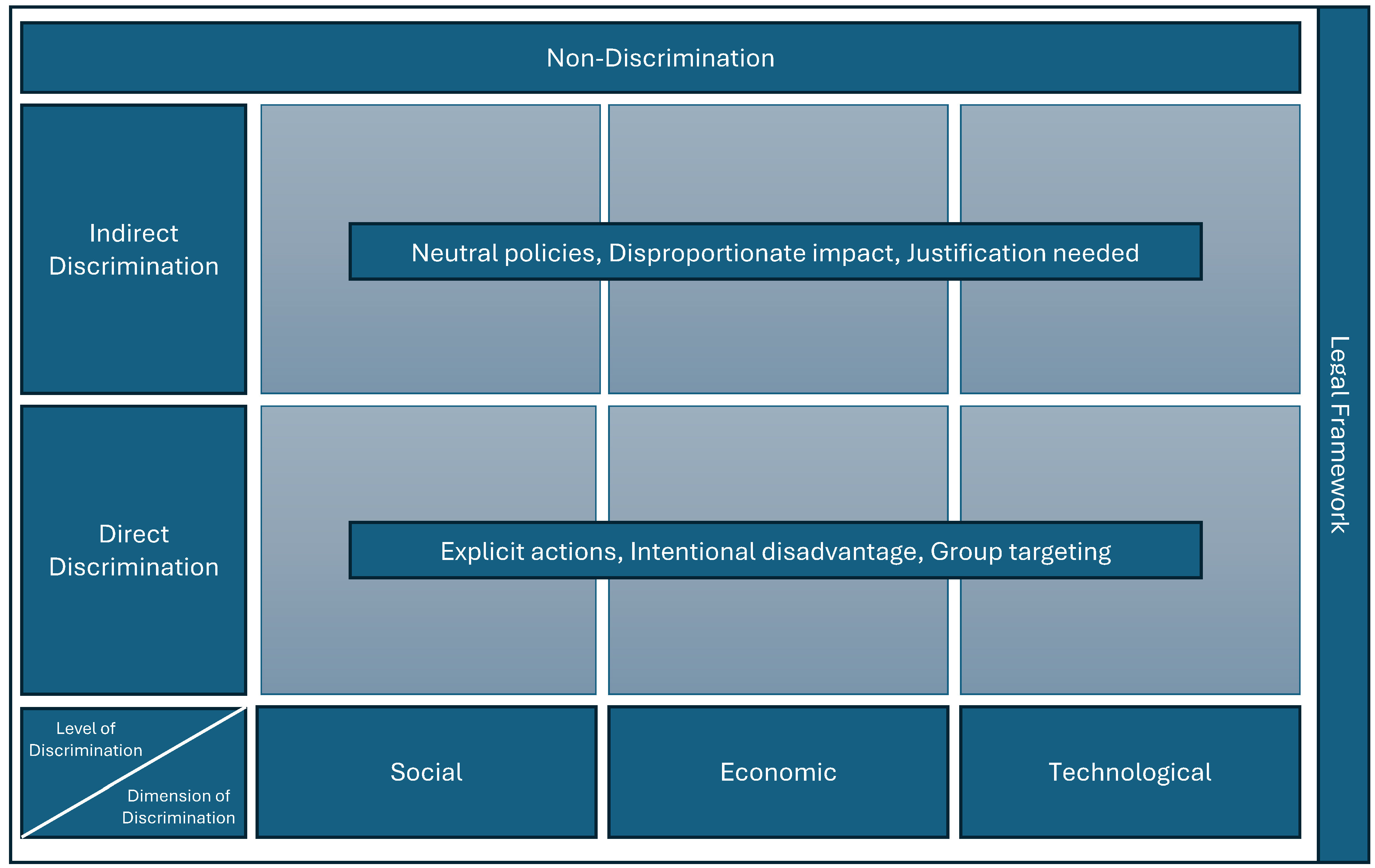
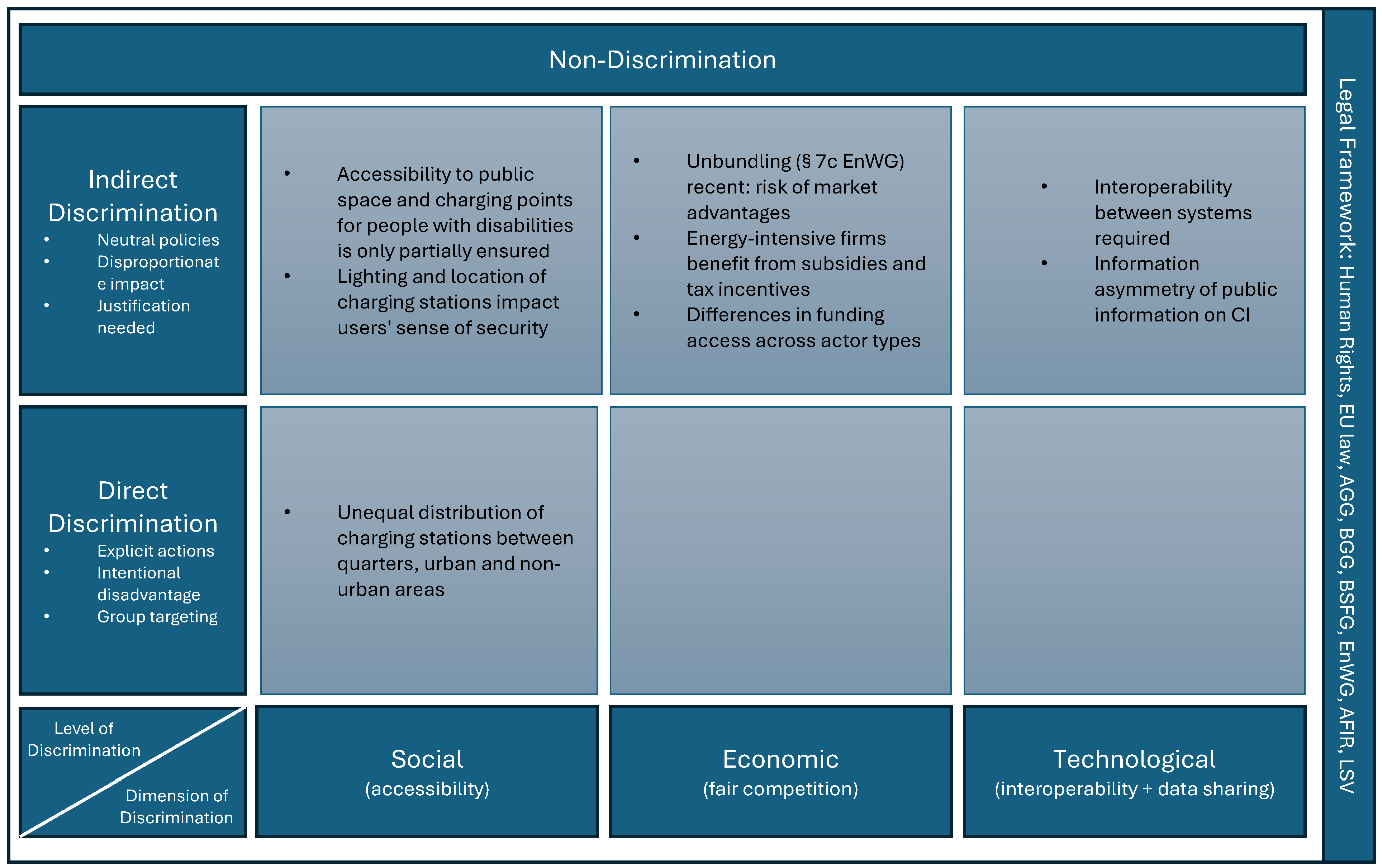
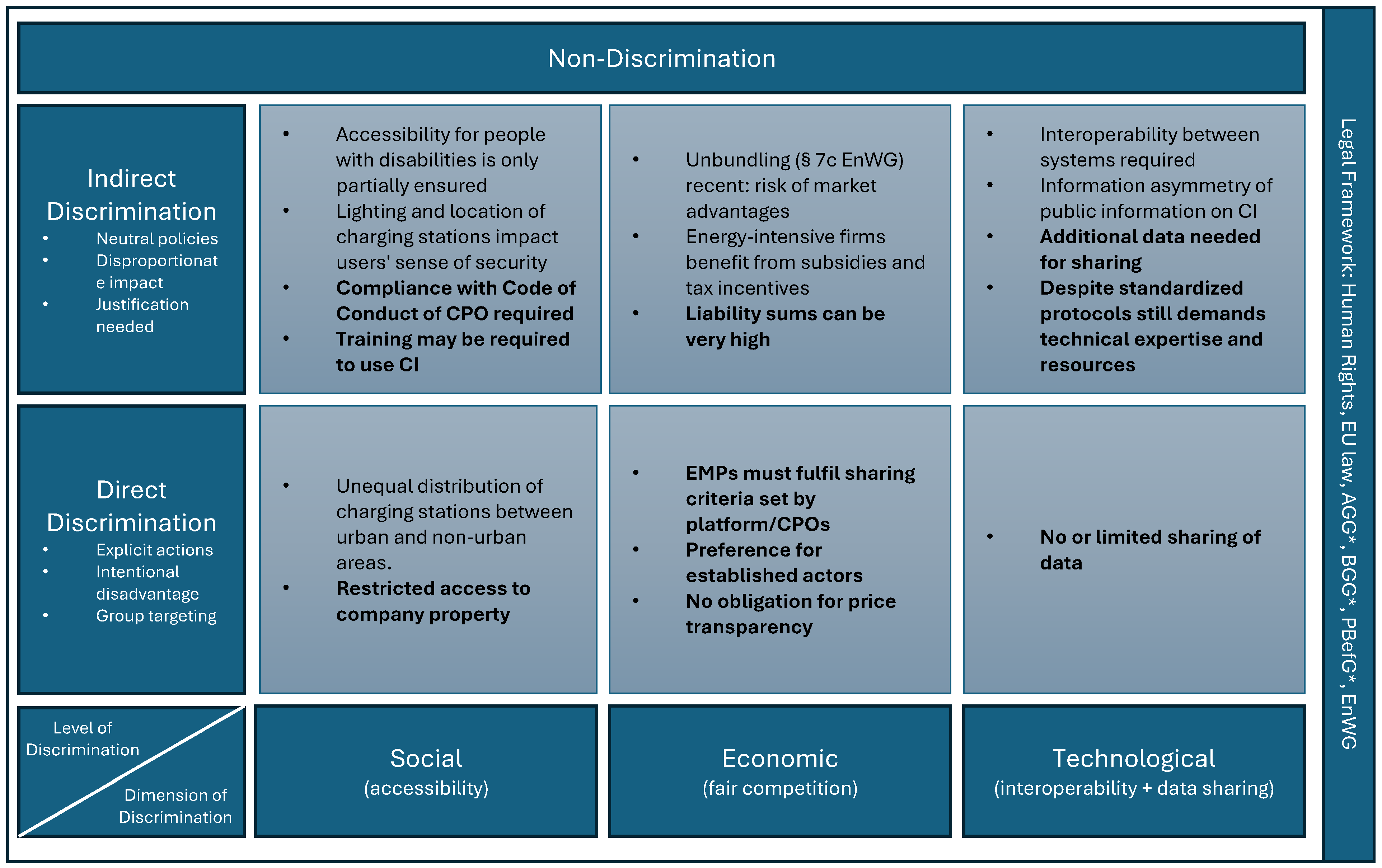
3.3. Operationalising a Non-Discrimination Matrix
- Social non-discrimination concerns the inclusivity of infrastructure for diverse user groups. Relevant indicators include physical accessibility (e.g., barrier-free design, access restrictions), user interface design (clarity, language availability), procedural simplicity (e.g., low-complexity authentication steps), and the suitability of infrastructure locations for users with diverse mobility needs, taking into account factors such as spatial deployment, lighting, and whether users are distinguished by location (e.g., urban, rural), gender, age, or health status.
- Economic non-discrimination captures fairness in pricing structures and financial accessibility. Indicators include price transparency, the availability of non-discriminatory tariff options, proportionality of costs (e.g., avoidance of excessive mark-ups for certain user categories), and the affordability of access across income groups or organisational roles, including funding and subsidies as well as market access (e.g., prevention of monopolies), additional costs, and resources.
- Technological non-discrimination refers to unbiased access enabled (or restricted) by technical artefacts and standards. Indicators include interoperability of charging and authentication systems, compatibility of hardware and software, data accessibility, and the avoidance of technology-specific exclusion (e.g., proprietary protocols or exclusive roaming arrangements).
3.4. Applying NDM to Public EVCI in Germany
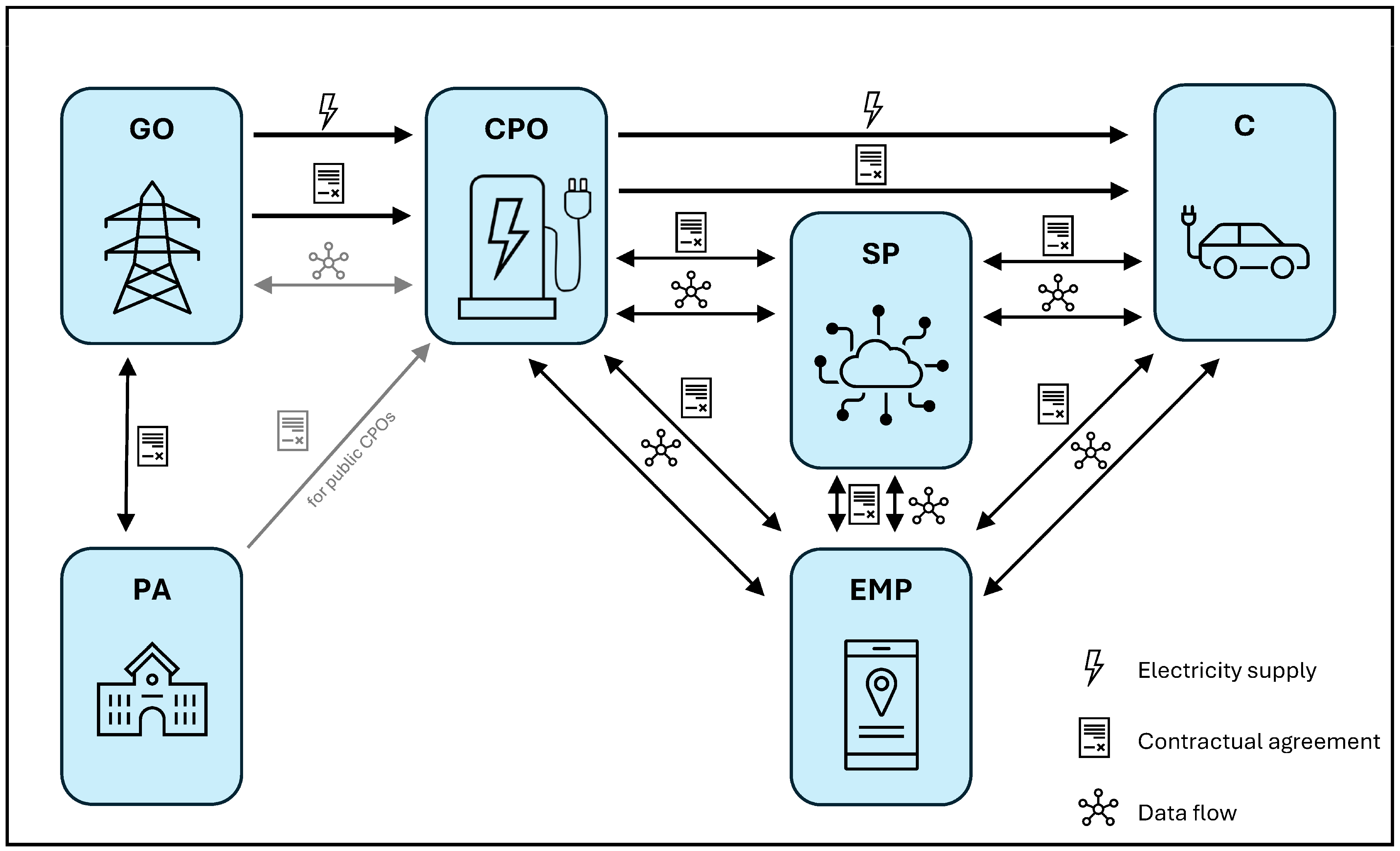
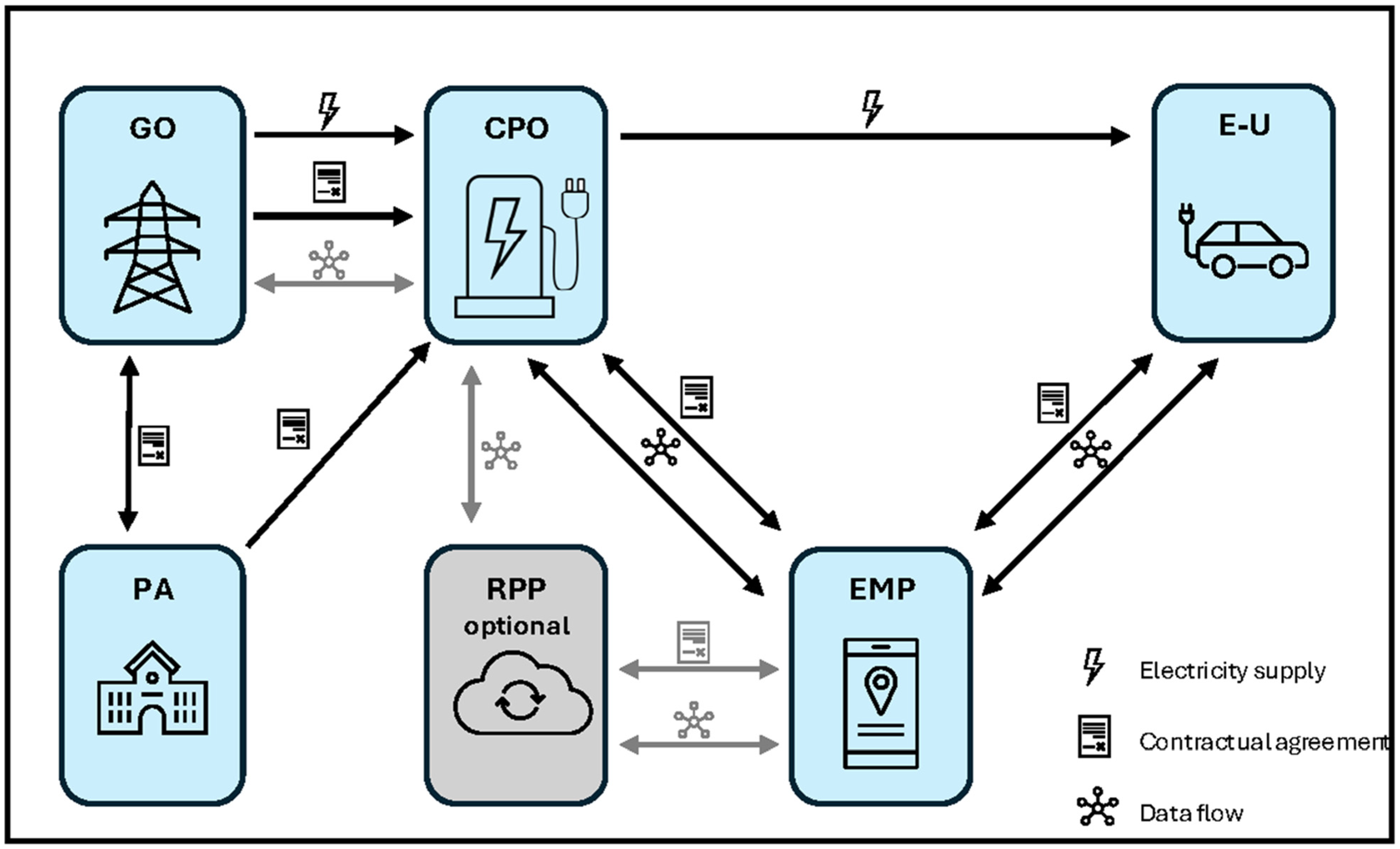
- Public authorities (PA) tender the planning, expansion, and operation of public charging infrastructure. At the municipal level, they award the concession [80] (§ 19) and determine who is permitted to operate the electricity distribution network.
- The grid operator (GO) provides the electrical energy required for EV charging. The operator delivers electricity to the charging stations based on contractual agreements, ensuring a consistent energy supply.
- The charging point operator (CPO) is responsible for the installation, operation, and maintenance of charging stations and manages the charging infrastructure. The CPO does not necessarily own the stations but ensures their functionality and reliability, and grants the EMP access to its charging points.
- The electro-mobility provider (EMP) acts as the user interface, offering services such as access cards or apps that enable EV users to locate and use charging stations. EMPs handle user billing and support, facilitating the overall charging experience.
- The roaming platform provider (RPP) (when separate) manages the data roaming and exchange necessary for the EMPs to provide their services.
- End-users (E-Us) utilise the services provided by the EMP and CPO to charge their electric vehicles. E-Us interact primarily through platforms or tools provided by the EMPs to access charging stations.
- Charging point distribution favours urban areas, putting low-income, peri-urban, and rural areas at a disadvantage [86];
- Public procurement and subsidisation—although justified in light of accelerating deployment—have led to a limited number of larger CPOs, constraining pricing and making market entry difficult [33];
- Private-sector charger growth outpaces government-subsidised rollout [87];
- Mandatory app use and contactless payment methods exclude non-smartphone users [88].
3.5. Applying NDM to Inter-Organisational EVCI Sharing in the Project FAMOUS
4. Discussion and Conclusions
Author Contributions
Funding
Institutional Review Board Statement
Informed Consent Statement
Data Availability Statement
Acknowledgments
Conflicts of Interest
References
- Fernández, R.A. Method for assessing the environmental benefit of road transport electrification and its influence on greenhouse gas inventories. J. Clean. Prod. 2019, 218, 476–485. [Google Scholar] [CrossRef]
- Jochem, P.; Doll, C.; Fichtner, W. External costs of electric vehicles. Transp. Res. Part D Transp. Environ. 2016, 42, 60–76. [Google Scholar] [CrossRef]
- van Vliet, O.; Brouwer, A.S.; Kuramochi, T.; van den Broek, M.; Faaij, A. Energy use, cost and CO2 emissions of electric cars. J. Power Sources 2011, 196, 2298–2310. [Google Scholar] [CrossRef]
- Friesen, I.; Trunk, M.; Kiriazis, T.; Vogl, S. Grid Integration of Heavy Commercial Vehicles—An Impulse Paper by the Accompanying Research Elektro-Mobil. 2024. Available online: https://consulting.tuv.com/wp-content/uploads/Impulse-Paper_Grid-Integration-of-Electrified-Commercial-Vehicles.pdf (accessed on 15 January 2026).
- He, Y.; Liu, Z.; Song, Z. Joint optimization of electric bus charging infrastructure, vehicle scheduling, and charging management. Transp. Res. Part D Transp. Environ. 2023, 117, 103653. [Google Scholar] [CrossRef]
- Fu, J.; Nåbo, A.; Bhatti, H.J. Locating charging infrastructure for freight transport using multiday travel data. Transp. Policy 2024, 152, 21–28. [Google Scholar] [CrossRef]
- Kin, B.; Hopman, M.; Quak, H. Different Charging Strategies for Electric Vehicle Fleets in Urban Freight Transport. Sustainability 2021, 13, 13080. [Google Scholar] [CrossRef]
- Liu, M.; He, S.Y. E-taxi drivers’ charging behavior: Effects of the built environment, temporal factors, and ridership. J. Transp. Geogr. 2025, 123, 104118. [Google Scholar] [CrossRef]
- Shahraki, N.; Cai, H.; Turkay, M.; Xu, M. Optimal locations of electric public charging stations using real world vehicle travel patterns. Transp. Res. Part D Transp. Environ. 2015, 41, 165–176. [Google Scholar] [CrossRef]
- Kanger, L.; Geels, F.W.; Sovacool, B.; Schot, J. Technological diffusion as a process of societal embedding: Lessons from historical automobile transitions for future electric mobility. Transp. Res. Part D Transp. Environ. 2019, 71, 47–66. [Google Scholar] [CrossRef]
- Hu, H.; Zhao, D.; Zockaie, A.; Ghamami, M. Growth patterns and factors of electric vehicle charging infrastructure for sustainable development. Sustain. Cities Soc. 2025, 126, 106417. [Google Scholar] [CrossRef]
- La Monaca, S.; Ryan, L. The state of play in electric vehicle charging services—A review of infrastructure provision, players, and policies. Renew. Sustain. Energy Rev. 2022, 154, 111733. [Google Scholar] [CrossRef]
- Unterluggauer, T.; Rich, J.; Andersen, P.B.; Hashemi, S. Electric vehicle charging infrastructure planning for integrated transportation and power distribution networks: A review. eTransportation 2022, 12, 100163. [Google Scholar] [CrossRef]
- Newell, P.; Mulvaney, D. The political economy of the ‘just transition’. Geogr. J. 2013, 179, 132–140. [Google Scholar] [CrossRef]
- Jenkins, K.; Sovacool, B.K.; McCauley, D. Humanizing sociotechnical transitions through energy justice: An ethical framework for global transformative change. Energy Policy 2018, 117, 66–74. [Google Scholar] [CrossRef]
- Sareen, S.; Haarstad, H. Bridging socio-technical and justice aspects of sustainable energy transitions. Appl. Energy 2018, 228, 624–632. [Google Scholar] [CrossRef]
- Gerdes, D.; Kirchner, M.; Plöchl, J.; Scherhaufer, P.; Spittler, N.; Klingler, M. Beyond Watts and Wheels: A review of conceptualisations of justice and equity in energy and mobility transition research. SocArXiv 2024. [Google Scholar] [CrossRef]
- Ortar, N.; Flipo, A.; Lejoux, P. Towards a new formulation of mobility transition? A contribution to the debate on just transition in rural areas through the case of France. Nor. Geogr. Tidsskr.-Nor. J. Geogr. 2024, 78, 258–269. [Google Scholar] [CrossRef]
- Loorbach, D.; Schwanen, T.; Doody, B.J.; Arnfalk, P.; Langeland, O.; Farstad, E. Transition governance for just, sustainable urban mobility: An experimental approach from Rotterdam, the Netherlands. J. Urban Mobil. 2021, 1, 100009. [Google Scholar] [CrossRef]
- Prause, L.; Dietz, K. Just mobility futures: Challenges for e-mobility transitions from a global perspective. Futures 2022, 141, 102987. [Google Scholar] [CrossRef]
- Soares, B.O.; Glaser, M. Beyond infrastructure: Unpacking the complexity of exclusion and implications for just mobility transitions. J. Transp. Geogr. 2025, 126, 104202. [Google Scholar] [CrossRef]
- Wang, X.; Lo, K. Just transition: A conceptual review. Energy Res. Soc. Sci. 2021, 82, 102291. [Google Scholar] [CrossRef]
- Hu, X.; Yang, Z.; Sun, J.; Zhang, Y. Sharing economy of electric vehicle private charge posts. Transp. Res. Part B-Methodol. 2021, 152, 258–275. [Google Scholar] [CrossRef]
- Cai, J.; Wang, Y. Insights for Sustainable Urban Transport via Private Charging Pile Sharing in the Electric Vehicle Sector. Transp. Res. Rec. 2024, 2679, 1134–1169. [Google Scholar] [CrossRef]
- Huang, X.-Y.; Mao, Z.; Lin, Y.; Shi, Q.; Liu, F.; Zhou, F. Sharing or privacy for private electric vehicle charging piles? Evidence from Chongqing. Technol. Forecast. Soc. Change 2024, 203, 123350. [Google Scholar] [CrossRef]
- Melander, L.A.; Wallström, H. The benefits of green horizontal networks: Lessons learned from sharing charging infrastructure for electric freight vehicles. Bus. Strategy Environ. 2022, 32, 1835–1846. [Google Scholar] [CrossRef]
- Xu, G.; Chen, J.; Yu, D.Z.; Liu, Y. Evolutionary Game Analysis of Electric Vehicle Distribution Entities with Shared Charging Facilities. Mathematics 2024, 12, 3413. [Google Scholar] [CrossRef]
- Trinko, D.A.; Horesh, N.; Porter, E.B.; Dunckley, J.F.; Miller, E.; Bradley, T.H. Transportation and electricity systems integration via electric vehicle charging-as-a-service: A review of techno-economic and societal benefits. Renew. Sustain. Energy Rev. 2023, 175, 113180. [Google Scholar] [CrossRef]
- Erfani, A.; Cui, Q.; DeCorla-Souza, P. Crowdfunding for Equitable EV Charging Infrastructure. arXiv 2024, arXiv:2406.14295. [Google Scholar] [CrossRef]
- Carlton, G.J.; Sultana, S. Electric vehicle charging equity and accessibility: A comprehensive United States policy analysis. Transp. Res. Part D Transp. Environ. 2024, 129, 104123. [Google Scholar] [CrossRef]
- De Vos, J. Towards truly sustainable mobility. Transp. Res. Interdiscip. Perspect. 2024, 24, 101039. [Google Scholar] [CrossRef]
- Pfeiffer, Z.; Appel, A.; Weber, A.; Al Sabouni, A.; Vladova, G. Technologies, Standards and Business Models for Grid-Friendly Asset Sharing of Charging Infrastructure: Factsheet für das Projekt FAMOUS. 2024. Available online: https://www.ikem.de/publikation/factsheet-fuer-das-projekt-famous/ (accessed on 15 January 2026).
- BKartA (Bundeskartellamt). Sektoruntersuchung zur Bereitstellung und Vermarktung Öffentlich Zugänglicher Ladeinfrastruktur für Elektrofahrzeuge. Abschlussbericht. 1 October 2024. Available online: https://www.bundeskartellamt.de/SharedDocs/Publikation/DE/Sektoruntersuchungen/Sektoruntersuchung_Ladesaeulen_Abschlussbericht.html?nn=48888 (accessed on 15 January 2026).
- BKartA (Bundeskartellamt). Wettbewerbsschädliche Strukturen Beim Angebot von Ladestrom—Abschlussbericht der Sektoruntersuchung zur E-Ladeinfrastruktur. Pressemitteilung vom 1 October 2024. Available online: https://www.bundeskartellamt.de/SharedDocs/Meldung/DE/Pressemitteilungen/2024/01_10_2024_Ladesaeulen.html (accessed on 15 January 2026).
- Meinert, M.; Vladova, G. Entwicklung einer Sharing-Plattform zur koordinierten Auslastungssteigerung von betrieblicher Ladeinfrastruktur. In Hamburger Energieinfrastruktur—Anforderungen, Problemstellungen und Lösungsansätze; Elektrische Energiesysteme; Helmut-Schmidt-Universität Hamburg: Hamburg, Germany, 2025; pp. 13–17. [Google Scholar] [CrossRef]
- Mayring, P. Qualitative Content Analysis: Theoretical Foundation, Basic Procedures and Software Solutions. 2014. Available online: https://www.ssoar.info/ssoar/handle/document/39517 (accessed on 15 January 2026).
- Moeckli, D. Equality and non-discrimination. In Equality and Non-Discrimination Under International Law; Routledge: Oxfordshire, UK, 2017; pp. 53–70. [Google Scholar]
- Edwards, A.; Vandenhole, W. Non-discrimination and equality in the view of the UN human rights treaty bodies. Hum. Rights Law Rev. 2007, 7, 267–269. [Google Scholar] [CrossRef]
- Krueger, A.E. The Economics of Discrimination. J. Political Econ. 1963, 71, 481–486. [Google Scholar] [CrossRef]
- Armstrong, M. Price Discrimination; Department of Economics, University College London: London, UK, 2006. [Google Scholar]
- Small, M.L.; Pager, D. Sociological perspectives on racial discrimination. J. Econ. Perspect. 2020, 34, 49–67. [Google Scholar] [CrossRef]
- Henrard, K. Duties of Reasonable Accommodation in Relation to Religion and the European Court of Human Rights: A Closer Look at the Prohibition of Discrimination, the Freedom of Religion and Related Duties of State Neutrality. Erasmus Law Rev. 2012, 5, 59–78. [Google Scholar] [CrossRef]
- Estlund, C. Freedom of expression in the workplace and the problem of discriminatory harassment. Tex. Law Rev. 1997, 75, 687–723. [Google Scholar]
- Benjamin, R. (Ed.) Introduction: Discriminatory design, liberating imagination. In Captivating Technology: Race, Carceral Technoscience, and Liberatory Imagination in Everyday Life; Duke University Press: Durham, NC, USA, 2019; pp. 1–22. [Google Scholar] [CrossRef]
- Yüksel, S. New Technologies through a Human Rights Lens: Reflecting on Personal Autonomy and Non-Discrimination. J. Penal Law Criminol. 2022, 10, 281–305. [Google Scholar] [CrossRef]
- Cohen, J.E. Technologies of discrimination. In Teaching Race in Perilous Times; Cohen, J.E., Raynor, S.D., Mack, D.A., Eds.; State University of New York Press: Albany, NY, USA, 2021. [Google Scholar]
- Hagendorff, T. From privacy to anti-discrimination in times of machine learning. Ethics Inf. Technol. 2019, 21, 331–343. [Google Scholar] [CrossRef]
- Lee, J.H.; Chakraborty, D.; Hardman, S.J.; Tal, G. Exploring electric vehicle charging patterns: Mixed usage of charging infrastructure. Transp. Res. Part D Transp. Environ. 2020, 79, 102249. [Google Scholar] [CrossRef]
- Csillak, K.; Kamenz, S. Electric Charging Infrastructure and Gender Equality: An Overview for USER-CHI (H2020 Project). In Open Research Europe 3/47. 2023. Available online: https://open-research-europe.ec.europa.eu/articles/3-47 (accessed on 15 January 2026).
- Russo, S.; Spiller, B.; Wilwerding, R. Equity in Electric Vehicle Charging Infrastructure. Resour. Future 2024, 24-14, 1–23. Available online: https://media.rff.org/documents/WP_24-14.pdf (accessed on 15 January 2026).
- Selting, M.; Auer, P.; Barden, B.; Bergmann, J.; Couper-Kuhlen, E.; Günther, S.; Meier, C.; Quasthoff, U.; Schlobinski, P.; Uhmann, S. Gesprächsanalytisches Transkriptionssystem (GAT). 1998. Available online: https://www.uni-muenster.de/imperia/md/content/germanistik/lehrende/guenthner_s/gat.pdf (accessed on 12 October 2018).
- AGG. Allgemeines Gleichbehandlungsgesetz vom 14. August 2006 (BGBl. I S. 1897), das Zuletzt Durch Artikel 15 des Gesetzes vom 22. Dezember 2023 (BGBl. 2023 I Nr. 414) Geändert Worden Ist. 2023. Available online: https://dejure.org/gesetze/AGG (accessed on 15 January 2026).
- UDHR. UN GAOR Res. 217 (III). International Bill of Human Rights. A Universal Declaration of Human Rights Adopted 10 December 1948, 183th plen. mtg. 1948. Available online: https://www.un.org/sites/un2.un.org/files/2021/03/udhr.pdf (accessed on 15 January 2026).
- Osin, N.; Porat, D. Legislating Against Discrimination: An International Survey of Anti-Discrimination Norms; Martinus Nijhoff Publishers: Leiden, The Netherlands, 2005. [Google Scholar]
- Roberts, C.; Davies, E.; Jupp, T. Language and Discrimination, 1st ed.; Routledge: Oxfordshire, UK, 1993. [Google Scholar] [CrossRef]
- Williamson, T. Identity and Discrimination: Reissued and Updated Edition; Blackwell Publishing: Hoboken, NJ, USA, 2013. [Google Scholar]
- Stokey, N.L. Intertemporal price discrimination. Q. J. Econ. 1979, 93, 355–371. [Google Scholar] [CrossRef]
- Varian, H.R. Chapter 10: Price discrimination. In Handbook of Industrial Organization; Elsevier: Amsterdam, The Netherlands, 1989; Volume 1, pp. 597–654. [Google Scholar] [CrossRef]
- Becker, G.S. The Economics of Discrimination; University of Chicago Press: Chicago, IL, USA, 1971. [Google Scholar]
- Goldberg, S.B. Discrimination by comparison. Yale Law J. 2011, 120, 690–977. [Google Scholar]
- Wang, S. Discrimination and Classification: Applications to Discriminant Analysis (Honours Project). Ph.D. Thesis, Carleton University School of Mathematics and Statistics, Ottawa, ON, Canada, 2020. Available online: https://carleton.ca/math/wp-content/uploads/Shiying-Wang-Honours-Project.pdf (accessed on 15 January 2026).
- Williams, D.R.; Lawrence, J.A.; Davis, B.A.; Vu, C. Understanding how discrimination can affect health. Health Serv. Res. 2019, 54, 1374–1388. [Google Scholar] [CrossRef] [PubMed]
- Esses, V.M. Prejudice and discrimination toward immigrants. Annu. Rev. Psychol. 2021, 72, 503–531. [Google Scholar] [CrossRef] [PubMed]
- Gillis, T.B.; Spiess, J.L. Big Data and Discrimination. Univ. Chic. Law Rev. 2019, 86, 459–488. [Google Scholar]
- Lang, K.; Kahn-Lang Spitzer, A. Race discrimination: An economic perspective. J. Econ. Perspect. 2020, 34, 68–89. [Google Scholar] [CrossRef]
- Sovacool, B.K.; Martiskainen, M.; Hook, A.; Bake, L. Decarbonization and its discontents: A critical energy justice perspective on four low-carbon transitions. Clim. Change 2019, 155, 581–619. [Google Scholar] [CrossRef]
- Fredman, S. Discrimination Law, 3rd ed.; Oxford University Press: Oxford, UK, 2022. [Google Scholar]
- Leghari, M.A.; Wasiq, M.F.; Younes, J.; Hassan, B. Global legislation muzzling freedom of speech in the guise of cybersecurity. In Cybersecurity and Artificial Intelligence: Advanced Sciences and Technologies for Security Applications; Jahankhani, H., Bowen, G., Sharif, M.S., Hussien, O., Eds.; Springer: Berlin/Heidelberg, Germany, 2024; pp. 175–190. [Google Scholar] [CrossRef]
- Saunders, N. Security, digital border technologies, and immigration admissions: Challenges of and to non-discrimination, liberty and equality. Eur. J. Political Theory 2023, 24, 155–175. [Google Scholar] [CrossRef]
- Khattree, R.; Naik, D.N. Multivariate Data Reduction and Discrimination with SAS® Software; SAS Institute Inc.: Cary, NC, USA, 2020. [Google Scholar]
- Pedreshi, D.; Ruggieri, S.; Turini, F. Discrimination-aware data mining. In Proceedings of the 14th ACM SIGKDD International Conference on Knowledge Discovery and Data Mining; Association for Computing Machinery: New York, NY, USA, 2008; pp. 560–568. [Google Scholar] [CrossRef]
- Hajian, S.; Domingo-Ferrer, J. A methodology for direct and indirect discrimination prevention in data mining. IEEE Trans. Knowl. Data Eng. 2013, 25, 1445–1459. [Google Scholar] [CrossRef]
- Romei, A.; Ruggieri, S. A multidisciplinary survey on discrimination analysis. Knowl. Eng. Rev. 2014, 29, 582–638. [Google Scholar] [CrossRef]
- Lippert-Rasmussen, K. The badness of discrimination. Ethical Theory Moral Pract. 2006, 9, 167–185. [Google Scholar] [CrossRef]
- López, G. Discrimination. In The Stanford Encyclopedia of Philosophy; Zalta, E.N., Ed.; Metaphysics Research Lab, Stanford University: Stanford, CA, USA, 2020; Available online: https://plato.stanford.edu/entries/discrimination/ (accessed on 15 January 2026).
- Fibbi, R.; Midtbøen, A.H.; Simon, P. Theories of discrimination. In Migration and Discrimination; IMISCOE Research Series; Springer: Berlin/Heidelberg, Germany, 2021; pp. 21–41. [Google Scholar] [CrossRef]
- Khaitan, T. A Theory of Discrimination Law; Oxford University Press: Oxford, UK, 2015. [Google Scholar]
- Collins, P.H. Intersectionality’s definitional dilemmas. Annu. Rev. Sociol. 2015, 41, 1–20. [Google Scholar] [CrossRef]
- BMDV—Bundesministerium für Digitales und Verkehr. Masterplan Ladeinfrastruktur 2.0. Bundesministerium für Digitales und Verkehr. 2022. Available online: https://bmdv.bund.de/SharedDocs/DE/Anlage/G/masterplan-ladeinfrastruktur-2.pdf?__blob=publicationFile (accessed on 15 January 2026).
- EnWG. Energiewirtschaftsgesetz vom 7. Juli 2005 (BGBl. I S. 1970, 3621), das Zuletzt Durch Artikel 5 des Gesetzes vom 29. März 2026 (BGBl. 2026 I Nr. 84) Geändert Worden Ist. 2026. Available online: https://www.gesetze-im-internet.de/enwg_2005/BJNR197010005.html (accessed on 1 April 2026).
- DKE—Deutsche Kommission Elektrotechnik Elektronik Informationstechnik in DIN und VDE. Technischer Leitfaden Ladeinfrastruktur Elektromobilität—Version 4.1; VDE: Frankfurt am Main, Germany, 2023; Available online: https://www.vde.com/resource/blob/988408/87ed1f99814536d66c99797a4545ad5d/technischer-leitfaden-ladeinfrastruktur-elektromobilitaet---version-4-data.pdf (accessed on 15 January 2026).
- AFIR. Regulation (EU) 2023/1804 of the European Parliament and of the Council of 13 September 2023 on the Deployment of Alternative Fuels Infrastructure, and Repealing Directive 2014/94/EU. 2023. Available online: https://eur-lex.europa.eu/legal-content/EN/TXT/PDF/?uri=CELEX:32023R1804 (accessed on 15 January 2026).
- LSV. Ladesäulenverordnung vom 9. März 2016 (BGBl. I S. 457), die Zuletzt Durch Artikel 1 der Verordnung vom 17. Juni 2023 (BGBl. 2023 I Nr. 156) Geändert Worden ist. 2023. Available online: https://www.recht.bund.de/eli/bund/bgbl-1/2023/156 (accessed on 15 January 2026).
- BDEW—Bundesverband der Energie- und Wasserwirtschaft e.V. Elektromobilität Definition der Ladeinfrastruktur Marktrollen. Published 8 October 2020. Available online: https://www.bdew.de/media/documents/201008_PG-LIS_Definitionen_Marktrollen_neu.pdf (accessed on 15 January 2026).
- Bundesnetzagentur. E-Mobilität: Öffentliche Ladeinfrastruktur. 1 February 2025. Available online: https://www.bundesnetzagentur.de/DE/Fachthemen/ElektrizitaetundGas/E-Mobilitaet/start.html (accessed on 15 January 2026).
- Hopkins, E.C.; Potoglou, D.; Orford, S.; Cipcigan, L. Can the equitable roll out of electric vehicle charging infrastructure be achieved? Renew. Sustain. Energy Rev. 2023, 182, 113398. [Google Scholar] [CrossRef]
- NLL—Nationale Leitstelle Ladeinfrastruktur, NOW GmbH (Hrsg.). ö-LIS-Report: Bestand und Entwicklung der Öffentlich Zugänglichen Ladeinfrastruktur in Deutschland, December 2024–February 2025; Available online: https://nationale-leitstelle.de/wp-content/uploads/2025/03/oelis-report-2024-dez-2025-feb.pdf (accessed on 15 January 2026).
- Alyavina, E.; Nikitas, A.; Njoya, E.T. Mobility as a service (MaaS): A thematic map of challenges and opportunities. Res. Transp. Bus. Manag. 2022, 43, 100783. [Google Scholar] [CrossRef]
- BGG. Behindertengleichstellungsgesetz vom 27 April 2002 (BGBl. I S. 1467, 1468), das Zuletzt Durch Artikel 7 des Gesetzes vom 23 May 2022 (BGBl. I S. 760) Geändert Worden Ist. 2022. Available online: https://www.gesetze-im-internet.de/bgg/BJNR146800002.html (accessed on 15 January 2026).
- PbefG. Personenbeförderungsgesetz in der Fassung der Bekanntmachung vom 8 August 1990 (BGBl. I S. 1690), das Zuletzt Durch Artikel 2 des Gesetzes vom 23 February 2026 (BGBl. 2026 I Nr. 47) Geändert Worden Ist. Available online: https://www.gesetze-im-internet.de/pbefg/BJNR002410961.html (accessed on 15 March 2026).
- BFSG. Barrierefreiheitsstärkungsgesetz vom 16. Juli 2021 (BGBl. I S. 2970), das Zuletzt Durch Artikel 32 des Gesetzes vom 6. Mai 2024 (BGBl. 2024 I Nr. 149) Geändert Worden Ist. 2024. Available online: https://www.gesetze-im-internet.de/bfsg/BJNR297010021.html (accessed on 15 January 2026).
- Qian, X.; Gazmeh, H.; Small, M.L.; Wang, Q.; Guo, Y. The accessibility and inaccessibility of urban public charging station. Res. Sq. 2025; preprint. [CrossRef]
- Hardinghaus, M.; Blümel, H.; Seidel, C. Charging infrastructure implementation for EVs—The case of Berlin. Transp. Res. Procedia 2016, 14, 2594–2603. [Google Scholar] [CrossRef]
- Bhatt, R.; Giang, A.; Javed, B.; Kandlikar, M. Equitable charging infrastructure for electric vehicles: Access and experience. Prog. Energy 2024, 6, 033006. [Google Scholar] [CrossRef]
- Forschungsstelle für Energiewirtschaft e.V. (FfE). Beitragsreihe Elektromobilität: Privates und öffentliches Laden; Fraunhofer UMSICHT: Oberhausen, Germany, 2020; Available online: https://www.ffe.de/veroeffentlichungen/beitragsreihe-elektromobilitaet-privates-und-oeffentliches-laden/ (accessed on 15 January 2026).


| ID | Interview Partner | Role in FAMOUS | Actor Group in EVCI |
|---|---|---|---|
| I | Public–private company | Partner | Project manager |
| II | Stationary car-sharing provider | Partner | CPO/potential user |
| III | Service and software provider | Partner | EMP |
| IV | Industry association | Associated partner | Interest group |
| V | Energy supply company, service provider & grid operator | Associated partner | CPO |
| VI | Urban electricity supplier | Partner | FAMOUS platform provider |
| VII | Urban electricity supplier | Partner | FAMOUS platform provider |
| VIII | Urban electricity supplier | Partner | FAMOUS platform provider |
| IX | Energy supply company | Associated partner | Energy supplier |
| X | Public transport operator | Associated partner | CPO/potential user |
| XI | Shared mobility operator | Associated partner | Potential CPO/potential user |
| XII | Shared mobility operator | Associated partner | Potential CPO/potential user |
| XIII | Park & ride operator | Associated partner | Potential location operator/potential CPO |
| XIV | Public transport provider | Associated partner | Potential CPO/potential user |
| XV | Private company | Extern | Owner of charging infrastructure/potential CPO |
| XVI | Grid planning engineering firm | Extern | Planning services |
| XVII | CPO | Extern | CPO for public charging |
| XVIII | Logistic service provider; parcel delivery service | Extern | Potential user/CPO |
| XIX | Real estate company | Extern | Potential location partner/CPO |
| XX | Super market chain | Extern | Potential location partner |
| XXI | Taxi service provider | Extern | Potential user |
| XXII | Taxi service provider | Extern | Potential user |
| XXIII | Taxi service provider | Extern | Potential user |
| Actor Relationship | Level | Dimension | Core Discrimination/Non-Discrimination Risk | Evidence |
|---|---|---|---|---|
| PA–E-U | Direct | Social | Spatial concentration of chargers in dense, wealthy areas disadvantages low-income, peri-urban, and rural users. | Literature; interviews |
| PA–CPO | Indirect | Economic | Public tenders and subsidies favour large, established CPOs and constrain market entry. | Literature |
| PA–CPO | Indirect | Econ./Tech. | Tender conditions (throughput, green power) may exclude actors unable to meet specific criteria. | Literature |
| GO–CPO | Indirect | Econ./Tech. | Post-unbundling, former grid operators retain advantages (infrastructure, data, and local knowledge). | Literature |
| CPO–E-U | Indirect | Social | Insufficient physical accessibility and lighting affect safety. | Literature |
| CPO–E-U | Indirect | Technological | App-based access and digital interfaces exclude non-smartphone users despite ad hoc rules. | Literature |
| PA–Funding recipients | Indirect | Economic | Funding schemes may privilege public and administratively strong actors. | Literature |
| E-U–Charging location | Direct | Social | Longer charging times increase relevance of spatial proximity and amenities, potentially reinforcing mobility inequalities. | Literature; interviews |
| Actor Relationship | Level | Dimension | Core Discrimination/Non-Discrimination Risk | Evidence |
|---|---|---|---|---|
| CPO–Customer | Direct | Social | Restricted depot access, security rules, and physical barriers exclude non-affiliated users (legitimate constraints). | Interviews, Project Workshops |
| CPO–Customer | Direct | Social | Mandatory codes of conduct and training requirements favour larger organisations. | Interviews, Project Workshops |
| CPO–Customer | Indirect | Economic | High liability and insurance requirements disadvantage smaller customers. | Interviews, Project Workshops |
| SP–Customer | Indirect | Soc./Tech. | Platform visibility of access without shared “barrier-free” standard leaves accessibility ambiguous. | Interviews, Project Workshops |
| SP–EMP | Direct | Econ./Tech. | Platform participation criteria shaped by CPOs may reinforce asymmetries between EMPs. | Interviews, Project Workshops |
| SP–EMP | Indirect | Economic | Platform does not standardise tariffs, enabling price differentiation between customers. | Interviews, Project Workshops |
| SP–CPO/EMP | Indirect | Technological | Integration requires compatible IT, data sharing, and expertise, raising entry barriers. | Interviews, Project Workshops |
| CPO–CPO | Indirect | Economic | Early subsidies enable large/public CPOs to offer lower prices once sharing opens. | Interviews, Literature |
| SP–CPO/Customer | Indirect | Economic | Platform may commercialise formerly private assets, shifting value to intermediaries. | Literature |
| GO–SP/CPO | Indirect | Technological | Smart/bidirectional charging may increase data dependencies and coordination barriers. | Interviews |
| Customer–non-affiliated E-U | Direct & Indirect | Social | Inter-organisational sharing may exclude non-affiliated individuals by design. | Interviews |
Disclaimer/Publisher’s Note: The statements, opinions and data contained in all publications are solely those of the individual author(s) and contributor(s) and not of MDPI and/or the editor(s). MDPI and/or the editor(s) disclaim responsibility for any injury to people or property resulting from any ideas, methods, instructions or products referred to in the content. |
© 2026 by the authors. Licensee MDPI, Basel, Switzerland. This article is an open access article distributed under the terms and conditions of the Creative Commons Attribution (CC BY) license.
Share and Cite
Weber, A.; Appel, A.; Pfeiffer, Z. Exploring ‘(Non-)Discrimination’ in Charging Infrastructure Sharing. Sustainability 2026, 18, 5117. https://doi.org/10.3390/su18105117
Weber A, Appel A, Pfeiffer Z. Exploring ‘(Non-)Discrimination’ in Charging Infrastructure Sharing. Sustainability. 2026; 18(10):5117. https://doi.org/10.3390/su18105117
Chicago/Turabian StyleWeber, Annika, Alexandra Appel, and Zeno Pfeiffer. 2026. "Exploring ‘(Non-)Discrimination’ in Charging Infrastructure Sharing" Sustainability 18, no. 10: 5117. https://doi.org/10.3390/su18105117
APA StyleWeber, A., Appel, A., & Pfeiffer, Z. (2026). Exploring ‘(Non-)Discrimination’ in Charging Infrastructure Sharing. Sustainability, 18(10), 5117. https://doi.org/10.3390/su18105117