Article

Measuring Social Attachment to Urban Greening: Validation of the Urban Green Attachment Scale for Project-Level Sustainability Evaluation


INESAN (Institute for Evaluations and Social Analyses), Sokolovská 351/25, 18600 Prague, Czech Republic
Sustainability 2026, 18(10), 5112; https://doi.org/10.3390/su18105112
Submission received: 2 April 2026 / Revised: 15 May 2026 / Accepted: 17 May 2026 / Published: 19 May 2026

Abstract

Background/Objectives: Although urban greening interventions are increasingly implemented to improve livability, environmental quality, and adaptation capacity in cities, their evaluation still predominantly relies on physical outputs rather than validated, resident-centered outcomes. This study examined whether the five-item attachment dimension of the Urban Green Attachment Scale (UGAS) can reliably indicate the social integration of newly introduced greenery in an SDG 11-oriented evaluation context. The present adaptation of the UGAS captures the perceived importance of the planting, its contribution to well-being, anticipated loss, willingness to protect it, and aesthetic appreciation. Methods: Data were collected through two independent face-to-face surveys conducted among residents of the same housing estate shortly after a greening intervention in May 2025 (n = 150) and September 2025 (n = 191). The first sample was used for exploratory factor analysis (EFA) and the second for confirmatory factor analysis (CFA). Reliability was assessed using Cronbach’s α and McDonald’s ω; inter-item associations were estimated using Kendall’s tau-b; and construct validity was examined through known-groups comparisons with theoretically relevant appraisals and stewardship-related indicators. Results: The adapted UGAS demonstrated high internal consistency, low floor and ceiling effects, and moderate to strong inter-item associations. Exploratory factor analysis supported a unidimensional solution with high loadings and 65.7% explained variance, and confirmatory factor analysis corroborated this structure after minor, theory-guided localized refinements. Higher UGAS scores were consistently observed among residents who reported stronger calming and home-related effects, perceived healthier local conditions, expressed willingness to help care for the plants, and demonstrated a readiness to cooperate in improving the area. Conclusions: The results support the five-item UGAS attachment score as a compact, psychometrically adequate measure of residents’ attachment to newly planted urban greenery. Rather than replacing official SDG indicators, the UGAS can complement them at the project level by determining if urban greening becomes socially meaningful and accepted and if it supports stewardship. In this sense, UGAS offers municipalities a practical tool for linking physical greening outputs with resident-centered outcomes relevant to inclusive public spaces, participatory urban development, and the long-term social durability of urban greening interventions.

1. Introduction

Addressing the challenges of climate adaptation, cities are turning to urban green infrastructure in the form of orchards, parks, or edible plantings [1]. There is already empirical evidence linking exposure to green environments with reduced stress [2,3], increased opportunities for physical activity [4,5,6], enhanced social cohesion [3,7,8], improved environmental conditions, and other health and social outcomes [1,9,10,11]. These effects and long-term viability of greening interventions are only possible if residents perceive these interventions as valuable [12], legitimate [13], and worth caring for [14]. This is especially true in dense urban areas, where greenery is embedded in everyday routines and can generate not only benefits but also perceived burdens, such as safety concerns, maintenance demands, or contested use [15]. Although urban greening interventions are increasingly justified in terms of climate adaptation, heat mitigation, health, and livability, their evaluation still often emphasizes implementation outputs, such as the number of trees planted, area covered, or maintenance inputs. Such indicators are necessary, but they are insufficient for understanding whether interventions become socially embedded and therefore sustainable over time. In the context of SDG 11, especially targets 11.3 (participatory and inclusive urbanization), 11.7 (access to safe, inclusive and accessible green/public spaces), and 11.B (integrated policies for climate adaptation and resilience), there is a need for validated indicators that measure resident-centered outcomes relevant to inclusive public space, participatory urban development, and climate resilience. A key missing dimension is whether residents develop meaningful bonds with newly introduced greenery and are willing to accept, protect, and co-sustain it.
This manuscript contributes to outcome-oriented SDG 11 evaluation by validating a resident-centered indicator for assessing the social outcomes of urban greening interventions. It develops evidence for a compact key performance indicator (KPI) that measures acceptance, perceived benefit, and stewardship-oriented attachment in climate-resilient public-space interventions. Outcome-oriented smart city governance increasingly depends on indicators that make project performance comparable, auditable, and useful for decision-making. While generic place-attachment scales provide an essential theoretical foundation, they are not entirely sufficient for evaluating newly implemented urban greening interventions. Many established instruments were developed for neighborhoods, recreational destinations, or relatively stable environmental settings. However, intervention-oriented greening evaluation requires measures that are sensitive to recently introduced vegetation, project-specific acceptance, and early-stage stewardship orientations. In such contexts, municipal entities are not merely concerned with the general sentiment of individuals towards a particular location; rather, they are interested in ascertaining whether a specific greening initiative possesses sufficient significance to be embraced, supported, and integrated into individuals’ daily experiences within the designated space. This underscores the necessity for a concise, intervention-relevant, and psychometrically validated attachment measure to evaluate urban greening initiatives, particularly in densely populated residential areas where the same intervention may concurrently engender perceived benefits, maintenance expectations, and negotiated forms of everyday use.
In environmental psychology and urban studies, attachment is a key construct for understanding why some environments become meaningful enough to motivate protection, stewardship, and tolerance of trade-offs. In this respect, attachment is conceptualized as an emotional bond between people and places, complemented by cognitive and functional dimensions [16,17]. It is operationalized as place identity and dependence [18,19,20]. However, attachment involves more than simply liking people and places; it also involves a propensity to stay close, to miss it when absent, and to feel distress when it is threatened or lost. This distinguishes attachment from satisfaction, which typically identifies how people rate their environment [21]. Current studies offer multiple perspectives of attachment. For instance, Jorgensen and Stedman [22] treated their “sense of place” as an attitude consisting of affect (attachment), cognition (identity), and conation (dependence and intention to act). Psychometric studies have shown that identity and dependence can be empirically distinguished. Building on this, Raymond and colleagues [18] proposed a self–other–environment framework that adds nature bonding (emotional ties to the biophysical environment) and social bonding (ties to family, friends, and community). This framework emphasized that attachment is grounded in personal life, social relationships, and the physical features of settings. Other authors differentiated between affective and cognitive aspects: for example, Rollero and De Piccoli [21] conceptualized attachment as an emotional bond to the local environment and they defined place identification as a sense of belonging to the local environment. Their findings, along with those of Hidalgo and Hernández [17], suggested that these dimensions had different predictors. Importantly, highly attached residents described their neighborhoods as more pleasant, healthy, and safe compared with less attached residents. The findings also reinforced the idea that attachment represents both the emotional response to environmental qualities, and a perspective through which those qualities are perceived. In environmental sociology, attachment is understood as a social phenomenon and it is associated with higher levels of civic engagement [23], neighborhood involvement [18], and place-protective or pro-environmental behaviors [16,24].
Measurement approaches reflect this conceptual richness. Some studies relied on single item or generic place-attachment measures originally developed for leisure, tourism, or neighborhood settings. More elaborated instruments like the Williams and Vaske scale [20] employed Likert-type items that assessed emotional and functional aspects like “I am very attached to this place”, or “This is the best place for what I like to do”. Other instruments built on this approach by adding scale items on feeling at home or feeling rooted [25], social integration [26], perceived healthfulness and safety [27,28], and willingness to improve the place [9,29,30]. However, measuring attachment within the framework of urban greening interventions remained challenging, albeit a psychometrically sound measure is essential for municipalities and urban planners to monitor acceptance, identify barriers, and compare outcomes across sites and over time.
A recent contribution in this regard is the Urban Green Attachment Scale (UGAS). It was introduced by Haluza et al. [31] who operationalized residents’ emotional, cognitive, and behavioral relations to urban vegetation. UGAS was introduced as a practical tool that distinguishes between vertical and horizontal greenery using two parallel sets of items. The scale involves a positive attachment component, a negative-valence discontent component, and an availability component reflecting satisfaction with the urban green. Later, the UGAS was used to evaluate the intervention described elsewhere [32]. As part of the effort to gather feedback to the intervention in the form of newly established orchard, UGAS was administered, and its psychometric characteristics were evaluated.
Following the calls for metrics relevant to decision-making in smart cities and SDG-aligned governance, this study addresses the question of whether the UGAS score can serve as a valid project-level indicator of a socially important outcome of urban greening interventions. The question is whether the UGAS could be deployed as a standardized, low-burden tool within municipal evaluation frameworks to support benchmarking across interventions and inform communication, participation, and maintenance strategies. In this study, UGAS is not proposed as a substitute for the official global SDG 11 indicators. Rather, it is proposed as a complementary project-level social outcome measure that can enrich local monitoring. With regard to SDG 11.3, the attachment to newly introduced greenery can serve as an indicator of whether urban change is becoming socially embedded and acceptable within participatory and inclusive development processes. With regard to Sustainable Development Goal 11.7, the capacity of UGAS to facilitate the assessment of whether accessible green public space is experienced as meaningful, beneficial, and worth preserving by residents, rather than merely being physically present, is noteworthy. With regard to SDG 11.B, the repeated use of UGAS can inform the question of whether climate-adaptive greening interventions gain sufficient public legitimacy and stewardship potential to remain socially sustainable over time. In this sense, UGAS can be conceptualized as a resident-centered KPI that serves to complement physical and environmental metrics. It does so by capturing the social durability of urban greening interventions. To avoid overstating its role in the SDG monitoring framework, the UGAS should be understood as a localized, project-level supplementary indicator rather than as a replacement for or direct transformation of an official global SDG indicator. UGAS addresses the question of whether a specific greening intervention has become socially meaningful, accepted, and worth protecting from the perspective of the residents who encounter it in everyday life. In a municipal monitoring workflow, official SDG 11 indicators may constitute the first reporting layer, city-level greening and climate adaptation indicators the second layer, and UGAS the third, project-level layer. The UGAS score can be reported as a standardized, resident-centered outcome indicator. Therefore, this study pursued three objectives. First, it examined the dimensionality of the UGAS attachment items to determine whether a one-factor solution was supported in the new context. Second, it evaluated the fit of this structure in an independent sample. Third, it tested whether UGAS scores differentiated between groups defined by theoretically relevant appraisals and orientations; especially, perceived calming effect, feeling of home, readiness to help with the care for the plantings, and overall satisfaction with the residential area. These indicators are frequently discussed in the literature as correlates or consequences of place-based bonds in greening interventions, e.g., [9,28,29,33].

2. Materials and Methods

2.1. Participants and Procedures, Research Design

The study draws on two independent cross-sectional surveys of residents living in the housing estate in Hradec Králové, Czechia. These surveys were conducted in the aftermath of the implementation of a greening intervention. The urban landscape of the area under consideration is predominantly characterized by multi-story apartment blocks and shared open spaces between buildings. This context is important for interpreting the findings. Czech housing estates are high-density residential environments typically composed of multistory apartment buildings surrounded by shared semi-public open spaces and greenery. Many such estates were developed during the socialist period and still have municipal or semi-municipal maintenance arrangements, as well as a strong everyday dependence on common open spaces. In this context, newly planted greenery is not only an environmental intervention, but also a visible change to the immediate living environment of residents.
The greening intervention involved the introduction of newly planted trees and shrubs into these common residential spaces. The initial survey, administered in May 2025, yielded the dataset for the exploratory analyses (n = 150), while the subsequent survey, conducted in September 2025, served as an independent dataset for the confirmatory analyses (n = 191). Both surveys employed face-to-face interviews with residents performed directly within the study area, thereby ensuring that respondents evaluated greenery that constituted their everyday living environment.
The sampling strategy combined two elements: (1) stratified probability sampling across designated apartment blocks to ensure geographic coverage, and (2) convenience sampling, reflecting the household accessibility, availability, and willingness to participate. Therefore, the sample should be regarded as a stratified household intercept, as opposed to a fully probabilistic sample.
The Kish table was used to identify a single respondent from each dwelling who was then invited to participate in the study. In each dwelling that was contacted, the interviewers initially ascertained the list of all household members who met the study’s eligibility criteria. The subsequent step entailed the enumeration of eligible members, followed by the selection of the desired respondent through the utilization of the Kish table. This procedure was implemented to mitigate selection bias within the household and to ensure that the selection of participants did not rely solely on the availability or willingness of the most prominent household member. Substitution by another household member was not permitted once the target respondent had been identified.
During the first survey, a total of 267 residents were asked for participation; 158 of them agreed (i.e., the response rate according to AAPOR RR-5 reached 59%). Before the data analysis, eight cases were excluded for their incompleteness (i.e., missing UGAS items or missing covariates), yielding a final sample of 150 respondents. For the second survey an independent sample from the same residential area was recruited. In this second survey, 297 individuals were asked for cooperation and 203 of them agreed. Therefore, the AAPOR RR-5 response rate was 68%. The final sample used for CFA comprised 191 respondents when 12 cases were excluded due to item non-response in substantive variables; cases with missing responses on UGAS items were removed by listwise deletion [34,35,36]. Prior to each interview, appropriate procedures for obtaining informed consent were followed, including measures to ensure the confidential handling of the responses provided. No personally identifying data were collected in this study. Ethical approval was given by the INESAN Ethical Committee (IREBA/2025/425; 8 April 2025). Data collection procedures followed the principles of the Helsinki Declaration [37].

2.2. Translation of the Scale and Its Cognitive Testing

The items of the UGAS were translated from English into Czech and verified by back-translation [38,39]. Cognitive interviews (n = 12) were then conducted to test the understanding of item wording and identify possible barriers of information retrieval [40]. No substantive wording issues were identified but there were two changes involved. Firstly, to ensure contextual fit with the intervention, a minor terminology adaptation was introduced by replacing “trees” with “trees and shrubs” wherever appropriate. Secondly, although the original scale used a five-point response format, the present study administered the items on a four-point Likert-type scale (1 = strongly disagree to 4 = strongly agree) to simplify response processing and reduce midpoint overuse in the field setting [41,42]. The transition from the original five-point response format to a four-point format should be interpreted as a field adaptation of the Czech version, rather than as a redefinition of the underlying construct. The rationale was methodological in nature; it was reasonably hypothesized that the four-category format would reduce the undesirable overuse of the midpoint. The study validates the adapted response format; however, it does not establish strict score equivalence with the original five-point version. Therefore, the results should be interpreted primarily as the evidence of structural validity, reliability, and construct validity within the adapted version.

2.3. Measures

2.3.1. UGAS

Urban green attachment was assessed using the component of the UGAS focused on vertical green, i.e., trees and shrubs [31]. The original instrument operationalized the construct by two parallel eight-item subscales, one for vertical (trees) and the second for horizontal (green areas) urban green. In the original study, the set of items yielded a three-factor solution composed of (i) attachment, defined by positively valenced evaluative and affective items, (ii) discontent, defined by the two negatively valenced items, and (iii) availability, defined by one item on satisfaction with urban green.
The present study focused on validating the attachment dimension with respect to the trees and shrubs rather than administering both vertical and horizontal item sets. We used one set of the five indicators that defined the attachment factor in the original scale, i.e., importance, contribution to well-being, anticipated loss, protectiveness, and attractiveness. We deliberately excluded the original discontent and availability components. The discontent component relied heavily on reverse-coded, negatively framed content, which may have introduced method-related covariance [43,44]. The availability component was based on only one pair of items, which may be valuable for other research questions but it was out of the scope of this study aimed at scale validation [45]. Thus, in this paper, “UGAS” refers to the five-item attachment subset adapted from the original scale.

2.3.2. Indicators Used for Known-Groups Validity

This study assessed whether UGAS scores differed across groups defined by theoretically related appraisals and orientations [28]. The choice of indicators followed a set of seven topics comprising theoretically anchored manifestations of the place attachment. The selection of these indicators was grounded in existing theories about the affective, cognitive, and behavioral dimensions of place attachment.
First, we assessed whether the new vertical green, i.e., trees and shrubs, were experienced as psychologically beneficial using the statement “The planted trees and shrubs have a calming effect”. Emotional well-being and stress relief are often described as key psychological benefits [2,22] that such places provide for people. Empirically, attachment to local environments has been linked to positive affective evaluations [13], including lower perceived stress [46] and heightened restorative experiences [33].
Second, we measured whether the intervention contributed to residents’ sense of being at home using the statement “The planted trees and shrubs create a feeling of home”. Feeling of home is usual indicator of place attachment and is often used to distinguish attachment from mere satisfaction [19,47,48]. The feeling of home encompasses emotional safety and belonging to the given place. Higher endorsement indicates that residents have incorporated the greenery into their subjective home territory rather than viewing it as anonymous city infrastructure.
Third, perceived environmental benefits were assessed with the statement “The planted trees and shrubs create a healthier environment here”. Previous studies have shown that residents who were strongly attached to their neighborhood perceive it as healthy [5,27] and less polluted. The healthfulness item taps into how the intervention is integrated into residents’ cognitive evaluation of local environmental quality and bridges attachment with the broader ecosystem services discourse.
Fourth, we included indicators of protective concern and stewardship intentions. The item “Someone would damage the planted trees and shrubs...it would bother me/it would not bother me”, operationalizes the merit of attachment because it depicts distress over the actual or anticipated degradation of the object of attachment. Previous studies have shown that residents with strong attachment were more sensitive to incivilities and physical decline in their surroundings [9,17,22] and are more critical of behaviors that threaten their valued settings [26].
Fifth, the item “Would you be willing to help care for the planted trees and shrubs?” followed by response options “Yes/Maybe/No” assesses the conative dimension highlighted in models of place attachment, which was the willingness to invest effort in maintenance and care as an expression of nature bonding.
Sixth, to situate orchard-related attachment within residents’ relationship to their neighborhood, we also included two indicators of social context. Overall satisfaction with living in the neighborhood was measured by asking “How satisfied are you overall with living in this neighborhood?” with response options “Satisfied/Neither nor/Dissatisfied”. Although satisfaction and attachment are conceptually distinct, satisfaction is associated with affective and cognitive bonds to place [10,16] and therefore, high associations were expected.
Seventh, the item “I am willing to work with others to improve this place” indicates residents’ readiness for action. Local participation and civic engagement have repeatedly been identified as key behavioral correlates of place attachment [23,49,50] linking personal bonds to places with community-level social capital.

2.4. Data Analysis

The analysis followed a two-sample validation strategy when the first sample served for EFA, whereas the second sample was used for CFA. This approach aligns with standard psychometric practice, ensuring that the factor structure suggested by the exploratory analyses is tested on an independent dataset [51,52].
For both samples, descriptive statistics were computed at the item and scale levels, including data distribution, skewness, kurtosis, and floor/ceiling effects [53,54,55]. Internal consistency was assessed with Cronbach’s alpha (α) and McDonald’s omega (ω) [56,57,58,59,60]. Inter-item associations were estimated by Kendall’s tau-b, which is suitable for short ordinal items [61].
In the exploratory phase, sampling adequacy and factorability were evaluated by the Kaiser–Meyer–Olkin (KMO) measure and Bartlett’s test of sphericity [62]. Factor loadings and communalities were inspected for item adequacy [63,64]. Convergent validity was summarized using average variance extracted (AVE) and composite reliability (CR), which were computed from the standardized loadings [65]. One-factor extraction was conducted using principal axis factoring (PAF) whereas rotation was not relevant since we had only one-factor solution. Factor retention was based on the eigenvalue criterion, inspection of the scree plot, and parallel analysis. In the confirmatory phase, the hypothesized one-factor model was tested on the independent sample. Model fit was evaluated using absolute and incremental fit indices, including Bollen–Stine p-value, RMSEA, SRMR, CFI, TLI, NFI, and GFI [66]. These indices were reported for both the original and improved models [67]. Model refinements were implemented as localized adjustments aimed at addressing residual covariances not captured by the general attachment factor, while retaining the substantive one-factor interpretation [68,69].
Known-groups validity was assessed by comparing UGAS scores with relevant indicators. For ordered multi-category indicators, differences were tested by Jonckheere–Terpstra tests, and for binary indicators with exact Mann–Whitney U tests [70]. Effect sizes were reported as rank biserial r for Jonckheere–Terpstra tests and Cliff’s Delta for Mann–Whitney tests. For indicators with more than two ordered groups, significant differences were followed by Dunn’s post hoc pairwise comparisons with Bonferroni adjustment. The indicators used for known-groups validity were not considered equally external to UGAS. Instead, they were interpreted along a continuum of conceptual proximity. Some indicators, such as the “feeling of home” and concern about possible damage, were considered proximal convergent indicators because they are theoretically close to place attachment. These indicators are therefore useful for testing whether UGAS behaves consistently with similar constructs. Other indicators were considered more distal because they referred to either perceived environmental consequences of the intervention, such as a healthier environment, or behavioral and collective orientations, such as a willingness to help care for the greenery and a willingness to work with others to improve the area. Thus, the known-groups analysis was interpreted as evidence of nomological consistency rather than criterion validation.
All descriptive analyses, item analyses, EFA, Kendall’s tau-b correlations, and nonparametric group comparisons were performed in IBM SPSS Statistics, version 26 (IBM Corp., Armonk, NY, USA). Confirmatory factor analysis, bootstrap estimation, Bollen–Stine testing, and invariance analyses were performed in IBM SPSS AMOS 24.

3. Results

3.1. Study Samples

The distributions of key socio-demographic characteristics were comparable across both samples. Table 1 shows that men represented 40.0% of the EFA sample and 45.5% of the CFA sample. The age distributions were also comparable, as were the distributions of educational attainment. The age composition was similar in both samples with residents aged 60 and over comprising 26.0% and 25.1% in the first and second samples respectively, and those under 30 years old representing 24.0% and 25.7%. Highest achieved education was also similar across the two samples, with the most prevalent being secondary education (51.3% and 55.5%), followed by vocational education (22.7% and 22.5%), and university education (21.3% and 19.4%).

3.2. Item Distributions and Internal Consistency

As Table 2 shows, the item means indicated generally positive evaluations of the planted trees and shrubs. In the first sample, item means ranged from 2.91 (item 3) to 3.31 (item 5). UGAS mean score was 15.67 (SD = 2.401). Distributional diagnostics revealed negative skewness (−0.277) and low kurtosis (0.351). There was zero floor effect (0.0%) and small ceiling effect (7.3%) [54]; internal consistency was high (Cronbach’s α = 0.869, McDonald’s ω = 0.872). In the second sample, item means remained high (from 2.97 to 3.44), with the UGAS total mean 16.09 (SD = 2.459). The distribution also showed negative skewness (–0.603) and low kurtosis (0.132). Similarly, there was a zero floor effect (0.0%) and a low ceiling effect (5.8%). Reliability was also strong when Cronbach’s α was 0.875, and McDonald’s ω was 0.875.
To determine if the time gap between data collections introduced a substantial wave effect, we compared total UGAS scores between the May and September samples. The observed difference in mean score (15.67 vs. 16.09) was not significant (Mann–Whitney U = 16,086.000, p = 0.051, and Cliff’s delta = 0.12), suggesting a weak seasonal or maturation effect.
Item-total correlations (ITC) supported the coherence of all indicators with the total score. In the first sample, the ITC ranged from 0.624 to 0.773. In this respect, item 1 (0.773) and item 2 (0.733) showed the strongest relation to the total score, while item 5 (0.635) and item 4 (0.624) were comparatively lower, yet still substantial. Removing any single item would not improve the overall reliability of the scale. In the second sample, ITCs ranged from 0.656 to 0.756, suggesting that all five items meaningfully contributed to the scale.

3.3. Inter-Item Associations

As shown in Table 3, Kendall’s tau-b correlations among the five UGAS items were positive and statistically significant at the 0.01 level in both samples, indicating a shared latent construct. In the first sample, the tau-b coefficients ranged from 0.465 to 0.647, and the strongest association was between item 1 and item 2 (τ = 0.647), followed closely by item 1 and item 4 (τ = 0.645). In the second sample, the correlations ranged from 0.471 to 0.675, peaking between item 1 and item 2 (τ = 0.675). The weakest association was between item 1 and item 4 (τ = 0.471), though it was still significant.

3.4. Exploratory Factor Analysis

Sampling adequacy and factorability in the first sample were strong. The KMO measure was 0.858, which is considered acceptable [63]. Bartlett’s test of sphericity was significant (χ2 = 343.194, df = 10, p < 0.001) confirming that inter-item correlation matrix was suitable for factor extraction [71]. EFA supported a unidimensional solution. Exploratory dimensionality was examined using principal axis factoring (PAF). A single-factor solution was retained based on Kaiser’s criterion (eigenvalue > 1) and inspection of the scree plot, complemented by parallel analysis, requirement that all items show substantial loadings on the first component and that no meaningful second component emerged. The factor had an eigenvalue of 3.287 and explained 65.7% of the variance. Table 4 shows that all five items loaded strongly onto this factor (0.755–0.870), with the highest loadings for item 1 (0.870) and item 2 (0.841). The communalities (h2) were adequate to high (0.570–0.757), which suggests that the common factor substantially accounted for each item’s variance.
Parallel analysis summarized in Table 5 supported the retention of a single factor. Only the first observed eigenvalue (2.801) exceeded both the mean (0.272) and the 95th percentile (0.415) of eigenvalues generated from random data. All subsequent eigenvalues were smaller than the corresponding random-data eigenvalues, indicating that only one factor should be retained.
Convergent validity indicators supported the latent construct when AVE = 0.66 and CR = 0.91.

3.5. Confirmatory Factor Analysis

By CFA we tested the one-factor structure on the second independent sample. CFA was estimated using the Maximum Likelihood (ML) method. Due to the violation of the multivariate normality assumption and the ordinal nature of the items, bootstrapped standard errors and bias-corrected confidence intervals (2000 replications) were employed. Model fit was assessed using the Bollen–Stine bootstrap test. As a robustness check, we screened item distributions for floor/ceiling effects, skewness and kurtosis. In the original model, global fit indices were already strong on incremental indices (CFI = 0.981; TLI = 0.961; NFI = 0.970; GFI = 0.973) with low SRMR (0.0287), although RMSEA was 0.096. Table 6 shows the original and the improved results.
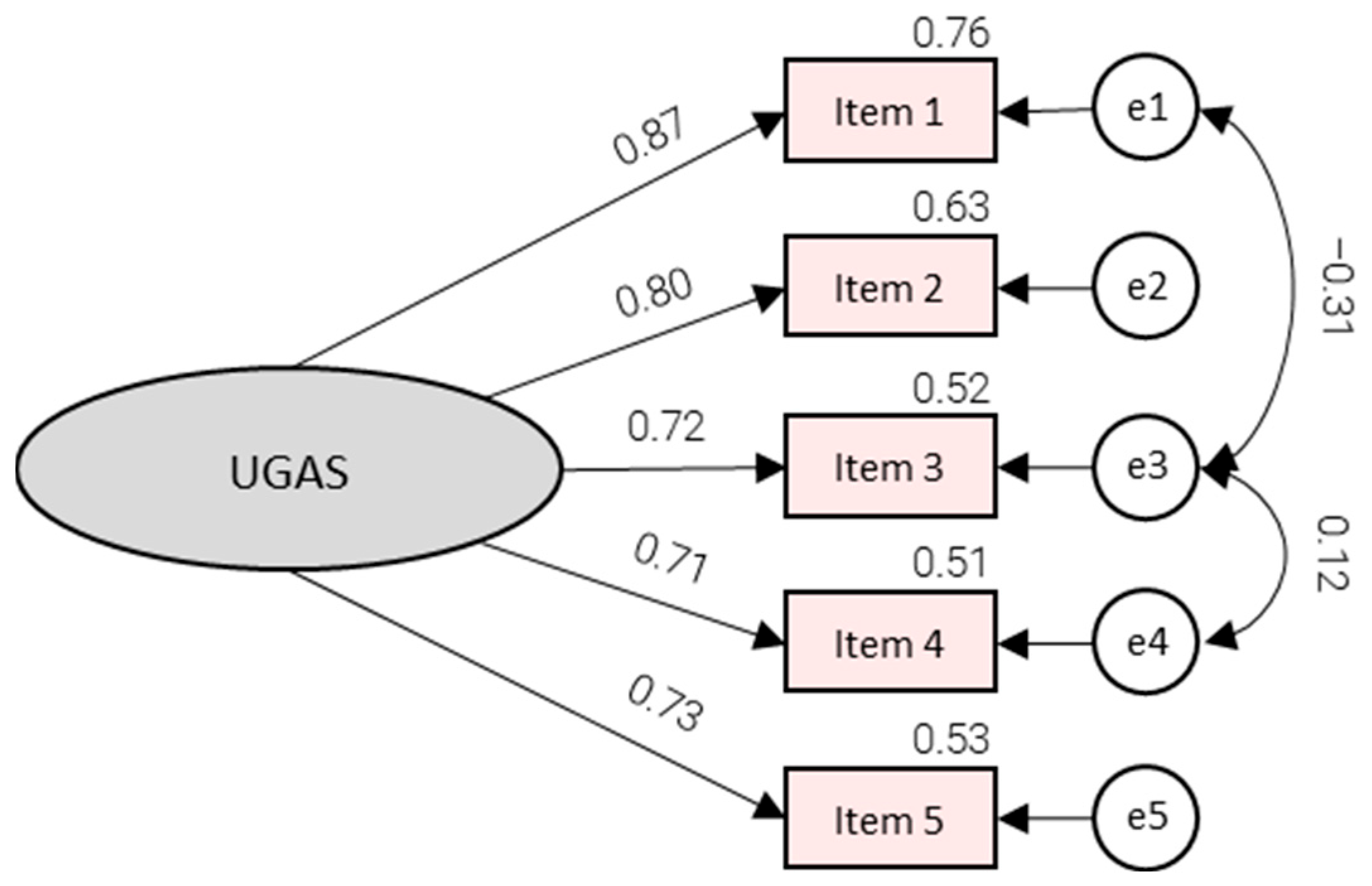
After model improvement, SRMR decreased (0.0140), while incremental and absolute fit indices reached higher values (GFI = 0.994; CFI = 1.000; TLI = 1.002; NFI = 0.994); RMSEA in the improved model was 0.000. The RMSEA value of 0.000 in the improved model does not indicate a perfect model. In small confirmatory models with few degrees of freedom, the RMSEA value is highly sensitive to model specification. According to the RMSEA formula, the value indicates that the improved model showed no detectable residual population misfit. This interpretation is supported by the TLI value, which is slightly above 1.000. For this reason, the improved CFA model is primarily interpreted in terms of the pattern of standardized loadings, low SRMR, Bollen–Stine bootstrap results, and theoretical plausibility of the two localized residual covariances rather than as proof of a perfect global fit. The standardized loadings exhibited a consistent pattern maintaining a range of 0.73 to 0.87, while the item R2 values demonstrated a similar trend, ranging from 0.51 to 0.76. These results suggest that the enhanced compatibility was attained without compromising the one-factor structure. Accordingly, the improved model best supports the idea that the one-factor solution was reasonable, while the freed residual covariances likely reflect limited item-specific overlap beyond the latent factor. As Figure 1 shows, only two residual covariances consistent with the theory were introduced to account for local item dependencies (between item 1 and item 3; and item 3 and item 4). These pairings were found defensible because they share semantic variance beyond the latent factor. The error covariance between items 1 and 3 reveals the importance of anticipated loss and shares item-specific meanings beyond the general attachment factor. Meanwhile, the error covariance between items 3 and 4 represents anticipated loss and the willingness to protect, activating threat-related attachment content.

3.6. Known-Groups Validity

Table 7 shows that across environmental appraisal indicators, a higher endorsement of positive statements about the planting was consistently associated with a higher UGAS score. For instance, respondents who definitely agree that “The planted trees and shrubs have a calming effect” reported a significantly higher UGAS score (M = 17.00, SD = 2.127) compared to those who agree (M = 15.69, SD = 2.429). Similarly, the item “The planted trees and shrubs create a feeling of home” showed a graded pattern when M = 17.42, SD = 1.810 for those who definitely agreed, M = 15.91, SD = 2.380 for those who agreed and M = 12.75, SD = 2.659 for respondents who disagreed. These differences were also significant (H = 22.070, p < 0.001). This result should be interpreted cautiously because the “feeling of home” concept is closely related to place attachment, so it does not constitute a fully independent external criterion. Instead, it offers a proximal convergent check demonstrating that UGAS is associated with an additional place-identity indicator in the anticipated manner. Therefore, the result provides convincing support for the validity of UGAS, as it is strongly linked to a construct that should theoretically overlap with emotional bonding to place. Perceiving a healthier environment was associated with UGAS (H = 9.995, p = 0.007) when the definitely agree group scored the highest (M = 17.22, SD = 1.953).
Behavioral intentions and concern-based indicators moved in the same direction. Willingness to care for the planted trees and shrubs was related to UGAS (H = 23.723, p < 0.001). In this respect, respondents who answered “yes” (M = 17.50, SD = 1.900) or “maybe” (M = 17.03, SD = 1.845) scored significantly higher than those who answered “no” (M = 15.27, SD = 2.595). Concern about potential damage also differentiated attachment (U = 100.5, p = 0.003) when those who were bothered by possible damage scored higher (M = 16.18, SD = 2.380) than those not bothered (M = 12.20, SD = 2.387). The magnitude of |δ| = 0.78 indicates large difference between the two groups. Similarly, willingness to work with others to improve the given place was associated with UGAS (U = 2360.5, p < 0.001) when higher scores were observed among those who agreed (M = 17.28, SD = 1.660) than among those who disagreed (M = 15.32, SD = 2.579). Where the overall Jonckheere–Terpstra test was significant, Dunn–Bonferroni post hoc comparisons were used to determine which specific response categories differed from one another. It showed that for feeling of home and healthier environment, all response categories differed significantly from each other, whereas for willingness to help care for the greenery and neighborhood satisfaction the differences were concentrated primarily between respondents with positive versus negative or neutral evaluations. However, for items with very small negative-response categories, the post hoc pattern should be interpreted cautiously.
Table 8 provides evidence that the one-factor UGAS model is invariant across the two samples at the configural, metric, and scalar levels. It indicates that the UGAS measures the same construct in the same way across both samples and supports the comparability and reproducibility of the measurement model.
Measurement invariance testing across the two samples supported the stability of the UGAS measurement model. The configural model showed a very good fit, indicating that the same one-factor structure was applicable in both samples. Constraining factor loadings to equality did not meaningfully worsen model fit, supporting metric invariance. Further constraining item intercepts also produced negligible changes in fit indices, supporting scalar invariance. These results mean that UGAS performs equivalently across both samples, which strengthens the confidence in UGAS robustness, reproducibility, and comparability.

4. Discussion

The aim of this study was to assess psychometric characteristics of the UGAS attachment dimension in a new setting. Therefore, the latent structure, measurement performance, and known-groups validity were examined using two independent samples drawn from the same theoretical population. Results from both datasets converged on a conclusion that the five-item UGAS attachment score is a coherent, reliable, and meaningful measure of residents’ attachment to newly planted urban greenery. The study brought consistent empirical evidence across descriptive and reliability diagnostics, exploratory and confirmatory factor analyses, and theoretically expected group differences in external indicators of appraisal, stewardship intentions, and neighborhood satisfaction.
This study demonstrated that the subset of five items could be considered as a single coherent dimension. In EFA, factorability was strong, and a unidimensional one-factor solution was empirically supported. The factor eigenvalue (3.287) and the proportion of explained variance (65.7%) indicated a strong common core. Moreover, loadings of all items and communalities were high. Additionally, convergent adequacy indicators were above usual benchmarks, reinforcing the notion that the latent construct explains most of its indicators’ variance. On top of that, the CFA results corroborated this structure in an independent sample. The unidimensional model showed strong incremental fit in the original specification, though RMSEA values indicated localized issues. However, after refinement the global fit improved (p = 0.539; SRMR = 0.0140; CFI = 1.000; TLI = 1.002; NFI = 0.994; GFI = 0.994). Therefore, the results supported the interpretation that the attachment construct measured by the UGAS is a meaningful latent factor.
For applied research, the observed score distribution is relevant. Although attachment levels were generally positive (item means were around 3.0–3.4 on a four-point scale and total UGAS means were 15.67 and 16.09), there were no floor effect (0.0% in both samples), and ceiling effect remained low (7.3% and 5.8%), both of which were under the usual threshold values [54]. This suggests that the scale retains enough variability to differentiate residents, even when the overall attitude is favorable. Such sensitivity is important if the UGAS is to be used to evaluate interventions over time or to compare different subgroups. The inter-item correlation matrices further illustrated that the scale achieved a desirable balance between coherence and breadth. The strongest associations were between perceived importance and well-being contribution (τ = 0.647 and 0.675), which is theoretically plausible because place attachment is consistently associated with perceived psychological benefits and well-being, including social well-being and quality-of-life appraisals [21,72].
A frequent issue in short-scale CFA is the detection of localized misfit, often due to overlapping content, or shared method variance. In this study, the improved CFA model achieved an excellent global fit, and the standardized solution remained unidimensional. However, fit indices should be interpreted with caution. Accordingly, we emphasize SRMR and incremental fit indices, and interpret the localized residual covariances as minor item-specific overlap rather than evidence against unidimensionality [73].
More specifically, localized model refinements were introduced only after the modification indices indicated residual dependencies not fully captured by the general attachment factor. These refinements were retained only where they were also theoretically interpretable. For example, the covariance between Item 1 and Item 3 is defensible because both items measure the importance of the attachment object under two related cognitive framings, i.e., present importance and anticipated loss. Similarly, the covariance between Items 3 and 4 is plausible because both items activate threat-related attachment content, specifically loss anticipation and defensive responses. This interpretation is consistent with attachment theory, which considers attachment to involve not only positive evaluation but also distress at potential loss and readiness to defend the attachment object [16,28]. Therefore, the negative residual covariance estimated between Items 1 and 3 should not be interpreted as a negative substantive relationship between the items. Rather, after the common attachment factor is removed, it indicates a small inverse dependency specific to each item, likely reflecting the fact that present evaluative importance and counterfactual loss are not identical cognitive operations.
Beyond internal structure, the practical arguments for the scale’s usefulness lie in its external validity. Known-groups analysis showed consistent, theoretically expected differences in UGAS scores across multiple indicators. Residents who expressed restorative and identity-relevant appraisals reported higher attachment. Even stronger association was evident for feeling of home, where the UGAS mean decreased from 17.42 (definitely agree) and 15.91 (agree) to 12.75 (disagree). Perceiving a healthier environment significantly differentiated attachment, with higher UGAS scores among those most convinced of the health benefits. The scale also performed well with respect to stewardship intentions and protective concern. On top of that, respondents bothered by the possibility of someone damaging the trees or shrubs scored significantly higher than those not bothered (M = 16.18 vs. 12.20). These results support the interpretation of the UGAS as being associated with a protective orientation and a readiness to invest effort, as implied by the attachment concepts in environmental psychology [7,9,17]. Finally, attachment was strongly associated with place evaluation and willingness to cooperate with others to improve the given area.
The pattern of associations between the UGAS scores and external indicators suggests residents’ bond with the newly planted trees and shrubs is embedded in a broader complex of environmental meanings and social commitments. Higher attachment scores tended to occur alongside stronger perceptions of the planting as calming and health-promoting, a stronger feeling of home, and greater annoyance at hypothetical damage. This reflects previous findings that individuals with stronger attachment evaluate their environment as more pleasant, safe, and healthy, and are more sensitive to threats or decline, e.g., [16,17,18,46]. At the same time, attachment was related to the willingness to care for the greenery and cooperate with others to improve the given area, which is consistent with models that conceptualize local participation and place-protective intentions as key behavioral expressions of attachment [9,28,29]. These findings support interpreting the UGAS as measuring the affective element of place attachment in urban greening interventions [25]. The fact that attachment to the new planting was linked not only to individual-level benefits (e.g., calm and home-likeness), but also to the collective orientations (e.g., willingness to collaborate and sensitivity to vandalism) resonates with frameworks that distinguish personal, social, and environmental layers of attachment [3,74].
The results of this study support the use of UGAS as a compact, resident-centered outcome measure that can be integrated into local evaluation routines for urban greening interventions. UGAS is relevant to SDG 11 because it can help municipalities determine if physical investments in green public spaces are meaningful, accepted, and stewarded by residents. UGAS complements SDG 11 indicators and city-level environmental metrics, such as canopy cover, green space accessibility, cooling potential, biodiversity, and maintenance quality. Thus, UGAS is best understood as a social outcome KPI at the project level that can enrich SDG-oriented local monitoring.
From a metrics perspective, the UGAS is particularly relevant for indicator ecosystems that aim to reconcile top-down comparability with place-based priorities. When collected repeatedly across neighborhoods and intervention types, UGAS can support cross-site learning about which designs and arrangements yield socially durable outcomes. To support decision-making, future applications should test external validity across contexts; this will strengthen the use of UGAS in procurement and budgeting evaluation routines. Although the contextual features of Czech housing estates make them particularly relevant for studying social attachment to urban greening, these features also limit the transferability of the findings to low-density neighborhoods, privately managed residential developments, and urban contexts with different property and governance arrangements.
Several limitations of this study must be acknowledged. Firstly, although EFA and CFA were conducted on different groups of respondents, all respondents were from the same housing estate, were exposed to the same intervention logic, and were embedded in the same local policy and social environment. Therefore, the observed reproducibility should be interpreted as within-context stability rather than cross-context replication. A shared community climate may have increased the consistency with which residents interpreted the planting and its significance. While this is useful for establishing local validity, it may also make confirmation of the structure more favorable than would be expected across genuinely different neighborhoods or governance settings. For this reason, the present study provides strong evidence of contextual robustness within one intervention setting. However, broader inferential validity must await replication across multiple sites. Secondly, the samples were independent in respondent identity; however, they were collected at different time points (May and September). Thus, results may also reflect time-related influences (e.g., maturation of the plantings, seasonal perceptions). Thirdly, the response format was ordinal with only four categories. While this could enhance clarity and reduce satisficing, it may have also constrained variance and contributed to the skewness. Fourthly, for UGAS we used a 4-point agreement scale (i.e., with no midpoint) to intentionally reduce neutral responding and to improve respondent comprehension in the given setting. However, this response format may limit direct comparability with studies using the original five-point format. Fifthly, cross-sectional design of the study does not allow monitoring changes throughout the time, nor formulate causal claims. Additionally, this study did not include official SDG 11 indicator data, such as measures of open public space availability, green area accessibility, formal participation structures, and local disaster risk reduction planning. Therefore, the study cannot empirically test the relationship between UGAS scores and SDG 11 indicators. Therefore, the relevance of UGAS to SDG 11 should be interpreted as conceptual and evaluative rather than as evidence of direct statistical alignment with the global SDG indicator framework.
Moreover, the reported findings establish local validity and initial transfer potential. However, broader use in smart-city evaluation would require replication across intervention types, neighborhoods, and governance contexts, as well as further testing of invariance, uncertainty, and external validity. For these reasons, the results of this study should be transferred to other urban forms with caution. Replication is especially needed in historical city centers, suburban neighborhoods, privately managed residential complexes, and different national planning cultures. Such replication would clarify whether the one-factor UGAS structure and its associations with stewardship and perceived environmental benefits are general features of urban greening interventions or if they are shaped by the context of the housing estate.
Future work could strengthen the validity of the scale by testing measurement invariance across relevant groups (e.g., gender and age cohorts) and over time. Effort can also be focused on examining predictive validity using behavioral indicators (e.g., actual participation in care, attendance at meetings, and reporting of vandalism). It would also be useful to replicate the study in other urban contexts to examine how attachment is manifested under different designs (e.g., tree alleys, pocket parks, or orchards), governance models (e.g., municipality-led maintenance, co-governance with resident groups, or hybrid stewardship arrangements), and neighborhood histories (e.g., prior experiences with redevelopment, trust in local institutions, and place-memory dynamics shaping responses to change). Given the strong known-groups results observed in this study, UGAS also appears well suited for integration into broader models linking environmental interventions to social cohesion and perceived livability.
Although the present study is situated at the project level, its relevance extends beyond a single greening intervention. If validated across settings, the UGAS can support cross-site comparison, longitudinal monitoring, and the integration of resident-centered outcomes into broader municipal evaluation frameworks. In this sense, it helps bridge a common gap in urban sustainability assessment between intervention outputs and socially meaningful outcomes.

5. Conclusions

The results indicated that the five-item UGAS attachment score was a reliable, unidimensional, and practically useful measure of residents’ attachment to urban green. The scale demonstrated high internal consistency, unidimensional structure, and known-groups validity reflected in stable associations with restorative and identity-related appraisals, stewardship intentions, and neighborhood satisfaction. Moreover, results suggested that UGAS measured bonds with local greenery supporting its use as a coherent and compact measure in urban greening research and evaluation.
From an applied perspective, the UGAS offers municipalities and researchers a useful tool to monitor community relationships with green spaces, compare subgroups of residents, and assess whether greening interventions foster acceptance. Specifically for urban planners and designers, the results highlight the value of creating greening projects that are legible and purposeful, as such spaces are more likely to become objects of attachment rather than mere background vegetation. Development of urban green is widely considered solutions for mitigating urban heat, improving microclimates, and strengthening climate resilience in residential areas. Yet their effectiveness depends not only on species selection, spacing, and maintenance but also on social acceptance. This study offers a practical means of integrating residents’ social responses into climate adaptation planning and evaluation.
By integrating a theoretically informed adaptation of UGAS with indicators grounded in environmental psychology and sociology, this study implies that urban greening interventions can foster place attachment. These perceptions point to the potential of such greening interventions to support well-being and neighborhood social infrastructure by reinforcing residents’ sense of belonging. In this respect, UGAS may be interpreted not only as adequate measure of attachment to urban greenery, but also as a project-level KPI for outcome-oriented evaluation of urban greening interventions. Its value lies in making visible a dimension that is often assumed but rarely measured directly.
From an SDG 11-oriented evaluation perspective, UGAS’s practical value lies in its ability to complement physical greening indicators with a resident-centered measure of social embedding. In high-density residential areas, municipalities can use UGAS to evaluate not only the visibility and technical functionality of newly introduced greenery, but also its perceived meaningfulness, benefit, and worthiness of protection by local residents. This information can support design refinement, communication strategies, prioritization of stewardship activities, and comparison of alternative greening solutions across sites. Repeated UGAS measurements can help urban managers connect the implementation of green spaces with socially relevant outcomes, such as inclusive public spaces, participatory urban development, and the long-term public legitimacy of these interventions.

Funding

This research was funded by TA ČR, grant number SS07020449—Mitigation of the negative impacts of weather extremes (temperature, wind, and precipitation) on the public health and environment in large agglomerations.

Institutional Review Board Statement

The study was conducted in accordance with the Declaration of Helsinki, and approved by the INESAN Research Ethics Board (IREBA/2025/425, 8 April 2025).

Informed Consent Statement

Informed consent was obtained from all subjects involved in the study.

Data Availability Statement

The data used to support the findings of this study can be available from the author upon reasonable request.

Acknowledgments

The author would like to thank all respondents and interviewers who engaged in this study, and all members of the supportive research team.

Conflicts of Interest

The author declares no conflicts of interest. The funders had no role in the design of the study; in the collection, analyses, or interpretation of data; in the writing of the manuscript; or in the decision to publish the results.

Abbreviations

The following abbreviations are used in this manuscript:
AVEAverage Variance Extracted
CFAConfirmatory Factor Analysis
CFIComparative Fit Index
CRComposite Reliability
DFDegrees of Freedom
EFAExploratory Factor Analysis
GFIGoodness of Fit Index
ITCItem-Total Correlation
KMOKaiser–Meyer–Olkin
KPIKey Performance Indicator
NFINormed Fit Index
PAParallel Analysis
PAFPrincipal Axis Factoring
RMSEARoot Mean Square Error of Approximation
SDStandard Deviation
SRMRStandardized Root Mean Squared Residual
TLITucker–Lewis Index
UGASUrban Green Attachment Scale

References

  1. Bowler, D.E.; Buyung-Ali, L.; Knight, T.M.; Pullin, A.S. Urban greening to cool towns and cities: A systematic review of the empirical evidence. Landsc. Urban Plan. 2010, 97, 147–155. [Google Scholar] [CrossRef]
  2. Lake, B.; Milfont, T.L.; Gavin, M.C. The Relative Influence of Psycho-Social Factors on Urban Edible Gardening. N. Z. J. Psychol. 2012, 41, 49–58. [Google Scholar]
  3. Kabisch, N.; Qureshi, S.; Haase, D. Human–environment interactions in urban green spaces—A systematic review of contemporary issues and prospects for future research. Environ. Impact Assess. Rev. 2015, 50, 25–34. [Google Scholar] [CrossRef]
  4. Browning, M.H.; Rigolon, A.; McAnirlin, O. Where greenspace matters most: A systematic review of urbanicity, greenspace, and physical health. Landsc. Urban Plan. 2022, 217, 104233. [Google Scholar] [CrossRef]
  5. Fekete, A.; Abuhayya, M. Urban green spaces: The role of greenery and natural elements in promoting visitors’ attachment and well-being. Acta Hortic. Regiotectuare 2023, 26, 157–167. [Google Scholar] [CrossRef]
  6. Lee, A.C.; Maheswaran, R. The health benefits of urban green spaces: A review of the evidence. J. Public Health 2011, 33, 212–222. [Google Scholar] [CrossRef] [PubMed]
  7. Escalera-Reyes, J. Place attachment, feeling of belonging and collective identity in socio-ecological systems: Study case of Pegalajar (Andalusia-Spain). Sustainability 2020, 12, 3388. [Google Scholar] [CrossRef]
  8. Krarup, T. The politics of the urban green: Class, morality and attachments to place. Sociol. Rev. 2022, 70, 1119–1140. [Google Scholar] [CrossRef]
  9. Daryanto, A.; Song, Z. A meta-analysis of the relationship between place attachment and pro-environmental behaviour. J. Bus. Res. 2021, 123, 208–219. [Google Scholar] [CrossRef]
  10. Kyle, G.; Graefe, A.; Manning, R.; Bacon, J. Effects of place attachment on users’ perceptions of social and environmental conditions in a natural setting. J. Environ. Psychol. 2004, 24, 213–225. [Google Scholar] [CrossRef]
  11. Brehm, J.M.; Eisenhauer, B.W.; Stedman, R.C. Environmental concern: Examining the role of place meaning and place attachment. Soc. Nat. Resour. 2013, 26, 522–538. [Google Scholar] [CrossRef]
  12. Camacho-Cervantes, M.; Schondube, J.E.; Castillo, A.; MacGregor-Fors, I. How do people perceive urban trees? Assessing likes and dislikes in relation to the trees of a city. Urban Ecosyst. 2014, 17, 761–773. [Google Scholar] [CrossRef]
  13. Atiqul Haq, S.M.; Islam, M.N.; Siddhanta, A.; Ahmed, K.J.; Chowdhury, M.T.A. Public perceptions of urban green spaces: Convergences and divergences. Front. Sustain. Cities 2021, 3, 755313. [Google Scholar] [CrossRef]
  14. Darabaneanu, D.; Maci, D.; Oprea, I.M. Influence of environmental perception on place attachment in Romanian rural areas. Sustainability 2024, 16, 1106. [Google Scholar] [CrossRef]
  15. Dasgupta, R.; Basu, M.; Hashimoto, S.; Estoque, R.C.; Kumar, P.; Johnson, B.A.; Mitra, B.K.; Mitra, P. Residents’ place attachment to urban green spaces in Greater Tokyo region: An empirical assessment of dimensionality and influencing socio-demographic factors. Urban For. Urban Green. 2022, 67, 127438. [Google Scholar] [CrossRef]
  16. Giuliani, M.V. Theory of attachment and place attachment. In Psychological Theories for Environmental Issues; Bonnes, M., Lee, T., Bonaiuto, M., Eds.; Ashgate: Aldershot, UK, 2003. [Google Scholar]
  17. Hidalgo, M.C.; Hernandez, B. Place attachment: Conceptual and empirical questions. J. Environ. Psychol. 2001, 21, 273–281. [Google Scholar] [CrossRef]
  18. Raymond, C.M.; Brown, G.; Weber, D. The measurement of place attachment: Personal, community, and environmental connections. J. Environ. Psychol. 2010, 30, 422–434. [Google Scholar] [CrossRef]
  19. Shamai, S.; Ilatov, Z. Measuring sense of place: Methodological aspects. Tijdschr. Voor Econ. Soc. Geogr. 2005, 96, 467–476. [Google Scholar] [CrossRef]
  20. Williams, D.R.; Vaske, J.J. The measurement of place attachment: Validity and generalizability of a psychometric approach. For. Sci. 2003, 49, 830–840. [Google Scholar] [CrossRef]
  21. Rollero, C.; De Piccoli, N. Place attachment, identification and environment perception: An empirical study. J. Environ. Psychol. 2010, 30, 198–205. [Google Scholar] [CrossRef]
  22. Jorgensen, B.S.; Stedman, R.C. Sense of place as an attitude: Lakeshore owners attitudes toward their properties. J. Environ. Psychol. 2001, 21, 233–248. [Google Scholar] [CrossRef]
  23. Irani, M.; Aghdam, S.R.; Ghasemzadeh, B. Investigating the link between place attachment, civic engagement, and pro-environmental behaviors. Environ. Dev. 2023, 47, 100897. [Google Scholar] [CrossRef]
  24. Lee, T.; Bonaiuto, M. (Eds.) Psychological Theories for Environmental Issues; Ashgate: Aldershot, UK; pp. 137–170.
  25. Riger, S.; Lavrakas, P.J. Community ties: Patterns of attachment and social interaction in urban neighborhoods. Am. J. Community Psychol. 1981, 9, 55. [Google Scholar] [CrossRef]
  26. Stedman, R.C. Understanding place attachment among second home owners. Am. Behav. Sci. 2006, 50, 187–205. [Google Scholar] [CrossRef]
  27. Afshar, P.F.; Foroughan, M.; Vedadhir, A.; Tabatabaei, M.G. The effects of place attachment on social well-being in older adults. Educ. Gerontol. 2017, 43, 45–51. [Google Scholar] [CrossRef]
  28. Scannell, L.; Gifford, R. Defining place attachment: A tripartite organizing framework. J. Environ. Psychol. 2010, 30, 1–10. [Google Scholar] [CrossRef]
  29. Feng, X.; Zhang, Z.; Chen, X. Paper analysis of the relevance of place attachment to environment-related behavior: A systematic literature review. Sustainability 2022, 14, 16073. [Google Scholar] [CrossRef]
  30. Fornara, F.; Scopelliti, M.; Carrus, G.; Bonnes, M.; Bonaiuto, M. Place attachment and environment-related behavior. In Place Attachment; Routledge: Abingdon, UK, 2020; pp. 193–207. [Google Scholar]
  31. Haluza, D.; Meyer, I.; Strüver, A.; Exner, A. Introducing a Scale for Measuring Attachment to Urban Green. Urban Sci. 2024, 8, 62. [Google Scholar] [CrossRef]
  32. Remr, J.; Sedlák, J. From Planting to Participation: Early-Phase Resident Attachment in an Urban Fruit Orchard. Urban Sci. 2025, 9, 492. [Google Scholar] [CrossRef]
  33. Subiza-Pérez, M.; Vozmediano, L.; San Juan, C. Green and blue settings as providers of mental health ecosystem services: Comparing urban beaches and parks and building a predictive model of psychological restoration. Landsc. Urban Plan. 2020, 204, 103926. [Google Scholar] [CrossRef]
  34. Anthoine, E.; Moret, L.; Regnault, A.; Sébille, V.; Hardouin, J.B. Sample size used to validate a scale: A review of publications on newly-developed patient reported outcomes measures. Health Qual. Life Outcomes 2014, 12, 2. [Google Scholar] [CrossRef]
  35. Gunawan, J.; Marzilli, C.; Aungsuroch, Y. Establishing appropriate sample size for developing and validating a questionnaire in nursing research. Belitung Nurs. J. 2021, 7, 356. [Google Scholar] [CrossRef]
  36. Lorenzo-Seva, U.; Ferrando, P.J. Determining sample size requirements in EFA solutions: A simple empirical proposal. Multivar. Behav. Res. 2024, 59, 899–912. [Google Scholar] [CrossRef] [PubMed]
  37. World Medical Association. WMA Declaration of Helsinki—Ethical Principles for Medical Research Involving Human Participants; World Medical Association: Ferney-Voltaire, France, 2024. [Google Scholar]
  38. Behr, D. Assessing the use of back translation: The shortcomings of back translation as a quality testing method. Int. J. Soc. Res. Methodol. 2017, 20, 573–584. [Google Scholar] [CrossRef]
  39. Sousa, V.D.; Rojjanasrirat, W. Translation, adaptation and validation of instruments or scales for use in cross-cultural health care research: A clear and user-friendly guideline. J. Eval. Clin. Pract. 2011, 17, 268–274. [Google Scholar] [CrossRef] [PubMed]
  40. Beaton, D.E.; Bombardier, C.; Guillemin, F.; Ferraz, M.B. Guidelines for the process of cross-cultural adaptation of self-report measures. Spine 2000, 25, 3186–3191. [Google Scholar] [CrossRef] [PubMed]
  41. Garland, R. The mid-point on a rating scale: Is it desirable. Mark. Bull. 1991, 2, 66–70. [Google Scholar]
  42. Adelson, J.L.; McCoach, D.B. Measuring the mathematical attitudes of elementary students: The effects of a 4-point or 5-point Likert-type scale. Educ. Psychol. Meas. 2010, 70, 796–807. [Google Scholar] [CrossRef]
  43. Hayton, J.C.; Allen, D.G.; Scarpello, V. Factor retention decisions in exploratory factor analysis: A tutorial on parallel analysis. Organ. Res. Methods 2004, 7, 191–205. [Google Scholar] [CrossRef]
  44. Henson, R.K.; Roberts, J.K. Use of exploratory factor analysis in published research: Common errors and some comment on improved practice. Educ. Psychol. Meas. 2006, 66, 393–416. [Google Scholar] [CrossRef]
  45. Pett, M.A.; Lackey, N.R.; Sullivan, J.J. Making Sense of Factor Analysis: The Use of Factor Analysis for Instrument Development in Health Care Research; Sage: London, UK, 2003. [Google Scholar]
  46. Twohig-Bennett, C.; Jones, A. The health benefits of the great outdoors: A systematic review and meta-analysis of greenspace exposure and health outcomes. Environ. Res. 2018, 166, 628–637. [Google Scholar] [CrossRef]
  47. Austin, D.M.; Baba, Y. Social determinants of neighborhood attachment. Sociol. Spectr. 1990, 10, 59–78. [Google Scholar] [CrossRef]
  48. Wynveen, C.J.; Kyle, G.T.; Absher, J.D.; Theodori, G.L. The meanings associated with varying degrees of attachment to a natural landscape. J. Leis. Res. 2011, 43, 290–311. [Google Scholar] [CrossRef]
  49. Remr, J. Usefulness of a civic engagement scale for research on smart cities: Measuring attitudes and behavior. Smart Cities 2023, 6, 3251–3265. [Google Scholar] [CrossRef]
  50. Choudhary, R.; Gupta, D.S. Civic Engagement a Precursor to Well-being. Indian J. Health Wellbeing 2017, 8, 152–156. [Google Scholar]
  51. Furr, R.M. Scale Construction and Psychometrics for Social and Personality Psychology; Sage Publications: London, UK, 2011. [Google Scholar]
  52. DeVellis, R.F. Scale Development: Theory and Applications, 4th ed.; Sage: London, UK, 2016. [Google Scholar]
  53. Cain, M.K.; Zhang, Z.; Yuan, K.H. Univariate and multivariate skewness and kurtosis for measuring nonnormality: Prevalence, influence and estimation. Behav. Res. Methods 2017, 49, 1716–1735. [Google Scholar] [CrossRef]
  54. Šimkovic, M.; Träuble, B. Robustness of statistical methods when measure is affected by ceiling and/or floor effect. PLoS ONE 2019, 14, e0220889. [Google Scholar] [CrossRef]
  55. Ho, A.D.; Yu, C.C. Descriptive statistics for modern test score distributions: Skewness, kurtosis, discreteness, and ceiling effects. Educ. Psychol. Meas. 2015, 75, 365–388. [Google Scholar] [CrossRef]
  56. Hayes, A.F.; Coutts, J.J. Use omega rather than Cronbach’s alpha for estimating reliability. But…. Commun. Methods Meas. 2020, 14, 1–24. [Google Scholar] [CrossRef]
  57. Taber, K.S. The use of Cronbach’s alpha when developing and reporting research instruments in science education. Res. Sci. Educ. 2018, 48, 1273–1296. [Google Scholar] [CrossRef]
  58. Tavakol, M.; Dennick, R. Making sense of Cronbach’s alpha. Int. J. Med. Educ. 2011, 2, 53–55. [Google Scholar] [CrossRef]
  59. Revelle, W.; Zinbarg, R. Coefficients alpha, beta, omega, and the GLB: Comments on Sijtma. Psychometrika 2009, 74, 145–154. [Google Scholar] [CrossRef]
  60. Kalkbrenner, M.T. Alpha, omega, and H internal consistency reliability estimates: Reviewing these options and when to use them. Couns. Outcome Res. Eval. 2023, 14, 77–88. [Google Scholar] [CrossRef]
  61. Raykov, T. Scale reliability, Cronbach’s coefficient alpha, and violations of essential tau-equivalence with fixed congeneric components. Multivar. Behav. Res. 1997, 1997, 329–353. [Google Scholar] [CrossRef]
  62. Hogarty, K.Y.; Hines, C.V.; Kromrey, J.D.; Ferron, J.M.; Mumford, K.R. The quality of factor solutions in exploratory factor analysis: The influence of sample size, communality, and overdetermination. Educ. Psychol. Meas. 2005, 65, 202–226. [Google Scholar] [CrossRef]
  63. Fabrigar, L.R.; Wegener, D.T. Exploratory Factor Analysis; Oxford University Press: Oxford, UK, 2012. [Google Scholar]
  64. Comrey, A.L.; Lee, H.B. A First Course in Factor Analysis; Psychology Press: London, UK, 2013. [Google Scholar]
  65. Nunnally, J.C.; Bernstein, I.H. Validity. Psychom. Theory 1994, 3, 99–132. [Google Scholar]
  66. Li, C.H. Confirmatory factor analysis with ordinal data: Comparing robust maximum likelihood and diagonally weighted least squares. Behav. Res. Methods 2016, 48, 936–949. [Google Scholar] [CrossRef]
  67. West, S.G.; Taylor, A.B.; Wu, W. Model fit and model selection in structural equation modeling. Handb. Struct. Equ. Model. 2012, 1, 209–231. [Google Scholar]
  68. Kline, R.B. Principles and Practice of Structural Equation Modeling; Guilford Publications: New York, NY, USA, 2023. [Google Scholar]
  69. Schreiber, J.B.; Nora, A.; Stage, F.K.; Barlow, E.A.; King, J. Reporting structural equation modeling and confirmatory factor analysis results: A review. J. Educ. Res. 2006, 99, 323–338. [Google Scholar] [CrossRef]
  70. Field, A. Discovering Statistics Using SPSS, 5th ed.; Sage Publications: London, UK, 2017. [Google Scholar]
  71. Loewen, S.; Gonulal, T. Exploratory factor analysis and principal components analysis. In Advancing Quantitative Methods in Second Language Research; Routledge: Abingdon, UK, 2015; pp. 182–212. [Google Scholar]
  72. Hu, L.T.; Bentler, P.M. Cutoff criteria for fit indexes in covariance structure analysis: Conventional criteria versus new alternatives. Struct. Equ. Model. A Multidiscip. J. 1999, 6, 1–55. [Google Scholar] [CrossRef]
  73. Junot, A.; Paquet, Y.; Fenouillet, F. Place attachment influence on human well-being and general pro-environmental behaviors. J. Theor. Soc. Psychol. 2018, 2, 49–57. [Google Scholar] [CrossRef]
  74. Brehm, J.M.; Eisenhauer, B.W.; Krannich, R.S. Dimensions of community attachment and their relationship to well-being in the amenity-rich rural west. Rural Sociol. 2004, 69, 405–429. [Google Scholar] [CrossRef]
Figure 1. Confirmatory factor analysis (second sample; improved model).
Sustainability 18 05112 g001
Table 1. Samples description with regard to key socio-demographic characteristics.
VariablesFirst Sample (EFA)Second Sample (CFA)
GenderMale40.0%45.5%
Female60.0%54.5%
Total100.0%100.0%
AgeLess than 30 years24.0%25.7%
30–39 years20.0%18.8%
40–49 years16.0%18.3%
50–59 years14.0%12.0%
60 and more years26.0%25.1%
Total100.0%100.0%
EducationElementary4.7%2.6%
Vocational22.7%22.5%
Secondary51.3%55.5%
University21.3%19.4%
Total100.0%100.0%
Table 2. Descriptives of the UGAS items (first and second samples).
NMeanSDItem-Total CorrelationsAlpha If Item Deleted
ababababab
1. These trees and shrubs are important to me.1501913.123.300.6340.6340.7730.7560.8200.835
2. These trees and shrubs contribute to my well-being.1501913.273.440.6090.6030.7330.7270.8310.843
3. I would miss something in this neighborhood if these trees and shrubs were gone.1501912.913.160.5830.5980.6240.6910.8580.852
4. I would protect these trees and shrubs if someone wants to remove them.1501913.072.970.5450.5970.7030.6560.8400.860
5. These trees and shrubs are beautiful.1501913.313.200.5900.5760.6350.6900.8550.852
UGAS15019115.6716.092.4012.459
Note: a = first sample (EFA); b = second sample (CFA).
Table 3. Correlation of UGAS items (first and second samples).
Item 1Item 2Item 3Item 4Item 5
1. These trees and shrubs are important to me.1.0000.647 **0.586 **0.645 **0.519 **
2. These trees and shrubs contribute to my well-being.0.675 **1.0000.513 **0.574 **0.564 **
3. I would miss something in this neighborhood if these trees and shrubs were gone.0.569 **0.507 **1.0000.508 **0.465 **
4. I would protect these trees and shrubs if someone wants to remove them.0.471 **0.516 **0.530 **1.0000.528 **
5. These trees and shrubs are beautiful.0.577 **0.528 **0.511 **0.489 **1.000
Note: Kendall’s tau_b; ** correlation is significant at the 0.01 level; correlations within the first sample are presented above the diagonal, whereas the correlations within the second sample are below the diagonal.
Table 4. Exploratory factor analysis (first sample).
NF1h2
1. These trees and shrubs are important to me.1500.8700.757
2. These trees and shrubs contribute to my well-being.1500.8410.707
3. I would miss something in this neighborhood if these trees and shrubs were gone.1500.8180.670
4. I would protect these trees and shrubs if someone wants to remove them.1500.7640.583
5. These trees and shrubs are beautiful.1500.7550.570
Table 5. Parallel analysis (first sample).
RootRaw DataMeans95% Perc
12.8010.2720.415
2−0.0170.1230.214
3−0.0410.0130.074
4−0.078−0.085−0.029
5−0.158−0.185−0.124
Table 6. Absolute and incremental indices (second sample).
Bollen–Stine p-ValueRMSEASRMRGFICFITLINFI
Original modelp = 0.0590.0960.02810.9730.9810.9610.970
Improved modelp = 0.5390.0000.01400.9941.0001.0020.994
Critical valuesp > 0.05<0.07<0.08>0.90>0.95>0.95>0.90
Table 7. Associations of the UGAS with other indicators (known-groups validity).
%MeanSDJ/Up-Valuer/δ
“The planted trees and shrubs have a calming effect” 5419.000<0.001 a0.28
Definitely agree *32.5%17.002.127
Agree *67.0%15.692.429
Disagree + Definitely disagree0.5%9.00N/A
“The planted trees and shrubs create a feeling of home” 4978.000<0.001 a0.33
Definitely agree */**19.9%17.421.810
Agree */***75.9%15.912.380
Disagree + Definitely disagree **/***4.2%12.752.659
“The planted trees and shrubs create a healthier environment here” 2826.0000.004 a0.21
Definitely agree */**12.0%17.221.953
Agree */***86.9%15.982.449
Disagree + Definitely disagree **/***1.0%11.500.707
“Someone would damage the planted trees and shrubs” 100.50.003 b−0.78
It would bother me97.4%16.182.380
It would not bother me2.6%12.202.387
Would you be willing to help care for the planted trees and shrubs? 3012.500<0.001 a0.35
Yes **5.2%17.501.900
Maybe *39.3%17.031.845
No */**55.5%15.272.595
How satisfied are you overall with living in this neighborhood? 417.500<0.001 a0.33
Satisfied */**92.1%16.382.172
Neither, nor *6.8%12.852.940
Dissatisfied **1.0%10.502.121
“I am willing to work with others to improve this place” 2360.5<0.001 b0.45
Agree38.7%17.281.660
Disagree61.3%15.322.579
Note: a) Jonckheere–Terpstra; b) Exact Mann–Whitney; r—rank-biserial r (Jonckheere–Terpstra), δ—Cliff’s Delta (Mann–Whitney); */**/*** significant differences between groups (Dunn–Bonferroni).
Table 8. Measurement model invariance test.
Modelχ2
(df)
CFIRMSEA (95% CI)SRMRΔ χ2 (Δdf)Δ CFIΔ RMSEAΔ SRMRDecision
M1: Configural Invariance18.986 (10) *0.9890.051
(0.011–0.086)
0.0196
M2: Metric Invariance20.337 (14)0.9920.037
(0.000–0.069)
0.02071.351
(4)
0.0030.0140.001Accept
M3: Scalar Invariance20.362 (15)0.9930.032
(0.000–0.065)
0.02170.025
(1)
0.0010.0050.001Accept
Note: * p < 0.05.
Disclaimer/Publisher’s Note: The statements, opinions and data contained in all publications are solely those of the individual author(s) and contributor(s) and not of MDPI and/or the editor(s). MDPI and/or the editor(s) disclaim responsibility for any injury to people or property resulting from any ideas, methods, instructions or products referred to in the content.