Article

Government Barriers to Implementing Beyond GDP Measures and Practical Strategies to Address Them

College of Agriculture Urban Sustainability and Environmental Sciences (CAUSES), University of the District of Columbia, Washington, DC 20008, USA
*
Author to whom correspondence should be addressed.
Sustainability 2026, 18(10), 5113; https://doi.org/10.3390/su18105113
Submission received: 17 March 2026 / Revised: 18 April 2026 / Accepted: 7 May 2026 / Published: 19 May 2026

Abstract

Over the past 50 years, researchers have produced a considerable body of work substantiating that gross domestic product (GDP) is not a measure of social welfare. In response, numerous measures, collectively known as Beyond GDP (BGDP) measures, have been developed to provide a more balanced assessment of the social, environmental, and economic impacts of economic activity on current and future generations. BGDP measures have gained the attention not only of academics, but also of government practitioners concerned with prevailing measures of national and regional progress that overrepresent narrow economic objectives and underrepresent sustainability objectives. Despite this widespread support for alternatives, few governments have made significant progress in implementing BGDP measures to inform public policy. Viewed through an operational lens, this study examines strategies used by two governments that have progressed in implementing BGDP measures. We analyze their strategies against five practical considerations: (1) alignment with mission, (2) fiscal and resources constraints, (3) communication and public messaging challenges, (4) challenges with political and public commitment, and (5) gaps in internal agency knowledge and training. These five considerations were identified as the five most prominent barriers to implementing BGDP measure based on a systematic review of the BGDP literature published over the past 50 years. We conclude that these two governments implemented actions that addressed key elements of these five barriers and succeeded in adopting BGDP measures. We conclude that others could emulate these successes to advance the broader adoption of BGDP measures.

1. Introduction

Since its introduction, researchers [1,2,3,4,5,6], world leaders [7,8,9], and even its inventor, Simon Kuznets [10], have contended that GDP is not a measure of welfare and has been misused as such. Critiques have fueled the need for measures that offer a more realistic assessment of the social and environmental impacts of economic activity than the GDP [1,2,3,4,5,6,11]. In response, researchers across multiple disciplines have developed a vast number of alternative measures collectively known as Beyond GDP (BGDP) measures [8,12,13,14,15,16,17,18].
The number of alternative measures has grown significantly since 1972 when Nordhaus and Tobin (1972) [12] introduced the Measure of Economic Welfare (MEW); Daly and Cobb (1994) [13] improved upon the MEW with the Index of Sustainable Economic Welfare (ISEW); and Cobb, Halstead, and Rowe (1995) [14] introduced the latest iteration with the Genuine Progress Indicator (GPI). Around the same time, the King of Bhutan declared happiness as the country’s measure of progress and not GDP [17]. This laid the foundation for several governments to use citizens’ expressions of subjective wellbeing to inform public policy decisions, alongside the GDP [19].
Despite the well-documented shortcomings of the GDP, evidence of regional and national governments’ appetite for alternative measures, and the vast number of BGDP options developed over the past 50 years, relatively few national, state, or local governments have consistently implemented programs to calculate BGDP measures or use them in policy decisions [5,20,21,22,23]. Notably, Australia, Austria, Belgium, Bhutan, Canada, Chile, China, Ecuador, Finland, France, Germany, Italy, Isreal, Japan, Luxembourg, the Netherlands, New Zealand, Scotland, Slovenia, Spain, Sweden, the United Kingdon, the United Arab Emirates, and Wales have either begun to use BGDP measures and have halted their programs, or are in various stages of moving toward the implementation of BGPD measures [19,20]. Most United Nations member countries track progress towards the 17 UN Sustainable Development Goals [18]. However, overall, progress has been slow [18]. Only the country of Bhutan consistently calculates and explicitly uses trends from its BGDP measure as a primary consideration in public policy decisions. Bhutan is also the first country to achieve a net-zero carbon emissions status [24].
Government agencies are the primary producers of the data needed to calculate BGDP measures, yet governments have thus far failed to use this data to advance their use of BGDP measures [6,20,25,26,27]. Previous research examined barriers to the adoption of BGDP alternatives [28] and found that only about 2% of the extensive work on BGDP measures focused on barriers or practical pathways toward their implementation. Within this small body of work, five (5) distinct types of barriers were identified [28]: (1) mission-related barriers, (2) fiscal and resource barriers, (3) communications challenges, (4) commitment barriers, and (5) knowledge barriers.
We hypothesize that governments are better able to adopt BGDP measures when their operational realities are adequately addressed. We also argue that governments need help identifying workable implementation strategies, and researchers can fill this gap. This study tests the previously identified barriers by examining two cases that stand out for their consistent implementation of BGDP measures. We selected our cases from a small sample of national and regional governments to better understand how operational challenges may be approached by different levels of government. Our case study analysis uses a practical operational lens to identify strategies that can meaningfully advance the adoption and implementation of BGDP measures as governments seek to secure a sustainable future for their populations. We conclude that the previously identified barriers hold up and can provide meaningful guidance to the broader implementation of BGDP measures.

2. Background

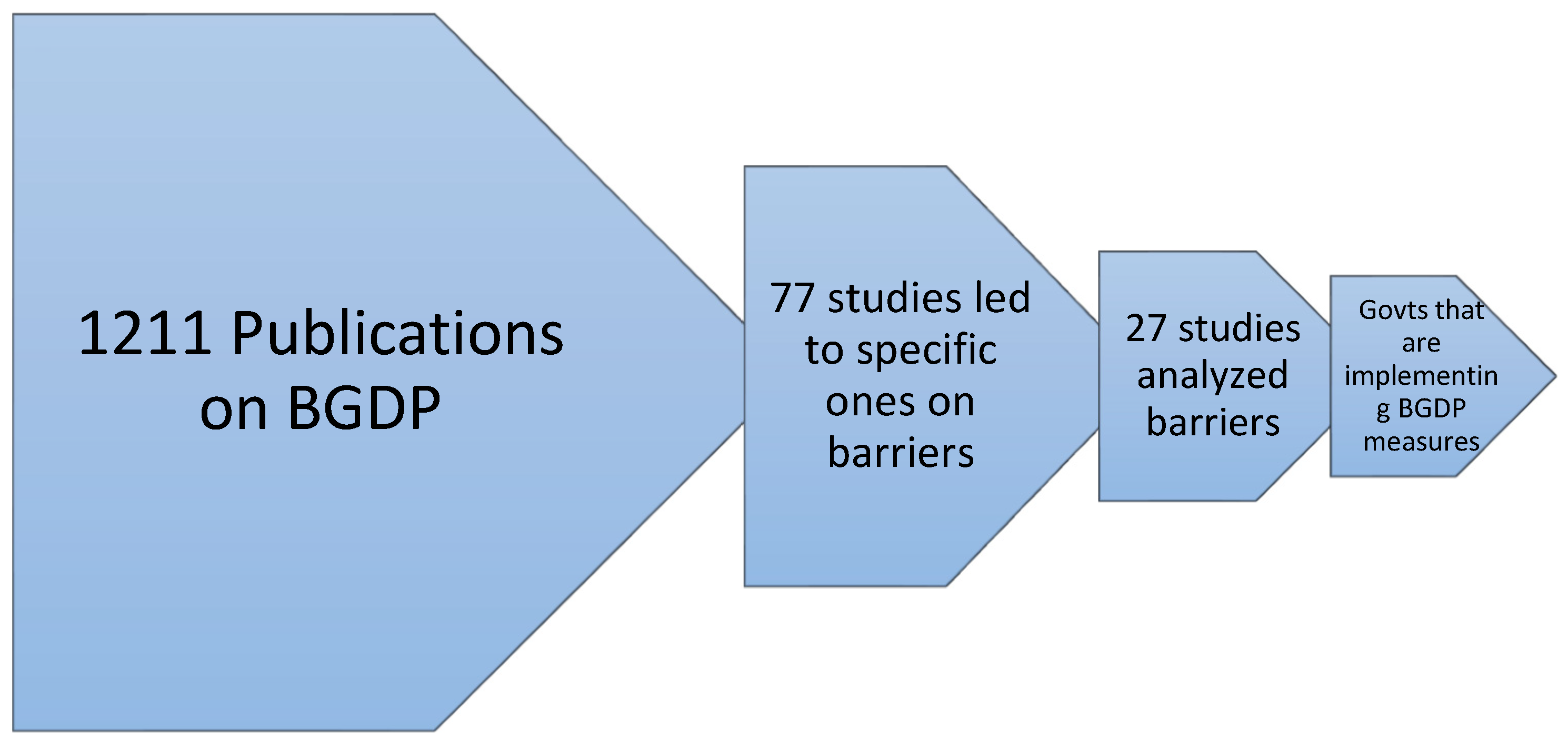
The lack of widespread, consistent adoption and use of BGDP measures is surprising in light of the vast literature devoted to the topic over the past 50 years. Taylor and O’Hara [28] conducted a systematic literature review (SLR) of the BGDP literature on barriers to governments adopting alternative measures. They found that, of 1211 publications, only 27 (2%) focused on barriers to implementation [28]. For this case study analysis, we found that literature on government implementation of BGDP measures to also be limited. Figure 1 depicts the relationship between the aforementioned SLR study and literature on governments that have implemented BGDP measures which ultimately led to the selection of the two cases for this study. Supplementary Figure S1 provides additional details on the aforementioned SLR [28].
The SLR identified 16 consistent barrier themes across the 27 studies. The authors analyzed studies that included different types of organizations interested in using BGDP measures [28] and found that the wide variety of measures, which all differ somewhat in how they are calculated, all posed similar challenges. Further, the majority of studies mentioned more than one barrier theme. For example, barriers related to data availability and limited mindsets were observed in 19 of the 27 studies and a study of Maryland’s GPI implementation [26], described 13 barrier themes [28]. When the prominent themes were analyzed through an operational lens, the authors found that five highly interconnected types of barriers emerged. Table 1 is adapted [28] and provides the five barrier types, a summary of the 16 underlying themes, and example references that mentioned each theme. Supplementary Table S1 provides a more detailed list.
The five barrier types are: (1) mission-related barriers, (2) fiscal and resource barriers, (3) communications challenges, (4) commitment barriers, and (5) knowledge barriers.
Mission barriers are those that interfere with government operations and purpose. In the BGDP-to-government-user world, they typically manifest as a misalignment between the purpose or construction of a BGDP model and the government agency’s mission and authorities. They include issues such as an unclear purpose of a model or its components, not having standardized methods to calculate components, users not being involved in model designs to convey their needs, an inability to tie the results of a BGDP measure to policy implications or to use its information to evaluate projects, and an absence of help on strategies to integrate data and results across siloed agencies [28,32,33,34].
Addressing resource barriers requires increases in labor, expertise, or funding. They include a lack of quality and timely data, a lack of staff to handle multiple components within a model or multiple models being combined to meet an agency’s information needs, and a lack of funds to address any of these [28,32,34,35].
Communication barriers primarily stem from the lack of a consistent, authoritative narrative that conveys BGDP information in ways that resonate with users, political actors, businesses, or the public [28,32,33,34,35].
Commitment barriers pertain to the mindsets of public, political, and private sector actors that are disproportionately focused on GDP growth. These mindsets block consideration of other metrics that can provide a more balanced assessment of the social and environmental implications of economic decisions. These barriers are likely the most difficult to overcome and require ongoing attention since the persistent global reliance on GDP as a performance measure will continue to call alternatives into question. Some BGDP proponents and users have therefore advocated for legislation to regularize commitment to BGDP measures and help address persistent commitment barriers [27,28,32,33,34,35].
Knowledge and education barriers refer to the need for training to help users, the public, and political actors address the interdisciplinary nature of BGDP measures and the sustainability and wellbeing concepts they support. This begins with a need to increase interdisciplinary knowledge and knowledge sharing among agency staff. However, it also includes interdisciplinary workshops to discuss BGDP indicator models, assistance and collaboration with indicator experts on how to use BGDP models, knowledge sharing across government sectors and nations, public education materials or workshops, and education of political actors on how to resonate BGDP information with their constituencies [28,33,34,35].
We note that the identified five operational barrier types are broad in nature and similar barriers may be encountered in any effort to bring about change in well-established procedures and metrics [36]. We also acknowledge that other researchers [25,37] have analyzed similarly identified barriers in a different way from this operational view. However, it is noteworthy that these themes are consistently mentioned in the admittedly small body of work that examined barriers to implementing BGDP measures; a closer examination of why these barriers might persist and what specific strategies might help overcome them is missing. Thus far, research on BGDP measures has almost entirely focused on developing new and more refined BGDP measures, to the detriment of identifying ways to overcome implementation barriers.
This paper analyzes two case studies of governments that have consistently implemented BGDP measures, namely New Zealand, and the State of Maryland in the United States. One illustrates a national-level example, the other a state-level regional one. The analysis focuses on whether the previously identified implementation barriers proved relevant to the two governments in our case study and how they overcame them.

3. Methodology

To test whether strategies used by governments that have successfully implemented BGDP measures address our five types of operational barriers, we look to historical case study approaches that use qualitative analysis of historical documents to answer the question of ‘how’ these successful governments overcame the identified implementation barriers [38,39,40]. This study is a first step toward identifying practical ways for governments to implement BGDP measures.
The selected case studies build on the review and analysis of documents that provide context for actions and events over the period [41] in which each government began investigating BGDP measures, chose a model, and then implemented it. We defined implementation success as the government’s consistent calculation and use in some way of its measure over time [18,19,20,22,23,24,25,26,28,29,30,42,43,44]. While this bar may seem low, the number of governments that have either not attempted to implement BGDP measures or abandoned their efforts is vast compared to the few that have consistently implemented a BGDP measure program of any kind [20,28]. We chose our two cases from governments that had successfully implemented measures covering environmental, social, and economic dimensions and where relevant documents in English [18,20,22,23,24,25,26,28,29,30,31,42,43,44] provided information on (1) what actions were taken thus far that advanced the implementation of BGDP measures, (2) what specific setbacks were experienced, and (3) whether these experiences connected to the five operational barriers being tested.
Documents used to examine our questions included government reports and presentations, government websites, government administration press releases, speeches, reports from the Organization for Economic Co-operation and Development (OECD), and relevant studies.
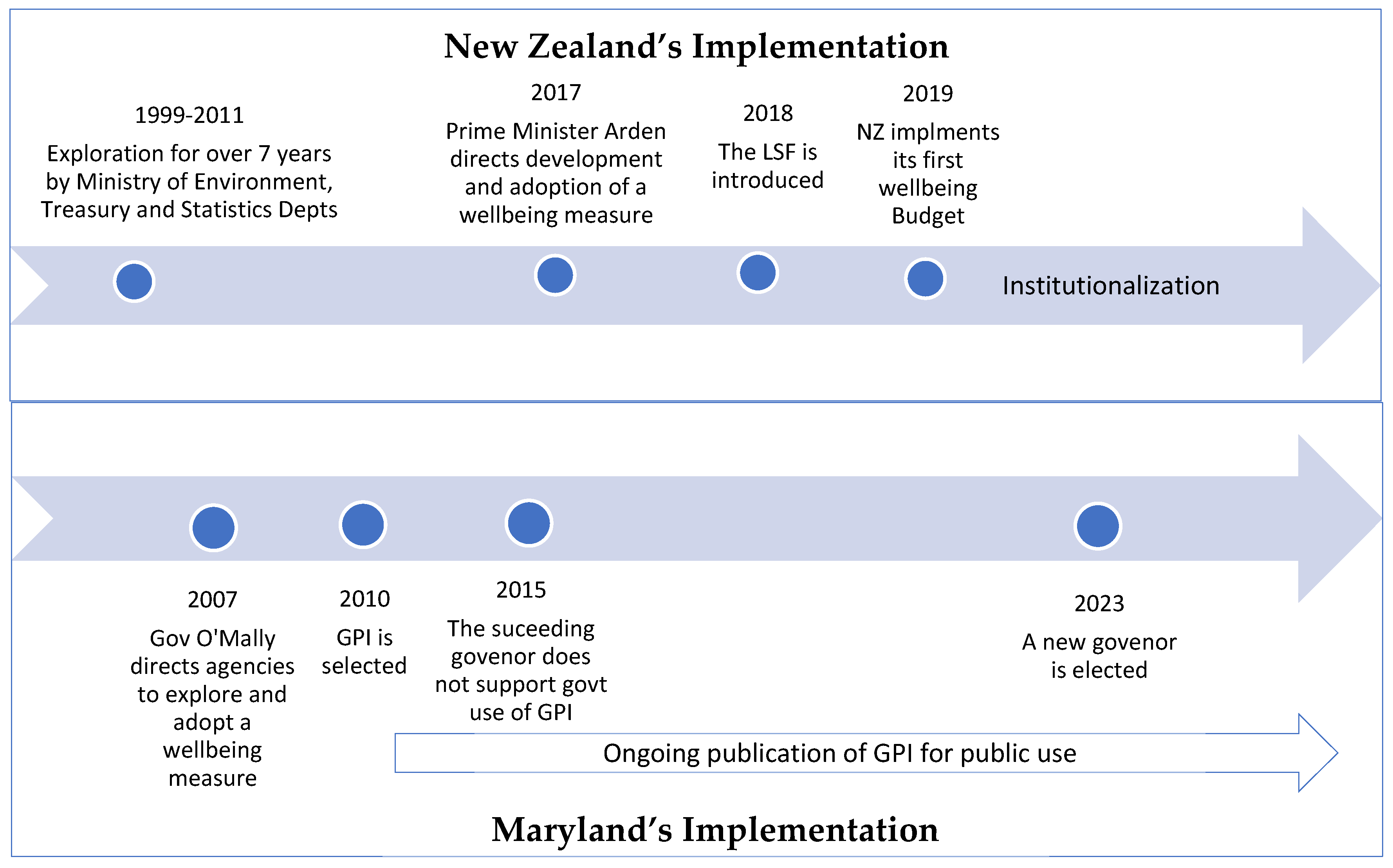
The governments of New Zealand and the US State of Maryland were chosen as our two case study examples for several reasons. First, based on our review of the aforementioned literature [28], we found that these two governments had made notable advancements in implementing BGDP measures. Figure 2 provides a pictorial timeline of each government’s implementation path. Second, they both used measures that include metrics covering the three dimensions of sustainability [45]. Third, these two governments produced supporting documents in English detailing actions taken to implement the selected BGDP measures. Fourth, we opted to review two different levels of government to test for similarities and differences in how a national-level government versus a state (regional) government implemented their BGDP programs.

3.1. The Case of New Zealand

In 2018, the government of New Zealand (NZ) announced its Living Standards Framework (LSF) and its agenda for the wellbeing for all New Zealanders [46]. The following year, NZ was amongst the frontrunners in BGDP progress with the release of its wellbeing budget. Although it was not the first national government to incorporate wellbeing into its budget [24,42], NZ’s specific coordination requirements and public record for transparency associated with its wellbeing budget are notable.
New Zealand’s Treasury department is the country’s lead economic advisor and a steward of NZ’s mission to achieve a higher quality of life for New Zealanders [47]. The agency’s goal is to consider a broad range of evidence when analyzing the current and future impacts of its economic policy decisions [48]. The New Zealand government has been exploring concepts of an inclusive economy, wellbeing, and sustainability since 1999 [49,50]. In 2011, the Treasury released its first version of the Living Standards Framework (LSF). The first LSF was an economic stocks and flows model with four headliner capital stocks to include (1) financial and physical, (2) human, (3) social, and (4) natural and examples and ten flows including income, consumption, in-kind services, employment, leisure, innovation, freedom, security, environmental services, and amenities [49,50]. Treasury’s message emphasized its long-standing, over-decade-long focus on multiple aspects of life beyond material considerations [49]. It introduced the LSF to provide greater clarity and transparency in carrying out that mission [49]. Shortly after, the Treasury released a tool designed to help its staff in their day-to-day work of providing policy advice to NZ government leaders [49]. The tool was presented as an operational way to consistently incorporate the complex concepts of the LSF into policy analysis by focusing on five key areas where governments have influence and often face competing priorities. These areas were economic growth, reducing macro-economic vulnerability, growing social capital, increasing equity, and sustainability for the future [48,49].
During its 2011–2012 rollout, all aspects of the LSF program were communicated as a work in progress where components would be tested and input would be sought from the public, across NZ government agencies, from political and government leaders, and from business and other stakeholders [20,43,49,50,51]. This behind-the-scenes churning and adjusting lasted for seven years [20,43,51].
New Zealand took a significant leap forward in 2018 when the newly elected Prime Minister, Jacinda Ardern, announced an aggressive political agenda that included goals of establishing the LSF to assess the nation’s spending proposals against it [46]. She named the Treasury and Statistics departments responsible for establishing a suitable framework [20,43,51]. NZ Statistics surveyed the population and worked with Treasury to include subjective wellbeing data in the LSF alongside its objective data [20,43,51]. The revised version was based on OECD’s Better Life Index (BLI) [16]. During the same year, NZ became a founding member of the Wellbeing Economy Governments (WEGo) Group [29,52,53].
NZ’s 2018 progress had been preceded by many years of research, testing, and discussion from NZ’s agencies, including Treasury, Statistics, and the Ministry of Environment [31,47,49,54]. Therefore, when the Prime Minister issued mandates to implement NZ’s BGDP program, the responsible agencies were ready [51].
In 2019, NZ implemented its first wellbeing budget [20,29,51]. The budget’s development process and features are notable. First LSF results are used to establish overarching priorities. Second, all agencies must show how their proposed expenditures align with the stated priorities; demonstrate that they collaborated with other agencies to evaluate the multidimensional impacts of their proposals; and show how their proposals will improve wellbeing for New Zealanders [29].

3.2. The Case of Maryland

The State of Maryland became the first state in the United States of America to calculate the Genuine Progress Indicator (GPI) in 2010. It is also one of only two US states that regularly calculate the BGDP measure. The initiative was led by then-Governor Martin O’Malley, who was interested in “data-driven governance” [26] measures that could complement the Gross State Product (GSP), the US state version of GDP, and help the Governor address the State’s tough environmental and social challenges [26,55].
Maryland consistently ranks among the wealthiest states in the U.S. [56]. While 5% of households earn 14 times as much as 20% of the state’s lowest-income households, Maryland nonetheless ranks around the midpoint, 23rd, in income inequality among US states [57,58]. Maryland shares a significant watershed, the Chesapeake Bay, with Virginia, Delaware, and the District of Columbia. The Bay is valued for its wildlife, recreation, fisheries, shellfish, tourism, and port access [59]. However, these jurisdictions, plus three others (West Virginia, Pennsylvania, and New York), have polluted the Bay through outdated wastewater treatment plants, polluting agricultural practices, and stormwater runoff [59,60]. The Bay has been overfished at times, which has also contributed to its degradation [61]. Water quality, aquatic life, and shellfish production have all been affected, and the Bay has consistently received health grades ranging from C to D for more than a decade [61]. Maryland has been working to do its part in reducing pollution sources and contributing to the Bay’s cleanup [59]. This endeavor has been expensive in a landscape of competing political priorities and finite revenues [55].
In 2007, during his first year in office, former Governor O’Malley established an office for a Sustainable Future to lead the State’s BGDP efforts. His policy Director, Sean McGuire, suggested the office investigate alternative measures of progress [26]. McGuire recognized the need to communicate to the Governor’s constituency the environmental and social damage resulting from activities across the State and the region [55]. If the governor wanted support for policies to address these issues, he needed his constituency to be aware of them [55]. From the outset, a metric was sought to help consumer voters appreciate the State’s challenges, especially those associated with the Bay, and to determine for themselves the need to shift towards more sustainable practices [55]. At the same time, the word of the day was ‘jobs’ ([26], p. 9). The metric had to be compatible with the State’s GSP and use familiar growth terminology to support the Governor’s messages on Green Growth for the State [62].
Evaluations began in 2009 through a task force consisting of members from multiple state agencies [55]. GPI was chosen for its use of readily available data, its academic acceptance, its comparability to GDP, and its use of monetized metrics that could support budget decisions in a manner familiar to bureaucrats and leaders [26,55]. The initiative was intentionally kept low-profile to avoid the risk of it being shut down by political opponents before the Maryland Department of Natural Resources (MDNR) staff could advance their understanding of the metric and the best strategy for implementing it [26]. For the same reason, the agency did not recommend, nor did the governor seek formal legislation to mandate the measure’s use [26]. From the outset, it was unclear how the metric would be used in policymaking [26]; however, staff and leadership viewed the endeavor as an exploration of an opportunity for better governance through data ([26], p. 6; [55]).
Many, including the governor, felt they were planting seeds to inspire a different kind of thinking that put sustainability choices in the forefront of government decision-making [26,55]. To this end, former Governor O’Mally used MD GPI information in some communications [26,63,64,65]. He hosted two national workshops in 2012 and 2013 that brought state users and researchers together to share insights and practices for calculating the metric and to discuss standard methodologies to make it more comparable from year to year and user to user [5,26,44].
From 2008 to 2016, during the Governor’s two terms in office, the state spent record numbers on education, college affordability, and the Bay’s restoration ([26], p. 9). Also, during this time, the State shifted toward mass-transit rail projects vs. roads, acquired an electric-vehicle fleet, established consumer electric-vehicle incentives, increased land-conservation efforts, established weatherization programs, and set aggressive renewable-energy goals [26,66]. The state also engaged the nonprofit sector to create and run Maryland’s Quality of Life Initiative, which collaborated with businesses, nonprofits, academics, and state agencies to improve the quality of life for all Marylanders [67,68].
The succeeding governor, Larry Hogan, shut down many of the BGDP initiatives intended to advance the transition of the measure into policies, including efforts to adjust the State’s budget to reflect improvements in the GPI rather than the GDP [26]. However, MDNR continues to calculate and publish the metric, and its website includes an interactive tool that allows the public to calculate GPI for the State or see how changes to their own households could impact the State’s wellbeing [58].
The current governor, Wes Moore, continues to have progressive environmental and social policies [69]. However, thus far, mention of GPI in connection with informing the administration’s decisions is absent from the governor’s official media communications. Therefore, it is unclear if and how the administration may currently be using GPI for policy decisions.

4. Analysis and Results

Both New Zealand and Maryland reveal several activities that connect to the five barrier types identified in previous research [28]. The following section analyzes each barrier and identifies whether each government’s implementation process addresses these challenges. Table 2 compares our two cases against the five types of barriers to BGDP implementation identified in the systematic review of the BGDP literature [28].

4.1. Comparison of New Zealand Against the Five Barrier Types

4.1.1. New Zealand’s Mission-Related Barriers

New Zealand’s efforts to implement a BGDP measure clearly focused on addressing mission-related barriers (see Table 2). NZ’s Treasury states that its mission is to ensure the wellbeing of citizens through policymaking and programs Agency staff clearly stated that any new measure would need to facilitate the achievement of this mission [48]. From the outset of developing the LSF, emphasis was placed on operationalizing it to inform policy and to provide Treasury staff with a tool for day-to-day policy evaluation. Among other advantages, the OECD’s BLI model was favored because it was developed with government policymakers in mind [70].
The government also wanted a measure that could be used to assess New Zealand’s population and environment against internationally recognized standards for wellbeing, while also supporting the priorities expressed by specific NZ populations, such as Māori. The final LSF met both requirements [70]. It includes components common to the OECD’s BLI, plus added components to enable interventions for specific New Zealand populations.
NZ’s process also addressed user involvement and a path for breaking down silos, two fundamental challenges in any BGDP implementation. The two responsible agencies, Treasury and Statistics, engaged all the agencies and the general public. The implementation of the wellbeing budget and the LSF analysis tool are both designed to facilitate ongoing inter-agency coordination on tough policy decisions [48].

4.1.2. New Zealand’s Fiscal and Resource Barriers

The literature reviewed for NZ does not explicitly mention fiscal constraints. However, the incremental nature of the agencies’ actions in researching and developing a BGDP solution over more than a decade is telling (see Table 2). NZ’s agencies could have evaluated and developed a BGDP model in a much shorter time by allocating significant resources to the endeavor at once or by hiring commercial consultants. Instead, NZ’s agencies appear to have allocated resources over time in ways that could close the gap between what was needed to assess and implement a measure and the realities of limited resources. For instance, the Ministry of Environment (MoE) began its quest in 2002 by commissioning academia to evaluate and develop a sustainability model [31]. First, academic assistance is typically less expensive than commercial consultation. Second, the models tested were NZ versions of existing models, eliminating the higher costs of creating something completely new. And third, the agency implemented its projects over a span of seventeen years, likely within flat or limited annual budgets. The final analysis of the endeavor didn’t occur until 2019 [54]. Treasury also used an incremental process over many years. However, it relied on internal agency staff to achieve its goal of creating the LSF. Finally, NZ Statistics began work compiling indicators for sustainable development in 2010 [54], with its efforts culminating in the 2018 release of the LSF. We assert that even if a BGDP program will help an agency do its job better, large new budgets and authorities to establish a program are unlikely to be approved when other pressing issues, such as healthcare, education, or environmental cleanup, exist. Agencies typically fund new government-improvement initiatives by identifying operational efficiencies and redistributing existing resources within flat budgets over many years. The slow, incremental churn in NZ’s implementation could be interpreted as a sign of hesitancy or uncertainty. However, we assert it is also indicative of a prudent resource management strategy.
The LSF’s final rollout also appears to have been done in a fiscally informed way. There is no indication of a substantial increase in budget to publish the LSF metrics or to use its data. In fact, key reasons NZ chose the OECD’s Better Life Index as a basis for the LSF include its use of available data and its broad constituency of support with an established international language around wellbeing [70]. We argue that NZ’s strategy to base the LSF on the BLI mitigated potential expenses associated with implementing new BGDP measures. NZ avoided the cost of developing or collecting new data. NZ also took advantage of OECD’s established and familiar narrative surrounding the BLI measure, eliminating cost for developing new communication strategies to convey basic messages on wellbeing and the benefits of BGDP considerations.

4.1.3. New Zealand’s Communication and Public Messaging

Communication and messaging appear to be particularly challenging for BGDP endeavors. The multi-dimensional nature of these efforts have resulted in numerous ways to define and track well-being and sustainability [1]. At the same time, there is little room for missteps in government communications to the public [55]. Unclear information or messages riddled with technical jargon can quickly be construed by the public as dishonest or deceptive and seeking to hide information. NZ’s choice of a BGDP measure fully considered the complex communication challenges of BGDP measures (see Table 2). For instance, Treasury researchers preferred the BLI’s dashboard structure because they felt it enabled transparent communication to the public and others about how measures within each wellbeing sector were calculated and evaluated [20,43,51,70]. They pointed to widespread international knowledge of the BLI as an advantage that would enable contextual comparisons with other countries [43,70]. We observe that the BLI also provided an established foundation for NZ’s government and its Prime Minister to connect with constituents on the issues they cared most about.

4.1.4. New Zealand’s Commitment Barriers

New Zealand’s years of research, exploration, and outreach activities, when combined over time, served to reinvigorate support for the perception that the government seeks to ensure the wellbeing of all New Zealanders. This, in turn, may have reduced opposition to using BGDP measures as a tool for evaluating policy. Internally, the process reinvigorated and strengthened Treasury’s culture of analyzing policy beyond financial costs and benefits. Some of Treasury’s own staff who were once adversarial to wellbeing approaches became engaged through the agency’s learning and coordination activities [51].
Externally, there appears to be an evolution from the sentiments that resulted in the election of leaders in the 90’s who restructured the country’s economic welfare programs through elimination or privatization. When releasing the first LSF, Treasury emphasized its longstanding practice of considering factors beyond material costs. Its secretary clarified that the LSF did not constitute a new mission but instead provided greater transparency into the Treasury’s work [50]. This clarification indicates a public expectation that wellbeing should be part of the government’s responsibility. Further, the fact that the former Prime Minister was able to immediately announce and direct efforts to implement a BGDP program speaks volumes about the level of support from NZ’s constituency for such a program (see Table 2).

4.1.5. New Zealand’s Knowledge, Sharing, Education, and Training

New Zealand’s journey involved knowledge sharing and education on several fronts (see Table 2). For example, the Ministry of Environment (MoE) tested a New Zealand GPI, which was not considered in the final 2018 analysis [70]. They also developed an NZ version of the ecological footprint calculator [54] for use by the MoE. It was later withdrawn due to concerns from agricultural interests, among others [54]. On the public front, an ecological footprint was also developed for a TV reality show, in which households attempted to reduce their footprint by changing their behaviors [54]. We find this an interesting platform for educating the public about the country’s environmental challenges. While the LSF was under development, NZ Statistics surveyed the public to gather opinions, concerns, and priorities regarding the population’s wellbeing. They also engaged the indigenous Māori population to ensure concerns of all New Zealanders were considered [51]. And finally, internationally, NZ strengthened its support channels by co-founding the WEGo group with Scotland and Iceland, the same year it released its LSF.

4.2. Comparison of Maryland Against the Five Barrier Types

4.2.1. Maryland’s Mission-Related Barriers

Viewing Maryland’s BGDP implementation through our operational lens, we found that the agency took several actions to ensure its chosen metric aligned with its mission, but its overall strategy did not address all aspects of this barrier type (see Table 2) First, the governor chose a metric and an implementation path that could support the State’s agenda for green growth [26,55]. The metric had to be usable alongside GDP while also conveying the complex mix of sustainability elements in an easy-to-understand way [55]. GPI’s monetized components were seen as a benefit that could meet this requirement and possibly be used in the future to inform the State’s budgets. MD also liked that GPI used an accepted academic methodology that could be standardized across users. Further, MD chose not to weigh its GPI components, providing greater transparency into how results were derived. Although MD was not involved in the original design of GPI, it held its own workshop and participated in the metric’s revamp ([5], p. 30; [26], p. 5; [44], p. 17).
Maryland chose a measure it believed could help break down internal government silos to enable more comprehensive thinking in policymaking [26,55]; however, it did not go far in implementing this feature. Efforts began, and it appears MD’s agencies were beginning to test how this functionality could work for them, but they were halted by the State’s new governor. Similarly, GPI was chosen in hopes that it would one day be used for policy and budget decisions. Efforts towards this goal never started. However, the calculation and publication of Maryland’s BGDP measure continues [58] and serves former Governor O’Malley’s primary objective of educating Maryland’s constituency on the complex challenges facing the state and the need for multidimensionally informed solutions.

4.2.2. Maryland’s Fiscal and Resource Barriers

Unlike NZ, Maryland’s initial efforts to evaluate, select, and implement a BGDP measure occurred over a much shorter period. Yet like NZ, MD performed substantial work behind the scenes, and its implementation strategy reflected an awareness of constrained fiscal and resource realities. For instance, the Office for a Sustainable Future was created within the existing Maryland Department of Natural Resources (MDNR). The task force charged with investigating BGDP options was composed of staff members from across the government’s agencies [55]. Further, the endeavor was kept low-profile, and no new legislation was enacted to require the use of GPI. These strategies are typical of governments when implementing something new, where it is prudent to evaluate and test the endeavor within existing authorities and budgets. Further, it is always beneficial when the working group can find a way to fully implement the endeavor to serve the government’s needs, while operating within existing authorities and budgets.
McGuire et al. (2012) [55] note the need for an indicator that could support Maryland’s already stressed fiscal and political challenges [55]. One advantage of GPI was its use of data that Maryland already collected, which was readily available [26], and not “expensive to track” [55] (see Table 2). This is not the case for many other BGDP measures, and a key barrier noted by BGDP user hopefuls [26,28]. GPI also used language familiar to politicians and the public, making communication easier [26,55]. Both advantages gave the government a head start, as it avoided spending resources on building new data systems or developing explanatory communication strategies. Essentially, Maryland did not create a program in which substantial funding needs would compete and likely lose out to the government’s priorities for cleaning the environment, creating jobs, and improving schools.

4.2.3. Maryland’s Communication and Public Messaging

GPI was sought as an educational tool. Its use of language similar to GDP and its ability to be readily compared to GDP kept politicians and bureaucrats in their comfort zone [55]. Its established narrative and use of familiar data to convey issues Marylanders cared about, such as crime, education, water quality, and transportation, fostered meaningful communication with the public [55]. Unfortunately, due to the low-key nature of MD’s endeavor, the administration did not take full advantage of GPI’s built -in communication features (Table 2). For instance, one report used GPI data to support the Governor’s statewide planning initiative [62]. However, GPI’s mention appeared in the references rather than being up and center in the report’s narrative. GPI also confirmed the Governor’s policies were pressing the State toward green growth [55]. Again, mention of the metric was limited and was not included in the Governor’s central messaging on these matters [64].

4.2.4. Maryland’s Commitment Barriers

Former Governor O’Malley was committed to a green growth agenda that included investments to clean up the Chesapeake Bay, shifting dollars towards public transportation projects, investments in nature-based recreation, support for public colleges, and jobs [26,58,62,63,65]. The fact that he was elected for two terms indicates public interest and approval of his policies. GPI provided dollar-and-cents confirmation that his investments would move the State in the right direction [55]. However, public opinion and support for using GPI as a metric for the State’s progress was never truly tested or debated due to the low-profile implementation of the endeavor [26].
There did seem to be support for GPI calculations from the nonprofit sector. They used it to determine how they could better help Marylanders in need. The administration implemented an interesting strategy of engaging the nonprofit sector to use GPI and its related metrics to collaborate with businesses and state agencies to address gaps in Marylanders’ quality of life. This leverage of the nonprofit sector to bring businesses into the fold appears to continue today.
The state’s objectives to educate and expand mindsets also appear to have had some internal impact. The state’s staffers across multiple offices began requesting GPI calculations to support a more holistic view of their policy analysis [26]. Staff also pointed to opting against consolidating smaller MDNR offices, once GPI measures for longer commute times and staff energy costs were considered [26].
MDNR has remained committed to calculating GPI as an education and communication tool for anyone who wishes to use it, regardless of any outward public use or commitment to the metric by the state’s former or current leadership [58].
Maryland’s decision not to implement legislation that would require the use of the GPI may have been appropriate, given the administration’s need to focus on jobs and stabilizing the economy during O’Malley’s governorship. Unlike NZ, direct statements regarding the state’s responsibility to advance the wellbeing of its citizens are not included in the mission statements of Maryland’s public sector agencies. Notions of quality-of-life considerations beyond economic ones are not fully permeated throughout Maryland’s society, although most advocate for reduced crime, quality education, beautiful spaces for recreation, great healthcare, and other features that contribute to high living standards. However, without legislation mandating the use of a BGDP measure, it is up to each political administration to decide whether the swift integration of siloed units to achieve these goals systematically is a worthwhile commitment.

4.2.5. Maryland’s Knowledge, Sharing, Education, and Training

MD was clear on its objective to use its BGDP measure to educate the electorate and bureaucrats on complex environmental, social, and economic issues facing the state, and on its goal of planting seeds for a new, more comprehensive way of thinking about solutions. It was less clear but saw potential for using GPI in policymaking by connecting it to the state’s budgets. Unfortunately, steps towards this latter goal and formal training to implement the use of the measure statewide were not achieved during O’Malley’s time in office [26] (Table 2). However, informal training and collaboration appear to have played a positive role.
As with NZ, the government’s knowledge-sharing and education efforts included cross-agency coordination to evaluate models and exchange feedback. It included coordination with academia and researchers. As in NZ, once the metric was decided upon, the state quickly connected with others also interested in it. Unlike the NZ model, the public was not engaged in choosing or developing the metric. The government did, however, coordinate with the nonprofit sector and businesses to leverage their support. Maryland also spent less time researching and trying models. The initiative’s leader, Sean McGuire, a graduate in environmental policy and ecological economics from the University of Maryland, was already familiar with BGDP choices [55].

5. Discussion and Future Direction

Both New Zealand’s and Maryland’s implementation strategies addressed all five barrier types in some way (see Table 2). Except for ongoing training, New Zealand’s strategy also demonstrates clear connections to all underlying barrier themes across the types. Maryland’s strategy aligned with many of the underlying themes, but it lost its political support before it could capitalize on opportunities it believed its metric would provide. NZ established a program that appears on the path to full integration of its metric into the government’s business process leading to continued success and expansion. Maryland’s failure to implement all the features it sought in its metric resulted in mission, communication, and commitment barriers not being fully met. It’s path towards continued implementation of its metric appears uncertain.

5.1. BGDP Opportunities

Examining BGDP’s barriers reveals its opportunities. First, the interdisciplinary nature of BGDP measures fuels government hopes that they will help break down long-standing government silos to facilitate a more systems-based approach to complex, interdisciplinary policy decisions [26]. However, if these silos are not considered, this opportunity quickly becomes an obstacle. Both examples demonstrate efforts to facilitate this integration. Maryland began with a cross-agency council but has yet to pursue coordinated decision-making. New Zealand appears to have had a more disjointed start. However, it now ensures coordinated decision-making on two fronts through its LSF policy-integration tool and its budget development process. It is also noteworthy that both governments deemed the budget development process key to integrated policy decisions, despite Maryland never having taken this step [26].
Second, Governments and politicians see opportunities for BGDP measures to help them communicate complex policies to the public in ways that resonate [55]. This is a highly difficult and needed task. Both governments chose metrics with an established narrative familiar to their publics and whose results could be communicated clearly, compared with other governments, or aligned with other metrics for context. They both chose dashboard-style reporting, citing the transparency it provided. MD, however, did not fully use GPI’s built-in communications features.
Finally, fiscal constraints are a large concern for governments. Attention to fiscal matters were observed in both cases. Both governments looked for models that helped avoid the cost of generating large amounts of new data. Both measures were based on models with an existing narrative and language that could readily be used without spending resources to develop new communications campaigns. Both governments appeared to use strategies suitable for managing flat or shrinking budgets over time.
Researchers can help governments by promoting BGDP models that provide a head start on costly features like data development and communication narratives. They can help develop phased implementation strategies that optimize BGDP opportunities.

5.2. Important First Steps

Although knowledge and education are often regarded as training activities that occur after a BGDP model is selected and a program is established, both examples show that the BGDP implementation process began with informal self-education and peer-to-peer knowledge sharing. In both cases, government staff spent considerable time building their own knowledge base, researching models, engaging peers, engaging academic researchers, and educating and engaging the public. Once both governments had determined a metric, they quickly connected with a peer group of governments to share experiences and were dedicated to better understanding how to link the metric to public policy. Generally, knowledge efforts are key to planting seeds that inspire systemic thinking across disciplines on today’s problems affecting current and future generations [36]. It is the foundation for garnering support from internal government staff and leaders, political leaders, and the public. And it is the only way an agency group can figure out how a potential indicator aligns with its missions, fits within its budgets, or supports clear and inspiring messages about programs people care about. The process of knowledge building may be long and arduous, but as demonstrated in both cases, this phase of learning and exploration by government staff and leaders is needed before any leaps can be made.
Both governments’ efforts appeared to have influenced mindsets in the political and general public spheres regarding environmental, social, and economic issues in their jurisdictions. However, NZ’s longer-term efforts appear to have had a greater impact. Perhaps, as MD continues to publish its GPI for consumption external to the government, it will be ready to take action to sustain commitment to the government’s use of the metric, if political support is once again activated, as in NZ’s case.
Both cases demonstrate the importance of political commitment for governments to make big leaps. Maryland’s loss of its political support demonstrates how changes can affect progress over time. However, both cases also demonstrate that an initiative can be sustained in a low-profile way. Once a program is initiated, agencies may be able to prepare behind the scenes within existing authorities and budgets. NZ Treasury staff continued developing the LSF for seven after its first version was released, and the Ministry of Environment tested measures for even longer before the LSF was established in 2018 by Prime Minister Ardern. And while MD’s initiative slowed under former Governor Hogan, it was not abolished. This behind-the-scenes education and knowledge-sharing work may be desirable as staff and leadership develop their own commitment to the project. Further, given the political climate in many jurisdictions worldwide, governments and constituents will need strategies to implement BGDP measures independently of individual political leaders’ opinions. This may include knowledge sharing and collaborations with nonprofit-to-business coalitions or coalitions of local governments. Future research is needed to identify how government collaborations independent of political agendas can advance the implementation of BGDP measures.
Finally, public support drives political leadership to act. We note that NZ took a step that Maryland did not. NZ’s government agencies engaged the public and community sectors to gather feedback on its metrics and initiatives at various times during its long exploration and development process. This likely created a sense of ownership that may have been an important step in securing the long-term public support needed for sustained political action.
Based on both cases, we contend that the first step of internal knowledge building and sharing knowledge with the public fuels the political support needed to move these government endeavors forward. Agencies are often the behind-the-scenes catalysts for change in political and public mindsets. They must also be ready to act when called upon by political leaders. Unfortunately, Maryland’s agencies have not thus far been called upon to act publicly, as in New Zealand. However, the State appears committed to the principles of green growth, even if the metric’s use in policy making is not obvious.
Lessons can also be gleaned from the GDP’s rise to prominence. Events began with extensive exploration as government economists and others around the world sought to measure the economy with hopes of finding pathways out of the Great Depression [71,72]. US policymakers, government researchers, and economists debated and tested components of the metric that could meet the government’s need to address the situation. The metric was used to support policies and funding for the New Deal. It was later used worldwide to support policies aimed at rebuilding the losing nations of World War II [71,72]. The GDP metric had a simple narrative, and it proved its utility in addressing a crisis. It thereby quickly gained political and public support and instilled a new mindset. Even in the case of GDP, collaboration and testing to meet a mission were the foundations of the endeavor. Government researchers and bureaucrats were integral to ensuring government needs were met.

5.3. Causality

As research on this topic evolves, one or more barrier types may emerge as a key contributor toward success. Given New Zealand’s robust program and the uncertain future of Maryland’s GPI, political commitment could be viewed as top. However, the highly interconnected nature of the barriers will likely make it difficult to identify one or two as the most important to overcome. Additionally, factors that precede any government efforts to facilitate the implementation of BGDP measures, such as a population’s philosophical culture or the context of the population’s current living experiences, will interact with short- or long-term success.
Addressing these five barriers does not guarantee success. However, we contend that failing to address them will lead to a difficult road. We view this study as a first step toward understanding how researchers can support governments in their quest.

6. Conclusions

We viewed the BGDP implementation strategies of two levels of government against five types of barriers, namely mission alignment, fiscal and resource constraints, communication challenges, commitment from bureaucrats, politicians, and the public, and knowledge barriers, to determine if lessons could be learned from how they went about implementing their programs. Although the governments represented in our case studies may not have developed their strategies specifically to address these barriers, the criteria and requirements each government used when searching for a BGDP measure aligned with these challenges. These constraints are not new to anyone serving in the public sector. Government staff at all levels are experts at identifying and refining best practices to overcome these constraints. Academic researchers can help by considering these five distinct types of challenges when designing or refining indicator models. To address persistent implementation gaps, it will be especially important for researchers to work with agencies from the outset to define the implementation plan and objectives for the BGDP indicator, as well as fiscal constraints. There is currently ample BGDP research exploring ‘what’ and ‘which’. For example, what set of indicators should be used, which methodologies should be used, and what models should exist. However, research on the ‘how’ question is sparse. More information is needed to determine how BGDP measures can be implemented, how implementation needs can be met, and how interested governments can be supported. The OECD is at the forefront of addressing these research gaps. Its work to develop the BLI and help counties use it was a breakthrough [16]. Its recent work to help Italy determine how to integrate its BGDP metric into its budget is also notable [30]. Other efforts, such as the European Union’s BRAINPOoL (Bringing Alternative Indicators into Policy) project [37] also yielded useful information and could be expanded upon.
We also note that our study was limited to information in English. Existing efforts in English primarily cover OECD and Western countries. We recognize that this creates a bias towards Western and OECD contexts. We encourage study of other countries’ implementation efforts and of how the five identified types of implementation barriers hold up under further scrutiny. We anticipate that as more SDG reports are generated and more state and local governments begin their own efforts to use BGDP measures, additional research findings will emerge, expanding the exploration of existing implementation barriers and how best to overcome them.

Supplementary Materials

The following supporting information can be downloaded at https://www.mdpi.com/article/10.3390/su18105113/s1, Figure S1: Taylor & O’Hara (2026) [28] systematic review flow diagram, Table S1: Taylor & O’Hara (2026) [28] synthesis of barriers into themes. References [73,74,75,76,77,78,79,80,81,82,83,84,85,86,87,88,89,90,91,92,93,94,95,96] are cited in supplementary materials.

Author Contributions

Conceptualization, T.S.T., S.O. and Y.P.; methodology, T.S.T. and S.O.; data collection and curation: T.S.T.; formal analysis, T.S.T.; original draft preparation: T.S.T.; review and editing: T.S.T., S.O. and Y.P. All authors have read and agreed to the published version of the manuscript.

Funding

This research received no external funding.

Institutional Review Board Statement

Not applicable.

Informed Consent Statement

Not applicable.

Data Availability Statement

The original contributions presented in this study are included in the article. Further inquiries can be directed to the corresponding author.

Acknowledgments

The authors thank Christopher Anglim for his assistance with the literature and John Gowdy for his support on previous work leading up to this study.

Conflicts of Interest

The authors declare no conflicts of interest.

References

  1. Cassiers, I.; Thiry, G. A High-Stakes Shift: Turning the Tide from GDP to New Prosperity Indicators. 2014. Available online: https://www.academia.edu/85044260/A_High_Stakes_Shift_Turning_the_Tide_From_GDP_to_New_Prosperity_Indicators (accessed on 22 November 2022).
  2. Costanza, R.; Hart, M.; Posner, S.; Talberth, J. Beyond GDP: The Need for New Measures of Progress; The Pardee Papers (No. 4); Boston University Frederick S. Pardee Center: Boston, MA, USA, 2009; pp. 1–46. [Google Scholar]
  3. Costanza, R.; Atkins, P.W.B.; Bolton, M.; Cork, S.; Grigg, N.J.; Kasser, T.; Kubiszewski, I. Overcoming societal addictions: What can we learn from individual therapies? Ecol. Econ. 2017, 131, 543–550. [Google Scholar] [CrossRef]
  4. England, R.W. Measurement of social well-being: Alternatives to gross domestic product. Ecol. Econ. 1998, 25, 89–103. [Google Scholar] [CrossRef]
  5. Fox, M.-J.V.; Erickson, J.D. Genuine Economic Progress in the United States: A Fifty State Study and Comparative Assessment. Ecol. Econ. 2018, 147, 29–35. [Google Scholar] [CrossRef]
  6. Kubiszewski, I.; Costanza, R.; Eastoe, J.; Lu, T.; Mulder, K.; Hernandez, G.P.; Benczûr, P.; Dixson-Dectéve, S. Building consensus on societal wellbeing: A semantic synthesis of indicators to move beyond GDP. Ecol. Indic. 2025, 178, 114076. [Google Scholar] [CrossRef]
  7. Kennedy, R. Remarks at the University of Kansas, 18 March 1968|JFK Library. 1968. Available online: https://www.jfklibrary.org/learn/about-jfk/the-kennedy-family/robert-f-kennedy/robert-f-kennedy-speeches/remarks-at-the-university-of-kansas-march-18-1968 (accessed on 13 April 2025).
  8. Stiglitz, J.E.; Sen, A.; Fitoussi, J.P. Report by the Commission on the Measurement of Economic Performance and Social Progress; Commission on the Measurement of Economic Performance and Social Progress: Paris, France, 2009. [Google Scholar]
  9. Shrotryia, V.K.; Singh, S.V.P. Measuring Progress Beyond GDP: A Theoretical Perspective. Emerg. Econ. Stud. 2020, 6, 143–165. [Google Scholar] [CrossRef]
  10. United States. Bureau of Foreign and Domestic Commerce. In National Income, 1929–1932; U.S. Government Printing Office: Washington, DC, USA, 1934. [Google Scholar]
  11. Myers, S.; Frumkin, H. Planetary Health: Protecting Nature to Protect Ourselves; Island Press: Washington, DC, USA, 2020. [Google Scholar]
  12. Nordhaus, W.D.; Tobin, J. “Is Growth Obsolete?” In Economic Research: Retrospect and Prospect, Economic Growth; NBER: Cambridge, MA, USA, 1972; Volume 5, pp. 1–80. Available online: https://www.nber.org/books-and-chapters/economic-research-retrospect-and-prospect-volume-5-economic-growth/growth-obsolete (accessed on 7 February 2022).
  13. Daly, H.E.; Cobb, J.B.; Cobb, C.W. For the Common Good: Redirecting the Economy Toward Community, the Environment, and a Sustainable Future, 2nd ed.; Updated and Expanded; Beacon Press: Boston, MA, USA, 1994. [Google Scholar]
  14. Cobb, C.; Halstead, T.; Rowe, J. If the GDP Is Up, Why Is America Down? The Atlantic Monthly: Washington, DC, USA, 1995; pp. 1–26. Available online: http://www.glaserprogress.org/program_areas/pdf/If_the_GDP_is_Up_Why_is_America_Down.pdf (accessed on 13 November 2022).
  15. Marks, N.; Abdallah, S.; Simms, A.; Thompson, S. The Happy Planet Index. New Economics Foundation. 2006. Available online: https://neweconomics.org/2006/07/happy-planet-index (accessed on 28 July 2025).
  16. OECD. OECD Better Life Index. 2023. Available online: https://oecd-better-life-index.truth-and-beauty.net/#/11111111111 (accessed on 10 March 2026).
  17. OECD. Bhutan’s Gross National Happiness (GNH) Index; OECD Publishing: Paris, France, 2024; Available online: https://www.oecd.org/en/publications/well-being-knowledge-exchange-platform-kep_93d45d63-en/bhutan-s-gross-national-happiness-gnh-index_ff75e0a9-en.html (accessed on 10 March 2026).
  18. United Nations Department of Economic and Social Affairs. The Sustainable Development Goals Report 2025, 1st ed.; United Nations Research Institute for Social Development: Geneva, Switzerland, 2025.
  19. Musikanski, L.; Polley, C. Life, Liberty, and the Pursuit of Happiness: Measuring What Matters. J. Soc. Change 2016, 8, 5. Available online: http://www.proquest.com/docview/1842219921/abstract/EDCAB4C784C847CCPQ/1 (accessed on 9 July 2022). [CrossRef]
  20. Exton, C.; Shinwell, M. Policy Use of Well-Being Metrics: Describing Countries’ Experiences; Working Paper No. 2018/07; OECD Statistics Working Papers; OECD Publishing: Paris, France, 2018; Available online: https://EconPapers.repec.org/RePEc:oec:stdaaa:2018/07-en (accessed on 27 February 2026).
  21. Bagstad, K.J.; Berik, G.; Gaddis, E.J.B. Methodological Developments in US State-Level Genuine Progress Indicators: Toward GPI 2.0. Ecol. Indic. 2014, 45, 474–485. [Google Scholar] [CrossRef]
  22. Held, B.; Rodenhäuser, D.; Diefenbacher, H.; Zieschank, R. The National and Regional Welfare Index (NWI/RWI): Redefining Progress in Germany. Ecol. Econ. 2018, 145, 391–400. [Google Scholar] [CrossRef]
  23. Janoušková, S. Implementation of an Evaluation System—An indicator Set—In the Healthy City of “Chrudim”, Czech Republic (Bringing Alternative Indicators into Policy (BRAINPOoL)—WP3). Charles University and BRAINPOoL Project. 2013. Available online: https://neweconomics.org/uploads/images/2018/01/WP3-case-study-Chrudim.pdf (accessed on 31 October 2024).
  24. Kim, J.C.; Mackenzie, A. Beyond GDP, Beyond Numbers: Bhutan’s Journey towards Gross National Happiness. In Towards Sustainable Well-Being; University of Toronto Press: Toronto, ON, Canada, 2022; pp. 81–102. [Google Scholar]
  25. Bleys, B.; Whitby, A. Barriers and opportunities for alternative measures of economic welfare. Ecol. Econ. 2015, 117, 162–172. [Google Scholar] [CrossRef]
  26. Hayden, A.; Wilson, J. Taking the First Steps beyond GDP: Maryland’s Experience in Measuring “Genuine Progress”. Sustainability 2018, 10, 462. [Google Scholar] [CrossRef]
  27. Talberth, J. Ilhan Omar Just Introduced a Bill to Make People and the Planet Priorities for Economic Policy. 20 September 2023. Available online: https://www.sustainable-economy.org/copy-of-washington-drn-sued-for-failing-to-account-for-the-climate-impacts-of-its-logging-proposals (accessed on 17 January 2026).
  28. Taylor, T.S.; O’Hara, S. GDP alternatives revisited: A systematic review and thematic analysis of barriers to the adoption of alternative measures of economic progress. Ecol. Econ. 2026, 245, 108969. [Google Scholar] [CrossRef]
  29. Hayden, A.; Dasilva, C. The wellbeing economy: Possibilities and limits in bringing sufficiency from the margins into the mainstream. Front. Sustain. 2022, 3, 966876. [Google Scholar] [CrossRef]
  30. Blazey, A.; Lelong, M.; Giannini, F. The Equitable and Sustainable Well-Being Framework in Italy: An Action Plan for Its Use in Policy and Budget Decision Making. OECD Working Papers on Public Governance 56. 2022. Available online: https://ideas.repec.org//p/oec/govaaa/56-en.html (accessed on 19 January 2025).
  31. Patterson, M.; Jollands, N. The power of one: Developing a headline indicator for tracking progress to sustainability in New Zealand. Int. J. Environ. Sustain. Dev. 2004, 3, 316–338. [Google Scholar] [CrossRef]
  32. Listiana, Y.; Yumame, J.; Pugu, M. Public Policy Implementation: Challenges and Solutions in Achieving People’s Welfare. Morfai J. 2025, 5, 442–445. [Google Scholar] [CrossRef]
  33. Ostroff, F. Change Management in Government. Harv. Bus. Rev. 2006, 84, 141. [Google Scholar]
  34. Rahmat, A.A. Policy Implementation: Process and Problems. Int. J. Soc. Sci. Humanit. Res. 2015, 3, 306–311. [Google Scholar]
  35. Errida, A.; Lotfi, B. The Determinants of Organizational Change Management Success: Literature Review and Case Study. Int. J. Eng. Bus. Manag. 2021, 13, 1–15. [Google Scholar] [CrossRef]
  36. Mulgan, G. Government, Knowledge and the Business of Policy Making: The Potential and Limits of Evidence-Based Policy. Evid. Policy 2005, 1, 215–226. [Google Scholar] [CrossRef]
  37. Whitby, A.; Seaford, C.; Berry, C. BRAINPOoL Project Final Report: Beyond GDP—From Measurement to Politics and Policy (BRAINPOoL Deliverable 5.2) [A Collaborative Programme Funded by the European Union’s Seventh Programme for Research, Technological Development and Demonstration Under Grant Agreement No. 283024]. WFC (World Future Council). 2014. Available online: https://neweconomics.org/uploads/images/2018/01/BRAINPOoL-Project-Final-Report.pdf (accessed on 12 May 2025).
  38. Gerring, J. What Is a Case Study and What Is It Good for? Am. Political Sci. Rev. 2004, 98, 341–354. Available online: https://www.jstor.org/stable/4145316 (accessed on 2 March 2026). [CrossRef]
  39. Orum, A.M.; Feagin, J.R.; Sjoberg, G. Introduction: The Nature of the Case Study. In A Case for the Case Study; Orum, A.M., Feagin, J.R., Sjoberg, G., Eds.; University of North Carolina Press: Chapel Hill, NC, USA, 1991; pp. 1–26. Available online: https://www.jstor.org/stable/10.5149/9781469663814_feagin.4 (accessed on 2 March 2026).
  40. Yin, R.K. Case Study Research and Applications: Design and Methods, 6th ed.; SAGE Publications Inc.: Thousand Oaks, CA, USA, 2018. [Google Scholar]
  41. Priya, A. Case Study Methodology of Qualitative Research: Key Attributes and Navigating the Conundrums in Its Application. Sociol. Bull. 2021, 70, 94–110. Available online: https://www.jstor.org/stable/48651580 (accessed on 2 March 2026). [CrossRef]
  42. Canada Department of Finance. Toward a Quality-of-Life Strategy for Canada: F2-296/2021E-PDF—Government of Canada Publications—Canada.ca. 2021. Available online: https://publications.gc.ca/site/eng/9.929634/publication.html (accessed on 3 March 2025).
  43. Ng, T. 9 Measuring What Matters: Policy Applications in New Zealand. In Towards Sustainable Well-Being: Moving Beyond GDP in Canada and the World; Hayden, A., Gaudet, C., Wilson, J., Eds.; University of Toronto Press: Toronto, ON, Canada, 2022; pp. 181–198. Available online: https://www.degruyterbrill.com/document/doi/10.3138/9781487537067-013/html (accessed on 27 February 2026).
  44. Zencey, E. The 2018 Vermont Genuine Progress Indicator Report; Vermont Genuine Progress Indicator Project, The Center for Research on Vermont and The Center for Rural Studies, University of Vermont: Burlington, VT, USA, 2018; Available online: https://www.uvm.edu/d10-files/documents/2025-05/2018_VT_Genuine_Progress_Indicators_Report.pdf (accessed on 6 March 2026).
  45. United Nations World Commission on Environment and Development (UN WCED). Report of the World Commission on Environment and Development: Our Common Future. United Nations. 1987. Available online: https://www.brundtland.co.za/other-publication/brundtland-report-1987-our-common-future/ (accessed on 15 March 2026).
  46. Ardern, J. The 100-Day Plan and Beyond: Setting the Direction of the Government, Beehive.govt.nz. 2018. Available online: https://www.beehive.govt.nz/speech/100-day-plan-and-beyond-setting-direction-government (accessed on 6 March 2026).
  47. New Zealand Treasury. Towards Higher Living Standards: Briefing to the Incoming Government 1999|The Treasury New Zealand. 1999. Available online: https://www.treasury.govt.nz/publications/bim/towards-higher-living-standards-briefing-incoming-government-1999 (accessed on 6 March 2026).
  48. New Zealand Treasury. Higher Living Standards|The Treasury New Zealand. 28 October 2021. Available online: https://www.treasury.govt.nz/information-and-services/nz-economy/higher-living-standards (accessed on 10 March 2026).
  49. Karacaoglu, D.G. Improving the Living Standards of New Zealanders: Moving from a Framework to Implementation. Wellbeing and Public Policy Conference. June 2012. Available online: https://www.treasury.govt.nz/sites/default/files/2012-06/sp-livingstandards-paper.pdf (accessed on 6 March 2026).
  50. Whitehead, J. Working Towards Higher Living Standards for New Zealanders|The Treasury New Zealand. 25 May 2011. Available online: https://www.treasury.govt.nz/publications/speech/working-towards-higher-living-standards-new-zealanders (accessed on 6 March 2026).
  51. Weijers, D. Wellbeing and Policy in New Zealand: From a wellbeing framework to a government-wide approach. In Wellbeing and Policy; Routledge: Oxfordshire, UK, 2025. [Google Scholar]
  52. Scottish Government. Wellbeing Economy Governments (WEGO). Available online: https://www.gov.scot/groups/wellbeing-economy-governments-wego/ (accessed on 25 February 2026).
  53. Wellbeing Economy Alliance. Wellbeing Economy Governments (WEGO): Wellbeing Economy Alliance. Available online: https://weall.org/wego (accessed on 6 March 2026).
  54. Patterson, M.; McDonald, G.; Forgie, V.; Kim, J.H.; Hardy, D.; Smith, N.; Zhang, Y. Beyond Gross Domestic Product: The New Zealand Genuine Progress Indicator to Measure Economic, Social and Environmental Dimensions of Well-Being from 1970 to 2016. Massey University, Palmerston North, New Zealand. 2019. Available online: https://www.massey.ac.nz/shadomx/apps/fms/fmsdownload.cfm?file_uuid=8581767A-167D-4E43-A520-3862512B319D (accessed on 29 January 2026).
  55. McGuire, S.; Posner, S.; Haake, H. Measuring Prosperity: Maryland’s Genuine Progress Indicator. 2012. Available online: https://hdl.handle.net/10535/7999 (accessed on 22 February 2026).
  56. Maryland Marketing Partners. Business.maryland.gov: Rankings, Business. Maryland.Gov. Available online: https://business.maryland.gov/ranking/?bj-ranking-topics%5B%5D=income-wealth (accessed on 6 March 2026).
  57. Hutton, E. Maryland’s State Tax Policies Reduce Some Inequality but Have a Long Way to Go. Maryland Center on Economic Policy. 7 February 2017. Available online: https://mdeconomy.org/marylands-state-tax-policies-reduce-some-inequality-but-have-a-long-way-to-go/ (accessed on 6 March 2026).
  58. Maryland Department of Natural Resources. Maryland Genuine Progress Indicator. Maryland Department of Natural Resources. 2023. Available online: https://dnr.maryland.gov/mdgpi/Pages/default.aspx (accessed on 28 February 2026).
  59. Maryland Department of the Environment. Our Treasured Ecosystem. Department of the Environment. Available online: https://mde.maryland.gov/programs/Water/TMDL/TMDLImplementation/Pages/what-is-the-bay.aspx (accessed on 9 March 2026).
  60. Chesapeake Bay Foundation. State of the Bay Report • Chesapeake Bay Foundation. Chesapeake Bay Foundation. Available online: https://live-cbf-wp.pantheonsite.io/state-of-the-bay-report/ (accessed on 6 March 2026).
  61. University of Maryland Center for Environmental Science. Publications • Chesapeake Bay EcoHealth Report Cards. 2025. Available online: https://ecoreportcard.org/report-cards/chesapeake-bay/publications/ (accessed on 6 March 2026).
  62. Maryland Department of Planning. PlanMaryland (Nos. 2011-017). Maryland Department of Planning. 2011. Available online: https://planning.maryland.gov/documents/ourproducts/archive/72195/state-development-plan.pdf (accessed on 6 March 2026).
  63. Maryland State of the State Address 2010. Scribd. Available online: https://www.scribd.com/document/26270087/2010-State-of-the-State (accessed on 15 March 2026).
  64. Office of Governor Martin O’Malley. Governor O’Malley Leads in the Fast-Rising Movement around Measurement Issues. Demos. 20 June 2013. Available online: https://www.demos.org/press-release/governor-omalley-leads-fast-rising-movement-around-measurement-issues (accessed on 15 March 2026).
  65. Office of Governor Martin O’Malley. Governor O’Malley Releases Genuine Progress Indicator Results. 9 January 2015. Available online: https://www.p2016.org/omalley/omalley010915pr.html (accessed on 15 March 2026).
  66. Smart, Green, and Growing—Smart and Sustainable Growth Act of 2009. 2009. Available online: https://mgaleg.maryland.gov/2009rs/fnotes/bil_0000/sb0280.pdf (accessed on 6 March 2026).
  67. Maryland Nonprofits. Maryland Quality of Life Dashboard. Maryland Nonprofits. Available online: https://marylandnonprofits.org/resource/maryland-quality-of-life-dashboard/ (accessed on 6 March 2026).
  68. Office of Governor Martin O’Malley. Governor O’Malley Launches Maryland Green Registry; Maryland Department of the Environment: Baltimore, MD, USA, 2009. Available online: https://mde.maryland.gov/programs/Pressroom/Pages/1208.aspx (accessed on 6 March 2026).
  69. Office of Governor Wes Moore. Governor Moore Releases Fiscal Year 2027 Proposed Budget. 2026. Available online: https://governor.maryland.gov/news/press/pages/Governor-Moore-Releases-Fiscal-Year-2027-Proposed-Budget.aspx (accessed on 6 March 2026).
  70. King, A.; Huseynli, G.; Macgibbon, N. Wellbeing Frameworks for the Treasury (DP 18/01)|The Treasury New Zealand (No. 18/01; Living Standards Series 18/01). New Zealand Treasury. 2018. Available online: https://www.treasury.govt.nz/publications/dp/wellbeing-frameworks-treasury-dp-18-01#summary (accessed on 27 February 2026).
  71. Coyle, D. GDP: A Brief But Affectionate History—Revised and Expanded Edition (Revised Edition); Princeton University Press: Princeton, NJ, USA, 2014. [Google Scholar]
  72. Lepenies, P.; Gaines, J. The Power of a Single Number: A Political History of GDP; Columbia University Press: New York, NY, USA, 2016. [Google Scholar] [CrossRef]
  73. Page, M.J. PRISMA Flow Diagram. 2021. Available online: https://www.prisma-statement.org/prisma-2020-flow-diagram (accessed on 16 January 2026).
  74. Abdallah, S.; Seaford, C. Case Study: Opportunities for Use of Alternative Indicators in the OECD; Bringing Alternative Indicators into Policy (BRAINPOoL)—WP3. nef (The New Economics Foundation) and BRAINPOoL Project; OECD: Paris, France, 2013. [Google Scholar]
  75. Brandon, C.; Brandon, K.; Fairbrass, A.; Neugarten, R. Integrating natural capital into National Accounts: Three decades of promise and challenge. Rev. Environ. Econ. Policy 2021, 15, 134–153. [Google Scholar] [CrossRef]
  76. Coyle, D.; Allin, P.; Jackson, T. Beyond GDP: Changing How We Measure Progress is Key to Tackling a World in Crisis—Three Leading Experts [WWW Document] The Conversation. 2022. Available online: http://theconversation.com/beyond-gdp-changing-how-we-measure-progress-is-key-to-tackling-a-world-in-crisis-three-leading-experts-186488 (accessed on 14 October 2024).
  77. Frederiksen, P.; Petersen, L.K.; Larsen, L.E.; Kautto, P.; Lyytimaki, J.; Rinne, J.; Assmuth, T.; Gudmundsson, H.; Hedegaard, C.; Bauler, T. Policy Influence of Indicators Scientific Summary Report. CORDIS | European Commission. 2011. Available online: https://cordis.europa.eu/project/id/217207/reporting (accessed on 15 March 2026).
  78. Giovannini, E. “Beyond GDP” ten years after the first OECD world forum where do we stand? Riv. Int. Sci. Soc. 2015, 123, 3–15. [Google Scholar] [CrossRef]
  79. Hayden, A.; Wilson, J. Is it what you measure that really matters? The struggle to move beyond GDP in Canada. Sustainability 2016, 8, 623. [Google Scholar] [CrossRef]
  80. Hayden, A.; Gaudet, C.; Wilson, J. Towards Sustainable Well-Being: Moving Beyond GDP in Canada and the World; University of Toronto Press: Toronto, ON, Canada, 2022. [Google Scholar]
  81. Hoekstra, R. Replacing GDP by 2030: Towards a Common Language for the Well-Being and Sustainability Community, 1st ed.; Cambridge University Press: Cambridge, UK, 2019. [Google Scholar] [CrossRef]
  82. Holmes, C.; Yarrow, D. The Politics of the Post-GDP Agenda: Progress beyond Growth? In Proceedings of the 2nd EMES-Polanyi International Seminar, Paris, France, 19–20 May 2016. [Google Scholar]
  83. Landefeld, J.S.; Villones, S.; Holdren, A. GDP and beyond: Priorities and plans. Surv. Curr. Bus. 2020, 100, 1–34. [Google Scholar]
  84. Michaelson, J. The Use of Sustainable Development Indicators in the Welsh Government, Bringing Alternative Indicators into Policy (BRAINPOoL)—WP3. nef (The New Economics Foundation) and BRAINPOoL Project. 2013. Available online: https://new-economicsf.files.svdcdn.com/production/images/2018/01/WP3-case-study-Wales.pdf (accessed on 15 March 2026).
  85. Paris, S. Outcomes from Toulouse, Bringing Alternative Indicators into Policy (BRAINPOoL)—WP3. University of Toulouse and BRAINPOoL Project. 2013. Available online: https://new-economicsf.files.svdcdn.com/production/images/2018/01/WP3-case-study-Toulouse.pdf (accessed on 15 March 2026).
  86. Rauch, J.N.; Chi, Y.F. The plight of green GDP in China. Consilience 2010, 102–116. [Google Scholar] [CrossRef]
  87. Seaford, C. The British Business Bank, Bringing Alternative Indicators into Policy (BRAINPOoL)—WP3. nef (The New Economics Foundation) and BRAINPOoL Project. 2013. Available online: https://new-economicsf.files.svdcdn.com/production/images/2018/01/WP3-case-study-BBB.pdf (accessed on 15 March 2026).
  88. Seaford, C. Report on Results on Action Research: Barriers to the Use of Alternative (‘Beyond GDP’) Indicators in Policy Making and how they Are Being Overcome and Can Be Overcome, The BRAINPOoL Project: Beyond GDP—from Measurement to Politics and Policy. 2013. Available online: https://www.socioeco.org/bdf_fiche-document-2816_en.html (accessed on 15 March 2026).
  89. Sébastien, L.; Bauler, T.; Lehtonen, M. Can indicators bridge the gap between science and policy? An exploration into the (non)use and (non)influence of indicators in EU and UK policy making. Nat. Cult. 2014, 9, 316–343. [Google Scholar] [CrossRef]
  90. Talberth, J.; Weisdorf, M. Genuine progress indicator 2.0: Pilot accounts for the US, Maryland, and City of Baltimore 2012–2014. Ecol. Econ. 2017, 142, 1–11. [Google Scholar] [CrossRef]
  91. Thiry, G.; Paris, S.; Sébastien, L.; Bauler, T.; Lacroix, V. Characterizing demand for “Beyond GDP” BRAINPOoL Project, WP2 Final Report (A Collaborative Project Funded by the European Commission Under the FP7 Programme (Contract no. 283024) No. UCL-Université Catholique de Louvain). 2013. Available online: https://research.dial.uclouvain.be/entities/publication/a2d87278-d6e7-4d7e-8003-b6d273512831 (accessed on 15 March 2026).
  92. van Bree, T.; Slob, A. Vision Report on Application of Beyond GDP Indicators, The BRAINPOoL Project: Beyond GDP—From Measurement to Politics and Policy. The Netherlands Organization for Applied Scientific Research TNO. 2014. Available online: https://www.researchgate.net/publication/313256150_Vision_Report_on_application_of_Beyond_GDP_indicators?channel=doi&linkId=589492f692851c54574b9ea6&showFulltext=true (accessed on 15 March 2026).
  93. van Bree, T.; Slob, A. BRAINPOoL Action Plan—A Roadmap Towards Application of Beyond GDP Indicators in Policy, The BRAINPOoL Project: Beyond GDP—From Measurement to Politics and Policy. The Netherlands Organization for Applied Scientific Research TNO. 2014. Available online: https://www.researchgate.net/publication/313256255_BRAINPOoL_Action_Plan_-_A_Roadmap_Towards_Application_of_Beyond_GDP_Indicators_in_Policy?channel=doi&linkId=5894951892851c54574b9ef1&showFulltext=true (accessed on 15 March 2026).
  94. van Bree, T.; Slob, A.; van der Vlies, J. WP3 Action Research Rotterdam’s Sustainability Profile—Final Version (No. WP3-Case Study), Bringing Alternative Indicators into Policy (BRAINPOoL)—WP3. BRAINPOoL Project. 2013. Available online: https://new-economicsf.files.svdcdn.com/production/images/2018/01/BRAINPOoL-WP3-FINAL-case-study-report-Sustainability-Profile-Rotterdam.pdf (accessed on 15 March 2026).
  95. van den Bergh, J.C.J.M. Abolishing GDP. Tinbergen Institute Discussion Paper, No. 07-019/3. 2007. Available online: https://www.econstor.eu/handle/10419/86528 (accessed on 15 March 2026).
  96. Whitby, A. Barriers and Opportunities: The Use and Impact of the German National Welfare Index (NWI), Bringing Alternative Indicators into Policy (BRAINPOoL)—WP3. World Future Council (WFC) and BRAINPOoL Project. 2013. Available online: https://new-economicsf.files.svdcdn.com/production/images/2018/01/BRAINPOoL-NWI-case-study-report.pdf (accessed on 15 March 2026).
Figure 1. Path to Studies on Government Implementation of BGDP Measures. Adapted from Taylor & O’Hara (2026) [28].
Sustainability 18 05113 g001
Figure 2. New Zealand’s and Maryland’s path to BGDP measure implementation—a pictorial representation (timeline is not to scale).
Sustainability 18 05113 g002
Table 1. Five barrier types, sixteen underlying themes, and example references (Taylor & O’Hara (2026) [28]).
Barrier TypesBarrier ThemesExample References
Mission-Related BarriersThe need to integrate data across government offices[25,26,29,30]
BGDP model designs and components that are incompatible with agencies’ missions, functions, or structures [1,22,26,31]
Inability to connect BGDP results to policy decisions[22,23,25,30,31]
The need for standard calculation methodologies and uniform guides for interpreting results [1,2,25,26]
Users being involved during the design process [1,26,30]
Communication BarriersDisparate narratives across the BGDP industry that cloud the communication of the benefits of BGDP measures [1,25,26,31]
The need for contextual discussions from comparing a metric’s results from year to year, user to user, or against other measures [22,25,26]
Commitment BarriersThe need to overcome limiting mindsets, both within and outside the government, that are focused on GDP trends [2,3,22,23,26,29]
A lack of political support [2,22,23,25,26]
A lack of public support or interest [1,22,23,25,31]
The need for legislative mandates to use alternatives [26]
Fiscal & Resource BarriersMeasures that don’t use data that is currently being collected by government agencies and that meet the quality and timeliness standards required to make them useful [2,22,23,25,26,30,31]
A lack of government resources to implement new measures [23,26,31]
An overwhelming number of components within BGDP measures and an overwhelming number of BGDP measures to choose from [1,22,23]
Knowledge BarriersNeeded clarity on the purpose and use of BGDP measure and the need for training on how to implement them effectively [23,25,26,30]
The importance of sharing knowledge and practices with peers [26]
Table 2. Barriers vs. Implementation—New Zealand and Maryland.
Operational Barrier TypeStrategies/Barrier ThemesNew ZealandMaryland
Mission-related barriersThe measure/strategy aligns with the agency’s stated mission or the administration’s goalsXX
The measure/strategy can be used to integrate data across government agencies and reduce siloed decision-makingXNot Implemented
The measure/strategy involves a workable design and components that are useful to the agency’s mission or goalsXX
The measure/strategy is useful in policymakingXNot Implemented
The measure/strategy offers a standard calculation method that is accepted by expertsXX
Users are involved in the design processXPartial
Fiscal and resource barriersThe measure uses data that is already available within useful timeframes.XX
The measure has a manageable # of componentsXNot mentioned
The measure/implementation strategy considers additional resources that may be requiredXX
Communications challengesThe measure/strategy has a strong cohesive narrative that connects with what is important to the agency’s constituency.XYes, but not fully implemented
Results from the measure can be compared for context with other jurisdictions or against other metrics like the SDGs or GDPXX
Commitment barriersThe measure/strategy releases limiting beliefs regarding welfare measures or conceptsXX
The measure/strategy has strong political supportXPartial
The measure/strategy has public interest and supportXPartial
The measure/strategy has been mandated legislatively or via orderXNo
Knowledge barriersGovernment users are clear on the measure/strategy’s purpose or objectives and how they can use it for their missionXX
Users have been trained in how to calculate and use the measureEvolvingNot Evident
Knowledge is developed through peer-to-peer sharingXX
Disclaimer/Publisher’s Note: The statements, opinions and data contained in all publications are solely those of the individual author(s) and contributor(s) and not of MDPI and/or the editor(s). MDPI and/or the editor(s) disclaim responsibility for any injury to people or property resulting from any ideas, methods, instructions or products referred to in the content.