Analysis of the Global Tungsten Supply Chain Trade Network: Does Sino–US Trade Friction Affect Supply Chain Resilience?


Abstract
1. Introduction
2. Theoretical Framework and Research Hypotheses
2.1. Theoretical Framework
2.2. Research Hypotheses
3. Materials and Methods
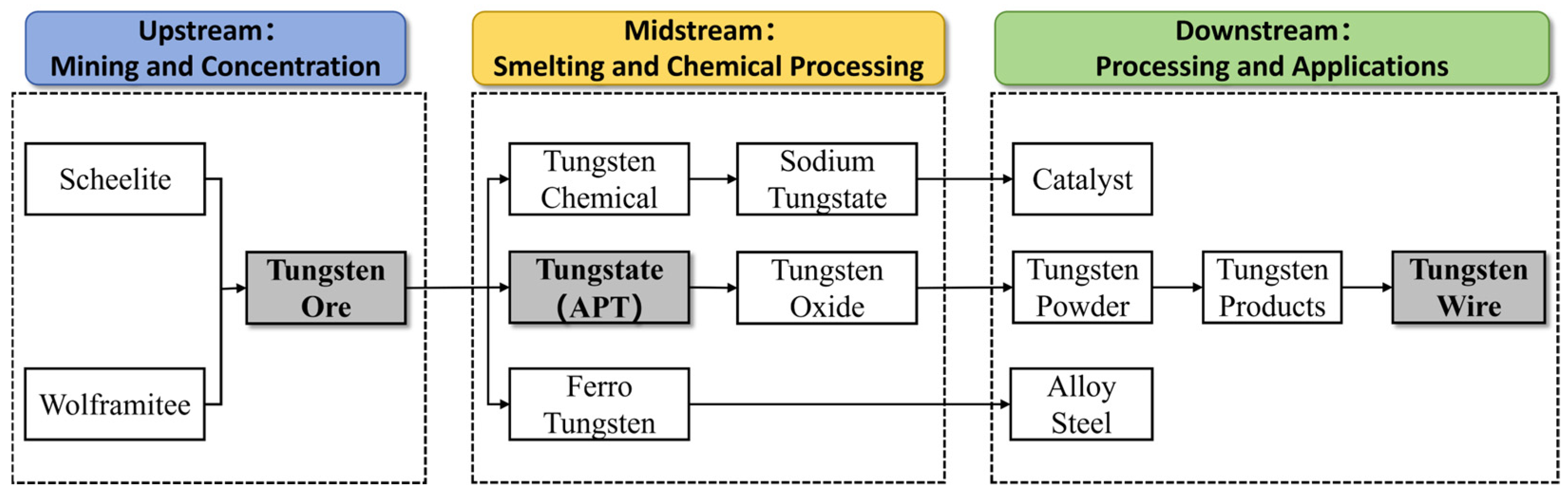
3.1. Multi-Stage Tungsten Supply Chain and Network Construction
3.2. Network Measures and Indicators
3.3. Difference-in-Differences Model
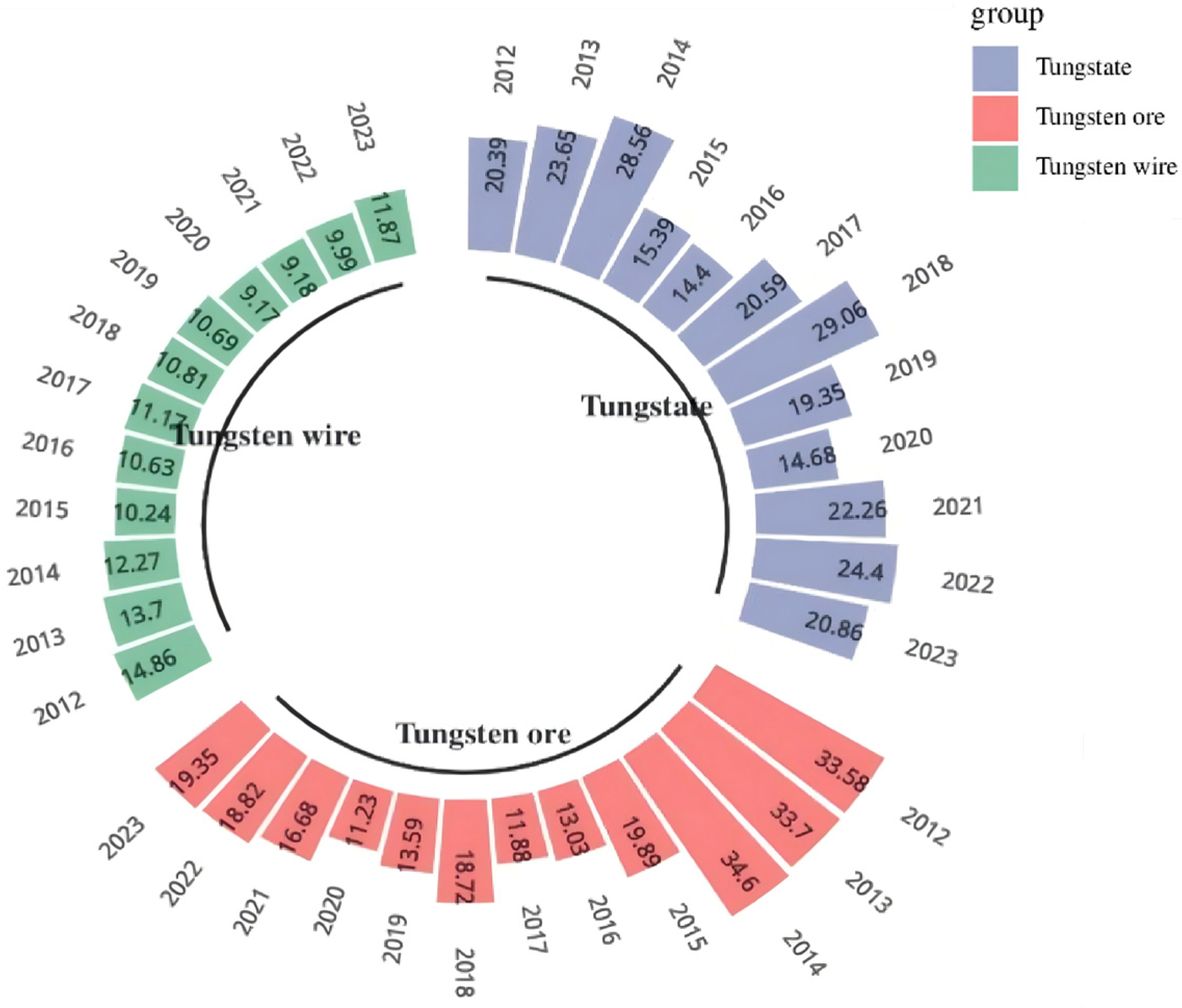
3.4. Data and Sample Description
3.5. Variables
4. Results
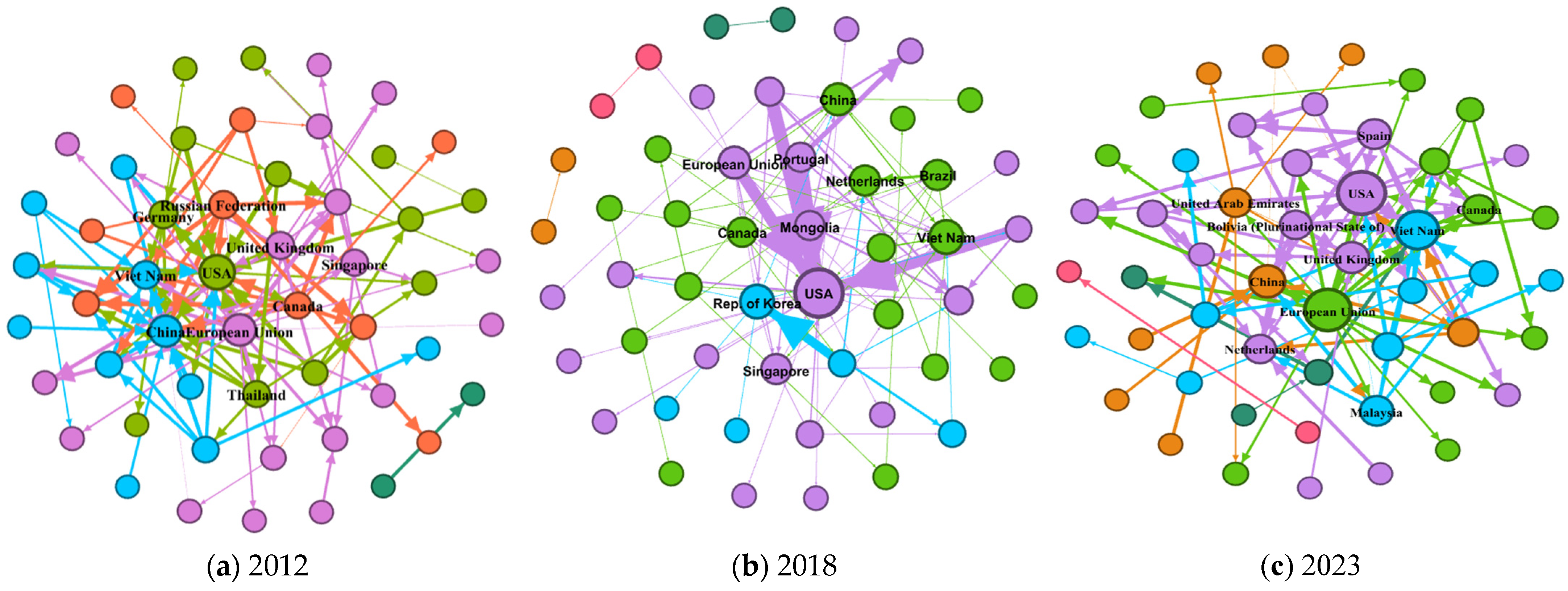
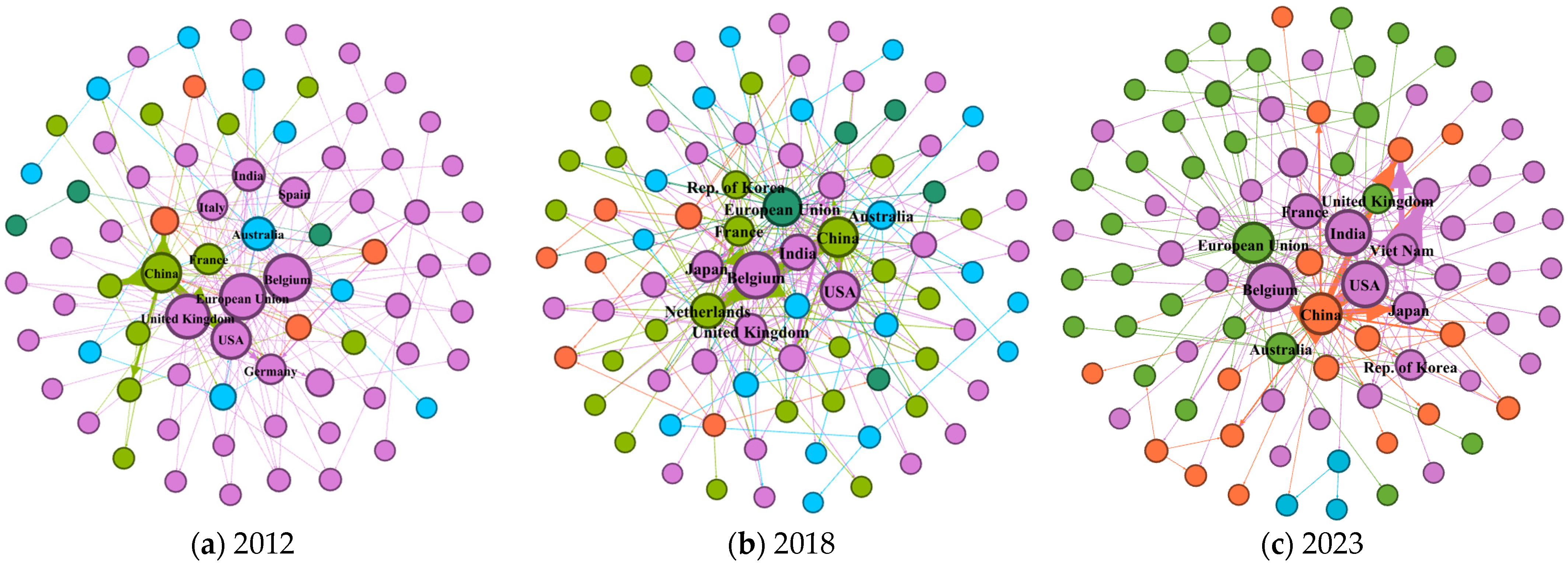
4.1. Network Structure of the Tungsten Supply Chain
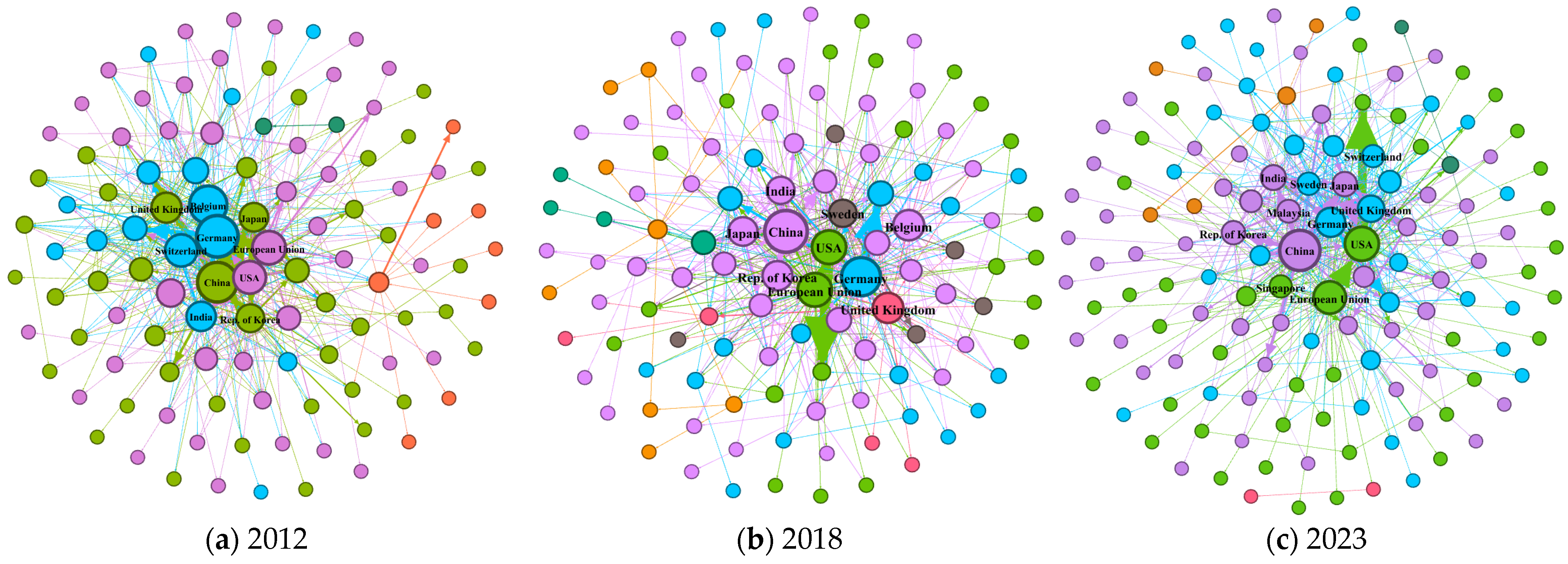
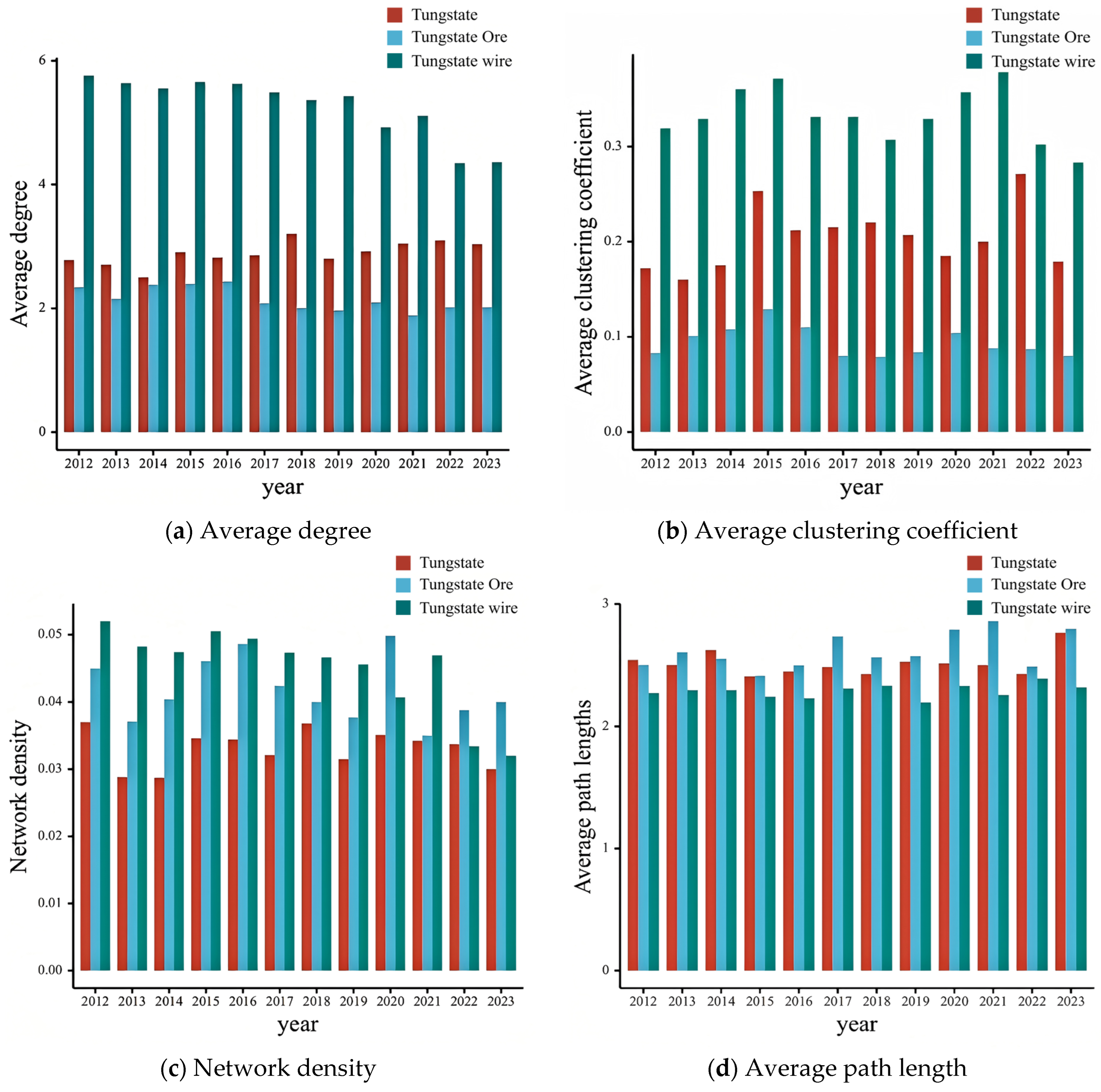
4.1.1. Overall Network Structure
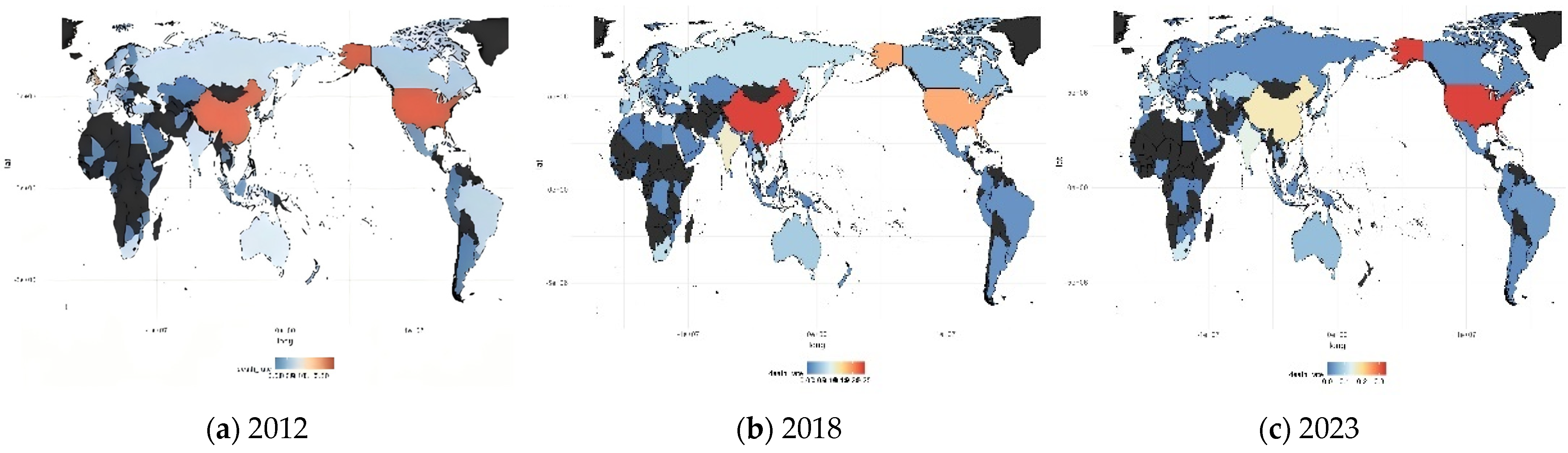
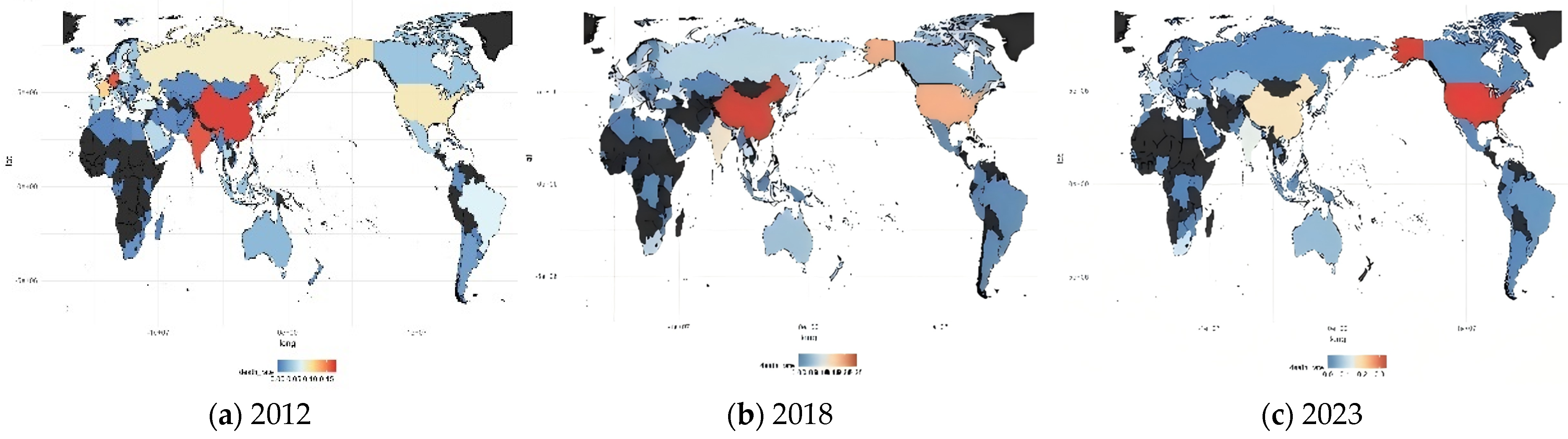
4.1.2. Node Centrality and Core Positions
4.2. Effects of Sino–US Trade Friction
4.2.1. Parallel Trend Test
4.2.2. Baseline DID Results
4.2.3. Robustness Tests
4.2.4. Heterogeneity Analysis
5. Conclusions and Policy Implications
Author Contributions
Funding
Institutional Review Board Statement
Informed Consent Statement
Data Availability Statement
Conflicts of Interest
Appendix A

| Year | Tungstate | Tungsten Ore | Tungsten Wire |
|---|---|---|---|
| 2012 | 2.779 | 2.34 | 5.759 |
| 2013 | 2.705 | 2.153 | 5.636 |
| 2014 | 2.500 | 2.383 | 5.551 |
| 2015 | 2.906 | 2.396 | 5.655 |
| 2016 | 2.819 | 2.431 | 5.626 |
| 2017 | 2.856 | 2.080 | 5.487 |
| 2018 | 3.205 | 2.000 | 5.362 |
| 2019 | 2.800 | 1.962 | 5.425 |
| 2020 | 2.917 | 2.093 | 4.926 |
| 2021 | 3.044 | 1.891 | 5.109 |
| 2022 | 3.097 | 2.019 | 4.344 |
| 2023 | 3.036 | 2.020 | 4.36 |
| Year | Tungstate | Tungsten Ore | Tungsten Wire |
|---|---|---|---|
| 2012 | 0.172 | 0.083 | 0.319 |
| 2013 | 0.160 | 0.101 | 0.329 |
| 2014 | 0.175 | 0.108 | 0.360 |
| 2015 | 0.253 | 0.129 | 0.371 |
| 2016 | 0.212 | 0.110 | 0.331 |
| 2017 | 0.215 | 0.080 | 0.331 |
| 2018 | 0.220 | 0.079 | 0.307 |
| 2019 | 0.207 | 0.084 | 0.329 |
| 2020 | 0.185 | 0.104 | 0.357 |
| 2021 | 0.200 | 0.088 | 0.378 |
| 2022 | 0.271 | 0.087 | 0.302 |
| 2023 | 0.179 | 0.080 | 0.283 |
| Year | Tungstate | Tungsten Ore | Tungsten Wire |
|---|---|---|---|
| 2012 | 0.0370 | 0.045 | 0.0520 |
| 2013 | 0.0288 | 0.0371 | 0.0482 |
| 2014 | 0.0287 | 0.0404 | 0.0474 |
| 2015 | 0.0346 | 0.0461 | 0.0505 |
| 2016 | 0.0344 | 0.0486 | 0.0494 |
| 2017 | 0.0321 | 0.0424 | 0.0473 |
| 2018 | 0.0368 | 0.0400 | 0.0466 |
| 2019 | 0.0315 | 0.0377 | 0.0456 |
| 2020 | 0.0351 | 0.0498 | 0.0407 |
| 2021 | 0.0342 | 0.0350 | 0.0469 |
| 2022 | 0.0337 | 0.0388 | 0.0334 |
| 2023 | 0.0300 | 0.0400 | 0.032 |
| Year | Tungstate | Tungsten Ore | Tungsten Wire |
|---|---|---|---|
| 2012 | 2.543 | 2.502 | 2.273 |
| 2013 | 2.502 | 2.605 | 2.296 |
| 2014 | 2.624 | 2.552 | 2.297 |
| 2015 | 2.409 | 2.414 | 2.242 |
| 2016 | 2.449 | 2.500 | 2.230 |
| 2017 | 2.486 | 2.733 | 2.310 |
| 2018 | 2.428 | 2.564 | 2.333 |
| 2019 | 2.529 | 2.573 | 2.194 |
| 2020 | 2.516 | 2.791 | 2.332 |
| 2021 | 2.501 | 2.859 | 2.257 |
| 2022 | 2.430 | 2.491 | 2.391 |
| 2023 | 2.765 | 2.795 | 2.319 |
References
- Heydari, M.; Mitchell, P.; Cullen, L.; Andrieu, B.; Serrenho, A.C.; Cullen, J. A Systematic review of resilience in critical minerals supply chains needed for the low-carbon energy transition. Renew. Sustain. Energy Transit. 2025, 8, 100127. [Google Scholar] [CrossRef]
- Whitlock, Z.; Kannan, S.G.; Toman, M.A. Resource Nationalism and the Resilience of Critical Mineral Supply Chains (RFF Report); Resources for the Future: Washington, DC, USA, 2025; Available online: https://share.google/kgaWUh97pwYX3ikG5 (accessed on 8 May 2026).
- Vivoda, V.; Matthews, R.; McGregor, N. A critical minerals perspective on the emergence of geopolitical trade blocs. Resour. Policy 2024, 89, 104587. [Google Scholar] [CrossRef]
- Saadaoui, J.; Smyth, R.; Vespignani, J. Ensuring the security of the clean energy transition: Examining the impact of geopolitical risk on the price of critical minerals. Energy Econ. 2025, 142, 108195. [Google Scholar] [CrossRef]
- Lèbre, É.; Valenta, R.; Kemp, D.; Ali, S.H. (Eds.) Critical Raw Materials and the Energy Transition; CRC Press: Boca Raton, FL, USA, 2024. [Google Scholar]
- Caldara, D.; Iacoviello, M.; Molligo, P.; Prestipino, A.; Raffo, A. The economic effects of trade policy uncertainty. J. Monet. Econ. 2020, 109, 38–59. [Google Scholar] [CrossRef]
- World Trade Organization (WTO). World Trade Report 2023: Re-Globalization for a Secure, Inclusive and Sustainable Future; WTO: Geneva, Switzerland, 2023. [Google Scholar]
- Vivoda, V. Friend-shoring and critical minerals: Exploring the role of the Minerals Security Partnership. Energy Res. Soc. Sci. 2023, 100, 103085. [Google Scholar] [CrossRef]
- Huang, J.; Ding, Q.; Wang, Y.; Hong, H.; Zhang, H. The evolution and influencing factors of international tungsten competition from the industrial chain perspective. Resour. Policy 2021, 73, 102185. [Google Scholar] [CrossRef]
- Tang, L.; Wang, P.; Ma, Z.; Pauliuk, S.; Chen, W.-Q.; Dai, T.; Lin, Z. Exploring the global trade networks of the tungsten supply chain: Insights into the physical and monetary mismatch among countries. J. Ind. Ecol. 2023, 27, 323–335. [Google Scholar] [CrossRef]
- Zheng, X.; Li, H.; Liu, X.; Wang, X.; Zhang, Y.; Tang, Q.; Ren, B. Supply risk propagation in international trade networks of the tungsten industry chain. Humanit. Soc. Sci. Commun. 2025, 12, 54. [Google Scholar] [CrossRef]
- Barabási, A.-L.; Pósfai, M. Network Science; Cambridge University Press: Cambridge, UK, 2016; Available online: http://networksciencebook.com/ (accessed on 5 May 2026).
- Shi, Q.; Sun, X.; Xu, M.; Wang, M. The multiplex network structure of global cobalt industry chain. Resour. Policy 2022, 76, 102555. [Google Scholar] [CrossRef]
- Wang, X.; Wang, A.; Zhong, W.; Zhu, D.; Wang, C. Analysis of international nickel flow based on the industrial chain. Resour. Policy 2022, 77, 102729. [Google Scholar] [CrossRef]
- Chen, W.; Zhao, X.; Yu, H. Evaluating the spatiotemporal dynamics and structural resilience of the global titanium industrial chain: Insights from trade network analysis. Resour. Environ. Sustain. 2025, 20, 100213. [Google Scholar] [CrossRef]
- Anderson, J.E.; van Wincoop, E. Gravity with Gravitas: A Solution to the Border Puzzle. Am. Econ. Rev. 2003, 93, 170–192. [Google Scholar] [CrossRef]
- Helpman, E.; Melitz, M.; Rubinstein, Y. Estimating Trade Flows: Trading Partners and Trading Volumes. Q. J. Econ. 2008, 123, 441–487. [Google Scholar] [CrossRef]
- Gereffi, G.; Humphrey, J.; Sturgeon, T.J. The governance of global value chains. Rev. Int. Political Econ. 2005, 12, 78–104. [Google Scholar] [CrossRef]
- Timmer, M.P.; Los, B.; Stehrer, R.; De Vries, G.J. Fragmentation, incomes and jobs: An analysis of European competitiveness. Econ. Policy 2013, 28, 613–661. [Google Scholar] [CrossRef]
- Caldara, D.; Iacoviello, M. Measuring geopolitical risk. Am. Econ. Rev. 2022, 112, 1194–1225. [Google Scholar] [CrossRef]
- OECD. Risks and Resilience in Global Trade: Key Trends in 2023–2024; OECD Publishing: Paris, France, 2024. [Google Scholar] [CrossRef]
- Müller, M. The “new geopolitics” of mineral supply chains. Aust. J. Int. Aff. 2023, 77, 525–543. [Google Scholar] [CrossRef]
- Holling, C.S. Resilience and stability of ecological systems. Annu. Rev. Ecol. Syst. 1973, 4, 1–23. [Google Scholar] [CrossRef]
- Christopher, M.; Peck, H. Building the resilient supply chain. Int. J. Logist. Manag. 2004, 15, 1–14. [Google Scholar] [CrossRef]
- International Energy Agency (IEA). Global Critical Minerals Outlook 2025; IEA: Paris, France, 2025; Available online: https://www.iea.org/reports/global-critical-minerals-outlook-2025 (accessed on 9 May 2026).
- Pfeffer, J.; Salancik, G.R. The External Control of Organizations: A Resource Dependence Perspective; Harper & Row: New York, NY, USA, 1978. [Google Scholar]
- Hund, K.; La Porta, D.; Fabregas, T.P.; Laing, T.; Drexhage, J. Minerals for Climate Action: The Mineral Intensity of the Clean Energy Transition; World Bank: Washington, DC, USA, 2023; Available online: http://hdl.handle.net/10986/40002 (accessed on 6 May 2026).
- U.S. Geological Survey. Mineral Commodity Summaries 2026: Tungsten; U.S. Geological Survey: Reston, VA, USA, 2026. Available online: https://pubs.usgs.gov/periodicals/mcs2026/mcs2026-tungsten.pdf (accessed on 8 May 2026).
- Dolgui, A.; Ivanov, D. Ripple effect and supply chain disruption management: New trends and research directions. Int. J. Prod. Res. 2021, 59, 102–109. [Google Scholar] [CrossRef]
- Ponis, S.T.; Koronis, E. Supply chain resilience: Definition of concept and its formative elements. J. Appl. Bus. Res. 2012, 28, 921–930. [Google Scholar] [CrossRef]




| Stage | Representative Product | HS Code |
|---|---|---|
| Upstream | Tungsten Ore | 2611 |
| Midstream | Tungstate (APT) | 284180 |
| Downstream | Tungsten Wire | 810196 |
| Indicator | Interpretation | Formula | |
|---|---|---|---|
| Overall metrics | Average degree | Measures the average number of trade connections per country. A higher value indicates stronger overall connectivity and more active participation in global tungsten trade. | |
| Network density | Reflects the overall tightness of trade relationships. A higher density indicates a more interconnected and globalized tungsten trade system. | ||
| Average clustering coefficient | Indicates the tendency of countries to form regional trade clusters. A higher value suggests localized cooperation or regional concentration in tungsten trade. | , where | |
| Average path length | Measures the efficiency of trade transmission across the network. A shorter path length indicates faster circulation of tungsten products and higher accessibility. | ||
| Node metrics | Degree centrality | Represents the number of direct trade partners of a country. A higher value indicates broader trade participation and stronger market connectivity. | |
| Betweenness centrality | Measures the extent to which a country acts as an intermediary in trade flows. A higher value indicates stronger control over tungsten trade routes and resource allocation. | ||
| Closeness centrality | Reflects how easily a country can access other countries. A higher value indicates better accessibility and a more central position in the trade network. | ||
| Eigenvector centrality | Measures a country’s influence by considering the importance of its trade partners. A higher value indicates a more influential position in the tungsten trade network. | ||
| Structural metrics | Core–periphery structure | Identifies core countries with dense trade connections and peripheral countries with limited participation, revealing the hierarchical structure of the tungsten supply chain. | Identified using core-periphery algorithms |
| Coreness | Indicates the degree to which a country belongs to the core of the network. Higher values imply a more central and dominant position in tungsten trade. | Measured using k-core decomposition | |
| Effective size | Measures the extent to which a country occupies non-redundant trade positions. A higher value indicates greater access to diverse trade partners and information advantages. | ||
| Constraint | Reflects the degree to which a country’s trade relationships are constrained by its partners. A lower value indicates greater flexibility and stronger brokerage capacity. |
| No. | ISO Code | Country | No. | ISO Code | Country |
|---|---|---|---|---|---|
| 1 | ARG | Argentina | 34 | LUX | Luxembourg |
| 2 | AUS | Australia | 35 | MYS | Malaysia |
| 3 | AUT | Austria | 36 | MEX | Mexico |
| 4 | BHR | Bahrain | 37 | MNG | Mongolia |
| 5 | BLR | Belarus | 38 | NLD | Netherlands |
| 6 | BEL | Belgium | 39 | NOR | Norway |
| 7 | BOL | Bolivia | 40 | OMN | Oman |
| 8 | BRA | Brazil | 41 | PAN | Panama |
| 9 | BDI | Burundi | 42 | PHI | Philippines |
| 10 | KHM | Cambodia | 43 | POL | Poland |
| 11 | CAN | Canada | 44 | PRT | Portugal |
| 12 | CHN | China | 45 | KOR | South Korea |
| 13 | HKG | Hong Kong, China | 46 | ROU | Romania |
| 14 | COL | Colombia | 47 | RUS | Russia |
| 15 | HRV | Croatia | 48 | SAU | Saudi Arabia |
| 16 | CZE | Czech Republic | 49 | SRB | Serbia |
| 17 | DNK | Denmark | 50 | SGP | Singapore |
| 18 | EST | Estonia | 51 | SVK | Slovakia |
| 19 | EUU | European Union | 52 | SVN | Slovenia |
| 20 | FIN | Finland | 53 | ZAF | South Africa |
| 21 | FRA | France | 54 | ESP | Spain |
| 22 | DEU | Germany | 55 | SWE | Sweden |
| 23 | GRC | Greece | 56 | CHE | Switzerland |
| 24 | HUN | Hungary | 57 | THA | Thailand |
| 25 | IND | India | 58 | TUR | Turkey |
| 26 | IDN | Indonesia | 59 | UGA | Uganda |
| 27 | IRL | Ireland | 60 | UKR | Ukraine |
| 28 | ISR | Israel | 61 | ARE | United Arab Emirates |
| 29 | ITA | Italy | 62 | GBR | United Kingdom |
| 30 | JPN | Japan | 63 | TZA | Tanzania |
| 31 | KAZ | Kazakhstan | 64 | USA | United States |
| 32 | KGZ | Kyrgyzstan | 65 | VNM | Vietnam |
| 33 | LTU | Lithuania | 66 | ZWE | Zimbabwe |
| Variable | Definition |
|---|---|
| Yit | Closeness centrality of country i at time t |
| Treati × Postt | Interaction term capturing the effect of Sino–US trade friction |
| Tradeopenit | Merchandise trade as a percentage of GDP |
| Laborit | Total labor force (logarithm) |
| Period | Relative Period | Coefficient | Robust SE | T-Statistic | p-Value |
|---|---|---|---|---|---|
| Pre-policy | t − 2 | −0.004 | 0.013 | −0.30 | 0.776 |
| t − 1 | 0.036 | 0.019 | 1.89 | 0.132 | |
| Policy year | t | 0.031 ** | 0.009 | 3.38 | 0.028 |
| Post-policy | t + 1 | 0.057 *** | 0.010 | 6.01 | 0.004 |
| t + 2 | 0.072 *** | 0.010 | 6.94 | 0.002 | |
| t + 3 | 0.135 *** | 0.017 | 7.87 | 0.001 | |
| t + 4 | 0.092 ** | 0.024 | 3.79 | 0.019 |
| Upstream (Tungsten Ore, Y1) | Midstream (Tungstate, Y2) | Downstream (Tungsten Wire, Y3) | |||||
|---|---|---|---|---|---|---|---|
| (1) | (2) | (3) | (4) | (5) | (6) | ||
| Period | Group | ||||||
| Before | Control | 0.533 | −0.906 | 0.306 | 1.132 | 0.581 | 0.269 |
| Treated | 0.676 | −0.069 | 0.287 | 1.111 | 0.675 | 0.387 | |
| Difference | 0.143 (1.31) | 0.215 (1.62) | 0.201 (2.65) | −0.021 (−0.26) | 0.094 (4.75) | 0.118 (5.51) | |
| p-value | 0.196 | 0.110 | 0.010 *** | 0.792 | 0.000 *** | 0.000 *** | |
| After | Control | 0.341 | −1.091 | 0.379 | 1.190 | 0.552 | 0.242 |
| Treated | 0.551 | −0.769 | 0.487 | 1.058 | 0.719 | 0.438 | |
| Difference | 0.210 (1.93) | 0.321 (2.43) | 0.109 (1.43) | −0.132 (1.65) | 0.168 (8.50) | 0.195 (9.78) | |
| p-value | 0.058 * | 0.018 ** | 0.158 | 0.103 | 0.000 *** | 0.000 *** | |
| DID estimate | 0.068 (0.44) | 0.106 (0.69) | −0.093 (0.87) | −0.111 (1.19) | 0.074 (2.65) | 0.077 (3.13) | |
| p-value | 0.663 | 0.493 | 0.390 | 0.239 | 0.010 ** | 0.003 *** | |
| R2 | 0.14 | 0.18 | 0.13 | 0.39 | 0.63 | 0.75 | |
| Controls | No | Yes | No | Yes | No | Yes | |
| (1) | (2) | |
|---|---|---|
| DID estimate | 317.270 (2.95) | 0.043 (1.86) |
| p-value | 0.004 *** | 0.068 * |
| R2 | 0.62 | 0.65 |
| Controls | Yes | No |
| China | United States | |
|---|---|---|
| DID estimate | 0.077 (3.13) | 0.037 (1.67) |
| p-value | 0.003 *** | 0.101 |
| Controls | Yes | Yes |
| Year FE | Yes | Yes |
| Country FE | Yes | Yes |
| R2 | 0.75 | 0.41 |
Disclaimer/Publisher’s Note: The statements, opinions and data contained in all publications are solely those of the individual author(s) and contributor(s) and not of MDPI and/or the editor(s). MDPI and/or the editor(s) disclaim responsibility for any injury to people or property resulting from any ideas, methods, instructions or products referred to in the content. |
© 2026 by the authors. Licensee MDPI, Basel, Switzerland. This article is an open access article distributed under the terms and conditions of the Creative Commons Attribution (CC BY) license.
Share and Cite
Qiang, H.; Zhang, Y. Analysis of the Global Tungsten Supply Chain Trade Network: Does Sino–US Trade Friction Affect Supply Chain Resilience? Sustainability 2026, 18, 5110. https://doi.org/10.3390/su18105110
Qiang H, Zhang Y. Analysis of the Global Tungsten Supply Chain Trade Network: Does Sino–US Trade Friction Affect Supply Chain Resilience? Sustainability. 2026; 18(10):5110. https://doi.org/10.3390/su18105110
Chicago/Turabian StyleQiang, Haiyan, and Yongli Zhang. 2026. "Analysis of the Global Tungsten Supply Chain Trade Network: Does Sino–US Trade Friction Affect Supply Chain Resilience?" Sustainability 18, no. 10: 5110. https://doi.org/10.3390/su18105110
APA StyleQiang, H., & Zhang, Y. (2026). Analysis of the Global Tungsten Supply Chain Trade Network: Does Sino–US Trade Friction Affect Supply Chain Resilience? Sustainability, 18(10), 5110. https://doi.org/10.3390/su18105110