1. Introduction and Motivation
1.1. Pertinence and Opportunity of Frugal Edge AI
In recent years, the concept of Frugal AI [
1] has gained growing recognition within international policy and development frameworks, particularly through initiatives led by the United Nations Educational, Scientific and Cultural Organization (UNESCO) [
2] and the UN [
3]. These institutions have underscored the need for inclusive, ethical, and resource-efficient AI systems that align with the SDGs and address the persistent digital divide between high- and low-income regions [
4]. Within this global discourse, Frugal AI has emerged as a guiding principle for designing technologies that are affordable, adaptable, and accessible, enabling broader participation in the AI revolution while minimizing environmental impact and energy consumption [
5].
Frugal AI advocates for approaches that maximize societal benefit under conditions of resource constraint—whether computational, financial, or educational. This paradigm has become increasingly relevant for developing countries, where the rapid diffusion of AI risks deepening inequalities if not accompanied by inclusive capacity-building and local innovation pathways [
6]. UNESCO’s Recommendation on the Ethics of Artificial Intelligence [
2] and the UN’s Digital Public Goods Alliance [
7] have both emphasized the importance of open, transparent, and participatory AI ecosystems, calling for strategies that empower communities to shape the technologies that affect their lives [
8].
TinyML exemplifies Frugal AI in action: by enabling the deployment of ML models to run on low-power, low-cost microcontrollers and embedded systems that consume only milliwatts of power, reducing dependency on cloud infrastructure and data connectivity [
9,
10]. It allows AI to function “at the edge”—close to where data are generated—without continuous connectivity to cloud servers. In that context, [
11] proposes the subconcept of
Frugal Edge AI, concerning the edge computing variation of the general concept, fitting the TinyML-focused innovation explored in this paper. Its energy efficiency and affordability make it particularly suitable for low-resource environments, where traditional AI systems are impractical. As such, it opens a path for localized, sustainable AI innovation that is both environmentally and economically viable.
1.2. Related Work
TinyML systems have been successfully applied to tasks such as environmental sensing, wildlife conservation, precision agriculture, and low-cost diagnostics, often in contexts where connectivity or infrastructure is limited. Emerging examples from programs such as TinyML4D [
12], TinyMLedu [
13], and community-based innovation challenges demonstrate how grassroots AI education and innovation can contribute to local development and sustainability goals [
11,
14]. Yet systematic analysis of such initiatives remains limited. There is a need to better understand how edge AI and participatory models translate into entrepreneurial activity, what institutional conditions support their growth, and how ethical and responsible practices can be embedded from the outset.
However, technology alone cannot ensure inclusivity. The realization of Frugal AI depends on human-centered, participatory approaches that empower local actors to co-create solutions relevant to their contexts. Citizen science—the active involvement of non-experts in scientific inquiry—offers a powerful model for this engagement [
15,
16]. When integrated with TinyML workshops and edge AI initiatives, citizen science can help communities define their own challenges, collect data, and develop context-specific applications in areas such as agriculture, environmental monitoring, and public health. These participatory initiatives enhance technical literacy and nurture local entrepreneurship by providing pathways for participants to transform prototypes into sustainable products or services [
17].
Recent literature on edge and frugal AI has also begun to explore frameworks that bridge technical design with business and societal impact. Approaches such as the Lean Startup methodology [
18] and adaptations of the Business Model Canvas for social innovation [
19] provide useful foundations for structuring early-stage ventures, yet they largely overlook the constraints and design trade-offs inherent to edge deployments. In parallel, research on responsible AI and AI for Social Good emphasizes the need to embed ethical, governance, and impact considerations throughout the innovation lifecycle [
6]. However, few existing frameworks explicitly integrate resource constraints, edge-specific risks, and measurable efficiency metrics alongside traditional value creation and impact dimensions. This gap highlights the need for tailored tools that can support innovators in aligning technical feasibility, ethical responsibility, and sustainable business models in low-resource and distributed contexts.
1.3. Contributions of This Work
In this paper, we explore the intersection of Frugal AI, participatory citizen science, and TinyML as a framework for fostering sustainable, community-driven technological ecosystems in developing contexts. Specifically, this study seeks to address the following research questions:
How can edge AI—through TinyML and related initiatives—foster entrepreneurship driven by participatory citizen science in developing countries?
What pedagogical, technical, and institutional frameworks support the emergence and sustainability of such community-driven AI entrepreneurship?
What lessons from existing TinyML projects highlight the need to strengthen ethical and responsible AI practices within participatory and frugal AI initiatives?
By analyzing a selection of existing TinyML initiatives and early participatory experiences, this paper identifies the foundational elements that enable community-led AI entrepreneurship, strengthen local innovation capacity, and promote sustainable, ethical, and equitable technological ecosystems. Through this lens, we aim to contribute to the growing global conversation on Frugal and Sustainable AI, offering insights for educators, policymakers, and practitioners committed to inclusive digital transformation.
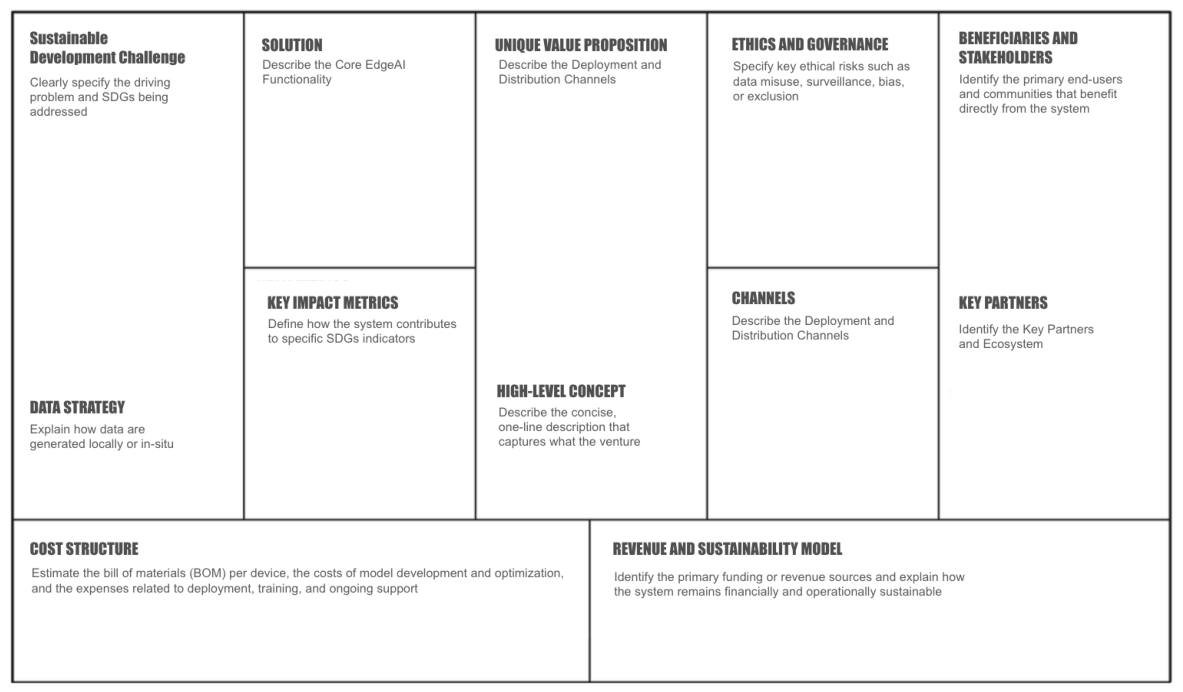
Moreover, this work positions Frugal Edge AI not only as a technical paradigm but also as an academically driven mechanism for enabling sustainable entrepreneurship and boosting local economic resilience. We introduce the Frugal Edge AI Lean Canvas, a constraint-aware framework for designing and evaluating edge AI solutions in low-resource settings. It integrates frugal AI design choices (e.g., TinyML/TinyLM, on-device and offline-first deployment), local data ecosystems, and context-specific ethical considerations. The canvas also incorporates dual impact metrics—capturing both SDG contributions and system efficiency—enabling innovators to articulate novelty, responsibility, and measurable real-world impact.
With it, we contribute to the broader discussion on sustainable entrepreneurship and local economic resilience by examining how academic-led TinyML initiatives translate research and education into community-driven entrepreneurial activity. Through the lens of Frugal Edge AI and participatory citizen science, the study illustrates entrepreneurial processes that generate economic value while remaining environmentally responsible and socially inclusive, particularly in low-resource settings where conventional AI solutions are impractical. By documenting how low-cost, energy-efficient TinyML systems are co-designed with local stakeholders to address challenges in agriculture, environmental monitoring, and public health, the paper provides empirical insight into sustainable business model formation, stakeholder engagement, and early-stage innovation under conditions of constraint.
At the same time, the work emphasizes the central role of academia in shaping local sustainability ecosystems. Universities and research institutions act not only as sites of technical innovation but also as hubs for entrepreneurship education, experiential learning, and community engagement, providing open educational resources, participatory workshops, and research infrastructures that support skills development and prototype-to-venture pathways. By integrating technical research with social and cultural dimensions of sustainability, the paper demonstrates how academic institutions enable ethically grounded, locally embedded entrepreneurial practices that strengthen economic resilience and support SDG acceleration.
The TinyML4D (TinyML for Development) initiative [
20], launched in collaboration with Harvard University, the UN ITU AI for Good program, and local partners, demonstrates the potential of TinyML to drive inclusive innovation. Through workshops, hackathons, and open-source curricula, TinyML4D has engaged students, researchers, and entrepreneurs in low- and middle-income countries, fostering innovation ecosystems that combine technical education, applied research, and entrepreneurship [
21,
22]. These experiences highlight how affordable, open educational resources can enable local communities to design and deploy AI applications tailored to their unique socio-economic and environmental needs. Furthermore, TinyML workshops serve as pre-incubation spaces where participants move from problem identification to minimum viable products (MVPs) deployable in community markets.
Citizen science—a model in which non-experts actively contribute to data collection, problem definition, and knowledge production—offers an important mechanism for democratizing AI innovation [
23]. Traditionally used in environmental monitoring and public health, citizen science initiatives are increasingly intersecting with AI tools, enabling communities to collect, annotate, and interpret data relevant to their contexts.
When combined with TinyML, citizen science takes on a new dimension: participants not only gather data but also build and train models that operate autonomously on inexpensive hardware. This transforms citizens from data sources into co-creators and decision-makers, aligning technological innovation with local priorities. Participatory TinyML workshops—such as those implemented in Latin America, Africa, and South Asia—have shown that even participants with minimal prior programming experience can design and deploy functional AI prototypes within days [
24]. These activities often spark grassroots entrepreneurship, as participants identify ways to adapt prototypes into solutions addressing real-world challenges, from smart irrigation to air-quality monitoring and waste management.
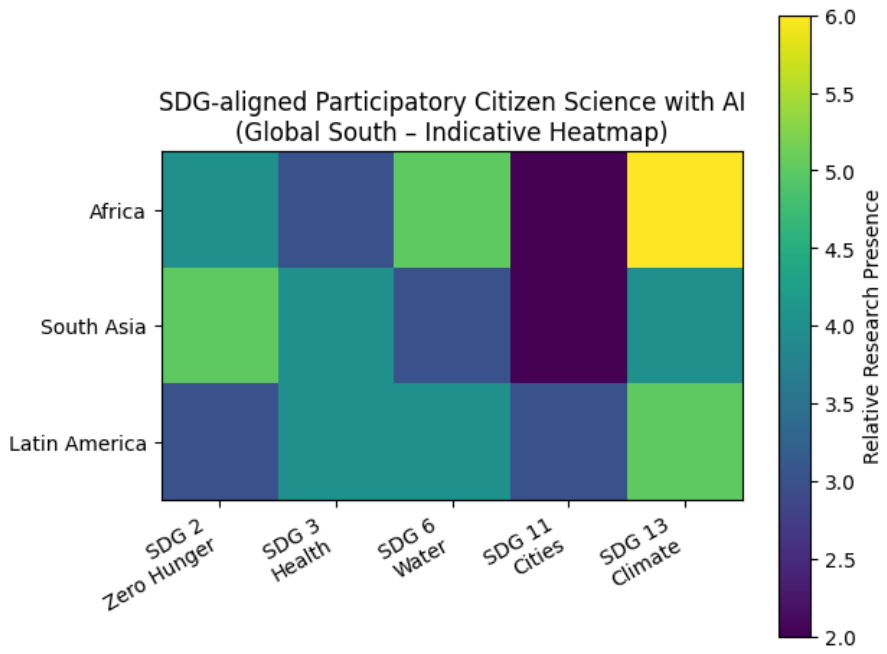
Figure 1 shows an indicative SDG-aligned heatmap of participatory citizen science initiatives using AI across Global South regions, based on collected abstracts of research papers in OpenAlex [
25]. The visualization highlights uneven thematic concentration, with stronger activity in climate action, food systems, and water monitoring, and comparatively limited engagement in urban and health-system applications, underscoring both emerging strengths and persistent gaps in SDG-oriented participatory AI research.
The entrepreneurial potential of participatory and frugal AI initiatives lies in their ability to bridge education, innovation, and local market needs. By empowering participants to experiment, iterate, and prototype, these workshops cultivate creative problem-solving and entrepreneurial mindsets [
6]. When supported by universities, NGOs, or industry partners, they can form the nucleus of local innovation ecosystems, where trained participants evolve into community mentors, startup founders, or applied researchers.
Such models also align with sustainable entrepreneurship principles, where innovation serves both economic and social objectives. The entrepreneurial spillover from TinyML workshops—through startups, open hardware projects, or micro-enterprises—illustrates how edge AI can generate inclusive economic opportunities while advancing the SDGs. However, the sustainability of these ecosystems often depends on ongoing mentorship, access to funding, and supportive institutional policies, all of which remain underdeveloped in many regions. A structured analysis of these efforts is still lacking. Addressing this gap is essential to understanding how Frugal AI can remain both innovative and ethically grounded [
26].
Figure 1.
Indicative SDG-aligned heatmap of participatory citizen science initiatives using AI across Global South regions, adopting the Wikidata-aligned SDG terminology provided in [
27].
Figure 1.
Indicative SDG-aligned heatmap of participatory citizen science initiatives using AI across Global South regions, adopting the Wikidata-aligned SDG terminology provided in [
27].
2. Methodology and Framework
2.1. Research Design
This paper adopts a qualitative, exploratory research design, focusing on 50 participatory TinyML initiatives across 22 countries, aimed at understanding how edge AI initiatives—particularly those centered around TinyML—are fostering entrepreneurship and participatory innovation in developing countries. Given the novelty and evolving nature of Frugal AI and citizen-driven technological ecosystems, an exploratory approach is appropriate for identifying emerging patterns, practices, and challenges.
Rather than evaluating programs as isolated repositories or assessing impact quantitatively, the study systematically compares cases to identify recurring patterns, enabling conditions, and variations across contexts. The aim is to generate analytical generalizations about how participatory Frugal Edge AI ecosystems function, particularly in relation to entrepreneurship, capacity building, and ethical practices. Accordingly, this work is positioned as a qualitative comparative assessment of participatory AI initiatives rather than a formal evaluation or impact measurement study. The analysis focuses on cross-case patterns and mechanisms that explain how innovation and entrepreneurship emerge within frugal AI ecosystems.
Cases were identified through systematic screening of three publicly accessible repositories and program archives: (i) the TinyML4D “Show and Tell” archive [
20]; (ii) the TinyMLedu research repository [
28]; and (iii) the ITU AI for Good Innovation Factory program records [
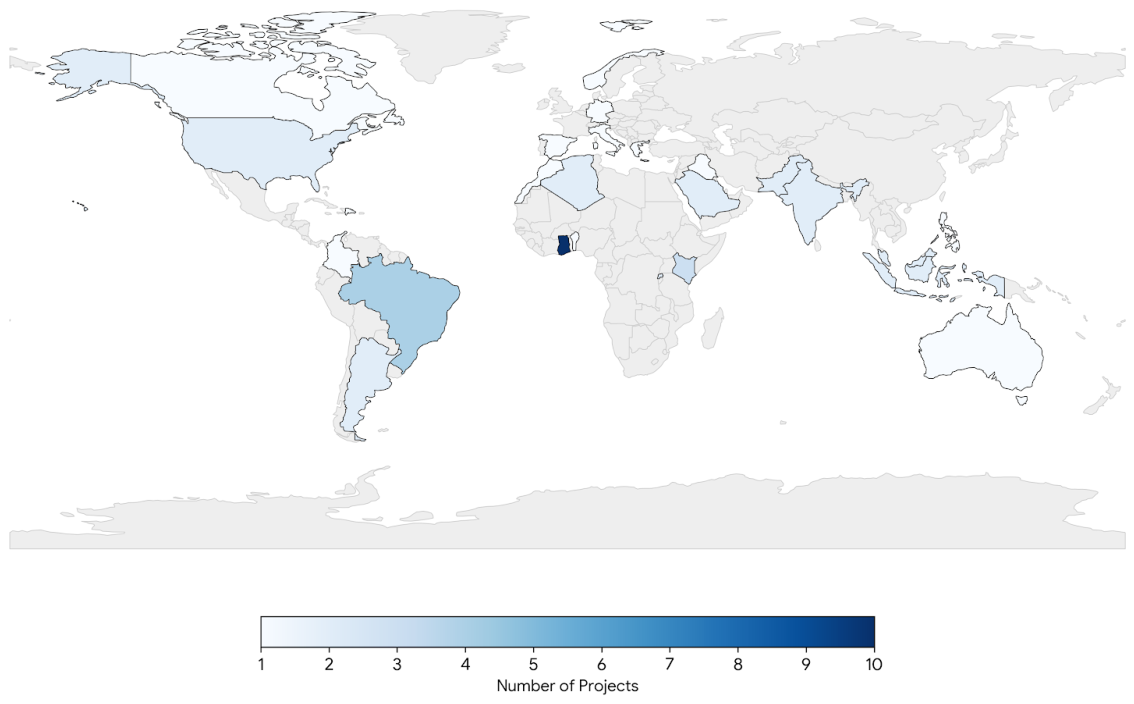
29]. An initial pool of 112 candidate initiatives documented between 2020 and 2025 was identified, spanning a wide geographical distribution with substantial contributions from the Global South, as shown in
Figure 2. These initiatives derive mostly from university- or NGO-led workshops in Latin America, Africa, and South Asia—some co-created with the authors of this paper.
The study follows the logic of a multiple case study, combining documentary analysis, workshop reports, and stakeholder reflections to extract insights from TinyML and edge AI initiatives conducted between 2020 and 2025. The showcases presented in TinyML4D are best suited to the analysis conducted in this paper. TinyMLedu complements this work by providing research-oriented case studies discussed within its lectures, while the ITU initiative is currently tangential to the core analysis, though it remains valuable for long-term comparison.
Rather than assessing performance metrics, the analysis emphasizes contextual understanding—how technological, pedagogical, and institutional factors interact to enable participatory entrepreneurship and ethical AI practices. The aim is to generate analytical generalizations that inform future Frugal AI initiatives rather than statistical generalizations across a population.
2.2. Data Sources and Selection Criteria
Data for this study were drawn from two complementary sources: (i) documentary and archival sources in [
12], including project reports, workshop documentation, open-access datasets, and official communications from TinyML4D, TinyMLedu, and the ITU AI for Good programme, providing insights into program structures, participant demographics, and thematic focus areas; and (ii) secondary academic and gray literature in [
13], including peer-reviewed articles, white papers, and policy briefs related to participatory AI, Frugal AI, and TinyML-based innovation in low-resource settings, establishing the broader conceptual and ethical backdrop against which specific initiatives are analyzed. The data for analysis also include the upcoming TinyML/FrugalAI-related records of ITU’s AI for Good Innovation Factory programme, profiled in [
30].
To ensure relevance, cases were selected according to three criteria and explicitly involved TinyML or edge AI technologies, emphasizing capacity-building and participation (e.g., workshops, hackathons, or open educational models) and occurring in or being targeted toward developing and emerging economies. In particular, case studies were included if they met all of the following criteria: (i) explicit use of TinyML or low-power edge-AI techniques; (ii) participatory or citizen-science-oriented implementation (e.g., workshops, co-creation, community data collection); and (iii) implementation in, or primary targeting of, low- and middle-income or resource-constrained contexts, with sufficient public documentation (reports, videos, repositories, or programme summaries).
A total of 50 representative cases from 22 countries worldwide were included for analysis, capturing variation in geographical focus, institutional partnerships, and project maturity.
A qualitative coding process was conducted for the TinyML4D and TinyMLedu initiatives following a structured, multi-step protocol and an iterative coding process. An initial coding framework was developed deductively from the literature on sustainable innovation systems, participatory design, and sustainable entrepreneurship, and inductively refined through close reading of the case materials. Each case was coded across five analytical dimensions: (i) skill formation and learning outcomes; (ii) prototype characteristics and deployment context; (iii) forms of entrepreneurial engagement; (iv) institutional support and partnerships; and (v) ethical and governance practices.
Coding was conducted by a single researcher, with no inter-coder reliability metrics computed. To ensure analytical rigor and consistency, the study applied intra-coder reliability procedures, including: (i) repeated coding of a subset of cases after a two-week interval; (ii) systematic use of predefined coding criteria; and (iii) cross-validation of interpretations against publicly available documentation and triangulated sources. The reference to inter-coder reliability in previous versions has therefore been removed to avoid ambiguity. The coding framework is documented in
Appendix A to support transparency and reproducibility of the study.
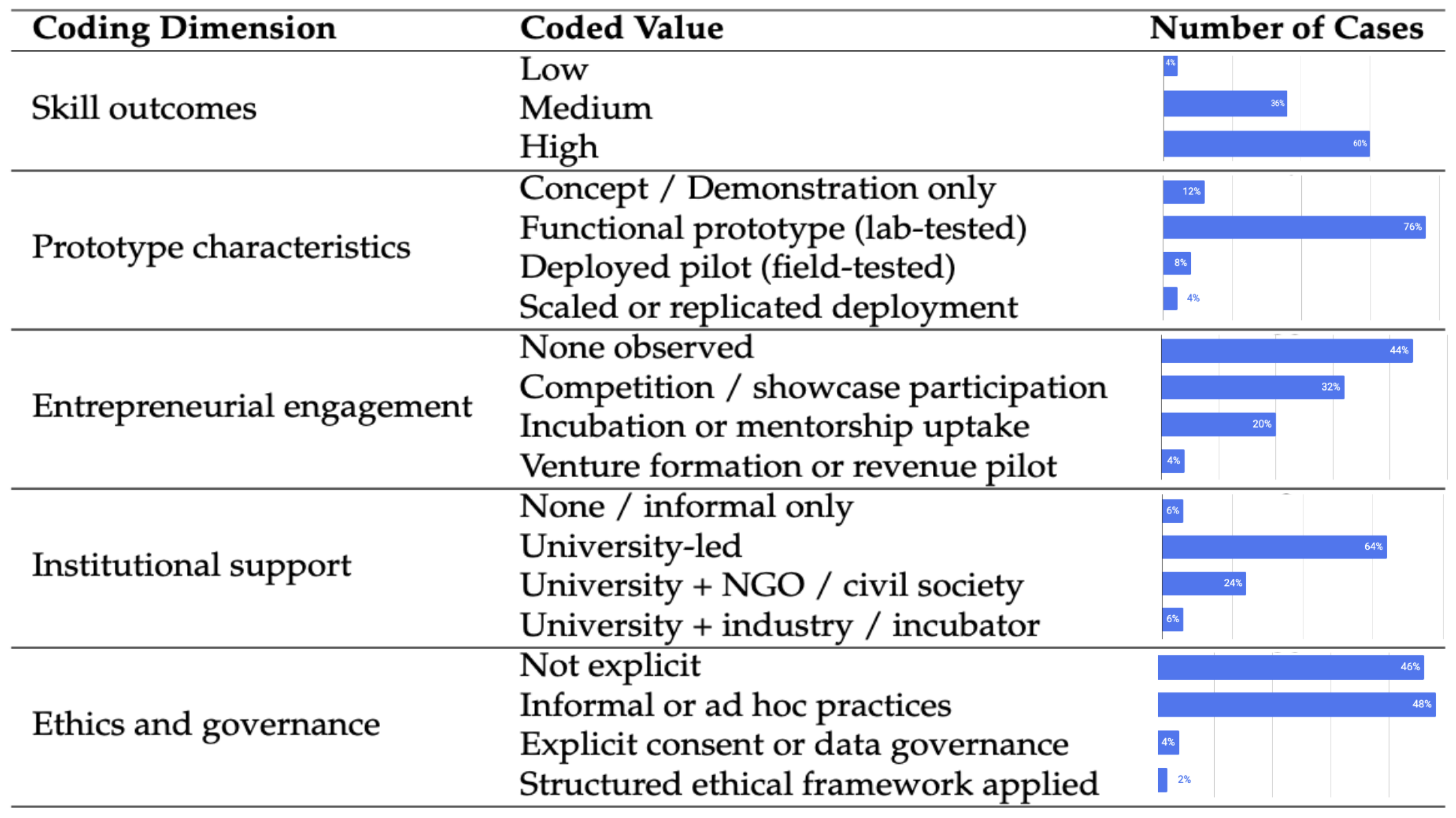
Across the 50 analyzed cases in
Figure 3, the aggregated evidence from
Table A1 in the
Appendix A of this paper, indicates that over 85% of the initiatives remain at the stage of functional, lab-tested prototypes, with only a limited share (around 15%) progressing to field deployment or scaled implementation. In terms of entrepreneurial engagement, over half of the cases (76%) are confined to early-stage activities such as competitions or showcases, while fewer than 20% demonstrate incubation uptake or venture formation trajectories. Institutional support is strongly concentrated in academia, with universities involved in more than 60% of cases, often acting as primary facilitators of capacity-building and innovation. However, explicit ethics and governance practices appear in less than 10% of initiatives, with most cases relying on informal or ad hoc approaches.
These findings suggest that participatory TinyML ecosystems, as provided in the channels analyzed in this study (that host a pedagogical priority), primarily operate as entrepreneurial catalysts, lowering barriers to experimentation and enabling early-stage opportunity recognition. However, the transition to sustained entrepreneurship depends on external ecosystem factors—particularly access to mentorship, funding, and institutional support—rather than on technical training alone.
2.3. Analytical Framework
The analytical framework integrates three conceptual lenses that together support a holistic understanding of participatory and frugal AI ecosystems: (a) sustainable innovation systems, (b) participatory design and co-creation, and (c) responsible and ethical AI principles. Drawing on the Sustainability Transitions and Innovation Systems literature [
21,
23], this perspective views participatory AI initiatives as part of broader socio-technical systems in which technology, education, policy, and entrepreneurship interact. By examining how knowledge flows between universities, NGOs, private sector actors, and community participants, we assess the enabling functions of these systems—such as knowledge development, network building, and resource mobilization. This framework helps identify which institutional configurations most effectively sustain local innovation capacity. The analysis follows a qualitative, comparative approach grounded in document analysis, based on the list in
Appendix A with further details on methods used. Projects were selected through purposive sampling to represent a diversity of institutional contexts, pedagogical formats, and degrees of community engagement within the TinyML and Frugal Edge AI ecosystem. Selection criteria included: (i) explicit engagement with TinyML or participatory AI practices; (ii) availability of sufficient public documentation (e.g., repositories, workshop materials, videos, or reports) to enable systematic analysis; and (iii) relevance to capacity building in low-resource or development-oriented contexts. For each selected initiative, materials were coded against a common set of evaluative categories derived from participatory design literature and international ethical frameworks (including UNESCO AI ethics principles in [
2]). This analysis focused on evidence of participatory mechanisms, knowledge transfer practices, ethical considerations, and links to local innovation or entrepreneurial activity based on desk research. While the analysis does not aim to rank initiatives, the comparative framework enables the identification of recurring patterns, gaps, and good practices across cases. The participatory design tradition emphasizes that innovation is most sustainable when it is co-created with intended users and beneficiaries [
16]. Applying this to AI and TinyML, we analyze how workshop methodologies and citizen science practices facilitate active participation, knowledge transfer, and local agency. This includes evaluating mechanisms for inclusive participation (e.g., gender balance, accessibility), community problem identification, and iterative prototyping. The analysis examines how these features contribute to both technical learning outcomes and entrepreneurial opportunities emerging from participatory engagement. To ensure alignment with global standards, the analysis incorporates ethical dimensions inspired by the UNESCO Recommendation on the Ethics of Artificial Intelligence [
2], the recent guidelines of the Hamburg Declaration on Responsible Artificial Intelligence for the Sustainable Development Goals [
31], as well as the Strategic Research Agendas of the HumanE AI Net [
32], and of the European Lighthouse of AI for Sustainability (ELIAS) [
33]. These principles—human rights, sustainability, fairness, transparency, and accountability—are applied as evaluative categories to assess how TinyML and participatory AI initiatives address or overlook responsible innovation. This includes attention to data governance, privacy, environmental impact, and the social inclusivity of AI solutions, where the frameworks highlight areas where ethical literacy and institutional support need to be strengthened while identifying recurring challenges and good practices.
2.4. Limitations of the Study
The exploratory nature of this study implies certain limitations. The reliance on publicly available documentation and secondary sources may omit unpublished or informal activities. Moreover, differences in program maturity and geographic coverage mean that findings should be interpreted as illustrative rather than exhaustive. Nevertheless, the combination of diverse data sources and an explicitly comparative analytical framework ensures a robust and triangulated understanding of emerging trends across the TinyML and Frugal Edge AI landscape. As an exploratory and qualitative investigation, this study is subject to several limitations that should be considered when interpreting its findings. Firstly, the analysis relies primarily on secondary and publicly available sources, including project documentation, repositories, videos, and published reflections. While this approach enables broad coverage across multiple initiatives and regions, it inevitably limits access to informal practices, unpublished outcomes, and challenges that may not be captured in public-facing materials. Consequently, some dimensions of participant experience, institutional dynamics, and project failure may be underrepresented in the analysis.
Secondly, the initiatives examined vary substantially in terms of maturity, scale, and documentation quality. Some cases represent well-established programs with multi-year histories, while others consist of early-stage workshops or short-term pilot projects. This variability constrains the comparability of outcomes and makes it difficult to draw strong conclusions about long-term sustainability or impact. In addition, inconsistencies in data completeness—such as uneven reporting of participant demographics, follow-up activities, or post-deployment outcomes—limit the ability to systematically assess effectiveness across cases. The study is also limited by the absence of robust quantitative metrics for evaluating long-term outcomes related to skill retention, employment, entrepreneurship, or societal impact. While qualitative evidence suggests positive learning and innovation effects, these findings should be interpreted as indicative rather than conclusive. The lack of standardized indicators and longitudinal data restricts the ability to measure causal relationships between participatory TinyML interventions and sustained development outcomes.
A third key limitation of this study is that qualitative coding was conducted by a single researcher, which may introduce subjective bias in the interpretation and categorization of data. To mitigate this risk, we adopted several strategies to enhance objectivity and reliability. First, a structured coding protocol and a clearly defined codebook were developed and iteratively refined to ensure consistency across the analysis. Second, we employed intra-coder reliability checks by revisiting and re-coding a subset of the data at different stages, assessing stability over time. Third, findings were triangulated across multiple data sources (e.g., project documentation, participant outputs, and observational notes) to validate emerging themes. Finally, interim results and coding decisions were discussed with peers and domain experts to challenge assumptions and reduce individual bias. While these measures strengthen the robustness of the analysis, future work would benefit from multiple coders and a formal inter-coder reliability assessment.
Future research should therefore complement this exploratory analysis with more systematic and longitudinal approaches. Long-term impact studies tracking participants over time would provide valuable insights into how TinyML training influences career trajectories, entrepreneurial activity, and community-level innovation. Surveys and in-depth interviews with participants, educators, and institutional partners could further illuminate skill retention, barriers to scaling, and the social dynamics shaping participatory AI initiatives. Additionally, comparative studies across regions or policy environments would help identify how national strategies, regulatory frameworks, and institutional support structures influence the success and sustainability of participatory and frugal AI ecosystems. Together, such research directions would strengthen the empirical foundation for understanding how participatory TinyML can contribute to inclusive and sustainable AI development.
2.5. Toward a Sustainable AI Ecosystem
The analysis presented in this paper underscores that sustainable AI ecosystems do not emerge from technological efficiency alone but from the dynamic interaction of education, entrepreneurship, and ethical governance. The findings demonstrate that participatory TinyML initiatives are most impactful when technical capacity building is closely linked to opportunities for innovation and supported by institutional and ethical frameworks. Education provides the foundation for agency and skill development; entrepreneurship enables the translation of these skills into socially and economically meaningful applications; and ethical anchoring ensures that innovation remains aligned with principles of inclusivity, accountability, and environmental sustainability. When these dimensions reinforce one another, participatory and frugal AI initiatives can move beyond isolated pilot projects toward resilient, locally embedded innovation ecosystems.
Participatory TinyML emerges from this study as a compelling model for inclusive, bottom-up AI innovation. By lowering technical, financial, and infrastructural barriers, TinyML enables communities to engage with AI as creators rather than passive users, fostering localized problem-solving and experimentation. The participatory citizen-science approach further strengthens this model by grounding technological development in community-defined needs and contextual knowledge. Together, these elements challenge dominant top-down AI development paradigms and demonstrate how frugal, edge-based AI can support pluralistic and context-sensitive innovation pathways, particularly in developing and resource-constrained environments. Aligning participatory TinyML initiatives with the Sustainable Development Goals provides a unifying framework that connects local innovation to global societal priorities. The SDGs offer a shared language for linking educational outcomes, economic inclusion, environmental stewardship, and social equity, helping to ensure that AI-driven innovation delivers both social and environmental impact. By operationalizing sustainability through low-energy computation, open hardware, and community-driven design, Frugal AI approaches translate SDG principles into concrete technological and institutional practices.
Looking ahead, scaling sustainable AI ecosystems will require coordinated global collaboration that builds on existing international and open-source networks. Organizations such as UNESCO and the ITU AI for Good programme are well-positioned to facilitate knowledge exchange, develop ethical and pedagogical standards, and support capacity-building initiatives across regions. At the same time, open-source communities and academic–civil society partnerships can play a critical role in maintaining accessible tools, shared curricula, and collaborative innovation platforms. Strengthening these multi-level collaborations will be essential for mainstreaming participatory and frugal AI approaches and for ensuring that the future of AI development is inclusive, sustainable, and locally empowered. This methodology and analytical framework allow the study to systematically examine how edge AI and participatory citizen science intersect with entrepreneurship, ethics, and sustainability. By combining perspectives from innovation systems, participatory design, and responsible AI governance, the analysis provides an integrative view of how Frugal Edge AI initiatives can be designed, scaled, and ethically grounded to support inclusive technological ecosystems in developing countries. Building on these conceptual and empirical foundations, the following section outlines the research design and methodological approach used to examine how participatory TinyML initiatives contribute to frugal, inclusive, and entrepreneurial AI ecosystems.
3. Main Results
3.1. Overview of Case Study Findings
Across this study, we analyzed three major public repositories and program streams that document participatory TinyML and edge-AI innovation in developing contexts: the TinyML4D “Show and Tell” video archive, the TinyMLedu project and research repository, and the AI for Good Innovation Factory startup pipeline. Together, these sources provided 50 representative cases that span educational workshops, student-led prototypes, community-driven sensor deployments, and early-stage entrepreneurial initiatives. The TinyML4D archive illustrates grassroots innovation emerging from hands-on training in Africa, Latin America, and South Asia, while the TinyMLedu repository offers peer-reviewed research outputs and reproducible project demonstrations built on low-power microcontrollers. Complementing these, the AI for Good Innovation Factory showcases high-impact, SDG-aligned AI start-ups selected from global pitching competitions. Collectively, these cases capture a diverse mix of educational, applied, and entrepreneurial perspectives, enabling a multifaceted assessment of how TinyML, as a Frugal Edge AI approach, supports capacity building, local problem-solving, and sustainable innovation ecosystems in low-resource settings.
Across the analyzed cases, several consistent outcomes emerged regarding participant learning and innovation capacity. First, participants demonstrated clear gains in technical skills, including sensor integration, data collection, model training, and on-device inference, reflecting the accessibility of TinyML workflows even for beginners. These hands-on learning experiences also contributed to a measurable increase in AI literacy, as participants reported improved understanding of core machine learning concepts, the distinctions between cloud and edge AI, and the relevance of Frugal AI for low-resource environments. Importantly, nearly all reviewed initiatives produced functional prototypes, with models successfully deployed on microcontrollers for tasks such as environmental sensing, agricultural monitoring, acoustic detection, and simple health diagnostics. These prototypes—often created within days or weeks—demonstrate the feasibility of rapid, community-driven innovation using low-cost edge-AI tools. Patterns of success were strongly linked to the presence of ongoing mentorship, structured follow-up activities, and connections to innovation hubs or university labs, which provided continuity beyond initial workshops. Programs that combined technical coaching with opportunities to pitch ideas, participate in competitions, or access maker spaces showed markedly higher rates of prototype refinement and entrepreneurial engagement. Collectively, these findings highlight how participatory TinyML ecosystems can cultivate sustained skill development, deepen AI understanding, and generate practical, locally relevant innovations.
We analyzed three public TinyML resources and repositories used by education and outreach programs: the TinyMLedu research listing, the TinyML4D Show and Tell page and associated playlists, and the TinyML4D video channel/archives that document student and practitioner projects. The TinyMLedu research page aggregates academic journal articles, conference proceedings, and applied case work demonstrating TinyML use across environmental sensing, agriculture, health, and low-power sensing applications; it also links to TinyML4D program outputs and curricular resources. The cases reveal a clear education > prototyping > local solutions pipeline, in which TinyMLedu and TinyML4D integrate open educational materials, hands-on workshops, and public “Show and Tell” presentations to accelerate learning. These programs significantly shorten the traditional learning-to-prototyping cycle: participants often develop and present functional projects within a matter of weeks. This rapid progression from instruction to implementation supports iterative experimentation, encourages creative problem-solving, and enables participants to adapt solutions to local needs. As such, the fast cycle is a critical driver of grassroots innovation and an essential foundation for emerging entrepreneurial activity.
A second key finding concerns TinyML’s low-cost and low-power technical affordances, which align closely with Frugal AI and Green AI principles [
11]. The TinyML corpus consistently demonstrates the feasibility of running machine learning models directly on microcontrollers, thereby minimizing reliance on high-performance infrastructure, continuous connectivity, or cloud-based processing. This edge-AI operation reduces costs, improves data privacy, and supports deployment in resource-constrained environments with intermittent power or connectivity. Published examples within TinyMLedu’s research listings further include environmental footprint assessments, reinforcing the compatibility of TinyML with sustainability-focused technological practices. The analyzed ecosystems highlight the importance of networks and visibility for nascent innovators. TinyML4D’s Show and Tell platform and the broader video playlists create an accessible community space where participants can share their work, receive feedback, and connect with peers and mentors. These public venues serve as early innovation accelerators, offering exposure that can lead to new collaborations, technical mentorship, or entry into formal innovation challenges and competitions. For many participants, this visibility represents a first step toward sustained participation in local innovation ecosystems or the transition from prototype development to entrepreneurial exploration. The
Table A3 in
Appendix A presents a consolidated list of the wide range of TinyML applications discussed across the repository items analyzed and mapped to their industrial domains, illustrating how ultra-low-power, on-device intelligence is deployed in real-world settings. It serves as a practical reference for TinyML innovators to map their own solutions to established application patterns, industry needs, and system constraints.
3.2. UNESCO AI Ethics Pillars Alignment
We evaluated alignment using several UNESCO pillars (human-centered development; transparency and explainability; capacity-building; fairness and non-discrimination; and governance/accountability). Key observations include:
Human-centred development and capacity building. TinyML4D/TinyMLedu emphasizes education, open curricula, and local project work—directly supporting UNESCO’s call for capacity-building and empowering communities to participate in AI development—as practical instruments for implementing UNESCO’s recommendation on education and skills.
Sustainability and environmental considerations. The TinyML research listing explicitly includes papers that assess environmental impacts and propose low-power deployment as a mitigation strategy; this aligns with UNESCO’s sustainability emphasis and with the recommendations on environmental footprints in AI design.
Transparency and reproducibility. A strong feature of the repositories is the emphasis on open educational resources, datasets, code, and recorded project demonstrations (Show and Tell videos); these practices align with UNESCO guidance on transparency and accessibility of AI tools and knowledge.
Fairness, inclusion, and participation. The participatory framing (student projects from the Global South, community workshops, multilingual materials) supports UNESCO’s equity goals. However, explicit measures for fairness (bias auditing, demographic reporting, consultation with vulnerable groups) are not consistently visible in the repository metadata or show-and-tell documentation; this gap weakens full alignment with UNESCO’s fairness/non-discrimination guidance.
Governance, accountability and data protection. The repositories promote open practice but contain limited centralized guidance on data governance, consent practices, or mechanisms for redress and accountability tailored to participatory deployments. UNESCO emphasizes appropriate governance mechanisms and remedies; the observed materials would benefit from stronger, explicit guidance and templates for community data governance and accountability.
Limited explicit ethical scaffolding inside project templates. While ethics and sustainability topics appear in papers and occasional talks, most project pages and show-and-tell abstracts do not include standardized sections on informed consent, provenance of training data, bias assessment, or impact/risk statements; that limits practitioners’ ability to operationalize UNESCO principles at deployment.
Scalability and sustained incubation. Educational bursts produce prototypes, but evidence of sustained incubation (seed funding, business model support, and regulatory navigation) is sporadic in the repositories; sustained entrepreneurship requires follow-on resources and institutional scaffolding that are under-documented.
Monitoring of societal impacts. There is limited post-deployment monitoring metadata (who used the devices, outcomes, and unintended effects) published alongside a number of field projects; such monitoring is important to satisfy UNESCO’s calls for accountability and human-rights impact assessment.
Data governance and privacy templates. Community projects often collect sensitive or locally sensitive data (health, environment, livelihoods); the repositories lack widely available, easy-to-adopt templates for consent, anonymization, data stewardship, and data access control aligned to local legal contexts.
To increase both innovation potential and ethical alignment, project owners and program leads should integrate an “Ethics and Governance” module with standardized fields (data provenance, consent procedures, potential harms, fairness checks, and disposal/reuse plans for hardware). This makes ethical reflection routine and easier to evaluate, directly supporting UNESCO principles on transparency, accountability, and human-centered design. It is also recommended to publish post-deployment case summaries with impact and monitoring indicators and encourage teams to report outcomes (who used the solution, benefits observed, and any unintended harms). This supports accountability and builds an empirical evidence base for scaling. Program leads should add entrepreneurship incubation pathways to the repository network. Link Show and Tell promising project teams to micro-grant mechanisms, regional incubators, and mentorship programs so prototypes can become viable ventures, bridging the research-to-industry gap evident in the current corpus. They should also embed ethical literacy into workshops as an assessed component, make responsible-AI mini-assignments part of course deliverables (bias checks, environmental footprint estimates, consent reports), and provide rubrics aligned to UNESCO’s principles. This will mainstream ethical practice among future practitioners.
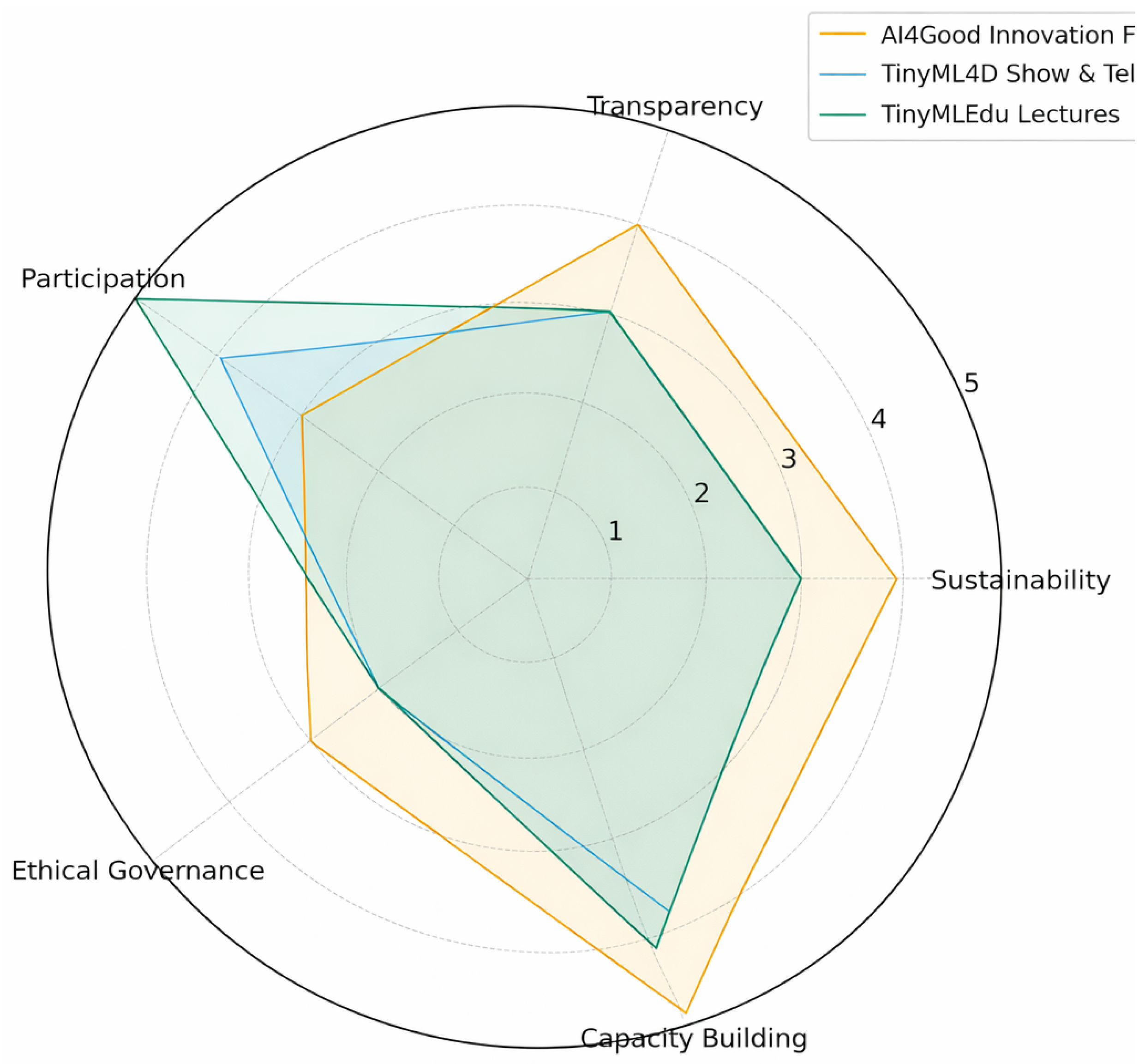
The TinyMLedu and TinyML4D repositories represent high innovation potential for frugal, locally relevant AI: they combine low-power technical affordances, accessible teaching materials, and community visibility that together catalyze rapid prototyping and early entrepreneurship. These strengths map well onto UNESCO’s priorities for capacity building, inclusivity, and sustainability as described in
Figure 4. However, to fully align with the UNESCO Recommendation on the Ethics of AI, the repositories would benefit from more systematic, operationalized ethics and governance practices, better post-deployment monitoring, and explicit incubation pathways that translate prototypes into sustainable enterprises. Implementing the recommendations above would materially strengthen both the ethical footing and the entrepreneurship outcomes of TinyML-driven Frugal AI initiatives. The methodology and insights underlined in [
34] provide a foundation for strengthening the ethical and participatory dimensions of our analysis. This work synthesizes qualitative, interdisciplinary approaches guided by UNESCO’s principles of transparency, inclusivity, fairness, environmental responsibility, and cultural diversity to examine how edge AI (including TinyML and LLM-enabled models already looking at a near future of Frugal Edge AI innovation) can be embedded ethically into citizen science and STEAM educational practice, offering layered strategies such as participatory governance and community-led data stewardship that directly complement our innovation system and responsible AI analytical framework. By adapting their guidelines on AI ethics integration—such as embedding ethics into curricula and localized governance protocols—our study can more systematically assess and extend ethical practices within Frugal Edge AI projects in developing contexts, ensuring that technological capacity building and entrepreneurial outcomes remain aligned with global human rights and ethical standards.
3.3. Baseline Technical Skills and Technologies for TinyML Innovation Ecosystems and Entrepreneurship
A recurring gap identified across the analyzed participatory TinyML initiatives is the absence of a clearly articulated baseline of technical skills and enabling technologies required to move from initial exposure to sustainable innovation and entrepreneurship. While many initiatives successfully support rapid prototyping and early experimentation, the transition toward scalable, deployable, and market-ready solutions remains uneven and could benefit from common starting resources. This suggests that, beyond introductory training, a more coherent and shared understanding of the minimum technical and systemic requirements is necessary to support TinyML innovation ecosystems. The evidence from the case studies indicates that meaningful participation in such TinyML ecosystems depends on a combination of complementary competencies rather than isolated technical abilities and hardware available. Participants must develop familiarity with embedded systems and low-power hardware, including the integration of sensors and microcontrollers, as well as an understanding of the operational constraints imposed by limited memory, energy consumption, and latency. Equally important is the ability to manage the full data lifecycle, from collection and labeling to preprocessing and validation, particularly in contexts where data are locally generated and may be sparse, noisy, or biased. Building on this, participants are expected to engage with on-device machine learning workflows, including model training, optimization, and deployment, while navigating trade-offs between model performance and resource efficiency. These technical skills are complemented by basic software engineering practices that support reproducibility, collaboration, and iterative development.
However, that technical proficiency alone is insufficient to generate meaningful or sustainable innovation outcomes. Domain knowledge and contextual awareness play a decisive role in shaping the relevance and applicability of TinyML solutions, enabling participants to frame problems appropriately and design interventions that respond to real-world needs. This interplay between technical and contextual knowledge emerges as a defining characteristic of successful participatory initiatives, reinforcing the importance of interdisciplinary learning environments that bridge engineering, domain expertise, and community engagement. A critical dimension that remains underdeveloped in many current initiatives is the capacity for system-level integration and orchestration. While most projects achieve functional prototypes on individual devices, fewer address the challenges associated with managing multiple distributed nodes operating in real-world environments. Emerging approaches to TinyMLorchestration [
11,
22] highlight the importance of coordinating data flows, updating models remotely, and maintaining system performance across networks of edge devices. In this context, orchestration represents a shift from isolated experimentation toward operational infrastructure, enabling continuous learning, monitoring, and lifecycle management of deployed systems. Without such capabilities, the scalability and long-term viability of TinyML solutions remain constrained.
The concept of Frugal AI provides an overarching framework for understanding how these technical capabilities can be aligned with sustainability and scalability objectives. Increasingly emphasized in global initiatives and policy discussions, Frugal AI promotes the design of systems that are efficient, affordable, and adapted to resource-constrained environments. Within this paradigm, scalability is not achieved through increased computational capacity but through careful optimization of models, hardware, and deployment architectures. Lightweight models, energy-efficient devices, and decentralized processing become central design elements, allowing solutions to scale across contexts without requiring significant infrastructure investments. This approach reframes scalability as an inherent property of system design rather than a downstream engineering challenge. From a technological perspective, the analyzed cases suggest the emergence of a layered TinyML ecosystem, encompassing hardware platforms, model development frameworks, deployment and orchestration mechanisms, and data integration processes. These layers are typically supported by open-source tools, shared repositories, and collaborative learning platforms that facilitate knowledge exchange and replication. Despite this emerging structure, the absence of standardized reference architectures or commonly accepted baselines leads to fragmentation across initiatives, limiting interoperability and hindering the transferability of solutions between contexts.
The transition from technical capability to entrepreneurship further depends on the ability to extend beyond prototype development toward considerations of deployment, maintenance, and value creation. Participants must not only understand how to build functional systems but also how to adapt them to specific operational environments, ensure their reliability over time, and align them with viable use cases or service models. The findings of this study indicate that while many participants successfully reach the stage of functional prototyping, fewer are able to progress toward sustained deployment or venture formation. This gap underscores the importance of defining the technical baseline not merely as a set of skills, but as a broader foundation that integrates system design, scalability awareness, and application-oriented thinking. Taken together, these observations highlight that establishing a coherent baseline of technical skills and technologies is essential for enabling the evolution of participatory TinyML initiatives into sustainable innovation ecosystems. Such a baseline should not be understood as a rigid standard but as a flexible and context-sensitive framework that supports progression from learning to deployment and, ultimately, to entrepreneurship. By clarifying these foundational elements, it becomes possible to strengthen the continuity between education, innovation, and economic activity, thereby enhancing the overall impact of Frugal Edge AI in developing contexts.
3.4. Scaling Global Solutions Through Competitions and Workshops
Global initiatives promoting TinyML through workshops, hackathons, and international competitions have become a critical driver in democratizing access to artificial intelligence and fostering early-stage innovation ecosystems. Programs such as TinyML4D, TinyMLedu, and the AI for Good Innovation Factory create structured pathways that connect education, experimentation, and entrepreneurship at a global scale. By combining hands-on training with competitive platforms and visibility mechanisms, these initiatives not only accelerate technical skill acquisition but also provide participants with opportunities to showcase solutions, attract mentorship, and engage with broader innovation networks. In this way, they function as catalytic infrastructures that lower entry barriers to AI development while simultaneously nurturing a pipeline from learning to innovation and, ultimately, to entrepreneurship. The AI for Good Innovation Factory has established itself as a premier UN-led platform for identifying and scaling AI-powered startups that address the SDGs. Through a rigorous series of 52 pitching competitions, the initiative has analyzed a substantial volume of innovation, processing over 3000 startup applications from more than 150 countries. This extensive global search has resulted in a highly selective cohort of over 210 finalists and 35 winners, representing leading examples of socially impactful AI innovation. Although the applications span a wide geographical range, the selected finalists—originating from 30 countries—demonstrate a strong concentration of solutions addressing critical development challenges.
The portfolio of innovations emerging from these initiatives spans several domains in which AI can effectively bridge the gap between technological capability and human need. In the domain of health and well-being (SDG 3), solutions focus on maternal health, remote diagnostics, and malnutrition detection in low-resource environments. In climate action (SDG 13), projects address zero-emission agriculture, smart energy systems, and biodiversity monitoring. Applications in sustainable cities and mobility (SDG 11) include assistive navigation systems and the optimization of urban infrastructure, while developments in robotics and autonomous systems (SDG 8) target areas such as humanitarian demining and disaster response. Together, these examples illustrate the breadth of application areas where TinyML and Frugal Edge AI can generate tangible societal impact. Participatory citizen-science workshops play a central role in enabling these outcomes by strengthening capacity building and knowledge transfer. Across the analyzed cases, hands-on learning formats allow participants to rapidly translate theoretical concepts into practical applications, including environmental sensing devices, soil-moisture and crop-health monitoring systems, and low-cost diagnostic tools operating on microcontrollers. These tangible outputs reinforce foundational skills in AI and embedded systems while demonstrating the direct relevance of TinyML to local challenges, thereby increasing participant motivation and engagement. Effective pedagogical approaches consistently combine project-based learning, peer collaboration, and the use of open educational resources, which collectively reduce barriers to entry and support continued learning beyond formal training environments.
Inclusion strategies further enhance the impact of these initiatives. Programs that prioritize gender balance, multilingual resources, and accessible participation conditions report higher levels of engagement and retention, particularly among groups traditionally underrepresented in STEM. By fostering diverse and collaborative learning environments, these initiatives promote cross-cultural knowledge exchange and expand the pool of potential innovators. As a result, participants increasingly transition from passive users of technology to active creators of contextually relevant AI solutions. The evidence also indicates the emergence of grassroots entrepreneurship as a direct outcome of these participatory ecosystems, closely aligning with the objectives of initiatives such as the AI for Good Innovation Factory. A number of participants progress from initial prototypes to early-stage ventures, university-affiliated start-ups, or community-based innovation projects. Solutions developed within TinyML4D and TinyMLedu activities have been translated into practical applications, including smart irrigation systems, low-cost waste monitoring tools, and air-quality mapping platforms for urban and peri-urban environments. In several cases, teams have formalized their work into spin-offs or partnered with NGOs and local institutions to pilot deployments in real-world settings.
The transition from learning to entrepreneurship is consistently supported by a set of enabling conditions. Access to seed funding, participation in innovation challenges, ongoing technical mentorship, and institutional support from universities or partner organizations play a decisive role in sustaining project development. Public visibility through competitions, showcases, and media exposure further contributes to the refinement of prototypes and the attraction of collaborators. These interconnected elements create pathways through which community-driven innovation can evolve into sustainable entrepreneurial activity. At the same time, the sustainability of participatory TinyML and edge-AI initiatives is strongly influenced by the broader institutional and ecosystem context. Successful programs are typically embedded within multi-stakeholder networks that include universities, NGOs, government bodies, and industry partners, each contributing complementary resources and expertise. Access to shared infrastructure—such as fabrication laboratories, maker spaces, and open-source hardware platforms—supports continuous experimentation and lowers the cost of innovation. Alignment with national or regional policies related to digital transformation and STEM education further enhances program visibility and scalability. Conversely, in contexts where such institutional support is lacking, initiatives often experience fragmentation and limited continuity, with promising prototypes failing to progress due to insufficient mentorship, funding, or ecosystem integration. These findings underscore that while grassroots innovation and Frugal AI technologies are essential, long-term impact depends on coordinated institutional support and sustained ecosystem development.
4. Discussion
Drawing on the empirical findings presented earlier, this section interprets the results to elucidate their implications for participatory Frugal Edge AI ecosystems, particularly in relation to sustainability, entrepreneurship, and responsible AI. The findings presented indicate that the combination of participatory citizen science and TinyML constitutes an effective mechanism for democratizing access to artificial intelligence in low-resource settings. Across the analyzed cases, participatory TinyML initiatives consistently enabled learners with limited prior technical background to acquire practical skills in data collection, embedded machine learning, and edge deployment, while producing functional prototypes addressing locally defined challenges. These outcomes demonstrate that low-power, low-cost edge AI technologies—when embedded in hands-on, community-oriented pedagogical models—can significantly lower barriers to AI participation. Rather than positioning communities as passive recipients of externally developed technologies, participatory TinyML reframes them as active co-creators of AI systems, aligning technological development with local priorities, contextual knowledge, and resource constraints. Beyond learning outcomes, the results reveal early but meaningful signs of grassroots entrepreneurship emerging from participatory TinyML ecosystems. Several initiatives progressed from short-term educational interventions to sustained innovation pathways, including prototype refinement, collaboration with local institutions, and the formation of early-stage ventures. This transition was most evident in contexts where technical training was coupled with mentorship, visibility through open platforms, and access to innovation challenges or incubation support. These findings underscore the importance of ecosystem-level factors—such as institutional anchoring and network connectivity—in transforming technical capacity into entrepreneurial activity. From a sustainable AI perspective, this is significant: it suggests that Frugal Edge AI can contribute not only to skills development but also to inclusive economic opportunities, supporting locally grounded innovation that is socially embedded and environmentally conscious.
4.1. Implications for Sustainable Development Goals
The findings of this study demonstrate that participatory TinyML initiatives have direct and multi-dimensional relevance for advancing the SDGs, particularly where capacity building, inclusion, and sustainability intersect. First, the strong learning outcomes observed across participatory workshops and citizen-science projects highlight a clear contribution to SDG 4 (Quality Education), as these initiatives provide accessible, practice-oriented pathways into AI and digital skills development. By relying on hands-on experimentation, open educational resources, and low-cost hardware, participatory TinyML lowers traditional barriers to entry associated with advanced AI education. Importantly, this educational impact is closely intertwined with SDG 10 (Reduced Inequalities): access to AI tools and training is extended to learners and communities in low-resource settings who are often excluded from cloud-based, infrastructure-intensive AI ecosystems. In this sense, participatory Frugal AI initiatives do not merely expand educational access but actively contribute to reducing structural inequalities in who can learn, use, and shape AI technologies. Beyond education, the emergence of grassroots entrepreneurship and local innovation pathways observed in the analyzed cases links participatory TinyML directly to SDG 8 (Decent Work and Economic Growth) and SDG 9 (Industry, Innovation, and Infrastructure). Several initiatives demonstrated how technical capacity developed through workshops translated into early-stage ventures, university spin-offs, or community-based enterprises addressing local needs in agriculture, environmental monitoring, and public services. These outcomes suggest that Frugal Edge AI can function as an enabling technology for inclusive economic activity, supporting job creation and entrepreneurial experimentation without requiring high capital investment or centralized infrastructure. At the ecosystem level, participatory TinyML contributes to the formation of localized innovation infrastructures—such as maker spaces, university labs, and NGO-supported hubs—that strengthen regional innovation capacity and reduce dependence on external technological providers.
The observed entrepreneurial pathways align with the sustainable entrepreneurship literature, which emphasizes opportunity creation under resource constraints, social–environmental value creation, and local embeddedness. Rather than high-growth, venture-capital-driven models, the TinyML cases illustrate forms of community-oriented, resilience-building entrepreneurship, where value is generated through local deployment, service provision, and institutional collaboration. This supports interpretations of frugal innovation as a mechanism for strengthening local economic resilience by reducing technological dependency and retaining value creation within communities. The findings of this study also suggest that participatory and frugal AI approaches can play a meaningful role in strengthening digital sovereignty in developing countries by enhancing technological self-determination. Participatory TinyML initiatives shift the locus of AI development from external technology providers to local communities, educational institutions, and grassroots innovators. Through citizen science workshops and hands-on experimentation, participants are not only exposed to AI concepts but are actively involved in problem definition, data collection, model development, and deployment. This participatory orientation enables communities to shape AI systems in accordance with local priorities, cultural contexts, and resource constraints, thereby increasing agency over how digital technologies are designed and used. Such forms of engagement align with broader understandings of digital sovereignty as the capacity to control and govern technological infrastructures and knowledge systems rather than merely access them. TinyML, as an edge-based and resource-efficient AI paradigm, further reinforces digital sovereignty by reducing dependence on foreign-owned, cloud-centric infrastructures that dominate contemporary AI ecosystems. By enabling on-device inference on low-cost microcontrollers, TinyML allows AI applications to function with limited connectivity, minimal energy consumption, and greater data locality. This technical configuration mitigates reliance on centralized data centers, proprietary platforms, and cross-border data flows, which are often subject to geopolitical, economic, and regulatory asymmetries. In development contexts where connectivity is intermittent and data governance frameworks are still evolving, edge-based AI offers a pathway toward greater control over data, models, and operational continuity. As such, Frugal Edge AI can be understood not only as a cost-efficient solution but also as a strategic enabler of technological autonomy. These dynamics intersect with broader debates on AI equity, knowledge transfer, and open innovation. Conventional AI development models frequently reproduce global inequalities by concentrating expertise, computational resources, and intellectual property within a small number of high-income regions and corporations. In contrast, participatory TinyML initiatives emphasize open educational resources, open-source software, and shared hardware platforms, facilitating horizontal knowledge exchange and localized innovation. The study’s findings indicate that when knowledge transfer is embedded in participatory learning and experimentation, it supports not only skills acquisition but also the emergence of locally adapted solutions that challenge one-size-fits-all AI deployments. This contributes to a more equitable distribution of AI capabilities and aligns with calls for pluralistic, context-sensitive approaches to AI governance and innovation. Empowering communities as AI creators rather than passive users fosters resilience and autonomy within digital ecosystems. The ability to design, adapt, and maintain AI systems locally enhances communities’ capacity to respond to changing social, economic, and environmental conditions without external dependency. From a digital sovereignty perspective, such resilience is critical: it enables developing countries to participate in the global AI landscape on more equal terms while preserving the flexibility to pursue development pathways aligned with their own values and priorities. The study thus reinforces the argument that participatory and frugal AI approaches are not peripheral alternatives, but central components of sustainable and sovereign digital futures.
4.2. Pedagogical and Policy Implications
The results of this study indicate that realizing the developmental potential of participatory and frugal AI requires coordinated changes across educational practice and institutional policy, rather than isolated technical interventions. Participatory TinyML initiatives were most effective when they were embedded within broader learning ecosystems that connected skills development to local problem-solving and innovation pathways. This suggests that AI education in developing contexts should move beyond abstract instruction toward experiential, community-oriented models that integrate TinyML and citizen science into STEM and vocational training. Such integration enables learners to engage with AI as a practical tool for addressing real-world challenges, strengthening both technical competence and contextual understanding. At the pedagogical level, the accessibility of TinyML is amplified through the systematic use of OERs and affordable, hands-on hardware kits. These resources reduce dependence on proprietary platforms and enable educators to adapt content to diverse institutional and cultural settings. The findings further indicate that inclusive instructional design—such as gender-aware facilitation, collaborative project work, and community-driven problem selection—enhances participation and retention, particularly among learners who are historically underrepresented in technical fields. By foregrounding inclusivity and relevance, participatory TinyML pedagogy contributes not only to skill acquisition but also to the cultivation of confidence and agency among emerging AI practitioners. Institutional and policy frameworks play an equally decisive role in determining whether educational gains translate into sustained innovation and economic opportunity. The cases analyzed show that public–private–academic partnerships are essential for providing the infrastructure, mentorship, and legitimacy needed to support local innovation hubs. When aligned with national AI strategies and sustainability agendas, participatory TinyML initiatives benefit from greater coherence and long-term viability. However, the progression from prototype development to entrepreneurship remains uneven in many low-resource settings. Targeted policy measures—such as micro-grants, early-stage incubation, and locally embedded funding mechanisms—are therefore critical to bridging the gap between learning and enterprise. Together, these pedagogical and policy implications underscore that participatory and frugal AI can contribute to inclusive development only when supported by integrated educational and institutional systems that prioritize accessibility, collaboration, and long-term sustainability.
This study conceptually links Frugal AI, participatory citizen science, and sustainable entrepreneurship within a unified analytical framework. While prior work has examined these domains largely in isolation, this paper demonstrates how their intersection forms a coherent socio-technical model for inclusive AI innovation in developing contexts. By grounding this conceptual integration in empirical observations from participatory TinyML initiatives, the study advances understanding of how low-resource, edge-based AI technologies can support not only technical efficiency but also social inclusion, local agency, and environmentally responsible innovation. In applied terms, the paper offers a practical framework illustrating how community participation and low-cost edge AI can be combined to create inclusive innovation ecosystems. The three-pillar model—linking pedagogical empowerment, entrepreneurial enablement, and ethical–institutional anchoring—provides a transferable structure for analyzing and designing participatory AI initiatives. This framework helps bridge the gap between abstract principles of responsible and sustainable AI and their operationalization in educational programs, grassroots innovation projects, and local technology ecosystems. For practitioners and policymakers, the study provides evidence that participatory TinyML initiatives represent scalable and adaptable models for AI education and application in low-resource settings. The analyzed cases show that meaningful AI learning and innovation can occur without reliance on high-performance computing infrastructure or proprietary platforms, making such approaches particularly relevant for public education systems, vocational training programs, and community-based innovation efforts. These insights support the development of cost-effective strategies for expanding AI capacity while aligning with broader digital inclusion and sustainability objectives. The findings highlight how participatory TinyML can inform concrete decisions in curriculum design, innovation-hub planning, and ethical-AI policymaking. Educational institutions can draw on the study’s insights to integrate hands-on, participatory AI modules into STEM and vocational curricula. Innovation hubs and incubators can use the framework to design support structures that connect technical training with mentorship and entrepreneurship. At the policy level, the study underscores the importance of embedding ethical and sustainability considerations directly into AI capacity-building initiatives, offering guidance for the development of responsible-AI policies that are grounded in practice rather than solely in principle.
As presented in
Figure 3, the underrepresentation of mature, field-deployed solutions is consistent with the learning-oriented nature of the forums from which the data were sourced. These environments primarily serve as spaces for experimentation, skill development, and early-stage prototyping, where participants are encouraged to explore ideas rather than advance immediately toward deployment and scale. As such, the predominance of lab-tested prototypes reflects the educational and exploratory focus of these initiatives, rather than a lack of potential for maturation. To translate the demonstrated potential of participatory and frugal edge-AI initiatives into sustained development impact, national and regional policy frameworks must explicitly recognize and support these approaches within broader digital-transformation agendas. Rather than prioritizing only large-scale, cloud-centric AI strategies, policymakers should incorporate participatory Frugal AI and TinyML as complementary pathways that emphasize accessibility, energy efficiency, and local relevance. Embedding such approaches in national AI strategies, STEM education reforms, and digital public goods initiatives can help ensure that AI-driven transformation advances SDG 4 (Quality Education), SDG 9 (Industry, Innovation and Infrastructure), and SDG 10 (Reduced Inequalities) by expanding who can meaningfully participate in AI innovation and governance. Institutional support mechanisms are equally critical for converting community-driven prototypes into sustainable economic activity. The findings of this study highlight the importance of micro-funding instruments, early-stage incubation programs, and locally embedded innovation hubs tailored to community-led AI initiatives. Small grants, challenge-based funding, and seed incubation can significantly lower barriers for emerging entrepreneurs working with low-cost edge-AI technologies, thereby supporting SDG 8 (Decent Work and Economic Growth). In parallel, strengthening public–private–academic partnerships can provide access to mentorship, shared infrastructure, and market pathways while sustaining open-source TinyML ecosystems. Such partnerships are essential for maintaining open hardware platforms, shared curricula, and reproducible toolchains that underpin frugal and participatory AI innovation.
4.3. Ethical and Environmental Reflections
Ethical and sustainability considerations must be systematically institutionalized across AI education, training, and innovation programs. The study underscores the need to embed ethical-AI literacy—including data governance, fairness, environmental impact, and community accountability—into all participatory AI curricula and capacity-building initiatives. Doing so aligns directly with UNESCO’s Recommendation on the Ethics of Artificial Intelligence and supports SDG 13 (Climate Action) by reinforcing low-energy, environmentally responsible AI practices. Explicitly linking ethical-AI education and frugal edge-AI deployment to SDG targets provides policymakers and institutions with a coherent framework for monitoring impact and accountability. These policy and institutional measures can help ensure that participatory TinyML ecosystems evolve from isolated initiatives into durable, ethical, and SDG-aligned pillars of inclusive digital development. Moreover, the findings of this study reveal that ethical considerations are both central to, and unevenly addressed within, participatory and frugal AI initiatives. Community-driven TinyML projects frequently involve the collection and processing of locally generated data related to health, environment, livelihoods, or public services, raising important questions about data ownership, privacy, and informed consent. While several initiatives demonstrated good practices—such as transparent communication with participants and basic consent procedures—formalized data governance mechanisms were often absent or inconsistently applied. This gap suggests that participatory intent alone does not guarantee ethical robustness; without explicit frameworks, community-based AI projects risk reproducing the same power asymmetries and governance shortcomings observed in larger-scale AI deployments. In addition to data governance, the analysis highlights potential risks of bias, exclusion, and unintended misuse within participatory data projects. Citizen-generated datasets may reflect uneven participation, local social hierarchies, or context-specific assumptions that shape model performance and downstream impacts. Without systematic reflection on representativeness, bias, and potential harm, participatory AI systems may inadvertently marginalize certain groups or reinforce existing inequalities. The findings therefore underscore the need to integrate responsible-AI literacy directly into participatory TinyML workshops, not as an optional add-on but as a core learning outcome. Embedding structured discussions, practical checklists, and reflective exercises on fairness, accountability, and societal impact can help participants critically assess both the technical and social implications of their AI solutions. Environmental considerations emerged as a distinctive strength of Frugal AI approaches, particularly when viewed through the lens of Green AI. TinyML’s emphasis on low-power, on-device inference significantly reduces energy consumption and dependence on energy-intensive cloud infrastructures, aligning AI deployment with sustainability objectives in resource-constrained environments. Moreover, the reuse of hardware, reliance on affordable components, and minimal computational requirements observed across the cases contribute to reducing electronic waste and lowering the environmental footprint of AI experimentation. These characteristics position Frugal Edge AI not only as an accessibility strategy but also as a practical response to growing concerns about the environmental costs of large-scale AI systems. The ethical and environmental dimensions identified in this study point toward the need for sustainable AI governance models tailored to developing contexts. Responsible data practices, inclusive participation, and environmental stewardship must be treated as integral components of participatory AI design rather than secondary considerations. By embedding ethical reflection and sustainability principles into educational curricula, project templates, and institutional support structures, participatory TinyML initiatives can foster AI ecosystems that are not only innovative and inclusive but also trustworthy and environmentally responsible. Such approaches contribute to the long-term legitimacy and resilience of AI deployments, reinforcing the role of Frugal AI as a foundation for sustainable and context-sensitive AI governance.
4.4. Implications for Local Economic Resilience
Frugal Edge AI and TinyML-based participatory innovation directly strengthen local economic resilience by advancing digital sovereignty and local ownership over critical data, infrastructure, and services. By enabling on-device intelligence that functions without continuous cloud connectivity, communities can develop and operate AI-powered tools—such as environmental monitors, agricultural diagnostics, and health-screening devices—within their own local markets. This low-cost innovation model lowers barriers to entry for entrepreneurs, allowing small enterprises, cooperatives, and social ventures to emerge around locally relevant services rather than imported technologies. As a result, value creation remains embedded in the community, supporting job creation, micro-enterprises, and service provision that are less vulnerable to external supply shocks, licensing dependencies, or global platform lock-in. In this way, Frugal Edge AI contributes to economic self-reliance by transforming communities from passive technology consumers into active producers of digital services tailored to their own contexts. These locally controlled, energy-efficient AI systems also enhance climate adaptation and long-term resilience by aligning technological development with environmental and social sustainability. Low-power edge devices and hardware reuse reduce operational costs and carbon footprints, making it feasible for local ventures to offer climate-sensitive services—such as irrigation management, air-quality monitoring, or early-warning systems—at scale. Because data collection and decision-making occur within the community, trust is strengthened between technology providers and users, fostering higher adoption and sustained engagement. This community trust, combined with transparent and participatory governance of data and models, creates the institutional foundation needed for resilient local markets to grow. Over time, these dynamics support diversified livelihoods, adaptive services, and robust local innovation ecosystems that can respond more effectively to economic, environmental, and social disruptions. By enabling local sensing, decision-making, and service provision without reliance on global cloud infrastructure, Frugal Edge AI increases the capacity of communities to withstand economic, infrastructural, and climate shocks. Universities and research institutions function as neutral, trusted hubs that integrate research, teaching, and community engagement into a coherent pipeline for local enterprise formation.
To address the limitations of conventional innovation and business modeling frameworks in low-resource and sustainability-oriented contexts, this work introduces a novel Frugal Edge AI Lean Canvas, a structured and constraint-aware framework that enables innovators to systematically design, evaluate, and communicate Edge AI solutions in low-resource environments. The canvas goes beyond traditional business modeling by integrating contextual constraints (e.g., limited connectivity, energy, and compute), frugal AI architectural choices (such as TinyML/TinyLM optimization, on-device inference, and offline-first deployment), and locally grounded data ecosystems. It further supports the identification of ethical and governance risks specific to edge settings, including bias from sparse data, risks of misuse in offline scenarios, and issues of data ownership and community participation. In addition, the canvas incorporates dual impact metrics, capturing both contributions to SDG targets and system efficiency (e.g., energy consumption, model size, and cost per inference), thereby enabling measurable and comparable evaluation of solutions. By linking technical design, deployment pathways, stakeholder co-creation, and sustainable business models, the Frugal Edge AI Lean Canvas provides a practical tool for innovators to articulate novelty, ensure responsible AI deployment, and assess real-world impact from the earliest stages of development. Traditional lean or startup-oriented canvases assume persistent connectivity, scalable cloud infrastructure, and revenue-driven growth models, which are often misaligned with the realities of sustainable development deployments. The proposed canvas reframes the core design logic around on-device intelligence, ultra-low power consumption, intermittent connectivity, and local deployment, placing SDG and societal impact at the center of the value creation process. It can be described by the following fields:
Sustainable Development Challenge Clearly specify the SDGs being addressed, the socio-economic or environmental problem context, and why existing digital or AI solutions fail (e.g., due to cost, connectivity, energy use, data centralization, or lack of local relevance).
Beneficiaries and Stakeholders Identify the primary end-users and communities that benefit directly from the system, the organizations or individuals that own and operate the deployment, and the local intermediaries (e.g., NGOs, schools, cooperatives, clinics) who facilitate adoption, trust, and long-term use.
EdgeAI-focused Unique Value Proposition Describe the core advantage created by on-device intelligence, including reductions in energy consumption and dependence on network connectivity, as well as improvements in privacy, responsiveness, and reliability compared with cloud-based AI.
High-level Concept Describe the concise, one-line description that captures what the venture is, who it is for, and why it is unique by framing the startup as a familiar category with a clear differentiator.
Core EdgeAI Functionality of the Solution Define the machine-learning task (e.g., classification, anomaly detection, prediction), the physical or digital input signals used (e.g., sensors, audio, images), the outputs or actions triggered, and the constraints on model size, memory footprint, and real-time latency.
Data Strategy (Frugal by Design) Explain how data are generated locally or in situ, how labeling or validation is performed with minimal cost and expertise, and how models are updated or adapted over time (e.g., on-device learning, periodic retraining, or federated updates).
Deployment and Distribution Channels Describe the hardware form factor (e.g., microcontroller, wearable, sensor node, gateway), how devices are distributed and installed, and how maintenance, updates, and repairs are handled in low-resource environments.
Key Partners and Ecosystem List the local partners who enable deployment and legitimacy, the technical or research partners who contribute to model development and evaluation, and institutional or UN-aligned partners who support scaling, policy alignment, or funding.
Cost Structure (Frugal Economics) Estimate the bill of materials (BOM) per device, the costs of model development and optimization, and the expenses related to deployment, training, and ongoing support, with an emphasis on minimizing the total cost of ownership.
Impact Metrics (Beyond Revenue) Define how the system contributes to specific SDG indicators, reduces environmental footprint (e.g., energy use, emissions, e-waste), and produces social outcomes such as resilience, inclusion, capacity building, or community empowerment.
Revenue and Sustainability Model Identify the primary funding or revenue sources (e.g., grants, public procurement, service fees, NGO support) and explain how the system remains financially and operationally sustainable after initial pilots.
Ethics and Governance (Edge-specific) Specify key ethical risks such as data misuse, surveillance, bias, or exclusion; the mitigation measures built into the design (e.g., on-device processing, consent mechanisms, and transparency); and how the system aligns with UNESCO AI Ethics principles and local regulatory frameworks.
The initial version of the Frugal Edge AI Lean Canvas depicted in
Figure 5 extends the classical [
19] and Lean [
18] Business Model Canvas (BMC) structure by introducing tinyML-specific building blocks, including frugal data strategies, edge-constrained model functionality, deployment and maintenance pathways in resource-constrained environments, and explicit ethical and governance considerations at the edge. In contrast to data-intensive AI paradigms, the canvas emphasizes minimal and locally generated data, privacy-by-design, and resilience through autonomy from cloud services. Impact metrics are treated as first-class elements alongside cost structures and sustainability models, reflecting the need for solutions that are economically viable while delivering measurable social, environmental, and resilience outcomes. Beyond its descriptive function, the EdgeAI Business Canvas serves as a practical design and evaluation tool for researchers, innovators, and policymakers working at the intersection of AI and sustainable development. It supports co-creation with local stakeholders, facilitates comparison across pilot deployments, and enables systematic assessment of scalability and long-term viability beyond proof-of-concept demonstrations. By aligning technical design choices with development finance, governance frameworks, and UNESCO AI ethics principles, the canvas provides a structured pathway for translating edge AI research into deployable, responsible, and impactful solutions for sustainable development contexts.
5. Conclusions and Future Work
This paper set out to explore how participatory citizen science, when combined with TinyML, can contribute to the democratization of artificial intelligence innovation in developing countries. Against the backdrop of persistent digital inequalities and growing concerns about the environmental and social impacts of AI, the study examined participatory and frugal edge-AI initiatives as an alternative model for inclusive and sustainable technological development. By analyzing a range of educational programs, repositories, and early-stage innovation pathways, the paper sought to understand how low-cost, low-power AI technologies can be embedded within community-driven learning and innovation ecosystems. The analysis indicates that participatory TinyML workshops and citizen-science initiatives are effective in building both technical and entrepreneurial capacity. Participants across diverse contexts were able to acquire practical skills in data collection, embedded machine learning, and edge deployment, often progressing rapidly from introductory training to the development of functional prototypes. In several cases, these learning outcomes extended beyond education into early-stage entrepreneurship, university spin-offs, or community-based applications, demonstrating the potential of Frugal Edge AI to support locally grounded innovation and inclusive economic activity. These findings highlight the importance of coupling technical training with mentorship, institutional support, and opportunities for experimentation in order to sustain innovation beyond short-term interventions. Community-driven projects emerged as a particularly powerful mechanism for bottom-up innovation and local problem-solving. By involving participants directly in problem definition, data generation, and model deployment, participatory TinyML initiatives enabled AI solutions to be closely aligned with local needs, knowledge, and resource constraints. This participatory orientation not only enhanced relevance and adoption but also strengthened local ownership over AI systems, contributing to greater technological agency and resilience. Importantly, the study also shows that the integration of ethical reflection and sustainability principles—such as responsible data practices, energy-efficient computation, and hardware reuse—plays a critical role in building trust and ensuring the long-term viability of participatory AI ecosystems. The findings reaffirm that Frugal AI, operationalized through TinyML and participatory approaches, offers a viable pathway toward sustainable digital transformation in developing contexts. By embedding accessibility, inclusivity, and environmental responsibility into both technological design and innovation processes, Frugal AI challenges dominant, resource-intensive AI paradigms and opens space for more equitable forms of AI development. As such, participatory TinyML initiatives represent not merely a technical alternative but a socio-technical model capable of aligning AI innovation with broader goals of sustainability, equity, and local empowerment.
While the findings of this study provide encouraging evidence of the potential of participatory TinyML initiatives, they also point to the need for deeper and more systematic empirical investigation. A priority for future research is the development of longitudinal studies that track participants over extended periods, moving beyond immediate learning outcomes to assess longer-term effects on entrepreneurship, employment trajectories, and professional identity formation. Such studies would enable a more robust understanding of how TinyML education influences sustained engagement with AI, the durability of acquired skills, and the conditions under which early prototypes evolve into viable enterprises or long-term livelihood opportunities. Further research is also needed to examine gender dynamics and broader inclusivity outcomes within participatory AI and citizen-science programs. While many initiatives explicitly aim to broaden participation, evidence on how these goals translate into equitable learning experiences, leadership roles, and entrepreneurial opportunities remains limited. Future studies should therefore adopt intersectional approaches that consider gender, socioeconomic background, geography, and educational access, enabling a more nuanced assessment of who benefits from participatory TinyML initiatives and under what conditions. Such analyses would contribute to the design of more inclusive pedagogical models and help ensure that frugal AI ecosystems do not inadvertently reproduce existing inequalities. The study reveals a critical gap in current grassroots AI practices, showing low explicit consideration of ethics and governance. This finding underscores the uneven integration of responsible AI principles in early-stage and community-driven initiatives and strongly reinforces the need for structured guidance, such as the UNESCO AI ethics framework, and tools such as the proposed Frugal Edge AI Lean Canvas, promoting clear empirical evidence of the urgency to embed ethical and governance practices from the outset of Frugal AI and TinyML innovation. In parallel, there is a need for more rigorous quantitative assessment of the environmental impacts associated with Frugal and edge-AI deployments. Although TinyML is widely promoted as an energy-efficient alternative to cloud-based AI, systematic metrics capturing energy consumption, hardware reuse, lifecycle emissions, and electronic waste reduction remain underdeveloped. Future research should therefore integrate life-cycle assessment methodologies and standardized energy benchmarks into participatory AI projects, enabling clearer comparisons between frugal edge-AI systems and conventional AI infrastructures. This evidence base would strengthen claims about the environmental sustainability of TinyML and support policy alignment with climate-focused SDGs. Comparative and policy-oriented research is required to identify the institutional and regulatory frameworks that most effectively support the scaling and replication of participatory TinyML models across regions. Cross-country studies examining national AI strategies, education policies, funding mechanisms, and innovation ecosystems would help clarify how local initiatives can transition from isolated pilots to sustained, system-level interventions. By analyzing how policy environments interact with grassroots innovation, future research can inform the design of adaptive governance models that balance local autonomy with national and global coordination, thereby enabling participatory and frugal AI to scale while remaining ethically grounded and context-sensitive.
This study underscores that truly sustainable AI transformation cannot be achieved through technological efficiency alone. Instead, it must be grounded in inclusive, ethical, and locally anchored innovation processes that recognize communities as active agents rather than passive beneficiaries of digital change. Participatory and frugal AI approaches, exemplified by TinyML and citizen-science-based methodologies, demonstrate that it is possible to align technological development with social equity, environmental responsibility, and contextual relevance. By embedding ethical reflection, sustainability, and participation directly into AI design and deployment, such approaches offer a credible alternative to resource-intensive and centralized AI paradigms that risk reinforcing existing global inequalities. Central to this vision is the transition of communities in developing countries from AI users to AI creators and innovators. The evidence presented in this paper shows that when access barriers are lowered through low-cost hardware, open educational resources, and participatory pedagogies, communities can meaningfully engage in the full AI innovation lifecycle—from problem definition and data collection to model deployment and entrepreneurial experimentation. This shift in agency strengthens local ownership over digital technologies, enhances digital sovereignty, and enables AI solutions to be more responsive to local needs, cultures, and environmental constraints. Empowering communities as AI creators is, therefore, not only a matter of capacity building but also a foundational step toward more resilient and self-determined digital ecosystems. Achieving this transformation at scale will require sustained global collaboration among researchers, governments, and international organizations. Institutions such as UNESCO and the ITU are uniquely positioned to facilitate the mainstreaming of participatory and frugal AI by supporting open standards, ethical governance frameworks, and capacity-building initiatives that bridge education, innovation, and policy. Coordinated efforts across academia, public institutions, civil society, and the private sector are essential to ensure that participatory TinyML ecosystems are supported by coherent policies, shared infrastructure, and inclusive funding mechanisms. Such collaboration can help translate local experimentation into globally relevant models for responsible and sustainable AI development. Moreover, the integration of TinyML and participatory citizen science offers a compelling pathway toward equitable and sustainable digital futures. By coupling low-energy, edge-based AI technologies with community-driven knowledge production, Frugal AI operationalizes sustainability as a practical design principle rather than an abstract aspiration. As the global community seeks to accelerate progress toward the Sustainable Development Goals, participatory and frugal AI approaches provide a concrete means of ensuring that AI innovation contributes to shared prosperity, environmental stewardship, and social inclusion. In this sense, TinyML is not merely a technological tool but part of a broader socio-technical vision in which inclusive participation, ethical responsibility, and sustainability define the future of artificial intelligence. Looking ahead, deeper engagement with entrepreneurial activities around TinyML in developing-country contexts can be supported through targeted investment, dissemination and capacity-building efforts. These efforts extend beyond individual projects guided by the Frugal Edge AI Lean Canvas introduced in this work. This canvas serves as a framework for designing and evaluating Edge AI solutions in low-resource environments integrating frugal AI architectures, local data ecosystems, ethical considerations, and dual impact metrics, covering both SDG contributions and system efficiency. The canvas provides a practical tool to guide responsible innovation, linking technical design, deployment, and sustainability, and enabling innovators to assess feasibility, impact, and scalability from the earliest stages. One promising complementary direction is the creation of a dedicated TinyML channel on VideoLectures.net, enabling the systematic curation of TinyML educational content—including workshop recordings and lectures—presented with synchronized slides and video and enhanced through automated multilingual translations to broaden accessibility. In parallel, further development of the TinyML Handbook as a living, multilingual document would strengthen its role as a foundational reference, linking conceptual guidance with hands-on resources. Building on existing initiatives such as the TinyML kits, this approach could integrate ready-to-use code, datasets, and workshop materials, supported by open repositories (e.g., GitHub) and long-term archival platforms (e.g., Zenodo). Together, these efforts would reinforce knowledge transfer, lower barriers to experimentation, and help translate TinyML education into sustained entrepreneurial and innovation pathways in resource-constrained settings.