Article

Water Use Efficiency and Carbon Trade-Offs of Gravity and Pump Irrigation in Rice Cultivation

by
Chaitat Bokird
1,
Jutithep Vongphet
1,2,
Sasiwimol Khawkomol
1,2,
Ketvara Sittichok
1,2,
Chaiyapong Thepprasit
1,2,
Bancha Kwanyuen
1,
Bittawat Wichaidist
3,
Chaisri Suksaroj
1,2 and
Songsak Puttrawutichai
1,2,*
1
Department of Irrigation Engineering, Faculty of Engineering at Kamphaeng Saen, Kasetsart University, Kamphaeng Saen Campus, Nakhon Pathom 73140, Thailand
2
Research Center for Sustainable Development, Faculty of Engineering at Kamphaeng Saen, Kasetsart University, Kamphaeng Saen Campus, Nakhon Pathom 73140, Thailand
3
Thailand Rice Science Institute, Rice Department, Suphan Buri 72000, Thailand
*
Author to whom correspondence should be addressed.
Sustainability 2026, 18(10), 5097; https://doi.org/10.3390/su18105097
Submission received: 30 March 2026 / Revised: 13 May 2026 / Accepted: 15 May 2026 / Published: 19 May 2026
(This article belongs to the Section Sustainable Agriculture)

Abstract

As climate change worsens, irrigation modernization has become critical for better water distribution and maintaining rice production in the face of increasing water constraints. However, there remains a gap in quantification regarding the environmental trade-offs between pump-managed and gravity-based irrigation systems, especially in integrated assessments that relate economic performance, carbon emissions, and water use. This study used an integrated framework of water productivity (WP), consumptive water footprint (WF), carbon footprint, and eco-efficiency to compare gravity-based and pump-managed systems in the Don Chedi Operation and Maintenance Project, Thailand, from 2021 to 2023. The results showed no significant differences in WP and WF between systems. WP averaged 0.39 kg m−3 during the wet seasons and 0.54 kg m−3 during the dry seasons, while the WF averaged 2517 m3 t−1 and 1854 m3 t−1, respectively. These findings indicate that pump-managed irrigation enhanced operational flexibility and yield stability but did not substantially improve water use efficiency. However, compared with the gravity-based system, the pump-managed system produced much greater carbon emissions, with total carbon footprints ranging from 1.252 to 1.333 tCO2eq t−1, or five times higher in the irrigation process. Eco-efficiency metrics rose by up to 8.11% despite this environmental burden, indicating enhanced economic resilience amid fluctuating water conditions. These results show a recurring trade-off between low-carbon agricultural development and irrigation modernization. The study therefore emphasizes the importance of integrating renewable energy and low-carbon technologies into pump-based irrigation systems to support climate-resilient and sustainable agricultural transitions.

1. Introduction

As a cornerstone of Thailand’s agricultural economy, rice production is characterized by high water consumption relative to other commodities. However, in the context of global warming and increasing competition for water across the industrial and social sectors, there is an urgent need to shift agricultural management toward maximizing water use efficiency. One might suggest that transitioning to high-efficiency water management is now a strategic necessity for sustainable growth rather than a choice [1,2]. Agricultural water management has become a complex issue, further complicated by fluctuating energy costs and global climate change. Nevertheless, sustainable agriculture requires a paradigm change from conventional methods to resilient, low-carbon irrigation techniques [2,3]. The Don Chedi Operation and Maintenance Project is one of the crucial strategic areas for Thailand’s rice farming [4], but its operational effectiveness is impacted by complex geographical limitations. To ensure long-term sustainability, it is essential to assess how modernized infrastructure can reconcile economic productivity with environmental responsibility, thereby ensuring that sustainable rice agriculture remains a viable pillar of the Thai economy.
In hydrological terms, water use efficiency is achieved through integrated water cycle management that emphasizes productive components such as crop transpiration [5,6]. Implementing pumping infrastructure improves the ability to apply water in a controlled manner, allowing better management of irrigation depth and time [7,8]. The implementation of technology ensures that water distribution is incredibly responsive to crop-specific water demands throughout the cultivation cycle. A key component of modernizing irrigation systems to enhance water productivity is operational flexibility [9]. The economic feasibility of electric pumping systems, which include fixed and variable costs, is primarily determined by the cost of acquiring water [10,11], most notably electricity costs, which are significantly higher than those of gravity-fed systems. Consequently, evaluating the effectiveness of the water supply is essential to ensuring long-term implications for all stakeholders. By identifying the precise interconnections of water, energy, and food in time and place, the nexus methodology aims to improve the security of these essential resources and provide a structured path for external communications and cross-sectoral decision-making. Within this framework, analyzing the interactions between these sectors allows for strengthened integration, maximized synergies, and minimized trade-offs, thereby internalizing environmental impacts and improving resource use efficiency. Finally, this integrated perspective intends to support the transition toward sustainability and improve overall management outcomes by ensuring water, energy, and food stability at various geographical scales and contexts [12,13,14,15].
Asia’s rice production is still an essential element of the region’s food security, but to satisfy the demands of the expanding population, productivity must increase dramatically [5]. The “more crop per drop” paradigm, which promotes optimizing water resources to ensure sustainable food security, is predominantly driven by improving water usage efficiency from a sustainability perspective [16]. However, globally, irrigation generates over 200 million metric tons of CO2 annually, accounting for approximately 15% of total agricultural emissions, largely driven by energy consumption associated with groundwater pumping [17]. To mitigate these emissions and enhance energy reliability, the integration of thermal energy storage systems offers a transformative solution by buffering energy supply and demand, thereby optimizing the performance of irrigation pumping frameworks. Furthermore, the application of phase change materials within solar-powered pumping systems can significantly stabilize discharge rates and improve overall system efficiency by storing excess thermal energy for consistent water delivery [18,19].
While previous studies have widely examined the water productivity (WP), water footprint (WF), and carbon emissions in rice production systems, these variables have often been investigated independently rather than through an integrated sustainability framework. Comprehensive assessments under contrasting irrigation management systems remain limited, particularly in Southeast Asia. Moreover, few studies have explored the environmental trade-offs associated with irrigation modernization, where improvements in water management may be accompanied by increased energy consumption and carbon emissions. This knowledge gap is especially important for Thailand, where irrigation infrastructure is undergoing rapid modernization in response to increasing climate variability and water scarcity risks. To address this gap, the present study provides a site-specific comparison between gravity-based and pump-managed irrigation systems within the Don Chedi Operation and Maintenance Project from 2021 to 2023. An eco-efficiency framework is applied to evaluate resource use performance and environmental consequences across wet and dry seasons. The findings are expected to contribute to strategic planning for Thailand’s future irrigation development by highlighting the importance of balancing water security, agricultural productivity, and environmental sustainability. As climate change intensifies the risks of water scarcity and production instability, irrigation systems must evolve beyond ensuring reliable water delivery toward incorporating climate-resilient and low-carbon management strategies. Integrating precision irrigation with energy-efficient and renewable-energy technologies may therefore provide a pathway toward sustainable agricultural transformation, supporting socioeconomic resilience and long-term environmental goals.

2. Materials and Methods

2.1. Study Area

The study was conducted at the Don Chedi Operation and Maintenance Project, Suphan Buri Province, Thailand, during the wet and dry seasons from 2021 to 2023. Key climatological parameters observed during the experimental timeframe are presented in Table 1. The topography of the area is characterized by a gradual slope descending from north to south. The primary water source was the Makham Thao–U Thong Canal, which receives water diverted from the Chao Phraya Dam in Chai Nat Province.
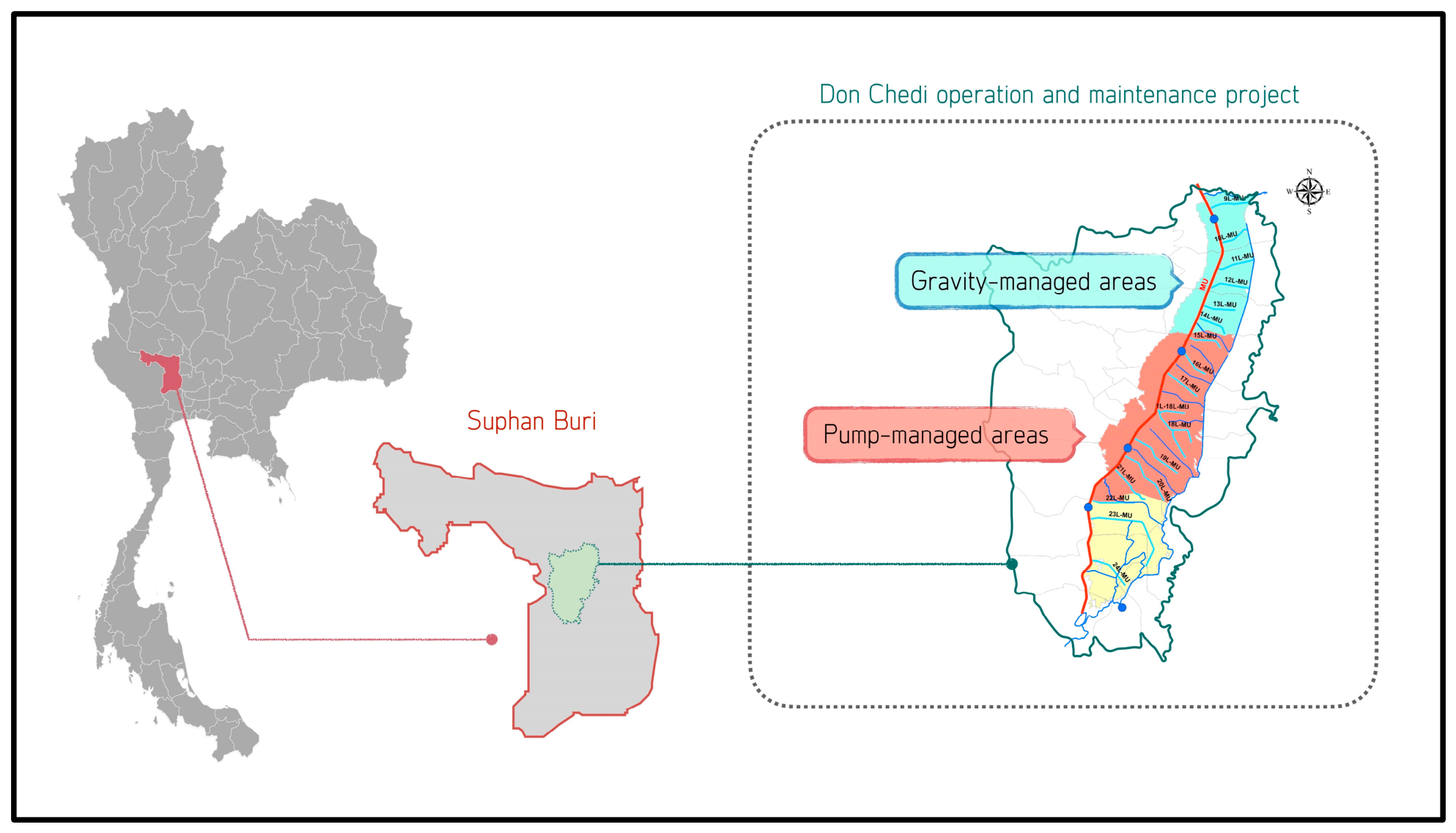
The area represents a strategic rice-growing zone characterized by two different irrigation delivery systems (Figure 1). Both systems utilize open concrete-lined canals for main conveyance and open canals at the tertiary and farm-block levels. At the field scale, surface irrigation is employed in both cases. The primary distinction between the two systems lies in the energy source used for water distribution:
  • Gravity-based irrigation, utilizing natural elevation gradients for water distribution.
  • Pump-managed irrigation, utilizing electrical pumping stations for controlled water delivery.
This study was conducted under the assumption that gravity-fed and pump-supplied systems share identical soil series, mesoclimatic conditions, and water allocation schedules in the homogeneous environment of the Don Chedi Operation and Maintenance Project. Agricultural practices, such as fertilization schedules, pest control, and soil preparation, are highly standardized and correspond to collective traditional practices because the farmers in both systems are members of the same agricultural cooperative and rice-growing groups. As both regions are governed by the same management initiative, the water allocation schedules are coordinated. In addition, both irrigation systems utilize identical open concrete-lined canals for water conveyance, ensuring consistency in hydraulic characteristics and seepage control across the study area. Therefore, the energy source—hydrostatic pressure vs. mechanical pumping—is the only significant difference between the two systems. The distribution of the cultivation area for both irrigation systems during the study period is summarized in Table 2.

2.2. Data Collection

To assess the environmental, hydrological, and economic performance of RD41 rice farming from 2021 to 2023, an entire dataset was assembled. The 12 Left and 21 Left Makham Thao–U Thong Canals’ typical irrigation networks were the study’s main emphasis. To verify temporal and spatial consistency, data collection was standardized during the wet and dry seasons.
  • Agronomic and Economic Data Profiles
The Thailand Rice Science Institute provided technical cultivation parameters and yield data. Information regarding the standardized agricultural practices for RD41 rice was supplied by this dataset:
Cultivation parameters included specialized agricultural methods for RD41 rice and the total planting area (ha).
Yield and quality control: Rice yield data were collected from field sampling areas under each irrigation management system. Specifically, five monitoring locations were selected for each system, with three field plots established at each location. Within each plot, yield measurements were conducted using three randomly selected sampling areas of 4 × 6 m2. All yield samples were cleaned, threshed, and adjusted to a standard moisture level of 14% to preserve analytical consistency.
Economic indicators: Comprehensive production cost profiles that included labor, fertilizer, pesticide, and seed costs were incorporated. These expenses were then compared with total grain yields (t/ha) at current market prices to determine net profitability.
  • Hydrological and Energy Records
Resource usage was quantified using administrative and technical records from the Don Chedi Operation and Maintenance Project. This stage of gathering data comprised the following:
Hydrological records: These are official operational records of the Don Chedi Operation and Maintenance Project, which continuously monitors water allocation throughout the irrigation seasons. Green water consumption was determined using daily precipitation statistics, while daily irrigation discharge volumes provided the basis for “direct blue water” assessment.
Energy–carbon nexus: The total electricity consumption and operating expenses of the pump station systems were obtained from the project’s official records. These data served as the primary quantitative inputs to assess the correlation between energy use and carbon emissions in the study area.

2.3. Water Productivity and Water Footprint Assessment

To assess the efficiency and sustainability of water resource management in the Don Chedi project, two complementary indicators were employed in the study: water productivity and the consumptive water footprint.
  • Water productivity (WP)
Water productivity is defined as the ratio of product mass or economic value to the total volume of water consumed. This indicator is critical for assessing how irrigation strategies contribute to maintaining food security while simultaneously conserving freshwater resources [20,21]. In this study, WP was calculated using the following formula:
WP = Y/(I + R)
where WP—water productivity (kg m−3), Y—rice yield (kg), I—direct irrigation water (m3), and R—effective rainfall (m3). While parameters such as deep percolation, surface runoff, and non-productive evaporation are substantial in paddy environments, they were excluded from the primary WP equation to focus on supply-side efficiency from a management perspective. This exclusion is further justified by the site-specific characteristics of the Don Chedi project, where both study areas share homogeneous heavy clay soil textures and concrete-lined distribution canals. These conditions minimize variations in seepage and conveyance losses between the two systems.
  • Partial Consumptive Water Footprint (WF)
In this study, the partial consumptive water footprint is denoted as WF for brevity. The study examined WF to quantify the water removed from the local watershed and made unavailable for other immediate uses. The WF concept provides a comprehensive framework for assessing freshwater consumption [1,22] by accounting for direct water use (field application) and indirect water use (water embodied in production inputs). The WF used in this investigation can be calculated using the following formula:
WF = (R + CWUblue)/Y
where WF—consumptive water footprint (m3 ton−1), R—effective rainfall from CROPWAT 8.0 with weather data from microclimate weather station (m3 ha−1), CWUblue—irrigation data (direct irrigation water; I) and material used in cultivation system (indirect water used) (m3 ha−1), and Y—rice yield (ton ha−1). Applying the water footprint assessment methodology as established by the water footprint network [23], the scope of this evaluation encompasses all water-related inputs throughout the production cycle. At every stage of the rice cultivation system, “indirect water” is linked to fertilizer use, energy consumption, and other production components. According to the inventory summary shown in Table 3, all water footprint values were normalized and reported in cubic meters per ton of paddy grain (m3⋅ton−1).

2.4. Carbon Footprint Calculation

The carbon footprint assessment in this study was based on a yield-scaled greenhouse gas emission framework expressed as tons of CO2 equivalent per ton of grain yield (tCO2 eq/ton yield). The assessment boundary included direct emissions from rice cultivation and indirect emissions associated with irrigation water delivery. Direct agricultural emissions consisted primarily of CH4 and N2O emissions derived from rice cultivation processes. These emissions were estimated using greenhouse gas inventory data obtained from closed chamber measurements, as reported in [1]. Indirect emission factors were calculated following the IPCC (2019 Refinement) guidelines and further refined to comply with the Thailand Greenhouse Gas Management Organization (TGO) inventory framework, the calculation integrated emissions derived from agricultural activities such as fertilizer application and agrochemical use, the manufacturing of farm machinery, and the logistics and transportation required for these inputs [24]. Emissions from pump irrigation were estimated based on irrigation water volume. An emission factor of 0.0510 kgCO2eq per m3 of water was adopted from the Thai National Life Cycle Inventory (LCI) Database. Finally, the total carbon footprint for each irrigation delivery technique was calculated by adding the emissions from agricultural and irrigation activities over all research years and seasons.

2.5. Eco-Efficiency Assessment

Eco-efficiency in this study is defined as the ratio between the economic value of the agricultural output and the environmental impact generated during its production [25,26]. The quantitative assessment follows the standardized framework:
Eco-efficiency = Economic Value Output/Environmental impact
where economic value is represented by the total rice yield (t/ha) multiplied by the farm gate price. Environmental impact is represented by the WF (m3/t) or carbon footprint (tCO2eq/t) derived from the integrated irrigation activities and agricultural processes. The gravity-fed irrigation system is established as the reference baseline. Since the gravity system represents the traditional, low-energy method of water delivery in the Don Chedi project, all fluctuations and percentage changes are calculated as relative deviations from this baseline.

2.6. Statistical Analysis

Statistical analyses were performed to compare the means between the two irrigation systems. All data processing and statistical computations were performed using R (version 4.5.1, R Core Team, 2025). Since the study aimed to evaluate the performance of each system individually for each year and season, an Independent Samples t-test was employed to determine significant differences between gravity-based and pump-managed systems (n = 25). In instances where multiple timeframes (2021, 2022, and 2023) were compared, a one-way Analysis of Variance (ANOVA) was applied, followed by Duncan’s New Multiple Range Test (DMRT) for post hoc mean separation. All data were pre-tested for normality using the Shapiro–Wilk test and for homogeneity of variance using Levene’s test. Statistical significance was set at p < 0.05.

3. Results and Discussion

3.1. Crop Productivity

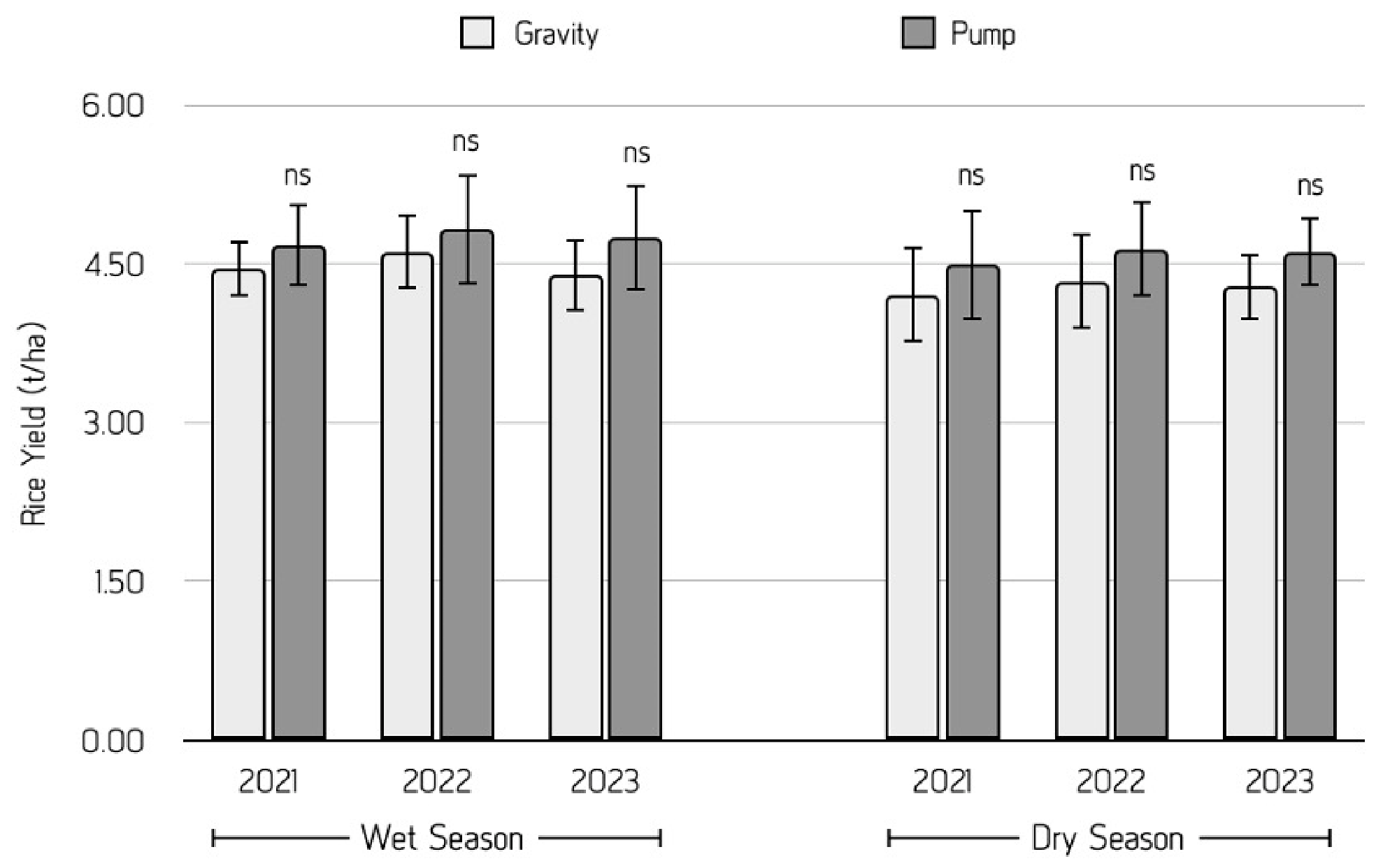
For the period 2021–2023, data from the wet and dry seasons showed no significant differences in rice yield between regions with gravity-based and pump-managed irrigation. Rice yields ranged from 4.21 to 4.68 tons/ha in 2021, from 4.33 to 4.82 tons/ha in 2022, and from 4.28 to 4.75 tons/ha in 2023, implementing gravity-based and pump-managed irrigation approaches (Figure 2).
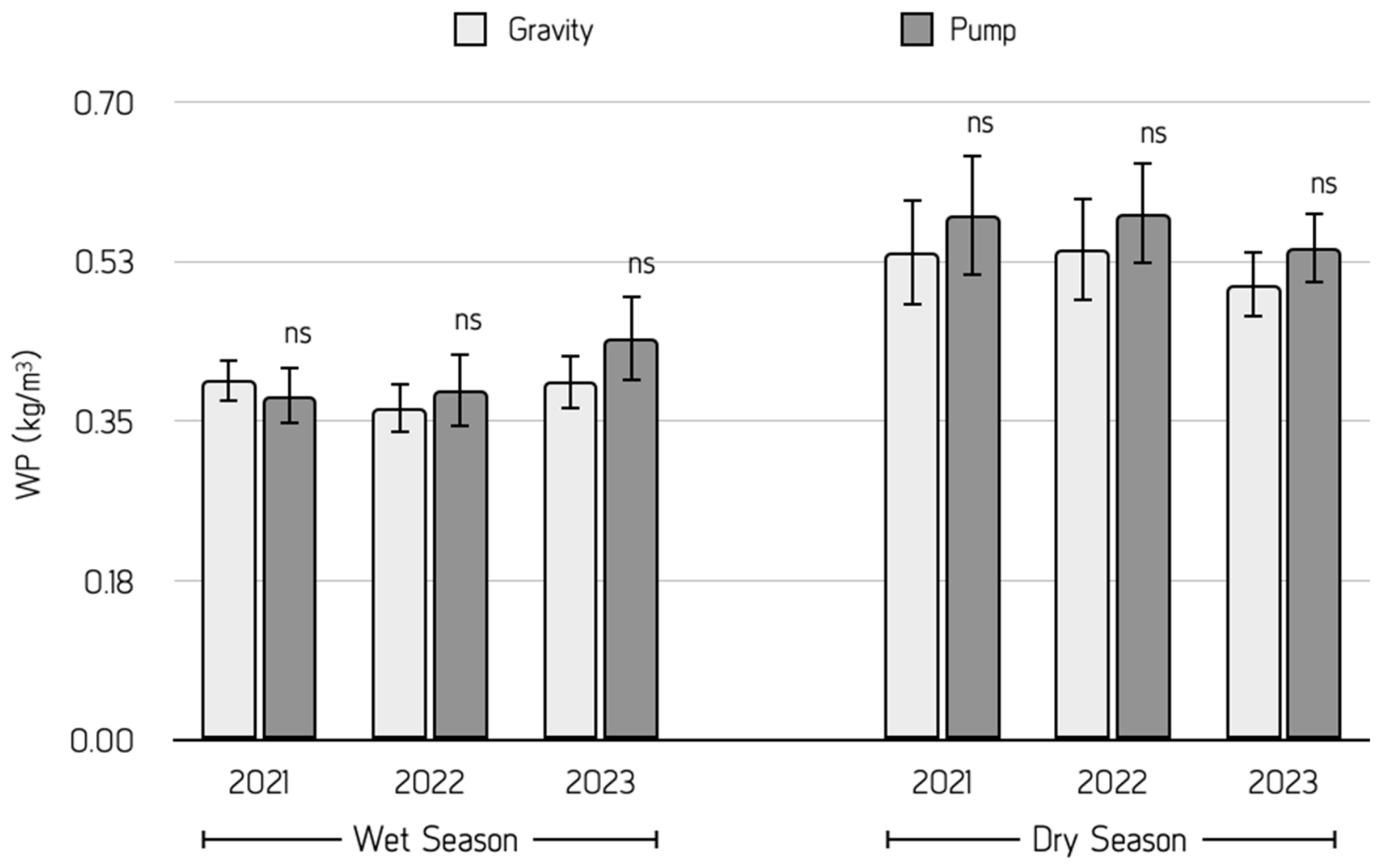
The water productivity (WP) data collected during the wet and dry seasons from 2021 to 2023 showed a pattern corresponding to crop yield. Specifically, no significant differences in WP were observed between the gravity-based and pump-managed irrigation systems. In 2021, the WP values for gravity and pump systems were 0.39 and 0.38 kg/m3 in the wet season, and 0.54 and 0.58 kg/m3 in the dry season, respectively. A similar pattern appeared in 2022, with values of 0.36 and 0.38 kg/m3 (wet season) and 0.54 and 0.58 kg/m3 (dry season). By 2023, the WP remained comparable at 0.39 and 0.44 kg/m3 in the wet season and 0.50 and 0.55 kg/m3 in the dry season, respectively (Figure 3).
The results demonstrate that the WP of rice in the Don Chedi Operation and Maintenance Project area is not significantly affected by the method of water supply, whether it be electrical pumping or gravity. Regardless of the energy source used for water transport, this implies that rice’s biological efficiency in converting water into biomass remains constant after the crop’s water requirements are achieved. However, a notable seasonal variation in WP was observed, with dry-season figures consistently outperforming wet-season values. This pattern can be found in agricultural water studies from a hydrological point of view [27,28]; in the dry season, more precise water accounting is possible because of the lack of unpredictable rainfall. On the other hand, adding significant rainfall to the overall water input during the monsoon or wet season often “dilutes” the WP calculation as excessive precipitation typically results in a substantial water loss rather than being effectively utilized for crop growth [29,30,31,32]. The expected linear correlation between evapotranspiration (ET) and yield (Y) does not necessarily result in a constant water productivity (WP) across different yield levels [33]. Therefore, during the wet season, the dynamics of consumptive.
Green water productivity often shifts because additional rainfall increases the total water input without a proportional gain in yield, leading to a decline in calculated efficiency. Furthermore, the seasonal disparity in WP is influenced by atmospheric and physiological processes. During the dry season, the higher cumulative solar radiation and optimal light intensity enhance photosynthetic rates during the critical reproductive and grain-filling stages of RD41 rice, maximizing the conversion of transpired water into biomass. In contrast, the increased cloud cover and higher relative humidity characteristic of the wet season can limit the plant’s transpirational pull and nutrient uptake efficiency [34,35,36]. Consequently, the superior WP observed in the dry season reflects a synergistic effect where precise irrigation scheduling synchronizes with favorable microclimatic conditions, allowing the crop to achieve its maximum genetic yield potential while minimizing non-productive water discharge.
Even though the WP for the two distribution methods is statistically comparable, the pump-managed system has higher operating costs because of its higher energy consumption, according to engineering economics [10]. Thus, pumping’s strategic value lies not in improving WP but rather in providing operational flexibility to preserve yield stability and reduce the risk of water scarcity [37].

3.2. Water Footprint

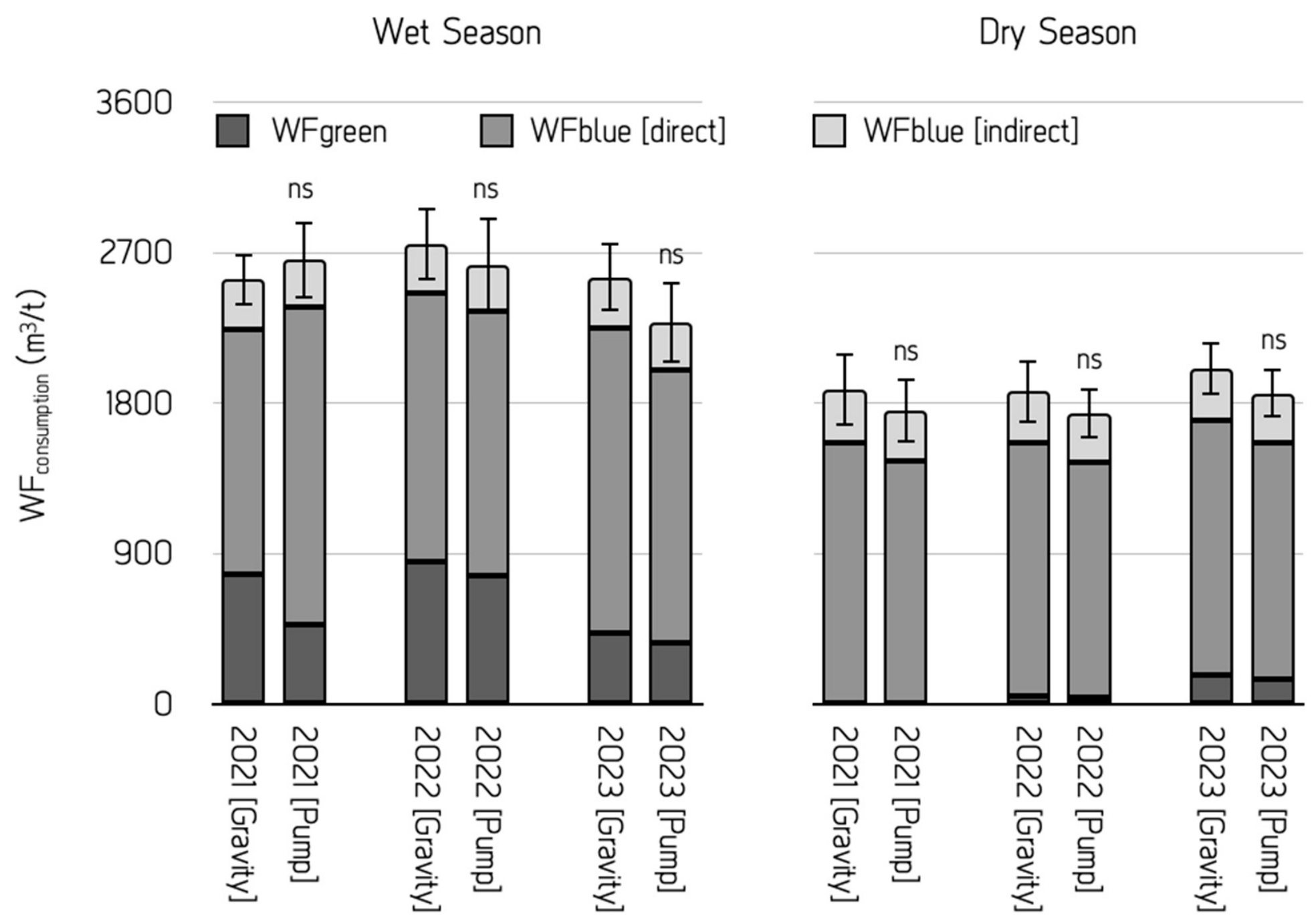
In this experiment, the consumptive water footprint (WF), a measure of water use, includes direct and indirect water inventories. In general, the water footprint is a reliable indicator for measuring the volumetric water content of products and tracking global virtual water commerce. In accordance with the Water Footprint Network (WFN) methodology [21,38], a comprehensive water footprint comprises green, blue, and grey components. However, the current study focused exclusively on the consumptive water footprint, specifically the green WF (effective rainfall) and blue WF (direct and indirect irrigation). While the grey water footprint is a critical indicator of the freshwater volume required to assimilate pollutant loads, it was intentionally excluded from the scope of this assessment. Consequently, this study provides a partial water footprint analysis, prioritizing the quantification of direct water consumption associated with crop growth under the experimental conditions. The results showed no noticeable variation in WF between gravity-based and pump-managed irrigation systems (Figure 4). The values for the green water footprint and the indirect blue water footprint remained the same for both systems because the experiment was conducted in the same location and under the same ambient circumstances and production inputs. The lack of noticeable variation in WF between the two irrigation techniques emphasizes that crop physiology and local evapotranspiration demands, not the delivery system itself, are the main factors influencing overall water consumption in rice farming.
The consistency between the WF results and the previously discussed WP trends further validates the hydrological efficiency. In this study, the inverse relationship between WP and WF is clearly demonstrated; the stability of WP across both irrigation systems is reflected in the non-significant variance in WF. This alignment implies that site-specific evapotranspiration and the rice variety’s physiological water demand, rather than the mechanical method of water delivery, primarily control overall consumptive water use, which includes green and blue water. This suggests that the energy-intensive pumping in the Don Chedi Operation and Maintenance Project stabilizes the yield (maintaining grain yield and WP) instead of contributing to excessive water use.

3.3. Carbon Footprint

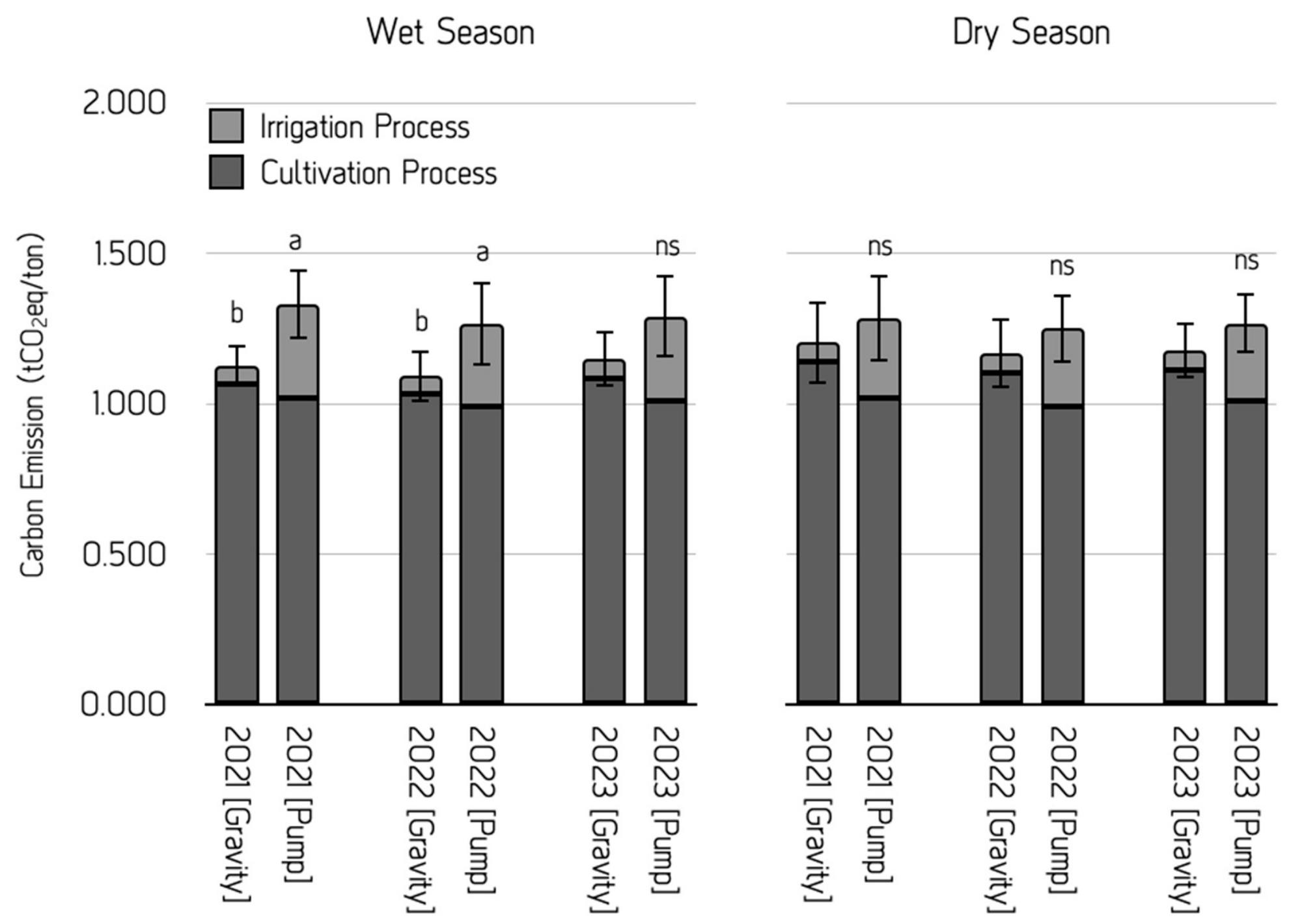
The carbon footprint assessment was conducted using a yield-scaled greenhouse gas emission framework expressed as tCO2eq per ton of grain yield, incorporating direct cultivation emissions and indirect irrigation-related emissions within the defined system boundary. The comparative analysis reveals that the transition to pump-managed irrigation significantly elevates the total carbon footprint, primarily due to the high energy intensity required for water delivery. The energy requirements increase total emissions from the pumping system, as indicated by a comparison of carbon emissions (tCO2eq/t) between gravity-based and pump-managed irrigation systems from 2021 to 2023. During the wet season, the pump system consistently had a higher overall carbon footprint than the gravity system, with values of 1.333, 1.267, and 1.291 tCO2eq/t compared with the gravity system’s values of 1.129, 1.093, and 1.148 tCO2eq/t, respectively (Figure 5). The irrigation process causes this disparity, as pumping emissions (averaging ≈0.289 tCO2eq/t) were approximately five times higher than those of gravity-fed irrigation emissions (≈0.060 tCO2eq/t). The dry season displayed a similar trend; the gravity system maintained a lower profile between 1.168 and 1.204 tCO2eq/t, and the pump system’s total emissions ranged from 1.252 to 1.285 tCO2eq/t (Figure 5). While the pump-managed irrigation system resulted in an increased carbon footprint, the yield-scaled emissions observed in this study remain consistent with established benchmarks in other major rice-producing countries. For instance, the carbon footprint values recorded here are comparable with those reported. In China and India, where previous studies identified values of 1.1 and 1.3 tCO2eq/t, respectively [39,40].
The comparison reveals that the transition from gravity-based to pump-managed irrigation results in a consistent increase in total emissions for the pumping system, primarily driven by the energy requirements. The significant rise in carbon emissions observed in the pump-managed system underscores how closely energy use and environmental impacts are linked in modern agriculture. According to [41], the need for more energy to pump water is consistently associated with higher carbon emissions. The results corroborate this assumption, as the pumping system produced emissions approximately five times higher than that of the gravity-fed baseline. Our analysis employs a system-level perspective to address these water–energy–carbon trade-offs. The evidence suggests that a non-renewable energy pump is inadequate for achieving comprehensive environmental gains. Consequently, driving a transition through the integration of renewable energy and precision management is essential [17,41,42]. Additionally, across all recorded years and seasons, the carbon intensity per ton of yield is significantly higher in the pump-managed areas, even though both systems operate under the same geographic and climatic conditions. Therefore, shifting to highly effective, low-carbon irrigation techniques is not merely an alternative but a pivotal strategy for future sustainability. In the context of the Don Chedi Operation and Maintenance Project, driving this transition through the integration of renewable energy and precision energy management is essential.

3.4. Eco-Efficiency and Economic Performance

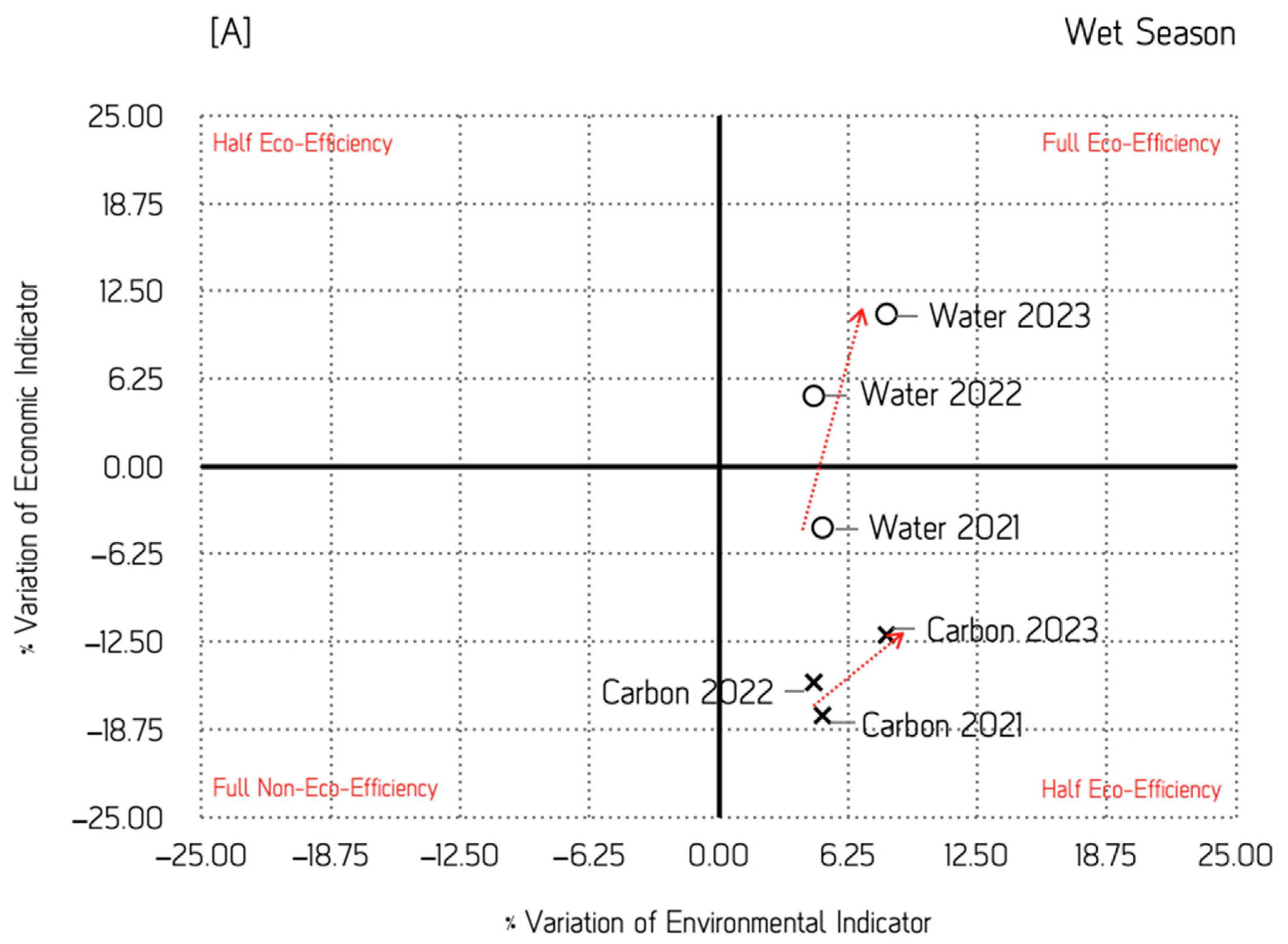
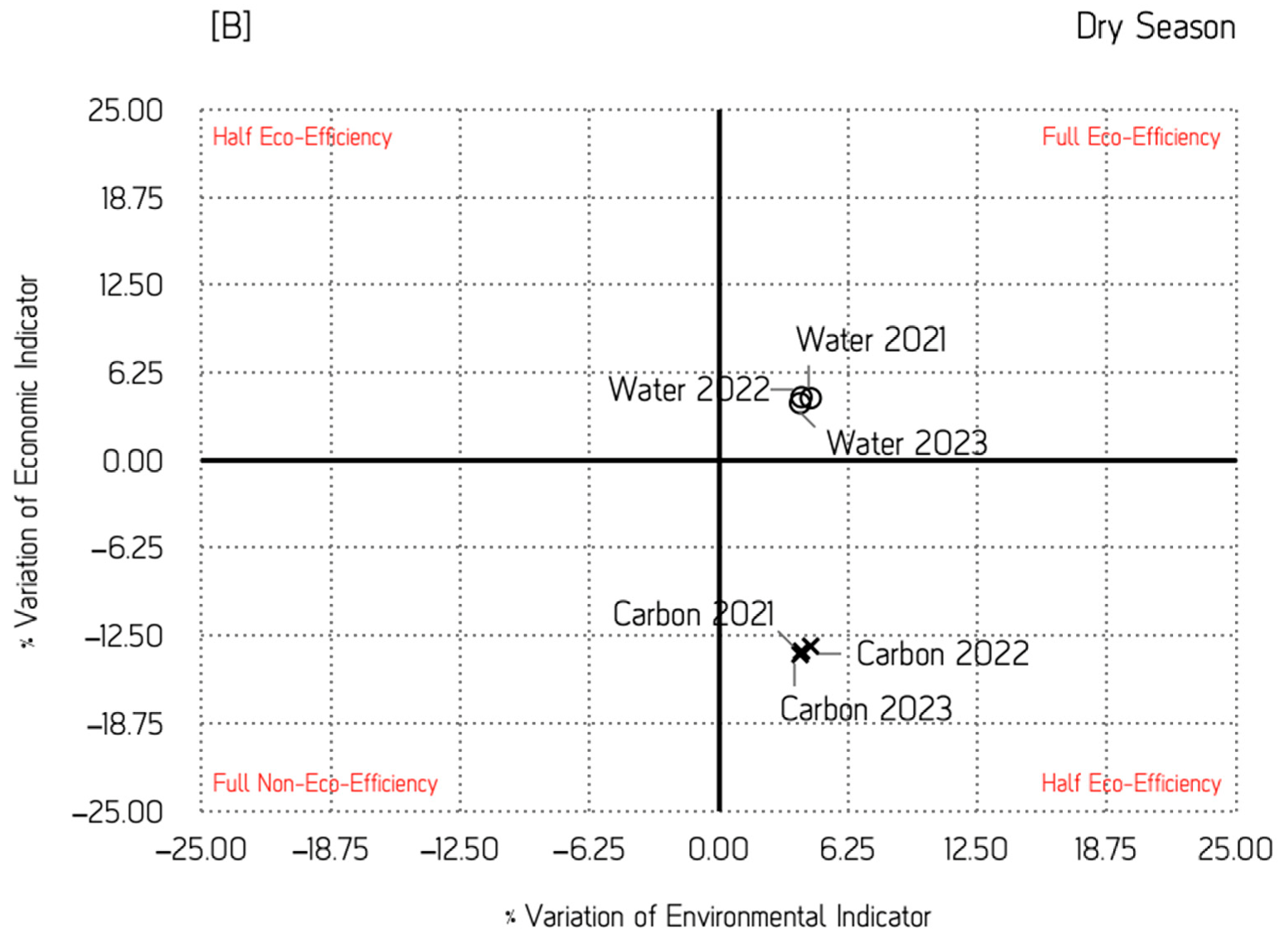
The idea of eco-efficiency, which assesses the synergy between economic performance and responsibility for the environment, is fundamental to this approach [43]. When comparing the pump-managed system to the gravity-based baseline (2021–2023), the results show that the pump-managed system is fully eco-efficient for water use metrics (except for the wet season in 2021), while the carbon metrics are only half eco-efficient in both seasons (Figure 6). Variations in the economic indicator in the wet season were +5.01%, +4.59%, and +8.11%, respectively. An improved water use efficiency trend, which increased from −4.37% in 2021 to +5.02% in 2022 and peaked at +10.86% in 2023, matched this economic growth. However, with variances of −17.76%, −15.41%, and −12.02%, the carbon efficiency remains well below the baseline. In the dry seasons, the economic (+4.00%, 4.44%, and 3.93%) and water efficiency performance (4.49%, 4.42%, and 4.06%) remained consistent and positive. Despite these improvements, the system still consistently faces a carbon penalty, with fluctuations in carbon efficiency of −13.62%, −13.26%, and −13.85%.
The empirical data reveal that yields, WP, and WF remained statistically comparable between the gravity-fed and pump-managed systems. Consequently, the perceived success of the pump-managed system during the dry season should not be attributed to an increase in water use efficiency. Instead, the data suggest that pumping serves as a risk mitigation tool rather than an efficiency-enhancing technology. The shift to a pumping system facilitates enhanced management [8]; however, additional research is necessary to determine whether the economic benefits originate directly from superior crop quality or more consistent production cycles. Furthermore, this economic advantage involves a clear environmental trade-off. In alignment with the irrigation energy-intensity framework [17], the observed 14% average decrease in carbon efficiency reflects the inherent environmental costs of pressurized water delivery. These findings suggest that the gains in water productivity and economic return are currently achieved at the expense of higher carbon-equivalent.
Energy inputs highlight a critical tension between economic optimization and carbon footprint reduction. Decoupling economic growth from carbon efficiency poses a major challenge. The system is hydrologically efficient and economically beneficial, but it still has a significant environmental impact. Irrigation modernization initiatives that move beyond simple mechanical modifications to digital water–energy management are necessary because of the environmental trade-off. To minimize the particular energy consumption per unit of water delivered, policy frameworks should encourage ‘climate-smart’ infrastructure that optimizes pump duty cycles through sensor-based automation. To create an authentic, sustainable ‘strategic rice zone,’ the Don Chedi Operation and Maintenance Project must address this water–energy–food nexus, recognizing the interdependence of water management, energy use, and agricultural production [44]. Our findings reveal a critical tension within this trilemma: while the system successfully achieved “water–food” synergy, it did so at the expense of “energy–carbon” stability. Data demonstrates a positive correlation between food productivity and water management. However, this “water–food” success is currently undermined by a significant energy-related trade-off. The system consistently incurs a “carbon penalty,” with carbon efficiency falling as low as −17.76% in wet seasons and stagnating at −13.85% in dry periods. The modest economic gains (averaging +5%) could be redirected to finance a transition from grid electricity to renewable energy sources, such as solar photovoltaic pumping, which has been shown to lower carbon intensity without undermining water use or economic performance in irrigation systems [45,46].

3.5. Study Limitations and Future Prospects

Although this study offers a comprehensive framework for evaluating the trade-offs within the WEF nexus, significant limitations should be recognized. The first involves the calculation of water productivity (WP). This study utilized the WP = Y/(I + R) formula, which provides an essential baseline but does not account for non-productive water consumption such as conveyance losses, deep percolation, and surface evaporation. While the homogeneous conditions of the Don Chedi project—including identical soil series and standardized concrete-lined canals—minimized the variance in these losses between the two systems, we recognize that this formula may not fully capture the absolute water consumption. Future studies should adopt more robust models, such as the multi-objective collaborative optimization approach proposed by [47], to integrate these complex variables for a more comprehensive understanding of the WEF nexus. The second limitation is that the empirical findings are specific to the topographical and climatic conditions of the Don Chedi irrigation project, which may limit the direct generalizability of the carbon efficiency data to regions with different elevation profiles or soil characteristics. Additionally, while the yield-scaled carbon footprint was calculated based on secondary emission factors for agricultural inputs, real-time field measurements of CH4 and N2O emissions were not conducted. To address these limitations, future research should implement this integrated framework to a broader range of irrigation landscapes in Thailand, validating the ‘pump-managed’ model’s scalability. Incorporating solar photovoltaic systems to power the pump motors is one possible way to address the observed “carbon penalty” and encourage the use of green energy in agriculture. Furthermore, future investigations should incorporate LCAs that utilize primary field data for greenhouse gas emissions to provide an even more granular understanding of the eco-efficiency of sustainable rice cultivation.

4. Conclusions

The longitudinal evaluation of the Don Chedi Operation and Maintenance project demonstrates that while electrical pumping infrastructure enhances operational flexibility—a key component for SDG 2 (Zero Hunger)—it introduces a measurable environmental trade-off within the water–energy–food (WEF) nexus. Within the context of the Don Chedi Operation and Maintenance project, where both irrigation systems have comparable open-channel infrastructure and environmental conditions, the empirical results confirm that gravity and pumping systems exhibit statistically similar water productivity (WP) and water footprint (WF), indicating that the transition to pump-managed systems enhances the adaptive capacity and resilience of agricultural production rather than water-use efficiency. Instead, the value of pumping is evidenced by its operational flexibility; the ability to maintain stable yields and economic surpluses (up to 8.11%) despite varying seasonal water availability suggests that pumping acts as a critical buffer against water scarcity. However, there is a noticeable trade-off between water and carbon when converting to pump-managed irrigation. This transition resulted in a carbon footprint in the irrigation process approximately five times higher than gravity-fed baselines, creating a negative carbon efficiency that suggests that “water–food” security is currently being prioritized at the expense of “energy–carbon” stability, thereby challenging the climate targets of SDG 13 (Climate Action). The recorded economic surpluses from pumping systems indicate a strategic opportunity to reinvest in low-carbon technologies, such as solar photovoltaics, to fulfill the objectives of SDG 7 (Affordable and Clean Energy) and decouple agricultural growth from fossil fuel dependence. While this study is limited to the specific climatic and topographical conditions of the Don Chedi project, characterized by open canals and surface irrigation, they offer a relevant framework for evaluating the water–energy–food nexus. It is important to note that these conclusions should not be applied to comparisons between pumped closed-conduit networks and gravity-fed open-channel systems without additional empirical evidence. Nevertheless, the methodology provides a scalable model for balancing food security with decarbonization mandates, suggesting that future research across diverse irrigation landscapes should focus on integrating renewable energy to enhance the net eco-efficiency of rice production.

Author Contributions

Conceptualization, B.K., C.S., and S.P.; software, C.B.; validation, J.V., S.K., K.S., and C.T.; formal analysis, C.B., J.V., and S.K.; investigation, C.B., K.S., and C.T.; resources, B.W. and C.T.; data curation, C.S., S.P., and B.W.; writing—original draft preparation, C.B.; writing—review and editing, B.W. and S.P.; visualization, C.S.; supervision, B.K. All authors have read and agreed to the published version of the manuscript.

Funding

This research received no external funding.

Institutional Review Board Statement

Not applicable.

Informed Consent Statement

Not applicable.

Data Availability Statement

The raw data supporting the conclusions of this article will be made available by the authors upon request.

Acknowledgments

We sincerely thank the Don Chedi Operation and Maintenance Project for providing essential datasets, including daily precipitation and irrigation supply records, as well as electricity usage and expenditure data for the pump-managed systems. This support was vital for the hydrological and energy–carbon nexus analyses conducted in this study.

Conflicts of Interest

The authors declare no conflicts of interest.

Abbreviations

The following abbreviations are used in this manuscript:
CH4Methane
CO2Carbon dioxide
CO2eqCarbon dioxide equivalent
CWUblueIrrigation water (direct) and material used (indirect)
°Cdegrees Celsius
GHGGreenhouse gas
haHectares
IIrrigation
kgKilograms
LCALife cycle assessment
m3Cubic meters
mmMillimeters
N2ONitrous oxide
REffective rainfall
WEF nexusWater–energy–food nexus
WFConsumptive water footprint
WPWater productivity
YRice yield

References

  1. Wichaidist, B.; Intrman, A.; Junhom, P.; Puttrawutichai, S.; Rewtragulpaibul, C.; Suksaroj, C. Physiological indicators drive climate-smart and sustainable AWD irrigation in rice system. Sci. Rep. 2025, 15, 39660. [Google Scholar] [CrossRef]
  2. Hanjra, M.A.; Qureshi, M.E. Global water crisis and future food security in an era of climate change. Food Policy 2010, 35, 365–377. [Google Scholar] [CrossRef]
  3. He, G.; Zhao, Y.; Wang, J.; Zhu, Y.; Jiang, S. The water-energy nexus: Energy use for water supply in China. Int. J. Water Resour. Dev. 2018, 35, 587–604. [Google Scholar] [CrossRef]
  4. Singkawat, C.; Intarat, K. Rice cropping systems classification using time-series Landsat images and Phenology-based algorithms in Suphan Buri, Thailand. Asia-Pac. J. Sci. Technol. 2023, 29, 10. [Google Scholar] [CrossRef]
  5. Bouman, B.A.M.; Tuong, T.P. Field water management to save water and increase its productivity in irrigated lowland rice. Agric. Water Manag. 2001, 49, 11–30. [Google Scholar] [CrossRef]
  6. Molden, D.; Oweis, T.; Steduto, P.; Bindraban, P.; Hanjra, M.A.; Kijne, J. Improving agricultural water productivity: Between optimism and caution. Agric. Water Manag. 2010, 97, 528–535. [Google Scholar] [CrossRef]
  7. Moreno, M.A.; Corcoles, J.I.; Tarjuelo, J.M.; Ortega, J.F. Energy efficiency of pressurised irrigation networks managed on-demand and under a rotation schedule. Biosyst. Eng. 2010, 107, 349–363. [Google Scholar] [CrossRef]
  8. Lakhiar, I.A.; Yan, H.; Zhang, C.; Wang, G.; He, B.; Hao, B.; Han, Y.; Wang, B.; Bao, R.; Syed, T.N.; et al. A Review of Precision Irrigation Water-Saving Technology under Changing Climate for Enhancing Water Use Efficiency, Crop Yield, and Environmental Footprints. Agriculture 2024, 14, 1141. [Google Scholar] [CrossRef]
  9. Playan, E.; Mateos, L. Modernization and optimization of irrigation systems to increase water productivity. Agric. Water Manag. 2006, 80, 100–116. [Google Scholar] [CrossRef]
  10. Hafeez, M.M.; Bouman, B.A.M.; Giesen, N.V.; Mushtaq, S.; Vlek, P.; Khan, S. Water reuse and cost-benefit of pumping at different spatial levels in a rice irrigation system in UPRIIS, Philippines. Phys. Chem. Earth 2008, 33, 115–126. [Google Scholar] [CrossRef]
  11. Daudin, K.; Cernesson, F.; Belaud, F.; Weber, G. Energy Consumption of Irrigation Systems: A Functional Perspective. In Water-Energy-Nexus in the Ecological Transition; Naddeo, V., Choo, K.H., Ksibi, M., Eds.; Advances in Science, Technology & Innovation; Springer: Cham, Switzerland, 2022. [Google Scholar] [CrossRef]
  12. FAO. The Water-Energy-Food Nexus: A New Approach in Support of Food Security and Sustainable Agriculture; Food and Agriculture Organization of the United Nations: Rome, Italy, 2014. [Google Scholar]
  13. Ngammuangtueng, P.; Jakrawatana, N.; Nilsalab, P.; Gheewala, S.H. Water, energy and food nexus in rice production in Thailand. Sustainability 2019, 11, 5852. [Google Scholar] [CrossRef]
  14. Yang, G.; Xia, S.; Huo, L.; Li, M.; Zhang, C.; Su, Y.; Guo, D. Two-stage multiobjective decision-making method based on agricultural water-energy-food nexus: Case study in Hetao Irrigation District China. J. Water Resour. Plan. Manag. 2023, 149, 05023006. [Google Scholar] [CrossRef]
  15. Su, Y.; Liu, Y.; Huo, L.; Yang, G. Research on optimal allocation of soil and water resources based on water–energy–food–carbon nexus. J. Clean. Prod. 2024, 450, 141869. [Google Scholar] [CrossRef]
  16. Liu, Y.; Song, W. Modelling crop yield, water consumption, and water use efficiency for sustainable agroecosystem management. J. Clean. Prod. 2020, 253, 119940. [Google Scholar] [CrossRef]
  17. Qin, J.; Duan, W.; Zou, S.; Chen, Y.; Huang, W.; Rosa, L. Global energy use and carbon emissions from irrigated agriculture. Nat. Commun. 2024, 15, 3084. [Google Scholar] [CrossRef]
  18. Zhu, N.; Hu, P.; Xu, L.; Jiang, Z.; Lei, F. Recent research and applications of ground source heat pump integrated with thermal energy storage systems: A review. Appl. Therm. Eng. 2014, 71, 142–151. [Google Scholar] [CrossRef]
  19. Kumar, R.; Thakur, A.K.; Gupta, L.R.; Gehlot, A.; Sikarwar, V.S. Advances in phase change materials and nanomaterials for applications in thermal energy storage. Environ. Sci. Pollut. Res. 2023, 31, 6649–6677. [Google Scholar] [CrossRef]
  20. Tuong, T.P.; Bouman, B.A.M.; Mortimer, M. More rice, less water—Integrated approaches for increasing water productivity in irrigated rice-based system in Asia. Plant Prod. Sci. 2005, 8, 231–241. [Google Scholar] [CrossRef]
  21. Wichaidist, B.; Intrman, A.; Junhom, P.; Puttrawutichai, S.; Rewtragulpaibul, C.; Suksaroj, C. The effect of irrigation practices on stress-related physiological characteristics, water productivity, and water footprint in rice cultivation. Environ. Sustain. Indic. 2025, 26, 100695. [Google Scholar] [CrossRef]
  22. Mekonnen, M.M.; Hoekstra, A.Y. The green, blue and grey water footprint of crops and derived crop products. Hydrol. Earth Syst. Sci. 2011, 15, 1577–1600. [Google Scholar] [CrossRef]
  23. Hoekstra, A.Y.; Chapagain, A.K.; Aldaya, M.M.; Mekonnen, M.M. The Water Footprint Assessment Manual; Earthscan Ltd.: London, UK, 2011. [Google Scholar]
  24. Yang, G.; Su, Y.; Huo, L.; Guo, D.; Wu, Y. A multi-objective synergistic optimization model considering the water-energy-food-carbon nexus and bioenergy. Agric. Water Manag. 2025, 312, 109431. [Google Scholar] [CrossRef]
  25. Sandeep, S.; Fathima, P.; Yogananda, S.; Suma, R.; Shivakumar, K.; Sowmyalatha, B.; Gowda, P.T.; Halli, H.M.; Sannagoudar, M.S.; Senthamil, E.; et al. Trade-offs between global warming potential, eco-efficiency and water use efficiency under different establishment methods and nitrogen management strategies for sustainable rice production. Sci. Total Environ. 2025, 1004, 180759. [Google Scholar] [CrossRef]
  26. Ghani, H.U.; Mahmood, A.; Finkbeiner, M.; Kaltschmitt, M.; Gheewala, S.H. Evaluating the absolute eco-efficiency of food products: A case study of rice in Pakistan. Environ. Impact Assess. Rev. 2023, 101, 107119. [Google Scholar] [CrossRef]
  27. Cabangon, R.J.; Tuong, T.P.; Abdullah, N.B. Comparing water input and water productivity of transplanted and direct-seeded rice production systems. Agric. Water Manag. 2002, 57, 11–31. [Google Scholar] [CrossRef]
  28. Senthilkumar, K. Productivity of Hybrid Rice as Influenced by Methods of Establishment, Management of Water, Weed and Nutrient. Master’s Dissertation, Graduate School, Tamil Nadu Agricultural University, Coimbatore, India, 2002. [Google Scholar]
  29. Lange, J.; Leibundgut, C. Surface runoff and sediment dynamics in arid and semi-arid regions. In Understanding Water in a Dry Environment; Simmers, I., Ed.; CRC Press: Boca Raton, FL, USA, 2003. [Google Scholar] [CrossRef]
  30. Quinton, W.L.; Roulet, N.T. Spring and summer runoff hydrology of a subarctic patterned wetland. Arct. Alp. Res. 1998, 30, 285–294. [Google Scholar] [CrossRef]
  31. Upadhyaya, A.; Sikka, A.K. Concept of water, land and energy productivity in agriculture and pathways for improvement. Irrig. Drain. Syst. Eng. 2016, 5, 154. [Google Scholar] [CrossRef]
  32. Rockstrom, J.; Hatibu, N.; Owenis, T.Y.; Wani, S.P.; Barron, J.; Bruggeman, A.; Farahani, J.; Qiang, Z. Managing water in rainfed agriculture. In Water for Food, Water for Life: A Comprehensive Assessment of Water Management in Agriculture; Molden, D., Ed.; International Water Management Institute: London, UK, 2007. [Google Scholar]
  33. Rockstorm, J.; Barron, J. Water productivity in rainfed systems: Overview of challenges and analysis of opportunities in water scarcity prone savannahs. Irrig. Sci. 2007, 25, 299–311. [Google Scholar] [CrossRef]
  34. Namikawa, M.; Matsunami, T.; Yabiku, T.; Takahashi, T.; Matsunami, M.; Hasegawa, T. Analysis of yield constraints and seasonal solar radiation and temperature limits for stable cultivation of dry direct-seeded rice in northeastern Japan. Field Crops Res. 2023, 295, 108896. [Google Scholar] [CrossRef]
  35. Lin, Z.; Guan, K.; Wang, S.; Zhou, Q.; You, L.; Chen, X.; Luo, X.; Zhao, K. Phenology-Aligned multi-task temporal fusion framework for satellite-based triple-seasonal rice yield estimation in Southeast Asia. Int. J. Appl. Earth Obs. Geoinf. 2026, 149, 105231. [Google Scholar] [CrossRef]
  36. Cramer, M.D.; Hawkins, H.; Verboom, G.A. The importance of nutritional regulation of plant water flux. Oecologia 2009, 161, 15–24. [Google Scholar] [CrossRef]
  37. Peretti, F.; Menapace, A.; Zanfei, A.; Righetti, M. Optimal irrigation scheduling for sustainable agriculture: Minimising energy costs in rotational management. Agric. Water Manag. 2025, 332, 109986. [Google Scholar] [CrossRef]
  38. Lovarelli, D.; Bacenetti, J.; Fiala, M. Water Footprint of crop productions: A review. Sci. Total Environ. 2016, 548–549, 236–251. [Google Scholar] [CrossRef]
  39. Sun, T.; Li, H.; Wang, C.; Li, R.; Zhao, Z.; Guo, B.; Yao, L.; Gao, X. The carbon footprint and influencing factors of the main grain crops in the North China plain. Agronomy 2024, 14, 1720. [Google Scholar] [CrossRef]
  40. Ray, K.; Sen, P.; Goswami, R.; Sarkar, S.; Brahmachari, K.; Ghosh, A.; Nanda, M.K.; Mainuddin, M. Profitability, energetics and GHGs emission estimation from rice-based cropping systems in the coastal saline zone of West Bengal, India. PLoS ONE 2020, 15, e0233303. [Google Scholar] [CrossRef]
  41. Karimov, A.K.; Amirova, I.; Karimov, A.A.; Tohirov, A.; Abdurakhmanov, B. Water, energy and carbon tradeoffs of groundwater irrigation-based food production: Case studies from Fergana valley, central Asia. Sustainability 2022, 14, 1451. [Google Scholar] [CrossRef]
  42. Yang, Y.; Jin, Z.; Mueller, N.D.; Driscoll, A.W.; Hernandez, R.R.; Grodsky, S.M.; Sloat, L.L.; Chester, M.V.; Zhu, Y.-G.; Lobell, D.B. Sustainable irrigation and climate feedback. Nat. Food 2023, 4, 654–663. [Google Scholar] [CrossRef]
  43. Glauninger, I.; Husen, C.V. Eco-Efficiency Indicators: A Literature Review and Analysis. Sustainability 2026, 18, 75. [Google Scholar] [CrossRef]
  44. Albrecht, T.R.; Crootof, A.; Scott, C.A. The water-energy-food nexus: A systematic review of methods for nexus assessment. Environ. Res. Lett. 2018, 13, 043002. [Google Scholar] [CrossRef]
  45. Daccache, A.; Ciurana, J.S.; Diaz, J.A.R.; Knox, J.W. Water and energy footprint of irrigated agriculture in the Mediterranean region. Environ. Res. Lett. 2014, 9, 124014. [Google Scholar] [CrossRef]
  46. Chandel, S.; Naik, M.N.; Chandel, R. Review of solar photovoltaic water pumping system technology for irrigation and community drinking water supplies. Renew. Sustain. Energy Rev. 2015, 49, 1084–1099. [Google Scholar] [CrossRef]
  47. Yang, Z.; Li, L.; Su, Y.; Huo, L.; Yang, G. Multi-objective collaborative optimization model and application of the water-energy-food-carbon nexus under uncertainty: A case study of the Heihe irrigation area. Water 2026, 18, 841. [Google Scholar] [CrossRef]
Figure 1. Study area of the Don Chedi Operation and Maintenance Project, illustrating the distribution of irrigation types: gravity-based irrigation areas (blue) and pump-managed irrigation areas (red).
Sustainability 18 05097 g001
Figure 2. Rice yield from the wet and dry seasons in 2021–2023 between regions with gravity-based and pump-managed irrigation. ANOVA was performed, followed by mean comparison with DMRT. The error bar represents the standard deviation; “ns” indicates no significant difference.
Sustainability 18 05097 g002
Figure 3. Water productivity (WP) from the wet and dry seasons in 2021–2023 between regions with gravity-based and pump-managed irrigation. ANOVA was performed, followed by mean comparison with DMRT. The error bar represents the standard deviation; “ns” indicates no significant difference.
Sustainability 18 05097 g003
Figure 4. Consumptive water footprint (WF) from the wet and dry seasons in 2021–2023 between regions with gravity-based and pump-managed irrigation. The bars are stacked to represent the total footprint, comprising the green water footprint and the direct and indirect blue water footprint. ANOVA was performed, followed by mean comparison with DMRT. The error bar represents the standard deviation; “ns” indicates no significant difference (p ≥ 0.05) between the two irrigation systems within the same season.
Sustainability 18 05097 g004
Figure 5. Carbon footprint during the wet and dry seasons from 2021 to 2023 between regions with gravity-based and pump-managed irrigation. The stacked components within each bar disaggregate the total emissions and cultivation and irrigation processes. ANOVA was performed, followed by mean comparison with DMRT. The error bar represents the standard deviation. Different letters indicate statistically significant differences between treatments at p  <  0.05; “ns” indicates no significant difference.
Sustainability 18 05097 g005
Figure 6. Comparative eco-efficiency of irrigated rice production between pump-managed and gravity-based systems (2021–2023). The SNAP analysis plots economic returns on the y-axis against the environmental indicators on the x-axis. Disaggregated results for the (A) wet season and (B) dry season highlight the relative trade-offs. The arrows indicate the change trends from 2021 to 2023. Data points represent average performance, with the pump-managed system showing a distinct seasonal variation in resource use efficiency compared with the gravity-fed baseline.
Sustainability 18 05097 g006aSustainability 18 05097 g006b
Table 1. Climatological characteristics including rainfall and temperature variations at the study site (2021–2023).
Annual Rainfall
(mm)
Frequency of Precipitation (Days)Temperature (°C)
MaxMinAv
2021118211539.714.828.7
2022137312739.817.628.8
20235569541.916.629.4
Table 2. Cultivation area (ha) of gravity-based and pump-managed irrigation systems (2021–2023).
Cultivation Area (ha)
Wet SeasonDry Season
GravityPumpGravityPump
2021741386118326
2022666526338489
2023735526232361
Table 3. Resources considered in the rice cultivation system.
Material Used in the Rice Cultivation SystemUnit
Seedskg
Dieselliter
Chemical fertilizer 46–0–0kg
Chemical fertilizer 16–20–0kg
Herbicidesliter
Pesticidesliter
Disclaimer/Publisher’s Note: The statements, opinions and data contained in all publications are solely those of the individual author(s) and contributor(s) and not of MDPI and/or the editor(s). MDPI and/or the editor(s) disclaim responsibility for any injury to people or property resulting from any ideas, methods, instructions or products referred to in the content.