Quality-Matched Life Cycle Assessment of CCU Supply Chains for SMR Tail Gas CO2 in Industrial Parks


Abstract
1. Introduction
2. Methodology
2.1. Goal and Scope Definition
2.2. Life Cycle Inventory and Data Sources
2.3. LCIA Method and Environmental Indicators
3. Scenario Design and Key Assumptions
3.1. Technical Matrix of Capture Technologies
3.2. CO2 Utilization Pathways
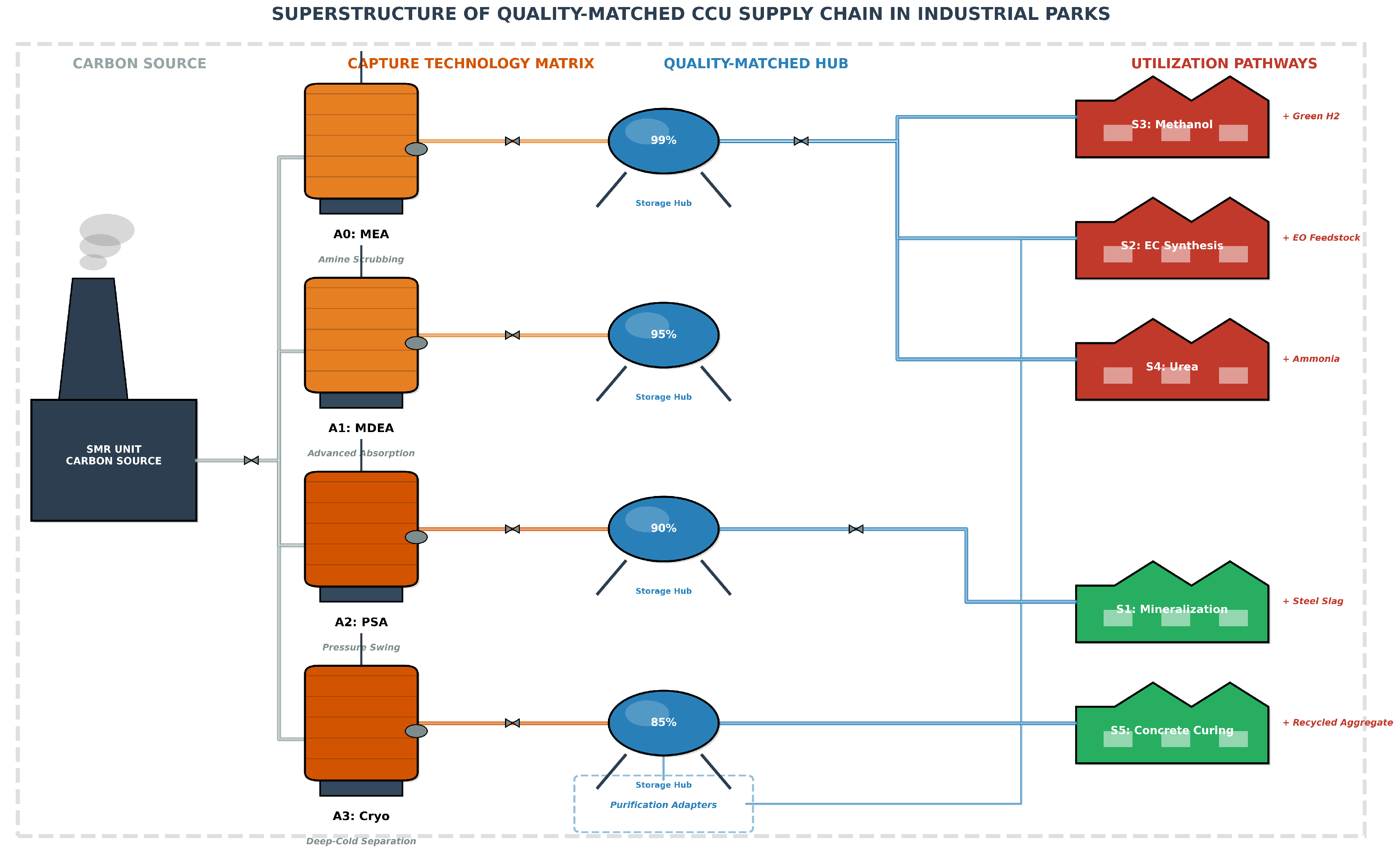
3.3. Integrative Supply Chain Decarbonization Pathways
4. Results and Discussion
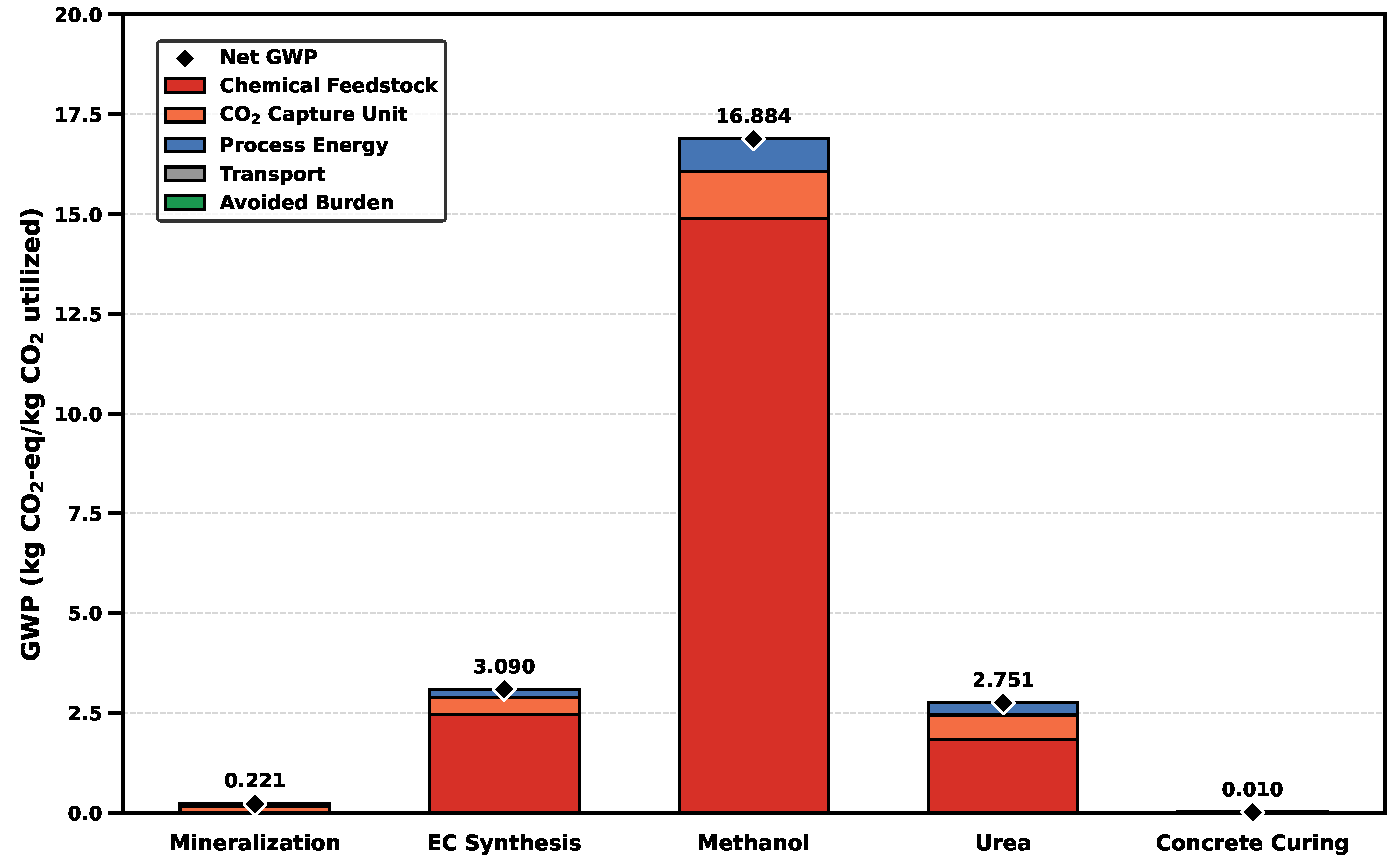
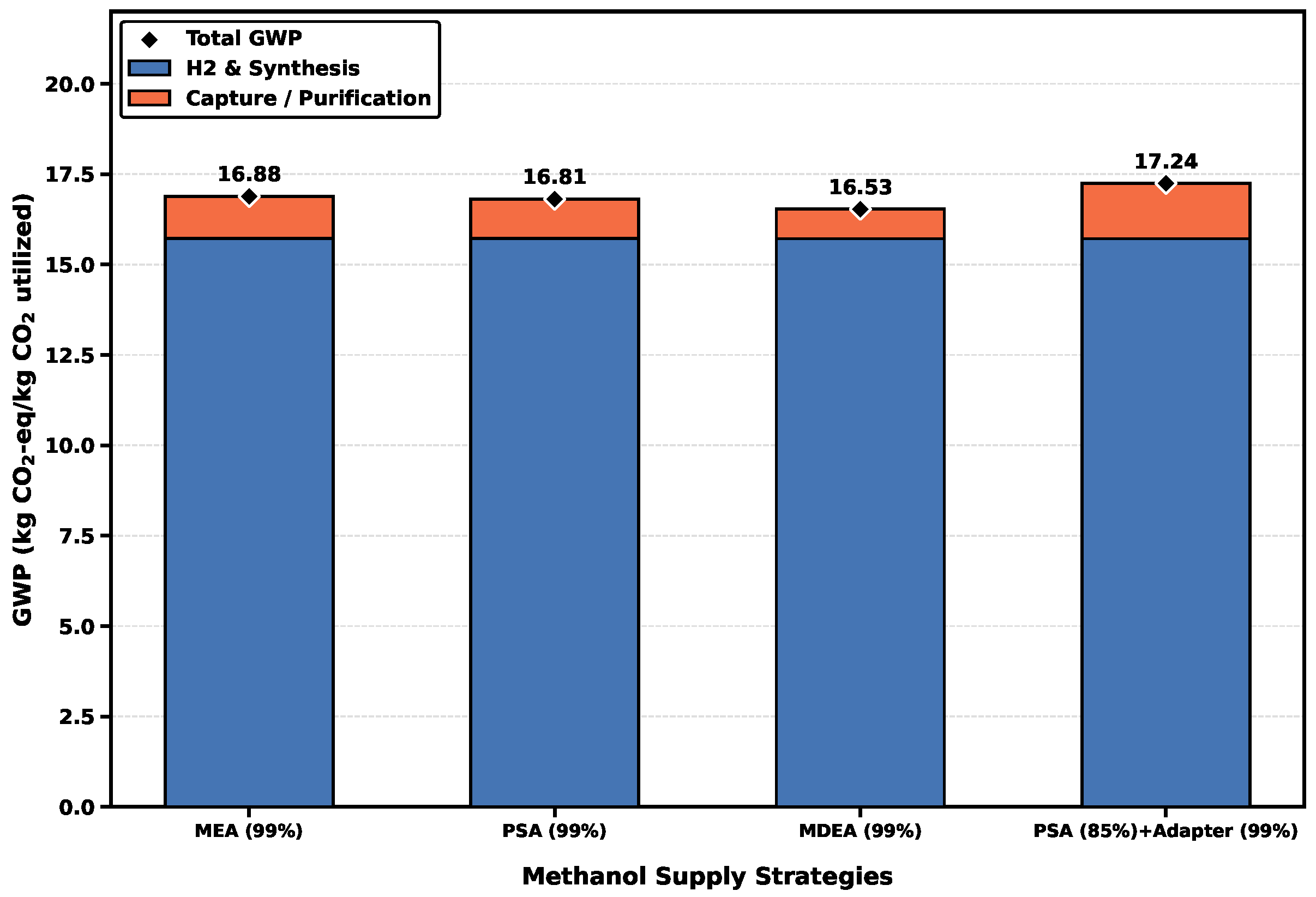
4.1. Baseline Performance Hotspot Identification
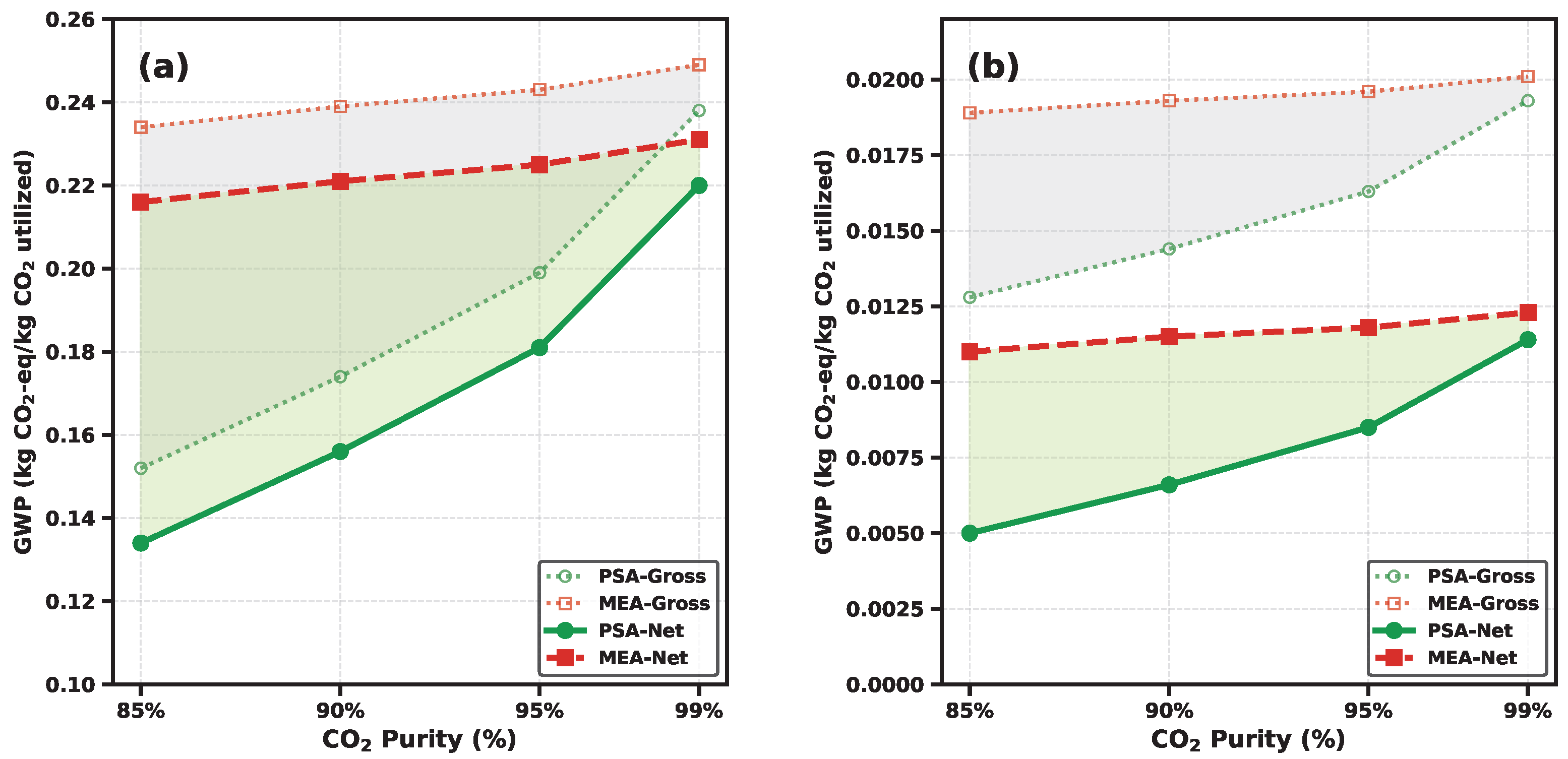
4.2. Purity–Sensitivity Energy Efficiency Impacts
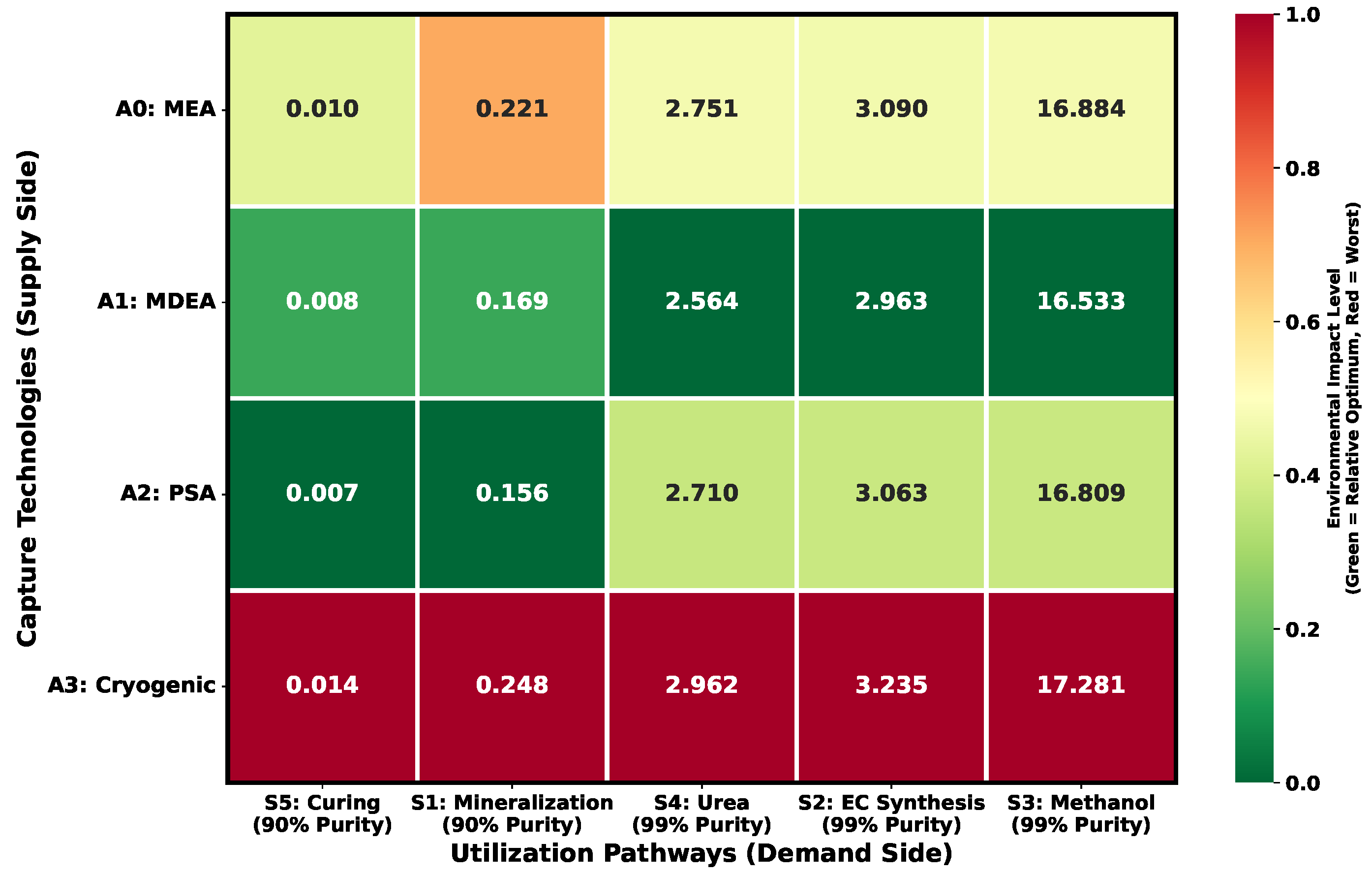
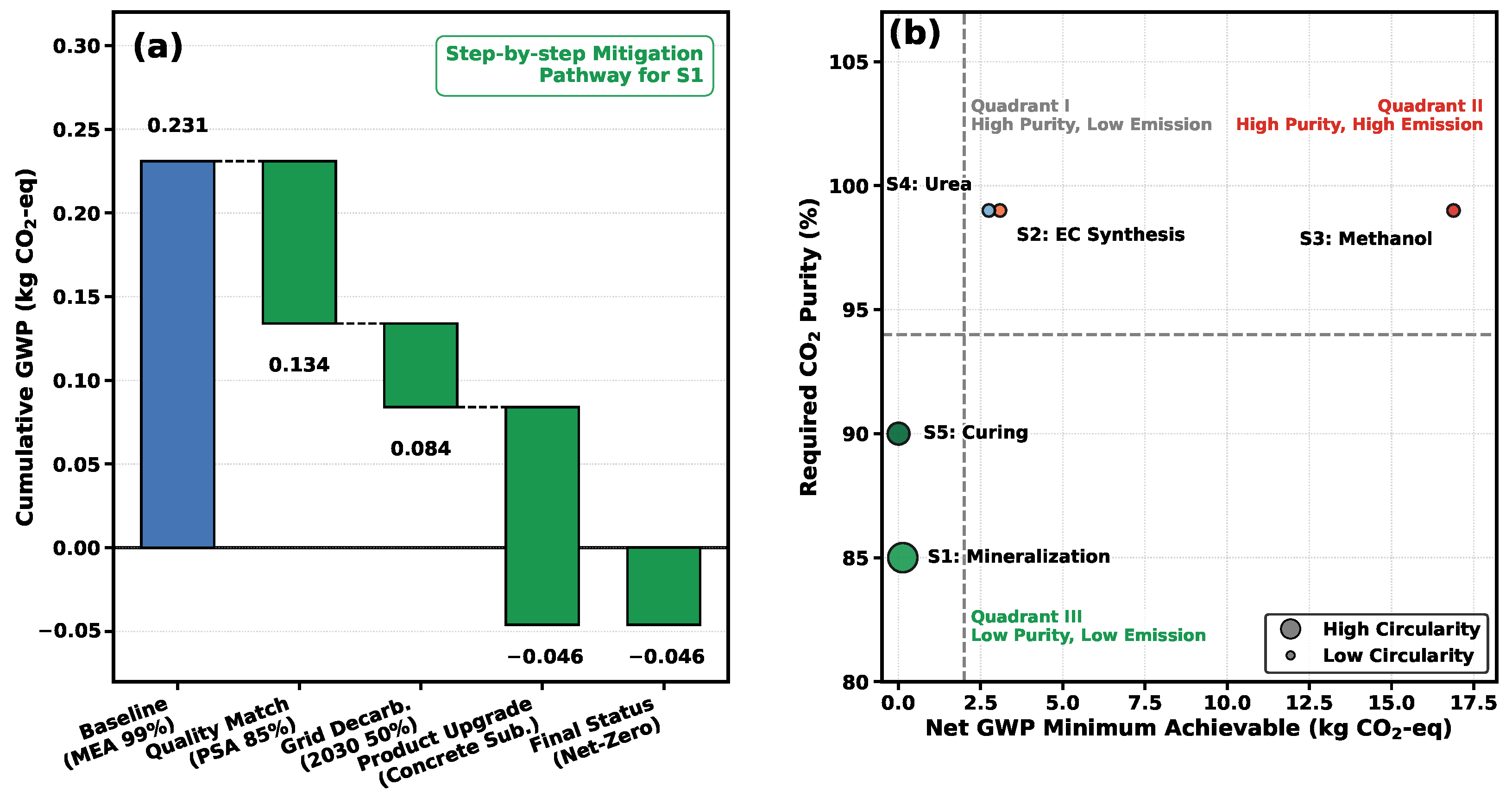
4.3. Optimal Pathway Supply Chain Synergy
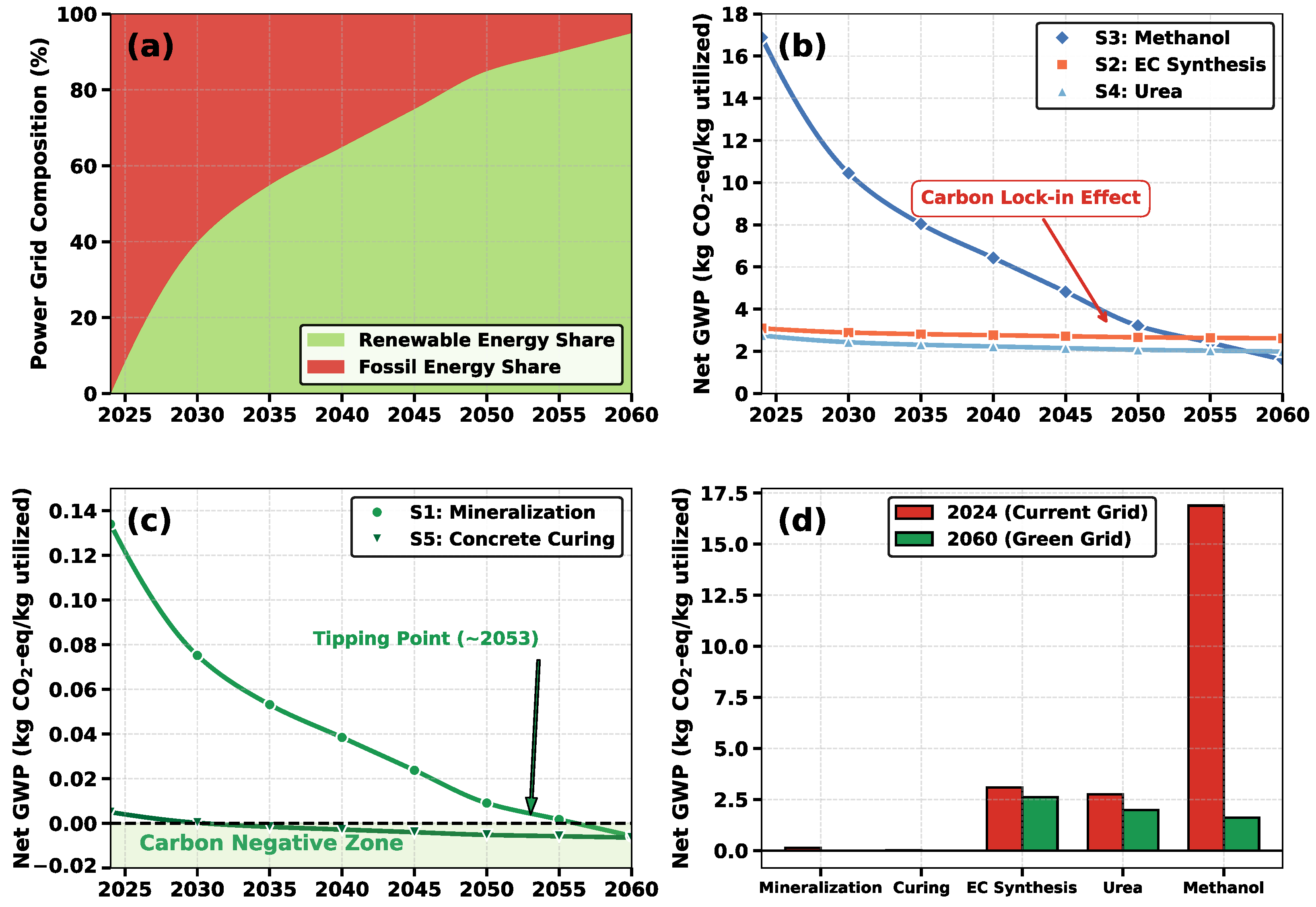
4.4. Future Evolution Decision-Making Matrix
4.5. Study Limitations and Future Research
5. Conclusions and Policy Implications
Author Contributions
Funding
Institutional Review Board Statement
Data Availability Statement
Acknowledgments
Conflicts of Interest
References
- von der Assen, N.; Voll, P.; Peters, M.; Bardow, A. Life cycle assessment of CO2 capture and utilization: A tutorial review. Chem. Soc. Rev. 2014, 43, 7982–7994. [Google Scholar] [CrossRef]
- Baena-Moreno, F.M.; Rodríguez-Galán, M.; Vega, F.; Alonso-Fariñas, B.; Vilches Arenas, L.F.; Navarrete, B. Carbon capture and utilization technologies: A literature review and recent advances. Energy Sources Part A Recovery Util. Environ. Eff. 2018, 41, 1403–1433. [Google Scholar] [CrossRef]
- Morales Mora, M.; Vergara, C.P.; Leiva, M.; Martínez Delgadillo, S.; Rosa-Domínguez, E. Life cycle assessment of carbon capture and utilization from ammonia process in Mexico. J. Environ. Manag. 2016, 183, 998–1008. [Google Scholar] [CrossRef] [PubMed]
- Leonzio, G. Carbon Capture Utilization and Storage Supply Chain: Analysis, Modeling and Optimization. In Sustainable Agriculture Reviews 37; Springer International Publishing: Berlin/Heidelberg, Germany, 2019; pp. 37–72. [Google Scholar]
- Alsarhan, L.M.; Alayyar, A.S.; Alqahtani, N.B.; Khdary, N.H. Circular Carbon Economy (CCE): A Way to Invest CO2 and Protect the Environment, a Review. Sustainability 2021, 13, 11625. [Google Scholar] [CrossRef]
- He, Y.; Zhu, L.; Fan, J.; Li, L.; Liu, G. Life cycle assessment of CO2 emission reduction potential of carbon capture and utilization for liquid fuel and power cogeneration. Fuel Process. Technol. 2021, 221, 106924. [Google Scholar] [CrossRef]
- von der Assen, N.; Jung, J.; Bardow, A. Life-cycle assessment of carbon dioxide capture and utilization: Avoiding the pitfalls. Energy Environ. Sci. 2013, 6, 2721. [Google Scholar] [CrossRef]
- Lan, K.; Yao, Y. Dynamic Life Cycle Assessment of Energy Technologies under Different Greenhouse Gas Concentration Pathways. Environ. Sci. Technol. 2022, 56, 1395–1404. [Google Scholar] [CrossRef]
- Terlouw, T.; Bauer, C.; Rosa, L.; Mazzotti, M. Life cycle assessment of carbon dioxide removal technologies: A critical review. Energy Environ. Sci. 2021, 14, 1701–1721. [Google Scholar] [CrossRef]
- de Kleijne, K.; Hanssen, S.V.; van Dinteren, L.; Huijbregts, M.A.; van Zelm, R.; de Coninck, H. Limits to Paris compatibility of CO2 capture and utilization. One Earth 2022, 5, 168–185. [Google Scholar] [CrossRef]
- Zitscher, T.; Kaltschmitt, M. Sustainable Carbon Utilization for a Climate-Neutral Economy–Framework Necessities and Assessment Criteria. Energies 2024, 17, 4118. [Google Scholar] [CrossRef]
- Kätelhön, A.; Meys, R.; Deutz, S.; Suh, S.; Bardow, A. Climate change mitigation potential of carbon capture and utilization in the chemical industry. Proc. Natl. Acad. Sci. USA 2019, 116, 11187–11194. [Google Scholar] [CrossRef]
- Gabrielli, P.; Gazzani, M.; Mazzotti, M. The Role of Carbon Capture and Utilization, Carbon Capture and Storage, and Biomass to Enable a Net-Zero-CO2 Emissions Chemical Industry. Ind. Eng. Chem. Res. 2020, 59, 7033–7045. [Google Scholar] [CrossRef]
- Ueckerdt, F.; Bauer, C.; Dirnaichner, A.; Everall, J.; Sacchi, R.; Luderer, G. Potential and risks of hydrogen-based e-fuels in climate change mitigation. Nat. Clim. Chang. 2021, 11, 384–393. [Google Scholar] [CrossRef]
- Sanna, A.; Hall, M.R.; Maroto-Valer, M. Post-processing pathways in carbon capture and storage by mineral carbonation (CCSM) towards the introduction of carbon neutral materials. Energy Environ. Sci. 2012, 5, 7781. [Google Scholar] [CrossRef]
- Huang, H.; Wang, T.; Kolosz, B.; Andresen, J.; Garcia, S.; Fang, M.; Maroto-Valer, M.M. Life-cycle assessment of emerging CO2 mineral carbonation-cured concrete blocks: Comparative analysis of CO2 reduction potential and optimization of environmental impacts. J. Clean. Prod. 2019, 241, 118359. [Google Scholar] [CrossRef]
- Ravikumar, D.; Zhang, D.; Keoleian, G.; Miller, S.; Sick, V.; Li, V. Carbon dioxide utilization in concrete curing or mixing might not produce a net climate benefit. Nat. Commun. 2021, 12, 855. [Google Scholar] [CrossRef]
- Duval-Dachary, S.; Beauchet, S.; Lorne, D.; Salou, T.; Helias, A.; Pastor, A. Life cycle assessment of bioenergy with carbon capture and storage systems: Critical review of life cycle inventories. Renew. Sustain. Energy Rev. 2023, 183, 113415. [Google Scholar] [CrossRef]
- Zhang, Z.; Pan, S.Y.; Li, H.; Cai, J.; Olabi, A.G.; Anthony, E.J.; Manovic, V. Recent advances in carbon dioxide utilization. Renew. Sustain. Energy Rev. 2020, 125, 109799. [Google Scholar] [CrossRef]
- Zhang, C.; He, G.; Johnston, J.; Zhong, L. Long-term transition of China’s power sector under carbon neutrality target and water withdrawal constraint. J. Clean. Prod. 2021, 329, 129765. [Google Scholar] [CrossRef]
- Cuéllar-Franca, R.M.; Azapagic, A. Carbon capture, storage and utilisation technologies: A critical analysis and comparison of their life cycle environmental impacts. J. CO2 Util. 2015, 9, 82–102. [Google Scholar] [CrossRef]
- Strazza, C.; Del Borghi, A.; Gallo, M. Development of Specific Rules for the Application of Life Cycle Assessment to Carbon Capture and Storage. Energies 2013, 6, 1250–1265. [Google Scholar] [CrossRef]
- ISO 14040:2006; Environmental Management—Life Cycle Assessment—Principles and Framework. International Organization for Standardization: Geneva, Switzerland, 2006.
- ISO 14044:2006; Environmental Management—Life Cycle Assessment—Requirements and Guidelines. International Organization for Standardization: Geneva, Switzerland, 2006.
- Tokede, O.; Rouwette, R. Problematic consequences of the inclusion of capital goods inventory data in Environmental Product Declarations. Int. J. Life Cycle Assess. 2023, 29, 1–24. [Google Scholar] [CrossRef]
- Shanghai HiQ Smart Data Co., Ltd. HiQLCD—China’s High-Quality LCI Database. 2025. Available online: https://nexus.openlca.org/database/HiQLCD (accessed on 20 May 2025).
- Wernet, G.; Bauer, C.; Steubing, B.; Reinhard, J.; Moreno-Ruiz, E.; Weidema, B. The ecoinvent database version 3 (part I): Overview and methodology. Int. J. Life Cycle Assess. 2016, 21, 1218–1230. [Google Scholar] [CrossRef]
- IPCC. IPCC 2021 AR6 Impact Assessment Method. 2021. Available online: https://nexus.openlca.org/ (accessed on 20 May 2024).
- Müller, L.J.; Kätelhön, A.; Bachmann, M.; Zimmermann, A.; Sternberg, A.; Bardow, A. A Guideline for Life Cycle Assessment of Carbon Capture and Utilization. Front. Energy Res. 2020, 8, 15. [Google Scholar] [CrossRef]
- Langhorst, T.; McCord, S.; Zimmermann, A.; Müller, L.; Cremonese, L.; Strunge, T.; Wang, Y.; Zaragoza, A.V.; Wunderlich, J.; Marxen, A.; et al. Techno-Economic Assessment & Life Cycle Assessment Guidelines for CO2 Utilization (Version 2.0); ETH Zurich: Zurich, Switzerland, 2022. [Google Scholar]
- Bui, M.; Adjiman, C.S.; Bardow, A.; Anthony, E.J.; Boston, A.; Brown, S.; Fennell, P.S.; Fuss, S.; Galindo, A.; Hackett, L.A.; et al. Carbon capture and storage (CCS): The way forward. Energy Environ. Sci. 2018, 11, 1062–1176. [Google Scholar] [CrossRef]
- Hasan, M.F.; First, E.L.; Boukouvala, F.; Floudas, C.A. A multi-scale framework for CO2 capture, utilization, and sequestration: CCUS and CCU. Comput. Chem. Eng. 2015, 81, 2–21. [Google Scholar] [CrossRef]
- Bobicki, E.R.; Liu, Q.; Xu, Z.; Zeng, H. Carbon capture and storage using alkaline industrial wastes. Prog. Energy Combust. Sci. 2012, 38, 302–320. [Google Scholar] [CrossRef]
- Zhang, D.; Ghouleh, Z.; Shao, Y. Review on carbonation curing of cement-based materials. J. CO2 Util. 2017, 21, 119–131. [Google Scholar] [CrossRef]
- Zhou, J.; He, Y.; Lyu, Y.; Wang, K.; Che, Y.; Wang, X. Long-term electricity forecasting for the industrial sector in western China under the carbon peaking and carbon neutral targets. Energy Sustain. Dev. 2023, 73, 174–187. [Google Scholar] [CrossRef]
- Greig, C.; Uden, S. The value of CCUS in transitions to net-zero emissions. Electr. J. 2021, 34, 107004. [Google Scholar] [CrossRef]
- Bauer, F.; Nielsen, T.D.; Nilsson, L.J.; Palm, E.; Ericsson, K.; Fråne, A.; Cullen, J. Plastics and climate change—Breaking carbon lock-ins through three mitigation pathways. One Earth 2022, 5, 361–376. [Google Scholar] [CrossRef]
- Monkman, S.; Shao, Y. Carbonation Curing of Slag-Cement Concrete for Binding CO2 and Improving Performance. J. Mater. Civ. Eng. 2010, 22, 296–304. [Google Scholar] [CrossRef]
- Garcia-Garcia, G.; Fernandez, M.C.; Armstrong, K.; Woolass, S.; Styring, P. Analytical Review of Life-Cycle Environmental Impacts of Carbon Capture and Utilization Technologies. ChemSusChem 2021, 14, 995–1015. [Google Scholar] [CrossRef]



| Process Category | Material Inputs | Energy Demand | Outputs and Avoided Burdens |
|---|---|---|---|
| S1: Mineralization | CO2 (0.20 kg); Steel slag (0.80 kg) | Elec: 0.05 kWh | Aggregate (1.0 kg); Gravel (−1.0 kg) |
| S2: EC Synthesis | CO2 (0.50 kg); Ethylene oxide (0.50 kg) | Elec: 0.08 kWh; Heat: 0.80 MJ | Ethylene carbonate (1.0 kg) |
| S3: Methanol | CO2 (1.38 kg); Green H2 (0.19 kg) | Elec: 0.40 kWh; Heat: 4.00 MJ | Methanol (1.0 kg) |
| S4: Urea | CO2 (0.73 kg); Liquid ammonia (0.57 kg) | Elec: 0.14 kWh; Heat: 0.95 MJ | Urea (1.0 kg) |
| S5: Concrete Curing | CO2 (0.015 kg); Raw concrete (1.00 kg) | Elec: 0.005 kWh | Cured block (1.0 kg); Concrete (−1.0 kg) |
| Adapter: 95% → 99% | Coarse CO2 95% (1.06 kg) | Elec: 0.05 kWh | Refined CO2 99% (1.0 kg) |
| Adapter: 90% → 99% | Coarse CO2 90% (1.15 kg) | Elec: 0.12 kWh | Refined CO2 99% (1.0 kg) |
| Adapter: 85% → 99% | Coarse CO2 85% (1.24 kg) | Elec: 0.20 kWh | Refined CO2 99% (1.0 kg) |
| Capture Technology | Purity Level | Electricity Demand (kWh/kg CO2) | Thermal Demand (MJ/kg CO2) | Technology Type |
|---|---|---|---|---|
| A0: MEA | 99% (Industrial grade) | 0.32 | 3.50 | Purity-Rigid |
| 95% (Fine grade) | 0.30 | 3.20 | ||
| 90% (Coarse grade) | 0.28 | 2.90 | ||
| 85% (Raw grade) | 0.26 | 2.60 | ||
| A1: MDEA | 99% (Industrial grade) | 0.22 | 2.50 | Purity-Rigid |
| 95% (Fine grade) | 0.20 | 2.30 | ||
| 90% (Coarse grade) | 0.18 | 2.10 | ||
| 85% (Raw grade) | 0.16 | 1.90 | ||
| A2: PSA | 99% (Industrial grade) | 0.55 | 0.00 | Purity-Elastic |
| 95% (Fine grade) | 0.40 | 0.00 | ||
| 90% (Coarse grade) | 0.30 | 0.00 | ||
| 85% (Raw grade) | 0.22 | 0.00 | ||
| A3: Cryogenic | 99% (Industrial grade) | 0.75 | 0.50 | High-End/Rigid |
| 95% (Fine grade) | 0.65 | 0.50 | ||
| 90% (Coarse grade) | 0.55 | 0.50 | ||
| 85% (Raw grade) | 0.45 | 0.50 |
| Utilization Pathway | Optimal Capture Strategy | Net-Zero Tipping Year | Renewable Threshold | 2060 GWP Reduction | Lock-in Vulnerability |
|---|---|---|---|---|---|
| S5: Curing | PSA (90% direct) | ∼2031 | 41.7% | >100% (Net-neg.) | Low (Mineral sink) |
| S1: Mineral. | PSA (85% direct) | ∼2053 | 88.4% | >100% (Net-neg.) | Low (Mineral sink) |
| S3: Methanol | MDEA (99% direct) | N/A | N/A | 90.7% | Low (Green H2) |
| S2: EC Syn. | MDEA (99% direct) | N/A | N/A | 11.3% | High (Fossil EO) |
| S4: Urea | MDEA (99% direct) | N/A | N/A | 1.5% | High (Fossil NH3) |
Disclaimer/Publisher’s Note: The statements, opinions and data contained in all publications are solely those of the individual author(s) and contributor(s) and not of MDPI and/or the editor(s). MDPI and/or the editor(s) disclaim responsibility for any injury to people or property resulting from any ideas, methods, instructions or products referred to in the content. |
© 2026 by the authors. Licensee MDPI, Basel, Switzerland. This article is an open access article distributed under the terms and conditions of the Creative Commons Attribution (CC BY) license.
Share and Cite
Ruan, J.; Wang, Y.; Du, T.; Bai, L.; Jia, H.; Li, Y.; Chen, P. Quality-Matched Life Cycle Assessment of CCU Supply Chains for SMR Tail Gas CO2 in Industrial Parks. Sustainability 2026, 18, 5063. https://doi.org/10.3390/su18105063
Ruan J, Wang Y, Du T, Bai L, Jia H, Li Y, Chen P. Quality-Matched Life Cycle Assessment of CCU Supply Chains for SMR Tail Gas CO2 in Industrial Parks. Sustainability. 2026; 18(10):5063. https://doi.org/10.3390/su18105063
Chicago/Turabian StyleRuan, Jiuli, Yisong Wang, Tao Du, Lu Bai, He Jia, Yingnan Li, and Peng Chen. 2026. "Quality-Matched Life Cycle Assessment of CCU Supply Chains for SMR Tail Gas CO2 in Industrial Parks" Sustainability 18, no. 10: 5063. https://doi.org/10.3390/su18105063
APA StyleRuan, J., Wang, Y., Du, T., Bai, L., Jia, H., Li, Y., & Chen, P. (2026). Quality-Matched Life Cycle Assessment of CCU Supply Chains for SMR Tail Gas CO2 in Industrial Parks. Sustainability, 18(10), 5063. https://doi.org/10.3390/su18105063