Article

Impact of Risk Preference on Grape Growers’ Climate Adaptation Behaviors: Mediating Roles of Credit Access and Moderating Roles of Social Trust

by
Yuwei Shi
,
Qianwei Wang
,
Xiandong Li
* and
Lingfei Zhang
College of Economics and Management, Xinjiang Agricultural University, Urumqi 830052, China
*
Author to whom correspondence should be addressed.
Sustainability 2026, 18(10), 5062; https://doi.org/10.3390/su18105062 (registering DOI)
Submission received: 22 March 2026 / Revised: 7 May 2026 / Accepted: 12 May 2026 / Published: 18 May 2026

Abstract

Improving the climate adaptability of farmers is crucial to ensuring agricultural production and achieving the goal of sustainable development in agriculture. Against the background of climate change aggravating agricultural risks, how do farmers’ own risk attitudes affect their adaptive behavior? Based on the micro-survey data of 480 grape growers in the Turpan-Hami Basin in 2025, we used the least squares method (OLS) to explore the impact of risk appetite on the climate adaptation behavior of farmers and its mechanism. The study found that risk appetite significantly promoted the adoption of adaptive behaviors by farmers. For every 1 unit increase in the risk preference score, the number of climate-adaptive behaviors adopted by farmers increased by an average of 0.322. Mechanism testing shows that both formal credit and informal credit play a partial intermediary role. The intermediary effect accounts for 18.3% and 36.3% respectively, and the transmission effect of informal credit is stronger; Institutional trust and interpersonal trust both positively regulate the relationship between risk preference and adaptive behavior at the level of 1%. Research shows that we should take into account risk education and production environment optimization, pay attention to the supplementary role of private lending, and build a multi-level trust promotion system to jointly improve the climate adaptability of farmers.

1. Introduction

In recent years, extreme weather events such as high temperatures, droughts, and erratic rainfall driven by global climate change have exacerbated instability in agricultural production [1]. These extreme climates include high temperatures, droughts, and erratic rainfall. As a highly climate-sensitive industry, agriculture in China is vulnerable to the impacts of climate change. Climate change exerts persistent effects on yield formation, quality stability, and farmers’ income [2]. Against this background, the 2022 Central Government No. 1 clearly proposes strengthening research on the medium- and long-term impacts of climate change on agriculture. It also lists climate change mitigation and adaptation as important tasks for national sustainable development. In practice, climate-adaptive behaviors can alleviate climate shocks to a certain extent. These behaviors include improved irrigation methods, adjusted planting structure, adoption of stress-resistant new varieties, and enhanced field management. Such behaviors help improve agricultural risk resilience and stabilize agricultural output [3,4]. However, the actual adoption rate of relevant adaptive measures among farmers remains low [5]. This phenomenon indicates that the key factors influencing farmers’ adoption of adaptive behaviors are not limited to the effectiveness of technologies. They also include farmers’ trade-offs among input costs, expected returns, and potential risks. Therefore, farmers’ adoption of climate-adaptive behaviors is not only a technical choice. It is also, in essence, a typical risk decision-making issue. This issue is particularly prominent among farmers who plant high-value cash crops such as grapes. Unlike food crops, the production of high-value cash crops is characterized by high input intensity, large profit fluctuations, and strong asset specificity. The adoption of climate-adaptive behaviors is often accompanied by high initial investment, a long payback period, and considerable profit uncertainty. For example, improving irrigation facilities, adjusting cultivation modes, or adopting new disaster-prevention and mitigation technologies may enhance medium- and long-term risk resilience while simultaneously increasing current financial pressure. Farmers may thus face multiple constraints, including uncertain technical outcomes, fluctuating market returns, and overlapping natural risks. As adopters, users, and beneficiaries of adaptive behaviors, farmers aim to maximize their own benefits. They decide whether to adopt preventive measures based on cost–benefit analysis. However, adopting adaptation behaviors often entails high investment, long cycles, and uncertainty. This situation may conflict with farmers’ pursuit of short-term economic gains. Such inconsistency further discourages farmers from adopting climate-adaptive behaviors.
Climate-adaptive behavior refers to a series of behavioral decisions in which farmers take the initiative to adjust production management measures to reduce risks and maintain or improve agricultural output in response to the adverse effects of climate change. Adopting adaptive behaviors aims to address risks caused by climate change. It helps ensure stable production and income security for farmers. However, adaptive behaviors exhibit high investment, uncertain returns, and intertemporal returns. Technology adopters need to trade off between current costs and future benefits. Therefore, as a high-risk choice, the application of adaptive behaviors cannot ignore the influence of individual risk preference. Farmers’ risk preferences refer to their subjective risk attitude toward uncertainty in agricultural production and management. It exerts a direct impact on behavioral decision-making [6]. Studies show that farmers’ risk preferences are an important factor influencing their agricultural production decisions [7,8]. On the one hand, risk preferences affect farmers’ judgments of costs and benefits. Farmers with a higher risk preference hold more optimistic expectations of future returns. They are more likely to adopt adaptive technologies with high short-term input and stable long-term benefits. Risk-averse farmers pay more attention to current costs. They tend to choose traditional measures with low risks and quick effects. These measures cannot bring long-term returns. On the other hand, risk preference affects farmers’ acceptance of new technologies. Risk-averse farmers often adopt a cautious attitude toward adopting new adaptive behaviors to avoid potential losses. Risk-preferring farmers are more willing to try new varieties, technologies, or cultivation modes. These practices help them achieve higher climate resilience and long-term returns. In addition, farmers’ risk preferences are not fixed. They can be guided by external intervention [9]. Effective policy support can change individual behavioral intention in high-risk situations. Common approaches include technical subsidies and market information services [10,11]. Policy intervention can reduce farmers’ perceived uncertainty about future returns. It can strengthen their confidence in adopting adaptive behaviors. It can also alleviate financial constraints to a certain extent. It can further improve their risk-taking capacity. Accordingly, an in-depth investigation into the mechanism underlying risk preference on the adoption of climate-adaptive behaviors by high-value cash crop growers is of practical significance. It also analyzes the moderating roles of external factors such as social trust and credit access. This investigation helps understand the adaptive behaviors of high-value cash crop growers. It supports the guarantee of agricultural product supply.
The adoption of farmers’ adaptive behaviors and the mechanisms that influence it have long attracted attention. Previous studies have mainly focused on farmers’ own resource endowments. In addition to the attributes of adaptive behaviors themselves, farmers’ adaptive behaviors are closely related to individual characteristics. These characteristics include age and educational level. They are also related to household characteristics such as labor quantity, land scale, and income level [12,13,14,15,16]. Some scholars have also explored the impacts of the external environment on adaptive behaviors. They find that strengthened social relations increase the likelihood of adoption by improving access to information and technologies [17,18]. Technical support and social technical training can improve farmers’ technical literacy. These measures help farmers master scientific methods. They promote farmers’ adoption of adaptive behaviors [19,20]. From a research perspective, agricultural production entails relatively high risks. This is particularly the case for the adoption of preventive measures. Farmers may face risks such as inappropriate technology, long cycles, and uncertain market conditions. During this process, farmers’ risk preference and uncertain returns can influence their adoption of adaptive behaviors. Existing studies have confirmed this view. Farmers with higher risk preferences are more inclined to adopt adaptive behaviors. These behaviors include drought-resistant new varieties, water-saving irrigation technologies, and green prevention and control measures [10,21]. Furthermore, farmers’ decisions are not merely influenced by their own risk preferences. They may also function indirectly through other channels. On the one hand, credit access is an important channel to ease farmers’ financial constraints. Farmers with higher risk preferences may seek credit support more actively for adaptive technology investments. Credit availability can provide a financial guarantee for the adoption of adaptive behaviors [5,22]. On the other hand, farmers make decisions within a specific social environment. Social trust may strengthen or weaken the impact of risk preference on behaviors. It can reduce information asymmetry and improve expectations of cooperation.
Studies have provided a basis for understanding the climate-adaptive behavior of farmers, but there are still the following shortcomings: first, they pay more attention to annual food crops and give insufficient attention to perennial cash crops such as grapes. The risk structure of perennial crops determines that there may be essential differences in their adaptive decision-making logic; second, although the direct impact of risk preference on the behavior of farmers has been examined, the transmission mechanism that plays a role through credit channels is limited; third, the regulatory role of social trust in the relationship between risk preference and adaptive behavior is ignored, and the situational dependence characteristics of the impact effect of risk preference is not revealed. Against this background, this study focuses on grape growers in the Turpan-Hami Basin, an arid region in Northwest China. It uses 480 sets of micro-survey data collected in 2025. This study starts from the perspective of grape growers’ risk preference. It empirically examines the impact of risk preference on the adoption of adaptive behaviors by grape growers. It also investigates the moderating effect of different types of social trust on risk preference. It further explores the heterogeneous mediating effect of different credit access channels. This study provides a new theoretical perspective for understanding the climate response behaviors of fruit growers in arid regions. It also offers empirical evidence for optimizing the rural credit system, fostering a social trust environment, and formulating differentiated climate adaptation policies.

2. Theoretical Analysis and Research Hypothesis

2.1. The Impact of Risk Preference on Farmers’ Climate-Adaptive Behavior

Risk preference refers to farmers’ subjective risk-taking tendencies in the face of uncertainty during agricultural production and management. It is an important leading psychological factor for farmers to make relevant decisions. It directly impacts behavioral decision-making. Attitude toward risk is one of the important factors influencing individual decision-making [11]. Prospect theory holds that individuals do not fully follow the principle of rational maximization in decision-making under uncertainty. They show significant psychological deviations and differences in subjective perception. Therefore, farmers with different levels of risk preference behave differently [23,24,25]. The adoption of adaptive behaviors can effectively address climate change [26]. However, farmers’ production decisions are restricted by multiple risks. Specifically, the adoption of adaptive behaviors increases the production costs and time costs for grape growers. Farmers’ investment is not proportional to short-term income. The uncertainty risk of returns increases accordingly. On the other hand, unlike grain crops, cash crops require higher levels of professional skills. If growers cannot master the relevant technology in time, they may not achieve the expected effect [27]. As a perennial crop, grapes need to maintain their growth structure across years. Once they suffer from extreme weather events, not only will the yield of the year be damaged, but the tree’s recovery may take several years, and the loss will have a cumulative effect over the period. Compared with annual food crops, grape cultivation faces higher climate risk exposure and greater silent costs, which makes risk appetite more critical in driving adaptive behavior. Farmers with stronger risk preferences tend to show a more positive attitude. They are more inclined to adopt new technologies [28,29]. Risk-averse farmers show a cautious attitude. They are more likely to adopt conservative strategies to avoid potential losses under risk constraints [30]. Based on the above analysis, Hypothesis 1 is proposed.
Hypothesis 1.
Risk preference has a significant positive impact on climate-adaptive behaviors.

2.2. The Impact of Social Trust on Climate-Adaptive Behavior

Trust is an essential part of social capital. It is a complex, multi-dimensional, and multi-level psychological phenomenon. It can also be regarded as an expectation for the future. This expectation influences the decision-making behaviors of individuals or groups [31]. Farmers often face insufficient information or information asymmetry when adopting adaptive behaviors. They cannot accurately judge the effects of adaptive behaviors. Social trust can alleviate such information asymmetry to a certain extent [32]. Following the studies by Maguire and Cai, this study divides social trust into interpersonal trust and institutional trust [33,34,35]. Generally, interpersonal trust refers to the trust and expectations individuals have for specific others (such as relatives, friends, and neighbors) based on blood, geographical, and emotional ties. Their trust stems from the emotional identity and reciprocity that accumulate over repeated interactions. Farmers are rational economic individuals as well as social beings. They are easily influenced by external environments, such as social networks and interpersonal relationships [36]. In social networks with high trust, the positive effects of preventive measures adopted by some farmers spread quickly. This encourages other farmers to have a try. Institutional trust refers to the individual’s trust in the reliability and fairness of abstract institutional rules, organizational systems, and their executors (such as government policies, laws and regulations, village cadres, and technology promoters). It stems from the system’s stability and authority, and from the predictability of the executor’s performance of duties. When farmers have high trust in government policies and village cadres, they are more willing to adopt government-promoted technologies. Therefore, interpersonal trust and institutional trust exert significant influence on farmers’ behavioral decisions. Meanwhile, existing studies show that mutual assistance and sharing among farmers have significant impacts. Trust in relatives, friends, neighbors, village cadres, and government policies also plays a significant role. These factors influence the adoption of adaptive behaviors, technology adoption, and the supply of rural public goods [37,38,39]. Based on the above analysis, Hypothesis 2 and Hypothesis 3 are proposed.
Hypothesis 2.
Interpersonal trust has a positive impact on the adoption of adaptive behaviors.
Hypothesis 3.
Institutional trust has a positive impact on the adoption of adaptive behaviors.

2.3. The Moderating Effect of Social Trust

As one important informal institutional factor, the improvement of social trust helps reduce uncertainty risks [40]. Rural China is a familiar community. The sharing of knowledge and the exchange of information influence farmers’ behavioral decisions [41,42,43]. The improvement of social trust promotes cooperation among farmers in production and daily life. It also improves farmers’ trust in government commitments and reduces concerns about risks. That is to say, social trust may regulate the relationship between risk preference and adaptive behaviors. It achieves this by providing risk buffering and strengthening positive signals. Farmers with high institutional trust expect the government and financial institutions to provide disaster assistance. They have fewer worries about the failure of behaviors. They dare to transform risk attitudes into practical actions. Thus, they strengthen the effect of risk preference. Farmers with high interpersonal trust obtain informal protection through information sharing. They respond actively to climate risks and adopt adaptive measures accordingly. They also positively strengthen the relationship between risk preference and behaviors. Based on the above analysis, Hypothesis 4 and Hypothesis 5 are proposed.
Hypothesis 4.
Interpersonal trust plays a positive moderating role in the impact of risk preference on the adoption of adaptive behaviors.
Hypothesis 5.
Institutional trust plays a positive moderating role in the impact of risk preference on the adoption of adaptive behaviors.

2.4. The Mediating Effect of Credit Acquisition

Rural credit supply comprises formal credit and informal credit. Formal credit is represented by financial institutions such as banks and credit unions. Informal credit is composed of relatives, friends, and private institutions [44,45]. Adaptive behavior can be divided into labor-intensive and capital-intensive behavior according to its element input structure [46]. In a situation where labor is abundant and the cost is low, growers may rely more on manual operation than capital investment. However, some adaptive behaviors have significant capital requirements and require financial support. For example, measures such as purchasing irrigation equipment, introducing drought-resistant varieties, and constructing hail-proof nets often require farmers to invest a large sum of money once. At the same time, the survey found that the labor force of grape growers in the Turpan-Hami Basin is mainly composed of husband-and-wife teams. When adopting adaptive sexual behavior, it is generally necessary to hire workers. The cost of hiring is about 120–150 yuan per person per day. These high labor costs mean that even labor-intensive measures may result in actual financial requirements due to the expenditure on hiring workers. The results show that, regardless of the type of adaptive behavior, capital investment is a key constraint in its adoption. They require financial support [47]. Farmers can alleviate financial pressure through credit support. Such support promotes the adoption of adaptive behaviors [22]. Credit provides funds for farmers. It breaks the capital constraints in production decisions. It also promotes farmers’ adoption of climate-adaptive behaviors [48]. Farmers’ risk preferences directly affect their willingness to obtain credit [49]. This paper develops the theoretical logic of “risk preference → credit acquisition → adaptive behavior” from the perspectives of behavioral economics and credit-constraint theory. First, according to prospect theory, individual decision-making under uncertainty is governed by risk attitudes. When weighing gains and losses, risk-preferring farmers pay more attention to the high returns that may be brought by credit and are less sensitive to potential default risks, so they are more willing to participate in credit; in contrast risk-averse farmers are more sensitive to losses and tend to reduce lending behavior to avoid possible debt pressure. Second, according to the credit-constraint theory, capital restrictions are a key obstacle to farmers adopting new technologies and measures. Credit acquisition can overcome liquidity constraints in farmers’ production decision-making and enable them to bear the input costs required in the early stage of adaptive behavior, thereby promoting the adoption of climate-adaptive behavior. Therefore, farmers’ risk preferences affect their adoption of climate-adaptive behaviors through credit participation.
Hypothesis 6.
Farmers’ credit plays a mediating role between risk preference and adaptive behaviors, and this effect has credit heterogeneity.
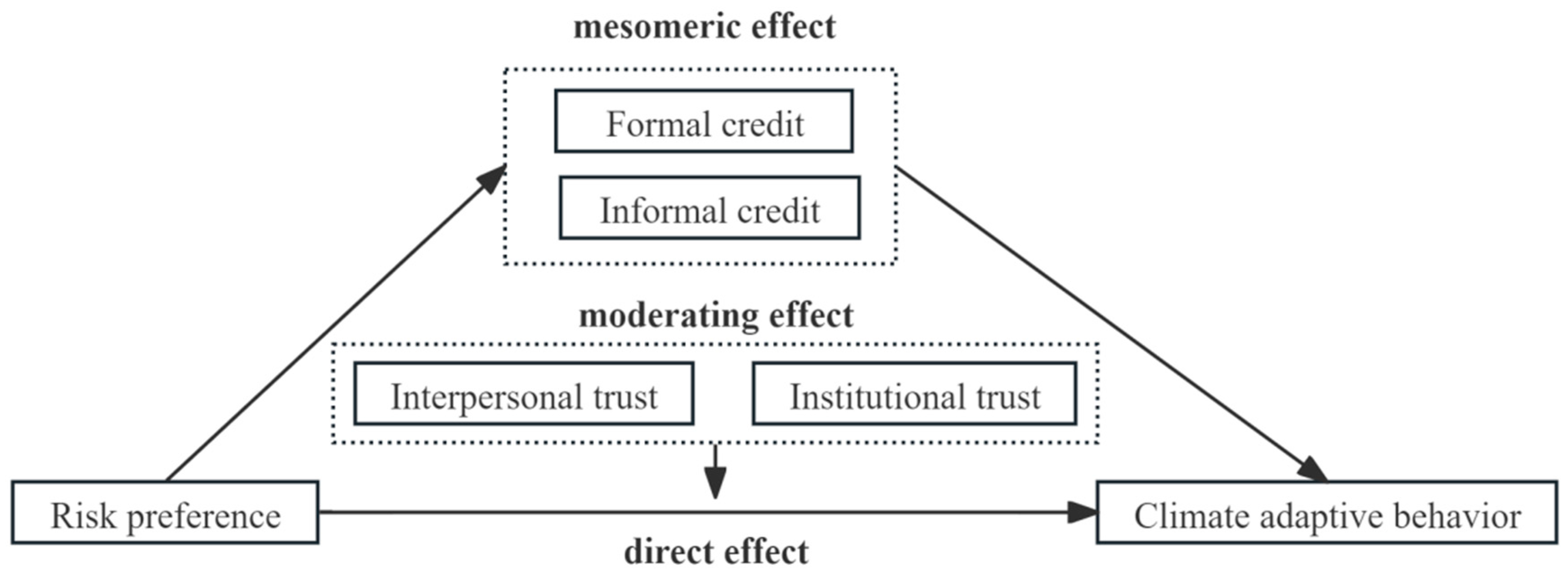
Based on the above analysis, the theoretical framework constructed in this paper is shown in Figure 1.

3. Model Design, Variable Selection, Data Sources

3.1. Model Design

3.1.1. Benchmark Model

To examine the impact of risk preference on climate-adaptive behavior, climate-adaptive behavior is taken as the explained variable and risk preference as the core explanatory variable, and the OLS model is used for benchmark regression analysis. The selection of OLS is mainly based on the following considerations: the interpreted variable is a count variable with a value of 0 to 8, the value range is relatively wide, and the meaning of the OLS regression coefficient is intuitive, which is convenient to directly explain the marginal impact of risk preference on the number of adaptive behavior adoptions. However, the explained variable is essentially count data. Direct OLS estimation may lead to predicted values outside the actual range, as well as other econometric issues such as heteroskedasticity. For this reason, the study further uses Poisson regression to re-estimate the benchmark model in the robustness test part to ensure the reliability of the core conclusion. The specific model is as follows:
Y i = β 0 + β 1 X i + β 2 Control i + ε 1
In Equation (1), Y i denotes farmers’ climate-adaptive behaviors. X i denotes farmers’ risk preference. It is measured as the risk preference value based on the questionnaire design. Control i represents control variables. These include farmers’ characteristics, household characteristics, social capital and other factors. β 0 represents the constant term. β 1 , β 2 represents the coefficients to be estimated. ε 1 represents the random disturbance term.

3.1.2. Mediating Effect Model

To test whether risk preference affects farmers’ climate-adaptive behaviors through credit, this study employs the mediating effect test method proposed by Wen [50]. The econometric models are constructed as follows:
The specific steps are as follows: The first step is to test the overall effect of risk preference on climate adaptation behavior. If the coefficient is significant, it indicates the presence of an intermediary effect. The second step is to test the impact of risk preference on the intermediary variables (regular credit, informal credit). If the coefficient is significant, it indicates that risk preference affects credit acquisition. In the third step, risk preference and the intermediary variables are included in the model simultaneously to test their impact on climate-adaptive behavior. If the coefficients of the intermediary variables in the second and third steps are significant, and the coefficient of risk preference in the third step is lower than that of the first step, it indicates the existence of the intermediary effect. Furthermore, this paper uses the Sobel test to verify the significance of the intermediary effect and calculate the proportion of the intermediary effect in the total effect.
Y i = α 0 + α 1 X i + α 2 Control i + ε 2
M i = δ 0 + ω 1 X i + ω 2 C o n t r o l i + ε 3
Y i = ξ 0 + ξ 1 X i + ξ 2 M + ξ 3 C o n t r o l i + ε 4
In Equations (2)–(4), Y i denotes farmers’ climate-adaptive behaviors. M i denotes farmers’ credit variable, which is the mediating variable. X i denotes farmers’ risk preference. α 1 , α 2 , ω 1 , ω 2 , ξ 1 , ξ 2 , ξ 3 represents the coefficients to be estimated. α 0 , δ 0 , ξ 0 represents the constant term. ε 2 , ε 3 , ε 4 represents the random disturbance term.

3.1.3. Moderating Effect Model

To test whether social trust affects the relationship between risk preference and climate-adaptive behaviors, a moderating effect model is constructed by using interaction terms. Specifically, two interactions, risk preference × institutional trust and risk preference × interpersonal trust, are constructed respectively, and incorporated into the extended regression model. The specific model is as follows:
Y i = λ 1 + λ 2 X i + λ 3 D i + λ 4 X i × D i + λ 5 Control i + ε 5
In Equation (5), Y i denotes farmers’ climate-adaptive behaviors. X i denotes farmers’ risk preference. D i denotes interpersonal trust and institutional trust. X i × D i denotes the interaction term between farmers’ risk preference and social trust. Control i represents control variables. λ 2 , λ 3 , λ 4 , λ 5 represents the coefficients to be estimated. λ 1 represents the constant term. ε 5 represents the random disturbance term.

3.2. Variable Selection

3.2.1. Explained Variable

The explained variable is climate-adaptive behavior. Referring to the studies of Lu, in combination with local conditions, climate-adaptive behavior is divided into the following eight dimensions [3,51,52]. These dimensions include plastic film mulching, cultivar replacement, adoption of new technologies, increased input of chemical fertilizers and pesticides, adjustment of planting structure, purchase of agricultural insurance, improvement of the ecological environment, and adjustment of farming time. Each behavior is assigned a value of 1 if adopted by farmers and 0 otherwise. The total number of adaptive behaviors adopted by farmers is obtained by summing up all items. This variable is a non-negative integer counting variable. Its value ranges from 0 to 8. A higher value indicates a greater degree of adoption of climate-adaptive behaviors by farmers.

3.2.2. Explanatory Variables

The core explanatory variable is risk preference. Following the method of Keshavarz and Zhang, risk preference is identified based on respondents’ decision-making attitudes toward uncertain returns [10,53]. Risk preference is measured using the following experimental question: “If you have one chance to participate in a lottery, which of the following payment options will you choose?” The options are: (1) receive 200 yuan for sure; (2) 50% chance to receive 150 yuan and 50% chance to receive 250 yuan; (3) 50% chance to receive 100 yuan and 50% chance to receive 300 yuan; (4) 50% chance to receive 50 yuan and 50% chance to receive 350 yuan; or (5) 50% chance to receive 0 yuan and 50% chance to receive 400 yuan. The amount setting draws on the classic design ideas of Zhang et al. and Holt [10,54]. The average annual income of sample farmers is about 64,522 yuan, and the range of 200 to 400 yuan accounts for about 3.7% to 7.4% of the average monthly income, which can serve as an effective incentive to capture the differences in farmers’ risk attitudes. The greater the fluctuation of the corresponding income in the option selected by the farmer, the higher the degree of risk appetite. Accordingly, the risk preference is assigned from low to high, with scores ranging from 1 to 5.

3.2.3. Control Variable

To reduce estimation bias in the econometric model, control variables are selected based on the existing literature [3]. They mainly cover three dimensions: individual characteristics, household characteristics, and social characteristics of farmers. Specifically, 15 control variables are defined. These include age, gender, ethnicity, education level, whether the family contains village cadres or party members, distance to the county seat, distance to the township government, total family population, permanent resident population, labor force, years of fruit forest planting, total cultivated land area, grape planting area, membership in cooperatives, and total annual income. It should be noted that, due to limitations in the questionnaire design, this article failed to include the baseline level of vineyard technology as a control variable, which is an important limitation of this study. The technical baseline refers to the production conditions farmers have before adopting adaptive behavior, such as whether they have drip irrigation facilities, whether they have built a hail-proof net, and the amount of agricultural equipment. The absence of this variable may affect the estimated results in the following ways: on the one hand, farmers with a high technical baseline level are more adaptable. If not controlled, they may overestimate the independent contribution of risk preferences to adaptive behavior; on the other hand, the technical baseline level may also be related to farmers’ credit needs, thereby affecting the estimation of the media effect. Therefore, this article has been cautious in the interpretation of the results.

3.2.4. Moderator Variable

Social trust serves as the moderating variable. This study examines farmers’ trust in five objects using measurement methods from existing studies. These objects include relatives, friends, neighbors, village cadres, and government policies [34,55]. In this study, trust in relatives, friends, and neighbors is conceptualized as interpersonal trust, while trust in village cadres and government policies is defined as institutional trust. Scores are assigned based on trust levels, from low to high. Score 1 represents strong distrust. Score 2 represents relative distrust. Score 3 represents moderate trust. Score 4 represents relative trust. Score 5 represents strong trust. On this basis, reliability and validity tests are conducted for the social trust scale. The Cronbach’s Alpha coefficients of interpersonal trust and institutional trust are 0.819 and 0.783, respectively. The KMO value is 0.729. The cumulative variance contribution rate reaches 77.123%. These results indicate good reliability and validity of the scale. The scale is suitable for subsequent analysis. This paper computes the arithmetic mean for the items included in interpersonal trust and institutional trust separately. The mean values are used as observations of each dimension in the analysis.

3.2.5. Mediator Variable

Credit access is the mediating variable. Following the research framework of Mao, credit is divided into formal credit and informal credit [5]. The variable is assigned a value of 1 if farmers obtain such credit, and 0 otherwise. Detailed variable definitions and descriptive statistics are shown in Table 1.

3.3. Data Sources

Data were obtained from a questionnaire survey conducted by the research team in April 2025. The survey covered Gaochang District, Shanshan County, Tuokexun County of Turpan, and Hami City. By 2025, these regions had a total grape planting area of 47,466.67 ha and a total output of 1.7177 million tons. Their output accounted for 8.59% of China’s total and 42.94% of Xinjiang’s total. These regions are major grape-producing areas in Xinjiang and are well represented.
This study used a multistage stratified random sampling method to select the samples. First, three to five townships were randomly selected from each district and county in Turpan. Second, two to four villages were randomly selected from each sample township. A total of eight sample villages were randomly selected in Hami City. In all selected sample villages, 8 to 10 rural households were randomly selected for questionnaire surveys. During the household survey, the researcher first confirms whether the household is currently planting grapes. If the household is no longer planting, it will be replaced by the next grape grower. This aims to clarify the sampling frame’s qualifying conditions and enhance the research method’s description.
There are a total of 37 questions in the questionnaire, covering five parts: basic characteristics of farmers and families (15 questions), production and operation (8 questions), risk attitude (1 question, measured by a five-level lottery plan), climate adaptability (8 questions), and social trust (5 questions). Before the formal research, the research team selected two sample villages in Turpan City to conduct 30 preliminary surveys and optimize the presentation of some questions accordingly. To minimize language barriers and improve response accuracy, trained Uyghur-speaking investigators conducted face-to-face interviews with sampled households. A total of 505 questionnaires were distributed. After later checking and sorting, questionnaires with logical contradictions or missing variable information were excluded. Finally, 480 valid questionnaires were obtained. The effective questionnaire rate was 95.05%. Using a valid sample, this study tested the reliability of the social trust scale. The results show that the Cronbach’s α coefficients of interpersonal trust and institutional trust are 0.819 and 0.783, respectively, and the KMO value is 0.729. Bartlett’s sphericity test is significant, indicating that the scale’s reliability is good.

4. The Empirical Results

4.1. Baseline Regression

To verify the constructed theoretical analysis framework for risk preference and climate-adaptive behaviors, this study analyzes the path by which risk preference affects farmers’ climate-adaptive behaviors. Considering the potential multicollinearity among variables, a correlation test is conducted on all explanatory variables before the baseline regression. Before estimation, this study conducted multicollinearity diagnostics, and all VIF values were well below 10.
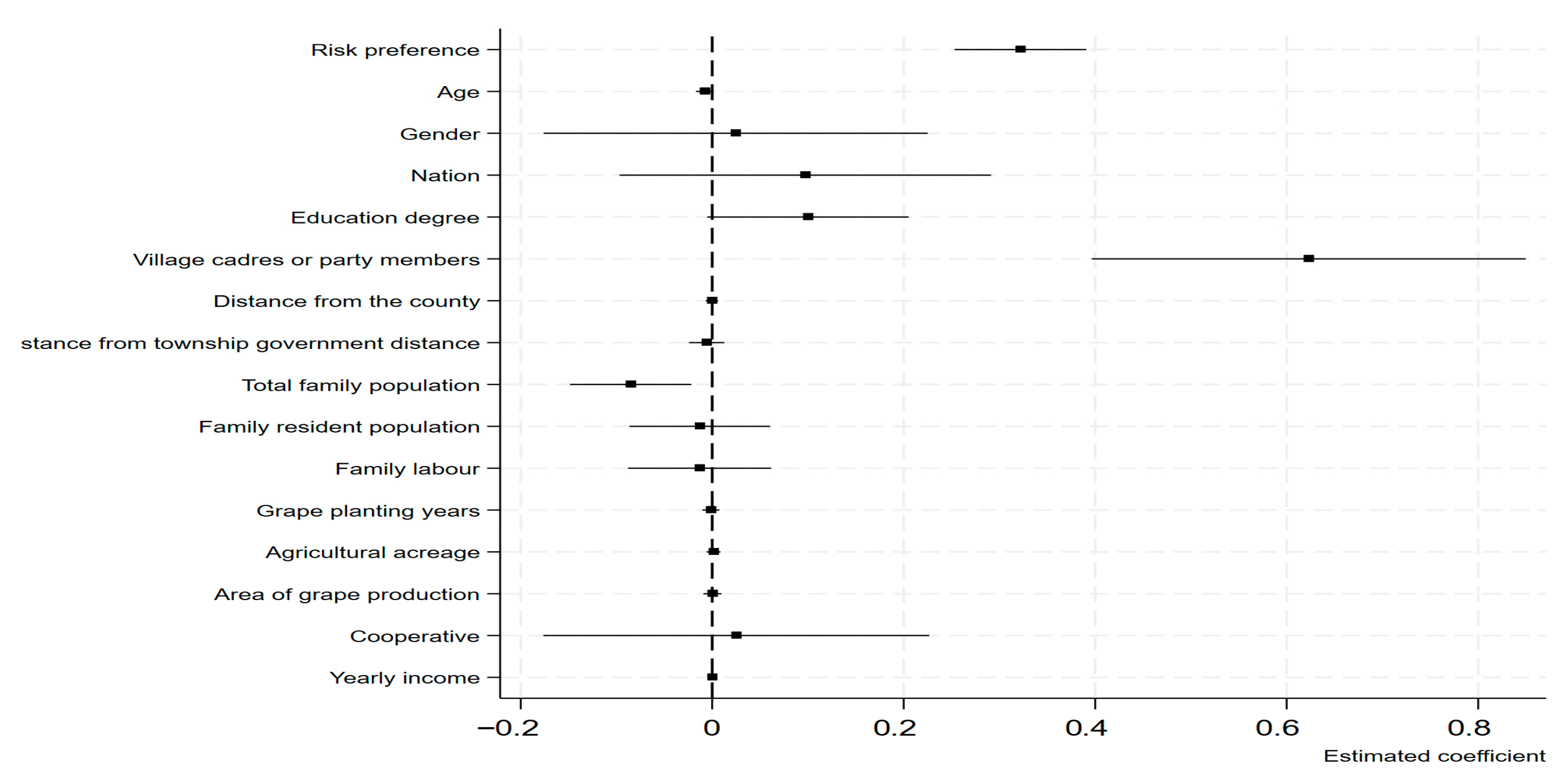
Table 2 presents the regression results of the baseline model. Column (1) considers only the risk preference variable without introducing control variables. The results show that risk preference has a significantly positive impact on farmers’ climate-adaptive behaviors at the 1% significance level. Column (2) adds control variables based on Column (1). Risk preference remains significantly positive, indicating that after controlling for other factors, it significantly promotes farmers’ climate-adaptive behaviors. To further intuitively present the impact of each variable on climate-adaptive behavior, this paper presents a coefficient diagram. As shown in Figure 2, the coefficient of risk preference of the core explanatory variable is 0.322, and its 95% confidence interval does not contain 0 at all, indicating that risk preference has a significant positive impact on adaptive behavior, thus verifying Hypothesis 1. Column (3) presents the estimation results for interpersonal trust and adaptive behaviors. It can be seen that interpersonal trust has a significantly positive impact on farmers’ climate-adaptive behaviors at the 1% significance level, thereby verifying Hypothesis 2. This result is consistent with the characteristics of traditional Chinese society, which place trust in acquaintances at its core. The trust formed through high-frequency interaction enhances recognition and collaboration among farmers [36], helping them take collective action in the process of climate adaptation. Column (4) presents the estimation results of institutional trust on adaptive behaviors. The results show that institutional trust has a significantly positive impact on farmers’ climate-adaptive behaviors at the 1% significance level, indicating that farmers’ recognition of the government can promote the adoption of adaptive behaviors. Hypothesis 3 is verified.
From the regression results on control variables, the impacts of various factors on farmers’ climate-adaptive behaviors differ significantly. Specifically, education level has a significantly positive impact on adaptive behaviors at the 10% significance level. This indicates that farmers with higher education levels usually have a stronger ability to acquire and process information. They can better understand the potential risks of climate change and master new technologies, thereby being more inclined to adopt adaptive measures. Whether the family has village cadres or party members significantly positively affects climate-adaptive behaviors at the 1% significance level. In contrast, the total family population has a significantly negative impact on adaptive behaviors at the 1% significance level, consistent with the findings of Tong [18]. This may be because a larger family size directly weakens farmers’ risk awareness and thus inhibits adaptive behaviors.

4.2. Endogeneity Test

Although this study has controlled for as many variables as possible that may affect the relationship between farmers’ risk preference and adaptive behaviors in the baseline regression model, unobservable factors such as farmers’ values and personal abilities may still influence both risk preference and adaptive behavior decisions. These omitted variables may lead to endogeneity issues and bias the estimation results. To address this concern, this study employs the instrumental variable method to more accurately estimate the effect of risk preference on farmers’ adaptive behaviors [56]. Theoretically, a valid instrumental variable must satisfy both relevance and exogeneity conditions. This study selects the average risk preference of other farmers in the same village as the instrumental variable for farmers’ own risk preference. On the one hand, the risk preference of other farmers in the same village can affect the farmer’s risk attitude through neighborhood demonstrations, social interactions, and other channels, thereby meeting the relevance requirement. On the other hand, the risk preference of other farmers does not directly determine the farmer’s adaptive behaviors, thereby satisfying the exogeneity condition. Therefore, this instrumental variable is theoretically reasonable.
This study uses the two-stage least squares (2SLS) method to test for endogeneity, and the results are shown in Table 3. The first-stage estimation results show that the instrumental variable has a significantly positive effect on farmers’ risk preference at the 1% significance level. The first-stage F statistic is 13.29, which exceeds the critical value of 10, indicating no weak instrumental-variable problem. The Durbin–Wu–Hausman endogeneity test rejects the null hypothesis that risk preference is exogenous at the 10% significance level, confirming that risk preference is indeed endogenous and justifying the use of the instrumental variable method. The second-stage regression results show that after eliminating endogeneity bias, the effect of risk preference on fruit farmers’ climate-adaptive behaviors is still significantly positive at the 1% significance level (coefficient = 0.419, standard error = 0.064). Compared with the baseline regression, the core conclusion remains unchanged, indicating that the paper’s research results are robust.

4.3. Analysis on the Moderating Effect of Social Trust

To further explore the moderating effect of social trust on the relationship between risk preference and adaptive behaviors, the interaction term between risk preference and social trust is incorporated into the model. First, the variables are centered, and the centered variables are introduced into the model; the estimation results are shown in Table 4. The results indicate that the coefficient of the interaction term between institutional trust and risk preference is significantly positive at the 1% significance level, and the coefficient of the interaction term between interpersonal trust and risk preference is also significantly positive at the 1% significance level. This suggests that both interpersonal trust and institutional trust enhance the positive impact of risk preference on adaptive behaviors, thus verifying Hypotheses 4 and 5. On the one hand, the sense of trust and identity among farmers can improve their expectations for future cooperation; meanwhile, the evaluations of the effects of adaptive behaviors by relatives, friends, and neighbors will spread and form a demonstration effect, reducing the uncertainty of other farmers about new technologies and measures, thereby accelerating their adoption decisions. On the other hand, farmers’ trust in the government can to a certain extent reduce their worries about the consequences of their actions, enhance their psychological sense of security when responding to risks, and thus make them more inclined to transform their risk preference into actual production behaviors.
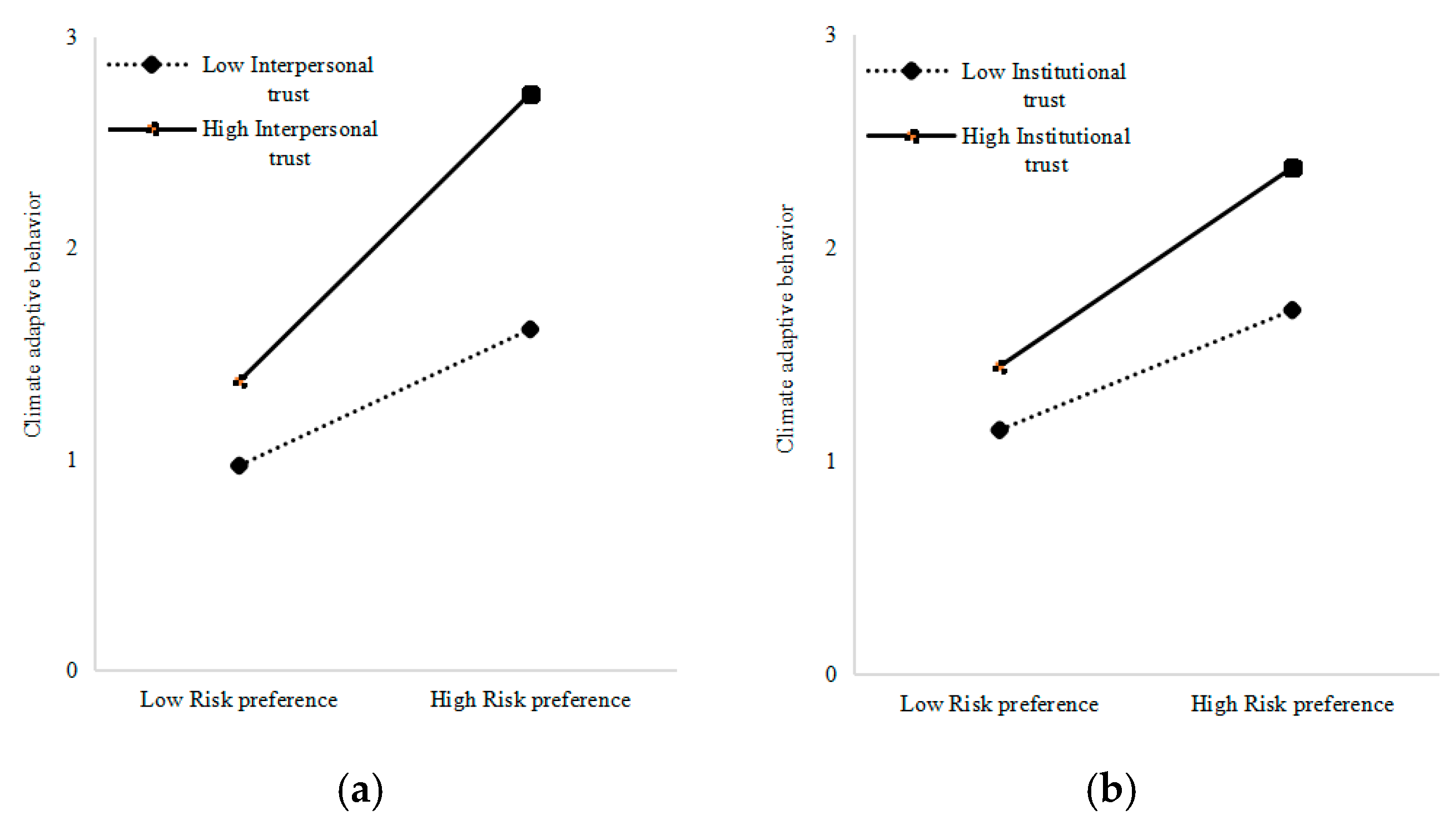
To further intuitively present the direction and intensity of the adjustment effect, this article presents an interactive diagram. Figure 3 shows the marginal impact of risk preference on climate-adaptive behavior at different levels of trust. As shown in Figure 3a, the slope of the group with high interpersonal trust is clearly steeper than that of the group with low interpersonal trust, indicating that as interpersonal trust improves, the role of risk appetite in promoting adaptive behavior is significantly enhanced. Figure 3b shows that the adjustment effect of institutional trust exhibits similar characteristics, and the slope for the high institutional trust group is steeper than that for the low institutional trust group.

4.4. Mechanism Analysis

The mediating role of credit access between risk preference and climate-adaptive behaviors was tested using the mediating effect test procedure. The results are shown in Table 5. Columns (1) to (3) present the test results of formal credit on the impact of risk preference on farmers’ climate-adaptive behaviors. Columns (4) to (6) present the test results of informal credit on the impact of risk preference on farmers’ climate-adaptive behaviors. Column (1) shows the estimation results of risk preference on formal credit. Column (3) shows the estimation results with the introduction of risk preference and formal credit. The results indicate that both risk preference and formal credit pass the significance test at the 1% statistical level. Moreover, the coefficient of risk preference decreases to 0.263. This suggests that formal credit plays a partial mediating role.
Similarly, Columns (4)–(6) examine the mediating effect of informal credit in the influence of risk preference on climate-adaptive behaviors. Column (4) shows the impact of risk preference on informal credit. Column (6) presents the estimation results with both risk preference and adaptive behaviors included. The results show that both risk preference and informal credit pass the significance test at the 1% statistical level. The coefficient decreases to 0.205. This indicates that informal credit plays a partial mediating role.
To further verify the rationality of the mediating effects of formal credit and informal credit, the Sobel test is used to estimate the effect values of the two paths. The results are presented in Table 6. The results show that the mediating effect of formal credit is significant. The direct effect of risk preference on climate-adaptive behaviors is 0.263. The indirect effect of risk preference on climate-adaptive behaviors through formal credit is 0.059. The total effect of risk preference on climate-adaptive behaviors is 0.322. The mediating effect accounts for 18.32% of the total effect. About 18.32% of the effect of risk preference on farmers’ adoption of climate-adaptive behaviors is realized through formal credit.
Similarly, the mediating effect of informal credit is also confirmed. On this path, the direct effect of risk preference on climate-adaptive behaviors is 0.205. The indirect effect of risk preference on climate-adaptive behaviors through informal credit is 0.117. The total effect remains unchanged. The mediating effect accounts for 36.34% of the total effect. This indicates that about 36.34% of the effect of risk preference on farmers’ adoption of climate-adaptive behaviors is realized through informal credit. Meanwhile, the results show that the mediating effect of informal credit is significantly stronger than that of formal credit. Hypothesis 6 is verified. This result may be attributed to the convenience and flexibility of informal credit. It better meets the timely and diverse capital needs of farmers in coping with climate risks.

4.5. Robustness Test

4.5.1. Group Regression

First, farmers are divided into high interpersonal trust, low interpersonal trust, high institutional trust, and low institutional trust groups based on the mean values of interpersonal trust and institutional trust. The impact of risk preference on farmers’ adaptive behaviors is estimated in the two groups of samples separately. According to Table 7, the impact of risk preference on climate-adaptive behaviors differs significantly between the two groups. In the interpersonal trust groups, the effect of risk preference is positive and significant at the 1% level in the high interpersonal trust group. The effect is no longer significant in the low interpersonal trust group. This means that the effect of risk preference on farmers’ climate-adaptive behaviors is moderated by interpersonal trust. Interpersonal trust exerts a significant strengthening effect. Second, institutional trust shows a general strengthening effect. The effect of risk preference is significantly positive in both low institutional trust and high institutional trust groups. The promoting effect is significantly stronger in the high institutional trust group.

4.5.2. Winsorization

To mitigate the influence of extreme values, all continuous variables were winsorized at the 1% significance level. The coefficient and significance of risk preference after re-estimation do not change greatly compared with those before winsorization. Thus, the basic conclusions drawn above are robust.

4.5.3. Poisson Regression

Considering that the interpreted variables are count variables with values of 0 to 8, this paper also uses Poisson regression for a robustness test. As shown in Table 8, the coefficient of risk preference is 0.165, which is significantly positive at the significance level of 1%. Through index conversion, for every unit increase in risk preference, the incidence of farmers’ adoption of adaptive behavior increases by about 17.87%, consistent with the OLS estimates, indicating that the core conclusion is stable.

4.6. Heterogeneity Analysis

4.6.1. Heterogeneity by Household Political Ties

The samples are divided into groups according to whether the household contains village cadres or party members. Households with village cadres or party members account for 23.54% of the total sample. The estimation results show that the positive effect of risk preference is stronger in households without village cadres or party members. In the baseline regression results, having village cadres or party members in the household shows a significantly positive impact on climate-adaptive behaviors, even as a control variable. However, risk preference presents a stronger, more significant driving effect on adaptive behaviors in households without village cadres or party members. This may be because village cadres and party members have a strong ability to attract social capital. This weakens the influence of risk preference on adaptive behaviors.

4.6.2. Heterogeneity by Cooperative Participation

This paper divides the sample into groups based on whether farmers join cooperatives, with households participating in cooperatives accounting for 34.38% of the total sample. From the estimation results on whether the household includes village cadres or party members (Table 9), the regression coefficient of risk preference on growers is significantly positive at the 1% significance level in both groups. The coefficient for farmers who joined cooperatives is higher than that for those who did not. The reason may be that cooperatives provide farmers with a platform for risk sharing and resource integration. For farmers with high risk preference, with the support of cooperatives, they can more effectively adopt a variety of adaptive behaviors. In contrast, farmers who have not joined cooperatives have to face market uncertainty alone. Although high risk preference still exerts a positive effect, they are subject to stronger resource constraints and risk constraints, so the marginal effect of risk preference is relatively lower.

5. Discussion

This study sampled 480 grape growers in the Turpan-Hami Basin, and empirically tested the impact of risk preference on climate adaptation behavior and its mechanism of action. The core findings include the following: risk preference significantly has a positive impact on adaptive behavior; both formal credit and informal credit play a partial intermediary role, and the intermediary effect of informal credit is stronger; and both interpersonal trust and institutional trust positively regulate the above relationship.
The above findings are consistent with existing studies and also make contributions. First, this study found that risk preference has a significant positive impact on adaptive behavior. For every 1 unit increase in risk preference, the number of adaptive behaviors increases by an average of 0.322. This conclusion is consistent with the direction of Zhang and others based on the discovery of Hainan rubber farmers. However, Zhang et al. [10] are concerned about the risk situation dominated by price fluctuations, and grape growers in this study also need to deal with the unique climate risks of perennial crops, and the risk structure is more complex. Accordingly, this study extends the relevant conclusion to the field of perennial cash crops facing relatively high risks, and verifies that the promoting effect of risk preference on farmers’ adaptive behavior remains significant. This implies that the adaptive driving effect of risk preference is not limited to specific crop types or risk scenarios, which provides new empirical evidence for understanding farmers’ adaptation decision-making logic under more complex production conditions. Second, Mao et al. [5] found that credit plays a mediating role between risk preference and farmer behavior. On this basis, the study further distinguishes the heterogeneous effects of formal credit and informal credit. It is found that the mediating effect of informal credit accounts for 36.3%, while formal credit is only 18.3%. The transmission of informal credit is obviously stronger. This distinction reveals that informal credit plays a more pivotal role in the production of perennial high-value crops with flexible capital demand and strong seasonality. Third, both interpersonal trust and institutional trust are positively regulating the relationship between risk preference and adaptive behavior. Although there are differences between the two types of trust, they are important situational conditions for the transformation of risk attitudes into adaptive action. The results of the study help researchers and policymakers to deeply understand the complex relationship between trust and adaptive behavior.
Although this study has made some meaningful conclusions, there are still the following limitations. First, the research sample consists of grape growers in the Turpan-Hami Basin, and the conclusions are mainly applicable to perennial cash crops such as grapes. Compared with annual crops, perennial crops differ in production characteristics and risk exposure characteristics, indicating that the findings of this study are more conducive to formulating climate adaptation policies for perennial cash crops. Meanwhile, the conclusions of this paper also provide a useful reference for other perennial cash crop planting regions in arid areas. For annual crops, although the findings can serve as a reference, they still need further verification and expansion through more comprehensive comparative research in the future. Second, due to the limitation of cross-sectional data, the causal effect between risk preference and adaptive behavior is difficult to strictly identify, and the endocological problem of credit acquisition has not been fully dealt with. Third, because the questionnaire design did not include questions about the technical baseline, this study cannot control for the impact of farmers’ existing technical conditions on adaptive behavior. The technical baseline of vineyards not only directly affects the starting point of farmers’ adaptation but may also shape the specific path through which risk preference translates into adaptive behavior. For example, farmers with better technical conditions may be more inclined to obtain credit to adopt capital-intensive measures such as new varieties and technologies. In comparison, farmers with weaker technical conditions may rely more on low-cost or non-technical adaptation strategies. The absence of this variable may introduce bias in the estimation of the core variable coefficients, and this study has therefore exercised caution in interpreting the results. By incorporating this variable as a control in future research, we can further include it in the analytical framework as a moderating variable, to examine whether the impacts of risk preference and credit access on adaptive behavior exhibit systematic differences across varying technical baseline levels. Fourth, risk preference adopts a single-question measurement. Although it is reasonable in academic norms, there are certain limitations on the measurement accuracy. Future research can be improved by tracking data, expanding crop types and regions, and enriching variable measurement methods.

6. Conclusions and Policy Recommendations

6.1. Conclusions

The study sampled 480 grape growers in the Turpan-Hami Basin, and empirically tested the impact of risk preference on climate-adaptive behavior and its underlying mechanisms. It should be noted that as a perennial cash crop, the production characteristics of grapes are significantly different from those of food crops. The conclusion of this study is mainly applicable to the cultivation of perennial cash crops represented by grapes. The main research conclusions are as follows.
First, in the sample of grape growers in the Turpan-Hami Basin, risk preference has a significant positive impact on the climate adaptability of farmers. After controlling for other factors, for every unit increase in the risk preference score, the number of adaptive behaviors adopted by farmers increased by an average of 0.322. This shows that the higher the risk preference, the more inclined farmers are to adopt active production adjustment strategies.
Second, credit acquisition plays a partial intermediary role in the process of risk preference influencing adaptive behavior. The mediating effect of formal credit and informal credit accounts for 18.3% and 36.3% respectively, and the transmission effect of informal credit is significantly stronger than that of formal credit. This difference may stem from the advantages of informal credit in terms of the approval process and flexibility in the use of funds, making it more in line with the timely and diverse capital needs of farmers when responding to climate risks.
Third, interpersonal trust and institutional trust both positively regulate the relationship between risk preference and adaptive behavior. Both types of trust significantly enhance the promoting effect of risk preference on adaptive behavior at the 1% significance level. This shows that farmers’ risk decisions are not only driven by individual psychological factors, but also embedded in a specific social trust environment. Whether it is interpersonal trust based on acquaintance society or institutional trust based on formal rules, it can provide social support for the transformation of farmers’ risk behavior.

6.2. Policy Recommendations

Based on the above conclusions, this article puts forward the following policy inspiration.
First, take into account risk education and the optimization of the production environment for high-value cash crops, and improve farmers’ adaptability. On the one hand, climate risk education should be integrated into agricultural technology promotion to help farmers develop a clear understanding. On the other hand, market uncertainty can be reduced by improving the market information platform and developing order agriculture, developing high-value cash crop insurance, and providing premium subsidies to share production risks.
Second, research showing that the mediating effect of informal credit is significantly stronger than that of formal credit emphasizes the supplementary role of private lending in farmers’ climate adaptation. Standardize the informal credit market, improve its transparency and security through the establishment of a private loan registration and filing system, and give it full play in the inclusive financial system.
Third, build a multi-level trust promotion system. On the one hand, we should strengthen the exchange of experiences and knowledge sharing among farmers through typical demonstrations, township promotion and other methods, and give full play to the linking role of interpersonal trust in technology diffusion; on the other hand, we should improve the openness, transparency and consistency of the government’s agricultural policies, enhance farmers’ trust in public services, and promote adaptive behavior. Widely, we should create a good social support environment.

Author Contributions

X.L. contributed to conceptualization, funding acquisition, methodology development, project supervision, and writing of the original draft. Y.S. was responsible for formal analysis, writing of the original draft, writing, reviewing and editing of the manuscript, and visualization. Y.S. also handled software application for data processing and analysis. Q.W. and L.Z. participated in the writing of this work. All authors have read and agreed to the published version of the manuscript.

Funding

This research is funded by the Youth Project of the Humanities and Social Science Fund of the Ministry of Education of China (grant number 22YJC790063), the Scientific Research and Innovation Project for Graduate Students of Xinjiang Agricultural University (grant number XJAUGRI2025036), and the Third Xinjiang Comprehensive Scientific Investigation Project (grant number 2022XJKK1201).

Institutional Review Board Statement

Ethical review and approval for this study were waived in accordance with Chapter 3, Article 32 of the Measures for the Ethical Review of Life Sciences and Medical Research Involving Humans issued by the National Health Commission of the People’s Republic of China. This study involves no harm to human subjects, no collection of sensitive personal information, and no commercial interests.

Informed Consent Statement

Informed consent was obtained from all individual participants included in the study.

Data Availability Statement

The raw data supporting the conclusions of this article will be made available by the authors on request.

Conflicts of Interest

The authors declare no conflicts of interest.

References

  1. Jahan, N.; Padaria, R.N.; S, A.; Muralikrishnan, L.; Sahu, S.; Yeasin, M.; Vashisth, A.; Shekhar, D.; Priyadarshni, P.; Ghosh, B.; et al. Climate risk communication and farmers’ adaptive behaviour in the Indo-Gangetic Plains: Insights from the Stimulus-Organism-Response (S-O-R) framework. Environ. Sustain. Indic. 2026, 30, 101141. [Google Scholar] [CrossRef]
  2. Song, Y.; Zhang, B.; Wang, J.; Kwek, K. The impact of climate change on China’s agricultural green total factor productivity. Technol. Forecast. Soc. Change 2022, 185, 122054. [Google Scholar] [CrossRef]
  3. Lu, Y.R.; Chen, S.F. Farmers’ cognition and adaptive behavior to climate change. Chin. Rural Econ. 2010, 7, 75–86. [Google Scholar] [CrossRef]
  4. Li, Z.Y.; Sun, Z.; Wang, C.Q. Understanding the adaptive behaviors of farmers on the Qinghai-Tibetan Plateau: A mixed-methods study on the mediating role of risk perception and the moderating effects of climate change benefits and self-efficacy. Humanit. Soc. Sci. Commun. 2026, 13, 232. [Google Scholar] [CrossRef]
  5. Mao, H.; Fu, Y.; Peng, P.; Chai, Y. Risk aversion and farmers’ climate adaptive technology adoption behavior-An empirical analysis based on cotton farmers in Xinjiang. China Rural. Obs. 2022, 1, 126–145. [Google Scholar]
  6. Moritz, L.; Spada, R.; Rommel, J.; Dalhaus, T.; Cerroni, S. Risk preferences and other (ignored) behavioral factors in fertilizer management decisions: A systematic literature review. J. Behav. Exp. Econ. 2026, 121, 102524. [Google Scholar] [CrossRef]
  7. Yu, Y.; Chen, X.Y.; Xu, X. The influence of risk preference and fuzzy attitude on farmers’ technology adoption behavior—Based on the empirical and simulation of fruit and vegetable growers in Weifang City, Shandong Province. Manag. Mod. 2025, 45, 126–138. [Google Scholar] [CrossRef]
  8. Li, H.; Appel-Meulenbroek, R.; Arentze, T.; Hoes, P.-J. Profiling office workers’ comfort-related adaptive actions: A latent class analysis. J. Environ. Psychol. 2026, 111, 102979. [Google Scholar] [CrossRef]
  9. Mezgebo, T.; Gebreegziabher, Z.; Kahsay, H.B.; Meressa, A.M.; Gebremariam, L.W.; Govigli, V.M.; Setti, M. Time preferences, risk preferences and the adoption of household level water treatment in Rural Tigray, Northern Ethiopia. Rev. Econ. Househ. Prepublish 2026, 1–23. [Google Scholar] [CrossRef]
  10. Zhang, D.S.; Yan, W.Y.; Xu, T. Livelihood resilience, risk preference, and farmers’ willingness to adjust planting structure. Agric. Technol. Econ. 2024, 12, 129–144. [Google Scholar] [CrossRef]
  11. Lu, J.; Liu, H.; Xue, Y.; Han, X. Risk aversion, social network and farmers’ excessive use of chemical fertilizers-survey data from corn farmers in the three northeastern provinces. Agric. Technol. Econ. 2021, 7, 4–17. [Google Scholar] [CrossRef]
  12. Song, Z.; Shi, X.M. Path Analysis of Farmers’ Climate Change Adaptation Behavior and Influencing Factors in Rain-fed Agricultural Areas. Adv. Geogr. Sci. 2020, 39, 461–473. [Google Scholar]
  13. Savari, M.; Khaleghi, B.; Sheheytavi, A. Iranian farmers’ response to the drought crisis: How can the consequences of drought be reduced? Int. J. Disaster Risk Reduct. 2024, 114, 104910. [Google Scholar] [CrossRef]
  14. He, Q.; Qi, Y.B. From drought to recovery: How extreme drought drives adaptive behaviour and grain production efficiency in Sichuan and Chongqing, China. J. Rural. Stud. 2025, 120, 103860. [Google Scholar] [CrossRef]
  15. Shi, X.; Sun, L.; Chen, X.; Wang, L. Farmers’ perceived efficacy of adaptive behaviors to climate change in the Loess Plateau, China. Sci. Total Environ. 2019, 697, 134217. [Google Scholar] [CrossRef]
  16. Song, H.C.; Zhu, Z.Y. Farmers’ adaptive behaviors to climate change and their influencing factors: Evidence from the Guanzhong Region of Shaanxi, China. Front. Sustain. Food Syst. 2025, 9, 1648301. [Google Scholar] [CrossRef]
  17. Cano, A.; Campos, B.C. Drivers of farmers’ adaptive behavior to climate change: The 3F-SEC framework. J. Rural. Stud. 2024, 109, 103343. [Google Scholar] [CrossRef]
  18. Tong, Q.M.; Zhang, L.; Zhang, J.B. Research on the impact of family endowment characteristics on farmers’ adaptive behavior to climate change. Soft Sci. 2018, 32, 136–139. [Google Scholar] [CrossRef]
  19. Li, L.P.; Ding, X.L.; Li, H. Study on the correlation effect and influencing factors of farmers’ green fertilization behavior-A case study of the pilot area of green agriculture construction in northern Shaanxi. Chin. Agric. Resour. Reg. 2022, 43, 71–78. [Google Scholar]
  20. Guo, R.; Li, Y.; Shang, L.; Feng, C.; Wang, X. Local farmer’s perception and adaptive behavior toward climate change. J. Clean. Prod. 2021, 287, 125332. [Google Scholar] [CrossRef]
  21. Gao, Y.; Niu, Z.H. Risk Aversion, Information Acquisition Ability, and Farmers’ Adoption of Green Prevention and Control Technologies. Chin. Rural Econ. 2019, 8, 109–127. [Google Scholar] [CrossRef]
  22. Feng, X.L.; Zhu, Y.J.; Li, J. Credit constraints, grassland ecological compensation policy and herders’ adaptive behavior to climate change. Chin. Popul. Resour. Environ. 2024, 34, 93–101. [Google Scholar]
  23. Kahneman, D.; Tversky, A. Choices, values, and frames. Am. Psychol. 1984, 39, 341. [Google Scholar] [CrossRef]
  24. Liu, E.M. Time to change what to sow: Risk preferences and technology adoption decisions of cotton farmers in China. Rev. Econ. Stat. 2013, 95, 1386–1403. [Google Scholar] [CrossRef]
  25. Weber, E.U.; Blais, A.R.; Betz, N.E. A domain-specific risk-attitude scale: Measuring risk perceptions and risk behaviors. J. Behav. Decis. Mak. 2002, 15, 263–290. [Google Scholar] [CrossRef]
  26. Chen, Q.P.; Liu, Z.B.; Wang, B.; Shi, Y. The impact of climate change adaptive behavior on the income of tea farmers-Based on 312 household survey data in Fujian. J. Southwest Univ. (Nat. Sci. Ed.) 2024, 46, 75–85. [Google Scholar] [CrossRef]
  27. Wu, S.; Zikalala, P.G.; Alba, S.; Jarvis-Shean, K.S.; Kisekka, I.; Segaran, M.; Snyder, R.; Monier, E. Advancing the Modeling of Future Climate and Innovation Impacts on Perennial Crops to Support Adaptation: A Case Study of California Almonds. Earth’s Future 2025, 13, e2024EF005033. [Google Scholar] [CrossRef]
  28. Cheng, S.W.; Qi, Z.H.; Tian, Z.Y.; Liu, Z. Effects of Internet use and risk preference on farmers’ willingness to continue adoption of Ecological planting and rearing technology-A case study of Rice-crayfish Integrated Technology. World Agric. 2023, 1, 115–126. [Google Scholar] [CrossRef]
  29. Wang, X.M.; Jin, J.J.; Gao, Y.W. Behavior and Influencing Factors of Farmers’ Adaptation to Climate Change—A Study Based on Experimental Economics Methods. J. Beijing Norm. Univ. (Nat. Sci. Ed.) 2016, 52, 501–505. [Google Scholar] [CrossRef]
  30. Wang, J.; Zhou, S.Q.; Sun, P.F.; Sun, F.B. The impact of risk attitude on farmers’ homestead exit-the mediating effect test based on risk perception. Resour. Environ. Arid. Areas 2025, 39, 91–100. [Google Scholar] [CrossRef]
  31. Wang, P.C.; Yang, X.L. Social trust and household financial decision-making: An empirical study based on the usage of household financial technology. Financ. Res. Lett. 2024, 70, 106294. [Google Scholar] [CrossRef]
  32. Shi, Y.X.; Yao, L.Y.; Zhao, M.J. The Impact of Social Capital on Herdsmen’s Willingness to Participate in Grassland Community Governance—An Analysis Based on Triple-Hurdle Model. China Rural. Obs. 2018, 3, 35–50. [Google Scholar] [CrossRef]
  33. Maguire, S.; Phillips, N. ‘Citibankers’ at Citigroup: A Study of the Loss of Institutional Trust after a Merger. J. Manag. Stud. 2008, 45, 372–401. [Google Scholar] [CrossRef]
  34. Cai, Q.H.; Zhu, Y.C. Social trust, relationship network and farmers’ participation in rural public goods supply. Chin. Rural Econ. 2015, 7, 57–69. [Google Scholar] [CrossRef]
  35. Dorrington, G.; Schulz-Herzenberg, C. Trusting others in a divided country: The determinants of social trust in South Africa. Political Psychol. 2024, 46, 382–396. [Google Scholar] [CrossRef]
  36. Tao, Y.; Chou, X.Y.; Zhou, Y.X.; Hu, J.L. Risk perception, social trust and farmers’ organic fertilizer substitution behavior deviation research. Agric. Technol. Econ. 2022, 5, 49–64. [Google Scholar] [CrossRef]
  37. Zhang, Z.; Yang, A.; Wang, Y. How do social capital and village-level organizational trust affect farmers’ climate-related disaster adaptation behavior? Evidence from Hunan Province, China. Int. J. Disaster Risk Reduct. 2023, 99, 104083. [Google Scholar] [CrossRef]
  38. Wang, J.H.; Ma, L. A Study on the Impact of Social Trust on Farmers’ Agricultural Waste Resource Utilization Behavior in the Context of Environmental Regulation Policy. Agriculture 2025, 15, 759. [Google Scholar] [CrossRef]
  39. Yang, S.S.; Zhao, L.R.; Han, X.R. How the peer effect affects the effectiveness of farmers’ drought adaptation. Chin. Rural Econ. 2023, 11, 39–57. [Google Scholar] [CrossRef]
  40. Martin-Collado, D.; Diaz, C.; Ramón, M.; Iglesias, A.; Milán, M.; Sánchez-Rodríguez, M.; Carabaño, M. Are farmers motivated to select for heat tolerance? Linking attitudinal factor, perceived climate change impact and social trust to farmers breeding desires. J. Dairy Sci. 2023, 107, 2156–2174. [Google Scholar] [CrossRef] [PubMed]
  41. Li, Y.L.; Li, C.C. A composite mechanism for achieving effective rural governance-Taking the governance practice of three governance integration in Tongxiang, Zhejiang Province as the research object. Rural. Econ. 2022, 10, 56–63. [Google Scholar] [CrossRef]
  42. Hu, Y.; Chen, Y.; Li, Y.; Yang, W. Age structure impacts on household carbon emissions: Based on a social interaction perspective. Ecol. Econ. 2025, 230, 108534. [Google Scholar] [CrossRef]
  43. Teng, Y.; Li, N.; Yang, J.; Liu, Y.; Liu, C. Study on the impact of social capital on the rural residents’ conscious interpersonal waste separation behavior: Evidence from Jiangxi province, China. Front. Environ. Sci. 2024, 12, 1363240. [Google Scholar] [CrossRef]
  44. Wu, Y.; Song, Q.Y.; Yin, Z.C. Farmers’ formal credit access and credit channel preference analysis—Based on the perspective of financial knowledge level and education level. Chin. Rural Econ. 2016, 5, 43–55. [Google Scholar] [CrossRef]
  45. Lu, X.M.; Wu, Y. Transferring land, farmers’ agricultural credit demand and credit constraints-an analysis based on China Household Finance Survey (CHFS) data. Financ. Res. 2021, 5, 40–58. [Google Scholar]
  46. Ngoma, H.; Angelsen, A.; Jayne, T.S.; Chapoto, A. Understanding Adoption and Impacts of Conservation Agriculture in Eastern and Southern Africa: A Review. Front. Agron. 2021, 3, 671690. [Google Scholar] [CrossRef]
  47. Karlan, D.; Lambon-Quayefio, M.; Manjeer, U.; Udry, C. Access to digital credit for smallholder farmers: Experimental evidence from Ghana. J. Dev. Econ. 2026, 181, 103745. [Google Scholar] [CrossRef]
  48. Teng, C.G.; Lv, K.Y.; Han, F.; Zhang, C.S. Whether household borrowing can inhibit overgrazing of herders-Empirical evidence from pastoral areas in central and western Inner Mongolia. Agric. Technol. Econ. 2025, 4, 54–70. [Google Scholar] [CrossRef]
  49. Branten, E. The role of risk attitudes and expectations in household borrowing: Evidence from Estonia. Balt. J. Econ. 2022, 22, 126–145. [Google Scholar] [CrossRef]
  50. Wen, Z.L.; Ye, B.J. Mediating Effect Analysis: Methods and Model Development. Prog. Psychol. Sci. 2014, 22, 731–745. [Google Scholar]
  51. Feng, X.L.; Huo, X.X.; Chen, Z.X. Climate change and farmers’ adaptive behavior decision-making. J. Northwest A F Univ. (Soc. Sci. Ed.) 2017, 17, 73–81. [Google Scholar] [CrossRef]
  52. Morales-Castilla, I.; García de Cortázar-Atauri, I.; Cook, B.I.; Lacombe, T.; Parker, A.; van Leeuwen, C.; Nicholas, K.A.; Wolkovich, E.M. Diversity buffers winegrowing regions from climate change losses. Proc. Natl. Acad. Sci. USA 2020, 117, 2864–2869. [Google Scholar] [CrossRef] [PubMed]
  53. Keshavarz, M.; Masoomi, E. Beyond Survival: A wellbeing-centric indicator for assessing rural individuals’ resilience to climate change. Environ. Sustain. Indic. 2026, 29, 101078. [Google Scholar] [CrossRef]
  54. Holt, A.C.; Laury, K.S. Risk Aversion and Incentive Effects. Am. Econ. Rev. 2002, 92, 1644–1655. [Google Scholar] [CrossRef]
  55. Yang, L.; Zhu, Y.C. Social trust, cooperation ability and farmers’ participation in small-scale water supply behavior-Based on the data of five provinces in the Yellow River irrigation area. Popul. Resour. Environ. China 2016, 26, 163–170. [Google Scholar]
  56. Campagna, K.; Machard, A.; Foucquier, A.; Charlier, D.; Woloszyn, M. Windows, fans, and solar shadings during summer and heatwave: Occupant behavior and potential for improvement in heat-mitigation practices. Build. Environ. 2026, 290, 114168. [Google Scholar] [CrossRef]
Figure 1. The mechanism through which risk preference affects farmers’ adaptive behavior.
Sustainability 18 05062 g001
Figure 2. The coefficient plot of benchmark regression results. Note: the vertical dashed line as the zero baseline.
Sustainability 18 05062 g002
Figure 3. Moderating effects of social trust on the relationship between risk preference and climate-adaptive behavior. (a) Moderating effect of interpersonal trust. (b) Moderating effect of institutional trust.
Sustainability 18 05062 g003
Table 1. Variable description and descriptive statistics.
VariableVariable NameDefinition and AssignmentMean ValueStandard DeviationMinimum ValueMaximum Value
Explanatory variablesRisk preferenceRisk preference is measured according to scheme selection.2.291.39915
Explained variableClimate-adaptive behaviorNumber of climate-adaptive behaviors adopted1.871.19304
Control variableGenderMale = 1; female = 00.360.48101
AgeActual age (years)50.4710.2342370
NationHan = 1; Ethnic minorities = 00.550.49801
Education degreeHave not been to school = 1; primary school = 2; junior high school = 3; high school or technical secondary school = 4; specialist and above = 52.580.91915
Village cadres or party membersAre there family members who are in village cadres or party members? (yes = 1; no = 0)0.240.42501
Distance from the countyActual distance (Km)24.6114.861260
Distance from township government distanceActual distance (Km)8.145.180120
Total family populationActual observed value (persons)4.601.524210
Family resident populationFamily resident population (persons)3.221.31017
Family laborActual household labor force (persons)2.801.27517
Grape planting yearsPlanting years (years)24.2610.655250
Agricultural acreageTotal planting area (hectares)1.1590.8920.24.536
Area of grape productionGrape planting area (hectares)0.6930.6780.0674.002
CooperativeWhether the family joins the cooperative (yes = 1; no = 0)0.340.47501
Yearly incomeTotal annual income (yuan)64,522.2957,287.4693000400,000
Mediator variableFormal creditWhether farmers have productive formal credit (yes = 1; no = 0)0.59380.4916401
Informal creditWhether to borrow from relatives, friends or lenders (yes = 1; no = 0)0.34380.4757501
Moderator variableInstitutional trustAverage index3.19691.1355415
Interpersonal trustAverage index3.64440.7705825
Table 2. Baseline regression results.
VariableClimate-Adaptive Behavior
(1)(2)(3)(4)
Risk preference0.352 ***
(0.036)
0.322 ***
(0.035)
Interpersonal trust 0.356 ***
(0.067)
Institutional trust 0.335 ***
(0.044)
Age −0.008
(0.005)
−0.006
(0.005)
−0.008 *
(0.005)
Gender 0.025
(0.102)
0.012
(0.108)
0.031
(0.105)
Nation 0.097
(0.099)
0.082
(0.104)
0.038
(0.101)
Education degree 0.100 *
(0.054)
0.115 **
(0.056)
0.115 **
(0.055)
Village cadres or party members 0.623 ***
(0.115)
0.702 ***
(0.121)
0.674 ***
(0.118)
Distance from the county −0.0002
(0.003)
−0.001
(0.003)
−0.001
(0.003)
Distance from township government distance −0.006
(0.009)
−0.003
(0.010)
−0.002
(0.010)
Total family population −0.085 ***
(0.032)
−0.082 **
(0.034)
−0.080 **
(0.033)
Family resident population −0.013
(0.037)
−0.014
(0.040)
−0.015
(0.038)
Family labor −0.013
(0.038)
−0.003
(0.040)
−0.005
(0.039)
Grape planting years −0.001
(0.003)
−0.001
(0.005)
−0.002
(0.005)
Agricultural acreage 0.001
(0.005)
0.001
(0.004)
0.002
(0.004)
Area of grape production 0.0003
(0.005)
0.002
(0.005)
0.002
(0.005)
Cooperative 0.025
(0.103)
−0.005
(0.108)
0.005
(0.105)
Yearly income 0.000 ***
(0.000)
0.000
(0.000)
0.000
(0.000)
Constant term1.060 ***
(0.095)
1.531 ***
0.412
0.723
(0.513)
1.130 **
(0.440)
N480480480480
R20.1700.2480.1620.210
Notes: Robust standard errors are reported in parentheses. ***, **, and * denote significance at the 1%, 5%, and 10% levels, respectively.
Table 3. Endogeneity tests.
VariableThe First Stage: Risk PreferenceThe Second Stage: Climate-Adaptive Behavior
Risk preference 0.419 ***
(0.064)
Village average risk preference0.777 ***
(0.057)
Control variableYesYes
The first stage F value13.290
Durbin test 3.2785 (p = 0.070)
Wu–Hausman test 3.1773 (p = 0.075)
N480480
Notes: Robust standard errors are reported in parentheses. *** denote significance at the 1% levels.
Table 4. Test results for the moderating effect of social trust.
VariableClimate-Adaptive Behavior
(1)(2)
Risk preference0.201 ***
(0.044)
0.231 ***
(0.043)
Interpersonal trust 0.172 **
(0.076)
Institutional trust0.181 ***
(0.052)
Risk preference × interpersonal trust 0.256 ***
(0.060)
Risk preference × institutional trust0.132 ***
(0.039)
Control variableYesYes
Constant term0.964 **
(0.425)
0.761
(0.496)
N480480
R20.2800.278
Notes: Robust standard errors are reported in parentheses. *** and ** denote significance at the 1% and 5% levels, respectively.
Table 5. Test results for the mediating effect of farmers’ credit.
VariableFormal CreditClimate-Adaptive BehaviorClimate-Adaptive BehaviorInformal CreditClimate-Adaptive BehaviorClimate-Adaptive Behavior
(1)(2)(3)(4)(5)(6)
Risk preference0.124 ***
(0.035)
0.322 ***
(0.015)
0.263 ***
(0.037)
0.133 ***
(0.014)
0.322 ***
(0.035)
0.205 ***
(0.036)
Formal credit 0.478 ***
(0.104)
Informal credit 0.878 ***
(0.106)
Control variableYesYesYesYesYesYes
Constant term0.324 *
(0.180)
1.531 ***
(0.412)
1.376 ***
(0.405)
−0.078
(0.169)
1.531 ***
(0.412)
1.600 ***
(0.390)
N480480480480480480
R20.15890.24780.28040.20890.24780.3447
Notes: Robust standard errors are reported in parentheses. *** and * denote significance at the 1% and 10% levels, respectively.
Table 6. Sobel test results.
CoefficientStandard ErrorZP
Formal creditindirect effect0.0590.0153.9870.000
direct effect0.2630.0377.1730.000
total effects0.3220.0359.1990.000
Informal creditindirect effect0.1170.0196.1800.000
direct effect0.2050.0365.7560.000
total effects0.3220.0359.1990.000
Table 7. Robustness test results.
VariableClimate-Adaptive Behavior
Low Interpersonal Trust
(1)
High Interpersonal Trust
(2)
Low Institutional Trust
(3)
High Institutional Trust
(4)
Tail-Shrinking Treatment
(5)
Risk preference0.041
(0.094)
0.420 ***
(0.045)
0.145 **
(0.071)
0.340 ***
(0.045)
0.322 ***
(0.035)
Control variableYesYesYesYesYes
Constant term1.977 ***
(0.630)
1.002 *
(0.547)
1.697 ***
(0.589)
1.330 **
(0.579)
1.531 ***
(0.412)
N198282245235480
R20.11460.34170.14910.27430.2478
Notes: Robust standard errors are reported in parentheses. ***, **, and * denote significance at the 1%, 5%, and 10% levels, respectively.
Table 8. Poisson regression result.
VariableClimate-Adaptive Behavior
Risk preference0.165 *** (0.018)
Control variableYes
Constant term0.436 (0.221) **
N480
Pseudo R20.056
Wald chi2158.38 ***
Notes: Robust standard errors are reported in parentheses. *** and ** denote significance at the 1% and 5% levels, respectively.
Table 9. Heterogeneity analysis results.
VariableClimate-Adaptive Behavior
There Are Village Cadres or Party Members
(1)
No Village Cadres or Party Members
(2)
Join a Cooperative
(3)
Did Not Join the Cooperative
(4)
Risk preference0.112 **
(0.055)
0.401 ***
(0.042)
0.390 ***
(0.063)
0.278 ***
(0.043)
Control variableYesYesYesYes
Constant term3.631 ***
(0.726)
1.251 *
(0.487)
1.076
(0.723)
1.737 ***
(0.523)
N113367165315
R20.31770.22350.3200.2557
Notes: Robust standard errors are reported in parentheses. ***, **, and * denote significance at the 1%, 5%, and 10% levels, respectively.
Disclaimer/Publisher’s Note: The statements, opinions and data contained in all publications are solely those of the individual author(s) and contributor(s) and not of MDPI and/or the editor(s). MDPI and/or the editor(s) disclaim responsibility for any injury to people or property resulting from any ideas, methods, instructions or products referred to in the content.