Article

Validation of the Questionnaire to Measure Social Entrepreneurship in a Sample of Mexican Health Sciences Students


by
Francisco Javier Turrubiates-Hernández
1,2,3,
José Francisco Muñoz-Valle
1,2,4,*,
Guillermo González-Estevez
1,3,
Jorge Hernández-Bello
1,
Alexis Missael Vizcaíno-Quirarte
5,
Cristian Oswaldo Hernández-Ramírez
1,2,
Beatriz Verónica Panduro-Espinoza
6 and
Norma Alicia Ruvalcaba-Romero
7,*
1
Instituto de Investigación en Ciencias Biomédicas, Departamento de Clínicas Médicas, División de Disciplinas Clínicas, Centro Universitario de Ciencias de la Salud, Universidad de Guadalajara, Guadalajara 44340, Mexico
2
Centro de Innovación Social y Emprendimiento Sostenible, Coordinación de Ecosistemas para el Aprendizaje, Centro Universitario de Ciencias de la Salud, Universidad de Guadalajara, Guadalajara 44340, Mexico
3
Departamento de Alimentación y Nutrición, División de Disciplinas para el Desarrollo, Promoción y Preservación de la Salud, Centro Universitario de Ciencias de la Salud, Universidad de Guadalajara, Guadalajara 44340, Mexico
4
Máster en Innovación Social y Economía Solidaria, Instituto Universitario de Estudios sobre la Ciencia y la Tecnología, Universidad de Salamanca, 37008 Salamanca, Spain
5
Departamento de Ciencias Sociales, División de Disciplinas Básicas para la Salud, Centro Universitario de Ciencias de la Salud, Universidad de Guadalajara, Guadalajara 44340, Mexico
6
Departamento de Clínicas de la Reproducción Humana, Crecimiento y Desarrollo Infantil, División de Disciplinas Clínicas, Centro Universitario de Ciencias de la Salud, Universidad de Guadalajara, Guadalajara 44340, Mexico
7
Departamento de Psicología Básica, División de Disciplinas Básicas para la Salud, Centro Universitario de Ciencias de la Salud, Universidad de Guadalajara, Guadalajara 44340, Mexico
*
Authors to whom correspondence should be addressed.
Sustainability 2026, 18(10), 5051; https://doi.org/10.3390/su18105051
Submission received: 19 February 2026 / Revised: 9 May 2026 / Accepted: 14 May 2026 / Published: 18 May 2026

Abstract

Social entrepreneurship has emerged as a strategic approach to addressing collective needs through innovative and sustainable solutions. While many instruments have traditionally focused on business and organizational metrics, a significant gap remains in tools specifically validated for the professional and cultural context of health sciences in Latin America. Grounded in a multidimensional theoretical framework of social entrepreneurship traits, this study aimed to validate a questionnaire designed to measure social entrepreneurship among 1129 Mexican health science students. Following exploratory factor analysis using principal axis factoring and confirmatory factor analysis, a refined 17-item three-dimensional structure was identified, comprising innovative, execution, and social traits. The model demonstrated moderate fit (χ2 = 580.468, p <0.001; CFI = 0.831; RMSEA = 0.084) and preliminary internal consistency. Measurement invariance across sex and semester was also supported. These findings provide a context-specific tool for exploring initial entrepreneurial potential, enabling higher education institutions to design targeted programs that foster proactive innovation and social commitment toward sustainable development.

1. Introduction

One of the most relevant concepts in contemporary social and economic discourse is social entrepreneurship (SE). Globally, SE has gained momentum as a mission-driven approach to addressing complex social problems while aligning with sustainability principles and the objectives of the 2030 Agenda. Furthermore, it has emerged from the need to confront the challenges generated by the global capitalist model—particularly inequality, poverty, and environmental degradation—while filling the gaps left by government social policies that have increasingly emphasized deregulation and economic liberalization [1]. In this sense, SE represents a pivotal mechanism for achieving the Sustainable Development Goals (SDGs), promoting systemic changes that foster social inclusion, environmental resilience, and ethical economic growth, directly contributing to building a sustainable future [2,3]. As a complementary model to traditional market-oriented entrepreneurship, SE contributes to improving the overall economic system by making it more equitable and efficient [4]. The main distinction between SE and traditional entrepreneurship lies in the fundamental mission of the enterprise and its market impact. While conventional models focus primarily on market needs, social entrepreneurs act as agents of change, seeking innovative solutions to meet societal needs and alleviate social challenges [5,6,7].
Due to the high prevalence of social problems in developing countries, SE often emerges as a response to the inability of governments and markets to meet the basic needs of the population [8]. In middle-income countries such as Mexico, persistent gaps in social welfare, healthcare access, and equity further underscore the need for innovative models capable of delivering high-impact social solutions. Despite Mexico’s growing interest in social innovation, the implementation of SE remains uneven across the country, often hindered by a lack of standardized metrics to evaluate the entrepreneurial orientation within its diverse population [9,10]. It is noteworthy that approximately 68% of global SE activity is concentrated in developed countries, highlighting a significant opportunity for countries like Mexico to adopt and adapt strategies that address social problems more effectively [7].
Higher education institutions (HEIs) play a fundamental role in this advancement, given their commitment to innovation across disciplines and to promoting interdisciplinary education. HEIs serve as key incubators of innovation, leadership, and problem-solving skills, and therefore occupy a strategic position in training future social entrepreneurs. In the Mexican context, HEIs are increasingly recognized not only as centers of academic excellence but also as vital catalysts for regional development and social transformation [11,12]. This role is reinforced by a growing consensus regarding the need to develop new business and organizational models capable of addressing contemporary social challenges [13]. SE projects enable students to apply their academic expertise in real-world problem-solving environments, thereby enhancing both their technical and soft skills [14].
Identifying and fostering SE traits among university students in health sciences is therefore crucial. This disciplinary focus is strategic, as health professionals are on the frontline of addressing the “social determinants of health”—the non-medical factors such as poverty and lack of education that influence health outcomes [15,16]. These competencies can contribute to tackling current challenges related to healthcare access and community care [17]. This is especially relevant in health sciences due to the intrinsic link between healthcare professions, social mission, and community-oriented problem-solving. By equipping future health professionals with SE traits, HEIs can foster “change agents” capable of designing sustainable health interventions that transcend traditional clinical care and address systemic health disparities [18,19,20].
However, establishing effective strategies to cultivate a robust SE culture requires an accurate diagnosis based on the assessment of individual tendencies and characteristics [21]. As the field of SE continues to expand, there is an increasing demand for reliable tools to assess the potential and skills of prospective social entrepreneurs [22]. Traditionally, many existing instruments have been developed either to measure organizational capacity or to evaluate the impact of business projects [21,23]. Consequently, there remains a need for tools specifically validated to assess the predispositions and traits of students within diverse cultural and disciplinary contexts, such as health sciences in Latin America [24]. This gap is particularly evident in the region, where psychometric validation studies are scarce and many available tools have not been systematically adapted to specific professional fields.
In this regard, several theoretical proposals have identified key traits and characteristics associated with social entrepreneurs, including opportunity recognition, creativity, ethical commitment, risk-taking propensity, and achievement motivation [22,25]. While international literature has validated these constructs in business and general education contexts [26,27,28,29,30,31], a significant gap remains in instruments specifically adapted for health-related disciplines. This distinction is critical, as the entrepreneurial orientation of future healthcare professionals is uniquely driven by the ethical mandate to address the social determinants of health rather than traditional market dynamics [15,19,32,33]. Thus, evaluating these characteristics in health disciplines provides crucial evidence of the inherent psychometric challenges of quantifying entrepreneurial traits in populations bound by strong prosocial mandates. Consequently, the proposal by Capella Peris et al. [34] is especially relevant as it provides a multidimensional theoretical framework of SE traits that—once psychometrically refined for the health sciences—can serve as a preliminary tool to evaluate the specific innovative, execution, and social characteristics required to foster change agents in this sector.
Therefore, this study aimed to analyze the factorial structure of the Questionnaire to Measure Social Entrepreneurship [34] to address the following research question: Is the three-dimensional factor structure—comprising innovative, execution, and social traits—a viable baseline model for assessing SE traits within the Mexican health sciences student population? By evaluating its psychometric properties, this study provides a context-specific tool for exploring innovative entrepreneurial profiles and for guiding the development of educational programs designed to train effective social entrepreneurs committed to sustainable development. Ultimately, this research contributes to addressing sustainability-related challenges by providing the empirical foundation necessary to measure and enhance the human capital required to drive social and economic transitions in emerging economies.

2. Methodology

2.1. Research Framework

This study employed an instrumental methodological design to validate the Questionnaire to Measure Social Entrepreneurship [34] in Mexican health sciences students.

2.2. Participants

Sample size estimation was performed using the Epidat software package (version 4.2), applying the formula for estimating a confidence interval for a proportion. An unknown prevalence (p = 0.50) was assumed, with a 95% confidence level and a 5% margin of error. After applying the finite population correction for first-semester students (N = 1859) and final-semester students (N = 1382), the minimum participant targets were set to 319 and 301 for each group.
The sample consisted of 1129 Mexican undergraduate students enrolled at the University of Guadalajara, specifically at the University Center for Health Sciences (Centro Universitario de Ciencias de la Salud). The sample covered the following academic programs: Forensic Sciences, Nutrition, Dental Surgery, Psychology, Medicine, Nursing, Podiatry, and Physical Culture and Sports. The mean age was 21.5 ± 3.5 years. Regarding sex, 66% of participants identified as female, 33% as male, and 1% chose not to specify. In terms of academic enrollment, 48.4% were in their first semester, 50.3% were in their final semester, and 1.3% did not indicate their semester.

2.3. Instruments

A survey was administered to collect sociodemographic information, including sex, age, academic program, and semester of enrollment. The Questionnaire to Measure Social Entrepreneurship [34], previously validated in a Spanish population, was used. Given that the original instrument was developed in Spain, a preliminary semantic review was conducted by the research team to ensure cultural and linguistic appropriateness for the Mexican context. Upon review, it was determined that the phrasing of the items was consistent with standard Spanish and did not contain regionalisms or syntactic structures that could hinder comprehension among Mexican university students. Consequently, the instrument demonstrated adequate face validity for this population, and the items were administered in their original form without modification. This instrument consists of 30 items rated on a five-point Likert-type scale and assesses three dimensions inherent to the social entrepreneur: innovative, execution, and social traits. In its original version, the overall scale reported a reliability coefficient of α = 0.809 (Cronbach’s alpha).
Additionally, for external convergent validation, the Social Innovation Tendency Scale [35] was employed. This unidimensional instrument comprises nine items rated on a five-point Likert scale, ranging from strongly disagree (1) to strongly agree (5), and reported a reliability coefficient of α = 0.858 (Cronbach’s alpha) in its original validation.

2.4. Procedure

Using non-probabilistic convenience sampling, intact groups from the different academic programs at CUCS were invited to participate during sessions held in the computer laboratory. Participants completed a Google Form (Google LLC, Mountain View, CA, USA) that included giving informed consent to participate, followed by sociodemographic questions and the corresponding measurement scales.

2.5. Ethical Considerations

The study protocol was evaluated and approved by the corresponding institutional ethical and scientific review boards (assigned protocol number: 023/2023). The study was conducted in accordance with national ethical guidelines established in the General Health Law on Health Research. All participants were informed about the voluntary nature of their participation and the confidentiality of their responses through an informed consent form included in the Google Form prior to instrument administration.

2.6. Data Analysis

Data were analyzed using SPSS (version 25) and JASP (version 0.95.2.0). Descriptive analyses were performed by summarizing continuous variables using mean values and standard deviations (SDs), whereas categorical variables were summarized using frequencies and proportions. Two random subsamples were generated from the original dataset to conduct the exploratory (EFA) and confirmatory (CFA) factor analyses, respectively.
Sampling adequacy for the EFA was assessed using KMO values greater than 0.80 and a significant Bartlett’s test (p < 0.05). A three-factor extraction was performed using principal axis factoring (PAF) with oblimin rotation to account for the expected correlations between dimensions. The selection of a three-factor structure was theoretically driven to ensure consistency with the original instrument, supported by a preliminary parallel analysis.
To perform the CFA, a robust maximum likelihood estimation approach was applied, using both saturated and independent models for comparison. The following goodness-of-fit indices were examined: χ2, IFI, TLI, CFI, and RMSEA. To evaluate convergent validity, Pearson correlation analyses were conducted with the Social Innovation Tendency Scale [35] along with the computation of the Average Variance Extracted (AVE). Multigroup analysis was conducted to evaluate measurement invariance [36].

3. Results

For the EFA, the sample was randomly divided, and one subsample (n = 566) was used for this analysis. A KMO coefficient of 0.899 and a significant Bartlett’s test result (p < 0.001) were obtained, both of which provide strong evidence that the dataset is appropriate for factor analysis. The parallel analysis initially suggested an eight-factor structure. However, to maintain theoretical consistency with the original instrument and to ensure a more parsimonious and interpretable model for the health sciences context, a three-factor solution was retained. This decision aligns with the foundational dimensions of SE: innovative, execution, and social traits. Table 1 presents the factor loading matrix, which only includes items with loadings < 0.40, in accordance with psychometric standards commonly applied in the social sciences.
The resulting factor structure showed differences compared to the original version of the questionnaire. A total of 13 items (1, 2, 6, 10, 11, 12, 13, 17, 22, 23, 28, 29, and 30) were removed from the adapted version of the instrument due to low factor loadings (<0.40). Despite the exclusions, the scale demonstrated conceptual coherence across the remaining 17 items, resulting in a three-factor solution: a first factor associated with innovative traits (encompassing capacity for change, improvisation, generation of novel solutions, opportunity identification, creativity, and idea generation); a second factor related to execution traits (including self-sufficiency, goal determination, and risk-taking); and a third factor corresponding to social traits (including peer support, prosocial behavior, and willingness to collaborate with NGOs). The cumulative variance explained by the three factors was 30.6%. This result is consistent with findings typically observed in multidimensional constructs involving social and behavioral traits [37,38].
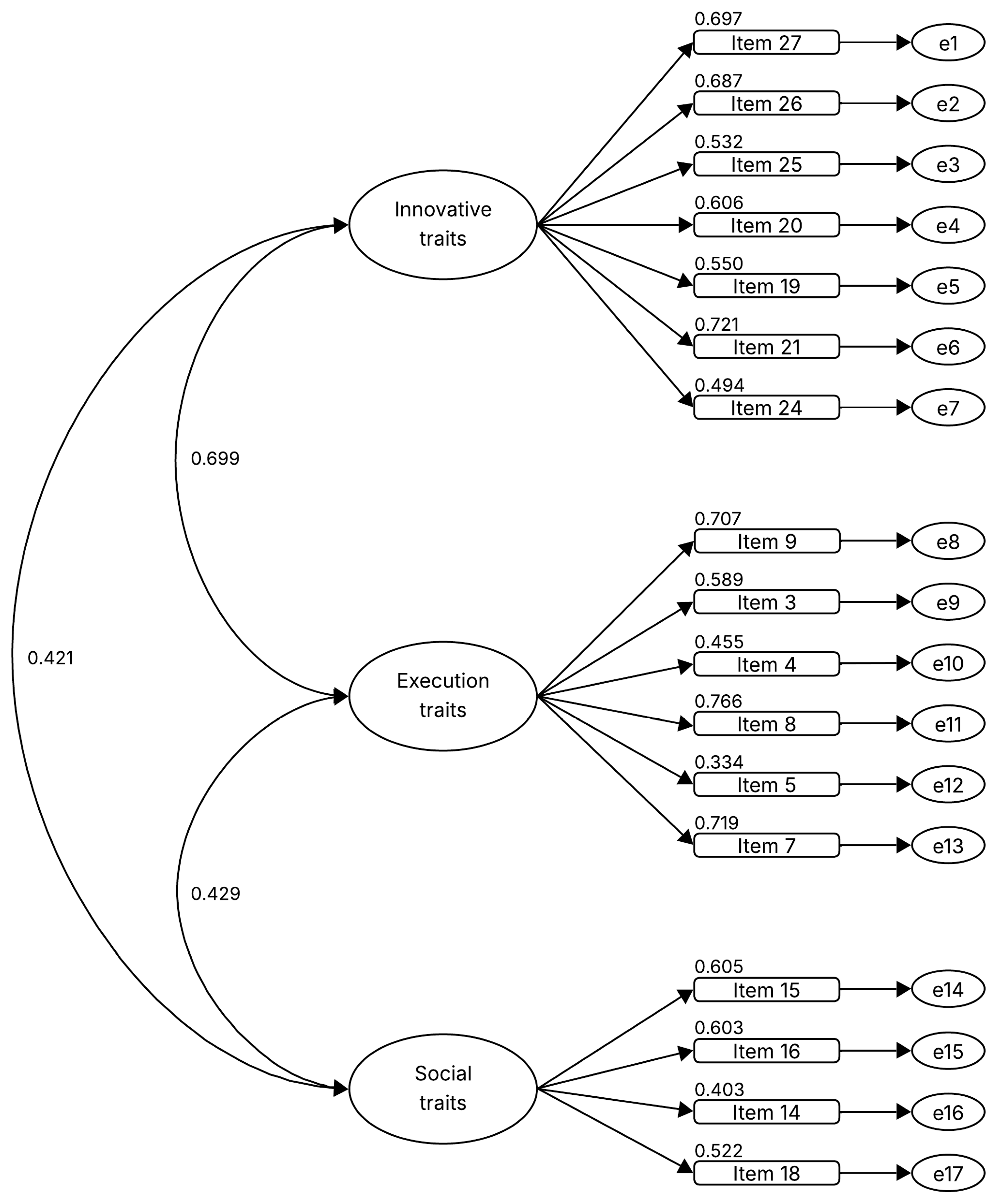
A CFA was performed on the second subsample using the robust maximum likelihood estimation method. The model fit was determined based on the following indices: χ2 reached 580.468 (p <0.001), while IFI, TLI, and CFI obtained values of 0.832, 0.802, and 0.831, respectively. The RMSEA was calculated to be 0.084. Furthermore, all factor loadings were statistically significant (p < 0.001) (Figure 1).
To further support the validity of the Questionnaire to Measure Social Entrepreneurship, convergent validity was examined through correlation analysis with the Social Innovation Tendency Scale [35]. Mean scores were calculated for each of the three dimensions—innovative (7 items), execution (6 items), and social traits (4 items)—and subsequently correlated with the overall score of the Social Innovation Tendency Scale. Moderate, positive correlations were obtained for all three dimensions (Table 2), indicating that the constructs are conceptually related yet non-redundant, as theoretically expected.
Convergent validity was also assessed using AVE and internal consistency indices. The analysis showed an AVE of 0.389 for the innovative factor (α = 0.808, ω = 0.806). The execution factor produced an AVE of 0.381 (α = 0.768, ω = 0.756), whereas the social factor generated an AVE of 0.256 (α = 0.574, ω = 0.580). Although the social dimension showed lower values, it was retained to preserve the theoretical integrity of the three-dimensional model [37].
Finally, measurement invariance was assessed by sex and academic semester to ensure the instrument’s stability across groups. The unconstrained models for both variables showed moderate fit indices, supporting configural invariance. When equality constraints were progressively applied to factor loadings (metric), intercepts (scalar), and residuals (residual), the changes in fit indices remained within recommended thresholds. Specifically, the observed changes did not exceed ΔCFI = 0.007, ΔRMSEA = 0.002, or ΔSRMR = 0.006. These findings indicate that the model is invariant across participants’ sex and semester of enrollment, allowing for meaningful comparisons between these groups (Table 3).

4. Discussion

The primary objective of this research was to examine the validity of the Questionnaire to Measure Social Entrepreneurship among undergraduates in Mexican health science programs. By applying a multidimensional theoretical framework of SE traits using PAF, this study supports the viability of the three-dimensional structure originally proposed by Capella Peris et al. [34]. Although initial empirical indices suggested a more complex structure, the decision to retain three factors was prioritized to maintain theoretical consistency and parsimony, resulting in a refined 17-item model specifically tailored to the health sciences context. Within this validated structure, a reorganization of item loadings was observed: social traits became more clearly differentiated into a distinct factor, and items related to creativity and idea generation—originally categorized as personal and social traits—loaded onto the innovative traits dimension. This finding underscores the importance of contextual adaptation when applying SE assessment tools [24]. By addressing the socially and contextually constructed nature of entrepreneurial perceptions, these results suggest that, within this specific population, entrepreneurial initiative is perceived as a proactive and transformative process rather than solely a relational competence.
With regard to the dimensions identified in this questionnaire, the innovative traits factor—encompassing the ability to manage unforeseen situations, generate and exploit opportunities, and develop novel solutions—aligns with theoretical models that emphasize opportunity recognition and exploitation as core components of entrepreneurship [13,25,39,40]. This dimension is closely related to entrepreneurial cognition frameworks, reinforcing the notion that innovation-oriented thinking typically precedes execution behaviors in complex problem-solving processes. Likewise, the inclusion of creativity within the innovative dimension is consistent with other assessment instruments [24,41], which conceptualize these attributes as central drivers of entrepreneurial initiative rather than exclusively social competencies.
The execution dimension was characterized by traits related to risk-taking, determination, and confidence in achieving goals. The results are consistent with the model proposed by Saxena [42], as well as with instruments assessing SE coefficients [22], entrepreneurial orientation [43], and orientation toward SE [44]. These findings support the relevance of execution-oriented traits as a distinct yet complementary component of SE. Finally, social traits—comprising items related to interpersonal support, prosocial role models, willingness to collaborate with NGOs, and the use of dialogue for conflict resolution—emerged as a clearly differentiated dimension in the refined 17-item model. Although this factor demonstrated lower internal consistency and AVE values compared to the other dimensions, its retention is theoretically justified as it captures the foundational mission of SE directed toward generating positive community impact [5]. This dimension is consistent with the social proactivity component of the IEO instrument [43], which assesses engagement in collective action and community improvement, as well as with the social passion dimension proposed by Satar et al. [28], which prioritizes social interaction and collective benefit over individual gain.

4.1. Theoretical Contributions

The primary theoretical contribution of this study lies in the empirical validation of SE as a multidimensional and contextually situated construct. By addressing the socially constructed nature of entrepreneurial perceptions, the application of a systematic extraction method enabled the identification of a refined 17-item structure. This contribution addresses the methodological debate on the “boundary conditions” of SE constructs [45,46], demonstrating how professional socialization in the health sciences acts as a structural filter that influences the statistical behavior and internal structure of the measurement model. Within this framework, the decision to retain the social traits dimension, despite its lower AVE and internal consistency values, was a deliberate choice [37]. In the context of health sciences, omitting the social component to achieve better statistical fit would result in a conceptually incomplete model [7,8]. By prioritizing this multidimensional nature, the model provides a more authentic representation of the entrepreneurial profile in this sector, where social mission acts as the primary driver of innovation [43,47].
From a theoretical perspective, these results provide a nuanced understanding of SE by framing it as a dynamic process that integrates cognitive orientation, action capacity, and social purpose [6]. Specifically, the findings suggest that, within the health sciences context, innovation-oriented thinking and creativity act as cognitive catalysts that transform social awareness into proactive pathways [48]. Furthermore, the results reinforce the theoretical necessity of individual agency—expressed through self-sufficiency and determination—as the essential mechanism that drives the transition from social intent to measurable community impact [49,50]. Finally, the persistence of social traits as a distinct factor confirms that social purpose is not merely an external objective but an internal psychological driver rooted in altruistic motivation and collective identity. The identification of these traits reinforces the idea that entrepreneurial orientation in health sciences is not a fragmented set of skills, but a cohesive psychological structure aligned with social value creation. Additionally, the moderate and positive correlations observed with social innovation tendency provide empirical support for the close conceptual relationship between these constructs [35,51].

4.2. Practical and Policy-Related Contributions

The relevance of these traits is particularly pronounced among students in the health sciences, where entrepreneurship extends beyond business ventures to address the social determinants of health. Regarding practical implications, the resulting metric provides academic institutions with a useful initial screening tool to identify entrepreneurial characteristics among students. This, in turn, enables the design of targeted educational strategies and training programs that emphasize critical competencies, such as entrepreneurial initiative in clinical and community settings and social risk management. By equipping future health professionals with these traits, HEIs can foster “change agents” capable of designing sustainable interventions that transcend traditional clinical care and address systemic health disparities, such as food insecurity or limited healthcare access [32,47], thereby aligning medical education with urgent social determinants of health priorities [33,52].
At the policy level, this study supports a strategic shift from reactive healthcare models towards more holistic, social-impact-driven public health approaches, as emphasized in international frameworks [17,53]. The scale facilitates institutional comparisons and the development of evidence-based academic policies that promote SE. This is particularly critical in developing countries such as Mexico, where universities are increasingly expected to serve as catalysts for regional development and social transformation [13], bridging institutional gaps and harnessing the entrepreneurial potential of the student population [9]. By providing a standardized metric, the tool enables institutions to align their educational goals with the sustainable development needs of the region, ensuring that human capital is prepared to drive the social and economic transitions required for community well-being.

4.3. Study Limitations

A notable limitation affecting construct validity is that the AVE values were below the traditional 0.50 threshold across all factors. However, for the innovative and execution traits, the construct validity remains acceptable. As argued by Lam, an AVE close to 0.40 is acceptable when internal consistency is above 0.60 [54]. Conversely, the AVE was particularly low for the social traits dimension (AVE = 0.256). In the context of health sciences, social traits are heavily influenced by the ethical mandates and prosocial baseline inherent to the profession [15,32]. This homogeneity often creates ceiling effects and increases susceptibility to social desirability bias in self-report measures [55,56], thereby depressing common variance and complicating the operationalization of the construct. Despite this limitation in construct validity, the factor was retained due to its strong theoretical relevance and the preliminary viability of the model. Future research may explore whether refining item wording or incorporating culturally specific prosocial indicators improves AVE values and composite reliability. Furthermore, the observed fit indices indicate a marginal model fit relative to traditional thresholds [37,57]. This suggests that while the 17-item structure is a viable baseline for this specific population, it should be treated as a preliminary model that requires further structural refinement in future cross-cultural research.
Several limitations should be acknowledged. Participants were recruited via non-probabilistic convenience sampling, limiting the sample exclusively to undergraduates enrolled in health science programs at one specific university. As an inherent limitation of survey-based research, the use of self-report measures may introduce social desirability bias, particularly regarding prosocial traits, where participants may align their responses with perceived professional expectations. Thus, the findings might reflect an inherent academic focus dedicated to societal betterment and enhancing human well-being, thereby constraining the external validity and applicability to areas such as business or engineering. Furthermore, the cross-sectional nature of the data provides a static snapshot, which does not allow for the examination of how these traits evolve over time. Nevertheless, the large sample size and diversity of health sciences academic programs included support the internal stability of the factor structure for an initial validation study.

4.4. Future Directions

Future research should extend this validation to students from other academic disciplines and institutions across different regions of Mexico to confirm the stability of the factor structure. Additionally, the cumulative explained variance and AVE values suggest the need for further refinement of the measurement model, particularly within the social traits dimension. From a psychometric standpoint, subsequent studies should examine predictive and criterion validity, including associations with entrepreneurial behaviors and participation in social ventures. Longitudinal designs would also be valuable for determining whether these traits evolve throughout professional training or translate into observable social innovation outcomes after graduation. Similarly, replication using alternative estimation methods (e.g., WLSMV) and multi-institutional or cross-cultural samples could strengthen external validity and further support measurement invariance beyond sex and academic seniority.

5. Conclusions

The factor structure of the SE questionnaire provides a preliminary distinction among innovative, execution, and social dimensions within a refined 17-item model. Although the three-factor structure remains consistent with the original theoretical framework, the migration of creativity and idea generation into the innovative dimension—along with the reduction to a more parsimonious set of items—highlights the socially and contextually constructed nature of entrepreneurial perceptions in the Mexican context. These findings underscore that entrepreneurial traits are not universal constants but are shaped by cultural and professional environments, particularly within the health sciences, where practice is guided by ethical mandates and the social determinants of health.
This study provides HEIs with a useful initial screening tool to identify entrepreneurial potential and to design targeted programs that foster “change agents” committed to sustainable development. Although further research is needed to test the scale’s stability across other disciplines, this validated 17-item instrument represents a valuable first step toward informing evidence-based educational policy in Latin America.

Author Contributions

Conceptualization, F.J.T.-H., J.F.M.-V. and N.A.R.-R.; methodology, F.J.T.-H., J.F.M.-V., G.G.-E. and N.A.R.-R.; validation, F.J.T.-H., J.H.-B., A.M.V.-Q. and N.A.R.-R.; formal analysis, F.J.T.-H. and N.A.R.-R.; investigation, G.G.-E., C.O.H.-R. and B.V.P.-E.; resources, J.F.M.-V., B.V.P.-E. and N.A.R.-R.; data curation, F.J.T.-H. and N.A.R.-R.; writing—original draft preparation, F.J.T.-H. and J.F.M.-V.; writing—review and editing, J.H.-B., A.M.V.-Q., C.O.H.-R. and B.V.P.-E.; visualization, F.J.T.-H. and C.O.H.-R.; supervision, G.G.-E. and N.A.R.-R.; project administration, J.F.M.-V., B.V.P.-E. and N.A.R.-R. All authors have read and agreed to the published version of the manuscript.

Funding

This research received no external funding.

Institutional Review Board Statement

The Research and Ethics Committees of the Centro Universitario de Ciencias de la Salud granted formal approval for this study (reference 023/2023, 31 January 2023). All procedures were conducted in accordance with the Declaration of Helsinki and Mexico’s General Health Law on Health Research.

Informed Consent Statement

All individuals participating in this investigation gave their informed consent before data collection.

Data Availability Statement

The data presented in this study are available on request from the corresponding authors.

Conflicts of Interest

The authors declare no conflicts of interest.

Abbreviations

This article employs the following acronyms and abbreviations:
AVEAverage variance extracted
CFAConfirmatory factor analysis
CFIComparative fit index
CUCSCentro Universitario de Ciencias de la Salud
EFAExploratory factor analysis
FAFactor analysis
HEIHigher education institution
IFIIncremental fit index
KMOKaiser-Meyer-Olkin
NGONon-governmental organization
PAFPrincipal axis factoring
RMSEARoot mean square error of approximation
SDStandard deviation
SDGsSustainable Development Goals
SESocial entrepreneurship
SPSSStatistical package for the social sciences
TLITucker–Lewis index
αCronbach’s alpha
ωMcDonald’s omega

References

  1. Bouby Tolentino, F. La Importancia del Emprendimiento Social Frente al Proceso de Globalización Dela Economía y los Mercados. Gest. Terc. Milen. 2015, 18, 39–49. [Google Scholar] [CrossRef]
  2. Jareh, A. Sustainable Social Innovation as a Solution for Systemic Change and Resilience. Sustainability 2025, 17, 1583. [Google Scholar] [CrossRef]
  3. Prakash, D.; Arora, T.; Bisla, M. Understanding Social Innovation and Public Policy for Sustainable Development: A Bibliometric and Thematic Analysis. J. Entrep. Public Policy 2025, 15, 143–166. [Google Scholar] [CrossRef]
  4. Santos, F.J.; Barroso, M.d.l.O.; Guzmán, C. La Economía Global y Los Emprendimientos Sociales. Rev. Econ. Mund. 2020, 35, 21–45. [Google Scholar] [CrossRef]
  5. Gandhi, T.; Raina, R. Social Entrepreneurship: The Need, Relevance, Facets and Constraints. J. Glob. Entrep. Res. 2018, 8, 9. [Google Scholar] [CrossRef]
  6. Portales, L. Social Innovation and Social Entrepreneurship: Fundamentals, Concepts, and Tools; Springer International Publishing: Cham, Switzerland, 2019. [Google Scholar]
  7. Rodríguez García, J.S. Desarrollo de La Investigación Sobre El Emprendimiento Social y El Emprendedor Social: Análisis Bibliométrico. Rev. Col. San Luis 2023, 13, 1–38. [Google Scholar] [CrossRef]
  8. Manuel Reyes, V.; Rodríguez Rojas, Y.L.; Castillo Leal, M. Emprendimiento Social: Una Revisión Sistemática de Literatura. SIGNOS-Investig. Sist. Gest. 2022, 14, 1–19. [Google Scholar] [CrossRef]
  9. Villegas-Mateos, A.; Vázquez-Maguirre, M. Social Entrepreneurial Ecosystems: A Regional Perspective of Mexico. Int. J. Entrep. 2020, 24, 1–19. [Google Scholar]
  10. Ballari, D.; Siabato, W.; Claramunt, C.; Mata, M.; Zagal, R.; Franco, R. On the Development of Open Geographical Data Infrastructures in Latin America: Progress and Challenges. J. Spat. Inf. Sci. 2025, 30, 3–23. [Google Scholar] [CrossRef]
  11. Unceta, A.; Guerra, I.; Barandiaran, X. Integrating Social Innovation into the Curriculum of Higher Education Institutions in Latin America: Insights from the Students4Change Project. Sustainability 2021, 13, 5378. [Google Scholar] [CrossRef]
  12. Hernández Blancas, G.J.; Bringas Benavides, M.d.R.; García Villeda, Z.; Meneses Valencia, E. Inclusive Higher Education: Advances and Challenges in Latin American Contexts. Tesla Rev. Científica 2026, 6, 1–24. [Google Scholar] [CrossRef]
  13. Velasco Martínez, L.C.; Estrada Vidal, L.I.; Pabón Figueras, M.; Tójar Hurtado, J.C. Evaluar y Promover Las Competencias Para El Emprendimiento Social En Las Asignaturas Universitarias. REVESCO Rev. Estud. Coop. 2019, 131, 199–223. [Google Scholar] [CrossRef]
  14. Gleason Rodríguez, M.A.; Rubio Barrios, J.E.; Ruiz Godoy Rivera, J.A.; Velázquez Díaz, M.L. Proyectos de Innovación Social Como Estrategia Para El Desarrollo de Competencias de Estudiantes Universitarios. Rev. Educ. Sup. 2022, 51, 69–88. [Google Scholar] [CrossRef]
  15. Andermann, A. Taking Action on the Social Determinants of Health in Clinical Practice: A Framework for Health Professionals. CMAJ Can. Med. Assoc. J. 2016, 188, E474–E483. [Google Scholar] [CrossRef]
  16. Vohra-Gupta, S.; Petruzzi, L.; Cherian, A.; Chow, C.; Unzueta, M.; Joachimi, R. A Narrative Review on Shifting Practice and Policy Around Social Determinants of Health (SDOH) Screenings: Expanding the Role of Social Workers in Healthcare Settings in the U.S. Healthcare 2025, 13, 1097. [Google Scholar] [CrossRef] [PubMed]
  17. Muñoz-Valle, J.F.; Estrada-Pereira, L.; Turrubiates-Hernández, F.J.; Vizcaíno-Quirarte, A.M.; Ruvalcaba-Romero, N.A. Validation of the Social Innovation Tendency Scale in Mexico. Eur. J. Investig. Health Psychol. Educ. 2025, 15, 195. [Google Scholar] [CrossRef] [PubMed]
  18. Orr, Z.; Zalcman, B.G.; Pinchas-Mizrachi, R.; Romem, A. Fostering Healthcare Innovation: A Mixed-Methods Study of an Impact Entrepreneurship Course for Nurse Practitioner Students. Nurs. Rep. 2025, 15, 397. [Google Scholar] [CrossRef] [PubMed]
  19. Chahine, T. Toward an Understanding of Public Health Entrepreneurship and Intrapreneurship. Front. Public Health 2021, 9, 593553. [Google Scholar] [CrossRef]
  20. Mukesh, H.V.; Shetty, J.; Kenny, B.; McGuirk, H. Value for Value: Social Entrepreneurship Education Through Value Creation Extracurricular Activity. J. Soc. Entrep. 2024, 1–26. [Google Scholar] [CrossRef]
  21. Hernández-Ascanio, J.; Aja Valle, J.; Rueda López, R.; Medina Viruel, M.J. Medir La Capacidad de Innovación Social En Organizaciones Complejas Del Tercer Sector. Empiria Rev. Metodol. Cienc. Soc. 2021, 51, 153–182. [Google Scholar] [CrossRef]
  22. Jilinskaya-Pandey, M.; Wade, J. Social Entrepreneur Quotient: An International Perspective on Social Entrepreneur Personalities. J. Soc. Entrep. 2019, 10, 265–287. [Google Scholar] [CrossRef]
  23. Buckland, H.; Murillo, D. La Innovación Social En América Latina. Marco Conceptual y Agentes; Editorial de la Universidad de Almería: Almería, Spain, 2014. [Google Scholar]
  24. García-González, A.; Ramírez-Montoya, M.S.; De León, G.; Aragón, S. El Emprendimiento Social Como Una Competencia Transversal: Construcción y Validación de Un Instrumento de Valoración En El Contexto Universitario. REVESCO Rev. Estud. Coop. 2020, 136, e71862. [Google Scholar] [CrossRef]
  25. Bacq, S.; Janssen, F. The Multiple Faces of Social Entrepreneurship: A Review of Definitional Issues Based on Geographical and Thematic Criteria. Entrep. Reg. Dev. 2011, 23, 373–403. [Google Scholar] [CrossRef]
  26. Hockerts, K. The Social Entrepreneurial Antecedents Scale (SEAS): A Validation Study. Soc. Enterp. J. 2015, 11, 260–280. [Google Scholar] [CrossRef]
  27. Kraus, S.; Niemand, T.; Halberstadt, J.; Shaw, E.; Syrjä, P. Social Entrepreneurship Orientation: Development of a Measurement Scale. Int. J. Entrep. Behav. Res. 2017, 23, 977–997. [Google Scholar] [CrossRef]
  28. Satar, M.S.; Natasha, S. Individual Social Entrepreneurship Orientation: Towards Development of a Measurement Scale. Asia Pac. J. Innov. Entrep. 2019, 13, 49–72. [Google Scholar] [CrossRef]
  29. García-González, A.; Ramírez-Montoya, M.S. Social Entrepreneurship Education: Changemaker Training at the University. High. Educ. Ski. Work-Based Learn. 2021, 11, 1236–1251. [Google Scholar] [CrossRef]
  30. Alcantar-Nieblas, C.; Glasserman-Morales, L.D.; Vázquez-Parra, J.C. Psychometric Properties of a Scale to Measure Social Entrepreneurship Competency in Mexican University Students. Horiz. Int. J. Learn. Futures 2024, 32, 178–187. [Google Scholar] [CrossRef]
  31. Quintero Rojas, C.A.; Caldera González, D.D.C. Índice Para Evaluar El Perfil Emprendedor Social de Jóvenes Universitarios. Entrecienc. Diálogos Soc. Conoc. 2025, 13, 1–15. [Google Scholar] [CrossRef]
  32. Roy, M.J.; Lysaght, R.; Krupa, T.M. Action on the Social Determinants of Health through Social Enterprise. CMAJ Can. Med. Assoc. J. 2017, 189, E440–E441. [Google Scholar] [CrossRef]
  33. Brown, D.E.; Malinovitch, A.; Posner, H.; Indrakanti, D.; Sharma, M.; Karamardian, M.; Dine, C.J. Novel Program Connects Medical Students with Startups Focused on Social Determinants of Health. J. Gen. Intern. Med. 2025, 40, 474–478. [Google Scholar] [CrossRef]
  34. Capella Peris, C.; Gil Gómez, J.; Martí Puig, M.; Ruiz-Bernardo, P. Construcción de Un Cuestionario Para Medir El Emprendimiento Social En Educación Física. Pedagog. Soc. Rev. Interuniv. 2016, 28, 169. [Google Scholar] [CrossRef]
  35. Bulut, C.; Eren, H.; Halac, D.S. Social Innovation and Psychometric Analysis. Procedia-Soc. Behav. Sci. 2013, 82, 122–130. [Google Scholar] [CrossRef]
  36. Chen, F.F. Sensitivity of Goodness of Fit Indexes to Lack of Measurement Invariance. Struct. Equ. Model. Multidiscip. J. 2007, 14, 464–504. [Google Scholar] [CrossRef]
  37. Hair, J.F.; Black, W.C.; Babin, B.J.; Anderson, R.E. Multivariate Data Analysis, 8th ed.; Cengage: Andover, UK, 2019. [Google Scholar]
  38. Peterson, R.A. A Meta-Analysis of Variance Accounted for and Factor Loadings in Exploratory Factor Analysis. Mark. Lett. 2000, 11, 261–275. [Google Scholar] [CrossRef]
  39. Portuguez Castro, M.; Valenzuela González, J.R.; Navarro Corona, C. Diseño y Validación de Un Test de Evaluación Del Potencial En Emprendimiento Social. REVESCO Rev. Estud. Coop. 2018, 128, 192–211. [Google Scholar] [CrossRef]
  40. Sannikova, A.; Vevere, V.; Titko, J. Competences Necessary for a Social Entrepreneur: A Case Study of Latvia. Bus. Theory Pract. 2023, 24, 604–612. [Google Scholar] [CrossRef]
  41. Sáenz Bilbao, N.; López Vélez, A.L. Las Competencias de Emprendimiento Social, COEMS: Aproximación a Través de Programas de Formación Universitaria En Iberoamérica. REVESCO Rev. Estud. Coop. 2015, 119, 159–182. [Google Scholar] [CrossRef]
  42. Saxena, G. Multidimensional Competency Construct for Social Entrepreneurs: A Logistic Regression Approach. Kasetsart J. Soc. Sci. 2018, 40, 684–688. [Google Scholar] [CrossRef]
  43. Garçon, M.M.; Nassif, V.M.J. Individual Tailored Entrepreneurial Orientation: Scale Development Focused on Social Entrepreneurship. REGEPE-Rev. Empreended. E Gest. Peq. Empres. 2021, 10, e2008. [Google Scholar] [CrossRef]
  44. Rodríguez-Piñeros, S.; Sabogal-Salamanca, M.; Ibarvo-Urista, V.; Aguilar-Palma, N.; Sánchez-Basualdo, R.; Villarraga-Flórez, L.F. Building a Scale to Measure Individual Social Entrepreneurship Orientation (ISEO) of Forest Students in Latin America. For. Policy Econ. 2023, 154, 103026. [Google Scholar] [CrossRef]
  45. Short, J.C.; Moss, T.W.; Lumpkin, G.T. Research in Social Entrepreneurship: Past Contributions and Future Opportunities. Strateg. Entrep. J. 2009, 3, 161–194. [Google Scholar] [CrossRef]
  46. Welter, F. Contextualizing Entrepreneurship—Conceptual Challenges and Ways Forward. Entrep. Theory Pract. 2011, 35, 165–184. [Google Scholar] [CrossRef]
  47. Lim, Y.W.; Chia, A. Social Entrepreneurship: Improving Global Health. JAMA 2016, 315, 2393–2394. [Google Scholar] [CrossRef]
  48. Mansoor, A.; Farrukh, M.; Wu, Y.; Abdul Wahab, S. Does Inclusive Leadership Incite Innovative Work Behavior? Hum. Syst. Manag. 2021, 40, 93–102. [Google Scholar] [CrossRef]
  49. Hong, P.Y. Transforming Opportunities into Productivity (TOP): A New Social Development Model for Social Transformation. Soc. Dev. Issues 2023, 46, 7. [Google Scholar] [CrossRef]
  50. Montgomery, A.W.; Dacin, P.A.; Dacin, M.T. Collective Social Entrepreneurship: Collaboratively Shaping Social Good. J. Bus. Ethics 2012, 111, 375–388. [Google Scholar] [CrossRef]
  51. Cunha, J.; Benneworth, P.S. Social Entrepreneurship and Social Innovation: Are Both the Same? In Proceedings of the 2nd International Conference on Project Evaluation, Guimarães, Portugal, 26 June 2014. [Google Scholar]
  52. Byhoff, E.; Kangovi, S.; Berkowitz, S.A.; DeCamp, M.; Dzeng, E.; Earnest, M.; Gonzalez, C.M.; Hartigan, S.; Karani, R.; Memari, M.; et al. A Society of General Internal Medicine Position Statement on the Internists’ Role in Social Determinants of Health. J. Gen. Intern. Med. 2020, 35, 2721–2727. [Google Scholar] [CrossRef] [PubMed]
  53. Committee on Educating Health Professionals to Address the Social Determinants of Health; Board on Global Health; Institute of Medicine. A Framework for Educating Health Professionals to Address the Social Determinants of Health; The National Academies Press: Washington, DC, USA, 2016. [Google Scholar]
  54. Lam, L.W. Impact of Competitiveness on Salespeople’s Commitment and Performance. J. Bus. Res. 2012, 65, 1328–1334. [Google Scholar] [CrossRef]
  55. Podsakoff, P.M.; MacKenzie, S.B.; Lee, J.-Y.; Podsakoff, N.P. Common Method Biases in Behavioral Research: A Critical Review of the Literature and Recommended Remedies. J. Appl. Psychol. 2003, 88, 879–903. [Google Scholar] [CrossRef]
  56. Streiner, D.L.; Norman, G.R.; Cairney, J. Health Measurement Scales: A Practical Guide to Their Development and Use; Oxford University Press: Oxford, UK, 2014. [Google Scholar]
  57. Hu, L.; Bentler, P.M. Cutoff Criteria for Fit Indexes in Covariance Structure Analysis: Conventional Criteria versus New Alternatives. Struct. Equ. Model. Multidiscip. J. 1999, 6, 1–55. [Google Scholar] [CrossRef]
Figure 1. Confirmatory factor analysis of the Questionnaire to Measure Social Entrepreneurship responses.
Sustainability 18 05051 g001
Table 1. Results of the EFA for the Questionnaire to Measure Social Entrepreneurship *.
Item123
27. I am good at handling unexpected situations0.636
26. When plans are changed, I improvise without difficulty0.633
25. I enjoy finding good solutions to problems that no one has solved yet0.606
20. I see new uses for common objects0.499
19. I get to do things imaginatively and differently than other people do0.496
21. I can create opportunities and take advantage of them0.428
24. I am able to make suggestions to improve the projects in which I participate0.423
9. I consider myself self-sufficient, so I can achieve what I set out to do 0.670
3. I am a determined person and willing to achieve my goals 0.646
4. I think it is necessary to take risks in order to progress 0.622
8. I believe in my possibilities 0.616
5. I believe that people who take risks are more likely to succeed than those who do not 0.495
7. I see myself capable of dealing with most situations 0.486
15. I like to help my class/work friends 0.632
16. People who help others are an example to follow 0.602
14. I would love to collaborate for free in an NGO 0.490
18. Coexistence problems can be solved through dialogue 0.445
Explained Variance12.111.37.2
Coefficient α0.7890.7760.623
Coefficient ω0.7880.7750.628
* Items with factor loadings below 0.40 were eliminated. EFA, exploratory factor analysis.
Table 2. Correlation analysis between the Social Innovation Tendency Scale and the factors of the Questionnaire to Measure Social Entrepreneurship.
DimensionMeanSDCorrelation
Innovative traits3.850.570.419 **
Execution traits4.230.500.352 **
Social traits4.190.490.431 **
** p <0.001.
Table 3. Analysis of invariance across sex and academic semester.
InvarianceRMSEASRMRCFIΔRMSEAΔSRMRΔCFI
SexConfigural a0.0880.0710.821---
Metric b0.0860.0770.8160.002−0.0060.005
Scalar c0.0860.0740.8090.0000.0030.007
Residual d0.0840.0750.8050.002−0.0010.004
SemesterConfigural e0.0850.0650.829---
Metric b0.0830.0710.8260.002−0.0060.003
Scalar c0.0810.0710.8260.0020.0000.000
Residual d0.0790.0730.8240.002−0.0020.002
a Unconstrained baseline model across males and females. b Equality constraints applied to factor loadings. c Equality constraints applied to item intercepts. d Equality constraints applied to residuals. e Unconstrained baseline model across first and final academic semesters.
Disclaimer/Publisher’s Note: The statements, opinions and data contained in all publications are solely those of the individual author(s) and contributor(s) and not of MDPI and/or the editor(s). MDPI and/or the editor(s) disclaim responsibility for any injury to people or property resulting from any ideas, methods, instructions or products referred to in the content.