Review

Review of the Application of Zeolites as Sorption Materials in Water Treatment

1
Faculty of Materials Engineering and Physics, Cracow University of Technology, 31-864 Cracow, Poland
2
Raluca Ripan Institute of Research in Chemistry, Babes Bolyai University, 30 Fantanele Street, 400294 Cluj Napoca, Romania
3
CUT Doctoral School, Cracow University of Technology, Warszawska 24, 31-155 Cracow, Poland
4
Interdisciplinary Center for Circular Economy, Cracow University of Technology, Warszawska 24, 31-155 Cracow, Poland
*
Authors to whom correspondence should be addressed.
Sustainability 2026, 18(10), 5045; https://doi.org/10.3390/su18105045
Submission received: 13 April 2026 / Revised: 11 May 2026 / Accepted: 14 May 2026 / Published: 17 May 2026

Abstract

The pollution of water, including salt and fresh water, has become an emergency problem. Pollutants come from different sources and have various characteristics, starting from industry and fertilizers used in agriculture, sewage related to human living, and other sources. Diverse sources of pollution require a comprehensive approach to water purification. One possible approach may be the use of appropriate sorbents. Currently, one of the most promising materials used is zeolites. This is because they can come from various sources, including waste raw materials such as fly ash, and, therefore, allow for the use of a circular economy approach. Moreover, these materials can be modified, which enables their selective use for selected types of pollutants. Eventually, these materials become economically viable options. The main aim of this article is to present and analyze possible solutions to water pollution based on zeolite materials. For this purpose, a critical literature review was prepared. The review reveals that zeolites perform particularly well in ion-exchange-driven removal of inorganic contaminants, while their effectiveness for organic micropollutants under realistic conditions is often limited. The identified trade-offs between removal efficiency, regeneration stability, and scalability indicate that zeolites are best applied as function-specific rather than universal sorbents. From a sustainability perspective, this targeted applicability is supported by advantages, such as low material cost, long service life, and the possibility of using naturally occurring or waste-derived precursors, which, together, enable resource-efficient water treatment processes, reduced reliance on energy-intensive technologies, and the valorization of industrial byproducts within circular economy frameworks.

1. Introduction

Nowadays, water pollution is a growing environmental and technological problem [1]. It also remains a major public-health challenge. However, the scale of the wastewater problem is still not precisely known, and the most recent global estimates are based on data from 2022 or earlier. Reporting remains incomplete: the latest UN-Water assessment covers 107 countries, which is only about half of the world’s countries; therefore, global figures still rely on partial coverage [2]. Cao et al. [3] estimated the global annual wastewater volume at about 3.594 × 10¹¹ m3, of which 41.4% is treated in wastewater treatment plants [3,4]. In parallel, UN-Water reported that in 2022, 42% of household (domestic) wastewater was not safely treated before discharge, corresponding to an estimated 113 billion m3 released into the environment with inadequate or no treatment [2]. It is worth noting that these two figures refer to different datasets and indicators, and the UN-Water estimate does not include industrial wastewater.
The main sources of water pollution are municipal wastewater, industrial effluents, agricultural runoff, and urban stormwater runoff [2]. However, their relative importance varies by region and is not uniform worldwide: in many low- and middle-income settings, insufficiently treated sewage is a dominant pressure, whereas in agricultural catchments, nutrient and pesticide runoff can be more significant, and in urban areas, stormwater often contributes hydrocarbons, metals, nutrients, and microbes [5,6]. Not all pollutants pose the same level of risk, and they also differ in how readily they can be removed. Some contaminants, such as many textile dyes, are relatively well studied and can often be treated using established technologies [7,8], whereas emerging pollutants such as microplastics and antibiotics are generally more challenging to remove, and their long-term environmental and health impacts remain less certain [6,9]. The main types of water pollutants are presented in Table 1. Table 1 provides a high-level overview of the major pollutant groups relevant to water quality and environmental regulation and is intended to outline the broader contamination landscape rather than to compare removal performance or material suitability.
Accordingly, not all pollutant groups listed in Table 1 are discussed in equal depth in the subsequent sections, which focus on contaminant classes for which zeolites have demonstrated practical relevance or consensus in the literature.
Sorption remains a key water treatment technology, particularly for removing pollutants that are difficult to eliminate by conventional methods such as coagulation, precipitation, or disinfection [27]. Its efficiency depends not only on the type of sorbent used, but also on pore structure, surface chemical properties, solution pH, ionic composition, and the presence of competing contaminants [27]. Finding an appropriate sorbent is essential to meeting the needs of water treatment. An efficient sorbent must possess a high surface area, great chemical, physical, and mechanical stability, and a significant affinity for binding with contaminants. These features allow for effective elimination of contaminants by its notable sorption capacity, selectivity, rapid kinetics of adsorption and desorption, and little energy needed for regeneration [13].
Traditional sorbents are often insufficient for emerging contaminants because many persistent, mobile, and toxic substances (PMT) are small, highly mobile, and ionized, which reduces their affinity for hydrophobic and π–π interactions [28]. Moreover, short-chain per- and polyfluoroalkyl substances (PFAS) and similar anionic compounds exhibit early breakthrough and poor retention, mainly due to electrostatic repulsion from negatively charged carbon surfaces (used in traditional sorption systems) at circumneutral pH [28]. As a result, conventional sorption systems show limited performance and operational lifetimes for this new class of contaminants.
Sustainable water management requires treatment technologies that are not only effective but also economically viable, resource-efficient, and adaptable to diverse local conditions. In this context, sorption-based processes are increasingly recognized as sustainable alternatives due to their relatively low energy demand and operational simplicity.
Zeolites are synthetic or naturally occurring minerals characterized by a wide range of framework structures, chemical compositions, and sorption behaviors [13,29]. Their high ion-exchange capacity, negatively charged aluminosilicate framework, and chemical as well as mechanical stability in aqueous environments make them particularly effective sorbents for water treatment applications [27,30].
Recent research shows that the field of zeolite-based adsorption is rapidly expanding, moving beyond its traditional application in treating water contaminated with nitrogenous, phosphoric, organic compounds, heavy metals, and dyes [31]. As the spectrum of pollutants in industrial effluents continues to diversify, zeolites are increasingly being investigated not only as standalone adsorbents but also as functional components within advanced composite materials designed to target emerging contaminants. This growing scientific interest reflects both their versatility and their potential to address newly identified environmental challenges, supporting the need for comprehensive reviews that highlight progress, knowledge gaps, and opportunities for innovation. Consequently, zeolite research today goes beyond classical water treatment scenarios and explores novel configurations, modified structures, and hybrid systems to broaden their applicability in large-scale effluent remediation.
While numerous reviews have addressed the use of zeolites in water treatment, most of them focus on selected pollutant classes, specific zeolite types, or adsorption performance under idealized laboratory conditions. In contrast, the present review provides a function-oriented and application-focused synthesis, critically comparing natural, synthetic, waste-derived, and hybrid zeolites across different contaminant groups while explicitly considering trade-offs between removal efficiency, regeneration stability, scalability, and sustainability. By shifting the perspective from cataloging materials to identifying realistic application niches, this work contributes a complementary and practice-relevant framework that is largely absent from earlier reviews.
The main aim of the article is to present and analyze possible solutions to water pollution based on zeolite materials, taking into consideration their advantages and disadvantages, including ease of zeolite modification and integration into more complex systems, allowing them to function as modern sorbents designed for advanced pollutants. This article shows the latest research in this area, together with the estimation of practical applications of these technologies. It refers to the current challenges and assesses the perspectives for the development of technologies based on zeolites. Rather than providing an exhaustive overview of zeolite chemistry and classification, this review focuses on critically assessing their functional role in water treatment systems. Particular emphasis is placed on identifying scenarios in which zeolites offer clear advantages over alternative sorbents, as well as conditions under which their performance or practicality becomes limited.

2. Research Methodology

The methodology applied in this article is based on a critical review of the scientific literature and relevant case studies. This literature review was conducted following a structured and transparent search and selection strategy to ensure reproducibility and mitigate selection bias. The initial literature search was performed using the Scopus database, chosen for its broad coverage of peer-reviewed journals in environmental sciences, materials science, and chemical engineering. In the initial stage, three keywords were combined to obtain proper search results in the Scopus database: “zeolite”, “water treatment”, and sorption”. This search was carried out using the following Boolean query applied to titles, abstracts, and keywords: TITLE-ABS-KEY (“zeolite” AND “water treatment” AND “sorption”). The filters were not applied.
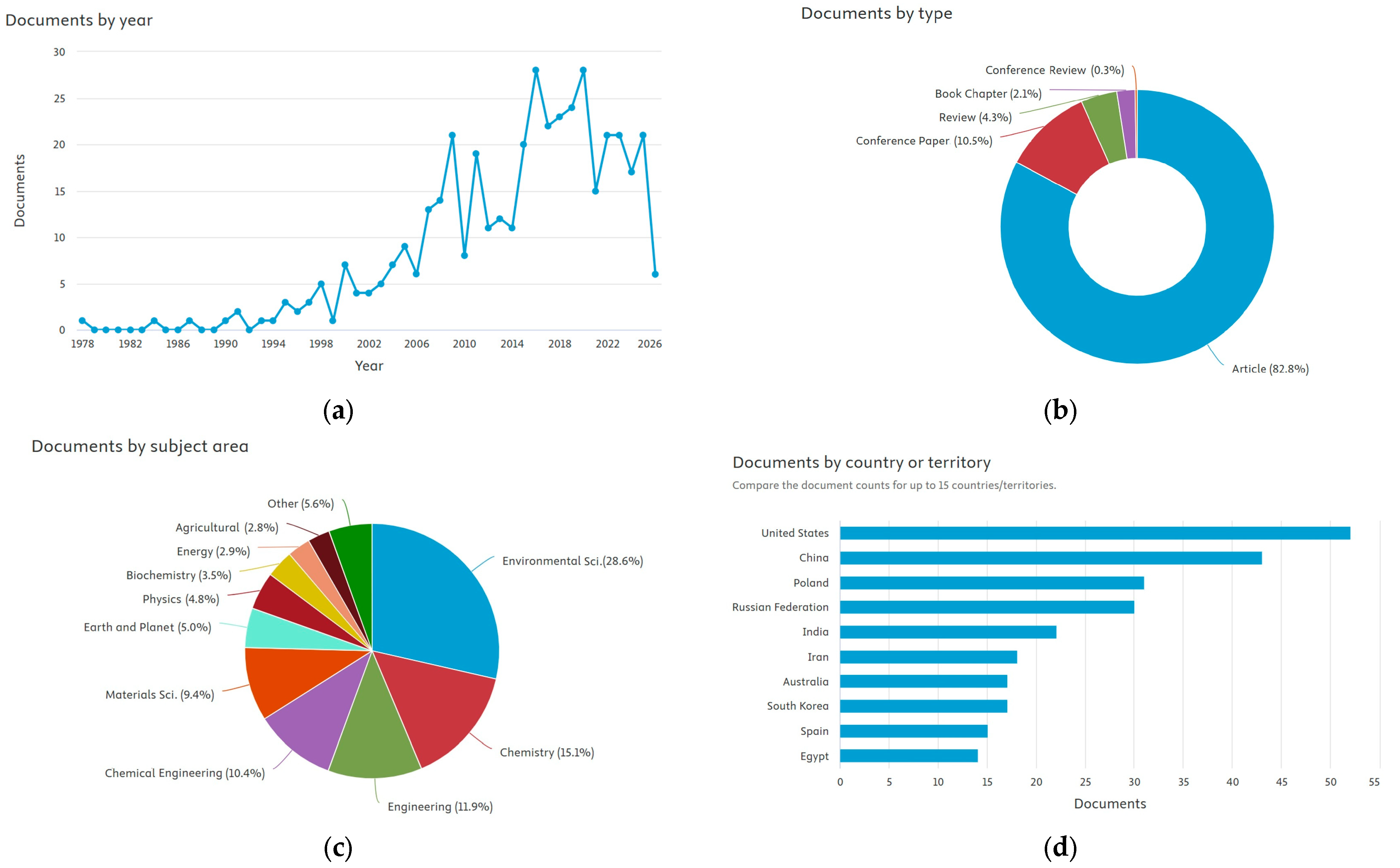
This query resulted in 419 publications related to this topic (Figure 1).
The analysis of the results shows that the topic is well structured, with the first publications registered in the database from 1978. Interest in this topic is changeable, with the general trend of growth (Figure 1a). Most of these publications are research articles, almost 83%, and less than 5% review papers. This demonstrates a small number of this type of study and shows the same need for systematizing the existing research by the review studies (Figure 1b). The analysis according to research subjects shows that this topic has an interdisciplinary characteristic, with mainly participation from the Environmental Sciences (Figure 1c). An interesting and atypical finding from the analysis is the substantial contribution by the United States to this research area. In many disciplines, the highest number of publications usually originates from developing countries such as India and China. Also, the high position of Poland (third place) is proof of a strong position of the researchers from this country in this area (Figure 1d). This ranking reflects the differences in publication output, observed in the analyzed dataset, and highlights the concentration of research activity in selected countries.
After the initial search, the authors checked the manuscripts according to the relevance of the topics. Among the searched publications, the authors selected the most relevant manuscripts according to content for the suitable sections of this article. The literature review was focused especially on the publications from the last 5 years (from January 2020 to March 2026). To refine the dataset, explicit inclusion and exclusion criteria were applied.
  • Inclusion criteria:
  • Peer-reviewed publications reporting experimental, modeling, or applied studies on zeolites used as sorbents in water and wastewater treatment;
  • Studies addressing pollutant removal mechanisms, modification strategies, regeneration, or practical applications;
  • Articles providing quantitative performance data (e.g., removal efficiency, sorption capacity, kinetics).
  • Exclusion criteria:
  • Publications focusing on gas-phase adsorption, catalysis unrelated to water treatment, or geological characterization without environmental application;
  • Editorials, patents, and non-peer-reviewed sources;
  • Papers addressing zeolites only as catalyst supports without sorption relevance;
  • Duplicate information in the article compared with the previous one.
The selection process followed the principles of the PRISMA 2020 guidelines [33]. After removal of duplicates, titles and abstracts were screened to exclude clearly irrelevant studies. The remaining papers underwent full-text assessment for eligibility based on the criteria above. From the initial 419 records, publications not meeting the inclusion criteria were excluded during screening, resulting in a reduced set of articles considered most relevant for qualitative synthesis and citation in this review. Priority was given to studies published within the last five years to reflect the current state-of-the-art, while earlier seminal works were retained where necessary to provide historical or conceptual context.
For a better visualization of the research areas in the framework of the topic of the article, the supporting tool—VOSviewer version 1.6.20 (Centre for Science and Technology Studies, Leiden University, Leiden, The Netherlands)—was used. As a datasheet file, a generated Excel presentation with 419 positions from the Scopus database was used. The created diagram is presented in Figure 2.
Figure 2 illustrates the interdisciplinary character of zeolite research, highlighting strong linkages between water treatment, adsorption, and environmental engineering. It presents a keyword co-occurrence network generated using VOSviewer, where the node size reflects keyword frequency, link strength represents co-occurrence intensity, and different color clusters indicate major thematic groups within the literature. The analysis reveals several clearly distinguishable research streams. One dominant cluster is centered around traditional applications of zeolites in water treatment, including keywords such as “ion exchange”, “ammonium removal”, “heavy metals”, and “clinoptilolite”, which represent long-established and widely investigated topics. A second cluster groups terms related to material modification and hybrid systems (e.g., “modified zeolites”, “composites”, “metal oxides”, “surface functionalization”), reflecting the growing emphasis placed on tailoring zeolites for enhanced selectivity and performance. Another cluster highlights emerging research directions associated with complex and modern pollutants, including “pharmaceuticals”, “PFAS”, “micropollutants”, and “advanced oxidation processes”, which appear less central but increasingly interconnected. The spatial distribution of keywords suggests a clear transition in research focus over time: while classical ion-exchange-driven applications dominate the core of the network, newer topics are located more peripherally and are linked to modification strategies and hybrid treatment concepts. This pattern indicates that recent research increasingly moves beyond bulk contaminant removal toward function-specific applications of zeolites in complex water matrices, supporting the need for a critical and application-oriented synthesis rather than a purely descriptive review.
It should be noted that the methodological approaches employed in the reviewed studies vary considerably. The majority of available data are derived from batch sorption experiments conducted under controlled laboratory conditions, typically using synthetic aqueous solutions. While such studies are essential for mechanistic understanding and preliminary material screening, they often do not fully capture the complexity of real water and wastewater matrices or operational conditions encountered in practice. Fewer studies evaluate zeolite performance under continuous-flow or column conditions, which limits direct assessment of scalability and long-term operational stability.
In this review, the term ‘sorption’ is used as a generic descriptor encompassing ion exchange, surface adsorption, electrostatic interactions, and surface complexation, whereas ‘adsorption’ refers specifically to surface-bound, non-exchange mechanisms.

3. Zeolites as a Sorption Material

3.1. Structure of Zeolite

The term zeolite originates from the Greek words zein (to boil) and lithos (stone) and was introduced in 1758 by the Swedish mineralogist Axel Fredrik Cronstedt to describe a mineral that expands when heated [31]. Zeolite is a crystalline, hydrated aluminosilicate mineral composed of a three-dimensional framework of SiO4 and AlO4 tetrahedra, forming a system of interconnected channels and cavities [13,34]. The general chemical formula is as follows [13,34]:
M x + · M y 2 + [ A l x + 2 y S i n x + 2 y O 2 n ] · m H 2 O ,
where M+ represents the metal cation of the elements of the IA group (Li+, Na+, K+, …), and M2+ elements of the IIA group (Ca2+, Sr2+, Ba2+, …), where the number of molecules and atoms usually is m < n [34].
The negative charge of the framework is balanced by exchangeable alkali and alkaline-earth cations and water molecules, which can be reversibly replaced, giving zeolites their characteristic ion-exchange and adsorption properties [31].
Zeolites come in a wide range of structures. According to the International Zeolite Association (IZA), 264 zeolite framework types have been recognized (as of November 2025) [35]. The zeolite framework is defined as distinct three-dimensional tetrahedral structures of SiO4 and AlO4 units with unique pore and channel topologies, officially classified by the International Zeolite Association (IZA) [35]. These framework types describe topology only and can host different chemical compositions.
While the fundamental framework structure and classification of zeolites are well established, their relevance for water treatment applications lies primarily in how structural parameters govern adsorption selectivity and stability. In particular, the Si/Al ratio plays a decisive role in determining framework charge density and, consequently, ion-exchange capacity and hydrophilicity. Zeolites with low Si/Al ratios exhibit a higher negative framework charge, resulting in stronger electrostatic interactions with inorganic cations such as ammonium and heavy metals, making them particularly suitable for classical ion-exchange-based water treatment applications [36,37].
In contrast, high-silica zeolites possess a lower framework charge and increased hydrophobicity, which enhances their affinity for neutral or weakly polar organic contaminants, including certain pharmaceuticals and emerging micropollutants [38]. These structure–property relationships directly translate into adsorption selectivity and regeneration behavior under realistic water matrices. Therefore, zeolite classification should be considered not only from a crystallographic perspective but also as a practical guideline for matching material properties with specific water treatment objectives [39].
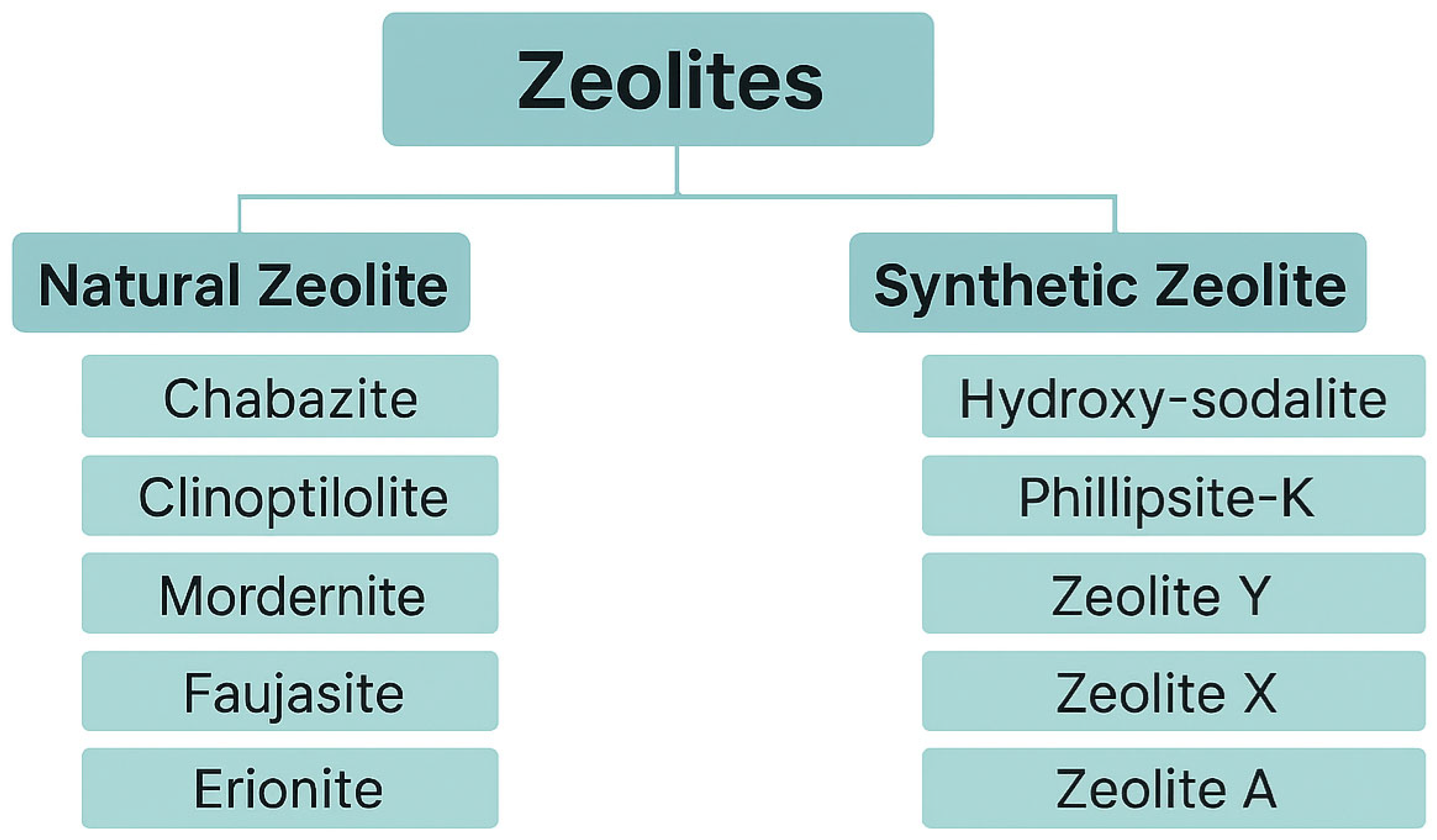
Zeolites are generally classified into two main groups: natural zeolites, which occur as minerals formed in geological processes, and synthetic zeolites, which are produced under controlled conditions to obtain specific, uniform structural and chemical properties. The overall classification of zeolites is presented in Figure 3.
From an application-oriented perspective, the practical relevance of this classification lies not in structural taxonomy alone, but in how different zeolite types translate specific physicochemical properties into treatment performance. Consequently, the following sections focus on comparative behavior rather than detailed crystallographic distinctions.

3.2. Source and Production of Zeolite Materials

3.2.1. Natural Zeolites

Natural zeolites form a smaller subset, comprising about 40–80 mineral species that occur in nature, typically formed by alteration of volcanic ash and distinguished by specific chemical compositions and cation contents [40,41]. The wide range in the reported number of natural zeolites arises from differences in classification criteria. Some sources count only well-established, chemically distinct mineral species, while others include rare, poorly characterized, recently approved, or structurally related variants and polymorphs. In addition, ongoing mineralogical research and updates to official nomenclature mean that the recognized number of natural zeolite species continues to evolve [31].
Natural zeolites occur predominantly as products of zeolitization of volcanic tuffs, as sediments formed in alkaline lake environments, and as hydrothermally altered rocks. The most commonly mined and commercially exploited zeolite minerals are clinoptilolite, chabazite, mordenite, and analcime [42]. However, it should be borne in mind that the sorption properties of zeolites are strongly dependent on their geological origin, which confirms that natural zeolites from different deposits are not functionally equivalent materials [43]. One of the most popular types of natural zeolite used in industry is clinoptilolite. Natural clinoptilolite is valued for its wide availability, structural stability, and low cost; however, its relatively small pore openings can restrict the uptake of larger organic molecules. Even so, targeted modification approaches can markedly enhance its adsorption efficiency [44].
Quantitative data on natural zeolite reserves are rarely reported in official statistics; however, secondary compilations suggest that China holds in the order of ~200 million tons of zeolite-bearing resources, followed by the United States (~50 million tons), Cuba (~30 million tons), Jordan (~20 million tons), and Turkey (~15 million tons) [45]. These values should be regarded as approximate, as they are derived mainly from aggregated national geological surveys and market analyses rather than standardized reserve assessments. Global production of natural zeolites is estimated at approximately 0.9–1.0 million tons per year, with Slovakia, China, the United States, and several Asian countries being the leading producers [46,47]. Precise assessment is difficult because several countries do not report natural zeolites separately, and production data are often aggregated with other clay and industrial mineral commodities.
Natural zeolites, in contrast to synthetic ones, exhibit greater variability in mineralogical and chemical composition, crystal structure, and pore size, which may limit their use in applications requiring highly uniform properties for maximum efficiency. However, their significantly lower cost makes natural zeolites attractive for large-scale applications such as animal feed additives, water treatment, odor control, gas adsorption, and pozzolanic additions to Portland cement [31].

3.2.2. Synthetic Zeolites

Despite being more expensive, synthetic zeolites offer uniform and highly controlled properties, making them suitable for applications requiring high-purity materials [31]. Their key advantage lies in the consistent pore size distribution, in contrast to the more variable and generally smaller pores characteristic of natural zeolites, which directly translates into higher unit efficiency, as reported in comparative studies [31]. Comparative studies often demonstrate higher performance of synthetic zeolites; for example, Wulandari et al. [48] showed that synthetic zeolite achieved significantly higher copper removal efficiency than natural zeolite at substantially lower sorbent doses. However, deviations from this general trend have also been reported [48]. Zhang et al. [49] found that natural clinoptilolite outperformed synthetic ZSM-5 in Pb removal across the investigated pH range, primarily due to its higher cation-exchange capacity and more hydrophilic surface [49].
Currently, one of the important directions of the research on zeolite synthesis is the use of waste or industrial byproducts. In this case, different materials rich in aluminosilicates can be used. One of the most investigated is fly ash because of its suitable chemical composition and abundance—it is generated in very large quantities worldwide as a byproduct of coal combustion [50,51]. An example of synthesis from coal fly ash is provided by Chukanov et al. [52], which shows the practical potential of gmelinite synthesized from industrial wastes as a low-cost and efficient material for heavy-metal removal from water [52]. Na-rich gmelinite (gmelinite-Na) shows superior affinity toward Pb2+ ions, resulting in high removal efficiency, thanks to the fact that gmelinite-based sorbents can offer a sustainable and economically viable alternative to conventional materials in technologies for lead-contaminated water remediation [52].
However, traditional coal fly ash is also quite intensively used for other applications, including cementitious material production [53]; because of that, other alternatives are also investigated. Grela et al. [54] demonstrated that fly ash derived from circulating fluidized bed (CFB) boilers constitutes a very suitable precursor for zeolite synthesis despite its limited applicability in the construction industry due to its irregular particle morphology and the absence of a glassy phase [54]. Łach et al. [55] show that fly ash derived from biomass combustion and co-combustion is also possible to use in zeolite synthesis, indicating that the more complex and variable chemical composition of biomass ashes enables hydrothermal synthesis, which enables the formation of multiple zeolite phases, including sodalite, faujasite (FAU), and chabazite [55]. Similarly, agricultural waste was used by Oluyinka et al. [56]; bagasse fly ash, a silica-rich solid waste generated in large quantities by the sugar industry during biomass combustion, was successfully converted into functional zeolitic adsorbents through chemical activation and crystallization [56]. The transformation yielded Mg-modified zeolite composites dominated by FAU-, sodalite-, and chabazite-type phases, effectively upgrading an environmental liability into a value-added material. These zeolitic adsorbents exhibited high surface area and porosity and were efficiently applied for the removal of toxic nitroaromatic contaminants (p-nitroaniline and nitrobenzene) from aqueous solutions [56]. The research also shows that other agricultural waste can be a valuable source for zeolite synthesis. For example, Zharylkan et al. [57] produced a NaX-type zeolite with a well-defined crystalline structure from rice husks by conversion via hydrothermal synthesis [57]. Another possibility was shown by Hussain et al. [58]. They used rag fly ash (textile waste ash) as a low-cost feedstock and transformed it into Na-zeolites [58]. The produced zeolites exhibited rapid and highly efficient Pb(II) removal, primarily via ion-exchange mechanisms [58].
Also, other aluminosilicate materials have been investigated as precursors for zeolite production. For example, Łach et al. [59] show that calcined coal shale can be an effective and locally available precursor for the synthesis of high-surface-area zeolites, confirming that mining waste can serve as an alternative source of silica and alumina [59]. Consequently, zeolite synthesis does not need to rely on pure chemical reagents, enabling the design of low-cost, waste-derived zeolites suitable for further applications such as adsorption, catalysis, and ion exchange. A similar study was also provided by Ibsaine et al. [60]. This team synthesized Na-P1 zeolite via a hydrothermal process using aluminosilicate waste residue generated during lithium extraction from spodumene, without the need to adjust the Si/Al ratio [60]. The produced zeolite was applied for water softening and removal of NH4+, heavy metals, as well as rare earth elements from contaminated water. The material exhibited high sorption capacities for Ca2+ and NH4+ (~66 mg/g) and showed particularly strong affinity toward Ce3+, Cd2+, Cu2+, and Cr3+, achieving performance comparable to that of commercial zeolite A [60]. This type of research confirms the efficiency of waste-derived zeolites.

3.2.3. Methods of Producing Synthetic Zeolites

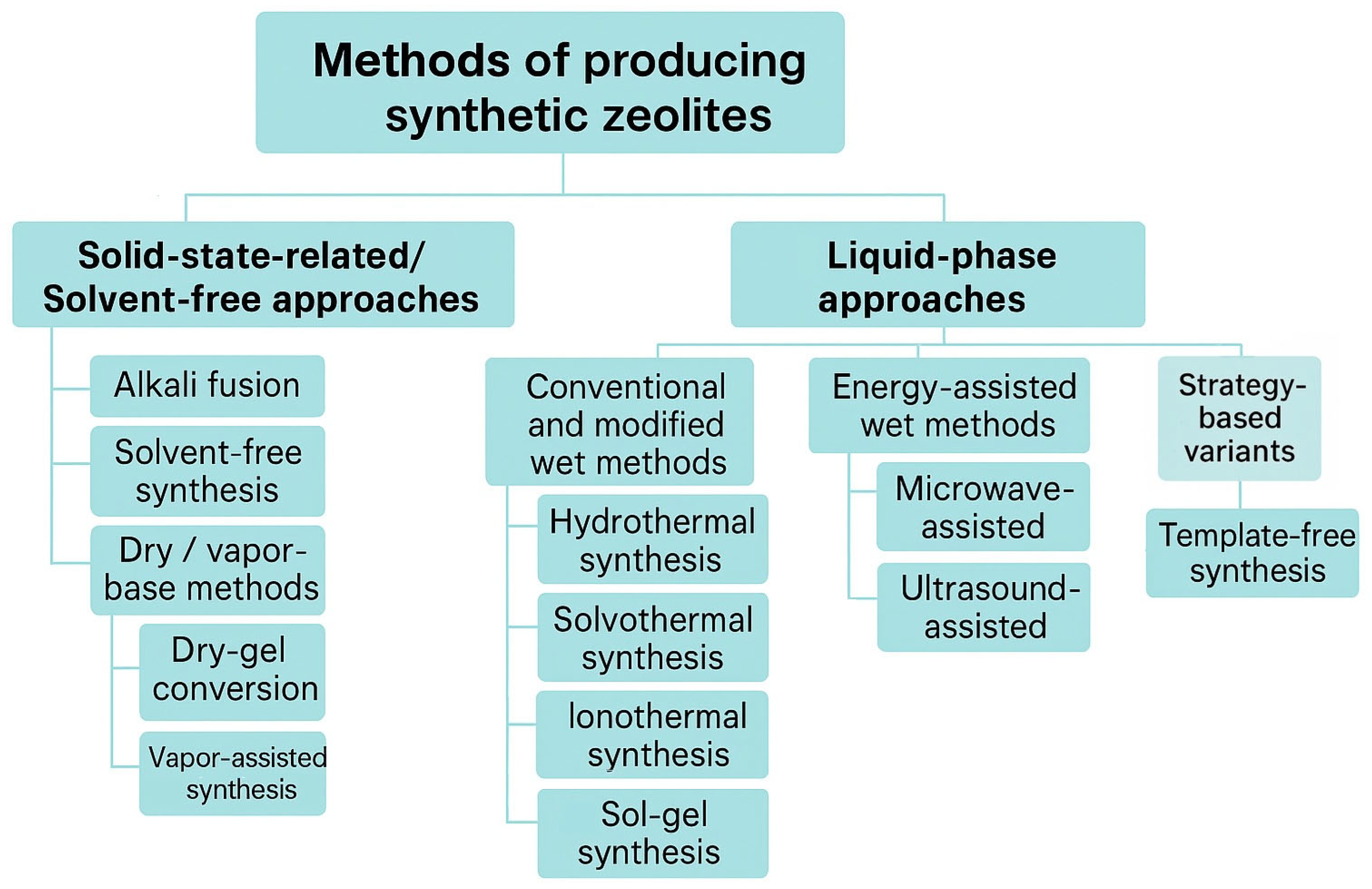
Synthetic zeolites are produced by using a range of controlled chemical methods that can be broadly divided into solid-state synthesis and liquid-phase synthesis, the latter encompassing the most practical approaches due to better control over crystallization, composition, and framework structure (Figure 4).
The hydrothermal method is the most versatile approach for obtaining a wide range of zeolites—particularly the classic types (A, X, Y)—whereas solvothermal, ionothermal, microwave, sol–gel, and ultrasonic methods are currently being developed to enable the synthesis of more challenging structures, such as ZSM-5, MEL, or zeolite hybrids. The choice of technique depends on the type of zeolite, the required morphology, and the permissible process conditions [31].
Hydrothermal synthesis is the most established route for zeolite preparation, in which aluminosilicate precursors crystallize from aqueous alkaline solutions under elevated temperature and autogenous pressure [61]. This method is widely applied to the synthesis of technologically important zeolites such as ZSM-5, Zeolite A (LTA), Zeolite X (FAU), and Zeolite K, as well as other frameworks, including sodalite, analcime, Na-P1, and phillipsite [61,62]. Crystallization is strongly influenced by synthesis parameters such as temperature and pressure, batch composition, the silica-to-aluminum ratio, the nature of reactant materials, total alkalinity, aging period, template presence, and seeding. Careful control of these factors enables the production of materials with good crystal quality, high reactivity, relatively low energy consumption, and limited pollutant generation. Moreover, hydrothermal synthesis allows the use of alternative precursor sources, including industrial residues such as fly ash and slag [61,62]. However, the process is associated with certain limitations, including the need for costly autoclave equipment, the generation of corrosive alkaline slurries, and, in some cases, long crystallization times, which require appropriate waste management and also increase the overall production costs [41,63,64].
Solvothermal synthesis is similar to hydrothermal synthesis, but it uses non-aqueous solvents, including organic media, to influence crystallization pathways and framework formation [65]. This approach can help obtain zeolite structures that are more difficult to produce in water-based systems and may improve control over morphology and porosity. Makova et al. [66], using organic solvents in a fluoride medium, obtained highly crystalline, Brønsted-acid-rich ferrierite zeolites with large crystal sizes, although the resulting catalysts exhibited lower N2O decomposition activity compared to hydrothermally synthesized analogs [66]. Wei et al. [65], in turn, point out that solvothermal synthesis effectively regulates nucleation and mass transfer, enabling the controlled growth of compact NaX zeolite membranes with exceptionally high methanol/methyl tert-butyl ether separation performance [65]. However, its use is limited by the cost and environmental burden of organic solvents, as well as safety concerns associated with solvent handling [66,67].
Ionothermal synthesis employs ionic liquids as both solvent and structure-directing medium, allowing zeolite crystallization under relatively mild conditions. A major advantage of this route is the very low vapor pressure of ionic liquids, which reduces volatile emissions and can improve control over crystal growth and morphology [68]. Morris [69] shows that ionothermal synthesis using ionic liquids, especially when combined with microwave heating, overcomes key limitations of conventional hydrothermal methods, notably the need for high-pressure autoclaves. This approach enables faster crystallization, ambient-pressure operation, and the direct formation of well-oriented zeolite coatings, making it particularly suitable for emerging applications such as anticorrosion layers. It can be a promising, versatile route for producing zeolites in forms inaccessible by traditional methods [69]. The main limitation of the method is the high cost of ionic liquids and potential environmental concerns [68].
Quite interesting is the method of microwave-assisted synthesis. It accelerates heating and nucleation by directly coupling microwave energy with the reaction mixture, which substantially reduces crystallization time compared with conventional heating [64]. This method is valued for its rapid processing, lower energy demand, and improved control of nucleation and crystal uniformity. It has been reported for zeolite A, zeolite X, zeolite Y, sodalite, and other frameworks, although scale-up remains challenging because of limitations in heat distribution and reactor size [41,70]. Microwave-assisted crystallization was employed by Oluyinka et al. [56] to accelerate zeolite formation by providing rapid and volumetric heating, which enhanced nucleation and reduced synthesis time compared to conventional hydrothermal methods. This approach promoted the development of crystalline zeolitic phases while limiting energy consumption and processing steps. Although less aggressive than alkali fusion, the microwave method enabled controlled zeolitization and produced reusable adsorbents with measurable sorption capacity and structural stability [56].
In zeolite preparation, gel formation constitutes a crucial intermediate stage rather than always representing a standalone synthesis method. In the sol–gel approach, aluminosilicate sols are first generated from silica and alumina precursors through hydrolysis and condensation reactions, followed by gel formation, which provides a chemically homogeneous and compositionally well-defined precursor [71]. This stage allows precise control over key parameters such as the hydrolysis rate, temperature, heating rate, and pH, making it particularly suitable for tailoring framework chemistry in zeolitic materials such as ZSM-5 zeolite and NaY zeolite. However, the applications of the sol–gel method are limited by relatively high precursor costs, the persistence of residual hydroxyl (–OH) groups and unavoidable residual porosity, as well as the risk of undesired oxide precipitation during sol formation, all of which can hinder phase purity and precise structural control [72].
Ultrasound-assisted synthesis uses acoustic cavitation to improve mixing, enhance dissolution of precursor materials, and accelerate nucleation during zeolite formation. As a result, crystallization can proceed faster, and the method is particularly useful for waste-derived precursors with lower reactivity, such as fly ash or glass residues. Its main limitation is scale-up, since ultrasonic energy distribution is difficult to control uniformly in large reactors [72,73].
The alkali fusion method is a synthesis approach used for the preparation of zeolites such as Zeolite 13X, Zeolite A, and Zeolite NaX, particularly from low-reactivity aluminosilicate raw materials, including fly ash and other industrial wastes. In this method, the precursor is pre-mixed with a strong alkali source, typically sodium hydroxide, and thermally treated at an elevated temperature prior to crystallization [72]. This fusion step converts poorly soluble aluminosilicate phases into more reactive sodium silicate and sodium aluminate species, which subsequently crystallize into zeolite frameworks during a following hydrothermal treatment. The crystallization rate and phase formation are mainly influenced by the silicon-to-aluminum ratio of the raw material, alkali concentration, and processing temperature. A major advantage of the alkali fusion method is its ability to valorize inferior or waste-derived raw materials while producing high-quality anhydrous zeolites. However, this benefit is offset by higher energy consumption, increased alkali usage, and higher overall processing costs associated with the additional high-temperature fusion step [41,71]. Koshlak [51] also shows that the method of alkali fusion can be successfully used for synthesizing zeolites from coal fly ash [51]. In this case, coal fly ash was mixed with concentrated NaOH and thermally treated to promote the conversion of amorphous aluminosilicates into crystalline zeolitic phases, predominantly sodalite [51]. This approach enables effective control over the phase composition and textural properties of the resulting zeolites, while simultaneously valorizing an industrial waste into low-cost adsorbents for heavy-metal removal from aqueous solutions.
Solvent-free synthesis is a greener zeolite preparation route in which solid precursors are mechanically mixed and heated with little or no added solvent. Compared with conventional hydrothermal methods, this approach reduces or eliminates bulk water use and can significantly lower wastewater generation. It is considered attractive from both environmental and process-efficiency perspectives, although its applicability is not universal and many zeolite structures still require the use of a templating agent or carefully controlled reaction conditions [74].
Dry-gel conversion is a zeolite synthesis method in which a pre-formed dry aluminosilicate gel is crystallized through contact with water vapor and, depending on the variant, vapors of an organic structure-directing agent under sealed conditions. In contrast to conventional liquid-phase hydrothermal synthesis, the dry gel does not dissolve into a continuous aqueous phase; instead, crystallization proceeds via surface hydrolysis and solid-state or quasi-solid-state rearrangement of framework species. This effective separation of the solid precursor from the liquid phase significantly reduces solvent consumption and wastewater generation, while still enabling rapid and efficient zeolite crystallization [74,75,76]. Some authors also classify vapor-phase transport and steam-assisted conversion as variants of the dry-gel method [75]. These approaches have been demonstrated to enable the synthesis of a broad range of zeolite frameworks, often exhibiting accelerated crystallization kinetics, enhanced stabilization of structure-directing agents, and access to compositions and framework structures that are difficult to achieve when using conventional hydrothermal routes [76]. Moreover, rather than being inherently slower, dry-gel conversion can exhibit shorter crystallization times and higher yields than conventional methods; however, careful control of the water content, gel composition, and template chemistry is essential, as excessive water or inappropriate structure-directing agent selection can inhibit crystallization or promote undesired phase transformations [74,75].
Template-free or organic structure-directing agents-free (OSDA-free) synthesis eliminates the need for organic structure-directing agents and instead relies on precursor composition, seeds, and reaction conditions to direct zeolite formation. This route is especially interesting because it reduces synthesis cost and avoids the environmental burden associated with template removal or combustion after crystallization. However, it is still limited to selected zeolite frameworks, and structural selectivity is often more difficult to control than in templated synthesis routes. [74,77]. It is also worth noting that interest in this group of methods is rapidly increasing, as evidenced by the growing number of recent studies in this field [78,79].
Steam-assisted or vapor-assisted crystallization is a related low-solvent route in which precursor gels are crystallized through exposure to steam or vapor-phase species rather than immersion in bulk liquid. These methods are often discussed together with dry-gel conversion because they share the goal of reducing solvent use while maintaining crystallization control (or are considered as a part of this method). Their main advantages are lower solvent demand and reduced wastewater generation, although process optimization and scale-up can be challenging because vapor transport and reactor geometry strongly influence crystal growth. [74,80,81].
Overall, modern zeolite synthesis methods range from conventional liquid-phase hydrothermal routes to solvent-free, dry-gel, alkali fusion, and OSDA-free approaches, each offering different balances between compositional control, crystallization efficiency, resource consumption, and environmental impact. From a sustainability perspective, microwave and ultrasonic methods—as well as hydrothermal methods utilizing Si/Al waste—are the most promising, whereas solvothermal methods and certain ionothermal techniques entail a higher environmental cost [31].
A short summary of the most important features of the presented methods is presented in Table 2.
Although Table 2 summarizes the main characteristics of synthesis methods, not all of them are equally suitable for real-world water treatment systems. In practice, methods enabling low-cost, high-throughput production tend to dominate, even at the expense of limited structural control, which favors classical hydrothermal approaches and waste-derived methods. In contrast, methods offering very high structural precision remain primarily relevant for specialized rather than large-scale applications.
It is worth noting that, depending on the method used from the same precursors, different types of zeolites can be obtained. In the research provided by Grela et al. [54], two methods of zeolite synthesis from the fly ash have been used. In the case of low-temperature synthesis, zeolite-like materials are yielded with a very high specific surface area (≈213 m2/g), which is significantly higher than that obtained by fusion synthesis (≈121 m2/g), highlighting the superior textural development achieved under mild synthesis conditions [54]. In consequence, depending on the synthesis route applied, different zeolitic structures were obtained: Na-X zeolite via low-temperature synthesis and sodalite via alkaline fusion synthesis [54].
One interesting fact is also that particular types of zeolites can be transformed into other types during some sorbent material preparation, including compositions. For example, Nikolov et al. [82] describe some transformations during calcination (≈900 °C). Natural clinoptilolite undergoes structural collapse and amorphization, losing its original microporous zeolitic framework and transforming into a highly reactive metazeolite that is more susceptible to alkaline attack during geopolymerization [82]. In the subsequent alkali activation and curing stage, this amorphous aluminosilicate matrix can partially recrystallize into secondary zeolite phases, mainly phillipsite and Na-P (NaP1), which nucleate within the geopolymer gel and contribute additional zeolitic features to the final composite material [82].
From the perspective of large-scale applications and sustainable water treatment, not only are the structural parameters of the resulting zeolite of key importance, but also the energy demand of the synthesis, chemical consumption, the possibility of using waste-derived feedstocks, and the ease of process scale-up [83]. Among the methods discussed, conventional hydrothermal synthesis—particularly when based on fly ash or other aluminosilicate waste materials—remains the most practical solution for large-scale environmental applications [84]. Intensified methods (microwave-assisted and ultrasound-assisted) show potential for shortening the synthesis time and reducing energy consumption; however, at present, their use is largely limited to laboratory and pilot scales. By contrast, solvothermal and ionothermal syntheses routes offer high structural control, but due to cost, environmental impact, and safety considerations, they are currently not competitive as routes for producing low-cost sorbents for water treatment [83,85].

3.3. Pollutants Removed by Zeolites

The vast majority of studies confirm the high potential of zeolites for the sorption of heavy metals, while numerous studies indicate that zeolites are effective, low-cost, and environmentally friendly sorbents of heavy metals, acting predominantly via ion-exchange mechanisms, and owing to their high ion-exchange capacity, porous structure, and wide availability of raw materials [29]. Zeolites—including natural ones such as clinoptilolite—demonstrate high efficacy in removing Pb, Cd, Cr, Hg, and Ni, as well as—following appropriate modifications—As [29]. It is also worth noting that zeolites are also tested for the removal of radioactive contaminants due to their high ion-exchange capacity and strong selectivity toward radionuclides such as cesium, strontium, and uranium. Their stable crystalline structure enables efficient immobilization of radioactive ions, making zeolites effective materials for nuclear waste treatment and groundwater remediation, including naturally occurring radioactive nucleoids [63,86]. Mechanistically, the efficiency of cation exchange is governed by the permanent negative charge of the zeolite framework originating from AlO4 tetrahedra. The density and accessibility of exchange sites depend strongly on the Si/Al ratio, type of extra-framework cations, and pore topology, which together control selectivity and maximum uptake capacity. Under realistic water matrices, competitive exchange with ubiquitous background cations such as Ca2+, Mg2+, or Na+ may significantly reduce effective removal, emphasizing the importance of multicomponent rather than single-solute systems.
The other quite widely investigated area is applications against pollution by nutrients such as ammonium and phosphates. Excessive nutrient concentrations, especially ammonium (NH4+) and phosphate (PO43−) ions, originating mainly from agricultural runoff, municipal wastewater, and industrial effluents, contribute significantly to eutrophication of surface waters [87,88]. Zeolites are especially effective for ammonium removal due to their high cation-exchange capacity and strong selectivity toward NH4+ ions, enabling their use in wastewater treatment, constructed wetlands, and aquaculture systems [89,90]. Although phosphate removal by zeolites is less straightforward because of its anionic nature, modified or composite zeolitic materials—such as metal-loaded or surface-functionalized zeolites—have shown enhanced affinity for phosphates through precipitation or surface complexation mechanisms [87]. As a result, zeolite-based systems offer a promising, low-cost, and environmentally sustainable approach for nutrient control and water quality improvement. Moreover, when considering agricultural pollutants, it is worth mentioning that zeolites can be effective against pesticides and herbicides [18,91]; zeolites not only immobilize these substances, but also have the possibility to transform them into less hazardous ones. The investigation provided by Gavel et al. [91] demonstrated that zeolites enable not only the removal of atrazine and bromacil from groundwater but, above all, their controlled transformation into more hydrophilic, more readily released, and significantly less toxic products [91]. The limited affinity of conventional zeolites toward anionic pollutants (e.g., NO3, PO43−, CrO42−) is primarily rooted in the permanent negative charge of the aluminosilicate framework, which electrostatically repels anions. In addition, under circumneutral pH conditions typical for natural waters, zeolite surfaces exhibit a low density of protonated functional groups capable of specific anion binding. Strong hydration of anions and competition with background electrolytes further suppress their adsorption, rendering surface modification necessary for efficient anion removal.
While zeolite-based technologies are well established for the removal of classical inorganic pollutants such as heavy metals and ammonium, their extension to emerging contaminants represents a qualitatively different challenge. Many pharmaceuticals, personal care products, and other emerging micropollutants are neutral or weakly charged and exhibit molecular sizes comparable to or exceeding zeolite micropores, as well as interact primarily through hydrophobic, van der Waals, or π–π interactions rather than ion exchange [92,93]. Consequently, the performance of unmodified zeolites toward these compounds is often limited, highly compound-specific, and sensitive to pore structure and surface hydrophobicity. This fundamental difference explains why successful application of zeolites to emerging contaminants typically relies on framework composition control, surface functionalization, or hybrid system design rather than the simple extrapolation of mechanisms established for inorganic ions [93].
Zeolites have been widely examined as sorbents for a broad spectrum of organic contaminants, including phenolic compounds, synthetic colorants, pharmaceutical residues, and selected food-related additives [94]. While early studies predominantly focused on dye adsorption as model organic pollutants, more recent research has shifted toward compounds of higher environmental relevance, such as pharmaceuticals and emerging organic micropollutants exhibiting persistence and bioactivity at trace concentrations [95,96,97]. The adsorption performance of zeolites toward these substances is governed by factors such as pore structure, surface charge, hydrophobicity, and the presence of framework or extra-framework cations. However, despite their chemical stability and tunable surface properties, unmodified zeolites often show limited affinity toward bulky or weakly polar organic molecules, necessitating surface modification or composite design to enhance removal efficiency [94,98]. Consequently, current research increasingly emphasizes functionalized and hybrid zeolitic materials while also critically assessing trade-offs related to regeneration capability, selectivity, and long-term performance under realistic environmental conditions [11,99].
Zeolites can be applied for the removal of oils and other industrial contaminants; however, effective adsorption of non-polar and bulky organic compounds typically requires surface-modified or composite zeolitic materials to overcome the intrinsic hydrophilicity of conventional zeolites [94,98].
Salts and ions in saline or brackish water represent another important class of contaminants addressed in zeolite applications in water treatment studies. Natural and synthetic zeolites exhibit high selectivity toward specific cations, making them suitable for partial desalination, water softening, and targeted ion removal [100,101]. Their negatively charged aluminosilicate framework enables efficient exchange of hydrated cations present in saline and brackish waters. However, zeolites are inherently less effective for anion removal, such as chloride or sulfate, and their ion-exchange capacity is strongly influenced by competing ions, salinity level, and solution chemistry [94,101]. As a result, zeolites are generally applied not as standalone desalination materials, but as selective sorbents or pretreatment media to reduce specific ionic loads, mitigate scaling potential, or improve the efficiency of downstream treatment processes [100,102].
In Table 3, the examples of different zeolites and pollutants are presented in the first part, where the natural zeolites are considered, and the next part presents the synthetic ones. The examples of different pollutants are given to show the variety of substances for which zeolites can be used.
A comparative synthesis of the data summarized in Table 3 reveals several recurring trends across pollutant classes. For inorganic cations such as Pb2+, Cd2+, Cu2+, NH4+, and radionuclides, zeolites characterized by low Si/Al ratios and a high framework charge—particularly clinoptilolite, chabazite, zeolite A (LTA), and FAU-type zeolites—consistently exhibit the highest removal efficiencies, with reported sorption capacities typically ranging from tens to several hundreds of mg/g, and in selected synthetic or modified systems, exceeding 500 mg/g. In these cases, ion exchange remains the dominant mechanism, and performance is strongly governed by cation type, hydrated ionic radius, and competition effects in multicomponent matrices. In contrast, the removal of organic pollutants and emerging contaminants shows a much higher dependence on framework topology, pore size, and surface chemistry rather than on ion-exchange capacity alone. High-silica zeolites (e.g., BEA, ZSM-5) and surface-modified natural zeolites often outperform low-silica frameworks for neutral or weakly polar organics, albeit with typically lower sorption capacities (commonly below 50 mg/g) and stronger compound-specific behavior. Effective uptake in this group generally requires targeted modification strategies, such as surfactant functionalization or the incorporation of secondary active phases. Across all pollutant classes, the data indicate that sorption efficiency is controlled not only by zeolite type but also by experimental context. High capacities reported under idealized laboratory conditions often decrease significantly in real water matrices due to competing ions, natural organic matter, and pH variability. These trends underscore that zeolite performance should be interpreted in a function-specific and matrix-dependent manner rather than as an intrinsic material constant.
Zeolites may also serve as components of more complex purification systems. An example is the solution investigated by Amari et al. [112], who developed a composite porous geopolymer membrane fabricated from waste natural zeolite powder, combined with a geopolymer matrix and further modified with poly(vinyl acetate) (PVAc) to enhance structural integrity and control porosity [112]. Experimental testing showed that the membrane effectively removed Pb(II) from contaminated water, with optimized PVAc content improving both permeation performance and lead-ion rejection efficiency [112]. Moreover, the created membrane, geopolymer–zeolite composite, offers greater durability, controlled porosity, and significantly improved practical utility compared to powdered zeolite used alone [112].
Other examples of applications of zeolites in complex systems against modern pollutants are the investigations provided by Gajdoš et al. [97]. They researched a combined treatment of UV/H2O2 followed by sorption on granular activated carbon (GAC) supplemented with hydrophilic zeolites, where part of the GAC bed was replaced with cemented ash-based zeolites dominated by zeolite A and P (Si/Al ≈ 0.8) [97]. The addition of zeolites significantly improved the removal of persistent and polar pharmaceuticals, particularly gabapentin (up to 57% removal), diclofenac (up to 100%), metformin, acesulfame, and iomeprol, which were insufficiently removed by GAC alone [97]. Overall, the results show that zeolites are a valuable complement for active carbon materials by targeting charged and hydrophilic compounds, leading to an enhanced quality of the sorption process. Similarly, Zeng et al. [113] developed an advanced Mn-anchored zeolite molecular nest composite (Mn@ZN) based on a dealuminated zeolite 5A framework, designed as a heterogeneous catalyst for catalytic ozonation of the antibiotic, cephalexin, in water [113]. As a result, this system achieved 97% removal of cephalexin within 2 min, exhibiting a reaction rate nearly 80 times higher than non-catalytic ozonation and excellent stability over multiple reuse cycles [113].
Another example is a solution proposed by Baghdad and Hasnaoui [114]. The proposed solution is based on zeolite–cellulose composite membranes containing NaY-type FAU, which combine ion-exchange, filtration, and antimicrobial functions in a single material [114]. These membranes showed high removal efficiency of indicator bacteria (Total coliforms, Escherichia coli, Enterococci, and Clostridium), with near-complete elimination for water samples containing <100 colonies per 100 mL [114]. The effect is attributed to a synergistic mechanism involving physical retention by the membrane structure, the presence of FAU zeolite, and the alkaline activity of NaOH incorporated in the composite, which together suppress bacterial growth and enhance removal performance [114]. Zeolite-cellulose membranes combine the sorption properties of zeolites with the flexibility and porosity of cellulose, making them versatile materials for filtration and ion exchange. The resulting materials are chemically and thermally resistant, operate effectively over a wide pH range, and are suitable for industrial applications [114].
A critical comparison of the reported results reveals that natural and synthetic zeolites do not exhibit universally superior performance across all pollutant classes. For example, synthetic zeolites often demonstrate higher sorption capacities and faster kinetics for heavy metals under controlled conditions, owing to their uniform pore structure and higher ion-exchange capacity. In contrast, natural zeolites such as clinoptilolite may outperform synthetic counterparts in complex matrices due to their greater tolerance to competing ions and structural heterogeneity. These opposing trends indicate that reported performance strongly depends on both material origin and experimental context rather than on zeolite type alone.
When interpreting reported removal efficiencies and sorption capacities, it is important to consider the experimental context in which these values were obtained. Many studies rely on simplified model systems, often neglecting the influence of competing ions, natural organic matter, and variable pHs typical of real waters. Consequently, high sorption capacities reported under idealized laboratory conditions may overestimate performance in complex environmental systems, emphasizing the need for careful comparison between studies employing different methodologies.

3.4. Mechanisms of Sorption in Zeolites

The ability of zeolites to effectively sorb contaminants from water and soil solutions typically does not stem from a only one single process but rather from the synergistic action of several physicochemical mechanisms occurring simultaneously at various structural levels (surface, pores, channels, and crystal structure) [115]. It is precisely this multi-mechanistic nature that renders zeolites particularly attractive materials for environmental applications. Aumeier et al. [28] highlight that sorption mechanisms on zeolites are strongly governed by their chemical composition, particularly the Si/Al ratio. High-silica zeolites exhibit predominantly hydrophobic interactions and van der Waals forces, resulting in sorption capacities comparable to activated carbon for small, non-polar organic molecules. In contrast, low-silica (high-aluminum) zeolites favor ion exchange, hydrogen bonding, and electrostatic interactions, making them especially effective for the removal of ionic and highly polar PMTs [28].
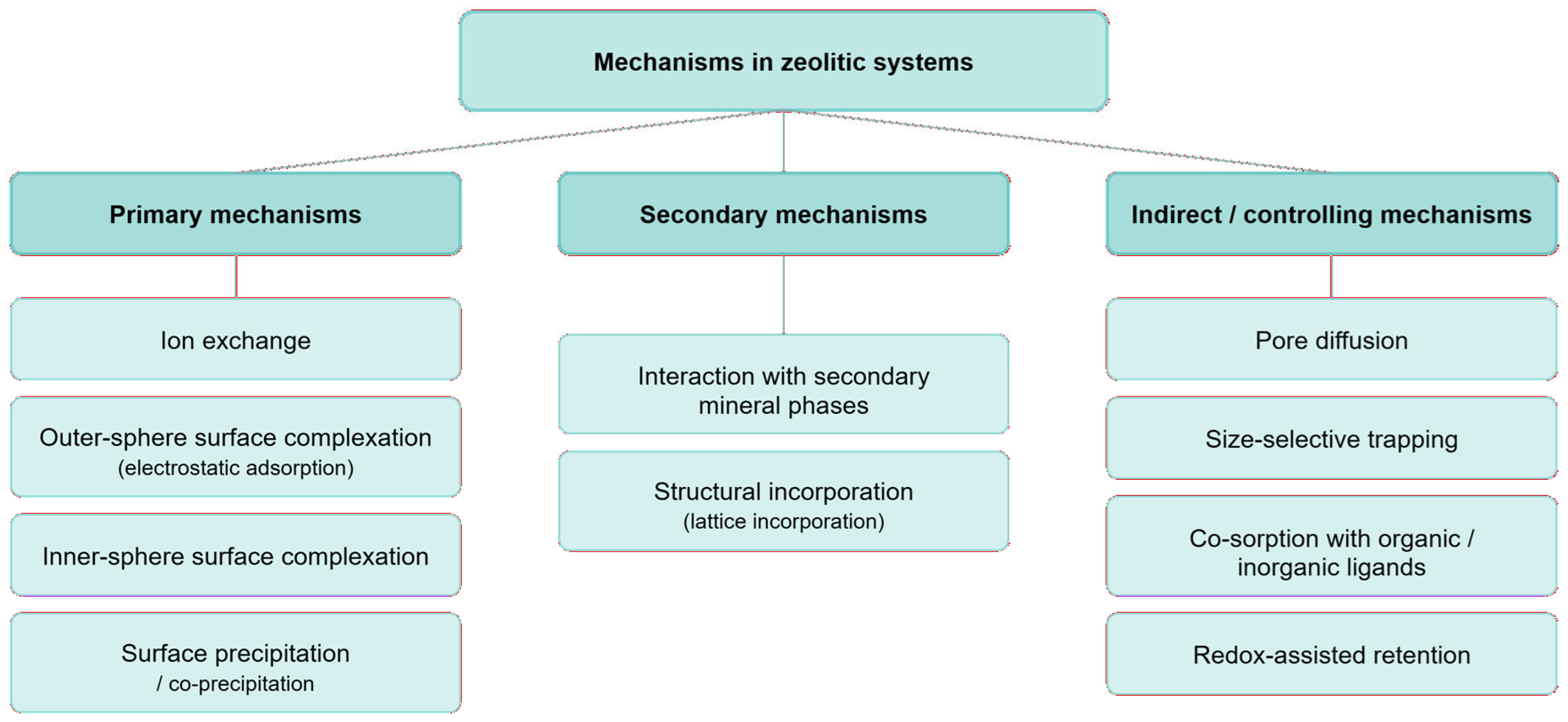
Figure 5 shows the main sorption mechanisms that are identified, based on the literature, in zeolites.
As illustrated in Figure 5, ion exchange represents the dominant retention mechanism for inorganic cations, while surface complexation and electrostatic adsorption play supporting roles depending on solution chemistry. Ion exchange is the primary and most widely studied mechanism governing cation sorption in zeolites. It involves the replacement of charge-balancing cations (e.g., Na+, K+, Ca2+, Mg2+) in the zeolite framework by ions from the solution. The efficiency and selectivity of this process depend on ionic charge, hydrated ionic radius, and the structural properties of the zeolite [34]. It also plays a dominant role in heavy metal sorption [29], where it is driven by the permanent negative charge of the aluminosilicate structure, with contributions from electrostatic interactions, surface complexation, and pore adsorption [115]. It is also worth noting that some research suggests that the actual ion-exchange mechanism in zeolites can be more complex than the classical purely cation-exchange model [52]. Chukanov et al. [52] find that ion-exchange processes involve not only metal cations, but also H3O+ ions (in reactions with CuSO4) and, to a lesser extent, NO3 anions (in reactions with Pb(NO3)2) [52].
Surface complexation is another important sorption mechanism, involving the binding of metal ions to surface hydroxyl groups (≡Si–OH and ≡Al–OH) located on the external surface and pore entrances of zeolites. This process leads to the formation of inner- or outer-sphere complexes, which enhance sorption strength and stability, particularly at neutral to alkaline pH [115]. Inner-sphere complexation occurs through a direct interaction between metal ions and surface functional groups, accompanied by partial or complete dehydration, resulting in strong and stable binding. However, this mechanism is slower than ion exchange and strongly dependent on pH and the chemical properties of the metal ion [34]. This mechanism was confirmed, for example, by Kouznetsova et al. [116]. They studied the sorption mechanisms of Cu2+, Pb2+, and Sr2+ on zeolite NaY, mesoporous aluminosilicate, and their composite materials. It was concluded that while ion exchange dominates in pure zeolite, inner-sphere surface complexation is essential for enhancing sorption stability and resistance to competitive ions, particularly in composite systems.
Another mechanism that can be classified as outer-sphere complexation is electrostatic adsorption. It involves the attraction of positively charged metal ions to the negatively charged zeolite surface through nonspecific electrostatic interactions, without the formation of direct chemical bonds [115]. This outer-sphere complexation mechanism occurs with the hydration shell retained between the ions and the surface. It is rapid and reversible, strongly dependent on pH and ionic strength, and mainly enhances the initial uptake rate. Electrostatic adsorption is particularly significant at lower pH values and in the presence of high concentrations of competing ions [34]. Electrostatic adsorption on zeolites has been reported as a dominant, rapid, and reversible mechanism at low pH, where metal ions are retained in the electrical double layer through nonspecific Coulombic interactions without direct chemical bonding [117,118].
Other phenomena that can be observed in zeolites are interactions with secondary mineral phases. In many natural and modified zeolitic materials, the zeolite framework is accompanied by secondary mineral phases, most commonly, iron(III) oxyhydroxides (e.g., goethite, ferrihydrite, hematite), manganese oxides, or amorphous aluminosilicates. These phases are typically present as coatings, discrete nanoparticles, or hetero-aggregates on the external surface and within pore entrances of zeolite grains. Unlike the zeolite framework, which predominantly facilitates ion exchange, secondary phases provide high-affinity surface functional groups capable of strong and often irreversible metal binding [115,119]. Iron(III) oxyhydroxides possess a high density of reactive ≡Fe–OH groups that act as specific adsorption sites for metal cations and metalloids through inner-sphere surface complexation and ligand-exchange mechanisms. As a result, metals such as Pb2+, Cu2+, Cd2+, As(V), and Cr(VI) are bound more strongly and selectively than on zeolite-exchange sites, and their retention is typically less reversible under changing geochemical conditions [115,119,120].
In turn, surface precipitation (precipitation/co-precipitation) may occur when metal ions precipitate on the zeolite surface as poorly soluble hydroxides or (hydr)oxides (e.g., Pb(OH)2, Zn(OH)2), particularly under elevated pH conditions. At higher pH values, metal hydroxide precipitation becomes increasingly significant, leading to the deposition of solid phases on the external surface of the zeolite or within its pore system. Although this process can markedly increase the apparent removal efficiency and result in very stable immobilization of metals, it does not always represent true sorption and may limit reversibility and hinder the regeneration potential of the zeolitic material [34,121].
Structural incorporation involves the substitution or incorporation of metal ions into the zeolite crystal framework or lattice defects, where they occupy tetrahedral or extra-framework positions, particularly in synthetically modified zeolites or during long-term contact. This mechanism leads to nearly irreversible metal immobilization, as the incorporated species become an integral part of the zeolite structure rather than being surface-bound or exchangeable [122,123].
Also in the reaction, some supportive mechanisms can be observed, including pore diffusion and size-selective trapping, which involve the migration of metal ions or metal–ligand species into the zeolite’s microporous channels and cages, where transport is governed by pore size and channel topology. As a result, metals with suitable hydrated dimensions may become kinetically hindered or physically confined, primarily affecting uptake rates and sorption selectivity rather than long-term immobilization [124]. In addition, co-sorption with organic or inorganic ligands may occur, whereby metals form complexes (e.g., with OH, CO32−, SO42−, or natural organic matter) that are subsequently retained within the zeolite structure, a process particularly relevant in natural waters [125]. Finally, redox-assisted retention can take place in systems containing Fe or Mn, where changes in metal oxidation state (e.g., Cr(VI) to Cr(III)) lead to the formation of less mobile species that are more readily sorbed by the zeolite [126,127].
In Table 4, the examples of different mechanisms of zeolites’ activities against the pollutants are presented. They are ordered according to the group of pollutants. It is visible that in most cases, ion exchange is the most typical mechanism.
Sorption in the zeolite–aqueous solution system is complex and multi-mechanistic, and the contribution of individual processes depends on the chemical conditions of the solution as well as the properties of both the zeolite and the sorbed ions. [34]. The relative contribution of different mechanisms is governed by solution pH, ion type and concentration, hydrated ionic radius and charge, as well as the presence of competing ions, resulting in a dynamic balance of multiple simultaneous processes during practical water treatment using zeolites [34].
Kinetic and equilibrium modeling (isotherms) is commonly applied to describe and interpret the sorption behavior of zeolites in aqueous systems, as it enables identification of the dominant retention mechanisms, assessment of surface heterogeneity, and prediction of sorption capacity under varying conditions [138]. Isotherm models such as Langmuir (monolayer adsorption on homogeneous sites), Freundlich (multilayer adsorption on heterogeneous surfaces), and hybrid models, including Sips and Redlich–Peterson, are widely used to capture non-ideal sorption behavior frequently observed for zeolites [138]. Additional models, such as Temkin, Dubinin–Radushkevich, Toth, and Jovanovic, provide further insight into sorption energetics, pore filling effects, and the relative contribution of physical versus chemical interactions [138].
Beyond their role as sorption materials, zeolites can simultaneously function as biological carriers in biologically assisted wastewater treatment systems [139]. Their porous structure, high specific surface area, and surface charge promote microbial attachment and biofilm development, enabling the retention of active biomass within treatment units [140]. In such systems, zeolites provide a dual functionality: adsorption of inorganic and organic contaminants contributes to buffering concentration fluctuations and reducing inhibitory effects, while the immobilized microbial communities enable biological degradation and nutrient removal [141].
This combined sorption–biological mechanism has been exploited in fixed-bed biofilters, moving bed biofilm reactors, and hybrid adsorption–biodegradation systems, particularly for ammonium, organic nitrogen, and biodegradable micropollutants. In this context, zeolite properties such as the Si/Al ratio, ion-exchange capacity, and surface modification influence not only adsorption selectivity but also microbial colonization and long-term process stability. Consequently, zeolites should be viewed as multifunctional media that bridge physicochemical and biological water treatment processes rather than as purely passive sorbents [139,141].
Understanding the dominant sorption mechanisms governing zeolite–pollutant interactions is essential for the rational design of advanced sorbent materials. The relative contribution of ion exchange, surface complexation, electrostatic interactions, and secondary mineral phases directly determines removal efficiency, selectivity, and regeneration behavior. Therefore, targeted modification strategies are commonly employed to enhance or activate specific mechanisms, depending on the nature of the contaminant and the required performance characteristics of the sorbent. This mechanistic perspective provides the basis for the modification approaches discussed in the following section.

4. Modification Strategies

The modification of zeolites is a very important element of designing effective sorption materials for water treatment. Thanks to different processes, the adsorption performance of zeolites can be significantly enhanced through ion exchange, acid activation, surface functionalization (e.g., surfactants and –NH2 or –SH groups), and the deposition of metal oxides such as Fe, Zn, or Ti [142]. In particular, zeolite–metal oxide composites exhibit superior efficiency because several mechanisms operate simultaneously, including adsorption, ion exchange, surface complexation, and redox reactions. This synergistic behavior is especially effective for the removal of redox-active contaminants such as arsenic and chromium, leading to higher selectivity and stability of the adsorbents [142].
At the same time, it is worth noting that zeolites are structurally stable materials, resistant to mechanochemical modifications such as milling or grinding; consequently, effectively improving their properties requires more tailored modification strategies [143]. The most popular modification methods are:
  • Ion-exchange modification: This method relies on replacing the native charge-compensating cations in the zeolite framework (e.g., Na+, Ca2+) with other metal or ammonium ions. Ion exchange is commonly used to improve selectivity toward specific contaminants and to introduce catalytically or redox-active species into the zeolite structure [142]. This kind of modification significantly enhances the sorption performance of natural zeolites, particularly for contaminants that are weakly retained by the unmodified material. Cationic surfactant modification is crucial for enabling effective adsorption of anionic species such as As(V) and Cr(VI) by creating positively charged surface sites, while metal modifications (e.g., Fe or Cu) increase the number of active binding centers and promote the uptake of anions through surface complexation or ligand-exchange mechanisms [29].
  • Chemical activation (acidic and alkaline treatments): Chemical activation includes both acid treatment (partial dealumination, removal of impurities, increase in surface area) and alkaline treatment (selective silicon dissolution and creation of mesoporosity). These processes modify the Si/Al ratio, porosity, and accessibility of active sites, leading to improved adsorption kinetics and capacity [142]. It is quite commonly applied to modify natural zeolites. For example, Kuldeyev et al. [43] confirmed that the modification of zeolites, including treatment with hydrochloric acid, improved their sorption properties by altering the surface structure, increasing porosity, and enhancing the accessibility of active adsorption sites. These structural changes translated into higher filtration efficiency and improved removal performance for target contaminants in aqueous systems [43]. These results are also confirmed by Eprikashvili et al. [99]. They demonstrated that acid-modified natural zeolites (clinoptilolite and mordenite) modified with hydrochloric acid (HCl) constitute an efficient, low-cost, and structurally stable alternative to advanced synthetic sorbents for the removal of pharmacopollutants from water [99]. The key factor behind their high performance is controlled acid treatment, which tailors the zeolite framework and generates a high concentration of active surface sites, enabling effective adsorption of large and chemically persistent organic molecules [99].
  • Surface functionalization involves the introduction of organic or inorganic functional groups (e.g., –NH2, –SH, –COOH, or surfactants) onto the zeolite surface, enhancing selective complexation, electrostatic interactions, and hydrophobic or organophilic properties [142]. For example, thiol-functionalized zeolites show a markedly increased affinity toward soft metal ions such as Hg2+ and Pb2+ due to the formation of strong metal–sulfur complexes [144].
  • Deposition of metal oxides or hydroxides (e.g., FeO(OH), Fe3O4, Fe2O3, TiO2, ZnO) onto the zeolite surface or within its pore system results in hybrid materials exhibiting synergistic effects of adsorption, ion exchange, surface complexation, and redox reactions. This method is particularly effective for contaminants such as As and Cr [142]. For instance, iron-oxide-coated zeolites show enhanced removal of arsenic and hexavalent chromium due to strong inner-sphere complexation with Fe-hydroxyl groups and concurrent redox transformation of Cr(VI) to less mobile Cr(III) [145,146].
  • Thermal and structural modification: Thermal treatments such as calcination can partially or fully destroy the original zeolite framework, forming highly reactive metazeolites. Additionally, hydrothermal processes may induce recrystallization and formation of secondary zeolite phases (e.g., phillipsite, Na-P), altering porosity and ion-exchange properties [147]. However, the literature also shows successful implementation of thermal treatment. Șenilă et al. [135] significantly enhanced the sorption capacity of natural zeolite for Cs+ and Sr2+ ions by altering the availability of exchangeable cation sites and removing structural water by thermal treatment in an optimal temperature range. However, exceeding this range caused partial framework degradation and a consequent decline in sorption performance [135].
  • As a method of modification, different composites and hybrid materials are also considered. Their formation involves combining zeolites with carbon materials (e.g., biochar, activated carbon, graphene), polymers, or biopolymers to create multifunctional composites [142]. These hybrids integrate adsorption, surface complexation, redox activity, and physical immobilization while improving mechanical stability and reusability. For example, zeolite–biochar and zeolite–graphene composites show enhanced removal of heavy metals and oxyanions due to the synergistic combination of porous mineral frameworks and redox-active or highly conductive carbon phases [148].
  • Magnetic modification of zeolites involves the incorporation of iron-based phases (e.g., Fe3O4, γ-Fe2O3) into the zeolite framework or onto its surface, enabling rapid magnetic separation, simplified recovery, and improved regeneration. This class also includes multifunctional hybrid systems in which zeolites serve as structural supports for multiple active components—such as magnetic nanoparticles, catalytic phases, or redox-active species—operating simultaneously to enhance removal efficiency and operational flexibility [110,149]. For example, Fe3O4-modified zeolites maintain the ion-exchange and adsorption capacity of the zeolite matrix while allowing fast magnetic retrieval from treated water and repeated adsorption–desorption cycles with minimal performance loss [150].
  • Biological and framework-level modifications encompass both the immobilization of microorganisms or enzymes on zeolite surfaces and the isomorphous substitution of framework atoms, such as Fe, Ti, or Ga replacing Si or Al. Enzyme or cell immobilization enhances catalytic specificity, stability, and reusability, while framework substitution tailors the intrinsic reactivity, charge distribution, and redox properties of zeolites. Together, these strategies enable advanced environmental applications by coupling biological functionality with precisely engineered inorganic active sites [151]. For instance, enzymes immobilized on zeolite-based or hierarchical zeolitic supports exhibit improved operational stability and repeated usability, enabling synergistic adsorption–biocatalysis pathways for the degradation of organic pollutants [152,153].
Selected examples for the successful modification process are presented in Table 5. The first part of the table is dedicated to the natural zeolite as a group, which very often undergoes modification to increase efficiency. The second part of the table presents the selected examples of modifications made to synthetic zeolites.
The modification of zeolites, both natural and synthetic ones, allows for wider application of these materials, including usage in a new area due to the changing properties. For example, iron-modified zeolite acts not only as a physical support but also as a high-surface-area stable carrier for reactive iron phases, enabling high removal efficiency, resistance to competing ions, and good reusability—making it particularly suitable for long-term permeable reactive barrier applications [165]. Another example is modified natural clinoptilolite zeolite, which, after modifications, gains high adsorption capacity—especially for Cu2+—and strong performance at low pH, while the main limitation is that efficiency decreases as metal concentration increases and adsorption is weak at neutral or alkaline pH [12]. Many works also concluded that transition-metal-functionalized zeolites are promising sorbents for the removal of anions, not only cations [106].
Smart modification can also enhance functional properties, as well as give some benefits for sorbent usage itself. For example, Tomina et al. [167] modified natural zeolite, which serves as a key functional support, for the stable deposition of magnetic active-phase ZnFe2O4 nanoparticles, which were incorporated onto the zeolite matrix at different loadings [167]. The synergistic interaction between the porous zeolite structure and reactive zinc ferrite nanoparticles enhanced Cu2+ adsorption while preserving the textural properties of the support. Importantly, the magnetic properties imparted by ZnFe2O4 allowed easy separation and recovery of the sorbent from water using an external magnetic field, making the composite highly attractive for practical water and wastewater treatment applications [167].
Humelnicu et al. [168] prepared a combination of natural zeolites with biopolymers (chitosan) in the form of ion-imprinted cryogels with anisotropic porosity, enabling the production of highly selective, rapid, and regenerable sorbents for the purification of complex industrial wastewater [168]. Also, Bandura et al. [169] investigated the compositions of zeolites, synthesized from coal fly ash, with chitosan and confirmed their efficiency for water treatment [169]. Synthetic NaP1 zeolite effectively removes phenol and Cu(II) ions from multicomponent aqueous systems, and its surface modification with chitosan significantly enhances adsorption performance, particularly toward organic pollutants [169].
It is also worth mentioning that the modification of zeolites can be made using waste materials. Such a possibility was shown by Wibowo et al. [170]. They modified natural zeolite by controlling the Si/Al ratio by using low-cost and readily available waste materials such as pumice (as a silicon source), and discarded aluminum cans (as an aluminum source), significantly enhancing its adsorption performance toward ions responsible for water hardness [170]. The optimized Ze–Si/Al zeolite with a Si/Al ratio of 0.67 exhibited high affinity for divalent cations, primarily Ca2+ and Mg2+, through ion-exchange and surface adsorption mechanisms. Consequently, this modified zeolite represents an effective, stable, and environmentally friendly adsorbent with strong potential for application in simple and sustainable water-softening and treatment systems [170].
Smart modifications that are proportionate and accurate are required. Different studies also indicate that an excessive amount of modifying substances leads to extensive encapsulation of zeolite crystals, thereby reducing the effective pore aperture for sorption. Modifiers may result in a reduction in the effective reactive surface area [15]. Also, research provided by Prepilková et al. [128] shows that despite the very large specific surface area of clinoptilolite zeolites (6673 cm2/g), the authors emphasize that it does not correlate directly with efficiency, indicating the dominance of ion-exchange processes over surface adsorption [128]. Therefore, in some cases, zeolite modifications alter its activity but do not destroy its structure. Similarly, Arsi et al. [151] also tried to modify zeolite 13X to improve chromium sorption (including Cr(VI)) by yeast. Despite the favorable sorption properties of zeolite, chromium removal was limited due to the poor adhesion of the yeast (Wickerhamomyces anomalus) biofilm and low extracellular polymeric substance production, resulting in a less stable and less effective biological system [151].
Despite frequently reported improvements in sorption performance after modification, long-term stability and regenerability of modified zeolites remain critical limiting factors. Numerous studies demonstrate a gradual decline in removal efficiency after repeated adsorption–desorption cycles, often associated with pore blockage, partial framework degradation, or irreversible binding of target ions. In some cases, aggressive regeneration conditions (e.g., strong acids or bases) further accelerate structural damage, highlighting a trade-off between regeneration efficiency and material durability.
The modification strategies discussed above significantly extend the functional potential of zeolite materials, enabling their adaptation to diverse water treatment challenges. These tailored properties translate directly into improved performance under real operating conditions, including higher removal efficiency, enhanced selectivity, and better mechanical and chemical stability. Consequently, modified zeolites have found increasing application in practical water and wastewater treatment systems, as discussed in the following section.

5. Applications for Zeolites in Water Treatment

Research shows that zeolites, after modification, can be effective in real wastewater (industrial and domestic) and capable of purifying lake and river water to meet WHO/EPA standards [110]. It should be emphasized that sorption efficiencies reported for real waters are frequently lower than those obtained in synthetic solutions. The presence of competing ions (e.g., Ca2+, Mg2+, Na+, K+), natural organic matter, and variable pH conditions can significantly suppress ion-exchange and surface-complexation mechanisms. This effect is particularly pronounced for natural zeolites with non-uniform exchange sites, whereas synthetic and hybrid materials may retain higher selectivity at the expense of increased cost and processing complexity.
Although numerous studies report promising results for zeolite-based systems, only a limited number of investigations address performance under realistic operational conditions. In particular, continuous-flow experiments, long-term stability tests, and studies based on real wastewater or surface water are still underrepresented compared to batch laboratory experiments. This methodological imbalance highlights a gap between laboratory-scale validation and full-scale implementation, which remains a critical challenge for practical deployment.
Table 6 presents the selected examples of zeolites in water treatment applications. The applications have been selected to show the wide spectrum of possibilities for applying zeolite materials and involve treatment of drinking water, wastewater treatment, industrial wastewater, agricultural runoff and nutrient removal, saline water and freshwater purification systems, and others.
Zeolites are quite often investigated in the context of agricultural activity. Bocharnikova et al. [179] present the application of a natural zeolite-based sorption filter for the preparation of surface water from the Volga River (Volgograd region, Russia) intended for agricultural irrigation, where water is commonly used without prior treatment [179]. The zeolite filter was used to remove copper and zinc ions, petroleum products, nitrites, and ammonium nitrogen, reducing their concentrations to sanitary standards in order to prevent soil contamination, crop uptake of toxic compounds, and groundwater pollution during long-term irrigation [179]. The technology is proposed as a cost-effective and environmentally friendly pretreatment solution for irrigation water in agriculture, improving water quality while minimizing impacts on agroecosystems [179]. Additional advantages of this solution are long-term durability. The authors note that the zeolite filter bed is characterized by a long service life—estimated by them at approximately five years—although this was not directly verified experimentally within the scope of the presented studies [179].
Abdelmoneim et al. [180] also conducted research related to agricultural waters. This time, the issue concerned the purification of waters that had become contaminated as a result of agricultural activity. They reported treatment of nitrate-contaminated groundwater from Wadi El-Assiuti (Upper Egypt), where elevated NO3 concentrations posed a risk to drinking water quality due to agricultural activities [180]. A synthetic analcime zeolite, produced from kaolinite via alkaline fusion with NaOH followed by hydrothermal crystallization, was applied as a low-cost adsorbent. Under optimal conditions (pH ~6–6.5, contact time ~60–90 min), analcime achieved ~80% nitrate removal (up to ~97% with extended contact) [180]. The team also addressed polluted water by introducing sodalite, synthesized from natural kaolin and sand. This targeted adsorbent aims to reduce groundwater salinity and Na+ ions, building upon their previous work on nitrate removal [181]. This research proves the efficiency of sodalite zeolite for removing Na+ and TDS mitigation, including reducing groundwater salinity and Na+ concentration, achieving up to ~80% sodium removal [181].
However, zeolites have a huge potential for practical applications. The number of articles that presented full-scale studies is quite limited. One, presented by Khamzina and Belopukhov [182], demonstrated results that corresponded to a pilot stage and demonstrated that natural Kazakhstani clinoptilolite zeolites maintain high efficiency in removing Fe2+ ions under flow conditions and when utilizing actual tap water from the city of Almaty [182]. The results confirm the feasibility of their practical implementation in water treatment systems without the need for costly and complex chemical modification of the sorbent material [182].
Another example of a real-scale pilot wastewater treatment system is the implementation in nine rural public schools in the Coquimbo Region (north-central Chile), where low-cost filtration units were installed to treat greywater from washbasins for reuse in irrigation under conditions of severe water scarcity [183]. The pilot focused on greywater reclamation, using sequential filtration systems composed of heat-activated carbon as the main adsorbent, and natural zeolite as a supporting and polishing medium, where zeolites played a key role in reducing turbidity, thus stabilizing filtration performance and protecting the activated carbon layer [183]. As a result, the system achieved over 90–100% turbidity removal, significant reductions in organic load, compliance with national reuse regulations, and monthly water savings of up to tens of thousands of liters, enabling safe irrigation of gardens and green areas in the schools [183].
An interesting case study is also described by Castro et al. [89]. They comprised a 1.5-year full-scale field trial, conducted in an informal settlement in the eThekwini municipality (South Africa), where natural clinoptilolite zeolite was implemented as part of a non-sewered sanitation system. The system treated high-strength blackwater from communal toilets, periodically supplemented with yellow water (urine), resulting in highly variable and elevated ammonium loadings. It operated under real-world conditions without tight control of hydraulic or nitrogen loading [89]. Comparison with laboratory tests showed that the field sorption capacity (14.2–16.5 g NH4-N/kg) closely matched the laboratory-determined capacity (16.2 ± 0.13 g NH4-N/kg). Overall, the results demonstrate that natural clinoptilolite is a technically mature, regenerable, and effective ion-exchange material, performing nearly as efficiently in field conditions as under laboratory settings [89].
To bridge the discussion between reported application performance and broader technological feasibility, a comparative evaluation of different zeolite categories is required. Table 7 integrates key aspects such as cost, sorption efficiency, and scalability, offering a concise framework for interpreting experimental results in the context of real-world water treatment implementation.
Although numerous studies demonstrate the effectiveness of zeolite-based systems in practical applications, their technological relevance can be fully assessed only in comparison with established water treatment materials. A comparative analysis with conventional sorbents and membrane-based technologies allows for a clearer evaluation of the advantages, limitations, and niche applications of zeolites within modern water treatment frameworks. Direct quantitative comparison between zeolite categories remains challenging due to the lack of standardized reporting across studies. Reported material costs, regeneration performance, and removal efficiencies are strongly dependent on site-specific factors, process configuration, and experimental scale. As a result, most available data originate from laboratory or early pilot studies and cannot be directly extrapolated to full-scale operation without uncertainty.

6. Comparison with Conventional Treatment Materials

This chapter compares zeolites with the most common materials used in water treatment, including activated carbon, polymer-based sorbents, and membrane-based systems. The literature defines some advantages of zeolites compared to traditional sorption materials. The most significant technical features seem to be [28]:
  • Molecular selectivity (molecular sieving effect);
  • High chemical and oxidative stability;
  • Potential to couple sorption with degradation (reactive sorption).
Zeolites exhibit moderate to high selectivity that can be effectively tuned through ion exchange, surface functionalization, framework substitution, and the formation of hybrid or biological systems; however, their pristine forms are often broadband sorbents rather than perfectly selective materials. Zeolites possess well-defined pore sizes that enable the selective removal of small and highly mobile compounds while sterically excluding larger organic molecules. This size-selective sorption results in reduced competition with natural organic matter (NOM), making zeolites less susceptible to fouling compared to other traditional sorbents, such as activated carbon [28]. Activated carbon generally shows low intrinsic selectivity, as adsorption is primarily governed by surface area and hydrophobic interactions, leading to nonspecific uptake of a wide range of organic contaminants. Moazeni et al. [184] show that synthetic ion-exchange resin was generally more efficient than natural zeolite, particularly at higher Pb2+ concentrations (50–250 mg/L). However, at low Pb2+ concentrations (around 25 mg/L), the removal efficiencies of zeolite and resin were comparable, highlighting the potential of natural zeolite for environmental applications with low contamination levels [184]. Polymer sorbents offer the highest selectivity among the compared materials since their chemical structure and functional groups can be precisely designed to target specific ions or molecules, although this often comes at the expense of universality [185]. In contrast, membrane systems provide high separation selectivity based on size exclusion, charge effects, or affinity interactions, but this selectivity is process-driven rather than sorbent-driven and is sensitive to fouling and operating conditions [186,187]. The comparative research studies provided by Prepilková et al. [128] also show that zeolite is characterized by the highest sorption capacity among three mineral sorbents tested (zeolites, bentonite, and sludge) [128], which also confirms its effectiveness.
In terms of regeneration, zeolites show very good regeneration potential, as they can often be regenerated through simple ion exchange, pH adjustment, or mild chemical treatment, allowing multiple reuse cycles with limited structural degradation [188]. Zeolites are mineral sorbents that are largely inert toward strong oxidants such as ozone, hydrogen peroxide, and hydroxyl radicals. Unlike activated carbon, they do not consume oxidants during treatment, allowing their use in oxidative environments without loss of structural integrity or efficiency [28]. Also, transition metal ions such as Fe2+/Fe3+ can be immobilized on zeolite ion-exchange sites, where they act as heterogeneous Fenton or photo-Fenton catalysts. This enables in situ degradation of strongly sorbed contaminants, including PFAS, directly on the zeolite surface after sorption [28]. Activated carbon can also be regenerated, but the process typically requires high-temperature thermal treatment or chemical regeneration, which is energy-intensive, costly, and can progressively reduce adsorption capacity. Polymer sorbents generally exhibit moderate regeneration capability: although selective desorption is possible, repeated regeneration may lead to chemical degradation, fouling, or loss of functional groups [189]. When compared with sorption-based materials, particularly those operating via ion exchange, membrane systems are the least favorable in terms of regeneration, since fouling control relies mainly on chemical cleaning rather than true material regeneration, and membranes often require periodic replacement rather than long-term reuse [190,191].
Except for the technical features for practical applications, some other factors have a critical meaning, including availability, cost, environmental impact, and circular economy potential.
Taking into consideration the availability, zeolites are among the most accessible materials for water treatment, as they occur naturally, can be synthesized on a large scale, and may also be produced from waste-derived raw materials such as fly ash, enabling local production [55,188]. Activated carbon is likewise widely available commercially, but its production and regeneration are energy-intensive, which can limit cost-effective use despite its global supply [192]. Polymer sorbents show more limited availability because they rely on specialized chemical manufacturing and petrochemical feedstocks, and are often designed for specific contaminants rather than broad application [193]. In comparison with other materials, membrane systems are technologically mature but exhibit lower practical availability due to high production complexity, infrastructure requirements, and operating costs, which restrict their deployment, particularly in decentralized or resource-limited water treatment scenarios [194,195].
Most of the articles suggested that zeolites are a low-cost sorbent [166,182]. Zeolites are generally among the most cost-effective materials available for water treatment because they can be sourced naturally, synthesized at a large scale, or produced from low-value waste streams such as coal fly ash, resulting in relatively low material and operational costs [51,102]. Zeolites are inexpensive compared to many other adsorbents, but a full assessment of their cost-effectiveness depends on several factors, including raw material availability, processing complexity, and the expenses associated with modification and regeneration. Despite these uncertainties, their low initial cost combined with strong adsorption performance makes zeolites an attractive option for economically viable disinfection and remediation applications [13]. Recent market data indicate that the price of zeolites varies significantly depending on their type, purity, and region. According to the IMARC Group’s pricing report, average zeolite prices in Q4 2025 ranged from 564 USD/ton in Malaysia to 935 USD/ton in the United States. Natural clinoptilolite—commonly used in water treatment—remains substantially cheaper, with commercial suppliers offering it in the range of 80–200 USD/ton, while higher-grade natural materials for filtration are typically priced around 95–150 USD/ton [196,197]. In contrast, synthetic zeolites such as ZSM-5 or 13X reach considerably higher values. Industrial-grade ZSM-5 is often sold at 220–580 USD/ton, whereas specialized molecular-sieve grades (3A, 13X) may cost between 669 and 1 869 USD/ton, depending on particle size, purity, and application requirements. These data clearly show that although natural zeolites are inexpensive, the economics of using zeolites in environmental applications depend strongly on raw material availability, processing complexity, and modification or regeneration costs, which together shape the overall cost-effectiveness of the process [13,196]. Activated carbon typically involves higher costs due to energy-intensive activation processes and often limited economic feasibility of regeneration, especially when high-grade carbons are required [192]. Polymer sorbents are usually more expensive because they rely on complex chemical synthesis, petrochemical feedstocks, and tailored functionalization, which increases both production and replacement costs [198]. In contrast, membrane systems represent the highest overall cost category, driven by expensive materials, sophisticated manufacturing, high-energy demand during operation, and maintenance issues such as fouling and periodic membrane replacement, making them less economically accessible for large-scale or decentralized water treatment applications [195].
In terms of environmental impact and circular economy potential, zeolites are generally considered environmentally favorable materials due to their mineral origin, low toxicity, long service life, and potential production from industrial waste streams, which reduces both resource consumption and waste generation. Zeolites offer the highest compatibility with the circular economy approach, as they can be produced from industrial byproducts such as coal fly ash or slags, reused through multiple regeneration cycles, and safely reintegrated into environmental matrices at the end of their life cycle, closing material loops effectively [188,199]. Activated carbon has a moderate environmental footprint: while it can be produced from renewable biomass, its high-energy demand during activation and regeneration significantly increases associated emissions. Also, it limits recyclability after multiple cycles, reducing its overall sustainability [192,200]. Polymer sorbents tend to have a higher environmental impact because they are derived mainly from petrochemical feedstocks, are less biodegradable, and may pose challenges related to disposal and microplastic formation [193]. However, it should be noted that there is a realistic possibility of this situation changing in the future, owing to the rapid development of biodegradable and bio-derived polymers [201]. Additionally, lower long-term chemical stability of polymeric sorbents compared to mineral sorbents, which adversely affects the long product life cycle, is a key premise of the circular economy [185]. Membrane systems exhibit the highest environmental burden overall, resulting from energy-intensive manufacturing, operational energy requirements, chemical cleaning agents, fouling-related waste, and end-of-life disposal issues, despite their high treatment efficiency. It also has the lowest circular economy compatibility due to complex multimaterial designs, short operational lifetimes, and other reasons listed above [194,202].
The short summary of the presented comparison is presented in Figure 6.
It should also be noted that in the practical dimension, zeolites do not compete with traditional sorbents, but rather constitute a strategic element of a new generation of water treatment systems [28]. Their potential lies in the selective removal of small, mobile, ionic PMTs, offering resistance to oxidation as well as the capability for sorption accompanied by chemical degradation [28].

7. Challenges and Limitations

Despite their high sorption potential and sustainability advantages, the practical application of zeolites remains constrained by some challenges, which limit their broader implementation in advanced water treatment systems. From a methodological perspective, an additional limitation of the current body of literature is the limited reproducibility and standardization of experimental conditions. Differences in sorbent preparation, particle size, solid-to-liquid ratios, contact times, and evaluation metrics often hinder direct comparison between studies. The lack of standardized testing protocols complicates the objective assessment of zeolite performance and underscores the need for harmonized experimental methodologies and reporting frameworks to enable reliable benchmarking and facilitate the translation of laboratory results to practical applications.
Although zeolites are often cited as universal environmental sorbents, Łożyńska et al. [87] demonstrate that their role in the removal of orthophosphates from hypolimnetic waters is limited (and prevents eutrophication) [87]. Limestone and clay aggregates prove significantly more effective than zeolite (mainly clinoptilolite), while a hybrid system—combining high phosphorus retention with favorable bed hydraulics—yields the best results [87]. Limitations were also observed for such pollutants as triclosan and bisphenol A, where zeolites have much lower efficiency than other commercial compounds such as granular activated carbon, granular ferric hydroxide, and surfactant-modified bentonite organoclay [44].
Some research also shows that zeolites can have limited efficiency in wastewater. Brossat et al. [203] show that the clinoptilolite zeolite released notable amounts of its own framework constituents—including potassium and silicon—when exposed to treated wastewater, indicating limited chemical stability under real wastewater conditions. This instability is further amplified by the complex composition of wastewater, where numerous ions (Ca, Mg, Na, K, P, Si, trace elements, and dissolved organic matter) compete for sorption sites; as a result, the zeolite becomes saturated with dominant, high-concentration ions, effectively suppressing its selectivity [203]. Similarly, Masoud et al. [172] investigated zeolite NaX in real environmental water samples, including seawater, brackish water, freshwater, and industrial wastewater. The results clearly showed that zeolite maintained a high removal efficiency for Pb2+ across all tested water matrices, with removal rates typically reaching 93–99%, even in saline and complex waters [172]. In contrast, Cd2+ removal was more sensitive to the composition of the water matrix, particularly to the presence of competing ions such as Na+, Ca2+, and Mg2+ [172]. This shows that the effectiveness of the process of adsorption for some ions is higher in freshwater and decreased in brackish and marine environments, which can be a limitation for applications in practical heavy-metal removal from contaminated waters.
A certain limitation for applying zeolites can only work under strongly acidic conditions, which limits their efficiency. Under strongly acidic conditions, the high concentration of H+ ions competes with metal cations for exchange sites in zeolite frameworks, leading to protonation of surface groups and a significant reduction in cation-exchange capacity and metal removal efficiency [115,204]. However, the study conducted by Obiri-Nyarko et al. [204] indicates that, under strongly acidic conditions, the effectiveness of the zeolites can be enhanced by combining them with organic materials, although this entails a trade-off between chemical reactivity and hydraulic durability [204]. However, not all provided work confirms this phenomenon. For example, Moazeni et al. [184] show that natural zeolite demonstrated high effectiveness in an acidic environment, with an optimum in the pH range of 3–5, yielding better results than synthetic resin [184]. This is similar to Liang et al. [176], who demonstrate the preserved sorption effectiveness of zeolites (chabazite) over a wide range: pH 3–11 [176]. Such behavior of the zeolite may be advantageous from the perspective of treating industrial and mine waters.
In practical applications, the sensitivity of zeolites to pH fluctuations and temperature variations can be partly mitigated through material modification and appropriate shaping strategies. Surface modification, including ion exchange, acid or alkali activation, and functional coating, may improve chemical stability and reduce performance losses under variable pH conditions by stabilizing active sites and limiting uncontrolled ion release [205,206]. In parallel, granulation or pelletization of zeolitic materials enhances their mechanical strength and thermal robustness, facilitates handling in fixed-bed systems, and reduces attrition during prolonged operation. Such approaches are commonly applied in pilot- and field-scale installations to improve operational stability, although they may involve trade-offs related to mass transfer resistance or reduced specific surface area [207].
However, one of the common limitations of zeolites mentioned in the literature is their sensitivity to environmental conditions; in a comparative study, this sensitivity was clearly element-dependent, as the sorption of Zn2+ showed a much stronger temperature response than the sorption of Cu2+, unlike bentonite and sludge, whose performance improved more uniformly for both metals at lower temperatures [128].
One of the scale-up barriers mentioned in the literature is the use of zeolite as a powder. It is especially important in water treatment applications. This limitation is usually overcome by designing different compositions. One interesting conception of mechanical immobilization was proposed by Sun et al. [208]. They proved that zeolites, suitably immobilized within the wet-laid non-woven structure, were composed of short glass fibers and low-melting PET fibers [208]. In this structure, up to 50 wt% natural zeolite was uniformly embedded, enabling simultaneous mechanical particle filtration and highly efficient (>99% initial) ion-exchange removal of Cs+ and Ca2+ from wastewater under continuous-flow conditions [208]. As a consequence, these filtration systems combine high ion-exchange efficiency with the advantage of conventional mechanical filtration. Similarly, the investigations provided by Baimenov et al. [209] confirm that zeolites retain their sorption activity even after immobilization in a polymer matrix, which is crucial for practical applications [209].
Another simple solution in this area is granulating powdered zeolite. This type of approach was investigated by Isawi [210]. In this case, the beads were prepared by dispersing nano-sized natural zeolite (mainly clinoptilolite) in an aqueous polyvinyl alcohol (PVA) and sodium alginate (SA) mixture, followed by dropwise gelation and cross-linking. Glutaraldehyde was used as a cross-linking agent to form stable Zeo/PVA/SA composite beads with improved mechanical strength and adsorption performance [210]. Also, Alagarsamy et al. [211] show that zeolites perform exceptionally well as components of hybrid sorbent materials rather than as standalone powders only because their incorporation into granulated or bead-type composites significantly improves mechanical stability, handling, and separation from treated water [211]. Granulation into porous beads enables practical fixed-bed or batch applications while preserving the ion-exchange functionality of zeolites as well as facilitating synergy with other active phases, such as metal oxides or hydroxyapatite. As a result, such hybrid and granulated zeolite-based materials are particularly well-suited for simultaneous removal of multiple metal ions, even in complex groundwater matrices containing competing species [211].
Although numerous studies report good regenerability of zeolite-based adsorbents, regeneration performance is often discussed qualitatively rather than quantitatively. Reported data indicate that natural and synthetic zeolites typically retain 70–95% of their initial adsorption capacity after 3–10 adsorption–desorption cycles, depending on pollutant type, regeneration method, and zeolite composition [89]. Mild regeneration approaches, such as saline washing or pH adjustment, are generally sufficient for ammonium and metal ions, whereas organic pollutants often require solvent-assisted or thermal regeneration, which may accelerate capacity loss. Importantly, regeneration efficiency tends to decrease progressively rather than abruptly, highlighting cumulative effects such as pore blockage, framework degradation, or irreversible adsorption. These findings underline the need for standardized regeneration protocols and long-term cyclic testing to enable realistic performance comparison across studies [188,212].
Investigating the potential health and environmental issues associated with nanostructured zeolites presents another challenge. Certain fibrous or nano-sized zeolites (e.g., erionite) have been reported to exhibit cytotoxic and carcinogenic effects, raising concerns about inhalation risks and environmental safety when zeolites are used in finely dispersed or nanoparticulate forms [115]. Recent life cycle assessment and techno-economic studies highlight that the overall sustainability of zeolite-based systems is often dominated by synthesis route, regeneration energy demand, and transport distance rather than sorption efficiency alone.

8. Practical Implementation and Future Directions

8.1. Guidance for Zeolite Selection

The comparative analysis presented in this review suggests that the future role of zeolites in water treatment will depend less on maximizing sorption capacity and more on strategic integration with other treatment technologies. Identifying application niches where zeolites outperform competing sorbents under realistic conditions is therefore essential for their effective deployment at larger scales.
The selection of an appropriate zeolite type for water treatment applications depends on multiple interrelated factors, including the nature of the target pollutant, matrix conditions (e.g., pH variability and competing ions), cost sensitivity, and local material availability. To support researchers and engineers in navigational decision-making, Table 8 provides a qualitative selection framework summarizing typical applicability ranges of natural, synthetic, waste-derived, and hybrid zeolites. This framework is intended as a decision-support aid rather than a prescriptive selection algorithm and should be complemented by site-specific evaluation and pilot-scale validation.
To support practical decision-making, Table 8 summarizes the qualitative criteria for selecting different zeolite categories. The qualitative nature of this table reflects the diversity of site-specific conditions encountered in real water treatment systems and the absence of a universal zeolite-based sorbent.

8.2. Future Directions

Based on the literature, the proposed future directions and key developmental milestones for zeolite-based water treatment technologies, organized across near-, mid-, and long-term time horizons from the current state toward sustainable and cost-effective treatment systems, are proposed in Figure 7.
As shown in Figure 7, one of the most dynamically developing directions for the future application of zeolites in water treatment involves the production of materials with a reduced carbon footprint, derived from waste and byproduct feedstocks. Current research increasingly focuses on waste- and byproduct-derived precursors for zeolite synthesis, with the aim of reducing energy demand and environmental impact [55,110]. Concurrently, strategies for optimizing synthesis routes are being developed, aimed at minimizing energy-intensive process steps, reducing chemical reagent consumption, and lowering the overall environmental burden [79,188]. Consequently, zeolite production is increasingly viewed not merely as a materials manufacturing process, but rather as an integral component of broader circular economy frameworks—systems in which waste is transformed into raw material, and water treatment technologies are directly linked to the principles of resource valorization and reuse.
One of the key challenges—which simultaneously represents a tangible direction for research development in the near future—is the need to standardize methods for testing and reporting the results of sorption studies. Currently, the literature concerning zeolites and other sorbents is characterized by significant discrepancies regarding the experimental protocols, operating conditions, and methods of data presentation employed; this significantly hinders a reliable comparison of material performance. Contemporary research increasingly underscores the necessity of developing unified procedures for assessing sorption capacity, selectivity, kinetics, and regenerability, as well as defining common reference contaminants and standard test conditions (e.g., pH, ionic composition, and concentrations) [213]. Such an approach would not only enhance the comparability of data found in the literature but also establish a credible foundation for benchmarking zeolites against activated carbon, polymeric sorbents, and membrane technologies, thereby facilitating the transition from laboratory-scale research to pilot-scale and industrial applications [214,215].
Zeolite composites combine the advantages of natural aluminosilicate frameworks and nanotechnology-based modifications, offering high removal efficiency, structural stability, and strong potential for environmental remediation applications. Future research should therefore focus on improving regeneration and reusability, developing environmentally friendly modification strategies, and scaling up zeolite-based composites for industrial and field-scale implementation [142]. Zeolite regeneration is a critical step for sustainable water treatment, as sorption capacity decreases with successive use, but the chapter shows that efficient regeneration is achievable by using simple chemical agents (e.g., NaCl solutions) or electrochemical methods, often restoring more than 90–95% of the original capacity [34]. The main challenge identified is the management of secondary liquid waste generated during regeneration, which motivates integrated approaches combining regeneration with metal recovery or electrochemical oxidation [34]. This type of challenge is described by Castro et al. [89], who tested clinoptilolite as an ion-exchange medium for removing NH4+–N, pointing out reducing ammonia losses during alkaline regeneration, and developing efficient methods to recover ammonium from the saline regenerant without generating excessive brine waste [89]. In addition, optimizing regeneration duration and chemical consumption while preventing long-term physical degradation of zeolite granules under harsh field conditions remains a key challenge for sustainable, repeated reuse [89]. Krstić [34] also shows some additional challenges, including progressive loss of sorption capacity after repeated regeneration cycles, structural degradation of zeolites under harsh chemical or thermal conditions, and reduced efficiency in the presence of competing ions, which can hinder complete regeneration of active sites [34]. All of them are promising directions for future studies, especially taking into consideration that practical implementation of zeolite-based technologies is further constrained by regenerant consumption, energy demand (especially for thermal or electrochemical methods), and the need to balance regeneration efficiency with economic and environmental sustainability.
In the mid-term, the development of highly selective zeolite sorbents and their comparison with other materials seems to be crucial. These research directions are exemplary, pointed out as future studies by Radoor et al. [95]. The design of hierarchical zeolites, combining intrinsic microporosity with additional meso- or macropores, is a key strategy to overcome diffusion limitations, improve reactant accessibility to active sites, and enhance catalytic activity and stability, especially for reactions involving bulky molecules [95]. As a promising further solution, they also describe the incorporation of heteroatoms (e.g., Ti, Sn, Fe, Ga, or Zr) into the zeolite framework, which enables precise tuning of acidity and redox properties, creating new catalytic functionalities while maintaining the structural integrity and hydrothermal stability characteristic of zeolites [95].
Kupich and Madeła [27] indicate that the future use of zeolites in water treatment relies on hybridization and surface functionalization rather than on the simple application of raw minerals [27]. The greatest application potential lies in modified and composite systems, in which zeolites act not as standalone sorbents but as functional components of a larger, synergistic sorption framework [27].
The next step should be connected with hybrid and composite sorbents. One of the important further directions is designing multifunctional compositions, including combining organic and inorganic components to increase sorption efficiency. This type of approach is represented by Madahi et al. [216]. The team synthesized cellulose aerogel combined with palm fiber, metakaolin, and modified zeolite A. This composition exhibited excellent oil sorption performance and represents scalable and environmentally valuable candidates for efficient oil sorption in wastewater treatment [216]. Another solution was designed by Kumar et al. [110]. They joined the particles of modified zeolite with a polymer film. The magnetic zeolite thin film represents a significant advancement over conventional dispersed zeolites because it preserves the high surface activity of the zeolite while solving the practical limitations of powder adsorbents [110]. In this design, zeolite particles remain fully exposed and accessible within a porous polymer network, ensuring that their adsorption capacity is not lost to aggregation or polymer blockage. Unlike dispersed zeolites, which tend to settle, clump, or require filtration after use, the thin film is mechanically stable, easy to handle, and can be rapidly recovered from water by using a magnet thanks to the embedded Fe3O4 nanoparticles. This prevents material loss, eliminates separation steps, and enables simple regeneration with alkaline solutions [110].
Moreover, different hybrid systems that combine adsorption with membrane filtration or photocatalytic processes improve pollutant removal efficiency and reduce secondary waste generation. By leveraging complementary treatment mechanisms, they can also lower operational costs and enhance overall system performance [13].
This is confirmed by research conducted by Angaru et al. [149], demonstrating that pure zeolites possess limited efficacy in the purification of complex industrial wastewater, whereas waste-derived zeolites (specifically those derived from fly ash) acquire real practical value only when incorporated into hybrid composites, where they interact synergistically with nanometals and polymer matrices [149]. This direction in development—positioning the zeolite as a component of a reactive system rather than a standalone sorbent—is of pivotal importance for industrial-scale water purification technologies [149].
Grba et al. [115] highlighted that a key future avenure is the development of geopolymer–zeolite composites. Here, the geopolymer offers a mechanically robust and durable matrix, while the zeolite serves as the active sorptive phase due to its high cation exchange capacity and micro-/nanoporous structure [115]. Such hybrid materials combine high sorption efficiency with long-term immobilization, exhibit excellent resistance to aggressive chemical environments (e.g., acids and sulfates), and are particularly promising for applications involving permeable reactive barriers and stabilization/solidification technologies [115].
Gravino et al. [217] demonstrated that 3D-printed monolithic composites with a very high zeolite content (70 wt.% NaX) can be successfully fabricated using Direct Ink Writing, while preserving the crystalline structure and adsorption properties of the zeolite; the resulting materials exhibited a high specific surface area of 242 m2/g and open porosity suitable for fixed-bed operation [217]. The authors identify adsorption-based CO2 capture in fixed-bed columns as the main potential application of these 3D-printed zeolite–geopolymer monoliths [217]. This work also shows further perspectives on the usage of 3D printing technology for water treatment applications.
Another interesting strategy was the development of sorption technology with the use of zeolites, designed by Gurave et al. [218]. They incorporated a zeolitic metal–organic framework, specifically ZIF-8, as an active component of a biomimetic nanofibrous membrane that transformed the material into an advanced, multifunctional platform for wastewater treatment [218]. In this study, ZIF-8 was grown in situ on a dual crosslinked core–sheath electrospun membrane, where it enhanced surface roughness, wettability, and sorption sites, enabling efficient oil–water emulsion separation, heavy-metal ion removal, and organic solvent adsorption [218]. Additionally, it is worth noting that hidden within this solution was iomimetic inspiration. The membrane design was inspired by fish gills, whose hierarchical fibrous architecture allows selective transport and capture, a concept mimicked here to promote water permeation while rejecting oil droplets and pollutants [218].
Regarding a long perspective, life cycle assessment (LCA) and cost–benefit analysis provide a comprehensive framework for evaluating the sustainability and viability of water treatment technologies, which should be more intensively applied. These tools support informed decision-making by identifying the most cost-effective and environmentally responsible solutions [13]. Also, a smart cost analysis should be provided. For example, a study conducted by Angaru et al. [149] points out that zeolite-based compositions can be cost-effective. The authors show that despite the higher unit price of the composite material, the overall cost of treating one ton of industrial wastewater was approximately four times lower than that achieved using commercial natural zeolite due to its much higher adsorption efficiency and longer operational lifetime [149]. Moreover, the material proved to be both more cost-effective and more efficient than conventional coagulation–sedimentation processes, highlighting its strong potential for large-scale industrial wastewater treatment [149].
Zeolites are expected to play an important role as components of integrated multi-barrier treatment systems, for example, in combinations such as activated carbon followed by zeolite sorption and advanced oxidation processes, or nanofiltration coupled with zeolite-based Fenton or photo-Fenton degradation [28]. In this context, zeolites serve as selective sorbents for the preconcentration and targeted removal of PMT, while their high chemical stability and ability to host catalytic metal sites make them well-suited for systems that deliberately couple sorption with catalytic degradation [28].
The sorption properties of zeolites and similar materials can also find less obvious applications, such as harvesting water from atmospheric humidity through adsorption–desorption cycles. Chouquet et al. [219] synthesized a zeolite-like SAPO-34 sorbent with a chabazite framework (typical for zeolite materials) and processed it into porous 3D-printed bodies using Direct Ink Writing [219]. The resulting structures demonstrated high water uptake (≈25–30 wt%), retained sorption performance after thermal treatment, and were proven suitable for atmospheric moisture collection systems [219].
Beyond the directions described, one important area remains, which is the development of computer-aided techniques, including the use of artificial intelligence (AI). Currently, the main directions in which AI support is applied are as follows:
  • Prediction of zeolite-related properties: Models that are trained on experimental and simulation data predict structural, thermodynamic, mechanical, and adsorption properties [220].
  • Machine Learning (ML)-aided synthesis: Algorithms analyze synthesis parameters and identify conditions, leading to a desired structure [221,222].
  • Inverse design/generative models: AI generates new hypothetical zeolite structures [220].
  • Explainable AI: Newer approaches help to interpret the most critical descriptors for adsorption and other properties [223,224].
The literature demonstrates that AI not only supports analysis of existing zeolites but also genuinely aids in the design of new structures and the optimization of synthesis conditions [223,225]. Moreover, modeling and optimization techniques help balance treatment efficiency with economic feasibility, making advanced adsorbent systems more practical for real-world use. Such approaches facilitate the transition of innovative materials from laboratory research to market-ready applications [13].

9. Conclusions

The current review shows that advanced zeolite-based materials, particularly within hybrid, multifunctional, and biologically or structurally modified systems, represent a rapidly developing and effective direction for modern water treatment technologies. At the same time, the review identifies remaining challenges related to material stability, scalability, and real-world implementation, which define critical future research needs for the sustainable use of zeolites in water purification. It allows the formulation of some main conclusions, which show current areas of interest, limitations, and challenges:
  • Overall, this review demonstrates that zeolites represent a technically mature and versatile class of sorbent materials for water treatment, particularly when their structural features and modification strategies are matched to specific contaminant groups and operational conditions.
  • The latest studies indicate that the sorption process on zeolites and their modifications rarely proceeds via a single mechanism, but is most often the result of the coexistence and synergy of several mechanisms.
  • The diversity of zeolite modification methods—including surface, composite, magnetic, biological, and structural approaches—enables the precise tailoring of their properties to target specific groups of contaminants.
  • Modern zeolite-based hybrid and multifunctional systems allow for the integration of adsorption, catalysis, redox, and biological immobilization processes within a single material.
  • Zeolites and their modified forms find application in various areas of water treatment, including the purification of drinking water, municipal and industrial wastewater, process water, and saline water, as well as the remediation of water contaminated with heavy metals, organic substances, pharmaceuticals, and biogenic constituents.
  • The application of zeolites aligns with the principles of the circular economy, thereby supporting the sustainable development of water treatment technologies.
Despite the extensive body of laboratory-scale research, several critical gaps remain in the current literature. First, a substantial proportion of reported zeolite performance data is derived from batch experiments using synthetic single-solute solutions, while studies conducted under realistic conditions—including real wastewater, complex ion matrices, and continuous-flow systems—remain comparatively limited. Second, long-term data on regeneration efficiency, structural durability, and performance stability over repeated adsorption–desorption cycles are still scarce, particularly for modified and hybrid zeolite systems. Third, comprehensive techno-economic analyses and life cycle assessments are only sporadically reported, which hampers objective comparisons between zeolite-based technologies and established sorbents or membrane systems.
A realistic outlook for the role of zeolites in future water treatment systems shows that they can be a “single” sorbent for some applications that require a cheap solution for treating traditional pollutions such as heavy metals. The zeolites show high efficiency in this area, especially after appropriate modification. In the case of “modern” pollutions, there is no single “universal” sorbent for new classes of pollutants; selective materials and multistage technological systems are therefore necessary. In this case, the zeolites can be a valuable part of such a system as an element of composition. The development of zeolite-based water treatment technologies will follow a staged trajectory. Short-term challenges are primarily related to regeneration performance, standardization of testing methodologies, and the use of waste-derived raw materials. Medium-term research is expected to address the validation of hybrid systems and pilot-scale applications. In the long term, research will focus on life cycle-oriented materials design, circular economy integration, and decentralized, sustainable treatment concepts.

Author Contributions

Conceptualization, M.N. and K.K.; methodology, M.N. and M.Ł.; validation, G.F. and M.Ł.; formal analysis, G.F.; investigation, M.N., K.O., and K.K.; resources, M.N. and K.K.; data curation, M.N.; writing—original draft preparation, M.N., K.O., and K.K.; writing—review and editing, G.F. and M.Ł.; visualization, K.O.; supervision, K.K.; project administration, K.K.; funding acquisition, K.K. All authors have read and agreed to the published version of the manuscript.

Funding

This research was funded by the project entitled: “Development of water treatment systems that counteract the eutrophication process of lakes based on zeolites obtained from industrial by-products”, which was financed by the Polish National Center for Research and Development under the M-ERA.NET 3 program, grant number M-ERA.NET3/2023/67/CleanLake/2024.

Institutional Review Board Statement

Not applicable.

Informed Consent Statement

Not applicable.

Data Availability Statement

The original contributions presented in the study are included in the article; further inquiries can be directed to the corresponding author.

Acknowledgments

(1) The authors thank the COST Action CA21103 for COST meeting support. (2) During the preparation of this work, the authors used M365 Copilot running on the GPT-5 (chat) model (AI) to assist with the figures creation and Grammarly (spell-checking tool) for grammar checking. After using this tool/service, the authors reviewed and edited the content as needed and take full responsibility for the content of the publication.

Conflicts of Interest

The authors declare no conflicts of interest. The funders had no role in the design of the study; in the collection, analyses, or interpretation of data; in the writing of the manuscript; or in the decision to publish the results.

Abbreviations

The following abbreviations are used in this manuscript:
AIArtificial intelligence
BEABeta zeolite
FAUFaujasite
FTIRFourier transform infrared spectroscopy
GACGranular activated carbon
GISGismondine-type zeolite
HDTMA-BrHexadecyltrimethylammonium bromide
LCALife cycle assessment
LTALinde type A zeolite
MELMEL framework type
MFIMobil five framework
MLMachine learning
MOFMetal–organic framework
Na-P1 Sodium P1 zeolite
OSDAOrganic structure-directing agents
PFASPer- and polyfluoroalkyl substances
PMTPersistent, mobile, and toxic substances
SEMScanning electron microscopy
TDSTotal Dissolved Solids
TONTon framework type
XRDX-ray diffraction
ZSM-5 Zeolite Socony Mobil-5

References

  1. Karmil, F.Z.; Hassoune, J.; El Alaoui-Belghiti, H. Organic-Modified Geopolymer Nanosheet for Efficient Phosphorus Removal from Contaminated Media and Its Potential Reuse as a Slow-Release Fertilizer. Environ. Res. 2025, 287, 123035. [Google Scholar] [CrossRef]
  2. Thevenon, F.; Alabaster, G.; Shantz, A.; Johnston, R. Progress on the Proportion of Domestic and Industrial Wastewater Flows Safely Treated; World Health Organization: Geneva, Switzerland; United Nations Human Settlements Programme: Nairobi, Kenya, 2024. [Google Scholar]
  3. Cao, X.; Chen, S.; Liu, Y.; Long, G.; Xu, Y.J. Domestic Wastewater Is an Overlooked Source and Quantity in Global River Dissolved Carbon. Nat. Commun. 2025, 16, 7522. [Google Scholar] [CrossRef]
  4. Jones, E.R.; Van Vliet, M.T.H.; Qadir, M.; Bierkens, M.F.P. Country-Level and Gridded Estimates of Wastewater Production, Collection, Treatment and Reuse. Earth Syst. Sci. Data 2021, 13, 237–254. [Google Scholar] [CrossRef]
  5. Qin, G.; Liu, J.; Xu, S.; Sun, Y. Pollution Source Apportionment and Water Quality Risk Evaluation of a Drinking Water Reservoir during Flood Seasons. Int. J. Environ. Res. Public Health 2021, 18, 1873. [Google Scholar] [CrossRef]
  6. Nijhawan, A.; Howard, G. Associations between Climate Variables and Water Quality in Low- and Middle-Income Countries: A Scoping Review. Water Res. 2022, 210, 117996. [Google Scholar] [CrossRef]
  7. Hashish, S.A.; Kishar, E.A.; Ahmed, D.A.; Ragei, S.M.; Ebrahim, A.A.M. Sustainable Slag-Based Geopolymers Incorporating Styrofoam and Moringa Leaves Ash for Mechanical Enhancement and Crystal Violet Adsorption. Sci. Rep. 2025, 15, 35011. [Google Scholar] [CrossRef]
  8. Palani, G.; Trilaksana, H.; Sujatha, R.M.; Kannan, K.; Rajendran, S.; Korniejenko, K.; Nykiel, M.; Uthayakumar, M. Silver Nanoparticles for Waste Water Management. Molecules 2023, 28, 3520. [Google Scholar] [CrossRef]
  9. Lamichhane, G.; Acharya, A.; Marahatha, R.; Modi, B.; Paudel, R.; Adhikari, A.; Raut, B.K.; Aryal, S.; Parajuli, N. Microplastics in Environment: Global Concern, Challenges, and Controlling Measures. Int. J. Environ. Sci. Technol. 2023, 20, 4673–4694. [Google Scholar] [CrossRef]
  10. Margeta, K.; Zabukovec, N.; Siljeg, M.; Farkas, A. Natural Zeolites in Water Treatment—How Effective Is Their Use. In Water Treatment; Elshorbagy, W., Ed.; InTech: London, UK, 2013; ISBN 978-953-51-0928-0. [Google Scholar]
  11. Siva Shankari, S.V.; Sivasakthi, M. A State-of-the-Art Review on Effectiveness of Geopolymer Technology Toward Dye Degradation, Heavy Metal Encapsulation and Its Future Prospects on Environmental Remediation. Environ. Qual. Manag. 2025, 34, e70054. [Google Scholar] [CrossRef]
  12. Khomenko, O.; Yehorova, O.; Mislyuk, O.; Yashchuk, L.; Zhytska, L.; Loboda, O. Research into the Possibility of Using Natural Sorbents to Purify Wastewater from Heavy Metal Ions. Ecol. Eng. Environ. Technol. 2026, 27, 345–356. [Google Scholar] [CrossRef]
  13. Kumari, S.; Chowdhry, J.; Kumar, M.; Chandra Garg, M. Zeolites in Wastewater Treatment: A Comprehensive Review on Scientometric Analysis, Adsorption Mechanisms, and Future Prospects. Environ. Res. 2024, 260, 119782. [Google Scholar] [CrossRef]
  14. Solcova, O.; Dlaskova, M.; Kastanek, F. Innovative Sorbents for the Removal of Micropollutants from Water. Molecules 2025, 30, 1444. [Google Scholar] [CrossRef]
  15. Kadkhodaie, N.; Ebrahimi, A.; Moazeni, M.; Fatehizadeh, A.; Rtimi, S. Graphene Oxide Nanocomposite Decorated Zeolitic Imidazolate Framework-8 as an Effective Sorbent for Acid Orange 10 Dye Removal. Colloids Surf. A Physicochem. Eng. Asp. 2025, 726, 137819. [Google Scholar] [CrossRef]
  16. Amobonye, A.; Aruwa, C.E.; Aransiola, S.; Omame, J.; Alabi, T.D.; Lalung, J. The Potential of Fungi in the Bioremediation of Pharmaceutically Active Compounds: A Comprehensive Review. Front. Microbiol. 2023, 14, 1207792. [Google Scholar] [CrossRef]
  17. McDonough, C.A.; Joudan, S.; Quinete, N.S.; Wang, X. Transformation of Environmental Contaminants: Uncovering Reaction Mechanisms, Identifying Novel Products, and Understanding Environmental Implications. Environ. Toxicol. Chem. 2024, 43, 2249–2251. [Google Scholar] [CrossRef]
  18. Jankowska, A.; Panek, R.; Franus, W.; Goscianska, J. Hexadecyltrimethylammonium Bromide-Modified Zeolite@carbon Composite: Transforming Waste-Derived Materials into Herbicide Adsorbents. Int. J. Environ. Sci. Technol. 2026, 23, 119. [Google Scholar] [CrossRef]
  19. Shekhar, C.; Khosya, R.; Sharma, A.K.; Thakur, K.; Mahajan, D.; Kumar, R.; Kumar, S.; Sharma, A.K. A Systematic Review on Health Risks of Water Pollutants: Classification, Effects and Innovative Solutions for Conservation. Toxicol. Res. 2024, 14, tfaf014. [Google Scholar] [CrossRef]
  20. Ameen, F.; Alsarraf, M.J.; Stephenson, S.L. Bioremediation Petroleum Wastewater and Oil-Polluted Soils by the Non-Toxigenic Indigenous Fungi. World J. Microbiol. Biotechnol. 2024, 40, 336. [Google Scholar] [CrossRef]
  21. Falih, K.T.; Mohd Razali, S.F.; Abdul Maulud, K.N.; Abd Rahman, N.; Abba, S.I.; Yaseen, Z.M. Assessment of Petroleum Contamination in Soil, Water, and Atmosphere: A Comprehensive Review. Int. J. Environ. Sci. Technol. 2024, 21, 8803–8832. [Google Scholar] [CrossRef]
  22. Zhang, W.; Chen, Y.; Wang, Y.; Cao, S. The Marine Organism Toxicity and Regulatory Policy of Brominated Flame Retardants: A Review. Front. Mar. Sci. 2025, 12, 1609843. [Google Scholar] [CrossRef]
  23. Islam, A.K.M.N.; Uddin, M.N.; Ridwan, A.; Neon, A.K.; Rab, M.F. Engineering Nanoparticles (ENPs) in Aquatic Environments and Soil-Plant Ecosystems: Transformation, Toxicity, and Environmental Challenges. Front. Soil. Sci. 2025, 5, 1705689. [Google Scholar] [CrossRef]
  24. Ridoy, M.N.; Supto, S.T.J. Environmental Impacts and Sustainability of Nanomaterials in Water and Soil Systems. In Proceedings of the 4th International Online Conference on Materials, Online, 3–6 November 2025; MDPI: Basel, Switzerland, 2026; p. 6. [Google Scholar]
  25. Mendrik, F.; Houseago, R.C.; Hackney, C.R.; Parsons, D.R. Microplastic Trapping Efficiency and Hydrodynamics in Model Coral Reefs: A Physical Experimental Investigation. Environ. Pollut. 2024, 342, 123094. [Google Scholar] [CrossRef]
  26. Suman, T.-Y.; Kim, S.-Y.; Yeom, D.-H.; Jeon, J. Transformation Products of Emerging Pollutants Explored Using Non-Target Screening: Perspective in the Transformation Pathway and Toxicity Mechanism—A Review. Toxics 2022, 10, 54. [Google Scholar] [CrossRef] [PubMed]
  27. Kupich, I.; Madeła, M. Sorption as Effective and Economical Method of Waterborne Pathogens Removal. In Waterborne Pathogens; Elsevier: Amsterdam, The Netherlands, 2020; pp. 301–319. ISBN 978-0-12-818783-8. [Google Scholar]
  28. Aumeier, B.M.; Georgi, A.; Saeidi, N.; Sigmund, G. Is Sorption Technology Fit for the Removal of Persistent and Mobile Organic Contaminants from Water? Sci. Total Environ. 2023, 880, 163343. [Google Scholar] [CrossRef]
  29. Velarde, L.; Nabavi, M.S.; Escalera, E.; Antti, M.-L.; Akhtar, F. Adsorption of Heavy Metals on Natural Zeolites: A Review. Chemosphere 2023, 328, 138508. [Google Scholar] [CrossRef] [PubMed]
  30. Valhondo, C.; Duporté, G.; Cabaret, G.; Rosain, D.; Gomez, E.; Luquot, L. Assessing the Feasibility of Sustainable Materials to Boost the Sorption of Pharmaceutical Active Compounds When Included in Reactive Barriers in Soil Aquifer Treatment for Water Reuse. Water 2023, 15, 1393. [Google Scholar] [CrossRef]
  31. De Magalhães, L.F.; Da Silva, G.R.; Peres, A.E.C. Zeolite Application in Wastewater Treatment. Adsorpt. Sci. Technol. 2022, 2022, 4544104. [Google Scholar] [CrossRef]
  32. Scopus. Available online: https://www.scopus.com/term/analyzer.uri?sort=plf-f&src=s&sid=e39ced51eeb957fe7f572ab5144a8692&sot=a&sdt=a&sl=89&s=%28TITLE-ABS-KEY%28zeolite%29+AND+TITLE-ABS-KEY%28%22water+treatment%22%29+AND+TITLE-ABS-KEY%28sorption%29%29&origin=resultslist&count=10&analyzeResults=Analyze+results (accessed on 1 April 2026).
  33. Page, M.J.; McKenzie, J.E.; Bossuyt, P.M.; Boutron, I.; Hoffmann, T.C.; Mulrow, C.D.; Shamseer, L.; Tetzlaff, J.M.; Akl, E.A.; Brennan, S.E.; et al. The PRISMA 2020 Statement: An Updated Guideline for Reporting Systematic Reviews. BMJ 2021, 372, n71. [Google Scholar] [CrossRef]
  34. Krstić, V. Role of Zeolite Adsorbent in Water Treatment. In Handbook of Nanomaterials for Wastewater Treatment; Elsevier: Amsterdam, The Netherlands, 2021; pp. 417–481. ISBN 978-0-12-821496-1. [Google Scholar]
  35. International Zeolite Association Database of Zeolite Structures. Available online: https://www.iza-structure.org/databases/ (accessed on 1 March 2026).
  36. Munthali, M.; Elsheikh, M.; Johan, E.; Matsue, N. Proton Adsorption Selectivity of Zeolites in Aqueous Media: Effect of Si/Al Ratio of Zeolites. Molecules 2014, 19, 20468–20481. [Google Scholar] [CrossRef] [PubMed]
  37. Sharma, P.; Song, J.-S.; Han, M.H.; Cho, C.-H. GIS-NaP1 Zeolite Microspheres as Potential Water Adsorption Material: Influence of Initial Silica Concentration on Adsorptive and Physical/Topological Properties. Sci. Rep. 2016, 6, 22734. [Google Scholar] [CrossRef]
  38. Sarti, E.; Chenet, T.; Stevanin, C.; Costa, V.; Cavazzini, A.; Catani, M.; Martucci, A.; Precisvalle, N.; Beltrami, G.; Pasti, L. High-Silica Zeolites as Sorbent Media for Adsorption and Pre-Concentration of Pharmaceuticals in Aqueous Solutions. Molecules 2020, 25, 3331. [Google Scholar] [CrossRef]
  39. Goring, P.; Skrabalak, S.E. Recent Highlights on the Chemistry of Zeolites. Chem. Mater. 2024, 36, 7106–7107. [Google Scholar] [CrossRef]
  40. Armbruster, T.; Gunter, M.E. Crystal Structures of Natural Zeolites. Rev. Mineral. Geochem. 2001, 45, 1–67. [Google Scholar] [CrossRef]
  41. Kordala, N.; Wyszkowski, M. Zeolite Properties, Methods of Synthesis, and Selected Applications. Molecules 2024, 29, 1069. [Google Scholar] [CrossRef]
  42. Alotaibi, A.M. An Overview of Zeolites: From Historical Background to Diverse Applications. Molecules 2025, 30, 4036. [Google Scholar] [CrossRef]
  43. Kuldeyev, E.I.; Orynbekov, Y.S.; Mansurov, Z.A.; Nurlybayev, R.E.; Zhumadilova, Z.O.; Murzagulova, A.A. Applicability of Zeolite from the Daubabinsk and Chankanai Deposits as a Sorbent for Natural Waters. Water 2023, 15, 2231. [Google Scholar] [CrossRef]
  44. Lubarsky, H.; Olanrewaju, T.O.; Shepherd, S.; Wilkins, D.M.; Phillips, D.H. Removal of Triclosan and Bisphenol A from Water by Selected Natural Adsorbents. Sep. Purif. Technol. 2026, 394, 137281. [Google Scholar] [CrossRef]
  45. Gultig, R. Top 10 Countries with Largest Zeolite Reserves: China, United States, Cuba, Jordan, Turkey—Estimates. Available online: https://essfeed.com/top-10-countries-with-largest-zeolite-reserves-china-united-states-cuba-jordan-turkey-estimates/ (accessed on 2 March 2026).
  46. U.S. Geological Survey (USGS). Mineral Commodity Summaries 2025: Zeolites (Natural); Department of the Interior, U.S. Geological Survey: Reston, VA, USA, 2025. [Google Scholar]
  47. Market Growth Report Natural Zeolites Market—Global Industry Analysis, Size, Share, Growth, and Forecast to 2035. Available online: https://www.marketgrowthreports.com/market-reports/natural-zeolites-market-115667 (accessed on 1 March 2026).
  48. Wulandari, E.; Hidayat, A.E.; Moersidik, S.S. Comparison of Copper Adsorption Effectivity in Acid Mine Drainage Using Natural Zeolite and Synthesized Zeolite. IOP Conf. Ser. Earth Environ. Sci. 2020, 473, 012143. [Google Scholar] [CrossRef]
  49. Zhang, Y.; Alessi, D.S.; Chen, N.; Luo, M.; Hao, W.; Alam, M.S.; Flynn, S.L.; Kenney, J.P.L.; Konhauser, K.O.; Ok, Y.S.; et al. Lead (Pb) Sorption to Hydrophobic and Hydrophilic Zeolites in the Presence and Absence of MTBE. J. Hazard. Mater. 2021, 420, 126528. [Google Scholar] [CrossRef]
  50. Ziejewska, C.; Grela, A.; Łach, M.; Marczyk, J.; Hordyńska, N.; Szechyńska-Hebda, M.; Hebda, M. Eco-Friendly Zeolites for Innovative Purification of Water from Cationic Dye and Heavy Metal Ions. J. Clean. Prod. 2023, 406, 136947. [Google Scholar] [CrossRef]
  51. Koshlak, H. Synthesis of Zeolites from Coal Fly Ash Using Alkaline Fusion and Its Applications in Removing Heavy Metals. Materials 2023, 16, 4837. [Google Scholar] [CrossRef] [PubMed]
  52. Chukanov, N.V.; Chervonnaya, N.A.; Kazheva, O.N.; Ermolaeva, V.N.; Varlamov, D.A.; Van, K.V. Ion Exchange Properties of Günterblassite and Gmelinite, Prototypes of Microporous Materials for Water Purification. Russ. J. Appl. Chem. 2020, 93, 595–602. [Google Scholar] [CrossRef]
  53. Korniejenko, K.; Mikuła, J.; Brudny, K.; Aruova, L.; Zhakanov, A.; Jexembayeva, A.; Zhaksylykova, L. A Review of Industrial By-Product Utilization and Future Pathways of Circular Economy: Geopolymers as Modern Materials for Sustainable Building. Sustainability 2025, 17, 4536. [Google Scholar] [CrossRef]
  54. Grela, A.; Hebda, M.; Łach, M.; Mikuła, J. Thermal Behavior and Physical Characteristics of Synthetic Zeolite from CFB-Coal Fly Ash. Microporous Mesoporous Mater. 2016, 220, 155–162. [Google Scholar] [CrossRef]
  55. Łach, M.; Grela, A.; Bajda, T.; Mierzwiński, D.; Komar, N.; Mikuła, J. Production of Zeolite Sorbents from Burning and Co-Burning Biomass with Coal. E3S Web Conf. 2018, 44, 00097. [Google Scholar] [CrossRef]
  56. Oluyinka, O.A.; Patel, A.V.; Shah, B.A.; Bagia, M.I. Microwave and Fusion Techniques for the Synthesis of Mesoporous Zeolitic Composite Adsorbents from Bagasse Fly Ash: Sorption of p-Nitroaniline and Nitrobenzene. Appl. Water Sci. 2020, 10, 236. [Google Scholar] [CrossRef]
  57. Saule, Z.; Shynggyskhan, S.; Suleimenova, M.; Azat, S.; Sailaukhanuly, Y.; Tulepov, M. Enhanced Adsorption of Mercury and Methylene Blue Using Silver and Surface Modified Zeolite-NaX Derived from Rice Husk. Eng. Sci. 2024, 31, 1241. [Google Scholar] [CrossRef]
  58. Hussain, T.; Hussain, A.I.; Chatha, S.A.S.; Ali, A.; Rizwan, M.; Ali, S.; Ahamd, P.; Wijaya, L.; Alyemeni, M.N. Synthesis and Characterization of Na-Zeolites from Textile Waste Ash and Its Application for Removal of Lead (Pb) from Wastewater. Int. J. Environ. Res. Public Health 2021, 18, 3373. [Google Scholar] [CrossRef] [PubMed]
  59. Łach, M.; Grela, A.; Komar, N.; Mikuła, J.; Hebda, M. Calcined Post-Production Waste as Materials Suitable for the Hydrothermal Synthesis of Zeolites. Materials 2019, 12, 2742. [Google Scholar] [CrossRef]
  60. Ibsaine, F.; Dionne, J.; Tran, L.H.; Coudert, L.; Pasquier, L.-C.; Blais, J.-F. Application of Aluminosilicate Residue-Based Zeolite from Lithium Extraction in Water Treatment. Microporous Mesoporous Mater. 2025, 381, 113370. [Google Scholar] [CrossRef]
  61. Bilgiç, C.; Hoşgün, S.; Çiftci, A. Hydrothermal Synthesis and Characterization of Zeolite A and Zeolite X from Kaolinite, Fly Ash, Slag and Their Application in Hydrogen Generation Systems on NaBH4 Hydrolysis. Int. J. Hydrogen Energy 2025, 109, 742–752. [Google Scholar] [CrossRef]
  62. Marhoon, A.A.; Hasbullah, S.A.; Asikin-Mijan, N.; Mokhtar, W.N.A.W. Hydrothermal Synthesis of High-Purity Zeolite X from Coal Fly Ash for Heavy Metal Removal: Kinetic and Isotherm Analysis. Adv. Powder Technol. 2023, 34, 104242. [Google Scholar] [CrossRef]
  63. Dran’kov, A.; Shichalin, O.; Papynov, E.; Nomerovskii, A.; Mayorov, V.; Pechnikov, V.; Ivanets, A.; Buravlev, I.; Yarusova, S.; Zavjalov, A.; et al. Hydrothermal Synthesis, Structure and Sorption Performance to Cesium and Strontium Ions of Nanostructured Magnetic Zeolite Composites. Nucl. Eng. Technol. 2022, 54, 1991–2003. [Google Scholar] [CrossRef]
  64. Rouchalová, K.; Rouchalová, D.; Čablík, V.; Matýsek, D. Microwave-Assisted Hydrothermal Synthesis of Pure-Phase Sodalite (>99 Wt.%) in Suspension: Methodology Design and Verification. Materials 2024, 17, 269. [Google Scholar] [CrossRef]
  65. Wei, X.-L.; Song, B.; Luo, Y.-L.; An, J.-F.; Zhang, J.-B.; Pan, M.; Li, X. Hydro-Solvothermal Synthesis of NaX Zeolite Membranes for the Separation of MeOH/Methyl Tert-Butyl Ether Mixtures. Ind. Eng. Chem. Res. 2023, 62, 13107–13116. [Google Scholar] [CrossRef]
  66. Makova, A.S.; Mashkin, M.Y.; Mishin, I.V.; Kapustin, G.I.; Tkachenko, O.P.; Kalmykov, K.B.; Kustov, A.L.; Kustov, L.M. Synthesis of Zeolites with a Ferrierite Structure by Hydrothermal and Solvothermal Methods and Their Activity in N2O Decomposition. Colloids Surf. A Physicochem. Eng. Asp. 2025, 727, 138472. [Google Scholar] [CrossRef]
  67. Zhang, S.; Xu, L.; Xu, J.; Shen, B. A Mini-Review of Recent Progress in Zeolite-Based Catalysts for Photocatalytic or Photothermal Environmental Pollutant Treatment. Catalysts 2025, 15, 158. [Google Scholar] [CrossRef]
  68. Tian, Y.; McPherson, M.J.; Wheatley, P.S.; Morris, R.E. Ionic Liquid Assisted Synthesis of Zeolite-TON. Z. Anorg. Allg. Chem. 2014, 640, 1177–1181. [Google Scholar] [CrossRef]
  69. Morris, R.E. Ionic Liquids and Microwaves—Making Zeolites for Emerging Applications. Angew. Chem. Int. Ed. 2008, 47, 442–444. [Google Scholar] [CrossRef]
  70. Li, L. Microwave Synthesis in Zeolite and MOF Membranes. Membranes 2025, 15, 275. [Google Scholar] [CrossRef]
  71. Derbe, T.; Temesgen, S.; Bitew, M. A Short Review on Synthesis, Characterization, and Applications of Zeolites. Adv. Mater. Sci. Eng. 2021, 2021, 6637898. [Google Scholar] [CrossRef]
  72. Khaleque, A.; Alam, M.M.; Hoque, M.; Mondal, S.; Haider, J.B.; Xu, B.; Johir, M.A.H.; Karmakar, A.K.; Zhou, J.L.; Ahmed, M.B.; et al. Zeolite Synthesis from Low-Cost Materials and Environmental Applications: A Review. Environ. Adv. 2020, 2, 100019. [Google Scholar] [CrossRef]
  73. Braide, D.; Al-Sakkari, E.G.; Panaritis, C.; Li, L.Z.; Etienne, N.K.; Lavigne, L.; Abanobi, A.; Ragab, A.; Patience, G.; Boffito, D.C. Ultrasound Accelerates Zeolite Synthesis: Predictive Modelling via Machine Learning. J. Environ. Chem. Eng. 2025, 13, 120180. [Google Scholar] [CrossRef]
  74. Mei, J.; Duan, A.; Wang, X. A Brief Review on Solvent-Free Synthesis of Zeolites. Materials 2021, 14, 788. [Google Scholar] [CrossRef]
  75. Matsukata, M.; Ogura, M.; Osaki, T.; Hari Prasad Rao, P.R.; Nomura, M.; Kikuchi, E. Conversion of Dry Gel to Microporous Crystals in Gas Phase. Top. Catal. 1999, 9, 77–92. [Google Scholar] [CrossRef]
  76. Naik, S.P.; Chiang, A.S.T.; Thompson, R.W. Synthesis of Zeolitic Mesoporous Materials by Dry Gel Conversion under Controlled Humidity. J. Phys. Chem. B 2003, 107, 7006–7014. [Google Scholar] [CrossRef]
  77. Mallette, A.J.; Shilpa, K.; Rimer, J.D. The Current Understanding of Mechanistic Pathways in Zeolite Crystallization. Chem. Rev. 2024, 124, 3416–3493. [Google Scholar] [CrossRef]
  78. Liu, S.; Xu, P.; Wang, C.; Pan, J.; Xue, Z.; Wu, R.; Yan, W. Template-Free and Rapid Synthesis of Discrete CHA Zeolite Nanosheets for High-Performance CO2 Capture from Flue Gas. Sep. Purif. Technol. 2026, 394, 137377. [Google Scholar] [CrossRef]
  79. Li, L.; Li, J.; Li, L. Recent Progress in the Green Synthesis of Zeolite Membranes. Microporous Mesoporous Mater. 2025, 397, 113761. [Google Scholar] [CrossRef]
  80. Kim, M.-H.; Li, H.-X.; Davis, M.E. Synthesis of Zeolites by Water—Organic Vapor-Phase Transport. Microporous Mater. 1993, 1, 191–200. [Google Scholar] [CrossRef]
  81. Zhang, W.; Zhang, P.; Liu, K.; Ren, Z.; Niu, Y.; Wang, L.; Zhang, G.; Ren, G.; Li, Y.; Zhang, P.; et al. Synthesis and Crystallization Mechanisms of Zeolites: A Comprehensive Review. Int. J. Appl. Ceram. Tech. 2026, 23, e70169. [Google Scholar] [CrossRef]
  82. Nikolov, A.; Nugteren, H.; Petrov, O.; Rostovsky, I.; Petrova, T.; Delcheva, Z. Synthesis of Natural Zeolite Agglomerates: Clinoptilolite-Based Geopolymers through Aluminate Activation. Clay Miner. 2019, 54, 393–400. [Google Scholar] [CrossRef]
  83. Chen, X.; Xiao, G.; Li, T.; Wang, C.; Cui, Q.; Bao, X.; Yue, Y. Comparative Environmental Assessment of Zeolites Synthesized from Chemicals and Natural Minerals. Green Chem. 2024, 26, 5273–5283. [Google Scholar] [CrossRef]
  84. Gölboylu, S.C.; Akın, S.Ş.; Akata, B. Selective Synthesis of FAU- and CHA-Type Zeolites from Fly Ash: Impurity Control, Phase Stability, and Water Sorption Performance. Minerals 2025, 15, 1153. [Google Scholar] [CrossRef]
  85. Karavaev, A.; Makova, A.; Kustov, L. Microwave Synthesis of Zeolites and Zeolite-like Materials: Citius! Altius! Fortius! Catalysts 2026, 16, 332. [Google Scholar] [CrossRef]
  86. Sobczyk, M.; Nguyen Dinh, C.; Marzec, M.; Bazarkina, E.; Kvashnina, K.O.; Cwanek, A.; Łokas, E.; Bajda, T. Insights into Uranium Sequestration by Coal Fly-Ash-Derived Zeolites: Understanding via Wet Chemistry, and Advanced Spectroscopies. J. Clean. Prod. 2024, 449, 141206. [Google Scholar] [CrossRef]
  87. Łożyńska, J.; Bańkowska-Sobczak, A.; Popek, Z.; Dunalska, J.A. Selection of P-Reactive Materials for Treatment of Hypolimnetic Water Withdrawn from Eutrophic Lakes. Ecohydrol. Hydrobiol. 2020, 20, 276–288. [Google Scholar] [CrossRef]
  88. Yang, X.; Wu, X.; Hao, H.; He, Z. Mechanisms and Assessment of Water Eutrophication. J. Zhejiang Univ. Sci. B 2008, 9, 197–209. [Google Scholar] [CrossRef]
  89. Castro, C.J.; Shyu, H.Y.; Xaba, L.; Bair, R.; Yeh, D.H. Performance and Onsite Regeneration of Natural Zeolite for Ammonium Removal in a Field-Scale Non-Sewered Sanitation System. Sci. Total Environ. 2021, 776, 145938. [Google Scholar] [CrossRef] [PubMed]
  90. Šarko, J.; Mažeikienė, A. Removal of Ammonium Nitrogen from Wastewater by Tertiary Treatment; Vilnius Gediminas Technical University: Vilnius, Lithuania, 2023; pp. 1–6. [Google Scholar]
  91. Gawel, A.; Seiwert, B.; Sühnholz, S.; Schmitt-Jansen, M.; Mackenzie, K. In-Situ Treatment of Herbicide-Contaminated Groundwater–Feasibility Study for the Cases Atrazine and Bromacil Using Two Novel Nanoremediation-Type Materials. J. Hazard. Mater. 2020, 393, 122470. [Google Scholar] [CrossRef]
  92. Serna-Galvis, E.A.; Arboleda-Echavarría, J.; Echavarría-Isaza, A.; Torres-Palma, R.A. Removal and Elimination of Pharmaceuticals in Water Using Zeolites in Diverse Adsorption Processes and Catalytic Advanced Oxidation Technologies—A Critical Review. Environ. Sci. Pollut. Res. 2024, 31, 63427–63457. [Google Scholar] [CrossRef]
  93. Mijailović, N.R.; Nedić Vasiljević, B.; Ranković, M.; Milanović, V.; Uskoković-Marković, S. Environmental and Pharmacokinetic Aspects of Zeolite/Pharmaceuticals Systems—Two Facets of Adsorption Ability. Catalysts 2022, 12, 837. [Google Scholar] [CrossRef]
  94. Dehmani, Y.; Ba Mohammed, B.; Oukhrib, R.; Dehbi, A.; Lamhasni, T.; Brahmi, Y.; El-Kordy, A.; Franco, D.S.P.; Georgin, J.; Lima, E.C.; et al. Adsorption of Various Inorganic and Organic Pollutants by Natural and Synthetic Zeolites: A Critical Review. Arab. J. Chem. 2024, 17, 105474. [Google Scholar] [CrossRef]
  95. Radoor, S.; Karayil, J.; Jayakumar, A.; Lee, J.; Nandi, D.; Parameswaranpillai, J.; Pant, B.; Siengchin, S. Efficient Removal of Organic Dye from Aqueous Solution Using Hierarchical Zeolite-Based Biomembrane: Isotherm, Kinetics, Thermodynamics and Recycling Studies. Catalysts 2022, 12, 886. [Google Scholar] [CrossRef]
  96. Licato, J.J.; Foster, G.D.; Huff, T.B. Zeolite Composite Materials for the Simultaneous Removal of Pharmaceuticals, Personal Care Products, and Perfluorinated Alkyl Substances in Water Treatment. ACS ES&T Water 2022, 2, 1046–1055. [Google Scholar] [CrossRef]
  97. Gajdoš, S.; Zuzáková, J.; Pacholská, T.; Kužel, V.; Karpíšek, I.; Karmann, C.; Šturmová, R.; Bindzar, J.; Smrčková, Š.; Sýkorová, Z.; et al. Synergistic Removal of Pharmaceuticals and Antibiotic Resistance from Ultrafiltered WWTP Effluent: Free-Floating ARGs Exceptionally Susceptible to Degradation. J. Environ. Manag. 2023, 340, 117861. [Google Scholar] [CrossRef]
  98. Pérez-Botella, E.; Valencia, S.; Rey, F. Zeolites in Adsorption Processes: State of the Art and Future Prospects. Chem. Rev. 2022, 122, 17647–17695. [Google Scholar] [CrossRef] [PubMed]
  99. Eprikashvili, L.G.; Tsintskaladze, G.P.; Kordzakhia, T.N.; Zautashvili, M.G.; Pirtskhalava, N.V.; Dzagania, M.A.; Sharashenidze, T.M. Effect of Acid Modification of Natural Zeolites on the Adsorption of Some Pharmacopollutants. Him. Fiz. Tehnol. Poverhni 2022, 13, 498–505. [Google Scholar] [CrossRef]
  100. Amirfakhraei, A.; Ghorbanzadeh, M.; Salimi, M.; Amidpour, M.; Zarei, T. Experimental Studies of Adsorption Desalination Systems: Current Research, Development and Future Prospects. Energy Convers. Manag. X 2025, 26, 101016. [Google Scholar] [CrossRef]
  101. Campanile, A.; Liguori, B.; Ferone, C.; Caputo, D.; Aprea, P. Zeolite-Based Monoliths for Water Softening by Ion Exchange/Precipitation Process. Sci. Rep. 2022, 12, 3686. [Google Scholar] [CrossRef] [PubMed]
  102. Gorimbo, J.; Rashama, C.; Bhondayi, C. Natural Zeolites for Seawater Desalination. In Sustainable Materials and Systems for Water Desalination; Advances in Science, Technology & Innovation; Inamuddin, Khan, A., Eds.; Springer International Publishing: Cham, Switzerland, 2021; pp. 1–14. ISBN 978-3-030-72872-4. [Google Scholar]
  103. Razmakhnin, K.K.; Shumilova, L.V.; Razmakhnina, I.B. Recovery of Rare Alkali Elements from Hydromineral Resources by Zeolite-Bearing Rocks-Based Adsorbents. J. Min. Sci. 2025, 61, 478–486. [Google Scholar] [CrossRef]
  104. Myrzalieva, S.K.; Bagasharova, J.T.; Akilbekova, S.K.; Serikbayev, P. Natural Mineral Raw Materials as Granular Filtering Materials in Industrial and Waste Water Treatment. Kompleks. Ispolz. Miner. Syra Complex Use Miner. Resour. 2025, 332, 70–78. [Google Scholar] [CrossRef]
  105. Gaikwad, R.W.; Sonawane, A.V.; Hakke, V.S.; Sonawane, S.H.; Gaikwad, M.S.; Lakhera, S.K.; Babu, G.V.; Warade, A.R.; Urgunde, A.B.; Sapkal, V.S. Application of Apophyllite and Thomsonite Natural Zeolite as Modified Adsorbents for the Removal of Zinc from Acid Mine Drainage. Chemosphere 2024, 350, 141095. [Google Scholar] [CrossRef] [PubMed]
  106. Yang, B.; Sun, G.; Quan, B.; Tang, J.; Zhang, C.; Jia, C.; Tang, Y.; Wang, X.; Zhao, M.; Wang, W.; et al. An Experimental Study of Fluoride Removal from Wastewater by Mn-Ti Modified Zeolite. Water 2021, 13, 3343. [Google Scholar] [CrossRef]
  107. Izzo, F.; Langella, A.; De Gennaro, B.; Germinario, C.; Grifa, C.; Rispoli, C.; Mercurio, M. Chabazite from Campanian Ignimbrite Tuff as a Potential and Sustainable Remediation Agent for the Removal of Emerging Contaminants from Water. Sustainability 2022, 14, 725. [Google Scholar] [CrossRef]
  108. Wang, Y.; Liu, S.; Pan, J.; Zhang, H.; Wang, B.; Yan, W. MER Zeolite with Remarkable Pb2+ and Cd2+ Removal Capability Cost-Effectively Synthesized from Postprocessed Natural Stellerite. Inorg. Chem. 2025, 64, 393–403. [Google Scholar] [CrossRef]
  109. Ghanem, A.F.; Elsebai, B.; Abdel Moniem, S.; Badawy, A.A.; Abdel Rahman, H.; Khalil, M.M.H. Zeolitic Polyacrylamide Hydrogel for Methylene Blue Removal. Egypt. J. Chem. 2024, 67, 2215–2226. [Google Scholar] [CrossRef]
  110. Krishna Kumar, A.S.; Swistun, E.; Sobczyk, M.; Madhu, M.; Prabhu, S.M.; Vasimalai, N.; Tanwar, M.D.; Kakarla, D.C.; Pham, P.V.; Tseng, W.-L.; et al. Exploration of Magnetic Zeolite Thin Film Derived from Coal Fly Ash an Efficient Sorbent: Application to Water Treatment. J. Environ. Manag. 2025, 374, 123972. [Google Scholar] [CrossRef]
  111. Painer, F.; Baldermann, A.; Gallien, F.; Eichinger, S.; Steindl, F.; Dohrmann, R.; Dietzel, M. Synthesis of Zeolites from Fine-Grained Perlite and Their Application as Sorbents. Materials 2022, 15, 4474. [Google Scholar] [CrossRef]
  112. Amari, S.; Darestani, M.; Millar, G.; Boshrouyeh, B. Fabrication and Performance of PVAc-Incorporated Porous Self-Standing Zeolite-Based Geopolymer Membranes for Lead (Pb(II)) Removal in Water Treatment. Polymers 2025, 17, 1155. [Google Scholar] [CrossRef]
  113. Zeng, Y.; Zhuo, Q.; Dai, L.; Guan, B. Mn Anchored Zeolite Molecular Nest for Enhanced Catalytic Ozonation of Cephalexin. Chemosphere 2023, 335, 139058. [Google Scholar] [CrossRef]
  114. Baghdad, K.; Hasnaoui, A.M. Zeolite–Cellulose Composite Membranes: Synthesis and Applications in Metals and Bacteria Removal. J. Environ. Chem. Eng. 2020, 8, 104047. [Google Scholar] [CrossRef]
  115. Grba, N.; Baldermann, A.; Dietzel, M. Novel Green Technology for Wastewater Treatment: Geo-Material/Geopolymer Applications for Heavy Metal Removal from Aquatic Media. Int. J. Sediment Res. 2023, 38, 33–48. [Google Scholar] [CrossRef]
  116. Kouznetsova, T.; Ivanets, A.; Prozorovich, V.; Hosseini-Bandegharaei, A.; Tran, H.N.; Srivastava, V.; Sillanpää, M. Sorption and Mechanism Studies of Cu2+, Sr2+ and Pb2+ Ions on Mesoporous Aluminosilicates/Zeolite Composite Sorbents. Water Sci. Technol. 2020, 82, 984–997. [Google Scholar] [CrossRef]
  117. Medykowska, M.; Wiśniewska, M.; Szewczuk-Karpisz, K.; Panek, R. Study on Electrical Double Layer Nanostructure on Zeolitic Materials’ Surface in the Presence of Impurities of Different Nature. Appl. Nanosci. 2023, 13, 6737–6748. [Google Scholar] [CrossRef]
  118. Kabwadza-Corner, P.; Johan, E.; Matsue, N. pH Dependence of Lead Adsorption on Zeolites. J. Environ. Prot. 2015, 6, 45–53. [Google Scholar] [CrossRef]
  119. Karantoumanis, F.; Tsamos, P.; Noli, F. Application of a Greek Zeolite Embedded with Fe-Oxyhydroxides for Uranium Retention from Aqueous Solutions. Water Air Soil. Pollut. 2025, 236, 281. [Google Scholar] [CrossRef]
  120. Raji, Z.; Karim, A.; Karam, A.; Khalloufi, S. Adsorption of Heavy Metals: Mechanisms, Kinetics, and Applications of Various Adsorbents in Wastewater Remediation—A Review. Waste 2023, 1, 775–805. [Google Scholar] [CrossRef]
  121. Yang, Y.; Wang, X.; Abbasi, S.S.; Zhou, B.; Huang, Q.; Zhang, S.; Xiao, X.; Li, H.; Chen, H.; Hu, Y. Highly Efficient Adsorption of Pb(II) by Magnesium-Modified Zeolite: Performance and Mechanisms. Toxics 2026, 14, 85. [Google Scholar] [CrossRef]
  122. Li, D.; Xing, B.; Wang, B.; Li, R. Theoretical Study of Zirconium Isomorphous Substitution into Zeolite Frameworks. Molecules 2019, 24, 4466. [Google Scholar] [CrossRef]
  123. Murrieta-Rico, F.N.; Antúnez-García, J.; Yocupicio-Gaxiola, R.I.; Zamora, J.; Serrato, A.R.; Petranovskii, V. One-Pot Synthesis of Iron-Modified Zeolite X and Characterization of the Obtained Materials. Catalysts 2023, 13, 1159. [Google Scholar] [CrossRef]
  124. Wu, D.; Yang, M.; Yu, J.; Dyballa, M.; Yang, P.; Li, M.; Hou, G.; Hunger, M.; Dai, W. The Role of Adsorption and Diffusion in Improving the Selectivity and Reactivity of Zeolite Catalysts. Chem. Soc. Rev. 2025, 54, 9192–9244. [Google Scholar] [CrossRef]
  125. Senila, M.; Cadar, O. Modification of Natural Zeolites and Their Applications for Heavy Metal Removal from Polluted Environments: Challenges, Recent Advances, and Perspectives. Heliyon 2024, 10, e25303. [Google Scholar] [CrossRef]
  126. Zhang, W.; Fang, D.; Huang, G.; Li, D.; Zheng, Y. Research and Application Development of Catalytic Redox Technology for Zeolite-Based Catalysts. Catalysts 2023, 13, 1197. [Google Scholar] [CrossRef]
  127. Rosa, M.I.G.; Boga, G.A.; Cruz, S.S.V.; Andrade, F.R.D.D.; Furquim, S.A.C.; Shinzato, M.C. Mechanisms of Chromium(VI) Removal from Solution by Zeolite and Vermiculite Modified with Iron(II). Environ. Sci. Pollut. Res. 2022, 29, 49724–49738. [Google Scholar] [CrossRef]
  128. Prepilková, V.; Poništ, J.; Belčáková, I.; Ďuricová, A.; Salva, J.; Schwarz, M.; Samešová, D. Comparison of Copper and Zinc SorptionDepending on Temperature and Sorbents. Pol. J. Environ. Stud. 2024, 33, 2241–2254. [Google Scholar] [CrossRef]
  129. Ortiz-Núñez, J.L.; Ricardo-García, J.A.; Villanueva-Tagle, M.E.; Enamorado-Horrutiner, Y.; Nieto-Villar, J.M.; Rodríguez-Fuentes, G.; Pomares-Alfonso, M.S. Enhanced Ni(II) Removal Using NaCl-Treated Zeolite for Solid Phase Extraction. Int. J. Environ. Sci. Technol. 2025, 22, 10699–10712. [Google Scholar] [CrossRef]
  130. Phanthasri, J.; Grisdanurak, N.; Khamdahsag, P.; Wantala, K.; Khunphonoi, R.; Wannapaiboon, S.; Tanboonchuy, V. Role of Zeolite-Supported Nanoscale Zero-Valent Iron in Selenate Removal. Water Air Soil. Pollut. 2020, 231, 199. [Google Scholar] [CrossRef]
  131. Eberle, S.; Börnick, H.; Stolte, S. Granular Natural Zeolites: Cost-Effective Adsorbents for the Removal of Ammonium from Drinking Water. Water 2022, 14, 939. [Google Scholar] [CrossRef]
  132. Li, Y.; Wu, M.; Wu, J.; Wang, Y.; Zheng, Z.; Jiang, Z. Mechanistic Insight and Rapid Co-Adsorption of Nitrogen Pollution from Micro-Polluted Water over MgAl-Layered Double Hydroxide Composite Based on Zeolite. Sep. Purif. Technol. 2022, 297, 121484. [Google Scholar] [CrossRef]
  133. Sheehan, N.P.; Ponge, C.A.; Pankratz, A.; Hutchison, J.M.; Laird, B.B.; Nguyen, N.P.; Shiflett, M.B.; Timalsina, D.; Wang, M.Z.; Peltier, E.F. Interference of PFAS Sorption on Zeolites from Natural Water Characteristics. Chemosphere 2025, 378, 144414. [Google Scholar] [CrossRef] [PubMed]
  134. Sobczyk, M.; Cwanek, A.; Łokas, E.; Nguyen Dinh, C.; Marzec, M.; Wróbel, P.; Bajda, T. Elucidating Uranium Interactions with Synthetic Na–P1 Zeolite/Ca2+-Substituted Alginate Composite Granules through Batch and Spectroscopic Studies: Emphasizing the Significance of Ion Exchange and Complexation. Environ. Pollut. 2024, 343, 123184. [Google Scholar] [CrossRef] [PubMed]
  135. Șenilă, M.; Neag, E.; Tănăselia, C.; Șenilă, L. Removal of Cesium and Strontium Ions from Aqueous Solutions by Thermally Treated Natural Zeolite. Materials 2023, 16, 2965. [Google Scholar] [CrossRef]
  136. Kang, J.; Singh, B.K.; Um, W. Efficient Radon Removal Using Fluorine-Functionalized Natural Zeolite. J. Environ. Radioact. 2021, 233, 106607. [Google Scholar] [CrossRef] [PubMed]
  137. Spacilova, M.; Dytrych, P.; Lexa, M.; Wimmerova, L.; Masin, P.; Kvacek, R.; Solcova, O. An Innovative Sorption Technology for Removing Microplastics from Wastewater. Water 2023, 15, 892. [Google Scholar] [CrossRef]
  138. Núñez-Gómez, D.; Martínez-Nicolás, J.J.; Legua, P.; Giménez-Valero, C.; Maciá-Vázquez, A.A.; Melgarejo, P. Comparative Evaluation of Boron Sorption Dynamics on Zeolites in Irrigation Waters: An Isothermal Modeling Approach. Molecules 2024, 29, 2545. [Google Scholar] [CrossRef]
  139. Ospanov, K.; Myrzakhmetov, M.; Andraka, D.; Dzienis, L. APPLICATION OF NATURAL ZEOLITE FOR INTENSIFICATION OF MUNICIPAL WASTEWATER TREATMENT. J. Ecol. Eng. 2016, 17, 57–63. [Google Scholar] [CrossRef]
  140. Pirsaheb, M.; Hossaini, H.; Nabizadeh, R.; Azizi, N. Zeolite-Intermittent Cycle Moving Bed Air-Lift Bioreactor (Zeo-ICMBABR) for Composting Leachate Treatment; Simultaneous COD, Nitrogen and Phosphorous Compounds Removal. J. Environ. Health Sci. Eng. 2020, 18, 933–945. [Google Scholar] [CrossRef] [PubMed]
  141. Tang, C.-C.; Zhang, B.-C.; Yao, X.-Y.; Sangeetha, T.; Zhou, A.-J.; Liu, W.; Ren, Y.-X.; Li, Z.; Wang, A.; He, Z.-W. Natural Zeolite Enhances Anaerobic Digestion of Waste Activated Sludge: Insights into the Performance and the Role of Biofilm. J. Environ. Manag. 2023, 345, 118704. [Google Scholar] [CrossRef]
  142. Ramutshatsha-Makhwedzha, D.; Akawa, M.N. Synthesis, Modifications, Characterization, and Application of Composites for Heavy Metal Adsorption. In Composites and Biocomposites for Heavy Metal Adsorption; Elsevier: Amsterdam, The Netherlands, 2026; pp. 35–52. ISBN 978-0-443-31528-2. [Google Scholar]
  143. Natsagdorj, N.; Lkhagvasuren, N.; Munkhjargal, B.; Temuujin, J. Influence of Co-Milling Oxide Physical Properties on the Structural Changes of Natural Clinoptilolite Zeolites. Mong. J. Chem. 2023, 24, 27–32. [Google Scholar] [CrossRef]
  144. Fardmousavi, O.; Faghihian, H. Thiol-Functionalized Hierarchical Zeolite Nanocomposite for Adsorption of Hg2+ from Aqueous Solutions. Comptes Rendus. Chim. 2014, 17, 1203–1211. [Google Scholar] [CrossRef]
  145. Senamart, N.; Yingyuen, W.; Obrom, W.; Nanmong, T.; Budsombat, S.; Wittayakun, J.; Prayoonpokarach, S.; Loiha, S. Improving the Efficiency of Cr(vi) Reduction and Adsorption by Fe3 O4 Using ZSM-5 Zeolite Support Prepared through Various Methods. RSC Adv. 2025, 15, 5808–5821. [Google Scholar] [CrossRef]
  146. Bakatula, E.N.; Molaudzi, R.; Nekhunguni, P.; Tutu, H. The Removal of Arsenic and Uranium from Aqueous Solutions by Sorption onto Iron Oxide-Coated Zeolite (IOCZ). Water Air Soil. Pollut. 2017, 228, 5. [Google Scholar] [CrossRef]
  147. Kochubei, V.; Yaholnyk, S.; Malovanyy, M.; Buchaichuk, N. Study of the influence of dispersion and conditions of thermal activation on the sorption properties of transcarpathian clinop-tilolite and prospects for its application in environmental technologies. Environ. Probl. 2024, 9, 218–226. [Google Scholar] [CrossRef]
  148. Zungeru, I.S.; Aliyu, M.; Saidu, B.; Tsado, A.N.; Mathew, J.T.; Kolo, O.O.; Zubairu, R.; Joseph, D.; Suleman, B.A.; Danazumi, N.; et al. Utilization of Zeolite-A/ZnO/Graphene Oxide Nanocomposite in the Adsorption Removal of Some Heavy Metals from Pharmaceutical Wastewater. Sch. Int. J. Chem. Mater. Sci. 2025, 8, 117–131. [Google Scholar] [CrossRef]
  149. Angaru, G.K.R.; Choi, Y.-L.; Lingamdinne, L.P.; Koduru, J.R.; Yang, J.-K.; Chang, Y.-Y.; Karri, R.R. Portable SA/CMC Entrapped Bimetallic Magnetic Fly Ash Zeolite Spheres for Heavy Metals Contaminated Industrial Effluents Treatment via Batch and Column Studies. Sci. Rep. 2022, 12, 3430. [Google Scholar] [CrossRef]
  150. Vohl, S.; Ban, I.; Stergar, J.; Slemnik, M. Synthesis, Characterization, and Application of Magnetic Zeolite Nanocomposites: A Review of Current Research and Future Applications. Nanomaterials 2025, 15, 921. [Google Scholar] [CrossRef]
  151. Asri, M.; Ouafi, R.; Elabed, S.; Bahafid, W.; Koraichi, S.I.; Tavares, T.; El Ghachtouli, N. Wickerhamomyces Anomalus Biofilm Supported on Wood Husk and Zeolite 13X for the Treatment of Chromium in Aqueous Solutions and a Tannery Effluent. Desalination Water Treat. 2023, 306, 39–50. [Google Scholar] [CrossRef]
  152. Yamaguchi, H.; Miyazaki, M. Bioremediation of Hazardous Pollutants Using Enzyme-Immobilized Reactors. Molecules 2024, 29, 2021. [Google Scholar] [CrossRef] [PubMed]
  153. Azhagapillai, P.; Gopalsamy, K.; Othman, I.; Alhatti, N.I.; Haija, M.A.; Ashraf, S.S. Immobilization of Soybean Peroxidase Enzyme on Hierarchical Zeolite-Ordered Mesoporous Carbon Nanocomposite and Its Activity. RSC Adv. 2025, 15, 5781–5794. [Google Scholar] [CrossRef]
  154. Elkhatib, E.A.; Moharem, M.L.; Saad, A.F.; Abdelhamed, S. Effective Elimination of Lead from Polluted Wastewater Utilizing a Novel Nanocomposite Derived from Byproducts of Drinking Water Industry. BMC Chem. 2025, 19, 188. [Google Scholar] [CrossRef]
  155. Maldonado, T.; Manquián-Cerda, K.; Fuentealba, I.; Calderón, R.; Rubio, M.A.; García, A.; Arancibia-Miranda, N. Advanced Zeolite Composites with nZVI for Lead Removal in Mining Water: Laboratory Results and Field Validation. Water Air Soil. Pollut. 2025, 236, 699. [Google Scholar] [CrossRef]
  156. Velarde, L.; Escalera, E.; Akhtar, F. Surfactant-Modified Bolivian Natural Zeolite for the Adsorption of Cr (VI) from Water. Water 2024, 16, 1954. [Google Scholar] [CrossRef]
  157. Halalsheh, N.; Alshboul, O.; Shehadeh, A.; Al Mamlook, R.E.; Al-Othman, A.; Tawalbeh, M.; Saeed Almuflih, A.; Papelis, C. Breakthrough Curves Prediction of Selenite Adsorption on Chemically Modified Zeolite Using Boosted Decision Tree Algorithms for Water Treatment Applications. Water 2022, 14, 2519. [Google Scholar] [CrossRef]
  158. Skwarczynska-Wojsa, A.L.; Sobolewska, P.; Chutkowski, M.; Warchol, J. Modification of Chabazite Using Hexadecyltrime-Thylammonium Bromide (HDTMA-Br) for Chromium(VI) Removal from Water Solutions. Materials 2025, 18, 2897. [Google Scholar] [CrossRef] [PubMed]
  159. Konyratbekova, S.S.; Shopanbek, Z.; Nurzhanova, S.B.; Baikonurova, A.O. Purification of Wastewater from Heavy Metal Ions Using Nanostructured Adsorbents. Kompleks. Ispolz. Miner. Syra Complex Use Miner. Resour. 2024, 330, 22–31. [Google Scholar] [CrossRef]
  160. Elkhatib, E.A.; Moharem, M.L.; Saad, A.F.; Abdelhamed, S. A Novel Nanocomposite-Based Zeolite for Efficient Remediation of Cd-Contaminated Industrial Wastewater. Appl. Water Sci. 2024, 14, 75. [Google Scholar] [CrossRef]
  161. Al-Mashaqbeh, O.A.; Alsafadi, D.A.; Alsalhi, L.Z.; Bartelt-Hunt, S.L.; Snow, D.D. Removal of Carbamazepine onto Modified Zeolitic Tuff in Different Water Matrices: Batch and Continuous Flow Experiments. Water 2021, 13, 1084. [Google Scholar] [CrossRef]
  162. Puspitasari, T.; Darwis, D.; Pangerteni, D.S.; Seftiani, S.; Nurhasni, N. Synthesis and Characterization of Zeolite–AMO Hybrid Composite Adsorbent by Using Simultaneous Gamma Irradiation for Uranium (VI) Removal from Aqueous Solutions. Macromol. Symp. 2020, 391, 1900156. [Google Scholar] [CrossRef]
  163. Obuzdina, M.V.; Rush, E.A. Theoretical Objectives and Development of Methods to Protect the Water Resources of the Angara Region from Heavy Metals Pollution. IOP Conf. Ser. Earth Environ. Sci. 2020, 459, 032021. [Google Scholar] [CrossRef]
  164. Le, Q.T.N.; Cho, K. Caesium Adsorption on a Zeolitic Imidazolate Framework (ZIF-8) Functionalized by Ferrocyanide. J. Colloid Interface Sci. 2021, 581, 741–750. [Google Scholar] [CrossRef]
  165. Yuan, L.; Li, J.; Wang, X.; Zhao, Q.; Li, L.; Wang, K.; Wang, G. Preparation of Iron Composite Filler for PRB Technology and Its Application in the Removal of Toxic Metals(Loids) from Groundwater. J. Environ. Chem. Eng. 2024, 12, 112570. [Google Scholar] [CrossRef]
  166. Łach, M.; Grela, A.; Pławecka, K.; Guigou, M.D.; Mikuła, J.; Komar, N.; Bajda, T.; Korniejenko, K. Surface Modification of Synthetic Zeolites with Ca and HDTMA Compounds with Determination of Their Phytoavailability and Comparison of CEC and AEC Parameters. Materials 2022, 15, 4083. [Google Scholar] [CrossRef] [PubMed]
  167. Tomina, E.; Novikova, L.; Kotova, A.; Meshcheryakova, A.; Krupskaya, V.; Morozov, I.; Koroleva, T.; Tyupina, E.; Perov, N.; Alekhina, Y. ZnFe2O4/Zeolite Nanocomposites for Sorption Extraction of Cu2+ from Aqueous Medium. AppliedChem 2023, 3, 452–476. [Google Scholar] [CrossRef]
  168. Humelnicu, D.; Lazar, M.M.; Ignat, M.; Dinu, I.A.; Dragan, E.S.; Dinu, M.V. Removal of Heavy Metal Ions from Multi-Component Aqueous Solutions by Eco-Friendly and Low-Cost Composite Sorbents with Anisotropic Pores. J. Hazard. Mater. 2020, 381, 120980. [Google Scholar] [CrossRef]
  169. Bandura, L.; Franus, M.; Madej, J.; Kołodyńska, D.; Hubicki, Z. Zeolites in Phenol Removal in the Presence of Cu(II) Ions—Comparison of Sorption Properties after Chitosan Modification. Materials 2020, 13, 643. [Google Scholar] [CrossRef] [PubMed]
  170. Gusti Wibowo, Y.; Sudibyo; Rianjanu, A.; Taher, T.; Susanti, N.; Karo Karo, P.; Suprihatin; Iman Supriyatna, Y.; Prasetyo, E.; Bahfie, F.; et al. Synthesis, Characterization, and Performance Test of Modified Zeolite-Si/Al Nanocomposite from Pumice and Waste Cans Using Slow Pyrolysis Process for Removal Pollutant Parameters from Hard Water. Environ. Nanotechnol. Monit. Manag. 2023, 20, 100853. [Google Scholar] [CrossRef]
  171. Martinez-Landa, L.; Carrera, J.; Ledo, J.J.; Piña-Varas, P.; Sepúlveda-Ruiz, P.; Folch, M.; Valhondo, C. Mapping Water Content Dynamics in SAT Systems Using 3D Electrical Tomography. Hydrol. Earth Syst. Sci. 2026, 30, 877–892. [Google Scholar] [CrossRef]
  172. Masoud, M.S.; Zidan, A.A.; El Zokm, G.M.; Elsamra, R.M.I.; Okbah, M.A. Humic Acid and Nano-Zeolite NaX as Low Cost and Eco-Friendly Adsorbents for Removal of Pb (II) and Cd (II) from Water: Characterization, Kinetics, Isotherms and Thermodynamic Studies. Biomass Conv. Bioref. 2024, 14, 3615–3632. [Google Scholar] [CrossRef]
  173. Razmakhnin, K.K.; Shumilova, L.V.; Razmakhnina, I.B. Mining Recirculated and Waste Water Treatment Using Adsorbents Made of Zeolite-Bearing Rocks from the Khola Deposit. J. Min. Sci. 2024, 60, 695–702. [Google Scholar] [CrossRef]
  174. Srivastava, S.; Gautam, S.; Matli, C.S. Removal of Heavy Metals from Sewage Sludge by Using Zeolite Socony Mobil-5. In Pollution Control for Clean Environment—Volume 2; Lecture Notes in Civil Engineering; Roshan Dash, R., Mohapatro, S., Behera, M., Eds.; Springer Nature: Singapore, 2025; Volume 416, pp. 197–206. ISBN 978-981-97-7845-4. [Google Scholar]
  175. Chostak, C.L.; López-Delgado, A.; Padilla, I.; Lapolli, F.R.; Lobo-Recio, M.Á. Agarose-Immobilized LTA Zeolite: A Novel Material to Use in an Improved Treatment Process of Mine-Impacted Water. Water Air Soil. Pollut. 2023, 234, 365. [Google Scholar] [CrossRef]
  176. Liang, J.; Li, J.; Li, X.; Liu, K.; Wu, L.; Shan, G. The Sorption Behavior of CHA-Type Zeolite for Removing Radioactive Strontium from Aqueous Solutions. Sep. Purif. Technol. 2020, 230, 115874. [Google Scholar] [CrossRef]
  177. Khan, S.; Anjum, R.; Bilal, M. Revealing Chemical Speciation Behaviors in Aqueous Solutions for Uranium (VI) and Europium (III) Adsorption on Zeolite. Environ. Technol. Innov. 2021, 22, 101503. [Google Scholar] [CrossRef]
  178. Xie, H.; Wei, Y.; Li, J.; Wang, S.; Li, H.; Zhao, Y.; Zhao, M.; Chen, X. In-Situ Exfoliation of Graphitic Carbon Nitride with Metal-Organic Framework via a Sonication-Assisted Approach for Dispersive Solid-Phase Extraction of Perfluorinated Compounds in Drinking Water Samples. J. Chromatogr. A 2020, 1625, 461337. [Google Scholar] [CrossRef]
  179. Bocharnikova, O.V.; Denisova, M.A.; Bocharnikov, V.S. Technology of Preparation of Natural Waters for Irrigation. IOP Conf. Ser. Earth Environ. Sci. 2020, 579, 012033. [Google Scholar] [CrossRef]
  180. Abdelmoneim, A.A.; Abdul-Moneim, M.; Geies, A.A.; Farghaly, S.O. Synthesis, Characterization and Application of Analcime to Control Nitrate Ions from the Ground Water Samples from Wadi El-Assiuti—Egypt as a Low-Cost and Locally Available Adsorbent. IOP Conf. Ser. Mater. Sci. Eng. 2020, 975, 012013. [Google Scholar] [CrossRef]
  181. Abdelmoneim, A.A.; Abdul-Moneim, M.; Geies, A.A.; Farghaly, S.O. Application of Zeolite Prepared from Natural Materials for Reducing Ground Water Salinity and Sodium Ion from Wadi El-Assiuti. Desalination Water Treat. 2020, 193, 72–82. [Google Scholar] [CrossRef]
  182. Khamzina, Z.B.; Belopukhov, S.L. Efficiency of Using the Kazakhstan Zeolites for the Purification of Water from Iron Ions. IOP Conf. Ser. Earth Environ. Sci. 2022, 965, 012010. [Google Scholar] [CrossRef]
  183. Rodríguez, C.; Carrasco, F.; Sánchez, R.; Rebolledo, N.; Schneider, N.; Serrano, J.; Leiva, E. Performance and Treatment Assessment of a Pilot-Scale Decentralized Greywater Reuse System in Rural Schools of North-Central Chile. Ecol. Eng. 2022, 174, 106460. [Google Scholar] [CrossRef]
  184. Moazeni, M.; Parastar, S.; Mahdavi, M.; Ebrahimi, A. Evaluation Efficiency of Iranian Natural Zeolites and Synthetic Resin to Removal of Lead Ions from Aqueous Solutions. Appl. Water Sci. 2020, 10, 60. [Google Scholar] [CrossRef]
  185. Halpani, C.; Mansi, G.; Chaubey, S. Polymeric Ion-Exchange Sorbents with Improved Capacity and Selectivity. In Ion Exchange Processes for Water and Environment Management; Sustainable Materials and Technology; Somya, A., Khan, A., Eds.; Springer Nature: Singapore, 2025; pp. 231–259. ISBN 978-981-96-3988-5. [Google Scholar]
  186. Suhalim, N.S.; Kasim, N.; Mahmoudi, E.; Shamsudin, I.J.; Mohammad, A.W.; Mohamed Zuki, F.; Jamari, N.L.-A. Rejection Mechanism of Ionic Solute Removal by Nanofiltration Membranes: An Overview. Nanomaterials 2022, 12, 437. [Google Scholar] [CrossRef]
  187. Su, M.; Zhang, Y.; Liu, S.; Wang, Y.; Li, T. Challenges and Solutions for Nanofiltration Membranes in Water Treatment. Front. Chem. Eng. 2025, 7, 1695014. [Google Scholar] [CrossRef]
  188. Chen, J.; Liu, J.; Zhang, Z.; Wang, J.; Bi, S.; Tang, X.; Huang, Z. Green Synthesis of Zeolite and Its Regeneration for Adsorption of Ammonia Nitrogen in Water. Environ. Sci. Pollut. Res. 2025, 32, 5132–5142. [Google Scholar] [CrossRef]
  189. Andrunik, M.; Smol, M. Life After Adsorption: Regeneration, Management, and Sustainability of PFAS Adsorbents in Water Treatment. Water 2025, 17, 2813. [Google Scholar] [CrossRef]
  190. Gul, A.; Hruza, J.; Yalcinkaya, F. Fouling and Chemical Cleaning of Microfiltration Membranes: A Mini-Review. Polymers 2021, 13, 846. [Google Scholar] [CrossRef]
  191. Zaid, A.; Jarma, Y.A.; Ahmed Senan, I.R.; Karaoğlu, A.; Cihanoğlu, A.; Baba, A.; Kabay, N. Evaluation of Fouling and Chemical Cleaning of Reverse Osmosis Membrane after Treatment of Geothermal Water. Front. Membr. Sci. Technol. 2025, 3, 1408595. [Google Scholar] [CrossRef]
  192. Saleem, J.; Khalid Baig Moghal, Z.; Tahir, F.; Al-Ansari, T.; Osman, A.I.; McKay, G. Life Cycle Assessment of High Value Activated Carbon Production Based on Mass and Functional Performance Metrics. Sci. Rep. 2025, 15, 32797. [Google Scholar] [CrossRef]
  193. Mohanrasu, K.; Manivannan, A.C.; Rengarajan, H.J.R.; Kandaiah, R.; Ravindran, A.; Panneerselvan, L.; Palanisami, T.; Sathish, C.I. Eco-Friendly Biopolymers and Composites: A Sustainable Development of Adsorbents for the Removal of Pollutants from Wastewater. npj Mater. Sustain. 2025, 3, 13. [Google Scholar] [CrossRef]
  194. Sha, C.; Shen, S.; Zhang, J.; Zhou, C.; Lu, X.; Zhang, H. A Review of Strategies and Technologies for Sustainable Decentralized Wastewater Treatment. Water 2024, 16, 3003. [Google Scholar] [CrossRef]
  195. Garrido-Baserba, M.; Sedlak, D.L.; Molinos-Senante, M.; Barnosell, I.; Schraa, O.; Rosso, D.; Verdaguer, M.; Poch, M. Using Water and Wastewater Decentralization to Enhance the Resilience and Sustainability of Cities. Nat. Water 2024, 2, 953–974. [Google Scholar] [CrossRef]
  196. Zeolite Price per Ton. Available online: https://www.accio.com/plp/zeolite-price-per-ton (accessed on 6 April 2026).
  197. IMARC. Available online: https://www.imarcgroup.com/zeolites-pricing-report (accessed on 6 April 2026).
  198. Bucatariu, F.; Teodosiu, C.; Morosanu, I.; Fighir, D.; Ciobanu, R.; Petrila, L.-M.; Mihai, M. An Overview on Composite Sorbents Based on Polyelectrolytes Used in Advanced Wastewater Treatment. Polymers 2021, 13, 3963. [Google Scholar] [CrossRef]
  199. De Carvalho Izidoro, J.; Fungaro, D.A.; Cataldo, E. Zeolites Synthesized from Agro-industrial Residues Applied in Agriculture: A Review and Future Prospects. Soil Use Manag. 2024, 40, e13003. [Google Scholar] [CrossRef]
  200. Vilén, A.; Laurell, P.; Vahala, R. Comparative Life Cycle Assessment of Activated Carbon Production from Various Raw Materials. J. Environ. Manag. 2022, 324, 116356. [Google Scholar] [CrossRef]
  201. Abdelhamid, H.N. Degradable Biopolymer-Based Nanocomposites in Water Treatment and Air Purification: A Review. ACS Appl. Polym. Mater. 2025, 7, 6576–6596. [Google Scholar] [CrossRef]
  202. Mohiuddin, N.; Vel, V.; Vibhandik, J.; Velagala, S.K.R.; Singh, S.A.; Sreedhar, I. A Comprehensive and In-Depth Review of the Latest Advances in Adsorption-Based Carbon Capture under Humid Conditions. Sep. Purif. Technol. 2026, 382, 135900. [Google Scholar] [CrossRef]
  203. Brossat, M.; Choubert, J.-M.; Varennes, E.; Azais, A.; Blanc, D. First Step Toward Recovering Metals from Domestic Wastewater: How to Optimize Sorption Efficiency? Water Air Soil. Pollut. 2026, 237, 425. [Google Scholar] [CrossRef]
  204. Obiri-Nyarko, F.; Kwiatkowska-Malina, J.; Malina, G.; Wołowiec, K. Assessment of Zeolite and Compost-Zeolite Mixture as Permeable Reactive Materials for the Removal of Lead from a Model Acidic Groundwater. J. Contam. Hydrol. 2020, 229, 103597. [Google Scholar] [CrossRef] [PubMed]
  205. Lemic, J.; Milosevic, S.; Vukasinovic, M.; Radosavljevic-Mihajlovic, A.; Kovacevica, D. Surface Modification of a Zeolite and the Influence of pH and Ionic Strength on the Desorption of an Amine. J. Serb. Chem. Soc. 2006, 71, 1161–1172. [Google Scholar] [CrossRef]
  206. Wang, S.; Peng, Y. Natural Zeolites as Effective Adsorbents in Water and Wastewater Treatment. Chem. Eng. J. 2010, 156, 11–24. [Google Scholar] [CrossRef]
  207. Nadhem, A.-K.M.; Skydanenko, M.; Ostroha, R.; Neshta, A.; Yukhymenko, M.; Yakhnenko, S.; Zabitsky, D.; Yesypchuk, S.; Moskalchuk, O. Research of Plate Granulator Operation Modes in the Production of Coarse Carbamide Granules. Technol. Audit. Prod. Reserves 2022, 1, 12–15. [Google Scholar] [CrossRef]
  208. Sun, K.C.; Noh, J.W.; Choi, Y.O.; Jeong, S.H.; Kim, Y.S. Zeolite and Short-Cut Fiber-Based Wet-Laid Filter Media for Particles and Heavy Metal Ion Removal of Wastewater. J. Ind. Text. 2021, 50, 1475–1492. [Google Scholar] [CrossRef]
  209. Baimenov, A.; Berillo, D.; Azat, S.; Nurgozhin, T.; Inglezakis, V. Removal of Cd2+ from Water by Use of Super-Macroporous Cryogels and Comparison to Commercial Adsorbents. Polymers 2020, 12, 2405. [Google Scholar] [CrossRef]
  210. Isawi, H. Using Zeolite/Polyvinyl Alcohol/Sodium Alginate Nanocomposite Beads for Removal of Some Heavy Metals from Wastewater. Arab. J. Chem. 2020, 13, 5691–5716. [Google Scholar] [CrossRef]
  211. Alagarsamy, G.; Nithiya, P.; Sivasubramanian, R.; Selvakumar, R. Multi-Ionic Interaction with Magnesium Doped Hydroxyapatite-Zeolite Nanocomposite Porous Polyacrylonitrile Polymer Bead in Aqueous Solution and Spiked Groundwater. Environ. Pollut. 2022, 309, 119728. [Google Scholar] [CrossRef]
  212. Zhang, T.; Narbaitz, R.M.; Sartaj, M.; Downey, J. Chlorine vs. Sodium Chloride Regeneration of Zeolite Column for Ammonium Removal from an Explosives Impacted Mining Wastewater. Water 2022, 14, 3094. [Google Scholar] [CrossRef]
  213. Espinal, L.; Poster, D.L.; Wong-Ng, W.; Allen, A.J.; Green, M.L. Measurement, Standards, and Data Needs for CO2 Capture Materials: A Critical Review. Environ. Sci. Technol. 2013, 47, 11960–11975. [Google Scholar] [CrossRef]
  214. Saenz Cavazos, P.A.; Hunter-Sellars, E.; Iacomi, P.; McIntyre, S.R.; Danaci, D.; Williams, D.R. Evaluating Solid Sorbents for CO2 Capture: Linking Material Properties and Process Efficiency via Adsorption Performance. Front. Energy Res. 2023, 11, 1167043. [Google Scholar] [CrossRef]
  215. Tran, H.N. Adsorption Technology for Water and Wastewater Treatments. Water 2023, 15, 2857. [Google Scholar] [CrossRef]
  216. Madahi, S.; Norouzbeigi, R.; Montazeri, M. Innovative Composite Aerogels Based on Cellulose Fiber, Metakaolin, Zeolite A, and Lignin for Sustainable Oil Sorption: Synthesis and Characterization. Microporous Mesoporous Mater. 2026, 408, 114119. [Google Scholar] [CrossRef]
  217. Gravino, C.; Gargiulo, N.; Peluso, A.; Aprea, P.; D’Agostini, M.; Franchin, G.; Colombo, P.; Caputo, D. Equilibrium Adsorption Behaviour of a 3D-Printed Zeolite–Geopolymer Composite with High Faujasitic Content. Mater. Adv. 2025, 6, 2579–2587. [Google Scholar] [CrossRef]
  218. Gurave, P.M.; Nandan, B.; Srivastava, R.K. Fish-Gill Inspired Multifunctional Nanofibrous Membrane for Efficient Demulsification and Pollutant Sorption. J. Membr. Sci. 2023, 683, 121850. [Google Scholar] [CrossRef]
  219. Chouquet, X.; Bolten, J.; Prinz, C.; Günster, J.; Zocca, A. Direct Ink Writing of Zeolite-like AQSOA Z02 for Envisioned Applications in Solar-Driven Atmospheric Water Harvesting: Paste Formulation and Effect of Thermal Treatments on the Water Sorption Properties. Ceram. Int. 2025, 51, 56006–56017. [Google Scholar] [CrossRef]
  220. Wu, M.; Zhang, S.; Ren, J. AI-Empowered Digital Design of Zeolites: Progress, Challenges, and Perspectives. APL Mater. 2025, 13, 020601. [Google Scholar] [CrossRef]
  221. Jensen, Z.; Kim, E.; Kwon, S.; Gani, T.Z.H.; Román-Leshkov, Y.; Moliner, M.; Corma, A.; Olivetti, E. A Machine Learning Approach to Zeolite Synthesis Enabled by Automatic Literature Data Extraction. ACS Cent. Sci. 2019, 5, 892–899. [Google Scholar] [CrossRef]
  222. Sifuna Wanyonyi, F.; Fidelis, T.T.; Louis, H.; Kyalo Mutua, G.; Orata, F.; Rhyman, L.; Ramasami, P.; Pembere, A.M.S. Simulation Guided Prediction of Zeolites for the Sorption of Selected Anions from Water: Machine Learning Predictors for Enhanced Loading. J. Mol. Liq. 2022, 355, 118913. [Google Scholar] [CrossRef]
  223. Sastre, G.; Daeyaert, F.F. (Eds.) AI-Guided Design and Property Prediction for Zeolites and Nanoporous Materials; John Wiley and Sons Ltd.: Hoboken, NJ, USA, 2023; ISBN 978-1-119-81975-2. [Google Scholar]
  224. Chakraborty, A.; Gandhi, A.; Faruque Hasan, M.M.; Venkatasubramanian, V. Explainable AI Modeling of Zeolite Adsorption Isotherms. Chem. Eng. Sci. 2026, 320, 122361. [Google Scholar] [CrossRef]
  225. Li, X.; Han, H.; Evangelou, N.; Wichrowski, N.J.; Lu, P.; Xu, W.; Hwang, S.-J.; Zhao, W.; Song, C.; Guo, X.; et al. Machine Learning-Assisted Crystal Engineering of a Zeolite. Nat. Commun. 2023, 14, 3152. [Google Scholar] [CrossRef] [PubMed]
Figure 1. Results of the Scopus-based literature analysis for publications related to zeolites in water treatment (1978–2026): (a) Number of documents by year; (b) analysis of documents by type; (c) analysis of documents by main subject area; (d) number of documents by country [32].
Sustainability 18 05045 g001
Figure 2. Network visualization of keyword co-occurrence in zeolite-related water treatment studies generated using VOSviewer. Node size reflects keyword frequency, and link strength indicates co-occurrence intensity.
Sustainability 18 05045 g002
Figure 3. Classification of zeolites into natural and synthetic categories and examples commonly applied in water treatment.
Sustainability 18 05045 g003
Figure 4. Classification of synthetic zeolite synthesis methods based on the physical nature of the reaction medium.
Sustainability 18 05045 g004
Figure 5. Classification of primary, secondary, and indirect mechanisms operating in zeolitic systems for water treatment applications.
Sustainability 18 05045 g005
Figure 6. Comparison of zeolite-based sorbents with conventional water treatment materials.
Sustainability 18 05045 g006
Figure 7. Proposed future development pathways for zeolite-based water treatment technologies across short-, mid-, and long-term time horizons.
Sustainability 18 05045 g007
Table 1. The main types of water pollutants.
No.Type of PollutantMain SourcesEnvironmental and Health RisksSorbentsSource
1Heavy metals and metalloids (e.g., Pb, Cd, Cr, Hg, As)Mining, metallurgy, electroplating, industrial effluents, tannery wastewater, pesticides, coal-related emissionsToxicity to aquatic organisms, bioaccumulation, neurological damage, kidney and liver disorders, reproductive toxicity, carcinogenic effects, and phytotoxicityZeolites, activated carbon, biochar, biosorbents, mineral adsorbents, and iron-based sorbents[10,11,12]
2Nutrients (ammonium, nitrates, phosphates)Agricultural runoff, fertilizers, livestock waste, sewage dischargeEutrophication, algal blooms, oxygen depletion in water bodies, and methemoglobinemia (“blue baby syndrome”) from nitratesZeolites, modified zeolites, ion-exchange materials, clays, and metal oxides[10,13]
3Industrial organic chemicals (synthetic dyes and phenolic compounds)Chemical manufacturing, pulp and paper industry, coking plants, pharmaceuticals, and textile, leather, cosmetic, food, and dyeing industriesReduced light penetration, toxicity to aquatic life, mutagenic/carcinogenic potential, wastewater discoloration, and resistant to biodegradationActivated carbon, zeolites, biosorbents, microbial biosorbents, biochar, and modified clays[11,14,15]
4Pharmaceutical and food additive residues, including
artificial sweeteners
Municipal wastewater, hospital discharge, food industry, domestic sewage, and pharmaceutical industryEndocrine disruption, antibiotic resistance, chronic ecotoxicity, long-term human exposure risks, highly persistent in the aquatic environment, potential disruption of microbial communities, and detectable in drinking waterActivated carbon, zeolites, composite sorbents, biochar-based materials, and other advanced porous adsorbents[14,16,17]
5Pesticides and herbicidesAgricultural runoff, crop protection chemicals, and irrigation return flowsToxicity to aquatic ecosystems, endocrine disruption, potential carcinogenicity, soil and water contaminationActivated carbon, zeolites, biochar, and mineral sorbents[14,17,18]
6Pathogens and microbial contaminantsSewage discharge, contaminated surface water, and poor sanitation systemsWaterborne diseases such as cholera, dysentery, hepatitis, gastroenteritis, and dehydrationSorbents are less effective directly; used mainly with filtration, disinfection, and hybrid treatment systems[14,19]
7Petroleum-derived contaminants, including oils, greases, and hydrocarbonsIndustrial discharges, urban runoff, petroleum leakage, the petrochemical industry, and shipping activities Toxicity to aquatic organisms, oxygen depletion, surface film formation, and ecosystem degradation Activated carbon, biochar, polymer sorbents, and composite adsorbents [19,20,21]
8Salts and ions in saline waterSeawater intrusion, saline groundwater, industrial brines, desalination concentrate streams Salinization of freshwater resources, reduced water usability, stress on crops and ecosystems Zeolites, ion-exchange materials, modified clays, and composite sorbents [13]
9Flame retardants (e.g., polybrominated diphenyl ethers, PBDE, tetrabromobisphenol A—TBBPA)Electronics, textiles, polyurethane foams, and household appliancesHigh bioaccumulation potential, toxic metabolites, endocrine disruption, and neurotoxicityCarbon-based sorbents (activated carbon, biochar), graphene and derivatives, and hybrid composite sorbents[22]
10Nanomaterials (metal nanoparticles, metal oxides, Ag, TiO2, CNTs)Cosmetics, sunscreens, paints, electronics, textiles, and nanotechnology industryCellular toxicity, reactive oxygen species (ROS) generation, poor biodegradability, and environmental persistenceMagnetic biochar (easy separation), modified clays, mineral sorbents with high surface area[23,24]
11Particulate polymer contaminants (including microplastics and nanoplastics)Fragmentation of plastics; degradation of synthetic textiles; tire wear particles; wastewater effluents; household and industrial plastic wastePersistent environmental pollutants; vectors for other chemicals and pathogens; ingestion by aquatic organisms; bioaccumulation; potential toxicity and inflammatory response at the cellular levelHigh-surface-area carbon sorbents; modified clays; magnetic biochar; advanced composite sorbents designed for particulate capture[14,25]
12Transformation products (TPs)Byproducts of photolysis, ozonation, UV treatment, chlorination, and biodegradationOften more toxic than parent compounds; difficult to detect; may enter drinking water sourcesCarbon materials (activated carbon, biochar), selective metal–organic framework (MOFs), hybrid organic–inorganic sorbents[17,26]
13Non-ionic and cationic surfactants (e.g., nonylphenol ethoxylates—NPEs, quaternary ammonium surfactants)Detergents, cleaning products, and textile industryMembrane disruption in aquatic organisms; endocrine activity; persistenceModified clays, carbon sorbents, and chemically activated biochar[14]
Table 2. The characteristics of the main methods for zeolite synthesis.
NoMethodCostReaction TimeStructure ControlScalabilityMain LimitationsSource
1Hydrothermallowlongmoderatehighhigh water use, alkaline waste [31,63,71]
2Solvothermalmediummediumhighmediumexpensive solvents, safety concerns [31,65,66]
3Ionothermalhighmediumvery highlow-mediumcost of ionic liquids [31,68,72]
4Microwavemediumvery shorthighlow-mediumscale-up issues with large volumes [31,56]
5Sol–gelmediummedium-longvery highmediumprecursor purity requirements [31,71]
6Ultrasoundmediumshortmoderatelowdifficult scaling [31,72,73]
7Alkali fusionlow-mediummediummoderatemediumhigh NaOH consumption, extra step [41,71,72]
8Solvent-freelowmedium-longmoderatemedium-highlimited framework universality [74]
9Dry-gel conversionlowlonghighmediumcareful control of water content[74,75]
10Template-freelowmedium-longlow-moderatemediumlimited number of structures [74,77]
11Vapor-assistedlow-mediummedium-longhighmediumvapor transport control [74,75,81]
Table 3. Examples of different zeolite types and targeted pollutants.
No.Zeolite Type Raw Material SourceMain PropertiesTarget Pollutant(s)Key FindingsSource
1Natural zeolite, clinoptilolite, and chabaziteNatural deposits, clinoptilolite (Shivyrtui deposit) and Chabazite (Talan–Gozagor deposit), Trans-Baikal Territory, RussiaHigh ion-exchange capacity; selective affinity for Cs+ and Rb+, enhanced sorption after chemical modification with vanadium compounds (VOCl3); mechanically stable after pelletization; regenerable using H2SO4Rare alkali elements: Cesium (Cs+), Rubidium (Rb+)Removal efficiencies (after modification): up to 99.8% Cs+ and ca. 99% Rb; zeolites remained effective over multiple sorption–desorption cycles; cost-effective recovery of rare alkali elements and high-quality treated effluent[103]
2Natural zeolites, particularly clinoptiloliteNatural deposits, Chankanai and Taizhuzgen, KazakhstanHighly porous, high cation-exchange capacity, selective toward large-radius ions (e.g., Cs+, Rb+, NH4+, Ba2+, Sr2+); thermal, chemical, and radiation stability; resistant to acidsHeavy metals: Pb2+, Cd2+, Hg2+, Cu2+, Zn2+, Ni2+, Ba2+, Sr2+, Co2+; Ammonium (NH4+)Effective at removing multiple metal ions due to its microporous framework; hydrothermal modification increases sorption capacity (Cu2+); safe, and suitable as granular filter media in an industrial wastewater treatment system[104]
3Natural zeolite, apophyllite, and thomsoniteNatural deposits, Nizarneshwar Hills, western IndiaModerate (apophyllite) or high (thomsonite) ion-exchange capacity; presence of Si–O–Al functional groups; meso-/microporous structure; strong surface reactivityZn(II) from acid mine drainageApophyllite-effective Zn removal with a maximum uptake of 81.6%; thomsonite-Zn removal efficiency (86.2%); superior intrinsic ion-exchange properties compared to apophyllite; low-cost and sustainable adsorbent for Zn removal [105]
4Natural zeolite, primarily gismondineNatural deposits, Henan Province, China, chemically modified in the laboratory with Mn and Ti precursorsPorous aluminosilicate framework; acts as a low-cost support; after Mn–Ti modification: increased BET surface area (from 1.25 to 6.40 m2/g), altered surface charge (PZC ≈ 5.1), presence of MnO2 and TiO2 active phasesFluoride ions (F) in aqueous solutionsMax. adsorption capacity after modification-2.175 mg/g achieved at pH 7 and 25 °C; fluoride removal is attributed mainly to chemical interaction forming hydrated metal–fluoride complexes on the zeolite surface[106]
5Natural zeolite, chabaziteNatural deposits, chabazite-rich volcanic tuff from the Campanian Ignimbrite, San Mango sul Calore, southern ItalyHigh ion-exchange and adsorption capacity; surface modified with cationic surfactants (cetylpyridinium chloride and benzalkonium chloride) to form SMNZs; mineralogical and physicochemical stability suitable for water treatment applicationsIbuprofen sodium salt (non-steroidal anti-inflammatory drug, NSAID)Max. sorption capacities after modification-24.5 mg/g (cetylpyridinium) and 13.5 mg/g (benzalkonium); study demonstrates the feasibility of using natural chabazite-rich tuffs as sustainable remediation agents for emerging organic contaminants[107]
6Synthetic zeolite. MER (merlinoite framework) H-STI produced by interzeolite conversion from stellerite; next transformed into MER-SLow Si/Al ratio (~2.0); high ion-exchange capacity; needle-shaped MER crystals (crystallinity ~96%); strong selectivity for heavy-metal cations; stable sorption performance across pH 3–8; ion-exchange-driven chemisorption mechanismPb2+ (lead) and Cd2+ (cadmium)—major toxic heavy-metal contaminants in wastewaterRemoval efficiencies: 99.7% (Pb2+), 99.9% (Cd2+) at 25 °C; sorption capacities: 513 mg/g (Pb2+) and 171 mg/g (Cd2+); strong selectivity even with competing ions (Na+, K+, Ca2+, Mg2+, Zn2+, Cu2+, Co2+); material can be reused (multiple cycles)[108]
7Synthetic zeolite, Na-A zeolite (Zeolite A/LTA-type)Produced hydrothermally from Egyptian kaolinCubic morphology; high structural charge; strong ion-exchange ability; porous aluminosilicate frameworkCationic pollutants, methylene blueWhen incorporated into a polyacrylamide hydrogel (10 wt.%), the zeolite significantly enhances the adsorption of methylene blue, achieving up to 96% removal and a maximum capacity of ~275 mg/g. [109]
8Synthetic zeolite, nosean in magnetic composite formSynthesized hydrothermally using sodium silicate and sodium aluminate as aluminosilicate; magnetite was formed in situ from FeCl3·6H2O and Mohr’s saltMesoporous nanostructured composite; high ion-exchange capacity; partial amorphous-to-crystalline nosean structure; superparamagnetic behavior enabling magnetic separationCesium (Cs+/137Cs) and Strontium (Sr2+/90Sr)Adsorption capacities (229.6 mg/g for Cs+ and 105.1 mg/g for Sr2+); magnetic properties enabled efficient recovery of the sorbent after treatment[63]
9Synthetic, waste-derived zeolite, gismondine (Na-P1), sodalite, and zeolite A (LTA)Synthesized via alkali fusion from fly ash from lignite combustion in circulating fluidized bed boilers High specific surface area (up to 132 m2/g); well-developed meso-/macroporosity; crystalline aluminosilicate framework; high cation-exchange capacity; low toxicity; low production costMethylene blue (dye) and heavy metal ions (Pb2+)Removal efficiencies: 85–97% methylene blue and 89–99.5% Pb2+; production costs were lower than commercial zeolites, demonstrating strong potential for low-cost, eco-friendly wastewater treatment and circular economy applications.[50]
10Synthetic, waste-derived zeolite, NaX zeolite (FAU framework type) Synthesized via alkali fusion from coal fly ash—chemically transformed into zeolite NaX, (hydrothermal treatment)High mesoporosity and high specific surface area; permanent negative framework charge; functional groups involved: imidazolium R–N+, –NH, –NH2 (chitosan), –OH (PVA and Fe–OH); capability for strong electrostatic binding of anionic pollutants; ability to anchor Fe3O4 nanoparticles uniformly; good chemical stability and performance across a wide pH rangeAnionic heavy metals: Cr(VI), Se(IV), Se(VI);
dyes: Congo Red, Rhodamine B;
inorganic ions: Pb2+, Hg2+, As3+/As5+, Cd2+, Cl, SO42−, NO3, PO43−;
oil-in-water emulsions
Modification of the surface to a positive charge is necessary to effectively remove pollutants. Based on zeolites, a thin film was manufactured. It exhibited high adsorption capacities, i. a. 961.5 mg/g for Cr(VI) and 568.5 mg/g for Se(IV), while maintaining rapid adsorption kinetics (equilibrium within 90–100 min) and preserving more than 70 % of its adsorption efficiency over three regeneration cycles using 3.0 M NaOH[110]
11Synthetic, waste-derived zeolite, zeolite
A (LTA)
Fine-grained perlite waste (Si-rich volcanic glass)High cation-exchange capacity; uniform microporous structure; high Al content; excellent water-softening abilityDivalent metal cations (Ca2+, Mg2+, Ba2+, Zn2+)High sorption capacity (2.69–2.86 mmol/g), comparable to commercial zeolite A, and removed up to 99.8% Ca2+ and 93.4% Mg2+ from tap water[111]
12Synthetic, waste-derived zeolite, Na-P1 (gismondine)Fine-grained perlite waste (Si-rich volcanic glass)Moderate cation-exchange capacity; open channel structure; good accessibility of exchange sitesDivalent metal cations (Ca2+, Mg2+, Ba2+, Zn2+)Good sorption performance (≈2.69 mmol/g)[111]
13Synthetic, waste-derived zeolite,
sodalite
Fine-grained perlite waste (Si-rich volcanic glass)Dense framework; limited pore accessibility; low effective exchange capacityDivalent metal cations (Ca2+, Mg2+, Ba2+, Zn2+)Low sorption capacity (≈0.88 mmol/g)[111]
14Synthetic, waste-derived zeolite,
Zeolite NaX (FAU framework type)
Synthesized hydrothermally from rice husk ash, an agricultural waste rich in silicaMicroporous/mesoporous structure; Si/Al ≈ 1 (high Al content → strong ion-exchange ability); possibility of modification with:
Ag nanoparticles and
SDS surfactant; surface area: NaX: ~6.25 m2/g, NaX–AgNPs: ~6.6 m2/g, NaX–SDS: ~8.39 m2/g
Mercury ions (Hg2+) and methylene blue (dye)
Ag-modified zeolite significantly improves Hg2+ removal: 136.9 → 285.7 mg/g; SDS-modified zeolite increases dye removal: 9.21 → 13.48 mg/g; both modifications effectively upgrade low-cost zeolite derived from agricultural waste into a high-performance water purification material[57]
Table 4. Examples of sorption mechanisms of zeolites’ efficiency for different classes of pollutants.
No.Pollutant ClassMain Removal MechanismZeolite TypeModificationKey RemarksSource
1Heavy metals (Cu2+, Zn2+)Ion exchange driven by the negatively charged aluminosilicate framework; partial surface adsorptionNatural zeolite, clinoptilolite (hydrated aluminosilicate, tectosilicate)Non-modifiedSorption efficiency depends strongly on the element: Cu2+ is removed more effectively and is less temperature-sensitive, while Zn2+ shows much stronger temperature dependence[128]
2Heavy metal (Ni2+)Chemisorption via ion exchange, predominantly exchange of Ni2+ with Na+ (introduced during NaCl treatment), and with native cations (K+, Ca2+, Mg2+) at higher temperaturesNatural zeolite, clinoptiloliteNaCl treatment → creates Na-enriched zeolite, increases negative surface chargeHigh sorption capacity (up to 28.84 mg/g), fast kinetics, effective preconcentration of Ni2+ for low-cost detection, quantitative desorption with NH4Cl, and suitability for monitoring drinking water at 0.02 mg/L Ni2+ (WHO limit)[129]
3Oxyanion of a metalloid selenate (SeO42−, Se6+)Synergistic reduction–adsorption mechanism: Se6+ is rapidly reduced by Fe0 (NZVI) to Se4+ and predominantly to insoluble elemental selenium (Se0), followed by adsorption/immobilization of Se species on the corroded NZVI and zeolite surfaceSynthetic zeolite, Na-P1 (Na6Al6Si10O32·12H2O), synthesized from coal fly ashImmobilization/support of nanoscale zero-valent iron (NZVI) on zeolite Na-P1, forming the Z-NZVI composite; Zeolite alone shows negligible Se6+ removal due to electrostatic repulsion, but acts as an effective NZVI support. The Z-NZVI composite exhibits significantly higher removal kinetics than NZVI alone, accelerates Se6+ → Se0 reduction, and retains insoluble products. The modification improves NZVI dispersion, prevents particle aggregation, enhances reactive surface area, and stabilizes reduction activity[130]
4Nutrients/inorganic nitrogen compounds; primarily ammonium nitrogen (NH4+-N) remaining in biologically treated domestic wastewater
Ion exchange and adsorption.
Ammonium ions are removed mainly through cation exchange between NH4+ and exchangeable cations (Na+, Ca2+, K+, Mg2+) in the zeolite framework, supported by physical adsorption on the porous surface
Natural zeolite, clinoptiloliteNon-modifiedHigh ammonium removal efficiency (66–99%, average ~86%). The zeolite filter did not alter pH or temperature, indicating chemical stability and suitability for tertiary treatment. Zeolite-based filtration proved effective as a low-cost and robust tertiary treatment option, especially for small and decentralized wastewater treatment systems where biological nitrogen removal is incomplete[90]
5Ammonium nitrogen (NH4+)Ion exchange and adsorption on negatively charged zeolite framework (exchange of NH4+ with native cations such as Na+, K+, Ca2+, Mg2+)Natural zeolite, granular clinoptiloliteNon-modified; optimization via regeneration strategy, with K+-based regeneration outperforming Na+High removal efficiency (≈97–98% at 10 mg N/L) independent of grain size; minor influence of pH and competing anions; granular zeolites are cost-effective, less prone to clogging, and suitable for drinking water treatment, especially in developing regions[131]
6Nitrogen species (ammonium NH4+ and nitrate NO3) in micro-polluted surface waterSimultaneous co-adsorption dominated by ion exchange and chemisorption: NH4+ removal mainly via cation exchange on zeolite and hydrophobic interactions, while NO3 removal proceeds via anion exchange in MgAl-LDH interlayers, electrostatic attraction, and metal-bonded bridgesNatural zeolite, clinoptilolite (Na/Ca form), pretreated with NaCl to enhance cation-exchange capacityIn situ growth of MgAl-layered double hydroxide nanosheets on the zeolite, combined with NaCl pretreatment of the zeolite to increase NH4+ selectivity and suppress aggregationThe zeolite plays a dual role as both an active NH4+ exchanger and a structural substrate stabilizing LDH, enabling rapid (<30 min), pH-tolerant (pH 4–8), and highly efficient (>97.6% in river water) simultaneous removal of NH4+ and NO3, with good regeneration ability over multiple cycles[132]
7Halogenated herbicides, specifically atrazine and bromacil Coupled adsorption and in situ chemical oxidation via a heterogeneous Fenton-like process, where herbicides are first adsorbed in zeolite pores and subsequently oxidized by hydroxyl radicals (•OH) generated from H2O2.Synthetic zeolite, iron-exchanged beta (Trap-Ox® FeBEA35) Ion exchange with Fe species transforms the zeolite into a Fenton-like catalyst capable of radical generation without iron leaching, while preserving high sorptive capacity for organic micropollutantsTrap-Ox zeolite enabled rapid and near-complete degradation (>99%) of both atrazine and bromacil, with strong detoxification evidenced by large increases in EC50 values and loss of phytotoxicity. The material combines high sorption efficiency, catalytic regeneration, and neutral-pH operation, making it a highly suitable candidate for permeable reactive barriers in in situ groundwater nanoremediation, especially for mixed herbicide contamination[91]
8Bisphenol A (BPA) and triclosan (TCS)The adsorption mechanism was constrained by pore size and surface chargeNatural zeolite, clinoptiloliteNon-modifiedNo detectable BPA adsorption; limited capacity, ≤25% TCS removal[44]
9Per- and polyfluoroalkyl substances (PFAS), including PFOA, PFOS, PFHxS—highly persistent synthetic organofluorine pollutantsAdsorption driven by size-selective micropore sorption, hydrophobic interactions, and electrostatic effects; PFAS molecules diffuse into the beta-zeolite micropores and bind to internal acid sitesSynthetic zeolite, Beta zeolite (BEA), calcined to the hydrogen form.Calcination to remove organics and transform BEA to the H-form, improving pore accessibility and sorption capacityBEA maintained high PFAS removal even in realistic water matrices; showed strong adsorption at ng/L levels, and retained capacity over seven regeneration cycles; performance often exceeded that of hydrotalcite and activated carbon, highlighting BEA as a promising technology for PFAS treatment; thermal regeneration at 350 °C allows effective reuse[133]
10Perfluorinated Alkyl Substances (PFAS)Physical adsorption with the contribution of hydrophobic interactions, limited by electrostatic repulsion for short-chain PFASSynthetic zeolites, especially Y, ZSM-5, BEA, and clinoptilolite (minor fraction in composite)Multi-zeolite composite combining different pore sizes and Si/Al ratiosAverage PFAS mass reduction of ~72% in real WWTF effluents; longer-chain PFAS were more effectively removed, while short-chain PFAS showed lower retention due to charge repulsion and high solubility[96]
11Pharmaceuticals and personal care products (PPCPs)Predominantly physical adsorption driven by van der Waals interactions and pore–molecule congruency; secondary electrostatic interactionsSynthetic zeolites, 13X, BEA, Y, ZSM-5, 5A, and clinoptiloliteFormation of zeolite–sodium silicate composites Adsorption effectiveness varied strongly among individual compounds; clinoptilolite showed high adsorption capacity and slower saturation, while synthetic zeolites differed mainly in initial uptake rates rather than a single governing structural parameter[96]
12Radioactive actinides and radionuclides (U(VI), 238U; Ra2+: 226Ra, 228Ra) Combined mechanism: (i) ion exchange between uranyl/Ra2+ and charge-compensating cations (Ca2+/Na+) in the zeolite framework, (ii) U complexation via alginate functional groups (–COOH, –C=O, –OH), and (iii) immobilization as secondary U-bearing mineral precipitatesSynthetic zeolite, Na–P1 (gismondine structure) derived from coal fly ashGranulation with
biodegradable Ca2+-exchanged alginate (0.5–1 wt%) transforming powder zeolite into composite beads (ZACB) and introducing additional complexing functional groups
Modification significantly increased adsorption capacity (up to ~77 mg U/g), enabled fast kinetics (equilibrium ~2 h), improved applicability in flow systems, and allowed effective removal of U and Ra from real coal-mine wastewater below WHO limits[86,134]
13Cesium (Cs+) and strontium (Sr2+)Ion exchange-dominated sorption; removal occurs primarily via ion exchange between Cs+/Sr2+ and native exchangeable cations (Na+, K+, Ca2+) in the zeolite frameworkNatural zeolite, clinoptilolite, from Măcicașu (Cluj County), RomaniaThermal modification (controlled heat treatment)Thermal treatment significantly improves Cs+ and Sr2+ uptake without chemical modification. The approach provides a low-cost, chemically simple, and environmentally friendly option for radionuclide remediation in water.[135]
14Radioactive noble gas dissolved in water (radionuclide; ^222Rn)Physical adsorption and retention governed by van der Waals interactions, enhanced by preferential interaction between radon and fluorine species; suppression of radon volatilization from the aqueous phaseNatural zeolite, composed mainly of clinoptilolite-Ca and mordeniteFluorine functionalization using ammonium fluoride, leading to the formation of surface Si–F speciesFluorine functionalization improves removal efficiency (from ~40% to ~70%); performance improvement is attributed to surface chemistry rather than textural changes, as surface area and porosity remain similar; the study highlights a rare case where zeolite modification enables effective capture of an inert noble gas from water through weak intermolecular forces rather than ion exchange or chemisorption[136]
15MicroplasticsPhysical sorption and mechanical retention; particles are removed predominantly through physical adsorption, surface adhesion, and mechanical trapping on the rough, porous surfaces of mineral sorbents rather than through ion exchange or chemical bondingNatural zeolitesUnmodifiedZeolites proved effective for microplastic removal with >90% efficiency in both laboratory and semi-operational wastewater treatment plant trials. Their low cost, chemical stability, and scalability make them suitable for tertiary treatment stages, although regeneration strategies and detailed sorption mechanisms require further investigation[137]
Table 5. The most important methods of modification for zeolites.
No.Zeolite TypeModification MethodTarget Pollutant(s)Sorption Capacity/Removal EfficiencyRegeneration AbilitySource
1Natural zeolite, most likely clinoptilolite, based on chemical composition (not precisely defined by authors)Combination of zeolite with nano-Water Treatment Residuals (nWTR)Pb(II) as the primary contaminant; additional evaluation of competitive ions: Zn2+, Cu2+, Ni2+Qmax = 198.7 mg/g (2.6× higher than nWTR and 5.5× higher than zeolite alone); removal efficiency in real wastewater: 96–97% Pb(II)Sorbent maintained high removal efficiency over six adsorption/desorption cycles (0.01 M HCl) with no significant loss of performance[154]
2Natural zeolite, mordeniteFunctionalization with nanoscale zero-valent iron (nZVI) via Fe3+ reduction using NaBH4 and immobilization onto the zeolite surfacePrimarily Pb2+, with evaluation of competition from Al3+In single-component Pb2+ systems: >95% removal for composites; with Al3+ present: ~70%Materials were evaluated over three sorption cycles, showing a gradual efficiency decrease but continued functionality[155]
3Natural zeolite, clinoptilolite Three methods: thermal activation, chemical activation with 7% HCl, and a combined (thermal + acid)Cu2+, Zn2+, and Mn2+ heavy metal ionsThe highest removal is achieved by the combined modified zeolite: Cu2+ ≈ 80%, Zn2+ ≈ 63%, Mn2+ ≈ 51%Not investigated[12]
4Natural zeolite, Bolivian clinoptiloliteSurfactant modification using HTDMA-Br (hexadecyltrimethylammonium bromide)Hexavalent chromium Cr(VI) (H2CrO4, HCrO4, CrO42−, Cr2O72−)Maximum adsorption capacity: 17 mg/gNot investigated[156]
5Natural zeolite, clinoptiloliteChemical surface modification with iron coating (Fe(III) impregnation forming iron-coated zeolite)Selenite (Se(IV), SeO32−)High removal efficiency; delayed breakthrough and effective selenite uptake under dynamic flow conditions; performance decreases with increasing influent concentration and ionic strengthNot investigated[157]
6Natural zeolite, chabaziteSurface modification with HDTMA-Br to create a double-layer coverageCr(VI) anions in aqueous solutionsMaximum adsorption capacity: approx. 9.3–9.9 mg/gAdsorption involves reversible mechanisms[158]
6Natural zeolite, clinoptilolite, and commercial zeolite KN-30Nanostructural activation with vanadium–titanium compounds, achieved by depositing nano-sized oxides (V2O5, TiO2, and mixed V–Ti–O phases) onto the zeolite surface, forming a highly dispersed sol–gel nanoparticle systemHeavy and non-ferrous metal ions, mainly:
Cu2+, Zn2+, Ni2+, Pb2
Activated zeolites showed enhanced performance, achieving removal efficiencies of: Cu2+: ~96.4%, Zn2+: ~96.8%, Ni2+: ~98.0%, Pb2+: ~87.5%
These values were significantly higher than those obtained with non-modified zeolites and conventional sorbents (e.g., activated carbon)
Not investigated[159]
7Natural zeolite, most likely clinoptilolite, based on chemical composition
(not precisely defined by authors)
Deposition of nanostructured Water Treatment Residuals (nWTR) onto zeolite surface via high-energy ball millingCadmium ions (Cd2+)Qmax ≈ 147.9 mg/g, up to ~270 mg/g (temperature dependent); 95–98% Cd removal from real industrial and agricultural wastewaterHigh reusability: effective for up to six adsorption–desorption cycles using 0.01 M HCl, with <4% loss in adsorption efficiency[160]
8Natural zeolitic tuff (raw zeolitic tuff, RZT) and surfactant-modified zeolitic tuff (SMZ)Chemical surface modification via cationic surfactant (HDTMA-Br); organophilization through ion-exchange-based surfactant graftingCarbamazepine (CBZ), a persistent pharmaceutical contaminantSMZ showed >8-fold higher CBZ uptake than raw zeolite; sorption capacity up to ~0.25 mg/g (wastewater) and ~0.14 mg/g (ultrapure water)Not investigated[161]
9Natural zeolite (aluminosilicate framework with Si–O–Al tetrahedra; exact mineral type not further specified)Simultaneous γ-irradiation-induced graft polymerization of acrylonitrile onto zeolite, followed by amidoximation using hydroxylamine to introduce amidoxime (–C(NH2)=NOH) groups (zeolite–AMO)Uranium(VI) ions (UO22+) in aqueous solutionsMaximum sorption capacity of ~9.25 mg/g for zeolite–AMO (vs. ~3.78 mg/g for raw zeolite); removal efficiency up to ~94% at 500 mg/L U(VI), pH ≈ 5.9Not investigated[162]
10Natural zeolite, gismondineSurface modification by immobilization of MnO2 and TiO2 nanoparticles (Mn–Ti modified zeolite) via sol–gel coating and calcinationFluoride ions (F) in waterMaximum adsorption capacity: 2.175 mg F/g at pH 7, 25 °C, initial F = 10 mg/L; removal efficiency up to ≈ 77–80 % Not investigated[106]
11Natural zeolite, clinoptilolite-rich zeolite tuff from the Holinsky deposit (Eastern Transbaikalia, Russia)Chemical surface modification using hexamethyldisilazane (HMDS) and tetraethoxysilane (TEOS) to hydrophobize the zeolite surface, as well as sulfur-containing polymers derived from epichlorohydrin waste, aimed at enhancing affinity toward organic pollutants and heavy metal ionsHeavy metal ions (Ni2+, Zn2+, Cu2+) and oil products present in industrial wastewater, particularly from railway transport enterprisesModified zeolites showed significantly enhanced sorption activity compared to natural zeolite; TEOS modification increased oil sorption capacity by approximately 1.2 times under static conditions; zeolites modified with sulfur-containing polymers achieved very high removal efficiencies (up to 99–100%) for Ni(II), Zn(II), and Cu(II) due to the formation of poorly soluble metal sulfidesNot investigated[163]
12Synthetic zeolite, zeolitic-imidazolate-framework (ZIF-8), a MOF with zeolite-like topologyGraphene oxide nanocomposites (5%, 10%, 15%) via hydrothermal synthesisAcid Orange 10 (AO10) azo dye.The optimized ZIF-8/GO (10%) composite achieved 100% removal under optimal conditions and showed a maximum sorption capacity of ~6780–7250 mg/gNot investigated[15]
13Synthetic zeolite, NaX zeolite (ultra-pure NaX-UP)—FAU-type zeolite synthesized via alkaline fusion and hydrothermal treatment.Functionalization with ionic liquid (1-(3-aminopropyl)imidazole) and in situ loading of Fe3O4 nanoparticles onto IL-modified zeolite; embedding in PVA/PSS/chitosan polymer matrix to form a magnetic, flexible filmAnionic heavy metals: Cr(VI), Se(IV), Se(VI); organic dyes: Rhodamine B (RhB), Congo Red; inorganic ions: Pb2+, Hg2+, As3+/5+, Cd2+, Cl, SO42−, NO3, PO43−; oil-in-water emulsionsVery high sorption capacity: Cr(VI): ~961.5 mg/g; Se(IV): ~568.5 mg/g; Rhodamine B: ~210 mg/g; Congo Red: ~203 mg/g; performance characteristics: 80% removal in optimal conditions; pH range (pH 3–7)Reusable for ≥2–3 cycles (regenerated using NaOH), with magnetic separation enabling easy recovery [110]
14Synthetic zeolite, zeolitic Imidazolate Framework-8 (ZIF-8), a zeolite-like MOFChemical functionalization with ferrocyanide (FC) via ligand exchange/coordination to Zn sites, forming ZIF-8-FC with dispersed K-Zn ferrocyanide nanophasesCesium ions (Cs+), particularly radioactive 137CsQmax = 422.42 mg/g (≈16× higher than pristine ZIF-8); removal efficiency >95% for 10–300 mg/L; high selectivity with Kd up to 5.3 × 10⁴ mL/g (DI water) and 4.3 × 10⁴ mL/g (artificial seawater); effective across pH 3–11Not investigated[164]
15Composite zeolite (Permutit, synthetic aluminosilicate)Impregnation with FeCl3 followed by alkaline precipitation (Fe loaded mainly as FeO(OH), Fe3O4, Fe2O3 on zeolite surface)Cr(VI), Co(II), Cu(II), As(III)Up to 99–100% removal of Co(II) and Cu(II), ~75–80% removal of Cr(VI), lower but significant removal of As(III); >95% average removal of mixed toxic metals(loids)Good regeneration stability: after multiple adsorption–desorption cycles, variation in removal efficiency generally <5%; performance remained stable even under Fe(III) and Mn(II) interference[165]
16Synthetic zeolite, west-derived, fly ash-based NaX zeolite incorporated into a zeolite@carbon (NaX@C) compositeSurface-functionalized with hexadecyltrimethylammonium bromide (CTAB) at concentrations of 0.05 and 0.1 mol/LHerbicide 2,4-dichlorophenoxyacetic acid (2,4-D).The highest sorption capacity is 28 mg/g for the 0.05 mol/L CTAB-modified composite, which performs significantly better than unmodified NaX@C, while the 0.1 mol/L loading reduces efficiency due to pore blockageRegeneration is possible, but the adsorption efficiency declines substantially after the third cycle [18]
17Synthetic zeolite, west-derived, calcined coal shaleSurface modification with Ca2+ ions and hexadecyltrimethylammonium bromide (HDTMA) via ion exchange and surfactant functionalizationAnionic species: nitrate (NO3), phosphate (PO43−), sulfate (SO42−)Enhanced sulfate sorption after Ca2+/HDTMA modification; nitrates and phosphates showed lower retention but high release abilityHigh desorption (~90%) of NO3, PO43−, and SO42−, indicating good regenerability and controlled release potential[166]
Table 6. Practical applications of zeolite-based sorbents in water treatment systems.
No.Application Area
(Water Type)
Target ContaminantZeolite Form (Material)Performance Outcome and Key RemarksSource
1Hydration-drainage layer-multimaterial reactive barrier installed between the recharge basin and the aquiferThe secondary effluent from a municipal wastewater treatment plantZeolite is used as an unmodified additive (8%) The reactive barrier (including zeolite) enhanced water retention and supported greater biofilm development compared to sand alone[171]
2Environmental remediation; treatment of mining process water contaminated with heavy metals; mining wastewater from copper extractionPrimarily Pb2+, but also Al3+ and other competing ions (Na+, Ca2+, Mg2+, phosphates)Natural mordenite-type zeolite (Al-Mordenite) with nanoscale zero-valent ironEffective removal of Pb even in complex real wastewater; materials viable as supportive technology in multistage treatment systems[155]
3Recovery of rare alkali elements from hydromineral resources; treatment of complex aqueous solutions containing valuable metalsCs+ and Rb+—rare alkali metals present at low concentrationsNatural clinoptilolite and chabazite Zeolites are abundant, low cost, easy to regenerate, and mechanically stable after pelletization; sorption efficiency up to 99.8% (Cs+) and 99.1% (Rb+)[103]
4Environmental water remediation (seawater, brackish water, freshwater, and industrial wastewater)Pb2+, Cd2+Zeolite NaXZeolite NaX demonstrated very high efficiency for Pb2+ removal across all investigated water matrices (typically >90%, locally up to ~99%); Cd2+ removal was noticeably lower and strongly dependent on water composition, showing the best performance in freshwater and the lowest efficiency in brackish and marine waters due to competitive ion effects[172]
5Mining and mineral processing wastewater treatment (wastewater from polymetallic and gold ore processing plants)Primarily As, with concurrent removal of F, Zn, Pb, Ni, Cr, and MnNatural zeolite-bearing rocks (ZBR) from the Khola deposit (Russia), rich in clinoptilolite (up to ~60%) with clay components (e.g., montmorillonite)Arsenic removal efficiency: 94.0% for dressed ZBR, 92.2% for original ZBR; removal efficiencies for other contaminants: F: ~98%, Pb: ~88%, Mn: ~99.8%. Stable dynamic operation for ~200 h without significant loss of adsorption capacity. Residual arsenic concentrations were reduced to maximum permissible levels[173]
6Sewage sludge leachate/digested sludge extract obtained from municipal wastewater treatment plants, representing metal-bearing aqueous fractions associated with sludgeHeavy metals: Cu, Cr, and Mn.Synthetic zeolite ZSM-5 (Zeolite Socony Mobil-5) ZSM-5 effectively reduces the mobility and bioavailability of heavy metals in sewage sludge rather than achieving complete removal; maximum removal efficiencies: Mn: 54.4%, Cr: 30.8%, Cu: 21.1% [174]
7Remediation of acid mine drainage and mine-impacted water contaminated with dissolved metalsAl3+, Fe2+ and Mn2+Synthetic zeolite, Linde Type A (LTA) zeolite immobilized
as a thin agarose gel disk (hybrid material)
Removal efficiencies: Al3+: 99.49%, Mn2+: 95.55%, Fe2+: 95.29%; maximum sorption capacities: Al3+: 15.78 mg/g, Mn2+: 3.02 mg/g, Fe2+: 19.23 mg/g; effluent metal concentrations compliant with Brazilian, FAO, and US regulations[175]
8Radioactive wastewater treatment; nuclear waste managementStrontium ions (Sr2+), surrogate for radioactive 90SrSynthetic zeolite, aluminosilicate CHA-type zeolite (Na-form), nano-sized crystals (CHA-3)High selectivity for Sr2+ via Na+/Sr2+ ion exchange; very fast kinetics; wide pH tolerance; excellent regenerability; high structural and hydrothermal stability; maximum adsorption capacity ≈ 12.4 mg/g[176]
9Nuclear wastewater treatment; radioactive waste remediationUranium(VI) (UO22+) and Europium(III) (Eu3+, lanthanide surrogate)Synthetic zeolite beta (BEA structure, Na-form)Maximum adsorption capacity: 50.0 mg/g for U(VI) and 24.39 mg/g for Eu(III) at 30 °C; adsorption spontaneous and endothermic; high removal efficiency (>60%) over wide pH range; high affinity for both actinides and lanthanides; stable aluminosilicate framework[177]
10Water quality monitoring and environmental analysis, specifically trace-level determination of persistent organic pollutants.Perfluorinated compounds (PFCs), including perfluoroalkyl carboxylates and sulfonates (e.g., PFBA, PFOA, PFOS, PFDA).Synthetic zeolite, ZIF-67/g-C3N4 composite, where ZIF-67 is a zeolitic imidazolate framework (MOF with sodalite-type topology) grown in situ on exfoliated graphitic carbon nitride nanosheets.The composite acts as a preconcentration sorbent rather than a permanent adsorbent; captured PFCs are intentionally desorbed for instrumental quantification. The material combines zeolite-like microporosity (ZIF-67) and 2D surface accessibility (g-C3N4) to improve analytical sensitivity. Limits of detection: 0.3–2.0 ng/L[178]
Table 7. Comparative assessment of different zeolite categories in terms of cost, efficiency, and scalability.
Zeolite TypeTypical CostSorption EfficiencyRegeneration StabilityScalabilityKey Trade-Offs
Natural zeolitesLowModerateModerate–lowHighLow cost, but strong sensitivity to competing ions
Pure synthetic zeolitesHighHighModerateMediumExcellent performance, limited economic feasibility
Waste-derived zeolitesLow–moderateModerate–highVariableHighSustainability advantage, variable quality
Hybrid/modified zeolitesHighVery highModerateLow–mediumHighest efficiency, but complex regeneration
Table 8. Qualitative guidance for selecting zeolite categories for water treatment applications.
NoDecision CriterionNatural ZeolitesSynthetic ZeolitesWaste-Derived ZeolitesHybrid/Modified Zeolites
1Typical target pollutantsInorganic cations (NH4+, Pb2+, Cu2+); bulk removalSelective removal of specific ions or moleculesSimilar to natural zeolites, site-specific contaminantsChallenging pollutants (oxyanions, organics, mixed matrices)
2Matrix pH sensitivityModerate; performance decreases at extreme pHLower sensitivity due to controlled compositionComparable to natural zeolites; it depends on the precursorOften improved pH tolerance after modification
3Matrix complexity (competing ions)Performance may decline in complex matricesHigher selectivity under controlled conditionsStrongly matrix-dependentBetter resistance to competition after surface functionalization
4Cost sensitivityVery low material costHigher production costVery low cost; valorization of waste streamsMedium to high (modification and processing costs)
5Local availabilityDepends on regional geologyIndependent of locationDependent on local industrial byproducts Dependent on the availability of base material and modifiers
6Operational scalabilityWell established; widely used in practiceGood scalability, but cost-drivenPromising but site-specificOften limited by regeneration and durability
7Typical application nicheLow-cost, large-volume treatmentHigh-performance, selective systemsCircular economy-driven applicationsFunction-specific or hybrid treatment systems
Disclaimer/Publisher’s Note: The statements, opinions and data contained in all publications are solely those of the individual author(s) and contributor(s) and not of MDPI and/or the editor(s). MDPI and/or the editor(s) disclaim responsibility for any injury to people or property resulting from any ideas, methods, instructions or products referred to in the content.