A Dynamic AHP–GIS Framework for Spatio-Temporal Flood Risk Assessment Incorporating Flood Risk Transfer Index (FRTI)




Abstract
1. Introduction
1.1. Background
1.2. Research Gap
1.3. Objectives
- To identify and evaluate key flood conditioning factors using an AHP-based multi-criteria approach.
- To generate GIS-based flood susceptibility maps representing spatial flood risk distribution.
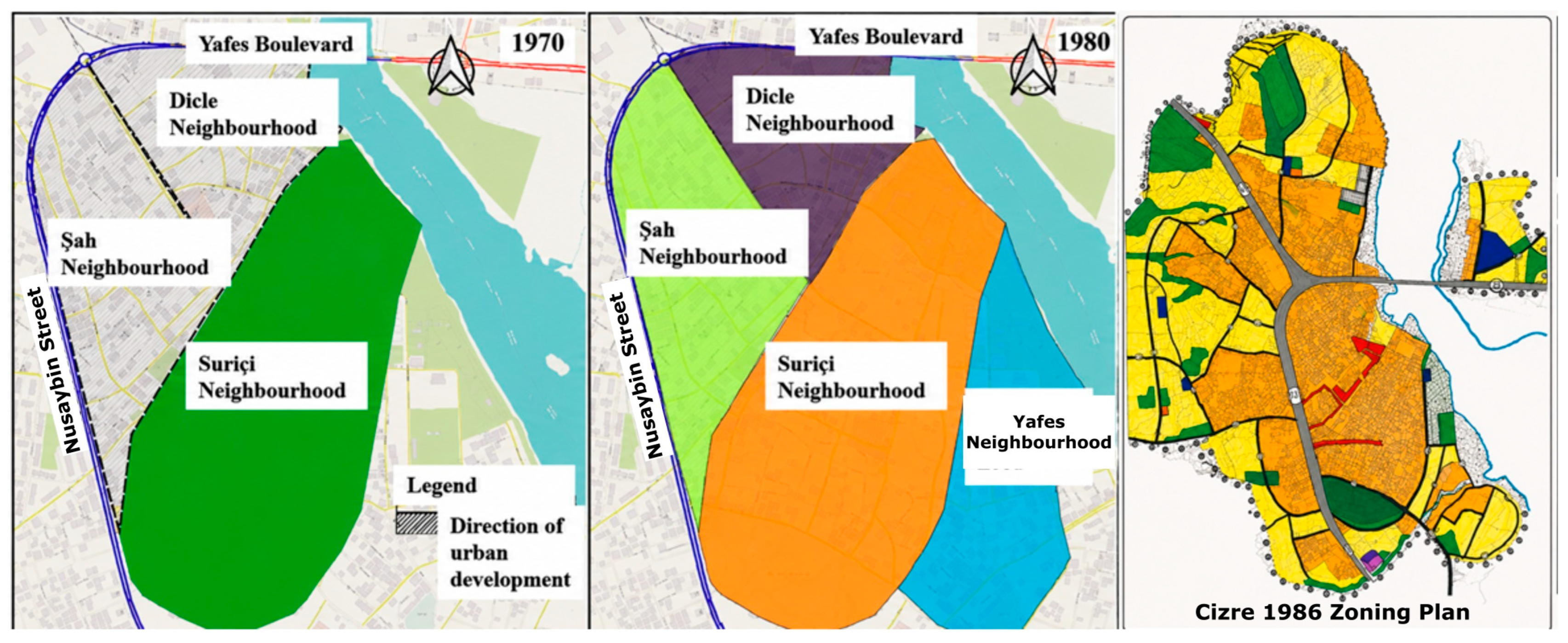
- To analyze multi-temporal urban growth patterns from 1970 to 2025.
- To examine the relationship between urban expansion and changes in flood risk.
- To support sustainable urban planning through risk-informed insights.
1.4. Novelty and Contributions
- Spatio-temporal flood modeling: Integration of multi-decadal urban expansion with flood susceptibility analysis.
- Introduction of FRTI: A novel quantitative index to measure flood risk redistribution.
- Urban–hydrology linkage: A process-based interpretation of how urban growth alters runoff dynamics.
- Enhanced validation: Combination of AHP modeling with machine learning techniques to improve reliability.
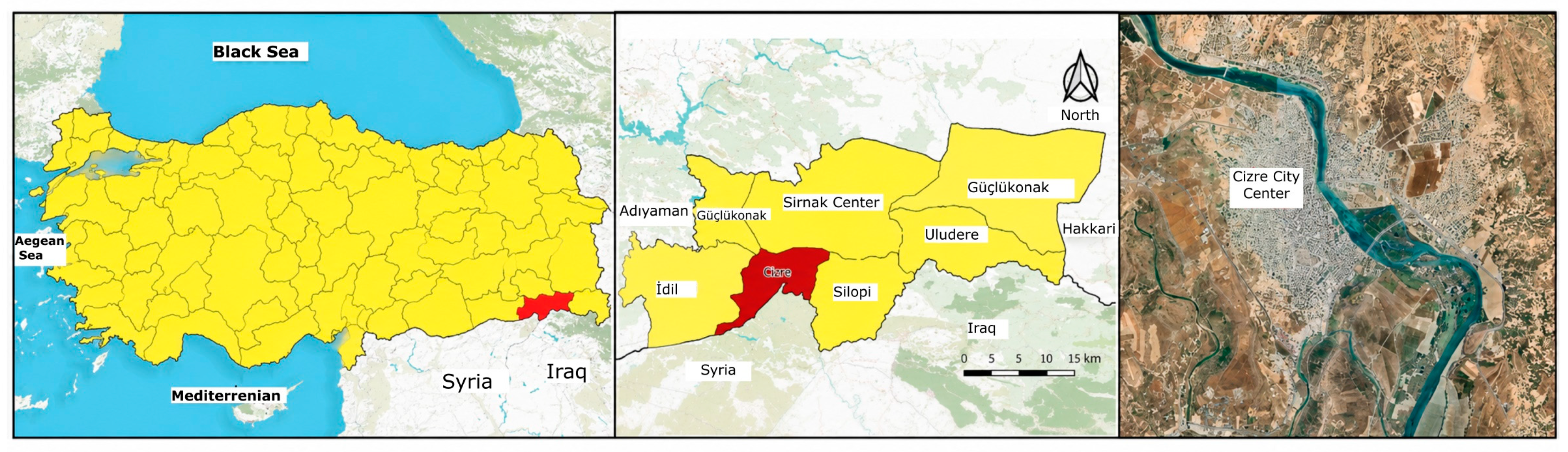
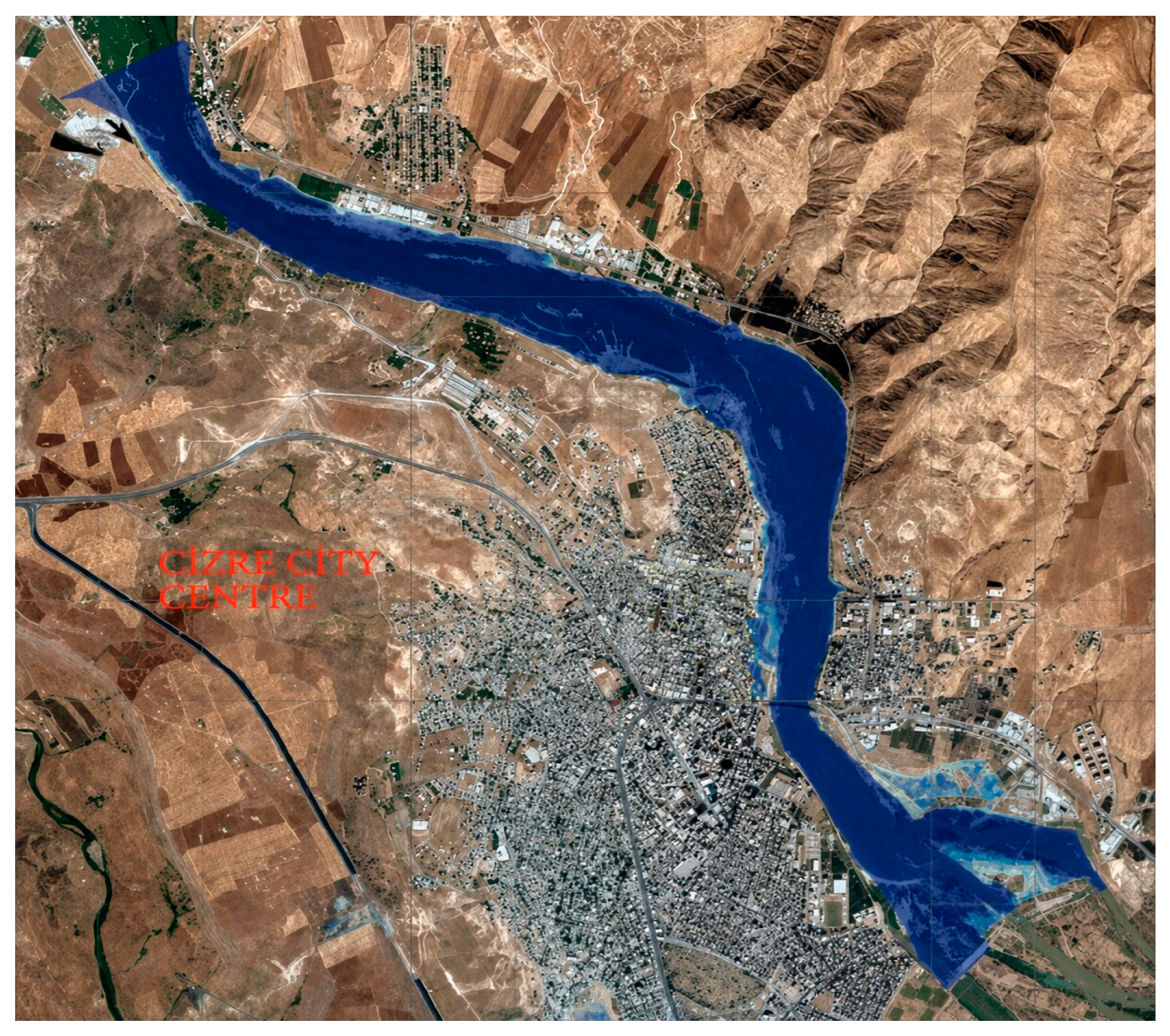
2. Study Area
Geographic and Environmental Characteristics
3. Data and Flood Conditioning Factors
3.1. Data Sources and Preparation
3.2. Flood Conditioning Factors
4. Methodology
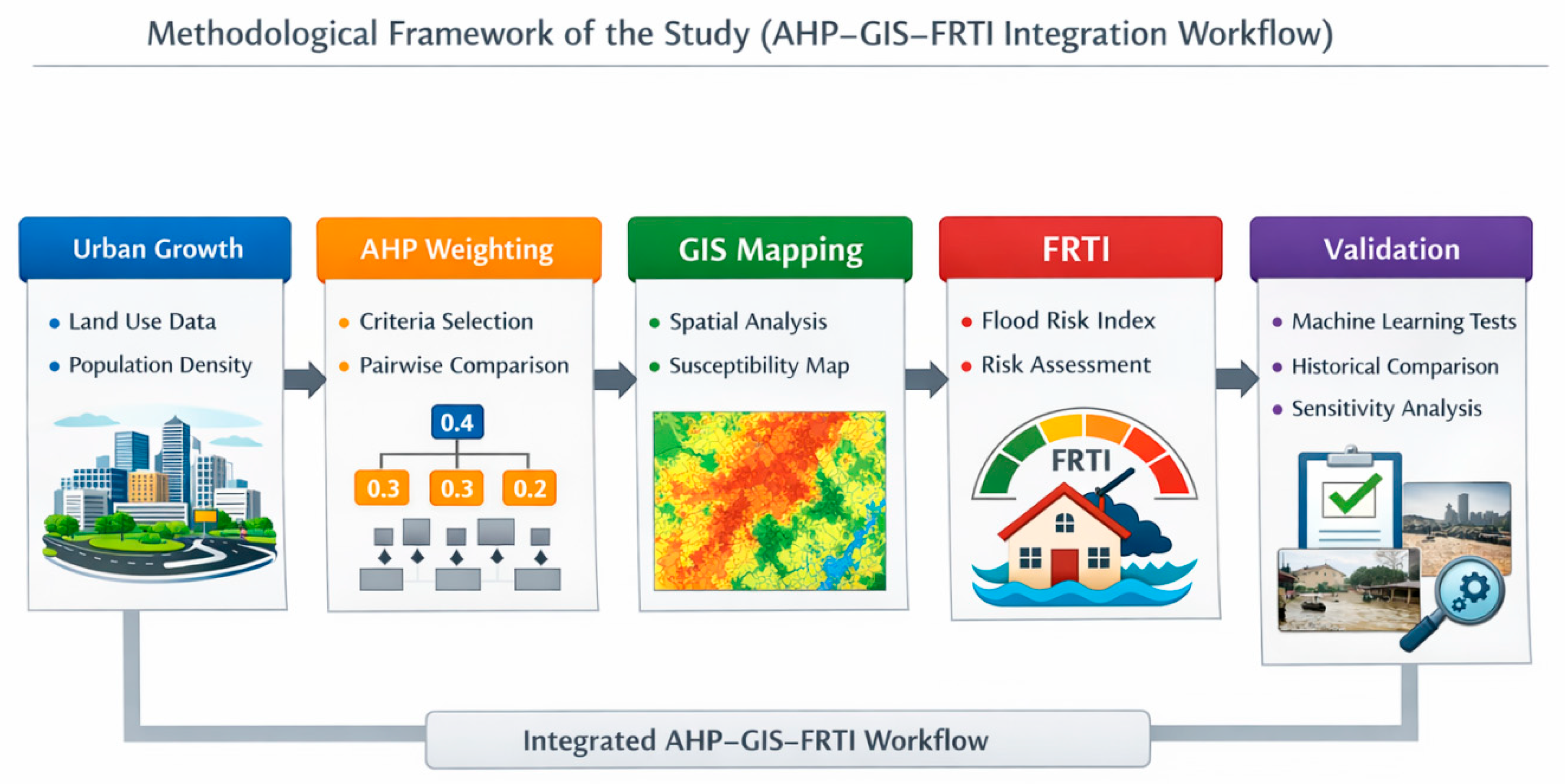
4.1. Overall Framework
- Urban growth analysis (multi-temporal LULC assessment);
- Flood susceptibility mapping using AHP–GIS;
- Flood risk transfer quantification using FRTI;
- Model validation and robustness assessment.
4.2. AHP-Based Criteria Weighting
- Goal: Flood risk assessment;
- Criteria: LULC, distance to rivers, drainage density, slope, NDVI, precipitation, and elevation.
Expert Survey and Data Collection
4.3. Consistency Check of AHP Judgments
- = maximum eigenvalue of comparison matrix;
- = number of criteria.
- = Random Index.
4.4. Flood Susceptibility Mapping Using GIS
- = Flood Susceptibility Index;
- = weight of factor i derived from the AHP;
- = normalized rating of factor i;
- = total number of conditioning factors.
- Low risk;
- Medium risk;
- High risk;
- Very high risk.
4.5. Urban Growth Analysis
- = urban area at initial time;
- = urban area at later time;
- = time interval (years).
4.6. Flood Risk Transfer Index (FRTI): A Novel Framework
- Stronger hydrological connectivity;
- Increased runoff transfer;
- Greater downstream flood intensification.
4.7. Model Validation and Robustness Assessment
4.7.1. Machine Learning Validation
4.7.2. Historical Flood Validation
4.7.3. Sensitivity Analysis
5. Results
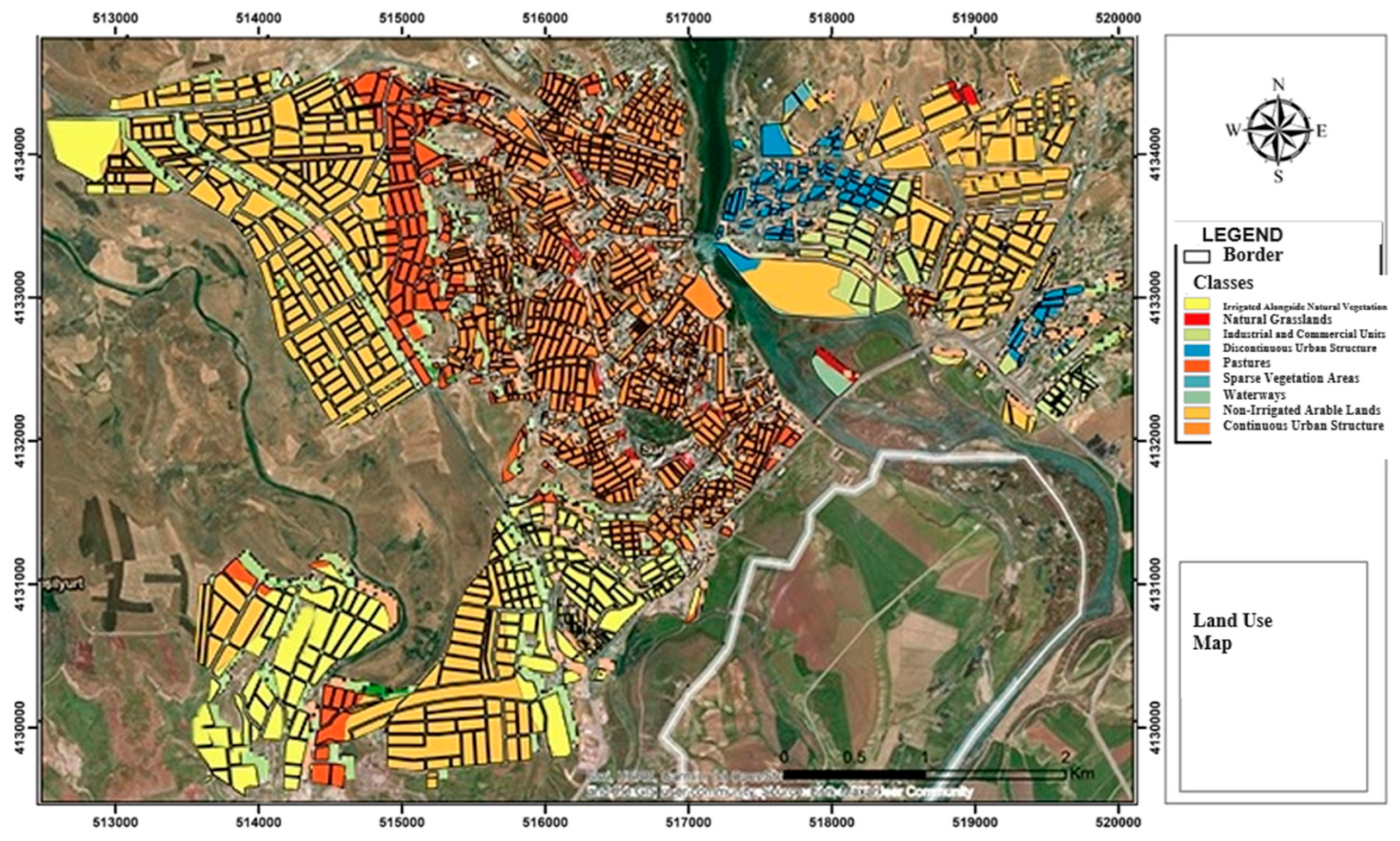
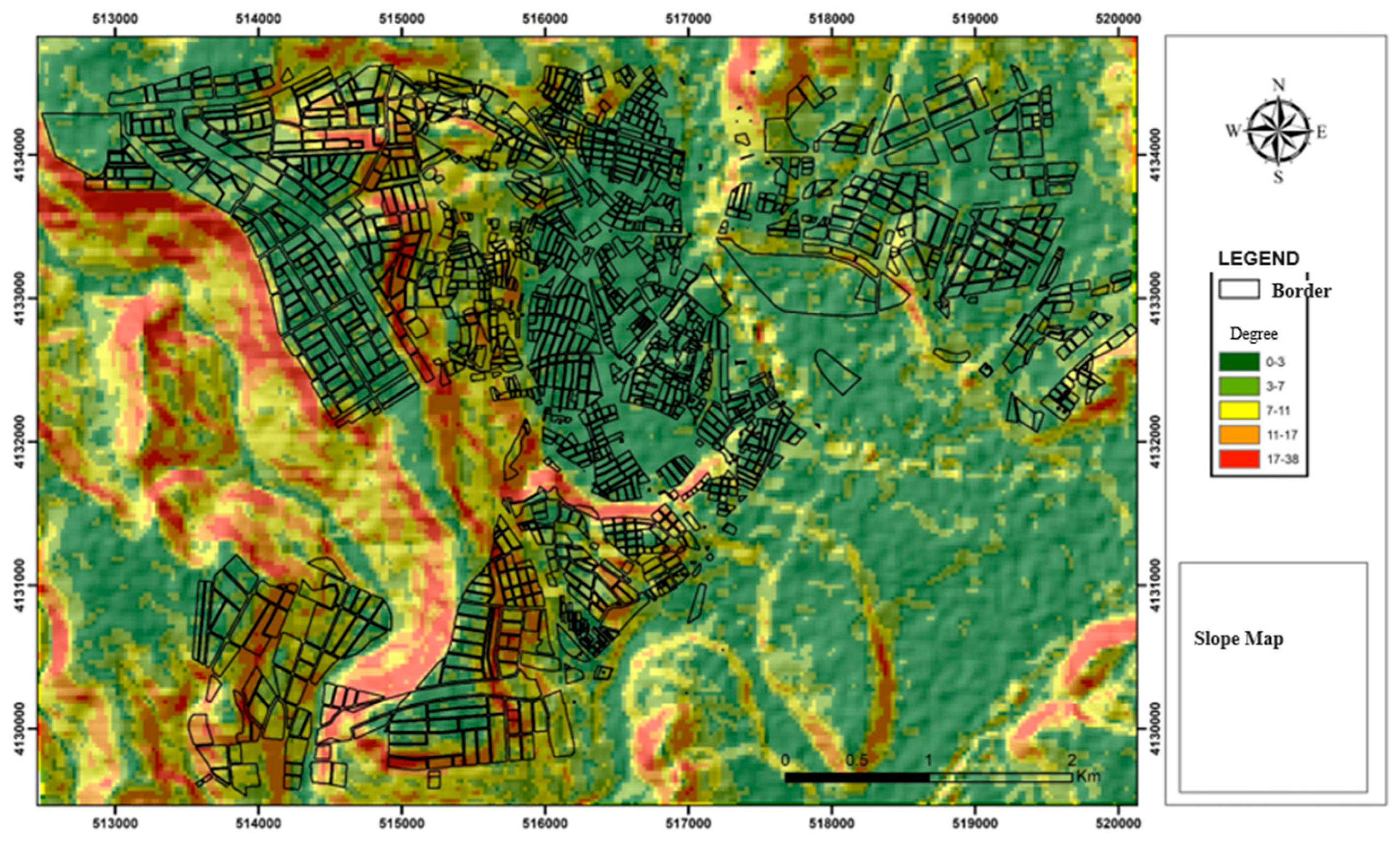
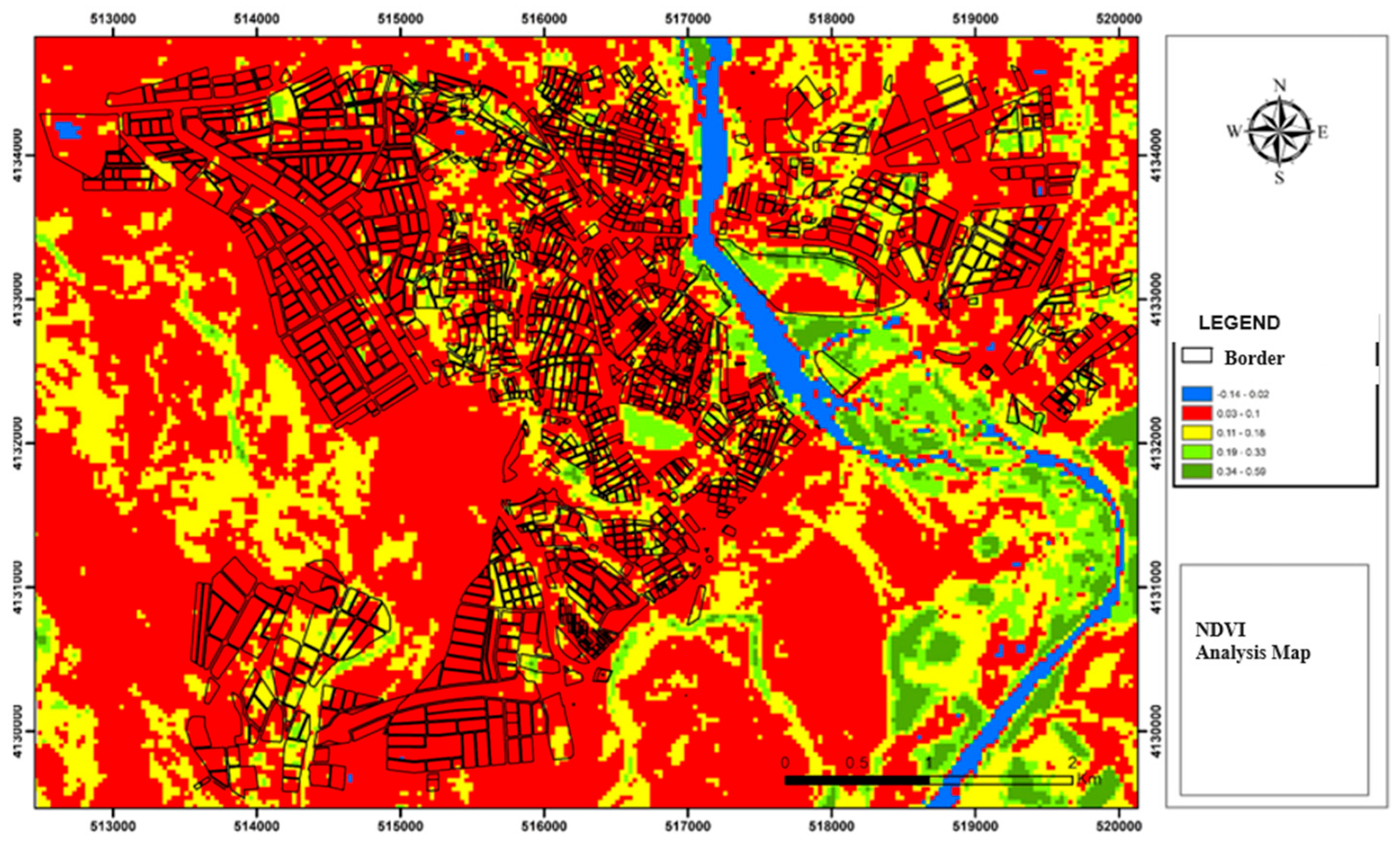
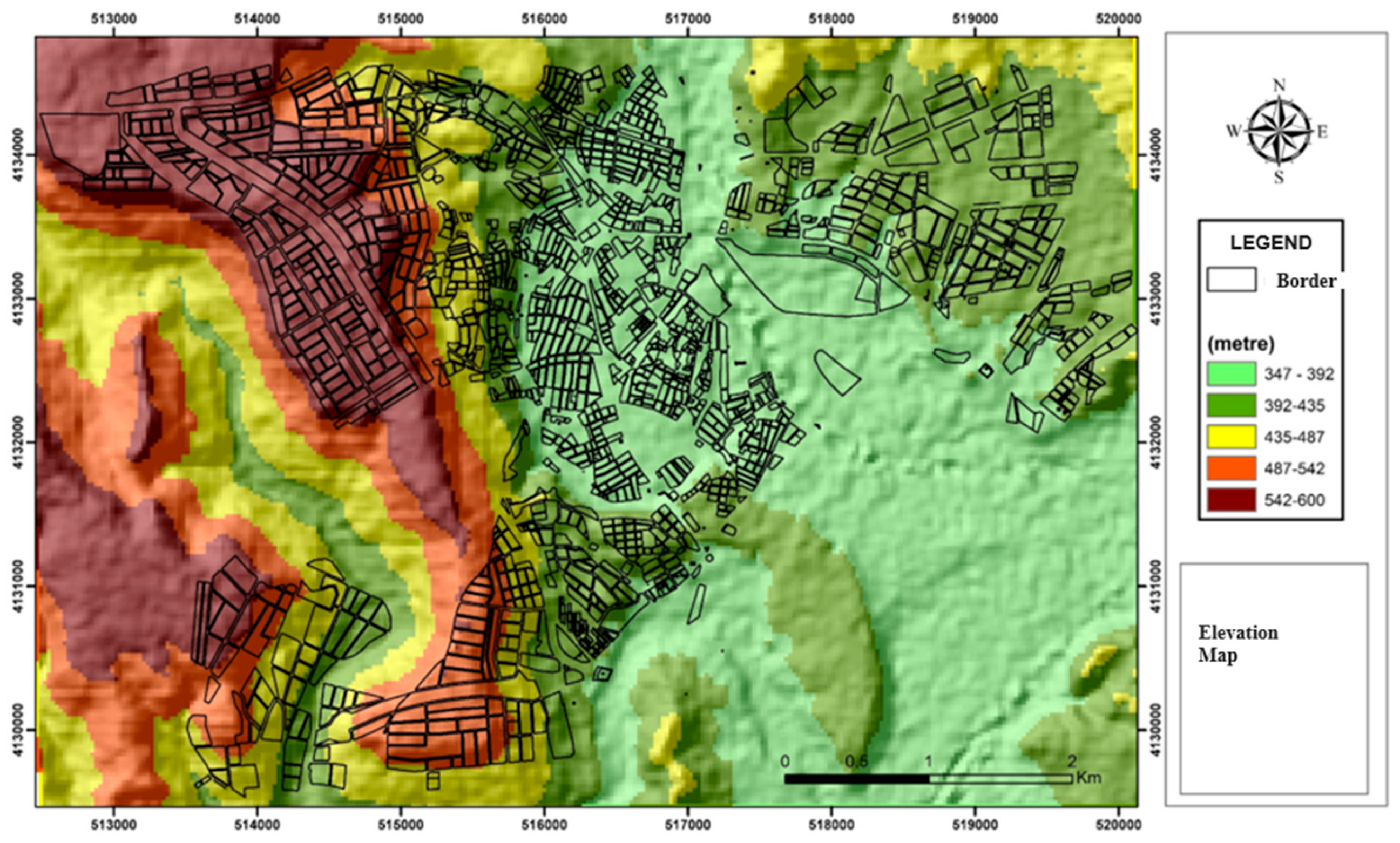
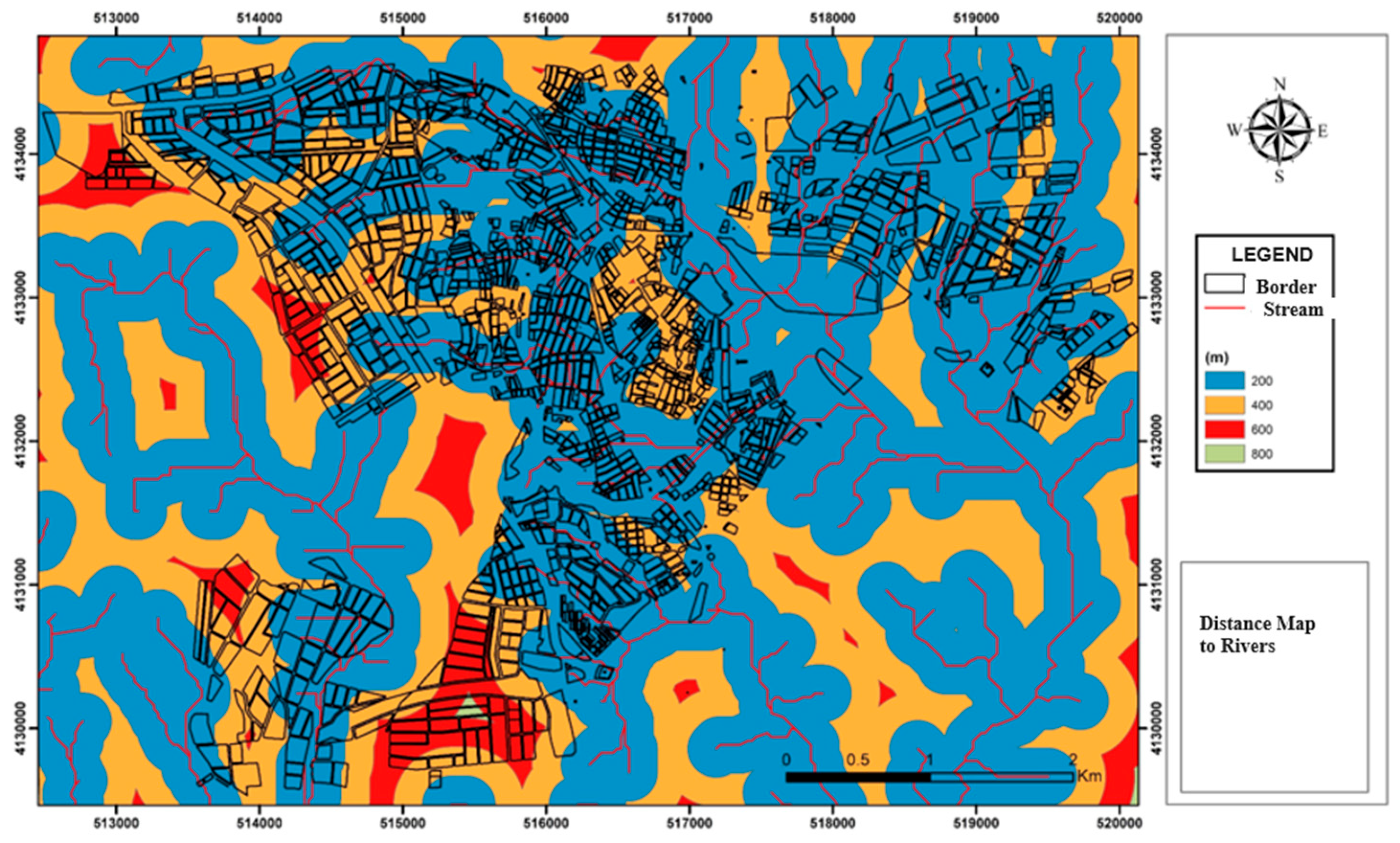
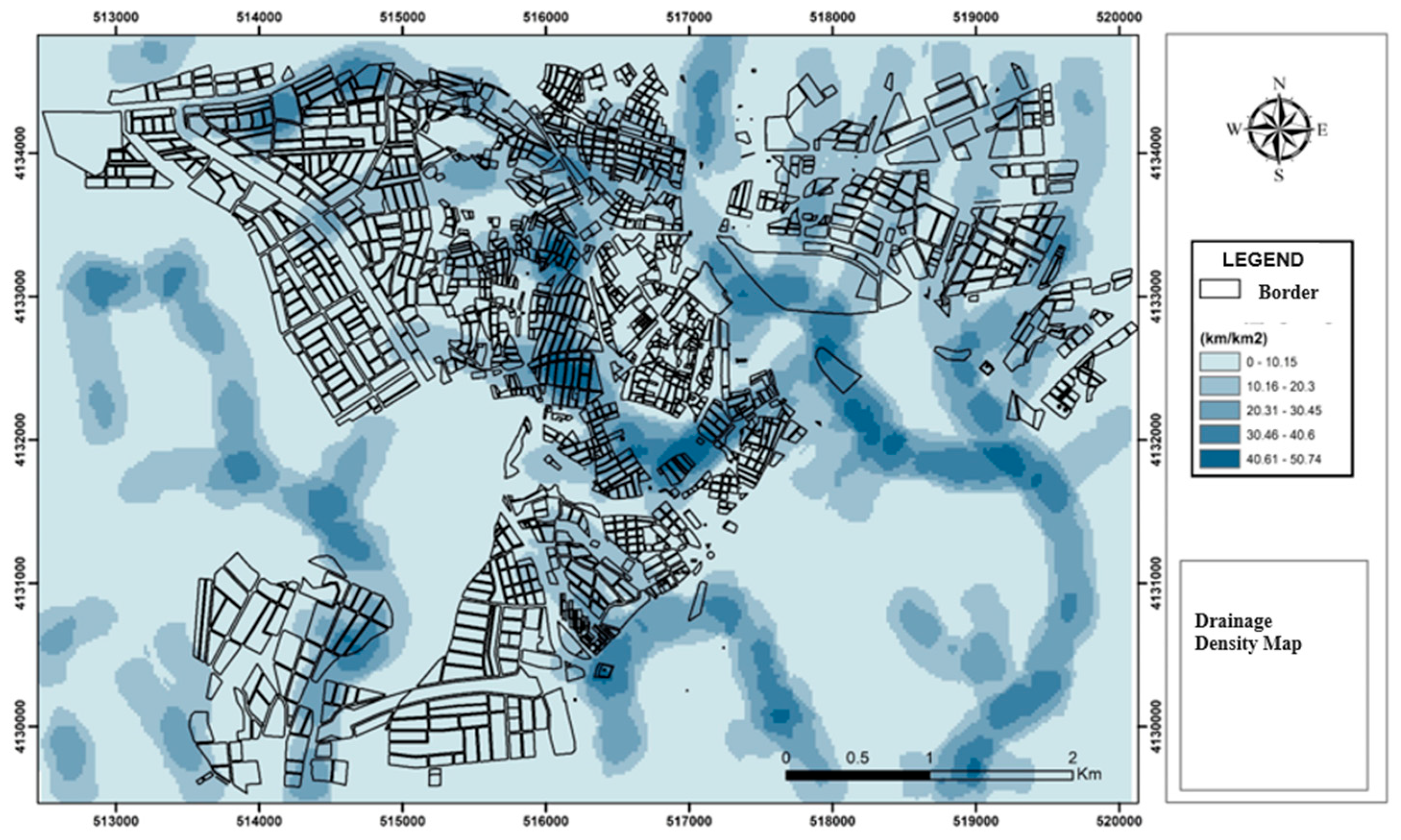
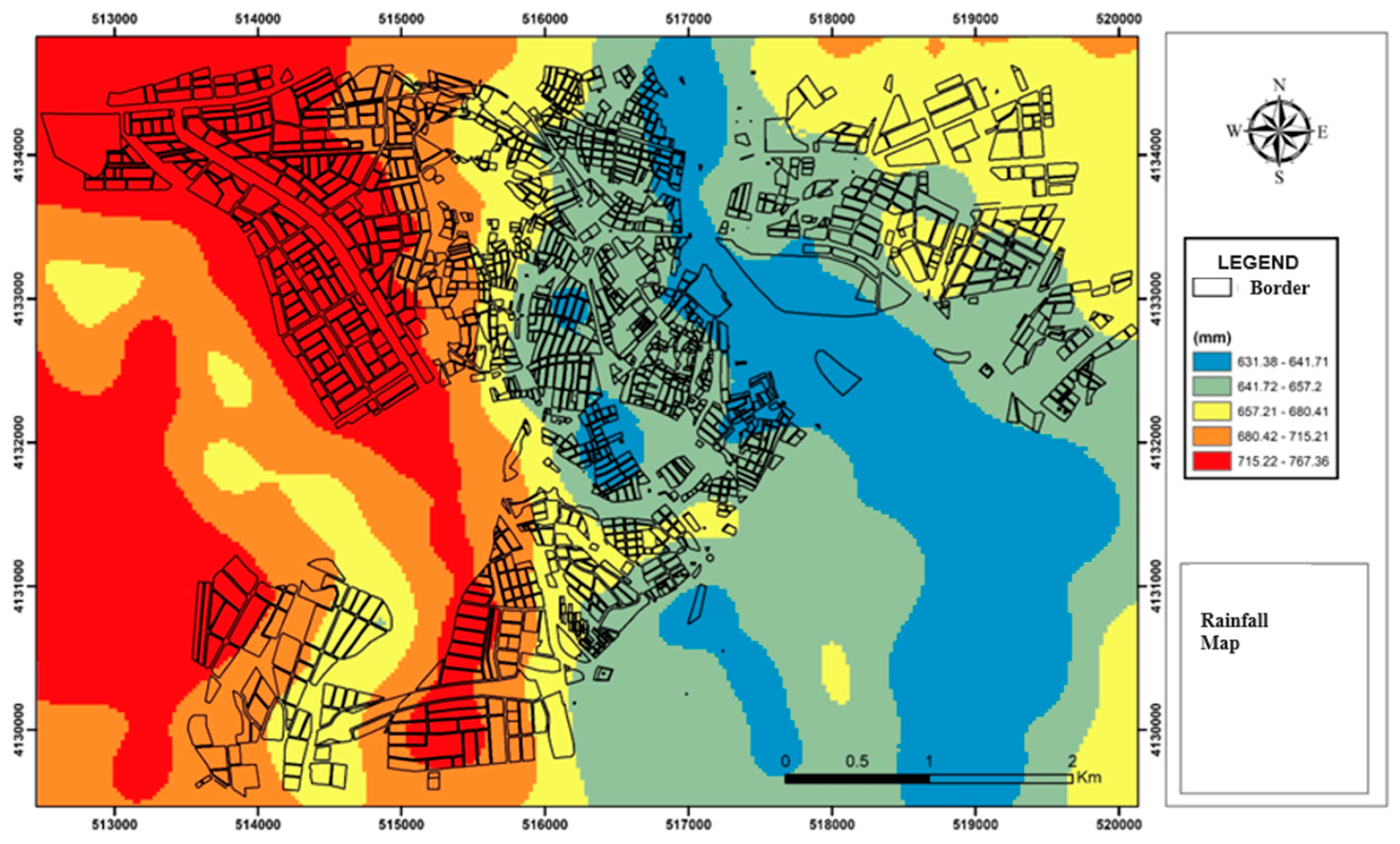
5.1. Thematic Layers
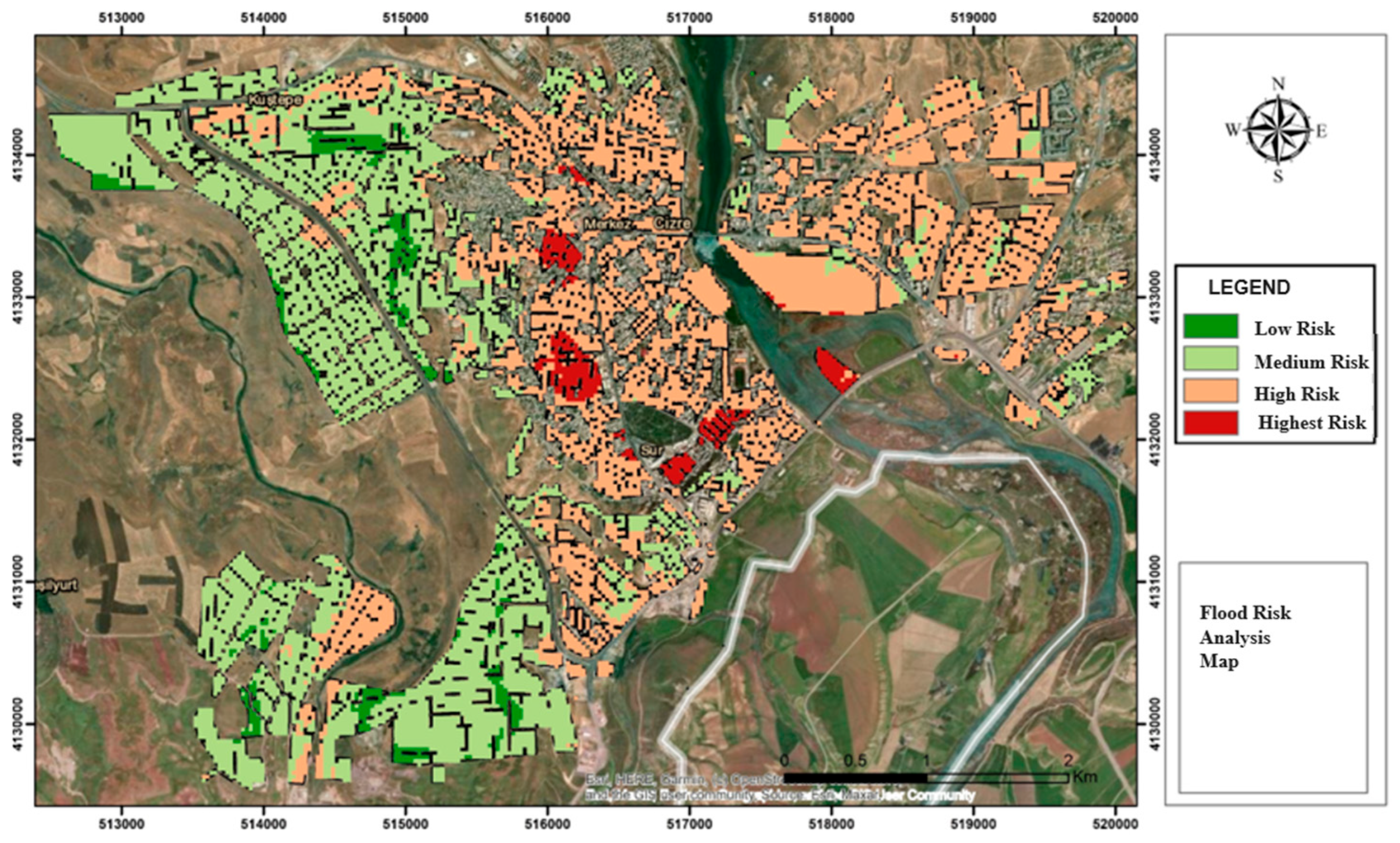
5.2. Flood Susceptibility Map
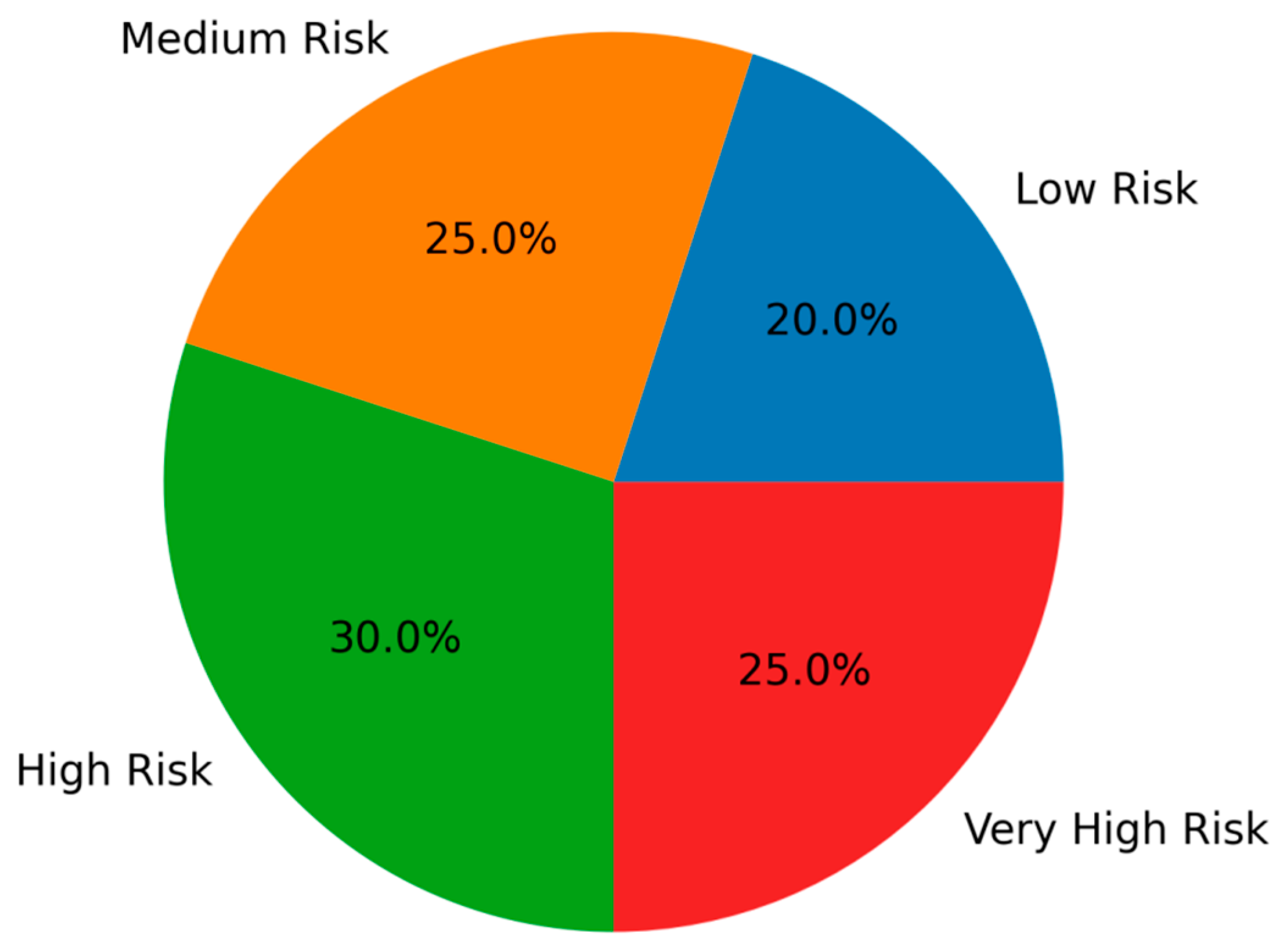
5.3. Risk Distribution
5.4. Urban Growth Impact
5.5. Flood Risk Transfer Results
5.6. Statistical Analysis
- = change in high-risk area;
- = change in urban area;
- = intercept term;
- = regression coefficient representing the rate of flood risk increase per unit of urban expansion.
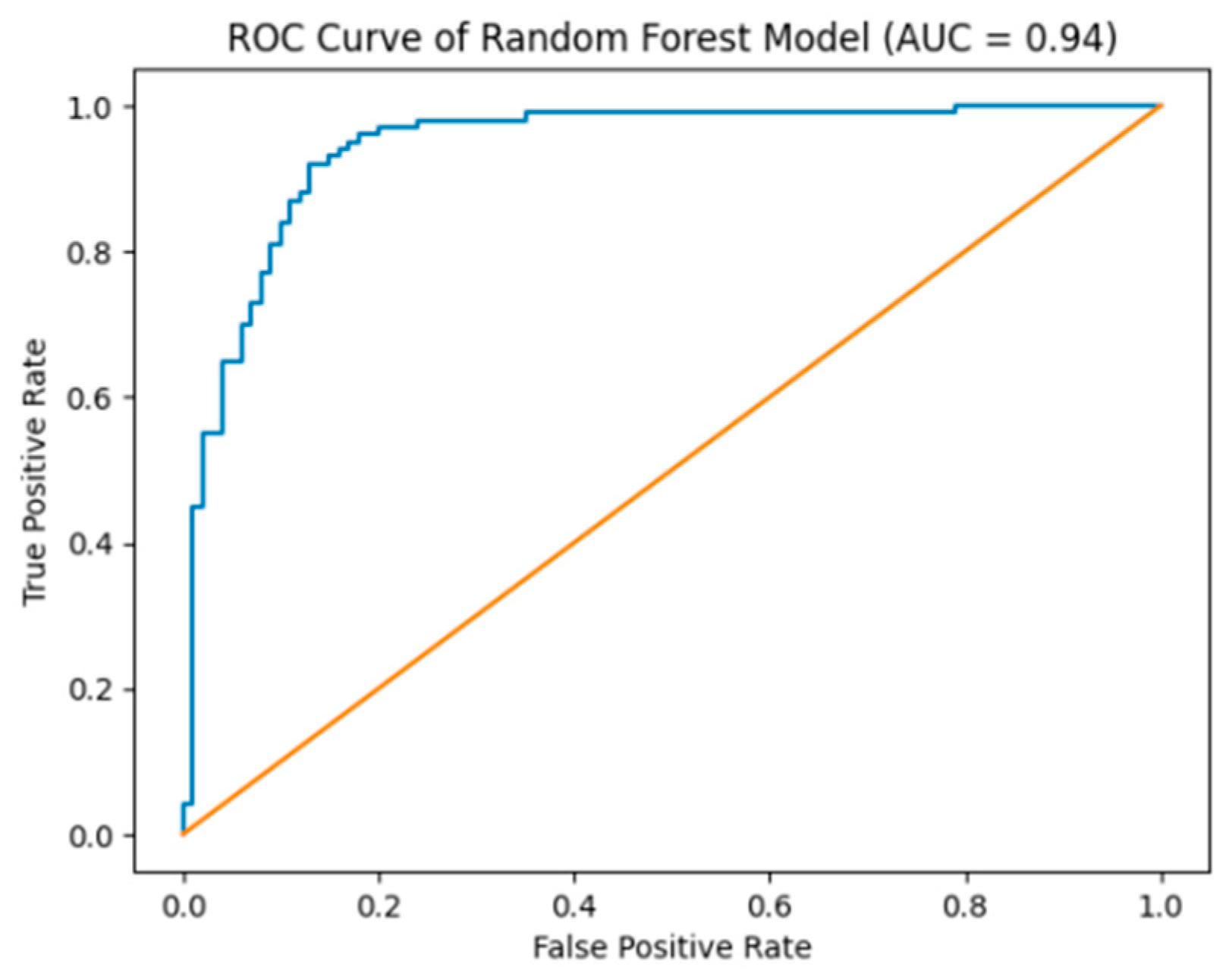
5.7. Model Performance
6. Discussion
6.1. Urban Growth vs. Flood Risk
- = peak runoff discharge;
- = runoff coefficient;
- = rainfall intensity;
- = drainage area.
6.2. Comparison with Existing Studies
6.3. Planning Implications
7. Conclusions
7.1. Key Findings
7.2. Limitations and Future Work
Author Contributions
Funding
Institutional Review Board Statement
Data Availability Statement
Conflicts of Interest
References
- Kaiser, Z.A.; Akter, F. From risk to resilience and sustainability: Addressing urban flash floods and waterlogging. Risk Sci. 2025, 1, 100011. [Google Scholar] [CrossRef]
- Borah, G. Urban water stress: Climate change implications for water supply in cities. Water Conserv. Sci. Eng. 2025, 10, 20. [Google Scholar] [CrossRef]
- David Raj, A.; David Raj, A. Climate Change Induced Hydro-Meteorological Extremes in the Himalayan Region. In Climate Change: Conflict and Resilience in the Age of Anthropocene; Springer Nature: Cham, Switzerland, 2025; pp. 33–56. [Google Scholar]
- Zia, B.T.; Chaudhary, A.; Nayak, S.; Kumar, A.; Mohanty, S.S. Rainwater Harvesting to Reduce Urban Flooding. Int. J. Eng. Dev. Res. 2026, 14, 725–747. [Google Scholar]
- Negahban, S.; Ganjaeian, H.; Ebrahimi, A.; Gheysarian, S.S. Analysis of the roles of environmental factors in the occurrence of floods using the Google Earth Engine system (Case study: West of Golestan Province). Geogr. Environ. Plan. 2025, 35, 1–18. [Google Scholar]
- Kanimozhi, R.; Ramesh, P.S. Deep reinforcement learning-based intrusion detection scheme for software-defined networking. Sci. Rep. 2025, 15, 38827. [Google Scholar] [CrossRef]
- Juan-Diego, E.; Mendoza, A.; Arganis-Juárez, M.L.; Berezowsky-Verduzco, M. Alteration of catchments and rivers, and the effect on floods: An overview of processes and restoration actions. Water 2025, 17, 1177. [Google Scholar] [CrossRef]
- Zhu, Y.; Burlando, P.; Zhang, Y.; Chi, D.; Wang, J.; Qiu, Y.; Bonatesta, M.; Zou, W.; Geiß, C.; Tan, P.Y.; et al. The influence of urban morphological changes on pluvial flooding during urban expansion. Sustain. Cities Soc. 2025, 135, 107018. [Google Scholar] [CrossRef]
- Tonkin, J.D.; Siqueira, T.; Merder, J.; Datry, T.; Poff, N.L.; Talbot-Jones, J.; Olden, J.D. Extreme events and river biodiversity under climate change. Nat. Rev. Biodivers. 2026, 2, 150–169. [Google Scholar] [CrossRef]
- Neale, P.J.; Hylander, S.; Banaszak, A.T.; Häder, D.P.; Rose, K.C.; Vione, D.; Wängberg, S.Å.; Jansen, M.A.; Busquets, R.; Andersen, M.P.S.; et al. Environmental consequences of interacting effects of changes in stratospheric ozone, ultraviolet radiation, and climate: UNEP Environmental Effects Assessment Panel, Update 2024. Photochem. Photobiol. Sci. 2025, 24, 357–392. [Google Scholar] [CrossRef]
- Zhu, L.; Gao, C.; Wu, M.; Zhu, R. Integrating Blue–Green Infrastructure with Gray Infrastructure for Climate-Resilient Surface Water Flood Management in the Plain River Networks. Land 2025, 14, 634. [Google Scholar] [CrossRef]
- Mishra, A.; Mukherjee, S.; Merz, B.; Singh, V.P.; Wright, D.B.; Villarini, G.; Paul, S.; Kumar, D.N.; Khedun, C.P.; Niyogi, D.; et al. An overview of flood concepts, challenges, and future directions. J. Hydrol. Eng. 2022, 27, 03122001. [Google Scholar] [CrossRef]
- Devi, K.; Reddy, C.C.; Rahul, K.; Khuntia, J.R.; Das, B.S. A holistic methodology for evaluating flood vulnerability, generating flood risk map and conducting detailed flood inundation assessment. Sci. Rep. 2025, 15, 28253. [Google Scholar] [CrossRef]
- Tian, J.; Chen, Y.; Yang, L.; Li, D.; Liu, L.; Li, J.; Tang, X. Enhancing Urban Flood Susceptibility Assessment by Capturing the Features of the Urban Environment. Remote Sens. 2025, 17, 1347. [Google Scholar] [CrossRef]
- Singh, S.R.; Harirchian, E.; Monjardin, C.E.F.; Lahmer, T. GIS-based risk assessment of building vulnerability in flood zones of Naic, Cavite, Philippines using AHP and TOPSIS. GeoHazards 2024, 5, 1040–1073. [Google Scholar] [CrossRef]
- Fu, X.; Xue, F.; Liu, Y.; Chen, F.; Yang, H. Evaluation of Urban Flood Susceptibility Under the Influence of Urbanization Based on Shared Socioeconomic Pathways. Land 2025, 14, 621. [Google Scholar] [CrossRef]
- Pierdicca, R.; Muralikrishna, N.; Tonetto, F.; Ghianda, A. On the use of LLMs for GIS-based spatial analysis. ISPRS Int. J. Geo-Inf. 2025, 14, 401. [Google Scholar] [CrossRef]
- Ahmad, I.; Ping, W.; Ullah, S.; Faqeih, K.Y.; Alamri, S.M.; Alamery, E.R.; Abalkhail, A.A.A.; Bilal Jan, H.M. Spatiotemporal Mapping of Urban Flood Susceptibility: A Multi-Criteria GIS-Based Assessment in Nangarhar, Afghanistan. Land 2025, 14, 2376. [Google Scholar] [CrossRef]
- Shadmehri Toosi, A.; Batelaan, O.; Shanafield, M.; Guan, H. Land use-land cover and hydrological modeling: A review. Wiley Interdiscip. Rev. Water 2025, 12, e70013. [Google Scholar] [CrossRef]
- Mishra, P.; Jena, D.; Thakur, R.R.; Chand, S.; Javed, B.; Shukla, A.K. Peri-urban floodscapes: Identifying and analyzing flood risk areas in North Bhubaneswar in Eastern India. Water 2024, 16, 3019. [Google Scholar] [CrossRef]
- Zhang, Y.; Lu, Y.; Zhai, G. Spatial inequality of climate risks: Impacts of extreme rainfall and flooding under multiple climate scenarios in the Beijing-Tianjin-Hebei urban agglomeration, China. Int. J. Disaster Risk Reduct. 2025, 127, 105674. [Google Scholar] [CrossRef]
- Kanimozhi, R.; Padmavathi, V. A Unified Adaptive Deterministic Concurrency Control Framework for Distributed Systems. Concurr. Comput. Pract. Exp. 2026, 38, e70638. [Google Scholar] [CrossRef]
- Lv, W.; Deng, F.; Wang, J.; Han, Y.; Yang, S. Large-scale real-time evacuation modeling during urban floods: A coupled agent-based multi-model framework. Simul. Model. Pract. Theory 2025, 140, 103075. [Google Scholar] [CrossRef]
- Ahmad, K.; Marchesano, M.G.; Popolo, V.; Revetria, R.; Rozhok, A. Development of a European Sustainability Reporting Standards Compliant Sustainability Assessment Framework for Manufacturing Organisations Using Analytic Hierarchy Process. Sustainability 2025, 17, 4772. [Google Scholar] [CrossRef]
- Ghosh, S.; Das Chatterjee, N.; Dinda, S. Urban environmental livability assessment through multi-source remote sensing and hybrid entropy-AHP model: A case study of the largest urban agglomeration in Eastern India. Environ. Dev. Sustain. 2026, 1–28. [Google Scholar] [CrossRef]
- Shi, Y.; Wang, Y.; Wang, L.N.; Wang, W.N.; Yang, T.Y. Bridge Tower Warning Method Based on Improved Multi-Rate Fusion Under Strong Wind Action. Buildings 2025, 15, 2733. [Google Scholar] [CrossRef]
- Abdo, H.G.; Zeng, T.; Alshayeb, M.J.; Prasad, P.; Ahmed, M.F.M.; Albanai, J.A.; Alharbi, M.M.; Mallick, J. Multi-criteria analysis and geospatial applications-based mapping flood vulnerable areas: A case study from the eastern Mediterranean. Nat. Hazards 2025, 121, 1003–1031. [Google Scholar] [CrossRef]
- Panigrahi, M.; Pal, S.; Sharma, A. A GIS-enabled AHP approach for mapping urban flood susceptibility in Bhubaneswar city. AIMS Geosci. 2026, 12, 127–157. [Google Scholar] [CrossRef]
- Chen, S.Y.; Idris, N.H.; Hamden, M.H.; Abdul Hamid, A.I.; Pa’suya, M.F.; Darwin, N. A review on the earth observation techniques for coastal vulnerability index in Malaysia. Int. J. Remote Sens. 2026, 2, 150–169. [Google Scholar] [CrossRef]
- Nazir, M.F.; Atif, S.; Hussain, E. An integrated geographic information system (GIS) and analytical hierarchy process (AHP)-based approach for drone-optimized large-scale flood imaging. Drone Syst. Appl. 2025, 13, 1–18. [Google Scholar] [CrossRef]
- Singha, C.; Chakraborty, N.; Sahoo, S.; Pham, Q.B.; Xuan, Y. A novel framework for flood susceptibility assessment using hybrid analytic hierarchy process-based machine learning methods. Nat. Hazards 2025, 121, 13765–13810. [Google Scholar] [CrossRef]
- Tabasi, N.; Fereshtehpour, M.; Roghani, B. A review of flood risk assessment frameworks and the development of hierarchical structures for risk components. Discov. Water 2025, 5, 10. [Google Scholar] [CrossRef]
- Guven, D.S.; Yenigun, K.; Isinkaralar, O.; Isinkaralar, K. Modeling flood hazard impacts using GIS-based HEC-RAS technique towards climate risk in Şanlıurfa, Türkiye. Nat. Hazards 2025, 121, 3657–3675. [Google Scholar] [CrossRef]
- Schneider, M.; Halekotte, L.; Comes, T.; Fiedrich, F. A Method for Rapid Area Prioritisation in Flood Disaster Response. arXiv 2025, arXiv:2506.18423. [Google Scholar] [CrossRef]
- Davraz, A.; Nalbantçılar, M.T.; İştin, A.E.; Kadırhan, G.; Çelik, S. Hydrogeochemistry properties of thermal waters and health risk assessment in Şırnak geothermal fields (Turkey). Carbonates Evaporites 2025, 40, 136. [Google Scholar] [CrossRef]
- Giovanis, E.; Ozdamar, O. The transboundary effects of climate change and global adaptation: The case of the Euphrates–Tigris water basin in Turkey and Iraq. Empir. Econ. 2025, 68, 1935–1972. [Google Scholar] [CrossRef]
- Khan, I.; Kainthola, A.; Bahuguna, H.; Yadav, V.; Pandey, V.H.R.; Kushwaha, G. Decoding Landslide Susceptibility in Wayanad District of Kerala, India, Using Machine Learning Approach. Earth Syst. Environ. 2025, 1–28. [Google Scholar] [CrossRef]
- Michaelides, K.; Agapiou, A. An Open-Access Remote Sensing and AHP–GIS Framework for Flood Susceptibility Assessment of Cultural Heritage. Geomatics 2026, 6, 23. [Google Scholar] [CrossRef]
- Abdo, B.; Omar, A.E.; Saad, A.M.; Sakr, M.A. Geo-spatial characterization of lithology and geotechnical conditions for sustainable urban development in the Suez region, Egypt. Geotech. Geol. Eng. 2025, 43, 306. [Google Scholar] [CrossRef]
- Stahl, D.J. Two Rivers Entangled: An Ecological History of the Tigris and Euphrates in the Twentieth Century; Stanford University Press: Redwood City, CA, USA, 2026. [Google Scholar]
- Zhang, Q.; Chen, Y.; Chen, S.; Liu, L.; Liu, E. Macrophyte community changes related to water level fluctuation and anthropogenic pressure in a floodplain lake in lower Huanghe River Basin, China since the 19th century. J. Oceanol. Limnol. 2025, 43, 848–864. [Google Scholar] [CrossRef]
- Çelik, M.A.; Bilik, A.; Türkeş, M. Spatio-Temporal Analysis of Observed Drought Events in the Tigris–Euphrates Basin during the 1960–2023 Period Via SPI and SPEI Drought Indices. Pure Appl. Geophys. 2026, 183, 655–692. [Google Scholar] [CrossRef]
- Mirza, M.M.Q.; Dixit, A. Impact of Floods on Floodplains and Storm Hazards in Coastal and Estuarine Environments Through Ecosystem-Based Adaptations in a Changing Climate. In Handbook of Nature-Based Solutions to Mitigation and Adaptation to Climate Change; Springer Nature: Cham, Switzerland, 2025; pp. 1–32. [Google Scholar]
- Paprotny, D.; ’t Hart, C.M.P.; Morales-Nápoles, O. Evolution of flood protection levels and flood vulnerability in Europe since 1950 estimated with vine-copula models. Nat. Hazards 2025, 121, 6155–6184. [Google Scholar] [CrossRef]
- Ketabchi, H.; Mahmoodzadeh, D.; Sadeghi-Jahani, H.; Shamsoddini, A.; Saadi, T. Emergent archetype patterns of coupled land use/land cover and hydrogeologic responses on a regional scale. Catena 2025, 259, 109329. [Google Scholar] [CrossRef]
- Pimenta, L.; Duarte, L.; Teodoro, A.C.; Beltrão, N.; Gomes, D.; Oliveira, R. GIS-Based Flood Susceptibility Mapping Using AHP in the Urban Amazon: A Case Study of Ananindeua, Brazil. Land 2025, 14, 1543. [Google Scholar] [CrossRef]
- Wang, Y.; Zhou, B.; Xu, Y.; Chung, C.Y.; Yang, Y.; Yuan, Z.; Hu, C. Spatio-Temporal Power Outage Risk Prediction for Interdependent Urban Electricity and Drainage Networks Under Rainstorm Disasters. IEEE Trans. Smart Grid 2026. early access. [Google Scholar]
- Todini, E. Understanding and mitigating urban flood risk. Hydrology 2025, 12, 146. [Google Scholar] [CrossRef]
- Bao, Z.; Wu, Y.; He, W.; She, N.; Li, Z. Intensified Rainfall, Growing Floods: Projecting Urban Drainage Challenges in South-Central China Under Climate Change Scenarios. Appl. Sci. 2025, 15, 11577. [Google Scholar] [CrossRef]
- Shen, C.; Zang, Z.; Meng, S.; Tang, H.; Qin, C.; Ning, D.; Wu, Y.; Zhao, L.; Lu, Z. Built-Up Fraction and Residential Expansion Under Hydrologic Constraints: Quantifying Effects of Terrain, Groundwater and Vegetation Root Depth on Urbanization in Kunming, China. Hydrology 2026, 13, 48. [Google Scholar] [CrossRef]
- Hua, Z.; Zhou, B.; Chan, K.W.; Zhang, C.; Cao, Y.; Wang, P.; Xia, M. A progressive polyhedral approximation method for nonlinear PDE-constrained electricity-water nexus dispatch. IEEE Trans. Smart Grid 2025, 16, 2703–2706. [Google Scholar] [CrossRef]
- Guo, S.; Zhou, B.; Chung, C.Y.; Bu, S.; Hua, Z.; Liu, J.; Hu, W. Hierarchical Aggregation-Embedded Emergency Scheduling of Coupled Electricity-Watershed Networks with Heterogeneous Flexibility Resources Under Extreme Drought Events. IEEE Trans. Sustain. Energy 2025, 17, 45–58. [Google Scholar] [CrossRef]
- Ebrahimnia, V.; Arabahmadi, M.; Sharifi, A. Integrated flood risk assessment in Iran: The role of development plans within a spatial planning perspective. Environ. Hazards 2025, 1–33. [Google Scholar] [CrossRef]
- Jia, X.; Jiang, X.; Huang, J.; Li, L.; Liu, B.; Yu, S. Risk Assessment of Yellow Muddy Water in High-Construction-Intensity Cities Based on the GIS Analytic Hierarchy Process Method: A Case Study of Guangzhou City. Land 2025, 14, 779. [Google Scholar] [CrossRef]
- Hasnaoui, Y.; Tachi, S.E.; Bouguerra, H.; Yaseen, Z.M.; Gilja, G.; Szczepanek, R.; Navarro-Pedreño, J. Integrated remote sensing and deep learning models for flash flood detection based on spatio-temporal land use and cover changes in the Mediterranean region. Environ. Model. Assess. 2025, 30, 1013–1035. [Google Scholar] [CrossRef]
- Yılmaz, M.; Alemdar, K.D. Mapping and assessment of flood risk based on vulnerability and hazard factors in urban areas through the integration of multi-criteria techniques and GIS: A case study in Yakutiye, Erzurum, Türkiye. Environ. Earth Sci. 2025, 84, 435. [Google Scholar] [CrossRef]
- Nikolaus, G. Flood Vulnerability in Punjab, Pakistan: A Geospatial Analysis and Cartographic Approach. Doctoral Dissertation, Palacký University Olomouc, Olomouc, Czech Republic, 2025. [Google Scholar]
- Xie, J.; Qiang, W.; Lin, Y.; Huang, Y.; Xu, K.Q.; Zheng, D.; Chen, S.; Pei, Y.; Fan, G. Enhancing urban drainage resilience through holistic stormwater regulation: A review. Water 2025, 17, 1536. [Google Scholar] [CrossRef]
- Tong, S.; Wang, J.; Qin, J.; Ji, X.; Wu, Z. Study on the Risk of Urban Population Exposure to Waterlogging in Huang-Huai Area Based on Machine Learning Simulation Analysis—A Case Study of Xuzhou Urban Area. Land 2025, 14, 939. [Google Scholar] [CrossRef]
- Liu, J.; Wang, X.; Gao, G. Spatiotemporal evolution and determinants of urban flood resilience: A case study of Yellow River Basin. Sustainability 2025, 17, 1433. [Google Scholar] [CrossRef]
- Madadi, P.; Sadeghi, A. Integrating Urban Expansion and Flood Risk: A Spatial Assessment of Impervious Surface Growth and Floodplain Exposure in Mecklenburg County (2011–2021). World Water Policy 2026, 12, e70052. [Google Scholar] [CrossRef]








| Study | Year | Region | Methodology | Key Focus | Limitations | How This Study Addresses the Problem |
|---|---|---|---|---|---|---|
| [27] | 2024 | Eastern Mediterranean | GIS + MCDA | Urban flood vulnerability mapping | Static spatial analysis; lacks temporal dynamics | Introduces multi-temporal urban growth integration |
| [28] | 2026 | India | AHP + GIS + RS | Urban flood susceptibility zones | Focus on spatial mapping; no risk redistribution modeling | Adds FRTI to quantify flood risk transfer across regions |
| [29] | 2026 | Malaysia | AHP + GIS (multi-temporal) | Spatio-temporal flood vulnerability | Limited temporal resolution (few time points); lacks process-based interpretation | Uses long-term (1970–2025) urban growth and hydrological linkage |
| [30] | 2025 | Global | GIS + AHP + drone integration | Flood mapping for disaster response | Focus on operational mapping; no urban growth interaction analysis | Integrates urban expansion with hydrological processes and risk evolution |
| [31] | 2025 | India | AHP + deep learning | Model comparison for flood susceptibility | AHP shows lower predictive accuracy; lacks temporal risk evolution | Combines AHP with temporal analysis + validation + process interpretation |
| [32] | 2024 | Global | Review study | Flood risk conceptual frameworks | Identifies a lack of unified dynamic frameworks and integration | Proposes a unified dynamic, process-based AHP–GIS–FRTI framework |
| [33] | 2025 | Turkey | GIS + hydraulic modeling | Flood hazard probability mapping | Focus on hydraulic simulation; ignores land use dynamics | Integrates land use change and urban growth impacts |
| [34] | 2025 | Germany | GIS + Bayesian model | Flood response prioritization | Designed for the response phase; not for long-term risk evolution | Provides long-term spatio-temporal flood risk evolution analysis (arXiv) |
| This Study (2026) | 2026 | Cizre, Turkey | AHP + GIS + FRTI | Spatio-temporal flood risk modeling | — | Dynamic framework + quantitative flood risk transfer (FRTI) + urban–hydrology linkage |
| Factor | Description | Influence on Flood Risk |
|---|---|---|
| Land Use (LULC) | Surface characteristics, including urban and natural areas | Impervious surfaces increase runoff |
| Distance to Rivers | Proximity to river channels | Closer areas have higher flood exposure |
| Drainage Density | Density of drainage network | Higher density increases runoff concentration |
| Slope | Terrain gradient | Low slopes favor water accumulation |
| NDVI | Vegetation density indicator | Higher vegetation reduces flood risk |
| Precipitation | Rainfall intensity and distribution | Triggers flood events |
| Elevation | Height above mean sea level | Low elevations are flood-prone |
| Importance Scale | Definition | Explanation |
|---|---|---|
| 1 | Equal importance | Both options are equally important. |
| 3 | Moderate importance | Experience and expert judgment lead to one criterion being considered slightly superior to another. |
| 5 | Strong importance | Experience and judgment make one criterion significantly superior to another. |
| 7 | Very strong importance | One criterion was deemed superior to the other. |
| 9 | Extreme importance | It demonstrates that one criterion is superior to another. |
| 2,4,6,8 | Intermediate values | It refers to values that lie between two consecutive judgments, to be used in situations requiring compromise. |
| Criterion | LU | DR | DD | S | NDVI | P | EC |
|---|---|---|---|---|---|---|---|
| Land Use (LU) | 1.00 | 0.86 | 1.20 | 1.20 | 2.00 | 1.00 | 1.50 |
| Distance to Rivers (DR) | 1.17 | 1.00 | 1.40 | 1.40 | 2.33 | 1.17 | 1.75 |
| Drainage Density (DD) | 0.83 | 0.71 | 1.00 | 1.00 | 1.67 | 0.83 | 1.25 |
| Slope (S) | 0.83 | 0.71 | 1.00 | 1.00 | 1.67 | 0.83 | 1.25 |
| NDVI | 0.50 | 0.43 | 0.60 | 0.60 | 1.00 | 0.50 | 0.75 |
| Precipitation (P) | 1.00 | 0.86 | 1.20 | 1.20 | 2.00 | 1.00 | 1.50 |
| Elevation Classes (EC) | 0.67 | 0.57 | 0.80 | 0.80 | 1.33 | 0.67 | 1.00 |
| Column Total | 6.00 | 5.14 | 7.20 | 7.20 | 12.00 | 6.00 | 9.00 |
| Criterion | Abbreviation | Weight (Wi) | Percentage (%) | Rank | Interpretation |
|---|---|---|---|---|---|
| Distance to Rivers | DR | 0.19 | 19% | 1 | Most influential factor due to direct exposure to river overflow |
| Land Use | LU | 0.17 | 17% | 2 | Urban density significantly increases surface runoff and flood risk |
| Precipitation | P | 0.17 | 17% | 2 | Primary triggering factor for flood events |
| Drainage Density | DD | 0.14 | 14% | 3 | Influences runoff concentration and water accumulation |
| Slope | S | 0.14 | 14% | 3 | Controls flow velocity and accumulation patterns |
| Elevation Classes | EC | 0.11 | 11% | 4 | Low-lying areas are more vulnerable to flooding |
| NDVI | NDVI | 0.08 | 8% | 5 | Vegetation reduces flood risk through infiltration and retention |
| Total | — | 1.00 | 100% | — | — |
| Parameter | Value | Description |
|---|---|---|
| (λmax) | 7.85 | Maximum eigenvalue of the pairwise comparison matrix |
| (n) | 7 | Number of criteria (flood conditioning factors) |
| CI | 0.142 | Consistency Index |
| RI | 1.32 | Random Index (for (n = 7)) |
| CR | 0.108 | Consistency Ratio |
| Period | Urban Area (km2) | High + Very High Risk (km2) | ΔUrban | ΔHighRisk |
|---|---|---|---|---|
| 1970 | 5.2 | 8.3 | – | – |
| 2006 | 14.8 | 13.6 | 9.6 | 5.3 |
| 2024 | 27.2 | 22.5 | 12.4 | 8.9 |
| Period | ΔUA_new (km2) | ΔHR_old (km2) | FRTI |
|---|---|---|---|
| 1970–2006 | 6.8 | 2.6 | 0.38 |
| 2006–2024 | 12.4 | 8.9 | 0.72 |
| Model | Accuracy (%) | AUC | Precision |
|---|---|---|---|
| AHP | 78 | 0.81 | 0.75 |
| Random Forest | 86 | 0.89 | 0.84 |
| Scenario | High- + Very-High-Risk Area (km2) | Percentage Change |
|---|---|---|
| Original Weights | 21.4 | – |
| +10% Elevation | 22.1 | +3.3% |
| −10% Elevation | 20.8 | −2.8% |
| +10% Land Use | 22.5 | +5.1% |
| −10% Land Use | 20.2 | −5.6% |
| Risk Level | Area (km2) | Percentage (%) |
|---|---|---|
| Low Risk | 18.5 | 20.3 |
| Medium Risk | 22.8 | 25.0 |
| High Risk | 27.4 | 30.0 |
| Very High Risk | 22.5 | 24.7 |
| Total | 91.2 | 100 |
| Year | Urban Area (km2) | High + Very High Risk (km2) |
|---|---|---|
| 1970 | 5.2 | 8.3 |
| 2006 | 14.8 | 13.6 |
| 2024 | 27.2 | 22.5 |
| Period | ΔUA_new (km2) | ΔHR_old (km2) | FRTI |
|---|---|---|---|
| 1970–2006 | 6.8 | 2.6 | 0.38 |
| 2006–2024 | 12.4 | 8.9 | 0.72 |
| Parameter | Value |
|---|---|
| R2 | 0.87 |
| β (Slope) | Positive |
| Significance | Strong |
| Model | Accuracy (%) | AUC | Precision |
|---|---|---|---|
| AHP | 78 | 0.81 | 0.75 |
| Random Forest | 86 | 0.89 | 0.84 |
| Study | Region | Method | Key Focus | Limitation | Contribution of This Study |
|---|---|---|---|---|---|
| Ebrahimnia [53] | Iran | AHP + GIS | Flood susceptibility mapping | Static analysis | Adds temporal urban growth + dynamic risk transfer |
| Jia [54] | China | GIS Index | Hazard mapping | No multi-criteria weighting | Integrates AHP with urban dynamics |
| Hasnaoui [55] | Turkey | GIS Spatial Analysis | Multi-hazard mapping | No temporal dimension | Introduces spatio-temporal flood modeling |
| Ladik Basin [56] | Turkey | AHP + GIS | Vulnerability assessment | No urban growth integration | Links land use change with flood processes |
| Nikolous [57] | Pakistan | GIS + AHP | Urban flood resilience | Limited temporal analysis | Quantifies flood risk redistribution |
| This Study (2026) | Cizre, Turkey | AHP + GIS + FRTI | Dynamic flood risk modeling | — | Introduces FRTI and process-based risk transfer framework |
| Risk Level | Spatial Characteristics | Planning Strategy | Structural Measures | Policy Implication |
|---|---|---|---|---|
| Very High | Low elevation, river proximity, dense urban fabric | Restrict development | Flood barriers, retention basins | Strict zoning and relocation |
| High | Near-river, moderate elevation | Controlled development | Advanced drainage systems | Enforce building regulations |
| Medium | Transitional zones | Planned expansion | Storm water systems | Balanced development policies |
| Low | High elevation, good drainage | Suitable for growth | Standard infrastructure | Promote future development |
Disclaimer/Publisher’s Note: The statements, opinions and data contained in all publications are solely those of the individual author(s) and contributor(s) and not of MDPI and/or the editor(s). MDPI and/or the editor(s) disclaim responsibility for any injury to people or property resulting from any ideas, methods, instructions or products referred to in the content. |
© 2026 by the authors. Licensee MDPI, Basel, Switzerland. This article is an open access article distributed under the terms and conditions of the Creative Commons Attribution (CC BY) license.
Share and Cite
Nasanlı, O.; R, K.; Tan, N. A Dynamic AHP–GIS Framework for Spatio-Temporal Flood Risk Assessment Incorporating Flood Risk Transfer Index (FRTI). Sustainability 2026, 18, 5038. https://doi.org/10.3390/su18105038
Nasanlı O, R K, Tan N. A Dynamic AHP–GIS Framework for Spatio-Temporal Flood Risk Assessment Incorporating Flood Risk Transfer Index (FRTI). Sustainability. 2026; 18(10):5038. https://doi.org/10.3390/su18105038
Chicago/Turabian StyleNasanlı, Osman, Kanimozhi R, and Nurullah Tan. 2026. "A Dynamic AHP–GIS Framework for Spatio-Temporal Flood Risk Assessment Incorporating Flood Risk Transfer Index (FRTI)" Sustainability 18, no. 10: 5038. https://doi.org/10.3390/su18105038
APA StyleNasanlı, O., R, K., & Tan, N. (2026). A Dynamic AHP–GIS Framework for Spatio-Temporal Flood Risk Assessment Incorporating Flood Risk Transfer Index (FRTI). Sustainability, 18(10), 5038. https://doi.org/10.3390/su18105038