At the Intersection of Science and Sustainability: A Qualitative Study of Food Scientists’ Personal and Professional Perspectives

Abstract
1. Introduction
2. Literature Review
3. Materials and Methods
3.1. Recruitment
3.2. Data Analysis
4. Results
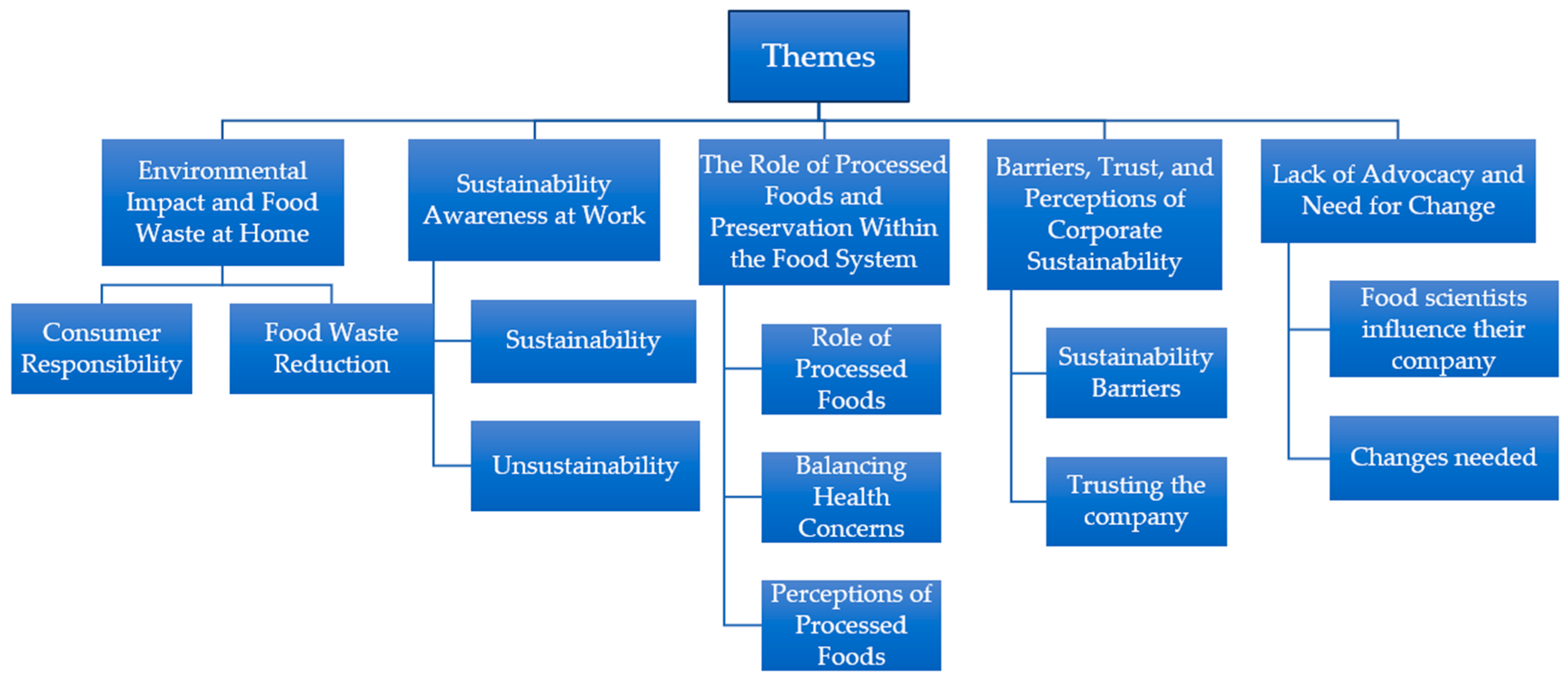
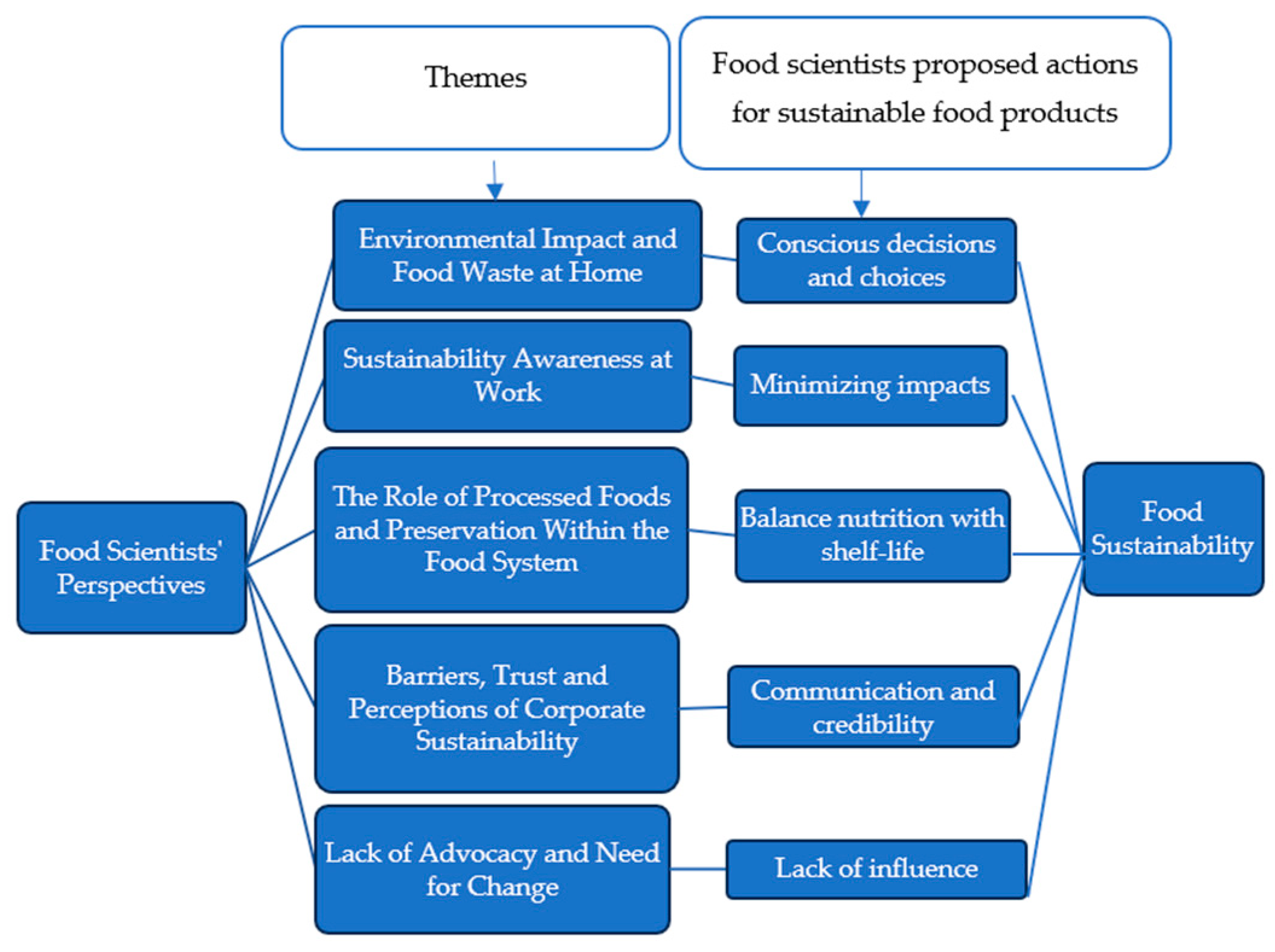
4.1. Theme 1: Environmental Impact and Food Waste at Home
As a consumer, we have a vote in the grocery store by the choices we make, and that’s where we can really make the change. We can look at packaging, how things are packaged and think about, is that responsible? We can purchase and make conscious decisions or just become more educated about those choices.(XX13)
Yeah, I’m pretty careful with that, actually my family eats leftovers. We try and compost as much organic food waste as we can. As a family of four, we’re putting out, like, max two bags of trash a week. I am still making food, plenty of food waste because I’m just putting things that we don’t get around to eating into the compost. But I try to minimize that.(GG07)
I used to do more of it than I do now. Since I’ve had a kid, I used to make my own marinara sauces and jellies and jams. Like if I go apple or strawberry picking or raspberry picking, I would make my own jellies. And then when I get tomatoes from neighbors, then I’d make marinara sauces and can or jar those. But I don’t do much of it anymore just because lack of time.(VV22)
I think in terms of, you know choosing the right products and choosing the right packaging materials and having a commitment to recycle and perhaps even composting food waste. You know, a single individual isn’t going to make a difference. If everybody were committed to that, I think it could make a difference.(KK11)
4.2. Theme 2: Sustainability Awareness at Work
reducing our carbon footprint, minimizing our global gases, minimizing waste, you know, stepping delicately in everything that we do.(II09)
Minimize coming from very far away and trying to minimize the footprint of those ingredients.(WW01)
So, being able to produce something as efficiently as possible without you having an extended carbon footprint.(VV22)
wasting food or practices such as growing palm oil and cutting down forests to be able to grow palm trees, and that, to me, is unsustainable.(BB02)
[Unsustainability is being:] Wasteful, inconsiderate, abundance of unnecessary ingredients in packaging.(II09)
You have issues with product packaging that, on one hand, you’re trying to make things more biodegradable…but you have to look at the cost and how the cost affects profitability.(JJ10)
Some of that is still quite nutritious, edible and shouldn’t be dumped or pulled off the shelf because you can’t pass [a] particular shelf-life date (JJ10). I mean, from a manufacturing perspective, I think most manufacturers really you know, food waste is money out the door. I think that people try to be mindful of waste. Regardless, if there is waste, I don’t know how we manage it. I know in our R&D lab, we don’t have, like, a separate stream for composting. It all just gets dumped.(HH08)
4.3. Theme 3: The Role of Processed Foods and Preservation Within the Food System
Try to avoid them [processed food] at all costs. However, as a food scientist, I tend to produce them. So, I hope that people eat them in moderation and consider a well-balanced diet. On my position on processed foods, I think they hold a place in society because of shelf life and shipping and transportation, but I also try to eat as healthy and natural and close to the earth as I can.(II09)
The more natural that people eat, it’s probably the better. Although even natural, you have to watch out for certain things like, again, the levels of nutrients. Some natural foods are probably not the best either. And if the processed foods, don’t have any of the artificial ingredients that we talked about before, then it’s fine.(QQ17)
I think there’s a lot of misunderstanding about what a processed food is. The definition could mean many, many things to many people. In fact, there is no specific definition to processed foods from my perspective of food science, food engineering.(LL12)
Help [ing to] insulate our sustainable food, by creating foods that have longer shelf life that can be nutritionally supplemented.(LL12)
4.4. Theme 4: Barriers, Trust and Perceptions of Corporate Sustainability
I would say the main one that comes to mind is cost because cost is always the big one that shuts things down immediately. Outside of cost, I’m struggling to understand whether consumers do genuinely care about sustainability… If the company can’t communicate it on a package on a product, then why would I use this ingredient if nobody’s going to know that it’s sustainable? And that comes down to morals and so how moral a company can be or not is really dependent on each company.(OO15)
Right now, companies are avoiding messaging that communicate[s] sustainable [practices] just because of a lot of the greenwashing that was happening. Companies now are, like, greenhushing. [Conversely] if I see, for example a brand that on the back says working with farmers or supporting farmers, then that’s a good indication that it’s a sustainable brand. For example, even like logos for international programs like Rainforest Alliance give me a good indication that they’re investing money in sustainability.(QQ17)
[I trust them] 100%. I feel my company’s DNA is [sustainability]. You know, sustainably is part of that.(XX13)
Tough question. No. When they walk the walk, when they actually show new packaging that is compostable, I totally believe them. When they drag their feet on some things because it’s too expensive or too complex. I’m a little more jaded.(II09)
Well [in our company], the strategy [is] in terms of using less land, using less resources when it comes to the water usage, using a kind of a controlled environmental agriculture program versus just having farmland, etc.(RR18)
4.5. Theme 5: Lack of Advocacy and Need for Change
educating the current and new product formulators to create a more conscious product using better formulas to improve the new products [to be more sustainable] and impact people’s life better.(UU21)
I don’t have much influence since the portfolio is already well established.(RR18)
Well, I think that, you know, large food companies, big CPGs [consumer packaged goods providers], need to be ethically responsible. Especially that now, we have, you know, pretty major changes in the federal administration. I support that, I just don’t know what we’re facing as we move forward.(EE05)
I think there needs to be increased education, understanding of the benefits of genetic [modification for] our plants, our farming methods. I think there needs to be significant investment in truly understanding the benefits of engineered foods with food scientists, nutritionists, and people in that realm and engineers are able to craft something that is [environmentally] healthy for you. But from my perspective, I really see the power in genomics [and] alternate food sources that may be non-traditional but offer nutritional benefits such as seaweeds and untapped resources, often considered to be weeds and waste. What can we do with our waste streams? I think that’s really a compelling perspective.(LL12)
5. Discussion
6. Implications
7. Limitations
8. Conclusions
Author Contributions
Funding
Institutional Review Board Statement
Informed Consent Statement
Data Availability Statement
Acknowledgments
Conflicts of Interest
Abbreviations
| IQA | Iterated Questioning Approach |
| MI | Motivational Interviewing |
| IFF | International Flavors and Fragrances |
| AI | Artificial Intelligence |
| EPA | Environmental Protection Agency |
| FAO | Food Agriculture and Organization |
References
- Fanzo, J.; Rudie, C.; Sigman, I.; Grinspoon, S.; Benton, T.G.; Brown, M.E.; Covic, N.; Fitch, K.; Golden, C.D.; Grace, D.; et al. Sustainable food systems and nutrition in the 21st century: A report from the 22nd annual Harvard Nutrition Obesity Symposium. Am. J. Clin. Nutr. 2022, 115, 18–33. [Google Scholar] [CrossRef]
- EPA. Sustainable Management of Food Basics. Available online: https://www.epa.gov/sustainable-management-food/sustainable-management-food-basics (accessed on 16 April 2025).
- FAO. Sustainable Food Systems: Concept and Framework. No. 2018. Available online: https://openknowledge.fao.org/handle/20.500.14283/ca2079en (accessed on 15 May 2025).
- FAO. Sustainable Food Systems: Concept and Framework. No. 2021. Available online: https://openknowledge.fao.org/handle/20.500.14283/cb8108en (accessed on 3 November 2025).
- Milligen, D.V. IFT Shares How to Mitigate and Adapt to Climate Change to Improve Food and Nutrition Security in New White Paper. 2026. Available online: https://www.ift.org/about-us/press/press-releases/climate-change-white-paper (accessed on 4 May 2026).
- Haring, S.; Pesci Schmulevich, S.; Manser, G.M.; Cooper, M.H. Rethinking scientists’ ongoing participation in ‘feeding the world’. Front. Sustain. Food Syst. 2023, 7, 1174704. [Google Scholar] [CrossRef]
- Food Forum; Food and Nutrition Board; Health and Medicine Division; National Academies of Sciences, Engineering, and Medicine. The Food Forum 30th Anniversary: Proceedings of a Symposium; National Academies Press: Washington, DC, USA, 2024; p. 27771. [Google Scholar] [CrossRef]
- Thiel, A.E.; Hill, S. First Jobs for Food Scientists. In Careers in Food Science: From Undergraduate to Professional; Hartel, R.W., Klawitter, C., Thiel, A., Eds.; Springer International Publishing: Cham, Switzerland, 2023; pp. 17–28. [Google Scholar] [CrossRef]
- Ellis, L. Exploring Careers in Food Science. Food Sci. Technol. 2024, 38, 54–57. [Google Scholar] [CrossRef]
- HTF Market Intelligence. Available online: https://www.htfmarketintelligence.com/ (accessed on 28 March 2026).
- Creemers, S.; Van Passel, S.; Vigani, M.; Vlahos, G. Relationship between farmers’ perception of sustainability and future farming strategies: A commodity-level comparison. AIMS Agric. Food 2019, 4, 613–642. [Google Scholar] [CrossRef]
- De Moraes Prata Gaspar, M.C.; Soar, C.; Aguilera, M.; Gomez, M.C.; Celorio-Sardà, R.; Comas-Basté, O.; Larrea-Killinger, C.; Vidal-Carou, M.C. Perceptions of Food among College Students in the Field of Food Science: A Food Sustainability Approach. Foods 2023, 12, 917. [Google Scholar] [CrossRef]
- Parry, S.; Metzger, E. Barriers to learning for sustainability: A teacher perspective. Sustain. Earth Rev. 2023, 6, 2. [Google Scholar] [CrossRef]
- Torán-Pereg, P.; Mora, M.; Thomsen, M.; Palkova, Z.; Novoa, S.; Vázquez-Araújo, L. Understanding food sustainability from a consumer perspective: A cross cultural exploration. Int. J. Gastron. Food Sci. 2023, 31, 100646. [Google Scholar] [CrossRef]
- De Vries, H. Food science and technology contributes to sustainable food systems. Trends Food Sci. Technol. 2021, 116, 1200–1202. [Google Scholar] [CrossRef]
- Ada, N.; Kazancoglu, Y.; Sezer, M.D.; Ede-Senturk, C.; Ozer, I.; Ram, M. Analyzing Barriers of Circular Food Supply Chains and Proposing Industry 4.0 Solutions. Sustainability 2021, 13, 6812. [Google Scholar] [CrossRef]
- Nichifor, B.; Zait, L.; Timiras, L. Drivers, Barriers, and Innovations in Sustainable Food Consumption: A Systematic Literature Review. Sustainability 2025, 17, 2233. [Google Scholar] [CrossRef]
- Kumar, A.; Mangla, S.K.; Kumar, P. Barriers for adoption of Industry 4.0 in sustainable food supply chain: A circular economy perspective. Int. J. Product. Perform. Manag. 2024, 73, 385–411. [Google Scholar] [CrossRef]
- Mohseni, S.; Baghizadeh, K.; Pahl, J. Evaluating Barriers and Drivers to Sustainable Food Supply Chains. Math. Probl. Eng. 2022, 2022, 4486132. [Google Scholar] [CrossRef]
- Fardet, A.; Rock, E. Ultra-Processed Foods and Food System Sustainability: What Are the Links? Sustainability 2020, 12, 6280. [Google Scholar] [CrossRef]
- Sundqvist-Andberg, H.; Åkerman, M. Sustainability governance and contested plastic food packaging—An integrative review. J. Clean. Prod. 2021, 306, 127111. [Google Scholar] [CrossRef]
- Gil, J. Environmental impacts of ultra-processed foods. Nat. Food 2023, 4, 199. [Google Scholar] [CrossRef]
- McKenzie, F.C.; Williams, J. Sustainable food production: Constraints, challenges and choices by 2050. Food Secur. 2015, 7, 221–233. [Google Scholar] [CrossRef]
- Prasanna, S.; Verma, P.; Bodh, S. The role of food industries in sustainability transition: A review. Environ. Dev. Sustain. 2024, 27, 15113–15133. [Google Scholar] [CrossRef]
- Pandey, N.; De Coninck, H.; Sagar, A.D. Beyond technology transfer: Innovation cooperation to advance sustainable development in developing countries. WIREs Energy Environ. 2022, 11, e422. [Google Scholar] [CrossRef]
- Marvin, H.J.P.; Bouzembrak, Y.; Van der Fels-Klerx, H.J.; Kempenaar, C.; Veerkamp, R.; Chauhan, A.; Stroosnijder, S.; Top, J.; Simsek-Senel, G.; Vrolijk, H.; et al. Digitalisation and Artificial Intelligence for sustainable food systems. Trends Food Sci. Technol. 2022, 120, 344–348. [Google Scholar] [CrossRef]
- Ioana, A. Food sustainability: Problems, perspectives and solutions. Lucr. Ştiinţifice 2022, 24, 109–114. [Google Scholar]
- Khan, N.; Ray, R.L.; Kassem, H.S.; Hussain, S.; Zhang, S.; Khayyam, M.; Ihtisham, M.; Asongu, S.A. Potential Role of Technology Innovation in Transformation of Sustainable Food Systems: A Review. Agriculture 2021, 11, 984. [Google Scholar] [CrossRef]
- McClements, D.J.; Barrangou, R.; Hill, C.; Kokini, J.L.; Lila, M.A.; Meyer, A.S.; Yu, L. Building a Resilient, Sustainable, and Healthier Food Supply Through Innovation and Technology. Annu. Rev. Food Sci. Technol. 2021, 12, 1–28. [Google Scholar] [CrossRef] [PubMed]
- Edwards, F.; Sonnino, R.; López Cifuentes, M. Connecting the dots: Integrating food policies towards food system transformation. Environ. Sci. Policy 2024, 156, 103735. [Google Scholar] [CrossRef]
- Adams, D.; Donovan, J.; Topple, C. Sustainability in large food and beverage companies and their supply chains: An investigation into key drivers and barriers affecting sustainability strategies. Bus. Strategy Environ. 2023, 32, 1451–1463. [Google Scholar] [CrossRef]
- Takacs, F.; Brunner, D.; Frankenberger, K. Barriers to a circular economy in small- and medium-sized enterprises and their integration in a sustainable strategic management framework. J. Clean. Prod. 2022, 362, 132227. [Google Scholar] [CrossRef]
- Leesatapornwongsa, F.; Thawesaengskulthai, N.; Vaiyavuth, R. Developing a Sustainability Measurement for Innovation Performance for the Food Industry. Sustainability 2023, 15, 16714. [Google Scholar] [CrossRef]
- Garnett, T. What Is a Sustainable Healthy Diet? A Discussion Paper. Available online: https://cgspace.cgiar.org/items/068df7b1-1234-4b7f-b826-b668af8187ff (accessed on 16 April 2025).
- Early, R. Ethics and Food Scientists: Duties, Issues and Dilemmas. Food Sci. Nutr. Cases 2023, 2023, fsncs20230002. [Google Scholar] [CrossRef]
- Knorr, D.; Augustin, M.A. Uncertainty, insightful ignorance, and curiosity: Improving future food science research. Trends Food Sci. Technol. 2021, 118, 559–568. [Google Scholar] [CrossRef]
- Stewart, C.M. A Day in the Life of a Food Product Developer. Nutr. Today 2024, 59, 289–293. [Google Scholar] [CrossRef]
- Stewart, C.M. A Day in the Life of a Food Chemist. Nutr. Today 2024, 59, 104–109. [Google Scholar] [CrossRef]
- Stewart, C.M. A Day in the Life of a Food Engineer. Nutr. Today 2024, 59, 195–201. [Google Scholar] [CrossRef]
- Liu, Z.; Guo, Y.; Liao, J.; Li, Y.; Wang, X. The effect of corporate social responsibility on employee advocacy behaviors: A perspective of conservation of resources. Chin. Manag. Stud. 2022, 16, 140–161. [Google Scholar] [CrossRef]
- Thelen, P.D.; Men, L.R. Commentary: The Role of Internal Communication in Fostering Employee Advocacy: An Exploratory Study. Int. J. Bus. Commun. 2023, 60, 1441–1454. [Google Scholar] [CrossRef]
- Kim, J.-N.; Rhee, Y. Strategic Thinking about Employee Communication Behavior (ECB) in Public Relations: Testing the Models of Megaphoning and Scouting Effects in Korea. J. Public Relat. Res. 2011, 23, 243–268. [Google Scholar] [CrossRef]
- Stewart, C.M. A Day in the Life of a Food Microbiologist. Nutr. Today 2024, 59, 239–245. [Google Scholar] [CrossRef]
- Mahajan, R.; Lim, W.M.; Sareen, M.; Kumar, S.; Panwar, R. Stakeholder theory. J. Bus. Res. 2023, 166, 114104. [Google Scholar] [CrossRef]
- Ames, H.; Glenton, C.; Lewin, S. Purposive sampling in a qualitative evidence synthesis: A worked example from a synthesis on parental perceptions of vaccination communication. BMC Med. Res. Methodol. 2019, 19, 26. [Google Scholar] [CrossRef] [PubMed]
- Awa, H.O.; Etim, W.; Ogbonda, E. Stakeholders, stakeholder theory and Corporate Social Responsibility (CSR). Int. J. Corp. Soc. Responsib. 2024, 9, 11. [Google Scholar] [CrossRef]
- Nyimbili, F.; Nyimbili, L. Types of Purposive Sampling Techniques with Their Examples and Application in Qualitative Research Studies. Br. J. Multidiscip. Adv. Stud. 2024, 5, 90–99. [Google Scholar] [CrossRef]
- QSR International. NVivo. Available online: https://www.qsrinternational.com/nvivo (accessed on 16 January 2025).
- Blatter, J. Aligning Methodologies to Epistemologies and Ontologies in Qualitative Research: An Ideal-Typical Approach. In Proceedings of the 112th American Political Science Association (APSA) Annual Meeting, Philadelphia, PA, USA, 1–4 September 2016. [Google Scholar]
- Miller, W.R.; Rollnick, S. Why Motivational Interviewing Is a Person-Centered Approach. SUCHT 2024, 70, 97–101. [Google Scholar] [CrossRef]
- Robinson, L.; Schulz, J. Eliciting Frontstage and Backstage Talk with the Iterated Questioning Approach. Sociol. Methodol. 2016, 46, 53–83. [Google Scholar] [CrossRef]
- Goffman, E. Presentation of Self in Everyday Life. Available online: https://crossculturalleadership.yolasite.com/resources/Goffman%20%281959%29%20Presentation%20of%20Self%20in%20Everyday%20Life.pdf (accessed on 16 September 2025).
- Dunteman, A.N.; Lee, Y.; Lee, S. A qualitative look at perception and experience of sodium reduction strategies in the food industry through focus groups and individual interviews. J. Food Sci. 2023, 88, 2203–2216. [Google Scholar] [CrossRef]
- Irazusta-Garmendia, A.; Orpí, E.; Bach-Faig, A.; González Svatetz, C. Food Sustainability Knowledge, Attitudes, and Dietary Habits among Students and Professionals of the Health Sciences. Nutrients 2023, 15, 2064. [Google Scholar] [CrossRef]
- Kymäläinen, T.; Seisto, A.; Malila, R. Generation Z Food Waste, Diet and Consumption Habits: A Finnish Social Design Study with Future Consumers. Sustainability 2021, 13, 2124. [Google Scholar] [CrossRef]
- Schiano, A.N.; Harwood, W.S.; Gerard, P.D.; Drake, M.A. Consumer perception of the sustainability of dairy products and plant-based dairy alternatives. J. Dairy Sci. 2020, 103, 11228–11243. [Google Scholar] [CrossRef]
- Tisdell, E.J.; Merriam, S.B.; Stuckey, H. Qualitative Research: A Guide to Design and Implementation, 5th ed.; Jossey-Bass: Hoboken, NJ, USA, 2025. [Google Scholar]
- Van Manen, M. Researching Lived Experience: Human Science for An Action Sensitive Pedagogy. In SUNY series in the philosophy of education; State University of New York Press: Albany, NY, USA, 1990. [Google Scholar]
- Braun, V.; Clarke, V. Using thematic analysis in psychology. Qual. Res. Psychol. 2006, 3, 77–101. [Google Scholar] [CrossRef]
- De Farias, B.G.; Dutra-Thomé, L.; Koller, S.H.; De Castro, T.G. Formulation of Themes in Qualitative Research: Logical Procedures and Analytical Paths. Trends Psychol. 2021, 29, 155–166. [Google Scholar] [CrossRef]
- Lincoln, Y.S.; Guba, E.G.; Pilotta, J.J. Naturalistic inquiry. Int. J. Intercult. Relat. 1985, 9, 438–439. [Google Scholar] [CrossRef]
- Patton, M.Q. Qualitative Research & Evaluation Methods: Integrating Theory and Practice, 4th ed.; SAGE: Los Angeles, CA, USA; London, UK; New Delhi, India; Singapore; Washington, DC, USA, 2015. [Google Scholar]
- Onwuegbuzie, A.; Leech, N.; Collins, K. Qualitative Analysis Techniques for the Review of the Literature. Qual. Rep. 2015, 17, 56. [Google Scholar] [CrossRef]
- Drummond, K.E.D. Nutrition Research: Concepts and Applications. Available online: https://www.jblearning.com/catalog/productdetails/9781284227116?srsltid=AfmBOor32w-vLjfPia3rlVgU_cucMrvCe2lL6Dgx5WPihtXwW9YPMjZ8 (accessed on 16 March 2025).
- Rahimi, S.; Khatooni, M. Saturation in qualitative research: An evolutionary concept analysis. Int. J. Nurs. Stud. Adv. 2024, 6, 100174. [Google Scholar] [CrossRef]
- Guest, G.; Bunce, A.; Johnson, L. How Many Interviews Are Enough?: An Experiment with Data Saturation and Variability. Field Methods 2006, 18, 59–82. [Google Scholar] [CrossRef]
- Hennink, M.M.; Kaiser, B.N.; Marconi, V.C. Code Saturation Versus Meaning Saturation: How Many Interviews Are Enough? Qual. Health Res. 2017, 27, 591–608. [Google Scholar] [CrossRef]
- Hennink, M.; Kaiser, B.N. Sample sizes for saturation in qualitative research: A systematic review of empirical tests. Soc. Sci. Med. 2022, 292, 114523. [Google Scholar] [CrossRef]
- Kassier, L. Interconnected or Disconnected? A Review of Sustainability, Resilience, and Sustainable Business Model Constructs in the Academic Business Literature. J. Knowl. Econ. 2024, 15, 15931–15958. [Google Scholar] [CrossRef]
- Negri, M.; Cagno, E.; Colicchia, C.; Sarkis, J. Integrating sustainability and resilience in the supply chain: A systematic literature review and a research agenda. Bus. Strategy Environ. 2021, 30, 2858–2886. [Google Scholar] [CrossRef]
- Florez-Jimenez, M.P.; Lleo, A.; Ruiz-Palomino, P.; Muñoz-Villamizar, A.F. Corporate sustainability, organizational resilience, and corporate purpose: A review of the academic traditions connecting them. Rev. Manag. Sci. 2025, 19, 67–104. [Google Scholar] [CrossRef]
- Antasouras, G.; Vasios, G.K.; Kontogiorgis, C.; Ioannou, Z.; Poulios, E.; Deligiannidou, G.E.; Troumbis, A.Y.; Giaginis, C. How to improve food waste management in hospitals through focussing on the four most common measures for reducing plate waste. Int. J. Health Plan. Manag. 2023, 38, 296–316. [Google Scholar] [CrossRef] [PubMed]
- Prosen, M.; Lekše, R.; Ličen, S. Health Professionals’ Role in Promoting Health and Environmental Sustainability through Sustainable Food Advocacy: A Systematic Literature Review. Sustainability 2023, 15, 13651. [Google Scholar] [CrossRef]



| Participant Code | Gender | Age | Race | Ethnicity | Total House-Hold Income | Highest Level of Education | Company Classification | International Operations | Role | Experience |
|---|---|---|---|---|---|---|---|---|---|---|
| EE05 | M | 60+ | Other | Non-Hispanic | Prefer not to answer | Master’s | Food technology | Yes | Product development | 35+ years |
| PP16 | M | 26–59 | White | Non-Hispanic | >$96K | Master’s | Ingredients and additives | Yes | Other | 16 to 25 years |
| TT20 | F | 26–59 | White | Non-Hispanic | >$96K | Master’s | Food production and manufacturing | Yes | Marketing, Technician, and Sales | 5 to 15 years |
| LL12 | F | 26–59 | Caucasian | Non-Hispanic | >$96K | Master’s | Ingredients and additives | Yes | Other | 16 to 25 years |
| KK11 | F | 60+ | White | Non-Hispanic | Prefer not to answer | Master’s | Ingredients and additives | Yes | Other | 35+ years |
| FF06 | M | 60+ | Caucasian | Non-Hispanic | $76K–$96K | Master’s | Other | Yes | Flavorist | 26 to 35 years |
| UU21 | M | 26–59 | Other | Hispanic | >$96K | Master’s | Chemical manufacturing | Yes | R&D | 5 to 15 years |
| VV22 | F | 26–59 | Black or African American | Non-Hispanic | >$96K | PhD | Ingredients and additives | Yes | R&D | 5 to 15 years |
| QQ17 | F | 26–59 | White | Non-Hispanic | >$96K | PhD | Food production and manufacturing | Yes | R&D | 16 to 25 years |
| GG07 | F | 26–59 | Caucasian | Non-Hispanic | >$96K | Master’s | Flavors and fragrance | Yes | Other | 16 to 25 years |
| BB02 | M | 60 or over | Caucasian | Non-Hispanic | >$96K | PhD | Others | Yes | Product development | 26 to 35 years |
| OO15 | F | 26–59 | Other | Hispanic | >$96K | Bachelor’s | Food production and manufacturing | Yes | Other | 5 to 15 years |
| CC03 | F | 26–59 | Caucasian | Non-Hispanic | >$96K | Master’s | Ingredients and additives | Yes | Marketing, technician, and sales | 26 to 35 years |
| DD04 | M | 60+ | Caucasian | Non-Hispanic | >$96K | Doctorate | Ingredients and additives | Yes | others | 35+ years |
| NN14 | M | 60+ | Caucasian | Non-Hispanic | >$96K | Master’s | Other | Yes | Marketing, technician, and Sales | 35+ years |
| HH08 | F | 26–59 | Caucasian | Non-Hispanic | Prefer not to answer | Master’s | Ingredients and additives | Yes | Marketing, technician, and sales | 16 to 25 years |
| RR18 | M | 26–59 | White | Non-Hispanic | >$96K | Master’s | Food production and manufacturing | No | Product development | 5 to 15 years |
| II09 | F | Prefer not to answer | Caucasian | Non-Hispanic | Prefer not to answer | Master’s | Food production and manufacturing | Yes | Product development | 5 to 15 years |
| JJ10 | M | 60 or over | White | Non-Hispanic | >$96K | PhD | Other | Yes | Other | 35+ years |
| XX13 | M | 60+ | Caucasian | Non-Hispanic | >$96K | Bachelor’s | Food production and manufacturing | Yes | Flavorist | 26 to 35 years |
| ZZ19 | M | 26–59 | Asian | Non-Hispanic | >$96K | Bachelor’s | Flavors and fragrance | Yes | Other | 5 to 15 years |
| WW01 | M | 26–59 | Asian | Non-Hispanic | >$96K | Master’s | Food production and manufacturing | Yes | Product development | 5 to 15 years |
Disclaimer/Publisher’s Note: The statements, opinions and data contained in all publications are solely those of the individual author(s) and contributor(s) and not of MDPI and/or the editor(s). MDPI and/or the editor(s) disclaim responsibility for any injury to people or property resulting from any ideas, methods, instructions or products referred to in the content. |
© 2026 by the authors. Licensee MDPI, Basel, Switzerland. This article is an open access article distributed under the terms and conditions of the Creative Commons Attribution (CC BY) license.
Share and Cite
Parikh, S.; Feldman, C. At the Intersection of Science and Sustainability: A Qualitative Study of Food Scientists’ Personal and Professional Perspectives. Sustainability 2026, 18, 5033. https://doi.org/10.3390/su18105033
Parikh S, Feldman C. At the Intersection of Science and Sustainability: A Qualitative Study of Food Scientists’ Personal and Professional Perspectives. Sustainability. 2026; 18(10):5033. https://doi.org/10.3390/su18105033
Chicago/Turabian StyleParikh, Srushti, and Charles Feldman. 2026. "At the Intersection of Science and Sustainability: A Qualitative Study of Food Scientists’ Personal and Professional Perspectives" Sustainability 18, no. 10: 5033. https://doi.org/10.3390/su18105033
APA StyleParikh, S., & Feldman, C. (2026). At the Intersection of Science and Sustainability: A Qualitative Study of Food Scientists’ Personal and Professional Perspectives. Sustainability, 18(10), 5033. https://doi.org/10.3390/su18105033