1. Introduction
In a globalizing world, increasing population rates, industrialization, technological advancements, and the decline in energy supply resources are pushing energy issues to the forefront of the world’s global agenda. Numerous studies are being conducted in countries to address this issue. These include energy demand forecasting and demand management, energy supply security studies, renewable energy applications, and the analysis and direction guidance of energy policies. Energy demand forecasting constitutes a significant portion of this type of research.
Energy demand forecasting is the estimation of energy demand over specific time frames, taking into account future data and changing parameters. Forecasting studies provide roadmaps for countries, policymakers, and individual and institutional consumers, providing short-, medium-, and long-term energy consumption and production plans [
1,
2].
The purpose of energy demand forecasting is to achieve supply–demand balance, implement infrastructure plans, create optimal sizing by considering peak and trough loads, increase and improve energy efficiency, and achieve carbon neutrality [
3,
4,
5].
Energy demand forecasting studies are classified into time scale and forecasting methods. Studies conducted based on time scales are categorized into three categories: short-term, medium-term, and long-term. Short-term studies utilize intraday, day-ahead, and balancing market data to generate hourly and daily forecasts. Medium-term forecasting models utilize monthly and annual forecasts. Long-term models utilize forecasts for periods of 3, 5, 10, or longer [
6,
7,
8].
Energy demand forecasts are categorized into four types based on forecasting methods: statistical methods, machine learning methods, artificial neural network models, and hybrid models [
9,
10,
11].
Another categorization of forecasting techniques involves correlation, extrapolation, and a combination of the two. Extrapolation techniques involve statistically estimating future forecasts using historical data based on growth trends. Correlation techniques, on the other hand, create forecasts by correlating system demands with socioeconomic factors [
12,
13,
14,
15,
16,
17]. Forecasts are generally made using data such as population, number of residences, gross domestic product, number of building permits, number of university graduates, and weather conditions. When current studies using forecasting techniques are examined in the literature, it is seen that studies estimate energy demand using a single forecasting method, studies in which forecasting is made using more than one method and the results are compared, hybrid forecasting methods are developed, and studies in which the forecasting is applied in different geographies and the results are comparatively analyzed are common [
17,
18,
19,
20].
In this context, a study by Dudek et al. used a hybrid Long Short-Term Memory Network (LSTM) and Exponential Smoothing (ES) systems [
21]. The model aims to capture periodic components of historical data using LSTM and exponential smoothing. The implemented model yielded lower error rates compared to the LSTM and ES models alone. A study by Lee, J., and colleagues compared predictions made using traditional statistical methods, machine learning methods, and hybrid methods. It was concretely demonstrated that the success rate of the model created by hybridizing Auto Regressive Integrated Moving Average (ARIMA) and Machine Learning(ML) methods was lower than that of the models created by either method alone [
22]. However, this study did not focus on the hybrid system’s construction methodology; instead, a methodological innovation was presented. In Arslan’s study, a hybrid model was proposed by combining the LSTM and Prophet models [
23]. This combination is achieved using time series decomposition. The resulting hybrid model was quantitatively shown to yield better results than either the LSTM or Prophet models alone. The key difference is that the hybrid model is created using a decomposition technique. Arslan proposed a hybrid approach integrating LSTM and Prophet models by decomposing the time series into trend, seasonality, and residual components for energy consumption forecasting. The study shows that the hybrid structure improves forecasting performance by producing lower error rates compared to singular models. However, since the model’s performance is based only on past time series components, the impact of socioeconomic variables or exogenous factors is not considered. This is considered a factor that may limit the generalizability of the model in long-term and structurally changing energy demand projections. Doğan et al. propose a hybrid forecasting method combining Convolutional Neural Network (CNN) and LSTM forecasting methods [
15]. The model prioritizes sustainability by considering temporal and spatial variables. Zhang et al. tested Lasso and Ridge Regression together, measuring their performance against overfitting; Lasso was shown to offer an advantage in terms of variable selection [
24,
25]. Javanmard et al. performed electricity demand forecasting for seven sectors in Iran. Artificial Neural Network(ANN) ARIMA, Seasonal Auto Regressive Integrated Moving Average (SARIMA), and LSTM models were used in demand forecasting. This differs from other studies in that it highlights sectoral forecasting differences between the models. However, no hybridization was performed; only the performance of existing models was evaluated [
2]. Wang et al. (2019) developed an LSTM-based model for short-term estimation of building electricity consumption. The study demonstrated that LSTM achieved high success in capturing nonlinear relationships in time series data and produced lower estimation errors compared to traditional methods. However, since the model is based only on historical consumption data, the influence of exogenous factors such as weather conditions, user behavior, or socioeconomic variables is ignored. This is considered a limiting factor in the generalizability of the model under different building types and varying usage scenarios [
4].
In addition to battery electric vehicles, fuel cell vehicles (FCVs) are increasingly recognized as an alternative low-carbon transportation technology that may influence future energy demand structures. Since hydrogen production for FCVs can be supported by renewable electricity sources such as wind and solar power, the wider deployment of FCVs may create additional interactions between transportation systems and renewable energy demand. Recent studies have shown that advanced energy management strategies can significantly improve the operational efficiency and robustness of FCV-based public transport systems, highlighting their potential role in integrated sustainable energy planning [
26]. Therefore, emerging transport technologies such as FCVs should also be considered as potential long-term drivers in future energy demand forecasting frameworks.
In this study, using Türkiye’s current 2020–2024 consumption data, wind–solar–geothermal energy demand for 2025–2030 is forecasted using ARIMA, Exponential Smoothing, Linear Regression, Polynomial Regression, Lasso, Random Forest, Ridge, Support Vector Regression (SVR), and Gradient Boosting (XGBoost) forecasting methods. Post-calculation backtesting was conducted, the models with the best results were identified, and a hybrid forecasting method was developed and implemented. By evaluating the demand between 2025 and 2030, the impact rates of the parameters affecting the demand were analyzed using Pearson Sensitivity Analysis.
Unlike previous studies, this study employs eight different forecasting methods and conducts a comprehensive comparative analysis, whereas many existing studies are limited to comparisons involving only two or three models. Moreover, while prior research often treats model performance evaluation and hybrid model development as separate processes, this study integrates model benchmarking, hybrid model construction, and future demand estimation within a unified framework, enabling a multidimensional assessment of forecasting performance.
A key methodological novelty lies in the hybrid forecasting structure. Unlike conventional studies that rely on arbitrarily assigned weights or simple averaging, the proposed hybrid model determines model coefficients directly from backtesting error performance through an inverse-error weighting mechanism. Therefore, the hybrid system is validation-driven and data-oriented rather than heuristic. The study further incorporates socioeconomic variables—gross domestic product, population, and the number of university graduates—into the forecasting framework, thereby enhancing explanatory power beyond purely statistical trend analysis. In addition, Pearson correlation analysis is applied as a post hoc sensitivity tool to interpret the relative impacts of these variables on demand. Furthermore, the study focuses specifically on Türkiye’s wind, solar, and geothermal electricity demand, providing a renewable-energy-oriented planning perspective. To the best of the authors’ knowledge, limited studies have jointly evaluated these three renewable sources under a hybrid and socioeconomic forecasting framework for Türkiye.
The main contributions of this study are: (i) the development of a multi-model comparative benchmarking framework; (ii) the construction of a validation-based hybrid forecasting model; (iii) the integration of socioeconomic explanatory variables into the forecasting process; and (iv) the provision of policy-relevant demand projections for long-term renewable energy planning. This integrated structure distinguishes the present study from existing hybrid forecasting literature.
2. Methodology
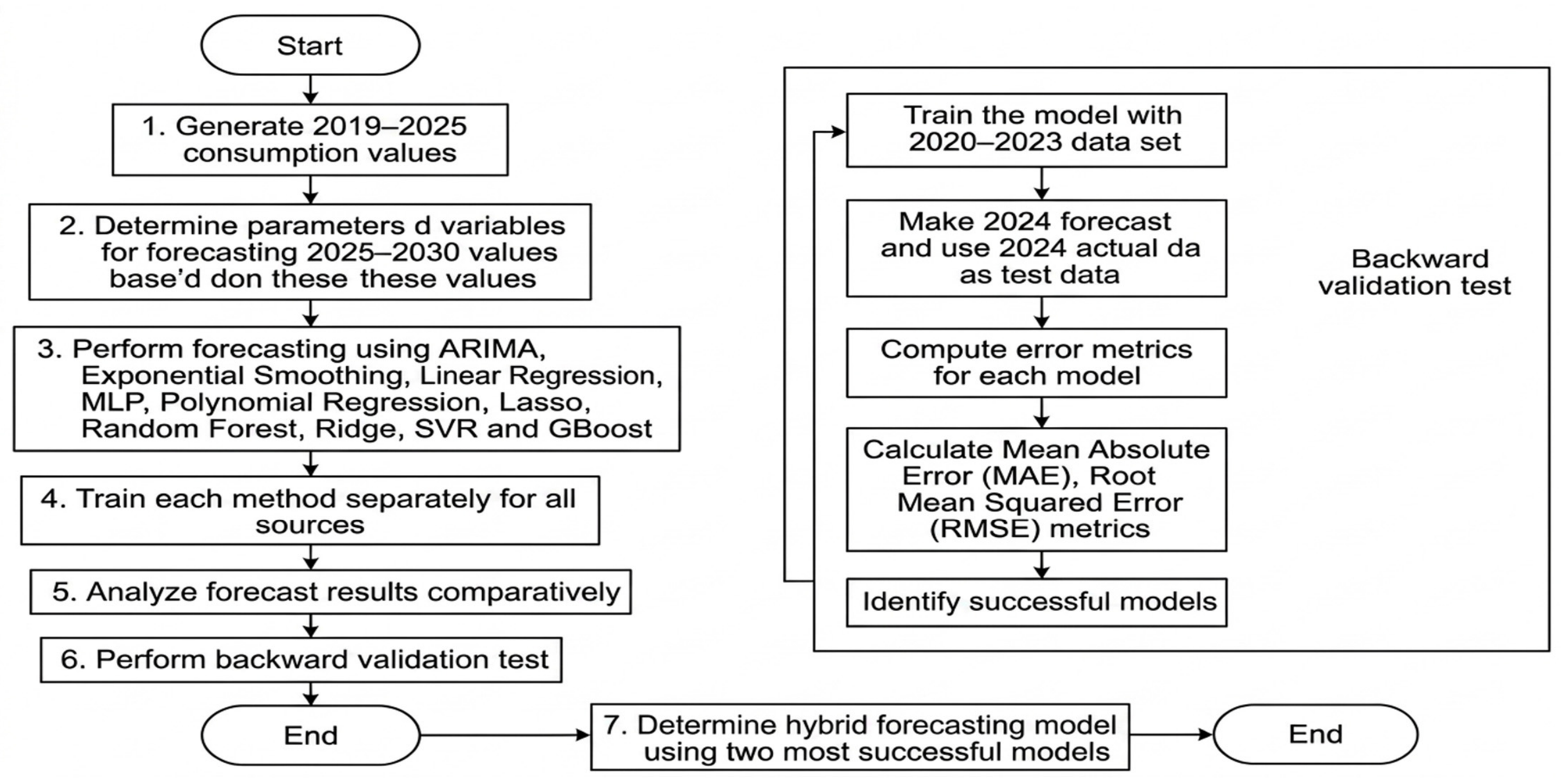
Methodology consists of data collection and processing into meaningful data, establishing and implementing forecasting models based on the data, validating the forecasts with test data, conducting model performance tests, and determining the hybrid model. In this context, a forecast based on production values was conducted in the study. Data on wind, solar, and geothermal energy consumed in Turkey between 2019 and 2024 were obtained from the Turkish Ministry of Energy and Natural Resources. The data was then processed into meaningful data. The forecast model was created using ARIMA, Exponential Smoothing, Linear Regression, Polynomial Regression, Lasso, Random Forest, Ridge, Support Vector Regression (SVR), and Gradient Boosting (XGBoost). The forecast was concluded with retrospective accuracy testing, determining optimal forecasting methods, and creating and implementing a hybrid forecasting system based on these data. Energy consumption data served as the dependent variable in the forecasting studies. The results were analyzed comparatively, and a wind–solar–geothermal energy consumption forecast for 2025–2030 was produced. In the hybrid estimation model, the impact of the variables affecting the formation of demand was calculated using the Pearson Correlation Statistical method. The flow diagram of the study is shown in
Figure 1.
2.1. Creating the Dataset
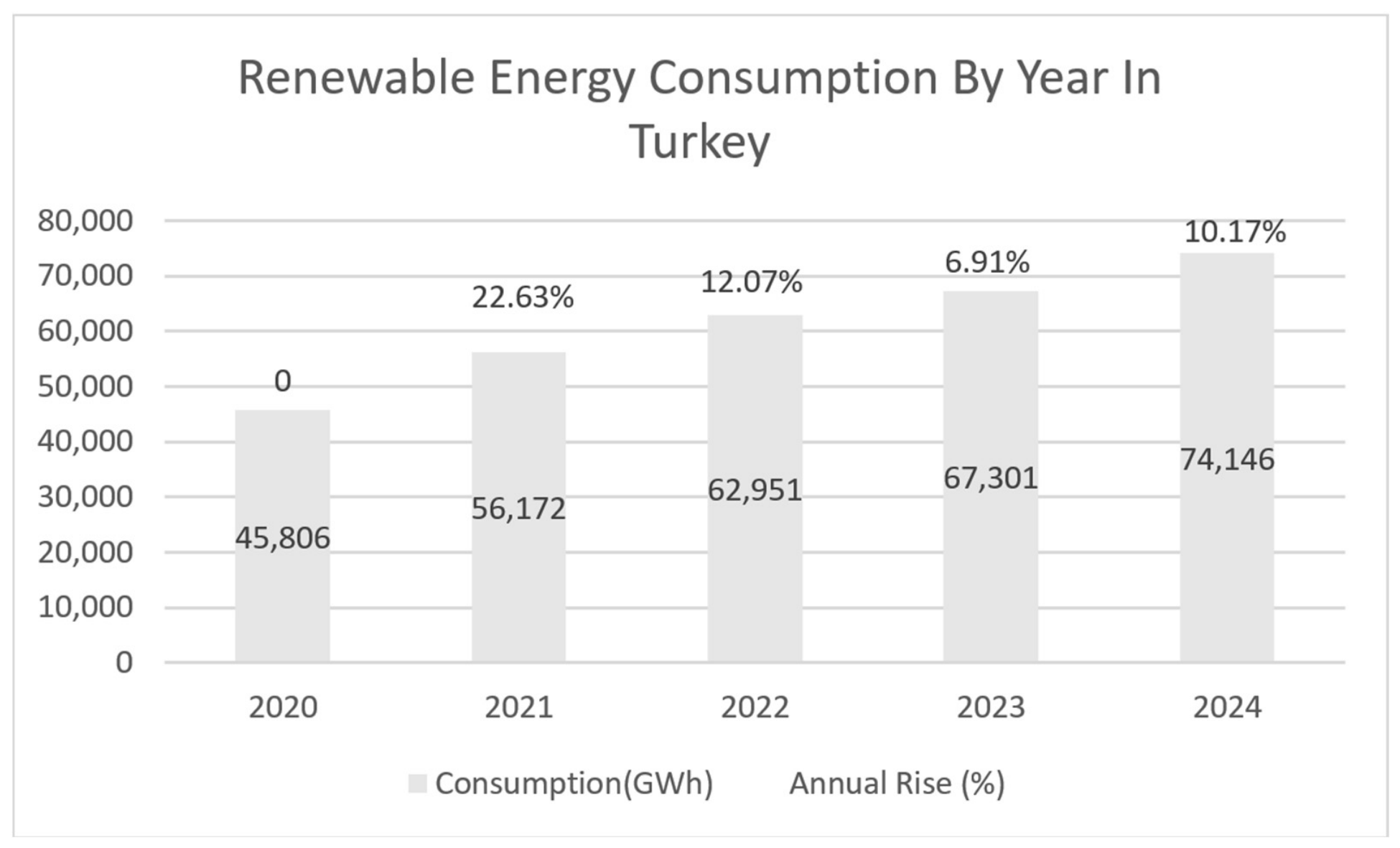
Five-year consumption data from the Turkish Ministry of Energy and Natural Resources, covering the years 2019–2024, were analyzed, compiled, and adapted for model use. Total annual consumption data for these resources was obtained based solely on wind, solar, and geothermal energy data. These consumption values are shown in
Figure 2.
Population, Gross Domestic Product, and the number of university graduates were selected as the independent variables for this study. Population was chosen as the independent variable because electricity demand is directly related to population density and directly affects demand growth. Gross Domestic Product was chosen as the independent variable because electricity demand increases in proportion to economic development. As economic development increases, digitalization, technology use, energy access, industrial development, the service sector, and commercial energy use also increase. The number of university graduates was chosen as the independent variable because a university fosters individual development. Consequently, digitalization, technology access and use, smart device use, and the understanding of electricity-dependent comfort are increasing. These changes directly affect consumption forecasts.
Data variability and uncertainty affect demand forecast accuracy. The primary causes of data uncertainty are human factors, economic variables, demographic changes, educational shifts, and other socioeconomic changes. In this study, socioeconomic data were included as independent variables to minimize forecast errors due to data uncertainty.
It should be acknowledged that the dataset used in this study consists of annual observations over a relatively limited period (2019–2024), which may restrict the learning capacity of highly data-intensive forecasting models. However, the use of annual data reflects the official reporting frequency of Türkiye’s aggregated wind, solar, and geothermal electricity consumption statistics. Since the primary objective of the study is medium-term trend forecasting rather than short-term high-frequency prediction, annual observations were considered appropriate for the scope of the analysis. In addition, to reduce the risk of overfitting, chronological data partitioning, backtesting validation, and regularization-based models such as Lasso and Ridge were employed. Therefore, the forecasting framework was designed to balance data limitations with methodological robustness.
Data Partitioning Strategy
A chronological data partitioning strategy was adopted in this study due to the time-series nature of the dataset. To preserve temporal dependencies and prevent data leakage, the dataset was not randomly divided. Instead, historical data up to 2022 were used for model training, while the most recent years, 2023 and 2024, were reserved as the validation (backtesting) period. The selection of the latest years for validation enables the assessment of model performance under current and realistic conditions, ensuring that recent trends and structural changes in energy demand are adequately captured.
It should be noted that the validation framework in this study is based on chronological backtesting using the most recent observations (2023 and 2024) as out-of-sample test years. Given the limited number of annual observations available, this approach was preferred to preserve temporal consistency while avoiding data leakage. Although more advanced procedures such as rolling-origin evaluation or time-series cross-validation may provide stronger evidence for model generalization, their applicability becomes constrained under very small annual datasets. Therefore, the adopted validation strategy was considered a practical compromise between methodological rigor and data availability. Future studies with longer historical series should implement rolling-origin or expanding-window validation frameworks to further improve robustness.
2.2. Creating and Implementing Forecast Models
The forecasting model was created using ARIMA, Linear Regression, Exponential Smoothing, Polynomial Regression, Random Forest Regressor, XGBoost Regressor, Lasso, Ridge, and SVR forecasting methods on the same dataset.
These forecasting methods were selected for demand forecasting because of their structural differences and distinct strengths. ARIMA was chosen for its ability to model random components in time series, Exponential Smoothing for its emphasis on recent observations, and Linear and polynomial regression models for their linear assessments of variables. Machine learning models were selected to capture the complex interactions in the dataset. Random Forest, XGBoost, Lasso, SVR, and Ridge forecasting methods were included in this study. The high generalization capabilities of Lasso and Ridge models, SVR’s ability to handle nonlinear relationships, and XGboost’s ability to sequentially optimize the error function also contributed to their inclusion in the study.
In the study conducted using ARIMA (AutoRegressive Integrated Moving Average), annual production values were obtained, and trend testing was performed using these values. After selecting the model parameters, the most appropriate p, d, and q values were determined. Forward-looking forecasting was performed using the past 5 years of data. A mathematical equation was created: p: Autoregressive term (AR), d: Differencing number (if there is a trend), q: Moving average (MA), and ε
t: White noise error term. Stationarity Test—ADF Test One of the basic assumptions of the ARIMA model is that the data is stationary. According to the ADF (Augmented Dickey–Fuller) test, the solar production data is not stationary because it contains a trend. It became stationary when the 1st degree difference was taken. The mathematical model is shown in Equation (1).
Model Parameter Selection: AR (p), MA (q). To determine these, the ACF (Autocorrelation Function) graph and the PACF (Partial Autocorrelation Function) graph were used. The ACF rapidly decreased to zero after the first delay → the MA component was low, the PACF decayed slowly → the AR component was more significant. Therefore, the most suitable model was found to be ARIMA(2,1,1) according to the AIC criterion. Parameter training was initiated. The trained parameters are shown in
Table 1.
The Linear Regression Model is a model that makes future predictions using linear equations. This model performs regression using year information. In this study, the year is expressed as t (e.g., 2020 = 1, 2021 = 2), the learned regression coefficients are expressed as β
0–β
1, and the error term is expressed as ε
t. β
0 = 8.120 and β
1 = 1.32 were taken into account in the calculation. Here, Y
t is the dependent variable, t is the independent variable, β
0 and β
1 are constant values, and ε
t is the error term. The error term is obtained by summing and minimizing the total squared error. The mathematical model is shown in Equation (2).
In the Exponential Smoothing forecasting method, a forecast is made based on a weighted average of historical data. The forecast is made with constant variance, ignoring seasonality and/or trend assumptions. Mathematically, the equation is expressed as x. In the given equation, Y
t+1 represents the forecast for period t + 1, and the value a represents the smoothing coefficient, which is taken as 0 or 1. The mathematical model is shown in Equation (3).
The prediction was made using the Polynomial Regression method. Because systems exhibit accelerated growth and decline, the results are highly accurate. In grids containing solar and wind generation, this rate of change is high, and this prediction method is highly accurate. The mathematical model for the polynomial calculation method is shown in Equation (4). In the study, β
0 = 7.850, β
1 = 1.500, and β
2 = −35 were included in the calculation.
In the case of the prediction using the Random Forest Regressor, the forest model, consisting of the decision tree, was created by preserving only the year values. The mathematical model of the decision trees used in this prediction model is given in Equation (5). In this equation, Ti represents the ith decision tree, and t represents the year value. Prediction is performed using the relationship between years and rows. In the model, a regression model with 100 trees was created. The trained inputs were 1, 2, 3, 4, and 5. The tree depth was set to 3.
In the XGBoost (Boosted Decision Trees) estimation model, decision trees are created as in the Random Forest model, and these decision trees progress by correcting the errors of previous trees. The mathematical model created in this estimation method is shown in Equation (6). In this equation, f
k represents the learned decision trees.
In the Lasso estimation method, variable selection was made by setting the coefficients within the linear structure. Thanks to L1 regularization, variable selection was made by equating some β coefficients to zero, and estimation was made by producing simpler models. In the lasso equation, J(β) represents the model’s total loss function (error + penalty). Y
i represents the true (observed) value at the ith observation, and Ŷ
i represents the value predicted by the model. The term (Y
i − Ŷ
i)
2 gives the squared error value for each observation, while the sum of these errors indicates the model’s fit. βⱼ is the regression coefficient of the jth independent variable. λ (lambda) is the regularization coefficient that determines the model’s penalty severity; as it increases, more penalty is applied. |βⱼ| represents the L1 norm, that is, the absolute value of the coefficient. This allows for variable selection by reducing some coefficients to zero. m represents the total number of observations, and n represents the number of independent variables (features) in the model. The mathematical model is shown in Equation (7).
The Ridge estimation method is achieved by adding an L2 penalty to the linear regression model to prevent overfitting. In the model, λ denotes the regularization coefficient, and β
j denotes the model coefficients. In the applied method, the learned parameters were found to be λ = 1.0, β
0 = 7.980, and β
1 = 1.320. Variables are determined in the model by pushing β
j values to zero. The learned parameters in this model are λ = 0.1, β
0 = 8.000, and β
1 = 1.310. The mathematical model is shown in Equations (8) and (9).
SVR (Support Vector Regression) is an estimation system that eliminates errors outside a certain tolerance without penalizing errors within it. In the given model, C: regularization parameter, ε: tolerance, and ∗: error margins. During the training process, c = 100 and ε = 0.1 were considered.
Backtesting models were trained using data from 2020 to 2023 using a backtesting system. Since 2024 was the actual dataset available, it was used as the test data. Error metrics were calculated by comparing the 2024 forecast data with the actual data. The same process was repeated with 2023 selected as the test year. MAE and RMSE tests were performed. The dataset was divided into chronological order. The data was divided into two groups: training series and test series. In this study, the model was trained between 2019 and 2022. The trained data was tested separately for 2023 and 2024. The accuracy was measured by calculating the error metrics Mean Absolute Error (MAE) and Mean Squared Error (MSE). The mathematical model is shown in Equations (10) and (11).
In the calculation, Yt → Actual (observed) value, Ŷt → Predicted (model output) value, et → Error value (actual value − predicted value), N → Total number of observations (number of t times), Yi → Actual value of the i-th observation, Ŷi → Predicted value of the i-th observation.
In addition to MAE and RMSE, Mean Absolute Percentage Error (MAPE) was used to provide a percentage-based interpretation of forecasting performance. Unlike absolute error metrics, MAPE expresses the prediction error relative to the actual observed value, thereby enabling a more intuitive comparison of model accuracy. The mathematical model is shown in Equation (12).
where
denotes the actual value,
denotes the predicted value, and n represents the number of observations.
In addition to MAE and RMSE, Mean Absolute Percentage Error (MAPE) was employed to provide a relative interpretation of forecasting accuracy. This allows for a more comprehensive comparison of model performance, particularly when dealing with different scales of prediction values.
For consistency in model comparison, baseline hyperparameter settings commonly adopted in the literature were initially used for all machine learning models. Limited manual tuning was conducted to avoid overfitting under the small annual dataset structure. It is acknowledged that more comprehensive optimization procedures such as Grid Search, Random Search, or Bayesian Optimization may further improve model-specific performance. Therefore, future studies should incorporate systematic hyperparameter tuning frameworks to strengthen comparative robustness.
2.3. Creating a Hybrid Forecasting Model
The inverse error weighting method was applied to create the hybrid model. The new model was obtained by using the inverse error weighting method using the outputs of both models. In this model, the weight given to the lasso estimates is expressed as w, and the weight for the random forest model is expressed as (1 − w). The w value ranges from 0 to 1. The parameters used in the model equation are expressed as follows: yHybrid represents the results of the hybrid system, yLasso represents the results of the lasso estimate, and yRF represents the results of the random forest estimate. The weights are calculated using the following general formulation, where W
i represents the weight of model E
i, and I denotes the corresponding error metric. The calculations are shown in Equations (13) and (14).
The inverse error weighting method was used to determine the weights for the hybrid system. In this approach, higher weights are given to models with lower errors. In this case, the weightings for the years 2023 and 2024 are as follows: Lasso contribution = 1/19.69 = 0.0508, RF contribution = 1/4.705 = 0.2125, Total = 0.0508 + 0.2125 = 0.2633, Lasso: 0.0508/0.2633 = 19.3%, Random Forest: 0.2125/0.2633 = 80.7%. The weights for the hybrid model are determined as follows: w = 0.193 (Lasso), 1 − w = 0.807 (RF). The mathematical model is shown in Equation (12).
In the hybrid model, the dynamic nature of the Random Forest model is balanced by the Lasso model. By combining the learning capacity of the Random Forest with the simplifying effect of the Lasso, a new model with high prediction accuracy is obtained.
The hybrid model is constructed using an inverse error weighting approach, where models with lower prediction errors are assigned higher weights. This ensures that more reliable models contribute more significantly to the final prediction. The weighting scheme is derived from validation errors obtained during the backtesting phase, providing a data-driven and objective basis for model combination.
2.4. Pearson Correlation Method
In this study, the effects of variables on the prediction results were statistically determined using the Pearson Correlation Method. It is important to emphasize that the Pearson correlation analysis was not used for feature selection or model training. Instead, it was applied as a post-analysis tool to interpret the strength and direction of relationships between variables, thereby enhancing the explanatory power of the study.
The steps of the Pearson Correlation Method were as follows:
Creating the dataset.
Creating the correlation mathematical model.
Calculating the correlation coefficient.
Determining the correlation coefficient and determining the effectiveness levels of their effects on the results.
The Pearson Correlation Mathematical Model is given in Equation (15).
In the given mathematical model,
: each observation value of the independent variable (for example: GDP);
: each observation value of the dependent variable (Electricity Consumption);
: the mean of each variable;
r: correlation coefficient.
Correlation analysis:
r = +1; perfect positive correlation.
r = −1; perfect negative correlation.
r = 0; No correlation.
Pearson correlation analysis was conducted as a post hoc sensitivity analysis to evaluate the strength and direction of the relationships between electricity consumption and the selected socioeconomic variables, including gross domestic product, population, and the number of university graduates. It is important to note that the correlation analysis was not used for variable selection or model construction. Instead, all variables were included in the forecasting models based on their theoretical relevance and data availability. The results of the Pearson correlation analysis were utilized to support the interpretation of the model outputs and to provide additional insights into the relative influence of each variable on energy demand. The correlation coefficient takes values between 0 and 1 depending on the type of relationship. This is shown in
Table 2.
3. Findings and Discussion
In this study, wind, solar, and geothermal energy consumption in Turkey between 2025 and 2030 was estimated by using all forecasting methods, covering the years.
The highest forecast value in all years was achieved by the Polynomial forecasting method. The forecasting methods that showed the lowest consumption in 2030 were SVR and Random Forest. When the results were evaluated, an increase was observed across years in all models. However, these increases occurred at different rates. These results are presented as GWh in
Table 3.
As a result of retrospective validation tests, data for the years 2023 and 2024 were selected as test data, and the models with the highest predictive accuracy were determined to be the Lasso and Random Forest models. The validation tests for the years 2023 and 2024 are shown in
Table 4.
The Random Forest model emerges as a more stable and lower-error approach across both years. Although the Lasso model shows improvement in 2024, it still remains behind the Random Forest model in terms of performance. The equality of MAE and RMSE values indicates that the errors are absolute and unidirectional rather than directional, demonstrating that the forecasting model operates without systematic bias.
In addition to MAE and RMSE, percentage-based evaluation metrics, MAPE, were approximated to provide a more comprehensive assessment of model performance. The results indicate that both Lasso and Random Forest models exhibit very low relative error values, with Random Forest achieving the lowest error levels. These findings further support the robustness and consistency of the forecasting models.
MAPE results indicate that both Lasso and Random Forest models exhibit extremely low relative error rates, confirming the high accuracy of the forecasting framework. Random Forest consistently achieves the lowest MAPE values across both validation years, demonstrating superior robustness. The very low MAPE values (all below 0.03%) further support the applicability of the hybrid modeling approach and the overall forecasting methodology. The Random Forest model exhibits a lower error rate in both validation years. Furthermore, Random Forest is inherently more accurate for complex datasets, whereas Lasso performs effectively in linear data structures and in cases involving smaller datasets. Mape values are presented in
Table 5.
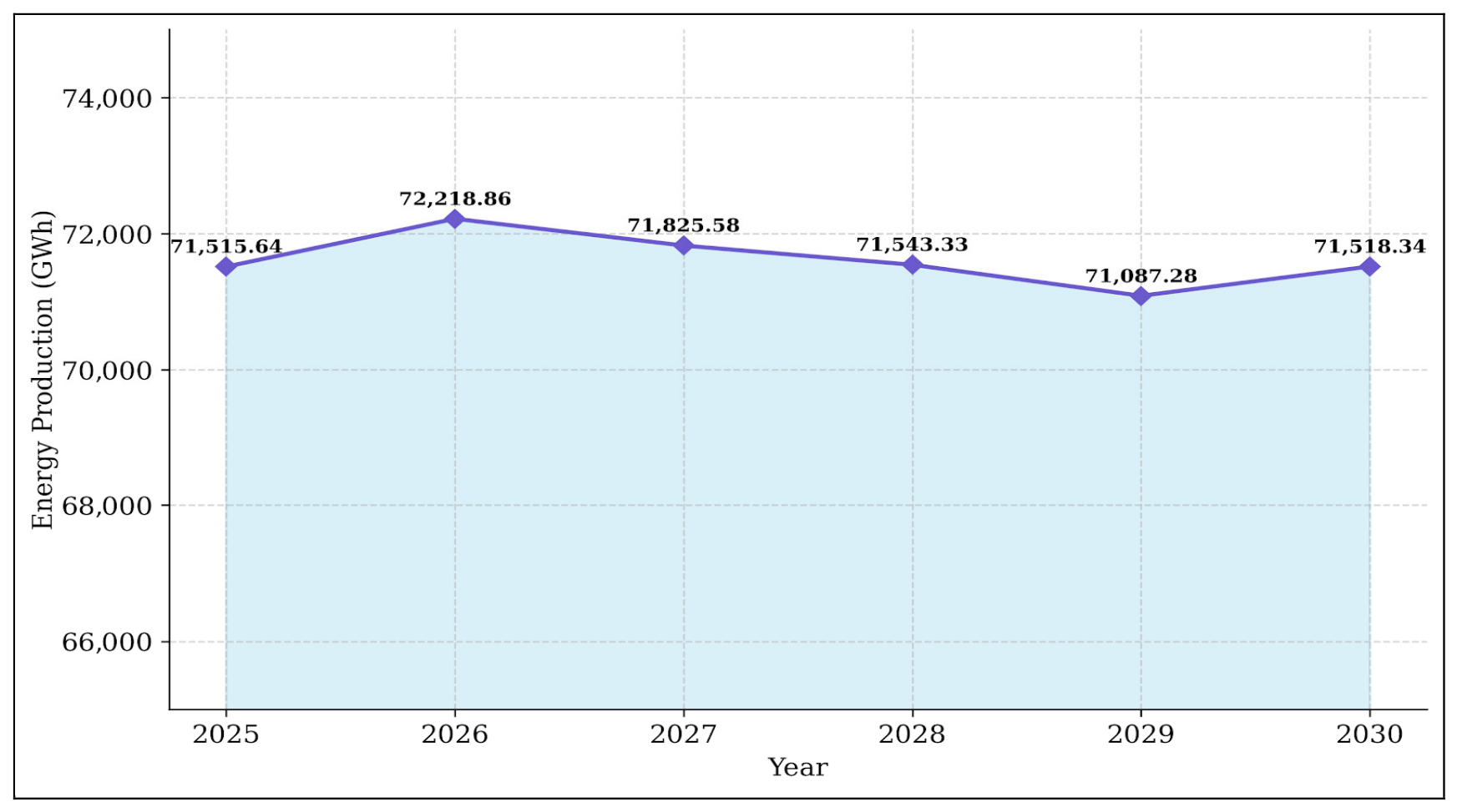
Using the inverse-error weighting framework based on backtesting performance, the hybrid forecasting model generated revised demand projections for the 2025–2030 period. The horizontal axis represents the years (2025, 2026, 2027, 2028, 2029, and 2030), and the vertical axis represents the production amount (GWh). According to the model, electricity production is projected to be 71,515.64 GWh in 2025, 72,218.86 GWh in 2026, 71,825.58 GWh in 2027, 71,543.33 GWh in 2028, 71,087.28 GWh in 2029, and 71,518.34 GWh in 2030. These values are presented in
Figure 3.
When all results were compared with the hybrid model, Random Forest and XGBoost produced the closest results to the revised hybrid model. Polynomial and Exponential estimation methods produced the farthest estimates from the hybrid model. This situation is demonstrated in
Table 6. The values in the table are given as GWh.
Between 2025 and 2030, the recalculated Hybrid model forecasts remained within a relatively stable range, varying between 71,217 GWh and 72,219 GWh. In 2025, the ARIMA model produced a forecast that was 9.40% higher than the Hybrid model. This difference increased to 12.88% in 2026, 17.17% in 2027, 20.58% in 2028, 23.52% in 2029, and 24.90% in 2030. These findings indicate that the ARIMA model consistently projected higher demand levels than the Hybrid model, with the gap widening over time.
The Exponential Smoothing method generated substantially higher values than the Hybrid model across all forecast years. The deviations were 12.24% in 2025, 19.51% in 2026, 28.58% in 2027, 37.54% in 2028, 46.65% in 2029, and 54.48% in 2030. This demonstrates that the Exponential model exhibits a strong upward extrapolation tendency and significantly overestimates demand relative to the Hybrid framework.
The Linear Regression model also produced higher estimates than the Hybrid model throughout the forecast horizon. The differences were 7.72% in 2025, 11.73% in 2026, 16.02% in 2027, 20.17% in 2028, 25.85% in 2029, and 30.42% in 2030. These results suggest that the Linear model captures a stronger growth trend, whereas the Hybrid model remains more conservative due to the dominant contribution of Random Forest.
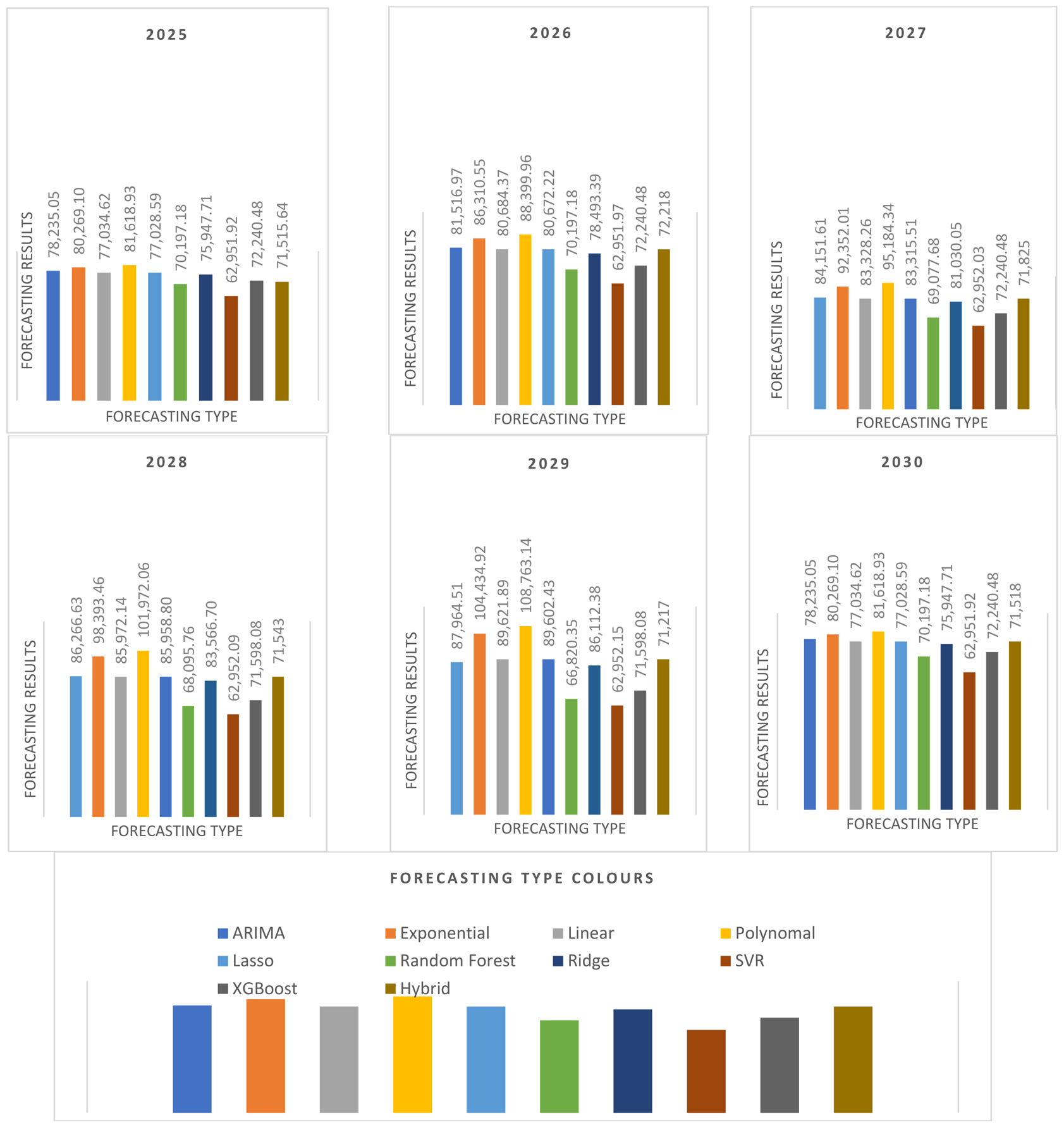
The results of all forecasting models, together with the revised Hybrid forecasting model, for the years 2025–2030 are comparatively presented on a yearly basis in
Figure 4.
The figure shows each year as separate sub-graphs, with all model outputs for that year represented as bar graphs. The horizontal axis represents the forecasting methods, and the vertical axis represents the generation values (GWh). Each column shows the numerical forecast value for the relevant model, and the models are identified by color codes (legends) given at the top. According to the data, the projected values are in the ranges of 62,351.92–80,269.10 GWh in 2025, 62,951.97–86,310.55 GWh in 2026, 62,952.03–92,352.01 GWh in 2027, 62,952.09–98,393.46 GWh in 2028, 62,952.15–104,434.91 GWh in 2029, and 62,951.92–110,476.37 GWh in 2030.
The Polynomial Regression model exhibits a substantial overestimation bias compared with the Hybrid model across all forecast years. The deviations were 14.13% in 2025, 22.41% in 2026, 32.53% in 2027, 42.54% in 2028, 52.73% in 2029, and 61.58% in 2030. Accordingly, the polynomial approach produces rapidly increasing and high-variance forecasts, making it one of the most optimistic models relative to the Hybrid framework.
The Hybrid model does not converge to the Lasso estimates. Instead, the hybrid structure reflects the dominant contribution of Random Forest due to its superior validation performance, while still preserving part of the upward trend captured by Lasso. This indicates that the inverse-error weighting framework generated a more balanced forecast trajectory between conservative and trend-oriented models.
The Random Forest model produced lower predictions than the Hybrid model in all years. The differences were 1.84% in 2025, 2.80% in 2026, 3.83% in 2027, 4.82% in 2028, 6.17% in 2029, and 7.27% in 2030. These results confirm that Random Forest acted as the conservative baseline component of the Hybrid structure.
The SVR model generated nearly constant forecasts across the projection horizon (approximately 62,952 GWh), remaining below the Hybrid model in every year. The differences were 11.03% in 2025, 14.56% in 2026, 14.02% in 2027, 13.35% in 2028, 11.62% in 2029, and 11.98% in 2030. This static behavior can be attributed to the limited dataset size and the absence of extensive hyperparameter optimization. Due to the ε-insensitive loss function, SVR may produce flat estimations when data variability is limited. Therefore, SVR appears less suitable for small-scale annual datasets without advanced parameter tuning or scaling procedures. Future studies should employ Grid Search or Bayesian Optimization to improve SVR performance.
The XGBoost model slightly exceeded the Hybrid model in 2025 and 2026, but remained highly comparable thereafter. The deviations were 1.08% higher in 2025, 0.03% higher in 2026, 0.58% lower in 2027, 0.08% higher in 2028, 0.53% higher in 2029, and 0.11% higher in 2030. These findings indicate that XGBoost produced forecasts highly comparable to the Hybrid model and was among the closest-performing individual approaches.
The Ridge model consistently generated higher forecasts than the Hybrid model. The differences were 6.20% in 2025, 8.69% in 2026, 12.82% in 2027, 16.81% in 2028, 20.92% in 2029, and 23.97% in 2030. Overall, the closest predictions were obtained from XGBoost and Random Forest, whereas the weakest relative performances were associated with Polynomial Regression and Exponential Smoothing due to their strong upward bias. These findings demonstrate that weighting schemes based on validation accuracy can substantially reshape the final Hybrid forecast trajectory.
Correlation Assessment
The correlation between electricity consumption and gross domestic product is calculated as 0.995. The correlation between electricity consumption and the number of university graduates is 0.9971, while the correlation between electricity consumption and population is 0.9827. These results indicate that the relationship between GDP and electricity demand is highly positive, the relationship between the number of university graduates and electricity consumption is strongly positive, and the correlation between population and electricity consumption is also highly positive.
Demand forecasting studies serve as a direct input for technical and economic planning processes, including determining the capacity and number of future energy generation plants, planning grid infrastructure, designing renewable and distributed energy systems, developing policies to reduce energy imports, establishing pricing and incentive mechanisms for grid integration, defining future carbon neutrality targets, planning energy consumption across transportation, industry, services, and residential sectors, implementing energy efficiency projects, and managing demand. In this context, such studies have a direct impact on public policy formulation as well as energy production strategies.
4. Conclusions
In this study, Türkiye’s wind, solar, and geothermal energy demand for the 2025–2030 period was forecasted using ten different predictive methods, including ARIMA, Exponential Smoothing, Linear Regression, Polynomial Regression, Lasso, Ridge, SVR, Random Forest, XGBoost. The results were subsequently compared with a hybrid forecasting model developed within the scope of the study. Through backtesting-based analysis, the performance of each model was evaluated annually by comparing absolute and percentage deviations from the hybrid model. In addition, the relative effects of the selected socioeconomic variables on demand were assessed through Pearson correlation analysis.
The revised results indicate that the hybrid model generated relatively stable forecasts between 71,217 GWh and 72,219 GWh over the 2025–2030 horizon. The hybrid forecasts no longer converged to the Lasso model. Instead, the hybrid structure was primarily shaped by the stronger contribution of Random Forest, which received a larger weight due to its superior validation performance, while still preserving part of the upward trend captured by Lasso.
Among the individual models, Random Forest and XGBoost produced the closest forecasts to the hybrid model. Random Forest remained consistently below the hybrid forecasts, with annual deviations ranging from 1.84% to 7.27%, while XGBoost generated highly comparable results throughout the forecast horizon. In contrast, the Linear Regression and Ridge models produced systematically higher projections, reflecting stronger growth trends than the hybrid framework.
The Exponential Smoothing and Polynomial Regression models consistently produced substantially higher forecasts than the hybrid model, especially after 2028. In 2030, the Exponential model overestimated demand by 54.48%, while the Polynomial model deviated by 61.58%. These findings suggest that extrapolation-based models may generate excessive long-term growth projections when applied to short annual datasets.
Another notable finding is that the Support Vector Regression (SVR) model generated nearly constant forecasts across all years, remaining below the hybrid model throughout the projection horizon. This behavior indicates that SVR may be less suitable for limited annual datasets when extensive hyperparameter optimization is not performed.
The correlation between electricity consumption and gross domestic product was 0.995. The correlation between electricity consumption and the number of university graduates was 0.9971, while the correlation between electricity consumption and population was 0.9827. These findings indicate that GDP, education level, and population all have strong positive relationships with renewable energy demand.
The revised hybrid model demonstrated stronger agreement with conservative machine learning approaches, particularly Random Forest and XGBoost, while substantial discrepancies were observed with aggressive trend-based models such as Exponential Smoothing and Polynomial Regression. These findings highlight the importance of carefully selecting hybrid model components and validating weighting structures through backtesting procedures. The methodological comprehensiveness of this study, together with its multi-model comparative framework and socioeconomic interpretation layer, offers both theoretical and practical contributions to the field of energy demand forecasting.
Energy demand forecasting serves as an important guide for governments and private sector investors. Accurate forecasting enables advance planning of generation investments, transmission and distribution infrastructure, grid flexibility measures, renewable integration policies, and long-term budgeting decisions. Likewise, private investors may use forecasting outputs to align capital allocation strategies with expected market developments. Therefore, forecasting studies have direct implications for energy policy and strategic planning.
This study provides important findings through a comprehensive comparison of multiple forecasting models and the development of a validation-based hybrid framework for forecasting Türkiye’s wind, solar, and geothermal energy demand. However, several improvements can be considered in future research. First, forecasting accuracy may be enhanced through advanced optimization techniques such as Genetic Algorithms, Grid Search, or Bayesian Optimization. Second, the validation framework may be strengthened through rolling-origin or time-series cross-validation procedures. Third, sub-regional forecasting models at the city or provincial level may improve the practical applicability of the results. Finally, integrating variables related to energy storage systems, renewable policy changes, and technological progress may provide more strategic long-term planning insights.
Despite its contributions, this study has several limitations. First, the analysis is based on a relatively short annual dataset (2019–2024), which may limit the ability of some models to capture long-term variability. Second, although multiple forecasting models were implemented, hyperparameter optimization was not extensively applied to all machine learning models. Third, the study considered a limited set of socioeconomic variables, while additional drivers such as climate conditions, policy shifts, and technological developments were not explicitly incorporated into the forecasting process. Another limitation of this study is that exhaustive hyperparameter optimization was not applied to all machine learning models due to the restricted dataset size.
Future studies can build upon this framework by employing longer historical datasets and higher-frequency observations such as monthly or quarterly data. In addition, advanced optimization techniques may further improve model performance. The development of regional forecasting models may also enhance practical relevance. Moreover, integrating emerging factors such as energy storage systems, renewable policy dynamics, and sectoral electrification trends may provide more comprehensive and policy-relevant insights for long-term sustainable energy planning.