1. Introduction
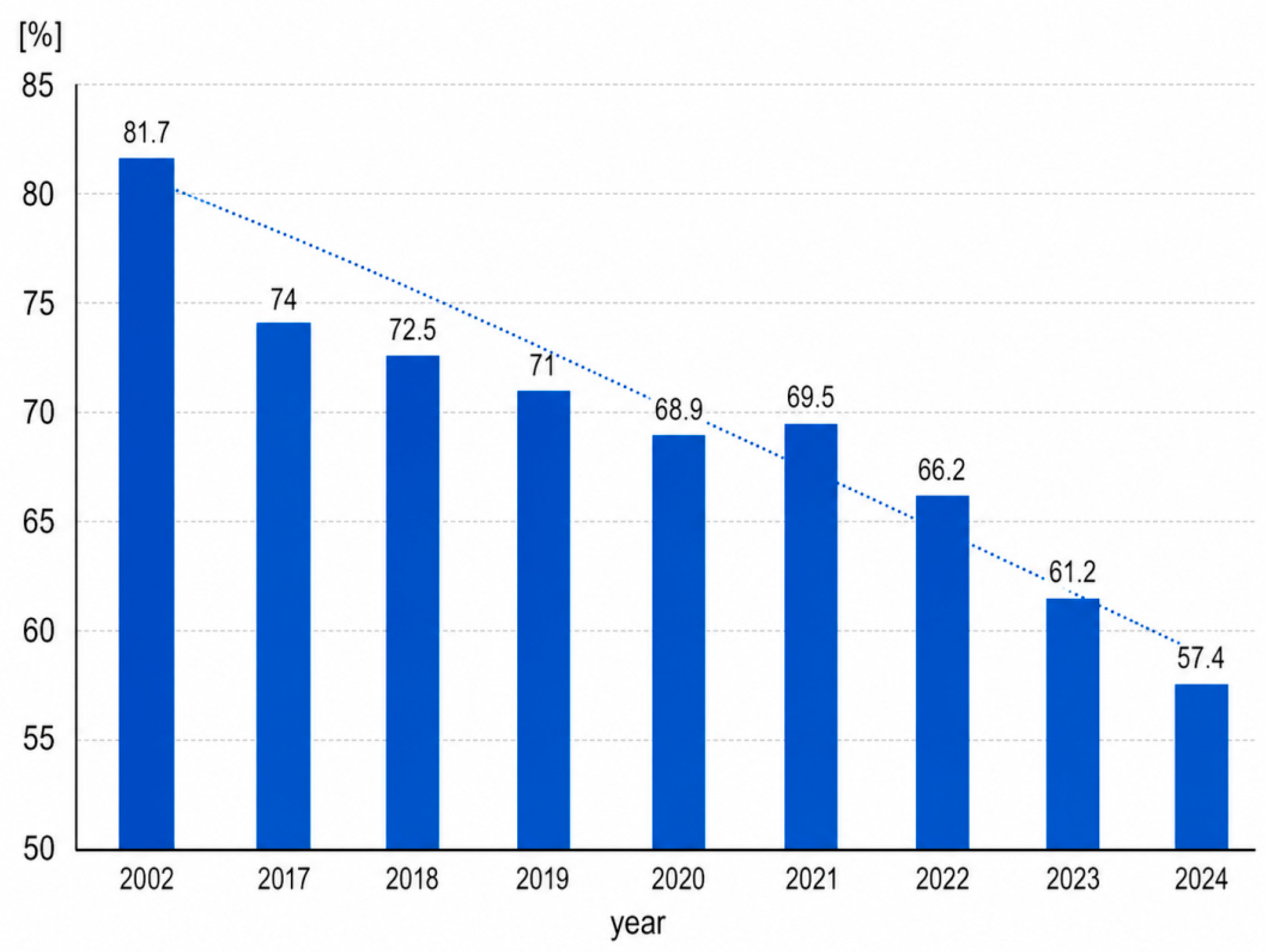
Poland’s energy transition has focused primarily on electricity generation, while heat generation has been pushed into the background. This creates several undesirable consequences, because combined heat and power plants and district heating plants in Poland, producing 323,679.5 TJ of heat, are still fuelled predominantly by fossil fuels. Although the share of coal-based fuels has decreased by nearly 23% over the last 22 years, coal still accounts for more than 57% of heat production, as shown in
Figure 1.
In this paper, district heating is understood as a centralised heat supply system in which heat is generated in one or more central sources and distributed through a municipal network to residential, public, and commercial consumers. In Poland, such systems differ substantially depending on the settlement size, heat demand density, network age, local fuel availability, and the technical condition of the existing heat sources. Large urban systems are often supplied by CHP plants and extensive transmission networks, whereas smaller municipal systems usually depend on local boiler houses or smaller CHP units and have more limited options for fuel switching and network modernisation.
Ustka is a small coastal town in northern Poland, located in the Pomeranian Voivodeship. At the end of 2023, the town had approximately 13.7 thousand inhabitants, with a declining population trend in recent years. The municipal district heating system is operated by EMPEC Ustka and supplies heat through a local network serving the town’s urban heat demand. The existing system can therefore be considered representative of a smaller Polish municipal district heating network, where transition options must be assessed not only in terms of the operating costs but also in relation to the local demand, available space, existing infrastructure, and site-specific technical constraints.
The limited focus on heat production has created difficulties for the transition of this part of the energy system. In practice, district heating transition cannot be implemented as a binary replacement of one technology by another. It must account for the local heat-demand characteristics, available space, existing infrastructure, technical feasibility, and operating conditions [
2].
Hybrid configurations integrating gas-fired CHP units, heat pumps, thermal storage, and peak-load sources are increasingly relevant for smaller municipal systems. Such configurations can improve operational flexibility, support gradual emission reduction, and increase resilience to volatility in fuel and electricity prices. From a sustainability perspective, their assessment should consider not only operating costs but also energy efficiency, local feasibility, and implementation robustness.
In sustainability terms, this transition concerns not only decarbonisation, but also long-term energy efficiency, reduced dependence on a fossil-fuel-based heat supply, resilience to fuel and electricity price volatility, and the practical deployment of locally feasible low-emission solutions in the municipal infrastructure.
Recent studies on district heating decarbonisation emphasise several complementary transition pathways. These include the diversification of heat sources, integration of renewable energy and sector-coupling flexibility, use of industrial excess heat, reduction in network operating temperatures, and electrification through heat pumps [
3,
4,
5,
6,
7,
8,
9,
10].
System-level studies also show that heat-source selection should be analysed together with the building retrofit strategies, local demand profiles, and the technical condition of the existing networks [
11,
12,
13,
14].
In addition, social and institutional aspects are increasingly recognised as important, particularly where modernisation affects end-user costs, comfort, and local acceptance [
15,
16].
These findings indicate that district heating transition cannot be reduced to the replacement of one fuel or technology by another. Instead, it requires a combined assessment of the technical feasibility, operating costs, network constraints, and local implementation conditions. This is especially relevant for smaller municipal systems, where the available space, resource potential, and connection to electricity or gas infrastructure may strongly influence the practical choice of the transition pathway.
In the district heating transition literature, scenario-based studies and analyses focused on individual technologies are common. Fewer studies combine, within one consistent framework, real time series from the operation of a specific district heating network, high time-resolution market signals, and the constraints arising from the local availability of resources. As a result, planning may face a gap between the configuration identified as favourable by an operational OPEX-based model and the configuration that remains implementable once site-specific technical constraints are considered, particularly for options dependent on the local heat sources, such as the borehole heat exchangers, or on electricity settlement rules at hourly resolution. In the Polish context, an additional limitation is the relatively small number of case studies that directly integrate operational datasets from district heating operators with observed electricity and gas market prices, including a systematic comparison of the daily and hourly settlement.
The contribution of this study is therefore not the introduction of a new transition technology but the integration of real operator-level data, market-based price signals, and local feasibility verification in a Polish municipal district heating case located in a coastal setting.
The aim of this study is to evaluate the hybrid heat-supply configurations for a municipal district heating system under real operational and market conditions. The analysis combines operational data from the Ustka district heating system for 2021–2022 with observed electricity and natural gas prices from the TGE day-ahead market. Four heat-source configurations are compared under the hourly and daily electricity settlement assumptions. The study focuses on the adopted OPEX-based unit heat generation indicator, the contribution of individual technologies to annual heat-demand coverage, and the role of local feasibility constraints in preliminary technology screening.
2. Materials and Methods
2.1. Data Sources
The existing Ustka district heating network was used as the reference demand system for the analysis. The calculations were based on measured operational data from 2021 to 2022, including heat demand, outdoor air temperature, and district heating supply and return temperatures [
2,
17]. The modelled heat-source configurations analysed in this study should therefore be understood as alternative modernisation options rather than as a description of the current heat-source structure. The optimisation model was used to determine the installed capacity mix of the new hybrid heat-source system. The installed capacities of the combined heat and power unit and the heat pump system were treated as optimisation variables. The required peak-load gas boiler capacity was determined from the need to meet the design supply temperature of 116 °C under the design outdoor temperature of −16 °C.
The analysed operational parameters included heat demand, outdoor air temperature, supply and return water temperatures, and the operating behaviour of the heat sources as a function of load.
The model used aggregated operational data at the district heating-system level. Separate detailed sub-models of distribution-network heat losses and user-side load characteristics were not developed in this study. Their influence is reflected only indirectly through the measured system heat-demand series and the recorded supply and return temperature data used as model inputs.
The present study also did not include a formal statistical data-validation or outlier-treatment procedure. The results should therefore be interpreted as based on operational records used for system-level screening analysis rather than on a separately calibrated network and consumer model.
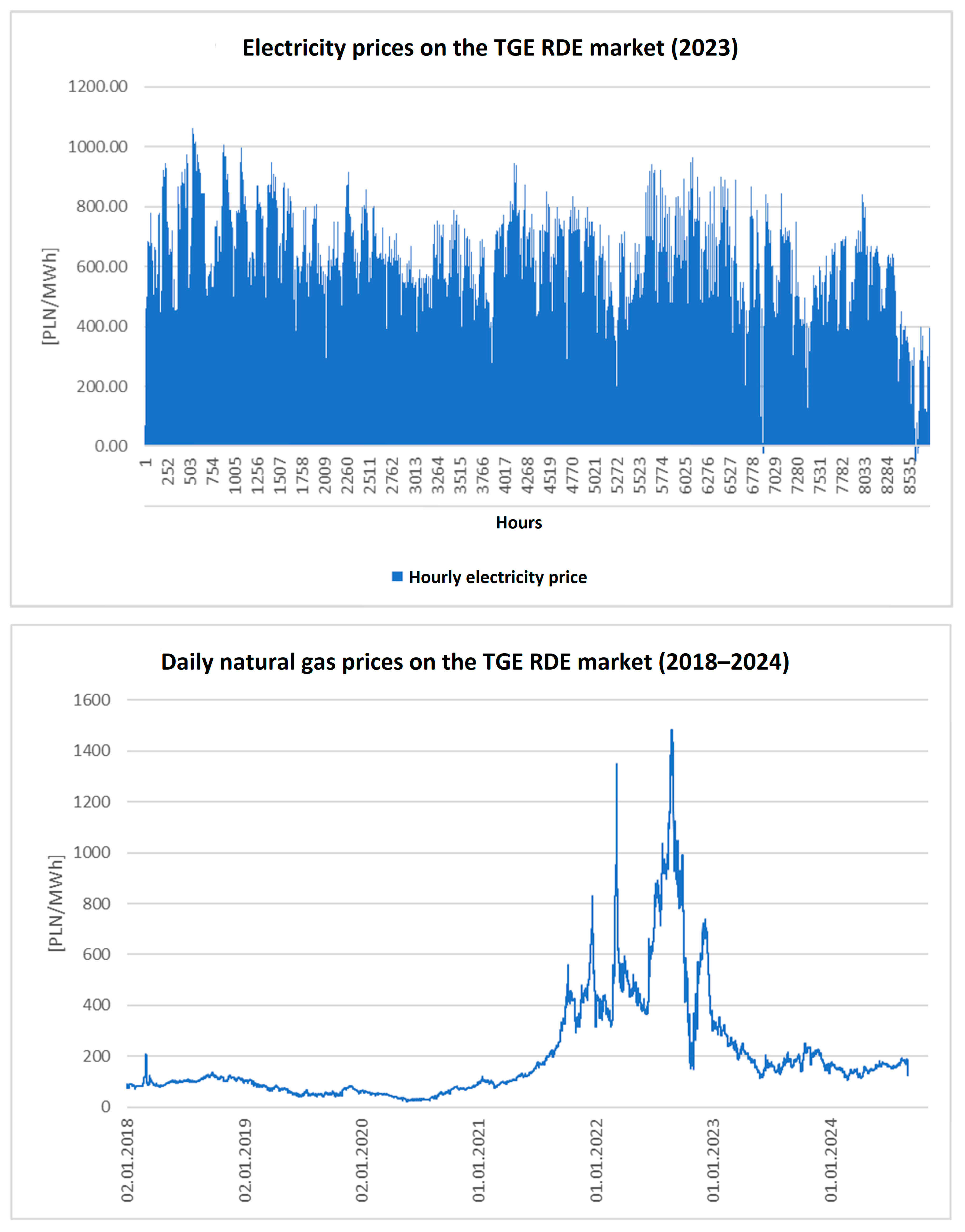
Market inputs were defined using observed electricity and natural gas prices from TGE [
18]. For electricity, two settlement assumptions were considered, namely hourly and daily settlement. The year 2023 was used as a pragmatic reference year for the price analysis because it reflects market conditions after the most severe disturbances observed in 2021–2022. The present study did not include a formal statistical comparison of electricity-price volatility across 2021–2024, so 2023 should be understood as a pragmatic reference year rather than as a statistically verified representative year. To ensure reproducibility, all boundary conditions and modelling assumptions used in the analyses are compiled in
Appendix A as a structured input table. The appendix lists the parameters required to rebuild the spreadsheet model and replicate the optimisation runs. It includes the adopted design conditions, the definition of market inputs (electricity and gas from the TGE day-ahead market, with hourly and daily electricity settlement assumptions), and the operational constraints imposed on the CHP units, heat pumps, and thermal storage. Where results depend on time-resolved series such as heat demand and market prices, the appendix specifies the data sources and temporal resolution so that the same datasets can be imported and the calculations reproduced consistently. In addition,
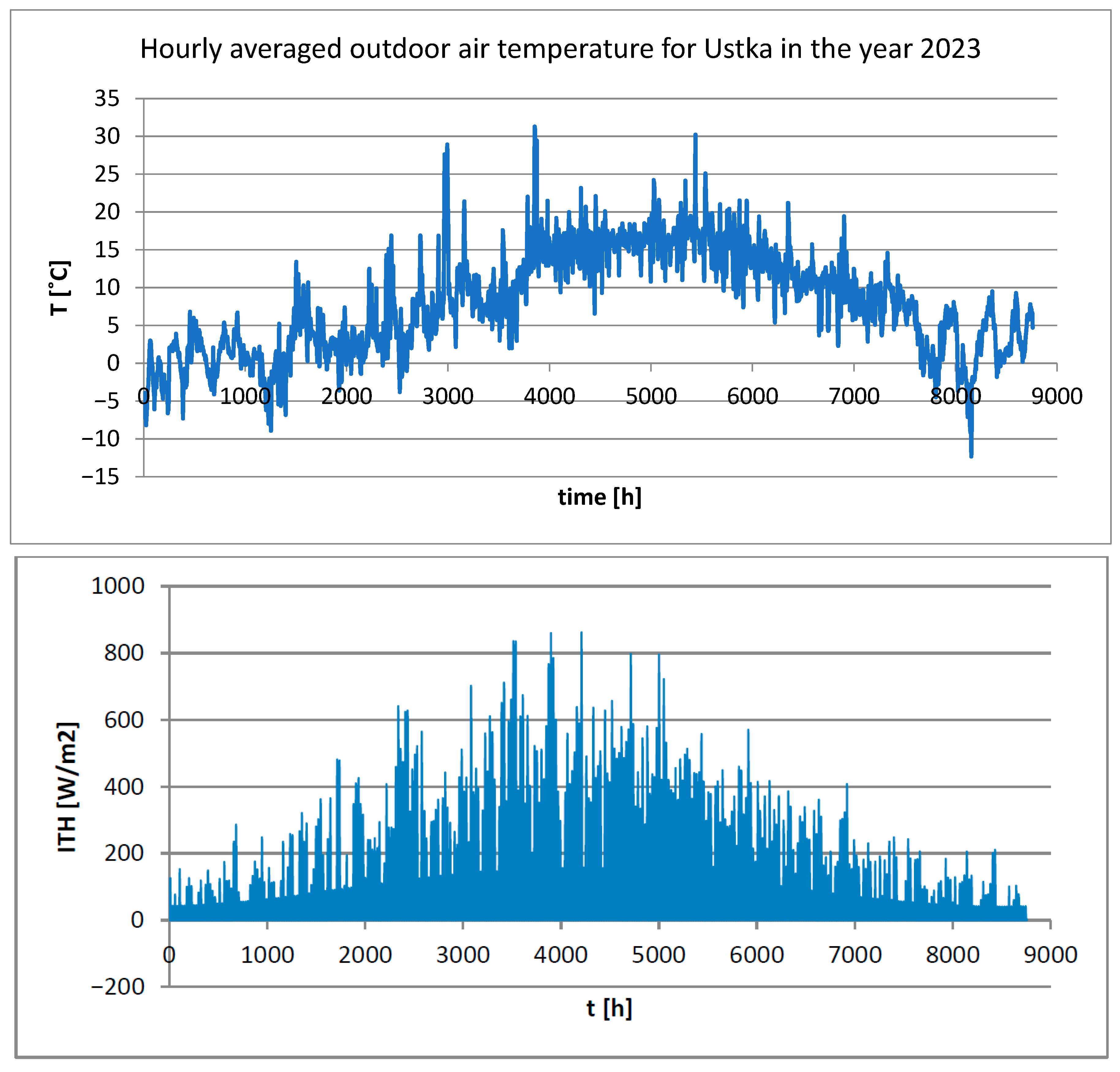
Appendix B presents supporting plots used in the study, including the 2023 electricity price series, the 2023 natural gas price series, and the hourly averaged total solar irradiance on a horizontal plane (ITH) for Ustka in 2023. The irradiance plot is not used as an input to the optimisation model and does not represent a solar generation option. It is included only as supporting background information for the separate assessment of ground-source feasibility, in particular the seasonal regeneration context of the ground heat exchanger.
2.2. Optimisation of the Capacity Mix and Dispatch of the Hybrid Heat-Source System
The optimisation model was implemented in MS Excel and used as a decision-support tool for screening alternative hybrid heat-source configurations for the Ustka district heating system. The objective of the model is to minimise the simplified average annual OPEX-based unit heat generation indicator, expressed in PLN/GJ, while meeting time-resolved heat demand and respecting the technical constraints of the analysed technologies.
The decision variables are the installed capacities of the CHP unit and the heat pump system, as well as their time-dependent operating levels within the imposed technical limits. The peak-load boiler capacity is determined by the requirement to satisfy the design district heating supply temperature of 116 °C at the outdoor design temperature of −16 °C. The optimisation is therefore applied to the capacity mix and operating dispatch of the hybrid heat-source system, whereas the district heating demand profile, supply-temperature requirement, and market-price series are treated as external inputs.
The model is solved in MS Excel using the GRG Nonlinear algorithm in Solver. The main constraints include the time-resolved heat demand, district heating temperature requirements, CHP part-load range, sequential staging logic for CHP operation, and the adopted heat-pump performance representation. The analysed system configurations are compared using the simplified average annual OPEX-based unit heat generation indicator and the contribution of individual sources to meeting the annual heat demand.
Some parts of the operating logic were imposed exogenously as engineering assumptions rather than derived from the optimisation itself. In particular, the charging and discharging of the thermal storage were represented by a predefined rule-based strategy linked to the relation between the current electricity price and the daily average electricity price. This distinction is important for interpreting the model as a screening and decision-support framework rather than as a full unit-commitment optimisation model [
19].
The model allowed the use of up to three CHP units. Because CHP units can be modulated within 50–100% of nominal electrical load while maintaining an approximately constant thermal efficiency, a sequential staging scheme was adopted. The first engine operates within 50–100% of its rated capacity. The second engine is started when the required load exceeds 100% of the first engine’s capacity. At that point, Engine 1 is reduced to 50%, and both engines operate at 50% load. The third engine is started when both engines reach 75% load. Engine 1 and Engine 2 are then reduced to 50%, and Engine 3 is started at 50%. Under this logic, the committed engines operate at equal load levels within the 50–100% range. Heat pumps were modelled as vapour-compression systems operating in a reversed thermodynamic cycle. The coefficient of performance (COP) was calculated using a Carnot-based relationship corrected by a real-cycle effectiveness factor. This factor was calibrated using performance information available for the heat pump units proposed by suppliers [
20,
21].
This approach was used because the heat pumps operate under variable temperature conditions during the year. A single manufacturer COP value at one nominal operating point would not represent annual operation, especially for the air-source heat pump, whose low-temperature source varies with outdoor air temperature.
The Carnot-based formulation therefore allowed the COP to be recalculated as a function of the temperature lift between the low-temperature source and the district heating supply temperature.
For the ground-source heat pump representation, the reference COP value was 3.5. The low-temperature source was represented by a constant evaporation temperature of 0 °C, corresponding to an assumed ground temperature of approximately 8 °C and an intermediate brine temperature of approximately 4 °C [
22,
23]. For the air-source heat pump representation, the COP at the outdoor design temperature of −16 °C was assumed to be approximately 1.5–1.8. During annual operation, COP was recalculated according to the current source temperature and required district heating temperature level.
The seasonal thermal potential of the ground heat exchanger was defined as the product of its thermal power and the operating time. The stated thermal power corresponds to operation with a 10 K temperature difference between the brine and the surrounding ground. If the ground is cooled during operation, the brine temperature must be reduced to maintain the same thermal power, which in turn decreases the heat pump COP.
Thermal energy storage was represented using predefined rule-based operating logic. The storage charging and discharging strategy was imposed as an engineering assumption and was not independently optimised by Solver. The rule was based on the relation between the current electricity price and the daily average electricity price.
Two storage applications were considered. The first concerned heat produced by the CHP units during periods when they were not fully loaded to meet district heating demand. When the current electricity price was above the daily average, CHP output could be increased and surplus heat stored, provided that the technical load constraints were satisfied. During periods when the electricity price was below the daily average, stored heat could be used to reduce CHP output and electricity generation.
The second application concerned the heat pump system. When the heat pump system was not fully loaded and the electricity price was below the daily average, the system could charge the thermal storage tank. The stored heat could then be discharged during less favourable electricity-price periods. This rule-based representation was used to test the potential operational benefit of thermal storage under dynamic electricity prices.
The model includes parameters for the following heat pumps:
A custom-designed ammonia heat pump manufactured by GEA (Düsseldorf, Germany);
An ammonia heat pump, GEA Blue-Red Fusion BG600-RG350 (GEA, Düsseldorf, Germany);
A CO2 heat pump, Mitsubishi q-ton ESA30EH-25 (Mitsubishi Heavy Industries, Tokyo, Japan).
The model includes parameters for the following CHP units:
GENTEC KE-MTUNG 500-ASE (500 kW) (GENTEC CHP s.r.o., Prague, Czech Republic);
GENTEC KE-MTUNG 1000-ASE (1000 kW) (GENTEC CHP s.r.o., Prague, Czech Republic);
GENTEC KE-MTUNG 1500-ASE (1500 kW) (GENTEC CHP s.r.o., Prague, Czech Republic);
GENTEC KE-MTUNG 2100-ASE (2100 kW) (GENTEC CHP s.r.o., Prague, Czech Republic);
JENBACHER J416 (1000 kW) (JENBACHER, Jenbach, Austria);
JENBACHER J416 (1200 kW) (JENBACHER, Jenbach, Austria);
JENBACHER J420 (1500 kW) (JENBACHER, Jenbach, Austria);
JENBACHER J624 (4500 kW) (JENBACHER, Jenbach, Austria).
The objective function is presented formally in
Section 2.4. In brief, it accounts for natural gas costs, electricity costs for heat pump operation, and revenues from electricity generated by the CHP unit.
The optimisation focused on operating costs and was used to determine the installed capacity mix between the CHP unit and the heat pump system. The calculations used operational data provided by the district heating operator, including the required thermal output delivered to the district heating network under the design outdoor temperature of −16 °C. A full CAPEX assessment was not included because sufficiently reliable and comparable investment-cost data were not available for all of the analysed configurations. Consequently, the reported optimisation results should be interpreted as OPEX-based operating-cost results rather than as full life-cycle cost optima or investment recommendations. The model could be extended in future work to include consistent CAPEX assumptions and payback periods, but such an extension is outside the scope of the present paper.
The OPEX analysis was performed using both average electricity and natural gas prices obtained from the Polish Power Exchange (TGE) and time-varying day-ahead market prices. The aim was to identify potential economic benefits of the dynamically adjusting heat and electricity production in response to market price signals.
2.3. Analysed System Configurations
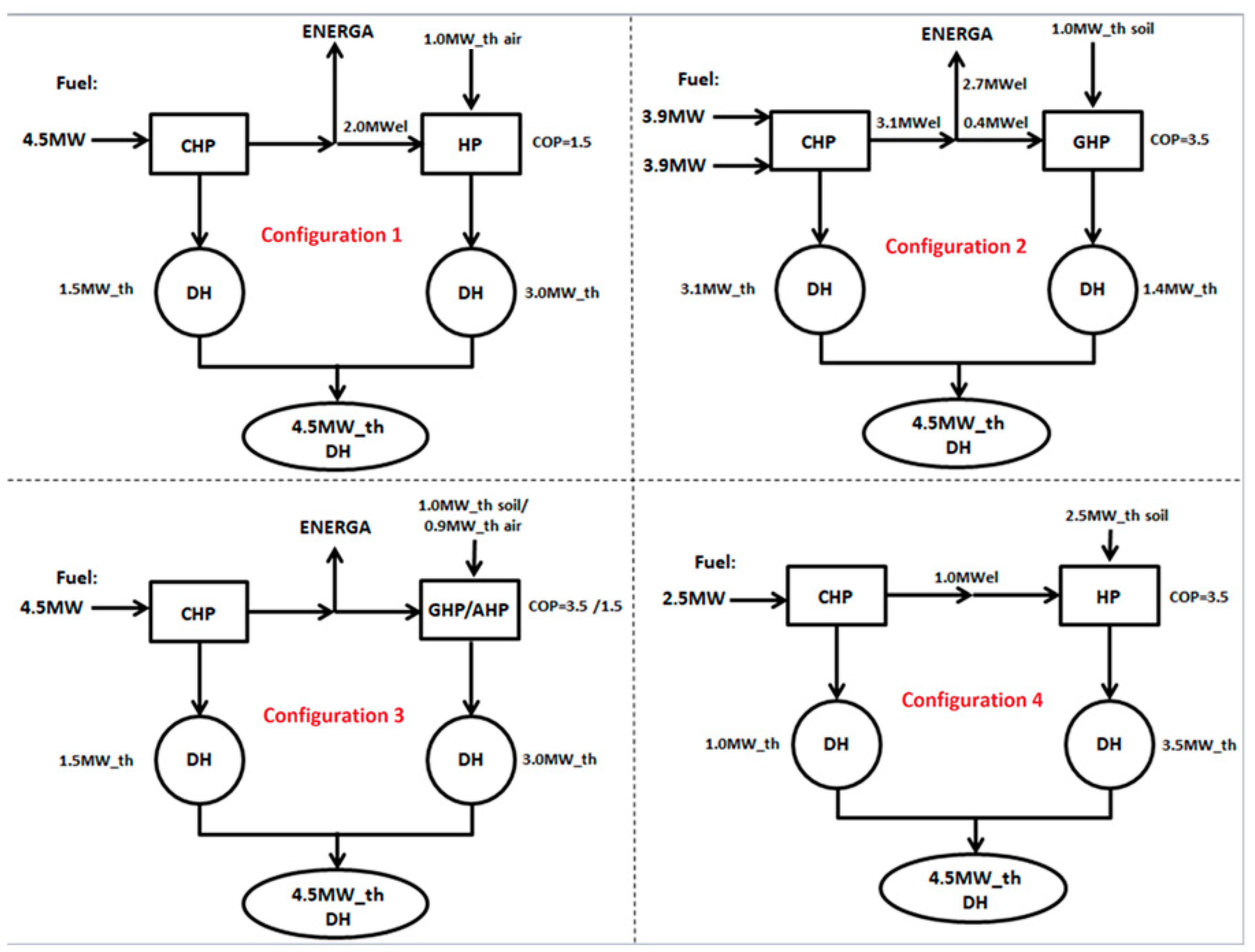
Four system configurations were compared (
Figure 2): a CHP-led configuration with an air-source heat pump; a CHP-led configuration with a ground-source heat pump; a CHP-led configuration with both ground-source and air-source heat pumps; and an air-source-heat-pump-led configuration with CHP support for electricity self-consumption. In this study, the term “system configuration” refers to the selected combination of heat-source technologies, whereas “operating strategy” refers to dispatch logic, electricity settlement assumptions, and self-consumption/export assumptions. This distinction is used consistently throughout the manuscript.
All four configurations were evaluated under two electricity settlement assumptions: hourly day-ahead electricity prices and daily averaged day-ahead electricity prices.
The methodological workflow included four main steps:
development of a configuration-based screening approach for a hybrid urban district heating source;
comparison of alternative CHP, heat-pump, and thermal-storage configurations;
evaluation of hourly and daily electricity settlement assumptions; and
assessment of local implementation constraints using the ground heat exchanger potential in Ustka as an example.
2.4. Objective Function
The optimisation objective was defined as the minimisation of the simplified average annual OPEX-based unit heat generation indicator, expressed in PLN/GJ. The indicator was calculated as the ratio of the annual net operating cost of the analysed supply configuration to the annual useful heat delivered to the network. Because the CHP unit simultaneously produces heat and electricity, the electricity stream was accounted for through revenues from electricity sales. In the economic balance used in this study, the CHP electricity revenue was offset by the cost of natural gas consumed by the CHP unit, which yields a net electricity margin given by (1).
where
is the average annual unit heat indicator (PLN/GJ),
is the annual electricity purchase cost for the heat pump installation (PLN),
is the annual natural gas purchase cost (PLN),
is the annual useful heat supplied to the district heating network (GJ), and
is the net electricity margin of the CHP unit (PLN), defined as (2):
where
is the annual revenue from electricity sales from the CHP unit (PLN) and
is the annual cost of natural gas consumed by the CHP unit (PLN). In the full self-consumption configuration, electricity export is restricted by definition, and
is reduced accordingly.
The economic indicator used in this study is a simplified OPEX-based unit heat generation indicator. It includes natural gas costs, electricity costs for heat pump operation, and revenues from electricity generated by the CHP unit. It does not include CAPEX, maintenance and repair costs, labour costs, auxiliary electricity consumption, taxes, financing costs, or other fixed operating expenses. Therefore, the indicator should not be interpreted as a full heat production cost or as a levelised cost of heat (LCOH). It is used only to compare the operating-cost performance of the analysed configurations under the same demand and market-price assumptions.
For the hourly settlement case, hourly heat production, electricity consumption, gas consumption, electricity revenues, and electricity costs were summed over the full analysis year. For the daily settlement case, the same annual quantities were calculated using daily averaged electricity prices, while the heat-demand and operating profiles remained time-resolved. Electricity costs and electricity revenues were evaluated under two settlement assumptions: (i) hourly day-ahead electricity prices and (ii) daily averaged electricity prices. Natural gas costs were evaluated using the adopted daily natural gas price series.
The optimisation was performed subject to the technical constraints, including the district heating temperature requirements (heat pumps providing high-temperature supply up to approximately 95 °C, with the peak-load boiler ensuring the design supply temperature of 116 °C at −16 °C outdoor temperature), capacity limits, and the assumed CHP part-load range and sequential staging logic.
The decision variables included the installed capacities of the CHP unit and the heat pump system, as well as time-dependent operating levels within the imposed constraints. The heat pump system capacity was treated as a decision variable and is reported in
Section 3.6. The optimal value obtained in the model was 1.5 MWel/3.0 MWth. The reported “capacity split between generation sources” is therefore the outcome of minimising
under the stated operating assumptions and constraints.
2.5. Ground Source Feasibility Assessment
The assessment followed the assumptions reported in [
24]. The assessment of the ground-source configuration required an additional verification of the local potential of the low-temperature heat source. For a 3.5 ha site and assuming vertical boreholes with a depth of 150 m, the feasible layout was estimated at 122 boreholes. For sandy soils typical of coastal locations, a thermal conductivity of approximately 1.5 W/mK, a volumetric heat capacity of 2.1 MJ/m
3, and an average temperature difference of about 10 K were assumed.
An additional assessment of ground heat exchanger operation was then used to compare the modelled ground-source load with the estimated local heat-extraction potential. For an operating time of 8000 h/year, the feasible continuous load of the exchanger was estimated at approximately 100 kW, whereas an extraction rate of 500 kW would require 6.5 months of ground regeneration during the summer period. These values were used as a local feasibility check for the ground-source configuration.
3. Results
Section 3 presents the model outputs for the four analysed system configurations summarised in
Table 1. Each configuration was evaluated under two electricity settlement cases, namely hourly day-ahead electricity prices and daily averaged day-ahead electricity prices. The following subsections retain a configuration-by-configuration presentation, because each case has a distinct operating logic and a different set of relevant model outputs. The comparative performance indicators are summarised in
Table 2,
Table 3,
Table 4,
Table 5 and
Table 6.
3.1. CHP-Led Configuration with an Air-Source Heat Pump System—Configuration 1
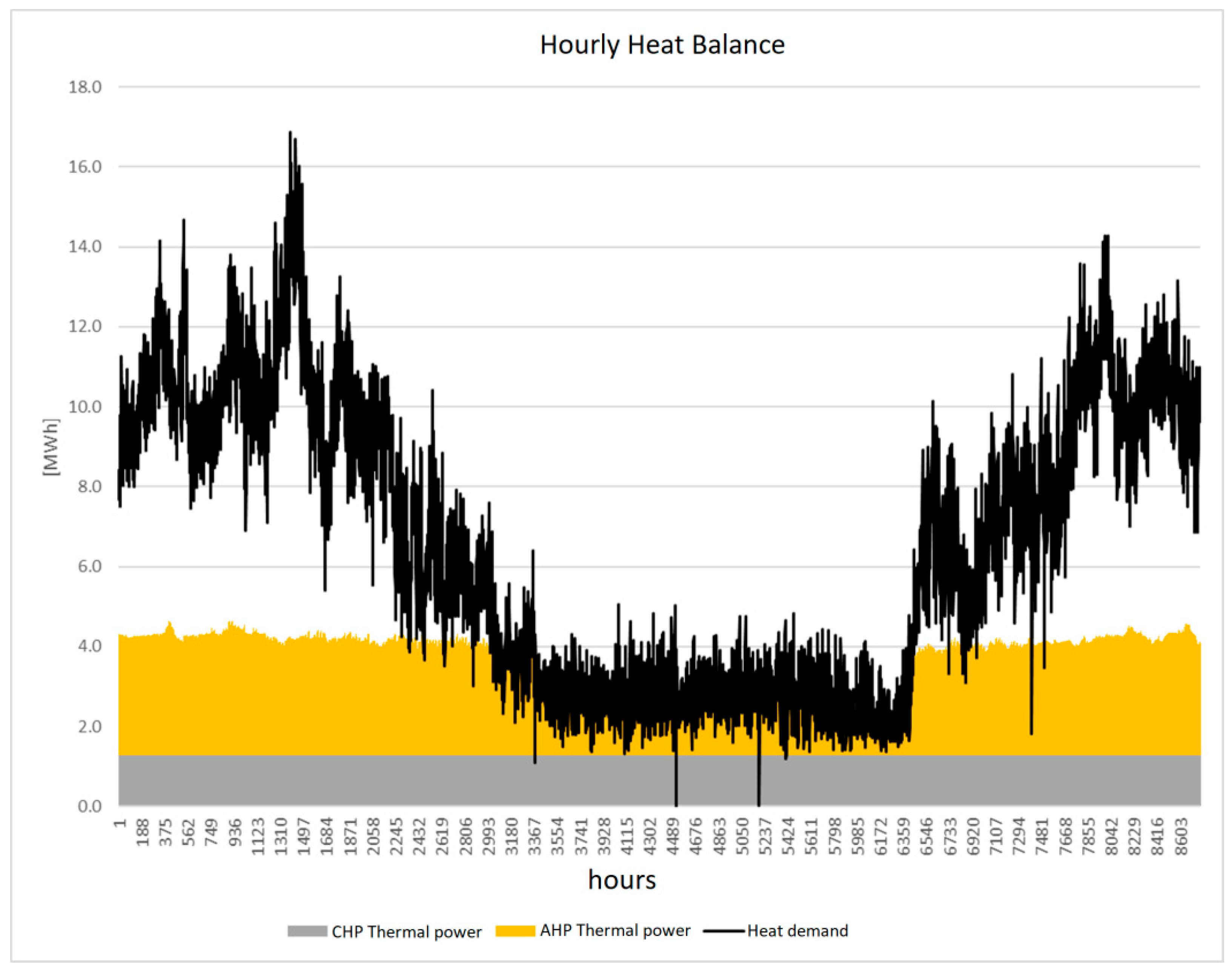
Configuration 1 represents the CHP-led system with an air-source heat pump. In this configuration, the CHP unit provides a baseload contribution, while the ASHP covers part of the remaining heat demand under the adopted operating constraints.
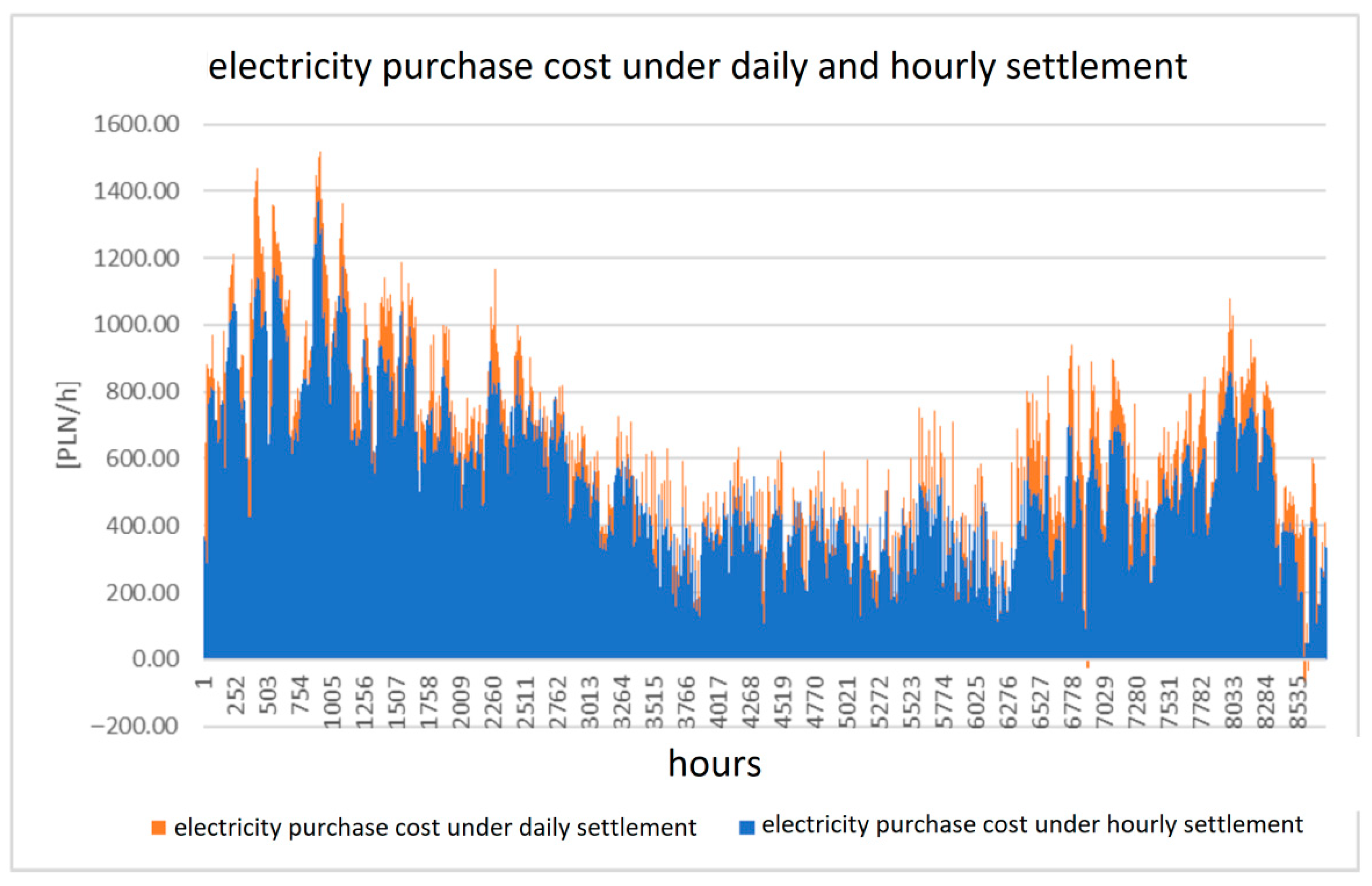
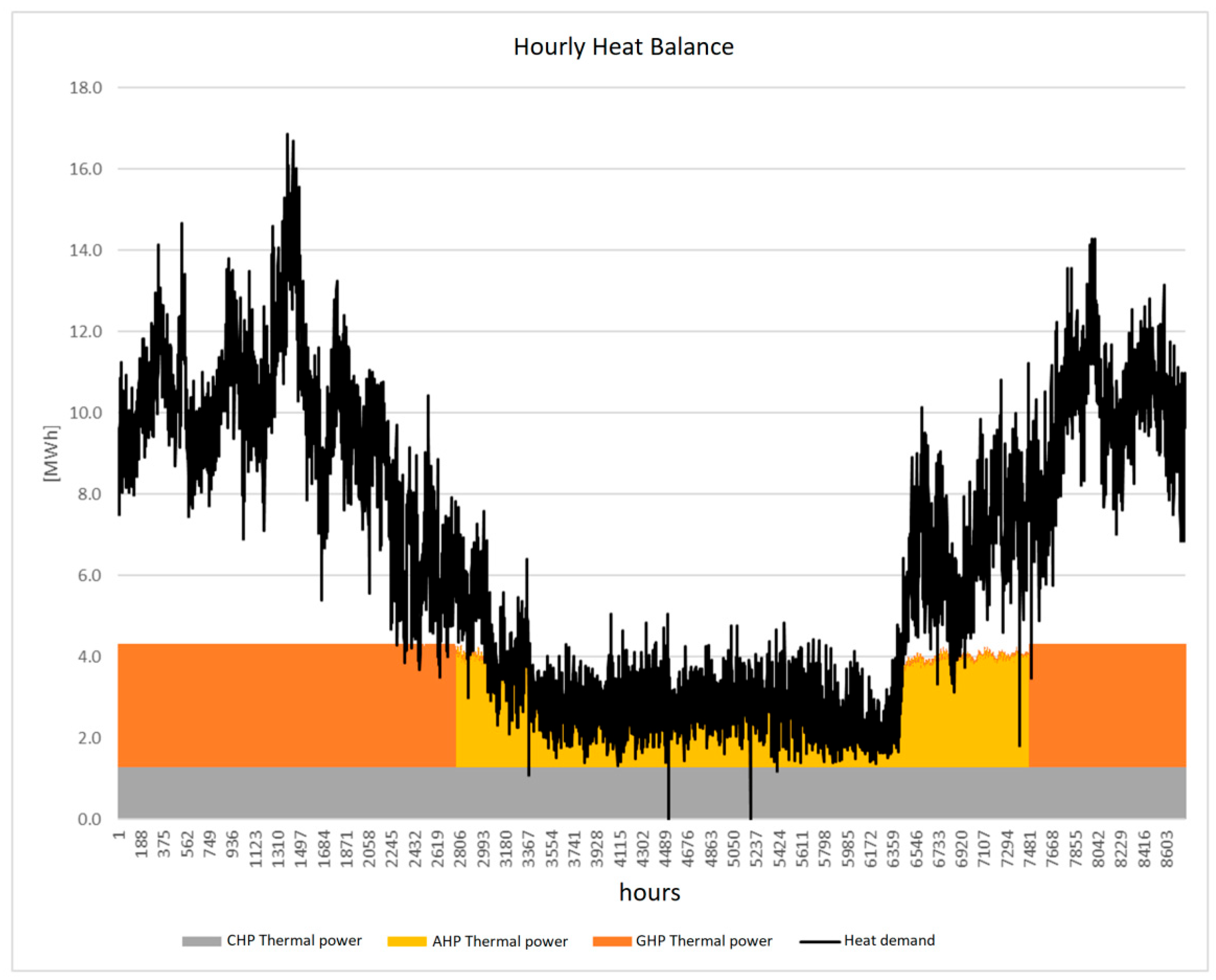
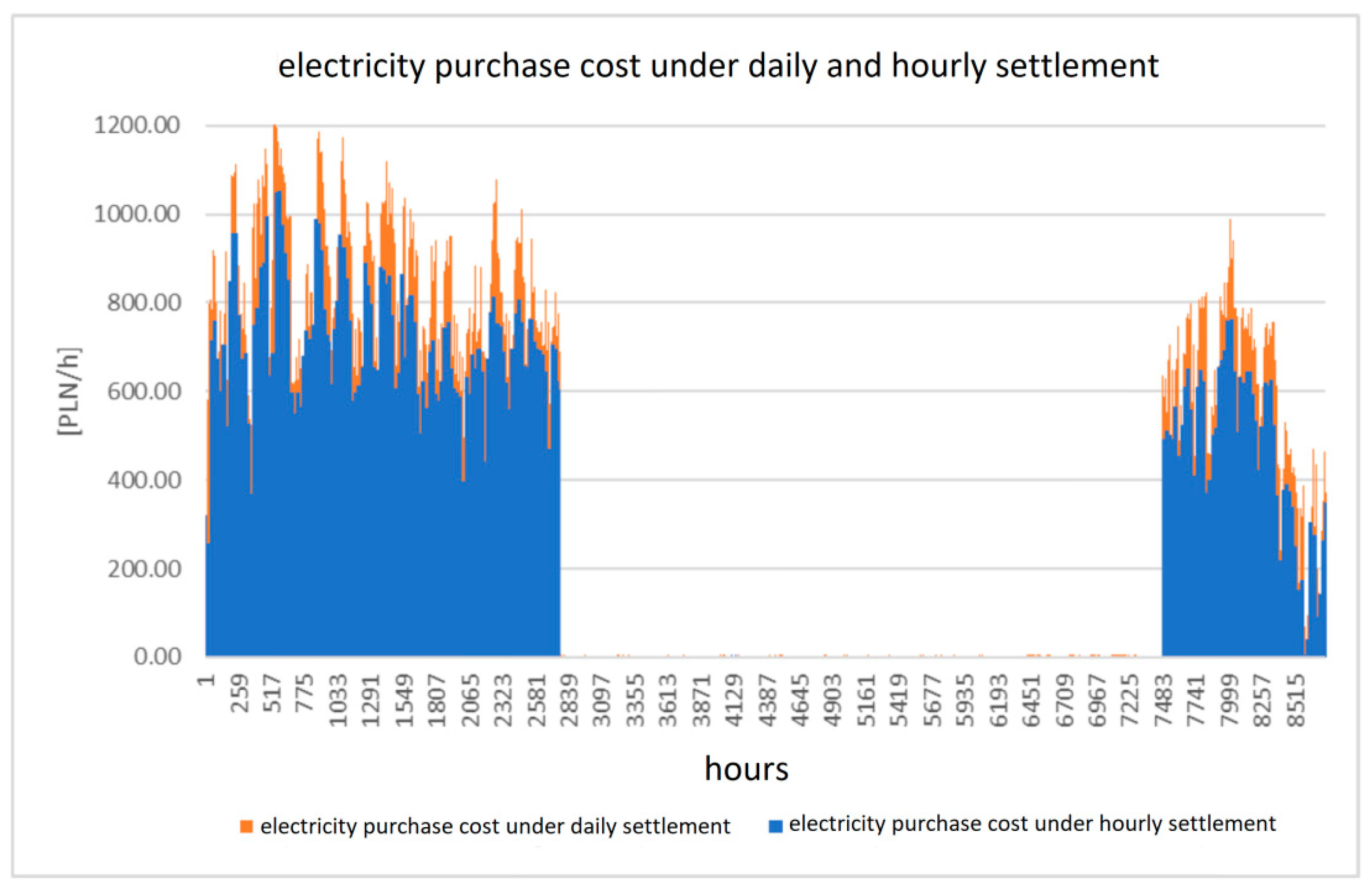
Figure 3 and
Figure 4 show the corresponding heat-balance profile and electricity purchase cost under hourly and daily settlement assumptions.
3.2. CHP-Led Configuration with a Ground-Source Heat Pump System—Configuration 2
This subsection presents the model outputs for the CHP-led configuration with a ground-source heat pump.
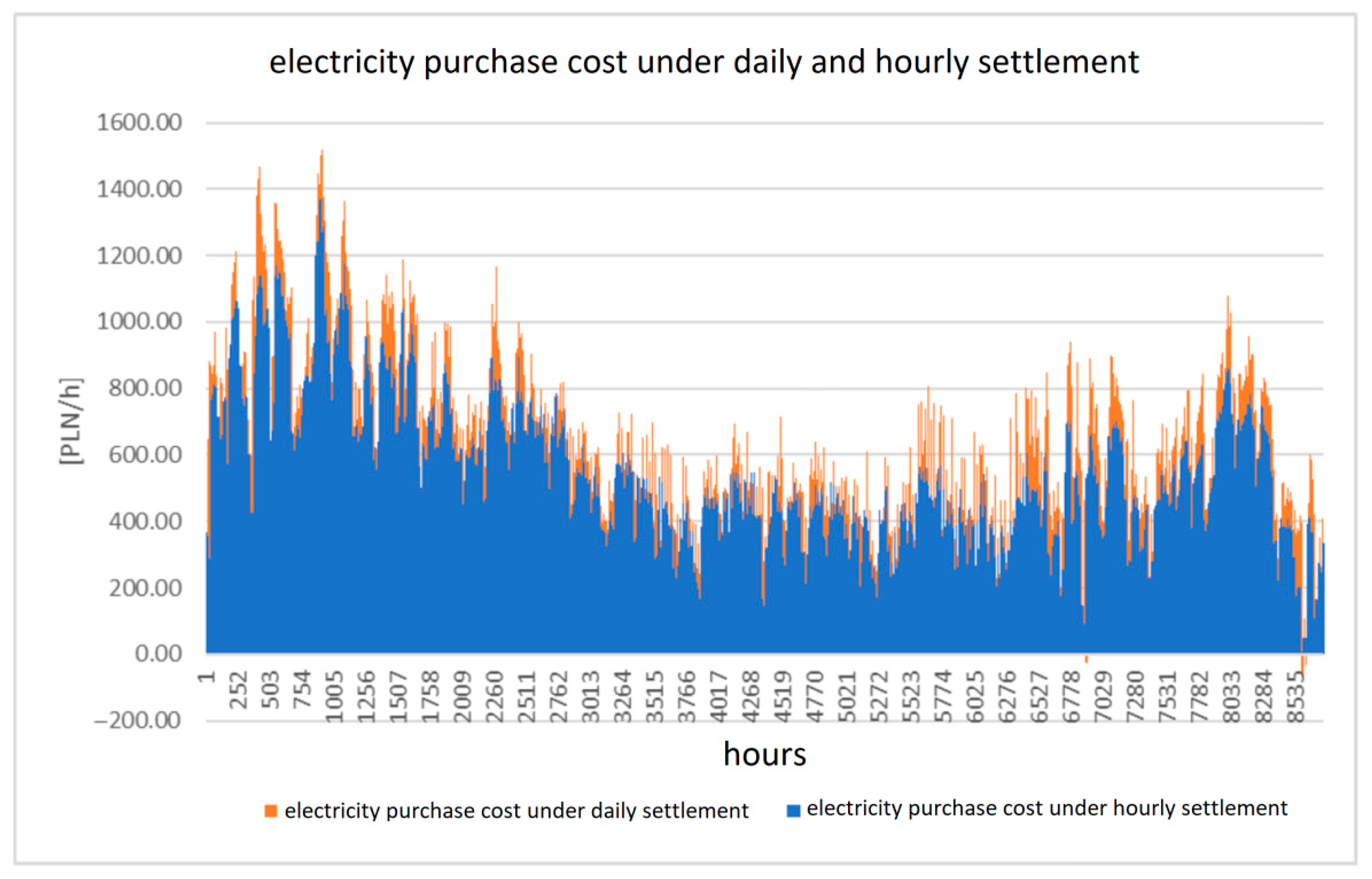
Figure 5 shows the modelled electricity purchase costs under daily and hourly settlement assumptions for Configuration 2. These results are relevant to the comparative OPEX assessment because they quantify the electricity-cost component associated with the ground-source heat pump under the adopted operating assumptions. This configuration should be interpreted as a modelled case used to assess the operating-cost effect of a ground-source heat pump under the assumed local constraints. The estimated thermal capacity of the borehole heat exchanger at the analysed site is limited; therefore, this configuration is included primarily to quantify the operating-cost effect of using the ground as the low-temperature heat source under the adopted modelling assumptions.
The operating conditions of the CHP unit remain unchanged compared with the previous system configuration. Therefore, the results presented below refer to the ground-source heat pump subsystem.
3.3. CHP-Led Configuration with Ground-Source and Air-Source Heat Pump Systems
This subsection presents the model outputs for the CHP-led configuration combining ground-source and air-source heat pumps.
Figure 6 shows the modelled hourly heat balance for Configuration 3 and indicates how the combined use of the two heat pump subsystems affects the contribution of individual heat sources to annual demand coverage.
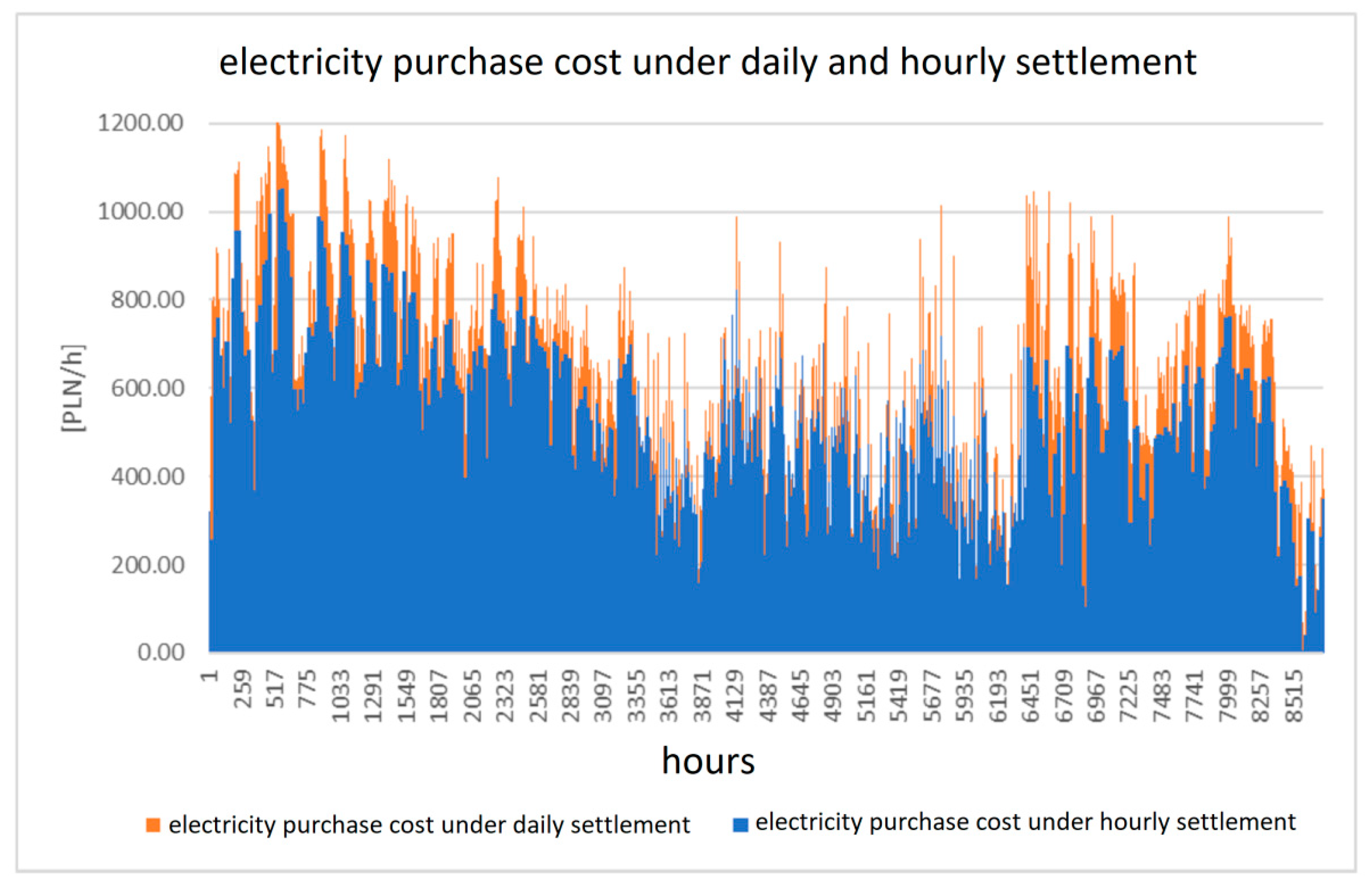
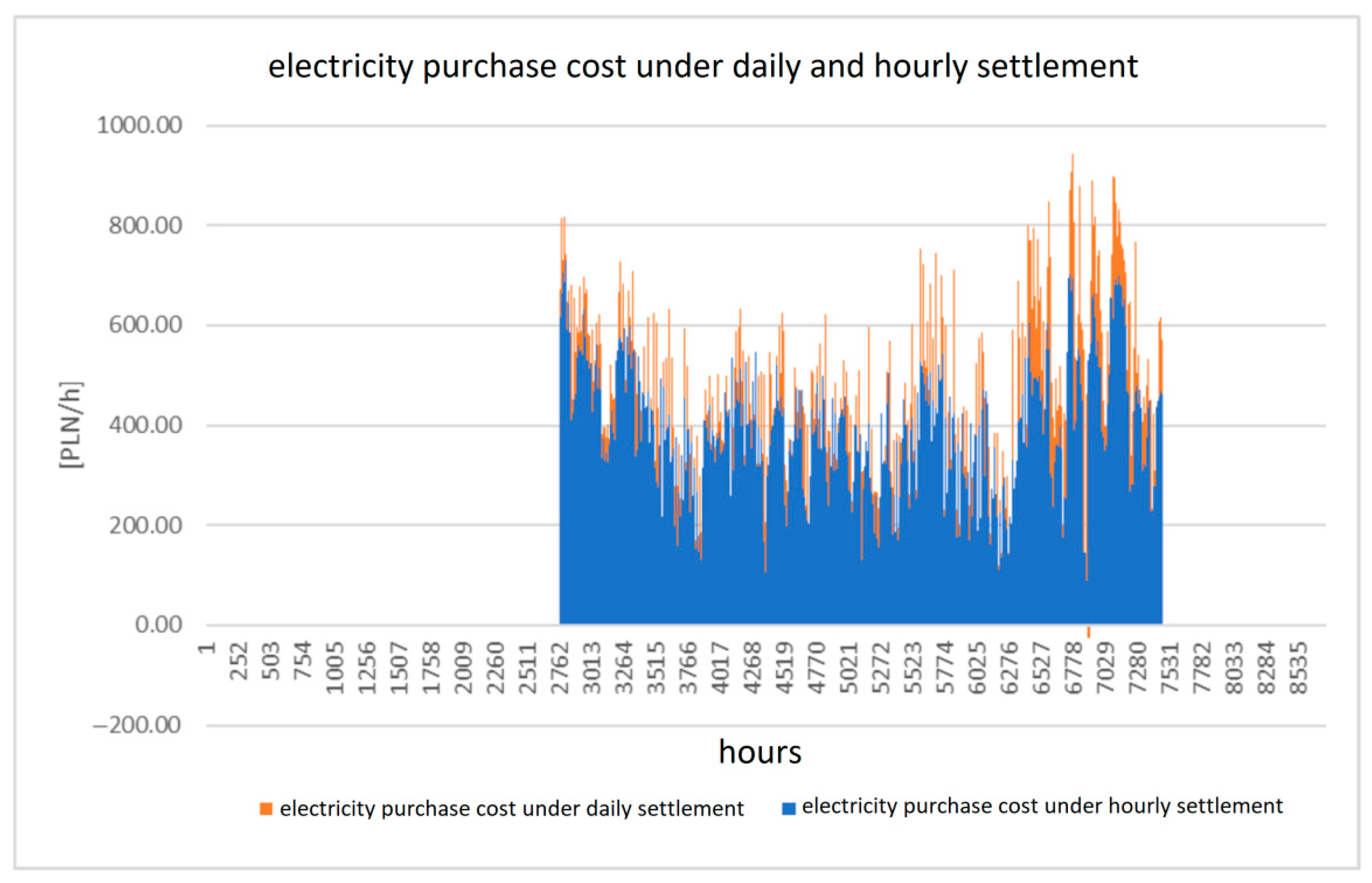
Figure 7 shows the modelled electricity purchase costs for the ground-source heat pump subsystem under hourly and daily settlement assumptions, while
Figure 8 shows the corresponding costs for the air-source heat pump subsystem. Together, these figures support the interpretation of the favourable OPEX-based performance of this configuration.
3.4. ASHP-Led Configuration with CHP Support for Self-Consumption—Configuration 4
This subsection presents the model outputs for the air-source-heat-pump-led configuration with CHP support for electricity self-consumption.
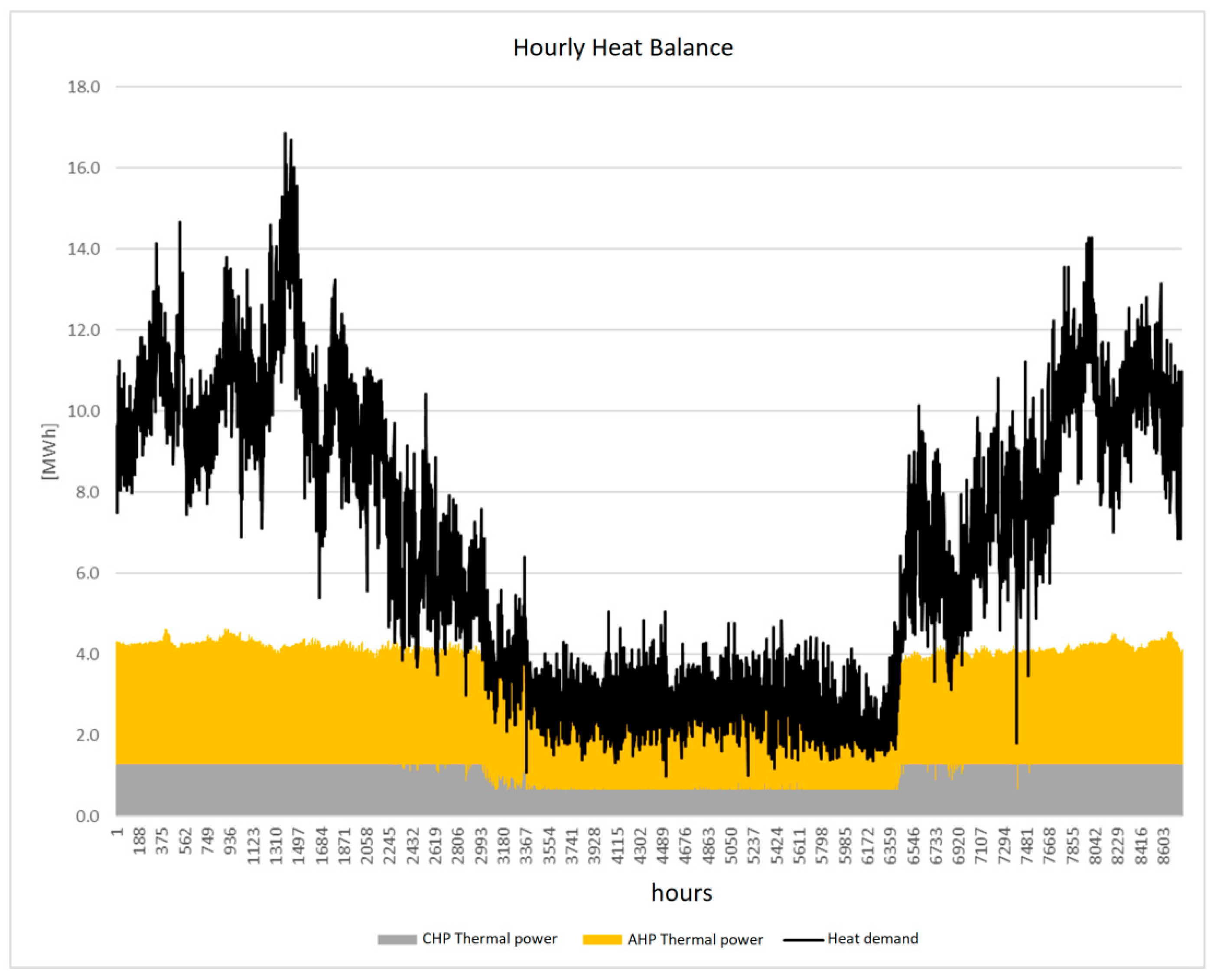
Figure 9 shows the modelled hourly heat balance for Configuration 4 and illustrates the operating pattern of the configuration in which the heat pump plays the leading role.
Figure 10 shows the corresponding modelled electricity purchase costs under the daily and hourly settlement assumptions. These results are relevant to the optimisation objective because they show the cost implications of the self-consumption-based operating strategy in comparison with the CHP-led configurations.
3.5. Comparison of Configurations
For the comparative assessment, the most important values are the average annual OPEX-based unit heat generation indicator under hourly and daily electricity settlement, together with the total coverage of the heat demand by the main heat sources.
Table 2,
Table 3,
Table 4 and
Table 5 provide source-specific results, whereas
Table 6 presents the overall system-level comparison and is the main basis for ranking the analysed configurations.
Within the OPEX-based assessment adopted in this study, the lowest average annual value of the unit heat generation indicator was obtained for the CHP-led configuration combining ground-source and air-source heat pumps, reaching 38.55 PLN/GJ under hourly electricity settlement and 38.45 PLN/GJ under daily settlement. For the air-source-heat-pump-led configuration with full electricity self-consumption, the corresponding values were 43.02 PLN/GJ and 43.00 PLN/GJ. The difference between the lowest and highest values in the OPEX-based comparison was therefore 4.55 PLN/GJ. The heat-balance and electricity-cost results presented in
Figure 3,
Figure 4,
Figure 5,
Figure 6,
Figure 7,
Figure 8,
Figure 9 and
Figure 10 explain this ranking by showing both the source contribution structure and the electricity-cost burden associated with each configuration.
CHP-led configurations were operationally more favourable because they enabled higher revenues from electricity sales. In contrast, the full self-consumption configuration was less dependent on a grid connection to export electricity but resulted in a higher value of the OPEX-based unit heat generation indicator. Differences between hourly and daily settlement were small in terms of the annual average, although they affected the short-term profiles of costs and revenues. Summary results for the analysed system configurations are given in
Table 2,
Table 3,
Table 4,
Table 5 and
Table 6.
Negative values in the CHP rows do not represent a negative heat production cost in the usual accounting sense. They indicate negative values of the simplified OPEX-based unit heat generation indicator used in this study after netting CHP electricity revenues against the corresponding natural gas cost. In other words, when the electricity sales revenues exceed the gas cost attributed to CHP operation, the net OPEX-based indicator becomes negative. When the value is positive, the gas cost remains higher than the electricity revenue, and a net operating cost must still be covered.
3.6. Capacity Split Between Generation Sources
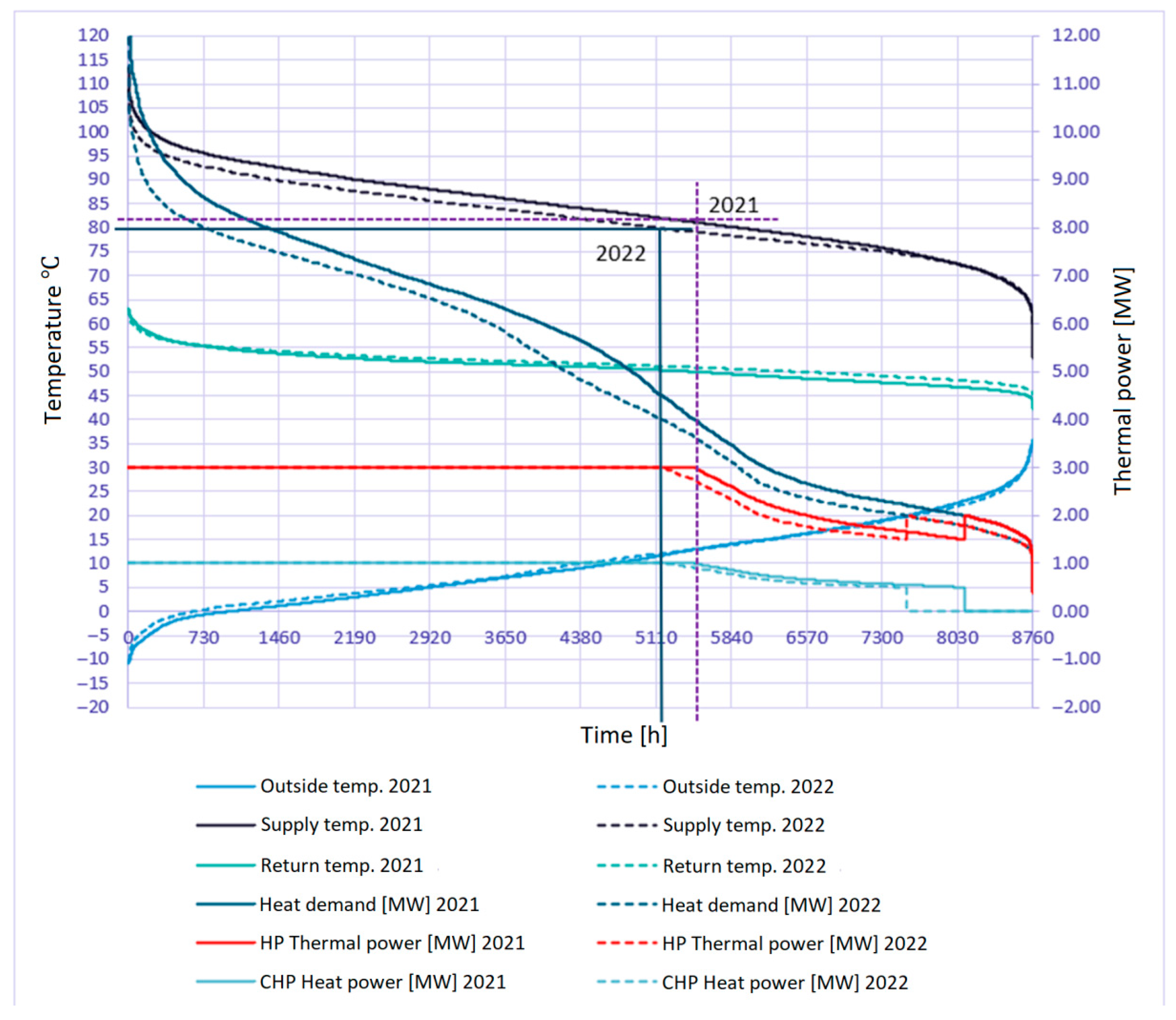
In the analysed years 2021–2022, the heat demand amounted to 65,312.80 MWh and 60,793.98 MWh, respectively. Operating modes were identified by a separate analysis of the historical operational data for 2021–2022, using the heat-demand series together with outdoor air temperature and district heating supply and return water temperatures. These operating modes were used to interpret the feasible operation of the modelled new heat source and were not generated directly by the optimisation routine. The following operating regimes were distinguished:
at nominal capacity of the CHP unit and the heat pump installation;
with the CHP unit and the heat pump installation under partial load; and
with the CHP units switched off and the district heating demand fully covered by the heat pump installation.
The results of this historical operating-data analysis for the period 2021–2022 are shown in
Figure 11.
The optimisation analysis identified the most favourable installed capacity split for the overall system as follows:
- -
1.2 MWel/1.3 MWth for the CHP unit and
- -
1.5 MWel/3.0 MWth for the heat pump installation.
This capacity split enables electricity self-consumption and allows district heating water to be heated from 75 °C to 90 °C, that is, from the design operating temperature of the heat pump system to the operating temperature level associated with the CHP units. The share of heat produced by the CHP unit and the heat pump installation accounts for at least 55.07% of the heat demand of the municipal district heating network.
A peak-load gas boiler with a thermal capacity of 8.23 MWth is required. Its role is to raise the district heating supply temperature above 90 °C, that is, above the temperature level provided by the CHP units. The maximum design supply temperature of the network is 116 °C.
Splitting the CHP capacity into two smaller units would allow CHP operation to be extended by nearly one month in 2021 and by more than one and a half months in 2022. In such a configuration, annual engine maintenance could be carried out in an alternating mode during the respective period. However, dividing the capacity into two units would reduce electrical generation efficiency, because the electrical efficiency of these engines increases with rated capacity. For example, the electrical efficiency of the GENTEC KE-MTUNG 500-ASE engine (550 kWel) is 42.0%, while for the GENTEC KE-MTUNG 1000-ASE engine (1026 kWel) it is 45.4%; at 50% load, the corresponding efficiencies are 39.0% and 42.0%, respectively. For this reason, the analysis focused on the single-engine configuration with the higher electrical efficiency. A detailed investment-cost comparison between one larger unit and two smaller units was outside the scope of the present OPEX-based assessment.
4. Discussion
Within the OPEX-based assessment adopted in this study, the lowest average annual value of the unit heat generation indicator is achieved by the CHP-led configuration combining ground-source and air-source heat pumps. Within the same OPEX-based comparison, the highest value is obtained for the air-source-heat-pump-led configuration with full electricity self-consumption. This ranking reflects the operating-cost performance under the adopted market-price, dispatch, and settlement assumptions and should not be interpreted as a final investment ranking.
The feasibility check substantially qualifies the OPEX-based ranking. Although the CHP + GSHP + ASHP configuration shows the lowest value of the adopted OPEX-based indicator, the local ground-source assessment indicates that the borehole heat exchanger capacity is strongly constrained at the analysed site. For this reason, a configuration that is favourable in the dispatch model may be less suitable once the site-specific geological, spatial, and implementation constraints are considered. In practical transition planning for smaller municipal systems, CHP-led configurations supported by air-source heat pumps may therefore represent a more realistic option where implementation simplicity and lower site-specific delivery risk are important.
The results obtained for Ustka should be interpreted with respect to the specific characteristics of the analysed system. In particular, the identified optimal configurations and cost levels depend on the local heat demand, network parameters, available space, and the feasibility of low-temperature heat sources. Therefore, the quantitative results are most directly applicable to district heating systems of a similar size and technological structure, especially smaller municipal networks.
However, the methodological approach adopted in this study, combining operational time series, market-based price signals, and a subsequent verification of local feasibility, can be transferred to other district heating systems. Its application to different cities would require the adaptation of the input data, including demand profiles, market conditions, and site-specific technical constraints.
Methodological Limitations Relevant to the Interpretation of the Results
The spreadsheet-based implementation of the model has direct implications for the interpretation of the results. In particular, the transparency and auditability of the workflow support traceability, but the adopted structure also imposes limitations that should be considered when assessing the robustness and scope of the reported findings [
25,
26,
27].
A key strength of the spreadsheet approach is its auditability: formulas, intermediate balances, and the impact of individual assumptions can be inspected directly by the reviewers and stakeholders, which supports reproducibility and traceability as emphasised in the energy-modelling literature [
25,
26,
27]. The approach is also accessible and well-suited for rapid iteration, allowing sensitivity checks and scenario comparisons without the need for dedicated modelling environments; this can be advantageous in applied operational screening studies where multiple configurations must be screened efficiently [
27].
From a methodological perspective, the spreadsheet structure makes it straightforward to integrate explicit (although simplified) component performance descriptions within a single framework, including part-load characteristics of CHP units and COP representations for heat pumps; such simplified performance representations are widely used in planning studies, provided that their assumptions are stated explicitly [
28,
29]. Finally, because the calculation is driven by time-resolved inputs, the model can be coupled directly to hourly or daily electricity price series, which supports the assessment of the operational strategies under dynamic market signals—an aspect commonly addressed in the district heating production optimisation studies [
30].
The approach also has limitations that should be considered when interpreting the results. The optimisation relies on nonlinear solving (GRG), and for nonlinear or potentially non-convex problems the obtained solution may represent a local optimum; repeated runs from different initial points are a common practical strategy to reduce this risk [
30,
31,
32]. Furthermore, the spreadsheet-based nonlinear optimisation can be sensitive to configuration choices such as bounds, scaling, and starting values, and the Solver guidance explicitly highlights the role of multistart/global-search options that rerun GRG from different initial points to improve solution robustness [
31,
32]. In the present study, no multi-start runs, no comparison with global optimisation algorithms, and no formal sensitivity analyses for key parameters were performed. Therefore, the robustness of the reported solution was not verified beyond the single adopted optimisation framework.
Another limitation concerns the heat pump performance representation: COP estimation in energy planning ranges from constant-COP approaches to Carnot/Lorenz-based and exergy-based formulations, and the resulting optimal capacities and economic outcomes can vary with the chosen COP method and underlying assumptions [
28,
29,
33]. In addition, because spreadsheet errors are known to be relatively common and may materially influence decision-support results, spreadsheet-based models require explicit quality assurance practices (e.g., structured verification, peer review, and systematic auditing) [
34,
35].
Finally, the model class differs from alternative optimisation frameworks frequently applied in the district heating research. Many studies use LP/MILP/MINLP or MPC-based formulations to represent discrete operational decisions more explicitly and to obtain provably optimal solutions for linearised models (LP/MILP) or more detailed scheduling under constraints [
30,
36,
37,
38]. Therefore, the present spreadsheet-based formulation is best interpreted as a transparent and computationally efficient screening tool rather than a full unit-commitment scheduler.
Because CAPEX was not included in the objective function, the comparative ordering presented in this study is strictly an OPEX-based operating-cost comparison and not a final investment ranking. The inclusion of investment costs could change the relative attractiveness of the analysed configurations, particularly for options requiring ground heat exchangers, thermal storage, additional grid-connection capacity, or site-specific civil works. Therefore, the results identify promising operating configurations for preliminary screening, but they do not by themselves determine the most economically viable investment option.
Another limitation is that the present framework does not include policy support mechanisms or regulatory adjustments, such as CHP support schemes, white certificates, renewable-energy auction instruments, or ETS-related effects. The reported comparison therefore reflects market-based operating conditions only.




 ,
,