Article

Road Drainage Infrastructure Diagnostics and Deficiency Indexing in ENSO-Vulnerable Andean Corridors: A STEM–PjBL Field Assessment

by
Holger Manuel Benavides-Muñoz
1,*,
Manuel Ignacio Ayala-Chauvin
2 and
Leirys María Benavides-Ortega
3
1
Research Group R&D for the Sustainability of the Urban and Rural Water Cycle, Departamento de Ingeniería Civil, Arquitectura y Geociencias, Universidad Técnica Particular de Loja, Loja 110107, Ecuador
2
Centro de Investigación en Ciencias Humanas y de la Educación (CICHE), Facultad de Ingenierías, Universidad Tecnológica Indoamérica, Ambato 180103, Ecuador
3
Civil Engineering Program, Departamento de Ingeniería Civil, Arquitectura y Geociencias, Universidad Técnica Particular de Loja, Loja 110107, Ecuador
*
Author to whom correspondence should be addressed.
Sustainability 2026, 18(10), 4964; https://doi.org/10.3390/su18104964
Submission received: 2 April 2026 / Revised: 7 May 2026 / Accepted: 9 May 2026 / Published: 15 May 2026

Abstract

Road drainage infrastructure in ENSO-vulnerable Andean regions faces compounding threats from climatic variability, geometric inadequacy, and systemic maintenance neglect. This study presents a STEM-integrated Project-Based Learning (PjBL) diagnostic framework applied to 42 road segments along corridors connecting Loja, Ecuador, selected through a purposive-stratified spatial-coverage protocol. Using ArcGIS Survey123, standardised field data were collected on structure presence, geometry, failure modes, and condition across four structure types: crown gutters, road gutters, hydraulic chutes, and culverts. The Composite Drainage Deficiency Index (DDI, 0–100) was derived from five equally weighted binary indicators and validated through Monte Carlo Dirichlet weight-perturbation analysis and jackknife leave-one-out resampling, confirming rank-order invariance to admissible alternative weightings. The results reveal severe systemic deficiencies, including crown gutters absent at 88.1% (95% CI: 75.0–94.8) and road gutters at 81.0% (95% CI: 66.7–90.0) of sites. Every segment exhibited at least one drainage failure (100%; 95% CI: 91.6–100). The DDI identified 73.8% of segments in the High or Critical band (DDI ≥ 60; mean = 60.2 ± 20.4). Hierarchical clustering isolated one geometric outlier whose exclusion altered the aggregate metrics by <1.2%. These findings establish a georeferenced baseline for maintenance prioritisation and validate the methodological reproducibility of academically integrated field protocols for infrastructure diagnostics.

1. Introduction

Road drainage infrastructure in tropical Andean regions faces a distinctive convergence of stressors: episodic high-intensity rainfall driven by El Niño–Southern Oscillation (ENSO) warm phases, steep terrain favouring rapid runoff concentration, and chronic maintenance under-provision. When these pressures coincide, drainage structures are routinely forced beyond hydraulic capacity during design-return-period events, triggering embankment saturation, progressive erosion, slope failure, and road closure. The corridor network connecting Loja with surrounding communities in southern Ecuador is recurrently disrupted by ENSO-driven precipitation extremes, which have historically triggered drainage infrastructure damage [1] and slope failures [2] along these corridors. Despite the operational criticality of these routes, no systematic diagnostic inventory of their drainage infrastructure exists in the peer-reviewed literature, a gap this study addresses.
Project-Based Learning (PjBL) is grounded in constructivist principles: learners develop competencies through sustained engagement with authentic, complex problems [3,4]. Meta-analyses document significant gains in higher-order thinking and applied transfer when technology-enhanced PjBL is embedded within meaningful problem contexts [5,6,7], an effect amplified by STEM integration within engineering programmes [8,9]. Deploying ArcGIS Survey123 for standardised field data collection—combined with reproducible R-based statistical analysis—positions student-generated data within professional scientific practice. The analytical focus remains strictly on infrastructure condition assessment and statistical validation, with pedagogical outcomes excluded from the scope of this study. This delimitation follows the boundary-work principle [10]: the manuscript claims validity for its infrastructure dataset and reproducible methodology, not for generalizable pedagogical efficacy.
Road drainage research in tropical and Andean settings consistently identifies cross-sectional geometry inadequacy, blockage susceptibility, and ENSO-induced hydraulic overloading as primary failure drivers [11,12,13,14]. Culvert blockage progressively reduces effective hydraulic aperture, elevates headwater levels, and amplifies inlet loading, a well-documented failure cascade [15,16,17] relevant to Andean contexts where steep gradients accelerate debris and sediment transport. Design standards for surface drainage structures in Ecuador are governed by NEVI-12 (Vol. 2B, Ch. 2B.200) [18], with the INVIAS Manual de Drenaje para Carreteras [19] providing the principal Andean comparative reference; both establish hydraulic criteria and IDF-based discharge periods for the structure typology inventoried here, including crown ditches [20], roadside gutters [21,22], drainage downspouts [23], and cross-drainage structures [18,19]. Regional IDF analysis, isohyetal mapping, and ENSO anomaly characterisation for the Loja corridor are documented in a companion publication [1], to which this inventory provides the structural condition baseline required for hydraulic capacity assessment.
UAV-assisted survey and GIS integration within engineering curricula have demonstrated utility for topographic mapping, site characterisation, and spatial infrastructure analysis [24,25]. Yet published studies combining standardised multi-structure field diagnostics, geometric data collection, and inferential statistical analysis within a PjBL framework for road drainage assessment in ENSO-exposed Andean corridors remain scarce; the authors are unaware of a directly comparable study in the southern Ecuadorian context, which motivates the present work.
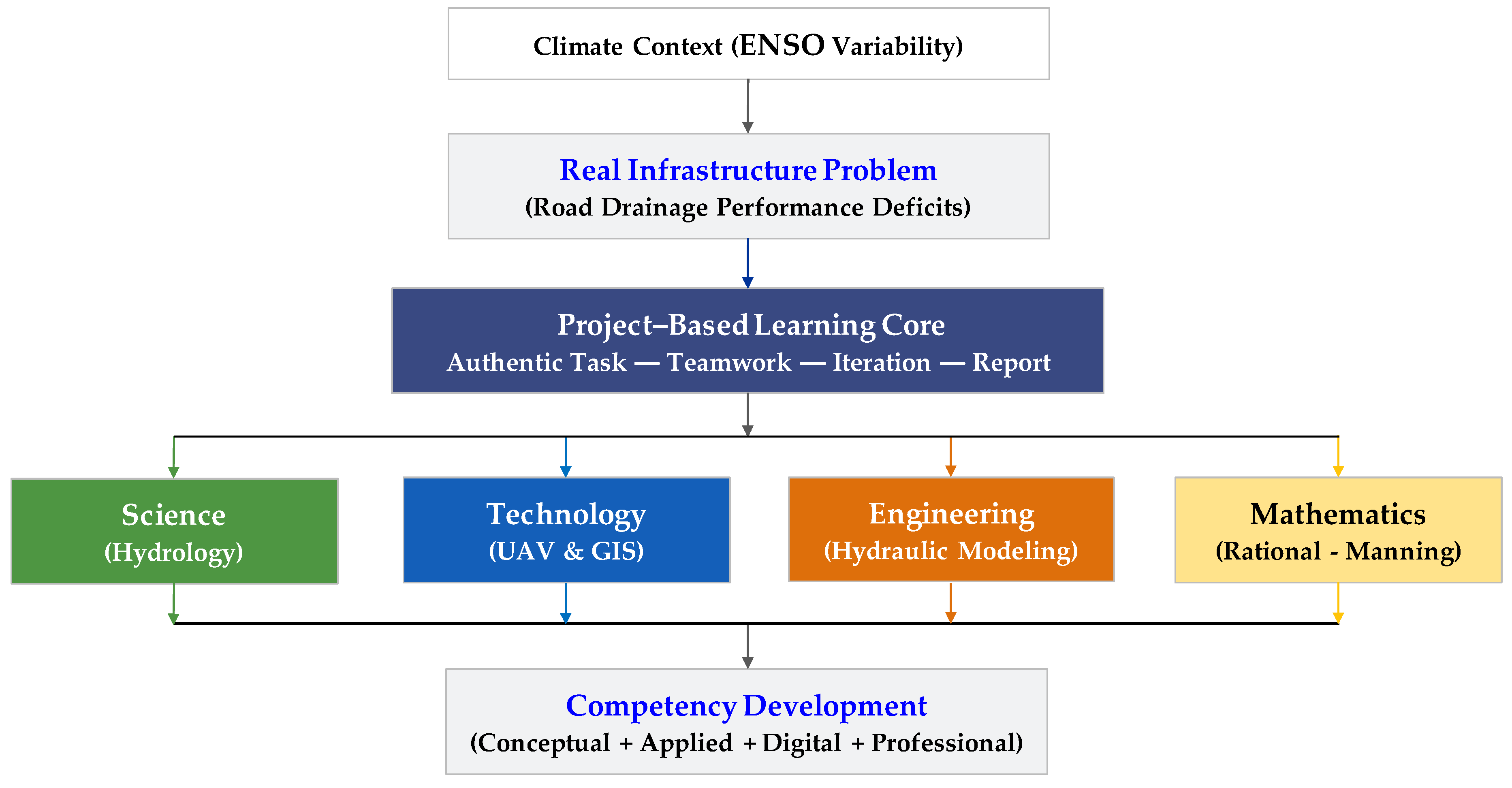
Two interrelated objectives are pursued: (1) to characterise the condition, geometry, failure modes, and deficiency patterns of road drainage infrastructure along ENSO-vulnerable corridors near Loja, Ecuador, using a standardised diagnostic instrument applied to a purposively stratified segment sample; and (2) to evaluate the statistical rigor and methodological reproducibility of a structured field data-collection protocol deployed within an academic framework. The DDI developed here is designed as an operationally transferable instrument deployable without specialised hydraulic-modelling software; its external empirical validation across other Andean corridor networks falls outside the scope of this study and is identified as a priority future direction. The integrated conceptual framework is presented in Figure 1.
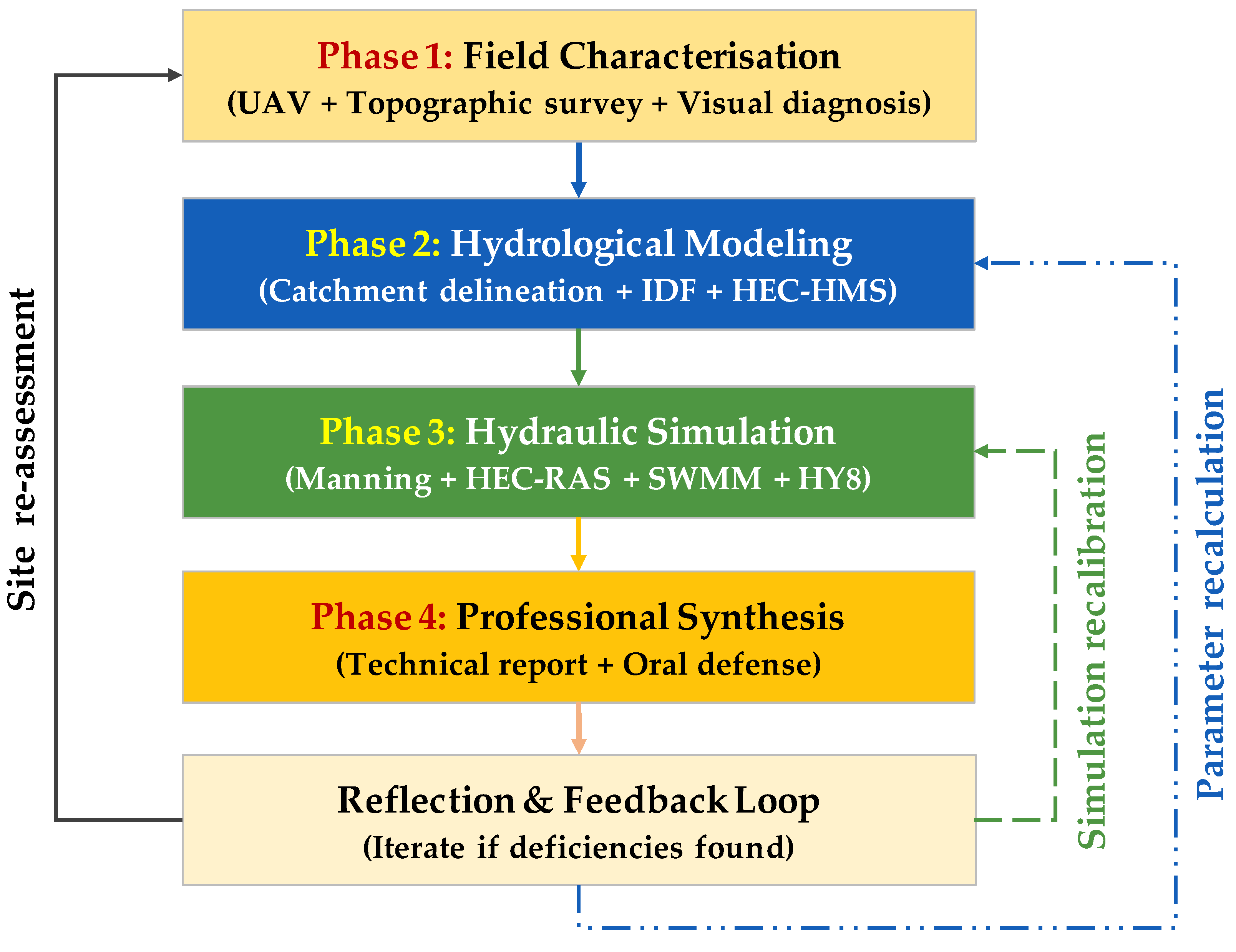
This framework represents the overarching STEM–PjBL pedagogical architecture executed across the full academic semester. While the complete workflow encompasses four phases, the present manuscript reports exclusively on Phase 1 (field characterisation and diagnostic inventory) and its statistical validation. Phases 2–3 (hydrological modelling and hydraulic simulation) were executed as part of the course curriculum and are documented in companion publications; this study isolates the structural baseline to ensure methodological rigor and provide the ground-truth data required for subsequent hydraulic capacity analyses.

2. Materials and Methods

2.1. Study Area and Sampling Design

The study area encompasses road corridors linking the city of Loja (−4.0055° S, −79.2052° W; 2100 m a.s.l.) with surrounding communities in Loja Province, southern Ecuador. The six toponymic designations used locally, Loja–Zamora, Loja–Catamayo, Loja–Malacatos, Loja–Saraguro, Loja–Villonaco, and Santa Ana–Los Encuentros, correspond to five physically distinct continuous routes: Loja–Villonaco and Loja–Catamayo denote sequential segments of the same road (Villonaco lies en route to Catamayo), and Loja–Malacatos and Loja–Yangana (the southward continuation of Loja–Malacatos) likewise form a single corridor. Segment coordinates catalogued in Table S1 (Supplementary Material S1) allow unambiguous geospatial identification independent of naming convention. The region is characterised by steep Andean topography (elevational range 1800–3200 m a.s.l.), a bimodal precipitation regime (mean annual rainfall 850–1200 mm), and recurrent ENSO-driven extremes that have historically triggered slope failures and drainage infrastructure damage along these corridors [1,2]. The regional hydrological baseline, IDF curves calibrated to INAMHI stations [26], isohyetal maps for Loja Province, and ENSO precipitation anomaly characterisation is fully documented in the companion publication [1].
Segment selection followed a purposive-stratified spatial-coverage protocol designed to maximise geomorphological representativeness while ensuring road safety and supervisor accessibility within a 16-week academic semester. The corridor network was first stratified by dominant geomorphological regime: (i) high-elevation inter-Andean valleys (Loja–Villonaco/Catamayo, Loja–Malacatos/Yangana); (ii) mid-elevation transitional slopes (Loja–Zamora, Loja–Saraguro); and (iii) low-elevation foothill corridors (Santa Ana–Los Encuentros). Within each stratum, segments were selected to capture the full elevational gradient (1800–3200 m a.s.l.) and the range of slope instability classes observable from UAV-derived terrain reconnaissance. This protocol does not claim statistical randomness; rather, it operationalises maximum-diversity spatial coverage within logistical constraints [27], yielding a purposive sample [28] adequate for non-parametric descriptive inference and index validation, but not for population-level frequency estimation. The 42 segments represent approximately 12% of the ~340 km corridor network; their spatial distribution is catalogued in Table S1 (Supplementary Material S1). Generalisation to the full network therefore requires cautious interpretation: the DDI prevalence estimates reported here are lower-bound indicators of network-wide deficiency severity, not unbiased population parameters.

2.2. Diagnostic Instrument and Data Collection

A standardised diagnostic instrument was developed and deployed via ArcGIS Survey123, (Esri, Redlands, CA, USA. Available online: https://survey123.arcgis.com, accessed on 8 May 2026), enabling georeferenced field data collection with integrated photographic documentation at each site. Variables recorded per segment comprised: (1) slope instability class (four–level ordinal scale: High, Medium, Low, None); (2) crown gutter presence and cross-sectional type; (3) road gutter presence, cross-sectional type, longitudinal drainage condition (failure code 0–3), and geometric dimensions (depth H, base width b, side-slope Z); (4) hydraulic chute cross-sectional type, structural condition (Good/Poor), failure code, and dimensions (H, b, Z); and (5) culvert cross-sectional type, structural condition, failure code, and dimensions (H or diameter D, base width b). GPS coordinates were automatically recorded at each survey point. Slope instability was assessed through geomorphological field indicators calibrated to established landslide hazard protocols [2]. Classification criteria are summarized in Table 1. Classification was performed by the supervising author at each segment during the field survey, with photographic documentation (Supplementary Material S2). This is an observational geomorphological rating, not a geotechnical engineering assessment: no shear-strength testing, inclinometer data collection, or pore-pressure monitoring was conducted. The ordinal scale captures visible surficial evidence of instability risk relevant to drainage infrastructure planning, not quantitative safety factors.
Forty-two survey groups, each corresponding to a distinct road segment and comprising 3–4 members (mean 3.8 ± 0.4), completed the instrument under direct supervisor validation to ensure measurement consistency. Group size was not treated as an analytical covariate in the infrastructure analysis but was included as a control variable in Spearman partial correlations (Section 2.4) to rule out group-composition artefacts.

2.3. STEM Digital Tool Integration

UAV-derived aerial imagery provided terrain context and supported candidate site identification prior to ground survey. ArcGIS Survey123 enforced consistent multi-field data entry with automatic geolocation and timestamping, eliminating transcription error and ensuring full reproducibility. Field geometric measurements were obtained with calibrated measuring tapes, with photogrammetric cross-checks applied where site conditions permitted. The complete diagnostic workflow is illustrated in Figure 2.
All statistical analyses were performed in R (v. 4.5.2 [29]), R software, version 4.5.2 (R Core Team, Vienna, Austria. Available online: https://www.R-project.org, accessed on 8 May 2026), using the following packages (version in parentheses): readxl (1.4.3), dplyr (1.1.4), tidyr (1.3.1), ggplot2 (3.5.1), ggpubr (0.6.0), scales (1.3.0), vcd (1.4-13), corrplot (0.94), psych (2.4.6), rstatix (0.7.2), patchwork (1.2.0), forcats (1.0.0), stringr (1.5.1), knitr (1.48), flextable (0.9.6), officer (0.6.6), RColorBrewer (1.1-3), viridis (0.6.5), janitor (2.2.0), skimr (2.1.5), openxlsx (4.2.7), boot (1.3-30), DescTools (0.99.54), effectsize (0.8.9), factoextra (1.0.7), cluster (2.1.6), ggdendro (0.2.0), broom (1.0.6), car (3.1-2), and lmtest (0.9-40). The complete annotated R script has been deposited on Zenodo (https://zenodo.org, accessed on 8 May 2026).

2.4. Statistical Analysis

Distributional assumptions were assessed using the Shapiro–Wilk test (Equation (1)).
W = ( i = 1 n a i   x ( i ) ) 2 i = 1 n ( x i x ¯ ) 2
where   x ( i ) denotes the order statistics, x ¯ the sample mean, a i the expected normal-score coefficients, and n the sample size. Non-normality was confirmed for all eight continuous geometric variables (W = 0.458–0.899; p < 0.001 throughout), justifying the exclusive use of non-parametric methods. Descriptive statistics reported include the mean, standard deviation (SD), median, first and third quartiles (Q1, Q3), and the coefficient of variation (CV%).
Binomial proportions were accompanied by 95% Wilson confidence intervals (Equation (2)).
CI = p ^ + z 2 2 n ± z p ^ ( 1 p ^ ) n + z 2 4 n 2 1 + z 2 n
where p ^ = k n is the sample proportion, k is the count of segments meeting the criterion, n = 42 is the total number of surveyed segments, and z = z ( α 2 ) = 1.96 is the upper quantile of the standard normal distribution for a 95% confidence level ( α = 0.05 ).
Bivariate associations between categorical variables were tested using Fisher’s exact test with Monte Carlo simulation (B = 100,000), when any expected cell count fell below 5, or Pearson’s χ2 otherwise. Effect size was quantified by Cramér’s rule using Equation (3).
V = χ 2 n · m i n ( r 1 , c 1 )
where χ 2 is the Pearson Chi-squared test statistic; n = 42 is the total sample size; r is the number of rows in the contingency table; c is the number of columns; and m i n ( r 1 , c 1 ) is the smaller of the degrees of freedom, ensuring V     [ 0 , 1 ] regardless of table dimensions. Interpretation thresholds follow Cohen (1988) [30]: negligible < 0.10; weak 0.10–0.20; moderate 0.20–0.40; strong 0.40–0.60; very strong > 0.60. Bootstrap 95% CIs for V were computed from B = 2000 resamples. Odds ratios for 2 × 2 tables were derived as OR = (a · d)/(b · c).
Geometric dimension relationships were characterised using Spearman rank-order correlations (Equation (4)), computed pairwise on segments where both structures in each pair were present (pair-available approach), ensuring that correlations reflect observed geometric dimensions rather than absence-coded entries.
ϱ = 1 6 d i 2 n ( n 2 1 )
where ϱ (rho) is the Spearman rank correlation coefficient ( ρ     [ 1 , 1 ] ) ; d i = r a n k ( x i ) r a n k ( y i ) is the difference between the ranks of the i–th observation on variables x and y ; d i 2 is the sum of squared rank differences across all n pairs; and n = 42 is the number of road segments. This formula assumes no tied ranks; ties were handled by averaging ranks prior to computation. Benjamini–Hochberg (BH) correction was applied across all 15 unique pairs to control the false discovery rate at α = 0.05.
Between-group dimensional comparisons across cross-section type categories were performed using the Kruskal–Wallis H-test (Equation (5)).
H = 12 n ( n + 1 )   i = 1 n R i 2 n i 3 ( n + 1 )
where H is the Kruskal–Wallis test statistic, approximately Chi-squared distributed with k 1 degrees of freedom under the null hypothesis of equal distributions; n is the total number of observations across all groups ( n = 42 ); k is the number of groups (cross-section type categories; k = 4 for chute depth comparisons); R i is the sum of ranks assigned to all observations in group i ; and n i is the number of observations in group i .
Effect sizes ε2 = (Hk + 1)/(nk) and rank–η2 were reported, with thresholds as follows: small ≥ 0.01; medium ≥ 0.06; large ≥ 0.14. Statistically significant Kruskal–Wallis results were followed by BH-corrected Dunn post hoc tests restricted to present structures.   ( ε 2 ,   η 2   [ 0 , 1 ] ) represent the proportion of variance in ranks explained by group membership.
A Composite Drainage Deficiency Index (DDI; range 0–100) was computed for each segment by aggregating five equally weighted binary indicators (Equation (6)).
D D I i = 20 · I ( C G a b s e n t ) + 20 · I ( R G a b s e n t ) + 20 · I ( S I H i g h M e d ) + 20 · I ( C h u t e P o o r ) + 20 · I ( C u l v e r t P o o r )  
where D D I i   { 0 ,   20 ,   40 ,   60 ,   80 ,   100 } is the deficiency score for segment i ; I(·) is the indicator function, returning 1 if the condition is met and 0 otherwise. Components corresponding to absent structures were assigned 0, providing a conservative lower bound for deficiency severity. C G a b s e n t denotes the absence of a crown gutter; R G a b s e n t denotes the absence of a road gutter; S I H i g h M e d denotes a High or Medium slope instability rating; C h u t e P o o r denotes poor structural condition of the hydraulic chute, assigned 0 if the structure is absent; C u l v e r t P o o r denotes poor structural condition of the culvert, assigned 0 if absent. Each component contributes equally (20 points), reflecting the absence of empirical data to justify differential weighting. DDI classes: Very Low (0–20), Low (21–40), Moderate (41–60), High (61–80), and Critical (81–100).
The DDI is formulated as an equal-weight composite index following the principle of insufficient reason (Laplace criterion) under structural uncertainty [31,32]. When no empirical failure-probability data exist to differentiate the hydraulic risk contribution of individual components, differential weighting would introduce unverifiable subjective priors that reduce inter-study reproducibility. Equal weighting therefore maximises procedural objectivity and transferability across corridor networks where local hydrological forcing differs. The five indicators operationalise the minimum necessary condition for hydraulically functional drainage along an Andean road segment [18,19]: crown gutters intercept upslope runoff; road gutters provide longitudinal platform drainage; slope instability captures geotechnical failure risk independent of drainage capacity; chutes govern controlled downslope conveyance; and culverts determine cross-drainage capacity. Each component is necessary but not sufficient for drainage functionality; no single component can compensate for another. This non-substitutability justifies additive aggregation over multiplicative or compensatory formulations [33].
To test whether equal weighting is robust against admissible alternatives, a Monte Carlo weight-perturbation analysis (n = 10,000 iterations) was performed. Component weights were drawn from a Dirichlet(1,1,1,1,1) distribution, representing an uninformative (uniform) prior over the 4-simplex. This approach stress-tests the index across the full admissible weight space, including extreme but theoretically plausible allocations. A perturbed DDI was computed for each iteration. Rank-order stability between perturbed and equal-weight DDI was assessed via Spearman correlation, and the retention of Critical-band segments in the top decile was tracked across iterations. Results confirmed that rank-order prioritisation remained stable across the admissible weight space (Spearman ρ = 0.930; 95% CI: [0.753, 0.998]), providing empirical support for the equal-weight specification adopted in the main analysis. The stability of key proportions was additionally validated through jackknife leave-one-out resampling.
Missing data were interpreted under Rubin’s taxonomy [34]: condition ratings for absent structures (chutes and culverts) constitute structural zeros by design—the quantity is undefined when the structure does not exist—and were encoded as such in the DDI. For the minority of segments where a structure was present, but its condition could not be rated during the survey window, the rating was treated as missing (not a structural zero) and excluded from condition-specific analyses; the DDI component defaulted to zero under conservative bounding. No imputation was performed.

The results of the Monte Carlo Dirichlet weight-perturbation analysis for the Composite Drainage Deficiency Index (DDI) are shown in Figure S1 (Supplementary Material S1).

3. Results

3.1. Dataset Overview and Slope Instability

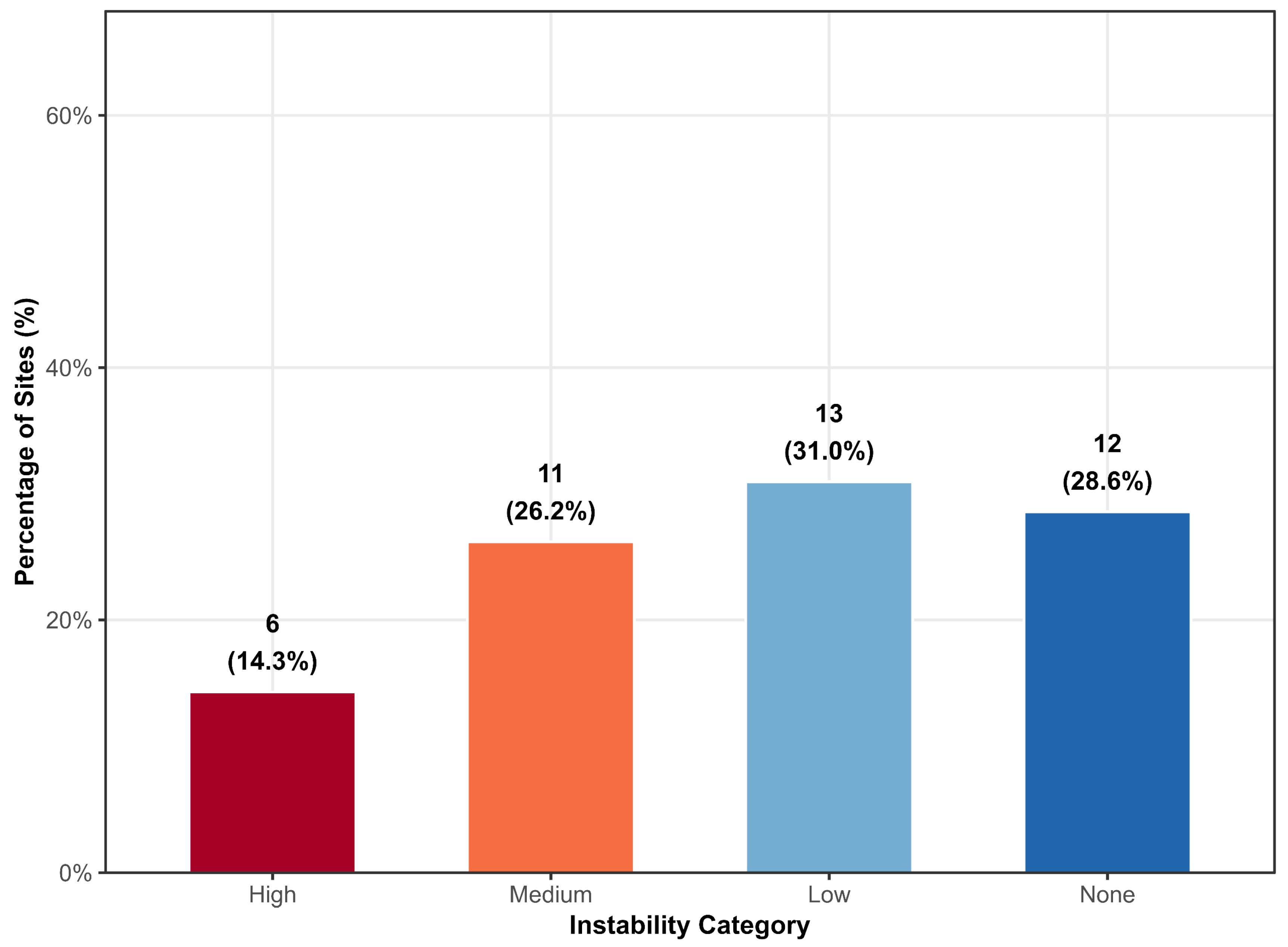
The diagnostic inventory encompassed 42 road segments distributed across five corridors in Loja Province (Table 2). Slope instability ratings were: High at 6 (14.3%), Medium at 11 (26.2%), Low at 13 (31.0%), and None at 12 (28.6%) sites. Collectively, 17 of 42 sites (40.5%; 95% CI: 27.0–55.5) exhibited High or Medium instability, representing the fraction of the network at elevated risk of embankment saturation under extreme precipitation.
The distribution of slope instability ratings is illustrated in Figure 3.

3.2. Drainage Structure Presence and Cross-Section Type Distribution

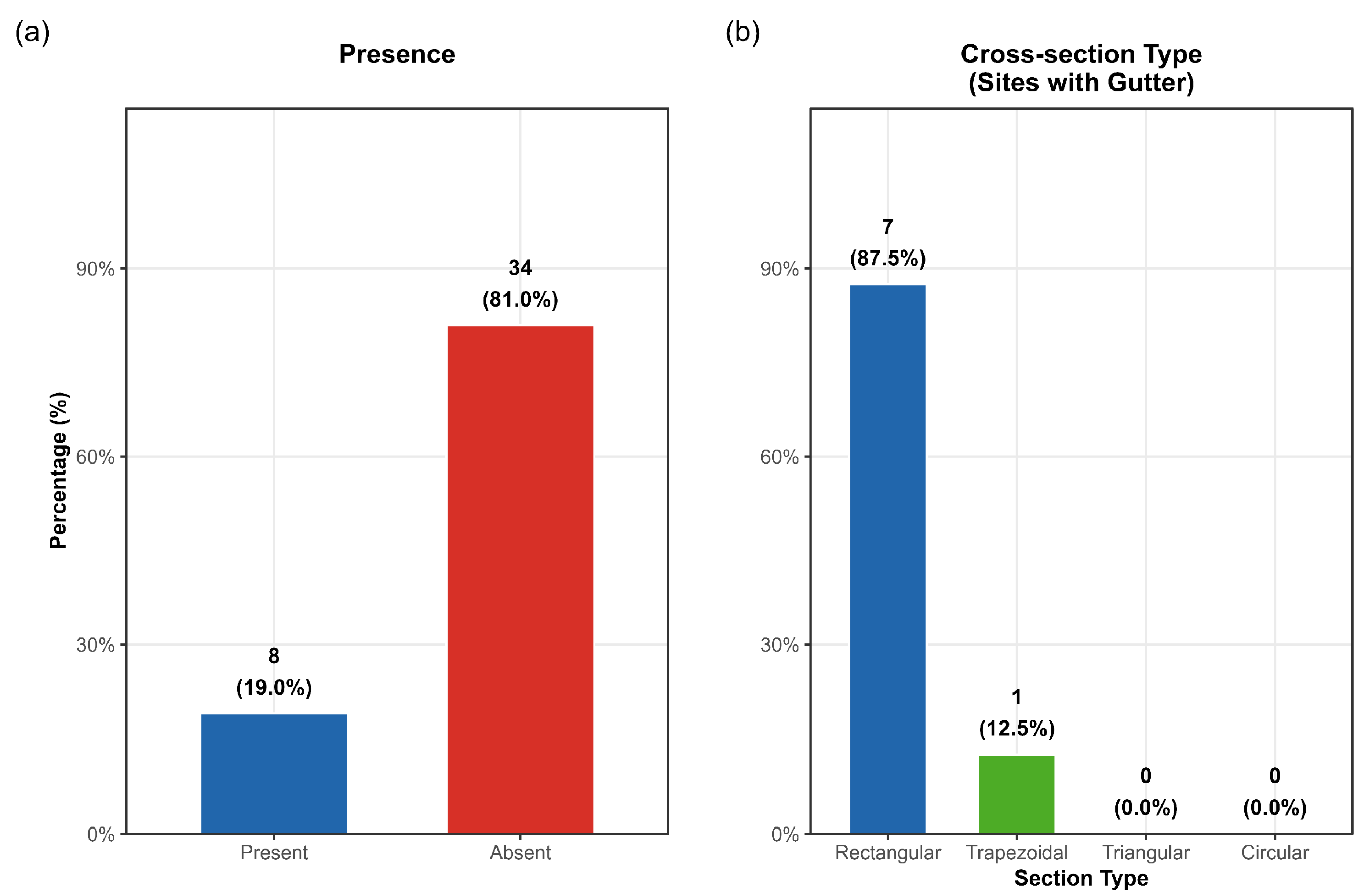
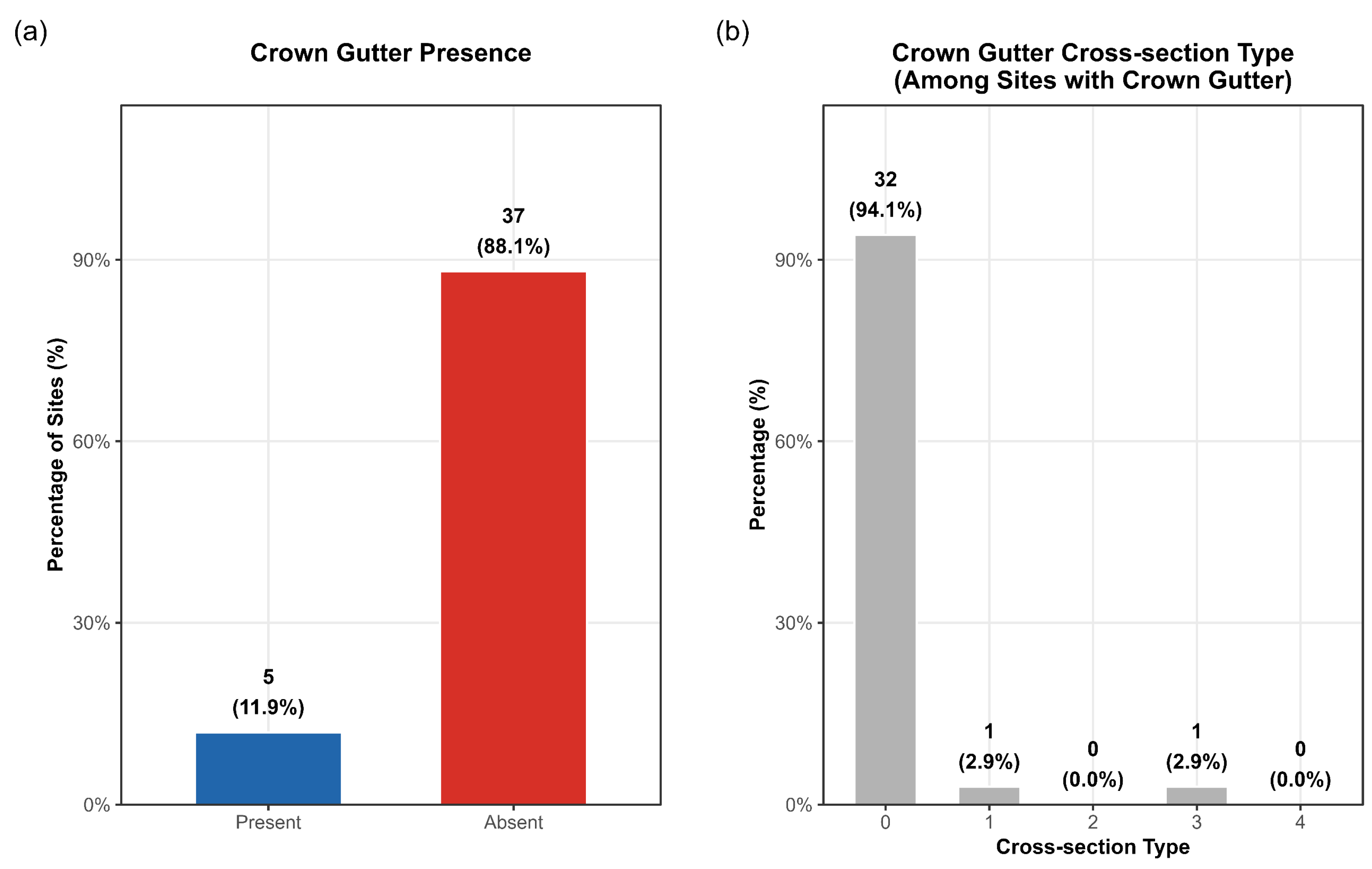
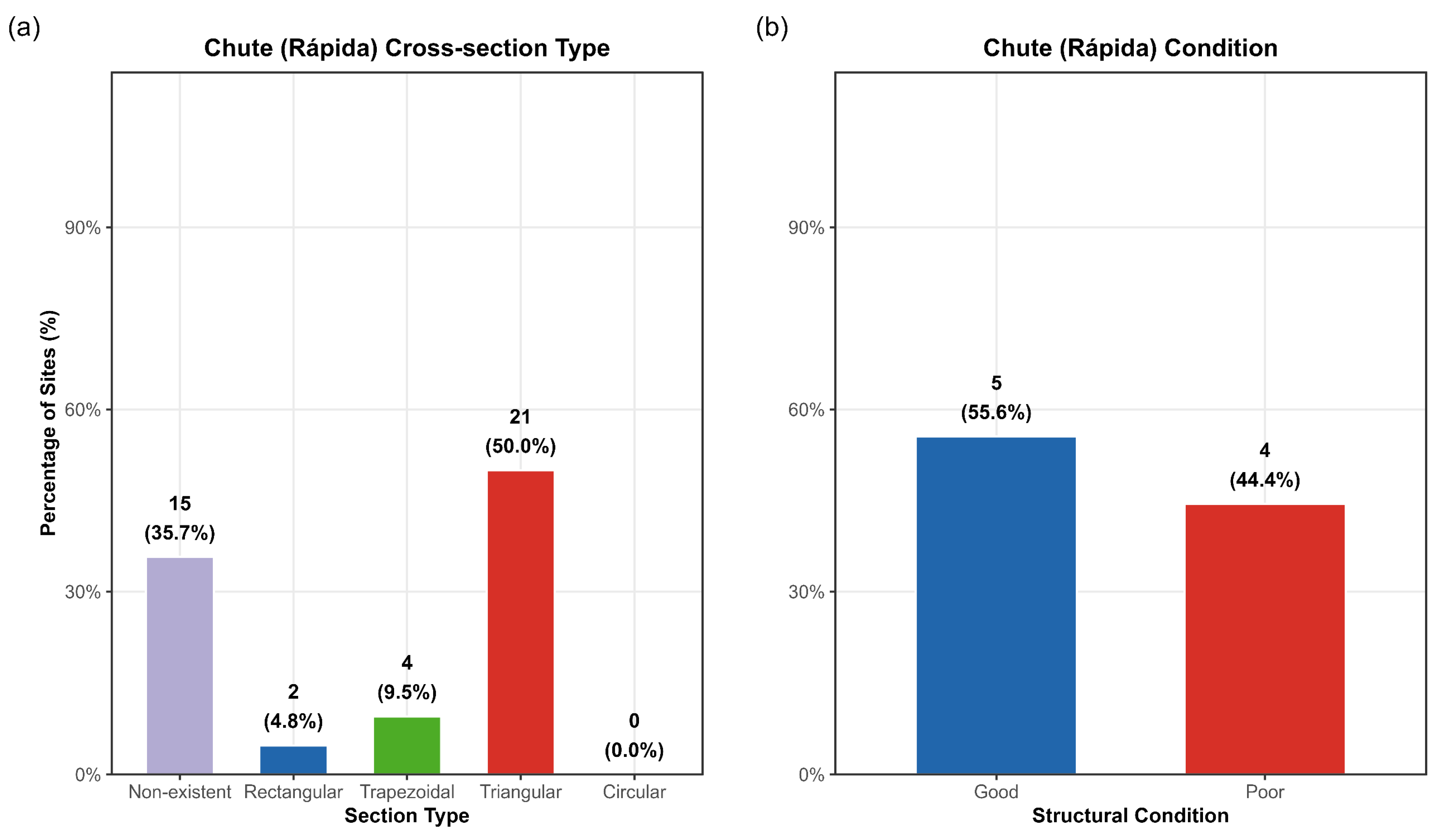
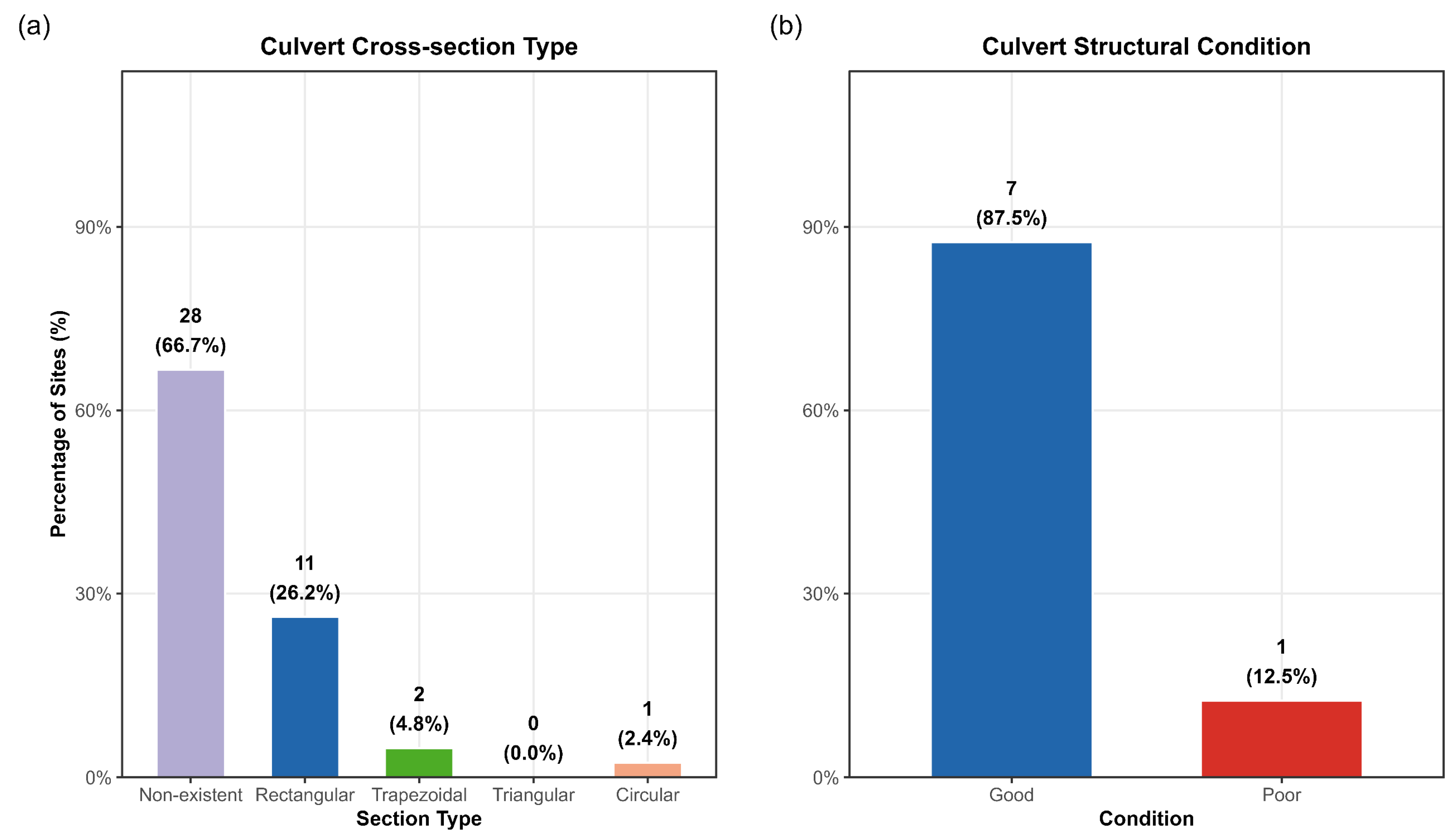
Structure presence and cross-section distributions are summarised in Table 3 and Figure 4, Figure 5, Figure 6 and Figure 7. Crown gutters were present at only 5 sites (11.9%), road gutters at 8 (19.0%), hydraulic chutes at 27 (64.3%), and culverts at 14 (33.3%). Among the present structures, rectangular sections predominated for road gutters (87.5%) and culverts (78.6%), whereas triangular sections dominated hydraulic chutes (77.8%). No compound triangular road gutter was recorded (0/42; 95% CI: 0.0–8.4).
Figure 3. Slope instability level distribution across 42 surveyed road segments. Bars show percentage of sites; labels indicate count and percentage.
Sustainability 18 04964 g003
Figure 4. (a) Crown gutter presence and (b) crown gutter cross-section type distribution (among sites with crown gutter), n = 42 segments. Bars show percentage; labels indicate n and %. Cross-section type codes: 0 = Non-existent; 1 = Rectangular; 2 = Trapezoidal; 3 = Triangular; 4 = Circular.
Sustainability 18 04964 g004
Figure 5. (a) Road gutter presence and (b) cross-section type distribution (among sites with road gutter), n = 42 segments. Bars show percentage of sites; labels indicate n and %.
Sustainability 18 04964 g005
Figure 6. Hydraulic chute (a) cross-section type and (b) structural condition, n = 42 segments.
Sustainability 18 04964 g006
Figure 7. Culvert (a) cross-section type and (b) structural condition, n = 42 segments.
Sustainability 18 04964 g007

3.3. Structural Condition and Failure Modes

Among the 9 sites with available chute condition data, 5 (55.6%) were rated Good and 4 (44.4%) Poor; the full-sample prevalence of Poor chute condition was 9.5% (4/42; 95% CI: 3.8–22.1). For culverts, 7 of 8 sites with condition data were rated Good (87.5%), yielding a full-sample poor-condition prevalence of 2.4% (1/42; 95% CI: 0.4–12.3). Every one of the 42 surveyed segments exhibited at least one drainage failure mode (100%; 95% CI: 91.6–100), confirming systemic infrastructure degradation across the entire sample (Table 4). Failure mode distributions are presented in Figure 8 and Figure 9.

3.4. Geometric Dimensions

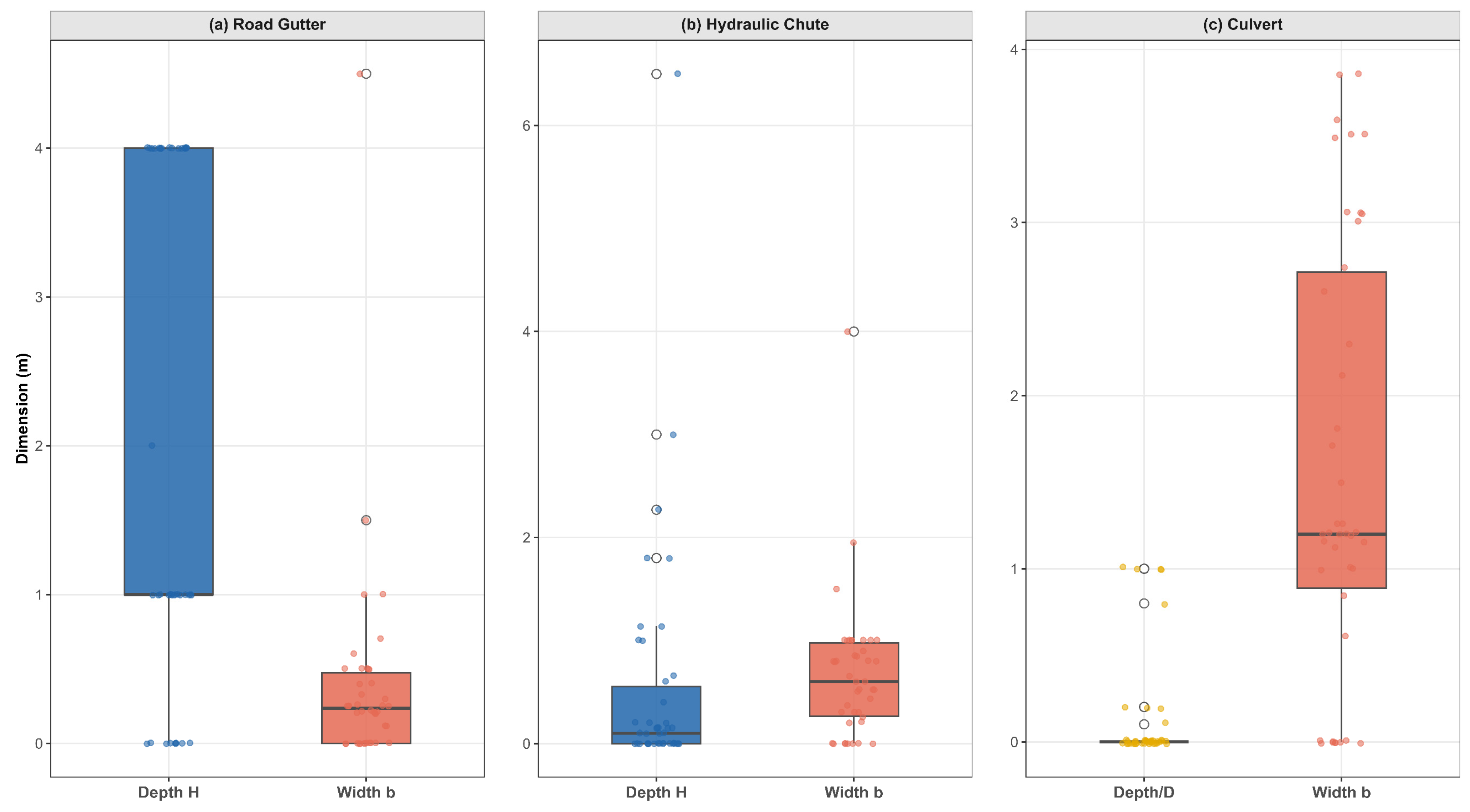
Descriptive statistics for the eight geometric variables are presented in Table 5. Non-normality was confirmed for all (W = 0.458–0.899; p < 0.001), validating non-parametric inference throughout. These statistics mix true geometric measurements with structurally absent cases: zeros represent the physical state of absence, not missing data. Road gutter depth exhibited moderate variability (CV% = 84.2%), while culvert depth/diameter showed the greatest dispersion (CV% = 240%); CV% values exceeding 100% are an expected consequence of this absence–presence mixture and should not be interpreted as measurement noise. Conditional distributions restricted to segments where the structure was present are shown in Figure 10.

3.5. Kruskal–Wallis Tests: Geometry by Cross-Section Type

Dimensional comparisons were restricted to present structures to avoid conflating absence with geometric scaling. Structural absence is reported as a categorical deficiency metric in Section 3.2 and is excluded from geometric inference. For hydraulic chutes (n = 27), chute depth was compared across existing section types (Rectangular, Trapezoidal, Triangular) to ensure that inferences reflect actual design variation rather than presence/absence artefacts. Chute depth did not differ significantly across section types (H(2) = 1.92, p = 0.383; ε2 = 0.000, η2r = 0.074; Table 6). Effect sizes fall below the small threshold (ε2 < 0.01), indicating that section type explains a negligible proportion of chute-depth variance. BH-corrected Dunn post hoc contrasts yielded no significant pairwise differences (all p > 0.05), consistent with the absence of systematic geometric scaling across triangular, trapezoidal, and rectangular chute designs in this sample.

3.6. Bivariate Association Analysis

All six Fisher’s exact tests (Monte Carlo, B = 100,000) returned non-significant results at α = 0.05 (Table 7). The largest Cramér’s V was observed for road gutter presence × culvert condition (V = 0.488, n = 8, p = 0.375), classified as strong but statistically underpowered (post hoc power ≈ 0.28 [34]). Bootstrap 95% CIs for V exclude zero in four of six tests (crown gutter × slope instability; crown gutter × chute condition; crown gutter × culvert condition; slope instability × chute condition), providing evidence of genuine though imprecisely estimated associations. The OR for crown gutter absence × High/Medium slope instability was 3.05 (bootstrap CI: 0.31–29.97). In subgroups with n = 8–9, Cramér’s V values in the moderate-to-strong range that fail to reach significance reflect limited statistical power and finite-sample variability rather than genuine null associations [34]. Bootstrap 95% CIs excluding zero in four of six tests further support the existence of genuine associations warranting confirmation in an expanded inventory.

3.7. Spearman Rank Correlations Among Geometric Dimensions

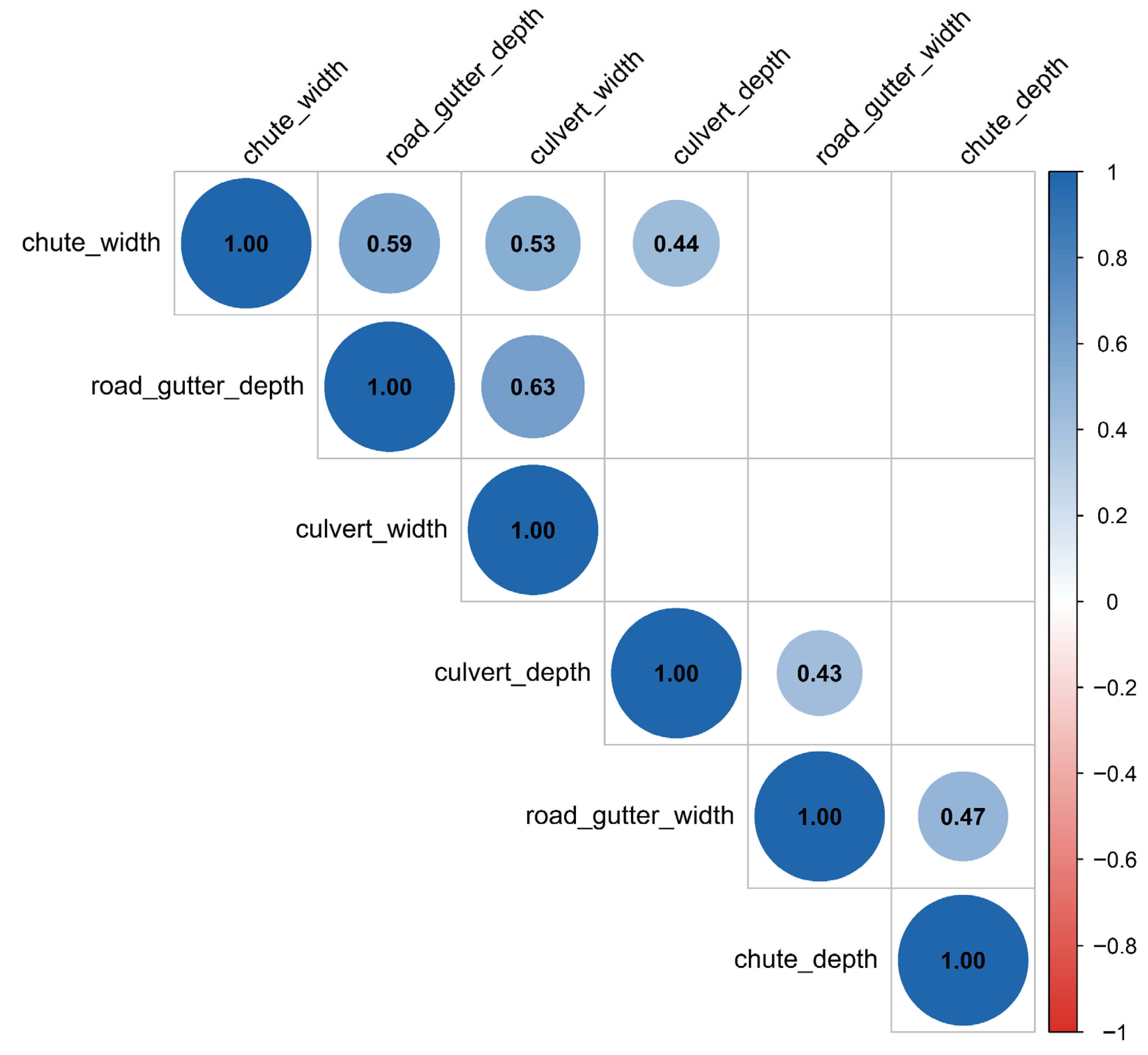
Of the 15 unique Spearman pairwise correlations (n = 42), nine were significant at α = 0.05 before Benjamini–Hochberg (BH) correction; six survived BH correction (Figure 11; Table 8). The six BH-corrected significant pairs exhibited positive ρ values in the moderate-to-large range (ρ = 0.428–0.625; all padj ≤ 0.012 [30]), indicating consistent co-directional scaling across structure types. Partial Spearman correlations controlling for survey group size were computed for all 15 pairs. All partial coefficients remained directionally consistent with the zero-order values (e.g., road gutter H × culvert width b: ρpartial = 0.612 vs. ρzero-order = 0.625; road gutter b × chute depth H: ρpartial = 0.461 vs. 0.473) but none reached significance after BH correction (all p > 0.08). The attenuation of significance reflects reduced effective degrees of freedom and concomitant collapse below the threshold required to detect medium effects (ρ ≈ 0.30; power ≈ 0.32 at α = 0.05) [34,35], not sign reversal or magnitude collapse. The group-composition artefact hypothesis is therefore rejected: the observed correlations reflect genuine site-level geometric scaling, corroborated by the supervisor validation protocol (Section 2.3).

3.8. Multivariate Structure: PCA and Hierarchical Clustering

PCA of the six geometric dimensions extracted three principal components accounting for 85.8% of total variance (Table 9). PC1 (42.6%) loaded predominantly on road gutter width (λ = 0.584), chute width (0.582), and chute depth (0.503). PC2 (28.5%) reflects a secondary scaling axis governed by culvert width (0.637) and road gutter depth (0.605). PC3 (14.7%) was defined by culvert depth/diameter (0.856), capturing culvert geometry type independently of the broader scale axis. These multivariate patterns align with site-level co-scaling across structure types; however, attributing this to specific project-level design decisions would require historical construction archives, which falls outside the scope of this study. The spatial distribution and variable loadings are detailed in the PCA biplot and score plot (Figures S2 and S3, Supplementary Material S1).
Complementing this, hierarchical clustering with silhouette optimisation yielded an optimal partition at k = 2 (mean silhouette = 0.713). This result, however, produced an imbalanced 41:1 split: while Cluster 1 encompasses segments of moderate dimensions (mean road gutter depth 2.07 m, culvert width 1.62 m), Cluster 2 isolates a single outlier with extreme chute dimensions (depth: 6.5 m; width: 4.0 m). This partition is interpreted as univariate outlier detection rather than as a meaningful subdivision of the population. To ensure that this extreme case did not bias the broader findings, a sensitivity check was performed by recomputing the inferential statistics without the outlier. The impact was negligible: DDI ≥ 60 prevalence shifted marginally from 73.8% to 73.2%, universal-failure rates remained at 100%, and the stability of all significant Spearman correlations was maintained (maximum absolute change in ρ of 0.027).
Consequently, the outlier is retained under the conservative-bounding principle, though it remains flagged for targeted hydraulic re-verification in subsequent work.

3.9. Composite Drainage Deficiency Index (DDI)

DDI scores across the 42 segments ranged from 0 to 100, with a mean of 60.2 ± 20.4 and a median of 60.0 (Figure S4, Supplementary Material S1). Class distribution was Very Low (DDI 0–20): 4 (9.5%); Low (21–40): 3 (7.1%); Moderate (41–60): 19 (45.2%); High (61–80): 13 (31.0%); Critical (81–100): 3 (7.1%) segments. A total of 31 segments (73.8%) fell within the High or Critical band (DDI ≥ 60), with the three Critical-band segments (DDI = 100; segment IDs 9, 10, 11) each accumulating all five deficiency components simultaneously.
The Monte Carlo weight-perturbation analysis confirmed rank-order prioritisation stability, with Critical-band segment identification preserved in 96.3% of iterations (95% CI: [91.7, 100.0]). Jackknife sensitivity analysis validating the stability of these proportions is reported in Table 10.

4. Discussion

4.1. Severity and Pattern of Infrastructure Deficiencies

The near-universal absence of crown gutters (88.1% of sites; 95% CI: 75.0–94.8) is the most consequential deficiency identified. Crown gutters constitute the primary active barrier against embankment saturation, intercepting upslope runoff before it reaches the road platform and thereby preventing progressive moisture infiltration, shear-strength loss, and slope failure. Their absence across 37 of 42 segments means the road platform itself functions as the de facto drainage channel for contributing-area runoff, a situation reflecting prolonged insufficient maintenance and documented deficiencies in crown drainage systems on high-relief road networks [19], compounded by blockage susceptibility at cross-drainage structures [15,16] and sediment-driven degradation [36].
Direct statistical benchmarking against other Andean corridor inventories is precluded by methodological heterogeneity in sampling frames, instability metrics, and condition rating scales [27,28]. The authors are unaware of published multi-structure diagnostic protocols or DDI-equivalent metrics applied to ENSO-exposed Andean road networks; this absence motivates the present contribution as a reproducible baseline. Directional consistency with documented failure modes in high-relief networks, sediment/vegetation blockage, geometric inadequacy, and absent cross-slope interception [15,20,36] supports the conditional transferability of visual-diagnostic protocols to geomorphologically similar contexts, pending external empirical validation (Section 4.6).
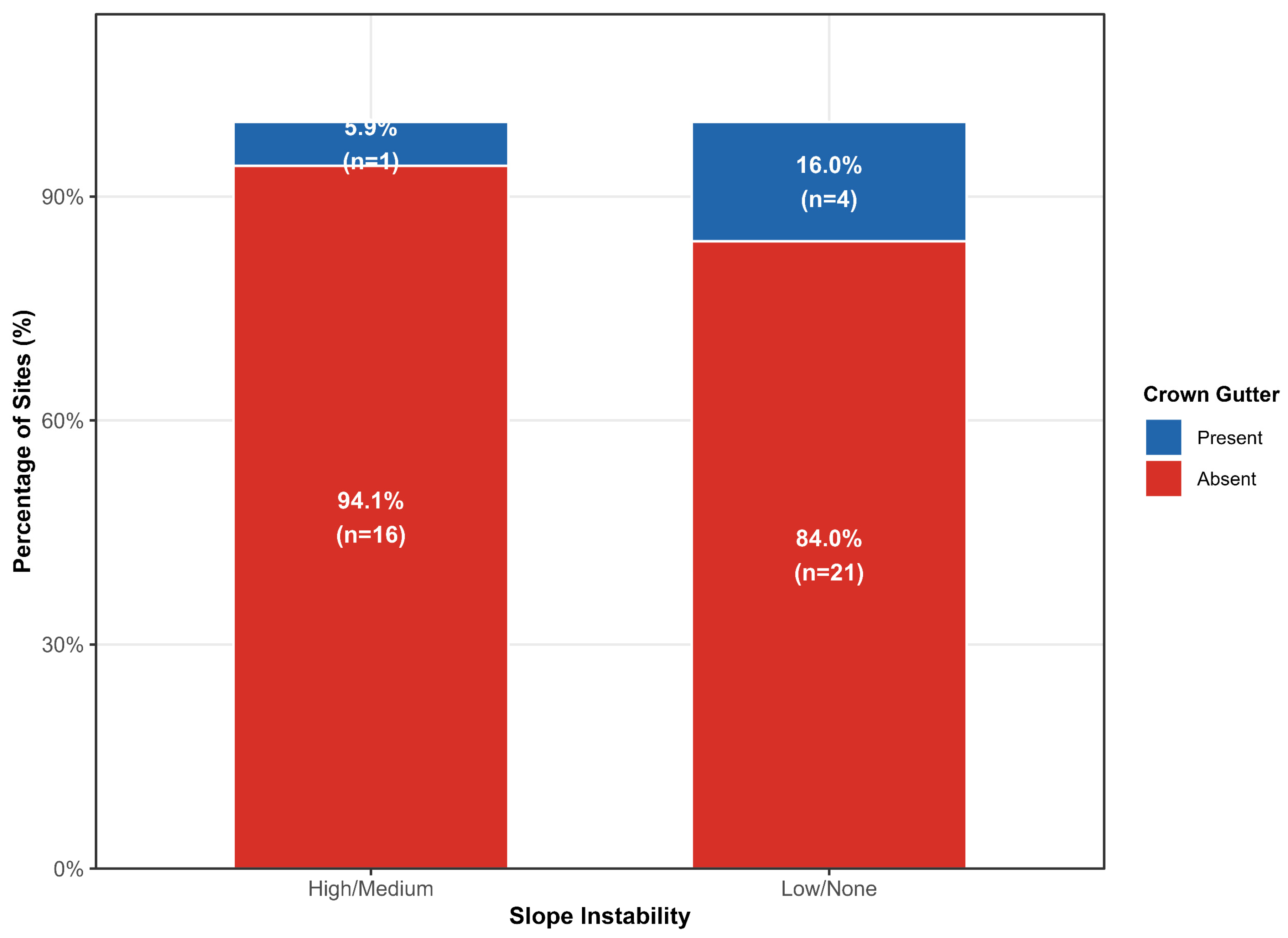
The 40.5% prevalence of High or Medium slope instability (95% CI: 27.0–55.5), combined with the direction of the crown gutter–slope instability association (OR = 3.05; bootstrap CI for V excludes zero), indicates that the most hydraulically exposed locations are disproportionately those with the most critical drainage gaps. Although Fisher’s exact test does not reach significance at α = 0.05 (p = 0.632), a predictable consequence of the sparse 2 × 2 table at n = 42 and the post hoc power of ≈ 0.28 documented in Section 3.6 [30], the effect-size and bootstrap CI evidence supports a practically meaningful but statistically underpowered association warranting precautionary maintenance prioritisation pending larger-n confirmation.
The predominance of triangular chute sections (77.8% of present chutes) reflects a systematic design preference confirmed by goodness-of-fit testing (χ2(4) = 58.37; p < 0.001). The absence of significant geometric differentiation across section types (Kruskal–Wallis H(2) = 1.92, p = 0.383) suggests that, among constructed chutes, section type does not inherently dictate conveyance capacity in this sample, likely reflecting historical design defaults or material availability rather than hydraulically optimised sizing NEVI-12 [18] thresholds.
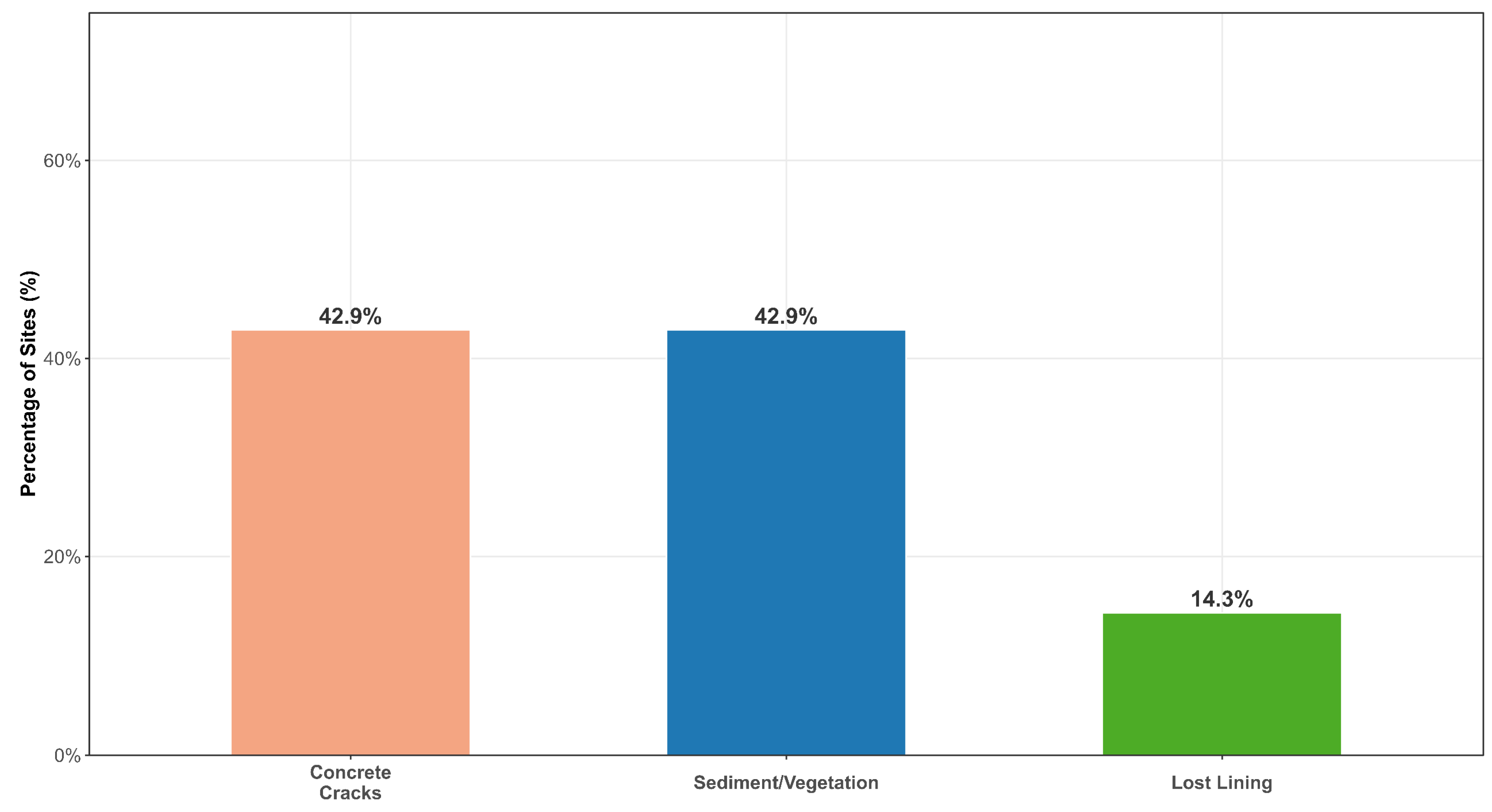
The universal presence of drainage failure—documented across all 42 surveyed segments—constitutes the most definitive evidence of chronic underinvestment in maintenance. Sediment and vegetation accumulation accounted for the majority of culvert failures (59.5%), a pattern consistent with long-term inadequacies in preventative upkeep. Concrete cracking and lost lining each accounted for 42.9% of road gutter failure events, reflecting active structural deterioration consistent with concrete degradation patterns in exposed Andean drainage infrastructure [22].

4.2. Geometric Scaling and Infrastructure Coherence

The Spearman correlation structure (Table 8; Figure 11) reveals a coherent pattern of positive cross-structure dimensional associations: segments with larger road gutters tend to have proportionally larger hydraulic chutes and culverts (six BH-corrected significant pairs; ρ = 0.428–0.625 [30], all padj ≤ 0.012). This pattern is corroborated by PCA: PC1 (42.6% of variance) loads jointly on road gutter width, chute width, and chute depth, representing a dominant scale axis across structure types.
These observations are pattern-descriptive: the co-scaling identified here is a structural empirical regularity, and mechanistic interpretation—such as attribution to coordinated project-level design—could equally arise from shared construction-era design defaults, correlated site constraints, or parallel degradation processes and exceeds the evidential scope of this cross-sectional study.
Nevertheless, under a maintenance-planning interpretation consistent with these findings, segments characterised by undersized road gutters are likely accompanied by undersized conveyance and cross-drainage structures, implying that drainage deficiency is spatially cumulative. Rehabilitation strategies targeting a single structure type without addressing the others risk introducing hydraulic discontinuities, a concern aligned with integrated drainage system design principles in NEVI-12 [18] and the INVIAS Manual de Drenaje para Carreteras [19].

4.3. DDI as a Prioritisation Framework for Infrastructure Managers

The mean DDI of 60.2 ± 20.4 (median = 60), with 31 of 42 segments (73.8%) scoring DDI ≥ 60 and three Critical-band segments at the maximum score (DDI = 100), provides infrastructure managers with a quantitative, georeferenced prioritisation framework. The Critical-band segments—each accumulating all five deficiency components simultaneously—represent priority candidates for hydraulic verification against NEVI-12 [18] geometric thresholds. Internal robustness is confirmed by jackknife leave-one-out resampling ( p ^   = 0.738; J K S E = 0.069; J K C I : 0.604–0.873), indicating that no single segment exerts undue influence, while Monte Carlo weight-perturbation analysis demonstrates that rank-order prioritisation remains invariant to admissible alternative weightings. Because the DDI relies exclusively on directly observable binary indicators and requires no hydraulic modelling, it is operationally deployable by maintenance crews without specialised software [37]. This methodological transferability must be distinguished from external empirical validation: while the framework can be immediately applied to resource-constrained Andean corridors, cross-network validation of its predictive capacity regarding hydraulic exceedance remains a priority future direction.

4.4. ENSO Exposure, IDF Context, and Climate Resilience

4.4.1. Boundary Conditions of the Present Study

This manuscript reports a structural condition baseline, not a hydrodynamic capacity assessment. The ENSO vulnerability framing establishes climatic forcing context and motivation for diagnostic urgency, not causal attribution. Three epistemological boundaries are explicitly delimited. (i) No historical precipitation analysis: rainfall data from INAMHI stations [26] and IDF curves for Loja Province are reported in the companion publication [1], to which this inventory provides the structural input required for subsequent hydraulic modelling. The present study does not re-derive these curves. (ii) No runoff simulation: peak-discharge estimation, catchment delineation, and HEC-HMS/HEC-RAS modelling are identified as Phases 2–3 of the workflow (Figure 2) and are documented in [1]. The Manning proxy presented here (n = 8 segments; median Qproxy = 1.66 m3/s) is an observational dimensioning indicator, not a verified capacity estimate. (iii) No ENSO-phase damage attribution: the correlation between ENSO warm-phase precipitation anomalies and drainage failure rates is hypothesised, not tested, within this cross-sectional design. Establishing causal attribution would require (a) pre-ENSO baseline condition data, (b) post-ENSO damage surveys, and (c) controlled comparison with non-ENSO periods—data unavailable for this corridor network.

4.4.2. Diagnostic Urgency Under ENSO Forcing

Despite these boundaries, the structural deficiency pattern documented here acquires conditional urgency under projected ENSO exposure. The IDF framework in [1] indicates that 10-year return-period rainfall intensities during El Niño warm phases exceed NEVI-12 [18] design thresholds by 18–34% across Loja Province. When superimposed on the geometric inadequacy documented here (88.1% crown gutter absence, 100% failure presence), this intensity excess implies capacity exceedance under design-return events for the majority of segments. The DDI ≥ 60 prevalence (73.8%) therefore identifies segments where structural deficiency compounds ENSO-driven hydraulic overload—a compound risk indicator [38], not a probabilistic failure forecast.

4.5. Limitations

Several limitations bound the scope and precision of these findings. First, the purposive-stratified sample of n = 42, while appropriate for the non-parametric analyses applied, restricts statistical power in condition-variable subgroup analyses where effective sample sizes fall to n = 8–9; Cramér’s V values in the moderate-to-strong range that fail to reach significance under these conditions reflect type II error (post hoc power ≈ 0.28 [30]) rather than genuine null associations, and future expanded inventories should be designed with explicit power analyses to address this. The sampling design also limits population-level generalisation: the DDI prevalence estimates should be read as lower-bound indicators of network-wide deficiency severity, not unbiased population parameters (Section 2.1). Second, condition data were available for only nine chutes and eight culverts. Consistent with the missing-data architecture (Section 2.4), DDI components for present-but-unrated structures default to zero—a conservative assumption that may understate deficiency; full-sample prevalence denominators are therefore reported alongside effective-n statistics throughout the results. Third, the Manning hydraulic capacity proxy cannot substitute for formal capacity verification; HEC-RAS [39] or HY-8 [40] analyses with catchment-delineated contributing areas remain essential for design discharge assessment. Fourth, although inter-group measurement variability was mitigated through supervisor validation and is further supported by the group-composition artefact analysis (Section 3.7), the PjBL data-collection context prevents formal quantification of test–retest reliability across groups. Fifth, the DDI weights are equal by design under the Laplace insufficient-reason principle (Section 2.4) [31]; although Monte Carlo perturbation demonstrates rank-order robustness, empirical failure-probability data calibrated to regional IDF forcing would enable differential weighting in future refinements of the metric. Sixth, interpretations regarding project-level geometric sizing (Section 4.2) are hypothesis-consistent with multivariate patterns but have not been mechanistically validated against construction archives.

4.6. Future Research Directions

Seven priority future directions emerge from this study: (1) expansion of the diagnostic inventory across the complete Loja corridor network to increase sample size and enable spatial autocorrelation and cluster analysis; (2) formal hydraulic capacity modelling using HEC-HMS [41], HEC-RAS [39], HY-8 [40], and SWMM [42] platforms to compute structure-level Qdesign/Qcapacity ratios with calibrated IDF curves, building on the Manning-based observational proxy presented in Section 3.4 and the regional IDF framework in [1]; (3) longitudinal monitoring of High/Critical DDI segments before and after maintenance interventions to validate the DDI’s predictive value for maintenance outcomes; (4) spatial clustering analysis of DDI scores along corridor profiles to delineate contiguous maintenance planning zones; (5) development of a DDI-based maintenance cost–benefit model using unit repair cost data from highway maintenance records; (6) external empirical validation of the DDI in other Andean corridor networks (Peru, Colombia, northern Ecuador) to establish cross-context transferability; and (7) a dedicated educational-research companion study using validated pre/post competency instruments to quantify the pedagogical effectiveness of the STEM–PjBL framework—an objective outside the present engineering-diagnostic scope.

5. Conclusions

A STEM-integrated PjBL diagnostic framework was implemented to characterise the drainage infrastructure across 42 ENSO-vulnerable road segments in southern Ecuador. Results reveal severe, systemic degradation indicative of long-term maintenance deficits: crown gutters were absent at 88.1% of sites (95% CI: 75.0–94.8), and road gutters were missing at 81.0% sites (95% CI: 66.7–90.0), while every surveyed segment exhibited at least one drainage failure mode (100%; 95% CI: 91.6–100). The Composite Drainage Deficiency Index (DDI) identified 73.8% of segments in the High or Critical deficiency band (DDI ≥ 60; jackknife CI: 60.4–87.3), pinpointing three Critical-band segments at the maximum score (DDI = 100; segment IDs 9, 10, 11), each accumulating all five deficiency components simultaneously, therefore prioritised for hydraulic verification.
Methodological robustness was established through jackknife leave-one-out resampling and Monte Carlo Dirichlet weight-perturbation analysis, which confirmed rank-order invariance (Spearman ρ = 0.930; 95% CI: [0.753, 0.998]). Furthermore, outlier sensitivity checks verified that the principal inferential conclusions remain robust upon the exclusion of the single high-dimension segment.
These findings establish the first quantitative, georeferenced diagnostic baseline for this corridor network, supplying the structural condition data required for subsequent hydraulic capacity analyses within the regional IDF framework. The deployment protocol demonstrates that academically scaffolded field datasets can meet rigorous peer-reviewed standards, though formal pedagogical validation remains a subject for future educational research. While the DDI is operationally transferable to other Andean corridor networks owing to its software-independent design, its external empirical validation across diverse geomorphological and institutional contexts remains a priority for future research.

Supplementary Materials

The following supporting information can be downloaded at: https://www.mdpi.com/article/10.3390/su18104964/s1, Supplementary Material S1: Table S1. DDI segment register for 42 road segments (including geographic coordinates and DDI classification). Figure S1. Hierarchical cluster dendrogram of drainage segments. Figure S2. Principal Component Analysis (PCA) biplot. Figure S3. Monte Carlo Dirichlet weight-perturbation analysis. Figure S4. Distribution of Drainage Deficiency Index (DDI) across surveyed segments. Supplementary Material S2: Figures S1–S5. STEM-PjBL Fieldwork and Digital Tools (UAV deployment, topographic survey, and ArcGIS Survey123 data collection). Figures S6–S10. Assessment of Drainage Structure Types (chutes, culverts, and headwalls). Figures S11–S22. Documentation of Structural Pathologies and Failure Modes (sedimentation, erosion, and pavement-gutter interface distress).

Author Contributions

Conceptualization, H.M.B.-M.; methodology, H.M.B.-M.; software, H.M.B.-M. and M.I.A.-C.; formal analysis, H.M.B.-M. and M.I.A.-C.; investigation, H.M.B.-M., L.M.B.-O. and student survey teams; data curation, H.M.B.-M.; writing—original draft preparation, H.M.B.-M.; writing—review and editing, H.M.B.-M., M.I.A.-C. and L.M.B.-O.; visualisation, H.M.B.-M.; supervision, H.M.B.-M.; project administration, H.M.B.-M.; funding acquisition, H.M.B.-M. All authors have read and agreed to the published version of the manuscript.

Funding

This research and the article processing charge (APC) were funded by the Universidad Técnica Particular de Loja (UTPL).

Institutional Review Board Statement

The study was conducted in accordance with applicable ethical guidelines for observational infrastructure research. Infrastructure data are non-personal in nature. Participant data from student survey teams were anonymised prior to analysis. Under UTPL standardised procedures, ethical review was not required for this study category.

Data Availability Statement

The complete annotated R analysis script, full R console output, and raw field dataset are publicly available on Zenodo: Benavides-Muñoz, H.M.; Ayala-Chauvin, M.I.; Benavides-Ortega, L.M. Research Data and Analytical Code—Road Drainage Infrastructure Diagnostics and Deficiency Indexing in ENSO-Vulnerable Andean Corridors: A STEM–PjBL Field Assessment. Zenodo 2026. https://zenodo.org/records/19390580 (accessed on 8 May 2026).

Acknowledgments

The authors gratefully acknowledge the civil engineering students who participated in this study. Their valuable contributions to meticulous fieldwork and topographic surveys, drone-based assessments, and systematic data registration via the ArcGIS Survey123 platform were essential to the research. Their active engagement, both within project teams and through peer collaboration, was instrumental in the practical implementation of the Project-Based Learning intervention. Support from the Academic Vice-Rectorate of UTPL for Good Practices and Teaching Innovation Projects is also gratefully acknowledged. During manuscript preparation, the authors used Claude (Anthropic, https://claude.ai, accessed on 15 March 2026) and Gemini (Google, https://gemini.google.com, accessed on 20 March 2026) to assist with translation from Spanish to English, grammatical refinement, and enhancement of technical terminology in engineering education. The authors have thoroughly reviewed, edited, and validated all generated content and take full responsibility for the accuracy, integrity, and scholarly quality of the final text.

Conflicts of Interest

The authors declare no conflicts of interest. The funders had no role in the design of the study; in the collection, analyses, or interpretation of data; in the writing of the manuscript; or in the decision to publish the results.

Abbreviations

The following abbreviations are used in this manuscript:
BHBenjamini–Hochberg false discovery rate correction
CIConfidence interval
CVCoefficient of variation
DDIDrainage Deficiency Index
ENSOEl Niño–Southern Oscillation
GISGeographic Information Systems
HEC–HMSHydrologic Engineering Center Hydrologic Modelling System
HEC–RASHydrologic Engineering Center River Analysis System
HY–8Hydraulic Engineering Center Culvert Analysis Program
IDFIntensity–Duration–Frequency
INAMHIInstituto Nacional de Meteorología e Hidrología (Ecuador)
INVIASInstituto Nacional de Vías (Colombia)
MTOPMinisterio de Transporte y Obras Públicas del Ecuador
NEVI-12Norma Ecuatoriana Vial 2012–2013 (MTOP road design standard)
PjBLProject-Based Learning
STEMScience, Technology, Engineering, and Mathematics
SWMMStorm Water Management Model
UAVUnmanned Aerial Vehicle
UTPLUniversidad Técnica Particular de Loja

References

  1. Benavides-Muñoz, H.M.; Román-Aguilar, K.M. Hydrodynamic modeling and flood mitigation strategies in an Andean Valley City. PLoS Water 2025, 4, e0000397. [Google Scholar] [CrossRef]
  2. U.S. Geological Survey. Landslide Hazards—Basics; USGS: Reston, VA, USA, 2024. Available online: https://www.usgs.gov/programs/landslide-hazards (accessed on 15 March 2026).
  3. Lee, M.Y.; Lee, J.S. Project-Based Learning as a Catalyst for Integrated STEM Education. Educ. Sci. 2025, 15, 871. [Google Scholar] [CrossRef]
  4. Kolmos, A.; Holgaard, J.E.; Routhe, H.W. Understanding and Designing Variation in Interdisciplinary Problem-Based Projects in Engineering Education. Educ. Sci. 2025, 15, 138. [Google Scholar] [CrossRef]
  5. Ramírez de Dampierre, M.; Gaya-López, M.C.; Lara-Bercial, P.J. Evaluation of the Implementation of Project-Based-Learning in Engineering Programs: A Review of the Literature. Educ. Sci. 2024, 14, 1107. [Google Scholar] [CrossRef]
  6. Sukackė, V.; Guerra, A.O.P.d.C.; Ellinger, D.; Carlos, V.; Petronienė, S.; Gaižiūnienė, L.; Blanch, S.; Marbà-Tallada, A.; Brose, A. Towards Active Evidence-Based Learning in Engineering Education: A Systematic Literature Review of PBL, PjBL, and CBL. Sustainability 2022, 14, 13955. [Google Scholar] [CrossRef]
  7. Lavado-Anguera, S.; Velasco-Quintana, P.-J.; Terrón-López, M.-J. Project-Based Learning (PBL) as an Experiential Pedagogical Methodology in Engineering Education: A Review of the Literature. Educ. Sci. 2024, 14, 617. [Google Scholar] [CrossRef]
  8. Hinostroza, J.E.; Armstrong-Gallegos, S.; Soto-Valenzuela, P.; Villafaena, M. Phases and Activities of Technology-Integrated Project-Based Learning in K-12: Findings from a Systematic Literature Review. Educ. Sci. 2025, 15, 1021. [Google Scholar] [CrossRef]
  9. Kefalis, C.; Skordoulis, C.; Drigas, A. Digital Simulations in STEM Education: Insights from Recent Empirical Studies, a Systematic Review. Encyclopedia 2025, 5, 10. [Google Scholar] [CrossRef]
  10. Gieryn, T.F. Boundary-work and the demarcation of science from non-science. Am. Sociol. Rev. 1983, 48, 781–795. [Google Scholar] [CrossRef]
  11. Castillo-Guerrero, F.J.; De la Cruz-Ávila, M.; Barrientos, D.C.; Areu-Rangel, O.S.; Barrios-Pina, H.; Rosales-Magaña, V.H.A.; Bonasia, R. Hydraulic Simulation of Urban Flooding in Monterrey, Mexico: Lessons from Hurricane Alberto. Urban Water J. 2026, 23, 516–539. [Google Scholar] [CrossRef]
  12. Zeyrek, O.; Wang, F.; Xu, J. Behaviors of Highway Culverts Subjected to Flooding: A Comprehensive Review. Water 2025, 17, 2937. [Google Scholar] [CrossRef]
  13. Rodríguez, C.M.D.; Fabian, C.L.; Sarmiento-Rojas, J.A. Modeling urban drainage in intermediate cities under extreme climate change scenarios: A case study in Southeastern Tunja, Colombia. H2Open J. 2025, 8, 224–239. [Google Scholar] [CrossRef]
  14. Putri, M.M. Hydraulic Capacity of Culverts Under Sediment Transport. Ph.D. Thesis, Norwegian University of Science and Technology, Trondheim, Norway, 2014. Available online: https://hdl.handle.net/11250/242472 (accessed on 20 May 2025).
  15. Iqbal, U.; Riaz, M.Z.B. Blockage at cross-drainage hydraulic structures—Advances, challenges and opportunities. Heliyon 2024, 10, e35786. [Google Scholar] [CrossRef]
  16. Iqbal, U.; Bin Riaz, M.Z.; Barthelemy, J.; Perez, P. Prediction of hydraulic blockage at culverts using lab scale simulated hydraulic data. Urban Water J. 2022, 19, 686–699. Available online: https://hdl.handle.net/10779/uow.27809037 (accessed on 20 April 2025). [CrossRef]
  17. Zayed, M. Blockage slope and ratio effects on box culvert hydraulics. Discov. Water 2023, 3, 23. [Google Scholar] [CrossRef]
  18. Ministerio de Transporte y Obras Públicas del Ecuador (MTOP). Norma Ecuatoriana Vial NEVI-12, Volumen 2B: Diseño Hidráulico de Estructuras de Drenaje; Subsecretaría de Infraestructura del Transporte: Quito, Ecuador, 2013. Available online: https://www.scribd.com/document/684792109/01-12-2013-Manual-NEVI-12-VOLUMEN-2B (accessed on 18 April 2025).
  19. Instituto Nacional de Vías (INVIAS). Manual de Drenaje para Carreteras; Ministerio de Transporte de Colombia: Bogotá, Colombia, 2009. Available online: https://www.google.com/url?sa=t&source=web&rct=j&opi=89978449&url=https://repositorio.uniandes.edu.co/server/api/core/bitstreams/47d045df-7414-4456-8517-c47722b5b0e0/content&ved=2ahUKEwjLoNPOpbOUAxXtd2wGHVMhO8cQFnoECBsQAQ&usg=AOvVaw2JiF1Vu_3Hyf6sRWhjgjE8 (accessed on 18 April 2025).
  20. PennState. Crown and Cross Slope; Penn State Center for Dirt and Gravel Road Studies: University Park, PA, USA, 2022; Available online: https://dirtandgravel.psu.edu (accessed on 10 April 2025).
  21. Krochin, S. Diseño Hidráulico; Editorial UTPL: Loja, Ecuador, 2010; Available online: https://visorweb.utpl.edu.ec/library/publication/diseno-hidraulico-1620234933 (accessed on 18 April 2025).
  22. Ponce, V.M. Drenaje de Carreteras—C. Drenaje Superficial; San Diego State University: San Diego, CA, USA, 2018; Available online: http://ponce.sdsu.edu/drenaje_de_carreteras_c.html (accessed on 15 May 2025).
  23. Aranda, J.Á.; Sánchez-Juny, M.; Sanz-Ramos, M.; Beneyto, C. Design of Drainage Downspouts Systems over a Road Embankment. Water 2023, 15, 3529. [Google Scholar] [CrossRef]
  24. Vangu, G.M.; Miluț, M.; Croitoru, A.C. Use of modern technologies such as UAV, photogrammetry, 3D modeling, and GIS for urban planning. J. Appl. Eng. Sci. 2025, 15, 165–174. [Google Scholar] [CrossRef]
  25. Quamar, M.M.; Al-Ramadan, B.; Khan, K.; Shafiullah, M.; El Ferik, S. Advancements and Applications of Drone-Integrated Geographic Information System Technology—A Review. Remote Sens. 2023, 15, 5039. [Google Scholar] [CrossRef]
  26. INAMHI. Anuario Meteorológico 2020; Ministerio del Ambiente, Agua y Transición Ecológica: Quito, Ecuador, 2020. Available online: https://servicios.inamhi.gob.ec/anuarios-metereologicos/ (accessed on 15 March 2026).
  27. Palinkas, L.A.; Horwitz, S.M.; Green, C.A.; Wisdom, J.P.; Duan, N.; Hoagwood, K. Purposeful sampling for qualitative data collection and analysis in mixed method implementation research. Adm. Policy Ment. Health 2015, 42, 533–544. [Google Scholar] [CrossRef] [PubMed]
  28. O’Cathain, A.; Murphy, E.; Nicholl, J. Three techniques for integrating data in mixed methods studies. BMJ 2010, 341, c4587. [Google Scholar] [CrossRef] [PubMed]
  29. R Core Team. R: A Language and Environment for Statistical Computing; R Foundation for Statistical Computing: Vienna, Austria, 2024; Available online: https://www.R-project.org/ (accessed on 20 March 2026).
  30. Cohen, J. Statistical Power Analysis for the Behavioral Sciences, 2nd ed.; Lawrence Erlbaum Associates: Hillsdale, NJ, USA, 1988. [Google Scholar]
  31. Laplace, P.S. Essai Philosophique sur les Probabilités; Courcier: Paris, France, 1814; Available online: https://gallica.bnf.fr/ark:/12148/bpt6k96200351.texteImage (accessed on 15 May 2025).
  32. Gelman, A.; Carlin, J.B.; Stern, H.S.; Dunson, D.B.; Vehtari, A.; Rubin, D.B. Bayesian Data Analysis, 4th ed.; CRC Press: Boca Raton, FL, USA, 2020. [Google Scholar] [CrossRef]
  33. Greco, S.; Figueira, J.; Ehrgott, M. (Eds.) Multiple Criteria Decision Analysis: State of the Art Surveys, 2nd ed.; Springer: New York, NY, USA, 2016. [Google Scholar] [CrossRef]
  34. Little, R.J.A.; Rubin, D.B. Statistical Analysis with Missing Data, 3rd ed.; Wiley: Hoboken, NJ, USA, 2020. [Google Scholar] [CrossRef]
  35. Cohen, J.; Cohen, P.; West, S.G.; Aiken, L.S. Applied Multiple Regression/Correlation Analysis for the Behavioral Sciences, 3rd ed.; Erlbaum: Mahwah, NJ, USA, 2003. [Google Scholar]
  36. Muste, M.; Xu, H. Multi-Pronged Approach for Monitoring Sedimentation Processes at Multi-Barrel Culverts. J. Hydrol. 2022, 610, 127840. [Google Scholar] [CrossRef]
  37. Florida Department of Transportation. Drainage Design Guide; FDOT: Tallahassee, FL, USA, 2024. Available online: https://www.fdot.gov/roadway/drainage/design-guide (accessed on 12 June 2025).
  38. IPCC. Climate Change 2022: Impacts, Adaptation and Vulnerability. Contribution of Working Group II to the Sixth Assessment Report of the Intergovernmental Panel on Climate Change; Pörtner, H.-O., Roberts, D.C., Tignor, M., Poloczanska, E.S., Mintenbeck, K., Alegría, A., Craig, M., Langsdorf, S., Löschke, S., Möller, V., et al., Eds.; Cambridge University Press: Cambridge, UK; New York, NY, USA, 2022. [Google Scholar] [CrossRef]
  39. U.S. Army Corps of Engineers. HEC-RAS User’s Manual v6.4.1; USACE HEC: Davis, CA, USA, 2023; Available online: https://www.hec.usace.army.mil/software/hec-ras/documentation/HEC-RAS%20User’s%20Manual-v6.4.1.pdf (accessed on 12 June 2025).
  40. U.S. Department of Transportation. HY-8 Culvert Hydraulic Analysis Program User’s Manual; FHWA: Washington, DC, USA, 2025. Available online: https://www.fhwa.dot.gov/engineering/hydraulics/software/hy8/ (accessed on 12 June 2025).
  41. U.S. Army Corps of Engineers. HEC-HMS User’s Manual v4.11; USACE HEC: Davis, CA, USA, 2023. Available online: https://www.google.com/url?sa=t&source=web&rct=j&opi=89978449&url=https://www.hec.usace.army.mil/software/hec-hms/documentation/HEC-HMS_User%2527s_Manual-v4.11-20231018.pdf&ved=2ahUKEwj1zvGGp7OUAxVMV3ADHdqQOzcQFnoECBoQAQ&usg=AOvVaw0RYDC_M-e4_0YUuPHwKR1W (accessed on 19 June 2025).
  42. U.S. Environmental Protection Agency. SWMM User’s Manual Version 5.2; EPA/600/R-22/030; EPA: Washington, DC, USA, 2022. Available online: https://cfpub.epa.gov/si/si_public_record_Report.cfm?Lab=CESER&dirEntryID=354181 (accessed on 19 June 2025).
Figure 1. Integrated STEM–PjBL conceptual framework for climate-resilient road drainage assessment. The diagram illustrates the alignment between STEM digital tools (science: hydrology; technology: UAV and GIS; engineering: hydraulic modelling; mathematics: Rational and Manning methods), PjBL pedagogy (authentic task, teamwork, iteration, reporting), and infrastructure diagnostics within the ENSO variability context.
Sustainability 18 04964 g001
Figure 2. Iterative STEM–PjBL diagnostic workflow showing the four-phase implementation sequence. Phase 1 (Field Characterisation: UAV + topographic survey + visual diagnosis) constitutes the executed scope reported in this manuscript. Phase 2 (Hydrological Modelling: catchment delineation + IDF + HEC-HMS, Hydrologic Modeling System, version 4.11 (U.S. Army Corps of Engineers, Institute for Water Resources, Davis, CA, USA) and Phase 3 (Hydraulic Simulation: Manning + HEC-RAS, version 6.4.1 (U.S. Army Corps of Engineers, Institute for Water Resources, Davis, CA, USA) + SWMM, Storm Water Management Model, version 5.2 (U.S. Environmental Protection Agency, Washington, DC, USA) + HY8, Culvert Analysis Program, version 7.8 (Federal Highway Administration, Washington, DC, USA) represent part of the course curriculum. Phase 4 (Professional Synthesis: technical report + oral defence) completes the pedagogical cycle. The reflection and feedback loop enables site re-assessment and parameter recalculation when deficiencies are identified, ensuring iterative quality improvement across the semester-long PjBL intervention.
Sustainability 18 04964 g002
Figure 8. Crown gutter presence stratified by slope instability level (stacked bar), n = 42 segments. Colours represent presence (blue) and absence (red).
Sustainability 18 04964 g008
Figure 9. Longitudinal drainage failure mode distribution across 42 road segments. Bars show percentage of sites exhibiting each failure code; colours distinguish failure categories. Concrete Cracks (left), Sediment/Vegetation, and Lost Lining/Armature Exposed (right).
Sustainability 18 04964 g009
Figure 10. Geometric dimension distributions by structure type (box plots): (a) Road Gutter (n = 8), (b) Hydraulic Chute (n = 27), (c) Culvert (n = 14). Whiskers: 1.5 × IQR; circles: outliers.
Sustainability 18 04964 g010
Figure 11. Spearman rank-order correlation matrix for six geometric dimensions (n = 42). Colour intensity indicates ρ magnitude.
Sustainability 18 04964 g011
Table 1. Slope instability classification criteria (observational geomorphological rating).
ClassCriterian
HighActive tension cracks > 5 cm wide; head scarp visible; recent (<2 yr) displacement of road edge; seepage at toe.6
MediumDormant scarps; deformed vegetation (leaning trees); minor cracking 2–5 cm; localized subsidence.11
LowHistorical scarps without recent activity; minor riling; no visible deformation.13
NoneStable vegetated slope; no geomorphological evidence of past or present instability.12
Table 2. Study overview and survey scope (n = 42 road segments).
ParameterValue
Total surveyed road segments42
Sampling designPurposive-stratified (3 geomorphological strata)
Survey instrumentArcGIS Survey123 (georeferenced)
Group size—mean (SD)3.8 (0.4)
Group size—range3–4 members
Structure types assessedCrown gutter, road gutter, hydraulic chute, culvert
Study corridorsLoja–Zamora; Loja–Villonaco/Catamayo; Loja–Malacatos/Yangana; Loja–Saraguro; Santa Ana–Los Encuentros
Study duration16-week academic semester (PjBL framework)
Statistical softwareRStudio v. 4.5.2
Sites with any observed drainage failure42/42 (100.0%; 95% CI: 91.6–100.0)
Sites lacking crown gutter37/42 (88.1%; 95% CI: 75.0–94.8)
Sites lacking road gutter34/42 (81.0%; 95% CI: 66.7–90.0)
Sites with High/Medium slope instability17/42 (40.5%; 95% CI: 27.0–55.5)
DDI ≥ 60 (High/Critical band)31/42 (73.8%; jackknife CI: 60.4–87.3)
CI: 95% Wilson confidence interval; DDI: Drainage Deficiency Index (0–100 composite score); PjBL: Project-Based Learning.
Table 3. Presence and cross-section type distribution of drainage structures (n = 42 segments).
StructureStatus/Typen%Note
Crown gutterAbsent3788.195% CI: 75.0–94.8
Crown gutterPresent511.9
Crown gutter (present)Rectangular12.4of all 42 segments
Crown gutter (present)Triangular12.4
Road gutterAbsent348195% CI: 66.7–90.0
Road gutterPresent819
Road gutter (present)Rectangular716.787.5% of present
Road gutter (present)Trapezoidal12.4
Road gutter (present)Triangular00.0CI: 0.0–8.4
Hydraulic chute Present2764.3
Chute (present)Triangular215077.8% of present
Chute (present)Trapezoidal49.5
Chute (present)Rectangular24.8
CulvertPresent1433.3
Culvert (present)Rectangular1126.278.6% of present
Culvert (present)Trapezoidal24.8
Culvert (present)Circular12.4
All percentages refer to proportion of the full study sample (n = 42 segments) unless noted otherwise. CI: 95% Wilson confidence interval.
Table 4. Structural condition of hydraulic chutes and culverts (condition data available for subset).
StructureConditionn
(Condition)
%n (All 42 Segments)/Wilson 95% CI
Hydraulic chute Good555.64/42 poor (9.5%; CI: 3.8–22.1)
Poor444.4
CulvertGood787.51/42 poor (2.4%; CI: 0.4–12.3)
Poor112.5
Condition data available: chutes n = 9/42 (33 absent/unrated); culverts n = 8/42 (34 absent/unrated). Full-sample prevalence denominator = 42 for all Wilson CI calculations.
Table 5. Descriptive statistics for continuous geometric variables (n = 42 segments, including zeros for absent structures).
VariableMeanSDQ1MedianQ3MaxCV%
Road gutter depth H (m)2.0241.7031.001.004.004.0084.2
Road gutter base width b (m)0.3910.7230.000.240.484.50184.8
Road gutter side slope Z (–)0.5671.0080.000.130.805.73178.0
H. Chute depth H (m)0.5491.1690.000.100.556.50213.0
H. Chute base width b (m)0.6740.6870.260.600.984.00101.9
H. Chute side slope Z (–)0.8550.9730.310.791.196.10113.8
Culvert depth H/diameter D (m)0.1310.3140.000.000.001.00240.0
Culvert base width b (m)1.5791.2480.891.202.713.8579.0
n = 42 for all variables (zeros = structure absent at that segment). Min = 0. SD: standard deviation; CV% = SD/Mean × 100; Q1/Q3: first/third quartile. Shapiro–Wilk: W = 0.458–0.899; all p < 0.001, confirming non-normality throughout.
Table 6. Kruskal–Wallis H-tests: geometric dimensions by cross-section type.
Response VariableGrouping
Variable a
nHdfp-ValueInterpretation
(ε2; η2r)
Road gutter depth HSect. type80.60010.439n.s. (0.000; 0.086)
Road gutter width bSect. type80.43910.508n.s. (0.000; 0.063)
H. Chute depth HSect. type271.92020.383n.s. (0.000; 0.074)
H. Chute width bSect. type425.22730.156n.s. (0.059; 0.127)
Culvert depth H/DCrown presence426.64730.084n.s. (0.096; 0.162)
Culvert width bSlope level426.08130.108n.s. (0.081; 0.148)
Road gutter depth HCrown presence420.47010.494n.s. (0.000; 0.011)
Culvert depth H/DSlope level421.66010.198n.s. (0.016; 0.040)
a Grouping variable: Sect. type = cross-section type among present structures only (three levels: Rectangular, Trapezoidal, Triangular) for chute depth; Crown pres. = crown gutter presence (binary); Slope level = High/Medium vs. Low/None (binary). n.s.: not significant (p ≥ 0.05). ε2 thresholds: small ≥ 0.01, medium ≥ 0.06, large ≥ 0.14. For chute depth (n = 27 present structures): H(2) = 1.92, p = 0.383, ε2 = 0.000, η2r = 0.074 (n.s.); BH-corrected Dunn post hoc tests showed no significant pairwise differences among present section types. Structural absence is reported as a categorical metric in Section 3.2 and excluded from geometric inference.
Table 7. Bivariate association tests: Fisher’s exact (Monte Carlo, B = 100,000) and Cramér’s V with bootstrap 95% CI (B = 2000).
AssociationnpVBootstrap
95% CI
Interpretation
Crown gutter × Slope instability420.630.1530.014–0.381weak
Crown gutter × Chute condition91.000.3160.125–0.756moderate
Crown gutter × Culvert condition81.000.1430.143–0.447weak
Slope instability × Chute condition90.440.3950.189–1.000moderate
Slope instability × Culvert condition81.000.143n/aweak
Road gutter present × Culvert condition80.380.488n/astrong
All tests: Fisher’s exact with Monte Carlo simulation (B = 100,000). V: Cramér’s V. Bootstrap CI: B = 2000 percentile resamples. n: effective sample (segments with data for both variables). n/a: insufficient cell counts for reliable bootstrap. Interpretation (Cohen, 1988): weak 0.10–0.20; moderate 0.20–0.40; strong 0.40–0.60.
Table 8. Spearman rank-order correlations among geometric dimensions (selected significant pairs; n = 42).
Variable 1Variable 2ρp (Uncorr.)p (BH-adj.)Sig.
Road gutter HChute width b0.594<0.0010.006**
Road gutter HCulvert width b0.625<0.001<0.001***
Road gutter bChute depth H0.4730.0020.012*
Road gutter bCulvert depth H0.4280.0050.012*
Road gutter bGutter Z0.4900.0010.012*
Road gutter HRoad gutter b0.3230.0370.079n.s.†
Chute width bCulvert width b0.530<0.0010.001**
Chute width bCulvert depth H0.4380.0040.012*
Gutter ZChute depth H0.3480.0240.116n.s.†
Gutter ZCulvert depth H0.3420.0270.116n.s.†
ρ: Spearman rho; BH-adj.: Benjamini–Hochberg FDR-corrected p-value (m = 15 pairs). * p < 0.05; ** p < 0.01; *** p < 0.001. †: uncorrected significant, BH-corrected non-significant. Partial ρ controlling for group size: all pairs n.s. (p > 0.08), indicating no group-composition artefact.
Table 9. PCA variance decomposition and principal component loadings (n = 42).
VariablePC1PC2PC3PC4PC5PC6
Road gutter depth H0.1270.605–0.3280.633–0.2800.197
Road gutter width b0.584–0.1380.084–0.095–0.280–0.746
Chute depth H0.503–0.288–0.286–0.677–0.2640.235
Chute width b0.5820.075–0.0730.200.78–0.049
Culvert depth H/D0.2220.3480.856–0.2780.08–0.052
Culvert width b0.0440.637–0.258–0.108–0.4180.579
Eigenvalue2.5581.7090.8800.4780.2450.131
Variance %42.6028.5014.708.004.102.20
Cumulative %42.6071.1085.8093.7097.80100.00
Table 10. Jackknife sensitivity analysis: stability of key infrastructure proportions (n = 42).
IndicatorpJK_SEJK_CI LowerJK_CI UpperInterpretation
Crown gutter absent0.8810.0510.7820.980Stable
Road gutter absent0.8100.0610.6890.930Stable
High/Medium slope instability0.4050.0770.2550.555Stable
H. Chute in poor condition0.0950.0460.0050.185Stable
Culvert in poor condition0.0240.024−0.0230.070Stable (low n events)
DDI ≥ 60 (High/Critical)0.7380.0690.6040.873Stable
All proportions based on n = 42 segments. JK_SE: jackknife standard error; JK_CI: jackknife leave-one-out 95% confidence interval. Narrow CIs confirm that no single observation drives reported proportions; results are robust to individual data points.
Disclaimer/Publisher’s Note: The statements, opinions and data contained in all publications are solely those of the individual author(s) and contributor(s) and not of MDPI and/or the editor(s). MDPI and/or the editor(s) disclaim responsibility for any injury to people or property resulting from any ideas, methods, instructions or products referred to in the content.