Assessing the Feasibility of Using Coastal Salt Caverns for Strategic Energy Storage from Safety and Economic Perspectives


Abstract
1. Introduction
2. Methods
2.1. Establishment of Numerical Model
2.2. Constitutive Model and Parameters
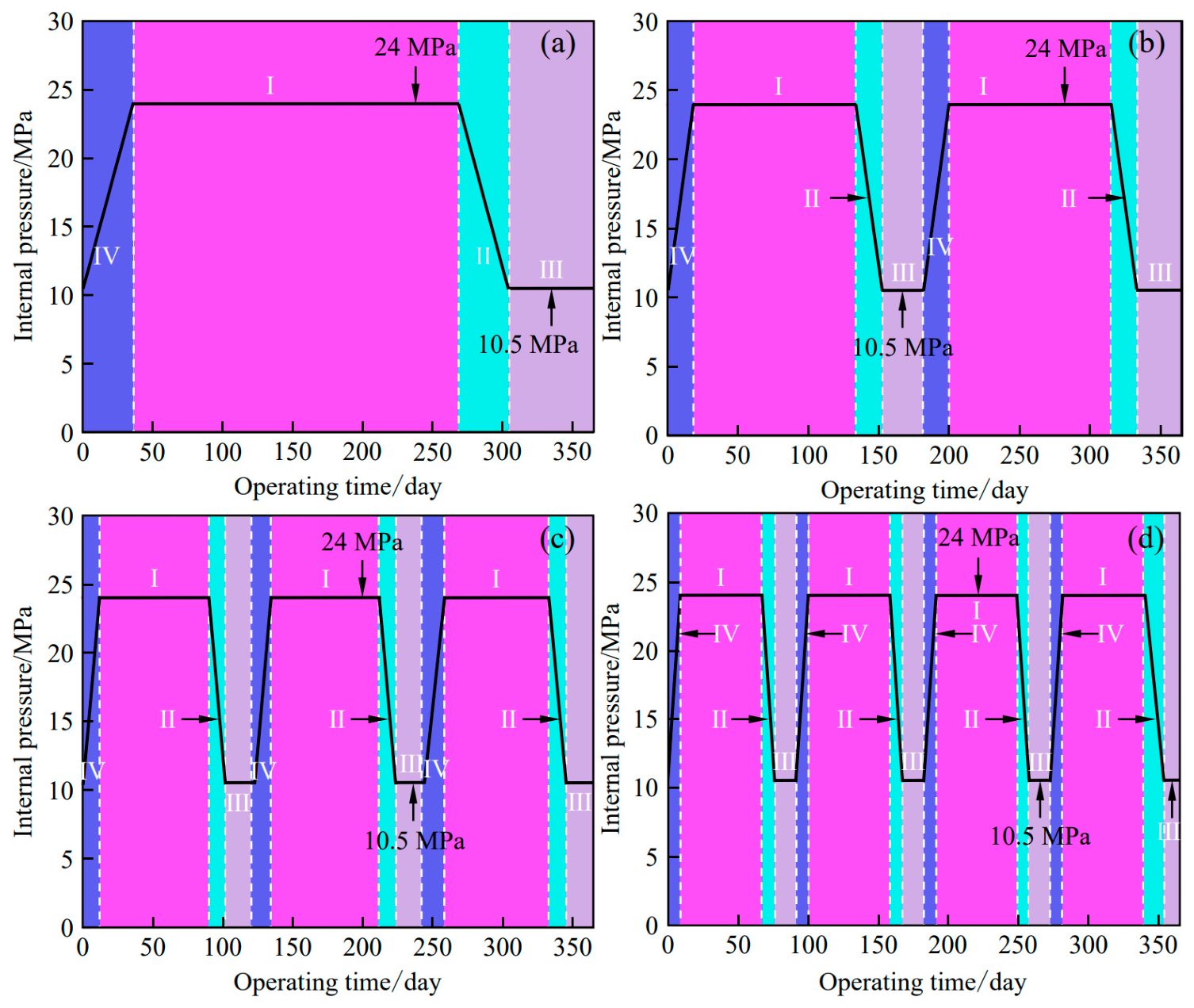
2.3. Operating Parameters of Gas Storage Facilities
3. Results
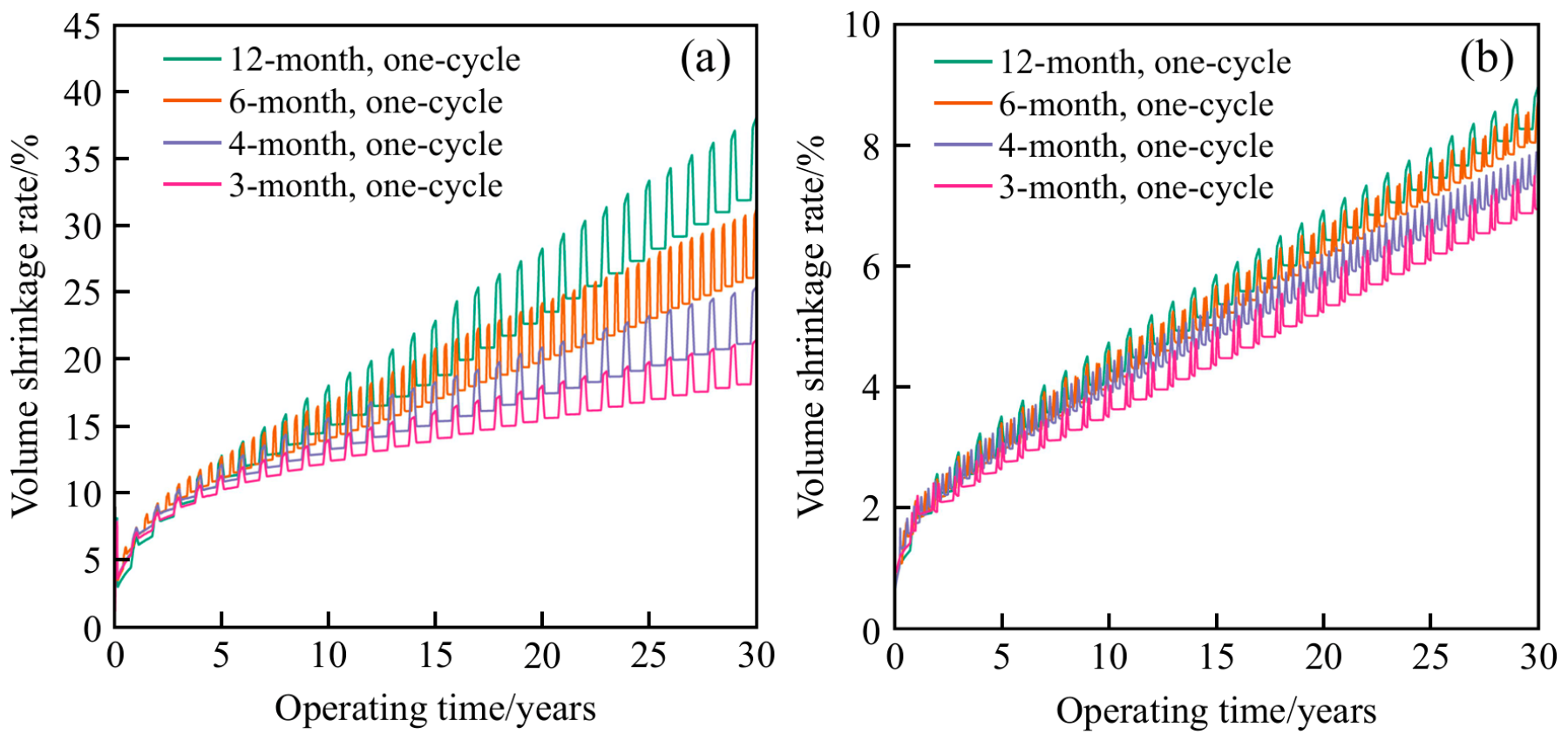
3.1. Volume Shrinkage Rate
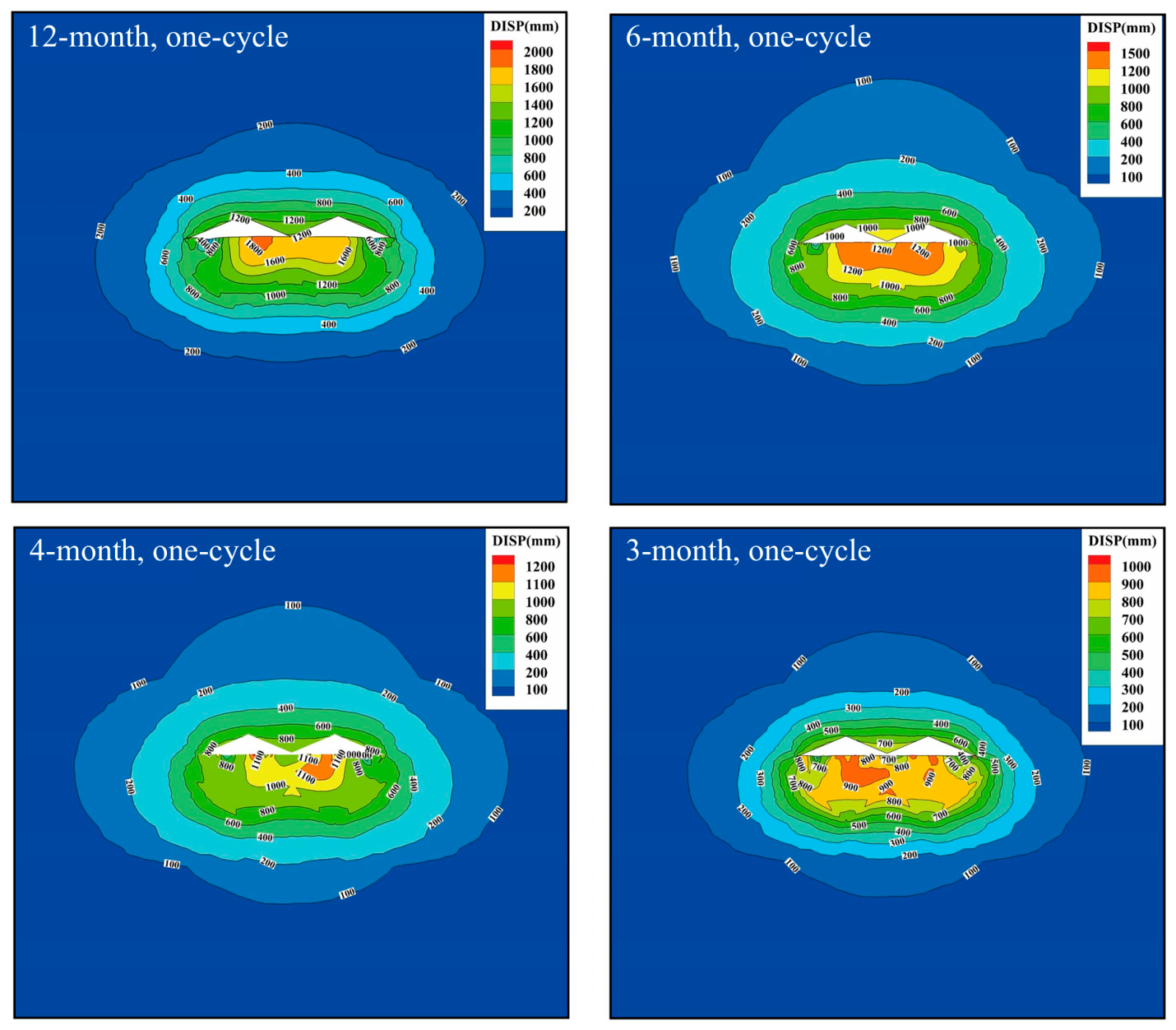
3.2. Variation in Displacement
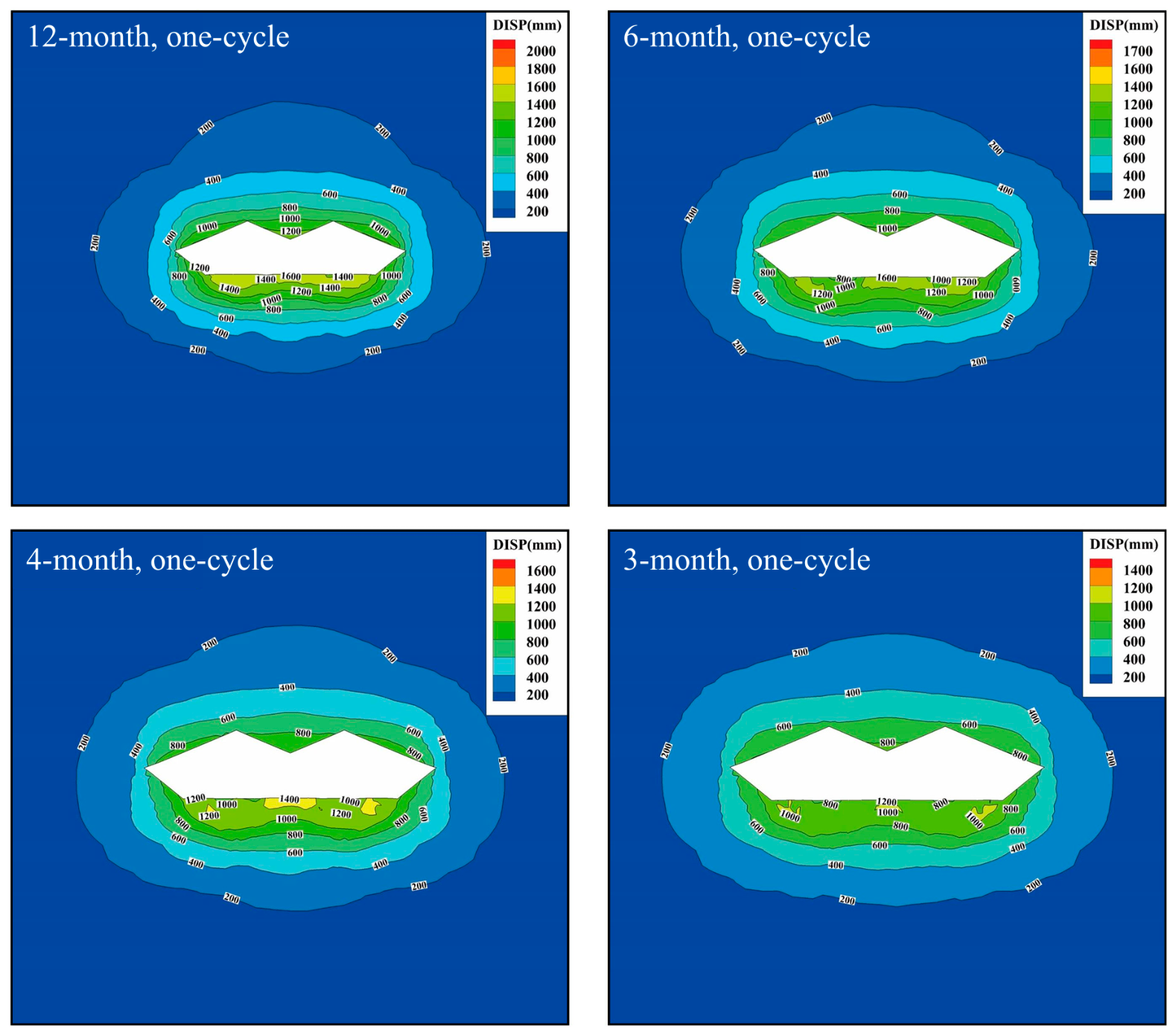
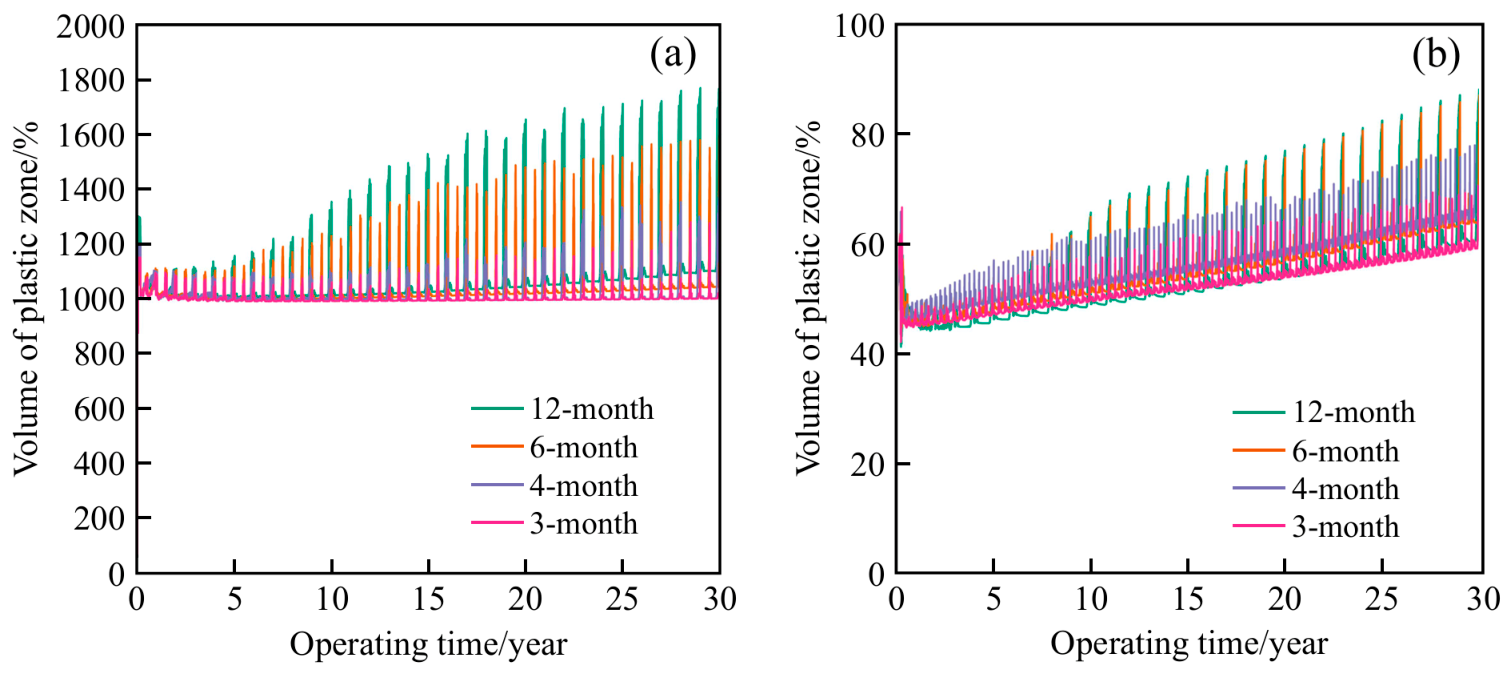
3.3. Plastic Zone of Surrounding Rock
4. Discussion
5. Conclusions
Author Contributions
Funding
Institutional Review Board Statement
Informed Consent Statement
Data Availability Statement
Conflicts of Interest
References
- Wright, G. Marine governance in an industrialised ocean: A case study of the emerging marine renewable energy industry. Mar. Policy 2015, 52, 77–84. [Google Scholar] [CrossRef]
- Wei, H.H.; Ding, S. The impact of industry integration on industrial energy efficiency in China. Energy Environ. 2026, 37, 560–580. [Google Scholar] [CrossRef]
- Hu, H.; Yan, K.G.; Fan, H.B.; Lv, T.G.; Zhang, X.M. Detecting regional unevenness and influencing factors of ecological resilience in China. Energy Environ. 2025, 36, 3985–4007. [Google Scholar] [CrossRef]
- Kizielewicz, J. Economic consequences of the COVID’19 pandemic for functioning of the cruise shipping industry in the Baltic Sea Region. Mar. Policy 2024, 159, 105925. [Google Scholar] [CrossRef]
- Shi, B.B.; Zhu, G.Y.; Zhang, R.J.; Li, N.; Ekeland, A. Energy transforming like China: The emission reduction effects of renewable energy development and its cost-benefit analysis. Energy Econ. 2026, 154, 109123. [Google Scholar] [CrossRef]
- Liu, W.; Li, Q.H.; Yang, C.H.; Shi, X.L.; Wan, J.F.; Jurado, M.J.; Li, Y.P.; Jiang, D.Y.; Chen, J.; Qiao, W.B.; et al. The role of underground salt caverns for large-scale energy storage: A review and prospects. Energy Storage Mater. 2023, 63, 103045. [Google Scholar] [CrossRef]
- Jahanbakhsh, A.; Potapov-Crighton, A.L.; Mosallanezhad, A.; Kaloorazi, N.T.; Maroto-Valer, M.M. Underground hydrogen storage: A UK perspective. Renew. Sustain. Energy Rev. 2024, 189, 114001. [Google Scholar] [CrossRef]
- Tarkowski, R.L.; Lankof, L.; Lubo, K.; Michalski, J. Hydrogen storage capacity of salt caverns and deep aquifers versus demand for hydrogen storage: A case study of Poland. Appl. Energy 2024, 355, 122268. [Google Scholar] [CrossRef]
- Li, Q.H.; Liu, W.; Jiang, L.L.; Ju, Y.W.; Hassanpouryouzband, A.; Zhang, G.M.; Kong, X.Z.; Xu, J. Harnessing sediment voids of low-grade salt mines for compressed air energy storage: Experimental and theoretical insights. Int. J. Min. Sci. Technol. 2025, 35, 1303–1322. [Google Scholar] [CrossRef]
- Liu, Z.Z.; Wang, Z.H.; Li, S.C.; Qiu, K. Study on the suitable hydrogen storage pressure of the cavern in bedded salt rock formation with different lithologic interlayers. Rock Mech. Rock Eng. 2025, 58, 8951–8971. [Google Scholar] [CrossRef]
- Slizowski, J.; Lankof, L.; Urbanczyk, K.; Serbin, K. Potential capacity of gas storage caverns in rock salt bedded deposits in Poland. J. Nat. Gas Sci. Eng. 2017, 43, 167–178. [Google Scholar] [CrossRef]
- Wei, X.X.; Shi, X.L.; Li, Y.P.; Huang, Y.S.; Hong, Y.; Liu, X.Y.; Yang, C.H. A comprehensive evaluation system for the underground U-shaped salt cavern sediment voids oil storage in the high-impurity salt mine. Geoenergy Sci. Eng. 2026, 260, 214402. [Google Scholar] [CrossRef]
- Li, Q.H.; Liu, W.; Zhu, X.S.; Huang, T.D.; Ma, R.; Qin, J.X. Stability evaluation of energy storage in large-spacing two-well salt caverns with different insoluble sediment contents. Geoenergy Sci. Eng. 2025, 254, 214048. [Google Scholar] [CrossRef]
- Kapsali, M.; Anagnostopoulos, J.S. Investigating the role of local pumped-hydro energy storage in interconnected island grids with high wind power generation. Renew. Energy 2017, 114, 614–628. [Google Scholar] [CrossRef]
- Bagci, A.S.; Ozturk, E. Performance prediction of underground gas storage in salt caverns. Energy Sources Part B 2007, 2, 155–165. [Google Scholar] [CrossRef]
- Yang, C.H.; Wang, T.T.; Li, Y.P.; Yang, H.J.; Li, J.J.; Qu, D.A.; Xu, B.C.; Yang, Y.; Daemen, J.J.K. Feasibility analysis of using abandoned salt caverns for large-scale underground energy storage in China. Appl. Energy 2015, 137, 467–481. [Google Scholar] [CrossRef]
- Li, Q.H.; Liu, W.; Jiang, L.L.; Qin, J.X.; Wang, Y.F.; Wan, J.F.; Zhu, X.S. Comprehensive safety assessment of two-well-horizontal caverns with sediment space for compressed air energy storage in low-grade salt rocks. J. Energy Storage 2024, 102, 114037. [Google Scholar] [CrossRef]
- Du, Z.Y.; Dai, Z.X.; Yang, Z.J.; Zhan, C.J.; Chen, W.; Cao, M.X.; Thanh, H.V.; Soltanian, M.R. Exploring hydrogen geologic storage in China for future energy: Opportunities and challenges. Renew. Sustain. Energy Rev. 2024, 196, 114366. [Google Scholar] [CrossRef]
- Abdelghany, M.B.; Shafiqurrahman, A.; Al-Durra, A.; Mohamed, M.; Hu, J.F.; Vaccaro, A.; Gao, F.; El Moursi, M.S. Hydrogen energy systems for decarbonizing smart cities and industrial applications: A review. Renew. Sustain. Energy Rev. 2026, 226, 116370. [Google Scholar] [CrossRef]
- Zhao, S.; Yan, X.Z.; Han, L.L. Reliability analysis of natural gas storage roof based on Monte Carlo method. Sci. Technol. Eng. 2013, 13, 10908–10912. (In Chinese) [Google Scholar]
- Zhang, G.M.; Wang, Z.S.; Liu, Y.X.; Luo, N.; Dong, J.W. Research on stability of the key roof above horizontal salt cavern for compressed air energy storage. Rock Soil Mech. 2021, 42, 800–812. [Google Scholar] [CrossRef]
- Xie, D.Z.; Jiang, T.T.; Ren, G.F.; Chi, Z.Q.; Cao, D.L.; He, T.; Liao, Y.Q.; Zhang, Y.X. Feasibility analysis on the debrining for compressed air energy storage salt cavern with sediment. Renew. Energy 2024, 237, 121529. [Google Scholar] [CrossRef]
- Liang, X.P.; Ding, X.L.; Hu, W.R.; Ma, H.L.; Huang, S.L.; Shi, X.L.; Cai, R.; Zeng, Z.; Wang, X. A novel numerical analysis method for the stability of sediment void-type energy storage salt cavern and its application in Tai’an, China. Tunn. Undergr. Space Technol. 2026, 167, 107085. [Google Scholar] [CrossRef]
- Fu, S.J.; Wang, J.W.; Mao, X.; Xu, G.L.; Huang, X.M. Tightness and safety assessment of underground salt cavern hydrogen storage under long-term operation based on hydro-mechanical coupling mechanism. Int. J. Hydrogen Energy 2026, 202, 153051. [Google Scholar] [CrossRef]
- Fu, L.P.; Shi, X.L.; Li, P.; Fan, J.Y.; Li, Z.Z.; Li, J.C.; Tian, H. Stability analysis and operational parameter optimisation of salt cavern gas storage based on orthogonal experimental design and machine learning. Geoenergy Sci. Eng. 2026, 262, 214472. [Google Scholar] [CrossRef]
- Liu, W.; Du, J.W.; Li, Q.H.; Shi, X.L.; Chen, J.; Yi, W.K.; He, T.; Li, D.P.; Dong, Y.K.; Jiang, D.Y.; et al. Feasibility analysis on the utilization of TWH-caverns with sediment space for gas storage: A case study of Sanshui salt mine. J. Energy Storage 2024, 75, 109576. [Google Scholar] [CrossRef]
- Papada, L.; Kaliampakos, D. A Stochastic Model for energy poverty analysis. Energy Policy 2018, 116, 153–164. [Google Scholar] [CrossRef]
- Niou, S.; Otmani, A.; Dekhane, A.; Azzouz, S. Digital analysis of common turbulence patterns in centrifugal pump flow simulation based on COMSOL Multiphysics Software. Int. J. Heat Technol. 2022, 40, 855–862. [Google Scholar] [CrossRef]
- Rodriguez-Matas, A.F.; Perez-Bravo, M.; Linares, P.; Romero, J.C. openMASTER: The open source Model for the Analysis of SusTainable Energy Roadmaps. Energy Strategy Rev. 2024, 54, 101456. [Google Scholar] [CrossRef]
- Alrowwad, I.; Wang, X.J.; Zhou, N.L. Numerical modelling and simulation analysis of wind blades: A critical review. Clean Energy 2024, 8, 261–279. [Google Scholar] [CrossRef]
- Kon, D.; Ngoie, S.; Shu, J.S.; Mbuyu, Y.; Mbako, D. A Fractal-Enhanced Mohr-Coulomb (FEMC) Model for Strength Prediction in Rough Rock Discontinuities. Fractal Fract. 2026, 10, 61. [Google Scholar] [CrossRef]
- Naseri, F.; Moghadas, N.H.; Beiki, M.; Suchelmaei, H.K.; Moghadam, M.K.; Bejestani, M.S. Hybrid Fuzzy-Based Modeling of Shear Strength Parameters of Rocks Using Petrographic Properties. Rock Mech. Rock Eng. 2023, 56, 5457–5485. [Google Scholar] [CrossRef]
- Arora, K.; Gutierrez, M. Viscous-elastic-plastic response of tunnels in squeezing ground conditions: Analytical modeling and experimental validation. Int. J. Rock Mech. Min. 2021, 146, 104888. [Google Scholar] [CrossRef]
- Zhang, J.; Salgado, R. Stress-dilatancy relation for Mohr-Coulomb soils following a non-associated flow rule. Geotechnique 2010, 60, 223–226. [Google Scholar] [CrossRef]
- Feng, H.; Huang, M.S.; Shi, Z.H.; Shen, K.M.; Wang, B. Macro-element modeling of suction caisson subjected to vertical tensile loading via up-scaling soil stress-strain relations. Ocean Eng. 2024, 304, 117850. [Google Scholar] [CrossRef]
- Vanhellemont, Q. Adaptation of the dark spectrum fitting atmospheric correction for aquatic applications of the Landsat and Sentinel-2 archives. Remote Sens. Environ. 2019, 225, 175–192. [Google Scholar] [CrossRef]
- Lankof, L.; Urbanczyk, K.; Tarkowski, R. Assessment of the potential for underground hydrogen storage in salt domes. Renew. Sustain. Energy Rev. 2022, 160, 112309. [Google Scholar] [CrossRef]
- Ji, Z.X.; Liu, J.F.; Qin, K.; Wei, J.B.; Liu, B.B.; Yang, J.X.; Wu, Y. Mechanical responses of deep salt caverns under synchronous and asynchronous operation strategies. Energy Geosci. 2026, 7, 100521. [Google Scholar] [CrossRef]
- Katiyar, N.; Saha, S.K. Study of shrinkage effect of aluminium based binary alloys as phase change materials for latent heat thermal energy storage applications. J. Energy Storage 2022, 47, 103587. [Google Scholar] [CrossRef]
- Zhang, G.M.; Zhang, H.; Liu, Y.X.; Wang, T.; Wang, Z.S. Surrounding rock stability of horizontal cavern reconstructed for gas storage. J. Energy Storage 2023, 59, 106534. [Google Scholar] [CrossRef]
- Cui, Q.Z.; Wu, F.; Liu, J.F.; Chen, J.; Li, C.B.; Gao, R.B.; Gao, S.; Liu, H.Q.; Ren, T. A variable fractal-order rock salt creep model with full-time domain memory effect and its application in salt cavern hydrogen storage. Energy 2025, 338, 138870. [Google Scholar] [CrossRef]
- Noroozi, M.; Rezaei, A.; Fathipour-Azar, H. Determination of Optimal Shape for Gas Storage Salt Caverns. Energy Storage 2025, 7, e70109. [Google Scholar] [CrossRef]
- Li, Z.E.; Li, Q.H. Balancing Submarine Landslides and the Marine Economy for Sustainable Development: A Review and Future Prospects. Sustainability 2024, 16, 6490. [Google Scholar] [CrossRef]
- Schlüter, B.A.; Rosano, M.B. A holistic approach to energy efficiency assessment in plastic processing. J. Clean. Prod. 2016, 118, 19–28. [Google Scholar] [CrossRef]
- Feng, R.H.; Sarout, J.; Dautriat, J.; Al Ghuwainim, Y.M.; Rezaee, R.; Sarmadivaleh, M. Laboratory validation of a new hydro-mechanical energy-based brittleness index model for hydraulic fracturing. Geomech. Energy Environ. 2024, 37, 100525. [Google Scholar] [CrossRef]
- Li, S.Y.; Wang, Z.F.; Zhou, W.J.; Lin, A.L.; Ren, H.T. Provincial employment effects of coal mine retirement in China’s carbon-neutral transition. Energy Policy 2026, 210, 115038. [Google Scholar] [CrossRef]
- Wang, S.S.; Yang, S.Q.; Zhang, Q. A novel time-dependent damage constitutive model for hard rock materials. Geomech. Geophys. Geo-Energy Geo-Resour. 2023, 9, 118. [Google Scholar] [CrossRef]
- Aspelund, A.; Tveit, S.P.; Gundersen, T. A liquefied energy chain for transport and utilization of natural gas for power production with CO2 capture and storage—Part 3: The combined carrier and onshore storage. Appl. Energy 2009, 86, 805–814. [Google Scholar] [CrossRef]
- Danebergs, J.; Deledda, S. Can hydrogen storage in metal hydrides be economically competitive with compressed and liquid hydrogen storage? A techno-economical perspective for the maritime sector. Int. J. Hydrogen Energy 2024, 50, 1040–1054. [Google Scholar] [CrossRef]
- Al-Hillo, A.J.; Rostami, N.; Sharifian, M.B.B.; Tabar, V.S. Robust multi-objective short-term planning of a completely renewable multi-carrier system incorporating the Internet of Things application and green hydrogen. Renew. Energy 2026, 256, 124140. [Google Scholar] [CrossRef]
- Rehman, S.; Kotb, K.M.; Zayed, M.E.; Menesy, A.S.; Irshad, K.; Alzahrani, A.S.; Mohandes, M.A. Techno-economic evaluation and improved sizing optimization of green hydrogen production and storage under higher wind penetration in Aqaba Gulf. J. Energy Storage 2024, 99, 113368. [Google Scholar] [CrossRef]
- Men, J.L.; Ji, H.B.; Chen, Z.T.; Xie, W.L.; Zhang, L.B. Study of the situation deduction of a domino accident caused by overpressure in LPG storage tank area. J. Loss Prev. Process Ind. 2021, 72, 104525. [Google Scholar] [CrossRef]
- Wu, F.; Gao, R.B.; Li, C.B.; Liu, J.F. A comprehensive evaluation of wind-PV-salt cavern-hydrogen energy storage and utilization system: A case study in Qianjiang salt cavern, China. Energy Convers. Manag. 2023, 277, 116633. [Google Scholar] [CrossRef]
- Qian, X.J.; You, S.H.; Wang, R.Z.; Yue, Y.Z.; Liao, Q.Z.; Dai, J.C.; Tian, S.C.; Liu, X. Underground Hydrogen Storage in Salt Cavern: A Review of Advantages, Challenges, and Prospects. Sustainability 2025, 17, 5900. [Google Scholar] [CrossRef]
- Yang, C.H.; Wang, T.T.; Chen, H.S. Theoretical and Technological Challenges of Deep Underground Energy Storage in China. Engineering 2023, 25, 168–181. [Google Scholar] [CrossRef]
- Danilovic, D.S.; Maricic, V.D.K.; Elhaddad, N.E.A.; Lekovic, B.A. An oilfield in Libya: A new model to enhance waste water disposal. Energy Environ. 2016, 27, 704–712. [Google Scholar] [CrossRef]






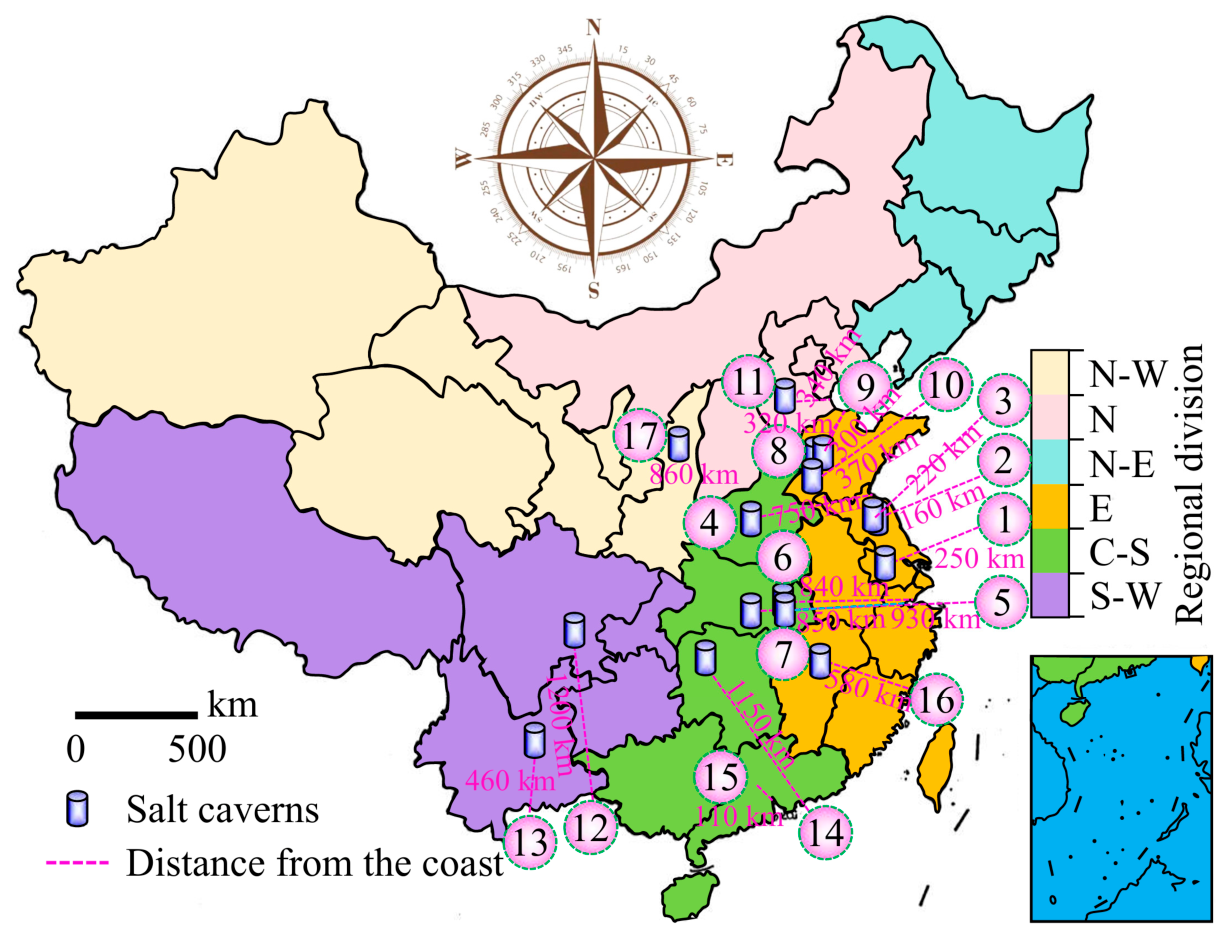
| Number | Name of Salt Cavern | Salt Grade/% | Sediment Content/% | Void Space of Sediment/% | Stratum Depth/m | Distance to the Coast/km |
|---|---|---|---|---|---|---|
| 1 | Jintan | 84.1 | 15.9 | 7.1 | 800~1300 | 250 |
| 2 | Huai’an | 26.4 | 73.6 | 32.7 | 1300~2200 | 160 |
| 3 | Zhaoji | 77.5 | 22.5 | 10.0 | 1350~2010 | 220 |
| 4 | Yexian | 31.7 | 68.3 | 30.4 | 1030~1480 | 750 |
| 5 | Qianjiang | 61.4 | 38.6 | 17.2 | 2000 | 930 |
| 6 | Yunying | 51.5 | 48.5 | 21.6 | 500~1000 | 840 |
| 7 | Jianghan | 39.2 | 60.8 | 27.0 | 2000 | 850 |
| 8 | Feicheng | 11.4 | 88.6 | 39.4 | 960~1200 | 320 |
| 9 | Tai’an | 20.6 | 79.4 | 35.3 | 800~1000 | 300 |
| 10 | Heze | 74.0 | 26.0 | 11.6 | 1452~1613 | 370 |
| 11 | Ningjin | 86.5 | 13.5 | 6.0 | 2900 | 340 |
| 12 | Zigong | 93.3 | 6.7 | 3.0 | 840~1054 | 1200 |
| 13 | Anning | 58.9 | 41.1 | 18.3 | 600~900 | 460 |
| 14 | Xiangli | 55.7 | 44.3 | 19.7 | 250 | 1150 |
| 15 | Sanshui | 34.8 | 65.2 | 29.0 | 1200~1400 | 110 |
| 16 | Zhangshu | 69.6 | 30.4 | 13.5 | 250 | 580 |
| 17 | Yulin | 90.0 | 10.0 | 4.44 | 2200~2850 | 860 |
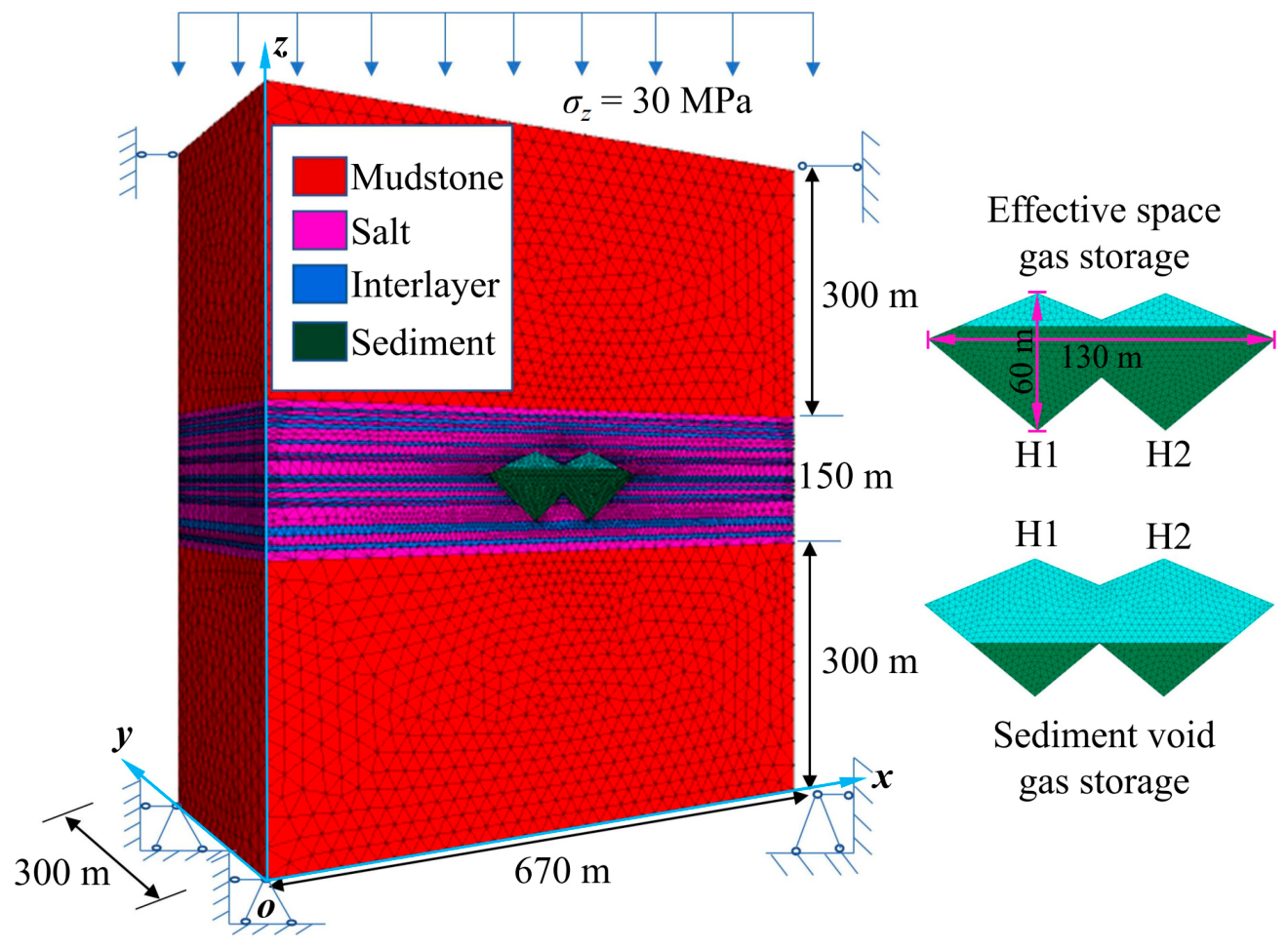
| Rock Type | Density/ kg·m3 | Bulk Modulus/GPa | Shear Modulus/GPa | Internal Friction Angle/° | Cohesion/MPa | Tensile Strength/MPa |
|---|---|---|---|---|---|---|
| Mudstone | 2500 | 26.7 | 13.1 | 30 | 9.9 | 4.7 |
| Salt | 2200 | 6.7 | 3.1 | 37.5 | 2 | 1.7 |
| Interlayer | 2500 | 16.7 | 8.6 | 45 | 6.1 | 1.9 |
| Sediment | 1922 | 0.867 | 0.395 | 10 | 0.4 | 0.4 |
| Cost (Unit: Thousand CNY) | Geophysical Exploration Cost | Drilling and Completion Cost | Water-Solution Cavern Formation Cost | Gas Injection and Brine Discharge Cost | Profit from Gas Storage | Net Earning |
|---|---|---|---|---|---|---|
| New single-well cavern | 10,000 | 40,000 | 150,000 | 10,000 | 0 | −210,000 |
| New horizontal well cavern | 10,000 | 40,500 | 120,000 | 10,000 | 40,830 | −130,670 |
| Existing caverns (sediment-type) | 10,200 | 60,000 | 0 | 10,000 | 110,271 | 30,071 |
Disclaimer/Publisher’s Note: The statements, opinions and data contained in all publications are solely those of the individual author(s) and contributor(s) and not of MDPI and/or the editor(s). MDPI and/or the editor(s) disclaim responsibility for any injury to people or property resulting from any ideas, methods, instructions or products referred to in the content. |
© 2026 by the authors. Licensee MDPI, Basel, Switzerland. This article is an open access article distributed under the terms and conditions of the Creative Commons Attribution (CC BY) license.
Share and Cite
Li, Z.; Li, Q. Assessing the Feasibility of Using Coastal Salt Caverns for Strategic Energy Storage from Safety and Economic Perspectives. Sustainability 2026, 18, 4949. https://doi.org/10.3390/su18104949
Li Z, Li Q. Assessing the Feasibility of Using Coastal Salt Caverns for Strategic Energy Storage from Safety and Economic Perspectives. Sustainability. 2026; 18(10):4949. https://doi.org/10.3390/su18104949
Chicago/Turabian StyleLi, Zuer, and Qihang Li. 2026. "Assessing the Feasibility of Using Coastal Salt Caverns for Strategic Energy Storage from Safety and Economic Perspectives" Sustainability 18, no. 10: 4949. https://doi.org/10.3390/su18104949
APA StyleLi, Z., & Li, Q. (2026). Assessing the Feasibility of Using Coastal Salt Caverns for Strategic Energy Storage from Safety and Economic Perspectives. Sustainability, 18(10), 4949. https://doi.org/10.3390/su18104949