1. Introduction
In rural areas, encouraging and supporting residents to engage in entrepreneurial activities can stimulate economic vitality by facilitating the inflow of external talent, capital, and technology [
1,
2,
3,
4]. In China, although the scale of farmer entrepreneurship has expanded in recent years, the overall quality and sustainability of entrepreneurial activities remain relatively limited [
5]. According to data from the Ministry of Agriculture and Rural Affairs, by the end of 2022, more than 12 million individuals had returned to their hometowns to initiate entrepreneurial ventures, generating over 20 million jobs. Nevertheless, farmers’ entrepreneurial behavior continues to be constrained by limited innovation capacity, weak sustainability, and restricted access to key resources. Existing studies indicate that farmers’ entrepreneurial behavior is shaped by both external conditions—such as policy support, financing channels, and technical training—and individual-level characteristics, including educational attainment, risk preferences, and social capital endowment [
6,
7,
8,
9,
10,
11,
12,
13,
14,
15].
With the rapid advancement of rural digital transformation, digital literacy has increasingly emerged as a critical determinant of farmers’ entrepreneurial behavior. Digital literacy, initially introduced by Lanham [
16] and subsequently developed into a multidimensional construct, encompasses individuals’ capabilities in operating digital tools, acquiring and processing information, and generating and sharing knowledge within digital environments [
17,
18,
19]. Prior research suggests that higher levels of digital literacy enable farmers to participate more effectively in e-commerce activities, access digital financial services, and expand their social networks through online platforms, thereby increasing the likelihood of entrepreneurial behavior [
20,
21]. However, compared with developed economies, China continues to face a pronounced urban–rural digital divide [
22]. Although rural internet penetration has improved significantly, substantial disparities persist in terms of network quality, platform accessibility, and service inclusiveness [
23]. Furthermore, farmers generally exhibit lower levels of formal education and limited information-processing capabilities, which constrain their ability to effectively adopt and utilize digital technologies [
24]. These structural constraints, coupled with the predominantly small-scale and household-based nature of rural entrepreneurship, further limit the transformative potential of digitalization in rural economic activities [
25].
From a theoretical perspective, digital literacy may influence farmers’ entrepreneurial behavior through multiple pathways. First, digital literacy can indirectly promote entrepreneurial participation by alleviating financial constraints. By enabling farmers to access digital payment systems and online credit services, digital literacy helps reduce information asymmetry and expand financing channels [
26,
27,
28]. Second, digital literacy can enhance social capital by allowing farmers to extend their social networks beyond traditional kinship- and geography-based relationships, thereby improving access to information and business opportunities [
29,
30]. In addition, policy accessibility may further strengthen the entrepreneurial effect of digital literacy by improving farmers’ ability to obtain, understand, and utilize policy information through digital platforms, thereby reducing institutional barriers to entrepreneurship [
31,
32]. More importantly, digital literacy may also reshape farmers’ entrepreneurial decision-making processes. Specifically, farmers with higher digital literacy are better able to identify market opportunities through digital information processing [
33], reduce subjective uncertainty through more effective risk assessment [
34], and integrate entrepreneurial resources more efficiently through digital platforms [
35]. Therefore, digital literacy not only improves farmers’ access to external resources, but also fundamentally influences how they perceive, evaluate, and act upon entrepreneurial opportunities.
However, existing studies have mainly examined financial constraints, social capital, and policy support as independent determinants of entrepreneurial behavior, while relatively limited attention has been paid to how digital literacy shapes these factors and indirectly influences farmers’ entrepreneurial behavior.
Building on the above analysis, this study investigates how digital literacy influences farmers’ entrepreneurial behavior through the mediating mechanisms of financial constraints and social capital, as well as the moderating role of policy accessibility. Using micro-level data from the China Family Panel Studies (CFPS) from 2014 to 2022, a multidimensional digital literacy index is constructed, and its impact on farmers’ entrepreneurial behavior is empirically examined. In addition to measuring the overall level and spatiotemporal characteristics of farmers’ digital literacy, this study further explores its direct effect on entrepreneurial behavior. Furthermore, it examines whether digital literacy indirectly promotes entrepreneurial behavior by alleviating financial constraints and enhancing social capital, and whether a supportive policy environment further strengthens the positive relationship between digital literacy and farmers’ entrepreneurial behavior.
The remainder of this paper is organized as follows.
Section 2 describes the data sources, variable construction, and empirical strategy.
Section 3 presents the main empirical results.
Section 4 discusses the findings and their implications. Finally,
Section 5 concludes the study and outlines policy implications and future research directions.
2. Materials and Methods
2.1. Research Methods
2.1.1. Entropy Weight Method
Common methods for determining indicator weights include the entropy weight method, principal component analysis (PCA), and the coefficient of variation method [
36,
37]. Compared with subjective weighting approaches, the entropy weight method determines indicator weights according to the degree of information variation in the data, which helps reduce subjective bias.
However, this method also has certain limitations. Because the entropy weight method is sensitive to data dispersion, indicators with larger variation may receive relatively higher weights, even when part of this variation is influenced by extreme values or measurement noise.
Despite these limitations, the entropy weight method is appropriate for this study. Digital literacy is a multidimensional concept composed of several heterogeneous indicators, and substantial differences exist across indicators in terms of scale and distribution. In the absence of a clear theoretical basis for assigning subjective weights across dimensions, the entropy weight method provides a transparent and replicable way to construct a composite digital literacy index.
To further ensure the robustness of the measurement results, this study also reconstructs the digital literacy index using principal component analysis (PCA), and the corresponding results are reported in
Section 3.4.
Following previous studies, this study adopts the entropy weight method to calculate the weights of each digital literacy indicator. Because the original indicators differ in scale and units, all variables are first standardized before the entropy values and indicator weights are calculated. The specific steps are as follows:
For positive indicators, the standardized values are calculated as follows:
For negative indicators, the standardized values are calculated as follows:
After standardization, the entropy values of the indicators are calculated as follows:
where
represents the proportion of the standardized value of the (
j)-th sample under the (
i)-th indicator.
Next, the entropy weight of the
i-th index is determined as follows:
Based on the weights of each indicator, the composite digital literacy index is calculated as follows:
2.1.2. Estimation of Nuclear Density
Kernel density estimation is a nonparametric method that estimates the distribution of a variable based on the sample data and presents its distributional characteristics through a continuous density curve [
38]. In this study, the Gaussian kernel function is used to examine the dynamic distribution of farmers’ digital literacy. The formula is as follows:
where
represents the estimated probability density function,
is the number of observations,
denotes the digital literacy index of the
i-th sample,
is the kernel function, and
represents the bandwidth parameter.
2.1.3. Moran Index
Moran’s index is a commonly used measure of spatial autocorrelation in regional data [
39,
40]. In this study, it is used to examine the spatial distribution characteristics of farmers’ digital literacy. The formula is specified as follows:
where
represents Moran’s index,
is the number of spatial units,
and
denote the digital literacy values of spatial units
and
, respectively,
is the mean value of digital literacy, and
represents the spatial weight between spatial units
and
.
indicates positive spatial autocorrelation; that is, units with similar attribute values are clustered in space, indicating negative spatial autocorrelation. Stated another way, units with opposite attribute values are clustered in space, representing a random distribution in space, with no significant spatial autocorrelation.
2.2. Data Source and Variable Selection
2.2.1. Data Sources
This paper selects five rounds of survey data from the CFPS in 2014, 2016, 2018, 2020 and 2022. The China Family Tracking Survey Database (CFPS) tracks the data of individuals, families and communities. The survey project covers 31 provinces, autonomous regions and municipalities directly under the Central Government (excluding Hong Kong, Macao and Taiwan) in China and involves approximately 15,000 families. The sources of specific indicators are as follows: (1) data about farmers’ digital literacy and individual characteristics are taken from individual self-answering questionnaires, and (2) data about farmers’ entrepreneurial decision-making and family situation are taken from the family economic questionnaire. By matching and integrating the data of these two parts of the questionnaire, the multidimensional characterization of the research object can be realized. The procedure for cleaning the samples was as follows: (1) the age of the subjects was limited to 16–60 years; (2) because the sample sizes of Qinghai Province, Ningxia Hui Autonomous Region, Xinjiang Uygur Autonomous Region, Xizang Autonomous Region, Inner Mongolia Autonomous Region and Hainan Province were less than 50, these provinces were excluded; and (3) samples that were not continuously counted were excluded. Finally, 18,622 valid samples, including 4922 families in 25 provinces, were screened out. The data distribution year by year is shown in
Table 1.
2.2.2. Variable Selection
Explained variables
Farmers’ entrepreneurial behavior is measured using household-level information from the CFPS. Specifically, the questionnaire reports the personal identification codes of household members who engaged in self-employment or established a private business in the past 12 months. These codes are matched with the respondent’s own identification code. When the entrepreneurial activity corresponds to the respondent him/herself, the entrepreneurship variable is coded as 1; otherwise, it is coded as 0.
Explanatory variable
The core explanatory variable in this paper is farmers’ digital literacy. Digital literacy reflects individuals’ ability to appropriately use digital tools and equipment, acquire and evaluate information, actively learn new knowledge, and effectively communicate with others [
20,
21].
Following the conceptual framework proposed by the OECD in the Programme for the International Assessment of Adult Competencies (PIAAC), particularly the Problem Solving in Technology-Rich Environments (PS-TRE) framework, digital literacy is understood as a multidimensional capability that integrates operational skills, task-oriented application abilities, and continuous learning and information-processing capacities. Based on this theoretical foundation and considering the accessibility of digital devices, the motivation behind digital technology adoption, and actual application behaviors, this study constructs a comprehensive digital literacy index system from three dimensions (11 items in total) and aggregates the indicators using the entropy-weight method.
Specifically, digital equipment operation literacy represents the foundational operational capability and reflects farmers’ familiarity with digital devices and basic proficiency in their use. Digital technology application literacy captures farmers’ ability to integrate digital technologies into production activities and daily life. Digital knowledge learning literacy emphasizes farmers’ capacity for continuous learning and adaptation to new digital technologies.
Table 2 presents the detailed construction of the indicators and their corresponding weights.
Control variables
The study selects individual-level and family-level control variables. The individual-level control variables include personal characteristics such as sex, age, marital status, health status, and education level, and the family-level control variables include family per capita income and family population size.
Mechanism variables
First, with respect to financial constraints, this paper uses farmers’ constraints in the financial credit market as the measurement index of credit constraints. CFPS questionnaire item “Loan Rejection Experience-Have you ever been rejected when your family borrowed a large amount of money (for example, for buying a house, operating turnover, etc.)?” which is used to measure financial constraints. Regarding the variable structure, a yes answer to the above question was recorded as 1, and a no answer as 0.
The second mechanism variable is social capital. This research adopts farmers’ “ Expenditures on social interactions and relationships “ as a proxy for social capital. The CFPS questionnaire is as follows: “In the past 12 months, how many gifts did your family give because of marriage, admission to university, childbirth and death of relatives and friends?” The respondents’ answers were subjected to logarithmic processing.
Moderating variable
Policy accessibility is introduced as the moderating variable in this study. To capture regional differences in access to digitalized public policies, this study uses the “Information Benefiting the People” pilot program as a proxy variable. Specifically, the sample is classified according to whether the farmer’s region is included in the pilot program, with pilot regions coded as 1 and non-pilot regions coded as 0.
As part of a nationwide digital public service initiative, pilot regions generally feature more developed digital public service platforms, more efficient channels for policy information dissemination, and stronger policy support. In the empirical analysis, the moderating effect of policy accessibility is examined by constructing an interaction term between digital literacy and the pilot program indicator.
The descriptive statistics of each variable are shown in
Table 3.
2.3. Empirical Model
2.3.1. Benchmark Regression Model
This paper constructs the following benchmark regression model:
In Formula (8), denotes farmers’ entrepreneurial behavior, and represents digital literacy. The model includes a set of control variables, including age, marital status, education level, health status, household size, and total household income. In addition, and represent individual fixed effects and year fixed effects, respectively. denotes the random error term.
In addition to the linear probability model, the baseline regression is also estimated using the Logit model, since the dependent variable is binary.
where
is the logistic function.
denotes farmers’ entrepreneurial behavior,
represents digital literacy,
is a vector of control variables,
μi captures individual fixed effects, and
λt denotes year fixed effects.
2.3.2. Mediating Effect Model
Following previous studies [
38], this paper departs from the traditional stepwise mediation testing procedure and instead focuses on identifying the causal relationships between the explanatory and mediating variables. Based on the theoretical framework, the mediating variables are expected to play a positive role in promoting farmers’ entrepreneurial behavior. The models are as follows:
In Formulas (10) and (11), the mediating variables are credit constraints (Fincons) and social capital (Social), respectively, while digital literacy (DL) is the core explanatory variable.
2.3.3. Moderating Effect Model
To examine the moderating role of policy accessibility (PA), the following interaction model is constructed:
In Equation (12), policy accessibility is measured by whether the farmer’s region is included in the “National Pilot of Information Benefiting the People” program (pilot = 1, non-pilot = 0). To test the moderating effect of policy accessibility, an interaction term between digital literacy and the pilot variable is introduced. The coefficient of the interaction term is the main parameter of interest. A significantly positive interaction coefficient indicates that policy accessibility strengthens the positive effect of digital literacy on farmers’ entrepreneurial behavior. In other words, farmers with higher digital literacy are more likely to benefit from supportive policy environments and engage in entrepreneurial activities.
3. Results
3.1. The Evolution Characteristics of Digital Literacy Space—Time Patterns
Before conducting the econometric analysis, this study examines the spatiotemporal characteristics of farmers’ digital literacy. This analysis aims to identify its temporal evolution and regional clustering patterns, providing background evidence for the subsequent empirical analysis.
First, this study describes the temporal and spatial evolution patterns of farmers’ digital literacy. On the one hand, changing trends in digital literacy and their subdimensions from 2014 to 2022 are investigated on the basis of the time dimension. On the other hand, the spatial dimension is compared across different provinces, and its spatial correlation is investigated with the help of the Moran index and other indicators.
3.1.1. Time Evolution Characteristics
Table 4 shows the temporal changes in farmers’ digital literacy levels from 2014 to 2022. Overall digital literacy (DL) increased from 0.0689 in 2014 to 0.4422 in 2022. During the research period, farmers’ digital literacy increased steadily. The three sub-dimensions are as follows: (1) digital equipment operation literacy increased from 0.0446 in 2014 to 0.1079 in 2022. Although the overall level remains relatively low, it more than doubled over the period, indicating a gradual improvement in farmers’ mastery of digital equipment; (2) digital technology application literacy increased from 0.0137 in 2014 to 0.1269 in 2022, reflecting significant progress in farmers’ participation in online shopping, online learning, and other digital activities; (3) digital knowledge learning literacy showed the most substantial growth, rising from 0.0106 in 2014 to 0.2074 in 2022, representing nearly a twenty-fold increase, which was much greater than that observed in the other dimensions.
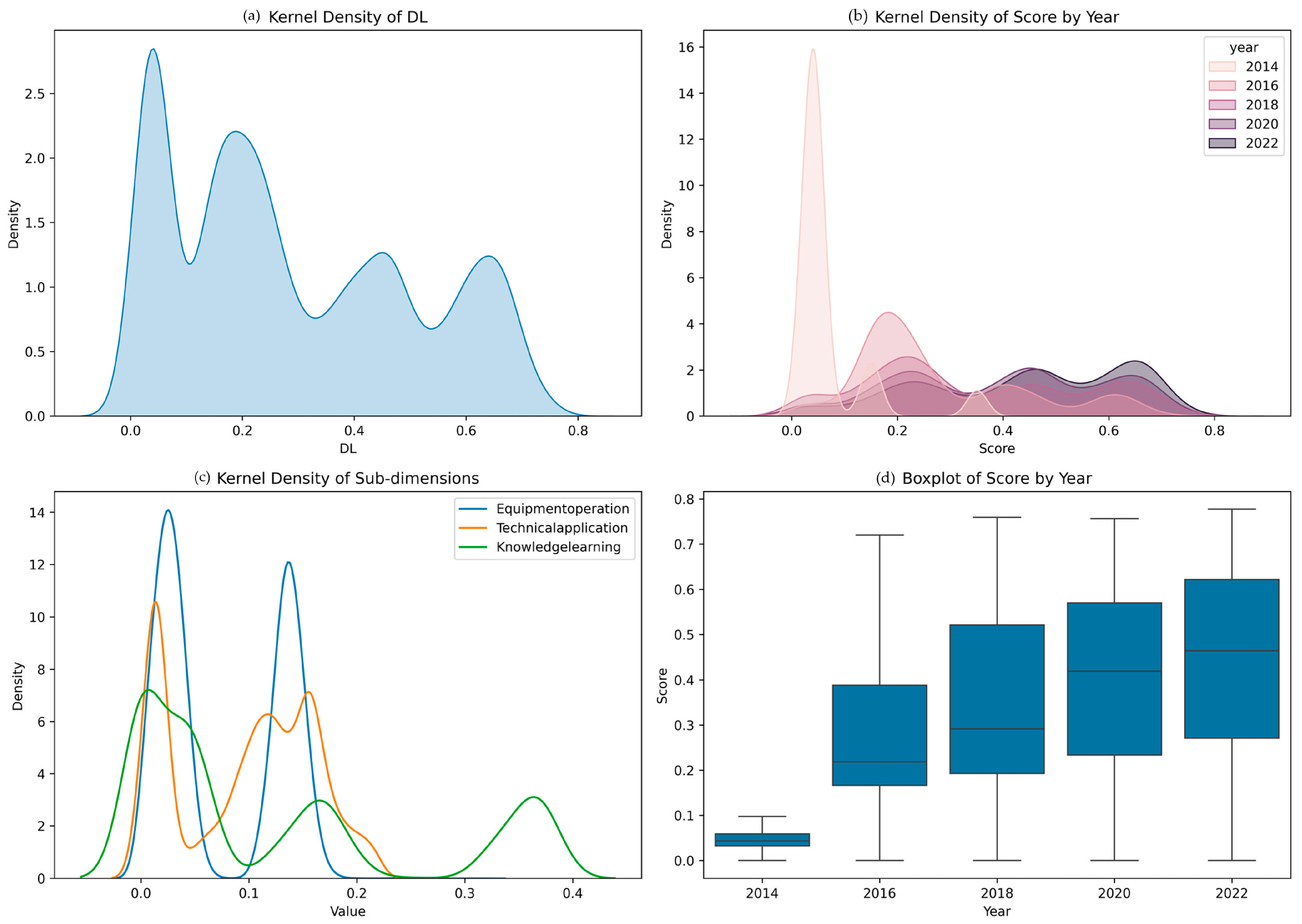
Figure 1 shows the temporal variation in farmers’ digital literacy from three perspectives: overall distribution, annual evolution, and fractal dimension differences. First, (1) as seen from the kernel density estimation results in
Figure 1a, the overall distribution of digital literacy presents multipeak characteristics, which are concentrated mainly in the range of 0–0.4. There are still significant differences in digital literacy among farmers, with most having low-to-medium levels. (2)
Figure 1b depicts the dynamic evolution of digital literacy by year. In 2014, the distribution was highly concentrated in the low-value range. Over time, the distribution gradually shifted to the right from 2016 to 2022; the proportion of individuals in the middle- and high-level groups continued to increase, and the overall literacy level continued to improve, but intragroup differences widened annually. (3) The fractal kernel density distribution in
Figure 1c shows that the distribution of digital equipment operation literacy was the most concentrated, with a high degree of popularization and small individual differences. The curve of digital technology application literacy was scattered, and farmers′ literacy differed across e-commerce, social networking and online learning. The distribution of digital knowledge learning literacy demonstrated the largest shift to the right, with the proportion of high-scoring groups increasing significantly and farmers demonstrating a prominent ability to improve their online learning and information acquisition. (4) The box chart in
Figure 1d further verifies the above conclusion. The median of each year increased annually, changing from less than 0.1 in 2014 to close to 0.4 in 2022. Moreover, the quartile range gradually expanded, indicating that the differentiation among the different groups existed despite the overall level improving.
3.1.2. Spatial Evolution Characteristics
Table 5 shows the comparison of farmers’ digital literacy and its three subdimensions across all the years. Generally, the digital literacy level of farmers in the eastern region was higher than that in the central and western regions. Beijing ranked first at 0.5083, ahead of the other provinces, followed by developed coastal provinces such as Jiangsu (0.3798), Tianjin (0.3667), Zhejiang (0.3415) and Fujian (0.3431), with digital literacy levels exceeding 0.30. The central region as a whole, such as Anhui (0.3184), Hunan (0.3196) and Henan (0.2799), was at the middle level. The development of each subdimension was relatively balanced, but the values were clearly lower than those of the eastern provinces. In contrast, the overall level of the western region was low, especially in Sichuan (0.2666), Yunnan (0.2303) and other provinces.
Table 6 examines the spatial autocorrelation of farmers’ digital literacy based on Moran’s index and depicts the spatial relationship between regions from two dimensions: geographical distance and economic distance.
From a temporal perspective, the spatial correlation of digital literacy shows a pattern of first increasing and then declining over the period from 2014 to 2022. Taking geographic distance as an example, Moran’s I increased from 0.1032 in 2014 to 0.3062 in 2018, and then declined to 0.1987 in 2020 and 0.1734 in 2022. In comparison, the spatial correlation coefficients based on economic distance are consistently higher. Moran’s I reached 0.4728 in 2016 and further increased to 0.5162 in 2018, before declining to 0.3570 in 2020 and 0.3255 in 2022. Despite this decline, the values remain above 0.3. The results in
Table 6 confirm the existence of spatial agglomeration in farmers’ digital literacy, with stronger correlations observed under economic distance than under geographic distance.
3.2. Benchmark Regression
Table 7 reports the benchmark regression results examining the impact of digital literacy on farmers’ entrepreneurial behavior using both OLS and Logit models. The results show that digital literacy (DL) has a positive and statistically significant effect on farmers’ entrepreneurial behavior across different estimation methods.
In the OLS specification, the coefficient of digital literacy is 0.0487 and statistically significant at the 1% level. This indicates that, after controlling for individual fixed effects, year fixed effects, and other covariates, a one-unit increase in digital literacy is associated with an increase of approximately 4.87 percentage points in the probability of farmers engaging in entrepreneurship.
The Logit estimation yields consistent results. The coefficient of digital literacy is 0.9157 and statistically significant at the 5% level. The average marginal effect (AME) is 0.1238, indicating that a one-unit increase in digital literacy increases the likelihood of farmers’ entrepreneurship by approximately 12.39 percentage points.
Further analysis across the three sub-dimensions of digital literacy reveals heterogeneous effects. First, digital equipment operation literacy has a positive and statistically significant effect on farmers’ entrepreneurial behavior. In the OLS model, the coefficient is 0.0080 and significant at the 1% level, while in the Logit model, the coefficient is 1.4000 and significant at the 1% level. Second, digital technology application literacy has positive coefficients in both models but does not reach statistical significance. Third, digital knowledge learning literacy has a positive and statistically significant effect on entrepreneurial behavior. In the OLS model, the coefficient is 0.0626 and significant at the 5% level, while in the Logit model, the coefficient is 1.2255 and significant at the 10% level.
3.3. Endogeneity Test
To address potential endogeneity issues, this paper uses two types of instrumental variables. The first category is a historical instrumental variable: the number of fixed telephone calls per 100 people in 1984, multiplied by the number of internet users in the previous year (after logarithmic transformation). This variable reflects the historical endowment of the region in traditional communication infrastructure, which differs from the internal activities of the current economic system and thereby creates an externality, yet exhibits a strong correlation through its long-term impact on digital economic infrastructure and skill cultivation. The second category is a village-level instrumental variable, that is, “the average digital literacy of other farmers in the same village except the interviewed head of household”. Neighborhood demonstration and spillover effects are common in rural areas, and the digital literacy level of individual farmers is often positively driven by the behavior of others in the same village; however, there is no direct causal relationship between the average value of this variable and whether individuals start their own businesses, thus meeting the instrumental variable requirement of exogeneity.
The first-stage regression results show that digital literacy (DL) is positively and significantly correlated with both instrumental variables. When the historical instrument (IV1) is used, the coefficient is 0.8923 and significant at the 1% level. Similarly, when the village-level instrument (IV2) is employed, the coefficient is 1.1756, also significant at the 1% level. The second-stage regression results indicate that digital literacy has a positive and statistically significant effect on farmers’ entrepreneurial behavior (Entrep). Specifically, the coefficient is 0.0522 when IV1 is used and 0.0396 when IV2 is used, both significant at the 1% level.
To further strengthen the exogeneity of the instrumental variables, additional auxiliary tests are conducted. For IV1, considering that historical communication infrastructure may also be associated with long-term regional development, this study further includes regional-level control variables, including regional GDP per capita, urbanization rate, and local fiscal revenue, in the second-stage estimation. For IV2, considering that the digital literacy of other villagers may potentially affect individual entrepreneurial behavior through peer effects or information spillovers, village-level mean characteristics are additionally included as control variables. The results show that the second-stage coefficients remain significantly positive and highly consistent with the baseline instrumental variable estimates.
Regarding instrument validity, the Kleibergen–Paap LM statistic is statistically significant, indicating that the model is identified. The Cragg–Donald Wald F statistics (36.174 and 42.978) exceed the Stock–Yogo critical values, suggesting that weak instrument concerns are unlikely. In addition, the Hansen J test yields p-values of 0.144 and 0.121, indicating that the null hypothesis of instrument exogeneity cannot be rejected.
Overall, the results in
Table 8 remain consistent with the benchmark regression findings.
3.4. Robustness Tests
To verify the reliability of the conclusions, this paper conducts a series of robustness tests. First, because the COVID-19 pandemic may have affected farmers’ entrepreneurial behavior, samples collected during the pandemic are excluded. Second, municipalities directly under the central government are removed from the sample to avoid potential distortions arising from their special administrative status. Third, the measurement of digital literacy is adjusted by replacing the entropy-weighted index with a composite index constructed using equal weights across all dimensions. Fourth, to control for potential policy influences, districts and counties included in the digital village pilot program are excluded. Fifth, the digital literacy index is reconstructed using principal component analysis (PCA), and the corresponding regression results are re-estimated to further assess robustness. Finally, considering that the indicator “Whether to use a computer to surf the internet” receives a relatively high weight (0.2) under the entropy weight method, this study further excludes this indicator and reconstructs the digital literacy index to conduct an additional robustness test.
The regression coefficients obtained from the above robustness tests are consistently positive, and most are statistically significant, indicating that digital literacy continues to promote farmers’ entrepreneurial behavior. These results suggest that variations in sample selection, model specification, index construction, and policy-related exclusions do not alter the fundamental conclusion that digital literacy fosters entrepreneurship. In particular, when the digital literacy index is reconstructed using principal component analysis (PCA), the estimated effects remain stable and consistent with the baseline results, further confirming the robustness of the findings.
In summary, the results in
Table 9 show that the core conclusion of the study does not depend on the specific sample, model settings or index construction method but is robust. The positive influence of digital literacy on farmers’ entrepreneurial behavior is credible.
3.5. Mechanism Testing
Table 10 reports the mechanism analysis results examining the roles of financing constraints and social capital in the relationship between digital literacy and farmers’ entrepreneurial behavior.
In Model (1), the coefficient of digital literacy on financing constraints is −0.0054 and is statistically significant at the 1% level, indicating that digital literacy is negatively associated with financing constraints. This result suggests that higher levels of digital literacy are accompanied by lower levels of financing constraints. In Model (2), the coefficient of digital literacy on social capital is 0.1638 and is statistically significant at the 5% level, indicating that digital literacy is positively associated with social capital. This implies that farmers with higher digital literacy tend to exhibit higher levels of social capital. To further validate the robustness of the mediation analysis, this study additionally conducts a Bootstrap mediation test. The results show that the indirect effects of financing constraints and social capital are both statistically significant, as the corresponding Bootstrap confidence intervals do not include zero. These findings provide further support for the mediating roles of financing constraints and social capital.
The results suggest that digital literacy influences entrepreneurial behavior through the mediating roles of financing constraints and social capital. Digital literacy not only directly promotes farmers’ entrepreneurial behavior but also plays an indirect role by easing financing constraints and enhancing social capital.
3.6. Moderating Effect Test
Table 11 reports the moderating effect of policy accessibility on the relationship between digital literacy and farmers’ entrepreneurial behavior. The results show that in Model (1), the coefficient of the pilot variable is 0.0520 and is significantly positive at the 1% level, indicating that farmers in regions covered by the “Information Benefiting the People” pilot program are more likely to engage in entrepreneurial activities. This suggests that improved access to digital public policies and services directly promotes farmers’ entrepreneurship. In Model (2), the coefficient of the interaction term (DL_PA) between digital literacy and policy accessibility is 0.0409 and is significantly positive at the 10% level. This indicates that policy accessibility positively moderates the relationship between digital literacy and farmers’ entrepreneurial behavior. Specifically, in regions with higher levels of policy accessibility, farmers with stronger digital literacy are better able to access policy information, utilize digital public service platforms, and take advantage of institutional support, thereby reducing institutional barriers and transforming entrepreneurial intentions into actual entrepreneurial activities.
Overall, the results suggest that policy accessibility strengthens the positive impact of digital literacy on farmers’ entrepreneurial behavior.
3.7. Heterogeneity Analysis
Table 12 reports the heterogeneity test results for the impact of digital literacy on farmers’ entrepreneurial behavior across different individual characteristics.
Specifically, Column (1) examines the interaction between digital literacy and age, Column (2) considers the interaction between digital literacy and education level, Column (3) includes the interaction between digital literacy and health status, and Column (4) introduces the interaction between digital literacy and income level.
The regression results indicate that the core variable, digital literacy (DL), is positive and statistically significant across all four models, suggesting that digital literacy is positively associated with farmers’ entrepreneurial behavior.
However, the interaction terms reveal heterogeneous effects across different groups. First, in terms of age, the coefficient of DL_Age is −0.0126 and is statistically significant at the 1% level, indicating that the effect of digital literacy decreases with age. Second, in terms of education level, the coefficient of DL_Edu is 0.0269 and is statistically significant at the 1% level, indicating that the effect of digital literacy is stronger among farmers with higher levels of education. Third, regarding health status, the coefficient of DL_Health is 0.0213 and is statistically significant at the 5% level, indicating that the effect of digital literacy is stronger among farmers with better health conditions. Fourth, with respect to income level, the coefficient of DL_Lninc is 0.0002 and is statistically insignificant, indicating that income does not significantly moderate the effect of digital literacy on entrepreneurial behavior.
Overall, the results in
Table 12 show that the effect of digital literacy on farmers’ entrepreneurial behavior varies across age, education, and health groups, while no significant difference is observed across income levels.
4. Discussion
The relationship between rural digital transformation and entrepreneurial behavior has attracted increasing attention in recent years. However, an important question remains: although digital infrastructure and internet accessibility in rural China have improved significantly, why do entrepreneurial outcomes still vary substantially across different groups of farmers? The findings of this study provide a more nuanced explanation for this issue.
On the one hand, our results support the mainstream view that digital literacy can significantly promote farmers’ entrepreneurial participation. This suggests that digital literacy has gradually evolved beyond a simple technical skill and increasingly functions as a form of human capital in rural economic transformation. Farmers with stronger digital literacy are better able to process market information, evaluate entrepreneurial opportunities, and reduce uncertainty in the decision-making process, thereby improving the feasibility of entrepreneurial participation.
On the other hand, the results also suggest that the entrepreneurial value of digital literacy does not emerge simply through direct effects. Rather, its influence is more deeply reflected in changing the conditions under which entrepreneurial decisions are made. Specifically, digital literacy helps farmers alleviate financing constraints by improving access to digital financial services, while at the same time expanding social connections and information channels, thereby strengthening social capital. In addition, the moderating effect analysis shows that the entrepreneurial returns of digital literacy become more pronounced in regions with stronger policy accessibility. This finding suggests that digital capabilities and institutional support do not operate independently, but jointly shape entrepreneurial outcomes.
Another important observation is that the benefits of digital literacy are not equally distributed. Younger, better educated, and healthier farmers are significantly more likely to translate digital literacy into entrepreneurial outcomes. This suggests that the digital divide in rural areas may no longer be reflected simply in access to digital devices or internet connectivity, but increasingly in differences in digital capability, learning ability, and technology utilization. If these capability gaps continue to widen, digital transformation may unintentionally reinforce existing inequalities between digitally advantaged farmers and more vulnerable groups.
Despite these contributions, several limitations of this study should be acknowledged. First, social capital is measured using Expenditures on social interactions and relationships, which captures an important aspect of interpersonal engagement in rural contexts, but may not fully reflect the multidimensional nature of social capital, including trust, reciprocity, and network embeddedness. Second, the policy accessibility variable is constructed based on participation in regional pilot programs. Although this operationalization provides a useful institutional perspective, it may also capture broader regional development characteristics beyond policy accessibility itself. Finally, the empirical analysis is conducted within the specific institutional context of rural China, which may limit the external generalizability of the findings. Future research could incorporate richer micro-level behavioral measures, alternative indicators of social and institutional conditions, and comparative evidence from different developing economies to further examine how digital literacy shapes entrepreneurial behavior over time.
5. Conclusions
This study investigates the impact of digital literacy on farmers’ entrepreneurial behavior using micro-level data from the China Family Panel Studies (CFPS) over the period 2014–2022.
First, the results show that digital literacy has a significantly positive effect on farmers’ entrepreneurial participation, highlighting its important role as a form of human capital in promoting rural entrepreneurship.
Second, the analysis of spatial characteristics indicates that farmers’ digital literacy exhibits significant spatial autocorrelation and clustering patterns. The spatial correlation follows a trend of first increasing and then declining over time, and the degree of spatial dependence based on economic distance is consistently higher than that based on geographic distance.
Third, the mechanism analysis indicates that digital literacy promotes farmers’ entrepreneurial behavior through multiple channels. Specifically, digital literacy indirectly encourages entrepreneurial participation by alleviating financing constraints and strengthening social capital. In addition, the moderating effect analysis reveals that policy accessibility further strengthens the positive relationship between digital literacy and farmers’ entrepreneurial behavior, suggesting that a supportive institutional environment enables farmers to more effectively transform digital capabilities into entrepreneurial outcomes.
Fourth, the heterogeneity analysis shows that the positive effect of digital literacy is stronger among younger farmers, those with higher levels of education, and those in better health conditions, while no significant differences are observed across income levels. This indicates that the impact of digital literacy is more closely related to individual capabilities than to initial income conditions.
Based on these findings, several policy implications can be drawn. First, improving digital literacy should be considered a key strategy for promoting rural entrepreneurship. Second, targeted support should be provided to vulnerable groups, particularly older and less-educated farmers, to reduce the digital divide. Third, strengthening digital infrastructure and improving access to digital public services can further enhance the effectiveness of digital literacy in supporting entrepreneurial activities.
In conclusion, this study provides new evidence on the role of digital literacy in shaping farmers’ entrepreneurial behavior from both spatial and mechanism perspectives. Future research could further explore additional mechanisms and examine the long-term effects of digital literacy using more detailed micro-level data.