Article

Sci-Tech Finance to Improve Agricultural Production Efficiency: Empirical Evidence from Pilot Policies


1
College of Intelligent Science and Control Engineering, Jinling Institute of Technology, Nanjing 211169, China
2
School of Business, Nanjing Normal University, Nanjing 210023, China
*
Author to whom correspondence should be addressed.
Sustainability 2026, 18(10), 4910; https://doi.org/10.3390/su18104910
Submission received: 3 April 2026 / Revised: 9 May 2026 / Accepted: 11 May 2026 / Published: 14 May 2026

Abstract

China’s agricultural development not only has the weakness of insufficient technological investment but also faces the constraint of a shortage of financial support. In this context, promoting the combination of technology with finance in agricultural production activities is very important for China’s agricultural modernization. Based on two batches of “the pilot policy for promoting the combination of science and technology with finance”, this paper investigates the policy effect and mechanism of sci-tech finance on agricultural production efficiency. The results show that sci-tech finance policy is able to promote the improvement of agricultural production efficiency significantly in pilot areas compared with non-pilot areas, and this treatment effect continues to expand over a long period after the implementation of the policy. In terms of space partition, the agricultural support effect of sci-tech finance not only shows regional heterogeneity but also performs better in cities with weaker technological innovation ability and a lower degree of financial deepening. The “offering fuel in snowy weather” effect on non-central cities is stronger than the “adding brilliance to its present splendor” effect on central cities. Lastly, the sci-tech finance policy successfully builds a long-term mechanism for policies to take effect at multiple points and continues to exert force from three aspects: accelerating the process of agricultural mechanization, promoting the development of modern rural industries and improving the human capital of farmers. The research conclusions provide policy recommendations for promoting science and technology finance from policy pilot to comprehensive promotion, and promoting and implementing the construction of agricultural power, for example, by “strengthening agricultural science and technology and equipment support” and “improving [the] rural financial service system” proposed by the report of the 20th National Congress.

1. Introduction

Globally, the experience of agricultural modernization demonstrates that the deep integration of technological innovation and financial support serves as a crucial driving force for enhancing agricultural production efficiency and competitiveness [1]. This integration has assumed different forms across countries, shaped by the institutional environment, financial market structures, and agricultural production regimes. In the United States, a multi-level financial ecosystem consisting of policy-oriented finance, commercial finance, venture capital, and crop insurance programs. Capital markets are established to provide differentiated support for agricultural R&D, technology application, and farm operations [2,3]. In contrast, as a global leader in high-value agriculture, the Netherlands utilizes closely integrated cooperative finance and agricultural value chains to provide stable funds for agricultural technological innovation, particularly in the fields of controlled environment agriculture and seed technology [4]. In Germany, public–private partnerships and specialized agricultural development banks have facilitated the promotion of precision agriculture technologies and renewable energy systems on small and medium-sized farms [5,6].
However, despite these advancements, agricultural technological innovation typically encounters more severe financing constraints than the secondary and tertiary industries, and this challenge is particularly prominent in developing countries [7,8,9]. The project information published on the official website of the International Development Research Centre (IDRC) in Canada indicates that the global financing demand gap for small-scale farmers is approximately $400 billion. Traditional financial services struggle to effectively address this gap in the short term. Concurrently, the adoption rate of agricultural technology remains relatively low. Just 10% of small-scale farmers in low- and middle-income nations have access to agricultural technologies. Insufficient financial support and limited investment are the primary constraints hindering broader adoption. Fernandez-Vidal & Alarcon [10] pointed out that even in these developed countries, public innovation projects often exhibit a tendency toward short-termism, as the typical three-year funding cycle proves inadequate for supporting the multi-location and multi-season testing required by agricultural technology.
The tension between the promise of agricultural technology and the structural constraints of agricultural finance frames China’s experience. China shares several key features with other major agricultural economies, particularly with large emerging economies such as Brazil and India. These include a high concentration of smallholder farms, fragmented land use patterns, and persistent gaps in agricultural labor productivity relative to non-agricultural sectors [11,12]. However, China also has unique characteristics that make its case especially instructive. Unlike Brazil, which has developed large-scale commercial agriculture tied to global commodity markets, or India, where agricultural credit expansion has emphasized subsidized short-term loans, China differs by pursuing two strategic goals: promoting mechanization and technological diffusion in agriculture, and restructuring rural financial systems to improve service delivery [13]. Moreover, China’s policy experimentation approach—exemplified by the “pilot policy for promoting the integration of science and technology with finance” (hereafter sci-tech finance) launched in two batches since 2011—offers a distinctive institutional setting for evaluating the causal effects of technology-finance integration in agriculture.
During the 13th Five-Year Plan period, significant advancements were made in China’s agricultural modernization. The contribution rate of agricultural science and technology progress exceeded 60%, and the comprehensive mechanization rate for crop cultivation, planting, and harvesting across the country surpassed 70%. The structure and operational efficiency of agricultural machinery and equipment continued to improve. Nationwide, the number of family farms exceeded one million, farmers’ cooperatives reached 2.225 million, and socialized agricultural service organizations surpassed 893,000, thereby becoming the primary driving force behind the development of modern agriculture. However, China’s agricultural production efficiency remains comparatively low; labor productivity in agriculture is only 25.3% of that in non-agricultural sectors, leaving a substantial gap relative to developed countries [14]. Entering the 14th Five-Year Plan period, agricultural modernization has reached a plateau characterized by structural upgrading, mode transformation, and power conversion, while technological weakness and financing constraints remain unresolved [15]. The alignment between national conditions and the agricultural particularities of a large country with small-scale farming and modern agricultural production methods remains under active exploration. Using science and technology to overcome backward production techniques and raise agricultural production efficiency is therefore crucial to enhancing China’s comprehensive agricultural competitiveness and supporting the construction of Chinese-style modernization [16].
A robust financial services system underpins support for agricultural science, technology and equipment. Scientific and technological innovation in agriculture, together with the deployment of new equipment, acts as a booster for improving agricultural production efficiency. It helps to refine production methods and resource allocation, to make agricultural management decisions more scientific and timely, and to lower production costs and risks [17,18,19,20]. In particular, rural financial development has been found to significantly promote agricultural technology innovation by easing credit constraints and broadening financing channels for farming households and agri-enterprises [21]. However, financial institutions typically allocate resources based on the principle of risk aversion. The high-risk nature of technological innovation and the often imperfect management systems of agricultural enterprises lead to a structural mismatch. This reflects a common pattern across countries: science and finance, remaining two relatively independent systems, exhibit a degree of mutual exclusivity in their “inclusive development” [22,23]. China’s traditional agricultural production mode of a large country with small farmers has further exacerbated the difficulties of their mutual integration.
To address this, to promote the integration of science and finance, and explore new mechanisms for linking scientific and financial resources, China has successively launched two batches of “pilot policy for promoting the integration of science and technology with finance” since 2011. The fundamental goal of these programs is to coordinate the planning of scientific and financial resources, align them effectively, and accelerate the establishment of an investment and financing system centered on scientific and technological innovation, achievement transformation, and application promotion. In agricultural production, the pilot plans state explicitly that “it is necessary to strengthen cooperation with the rural financial system and innovate financial service models that suit the characteristics of rural technological innovation and entrepreneurship.” Science and technology finance is thus tasked with addressing the development predicament of “poor financing and weak technology” in agricultural production. Moreover, technological innovation and financial services each produce substantial positive spill-over effects, and their integration can maximize economic efficiency [24], thereby promoting the transformation of China’s agricultural production dynamics toward greater efficiency.
As a pilot policy, the actual effect of technology finance in enhancing agricultural production efficiency in China still requires rigorous empirical evaluation. On one hand, the implementation direction of the pilot policy is crucial. The two batches of the “pilot policy for promoting the integration of science and technology with finance” are not confined to rural areas and primary industry. Moreover, traditional sci-tech finance policies have tended to favor urban areas and secondary or tertiary industries, which may leave agriculture as a “blind spot” in the pilot initiatives, preventing it from fully enjoying the policy dividends. On the other hand, China’s agricultural production has long been characterized by fragmented operations, low mechanization, and generally limited technical skills among farmers. Leading agricultural enterprises remain weakly competitive, and financial exclusion in agricultural production persists as a prominent problem [25]. Consequently, whether from the perspective of actual policy-oriented supply or the policy demands of agricultural businesses, the integration of science and technology with finance in China’s agricultural production sector faces many uncertainties. Based on this, the purposes of this study are threefold. (1) Using regional panel data from 2006 to 2019 and treating the sci-tech finance pilot policy as a quasi-natural experiment, a multi-period difference-in-differences (DID) model is used to estimate the policy effect of sci-tech finance on improving agricultural production efficiency. (2) Focusing on the core elements of the “agriculture, rural areas and farmers” framework, the mechanisms by which sci-tech finance improves agricultural production efficiency are explored. Specifically, we examine the acceleration of agricultural mechanization (agriculture), the promotion of modern rural industries (rural areas), and the enhancement of farmers’ human capital (farmers). (3) The heterogeneity of the impact of sci-tech finance on agricultural production efficiency from the perspectives of regional economic characteristics and administrative characteristics is discussed. Compared with the existing literature, the marginal contributions of this paper are as follows.
First, this paper contributes a novel research perspective on the integration of technology and finance. Under traditional research frameworks, technology and finance are often treated as two relatively independent systems. The relevant literature tends to focus on either enhancing technological innovation or improving financing accessibility from a single-dimensional perspective, with little attention to their combined effects. Drawing on relevant literature, this paper elucidates, at the theoretical level, the limitations of single-dimensional technology policy or finance policy, thereby underscoring the importance of integrating science and technology with finance. In the empirical research, this paper conducts a policy effect assessment of sci-tech finance based on the “pilot policy for promoting the integration of science and technology with finance”, and contrasts this with two single-dimension pilots: the Innovative City Pilot and the National Financial Reform Pilot Zone, which respectively emphasize technology or finance. The results show that sci-tech finance policy substantially improves agricultural production efficiency in pilot regions, while the single-dimension technology policy or financial policy delivers only limited improvements. This extension clarifies the value of integrating technology and finance, and provides a firmer foundation for scientifically evaluating the policy effect of sci-tech finance on improving agricultural production efficiency.
Second, the research approach of integrating sci-tech finance policy with rural areas and agriculture. As an incentive policy that supports technological innovation through financial instruments, sci-tech finance has drawn substantial scholarly attention for its effects on urban areas and the secondary and tertiary industries [26,27]. By contrast, few studies have explored its impacts on rural areas and agriculture, and evaluations of its role in enhancing agricultural production efficiency are scarce. Based on this, the present study takes rural areas and agriculture as its focus point and uses a quasi-natural experiment to assess the impact of sci-tech finance on improving agricultural production efficiency. This work illuminates a research domain that has been largely neglected despite the growing application of sci-tech finance in agricultural practice.
Third, this study anchors on the main body of agriculture, rural areas, and farmers to explore the channels of sci-tech finance. We collected, organized, and reviewed the specific implementation plans of this pilot across the pilot regions and extracted the measures that specifically support agriculture. Using an inductive approach, we anchored these policies to the core components of agriculture, rural areas, and farmers. On this basis, the study empirically examines how sci-tech finance policies enhance agricultural production efficiency, with particular attention to their roles in accelerating agricultural mechanization processes, advancing modern rural industries, and improving farmers’ human capital. This extension abstracts complex, specific sci-tech finance policies to their effects on agriculture, rural areas, and farmers, thereby clarifying the transmission channels through which sci-tech finance influences agricultural production efficiency.
The following paper is arranged as follows: Section 2 introduces the policy background and mechanism of action; Section 3 explains the research design; Section 4 is dedicated to empirical analysis and result presentation; Section 5 explores the heterogeneity of the sci-tech finance policy effect; Section 6 tests the mechanism of action, and the final part draws some conclusions and policy implications from this study.

2. Policy Background and Mechanisms of Action

2.1. Policy Background

China’s agricultural development is hampered not only by insufficient technological investment but also by a lack of financial support. These two factors, technology and finance, are the primary weaknesses that hinder the modernization of agriculture. More critically, they are interdependent, creating a mutually constraining dynamic that traps China’s agricultural production in a low-efficiency predicament. This reality determines that China’s transition from a major agricultural nation to an agricultural powerhouse must be driven by technological innovation, with finance acting as a crucial link between technological innovation and agricultural production. Therefore, effectively coordinating agricultural technology policy and financial policy to promote the integration of technology and finance within agricultural production activities is essential for enhancing China’s agricultural production efficiency.
In December 2010, the Ministry of Science and Technology, in collaboration with the “One Bank and Three Commissions”, issued the “Implementation Plan for the Pilot Policy for Promoting the Integration of Science and Technology with Finance” [28]. Within the context of the Chinese policy system, “sci-tech finance” refers to a systematic arrangement of policies and institutions that, through reforming fiscal technology investment mechanisms, guides and promotes various types of capital—including banking, securities, insurance, and venture capital—to innovate financial products, improve service models, and build service platforms, thereby achieving the organic integration of the technological innovation chain with the financial capital chain, providing financing support and financial services to technology enterprises at all stages from start-up to maturity [29]. In the specific context of agricultural production, sci-tech finance involves using financial instruments such as agricultural technology credit, policy-based agricultural insurance, and digital technology platforms to support agricultural technology research and development and facilitate the application of new technologies and equipment. This plan explicitly urged “local science and technology departments and banks to strengthen their collaboration with the rural financial system, advocating for the innovation of sci-tech finance service models suited to the specific characteristics of rural technological innovation and entrepreneurship.” Following a rigorous application and evaluation process, 16 regions were selected as the initial pilot areas for the integration of science and technology with finance. By 2016, the first batch of pilot regions had collectively issued over 350 policy documents, effectively promoting the implementation and impact of sci-tech finance. Influenced and driven by the first batch of pilot areas, a subsequent announcement in June 2016 by five government departments unveiled a second group of nine pilot regions dedicated to integrating science and technology with finance. The “Outline of Local Pilot Programs for Promoting the Integration of Science and Technology with Finance” [30] issued by the Ministry of Science and Technology explicitly provides these pilot regions with considerable latitude for policy innovation. This involves innovating methods and mechanisms for investing in fiscal science and technology, deepening the management reform of fiscal science and technology initiatives, like special projects and funds, establishing and expanding government venture capital guidance funds, supporting banking financial institutions in conducting investment-loan connections and bank-insurance collaboration, as well as innovating and improving the service and support systems for intermediary institutions and service platforms that integrate science and technology with finance.
A comprehensive analysis of sci-tech finance pilot programs and the No. 1 central documents over the years reveals that the integration of technology and finance also holds significant potential in agricultural production. Such integration provides effective support for the efficient and orderly advancement of agricultural modernization. This paper systematically compiles and organizes specific policies and implementation plans issued by various pilot regions. Table 1 outlines selected agriculture-related policies and typical characteristics from three pilot areas representing the eastern, central, and western regions: Jiangsu Province, the Hefei-Wuhu-Bengbu Entrepreneurial Innovation Comprehensive Experimental Zone, and the Guanzhong-Tianshui Economic Region. Each pilot region has established a clear understanding that the primary objective of fostering the integration of technology and finance is to utilize financial instruments to bolster agricultural technological innovation and facilitate the application of new technologies and equipment. Measures such as advancing innovative agricultural technology credit, implementing policy-based agricultural insurance, enhancing rural science and technology service systems, and utilizing digital technology platforms aim to foster cohesive collaboration and harmonized initiatives between technology and finance. In summary, sci-tech finance policies facilitate the integration of the innovation chain, capital chain, and agricultural production chain, thereby enhancing agricultural production efficiency.
Based on the comparative analysis of the three pilot regions presented in Table 1, three distinct patterns emerge regarding the impact of sci-tech finance on the agricultural sector, highlighting the regional specificity of policy effects. First, in economically advanced eastern regions such as Jiangsu Province—where the economic foundation and financial market maturity are relatively high—sci-tech finance policies operate primarily through market-oriented mechanisms. By leveraging instruments such as agricultural technology loans, management rights mortgages, and venture capital guidance funds, these regions have established a self-sustaining cycle of financial support for agricultural modernization. This suggests that in regions with well-developed financial ecosystems, sci-tech finance can effectively catalyze endogenous growth in agricultural productivity. Second, in central region pilot areas, exemplified by the Hefei-Wuhu-Bengbu Entrepreneurial Innovation Comprehensive Experimental Zone, the linkage between sci-tech finance and agriculture is more indirect. Given that agriculture is not a dominant industry in these central regions due to local resource endowments, sci-tech finance policies focus more on supporting technology-based small and medium-sized enterprises (SMEs) and fostering regionally characteristic industries. Agricultural benefits arise primarily as spillover effects from broader technological innovation initiatives rather than from direct agricultural targeting. Third, in western regions such as the Guanzhong-Tianshui Economic Region, where agriculture remains a foundational pillar of the local economy, sci-tech finance policies adopt a more integrated and industry-specific approach. By introducing innovative financial instruments—including agricultural insurance and agricultural enterprise bonds—and establishing agricultural venture capital alliances, these regions have fostered a synergistic development model that links technology, finance, and the agricultural industry. These regional variations underscore that the effectiveness of sci-tech finance in agriculture is contingent upon local economic structures, financial market depth, and the strategic role of agriculture within the regional economy. Such heterogeneity warrants careful consideration in policy design and evaluation.
Despite the potential benefits of sci-tech finance policies for agricultural production efficiency, several limitations and risks must be critically acknowledged. First, institutional barriers pose significant challenges to policy implementation. The fragmented administrative framework across different levels of government—involving multiple stakeholders such as science and technology departments, financial regulatory bodies, and agricultural authorities—often leads to coordination difficulties, policy duplication, and inefficiencies in resource allocation. The absence of a unified institutional mechanism for cross-departmental collaboration may undermine the coherence and effectiveness of sci-tech finance initiatives. Second, asymmetry in access to financing remains a persistent concern. While sci-tech finance policies theoretically broaden financing channels for agricultural entities, in practice, smallholder farmers and rural enterprises with limited collateral, weak credit histories, and insufficient technological capabilities often face de facto exclusion from these financial instruments. The benefits of sci-tech finance tend to be captured by larger, more established agricultural enterprises, potentially widening rather than narrowing the financing gap within the agricultural sector. Third, regional disparities in economic development and financial infrastructure lead to uneven policy outcomes. As demonstrated in the comparative analysis above, eastern regions with mature financial markets are better positioned to absorb and leverage sci-tech finance resources, whereas central and western regions may struggle with inadequate financial service networks, lower absorptive capacity for technological innovation, and weaker institutional support systems. These disparities risk exacerbating existing regional inequalities in agricultural development rather than alleviating them. Fourth, there is an inherent risk of financial over-reliance, whereby agricultural producers may become excessively dependent on policy-driven financing, potentially distorting market signals and crowding out private investment. Furthermore, the concentration of financial resources in certain agricultural sectors or technology projects may lead to resource misallocation and reduce the overall resilience of the agricultural economy. These critical considerations suggest that the design and implementation of sci-tech finance policies must be context-sensitive and accompanied by complementary institutional reforms to mitigate unintended consequences.

2.2. Theoretical Analysis and Research Hypotheses

Compared with “extensive” development driven by expanded factor inputs, “intensive” growth resulting from technological progress and improved financial allocation is central to transforming traditional agricultural production and achieving modernization. Sci-tech finance, as an integrated policy aimed at technology application and supported by financial means, serves as an effective policy incentive to enhance agricultural production efficiency. Drawing on measures implemented in pilot regions and incorporating research perspectives from existing literature, this study adopts an inductive approach to map those specific measures to the main body of “agriculture, rural areas and farmers”. It identifies that sci-tech finance policy positively affects various aspects of agriculture, rural areas, and farmers by accelerating agricultural mechanization processes (agriculture), developing modern rural industries (rural areas), and improving farmers’ human capital (farmers), thereby promoting improvements in agricultural production efficiency.

2.2.1. Accelerate the Process of Agricultural Mechanization

Advances in agricultural production methods and tools are critical for improving agricultural production efficiency [31]. After the deep integration of financial capital and emerging technologies, it can facilitate the monetization of R&D projects for advanced operational equipment and sophisticated production management technologies through its capital guidance and liquidity creation function [32,33]. Furthermore, innovative financial derivatives can mitigate potential return risks associated with technological innovation in agriculture, thereby easing the financial constraints faced by agricultural producers undertaking agricultural mechanization transformation [27,34]. Moreover, from the perspectives of information provision and risk management, the integration of the financial system with modern technology can help both technology R&D entities and agricultural business entities overcome moral hazard and adverse selection problems by improving the aggregation, organization, and identification of information. For example, by balancing short-term and long-term returns, sci-tech finance helps alleviate the short-sighted behavior of technological R&D entities. This not only improves the mechanism for technological innovation in agriculture but also facilitates the provision of more advanced equipment and technological solutions for agricultural mechanization [21]. In addition, the “cost reduction and efficiency enhancement” effects brought by sci-tech finance help lower the price of agricultural machinery, thereby reducing the cost burden on agricultural operators adopting mechanized operations [35]. Based on this, we propose research hypothesis 1.
Hypothesis 1:
Sci-tech finance promotes the improvement of agricultural production efficiency by accelerating the process of agricultural mechanization.

2.2.2. Promote the Development of Modern Rural Industries

The Opinions of the Central Committee of the Communist Party of China and the State Council on Comprehensively Promoting Rural Revitalization and Accelerating the Modernization of Agriculture and Rural Areas states that it is essential to “establish county-level arrangements for the initial and deep processing of distinctive agricultural products, and construct modern agricultural industrial parks, strong agricultural industrial towns, and clusters of advantageous characteristic industries,” and emphasizes “developing the whole agricultural industry chain.” Sci-tech finance policy has played a vital role in the development of modern rural industries. On one hand, by leveraging the internet and digital technologies such as blockchain, mobile terminals, and cloud computing, sci-tech finance has fostered integration of the innovation chain, the financial chain, and the agricultural production chain [36]. This integration provides the necessary guarantee for connecting upstream and downstream industries and optimizing the layout of the agriculture industry, which in turn supports agricultural production toward the middle and higher-value chain segments, such as intensive processing and brand building [37]. On the other hand, sci-tech finance lowers entry barriers for integrating e-commerce logistics, cultural tourism, and other sectors with primary industries, thereby broadening the production methods, organizational forms, and marketing models of traditional agriculture, promoting the formation of new agricultural business patterns and value curves [38]. Consequently, it expands the boundaries of agricultural production possibilities and creates opportunities for modern rural industry development. This will help extend the agricultural industrial chain, enhance the agricultural value chain, and expand new agricultural business models, thereby improving agricultural production efficiency. Based on this, we propose research hypothesis 2.
Hypothesis 2:
Sci-tech finance promotes the improvement of agricultural production efficiency by developing modern rural industries.

2.2.3. Enhance Farmers’ Human Capital

Enhancing farmers’ human capital is crucial for improving agricultural production efficiency. On one hand, the accumulation of human capital can strengthen farmers’ capabilities in adopting new technologies and methods to manage production and operational risks [39]. It also helps agricultural operators shift away from traditional agricultural production mindsets, promoting the transformation of smallholder farming models toward modern, new-type agricultural enterprises and cooperatives. On the other hand, such accumulation can mitigate information asymmetry through social networks, thereby enabling more efficient circulation of agricultural information and improving the allocation efficiency of agricultural production materials [40]. Sci-tech finance stimulates innovation in agricultural production, fosters the concentration of human capital and related activities in rural areas, and positively influences the enhancement of farmer human capital [41]. Under the incentives of sci-tech finance policies, both technological and financial resources have increasingly been directed to rural areas. This reallocation not only offers more effective and convenient channels and platforms for training new professional farmers, but also compels farmers to enhance their skills and competencies through emerging agricultural production methods and business models such as intelligent agriculture, precision planting, and agricultural product e-commerce platforms, thereby driving the accumulation and structural upgrading of farmer human capital [42]. Based on this, we propose research hypothesis 3.
Hypothesis 3:
Sci-tech finance promotes the improvement of agricultural production efficiency by enhancing farmers’ human capital.

3. Research Design

3.1. Model Settings

3.1.1. Baseline Model

The difference-in-differences (DID) model estimates the net effect of policy shocks by comparing changes in the experimental group and control group [43]. In this context, China launched two batches of the “Pilot Program for Promoting the Integration of Science and Technology with Finance” in 2011 and 2016, which provided a valuable quasi-natural experiment to assess the impact of sci-tech finance on agricultural production efficiency. These pilot programs encompassed a total of 41 cities nationwide, which are classified as the experimental group in this study, while other regions serve as the control group. Given the non-simultaneous implementation of the two batches of sci-tech finance pilot programs, this study adopts the methodology proposed by [44] to develop a multi-period DID model for policy evaluation. The econometric specification is presented in Equation (1):
e f f i c i e n c y i t = β 0 + β 1 d i d i t + β 2 X i t + μ i + θ t + ε i t
Here, e f f i c i e n c y i t represents the agricultural production efficiency of region i in year t. d i d i t = t r e a t i × p o s t i t denotes the policy disposal variable. Among them, t r e a t i identifies the experimental group that is affected by the policy shock and the control group that remains unaffected; p o s t i t indicates the time at which the experimental group is exposed to the policy shock. X i t represents a series of control variables, μ i and θ t denote the individual and time fixed effects, respectively, and ε i t represents the random error term. β 1 is the regression coefficient that is the main focus of this study. Its significance and coefficient value reflect the average change differences in agricultural production efficiency between pilot and non-pilot regions before and after the implementation of the sci-tech finance pilot policy. If β 1 is significantly positive, it suggests that the sci-tech finance policy has effectively promoted improvement of agricultural production efficiency.
The validity of the difference-in-differences (DID) estimation relies critically on the parallel trends assumption, which requires that in the absence of the sci-tech finance pilot policy, the treatment and control groups would have followed parallel trajectories in agricultural production efficiency. This assumption ensures that any observed divergence between the two groups after policy implementation can be attributed to the policy intervention rather than pre-existing differential trends. To empirically validate this crucial assumption, we conduct a parallel trends test using an event study approach. Specifically, we estimate a dynamic DID model that includes leads and lags of the policy indicator variable, as specified in Equation (2):
e f f i c i e n c y i t = β 0 + β k d i d i t k + β 2 X i t + μ i + θ t + ε i t
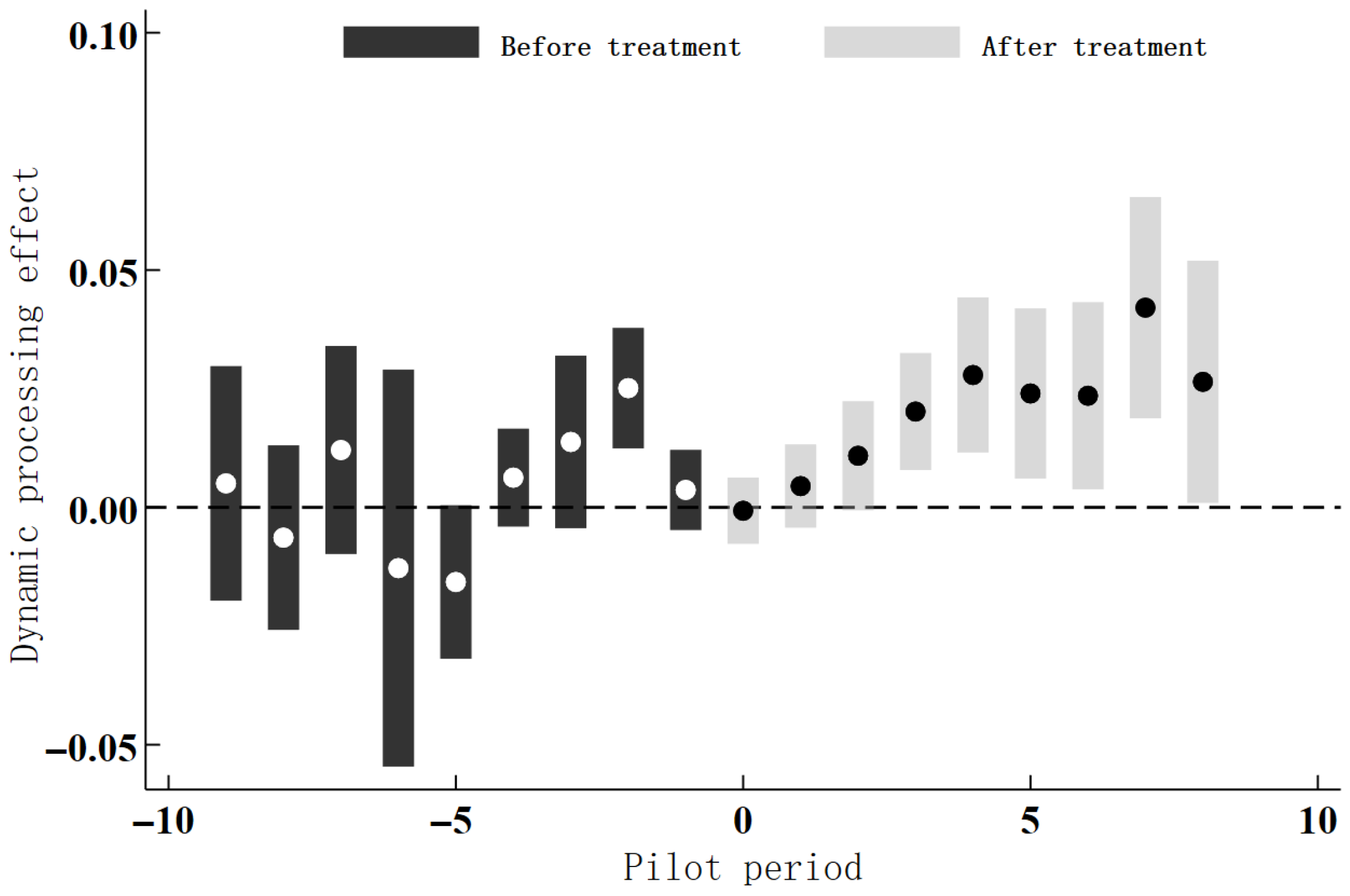
where d i d i t k represents dummy variables indicating k periods before or after the policy implementation. The coefficients β k for k < 0 capture the pre-treatment differences between pilot and non-pilot regions. If the parallel trends assumption holds, these pre-treatment coefficients should be statistically indistinguishable from zero. We present the dynamic treatment effects plot with 95% confidence intervals to visually inspect the parallel trends assumption, see the Parallel Trend Test in Section 4.2.1.
Considering that the establishment of sci-tech finance pilot zones may not be random. Regions with higher economic development levels and stronger technological innovation capabilities often have significant advantages in implementing sci-tech finance policies and are thus selected as pilot zones first, which violates the parallel trend assumption. To overcome the potential impact of self-selection bias on the estimation results, this study adopts the propensity score matching method to match pilot zones with corresponding control regions and performs a PSM-DID test in Section 4.2.2.

3.1.2. Mechanism Testing

To verify the mechanism through which sci-tech finance impacts agricultural production efficiency, this paper employs the two-step method to examine the mediating effects of agricultural mechanization, modern rural industries, and farmers’ human capital. The two-step method, following the framework proposed by Anderson & Gerbing [45] and refined by subsequent literature, provides a systematic approach to testing whether and how the policy affects agricultural production efficiency through specific transmission channels.
The theoretical foundation of the two-step mediating effect test rests on the causal chain wherein the independent variable (sci-tech finance policy) influences the dependent variable (agricultural production efficiency) through one or more intervening variables (mediators). The first step establishes whether the policy significantly affects the mediator, while the second step examines whether the mediator significantly affects the outcome variable when controlling for the policy effect. This decomposition allows us to distinguish between the direct effect of the policy and its indirect effects operating through specific channels. Specifically, the two-step procedure involves estimating the following equations:
M i t = η 0 + η 1 d i d i t + η 2 X i t + μ i + θ t + ε i t
e f f i c i e n c y i t = γ 0 + γ 1 d i d i t + γ 2 M i t + γ 3 X i t + μ i + θ t + ε i t
where M i t represents the mediator variable (agricultural mechanization, modern rural industries, or farmers’ human capital). In Equation (3), a significant and positive η 1 indicates that the sci-tech finance policy successfully promotes the development of the mediator variable. In Equation (4), a significant γ 2 suggests that the mediator contributes to agricultural production efficiency improvement. The definitions of the remaining variables align with those in Equation (1).

3.2. Definition and Description of Variables

3.2.1. Core Explanatory Variable

It serves as the policy disposal variable constructed based on two batches of sci-tech finance pilot programs.

3.2.2. Explained Variable

Drawing on the research conducted by Kumbhakar & Lovell [46] and Coelli et al. [47], this paper establishes a stochastic frontier analysis (SFA) model that incorporates a time-varying technical inefficiency index to assess agricultural production efficiency. Compared with the data envelopment analysis (DEA) model, the SFA model considers the production function and random factors, rendering it more appropriate for agricultural production characteristics. Regarding the choice of the production function, since the transcendent logarithmic production function is more flexible in form, it does not impose additional restrictions on the scale benefit, and can capture the nonlinear relationships between inputs and outputs. Therefore, this paper chooses to incorporate the transcendent logarithmic production function into the stochastic frontier model to measure the technical efficiency level of each region, as shown in Equations (5) and (6).
ln Y i t = α 0 + α L ln L + α A ln A + α E ln E + α F ln F + α L A ln L × ln A + α L E ln L × ln E + α L F ln L × ln F + α A E ln A × ln E + α A F ln A × ln F + α E F ln E × ln F + α L 2 ln 2 L + α A 2 ln 2 A + α E 2 ln 2 E + α F 2 ln 2 F + α L t ln L × t + α A t ln A × t + α E t ln E × t + α F t ln F × t + α t t + α t 2 t 2 + v i t u i t  
T E i t = exp [ ln f ( x i t ) + v i t u i t ] exp [ ln f ( x i t ) + v i t ] = exp ( u i t )
In Equation (5), Y i t represents the total output value of agriculture, forestry, animal husbandry, and fishery, serving as the output variable of the model. Concerning the input variables, this paper selects four agricultural factor inputs based on the traditional literature [48,49,50]. The input variables are labor (number of employees in the primary industry L i t ), land (total cultivated land resources at year-end A i t ), mechanical power (total power of agricultural machinery E i t ), and chemical fertilizers (amount of chemical fertilizers applied, converted to pure nutrient content F i t ). α denotes a series of parameters to be estimated, t represents the time trend term, and v i t is the random error term, representing the impact of various stochastic factors and statistical errors on the production frontier.
The technical inefficiency value of region i during period t can be calculated using Equation (5). Furthermore, Equation (6) can decompose the technical efficiency level T E i t , which is the ratio of the producer’s expected output to the stochastic frontier expectation. T E i t represents factors beyond input elements that contribute to agricultural output growth, thereby providing a comprehensive reflection of changes in agricultural production efficiency. Based on this, the paper employs the technical efficiency level T E i t as a proxy variable for agricultural production efficiency.

3.2.3. Channel Variables

Regarding the first channel variable, the ratio of total agricultural machinery power to regional GDP is a widely adopted proxy for the level of agricultural mechanization, capturing the extent to which mechanical inputs substitute for labor in agricultural production. A higher ratio indicates a more mechanized production mode, which is expected to improve factor allocation efficiency and overall agricultural productivity.
Regarding the second channel variable, the primary business income of agricultural product processing enterprises above a designated size reflects the scale and development level of modern rural industries. Agricultural product processing enterprises serve as key nodes linking primary agricultural production with downstream value chains, and their income captures the degree to which rural areas have developed agro-industrial integration and modern rural industrial systems.
Regarding the third channel variable, this study uses the difference between a city’s total education expenditure and that of its municipal districts as a proxy for the human capital investment targeting rural and county-level populations, which primarily captures farmers’ human capital accumulation. Investment in education constitutes the most important form of human capital formation. Consistent with this perspective, education expenditure is widely employed in the empirical literature as a proxy for human capital investment in agricultural settings [51]. Specifically, the portion of city-level education expenditure allocated beyond municipal districts predominantly flows to rural townships, villages, and county-level schools, which are the principal educational institutions serving farming households. Since farmers in China are predominantly located in non-municipal-district areas, the gap between total city education expenditure and municipal district education expenditure more precisely approximates the public educational investment directed at farming populations. Greater public investment in rural education improves literacy rates, enhances agricultural technology adoption capacity, and strengthens the ability of farm households to absorb and apply new agricultural knowledge and managerial practices, all of which collectively contribute to farmers’ human capital accumulation and, ultimately, to agricultural production efficiency [52].
The three mediating variables exhibit endogenous interrelationships. Since the mediation effect tests for these three variables are performed sequentially in this paper, the influence of endogeneity among them on the estimation results is relatively limited. In addition, for a single mediation effect model, the endogeneity issue is also relatively controllable. The reason is that the DID model, through differencing, eliminates individual characteristics and other time-invariant features, which helps avoid omitted variable bias. At the same time, because the policy pilot is random or quasi-natural in nature, the policy treatment effect is uncorrelated with omitted disturbances, thereby avoiding endogeneity bias induced by circular causality.

3.2.4. Control Variables

This study draws upon the discussions by de Chaisemartin & D’Haultfoeuille [53], Sun & Abraham [54], and others concerning the selection of control variables in difference-in-differences models. It refers to the existing literature on agricultural productivity and selects control variables from two dimensions: regional economic characteristics and the agricultural development environment. Specifically, in terms of regional economic characteristics, we incorporate variables based on the works of Fuglie [55], Fu & Zhang [56], and Caunedo & Keller [57]. These include fixed asset investment, transportation level, urbanization rate, regional innovation level, degree of financial deepening, and environmental governance level. These variables are intended to control for the impacts of infrastructure construction level, market access capabilities, and the urban–rural dual structure on agricultural production efficiency. Additionally, we include an industrial structure rationalization index (Theil index) to account for the influence of industrial structure on agricultural production efficiency. In terms of the agricultural development environment, we draw upon the studies conducted by Hou & Wang [58], Gollin et al. [14], and Ambler et al. [37] to introduce several key variables. These include the proportion of agricultural employment, defined as employment in the primary industry relative to total employment in both the primary and secondary industries; grain production capacity, quantified by total grain output; the Engel coefficient of rural households; and the income ratio between urban and rural residents. These variables are incorporated to account for the impacts of agricultural labor resources, whether the region is a major grain-producing area, farm household income, and the urban–rural income gap on agricultural production efficiency. Moreover, this study incorporates individual fixed effects and time fixed effects within the model to eliminate the influence of time-invariant individual factors and individual-invariant temporal factors on the estimation results. Furthermore, individual-time interaction fixed effects are controlled for in the robustness test.
We acknowledge that the inclusion of an extensive set of control variables raises legitimate concerns regarding potential endogeneity and mutual influence among these variables. To address these endogeneity concerns, we implement several methodological strategies.
First, we employ lagged values (one-year lag) for all time-varying control variables to mitigate simultaneity bias, as the lagged values are predetermined relative to the current period outcome. This approach ensures that the control variables reflect conditions established prior to the realization of current agricultural production efficiency.
Second, we conduct correlation analyses among the control variables and find that while some pairwise correlations are statistically significant, the variance inflation factors (VIFs) for all variables remain below the conventional threshold of 10, suggesting that multicollinearity does not pose a severe threat to our estimation.
Third, we perform robustness checks by sequentially excluding potentially endogenous control variables and examining the stability of our main results. The coefficient on the policy variable remains qualitatively unchanged across these specifications, indicating that our findings are not driven by the inclusion of specific control variables or their potential endogeneity.

3.3. Data Sources and Descriptive Statistics

The research sample for this study comprises panel data from 278 cities spanning 2006 to 2019 (The China City Statistical Yearbook has no longer published industry-specific employment data since 2020. Consequently, the cut-off time for the research sample has been set as 2019). The data were primarily sourced from the CSMAR Regional Economy and Agriculture, Forestry, Animal Husbandry, and Fishery Database, the EPS China City Database, the Flush iFinD China Macroeconomic Sub-market Database, as well as the China City Statistical Yearbook and the China County Statistical Yearbook. To ensure comparability, investment in fixed assets, regional GDP, and residents’ income levels were deflated using the investment in fixed assets price index, the GDP deflator, and the consumer price index (CPI), respectively, with 2005 as the base year.
The variable definitions and descriptive statistics of this study are shown in Table 2.

4. Empirical Results Analysis

4.1. Baseline Regression

Based on the multi-period DID model, Table 3 reports the baseline regression results of the sci-tech finance policy on agricultural production efficiency. Among them, column (1) excludes control variables, while columns (2) to (4) present the estimation results following the inclusion of control variables, employing the mixed regression model, random effects model, and fixed effects model, respectively. The results indicate that the regression coefficients of the policy treatment variable are significantly positive across all columns, suggesting that the sci-tech finance policy has a substantial and positive effect on improving agricultural production efficiency in the pilot areas. In terms of model selection, the p-value from the Hausman test is 0.000, suggesting that the fixed effects model provides a superior estimation compared to the random effects model and the mixed regression model. Consequently, taking the regression coefficient in column (4) as a reference, the estimation results show that the regression coefficient of the treatment effect of the sci-tech finance policy is 0.0418, which passes the significance test at the 1% confidence level. The average agricultural production efficiency for the full sample is recorded at 0.7038, indicating that the sci-tech finance pilot policy can enhance agricultural production efficiency by approximately 5.94% (0.0418/0.7038 = 5.94%).
Observing the estimation results of the control variables, with column (5) as a reference, the regression coefficients for fixed assets investment, the Theil index of industrial structure, and the proportion of employment in the primary industry are all significantly positive, which is generally consistent with the findings of existing literature. Conversely, the estimated coefficient for grain production capacity is significantly negative. This paper posits that regions with higher grain production capacity are often China’s major grain-producing areas. Such regions benefit from favorable agricultural production conditions and abundant agricultural resource endowments such as land and irrigation, and therefore lack the incentives to improve agricultural production efficiency, rendering them susceptible to the so-called “resource curse” dilemma [59]. As for other control variables, the regression coefficients for transportation level, urbanization rate, urban–rural income gap, and the Engel coefficient of rural households do not exhibit statistically significant differences.
From an economic perspective, the estimated coefficient of 0.0418 indicates that the sci-tech finance pilot policy raises agricultural production efficiency by approximately 5.94% (0.0418/0.7038) relative to the sample mean—a magnitude of meaningful real-world significance. First, sci-tech finance alleviates credit market frictions that disproportionately constrain agricultural technology investment. In the absence of targeted financial instruments, agricultural innovators face prohibitively high collateral requirements and information asymmetry vis-à-vis traditional lenders; the pilot policy directly relaxes these constraints by establishing technology-oriented credit guarantee schemes and subsidized loan programs tailored to the agricultural sector. Second, the policy facilitates a reallocation of productive resources from low-productivity subsistence farming toward technology-intensive agricultural activities. By lowering the user cost of capital for mechanization, precision agriculture, and biotechnological inputs, it incentivizes farmers and agri-enterprises to adopt capital-embodied technical change, thereby raising marginal labor productivity and overall efficiency. Third, the pilot mechanism generates positive agglomeration externalities: concentrated financial and technological support in designated pilot regions fosters knowledge spillovers, shared logistics infrastructure, and demonstration effects that further amplify productivity gains beyond the direct recipients of policy benefits.
These findings align closely with prior evidence. Liu et al. [21] showed that rural financial development significantly promotes agricultural technology innovation, mainly by easing credit constraints. Sheng et al. [60] similarly demonstrated that sci-tech finance development raises green total factor productivity through increased R&D expenditure and industrial structure upgrading, corroborating our result that policy-induced productivity gains work through multiple complementary channels. The magnitude of our estimated effect (5.94%) is comparable to that of analogous finance–technology integration initiatives: Li et al. [61] found that the Sci-Tech Finance Pilot Policy boosted corporate innovation output by approximately 15.7% and corporate revenue by 9.7%, suggesting that the agricultural efficiency gains we identify are both plausible and consistent with the broader sci-tech finance literature.

4.2. Robustness Test

4.2.1. Parallel Trend Test

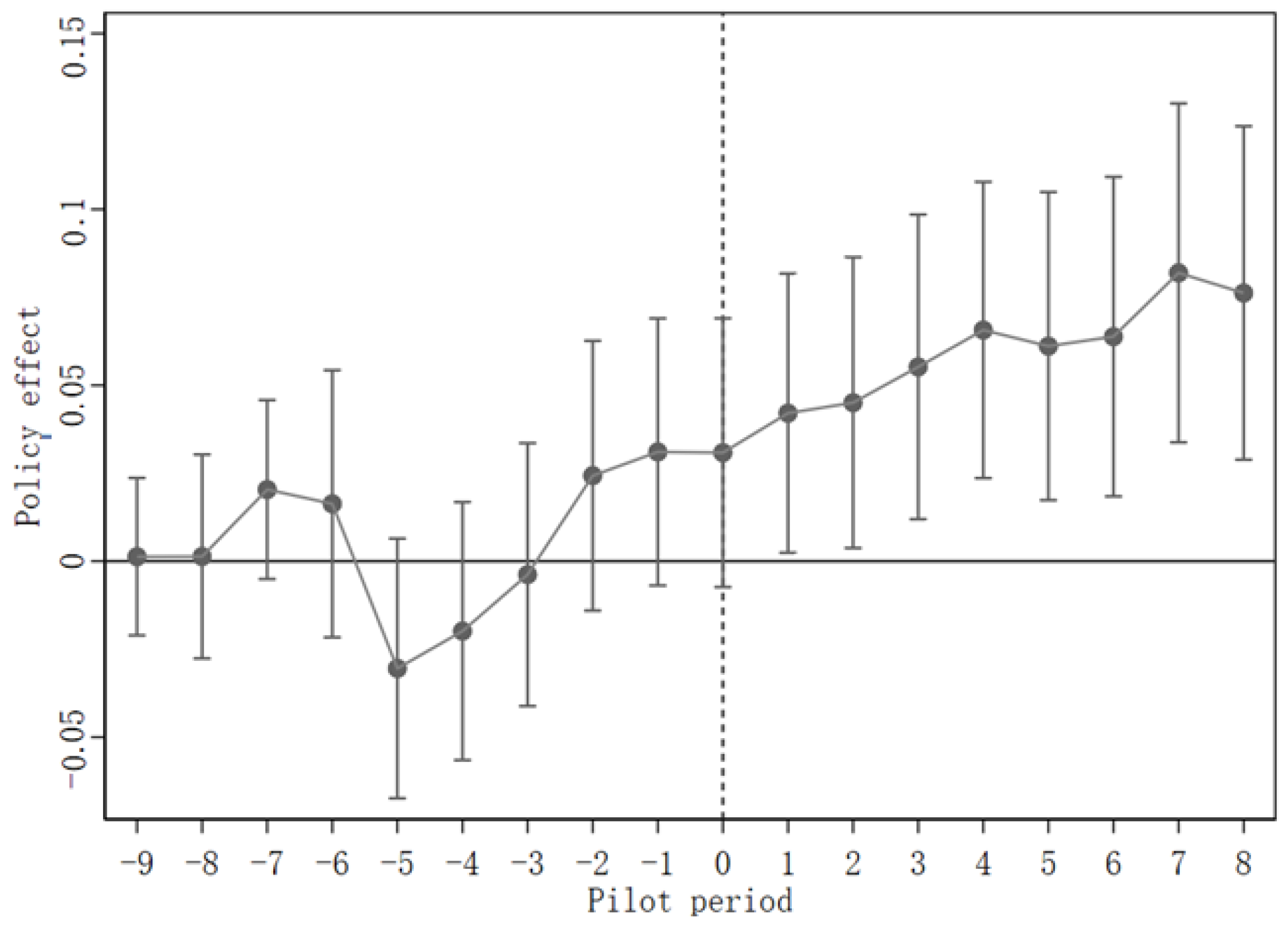
The baseline regression analysis in Table 3 must adhere to the parallel trend assumption, ensuring no significant disparity in the evolution of agricultural production efficiency between pilot and non-pilot cities pre-policy enactment. To this end, this paper conducted a parallel trend test. Specifically, we cross-multiplied dummy variables labeling treatment and control groups with annual dummy variables to assess the significance of the regression coefficients for each interaction term. Following the test results, we plotted a parallel trend graph for the entire sample period, depicted in Figure 1. The results indicate that the coefficient estimates for all periods preceding the implementation of the sci-tech finance policy are statistically insignificant, suggesting no discernible trend differences between the treatment and control groups. Conversely, after the policy implementation, agricultural production efficiency in the treatment group exhibited a significant increase relative to the control group. This observation confirms the presence of a policy disposal effect, which not only persisted but also intensified over an extended period after the policy was enacted.

4.2.2. PSM-DID Test

Considering that the establishment of pilot regions for sci-tech finance may not be random. Regions characterized by higher economic levels and stronger technological innovation typically possess significant advantages in the implementation of sci-tech finance policy, leading to their selection as pioneer pilot areas. To overcome the potential impact of self-selection bias on the estimation results, this study employs the propensity score matching method and conducts a PSM-DID test by matching pilot regions with corresponding control regions. Specifically, informed by relevant literature and considering the influence of control variables on agricultural production efficiency, this study selects a series of covariates to explain the dummy variable “whether a city is designated as a pilot city.” A Logit model is employed to calculate the propensity score for each city being selected as a sci-tech finance pilot region. Subsequently, the caliper k-nearest neighbor matching method (k = 4, radius = 0.05) is employed to annually match control cities with pilot cities, while samples outside the common support domain are excluded. This methodology enhances the statistical balance of the sample data and approximates the conditions of a randomized experiment as closely as possible.
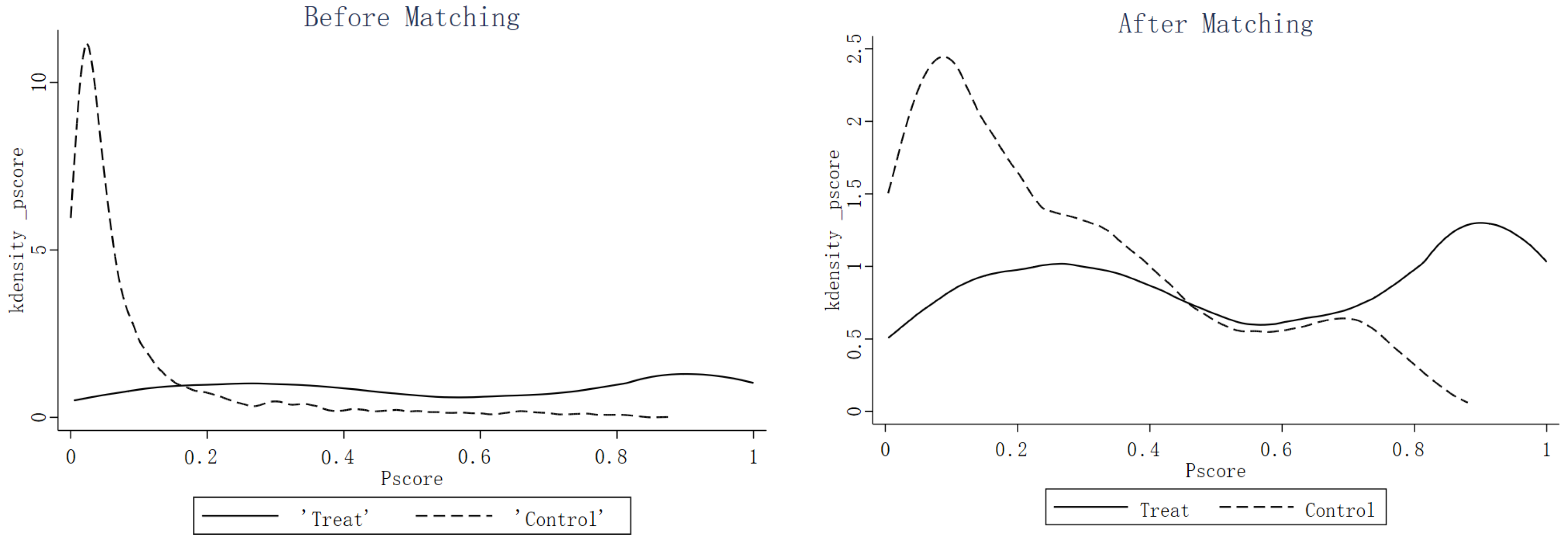
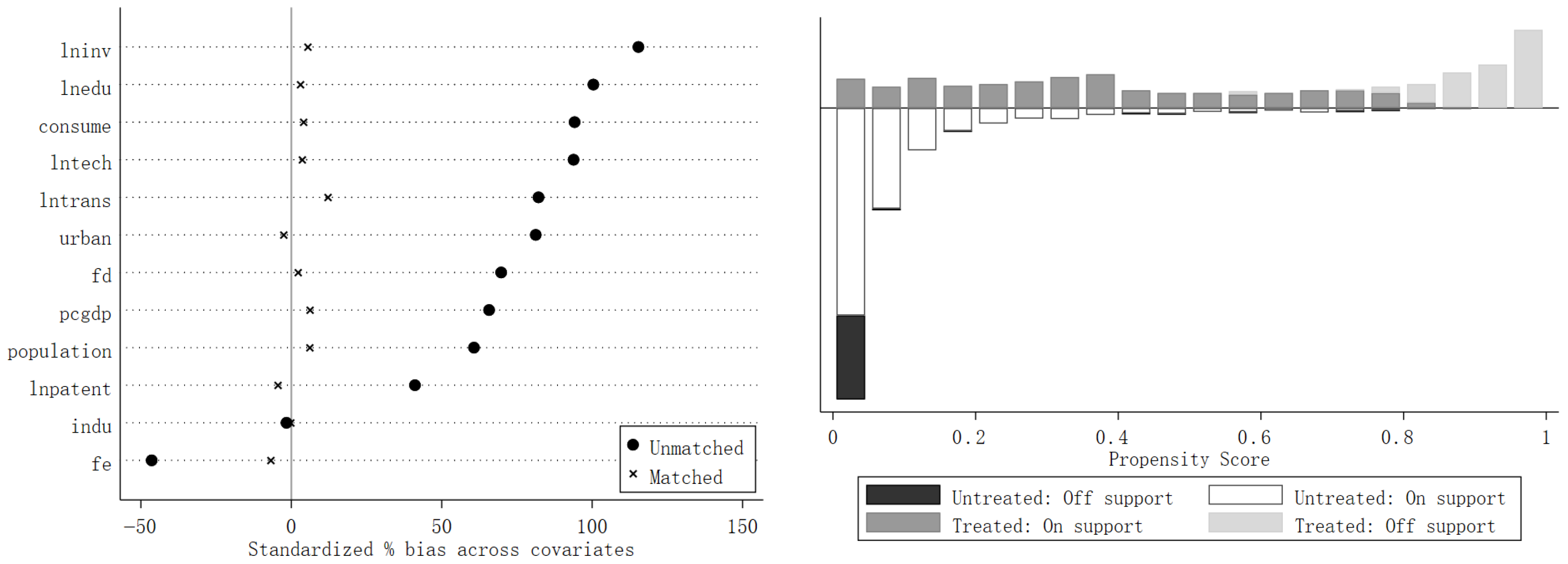
Figure 2 illustrates the distribution of kernel density functions both before and after matching, while Figure 3 presents the standardized deviations of covariates alongside the bar chart of the common support test after matching. It can be observed that after propensity score matching (PSM), the deviation between the kernel density curves of the treatment and control groups has significantly improved, resulting in a more uniform distribution of sample means. The bar charts further demonstrate that the majority of observations fall within the common support range, with the absolute values of standardized deviations for most covariates remaining below the 10% control threshold. In summary, after PSM processing, the study sample more closely resembles data derived from randomized experiments. Based on this, this paper excludes 629 samples that lie outside the common support domain and re-conducts the multi-period difference-in-differences (DID) estimation. The regression results are reported in Table 4, where Column (2) incorporates various control variables relative to Column (1). The empirical findings indicate that the sci-tech finance policy continues to exert a significant positive effect on improving agricultural production efficiency, thereby confirming the robustness of the baseline regression results.

4.2.3. Placebo Test

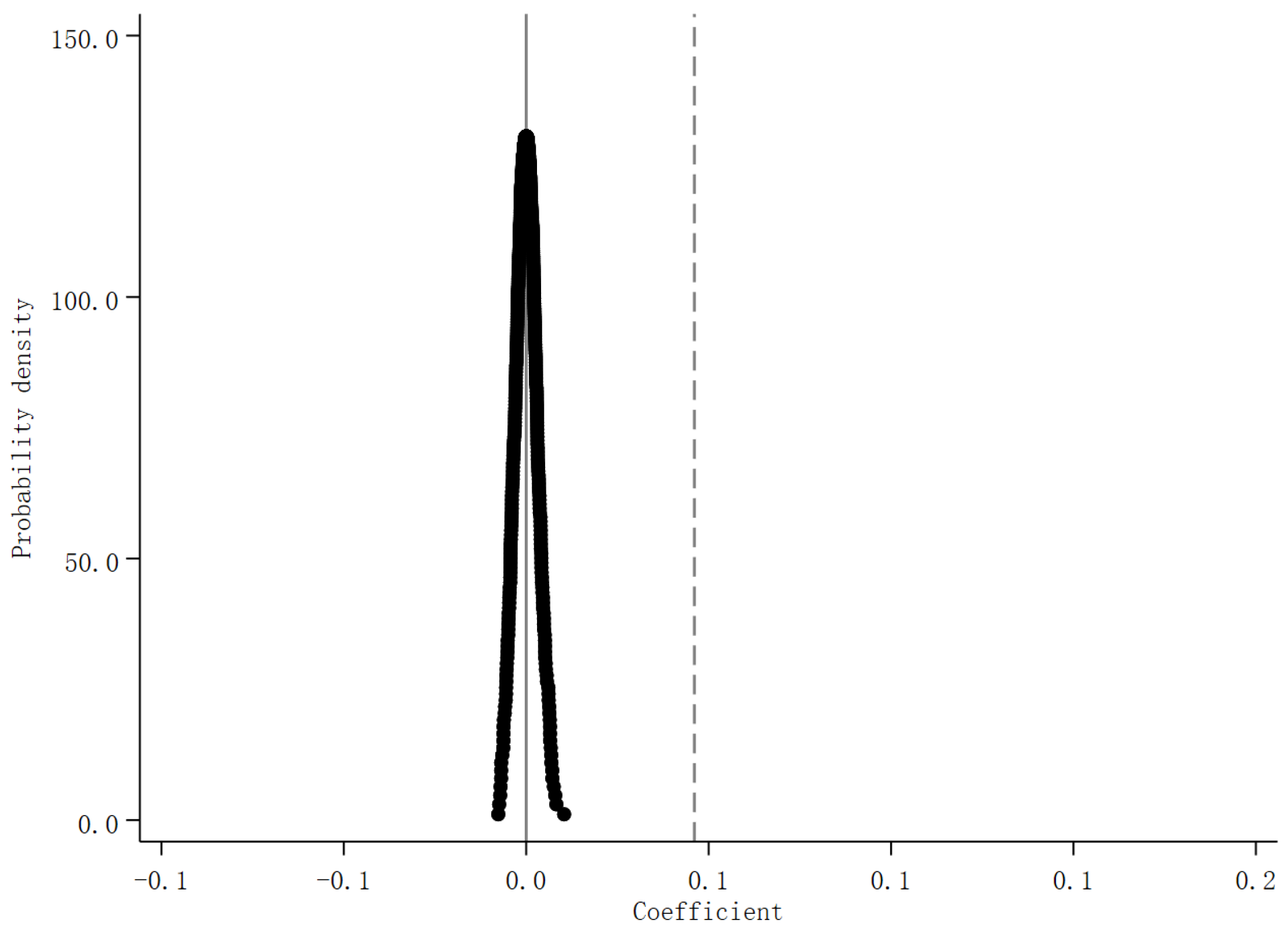
Considering that the significance of the estimation results may arise from random unobservable factors rather than the direct effect of sci-tech finance policy, this paper undertakes a placebo test. Following the methodology of Cantoni et al. [62], the study first randomly assigns the cities to create a “pseudo-experimental group” influenced by the sci-tech finance policy. Second, a year is randomly selected from the year variables within this “pseudo-experimental group” to serve as the time of the policy shock, with this random sampling repeated 500 times. The estimation results of this process are illustrated in Figure 4. It is found that the average value of the regression coefficient approaches 0, with most regression coefficient values deviating from the benchmark model’s regression coefficient of 0.0418 (Table 3, column (4)). The placebo test is passed, indicating that the sci-tech finance policy has a significant role in promoting agricultural production efficiency, and there is a strong causal relationship between the two.

4.2.4. Endogeneity Treatment

The difference-in-differences (DID) method evaluates the net effect of a policy shock by examining the difference between the treatment group and the control group. Given the exogeneity of the policy shock and the determinacy of the affected subjects, the DID model can alleviate endogenous issues to a certain degree. Drawing on the study by Liu et al. [63], this paper further addresses the impact of endogeneity on estimation results by incorporating instrumental variables. The selection of instrumental variables should satisfy both exogeneity and relevance conditions. Accordingly, this study introduces the number of patent grants and the marketization index as instrumental variables, representing the dimensions of technology and finance, respectively. It employs two-stage least squares (2SLS) and the generalized method of moments (GMM) for testing. On one hand, the establishment of pilot regions is influenced by initial endowments such as the number of local patent grants and the level of marketization, which correlates with the core explanatory variable—the sci-tech finance pilot policy. On the other hand, local patent grants predominantly arise from the secondary and tertiary industries, while the level of marketization exerts a relatively weak impact on agricultural production activities. Therefore, these factors can be regarded as exogenous in relation to changes in agricultural production efficiency. The first-stage regression results, as shown in Table 5, confirm the validity of the selected instrumental variables. Following the introduction of these instruments to address endogeneity, the estimated effect of the sci-tech finance pilot policy on agricultural production efficiency remains positive, with a coefficient hovering around 0.11. This represents a significant improvement compared to the baseline regression result of 0.0418 reported in column (4) of Table 3.

4.2.5. Test of Heterogeneous Treatment Effects

Many policies in China are characterized by a “pilot-first” approach, and the sci-tech finance policy is no exception. The two batches of pilot regions were affected by the policy at different times. In this context, existing studies have pointed out that using a multi-period difference-in-differences model (DID) to evaluate the policy effect faces the issue of heterogeneous treatment effects, that is, the effects of the same policy intervention vary across different individuals. This variation may manifest in two dimensions: the duration after receiving the treatment or the groups that receive treatment at different times. Therefore, following the methodology of Callaway & Sant’Anna [64], this paper first applies propensity score matching to the sample. It then calculates the average treatment effect on the treated ATT(e, t) for each group-period, subsequently aggregates them to obtain the overall ATT. Standard errors are computed using the bootstrap method, yielding a heterogeneity-robust estimator that satisfies unbiasedness and consistency.
Table 6 presents the results of the heterogeneity disposal effect test. The significant estimated coefficient of the average treatment effect (ATT) for the sci-tech finance policy is 0.0345 at the 1% level. Based on this, this paper further plotted an event study graph of the sci-tech finance pilot policy over the entire sample period to estimate the dynamic treatment effects [53]. The results of this analysis are depicted in Figure 5. Prior to the policy implementation, the treatment effects were largely insignificant. However, after the launch of the sci-tech finance pilot policy, the effects gradually became evident and continued to expand as the years of implementation increased. In summary, the heterogeneity disposal effect test yields estimates regarding the sign, magnitude, and trend of the policy effect of the sci-tech finance policy that are consistent with those derived from the baseline model. This consistency indicates that the model has successfully passed the heterogeneity disposal effect test. This confirms that the sci-tech finance policy exerts a robust positive impact on agricultural productivity.
The slightly lower ATT value (0.0345) relative to the baseline coefficient (0.0418) suggests that the average policy effect across all groups and periods, when properly accounting for heterogeneous treatment timing, remains substantively large—representing a 4.90% (0.0345/0.7038) increase relative to the sample mean. This attenuation indicates that the baseline difference-in-differences estimator may overstate the uniform treatment effect by pooling early- and late-adopting cohorts without adjusting for differential treatment duration. The dynamic pattern revealed by the event study carries important economic implications: the gradual and expanding treatment effect over time is consistent with a technology diffusion process in which the adoption of sci-tech finance follows an S-shaped learning curve. In the early post-policy years, farmers and agri-enterprises incur fixed costs of learning, adaptation, and complementary investment, which dampen the immediate productivity response. As these upfront costs are absorbed and network effects materialize—through peer learning, supply-chain coordination, and accumulated financial experience—the marginal productivity gain accelerates, producing the widening treatment effect observed in the data. This pattern also implies that sustained, rather than one-off, financial interventions are required to realize the full productivity potential of sci-tech finance in agriculture.
This pattern aligns with Zhu et al. [50], who show that agricultural mechanization—a key channel of sci-tech finance—exerts a cumulative positive effect on green total factor productivity in China’s planting industry, with the effect magnitude increasing over the sample period. The gradual strengthening of treatment effects further echoes evidence from analogous policy experiments: Zhang et al. [65] find that a technological finance cooperation pilot improved energy efficiency by 8.5–10.1%, with the effect intensifying over time through technological innovation and industrial upgrading—a trajectory remarkably consistent with the agricultural production efficiency gains observed in our study.

4.2.6. Other Robustness Tests

To ensure that the conclusions drawn from the baseline regression are not influenced by other unobservable time effects, sample outliers, or individual effects, several robustness tests were conducted. Firstly, to control for non-parallel trends. A year trend term was introduced into the baseline multi-period DID model to account for unobservable time effects that could threaten the model’s parallel trend assumption. The results are presented in column (1) of Table 7. Secondly, to perform tail trimming. To eliminate errors caused by extreme values, this paper conducted a 1% level winsorization, with the results shown in column (2) of Table 7. Following these adjustments, the disposal effect of the sci-tech finance policy remained significantly positive, indicating that the sci-tech finance pilot policy substantially enhanced agricultural production efficiency. Thirdly, to account for interactive fixed effects. This study recognized that the timing of policy shocks may be multidimensional, meaning the impact of the sci-tech finance policy shock on agricultural production efficiency could differ across cities. Consequently, one-dimensional interactive fixed effects were included in the analysis, with results presented in column (3) of Table 7. In the above robustness tests, the regression coefficients for the sci-tech finance pilot policy consistently remain significantly positive at the 1% significance level.
In contrast to one-dimensional technology or financial policies, the sci-tech finance policy emphasizes the integration of technology and finance. To mitigate the influence of other single-dimensional policy shocks, this study selects the innovative city pilot and national financial reform pilot zone as representative policies that concentrate on the distinct dimensions of technology and finance, respectively. The regression results are presented in columns (4) and (5) of Table 7. The national innovative city pilot policy was launched in 2008, while the national financial reform pilot zone policy commenced in 2012; both are pertinent to the research theme of this study. The test results indicate that the sci-tech finance pilot policy remains significant at the 1% level, whereas the estimated coefficients for the innovative city pilot policy and the national financial reform pilot zone are insignificant. To a certain extent, this finding suggests that relying solely on either technology or finance offers relatively weak support for enhancing agricultural production efficiency, further verifying the critical importance of the synergistic interaction between technology and finance.

5. Heterogeneity Analysis of the Policy Effects of Sci-Tech Finance

The studies referenced above demonstrate that sci-tech finance policy has significantly enhanced agricultural production efficiency. Nevertheless, regional disparities in development environments result in varying efficiency, intensity, and policy bias in implementing these policies, leading to diverse effects on agricultural production efficiency improvement. Consequently, this paper investigates the heterogeneity of sci-tech finance policy’s effects on agricultural production efficiency, considering economic characteristics of pilot regions, including technological innovation capacity and financial deepening level, as well as regional attributes such as administrative level and geographical location.

5.1. The Technological Innovation Capacity and the Degree of Financial Deepening in the Pilot Areas

Sci-tech finance embodies the convergence of technology and finance, with the efficacy of sci-tech finance policy being contingent upon regional technological innovation and the provision of financial services. Here, this paper focuses on two key dimensions of urban economic characteristics: technological innovation capacity and the degree of financial deepening. Table 8 presents the heterogeneity test outcomes of urban economic characteristics regarding the impact of sci-tech finance on agricultural production efficiency. The regression results reveal:
First, the promotional impact of sci-tech finance policies on agricultural production efficiency is notably more significant in cities characterized by weaker technological innovation capabilities. This study utilizes the China Regional Innovation Capability Evaluation Report to categorize the sample into two subgroups—those with strong and weak regional innovation capabilities, using the median of the regional innovation index as the cutoff point. A multi-period DID estimation was conducted for each subgroup, with the regression results presented in the first two columns of Table 8. The findings reveal that the coefficients for the sci-tech finance pilot policy are consistently positive and statistically significant at the 1% level, thereby further confirming the robustness of the baseline regression results. Furthermore, the policy treatment effect of sci-tech finance is actually more pronounced in the subsample of cities with weaker regional innovation capabilities. The diffusion and application of technological innovations are not constrained by geographical distances and administrative boundaries. Consequently, regions with relatively weaker local innovation capabilities can leverage the policy benefits of the sci-tech finance pilot to generate stronger incentives for enhancing local agricultural production efficiency by introducing technology.
Second, the facilitative impact of sci-tech finance policy on agricultural production efficiency is more pronounced in cities with lower levels of financial deepening. This study constructs a financial deepening indicator based on the ratio of total deposits and loans of financial institutions to regional GDP. The sample is divided into two subgroups—high and low financial deepening levels, using the median as the cutoff point. Multi-period DID estimations were conducted for each subgroup separately, with the regression results presented in the last two columns of Table 8. Consistent with the heterogeneity test results regarding technological innovation capability, the findings indicate that the sci-tech finance policy exerts a stronger positive effect on agricultural production efficiency in the subsample of cities with lower financial deepening. Considering that financial services such as credit resources and financing accessibility also exhibit cross-city allocation characteristics, this study offers a similar explanation: financial resources inherently tend to flow toward non-agricultural sectors. Historically, regions with relatively weak financial deepening have generally lacked sufficient financial support for local agricultural development. Encouraged by policy incentives, pilot regions with weaker financial deepening can capitalize on the policy dividends of the sci-tech finance pilot programs. This, in turn, facilitates the integration of financial resources with agricultural production and leads to more substantial improvements in agricultural production efficiency.

5.2. Administrative Division Level and Geographic Location of Pilot Regions

The implementation of pilot policies requires both responsibility and capability. Therefore, the efficiency of execution is susceptible to political factors and the economic foundation. Central cities with higher administrative levels, such as municipalities directly under the central government, provincial capitals, state-planned cities, and important node cities, are typically entrusted with leading and demonstrative functions. As a result, local governments s in these areas carry a greater responsibility for executing pilot policies. In addition, a robust economic foundation enables the promotion of pilot policies on a larger scale, at a higher level, and with greater depth, which also facilitates the quicker realization of policy incentives. Therefore, this paper examines the heterogeneity of urban administrative division characteristics of the impact of sci-tech finance on agricultural production efficiency, focusing on two dimensions: administrative division level and geographical location. Table 9 reports the regression results.
First, the regression results presented in the first two columns of Table 9 demonstrate that the sci-tech finance pilot policy significantly enhances agricultural production efficiency in both central and non-central cities, but the effect of supporting agriculture is stronger in non-central cities. A possible reason is that sci-tech finance has the late-mover advantage of increasing marginal returns. In economically developed central cities, the benefits derived from sci-tech finance in supporting agricultural production have gradually weakened. In contrast, non-central cities are in the initial and learning phases of agricultural technological innovation, where the marginal returns from integrating technological innovation and financial capital into agriculture are higher. Consequently, there is greater potential for improving agricultural production efficiency in these areas. In addition, non-central cities have more abundant agricultural resources, such as arable land, and most farmland irrigation projects are concentrated in these regions. This makes the “adding brilliance to its present splendor” effect of sci-tech finance on central cities less than the “offering fuel in snowy weather” effect on non-central cities.
Second, the regression results presented in the last three columns of Table 9 demonstrate that sci-tech finance has enhanced agricultural production efficiency in eastern and western cities, with a stronger policy disposal effect observed in eastern cities, whereas central cities are slightly weaker. The economic development levels vary across regions, with the eastern region being the most advanced, followed by the central region, and the western region lagging behind. This paper attempts to mark the economic foundation of cities by geographical location. Firstly, the eastern region has a robust economic foundation and a strong ability to implement the sci-tech finance policy. The funds and technologies brought by the pilot policy can be efficiently directed into the agriculture field, facilitating the transformation and modernization of small-scale agriculture, and enabling mechanized and large-scale development. Secondly, the western region of China, characterized by its vastness, holds unique advantages for agricultural development. The implementation of the sci-tech finance pilot policy has provided crucial technological and financial support to this region, which is conducive to the formation of modern agriculture with regional characteristics. Finally, it should be noted that the central region has fewer sci-tech finance pilot cities in our sample, which may limit the statistical power to detect a significant effect. Furthermore, against the background of industrial gradient transfer, central cities undertake more of the function of undertaking industrial transfer from the east, and the land transfer rate in the central region is lower than the national average. Therefore, the finding that the sci-tech finance policy did not show a statistically significant improvement in agricultural production efficiency in central cities should be interpreted with caution. The null result may be due to the insufficient sample size of pilot cities in this region rather than a genuine absence of the policy effect. Future studies with a larger set of central cities are needed to further verify this issue.
Beyond general economic development levels, several additional structural factors help explain the observed regional heterogeneity. First, infrastructure endowment plays a critical mediating role. The eastern region benefits from a substantially denser transportation network—including highway coverage, railway density, and port logistics—which lowers the transaction costs of agricultural input procurement and output marketing. This infrastructure advantage enables eastern pilot cities to channel financial and technological resources into agricultural production more effectively. In contrast, although the western region’s agricultural infrastructure is less developed in terms of transport connectivity, it benefits from recent state-led investments in water conservancy and irrigation projects, which provide a complementary foundation upon which sci-tech finance can operate. The central region, occupying an intermediate position in infrastructure development, faces a structural bottleneck: its road and irrigation networks are more developed than those in the west, yet they are less integrated with the financial services infrastructure (e.g., rural banking networks, agricultural insurance penetration) that is essential for translating policy finance into on-farm productivity gains. Second, market access conditions differ markedly across regions. Eastern cities enjoy proximity to large urban consumption centers and well-developed wholesale agricultural markets, which generate stronger price signals and demand-pull incentives for technology adoption. Western regions, though geographically remote, have developed niche markets for specialty agricultural products (e.g., organic produce, medicinal herbs) that align with the technology-enabled quality upgrading supported by sci-tech finance. The central region’s intermediate market access position—closer to national transportation corridors than the west, yet lacking the east’s deep integration with high-value supply chains—may explain why the policy’s agricultural productivity effect has yet to achieve statistical significance there. Third, differences in agricultural extension service coverage and human capital endowments across regions further condition the effectiveness of sci-tech finance, as the adoption of new technologies requires complementary knowledge and technical support that are unevenly distributed across China’s economic geography.

6. Examination of the Mechanism of Sci-Tech Financial Policy

Previous research has confirmed that sci-tech finance policy has significantly promoted the improvement of agricultural production efficiency. This paper has collected, organized, and consulted the work plans from pilot areas implementing the sci-tech finance pilot policy, extracted the support policies related to agriculture, and categorized these policies into the main subjects of agriculture, rural areas, and farmers. Subsequently, this paper investigates the mechanisms through which sci-tech finance policy improves agricultural production efficiency, considering three dimensions: agriculture (the process of agricultural mechanization), rural areas (the development of modern rural industries), and farmers (the human capital of farmers). The test results are shown in Table 10.
First, sci-tech finance policy has accelerated the process of agricultural mechanization. The coordinated integration of technology and finance not only alleviates credit constraints in agriculture, promotes the application and popularization of agricultural machinery in rural areas of China, but also improves the conditions for agricultural machinery technological innovation through the fundamental role of market-based resource allocation. This synergy stimulates the vitality and creativity of agricultural technology enterprises, leading to the provision of more specialized machinery and equipment for agricultural production, and enriching the application scenarios of agricultural mechanization [66,67]. Therefore, sci-tech finance policy serves as a key driver in improving the level of agricultural mechanization in pilot regions, thereby improving agricultural production efficiency. Using the ratio of total agricultural machinery power to regional GDP as a proxy variable for the agricultural mechanization process across regions, the regression results in column (1) of Table 10 show a significantly positive coefficient for the sci-tech finance policy disposal variable. This finding indicates that after the implementation of sci-tech finance policy, the process of agricultural mechanization in pilot regions has accelerated significantly compared to non-pilot regions, thereby validating hypothesis H1 proposed in this study. Importantly, in the context of urbanization, the accelerated progress of agricultural mechanization driven by sci-tech finance plays a crucial role in alleviating rural labor loss, enhancing agricultural capital deepening, and modernization. It serves as an important mechanism to balance the contraction of the agricultural labor force with the expansion of large-scale agricultural operations.
Second, sci-tech finance policy has promoted the development of modern rural industries. Agricultural modernization not only involves achieving modernization in agricultural production but also focuses on building a modern rural industrial system. The “Opinions of the Central Committee of the Communist Party of China and the State Council on Comprehensively Promoting Rural Revitalization and Accelerating Agricultural and Rural Modernization” states that it is necessary to “focus on county-level layouts for the initial and deep processing of characteristic agricultural products, and build modern agricultural industrial parks, strong agricultural industrial towns, and clusters of advantageous and distinctive industries,” emphasizing the importance of “building the whole agricultural industry chain.” The sci-tech finance policy has played a significant role in advancing modern rural industries. It provides financial support for the deep processing of agricultural products, fosters new agricultural business entities and innovative business models, and promotes the integration of internet technologies and digital e-commerce platforms with traditional agricultural practices, thereby achieving the extension and expansion of the agricultural industry chain [68]. Using the main business income of agricultural product processing enterprises above a designated size as a proxy variable for the level of modern rural industries across regions, the regression results in column (2) of Table 10 show that the coefficient of the sci-tech finance policy disposal variable is significantly positive at the 5% level. This indicates that after the implementation of the sic-tech finance policy, the level of modern agricultural development in the pilot regions has improved significantly compared to non-pilot regions, thereby confirming hypothesis H2 proposed in this study.
Third, sci-tech finance policy has enhanced farmers’ human capital. Rural revitalization necessitates not only the revitalization of rural industries but also the cultivation of rural talent and culture. The Rural Revitalization Strategic Plan (2018–2022) emphasizes the importance of “strengthening talent support for rural revitalization.” The allocation of technological and financial resources to rural areas has not only provided more effective and accessible platforms for cultivating new types of professional farmers but also created broader opportunities for strengthening the construction of rural professional talent teams. Moreover, it helps to encourage entrepreneurs, experts, scholars, and university graduates to participate in rural development, serving as a crucial means to enhance farmers’ human capital [69]. Given the absence of direct indicators for measuring farmers’ human capital, this study uses the difference between total municipal education expenditure and that of its municipal districts as a proxy to indirectly reflect regional investment in farmers’ human capital. The regression results presented in column (3) of Table 10 show that the coefficient of the sci-tech finance policy disposal variable is significantly positive at the 1% level. This indicates that the sci-tech finance policy has had a positive impact on farmers’ human capital in the pilot regions, contributing to the enhancement of rural human capital and providing empirical support for hypothesis H3.
In summary, sci-tech finance policy accelerates the advancement of agricultural mechanization, promotes the development of modern rural industries, and enhances farmers’ human capital. This policy positively influences all facets of agriculture, rural areas, and farmers, thereby significantly improving agricultural production efficiency.

7. Conclusions and Discussion

7.1. Main Conclusions

China’s agricultural development faces both the shortcomings of insufficient investment in technology and the constraint of inadequate financial support. Technology and finance have become the primary bottlenecks constraining the modernization of agriculture. To facilitate the integration of technology and finance, as well as to explore new mechanisms for connecting technological and financial resources, China has launched two batches of sci-tech finance pilot policies since 2011. In the realm of agricultural production, the pilot policy explicitly emphasizes the need to strengthen cooperation with the rural financial system and to innovate finance service models that align with the unique characteristics of rural technological innovation and entrepreneurship. Consequently, sci-tech finance has been positioned as a key strategy to address the dual challenges of limited financing and weak technological capacity in agricultural production.
This study employs regional panel data from 2006 to 2019, treating the sci-tech finance pilot policy as a quasi-natural experiment. A multi-period difference-in-differences (DID) model is utilized to evaluate the policy effect of sci-tech finance on enhancing agricultural production efficiency. On this basis, this study sequentially examines the mechanisms through which sci-tech finance enhances agricultural production efficiency, in alignment with the primary themes of “agriculture, rural areas and farmers”. This examination is conducted from the perspectives of accelerating agricultural mechanization (agriculture), promoting the development of modern rural industries (rural areas), and enhancing farmers’ human capital (farmers). In addition, the study explores the heterogeneity of sci-tech finance in promoting agricultural production efficiency from the perspectives of regional economic characteristics and administrative division features. The research findings indicate that: (1) Compared with non-pilot regions, the sci-tech finance policy has significantly promoted agricultural production efficiency in pilot regions. This treatment effect not only persisted but also strengthened over a considerable period after policy implementation. After addressing potential issues such as sample self-selection, endogeneity bias, and heterogeneous treatment effects, as well as conducting various robustness checks, the positive impact of the sci-tech finance policy on agricultural production efficiency remains robust. (2) Heterogeneity analysis reveals that the sci-tech finance policy exerts a stronger effect on agricultural production efficiency in pilot regions characterized by weaker technological innovation capacity and lower levels of financial deepening. The “adding brilliance to its present splendor” effect observed in central cities is less significant than the “offering fuel in snowy weather” effect noted in non-central cities. Moreover, the policy has improved agricultural production efficiency in both eastern and western cities, while its impact on central cities is not statistically significant. (3) Regarding transmission mechanisms, the sci-tech finance policy has facilitated the advancement of agricultural mechanization, accelerated the development of modern rural industries, and enhanced farmers’ human capital in pilot regions. It has produced positive effects across all aspects of agriculture, rural areas, and farmers, demonstrating a long-term mechanism characterized by multi-point effectiveness and sustained momentum.

7.2. Policy Implications

Based on empirical research showing that sci-tech finance significantly improves agricultural production efficiency through accelerating agricultural mechanization, promoting modern rural industries, and enhancing farmers’ human capital, we propose the following three actionable policy recommendations.
Formulate a specialized agricultural sci-tech finance policy with clear fiscal parameters, including interest subsidy ratios, risk compensation caps, and differentiated loan terms. The Ministry of Science and Technology, the People’s Bank of China, the National Financial Regulatory Administration, and the Ministry of Agriculture and Rural Affairs should jointly issue implementation rules for agricultural sci-tech finance. Drawing on the research findings of Fernandez-Vidal & Alarcon’s [10] regarding the mismatch in AgTech, particularly the conflict between the timelines of traditional venture capital and the 7–10 years cycle of biological innovation. The regulations should define the following key parameters. First, it is important to provide a fiscal interest subsidy of no more than 70% of the LPR, capped at 2 percentage points per borrower, with an annual ceiling of RMB 2 million. For national agricultural sci-tech parks and seed industry enterprises, allow a higher subsidy of up to 90% of the LPR for a maximum of 5 years. Second, there is a need to establish a risk compensation mechanism covering up to 80% of agricultural sci-tech credit losses, with an elevated 90% coverage for smallholder farmers with cultivated land areas of 50 mu or less, and adopt the provincial–municipal 1:1 co-funding model used in Hubei Province. Third, there is also a need to align loan maturities with agricultural investment cycles. Set terms up to 10 years for seed R&D, 5–8 years for smart agricultural equipment, and 8 years for facility agriculture. Fourth, implementation of an intellectual property pledge framework that recognizes data assets and plant variety rights as collateral, limits the pledge ratio at no more than 50% of appraised value and caps individual loans at RMB 5 million, consistent with the pilot in Shanghai’s Jinshan District, should be considered.
Establish a quantifiable evaluation and promotion system for pilot experiences, including coverage, cost, efficiency, and risk tolerance indicators. Drawing on Kong et al. [70], who employed a difference-in-differences model to demonstrate that China’s sci-tech finance pilot policy positively impacts innovation levels of agriculture-related listed enterprises, the following targets are recommended. First, loan accessibility for agricultural sci-tech enterprises should be at least 65%. Second, the average interest rate should not exceed LPR + 50 basis points. Third, loan approval time should be no more than 15 working days. Fourth, the tolerated non-performing loan (NPL) ratio for agricultural sci-tech loans should be capped at 3%, compared with the 2% standard for ordinary agricultural loans. Pilot regions that achieve annual growth in agricultural sci-tech lending of at least 20% and maintain an NPL ratio of 1% or less should see their “government risk compensation + bank credit + insurance” model expanded. To support development in central and western regions, the central government should provide an additional 30% matching risk compensation fund.
Target three transmission channels with tailored financial tools: agricultural mechanization (leasing subsidies), modern rural industries (supply chain incentives), and farmer human capital (sci-tech commissioner loans). First, for smart agricultural machinery, whose unit price ranges from RMB 0.5 million to RMB 2 million, implement a financing lease interest subsidy. Empirical evidence indicates that digital financial inclusion significantly improves agricultural mechanization services, and that human capital moderates this effect [71]. Therefore, set the subsidy at 2 percentage points for a 3–5 year term and cap support at RMB 300,000 per entity annually. Manage credit risk with a three-tier reserve: central 40%, provincial 30%, and county 20%. Second, provide an annual fiscal reward equal to 1.5% of loan disbursements to financial institutions serving agribusiness chains, capped at RMB 5 million per institution. Additionally, platforms serving at least 10,000 farm households qualify for a RMB 1 million platform-level payment. Third, adopt the Sanming City “Sci-Tech Commissioner Loan” model. Establish a RMB 3 million risk compensation pool that leverages bank lending 10–15 times, with a single loan limit of RMB 3 million. Share credit risk equally 50:50 between banks and the pool and provide an interest subsidy up to 50% of the 1-year LPR, with a cumulative cap of RMB 150,000 per person. As Yao et al. [72] demonstrate, rural human capital acts as a mediator in the relationship between sci-tech finance and agricultural outcomes, supporting such targeted human capital financing.

7.3. Limitations and Future Research

While this study offers valuable evidence on the agricultural efficiency effects of sci-tech finance pilot policy, several limitations remain and suggest promising directions for future research.
First, because the two pilot batches were administratively designated rather than randomly assigned, self-selection bias may persist despite propensity score matching. Moreover, the prefecture-level panel excludes counties and townships where much smallholder farming is concentrated, limiting representativeness for the most agriculturally marginal communities [8]. Household- or farm-level surveys would help verify whether reported aggregate efficiency gains translate into welfare improvements for individual farmers.
Second, our 2006–2019 window predates the third pilot batch and the post-2020 fintech-driven digitalization of rural finance, so the estimates capture only medium-term effects of the first two cohorts. Longer-run dynamics—diminishing returns, policy fatigue, or synergies with later digital finance initiatives—remain unexplored. As Fu & Zhang [56] stress, agricultural productivity trajectories require multi-decade observation. Future work should extend the panel and investigate how emerging fintech–agriculture integration models interact with the sci-tech finance framework. Moreover, cross-country comparative studies in other developing economies would help assess the external validity and international transferability of the findings.
Third, the efficiency measure relies on a parametric Stochastic Frontier Analysis [47,48]. The standard Cobb–Douglas form [49] imposes substitution-elasticity restrictions that may not hold across China’s heterogeneous agroecological zones. The staggered difference-in-differences design yields local average treatment effects with limited external validity [68]; even after robustness checks for parallel trends and cohort contamination [66], some concerns persist. Further, the mediation analysis (mechanization, modern rural industry, and farmers’ human capital) uses observable proxies that may imperfectly capture the underlying constructs. Non-parametric approaches (e.g., Data Envelopment Analysis) or instrumental-variable strategies could cross-validate the present findings.

Author Contributions

Conceptualization, J.Y. and J.G.; data curation, J.Y.; formal analysis, J.G.; methodology, J.Y.; writing—original draft, J.Y. and J.G.; writing—review and editing, J.G. All authors have read and agreed to the published version of the manuscript.

Funding

This research was funded by the Jiangsu Provincial Social Science Applied Research Excellence Project (No. 23SYB-116), Special Project of Jinling Institute of Technology on Studying and Implementing the Spirit of the 20th National Congress of the Communist Party of China (No. 2).

Institutional Review Board Statement

Not applicable.

Informed Consent Statement

Not applicable.

Data Availability Statement

The data that support the findings of this study are available from the corresponding author upon reasonable request.

Acknowledgments

We appreciate the constructive suggestions from peer reviewers and the help of the editors. All remaining errors are ours. The authors appreciate the valuable comments of the anonymous reviewers.

Conflicts of Interest

The authors declare no conflicts of interest.

References

  1. Karazijienė, Ž.; Černikovaitė, M.E. Promoting innovation adoption in the agricultural sector: The case of Lithuania and the Czech Republic. Agric. Resour. Econ. Int. Sci. E-J. 2025, 11, 5–31. [Google Scholar] [CrossRef]
  2. Binswanger-Mkhize, H.P.; Savastano, S. Agricultural intensification: The status in six African countries. Food Policy 2017, 67, 26–40. [Google Scholar] [CrossRef]
  3. USDA Economic Research Service (ERS). America’s Diverse Family Farms: 2021 Edition; EIB-223; U.S. Department of Agriculture: Washington, DC, USA, 2021.
  4. Bijman, J. Agricultural Cooperatives in the Netherlands: Key Success Factors; International Summit of Cooperatives: Quebec City, QC, Canada, 2016. [Google Scholar]
  5. Wolfert, S.; Ge, L.; Verdouw, C.; Bogaardt, M.J. Big data in smart farming: A review. Agric. Syst. 2017, 153, 69–80. [Google Scholar] [CrossRef]
  6. Yang, X.; Liu, Y.; Thrän, D.; Bezama, A.; Wang, M. Effects of the German Renewable Energy Sources Act and environmental, social and economic factors on biogas plant adoption and agricultural land use change. Energy Sustain. Soc. 2021, 11, 6. [Google Scholar] [CrossRef]
  7. Diniz, E.; Birochi, R.; Pozzebon, M. Triggers and barriers to financial inclusion: The use of ICT-based branchless banking in an Amazon county. Electron. Commer. Res. Appl. 2012, 11, 484–494. [Google Scholar] [CrossRef]
  8. Karlan, D.; Osei, R.; Osei-Akoto, I.; Udry, C. Agricultural Decisions after Relaxing Credit and Risk Constraints. Q. J. Econ. 2014, 129, 597–652. [Google Scholar] [CrossRef]
  9. Fishman, R.; Smith, S.C.; Bobić, V.; Sulaiman, M. Can Agricultural Extension and Input Support Be Discontinued? Evidence from a Randomized Phaseout in Uganda. Rev. Econ. Stat. 2022, 104, 1273–1288. [Google Scholar] [CrossRef]
  10. Fernandez-Vidal, J.; Alarcon, S. Financing agricultural innovation: Challenges and alternatives to venture capital in the AgTech sector. Food Policy 2025, 136, 102967. [Google Scholar] [CrossRef]
  11. Zhang, J.; Mishra, A.K.; Zhu, P.; Li, X. Land rental market and agricultural labor productivity in rural China: A mediation analysis. World Dev. 2020, 135, 105089. [Google Scholar] [CrossRef]
  12. Foster, A.D.; Rosenzweig, M.R. Are there too many farms in the world? Labor market transaction costs, machine capacities, and optimal farm size. J. Political Econ. 2022, 130, 636–680. [Google Scholar] [CrossRef]
  13. Chen, S.; Gong, B. Response and adaptation of agriculture to climate change: Evidence from China. J. Dev. Econ. 2021, 148, 102557. [Google Scholar] [CrossRef]
  14. Gollin, D.; Lagakos, D.; Waugh, M.E. The Agricultural Productivity Gap. Q. J. Econ. 2014, 129, 939–993. [Google Scholar] [CrossRef]
  15. Yang, D.T.; Zhu, X. Modernization of agriculture and long-term growth. J. Monet. Econ. 2013, 60, 367–382. [Google Scholar] [CrossRef]
  16. Peng, L.; Chen, L.; Dai, H. The impact of energy structure on agricultural green productivity in China. Sci. Rep. 2024, 14, 27938. [Google Scholar] [CrossRef]
  17. Carillo, M.F. Agricultural Policy and Long-Run Development: Evidence from Mussolini’s Battle for Grain. Econ. J. 2021, 131, 566–597. [Google Scholar] [CrossRef]
  18. Sun, S.; Wen, X.; Jie, S.; Gao, Q.; Zhu, Y.; Wen, S. Drivers of farmers’ intention to use the digital agricultural management system: Integrating theory of planned behavior and behavioral economics. Front. Psychol. 2022, 13, 901169. [Google Scholar] [CrossRef]
  19. Farrokhi, F.; Pellegrina, H.S. Trade, Technology, and Agricultural Productivity. J. Political Econ. 2023, 131, 2509–2555. [Google Scholar] [CrossRef] [PubMed]
  20. Dong, J.; Xu, J. Driving agricultural strength through digital transformation. Sci. Rep. 2026, 16, 446. [Google Scholar] [CrossRef] [PubMed]
  21. Liu, Y.; Ji, D.; Zhang, L.; An, J.; Sun, W. Rural financial development impacts on agricultural technology innovation: Evidence from China. Int. J. Environ. Res. Public Health 2021, 18, 1110. [Google Scholar] [CrossRef]
  22. Sengupta, T.; Narayanamurthy, G.; Moser, R.; Hota, P.K. Sharing app for farm mechanization: Gold Farm’s digitized access based solution for financially constrained farmers. Comput. Ind. 2019, 109, 195–203. [Google Scholar] [CrossRef]
  23. Moshirian, F.; Tian, X.; Zhang, B.; Zhang, W. Stock Market Liberalization and Innovation. J. Financ. Econ. 2021, 139, 985–1014. [Google Scholar] [CrossRef]
  24. Ge, H.; Li, B.; Tang, D.; Xu, H.; Boamah, V. Research on digital inclusive finance promoting the integration of rural three-industry. Int. J. Environ. Res. Public Health 2022, 19, 3363. [Google Scholar] [CrossRef]
  25. Jiang, S.; Qiu, S.; Zhou, H.; Chen, M. Can fintech development curb agricultural nonpoint source pollution? Int. J. Environ. Res. Public Health 2019, 16, 4340. [Google Scholar] [CrossRef] [PubMed]
  26. Huang, Y.; Zhao, J.; Yin, S. Does digital inclusive finance promote the integration of rural industries? Based on the mediating role of financial availability and agricultural digitization. PLoS ONE 2023, 18, e0291296. [Google Scholar] [CrossRef]
  27. Lu, Y.; Guo, J.; Ahmad, M.; Zhang, H. Can Sci-Tech Finance Pilot Policies Reduce Carbon Emissions? Evidence from 252 Cities in China. Front. Environ. Sci. 2022, 10, 933162. [Google Scholar] [CrossRef]
  28. Ministry of Science and Technology; The People’s Bank of China; China Banking Regulatory Commission; China Securities Regulatory Commission; China Insurance Regulatory Commission. Promoting the Combination of Technology and Finance Pilot Implementation Plan. 2016. Available online: https://www.gov.cn/zhengce/2016-02/23/5044857/files/58e260438105459ab364c63088902f50.pdf (accessed on 8 May 2026).
  29. Junfang, Z.; Mu, S. Construction of Sci-Tech Financial Ecosystem Indicators and International Comparative Research. Front. Political Sci. 2022, 4, 865884. [Google Scholar] [CrossRef]
  30. General Office of the Ministry of Science and Technology. Notice on Issuing the Outline of Local Pilot Schemes for Promoting the Combination of Technology and Finance. 2011. Available online: https://www.most.gov.cn/xxgk/xinxifenlei/fdzdgknr/qtwj/qtwj2011/201104/t20110420_86143.html (accessed on 8 May 2026).
  31. Belton, B.; Win, M.T.; Zhang, X.; Filipski, M. The Rapid Rise of Agricultural Mechanization in Myanmar. Food Policy 2021, 101, 102095. [Google Scholar] [CrossRef]
  32. Ang, J.B.; Madsen, J.B. Risk capital, private credit, and innovative production. Can. J. Econ./Rev. Can. D’économique 2012, 45, 1608–1639. [Google Scholar] [CrossRef]
  33. Emerick, K.; de Janvry, A.; Sadoulet, E.; Dar, M.H. Technological Innovations, Downside Risk, and the Modernization of Agriculture. Am. Econ. Rev. 2016, 106, 1537–1561. [Google Scholar] [CrossRef]
  34. Guariglia, A.; Liu, P. To what extent do financing constraints affect Chinese firms’ innovation activities? Int. Rev. Financ. Anal. 2014, 36, 223–240. [Google Scholar] [CrossRef]
  35. Xiang, R.; Liu, X.; Tian, M.; Ban, C.; Li, R.; Zhou, J. An efficient assignment of multiple agricultural machinery tasks based on Chaotic Cauchy Elite Variable Snake Optimization Algorithm. PLoS ONE 2025, 20, e0337219. [Google Scholar] [CrossRef]
  36. Sánchez, J.M.; Rodríguez, J.P.; Espitia, H.E. Bibliometric analysis of publications discussing the use of the artificial intelligence technique agent-based models in sustainable agriculture. Heliyon 2022, 8, e12005. [Google Scholar] [CrossRef]
  37. Ambler, K.; de Brauw, A.; Herskowitz, S.; Pulido, C. Finance Needs of the Agricultural Midstream. Food Policy 2023, 121, 102530. [Google Scholar] [CrossRef]
  38. Liang, K.; Li, Z.; Luo, L. Measurement, dynamic evolution and influencing factors of green development efficiency in western China: Based on ecological-economic-social system. PLoS ONE 2023, 18, e0290472. [Google Scholar] [CrossRef]
  39. Cinnirella, F.; Streb, J. The role of human capital and innovation in economic development: Evidence from post-Malthusian Prussia. J. Econ. Growth 2017, 22, 193–227. [Google Scholar] [CrossRef]
  40. Bressan, S.; Pace, N.; Pelizzon, L. Health status and portfolio choice: Is their relationship economically relevant? Int. Rev. Financ. Anal. 2014, 32, 109–122. [Google Scholar] [CrossRef]
  41. Lin, H.; Wu, H.; Lin, H.; Zhu, T.; Arshad, M.U.; Chen, H.; Li, W. The impact of rural e-commerce participation on farmers’ entrepreneurial behavior: Evidence based on CFPS data in China. PLoS ONE 2024, 19, e0300418. [Google Scholar] [CrossRef]
  42. Bell, A.; Chetty, R.; Jaravel, X.; Petkova, N.; Van Reenen, J. Who Becomes an Inventor in America? The Importance of Exposure to Innovation. Q. J. Econ. 2019, 134, 647–713. [Google Scholar] [CrossRef]
  43. Bertrand, M.; Duflo, E.; Mullainathan, S. How much should we trust differences-in-differences estimates? Q. J. Econ. 2004, 119, 249–275. [Google Scholar] [CrossRef]
  44. Beck, T.; Levine, R.; Levkov, A. Big Bad Banks? The Winners and Losers from Bank Deregulation in the United States. J. Financ. 2010, 65, 1637–1667. [Google Scholar] [CrossRef]
  45. Anderson, J.C.; Gerbing, D.W. Structural equation modeling in practice: A review and recommended two-step approach. Psychol. Bull. 1988, 103, 411. [Google Scholar] [CrossRef]
  46. Kumbhakar, S.; Lovell, C.A.K. Stochastic Frontier Analysis; Cambridge University Press: Cambridge, UK, 2000. [Google Scholar]
  47. Coelli, T.J.; Prasada Rao, D.S.; O’donnell, C.J.; Battese, G.E. An Introduction to Efficiency and Productivity Analysis; Springer: Boston, MA, USA, 2005. [Google Scholar]
  48. Kalirajan, K.P.; Obwona, M.B.; Zhao, S. A decomposition of total factor productivity growth: The case of Chinese agricultural growth before and after reforms. Am. J. Agric. Econ. 1996, 78, 331–338. [Google Scholar] [CrossRef]
  49. Zhou, L.I.; Zhang, H.P. Productivity growth in China’s agriculture during 1985–2010. J. Integr. Agric. 2013, 12, 1896–1904. [Google Scholar]
  50. Zhu, Y.; Zhang, Y.; Piao, H. Does agricultural mechanization improve the green total factor productivity of China’s planting industry? Energies 2022, 15, 940. [Google Scholar] [CrossRef]
  51. Huffman, W.E. Human capital: Education and agriculture. Handb. Agric. Econ. 2001, 1, 333–381. [Google Scholar]
  52. Ma, L.; Long, H.; Tang, L.; Tu, S.; Zhang, Y.; Qu, Y. Analysis of the spatial variations of determinants of agricultural production efficiency in China. Comput. Electron. Agric. 2021, 180, 105890. [Google Scholar] [CrossRef]
  53. de Chaisemartin, C.; D’Haultfoeuille, X. Two-way Fixed Effects Estimators with Heterogeneous Treatment Effects. Am. Econ. Rev. 2020, 110, 2964–2996. [Google Scholar] [CrossRef]
  54. Sun, L.; Abraham, S. Estimating Dynamic Treatment Effects in Event Studies with Heterogeneous Treatment Effects. J. Econ. 2021, 225, 175–199. [Google Scholar] [CrossRef]
  55. Fuglie, K.O. Is agricultural productivity slowing? Glob. Food Secur. 2018, 17, 73–83. [Google Scholar] [CrossRef]
  56. Fu, W.; Zhang, R. Can digitalization levels affect agricultural total factor productivity? Evidence from China. Front. Sustain. Food Syst. 2022, 6, 860780. [Google Scholar] [CrossRef]
  57. Caunedo, J.; Keller, E. Capital Obsolescence and Agricultural Productivity. Q. J. Econ. 2021, 136, 505–561. [Google Scholar]
  58. Hou, D.; Wang, X. Inhibition or promotion?—The effect of agricultural insurance on agricultural green development. Front. Public Health 2022, 10, 910534. [Google Scholar]
  59. Gylfason, T. Natural resources, education, and economic development. Eur. Econ. Rev. 2001, 4, 847–859. [Google Scholar] [CrossRef]
  60. Sheng, Y.; Zhao, S.; Mao, Z.; Li, K. Effects of Science and Technology Finance on Green Total Factor Productivity in China: Insights from an Empirical Spatial Durbin Model. J. Knowl. Econ. 2024, 15, 7280–7306. [Google Scholar]
  61. Li, Z.; Hu, H.; Xue, M. The Scale and Innovation Effects of Sci-Tech Finance Pilot Policy from the Perspective of Sustainable Development. Systems 2025, 13, 962. [Google Scholar] [CrossRef]
  62. Cantoni, D.; Chen, Y.; Yang, D.Y.; Yuchtman, D.; Zhang, J.Y. Curriculum and Ideology. J. Political Econ. 2017, 125, 338–392. [Google Scholar]
  63. Liu, Y.; Yang, Y.; Li, H.; Zhong, K. Digital economy development, industrial structure upgrading and green total factor productivity: Empirical evidence from China’s cities. Int. J. Environ. Res. Public Health 2022, 19, 2414. [Google Scholar]
  64. Callaway, B.; Sant’Anna, P.H. Difference-in-Differences with Multiple Time Periods. J. Econ. 2021, 225, 200–230. [Google Scholar] [CrossRef]
  65. Zhang, X.; Wang, J.; Ma, Y. Can technological finance cooperation pilot policy improve energy efficiency? Evidence from a quasi-experiment in China. Environ. Sci. Pollut. Res. 2023, 30, 53445–53460. [Google Scholar] [CrossRef] [PubMed]
  66. Sahara, D.; Setiani, C.; Swastika, D.K.S.; Asnawi, R.; Sugiman, S.B.; Fadwiwati, A.Y.; Dewi, T. Strategy formulation of agricultural machinery development for sustainable potato farming in upland of Banjarnegara Regency, Central Java, Indonesia. Heliyon 2024, 10, e39637. [Google Scholar] [CrossRef]
  67. Gao, D.; Lyu, X. Agricultural total factor productivity, digital economy and agricultural high-quality development. PLoS ONE 2023, 18, e0292001. [Google Scholar] [CrossRef]
  68. Fang, Y.; Yang, Y. Analysis of spatial effects and influencing factors of rural industrial integration in China. Sci. Rep. 2025, 15, 16790. [Google Scholar] [CrossRef]
  69. Shahabadi, A.; Kimiaei, F.; Arbab Afzali, M. The evaluation of impacts of knowledge-based economy factors on the improvement of total factor productivity (a comparative study of emerging and G7 economies). J. Knowl. Econ. 2018, 9, 896–907. [Google Scholar] [CrossRef]
  70. Kong, F.; Zhong, H.; Chai, N.; Shi, B. The impact of the integration of science, technology, and finance on innovation in listed agricultural enterprises through the lens of digital transformation. Agric. Econ. 2026, 72, 84–100. [Google Scholar] [CrossRef]
  71. Yan, Y.; Chen, L.; Zhou, Z.; Wei, Y. Digital financial inclusion and agricultural modernization development in China—A study based on the perspective of agricultural mechanization services. Humanit. Soc. Sci. Commun. 2025, 12, 577. [Google Scholar] [CrossRef]
  72. Yao, S.; Wu, G.; Zhang, S. How does science and technology finance affect the agricultural green development: An interpretation from the perspective of rural human capital and agricultural industrial agglomeration. Front. Sustain. Food Syst. 2025, 9, 1540645. [Google Scholar] [CrossRef]
Figure 1. Parallel trend test of the difference-in-differences model.
Sustainability 18 04910 g001
Figure 2. Distribution of the kernel density function before and after matching.
Sustainability 18 04910 g002
Figure 3. Scatter plot of standardized deviations after matching and bar chart of the common support test.
Sustainability 18 04910 g003
Figure 4. Placebo test results of sci-tech-finance on agricultural production efficiency.
Sustainability 18 04910 g004
Figure 5. Event study plot for the dynamic disposition effect test.
Sustainability 18 04910 g005
Table 1. Release of sci-tech finance policies in typical pilot areas.
Pilot AreasAgricultural-Related Policies
(Excerpt)
Typical Characteristics
Jiangsu
Province
(eastern
region)
1. Notice of the Provincial Government Office on Issuing the Implementation Plan for Building an Innovative Province: The province aims to advance the construction of the national pilot province for the integration of science and technology with finance. Leverage the provincial angel investment risk compensation fund and local “sci-tech loan fund pools” to implement the modern agriculture technology support action plan, and carry out major scientific and technological achievement transformation special projects and strategic emerging industry special projects, and enhance the level of agricultural modernization.
2. Opinions of the Yangzhou Municipal Government on Accelerating the Development of Modern Financial Industry: Accelerate the integration of technology and finance, focus on building a comprehensive sci-tech finance service system that encompasses technology loans, investments, guarantees, insurance, and intermediary services. The city aims to facilitate the use of rural land contract management rights and forest rights as collateral for financing throughout the city, improve technology credit and investment risk-sharing mechanisms, and enhance the rural property rights transfer and trading market. These measures are intended to relieve farmers’ difficulties in securing financing guarantees.
Eastern regions, exemplified by Jiangsu, possess a relatively advanced economic foundation. Consequently, they primarily facilitate the development of agricultural modernization through market-oriented strategies, including agricultural-related technology loans and the mortgage of management rights, which enable a robust self-sustaining mechanism.
Hefei-Wuhu-Bengbu Entrepreneurial Innovation Comprehensive Experimental Zone
(central region)
1. Notice of the People’s Government of Anhui Province on Issuing the Implementation Plan for the Pilot Work of the National Technological Innovation Project in Anhui Province: Select certain banks to pilot innovative sci-tech finance cooperation models within the Hefei-Wuhu-Bengbu Comprehensive Experimental Zone for Entrepreneurial Innovation. Establish small loan companies oriented towards technology-based small and medium-sized enterprises and cultivate regionally characteristic industries. Develop and refine rural technology service systems and technology information service platforms, and promote the transfer and application of technological achievements to villages and households.
2. Notice of the People’s Government of Hefei City on Issuing the Key Points for Entrepreneurial Innovation Work in 2013: Vigorously carry out pilot projects on the integration of science and technology with finance, support technology-based enterprises in raising funds through listing and direct financing by issuing various bonds, and enhance agricultural technological innovation capabilities. Establish a strategic alliance for biological breeding, build the “Capital of Seed Industry”, promote the demonstration construction of agricultural Internet of Things and agricultural informatization, and implement the technology entrepreneurship action plan and the grain high-yield technology project.
In terms of geographical distribution, sci-tech finance pilot areas are seldom situated in China’s central regions. Moreover, owing to local resource endowments, agriculture is not a dominant industry in these central regions. Therefore, related sci-tech finance policies in central regions do not primarily target agricultural production.
Guanzhong-Tianshui Economic Region
(western region)
1. Response Letter to Proposal No. 445 of the First Session of the 12th Shaanxi Provincial Committee of the Chinese People’s Political Consultative Conference: Guided various cities to carry out sci-tech finance integration pilots. The Yangling Demonstration Zone issued 1.5 billion yuan in agricultural enterprise bonds, established the nation’s first agricultural venture capital alliance, and launched an innovative pilot for policy-based agricultural insurance. The premium scale of policy-based agricultural insurance reached 8.3 million yuan, and the coverage amount reached 170 million yuan. These measures promoted the organic integration and coordinated development of technology, finance, and industry throughout the province.
2. Letter on Effectively Carrying out the Construction of Agricultural Technology Parks: Establish a new model for constructing modern agricultural technology parks that is market-oriented, technology-supported, and enterprise-led. Accelerate the development of public service platforms for sci-tech finance, agricultural information, and innovation branding. Develop these parks into demonstration bases for modern agricultural science and technology, centers for transferring agricultural technological achievements, hubs that foster rural technological innovation and entrepreneurship, and training grounds for rural talent.
Agriculture has provided a firm foundation for economic development in the western regions. Pilot areas in the west have promoted integrated development across science and technology, finance and industry, while maintaining a focus on applying sci-tech finance to agriculture. They have introduced innovative financial instruments, including agricultural insurance and agricultural corporate bonds, to promote development.
Source: Announcements from relevant departments, including the Departments of Agriculture and Rural Affairs, Departments of Science and Technology, Departments of Finance, and Financial Offices in various regions.
Table 2. Variable definition and descriptive statistics.
Variable NameVariable DefinitionSample SizeAverage ValueStandard DeviationMinMax
Sci-tech finance pilot policySci-tech finance pilot region status: 1 for the year of implementation and all subsequent years; 0 otherwise.32300.10560.307301
Agricultural production efficiencyAgricultural technical efficiency was calculated using the SFA model32300.70380.13310.19830.9364
Agricultural mechanizationTotal power of agricultural machinery (kilowatts)/regional GDP (billion yuan)32300.29190.26150.00022.1761
Modern rural industriesPrimary business income of agricultural product processing enterprises above a designated size (hundreds of billions of yuan)32303.53288.26870.4439112.4170
Farmers’ human capitalDifference between the total education expenditure of the city and that of its municipal districts (billions of yuan)31052.73582.54710.011327.8440
Fixed-asset investmentFixed asset investment amount deflated by the fixed assets investment price index (ten thousand yuan)32301.14 × 1071.40 × 107287,5581.60 × 108
Regional innovation levelChina regional innovation index323070.664719.51565.722099.9904
Degree of financial deepeningRatio of total deposits and loans of financial institutions to GDP32302.13471.12210.560021.3015
Transportation levelTotal freight volume (ten thousand tons)323013,465.773418,028.545835.55 × 105
Urbanization rateNon-agricultural population/total population at year-end32300.37930.21250.08031.3523
Theil indexIndustrial structure rationalization deviation based on the Theil index32300.27460.20970.00011.7219
Proportion of agricultural practitionersNumber of employees in the primary industry/total employment in the primary and secondary industries32300.99170.02350.56171.0000
Grain production capacityTotal grain output (hundred million tons)32301.445463.39960.176146.8846
Urban–rural income gapUrban–rural disposable income ratio32302.15030.40761.13733.8252
Rural Engel’s coefficientEngel’s coefficient of rural households32300.77000.09170.23800.9597
Environmental governance levelSewage treatment rate32300.79870.22040.00570.9981
Table 3. Baseline regression results of sci-tech finance on agricultural production efficiency.
VariableDependent Variable: Agricultural Production Efficiency
Regression
1
Regression
2
Regression
3
Regression
4
Sci-tech finance pilot policy0.0401 ***0.0233 ***0.0336 ***0.0418 ***
(4.1935)(3.2373)(4.4162)(4.9733)
Fixed asset investment level 0.0223 ***0.0166 **0.0310 ***
(4.6682)(2.3231)(3.2290)
Regional innovation level 0.0011 ***−0.00020.0000
(4.5148)(−0.7006)(0.1709)
Degree of financial deepening −0.0185 ***−0.0194 ***−0.0189 ***
(−7.2371)(−3.3365)(−3.3945)
Transportation level 0.0140 ***0.0071 *0.0077 *
(4.4830)(1.6786)(1.7169)
Urbanization rate 0.0844 ***−0.0196−0.0525
(6.2308)(−0.4713)(−0.9927)
Theil index of industrial structure 0.1808 ***0.1402 ***0.1506 ***
(14.3891)(6.7663)(6.7227)
Proportion of agricultural practitioners 0.05110.3106 ***0.3068 ***
(0.3983)(3.4436)(3.4547)
Grain production capacity −0.0024 ***−0.0021 **−0.0034 **
(−3.1577)(−2.0029)(−2.3264)
Urban–rural income gap −0.0403 ***0.00990.0156
(−3.8321)(0.8981)(1.4637)
Rural Engel’s coefficient −0.2319 ***−0.1055 **−0.0594
(−4.1847)(−2.1618)(−1.1722)
Environmental governance level −0.1523 ***−0.0291 **−0.0047
(−11.5743)(−2.2591)(−0.3897)
Constant 0.7089 ***0.4419 ***0.1775−0.0854
(135.2107)(3.2000)(1.3649)(−0.5062)
Regional fixed effectsYesNoNoYes
Year fixed effectsYesNoNoYes
Observed value3230323032303230
Goodness of fit0.05790.27580.15030.2007
Note: ① values in parentheses are t-statistics; ② ***, **, and * denote significance at the 1%, 5%, and 10% levels, respectively.
Table 4. PSM-DID regression results of sci-tech finance on agricultural production efficiency.
VariableDependent Variable: Agricultural Production Efficiency
Regression 1Regression 2
Sci-tech finance pilot policy0.0539 ***0.0502 ***
(4.4584)(4.4116)
Control variableNoYes
Regional fixed effectsYesYes
Year fixed effectsYesYes
Observed value26012601
Goodness of fit0.07900.1818
Note: ① values in parentheses are t-statistics; ② *** denotes significance at the 1% level; ③ control variables are the same as Table 3; estimation results omitted.
Table 5. Endogeneity treatment results of sci-tech finance on agricultural production efficiency (instrumental variable test).
Variable2SLSGMM
First-StageSecond-Stage
Dependent Variable: Sci-Tech Finance Pilot PolicyDependent Variable: Agricultural Production Efficiency
Sci-tech finance pilot policy 0.1164 **0.1060 *
(2.0353)(1.8664)
Number of patent grants5.24 × 10−6 ***
(2.7155)
Marketization index0.0141 *
(1.8275)
Control variableYesYesYes
Regional fixed effectsYesYesYes
Year fixed effectsYesYesYes
Observed value323032303230
Goodness of fit/0.87820.8805
Note: ① values in parentheses are t-statistics; ② ***, **, and * denote significance at the 1%, 5%, and 10% levels, respectively; ③ control variables are the same as Table 3; estimation results omitted.
Table 6. Group-period average treatment effect test.
VariableEstimated CoefficientStandard ErrorZ-Statisticp-Value95% Confidence Interval
ATT0.0345 ***0.00844.090.0000.01800.0510
Note: ① *** denotes significance at the 1% level.
Table 7. Other robustness test results of sci-tech finance on agricultural production efficiency.
VariableDependent Variable: Agricultural Production Efficiency
Regression 1Regression 2Regression 3Regression 4Regression 5
Sci-tech finance pilot policy0.0414 ***0.0434 ***0.0366 ***0.0457 ***0.0426 ***
(4.8665)(4.9920)(7.6248)(5.0899)(4.7896)
Innovative city pilot policy −0.0111
(−1.1487)
National financial reform pilot zone 0.0166
(1.4262)
Year trend item−0.0029 *
(−1.8494)
Control variableYesYesYesYesYes
Regional fixed effectsYesYesYesYesYes
Year fixed effectsYesYesYesYesYes
Interactive fixed effectsNoNoNoNoNo
Observed value32303230323032303230
Goodness of fit0.12350.1689/0.16730.1676
Note: ① values in parentheses are t-statistics; ② ***, and * denote significance at the 1% and 10% levels, respectively; ③ control variables are the same as Table 3; estimation results omitted.
Table 8. Heterogeneity test results of urban economic characteristics of sci-tech finance’s impact on agricultural production efficiency.
VariableDependent Variable: Agricultural Production Efficiency
Technological Innovation CapabilityFinancial Deepening Level
High (1)Low (2)High (3)Low (4)
Sci-tech finance pilot policy0.0395 ***0.0622 ***0.0353 ***0.0660 ***
(4.1248)(3.4595)(3.3455)(4.9635)
Control variableYesYesYesYes
Regional fixed effectsYesYesYesYes
Year fixed effectsYesYesYesYes
Chi-square value2.76 *9.96 ***
Observed value1615161516151615
Goodness of fit0.17760.19240.20980.1877
Note: ① values in parentheses are t-statistics; ② ***, * denote significance at the 1% and 10% levels, respectively; ③ control variables exclude regional innovation level and degree of financial deepening based on Table 3; estimation results omitted.
Table 9. Heterogeneity test results of urban zoning characteristics of sci-tech finance’s impact on agricultural production efficiency.
VariableDependent Variable: Agricultural Production Efficiency
Central CitiesNon-Central CitiesEastern RegionCentral RegionWestern Region
(1)(2)(3)(4)(5)
Sci-tech finance pilot policy0.0368 ***0.0623 ***0.0486 ***0.01000.0477 ***
(3.2018)(4.6435)(4.1265)(0.5741)(3.1498)
Control variableYesYesYesYesYes
Regional fixed effectsYesYesYesYesYes
Year fixed effectsYesYesYesYesYes
Chi-square value7.70 ***14.26 ***
Observed value858237210361238956
Goodness of fit0.16760.18850.22770.18670.2487
Note: ① values in parentheses are t-statistics; ② *** denote significance at the 1% level; ③ control variables are the same as Table 3; estimation results omitted; ④ central cities include national central cities and provincial central cities; the list is sourced from the National Urban System Plan (2006–2020).
Table 10. Test results of the mechanism of sci-tech finance policy on agricultural production efficiency.
VariableAccelerate Agricultural MechanizationPromote Modern Rural IndustriesEnhance Farmers’ Human Capital
(1)(2)(3)
Sci-tech finance pilot policy0.0416 ***0.0854 **0.8052 ***
(2.6795)(2.0683)(2.9120)
Control variableYesYesYes
Regional fixed effectsYesYesYes
Year fixed effectsYesYesYes
Observed value323032303105
Goodness of fit0.54980.93840.6411
Note: ① values in parentheses are t-statistics; ② ***, ** denote significance at the 1% and 5% levels, respectively; ③ control variables are the same as Table 3; estimation results omitted.
Disclaimer/Publisher’s Note: The statements, opinions and data contained in all publications are solely those of the individual author(s) and contributor(s) and not of MDPI and/or the editor(s). MDPI and/or the editor(s) disclaim responsibility for any injury to people or property resulting from any ideas, methods, instructions or products referred to in the content.