Towards Sustainable Urban Mobility: An ESG-Based Decision Framework for Urban Air Integration



Abstract
1. Introduction
- What are the key factors influencing sustainable UAM implementation under an ESG-oriented governance framework?
- How can a hierarchical multi-criteria decision model be constructed to determine the relative priorities among governance, social, and environmental dimensions?
- What empirical insights can be derived from China’s emerging low-altitude economy context for sustainable UAM governance?
2. Literature Review
2.1. Systematic Literature Review for UAM Factor Screening
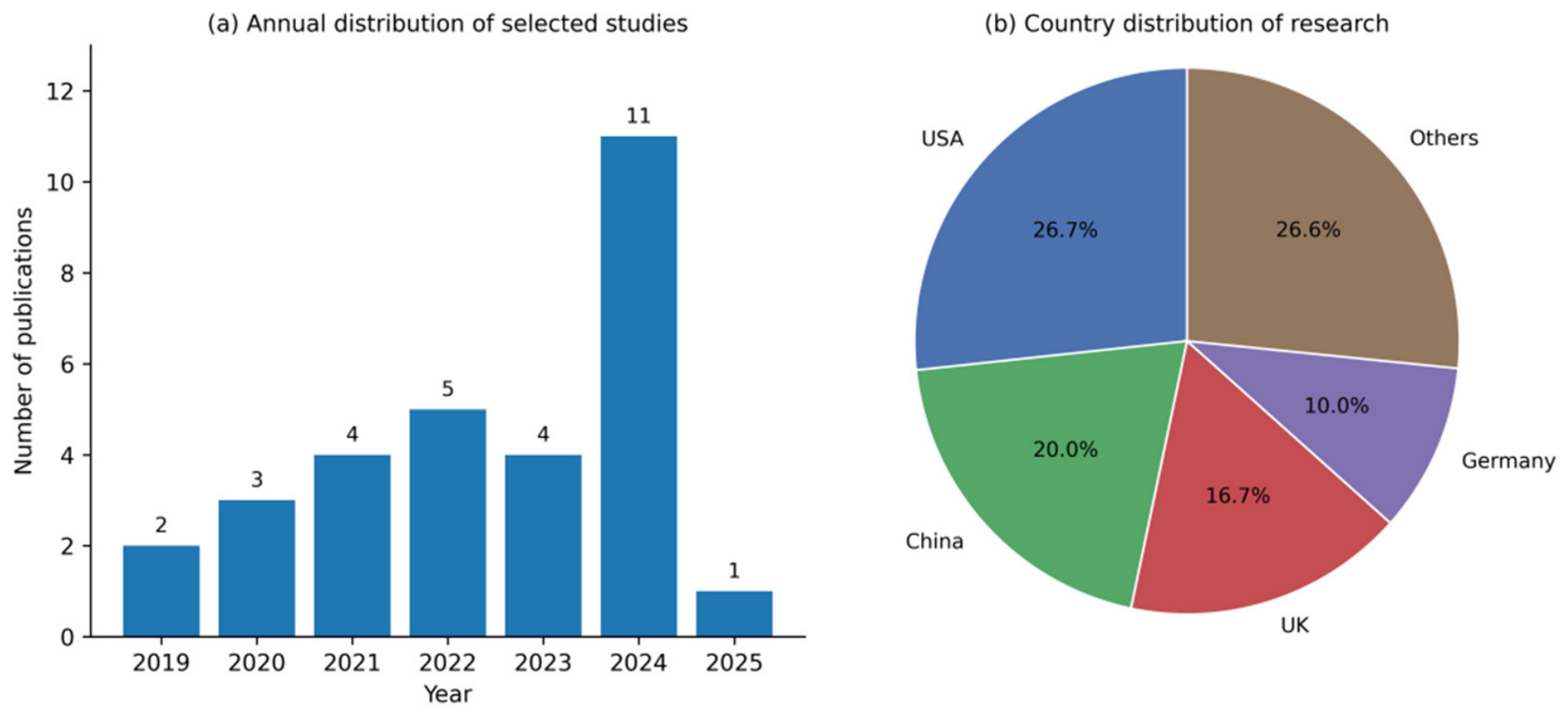
2.1.1. Temporal and Geographical Distribution of UAM Research
2.1.2. Frequency Analysis of Key UAM Factors
2.2. Factor Categorization and Framework Construction
2.2.1. Categorization Logic of Key Factors
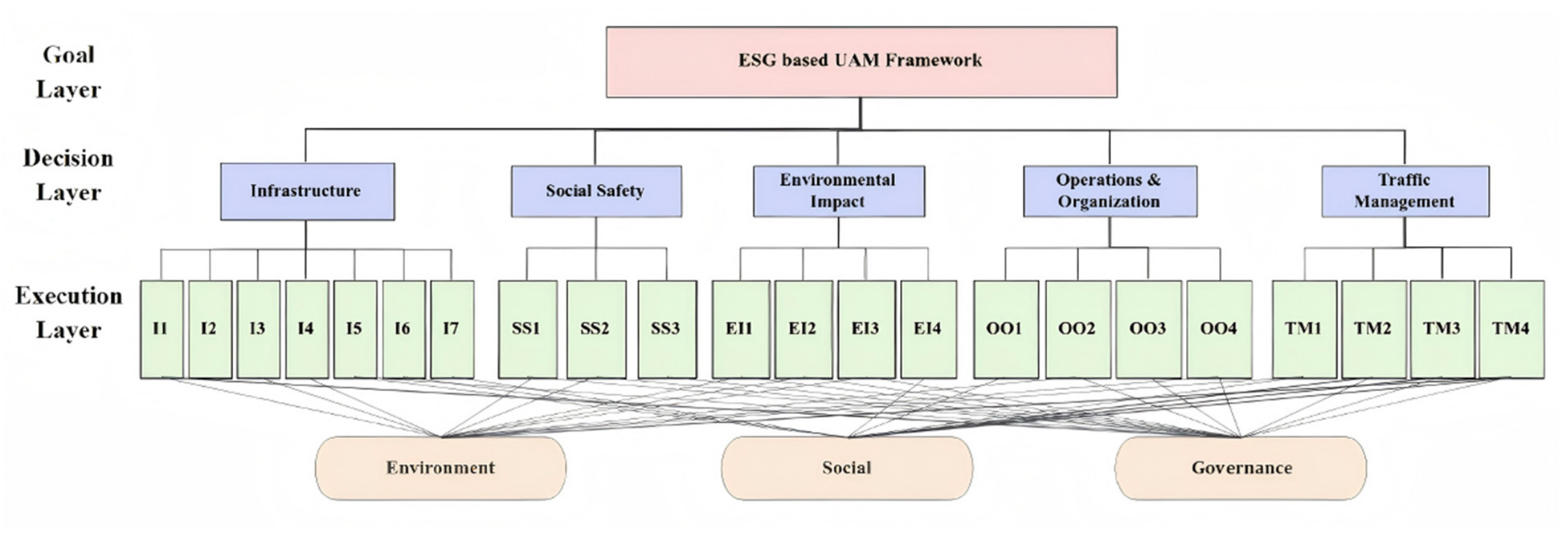
2.2.2. Integration of AHP and ESG Framework
3. Materials and Methods
3.1. Data Collection
3.1.1. Questionnaire Survey
3.1.2. Semi-Structured Interviews
3.1.3. Sample Characteristics
3.2. Analytical Methods
3.2.1. Reliability Analysis
3.2.2. Descriptive Statistical Analysis
3.2.3. Analytic Hierarchy Process
4. Results
4.1. Reliability Analysis Results
4.2. Descriptive Statistics and Ranking Analysis
4.2.1. Descriptive Statistics
4.2.2. Ranking Analysis
4.3. AHP Weighting Results
4.3.1. Decision-Layer Results
4.3.2. Execution-Layer Results
4.3.3. ESG Aggregation Results
5. Discussion
5.1. Interpretation of Key Findings
5.2. Comparison with the Existing Literature
5.3. Policy and Management Implications
6. Conclusions
Author Contributions
Funding
Institutional Review Board Statement
Informed Consent Statement
Data Availability Statement
Conflicts of Interest
Appendix A
Appendix A.1

| Decision-Layer Dimension | Execution-Layer Factor | Environmental | Social | Governance |
|---|---|---|---|---|
| Infrastructure | Conceptual Design | |||
| Technical Challenges | ||||
| Standard Certification | ||||
| Cost | ||||
| Green Energy Utilization | ||||
| Infrastructure Development | ||||
| Facility Assurance | ||||
| Social Safety | Social Acceptance | |||
| Privacy | ||||
| Flight Safety | ||||
| Environmental Impact | Noise Pollution | |||
| Visual Pollution | ||||
| Emissions Reduction Contribution | ||||
| Land Utilization | ||||
| Operations & Organization | Market Positioning | |||
| Talent Requirements | ||||
| Legal Regulations | ||||
| Management Framework | ||||
| Traffic Management | Airspace Structure Design | |||
| Digital Management | ||||
| Low-Altitude Airspace Resource Allocation Efficiency | ||||
| Dispatch Optimization |
| Scale | Interpretation |
|---|---|
| 1 | Equal importance |
| 3 | Slightly more important |
| 5 | Moderately more important |
| 7 | Strongly more important |
| 9 | Extremely more important |
| 2, 4, 6, 8 | Intermediate values |
| Reciprocal | When the second factor is more important |
| Hierarchical Level | Comparison Set | Number of Elements (n) | Number of Pairwise Comparisons (n(n − 1)/2) |
|---|---|---|---|
| Criteria Level | Governance dimensions | 5 | 10 |
| Sub-criteria Level | Infrastructure factors | 7 | 21 |
| Sub-criteria Level | Social safety factors | 3 | 3 |
| Sub-criteria Level | Environmental impact factors | 4 | 6 |
| Sub-criteria Level | Operations and organization factors | 4 | 6 |
| Sub-criteria Level | Traffic management factors | 4 | 6 |
Appendix A.2
| Expert ID | Sector | Organization Type | Position | Experience (Years) | Expertise Area |
|---|---|---|---|---|---|
| E1 | UAM Industry | eVTOL Manufacturer | Senior Engineer | 8 | Aircraft systems |
| E2 | Aviation Authority | Government Agency | Policy Analyst | 12 | Airspace regulation |
| E3 | Urban Planning | Municipal Government | Urban Planner | 10 | Urban transport planning |
| E4 | ESG Consulting | Consulting Firm | ESG Consultant | 7 | Sustainability assessment |
| E5 | Academia | University | Associate Professor | 15 | Transportation systems |
| E6 | Digital Technology | Technology Company | Project Manager | 9 | Smart mobility systems |
| E7 | Infrastructure | Airport Operator | Operations Manager | 11 | Infrastructure planning |
| Variable | Category | Number | Percentage (%) |
|---|---|---|---|
| Working experience | ≤5 years | 183 | 59.61 |
| 6–10 years | 121 | 39.41 | |
| >10 years | 3 | 0.98 | |
| Education level | Doctoral degree | 9 | 2.93 |
| Postgraduate | 85 | 27.69 | |
| Bachelor/Junior college | 211 | 68.73 | |
| High school or below | 2 | 0.65 | |
| Position | General employee | 285 | 92.83 |
| Department head | 17 | 5.54 | |
| Senior manager | 3 | 0.98 | |
| Other | 2 | 0.65 | |
| Professional background | ESG-related | 164 | 53.42 |
| UAM-related | 102 | 33.22 | |
| Other related fields | 41 | 13.36 | |
| Familiarity with UAM | First time / unfamiliar | 206 | 67.10 |
| ≤1 year | 97 | 31.60 | |
| 1–2 years | 2 | 0.65 | |
| >2 years | 2 | 0.65 | |
| Familiarity with ESG | First time | 7 | 2.28 |
| 0–1 years | 43 | 14.01 | |
| 1–2 years | 71 | 23.13 | |
| 2–3 years | 114 | 37.13 | |
| 3–4 years | 52 | 16.94 | |
| 4–5 years | 17 | 5.54 | |
| >5 years | 3 | 0.98 | |
| Total | 307 | 100.00 |
| Execution Layer | No. | Environmental Mean | SD | Social Mean | SD | Governance Mean | SD |
|---|---|---|---|---|---|---|---|
| Conceptual Design | I1 | 3.396 | 0.577 | 3.126 | 1.344 | 3.312 | 0.685 |
| Technical Challenges | I2 | 4.000 | 0.648 | 2.823 | 0.846 | 3.993 | 1.282 |
| Standard Certification | I3 | 4.629 | 0.639 | 2.797 | 0.822 | 4.323 | 1.480 |
| Cost | I4 | 3.021 | 0.308 | 2.897 | 0.835 | 3.528 | 1.081 |
| Green Energy Utilization | I5 | 4.035 | 0.703 | 3.957 | 0.694 | 4.180 | 1.505 |
| Infrastructure Development | I6 | 4.125 | 0.628 | 3.972 | 1.315 | 4.201 | 1.141 |
| Facility Assurance | I7 | 2.929 | 0.890 | 2.823 | 1.373 | 3.348 | 1.558 |
| Social Acceptance | SS1 | 3.935 | 1.113 | 4.241 | 1.112 | 4.022 | 1.078 |
| Privacy | SS2 | 2.663 | 1.174 | 4.589 | 0.698 | 4.033 | 1.069 |
| Flight Safety | SS3 | 3.248 | 1.565 | 3.801 | 1.455 | 3.205 | 0.554 |
| Noise Pollution | EI1 | 4.272 | 0.372 | 4.121 | 1.143 | 3.919 | 0.648 |
| Visual Pollution | EI2 | 4.194 | 0.452 | 4.101 | 1.141 | 3.868 | 0.698 |
| Emissions Reduction Contribution | EI3 | 3.855 | 0.458 | 2.738 | 0.894 | 4.062 | 0.445 |
| Land Utilization | EI4 | 2.773 | 0.855 | 3.429 | 1.066 | 3.282 | 0.890 |
| Market Positioning | OO1 | 3.033 | 0.669 | 3.585 | 0.929 | 3.433 | 0.982 |
| Talent Requirements | OO2 | 2.780 | 0.836 | 3.911 | 0.685 | 3.773 | 0.855 |
| Legal Regulations | OO3 | 3.979 | 0.725 | 3.490 | 0.703 | 4.467 | 0.383 |
| Management Framework | OO4 | 3.467 | 0.812 | 3.975 | 0.693 | 3.955 | 0.856 |
| Airspace Structure Design | TM1 | 2.053 | 1.379 | 2.718 | 1.078 | 1.972 | 0.710 |
| Digital Management | TM2 | 3.603 | 0.927 | 3.676 | 0.923 | 4.241 | 1.147 |
| Low-Altitude Airspace Resource Allocation Efficiency | TM3 | 3.230 | 1.151 | 2.430 | 1.154 | 3.267 | 1.147 |
| Dispatch Optimization | TM4 | 2.298 | 0.850 | 3.709 | 1.161 | 3.862 | 0.858 |
| Rank | Environmental | Mean | Social | Mean | Governance | Mean |
|---|---|---|---|---|---|---|
| 1 | Standard Certification | 4.629 | Privacy | 4.589 | Legal Regulations | 4.467 |
| 2 | Noise Pollution | 4.272 | Social Acceptance | 4.241 | Standard Certification | 4.323 |
| 3 | Visual Pollution | 4.194 | Noise Pollution | 4.121 | Digital Management | 4.241 |
| 4 | Infrastructure Development | 4.125 | Visual Pollution | 4.101 | Infrastructure Development | 4.201 |
| 5 | Green Energy Utilization | 4.035 | Management Framework | 3.975 | Green Energy Utilization | 4.180 |
| 6 | Technical Challenges | 4.000 | Infrastructure Development | 3.972 | Emissions Reduction Contribution | 4.062 |
| 7 | Legal Regulations | 3.979 | Green Energy Utilization | 3.957 | Privacy | 4.033 |
| 8 | Social Acceptance | 3.935 | Talent Requirements | 3.911 | Social Acceptance | 4.022 |
| 9 | Emissions Reduction Contribution | 3.855 | Flight Safety | 3.801 | Technical Challenges | 3.993 |
| 10 | Digital Management | 3.603 | Dispatch Optimization | 3.709 | Management Framework | 3.955 |
| 11 | Management Framework | 3.467 | Digital Management | 3.676 | Noise Pollution | 3.919 |
| 12 | Conceptual Design | 3.396 | Market Positioning | 3.585 | Visual Pollution | 3.868 |
| 13 | Flight Safety | 3.248 | Legal Regulations | 3.490 | Dispatch Optimization | 3.862 |
| 14 | Low-Altitude Airspace Resource Allocation Efficiency | 3.230 | Land Utilization | 3.429 | Talent Requirements | 3.773 |
| 15 | Market Positioning | 3.033 | Conceptual Design | 3.126 | Cost | 3.528 |
| 16 | Cost | 3.021 | Cost | 2.897 | Market Positioning | 3.433 |
| 17 | Facility Assurance | 2.929 | Technical Challenges | 2.823 | Facility Assurance | 3.348 |
| 18 | Talent Requirements | 2.780 | Facility Assurance | 2.823 | Conceptual Design | 3.312 |
| 19 | Land Utilization | 2.773 | Standard Certification | 2.797 | Land Utilization | 3.282 |
| 20 | Privacy | 2.663 | Emissions Reduction Contribution | 2.738 | Low-Altitude Airspace Resource Allocation Efficiency | 3.267 |
| 21 | Dispatch Optimization | 2.298 | Airspace Structure Design | 2.718 | Flight Safety | 3.205 |
| 22 | Airspace Structure Design | 2.053 | Low-Altitude Airspace Resource Allocation Efficiency | 2.430 | Airspace Structure Design | 1.972 |
References
- Tuffour, J.P.; Anokye, P.A. Accessibility Matters, but for Inner Suburbs Too: Unpacking the Impact of Accessibility Levels on Land Value and Transportation Management in the Kumasi Metropolitan Area, Ghana. Transp. Dev. Econ. 2024, 11, 10. [Google Scholar] [CrossRef]
- Hwang, J.H.; Hong, S. A Study on the Factors Influencing the Adoption of Urban Air Mobility and the Future Demand: Using the Stated Preference Survey for Three UAM Operational Scenarios in South Korea. J. Air Transp. Manag. 2023, 112, 102467. [Google Scholar] [CrossRef]
- Chen, X.; Yi, X.; Yang, Y.; Liu, Y.; Qu, X. Measuring Urban Road Transportation Efficiency: A Nonparametric Slack-Based Analysis with Malmquist and Luenberger Productivity Indices. Transp. Res. Part A Policy Pract. 2026, 205, 104845. [Google Scholar] [CrossRef]
- Deng, X.; Wang, L.; Gui, J.; Jiang, P.; Chen, X.; Zeng, F.; Wan, S. A Review of 6G Autonomous Intelligent Transportation Systems: Mechanisms, Applications and Challenges. J. Syst. Archit. 2023, 142, 102929. [Google Scholar] [CrossRef]
- Yan, Y.; Wang, K.; Qu, X. Urban Air Mobility (UAM) and Ground Transportation Integration: A Survey. Front. Eng. Manag. 2024, 11, 734–758. [Google Scholar] [CrossRef]
- Ditta, C.C.; Postorino, M.N. Three-Dimensional Urban Air Networks for Future Urban Air Transport Systems. Sustainability 2023, 15, 13551. [Google Scholar] [CrossRef]
- Xu, J.; Guan, C.; Wang, Y.; Zhuang, J.; Gan, W. A Systematic Review of Urban Air Mobility Development: eVTOL Drones’ Technological Challenges and Low-Altitude Policies of Shenzhen. Drones 2025, 9, 842. [Google Scholar] [CrossRef]
- Bridgelall, R. Forecasting Market Opportunities for Urban and Regional Air Mobility. Technol. Forecast. Soc. Change 2023, 196, 122835. [Google Scholar] [CrossRef]
- Wu, W.; Lyu, Y.; Zheng, C.; Hao, J.L.; Shen, S.; Yu, S. Digital Supervision in Construction Pollution Control: Utilizing Advanced Information Models for Enhanced Supervision and Sustainability. Environ. Technol. Innov. 2025, 37, 104038. [Google Scholar] [CrossRef]
- Guo, C.; Nie, J.; Hang, X.; Wang, Y.; Chen, Y.; Delahaye, D. VTOL Site Location Considering Obstacle Clearance during Approach and Departure. Commun. Transp. Res. 2024, 4, 100118. [Google Scholar] [CrossRef]
- Liberacki, A.; Trincone, B.; Duca, G.; Aldieri, L.; Vinci, C.P.; Carlucci, F. The Environmental Life Cycle Costs (ELCC) of Urban Air Mobility (UAM) as an Input for Sustainable Urban Mobility. J. Clean. Prod. 2023, 389, 136009. [Google Scholar] [CrossRef]
- Petrus, M.; Popa, C.; Bratu, A.-M. Temporal Variations in Urban Air Pollution during a 2021 Field Campaign: A Case Study of Ethylene, Benzene, Toluene, and Ozone Levels in Southern Romania. Sustainability 2024, 16, 3219. [Google Scholar] [CrossRef]
- Tojal, M.; Paletti, L. Is Urban Air Mobility Environmentally Feasible? Defining the Guidelines for a Sustainable Implementation of Its Ecosystem. Transp. Res. Procedia 2023, 72, 1747–1754. [Google Scholar] [CrossRef]
- Johnson, R.A.; Miller, E.E.; Conrad, S. Technology Adoption and Acceptance of Urban Air Mobility Systems: Identifying Public Perceptions and Integration Factors. Int. J. Aerosp. Psychol. 2022, 32, 240–253. [Google Scholar] [CrossRef]
- Xu, Y.; Zhu, N. The Effect of Environmental, Social, and Governance (ESG) Performance on Corporate Financial Performance in China: Based on the Perspective of Innovation and Financial Constraints. Sustainability 2024, 16, 3329. [Google Scholar] [CrossRef]
- Cui, J.; Sharifi, E.; Bartesaghi Koc, C.; Yi, L.; Hawken, S. Factors Shaping Biodiversity in Urban Voids: A Systematic Literature Review. Land 2025, 14, 821. [Google Scholar] [CrossRef]
- Zheng, C.; Qiao, G.; Hao, J.L.; Sarno, L.D.; Mannis, A.; Wen, Z.; Xu, B.; Wang, L. Tripartite Evolutionary Game Analysis of Collaborative Governance in Construction and Demolition Waste Management. J. Build. Des. Environ. 2025, 3, 202537. [Google Scholar] [CrossRef]
- Wang, L.; Deng, X.; Gui, J.; Jiang, P.; Zeng, F.; Wan, S. A Review of Urban Air Mobility-Enabled Intelligent Transportation Systems: Mechanisms, Applications and Challenges. J. Syst. Archit. 2023, 141, 102902. [Google Scholar] [CrossRef]
- Lewis, E.; Ponnock, J.; Cherqaoui, Q.; Holmdahl, S.; Johnson, Y.; Wong, A.; Oliver Gao, H. Architecting Urban Air Mobility Airport Shuttling Systems with Case Studies: Atlanta, Los Angeles, and Dallas. Transp. Res. Part A Policy Pract. 2021, 150, 423–444. [Google Scholar] [CrossRef]
- Murça, M.C.R. Identification and Prediction of Urban Airspace Availability for Emerging Air Mobility Operations. Transp. Res. Part C Emerg. Technol. 2021, 131, 103274. [Google Scholar] [CrossRef]
- Zewde, L.; Raptis, I.A. Conceptualizing UAM: Technologies and Methods for Safe and Efficient Urban Air Transportation. Green Energy Intell. Transp. 2026, 5, 100265. [Google Scholar] [CrossRef]
- Ma, Z.; Yang, X.; Chen, A.; Zhu, T.; Wu, J. Assessing the Resilience of Multi-Modal Transportation Networks with the Integration of Urban Air Mobility. Transp. Res. Part A Policy Pract. 2025, 195, 104465. [Google Scholar] [CrossRef]
- Babetto, L.; Kirste, A.; Deng, J.; Husemann, M.; Stumpf, E. Adoption of the Urban Air Mobility System: Analysis of Technical, Legal and Social Aspects from a European Perspective. J. Air Transp. Res. Soc. 2023, 1, 152–174. [Google Scholar] [CrossRef]
- Jia, H.; Lin, C.; Iwabuchi, M.; Kikumoto, H. Ten Questions Concerning Urban Wind Environments for the Safe Utilization of Urban Air Mobility. Build. Environ. 2026, 290, 114136. [Google Scholar] [CrossRef]
- Tang, L.; Yue, C.; Ma, L.; Zhao, J.; Zhou, Y. City Fly: Modeling Demand and Vertiport Location Jointly for Urban Commuting. Travel Behav. Soc. 2026, 42, 101142. [Google Scholar] [CrossRef]
- Du, S.; Zhong, G.; Wang, F.; Wu, L.; Zhang, H.; Xue, D. A Framework for Collaborative UAM Traffic Flow Optimization with Mission Preferences: Incorporating Customized Strategy Synergy into Strategic Conflict Management. Transp. Res. Part E Logist. Transp. Rev. 2025, 202, 104326. [Google Scholar] [CrossRef]
- Xu, L.; Xie, L.; Mei, S.; Hao, J.L.; Zhang, Y.; Song, Y. Corporate Sustainability Reporting and Stakeholders’ Interests: Evidence from China. Sustainability 2024, 16, 3443. [Google Scholar] [CrossRef]
- Cohen, A.P.; Shaheen, S.A.; Farrar, E.M. Urban Air Mobility: History, Ecosystem, Market Potential, and Challenges. IEEE Trans. Intell. Transp. Syst. 2021, 22, 6074–6087. [Google Scholar] [CrossRef]
- Dang, X.; Peng, J.; Deng, X. How to Improve the Environmental, Social and Governance Performance of Chinese Construction Enterprises Based on the Fuzzy Set Qualitative Comparative Analysis Method. Sustainability 2024, 16, 3153. [Google Scholar] [CrossRef]
- Volakakis, V.; Mahmassani, H.S. Strategic Vertiport Placement for Airport Access: Utilizing Urban Air Mobility for Accelerated and Reliable Transportation. Infrastructures 2025, 10, 242. [Google Scholar] [CrossRef]
- Lu, Y.; Zeng, W.; Wei, W.; Wu, W.; Jiang, H. Vertiport Location Selection and Optimization for Urban Air Mobility in Complex Urban Scenes. Aerospace 2025, 12, 709. [Google Scholar] [CrossRef]
- Li, X.; Dang, A.; Chen, M. Green, Safe, and Cost-Effective? An Integrated Structural Analysis of Public Acceptance of Urban Air Mobility. Transp. Policy 2025, 173, 103795. [Google Scholar] [CrossRef]
- Tedeschi, P.; Al Nuaimi, F.A.; Awad, A.I.; Natalizio, E. Privacy-Aware Remote Identification for Unmanned Aerial Vehicles: Current Solutions, Potential Threats, and Future Directions. IEEE Trans. Ind. Inform. 2024, 20, 1069–1080. [Google Scholar] [CrossRef]
- Ranganathan, S.I.; Ilangovan, H.; Campbell, N.H.; Acheson, M.J.; Gregory, I.M. Systems Approach to AI Model Integration & Performance in Generic Urban Air Mobility Simulation. In AIAA SCITECH 2025 Forum; American Institute of Aeronautics and Astronautics: Reston, VA, USA, 2025. [Google Scholar]
- Kim, S.; Zhang, K. Willingness to Use Urban Air Mobility (UAM) as an Airport Shuttle across Levels of Automation. J. Urban Mobil. 2025, 8, 100162. [Google Scholar] [CrossRef]
- Zhou, Z.; Liu, Y.; Hao, J.L.; Yu, S.; Skitmore, M.; Zheng, C. Collaborative Strategies for Enhancing Pro-Environmental Behavior in Renovation Waste Management: An Evolutionary Game Approach to Achieving a Circular Economy. Sustain. Chem. Pharm. 2025, 48, 102192. [Google Scholar] [CrossRef]
- Park, J.Y.; Kim, S.; Khemka, S.; Lee, C.Y.; Gao, Z. Integrating Urban Analytics in Low-Noise Airspace Design for Urban Air Mobility. Aerosp. Sci. Technol. 2026, 171, 111650. [Google Scholar] [CrossRef]
- Li, W.; Cheng, R.; Huang, H.; Garg, A.; Gao, L. Energy Consumption Modeling and Optimization of an eVTOL Aircraft: Integrating Weight, Motor, and Battery Dynamics. Energy 2025, 325, 136229. [Google Scholar] [CrossRef]
- Chen, Y.; Fu, R.; Jia, S. Flight Path Planning with Ground Risk and Noise Mitigation for Urban Air Mobility. Reliab. Eng. Syst. Saf. 2026, 270, 112176. [Google Scholar] [CrossRef]
- Santos, M.R.; Kalakou, S.; Ferreira, F.A.F. Mapping Research Achievements on Urban Air Mobility: A Systematic Literature Review. Socio-Econ. Plan. Sci. 2026, 104, 102392. [Google Scholar] [CrossRef]
- Aldemir, H.Ö.; Mavi, H. UAM Passenger Business Model Development: The Effect of Aviation Authorities’ Strategies and Technological Advancements. Transp. Res. Procedia 2024, 81, 35–43. [Google Scholar] [CrossRef]
- Tsou, C. Rethinking Transitions through Dual-Regime Dynamics: The Emergence of the Flying Car Sector in China. Technol. Forecast. Soc. Change 2026, 223, 124435. [Google Scholar] [CrossRef]
- Cavagnetto, N.; Tomasello, P.; Arrigoni, V.; Tackacs, V.; Simons, R.; Wagstaff, A.; De Rooy, D.; Brambati, F. Integrating Mental Health into Aviation Safety in an AI-Powered Future. Transp. Res. Procedia 2025, 88, 209–216. [Google Scholar] [CrossRef]
- Wang, Z.; Delahaye, D.; Farges, J.-L.; Alam, S. A Quasi-Dynamic Air Traffic Assignment Model for Mitigating Air Traffic Complexity and Congestion for High-Density UAM Operations. Transp. Res. Part C Emerg. Technol. 2023, 154, 104279. [Google Scholar] [CrossRef]
- Husemann, M.; Lahrs, L.; Stumpf, E. The Impact of Dispatching Logic on the Efficiency of Urban Air Mobility Operations. J. Air Transp. Manag. 2023, 108, 102372. [Google Scholar] [CrossRef]
- Liu, Y.; Pan, T.; Tan, J.; Zhong, R.; Chen, C. Integrated Take-off Management and Trajectory Optimization for Merging Control in Urban Air Mobility Corridors. Transp. Res. Part C Emerg. Technol. 2026, 182, 105370. [Google Scholar] [CrossRef]
- Song, K.; Yeo, H. Development of Optimal Scheduling Strategy and Approach Control Model of Multicopter VTOL Aircraft for Urban Air Mobility (UAM) Operation. Transp. Res. Part C Emerg. Technol. 2021, 128, 103181. [Google Scholar] [CrossRef]
- Ateeq, M.; Zhang, N.; Zhao, W.; Gu, Y.; Wen, Z.; Zheng, C.; Hao, J.L. Enhancing Construction Waste Transportation Management Using Internet of Things (IoT): An Evaluation Framework Based on AHP–FCE Method. Buildings 2025, 15, 1381. [Google Scholar] [CrossRef]
- Moslem, S.; Farooq, D.; Pilla, F.; Esztergár-Kiss, D.; Farooq, A.; Tufail, R.F.; Martinez-Pastor, B.; Rzayeva, U. Evaluating Pedestrian Behavior Factors Related to Road Safety Using Analytic Hierarchy Process and Kendall’s Correlation in a Fuzzy Environment. Transp. Res. Interdiscip. Perspect. 2026, 36, 101850. [Google Scholar] [CrossRef]
- Wen, Z.; Zheng, C.; Hao, J.L.; Yu, S. Built Environment and Elderly Safety Risks in Old Residential Communities Under Urban Renewal. Urban Sci. 2026, 10, 54. [Google Scholar] [CrossRef]
- Al Qudah, S.M.; Fuentes-Bargues, J.L.; Ferrer-Gisbert, P.S.; Al-Abdallat, H.N.; Sánchez-Lite, A. Assessing Risk Management Implementation in Jordanian Construction Projects: A Perception-Based Quantitative Survey of Organizational and Project-Level Practices. Buildings 2026, 16, 401. [Google Scholar] [CrossRef]
- Guo, N.; Hao, J.L.; Zheng, C.; Yu, S.; Wu, W. Applying Social Cognitive Theory to the Determinants of Employees’ Pro-Environmental Behaviour Towards Renovation Waste Minimization: In Pursuit of a Circular Economy. Waste Biomass Valorization 2022, 13, 3739–3752. [Google Scholar] [CrossRef]
- Fredriksson, H.; Danielsson, A.; Gundlegård, D.; Rydergren, C. Exploring Spatio-Temporal Traffic Performance Variation through Clustering of Descriptive Travel Time Statistics. Transp. Res. Procedia 2025, 86, 747–754. [Google Scholar] [CrossRef]
- Mirza, M.A.; Khurshid, K.; Shah, Z.; Ullah, I.; Binbusayyis, A.; Mahdavi, M. ILS Validity Analysis for Secondary Grade through Factor Analysis and Internal Consistency Reliability. Sustainability 2022, 14, 7950. [Google Scholar] [CrossRef]
- Weeks, K.; Safa, M.; Zamiran, S. The Productivity–Safety Nexus: The Impact of Human Factors on Operational Efficiency in Construction Projects. Buildings 2026, 16, 87. [Google Scholar] [CrossRef]
- Tipu, W.A.; Mughal, Y.H.; Kundi, G.M.; Nair, K.S.; Thurasamy, R. Enhancing the Sustainable Performance of Public–Private Partnership Projects: The Buffering Effect of Environmental Uncertainty. Buildings 2024, 14, 3879. [Google Scholar] [CrossRef]
- Rahayu, N.I.; Muktiarni, M.; Hidayat, Y. An Application of Statistical Testing: A Guide to Basic Parametric Statistics in Educational Research Using SPSS. ASEAN J. Sci. Eng. 2024, 4, 569–582. [Google Scholar] [CrossRef]
- Afifah, S.; Mudzakir, A.; Nandiyanto, A.B.D. How to Calculate Paired Sample T-Test Using SPSS Software: From Step-by-Step Processing for Users to the Practical Examples in the Analysis of the Effect of Application Anti-Fire Bamboo Teaching Materials on Student Learning Outcomes. Indones. J. Teach. Sci. 2022, 2, 81–92. [Google Scholar] [CrossRef]
- Chaturvedi, S.; Bhatt, N.; Shah, V.; Patel, D.; Jodhani, K.; Singh, S.K. Spatial Multi-Criteria Decision Framework for Landfill Site Selection Using AHP and CODAS with Sensitivity Analysis: A Case Study of Vadodara, India. J. Clean. Prod. 2026, 548, 147832. [Google Scholar] [CrossRef]
- Daimi, S.; Rebai, S. Sustainability Performance Assessment of Tunisian Public Transport Companies: AHP and ANP Approaches. Socio-Econ. Plan. Sci. 2023, 89, 101680. [Google Scholar] [CrossRef]
- Ahmed, F.; Kilic, K. Does Fuzzification of Pairwise Comparisons in Analytic Hierarchy Process Add Any Value? Soft Comput. 2024, 28, 4267–4284. [Google Scholar] [CrossRef]
- Qian, J.; Siriwardana, C.; Shahzad, W. Identifying Critical Criteria on Assessment of Sustainable Materials for Construction Projects in New Zealand Through the Analytic Hierarchy Process (AHP) Approach. Buildings 2024, 14, 3854. [Google Scholar] [CrossRef]
- Stofkova, J.; Krejnus, M.; Stofkova, K.R.; Malega, P.; Binasova, V. Use of the Analytic Hierarchy Process and Selected Methods in the Managerial Decision-Making Process in the Context of Sustainable Development. Sustainability 2022, 14, 11546. [Google Scholar] [CrossRef]
- Ma, W.; Hao, J.L. Enhancing a Circular Economy for Construction and Demolition Waste Management in China: A Stakeholder Engagement and Key Strategy Approach. J. Clean. Prod. 2024, 450, 141763. [Google Scholar] [CrossRef]
- Liu, R.; Xia, H.; Li, L.; Li, Q.; Liu, S. Transit Oriented Development under the Influence of Urban Air Mobility: A Public Transit-Based Vertiport Siting Method. J. Air Transp. Manag. 2026, 133, 102962. [Google Scholar] [CrossRef]
- Ren, X.; Wang, J. Symbiotic Evolution Mechanism of Urban Air Mobility Industrial Innovation Ecosystem: Evidence from Low Altitude Air Mobility in Shenzhen. J. Air Transp. Manag. 2025, 124, 102750. [Google Scholar] [CrossRef]
- Nazari, F.; Noruzoliaee, M.; Nurul Habib, K. Assessing Public Acceptance of Urban Air Mobility: Behavioral Insights. J. Air Transp. Manag. 2026, 131, 102907. [Google Scholar] [CrossRef]
- Velaz-Acera, N.; Arcauz-Durán, D.; Borge-Diez, D. Life Cycle Assessment of eVTOL Vehicles in Island Systems. Case Study: Canary Islands. Transp. Res. Procedia 2023, 71, 387–394. [Google Scholar] [CrossRef]
- Kim, S.; Kim, T.; Suh, K.; Jeon, J. Energy and Environmental Performance of a Passenger Drone for an Urban Air Mobility (UAM) Policy with 3D Spatial Information in Seoul. J. Clean. Prod. 2023, 415, 137683. [Google Scholar] [CrossRef]


| No. | Factor | Description | Frequency |
|---|---|---|---|
| 1 | Infrastructure development | Includes vertiport construction, hub layout, land-use planning, capacity design, and spatial configuration for UAM operations. | 22 |
| 2 | Digital management | Enables real-time traffic monitoring, intelligent route optimization, and digital approval systems for low-altitude operations. | 21 |
| 3 | Legal regulations | Addresses regulatory gaps, as existing aviation frameworks are not fully applicable to low-altitude and high-frequency UAM operations. | 17 |
| 4 | Social acceptance | Public perception and concerns regarding safety, economic feasibility, and environmental impacts of UAM. | 15 |
| 5 | Flight safety | Ensures reliable communication, obstacle avoidance, and redundant safety systems in complex urban environments. | 13 |
| 6 | Management framework | Establishes cross-departmental coordination and integrated regulatory mechanisms for UAM governance. | 11 |
| 7 | Technical challenges | Addresses eVTOL performance limitations, including safety, endurance, and system integration. | 10 |
| 8 | Green energy utilization | Improves environmental performance through advancements in battery technology and energy systems. | 9 |
| 9 | Airspace structure design | Develops dynamic airspace planning and management for efficient low-altitude operations. | 7 |
| 10 | Noise pollution | Low-altitude operational noise that may affect urban residents and constrain large-scale deployment. | 7 |
| 11 | Standard certification | Establishes airworthiness, safety, communication, and operational standards for UAM systems. | 6 |
| 12 | Cost | High infrastructure investment and operational expenses that may hinder commercialization. | 6 |
| 13 | Dispatch optimization | Improves traffic efficiency and safety through advanced scheduling and operational coordination. | 6 |
| 14 | Airspace allocation efficiency | Enhances utilization through differentiated zoning and resource management. | 6 |
| 15 | Talent requirements | Requires new technical workforce development and retraining for related industries. | 5 |
| 16 | Privacy protection | Addresses data security and cybersecurity risks related to location tracking and aerial data collection. | 4 |
| 17 | Market positioning | Defines service demand, operational scenarios, and business models for UAM applications. | 2 |
| 18 | Visual impact | Potential changes to urban landscape and skyline that may influence public acceptance. | 2 |
| 19 | Emissions reduction potential | Contribution of electric operations to carbon reduction in urban transport. | 2 |
| 20 | Conceptual design | Integrates UAM into urban planning and long-term development strategies. | 1 |
| 21 | Facility assurance | Provides charging, maintenance, and operational support infrastructure. | 1 |
| 22 | Land utilization | Ensures spatial compatibility and integration with existing urban facilities and transport hubs. | 1 |
| Decision Layer | Cronbach’s Alpha | ||
|---|---|---|---|
| Environmental | Social | Governance | |
| Infrastructure | 0.930 | 0.939 | 0.947 |
| Social Safety | 0.872 | 0.868 | 0.871 |
| Environmental Impact | 0.848 | 0.858 | 0.872 |
| Operations & Organization | 0.880 | 0.907 | 0.898 |
| Traffic Management | 0.925 | 0.929 | 0.922 |
| Rank | Environmental | Mean | Social | Mean | Governance | Mean |
|---|---|---|---|---|---|---|
| 1 | Standard Certification | 4.629 | Privacy | 4.589 | Legal Regulations | 4.467 |
| 2 | Noise Pollution | 4.272 | Social Acceptance | 4.241 | Standard Certification | 4.323 |
| 3 | Visual Pollution | 4.194 | Noise Pollution | 4.121 | Digital Management | 4.241 |
| 4 | Infrastructure Development | 4.125 | Visual Pollution | 4.101 | Infrastructure Development | 4.201 |
| 5 | Green Energy Utilization | 4.035 | Management Framework | 3.975 | Green Energy Utilization | 4.180 |
| Dimension | Feature Vector | Weight (%) |
|---|---|---|
| Infrastructure | 0.322 | 6.445 |
| Social Safety | 0.350 | 6.999 |
| Environmental Impact | 0.893 | 17.859 |
| Operations & Organization | 2.062 | 41.245 |
| Traffic Management | 1.373 | 27.452 |
| Maximum eigenvalue | λmax = 5.223 | - |
| Consistency index | CI = 0.056 | - |
| Consistency ratio | CR = 0.050 | - |
| Decision Layer | Execution Factor | Weight (%) |
|---|---|---|
| Infrastructure | Conceptual Design | 4.50 |
| Technical Challenges | 16.20 | |
| Standard Certification | 31.07 | |
| Cost | 12.18 | |
| Green Energy Utilization | 7.54 | |
| Infrastructure Development | 19.46 | |
| Facility Assurance | 9.05 | |
| Social Safety | Social Acceptance | 38.10 |
| Privacy | 46.18 | |
| Flight Safety | 15.72 | |
| Environmental Impact | Noise Pollution | 54.05 |
| Visual Pollution | 13.77 | |
| Emissions Reduction Contribution | 26.19 | |
| Land Utilization | 5.99 | |
| Operations & Organization | Market Positioning | 18.25 |
| Talent Requirements | 23.45 | |
| Legal Regulations | 27.10 | |
| Management Framework | 31.20 | |
| Traffic Management | Airspace Structure Design | 8.03 |
| Digital Management | 50.53 | |
| Low-altitude Airspace Resource Allocation Efficiency | 29.41 | |
| Dispatch Optimization | 12.03 |
| ESG Dimension | Cumulative Weight (%) |
|---|---|
| Governance (G) | 38.72 |
| Social (S) | 32.15 |
| Environmental (E) | 29.13 |
Disclaimer/Publisher’s Note: The statements, opinions and data contained in all publications are solely those of the individual author(s) and contributor(s) and not of MDPI and/or the editor(s). MDPI and/or the editor(s) disclaim responsibility for any injury to people or property resulting from any ideas, methods, instructions or products referred to in the content. |
© 2026 by the authors. Licensee MDPI, Basel, Switzerland. This article is an open access article distributed under the terms and conditions of the Creative Commons Attribution (CC BY) license.
Share and Cite
Wen, Z.; Liu, W.; Zheng, C.; Hao, J.L. Towards Sustainable Urban Mobility: An ESG-Based Decision Framework for Urban Air Integration. Sustainability 2026, 18, 4904. https://doi.org/10.3390/su18104904
Wen Z, Liu W, Zheng C, Hao JL. Towards Sustainable Urban Mobility: An ESG-Based Decision Framework for Urban Air Integration. Sustainability. 2026; 18(10):4904. https://doi.org/10.3390/su18104904
Chicago/Turabian StyleWen, Ziying, Wansong Liu, Caimiao Zheng, and Jian Li Hao. 2026. "Towards Sustainable Urban Mobility: An ESG-Based Decision Framework for Urban Air Integration" Sustainability 18, no. 10: 4904. https://doi.org/10.3390/su18104904
APA StyleWen, Z., Liu, W., Zheng, C., & Hao, J. L. (2026). Towards Sustainable Urban Mobility: An ESG-Based Decision Framework for Urban Air Integration. Sustainability, 18(10), 4904. https://doi.org/10.3390/su18104904