A Full-Process Carbon Footprint Assessment of Online and Offline Apparel Sales: Integrating Return Logistics
 ,
,
Abstract
1. Introduction
2. Materials and Methods
2.1. Goal and Scope Definition
2.2. System Boundary
2.3. Model Architecture
2.3.1. Model Architecture from Transportation
2.3.2. Model Architecture from Packaging
2.3.3. Model Architecture from Storage
2.3.4. Model Architecture from Operation
2.4. Data Sources and Assumptions
3. Case Study
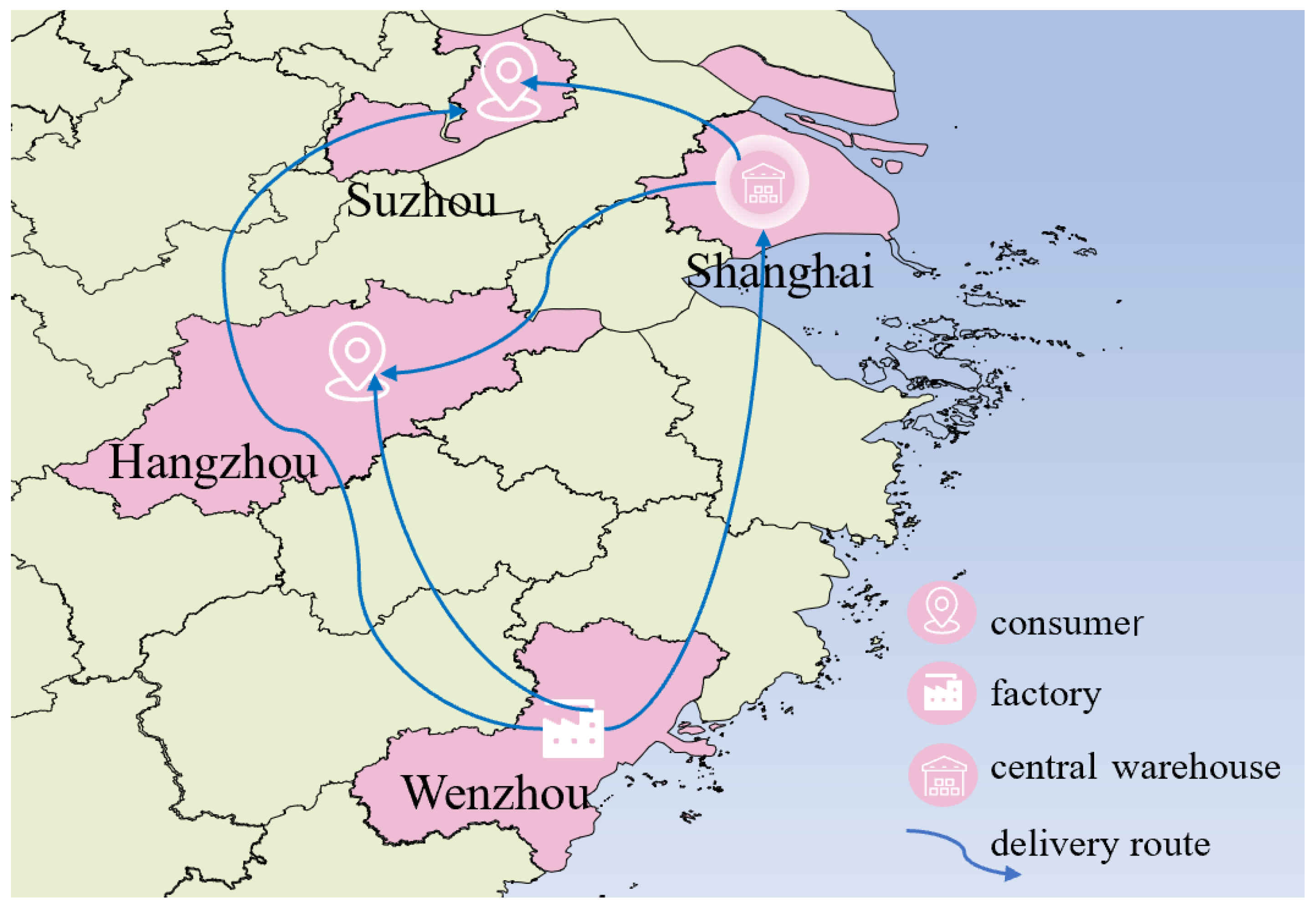
3.1. Basic Data for the Case Study
3.2. Analysis Results
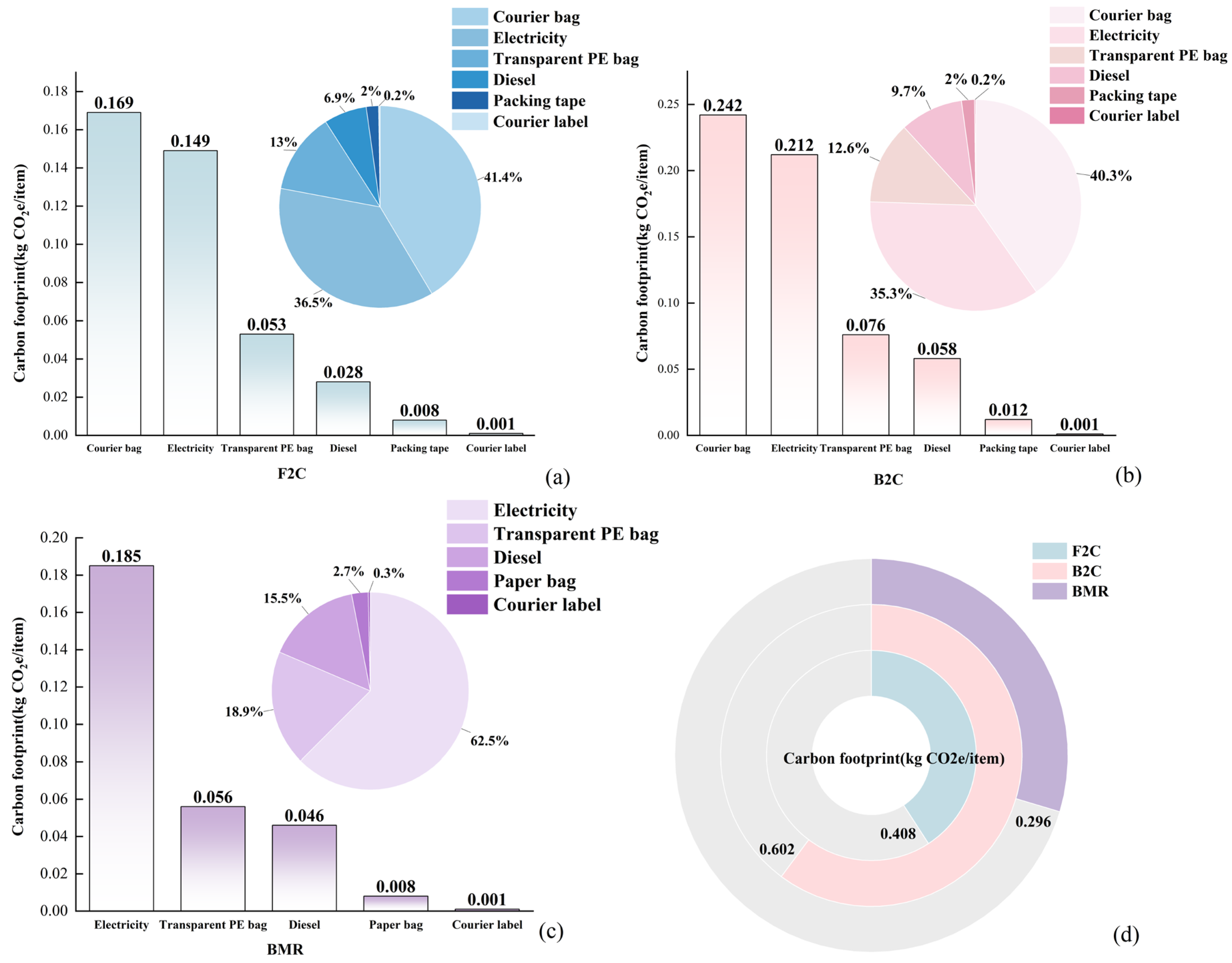
3.2.1. Carbon Footprint Results Analysis
3.2.2. Greenhouse-Gas Emission Source Analysis
4. Uncertainty and Sensitivity Analysis
4.1. Uncertainty Analysis
4.2. Sensitivity Analysis
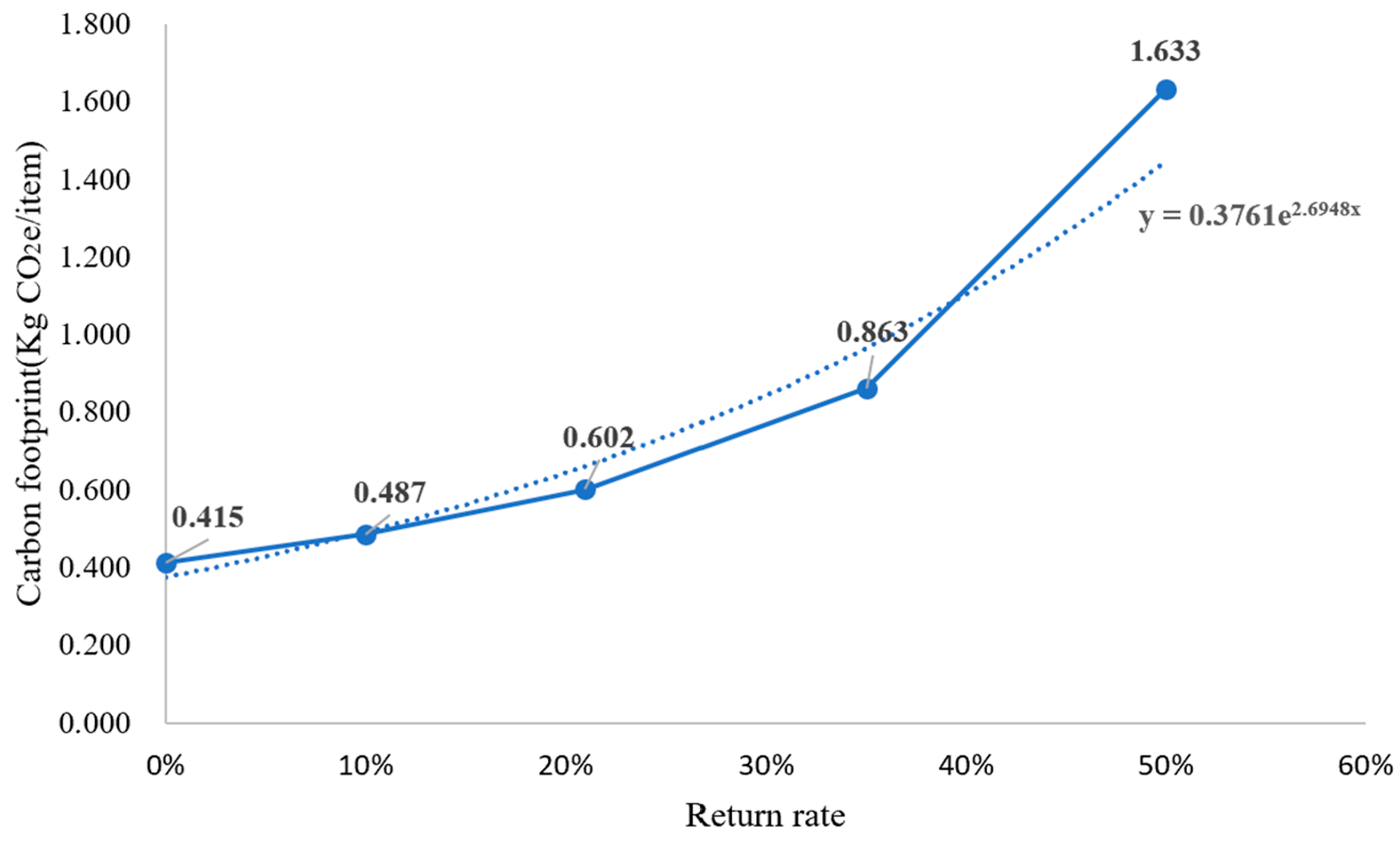
4.2.1. Return Rates’ Impact on the Carbon Footprint During the Sales Stage
4.2.2. The Impact of Transportation Distance on the Carbon Footprint of the Transportation Process
4.2.3. Sensitivity Analysis of the Carbon Footprint of the Packaging Process Based on Packaging Weight and Packaging Type
5. Conclusions
Supplementary Materials
Author Contributions
Funding
Institutional Review Board Statement
Informed Consent Statement
Data Availability Statement
Conflicts of Interest
Abbreviations
| F2C | Factory-to-Customer |
| B2C | Business-to-Customer |
| BMR | Brick-and-Mortar Retail |
| CO2 | Carbon Dioxide |
| CO2e | Carbon Dioxide Equivalent |
| CPCD | China Products Carbon Footprint Factors Database |
| GHG | Greenhouse Gas |
| HVAC | Heating, Ventilation, and Air Conditioning |
| IEA | International Energy Agency |
| ISO | International Organization for Standardization |
| LCA | Life Cycle Assessment |
| PE | Polyethylene |
| PEFCR | Product Environmental Footprint Category Rules |
| CF | Carbon Footprint |
| i | Sales model index: 1 = F2C, 2 = B2C, 3 = BMR |
| j | Region or product category index |
| k | Vehicle type index |
| Weighted average distance from factory to consumer under model i | |
| Weighted average distance from central warehouse to consumer under model | |
| Weighted average distance from central warehouse to retail store under model | |
| Fixed transport distance from factory to central warehouse | |
| Dynamic weighted average transport distance under model i (including returns/exchanges) | |
| Number of items shipped to region under model | |
| Transport distance from origin to region under model | |
| Total quantity of goods sold under model i (including returns/exchanges) | |
| Number of successfully sold items under model i | |
| Total quantity of goods shipped from factory to central warehouse under model i | |
| Return rate under model i | |
| Exchange rate under model i | |
| Number of returned items under model i | |
| Number of exchanged items under model i | |
| Proportion of total transport distance attributed to vehicle type k under model i | |
| Total weight of target apparel items carried by vehicle type k under model i | |
| Total weight of all goods carried by vehicle type k under model i | |
| Number of target apparel items shipped via vehicle type k under model i | |
| Carbon footprint of transport stage under model | |
| Physical volume of a single item under model i | |
| Average storage duration under model | |
| Total usable volume capacity of warehouse under model i | |
| Total operational period of warehouse under model i | |
| Carbon footprint of storage stage under model i | |
| Carbon footprint of operation stage under model | |
| Quantitative measure of the intensity of activity under sales model | |
| Emission factor that converts activity data into greenhouse gas emissions under sales model |
References
- Niinimäki, K.; Peters, G.; Dahlbo, H.; Perry, P.; Rissanen, T.; Gwilt, A. The environmental price of fast fashion. Nat. Rev. Earth Environ. 2020, 1, 189–200, Correction in Nat. Rev. Earth Environ. 2020, 1, 278. https://doi.org/10.1038/s43017-020-0054-x. [Google Scholar] [CrossRef]
- China Environmental Journalists Association. 90% of Textile Firms Set Climate Targets; Carbon-Footprint Accounting from Fibre to Garment Still Lagging. Available online: https://mp.weixin.qq.com/s?__biz=MzI4OTEyMjg2NQ==&mid=2652481784&idx=1&sn=317a0babf5feb2c9f417b91b1d7f026c&poc_token=HLunImmjxUnntgllZFe_wRmjtQ6YmRIownu11VjW (accessed on 22 October 2025).
- Zhang, M.F.; An, Z.; Cao, Z.J.; Zhang, W.Q. Fashion Brands Scope 3 Decarbonization: Based on Limited Samples of the Chinese Experience. World Resour. Inst. 2024. [Google Scholar] [CrossRef]
- IPCC. Global Warming of 1.5 °C: An IPCC Special Report on the Impacts of Global Warming of 1.5 °C Above Pre-Industrial Levels and Related Global Greenhouse Gas Emission Pathways, in the Context of Strengthening the Global Response to the Threat of Climate Change, Sustainable Development, and Efforts to Eradicate Poverty. 2018. Available online: https://www.ipcc.ch/sr15/ (accessed on 12 March 2025).
- Sadowski, M.; Perkins, L.; McGarvey, E. Roadmap to Net Zero: Delivering Science-Based Targets in the Apparel Sector. Available online: https://www.wri.org/research/roadmap-net-zero-delivering-science-based-targets-apparel-sector (accessed on 11 October 2025).
- Energy Foundation. The GHG Emissions of Shopping: E-Commerce and Bricks and Mortar in China. Available online: https://share.weiyun.com/JCztjOvF (accessed on 22 October 2025).
- Dong, Q.; Zhong, C.; Geng, Y.; Dong, F.; Chen, W.; Zhang, Y. A bibliometric review of carbon footprint research. Carbon Footpr. 2024, 3, 3. [Google Scholar] [CrossRef]
- Tariq, G.; Sun, H.; Ali, S. Environmental footprint impacts of green energies, green energy finance and green governance in G7 countries. Carbon Footpr. 2024, 3, 5. [Google Scholar] [CrossRef]
- Fu, L.; Zhao, H.; Wang, H. Analysis of China’s apparel e-commerce market development trend and platform competition pattern. Text. Dye. Finish. J. 2025, 47, 152–154. [Google Scholar] [CrossRef]
- Xiang, Y. The ecological balance point of e-commerce under high return rates. Prosec. View 2025, 14, 42–43. [Google Scholar] [CrossRef]
- Zheng, R.; Wang, C.; Yin, S. Estimating carbon emissions from in-store shopping and timely home delivery of fresh produce: Evidence from China. J. Clean. Prod. 2025, 501, 145222. [Google Scholar] [CrossRef]
- Van Loon, P.; Deketele, L.; Dewaele, J.; McKinnon, A.; Rutherford, C. A comparative analysis of carbon emissions from online retailing of fast moving consumer goods. J. Clean. Prod. 2015, 106, 478–486. [Google Scholar] [CrossRef]
- Wiese, A.; Toporowski, W.; Zielke, S. Transport-related CO2 effects of online and brick-and-mortar shopping: A comparison and sensitivity analysis of clothing retailing. Transp. Res. Part D-Transp. Environ. 2012, 17, 473–477. [Google Scholar] [CrossRef]
- Mangiaracina, R.; Perego, A.; Perotti, S.; Tumino, A. Assessing the environmental impact of logistics in online and offline B2C purchasing processes in the apparel industry. Int. J. Logist. Syst. Manag. 2016, 23, 98–124. [Google Scholar] [CrossRef]
- He, X. Research on transportation modes in supply chain based on carbon footprint. Logist. Sci-Tech 2016, 39, 77–80. [Google Scholar] [CrossRef]
- Carbonstop. The GHG Emissions of E-Commerce Enterprises in China. Available online: https://share.weiyun.com/ZwY08a8V (accessed on 10 November 2025).
- Lu, A.; Bai, J. Research on carbon footprint clothing sales. Wool Text. J. 2014, 42, 56. [Google Scholar] [CrossRef]
- Rosas, D.A.; Lli-Torrabadella, C.; Tamames-Sobrino, M.; Miguel-Corbacho, I.; Olazagoitia, J.L. Consumer Carbon Footprint of Fashion E-Commerce: A Comparative Analysis Between Omnichannel and Pure-Player Models in Spain. Sustainability 2025, 17, 8690. [Google Scholar] [CrossRef]
- Seebauer, S.; Kulmer, V.; Bruckner, M.; Winkler, E. Carbon emissions of retail channels: The limits of available policy instruments to achieve absolute reductions. J. Clean. Prod. 2016, 132, 192–203. [Google Scholar] [CrossRef]
- Hischier, R. Car vs. Packaging—A First, Simple (Environmental) Sustainability Assessment of Our Changing Shopping Behaviour. Sustainability 2018, 10, 3061. [Google Scholar] [CrossRef]
- Long, J.; Liu, J. Hidden footprints in reverse logistics: The environmental impact of apparel returns and carbon emission assessment. Sustain. Futures 2025, 10, 101360. [Google Scholar] [CrossRef]
- Yu, C.; Yang, X.; Mu, J.; Liu, S. A systematic review of urban road traffic CO2 emission models. Carbon Footpr. 2025, 4, 17. [Google Scholar] [CrossRef]
- Park, J.; Waqar, Z. Life cycle assessment of returnable mailers used for apparel electronic commerce: A case study in Canada. Packag. Technol. Sci. 2022, 35, 651–662. [Google Scholar] [CrossRef]
- Ao, X.; Xie, Z.; Yang, C. Production optimization and process reengineering of enterprises under the F2C model. Financ. Account. 2016, 13, 27–28. [Google Scholar] [CrossRef]
- ISO 14040:2006; Environmental Management—Life Cycle Assessment—Principles and Framework. ISO: Geneva, Switzerland, 2006. Available online: https://www.iso.org/obp/ui/en/#iso:std:iso:14040:ed-2:v1:en (accessed on 16 April 2025).
- ISO 14067:2018; Greenhouse Gases—Carbon Footprint of Products—Requirements and Guidelines for Quantification. ISO: Geneva, Switzerland, 2018. Available online: https://www.iso.org/obp/ui/en/#iso:std:iso:14067:ed-1:v1:en (accessed on 13 April 2025).
- IEA. CO2 Emissions from Fuel Combustion Highlights 2015. Available online: https://www.oecd.org/en/publications/co2-emissions-from-fuel-combustion-2015_co2_fuel-2015-en.html (accessed on 20 October 2025).
- CPCD. China Products Carbon Footprint Factors Database. Available online: https://proe9234e4f-pic3.ysjianzhan.cn/upload/w050.xlsx (accessed on 23 October 2025).
- European Commission. Product Environmental Footprint Category Rules (PEFCR), v3,1. Available online: https://eplca.jrc.ec.europa.eu/permalink/PEFCR_guidance_v6.3-2.pdf (accessed on 20 September 2025).
- Feng, Y. Solutions to high return rates in apparel e-commerce. Text. Appar. Wkly. 2024, 9, 24–25. [Google Scholar] [CrossRef]
- Wangjingshe. 2024 China Online Retail Market Data Report. Available online: https://caifuhao.eastmoney.com/news/20250610175729577883300 (accessed on 3 March 2026).
- GB 50352-2019; Unified Standard for Design of Civil Buildings. Chinese National Standards: Beijing, China, 2019. Available online: https://www.sohu.com/a/589851874_121123914 (accessed on 20 October 2025).
- Zhao, Y.-B.; Wu, G.-Z.; Gong, Y.-X. Environmental benefits of electronic commerce over conventional retail trade? A case study in Shenzhen, China. Sci. Total Environ. 2019, 679, 378–386. [Google Scholar] [CrossRef]
- ChinaReplas. “Pallet-to-Pallet” rPET Carbon Emission Factor Released. Available online: https://www.replas.org.cn/1334.html (accessed on 3 May 2026).
- Morão, A.; De Bie, F. Life cycle impact assessment of polylactic acid (PLA) produced from sugarcane in Thailand. J. Polym. Environ. 2019, 27, 2523–2539. [Google Scholar] [CrossRef]




| Parameter | F2C (i = 1) | B2C (i = 2) | BMR (i = 3) |
|---|---|---|---|
| One million pairs of jeans were manufactured within a single quarter. | |||
| Allocation ratio | 3.8% | 34.2% | 62% |
| Total quantity of goods sold (Tsi) | 38,000 | 342,000 | 620,000 |
| Return rate (R1i) | 1.2% | 21% | 4.5% |
| Exchange rate (R2i) | 0.6% | 10.5% | 2.3% |
| Number of successfully sold items (Ni) | 37,316 | 234,270 | 577,840 |
| Sales Model | Type of Transportation Vehicle (k) | Energy Consumption | Weighted Average Transport Distance | Dynamic Weighted Average Transport Distance |
|---|---|---|---|---|
| F2C (i = 1) | 17.6 m diesel truck | 47 L/100 km | 324.350 km (Dfc) | 332.510 km |
| 4.2 m diesel truck | 18.6 L/100 km | |||
| electric tricycle | 10 kwh/100 km | |||
| B2C (i = 2) | 17.6 m diesel truck | 47 L/100 km | 120.835 km (Dwc) | 944.377 km |
| 4.2 m diesel truck | 18.6 L/100 km | |||
| electric tricycle | 10 kwh/100 km | |||
| BMR (i = 3) | 17.6 m diesel truck | 47 L/100 km | 109.100 km (Dwr) | 640.665 km |
| 4.2 m diesel truck | 18.6 L/100 km |
| Packaging | |||
|---|---|---|---|
| Category | Primary packaging | Secondary packaging | Others |
| Packaging type | transparent PE bag and swing tag | courier bag | packing tape courier label |
| Weight | 0.021 kg | 0.035 kg | 0.0075 roll/item |
| 0.004 kg | |||
| Operation | |||
| Category | Data-center order processing | Printer | |
| Data | 0.03 kWh/item | 0.018 kWh/100 sheets | |
| Storage | |||
| Category | F2C (i = 1) | B2C (i = 2) | BMR (i = 3) |
| product volume | 0.006 m3 | ||
| warehouse volume | 4800 m3 | 4000 m3 | 498 m3 |
| energy consumption | 40 kwh/m2 * year | 40 kwh/m2 * year | 121.56 kwh/m2 * year |
| Travel Mode | Consumer Travel CF (kg CO2e/Trip) | BMR Total CF (kg CO2e/Item) | Change from Baseline (%) |
|---|---|---|---|
| Public transport | |||
| Bicycle | 0 | 0.296 | 0 |
| Diesel bus | 0.150 | 0.446 | +50.7% |
| Electric bus | 0.400 | 0.696 | +135.1% |
| Light rail | 0.136 | 0.432 | +46.0% |
| Private car | |||
| Gasoline car/taxi | 0.410 | 0.706 | +138.5% |
| Electric car/taxi | 0.170 | 0.466 | +57.4% |
| Scenario | Return Rate (%) | Carbon Footprint (kg CO2e/Item) | Change Relative to Baseline | Change Relative to the BMR Model |
|---|---|---|---|---|
| Excluding the return rate | 0 | 0.415 | −31.1% | +40.2% |
| Low-return scenario | 10 | 0.487 | −19.1% | +64.5% |
| Baseline scenario | 21 | 0.602 | 0% | +103.4% |
| High-return scenario | 35 | 0.863 | +43.4% | 191.6% |
| Extreme scenario | 50 | 1.633 | +171.3% | +451.7% |
| Scenario | Return Center Distance (% of Original) | Sales Model | Dynamic Weighted Average Distance (km) | Transport-Stage CF (kg CO2e/Item) |
|---|---|---|---|---|
| Baseline | 100% | F2C | 332.510 | 0.028 |
| B2C | 944.377 | 0.080 | ||
| BMR | 329.550 | 0.047 | ||
| Scenario 1 | 40% | F2C | 331.181 | 0.028 |
| B2C | 911.037 | 0.077 | ||
| BMR | 643.849 | 0.047 | ||
| Scenario 2 | 20% | F2C | 330.738 | 0.028 |
| B2C | 899.924 | 0.076 | ||
| BMR | 642.257 | 0.046 | ||
| Scenario 3 | 10% | F2C | 330.517 | 0.028 |
| B2C | 894.367 | 0.075 | ||
| BMR | 641.461 | 0.047 |
| Scenario | Location | Sales Model | Dynamic Weighted Average Distance (km) | Transport-Stage CF (kg CO2e/Item) |
|---|---|---|---|---|
| Baseline | Wenzhou | F2C | 332.510 | 0.028 |
| B2C | 944.377 | 0.080 | ||
| BMR | 329.550 | 0.047 | ||
| Scenario 1 | Shanghai | F2C | 98.956 | 0.008 |
| B2C | 304.961 | 0.026 | ||
| BMR | 178.668 | 0.013 | ||
| Scenario 2 | Guangzhou | F2C | 1385.514 | 0.118 |
| B2C | 2328.318 | 0.198 | ||
| BMR | 1665.793 | 0.121 |
| Parameter | Value | F2C | B2C | BMR |
|---|---|---|---|---|
| Baseline | — | 0.231 | 0.331 | 0.065 |
| Packaging weight | ||||
| −30% | 0.162 | 0.232 | 0.046 | |
| −20% | 0.185 | 0.265 | 0.052 | |
| +20% | 0.277 | 0.397 | 0.078 | |
| +30% | 0.300 | 0.430 | 0.085 | |
| Packaging material | ||||
| Recycled plastic [34] | 0.035 | 0.050 | 0.038 | |
| PLA [35] | 0.038 | 0.054 | 0.042 | |
| Paper package [28] | 0.106 | 0.152 | 0.139 | |
Disclaimer/Publisher’s Note: The statements, opinions and data contained in all publications are solely those of the individual author(s) and contributor(s) and not of MDPI and/or the editor(s). MDPI and/or the editor(s) disclaim responsibility for any injury to people or property resulting from any ideas, methods, instructions or products referred to in the content. |
© 2026 by the authors. Licensee MDPI, Basel, Switzerland. This article is an open access article distributed under the terms and conditions of the Creative Commons Attribution (CC BY) license.
Share and Cite
Tang, H.; Sun, Y.; Zhang, Y.; Xu, X.; Ren, Y.; Ji, X.; Wang, L. A Full-Process Carbon Footprint Assessment of Online and Offline Apparel Sales: Integrating Return Logistics. Sustainability 2026, 18, 4900. https://doi.org/10.3390/su18104900
Tang H, Sun Y, Zhang Y, Xu X, Ren Y, Ji X, Wang L. A Full-Process Carbon Footprint Assessment of Online and Offline Apparel Sales: Integrating Return Logistics. Sustainability. 2026; 18(10):4900. https://doi.org/10.3390/su18104900
Chicago/Turabian StyleTang, Hong, Yue Sun, Ying Zhang, Xiaofang Xu, Yanhong Ren, Xiang Ji, and Laili Wang. 2026. "A Full-Process Carbon Footprint Assessment of Online and Offline Apparel Sales: Integrating Return Logistics" Sustainability 18, no. 10: 4900. https://doi.org/10.3390/su18104900
APA StyleTang, H., Sun, Y., Zhang, Y., Xu, X., Ren, Y., Ji, X., & Wang, L. (2026). A Full-Process Carbon Footprint Assessment of Online and Offline Apparel Sales: Integrating Return Logistics. Sustainability, 18(10), 4900. https://doi.org/10.3390/su18104900