Article

Cold-Press Manufacturing of Laminated Bamboo and Bamboo–Timber Composites for Sustainable Construction: A Life-Cycle Carbon Assessment


Yousef Haj-Ahmad Department of Engineering, Brock University, St. Catharines, ON L2S 3A1, Canada
*
Author to whom correspondence should be addressed.
Sustainability 2026, 18(10), 4834; https://doi.org/10.3390/su18104834
Submission received: 14 April 2026 / Revised: 23 April 2026 / Accepted: 8 May 2026 / Published: 12 May 2026
(This article belongs to the Section Green Building)

Abstract

This study examines a cold-press manufacturing method for laminated bamboo and bamboo–timber composites, together with a cradle-to-gate carbon footprint analysis of the produced materials. The proposed material systems are assessed as alternatives to conventional engineered bamboo and to widely used construction materials such as structural steel, concrete, and aluminum. Existing engineered bamboo products are typically manufactured using hot pressing and formaldehyde-based adhesives, both of which contribute to their environmental burden. The present work therefore considers a more practical and environmentally responsible route based on lower-energy processing and lower-emission adhesive systems. Following a cradle-to-gate carbon footprint analysis of the produced materials, the embodied carbon values obtained for the four systems are 473.3, 322.3, 314.2, and 210.3 kg CO2e/m3 for the BBE, BPA, CBE, and CPA specimens, respectively. Relative to conventional hot-pressed laminated bamboo, these values correspond to embodied carbon reductions of 26.8%, 50.1%, 51.4%, and 67.5%, respectively. When the biogenic carbon stored in the bamboo and pine biomass is included, the net carbon balances become −415.5, −607.1, −597.0, and −618.6 kg CO2e/m3, respectively. These results show that the proposed engineered bamboo and bamboo–timber composites offer feasible low-carbon options for construction applications.

1. Introduction

Bamboo is a naturally renewable resource with a rapid growth cycle that reaches maturity within three to five years, compared to several decades for most timber species [1]. Bamboo offers a superior strength-to-weight ratio and favorable mechanical performance, making it an attractive material for construction applications [2]. Bamboo can also reduce dependence on traditional timber and less sustainable construction materials. Despite these advantages, natural bamboo has limitations that restrict its widespread structural use. Bamboo’s mechanical properties vary with species, culm region, age, preparation method, and moisture content [2,3,4,5]. In addition, the hollow geometry of bamboo makes it vulnerable to splitting and buckling under load [6,7]. For these reasons, raw bamboo is often considered less reliable for demanding structural applications.
To address these limitations, bamboo has increasingly been used in engineered forms produced through processes such as resin impregnation and hot pressing [8,9,10]. These methods improve dimensional stability, reduce variability, and enhance structural performance. However, the performance of engineered bamboo depends strongly on adhesives and pressing conditions. In particular, the type of adhesive and the resulting bond-line quality play a critical role in determining the strength, durability, and failure behavior of bamboo composites [11]. Pressing temperature, applied pressure, and duration influence density, fiber bonding, and mechanical properties [12,13]. In engineered laminated bamboo, weak adhesive layers may lead to premature bond-line failure, whereas in scrimber products, deeper resin penetration can improve fracture resistance and overall structural efficiency [4,14]. The strong dependence on processing conditions means that the sustainability and reliability of engineered bamboo cannot be assessed solely through material properties but must also be examined through the manufacturing route itself. Furthermore, recent studies show that variations in processing conditions and adhesive systems can lead to significant differences in the mechanical performance and long-term behavior of engineered bamboo products [9,10,15].

1.1. Research Gaps in Engineered Bamboo Materials

Several gaps remain in the existing literature related to engineered bamboo materials. For example, studies on bamboo–timber hybrid composites are still limited, even though partial replacement of timber with bamboo could reduce wood consumption in engineered renewable materials [14]. In such hybrids, incompatibilities in hygroscopic and thermal behavior between bamboo and timber may generate warping, internal stresses, and cracking, yet studies on hygrothermal effects in these systems remain scarce [16]. Another important issue is adhesive sustainability. Many engineered bamboo products currently in use still depend on petrochemical adhesive systems, particularly phenol–formaldehyde (PF) and urea–formaldehyde (UF) and melamine–urea–formaldehyde (MUF) resins, which raise environmental concerns due to their fossil-based origin and potential formaldehyde (HCHO) emissions [11,17].
Another limitation is the scarcity of long-term durability data under realistic service conditions. Only a small number of studies have investigated the effects of moisture cycling, thermal aging, or fungal exposure, and the available results are often difficult to interpret because exposure conditions vary considerably and control specimens are not always included [2,13,18]. Standardization remains an additional challenge. The use of different specimen sizes, loading directions, and test standards, including ASTM D143 [19], ISO 22157 [20], and GB 50005 [21], has made direct comparison between studies difficult and has slowed the development of reliable databases for engineered bamboo systems [18].

1.2. Research Gaps in Engineered Bamboo Manufacturing

Methodological limitations in the literature are not confined to testing standards alone. The reliability of engineered bamboo depends heavily on adhesive performance, yet important parameters such as solid content, spread rate, and curing profile are frequently not reported. Likewise, microscopic assessment of bond-line quality and careful monitoring of failure modes are seldom included, even though both are essential for evaluating the effectiveness of the adhesive system. Most available studies also remain limited to controlled uniaxial laboratory tests, while validation at the field scale under realistic mechanical and environmental conditions is still scarce. As a result, meaningful comparison between different manufacturing routes remains difficult, particularly when sustainability must be considered together with structural behavior [18]. Within this context, there is a clear need for engineered bamboo systems that reduce energy demand during production while maintaining adequate bonding quality, dimensional stability, and fabrication consistency. The manufacturing process developed in this study was conceived with this need in mind.

1.3. Life-Cycle Carbon Assessment of Engineered Bamboo

Studies assessing the environmental suitability of engineered bamboo through life-cycle assessment are still limited, especially when renewable or low-emission adhesive systems are involved. Although engineered bamboo is widely regarded as a sustainable material, relatively few studies have examined its environmental suitability through life-cycle assessment, particularly in relation to renewable or low-emission adhesive systems. Van der Lugt et al. [22], for example, reported that bamboo-based construction materials can achieve negative life-cycle carbon balances when biogenic carbon storage is taken into account. Li et al. [23] quantified the energy demand associated with hot pressing in glued laminated bamboo, while Liu et al. [24] further showed that bamboo materials can store substantial amounts of carbon in their biomass, in some cases exceeding the emissions generated during the manufacturing of engineered bamboo. This is important because existing engineered bamboo products continue to rely largely on petrochemical binders such as PF, UF, and MUF resins, which introduce a clear sustainability trade-off [9,10,11].
While the development of cold-press laminated bamboo and bamboo–timber composites may help address the need for lower-emission manufacturing, process innovation alone may not be sufficient to establish environmental suitability. Engineered bamboo is often considered as a sustainable material because of its renewable origin, yet the overall climate benefit of the final product depends not only on the bio-based carbon retained in the bamboo and timber phases but also on the emissions associated with adhesive production and specimen fabrication. This distinction is particularly important for engineered bamboo systems, where the choice of resin and manufacturing route can substantially influence the environmental balance of the material. Although existing products are commonly manufactured through resin impregnation and hot pressing, which require substantial energy input, the present study adopts a cold-press route specifically to reduce this burden. A life-cycle carbon assessment is therefore needed to determine whether the reduction in processing energy, together with the use of alternative adhesive systems, translates into a measurable embodied carbon advantage. Such an assessment also makes it possible to examine the extent to which the stored biogenic carbon in the composite offsets the emissions generated during production, thereby providing a more complete basis for evaluating the sustainability of the proposed manufacturing approach.
While engineered timber has already been adopted in structural applications, including mid- and high-rise buildings, the use of engineered bamboo remains limited in many regions due to the lack of standardized design provisions. In this context, bamboo–timber hybrid systems may offer a practical pathway by leveraging existing timber-based frameworks, subject to appropriate validation.
The primary objective of this study is to establish a low-emission and low-energy manufacturing framework for laminated bamboo and bamboo–timber composites that can support future structural applications. While the broader study also considers mechanical behavior and numerical modeling, the present paper focuses on the manufacturing process itself, including adhesive selection, strip preparation, layup configuration, moisture-related considerations, and the elimination of hot pressing as a sustainability measure, together with a cradle-to-gate carbon footprint analysis. The assessment also accounts for ancillary processing steps, including thermal pre-treatment of bamboo and laminate preparation, to provide a more complete representation of the manufacturing stage. In this way, the work responds to the need for more sustainable adhesive systems, improved fabrication consistency, and less energy-intensive processing routes for engineered bamboo composites. Because the environmental suitability of engineered bamboo depends not only on renewable feedstock but also on the emissions associated with adhesives and manufacturing, the study further incorporates a screening-level cradle-to-gate life-cycle assessment. This makes it possible to evaluate whether the proposed cold-press route provides a meaningful embodied carbon advantage and to assess the balance between production-related emissions and the biogenic carbon stored in the composite system.

2. Materials and Manufacturing of Engineered Bamboo Specimens

A total of 36 innovative samples of laminated bamboo and bamboo–timber composites using a cold hydraulic press process were designed and manufactured. Among the innovative samples, unprecedented hybrid composite samples of bamboo–timber composite materials were developed by combining bamboo and pinewood strips in an alternating format. The specimen matrix was designed to study both the effect of the adhesive type and the effect of the material composition (Table 1). The selected cross-sectional dimensions were chosen to represent a typical 2 in × 2 in member commonly used in practice. The specimen length was selected to limit the possibility of premature buckling.

2.1. Composite Configuration

As mentioned earlier, four main cross-sectional configurations were manufactured. These configurations were BBE, BPA, CBE, and CPA. The BBE configuration represents bamboo bonded using bio-epoxy, while BPA represents bamboo bonded using PVA. Similarly, the CBE configuration represents composite bamboo–timber bonded using bio-epoxy, while CPA represents composite bamboo–timber bonded with PVA.
The development of composite members using an alternating bamboo–timber configuration introduces a balanced structural design that enhances stress transfer and dimensional stability. In existing bamboo–timber designs, differences in hygroscopic expansion, shrinkage, and swelling lead to undesirable internal stress development, delamination, or surface cracking. By alternating bamboo and timber strips throughout the cross-section, these dimensional variations are balanced layer by layer, leading to more uniform stress distribution and improved dimensional stability. The proposed hybrid layup distributes mechanical and thermal stresses more evenly across the interface, which can improve bond quality, stress transfer efficiency, and long-term structural reliability. In fact, the alternating bamboo–timber layup was intentionally adopted to reduce stress concentrations arising from the mismatches in material properties, as it promotes a more uniform stress distribution compared to configurations where one material is grouped or surrounded by the other.
The raw materials used in this study were selected to support the development of laminated bamboo and bamboo–timber composites produced through a cold-press manufacturing route. The selected constituents included bamboo and timber strips as the main structural phases, along with two adhesive systems used to evaluate the influence of bonding type on specimen fabrication. The raw materials used to produce the proposed engineered bamboo specimens are described in this section.

2.2. Bamboo and Timber

Caramelized Moso bamboo and pinewood timber were used to manufacture the specimens. Caramelization in bamboo is a thermal treatment using pressurized steam at approximately 120–130 °C, during which the natural sugars in the bamboo are caramelized, resulting in a darker color and modified physical properties. The bamboo used in this study was commercially sourced mature Moso bamboo, while the pinewood was selected as a representative structural softwood.
A total of thirty-six specimens were manufactured using a novel combination of bamboo and pinewood strips to verify the manufacturing consistency of the specimens. Among these samples, 18 unprecedented hybrid bamboo–timber composite specimens were developed by integrating bamboo strips and pinewood timber in an alternating layered format. Through integrating timber and bamboo, these proposed specimens were expected to improve bonding strength, stability, and load transfer between bamboo and timber, while also providing hygroscopic benefits by possibly reducing differential swelling and shrinkage, and thereby limiting warping, interfacial stresses, and surface cracking.
All specimens were stored under normal laboratory conditions at room temperature. Dedicated specimens for moisture content testing were weighed to obtain their initial wet mass and then dried in a ventilated oven at 103 ± 2 °C until fully dried. The measured moisture content of all specimens was calculated based on ISO 22157 [20]. BBE and BPA showed average values around 9.3%, while CBE and CPA had slightly lower values, ranging between 7% and 9%. The individual bamboo and pinewood strips used in lamination also showed similar moisture levels, ranging from 9% to 11%, indicating that all samples were well-conditioned.

2.3. Resins

To evaluate the impact of adhesives, two different types of adhesives were used to prepare different samples. The two adhesives are:
  • The bio-epoxy adhesive used in this study was a commercially available system from Entropy Resins ONE System (Gougeon Brothers, Inc., Bay City, MI, USA) supplied as a two-part system mixed at a 2:1 ratio by weight, with approximately 30% bio-based content, as specified by the manufacturer. Bio-based epoxy resins are considered sustainable because the bio-based epichlorohydrin is produced from glycerol, which is a by-product of biodiesel manufacturing. This major bio-component replaces the commonly used fossil-based epichlorohydrin, made mainly from propene, in the production process. The two components of bio-epoxy were mixed for about two minutes until consistency was achieved. The mixture had a working time of roughly 25–30 min at room temperature.
  • The PVA-based adhesive chosen for this study was an X-PVA emulsion produced by the Gorilla Glue Company (Cincinnati, OH, USA), used as a single-component water-based bonding system.
The adhesive content of the manufactured specimens was determined by comparing the mass of each cured specimen with the combined mass of the dry bamboo and timber strips before bonding. The measured adhesive contents were 20.90% for the BBE group, 19.88% for the BPA group, 14.43% for the CBE group, and 15.03% for the CPA group.

2.4. Strip Preparation

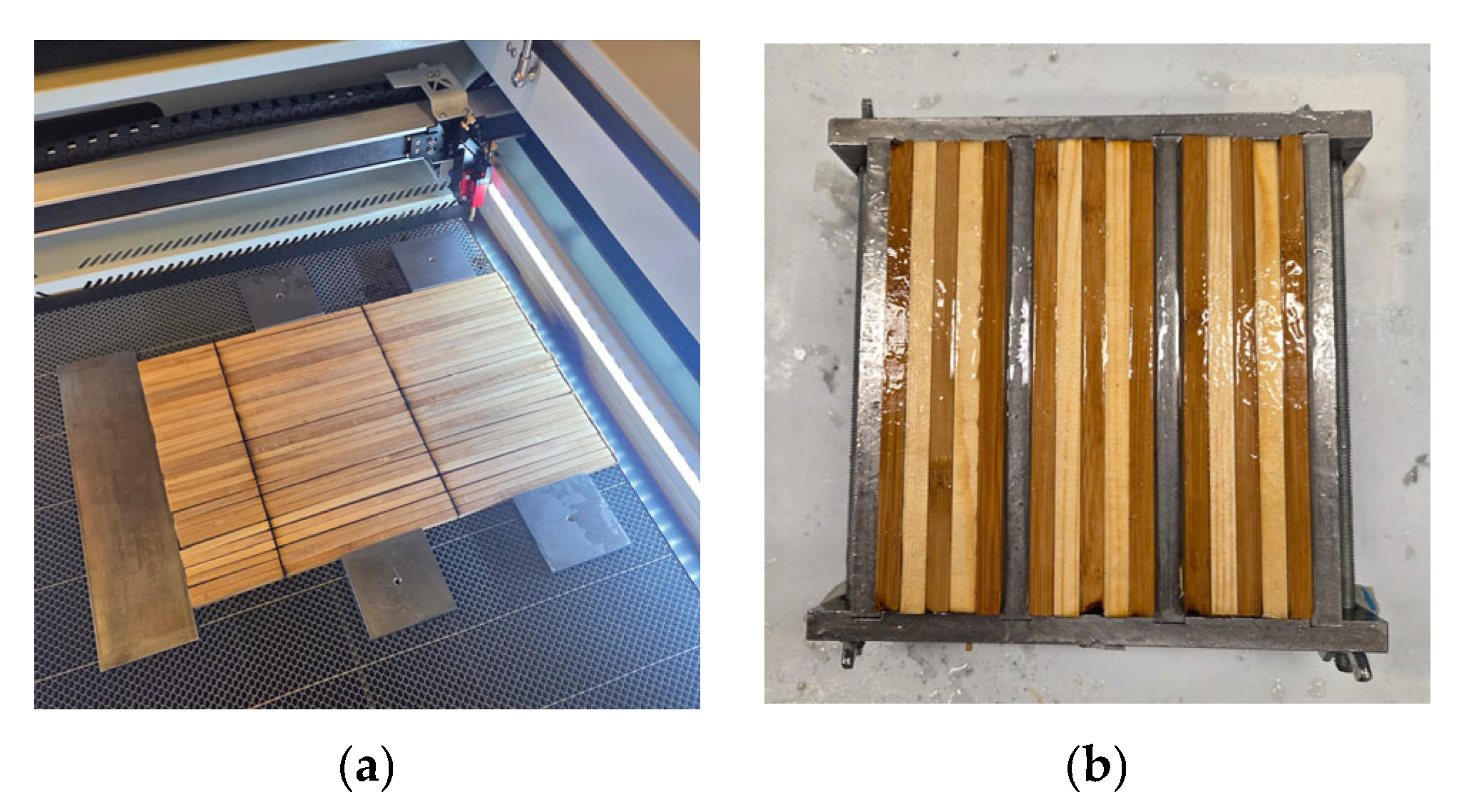
To manufacture the specimens, the caramelized Moso bamboo was cut into accurate measurements of 8 mm × 8 mm × 155 mm using a precise laser cutter (Suzhou AEON Laser Technology Co., Ltd., Suzhou, China), to ensure precision (Figure 1a). This method ensured that there was minimal error in cutting the materials while maintaining length tolerance within 0.2 mm. After cutting, the strips were sanded and air-blown to achieve strong adhesive bonding. The same procedure was followed for pine strips to ensure that the surface preparation was the same for the Moso bamboo and pine.
After the bamboo and timber strips were cut to the desired size, the strips were prepared for installation in a specially designed steel mold. For the hybrid specimens, bamboo and pinewood strips were combined in an alternating format. Adhesives were then applied to the strips to provide a strong bond. To spread the adhesive in uniform thin layers, 1-inch trim brushes were used to apply the adhesive to all surfaces (Figure 1b).
The specimens were manufactured under controlled laboratory conditions using two types of adhesives, bio-epoxy and PVA. As mentioned earlier, two different categories of specimens were manufactured: engineered bamboo specimens using eco-friendly resins with Moso bamboo strips; and hybrid bamboo–timber composites developed using an innovative arrangement of Moso bamboo and pine strips combined with bio-based, low-emission resins and an energy-efficient fabrication process.

2.5. Cold-Press Manufacturing

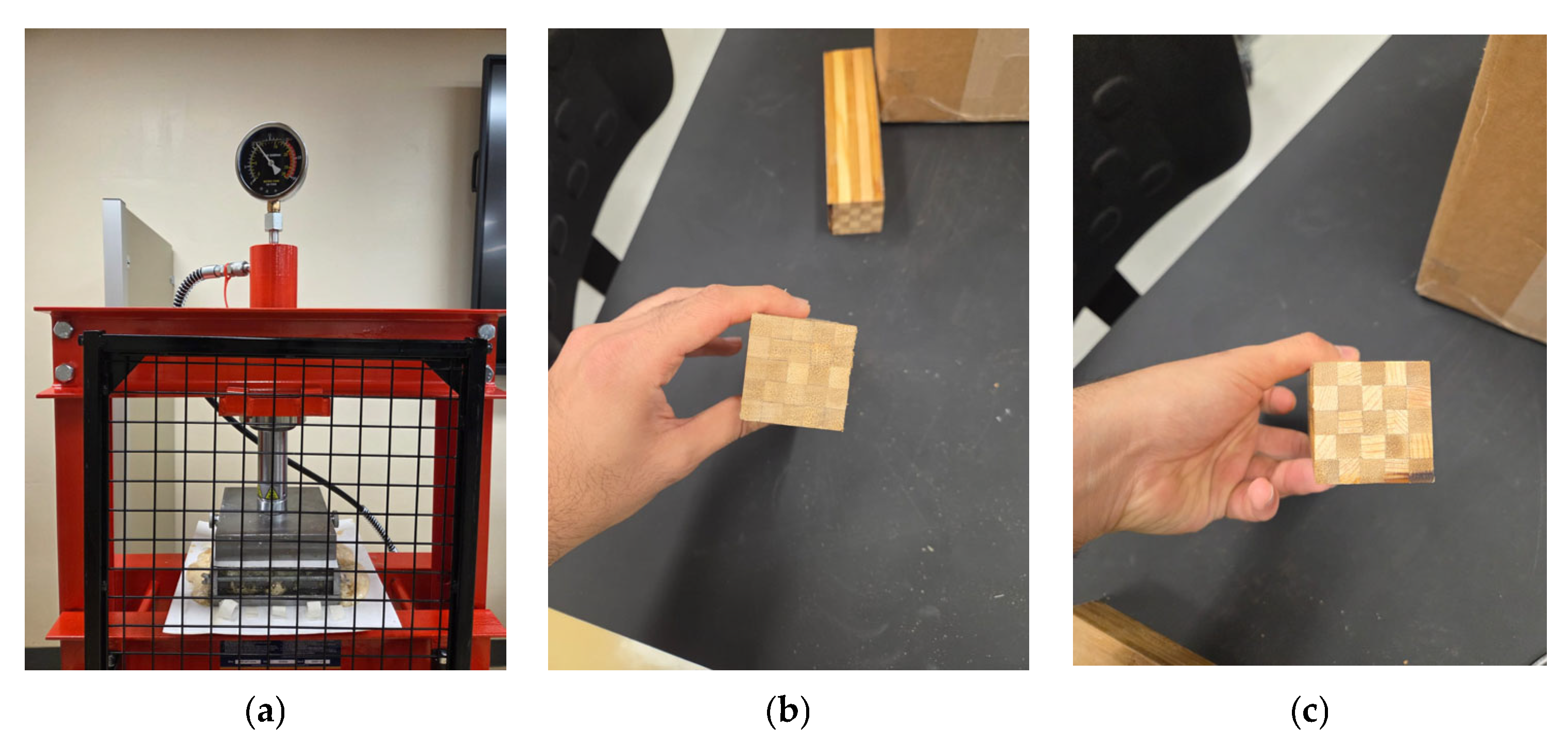
Cold-pressing was performed using a 20-ton hydraulic press (TMG Industrial, Richmond, BC, Canada) for 16 h at room temperature, during which a constant uniform load of 98 kN was applied to a steel plate placed on top of the steel mold holding three specimens in each casting (Figure 1b and Figure 2a). The manufacturing process is similar to the practice in industry, except that the hot-pressing stage was avoided as a sustainability measure to make the process less energy-intensive. Engineered bamboo composites are commonly manufactured through hot-press molding. The production of engineered bamboo products such as laminated bamboo, bamboo scrimber, and hybrid composites typically involves resin impregnation followed by hot pressing, which requires considerable energy input. This research, however, introduces a novel and sustainable design strategy employing a cold-press lamination method that eliminates the need for heat curing, leading to a reduction in energy consumption while maintaining the quality of samples (Figure 2b,c).

3. Embodied Carbon Assessment of Cold-Press Engineered Bamboo

3.1. Embodied Carbon Assessment

Life-cycle assessment (LCA) is widely used to evaluate the environmental impacts of construction materials, particularly the greenhouse gas emissions associated with extraction, processing, manufacturing, and transportation. Bamboo-based construction materials have attracted increasing attention in recent years because of their rapid renewability and capacity to retain substantial amounts of atmospheric carbon in structural applications.
On this basis, a screening-level cradle-to-gate carbon assessment was carried out to evaluate the proposed cold-press laminated bamboo and bamboo–timber composites against conventional hot-pressed laminated bamboo bonded with PF resin. The assessment was expressed in terms of global warming potential, reported as kg CO2e/m3 of finished material, which is the standard functional unit commonly adopted in construction-material LCAs. Calculations were performed in Microsoft Excel (Redmond, WA, USA) using a spreadsheet-based carbon accounting model. The life-cycle assessment framework adopted in this study, including system boundary definition, accounting approach, and treatment of manufacturing processes, follows established methodologies reported in the literature on engineered bamboo systems, e.g., [22,23,24]. Emission factors for the adhesive systems, however, were obtained independently from publicly available Environmental Product Declarations (EPDs) and LCA datasets for functionally comparable materials.
The proposed composite materials were manufactured using cold hydraulic pressing at room temperature, thereby eliminating the thermal curing step typically associated with engineered bamboo production. For the developed specimens, the assessment was based on the measured adhesive contents and specimen-specific densities obtained from the experimental program rather than assumed generic values. For the hot-pressed laminated bamboo reference, the pressing-stage energy demand was taken as 46.7 kWh/m3 from published LCA inventories, e.g., [23]. The corresponding carbon burden was calculated using an electricity emission factor of 0.309 kg CO2e/kWh, adopted from Department for Business, Energy and Industrial Strategy (BEIS) data [25].
The reported embodied carbon values were derived on a sample-specific basis using the measured adhesive contents and specimen densities obtained from the experimental program, together with published cradle-to-gate carbon factors for the adhesive systems and the hot-press reference process. First, the density of each specimen group was calculated from the measured specimen mass and known specimen volume. Second, the mass fraction of adhesive in each group was taken from the measured adhesive contents. The gross embodied carbon per cubic meter (ECgross) was then obtained by multiplying the density of the composite by the adhesive mass fraction and the selected adhesive emission factor, with the manufacturing-energy contribution added where relevant (Equation (1)).
ECgross = ρ × wadh × EFadh + ECmfg
where ρ is the specimen density (kg/m3), wadh is the adhesive mass fraction, EFadh is the adhesive emission factor (kg CO2e/kg), and ECmfg is the manufacturing-energy contribution (kg CO2e/m3). For the bio-epoxy system used in the present study, an EFadh value of 3.32 kg CO2e/kg was taken from the manufacturer data and supporting LCA datasets for the used liquid epoxy resin based on renewable epichlorohydrin [26]. For the hot-pressed laminated bamboo reference, the phenol–formaldehyde resin factor was taken as 4.56 kg CO2e/kg from a published product carbon report [27]. An EFadh value of 2.18 kg CO2e/kg for PVA was adopted from the published life-cycle assessment of Environmental Performance in Construction (EPiC) Database [28]. In addition to adhesive-related emissions, the ECₘfg includes ancillary processes such as bamboo caramelization and laminate preparation, estimated from representative energy ranges for lignocellulosic processing.
The resulting cradle-to-gate embodied carbon values are summarized in Table 2. The cold-press laminated bamboo systems yielded embodied carbon values of 473.3 kg CO2e/m3 for BBE and 322.3 kg CO2e/m3 for BPA, while the corresponding bamboo–pine composite systems yielded 314.2 kg CO2e/m3 for CBE and 210.3 kg CO2e/m3 for CPA. For comparison, the conventional hot-pressed laminated bamboo bonded with PF resin was calculated at 646.5 kg CO2e/m3.
For the cold-press systems, ECmfg does not include thermal curing; however, it includes the contributions from caramelization and strip preparation. For the hot-pressed reference, the manufacturing-energy contribution associated with the hot-pressing stage was calculated as 14.4 kg CO2e/m3 using the selected electricity emission factor of 0.309 kg CO2e/kWh. In addition, ancillary processing steps, including bamboo caramelization and strip preparation, were incorporated, resulting in a total manufacturing-energy contribution of 62.4 kg CO2e/m3, i.e., 14.4 kg CO2e/m3 for hot pressing, 40 kg CO2e/m3 for caramelization, and 8 kg CO2e/m3 for strip preparation. The remaining 584.1 kg CO2e/m3 of the overall gross embodied carbon was attributed to the PF resin, giving a total gross embodied carbon of 646.5 kg CO2e/m3. These results indicate that, within the present system boundary, adhesive selection remains the dominant contributor to embodied carbon, while the difference between cold pressing and hot pressing is secondary in comparison.
Compared with conventional hot-pressed laminated bamboo with PF resin, the proposed laminated bamboo systems BBE and BPA and the bamboo–pine composite systems CBE and CPA exhibit 26.8%, 50.1%, 51.4%, and 67.5% lower embodied carbon, respectively.
Since the reported carbon footprint values were derived from deterministic calculations based on measured specimen properties and selected literature-based emission factors, standard deviations are not reported. The results should therefore be interpreted as screening-level calculated values rather than statistically distributed measurements.

3.2. Net Carbon Balance Comparison with Conventional Construction Materials

Apart from manufacturing-related emissions, bamboo- and timber-based materials retain biogenic carbon absorbed from the atmosphere during plant growth. Through photosynthesis, atmospheric carbon dioxide is converted into biomass and remains stored in the material throughout its service life [22].
Using Equation (2), the biogenic carbon stored (CO2,stored) in the bamboo and pine phases was calculated from the biomass fraction of the composite, based on a carbon content of 50% of dry biomass [22,29] and converting carbon to equivalent CO2 using the molecular weight ratio 44/12 (Equation (2)).
CO2,stored = ρ × wbio × 0.50 × 44/12
where wbio is the biomass fraction of the composite, 0.50 is the assumed carbon fraction of dry biomass, and 44/12 converts element carbon to equivalent carbon dioxide. It should be noted that the biogenic carbon storage values slightly differ among the developed systems because they were calculated from the specimen-specific densities and biomass fractions of each material. As a result, differences in adhesive content and final composite density led to slightly different amounts of stored biogenic carbon per cubic meter for each specimen.
In the next step, the net carbon balance (ECnet) was obtained by subtracting the stored biogenic CO2 from the cradle-to-gate embodied carbon (Equation (3)).
ECnet = ECgross − CO2,stored
Using the relation defined above for ECnet, the cold-press laminated bamboo systems yielded net carbon balances of −415.5 kg CO2e/m3 for BBE and −607.1 kg CO2e/m3 for BPA, while the cold-press bamboo–pine composite systems yielded −597.0 kg CO2e/m3 for CBE and −618.6 kg CO2e/m3 for CPA (Table 2). These values indicate that, once biogenic carbon storage is taken into account, all four developed systems store substantially more carbon than is emitted during the manufacturing process.
For consistency, the same method was applied to softwood lumber, Laminated Veneer Lumber (LVL), and Parallel Strand Lumber (PSL). Based on published cradle-to-gate data, softwood lumber has gross emissions of 63.1 kg CO2e/m3. Assuming a carbon fraction of 50% of dry biomass, the corresponding biogenic carbon stored in the material is 843.3 kg CO2e/m3, resulting in a net carbon balance of −780.2 kg CO2e/m3. Similarly, published cradle-to-gate data [30] show that LVL has gross emissions of 361.5 kg CO2e/m3 and a net carbon balance of −636.8 kg CO2e/m3. For PSL, using a strand-based structural composite lumber proxy, the corresponding values for gross and net carbon balance are 310.3 kg CO2e/m3 and −667.2 kg CO2e/m3, respectively. The carbon values of the proposed engineered bamboo materials are close to those of engineered timber products such as LVL and PSL, while the bamboo-based systems offer the additional advantage of much faster renewability.
To place the developed materials in a broader context, Table 3 also compares the net carbon balance of the proposed systems with those of selected conventional construction materials. As mentioned earlier, all developed bamboo-based systems remain carbon-negative when biogenic storage is taken into account, with the bamboo–pine composite exhibiting the more favorable net carbon balance.

3.3. Discussion and Implications

Several observations can be drawn from the results of this screening-level cradle-to-gate LCA:
First, softwood lumber retains the lowest net carbon footprint among the materials considered, largely because it requires relatively little processing and contains no synthetic adhesive system. Meanwhile, the bamboo-based composites developed in this study remain strongly carbon-negative after manufacturing emissions are included. Given the modest difference in net carbon balance between sawn lumber and the proposed engineered bamboo systems (Table 3), together with bamboo’s much faster rate of renewability, engineered bamboo can reasonably be viewed as a competitive and sustainable construction material to sawn lumber.
Second, the cold-press manufacturing process provides a clear carbon advantage over conventional hot-pressed laminated bamboo. For example, the gross embodied carbon of the least carbon-efficient proposed laminated bamboo, i.e., BBE, was calculated as 473.3 kg CO2e/m3, compared with 646.5 kg CO2e/m3 for the hot-pressed PF-bonded reference, corresponding to a reduction of 26.8%. This difference is only slightly associated with the elimination of thermal curing and is primarily related to the lower adhesive emission factor of the bio-epoxy resin with respect to the PF resin reference.
Third, material configuration also influences carbon performance. The cold-press bamboo–pine composite exhibited a lower embodied carbon than the laminated bamboo system and also showed the more favorable net carbon balance of the two developed composite systems. Using a lower adhesive content and a more environmentally friendly adhesive in the bamboo–composite hybrid specimen resulted in 67.5% lower carbon emissions for the CPA specimen when compared with the PF-based engineered bamboo reference.
Finally, when compared with concrete, steel and aluminum, the difference in net embodied carbon remains substantial. This highlights the potential of engineered bamboo composites and bamboo–timber hybrid systems as scalable, carbon-storing materials for low-carbon construction applications.

4. Conclusions

This paper examined the proposed cold-press manufacturing of laminated bamboo and bamboo–timber composites and assessed their environmental performance through a screening-level cradle-to-gate life-cycle carbon assessment.
From the results of this study, the following conclusions can be drawn:
  • Adhesive selection had a greater influence on embodied carbon than the difference between cold pressing and hot pressing. Within the adopted system boundary, the resin system accounted for most of the gross embodied carbon, while the contribution of manufacturing energy was comparatively minor.
  • Although softwood lumber showed the lowest net carbon footprint among the materials considered, the developed bamboo-based systems also remained strongly carbon-negative.
  • The carbon performance of the proposed engineered bamboo materials is comparable to that of established engineered timber products such as LVL and PSL, with the added benefit that bamboo is renewed far more rapidly.
  • Given the relatively modest differences in net carbon balance between sawn lumber, LVL, and PSL and the proposed systems, together with bamboo’s much faster renewability, engineered bamboo can be regarded as a competitive, comparably sustainable alternative to sawn lumber and engineered timber solutions.
  • The cold-press systems showed a clear carbon advantage over conventional hot-pressed laminated bamboo, as reflected by gross embodied carbon reductions of 26.8% for BBE, 50.1% for BPA, 51.4% for CBE, and 67.5% for CPA.
  • The bamboo–pine composite systems exhibited lower embodied carbon and more favorable net carbon balances than the laminated bamboo systems, while all developed materials remained far lower in carbon impact than structural concrete, steel, and aluminum.
  • These results support the use of engineered bamboo composites and bamboo–timber hybrids as promising low-carbon materials for construction.

Author Contributions

Conceptualization, A.M. and N.J.; methodology, Y.D., A.M. and N.J.; formal analysis, A.M.; investigation, Y.D., A.M. and N.J.; resources, A.M.; data curation, A.M. and N.J.; writing—original draft preparation, A.M. and N.J.; writing—review and editing, A.M.; supervision, A.M.; project administration, A.M.; funding acquisition, A.M. All authors have read and agreed to the published version of the manuscript.

Funding

This research was supported by the Natural Sciences and Engineering Research Council of Canada (NSERC), which provided a Discovery Grant No. RGPIN 2023-05246 to Dr. Mofidi.

Institutional Review Board Statement

Not applicable.

Informed Consent Statement

Not applicable.

Data Availability Statement

The data generated and/or analyzed during this study are available from the corresponding author upon reasonable request.

Conflicts of Interest

The authors declare no conflicts of interest.

References

  1. Drury, B.; Padfield, C.; Russo, M.; Swygart, L.; Spalton, O.; Froggatt, S.; Mofidi, A. Assessment of the compression properties of different giant bamboo species for sustainable construction. Sustainability 2023, 15, 6472. [Google Scholar] [CrossRef]
  2. Adier, M.F.V.; Sevilla, M.E.P.; Valerio, D.N.R.; Ongpeng, J.M.C. Bamboo as sustainable building materials: A systematic review of properties, treatment methods, and standards. Buildings 2023, 13, 2449. [Google Scholar] [CrossRef]
  3. Padfield, C.; Drury, B.; Soltanieh, G.; Rajabifard, M.; Mofidi, A. Innovative cross-sectional configurations for low-cost bamboo composite (LCBC) structural columns. Sustainability 2024, 16, 7451. [Google Scholar] [CrossRef]
  4. Wei, Y.; Zhou, M.; Zhao, K.; Zhao, K.; Li, G. Stress-strain relationship model of glulam bamboo under axial loading. Adv. Compos. Lett. 2020, 29, 2633366X20958726. [Google Scholar] [CrossRef]
  5. Tang, S.; Zhou, A.; Li, J. Mechanical properties and strength grading of engineered bamboo composites in China. Adv. Civ. Eng. 2021, 2021, 6666059. [Google Scholar] [CrossRef]
  6. Huang, B.; Chen, L.; Wang, X.; Ma, X.; Liu, H.; Zhang, X.; Sun, F.; Fei, B.; Fang, C. Eco-friendly, high-utilization, and easy-manufacturing bamboo units for engineered bamboo products: Processing and mechanical characterization. Compos. Part B Eng. 2023, 267, 111073. [Google Scholar] [CrossRef]
  7. Drury, B.; Padfield, C.; Rajabifard, M.; Mofidi, A. Experimental investigation of low-cost bamboo composite (LCBC) slender structural columns in compression. J. Compos. Sci. 2024, 8, 435. [Google Scholar] [CrossRef]
  8. Li, Z.; Yang, G.S.; Zhou, Q.; Shan, B.; Xiao, Y. Bending performance of glubam beams made with different processes. Adv. Struct. Eng. 2019, 22, 535–546. [Google Scholar] [CrossRef]
  9. Sewar, Y.; Amran, M.; Avudaiappan, S.; Gamil, Y.; Rashid, R.S.M. Bonding strength performance of bamboo-based composite materials: An in-depth insight for sustainable construction applications. Heliyon 2024, 10, e32155. [Google Scholar] [CrossRef] [PubMed]
  10. Dai, C.; Semple, K.; Zhang, W.; Xia, Y.; Nkeuwa, W.; Meng, T.; Rodriguez, S.; Liu, K.; Mokarizadehhaghighishirazi, M.; Shen, J.; et al. Advancing engineered bamboo materials for sustainable construction. Renew. Sustain. Energy Rev. 2026, 235, 116951. [Google Scholar] [CrossRef]
  11. Kelkar, B.U.; Shukla, S.R.; Nagraik, P.; Paul, B.N. Structural bamboo composites: A review of processing, factors affecting properties and recent advances. Adv. Bamboo Sci. 2023, 3, 100026. [Google Scholar] [CrossRef]
  12. Sharma, B.; Gatóo, A.; Bock, M.; Ramage, M. Engineered bamboo for structural applications. Constr. Build. Mater. 2015, 81, 66–73. [Google Scholar] [CrossRef]
  13. Jafarnia, N.; Mofidi, A. Engineered bamboo for sustainable construction: A systematic review of characterization methods. Sustainability 2025, 17, 5977. [Google Scholar] [CrossRef]
  14. Huang, Y.; Ji, Y.; Yu, W. Development of bamboo scrimber: A literature review. J. Wood Sci. 2019, 65, 25. [Google Scholar] [CrossRef]
  15. Wang, X.; Li, W.; Jiang, X.; Lyu, J.; Li, X.; Qiao, J.; Xu, K.; Li, X.; Wu, Y. Physical and mechanical properties of bamboo scrimber: Influence of drying on phenolic resin-impregnated heat-treated bamboo bundles. Ind. Crops Prod. 2025, 236, 122052. [Google Scholar] [CrossRef]
  16. Mofidi, A.; Abila, J.; Ng, J.T.M. Novel advanced composite bamboo structural members with bio-based and synthetic matrices for sustainable construction. Sustainability 2020, 12, 2485. [Google Scholar] [CrossRef]
  17. Richardson, C.; Mofidi, A. Non-Linear Numerical Modelling of Sustainable Advanced Composite Columns Made from Bamboo Culms. Constr. Mater. 2021, 1, 169–187. [Google Scholar] [CrossRef]
  18. Harries, K.A.; Mofidi, A.; Naylor, J.; Trujillo, D.; Lopez, L.F.; Gutierrez, M.; Sharma, B.; Rogers, C. Knowledge gaps and research needs in bamboo construction. In Proceedings of the 18th International Conference on Non-conventional Materials and Technologies (NOCMAT 2022), Online, 7–23 June 2022. [Google Scholar]
  19. ASTM D143-14; Standard Test Methods for Small Clear Specimens of Timber. ASTM International: West Conshohocken, PA, USA, 2014.
  20. ISO 22157; Bamboo Structures, Determination of Physical and Mechanical Properties of Bamboo Culms, Test Methods. International Organization for Standardization: Geneva, Switzerland, 2019.
  21. GB 50005; Standard for Design of Timber Structures. Ministry of Housing and Urban-Rural Development of the People’s Republic of China. State Administration for Market Regulation: Beijing, China, 2017.
  22. Vogtlander, J.G.; Van der Lugt, P. The Environmental Impact of Industrial Bamboo Products: Life-Cycle Assessment and Carbon Sequestration, 2nd ed; The International Network for Bamboo and Rattan (INBAR): Beijing, China, 2015. [Google Scholar]
  23. Li, J.; Yuan, Y.; Guan, X. Assessing the environmental impacts of glued-laminated bamboo based on life cycle assessment. BioResources 2016, 11, 1941–1950. [Google Scholar] [CrossRef]
  24. Liu, K.; Jayaraman, D.; Shi, Y.; Xiong, Z.; Yang, J.; Symeonidis, A.; Escamilla, E.Z. Life cycle assessment (LCA) of the industrial production of structural glued laminated bamboo. J. Clean. Prod. 2024, 485, 144367. [Google Scholar] [CrossRef]
  25. Department for Business, Energy and Industrial Strategy (BEIS). Government GHG Conversion Factors for Company Reporting: Methodology Paper for Emission Factors; Final Report; Department for Business, Energy and Industrial Strategy (BEIS): London, UK, 2018. [Google Scholar]
  26. Entropy Resins. ONE System Technical Data Sheet: High Bio-Based Laminating Epoxy; Entropy Resins: Bay City, MI, USA, 2020. [Google Scholar]
  27. CarbonCloud. Phenol-Formaldehyde (PF) Resole Resin (Phenolic Resin). 2026. Available online: https://apps.carboncloud.com/climatehub/product-reports/id/9346376567703 (accessed on 2 April 2026).
  28. EPiC Database. Wood glue (PVA)—Global Warming Potential; University of Melbourne: Melbourne, Australia, 2019. [Google Scholar]
  29. Intergovernmental Panel on Climate Change (IPCC). 2006 IPCC Guidelines for National Greenhouse Gas Inventories, Volume 4: Agriculture, Forestry and Other Land Use; IGES: Hayama, Japan, 2006. [Google Scholar]
  30. American Wood Council (AWC) and Canadian Wood Council (CWC). North American Laminated Veneer Lumber: Environmental Product Declaration; American Wood Council (AWC) and Canadian Wood Council (CWC): Leesburg, VA, USA, 2020. [Google Scholar]
Figure 1. Specimen preparation: (a) laser cutting of Moso bamboo strips to the required dimensions; (b) application of adhesive to bamboo and timber strips and assembly in the mold.
Sustainability 18 04834 g001
Figure 2. Specimen manufacturing: (a) cold-press lamination of the specimens under hydraulic loading; (b) cross-sectional view of the laminated bamboo specimen, BPA; and (c) cross-sectional view of the hybrid bamboo–timber specimen, CPA.
Sustainability 18 04834 g002
Table 1. Production matrix of engineered bamboo and hybrid bamboo–timber composite specimens.
Group IDSpecimen TypeSpecimen Dimensions (mm)
BBELaminated bamboo using bio-epoxy adhesive40 × 40 × 155
BPALaminated bamboo using Polyvinyl Acetate (PVA) adhesive40 × 40 × 155
CBEHybrid composite bamboo–timber using bio-epoxy adhesive40 × 40 × 155
CPAHybrid composite bamboo–timber using PVA adhesive40 × 40 × 155
Table 2. Step-wise calculation of gross embodied carbon, biogenic carbon stored, and net carbon balance for the developed systems and the hot-pressed PF reference.
StepParameterSymbolBBEBPACBECPAPFUnit
1Composite densityρ612.9632.9580.6531.9612.9kg/m3
2Adhesive mass fractionwadh0.20900.19880.14430.15030.2090
3Adhesive emission factorEFadh3.322.183.322.184.56kg CO2e/kg
4Adhesive-related emissionsρ·wadh·EFadh425.3274.3278.2174.3584.1kg CO2e/m3
5Caramelization contribution40.040.028.028.040.0kg CO2e/m3
6Strip preparation contribution8.08.08.08.08.0kg CO2e/m3
7Hot-press contribution0.00.00.00.014.4kg CO2e/m3
8Total manufacturing-energy contributionECmfg48.048.036.036.062.4kg CO2e/m3
9Gross embodied carbonECgross473.3322.3314.2210.3646.5kg CO2e/m3
10Biomass fractionwbio0.7910.8010.8560.8500.791
11Biogenic carbon storedCO2,stored888.8929.4911.2828.9888.8kg CO2e/m3
12Net carbon balanceECnet−415.5−607.1−597.0−618.6−242.3kg CO2e/m3
Table 3. Carbon comparison of the proposed materials and selected conventional construction materials.
MaterialGross Emissions (kg CO2e/m3)Biogenic Carbon Stored (kg CO2e/m3)Net Carbon Balance (kg CO2e/m3)
Cold-press laminated bamboo, bio-epoxy (BBE)473.3888.8−415.5
Cold-press laminated bamboo, PVA (BPA)322.3929.4−607.1
Cold-press bamboo–pine composite, bio-epoxy (CBE)314.2911.2−597.0
Cold-press bamboo–pine composite, PVA (CPA)210.3828.9−618.6
Hot-pressed laminated bamboo, PF resin646.5888.8−242.3
Softwood lumber63.1 *843.3−780.2
Laminated Veneer Lumber (LVL)361.5 **998.3−636.8
Parallel Strand Lumber (PSL)310.3977.5−667.2
Structural concrete215.0 *0215.0
Structural steel15,857.0 ***015,857.0
Aluminum18,333.0 ***018,333.0
* Single comparison values shown as midpoint values adopted from broader ranges. ** North American laminated veneer lumber: Environmental product declaration [30]. *** Van der Lugt et al. [22].
Disclaimer/Publisher’s Note: The statements, opinions and data contained in all publications are solely those of the individual author(s) and contributor(s) and not of MDPI and/or the editor(s). MDPI and/or the editor(s) disclaim responsibility for any injury to people or property resulting from any ideas, methods, instructions or products referred to in the content.