Article

Nutrient Limitation and Ecological Chemicalometry Reveal the Impacts of Long-Term Continuous Cropping on Lavender Rhizosphere Soil


1
School of Resources and Environment, Yili Normal University, Yining 835000, China
2
Institute of Resources and Ecology, Yili Normal University, Yining 835000, China
3
Institute of Loess Plateau, Shanxi University, Taiyuan 030006, China
*
Author to whom correspondence should be addressed.
Sustainability 2026, 18(10), 4809; https://doi.org/10.3390/su18104809
Submission received: 10 April 2026 / Revised: 8 May 2026 / Accepted: 10 May 2026 / Published: 12 May 2026
(This article belongs to the Section Sustainable Agriculture)

Abstract

To elucidate the mechanisms of nutrient cycling in rhizosphere soil and microbial metabolism during the prolonged continuous cropping of lavender, this study examined the rhizosphere soil of lavender with different continuous cropping years (1, 4, 7, 10, 15, and 20 years) in the Ili River Valley of Xinjiang, China, measuring physicochemical properties, microbial biomass C/N/P, and eight extracellular enzyme activities. Microbial carbon use efficiency (CUE) and nutrient limitation were quantified using vector analysis, threshold elemental ratios (TERs), and two derived indices (TEREEA and TERL). Soil properties exhibited distinct nonlinear patterns: SOC peaked at 4 years (p < 0.05), TN was highest at 20 years, and TP was lowest at 4–7 years. MBC and MBN peaked at 20 years, whereas MBP was significantly lower than in 1-, 4-, and 10-year fields (p < 0.05). EEC and EEN were highest at 20 years, while EEP was lowest at 4 years (p < 0.05). The activity of carbon-related acquisition enzymes increases from 134.81 μmol/g·h in the first year to 393.86 μmol/g·h in the 20th year, an increase of 192%; the activity of nitrogen acquisition enzymes increases from 686.11 μmol/g·h in the first year to 1430.58 μmol/g·h in the 20th year, an increase of 108%. This indicates that the decomposition of organic matter and the nutrient cycling capacity continue to enhance. Vector analysis showed a mean VA of 46° and VL of 0.25, with VA > 45° (P limitation) at 1–4 years shifting to VA < 45° (N limitation) at 20 years. Critically, TEREEA and TERL produced opposite dominant limitations due to differing normalization frameworks—TEREEA scales by microbial biomass stoichiometry—while TERL normalizes against enzyme-derived thresholds. CUET and CUEE ranged from 0.42 to 0.56, with the minimum at 10 years and relatively high values at 15–20 years (p < 0.05). RDA identified CBH (26.2%) and NO3–N (19.8%) as primary drivers, with extractable phosphorus exhibiting the strongest regulatory effect (pseudo-F = 26.0). These results demonstrate that multi-model stoichiometric assessment is essential, as single indices may yield contradictory diagnoses. These results demonstrate that multi-model stoichiometric assessment is essential, as single indices may yield contradictory diagnoses, and the observed nonlinear shifts in dominant limitation type provide a mechanistic basis for targeted nutrient management in sustainable lavender cultivation.

1. Introduction

Continuous cropping refers to the planting method where the same species or plants from the same family are continuously grown on the same plot of land. Long-term continuous cropping can lead to imbalances in soil nutrients, increased soil acidification, and accumulation of toxic substances, which, in turn, inhibit the photosynthesis and root vitality of plants, manifesting as decreased plant height, reduced leaf area, and a significant reduction in yield [1,2]. The aforementioned physiological disorders are closely related to the structural imbalance of the rhizosphere microbial community: In continuously farmed soil, there is often a trend of transition from bacterial type to fungal type, resulting in an increase in pathogenic fungi and a decrease in the number of beneficial actinomycetes and nitrogen cycling bacteria, thereby weakening the soil’s nutrient supply capacity [3]. Furthermore, continuous cropping can induce plants to secrete toxic phenolic substances. These allelochemicals can damage the cell wall structure, inhibit cell division, and further reduce the crop’s stress resistance and nutrient accumulation. Studies have shown that continuous cropping disorder exhibits similar mechanisms in different crops. For example, medicinal plants such as ginseng, notoginseng, and licorice all show decreased germination rates and inhibited root systems, suggesting that their impact on plants is universal and has cross-species commonalities [4]. To alleviate the problem of continuous cropping, some studies have proposed measures such as crop rotation and the application of biochar or beneficial microorganisms to improve the physical and chemical properties of the soil and the diversity of microorganisms, thereby restoring the growth vitality of crops [5]. Overall, continuous cropping forms a complex negative feedback loop through the coupling effect among the soil, plants and microorganisms and is a key factor restricting the sustainable development of agriculture.
Soil carbon (C), nitrogen (N) and phosphorus (P) are fundamental nutrients sustaining plant growth and soil fertility, while microorganisms serve as pivotal regulators of soil C, N, and P cycling through organic matter decomposition and nutrient mineralization [6,7]. Because microbial metabolism is constrained by elemental stoichiometry, imbalances between resource supply and microbial demand frequently result in nutrient limitation, which, in turn, shapes microbial activity and ecosystem functioning [6,8]. Microorganisms respond to such imbalances by adjusting the production of extracellular enzymes involved in C-, N-, and P-acquisition, and ecoenzymatic stoichiometry has therefore been widely used as an indicator of microbial metabolic strategies and nutrient limitation status [8].
Microbial biomass C, N, and P (MBC, MBN, and MBP) represent the active and dynamic fraction of soil organic matter and serve as a key interface linking soil nutrient availability with microbial metabolic demand. Despite environmental variability, microbial biomass stoichiometry (MBC:MBN:MBP) is relatively constrained, typically ranging from approximately 42–60:6–7:1 at the global scale, indicating strong homeostatic regulation of microbial nutrient demand [9,10].
Soil carbon (C), nitrogen (N), and phosphorus (P) are fundamental nutrients sustaining plant growth and soil fertility, while microorganisms serve as pivotal regulators of soil C, N, and P cycling through organic matter decomposition and nutrient mineralization [6,11].
Nitrogen and phosphorus (MBC, MBN, and MBP) directly reflect the storage and transformation capabilities of soil microorganisms for these nutrients [12]. Microorganisms obtain C, N, and P by secreting corresponding acquisition enzymes, and the enzyme activity is in a ratio that matches the nutrient requirements, forming ecological enzyme stoichiometry, which has become an important indicator for assessing soil nutrient limitations [13]. The chemical stoichiometric ratio (MBC:MBN, MBC:MBP, and MBN:MBP) of soil microbial biomass is a core indicator for revealing nutrient cycling and microbial ecological functions. MBC:MBN reflects the relative demand of microorganisms for carbon and nitrogen; a higher ratio indicates nitrogen limitation or fungal dominance, while a lower ratio suggests carbon limitation or bacterial dominance [14]. Nitrogen and phosphorus addition can reduce this ratio, indicating an improvement in nitrogen utilization efficiency [15]. MBC:MBP represents the demand for carbon and phosphorus; an increase in the ratio indicates phosphorus limitation, and microorganisms obtain phosphorus by enhancing phosphatase activity. A decrease in the ratio suggests carbon limitation. MBN:MBP reflects the nitrogen–phosphorus relationship; a high value indicates phosphorus limitation, and a low value indicates nitrogen limitation [16]. The extracellular enzyme vector model is one of the most widely used approaches to interpret ecoenzymatic stoichiometry [17,18,19].
This model combines stoichiometry with microbial metabolic theory, providing an effective tool for quantifying microbial nutrient limitation patterns and offering a scientific basis for assessing soil health and guiding sustainable management. Under consecutive cropping conditions, the ratios of soil C, N, and P often become imbalanced: continuous planting leads to an increase in the C/N ratio and a decrease in the N/P ratio, which in turn causes the relative microbial limitation of carbon and an increase in microbial demand for phosphorus [20]. At the same time, the absolute contents of microbial biomass C, N, and P change significantly with crop rotation or long-term organic fertilizer application, showing an intensification of microbial C limitation or a reduction in N and P limitations [21,22]. These changes are echoed in enzyme activities: the activity of carbon acquisition enzymes increases, the activity of nitrogen acquisition enzymes decreases, and the activity of phosphorus acquisition enzymes increases, forming a typical stoichiometric deviation of C, N, and P ecological enzymes. Although these patterns have been verified in various crops (such as lily, strawberry, and tobacco), current research on soil C, N, P, microbial biomass, and enzyme stoichiometry in aromatic medicinal plants such as lavender (Lavandula spp.) is extremely scarce. There are only a few technical descriptions of lavender soil improvement, and there is also a lack of research on the coupling relationship between nutrient and microbial factors in lavender-growing soil [23]. Therefore, systematic research on the coupling characteristics of soil nutrients and microbial functions of lavender under consecutive cropping or different management measures is an important direction for future research.
Therefore, this study selected Hohhot County in the Yili River Valley of Xinjiang, where lavender has been cultivated for many years, as the research area. Differently aged lavender rhizosphere soils were selected as the research objects. Using ecological chemicalometry methods, the aim was to clarify the succession mechanism of nutrient cycling and microbial metabolism limitations in the rhizosphere soil during the long-term continuous cropping of lavender and to reveal the regulatory laws of the consecutive evolution of rhizosphere soil, microorganisms, and enzyme systems under the influence of the duration of continuous cropping. Long-term continuous cultivation often leads to a nutrient imbalance, with an increase in the carbon-to-nitrogen ratio (C:N) in the soil and a decrease in the nitrogen-to-phosphorus ratio (N:P). This imbalance causes carbon and nitrogen cycles to dominate, while phosphorus remains a limiting factor. The input of root exudates and organic matter plays a crucial role in the nutrient cycle, influencing the composition of microbial biomass and nutrient limitations. Additionally, the fixation mechanism of phosphorus, such as adsorption onto soil particles, further limits the availability of phosphorus, and the limitation of phosphorus will continue or intensify. We propose the following hypotheses: (1) As the duration of lavender continuous cropping increases, the microbial biomass carbon and nitrogen in the rhizosphere soil continue to accumulate, while the phosphorus content is relatively scarce. The microbial carbon–phosphorus ratio and nitrogen–phosphorus ratio significantly increase, and the activities of extracellular carbon, nitrogen, and phosphorus acquisition enzymes show regular increases. (2) Long-term continuous cropping of lavender will drive the succession of microbial nutrient limitation types in the rhizosphere soil, shifting from nitrogen limitation as the main type in the initial stage to phosphorus limitation as the main type in the middle and later stages, accompanied by multiple nutrient limitation states, including carbon limitation.

2. Materials and Methods

2.1. Regional Overview and Sampling

The study area is located in Lucaogou Town, Huocheng County, Ili Kazakh Autonomous Prefecture, Xinjiang Uygur Autonomous Region (latitude 44.48° N, longitude 81.13° E). The total area of the town is approximately 385 km2. It is an open plain in the Ili River Valley, with an altitude ranging from 700 to 1000 m. The terrain slopes from northeast to southwest, and the climate is a temperate continental semi-arid type. The average annual temperature ranges from 8.2 to 9.4 °C, with the extreme maximum temperature approximately 40.2 °C and the extreme minimum temperature approximately 26.8 °C. Another meteorological statistic shows that the annual average temperature is approximately 11.1 °C, with an average temperature of 6.7 °C in January and 25.5 °C in July. The annual average precipitation is approximately 251 mm (ranging from 140 to 420 mm). According to local climate characteristics, the evaporation is about 8 times that of precipitation, and the annual evaporation amount is approximately 2000 mm [24]. The town mainly relies on agricultural irrigation, with approximately 42,700 ha of cultivated land, 265,000 ha of grassland in all seasons, and 29,000 ha of forest. Water resources are scarce and evaporation is intense, forming a typical “desert oasis, irrigation agriculture” pattern [25]. The above meteorological and geographical elements provide key benchmarks for regional ecology, agricultural production, and water resource management.
Lavender fields with continuous cropping histories of 1, 4, 7, 10, 15, and 20 years were selected within the study region. Each lavender field exceeded 1 hectare in area. Sampling was conducted in early August. Prior to the transplantation of lavender cuttings in all experimental fields, residual plants of the previous crop were first removed, followed by deep tillage to a depth of 80–100 cm. When flower yield declined markedly after 6–7 years of continuous lavender cultivation, the aging plants were completely uprooted. The field land was subjected to the same residue removal and deep tillage practices, and new lavender cuttings were then transplanted in October to November of the same year. Within a 10 cm radius around the root system of each target plant, the soil was carefully excavated to retrieve intact roots. Loosely attached soil was gently shaken off and discarded, whereas soil tightly adhering to the root surface (strictly defined as rhizosphere soil, <2 mm from the root surface) was collected using a sterile brush. The sampling depth was 0–20 cm. For each treatment, three representative plants with consistent growth status were selected per row, and the rhizosphere soils were pooled to form one composite sample. A total of 10 composite samples were collected per treatment, yielding 60 samples across the six treatments. Ten sampling points are arranged in a systematic grid pattern within fields larger than 1 hectare. The spacing between the points is fixed at 20 m, and they are distributed in a “zigzag” pattern to avoid directional deviations. A 5 m field edge buffer zone is also set up. Each sample is composed of 5 sub-samples within a 2 m by 2 m area around the sampling point (collected diagonally, with sub-sample spacing ≥ 50 cm) in order to balance the micro-variation of the root zone and the representativeness of the sampling. All samples were immediately placed in a cooler with ice packs, transported to the laboratory, and stored at 4 °C prior to analyses of soil enzyme activities, microbial biomass, and soil physicochemical properties.

2.2. Soil Physical and Chemical Properties and Methods for Measuring Soil Extracellular Enzyme Activity

Stoichiometric characteristics refer to the quantitative proportion relationships of key elements such as carbon (C), nitrogen (N), and phosphorus (P) in organisms or ecosystems. The core lies in revealing the constraint laws of element balance—the growth, metabolism, and community structure of organisms are not determined by the absolute content of a single element but are regulated by the relative proportions of elements.
Soil moisture content (SMC) was determined gravimetrically. Soil pH and electrical conductivity (EC) were measured using standard potentiometric and conductivity methods, respectively. Soil organic carbon (SOC) was determined by the potassium dichromate oxidation method, total nitrogen (TN) by the Kjeldahl method, and total phosphorus (TP) by the molybdenum blue method following acid digestion. Total potassium (TK) was measured by the acid fusion method. Available phosphorus (AP) was extracted with sodium bicarbonate and determined colorimetrically. Ammonium (NH4+–N) and nitrate (NO3–N) were measured using a flow analyzer. Microbial biomass carbon (MBC), nitrogen (MBN), and phosphorus (MBP) were determined using the chloroform fumigation-extraction method. Extractable organic carbon (EOC), extractable total nitrogen (ETN), and extractable phosphorus (EP) were obtained from non-fumigated extracts [26,27]. Extracellular enzyme activities were measured fluorometrically using a microplate reader following Saiya-Cork et al. [28] (Table 1). Oxidative enzymes, including peroxidase (POD) and polyphenol oxidase (PPO), were measured colorimetrically. All enzyme activities were expressed in nmol g−1 soil h−1, and raw (non-log-transformed) values were used for stoichiometric calculations [8].

2.3. Ecoenzymatic Stoichiometry, Microbial Carbon Use Efficiency, and Nutrient Limitation

All stoichiometric ratios of soil nutrients, microbial biomass, and extracellular enzymes were expressed on a molar basis. Soil resource stoichiometry was represented as LC:N and LC:P, including both total nutrient ratios (TLC:X; e.g., SOC:TN and SOC:TP) and extractable resource ratios (ELC:X; e.g., EOC:ETN and EOC:EP), which were analyzed separately. Microbial biomass stoichiometry was expressed as BC:N = MBC:MBN and BC:P = MBC:MBP. Enzyme stoichiometry was calculated as EEAC:N = EEC:EEN and EEAC:P = EEC:EEP, where EEC (BG + CBH), EEN (NAG + LAP), and EEP (ACP) represented the summed activities of C-, N-, and P-acquiring enzymes, respectively.
Soil microbial carbon use efficiency (CUE) was defined as the proportion of assimilated carbon allocated to microbial biomass production and was estimated using a biogeochemical cycling balance model [29] within an ecoenzymatic stoichiometric framework as follows:
CUEC:X = CUEmax × SC:X/(SC:X + KX)
where X represents N or P, CUEmax is the maximum carbon use efficiency (0.6), KX is a half-saturation constant (KX = 0.5) [30], and SC:X represents the relative balance between carbon and nutrient acquisition. SC:X was calculated by integrating enzyme stoichiometry, microbial biomass stoichiometry, and soil resource availability [29]:
SC:X = (1/EEAC:X) × (BC:X/LC:X)
This formulation extended the original ecoenzymatic model by explicitly incorporating microbial biomass and soil resource stoichiometry. Overall microbial CUE was calculated as the geometric mean of CUEC:N and CUEC:P [11]:
CUE   =   C U E C : N × C U E C : P
Ecoenzymatic vector analysis was used to assess microbial nutrient limitation. Vector coordinates were calculated as [8]:
x = EEC/(EEC + EEP)
y = EEC/(EEC + EEN)
VL = x 2 +   y 2
VA = ATAN2(x,y) × 180/π
Vector length (VL) reflected the relative degree of microbial carbon limitation, with larger values indicating stronger C limitation. Vector angle (VA) distinguished nitrogen versus phosphorus limitation, where VA < 45° indicates N limitation and VA > 45° indicates P limitation. The calculation process of Vector Angle (VA) is presented in the Supplementary Materials.
The threshold element ratios (TERs) for C:N and C:P were calculated as the product of resource stoichiometry and enzyme activity ratios [29]:
TERC:X = EEAC:X × LC:X
Microbial metabolism was inferred to be limited by nitrogen when LC:N > TERC:N and by phosphorus when LC:P > TERC:P.
To quantify nutrient limitation, deviations between resource supply and microbial demand and the relative strength of N versus P limitation were calculated as follows [31]:
TER0C:X = (AmaxX/CUEmax) × BC:X
ΔTER1C:X = TER0C:X − TERC:X
ΔTER2C:X = LC:X − TERC:X
TEREEA = (ΔTER1C:P/BC:P) − (ΔTER1C:N/BC:N)
TERL = (ΔTER2C:P/BC:P) − (ΔTER2C:N/BC:N)
where TER0C:X is the optimal threshold element ratio, TERC:X is the estimated threshold element ratio, and LC:X represents soil resource stoichiometry. ΔTER1C:X and ΔTER2C:X denote deviations between microbial demand and resource supply based on optimal and available resources, respectively. Values of TEREEA and TERL > 0 indicate stronger P limitation, whereas values < 0 indicate stronger N limitation.

2.4. Data Statistical Analysis

Statistical analyses were performed using SPSS 23.0 (IBM Corp., Armonk, NY, USA). Data normality and homogeneity of variances were assessed using the Shapiro–Wilk test and Levene’s test, respectively. One-way analysis of variance (ANOVA) was used to examine differences among planting years. When the assumption of homogeneity of variance was met, Tukey’s honestly significant difference (HSD) test was applied for multiple comparisons. When homogeneity of variance was violated, Welch’s ANOVA was used, followed by Tamhane’s T2 test for post hoc comparisons. Differences were considered statistically significant at p < 0.05.
Pearson correlation analysis was conducted to evaluate relationships between environmental variables (SMC, EC, pH, SOC, TN, TP, EOC, ETN, EP, NH4+–N, and NO3–N) and soil nutrients, microbial biomass, enzyme activity and stoichiometric ratios. Principal component analysis (PCA) was conducted to explore the variation patterns of soil properties and the distribution of samples across continuous cropping years. Redundancy analysis (RDA) was performed using Canoco 5.0 to quantify the relationships between soil properties (explanatory variables) and microbial metabolic limitation indicators, including vector angle (VA), vector length (VL), and threshold elemental ratios (TERs). Figures were generated using Origin 2024 (OriginLab, Northampton, MA, USA).

3. Results

3.1. Soil Physicochemical Properties Across Continuous Cropping Years

Soil physicochemical properties varied significantly along a gradient of continuous cropping years (Table 2). SMC was the highest in the 1-year lavender field, significantly higher than that in other fields (p < 0.05). EC in the 20-year field was significantly higher than that in the 1-, 7- and 10-year fields (p < 0.05). Soil pH was highest in the 10-year field and was significantly higher than in all other fields except the 1-year field (p < 0.05). SOC was significantly higher in the 4-year field than in all other fields (p < 0.05). TN was highest in the 20-year field, whereas TP was significantly lower in the 4- and 7-year fields than in the other fields (p < 0.05). EOC was significantly higher in the 7-year field than in the 1-, 4-, 10-, and 20-year fields (p < 0.05). ETN and EP were significantly higher in the 4-year field than in the 1-, 7-, 10-, and 20-year fields (p < 0.05). Although NH4+–N was the highest in the 4-year lavender field, it did not significantly differ from the 1-, 7-, and 15-year fields; however, it was significantly higher than the 10- and 20-year fields (p < 0.05). NO3–N was significantly higher in the 4-year field than in the other fields, whereas the lowest values were observed in the 10-year field. POD and PPO were lowest in the 4- and 7-year fields, being significantly lower than in the 15- and 20-year fields (p < 0.05).

3.2. Microbial Biomass and Extracellular Enzyme Activities Across Continuous Cropping Years

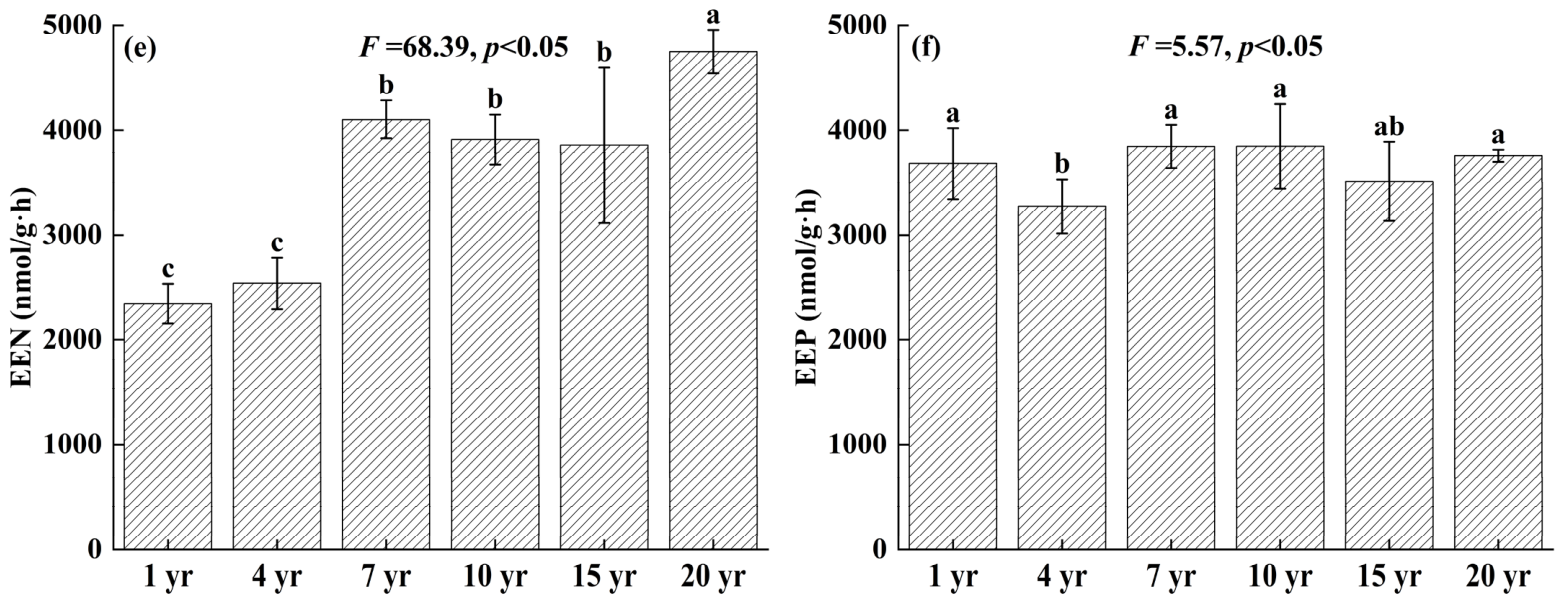
Significant differences in MBC, MBN, and MBP were observed among continuous cropping years (p < 0.05). MBC and MBN were highest in the 20-year field, being significantly higher than those in the 1-, 4-, and 15-year fields (p < 0.05; Figure 1a,b). MBP was significantly higher in the 4-year field than in the 1-, 7-, 15-, and 20-year fields (p < 0.05; Figure 1c).
After lavender was grown in succession for four years, the phenolic acid allelochemicals secreted by the root system accumulated in the rhizosphere soil and exceeded the threshold for microbial inhibition, directly inhibiting the activity of phosphatase and disrupting the structure of the phosphorus-decomposing microbial community, resulting in a shift from the brief release of available phosphorus at the beginning of cultivation to its fixation and depletion. At the same time, the vigorous growth of the plants and microorganisms intensified the competition for the limited available phosphorus, forcing the microbial phosphorus assimilation capacity to collapse, ultimately leading to a cliff-like decline in microbial biomass phosphorus after reaching its peak.
Continuous cropping years significantly affected extracellular enzyme activities (EEC, EEN, and EEP; p < 0.05; Figure 1d–f). EEC and EEN were highest in the 20-year field and were significantly higher than those in other fields (p < 0.05; Figure 1d,e). In contrast, EEP was lowest in the 4-year field and was significantly lower than that in the other fields (p < 0.05; Figure 1f).

3.3. Soil-Microbial-Enzyme Stoichiometry Across Continuous Cropping Years

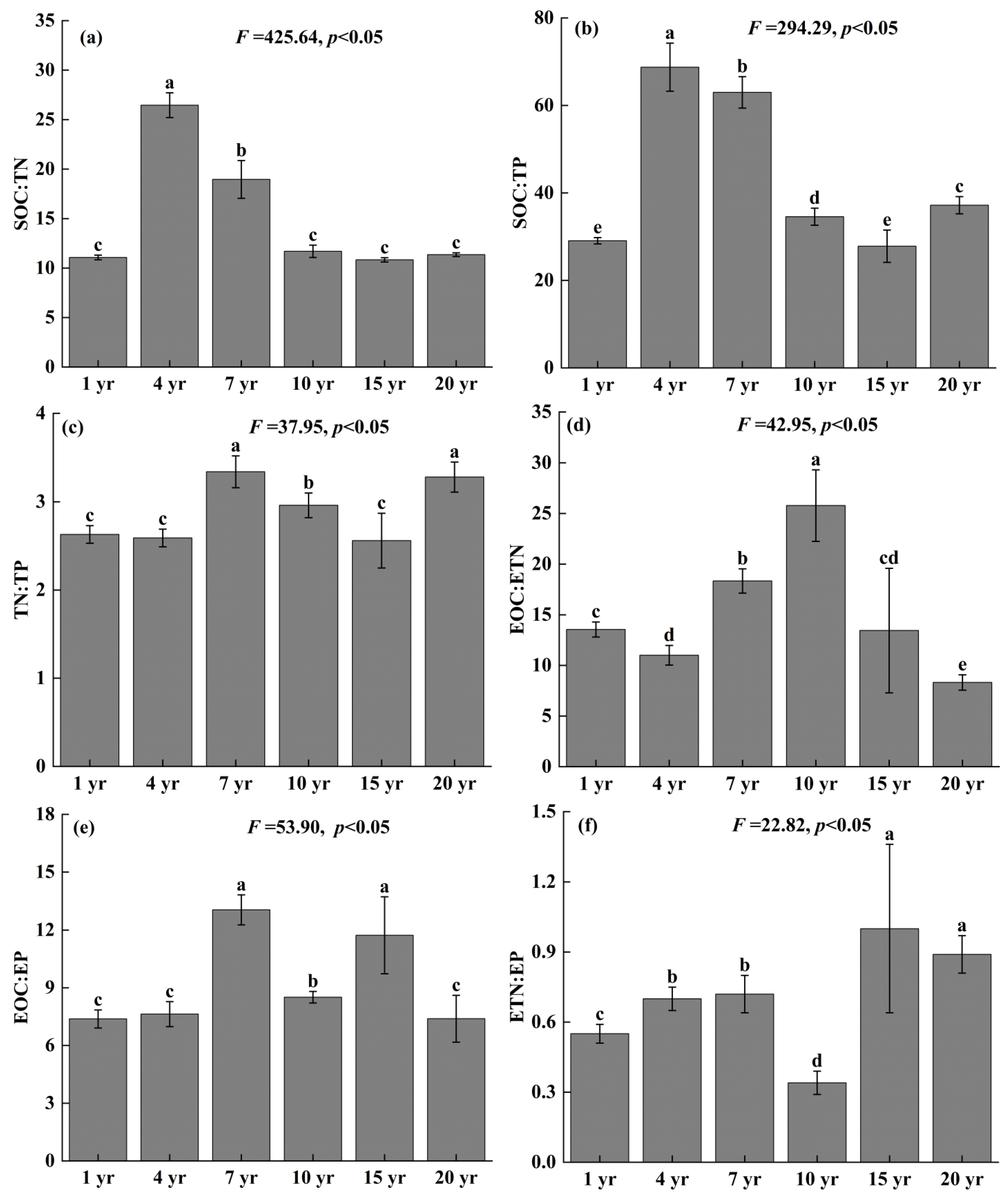
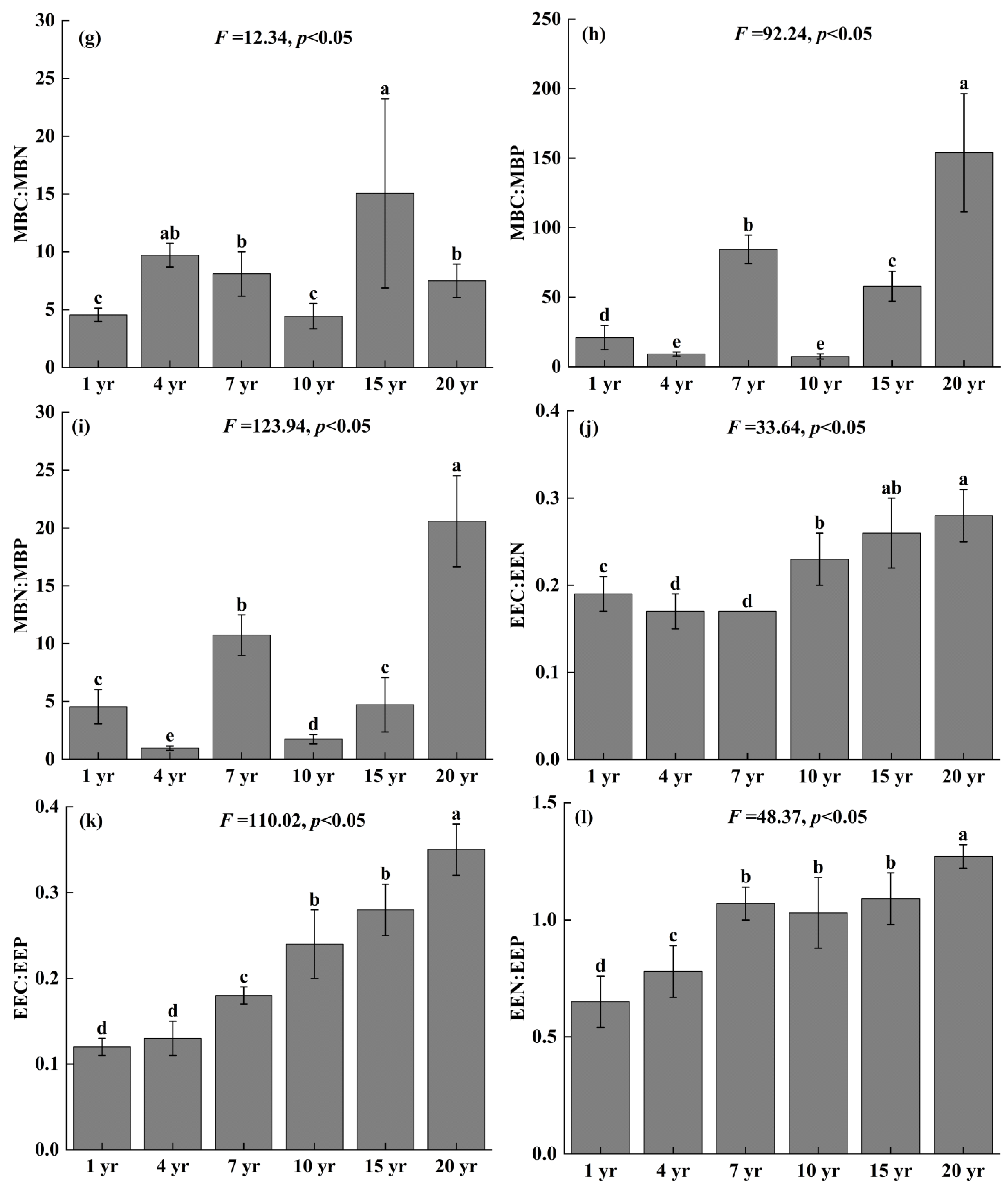
Significant differences in soil stoichiometric ratios were observed among continuous cropping years (p < 0.05; Figure 2a–f). SOC:TN and SOC:TP were highest in the 4-year field, being significantly higher than those in the 1-, 7-, 10-, 15-, and 20-year fields (p < 0.05; Figure 2a,b). TN:TP was significantly higher in the 7- and 20-year fields than in the other fields (p < 0.05; Figure 2c). The average of SOC:TN:TP was 43:3:1.EOC:ETN was significantly higher in the 10-year field than in the other fields (p < 0.05; Figure 2d). EOC:EP was significantly higher in the 7- and 15-year fields than in the other fields (p < 0.05; Figure 2e), whereas ETN:EP was significantly higher in the 15- and 20-year fields (p < 0.05; Figure 2f).
Significant differences in microbial biomass stoichiometry (MBC:MBN, MBC:MBP, and MBN:MBP) were observed among continuous cropping years (p < 0.05; Figure 2g–i). MBC:MBN was highest in the 15-year field and was significantly higher than in the other fields except the 4-year field (p < 0.05; Figure 2g). MBC:MBP and MBN:MBP were highest in the 20-year field, being significantly higher than those in the other fields (p < 0.05; Figure 2h,i). The average of MBC:MBN:MBP was 56:7:1.
Extracellular enzyme stoichiometry (EEC:EEN, EEC:EEP, and EEN:EEP) also differed significantly among continuous cropping years (p < 0.05; Figure 2j–l). All three ratios were significantly higher in the 20-year field than in the 1-, 4-, 7-, and 10-year fields (p < 0.05; Figure 2j–l).

3.4. Microbial Nutrient Limitation Across Continuous Cropping Years

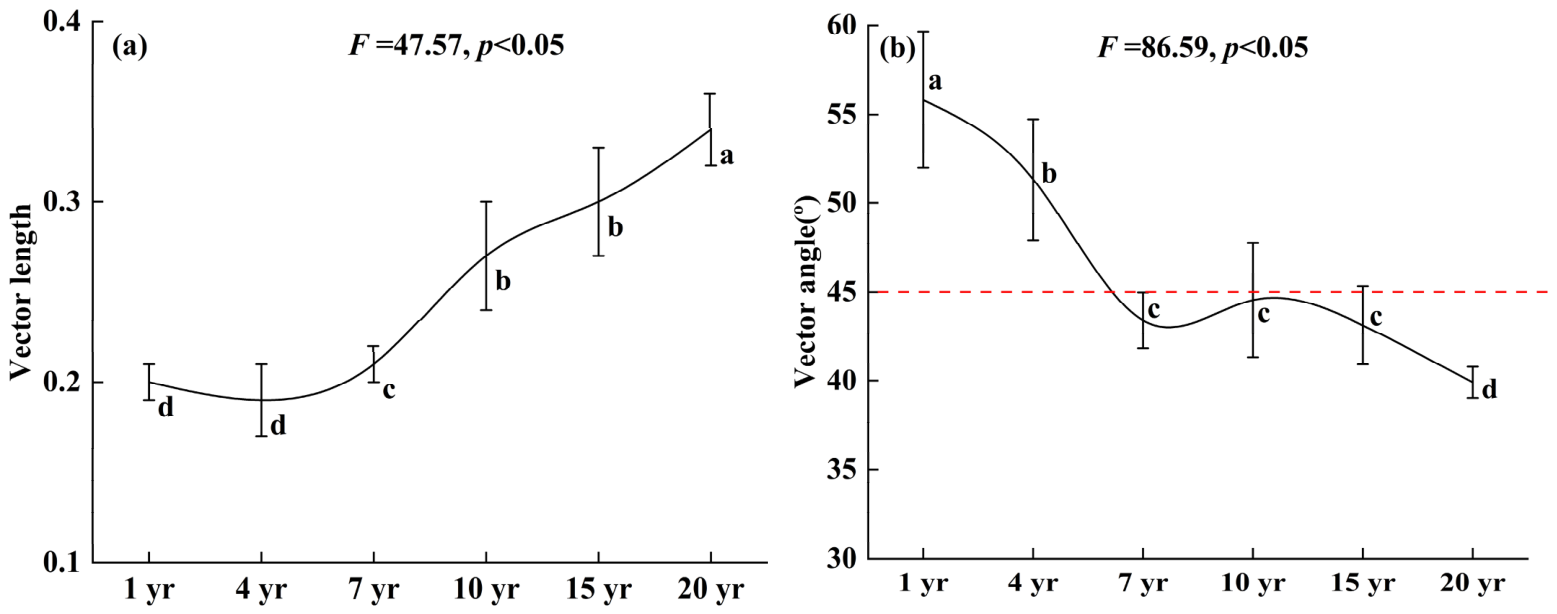
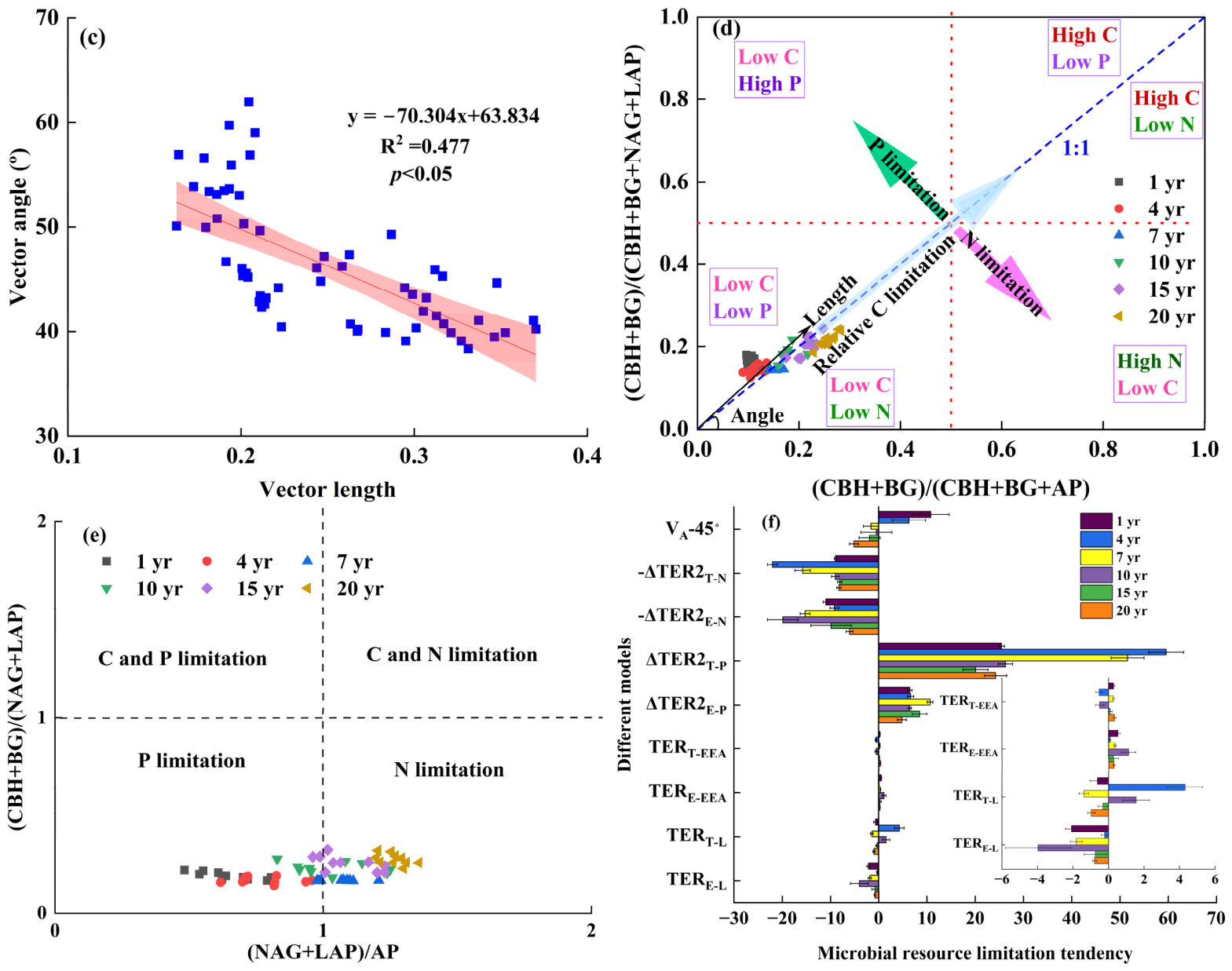
The characteristics of the enzyme vectors reflect the relationship between energy and nutrient limitations in the metabolic processes of soil microorganisms within the ecosystem. Significant differences were observed in both VL and VA across different continuous cropping years (Figure 3a,b). VL exhibited an increasing trend with the number of continuous cropping years, whereas VA showed a decreasing trend over the same period. The VL and VA for the 20-year lavender field were significantly different from those of other continuous cropping years (p < 0.05). The VA values for the 1-year and 4-year lavender fields were both greater than 45°, indicating a more severe P limitation in these two fields. A significant negative linear relationship was found between VL and VA (Figure 3c).
All continuous cropping years were characterized by low carbon, nitrogen, and phosphorus availability, with a mean vector angle of 46° and a mean vector length of 0.25 (Figure 3d). P limitation dominated in the 1-year and 4-year fields, whereas N limitation was observed in the 20-year field (Figure 3e). The TER results consistently indicated nitrogen limitation across all continuous cropping years, as both ΔTER2SOC:TN (LSOC:TN > TERSOC:TN) and ΔTER2EOC:ETN (LEOC:ETN > TEREOC:ETN) were negative. In contrast, ΔTER2SOC:TP (LSOC:TP > TERSOC:TP) and ΔTER2EOC:EP (LEOC:EP > TEREOC:EP) were positive, suggesting concurrent P limitation. Based on ΔTER1, TEREEA varied among continuous cropping years, with N limitation observed only in the 4-year and 10-year fields, while P limitation dominated in the others. TERL based on ΔTER2 exhibited the opposite pattern: only the 4-year and 10-year fields were P-limited, whereas N limitation prevailed in the remaining continuous cropping years (Figure 3f).
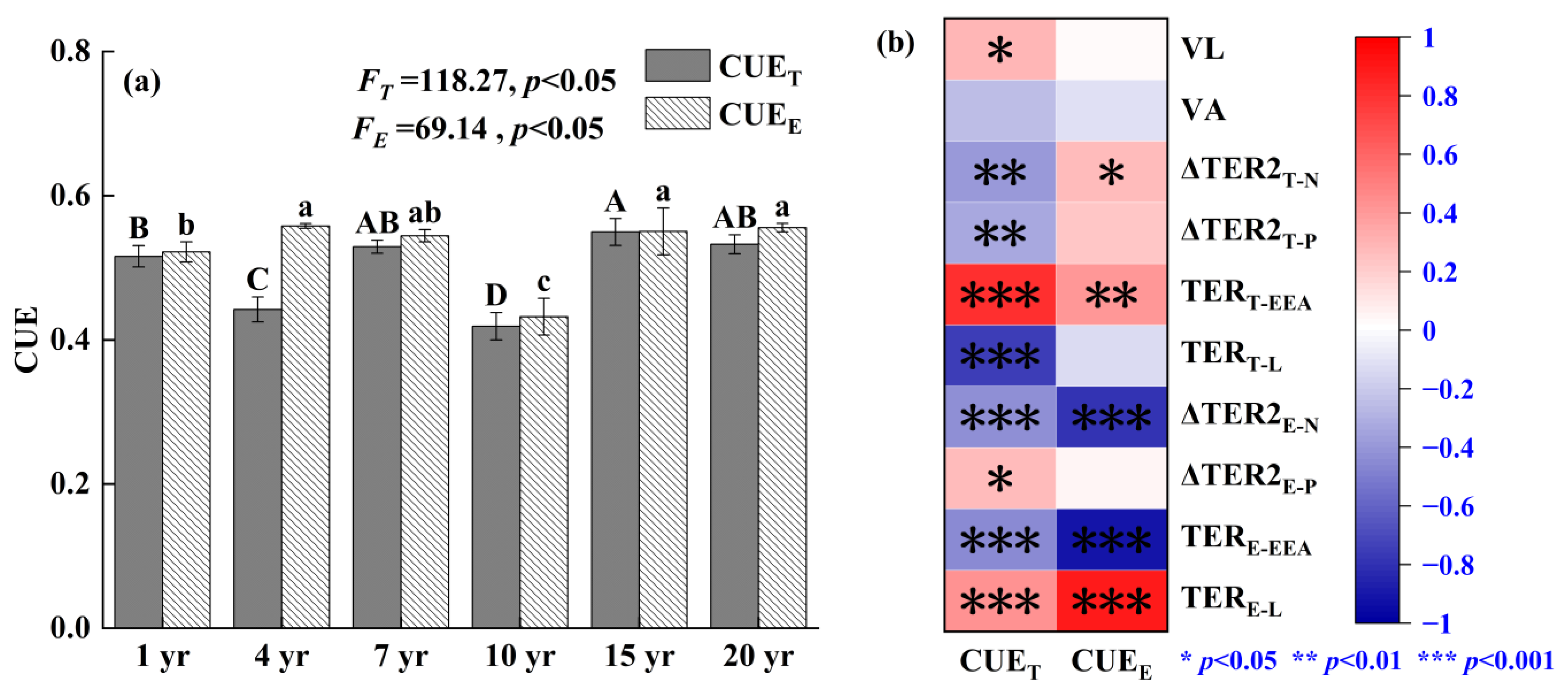
Both CUET and CUEE varied significantly across continuous cropping years, with the lowest values observed in the 10-year field (p < 0.05, Figure 4a). Both indices were positively correlated with TERT-EEA and TERE-L, but negatively correlated with ΔTER2E-N and TERE-EEA. Moreover, CUET exhibited significant associations with VL, ΔTER2T-N, ΔTER2T-P, TERT-L, and ΔTER2E-P, indicating a stronger sensitivity to changes in microbial metabolic limitation (p < 0.05, Figure 4b).
The core reason for the initial increase and subsequent decline of microbial carbon utilization efficiency (CUE) lies in the following: in the early stage of cultivation, there is an abundant supply of easily decomposable carbon sources and relatively weak nutrient limitation, allowing microorganisms to maintain a high CUE through efficient assimilation strategies. However, as the consecutive cropping years increase, phenolic acid allelochemicals accumulate, leading to the depletion of available phosphorus. Microorganisms are then forced to shift a large amount of carbon from biomass construction to extracellular enzyme synthesis and stress maintenance of respiration. The imbalance between investment and return in carbon and nutrient acquisition eventually causes a cliff-like decline in CUE.

3.5. Multivariate Analysis (PCA and RDA) of Soil Properties and Microbial Metabolic Limitation

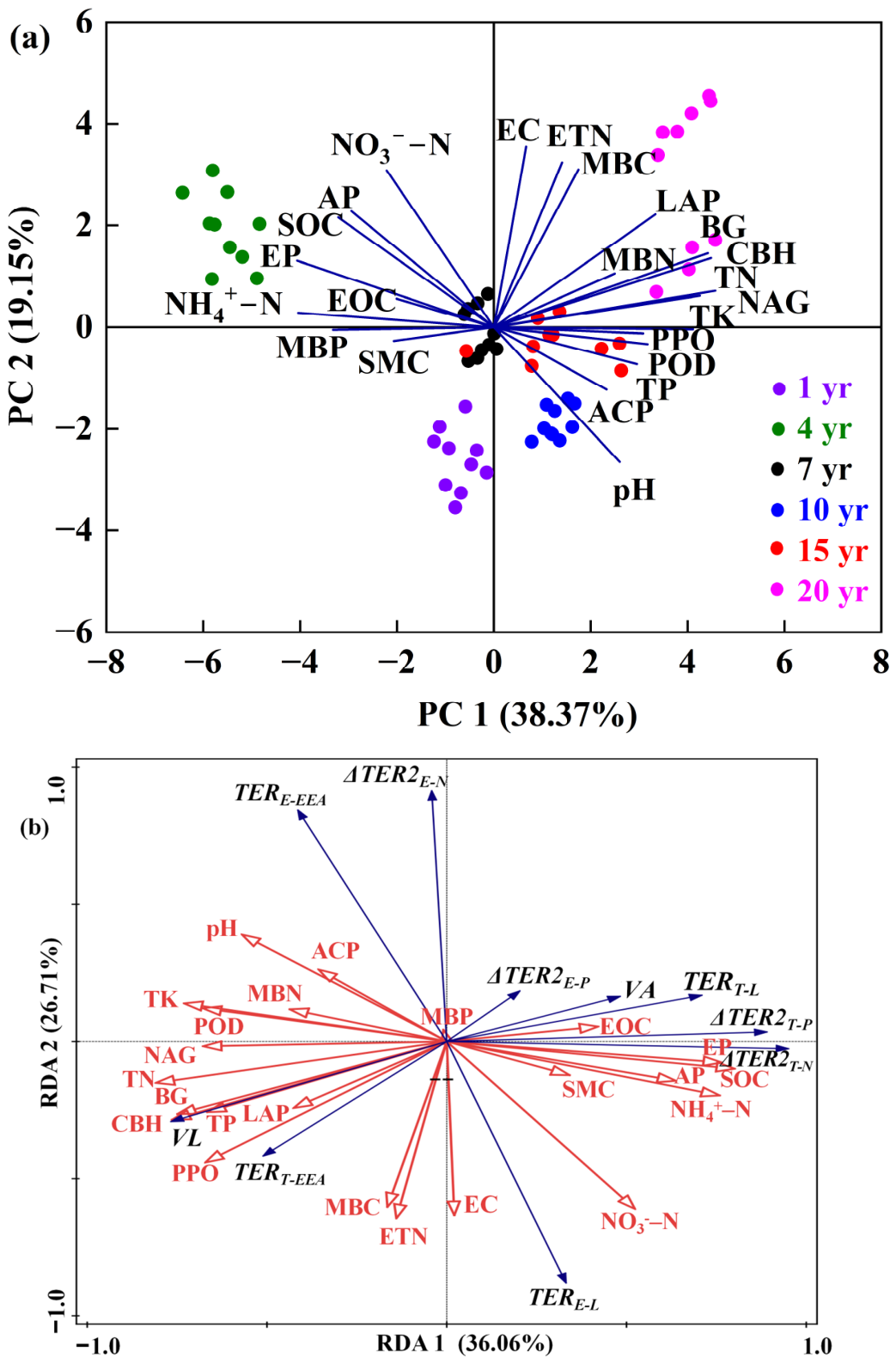
Biological factors and non-biological factors jointly influenced the lavender fields of different planting years. The results of the PCA indicated that the planting years affected both biological and non-biological indicators. The first and second axes of the PCA graph explained 38.37% and 19.15% of the changes in the indicators respectively. The soil properties differed greatly between the 1-, 4-, 10-, and 20-year planting durations, whereas the soil properties at 7- and 15- year were somewhat similar (Figure 5a).
Redundancy analysis (RDA) was performed to examine the relationships between soil properties and microbial metabolic limitation indicators. The first two axes (RDA1 and RDA2) explained 36.06% and 26.71% of the total variation, respectively (Figure 5b). CBH and NO3–N were the primary drivers of variation, supported by their high explanatory power (26.2% and 19.8%), while EP exhibited the highest pseudo-F value (26.0), indicating a strong regulatory effect. Microbial metabolic limitation indicators (VA, ΔTER2T–N, and ΔTER2T–P) were primarily associated with carbon availability (SOC and EOC) and nutrient supply (NH4+–N and AP), whereas VL was more closely linked to enzyme activities (CBH and BG).
The gradient structure revealed by PCA shows that PC1 (38.37%) constitutes the main gradient axis of “continuous cropping years—nutrient availability”: the left side gathers 4-year samples, accompanied by high MBP, SOC and AP loads, representing the initial root-zone nutrient enrichment state during continuous cropping; the right side distributes 15-year and 20-year samples, carrying high EC, TN and enzyme activity vectors, reflecting the coupling of soil salinization and microbial metabolic stress under long-term continuous cropping. PC2 (19.15%) constitutes the secondary axis of “acidification—salinization”, with the upper part of high NO3–N and EC loads corresponding to the nitrogen leaching and salt accumulation of 20-year samples and the lower part of the low pH vector pointing to the extreme soil acidification of 10-year samples. This orthogonal gradient structure confirms that the continuous cropping years are not driven by a single dimension but are jointly driven by two independent paths of nutrient depletion and acidification/salinization to promote soil functional degradation. The constrained sorting of RDA further quantifies the driving mechanism of MBP as a key response variable: the MBP vector is significantly negatively correlated with pH, EC, TER_E-EEA and TER_E-L (p < 0.001), while it is positively correlated with SOC, AP, and NH4+–N. The causal chain thus constructed is prolonged continuous cropping → accumulation of phenolic acid substances in roots (supported by literature) → soil acidification (P↓) and salinization (EC↑) → inhibition of phosphatase activity → immobilization of available phosphorus (AP↓) and depletion of microbial phosphorus pool (MBP↓) → microbial forced increase in extracellular enzyme investment (TER↑/EEA↑) to exploit scarce phosphorus → redistribution of carbon resources from biomass construction to enzyme synthesis and maintenance of respiration → decline in carbon utilization efficiency (CUE↓). Among them, soil acidification and effective phosphorus depletion constitute a dual bottleneck, the former exacerbating phosphorus fixation through Al3+/Fe3+ activation and the latter directly triggering microbial phosphorus starvation responses; the increase in enzyme investment is not an adaptive gain, but a costly, low-return stress compensation, ultimately leading to the loss of soil ecosystem stability.

4. Discussion

4.1. Effects of Continuous Cropping Years on Soil Properties and Eco-Chemical Stoichiometry

Irrigation in oasis farmlands in the arid regions of the northwest has led to significant declines in soil organic carbon, nitrogen, and phosphorus pools, and this negative effect accumulates over time with increasing irrigation duration. Changes in soil texture, pH, and chemical ratios are the main driving factors [32]. Unlike natural shrub ecosystems that gradually adapt to phosphorus limitation through community succession and mycorrhizal symbiosis, the continuous cropping system of lavender forms a unique “chemical–biological” synergistic fixation mechanism under irrigation conditions: Ca2+ and HCO3 in the irrigation water drive the continuous precipitation of phosphorus, the pulse concentration changes caused by dry–wet alternation intensify the fixation strength, and the phenolic acid substances released by the roots further block the desorption sites of phosphorus. This process is driven by secondary metabolism of the roots, the chemistry of the irrigation water and the coupling of soil minerals, and an independent theoretical framework is needed to explain it [33].
In this study, soil properties changed significantly across 1–20 years of continuous lavender cropping. SMC was highest in the 1-year field and differed significantly among cropping years (p < 0.05), contrasting with previous findings in continuous peanut systems where SMC peaked at 5 years [7], likely due to differences in crop type and water use strategies. From 10 to 15 years, the trends of EC, pH, SOC, and NO3-N were consistent with those observed in cotton fields under similar conditions [34], whereas TN, AP, and NH4+–N showed opposite patterns. Continuous cropping years reshaped soil C, N, and P supply and microbial nutrient acquisition, as reflected by the relatively low SOC:TN:TP ratio (43:3:1) compared with global averages (186:13:1) [9] and cropland values (64:5:1) [10], indicating relative carbon and nitrogen depletion or phosphorus enrichment under long-term management.
MBC, MBN, and MBP, as well as their ecological chemicalometry, exhibited fluctuating patterns with increasing continuous cropping years. Significant differences in microbial biomass were observed across continuous cropping years. MBC:MBP and MBN:MBP were highest in the 20-year field, being significantly higher than those in all other fields. The elevated MBC:MBP suggests strong phosphorus limitation driven by stoichiometric imbalance [9,35]. In the 20-year continuous cropping system, MBC and MBN were highest, and CUE was relatively high, whereas MBP and NH4+–N were depleted, indicating a clear decoupling of microbial C, N, and P pools. This pattern aligns with continuous cropping systems where nitrate content can increase by more than 100% after 10 years, while ammonium nitrogen is depleted [36]. The decoupling between high AP but low MBP captures the central paradox of this system. Long-term continuous cropping typically leads to the accumulation of phosphorus in the soil, yet most phosphorus is converted into slow-release and insoluble states that are extractable by chemical reagents but difficult for microbial transporters to access [37]. Accordingly, microbial phosphorus limitation intensified despite increasing chemical phosphorus availability because microbial phosphorus acquisition constraints are related to phosphorus speciation transformations rather than absolute scarcity [38]. Consistently, DOC and AP regulate microbial carbon limitation, whereas phosphorus limitation is mainly controlled by MBC, MBP, and MBC:MBP [39], ultimately reducing nutrient use efficiency and contributing to continuous cropping obstacles. MBC:MBN:MBP (56:7:1) is close to the commonly reported global value (60:7:1) [9], indicating a relatively conserved microbial stoichiometry. However, it is higher than both the global estimate (42:6:1) and the cropland value (38:5:1) reported in large-scale analyses [10], suggesting comparatively great microbial carbon and nitrogen accumulation relative to phosphorus. This pattern may reflect differences in resource availability and management regimes, which can modulate microbial nutrient demand and stoichiometric balance.
The MBP fluctuation was significant over the years. The peak in the fourth year might be due to an increase in organic matter input or improved temperature and humidity conditions that promote microbial activity; the trough in the 10th year might be related to the slowdown of organic matter turnover, reduced phosphorus input, or drought/nutrient imbalance leading to a decrease in microbial biomass, and it might also be influenced by the change in crop rotation in the previous period that alters the community structure. After adjusting the years from a categorical variable to a continuous variable, the long-term trend of the MBP fluctuation can be identified, rather than isolated anomalies, revealing the periodic change patterns driven by environmental factors, such as soil moisture, nutrient availability, and temperature, thereby more accurately assessing the impact of long-term environmental changes on the microbial phosphorus dynamics.
Increased POD and PPO indicate enhanced decomposition of recalcitrant organic matter and further signal enhanced oxidative depolymerization of aromatic compounds, consistent with increasing gene abundance for lignin metabolism along plantation chronosequences [40]. EEC (BG + CBH) and EEN (LAP + NAG) were highest in the 20-year lavender field and were significantly higher than those in all other fields. This reveals intensified microbial foraging for carbon and nitrogen substrates, mirroring tobacco chronosequences where EEN activities exhibit an upward tendency with continuous cropping for 1 to 9 years [17]. In contrast, the EEP (ACP) of lavender continuous cropping was lowest in the 4-year field and was significantly lower than that in all other fields. Acid phosphatase (ACP) activity varied significantly with continuous cropping duration in peanut fields: it was higher in the 4-year field than in the 2- and 6-year fields at the flowering stage but lower in the 6-year field than in the 2- and 4-year fields at the podding stage. Across the entire dataset, the 4-year field exhibited the lowest ACP activity, significantly below that of the other fields [18]. Increased extracellular enzyme production suggests greater microbial investment in C and N acquisition under prolonged continuous cropping, likely as an adaptive response to declining organic matter quality and intensified nutrient competition [19]. However, this response is not universal; for example, 10 years of continuous strawberry cropping reduced the abundance of the carbon fixation gene accA by 61.1%, indicating that long-term continuous cropping may also suppress microbial nutrient acquisition processes [41]. Overall, continuous cropping appears to reshape microbial resource acquisition strategies rather than consistently enhance microbial metabolic efficiency. EEC:EEN, EEC:EEP, and EEN:EEP progressively increased across the chronosequence and reached their highest values after 20 years of continuous cropping, indicating a pronounced shift in microbial nutrient acquisition strategy. Based on raw enzyme activities, the lavender soil exhibited an EEC:EEN:EEP ratio of 1:4.5:4.6, which markedly deviated from the globally averaged near-equilibrium ln-transformed ratio of approximately 1:1:1 proposed in the foundational ecoenzymatic stoichiometry framework [6]. Notably, ln-transformation of our data yielded a ratio of approximately 1:1.2:1.2, compressing the nearly five-fold absolute difference between C- and P-acquisition investment into an apparently balanced proportional allocation. This result suggests that logarithmic transformation may substantially reduce the magnitude of actual enzyme allocation differences, potentially obscuring microbial nutrient acquisition pressure under long-term continuous cropping conditions, as also highlighted in recent methodological evaluations [42]. Therefore, raw activity ratios may more realistically reflect the quantitative scale of microbial nutrient investment in continuous lavender cropping systems.

4.2. Effects of Continuous Cropping Years on Nutrient Limitations for Microorganisms

The characteristics of enzyme vectors reflect the relationship between energy and nutrient limitations in soil microbial metabolic processes [8]. In this study, significant differences in both vector length (VL) and vector angle (VA) were observed across continuous cropping years. VL increased with cropping years, while VA decreased. The 20-year field showed significantly different VL and VA values from all other years (p < 0.05). According to ecoenzymatic stoichiometry theory, vector length indicates carbon limitation intensity, while vector angle distinguishes nitrogen limitation (<45°) from phosphorus limitation (>45°) [6,8]. The 1-year and 4-year fields had VA > 45°, indicating P limitation, whereas the 20-year field showed VA < 45°, suggesting a shift to N limitation under long-term continuous cropping. All cropping years were characterized by low C, N, and P availability, with a mean VA of 46° and VL of 0.25, indicating concurrent N and P limitation with slight P dominance. The negative relationship between VL and VA suggests a trade-off: as C limitation intensified, relative P limitation decreased, reflecting microbial enzyme allocation adjustments.
TER results indicated concurrent N and P limitation across all years (Figure 3f), consistent with widespread microbial co-limitation by multiple nutrients in terrestrial ecosystems [6,43]. For visual clarity, −ΔTER2T-N and −ΔTER2E-N (negative values) denote N limitation, whereas ΔTER2T-P and ΔTER2E-P (positive values) denote P limitation. The divergent patterns of TEREEA and TERL stem from fundamental differences in their normalization strategies. As two distinct approaches for quantifying microbial nutrient limitation, TEREEA incorporates microbial biomass stoichiometry (BC:N and BC:P) into the ΔTER framework, while TERL normalizes soil resource availability (LC:X) against threshold elemental ratios (TERC:N and TERC:P) derived from enzyme activity intercepts [31]. Although both models predict N or P limitation at broad scales, their frameworks differ fundamentally—TEREEA evaluates biomass synthesis requirements via microbial biomass ratios, whereas TERL assesses metabolic thresholds via enzyme-derived thresholds [31]. This divergence explains the contrasting limitation diagnoses in this study, highlighting the sensitivity of nutrient limitation assessment to normalization choices. The inconsistent limitation assessment results derived from total versus extractable nutrient pools further demonstrate that microbial nutrient limitation diagnoses are highly dependent on the choice of nutrient resource pool. TERE-EEA consistently indicated P limitation, whereas TERE-L consistently indicated N limitation, suggesting that extractable nutrients impose distinct constraints on biomass synthesis versus metabolic activity. The observation that 4- and 10-year fields consistently appeared as transition points—where TERT-EEA and TERT-L flipped their diagnoses—suggests that these years represent critical ecological thresholds in the continuous cropping chronosequence. These results support the recommendation that ecological chemicalometry studies employ multiple complementary methods to robustly characterize microbial nutrient limitation [29].
Both CUET and CUEE varied significantly (0.42–0.56), remaining at moderate levels within the theoretical maximum of ~0.6 [29,44]. The lowest values occurred in the 10-year field, while 15- and 20-year fields showed relatively high CUE (p < 0.05), suggesting a nonlinear response to ecosystem development. CUET correlated positively with TER T-EEA and TER E-L, but negatively with ΔTER2E-N and TERE-EEA, and showed significant associations with VL and TER indices, indicating sensitivity to metabolic limitation changes. CUE is regulated by anabolic–catabolic balance, with nutrient limitation affecting enzyme production and substrate utilization efficiency [30,31,44]. Moderate C limitation may stimulate enzyme investment, maintaining relatively high CUE in older fields, while severe N limitation may reduce CUE through increased foraging costs.
Collectively, the enzyme vector, TER, and CUE results reveal dynamic shifts in microbial metabolic limitation over time. Fields with 1–4 years of continuous cropping showed P limitation with relatively low C limitation, and 7–10-year fields displayed intensified C limitation, whereas 15–20-year fields exhibited elevated C limitation but paradoxically higher CUE and shifted N limitation. The transition from P to N limitation may reflect P accumulation from fertilizers coupled with N depletion via crop uptake. The VL-VA trade-off indicates resource allocation constraints, underscoring the value of multi-indicator approaches in assessing microbial nutritional status in agroecosystems.

4.3. Environmental Driving Mechanism and Ecological Insights

Multivariate analysis revealed that biological and non-biological factors jointly shaped lavender fields across different planting years. PCA results showed nonlinear soil property trajectories, with 1-, 4-, 10-, and 20-year fields differing substantially while 7- and 15-year fields converged, indicating that soil conditions temporarily stabilize before diverging again under prolonged continuous cropping, as observed in other systems where soil chemistry and microbial communities undergo complex changes rather than linear degradation [36]. RDA further demonstrated that CBH and NO3–N served as primary drivers of microbial metabolic limitation (26.2% and 19.8% explanatory power), while extractable phosphorus (EP) exhibited the strongest regulatory effect (pseudo-F = 26.0), highlighting the importance of bioavailable phosphorus in shaping microbial metabolic status [31]. This aligns with evidence that soil physicochemical properties, resource ratios, and microbial biomass collectively govern enzyme activities and metabolic patterns [45].
This differential coupling reveals distinct regulatory pathways: VA responds to bulk soil carbon pools and mineral nutrient availability, whereas VL reflects microbial investment in enzyme systems targeting recalcitrant substrates [8]. The association between VL and CBH/BG activities supports the theoretical framework that vector length represents carbon limitation intensity, as these enzymes directly mediate cellulose and glucose hydrolysis [8]. The strong pseudo-F value for extractable phosphorus indicates that bioavailable phosphorus is a critical driver of microbial metabolic limitation patterns; when bioavailable phosphorus is deficient, microbial communities may face phosphorus constraints that alter nutrient limitation diagnoses [46]. This decoupling between high total phosphorus and low extractable phosphorus likely reflects progressive phosphorus immobilization into slowly cycling pools, a phenomenon that intensifies with prolonged continuous cropping duration [47]. The contrasting behavior of NH4+–N and NO3–N further emphasizes that microbial nutrient limitation cannot be inferred from total nitrogen alone but requires assessment of specific ionic forms [36].
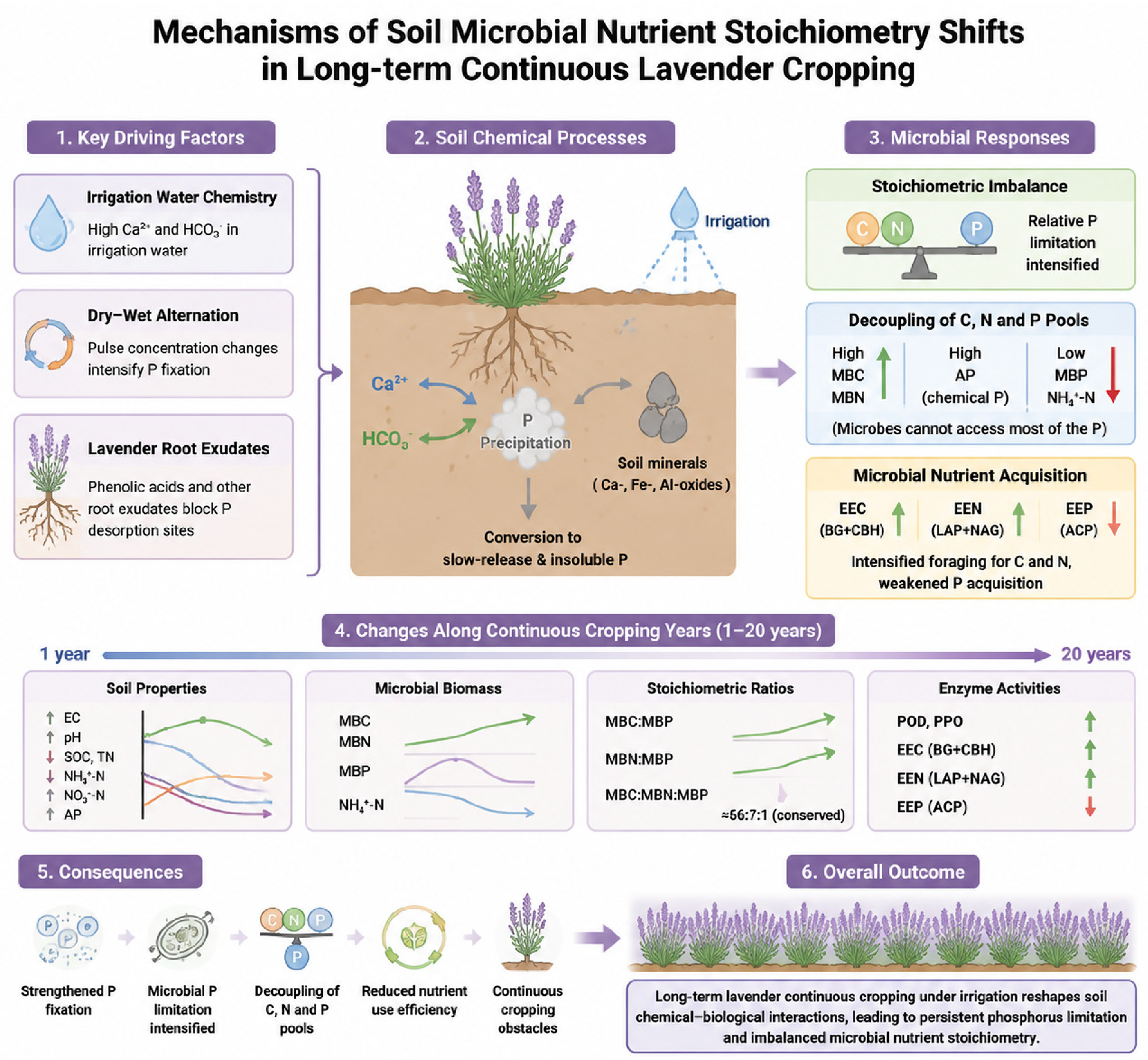
Collectively, microbial metabolic limitation in lavender rhizosphere soils reflects differential responses of vector indices: carbon limitation is quantified by vector length (enzyme-driven investment in C acquisition), whereas nutrient limitation is quantified by vector angle (relative P vs. N limitation) [8]. This implies that management interventions targeting specific enzymes or nutrient forms may differentially affect microbial metabolic status (Figure 6). For instance, practices enhancing cellulose accessibility may alleviate carbon limitation more effectively than bulk organic matter amendments, while phosphorus fertilization strategies should prioritize bioavailable forms rather than total phosphorus accumulation [46].

5. Conclusions

Based on comprehensive analysis across 1–20 years of continuous lavender cropping, microbial metabolic limitation exhibits clear nonlinear variation, shifting from phosphorus limitation in 1–4-year fields to intensified carbon limitation in 7–10-year fields and finally to nitrogen limitation in 15–20-year fields, alongside increased carbon limitation. TEREEA and TERL show inconsistent dominant limitation results due to different normalization frameworks, highlighting the need to consider assessment methods when interpreting nutrient limitation. Furthermore, carbon limitation (VL) correlates with enzyme characteristics, while nutrient limitation (VA and TER) correlates with bulk soil chemistry, with bioavailable phosphorus playing an important role; overall, bioavailable nutrient forms are closely related to microbial metabolic constraints in continuous lavender systems. Subsequent studies will combine high-throughput sequencing technology to analyze the species composition, functional genes (such as phoD for phosphorus cycling genes), and symbiotic network changes in bacterial/fungal communities under different consecutive cropping durations and quantify the contribution rate of community structure changes to the soil phosphorus cycling function.

Supplementary Materials

The following supporting information can be downloaded at: https://www.mdpi.com/article/10.3390/su18104809/s1, Table S1: the calculation process and related data of Vector Angle (VA).

Author Contributions

Conceptualization, X.L. and D.S.; methodology, S.L.; software, D.S.; validation, J.F., S.F. and C.Y.; investigation, J.F., S.F. and C.Y.; resources, X.L.; data curation, D.S.; writing—original draft preparation, D.S.; writing—review and editing, X.L., and S.L.; visualization, D.S., J.F., S.F. and C.Y.; supervision, X.L.; project administration, X.L.; funding acquisition, X.L. All authors have read and agreed to the published version of the manuscript.

Funding

This research was funded by the Department of Human Resources and Social Security of Xinjiang Uyghur Autonomous Region, grant number 2025CXLJ005.

Institutional Review Board Statement

Not applicable.

Informed Consent Statement

Not applicable.

Data Availability Statement

The original contributions presented in this study are included in the article. Further inquiries can be directed to the corresponding author.

Acknowledgments

This research was funded by the Tianchi Innovation Leading Talent Fund of the Xinjiang Autonomous Region and the High-level Talent Project of Yili Normal University. The authors express heartfelt gratitude to Yijing Lv and other colleagues who contributed to the field experiments. We are sincerely grateful to the reviewers for their valuable comments and suggestions.

Conflicts of Interest

The authors declare no conflicts of interest.

Abbreviations

The following abbreviations are used in this manuscript:
SMCSoil moisture content
ECElectrical conductivity
SOCSoil organic carbon
TNSoil total nitrogen
TPSoil total phosphorus
TKSoil total potassium
AMNAmmonium nitrogen
NINNitrate nitrogen
PODPeroxidase
PPOPhenol oxidase

References

  1. Guo, J.H.; Liu, X.J.; Zhang, Y.; Shen, J.; Han, W.; Zhang, W.; Christie, P.; Goulding, K.; Vitousek, P.; Zhang, F. Significant acidification in major Chinese croplands. Science 2010, 327, 1008–1010. [Google Scholar] [CrossRef]
  2. Zhao, X.; Liu, Y.; Yue, L.; Tian, Y.; Zhou, Q.; Wang, Y.; Liu, S.; Guo, Z.; Zhang, Y.; Wang, R. Continuous monoculture alters the fungal community and accumulates potential pathogenic strains in the rhizosphere of Codonopsis pilosula. Phytobiomes J. 2024, 8, 340–349. [Google Scholar] [CrossRef]
  3. Tang, J.; Xue, Z.; Daroch, M.; Ma, J. Impact of continuous Salvia miltiorrhiza cropping on rhizosphere actinomycetes and fungi communities. Ann. Microbiol. 2015, 65, 1267–1275. [Google Scholar] [CrossRef]
  4. He, Z.; Wang, Y.; Yan, Y.; Qin, S.; He, H.; Mao, R.; Liang, Z. Dynamic analysis of physiological indices and transcriptome profiling revealing the mechanisms of the allelopathic effects of phenolic acids on Pinellia ternata. Front. Plant Sci. 2022, 13, 1039507. [Google Scholar] [CrossRef] [PubMed]
  5. Zan, Z.; Jiao, N.; Ma, R.; Wang, J.; Wang, Y.; Ning, T.; Zheng, B.; Liu, L.; Zhao, X.; Cong, W. Long-term maize intercropping with peanut and phosphorus application maintains sustainable farmland productivity by improving soil aggregate stability and P availability. Agronomy 2023, 13, 2846. [Google Scholar] [CrossRef]
  6. Sinsabaugh, R.L.; Hill, B.H.; Follstad Shah, J.J. Ecoenzymatic stoichiometry of microbial organic nutrient acquisition in soil and sediment. Nature 2009, 462, 795–798. [Google Scholar] [CrossRef]
  7. Wang, X.; Yang, M.; Gao, L.; Li, Y.; Liang, W.; Zhang, X. Continuous cropping obstacles: Insights from the community composition and the imbalance carbon fluxes within soil nematode food web. Geoderma 2024, 451, 117060. [Google Scholar] [CrossRef]
  8. Moorhead, D.L.; Sinsabaugh, R.L.; Hill, B.H.; Weintraub, M.N. Vector analysis of ecoenzyme activities reveal constraints on coupled C, N and P dynamics. Soil Biol. Biochem. 2016, 93, 1–7. [Google Scholar] [CrossRef]
  9. Cleveland, C.C.; Liptzin, D. C:N:P stoichiometry in soil: Is there a “Redfield ratio” for the microbial biomass? Biogeochemistry 2007, 85, 235–252. [Google Scholar] [CrossRef]
  10. Xu, X.; Thornton, P.E.; Post, W.M. A global analysis of soil microbial biomass carbon, nitrogen and phosphorus in terrestrial ecosystems. Glob. Ecol. Biogeogr. 2013, 22, 737–749. [Google Scholar] [CrossRef]
  11. Sinsabaugh, R.L.; Follstad Shah, J.J. Ecoenzymatic stoichiometry and ecological theory. Annu. Rev. Ecol. Evol. Syst. 2012, 43, 313–343. [Google Scholar] [CrossRef]
  12. Cheng, Y.; Du, A.; Wang, Z.; Zhu, W.; Ren, S.; Xu, Y.; Ren, S. Soil enzyme activity differs among native species and continuously planted Eucalyptus plantations. Forests 2023, 14, 2210. [Google Scholar] [CrossRef]
  13. Tang, Y.; Li, X.; Song, Y.; Alabbosh, K.F.; Li, K.; Lou, J.; Hameed, R.; Iqbal, B.; Li, G.; Du, D. Nitrogen deposition enhanced the effect of Solidago Canadensis invasion on soil microbial metabolic limitation and carbon use efficiency. Pol. J. Environ. Stud. 2023, 32, 5799–5810. [Google Scholar] [CrossRef]
  14. Joergensen, R.G.; Hemkemeyer, M.; Beule, L.; Iskakova, J.; Oskonbaeva, Z.; Rummel, P.S.; Schwalb, S.A.; Wichern, F. A hitchhiker’s guide: Estimates of microbial biomass and microbial gene abundance in soil. Biol. Fertil. Soils 2024, 60, 457–470. [Google Scholar] [CrossRef]
  15. He, Y.; Xing, Y.; Yan, G.; Liu, G.; Liu, T.; Wang, Q. Long-term nitrogen addition could modify degradation of soil organic matter through changes in soil enzymatic activity in a natural secondary forest. Forests 2023, 14, 2049. [Google Scholar] [CrossRef]
  16. Hu, J.; Cui, H.; Fan, M.; Liu, M.; Wang, S.; Li, X.; Peng, X.; Shi, F.; Song, W.; Sun, W. Functional soil microbes drive soil phosphorus fractions in response to nitrogen addition across aggregate levels. Front. Microbiol. 2025, 16, 1671863. [Google Scholar] [CrossRef] [PubMed]
  17. Liu, C.-Q.; Zhao, G.-K.; Deng, X.-P.; Ma, E.-D.; Li, J.-Y.; Chen, Y.; Jiang, Y.-L.; Wang, C. Effects of continuous cropping time on soil nutrient, microbial biomass, and extracellular enzyme stoichiometry characteristics of tobacco-planting soil. J. Yunnan Agric. Univ. (Nat. Sci.) 2023, 38, 494–502. [Google Scholar]
  18. Li, Z.; Jiang, L.; Tang, R.; Guo, W. Effects of long-term continuous peanut cropping on dry matter weight of different peanut varieties, soil nutrient contents and enzyme activities. Soils 2018, 50, 491–497. [Google Scholar]
  19. Chen, X.; Han, X.; Lu, X.; Yan, J.; Biswas, A.; Zou, W. Long-term continuous cropping affects ecoenzymatic stoichiometry of microbial nutrient acquisition: A case study from a Chinese Mollisol. J. Sci. Food Agric. 2021, 101, 6338–6346. [Google Scholar] [CrossRef]
  20. Gao, Y.; Zhang, Y.; Wang, H.; Wu, B.; Li, Y.; Yan, B.; Wang, Y.; Lu, P.; Wang, R.; Wen, M. Improving the Key Enzyme Activity, Conversion Intensity, and Nitrogen Supply Capacity of Soil through Optimization of Long-Term Oilseed Flax Rotation Planting Patterns in Dry Areas of the Loess Plateau of China. Agronomy 2024, 14, 262. [Google Scholar] [CrossRef]
  21. Lu, P.; Zhao, C.; Yin, W.; Hu, F.; Fan, Z.; Yu, A.; Fan, H. Microbial community shifts with soil properties and enzyme activities in inter-/mono-cropping systems in response to tillage. Agronomy 2023, 13, 2707. [Google Scholar] [CrossRef]
  22. Zhai, J.; Zhou, H.; Wu, Y.; Wang, G.; Xue, S. Effect of nitrogen and phosphorus on soil enzyme activities and organic carbon stability in Qinghai–Tibet Plateau. Agronomy 2024, 14, 1376. [Google Scholar] [CrossRef]
  23. Marchidan, I.G.; Geicu-Cristea, M.; Popa, E.E.; Butnariu, G.; Băbeanu, N.E. Review on different applications of Lavandula spp. as a source of bioactive compounds. Sci. Bull. Ser. F. Biotechnol. 2023, 27, 81–96. [Google Scholar]
  24. Qiao, Q.; Shi, G.; Yang, D.; Wang, L.; Zhang, X.; Li, S.; Bai, X.-E. Study on the destruction law of physical and shear properties of soil in mining disturbance. Sci. Rep. 2023, 13, 17751. [Google Scholar] [CrossRef]
  25. Zhang, X.; Lei, J. Trend of urban system structure under the restriction of water and land resources in Xinjiang. Chin. Sci. Bull. 2006, 51, 179–188. [Google Scholar] [CrossRef]
  26. Chen, H.; Zhao, X.; Chen, X.; Lin, Q.; Li, G. Seasonal changes of soil microbial C, N, P and associated nutrient dynamics in a semiarid grassland of north China. Appl. Soil Ecol. 2018, 128, 89–97. [Google Scholar] [CrossRef]
  27. Hamel, C.; Hanson, K.; Selles, F.; Cruz, A.F.; Lemke, R.; McConkey, B.; Zentner, R. Seasonal and long-term resource-related variations in soil microbial communities in wheat-based rotations of the Canadian prairie. Soil Biol. Biochem. 2006, 38, 2104–2116. [Google Scholar] [CrossRef]
  28. Saiya-Cork, K.; Sinsabaugh, R.; Zak, D. The effects of long term nitrogen deposition on extracellular enzyme activity in an Acer saccharum forest soil. Soil Biol. Biochem. 2002, 34, 1309–1315. [Google Scholar] [CrossRef]
  29. Sinsabaugh, R.L.; Turner, B.L.; Talbot, J.M.; Waring, B.G.; Powers, J.S.; Kuske, C.R.; Moorhead, D.L.; Follstad Shah, J.J. Stoichiometry of microbial carbon use efficiency in soils. Ecol. Monogr. 2016, 86, 172–189. [Google Scholar] [CrossRef]
  30. Sinsabaugh, R.L.; Manzoni, S.; Moorhead, D.L.; Richter, A. Carbon use efficiency of microbial communities: Stoichiometry, methodology and modelling. Ecol. Lett. 2013, 16, 930–939. [Google Scholar] [CrossRef]
  31. Cui, Y.; Moorhead, D.L.; Guo, X.; Peng, S.; Wang, Y.; Zhang, X.; Fang, L. Stoichiometric models of microbial metabolic limitation in soil systems. Glob. Ecol. Biogeogr. 2021, 30, 2297–2311. [Google Scholar] [CrossRef]
  32. Sun, W.; He, Z.; Liu, B.; Ma, D.; Li, R.; Wang, S.; Malekian, A. Impact of long-term drip irrigation on soil organic carbon and nutrient stocks in arid oasis farmlands. Catena 2025, 252, 108895. [Google Scholar] [CrossRef]
  33. Syers, J.K.; Johnston, A.; Curtin, D. Efficiency of soil and fertilizer phosphorus use. FAO Fertil. Plant Nutr. Bull. 2008, 18, 5–50. [Google Scholar]
  34. Chen, H.; Yang, L.; Zhang, F.-H. Effects of continuous cotton monocropping on soil physicochemical properties and nematode community in Xinjiang, China. Ying Yong Sheng Tai Xue Bao J. Appl. Ecol. 2021, 32, 4263–4271. [Google Scholar]
  35. Simpson, A.; Whitehead, D.; Condron, L.M.; Orwin, K.H.; Cameron, K.C.; Lehto, N.J. Long-term biomass removal in grasslands reduces plant and soil phosphorus, increases carbon: Phosphorus stoichiometry, but does not lead to microbial phosphorus limitation. Agric. Ecosyst. Environ. 2026, 396, 110017. [Google Scholar] [CrossRef]
  36. Pan, H.; Zhu, M.; Ding, C.; Wu, J. Soil Physiochemical Property Variations and Microbial Community Response Patterns Under Continuous Cropping of Tree Peony. Agronomy 2025, 15, 2602. [Google Scholar] [CrossRef]
  37. Li, J.; Zhang, J.; Liu, Y.; Fu, H.; Sun, Z. Effects of Long-Term Material Amendments on Soil Phosphorus Fractions and Associated Microbial Changes in Greenhouse Tomato Cultivation. Agriculture 2026, 16, 406. [Google Scholar] [CrossRef]
  38. Xu, T.; Zheng, S.; Duo, X.; Hou, Z.; Wu, J. Long-term plastic mulching exacerbates the co-limitation of carbon and phosphorus in farmland by altering physicochemical properties and microbial interactions. Front. Microbiol. 2025, 16, 1694370. [Google Scholar] [CrossRef] [PubMed]
  39. Wang, J.; Wang, X.; Zheng, F.; Wei, H.; Zhao, M.; Jiao, J. Ecoenzymatic Stoichiometry Reveals Microbial Carbon and Phosphorus Limitations under Elevated CO2, Warming and Drought at Different Winter Wheat Growth Stages. Sustainability 2023, 15, 9037. [Google Scholar] [CrossRef]
  40. You, Y.; Liu, X.; Wang, L.; Khalid, M.; Wang, X.; Jiang, L.; Wang, F.; Pang, Z.; Peng, Y.; Zhao, X. Integrated metagenomic and soil chemical analyses revealed shifts of microbial nutrient cycling with poplar plantation age. Front. Plant Sci. 2025, 16, 1513281. [Google Scholar] [CrossRef] [PubMed]
  41. Wang, Q.; Chu, C.; Zhao, Z.; Wu, S.; Zhou, D. Effects of Strawberry Continuous Cropping on Soil Microbial Community Composition and Carbon, Nitrogen and Phosphorus Metabolism Gene Abundance. Sci. Agric. Sin. 2025, 58, 3488–3502. [Google Scholar]
  42. Puissant, J. Does the C:N:P 1:1:1 Ratio Hold? Examining Log-Transformation Bias in Enzyme Stoichiometry. Glob. Change Biol. 2025, 31, e70228. [Google Scholar] [CrossRef]
  43. Kang, H.; Xue, Y.; Cui, Y.; Moorhead, D.L.; Lambers, H.; Wang, D. Nutrient limitation mediates soil microbial community structure and stability in forest restoration. Sci. Total Environ. 2024, 935, 173266. [Google Scholar] [CrossRef] [PubMed]
  44. Manzoni, S.; Taylor, P.; Richter, A.; Porporato, A.; Ågren, G.I. Environmental and stoichiometric controls on microbial carbon-use efficiency in soils. New Phytol. 2012, 196, 79–91. [Google Scholar] [CrossRef]
  45. Gan, F.; Shi, H.; Tan, X.; Jiang, L.; Li, W.; Xia, Y.; Pu, J.; Dai, Q.; Yan, Y.; Fan, Y. Responses of Soil Enzyme Activity and Microbial Nutrient Limitations to Vegetation Types in a Degraded Karst Trough Valley. Forests 2025, 16, 279. [Google Scholar] [CrossRef]
  46. Ren, Y.; Wang, Y.; Zhang, X.; Liu, X.; Liu, P.; Chen, L. Enzymatic stoichiometry reveals the metabolic limitations of soil microbes under nitrogen and phosphorus addition in Chinese fir plantations. Microorganisms 2024, 12, 1716. [Google Scholar] [CrossRef] [PubMed]
  47. Zheng, S.; Bian, T.; Wang, S.; Zhang, X.; Li, X.; Zhang, Y.; Fu, H.; Sun, Z. Decoupling of P from C, N, and K elements in cucumber leaves caused by nutrient imbalance under a greenhouse continuous cropping system. Horticulturae 2021, 7, 528. [Google Scholar] [CrossRef]
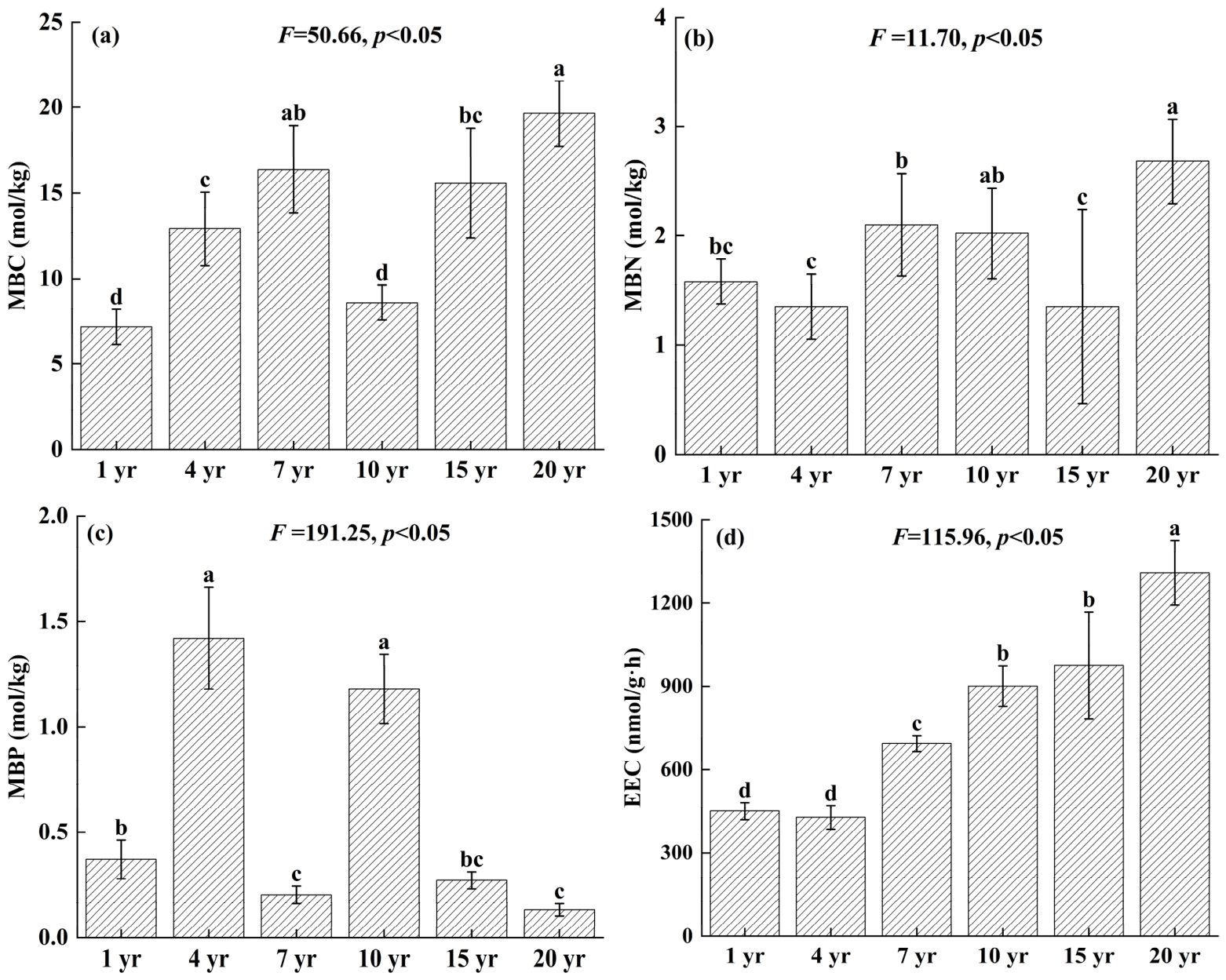
Figure 1. Microbial biomass and extracellular enzyme activities in lavender rhizosphere soils across continuous cropping years. Different lowercase letters indicate significant differences among continuous cropping years (p < 0.05). (a) The content of soil microbial biomass carbon for different continuous cropping durations; (b) The content of soil microbial biomass nitrogen for different continuous cropping durations; (c) The content of soil microbial biomass nitrogen for different continuous cropping durations; (d) Extracellular enzyme activities related to the carbon cycle in soils with different continuous cropping durations; (e) Extracellular enzyme activities related to the nitrogen cycle in soils with different continuous cropping durations; (f) Extracellular enzyme activities related to the phosphorus cycle in soils with different continuous cropping durations.
Sustainability 18 04809 g001aSustainability 18 04809 g001b
Figure 2. Stoichiometric patterns of soil, microbial, and enzymatic components across continuous cropping years. In the figure, different lowercase letters indicate significant differences among continuous cropping years (p < 0.05). (a) The ratio of soil organic carbon to total nitrogen over different continuous cropping durations; (b) The ratio of soil organic carbon to total phosphorus over different continuous cropping durations; (c) The ratio of total nitrogen to total phosphorus for different continuous cropping durations; (d) The ratio of extractable organic carbon to extractable total nitrogen over different continuous cropping periods; (e) The ratio of extractable organic carbon to extractable phosphorus over different continuous cropping periods; (f) The ratio of Extractable Total Nitrogen to Extractable Phosphorus over different continuous cropping durations; (g) The ratio of microbial biomass carbon to microbial biomass nitrogen for different continuous cropping durations; (h) The ratio of microbial biomass carbon to microbial biomass phosphorus for different continuous cropping durations; (i) The ratio of microbial biomass nitrogen to microbial biomass phosphorus for different continuous cropping durations; (j) The ratio of extracellular enzyme activities in the carbon cycle to those in the nitrogen cycle for different continuous cropping durations; (k) The ratio of extracellular enzyme activities for carbon cycling to those for phosphorus cycling over different continuous cropping durations; (l) The ratio of extracellular enzyme activities for nitrogen cycling to those for phosphorus cycling over different continuous cropping durations.
Sustainability 18 04809 g002aSustainability 18 04809 g002b
Figure 3. Microbial metabolic and nutrient limitation across continuous cropping years based on vector analysis, extracellular enzymes and threshold element ratios. Different lowercase letters indicate significant differences among continuous cropping years (p < 0.05). (a) Changes in enzyme vector length over different continuous cropping periods; (b) Changes in enzyme vectors over different continuous cropping periods; (c) Correlation analysis of enzyme vector length and enzyme vector angle with different continuous cropping years; (d) has the abscissa as (carbon-related acquisition enzyme)/(carbon-related acquisition enzyme + phosphorus-related acquisition enzyme), and the ordinate as (carbon-related acquisition enzyme)/(carbon-related acquisition enzyme + nitrogen-related acquisition enzyme + phosphorus-related acquisition enzyme). The upper left quadrant indicates that the contribution of carbon-related enzymes is relatively high, while the contribution of phosphorus-related enzymes is relatively low. The upper right quadrant, in this quadrant, on the upper side of the 1:1 dividing line, the activity of carbon-related enzymes dominates, while the contribution of phosphorus-related enzymes is less; on the lower side of the dividing line, the activity of carbon-related enzymes dominates, while the contribution of nitrogen-related enzymes is smaller. The lower left quadrant, on the upper side of the 1:1 dividing line, corresponds to the situation where the activities of carbon and phosphorus-related enzymes are low; on the lower side of the 1:1 dividing line, it corresponds to the situation where the activities of carbon and nitrogen-related enzymes are low. The lower right quadrant is characterized by the dominance of nitrogen-related enzymes, while the activity of carbon-related enzymes is relatively low; (e) This figure is a chemical stoichiometric ratio diagram of extracellular enzymes in soil microorganisms, which is used to determine the nutritional limitation status of soil microorganisms.; (f) Vector analysis model comparison of microbial resource limitation tendency of lavender soil under different continuous cropping durations (1–20 years). The main figure shows the limitation tendency scores of each duration on 10 enzymatic stoichiometric models. The inset enlarges and displays the details of the TERT-EEA, TERE-EEA, TERT-L and TERE-L models. Positive values indicate carbon limitation tendency, negative values indicate nutrient (nitrogen or phosphorus) limitation tendency, and the error bars represent the standard errors. Note: ΔTER2T-N, ΔTER2T-P, TERT-EEA and TERT-L denote threshold element ratios derived from total soil nutrients (SOC, TN, and TP), whereas ΔTER2E-N, ΔTER2E-P, TERE-EEA and TERE-L are derived from extractable nutrient pools (EOC, ETN, and EP).
Sustainability 18 04809 g003aSustainability 18 04809 g003b
Figure 4. Relationships between CUE and indicators of microbial metabolic limitation. Note: CUET and CUEE were derived from total soil nutrients (SOC, TN, and TP) and extractable nutrient pools (EOC, ETN, and EP), respectively. (a) Changes in total soil microbial carbon utilization efficiency (CUET) and extractable carbon utilization efficiency (CUEE) of lavender over different cropping durations (1–20 years). Capital letters (A–D) indicate significant differences in CUET among the cropping periods (p < 0.05), while lowercase letters (a–c) indicate significant differences in CUEE among the cropping periods (p < 0.05). The same letter indicates no significant difference, and different letters indicate significant differences. FT and FE are the F-statistics of variance analysis for CUET and CUEE, respectively; (b) Heatmap of Pearson correlation between the chemical metric vectors of extracellular enzymes in soil (VL, VA, TER, and ATER2) and the microbial carbon utilization efficiency (CUET, CUEE). Red indicates positive correlation, blue indicates negative correlation, and the darkness of the color reflects the absolute value of the correlation coefficient. The asterisk indicates the significance level: * p < 0.05, ** p < 0.01, *** p < 0.001.
Sustainability 18 04809 g004
Figure 5. PCA (a) and RDA (b) of soil properties and microbial metabolic limitation indicators. (a) Principal Component Analysis (PCA) of soil physicochemical properties, microbial biomass and extracellular enzyme activities of lavender under different continuous cropping durations (1–20 years). PC1 and PC2 respectively account for 38.37% and 19.15% of the total variation. The arrows indicate the contribution and direction of each variable to the principal components, and the different colored dots represent the soil samples from different continuous cropping durations; (b) The chemical stoichiometric vector characteristics (TER and ATER2) of soil extracellular enzymes were analyzed for redundancy with soil physical and chemical properties, microbial biomass, and enzyme activities. RDA1 and RDA2 respectively explained 36.06% and 26.71% of the total variation. The red arrows represent environmental/biological factors, while the blue arrows represent the enzyme chemical stoichiometric vector indicators. The length and direction of the arrows reflect the explanatory power and association direction of each variable for the enzyme chemical stoichiometric pattern.
Sustainability 18 04809 g005
Figure 6. Conceptual mechanism diagram. Irrigation input → Phosphorus chemical fixation → Microbial phosphorus limitation → Enhanced carbon-nitrogen foraging → Chemical balance disruption → Nutrient cycling disorder → Failure of continuous cropping. Through the use of arrows, a complete causal chain from soil chemistry to microbial ecology and then to agricultural ecology was constructed, revealing the underlying mechanism of lavender continuous cropping failure.
Sustainability 18 04809 g006
Table 1. Information related to extracellular enzymes in soil.
EnzymeAbbreviationSubstrateFunction
Cellulose hydrolaseCBH4-Methylumbelliferyl-β-D-fructosideActivated carbon circulation
β-glucosidaseBG4-Methylumbelliferyl-β-D-glucosideActivated carbon circulation
β-AcetylglycansidaseNAG4-Methyl-N-acetyl-β-D-glucosideNitrogen cycle
Leucine aminopeptidaseLAPL-Leucine-7-amino-4-methylcoumarinNitrogen cycle
Acid phosphataseACP4-Methylumbelliferyl phosphatePhosphorus cycle
Table 2. Physicochemical properties of lavender rhizosphere soils across continuous cropping years. Values with different lowercase letters are significantly different at p < 0.05.
Soil Properties1-Year4-Year7-Year10-Year15-Year20-Year
SMC16.56 ± 0.60 a15.36 ± 0.42 b12.52 ± 0.44 d12.23 ± 1.14 d10.43 ± 0.434 e13.97 ± 1.73 c
EC141.15 ± 4.88 c192.85 ± 11.50 a162.59 ± 9.46 b131.15 ± 1.87 d180.15 ± 10.90 a231.86 ± 68.92 a
pH8.07 ± 0.18 abc7.77 ± 0.03 d8.06 ± 0.01 b8.08 ± 0.01 a7.99 ± 0.02 c7.96 ± 0.05 c
SOC11.36 ± 0.36 e21.71 ± 1.26 a19.66 ± 1.14 b12.74 ± 0.65 d10.85 ± 0.50 e14.53 ± 0.82 c
TN1.20 ± 0.04 c0.96 ± 0.01 d1.22 ± 0.06 bc1.27 ± 0.05 b1.17 ± 0.04 c1.49 ± 0.06 a
TP1.01 ± 0.02 a0.82 ± 0.03 b0.81 ± 0.03 b0.95 ± 0.04 a1.02 ± 0.10 a1.01 ± 0.05 a
TK6.90 ± 0.03 d6.64 ± 0.09 e6.96 ± 0.05 c7.04 ± 0.04 b6.82 ± 0.12 d7.13 ± 0.06 a
EOC368.84 ± 22.30 d516.11 ± 15.33 b582.52 ± 28.93 a426.99 ± 14.56 c550.23 ± 84.59 ab354.10 ± 56.52 d
ETN31.85 ± 2.20 c55.10 ± 4.80 a37.29 ± 4.09 c19.66 ± 2.79 d55.58 ± 21.86 a49.48 ± 4.42 b
EP129.20 ± 0.69 b176.08 ± 18.05 a115.43 ± 2.41 d129.62 ± 1.59 b121.57 ± 6.14 c 123.96 ± 5.22 c
NH4+–N0.35 ± 0.06 c0.51 ± 0.15 abc0.44 ± 0.07 ab0.23 ± 0.06 d0.38 ± 0.07 bc0.21 ± 0.04 d
NO3–N9.76 ± 0.77 c17.97 ± 1.70 a8.37 ± 0.88 c3.73 ± 0.57 e6.79 ± 0.71 d14.69 ± 2.30 b
AP17.44 ± 1.14 c50.40 ± 9.15 a17.19 ± 1.85 c26.31 ± 3.20 b19.49 ± 2.94 c28.99 ± 4.96 b
POD1.46 ± 0.06 b1.36 ± 0.02 c1.28 ± 0.05 d1.69 ± 0.12 a1.63 ± 0.07 a1.61 ± 0.05 a
PPO1.36 ± 0.05 a1.18 ± 0.02 c1.19 ± 0.04 c1.23 ± 0.02 b1.37 ± 0.06 a1.39 ± 0.04 a
Disclaimer/Publisher’s Note: The statements, opinions and data contained in all publications are solely those of the individual author(s) and contributor(s) and not of MDPI and/or the editor(s). MDPI and/or the editor(s) disclaim responsibility for any injury to people or property resulting from any ideas, methods, instructions or products referred to in the content.