Social Life Cycle Assessment of Organic Cotton Trousers in a Multinational Supply Chain


Abstract
1. Introduction
2. Materials and Methods
2.1. Goal and Scope
2.2. Life Cycle Inventory Analysis
2.2.1. Definition of Activity Data
2.2.2. Mapping to SHDB Sectors and Countries
2.3. Life Cycle Impact Assessment
3. Results
3.1. Overall Social Risks Along the Life Cycle Stages
3.2. Hotspot Identification by Stakeholder Category
3.2.1. Worker-Related Risks
3.2.2. Local Community Risks
3.2.3. Societal Risks
3.2.4. Consumer-Related Risks
3.3. Comparison Across Countries and Life Cycle Stages
4. Discussion
4.1. Distribution of Social Risks Across Life Cycle Stages
4.2. Social Risk Redistribution Along the Global Textile Supply Chain
4.3. Stakeholder Implications and Pathways for Social Risk Mitigation
4.3.1. Implications for Workers and Supply-Chain Governance
4.3.2. Local Community Development
4.3.3. Implications for Consumers and Downstream Stakeholders
5. Conclusions and Limitations
Author Contributions
Funding
Institutional Review Board Statement
Informed Consent Statement
Data Availability Statement
Conflicts of Interest
Appendix A

References
- Textile Market Size, Share and Trends 2025 to 2034. 2025. Available online: https://www.precedenceresearch.com/textile-market (accessed on 1 January 2026).
- Becker-Leifhold, C.; Heuer, M. (Eds.) Eco-Friendly and Fair, 1st ed.; Routledge: New York, NY, USA, 2018; Available online: https://www.taylorfrancis.com/books/9781351058346 (accessed on 1 January 2026).
- Remy, N.; Speelman, E.; Swartz, S. Style That’s Sustainable: A New Fast-Fashion Formula. 2016. Available online: https://www.mckinsey.com/capabilities/sustainability/our-insights/style-thats-sustainable-a-new-fast-fashion-formula#/ (accessed on 1 January 2026).
- Peters, G.M.; Sandin, G.; Spak, B. Environmental Prospects for Mixed Textile Recycling in Sweden. ACS Sustain. Chem. Eng. 2019, 7, 11682–11690. [Google Scholar] [CrossRef]
- United Nations Climate Change. UN Helps Fashion Industry Shift to Low Carbon. 2018. Available online: https://unfccc.int/news/un-helps-fashion-industry-shift-to-low-carbon (accessed on 1 January 2026).
- Baydar, G.; Ciliz, N.; Mammadov, A. Life cycle assessment of cotton textile products in Turkey. Resour. Conserv. Recycl. 2015, 104, 213–223. [Google Scholar] [CrossRef]
- Sandin, G.A.; Roos, S.; Spak, B.; Zamani, B.; Peters, G. Environmental Assessment of Swedish Clothing Consumption—Six Garments, Sustainable Futures. 2019. Available online: https://research.chalmers.se/en/publication/514322 (accessed on 1 January 2026).
- Busi, E.; Maranghi, S.; Corsi, L.; Basosi, R. Environmental sustainability evaluation of innovative self-cleaning textiles. J. Clean. Prod. 2016, 133, 439–450. [Google Scholar] [CrossRef]
- Espinoza Pérez, L.A.; Espinoza Pérez, A.T.; Vásquez, Ó.C. Exploring an alternative to the Chilean textile waste: A carbon footprint assessment of a textile recycling process. Sci. Total Environ. 2022, 830, 154542. [Google Scholar] [CrossRef] [PubMed]
- Abrishami, S.; Shirali, A.; Sharples, N.; Kartal, G.E.; Macintyre, L.; Doustdar, O. Textile Recycling and Recovery: An Eco-friendly Perspective on Textile and Garment Industries Challenges. Text. Res. J. 2024, 94, 2815–2834. [Google Scholar] [CrossRef]
- Piontek, F.M.; Müller, M. Literature Reviews: Life Cycle Assessment in the Context of Product-Service Systems and the Textile Industry. Procedia CIRP 2018, 69, 758–763. [Google Scholar] [CrossRef]
- Becker, H.A. Social impact assessment. Eur. J. Oper. Res. 2001, 128, 311–321. [Google Scholar] [CrossRef]
- Bick, R.; Halsey, E.; Ekenga, C.C. The global environmental injustice of fast fashion. Environ. Health 2018, 17, 92. [Google Scholar] [CrossRef]
- Benoît Norris, C.; Traverzo, M.; Neugebauer, S.; Ekener, E.; Schaubroeck, T.; Russo Garrido, S. Guidelines for Social Life Cycle Assessment of Products and Organizations 2020. United Nations Environment Programme. 2020. Available online: https://scholar.google.com/scholar_lookup?title=Guidelines for Social Life Cycle Assessment of Products and Organizations&publication_year=2020&author=UNEP (accessed on 1 January 2026).
- Tragnone, B.M.; D’Eusanio, M.; Petti, L. The count of what counts in the agri-food Social Life Cycle Assessment. J. Clean. Prod. 2022, 354, 131624. [Google Scholar] [CrossRef]
- Russo Garrido, S.; Parent, J.; Beaulieu, L.; Revéret, J.-P. A literature review of type I SLCA—Making the logic underlying methodological choices explicit. Int. J. Life Cycle Assess. 2018, 23, 432–444. [Google Scholar] [CrossRef]
- Sureau, S.; Neugebauer, S.; Achten, W.M.J. Different paths in social life cycle impact assessment (S-LCIA)—A classification of type II impact pathway approaches. Int. J. Life Cycle Assess. 2020, 25, 382–393. [Google Scholar] [CrossRef]
- Akhtar, M.S.; Khan, H.; Liu, J.J.; Na, J. Green hydrogen and sustainable development—A social LCA perspective highlighting social hotspots and geopolitical implications of the future hydrogen economy. J. Clean. Prod. 2023, 395, 136438. [Google Scholar] [CrossRef]
- Spierling, S.; Knüpffer, E.; Behnsen, H.; Mudersbach, M.; Krieg, H.; Springer, S.; Albrecht, S.; Herrmann, C.; Endres, H.-J. Bio-based plastics—A review of environmental, social and economic impact assessments. J. Clean. Prod. 2018, 185, 476–491. [Google Scholar] [CrossRef]
- Garfí, M.; Requejo-Castro, D.; Villanueva, C.M. Social life cycle assessment of drinking water: Tap water, bottled mineral water and tap water treated with domestic filters. Environ. Impact Assess. Rev. 2025, 112, 107815. [Google Scholar] [CrossRef]
- Prasara-A, J.; Gheewala, S.H. Applying Social Life Cycle Assessment in the Thai Sugar Industry: Challenges from the field. J. Clean. Prod. 2018, 172, 335–346. [Google Scholar] [CrossRef]
- Muñoz-Torres, M.J.; Fernández-Izquierdo, M.Á.; Ferrero-Ferrero, I.; Escrig-Olmedo, E.; Rivera-Lirio, J.M. Social Life Cycle Analysis of Textile Industry Impacts for Greater Social Sustainability of Global Supply Chains. Systems 2022, 11, 8. [Google Scholar] [CrossRef]
- Fidan, F.Ş.; Aydoğan, E.K.; Uzal, N. Comprehensive analysis of social subcategories throughout life cycle assessment approach for the textile industry. Int. J. Life Cycle Assess. 2024, 30, 1464–1479. [Google Scholar] [CrossRef]
- Lenzo, P.; Traverso, M.; Salomone, R.; Ioppolo, G. Social Life Cycle Assessment in the Textile Sector: An Italian Case Study. Sustainability 2017, 9, 2092. [Google Scholar] [CrossRef]
- Mahiat, T.; Al Alam, M.A.; Argho, M.; Corlett, J.; Chowdhury, R.B.; Biswas, K.F.; Hossain, M.M.; Sujauddin, M. Modeling the environmental and social impacts of the handloom industry in Bangladesh through life cycle assessment. Model. Earth Syst. Environ. 2023, 9, 239–252. [Google Scholar] [CrossRef]
- Zamani, B.; Sandin, G.; Svanström, M.; Peters, G.M. Hotspot identification in the clothing industry using social life cycle assessment—Opportunities and challenges of input-output modelling. Int. J. Life Cycle Assess. 2018, 23, 536–546. [Google Scholar] [CrossRef]
- Roche, L.; Wolf, I.; Coroama, V.; Finkbeiner, M. Advancing primary data-based social life cycle assessment: Methodological challenges and potential solutions. Sustain. Prod. Consum. 2026, 63, 167–190. [Google Scholar] [CrossRef]
- Herrera Almanza, A.M.; Corona, B. Using Social Life Cycle Assessment to analyze the contribution of products to the Sustainable Development Goals: A case study in the textile sector. Int. J. Life Cycle Assess. 2020, 25, 1833–1845. [Google Scholar] [CrossRef]
- Rivera-Huerta, A.; Padilla-Rivera, A.; Galindo, F.; González-Rebeles, C.; Güereca, L.P. Social life cycle assessment of calves in Mexico and identification of barriers in the use of a generic database. Int. J. Life Cycle Assess. 2025, 30, 185–199. [Google Scholar] [CrossRef]
- Andrade, E.P.; Bonmati, A.; Esteller, L.J.; Vallejo, A.A. Assessment of social aspects across Europe resulting from the insertion of technologies for nutrient recovery and recycling in agriculture. Sustain. Prod. Consum. 2022, 31, 52–66. [Google Scholar] [CrossRef]
- Karlewski, H.; Lehmann, A.; Ruhland, K.; Finkbeiner, M. A Practical Approach for Social Life Cycle Assessment in the Automotive Industry. Resources 2019, 8, 146. [Google Scholar] [CrossRef]
- Tummala, R.; Schoenherr, T. Assessing and managing risks using the Supply Chain Risk Management Process (SCRMP). Supply Chain Manag. Int. J. 2011, 16, 474–483. [Google Scholar] [CrossRef]
- Brandi, C.; Schwab, J.; Berger, A.; Morin, J.-F. Do environmental provisions in trade agreements make exports from developing countries greener? World Dev. 2020, 129, 104899. [Google Scholar] [CrossRef]
- Sun, K.; Xiao, H.; Jia, Z.; Tang, B. Estimating the effects of regional value chains of the RCEP in a GVC-CGE model. J. Asian Econ. 2023, 88, 101647. [Google Scholar] [CrossRef]
- Tokel, D.; Dogan, I.; Hocaoglu-Ozyigit, A.; Ozyigit, I.I. Cotton Agriculture in Turkey and Worldwide Economic Impacts of Turkish Cotton. J. Nat. Fibers 2022, 19, 10648–10667. [Google Scholar] [CrossRef]
- Mazzi, A. Introduction. Life cycle thinking. In Life Cycle Sustainability Assessment for Decision-Making; Elsevier: Amsterdam, The Netherlands, 2020; pp. 1–19. Available online: https://linkinghub.elsevier.com/retrieve/pii/B9780128183557000014 (accessed on 1 January 2026).
- ISO 14040:2006; Environmental Management—Life Cycle Assessment—Principles and Framework. ISO: Geneva, Switzerland, 2006.
- Arnold, D.; Han Shih, T. A Fair Model of Globalisation? Labour and Global Production in Cambodia. J. Contemp. Asia 2010, 40, 401–424. [Google Scholar] [CrossRef]
- Norris, C.B.; Norris, G. Chapter 8: The Social Hotspots Database. In The Sustainability Practitioner’s Guide to Social Analysis and Assessment; Common Ground: Champaign, IL, USA, 2015; Available online: https://www.researchgate.net/publication/287215286_Chapter_8_The_Social_Hotspots_Database_Context_of_the_SHDB (accessed on 1 January 2026).
- Kuruvilla, S.; Li, C. Freedom of Association and Collective Bargaining in Global Supply Chains: A Research Agenda. J. Supply Chain Manag. 2021, 57, 43–57. [Google Scholar] [CrossRef]
- Tounsadi, H.; Metarfi, Y.; Taleb, M.; El Rhazi, K.; Rais, Z. Impact of chemical substances used in textile industry on the employee’s health: Epidemiological study. Ecotoxicol. Environ. Saf. 2020, 197, 110594. [Google Scholar] [CrossRef]
- Schilling-Vacaflor, A.; Gustafsson, M.-T. Integrating human rights in the sustainability governance of global supply chains: Exploring the deforestation-land tenure nexus. Environ. Sci. Policy 2024, 154, 103690. [Google Scholar] [CrossRef]
- Huq, F.A.; Chowdhury, I.N.; Klassen, R.D. Social management capabilities of multinational buying firms and their emerging market suppliers: An exploratory study of the clothing industry. J. Oper. Manag. 2016, 46, 19–37. [Google Scholar] [CrossRef]
- Xu, L. Attributing Inventory Performance via Shapley-Based Counterfactual Decomposition. Preprint.org 2026. [Google Scholar] [CrossRef]
- Gereffi, G. International trade and industrial upgrading in the apparel commodity chain. J. Int. Econ. 1999, 48, 37–70. [Google Scholar] [CrossRef]
- Morita, A.M.; Moore, C.C.S.; Nogueira, A.R.; Kulay, L.; Ravagnani, M.A.d.S.S. Assessment of potential alternatives for improving environmental trouser jeans manufacturing performance in Brazil. J. Clean. Prod. 2020, 247, 119156. [Google Scholar] [CrossRef]
- Bin Alam, M.F.; Hosen, M.I.; Mridha, J.H.; Chowdhury, S.E.; Rahman, M.A. Assessing the barriers of integrating technological innovations in textiles sector: Implications towards sustainable production. Green Technol. Sustain. 2023, 1, 100039. [Google Scholar] [CrossRef]
- Vahidi, F.; Torabi, S.A.; Ramezankhani, M.J. Sustainable supplier selection and order allocation under operational and disruption risks. J. Clean. Prod. 2018, 174, 1351–1365. [Google Scholar] [CrossRef]
- Traverso, M.; Mankaa, R.N. The social life cycle assessment of products and organizations—Methodological developments and implementations. Int. J. Life Cycle Assess. 2025, 30, 1011–1017. [Google Scholar] [CrossRef]
- Ibáñez-Forés, V.; Bovea, M.D.; Coutinho-Nóbrega, C.; de Medeiros, H.R. Assessing the social performance of municipal solid waste management systems in developing countries: Proposal of indicators and a case study. Ecol. Indic. 2019, 98, 164–178. [Google Scholar] [CrossRef]
- Bonfiglioli, C. Gendered citizenship in the global European periphery: Textile workers in post-Yugoslav states. Womens. Stud. Int. Forum 2015, 49, 57–65. [Google Scholar] [CrossRef]
- Diabat, A.; Kannan, D.; Mathiyazhagan, K. Analysis of enablers for implementation of sustainable supply chain management—A textile case. J. Clean. Prod. 2014, 83, 391–403. [Google Scholar] [CrossRef]
- Govindan, K.; Shaw, M.; Majumdar, A. Social sustainability tensions in multi-tier supply chain: A systematic literature review towards conceptual framework development. J. Clean. Prod. 2021, 279, 123075. [Google Scholar] [CrossRef]
- Karim, M.R.; Dulal, M.; Sakila, F.; Aditi, P.; Smrity, S.J.; Asha, N.N. Analyzing the factors influencing sustainable supply chain management in the textile sector. Clean. Logist. Supply Chain 2024, 13, 100183. [Google Scholar] [CrossRef]
- Macchion, L.; Moretto, A.; Caniato, F.; Caridi, M.; Danese, P.; Spina, G.; Vinelli, A. Improving innovation performance through environmental practices in the fashion industry: The moderating effect of internationalisation and the influence of collaboration. Prod. Plan. Control 2017, 28, 190–201. [Google Scholar] [CrossRef]
- Caniato, F.; Caridi, M.; Crippa, L.; Moretto, A. Environmental sustainability in fashion supply chains: An exploratory case based research. Int. J. Prod. Econ. 2012, 135, 659–670. [Google Scholar] [CrossRef]
- Cohen, J.H. Textile, tourism and community development. Ann. Tour. Res. 2001, 28, 378–398. [Google Scholar] [CrossRef]
- Petreca, B.; Jewitt, C.; Fotopoulou, A.; Golmohammadi, L.; O’Nascimento, R.; Chamberlin, L.; Bianchi-Berthouze, N.; Obrist, M.; Baurley, S. The wellbeing framework for consumer experiences in the circular economy of the textile industry. Humanit. Soc. Sci. Commun. 2025, 12, 1523. [Google Scholar] [CrossRef]
- Koekkoek, M.; Marx, A.; Wouters, J. Monitoring Forced Labour and Slavery in Global Supply Chains: The Case of the California Act on Transparency in Supply Chains. Glob. Policy 2017, 8, 522–529. [Google Scholar] [CrossRef]
- Jestratijevic, I.; Uanhoro, J.O.; Rana, M.R.I. Transparency of sustainability disclosures among luxury and mass-market fashion brands: Longitudinal approach. J. Clean. Prod. 2024, 436, 140481. [Google Scholar] [CrossRef]
- Ribeiro, P.R.; Batista, P.; Mendes-Palma, F.; Pintado, M.; Oliveira-Silva, P. Consumers’ Engagement and Perspectives on Sustainable Textile Consumption. Sustainability 2023, 15, 15812. [Google Scholar] [CrossRef]

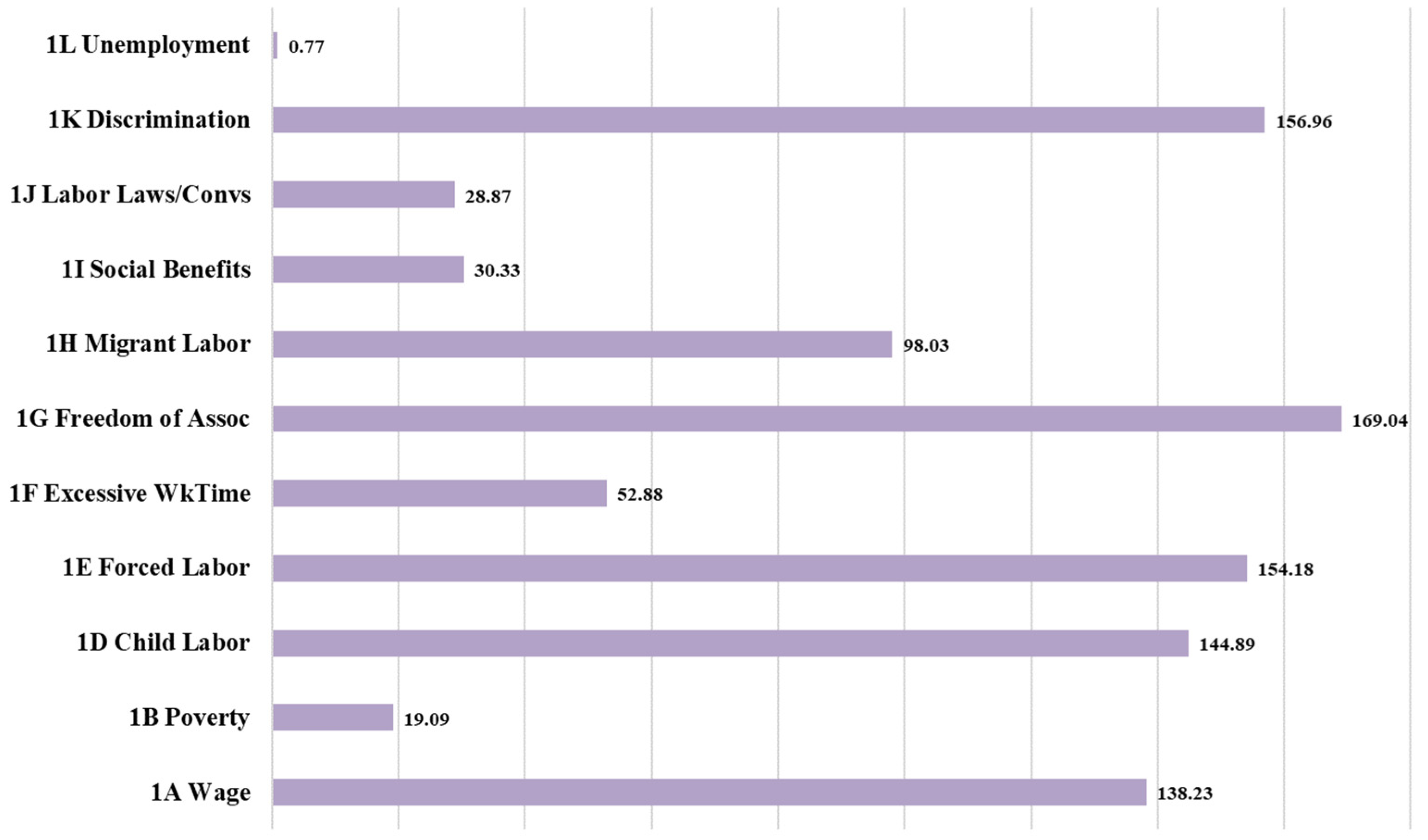
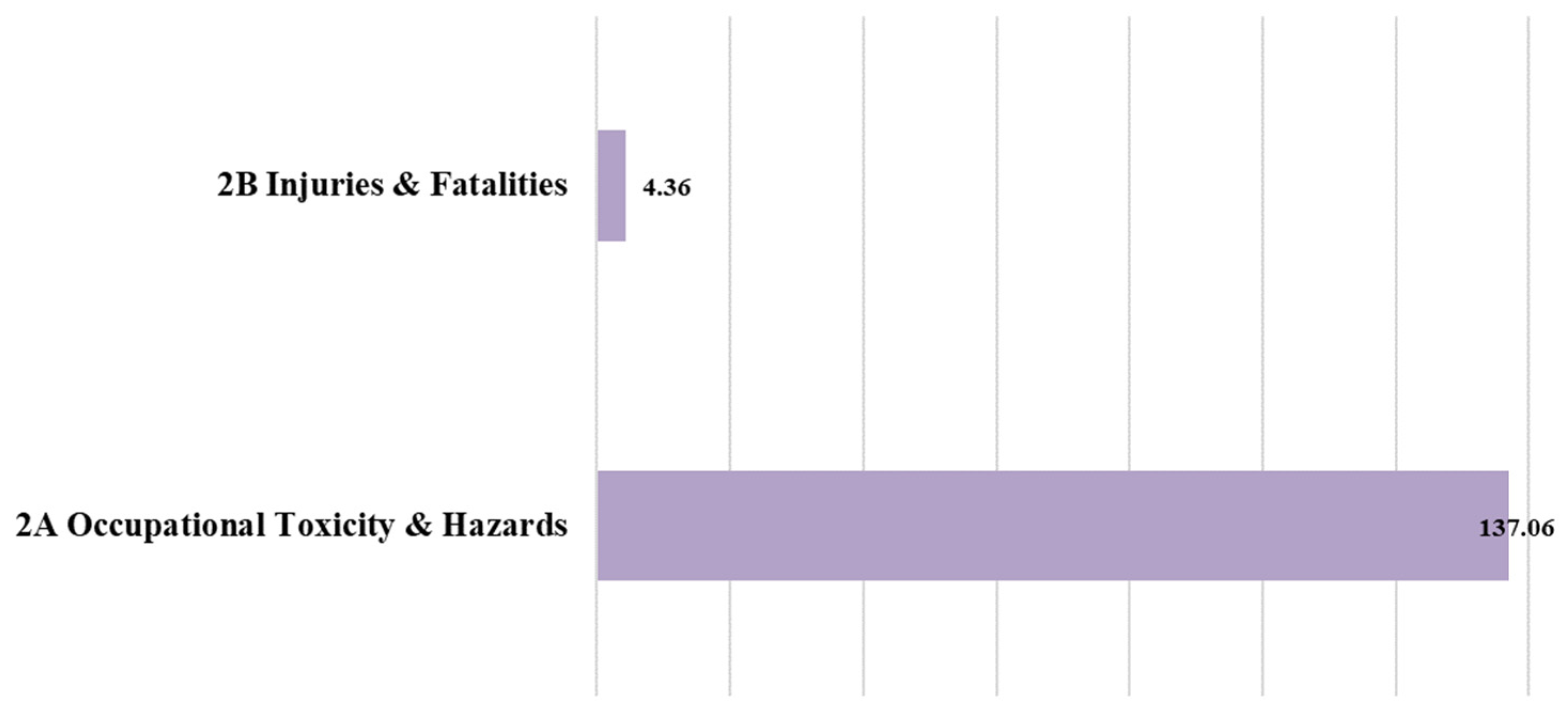
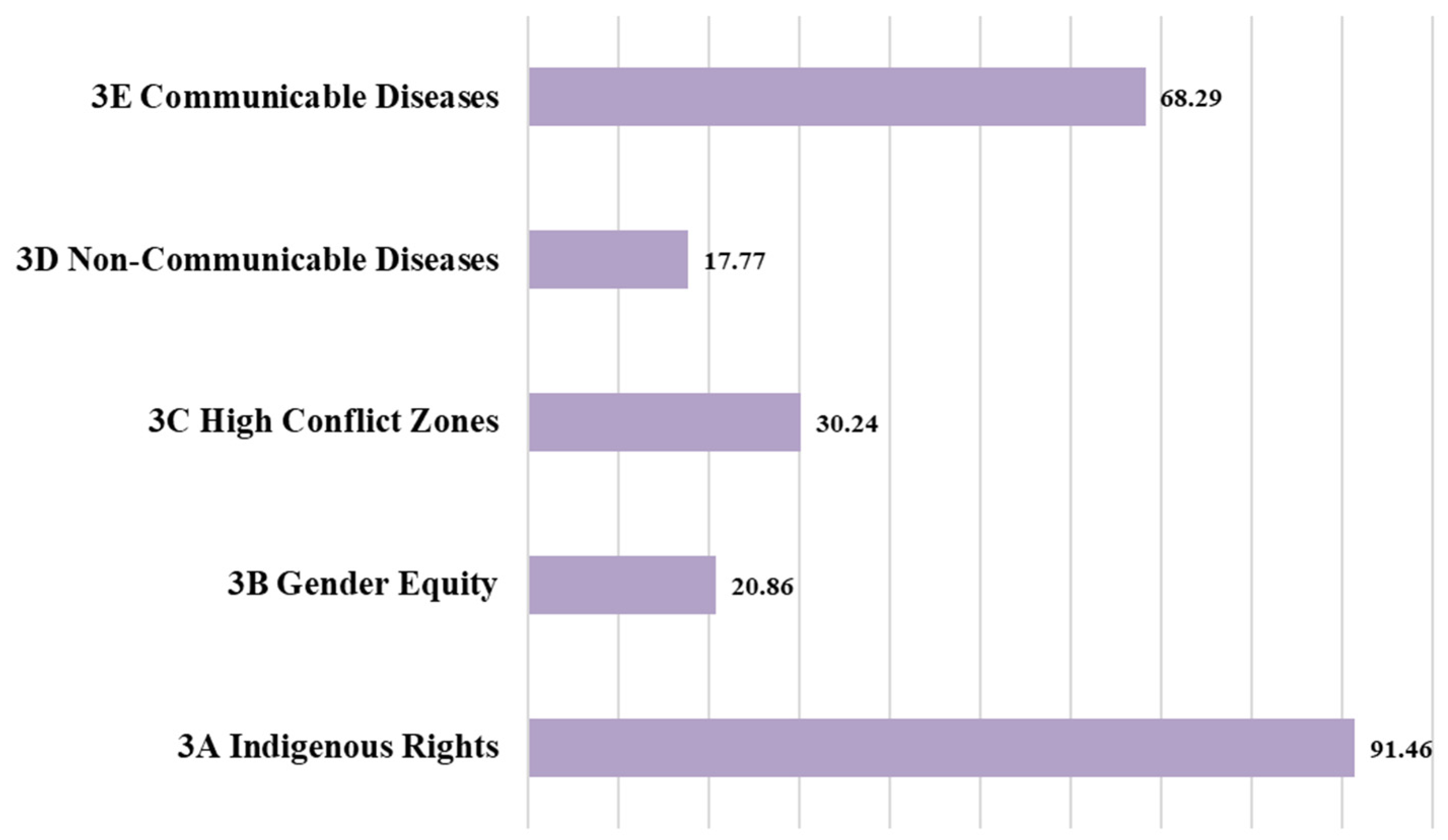



| Stakeholder Categories | Subcategories |
|---|---|
| Workers (General) | 1A Wage |
| 1B Poverty | |
| 1D Child Labor | |
| 1E Forced Labor | |
| 1F Excessive Work Time | |
| 1G Freedom of Association | |
| 1H Migrant Labor | |
| 1I Social Benefits | |
| 1J Labor Laws & Conventions | |
| 1K Discrimination | |
| 1L Unemployment | |
| Worker (Health & Safety) | 2A Occupational Toxicity & Hazards |
| 2B Injuries & Fatalities | |
| Local Community | 3A Indigenous Rights |
| 3B Gender Equity | |
| 3C High Conflict Zones | |
| 3D Non-communicable Diseases | |
| 3E Communicable Diseases | |
| Society | 4A Legal System |
| 4B Corruption | |
| Consumers | 5A Access to Drinking Water |
| 5B Access to Sanitation | |
| 5C Children out of School | |
| 5D Access to Hospital Beds | |
| 5E Smallholder vs. Commercial Farms |
| Life Cycle Stage | Country | Cost Input (USD/Trouser) | SHDB Sector Mapping | Data Source |
|---|---|---|---|---|
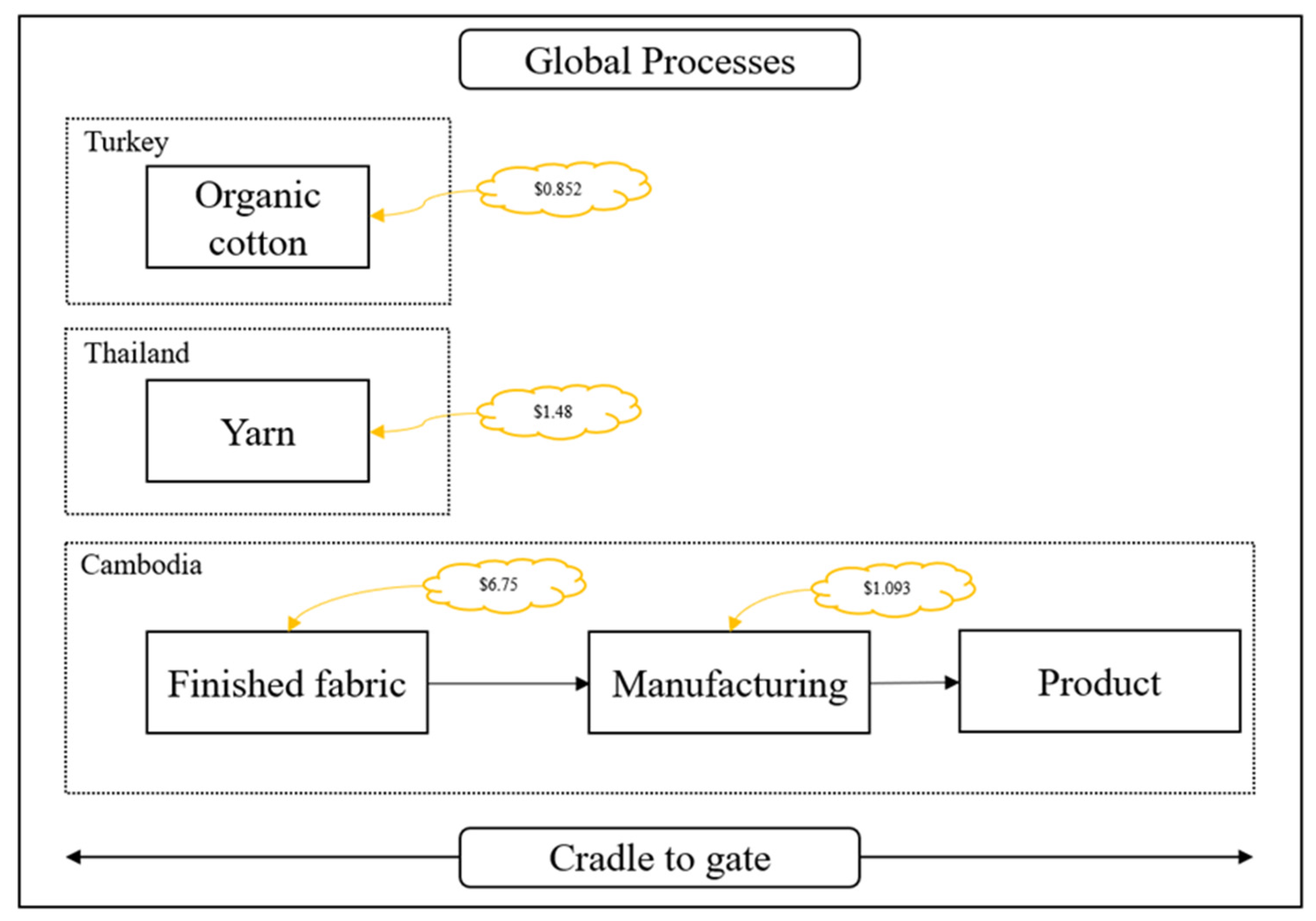
| Organic cotton | Turkey | 0.852 | Crops nec-TR | OEM Factory |
| Textile yarn | Thailand | 1.48 | Textiles-TH | OEM Factory |
| Finished fabric | Cambodia | 6.75 | Textiles-KH | OEM Factory |
| Manufacturing | Cambodia | 1.093 | Wearing apparel-KH | OEM Factory |
| Stakeholder | Impact Category | SHDB Indicator | Reference Scale |
|---|---|---|---|
| Worker (General) | 1A Wage | Risk that sector average wage is below sweatfree wage | VH, HR |
| Risk that average wage is below country minimum wage | VH, HR | ||
| Risk that sector average wage is below living wage | VH, MR, LR, HR | ||
| 1B Poverty | Percent of population living under the relevant poverty line | HR, VH, LR | |
| 1D Child Labor | Risk of child labor by sector | VH, HR, MR | |
| 1E Forced Labor | Overall forced labor in country | VH, HR | |
| 1F Excessive Work Time | Percent of population working > X h/week, >60 h/week | HR, MR, VH, LR | |
| 1G Freedom of Association | Overall risk of freedom of association | VH, HR | |
| 1H Migrant Labor | Evidence of risk to migrant workers | VH, HR | |
| 1I Social Benefits | Overall risk of inadequate social benefits | HR, MR | |
| 1J Labor Laws & Conventions | Number of labor laws by sector | HR, LR, MR | |
| 1K Discrimination | Prevalence of discrimination in the workplace | VH, MR, HR | |
| 1L Unemployment | Unemployment percentage at sector level | HR, VH, MR | |
| Worker (Health & Safety) | 2A Occupational Toxicity & Hazards | Overall occupational noise exposure risk | HR |
| Overall occupational cancer risk-loss of life | VH, MR | ||
| Disability-adjusted life years due to occupational-related lung cancer | VH, MR | ||
| 2B Injuries & Fatalities | Fatal injuries by sector | HR, VH | |
| Non-fatal work-related injuries by sector | MR, HR | ||
| Local Community | 3A Indigenous Rights | Indigenous sector issues identified | VH, HR |
| Overall risk of indigenous rights being infringed | HR | ||
| 3B Gender Equity | Overall gender inequity in country | MR, HR, VH | |
| 3C High Conflict Zones | Overall high conflict | HR, MR, VH | |
| 3D Non-communicable Diseases | Overall Non-communicable Diseases and other health risks | MR, HR | |
| 3E Communicable Diseases | Cases of HlV (per 1000 adults 15–49 years) | VH, HR | |
| Cases of tuberculosis (per 100,000 population) | HR | ||
| Notified cases of Malaria (per 100,000 population) | VH, HR | ||
| Age-standardized MRs from communicable diseases (per 100,000 population) | MR | ||
| Society | 4A Legal System | Overall fragility in legal system | VH, HR |
| 4B Corruption | Overall Corruption | VH, HR | |
| Consumers | 5A Access to Drinking Water | The percentage of total population with access to improved drinking water sources | HR, LR, MR, VH |
| 5B Access to Sanitation | The percentage of total population with access to improved sanitation | HR, VH, LR, MR | |
| 5C Children out of School | Percent of children out of primary school, total | HR | |
| 5D Access to Hospital Beds | Number of hospital beds per 1000 population | HR | |
| 5E Smallholder vs. Commercial Farms | Overall risk of freedom of association | VH, HR | |
| Percentage of family-owned farms in country | VH |
| Subcategory | Raw Material Acquisition | Fabric Production | Garment Manufacturing | Hotspot |
|---|---|---|---|---|
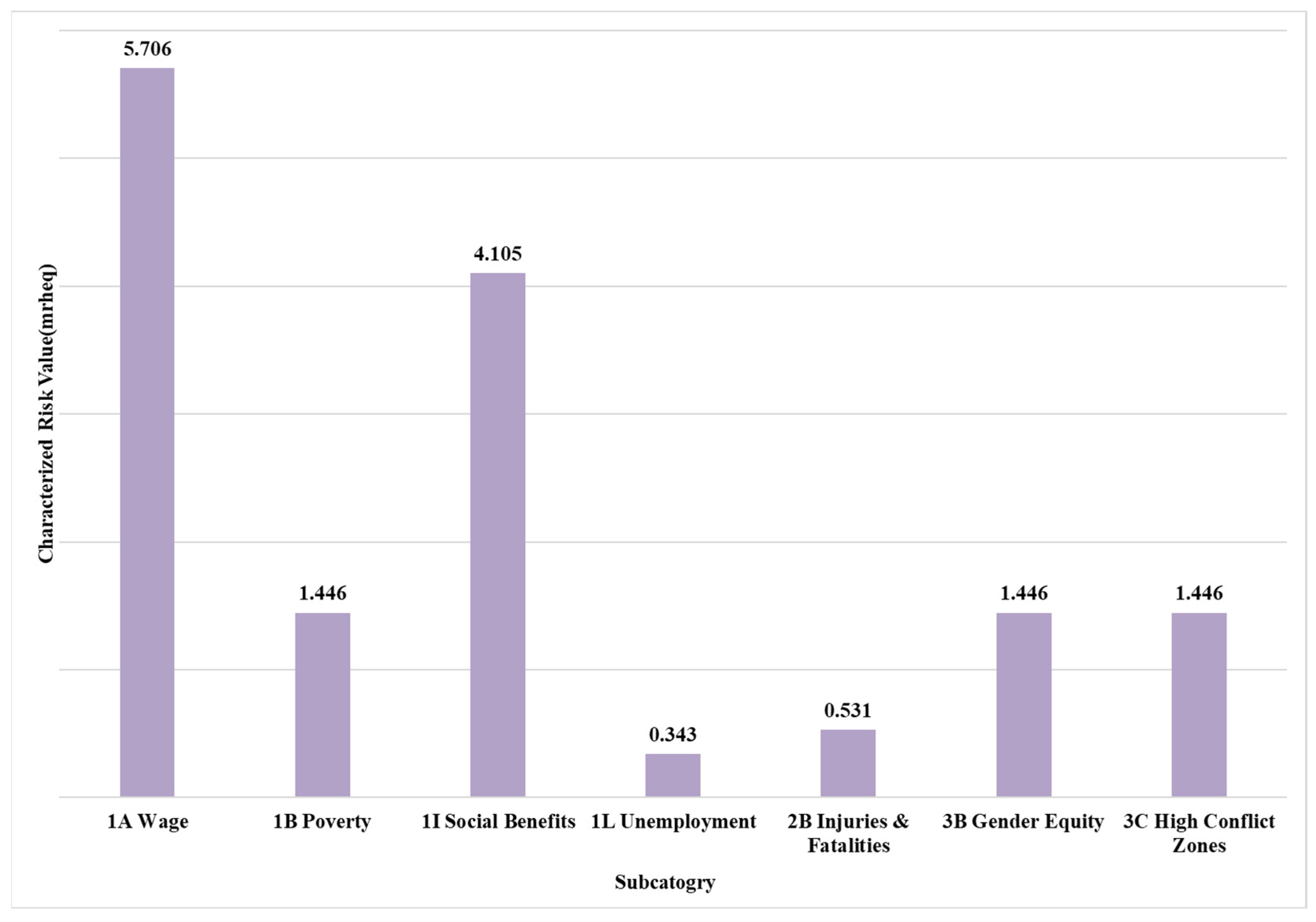
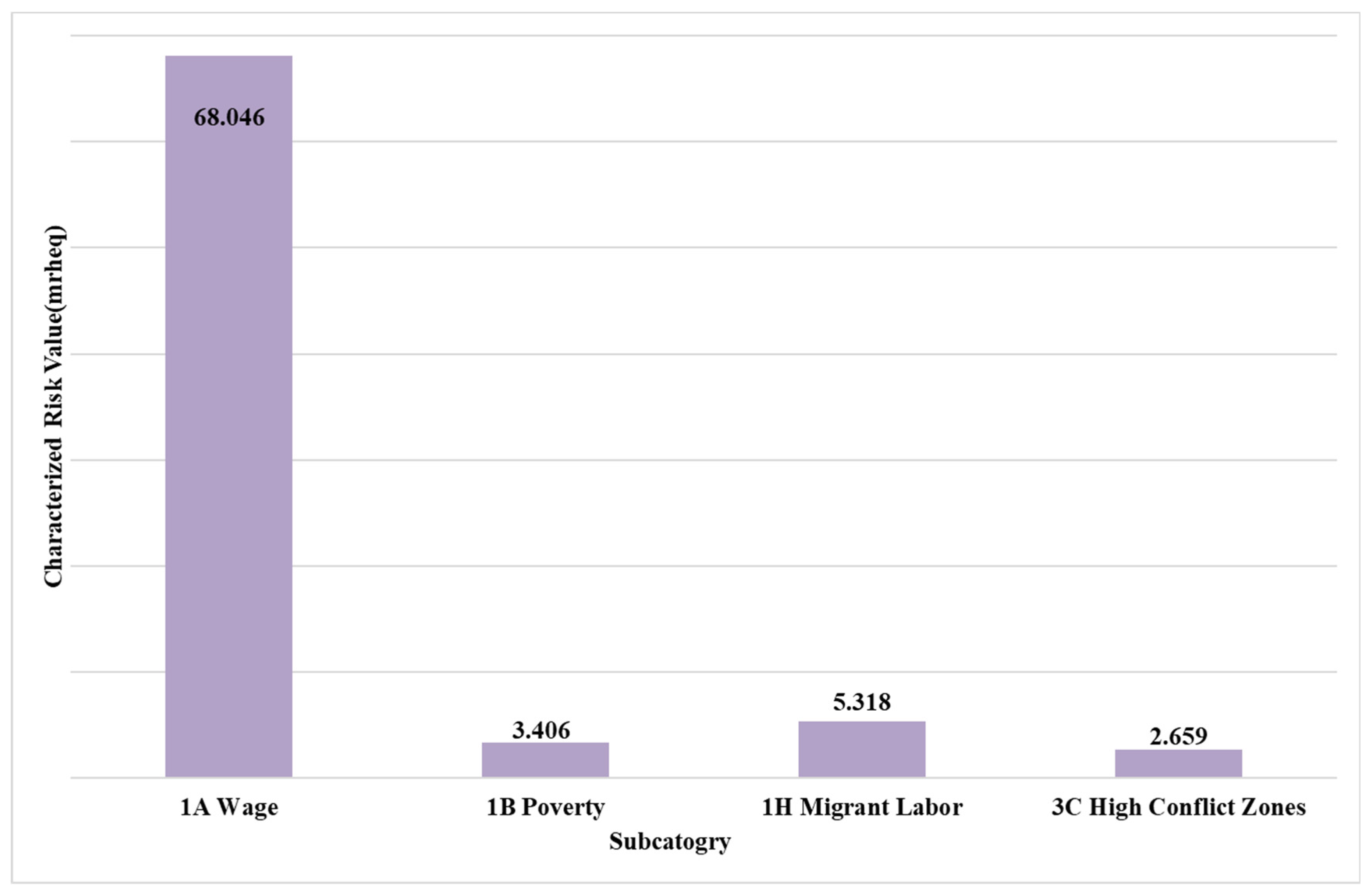
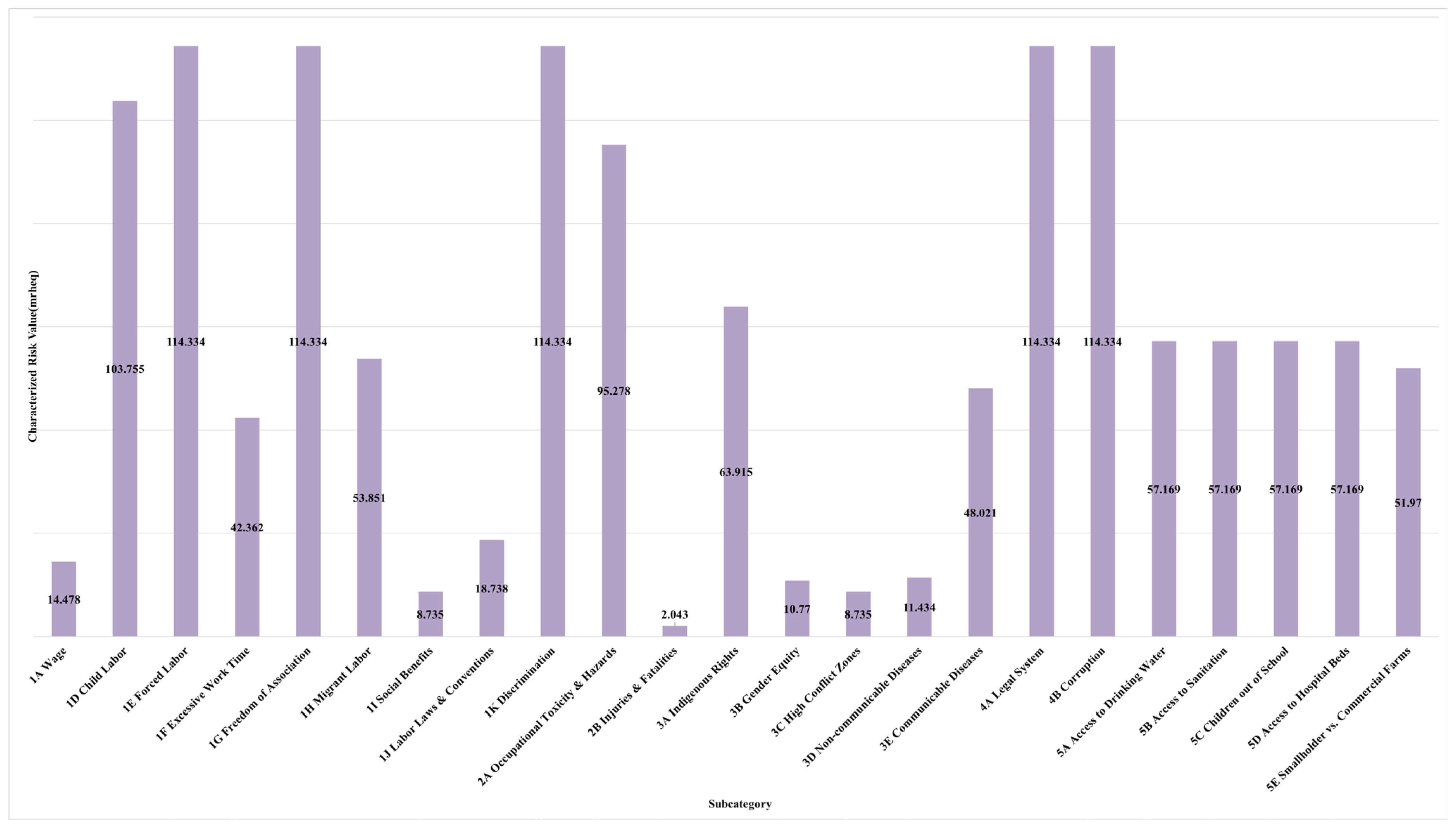
| 1A Wage | 5.706 | 68.046 | No data | Fabric production |
| 1B Poverty | 1.446 | 2.659 | No data | Fabric production |
| 1D Child Labor | No data | 68.046 | 9.651 | Fabric production |
| 1E Forced Labor | No data | 68.046 | 19.301 | Fabric production; Garment manufacturing |
| 1F Excessive Work Time | No data | 34.023 | 1.93 | Fabric production |
| 1G Freedom of Association | No data | 68.046 | 19.301 | Fabric production; Garment manufacturing |
| 1H Migrant Labor | No data | 39.341 | 9.651 | Fabric production |
| 1I Social Benefits | 1.446 | 6.805 | 1.93 | Fabric production |
| 1J Labor Laws & Conventions | No data | No data | No data | / |
| 1K Discrimination | No data | 68.046 | 19.301 | Fabric production; Garment manufacturing |
| 1L Unemployment | 0.289 | No data | No data | Raw material acquisition |
| 2A Occupational Toxicity & Hazards | No data | 56.705 | 16.084 | Fabric production; Garment manufacturing |
| 2B Injuries & Fatalities | 0.289 | 1.595 | No data | Fabric production |
| 3A Indigenous Rights | No data | 34.023 | 9.651 | Fabric production; Garment manufacturing |
| 3B Gender Equity | 1.446 | 6.805 | 1.93 | Raw material acquisition |
| 3C High Conflict Zones | 1.446 | 9.464 | 1.93 | Fabric production |
| 3D Non-communicable Diseases | No data | 6.805 | 1.93 | Fabric production |
| 3E Communicable Diseases | No data | 28.579 | 8.107 | Fabric production |
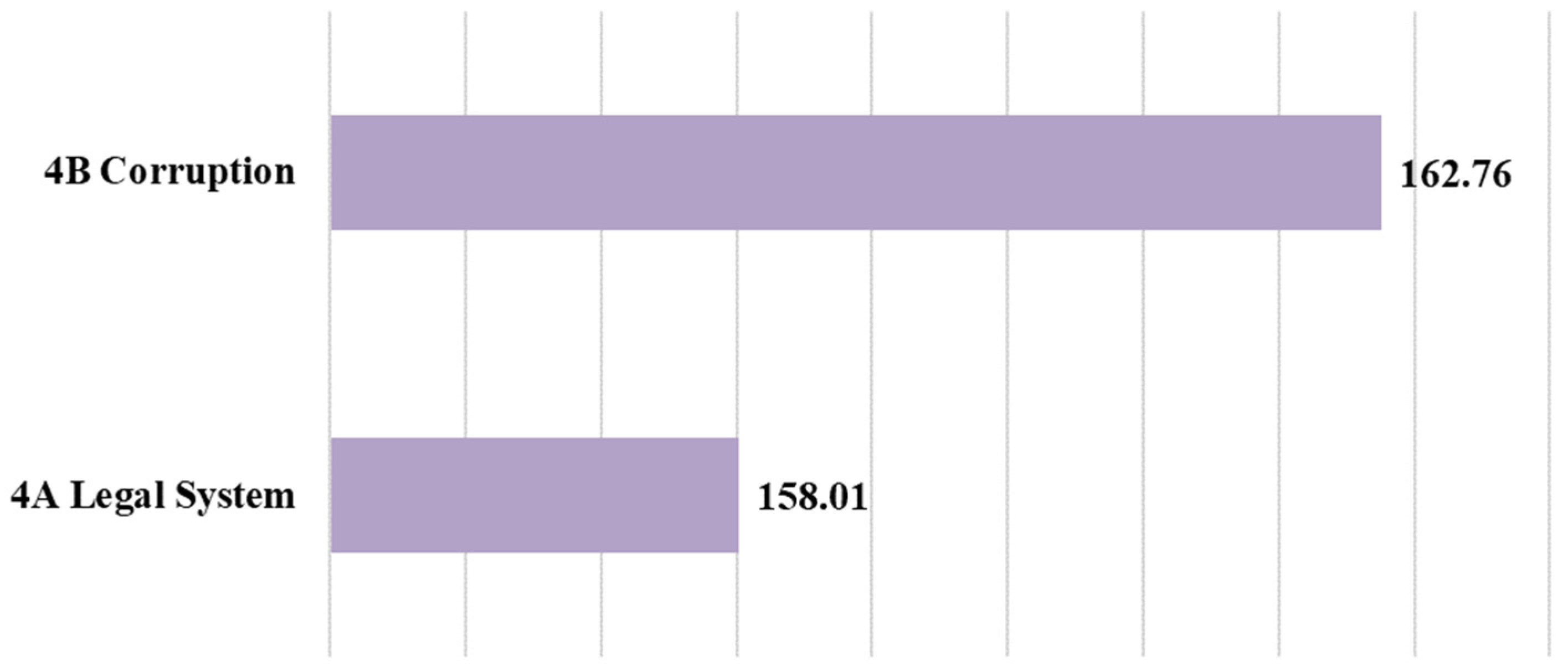
| 4A Legal System | No data | 68.046 | 19.301 | Fabric production; Garment manufacturing |
| 4B Corruption | No data | 68.046 | 19.301 | Fabric production; Garment manufacturing |
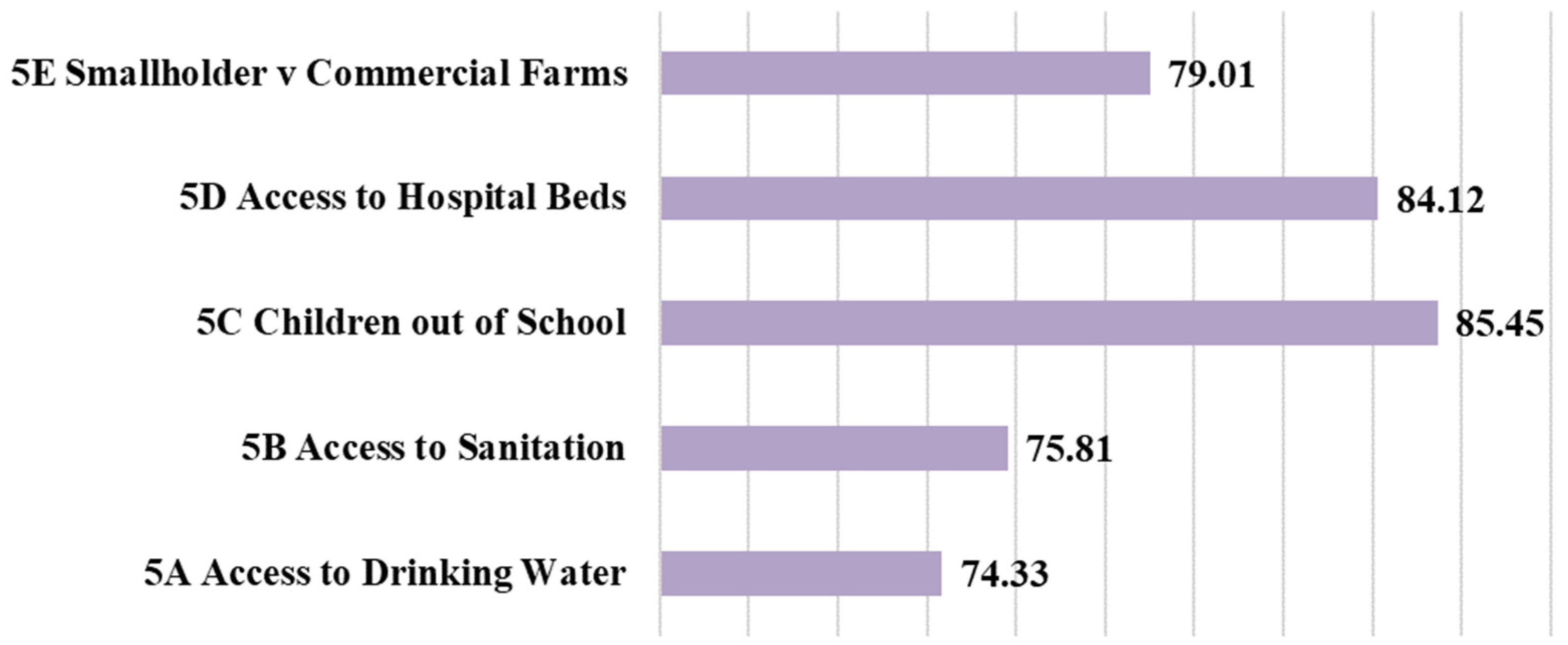
| 5A Access to Drinking Water | No data | 34.023 | 9.651 | Fabric production; Garment manufacturing |
| 5B Access to Sanitation | No data | 34.023 | 9.651 | Fabric production; Garment manufacturing |
| 5C Children out of School | No data | 34.023 | 9.651 | Fabric production; Garment manufacturing |
| 5D Access to Hospital Beds | No data | 34.023 | 9.651 | Fabric production; Garment manufacturing |
| 5E Smallholder vs. Commercial Farms | No data | 30.93 | 8.773 | Garment manufacturing |
Disclaimer/Publisher’s Note: The statements, opinions and data contained in all publications are solely those of the individual author(s) and contributor(s) and not of MDPI and/or the editor(s). MDPI and/or the editor(s) disclaim responsibility for any injury to people or property resulting from any ideas, methods, instructions or products referred to in the content. |
© 2026 by the authors. Licensee MDPI, Basel, Switzerland. This article is an open access article distributed under the terms and conditions of the Creative Commons Attribution (CC BY) license.
Share and Cite
Xu, Y.; Keeley, A.R.; Chapman, A. Social Life Cycle Assessment of Organic Cotton Trousers in a Multinational Supply Chain. Sustainability 2026, 18, 4780. https://doi.org/10.3390/su18104780
Xu Y, Keeley AR, Chapman A. Social Life Cycle Assessment of Organic Cotton Trousers in a Multinational Supply Chain. Sustainability. 2026; 18(10):4780. https://doi.org/10.3390/su18104780
Chicago/Turabian StyleXu, Yina, Alexander Ryota Keeley, and Andrew Chapman. 2026. "Social Life Cycle Assessment of Organic Cotton Trousers in a Multinational Supply Chain" Sustainability 18, no. 10: 4780. https://doi.org/10.3390/su18104780
APA StyleXu, Y., Keeley, A. R., & Chapman, A. (2026). Social Life Cycle Assessment of Organic Cotton Trousers in a Multinational Supply Chain. Sustainability, 18(10), 4780. https://doi.org/10.3390/su18104780