


Abstract
This study examined the effectiveness of using biochar from the tanning industry as a silicon carrier to reduce trace element toxicity and improve plant nutrition in soil–plant systems. Silicon-enriched biochar was produced from chromium-free leather waste and applied in 21-day pot trials with cucumber. It contained 11.6 ± 2.3% SiO2 and effectively served as a slow-release silicon carrier. Optimal plant growth and nutrient uptake were achieved with the application of 100% silicon without additional NPK fertilizers, demonstrating a strong positive correlation with essential trace elements such as copper and iron. Importantly, silicon fertilization significantly reduced the uptake of toxic metals such as Al, Cd, and Ti, underscoring the potential of silicon-enriched biochar for phytoremediation and sustainable crop production. Using silicon-enriched biochar from industrial leather waste thus provides a novel, sustainable strategy to improve soil fertility and plant health while repurposing waste. Future work should include long-term field trials and examine species-specific responses and management practices to scale up this approach for enhanced crop resilience.
1. Introduction
Soil degradation and trace element contamination are major challenges to agricultural productivity and environmental health [1]. Toxic elements like cadmium (Cd), chromium (Cr), and aluminum (Al) can accumulate in soil, reducing fertility, stunting plant growth, and posing health risks through biomagnification in the food chain. Therefore, developing effective strategies to restore soil quality, enhance plant nutrition, and mitigate such pollution is essential for sustainable agriculture.
One approach to improve degraded soils is biochar, a carbon-rich material produced by pyrolyzing organic waste. Biochar additions can increase soil organic matter, improve nutrient retention, and support beneficial microbes [2,3]. Another promising amendment is silicon (Si). While not traditionally deemed essential for all plants, silicon fortifies plant cell walls, enhances stress resistance, and improves nutrient uptake [4,5,6]. Silicon amendments can also immobilize toxic metals by forming stable mineral complexes in soil, thereby reducing heavy metal bioavailability to plants [7,8,9].
Combining these approaches, a silicon-enriched biochar could, in principle, deliver the benefits of both amendments [10]. Such a material would supply silicon to plants while improving soil properties, thereby enhancing fertility and plant nutrition and simultaneously reducing trace element bioavailability [11,12,13]. In contaminated environments, managing trace element bioavailability is crucial for maintaining soil health and crop yield. A Si-enriched biochar amendment thus represents a strategy to improve soil resilience and support both sustainable agriculture and environmental remediation efforts.
In soil, silicon can affect physical and chemical properties. Silicon amendments promote the formation of stable soil aggregates, improving aeration, water infiltration, and root penetration [14]. Silicon also tends to raise or buffer soil pH and can precipitate as secondary minerals [15,16]. These factors increase a soil’s cation exchange capacity and nutrient availability [17]. Importantly, Si additives can immobilize toxic metals. Silicon competes with heavy metals for sorption sites on soil particles and forms insoluble complexes with phytotoxic ions like Al3+, thereby reducing metal mobility and uptake by plants [7,18,19]. Silicon amendments may also foster heavy-metal-tolerant microbial communities, which indirectly contribute to lower trace element availability and toxicity [20].
Traditional remediation approaches for contaminated soils include immobilization (e.g., adding organic matter, phosphates, or lime to lock heavy metals in less bioavailable forms) and phytoremediation [21,22,23]. In contrast to these approaches, silicon provides a complementary strategy—instead of removing contaminants from soil, Si supplementation reduces the uptake and translocation of trace elements into plant tissues, thereby protecting the crop even when metals remain in the soil matrix.
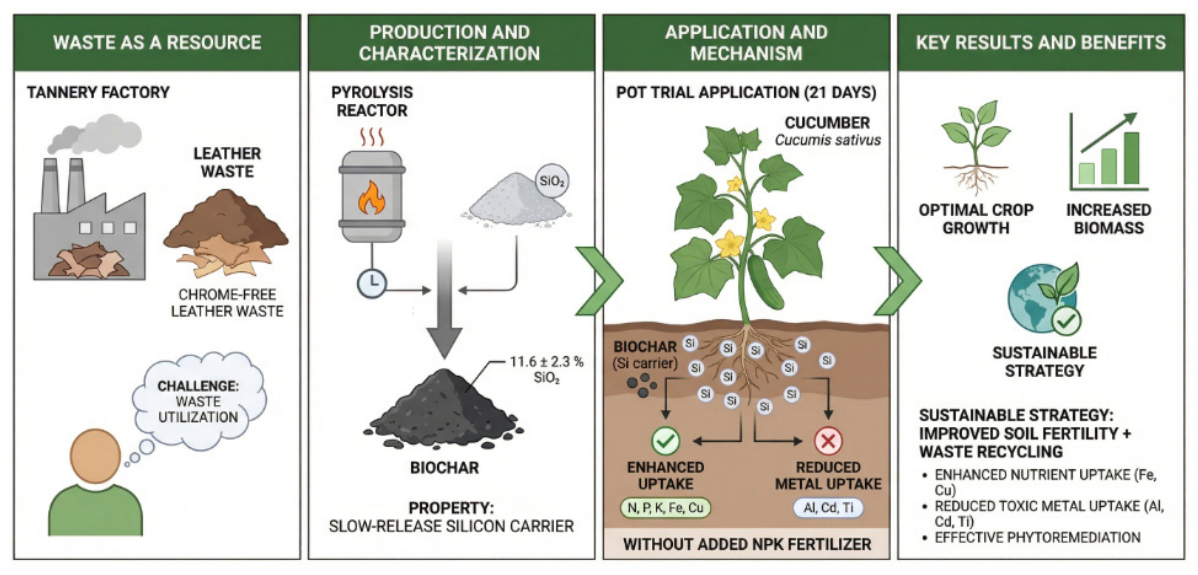
Despite extensive research on biochar and silicon separately in agriculture, using biochar derived from industrial leather waste as a silicon carrier remains largely unexplored. This study addresses that knowledge gap. Non-chromed leather waste is an attractive feedstock due to its inherent nutrients (including Si) and the environmental benefit of repurposing waste. We hypothesized that silicon-enriched biochar derived from leather waste would act as a slow-release silicon source, improving plant growth and nutrient status while reducing the accumulation of selected toxic elements in plant tissues, compared to conventional silicon fertilization. Biochar’s high porosity and surface area should facilitate nutrient adsorption and retention, potentially delivering silicon to plants more gradually and efficiently. This study evaluates plant responses to silicon supplied in different forms and application modes, including substrate application and foliar treatment. The reference silicon dose (1 L/ha) was selected based on the manufacturer’s recommendation for the commercial preparation and was used as a comparative baseline. While this dose reflects practical agricultural usage, the present study focuses on relative dose–response relationships (0.75, 1.0, 1.5) rather than establishing an absolute physiological optimum. The focus is on measurable plant-level responses, such as growth parameters and elemental composition, rather than on the physiological mechanisms of silicon uptake and transport. This approach allows for the assessment of how silicon supply influences plant performance and elemental status under controlled conditions. By doing so, we link waste management with soil remediation—a circular economy approach (Figure 1)—and aim to provide a sustainable solution for improving soil health and crop performance in trace-metal-contaminated conditions.
Figure 1.
Circular economy approach for producing silicon-enriched biochar from chrome-free leather waste and using it to improve cucumber growth and reduce trace element uptake.
The broader significance of this approach lies in its sustainability and innovation. Transforming leather industry waste into a value-added soil amendment not only addresses a waste disposal problem but also provides tangible agricultural benefits. In effect, this study pioneers a circular economy model: industrial waste is valorized into a biochar that improves crop production and remediates soil. This dual functionality—enhancing nutrient status while sequestering or immobilizing pollutants—highlights the potential for integrated solutions that simultaneously tackle agricultural productivity and environmental contamination.
2. Materials and Methods
2.1. Materials and Equipment
Materials used in the experimental procedures included silicon stimulator preparation (30% H4SiO4, 8.8% Si, Perma-Guard Agro, Otwock, Poland), acids for sample digestion (Nitric acid Tracepur 69%, Hydrochloric acid Tracepur 36%, Hydrofluoric acid Suprapur 40%, Merck, Darmstadt, Germany; Boric acid 4%, Chem-Lab NV, Zedelgem, Belgium), calibration standards (Single element standard solutions 1000 and 10,000 mg/dm3, ULTRA Scientific Inc., North Kingstown, RI, USA), reference materials (Quality Control Standard, Agilent, Santa Clara, CA, USA; Standard Reference Material® 1570a Trace Elements in Spinach Leaves, NIST, Gaithersburg, MD, USA; Standard Reference Material® 696 Trace Elements in Multi-Nutrient Fertilizer, NIST, USA; Standard Reference Material® 2709a San Joaquin Soil BaselineTrace Elements Concentration, NIST, USA), and ultra-pure water (HLP Ultra, Hydrolab, Warsaw, Poland).
Equipment used included the START D microwave digestion system (Milestone, Sorisole, Italy), ICP-OES Spectrometer (iCAP 6500, Thermo Scientific, Waltham, MA, USA), DMA-80 mercury analyzer (Milestone, Sorisole, Italy), Vario MACRO Cube CN Elementar Analyzer (ELEMENTAR Analysensysteme, Langenselbold, Germany), chlorophyll meter (CCM-300, OPTI-SCIENCES, Hudson, NH, USA), Epson PerfectionV850 Pro camera, and statistical software (Statistica 13.3, TIBCO Software Inc., Santa Clara, CA, USA).
2.2. Biochar Preparation
Non-chromed leather from Bader Poland (Bolesławiec, Poland) was used for biochar production due to its unique composition and the sustainable approach of recycling industrial waste. This leather was selected for its high silicon content and environmental benefits associated with repurposing waste into a useful agricultural product. Detailed compositional analysis confirmed its suitability for agricultural purposes.
The leather, initially with a moisture content of 55 wt.%, was dried at 110 °C for 48 h. Biochar production was carried out in a vertical furnace (Czylok MRT-4, Jastrzębie-Zdrój, Poland) under argon. The dried non-chromed leather waste was carbonized at a heating rate of 5 °C min−1 up to the final temperature of 500 °C. The final temperature was maintained for 30 min, and the obtained carbonized materials were cooled to room temperature under argon flow. Moisture, ash, and volatile matter content tests in biochar were performed based on standardized ASTM (American Society for Testing and Materials) technical methods. Moisture, ash, and volatile matter content tests in biochar were performed based on standardized ASTM (American Society for Testing and Materials) technical methods. Moisture content was analyzed using ASTM D3173-11 [24], ash content with ASTM D3174-12 [25], and volatile substances with ASTM D3175-11 [26]. These standards define generally accepted procedures for determining moisture, ash, and volatile matter content in solid materials, ensuring repeatability and comparability of analytical results. Thermogravimetric analysis was conducted from 20 to 900 °C at a rate of 5 °C per minute under a constant argon flow of 5 L per hour [27].
The produced biochar was enriched with silicon using silicic acid in order to enhance nutrient availability during early plant growth, promote root development, and improve resistance to abiotic and biotic stress [28]. The enrichment was performed using a spray method, in which a uniform monolayer of biochar was prepared on Petri dishes. The silicic acid solution was applied stepwise by spraying, with intermittent mixing to ensure homogeneous surface distribution. Three levels of silicon enrichment were applied: 66 mg Si/kg (B1), 88 mg Si/kg (B2), and 132 mg Si/kg (B3), selected based on their anticipated influence on nutrient availability and plant stress tolerance during early growth stages. Following application, the material was allowed to air-dry under ambient conditions. The dried, silicon-enriched biochar was subsequently ground using a mortar and stored in tightly sealed containers prior to further analysis and application.
2.3. Pot Trials
The experiment consisted of a 21-day pot trial using cucumber (Cucumis sativus L., Legutko) as a model plant species selected for its rapid growth and high sensitivity to substrate conditions. Plants were grown in multiplates (5 × 4) in a peat-based substrate, which is referred to as “soil” in subsequent sections for simplicity; however, all results relate specifically to this controlled growing medium. The experimental design comprised 20 treatment groups differing in silicon source, application method, dose level, and NPK co-fertilization (Table 1). Two silicon sources were evaluated: (i) a commercial silicon preparation, ZumSil (Perma-Guard Agro, Otwock, Poland), containing 30% H4SiO4 (8.8% Si), and (ii) silicon-enriched biochar produced from non-chromed leather waste at three enrichment levels, denoted as B1, B2, and B3.
Table 1.
Experimental design and description of treatment groups used in the pot trials.
Two silicon application routes were included, namely soil and foliar application, in order to compare plant responses depending on the mode of silicon delivery, without directly addressing the physiological mechanisms of silicon uptake. The foliar treatment was included only for the commercial silicon preparation as a comparative variant for soluble silicon application. In contrast, silicon-enriched biochar was applied exclusively to soil, in accordance with its intended role as a silicon carrier and soil amendment. Silicon treatments were applied at three relative dose levels: 75%, 100%, and 150% of the reference rate. The 100% level corresponded to 1 L /ha, according to the manufacturer’s recommendation for the ZumSil preparation, whereas the 75% and 150% levels corresponded to 0.75 and 1.50 L/ha, respectively. For the biochar treatments, the application rate was calculated on the basis of water-extractable (operationally defined as bioavailable) silicon content determined according to Section 2.4 so that the relative silicon input corresponded to the same dose scheme as that used for the commercial silicon preparation. The applied silicon doses should be interpreted as relative levels (of the reference dose), enabling a comparison of plant responses across treatments rather than defining an absolute optimal dose.
Pot trials were carried out under controlled environmental conditions: 60% relative humidity, 2400 lux illumination, and a 16 h light/8 h dark photoperiod. Soil application was performed on day 3 of the experiment, whereas foliar application was carried out on day 14. For clarity, treatment abbreviations were used: SiP (silicon stimulator preparation), B (biochar), S (soil application), F (foliar application), and NPK (mineral fertilization).
2.4. Analysis of Water-Soluble Components
In this study, water-extractable silicon was used as an operationally defined proxy for bioavailable silicon. This approach is commonly applied in biochar and growing medium studies, where the water-soluble fraction reflects the readily available pool of elements accessible to plants. Therefore, the calculated water-soluble fraction (WF) was used to estimate the relative bioavailability of silicon in the tested materials.
Water-soluble components of the raw biochar were analyzed using extraction tests based on PN-EN 15958 standard to ensure reproducibility and accuracy [29]. For this purpose, 1 g of biochar was placed in a conical flask with 100 mL of deionized water and stirred on an orbital shaker for 30 min at 180 rpm at room temperature. After stirring, the extract was filtered and analyzed by ICP-OES to determine the concentrations of water-soluble elements. Bioavailability and leachability of these elements were calculated using the equation:
where CE is the concentration in the extract, VE is the extract volume, Ct is the total content, and ms is the sample weight.
2.5. Biometric Measurements
Post-harvest, plants were subjected to weight measurements, and biometric attributes such as stem length and root characteristics (length, diameter, area) were assessed using an Epson PerfectionV850 Pro camera (Seiko Epson, Nagano, Japan). These measurements provided key indicators of plant health and growth, reflecting the impact of the biochar treatment. Chlorophyll content in the leaves was measured using an OPTI-SCIENCES CCM-300 chlorophyll meter (OPTI-SCIENCES, Hudson, NH, USA) to provide additional insights into the plants’ physiological responses.
2.6. Physicochemical Properties Assessment
The content of macro- and micronutrients and toxic elements was determined in biochar, peat and plant samples after pot tests. All samples were dried and homogenized before analysis. For carbon, nitrogen, and mercury content, no additional preparation was required. Carbon and nitrogen were measured using a Vario MACRO Cube elemental analyzer (ELEMENTAR Analysensysteme, Langenselbold, Germany), while mercury was analyzed using atomic absorption spectroscopy (AAS) with the amalgamation technique (DMA-80, (Milestone, Sorisole, Italy).
For the analysis of other elements (including total Si in the plant biomass), samples underwent ICP-OES analysis. Sample preparation involved a two-stage mineralization process using the START D microwave digestion system. Approximately 0.1 g of biochar or 0.25 g of plant biomass was weighed in Teflon vessels and mixed with concentrated nitric acid, hydrochloric acid, and hydrofluoric acid. Digestion occurred under specific time and temperature parameters, as detailed in Table 2. After cooling, boric acid was added, and samples underwent a second digestion. Peat samples weighing 0.5 g were mineralized using aqua regia, omitting the boric acid neutralization step. Following mineralization, samples were diluted to approximately 50 g for ICP-OES analysis. Six replicates of each sample were prepared, and certified reference materials validated the results.
Table 2.
Condition of the microwave digestion process.
The peat sorption capacity was determined using ISO 11260 [30], and pH was determined using ISO 10390 [31] standard methods.
2.7. Statistical Analysis
Statistical analyses were conducted using Statistica 13.3 software (TIBCO, USA). Data normality was assessed with the Shapiro–Wilk test (p > 0.05). For non-normally distributed data, the Kruskal–Wallis test was used to determine statistically significant differences (p < 0.05). For normally distributed data, the homogeneity of variances was tested using the Brown-Forsythe test (p < 0.05). When variances were homogeneous, Tukey’s HSD test was applied for post hoc comparisons. In cases of heterogeneous variances, the Kruskal–Wallis test was used. These statistical methods were selected for their robustness in analyzing group differences. Correlation analysis was performed using the classical Pearson’s correlation coefficient (Pearson’s r) to assess linear relationships between the studied variables.
3. Results and Discussion
3.1. Biochar Characterization and Soil Remediation Potential
The silicon-enriched biochar from leather waste was produced, and its suitability as a soil amendment and Si carrier were confirmed. The main nutrient content of biochar in this study—nitrogen (10 ± 1%), carbon (47± 5%), and silicon (12 ± 2%)—matches existing literature on biochar from various biomass sources. The observed silicon content aligns with Adekiya et al. (2020), who emphasized silicon’s role in enhancing soil health and plant growth [32]. Chen et al. (2015) showed that biochar’s chemical composition varies with pyrolysis conditions, impacting its effectiveness as a soil amendment [33]. Grycová et al. (2023) reported a lower nitrogen content (7.64%) and almost twice the carbon content (70.68%) after carbonization at 800 °C, highlighting the effect of pyrolysis temperature on material composition [34]. Lower temperatures result in reduced carbon fixation and retention of volatile components [33]. Mild conditions (<300 °C) result in amorphous silicon forms, while higher temperatures create crystalline forms [35]. Xiao et al. (2014) [36] found that dehydration of straw below 250 °C polymerizes silicic acid, integrating silicon and carbon. Pyrolysis at 250–350 °C releases silicon from carbon, whereas high temperatures (500–700 °C) lead to crystallization. Silicon-release kinetics from biochar can thus be manipulated through pyrolysis conditions, supporting its potential as a slow-release elemental source [36]. Although our leather biochar was produced at a moderate temperature, it still contains a significant total Si content, but only 0.5% of total Si was water-soluble, confirming that the vast majority of Si in the biochar is in a sparingly soluble form. Guo and Chen (2014), indicating that the amorphous forms of silicon in biochar produced below 300 °C provide prolonged availability, enhancing plant resilience to stresses [35]. This is desirable for a slow-release silicon fertilizer, as it suggests the biochar can continuously supply Si over time rather than causing a quick flush and leaching [37]. The biochar’s elevated Si content and its expected slow-release behavior indicate that it can serve as an effective long-term Si fertilizer.
Trace element content, including copper, iron, manganese, and zinc, which are vital for plant processes like chlorophyll production and stress resistance were also measured. Iron content was particularly high (3940 ± 788 mg/kg). Levels of toxic elements—arsenic, cadmium, mercury, and lead—were below detection limits, consistent with effective detoxification during pyrolysis [38].
Chromium levels were 112 ± 17 mg/kg. However, the chromium present in leather-waste biochar is primarily in a stable carbide form, which is non-bioavailable and does not pose a significant food safety risk [38]. The low water-soluble silicon fraction (0.5%) confirms biochar’s feasibility as a slow-release material, providing a continuous supply of silicon to plants and promoting consistent growth [36].
As shown in Table 3, the biochar contained significant amounts of nutrients, distinguishing this leather biochar from many traditional biochar that are often carbon-rich but nutrient-poor. Improved soil properties from biochar (higher organic C, balanced C:N ratio, added nutrients) are known to correlate with increased crop productivity [32,39]. In particular, biochar amendments generally raise soil pH and cation exchange capacity and enhance soil structure and porosity, thereby improving water retention and fostering beneficial microbial activity [40]. These changes create a more fertile soil environment that can boost plant growth [41]. Biochar’s abilities in nitrogen and carbon sequestration and its potential to enhance macronutrient availability are well established as well [42,43]. Literature indicates that such effects may be particularly beneficial in acidic soils, where increased soil pH can reduce the solubility and bioavailability of toxic elements, while sorption processes may enhance nutrient retention and reduce leaching [44,45]. Our results align with those general findings: the leather-waste biochar’s composition suggests it can improve degraded soils both chemically (nutrient addition, pH buffering) and physically (porosity), which in turn supports better crop yields.
Table 3.
Composition of biochar derived from leather waste, including macronutrients, micronutrients, and toxic elements. WF represents water-soluble forms; DM indicates dry mass content.
3.2. The Influence of Silicon on Plant Growth Metrics
Short-term pot experiments are commonly used as a preliminary assessment stage for new materials, as they allow for a rapid determination of their impact on early plant growth and the availability of nutrients and contaminants. They enable the identification of initial physiological responses in plants and the evaluation of the tested additive’s effectiveness, e.g., in terms of silicon supply or heavy metal immobilization. Thanks to controlled conditions and short durations, they serve as an effective screening tool that allows for the selection of the most promising solutions prior to conducting long-term and field studies.
3.2.1. Plant Biometric Responses to Silicon
The biometric assessment of cucumber plants treated with various forms and dosages of silicon, both with and without NPK fertilization, highlights silicon’s impact on plant growth metrics like stem length, chlorophyll content, root length, root area, root volume, fresh mass, and dry mass (Table 4). These parameters are essential indicators of plant health and stress resilience, providing insights into silicon’s role in promoting optimal growth conditions.
Table 4.
Effects of different treatments on plant biomass parameters (significant coefficients in bold, p < 0.05).
The longest stem, measuring 5.31 cm, was observed in the treatment involving 150% silicon dosage with NPK fertilizer (NPK + B3.S.150). This outcome was statistically significant and aligns with previous studies, such as Artyszak et al. (2021), which showed that combining silicon with NPK enhanced plant growth due to improved nutrient uptake and increased stress tolerance [46]. The shortest stem length (3.41 cm) was recorded in the control group treated with water, underscoring the significant growth effect of silicon combined with NPK.
Chlorophyll content, an indicator of photosynthetic efficiency, was highest (514.7 mg/m2) in the group treated with 75% silicon without NPK (SiP.S.75), suggesting that silicon alone can boost chlorophyll content. This effect was less pronounced in treatments combined with NPK. Similar trends were noted in Borawska-Jarmułowicz et al. (2022), where silicon enhanced chlorophyll production, particularly in grass-legume mixtures [47]. The different outcomes in combined treatments may indicate species-specific responses or variations in nutrient dynamics.
Root metrics showed significant improvements with silicon treatment. Root length reached 325.0 cm in the NPK + SiP.S.150 group, surpassing control and other silicon treatments. This finding is consistent with Jinger et al. (2022), who demonstrated that co-fertilization of silicon and phosphorus can enhance root development [48]. The improvement in root area and volume for the NPK + SiP.S.75 group indicates that silicon, with NPK, effectively stimulates root growth, which is crucial for water and nutrient uptake.
The highest fresh mass (40.61 g) was recorded in the NPK + SiP.S.75 group, while the largest dry mass (2.768 g) was in the NPK + SiP.S.100 treatment. These outcomes align with Stankowski et al. (2021), who reported that silicon application during key growth stages increased fresh and dry biomass, underscoring the importance of optimal silicon and NPK combinations for plant productivity [49].
The findings are consistent with those reported by Artyszak et al. (2021) and Jinger et al. (2022), which emphasize that silicon supplementation, particularly with NPK, enhances growth metrics like biomass, root development, and overall vigor [46,48]. While our results generally align with previous research, some differences were noted. In our study, silicon alone had a pronounced effect on chlorophyll content, contrasting with Borawska-Jarmułowicz et al. (2022), who found greater enhancement when silicon was applied with primary nutrients [47]. This discrepancy may arise from differences in plant species or the timing of silicon application.
3.2.2. Correlations of Si with Macronutrients
To further interpret the nutrient uptake dynamics, correlation analyses were performed between plant silicon content and other elemental concentrations in plant tissues under the various treatments. The correlation coefficients (Pearson’s r) are presented in Table 5 with significant correlations (p < 0.05) in bold.
Table 5.
Correlations between silicon and macronutrients (coefficients in bold are statistically significant at p < 0.05).
Correlation analysis (Table 4) shows that silicon content in plants was associated with the content of key macronutrients (N, P, K, Ca, Mg, and S) under the different treatment regimes. These correlations indicate how Si accumulation in plant tissues co-varied with the levels of other nutrients, but they do not by themselves demonstrate whether silicon directly facilitates or hinders their acquisition. In treatments where silicon was applied in soluble form to soil or with biochar, with no NPK addition in either case (SiP.S.100; SiP.S.150; B1.S.75 treatments), we found predominantly positive correlations between plant Si and elements like Ca, K, and S. For example, in the SiP.S.100 treatment, Si in plant tissue was strongly positively correlated with Ca and K, among others. This indicates that when silicon was supplied alone, plants with higher Si content also tended to show higher levels of these macronutrients, which may be consistent with improved nutrient status under these conditions. This observation is in line with reports that silicon may support root function or nutrient transport [50], although the present correlations alone do not allow confirmation of such mechanisms.
By contrast, in treatments where silicon was delivered via biochar combined with NPK, the correlations between Si and several macronutrients were negative. For instance, in the NPK + B3.S.150 treatment, higher Si accumulation was associated with lower concentrations of N, P, K, and other macronutrients in plant tissue. These negative correlations may reflect more complex interactions among silicon supply, nutrient availability, and plant response under biochar-amended conditions, but they should not be interpreted as direct evidence of a competitive or inhibitory effect. One possible explanation is that biochar influenced nutrient retention or availability in the soil, which may have affected plant nutrient status. Chew et al. (2022) reported similar phenomena, noting that biochar’s high surface area and cation exchange capacity can retain nutrients such as K+ and Ca2+ on its surfaces, potentially reducing their immediate bioavailability to plants [12]. Our correlation results are consistent with this interpretation, but they do not allow us to confirm whether biochar-mediated nutrient binding was responsible for the observed inverse relationships between Si and certain nutrient levels in plant tissue.
In summary, the positive Si–macronutrient correlations in non-biochar treatments suggest that higher Si levels in plant tissues were generally associated with higher levels of several macronutrients when silicon was added alone. This pattern is consistent with reports by Etesami and Jeong (2018), who reviewed several mechanisms by which silicon may improve plant mineral nutrition, including effects on root growth, root exudation, and stress mitigation [50,51]. On the other hand, the negative correlations observed in biochar-inclusive treatments with NPK may reflect altered nutrient availability or other treatment-related interactions associated with the presence of biochar, rather than a simple positive relationship between Si and nutrient status. When silicon is delivered on a biochar carrier, the interaction of biochar with nutrients in soil may complicate the interpretation of plant nutrient responses, and under some conditions this may be associated with lower concentrations of certain elements in plant tissue despite higher Si levels. Thus, while silicon was often positively associated with nutrient accumulation in our experiment, this relationship appeared to depend on the mode of delivery, with direct silicon application showing more consistent positive associations than silicon supplied via biochar in this short-term trial. Our correlation results are broadly in line with previous reports. Artyszak et al. (2021) also observed improved nutrient status, including higher N and K levels, in silicon-treated plants, particularly when Si was combined with conventional fertilizers [46]. They did not report comparable negative relationships, likely because their study did not involve a biochar carrier. A noteworthy observation from our study is that the presence of biochar may modify the relationship between silicon and plant nutrient status. Because biochar properties such as high porosity and charged surface sites can influence nutrient retention [12], hey may also contribute to more complex Si–nutrient patterns in plant tissues. Therefore, when silicon is applied via biochar, the effects on plant nutrition should be interpreted in the context of the broader substrate chemistry. Overall, silicon was frequently associated with improved macronutrient status, but the fertilizer form and matrix (soil vs. foliar, with or without biochar) clearly influenced this outcome.
3.2.3. Correlations of Si with Micronutrients
The interactions between silicon (Si) and micronutrients were analyzed across various fertilization treatments, as shown in Table 6. The results showed diverse relationships, including both positive and negative correlations, influenced by the fertilization method, silicon dosage, and the presence or absence of other amendments such as NPK or biochar.
Table 6.
Correlation of silicon with micronutrients.
Positive Si–Cu, Si–Fe, and Si–Zn correlations were frequently observed, particularly in treatments without biochar. For instance, in the SiP.S.100 treatment, Si content in plant tissue was very strongly positively correlated with Cu and Fe. As in the case of macronutrients, an exception was the biochar treatment B1.S.75, in which a strongly positive correlation was also observed between Si and Cu, Fe, and Zn. These strong positive correlations indicate that higher silicon levels in plant tissues were associated with higher levels of certain micronutrients, notably Cu and Fe, under selected conditions. This is in line with Greger et al. (2018), who reported that silicon supplementation was associated with increased accumulation of Cu and other micronutrients in plants, possibly through reduced physiological stress and improved root foraging [13]. Our data are consistent with a potentially beneficial role of silicon in the nutritional status of these essential trace elements under appropriate conditions, although the present correlations alone do not allow confirmation of the underlying mechanisms.
However, manganese (Mn) showed a different trend. In several treatments, especially those involving biochar-based Si or higher Si doses, the correlation between Si and Mn in plants was negative. For example, in NPK + SiP.S.100, positive correlations were observed between Si and Cu or Fe, whereas the Si–Mn correlation was negative. In pure biochar treatments (SiP.F.75 and SiP.F.100), Si–Mn correlations were also strongly negative. This indicates an inverse association between Si and Mn under some treatment conditions, but it should not be interpreted as direct evidence of antagonism or reduced Mn uptake. One possible explanation is that silicon or biochar may have influenced Mn availability or rhizosphere conditions, although alternative explanations such as dilution effects, treatment-related growth differences, or experimental variability cannot be excluded [12]. Interestingly, Wang et al. (2023) observed that the effect of silicon on micronutrient status can vary under different stress conditions, and that some micronutrients became imbalanced under combined stress [52], which is broadly consistent with the variable Si–Mn relationships observed in our study.
The prevalence of negative Si–Mn correlations across multiple treatments, especially those including biochar (e.g., SiP.F.75 and SiP.F.100), suggests that the relationship between silicon and manganese may be less favorable under these conditions. One possible explanation is that biochar influenced Mn availability, as Chew et al. (2022) reported reduced availability of certain micronutrients in the presence of biochar-based fertilizers [12]. It is also worth noting that Mn availability can decline when pH increases, which may be relevant here because biochar often raises soil pH, and that silicon has in some cases been reported to modify Mn uptake or alleviate Mn toxicity [53]. However, the present correlations do not allow us to determine which of these mechanisms, if any, was responsible for the observed patterns. In our data, Zn and Mo showed no consistent trend: some treatments had mildly positive or negative correlations of Si with Zn and Mo, but none were both strong and significant across treatments. This variability indicates that the relationship between silicon and the status of zinc and molybdenum may be more subtle or context-dependent, potentially influenced by changes in soil chemistry or plant physiological status under each treatment. In practical terms, these micronutrient correlations suggest that the effects of silicon on micronutrient status depended on the delivery method. Our results suggest that soil-applied silicic acid, particularly at the moderate dose (~100%) without biochar, as well as silicon supplied on a biochar carrier under selected conditions, were associated with higher Cu, Fe, and Zn levels in plant tissue. This contributes to our objective of identifying potentially favorable fertilization strategies, although the present findings should be treated as indicative rather than definitive. The presence of biochar, while offering other benefits, may also complicate micronutrient availability, particularly in the case of Mn.
These findings are generally consistent with reports by Greger et al. (2018), who showed that silicon supplementation was associated with greater accumulation of certain micronutrients, including Cu and Zn, in some plant species [13]. They are also broadly in line with Wang et al. (2023), who found that silicon was associated with increased Fe and Cu accumulation in stressed tobacco [52]. In contrast, the negative Si–Mn correlations observed in our study were not emphasized in those reports, possibly because of differences in experimental conditions. In our case, this pattern may be related to the specific properties of the peat substrate or to the influence of biochar. Chen et al. (2015) noted that biochar surface chemistry varies with production temperature and can affect micronutrient dynamics; accordingly, the characteristics of the biochar used here may have contributed to the Mn-related patterns observed [33]. Further investigation would be needed to clarify the basis of the negative Si–Mn relationship, as the present correlations do not allow mechanistic confirmation. From an applied perspective, these findings suggest that Mn status may warrant attention when Si–biochar amendments are used.
3.2.4. Correlations Between Silicon and Toxic Elements
Finally, we assessed the relationship between silicon application and the accumulation of toxic trace elements in plant tissues. Table 7 provides the correlation coefficients between Si and several potentially harmful elements (Al, As, Cd, Cr, Ni, Pb, Ti, Tl) in plant tissues.
Table 7.
Correlation of silicon with toxic metals.
In addition to nutrients, a core goal of our study was to assess whether silicon amendments were associated with lower accumulation of toxic elements in plant tissues. We focused on Cd, Al, and Cr as key toxic metals of concern (present at low levels in our system, but relevant to contaminated soils). Although our potting medium was not heavily spiked with these metals, trace amounts could still be taken up, and the correlations in Table 6 help to characterize the relationship between Si and toxic element concentrations in plant tissues. We found that in silicon-treated plants, especially those receiving silicon-enriched biochar, tissue concentrations of some toxic elements tended to be lower. For example, silicon in plant tissue was negatively correlated with Cd and Al in several treatments. In the NPK + B3.S.150 group, Si and Cd showed a strong negative correlation, and Si was also negatively correlated with Al. Negative Si–Cd correlations were also observed in some soluble Si treatments (e.g., NPK.S.100), indicating that plants with higher Si concentrations tended to show lower Cd concentrations. These patterns are consistent with reports that silicon may be associated with reduced accumulation of some toxic metals [18,54], but the present correlations do not by themselves demonstrate suppression of uptake or confirm exclusion or internal immobilization mechanisms. Kopittke et al. (2017) discussed the potential role of silicon in phytoremediation, and our results are in line with that broader interpretation in that higher plant Si was often associated with lower Cd and Al concentrations [18,55]. Our findings are also broadly consistent with studies such as Tripathi et al. (2013) [54], who observed reduced arsenic accumulation in rice after silicon supplementation, and Song et al. (2009) [56], who reported lower Cd accumulation in Brassica under silicon treatment. In our study, arsenic (As) levels in plants were very low, with many values below detection, so correlations with As were weak or inconsistent. Cadmium and lead (Pb) were measurable, and Si showed negative but more moderate correlations with Pb in some treatments. Nickel (Ni) and thallium (Tl) correlations with Si were less consistent: in some treatments, mild positive or negative relationships were observed, but these were not significant in most cases. This variability may reflect the low absolute concentrations of those elements or differences in their mobility and availability. As Wang et al. (2023) emphasized, the relationship between silicon and metal accumulation can depend on soil chemistry and plant status, including pH, competing ions, and species-specific responses [52]. In our relatively buffered peat medium, the most consistent inverse relationships involved Cd and Al, while the patterns for Pb, Ni, and Tl were weaker or less consistent. Overall, these results suggest that the effects associated with silicon may be metal-specific, and that interpretation of such patterns should take soil conditions and contaminant profile into account.
Overall, the use of silicon-enriched biochar in our experiment appeared to be associated with two potentially beneficial effects: improved plant nutritional status and growth, and lower accumulation of selected toxic elements in plant tissues. This combined pattern may be relevant from the perspective of phytoremediation and sustainable soil management. In many remediation approaches, trade-offs may occur, for example, when amendments that reduce contaminant availability also influence nutrient availability. In our study, the Si-enriched biochar applied at 75% of the optimal Si dose was associated with higher levels of some nutrients and, at the same time, with lower concentrations of selected toxic elements such as Cd and Al in plant tissues. This suggests that the approach may have potential as a more integrated strategy, although the present results do not yet allow firm conclusions regarding agronomic performance, food safety, or remediation efficiency under field conditions. Thus, the findings can be viewed as a promising indication that Si-enriched biochar may contribute simultaneously to plant nutrition and contaminant management. In this sense, the results are consistent with the concept of sustainable phytomanagement, in which agronomic practices are used to manage pollution while maintaining plant production. Our results suggest that Si-enriched biochar, when applied at an appropriate dose, may represent one such option, but this requires further verification in different crops, soils, and cultivation systems.
It should be emphasized that the present study does not directly investigate the mechanisms of silicon uptake or transport in plants. The observed relationships are based on biomass concentrations and correlations, which reflect net accumulation rather than specific uptake pathways. In the case of foliar application, the study does not distinguish between silicon absorption through leaf tissues and surface deposition. Therefore, the results should be interpreted as reflecting overall plant-associated silicon rather than confirmed internal uptake.
The results obtained in this study are consistent with the research hypothesis, as the application of silicon, particularly in the form of silicon-enriched biochar, was associated with improved plant growth parameters, modified nutrient status, and reduced accumulation of selected toxic elements in plant tissues under the tested conditions. The observed relationships reflect plant-level responses and do not provide direct evidence of physiological mechanisms of silicon uptake or transport.
Our results refer to the early phase of plant growth and reflect the short-term effects of using silicon-enriched biochar. The long-term impact of the tested material on soil properties, metal bioavailability, and crop yields requires further research under longer experimental conditions, including field trials.
3.3. Plant–Soil Interactions
The initial soil used in the experiment (Table 8) contained measurable levels of potentially toxic elements, including Al, Cd, and Pb, providing a relevant background for assessing plant uptake. The experimental design (Table 1) allowed for distinguishing between the effects of silicon form (silicic acid vs. Si-enriched biochar), application method (soil vs. foliar), and fertilization regime (with or without NPK), enabling a comprehensive evaluation of soil–plant interactions. The sorption capacity of the soil sample was 12 cmol(+)/kg, and the pH was 7.93.
Table 8.
Elemental composition of soil.
Despite the very low dose of biochar (<1%) and short duration of the experiment (21 days), clear differences in the accumulation of toxic elements in plant tissues were observed (Table 9), indicating that even subtle modifications in the soil environment or rhizosphere processes can significantly affect element bioavailability.
Table 9.
Toxic metals in plants after pot trials.
A consistent and notable effect was the reduction in Cd uptake in several treatments, particularly those involving silicon-enriched biochar, where Cd concentrations were below the detection limit (<0.025 mg/kg). This suggests that even at low application rates, biochar may enhance immobilization processes, likely through surface adsorption and the formation of stable complexes. Similar effects have been widely reported for biochar-amended systems, where reduced Cd bioavailability is attributed to sorption and precipitation mechanisms [57,58].
Differences between soil and foliar application of silicic acid further highlight the importance of soil-mediated processes. Foliar treatments (SiP.F) showed more variable and, in some cases, elevated concentrations of elements such as Ti and Ni, whereas soil-applied treatments (SiP.S) generally resulted in more stable and lower levels of toxic element accumulation. This suggests that direct soil interactions are crucial for controlling element mobility, while foliar application primarily affects plant physiological responses [21,59].
The comparison between silicic acid (SiP) and silicon-enriched biochar (B treatments) is particularly informative. While both silicon sources influenced element uptake, biochar-based treatments tended to produce more consistent reductions in toxic metal accumulation, especially for Cd and, in selected cases, Al. This indicates that biochar not only acts as a carrier of silicon but also introduces additional sorption sites and reactive surfaces, enhancing the retention of metals in the soil matrix [58,60].
The role of NPK fertilization appears to be secondary but still relevant. In some cases, the addition of NPK increased variability in metal uptake, which may be related to changes in nutrient availability, ionic competition, or root activity. However, the combined application of biochar and NPK still resulted in reduced Cd levels, suggesting that the immobilization effect of biochar can persist even under fertilized conditions [57,61].
In addition, the presence of silicon in the form of silicic acid likely contributed to reduced metal uptake through both chemical and physiological mechanisms. Silicon can form complexes with elements such as Al and influence their mobility, while also strengthening plant structural barriers and limiting metal translocation from roots to shoots [44]. The combined action of biochar and silicon therefore appears to operate at both the soil and plant levels, leading to a measurable decrease in the accumulation of selected toxic elements [21,61].
The results demonstrate that even low-dose application of silicon-enriched biochar can effectively modify trace element dynamics in the soil–plant system. The reduction in toxic element uptake observed in plant tissues provides biologically relevant evidence of decreased bioavailability, highlighting the importance of integrated soil–plant approaches in evaluating amendment effects.
3.4. Future Research Directions
Although this study looks at only a few specific soil–plant systems, there is clearly room to broaden the scope. Including more plant types and additional trace elements would likely offer a fuller picture and help shape more adaptable soil management strategies. The application of this type of solution in real-world cropping conditions requires verification in long-term studies and scale-up to assess silicon and biochar’s impact on nutrient uptake over multiple seasons, under varying conditions, such as drought and salinity. It will also be advisable to diversify soil types and climatic conditions, combined with monitoring soil microbial communities to determine its impact on the soil microbiome. Optimizing application methods and rates will also be crucial. Our results suggest that moderate Si and biochar dosages were very effective, so determining optimal dosages for different crops and contamination levels will guide recommendations. Combining silicon-enriched biochar with other agricultural products can yield synergistic effects in both fertility and remediation and should also be investigated.
4. Strengths and Limitations of the Study
This study proposes a novel approach combining silicon fertilization with biochar derived from industrial leather waste, contributing to circular economy strategies by valorizing a difficult waste stream into a functional agricultural material. A key strength is the comparative experimental design, which includes various silicon sources, application routes (soil and foliar), and dose levels (0.75, 1.0, 1.5). This allows for a structured evaluation of how silicon delivery mode influences plant response. The study integrates plant growth parameters, elemental composition, and correlation analyses, providing a multidimensional assessment of plant response rather than relying on a single type of indicator. The use of controlled experimental conditions enables the identification of early-stage plant responses and reduces environmental variability, making it possible to compare treatments in a consistent and reproducible manner. The work simultaneously addresses nutrient and trace element accumulation, which is particularly relevant for sustainable soil management and phytoremediation-oriented approaches.
However, several limitations should be acknowledged. The experiment was conducted using a peat-based substrate rather than field soil, which limits direct extrapolation to agricultural conditions. The duration of the experiment (21 days) reflects early plant growth responses only. Furthermore, silicon bioavailability was estimated based on water-extractable fractions, which represents an operational definition rather than a direct measure of plant-available silicon in soil systems. The study also does not address the physiological mechanisms of silicon uptake or distinguish between foliar absorption and surface deposition. Therefore, the conclusions refer to observed plant responses under controlled conditions and should not be interpreted as confirmation of underlying mechanisms. Despite these limitations, the controlled experimental design allows for a comparative evaluation of silicon sources and application methods.
5. Conclusions
Biochar produced from leather waste enriched with silicon has broad potential for both agricultural and environmental remediation applications. Studies have shown that it can positively impact plant yield by promoting micronutrient uptake and reducing the bioavailability of certain heavy metals. Biochar, as a source and carrier of silicon, can also improve soil fertility. This has potential implications for soil management practices and sustainable agriculture in terms of crop resilience, productivity, and food security.
However, the leather waste biochar approach offers broader environmental benefits. It allows for the reuse of industrial waste into a valuable product, representing an example of waste-to-resource conversion and aligning with the principles of a circular economy. By integrating waste valorization with soil remediation and agricultural support, this strategy supports both agricultural sustainability and environmental protection.
Although our research was short-term and cannot replace long-term studies, it represented a crucial step in evaluating the new materials. It allowed us to confirm their potential before moving on to more complex and time-consuming field studies.
Author Contributions
Conceptualization, M.M. and D.S.; methodology, M.M. and D.S.; validation, D.S. and F.G.; investigation, M.M. and D.S.; data curation, M.M., D.S., F.G., G.I. and O.A.; writing—original draft preparation, all authors.; writing—review and editing, M.M., D.S., F.G., G.I. and K.C.; supervision, M.M., D.S. and K.C.; funding acquisition, M.M., D.S., F.G., G.I. and K.C. All authors have read and agreed to the published version of the manuscript.
Funding
This research was funded by the European Union under the HORIZON Coordination and Support Actions project no. 101181936—FertiCovery: Best available techniques to recover or recycle fertilizing products from secondary raw materials. This work was supported by the National Centre for Research and Development in Poland within the framework of a grant entitled “Innovative complex and ecological fertilizers based on waste biomass” (LIDER13/0290/2022).
Institutional Review Board Statement
Not applicable.
Informed Consent Statement
Not applicable.
Data Availability Statement
The original contributions presented in this study are included in the article. Further inquiries can be directed to the corresponding author.
Conflicts of Interest
The authors declare no conflicts of interest. The funders had no role in the design of the study; in the collection, analyses, or interpretation of data; in the writing of the manuscript; or in the decision to publish the results.
Abbreviations
The following abbreviations are used in this manuscript:
| ASTM | American Society for Testing and Materials |
| B1 | Silicon-enriched biochar applied at a dose of 66 mg/kg |
| B2 | Silicon-enriched biochar at a dose of 88 mg/kg |
| B3 | Silicon-enriched biochar at a dose of 132 mg/kg |
| CE | Circular economy |
| F | Foliar applied materials |
| ICP-OES | Inductively coupled plasma-optical emission spectrometry |
| LOD | Limit of detection |
| NIST | National Institute of Standards and Technology |
| S | Materials applied to soil |
| SiP | Silicon stimulator preparation |
| NPK | Fertilizer comprising 11% nitrogen, 11% phosphorus, and 11% potassium |
| W | Water |
References
- Kabata-Pendias, A.; Pendias, H. Trace Elements in Soils and Plants; CRC Press: Boca Raton, FL, USA, 2001. [Google Scholar]
- Jiang, P.; Huang, H.; Hu, J.; Wang, L. Biochar and Manure Amendments Mitigate Chemical-Fertilizer-Induce Negative Effects on Soil Microbiomes, with Implications for Crop Productivity Gain. Appl. Soil Ecol. 2026, 220, 106858. [Google Scholar] [CrossRef] [Scilit]
- Mitani, N.; Jian, F.M. Uptake System of Silicon in Different Plant Species. J. Exp. Bot. 2005, 56, 1255–1261. [Google Scholar] [CrossRef] [Scilit]
- Ma, J.F.; Yamaji, N. A Cooperative System of Silicon Transport in Plants. Trends Plant Sci. 2015, 20, 435–442. [Google Scholar] [CrossRef] [Scilit] [PubMed]
- Guntzer, F.; Keller, C.; Meunier, J.D. Benefits of Plant Silicon for Crops: A Review. Agron. Sustain. Dev. 2012, 32, 201–213. [Google Scholar] [CrossRef] [Scilit]
- Luyckx, M.; Hausman, J.F.; Lutts, S.; Guerriero, G. Silicon and Plants: Current Knowledge and Technological Perspectives. Front. Plant Sci. 2017, 8, 411. [Google Scholar] [CrossRef] [Scilit] [PubMed]
- Khan, I.; Awan, S.A.; Rizwan, M.; Ali, S.; Hassan, M.J.; Brestic, M.; Zhang, X.; Huang, L. Effects of Silicon on Heavy Metal Uptake at the Soil-Plant Interphase: A Review. Ecotoxicol. Environ. Saf. 2021, 222, 112510. [Google Scholar] [CrossRef] [Scilit]
- Coskun, D.; Britto, D.T.; Huynh, W.Q.; Kronzucker, H.J. The Role of Silicon in Higher Plants under Salinity and Drought Stress. Front. Plant Sci. 2016, 7, 1072. [Google Scholar] [CrossRef] [Scilit]
- Yadav, M.; George, N.; Dwibedi, V. Emergence of Toxic Trace Elements in Plant Environment: Insights into Potential of Silica Nanoparticles for Mitigation of Metal Toxicity in Plants. Environ. Pollut. 2023, 333, 122112. [Google Scholar] [CrossRef] [Scilit]
- Liang, Y. Effects of Silicon on Enzyme Activity and Sodium, Potassium and Calcium Concentration in Barley under Salt Stress. Plant Soil 1999, 209, 217–224. [Google Scholar] [CrossRef] [Scilit]
- Zama, E.F.; Reid, B.J.; Sun, G.X.; Yuan, H.Y.; Li, X.M.; Zhu, Y.G. Silicon (Si) Biochar for the Mitigation of Arsenic (As) Bioaccumulation in Spinach (Spinacia oleracean) and Improvement in the Plant Growth. J. Clean. Prod. 2018, 189, 386–395. [Google Scholar] [CrossRef] [Scilit]
- Chew, J.K.; Joseph, S.; Chen, G.; Zhang, Y.; Zhu, L.; Liu, M.; Taherymoosavi, S.; Munroe, P.; Mitchell, D.R.G.; Pan, G.; et al. Biochar-Based Fertiliser Enhances Nutrient Uptake and Transport in Rice Seedlings. Sci. Total Environ. 2022, 826, 154174. [Google Scholar] [CrossRef] [Scilit]
- Greger, M.; Landberg, T.; Vaculík, M. Silicon Influences Soil Availability and Accumulation of Mineral Nutrients in Various Plant Species. Plants 2018, 7, 41. [Google Scholar] [CrossRef] [Scilit]
- Thakral, V.; Bhat, J.A.; Kumar, N.; Myaka, B.; Sudhakaran, S.; Patil, G.; Sonah, H.; Shivaraj, S.M.; Deshmukh, R. Role of Silicon under Contrasting Biotic and Abiotic Stress Conditions Provides Benefits for Climate Smart Cropping. Environ. Exp. Bot. 2021, 189, 104545. [Google Scholar] [CrossRef] [Scilit]
- Zhao, K.; Yang, Y.; Peng, H.; Zhang, L.; Zhou, Y.; Zhang, J.; Du, C.; Liu, J.; Lin, X.; Wang, N.; et al. Silicon Fertilizers, Humic Acid and Their Impact on Physicochemical Properties, Availability and Distribution of Heavy Metals in Soil and Soil Aggregates. Sci. Total Environ. 2022, 822, 153483. [Google Scholar] [CrossRef] [Scilit]
- Yuan, S.; Han, Y.; Cui, C.; Chen, P.; Tu, N.; Rang, Z.; Yi, Z. Silicon–Calcium Fertilizer Increased Rice Yield and Quality by Improving Soil Health. Sci. Rep. 2024, 14, 13088. [Google Scholar] [CrossRef] [Scilit]
- Lagaly, G.; Ogawa, M.; Dékány, I. Clay Mineral-Organic Interactions. Clays Clay Miner. 2013, 28, 125–129. [Google Scholar] [CrossRef] [Scilit]
- Kopittke, P.M.; Gianoncelli, A.; Kourousias, G.; Green, K.; McKenna, B.A. Alleviation of Al Toxicity by Si Is Associated with the Formation of Al–Si Complexes in Root Tissues of Sorghum. Front. Plant Sci. 2017, 8, 2189. [Google Scholar] [CrossRef] [Scilit]
- Exley, C. A Possible Mechanism of Biological Silicification in Plants. Front. Plant Sci. 2015, 6, 853. [Google Scholar] [CrossRef] [Scilit]
- Wang, H.M.; Yang, W.; Sipponen, M.H.; Dai, L. Editorial: Lignocellulosic Biomass-Based Materials: Design, Fabrication, and Applications. Front. Bioeng. Biotechnol. 2023, 11, 1188168. [Google Scholar] [CrossRef] [Scilit] [PubMed]
- Puppe, D.; Kaczorek, D.; Stein, M.; Schaller, J. Silicon in Plants: Alleviation of Metal(Loid) Toxicity and Consequential Perspectives for Phytoremediation. Plants 2023, 12, 2407. [Google Scholar] [CrossRef] [Scilit]
- Jan, S.; Bhardwaj, S.; Singh, B.; Kapoor, D. Silicon Efficacy for the Remediation of Metal Contaminated Soil. 3 Biotech 2024, 14, 212. [Google Scholar] [CrossRef] [Scilit]
- Komorowska-Trepner, M.; Głowacka, K. The Role of Silicon Compounds in Plant Responses to Cadmium Stress: A Review. Plants 2025, 14, 2911. [Google Scholar] [CrossRef] [Scilit]
- ASTM D3173-11; Standard Test Method for Moisture in the Analysis Sample of Coal and Coke. ASTM International: Conshohocken, PA, USA, 2011.
- ASTM D3174-12; Standard Test Method for Ash in the Analysis Sample of Coal and Coke. ASTM International: Conshohocken, PA, USA, 2012.
- ASTM D3175-11; Standard Test Method for Volatile Matter in the Analysis Sample of Coal and Coke. ASTM International: Conshohocken, PA, USA, 2011.
- Pstrowska, K.; Kaczmarczyk, J.A.N.; Czapor-Irzabek, H.; Kułażyński, M. Characterization of Activated Beech Wood Char—Methane Storage Application. Stud. Univ. Babes-Bolyai Chem. 2018, 63, 21–39. [Google Scholar] [CrossRef] [Scilit]
- Ahammed, G.J.; Yang, Y. Mechanisms of Silicon-Induced Fungal Disease Resistance in Plants. Plant Physiol. Biochem. 2021, 165, 200–206. [Google Scholar] [CrossRef] [Scilit]
- PN-EN 15958; Fertilizers—Extraction of Water Soluble Phosphorus. European Committee for Standardization: Brussel, Belgium, 2011.
- PN-ISO 11260; Soil Quality—Determination of Effective Cation Exchange Capacity and Base Saturation Level Using Barium Chloride Solution. International Organization for Standardization (ISO): Geneva, Switzerland, 2018.
- PN-ISO 10390; Soil Quality—Determination of pH. International Organization for Standardization (ISO): Geneva, Switzerland, 2005.
- Adekiya, A.O.; Agbede, T.M.; Aboyeji, C.M.; Dunsin, O.; Simeon, V.T. Effects of Biochar and Poultry Manure on Soil Characteristics and the Yield of Radish. Sci. Hortic. 2019, 243, 457–463. [Google Scholar] [CrossRef] [Scilit]
- Chen, Z.; Xiao, X.; Chen, B.; Zhu, L. Quantification of Chemical States, Dissociation Constants and Contents of Oxygen-Containing Groups on the Surface of Biochars Produced at Different Temperatures. Environ. Sci. Technol. 2015, 49, 309–317. [Google Scholar] [CrossRef] [Scilit]
- Grycová, B.; Klemencová, K.; Leštinský, P.; Stejskal, J.; Sáha, T.; Trchová, M.; Prokeš, J. Conductivity of Carbonized and Activated Leather Waste. Sustain. Chem. Pharm. 2023, 35, 101172. [Google Scholar] [CrossRef] [Scilit]
- Guo, J.; Chen, B. Insights on the Molecular Mechanism for the Recalcitrance of Biochars: Interactive Effects of Carbon and Silicon Components. Environ. Sci. Technol. 2014, 48, 9103–9112. [Google Scholar] [CrossRef] [Scilit]
- Xiao, X.; Chen, B.; Zhu, L. Transformation, Morphology, and Dissolution of Silicon and Carbon in Rice Straw-Derived Biochars under Different Pyrolytic Temperatures. Environ. Sci. Technol. 2014, 48, 3411–3419. [Google Scholar] [CrossRef] [Scilit] [PubMed]
- Trubenbacher, K.; Hosseini Bai, S.; Dissanayake, L.; Omidvar, N.; Joseph, S.; Farrar, M.B. Effects of Biochar-Based Fertilizer on Root Zeta Potential, Nutrient Leaching and Yield in an Intensive Protected Cropping System. Land 2025, 14, 2036. [Google Scholar] [CrossRef] [Scilit]
- Wells, H.C.; Sizeland, K.H.; Edmonds, R.L.; Aitkenhead, W.; Kappen, P.; Glover, C.; Johannessen, B.; Haverkamp, R.G. Stabilizing Chromium from Leather Waste in Biochar. ACS Sustain. Chem. Eng. 2014, 2, 1864–1870. [Google Scholar] [CrossRef] [Scilit]
- Junior, A.; Guo, M. Efficacy of Sewage Sludge Derived Biochar on Enhancing Soil Health and Crop Productivity in Strongly Acidic Soil. Front. Soil Sci. 2023, 3, 1066547. [Google Scholar] [CrossRef] [Scilit]
- Kim, H.S.; Kim, K.R.; Kim, H.J.; Yoon, J.H.; Yang, J.E.; Ok, Y.S.; Owens, G.; Kim, K.H. Effect of Biochar on Heavy Metal Immobilization and Uptake by Lettuce (Lactuca sativa L.) in Agricultural Soil. Environ. Earth Sci. 2015, 74, 1249–1259. [Google Scholar] [CrossRef] [Scilit]
- Rani, M.; Abideen, Z.; Munir, N.; Hasnain, M.; Mehdizadeh, M.; Qasim, M.; Radicetti, E. Enhancing Soil Fertility, Nutrient Recovery and Carbon Sequestration: The Role of Biochar, Composted Biochar, and Biochar-Compost Mixtures in Sustainable Agriculture. J. Trace Elem. Miner. 2026, 15, 100276. [Google Scholar] [CrossRef] [Scilit]
- Ullah, S.; Liang, H.; Ali, I.; Zhao, Q.; Iqbal, A.; Wei, S.; Shah, T.; Yan, B.; Jiang, L. Biochar Coupled with Contrasting Nitrogen Sources Mediated Changes in Carbon and Nitrogen Pools, Microbial and Enzymatic Activity in Paddy Soil. J. Saudi Chem. Soc. 2020, 24, 835–849. [Google Scholar] [CrossRef] [Scilit]
- Harvey, O.R.; Kuo, L.J.; Zimmerman, A.R.; Louchouarn, P.; Amonette, J.E.; Herbert, B.E. An Index-Based Approach to Assessing Recalcitrance and Soil Carbon Sequestration Potential of Engineered Black Carbons (Biochars). Environ. Sci. Technol. 2012, 46, 1415–1421. [Google Scholar] [CrossRef] [Scilit]
- Shetty, R.; Prakash, N.B. Effect of Different Biochars on Acid Soil and Growth Parameters of Rice Plants under Aluminium Toxicity. Sci. Rep. 2020, 10, 12249. [Google Scholar] [CrossRef] [Scilit]
- Yao, Y.; Gao, B.; Zhang, M.; Inyang, M.; Zimmerman, A.R. Effect of Biochar Amendment on Sorption and Leaching of Nitrate, Ammonium, and Phosphate in a Sandy Soil. Chemosphere 2012, 89, 1467–1471. [Google Scholar] [CrossRef] [Scilit]
- Artyszak, A.; Gozdowski, D.; Siuda, A. Effect of the Application Date of Fertilizer Containing Silicon. Plants 2021, 10, 370. [Google Scholar] [CrossRef] [Scilit]
- Borawska-Jarmułowicz, B.; Mastalerczuk, G.; Janicka, M.; Wróbel, B. Effect of Silicon-Containing Fertilizers on the Nutritional Value of Grass–Legume Mixtures on Temporary Grasslands. Agriculture 2022, 12, 145. [Google Scholar] [CrossRef] [Scilit]
- Jinger, D.; Dhar, S.; Dass, A.; Sharma, V.K.; Paramesh, V.; Parihar, M.; Joshi, E.; Singhal, V.; Gupta, G.; Prasad, D.; et al. Co-Fertilization of Silicon and Phosphorus in Uenced the Dry Matter Accumulation, Grain Yield, Nutrient Uptake, and Nutrient-Use E Ciencies of Aerobic Rice. Silicon 2022, 14, 4683–4697. [Google Scholar] [CrossRef] [Scilit]
- Stankowski, S.; Hury, G.; Sobolewska, M.; Jaroszewska, A.; Bashutska, U.; Gibczyńska, M. Assessment of the Effect of Foliar Silicone Fertilizer on Winter Wheat Cultivation. Ecol. Eng. Environ. Technol. 2021, 22, 75–80. [Google Scholar] [CrossRef] [Scilit]
- Etesami, H.; Jeong, B.R. Silicon (Si): Review and Future Prospects on the Action Mechanisms in Alleviating Biotic and Abiotic Stresses in Plants. Ecotoxicol. Environ. Saf. 2018, 147, 881–896. [Google Scholar] [CrossRef] [Scilit]
- Pavlovic, J.; Kostic, L.; Bosnic, P.; Kirkby, E.A.; Nikolic, M. Interactions of Silicon with Essential and Beneficial Elements in Plants. Front. Plant Sci. 2021, 12, 697592. [Google Scholar] [CrossRef] [Scilit] [PubMed]
- Wang, B.; Xiao, L.; Xu, A.; Mao, W.; Wu, Z.; Hicks, L.C.; Jiang, Y.; Xu, J. Silicon Fertilization Enhances the Resistance of Tobacco Plants to Combined Cd and Pb Contamination: Physiological and Microbial Mechanisms. Ecotoxicol. Environ. Saf. 2023, 255, 114816. [Google Scholar] [CrossRef] [Scilit]
- Imtiaz, M.; Rizwan, M.S.; Mushtaq, M.A.; Ashraf, M.; Shahzad, S.M.; Yousaf, B.; Saeed, D.A.; Rizwan, M.; Nawaz, M.A.; Mehmood, S.; et al. Silicon Occurrence, Uptake, Transport and Mechanisms of Heavy Metals, Minerals and Salinity Enhanced Tolerance in Plants with Future Prospects: A Review. J. Environ. Manag. 2016, 183, 521–529. [Google Scholar] [CrossRef] [Scilit]
- Tripathi, P.; Tripathi, R.D.; Singh, R.P.; Dwivedi, S.; Goutam, D.; Shri, M.; Trivedi, P.K.; Chakrabarty, D. Silicon Mediates Arsenic Tolerance in Rice (Oryza sativa L.) through Lowering of Arsenic Uptake and Improved Antioxidant Defence System. Ecol. Eng. 2013, 52, 96–103. [Google Scholar] [CrossRef] [Scilit]
- Huang, F.; Wen, X.H.; Cai, Y.X.; Cai, K.Z. Silicon-Mediated Enhancement of Heavy Metal Tolerance in Rice at Different Growth Stages. Int. J. Environ. Res. Public Health 2018, 15, 2193. [Google Scholar] [CrossRef] [Scilit] [PubMed]
- Song, A.; Li, Z.; Zhang, J.; Xue, G.; Fan, F.; Liang, Y. Silicon-enhanced resistance to cadmium toxicity in Brassica chinensis L. is attributed to Si-suppressed cadmium uptake and transport and Si-enhanced antioxidant defense capacity. J. Hazard. Mater. 2009, 172, 74–83. [Google Scholar] [CrossRef] [Scilit]
- Nkoh, J.N.; Ajibade, F.O.; Atakpa, E.O.; Baquy, M.A.-A.; Mia, S.; Odii, E.C.; Xu, R. Reduction of Heavy Metal Uptake from Polluted Soils and Associated Health Risks through Biochar Amendment: A Critical Synthesis. J. Hazard. Mater. Adv. 2022, 6, 100086. [Google Scholar] [CrossRef] [Scilit]
- Antonangelo, J.A.; Zhang, H.; Sitienei, I. Biochar Amendment of a Metal Contaminated Soil Partially Immobilized Zn, Pb, and Cd and Reduced Ryegrass Uptake. Front. Environ. Sci. 2023, 11, 1170427. [Google Scholar] [CrossRef] [Scilit]
- Tang, L.; Li, L.; Zhou, Z.; Zhang, X.; Ma, L.; Huang, F.; Song, B. Ca-Mg Soil Immobilization Combined with Foliar Spraying Si(OH)4 Reduced Cadmium Accumulation in Rice: A Field Study. Agronomy 2026, 16, 538. [Google Scholar] [CrossRef] [Scilit]
- Wei, Y.; Ma, J.; Liu, K.; Zhang, S.; Wang, J. Biochar-Based Remediation of Heavy Metal-Contaminated Soils: Mechanisms, Synergies, and Sustainable Prospects. Nanomaterials 2025, 15, 1487. [Google Scholar] [CrossRef] [Scilit] [PubMed]
- Bhat, J.A.; Shivaraj, S.M.; Singh, P.; Navadagi, D.B.; Tripathi, D.K.; Dash, P.K.; Solanke, A.U.; Sonah, H.; Deshmukh, R. Role of Silicon in Mitigation of Heavy Metal Stresses in Crop Plants. Plants 2019, 8, 71. [Google Scholar] [CrossRef] [Scilit] [PubMed]

Disclaimer/Publisher’s Note: The statements, opinions and data contained in all publications are solely those of the individual author(s) and contributor(s) and not of MDPI and/or the editor(s). MDPI and/or the editor(s) disclaim responsibility for any injury to people or property resulting from any ideas, methods, instructions or products referred to in the content. |
© 2026 by the authors. Licensee MDPI, Basel, Switzerland. This article is an open access article distributed under the terms and conditions of the Creative Commons Attribution (CC BY) license.