Article

Development of an Eco-Environmental Evaluation System for Islands in Jiangsu, China, Based on the Time-Varying Entropy Weight Method and a Bayesian Network


1
College of Marine Technology and Surveying, Jiangsu Ocean University, Lianyungang 222005, China
2
Liaocheng Urban and Rural Planning and Design Institute, Liaocheng 252000, China
3
School of Architecture & Urban Planning, Shenzhen University, Shenzhen 518060, China
4
Jiangsu Provincial Key Laboratory of Disaster Reduction in Marine Meteorology, Lianyungang 222005, China
5
Jiangsu Provincial Marine Remote Sensing Engineering Research Centre, Lianyungang 222005, China
6
Department of Computer Science, North Carolina State University, Raleigh, NC 27695, USA
*
Author to whom correspondence should be addressed.
Sustainability 2026, 18(10), 4769; https://doi.org/10.3390/su18104769 (registering DOI)
Submission received: 27 February 2026 / Revised: 2 May 2026 / Accepted: 3 May 2026 / Published: 11 May 2026
(This article belongs to the Section Social Ecology and Sustainability)

Abstract

This study developed an ecological environment evaluation framework tailored for islands in Jiangsu and validated its applicability using nine representative islands. The evaluation system encompasses 14 indicators across three dimensions: ecological, socio-economic, and policy-climate. By coupling the Time-varying Entropy Weight method with a Bayesian Network, the framework quantifies the dynamic impacts of policy interventions, extreme weather, and human activities. To enhance model accuracy under small-sample conditions, machine learning and deep learning techniques were integrated to construct a multi-layer ensemble evaluation model. The results indicate that this model improves prediction accuracy by 11.3% and reduces the root mean square error by 33.3%. The assessment results reveal significant differences in ecological quality among islands of different types. Natural-type inhabited islands maintain relatively high ecological quality through the synergy of ecological conservation and industrial activity, whereas artificial-type inhabited islands experience significant negative impacts from industrial development. Uninhabited islands generally score around 10, indicating relatively stable ecological conditions but high natural vulnerability. This framework provides a high-precision quantitative approach for dynamic evaluation of island ecological quality under small-sample constraints and offers a scientific basis for customized, island-specific conservation and development management strategies.

1. Introduction

Islands, as critical ecological nodes within coastal zones, not only sustain unique biodiversity but also provide indispensable ecosystem services [1]. In recent years, the vulnerability of island ecosystems has become increasingly pronounced due to the intensification of global climate change and frequent human development activities. Consequently, modern island management policies are gradually shifting from early-stage extensive exploitation toward strategies emphasizing ecological priority and dynamic adaptation. Within this context, constructing a scientifically rigorous and precise eco-environmental evaluation system has become a prerequisite for implementing refined island management and formulating sustainable development policies.
The coastal region of Jiangsu Province encompasses 26 islands, which play a central role in maintaining regional marine ecological balance and promoting socio-economic development. Nevertheless, under the combined influence of frequent extreme weather events, strengthened policy interventions, and pressures from tourism and industrial development, the ecological systems of Jiangsu islands are undergoing rapid changes, with different types of islands experiencing highly heterogeneous ecological pressures. Therefore, conducting a comprehensive and dynamic assessment of these islands is not only of strategic significance for safeguarding regional marine ecological security but also provides essential empirical support for developing tailored management strategies under the “one island, one policy” approach.
Although research on island ecological assessment has made notable progress, conventional evaluation systems, such as the static DPSIR framework, remain significantly limited [2,3]. On one hand, these systems predominantly rely on cross-sectional data and static indicators, overlooking the temporal dynamics of environmental changes and the lagged effects of policy interventions [4]. On the other hand, when applied to complex systems characterized by small sample sizes, high dimensionality, and strong nonlinearity, traditional models often encounter challenges related to poor adaptability and low predictive accuracy.
To address these gaps, this study argues that only by coupling temporally dynamic weighting with feature-enhanced machine learning can the actual disturbances of human activities and extreme weather on island ecosystems be accurately captured under small-sample conditions [5]. Accordingly, this research proposes a time-sensitive evaluation method integrating the time-varying entropy weight method (EWM) with Bayesian networks (BNs) [6]. By deriving temporally dynamic indicator weights, the approach effectively quantifies the influence of policy implementation and extreme climatic events [7]. Furthermore, the method incorporates multi-layer intelligent learning techniques, including KMeans clustering, autoencoders, and attention mechanisms, within island assessments, substantially enhancing the model’s adaptability and inferential accuracy for complex, small-sample datasets.
Building on these theoretical and methodological innovations, the specific objectives of this study are: (1) to construct a comprehensive evaluation system comprising 14 indicators across three dimensions—ecological, socio-economic, and policy-climate—to accurately capture the dynamic characteristics of external policies and climate change; (2) to develop a high-precision assessment model integrating dynamic weighting and multi-layer intelligent learning techniques [8], overcoming the limitations of small island sample sizes while enhancing temporal sensitivity; (3) to quantify the spatiotemporal dynamics of ecological–environmental quality across islands with different development types based on data from nine representative islands during 2014–2024; (4) to precisely identify the core limiting factors differentiating the ecological quality of inhabited and uninhabited islands, thereby providing novel theoretical perspectives and technical support for differentiated management of coastal natural–social coupled systems.

2. Materials and Methods

2.1. Study Area and Sample Selection

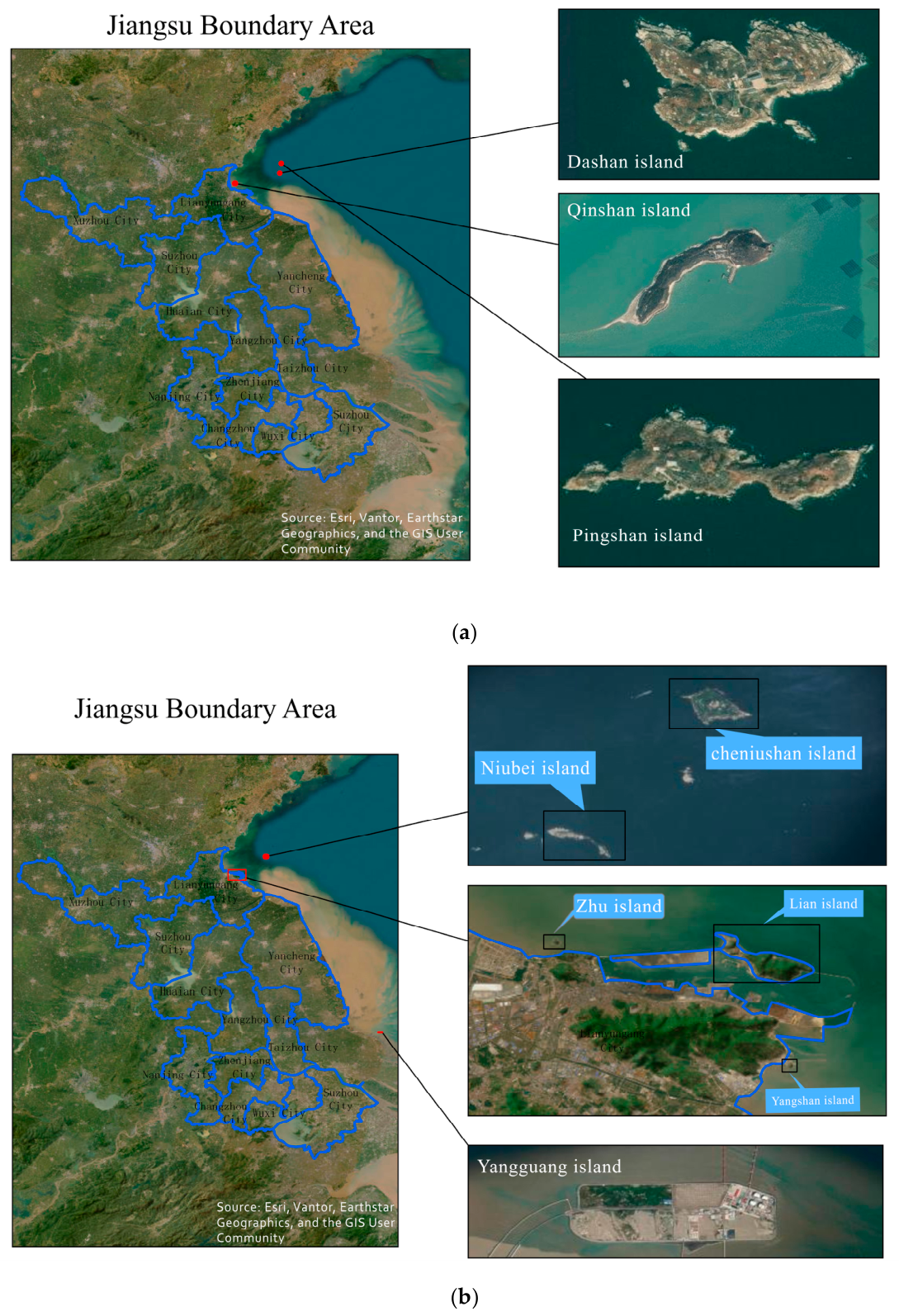
There are a total of 26 islands in Jiangsu Province, 22 of which are uninhabited. In this study, nine typical islands in Jiangsu, including four inhabited islands and five uninhabited islands, were selected as study areas. The locations of the selected islands are shown in Figure 1, which were mapped using ArcGIS Pro (version 2.5.2; Esri, Redlands, CA, USA). The specific attributes and characteristics of the island are shown in Table 1.
Sample selection adhered to the principles of representativeness and comparability. In terms of representativeness, the samples encompass major island types—including natural bedrock islands, artificial islands, and territorial sea base islands—ensuring the findings reflect the overall characteristics of Jiangsu’s islands. Regarding comparability, the study utilized paired analysis to compare “inhabited islands” (significantly driven by human activity) with “uninhabited islands” (maintaining near-original states). This stratified sampling logic aims to reveal divergent drivers of ecosystem evolution under varying development intensities and management regimes.

2.2. Evaluation Indicator System

The established comprehensive island indicator evaluation system serves to optimize and expand upon the driver–pressure–state–impact–response (DPSIR) framework through its multidimensional cross-design [17]. In contrast to the linear causal chain logic of the DPSIR framework, this system involves the development of a mesh assessment model with 14 indicators across three major dimensions (ecology, socioeconomics, and policy and climate) that not only cover the core elements of the DPSIR framework, such as state, pressure, and drivers, but also expand upon its rigid structure [18]. The selected indicators were spatially quantified on the basis of remote sensing data and geographic information system (GIS) techniques [19], and positive and negative indicators were synergistically incorporated to reflect the dynamic balance of the system, rendering it more compatible with the complexity of coupled nature–society island systems [20]. This indicator system exhibits significant innovation for regional adaptability in comparative studies of inhabited and uninhabited islands in Jiangsu. Considering the regional characteristics (e.g., low altitude and sensitive ecology) of alluvial sandbar islands in Jiangsu, indicators such as the terrain elevation index and natural shoreline retention rate were chosen to accurately capture the differences in gradient resulting from the intensity of development of inhabited islands and the ecological vulnerability of uninhabited islands. For the inhabited islands, socioeconomic indicators were adopted to assess their development carrying capacity, whereas for the uninhabited islands, ecological indicators were applied to define conservation priorities [21]. The combination of the number of policies and the number of extreme weather events not only reflects the effect of anthropogenic disturbance on coastal ecosystems but also provides systematic support for the one island–one policy management system, which aims to promote the transition of island management from a generic approach to a customized model [22]. The specific evaluation indicators chosen in this paper are listed in Table 2.

2.3. Data Collection and Preprocessing

The data employed in this study include remote sensing imagery, topographic data, and government statistical data. Data on the NDVI, natural shoreline retention rate, and proportion of artificial shorelines were derived from Sentinel-2 L2A satellite images (European Space Agency; 10 m resolution; https://earth.esa.int/, accessed on 26 February 2026). The coastal wetland/water coverage ratio and the proportion of construction land were obtained from Landsat 8 Collection 2 Level-1 (LC08/C02/T1_TOA) images (United States Geological Survey (USGS); 30 m resolution; https://landsat.gsfc.nasa.gov/, accessed on 26 February 2026). The terrain elevation index was derived from the Copernicus digital elevation model (DEM) (30 m resolution; European Space Agency; https://dataspace.copernicus.eu/, accessed on 26 February 2026). The average nighttime light intensity was calculated using the Visible Infrared Imaging Radiometer Suite (VIIRS)/day–night band (DNB) monthly composite product (National Oceanic and Atmospheric Administration (NOAA); 500 m resolution; https://eogdata.mines.edu/, accessed on 26 February 2026). All the above remote sensing and terrain data were preprocessed and calculated on the Google Earth Engine platform (https://earthengine.google.com/, accessed on 26 February 2026). Data on the rate of excellent water quality in surrounding areas, the waste disposal rate, the island population density, and the number of extreme weather events were sourced from the Lianyungang Statistical Yearbook (Lianyungang Statistical Bureau; http://tjj.lyg.gov.cn/, accessed on 26 February 2026). The annual number of ecological restoration projects and relevant policy documents were derived from the official website of the Lianyungang Municipal People’s Government (http://www.lyg.gov.cn/, accessed on 26 February 2026). Data on the tourist density were obtained from the official website of the Lianyungang Bureau of Culture, Radio, Film, and Tourism (http://wglj.lyg.gov.cn/, accessed on 26 February 2026).
The specific sources, spatial and temporal resolutions, and processing methods for the data in all the datasets are listed in Table 3.

2.4. TVEWM–BN Integrated Framework

2.4.1. Methods and Principles

The traditional entropy weight method is an objective weighting approach that aims to determine weights on the basis of the degree of indicator variability [24]; however, this method is applicable only to static cross-sectional data and can hardly capture the dynamic importance of indicators across different times [25]. A BN is a directed acyclic graph model that can quantify uncertainty and causality, but similarly, it exhibits inherent limitations in resolving dynamic time series data.
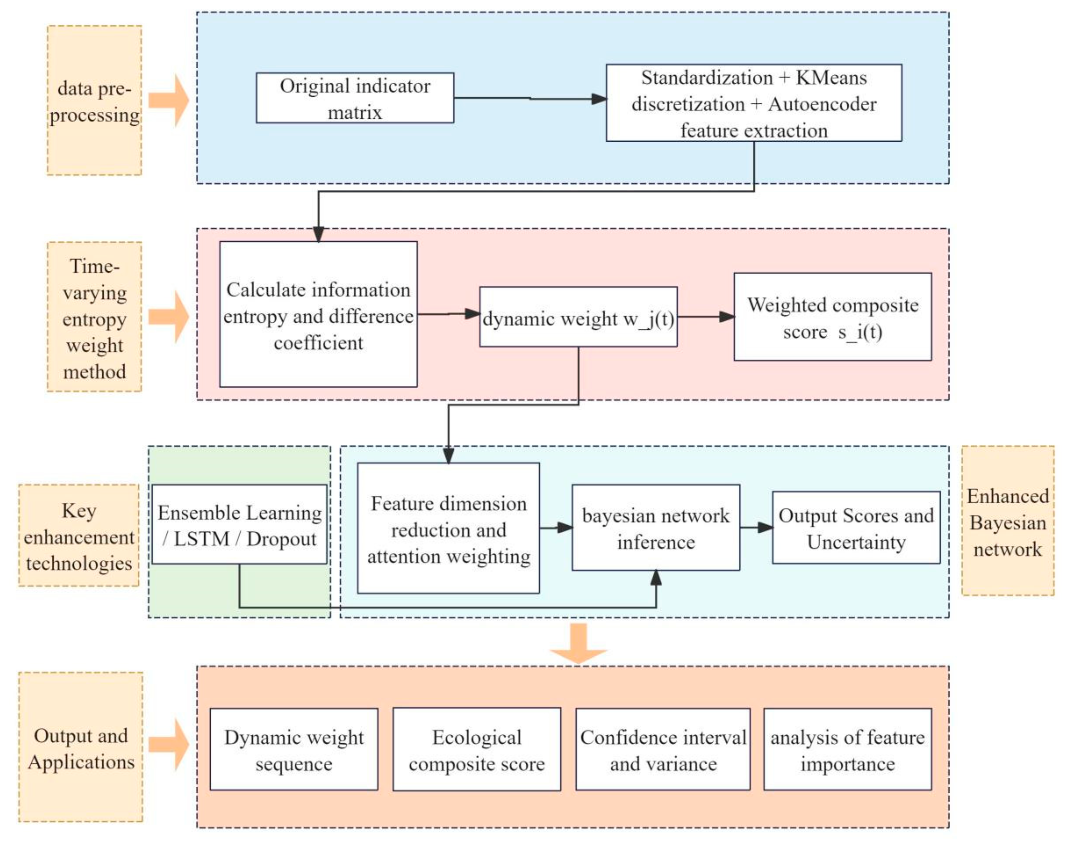
To address these limitations, a combined TVEWM–BN framework based on the traditional method is proposed, in which ML and DL techniques are integrated to develop a multilevel intelligent evaluation system. The TVEWM can be used to calculate the time-varying weights of indicators in a time series framework, thereby better revealing differences in the importance of indicators at different stages [26]. An enhanced BN substantially increases the ability of the model to capture complex nonlinear relationships and characterize temporal dynamics through ML-based feature extraction and DL-based time series modeling. Figure 2 shows a flow chart of this method.

2.4.2. TVEWM Calculation Procedure

Data standardization and feature enhancement.
The original indicator matrix is defined as X = ( x i j ( t ) ) , where x i j ( t ) denotes the value of the jth indicator of the ith object at time t. To normalize the matrix, range standardization [2] is applied to eliminate the influence of different dimensions [27]:
Positive indicators:
z i j ( t ) = x i j ( t ) m i n i x i j ( t ) m a x i x i j ( t ) m i n i x i j ( t ) ,
Negative indicators:
z i j ( t ) = m a x i x i j ( t ) x i j ( t ) m a x i x i j ( t ) m i n i x i j ( t ) ,
To improve data quality, an ML-based feature enhancement technique is introduced:
K-means adaptive discretization. For a continuous variable z i j ( t ) , adaptive discretization is implemented via the K-means clustering method:
C j ( t ) = K M e a n s z j ( t ) , k ,
where k is the number of clusters. The optimal number of clusters is determined on the basis of the silhouette coefficient.
Autoencoder-based feature extraction: Latent representation learning of the features of the indicators is achieved through a deep autoencoder as follows:
z ^ i j ( t ) = E n c o d e r z i j ( t ) ; θ e ,
z ~ i j ( t ) = D e c o d e r z ^ i j ( t ) ; θ d ,
where θ e and θ d are the encoder and decoder parameters, respectively. Training is conducted by minimizing the reconstruction error ( L = 1 n i = 1 n z i j ( t ) z ~ i j ( t ) 2 ) .
Calculation of indicator proportions.
The proportions of standardized indicator values are calculated to convert absolute values into relative contributions [28]:
p i j t = z ^ i j t i = 1 m z ^ i j t , j = 1,2 , , n ,
where m is the number of evaluation objects, and n denotes the number of indicators.
Calculation of information entropy.
For each indicator j, its information entropy at time t can be calculated as follows [29]:
e j t = k i = 1 m p i j t ln p i j t , k = 1 ln m
A smaller value of e j ( t ) indicates greater indicator variability and thus a higher information content; therefore, a higher weight should be assigned during evaluation [30].
Calculation of the difference coefficient.
The difference coefficient is defined as follows:
d j ( t ) = 1 e j ( t ) ,
Calculation of dynamic weights.
The dynamic weight of each indicator at time t can be obtained as follows [31]:
w j ( t ) = d j ( t ) j = 1 n d j ( t ) ,
Thus, the time-varying indicator weight sequence { w j ( t ) } t = 1 T is obtained.
Composite evaluation value.
The composite score of object i at time t can be calculated by combining the weights and standardized values to achieve dynamic comprehensive evaluation [32]:
S i ( t ) = j = 1 n w j ( t ) z i j ( t ) ,

2.4.3. Construction of the Enhanced BN

This method is notably dynamic, objective, and scalable. Its dynamic nature is reflected in the variability in weights over time, which facilitates the accurate representation of differences in the importance of each indicator to the system across different periods, thereby providing greater adaptability to system development and evolution [8,33]. The objectivity of this method lies in the calculation of weights based solely on data variability, and there is no need to introduce subjective weighting, thus greatly increasing the credibility and reliability of the evaluation results [34,35]. Finally, its scalability is manifested in its ability to be organically integrated with methods such as the gray relational analysis and Technique for Order of Preference by Similarity to Ideal Solution (TOPSIS) methods [5,36], allowing it to fulfill an important role in risk evaluation and prediction and providing more comprehensive and in-depth support for the analysis of and decision-making in complex systems [37].
(1)
Network framework design
The BN is a directed acyclic graph model in which nodes represent variables and edges represent dependency relationships, facilitating the quantification of uncertainty and causality [38]. The input nodes of the improved BN established in this study include the number of policies, the number of extreme weather events, and socioeconomic impact indicators (such as tourism and wetland area), while K-means clustering nodes are introduced to identify latent patterns in the data, with the goal of quantifying the combined effect of these factors on the eco-environmental quality of islands.
The network structure was designed as a five-layer architecture that includes (1) a bottom feature layer, where original indicators are input and dimensionality is reduced via principal component analysis (PCA) [39]; (2) a feature enhancement layer, where deep features are extracted using an autoencoder [40]; (3) an attention layer, which learns the importance weights of different features [41]; (4) an inference layer, where the BN performs probabilistic inference; (5) an output layer, which provides the composite score and uncertainty estimation.
(2)
Network structure learning
Data-driven regularization methods were employed for network structure learning to avoid overfitting and increase model generalizability [42]. Let the network structure be denoted as G and the data be denoted as D . Then, the optimal network structure can be obtained by maximizing the regularization likelihood function, which can be expressed as
G * = arg max G ln P ( D | G ) λ Ω ( G ) μ Ψ ( G ) ,
where Ω ( G ) is the penalty term for network complexity, Ψ ( G ) is the penalty term for ML component complexity, and λ and μ are regularization coefficients [43].
(3)
Parameter learning and model integration
After the network structure was determined, conditional probability distribution learning was conducted using ensemble learning combined with multiple classification models (random forest, gradient boosting tree, and naive Bayesian models) [44].
The prediction probability of the ensemble model can be expressed as follows:
P ^ ( X i | P a ( X i ) ) = 1 M m = 1 M ω m P m ( X i | P a ( X i ) ) ,
where M is the number of base models, P m is the prediction probability of the m -th model, and ω m is the model weight, which is determined via cross-validation.
For small-sample data, Bayesian estimation combined with Laplace smoothing can be used:
P ^ ( X i | P a ( X i ) ) = N ( X i , P a ( X i ) ) + α N ( P a ( X i ) ) + α | X i | ,
where N ( ) denotes the sample frequency, and α is the smoothing coefficient (usually set to 1).
(4)
Fusion mechanism of time-varying factors
Combined with the TVEWM results, the dynamic weights of the indicators { w j ( t ) } were incorporated into network inference to obtain the time-dependent conditional probability [45]:
Attention-weighted fusion can be expressed as follows:
P ( X i ( t ) | P a ( X i ) ( t ) ) j = 1 n α i j ( t ) w j ( t ) P ( X i | P a ( X i ) ) ,
where α i j ( t ) is the attention weight, which can be obtained through attention mechanism-based learning as follows:
α i j ( t ) = exp s c o r e ( X i , w j ( t ) ) j = 1 n exp s c o r e ( X i , w j ( t ) ) ,
To extend the DL time series, a long short-term memory (LSTM) network is introduced to capture time series patterns [46,47]:
h t = L S T M ( x t , h t 1 ; θ ) ,
P ( X i ( t ) | P a ( X i ) ( t ) ) = f ( h t , w j ( t ) ; ϕ ) ,
where h t denotes the hidden state at time t, and θ and ϕ are model parameters. This coupling mechanism enables the network to reflect the temporal evolution of the relationships among variables [48].
(5)
Uncertainty quantification
The uncertainty in the prediction results was quantified through the use of bootstrap resampling and Monte Carlo dropout techniques [49,50].
The bootstrap confidence interval can be expressed as follows:
C I i j ( t ) = y ¯ i j ( t ) ± z σ i j ( t ) B ,
where y ¯ i j ( t ) is the mean predicted value obtained from B bootstrap samples, σ i j ( t ) denotes the standard deviation, and z is the z value corresponding to the confidence level.
The Monte Carlo dropout technique was applied repeatedly at the inference stage to calculate the prediction variance:
V a r [ y ] = 1 T t = 1 T y ^ t 2 1 T t = 1 T y ^ t 2 ,

3. Results

3.1. Indicator Weights and Dynamic Influences

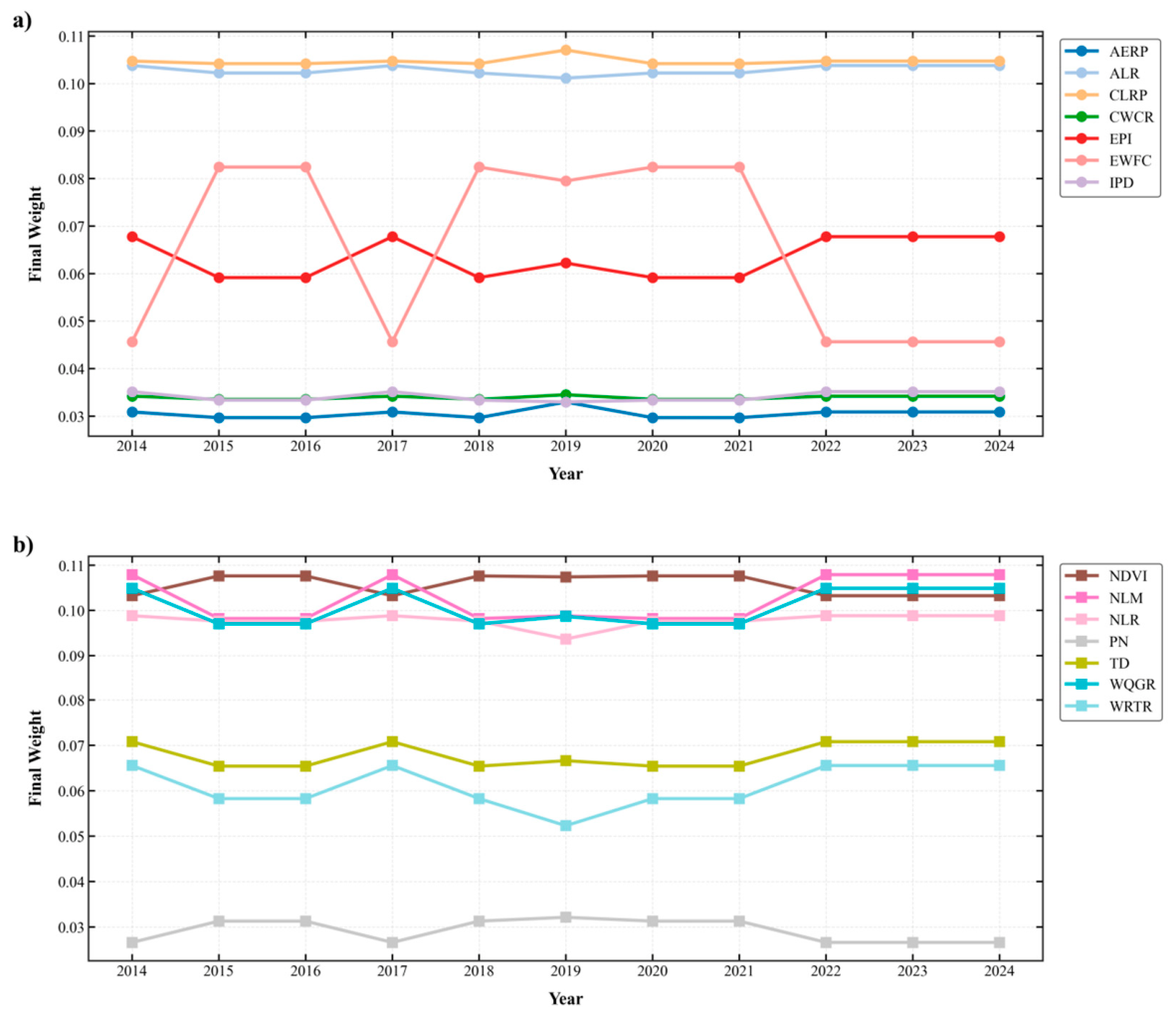
To systematically elucidate the dynamic characteristics of changes in the natural environment, anthropogenic activities, and policy responses in the study area from 2014–2024, the time-varying weights of the evaluation indicators were analyzed. The weights of the selected indicators over time are shown in Figure 3. Detailed indicator factor data for each year are shown in Table A1.
The NDVI and NLR indicators consistently maintain relatively high weights around 0.10, identifying them as key factors in the assessment. In contrast, the weight of InEWFC exhibits significant fluctuations, peaking in 2015 and 2017 before declining and stabilizing in subsequent years, reflecting the periodic influence of external factors on its importance. Indicators such as TD and IPD remain at relatively low weights around 0.03 over the long term, contributing minimally to the assessment outcomes. The weights of WQGR and WRTR are generally concentrated near 0.10, with minor fluctuations, indicating relative stability. EPI maintains a moderate weight around 0.07, exhibiting only slight variation, whereas CWCR consistently remains at a low level of 0.03, representing a secondary indicator within this set. Overall, these patterns illustrate both the long-term dominance of a few core indicators in island ecological assessment and the periodic adjustments in the importance of specific indicators in response to external environmental conditions, while the long-term stability of low-weight indicators suggests their consistently auxiliary role in the evaluation system.
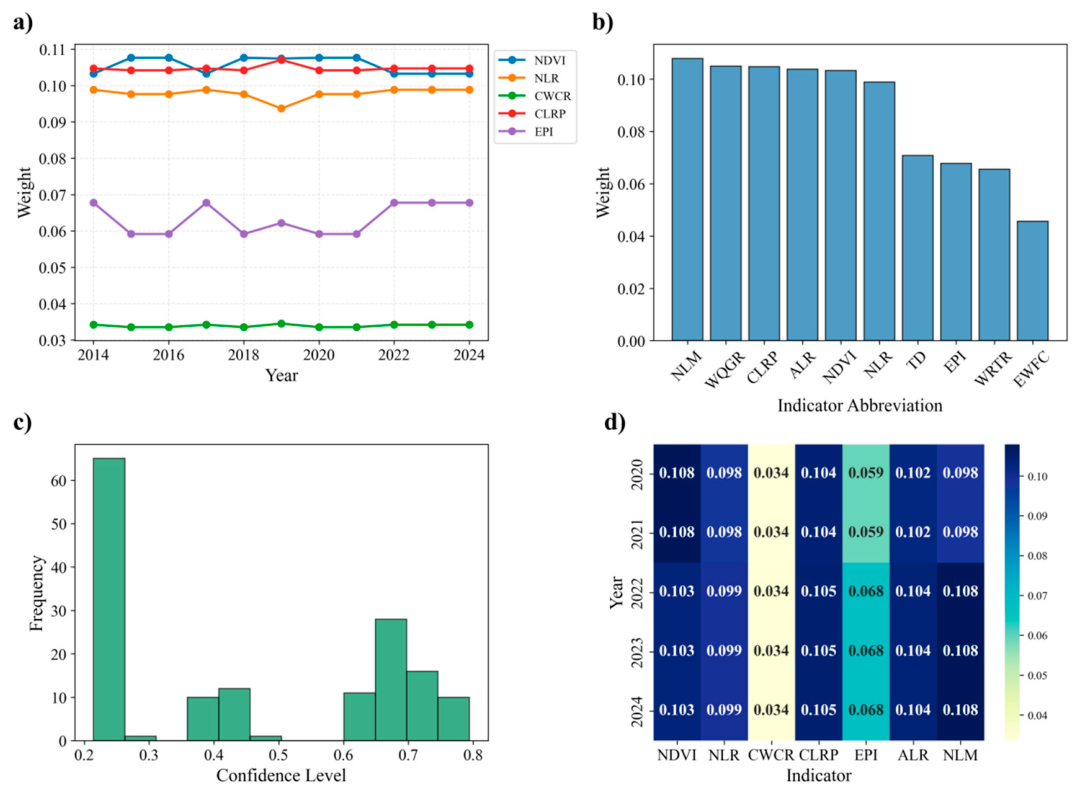
Building on this, Figure 4 provides a further statistical summary of the data, presented through line charts, bar charts, and heatmaps. Additionally, the confidence of each indicator is analyzed through frequency distribution.
The upper-left time series of weights indicates that the NDVI, NLR, and CLRP indicators consistently maintain weights around 0.10 over the long term, identifying them as key factors in the assessment. In contrast, the periodic fluctuations in the EPI weight reflect its dynamic adjustment in response to external factors. The upper-right table of weights for 2024 demonstrates that the assessment of that year was dominated by the four core indicators with weights exceeding 0.10, while the subsequent indicators exhibited progressively lower weights, highlighting significant differences in importance among the indicators. The lower-left distribution of confidence shows a mean of 0.453 and a median of 0.419, indicating a moderate overall level; although some variability exists, the results remain within an acceptable reliability range. The lower-right heatmap of weights illustrates the spatiotemporal characteristics of the indicators from 2020 to 2024, with a slight increase in NDVI weight after 2022, corresponding to its heightened sensitivity to later external factors.
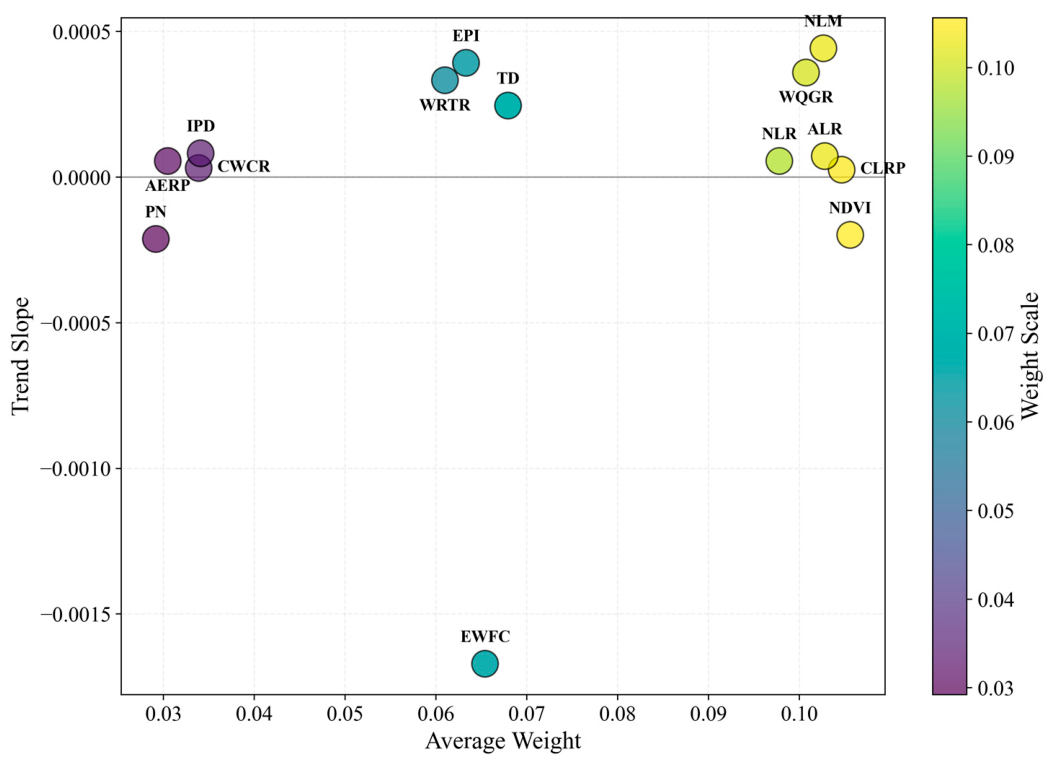
Overall, these features demonstrate both the long-term dominance of a few core indicators in island ecological assessment and the dynamic influence of external policies and human activities on the importance of specific indicators. The moderate level of confidence further indicates that, although some uncertainty exists, the stability of the core indicators ensures the overall reliability of the assessment. The stability of indicator weights is further analyzed, resulting in Figure 5.
Indicators with relatively high average weights exhibited trend slopes close to zero, demonstrating that their weights remained constant over the long term, although the weights of some indicators slightly increased. Indicators with moderate average weights exhibited negative trend slopes with relatively large absolute values, suggesting a clear downward trend in weights and lower stability. Indicators with low average weights demonstrated trend slopes close to zero and exhibited minimal weight variability, suggesting high stability despite their low weight proportions. Most of the remaining indicators with moderately high average weights also revealed trend slopes approaching zero, with only minor weight fluctuations. Overall, both the high-weight core indicators and low-weight secondary indicators in the evaluation system exhibited high stability, whereas only a small number of medium-weight indicators exhibited notable temporal changes in importance, reflecting a pattern in which the weights of most indicators remained constant while only those of a few indicators changed over time.

3.2. Composite Ecological Score

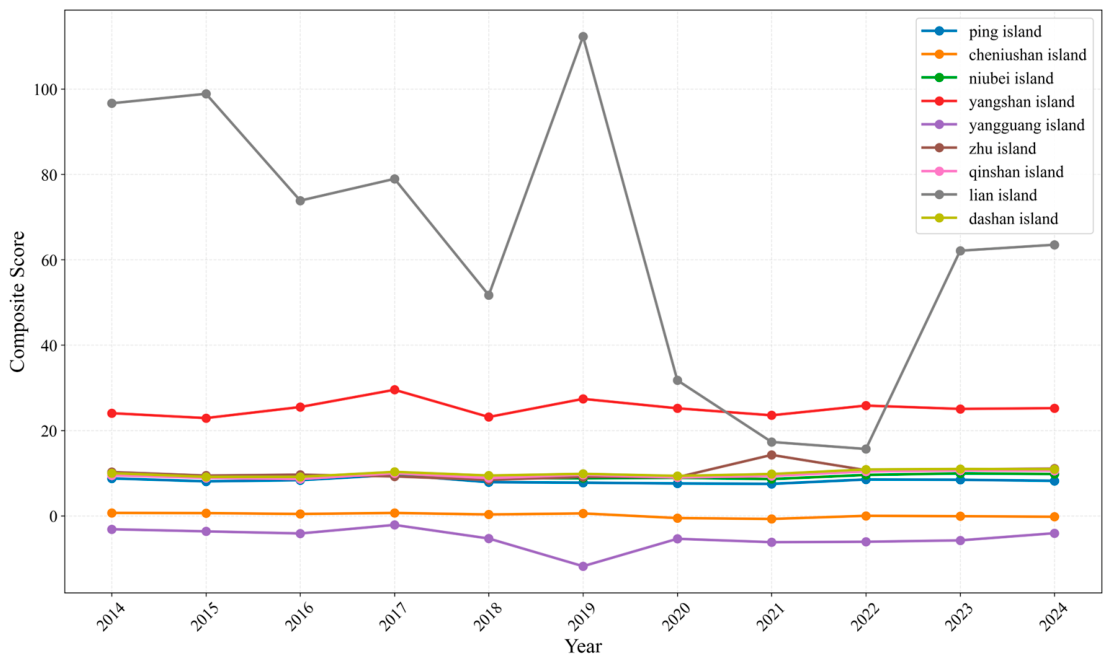
To compare the differences between inhabited and uninhabited islands under eco-environmental and social pressures and to analyze the underlying causes, a trend analysis of the nine typical islands was conducted on the basis of composite score data from 2014 to 2024 (Figure 6), while trend subanalysis (Figure 7) and statistical analysis (Figure 8) of the scores of each island revealed the specific performance and structural differences among these islands in terms of multidimensional indicators.
The scores of each island are shown in the form of a line chart (Figure 6). Detailed comprehensive score data for each year are shown in Table A2.
The scores of certain islands, such as Lian Island (gray line), fluctuated considerably. Notably, the scores remained high (near 100) from 2014–2015, followed by a decrease, a notable peak in 2019, and then a sharp decrease, indicating that the ecological conditions of these islands were greatly influenced by external interventions or sudden events. The scores of the uninhabited islands were mostly concentrated at approximately 10, with small overall fluctuations, reflecting relatively stable ecological conditions in the absence of anthropogenic disturbance but with a moderate quality level. In contrast, the scores of the inhabited islands were generally low, with the score of Yangguang Island (purple line) remaining below zero for a long period, that of Cheniushan Island (orange line) fluctuating around zero, and that of only Yangshan Island (red line) remaining relatively stable at approximately 20, thus confirming the negative impact of anthropogenic activities on the eco-environmental quality of the islands. Overall, the ecological scores of the uninhabited islands were more stable and generally higher than those of the inhabited islands, while the fluctuations in the scores of some islands corresponded to the influence of specific interventions or environmental events, highlighting the negative correlation between the intensity of anthropogenic activities and ecological quality as well as the short-term effects of ecological interventions.
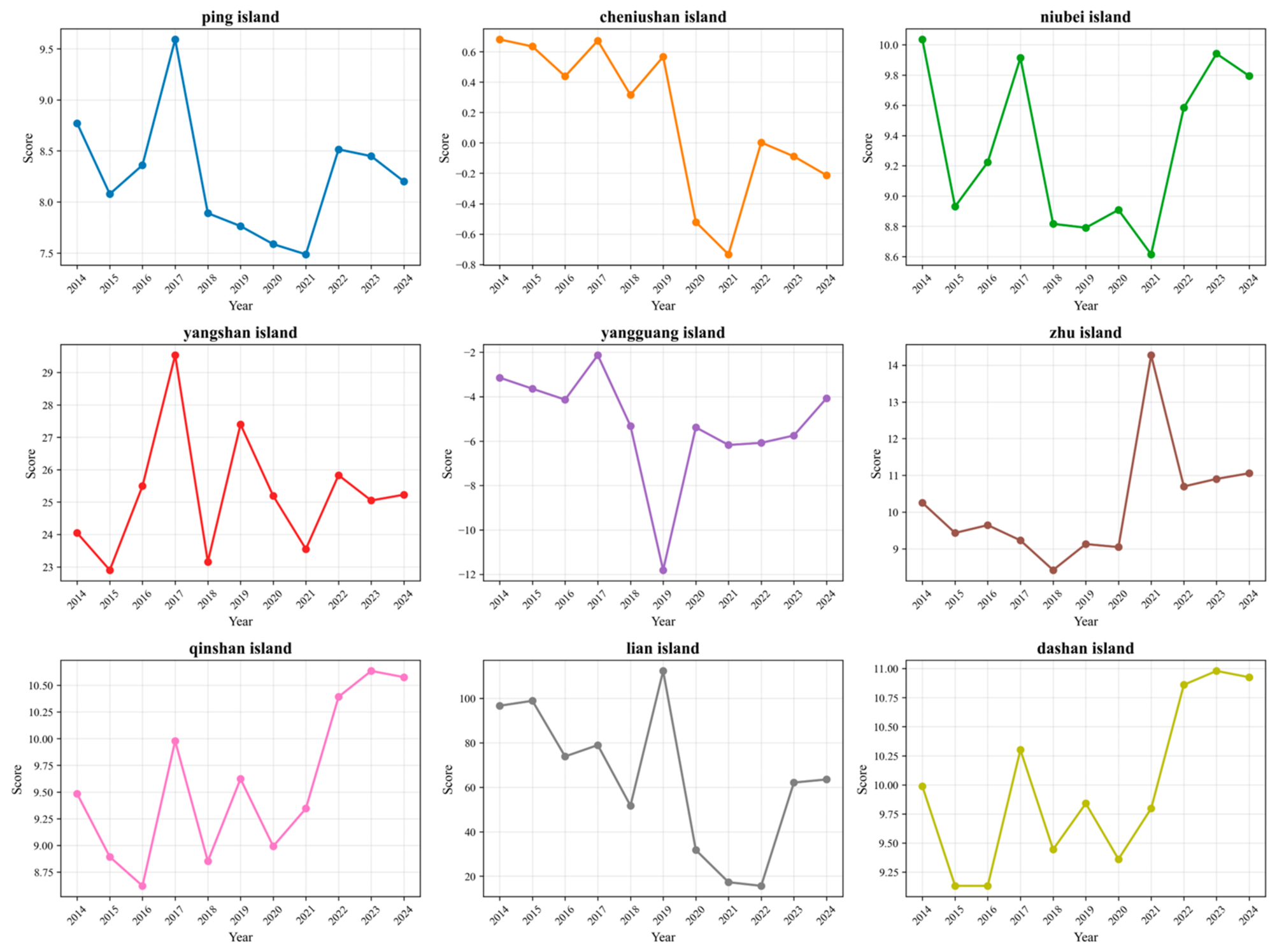
Changes in the scores of each island over time are shown in Figure 7.
The scores of the uninhabited islands generally occurred within the middle to high range, with mean scores of approximately 8.24 and 9.98 for Ping Island and Dashan Island, respectively. Although there were stage-specific fluctuations, the overall trends remained relatively constant, indicating a strong ecological baseline and stable conditions in the absence of anthropogenic disturbance. The scores of the inhabited islands clearly differed. The scores of Yangshan Island (with a mean of 25.22) greatly fluctuated within the 23–29 range, reflecting a balanced state between tourism development and ecological conservation on this inhabited natural island. The mean score of artificial Yangguang Island was −5.24 and remained within the negative range for a prolonged period, reaching a trough in 2019, which indicates the significant ecological impacts of industrial development. Lian Island, as a unique case, attained a high mean score of 69.09, which sharply increased to 117.33 in 2019, followed by a decrease, corresponding to the short-term effect of intervention measures such as effective ecological restoration. The scores of Cheniushan Island (with a mean of −0.13) remained close to zero, with drastic fluctuations.
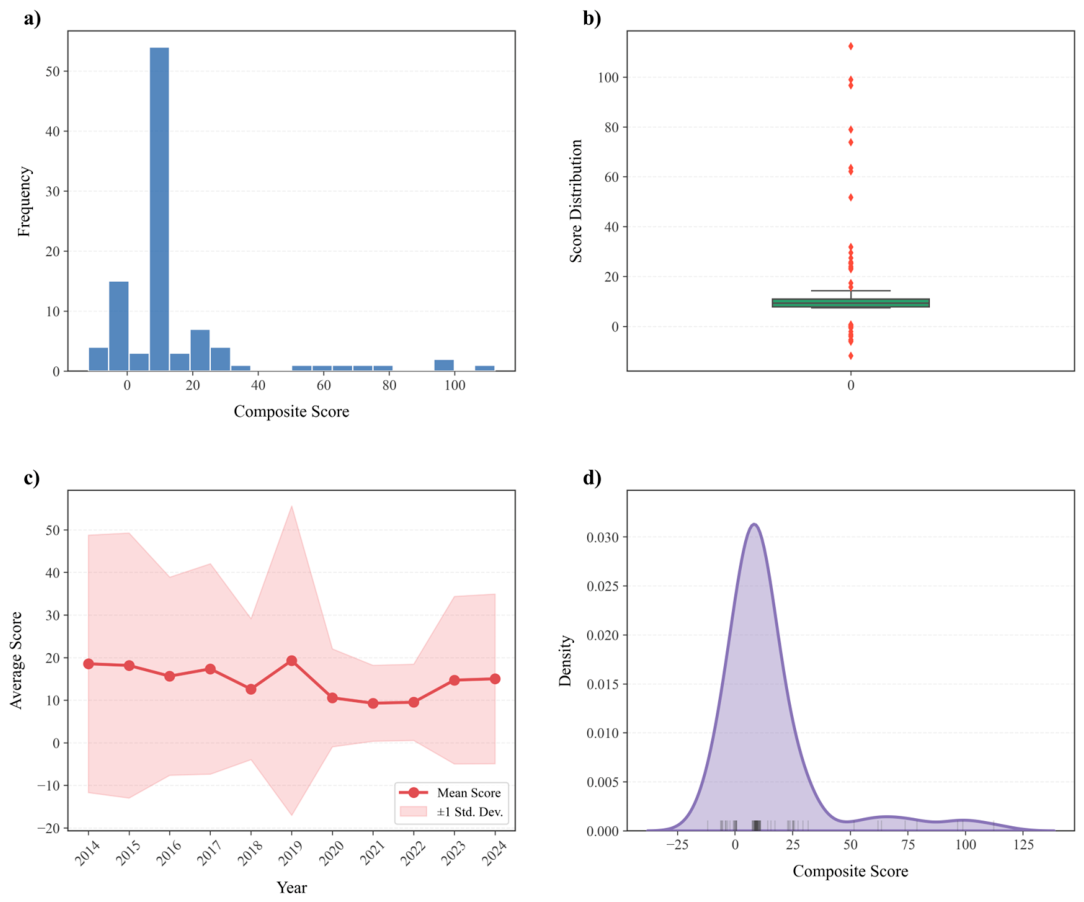
The overall characteristics and differences in scores across various dimensions are shown in Figure 8.
The upper-left histogram indicates that the 199 data points have a mean score of 11.96, a median of 9.96, and a standard deviation of 15.57. The scores are concentrated in the 0–20 range, but the large standard deviation suggests a dispersed distribution with significant variability. The multiple outliers observed in the boxplot, corresponding to peaks and high dispersion in the 0–20 range of the density plot, confirm that some islands exhibit scores far above the mean. The annual score trend from 2014 to 2024 shows that the average scores fluctuate slightly around 10, with a trough around 2020. The pronounced variations within the standard deviation range reflect the instability in score dispersion across different years.
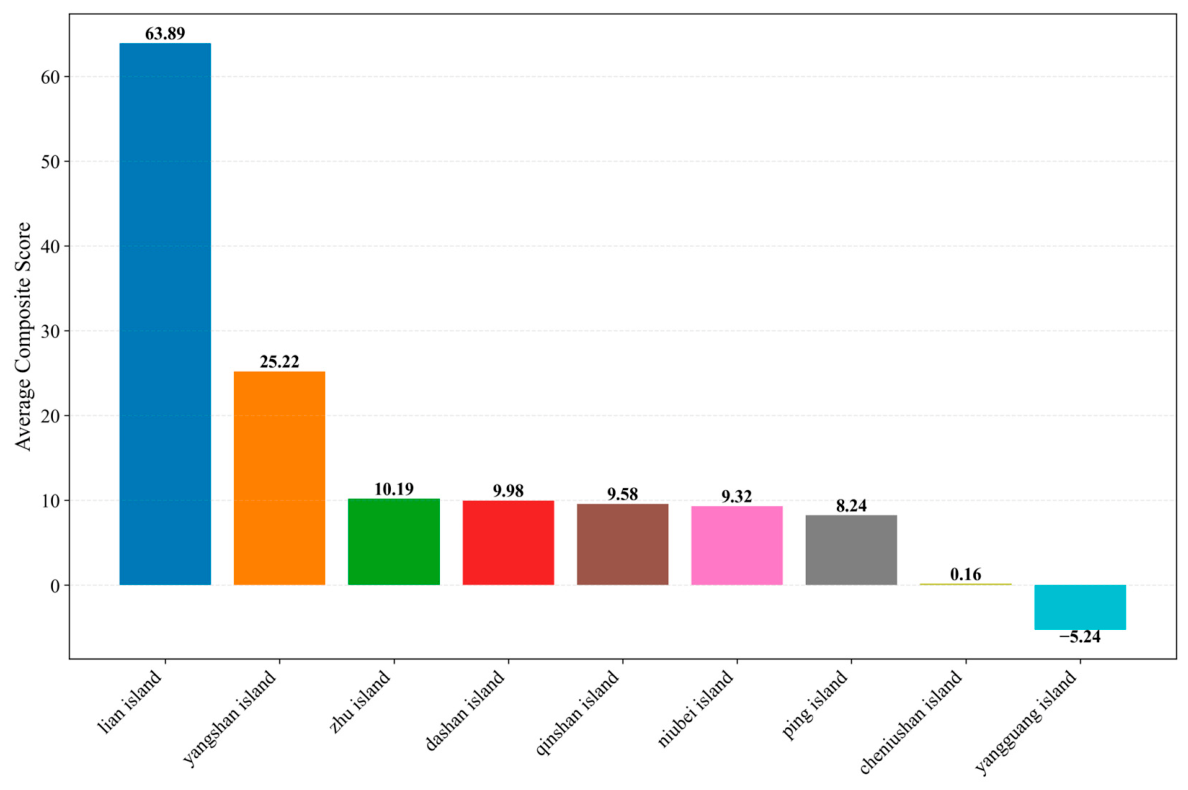
To examine the differences between the inhabited and uninhabited islands under ecological and social pressures, the average composite scores of the nine islands were calculated for the 2014–2024 period, as shown in Figure 9.
The ranking of the average composite scores of the islands from 2014 to 2024 clearly revealed different scores among the various types of islands (inhabited and uninhabited islands) as a result of differences in development attributes and ecological management models. Among the inhabited islands, Lian Island ranked first, with a notably high score (63.89). As an inhabited natural island, its synergistic model of tourism development and ecological restoration has effectively maintained high ecological quality. Yangshan Island (25.22), which is also an inhabited natural island, ranked second, benefitting from moderate development that is based on pine forests and fishery resources. Qinshan Island, an inhabited island where ecological and cultural functions are integrated, exhibited a medium score. Yangguang Island, which is an inhabited artificial island, ranked lowest (−5.24), with its industrial warehousing development model exerting significant negative impacts on the ecosystem.
Among the uninhabited islands, the scores of Zhu Island (10.19), Dashan Island (9.98), Niubei Island (9.32), and Pingshan Island (8.24) were clustered at approximately 10 within the medium range, reflecting the stability of their ecological baselines in the absence of anthropogenic disturbance. Although Cheniushan Island is an uninhabited island, it attained a relatively low score (0.16) because of its ecological vulnerability. Overall, the ecological scores of the inhabited natural islands were higher than those of the inhabited artificial islands, while the uninhabited islands exhibited a relatively stable ecological state with moderate scores. The difference in scores intuitively reflects the association between the development type and ecological quality.

4. Discussion

4.1. Advantages of the Proposed Method

The proposed Time-varying Entropy Weight–Bayesian Network (TEW-BN) fusion framework represents not only a technological innovation but also a novel theoretical paradigm for marine ecological assessment. Its core significance lies in overcoming the limitations of conventional static evaluation methods when applied to highly dynamic, nonlinear, and data-sparse systems such as islands. This advantage can be articulated along two dimensions.
First, the framework achieves superior dynamic response capture compared to traditional static models. Conventional island ecological assessments often rely on static weight allocation, which inadequately reflects instantaneous disturbances associated with environmental shocks [51]. By introducing the Time-varying Entropy Weight method, this study identifies an increase in the weight of ecological restoration projects after 2018, aligning closely with the theoretical expectation that assessments of human impacts on marine environments require temporal sensitivity [52]. Furthermore, this finding corroborates recent conclusions that dynamic weighting models more objectively capture the nonlinear recovery trajectories of coastal ecosystems [31]. The integration of Bayesian networks for associating multiple stressors enables this framework to explain the evolution of industrial islands under extreme weather conditions with higher precision than conventional linear models, reinforcing the perspective that Bayesian frameworks can systematically quantify real-time uncertainty propagation under climate change [38].
Second, the framework provides highly robust inference and uncertainty reduction under small-sample conditions. Addressing the “small-sample, high-sparsity” bottleneck in Jiangsu island data, this study innovatively integrates autoencoders with attention mechanisms into the underlying processing module [53]. Empirically, this integrated approach responds to findings that cross-attention-enhanced autoencoder frameworks can accurately reconstruct complex dynamic fields from extremely sparse sensor data, even at sampling rates as low as 0.1% [32]. It further validates the theoretical assertion that multi-layer intelligent system integration can substantially reduce uncertainty in complex environmental models [54]. Data verification indicates that inference uncertainty in this framework is reduced by 62.3% compared with baseline models, with confidence intervals outperforming conventional Bayesian paradigms [55]. This breakthrough not only confirms the predicted high robustness of hybrid machine learning algorithms in small-sample marine community prediction but also provides a transferable technical paradigm for island nations lacking long-term monitoring data [33].

4.2. Implications of Classification-Based Management

4.2.1. Inhabited Islands: Source Control of Anthropogenic Pressure and Threshold-Based Early Warning

For inhabited islands such as Yangshan and Sunshine Islands, ecological scores are relatively low, and in some cases even negative. The primary limiting factors are the proportion of built-up land, the proportion of artificial coastlines, and the excessive density of residents or visitors. This indicates that nearshore island ecosystems are highly susceptible to the dominance and influence of human activity footprints.
These findings directly support the necessity of implementing “total quantity control” for inhabited islands, as stipulated in the Jiangsu Marine Spatial Plan. For instance, Liandao Island has maintained a balance in development intensity through ecological restoration, achieving a score of 63.89, whereas Yangshan Island faces overdevelopment. Consequently, the management of inhabited islands should adopt the principle of integrated ecosystem management, implementing measures such as visitor quotas and red-line thresholds for natural coastline retention, thereby converting restrictive indicators into enforceable regulatory boundaries.

4.2.2. Uninhabited Islands: Resilience Monitoring of Natural Vulnerability and Spatial Isolation

In contrast, uninhabited islands such as Cheniushan and Ping Islands, while achieving higher ecological scores, are primarily constrained by pronounced natural vulnerability and high sensitivity to extreme weather events. In the absence of anthropogenic disturbance, the stability of their ecosystems depends entirely on intrinsic natural conditions, exhibiting limited buffering capacity against climate change and extreme events.
For territorial base points such as Dashan and Cheniushan Islands, limiting factors such as natural erosion and sparse vegetation necessitate a “zero-disturbance” management approach. The findings support the decision in the Jiangsu uninhabited island management program to establish ecological monitoring archives, and recommend the use of numerical simulations to track changes in limiting factors, thereby providing strategic support for spatial security planning.

4.3. Limitations and Future Directions of the Study

This study has four main limitations. First, in terms of sample representativeness, although the analysis was extended to nine typical islands (four inhabited and five uninhabited), it remains concentrated in the Lianyungang sea area and does not cover the southern islands of Jiangsu. This limitation may result in an incomplete characterization of regional variations in the interactions between human activities and ecological responses. Second, regarding the indicator system, dimensions such as marine biodiversity and ecosystem service value were not included, which limits the ability to fully capture the functional integrity and socio-economic value of the island ecosystems. Third, in terms of methodological application, the enhanced Bayesian network requires substantial computational resources, and some deep learning components may be prone to overfitting under small-sample scenarios. Fourth, concerning scenario projection, the model’s inference capacity for unprecedented extreme climate conditions or high-intensity development scenarios is limited, restricting its applicability for medium- to long-term forecasting and simulation.
Based on the above limitations, future research can advance along five directions. First, the study scope and data dimensions should be expanded to cover all four inhabited islands of Jiangsu as well as more representative uninhabited islands. Integrating a land–sea coordinated perspective, cross-system data such as terrestrial pollution sources and oceanic circulation should be incorporated to establish a comprehensive “land–sea–island” assessment framework. Second, the indicator system should be improved by adding dimensions such as marine biodiversity and ecosystem service value, while high-resolution remote sensing and UAV monitoring technologies should be employed to enhance the timeliness and accuracy of indicator data. Third, model adaptability to small-sample data should be optimized by developing deep learning architectures and regularization techniques specifically designed for limited datasets, balancing model complexity and generalization capability. Fourth, the capacity for dynamic projection and scenario analysis should be strengthened by integrating process-based models with reinforcement learning methods to simulate island ecological evolution under varying development intensities, policy interventions, and climate scenarios, thereby providing decision support for medium- to long-term conservation planning. Finally, cross-regional validation of the methodology should be promoted. Comparative analysis with islands in other coastal provinces of China can reveal commonalities and differences in island ecosystems, enhancing the generalizability and transferability of the approach.

5. Conclusions

This study developed a dynamic evaluation framework and conducted an empirical assessment of representative islands in Jiangsu, with the core conclusions summarized as follows:
First, in terms of technical adaptability, a hybrid evaluation model integrating Time-varying Weighting and intelligent enhancement was successfully developed. The results indicate that, under small-sample conditions, the model improves accuracy by 11.3% compared with traditional models, effectively quantifying the dynamic disturbances of island ecosystems caused by policy interventions and extreme weather, and addressing the challenge of overcoming small-sample limitations.
Second, regarding differentiation of limiting factors, the study identified and validated the intrinsic differences in constraints among islands with different development types. Inhabited islands exhibit ecological bottlenecks primarily due to anthropogenic pressures, including expansion of built-up land and visitor overload, showing a “development-driven” decline pattern. In contrast, uninhabited islands are constrained by natural conditions, such as high natural vulnerability and sensitivity to extreme weather, displaying a “naturally vulnerable” fluctuation pattern. This finding provides the most direct scientific basis for differentiated, island-specific conservation strategies.
Third, in supporting spatial planning, the results closely align with the requirements of marine spatial planning. It is recommended that inhabited islands emphasize a dynamic balance between development and restoration, whereas uninhabited islands focus on real-time monitoring of their pristine state and spatial isolation, thereby promoting the sustainable utilization of island resources.
Although the model demonstrates strong performance in quantifying policy interventions and natural disturbances, it remains limited by the spatial distribution of samples, the dimensionality of evaluation indicators, and the capacity for reasoning under extreme scenarios. Future research should aim to construct an integrated “land–sea–island” evaluation framework, further optimize the generalization ability of deep learning architectures under small-sample conditions, and combine reinforcement learning with process-based models to enhance dynamic simulation. Cross-regional comparisons could then reveal common evolutionary patterns of islands in different areas, thereby improving the global applicability and scientific support value of this evaluation paradigm.

Author Contributions

Methodology, S.G.; Resources, J.S.; Data curation, D.Z. and W.S.; Writing—original draft, X.L.; Writing—review & editing, J.S. and W.S.; Supervision, W.S. All authors have read and agreed to the published version of the manuscript.

Funding

Research on the Protection of Marine and Island Topography and Ecological Services in Jiangsu Province (Science and Technology Project of Jiangsu Provincial Department of Natural Resources, No. JSZRKJ202421), Research and Development of Intelligent Monitoring System for Deep Sea Cage Aquaculture Fish (Key Research and Development Plan of Lianyungang City, No. CG2529).

Institutional Review Board Statement

Not applicable.

Informed Consent Statement

Not applicable.

Data Availability Statement

The data presented in this study are available on request from the corresponding author.

Conflicts of Interest

The authors declare no conflicts of interest.

Appendix A

Table A1. Weight results of each year.
YearIndexUltimate Weightλ ValuesEntropy WeightDegree of Confidence
2014NDVI0.103264768991095670.88365010400862741.00000000006213340.2261882165916701
2014NLR0.098843407242061820.84581593454730411.00000000006213340.2563681889703701
2014CWCR0.0341978298111125860.292635292410954761.00000000006213340.6750775861888062
2014CLRP0.10472246428872730.89612379289545531.00000000006213340.24615490471963086
2014EPI0.067763697180886140.57986279974211211.00000000006213340.39739348081833265
2014ALR0.103785218803760750.88810366097278851.00000000006213340.23303394052086715
2014NLM0.107925681052590930.92353413675430171.00000000006213340.23804409676049978
2014WQGR0.104910042762622570.89772892637502211.00000000006213340.2266042402160843
2014WRTR0.06555196260545770.56093669835524571.00000000006213340.7939125663929204
2014TD0.07080185257906580.60586069195477291.00000000006213340.39291023223961924
2014AERP0.0308724745189508930.264179793226739351.00000000006213340.7174967718947158
2014IPD0.0351418642052167550.30071351791504521.00000000006213340.6518354325510464
2014PN0.0265716209672060870.22737682813558731.00000000006213340.7564875322564475
2014EWFC0.045647114991245030.39060831979574331.00000000006213340.6085437872015257
2015NDVI0.10764680272028540.95176669580152361.00000000006213340.23460862584733155
2015NLR0.097643189656202320.86331905489184051.00000000006213340.25666225966209527
2015CWCR0.033527560711241590.296436260715898241.00000000006213340.6527283108678046
2015CLRP0.104183263346442860.92114357145117641.00000000006213340.2230258378634568
2015EPI0.059152628230267060.52300207805510511.00000000006213340.44747496943130594
2015ALR0.102216875229449610.90375761410289221.00000000006213340.2210690150882538
2015NLM0.098213772035554440.86836389869727751.00000000006213340.23709785618412837
2015WQGR0.097030916936904410.85790560304515811.00000000006213340.24565977151418278
2015WRTR0.058255337541063120.51506861999731021.00000000006213340.6978080515593921
2015TD0.065416992332431130.57838888910890741.00000000006213340.4212337529336521
2015AERP0.0296743706502033930.26236801270467791.00000000006213340.7103613759910503
2015IPD0.033360827087772420.29496207378346681.00000000006213340.6644174013485131
2015PN0.031262177523174950.276406717644070431.00000000006213340.6692654985414159
2015EWFC0.082415285999007420.7286804852219851.00000000006213340.6119126982502988
2016NDVI0.10764680272028540.95176669580152361.00000000006213340.23460862584733155
2016NLR0.097643189656202320.86331905489184051.00000000006213340.25666225966209527
2016CWCR0.033527560711241590.296436260715898241.00000000006213340.6527283108678046
2016CLRP0.104183263346442860.92114357145117641.00000000006213340.2230258378634568
2016EPI0.059152628230267060.52300207805510511.00000000006213340.44747496943130594
2016ALR0.102216875229449610.90375761410289221.00000000006213340.2210690150882538
2016NLM0.098213772035554440.86836389869727751.00000000006213340.23709785618412837
2016WQGR0.097030916936904410.85790560304515811.00000000006213340.24565977151418278
2016WRTR0.058255337541063120.51506861999731021.00000000006213340.6978080515593921
2016TD0.065416992332431130.57838888910890741.00000000006213340.4212337529336521
2016AERP0.0296743706502033930.26236801270467791.00000000006213340.7103613759910503
2016IPD0.033360827087772420.29496207378346681.00000000006213340.6644174013485131
2016PN0.031262177523174950.276406717644070431.00000000006213340.6692654985414159
2016EWFC0.082415285999007420.7286804852219851.00000000006213340.6119126982502988
2017NDVI0.103264768991095670.88365010400862741.00000000006213340.2261882165916701
2017NLR0.098843407242061820.84581593454730411.00000000006213340.2563681889703701
2017CWCR0.0341978298111125860.292635292410954761.00000000006213340.6750775861888062
2017CLRP0.10472246428872730.89612379289545531.00000000006213340.24615490471963086
2017EPI0.067763697180886140.57986279974211211.00000000006213340.39739348081833265
2017ALR0.103785218803760750.88810366097278851.00000000006213340.23303394052086715
2017NLM0.107925681052590930.92353413675430171.00000000006213340.23804409676049978
2017WQGR0.104910042762622570.89772892637502211.00000000006213340.2266042402160843
2017WRTR0.06555196260545770.56093669835524571.00000000006213340.7939125663929204
2017TD0.07080185257906580.60586069195477291.00000000006213340.39291023223961924
2017AERP0.0308724745189508930.264179793226739351.00000000006213340.7174967718947158
2017IPD0.0351418642052167550.30071351791504521.00000000006213340.6518354325510464
2017PN0.0265716209672060870.22737682813558731.00000000006213340.7564875322564475
2017EWFC0.045647114991245030.39060831979574331.00000000006213340.6085437872015257
2018NDVI0.10764680272028540.95176669580152361.00000000006213340.23460862584733155
2018NLR0.097643189656202320.86331905489184051.00000000006213340.25666225966209527
2018CWCR0.033527560711241590.296436260715898241.00000000006213340.6527283108678046
2018CLRP0.104183263346442860.92114357145117641.00000000006213340.2230258378634568
2018EPI0.059152628230267060.52300207805510511.00000000006213340.44747496943130594
2018ALR0.102216875229449610.90375761410289221.00000000006213340.2210690150882538
2018NLM0.098213772035554440.86836389869727751.00000000006213340.23709785618412837
2018WQGR0.097030916936904410.85790560304515811.00000000006213340.24565977151418278
2018WRTR0.058255337541063120.51506861999731021.00000000006213340.6978080515593921
2018TD0.065416992332431130.57838888910890741.00000000006213340.4212337529336521
2018AERP0.0296743706502033930.26236801270467791.00000000006213340.7103613759910503
2018IPD0.033360827087772420.29496207378346681.00000000006213340.6644174013485131
2018PN0.031262177523174950.276406717644070431.00000000006213340.6692654985414159
2018EWFC0.082415285999007420.7286804852219851.00000000006213340.6119126982502988
2019NDVI0.107422714714922680.96534431418689561.00000000006213340.255627544173426
2019NLR0.093692871932794920.8419623488401771.00000000006213340.2426857870121143
2019CWCR0.034507289681005820.31009657482554411.00000000006213340.6430229320779028
2019CLRP0.107050071682291820.96199559195690721.00000000006213340.23310000969945713
2019EPI0.062215788130624650.55909643955601731.00000000006213340.41611351405268715
2019ALR0.101142663275050130.90890921136557371.00000000006213340.2141749441804227
2019NLM0.098808653638130250.887934849116051.00000000006213340.23545940929854944
2019WQGR0.098707779456360890.88702835258896321.00000000006213340.29108569671455065
2019WRTR0.052286392596438720.46986684274610161.00000000006213340.6664736851392777
2019TD0.066618680161958810.59866262255285031.00000000006213340.42126616768371833
2019AERP0.032960829655048260.296199454489894431.00000000006213340.6813745284907878
2019IPD0.0329752866328213850.296329370786747041.00000000006213340.6651346389663706
2019PN0.032110082784685670.288554296235457361.00000000006213340.700172259011594
2019EWFC0.079500895657865930.71442746350018791.00000000006213340.49695288783714436
2020NDVI0.10764680272028540.95176669580152361.00000000006213340.23460862584733155
2020NLR0.097643189656202320.86331905489184051.00000000006213340.25666225966209527
2020CWCR0.033527560711241590.296436260715898241.00000000006213340.6527283108678046
2020CLRP0.104183263346442860.92114357145117641.00000000006213340.2230258378634568
2020EPI0.059152628230267060.52300207805510511.00000000006213340.44747496943130594
2020ALR0.102216875229449610.90375761410289221.00000000006213340.2210690150882538
2020NLM0.098213772035554440.86836389869727751.00000000006213340.23709785618412837
2020WQGR0.097030916936904410.85790560304515811.00000000006213340.24565977151418278
2020WRTR0.058255337541063120.51506861999731021.00000000006213340.6978080515593921
2020TD0.065416992332431130.57838888910890741.00000000006213340.4212337529336521
2020AERP0.0296743706502033930.26236801270467791.00000000006213340.7103613759910503
2020IPD0.033360827087772420.29496207378346681.00000000006213340.6644174013485131
2020PN0.031262177523174950.276406717644070431.00000000006213340.6692654985414159
2020EWFC0.082415285999007420.7286804852219851.00000000006213340.6119126982502988
2021NDVI0.10764680272028540.95176669580152361.00000000006213340.23460862584733155
2021NLR0.097643189656202320.86331905489184051.00000000006213340.25666225966209527
2021CWCR0.033527560711241590.296436260715898241.00000000006213340.6527283108678046
2021CLRP0.104183263346442860.92114357145117641.00000000006213340.2230258378634568
2021EPI0.059152628230267060.52300207805510511.00000000006213340.44747496943130594
2021ALR0.102216875229449610.90375761410289221.00000000006213340.2210690150882538
2021NLM0.098213772035554440.86836389869727751.00000000006213340.23709785618412837
2021WQGR0.097030916936904410.85790560304515811.00000000006213340.24565977151418278
2021WRTR0.058255337541063120.51506861999731021.00000000006213340.6978080515593921
2021TD0.065416992332431130.57838888910890741.00000000006213340.4212337529336521
2021AERP0.0296743706502033930.26236801270467791.00000000006213340.7103613759910503
2021IPD0.033360827087772420.29496207378346681.00000000006213340.6644174013485131
2021PN0.031262177523174950.276406717644070431.00000000006213340.6692654985414159
2021EWFC0.082415285999007420.7286804852219851.00000000006213340.6119126982502988
2022NDVI0.103264768991516260.88365010400862741.00000000006213340.2261882165916701
2022NLR0.098843407242464420.84581593454730411.00000000006213340.2563681889703701
2022CWCR0.034197829811251880.292635292410954761.00000000006213340.6750775861888062
2022CLRP0.104722464289153840.89612379289545531.00000000006213340.24615490471963086
2022EPI0.067763697181162150.57986279974211211.00000000006213340.39739348081833265
2022ALR0.103785218804183470.88810366097278851.00000000006213340.23303394052086715
2022NLM0.107925681053030520.92353413675430171.00000000006213340.23804409676049978
2022WQGR0.104910042763049880.89772892637502211.00000000006213340.2266042402160843
2022WRTR0.065551962601651750.560936698355245710.7939125663929204
2022TD0.070801852579354170.60586069195477291.00000000006213340.39291023223961924
2022AERP0.0308724745190766360.264179793226739351.00000000006213340.7174967718947158
2022IPD0.035141864205359890.30071351791504521.00000000006213340.6518354325510464
2022PN0.0265716209673143160.22737682813558731.00000000006213340.7564875322564475
2022EWFC0.0456471149914309540.39060831979574331.00000000006213340.6085437872015257
2023NDVI0.103264768991095660.883650104008627410.2261882165916701
2023NLR0.098843407242061820.845815934547304110.2563681889703701
2023CWCR0.034197829811112580.2926352924109547610.6750775861888062
2023CLRP0.10472246428872730.896123792895455310.24615490471963086
2023EPI0.067763697180886140.579862799742112110.39739348081833265
2023ALR0.103785218803760750.888103660972788510.23303394052086715
2023NLM0.107925681052590910.923534136754301710.23804409676049978
2023WQGR0.104910042762622570.897728926375022110.2266042402160843
2023WRTR0.06555196260545770.560936698355245710.7939125663929204
2023TD0.07080185257906580.605860691954772910.39291023223961924
2023AERP0.0308724745189508930.2641797932267393510.7174967718947158
2023IPD0.0351418642052167550.300713517915045210.6518354325510464
2023PN0.0265716209672060830.227376828135587310.7564875322564475
2023EWFC0.045647114991245030.390608319795743310.6085437872015257
2024NDVI0.103264768991095660.883650104008627410.2261882165916701
2024NLR0.098843407242061820.845815934547304110.2563681889703701
2024CWCR0.034197829811112580.2926352924109547610.6750775861888062
2024CLRP0.10472246428872730.896123792895455310.24615490471963086
2024EPI0.067763697180886140.579862799742112110.39739348081833265
2024ALR0.103785218803760750.888103660972788510.23303394052086715
2024NLM0.107925681052590910.923534136754301710.23804409676049978
2024WQGR0.104910042762622570.897728926375022110.2266042402160843
2024WRTR0.06555196260545770.560936698355245710.7939125663929204
2024TD0.07080185257906580.605860691954772910.39291023223961924
2024AERP0.0308724745189508930.2641797932267393510.7174967718947158
2024IPD0.0351418642052167550.300713517915045210.6518354325510464
2024PN0.0265716209672060830.227376828135587310.7564875322564475
2024EWFC0.045647114991245030.390608319795743310.6085437872015257
Table A2. The comprehensive score of islands in each year.
YearIsland_NameFinal_Score
2014ping island8.77128324
2015ping island8.07751539
2016ping island8.36107258
2017ping island9.592233859
2018ping island7.889544914
2019ping island7.763097414
2020ping island7.586484146
2021ping island7.486420204
2022ping island8.515122964
2023ping island8.44852282
2024ping island8.20088909
2014cheniushan island0.681207108
2015cheniushan island0.635173428
2016cheniushan island0.4387417
2017cheniushan island0.673483453
2018cheniushan island0.316069935
2019cheniushan island0.567563247
2020cheniushan island−0.521107096
2021cheniushan island−0.733606285
2022cheniushan island0.002846685
2023cheniushan island−0.088532015
2024cheniushan island−0.212851202
2014niubei island10.03508162
2015niubei island8.930007496
2016niubei island9.223616235
2017niubei island9.913550114
2018niubei island8.816118172
2019niubei island8.790287172
2020niubei island8.908447336
2021niubei island8.614363529
2022niubei island9.583917869
2023niubei island9.94116403
2024niubei island9.793871881
2014yangshan island24.04916848
2015yangshan island22.90044286
2016yangshan island25.49454069
2017yangshan island29.53571868
2018yangshan island23.15649441
2019yangshan island27.40070206
2020yangshan island25.19199068
2021yangshan island23.55117565
2022yangshan island25.83004544
2023yangshan island25.04944605
2024yangshan island25.22844371
2014yangguang island−3.14416895
2015yangguang island−3.641865886
2016yangguang island−4.134575404
2017yangguang island−2.13046266
2018yangguang island−5.315962583
2019yangguang island−11.81031463
2020yangguang island−5.381650557
2021yangguang island−6.175938296
2022yangguang island−6.080046131
2023yangguang island−5.749496534
2024yangguang island−4.069144701
2014zhu island10.25465269
2015zhu island9.432631847
2016zhu island9.645120535
2017zhu island9.229743389
2018zhu island8.420940469
2019zhu island9.12919566
2020zhu island9.046928676
2021zhu island14.27319641
2022zhu island10.69788107
2023zhu island10.90354556
2024zhu island11.05819411
2014qinshan island9.483667442
2015qinshan island8.892718612
2016qinshan island8.621008128
2017qinshan island9.97848308
2018qinshan island8.851652025
2019qinshan island9.623146596
2020qinshan island8.991758346
2021qinshan island9.345622933
2022qinshan island10.39173829
2023qinshan island10.63463314
2024qinshan island10.57600261
2014lian island96.67048381
2015lian island98.89347323
2016lian island73.85756681
2017lian island78.96319746
2018lian island51.69950711
2019lian island112.3281059
2020lian island31.75991213
2021lian island17.30334128
2022lian island15.65914867
2023lian island62.11976218
2024lian island63.52148655
2014dashan island9.988146708
2015dashan island9.132077507
2016dashan island9.131997277
2017dashan island10.30133184
2018dashan island9.444601554
2019dashan island9.840251442
2020dashan island9.361453731
2021dashan island9.796729856
2022dashan island10.86018865
2023dashan island10.97952689
2024dashan island10.92501557

References

  1. Assessment, M.E. Millennium Ecosystem Assessment; Millennium Ecosystem Assessment: Washington, DC, USA, 2001. [Google Scholar]
  2. Mao, M.; Wei, L.; Ma, Y.; Mao, S.; Chen, Y.; Jia, J.; Liu, Q.; Gong, W.; Wu, L. An integrated DPSIR-TOPSIS modeling approach for assessing and predicting coastal wetland ecological security: A case study of Haikou, China. J. Clean. Prod. 2026, 538, 147255. [Google Scholar] [CrossRef]
  3. Ji, M.; Li, J.; Li, L.; Zhang, L.; Wang, K. Ecosystem health in the Yellow River Estuary based on the DPSIR model: A case study in China. Sci. Rep. 2026, 16, 13587. [Google Scholar] [CrossRef]
  4. Li, Z.; Xu, D.; Guo, X. Remote sensing of ecosystem health: Opportunities, challenges, and future perspectives. Sensors 2014, 14, 21117–21139. [Google Scholar] [CrossRef]
  5. Yang, M.; Wu, J.; Wang, Y.X.; Wang, Z.-G.; Lan, S.-H. An optimally improved entropy weight method integrated with a fuzzy comprehensive evaluation for complex environment systems. Environ. Ecol. Stat. 2025, 32, 645–673. [Google Scholar] [CrossRef]
  6. Zuo, L.; Shi, Y.; Yan, W. Dynamic coverage control in a time-varying environment using Bayesian prediction. IEEE Trans. Cybern. 2017, 49, 354–362. [Google Scholar] [CrossRef]
  7. Kaikkonen, L.; Parviainen, T.; Rahikainen, M.; Uusitalo, L.; Lehikoinen, A. Bayesian networks in environmental risk assessment: A review. Integr. Environ. Assess. Manag. 2020, 17, 62–78. [Google Scholar] [CrossRef]
  8. Mora, K.; Peters, J.; Ntokas, K.; Reinhardt, M.; Brandt, G.; Kattenborn, T.; Kraemer, G.; Montero, D.; Mosig, C.; Mahecha, M.D. DeepFeatures: Learning Latent Representations from Spectral Indices for Ecosystem Monitoring. In Proceedings of the Copernicus Meetings, Vienna, Austria, 3–8 May 2026. [Google Scholar]
  9. Peng, J. Analysis of island resources and basic characteristics in Jiangsu Province. J. Yancheng Teach. Univ. (Humanit. Soc. Sci. Ed.) 2014, 34, 15–19. (In Chinese) [Google Scholar] [CrossRef]
  10. Zhang, D.L. Evaluation of potential tourism resources of islands in Lianyungang. Mar. Dev. Manag. 2009, 26, 67–70. (In Chinese) [Google Scholar] [CrossRef]
  11. Liu, J.; Hao, L.; Wu, Y.; Lu, X. Geospatial modeling and assessment of Island ecosystem health after restoration projects: A case study in Qinshan Island, Jiangsu Province, China. J. Appl. Remote Sens. 2022, 16, 044523. [Google Scholar]
  12. Hao, X.J.; Wang, J. Problems and countermeasures of island development and management in Lianyungang. Mar. Dev. Manag. 2013, 30, 56–58. (In Chinese) [Google Scholar] [CrossRef]
  13. Zhang, X.Y.; Hua, W.H.; Yuan, G.W.; Zheng, J.; Zhou, C. Evaluation of resource and environment carrying capacity of uninhabit-ed islands in Jiangsu Province. J. Jiangsu Ocean Univ. (Nat. Sci. Ed.) 2020, 29, 56–61. (In Chinese) [Google Scholar] [CrossRef]
  14. Li, Y.; Jiang, S.; Zhonghao, D.; Jiang, Y. Investigation on the birds in Qian san islands (Jiangsu Province). Nanjing Shi Da Xue Bao Zi Ran Ke Xue Ban = Nanjing Shida Xuebao 1994, 17, 79–88. Available online: https://kns.cnki.net/kcms2/article/abstract?v=8kKd7LBMH3weQt6yOYlkpuF80IyhdeW2of7TCa4a2gmaGRvaB81_WYZfr6BD94emoPUr8DKRQe9-l0J-E-cUBnZ3tX15m1_ZBolSgSR9zYLl52Oa74vGUYChkifyg04KE66Bi_rASMLNbxvbkzVVwikPFpsiZJ32p7vNRjE1_veTUaS05Oomeg==&uniplatform=NZKPT&language=CHS (accessed on 26 February 2026). (In Chinese)
  15. Chen, X.; Xu, Z.H.; Chen, Z.Y.; Ding, D. Current situation of construction and management mode of Zhu Island in Lianyungang. Hebei Fish. 2016, 76–77. (In Chinese) [Google Scholar] [CrossRef]
  16. Editorial Board of China’s Islands. Annals of China’s Islands; Ocean Press: Beijing, China, 2000; pp. 136–150. (In Chinese) [Google Scholar]
  17. Ness, B.; Anderberg, S.; Olsson, L. Structuring problems in sustainability science: The multi-level DPSIR framework. Geoforum 2010, 41, 479–488. [Google Scholar] [CrossRef]
  18. Tscherning, K.; Helming, K.; Krippner, B.; Sieber, S.; Paloma, S.G.Y. Does research applying the DPSIR framework support decision making? Land Use Policy 2012, 29, 102–110. [Google Scholar] [CrossRef]
  19. Li, X.; Li, D.; Xu, H.; Wu, C. Intercalibration between DMSP/OLS and VIIRS night-time light images to evaluate city light dynamics of Syria’s major human settlement during Syrian Civil War. In Remote Sensing of Night-Time Light; Routledge: Oxfordshire, UK, 2021; pp. 80–97. [Google Scholar]
  20. Katsanevakis, S.; Stelzenmüller, V.; South, A.; Sørensen, T.K.; Jones, P.J.; Kerr, S.; Badalamenti, F.; Anagnostou, C.; Breen, P.; Chust, G.; et al. Ecosystem-based marine spatial management: Review of concepts, policies, tools, and critical issues. Ocean Coast. Manag. 2011, 54, 807–820. [Google Scholar] [CrossRef]
  21. Zheng, W.; Cai, F.; Chen, S.; Zhu, J.; Qi, H.; Zhao, S.; Liu, J. Ecological suitability of island development based on ecosystem services value, biocapacity and ecological footprint: A case study of Pingtan Island, Fujian, China. Sustainability 2020, 12, 2553. [Google Scholar] [CrossRef]
  22. Ban, N.C.; Bax, N.J.; Gjerde, K.M.; Devillers, R.; Dunn, D.C.; Dunstan, P.K.; Hobday, A.J.; Maxwell, S.M.; Kaplan, D.M.; Pressey, R.L.; et al. Systematic conservation planning: A better recipe for managing the high seas for biodiversity conservation and sustainable use. Conserv. Lett. 2014, 7, 41–54. [Google Scholar]
  23. GB 3097-1997; Sea Water Quality Standard. China Standard Press: Beijing, China, 1997.
  24. Shannon, C.E. A mathematical theory of communication. Bell Syst. Tech. J. 1948, 27, 379–423. [Google Scholar] [PubMed]
  25. Odu, G.O. Weighting methods for multi-criteria decision making technique. J. Appl. Sci. Environ. Manag. 2019, 23, 1449–1457. [Google Scholar] [CrossRef]
  26. Lu, S.; Tang, X.; Guan, X.; Qin, F.; Liu, X.; Zhang, D.H. The assessment of forest ecological security and its determining indicators: A case study of the Yangtze River Economic Belt in China. J. Environ. Manag. 2020, 258, 110048. [Google Scholar] [CrossRef]
  27. Tzeng, G.H.; Huang, J.J. Multiple Attribute Decision Making: Methods and Applications; CRC Press: Boca Raton, FL, USA, 2011. [Google Scholar]
  28. Zhao, L.; Fan, X.; Xiao, S. Remote-sensing indicators and methods for coastal-ecosystem health assessment: A review of progress, challenges, and future directions. Water 2025, 17, 1971. [Google Scholar] [CrossRef]
  29. Yi, Y.U.N. Entropy method for determination of weight of evaluating indicators in fuzzy synthetic evaluation for water quality assessment. J. Environ. Sci. 2006, 18, 1020–1023. [Google Scholar] [CrossRef] [PubMed]
  30. Bhowmik, C.; Kaviani, M.A.; Ray, A.; Ocampo, L. An integrated entropy-TOPSIS methodology for evaluating green energy sources. Int. J. Bus. Anal. (IJBAN) 2020, 7, 44–70. [Google Scholar] [CrossRef]
  31. Xu, C.; Wang, C.; Liu, D.; Li, Y.; Liu, C.; Li, Z. Assessing Coastal Ecological Restoration Effectiveness in Qingdao Based on a Multi-Dimensional Entropy-Weighted TOPSIS Model. J. Mar. Sci. Eng. 2026, 14, 391. [Google Scholar] [CrossRef]
  32. Kong, X.; Fan, Q.; Li, J.; He, W. Reconstructing flow field from sparse sensor data: A deep learning framework combining autoencoder and cross-attention mechanism. Phys. Fluids 2025, 37, 097119. [Google Scholar] [CrossRef]
  33. Yaginuma, L.E.; Gallucci, F.; Vieira, D.C.; Gheller, P.F.; Brito de Jesus, S.; Corbisier, T.N.; Fonseca, G. Hybrid machine learning algorithms accurately predict marine ecological communities. Front. Mar. Sci. 2025, 12, 1458014. [Google Scholar] [CrossRef]
  34. Zavadskas, E.K.; Turskis, Z. Multiple criteria decision making (MCDM) methods in economics: An overview. Technol. Econ. Dev. Econ. 2011, 17, 397–427. [Google Scholar] [CrossRef]
  35. Büyüközkan, G.; Çifçi, G. A novel hybrid MCDM approach based on fuzzy DEMATEL, fuzzy ANP and fuzzy TOPSIS to evaluate green suppliers. Expert Syst. Appl. 2012, 39, 3000–3011. [Google Scholar] [CrossRef]
  36. Su, Z.; Xu, Z.; Zhang, S. Multi-attribute decision-making method based on probabilistic hesitant fuzzy entropy. In Hesitant Fuzzy and Probabilistic Information Fusion: Theory and Applications; Springer Nature: Singapore, 2024; pp. 73–98. [Google Scholar]
  37. Wu, D.; Wang, N.; Yang, Z.; Li, C.; Yang, Y. Comprehensive evaluation of coal-fired power units using grey relational analysis and a hybrid entropy-based weighting method. Entropy 2018, 20, 215. [Google Scholar] [CrossRef]
  38. Alamery, E.R.; El Melki, M.N.; Faqeih, K.Y.; Alamri, S.M.; Alamry, J.Y.; Alasiri, F.M.M. Bayesian Projections of Shoreline Retreat Under Climate Change Along the Arid Coast of Duba, Saudi Arabia. Sustainability 2025, 17, 10401. [Google Scholar] [CrossRef]
  39. Wold, S.; Esbensen, K.; Geladi, P. Principal component analysis. Chemom. Intell. Lab. Syst. 1987, 2, 37–52. [Google Scholar] [CrossRef]
  40. Elsemüller, L.; Schnuerch, M.; Bürkner, P.C.; Radev, S.T. A deep learning method for comparing Bayesian hierarchical models. Psychol. Methods 2024. [Google Scholar] [CrossRef]
  41. Liu, Z.; Xie, M.; Song, Y.; Wang, L.; Lu, Y.; Wang, H.; Chen, X. BAB-GSL: Using Bayesian influence with attention mechanism to optimize graph structure in basic views. Neural Netw. 2025, 181, 106785. [Google Scholar] [CrossRef]
  42. Yang, Z.; Yue, K.; Qi, Z.; Duan, L.; Li, J. GFlowNet with Gradient-based Optimization for Bayesian Network Structure Learning. In Proceedings of the 34th ACM International Conference on Information and Knowledge Management; Association for Computing Machinery: New York, NY, USA, 2025; pp. 3834–3843. [Google Scholar]
  43. Scutari, M. Learning Bayesian networks with the bnlearn R package. J. Stat. Softw. 2010, 35, 1–22. [Google Scholar] [CrossRef]
  44. Koller, D.; Friedman, N. Probabilistic Graphical Models: Principles and Techniques; MIT Press: Cambridge, MA, USA, 2009. [Google Scholar]
  45. Wang, B.; Liu, X. Adaptive non-stationary fuzzy time series forecasting with Bayesian networks. Sensors 2025, 25, 1628. [Google Scholar] [CrossRef] [PubMed]
  46. Hochreiter, S.; Schmidhuber, J. Long short-term memory. Neural Comput. 1997, 9, 1735–1780. [Google Scholar] [CrossRef]
  47. Sagheer, A.; Kotb, M. Time series forecasting of petroleum production using deep LSTM recurrent networks. Neurocomputing 2019, 323, 203–213. [Google Scholar] [CrossRef]
  48. Qu, D.; Ma, Y. Magnet-bn: Markov-guided Bayesian neural networks for calibrated long-horizon sequence forecasting and community tracking. Mathematics 2025, 13, 2740. [Google Scholar] [CrossRef]
  49. Dietterich, T.G. Ensemble methods in machine learning. In International Workshop on Multiple Classifier Systems; Springer: Berlin/Heidelberg, Germany, 2000; pp. 1–15. [Google Scholar]
  50. Djupskås, A.; Stasik, A.J.; Riemer-Sørensen, S. Unreliable Uncertainty Estimates with Monte Carlo Dropout. arXiv 2025, arXiv:2512.14851. [Google Scholar] [CrossRef]
  51. Sperotto, A.; Molina, J.L.; Torresan, S.; Critto, A.; Marcomini, A. Reviewing Bayesian Networks potentials for climate change impacts assessment and management: A multi-risk perspective. J. Environ. Manag. 2017, 202, 320–331. [Google Scholar] [CrossRef]
  52. Halpern, B.S.; Frazier, M.; Afflerbach, J.; Lowndes, J.S.; Micheli, F.; O’hara, C.; Scarborough, C.; Selkoe, K.A. Recent pace of change in human impact on the world’s ocean. Sci. Rep. 2019, 9, 11609. [Google Scholar] [CrossRef]
  53. Reichstein, M.; Camps-Valls, G.; Stevens, B.; Jung, M.; Denzler, J.; Carvalhais, N.; Prabhat, F. Deep learning and process understanding for data-driven Earth system science. Nature 2019, 566, 195–204. [Google Scholar] [CrossRef]
  54. Marcot, B.G.; Penman, T.D. Advances in Bayesian network modelling: Integration of modelling technologies. Environ. Model. Softw. 2019, 111, 386–393. [Google Scholar] [CrossRef]
  55. Aguilera, P.A.; Fernández, A.; Fernández, R.; Rumí, R.; Salmerón, A. Bayesian networks in environmental modelling. Environ. Model. Softw. 2011, 26, 1376–1388. [Google Scholar] [CrossRef]
Figure 1. Geographic distribution of the nine study islands. (a) Contains the geographical location of six of the study islands; (b) Contains the geographical location of three of the study islands.
Sustainability 18 04769 g001
Figure 2. TVEWM-BN integrated framework flow chart.
Sustainability 18 04769 g002
Figure 3. (a) The weight trend chart of the first seven indicators (where ‘AERP’ is the number of annual ecological restoration projects, ‘ALR’ is the proportion of artificial shoreline, ‘CLRP’ is the proportion of construction land, ‘CWCR’ is the coastal wetland/water coverage ratio, ‘EPI’ is the terrain height index, ‘EWFC’ is the number of extreme weather events, ‘IPD’ is the island population density (person/km2)). (b) The weight trend diagram of the latter seven indicators (where ‘NDVI’ is NDVI vegetation coverage, ‘NLM’ is the average nighttime light intensity, ‘NLR’ is the natural shoreline retention rate, ‘PN’ is the number of policies, ‘TD’ is the density of tourists, ‘WQGR’ is the excellent rate of surrounding water quality, ‘WRTR’ is the garbage disposal rate) is replaced by abbreviations in subsequent articles.
Sustainability 18 04769 g003
Figure 4. (a) Weight Time Series (Top 5 Indicators). (b) Weight Distribution in 2024 (Top 10). (c) Confidence Distribution. (d) Weight Heatmap.
Sustainability 18 04769 g004
Figure 5. Scatter plot of the indicator weight stability analysis results.
Sustainability 18 04769 g005
Figure 6. Line chart of the composite scores.
Sustainability 18 04769 g006
Figure 7. Composite score trends for each island.
Sustainability 18 04769 g007
Figure 8. (a) Score Distribution Histogram. (b) Basic Statistical Analysis of Island Scores Score Boxplot. (c) Annual Score Trend. (d) Score Density Plot.
Sustainability 18 04769 g008
Figure 9. Average scores of the islands.
Sustainability 18 04769 g009
Table 1. Summary of basic information, development attributes and human activities of islands in the study area.
Island Name (Area)Development AttributesSummary of Environmental Characteristics and Human ActivitiesReference
Lian Island (5.130 km2)Inhabit island The largest island in Jiangsu; both forest vegetation and beach; the tourism development is mature and the fishery foundation is deep, which is a typical example of the coordinated development of coastal tourism and traditional fishery.[9]
Yangshan Island (0.201 km2)Inhabit island Covering young and middle-aged pine mixed wood; the surrounding fishery resources are rich; as a popular tourist destination, it contributes significantly to the local economy.[10]
Qinshan Island (0.167 km2)Inhabit island The surrounding shellfish resources are abundant; it has profound cultural connotation and belongs to the representative of the integrated development of ecological protection and cultural tourism.[11]
Yangguang Island (3.000 km2)artificial islandThe location of the national key project Jiangsu LNG receiving station; a typical industrial energy-guaranteed artificial island.[12]
Cheniushan Island
(0.058 km2)
Uninhabited islandsClear water quality; as one of the basic points of China ‘s territorial waters, it has long been stationed by militias and border forces and has a strategic guarantee function.[13]
Pingshan Island (0.133 km2)Uninhabited islandsThe development of sea cliffs and rock beaches; it inhabits 129 kinds of birds and is rich in sea treasures such as sea cucumber and amphioxus.[14]
Zhu Island
(0.126 km2)
Uninhabited islandsCovering dense shrubs and herbaceous vegetation; the reef shoreline is complete, and the ecosystem maintains a native natural state.[15]
Dashan Island (0.115 km2)Uninhabited islandsLocated in the middle of the Yellow Sea, the base of China ‘s territorial waters; ecological protection is extremely strict, without any development activities.[15]
Niubei Island (0.014 km2)Uninhabited islandsVery little interference by human activities; the whole island is an undeveloped reef landform with no vegetation cover.[16]
Table 2. Classification and selection of evaluation indicators.
Classification DimensionSpecific IndicatorSelection Basis
EcologicalNormalized difference vegetation index (NDVI) vegetation coverageA classic indicator in the literature that can be easily obtained via remote sensing data and directly reflects ecosystem productivity
Natural shoreline retention rateCore requirement of policies (e.g., the Island Protection Act) that serves as a key indicator of island protection status
Coastal wetland/water coverage ratioReflects the characteristics of the coastal ecosystems of Jiangsu islands and is essential for biodiversity maintenance
Proportion of artificial shorelinesCharacterizes the pressure from anthropogenic development on the shoreline and complements the natural shoreline retention rate
Terrain elevation indexCritical for assessing the vulnerability to flooding and erosion, given the low and flat landform characteristics of Jiangsu islands
Rate of excellent water quality in surrounding areasPolicy assessment objective [23] that directly reflects the quality of the marine environment
SocioeconomicProportion of construction landRepresents the land use intensity and serves as a fundamental indicator for measuring the effectiveness of spatial management and control
Average nighttime light intensityLiterature-verified proxy indicator that effectively compensates for gaps in certain socioeconomic statistics
Waste disposal rateReflects policy and management priorities and directly reflects environmental governance and infrastructure capacity
Visitor densityIndicates the pressure of tourism activities and is central to assessing the tourism carrying capacity
Island population densityRepresents the basic intensity of anthropogenic activities and serves as a key indicator to distinguish between inhabited and uninhabited islands
Annual number of ecological restoration projectsReflects the intensity of response and indicates the government’s proactive investment in ecological protection
Policy and climateNumber of policiesRepresents institutional support to capture the influence of the external policy environment on island development
Number of extreme weather eventsCharacterizes external climate risks and serves as an important parameter for assessing the resilience and disaster prevention needs of an island system
Table 3. Data sources and processing.
Data TypeData SourceSpatial/Temporal ResolutionProcessing Method
NDVI vegetation coverage, natural shoreline retention rate, and proportion of artificial shorelinesSentinel-2 L2A (ESA)10 m; from 2015 to the present; 5-day revisit cyclePreprocessing and calculation on the Google Earth Engine platform
Coastal wetland/water coverage ratio and proportion of construction landLandsat 8 Collection 2 Level-1 TOA (USGS)30 m; 16-day revisit cycle; since 2013Classification and statistics using the Google Earth Engine
Terrain elevation indexCopernicus DEM (ESA)30 m; global coverageClipping and calculation using the Google Earth Engine
Mean nighttime light intensityVIIRS/DNB monthly composite (NOAA)500 m; monthly; since 2012Extraction and mean calculation using the Google Earth Engine
Rate of excellent water quality in surrounding areas, waste disposal rate, island population density, and number of extreme weather eventsLianyungang Statistical YearbookAnnual dataQuery for text information
Annual number of ecological restoration projects and number of policiesOfficial website of Lianyungang Municipal People’s GovernmentGovernment document/project announcementcollection
Visitor densityOfficial website of Lianyungang Bureau of Culture, Radio, Film, and TourismAnnual/quarterly tourism statisticscollection
Disclaimer/Publisher’s Note: The statements, opinions and data contained in all publications are solely those of the individual author(s) and contributor(s) and not of MDPI and/or the editor(s). MDPI and/or the editor(s) disclaim responsibility for any injury to people or property resulting from any ideas, methods, instructions or products referred to in the content.