Fostering Domestic Demand Through Digital–Real Economy Integration: Evidence from Household Consumption in China

Abstract
1. Introduction
2. Theoretical Analysis and Research Hypotheses
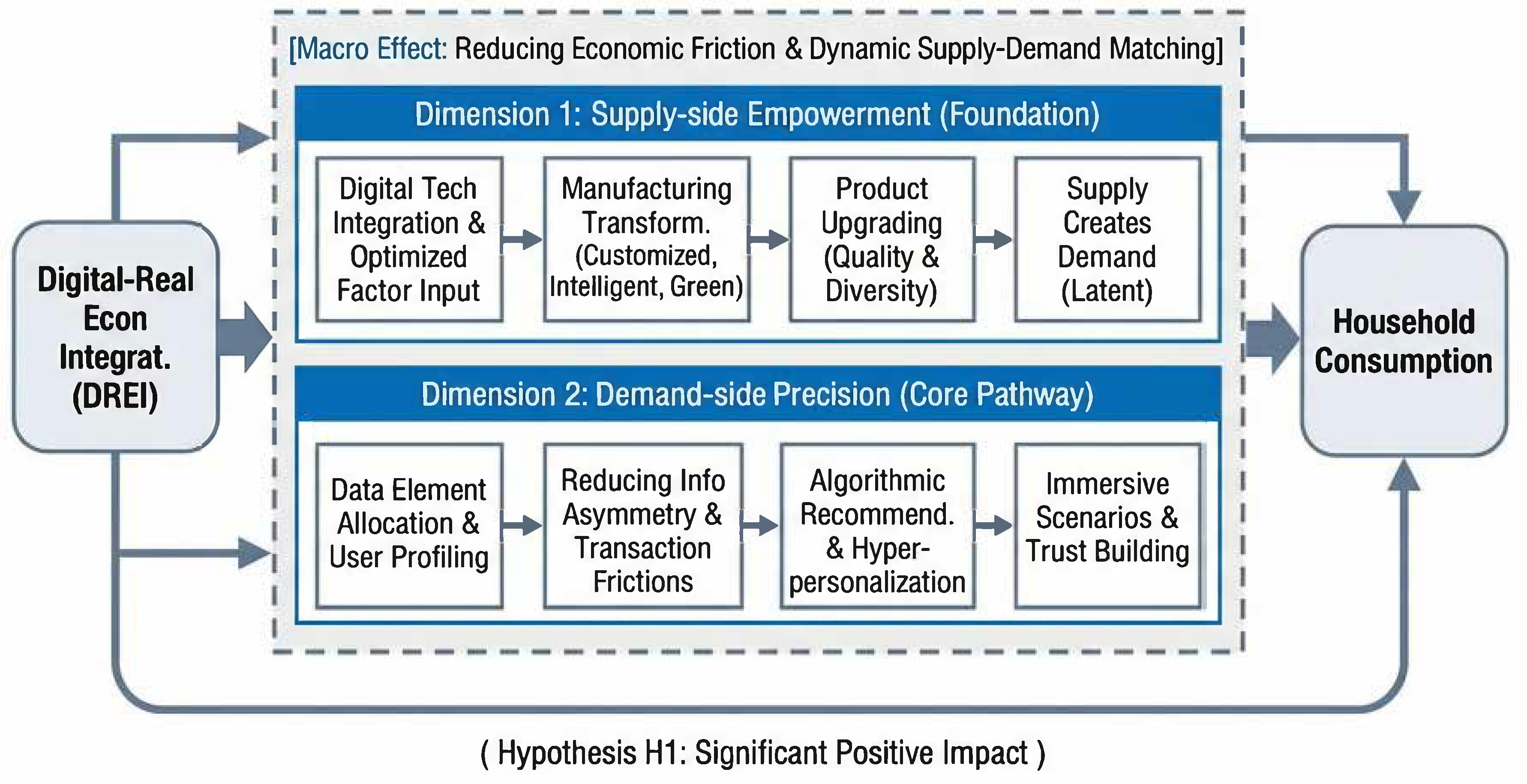
2.1. Direct Mechanisms of DREI in Reshaping Consumption Dynamics
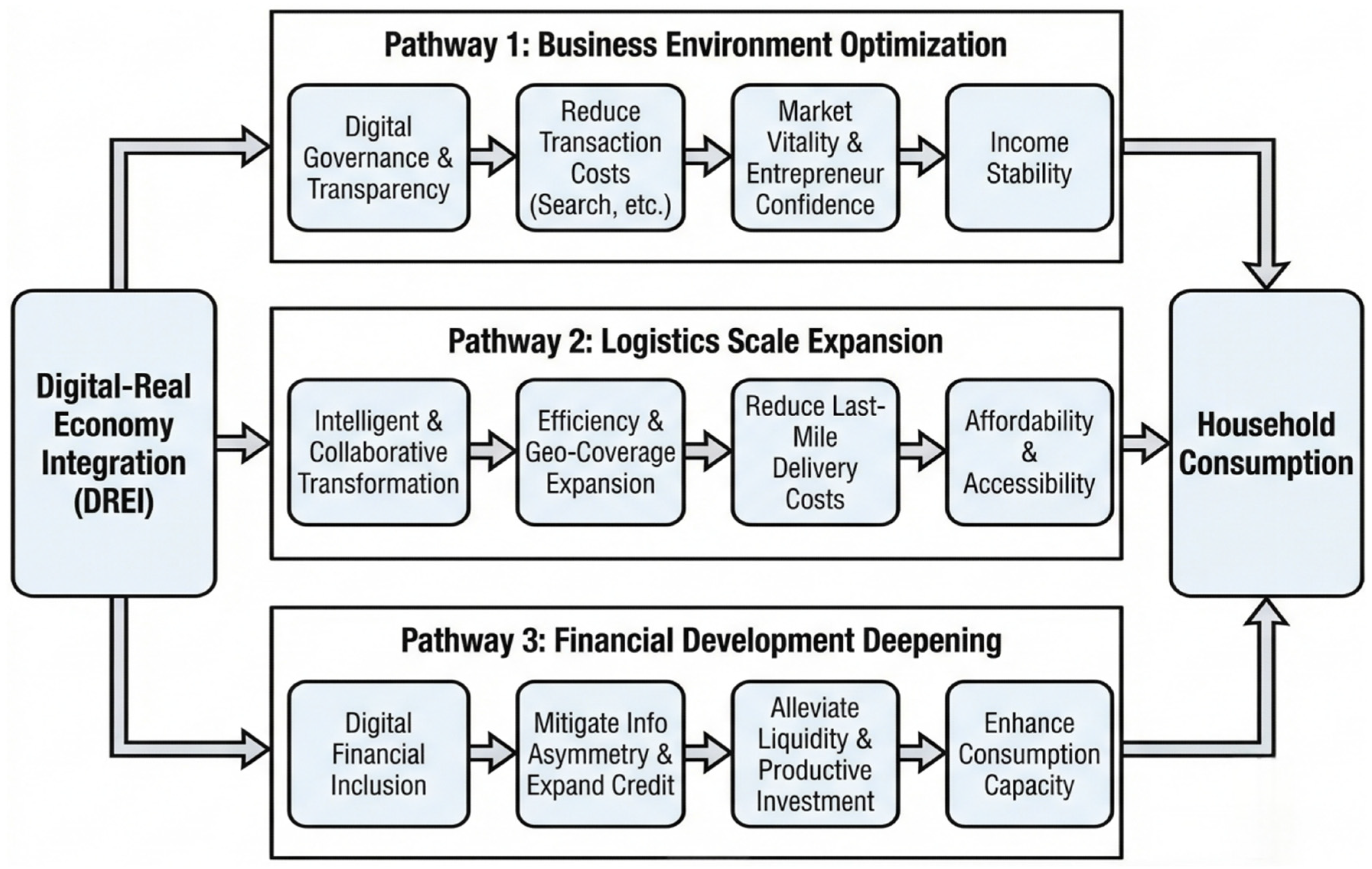
2.2. Indirect Transmission Pathways of DREI on Household Consumption
2.2.1. Business Environment Optimization as a Driver of Consumption Prosperity
2.2.2. Logistics Development Scale Expansion Facilitating Market Access
2.2.3. Financial Development Deepening, Enhancing Household Capacity
3. Methodology
3.1. Data Sources and Sample
3.2. Variable Definitions
3.2.1. Dependent Variable
3.2.2. Independent Variable
3.2.3. Mechanism Variables
3.2.4. Control Variables
3.3. Econometric Models
4. Empirical Results Analysis
4.1. Baseline Regression Analysis
4.2. Robustness Tests
4.3. Mechanism Analysis
4.4. Heterogeneity Analysis
4.4.1. Regional Heterogeneity
4.4.2. Consumption Type Heterogeneity Analysis
4.5. Discussion
5. Conclusions and Policy Implications
5.1. Summary of Findings
5.2. Policy Recommendations
5.3. Limitations and Future Research Directions
Author Contributions
Funding
Institutional Review Board Statement
Informed Consent Statement
Data Availability Statement
Conflicts of Interest
References
- Chawla, P.; Mahajan, S.; Anand, R. The future of employment and artificial intelligence’s economic impact. In Smart Cities of AI Robots and Autonomous Vehicles; Chawla, P., Mahajan, S., Anand, R., Eds.; Elsevier: Amsterdam, The Netherlands, 2026; pp. 427–457. [Google Scholar]
- Qin, M.; Wan, Y.; Dou, J.; Su, C.W. Artificial intelligence: Intensifying or mitigating unemployment? Technol. Soc. 2024, 79, 102755. [Google Scholar] [CrossRef]
- Li, K.; Mirza, N.; Safi, A.; Umar, M.; Su, C.-W. Leveraging energy efficiency, digitalization, and green finance for sustainable competitiveness: Insights from OECD economies post-COP28. J. Compet. 2025, 17, 317–334. [Google Scholar]
- Dou, J.; Su, C.W.; Li, W.; Dou, J. Green finance and artificial intelligence: Catalysts for promoting sustainability? Econ. Anal. Policy 2025, 88, 13–25. [Google Scholar] [CrossRef]
- Huo, X.; Dong, Y. From market segmentation to consumption growth: How does digital-real integration strengthen the consumption stimulation effect in a unified national market? Int. Rev. Econ. Financ. 2025, 103, 104497. [Google Scholar] [CrossRef]
- Shi, Q.; Deng, Y.; Liu, T.; Liu, X. Does digital-real integration drive enterprise ambidextrous innovation balance? J. Innov. Knowl. 2026, 11, 100870. [Google Scholar] [CrossRef]
- An, Q.; Wang, Y.; Liu, F.; Wang, R. Does the integration of digital and real economies enhance corporate supply chain resilience? Evidence from China’s listed firms. Financ. Res. Lett. 2025, 85, 107953. [Google Scholar] [CrossRef]
- Zhao, F.; Li, R.; Wu, Z.; Ru, X. Can the integration of digital and real economies stimulate residents’ consumption? Int. Rev. Financ. Anal. 2025, 103, 104260. [Google Scholar] [CrossRef]
- Kang, S.; Shang, Y. How does digital-real integration ignite urban entrepreneurship: Unpacking innovation’s complex mediation role. Technol. Soc. 2026, 84, 103106. [Google Scholar] [CrossRef]
- Huang, F.W.; Su, C.W.; Yang, S.; Qin, M.; Zhang, W. How do economic policy uncertainty and geopolitical risk affect oil imports? Evidence from China and India. Energy Strateg. Rev. 2025, 59, 101695. [Google Scholar] [CrossRef]
- Ren, Y.; Zhang, J.; Tian, Y. Tracing the dual-circulation value chain: Measurement on the embedding characteristics and evidence from China. J. Urban Manag. 2025, 14, 418–433. [Google Scholar] [CrossRef]
- Hao, Z.; Ren, X.; Meng, Y. Research on the impact of human settlement on expanding domestic demand: Evidence from 276 prefecture-level cities in China. Habitat Int. 2026, 170, 103731. [Google Scholar] [CrossRef]
- Liang, K.; Liu, W. Digital infrastructure and urban-rural income gap: Empirical evidence from China. Int. Rev. Econ. Financ. 2026, 107, 105000. [Google Scholar] [CrossRef]
- Li, W.; Cui, W.; Yi, P. Digital infrastructure and industrial integration: An assessment of the coupling coordination effect between digital and real economy in China. Telecommun. Policy 2026, 50, 103196. [Google Scholar] [CrossRef]
- Wang, Y.; Li, L. Digital economy, industrial structure upgrading, and residents’ consumption: Empirical evidence from prefecture-level cities in China. Int. Rev. Econ. Financ. 2024, 92, 1045–1058. [Google Scholar] [CrossRef]
- Wang, S.; Teng, T.; Hu, S.; Pan, Y. Interplay of digital economy and real economy: How to integrate and what drives it? Appl. Spat. Anal. Policy 2025, 18, 130. [Google Scholar] [CrossRef]
- Wang, Y.; Bu, Y.; Yu, X.; Ma, Y.; Li, H. The impact of the digital economy on the real economy: Promoting or crowding out? Empirical evidence from urban China. Sustain. Futures 2025, 10, 100882. [Google Scholar] [CrossRef]
- Zhou, C.; Bai, D.; Liu, Z.; Yu, J.; Fei, Y. Optimal logistics service strategies in green agricultural product supply chains with e-commerce platforms. Sustain. Oper. Comput. 2024, 5, 156–166. [Google Scholar] [CrossRef]
- Wang, L. The convergence effect of digital economy policies on the urban–rural consumption knowledge. J. Innov. Knowl. 2026, 16, 101026. [Google Scholar] [CrossRef]
- Maleha, N.Y.; Umar, S.H.; Kotngoran, W.A.; Huda, M. Consumption patterns in the digital age: Changing consumers behavior affects the global economy. Nomico 2025, 1, 17–31. [Google Scholar] [CrossRef]
- Guo, D.; Li, L.; Pang, G. Does the integration of digital and real economies promote urban green total factor productivity? Evidence from China. J. Environ. Manag. 2024, 370, 122934. [Google Scholar] [CrossRef]
- Zhong, K.; Lei, Y.; Zhao, J.; Jiang, Y. How to enhance China’s total-factor energy efficiency via digital-real economy integration: New evidence from dynamic QCA analysis. Energy Econ. 2025, 148, 108689. [Google Scholar] [CrossRef]
- Zheng, L.; Su, C.-W.; Baz, S.; Xue, Z. Governance and greenwashing in the BRICS: The moderating role of national ESG performance in sustainable finance outcomes. J. Innov. Knowl. 2026, 12, 100893. [Google Scholar]
- Guedes, B.T.; Fettermann, D.C.; Hribernik, K.A.; Thoben, K.D. How digital transformation is changing product development: A comprehensive analysis. J. Ind. Inf. Integr. 2026, 50, 101064. [Google Scholar] [CrossRef]
- Yanginlar, G.; Ansari, S.; Altay, N. Reverse logistics and sustainable supply chains in the automotive industry: The roles of AI adoption and top management support. Transp. Res. Part E Logist. Transp. Rev. 2026, 210, 104791. [Google Scholar] [CrossRef]
- Qin, M.; Lin, C.T.; Su, C.W.; Budría, S. Towards sustainability under crude dynamics: Exploring the relation between oil price and sustainable uncertainty. Sustain. Dev. 2026. [Google Scholar] [CrossRef]
- Khalil, M.A.; Padmanabhan, R.; Hadid, M.; Elomri, A.; Kerbache, L. AI driven transformation in trade finance: A roadmap for automating letter of credit document examination. Digit. Bus. 2025, 5, 100130. [Google Scholar] [CrossRef]
- Wu, X.; Chang, H. Impact of digital inclusive finance on household tourism consumption: Evidence from China. Eur. J. Innov. Manag. 2024, 100, 123179. [Google Scholar] [CrossRef]
- Sun, G.; Fang, J.; Li, J.; Wang, X. Research on the impact of the integration of digital economy and real economy on enterprise green innovation. Technol. Forecast. Soc. Chang. 2024, 200, 123097. [Google Scholar] [CrossRef]
- Fu, C.; Sun, X.; Guo, M.; Yu, C. Can digital inclusive finance facilitate productive investment in rural households? An Empirical Study Based on the China Household Finance Survey. Financ. Res. Lett. 2024, 61, 105034. [Google Scholar] [CrossRef]
- Liu, J.; Zhang, N. Digital inclusive finance, household leverage and household consumption. Financ. Res. Lett. 2025, 86, 108880. [Google Scholar] [CrossRef]
- Wang, H.; Wang, W.-N.; Xiong, L. Digital rural pilot policies, financial service innovations, and rural industrial transformation. Financ. Res. Lett. 2025, 86, 108362. [Google Scholar] [CrossRef]
- Cai, H.; Liu, Y.; Xiong, Z. Reexamining the effects of FinTech on household consumption: A perspective on monopoly alleviation. Emerg. Mark. Rev. 2026, 71, 101430. [Google Scholar] [CrossRef]
- Wang, M.; Yan, X.; Xu, J.; Yan, Z. Impact of county-level urbanization on household consumption: Evidence from China. Habitat Int. 2026, 170, 103741. [Google Scholar] [CrossRef]
- Zhang, B.; Dong, J.; Xiong, M.; Zheng, Y. Research on the integration of the digital and real economy. Glob. Financ. J. 2026, 70, 101257. [Google Scholar] [CrossRef]
- Dun, S. Business environment and industrial chain: Evidence from a quasi-natural experiment in China. Financ. Res. Lett. 2026, 92, 109565. [Google Scholar] [CrossRef]
- Su, Y.; Wu, J. Digital Transformation and Enterprise Sustainable Development. Financ. Res. Lett. 2024, 60, 104902. [Google Scholar] [CrossRef]
- Zhang, M.; Li, W.; Wang, Z.; Liu, H. Urbanization and production: Heterogeneous effects on construction and demolition waste. Habitat Int. 2023, 134, 102778. [Google Scholar] [CrossRef]
- Bian, Z.; Zhang, Y. Sustainable development in the era of digital trade: A perspective of industrial structure optimization. Sustain. Futures 2025, 9, 100539. [Google Scholar] [CrossRef]
- Li, Y.; Jin, M.; Ao, B.; Du, Y.; Jia, Z.; Li, J. Regional industrial structure optimization based on water-energy-carbon-economy Multi-Objectives: A case study of Inner Mongolia, China. Energy 2026, 347, 140355. [Google Scholar] [CrossRef]
- Sonar, H.; Ghag, N.; Sharma, I. Bridging theory and practice in AI-driven supply chains: Prioritizing LLM adoption challenges and SCOR-based applications. Int. J. Prod. Econ. 2026, 296, 110008. [Google Scholar] [CrossRef]
- Zhang, D.; Bai, D.; Wang, C.; He, Y. Distribution dynamics and quantile dynamic convergence of the digital economy: Prefecture-level evidence in China. Int. Rev. Financ. Anal. 2024, 95, 103345. [Google Scholar] [CrossRef]
- Suali, A.S.; Srai, J.S.; Tsolakis, N. The Role of Digital Platforms in E-Commerce Food Supply Chain Resilience Under Exogenous Disruptions. Supply Chain Manag. Int. J. 2024, 29, 573–601. [Google Scholar] [CrossRef]



| Primary Research Category | Core Research Topic | Author (Year) | Key Findings | This Study’s Contributions |
|---|---|---|---|---|
| Digital–Real Economy Integration Research | Forms and implications of deep digital–real integration | Li et al. [14] | Defines core integration patterns and framework | Develops an entropy-weighted modified DREI index with 2014–2024 China provincial panel data, improving integration measurement accuracy |
| Coupling coordination and sectoral adaptation of digital and real economies | Wang and Li [15] | Significant dynamic linkage; identifies sectoral definition mismatch | ||
| Cross-sector integration status and convergence drivers | Wang et al. [16], Wang et al. [17] | Clarifies sectoral integration heterogeneity and core drivers | ||
| Digital Economy and Consumption Research | Digital economy’s impact on urban consumption upgrading | Zhou [18], Wang and Li [15], Wang [19] | Significant positive effect on consumption structure optimization | Empirically tests three transmission channels; conducts refined heterogeneity analysis |
| Global economic impact of digital-era consumer behavior changes | Maleha et al. [20] | Behavior reshapes the global economy; data management is critical | ||
| Integration, unified national market and consumption growth. | Huo and Dong [5] | Integration amplifies the consumption effect of the unified market | ||
| Mechanism of integration of household consumption | Zhao et al. [8] | Drives consumption via supply-demand two-way synergy |
| Subsystem | Criterion Layer | Secondary Indicator | Tertiary Indicator | Weight |
|---|---|---|---|---|
| Digital Economy | Digital Infrastructure | Digital Facility Construction | Optical cable length/Land area (10 k km/10 k km2) | 0.0275 |
| Mobile phone base stations (10 k) | 0.0196 | |||
| Digital Network Construction | Telephone penetration rate (sets/100 people) | 0.0155 | ||
| Internet users/Total population (%) | 0.0154 | |||
| Digital Popularization | Mobile internet users (10 k households) | 0.0182 | ||
| Digital Industrialization | Digital Industry Construction | Software business revenue (10 k yuan) | 0.0329 | |
| Information service industry output (100 m yuan) | 0.0291 | |||
| Telecom business volume (100 m yuan) | 0.0251 | |||
| Digital Industry Scale | Technology contract transaction volume (10 k yuan) | 0.0345 | ||
| Digital Industry Personnel | Information service employees/Total employment (%) | 0.0311 | ||
| Industrial Digitalization | Digital Finance Coverage | Digital finance coverage breadth | 0.0635 | |
| Digital Finance Usage | Digital finance usage depth | 0.0152 | ||
| Digitalization Degree | Digital finance digitalization degree | 0.0155 | ||
| Digital Industry Construction | Mobile online payment level (%) | 0.0543 | ||
| E-commerce sales (100 m yuan) | 0.0280 | |||
| Digital Technology Environment | Technology R&D Environment | Three types of patent applications (items) | 0.0273 | |
| Industrial enterprise R&D projects (items) | 0.0281 | |||
| Industrial enterprise R&D personnel (person-years) | 0.0269 | |||
| Industrial enterprise R&D expenditure (10 k yuan) | 0.0261 | |||
| Government Digital Governance | Government S&T culture expenditure/General budget (%) | 0.0138 | ||
| Digital economy keywords in government reports (count) | 0.0177 | |||
| Digital Technology Talent | University Talent Support | University enrollment (persons) | 0.0174 | |
| University full-time teachers (persons) | 0.0170 | |||
| Government Talent Support | State-owned enterprise researchers (persons) | 0.0177 | ||
| Cultural Environment | Public libraries (count) | 0.0154 | ||
| Book and literature lending (1000 person-times) | 0.0204 | |||
| Real Economy | Agriculture | Agricultural Scale | Total agricultural output value (100 m yuan) | 0.0141 |
| Agricultural Potential | Agricultural added value (100 m yuan) | 0.0143 | ||
| Agricultural Modernization | Total agricultural machinery power (10 k kW) | 0.0158 | ||
| Industry | Industrial Scale | Industrial enterprises (count) | 0.0186 | |
| Industrial enterprise total assets (100 m yuan) | 0.0170 | |||
| Industrial Efficiency | Industrial enterprise main business income (100 m yuan) | 0.0146 | ||
| Industrial Potential | Industrial added value (100 m yuan) | 0.0160 | ||
| Construction | Construction Scale | Construction enterprises (count) | 0.0153 | |
| Construction enterprise total assets (10 k yuan) | 0.0143 | |||
| Construction Efficiency | Construction total output value (10 k yuan) | 0.0163 | ||
| Construction Potential | Construction added value (100 m yuan) | 0.0167 | ||
| Transportation and Post | Transportation Scale | Highway, inland waterway and railway mileage (km) | 0.0119 | |
| Transportation, warehousing and postal employees (persons) | 0.0139 | |||
| Transportation Potential | Transportation, warehousing and postal added value (100 m yuan) | 0.0121 | ||
| Wholesale and Retail | Wholesale Scale | Wholesale enterprises (count) | 0.0169 | |
| Wholesale and retail employees (10 k persons) | 0.0178 | |||
| Wholesale Efficiency | Wholesale and retail total sales (100 m yuan) | 0.0216 | ||
| Wholesale Potential | Wholesale and retail added value (100 m yuan) | 0.0151 | ||
| Accommodation and Catering | Accommodation Scale | Accommodation and catering enterprises (count) | 0.0152 | |
| Accommodation and catering employees (10 k persons) | 0.0160 | |||
| Accommodation Efficiency | Accommodation and catering revenue (100 m yuan) | 0.0168 | ||
| Accommodation Potential | Accommodation and catering added value (100 m yuan) | 0.0165 |
| Variables | (1) CL | (2) CL |
|---|---|---|
| DREI | 0.7941 * (0.4090) | 0.7140 *** (0.2611) |
| UL | 1.9083 *** (0.3392) | |
| EDL | 0.2008 *** (0.0729) | |
| IS | 0.1329 *** (0.0291) | |
| DEO | 0.0972 (0.0640) | |
| PS | 0.0078 (0.0870) | |
| Constant | 9.1894 *** (0.0937) | 5.8208 *** (0.7867) |
| Regional FE | Yes | Yes |
| Time FE | Yes | Yes |
| R-squared | 0.9650 | 0.9833 |
| Observations | 330 | 330 |
| Variables | (1) Replace Dependent Variable | (2) System GMM | (3) Add Controls |
|---|---|---|---|
| DREI | 0.5752 *** (0.1602) | 0.3776 * (0.2260) | 0.5261 ** (0.2598) |
| UL | −0.0329 (0.1183) | 1.1782 *** (0.1674) | 1.8057 *** (0.3500) |
| EDL | 0.0001 (0.0356) | 0.4151 *** (0.0470) | 0.1956 *** (0.0590) |
| IS | 0.0122 (0.0113) | 0.0315 *** (0.0099) | 0.1322 *** (0.0287) |
| DEO | 0.0699 ** (0.0296) | −0.4797 *** (0.0613) | 0.1172 * (0.0630) |
| PS | −0.0224 (0.0590) | 0.0388 ** (0.0196) | −0.0096 (0.0802) |
| IL | 0.2929 * (0.1511) | ||
| InL | −0.0042 (0.0054) | ||
| RDL | 0.0363 (0.0275) | ||
| AR(1) p-value | 0.0192 | ||
| AR(2) p-value | 0.3814 | ||
| Hansen J p-value | 0.2471 | ||
| Constant | 0.1551 (0.6229) | 2.2867 *** (0.5251) | 5.8212 *** (0.7437) |
| Regional FE | Yes | No | Yes |
| Time FE | Yes | No | Yes |
| R-squared | 0.2119 | - | 0.9295 |
| Observations | 330 | 270 | 330 |
| Variables | (1) BEI | (2) LSI | (3) FD | (4) CL | (5) CL | (6) CL |
|---|---|---|---|---|---|---|
| DREI | 2.378 *** (0.381) | 5.077 *** (1.838) | 7.250 *** (1.474) | - | - | - |
| BEI | - | - | - | 0.146 ** (0.066) | - | - |
| LSI | - | - | - | - | 0.061 *** (0.017) | - |
| FD | - | - | - | - | - | 0.044 *** (0.017) |
| UL | 1.468 ** (0.675) | 6.507 * (3.482) | 3.515 (2.288) | 1.615 *** (0.319) | 1.435 *** (0.263) | 1.681 *** (0.316) |
| EDL | −0.003 (0.148) | −0.862 (0.567) | −2.973 *** (0.513) | 0.243 *** (0.061) | 0.299 *** (0.058) | 0.376 *** (0.084) |
| IS | −0.020 (0.033) | −0.034 (0.154) | 0.453 ** (0.213) | 0.132 *** (0.033) | 0.139 *** (0.030) | 0.117 *** (0.029) |
| DEO | −0.039 (0.097) | 0.413 (0.483) | 0.128 (0.432) | 0.092 (0.072) | 0.063 (0.064) | 0.083 (0.074) |
| PS | −0.027 (0.138) | −1.786 ** (0.834) | −1.710 ** (0.749) | 0.070 (0.078) | 0.184 *** (0.060) | 0.148 ** (0.068) |
| Constant | 1.995 (1.822) | 27.862 *** (5.641) | 44.246 *** (9.476) | 4.740 *** (0.518) | 3.218 *** (0.680) | 2.995 *** (0.780) |
| Regional FE | Yes | Yes | Yes | Yes | Yes | Yes |
| Time FE | Yes | Yes | Yes | Yes | Yes | Yes |
| R-squared | 0.9523 | 0.9145 | 0.9324 | 0.9782 | 0.9689 | 0.9574 |
| Observations | 325 | 330 | 330 | 325 | 330 | 330 |
| Variables | (1) Eastern | (2) Central | (3) Western |
|---|---|---|---|
| DREI | 0.1144 (0.2937) | 2.5737 *** (0.5590) | −0.0074 (0.5656) |
| UL | 1.7216 *** (0.2189) | −1.5059 *** (0.5271) | 1.4820 * (0.8277) |
| EDL | −0.1016 (0.0807) | 0.1043 (0.1349) | 0.5356 *** (0.1726) |
| IS | 0.0737 ** (0.0371) | 0.0809 *** (0.0291) | 0.3008 *** (0.0570) |
| DEO | 0.0157 (0.0511) | 0.4489 ** (0.1797) | 0.0903 (0.1574) |
| PS | 0.4579 *** (0.0911) | 0.1917 * (0.1057) | −0.1264 (0.1715) |
| Constant | 5.7110 *** (1.1028) | 6.5759 *** (1.8270) | 3.6722 ** (1.7654) |
| Regional FE | Yes | Yes | Yes |
| Time FE | Yes | Yes | Yes |
| R-squared | 0.9866 | 0.9934 | 0.9868 |
| Observations | 121 | 88 | 121 |
| Variables | (1) Goods Consumption | (2) Service Consumption |
|---|---|---|
| DREI | 0.8282 *** (0.2139) | −0.1285 (0.6810) |
| UL | 1.5910 *** (0.2983) | 3.1917 *** (0.8037) |
| EDL | 0.2125 *** (0.0642) | 0.2819 (0.2063) |
| IS | 0.1347 *** (0.0237) | 0.1671 *** (0.0611) |
| DEO | −0.0047 (0.0534) | 0.5845 *** (0.1485) |
| PS | 0.0090 (0.0941) | −0.0397 (0.1483) |
| Constant | 6.3141 *** (0.7859) | 3.6617 * (2.1561) |
| Regional FE | Yes | Yes |
| Time FE | Yes | Yes |
| R-squared | 0.9858 | 0.9934 |
| Observations | 330 | 330 |
Disclaimer/Publisher’s Note: The statements, opinions and data contained in all publications are solely those of the individual author(s) and contributor(s) and not of MDPI and/or the editor(s). MDPI and/or the editor(s) disclaim responsibility for any injury to people or property resulting from any ideas, methods, instructions or products referred to in the content. |
© 2026 by the authors. Licensee MDPI, Basel, Switzerland. This article is an open access article distributed under the terms and conditions of the Creative Commons Attribution (CC BY) license.
Share and Cite
Nie, Y.; Chou, L.; Zhang, W.; Radu, B.M. Fostering Domestic Demand Through Digital–Real Economy Integration: Evidence from Household Consumption in China. Sustainability 2026, 18, 4758. https://doi.org/10.3390/su18104758
Nie Y, Chou L, Zhang W, Radu BM. Fostering Domestic Demand Through Digital–Real Economy Integration: Evidence from Household Consumption in China. Sustainability. 2026; 18(10):4758. https://doi.org/10.3390/su18104758
Chicago/Turabian StyleNie, Yongyou, Lihsin Chou, Wenwen Zhang, and Brindusa Mihaela Radu. 2026. "Fostering Domestic Demand Through Digital–Real Economy Integration: Evidence from Household Consumption in China" Sustainability 18, no. 10: 4758. https://doi.org/10.3390/su18104758
APA StyleNie, Y., Chou, L., Zhang, W., & Radu, B. M. (2026). Fostering Domestic Demand Through Digital–Real Economy Integration: Evidence from Household Consumption in China. Sustainability, 18(10), 4758. https://doi.org/10.3390/su18104758