Article

Redefining Livestock Architecture: Advancing Timber-Based Construction Systems Through Sustainable Design Strategies

1
DAFNE—Department of Agriculture, Forests, Nature and Energy, University of Tuscia, 01100 Viterbo, Italy
2
DA—Department of Architecture, Alma Mater Studiorum—University of Bologna, 40131 Bologna, Italy
*
Author to whom correspondence should be addressed.
Sustainability 2026, 18(10), 4752; https://doi.org/10.3390/su18104752 (registering DOI)
Submission received: 4 April 2026 / Revised: 30 April 2026 / Accepted: 6 May 2026 / Published: 10 May 2026
(This article belongs to the Section Green Building)

Abstract

Although livestock buildings constitute a widespread and structurally significant component of the rural landscape, they are, in most cases, characterised by construction configurations primarily driven by production requirements. Such an approach rarely results from a conscious design process capable of integrating architectural criteria with the environmental context in which these structures are embedded. Within this framework, the prevailing construction model—based on prefabricated steel systems and sandwich panels—prioritises rapid execution, standardisation, and cost efficiency, while relegating aspects such as environmental quality, material circularity, and landscape integration to a marginal role. Against this background, the present study investigates the possibility of redefining this paradigm through a technological substitution grounded in the principles of bio-based construction, technological design, and circular economy. To this end, a timber-based architectural solution for poultry houses is developed and adopted as an experimental case study to assess environmental and economic performance through an integrated methodology combining Life Cycle Assessment (LCA) and Construction Cost Analysis. The evaluation is conducted comparatively against a conventional steel-based system, maintaining consistent geometric and functional parameters, within the climatic context of the Italian Mediterranean and in accordance with EN 15978 and EN 15804+A2 standards, over a 30-year reference period. The results indicate a significant reduction in environmental impacts for the timber-based solution, with a decrease in Global Warming Potential of approximately 29%, reaching values close to 50% when accounting for biogenic carbon storage. From an economic perspective, the alternative solution entails an increase in initial costs of approximately 20%, primarily associated with the adoption of a high-performance building envelope. Overall, the study demonstrates how architectural technological design, when supported by quantitative assessment tools, can operate as an effective driver for the ecological transition of rural productive landscapes.

1. Introduction

The transition of rural productive buildings towards environmentally sustainable models represents a complex and still underexplored challenge, at the intersection of technological innovation, architectural design, and landscape transformation. Within this framework, the present study addresses the limitations of the current construction paradigm in the livestock sector, investigating the potential for a systemic technological redefinition based on bio-based approaches and life-cycle-oriented assessment methods.

1.1. Framing the Research Problem

Livestock buildings constitute a pervasive and structurally significant component of the European rural built environment, contributing substantially to the configuration of the agricultural landscape. They can be understood as the tangible outcome of the interaction between production practices and the environmental systems within which they are embedded [1,2].
Despite their ubiquity, such structures have largely remained at the margins of architectural and environmental discourse, which has instead extensively addressed other sectors of construction and, more broadly, urban transformations [3,4].
While architectural design culture has progressively promoted more integrated environmental and compositional approaches in the building sector [5], rural and production-related construction remains comparatively resistant to innovation, relying on consolidated frameworks. Within this context, sustainability strategies have been predominantly implemented through ex post interventions—mainly focused on building services and energy efficiency—without substantially altering the underlying construction paradigm [6,7].
Previous studies by the authors have shown that the integration of photovoltaic systems in existing poultry facilities yields significant, yet not decisive, environmental benefits, as a considerable share of impacts remains directly linked to material and construction choices [8]. In parallel, international architectural discourse has increasingly focused on the redefinition of construction systems through the adoption of bio-based materials, circularity principles, and integrated design strategies [9], outlining a framework potentially transferable to the agricultural building sector in order to move beyond the mere optimisation of standard construction models [10].
Building upon the authors’ previous research—focused on thermo-environmental monitoring and energy optimisation strategies [11]—this study advances the methodological approach by shifting the focus from operational performance to the redefinition of the building system. Within this framework, architectural technological design is adopted as an operative tool that integrates design strategies with life cycle-based assessment methods. The novelty of the study lies in the application of this integrated approach in an ex ante perspective to livestock building systems, a domain in which such methodologies remain largely underexplored.

1.2. Research Domain and Technological Paradigm of Rural Livestock Buildings

The research domain of this study is defined through a systematic review of the literature on the sustainability of agricultural and livestock buildings [12], which highlights a prevailing focus on energy efficiency and the reduction of operational emissions, while technological and material aspects remain largely underexplored. Within this framework, the livestock sector is still predominantly characterised by an industrial construction paradigm based on standardised prefabricated systems—particularly lightweight steel structures and sandwich panels—widely adopted for their cost-effectiveness, rapid assembly, and modularity [13].
While this approach effectively meets production requirements, it reduces the building to a purely technical device, with limited consideration for architectural and landscape dimensions. Consequently, a clear misalignment emerges with other construction sectors, where bio-based materials, circular strategies, and high-performance solutions are increasingly adopted. In the agricultural sector, however, such innovations remain marginal, resulting in persistent issues related to embodied environmental impacts and the quality of the rural landscape, despite adequate functional performance [14,15]. Within this framework, previous research by the authors has focused on the integration of photovoltaic systems in poultry facilities through Life Cycle Assessment approaches [8], with the objective of reducing environmental impacts. The findings indicate that, although such interventions contribute to lowering operational emissions, they do not substantially affect the overall environmental footprint, which remains largely dependent on material choices and the technological configuration of the building envelope.
From this perspective, livestock buildings can evolve beyond their utilitarian role to become architectural elements that shape the environmental and landscape quality of rural contexts. Accordingly, material selection, durability, reversibility, and contextual integration assume strategic importance, in line with European green transition policies [16]. The research therefore adopts an integrated analytical and design-oriented approach, shifting from the assessment of existing criticalities towards the exploration of alternative technological scenarios, validated through quantitative methods [17].

1.3. Theoretical Framework, Hypotheses and Research Questions

Building on the systematic review of the domain [12] and previous studies on energy retrofit strategies [8,18], it is recognised that the optimisation of building services alone, while necessary, is insufficient to induce structural changes in the environmental footprint of the livestock sector. Within this framework, the research is articulated around three complementary hypotheses: H1 investigates the role of Life Cycle Assessment (LCA) as an ex ante design driver capable of guiding technological and material choices [19,20]; H2 evaluates the effects of substituting conventional prefabricated systems with bio-based solutions developed according to circular economy principles [21,22,23]; H3 examines the integration of technological innovation and architectural design in enhancing both environmental performance and the landscape quality of rural contexts [24,25].
These hypotheses translate the underlying theoretical framework into testable propositions, thereby structuring the methodological approach of the study, as summarised in Table 1.
Based on the formulated hypotheses, the research questions are operationally defined in Table 2.
The present study advances the hypothesis that architectural technological design, when supported by quantitative tools such as Life Cycle Assessment (LCA) and economic analysis, can identify and validate alternative construction solutions to the prevailing prefabricated standards of the livestock sector. Such solutions—grounded in bio-based materials and circularity principles—have the potential to significantly reduce environmental impacts across the building life cycle, while ensuring functional efficiency, spatial quality, and contextual coherence. It should be noted that aspects related to landscape integration are addressed from a qualitative, design-oriented perspective and are not directly evaluated through quantitative methods within the scope of this study.

2. Background

The delineation of the investigative domain and the formulation of the research hypotheses necessitate a focused clarification of the theoretical and methodological premises underpinning the technological substitution proposed in Section 1. Previous systematic work by the authors has highlighted how livestock construction remains anchored to a conventional prefabricated paradigm, while innovation in sustainable building has predominantly evolved within residential and urban contexts.
Accordingly, this Background section does not aim to provide an exhaustive literature review, but rather to selectively recall the scientific orientations already systematised by the authors [12], with specific reference to contributions that have consolidated—albeit partially—the adoption of bio-based materials and low-carbon construction systems as drivers of ecological transition [26,27,28]. Within this framework, structural timber emerges as a particularly consistent technology with the research thesis, due to its low embodied carbon, the reversibility of dry-assembly systems, and its capacity to establish a more balanced relationship between productive buildings and the agricultural landscape [29,30].
However, the adoption of a timber-based solution cannot be justified solely on theoretical or cultural grounds. The replacement of the prevailing prefabricated paradigm requires a quantitative assessment capable of comparing conventional and alternative systems across the entire life cycle. In this regard, Life Cycle Assessment (LCA) is not merely a calculation tool, but a methodological framework [31] through which design intentions can be translated into measurable environmental impacts.
The application of LCA enables a shift from the traditionally dominant focus on operational performance towards a comprehensive evaluation of embodied emissions, production processes, end-of-life scenarios, and the potential for recovery and recycling [32]. In this sense, LCA provides a consistent analytical basis for comparing the conventional industrial paradigm with the proposed bio-based alternative, in line with the objective of a structural technological transition.

2.1. Bio-Based Materials and Timber Construction in the Transition of Livestock Buildings

The systematic review conducted by the authors has highlighted how the ecological transition in the building sector is progressively converging towards a construction model structured around three primary axes:
(i)
reduction of embodied emissions in materials;
(ii)
use of renewable and locally sourced resources;
(iii)
adoption of circular economy principles and design for disassembly.
These trajectories, widely established within sustainable architecture discourse [28,33], remain largely marginal in the livestock construction sector. Among emerging materials, bio-based systems—such as structural timber, plant fibres (hemp, flax), compressed straw panels, and bio-composites derived from agricultural by-products—have gained increasing attention. These materials offer both reduced embodied energy compared to mineral- and fossil-based alternatives and the potential to integrate local production cycles, thereby strengthening the relationship between building systems and rural contexts.
Within this framework, structural timber stands out as a mature and extensively validated solution. Glulam, cross-laminated timber, and prefabricated frame systems ensure high mechanical performance and adaptability to modular configurations, while enabling precise prefabrication, reduced construction times, and quality control comparable to conventional steel systems, albeit with a lower emissions profile.
Comparative studies indicate that timber-based structures generally exhibit lower Global Warming Potential during the production phase, although results may vary depending on processing and energy sources. This aspect is particularly relevant in lightweight productive buildings, where embodied impacts can represent a significant share of total life-cycle emissions.
In parallel, increasing attention has been directed towards design for disassembly and reuse, where timber dry-assembly systems offer substantial advantages in terms of reversibility, modularity, and end-of-life recovery, coherently aligning with circular economy principles.
Despite these advancements, the adoption of timber-based technologies in the livestock sector remains limited. Current practice continues to rely predominantly on steel frames and sandwich panels, prioritising cost efficiency and rapid construction [34,35], while seldom addressing embodied emissions or architectural and landscape quality [36].
In this context, the adoption of a timber-based solution for poultry buildings should be understood not as a simple material substitution, but as a deliberate process of technological transfer from sustainable architecture—where such systems are well established—to a sector still dominated by conventional industrial approaches.
Such transfer, already observed in isolated exemplary cases, requires systematic validation to ensure replicability and methodological robustness. This necessitates a rigorous life-cycle-based comparative assessment. In particular, the accounting of biogenic carbon introduces specific methodological challenges, making Life Cycle Assessment an essential tool for a scientifically grounded evaluation of both environmental impacts and economic performance within the constraints of rural productive construction.

2.2. Implications of Biogenic Carbon for the Life Cycle Assessment of Timber Buildings

Life Cycle Assessment of timber buildings exhibits specific characteristics compared to other construction systems employing construction materials of non-biological origin. These peculiarities are related to the renewable nature of wood, which requires considering not only the standard production, use, and end-of-life phases of the building, but also the effects associated with the ability of bio-based materials to store atmospheric CO2 during tree growth through the process of photosynthesis, and to subsequently release it into the atmosphere as CO2, CO, or CH4 as a result of biomass oxidation and/or reduction processes occurring during material transformation or degradation (e.g., combustion, digestion, composting, or landfilling). This contribution of carbon stored in bio-based materials is referred to as biogenic carbon and can be considered a “negative emission” [37]. Consequently, biological components can help reduce atmospheric carbon dioxide levels by storing carbon in buildings constructed with these materials [38]. However, biogenic carbon remains a significant point of contention within LCA studies [39].
When a bio-based material is employed to produce a building component, the carbon remains stored for the entire service life of the element. Bio-based products such as wood, hemp, and straw contain approximately 50% carbon by dry mass [40]. Currently, incineration is the most common end-of-life scenario for wood-based products, in which the stored carbon is released back into the atmosphere. In this case, according to most LCA methodologies (e.g., CML, TRACI, and EN 15978), carbon dioxide emissions from the combustion of renewable materials are not included in the GWP, as the material is assumed to regrow within a few decades and tie back the carbon if the forest area remains constant. This implies that carbon is temporarily stored for several decades, while the overall carbon balance over the building lifetime is considered to be zero [41]. Moreover, the assessment of biogenic carbon must be carried out with great care in order to avoid misleading results. For instance, when only the product stage is considered, a substantial overestimation of the benefits is obtained, leading to markedly different outcomes compared to a cradle-to-cradle approach [42].
Several approaches exist for accounting for biogenic carbon in LCA, depending on specific regulatory requirements:
(i)
Tools based on CML (EN 15804+A1) [43] or TRACI [44]. Biogenic carbon storage is reported only as additional information. Consequently, the negative emissions associated with CO2 uptake from the atmosphere are not included in A1–A3, and the emissions from its release are not included in C3. This means that neither the sequestration of atmospheric CO2 in A1 nor its release in C3 is reflected in the GWP results. This approach is referred to as the “0/0 approach” or “carbon-neutral approach” [45].
(ii)
Tools based on EN 15804+A2 [46]. Biogenic carbon storage is reported as part of the GWP results. The updated version of the standard divides the Global Warming Potential into four sub-categories: GWP Fossil, GWP LULUC, GWP Biogenic, and GWP Total. In this case, negative emissions are reported separately under GWP-Biogenic, while emissions from CO2 release depend on the selected end-of-life scenario and are reported in GWP Fossil. For example, incineration assigns emissions to C3, whereas landfilling assigns them to C4.
(iii)
DGNB and Energie Carbon/RE2020. DGNB (Deutsche Gesellschaft für Nachhaltiges Bauen—German Sustainable Building Council) is the German voluntary certification system for sustainable buildings [47]. RE2020 is a climate regulation mandating a simplified LCA for all new buildings in France [48]. In both methods, biogenic carbon storage is included in the GWP results. Negative emissions due to carbon storage are deducted in A1–A3, and the same amount of carbon is added in C3 when it is released back into the atmosphere. These approaches are referred to as the “−1/+1 approach” [46].
(iv)
RICS v1 (Royal Institution of Chartered Surveyors)/GLA (Greater London Authority)/Green Mark: negative emissions from CO2 sequestration are not included in A1–A3, whereas emissions from CO2 release are included in C3.
(v)
Dynamic methods: to overcome the limitations of traditional LCA, which does not consider the timing of carbon emissions nor the influence of biomass rotation periods, several dynamic approaches have been developed [40]. Some are based on time-dependent characterisation factors [49], while others define specific factors for biogenic CO2 that explicitly account for biomass rotation periods [50].
The choice of assessment approach is a key aspect, as it decisively influences the results. Several studies do not explicitly state how biogenic carbon is treated [51], although the evaluation of biogenic carbon can modify the final outcomes by more than 30% [52]. These effects are far from negligible, especially considering that the embodied GHG emissions of timber buildings already exhibit significant variability even when biogenic carbon is excluded. The inclusion of biogenic carbon further increases the uncertainty regarding the robustness of the results: for residential buildings, the embodied GHG emissions range from 6.7 to 11.2 kgCO2eq/m2a50, whereas for office buildings the range is 11.6 to 17.3 kgCO2eq/m2a50 [51].
The main differences among assessment approaches concern the treatment of biogenic carbon. Static approaches, both 0/0 and −1/+1, neglect the forest rotation period and do not account for tree typology, both of which are instead considered by dynamic approaches [40]. In the case of the −1/+1 approach, results become misleading when the system boundaries are limited to the product stage (A1–A3) [42]. Moreover, the −1/+1 approach tends to overestimate the climate benefits of timber compared with dynamic modelling. According to a study that analyses 17 buildings assessed with dynamic methods and 13 buildings evaluated using the −1/+1 method, the average embodied GHG emissions amount to 5.9 kgCO2eq/m2a50 with the −1/+1 approach, compared with 4.0 kgCO2eq/m2a50 obtained through the dynamic approach [53]. Nevertheless, due to their greater complexity, dynamic methods remain primarily confined to scientific research rather than professional practice.
In this paper, the EN 15804+A2 standard [47] is adopted, with two assessment scenarios considered. The first is a conservative scenario that excludes stage D and evaluates the GWP total using the −1/+1 approach, penalising timber-based construction systems in the comparison. The second scenario considers total GWP (−1/+1 approach), thus accounting also for the benefits arising from the recovery, recycling, and reuse of materials at the end of life, thereby revealing the potential of the construction system proposed in this study.

3. Materials and Methods

The present study aims to assess the effects of adopting an alternative timber construction system for rural livestock buildings, particularly poultry tunnels in the Italian Mediterranean region, on environmental and economic sustainability.
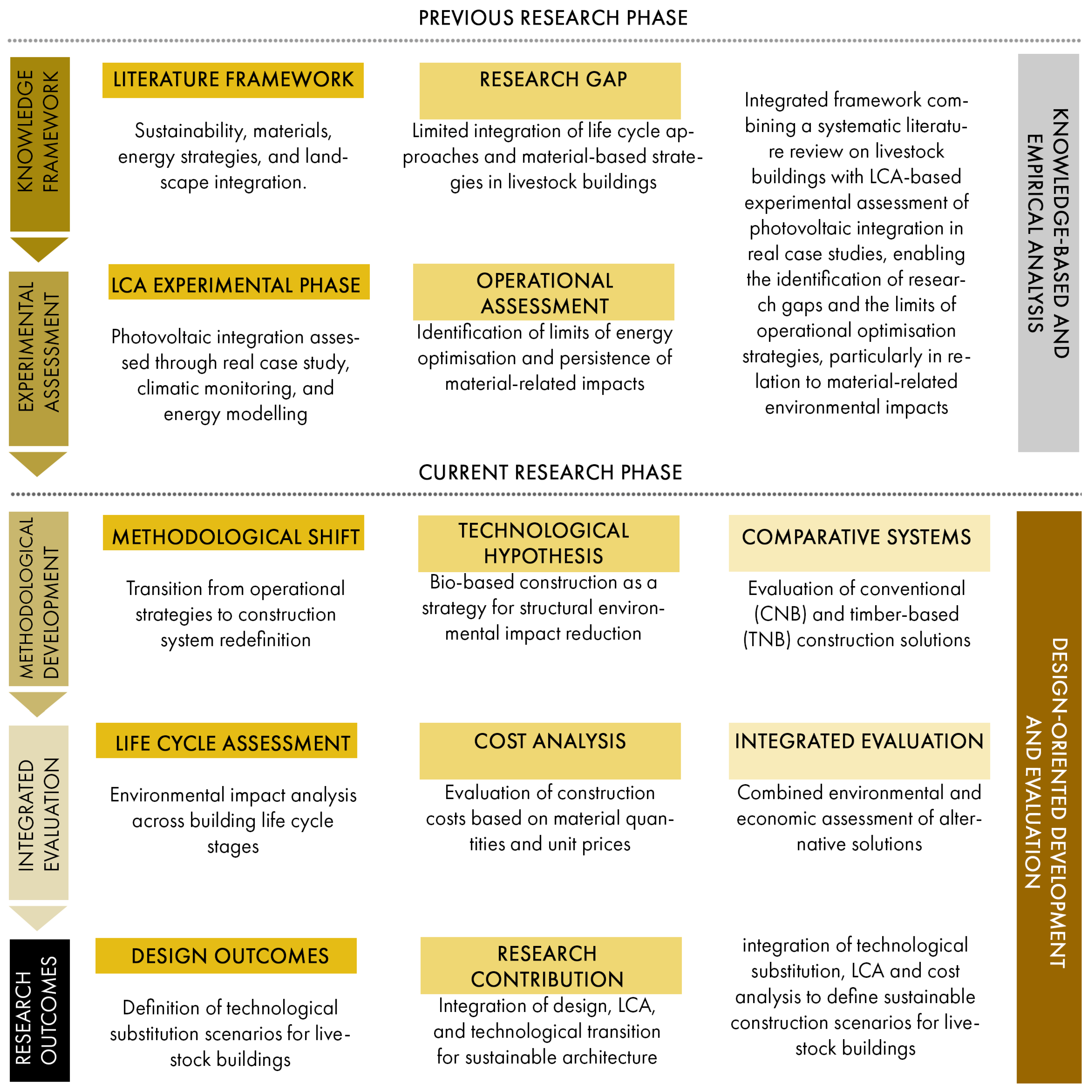
The methodological approach adopted in this study derives from a progressive research framework in which environmental monitoring, performance analysis, and technological design are integrated into a single evaluation process [8]. While previous investigations focused on operational optimisation strategies, this study shifts toward a design-oriented assessment based on technological substitution and comparative life cycle evaluation.
The proposed methodology, as summarised in Figure 1, is organised into three main phases, each serving a specific role in the research workflow:
(i)
Life cycle assessment (LCA): The evaluation is performed using OneClick LCA software (November 2025 release) and is based on average datasets representative of the Italian context. The assessment considers the materials composing the building envelope: external walls, roof, and ground floor slab, and includes the evaluation of their energy/thermal parameters.
(ii)
Construction Cost: The economic assessment is mainly based on Italian regional price lists in order to evaluate the initial construction costs of poultry tunnels.
(iii)
Definition of intervention guidelines: The outcomes provide operational data for defining future intervention strategies for new livestock buildings with similar characteristics.
The analysis is conducted assuming consistent geometric, functional, and climatic conditions for both construction systems. The system boundaries are defined in accordance with EN 15978 and EN 15804+A2, considering the main life cycle stages from production to end-of-life, while excluding operational modules. The functional unit is defined as 1 m2 of Gross Floor Area over a reference service life of 30 years, and the building envelope components are designed to achieve comparable performance parameters, in particular the thermal transmittance (U).

3.1. Case Study Description

The selected case study represents a paradigmatic example of contemporary livestock building systems widely adopted within the Italian and broader European rural context. It consists of two poultry tunnels designed for laying hen farming, located in the municipality of Montefiascone (VT), within a territorial context classified as a natural agricultural landscape according to the current regional planning framework, as previously described in detail by the authors [8].
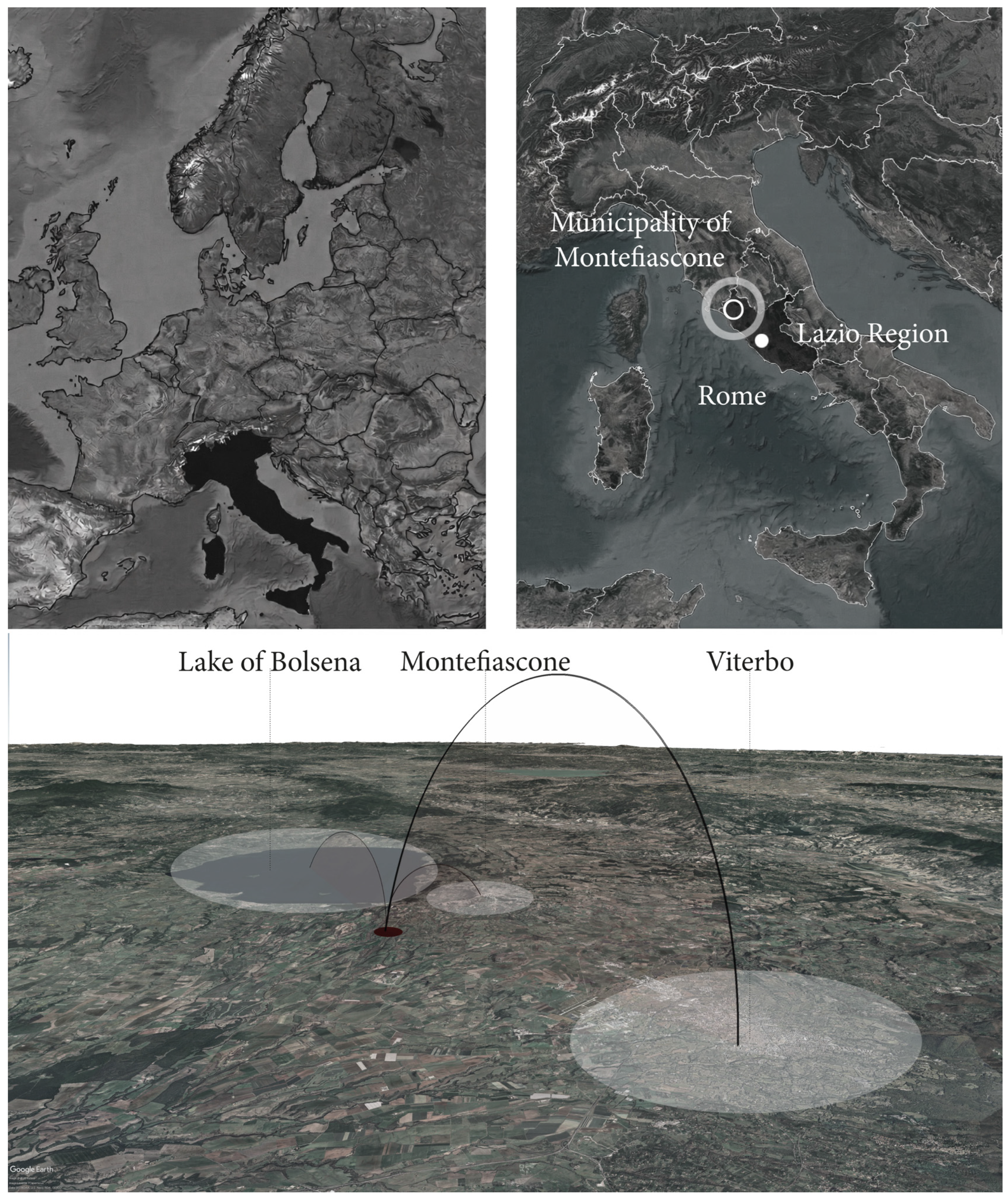
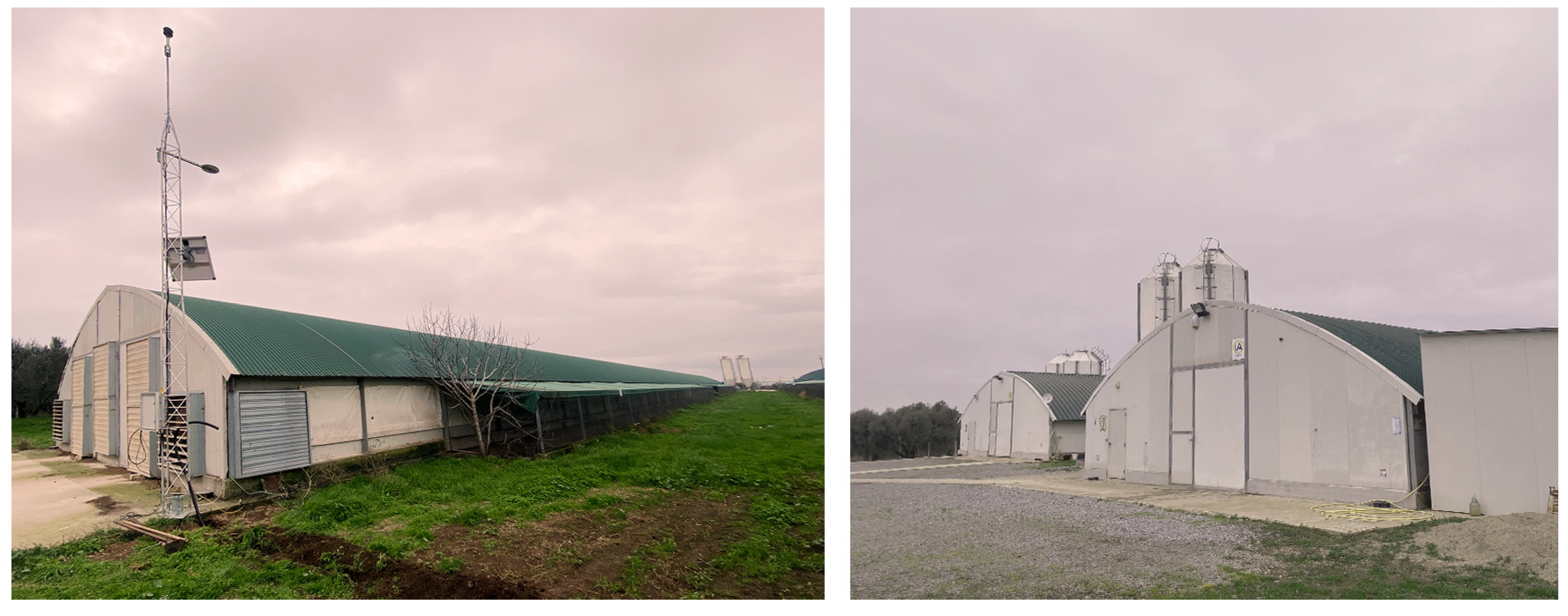
Figure 2 illustrates the geographical location of the intervention within the regional context, while Figure 3 depicts the physical configuration of one of the two buildings, highlighting how the prefabricated steel construction system emerges as an autonomous element with respect to the surrounding agricultural matrix, thus configuring itself as a purely functional production infrastructure.
Each building features a rectangular plan measuring approximately 120 m × 12 m, corresponding to a covered area of about 1440 m2 per unit, with an average internal height of approximately 3.50 m at the ridge. The facilities accommodate an average of 18,000–20,000 laying hens per tunnel, in accordance with the stocking densities prescribed by current regulations, thus configuring themselves as medium-intensity production buildings representative of the prevailing model within small- and medium-scale agricultural enterprises in central Italy.
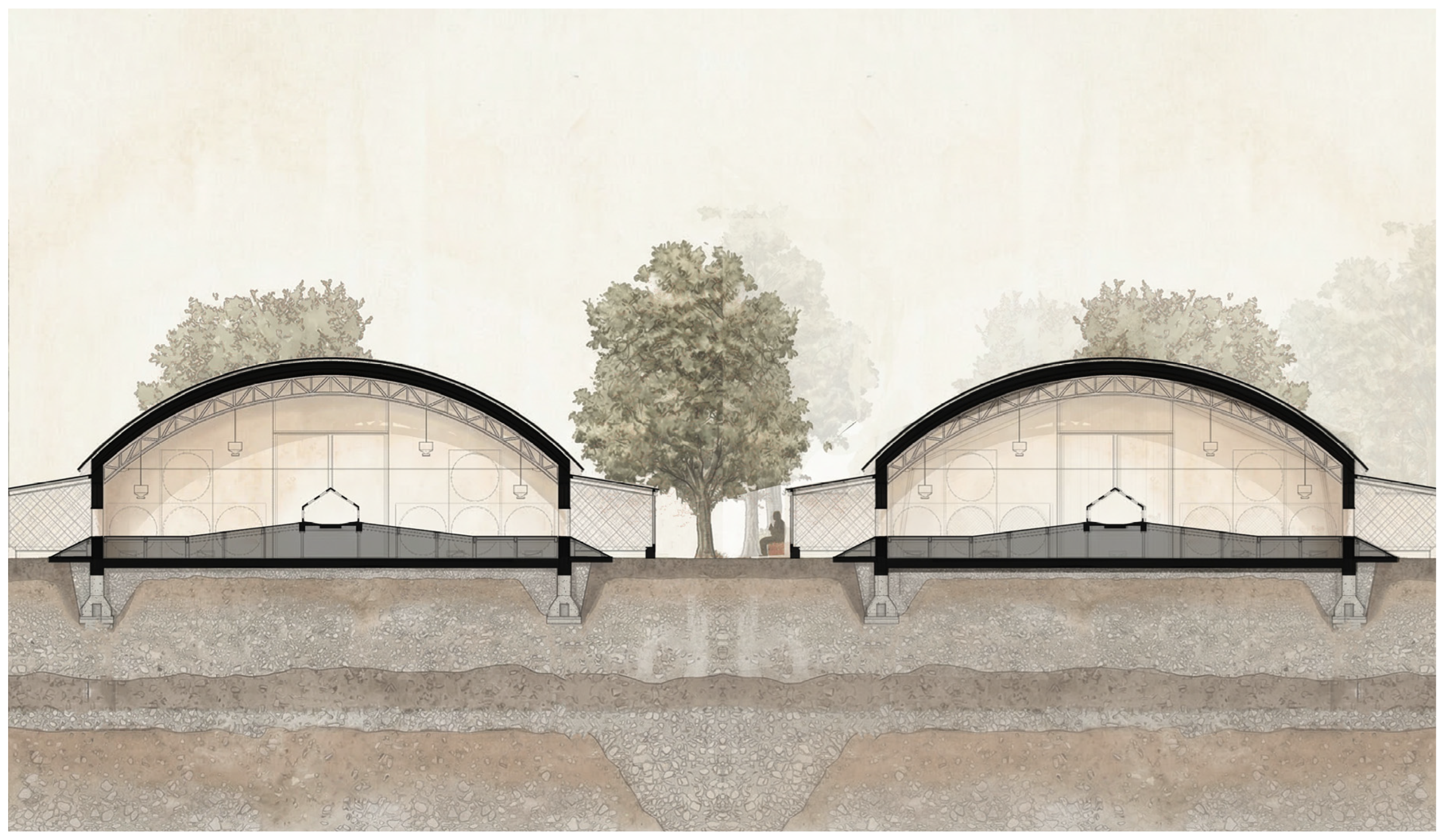
More specifically, the case study refers to two buildings that may be described, in summary terms, as architecturally and technologically homogeneous livestock buildings, characterised by an identical morphological configuration—namely, the same planimetric and altimetric dimensions and a vaulted roof—and by a uniform construction system based on prefabricated steel components. The building envelope is composed of sandwich panels, while the load-bearing structure consists of curved lattice girders, as illustrated in the sectional drawing shown in Figure 4.
More specifically, the load-bearing structure consists of prefabricated steel portal frames incorporating curved lattice trusses, mechanically anchored to reinforced concrete foundations. The building envelope is realised through prefabricated sandwich panels with a polyurethane foam insulating core, forming a lightweight and highly industrialised enclosure system.
This construction configuration, widely adopted due to its rapid assembly, modularity, and reduced initial investment costs, reflects a consolidated building paradigm within the livestock sector, characterised by standardised components and a high degree of prefabrication. From a technological standpoint, the system is defined by dry-assembled connections, limited material stratification, and low thermal inertia, all of which contribute to its efficiency in construction while simultaneously constraining its adaptability and long-term environmental performance.
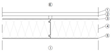
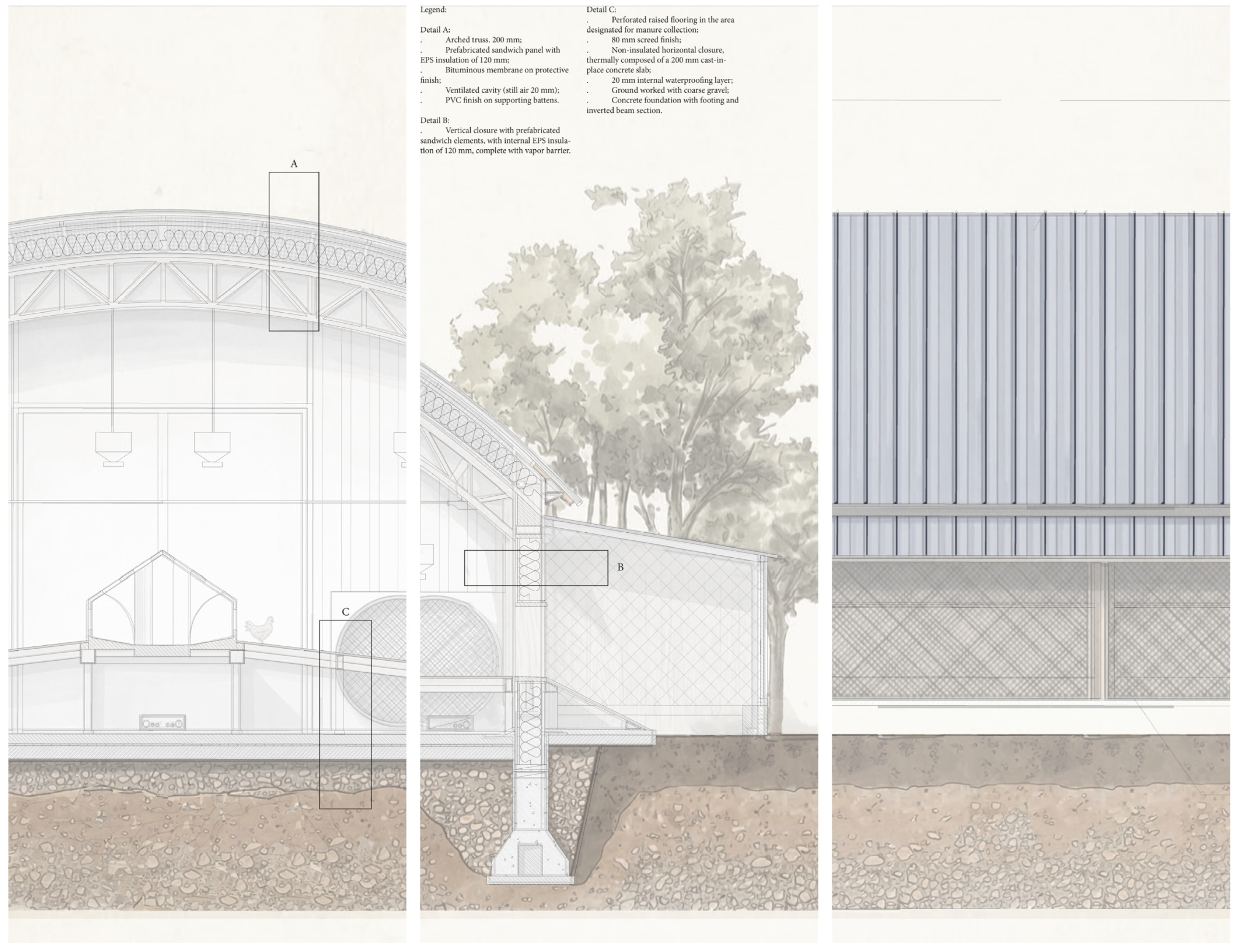
The architectural and technological articulation of the building system is illustrated through a full ground-to-roof sectional drawing, which explicitly represents the stratigraphy of the building envelope and the principal construction nodes, as shown in Figure 5. This representation provides a detailed understanding of the interaction between structural components and envelope assemblies, clarifying the constructive logic underpinning the system and supporting its subsequent evaluation within a life cycle-based analytical framework.
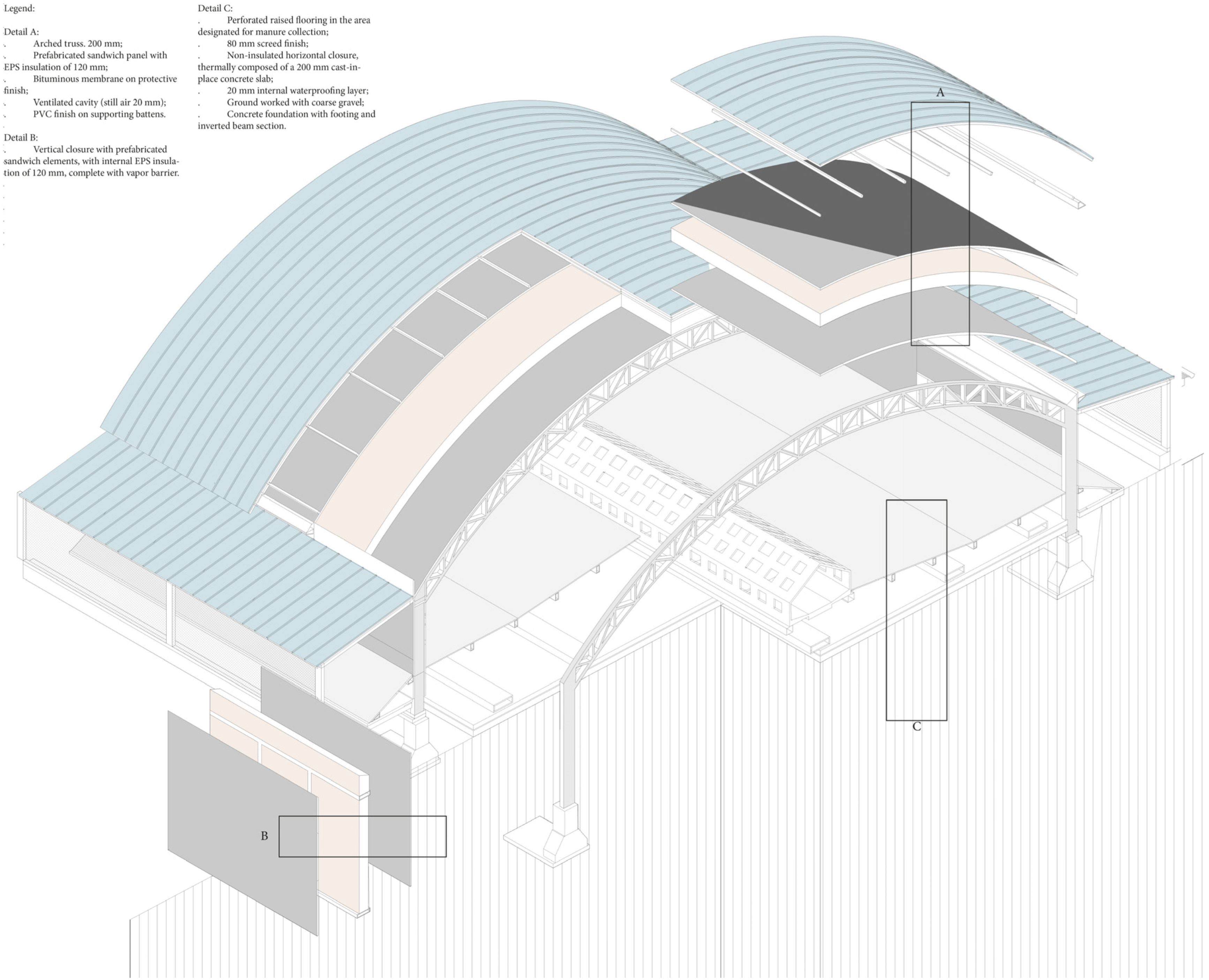
In addition to the sectional representation, a further graphical elaboration in the form of an exploded axonometric view is provided (Figure 6), aimed at restituting the three-dimensional techno-physical configuration of the building and the relationships among its constituent construction subsystems. In this representation, both structural elements and building envelope components are decomposed according to an assembly-based logic, making explicit the stratigraphic hierarchy, the connection interfaces between components, and the level of integration between the load-bearing structure and the prefabricated envelope system.
The axonometric view further enables a clearer interpretation of the serial and modular nature of the building system, as well as its reliance on industrialised components characterised by limited morphological variability. This condition highlights key implications in terms of assembly processes, maintenance strategies, and potential for disassembly at the end of the building life cycle, thus providing a critical reading of the system within a life cycle-oriented perspective.
Despite effectively meeting the functional requirements of intensive livestock production, the building ultimately operates as a standardised technical device, rarely subjected to a design-driven approach addressing architectural quality, advanced hygrothermal performance, material durability, reversibility of assemblies, and integration within the rural landscape.
Previous analyses [8], also interpreted in light of the systemic decomposition of the building as represented in the aforementioned graphical outputs, have shown that a significant share of environmental impacts is attributable to material choices and to the production stage of prefabricated components, thereby confirming the limitations of an approach exclusively focused on energy system optimisation. In particular, the industrialised and highly integrated nature of the adopted building systems, while ensuring rapid construction, results in a substantial contribution of upstream life cycle stages, as well as a reduced capacity for adaptability, selective maintenance, and disassembly.
Within this perspective, there emerges the need to extend the analysis beyond the mere performance improvement of the existing building system, directing it towards a comprehensive revision of the construction paradigm. Such a shift implies overcoming the additive logic typical of retrofit interventions, in favour of a systemic approach in which geometric configuration, functional organisation, and material choices are redefined in an integrated manner, adopting the case study as a comparative basis for the exploration of alternative building systems.
Accordingly, the decision to reconsider the same case study assumes a precise methodological significance: following the assessment of the benefits and limitations of energy retrofit measures, and the detailed characterisation of the environmental behaviour of the existing building system through in situ monitoring, the present research extends the analysis towards a technological substitution of the entire construction paradigm. Within this framework, the geometric, functional, and material definition of the prefabricated tunnel—articulated through both two-dimensional and three-dimensional descriptive models—constitutes the comparative basis for the subsequent evaluation, in terms of Life Cycle Assessment (LCA) and Construction Cost Analysis, of the timber-based solution developed through the design process.

3.2. Description of the Analysed Construction System

On the basis of the previously established constructive and technological framework—further elucidated through both sectional and axonometric representations—the study advances towards a comparative assessment of alternative building systems.
To compare the two construction technologies, the case study introduced in the previous paragraph was used. For the evaluation of building components, it is assumed the same geometric and volumetric characteristics of the existing building, considering only on the reconstruction process, without the contributions of the demolition phase, which remain constant in the two scenarios. The energy performance of the building envelope is assessed using the Edilclima EC700 software, version 14.25.22 (Edilclima S.r.l.) [54]. The reconstruction scenarios analyze two construction systems: (i) a conventional construction technique similar to that of the existing case study, employing a steel frame with external walls built entirely with dry elements (CNB); and (ii) a sustainable timber-frame solution using insulated timber panels for the building envelope (TNB). Table 1 and Table 2 summarize the geometric dimensions and thermal properties of each building element considered in the two scenarios. In this perspective, the comparison does not merely concern alternative materials, but rather confronts two distinct technological and architectural paradigms applied to rural production buildings.
The construction components were designed to comply with the minimum thermal transmittance limits required by Italian regulations [55] while ensuring comparable performance levels between the two solutions. This approach allows the definition of a consistent functional unit for the LCA analysis, as described in the following sections. The construction technologies are outlined below:
(i)
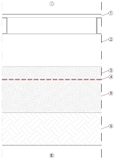
Conventional New Building (CNB): the foundation slab consists of a layer of coarse gravel, a 30 cm reinforced concrete slab with double reinforcement (Ø12 bars spaced at 20 cm in both directions), a waterproofing membrane, an 8 cm concrete screed, and a perforated raised floor. The load-bearing structure is made of HEA 140 steel profiles for the columns and L-shaped steel sections for the roof trusses, using 100 × 100 × 10 mm members for the top and bottom chords and 50 × 50 × 6 mm sections for the vertical and diagonal elements. The external walls consist of dry-assembled panels formed by a 1 mm steel sheet with a 12 cm internal layer of expanded polystyrene insulation. The roof adopts the same construction system, complemented by an external PVC cladding to ensure protection against weathering (Table 1). This configuration reflects the prevailing industrial paradigm in rural livestock construction, characterized by lightweight assemblies, low thermal inertia and limited material reversibility.
(ii)
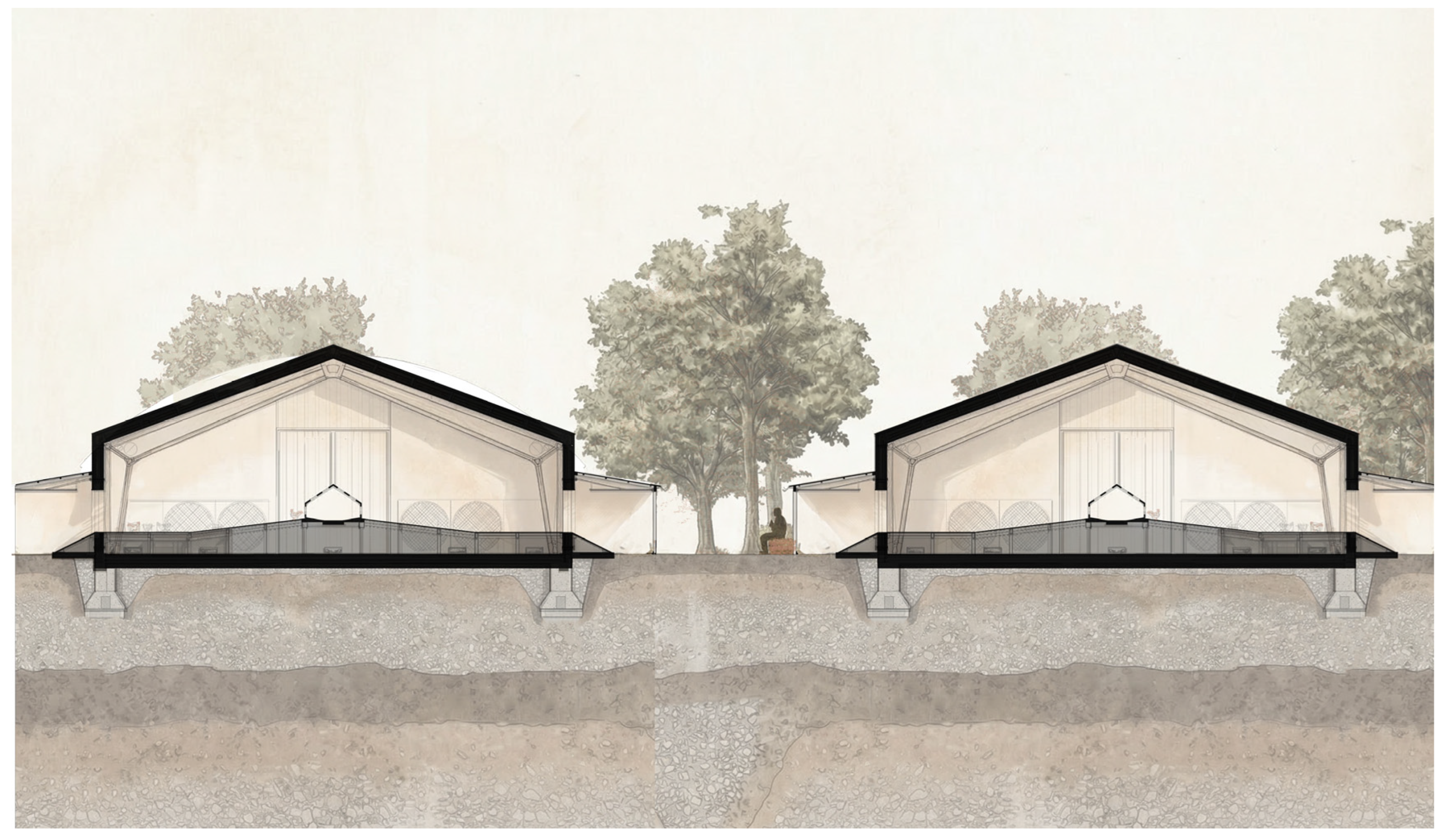
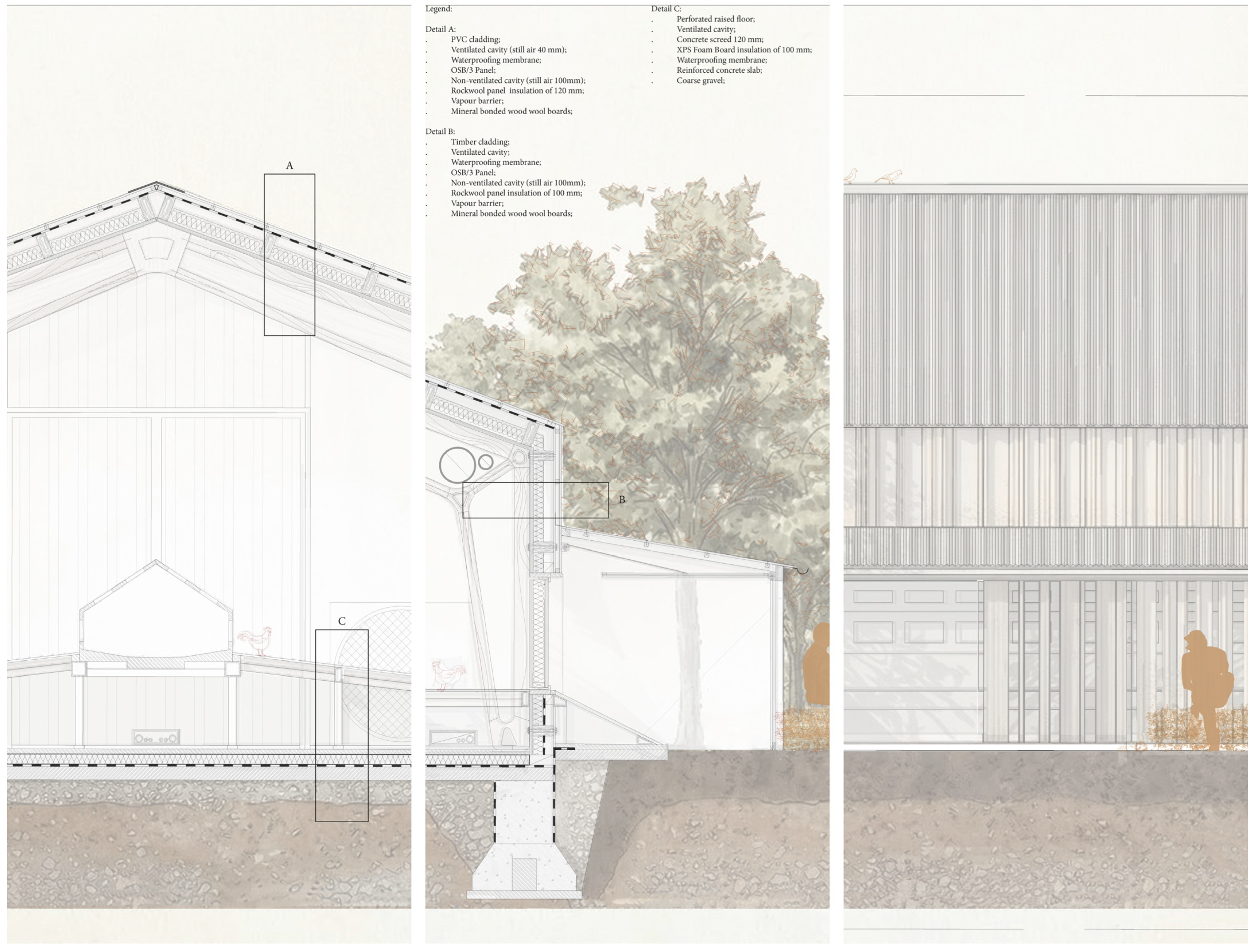
Timber New Building (TNB): the foundation slab is constructed in the same manner as in the CNB solution, with the addition of a 12 cm XPS insulation layer. The building structure is conceived as a dry-assembled and fully demountable system, in accordance with circular economy principles [56]. It consists of a series of glued-laminated timber portal frame structures with variable cross-sections and a double-pitched roof, while the building envelope is made of prefabricated timber panels. The external walls adopt prefabricated timber-framed walls, with a 3.5 cm internal wood-wool board and a 1.8 cm external OSB/3 panel. A 14.0 cm rock wool insulation layer is placed between the timber studs. On the exterior side, the panel is protected by a waterproofing membrane and timber cladding. The roof is constructed using a similar system, with the only difference being that the external cladding is PVC to ensure greater durability than timber.
The TNB solution under investigation is configured as a fully redefined bio-based construction system, characterised by a load-bearing structure in glued-laminated timber and a high-performance, coherently insulated building envelope.
The translation of the original steel structural system into a timber-based framework results in a corresponding modification of the building geometry and morphotype of the tunnels, as illustrated in Figure 7, leading to a distinct architectural configuration while maintaining functional requirements.
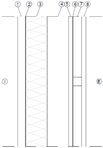
The technological configuration of the TNB solution is further illustrated through the full building section (ground-to-roof) at a 1:20 scale, presented in Figure 8, which enables a detailed examination of the envelope stratigraphy and the main construction nodes.
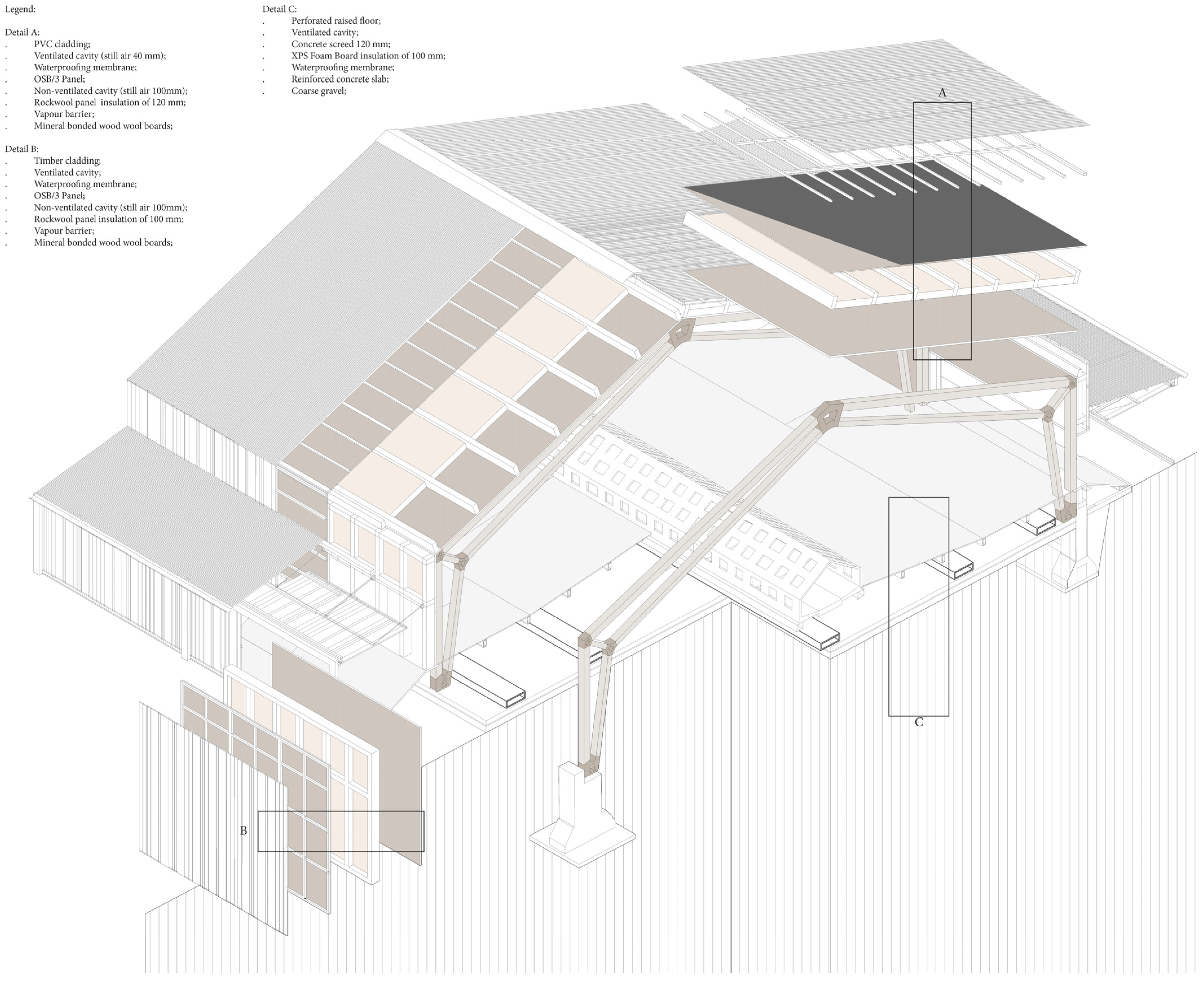
To complement the sectional representation and further elucidate the constructive logic of the proposed system, an exploded axonometric view of the TNB solution is provided (Figure 9). In analogy with the representation of the existing system (Figure 6), this three-dimensional representation illustrates the spatial arrangement, stratigraphic hierarchy, and assembly sequence of the timber-based components, highlighting the degree of prefabrication, the dry-joint connections, and the potential for disassembly inherent in the system.
These representations provide a fundamental interpretative basis for understanding the proposed system, whose technological components are subsequently analysed and systematically presented in Table 3 and Table 4, in comparative form with respect to the current technological paradigm represented by the previously introduced case study. The comparative technological characterisation of the building envelopes—both vertical and horizontal (roof and ground slab)—is further detailed in the following tables, which report the physical and performance properties of the opaque components for both the existing construction system and the proposed TNB solution.
This comparative setting isolates the technological variable while preserving geometric, functional, and productive equivalence, thereby ensuring that differences in environmental performance derive exclusively from construction technology and material configuration.

3.3. Evaluation of Environmental Impacts Based on Life Cycle Assessment

This study aims to assess the short/medium-term environmental impacts of two construction systems for livestock buildings using the LCA methodology. It compares a conventional system (CNB), built with dry steel elements, with a new timber-based system (CLT) designed according to circular economy principles [56]. The analysis was carried out using OneClick LCA software in accordance with the EN 15978:2011 [57] and EN 15804+A2 [46] standards. A 30-year evaluation period was considered, covering the following life cycle stages: production (A1–A3), transportation (A4), construction (A5), end-of-life (C1–C4), and material-related use phases (B4–B5). Stage D, which accounts for the benefits of material reuse and recycling, was analyzed separately to provide complementary insights. The decision to exclude operational energy (B6) and water use (B7) was made deliberately, in order to assess only the sustainability of the construction systems in relation to building materials, without including energy consumption, which could significantly affect the outcomes. The results are presented in terms of Global Warming Potential (GWP), Ozone Depletion Potential (ODP), Acidification Potential (AP), Eutrophication Potential (EP), Formation of Lower Atmosphere Ozone (FO), Renewable Primary Energy (PE_ren), Non-Renewable Primary Energy (PE_nren), and total Primary Energy (PE).
This study adopts the gross floor area in square meters as the functional unit, considering a Gross Floor Area of 1695 m2. The adoption of gross floor area (GFA) as functional unit ensures consistency with EN 15978 methodology and enables direct comparison between alternative technological solutions under equivalent spatial and productive conditions. The analysis focuses exclusively on the construction materials required for the structural system (steel frame, timber elements, and foundation), the building envelope (external walls, roof, and ground floor slab), and the photovoltaic system (modules, batteries, and substructure) were modeled using representative datasets of the European market, as specific manufacturer data were not available. Other types of mechanical systems, interior finishing materials, and equipment required for livestock operations were excluded from the analysis because they are not relevant to the comparison between construction systems and could be common across scenarios. The bill of quantities for each scenario is summarized in Table 5.
Other components, such as doors, windows, furnishings, finishes, materials external to the building, and mechanical systems (heating, cooling, ventilation, lighting, and machinery) are excluded from the evaluation. The study uses average data from generic materials contained in the OneClick LCA database, which incorporates ECOINVENT processes representing regional average data for the Italian context. Where necessary, average environmental profiles from the European Union or neighboring countries, such as France or Germany, were also applied. Transport distances and on-site waste generation for each material were obtained from the literature. Finally, the service life of each construction material was evaluated following the LEVEL(s) framework [58]. Although generic datasets were employed, regional representativeness was prioritized to ensure alignment with the Italian construction context and to enhance the robustness of the comparative results.
The production stages (A1–A3) cover the entire life cycle of construction materials, from the extraction and transportation of raw materials to the manufacturing site, the processing process and the management of possible generated waste. The transportation (A4) and construction (A5) phases are modeled using standard scenarios from the OneClick LCA database, assuming diesel-powered trucks with a 40-ton capacity and a 100% load factor (0.0383 kgCO2eq/ton·km), as well as an average material loss during construction, typically between 4 and 10%, in line with OneClick LCA process assumptions. Particular attention is devoted to the production stage (A1–A3), which previous studies have identified as the dominant contributor to embodied emissions in lightweight industrial buildings. Environmental impacts related to maintenance and replacement during the building’s service life (B4–B5), as well as waste treatment and disposal (C2–C4), are estimated using standard processes from the OneClick LCA database, reflecting current practices in Italy [59].

3.4. Evaluation of the Economic Feasibility of the Interventions

To assess the economic feasibility of the two scenarios, the construction cost of the buildings was analyzed. The construction cost represents the initial expenses required to build the structure and is calculated as the sum of the quantities (Q) multiplied by the respective unit cost (CU) for each construction element (i):
i = 1 n Q i · C U i
The unit cost of materials is defined by Italian regulations [60] as the sum of the costs associated with the individual production factors required to produce and install an element: materials, labor, equipment rental, and transportation. In this way, the technical cost for installing a building component is estimated, to which fixed costs are added: overhead, contractor’s profit, and VAT (in Italy, 22%), in order to cover design activities, project management, administrative expenses, surveys, inspections, etc. [61]. The quantification of individual elements is based on the Emilia-Romagna regional price list for 2025 (DGR No. 2342 of 23/12/2024), which sets overhead at 17% and contractor’s profit at 11.7% [62]:
C U = M T + M L + R t + O H + P R = 28.7 % ( M t + M O + N t )
where:
CU is the unit construction cost of a building element
MT is the material cost
ML is the labor cost for installing the building element
RT is the cost of any necessary equipment rentals;
OH is the overhead costs, evaluated as OH = 17% (MT + ML + RT)
PR is the contractor’s profit, estimated as PR= 10% (MT + ML + RT + OH) = 11.7% (MT + ML + RT)
The total building cost is obtained as the sum of all individual building elements, including structural components, exterior walls, roof, foundation, and the photovoltaic system. This analysis does not account for costs associated with compensation for CO2 emissions. The economic comparison therefore complements the environmental assessment by verifying whether the proposed technological substitution remains compatible with the financial constraints typical of small- and medium-scale agricultural enterprises.

4. Results and Discussion

In discussing the outcomes of the comparative investigation developed in the preceding chapters, this section aims to assess the robustness of the proposed technological substitution from environmental, economic, and theoretical-disciplinary perspectives. To this end, the analysis is structured into three complementary components: a first part devoted to the evaluation of environmental impacts through Life Cycle Assessment (LCA), a second focused on the economic comparison of the two construction systems, and a third aimed at the critical interpretation of the results in terms of barriers and opportunities for transition.
This articulated framework enables a shift from the quantitative reporting of results to their interpretation within a design-oriented perspective, assessing the extent to which the proposed bio-based solution may be understood not merely as a technically feasible alternative, but as a replicable model of environmental and architectural innovation for rural production building.

4.1. Results of the Environmental Impacts Based on Life Cycle Assessment

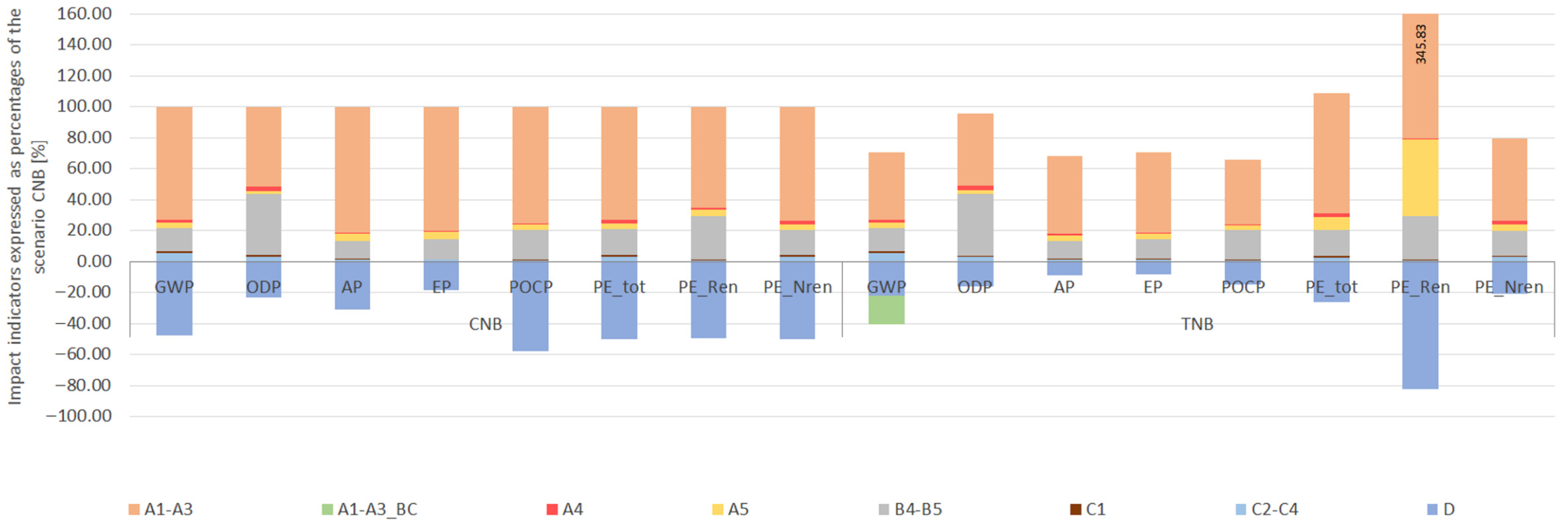
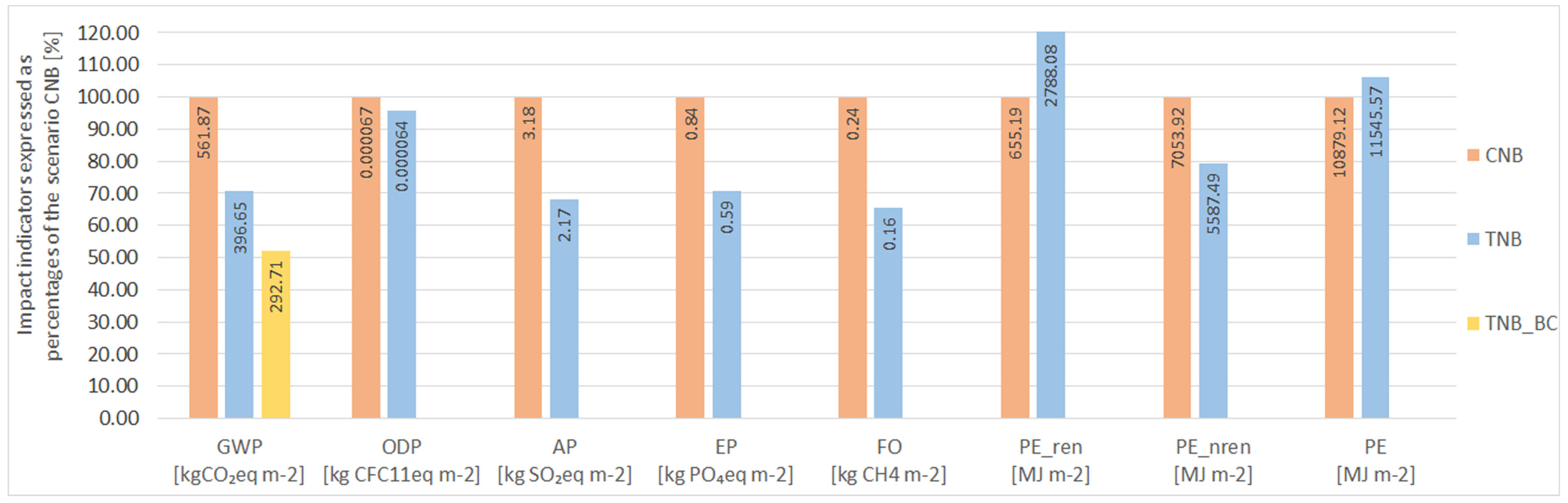
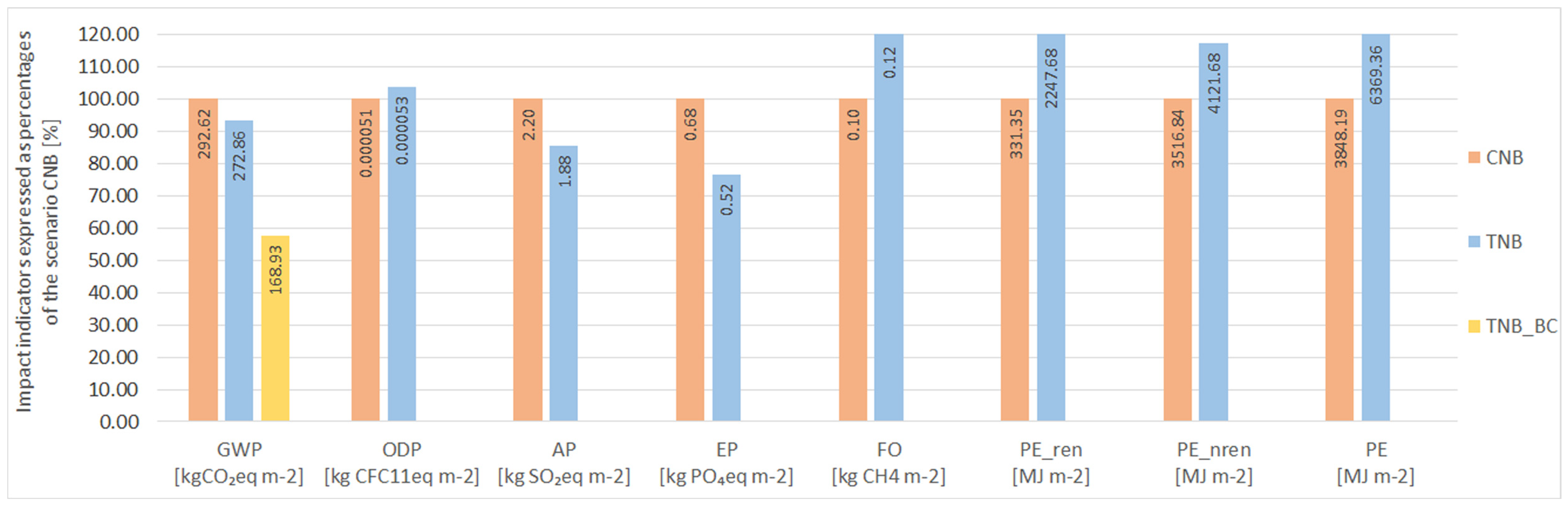
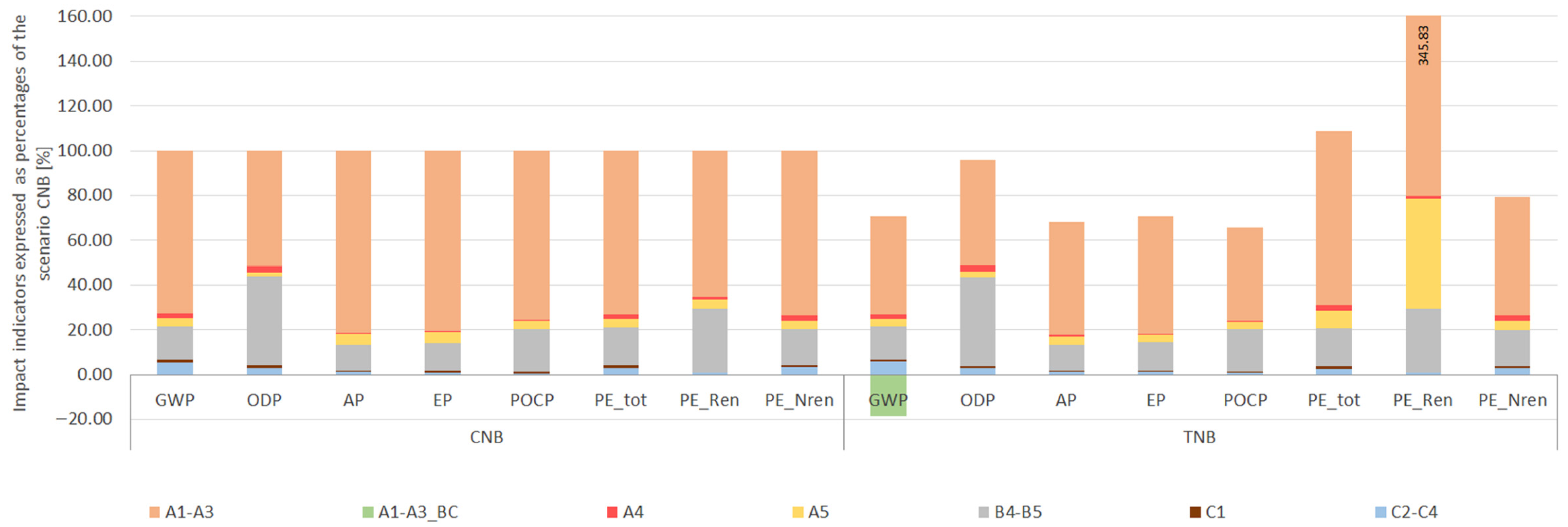
This section presents the results of the LCA analyses for the two construction technologies described in Section 2.2. The first graph (Figure 10) shows the overall environmental impacts of the CNB and TNB scenarios for stages A1–A3, A4, A5, B4–B5, and C2–C4, expressed in terms of the following impact indicators: GWP, ODP, AP, EP, FO, PE_ren, PE_nren, and PE. The second bar chart (Figure 11) presents the same scenarios and impact indicators, but also includes Stage D. In both scenarios, the contribution of biogenic carbon (TNB_BC) is reported separately from GWP (fossil GWP) to allow a clearer evaluation of its effect. In the bar charts, impacts are expressed as percentages relative to the CNB baseline, with the numeric value of each indicator shown within each bar per the chosen functional unit (square meter of GFA). The results presented in Figure 10 and Figure 11 are summarized in Table 6. Figure 12 and Figure 13 break down the previous charts by individual life cycle stages, excluding and including Stage D, respectively. All analyses consider a 30-year assessment period to focus on short- to medium-term impacts. Long-term impacts arising from renovations are not considered, as they are difficult to predict accurately in this type of production activity, even though they play a critical role in determining overall results [63]. The 30-year reference period is particularly relevant for livestock buildings, where technological obsolescence often precedes structural decay, making medium-term embodied impacts more decisive than long-term maintenance scenarios. Additionally, this time frame aligns with the European Union’s decarbonization targets set for 2050 [64].
In the first graph (Figure 10), it can be observed that the CNB scenario consistently exhibits the highest values across all impact categories, except for renewable primary energy (PE_ren) and total primary energy (PE). This reflects the greater environmental impacts associated with conventional building approaches using steel structures. High PE_ren and PE values are generally common in timber construction analyses due to the energy-intensive processes required to produce timber materials [63]. The TNB scenario shows a clear reduction in most impact indicators: GWP decreases by 29.4%, AP by 31.8%, EP by 29.8%, and FO by 33.3%. In particular, regarding the Global Warming Potential, the TNB system significantly reduces emissions compared to CNB, especially when the biogenic carbon credit is considered (TNB_BC scenario), resulting in an even greater reduction of approximately 50%. These results confirm that the environmental advantage of the timber-based system is primarily embedded in the material production phase, thus validating the hypothesis that technological substitution at the envelope and structural level can produce structural rather than incremental reductions in embodied emissions.
The second bar chart (Figure 11) presents the same impact indicators as the previous figure but also includes stage D, leading to significant changes in the results. In terms of Global Warming Potential, the TNB system now exhibits only a modest reduction compared to CN, less than 10%, whereas introducing the biogenic carbon credit in the TNB_BC scenario leads to a much larger decrease, exceeding 42%. Also in this case, the difference between CNB and TNB in terms of ODP is negligible, at around 5%, while Primary Energy impacts are higher for the TNB scenario, with increases of 14.8% in PE_nren and 63.1% in total primary energy. In contrast to the previous results, the impact related to ozone formation (FO) is higher for the TNB system, by approximately 20%. This apparent trade-off highlights the complexity of bio-based construction systems, where reductions in fossil-related emissions may coexist with increases in other impact categories due to industrial processing and material transformation stages.
An analysis of the overall assessment results (Table 5) highlights a series of environmental trade-offs in the comparison between the conventional construction system (CNB) and the timber-based system (TNB). Considering the A1–C4 life cycle stages, TNB shows lower environmental impacts across most impact categories. In particular, significant reductions are observed in GWP (−29.41%, or −47.90% when accounting for the biogenic carbon component), AP (−31.92%), EP (−29.36%), FO (−34.39%), and PEren (−20.79%). These results are consistent with the substitution of carbon-intensive materials, such as concrete and steel, with timber, which is associated with lower embodied emissions and contributes to carbon storage. However, a substantial increase in renewable primary energy demand is observed (+325.54%), leading to a moderate increase in total primary energy demand (+6.13%).
When Module D is included, accounting for benefits and loads beyond the end-of-life stage, the advantage of the timber system is reduced and trade-offs emerge. This is due to the fact that the conventional system benefits from more extensive recycling and energy recovery scenarios, thereby narrowing the gap between the two solutions. TNB continues to show lower impacts in terms of GWP (−6.75%, or −42.27% when biogenic carbon is considered), AP (−14.62%), and EP (−23.41%), while higher impacts are observed in other categories, such as ODP (+3.81%) and FO (+21.43%). In particular, energy demand increases more significantly, both in terms of renewable primary energy (+578.35%), non-renewable primary energy (+17.20%), and total primary energy (+65.52%). This reinforces the idea that the environmental benefits of timber are associated with higher energy requirements over the extended life cycle. This aspect is particularly relevant, as it links the environmental performance of timber solutions to the energy mix and the availability of renewable energy sources in production processes. Consequently, the selection of construction systems cannot rely on a single indicator but requires an integrated evaluation of trade-offs across multiple impact categories, as well as consideration of specific energy and management conditions.
Furthermore, a crucial aspect in the interpretation of the results is the role of biogenic carbon. When this is taken into account, the GWP of the timber system is further reduced, reaching values that indicate an overall decrease of approximately −42% compared to the conventional system.
Figure 12 illustrates the contribution of the different life cycle stages to the environmental impacts, normalized to the CNB reference scenario and excluding Stage D. In the conventional CNB system, Global Warming Potential is largely driven by the material production stage, which alone accounts for about 75% of the total impact. The use phase follows with roughly 15%, while all other stages play only a minor role. In the timber-based TNB system, the GWP-fossil is characterized by a lower contribution of A1–A3 stage, around 70%, together with the negative impact of approximately 20% related to the temporary storage of carbon in wood biomass. Acidification, eutrophication, and ozone formation show trends similar to those observed for global warming, with a strong dominance of the material production phase. For the CNB scenario, A1–A3 accounts for about 50% of ODP, 80% of AP, 80% of EP, 75% of FO, and 75% of PE. In the TNB scenario, the same stage accounts for approximately 42% of ODP, 75% of AP, 75% of EP, 70% of FO, and 70% of PE. For ozone depletion, the use phase also plays a significant role alongside material production, whereas the remaining stages are secondary. In the TNB scenario, the construction phase becomes more relevant for renewable primary energy; however, PE_ren remains much lower than PE_nren, so the overall primary energy profile is largely driven by the non-renewable component. The dominance of the A1–A3 stage across both systems reinforces the centrality of material choice in rural industrial buildings, where operational energy is comparatively limited and embodied impacts define the environmental profile.
Figure 13 shows results similar to those presented in the previous figure, while also highlighting the contribution of Stage D. When this stage is considered, both systems benefit from substantial environmental credits linked to material recycling and energy recovery beyond the system boundaries.
In the CNB scenario, Stage D introduces substantial negative contributions across all impact categories, reducing total impacts by up to approximately 50% for some indicators: GWP decreases by more than 40%, ODP by about 20%, AP by 25%, EP by 20%, FO by around 60%, and PE by over 40%. In the TNB scenario, the effect of Stage D is less pronounced, which reduces the performance gap between the two systems, in line with the trends observed in the previous figures. Overall, the negative contribution of Stage D remains below 20% for most indicators, while it becomes particularly relevant for non-renewable primary energy, reaching approximately 80%. The inclusion of Stage D partially compensates for the higher embodied impacts of the steel system through recycling credits, yet it does not fully overturn the comparative advantage observed in the timber-based solution when biogenic carbon storage is properly accounted for.
The environmental benefits observed in the TNB scenario must therefore be interpreted alongside the economic implications discussed below, in order to assess the feasibility of technological transfer from sustainable architecture to rural production systems.

4.2. Results of the Economic Assessment

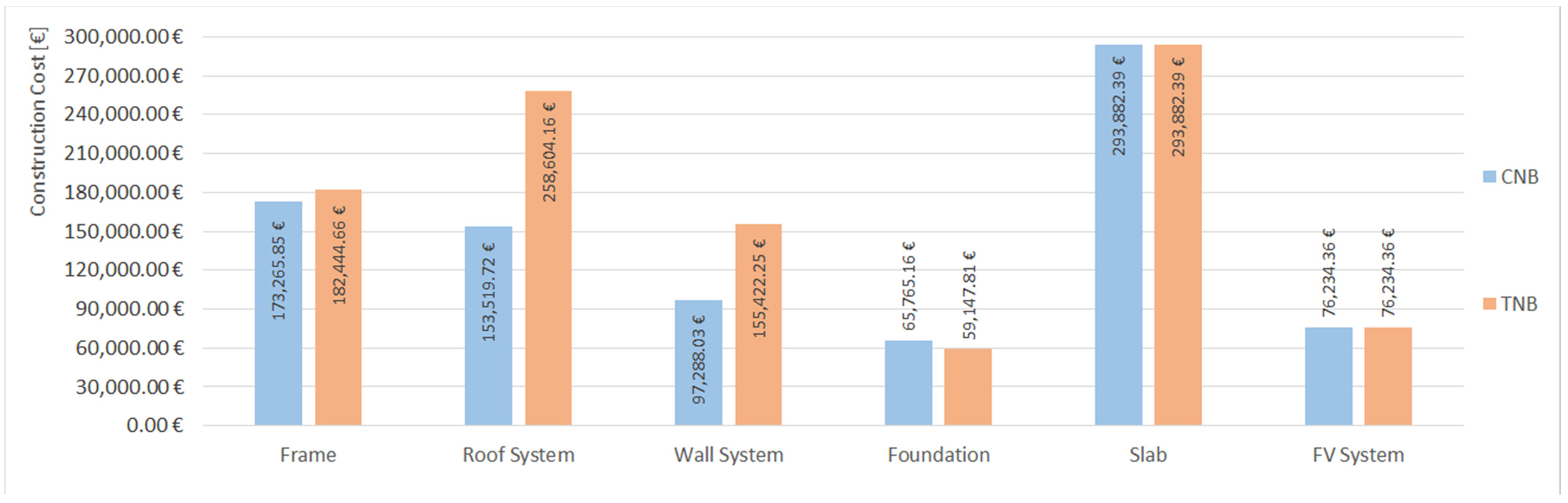
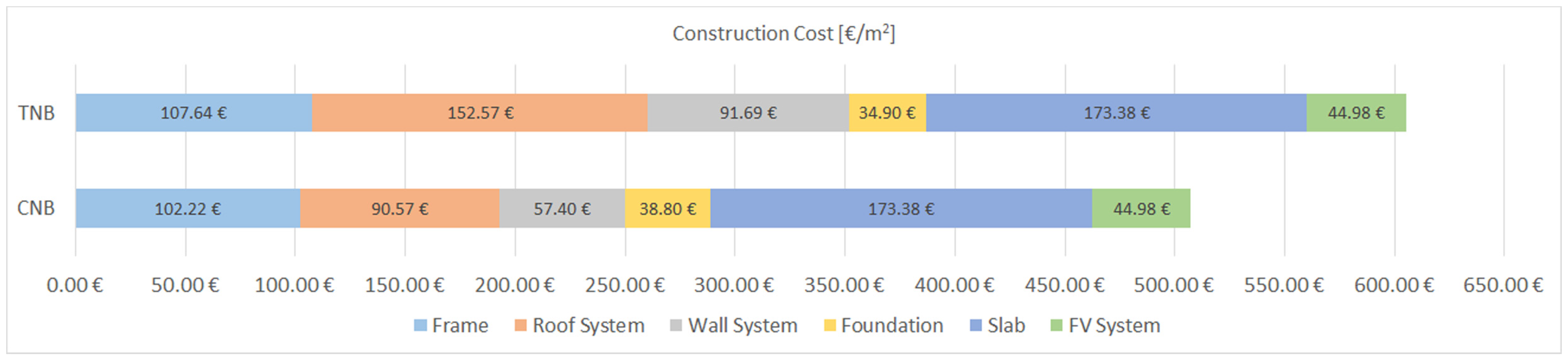
The economic assessment of the two scenarios was conducted following the methodology described in Section 3.4, using data from the Emilia-Romagna regional price list for 2025 (DGR No. 2342 of 23/12/2024) [62]. The figures compare the construction costs of the conventional CNB system with those of the timber-based TNB system. Figure 14 presents the total construction cost for each building component, including the frame, roof, walls, foundation, slab, and photovoltaic system. Figure 15 shows the total construction cost of the poultry tunnel per square meter of GFA, highlighting the cost contribution of each component. Parametric values for the construction cost of each component in both scenarios are also summarised in Table 6.
The diagrams highlight the cost differences between the two construction technologies. The load-bearing structure of the timber system is slightly more expensive than the conventional steel frame, by around 5%, confirming the timber frame’s economic competitiveness. The largest differences are found in the building envelope: in the TNB system, both the roof and external walls are significantly more expensive than in the CNB system, by 62% and 34%, respectively. This increase reflects the greater complexity of the timber construction solution, the higher quality of bio-based materials, and the superior thermal and acoustic performance they provide, despite cost savings achieved through the high degree of prefabrication in the TNB solution. The cost of the ground floor slab and photovoltaic system is the same for both systems, so these components do not affect the overall economic comparison. Foundations are the only element where the TNB system is slightly cheaper, thanks to a simpler foundation design requiring fewer steel plates for connecting the structural frames, though the cost difference is minimal, under 4%.
The limited cost differential at structural level confirms that the economic barrier to timber adoption in rural production buildings is not related to load-bearing systems, but rather to envelope stratigraphy and material quality.
In summary, the TNB system results in an approximately 20% higher construction cost compared to the CNB system. This increase is not related to the structure itself, but mainly to the high-quality materials used for the high-performance building envelope. This point is crucial for correctly interpreting the short-term economic comparison between the two construction solutions. For a more accurate assessment of the investment, however, a payback analysis should also be considered, accounting for the longer lifespan and durability provided by these higher-quality materials. From a technological design perspective, this cost increase must be interpreted as an investment in envelope performance and material durability rather than as a structural inefficiency (Table 7).

4.3. Critical Discussion and Design Implications for Bio-Based Transition in Rural Production Buildings

The results obtained, as presented in the preceding section, support the assertion that the transition towards bio-based building systems in the livestock sector does not constitute a mere technical upgrade, but rather represents a paradigmatic shift within the material culture of rural production buildings. These findings confirm that the construction paradigm represents the primary driver of environmental performance in rural production buildings. In light of the analyses conducted, it becomes evident that the issue at stake does not concern solely the substitution of steel with timber per se, but rather entails a broader reconfiguration of the relationship between the design approach, the material life cycle, and the environmental responsibility of productive buildings.
Notwithstanding the aforementioned potential, it is necessary to acknowledge that the barriers to a wholesale technological transition remain stratified, rendering any systemic shift inherently complex, particularly within the context of prefabricated industrial building systems for rural production facilities, and more specifically for livestock buildings.
First, an apparent economic barrier must be considered: the initial cost differential, amounting to approximately 20%, may discourage the adoption of the TNB solution in a production context characterised by limited margins and a strong focus on short-term investment. However, a disaggregated cost analysis reveals that this increase is almost entirely attributable to the building envelope, rather than to the load-bearing structure, which exhibits only a marginal variation (≈5%). This finding mitigates the perception of timber as economically uncompetitive in the agricultural sector and suggests that the economic barrier is more closely related to short-term decision-making models than to any intrinsic technical cost disparity.
Secondly, the coexistence of cultural and disciplinary barriers should also be acknowledged. As highlighted throughout this study, livestock buildings are traditionally conceived as purely functional infrastructures, governed by principles of serialisation, standardisation, and reduced design complexity. This approach has progressively limited the consideration of architectural, spatial, material, and landscape-related qualities. In this context, the proposed timber-based system can be interpreted as reintroducing a design-oriented perspective, in which prefabrication is not only a tool for executional efficiency, but may also support improved technological quality, reversibility, and potential environmental integration.
From an environmental standpoint, the results provide a direct response to the research questions. With reference to Table 2, and specifically to RQ1, the substitution of the conventional building system with a bio-based solution leads to a significant reduction in Global Warming Potential, as well as in acidification and eutrophication indicators, thereby confirming the effectiveness of the proposed technological substitution. The prominence of the A1–A3 life cycle stages, which account for up to 80% of total impacts, demonstrates that the criticality of the sector lies not primarily in operational energy consumption, but in the carbon intensity of the materials employed in the building envelope and structural components.
This finding substantiates the hypothesis introduced in Table 1 (H1), according to which the adoption of Life Cycle Assessment (LCA) as an ex-ante design tool is capable of structurally guiding technological choices, particularly by acting on the material production stages, where the dominant share of impacts is concentrated.
Similarly, RQ2 (Table 2) appears to be corroborated by the economic analysis: the cost differential is compatible with the production context, especially when interpreted within an extended life cycle perspective. The absence of significant divergence in the load-bearing structure costs, combined with the concentration of additional costs within the high-performance building envelope, suggests that the competitiveness of the TNB system may become more evident over a time horizon exceeding the 30 years considered in the environmental analysis, thus indicating the need for future integration with Life Cycle Costing (LCC) models over 60 years or more.
In this light, RQ3 (Table 2) assumes a significance that transcends purely quantitative evaluation. The proposed timber-based building system demonstrates that technologies consolidated within the field of bio-based construction can be coherently adapted to the livestock sector, generating a replicable model. Such replicability is not only technical, but also methodological: the process integrating technological design, energy modelling, LCA, and economic assessment defines a transferable framework applicable to other rural production contexts.
A further layer of complexity emerges from the analysis of Stage D. The inclusion of benefits associated with recovery and recycling reduces the gap between the two building systems, highlighting how sustainability outcomes are significantly influenced by end-of-life assumptions. Nevertheless, even under these conditions, the accounting of biogenic carbon in accordance with EN 15804+A2 preserves a competitive advantage for the timber-based solution. This confirms that environmental assessment cannot be decoupled from a transparent definition of methodological assumptions, as the selected accounting framework substantially affects the interpretation of results.
The present study has several limitations that may serve as starting points for future research. In particular, assessing the use phase of poultry tunnels could be of interest in order to evaluate the potential benefits of the proposed technological solution compared to standard ones, not only in terms of energy consumption, but also with regard to the integration of renewable energy sources and the monitoring of indoor air quality. A detailed evaluation of energy consumption, in particular, would significantly affect the LCA results and would represent a key component of a Life Cycle Costing (LCC) analysis. These aspects could also support a broader comparison, not only among different construction solutions for new buildings, but also including existing buildings. This would make it possible to assess whether it is more effective to implement energy-saving retrofit strategies or to proceed with demolition and reconstruction using more sustainable construction solutions.
Furthermore, in light of the trade-offs identified and discussed in the previous sections, a sensitivity analysis focused on the national energy mix would be highly relevant. Indeed, a significant share of the observed impacts—particularly those related to primary energy demand (PE_ren, PE_nren, and total PE)—depends on the carbon intensity and the composition of the energy sources used in production processes and end-of-life stages. In contexts characterised by a highly decarbonised energy mix, the impacts associated with the TNB scenarios would tend to decrease further, thereby strengthening the benefits already observed in terms of GWP. Conversely, in countries where the energy system still relies heavily on fossil fuels, this increase may reduce or even offset part of the environmental advantages of the TNB system. For reasons of brevity and due to the scope of the study, the analysis has been limited to the Italian context. However, a dedicated sensitivity analysis in this direction represents a limitation of the present work and a promising avenue for future research. Such an extension would allow the testing of different current and future energy scenarios across various European countries, identifying the conditions under which a given construction system becomes environmentally preferable. This would ultimately support more robust decision-making frameworks for both design and policy strategies.
Beyond quantitative findings, the research highlights a broader cultural and territorial opportunity. The proposed technological substitution enables a departure from the conception of livestock buildings as neutral and self-referential objects, reintegrating them into the rural landscape system. The increased articulation of the building envelope, the potential use of locally sourced materials, and the adoption of design-for-disassembly strategies introduce a logic of environmental compatibility that extends beyond climate-altering emissions to encompass habitat quality and the resilience of the agricultural context.
In this sense, the transition outlined herein is not merely energetic or carbon-related, but epistemological in nature: it shifts the axis of innovation from the incremental optimisation of existing building systems to the redefinition of the underlying construction paradigm. Sustainability is no longer interpreted as the additive incorporation of technological devices, but rather as the outcome of an integrated design approach encompassing materials, life cycle, economic considerations, and territorial context.
While the present study integrates architectural and landscape considerations within a design-oriented framework, these aspects are not subjected to direct quantitative evaluation. This reflects a broader methodological gap in the current literature, where the integration between environmental assessment tools and qualitative spatial criteria remains limited. Future research should therefore focus on bridging this gap through the development of integrated, multi-criteria evaluation approaches.
Nevertheless, critical issues remain, particularly in relation to the limited regulatory enforcement of embodied impact assessment within the agricultural sector. The absence of a stringent regulatory framework concerning LCA for rural production buildings reduces the pressure towards the adoption of low-carbon building systems. In this context, the methodological approach adopted demonstrates how technological architectural design can assume an anticipatory role with respect to regulation, providing measurable evidence to support more informed decision-making.
The transition therefore appears both feasible and conditional: it requires integrated assessment tools, supportive policy frameworks, cultural evolution, and a redefinition of the role of the architect within the rural production sector. Only through this convergence will it be possible to consolidate a model of livestock buildings capable of combining functional efficiency, structural reduction of environmental impacts, and enhanced environmental quality within the agricultural landscape. These aspects could form the basis for future research, including an integrated evaluation of operational, maintenance, and end-of-life replacement costs, accounting for material durability. From this perspective, adopting the TNB system could prove economically advantageous in the long term, offsetting higher upfront costs through lower operational expenses, improved environmental performance, and greater resilience in building value over time, aligning with strategies to foster sustainable development in rural areas [65].
To provide a structured and transparent validation of the proposed hypotheses and related research questions, Table 8 summarises the degree of empirical confirmation of the assumed relationships between technological substitution, environmental performance, economic sustainability, and architectural quality.
The table establishes a correspondence between each research question, the related hypothesis, and the outcomes derived from the LCA and Construction Cost Analysis, providing a comparative and systematised interpretation of the results.

5. Conclusions

The evidence obtained enables a systematic validation of the theoretical framework outlined in the introductory chapter and in the research background of this study. The comparative application of Life Cycle Assessment (LCA) and Construction Cost Analysis to two building systems that are geometrically and functionally equivalent, yet technologically distinct, demonstrates that the environmental and economic performance of livestock buildings is primarily determined by the adopted construction paradigm, rather than by incremental interventions of an energy or systems-related nature.
By maintaining constant geometric and performance-related variables, the analysis isolates the effect of technological substitution, confirming that material and construction choices—when guided by the design approach and validated ex ante through life cycle-based assessment tools—constitute the decisive factor for a structural redefinition of sustainability in rural production buildings. The results highlight the significant role of selecting sustainable construction materials and integrating photovoltaic systems in reducing the environmental footprint of rural buildings. Overall, the TNB system proves to be more advantageous than the CNB solution in terms of CO2 emissions, acidification, and eutrophication, particularly when the CO2 credit associated with biogenic carbon is taken into account (with GWP values approximately 40–50% lower) and the end-of-life valorisation of timber through recycling and reuse is properly considered. The TNB system, however, shows a slightly higher demand for primary energy, although the increase remains below 10%. Including Stage D substantially improves the environmental performance of both construction systems, with particularly notable benefits for the CNB solution. Across both scenarios, material production (A1–A3) consistently represents the most critical life cycle stage, accounting for up to 80% of total impacts.
On the other hand, the economic comparison indicates that the total cost difference between the two construction systems is limited, at approximately 20%, thereby ensuring feasibility over the short- to medium-term. This difference is primarily attributable to differences in the quality of the building envelope materials; structural costs remain comparable, differing by only about 5%. Despite the higher initial costs, the TNB system can be competitive in the long term, offering benefits such as improved energy performance, lower environmental impacts, potentially shorter construction times due to prefabrication, enhanced indoor comfort, and higher market value for sustainable buildings. Therefore, the choice between the two construction systems should consider not only the initial construction cost but also the entire building life cycle, in terms of both Life Cycle Costing (LCC) and environmental benefits over a medium- to long-term period of at least 60 years.
The findings obtained offer relevant insights not only from a technical standpoint, but also in terms of informing policy frameworks for the ecological transition of rural areas. The environmental validation of the technological shift towards bio-based building systems highlights the need to integrate ex ante assessment tools (LCA and Construction Cost Analysis) into both public and private decision-making processes, thereby overcoming sector-specific approaches limited to energy performance alone. In this regard, technological architectural design may serve as an operational support for innovation programmes in the livestock sector, including within broader territorial development strategies.
However, several critical aspects require further investigation. The adoption of the proposed solutions depends on their economic and cultural acceptability among stakeholders, as well as on their durability under demanding agricultural conditions. Long-term monitoring is therefore necessary to verify performance stability and resistance to degradation.
In parallel, the proposed approach may be compared with integrated retrofit strategies for existing buildings, including vernacular heritage, in order to explore alternative pathways for circular reuse and potential landscape-related implications. Future research should further investigate the balance between new bio-based construction and advanced retrofit solutions. Overall, the transition of livestock buildings should be interpreted not as a simple material substitution, but as a systemic process involving design, economic, and policy dimensions. Its implementation will depend on the integration of technological innovation, durability, and social acceptability within a coherent regulatory and territorial framework. In conclusion, the findings demonstrate that the environmental and economic performance of livestock buildings is primarily determined by the adopted construction paradigm rather than by incremental optimisation strategies. The results confirm the effectiveness of technological substitution towards bio-based building systems in reducing embodied environmental impacts, while maintaining economic feasibility within a life cycle perspective. The study contributes to the current body of knowledge by highlighting the role of architectural technological design, when integrated with LCA and Construction Cost Analysis, as a driver of systemic sustainability transitions in rural production buildings. The research questions are overall validated, although further investigations are required to assess long-term durability, economic performance over extended time horizons, and the applicability of the proposed approach to different contexts and retrofit scenarios.

Author Contributions

Conceptualization, S.B. and C.C.; methodology, S.B. and C.C.; software, S.B. and C.C.; validation, S.B. and C.C.; formal analysis, C.C.; investigation, S.B. and C.C.; resources, S.B. and C.C.; data curation, S.B. and C.C.; writing—original draft preparation, S.B. and C.C.; writing—review and editing, S.B., C.C. and A.M.; visualization, S.B. and C.C.; supervision, A.M.; project administration, S.B. and A.M.; funding acquisition, A.M. All authors have read and agreed to the published version of the manuscript.

Funding

The publication of this research work was supported by CURSA funds (CIA.ITEST_INDUSTRIA4.0_CURSA_2023).

Institutional Review Board Statement

Not applicable.

Informed Consent Statement

Not applicable.

Data Availability Statement

The data presented in this study are available on request from the corresponding author.

Acknowledgments

The authors would like to thank Luca Merlonghi (Department of DAFNE, University of Tuscia) for his active and valuable contribution to the successful completion of this work. He was directly involved in the re-editing, production, and post-production processes, and also supported the first author in redesigning Figure 2, Figure 4, Figure 5, Figure 6, Figure 7, Figure 8 and Figure 9 presented in the text.

Conflicts of Interest

The authors declare no conflicts of interest.

References

  1. Picuno, P. Farm Buildings as Drivers of the Rural Environment. Front. Built Environ. 2022, 8, 693876. [Google Scholar] [CrossRef]
  2. Cogato, A.; Cei, L.; Marinello, F.; Pezzuolo, A. The Role of Buildings in Rural Areas: Trends, Challenges, and Innovations for Sustainable Development. Agronomy 2023, 13, 1961. [Google Scholar] [CrossRef]
  3. Frontuto, V.; De Montis, A.; Ledda, A.; Serra, V.; Ganciu, A. The visual impact of agricultural sheds on rural landscapes. Land Use Policy 2020, 94, 104337. [Google Scholar] [CrossRef]
  4. Biancucci, A.; Oddo, S. “Lessico Famigliare”: Toward a New Paradigm of Spontaneous Rural Architecture in North-Western Sicily: From Historical Testimony of Peasant Culture to Sustainable Resource. In Conservation of Architectural Heritage (CAH 2022); Germanà, M.L., Akagawa, N., Versaci, A., Cavalagli, N., Eds.; Advances in Science, Technology & Innovation; Springer: Cham, Switzerland, 2024; pp. 273–286. [Google Scholar] [CrossRef]
  5. Koesling, M.; Flaten, O.; Lien, G. Factors influencing the adoption of new building technologies in agricultural buildings. Energy Build. 2016, 127, 107–117. [Google Scholar] [CrossRef]
  6. Vilches, A.; Garcia-Martinez, A.; Sanchez-Montañés, B. Life Cycle Assessment (LCA) of Building Refurbishment: A Literature Review. Energy Build. 2017, 135, 286–301. [Google Scholar] [CrossRef]
  7. Bigiotti, S.; Santarsiero, M.L.; Del Monaco, A.I.; Marucci, A. Eco-Efficient Retrofitting of Rural Heritage: A Systematic Review of Sustainable Strategies. Energies 2025, 18, 4065. [Google Scholar] [CrossRef]
  8. Bigiotti, S.; Costantino, C.; Patriarca, A.; Mancini, G.; Provolo, G.; Recanatesi, F.; Ripa, M.N.; Marucci, A. Energy Efficiency and Environmental Sustainability in Rural Buildings: A Life Cycle Assessment of Photovoltaic Integration in Poultry Tunnels—A Case Study in Central Italy. Appl. Sci. 2025, 15, 5094. [Google Scholar] [CrossRef]
  9. Bourbia, S.; Kazeoui, H.; Belarbi, R. A review on recent research on bio-based building materials and their applications. Mater. Renew. Sustain. Energy 2023, 12, 117–139. [Google Scholar] [CrossRef]
  10. Zohourian, M.; Pamidimukkala, A.; Kermanshachi, S.; Almaskati, D. Modular Construction: A Comprehensive Review. Buildings 2025, 15, 2020. [Google Scholar] [CrossRef]
  11. Bigiotti, S.; Patriarca, A.; Mancini, G.; Recanatesi, F.; Ripa, M.N.; Marucci, A. Monitoring and Energy Optimization of Agricultural Shelters: Case Study of Poultry Tunnels in the Province of Viterbo, Italy. In Proceedings of the AIIA 2025 Conference, Reggio Calabria, Italy; 2025; p. 277. Available online: https://aiiareggiocalabria2025.unirc.it/wp-content/uploads/2025/08/Book-of-Abstract-AIIA-2025.pdf (accessed on 23 March 2026).
  12. Isola, D.; Bigiotti, S.; Marucci, A. Livestock Buildings in a Changing World: Building Sustainability Challenges and Landscape Integration Management. Sustainability 2025, 17, 5644. [Google Scholar] [CrossRef]
  13. Kim, S. Prefabricated and Modularized Residential Construction: A Review of Present Status, Opportunities, and Future Challenges. Buildings 2025, 15, 2889. [Google Scholar] [CrossRef]
  14. Zisis, F.; Giamouri, E.; Mitsiopoulou, C.; Christodoulou, C.; Kamilaris, C.; Mavrommatis, A.; Pappas, A.C.; Tsiplakou, E. An Overview of Poultry Greenhouse Gas Emissions in the Mediterranean Area. Sustainability 2023, 15, 1941. [Google Scholar] [CrossRef]
  15. Liu, H.; Wang, Z.; Du, X.; Qi, F.; Wang, C.; Shi, Z. Decarbonizing Agricultural Buildings: A Life-Cycle Carbon Emissions Assessment of Dairy Barns. Agriculture 2025, 15, 1645. [Google Scholar] [CrossRef]
  16. European Commission. The European Green Deal; European Commission: Brussels, Belgium, 2019. [Google Scholar] [CrossRef]
  17. Salama, A.M. Methodological research in architecture and allied disciplines: Philosophical positions, frames of reference, and spheres of inquiry. Archnet-IJAR Int. J. Archit. Res. 2019, 13, 8–24. [Google Scholar] [CrossRef]
  18. Bigiotti, S.; Santarsiero, M.L.; Costantino, C.; Marucci, A. Photovoltaic Technology and Rural Landscapes: A Systematic Literature Review on Challenges and Sustainable Integration. Energies 2025, 18, 2095. [Google Scholar] [CrossRef]
  19. D’Agostino, D.; Mazzarella, L. What is a Nearly zero energy building? Overview, implementation and comparison of definitions. J. Build. Eng. 2019, 21, 200–212. [Google Scholar] [CrossRef]
  20. Kibert, C.J.; Fard, M.M. Differentiating among low-energy, low-carbon and net-zero-energy building strategies for policy formulation. Build. Res. Inf. 2012, 40, 625–637. [Google Scholar] [CrossRef]
  21. Benni, S.; Carfagna, E.; Torreggiani, D.; Maino, E.; Bovo, M.; Tassinari, P. Multidimensional measurement of the level of consistency of farm buildings with rural heritage: A methodology tested on an Italian case study. Sustainability 2019, 11, 4242. [Google Scholar] [CrossRef]
  22. Wang, Y.; Li, B.; Zheng, W. Optimum insulation thickness for the sandwich structure livestock buildings external envelopes in different climate regions of China. Int. J. Agric. Biol. Eng. 2020, 13, 29–41. [Google Scholar] [CrossRef]
  23. Harrouz, J.P.; Al Assaad, D.; Orabi, M.; Ghali, K.; Ouahrani, D.; Ghaddar, N. Modeling and optimization of poultry house passive cooling strategies in semiarid climates. Int. Energy Res. 2021, 45, 20795–20811. [Google Scholar] [CrossRef]
  24. Bigiotti, S.; Costantino, C.; Santarsiero, M.L.; Marucci, A. A Methodological Approach for Assessing the Interaction Between Rural Landscapes and Built Structures: A Case Study ofWinery Architecture in Tuscany, Italy. Land 2025, 14, 152. [Google Scholar] [CrossRef]
  25. De Masi, R.F.; Ruggiero, S.; Tariello, F.; Vanoli, G.P. Passive envelope solutions to aid design of sustainable livestock buildings in Mediterranean climate. J. Clean. Prod. 2021, 311, 127444. [Google Scholar] [CrossRef]
  26. Liu, X.; Zuo, Y.; Yin, Z.; Liang, C.; Feng, G.; Yang, X. Research on an evaluation system of the application effect of ground source heat pump systems for green buildings in China. Energy 2023, 262, 125374. [Google Scholar] [CrossRef]
  27. Hu, X.; Xiang, Y.; Zhang, H.; Lin, Q.; Wang, W.; Wang, H. Active–passive combined energy-efficient retrofit of rural residence with non-benchmarked construction: A case study in Shandong province, China. Energy Rep. 2021, 7, 1360–1373. [Google Scholar] [CrossRef]
  28. Marszal, A.J.; Heiselberg, P.; Bourrelle, J.S.; Musall, E.; Voss, K.; Sartori, I.; Napolitano, A. Zero Energy Building—A review of definitions and calculation methodologies. Energy Build. 2011, 43, 971–979. [Google Scholar] [CrossRef]
  29. Dorieh, A.; Pahlavan, F.; Hajkova, K.; Hsek, Š.; Pour, F.M.; Fini, E.H. Advancing Sustainable Building Materials: Reducing Formaldehyde Emissions in Medium Density Fiber Boards with Lignin Nanoparticles. Adv. Sustain. Syst. 2024, 8, 2400102. [Google Scholar] [CrossRef]
  30. Torreggiani, D.; Tassinari, P. Landscape quality of farm buildings: The evolution of the design approach in Italy. J. Cult. Herit. 2012, 13, 59–68. [Google Scholar] [CrossRef]
  31. Strelets, K.; Zaborova, D.; Kokaya, D.; Petrochenko, M.; Melekhin, E. Building Information Modeling (BIM)-Based Building Life Cycle Assessment (LCA) Using Industry Foundation Classes (IFC) File Format. Sustainability 2025, 17, 2848. [Google Scholar] [CrossRef]
  32. Kaynak, E.; Piri, I.S.; Das, O. Revisiting the Basics of Life Cycle Assessment and Lifecycle Thinking. Sustainability 2025, 17, 7444. [Google Scholar] [CrossRef]
  33. Garcés, G.; Montalbán-Domingo, L.; Sanz-Benlloch, A. Construction 4.0 technologies and their contribution to sustainability in building construction: A comprehensive and comparative assessment. J. Build. Eng. 2026, 118, 115004. [Google Scholar] [CrossRef]
  34. Poorisat, T.; Aigwi, I.E.; Doan, D.T.; GhaffarianHoseini, A. Unlocking the potentials of sustainable building designs and practices: A Systematic Review. Build. Environ. 2024, 266, 112069. [Google Scholar] [CrossRef]
  35. Zwolińska-Glądys, K.; Łuczak, R.; Zyczkowski, P.; Kuczera, Z.; Borowski, M. Sustainable Performance Building Design as a Driver of Post-Industrial Urban Transformation: Case Studies from Katowice, Poland. Appl. Sci. 2025, 15, 12061. [Google Scholar] [CrossRef]
  36. Arriaza, M.; Cañas-Ortega, J.F.; Cañas-Madueño, J.A.; Ruiz-Avilés, P. Assessing the visual quality of rural landscapes. Landsc. Urban Plan. 2004, 69, 115–125. [Google Scholar] [CrossRef]
  37. Brandão, M.; Levasseur, A.; Kirschbaum, M.U.F.; Weidema, B.P.; Cowie, A.L.; Jørgensen, S.V.; Hauschild, M.Z.; Pennington, D.W.; Chomkhamsri, K. Key issues and options in accounting for carbon sequestration and temporary storage in life cycle assessment and carbon footprinting. Int. J. Life Cycle Assess. 2013, 18, 230–240. [Google Scholar] [CrossRef]
  38. Churkina, G.; Organschi, A.; Reyer, C.P.; Ruff, A.; Vinke, K.; Liu, Z.; Reck, B.K.; Graedel, T.E.; Schellnhuber, H.J. Buildings as a global carbon sink. Nat. Sustain. 2020, 3, 269–276. [Google Scholar] [CrossRef]
  39. Levasseur, A.; Lesage, P.; Margni, M.; Samson, R. Biogenic carbon and temporary storage addressed with dynamic life cycle assessment. J. Ind. Ecol. 2013, 17, 117–128. [Google Scholar] [CrossRef]
  40. Pittau, F.; Krause, F.; Lumia, G.; Habert, G. Fast-growing bio-based materials as an opportunity for storing carbon in exterior walls. Build. Environ. 2018, 129, 117–129. [Google Scholar] [CrossRef]
  41. Hansen, R.N.; Rasmussen, F.N.; Ryberg, M.; Birgisdottir, H. Wood as a carbon mitigating building material: A review of consequential LCA and biogenic carbon characteristics. IOP Conf. Ser. Earth Environ. Sci. 2022, 1078, 012066. [Google Scholar] [CrossRef]
  42. Vogtländer, J.G.; van der Velden, N.M.; van der Lugt, P. Carbon sequestration in LCA, a proposal for a new approach based on the global carbon cycle; cases on wood and on bamboo. Int. J. Life Cycle Assess. 2014, 19, 13–23. [Google Scholar] [CrossRef]
  43. EN 15804:2012+A1:2013; Sustainability of Construction Works—Environmental Product Declarations—Core Rules for the Product Category of Construction Products. CEN: Tokyo, Japan, 2013.
  44. Tool for Reduction and Assessment of Chemicals and Other Environmental Impacts (TRACI). Available online: https://www.epa.gov/chemical-research/tool-reduction-and-assessment-chemicals-and-other-environmental-impacts-traci (accessed on 5 December 2025).
  45. Hoxha, E.; Passer, A.; Mendes Saade, M.R.; Trigaux, D.; Shuttleworth, A.; Pittau, F.; Allacker, K.; Habert, G. Biogenic carbon in buildings: A critical overview of LCA methods. Build. Cities 2020, 1, 504–524. [Google Scholar] [CrossRef]
  46. EN 15804:2012+A2:2019; Sustainability of Construction Works—Environmental Product Declaration—Core Rules for the Product Category of Construction Product. CEN: Tokyo, Japan, 2019.
  47. Deutsche Gesellschaft für Nachhaltiges Bauen. Available online: https://www.dgnb.de/de (accessed on 5 December 2025).
  48. Réglementation Environnementale RE2020. Available online: https://www.ecologie.gouv.fr/politiques-publiques/reglementation-environnementale-re2020 (accessed on 5 December 2025).
  49. Levasseur, A.; Lesage, P.; Margni, M.; Deschênes, L.; Samson, R. Considering time in LCA: Dynamic LCA and its application to global warming impact assessments. Environ. Sci. Technol. 2010, 44, 3169–3174. [Google Scholar] [CrossRef] [PubMed]
  50. Guest, G.; Cherubini, F.; Strømman, A.H. Global warming potential of carbon dioxide emissions from biomass stored in the anthroposphere and used for bioenergy at end of life. J. Ind. Ecol. 2013, 17, 20–30. [Google Scholar] [CrossRef]
  51. Röck, M.; Saade, M.R.M.; Balouktsi, M.; Rasmussen, F.N.; Birgisdottir, H.; Frischknecht, R.; Habert, G.; Lützkendorf, T.; Passer, A. Embodied GHG Emissions of Buildings—The hidden challenge for effective climate change mitigation. Appl. Energy 2020, 258, 114107. [Google Scholar] [CrossRef]
  52. Andersen, J.H.; Rasmussen, N.L.; Ryberg, M.W. Comparative life cycle assessment of cross laminated timber building and concrete building with special focus on biogenic carbon. Energy Build. 2021, 254, 111604. [Google Scholar] [CrossRef]
  53. Andersen, C.E.; Rasmussen, F.N.; Habert, G.; Birgisdóttir, H. Embodied GHG Emissions of Wooden Buildings—Challenges of Biogenic Carbon Accounting in Current LCA Methods. Front. Built Environ. 2021, 7, 729096. [Google Scholar] [CrossRef]
  54. Z1 Energetic Simulation Realized with Edilclima EC700 v.14.25.22. Available online: https://www.edilclima.it/software-termotecnica/prog-termotecnica-energetica/scheda/700 (accessed on 5 December 2025).
  55. Italian Government. Decreto Ministeriale 26 Giugno 2015. In Applicazione Delle Metodologie Di Calcolo Delle Prestazioni Energetiche e Definizione Delle Prescrizioni e Dei Requisiti Minimi Degli Edifici; Governo Italiano: Rome, Italy, 2015. [Google Scholar]
  56. Costantino, C.; Benedetti, A.C.; Gulli, R. The Role of Circular Design Principles in the Language of Residential Architecture. A Reflection on the Implications that Technical Aspects Bring to the Contemporary Way of Building. In Contemporary Heritage Lexicon (Springer Tracts in Civil Engineering); Springer Nature: Cham, Switzerland, 2024; pp. 1–23. [Google Scholar] [CrossRef]
  57. EN 15978; Sustainability of Construction Works—Assessment of 983 Environmental Performance of Buildings—Calculation Method 2012. CEN: Brussels, Belgium, 2012.
  58. Dodd, N.; Donatello, S.; Cordella, M. Level(s) Indicator 6.1: Life Cycle Costs User Manual: Introductory Briefing, Instructions and Guidance (Publication Version 1.1). 2021. Available online: https://susproc.jrc.ec.europa.eu/product-bureau/sites/default/files/2021-01/UM3_Indicator_6.1_v1.1_21pp.pdf (accessed on 15 July 2024).
  59. Rigamonti, L.; Pantini, S.; Borghi, G. Relazione Finale, Valutazione con metodologia LCA (Life Cycle Assessment) dei flussi e del destino dei rifiuti da costruzione e demolizione. Rep. Lomb. Reg. 2017. Available online: https://www.aware.polimi.it/valutazione-con-metodologia-lca-life-cycle-assessment-dei-flussi-e-del-destino-dei-rifiuti-da-costruzione-e-demolizione/ (accessed on 6 December 2025).
  60. Italian Government. Legge 12 Febbraio 1994, n. 109: “Norme per l’edilizia e i Lavori Pubblici”; Gazzetta Ufficiale n. 45; Italian Government: Rome, Italy, 1994. Available online: https://www.gazzettaufficiale.it/atto/serie_generale/caricaDettaglioAtto/originario?atto.dataPubblicazioneGazzetta=1994-02-19&atto.codiceRedazionale=094G0127&elenco30giorni=false (accessed on 6 December 2025).
  61. Bragadin, M.A.; Guardigli, L.; Calistri, M.; Ferrante, A. Demolishing or Renovating? Life Cycle Analysis in the Design Process for Building Renovation: The ProGETonE Case. Sustainability 2023, 15, 8614. [Google Scholar] [CrossRef]
  62. Regione Emilia-Romagna, Elenco Regionale Prezzi. Available online: https://territorio.regione.emilia-romagna.it/osservatorio/elenco_regionale_prezzi (accessed on 12 November 2025).
  63. Costantino, C.; Bigiotti, S.; Marucci, A.; Gulli, R. Long-Term Comparative Life Cycle Assessment, Cost, and Comfort Analysis of Heavyweight vs. Lightweight Construction Systems in a Mediterranean Climate. Sustainability 2024, 16, 8959. [Google Scholar] [CrossRef]
  64. European Commission: Directorate-General for Climate Action. Going Climate-Neutral by 2050—A Strategic Long-Term Vision for a Prosperous, Modern, Competitive and Climate-Neutral EU Economy; Publications Office of the European Union: Luxembourg, 2019. [Google Scholar] [CrossRef]
  65. Costantino, C.; Calleo, A.; Benedetti, A.C.; Bartolomei, C.; Predari, G. Fostering Resilient and Sustainable Rural Development through Nature-Based Tourism, Digital Technologies, and Built Heritage Preservation: The Experience of San Giovanni Lipioni, Italy. Sustainability 2024, 16, 5588. [Google Scholar] [CrossRef]
Figure 1. Applied Scientific Investigation Method—© Authors.
Sustainability 18 04752 g001
Figure 2. Geographical location of the case study: poultry tunnels in the municipality of Montefiascone, northern Lazio Region (Italy)—© Authors.
Sustainability 18 04752 g002
Figure 3. Physical Structure of One of the Two Poultry Tunnels and Its Relationship with the Surrounding Environment—© Authors.
Sustainability 18 04752 g003
Figure 4. Cross-sections of the two poultry tunnels, highlighting their morphological and technological uniformity—© Authors.
Sustainability 18 04752 g004
Figure 5. Architectural section detail (original scale 1:20) with corresponding elevation excerpt on the right—© Authors.
Sustainability 18 04752 g005
Figure 6. Exploded axonometric representation of the analysed construction system, highlighting the spatial configuration, stratigraphic hierarchy, and assembly logic of structural and envelope components—© Authors.
Sustainability 18 04752 g006
Figure 7. Cross-sections of the two poultry tunnels based on the proposed TNB construction system—© Authors.
Sustainability 18 04752 g007
Figure 8. Architectural section detail (original scale 1:20) of the proposed TNB system, with corresponding elevation excerpt on the right—© Authors.
Sustainability 18 04752 g008
Figure 9. Exploded axonometric view of the Timber New Building (TNB) system, illustrating the three-dimensional arrangement, stratigraphic hierarchy, and assembly logic of the timber-based structural and envelope components—© Authors.
Sustainability 18 04752 g009
Figure 10. Environmental impacts from modules A1 to C4 quantified in terms of GWP, ODP, AP, EP, FO, PE_ren, PE_nren, and total PE for each of the two evaluated scenarios (CNB and TNB). The biogenic carbon content of wooden materials is assessed separately (TNB_BC)—© Authors.
Sustainability 18 04752 g010
Figure 11. Environmental impacts from modules A1 to D quantified in terms of GWP, ODP, AP, EP, FO, PE_ren, PE_nren, and total PE for each of the two evaluated scenarios (CNB and TNB). The biogenic carbon content of wooden materials is assessed separately (TNB_BC)—© Authors.
Sustainability 18 04752 g011
Figure 12. Contribution of each life cycle stage (A1 to C4) in determining the overall environmental impacts in terms of GWP, ODP, AP, EP, FO, PE_ren, PE_nren, and total PE for each of the two evaluated scenarios (CNB and TNB)—© Authors.
Sustainability 18 04752 g012
Figure 13. Contribution of each life cycle stage (A1 to D) in determining the overall environmental impacts in terms of GWP, ODP, AP, EP, FO, PE_ren, PE_nren, and total PE for each of the two evaluated scenarios (CNB and TNB)—© Authors.
Sustainability 18 04752 g013
Figure 14. Contribution of each construction element in determining the construction cost for each of the two evaluated scenarios (CNB and TNB)—© Authors.
Sustainability 18 04752 g014
Figure 15. Parametric cost of each construction element in determining the construction cost for each of the two evaluated scenarios (CNB and TNB)—© Authors.
Sustainability 18 04752 g015
Table 1. Research Hypotheses—© Authors.
CodeHypothesis
H1The early-stage application of Life Cycle Assessment (LCA) within the design process enables the orientation of technological and material choices towards solutions that are genuinely sustainable across the entire life cycle, thereby significantly influencing embodied emissions.
H2The replacement of conventional prefabricated systems with a bio-based technology designed according to circular economy principles can lead to a substantial reduction in Global Warming Potential (GWP) and other environmental indicators, while maintaining an economic differential compatible with the constraints of small and medium-sized agricultural enterprises.
H3The integration of technological innovation, building envelope performance, and architectural design can contribute not only to the reduction of environmental impacts, but also to an improved qualitative integration of livestock buildings within the rural landscape.
Table 2. Research Questions—© Authors.
CodeResearch Question
RQ1To what extent can a bio-based construction technology, as an alternative to standard industrial prefabricated systems, reduce Global Warming Potential and overall environmental impacts over a 30-year assessment period?
RQ2Is the cost differential between the conventional system and the proposed alternative economically viable in the short to medium term, considering both construction cost structures and the performance quality of the building envelope?
RQ3To what extent can the transfer of bio-based building solutions to the livestock sector suggest a potential pathway for technological and environmental innovation, including qualitative implications for the agricultural landscape?
Table 3. Geometric and Thermal Characteristics of the main building envelope elements of the Conventional Construction Systems (CNB) analyzed in this study; where: Tot Th.: Total Thickness; U: thermal transmittance, YIE: periodic thermal transmittance, k1: periodic internal areal heat capacity, S. Mass: Surface Mass, At. Fct.: Attenuation factor and Perm.: Permeance—© Authors.
Building
Components
Scenario CNB
ID LayerTot. Th.
[mm]
Area [m2]U
[W/m2 K]
Yie [W/m2 K]k1 [kJ/m2 K]S. Mass [kg/m2]At. Fct.
[-]
Perm.
[10−12 kg/sm2 Pa]
Sustainability 18 04752 i001
External walls
  • Steel plate
  • EPS foam board
  • Steel plate
1211154.500.2460.2452.99210.000.9960.020
Sustainability 18 04752 i002
Roof
  • PVC cladding
  • Ventilated cavity
  • Steel plate
  • EPS foam board
  • Steel plate
1611821.760.2320.2263.79537.000.9730.018
Sustainability 18 04752 i003
Ground Floor Slab
  • Perforated raised floor
  • Ventilated cavity
  • Concrete screed
  • Waterproofing membrane
  • Reinforced concrete slab
  • Coarse gravel
8871695.000.8860.02538.0511020.000.0280.040
Table 4. Geometric and Thermal Characteristics of the main building envelope elements of the Timber Construction Systems (TNB) analyzed in this study; where: Tot Th.: Total Thickness; U: thermal transmittance, YIE: periodic thermal transmittance, k1: periodic internal areal heat capacity, S. Mass: Surface Mass, At. Fct.: Attenuation factor and Perm.: Permeance—© Authors.
Building
Components
Scenario CNB
ID LayerTot. Th.
[mm]
Area [m2]U
[W/m2 K]
Yie [W/m2 K]k1 [kJ/m2 K]S. Mass [kg/m2]At. Fct.
[-]
Perm.
[10−12 kg /sm2 Pa]
Sustainability 18 04752 i004
External walls
  • Timber cladding
  • Ventilated cavity
  • Waterproofing membrane
  • OSB/3 Panel
  • Non-ventilated cavity
  • Rockwool panel
  • Vapour barrier
  • Mineral bonded wood wool boards
313972.480.2450.17619.67945.000.74721.948
Sustainability 18 04752 i005
Roof
  • PVC cladding
  • Ventilated cavity
  • Waterproofing membrane
  • OSB/3 Panel
  • Non-ventilated cavity
  • Rockwool panel
  • Vapour barrier
  • Mineral bonded wood wool boards
3531833.400.2010.13720.38067.000.72821.820
Sustainability 18 04752 i006
Ground Floor Slab
  • Perforated raised floor
  • Ventilated cavity
  • Concrete screed
  • XPS Foam Board
  • Waterproofing membrane
  • Reinforced concrete slab
  • Coarse gravel
10071695.000.2440.00141.9591089.000.0060.040
Table 5. Bill of material quantities included in each scenario—© Authors.
DescriptionUnitQuantityDistance
[km]
Service LifeWaste RateEOL ProcessScenario
Rebart29.09370Building4.85%Recycling 90%CNB/TNB
Concrete C 16/20m3155.4760Building4%CrushingCNB/TNB
Concrete C 25/30m3506.4060Building4%CrushingCNB/TNB
Gravelm3339.0040Building0%ReuseCNB/TNB
Bentonite membranet11.754303010%IncinerationCNB/TNB
Wooden formworkm2108.52340Building16.7%IncinerationCNB/TNB
Steel framet57.79330Building3.3%Recycling 90%CNB
Structural timber m328.10220Building17.9%IncinerationTNB
OSB/3 panelm350.51340Building16.7%IncinerationTNB
Glulam framem3128.65220Building16.7%IncinerationTNB
PVC roofing elementskg3096.98430307.5%IncinerationCNB/TNB
Stone wool insulationm3323.3260304%LandfillingTNB
EPS insulationkg4464.36430304%IncinerationCNB
Steel sheetingt54.40330307.5%Recycling 90%CNB
Vapour barrier membranem22805.88902010%LandfillingTNB
Waterproofing membranem22805.88902010%LandfillingTNB
Raised floor systemkg8284.10370255%Recycling 90%CNB/TNB
PV modulesm2120320200%Recycling 90%CNB/TNB
Lithium Batteryunit60320200%Recycling 90%CNB/TNB
PV steel structuret5.18320201%Recycling 90%CNB/TNB
Table 6. Comparison of environmental impacts per m2 between the conventional system (CNB) and the timber system (TNB), broken down by impact categories—© Authors.
Impact Categories A1–C4
Construction
System
GWP
[kgCO2eq/m2]
ODP
[kgCFC11eq/m2]
AP
[kgSO2eq/m2]
EP
[kgPO4eq/m2]
FO
[kgCH4eq/m2]
PE_ren
[MJ/m2]
PE_nren
[MJ/m2]
PE
[MJ/m2]
Conventional (CNB)561.870.0000673.180.840.24655.197053.9210,879.12
Timber (TNB)396.650.0000642.170.590.162788.085587.4911,545.57
−29.41%−4.17%−31.92%−29.36%−34.39%+325.54%−20.79%+6.13%
Timber (TNB)292.710.0000642.170.590.162788.085587.4911,545.57
Biogenic−47.90%−4.17%−31.92%−29.36%−34.39%+325.54%−20.79%+6.13%
Impact Categories A1–C4 + D
Construction
System
GWP
[kgCO2eq/m2]
ODP
[kgCFC11eq/m2]
AP
[kgSO2eq/m2]
EP
[kgPO4eq/m2]
FO
[kgCH4eq/m2]
PE_ren
[MJ/m2]
PE_nren
[MJ/m2]
PE
[MJ/m2]
Conventional (CNB)292.620.0000512.200.680.10331.353516.843848.19
Timber (TNB)272.860.0000531.880.520.122247.684121.686369.36
−6.75%+3.81%−14.62%−23.41%+21.43%+578.35%+17.20%+65.52%
Timber (TNB)168.930.0000531.880.520.122247.684121.686369.36
Biogenic−42.27%+3.81%−14.62%−23.41%+21.43%+578.35%+17.20%+65.52%
Table 7. Comparison of construction costs per m2 between the conventional system (CNB) and the timber system (TNB), broken down by cost categories (frame, roof, walls, foundation, slab, and PV system), including the total construction cost—© Authors.
Cost Categories [€/m2]
Construction
System
FrameRoofWallsFoundationSlabFV SystemConstruction CostDifference [%]
Conventional (CNB)102.22 €90.57€57.40 €38.80 €173.38 €44.98 €507.35 €-
Timber (TNB)107.64 €152.57 €91.69 €34.90 €173.38. €44.98 €605.15 €19.28%
Table 8. Validation Outcome—© Authors.
CodeResearch Question
RQ1The bio-based timber solution (TNB) demonstrates a structural reduction in Global Warming Potential and in the main environmental impact indicators over the 30-year assessment period, primarily due to lower embodied emissions and the contribution of biogenic carbon. The results confirm that material-related impacts (A1–A3) are the dominant phase and that technological substitution significantly improves environmental performance compared to the conventional prefabricated system (CNB).
RQ2The cost differential between the conventional and timber-based systems remains within a manageable range (≈20%) and is mainly attributable to the higher technological quality of the building envelope, while structural costs are comparable. The results confirm the economic compatibility of the bio-based solution with small- and medium-scale agricultural enterprises in the short-to-medium term.
RQ3The results suggest that the transfer of bio-based construction technologies to the livestock sector represents a promising pathway for technological and environmental innovation. While the environmental benefits are quantitatively supported, implications for landscape integration are addressed from a qualitative and design-oriented perspective. Therefore, the potential for improving landscape quality is interpreted as a conceptual and design implication, rather than an empirically validated outcome.
Disclaimer/Publisher’s Note: The statements, opinions and data contained in all publications are solely those of the individual author(s) and contributor(s) and not of MDPI and/or the editor(s). MDPI and/or the editor(s) disclaim responsibility for any injury to people or property resulting from any ideas, methods, instructions or products referred to in the content.