Redefining Livestock Architecture: Advancing Timber-Based Construction Systems Through Sustainable Design Strategies

Abstract
1. Introduction
1.1. Framing the Research Problem
1.2. Research Domain and Technological Paradigm of Rural Livestock Buildings
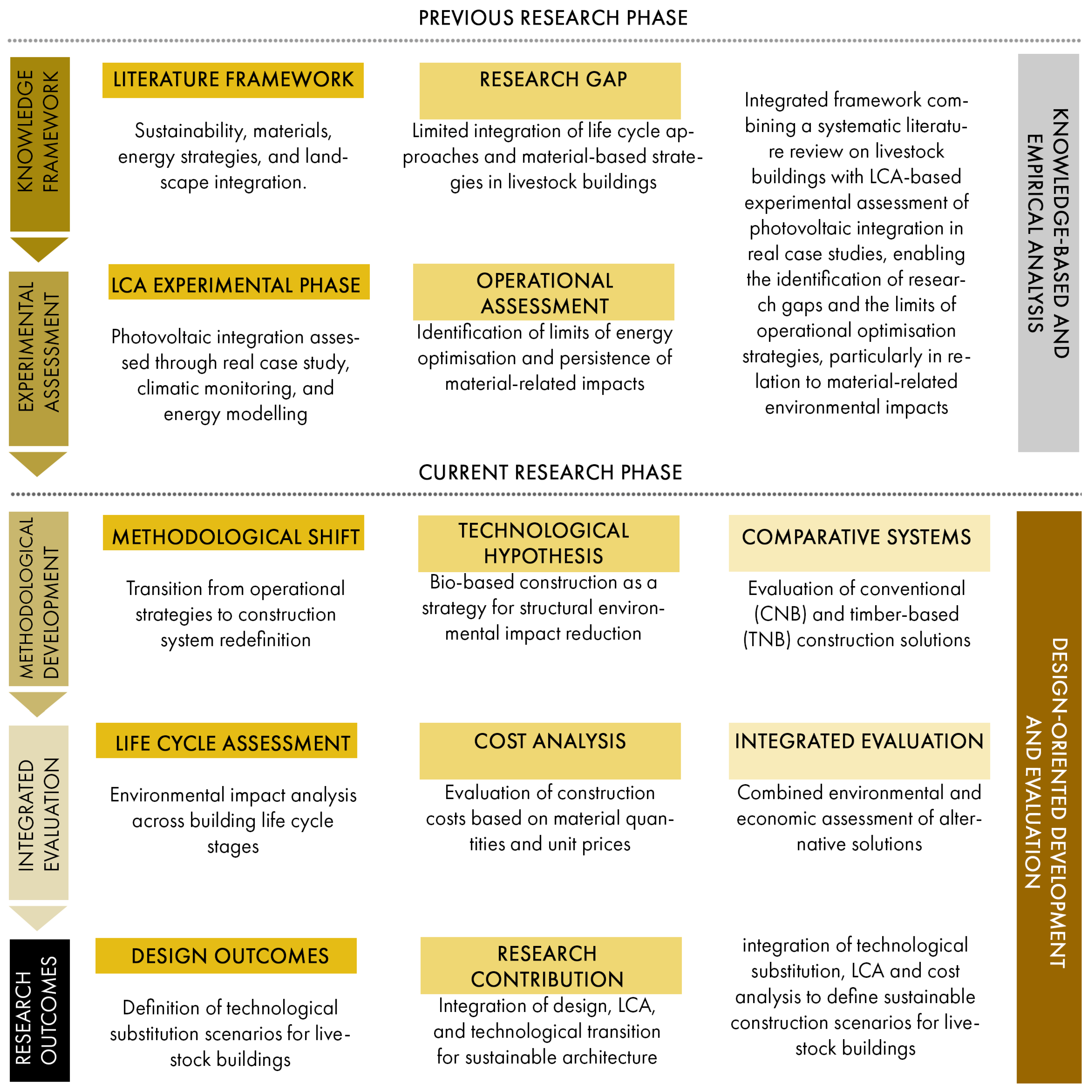
1.3. Theoretical Framework, Hypotheses and Research Questions
2. Background
2.1. Bio-Based Materials and Timber Construction in the Transition of Livestock Buildings
- (i)
- reduction of embodied emissions in materials;
- (ii)
- use of renewable and locally sourced resources;
- (iii)
- adoption of circular economy principles and design for disassembly.
2.2. Implications of Biogenic Carbon for the Life Cycle Assessment of Timber Buildings
- (i)
- Tools based on CML (EN 15804+A1) [43] or TRACI [44]. Biogenic carbon storage is reported only as additional information. Consequently, the negative emissions associated with CO2 uptake from the atmosphere are not included in A1–A3, and the emissions from its release are not included in C3. This means that neither the sequestration of atmospheric CO2 in A1 nor its release in C3 is reflected in the GWP results. This approach is referred to as the “0/0 approach” or “carbon-neutral approach” [45].
- (ii)
- Tools based on EN 15804+A2 [46]. Biogenic carbon storage is reported as part of the GWP results. The updated version of the standard divides the Global Warming Potential into four sub-categories: GWP Fossil, GWP LULUC, GWP Biogenic, and GWP Total. In this case, negative emissions are reported separately under GWP-Biogenic, while emissions from CO2 release depend on the selected end-of-life scenario and are reported in GWP Fossil. For example, incineration assigns emissions to C3, whereas landfilling assigns them to C4.
- (iii)
- DGNB and Energie Carbon/RE2020. DGNB (Deutsche Gesellschaft für Nachhaltiges Bauen—German Sustainable Building Council) is the German voluntary certification system for sustainable buildings [47]. RE2020 is a climate regulation mandating a simplified LCA for all new buildings in France [48]. In both methods, biogenic carbon storage is included in the GWP results. Negative emissions due to carbon storage are deducted in A1–A3, and the same amount of carbon is added in C3 when it is released back into the atmosphere. These approaches are referred to as the “−1/+1 approach” [46].
- (iv)
- RICS v1 (Royal Institution of Chartered Surveyors)/GLA (Greater London Authority)/Green Mark: negative emissions from CO2 sequestration are not included in A1–A3, whereas emissions from CO2 release are included in C3.
- (v)
- Dynamic methods: to overcome the limitations of traditional LCA, which does not consider the timing of carbon emissions nor the influence of biomass rotation periods, several dynamic approaches have been developed [40]. Some are based on time-dependent characterisation factors [49], while others define specific factors for biogenic CO2 that explicitly account for biomass rotation periods [50].
3. Materials and Methods
- (i)
- Life cycle assessment (LCA): The evaluation is performed using OneClick LCA software (November 2025 release) and is based on average datasets representative of the Italian context. The assessment considers the materials composing the building envelope: external walls, roof, and ground floor slab, and includes the evaluation of their energy/thermal parameters.
- (ii)
- Construction Cost: The economic assessment is mainly based on Italian regional price lists in order to evaluate the initial construction costs of poultry tunnels.
- (iii)
- Definition of intervention guidelines: The outcomes provide operational data for defining future intervention strategies for new livestock buildings with similar characteristics.
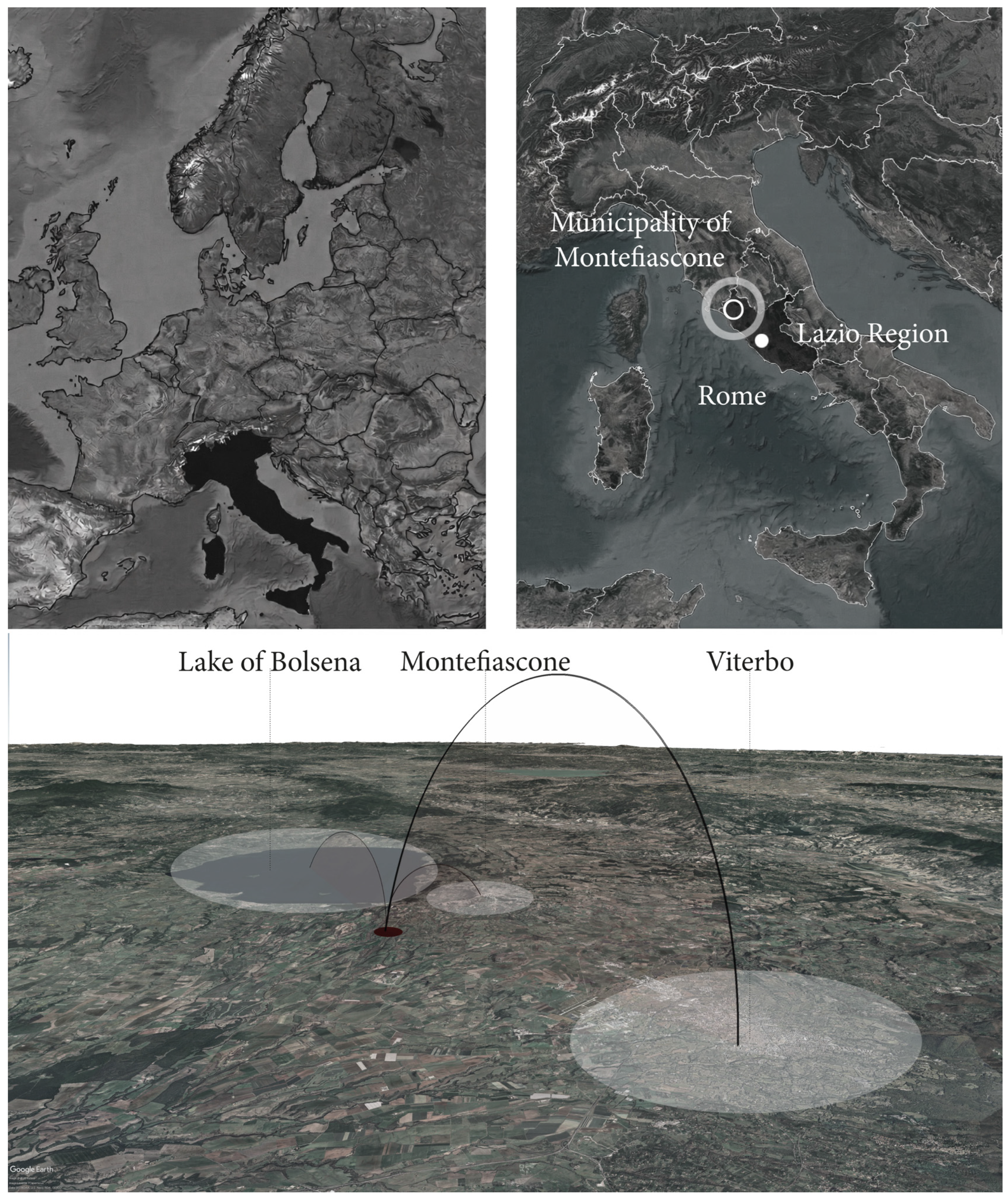
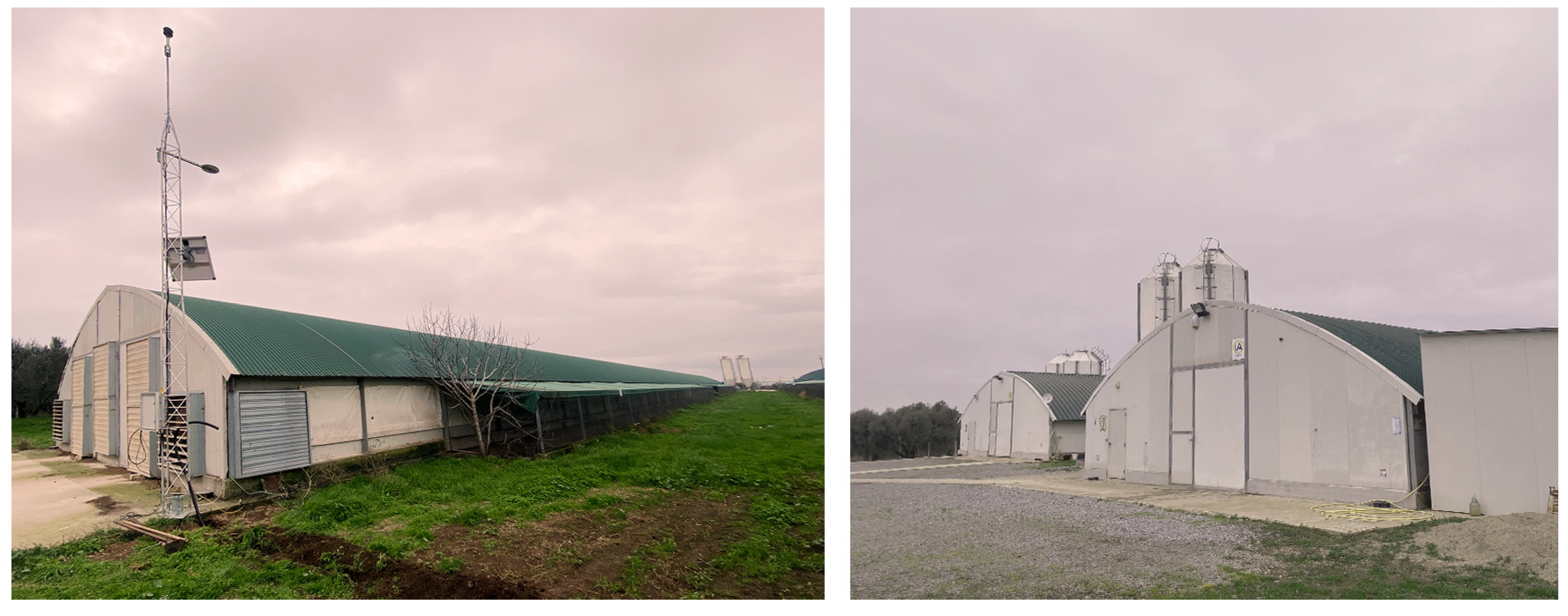
3.1. Case Study Description
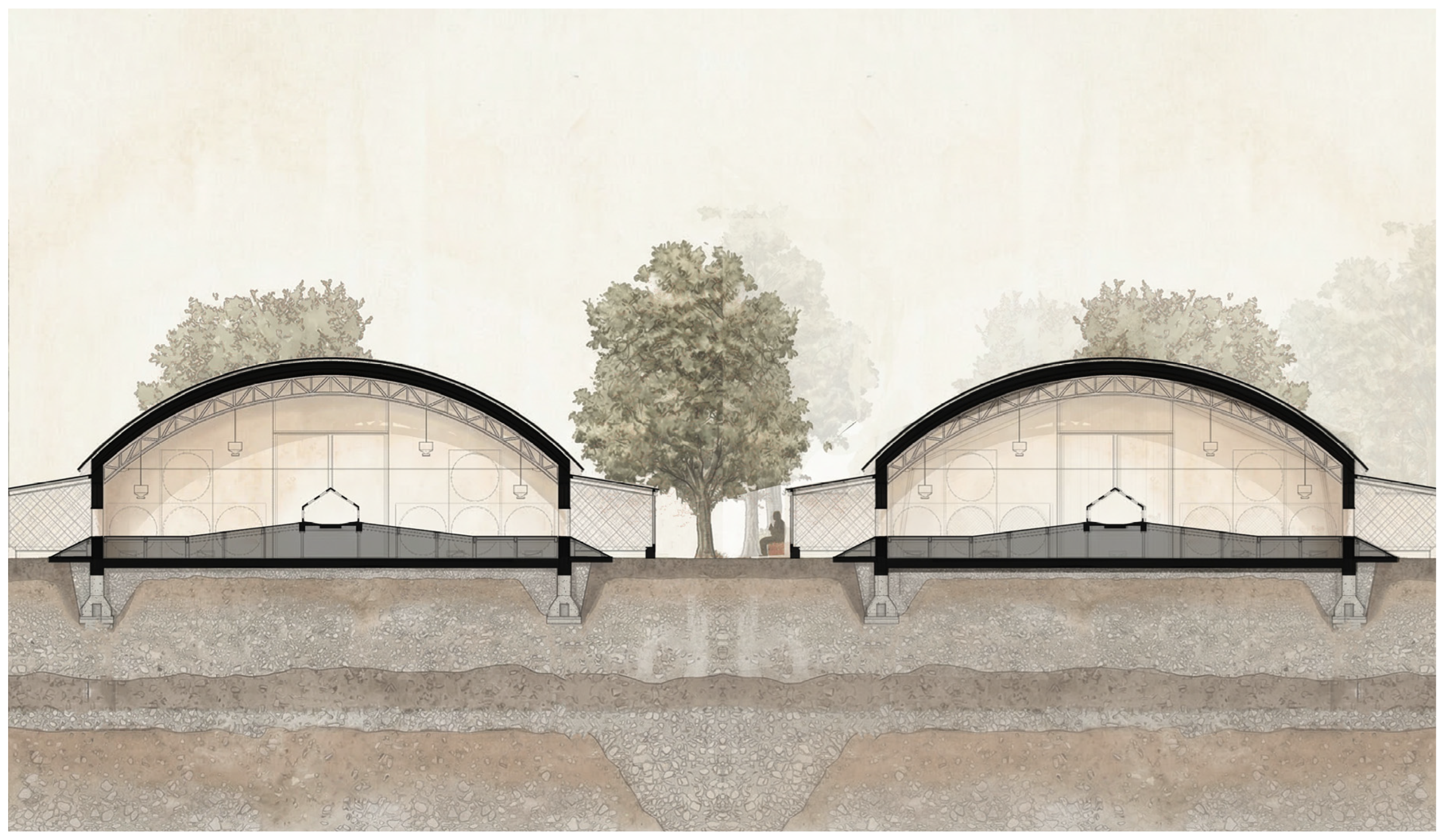
3.2. Description of the Analysed Construction System
- (i)
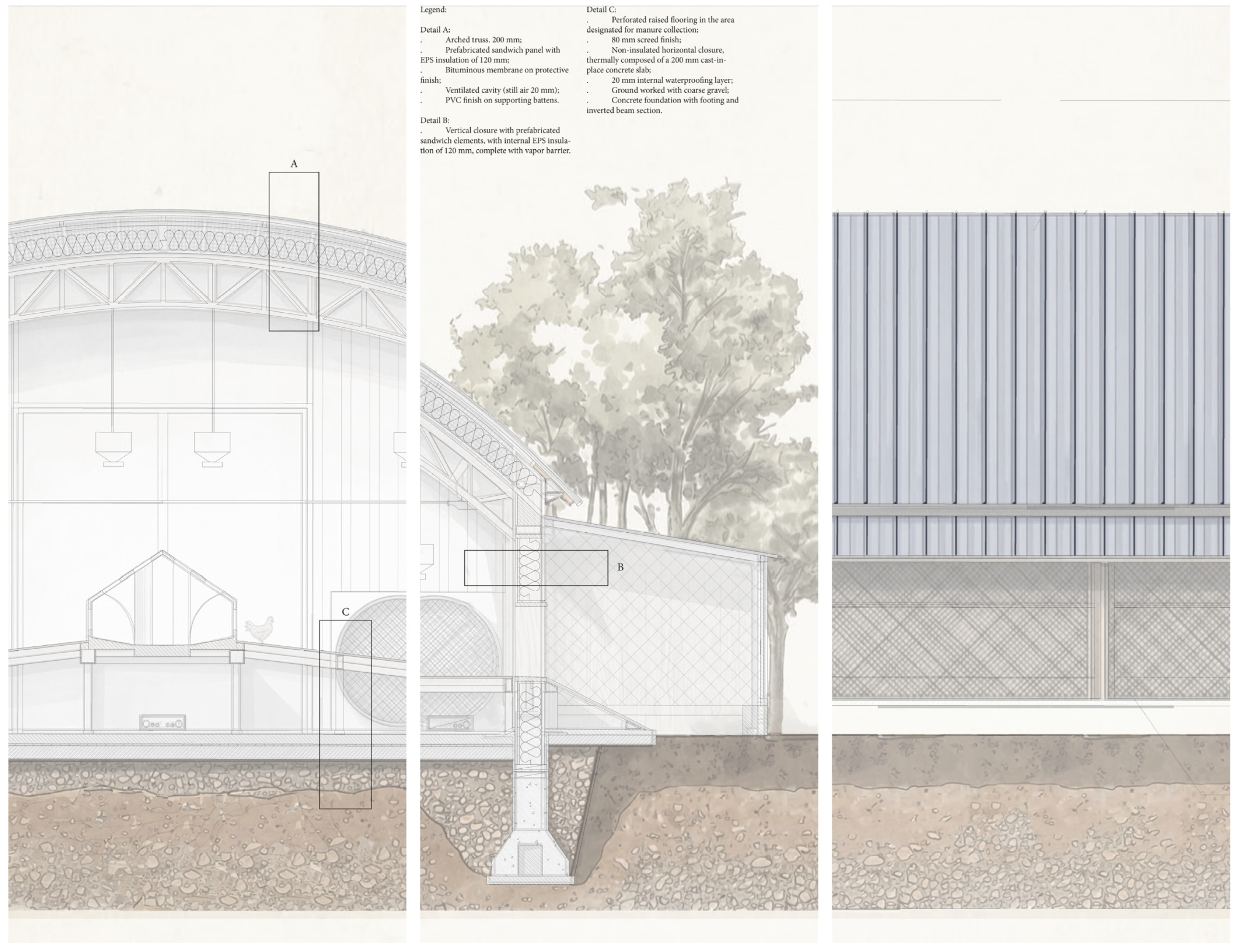
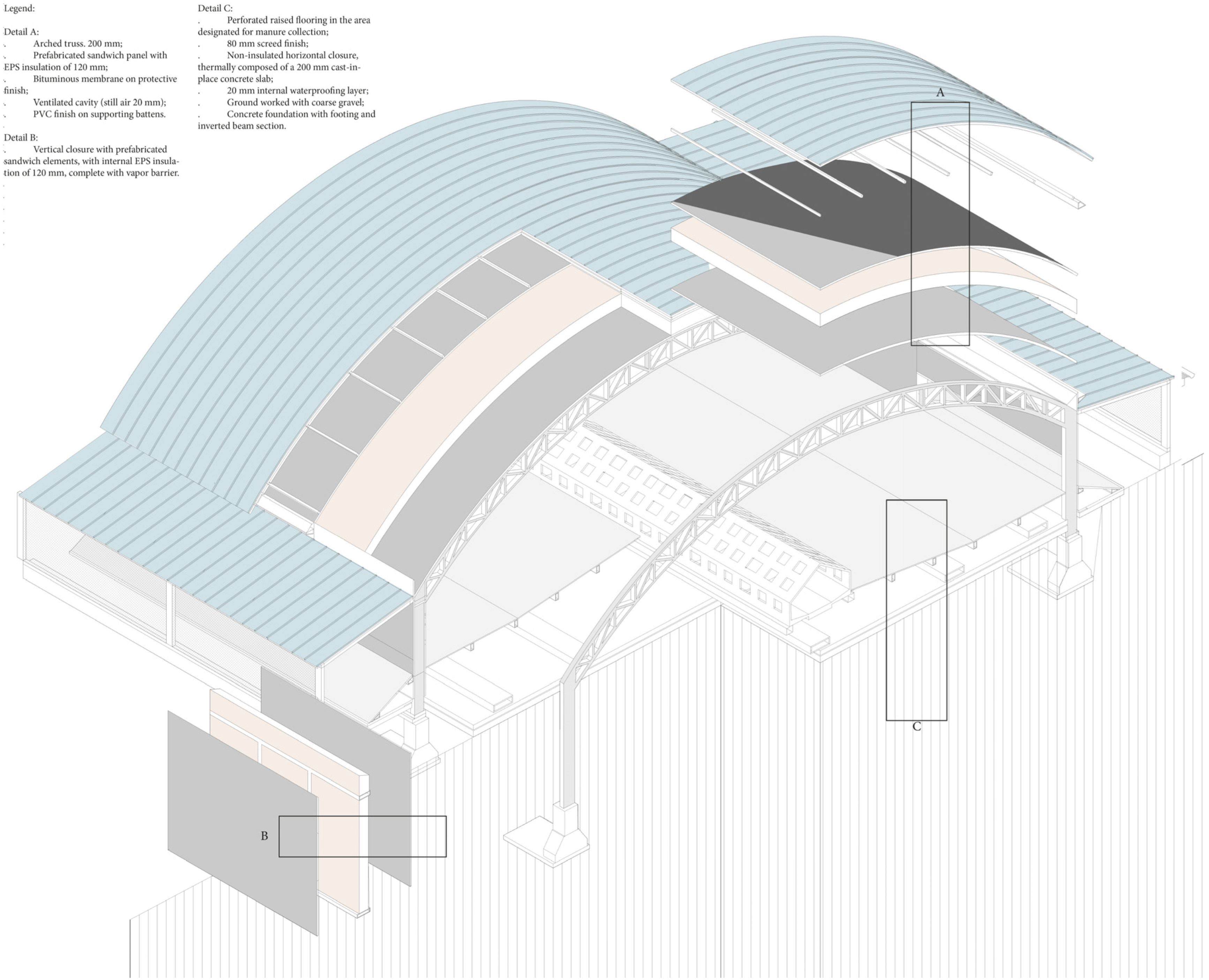
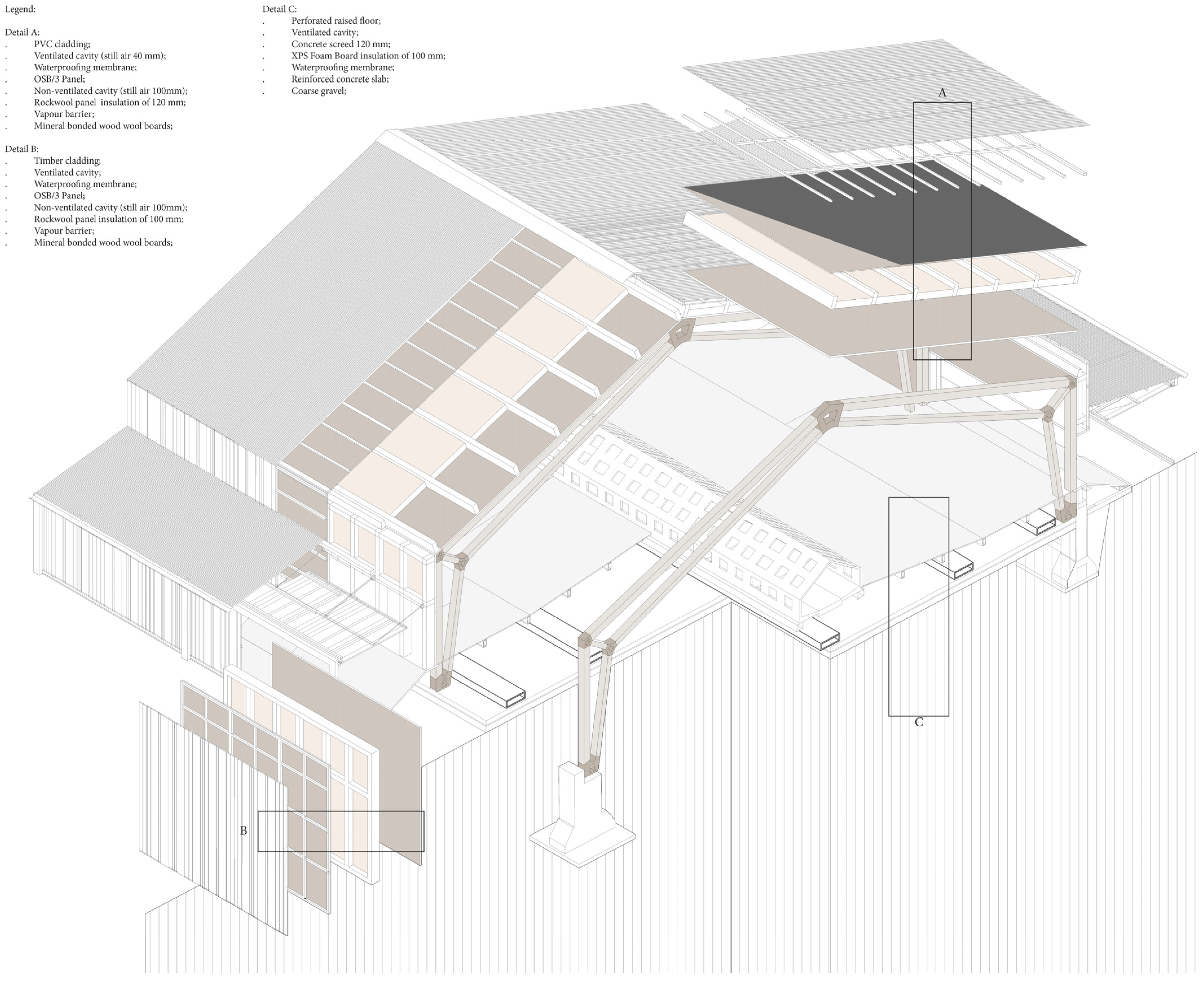
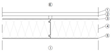
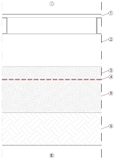
- Conventional New Building (CNB): the foundation slab consists of a layer of coarse gravel, a 30 cm reinforced concrete slab with double reinforcement (Ø12 bars spaced at 20 cm in both directions), a waterproofing membrane, an 8 cm concrete screed, and a perforated raised floor. The load-bearing structure is made of HEA 140 steel profiles for the columns and L-shaped steel sections for the roof trusses, using 100 × 100 × 10 mm members for the top and bottom chords and 50 × 50 × 6 mm sections for the vertical and diagonal elements. The external walls consist of dry-assembled panels formed by a 1 mm steel sheet with a 12 cm internal layer of expanded polystyrene insulation. The roof adopts the same construction system, complemented by an external PVC cladding to ensure protection against weathering (Table 1). This configuration reflects the prevailing industrial paradigm in rural livestock construction, characterized by lightweight assemblies, low thermal inertia and limited material reversibility.
- (ii)
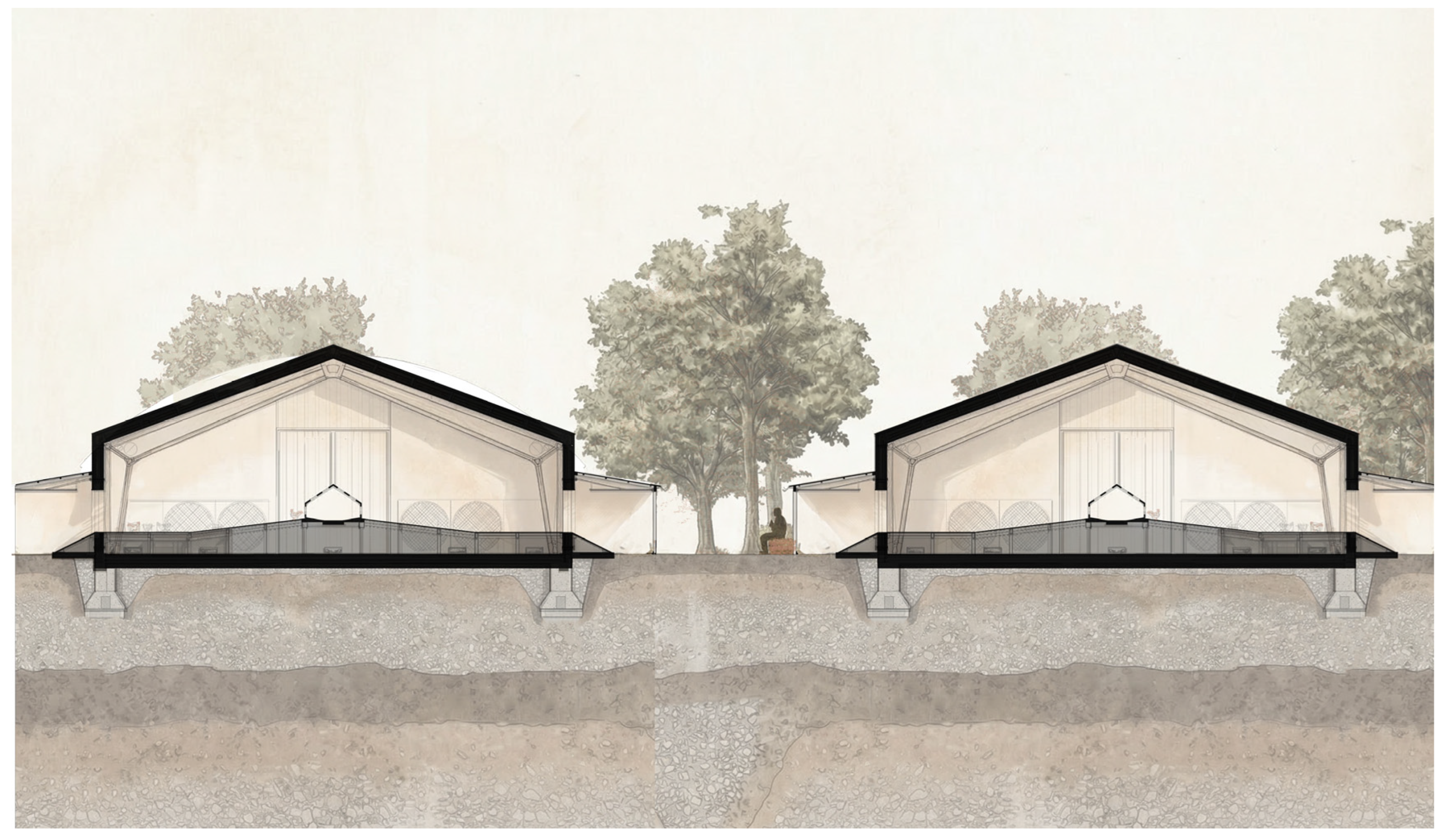
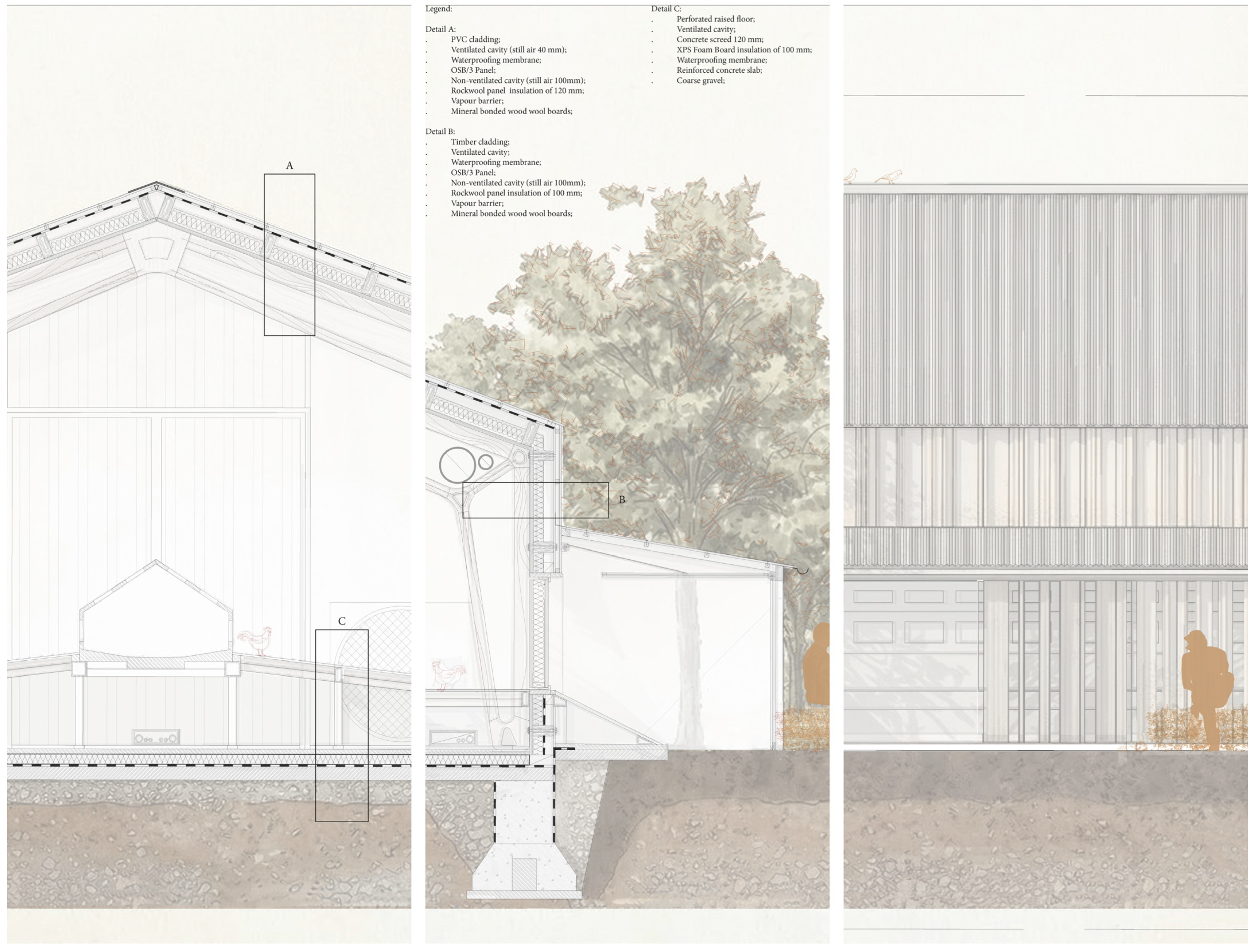
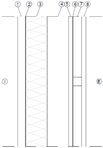
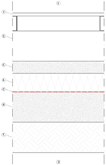
- Timber New Building (TNB): the foundation slab is constructed in the same manner as in the CNB solution, with the addition of a 12 cm XPS insulation layer. The building structure is conceived as a dry-assembled and fully demountable system, in accordance with circular economy principles [56]. It consists of a series of glued-laminated timber portal frame structures with variable cross-sections and a double-pitched roof, while the building envelope is made of prefabricated timber panels. The external walls adopt prefabricated timber-framed walls, with a 3.5 cm internal wood-wool board and a 1.8 cm external OSB/3 panel. A 14.0 cm rock wool insulation layer is placed between the timber studs. On the exterior side, the panel is protected by a waterproofing membrane and timber cladding. The roof is constructed using a similar system, with the only difference being that the external cladding is PVC to ensure greater durability than timber.
3.3. Evaluation of Environmental Impacts Based on Life Cycle Assessment
3.4. Evaluation of the Economic Feasibility of the Interventions
4. Results and Discussion
4.1. Results of the Environmental Impacts Based on Life Cycle Assessment
4.2. Results of the Economic Assessment
4.3. Critical Discussion and Design Implications for Bio-Based Transition in Rural Production Buildings
5. Conclusions
Author Contributions
Funding
Institutional Review Board Statement
Informed Consent Statement
Data Availability Statement
Acknowledgments
Conflicts of Interest
References
- Picuno, P. Farm Buildings as Drivers of the Rural Environment. Front. Built Environ. 2022, 8, 693876. [Google Scholar] [CrossRef]
- Cogato, A.; Cei, L.; Marinello, F.; Pezzuolo, A. The Role of Buildings in Rural Areas: Trends, Challenges, and Innovations for Sustainable Development. Agronomy 2023, 13, 1961. [Google Scholar] [CrossRef]
- Frontuto, V.; De Montis, A.; Ledda, A.; Serra, V.; Ganciu, A. The visual impact of agricultural sheds on rural landscapes. Land Use Policy 2020, 94, 104337. [Google Scholar] [CrossRef]
- Biancucci, A.; Oddo, S. “Lessico Famigliare”: Toward a New Paradigm of Spontaneous Rural Architecture in North-Western Sicily: From Historical Testimony of Peasant Culture to Sustainable Resource. In Conservation of Architectural Heritage (CAH 2022); Germanà, M.L., Akagawa, N., Versaci, A., Cavalagli, N., Eds.; Advances in Science, Technology & Innovation; Springer: Cham, Switzerland, 2024; pp. 273–286. [Google Scholar] [CrossRef]
- Koesling, M.; Flaten, O.; Lien, G. Factors influencing the adoption of new building technologies in agricultural buildings. Energy Build. 2016, 127, 107–117. [Google Scholar] [CrossRef]
- Vilches, A.; Garcia-Martinez, A.; Sanchez-Montañés, B. Life Cycle Assessment (LCA) of Building Refurbishment: A Literature Review. Energy Build. 2017, 135, 286–301. [Google Scholar] [CrossRef]
- Bigiotti, S.; Santarsiero, M.L.; Del Monaco, A.I.; Marucci, A. Eco-Efficient Retrofitting of Rural Heritage: A Systematic Review of Sustainable Strategies. Energies 2025, 18, 4065. [Google Scholar] [CrossRef]
- Bigiotti, S.; Costantino, C.; Patriarca, A.; Mancini, G.; Provolo, G.; Recanatesi, F.; Ripa, M.N.; Marucci, A. Energy Efficiency and Environmental Sustainability in Rural Buildings: A Life Cycle Assessment of Photovoltaic Integration in Poultry Tunnels—A Case Study in Central Italy. Appl. Sci. 2025, 15, 5094. [Google Scholar] [CrossRef]
- Bourbia, S.; Kazeoui, H.; Belarbi, R. A review on recent research on bio-based building materials and their applications. Mater. Renew. Sustain. Energy 2023, 12, 117–139. [Google Scholar] [CrossRef]
- Zohourian, M.; Pamidimukkala, A.; Kermanshachi, S.; Almaskati, D. Modular Construction: A Comprehensive Review. Buildings 2025, 15, 2020. [Google Scholar] [CrossRef]
- Bigiotti, S.; Patriarca, A.; Mancini, G.; Recanatesi, F.; Ripa, M.N.; Marucci, A. Monitoring and Energy Optimization of Agricultural Shelters: Case Study of Poultry Tunnels in the Province of Viterbo, Italy. In Proceedings of the AIIA 2025 Conference, Reggio Calabria, Italy; 2025; p. 277. Available online: https://aiiareggiocalabria2025.unirc.it/wp-content/uploads/2025/08/Book-of-Abstract-AIIA-2025.pdf (accessed on 23 March 2026).
- Isola, D.; Bigiotti, S.; Marucci, A. Livestock Buildings in a Changing World: Building Sustainability Challenges and Landscape Integration Management. Sustainability 2025, 17, 5644. [Google Scholar] [CrossRef]
- Kim, S. Prefabricated and Modularized Residential Construction: A Review of Present Status, Opportunities, and Future Challenges. Buildings 2025, 15, 2889. [Google Scholar] [CrossRef]
- Zisis, F.; Giamouri, E.; Mitsiopoulou, C.; Christodoulou, C.; Kamilaris, C.; Mavrommatis, A.; Pappas, A.C.; Tsiplakou, E. An Overview of Poultry Greenhouse Gas Emissions in the Mediterranean Area. Sustainability 2023, 15, 1941. [Google Scholar] [CrossRef]
- Liu, H.; Wang, Z.; Du, X.; Qi, F.; Wang, C.; Shi, Z. Decarbonizing Agricultural Buildings: A Life-Cycle Carbon Emissions Assessment of Dairy Barns. Agriculture 2025, 15, 1645. [Google Scholar] [CrossRef]
- European Commission. The European Green Deal; European Commission: Brussels, Belgium, 2019. [Google Scholar] [CrossRef]
- Salama, A.M. Methodological research in architecture and allied disciplines: Philosophical positions, frames of reference, and spheres of inquiry. Archnet-IJAR Int. J. Archit. Res. 2019, 13, 8–24. [Google Scholar] [CrossRef]
- Bigiotti, S.; Santarsiero, M.L.; Costantino, C.; Marucci, A. Photovoltaic Technology and Rural Landscapes: A Systematic Literature Review on Challenges and Sustainable Integration. Energies 2025, 18, 2095. [Google Scholar] [CrossRef]
- D’Agostino, D.; Mazzarella, L. What is a Nearly zero energy building? Overview, implementation and comparison of definitions. J. Build. Eng. 2019, 21, 200–212. [Google Scholar] [CrossRef]
- Kibert, C.J.; Fard, M.M. Differentiating among low-energy, low-carbon and net-zero-energy building strategies for policy formulation. Build. Res. Inf. 2012, 40, 625–637. [Google Scholar] [CrossRef]
- Benni, S.; Carfagna, E.; Torreggiani, D.; Maino, E.; Bovo, M.; Tassinari, P. Multidimensional measurement of the level of consistency of farm buildings with rural heritage: A methodology tested on an Italian case study. Sustainability 2019, 11, 4242. [Google Scholar] [CrossRef]
- Wang, Y.; Li, B.; Zheng, W. Optimum insulation thickness for the sandwich structure livestock buildings external envelopes in different climate regions of China. Int. J. Agric. Biol. Eng. 2020, 13, 29–41. [Google Scholar] [CrossRef]
- Harrouz, J.P.; Al Assaad, D.; Orabi, M.; Ghali, K.; Ouahrani, D.; Ghaddar, N. Modeling and optimization of poultry house passive cooling strategies in semiarid climates. Int. Energy Res. 2021, 45, 20795–20811. [Google Scholar] [CrossRef]
- Bigiotti, S.; Costantino, C.; Santarsiero, M.L.; Marucci, A. A Methodological Approach for Assessing the Interaction Between Rural Landscapes and Built Structures: A Case Study ofWinery Architecture in Tuscany, Italy. Land 2025, 14, 152. [Google Scholar] [CrossRef]
- De Masi, R.F.; Ruggiero, S.; Tariello, F.; Vanoli, G.P. Passive envelope solutions to aid design of sustainable livestock buildings in Mediterranean climate. J. Clean. Prod. 2021, 311, 127444. [Google Scholar] [CrossRef]
- Liu, X.; Zuo, Y.; Yin, Z.; Liang, C.; Feng, G.; Yang, X. Research on an evaluation system of the application effect of ground source heat pump systems for green buildings in China. Energy 2023, 262, 125374. [Google Scholar] [CrossRef]
- Hu, X.; Xiang, Y.; Zhang, H.; Lin, Q.; Wang, W.; Wang, H. Active–passive combined energy-efficient retrofit of rural residence with non-benchmarked construction: A case study in Shandong province, China. Energy Rep. 2021, 7, 1360–1373. [Google Scholar] [CrossRef]
- Marszal, A.J.; Heiselberg, P.; Bourrelle, J.S.; Musall, E.; Voss, K.; Sartori, I.; Napolitano, A. Zero Energy Building—A review of definitions and calculation methodologies. Energy Build. 2011, 43, 971–979. [Google Scholar] [CrossRef]
- Dorieh, A.; Pahlavan, F.; Hajkova, K.; Hsek, Š.; Pour, F.M.; Fini, E.H. Advancing Sustainable Building Materials: Reducing Formaldehyde Emissions in Medium Density Fiber Boards with Lignin Nanoparticles. Adv. Sustain. Syst. 2024, 8, 2400102. [Google Scholar] [CrossRef]
- Torreggiani, D.; Tassinari, P. Landscape quality of farm buildings: The evolution of the design approach in Italy. J. Cult. Herit. 2012, 13, 59–68. [Google Scholar] [CrossRef]
- Strelets, K.; Zaborova, D.; Kokaya, D.; Petrochenko, M.; Melekhin, E. Building Information Modeling (BIM)-Based Building Life Cycle Assessment (LCA) Using Industry Foundation Classes (IFC) File Format. Sustainability 2025, 17, 2848. [Google Scholar] [CrossRef]
- Kaynak, E.; Piri, I.S.; Das, O. Revisiting the Basics of Life Cycle Assessment and Lifecycle Thinking. Sustainability 2025, 17, 7444. [Google Scholar] [CrossRef]
- Garcés, G.; Montalbán-Domingo, L.; Sanz-Benlloch, A. Construction 4.0 technologies and their contribution to sustainability in building construction: A comprehensive and comparative assessment. J. Build. Eng. 2026, 118, 115004. [Google Scholar] [CrossRef]
- Poorisat, T.; Aigwi, I.E.; Doan, D.T.; GhaffarianHoseini, A. Unlocking the potentials of sustainable building designs and practices: A Systematic Review. Build. Environ. 2024, 266, 112069. [Google Scholar] [CrossRef]
- Zwolińska-Glądys, K.; Łuczak, R.; Zyczkowski, P.; Kuczera, Z.; Borowski, M. Sustainable Performance Building Design as a Driver of Post-Industrial Urban Transformation: Case Studies from Katowice, Poland. Appl. Sci. 2025, 15, 12061. [Google Scholar] [CrossRef]
- Arriaza, M.; Cañas-Ortega, J.F.; Cañas-Madueño, J.A.; Ruiz-Avilés, P. Assessing the visual quality of rural landscapes. Landsc. Urban Plan. 2004, 69, 115–125. [Google Scholar] [CrossRef]
- Brandão, M.; Levasseur, A.; Kirschbaum, M.U.F.; Weidema, B.P.; Cowie, A.L.; Jørgensen, S.V.; Hauschild, M.Z.; Pennington, D.W.; Chomkhamsri, K. Key issues and options in accounting for carbon sequestration and temporary storage in life cycle assessment and carbon footprinting. Int. J. Life Cycle Assess. 2013, 18, 230–240. [Google Scholar] [CrossRef]
- Churkina, G.; Organschi, A.; Reyer, C.P.; Ruff, A.; Vinke, K.; Liu, Z.; Reck, B.K.; Graedel, T.E.; Schellnhuber, H.J. Buildings as a global carbon sink. Nat. Sustain. 2020, 3, 269–276. [Google Scholar] [CrossRef]
- Levasseur, A.; Lesage, P.; Margni, M.; Samson, R. Biogenic carbon and temporary storage addressed with dynamic life cycle assessment. J. Ind. Ecol. 2013, 17, 117–128. [Google Scholar] [CrossRef]
- Pittau, F.; Krause, F.; Lumia, G.; Habert, G. Fast-growing bio-based materials as an opportunity for storing carbon in exterior walls. Build. Environ. 2018, 129, 117–129. [Google Scholar] [CrossRef]
- Hansen, R.N.; Rasmussen, F.N.; Ryberg, M.; Birgisdottir, H. Wood as a carbon mitigating building material: A review of consequential LCA and biogenic carbon characteristics. IOP Conf. Ser. Earth Environ. Sci. 2022, 1078, 012066. [Google Scholar] [CrossRef]
- Vogtländer, J.G.; van der Velden, N.M.; van der Lugt, P. Carbon sequestration in LCA, a proposal for a new approach based on the global carbon cycle; cases on wood and on bamboo. Int. J. Life Cycle Assess. 2014, 19, 13–23. [Google Scholar] [CrossRef]
- EN 15804:2012+A1:2013; Sustainability of Construction Works—Environmental Product Declarations—Core Rules for the Product Category of Construction Products. CEN: Tokyo, Japan, 2013.
- Tool for Reduction and Assessment of Chemicals and Other Environmental Impacts (TRACI). Available online: https://www.epa.gov/chemical-research/tool-reduction-and-assessment-chemicals-and-other-environmental-impacts-traci (accessed on 5 December 2025).
- Hoxha, E.; Passer, A.; Mendes Saade, M.R.; Trigaux, D.; Shuttleworth, A.; Pittau, F.; Allacker, K.; Habert, G. Biogenic carbon in buildings: A critical overview of LCA methods. Build. Cities 2020, 1, 504–524. [Google Scholar] [CrossRef]
- EN 15804:2012+A2:2019; Sustainability of Construction Works—Environmental Product Declaration—Core Rules for the Product Category of Construction Product. CEN: Tokyo, Japan, 2019.
- Deutsche Gesellschaft für Nachhaltiges Bauen. Available online: https://www.dgnb.de/de (accessed on 5 December 2025).
- Réglementation Environnementale RE2020. Available online: https://www.ecologie.gouv.fr/politiques-publiques/reglementation-environnementale-re2020 (accessed on 5 December 2025).
- Levasseur, A.; Lesage, P.; Margni, M.; Deschênes, L.; Samson, R. Considering time in LCA: Dynamic LCA and its application to global warming impact assessments. Environ. Sci. Technol. 2010, 44, 3169–3174. [Google Scholar] [CrossRef] [PubMed]
- Guest, G.; Cherubini, F.; Strømman, A.H. Global warming potential of carbon dioxide emissions from biomass stored in the anthroposphere and used for bioenergy at end of life. J. Ind. Ecol. 2013, 17, 20–30. [Google Scholar] [CrossRef]
- Röck, M.; Saade, M.R.M.; Balouktsi, M.; Rasmussen, F.N.; Birgisdottir, H.; Frischknecht, R.; Habert, G.; Lützkendorf, T.; Passer, A. Embodied GHG Emissions of Buildings—The hidden challenge for effective climate change mitigation. Appl. Energy 2020, 258, 114107. [Google Scholar] [CrossRef]
- Andersen, J.H.; Rasmussen, N.L.; Ryberg, M.W. Comparative life cycle assessment of cross laminated timber building and concrete building with special focus on biogenic carbon. Energy Build. 2021, 254, 111604. [Google Scholar] [CrossRef]
- Andersen, C.E.; Rasmussen, F.N.; Habert, G.; Birgisdóttir, H. Embodied GHG Emissions of Wooden Buildings—Challenges of Biogenic Carbon Accounting in Current LCA Methods. Front. Built Environ. 2021, 7, 729096. [Google Scholar] [CrossRef]
- Z1 Energetic Simulation Realized with Edilclima EC700 v.14.25.22. Available online: https://www.edilclima.it/software-termotecnica/prog-termotecnica-energetica/scheda/700 (accessed on 5 December 2025).
- Italian Government. Decreto Ministeriale 26 Giugno 2015. In Applicazione Delle Metodologie Di Calcolo Delle Prestazioni Energetiche e Definizione Delle Prescrizioni e Dei Requisiti Minimi Degli Edifici; Governo Italiano: Rome, Italy, 2015. [Google Scholar]
- Costantino, C.; Benedetti, A.C.; Gulli, R. The Role of Circular Design Principles in the Language of Residential Architecture. A Reflection on the Implications that Technical Aspects Bring to the Contemporary Way of Building. In Contemporary Heritage Lexicon (Springer Tracts in Civil Engineering); Springer Nature: Cham, Switzerland, 2024; pp. 1–23. [Google Scholar] [CrossRef]
- EN 15978; Sustainability of Construction Works—Assessment of 983 Environmental Performance of Buildings—Calculation Method 2012. CEN: Brussels, Belgium, 2012.
- Dodd, N.; Donatello, S.; Cordella, M. Level(s) Indicator 6.1: Life Cycle Costs User Manual: Introductory Briefing, Instructions and Guidance (Publication Version 1.1). 2021. Available online: https://susproc.jrc.ec.europa.eu/product-bureau/sites/default/files/2021-01/UM3_Indicator_6.1_v1.1_21pp.pdf (accessed on 15 July 2024).
- Rigamonti, L.; Pantini, S.; Borghi, G. Relazione Finale, Valutazione con metodologia LCA (Life Cycle Assessment) dei flussi e del destino dei rifiuti da costruzione e demolizione. Rep. Lomb. Reg. 2017. Available online: https://www.aware.polimi.it/valutazione-con-metodologia-lca-life-cycle-assessment-dei-flussi-e-del-destino-dei-rifiuti-da-costruzione-e-demolizione/ (accessed on 6 December 2025).
- Italian Government. Legge 12 Febbraio 1994, n. 109: “Norme per l’edilizia e i Lavori Pubblici”; Gazzetta Ufficiale n. 45; Italian Government: Rome, Italy, 1994. Available online: https://www.gazzettaufficiale.it/atto/serie_generale/caricaDettaglioAtto/originario?atto.dataPubblicazioneGazzetta=1994-02-19&atto.codiceRedazionale=094G0127&elenco30giorni=false (accessed on 6 December 2025).
- Bragadin, M.A.; Guardigli, L.; Calistri, M.; Ferrante, A. Demolishing or Renovating? Life Cycle Analysis in the Design Process for Building Renovation: The ProGETonE Case. Sustainability 2023, 15, 8614. [Google Scholar] [CrossRef]
- Regione Emilia-Romagna, Elenco Regionale Prezzi. Available online: https://territorio.regione.emilia-romagna.it/osservatorio/elenco_regionale_prezzi (accessed on 12 November 2025).
- Costantino, C.; Bigiotti, S.; Marucci, A.; Gulli, R. Long-Term Comparative Life Cycle Assessment, Cost, and Comfort Analysis of Heavyweight vs. Lightweight Construction Systems in a Mediterranean Climate. Sustainability 2024, 16, 8959. [Google Scholar] [CrossRef]
- European Commission: Directorate-General for Climate Action. Going Climate-Neutral by 2050—A Strategic Long-Term Vision for a Prosperous, Modern, Competitive and Climate-Neutral EU Economy; Publications Office of the European Union: Luxembourg, 2019. [Google Scholar] [CrossRef]
- Costantino, C.; Calleo, A.; Benedetti, A.C.; Bartolomei, C.; Predari, G. Fostering Resilient and Sustainable Rural Development through Nature-Based Tourism, Digital Technologies, and Built Heritage Preservation: The Experience of San Giovanni Lipioni, Italy. Sustainability 2024, 16, 5588. [Google Scholar] [CrossRef]





| Code | Hypothesis |
|---|---|
| H1 | The early-stage application of Life Cycle Assessment (LCA) within the design process enables the orientation of technological and material choices towards solutions that are genuinely sustainable across the entire life cycle, thereby significantly influencing embodied emissions. |
| H2 | The replacement of conventional prefabricated systems with a bio-based technology designed according to circular economy principles can lead to a substantial reduction in Global Warming Potential (GWP) and other environmental indicators, while maintaining an economic differential compatible with the constraints of small and medium-sized agricultural enterprises. |
| H3 | The integration of technological innovation, building envelope performance, and architectural design can contribute not only to the reduction of environmental impacts, but also to an improved qualitative integration of livestock buildings within the rural landscape. |
| Code | Research Question |
|---|---|
| RQ1 | To what extent can a bio-based construction technology, as an alternative to standard industrial prefabricated systems, reduce Global Warming Potential and overall environmental impacts over a 30-year assessment period? |
| RQ2 | Is the cost differential between the conventional system and the proposed alternative economically viable in the short to medium term, considering both construction cost structures and the performance quality of the building envelope? |
| RQ3 | To what extent can the transfer of bio-based building solutions to the livestock sector suggest a potential pathway for technological and environmental innovation, including qualitative implications for the agricultural landscape? |
| Building Components | Scenario CNB | ||||||||
|---|---|---|---|---|---|---|---|---|---|
| ID Layer | Tot. Th. [mm] | Area [m2] | U [W/m2 K] | Yie [W/m2 K] | k1 [kJ/m2 K] | S. Mass [kg/m2] | At. Fct. [-] | Perm. [10−12 kg/sm2 Pa] | |
 External walls |
| 121 | 1154.50 | 0.246 | 0.245 | 2.992 | 10.00 | 0.996 | 0.020 |
 Roof |
| 161 | 1821.76 | 0.232 | 0.226 | 3.795 | 37.00 | 0.973 | 0.018 |
 Ground Floor Slab |
| 887 | 1695.00 | 0.886 | 0.025 | 38.051 | 1020.00 | 0.028 | 0.040 |
| Building Components | Scenario CNB | ||||||||
|---|---|---|---|---|---|---|---|---|---|
| ID Layer | Tot. Th. [mm] | Area [m2] | U [W/m2 K] | Yie [W/m2 K] | k1 [kJ/m2 K] | S. Mass [kg/m2] | At. Fct. [-] | Perm. [10−12 kg /sm2 Pa] | |
 External walls |
| 313 | 972.48 | 0.245 | 0.176 | 19.679 | 45.00 | 0.747 | 21.948 |
 Roof |
| 353 | 1833.40 | 0.201 | 0.137 | 20.380 | 67.00 | 0.728 | 21.820 |
 Ground Floor Slab |
| 1007 | 1695.00 | 0.244 | 0.001 | 41.959 | 1089.00 | 0.006 | 0.040 |
| Description | Unit | Quantity | Distance [km] | Service Life | Waste Rate | EOL Process | Scenario |
|---|---|---|---|---|---|---|---|
| Rebar | t | 29.09 | 370 | Building | 4.85% | Recycling 90% | CNB/TNB |
| Concrete C 16/20 | m3 | 155.47 | 60 | Building | 4% | Crushing | CNB/TNB |
| Concrete C 25/30 | m3 | 506.40 | 60 | Building | 4% | Crushing | CNB/TNB |
| Gravel | m3 | 339.00 | 40 | Building | 0% | Reuse | CNB/TNB |
| Bentonite membrane | t | 11.75 | 430 | 30 | 10% | Incineration | CNB/TNB |
| Wooden formwork | m2 | 108.52 | 340 | Building | 16.7% | Incineration | CNB/TNB |
| Steel frame | t | 57.79 | 330 | Building | 3.3% | Recycling 90% | CNB |
| Structural timber | m3 | 28.10 | 220 | Building | 17.9% | Incineration | TNB |
| OSB/3 panel | m3 | 50.51 | 340 | Building | 16.7% | Incineration | TNB |
| Glulam frame | m3 | 128.65 | 220 | Building | 16.7% | Incineration | TNB |
| PVC roofing elements | kg | 3096.98 | 430 | 30 | 7.5% | Incineration | CNB/TNB |
| Stone wool insulation | m3 | 323.32 | 60 | 30 | 4% | Landfilling | TNB |
| EPS insulation | kg | 4464.36 | 430 | 30 | 4% | Incineration | CNB |
| Steel sheeting | t | 54.40 | 330 | 30 | 7.5% | Recycling 90% | CNB |
| Vapour barrier membrane | m2 | 2805.88 | 90 | 20 | 10% | Landfilling | TNB |
| Waterproofing membrane | m2 | 2805.88 | 90 | 20 | 10% | Landfilling | TNB |
| Raised floor system | kg | 8284.10 | 370 | 25 | 5% | Recycling 90% | CNB/TNB |
| PV modules | m2 | 120 | 320 | 20 | 0% | Recycling 90% | CNB/TNB |
| Lithium Battery | unit | 60 | 320 | 20 | 0% | Recycling 90% | CNB/TNB |
| PV steel structure | t | 5.18 | 320 | 20 | 1% | Recycling 90% | CNB/TNB |
| Impact Categories A1–C4 | ||||||||
| Construction System | GWP [kgCO2eq/m2] | ODP [kgCFC11eq/m2] | AP [kgSO2eq/m2] | EP [kgPO4eq/m2] | FO [kgCH4eq/m2] | PE_ren [MJ/m2] | PE_nren [MJ/m2] | PE [MJ/m2] |
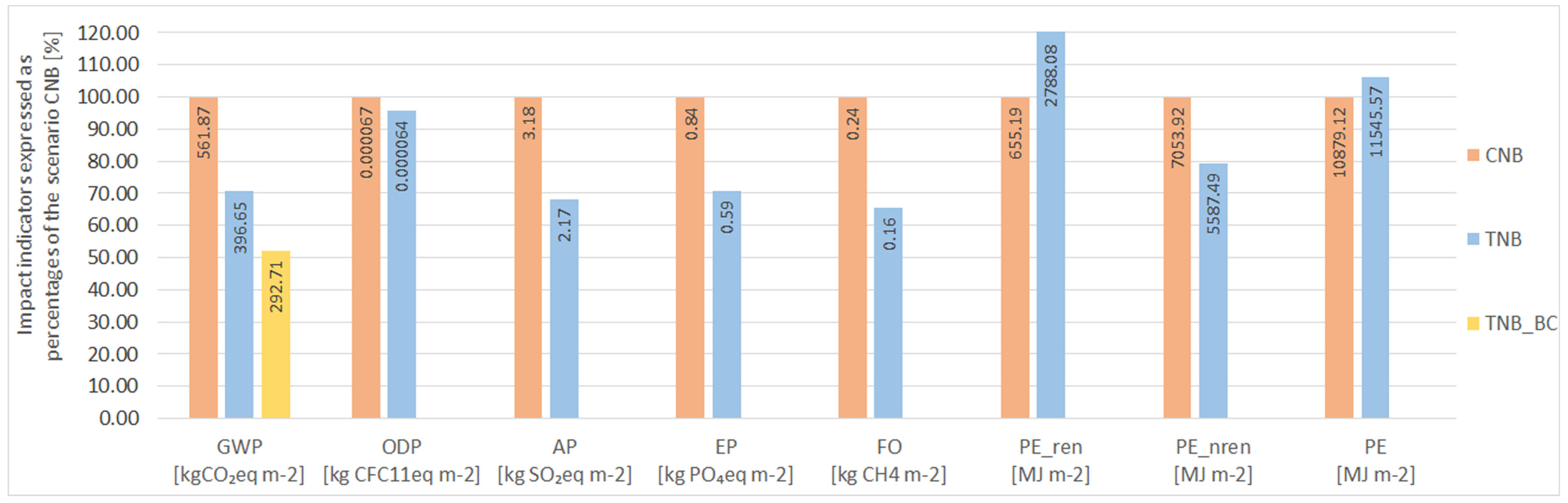
| Conventional (CNB) | 561.87 | 0.000067 | 3.18 | 0.84 | 0.24 | 655.19 | 7053.92 | 10,879.12 |
| Timber (TNB) | 396.65 | 0.000064 | 2.17 | 0.59 | 0.16 | 2788.08 | 5587.49 | 11,545.57 |
| −29.41% | −4.17% | −31.92% | −29.36% | −34.39% | +325.54% | −20.79% | +6.13% | |
| Timber (TNB) | 292.71 | 0.000064 | 2.17 | 0.59 | 0.16 | 2788.08 | 5587.49 | 11,545.57 |
| Biogenic | −47.90% | −4.17% | −31.92% | −29.36% | −34.39% | +325.54% | −20.79% | +6.13% |
| Impact Categories A1–C4 + D | ||||||||
| Construction System | GWP [kgCO2eq/m2] | ODP [kgCFC11eq/m2] | AP [kgSO2eq/m2] | EP [kgPO4eq/m2] | FO [kgCH4eq/m2] | PE_ren [MJ/m2] | PE_nren [MJ/m2] | PE [MJ/m2] |
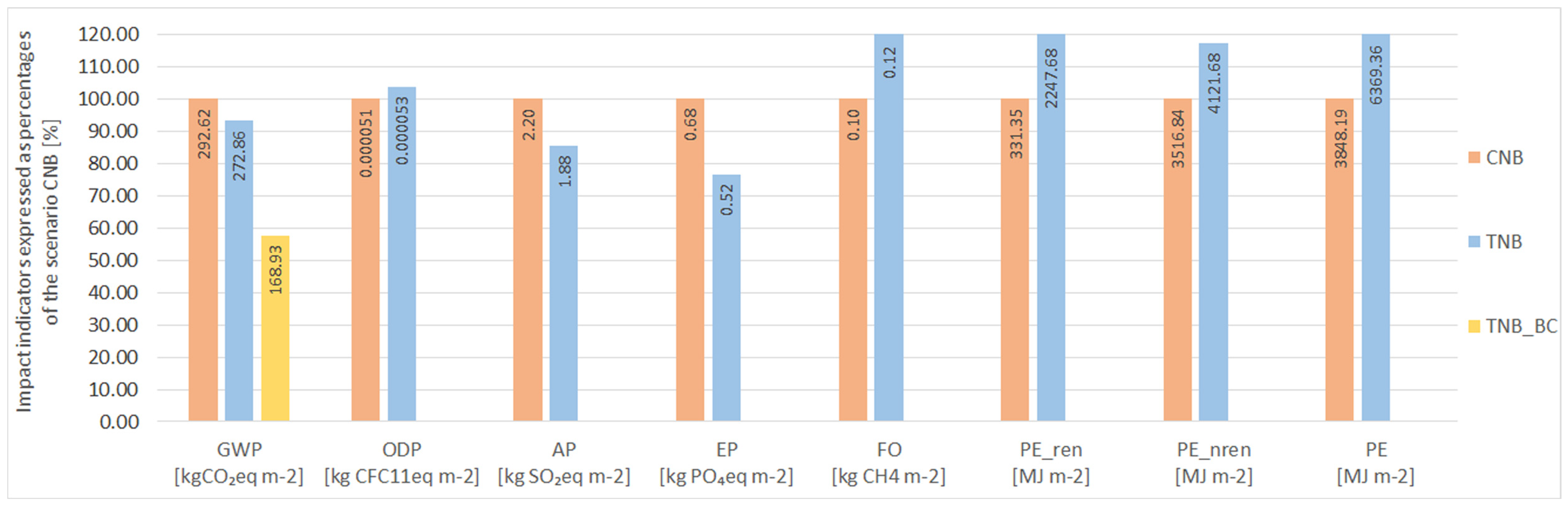
| Conventional (CNB) | 292.62 | 0.000051 | 2.20 | 0.68 | 0.10 | 331.35 | 3516.84 | 3848.19 |
| Timber (TNB) | 272.86 | 0.000053 | 1.88 | 0.52 | 0.12 | 2247.68 | 4121.68 | 6369.36 |
| −6.75% | +3.81% | −14.62% | −23.41% | +21.43% | +578.35% | +17.20% | +65.52% | |
| Timber (TNB) | 168.93 | 0.000053 | 1.88 | 0.52 | 0.12 | 2247.68 | 4121.68 | 6369.36 |
| Biogenic | −42.27% | +3.81% | −14.62% | −23.41% | +21.43% | +578.35% | +17.20% | +65.52% |
| Cost Categories [€/m2] | ||||||||
|---|---|---|---|---|---|---|---|---|
| Construction System | Frame | Roof | Walls | Foundation | Slab | FV System | Construction Cost | Difference [%] |
| Conventional (CNB) | 102.22 € | 90.57€ | 57.40 € | 38.80 € | 173.38 € | 44.98 € | 507.35 € | - |
| Timber (TNB) | 107.64 € | 152.57 € | 91.69 € | 34.90 € | 173.38. € | 44.98 € | 605.15 € | 19.28% |
| Code | Research Question |
|---|---|
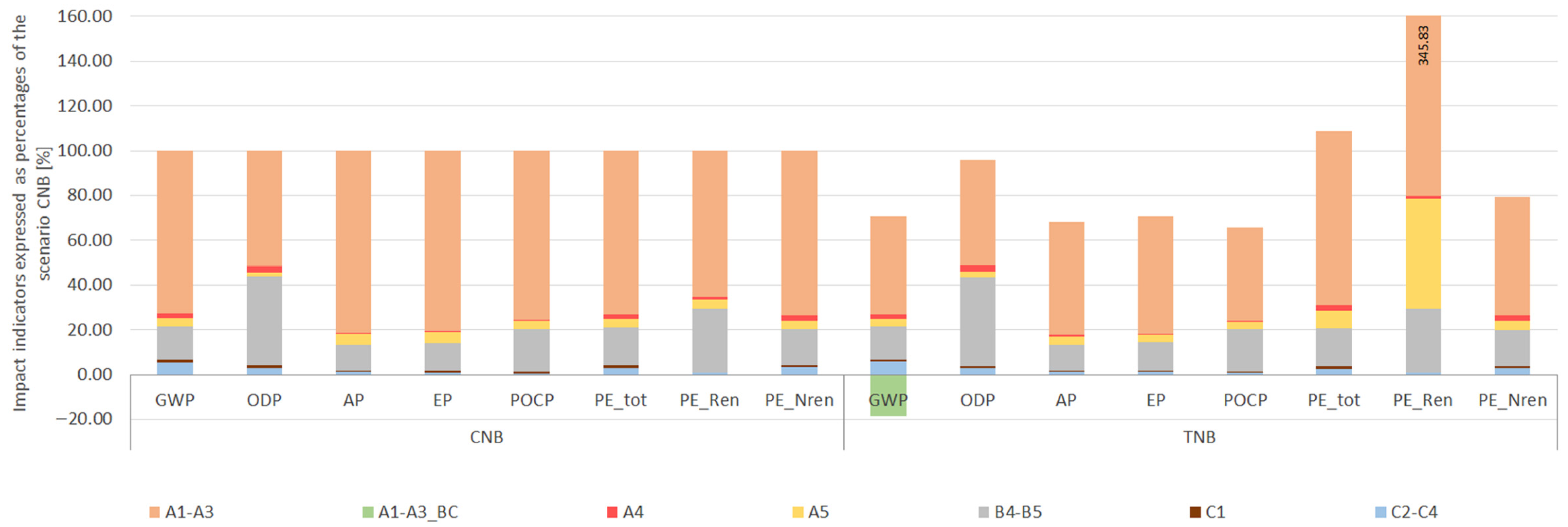
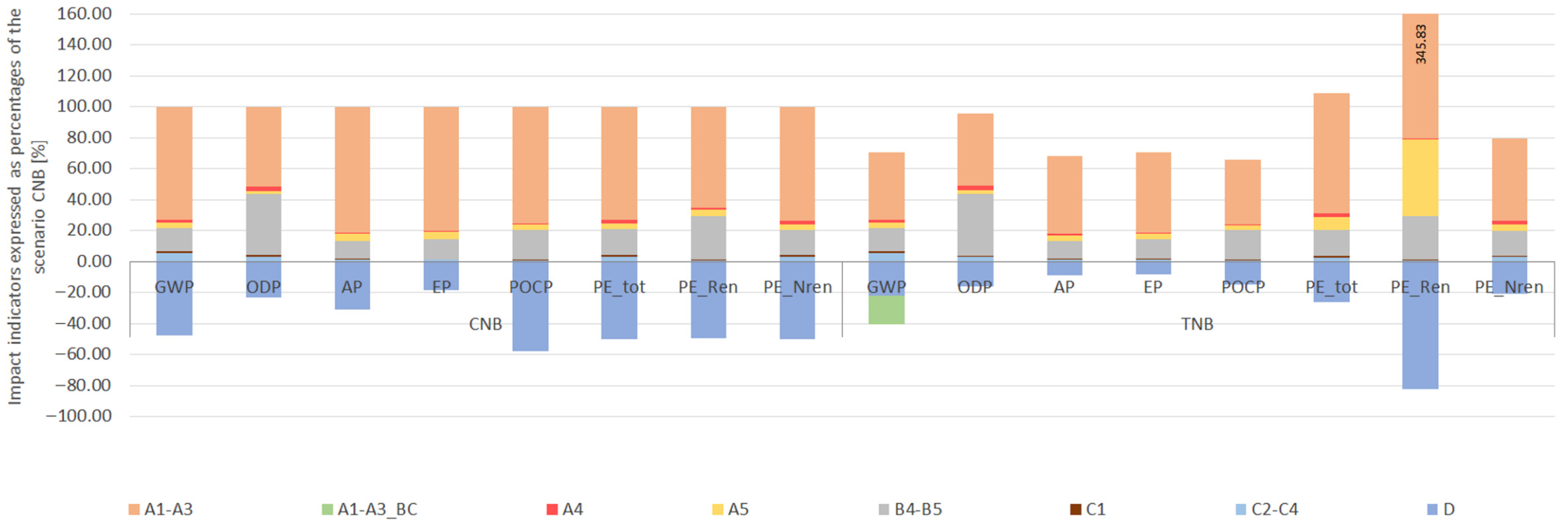
| RQ1 | The bio-based timber solution (TNB) demonstrates a structural reduction in Global Warming Potential and in the main environmental impact indicators over the 30-year assessment period, primarily due to lower embodied emissions and the contribution of biogenic carbon. The results confirm that material-related impacts (A1–A3) are the dominant phase and that technological substitution significantly improves environmental performance compared to the conventional prefabricated system (CNB). |
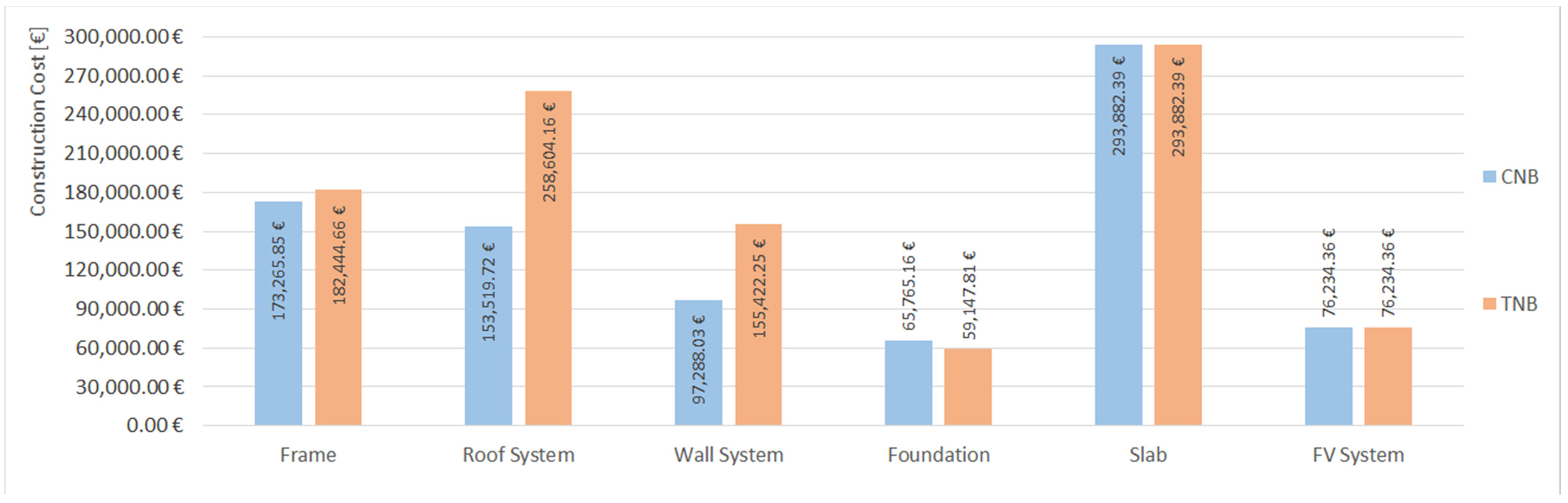
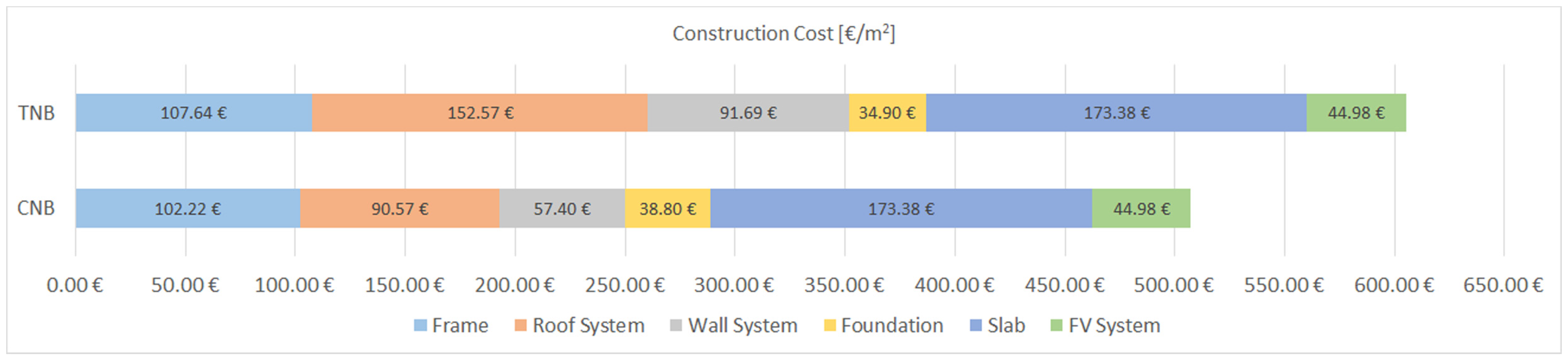
| RQ2 | The cost differential between the conventional and timber-based systems remains within a manageable range (≈20%) and is mainly attributable to the higher technological quality of the building envelope, while structural costs are comparable. The results confirm the economic compatibility of the bio-based solution with small- and medium-scale agricultural enterprises in the short-to-medium term. |
| RQ3 | The results suggest that the transfer of bio-based construction technologies to the livestock sector represents a promising pathway for technological and environmental innovation. While the environmental benefits are quantitatively supported, implications for landscape integration are addressed from a qualitative and design-oriented perspective. Therefore, the potential for improving landscape quality is interpreted as a conceptual and design implication, rather than an empirically validated outcome. |
Disclaimer/Publisher’s Note: The statements, opinions and data contained in all publications are solely those of the individual author(s) and contributor(s) and not of MDPI and/or the editor(s). MDPI and/or the editor(s) disclaim responsibility for any injury to people or property resulting from any ideas, methods, instructions or products referred to in the content. |
© 2026 by the authors. Licensee MDPI, Basel, Switzerland. This article is an open access article distributed under the terms and conditions of the Creative Commons Attribution (CC BY) license.
Share and Cite
Bigiotti, S.; Costantino, C.; Marucci, A. Redefining Livestock Architecture: Advancing Timber-Based Construction Systems Through Sustainable Design Strategies. Sustainability 2026, 18, 4752. https://doi.org/10.3390/su18104752
Bigiotti S, Costantino C, Marucci A. Redefining Livestock Architecture: Advancing Timber-Based Construction Systems Through Sustainable Design Strategies. Sustainability. 2026; 18(10):4752. https://doi.org/10.3390/su18104752
Chicago/Turabian StyleBigiotti, Stefano, Carlo Costantino, and Alvaro Marucci. 2026. "Redefining Livestock Architecture: Advancing Timber-Based Construction Systems Through Sustainable Design Strategies" Sustainability 18, no. 10: 4752. https://doi.org/10.3390/su18104752
APA StyleBigiotti, S., Costantino, C., & Marucci, A. (2026). Redefining Livestock Architecture: Advancing Timber-Based Construction Systems Through Sustainable Design Strategies. Sustainability, 18(10), 4752. https://doi.org/10.3390/su18104752