The Effect of ESG on Firms’ Product Market Performance and Supply Chain Spillover Effects

Abstract
1. Introduction
2. Literature and Hypothesis Development
2.1. The Impact of ESG Ratings on Firm Performance
2.2. Determinants of Product Market Performance and the Signaling Advantages of ESG
2.3. Research Hypothesis
3. Research Design
3.1. Sample Selection and Data Sources
3.2. Variable Definitions and Model Specifications
3.2.1. Dependent Variable
3.2.2. Independent Variable
3.2.3. Mediation Variables
3.2.4. Control Variables
3.2.5. Model Setting
3.3. Descriptive Statistical Analysis and Correlation Analysis
4. Results
4.1. Main Findings
4.2. Robustness Checks
4.2.1. Replace Core Variables
4.2.2. High-Dimensional Fixed Effects and Clustered Robust Standard Errors
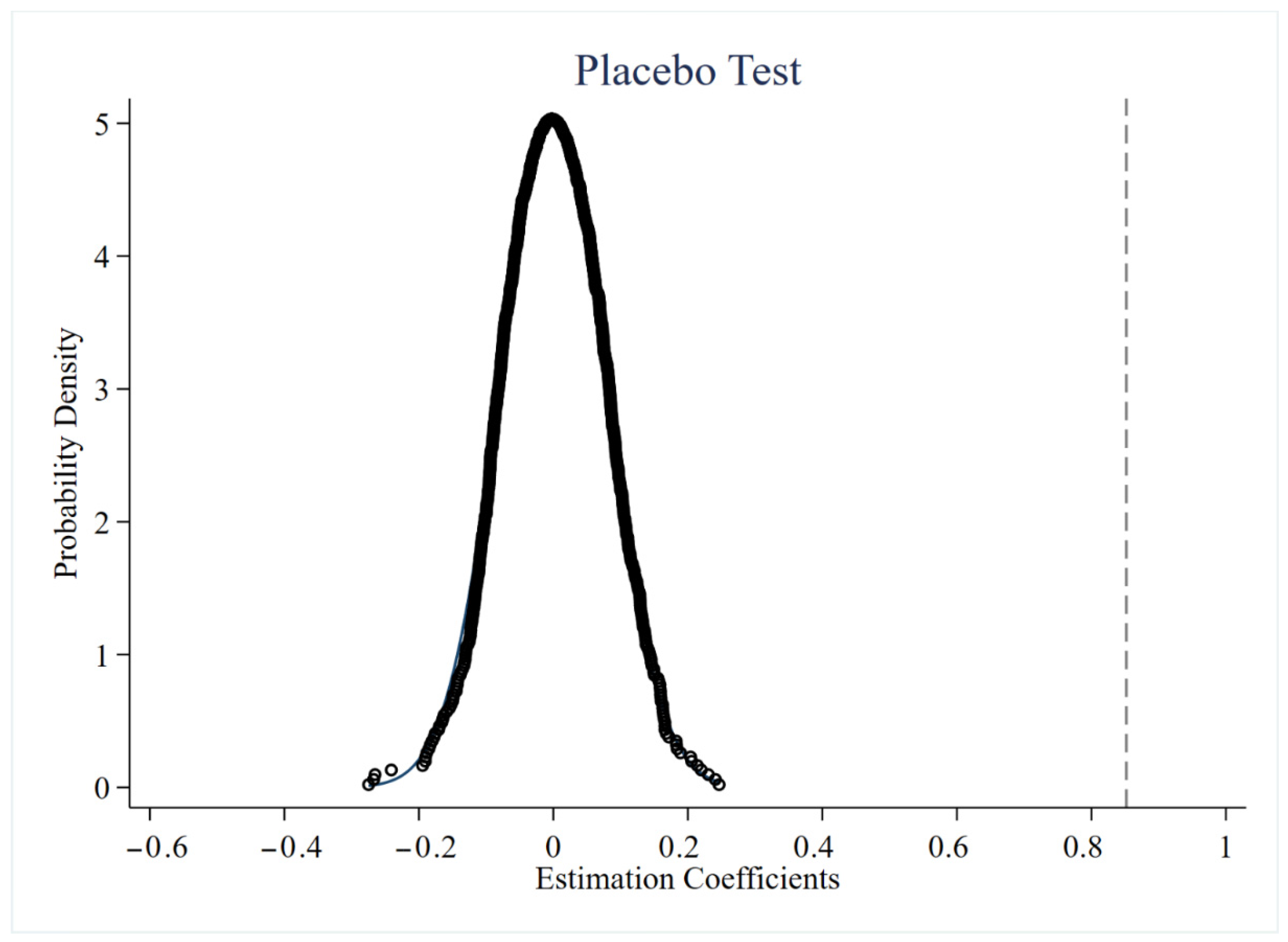
4.2.3. Placebo Test
4.2.4. Instrumental Variables (IV) Method
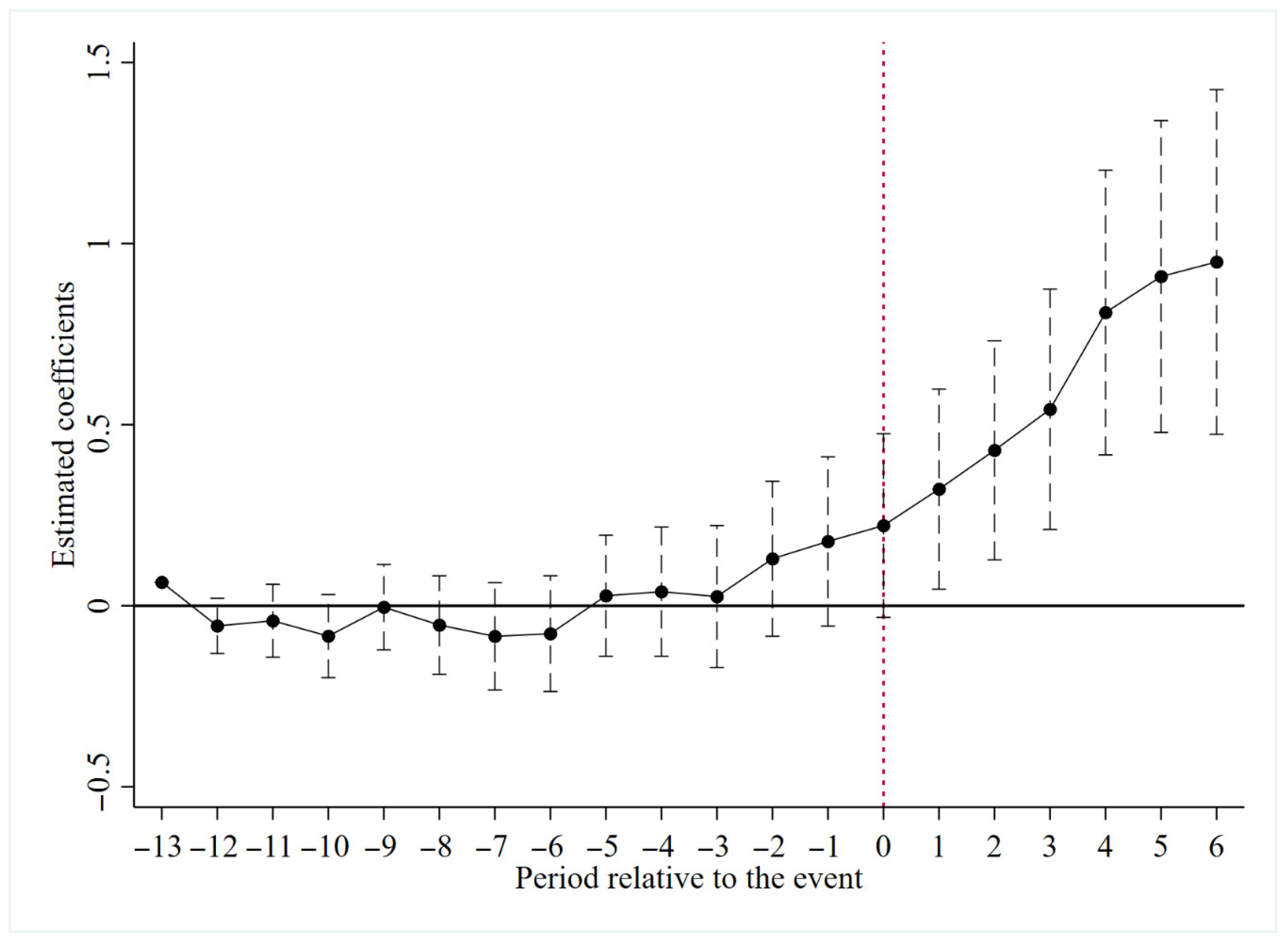
4.2.5. Identification Strategy
4.2.6. Propensity Score Matching (PSM) Method
4.3. Mechanism Analysis
4.3.1. Product Quality Channel
4.3.2. Service Capability Channel
4.4. Moderating Effect Analysis
4.4.1. High-Tech Firms
4.4.2. The Position of the Firm in the Industry Chain
4.5. Further Analysis
4.5.1. ESG Ratings and Changes in Market Share
4.5.2. The Spillover Effect of ESG Ratings
4.5.3. The Impact of E, S, and G on Product Market Performance
5. Discussion
5.1. Discussion of Main Findings
5.2. Theoretical Contributions
5.3. Practical and Regulatory Implications
6. Conclusions
6.1. Summary
6.2. Limitations and Future Research
Author Contributions
Funding
Institutional Review Board Statement
Informed Consent Statement
Data Availability Statement
Conflicts of Interest
Appendix A. Descriptive Statistical Analysis and Correlation Analysis

| Variables | N | Mean | SD | Median | Min | Max |
|---|---|---|---|---|---|---|
| MktShare | 39,823 | 0.992 | 1.743 | 0.397 | 0.008 | 12.377 |
| ESG | 39,823 | 0.731 | 0.051 | 0.734 | 0.550 | 0.855 |
| SIZE | 39,823 | 22.163 | 1.298 | 21.965 | 19.531 | 26.456 |
| Employee | 39,823 | 7.612 | 1.258 | 7.534 | 3.871 | 11.181 |
| AGE | 39,823 | 2.048 | 0.931 | 2.197 | 0.000 | 3.401 |
| ROA | 39,823 | 0.036 | 0.066 | 0.038 | −0.493 | 0.222 |
| LEV | 39,823 | 0.420 | 0.208 | 0.412 | 0.028 | 0.927 |
| Fixed | 39,823 | 0.207 | 0.158 | 0.173 | 0.002 | 0.772 |
| TOP1 | 39,823 | 34.265 | 15.048 | 32.020 | 0.290 | 89.990 |
| Board | 39,823 | 2.123 | 0.199 | 2.197 | 1.609 | 2.708 |
| Indep | 39,823 | 37.591 | 5.579 | 36.360 | 0.000 | 80.000 |
| SOE | 39,823 | 0.347 | 0.476 | 0.000 | 0.000 | 1.000 |
| Variables | MktShare | ESG | SIZE | Employee | AGE | ROA | LEV |
|---|---|---|---|---|---|---|---|
| MktShare | 1.000 | ||||||
| ESG | 0.195 *** | 1.000 | |||||
| SIZE | 0.619 *** | 0.195 *** | 1.000 | ||||
| Employee | 0.581 *** | 0.171 *** | 0.721 *** | 1.000 | |||
| AGE | 0.224 *** | −0.123 *** | 0.435 *** | 0.275 *** | 1.000 | ||
| ROA | 0.069 *** | 0.241 *** | −0.001 | 0.053 *** | −0.217 *** | 1.000 | |
| LEV | 0.275 *** | −0.097 *** | 0.496 *** | 0.352 *** | 0.407 *** | −0.356 *** | 1.000 |
| Fixed | 0.018 *** | −0.060 *** | 0.103 *** | 0.234 *** | 0.136 *** | −0.058 *** | 0.099 *** |
| TOP1 | 0.103 *** | 0.108 *** | 0.185 *** | 0.168 *** | −0.076 *** | 0.147 *** | 0.045 *** |
| Board | 0.148 *** | 0.029 *** | 0.255 *** | 0.243 *** | 0.142 *** | 0.022 *** | 0.150 *** |
| Indep | 0.040 *** | 0.069 *** | 0.010 ** | −0.010 * | −0.012 ** | −0.024 *** | −0.011 ** |
| SOE | 0.200 *** | 0.058 *** | 0.345 *** | 0.253 *** | 0.433 *** | −0.072 *** | 0.295 *** |
| Variables | Fixed | TOP1 | Board | Indep | SOE | ||
| Fixed | 1.000 | ||||||
| TOP1 | 0.087 *** | 1.000 | |||||
| Board | 0.148 *** | 0.023 *** | 1.000 | ||||
| Indep | −0.049 *** | 0.040 *** | −0.530 *** | 1.000 | |||
| SOE | 0.202 *** | 0.224 *** | 0.271 *** | −0.060 *** | 1.000 | ||
Appendix B. Placebo Test Results

Appendix C. Parallel Trend Test Results

Appendix D. Balance Test Results
| Variables | Unmatched | Mean | %Bias | %Reduct | t-Test | ||
|---|---|---|---|---|---|---|---|
| Matched | Treated | Control | |Bias| | t | p > |t| | ||
| SIZE | U | 22.336 | 21.983 | 27.5 | 96.7 | 27.20 | 0.000 |
| M | 22.330 | 22.318 | 0.9 | 0.87 | 0.386 | ||
| Employee | U | 7.787 | 7.435 | 28.3 | 87.9 | 27.98 | 0.000 |
| M | 7.782 | 7.739 | 3.4 | 3.33 | 0.001 | ||
| AGE | U | 1.924 | 2.154 | −24.7 | 94.1 | −24.47 | 0.000 |
| M | 1.924 | 1.938 | −1.5 | −1.40 | 0.163 | ||
| ROA | U | 0.048 | 0.029 | 32.0 | 97.1 | 31.85 | 0.000 |
| M | 0.048 | 0.048 | 0.9 | 1.04 | 0.300 | ||
| LEV | U | 0.399 | 0.436 | −17.8 | 93.2 | −17.63 | 0.000 |
| M | 0.399 | 0.397 | 1.2 | 1.22 | 0.221 | ||
| Fixed | U | 0.204 | 0.209 | −3.7 | 59.2 | −3.64 | 0.000 |
| M | 0.204 | 0.206 | −1.5 | −1.50 | 0.134 | ||
| TOP1 | U | 35.438 | 33.185 | 15.2 | 92.9 | 15.03 | 0.000 |
| M | 35.399 | 35.238 | 1.1 | 1.06 | 0.289 | ||
| Board | U | 2.126 | 2.119 | 3.7 | 92.9 | 3.68 | 0.000 |
| M | 2.126 | 2.127 | −0.3 | −0.26 | 0.794 | ||
| Indep | U | 37.939 | 37.192 | 13.9 | 84.9 | 13.79 | 0.000 |
| M | 37.916 | 37.803 | 2.1 | 2.04 | 0.041 | ||
| SOE | U | 0.342 | 0.301 | 8.9 | 93.0 | 8.78 | 0.000 |
| M | 0.342 | 0.339 | 0.6 | 0.62 | 0.538 | ||
Appendix E. The Calculation Method for the Firm’s Upstream Degree
References
- Gillan, S.L.; Koch, A.; Starks, L.T. Firms and Social Responsibility: A Review of ESG and CSR Research in Corporate Finance. J. Corp. Financ. 2021, 66, 101889. [Google Scholar] [CrossRef]
- Krueger, P.; Sautner, Z.; Tang, D.Y.; Zhong, R. The Effects of Mandatory ESG Disclosure Around the World. J. Account. Res. 2024, 62, 1795–1847. [Google Scholar] [CrossRef]
- Yang, X.; Shira, R.K.; Dang, L.P.; Hao, P. Unforeseen Benefits: Can ESG Enhance Corporate Access to Commercial Credit Financing? Res. Int. Bus. Financ. 2025, 75, 102735. [Google Scholar] [CrossRef]
- Dhaliwal, D.S.; Li, O.Z.; Tsang, A.; Yang, Y.G. Voluntary Nonfinancial Disclosure and the Cost of Equity Capital: The Initiation of Corporate Social Responsibility Reporting. Account. Rev. 2011, 86, 59–100. [Google Scholar] [CrossRef]
- Gao, X.; He, X.; Sun, C.; Wu, D.; Zhang, J. Innovation in Shouldering Green Responsibility: ESG Performance and Green Technology Innovation. Energy Econ. 2025, 142, 108197. [Google Scholar] [CrossRef]
- Ma, D.; Xie, Y.; Huang, H.; Qiu, J. Does Corporate ESG Performance Promote Export Resilience? New Insights from Risk Resistance and Resilience. J. Environ. Manag. 2024, 371, 122881. [Google Scholar] [CrossRef]
- Reber, B.; Gold, A.; Gold, S. ESG Disclosure and Idiosyncratic Risk in Initial Public Offerings. J. Bus. Ethics 2022, 179, 867–886. [Google Scholar] [CrossRef]
- Yang, X.; Wang, C.; Liu, B. ESG Performance and Corporate Labor Investment Efficiency: Evidence from China. Int. Rev. Econ. Financ. 2025, 98, 103909. [Google Scholar] [CrossRef]
- Colonnelli, E.; McQuade, T.; Ramos, G.; Rauter, T.; Xiong, O. Polarizing Corporations: Does Talent Flow to “Good” Firms? National Bureau of Economic Research: Cambridge, MA, USA, 2023; p. w31913. [Google Scholar]
- Dahlsrud, A. How Corporate Social Responsibility Is Defined: An Analysis of 37 Definitions. Corp. Soc. Responsib. Environ. Manag. 2008, 15, 1–13. [Google Scholar] [CrossRef]
- Wu, Z.; Lin, S.; Chen, T.; Luo, C.; Xu, H. Does Effective Corporate Governance Mitigate the Negative Effect of ESG Controversies on Firm Value? Econ. Anal. Policy 2023, 80, 1772–1793. [Google Scholar] [CrossRef]
- Kim, H.J.; Ahn, T.-W.; Yi, J. ESG Controversies and Firm Value: Moderating Role of ESG Performance. Asia-Pac. J. Financ. Stud. 2025, 54, 228–269. [Google Scholar] [CrossRef]
- Derrien, F.; Krüger, P.; Landier, A.; Yao, T. ESG News, Future Cash Flows, and Firm Value. J. Financ. 2025, 80, 3499–3554. [Google Scholar] [CrossRef]
- La Rosa, F.; Bernini, F. ESG Controversies and the Cost of Equity Capital of European Listed Companies: The Moderating Effects of ESG Performance and Market Securities Regulation. Int. J. Account. Inf. Manag. IJAIM 2022, 30, 641–663. [Google Scholar] [CrossRef]
- Freeman, R.E. Strategic Management: A Stakeholder Approach; Cambridge University Press: Cambridge, UK, 2010. [Google Scholar]
- Hu, T.-L.; Chao, C.-M.; Lin, C.-H. The Role of Social Media Marketing in Green Product Repurchase Intention. Sustainability 2024, 16, 5916. [Google Scholar] [CrossRef]
- Amel-Zadeh, A.; Serafeim, G. Why and How Investors Use ESG Information: Evidence from a Global Survey. Financ. Anal. J. 2018, 74, 87–103. [Google Scholar] [CrossRef]
- Barney, J. Firm Resources and Sustained Competitive Advantage. J. Manag. 1991, 17, 99–120. [Google Scholar] [CrossRef]
- Chang, Y.; Wang, S. A Study on the Impact of ESG Rating on Green Technology Innovation in Enterprises: An Empirical Study Based on Informal Environmental Governance. J. Environ. Manag. 2024, 358, 120878. [Google Scholar] [CrossRef]
- Li, J.; Lian, G.; Xu, A. How Do ESG Affect the Spillover of Green Innovation among Peer Firms? Mechanism Discussion and Performance Study. J. Bus. Res. 2023, 158, 113648. [Google Scholar] [CrossRef]
- Mitani, H. Capital Structure and Competitive Position in Product Market. Int. Rev. Econ. Financ. 2014, 29, 358–371. [Google Scholar] [CrossRef]
- Morgan, N.A.; Rego, L.L. The Value of Different Customer Satisfaction and Loyalty Metrics in Predicting Business Performance. Mark. Sci. 2006, 25, 426–439. [Google Scholar] [CrossRef]
- Chen, S.; Song, Y.; Gao, P. Environmental, Social, and Governance (ESG) Performance and Financial Outcomes: Analyzing the Impact of ESG on Financial Performance. J. Environ. Manag. 2023, 345, 118829. [Google Scholar] [CrossRef]
- Chen, Z.; Xie, G. ESG Disclosure and Financial Performance: Moderating Role of ESG Investors. Int. Rev. Financ. Anal. 2022, 83, 102291. [Google Scholar] [CrossRef]
- Friede, G.; Busch, T.; Bassen, A. ESG and Financial Performance: Aggregated Evidence from More than 2000 Empirical Studies. J. Sustain. Financ. Invest. 2015, 5, 210–233. [Google Scholar] [CrossRef]
- Duque-Grisales, E.; Aguilera-Caracuel, J. Environmental, Social and Governance (ESG) Scores and Financial Performance of Multilatinas: Moderating Effects of Geographic International Diversification and Financial Slack. J. Bus. Ethics 2021, 168, 315–334. [Google Scholar] [CrossRef]
- Andreou, P.C.; Kellard, N.M. Corporate Environmental Proactivity: Evidence from the European Union’s Emissions Trading System. Br. J. Manag. 2021, 32, 630–647. [Google Scholar] [CrossRef]
- Nollet, J.; Filis, G.; Mitrokostas, E. Corporate Social Responsibility and Financial Performance: A Non-Linear and Disaggregated Approach. Econ. Model. 2016, 52, 400–407. [Google Scholar] [CrossRef]
- Li, N.; Li, G.; Xue, J. Does ESG Protect Firms Equally during Crises? The Role of Supply Chain Concentration. Omega 2025, 130, 103171. [Google Scholar] [CrossRef]
- Wang, S.; Cheng, H.C.; Wang, J.; Yick, H.Y. The Performance of ESG Portfolios: Evidence from the Chinese Market under COVID-19. Econ. Model. 2025, 143, 106958. [Google Scholar] [CrossRef]
- Xu, N.; Chen, J.; Zhou, F.; Dong, Q.; He, Z. Corporate ESG and Resilience of Stock Prices in the Context of the COVID-19 Pandemic in China. Pac.-Basin Financ. J. 2023, 79, 102040. [Google Scholar] [CrossRef]
- He, F.; Feng, Y.; Hao, J. Corporate ESG Rating and Stock Market Liquidity: Evidence from China. Econ. Model. 2023, 129, 106511. [Google Scholar] [CrossRef]
- Wang, K.; Li, T.; San, Z.; Gao, H. How Does Corporate ESG Performance Affect Stock Liquidity? Evidence from China. Pac.-Basin Financ. J. 2023, 80, 102087. [Google Scholar] [CrossRef]
- Huang, J.; Li, Y.; Han, F. Walk Well and Talk Well: Impact of the Consistency of ESG Performance and Disclosure on Firms’ Stock Price Crash Risk. Int. Rev. Econ. Financ. 2024, 93, 1154–1174. [Google Scholar] [CrossRef]
- Wu, S.; Zhou, F.-Y.; Si, D.-K.; Hao, J. Does ESG Rating Policy Reduce Corporate Risk-Taking? Evidence from China. Pac.-Basin Financ. J. 2025, 90, 102654. [Google Scholar] [CrossRef]
- Li, W.; Chen, S.; Gao, Z.; Chen, X. Assessing the Impact of Corporate Environmental Performance on Efficiency Improvement in Labor Investment. Bus. Strategy Environ. 2023, 32, 5008–5024. [Google Scholar] [CrossRef]
- Xue, Q.; Jin, Y.; Zhang, C. ESG Rating Results and Corporate Total Factor Productivity. Int. Rev. Financ. Anal. 2024, 95, 103381. [Google Scholar] [CrossRef]
- Zhang, T.; Zhang, J.; Tu, S. An Empirical Study on Corporate ESG Behavior and Employee Satisfaction: A Moderating Mediation Model. Behav. Sci. 2024, 14, 274. [Google Scholar] [CrossRef]
- He, F.; Du, H.; Yu, B. Corporate ESG Performance and Manager Misconduct: Evidence from China. Int. Rev. Financ. Anal. 2022, 82, 102201. [Google Scholar] [CrossRef]
- Hao, P.; Alharbi, S.S.; Hunjra, A.I.; Zhao, S. How Do ESG Ratings Promote Digital Technology Innovation? Int. Rev. Financ. Anal. 2025, 97, 103886. [Google Scholar] [CrossRef]
- Cowling, K.; Rayner, A.J. Price, Quality, and Market Share. J. Political Econ. 1970, 78, 1292–1309. [Google Scholar] [CrossRef]
- Kim, C.K.; Chung, J.Y. Brand Popularity, Country Image and Market Share: An Empirical Study. J. Int. Bus. Stud. 1997, 28, 361–386. [Google Scholar] [CrossRef]
- Steenkamp, J.-B.E.M.; Dekimpe, M.G. The Increasing Power of Store Brands: Building Loyalty and Market Share. Long. Range Plan. 1997, 30, 917–930. [Google Scholar] [CrossRef]
- Czarnitzki, D.; Thorwarth, S. The Contribution of In-house and External Design Activities to Product Market Performance. J. Product. Innov. Manag. 2012, 29, 878–895. [Google Scholar] [CrossRef]
- Kramolis, J.; Svirakova, E. The Influence of Design on Companies’ Increase in Income, Market Share or Brand Value. J. Compet. 2019, 11, 89–102. [Google Scholar] [CrossRef]
- Huang, R.; Sarigöllü, E. How Brand Awareness Relates to Market Outcome, Brand Equity, and the Marketing Mix. J. Bus. Res. 2012, 65, 92–99. [Google Scholar] [CrossRef]
- Keiningham, T.L.; Morgeson, F.V.; Aksoy, L.; Williams, L. Service Failure Severity, Customer Satisfaction, and Market Share: An Examination of the Airline Industry. J. Serv. Res. 2014, 17, 415–431. [Google Scholar] [CrossRef]
- Rego, L.L.; Morgan, N.A.; Fornell, C. Reexamining the Market Share–Customer Satisfaction Relationship. J. Mark. 2013, 77, 1–20. [Google Scholar] [CrossRef]
- Rust, R.T.; Zahorik, A.J. Customer Satisfaction, Customer Retention, and Market Share. J. Retail. 1993, 69, 193–215. [Google Scholar] [CrossRef]
- Bae, K.-H.; El Ghoul, S.; Guedhami, O.; Kwok, C.C.Y.; Zheng, Y. Does Corporate Social Responsibility Reduce the Costs of High Leverage? Evidence from Capital Structure and Product Market Interactions. J. Bank. Financ. 2019, 100, 135–150. [Google Scholar] [CrossRef]
- Rahman, M.; Aziz, S.; Hughes, M. The Product-market Performance Benefits of Environmental Policy: Why Customer Awareness and Firm Innovativeness Matter. Bus. Strategy Environ. 2020, 29, 2001–2018. [Google Scholar] [CrossRef]
- Campello, M. Debt Financing: Does It Boost or Hurt Firm Performance in Product Markets? J. Financ. Econ. 2006, 82, 135–172. [Google Scholar] [CrossRef]
- Opler, T.C.; Titman, S. Financial Distress and Corporate Performance. J. Financ. 1994, 49, 1015–1040. [Google Scholar] [CrossRef]
- Fresard, L. Financial Strength and Product Market Behavior: The Real Effects of Corporate Cash Holdings. J. Financ. 2010, 65, 1097–1122. [Google Scholar] [CrossRef]
- He, J.; Huang, J. Product Market Competition in a World of Cross-Ownership: Evidence from Institutional Blockholdings. Rev. Financ. Stud. 2017, 30, 2674–2718. [Google Scholar] [CrossRef]
- Liu, G.; Shao, X.; Lang, X. On the Interaction of Technology Upgrade and Buyer Entry in a Supply Chain. Int. J. Prod. Econ. 2020, 221, 107478. [Google Scholar] [CrossRef]
- Spence, M. Job Market Signaling. Q. J. Econ. 1973, 87, 355. [Google Scholar] [CrossRef]
- Servaes, H.; Tamayo, A. The Impact of Corporate Social Responsibility on Firm Value: The Role of Customer Awareness. Manag. Sci. 2013, 59, 1045–1061. [Google Scholar] [CrossRef]
- Connelly, B.L.; Certo, S.T.; Ireland, R.D.; Reutzel, C.R. Signaling Theory: A Review and Assessment. J. Manag. 2011, 37, 39–67. [Google Scholar] [CrossRef]
- Zhu, B.; Wang, Y. Does Social Trust Affect Firms’ ESG Performance? Int. Rev. Financ. Anal. 2024, 93, 103153. [Google Scholar] [CrossRef]
- Costello, A.M. Credit Market Disruptions and Liquidity Spillover Effects in the Supply Chain. J. Political Econ. 2020, 128, 3434–3468. [Google Scholar] [CrossRef]
- Li, C.; Sensoy, A.; Song, C.; Zhang, M. Does Corporate Green Innovation Behaviour Impact Trade Credit? Evidence from China. Res. Int. Bus. Financ. 2023, 66, 102056. [Google Scholar] [CrossRef]
- Wang, Y.; Liu, B.; Chan, H.K.; Zhang, T. Who Pays Buyers for Not Disclosing Supplier Lists? Unlocking the Relationship between Supply Chain Transparency and Trade Credit. J. Bus. Res. 2023, 155, 113404. [Google Scholar] [CrossRef]
- Chasiotis, I.; Gounopoulos, D.; Konstantios, D.; Patsika, V. ESG Reputational Risk, Corporate Payouts and Firm Value. Br. J. Manag. 2024, 35, 871–892. [Google Scholar] [CrossRef]
- Farag, H.; Koirala, S.; Luo, D.; Rao, S. Do Titans Deliver the ESG Promise? Societal Recognition and Responsible Corporate Decisions. Br. J. Manag. 2024, 36, 885–909. [Google Scholar] [CrossRef]
- Lee, H.J.; Rhee, T. How Does Corporate ESG Management Affect Consumers’ Brand Choice? Sustainability 2023, 15, 6795. [Google Scholar] [CrossRef]
- Kudeshia, C.; Kumar, A. Social eWOM: Does It Affect the Brand Attitude and Purchase Intention of Brands? MRR 2017, 40, 310–330. [Google Scholar] [CrossRef]
- Sen, S.; Bhattacharya, C.B. Does Doing Good Always Lead to Doing Better? Consumer Reactions to Corporate Social Responsibility. J. Mark. Res. 2001, 38, 225–243. [Google Scholar] [CrossRef]
- Zhou, G.; Liu, L.; Luo, S. Sustainable Development, ESG Performance and Company Market Value: Mediating Effect of Financial Performance. Bus. Strategy Environ. 2022, 31, 3371–3387. [Google Scholar] [CrossRef]
- Bai, F.; Shang, M.; Huang, Y. Corporate Culture and ESG Performance: Empirical Evidence from China. J. Clean. Prod. 2024, 437, 140732. [Google Scholar] [CrossRef]
- Chen, C.; Yan, Y.; Jia, X.; Wang, T.; Chai, M. The Impact of Executives’ Green Experience on Environmental, Social, and Governance (ESG) Performance: Evidence from China. J. Environ. Manag. 2024, 366, 121819. [Google Scholar] [CrossRef]
- Maryoso, S.; Hamzah, R.; Astri, F.; Rukmana, A.Y.; Apramilda, R. Customer Satisfaction and Product Quality. J. Manag. 2023, 2, 215–223. [Google Scholar]
- Calantone, R.; Knight, G. The Critical Role of Product Quality in the International Performance of Industrial Firms. Ind. Mark. Manag. 2000, 29, 493–506. [Google Scholar] [CrossRef]
- Wen, H.; Zhong, Q.; Lee, C.-C. Digitalization, Competition Strategy and Corporate Innovation: Evidence from Chinese Manufacturing Listed Companies. Int. Rev. Financ. Anal. 2022, 82, 102166. [Google Scholar] [CrossRef]
- Yang, C.-C.; Marlow, P.B.; Lu, C.-S. Assessing Resources, Logistics Service Capabilities, Innovation Capabilities and the Performance of Container Shipping Services in Taiwan. Int. J. Prod. Econ. 2009, 122, 4–20. [Google Scholar] [CrossRef]
- Zeithaml, V.A.; Berry, L.L.; Parasuraman, A. The Behavioral Consequences of Service Quality. J. Mark. 1996, 60, 31–46. [Google Scholar] [CrossRef]
- Bai, X.; Han, J.; Ma, Y.; Zhang, W. ESG Performance, Institutional Investors’ Preference and Financing Constraints: Empirical Evidence from China. Borsa Istanb. Rev. 2022, 22, S157–S168. [Google Scholar] [CrossRef]
- Long, H.; Feng, G.; Gong, Q.; Chang, C. ESG Performance and Green Innovation: An Investigation Based on Quantile Regression. Bus. Strategy Environ. 2023, 32, 5102–5118. [Google Scholar] [CrossRef]
- Koh, H.-K.; Burnasheva, R.; Suh, Y.G. Perceived ESG (Environmental, Social, Governance) and Consumers’ Responses: The Mediating Role of Brand Credibility, Brand Image, and Perceived Quality. Sustainability 2022, 14, 4515. [Google Scholar] [CrossRef]
- Luo, X.; Bhattacharya, C.B. Corporate Social Responsibility, Customer Satisfaction, and Market Value. J. Mark. 2006, 70, 1–18. [Google Scholar] [CrossRef]
- Chi, C.G.; Gursoy, D. Employee Satisfaction, Customer Satisfaction, and Financial Performance: An Empirical Examination. Int. J. Hosp. Manag. 2009, 28, 245–253. [Google Scholar] [CrossRef]
- Chai, H.; Cheng, Z.; Wu, W. Is ESG Performance a Protective Umbrella for ESG Violations? Int. Rev. Financ. Anal. 2025, 98, 103858. [Google Scholar] [CrossRef]
- Bataineh, M.J.; Sánchez-Sellero, P.; Ayad, F. Green Is the New Black: How Research and Development and Green Innovation Provide Businesses a Competitive Edge. Bus. Strategy Environ. 2024, 33, 1004–1023. [Google Scholar] [CrossRef]
- De Loecker, J.; Warzynski, F. Markups and Firm-Level Export Status. Am. Econ. Rev. 2012, 102, 2437–2471. [Google Scholar] [CrossRef]
- Hausknecht, J.P.; Holwerda, J.A. When Does Employee Turnover Matter? Dynamic Member Configurations, Productive Capacity, and Collective Performance. Organ. Sci. 2013, 24, 210–225. [Google Scholar] [CrossRef]
- Griffeth, R.W.; Hom, P.W.; Gaertner, S. A Meta-Analysis of Antecedents and Correlates of Employee Turnover: Update, Moderator Tests, and Research Implications for the Next Millennium. J. Manag. 2000, 26, 463–488. [Google Scholar] [CrossRef]
- Sun, S.; Li, T.; Ma, H.; Li, R.Y.M.; Gouliamos, K.; Zheng, J.; Han, Y.; Manta, O.; Comite, U.; Barros, T.; et al. Does Employee Quality Affect Corporate Social Responsibility? Evidence from China. Sustainability 2020, 12, 2692. [Google Scholar] [CrossRef]
- Ener, H. Do Prior Experiences of Top Executives Enable or Hinder Product Market Entry? J. Manag. Stud. 2019, 56, 1345–1376. [Google Scholar] [CrossRef]
- Karuna, C. Industry Product Market Competition and Managerial Incentives. J. Account. Econ. 2007, 43, 275–297. [Google Scholar] [CrossRef]
- Jin, S.; Xiong, R.; Peng, H.; Tang, S. ESG Performance and Private Enterprise Resilience: Evidence from Chinese Financial Markets. Int. Rev. Financ. Anal. 2025, 98, 103884. [Google Scholar] [CrossRef]
- Dyck, A.; Lins, K.V.; Roth, L.; Wagner, H.F. Do Institutional Investors Drive Corporate Social Responsibility? International Evidence. J. Financ. Econ. 2019, 131, 693–714. [Google Scholar] [CrossRef]
- He, J.; Huang, J.; Zhao, S. Internalizing Governance Externalities: The Role of Institutional Cross-Ownership. J. Financ. Econ. 2019, 134, 400–418. [Google Scholar] [CrossRef]
- Staiger, D.; Stock, J.H. Instrumental Variables Regression with Weak Instruments. Econometrica 1997, 65, 557. [Google Scholar] [CrossRef]
- Bai, X.; Zhao, W.; Tian, G. ESG Certification, Green Innovation, and Firm Value: A Quasi-Natural Experiment Based on SynTao Green Finance’s ESG Ratings: A Pre-Registered Report. Pac.-Basin Financ. J. 2024, 86, 102453. [Google Scholar] [CrossRef]
- Wang, J.; Ma, M.; Dong, T.; Zhang, Z. Do ESG Ratings Promote Corporate Green Innovation? A Quasi-Natural Experiment Based on SynTao Green Finance’s ESG Ratings. Int. Rev. Financ. Anal. 2023, 87, 102623. [Google Scholar] [CrossRef]
- Meng, L.; Kou, S.; Duan, S.; Bie, Y. The Impact of Content Characteristics of Short-Form Video Ads on Consumer Purchase Behavior: Evidence from TikTok. J. Bus. Res. 2024, 183, 114874. [Google Scholar] [CrossRef]
- Poirier, S.-M.; Cosby, S.; Sénécal, S.; Coursaris, C.K.; Fredette, M.; Léger, P.-M. The Impact of Social Presence Cues in Social Media Product Photos on Consumers’ Purchase Intentions. J. Bus. Res. 2024, 185, 114932. [Google Scholar] [CrossRef]
- Caruana, A.; Ewing, M.T. How Corporate Reputation, Quality, and Value Influence Online Loyalty. J. Bus. Res. 2010, 63, 1103–1110. [Google Scholar] [CrossRef]
- Shams, R.; Chatterjee, S.; Chaudhuri, R. Developing Brand Identity and Sales Strategy in the Digital Era: Moderating Role of Consumer Belief in Brand. J. Bus. Res. 2024, 179, 114689. [Google Scholar] [CrossRef]
- Antràs, P.; Chor, D.; Fally, T.; Hillberry, R. Measuring the Upstreamness of Production and Trade Flows. Am. Econ. Rev. 2012, 102, 412–416. [Google Scholar] [CrossRef]
- Chor, D.; Manova, K.; Yu, Z. Growing like China: Firm Performance and Global Production Line Position. J. Int. Econ. 2021, 130, 103445. [Google Scholar] [CrossRef]
| Variable Type | Variable Name | Symbol | Description |
|---|---|---|---|
| Dependent Variable | Product Market Performance | MktShare | firm annual sales/total sales of all firms in the same industry-year |
| Independent Variable | Firms’ ESG Performance | ESG | Measured by the CSI ESG rating/index |
| Mediation Variables | Product Quality | Markup | Output elasticity with respect to variable inputs is estimated from a translog production function, and markup is then derived using the ratio of operating revenue to variable cost |
| Green_Patent | ln(1 + number of green patent applications filed in year t) | ||
| Service Level | Labor_Flow | 1 if Employees_t > Employees_(t − 1); 0 otherwise | |
| Labor_Edu | employees with a master’s degree or above/total employees | ||
| Control Variables | Firm size | SIZE | ln(year-end total assets) |
| employee size | Employee | ln(number of employees at year-end) | |
| firm age | AGE | ln(current year—listing year + 1) | |
| return on assets | ROA | net profit/total assets | |
| leverage | LEV | total liabilities/total assets | |
| fixed asset ratio | Fixed | fixed assets/total assets | |
| ownership concentration | TOP1 | shares held by the largest shareholder/total shares | |
| board size | Board | ln(number of board members) | |
| the proportion of independent directors | Indep | independent directors/total board members |
| Variables | F.MktShare | F.MktShare |
|---|---|---|
| (1) | (2) | |
| ESG | 1.699 *** | 0.856 *** |
| (8.340) | (4.456) | |
| SIZE | 0.502 *** | |
| (12.383) | ||
| Employee | 0.165 *** | |
| (5.939) | ||
| AGE | −0.039 | |
| (−1.340) | ||
| ROA | 0.857 *** | |
| (8.069) | ||
| LEV | 0.095 | |
| (1.122) | ||
| Fixed | 0.163 | |
| (1.446) | ||
| TOP1 | −0.001 | |
| (−0.771) | ||
| Board | −0.089 | |
| (−0.886) | ||
| Indep | −0.002 | |
| (−0.590) | ||
| SOE | −0.149 *** | |
| (−2.709) | ||
| Firm FE | YES | YES |
| Year FE | YES | YES |
| N | 34,057 | 34,057 |
| adj. R2 | 0.842 | 0.862 |
| Panel A: Alternative Measures of MktShare | ||||
|---|---|---|---|---|
| Variables | F.MktShare1 | F.MktShare2 | F.MktShare3 | F.MktShare4 |
| (1) | (2) | (3) | (4) | |
| ESG | 0.843 *** | 0.827 *** | 0.911 *** | 0.957 *** |
| (3.832) | (4.437) | (4.158) | (3.919) | |
| Controls | YES | YES | YES | YES |
| Firm FE | YES | YES | YES | YES |
| Year FE | YES | YES | YES | YES |
| N | 34,043 | 34,043 | 34,043 | 34,043 |
| adj. R2 | 0.840 | 0.864 | 0.872 | 0.804 |
| Panel B: Alternative measures of ESG | ||||
| Variables | F.MktShare1 | F.MktShare2 | F.MktShare3 | F.MktShare4 |
| (1) | (2) | (3) | (4) | |
| ESG1 | 0.038 *** | |||
| (4.479) | ||||
| Wind_ESG | 2.981 *** | |||
| (5.904) | ||||
| Bloomberg_ESG | 0.580 *** | |||
| (3.039) | ||||
| SynTao_ESG | 0.059 * | |||
| (1.707) | ||||
| Controls | YES | YES | YES | YES |
| Firm FE | YES | YES | YES | YES |
| Year FE | YES | YES | YES | YES |
| N | 34,057 | 12,556 | 13,105 | 4309 |
| adj. R2 | 0.862 | 0.865 | 0.943 | 0.931 |
| Variables | F.MktShare | F.MktShare | F.MktShare | F.MktShare | F.MktShare |
|---|---|---|---|---|---|
| (1) | (2) | (3) | (4) | (5) | |
| ESG | 0.798 *** | 0.829 *** | 0.777 *** | 0.777 *** | 0.777 *** |
| (3.852) | (4.439) | (3.840) | (3.620) | (4.082) | |
| Controls | YES | YES | YES | YES | YES |
| Firm FE | YES | YES | YES | YES | YES |
| City × Year FE | YES | NO | YES | YES | YES |
| Industry × Year FE | NO | YES | YES | YES | YES |
| cluster_level | Firm | Firm | Firm | City | Industry |
| N | 32,279 | 33,995 | 32,217 | 32,217 | 32,217 |
| adj. R2 | 0.858 | 0.872 | 0.868 | 0.868 | 0.869 |
| Variables | The First Stage | The Second Stage |
|---|---|---|
| ESG | F.MktShare | |
| (1) | (2) | |
| Fundnumber | 0.000 *** | |
| (4.893) | ||
| ESG | 29.406 *** | |
| (3.797) | ||
| Controls | YES | YES |
| Firm FE | YES | YES |
| Year FE | YES | YES |
| N | 37,233 | 32,197 |
| Variables | F.MktShare | F.MktShare |
|---|---|---|
| DID | PSM | |
| (1) | (2) | |
| ESG_DID | 0.261 *** | |
| (5.689) | ||
| ESG | 0.439 ** | |
| (2.344) | ||
| Controls | YES | YES |
| Firm FE | YES | YES |
| Year FE | YES | YES |
| N | 34,057 | 26,147 |
| adj. R2 | 0.862 | 0.962 |
| Variables | F.MktShare | Markup | F.MktShare | Green_Patent | F.MktShare |
|---|---|---|---|---|---|
| (1) | (2) | (3) | (4) | (5) | |
| ESG | 0.856 *** | 0.079 *** | 0.864 *** | 0.756 *** | 0.769 *** |
| (4.456) | (3.706) | (4.321) | (7.019) | (4.145) | |
| Markup | 0.326 ** | ||||
| (2.354) | |||||
| Green_Patent | 0.107 *** | ||||
| (5.454) | |||||
| Controls | YES | YES | YES | YES | YES |
| Firm FE | YES | YES | YES | YES | YES |
| Year FE | YES | YES | YES | YES | YES |
| N | 34,057 | 35,482 | 30,659 | 39,336 | 34,057 |
| adj. R2 | 0.862 | 0.708 | 0.868 | 0.643 | 0.862 |
| Variables | F.MktShare | Labor_Edu | F.MktShare | Labor_Flow | F.MktShare |
|---|---|---|---|---|---|
| (1) | (2) | (3) | (5) | (6) | |
| ESG | 0.856 *** | 1.228 ** | 0.706 *** | 0.166 ** | 0.851 *** |
| (4.456) | (2.494) | (3.157) | (2.337) | (4.439) | |
| Labor_Edu | 0.018 *** | ||||
| (3.218) | |||||
| Labor_Flow | 0.038 *** | ||||
| (3.818) | |||||
| Controls | YES | YES | YES | YES | YES |
| Firm FE | YES | YES | YES | YES | YES |
| Year FE | YES | YES | YES | YES | YES |
| N | 34,057 | 26,999 | 22,746 | 39,338 | 34,057 |
| adj. R2 | 0.862 | 0.883 | 0.889 | 0.219 | 0.862 |
| Variables | F.MktShare | F.MktShare |
|---|---|---|
| (1) | (2) | |
| ESG | 0.500 * | 0.510 * |
| (1.946) | (1.723) | |
| High_Tec | 0.340 *** | |
| (4.436) | ||
| ESG × High_Tec | 0.727 * | |
| (1.927) | ||
| Down_Idu | 0.233 *** | |
| (4.043) | ||
| ESG × Down_Idu | 0.769 ** | |
| (2.004) | ||
| Controls | YES | YES |
| Firm FE | YES | YES |
| Year FE | YES | YES |
| N | 34,057 | 34,057 |
| adj. R2 | 0.862 | 0.862 |
| Variables | F.NetMktShare | F.Customer_MktShare | F.MktShare | F.MktShare | F.MktShare |
|---|---|---|---|---|---|
| (1) | (2) | (3) | (4) | (5) | |
| ESG | 0.203 *** | 1.262 * | |||
| (3.685) | (1.723) | ||||
| E | 0.460 *** | ||||
| (2.754) | |||||
| S | 0.201 * | ||||
| (1.897) | |||||
| G | 0.474 *** | ||||
| (3.925) | |||||
| Controls | YES | YES | YES | YES | YES |
| Firm FE | YES | YES | YES | YES | YES |
| Year FE | YES | YES | YES | YES | YES |
| N | 34,057 | 782 | 34,057 | 34,057 | 34,057 |
| adj. R2 | 0.070 | 0.626 | 0.861 | 0.861 | 0.861 |
Disclaimer/Publisher’s Note: The statements, opinions and data contained in all publications are solely those of the individual author(s) and contributor(s) and not of MDPI and/or the editor(s). MDPI and/or the editor(s) disclaim responsibility for any injury to people or property resulting from any ideas, methods, instructions or products referred to in the content. |
© 2026 by the authors. Licensee MDPI, Basel, Switzerland. This article is an open access article distributed under the terms and conditions of the Creative Commons Attribution (CC BY) license.
Share and Cite
Tan, Y.; Gong, Z.; Yang, N.; Luo, Z. The Effect of ESG on Firms’ Product Market Performance and Supply Chain Spillover Effects. Sustainability 2026, 18, 4717. https://doi.org/10.3390/su18104717
Tan Y, Gong Z, Yang N, Luo Z. The Effect of ESG on Firms’ Product Market Performance and Supply Chain Spillover Effects. Sustainability. 2026; 18(10):4717. https://doi.org/10.3390/su18104717
Chicago/Turabian StyleTan, Yilin, Ziyang Gong, Ning Yang, and Zichen Luo. 2026. "The Effect of ESG on Firms’ Product Market Performance and Supply Chain Spillover Effects" Sustainability 18, no. 10: 4717. https://doi.org/10.3390/su18104717
APA StyleTan, Y., Gong, Z., Yang, N., & Luo, Z. (2026). The Effect of ESG on Firms’ Product Market Performance and Supply Chain Spillover Effects. Sustainability, 18(10), 4717. https://doi.org/10.3390/su18104717