Article

From Expectation to Experience: Understanding Public Acceptance of AI-Enabled Autonomous Shuttle Services in Seoul


1
Graduate School of Global Convergence, Kangwon National University, Chuncheon 24341, Republic of Korea
2
Department of Global Convergence, Kangwon National University, Chuncheon 24341, Republic of Korea
*
Author to whom correspondence should be addressed.
Sustainability 2026, 18(10), 4649; https://doi.org/10.3390/su18104649
Submission received: 4 April 2026 / Revised: 5 May 2026 / Accepted: 6 May 2026 / Published: 7 May 2026

Abstract

This study examines public acceptance of autonomous shuttle services in a real-world urban context by integrating expectation–experience dynamics, system characteristics, and configurational analysis. Based on survey data collected from users of Seoul’s self-driving shuttle operating along the Cheonggyecheon corridor (n = 566), a mixed-method approach combining structural equation modeling (SEM) and fuzzy-set qualitative comparative analysis (fsQCA) is employed. The results confirm that pre-use expectations significantly shape post-use experiences, supporting the expectation–confirmation framework. Notably, perceived autonomy exhibits a significant negative effect on user attitudes, suggesting that users may prefer partial automation rather than full autonomy during early deployment stages. In contrast to prior research, trust and satisfaction do not significantly influence attitudes, suggesting a context-specific pattern in which user evaluations may be shaped more by system-related considerations than by psychological responses in this early-stage pilot setting. Furthermore, perceived human backup plays a dual role by enhancing experienced safety while simultaneously reducing perceived autonomy, highlighting a human backup paradox in early-stage deployment. Contextual factors, including integration value and fare acceptability, significantly influence continuation intention, highlighting the importance of system-level integration in public transport. The fsQCA results further uncover multiple configurational pathways leading to high acceptance, demonstrating causal complexity and equifinality. These findings advance understanding of user acceptance in early-stage autonomous mobility systems and provide both practical and policy-relevant insights for designing safe, trustworthy, and system-integrated AI-enabled transport services, thereby supporting the sustainable deployment of autonomous transport systems in smart cities.

1. Introduction

Urban transportation systems worldwide are undergoing profound transformations in response to increasing traffic congestion, environmental concerns, and the growing demand for more efficient and sustainable mobility solutions. Rapid urbanization and motorization have intensified traffic-related challenges, including congestion, air pollution, and carbon emissions, which have become critical issues for cities globally [1]. In this context, autonomous vehicle (AV) technology has emerged as a promising innovation capable of reshaping public transportation systems and enhancing urban mobility [2,3]. AV technology is expected to improve traffic efficiency, reduce human error, and contribute to safer and more sustainable transport systems [4]. Among various applications, autonomous shuttle buses have gained particular attention as a flexible, low-capacity, and environmentally friendly solution for first-mile and last-mile connectivity and short-distance urban travel [5,6]. Compared with private autonomous vehicles, autonomous shuttle services are more closely integrated into public transport systems and have the potential to enhance accessibility, reduce reliance on private cars, and support sustainable urban mobility transitions [1,6].
Recent years have witnessed the transition of autonomous shuttle technology from experimental prototypes to real-world pilot operations in urban environments. A notable example is the launch of Seoul’s self-driving shuttle service along Cheonggyecheon. In September 2025, the Seoul Metropolitan Government introduced the country’s first driverless shuttle bus, operating on a 4.8 km route connecting major urban landmarks such as Cheonggye Plaza and Gwangjang Market [7]. The shuttle operates without a steering wheel or driver’s seat, accommodates up to eight passengers, and runs on a fixed schedule with free rides during the pilot phase [8]. Despite its high level of automation, a safety operator remains onboard to intervene in complex situations, reflecting the current transitional stage of autonomous public transport deployment [9]. Similar pilot initiatives have been implemented globally, highlighting the growing importance of autonomous shuttles as part of future smart mobility systems.
While technological advancements have accelerated the deployment of autonomous shuttles, public acceptance remains a critical barrier to large-scale adoption. A substantial body of literature has examined the determinants of autonomous vehicle (AV) acceptance, emphasizing key determinants such as perceived safety, trust, perceived risk, and perceived usefulness [2,3,10,11]. These studies, often grounded in established behavioral frameworks such as the Technology Acceptance Model (TAM) and the Unified Theory of Acceptance and Use of Technology (UTAUT), consistently demonstrate that trust and perceived safety play pivotal roles in shaping users’ behavioral intentions [12,13,14,15].
However, most existing studies rely on hypothetical scenarios or general perceptions, rather than actual user experiences. Although recent research has begun to explore user responses after riding autonomous shuttles, experience is frequently operationalized as a binary variable (e.g., experienced vs. non-experienced users), without explicitly modeling how pre-use expectations are updated through real interaction with the system [16,17]. This represents a significant research gap, particularly in the context of real-world pilot services where users directly interact with autonomous technology [18,19]. To address this limitation, this study adopts an experience-based perspective and proposes an Expectation–Experience framework to explain public acceptance of autonomous shuttle buses. Specifically, the study distinguishes between expected service attributes (e.g., expected safety and efficiency before boarding) and experienced service attributes (e.g., perceived safety and operational performance after riding). By modeling the causal relationship between expectation and experience, this research provides a more realistic representation of how perceptions are formed and updated in real-world settings [20,21].
Furthermore, this study addresses a critical but overlooked mechanism—perceived human backup—to capture the unique characteristics of current autonomous shuttle operations. In many pilot systems, including the Seoul case, human operators remain onboard for safety reasons. While this may enhance perceived safety, it may simultaneously reduce users’ perception of full autonomy, creating a potential “human backup paradox.” This dual effect has received limited attention in prior studies and represents an important contribution to the literature on autonomous public transport. Existing research on trust in automation suggests that human oversight can both increase reliability perceptions and reduce perceived system autonomy [14,22,23,24], but empirical validation in real-world autonomous shuttle contexts remains limited.
In addition, unlike private autonomous vehicles, autonomous shuttle buses operate within the broader public transportation system. Therefore, users’ acceptance is also influenced by contextual factors such as integration with existing transport networks and fare acceptability. Prior research suggests that integration with public transit and affordability are key determinants of adoption in shared mobility systems [1,25], yet these factors have not been sufficiently examined in the context of autonomous shuttle services [6]. Based on these considerations, this study aims to answer the following research question: How do pre-ride expectations and real riding experiences jointly influence public acceptance of autonomous shuttle buses in a real-world pilot context? To address this question, this study develops and tests a structural model incorporating expectation, experience, trust, satisfaction, perceived autonomy, and contextual factors such as integration value and fare acceptability. Using survey data collected from users of Seoul’s self-driving shuttle service and applying structural equation modeling (SEM), this study provides empirical evidence on selected mechanisms underlying experience-based acceptance in a real-world pilot context [26,27]. The contributions of this study are threefold. First, it advances the literature by testing an expectation–experience perspective, moving beyond traditional static acceptance models. Second, it highlights the role of human backup in shaping trust and perceived autonomy, offering new insights into the transitional phase of autonomous transport systems. Third, it incorporates public transport integration and pricing factors, providing a more comprehensive understanding of autonomous shuttle adoption in urban contexts. Overall, this study contributes to both theory and practice by testing a more realistic and policy-relevant framework for understanding public acceptance of autonomous shuttle services in smart cities.

2. Literature Review

2.1. Literature Review and Research Gap

A substantial body of research has investigated the determinants of autonomous vehicle (AV) acceptance, with particular emphasis on perceived safety, trust, perceived risk, and usefulness [2,3,10,11,15]. These studies, typically grounded in established behavioral frameworks such as the Technology Acceptance Model (TAM) and the Unified Theory of Acceptance and Use of Technology (UTAUT) [12,13], consistently demonstrate that trust and perceived safety are central to shaping users’ behavioral intentions [14,28]. However, much of this literature relies on hypothetical scenarios or general attitudes rather than actual user experiences. Even in studies incorporating real-world exposure, experience is often operationalized as a binary condition (experienced vs. non-experienced), without capturing how users update their perceptions through direct interaction with autonomous systems [16,17]. This limitation is particularly salient in the context of autonomous shuttle services, where perceptions are formed dynamically during real rides [18,29]. Drawing on expectation–confirmation theory and related research [20,21], recent studies suggest that distinguishing between pre-use expectations and post-use experiences is essential for understanding how user perceptions evolve. Nevertheless, this expectation–experience linkage remains underdeveloped in the autonomous shuttle literature.
Beyond expectation–experience dynamics, emerging research highlights the importance of system characteristics and contextual factors in shaping user acceptance of automated transport systems. Trust in automation, for instance, has been widely recognized as a key psychological mechanism influenced by system performance and reliability [14,22]. However, the role of human oversight in autonomous shuttle operations remains insufficiently explored. In many real-world pilot systems, human operators are retained onboard to ensure safety, introducing a hybrid operational mode that may simultaneously enhance perceived safety while reducing perceived autonomy. This dual effect has received limited empirical attention, particularly in the context of public autonomous transport. Furthermore, unlike private AVs, autonomous shuttle buses operate as part of integrated public transport systems. Consequently, user acceptance is influenced not only by individual perceptions but also by contextual factors such as system integration and fare acceptability [1,6,25]. While these factors have been widely examined in shared mobility and public transport research, they remain underrepresented in studies of autonomous shuttle services. Therefore, a comprehensive framework that explicitly integrates expectation–experience dynamics, system characteristics, and contextual factors is required to explain user acceptance of autonomous shuttle services in real-world settings. Table 1 summarizes the main literature streams, representative studies, and the research gaps addressed in this study.
As shown in Table 1, prior studies have examined autonomous vehicle acceptance from multiple perspectives, but evidence remains fragmented across expectation–experience processes, system characteristics, and contextual influences. This fragmentation justifies the development of the integrated framework proposed in this study.

2.2. Theoretical Framework and Hypotheses Development

Building upon the research gaps identified in Section 2.1, this section develops a theoretically grounded framework linking expectation–experience dynamics with psychological responses and contextual factors. Based on the identified research gaps, this study develops a theoretical framework to examine how expectation and experience jointly influence user acceptance of autonomous shuttle services.

2.2.1. Expectation and Experience

In the context of emerging transportation technologies, user expectations serve as a critical cognitive reference point that shapes subsequent evaluations of system performance. According to expectation–confirmation theory [31], individuals evaluate actual experiences by comparing them with prior expectations, which in turn influences post-use perceptions and judgments. In autonomous vehicle research, expectations regarding safety and operational efficiency are typically formed before direct interaction with the system, based on prior knowledge, media exposure, and perceived technological maturity [3,21]. Empirical evidence suggests that individuals interpret system performance through the lens of these pre-existing expectations, resulting in a positive association between expected and experienced attributes [3,17]. In the context of autonomous shuttle services, expected safety is likely to influence users’ perceived safety during actual rides, while expectations regarding efficiency—such as travel smoothness and reliability—are expected to shape experienced efficiency. Accordingly, the following hypotheses are proposed:
H1. 
Expected safety positively affects experienced safety.
H2. 
Expected efficiency positively affects experienced efficiency.

2.2.2. Experience and Psychological Responses

Actual user experience plays a central role in shaping psychological responses toward automated systems. Among these responses, trust is widely recognized as a key determinant of technology acceptance, particularly in contexts characterized by uncertainty and perceived risk [14]. When users perceive that an autonomous system operates safely and reliably, their trust in the system is strengthened [11,28]. In addition to trust, satisfaction represents an affective evaluation of the service experience and reflects users’ overall assessment of system performance. In transportation contexts, satisfaction is strongly influenced by perceived efficiency, service quality, and operational smoothness [10]. Therefore, in autonomous shuttle services, higher levels of experienced efficiency are expected to enhance user satisfaction. Accordingly, the following hypotheses are proposed:
H3. 
Experienced safety positively affects trust.
H4. 
Experienced efficiency positively affects satisfaction.

2.2.3. System Characteristics: Human Backup and Perceived Autonomy

In automated driving research, the degree of vehicle automation is commonly described using the SAE levels, which range from no automation to full automation. However, the present study does not treat autonomy as an engineering classification of the shuttle system itself. Instead, perceived autonomy refers to users’ subjective perception of how independently the shuttle operates during actual service delivery. This distinction is important in real-world pilot contexts, where a system may demonstrate a relatively advanced level of automation while still including onboard human backup. Under such conditions, users may perceive the system as less autonomous because visible human oversight signals incomplete technological independence. A distinctive feature of current autonomous shuttle systems is the presence of human operators who serve as safety backups. Although automation aims to minimize human involvement, real-world deployments often rely on human oversight to manage unexpected situations. From a human–automation interaction perspective, such oversight can enhance perceived reliability and safety, thereby positively influencing users’ evaluations of the system [14,23]. However, the presence of human backup may simultaneously signal that the system is not fully autonomous, potentially reducing users’ perception of autonomy. Prior research suggests that perceived autonomy reflects users’ perception of technological independence and plays an important role in shaping attitudes toward automated systems [22,24]. This indicates a dual effect of human backup, whereby it enhances perceived safety while constraining perceived autonomy. Accordingly, the following hypotheses are proposed:
H5. 
Perceived human backup positively affects experienced safety.
H6. 
Perceived human backup negatively affects perceived autonomy.

2.2.4. Attitude Formation

Attitude represents an overall evaluative judgment toward using a technology and is a central construct in behavioral models such as the Technology Acceptance Model (TAM) [12]. In the context of autonomous shuttle services, both cognitive and affective mechanisms contribute to attitude formation. Trust, as a cognitive belief regarding system reliability, has been shown to positively influence user attitudes toward autonomous vehicles [15]. At the same time, satisfaction reflects users’ affective responses to their experience and plays a crucial role in shaping favorable attitudes [10]. In addition, perceived autonomy may further enhance user attitudes by reinforcing perceptions of technological sophistication and system independence. Accordingly, the following hypotheses are proposed:
H7. 
Trust positively affects attitude.
H8. 
Satisfaction positively affects attitude.
H9. 
Perceived autonomy positively affects attitude.

2.2.5. Behavioral Intention

Behavioral intention represents the ultimate outcome of the acceptance process and reflects users’ willingness to adopt or continue using autonomous shuttle services. According to established behavioral models such as TAM and UTAUT [13], attitude is a key predictor of behavioral intention. In addition to attitudinal factors, contextual characteristics play an important role in public transportation systems. Integration value, defined as the perceived benefits of seamless connectivity with existing transport networks, has been identified as a key driver of adoption in mobility-as-a-service (MaaS) contexts [25]. Similarly, fare acceptability, reflecting perceived affordability and pricing fairness, significantly influences users’ willingness to use shared mobility services [1]. Accordingly, the following hypotheses are proposed:
H10. 
Attitude positively affects continuation intention.
H11. 
Perceived integration value positively affects continuation intention.
H12. 
Fare acceptability positively affects continuation intention.

3. Methodology

3.1. Research Model

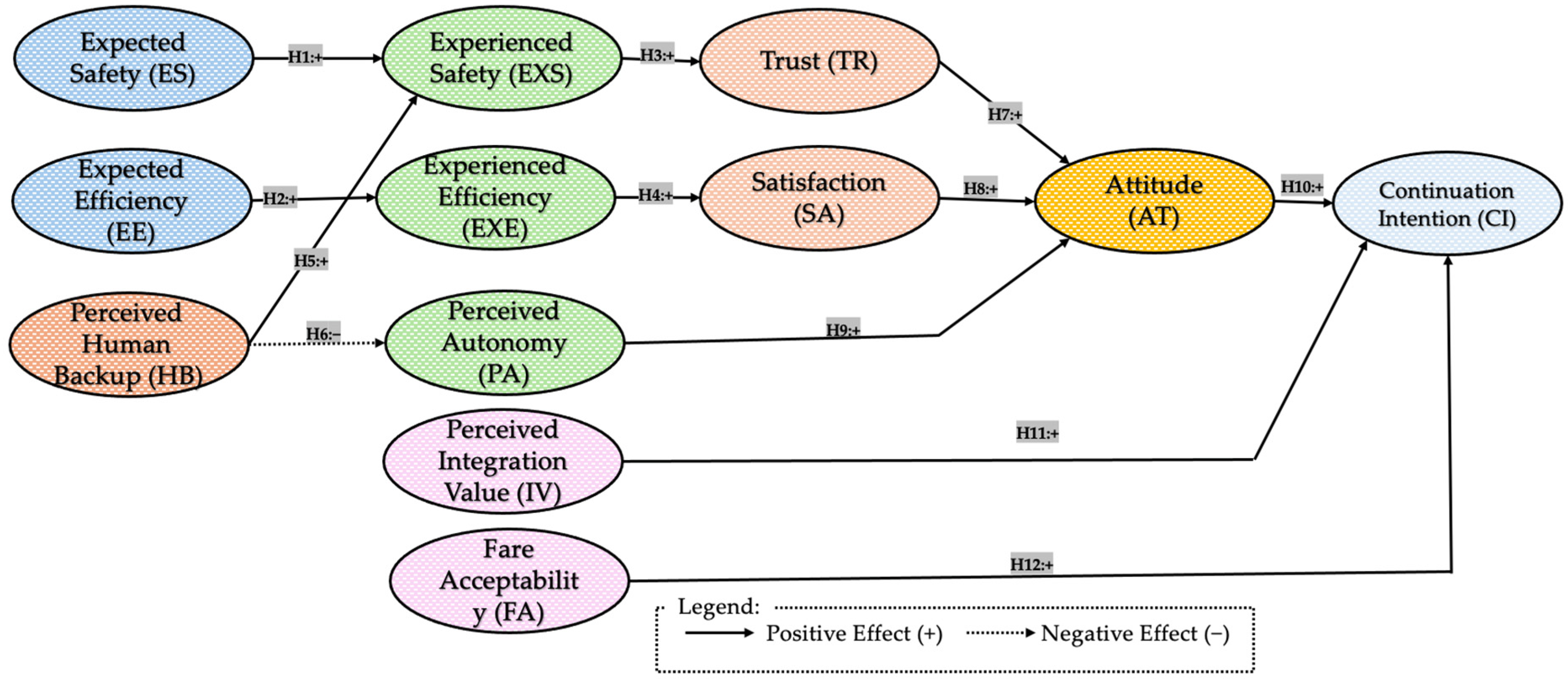
Based on the research gaps identified in Section 2, this study develops and tests a research model to examine user acceptance of autonomous shuttle services in a real-world context. The model integrates expectation–experience dynamics, psychological responses, system characteristics, and contextual factors into a unified framework. Specifically, expected safety and expected efficiency are proposed to influence experienced safety and experienced efficiency, respectively, in line with expectation–confirmation theory and prior empirical studies on autonomous mobility adoption [31,32]. Experienced safety further affects trust, while experienced efficiency influences satisfaction, consistent with established findings in automated transport systems and service evaluation research [5]. In addition, perceived human backup is hypothesized to enhance experienced safety while negatively affecting perceived autonomy, reflecting users’ preference for transitional automation stages [22]. Trust, satisfaction, and perceived autonomy are expected to shape user attitude, which in turn influences continuation intention. Furthermore, integration value and fare acceptability are included as contextual factors directly affecting continuation intention. The proposed research model is illustrated in Figure 1.

3.2. Measurement Items

All constructs in this study were measured using multi-item scales adapted from prior literature to ensure content validity and reliability. The measurement items were modified to fit the context of autonomous shuttle services in Seoul. Each construct was operationalized using three to four items based on established studies in autonomous vehicle acceptance, human–automation interaction, and mobility services. All items were measured using a five-point Likert scale ranging from 1 (strongly disagree) to 5 (strongly agree). Table 2 presents the measurement items and their corresponding sources.

3.3. Survey Design and Data Collection

The questionnaire was designed based on the measurement items presented in Section 3.2 and consisted of three main parts. The first part collected respondents’ socio-demographic information, including gender, age, education level, and prior experience with autonomous technologies. The second part measured the key constructs in the research model, including expectation, experience, perceived human backup, perceived autonomy, trust, satisfaction, integration value, and fare acceptability. The third part assessed respondents’ attitude and continuation intention toward autonomous shuttle services.
All measurement items were adapted from validated scales in prior studies and were slightly modified to fit the context of autonomous shuttle services in Seoul, following established practices in scale adaptation and validation [13,26]. A five-point Likert scale ranging from 1 (strongly disagree) to 5 (strongly agree) was used for all items, which is widely adopted in behavioral and technology acceptance research [12,33]. To ensure clarity and content validity, a pilot test was conducted with a small group of respondents (n = 50). Based on their feedback, minor revisions were made to improve wording and readability. Data were collected from users of Seoul’s autonomous shuttle service operating along the Cheonggyecheon corridor during the pilot operation period from October to December 2025. Because the Seoul pilot service was free of charge during the study period, the fare acceptability items captured respondents’ perceived reasonableness of potential future pricing rather than their evaluation of an actually paid fare. The survey was administered across both weekdays and weekends in order to capture variation in travel purposes and usage occasions. Respondents were approached near major shuttle stops along the route and invited to complete the questionnaire by scanning a QR code, which helped include users from different boarding locations. Both on-site recruitment and online survey administration were employed to collect data. Specifically, respondents were approached near shuttle stops and invited to complete an online questionnaire by scanning a QR code. All responses were collected electronically to ensure consistency in data recording and processing. To ensure data quality, only respondents who had actual experience using the autonomous shuttle were included in the analysis. After removing incomplete and invalid responses, a total of 566 valid questionnaires were retained for further analysis. Participation in the survey was voluntary, and respondents were informed about the purpose of the study. All responses were collected anonymously. This approach ensured that respondents had direct exposure to the service, thereby enhancing the validity of experience-based constructs. Although all core constructs were collected through a single questionnaire, several procedural steps were taken to reduce common method bias, including anonymous participation, the use of established multi-item scales from different literature sources, and clear separation of construct blocks in the survey design. In addition, Harman’s single-factor test was conducted as a statistical check, and the first unrotated factor accounted for 29.70% of the total variance, suggesting that common method bias is unlikely to be a serious concern.

3.4. Data Analysis Method

The two methods serve complementary purposes in this study. SEM is used to test theory-driven net effects and linear relationships among latent variables, thereby evaluating whether the proposed hypotheses are supported on average across the sample. In contrast, fsQCA is used to identify multiple sufficient combinations of conditions associated with high continuation intention, capturing causal asymmetry and equifinality. By combining these methods, the study is able to explain both the average structural relationships among variables and the alternative configurational pathways through which user acceptance may emerge. It should be noted that both expectation and experience constructs were measured within the same survey rather than through a longitudinal before–after design. Therefore, the results should be interpreted as cross-sectional associations that are theoretically consistent with the expectation–experience framework, rather than as direct evidence of temporal causal updating. To comprehensively examine the proposed research model and the underlying causal mechanisms, this study employs a mixed-method analytical approach combining structural equation modeling (SEM) and fuzzy-set qualitative comparative analysis (fsQCA). First, SEM was used to test the hypothesized relationships among latent constructs. SEM is particularly suitable for analyzing complex causal relationships and has been widely applied in technology acceptance research [26,34]. The analysis was conducted using SPSS 27 and AMOS 26 in two stages. In the first stage, confirmatory factor analysis (CFA) was performed to assess the reliability and validity of the measurement model. In the second stage, the structural model was estimated to examine the proposed hypotheses. Model fit was evaluated using multiple goodness-of-fit indices, including the chi-square to degrees of freedom ratio (χ2/df), comparative fit index (CFI), Tucker–Lewis index (TLI), and root mean square error of approximation (RMSEA). Reliability was assessed using Cronbach’s alpha and composite reliability (CR), while convergent validity and discriminant validity were evaluated using average variance extracted (AVE) and the Fornell–Larcker criterion [27].
In addition to SEM, fsQCA was employed to explore configurational effects and identify multiple combinations of conditions leading to high continuation intention. Unlike SEM, which focuses on net effects of individual variables, fsQCA allows for the examination of causal complexity, equifinality, and asymmetric relationships [35]. The fsQCA analysis was conducted using RStudio (version 4.2.3). Following established procedures, raw Likert-scale data were calibrated into fuzzy-set membership scores using three qualitative anchors (full membership, crossover point, and full non-membership). Subsequently, a truth table was constructed, and consistency and coverage thresholds were applied to identify sufficient configurations. By combining SEM and fsQCA, this study provides both symmetric (net-effect) and asymmetric (configurational) insights into the determinants of autonomous shuttle acceptance, thereby offering a more comprehensive understanding of user behavior.

3.5. Demographics of Respondents

Table 3 presents the demographic characteristics of the respondents. The sample is relatively balanced in terms of gender, with 49.3% male and 50.7% female participants. In terms of age, the majority of respondents are between 20 and 39 years old (60.8%), which reflects the primary user group of emerging mobility services in urban Korea. A smaller proportion of respondents are aged 40 and above (9.4%). Regarding education, most respondents hold a bachelor’s degree (50.9%), indicating a relatively well-educated sample. In terms of occupation, company employees represent the largest group (65.4%), followed by self-employed individuals (20.5%). With respect to income, the majority of respondents fall within the 4–6 million KRW range (50.4%), which is consistent with the average income level of urban residents in Seoul. Overall, the sample reflects the profile of active urban mobility users and early adopters of emerging transport services in Seoul, although caution is needed when generalizing the findings to all public transport users. The relatively high proportion of younger respondents may reflect both the novelty-oriented appeal of pilot autonomous mobility services and the QR-based survey mode, which may have been more readily adopted by younger users. The under-20 category should not be interpreted as mapping directly onto a purely minor-only group, however, because a separate age-screening threshold for under-18 exclusion was not implemented in the field survey, the age composition of the sample should be interpreted with caution.

4. Results

4.1. Descriptive Statistics

Descriptive statistics were calculated to provide an overview of respondents’ perceptions of the key constructs included in the research model. In Table 4, the results indicate that respondents generally held moderately positive perceptions toward the autonomous shuttle service, although notable differences were observed across constructs, which is consistent with prior studies on user perception heterogeneity in emerging mobility services [2,5]. Among expectation-related variables, expected efficiency (EE) recorded a relatively high mean value (M = 3.96), suggesting that users had strong expectations regarding the operational performance of the shuttle. In contrast, expected safety (ES) showed a comparatively lower mean (M = 3.39), indicating a more cautious attitude toward safety before actual experience. After using the shuttle, experienced efficiency (EXE) achieved the highest mean among all constructs (M = 4.10), while experienced safety (EXS) also increased to a moderate level (M = 3.57). This pattern suggests that actual user experience, particularly in terms of efficiency, exceeded initial expectations, providing preliminary support for the expectation–experience framework proposed in this study [32].
Regarding system characteristics, perceived human backup (HB) was relatively high (M = 3.94), indicating that users strongly recognized and valued the presence of human operators for safety assurance. However, perceived autonomy (PA) recorded the lowest mean among all constructs (M = 2.22), suggesting that the presence of human supervision may significantly reduce users’ perception of full system autonomy. This finding provides initial evidence supporting the “human backup paradox” proposed in this study.
In terms of psychological responses, trust (TR) was relatively low (M = 2.40), while satisfaction (SA) reached a moderate level (M = 3.09). This indicates that although users were somewhat satisfied with the service, their level of trust in the autonomous system remained limited, reflecting the transitional nature of current autonomous shuttle technology [11]. For attitudinal and contextual factors, attitude (AT) showed a relatively positive evaluation (M = 3.84). Integration value (IV) recorded a high mean (M = 4.09), suggesting that users perceive the shuttle as well integrated within the existing transport system. Similarly, fare acceptability (FA) was also relatively high (M = 3.87), indicating that respondents viewed potential future pricing as generally reasonable and acceptable. Finally, continuation intention (CI) demonstrated a strong positive level (M = 3.85), suggesting that despite concerns regarding autonomy and trust, users are generally willing to continue using and recommending the autonomous shuttle service. Overall, the descriptive results reveal a clear pattern: while users exhibit strong evaluations of efficiency and system integration, perceptions of autonomy and trust remain relatively weak. This imbalance highlights the importance of examining the distinct roles of trust and perceived autonomy in the acceptance process, even though only perceived autonomy shows significant mediation effects in the structural results.

4.2. Measurement Model Assessment

4.2.1. Confirmatory Factor Analysis (CFA)

Confirmatory factor analysis (CFA) was conducted using AMOS to evaluate the overall fit of the measurement model. In Table 5, the results indicate that the model demonstrates a good fit to the data. Specifically, the chi-square to degrees of freedom ratio (χ2/df) is 1.717, which is below the recommended threshold of 3.0, indicating an acceptable model fit [36]. The root mean square error of approximation (RMSEA) is 0.036, which is well below the threshold of 0.08 and suggests an excellent fit [37]. In addition, the goodness-of-fit index (GFI = 0.921) and adjusted goodness-of-fit index (AGFI = 0.900) meet the recommended threshold of 0.90. The incremental fit indices also demonstrate strong model performance, with the comparative fit index (CFI = 0.972), Tucker–Lewis index (TLI = 0.966), incremental fit index (IFI = 0.972), and normed fit index (NFI = 0.935), all exceeding the acceptable level of 0.90 [26]. Furthermore, all factor loadings are statistically significant (p < 0.001), indicating that the observed variables are good indicators of their respective latent constructs. Overall, these results confirm that the measurement model has a satisfactory level of goodness-of-fit and is suitable for further analysis.

4.2.2. Assessment of Reliability and Convergent Validity

The reliability and convergent validity of the measurement model were assessed using Cronbach’s alpha, composite reliability (CR), and average variance extracted (AVE) [26,27]. In Table 6, all constructs showed Cronbach’s alpha values exceeding the recommended threshold of 0.70 [33]. Similarly, composite reliability values range from 0.74 to 0.94, all above the acceptable level of 0.70, indicating strong reliability. Convergent validity was evaluated based on standardized factor loadings and AVE values. All factor loadings are statistically significant and exceed the recommended threshold of 0.60, indicating that the measurement items adequately represent their corresponding constructs. Most constructs exhibit AVE values above the recommended threshold of 0.50, confirming satisfactory convergent validity [27]. However, the construct of attitude (AT) shows a slightly lower AVE value (0.49), which is marginally below the threshold. Given that all factor loadings are significant and CR exceeds 0.70, the convergent validity of AT is considered acceptable in this study [26]. For transparency, the standardized factor loadings for the attitude items were AT1 = 0.677, AT2 = 0.689, and AT3 = 0.746, all of which exceed the acceptable level for item retention. Overall, these results indicate that the measurement model demonstrates adequate reliability and convergent validity. Nevertheless, because attitude plays a central mediating role in the structural model and its AVE is slightly below the conventional threshold, findings involving this construct should be interpreted with appropriate caution.

4.2.3. Assessment of Discriminant Validity

Discriminant validity was assessed using the Fornell–Larcker criterion, which requires that the square root of the average variance extracted (AVE) for each construct be greater than its correlations with other constructs [27]. As shown in Table 7, the square roots of AVE (reported on the diagonal) are greater than the corresponding inter-construct correlations for most constructs. This indicates that each construct shares more variance with its own indicators than with other constructs, thereby supporting discriminant validity. In addition, the correlations among constructs are generally below the recommended threshold of 0.85, suggesting that multicollinearity is not a concern [26,34]. Although some constructs (e.g., EE and HB, r = 0.710) show relatively strong correlations, they remain within acceptable limits. Overall, the results confirm that the measurement model demonstrates satisfactory discriminant validity. In addition, variance inflation factors (VIFs) were examined for the predictor constructs. The VIF values ranged from 1.003 to 1.377, which is well below the commonly accepted threshold, indicating that multicollinearity is not a serious concern in the model. To further verify discriminant validity, the HTMT criterion was also examined for conceptually adjacent constructs, including trust, satisfaction, and attitude, as well as the strongly correlated pair of expected efficiency and human backup. As reported in Table A1, all HTMT values are well below the recommended threshold, providing additional evidence that these constructs are empirically distinct.

4.3. Results of the Structural Model

The structural model was estimated using AMOS to test the proposed hypotheses. The results indicate that the model demonstrates a satisfactory fit to the data. Specifically, the chi-square to degrees of freedom ratio (χ2/df) is 2.205, which is below the recommended threshold of 3.0 [34]. The root mean square error of approximation (RMSEA) is 0.046, indicating a good fit [37]. In addition, the comparative fit index (CFI = 0.948), Tucker–Lewis index (TLI = 0.943), and incremental fit index (IFI = 0.948) all exceed the recommended threshold of 0.90, suggesting an acceptable model fit [26].
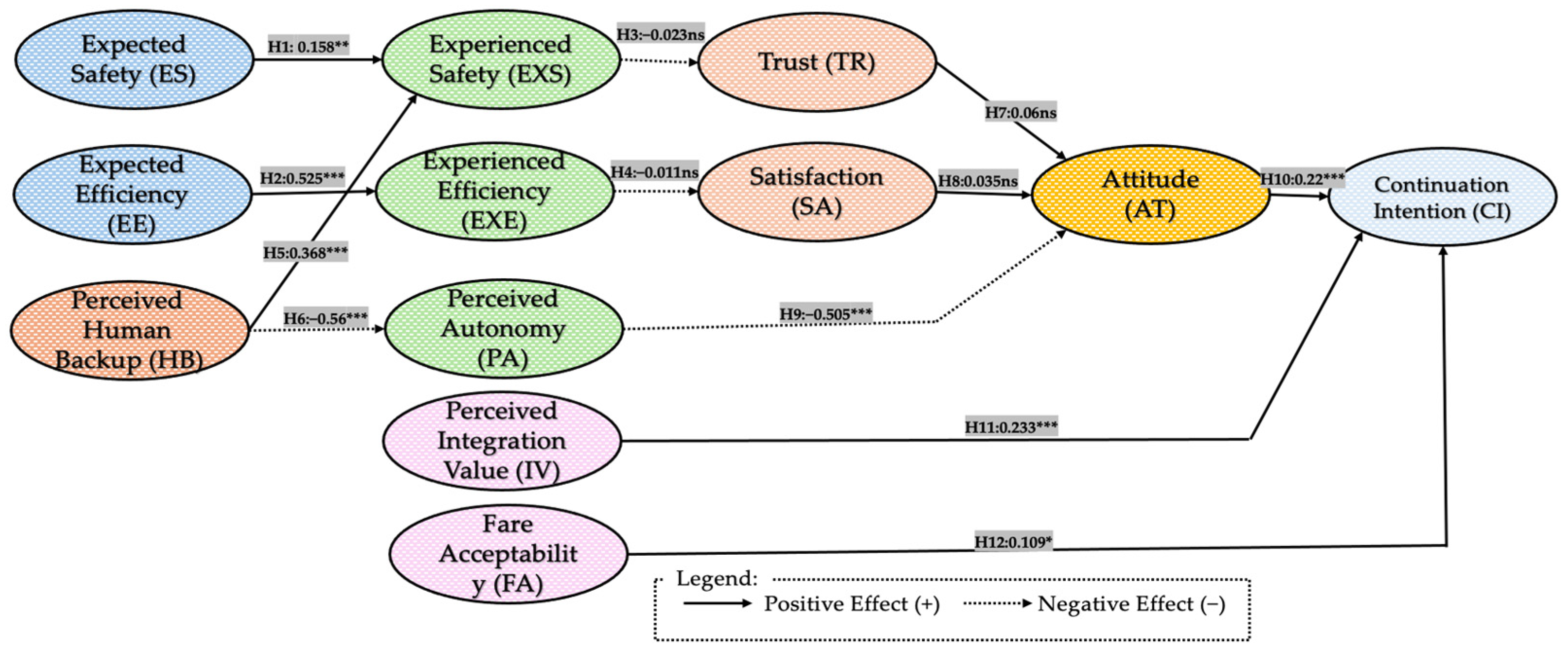
The standardized path coefficients and hypothesis testing results are presented in Table 8 and Figure 2. First, expected safety has a positive and significant effect on experienced safety (β = 0.158, p < 0.01), supporting H1. Expected efficiency also has a significant positive effect on experienced efficiency (β = 0.525, p < 0.001), supporting H2, which is consistent with the expectation–confirmation framework [32]. Second, experienced safety does not have a significant effect on trust (β = −0.023, p > 0.05), and experienced efficiency does not significantly influence satisfaction (β = −0.011, p > 0.05). Therefore, H3 and H4 are not supported. A plausible contextual interpretation is that users in the Seoul pilot may have evaluated safety and efficiency under transitional service conditions rather than under the standards of a mature public transport system. For example, the presence of visible human backup may lead passengers to attribute safe operation partly to human supervision rather than to the autonomous system itself, thereby weakening the link between experienced safety and trust. One possible interpretation is that trust may have functioned more as a broader system-level evaluation than as a direct reaction to a single ride experience in this pilot context. This interpretation should be viewed as contextual rather than definitive; however, the trust construct itself still demonstrates strong internal consistency, composite reliability, and convergent validity, suggesting that the issue lies more in its weak structural linkage to ride-level experiential judgments than in an obvious measurement failure. Likewise, because the pilot service involved short-distance rides and free trial use, experienced efficiency may not have been salient enough to translate into a broader sense of satisfaction. Moreover, because both coefficients are extremely close to zero, their negative signs should not be interpreted as substantively negative effects. Rather, they indicate the absence of stable positive relationships under the Seoul pilot conditions. These interpretations should therefore be understood as contextual explanations of the observed pattern rather than as directly tested mechanisms. Third, perceived human backup has a significant positive effect on experienced safety (β = 0.368, p < 0.001) and a significant negative effect on perceived autonomy (β = −0.560, p < 0.001), supporting H5 and H6. Fourth, trust and satisfaction do not have significant effects on attitude (β = 0.060, p > 0.05; β = 0.035, p > 0.05), indicating that H7 and H8 are not supported. In contrast, perceived autonomy has a significant negative effect on attitude (β = −0.505, p < 0.001). Although this relationship is statistically significant, its direction is opposite to the hypothesized positive effect, and thus H9 is not supported, which aligns with prior findings that users may prefer partial automation over full autonomy in early-stage systems [22]. Finally, attitude (β = 0.220, p < 0.001), perceived integration value (β = 0.233, p < 0.001), and fare acceptability (β = 0.109, p < 0.05) all have significant positive effects on continuation intention, supporting H10, H11, and H12. However, because the pilot service was free of charge, the effect of fare acceptability should be interpreted as reflecting anticipated affordability under possible future regular operation rather than evaluation of an actually paid fare. Overall, the results partially support the proposed hypotheses and provide empirical insights into the expectation–experience framework in autonomous shuttle acceptance.

4.4. Mediation Effect Analysis

To examine the mediating effects among the constructs, a bootstrapping procedure with 2000 resamples and bias-corrected confidence intervals was employed, which is widely recommended for testing mediation effects in structural models [38,39]. The results of standardized indirect effects, along with their confidence intervals and significance levels, are presented in Table 9. The findings reveal that perceived human backup (HB) has a significant indirect effect on attitude (AT) through perceived autonomy (PA) (β = 0.282, 95% CI [0.203, 0.372], p < 0.01), indicating a strong mediating mechanism. This indirect pathway represents the core mechanism of the “human backup paradox” proposed in this study. Specifically, the presence of human backup reduces perceived autonomy, but this reduced autonomy is associated with more favorable attitudes in the early-stage pilot context. Furthermore, HB also exerts a significant indirect effect on continuation intention (CI) through attitude (β = 0.062, 95% CI [0.027, 0.118], p < 0.01), demonstrating a partial mediation effect. In addition, perceived autonomy shows a significant negative indirect effect on continuation intention via attitude (β = −0.111, 95% CI [−0.195, −0.048], p < 0.01), indicating that higher perceived autonomy reduces users’ behavioral intention through its negative impact on attitude. However, the indirect effects of trust (TR) and satisfaction (SA) on continuation intention are not significant, as their confidence intervals include zero, which is consistent with prior studies suggesting that not all psychological constructs exhibit significant mediating roles in early-stage technology adoption contexts [40]. This suggests that trust and satisfaction do not play a meaningful mediating role in the proposed model.

4.5. fsQCA Results

To complement the SEM analysis, fuzzy-set qualitative comparative analysis (fsQCA) was conducted to explore multiple configurational pathways leading to high continuation intention (CI) [35,41]. First, all variables were calibrated into fuzzy sets using three qualitative anchors: full membership (4.5), crossover point (3.0), and full non-membership (1.5), following established calibration procedures [35]. These thresholds were chosen based on both theoretical and empirical considerations. On a five-point Likert scale, values around 1–2 represent substantive disagreement, 3 represents a neutral crossover point, and values around 4–5 indicate substantive agreement. Therefore, 1.5, 3.0, and 4.5 were used to capture full non-membership, the crossover point, and full membership, respectively. These anchors are also broadly consistent with the observed distribution of the construct scores in the sample. The calibration results indicate an appropriate distribution across membership scores. Second, necessity analysis was performed to identify whether any single condition is required for achieving high continuation intention. The results show that perceived integration value (IV), experienced efficiency (EXE), and expected efficiency (EE) exceed the recommended threshold of 0.90 in consistency [42]. However, these conditions should not be interpreted as strictly necessary, as multiple alternative conditions and combinations also reach this threshold, indicating that high continuation intention reflects causal complexity rather than reliance on any single dominant factor. Third, sufficiency analysis was conducted using a truth table approach with a consistency threshold of 0.80 and a frequency threshold of 3. For transparency, the truth table used in the fsQCA sufficiency analysis is reported in Appendix A (Table A2). The intermediate solution reveals four robust configurations leading to high continuation intention, as presented in Table 10. The overall solution shows strong explanatory power, with a solution consistency of 0.871 and solution coverage of 0.874, indicating that the identified configurations reliably explain a substantial proportion of cases with high CI. Among the configurations, the combination of human backup, positive attitude, and high integration value (HB*AT*IV) emerges as the most influential pathway, with the highest raw coverage (0.784), indicating its strong empirical relevance. In addition, configurations involving the absence of perceived autonomy (~PA) frequently appear, suggesting that lower perceived autonomy may reduce uncertainty and enhance user acceptance in early-stage deployment contexts. This finding is consistent with the SEM results, which identified a negative effect of perceived autonomy on behavioral intention. Compared with the full solution, retaining only high-consistency configurations improves the robustness and interpretability of the results. These configurations represent the most empirically robust and theoretically interpretable solutions. Compared with SEM, which identifies the average net effects of individual variables, fsQCA shows that high continuation intention does not depend on a single universal pathway. Instead, different combinations of reassurance, perceived system integration, and attitudinal readiness can jointly support acceptance in the Seoul pilot context, where users are responding to a transitional and partially supervised form of autonomous mobility. Overall, the fsQCA results demonstrate that multiple combinations of factors can lead to high continuation intention, reflecting causal complexity and complementing the net-effect relationships identified in the SEM analysis.

5. Conclusions

This study provides empirical insights into autonomous shuttle acceptance by integrating expectation–experience dynamics, system characteristics, and configurational analysis. The findings support the expectation–confirmation framework, as expected safety and efficiency significantly influence their experienced counterparts, consistent with prior research [3,21,32]. This indicates that user perceptions of autonomous shuttle services are strongly shaped by pre-use expectations, extending existing studies to a real-world public transport context. Unlike previous studies emphasizing trust and satisfaction [10,11,15], the results show that neither construct significantly affects attitude. This suggests that, in early-stage autonomous shuttle systems, user evaluations are driven more by structural and system-related factors than by psychological responses. In addition, the observed variation in trust and satisfaction suggests that the unsupported relationships are unlikely to be explained by a simple floor-effect problem. A cautious interpretation is that they may reflect the transitional characteristics of the Seoul pilot, where users may not yet translate perceived safety and efficiency into broader psychological judgments in the same way as they would in mature transport services. In addition, perceived autonomy negatively influences attitude, suggesting that users may perceive partial human involvement as a reassuring condition during early-stage deployment. This finding highlights that user acceptance of automation may be stage-dependent rather than linear. At the same time, these findings should be interpreted cautiously. Alternative explanations may include novelty effects, the short-distance and pilot-based nature of the service, and the continued presence of visible human supervision, all of which may shape user judgments differently from those observed in mature autonomous transport systems. Perceived human backup exhibits a dual effect by enhancing experienced safety while reducing perceived autonomy, confirming the “human backup paradox” [14,23]. More importantly, this dual effect operates through a significant indirect pathway from human backup to attitude via perceived autonomy, which clarifies the complete mediation logic underlying the paradox. This finding provides empirical support for the role of human–automation interaction in public transport settings. Meanwhile, integration value and fare acceptability significantly influence continuation intention, highlighting that autonomous shuttle services should be understood as part of a broader transport system rather than as isolated technologies. The fsQCA results complement the SEM findings by revealing multiple configurational pathways leading to high continuation intention, demonstrating causal complexity and equifinality [41]. The most influential configuration (HB*AT*IV) indicates that acceptance is strongest when safety assurance, positive attitude, and system integration co-exist. Notably, the absence of perceived autonomy (~PA) appears across several configurations, reinforcing the finding that lower perceived autonomy may facilitate acceptance in early-stage systems. Furthermore, alternative configurations suggest that different combinations of conditions can compensate for each other, highlighting the flexibility of user acceptance mechanisms. The results therefore support the framework only partially, with the strongest evidence concentrated in the expectation–experience linkage and the human backup–perceived autonomy pathway rather than in the full experience–trust/satisfaction–attitude sequence.
This study contributes to the literature in several ways. First, it tests an expectation–experience framework in the context of autonomous shuttle research, offering a more dynamic understanding of user perception formation. Second, it highlights the human backup paradox and reveals the counterintuitive negative role of perceived autonomy in shaping attitude. Third, by integrating SEM and fsQCA, this study provides both net-effect and configurational perspectives, responding to recent calls for methodological pluralism in mobility research. From a practical perspective, the findings suggest that human backup should not simply be retained as an operational safeguard but also presented strategically as a visible reassurance mechanism during early deployment stages. Rather than emphasizing full autonomy, operators may improve public acceptance by clearly communicating the role of safety personnel as part of a transitional trust-building strategy. In addition, fare policy should move beyond general affordability and consider phased or introductory pricing schemes that encourage trial use while gradually aligning user expectations with service value. This finding should therefore be treated as prospective rather than experiential and requires further validation in a paid operating environment. Connectivity planning is also crucial. For autonomous shuttle services to function as part of the urban mobility system, stronger integration with nearby bus stops, metro stations, and pedestrian access points is needed. In the Seoul pilot context, this means that system design should prioritize transfer convenience, route legibility, and multimodal coordination rather than treating the shuttle as a stand-alone innovation. Overall, this study advances both theory and practice by providing a realistic and integrated framework for understanding autonomous shuttle acceptance in real-world settings. The findings offer valuable insights for the design, deployment, and governance of autonomous mobility systems in smart cities. However, because the sample is concentrated among younger and relatively well-educated respondents, the findings may more strongly reflect the perceptions of early adopters than those of the broader population. Because the study relies on a cross-sectional self-report design, the expectation–experience relationship should be interpreted cautiously, and future longitudinal or before–after designs would be valuable for establishing stronger temporal inference. In addition, because the pilot rides were offered free of charge, the fare acceptability construct should be interpreted as a perception of hypothetical or future pricing rather than an evaluation of actual payment experience. Because the core constructs were collected from the same respondents in the same questionnaire, common method bias cannot be fully ruled out and should be considered when interpreting the results. Future research should incorporate more age-diverse and socially heterogeneous samples to improve the generalizability of the results.

Author Contributions

Conceptualization, X.Z., M.C. and L.T.; methodology, X.Z., M.C. and L.T.; software, X.Z.; validation, X.Z., M.C. and L.T.; formal analysis, X.Z.; investigation, X.Z.; resources, X.Z.; data curation, X.Z. and M.C.; writing—original draft preparation, X.Z.; writing—review and editing, M.C.; visualization, X.Z., M.C. and L.T.; supervision, M.C. All authors have read and agreed to the published version of the manuscript.

Funding

This research received no external funding.

Institutional Review Board Statement

This study was exempted from ethical review by the Department of Global Convergence, Kangwon National University, South Korea, because it involved voluntary, anonymous, questionnaire-based data collection in a non-interventional pilot-use context and posed no more than minimal risk to participants.

Informed Consent Statement

Informed consent was obtained from all participants prior to their participation in the study.

Data Availability Statement

The data presented in this study are available on request from the corresponding author. (The data are not publicly available due to privacy or ethical restrictions).

Conflicts of Interest

The authors declare no conflicts of interest.

Appendix A

Table A1. HTMT values among selected construct pairs.
Construct PairHTMT
TR–AT0.052
SA–AT0.037
TR–SA0.061
EE–HB0.698
Note: All HTMT values are below the recommended threshold, indicating adequate discriminant validity.
Table A2. Truth table for the fsQCA sufficiency analysis of high continuation intention (CI).
RowHBPAATIVFAOUTninclPRI
800111150.9660.920
9010000250.6460.413
1001001150.8230.476
1101010130.8260.492
20100111120.9390.877
2210101160.9590.889
23101101120.9660.932
241011112910.9100.884
3111110130.9630.892
32111111250.9600.927
Note: OUT = outcome value; n = number of cases in each configuration; incl = consistency; PRI = proportional reduction in inconsistency. The truth table was generated using a consistency threshold of 0.80 and a frequency threshold of 3.

References

  1. Shaheen, S.; Cohen, A. Shared Ride Services in North America: Definitions, Impacts, and the Future of Pooling. Transp. Rev. 2019, 39, 427–442. [Google Scholar] [CrossRef]
  2. Haboucha, C.J.; Ishaq, R.; Shiftan, Y. User Preferences Regarding Autonomous Vehicles. Transp. Res. Part C Emerg. Technol. 2017, 78, 37–49. [Google Scholar] [CrossRef]
  3. Bansal, P.; Kockelman, K.M.; Singh, A. Assessing Public Opinions of and Interest in New Vehicle Technologies: An Austin Perspective. Transp. Res. Part C Emerg. Technol. 2016, 67, 1–14. [Google Scholar] [CrossRef]
  4. Fagnant, D.J.; Kockelman, K. Preparing a Nation for Autonomous Vehicles: Opportunities, Barriers and Policy Recommendations. Transp. Res. Part A Policy Pract. 2015, 77, 167–181. [Google Scholar] [CrossRef]
  5. Nordhoff, S.; De Winter, J.; Madigan, R.; Merat, N.; Van Arem, B.; Happee, R. User Acceptance of Automated Shuttles in Berlin-Schöneberg: A Questionnaire Study. Transp. Res. Part F Traffic Psychol. Behav. 2018, 58, 843–854. [Google Scholar] [CrossRef]
  6. Ohnemus, M.; Perl, A. Shared Autonomous Vehicles: Catalyst of New Mobility for the Last Mile? Built Environ. 2016, 42, 589–602. [Google Scholar] [CrossRef]
  7. Jung-Joo, L. Seoul Begins Self-Driving Shuttle Service Along Cheonggyecheon. Available online: https://www.koreaherald.com/article/10581662 (accessed on 20 March 2026).
  8. Seoul Metropolitan Government. Autonomous Driving Shuttles without Driver’s Seats to Officially Begin Operation along Cheonggyecheon Stream on September 23. Press release, 2 October 2025. Available online: https://english.seoul.go.kr/autonomous-driving-shuttles-without-drivers-seats-to-officially-begin-operation-along-cheonggyecheon-stream-on-september-23/ (accessed on 20 March 2026).
  9. KBS World. Self-Driving Buses Begin Operation Near Seoul’s Cheonggye Stream. Available online: http://world.kbs.co.kr/service/news_view.htm?Seq_Code=196199&lang=e (accessed on 20 March 2026).
  10. Madigan, R.; Louw, T.; Wilbrink, M.; Schieben, A.; Merat, N. What Influences the Decision to Use Automated Public Transport? Using UTAUT to Understand Public Acceptance of Automated Road Transport Systems. Transp. Res. Part F Traffic Psychol. Behav. 2017, 50, 55–64. [Google Scholar] [CrossRef]
  11. Choi, J.K.; Ji, Y.G. Investigating the Importance of Trust on Adopting an Autonomous Vehicle. Int. J. Hum.-Comput. Interact. 2015, 31, 692–702. [Google Scholar] [CrossRef]
  12. Davis, F.D. Perceived Usefulness, Perceived Ease of Use, and User Acceptance of Information Technology. MIS Q. 1989, 13, 319. [Google Scholar] [CrossRef]
  13. Venkatesh, V.; Morris, M.G.; Davis, G.B.; Davis, F.D. User Acceptance of Information Technology: Toward a Unified View. MIS Q. 2003, 27, 425. [Google Scholar] [CrossRef]
  14. Lee, J.D.; See, K.A. Trust in Automation: Designing for Appropriate Reliance. Hum. Factors 2004, 46, 50–80. [Google Scholar] [CrossRef]
  15. Nordhoff, S.; de Winter, J.; Kyriakidis, M.; van Arem, B.; Happee, R. Acceptance of Driverless Vehicles: Results from a Large Cross-National Questionnaire Study. J. Adv. Transp. 2018, 2018, 5382192. [Google Scholar] [CrossRef]
  16. Hohenberger, C.; Spörrle, M.; Welpe, I.M. How and Why Do Men and Women Differ in Their Willingness to Use Automated Cars? The Influence of Emotions across Different Age Groups. Transp. Res. Part A Policy Pract. 2016, 94, 374–385. [Google Scholar] [CrossRef]
  17. Xu, Z.; Zhang, K.; Min, H.; Wang, Z.; Zhao, X.; Liu, P. What Drives People to Accept Automated Vehicles? Findings from a Field Experiment. Transp. Res. Part C Emerg. Technol. 2018, 95, 320–334. [Google Scholar] [CrossRef]
  18. Feys, M.; Rombaut, E.; Vanhaverbeke, L. Experience and Acceptance of Autonomous Shuttles in the Brussels Capital Region. Sustainability 2020, 12, 8403. [Google Scholar] [CrossRef]
  19. Zou, X.; Logan, D.B.; Vu, H.L. Modeling Public Acceptance of Private Autonomous Vehicles: Value of Time and Motion Sickness Viewpoints. Transp. Res. Part C Emerg. Technol. 2022, 137, 103548. [Google Scholar] [CrossRef]
  20. Yap, M.D.; Correia, G.; Van Arem, B. Preferences of Travellers for Using Automated Vehicles as Last Mile Public Transport of Multimodal Train Trips. Transp. Res. Part A Policy Pract. 2016, 94, 1–16. [Google Scholar] [CrossRef]
  21. Payre, W.; Cestac, J.; Delhomme, P. Intention to Use a Fully Automated Car: Attitudes and a Priori Acceptability. Transp. Res. Part. F Traffic Psychol. Behav. 2014, 27, 252–263. [Google Scholar] [CrossRef]
  22. Rödel, C.; Stadler, S.; Meschtscherjakov, A.; Tscheligi, M. Towards Autonomous Cars: The Effect of Autonomy Levels on Acceptance and User Experience. In Proceedings of the 6th International Conference on Automotive User Interfaces and Interactive Vehicular Applications; Association for Computing Machinery: New York, NY, USA, 2014; pp. 1–8. [Google Scholar]
  23. Parasuraman, R.; Sheridan, T.B.; Wickens, C.D. A Model for Types and Levels of Human Interaction with Automation. IEEE Trans. Syst. Man Cybern. —Part A Syst. Hum. 2000, 30, 286–297. [Google Scholar] [CrossRef]
  24. Endsley, M.R. From Here to Autonomy. Hum. Factors 2017, 59, 5–27. [Google Scholar] [CrossRef]
  25. Meurs, H.; Sharmeen, F.; Marchau, V.; van der Heijden, R. Organizing Integrated Services in Mobility-as-a-Service Systems: Principles of Alliance Formation Applied to a MaaS-Pilot in the Netherlands. Transp. Res. Part A Policy Pract. 2020, 131, 178–195. [Google Scholar] [CrossRef]
  26. Hair, J.F., Jr.; Babin, B.J.; Anderson, R.E.; Black, W.C. Multivariate Data Analysis; Prentice Hall: Upper Saddle River, NJ, USA, 2010. [Google Scholar]
  27. Fornell, C.; Larcker, D.F. Evaluating Structural Equation Models with Unobservable Variables and Measurement Error. J. Mark. Res. 1981, 18, 39–50. [Google Scholar] [CrossRef]
  28. Nordhoff, S.; Kyriakidis, M.; van Arem, B.; Happee, R. A Multi-Level Model on Automated Vehicle Acceptance (MAVA): A Review-Based Study. Theor. Issues Ergon. Sci. 2019, 20, 682–710. [Google Scholar] [CrossRef]
  29. Golbabaei, F.; Yigitcanlar, T.; Paz, A.; Bunker, J. Understanding Autonomous Shuttle Adoption Intention: Predictive Power of Pre-Trial Perceptions and Attitudes. Sensors 2022, 22, 9193. [Google Scholar] [CrossRef] [PubMed]
  30. Alonso-González, M.J.; Hoogendoorn-Lanser, S.; Van Oort, N.; Cats, O.; Hoogendoorn, S. Drivers and Barriers in Adopting Mobility as a Service (MaaS)—A Latent Class Cluster Analysis of Attitudes. Transp. Res. Part A Policy Pract. 2020, 132, 378–401. [Google Scholar] [CrossRef]
  31. Oliver, R.L. A Cognitive Model of the Antecedents and Consequences of Satisfaction Decisions. J. Mark. Res. 1980, 17, 460–469. [Google Scholar] [CrossRef]
  32. Bhattacherjee, A. Understanding Information Systems Continuance: An Expectation-Confirmation Model. MIS Q. 2001, 25, 351–370. [Google Scholar] [CrossRef]
  33. Nunnally, J.C. Psychometric Theory 3E; Tata McGraw-Hill Education: Columbus, OH, USA, 1994. [Google Scholar]
  34. Kline, R.B. Principles and Practice of Structural Equation Modeling; Guilford Publications: New York, NY, USA, 2015. [Google Scholar]
  35. Ragin, C.C. Redesigning Social Inquiry: Fuzzy Sets and Beyond; University of Chicago Press: Chicago, IL, USA, 2008. [Google Scholar]
  36. Tabri, N.; Elliott, C.M. Principles and Practice of Structural Equation Modeling. Can. Grad. J. Sociol. Criminol. 2012, 1, 59–60. [Google Scholar] [CrossRef]
  37. Hu, L.; Bentler, P.M. Cutoff Criteria for Fit Indexes in Covariance Structure Analysis: Conventional Criteria versus New Alternatives. Struct. Equ. Model. A Multidiscip. J. 1999, 6, 1–55. [Google Scholar] [CrossRef]
  38. Preacher, K.J.; Hayes, A.F. Asymptotic and Resampling Strategies for Assessing and Comparing Indirect Effects in Multiple Mediator Models. Behav. Res. Methods 2008, 40, 879–891. [Google Scholar] [CrossRef]
  39. Hayes, A.F. Introduction to Mediation, Moderation, and Conditional Process Analysis: A Regression-Based Approach; The Guilford Press: New York, NY, USA, 2013; pp. xvii, 507. [Google Scholar]
  40. Zhao, X.; Lynch, J.G.; Chen, Q. Reconsidering Baron and Kenny: Myths and Truths about Mediation Analysis. J. Consum. Res. 2010, 37, 197–206. [Google Scholar] [CrossRef]
  41. Fiss, P.C. Building Better Causal Theories: A Fuzzy Set Approach to Typologies in Organization Research. Acad. Manag. J. 2011, 54, 393–420. [Google Scholar] [CrossRef]
  42. Schneider, C.Q.; Wagemann, C. Set-Theoretic Methods for the Social Sciences: A Guide to Qualitative Comparative Analysis; Strategies for Social Inquiry; Cambridge University Press: Cambridge, UK, 2012. [Google Scholar]
Figure 1. Proposed research model of autonomous shuttle acceptance integrating expectation–experience dynamics and contextual factors.
Sustainability 18 04649 g001
Figure 2. Structural equation model (SEM) results of autonomous shuttle acceptance. Note: * p < 0.05; ** p < 0.01; *** p < 0.001; ns = not significant. Solid arrows indicate positive structural effects, whereas dashed arrows indicate negative structural effects.
Sustainability 18 04649 g002
Table 1. Summary of key literature streams and identified research gaps in autonomous shuttle acceptance.
Literature StreamKey Variables/FocusRepresentative StudiesMain FindingsResearch Gap Addressed in This Study
General AV acceptancePerceived safety, trust, perceived risk, usefulness, behavioral intentionHaboucha et al. (2017) [2];
Bansal et al. (2016) [3];
Nordhoff et al. (2018) [15];
Madigan et al. (2017) [10];
Choi and Ji (2015) [11]
AV acceptance is primarily driven by perceived safety, trust, and usefulness, often explained using TAM and UTAUT frameworks.Existing studies focus mainly on private AVs and general perceptions, with limited attention to autonomous shuttle services in real-world public transport contexts.
Experience-based acceptanceReal-world exposure, pre-use and post-use perceptions, ride experienceHohenberger et al. (2016) [16];
Xu et al. (2018) [17];
Yap et al. (2016) [20];
Payre et al. (2014) [21]
Real-world experience significantly influences user perceptions and generally improves acceptance compared with hypothetical scenarios.Experience is often treated as a binary variable rather than modeled as a dynamic expectation–experience process.
Trust and psychological mechanismsTrust, perceived safety, reliability, satisfactionLee and See (2004) [14];
Choi and Ji (2015) [11];
Madigan et al. (2017) [10]
Trust is a central determinant of AV acceptance, while perceived reliability and service performance shape psychological responses such as satisfaction.Limited research examines how experienced safety and experienced efficiency simultaneously influence trust and satisfaction in autonomous shuttle contexts.
Human oversight and autonomy perceptionHuman backup, automation level, perceived autonomy, hybrid controlRödel et al. (2014) [22];
Lee and See (2004) [14];
Parasuraman et al. (2000) [23];
Endsley (2017) [24]
Human oversight can enhance perceived safety and reliability but may reduce perceived autonomy and the sense of full automation.The dual effect of human backup has rarely been empirically tested in real-world autonomous shuttle operations.
Public transport integration and contextual factorsIntegration value, accessibility, fare acceptability, multimodal connectivityShaheen and Cohen (2019) [1];
Alonso-Gonzalez et al. (2020) [30];
Ohnemus and Perl (2016) [6]
Adoption of shared mobility depends not only on technology perceptions but also on system integration and affordability.Contextual factors remain underexplored in autonomous shuttle acceptance, particularly in pilot public transport settings.
Contribution of this studyExpectation–experience dynamics, system attributes, user perceptions, fare acceptability, continuance intentionSynthesized from the above literature streamsExisting studies provide valuable insights but remain fragmented across psychological, technological, and contextual dimensions.This study develops an integrated framework to explain real-world autonomous shuttle acceptance in Seoul’s pilot context.
Table 2. Measurement items and sources.
ConstructItem CodeMeasurement ItemSource
Expected Safety (ES)ES1I expect the autonomous shuttle to operate safely.Payre et al. (2014) [21]
ES2I believe the shuttle can avoid accidents effectively.Bansal et al. (2016) [3]
ES3I expect the shuttle system to be reliable and secure.Nordhoff et al. (2018) [15]
Expected Efficiency (EE)EE1I expect the shuttle to operate efficiently.Yap et al. (2016) [20]
EE2I expect the shuttle to provide smooth travel.Xu et al. (2018) [17]
EE3I expect the shuttle to reduce travel time.Bansal et al. (2016) [3]
Experienced Safety (EXS)EXS1I felt safe while using the shuttle.Feys et al. (2020) [18]
EXS2The shuttle operated safely during my trip.Xu et al. (2018) [17]
EXS3I did not feel at risk during the ride.Nordhoff et al. (2019) [28]
Experienced Efficiency (EXE)EXE1The shuttle operated efficiently.Madigan et al. (2017) [10]
EXE2The ride was smooth and comfortable.Xu et al. (2018) [17]
EXE3The shuttle performed well in terms of travel time.Feys et al. (2020) [18]
Perceived Human Backup (HB)HB1The presence of a human operator increased my sense of safety.Lee & See (2004) [14]
HB2I feel reassured knowing a human can intervene if needed.Parasuraman et al. (2000) [23]
HB3Human supervision improves the reliability of the system.Endsley (2017) [24]
Perceived Autonomy (PA)PA1The shuttle operates independently without human control.Rödel et al. (2014) [22]
PA2The system appears highly autonomous.Endsley (2017) [24]
PA3The shuttle relies minimally on human intervention.Parasuraman et al. (2000) [23]
Trust (TR)TR1I trust the autonomous shuttle system.Lee & See (2004) [14]
TR2I believe the system is reliable.Choi & Ji (2015) [11]
TR3I feel confident using the shuttle.Nordhoff et al. (2018) [15]
Satisfaction (SA)SA1I am satisfied with my experience using the shuttle.Madigan et al. (2017) [10]
SA2The service met my expectations.Oliver (1980) [31]
SA3Overall, I had a positive experience.Xu et al. (2018) [17]
Attitude (AT)AT1Using the autonomous shuttle is a good idea.Davis (1989) [12]
AT2I have a positive attitude toward the shuttle.Venkatesh et al. (2003) [13]
AT3I like the idea of using autonomous shuttle services.Nordhoff et al. (2018) [15]
Integration Value (IV)IV1The shuttle integrates well with other transport modes.Alonso-Gonzalez et al. (2020) [30]
IV2The shuttle improves connectivity within the transport system.Meurs et al. (2020) [25]
IV3The service is convenient for multimodal travel.Shaheen & Cohen (2019) [1]
Fare Acceptability (FA)FA1The fare of the shuttle is reasonable.Shaheen & Cohen (2019) [1]
FA2The service is affordable.Alonso-Gonzalez et al. (2020) [30]
FA3The price is acceptable for the service provided.Meurs et al. (2020) [25]
Continuation Intention (CI)CI1I intend to continue using the shuttle in the future.Venkatesh et al. (2003) [13]
CI2I will use the shuttle whenever possible.Madigan et al. (2017) [10]
CI3I would recommend the shuttle to others.Nordhoff et al. (2018) [15]
Table 3. Demographic characteristics of respondents.
CategoryVariableFrequencyPercentage (%)
GenderMale27949.3
Female28750.7
AgeUnder 2016929.9
20–2916429
30–3918031.8
40 and above539.4
EducationHigh school or below6311.1
Associate degree16128.4
Bachelor’s degree28850.9
Graduate degree549.5
OccupationStudent305.3
Company employee37065.4
Self-employed11620.5
Public sector305.3
Other203.5
Monthly Income (KRW)Less than 2 million295.1
2–4 million9316.4
4–6 million28550.4
6–8 million12221.6
More than 8 million376.5
Table 4. Descriptive statistics of constructs.
ConstructMean (M)Std. Deviation (SD)
Expected Safety (ES)3.390.93
Expected Efficiency (EE)3.960.73
Experienced Safety (EXS)3.570.94
Experienced Efficiency (EXE)4.100.86
Human Backup (HB)3.941.04
Perceived Autonomy (PA)2.221.06
Trust (TR)2.400.90
Satisfaction (SA)3.090.90
Attitude (AT)3.840.96
Integration Value (IV)4.090.92
Fare Acceptability (FA)3.870.97
Continuation Intention (CI)3.851.00
Note: All constructs were measured using a five-point Likert scale (1 = strongly disagree, 5 = strongly agree).
Table 5. Model fit indices of the measurement model.
Fit IndexRecommended ValueModel Value
χ2/df<3.001.717
RMSEA<0.080.036
GFI>0.900.921
AGFI>0.900.900
NFI>0.900.935
IFI>0.900.972
TLI>0.900.966
CFI>0.900.972
Table 6. Reliability and convergent validity.
ConstructCronbach’s αCRAVE
ES0.790.800.58
EE0.760.770.53
EXS0.830.840.64
EXE0.890.890.74
HB0.900.900.75
PA0.920.920.79
TR0.900.900.75
SA0.940.940.84
AT0.730.740.49
IV0.840.850.66
FA0.880.890.72
CI0.910.910.77
Table 7. Discriminant validity.
ConstructESEEEXSEXEHBPATRSAATIVFACI
ES0.76
EE0.560.73
EXS0.380.450.80
EXE0.350.430.210.86
HB0.610.710.450.450.87
PA−0.44−0.57−0.35−0.35−0.510.89
TR0.21−0.08−0.02−0.09−0.100.110.87
SA−0.020.090.02−0.020.03−0.01−0.060.92
AT0.480.640.340.370.62−0.480.010.030.70
IV0.500.670.380.470.63−0.49−0.030.070.560.81
FA0.440.600.380.390.51−0.44−0.100.030.540.480.85
CI0.310.410.300.240.38−0.32−0.060.060.380.360.310.88
Table 8. Structural model results.
HypothesisPathβp-ValueResult
H1ES → EXS0.158**Supported
H2EE → EXE0.525***Supported
H3EXS → TR−0.023n.s.Not supported
H4EXE → SA−0.011n.s.Not supported
H5HB → EXS0.368***Supported
H6HB → PA−0.560***Supported
H7TR → AT0.060n.s.Not supported
H8SA → AT0.035n.s.Not supported
H9PA → AT−0.505***Not supported (opposite direction)
H10AT → CI0.220***Supported
H11IV → CI0.233***Supported
H12FA → CI0.109*Supported
Note: Standardized path coefficients are reported. * p < 0.05; ** p < 0.01; *** p < 0.001; n.s. = not significant.
Table 9. Bootstrapping results of indirect effects.
PathIndirect Effect (β)Lower (95% CI)Upper (95% CI)p-ValueResult
HB → PA → AT0.2820.2030.3720.001Supported
HB → AT → CI0.0620.0270.1180.001Supported
PA → AT → CI−0.111−0.195−0.0480.001Supported
TR → AT → CI0.013−0.0050.040.139Not supported
SA → AT → CI0.008−0.0130.0340.407Not supported
Note: CI = confidence interval; bootstrap samples = 2000; bias-corrected confidence intervals are reported.
Table 10. Configurations leading to high continuation intention (CI).
ConfigurationHBPAATIVFAConsistencyPRIRaw CoverageUnique Coverage
1 0.8980.8740.7840.123
2 0.9060.8800.6760.016
3 0.8980.8710.6960.036
4 0.9080.8830.6840.023
Note: ● = presence of condition; ⊗ = absence of condition; blank = condition not specified. PRI = Proportional Reduction in Inconsistency. Configurations 2 and 3 are distinct because Configuration 2 includes the presence of attitude with integration value unspecified, whereas Configuration 3 includes the presence of integration value with attitude unspecified.
Disclaimer/Publisher’s Note: The statements, opinions and data contained in all publications are solely those of the individual author(s) and contributor(s) and not of MDPI and/or the editor(s). MDPI and/or the editor(s) disclaim responsibility for any injury to people or property resulting from any ideas, methods, instructions or products referred to in the content.