Article

Study on Administrative Collaborative Governance of Yellow River Water Pollution Under Sustainable Goals: An Empirical Study Based on China’s Current Legal System

1
School of Marxism, Tsinghua University, Beijing 100084, China
2
Law School, Shandong Normal University, Jinan 250014, China
3
Business School, Qingdao University of Technology, Qingdao 266520, China
*
Author to whom correspondence should be addressed.
Sustainability 2026, 18(1), 93; https://doi.org/10.3390/su18010093 (registering DOI)
Submission received: 4 November 2025 / Revised: 12 December 2025 / Accepted: 19 December 2025 / Published: 21 December 2025

Abstract

“Administrative collaboration” is an important theoretical and methodological requirement proposed by the Chinese government to advance the environmental governance of the Yellow River Basin (YRB). In the governance of Yellow River water pollution, it has been regarded as a key strategy to respond to and resolve pollution issues. Administrative collaboration refers to the timely linkage and cooperation that government departments in different administrative regions of the basin carry out when water pollution occurs. China’s current legal documents have stipulated provisions on this; however, most of these provisions are only guiding rather than obligatory, so collaboration between government departments mainly relies on their respective willingness. As a result, administrative power barriers are difficult to break through, making it hard to implement collaborative governance. To address this, relevant entities should be endowed with obligations through legal provisions. This study innovatively proceeds from the perspective of normative texts, establishes administrative collaborative governance as a legal obligation that government departments at all levels must fulfill, and proposes a series of operable and specific supervision requirements. This is intended to ensure the effective implementation of administrative collaboration in governance practice, realize the value of sustainable basin development, and at the same time provide legislative references for governments around the world in carrying out collaborative governance of major rivers.

1. Introduction

A river basin is a fundamental natural spatial unit connected by water. Due to the fluidity, continuity, and unceasing movement of water bodies [1], pollution in one area can continuously spread to other water bodies as water flows, resulting in cross-regional impacts of water pollution within the basin. Therefore, the governance of water pollution in river basins cannot be confined to a single administrative region. In addition, water pollution in river basins involves multiple departments, such as water resources, ecology and environment, and emergency management, making it impossible for any single functional department to address the complex challenges of basin water pollution on its own [2]. Thus, coordination and collaboration among government departments are critically important in the process of basin water pollution governance. The inherent hydrological continuity of the Yellow River—such as the frequent exchange between groundwater and surface water, and the complex processes of sediment adsorption and transport—naturally leads to the trans-administrative boundary transmission of pollutants at the physical level. This pollutant transport dynamics driven by natural forces constitutes a fundamental contradiction with artificially delineated administrative boundaries [3]. On this basis, water pollution is often accompanied by distinct characteristics such as sudden occurrence, high risk, and potential crisis, which greatly exacerbates the complexity and difficulty of collaborative governance among various administrative regions within the river basin.
The Yellow River is China’s second largest river, stretching 5464 km with a basin area of 752,443 square kilometers and occupying a highly strategic position [4]. According to Article 6 of the Yellow River Protection Law of the People’ s Republic of China (YRPL): “Local people’s governments at or above the county level and relevant departments shall, in accordance with the division of responsibilities within their respective administrative areas, strengthen coordination with one another.” In addition, Article 20 of the Law of the People’ s Republic of China on Prevention and Control of Water Pollution (WPCL): “The State shall establish a trans-administrative region joint prevention coordination mechanism.” Water pollution governance in the Yellow River Basin (YRB) is carried out through the division of responsibilities among administrative regions and relies on the respective authorities of those regions, namely, the various government departments. As the YRB spans multiple administrative regions, and given the differences in geographical conditions, environmental needs, and core interests among these regions, it is often difficult for a single government department to address complex cross-boundary water pollution issues. Therefore, efficient coordination among government departments is essential.
It should be particularly emphasized that, compared with other river basins, this study selects the YRB as the research object mainly based on the following reasons. First, the YRB has a higher level of top-level strategy and deployment. China has elevated the ecological protection and high-quality development of the YRB to the status of a major national strategy, a positioning that places it at a priority in the national development framework. The Chinese government has successively convened special symposiums targeting the ecological and environmental governance of the Yellow River as a single basin, an unprecedented measure not seen in other river basins such as the Yangtze River. The Yangtze River Basin has focused more on the coordination between economic development and ecological conservation, and has never formed such intensive special deployments for ecological protection and governance, which fully demonstrates the Chinese government’s extreme emphasis on the collaborative governance of the YRB. Second, the ecological environment of the Yellow River is more fragile. Unlike the Yangtze River Basin, the Pearl River Basin and other basins which are located in subtropical humid climates with lush vegetation and strong water self-purification capacity, the YRB is extremely deficient in water resources and has a more vulnerable ecological environment [5]. Its pollution problems are deeply intertwined with issues such as inter-provincial water right allocation and structural water scarcity, making the complexity and urgency of administrative coordination particularly prominent. Third, the Yellow River is a typical representative of China’s river basins with the most acute contradictions in water resources management and the most prominent challenges in administrative coordination. Its administrative collaborative governance involves more participants, more complex power and responsibility relationships, and greater difficulties in interest coordination. Collaborative governance in basins such as the Yangtze River and the Pearl River has mostly focused on relatively single fields such as shipping coordination, and a smooth coordination mechanism can be formed relying on the economic linkage effect of the basin economic belts. In contrast, the administrative coordination of the YRB needs to simultaneously address systematic challenges such as data sharing, emergency response, power coordination, cost allocation and benefit compensation among the “upper, middle and lower reaches”. This multi-objective and multi-dimensional coordination dilemma is highly representative in the governance of China’s river basins. Based on the above considerations, we have decided to take the administrative collaborative governance of the YRB as the research object of this paper. Meanwhile, this study focuses on the field of legal policies. The most important value of legal policies lies in their universal applicability in institutional construction, or at least their reference significance. Therefore, although this study focuses on the Yellow River, the revealed coordination governance dilemmas and the constructed path framework also have important reference value for the Yangtze River Basin and other six major river basins with similar governance structures in solving the ternary game dilemma of “basin–region–department”.
On 23 October 2025, the Chinese government convened the Fourth Plenary Session of the 20th Central Committee of the Communist Party of China (CPC) in Beijing. At this session, the strategy for the high-quality development of the ecological environment in the YRB was discussed at the national top level. On 28 October, the Suggestions of the CPC Central Committee on Formulating the 15th Five-Year Plan for National Economic and Social Development (hereinafter referred to as the “Suggestions”) was issued. The “Suggestions” clearly stated: “Continue to promote the ecological protection and high-quality development of the YRB, and deepen cross-administrative region cooperation.” This puts forward top-level requirements for the collaborative administrative governance of the YRB and demonstrates the great importance the Chinese government attaches to the collaborative administrative governance of river basins.
The core essence of administrative collaboration lies in fostering a long-term collaborative mechanism among different government departments [6], one that encompasses functional cooperation, information sharing, and goal alignment. However, in practice, water pollution control in the YRB has long been characterized by inefficient collaboration [7]. For example, in the case of the pollution discharge by a chemical enterprise at the border of Shanxi and Shaanxi provinces, the company’s discharge pipeline crossed the provincial boundary. Yet, since there were no mandatory regulations for joint governance between the two provinces, the effectiveness of tracing the pollution source by both provincial governments was far from ideal. Furthermore, as the case involved multiple departments—such as the local departments of ecology and environment and emergency management—overlapping responsibilities and inconsistent standards for administrative penalties prevented these departments from forming a cohesive collaborative force, resulting in numerous obstacles to effective water pollution governance.
Currently, only six provinces in the YRB—Henan–Shandong, Gansu–Ningxia, and Sichuan–Gansu—have reached compensation agreements, while the remaining provinces (regions/municipalities) are still in the negotiation phase. More critically, the compensation amount is far lower than the actual cost of pollution control in upstream regions. For instance, Gansu Province has invested over 800 million yuan in wetland restoration to protect the water source of the Taohe River, a tributary of the Yellow River. However, under its compensation agreement with Ningxia, the maximum annual compensation amount is less than 50 million yuan. Meanwhile, water quantity management in the YRB falls under the jurisdiction of water conservancy departments, water quality monitoring is the responsibility of ecological and environmental departments, and the control of agricultural non-point source pollution is overseen by agricultural and rural departments. The data sharing rate among these departments is less than 40%. According to a 2023 survey by the Yellow River Conservancy Commission, among the 673 key sewage outlets into the river within the basin, only 32% have achieved synchronized data monitoring by water conservancy and ecological and environmental departments. For the remaining outlets, due to inconsistent monitoring standards, the deviation in water quality monitoring results for the same sewage outlet exceeds 30%.
The lack of coordination among government departments ultimately stems from the lack of alignment in the exercise of administrative power. To address this, it is necessary to draw on fundamental theories of administrative collaboration, inter-governmental collaboration, and intra-departmental collaboration (for functional departments) to conduct an in-depth analysis of the causes and inherent nature of such collaboration failures. On this basis, targeted countermeasures can be further proposed to resolve the issue. Among these, administrative collaborative governance refers to a model where governments and functional departments, as the main entities, break through the boundaries of their respective administrative powers to achieve collaborative cooperation in the governance of Yellow River water pollution. Inter-governmental collaborative governance—also known as cross-administrative regional collaborative governance—takes governments as the primary participants and focuses on enabling cooperation among governments of different regions in water pollution governance. Meanwhile, intra-departmental collaborative governance (for functional departments) involves close cooperation among departments responsible for environmental protection, monitoring, supervision, and other functions in addressing Yellow River water pollution, including data sharing and the provision of functional support to facilitate joint efforts. In summary, inter-governmental collaborative governance and intra-departmental collaborative governance are two components of administrative collaborative governance. The coordination of administrative powers among different governments and departments collectively contributes to the effective implementation of administrative collaborative governance.
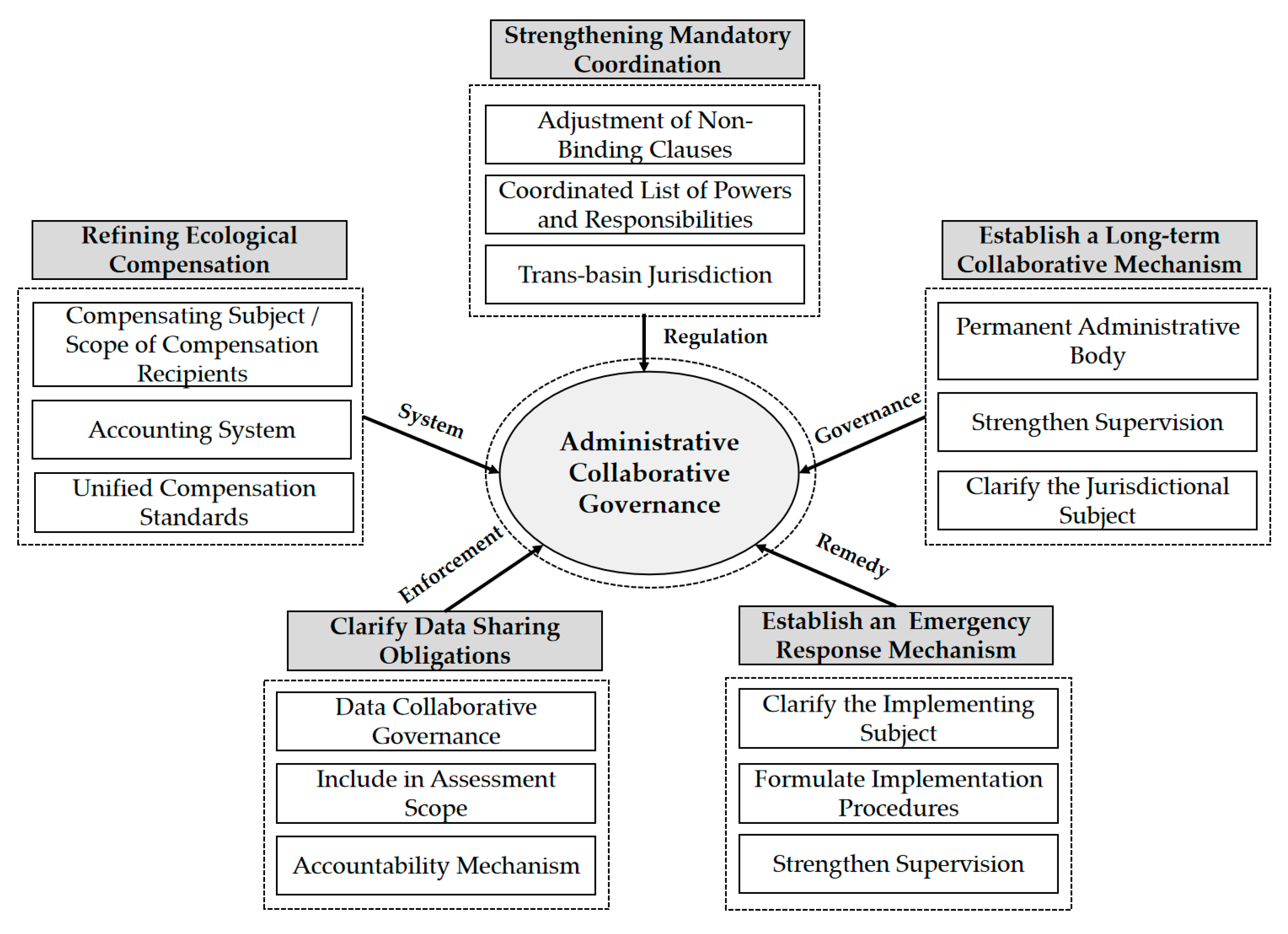
However, current policies and regulations on collaborative governance among government departments in China remain at the macro level of advocacy and conceptual guidance. Whether departments engage in collaborative governance and the depth and breadth of such collaboration largely depend on their own initiative, lacking rigid constraints. This is clearly insufficient to address the complex challenges of collaborative governance in practice. Therefore, this study aims to truly achieve effective coordination among government departments and translate national-level policy orientations into specific governance practices. It further proposes that a normative system with binding force must be formulated and refined—through institutional designs such as establishing rigid collaborative governance obligations, clarifying responsibilities for monitoring data sharing, improving ecological compensation standards, and strengthening supervision over the collaborative process and accountability mechanisms—to provide solid regulatory guarantees for the collaborative governance of water pollution in the YRB. This study takes the policy and regulatory system related to administrative collaborative governance of the Yellow River as its research object, systematically reviewing the overall status and framework of the current policy system. In terms of research approach, the study combines an analysis of practical cases of interdepartmental collaborative governance with a retrospective examination of the policy and regulatory formulation process, assessing the design of relevant policies and regulations. This allows for an in-depth analysis of the root causes of lack of coordination among government departments and ultimately leads to the development of targeted and practical recommendations for refining relevant policies and regulations. The deeper value of this research lies not only in providing new insights for basin collaborative governance from the perspective of institutional and normative design, compared to previous studies, but also in offering more targeted and practical top-level design solutions to address the dilemma of insufficient collaboration in governance practice, thereby responding to the global issue of “clean water sources” outlined in the SDGs [8].

2. Literature Review

2.1. Fundamental Theoretical Research on Administrative Collaborative Governance in River Basins

The inherent characteristics of river basin governance—such as its cross-boundary externalities and indivisible public nature—determine that the governance process inevitably involves multiple actors across different regions, levels, and departments. The differences in interests and the intertwining of rights and responsibilities among these actors make collaborative governance the fundamental methodological approach to addressing the challenges of river basin governance. Therefore, theoretical research on administrative collaborative governance is necessary and vital. As Hendra et al. (2024) [9] proposed, the paradigms of river basin governance are highly fragmented; therefore, collaborative governance is crucial. Regarding the deconstruction of the “collaborative” operational mechanism in administrative collaborative governance, Rogers et al. (1982) [10] argued early on that collaboration can be understood as a structural state. The essence of collaborative governance lies in reducing issues such as redundancy, gaps, and incoherence in the governance process. Here, “redundancy” refers to two or more governments or departments performing the same task; “gaps” refer to situations where no government or department undertakes a necessary task; and “incoherence” means that the same entity has conflicting goals and requirements. In short, administrative collaborative governance aims to address the problem of lack of coordination in river basin governance caused by overlapping responsibilities, governance gaps, and conflicts of interest among different governments and departments. As for the fundamental reasons behind such lack of coordination, Peters (1998) [11] argues that the root cause lies in the inability of multiple actors to break free from self-centered behavioral patterns and value perceptions, preventing the formation of shared behavioral logic and values. This issue inherently involves the challenge of transcending the boundaries of their respective jurisdictions. In other words, the lack of collaboration stems from the unwillingness of various actors to bear the costs and to break through the boundaries of their own rights and responsibilities. In contrast, Zhao et al. (2023) [12] argue that the achievement of effective collaborative governance relies on the breakthroughs made by various entities in transcending their own defined responsibilities and powers. In this regard, Barnes (2010) [13] also argues that, in the future, crossing jurisdictional boundaries will be crucial for effective governance, and collaborative governance is precisely the approach that operates across multiple jurisdictions.
Administrative collaborative governance of water pollution in river basins is the concrete manifestation of the aforementioned administrative coordination mechanisms in the field of water pollution control. Due to the diversity and complexity of river basin systems, administrative collaborative governance of basin water pollution also involves coordination among multiple actors. As Newig et al. (2009) [14] points out, water pollution control in river basins requires “multi-actor integration,” which often entails collaboration among various departments, regions, and sectors. Pahl-Wostl et al. (2021) [15] also argue that water pollution governance in river basins is not simply the sum of various pollution factors; rather, it requires systematic planning and organic cooperation among the governing bodies of relevant administrative regions. Emerson et al. (2012) [16] state that the fundamental purpose is to constructively involve cross-departmental and cross-level actors in the structure of public policy formulation and governance processes, so as to achieve governance goals that none of them could accomplish alone. In addition, Zhang et al. (2024) [17] clearly point out that entities exercising administrative power are the leaders in collaborative water pollution governance; therefore, such collaborative governance relationships should be established among governments and their various departments. As Greenstone et al. (2014) [18] note, administrative authority-centered collaborative governance of basin water pollution can generally be summarized as a horizontal coordination mechanism within the bureaucratic system, including horizontal collaboration among departments within government organizations and intergovernmental cooperation within the basin unit. Tamtik (2017) [19] also believes that the complexity of water pollution control involves the integration of various factors across different administrative regions, departments, and time periods, necessitating the establishment of collaborative relationships either between governments or among departments within governments.

2.2. Research on Collaborative Governance of Water Pollution by Governments in the YRB

According to Article 20 of the WPCL, water pollution prevention and control in China—including in the YRB—is primarily carried out through unified governance by the provincial and municipal governments located upstream, midstream, and downstream. Tang et al. (2024) [20] pointed out that the government assumes greater responsibility in the governance of the YRB, and government efficiency is crucial to the water pollution governance of river basins with concentrated chemical industry activities. Due to the inherently borderless nature of water pollution, neighboring regions are inevitably affected by pollution from adjacent areas. As Medema (2015) [21] suggests, geographic proximity becomes a natural link for the implementation of collaborative governance between neighboring regions, and local governments sharing administrative boundaries need to cooperate and form mutually dependent relationships. Feng et al. (2023) [22] also argue that collaboration across administrative boundaries and over long distances, which breaks through geographical constraints, should be encouraged among governmental actors.
However, collaborative governance among governments in the YRB faces corresponding challenges. Brisbois et al. (2015) [23] argues that there is a conflict between local interests and the overall interests of the basin; governments within the basin, especially those upstream and midstream, often engage in bargaining with downstream governments to protect their own local interests. Behind cross-boundary river basin disputes lies, in essence, a struggle over interests. This assertion is fully reflected in the governance of water pollution in the YRB. For example, upstream governments (such as Qinghai and Gansu) may limit their own development by strictly preventing water pollution, as this could mean forgoing high-energy hydropower development and other projects, while downstream provinces benefit directly, resulting in an imbalance where “protectors suffer losses and beneficiaries do not compensate.” Midstream governments (such as Ningxia and Inner Mongolia), motivated by the economic development of their own administrative regions, may relax water pollution penalties for high-return enterprises, which conflicts with the water environment protection needs of downstream governments (such as Henan and Shandong), thereby affecting the water quality of the entire basin. In addition, Li et al. (2025) [24], based on an examination using a digital economy model, found that there are “data barriers” in the basin regarding water resource monitoring and pollution tracing technologies, with cases of upstream water quality monitoring data not being shared with downstream regions, which leads to delayed responses to pollution incidents.

2.3. Research on Collaborative Governance Among Functional Departments for Water Pollution in the YRB

The YRB is an interconnected and complex ecological system encompassing water, soil, forests, farmland, lakes, and grasslands. Feiock et al. (2010) [25] pointed out that isolated actions by a single administrative department are insufficient to address such systemic interconnections, making interdepartmental collaboration essential. Chen et al. (2023) [26] also emphasized the importance of collaboration among functional departments within the basin. They argue that, in the spirit of collaboration, water pollution governance should be guided by a shared mission and driven by common interests, where governing bodies engage in consultation, coordination, and cooperation, thereby generating synergy across departments to facilitate collaborative governance.
However, there are currently significant challenges to collaboration among functional departments. Water pollution control in the YRB involves multiple departments, including those responsible for water resources, ecology and environment, water administration, agriculture and rural affairs, emergency management, and standardization, etc., each exercising authority according to different laws and regulations such as the Environmental Protection Law of the People’s Republic of China (EPL) and the Water Law of the People’s Republic of China (WL). For example, the department of ecology and environment is responsible for unified supervision and governance of water pollution prevention, as well as setting water quality and pollutant discharge standards; the water administration department oversees the approval of sewage outfalls into rivers and lakes and supervises environmental impact assessments for water-related projects; and the agriculture and rural affairs department guides the prevention of agricultural non-point source pollution. This has resulted in relatively rigid “functional territories.” Furthermore, according to Article 10 of the EPL, the entities authorized to supervise and manage local environmental protection work include not only local environmental protection departments, but also other departments and even military environmental protection units. This means that, in addition to local environmental protection departments, other administrative departments are also empowered to supervise and manage pollution in the Yellow River. As a result, Liu et al. (2023) [27] pointed out that functional departments in the ecological governance of the YRB face risks of fragmented or overlapping authority, reflecting differences or conflicts in administrative power. Therefore, Bryson et al. (2006) [28] stated that achieving effective collaborative governance across administrative departments requires strategies to balance power differences among departments and to manage conflicts effectively. Based on this, Song et al. (2023) [29] suggested that, to generate synergy in governance among cross-functional actors, it is essential to break through the boundaries of departmental divisions and resolve the problem of overlapping functions.
In addition, in terms of collaborative water pollution governance, the independence of each department’s functions and objectives has resulted in the fragmentation of “discretionary power.” Put simply, the autonomous decision-making of various departments has further entrenched the current situation of non-collaborative governance. For example, Wang et al. (2024) [30] pointed out that independently established information systems by different departments—such as the “Yellow River Water Resources Dispatching Platform” of the water resources department and the “National Territorial Spatial Planning Database” of the natural resources department—face issues such as inconsistent monitoring data samples, data standards, and formats. Clearly, due to concerns over “data security,” “data sensitivity,” and “departmental interests,” administrative departments may have a low willingness to share information, autonomously deciding not to share data or to selectively share only certain data, which in turn affects the effectiveness of governance.

2.4. Literature Summary

At present, scholars both in China and abroad have conducted research on three major aspects of collaborative governance among government departments: the fundamental theories of collaborative governance, collaboration among different levels of government, and collaboration among various functional departments. These research findings are categorized and summarized in Table 1 below.
The main contribution of current academic research lies in identifying the collaborative governance of water pollution in river basins—including the Yellow River—as a matter of cooperation among different governments and administrative departments. Building on this, existing studies have also noted the difficulties actors face in overcoming the boundaries of their respective jurisdictions and responsibilities. However, the current research has not provided a detailed and in-depth analysis of the specific factors leading to lack of collaboration among actors, nor has it proposed targeted and actionable solutions. Overall, because most studies remain at the level of general guidance and recommendations, there is insufficient argumentation regarding the practical implementation and improvement of administrative collaborative governance.
Secondly, some scholars have pointed out the existence of “information barriers” between administrative regions and departments, and have suggested establishing a platform or mechanism for information sharing. From a technical perspective, it is indeed possible to achieve a certain degree of data exchange among actors. However, in reality, administrative regions and departments have significant autonomy in deciding whether to share data and which data to share. Due to conflicts of interest among actors, some data that relates to economic development but also impacts environmental quality may be withheld or only partially disclosed by relevant parties. This shows that the root problem of insufficient collaboration must fundamentally be addressed through institutional design. We believe that it is necessary to impose mandatory obligations to create rigid constraints, which requires more detailed policy and regulatory provisions, and even the formulation of rules in areas where none currently exist. However, there is currently a significant lack of targeted research on policy and legal frameworks in the academic community. Therefore, this study intends to conduct a normative analysis of the policy and regulatory system for cross-governmental collaborative governance of water pollution in the YRB (such as the YRPL, local regulations, departmental rules, leaders’ speeches, meeting minutes, and programmatic documents). By integrating case analysis, this study will examine the specific issues of non-collaboration, thereby assessing the shortcomings of the current policy and regulatory system and ensuring the feasibility and relevance of policy and regulatory formulation and refinement.
In summary, by deeply analyzing legal texts and thoroughly examining typical cases, this paper not only addresses the previous shortcomings in institutional and normative research in the academic community but also provides more targeted and effective guidance for the policy and regulatory design of administrative collaborative governance of water pollution in the YRB. At the same time, as a significant case of river basin governance in the world’s largest developing country, the research findings offer new insights from Chinese practice for the institutional design of water pollution governance in other major river basins facing similar challenges globally, such as the Ganges in India and the Nile in Egypt.

3. Research Design

3.1. Study Area

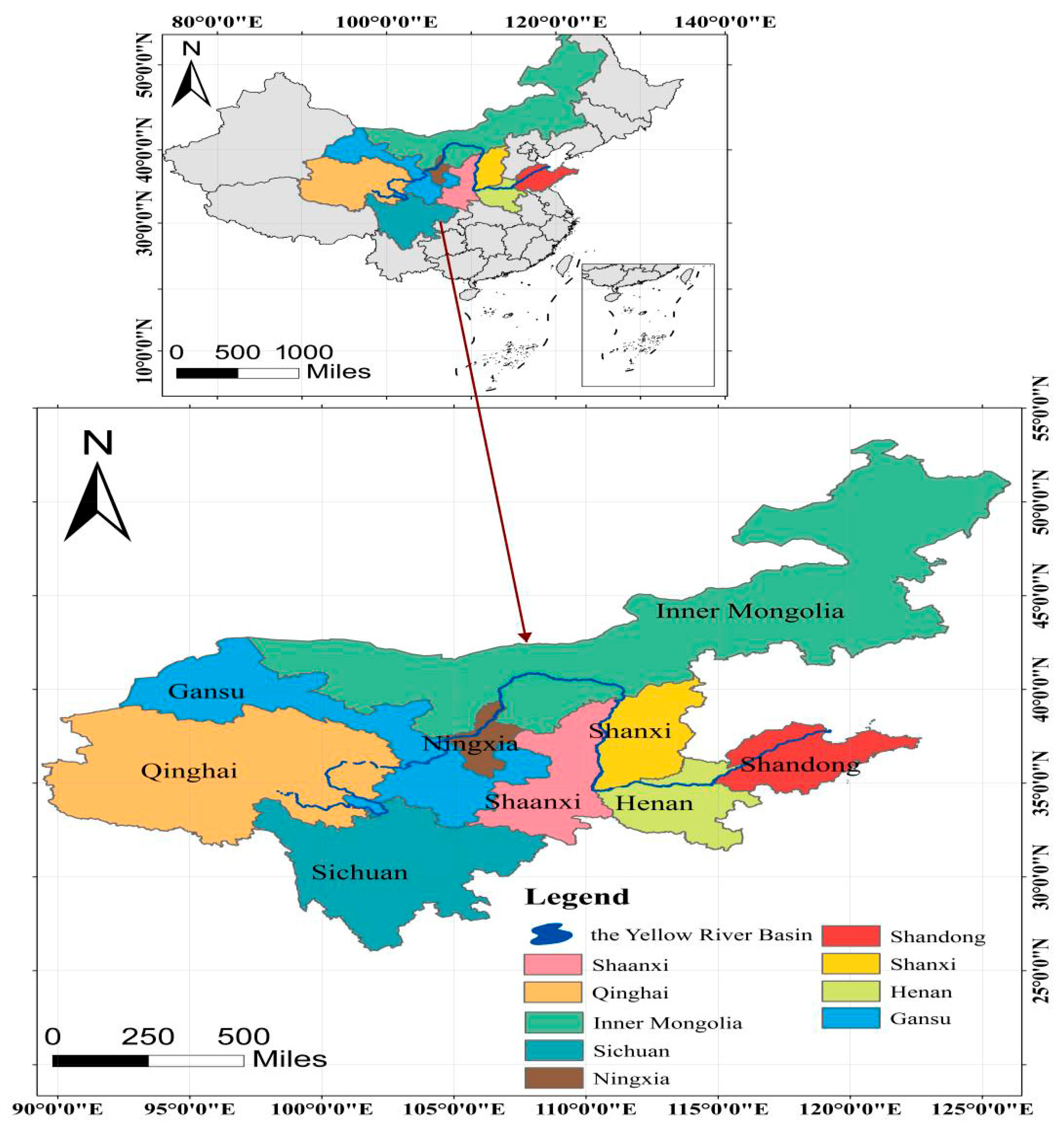
The YRB mainly flows through nine provinces and autonomous regions, specifically including: Qinghai (89°35′–103°04′ E, 31°39′–39°12′ N), Sichuan (102°29′–103°45′ E, 32°53′–34°19′ N), Gansu (92°13′–108°46′ E, 32°31′–42°57′ N), Ningxia (104°17′–107°39′ E, 35°14′–39°23′ N), Inner Mongolia (106°20′–114°53′ E, 37°30′–42°40′ N), Shanxi (110°14′–114°33′ E, 34°34′–40°44′ N), Shaanxi (105°29′–111°15′ E, 31°42′–39°35′ N), Henan (110°21′–116°39′ E, 31°23′–36°22′ N), and Shandong (114°47′–119°10′ E, 34°23′–38°23′ N). The provincial governments of these regions are primarily responsible for water pollution control within their respective administrative areas. The overall distribution of provincial governments in the YRB is shown in Figure 1.
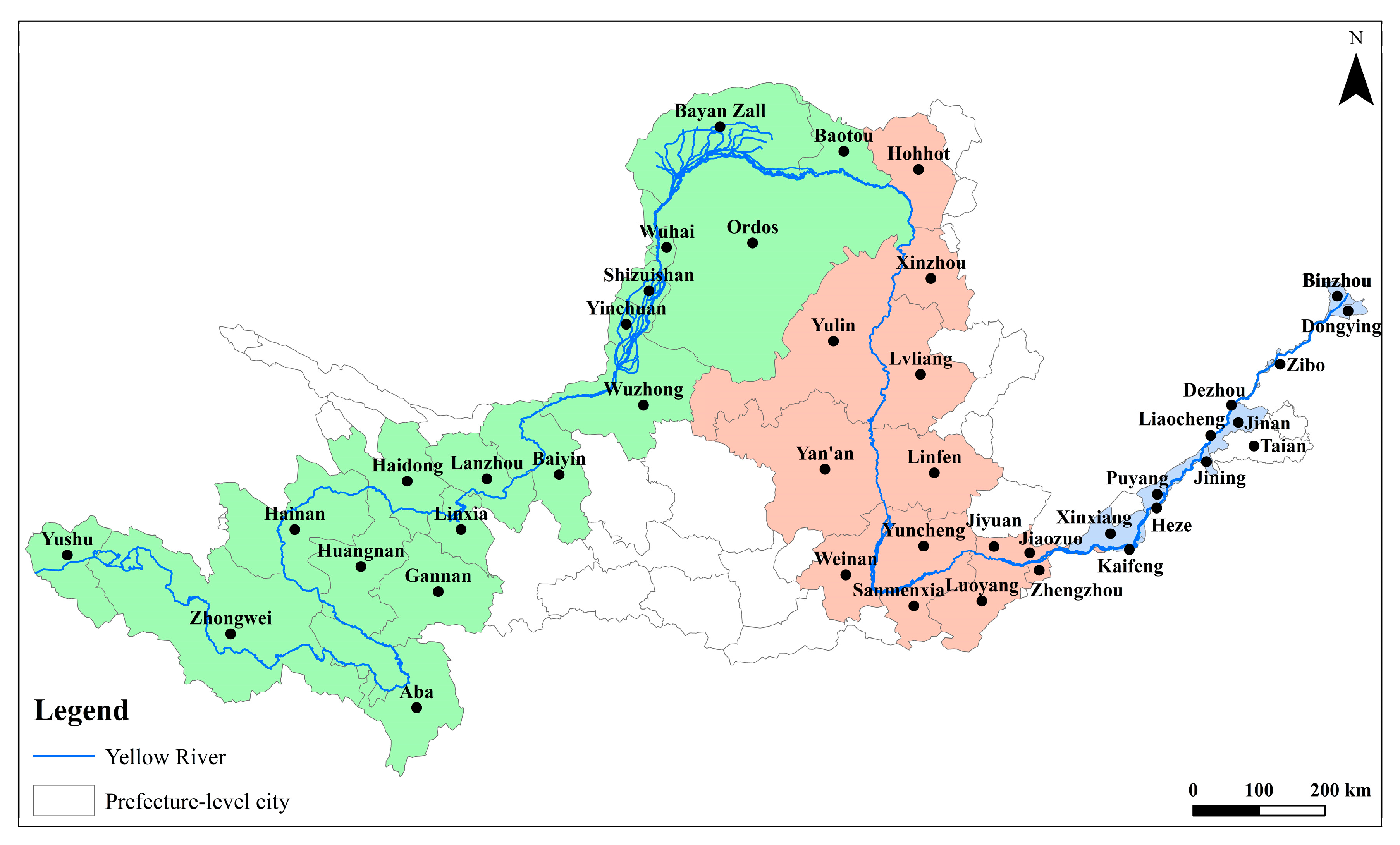
Within the administrative division system of the YRB, the next level of administrative unit under the provincial government—the prefecture-level city—serves as the key executive body responsible for undertaking water pollution control tasks in the basin. In terms of the river’s course, the Yellow River mainly covers 36 core prefecture-level cities, which are distributed in a belt-like pattern along the upper, middle, and lower reaches of the river, connecting the “key nodes” of ecological governance in the basin (Figure 2).
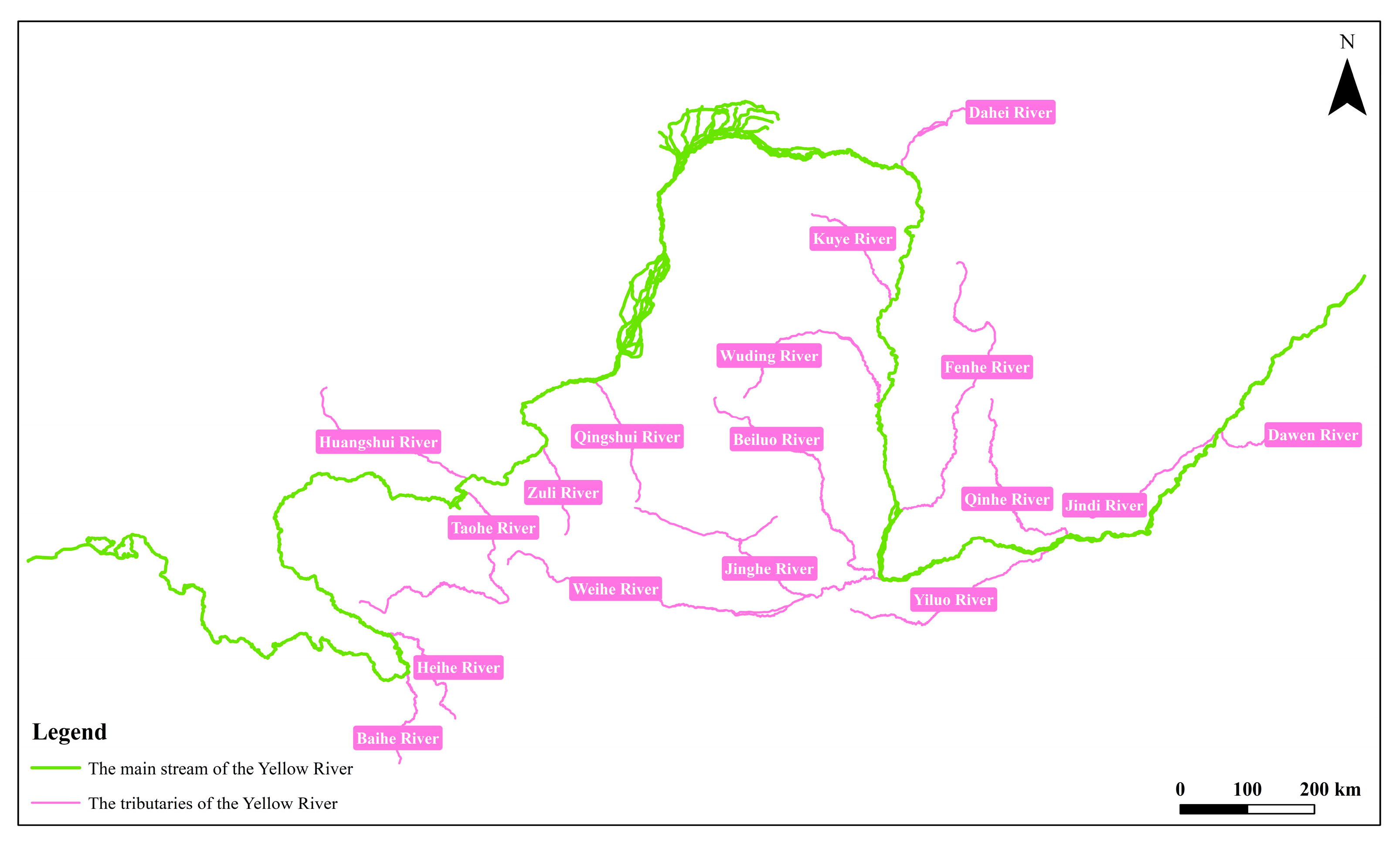
Within the water network system of the YRB, in addition to the main river, there are 17 major tributaries. These not only connect key nodes for water pollution control across different administrative regions, but also form deeply integrated governance units together with the aforementioned nine provinces (and autonomous regions) and 36 core prefecture-level cities, jointly constituting a “mainstream–tributary linkage” network for water pollution control in the YRB (Figure 3).

3.2. Methodology

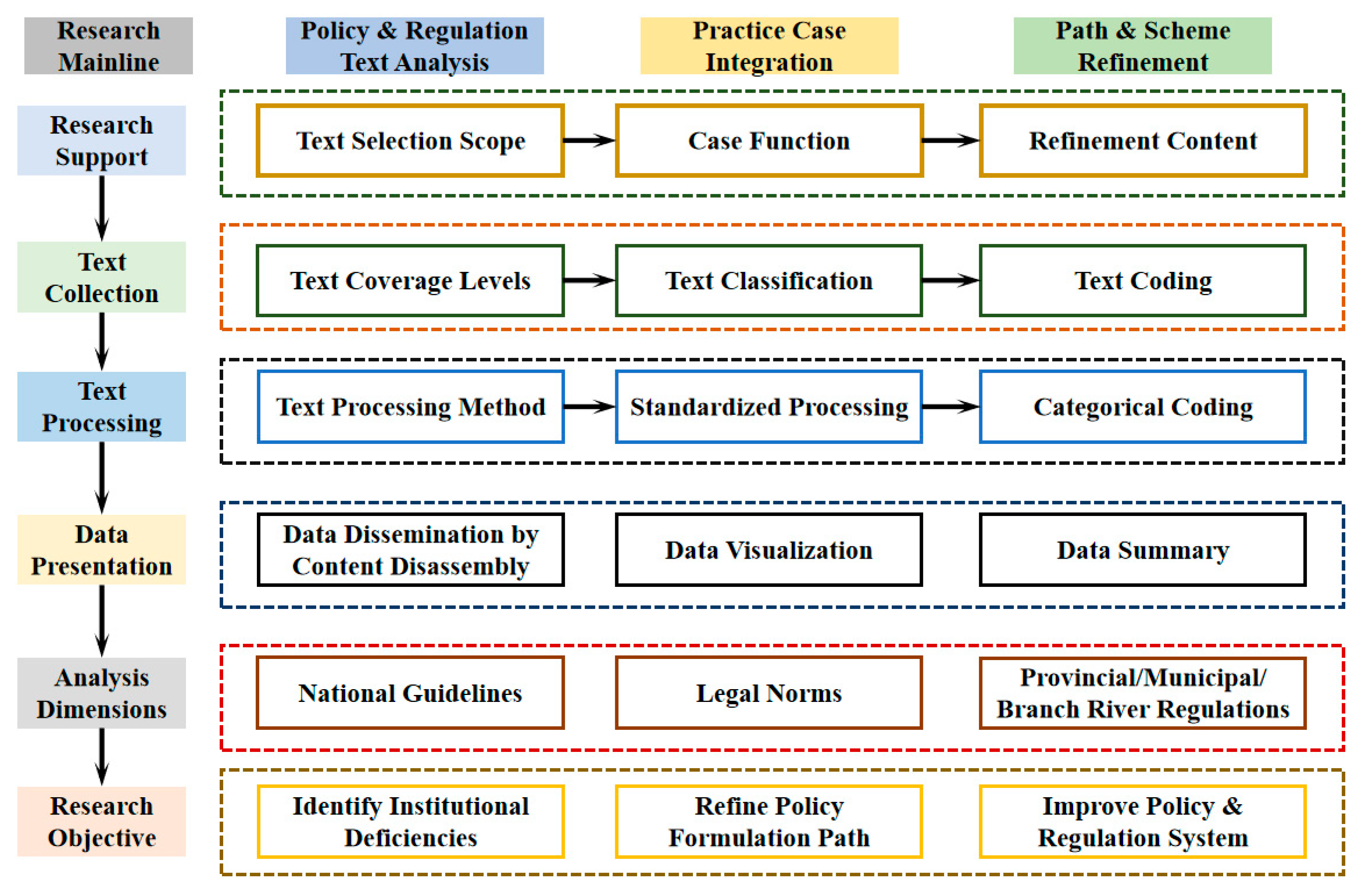
The overall framework of this study takes the analysis of policies and regulations related to administrative collaborative governance as its main thread. Combining relevant practical cases, it summarizes the institutional problems or defects existing in the current policy and regulatory system, and finally refines and formulates the formulation path and improvement plan for policies and regulations. To provide sufficient support for the research framework, this study has systematically collected policy text resources related to collaborative governance among government departments. The selection of texts is first limited to all policies, laws, and regulatory documents concerning the YRB. Second, from the aforementioned documents, texts covering content related to basin administrative collaborative governance (including inter-governmental collaboration and inter-departmental collaboration) are extracted. Therefore, this study already covers all texts relevant to the research theme, with a focus on five dimensions: national guidelines and policies, legal norms, provincial regulations, municipal regulations (for prefecture-level cities), and policies/regulations related to the basins of various tributaries. The collected texts will undergo standardized processing and classified coding, and be presented in a data-based form through content decomposition. The research framework and approach are shown in Figure 4.

4. Analysis of Current Regulatory Texts

4.1. Compilation of Texts

At the level of national policy guidelines, given China’s unique institutional system, the advancement of collaborative governance among government departments for water pollution control in the YRB is primarily guided by important speeches of top leaders and key documents from major political meetings of the ruling party. These guidelines not only serve as the core authoritative basis for administrative collaborative governance, but also represent the highest level of policy norms. As the most top-level guiding documents, they provide overarching direction and fundamental principles within the entire policy system for collaborative governance of water pollution in the YRB, delineating the path and offering authoritative reference for all levels of government departments in implementing collaborative governance practices (Table 2).
At the legislative level, a multi-tiered legal framework for collaborative governance of water pollution in the YRB has now essentially taken shape. This system is centered on the YRPL, supported by the EPL and the WPCL, and supplemented by national programmatic documents (Table 3).
At the local level, with the implementation of the YRPL and the deepening need for collaborative governance within the basin, a regulatory system for interdepartmental collaborative governance has essentially taken shape in recent years among the 9 provinces along the Yellow River, their 36 core prefecture-level cities, and the government departments of 17 major tributaries. This system is characterized by “provincial-level coordination, city-level refinement, and tributary-level adaptation.” The relevant regulations of provincial governments, municipal governments, and tributary regions are presented in Table 4, Table 5 and Table 6, respectively.

4.2. Analysis

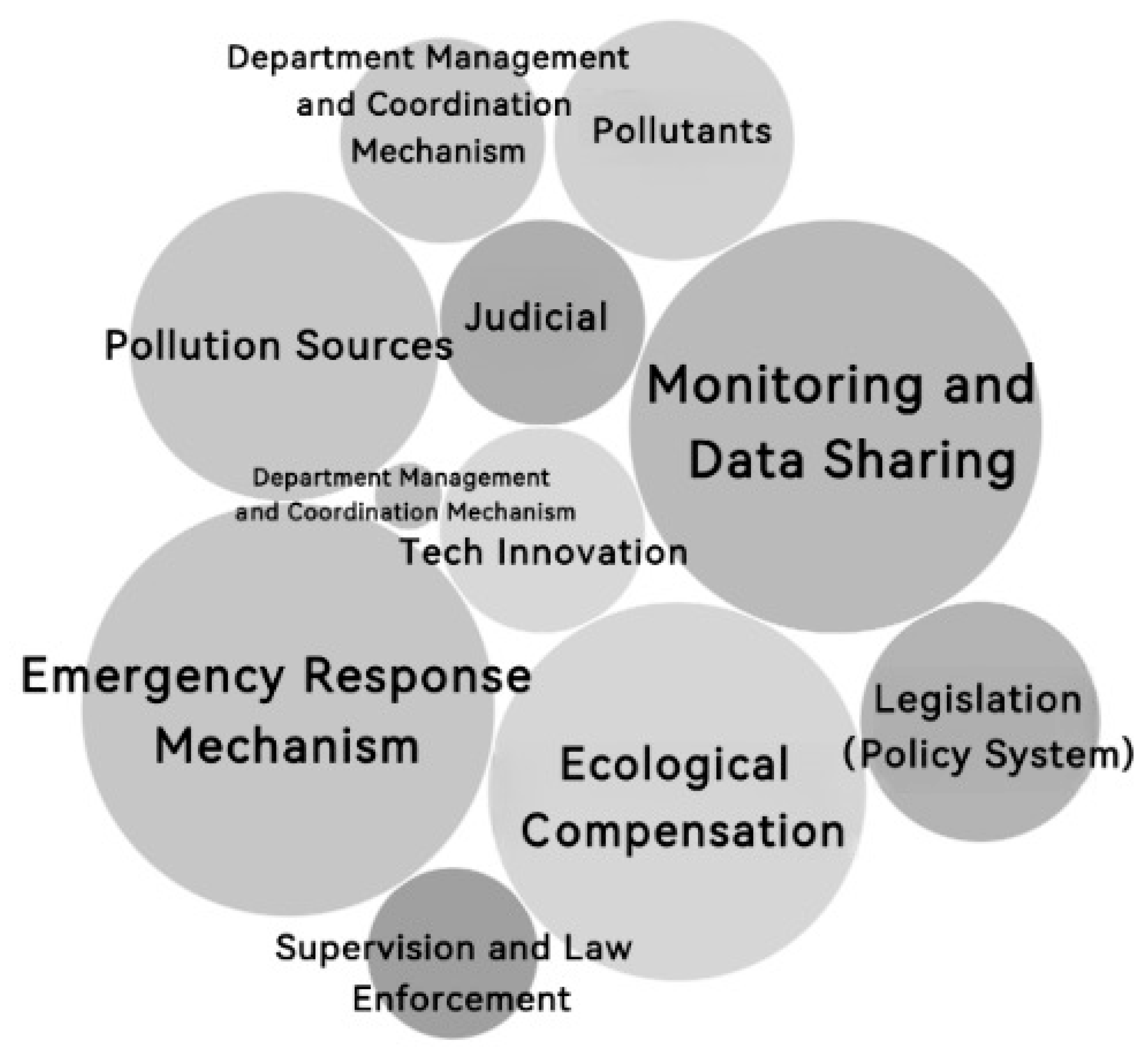
In the current specific regulations on collaborative governance of water pollution among government departments in the YRB, the scope of collaboration is relatively comprehensive, explicitly covering 11 collaborative areas (Figure 5). However, a closer review of these regulations reveals that the design of existing administrative coordination mechanisms remains at the “framework-building” stage—while it clearly identifies “which areas require collaboration,” it does not further specify the operational rules for “how to collaborate.” The content lacks specificity and practical applicability, and this issue is evident across different levels of documents, including national policy guidelines, legal norms, and local regulations.
At the level of national policy guidelines, due to their inherently macro-level orientation, the core purpose of these documents is to provide programmatic guidance for laws and local regulations, rather than to directly stipulate practical operations. Given the top-level design nature of such documents, it is inherently difficult for them to clearly define the specific procedures and division of responsibilities for administrative collaboration, which objectively leads to a lack of detailed operational basis in practice.
At the level of national legal norms, these regulations serve as the “rigid” basis constraining collaborative governance among government departments and directly determine the effectiveness of implementing coordination mechanisms. However, there are still significant shortcomings in the content design at this level. For example, the YRPL only stipulates in principle that “local people’s governments at or above the county level in the YRB and their relevant departments shall, in accordance with the division of responsibilities, collaboratively promote the control of agricultural non-point source pollution, industrial pollution, and urban-rural domestic pollution in the YRB.” Although the areas requiring collaboration are specified, there are no dedicated chapters elaborating or refining the specifics for different collaborative areas, nor is there a defined operational pathway for collaboration (such as methods for information sharing, joint law enforcement procedures, etc.). While it is understandable that, as a specialized legislative framework for basin-wide protection, the YRPL is extensive in structure and scope—making it objectively difficult to specify every detailed rule—the lack of concrete mechanisms for collaboration in core areas will still impact the effectiveness of governance.
To address this, we further focused on systematically reviewing the specific provisions on collaborative governance formulated by various administrative regions (including provincial and municipal government departments and departments along the tributaries). As the “last mile” regulatory basis for administrative coordination, such documents are expected to feature comprehensive content and concrete rules, serving as a bridge between top-level design and grassroots practice. Unfortunately, even though these regulations are somewhat more detailed than national policy guidelines and legal norms, they remain generally coarse in practice. For example, in the area of collaborative inspection of industrial pollution sources, the relevant regulations only broadly require that “ecological environment departments and departments of industry and information technology conduct joint inspections,” without specifying critical details such as inspection frequency (e.g., quarterly or annual inspections), inspection scope (e.g., key industrial parks or specific sectors), or division of responsibilities (e.g., which department leads and which supports). This lack of clarity can result in issues such as “repeated inspections increasing the burden on enterprises” or “unclear responsibilities leading to evasion or omissions” in some prefecture-level cities. By contrast, the Water Framework Directive (WFD) issued by the European Union (EU) has established a unified legal system for governing all water bodies across Europe. Its core advantage lies in the top-level institutional design that transcends administrative boundaries: the Directive explicitly mandates the establishment of a management system based on natural river basin boundaries, integrates multiple objectives—such as water quality protection, water quantity regulation, and ecological restoration—into a unified framework, and forms a complete institutional chain of “primary directive + specific regulations” by repealing and consolidating seven supporting directives.
Although China has clearly stipulated coordination requirements in the YRPL, most of the relevant provisions are merely principled statements. They lack specific timelines and quantifiable targets like the “achievement of good surface water status by 2015” specified in the EU Directive, resulting in insufficient rigid constraints on inter-departmental coordination. Additionally, the core strength of the WFD lies in integrating the hydrological characteristics, ecological status, and chemical indicators of water bodies into legally binding “environmental objectives,” with specific standards tailored to the uniqueness of different water body types (e.g., rivers, lakes, estuaries). In contrast, the current governance model of the YRB still relies excessively on uniform chemical concentration limits, failing to link them to key factors such as the specific ecological functions of different river sections, hydrological transport processes, and sediment dynamics within the basin. This results in legal obligations that lack differentiation and ecological relevance.
More importantly, there is a widespread use of flexible expressions—such as “may,” “recommend,” “as appropriate,” and “encourage”—across regulations at all levels. These types of wording weaken the mandatory and binding nature of administrative collaboration, reducing collaborative requirements to mere “guiding recommendations,” making it difficult to establish rigid constraints, and further undermining the effectiveness and enforcement of administrative collaborative governance.
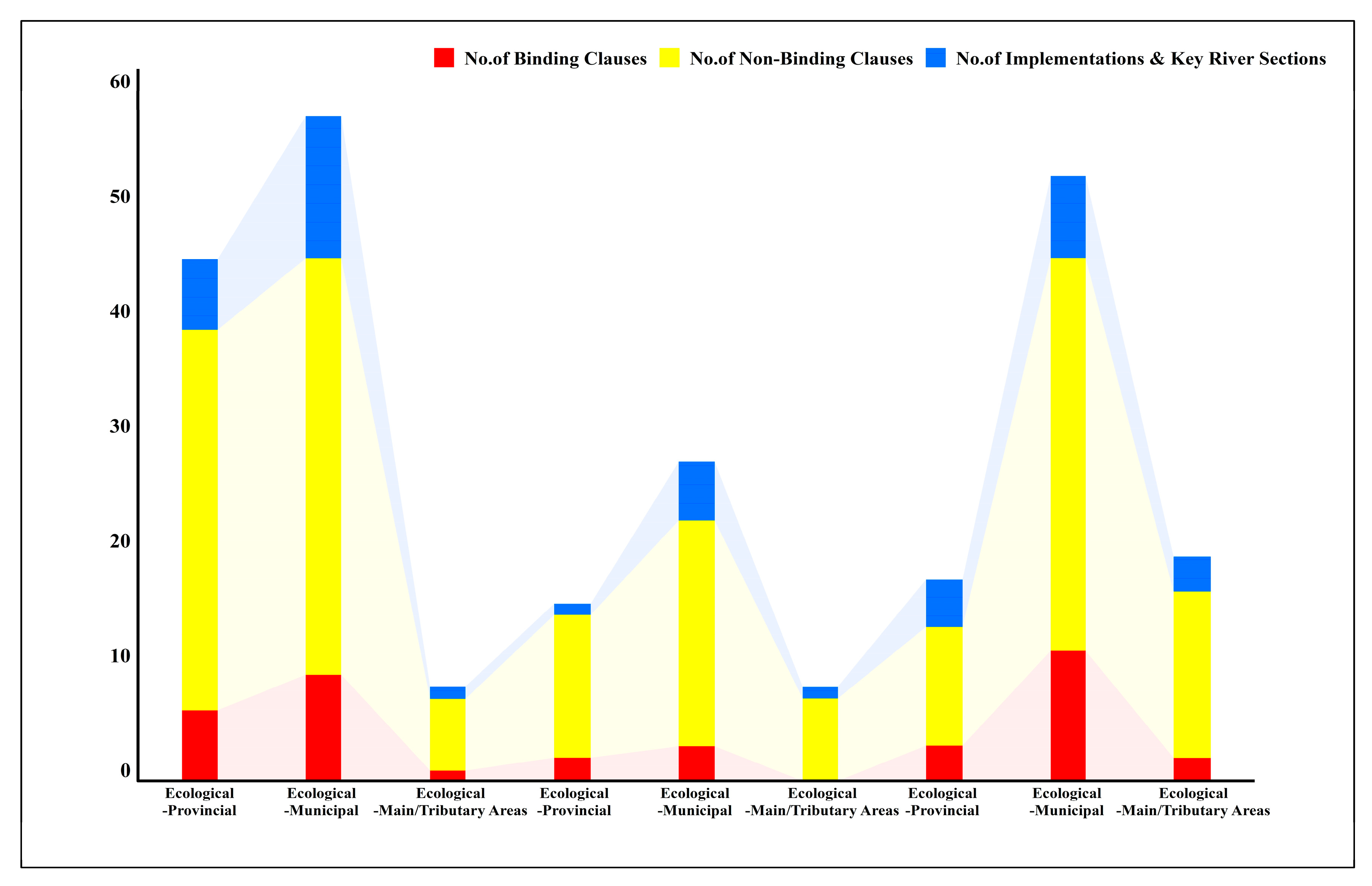
In response to this, we focused on three collaborative elements frequently mentioned in the aforementioned textual data—namely, the establishment of a “basin ecological compensation mechanism,” “basin coordination mechanism,” and “basin emergency response mechanism”—and systematically organized the relevant provisions. By summarizing the number of binding clauses, non-binding clauses, implementation cases, and key river sections involved, we present the formulation and implementation of rules at three levels: provincial, municipal, and main/tributary basin areas. The specific data are shown in the table below:
In Table 7, the “number of binding clauses” refers to the count of clauses with relatively mandatory wording in the texts. For example, Article 12 of the Regulations on Ecological Restoration and Protection of the Qinhe River Basin in Changzhi City stipulates: “The municipal government shall collaborate with the governments at the same level in the downstream areas to establish an ecological protection compensation mechanism.” The “number of non-binding clauses” refers to the count of clauses mainly expressed as advisory or guiding provisions. For example, Article 52 of the Regulations on the Protection of the Fenhe River in Shanxi Province stipulates: “Governments of adjacent cities divided into districts and counties (cities, districts) in the Fenhe River Basin may sign ecological protection compensation agreements.” The “number of implementations and key river sections” refers to the count of valid documents—such as laws, rules, and regulations—that involve the actual signing of Ecological Compensation Agreements between different governments or departments, and the establishment of inter-provincial/municipal coordination mechanisms and basin emergency response mechanisms for main and tributary basins, at the provincial, municipal, and main/tributary basin levels. It also includes the specific river sections where these regions are located. In addition, to more intuitively reflect the current development status of regulatory documents by government departments at all levels and the local implementation progress under these document regulations, we have presented these data in a graphical format.
The data in Figure 6 reveals the following key findings:
First, the number of binding clauses is excessively small, with non-binding clauses dominating. The overall count of binding clauses remains at a low level, while non-binding clauses are significantly more numerous.
  • In the ecological compensation mechanism: At the provincial level, there are 6 binding clauses versus 32 non-binding ones—non-binding clauses are 5.3 times the number of binding ones; at the municipal level, 9 binding clauses versus 35 non-binding ones (non-binding clauses are approximately 3.9 times more); and in main/tributary areas, 1 binding clause versus 6 non-binding ones (non-binding clauses are 6 times more).
  • In the coordination mechanism: The number of binding clauses is even smaller. At the provincial level, only 2 binding clauses exist alongside 12 non-binding ones (non-binding clauses are 6 times more); at the municipal level, 3 binding clauses versus 19 non-binding ones (non-binding clauses are approximately 6.3 times more); and there are no binding clauses at all in main/tributary areas, with only 7 non-binding clauses.
  • In the emergency response mechanism: Although the number of municipal-level binding clauses is relatively higher (11), non-binding clauses still reach 33 (approximately 3 times more than binding ones); at the provincial level, 3 binding clauses versus 10 non-binding ones (non-binding clauses are 3.3 times more); and in main/tributary areas, 2 binding clauses versus 14 non-binding ones (non-binding clauses are 7 times more).
Overall, across all three mechanisms and all regional levels, the structure of clauses is characterized by an insufficient number of binding clauses and an absolute dominance of non-binding ones. This clause structure fails to form strong rigid constraints, which is not conducive to the effective implementation and strict enforcement of the mechanisms.
Second, in terms of implementation count:
  • Only 6 out of 9 provinces, 12 out of 36 prefecture-level cities, and 1 out of 13 main/tributary areas have signed Ecological Compensation Agreements, with these primarily concentrated in the middle and lower reaches of the Yellow River. The coverage and implementation intensity of the ecological compensation mechanism need to be enhanced, as it has not fully exerted its incentive and restrictive role in basin ecological protection.
  • Meanwhile, the implementation of the basin coordination mechanism is equally unsatisfactory. Although all 9 provinces along the Yellow River jointly signed a document to establish a basin coordination mechanism, this only covers collaboration at the provincial level. At the local level, only 5 prefecture-level cities and 1 main/tributary area have provisions on “exploring the establishment of a basin coordination mechanism,” and these are mostly concentrated in the middle and lower reaches. Generally, the number of provisions on the basin coordination mechanism is relatively small, with unbalanced regional coverage. In the upper reaches, implementation is minimal only at the provincial level, while municipal-level and main/tributary-level implementation is absent or extremely limited, leading to insufficient coordination and linkage between regions.
  • Additionally, the number of provisions on the basin emergency response mechanism is relatively limited, and implementation is also concentrated in the middle and lower reaches, with a lack of implementation in the upper reaches. This indicates that the emergency response mechanism is far from perfect: in the face of various potential sudden ecological incidents in the basin, there is a lack of a comprehensive, efficient, and widely covered emergency response system, making it difficult to carry out rapid and effective emergency disposal and fully safeguard the ecological security of the YRB.

5. Challenges

5.1. Barriers of Authority and Responsibility Among Government Departments

The natural characteristic of the YRB featuring close cross-regional interconnection determines that its governance must break through the boundaries of administrative divisions and departmental functions. However, in the institutional norms for the governance of the YRB represented by the YRPL, the governance framework presents a fragmented governance feature based on administrative divisions as units and departmental functions as boundaries [31]. This model conflicts with the demand for collaborative governance of the Yellow River and constitutes a structural defect that distinguishes it from other river basins. According to Article 6 of the YRPL, “Local people’s governments at or above the county level and their departments in the YRB shall be responsible for work within their respective administrative areas according to the division of responsibilities.” Thus, there are natural boundaries of responsibility among different administrative regions and departments, established based on the division of powers and duties. While these boundaries are fundamental for ensuring the orderly operation of the administrative system, they also constitute a structural obstacle to collaborative governance to a certain extent [32]. Compared with other river basins such as the Yangtze River and the Pearl River, environmental problems of the Yellow River including pollution diffusion and sedimentation are of stronger cross-regional transmissibility: soil erosion in a province in the upper reaches will directly exacerbate sedimentation in the middle reaches, while sewage discharge by two cities in the lower reaches may rapidly affect the water quality of the entire river course along the basin. Such basin-specific characteristics make the demand for breaking the boundaries of powers and responsibilities far more urgent. The core essence of “collaborative” governance lies precisely in breaking down these entrenched boundaries within necessary limits through institutional design and mechanism innovation, thereby achieving optimal integration of governance resources and maximizing governance effectiveness. “collaborative” means, to some extent, breaking through these boundaries of responsibility among different administrative regions and departments. The problem of power and responsibility barriers in the YRB is particularly acute in the intertwined governance scenarios involving cross-regional and cross-departmental collaboration. For example, in a case of illegal pollution discharge by a coal mine in Henan Province in 2022, the coal mine in question was located right at the boundary between two municipal administrative regions. Its polluting activities involved multiple administrative departments, including those responsible for ecology and environment, natural resources, and water resources, as well as the jurisdictions of two municipal governments. However, prior to the incident, the two local governments and their relevant functional departments had not signed any binding collaborative governance agreement regarding environmental management in the border area, nor had they jointly established mandatory regulations or emergency linkage mechanisms for cross-regional pollution issues. This institutional gap directly led to a “ blank area “ in governance practice—both cities’ environmental enforcement efforts remained focused on clearly defined areas within their own jurisdictions, lacking routine joint inspections of the border areas. When pollution problems arose, they hesitated to act, waiting for clarity due to the ambiguity in the division of responsibilities.
A more profound challenge is that the provisions on collaborative mechanisms in the YRPL are mostly non-binding clauses, which fail to specifically regulate the acts of governments and departments in the YRB that shirk their obligations of functional coordination. Article 4 of the YRPL stipulates that “provinces and autonomous regions within the YRB may, as needed, establish provincial-level coordination mechanisms.” Furthermore, Article 6, Paragraph 3 provides that “localities may, as needed, strengthen cooperation and jointly promote ecological protection in the YRB.” It is evident that the establishment of coordination mechanisms is “as needed” and not a mandatory obligation for administrative regions; whether collaborative governance is actually carried out still depends on the free will of each actor. Within the governance logic of local government power in China, breaking through established barriers of authority and responsibility often means taking on additional risks and responsibilities. Under the dual constraints of “territorial management” and “departmental responsibility”, the performance of administrative actors heavily relies on clearly defined lists of powers and responsibilities. For cross-regional matters that fall outside these lists, proactive involvement may be questioned as “overstepping authority”, while passive responses can be justified by “unclear responsibilities” to evade accountability. This tendency toward risk avoidance becomes especially pronounced in the absence of explicit coordination mechanisms.

5.2. Interest-Based Conflicts Among Government Departments

From the perspective of collaborative governance in the YRB, there are often complex interest-based conflicts among different government departments, and such conflicts constitute a deep-seated obstacle to effective collaboration [33]. First, different administrative regions typically have their own independent development goals and interests, which can easily lead to competition in key areas such as resource allocation and the division of environmental responsibilities. Under traditional development models, upstream regions engage in economic activities such as industrial expansion and resource development, which are often accompanied by a certain degree of pollutant discharge [34]. These pollutants spread downstream through rivers and other water bodies, directly affecting the water quality and ecological health of downstream areas. Upstream regions may reap tangible benefits from short-term economic growth, while downstream regions are left to bear the ecological losses and remediation costs caused by environmental pollution. Although water pollution control benefits both local and neighboring provinces, the costs of pollution control are borne entirely by the party implementing the measures. This “mismatch between benefits and costs” intensifies the conflict of interests among regions. Second, the functional division of labor among administrative departments results in relatively rigid patterns of interest, which may foster departmentalism in resource allocation and the fulfillment of duties. Interest barriers between departments often hinder policy implementation and make it difficult to form a unified governance effort.
To truly resolve such entrenched interest-based conflicts, the key lies in establishing a scientific and reasonable mechanism for coordinating interests. Introducing mandatory ecological compensation regulations is a core approach to achieving interest balance and sustainable development. However, current legal norms do not clearly define the boundaries of compensation parties or their rights and obligations, making it difficult to accommodate the complex governance structure of the YRB. Article 48 of the YRPL stipulates that “the state shall establish an ecological compensation system for the YRB,” but does not specify the exact scope of “compensators” and “compensated parties.” There is a disparity of interests between the costs incurred by upstream provinces for measures such as industrial restrictions and ecological restoration to protect water quality, and the ecological benefits received by downstream provinces from water quality improvement [35]. However, the law does not specify whether downstream provinces are obligated to compensate upstream provinces, nor does it clarify the proportion of responsibility among local governments, polluting enterprises, and beneficiaries in compensation. At the same time, there is a notable gap in the division of ecological compensation responsibilities in cross-departmental collaboration [36]. The water resources department is responsible for water allocation, the ecological environment department for pollution prevention, and the natural resources department for ecological restoration, but existing regulations do not clarify their specific responsibilities in the allocation of compensation funds, project implementation, or effectiveness evaluation. In addition, current regulations do not establish a quantitative accounting system for ecological compensation standards, resulting in a serious disconnect between compensation amounts and actual ecological value. The WPCL (Article 30) proposes that “the state shall, through fiscal transfer payments and other means, establish and improve a compensation mechanism for water environment ecological protection in drinking water source protection areas and upstream areas of rivers, lakes, and reservoirs”, but does not specify the calculation method for compensation standards. Although the YRB Ecological Environment Protection Plan calls for “improving the ecological compensation standard system”, it does not clarify whether core indicators such as water quality compliance rates, ecological flows, and pollutant reduction should serve as the basis for accounting.
Furthermore, there are significant differences in the compensation accounting methods used in different regions and departments. Upstream provinces tend to advocate for compensation based on “the cost of ecological protection input,” while downstream provinces prefer to calculate compensation based on “the economic benefits of water quality improvement.” The ecological environment department uses the “environmental damage assessment method,” while the water resources department employs the “water resources value method,” and these approaches differ fundamentally in terms of indicator selection and parameter settings.

5.3. Data Barriers Among Administrative Authorities

In the collaborative governance of the YRB, fragmented monitoring infrastructure and inconsistent data standards are among the challenges. For sediment pollutant monitoring, different administrative departments and riparian provinces often adopt divergent sampling frequencies (e.g., quarterly sampling in some areas vs. monthly dynamic monitoring in others), analytical methods (coexisting lab testing and on-site rapid detection), detection limits (threshold gaps between local and industry standards), and storage formats (a mix of structured databases and unstructured documents). This directly reduces the comparability and reference value of cross-regional and cross-departmental data. Among the current regulations related to ecological protection in the YRB, while the YRPL specifies the need to “establish a unified monitoring network and information sharing mechanism,” it does not mandate uniform technical parameters for monitoring protocols. It only stipulates in principle that “provincial people’s governments shall coordinate overall.” In practice, provinces mostly formulate detailed standards based on local ecological characteristics, and inter-departmental functional divisions (e.g., the ecological environment department overseeing water quality, the water resources department managing hydrology) lead to inconsistent standards. Neither the responsible entity for unifying data standards nor a coordination mechanism for data disputes has been clarified, making it difficult to reach consensus on core links such as pollutant over-standard determination in joint law enforcement and damage measurement for ecological compensation. This greatly undermines the synergy of governance actions.
From a technical perspective, data barriers manifest as blocked or fragmented data flows between different entities. But, at their core, are these barriers a result of deficiencies in institutional norms? Previous scholarly research has not fully analyzed this underlying cause. We argue that the absence of institutional norms constitutes the fundamental cause of data barriers in the YRB. Past discussions of data barriers have mostly focused on technical obstacles or managerial inefficiencies. In reality, data barriers are often rooted in complex considerations of interests and concerns about responsibility, which are especially pronounced in scenarios involving cross-administrative regions and departments. Government departments at all levels along the YRB hold a vast array of environment-sensitive data directly related to the ecological security of the basin. Such data not only covers core categories including pollutant discharge monitoring data of high-energy-consuming industries, penalty records for environmental violations in key sectors, and information on substandard pollution control outcomes, but also has a direct bearing on local economic development benefits and the credibility of governmental ecological governance. Once such data is disclosed or incorporated into the cross-regional and cross-departmental sharing system, it may not only exert a direct impact on the local investment environment and the evaluation of industrial structure optimization, but also trigger retroactive investigations into regulatory liabilities, thereby posing a potential impact on local short-term economic interests and governmental administrative credibility. However, it is precisely this “protected” sensitive data that is crucial for collaborative governance of basin pollution. For example, in the 2024 “Shanxi–Shaanxi Yellow River Water Pollution Incident”, during the pollution investigation stage, the Shanxi environmental protection department possessed first-hand data on enterprise emissions but only incompletely and belatedly communicated some enterprise information to Shaanxi. The transportation department’s data on raw material and product shipments from polluting enterprises could not be smoothly shared with the environmental department. Likewise, the monitoring results of agricultural non-point source pollution collected by the agriculture and rural affairs department were not integrated in a timely manner with the industrial pollution data of the environmental department. As a result, when developing a comprehensive pollution control plan, it was impossible to fully consider all types of pollution sources.
We believe that the core issue hindering the establishment of effective data-sharing mechanisms largely lies in the lack of willingness and initiative among relevant parties—an attitude that is itself closely related to the absence of clear regulations. According to the Action Plan for the Battle to Protect and Manage the Ecology of the Yellow River, there is a call to “promote collaborative legislation in key areas and encourage the disclosure of environmental information and related data.” The Ningxia Hui Autonomous Region Ecological and Environmental Protection Regulations stipulate that “for cross-regional and interdepartmental water pollution prevention and control, the sharing of monitoring resources and information should be strengthened.” The Gansu Province YRB Ecological Protection and High-Quality Development Regulations state that “neighboring areas in the YRB should strengthen communication, collaboration, and information sharing, and collaborative legislation may be carried out as needed.” However, flexible terms such as “encourage,” “strengthen,” and “may” lack rigid constraints on data holders, and do not clearly define responsible parties, lists of obligations, or accountability mechanisms for data sharing. More crucially, no unified mandatory disclosure norms have been established for core elements concerning environment-sensitive data in the YRB, such as its sharing scope, standards and security guarantee rules. What is more, operable guidelines and supervision-assessment mechanisms are sorely lacking in the field of cross-regional and cross-departmental data sharing. As a result, data holders, aiming to avoid risks and protect local interests, naturally tend to adopt a closed attitude toward sharing sensitive data.

5.4. Lack of Mandatory Cross-Administrative Power Collaboration

At the national policy level, collaborative governance of the YRB has been elevated to a strategic priority and specifically addressed. In 2019, the Chinese government elevated the responsibility of cross-regional coordination to a political requirement for the first time. In 2021, it further demanded to “break down administrative barriers and establish a unified dispatching mechanism for the entire river basin,” directly addressing the core obstacles in coordinated governance. That same year, the Outline Plan for Ecological Protection and High-Quality Development of the YRB dedicated Chapter 12 to “establishing a provincial-level consultation and cooperation platform.” The YRPL, in legal form, explicitly establishes a collaborative mechanism “led by the State Council, with participation from relevant ministries and the governments of nine provinces and autonomous regions along the Yellow River, responsible for reviewing major development strategies and ecological protection policies for the basin, and for coordinating and resolving major issues that cross regions and departments.” At the local level, the Comprehensive Action Plan for Ecological and Environmental Management in Counties along the Mainstream of the Yellow River in Shanxi Province calls for “actively promoting joint protection and governance of cross-boundary water bodies, and establishing mechanisms for information sharing, joint monitoring, and coordinated response.” The Notice on the Implementation Plan for Special Actions on Water Ecological Protection in the YRB in Henan Province states that “all levels of water resources departments and Yellow River affairs departments in the YRB should consolidate and deepen established work mechanisms, and maintain close communication and collaboration.” The Shandong Province Yellow River Protection Regulations stipulate that “the provincial government should promote the establishment of a collaborative mechanism for ecological and environmental pollution prevention and control across county-level administrative regions in the YRB, organizing departments of ecology and environment, natural resources, water administration, agriculture and rural affairs, marine affairs, Yellow River affairs, as well as relevant municipal governments, to carry out comprehensive management and strengthen collaborative governance in key areas along the Yellow River, with the continuous improvement of the ecological environment” and so on.
However, these policies and regulations share a common shortcoming: provisions for collaborative governance across administrative powers remain at a macro level, making it difficult to effectively implement collaborative governance in practice.
There remains a significant lack of mandatory force in collaborative governance, which directly leads to frequent instances of buck-passing and shirking of responsibility among governments and departments. Although the central authorities have repeatedly emphasized the importance of collaboration, the current regulatory system still lacks rigid constraints on collaborative obligations and has yet to establish a strict “non-collaboration equals accountability” mechanism. At the level of administrative regions, provinces, autonomous regions, and cities/counties along the Yellow River serve as independent administrative entities with their own interests. In the absence of binding, mandatory responsibilities, they are prone to a “local interests first” dilemma when faced with cross-regional pollution control or other issues involving the adjustment of interests. When upstream areas cause water quality deterioration downstream due to agricultural non-point source pollution or industrial discharges, even if downstream regions present monitoring data to request collaborative governance, upstream regions may delay action, citing “economic development pressures” or “excessive control costs.” The current system lacks clear penalties for such passive responses, turning collaborative requirements into “soft constraints.” From the departmental perspective, under the current system in the YRB, the governance of water resources, water environment, and water ecology is divided among multiple departments. With such fragmented and overlapping administrative structures, each department is likely to act primarily based on its own interests [37]. Even within a single region, governance is often decentralized and fragmented. The ecological environment department is responsible for pollution prevention and control, the water resources department manages water allocation and protection, and the agriculture and rural affairs department leads the control of agricultural non-point source pollution [38]. Although there is a need for collaboration, in practice, the ecological environment department requires hydrological data from the water resources department and assistance from the agriculture and rural affairs department in identifying non-point pollution sources. However, due to the lack of mandatory collaborative obligations, relevant departments may passively cooperate or prioritize their own work, fearing increased workload, which slows down the tracing of pollution sources. While the YRPL establishes a basin-wide coordination mechanism and clarifies cross-departmental coordination responsibilities for major issues, it still fails to provide specific provisions regarding the routine processes of interdepartmental collaboration and accountability for non-cooperation. As a result, departmental collaboration lacks operable and enforceable guidance.

5.5. Insufficient Mandatory Requirements for Cross-Administrative Emergency Response

Compared with other types of pollution such as land-based pollution, riverine ecological pollution—due to its unique mobility—places an even greater demand on immediate emergency response mechanisms [39]. Unlike most rivers that are primarily plagued by industrial point-source pollution, the YRB is characterized by a more decentralized and concealed nature of pollutant sources. As dynamic water bodies, rivers facilitate the rapid diffusion and spread of pollutants with water flow. Particularly during periods of unstable aquatic environments, the concentration of pollutants may further increase over longer time scales [40]. The pollutants in the Yellow River mainly do not come from fixed point source emissions, but from widespread non-point sources in the basin such as agricultural soils and highly erodible loess sediments. A large amount of nitrogen, phosphorus, heavy metals, and organic pollutants are transported via surface runoff, undergoing complex adsorption–desorption processes, and migrate and transform primarily in combination with sediments. However, the current river basin governance and legal frameworks have not fully responded to the aforementioned pollution mechanisms based on soil processes. The existing administrative framework, which is based on administrative divisions, struggles to effectively address such transboundary non-point source pollution driven by soil and water processes in terms of monitoring, liability identification, and compensation. If an emergency response is not triggered promptly at the early stage of pollution, subsequent remediation efforts may be rendered much less effective due to the expanded scope and migration of pollutants, greatly increasing the difficulty and cost of treatment and even causing irreversible ecological damage. Thus, timeliness is a core requirement for collaborative governance of river pollution; it necessitates that all relevant departments and administrative regions break down barriers and form a rapid, efficient collaborative emergency response in the shortest possible time. In 2018, a large-scale water pollution incident suddenly occurred in the Gansu section of the Yellow River. After the incident, cross-regional emergency response was noticeably delayed. After detecting the pollution, the relevant upstream areas in Gansu did not, in accordance with any mandatory provisions, promptly and comprehensively notify downstream provinces and regions such as Ningxia and Inner Mongolia of the pollution details—including pollutant types, concentrations, and diffusion rates—leading to downstream areas facing sudden pollution threats without warning and missing the optimal window for pollution prevention and control. After detecting abnormal water quality, the ecological environment department lacked a mandatory workflow for coordination with the water resources department, resulting in serious disconnects in water resource scheduling. The water resources department failed to promptly adjust water flow in the affected sections of the Yellow River based on pollution reports from the ecological environment department, which could have diluted pollutant concentrations and slowed the spread of pollution. Meanwhile, the industry and information technology department, due to a lack of clear responsibility constraints, did not promptly implement compulsory measures such as suspending production or selling equipment at the involved chemical enterprise, allowing the company to potentially continue discharging pollutants in the early stages of the incident and further exacerbating the pollution. Clearly, there are significant deficiencies in emergency response coordination among cross-administrative authorities in the YRB.
Article 13 of YRPL explicitly states: “The competent department for ecological environment under the State Council shall, together with relevant departments of the State Council and provincial governments along the YRB, establish and improve an emergency response coordination mechanism for sudden ecological and environmental incidents in the YRB, align it with the national emergency response system, and strengthen the management of such incidents in the YRB.” Although this provision establishes a statutory requirement for building an emergency response coordination mechanism and provides a principled guide for collaborative governance in the basin, there are clearly regulatory gaps at the operational level. The law does not further clarify how cross-administrative regions and cross-administrative departments should specifically establish emergency response mechanisms—there are no provisions for the concrete procedures for establishing the mechanism, entry criteria for participants, or clear channels for information sharing and resource allocation. Nor does the law specify legal liability for failing to establish the required mechanisms, rendering the statutory requirement insufficiently binding. Furthermore, the law does not provide clear answers to core issues such as the division of labor and responsibility boundaries among different regions and departments during emergency response, leaving basic-level authorities without practical regulatory guidance in implementation.

5.6. Insufficient Long-Term Effectiveness of Cross-Administrative Collaborative Mechanisms

In principle, river water pollution control should be the responsibility of the environmental protection bureau. However, due to overlapping and unclear responsibilities among functional departments, river pollution control may also involve the water resources bureau, urban construction bureau, health bureau, and others [41]. When statutory powers and responsibilities are not clearly defined, it would be necessary to integrate the river pollution control authority of various departments—based on a review of departmental responsibilities and legal mandates—and concentrate it within the environmental protection or water resources department. This, however, would require institutional reform of administrative functions, which is beyond the authority or capability of county-level governments to accomplish. To achieve immediate collaborative governance of river pollution, various systems such as the “river chief” and “lake chief” systems have emerged—making party and government leaders at all levels the principal responsible persons for specific river sections, bearing primary leadership responsibility within their jurisdictions. From analyzing specific sources of basin pollution to finalizing collaborative governance programs, the river chiefs at each level organize and lead the process. However, in most regions, river chief offices are temporary agencies without independent staffing quotas, and their personnel are generally seconded from other units—serving in a part-time capacity [42]. This “part-time” staffing structure not only results in insufficient team stability and low enthusiasm among staff for performing their duties, making it difficult to sustain the regular advancement of collaborative governance in the YRB; more crucially, the personnel adjustments and leadership transitions of Party and government officials at all levels are prone to causing disruptions in the continuity of governance policies for the YRB, which is not conducive to consolidating governance achievements and ensuring their long-term effectiveness. By contrast, the Convention on the Protection of the Rhine not only clearly defines the pollution prevention and control obligations of governments and functional departments of riparian countries, but also innovatively endows the International Commission for the Protection of the Rhine (ICPR) with independent legal personality. This enables the ICPR to coordinate the actions of environmental protection, water conservancy, shipping, and other departments of various countries in the capacity of an authoritative third party, and even evaluate the effectiveness of measures taken by contracting parties and hold them accountable. This institutional design of “legal authorization + institutional empowerment” provides a direct reference for resolving the ambiguity in the responsibilities and powers of collaborative entities in the YRB.
In some areas, grassroots residents have repeatedly reported river pollution, yet some problems remain unresolved for a long time. This is closely related to the “power-dependent governance” approach at the grassroots level—only issues that attract leaders’ attention become “problems,” and only those problems that leaders push to resolve are effectively addressed. Therefore, we believe that in the practice of collaborative river pollution governance, the effective realization of “collaboration” cannot be achieved solely by the voluntary initiative of grassroots actors. It often requires higher-level administrative authorities to provide institutional backing and authoritative endorsement as fundamental guarantees. At the institutional level, higher-level administrative entities can break local interest barriers, formulate unified governance rules from a basin-wide perspective, balance different regional interests, and motivate grassroots actors to participate in collaboration. At the level of authoritative endorsement, higher-level administrative entities, with their political authority and capacity for resource coordination that transcend local interests, can facilitate dispute resolution when grassroots actors reach a stalemate due to conflicting interests; enforce accountability when there is buck-passing or poor implementation; and, in the event of major pollution incidents, quickly mobilize cross-regional and cross-departmental emergency resources for unified command and efficient response. Therefore, it is necessary to establish mandatory obligations by regulation to form a normalized and long-term mechanism.
In summary, within China’s governance system centered on institutional norms, central-level policies serve as irreplaceable strategic directives guiding national development as a whole. These policies chart the fundamental direction and establish core principles for all public affairs—including cross-administrative collaborative governance—serving as the basis for building consensus and coordinating various forces. However, the inherent characteristics of central policy mean that it is mostly expressed in principled and directional terms, focusing on establishing governance goals and value orientation from a macro perspective, which gives it an unavoidable generality. As a result, central policies cannot fully cover the diverse and complex practical scenarios and issues encountered in implementation—different regions have significantly different development foundations and governance conditions, and the same governance task may have different approaches, priorities, and challenges depending on the context. Central policy clearly cannot provide detailed operational plans for every specific situation.
Meanwhile, current laws, regulations, and local rules also lack sufficient detail in the normative design of cross-administrative collaborative governance, generally remaining at the level of broad, principled guidance. In the relevant policy texts, the frequent use of flexible terms like “emphasize,” “recommend,” “strengthen,” and “as appropriate” directly reflects the lack of rigid constraint in current regulations and fails to establish mandatory, binding standards. Within this normative framework, if explicit mandatory obligations are not used to regulate the collaborative behavior of administrative regions and departments, the advancement of cross-administrative collaborative governance in practice can only rely on the voluntary initiative and subjective motivation of the relevant actors. However, influenced by local interest differences and blurred boundaries of authority and responsibility, such a system relying on voluntary collaboration often cannot generate stable expectations or ensure the comprehensive and effective implementation of governance measures, ultimately restricting the full realization of collaborative governance effectiveness.

6. Response

In view of the problems identified in the administrative collaborative governance of the YRB mentioned above, this section proposes targeted solutions, which generally cover five dimensions: regulation, system, enforcement, governance, and remedy. Together, these form the response mechanism for administrative collaborative governance in the YRB (see Figure 7).

6.1. Institutional Design for Mandatory Collaboration in the YRB

To address the problems of low willingness to collaborate among governments and functional departments in the YRB and the ineffective implementation of administrative coordination, we argue that administrative coordination should be regulated by means of legal mandatory force.
First, revise the non-binding statement in the YRPL that “a coordination mechanism shall be established as needed” to the mandatory requirement that “a dedicated inter-departmental government coordination mechanism must be established,” so as to break down the barriers of powers and responsibilities between different administrative regions and government departments. Clearly stipulate that all provinces (autonomous regions) and cross-municipal administrative regions within the YRB must establish regular collaborative governance mechanisms, specify the organizational structure, rules of procedure, and operating cycles of these mechanisms, and incorporate collaborative governance into the statutory duties of local governments. Meanwhile, conduct regular evaluations on the formulation and implementation of provisions related to the river basin coordination mechanism. A dedicated working group led by the central government shall conduct annual comprehensive evaluations of the situation in various regions. Governments and departments that fail to implement (the mechanism) in practice shall be publicly notified and criticized, their responsible persons shall be disciplined, and those held accountable for serious cases shall bear legal liability in accordance with the law.
Second, add a “cross-departmental list of rights and responsibilities” to the implementing regulations of the YRPL, detailing the core responsibilities and collaborative obligations of the 12 river-related departments—including water resources, ecology and environment, natural resources, finance, agriculture and rural affairs, and housing and urban development—in water pollution control. For areas with overlapping responsibilities, establish a “lead department + collaborating departments” dual-track system. It is clearly stipulated that: “The natural resources department shall be clearly designated as the primary responsible unit, responsible for formulating plans and regulating land use; the ecological environment department shall collaborate in conducting soil pollution monitoring; the agriculture and rural affairs department shall participate in the design of ecological agriculture models. All departments shall sign a cooperation agreement before the project is launched, specifying the division of tasks, outcome standards and timelines.” Strengthen the legal constraints and safeguards for information sharing. Use administrative regulations to clearly define the statutory responsibilities, standards, and security requirements for data sharing. The law should mandate: “All river-related departments must complete the integration of core data into the collaborative platform within six months of the regulation’s implementation; water quality monitoring data from the ecology and environment department and hydrological data from the water resources department must be shared in real time, and any delay exceeding one hour will be considered late reporting.” At the same time, establish a data sharing whitelist, clarifying that data access permissions for each department are determined by the basin-wide coordination mechanism. Unauthorized expansion of access or data leaks will be subject to administrative or criminal liability by law.
Third, add a dedicated chapter on “cross-basin jurisdiction” in the detailed implementation rules of the YRPL, clearly defining the jurisdictional boundaries between basin management agencies and local governments in water pollution control. It can be specifically stipulated as: “River basin management agencies such as the YRB Ecological Environment Supervision and Administration Bureau shall have priority jurisdiction and overall coordination authority over water pollution cases involving cross-provincial administrative regions and major river basin ecological protection projects, and shall be responsible for core matters including formulating unified cross-regional law enforcement standards and planning river basin water quality monitoring networks.” For jurisdiction disputes arising during law enforcement, a two-level “negotiation-arbitration” resolution mechanism shall be established: first, the parties involved shall resolve the dispute through consultation at a joint meeting; if consultation fails, the river basin management agency shall make an arbitration in accordance with principles such as “priority jurisdiction of the place where the pollution act occurs” and “jurisdiction of the place where the main pollution source is located,” and the arbitration result shall have legal effect. The Leading Group for Ecological Protection and High-Quality Development of the YRB should take the lead in organizing the ecology and environment, water resources, natural resources departments, and local governments within the basin to jointly develop a List of Rights and Responsibilities for Cross-Regional Collaborative Governance in the YRB. The list should specify the concrete rights and responsibilities of each level of government and department in areas such as cross-regional pollution prevention, ecological restoration, and emergency response—including allocation of responsibility for pollution source tracing, procedures for joint enforcement, and the scope of data sharing. Simultaneously, a “negative list for dereliction of rights and responsibilities” should be developed, including behaviors such as “refusing to participate in collaborative consultation” and “delaying cross-regional pollution response,” which would be managed under the list and serve as a basis for performance evaluation and accountability.

6.2. Improving and Refining Policies and Regulations on Ecological Compensation

Through the aforementioned arguments, it can be concluded that the design of the ecological compensation system among governments and departments in the YRB remains overly generalized. The implementing regulations of the YRPL should clearly define the legal scope of compensators and beneficiaries. At the governmental level, the law should specify the compensation relationships among upstream water conservation areas, key management areas in the midstream, and beneficiary areas downstream, making it a legal obligation for downstream provinces to compensate upstream provinces for their contributions to water quality improvement. It should also clarify that when water quality at the upstream outflow section exceeds assessment standards, downstream regions must allocate compensation funds from water resource usage fees according to a specified proportion. For cross-departmental collaboration, administrative regulations should clearly delineate the division of duties among departments such as water resources, ecological environment, natural resources, and finance. The water resources department is responsible for compensation calculations related to ecological flow guarantees; the ecological environment department leads the quantitative assessment of pollution reduction; the finance department oversees the overall allocation of compensation funds [43]; and the natural resources department participates in the calculation and acceptance of ecological restoration costs. A “joint departmental list” should be established to specify the concrete rights, responsibilities, and deadlines for each department regarding fund applications, project implementation, and performance evaluation, in order to avoid buck-passing due to overlapping duties.
In addition, a unified quantitative compensation standard and accounting system should be established. The “YRB Ecological Compensation Standards Governance Measures” should be developed, establishing quantitative standards centered on “ecological value accounting + cost–benefit analysis.” Core indicators such as water quality compliance rate, ecological flow guarantee, pollution reduction, and area of ecological restoration should be included, with clearly defined weights and calculation methods for each indicator. Based on the water quality category at the upstream outflow section, for each improvement in category, downstream areas pay compensation at a fixed rate per ton of water. A dynamic adjustment mechanism should also be established, with compensation standards revised every three years based on ecological conditions and economic development levels in the basin, to ensure that compensation amounts are aligned with actual costs. Accountability should be strengthened by including ecological compensation obligations within the scope of statutory responsibility. A chapter on “ecological compensation responsibility” should be added to the revised YRPL, specifying penalties for failure to fulfill compensation obligations or for misappropriation of compensation funds.

6.3. Establishing Statutory Obligations for Data Sharing

“Data discoordination” constitutes the most intuitive manifestation restricting the administrative collaborative governance of water pollution in the YRB and it is also a core issue that must be addressed in tackling water pollution through collaborative governance. A new section on “basin-wide data collaborative governance” should be added to the YRPL, clarifying statutory principles of data sharing and stipulating that “environmentally sensitive data held by county-level and above governments and departments such as ecology and environment and water resources in the YRB, unless otherwise provided for by law, shall fall within the scope of basin data sharing.” The current policy language of “encouraging disclosure” should be replaced with a “statutory obligation for sharing,” and flexible expressions should be eliminated. At the same time, it should be stipulated that cross-departmental data requests must be responded to within three working days; if sharing is approved, the connection should be completed within seven working days, and failure to respond within the time limit will be deemed as consent by default. In addition, the Leading Group for Ecological Protection and High-Quality Development of the YRB, together with the Ministry of Justice, should formulate a “Negative List for Sharing Environmentally Sensitive Data” specifying circumstances in which sharing is prohibited (such as data involving military areas and national defense security); all other data must be shared according to law. For sensitive data such as emissions from high-energy-consuming industries and records of environmental violations, the scope of sharing should be limited to “departments and regions necessary for basin governance.” It should also be made clear that users of shared data may not use it for non-governance purposes, such as investment attraction assessments or performance evaluations. If such data is misused and causes losses, the responsible party must bear corresponding legal liability, thereby eliminating institutional concerns about “data misuse” among data holders. The key pollutants requiring monitoring in the YRB include not only conventional indicators such as chemical oxygen demand (COD), ammonia nitrogen, total phosphorus, total nitrogen, suspended solids, and pH value, but also special attention should be paid to their specific behaviors during hydrological transport. For example, the transport of suspended solids can adsorb and carry organic pollutants (such as Polycyclic Aromatic Hydrocarbons, PAHs) from industrial, agricultural, and domestic sewage, directly affecting the diffusion and sedimentation of pollutants. Meanwhile, emerging pollutants like microplastics, due to their persistence and mobility, are more likely to achieve cross-boundary transport through hydrological continuity. In light of this, at the legal level, targeted provisions in the Environmental Quality Standards for Surface Water and the Integrated Wastewater Discharge Standard should be strengthened. Such provisions should not only be based on the ecological toxicity of pollutants but also fully consider their migration and transformation laws in water bodies and cross-boundary transport potential. For the discharge of industrial wastewater and domestic sewage, on the basis of concentration and total quantity control, differentiated management and control requirements based on hydrological units and transport mechanisms should be introduced, so as to respond to the natural characteristics of pollutant transport in the river basin at the regulatory level. Meanwhile, the revision of regulations such as the Environmental Quality Standards for Surface Water should introduce classification standards based on water body types, and establish “hydrological integrity” and “ecological health” as legally binding objectives. This will promote the transformation of governance from simple pollution control to comprehensive ecosystem management.
Data sharing outcomes should be included in the performance evaluation of local governments’ ecological governance, with four main indicators: data sharing coverage rate (required to reach more than 95% of the directory list), timeliness of updates, application response rate, and utilization rate of shared data. Evaluation results should be linked to central transfer payments, and for regions that fail the assessment for two consecutive years, government officials in charge should be interviewed. Three types of liability should be specified: for units refusing to share non-classified data, a public notice of criticism and administrative sanctions for responsible persons; for tampering with or concealing shared data, legal liability according to law; for causing losses due to data leaks, orders for compensation and holding of relevant personnel accountable.

6.4. Mandating the Establishment of a Compulsory Emergency Response Mechanism

An additional clause should be added to Article 13 of the YRPL to further specify cross-regional and cross-departmental emergency coordination mechanisms, including the following elements:
First, defining responsible bodies: It should be stipulated that provincial governments in the YRB must take the lead in establishing an “inter-provincial emergency coordination center,” with corresponding branch agencies set up at the municipal and county levels. The ecological environment department should be designated as the lead unit, with water resources, emergency management, agriculture and rural affairs, and other departments as statutory participants, and detailed entry requirements and responsibilities for each unit should be specified.
Second, defining procedures: There should be a mandatory, real-time data sharing requirement for water quality monitoring data, pollution source location, and other information, with clear timelines for information notification. Upstream regions must report key details—such as pollutant types and diffusion rates—to downstream regions and relevant departments within one hour of detecting pollution, with late or concealed reporting resulting in administrative penalties.
Third, defining accountability: A new legal liability clause should be added for “failure to establish an emergency coordination mechanism as required.” Regions that fail to complete mechanism establishment on time should be publicly criticized by higher-level government and have ecological transfer payments reduced, and accountability procedures should be initiated for the responsible officials.
Additionally, the effectiveness of emergency coordination should be included in the ecological environment protection performance evaluation of local governments under the “joint responsibility of party and government leaders” system, with four core indicators: (1) timeliness of information notification (requirement: 100%); (2) speed of cross-regional response initiation (requirement: no more than two hours for inter-provincial response); (3) adequacy of resource allocation; (4) effectiveness in controlling the spread of pollution. Evaluation results should be directly linked to the performance assessment of leadership teams, and for regions that fail the assessment for two consecutive years, the principal government officials should be interviewed.

6.5. Establishing a Long-Term Collaborative Governance Mechanism

First, to address the unclear division of powers and responsibilities in the collaborative governance of trans-municipal and trans-provincial water pollution in the YRB, it is specified that a YRB River Chief Coordination Committee shall be established under the auspices of the superior government shared by the relevant administrative entities [44]. By virtue of the YRPL and its implementing regulations, the Committee is endowed with statutory functions and powers including overall coordination, administrative law enforcement supervision, and settlement of interest disputes, so as to promote the formation of an interactive law enforcement and collaborative governance model across regions and departments. For example, if water pollution in a certain area involves both City A and City B, the provincial government (as the next higher level above both cities) would set up a River Chief Coordination Committee to direct, lead, and coordinate collaborative water pollution governance efforts between A and B.
Second, given the highly mobile and temporary nature of the river chief system, we propose that the law should explicitly transform river chief offices at all levels in the YRB from “temporary institutions” into permanent administrative bodies with independent staffing, budget, and evaluation authority. A new clause should be added to the implementing regulations of the YRPL, explicitly stating that “river chief offices at the county level and above in the YRB shall have independent legal entity status and be responsible for the daily coordination, management, and supervision of collaborative governance in the basin,” thereby legally affirming their functions. At the same time, it should be stipulated that no less than 80% of river chief office staff must be full-time personnel, to be selected through formal channels such as civil servant recruitment and public institution examinations, in order to eliminate the practice of “temporary secondment and part-time positions” and ensure the stability of the team. In addition, rigid accountability provisions are needed. The YRPL should include a “collaborative governance accountability clause” specifying three types of accountability: (1) If a river chief office fails to fulfill its coordination duties and governance is delayed, the principal responsible person is held accountable; (2) If a department refuses to cooperate on collaborative tasks or shirks responsibility, the river chief office should report this to the government at the corresponding level for public criticism, and the relevant person should not be rated “excellent” in the annual assessment; (3) If a river chief’s improper performance leads to water quality deterioration or major pollution incidents in the basin, accountability is pursued according to regulations.
Meanwhile, a “fault tolerance and correction” mechanism should be established, exempting those who proactively collaborate but fail to meet expectations due to objective conditions, thereby encouraging active participation.

6.6. Improve the Legislative Design Targeting the Physical Impacts of Pollutants

The existing WPCL and its supporting standards mainly target dissolved pollutants, making it difficult to regulate the transport of sediment-bound pollutants. To this end, sediment-bound pollutants should be classified as an independent regulatory category in the implementing regulations of the YRPL or the local legislations of the provinces along the Yellow River, so as to clarify their legal status as water pollutants and fill the regulatory gaps in the current legal framework concerning such pollutants. Meanwhile, based on the sediment characteristics and pollution background of different reaches in the mainstream and tributaries of the Yellow River, it is imperative to scientifically delineate the background values and risk control limits for characteristic pollutants such as heavy metals and persistent organic pollutants (PAHs) in sediments at key monitoring sections, and establish a coupled monitoring system of “sediment pollution-water quality variation”.
More crucially, in view of the characteristics of massive sediment scouring and surging pollutant flux during special hydrological periods of the Yellow River such as flood seasons and water-sediment regulation periods, the traditional single concentration-based assessment model should be abandoned. Instead, differentiated assessment indicators based on “pollutant flux (concentration × discharge × sediment concentration)” should be introduced. This will enable the accurate accounting of the actual pollution load discharged with sediment and realize the whole-process and refined supervision of sediment-bound pollutants in the YRB.

6.7. Strengthening Data Monitoring and Collaborative Mechanisms

The YRB Ecological Protection and High-Quality Development Administration shall assume overall responsibility, collaborating with the River Basin Ecological Environment Supervision Bureau of the Ministry of Ecology and Environment, the Yellow River Conservancy Commission of the Ministry of Water Resources, as well as the departments of ecology and environment, water resources, and natural resources of the nine provinces (autonomous regions) along the Yellow River. A special compilation working group, comprising administrative managers, monitoring technology experts, and river basin ecology scholars, shall be established to formulate and issue the Technical Specifications for Sediment Pollutant Monitoring in the YRB within six months, thereby unifying the full-process standards for sampling, analysis, and storage. In the meantime, local authorities may make appropriate adjustments based on their actual conditions on the premise of adhering to the unified specifications. However, they must strictly comply with cross-regional coordination requirements to ensure the comparability and referential value of data across jurisdictions. Additionally, a cross-departmental data dispute coordination mechanism shall be established in parallel. A full-time Data Coordination Office shall be set up under the YRB management authority. When the deviation of monitoring data between different departments or provinces exceeds 10% (the preset threshold), any involved party may submit a dispute application. The office shall accept the application within three working days and entrust 2–3 third-party testing institutions certified by the Ministry of Ecology and Environment (e.g., the River Basin Sub-center of the China National Environmental Monitoring Center) to conduct blind sample re-inspection. A review report shall be issued within 15 working days, with clear final data conclusions specified. Simultaneously, data consistency shall be incorporated into the river basin governance assessment indicator system for provinces along the Yellow River and relevant central departments, accounting for no less than 15% of the total assessment score. For entities that fail to conduct monitoring in accordance with the specifications or have excessive data deviations, assessment scores shall be deducted based on the severity of the violation. Such deductions shall be linked to the allocation of ecological compensation funds and the approval authority for related projects.

7. Conclusions and Prospects

The construction of sustainable value cannot be separated from the support of the legal system as a core institutional mechanism, and its ultimate realization depends on the effective implementation and earnest enforcement of the system. Therefore, in the research on administrative coordination in the water pollution control of the YRB, we adopted a method combining normative text analysis and empirical research on typical cases, focused on sorting out the current policy and regulatory system for cross-administrative subject collaborative governance in the YRB, and conducted an in-depth analysis of the key issues existing in the institutional design. The results show that a preliminary institutional framework for cross-administrative collaboration in the YRB has been established, centered on the YRPL and integrating specialized laws, administrative regulations, and local regulations. However, in contrast to the high-level coordination mechanisms established in the Yangtze River Basin, such as the Leading Group for the Development of the Yangtze River Economic Belt, the collaborative governance mechanisms of the YRB still suffer from the problems of temporariness and fragmentation. Although the River Chief System has been fully implemented, the river chief offices in most regions function as temporary coordinating bodies, lacking independent staffing quotas and funding support, which makes it difficult for them to fulfill the regular coordination responsibilities across regions and departments. Meanwhile, the current policies and regulations are dominated by flexible expressions such as “emphasize” and “suggest”, and there is a lack of rigid constraint mechanisms featuring the principle of “non-collaboration entails accountability”. This leads to frequent buck-passing between upstream and downstream regions as well as among different departments when coping with cross-border pollution incidents, making it hard to transform collaborative governance from an emergency response mode to a normalized operation mode. Certain areas in the upper and middle reaches of the Yellow River are both ecologically fragile zones and economically underdeveloped regions, where there exists a significant spatial mismatch between the costs and benefits of ecological protection. Specifically, the upstream provinces are burdened with a large number of ecological conservation tasks but face the dilemma of limited development opportunities and insufficient financial input; whereas the downstream provinces enjoy the dividends of water resources and ecological benefits but fail to provide effective ecological compensation to the upstream regions. Given the particularity of this interest structure, the collaborative governance of water pollution in the YRB must establish a long-term mechanism of “ecological compensation–interest sharing”. The construction of such a mechanism needs to balance regional equity and the protection of development rights, which is far more complex than that in other river basins.
Nevertheless, this study has certain limitations. Due to the vast scale of legislation and policy systems related to the YRB in China, and the use of purposive sampling in selecting policy texts, the coverage is limited and cannot provide a comprehensive and in-depth discussion of all relevant policies. The research is therefore focused on major policies and regulations related to cross-administrative collaboration. Additionally, China’s river system consists of seven major basins, each with distinct hydrological, geographical, and ecological characteristics, necessitating context-specific approaches to collaborative governance. Future research could further focus on other river basins (such as the Yangtze River, Pearl River, and Taihu Lake). On the one hand, quantitative methods or social network analysis could be introduced to conduct systematic comparative case studies across different basins, testing and expanding the conclusions of this research. On the other hand, building upon the analytical perspective of this study, researchers could delve deeper into how synergistic drivers such as economic incentives and public participation complement administrative forces, thereby advancing the construction of a more holistic watershed governance theory.

Author Contributions

Conceptualization, L.H. and Y.W.; methodology, Y.W.; software, L.X.; validation, L.H. and Y.X.; formal analysis, Y.W. and L.X.; visualization, Y.X.; resources, Y.X.; data curation, Y.W., Y.X. and L.H.; writing—review and editing, L.H. and Y.X. All authors have read and agreed to the published version of the manuscript.

Funding

This research was funded by the National Natural Science Foundation of China, grant number 72303124; the Natural Science Foundation of Shandong Province, grant number ZR2023QG037; China Postdoctoral Science Foundation, grant number 2025M773702; Shandong Province College Youth Science and Technology, grant Number 2024KJB003.

Data Availability Statement

All data generated or analyzed during this study are included in this article.

Acknowledgments

The authors thank the editor and the anonymous reviewers for providing constructive suggestions and comments on this manuscript.

Conflicts of Interest

The authors declare no conflicts of interest.

Abbreviations

YRPLYellow River Protection Law of the People’s Republic of China
WPCLLaw of the People’s Republic of China on Prevention and Control of Water Pollution
YRBYellow River Basin
CPCCommunist Party of China
EPLEnvironmental Protection Law of the People’s Republic of China
WLWater Law of the People’s Republic of China
WFDWater Framework Directive
EUEuropean Union
ICPRInternational Commission for the Protection of the Rhine
CODchemical oxygen demand
PAHsPolycyclic Aromatic Hydrocarbons

References

  1. Ren, L.; Yi, N.; Li, Z.; Su, Z. Research on the Impact of Energy Saving and Emission Reduction Policies on Carbon Emission Efficiency of the Yellow River Basin: A Perspective of Policy Collaboration Effect. Sustainability 2023, 15, 12051. [Google Scholar] [CrossRef]
  2. Chen, X.; Wang, Y.; Ni, J. Structural characteristics of river networks and their relations to basin factors in the Yangtze and Yellow River basins. Sci. China Technol. Sci. 2019, 62, 1885–1895. [Google Scholar] [CrossRef]
  3. Xu, M.; Luan, S.; Gao, X.; Wang, H. Spatiotemporal Evolution, Spatial Agglomeration and Convergence of Environmental Governance in China—A Comparative Analysis Based on a Basin Perspective. Land 2024, 13, 231. [Google Scholar] [CrossRef]
  4. Han, M.; Niu, X.; Tang, M.; Zhang, B.T.; Wang, G.; Yue, W.; Kong, X.; Zhu, J. Distribution of microplastics in surface water of the lower Yellow River near estuary. Sci. Total Environ. 2020, 707, 135601. [Google Scholar] [CrossRef]
  5. Tan, S.; Li, W.; Liu, X.; Li, P.; Yan, L.; Liang, C. Synergistic Systems of Digitalization and Urbanization in Driving Urban Green Development: A Configurational Analysis of China’s Yellow River Basin. Systems 2025, 13, 426. [Google Scholar] [CrossRef]
  6. Bouckaert, F.W.; Wei, Y.; Pittock, J.; Vasconcelos, V.; Ison, R. River basin governance enabling pathways for sustainable management: A comparative study between Australia, Brazil, China and France. Ambio 2022, 51, 1871–1888. [Google Scholar] [CrossRef]
  7. Chen, C.; Hagemann, S.; Liu, J. Assessment of impact of climate change on the blue and green water resources in large river basins in China. Environ. Earth Sci. 2015, 74, 6381–6394. [Google Scholar] [CrossRef]
  8. Yang, Y.; Zhang, Y.; Wang, L. Water resource sustainable use assessment methodology and an impact factor analysis framework for SDG 6–oriented river basins: Evidence from the Yellow River basin (Shaanxi section) in China. Environ. Sci. Pollut. Res. 2023, 30, 110175–110190. [Google Scholar] [CrossRef]
  9. Hendra, O.; Prasojo, E.; Fathurrahman, R.; Pilbeam, C. Vertical-horizontal actor collaboration in governance network: A systematic review. Public Organ. Rev. 2024, 24, 1233–1252. [Google Scholar] [CrossRef]
  10. Rogers, D.L.; Whetten, D.A. (Eds.) Interorganizational Coordination: Theory, Research, and Implementation; Iowa State University Press: Ames, IA, USA, 1982. [Google Scholar] [CrossRef]
  11. Peters, B.G. Managing horizontal government: The politics of co-ordination. Public Adm. 1998, 76, 295–311. [Google Scholar] [CrossRef]
  12. Zhao, X.; Zhang, M.; Li, Y.; Ma, L. Impact of ecological governance policies on county ecosystem change in national key ecological functional zones: A case study of Tianzhu County, Gansu Province. Ecol. Indic. 2023, 154, 110748. [Google Scholar] [CrossRef]
  13. Barnes, W.R. Governing cities in the coming decade: The democratic and regional disconnects. Public Adm. Rev. 2010, 70, s137–s144. [Google Scholar] [CrossRef]
  14. Newig, J.; Fritsch, O. Environmental Governance: Participatory, Multi-Level—And Effective? Environ. Policy Gov. 2009, 19, 197–214. [Google Scholar] [CrossRef]
  15. Pahl-Wosti, C.; Patterson, J. Commentary: Transformative change in governance systems: A conceptual framework for analysing adaptive capacity and multi-level learning processes in resource governance regimes. Glob. Environ. Change 2021, 71, 102405. [Google Scholar] [CrossRef]
  16. Emerson, K.; Nabatchi, T.; Balogh, S. An integrative framework for collaborative governance. J. Public Adm. Res. Theory 2012, 22, 1–29. [Google Scholar] [CrossRef]
  17. Zhang, Z.; Wang, Q.; Yan, F.; Sun, Y.; Yan, S. Revealing spatio-temporal differentiations of ecological supply-demand mismatch among cities using ecological Network: A case study of typical cities in the “Upstream-Midstream-Downstream” of the Yellow River Basin. Ecol. Indic. 2024, 166, 112468. [Google Scholar] [CrossRef]
  18. Greenstone, M.; Hanna, R. Environmental regulations, air and water pollution, and infant mortality in India. Am. Econ. Rev. 2014, 104, 3038–3072. [Google Scholar] [CrossRef]
  19. Tamtik, M. Policy Coordination Challenges in Governments’ Innovation Policy—The Case of Ontario, Canada. Sci. Public Policy 2017, 44, 417–427. [Google Scholar] [CrossRef]
  20. Tang, L.; Jiang, H.; Zhou, Z.; Zhang, Z.; Hou, S.; Liu, B. The adaptation path of environmental governance in the Yellow River Basin for regional ecological improvement. Aquat. Ecol. 2024, 58, 535–549. [Google Scholar] [CrossRef]
  21. Medema, W.; Adamowski, J.; Orr, C.; Wals, A.; Milot, N. Towards Sustainable Water Governance: Examining Water Governance Issues in Quebec through the Lens of Multi-Loop Social Learning. Can. Water Resour. J. 2015, 40, 373–391. [Google Scholar] [CrossRef]
  22. Feng, D.; Han, J.; Jia, H.; Chang, X.; Guo, J.; Huang, P. Regional Economic Growth and Environmental Protection in China: The Yellow River Basin Economic Zone as an Example. Sustainability 2023, 15, 10790. [Google Scholar] [CrossRef]
  23. Brisbois, M.C.; de Loë, R.C. Power in Collaborative Approaches to Governance for Water: A Systematic Review. Soc. Nat. Resour. 2015, 29, 775–790. [Google Scholar] [CrossRef]
  24. Li, Z.T.; Li, X.B.; Xue, G.W.; Gou, X.X. Digital economy, technological innovation, and carbon productivity: Empirical evidence from the Yellow River Basin. Sustain. Futures 2025, 10, 100861. [Google Scholar] [CrossRef]
  25. Feiock, R.C.; Scholz, J.T. (Eds.) Self-Organizing Federalism: Collaborative Mechanisms to Mitigate Institutional Collective Action Dilemmas; Cambridge University Press: Cambridge, UK, 2010; Available online: https://www.cambridge.org/core/books/selforganizing-federalism/27DCCF742A3A48E5E89563EA7C6EB6B0 (accessed on 20 November 2025).
  26. Chen, Y.C.; Chen, B.R.; Guo, W.; Jia, J.; Wang, Y.J. Data evaluation algorithm for compensation litigation for ecotope pollution damage in the Yellow River valley caused by industrial wastewater from the perspective of green development. Water Sci. Technol. 2023, 88, 631–644. [Google Scholar] [CrossRef]
  27. Liu, C.; Yang, D.; Sun, J.; Cheng, Y. The Impact of Environmental Regulations on Pollution and Carbon Reduction in the Yellow River Basin, China. Int. J. Environ. Res. Public Health 2023, 20, 1709. [Google Scholar] [CrossRef]
  28. Bryson, J.M.; Crosby, B.C.; Stone, M.M. The design and implementation of cross-sector collaborations: Propositions from the literature. Public Adm. Rev. 2006, 66, 44–55. [Google Scholar] [CrossRef]
  29. Song, S.; Wang, S.; Wu, X.; Wei, Y.; Cumming, G.S.; Qin, Y.; Li, Y. Identifying regime transitions for water governance in the Yellow River Basin, China. Water Resour. Res. 2023, 59, e2022WR033819. [Google Scholar] [CrossRef]
  30. Wang, G.F.; Yuan, Q.W.; Jiao, Y. Impact of the digital economy on low carbon sustainability: Evidence from the Yellow River Basin. Front. Energy Res. 2024, 12, 1292904. [Google Scholar] [CrossRef]
  31. Song, S.; Wen, H.; Wang, S.; Wu, X.; Cumming, G.S.; Fu, B. Quantifying the effects of institutional shifts on water governance in the Yellow River Basin: A social-ecological system perspective. J. Hydrol. 2024, 629, 130638. [Google Scholar] [CrossRef]
  32. Wang, X.; Ongley, E.D. Transjurisdictional Water Pollution Disputes and Measures of Resolution: Examples from the Yellow River Basin, China. Water Int. 2004, 29, 282–289. [Google Scholar] [CrossRef]
  33. Shi, W.; Wu, Y.; Sun, X.; Gu, X.; Ji, R.; Li, M. Environmental governance of Western Europe and its enlightenment to China: In context to Rhine Basin and the Yangtze River Basin. Bull. Environ. Contam. Toxicol. 2021, 106, 819–824. [Google Scholar] [CrossRef]
  34. Wu, B.; Quan, Q.; Yang, S.; Dong, Y. A social-ecological coupling model for evaluating the human-water relationship in basins within the Budyko framework. J. Hydrol. 2023, 619, 129361. [Google Scholar] [CrossRef]
  35. Yu, J.; Xian, Q.; Cheng, S.; Chen, J. Horizontal ecological compensation policy and water pollution governance: Evidence from cross-border cooperation in China. Environ. Impact Assess. Rev. 2024, 105, 107367. [Google Scholar] [CrossRef]
  36. Lu, Y.; Fan, L.; Zhai, L. Evolutionary game analysis of inter-provincial diversified ecological compensation collaborative governance. Water Resour. Manag. 2023, 37, 341–357. [Google Scholar] [CrossRef]
  37. He, C.; Cheng, S.K.; Luo, Y. Desiccation of the Yellow River and the South Water Northward Transfer Project. Water Int. 2005, 30, 261–268. [Google Scholar] [CrossRef]
  38. Tan, Q.; Su, H.; Zhang, Y. Evolution Characteristics and Control Suggestions for Agricultural Non-Point Source Pollution in the Yellow River Basin of China. Water 2025, 17, 1626. [Google Scholar] [CrossRef]
  39. Jing, S.W.; Liao, L.P.; Du, M.Z.; Shi, E.Y. Assessing the effect of the joint governance of transboundary pollution on water quality: Evidence from China. Front. Environ. Sci. 2022, 10, 989106. [Google Scholar] [CrossRef]
  40. Izaditame, F.; Siebecker, M.G.; Sparks, D.L. Sea-level-rise-induced flooding drives arsenic release from coastal sediments. J. Hazard. Mater. 2022, 423, 127161. [Google Scholar] [CrossRef] [PubMed]
  41. Tu, G.; Yu, C.; Yu, F. Cooperative Strategies in Transboundary Water Pollution Control: A Differential Game Approach. Water 2024, 16, 3239. [Google Scholar] [CrossRef]
  42. Zhang, Z.; Zou, X.; Zhang, C.; Sharifi, S. Has China’s River Chief System Improved the Quality of Water Environment? Take the Yellow River Basin as an Example. Pol. J. Environ. Stud. 2023, 32, 4403–4416. [Google Scholar] [CrossRef]
  43. Zhang, J.; Zhang, D. Study on the fundraising of horizontal ecological compensation under efficiency and fairness: A case study of the Yellow River Basin in China. Environ. Sci. Pollut. Res. Int. 2023, 30, 74862–74876. [Google Scholar] [CrossRef] [PubMed]
  44. Li, W.; Zhou, Y.; Deng, Z. The Effectiveness of “River Chief System” Policy: An Empirical Study Based on Environmental Monitoring Samples of China. Water 2021, 13, 1988. [Google Scholar] [CrossRef]
Figure 1. Distribution of Provincial Governments along the Yellow River.
Sustainability 18 00093 g001
Figure 2. Distribution of Municipal Governments along the Yellow River.
Sustainability 18 00093 g002
Figure 3. Layout of the Mainstream and Tributaries of the Yellow River.
Sustainability 18 00093 g003
Figure 4. Research Flowchart.
Sustainability 18 00093 g004
Figure 5. Co-occurrence Results of Administrative Collaborative Areas.
Sustainability 18 00093 g005
Figure 6. Quantitative Chart of the Development and Implementation of Regulatory Documents.
Sustainability 18 00093 g006
Figure 7. Collaborative Governance Response Mechanism.
Sustainability 18 00093 g007
Table 1. Overview of Related Research.
FieldContentExampleYearContribution
Fundamental Theories of Administrative Collaborative Governance in River BasinsThe paradigms of river basin governance are highly fragmented.Hendra et al. [9]2024Indicate that collaborative governance is crucial.
The essence of collaborative governance is to reduce redundancy, gaps, and incoherence in the governance process.Rogers et al. [10]1982Proposed the operational mechanism of administrative collaborative governance.
“Lack of collaboration” arises when multiple actors are unwilling to break through their own jurisdictional boundaries.Peters [11]1998Identified the fundamental cause of non-collaboration.
The barriers to administrative power need to be broken down.Zhao et al. [12]2023Propose that governance effectiveness is related to the breakthrough of administrative power.
Collaborative governance requires actors to overcome limitations of authority and responsibility.Barnes [13]2010Proposed requirements for achieving administrative collaborative governance.
Collaborative water pollution governance involves multiple actors.Newig et al. [14]2009Highlighted the necessity of collaboration among administrative actors.
Collaboration occurs among cross-departmental and cross-regional government actors.Emerson et al. [16]2012Emphasized that river basin administrative collaborative governance is centered on administrative authority and involves government actors from different regions and their internal departments.
Entities exercising administrative power are the leaders in collaborative water pollution governance.Zhang et al. [17] 2024
Administrative authority-centered collaborative governance mainly involves collaboration between governments and their internal departments.Greenstone et al. [18]2014
Collaboration and coordination are needed among actors from different regions and departments.Tamtik [19]2017
Research on Collaborative Governance among Governments in the YRBThe government assumes greater responsibility in the governance of the YRBTang et al. [20]2024Give rise to a discussion on the government’s administrative power.
Governments sharing administrative boundaries need to cooperate.Medema [21]2015Emphasized the importance of cross-regional collaborative governance.
Collaboration among government actors that breaks geographic constraints should be encouraged.Feng et al. [22]2023
There is an interest game between upstream and downstream governments.Brisbois et al. [23]2015Identified the fundamental cause of conflict among administrative actors.
There are cases of non-sharing of monitoring data between upstream and downstream governments.Li et al. [24]2025Pointed out the existence of data barriers within the basin.
Research on Collaborative Governance among Functional Departments in the YRBA single administrative department cannot address complex water pollution scenarios.Feiock et al. [25]2010Highlighted the limitations of governance by a single department.
Collaboration among administrative departments is essential.Chen et al. [26]2023Stressed the importance of interdepartmental collaboration.
Administrative departments face risks of authority conflicts and overlaps.Liu et al. [27]2023Highlighted factors contributing to non-collaboration among departments.
Strategies must be used to balance power differences among departments and manage conflicts effectively.Bryson et al. [28]2006Proposed macro-level solutions for interdepartmental collaboration.
Collaboration among administrative departments must break through functional barriers.Song et al. [29]2023
There are “information barriers” between departments.Wang et al. [30]2024Pointed out that the exercise of discretion among departments exacerbates non-collaborative governance.
Table 2. Major Policy Guidelines Related to Collaborative Governance among Government Departments for Water Pollution Control in the YRB.
SerialYearTitleMain Content
12019Speech by Xi Jinping at the Symposium on Ecological Protection and High-Quality Development of the YRB (Zhengzhou, Henan Province)Emphasizes greater attention to systematic, holistic, and collaborative approaches to protection and governance.
22020Speech by Xi Jinping at the Sixth Meeting of the Central Financial and Economic Affairs CommissionFocuses on the integrity of the entire basin and ecosystem, jointly promoting large-scale protection and collaborative governance.
32021Speech by Xi Jinping at the Symposium on In-Depth Promotion of Ecological Protection and High-Quality Development of the YRB (Jinan, Shandong Province)Stresses balancing overall and local interests, and strengthening the awareness of unified action.
42024Speech by Xi Jinping at the Symposium on Comprehensive Promotion of Ecological Protection and High-Quality Development of the YRB (Lanzhou, Gansu Province)Highlights the importance of coordination in Yellow River governance and promotes the construction of an integrated governance system for upstream and downstream.
52022Report to the 20th National Congress of the CPCCollaborative Promotion of Ecological Protection and Governance of the Yellow River
Table 3. Major Legal Norms for Collaborative Governance among Government Departments on Water Pollution in the YRB.
SerialYearTitleMain Content
12022YRPLRelevant departments of local people’s governments at or above the county level in the YRB, according to the division of responsibilities, are responsible for ecological protection and high-quality development within their administrative regions.
22014EPLThe state establishes a cross-administrative-region mechanism for coordinated environmental pollution control.
32017WPCLThe competent environmental protection department under the State Council, together with the water administration and other relevant departments and governments of provinces, autonomous regions, and municipalities, shall establish a joint coordination mechanism for basin water environment protection of major rivers and lakes.
32022Special Session Report on the Draft YRPLStrengthens legal guarantees for collaborative governance in the basin.
42023Report of the Interprovincial Joint Conference on Ecological Protection and High-Quality Development in the YRBDeploys measures such as ecological compensation mechanisms and cross-regional collaborative governance.
52020Outline of the Plan for Ecological Protection and High-Quality Development of the YRBPromotes integrated governance of mountains, rivers, forests, farmlands, lakes, grasslands, and deserts.
62022Report to the 20th National Congress of the CPCPromotes systematic collaborative governance of ecological protection in the Yellow River.
72022Action Plan for the Tough Battle of Yellow River Ecological Protection and GovernanceRequires division of labor and collaboration among localities and departments; establishes and improves mechanisms for coordinated protection and governance of upstream–downstream, left-right banks, and main–tributary streams.
82025Opinions on Comprehensively Advancing Ecological Protection and High-Quality Development of the YRBCalls for the continuous improvement of the grand collaborative framework for ecological protection of the YRB.
92016Opinions of the CPC Central Committee and the State Council on Fully Implementing the River Chief SystemRiver chiefs at all levels are responsible for organizing, leading, managing, and protecting relevant water pollution prevention efforts, coordinating major issues, and implementing joint prevention and control for upstream–downstream and left-right bank areas that cross administrative boundaries.
Table 4. Major Regulations on Interdepartmental Collaborative Governance Formulated by Provincial Governments along the Yellow River.
RegionYearTitleMain Content
Qinghai2022Implementation Plan for Strengthening the Supervision and Governance of Sewage Outlets into the Yellow River in Qinghai ProvinceEcology environment departments at all levels are responsible for overall coordination, regular scheduling, guidance, and supervision; other departments collaborate according to the division of responsibilities.
Sichuan202214th Five-Year Plan for Ecological and Environmental Protection in Sichuan ProvinceExplores mechanisms for regional collaborative legislation and harmonized environmental standards, deepens cross-basin and cross-regional ecological cooperation, and promotes the establishment of regional ecological compensation mechanisms.
Gansu2023Gansu Province YRB Ecological Protection and High-Quality Development RegulationsNeighboring regions in the YRB should strengthen communication, cooperation, and information sharing; collaborative legislation may be carried out as needed.
Ningxia2025Ningxia Hui Autonomous Region Ecological and Environmental Protection RegulationsGovernments at or above the county level should consult on cross-regional and cross-departmental water pollution prevention and control, strengthen resource and information sharing, and enhance joint emergency response to pollution.
Inner MongoliaNo relevant regulations
Shaanxi2022Action Plan for the Tough Battle of Yellow River Ecological Protection and GovernanceRelevant departments should strengthen collaboration; cities (districts) along the Yellow River should take initiative, refine and allocate tasks, and improve mechanisms for advancing work to ensure effective implementation.
Shanxi2024Comprehensive Action Plan for Ecological and Environmental Governance in Counties along the Mainstream of the Yellow River in Shanxi Provincepromote joint protection and governance of cross-boundary water bodies; establish mechanisms for information sharing, joint monitoring, and coordinated response.
Henan2025Notice on the Implementation Plan for Special Actions on Water Ecological Protection in the YRB in Henan ProvinceWater resources departments and Yellow River affairs departments at all levels in the YRB should consolidate and deepen existing work mechanisms and maintain close communication and collaboration.
Shandong2024Shandong Province Yellow River Protection RegulationsThe provincial government should promote the establishment of a collaborative mechanism for ecological and environmental pollution prevention and control across county-level administrative regions in the YRB, organizing departments and governments for joint governance.
2023Action Plan for the Tough Battle of Yellow River Ecological Protection and Governance in Shandong ProvinceRelevant departments should strengthen collaboration, and cities along the Yellow River should refine and allocate tasks and improve mechanisms for advancing work.
Table 5. Major Regulations on Interdepartmental Collaborative Governance Formulated by Municipal Governments along the Yellow River.
SerialYearRegionTitleMain Content
12023XiningXining Municipal Ecological and Environmental Protection RegulationsThe municipal government and neighboring cities/prefectures establish cross-regional ecological protection cooperation mechanisms to achieve coordinated work and resource sharing.
22021Linxia Hui Autonomous PrefectureLinxia Prefecture YRB Ecological Protection and High-Quality Development PlanPromotes collaborative governance of industrial pollution sources across regions.
32010LanzhouLanzhou Municipal Action Plan for Environmental Pollution ControlCounty/district governments and relevant departments should focus on concentrated remediation, strengthen coordination, form linkages, and ensure effective implementation. Departments such as industry and information technology, water resources, housing and urban-rural development, and agriculture and rural affairs collaborate according to their respective responsibilities.
42023ZhongweiImplementation Plan for Strengthening the Investigation, Remediation, and Supervision of Sewage Outlets into the Yellow River in ZhongweiCounty/district governments are responsible for sewage outlet supervision and management. The ecological environment department exercises unified supervision and enforcement. Departments such as industry and information technology, water resources, housing and urban-rural development, and agriculture and rural affairs collaborate according to their respective responsibilities.
52023WuzhongImplementation Plan for Strengthening the Investigation, Remediation, and Supervision of Sewage Outlets into the Yellow River in WuzhongCounty governments are responsible for sewage outlet supervision and management. The ecological environment department exercises unified supervision and enforcement. Departments such as industry and information technology, housing and urban-rural development, water resources, and agriculture and rural affairs collaborate according to their respective responsibilities.
62022YinchuanImplementation Plan for Building a Demonstration City for Ecological Protection and High-Quality Development in the YRB (“Four Waters and Four Determinations”)Counties/districts and departments should strengthen coordination and collaboration, establish a multi-department joint meeting system, and coordinate the resolution of major issues.
72023ShizuishanPlan for Strengthening the Investigation, Remediation, and Supervision of Sewage Outlets into the Yellow RiverCounty governments are responsible for sewage outlet supervision and governance. The ecological environment department exercises unified supervision and enforcement. Departments such as water resources, industry and information technology, and housing and urban-rural development collaborate according to their respective responsibilities.
82023BayannurBayannur Wuliangsuhai Basin Ecological Protection RegulationsThe municipal government should establish a comprehensive river basin coordination mechanism to coordinate major cross-regional and cross-departmental matters.
92022HohhotKey Points for Promoting Ecological Protection and High-Quality Development in the YRBDepartments and divisions should collaborate according to their responsibilities and tasks to form synergy in their work.
102021Yan’anKey Points for Promoting Ecological Protection and High-Quality Development in the YRBThe municipal ecology and environment bureau, development and reform commission, and forestry bureau jointly carry out special actions for the control of pollution sources.
112024ZhengzhouImplementation Plan for the Remediation of Sewage Outlets into the YRBRelevant units of development zones and the municipal government establish a coordination mechanism for functional departments according to the division of responsibilities, promote the formulation of work plans and specific measures, and carry out the remediation of sewage outlets into the YRB.
122017XinxiangJoint Prevention and Control System for Basin Water PollutionThe municipal finance bureau, environmental protection bureau, and water resources bureau are responsible for implementing the upstream and downstream water ecological compensation system for transboundary rivers, strengthening multi-department governance of compensation funds.
Counties/cities/districts cooperate to establish joint inspection, handling, and supervision mechanisms for cross-boundary water pollution incidents. For cross-boundary water pollution disputes, relevant counties/cities/districts jointly coordinate and handle them according to law.
132022Tai’anTai’an Municipal Regulations for River and Lake Protection and GovernanceThe Tai’an section of the Yellow River is to be protected and managed collaboratively across regions by the municipal and county governments and their respective river and lake authorities.
142023JinanDivision of Tasks for the Implementation of the Action Plan for the Tough Battle of Yellow River Ecological Protection and Governance in Shandong ProvincePromotes the signing of joint law enforcement agreements for ecological protection in areas along administrative boundaries with neighboring cities along the Yellow River, and improves the cross-city jurisdictional cooperation mechanism for environmental and resource-related public interest litigation.
152024DongyingDongying Municipal Yellow River Delta Ecological Protection and Restoration RegulationsThe municipal government should strengthen communication and collaboration with relevant cities in the areas of joint pollution control, emergency response, and joint law enforcement.
Table 6. Major Regulations on Collaborative Governance Among Government Departments of Yellow River Tributaries.
SerialTributaryYearTitleMain Content
1Zuli River2023Baiyin Zuli River Basin Water Environment Protection RegulationsThe municipal and county governments should establish a joint meeting system and improve cross-departmental and cross-regional coordination mechanisms in the basin.
Relevant departments should promote collaborative water pollution control according to the division of responsibilities.
The municipal government is responsible for establishing a basin-wide coordination mechanism to address major issues.
2Wuding River2019Yulin Wuding River Basin Water Pollution Prevention and Control RegulationsThe municipal government establishes a joint coordination mechanism for water pollution prevention and organizes county (city, district) governments in the basin to conduct joint water pollution prevention, emergency response, and other cross-regional pollution control efforts.
3Kuye RiverNo information available.
4Wei River2022Shaanxi Wei River Protection RegulationsThe provincial government should establish a coordination mechanism to guide and supervise governance of the river’s upstream, downstream, main, and tributary areas, as well as both banks; coordinate major cross-regional and cross-departmental issues and implementation.
Communication and cooperation with neighboring provinces (regions) should be strengthened. Departments at or above county level are responsible for water pollution control in the Wei River basin.
2024Tianshui Wei River Basin Ecological Protection RegulationsThe municipal and county (district) governments should strengthen communication and cooperation with adjacent cities and counties along the Wei River to coordinate major cross-regional issues.
5Huangshui2025Xining Huangshui River Basin Water Ecological Environment Protection RegulationsMunicipal and county (district) governments should strengthen ties with upstream, downstream, left, and right bank governments at the same level, and establish coordination mechanisms for information sharing, pollution risk assessment and warning, and joint law enforcement.
6Dahei RiverNo information available.
7Tao River2023Gannan Tibetan Autonomous Prefecture Tao River Basin Ecological Protection RegulationsThe government establishes a coordination mechanism to comprehensively guide, coordinate, and supervise major cross-regional and cross-departmental matters.
8Qingshui River2025Wuzhong Qingshui River Basin Collaborative Protection Regulations (Draft for Comments)When formulating regulatory documents, the municipal and county (district) governments and their departments should solicit written opinions from relevant governments and departments, and resolve issues through consultation.
The municipal and relevant county (district) governments should cooperate with neighboring cities/counties to establish joint prevention and control mechanisms, clarify emergency response measures and division of responsibilities, promptly report cross-border water pollution incidents, and collaborate on prevention and control.
hongwei Qingshui River Basin Protection Regulations (Draft for Comments)When formulating administrative regulatory documents, comprehensive plans, and other special plans, the municipal and county (district) governments and their departments should strengthen communication with relevant governments and their departments.
9Fen River2022Shanxi Fen River Protection RegulationsAdjacent cities and counties (cities, districts) in the Fen River basin may sign ecological protection compensation agreements.
10Dawen RiverNo information available.
11HuangfuchuanNo information available.
12Qin River2021Changzhi Qin River Basin Ecological Restoration and Protection RegulationsThe municipal government should consult with downstream governments to establish a collaborative governance mechanism for upstream and downstream in the basin and coordinate major governance issues.
The municipal government should also collaborate with downstream governments to establish ecological protection compensation mechanisms.
2024Linfen Qin River Basin Ecological Protection and Restoration RegulationsThe municipal government should establish coordination mechanisms with upstream and downstream governments for the development of regulations, planning, supervision, and law enforcement.
Information on cross-border river water quality and quantity monitoring should be shared.
The municipal government should also establish environmental joint prevention and early warning mechanisms and promptly report major risks and issues.
A collaborative emergency response mechanism should be established for sudden ecological and environmental incidents, with strengthened preparedness and joint handling.
The municipal government should work with upstream and downstream governments to promote ecological protection compensation mechanisms.
2021Jincheng Qin River Basin Ecological Restoration and Protection RegulationsThe municipal government should consult with downstream governments to establish a collaborative governance mechanism for upstream and downstream, using joint meetings, agreements, etc., to coordinate major governance issues.
The municipal government should work with upstream and downstream governments to promote ecological protection compensation mechanisms.
The municipal government should consult with downstream governments to establish a collaborative governance mechanism. Information on cross-border river water quality and quantity monitoring should be shared. Major risks and issues should be promptly reported.
A collaborative emergency response mechanism should be established for sudden ecological and environmental incidents, with strengthened preparedness and joint handling.
The municipal government should work with upstream and downstream governments to promote ecological protection compensation mechanisms.
13Jindi River LiaochengPreliminary research for the formulation of the Liaocheng Jingdi River Protection Regulations has begun.
14Yiluo RiverNo information available.
15Bai River2023Nanyang Bai River System Water Environment Protection RegulationsMunicipal and county (city), district governments should establish a comprehensive coordination mechanism to address issues such as joint law enforcement and collaborative supervision, and urge relevant departments to fulfill their duties in accordance with the law.
16Hei RiverNo information available.
17Beiluo RiverNo information available.
Table 7. Effectiveness and Implementation of Relevant Clauses.
ObjectRegionNo. of Binding ClausesNo. of Non-Binding ClausesNo. of Implementations & Key River Sections
YRB Ecological Compensation MechanismProvincial6326 (Middle Reaches, Lower Reaches)
Municipal93512 (Middle Reaches, Lower Reaches)
Main/Tributary Areas161 (Middle Reaches)
YRB Coordination MechanismProvincial2121 (Upper Reaches, Middle Reaches, Lower Reaches)
Municipal3195 (Middle Reaches, Lower Reaches)
Main/Tributary Areas071 (Middle Reaches, Lower Reaches)
YRB Emergency Response MechanismProvincial3104 (Middle Reaches, Lower Reaches)
Municipal11337 (Middle Reaches, Lower Reaches)
Main/Tributary Areas2143 (Middle Reaches, Lower Reaches)
Disclaimer/Publisher’s Note: The statements, opinions and data contained in all publications are solely those of the individual author(s) and contributor(s) and not of MDPI and/or the editor(s). MDPI and/or the editor(s) disclaim responsibility for any injury to people or property resulting from any ideas, methods, instructions or products referred to in the content.