Article

Temporal Dynamics of Ecosystem Service Values in Aquaculture Ponds: A Case Study of Grass Carp Pond Systems in Songjiang District, Shanghai, China

1
School of Economics and Management, Shanghai Ocean University, Shanghai 201306, China
2
Teaching and Research Department, China Pudong Executive Leadership Academy, Shanghai 201204, China
*
Author to whom correspondence should be addressed.
Sustainability 2026, 18(1), 82; https://doi.org/10.3390/su18010082 (registering DOI)
Submission received: 15 November 2025 / Revised: 16 December 2025 / Accepted: 18 December 2025 / Published: 20 December 2025
(This article belongs to the Special Issue Bringing Ecosystem Services into Decision-Making—2nd Edition)

Abstract

To systematically quantify the ecosystem service values in aquaculture ponds and reveal their temporal dynamics, this study provides a scientific basis for promoting sustainable green aquaculture and enhancing ecological and economic benefits. Using a 0.4 hm2 grass carp pond in Songjiang District, Shanghai as the study site, we developed an evaluation framework of “base equivalent—dynamic equivalent—value quantification” and incorporated temperature spatiotemporal adjustment factors and social development coefficients to refine traditional models. The results indicate significant seasonal fluctuations in ecosystem service values for grass carp ponds. The highest value occurs in July at 21,868.21 CNY, and the lowest occurs in February at 4110.22 CNY, with a peak-to-trough ratio of 5.3. Among the five service functions, hydrological regulation accounts for the largest share (approximately 55%), followed by gas regulation (20%) and climate regulation (10%), while environmental purification and aesthetic landscapes, though contributing smaller proportions, remain indispensable. Temperature adjustment factors significantly enhance aquatic plant photosynthesis and microbial metabolism during high-temperature periods (>25 °C), whereas low temperatures suppress these ecological processes. The integration of social development coefficients effectively corrects underestimations of willingness to pay for cultural services. Compared to traditional seasonal-scale assessments, the monthly-scale approach substantially improves the explanatory power for pond ecological processes, offering quantitative support for differentiated ecological compensation mechanisms and optimized aquaculture management practices.

1. Introduction

Grass carp ponds represent a typical freshwater aquaculture ecosystem in China, providing stable food supplies while delivering multiple functions such as gas regulation, climate regulation, hydrological regulation, environmental purification, and aesthetic landscapes. These services underpin regional ecological security and human well-being. In 2024, China’s freshwater pond aquaculture covered 2.62 million hectares and produced 25.21 million tons [1]. Among these, grass carp contributed 6.16 million tons. Grass carp accounted for 24.45% of the national freshwater pond aquaculture production in 2024, with its share of the farming area being approximately equivalent to this proportion. This study specifically focuses on regulating and cultural services to address the “invisible” non-market values often overlooked in traditional economic assessments. Provisioning services (e.g., fish production) were excluded as they are already captured by market pricing mechanisms. Supporting services (e.g., nutrient cycling) were omitted to avoid the issue of double counting, as they serve as intermediate processes underpinning the final services quantified here. With the advancement of the carbon peaking and carbon neutrality targets and green agricultural development strategies, clarifying the ecosystem service values of grass carp ponds across their life cycle, characterizing their temporal dynamics, and quantifying these values are essential. Such efforts not only inform aquaculture model optimization and ecological compensation policy formulation but also facilitate a shift from “yield-oriented” to “ecological-economic-social comprehensive benefit-oriented” paradigms.
A review of the existing literature reveals that Costanza et al. [2] established a global ecosystem service valuation framework, laying the foundation for integrated assessments from functions to values [3]. In China, ecosystem service value research emerged early but gained systematic momentum in the 1990s through the establishment and localization of valuation paradigms. Ouyang Z. Y. et al. [4,5,6,7] conducted nationwide assessments of terrestrial ecosystem services and their ecological–economic values, advancing indicator-based and element-specific calculations tailored to Chinese contexts. Xie G. D. et al. [8,9] made pivotal improvements to the equivalent factor method by developing a system incorporating “unit area value equivalents, dynamic adjustment factors (net primary productivity, precipitation, soil conservation), and monthly/regional accounting.” This approach marked a transition from static estimations to spatiotemporal dynamic assessments, providing a direct methodological foundation for the present study. In aquaculture, Yang Z. Y. et al. [10,11,12,13,14] pioneered evaluations of non-market values in pond systems. Using conventional fish ponds in QingPu as examples, they integrated market value, replacement cost, travel cost, and contingent valuation methods, demonstrating that recreational–cultural and climate regulation values far exceed product market values. This empirically supported the proposition of “positive externalities in pond ecosystem services.” They also conducted targeted econometric analyses on air and microclimate regulation, proposing an ecological compensation framework for pond aquaculture based on ecosystem service values, emphasizing the “beneficiary-pays, protector-compensated” institutional orientation. These studies offer a directly applicable closed loop of assessment and policy application for this paper. In summary, the foundational threads of this research encompass the global valuation paradigm led by Costanza et al. [2] (initiated in the 1990s), the Chinese dynamic assessment systems and equivalent factor constructions by Ouyang Z. Y. [4], Xie G. D. et al. [9] (systematic outcomes from 1999–2015), and the empirical non-market value assessments and ecological compensation explorations in pond aquaculture by Yang Z. Y. et al. [10] (ongoing since 2009).
Despite these advancements, gaps persist. First, dynamic characterizations at the coupled “pond–species (grass carp)–life cycle” dimension remain insufficient, with most studies adopting annual or seasonal temporal scales and lacking monthly-scale depictions that align biological growth stages with ecological function intensities. Second, dynamic assessments of aquaculture ponds often rely on natural factors, like net primary productivity and precipitation, with weak spatiotemporal corrections for socioeconomic dimensions, such as social development coefficients, willingness to pay, and cultural services; operable social adjustment factors are needed to reflect urbanization and ecological preference shifts. Third, value decompositions for “same region, different months” are inadequate, and synergies/trade-offs among regulating services lack reproducible quantitative pathways centered on equivalent factors. This study responds to the emerging requirements for green aquaculture and sustainable development in pond-based farming. As environmental constraints tighten and the aquaculture sector shifts from scale expansion to quality improvement, clarifying the ecosystem services generated over the life cycle of grass carp ponds is not only a scientific prerequisite for recognizing their ecological value but also a key step in promoting a green transformation of farming practices. By revealing the intra-annual variation in the intensity of ecosystem service values, this study seeks to construct a valuation framework that combines accuracy, comparability, and policy relevance, thereby supporting the diffusion of green aquaculture technologies, the optimization of farming structures, and the refinement of measures for emission reduction and carbon sequestration. In addition, by characterizing the temporal dynamics of service values, the study provides quantitative evidence for ecological compensation, industrial planning, and mechanisms for realizing the value of ecological products, facilitating the transition of grass carp ponds from purely production spaces to providers of ecological products and composite ecological asset units, and ultimately contributing to a high-efficiency, low-carbon, and sustainable development pathway for freshwater aquaculture systems. Addressing these, this study uses data from a 0.4 hm2 grass carp pond at the Pond Ecological Engineering Research Center of the Chinese Academy of Fishery Sciences in Songjiang District, Shanghai (May 2021–May 2022) as a sample. By embedding temperature spatiotemporal adjustment factors and social development coefficients into the equivalent factor method, we construct a “base equivalent–dynamic equivalent–value quantification” evaluation framework for grass carp ponds. This enables differentiated monthly-scale characterizations of gas regulation, climate regulation, environmental purification, hydrological regulation, and aesthetic landscapes, providing operational decision-making foundations for enhancing ecological–economic benefits and optimizing management.

2. Materials and Methods

2.1. Study Area

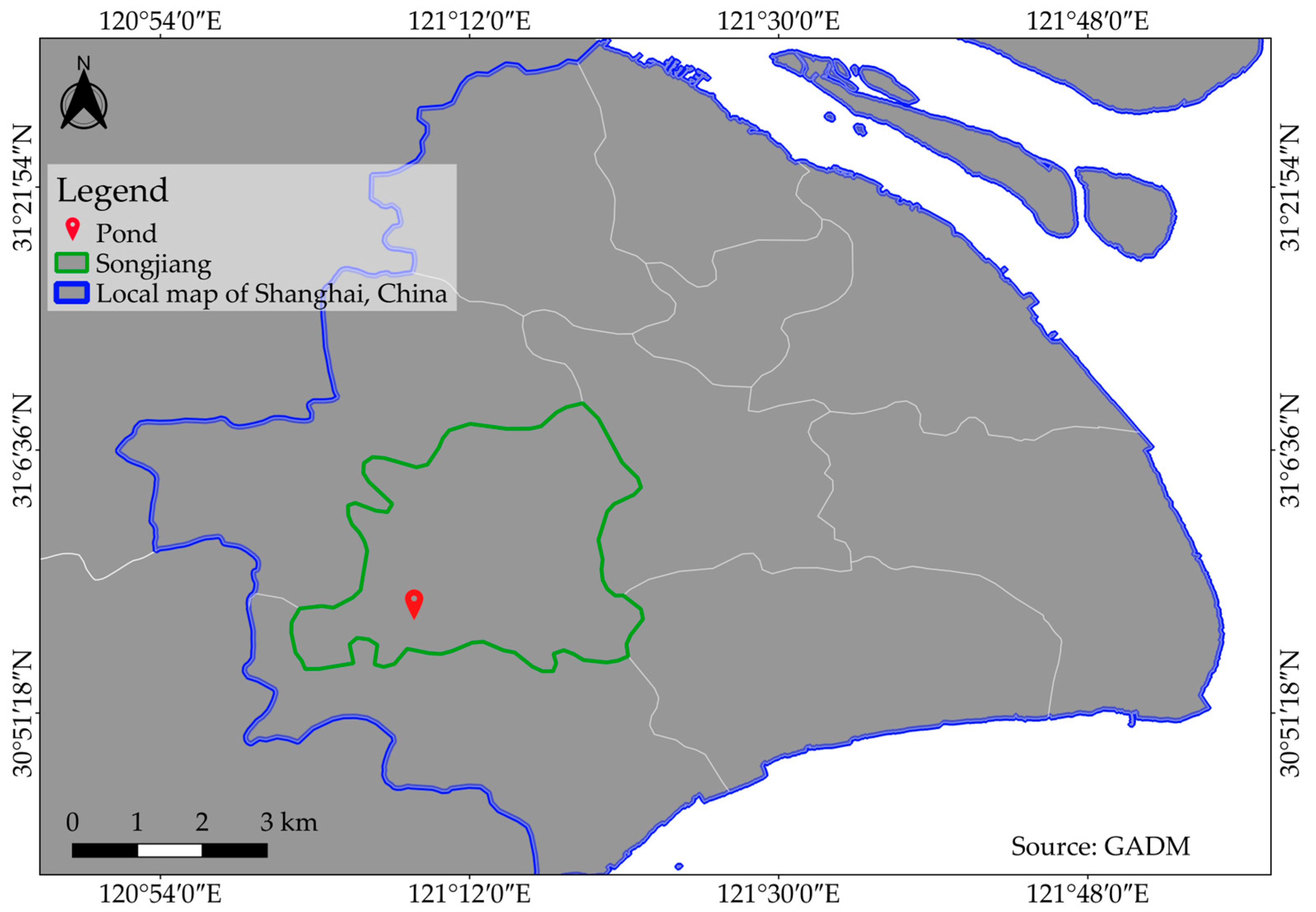
This study was conducted using a 0.4 hm2 grass carp pond located at the Pond Ecological Engineering Research Center of the Chinese Academy of Fishery Sciences in Songjiang District, Shanghai (Figure 1). The Center serves as a dedicated platform for advancing research on pond aquaculture ecology and production system models. It also pilots and demonstrates state-of-the-art mechanized and digital farming technologies and develops ecological engineering approaches tailored to freshwater aquaculture. Functioning as an integrated experimental base, the Center provides technical demonstrations and services that support the upgrading of pond-based farming models and promote the sustainable development of China’s pond aquaculture sector.

2.2. Calculation of Standard Equivalent Factor Value

To ensure international comparability and local applicability, the value equivalent factors used in this study were calibrated against the Millennium Ecosystem Assessment (MA) framework and the localized parameters established by Xie G. D. et al. [15]. This dual-reference approach aligns our specific coefficients for grass carp ponds with global standards while respecting regional ecological characteristics. Building on Costanza et al. [2], Xie G. D. et al. [9] adapted coefficients to Chinese contexts, developing a dynamic assessment method based on unit area value equivalent factors. This method enables quantitative analysis of 14 ecosystem types and 11 service functions at temporal (monthly) and spatial (provincial) scales, providing a scientific basis for dynamic ecosystem service value assessments. For freshwater aquaculture systems, particularly grass carp ponds, integrating ecosystem service theory with the equivalent factor method is a practical approach. This not only quantifies contributions to ecosystems but also offers new perspectives on regional ecological and economic impacts. In this study, we apply the equivalent factor assessment method to grass carp pond aquaculture, calculating unit area ecosystem service values and adjusting parameters for Shanghai’s socioeconomic and environmental characteristics to enhance accuracy and applicability. The revised coefficients more precisely reflect the ecological–economic benefits of Shanghai’s freshwater ponds, supporting sustainable aquaculture management and policy formulation.
This study calculates the economic value of one standard unit of ecosystem service value equivalent factor and adjusts the ecosystem service value coefficients based on Shanghai’s conditions, yielding the economic value for one standard unit in Shanghai. Following Xie G. D. et al. [9], the value is defined as the net profit from grain production in a unit area of farmland ecosystem, serving as one standard equivalent factor. Per prior research [16], one standard unit ecosystem service value equivalent factor (abbreviated as standard equivalent) equals 1/7 of the national average market economic value of grain yield per hm2 of farmland in that year.
Thus, incorporating Shanghai’s unit area grain yields and national average prices, the revised standard equivalent factor’s economic value is calculated as per Equation (1) as follows:
E y = 1 7 i = 1 n p i q i M
where E y denotes the ecosystem service value of one standard equivalent factor in year y (CNY/hm2); i represents Shanghai’s major grain crop types, including rice, wheat, and corn; p i is the national average price of the i -th major grain crop in year y (CNY/kg); q i is the total yield of the i -th major grain crop in Shanghai in year y (kg); and M is the total planting area of major grain crops in Shanghai in year y (hm2). The specific data are shown in Table 1. The value of E 2021 was calculated as 3478.39 CNY/hm2, and the value of E 2022 was calculated as 3360.99 CNY/hm2.

2.3. Base Equivalents of Unit Area Ecosystem Service Values

The base equivalent of unit area ecological service function values for grass carp pond ecosystems (hereafter “base equivalent”) refers to the annual average value of various services in a specific area, serving as a key parameter for measuring ecological contributions. Base equivalents not only quantify the multifunctional values of grass carp pond ecosystems but also provide data support for constructing dynamic equivalent tables, revealing temporal evolution trends in service values. This study employs the equivalent factor method to convert complex ecosystem services into economic values for precise quantification. Base equivalents are core tools for assessing grass carp pond ecosystem service values, foundational for inter-ecosystem function comparisons and long-term trend analyses. By quantifying values across service types, their roles at regional, national, and global scales can be evaluated, and the influences of environmental changes or human activities on functions can be revealed. Dynamic equivalent tables rely on base equivalents for monitoring spatiotemporal variations in service values, supporting ecological management, policy formulation, and resource optimization.
Service values for paddy fields and aquaculture zones can be assessed per Xie G. D. et al.’s [9,11,13,23] latest revisions for paddy ecosystems, as shown in Table 2, representing unit area ecological service value equivalents for grass carp pond ecosystems.

2.4. Construction of Dynamic Equivalent Tables for Unit Area Ecosystem Service Values

Ecosystem service functions exhibit pronounced dynamic variations across temporal and spatial dimensions, with internal structures and external environments directly influencing service provision and value fluctuations. As a typical managed ecosystem, grass carp ponds demonstrate high dynamism in regulating services (gas regulation, climate regulation, environmental purification, hydrological regulation) and cultural services (aesthetic landscapes). These changes are primarily driven by ecological and social development factors. Gas regulation depends on pollutant absorption and decomposition by pond ecosystems. In high-temperature seasons, vigorous photosynthesis in aquatic plants and algae effectively fixes CO2 and releases O2, while microbial degradation of nitrogen oxides accelerates, enhancing atmospheric purification; low temperatures slow metabolism, reducing efficiency. For climate regulation, pond water evaporation absorbs heat and modulates air humidity, influencing local microclimates. When temperatures exceed 25 °C, enhanced evaporation mitigates urban heat island effects; below 10 °C in winter, it may exacerbate cooling, diminishing comfort [24,25]. Environmental purification involves adsorption of suspended particulates and pollutant degradation; higher temperatures boost microbial efficiency and photosynthesis, while low temperatures weaken functions. Hydrological regulation buffers precipitation, runoff fluctuations, and flood risks through storage. High temperatures increase evaporation, potentially affecting storage but promoting water cycling; low temperatures reduce evaporation, enhancing retention but slowing organic degradation and water quality regulation. Aesthetic landscape services evolve with ecological and social demands. Pond biodiversity and dynamic hydrology provide venues for ecological education and research, with recreational, tourism, and cultural functions growing amid heightened societal ecological awareness, serving as vital human–nature interfaces for sustainable development goals.
In summary, this study identifies temperature and social development coefficients as spatiotemporal dynamic factors. Combined with the base equivalent table for grass carp pond ecosystem service values, the spatiotemporal dynamic value equivalent factor is formulated as per Equation (2):
F n i j = { T i j F n 1 L i j F n 2 o r
where F n i j is the dynamic equivalent factor for the n -th unit area ecosystem service in grass carp ponds in region i and month j ; F n is the n -th ecosystem service value equivalent factor for grass carp ponds; T i j is the temperature spatiotemporal adjustment factor for grass carp ponds in region i and month j ; and L i j is the social development coefficient spatiotemporal adjustment factor for grass carp ponds in region i and month j . Here, n 1 denotes gas regulation, climate regulation, environmental purification, and hydrological regulation services and n 2 refers to the ecosystem service function of providing aesthetic landscape services.

2.4.1. Temperature Spatiotemporal Adjustment Factor ( T i j )

Extending Xie G. D. et al.’s [9] unit area equivalent factor method for China’s terrestrial ecosystems, this study explores temporal dynamics in grass carp pond ecosystems and proposes refined spatiotemporal correction methods. Given the temperature’s critical influence on grass carp growth and pond ecological stability, we construct a temperature spatiotemporal adjustment factor to dynamically calibrate assessment parameters. The ratio of the monthly average temperature in the study area to the national annual mean is introduced as the temperature adjustment coefficient, correcting dynamic variations in unit area service values. Temperature changes directly affect grass carp physiological metabolism and growth and indirectly influence service functions via evaporation rates and biochemical reaction kinetics. This correction model more accurately depicts climate-driven spatiotemporal variations in grass carp pond service values, enhancing assessment rigor and applicability. The temperature spatiotemporal adjustment factor is calculated as follows:
T i j = t i j / t ¯
where T i j is the temperature spatiotemporal adjustment factor for grass carp ponds in region i and month j ; t i j is the temperature in region i and month j (°C); and t is the national annual mean temperature (°C). Based on pond temperature records and national annual averages [26,27], T i j values are computed in Table 3.

2.4.2. Social Development Coefficient Spatiotemporal Adjustment Factor

In assessing ecosystem service values for grass carp ponds, dynamic socioeconomic developments profoundly influence perceptions and willingness to pay for services. Given the complexity and dynamism of ecosystem services and the deepening human cognition of ecological values, this study introduces the social development coefficient as a spatiotemporal adjustment factor to correct spatial heterogeneity and temporal dynamics in service values. This coefficient not only captures differences in willingness to pay across development stages but also reveals gain effects in human sustainable development processes. Wilson et al. [25] posited that human cognition of ecosystem service values deepens with social development, exhibiting nonlinear growth in recognition depth and willingness to pay as socioeconomic levels and living standards improve. To characterize this, we adopt the Pearl growth curve (S-curve) model to describe nonlinear increases in willingness to pay driven by social development, serving as the social development coefficient spatiotemporal adjustment factor, as per Equation (4), as follows:
l = L max 1 + e ( 1 / E n 3 )
where l is the social development stage coefficient related to actual willingness to pay; L m a x = 1 is consumer willingness to pay under extreme affluence; e is the base of the natural logarithm; and E n is the Engel coefficient for the study area.
Using the Express Professional Superior (EPS) Database, Engel coefficients for the study area and nationally are derived, and then social development coefficients for the study area and the nation were calculated according to Equation (4).
Assuming equal willingness to pay for product and service functions, the dynamic equivalent table for grass carp ponds is formulated under this premise. The social development coefficient spatiotemporal adjustment factor is then constructed as follows:
L i j = l i j l
where L i j is the social development coefficient spatiotemporal adjustment factor for grass carp ponds in region i and month j ; l i j is the social development stage coefficient for region i and month j ; and l is the national average social development stage coefficient for month j .
Due to data limitations, monthly social development coefficients cannot be precisely calculated; thus, annual coefficients approximate monthly values for the year. Annual values are computed as per Equation (5) using full-year data and applied monthly, assuming annual changes outweigh monthly fluctuations for operational feasibility and consistency. The resulting factors are in Table 4.
As a typical managed ecosystem, grass carp ponds exhibit marked temporal dynamics in regulating (gas, climate, purification, hydrological) and cultural (aesthetic) services, driven by temperature and social development. High temperatures (>25 °C) boost aquatic plant and microbial metabolism, enhancing gas purification and water quality maintenance; cold seasons inhibit photosynthesis and degradation. Water evaporation mitigates heat but may amplify cooling. With socioeconomic progress, pond functions expand from production to ecological, educational, and research values, necessitating integrated temperature and social factor assessments. Accordingly, we construct the unit area ecosystem service value dynamic equivalent as per Equation (6), with the results shown in Table 5, to comprehensively depict and forecast service value evolutions under varying environmental and social contexts.
D n i y j = n = 1 n i = 1 n M n i y × F n i y j
where D n i y j is the unit area dynamic equivalent value for the n -th ecosystem service function in grass carp ponds in region i , year y , and month j ; M n i y is the base equivalent value for the n -th unit area service in region i and year y ; F n i y j is the dynamic equivalent factor for the n -th unit area service in region i , year y , and month j ; and n denotes service type, j represents the month, and y represents the year.

3. Results

3.1. Results of Ecosystem Service Values in the Grass Carp Aquaculture Life Cycle

Building on the ecosystem service assessment framework proposed by Costanza et al. [2] and integrating the base and dynamic equivalent tables for China developed by Xie et al. [9], this study refines the value coefficients layer by layer to reflect Shanghai’s economic structure, climatic conditions, and development levels. Specifically, precise quantification of standard unit equivalent factor economic values is achieved, with an adjustment factor for the spatiotemporal variability of temperature and a social development coefficient, both of which are embedded in the model. This yields an improved unit area value equivalent factor-based ecosystem service valuation method. The framework provides a robust, regionally targeted assessment for grass carp ponds, establishing a dedicated model as per Equation (7).
V i y j = n = 1 m j = 1 l E i y D n i y j S i y j
where V i y j is the total ecosystem service value for grass carp ponds in region i , year y , and month j (CNY); E i y is the value of one standard equivalent factor in region i and year y (CNY/hm2); D n i y j is the unit area dynamic equivalent for the n -th service in region i , year y , and month j ; S i y j is the aquaculture area in region i , year y , and month j (hm2); and n denotes service type, j month, and y year. Values for the grass carp aquaculture life cycle are computed as per Equation (7) (see Table 6).

3.2. Analysis of Ecosystem Service Values in the Grass Carp Aquaculture Life Cycle

Drawing on Table 6, analyses of gas regulation, climate regulation, environmental purification, hydrological regulation, and aesthetic landscapes elucidate dynamic variation patterns in grass carp pond ecosystem service values.
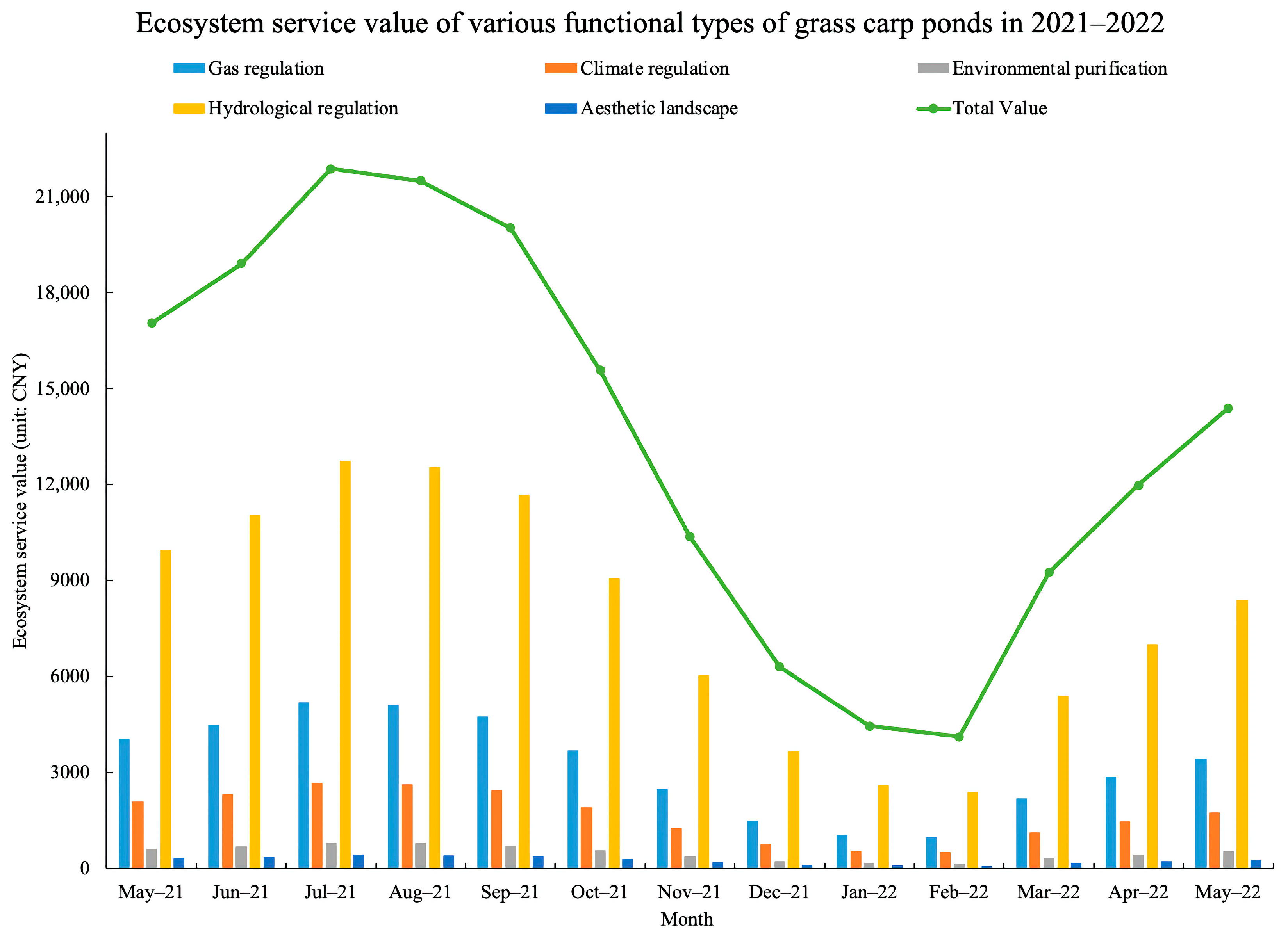
For gas regulation, grass carp ponds contribute to the regional carbon–oxygen balance and air quality via CO2 absorption and O2 release through photosynthesis. Values nadir in February at 979.04 CNY, reflecting winter low temperatures curtailing photosynthetic efficiency, and they peak in July at 5208.95 CNY, a 5.3-fold increase. This aligns with summer high temperatures, extended daylight, and intensified aquaculture, maximizing aquatic plant and plankton photosynthesis and CO2 sequestration per hectare. Grass carp foraging enhances water aeration, indirectly boosting photosynthesis. Conversely, winter (December–February) reduced light and temperature halt growth and microbial metabolism, minimizing capacity. Annually, spatiotemporal variations underscore ecosystem responsiveness to environments, with summer efficiency elevating economic values and supporting atmospheric optimization and global carbon neutrality.
For climate regulation, ponds modulate local microclimates via evaporation and transpiration, particularly cooling and humidifying in summer. Values are lowest in February (502.75 CNY) and peak in July (2674.87 CNY), nearly quintupling. Summer evaporation surges above 30 °C, absorbing heat; studies indicate 1.5–2 °C local cooling, up to 5 °C under extremes, benefiting agriculture and residents [28,29]. Increased humidity improves adjacent ecology. Winter lows weaken evaporation, negating cooling and potentially reducing comfort to 20% of summer levels. Aquaculture intensity influences efficacy. Summer high densities enhance liquidity and evaporation; winter reductions diminish it. Such seasonality necessitates management strategies for year-round balance.
For environmental purification, ponds reduce pollutants and enhance water quality via self-purification, vital for ecological health. Values bottom in February (149.94 CNY) and peak in July (797.77 CNY), a 5.3-fold rise. Summer high-density feeding promotes organic cycling, with active microbial and plankton metabolism and nutrient uptake by plants, mitigating eutrophication. Grass carp grazing controls algae, improving transparency and curbing blooms, buffering downstream quality. Winter slows metabolism and activity, dropping efficiency to 20% of summer. Annual functions synergize biological, chemical, and physical processes; summer liquidity and aeration further amplify them. This service improves pond quality and cuts regional pollution costs.
For hydrological regulation, ponds buffer water cycles via storage, runoff modulation, and flood risk reduction. Values are minimal in February (2399.10 CNY) and maximal in July (12,764.28 CNY), a 5.3-fold increase. Summer-concentrated rains enable runoff retention, easing floods; high temperatures boost evaporation for cooling and recharge. Winter-reduced precipitation, low temperatures, and activity curb evaporation and liquidity, halving capacity to 20% of summer. Annual dynamics reflect responses to precipitation and management, safeguarding regional water security and stability.
For aesthetic landscapes, ponds offer unique perceptual and cultural services rooted in natural ecology and biodiversity. Values trough in February (79.38 CNY) and crest in July (422.35 CNY), more than quintupling. Summer vibrancy—clear waters and lush plants—attracts tourism and angling, boosting economies. Winter-subdued activity lowers values, yet serene settings retain educational and aesthetic potential. Annual fluctuations highlight climate and human activity sensitivity; services enhance welfare and promote ecotourism and conservation awareness.
Overall, total ecosystem service values range from 4110.22 CNY in February to 21,868.21 CNY in July, a 5.3-fold span, reflecting seasonal climate, aquaculture intensity, and process interactions (Figure 2). Hydrological regulation dominates (~55%), followed by gas (20%) and climate (10%) regulation; purification and aesthetics, though minor, are essential. Summer peaks cut flood costs, enable carbon trading, and spur tourism; winter minima sustain water security. These dynamics reveal potentials for ecological–economic–social sustainability, informing management and policy.
Table 7 presents descriptive statistics for ecosystem service values across the 13-month aquaculture cycle. The coefficients of variation (CVs) for all functional types converge around 0.55, indicating consistent and substantial temporal volatility driven by seasonal phenology, social development, and willingness to pay. Hydrological regulation constitutes the dominant service, yielding the highest mean monthly value (7151.49 CNY), whereas aesthetic landscapes contribute a marginal share. The pronounced standard deviations relative to the means further corroborate the significant seasonal fluctuations identified in the monthly analysis. These metrics underscore the heterogeneity of ecosystem service provision throughout the production cycle, challenging the accuracy of static annual valuation methods. Consequently, these statistical results validate the necessity of the proposed dynamic monthly assessment framework for capturing the precise ecological–economic value of grass carp pond systems.

4. Discussion

4.1. Scientific Significance of Improvements in the Assessment Method

Although the grass carp pond examined in this study occupies only 0.4 hm2, its implications become substantial when extrapolated to the national scale. With freshwater pond aquaculture covering 2.62 million hectares across China and grass carp systems contributing nearly one-quarter of the total pond-based production, shifting these systems from high-input, resource-intensive models toward eco-friendly and low-impact paradigms could markedly enhance regional hydrological regulation and carbon sequestration. Implementing the proposed ecological compensation mechanism at this broader scale represents a critical pathway for advancing China’s green transformation and sustainable development in the aquaculture sector.
Improvements to the dynamic assessment method for grass carp pond service values underscore innovation and applicability in two aspects. First, the temperature spatiotemporal adjustment factor, based on monthly-to-national annual ratios, precisely captures temperature-driven ecological processes. In high-temperature periods (summer), it amplifies photosynthesis and microbial efficiency, elevating gas and purification values; in lows, it reflects suppression. This addresses equivalent factor method gaps in climate variability, enhancing spatiotemporal resolution for monthly management optimization. Second, the social development coefficient, via Pearl curve modeling of Engel coefficient-driven nonlinear willingness to pay growth, bolsters cultural services like aesthetics in developed areas like Shanghai, avoiding static underestimations of urbanization. Annual approximations integrate socioeconomic dimensions, aligning the results with regional sustainability.
Methodological limitations include single-pond sampling constraining spatial coverage and potential multi-regional heterogeneity; annual social coefficient simplifications overlook monthly variances, risking bias. Future enhancements include (1) multi-site empirics with remote sensing and GIS for spatial interpolation and (2) refined social models incorporating resident surveys for monthly willingness to pay. These will boost universality and predictive accuracy, advancing precise ecological compensation and green fisheries.

4.2. Sustainable Development Suggestions

To translate the quantified ecosystem service values and their pronounced monthly dynamics into practicable sustainability actions, policy design can shift from uniform subsidies to performance-based incentives and adaptive management tailored to regulating and cultural services, offering insights for similar regions and aquaculture ponds.
(1)
Adaptive pond management and nature-based water quality enhancement. Implement seasonally adaptive pond management by aligning stocking density, feeding regimes, aeration intensity, and aquatic vegetation management with temperature-driven shifts in gas regulation, environmental purification, and hydrological regulation so that peak service provision in warm months is reinforced while baseline functions are maintained during cold periods. In parallel, promote nature-based water quality enhancement by integrating constructed wetlands or ecological ditches with pond inflow–outflow pathways, coupled with routine sediment management and nutrient budgeting, to stabilize environmental purification capacity and reduce pollution risks without compromising production.
(2)
Watershed-oriented governance and ecological compensation. Establish a watershed-oriented ecological compensation scheme by linking payments to verified service outcomes—prioritizing hydrological regulation and water security functions given their dominant contribution to total ESV—and using the study’s dynamic accounting framework to set differentiated standards across months and management practices.
(3)
Value realization and cultural service expansion under safeguards. Develop market mechanisms for realizing regulating services by building MRV-compatible carbon and ecosystem service accounting protocols for pond systems, enabling carbon credit participation and other tradable instruments that internalize non-market benefits and incentivize low-carbon, resource-efficient practices. Expand cultural services under ecological safeguards by encouraging pond-based ecological education, research access, and low-impact recreation (e.g., landscape-oriented visitation) while applying carrying capacity controls and biosecurity measures so that cultural value grows without eroding regulating services.

5. Conclusions

The results show pronounced monthly-scale seasonal fluctuations in grass carp pond service values, from 4110.22 CNY (minimum, February) to 21,868.21 CNY (maximum, July), with a 5.3 peak-to-trough ratio. This dynamism reflects responses to climate and biological activities, highlighting hydrological regulation’s dominance (~55%), followed by gas (20%) and climate (10%) regulation. The findings align with and extend Xie G. D. et al. [9], whose equivalent factor method has been widely applied to terrestrial and aquatic spatiotemporal quantifications, affirming regulating services’ centrality in managed ecosystems. Innovations include temperature spatiotemporal adjustment and social development coefficients, overcoming traditional models’ socioeconomic oversights and capturing shifts toward comprehensive benefits. The validity of our findings was compared with empirical data from similar freshwater aquaculture studies in the assessment of the ecosystem service value of pond aquaculture in Shanghai [11,14]. The calculated trends showed a consistent spatiotemporal pattern with regional observations, confirming the robustness of the improved equivalent factor method. Monthly decompositions yield finer-grained fluctuations, enhancing life cycle explanatory power.
Temporally, values hinge on seasonal climate variability. Summer (June–September) high temperatures activate photosynthesis and metabolism, surging gas and purification values to peaks; winter (December–February) lows inhibit processes, with evaporation weakening climate and hydrological functions to ~20% of summer. Monthly patterns couple grass carp growth cycles with regional precipitation and insolation, akin to Costanza et al.’s [2] global managed wetland dynamics but emphasizing aquaculture amplification.
Spatially and functionally, Songjiang’s pond heterogeneity stems from development gradients and land uses. Hydrological regulation prevails in urban peripheries for flood buffering; aesthetic services rise from 0.09 to 0.30 equivalents in affluent areas via social coefficient corrections, reflecting heightened ecological awareness. Synergies/trade-offs exist. Summer hydrological–climate coordination boosts evaporative cooling but risks nutrient losses in purification. Shanghai ponds exceed national averages by 15–20%, attributable to high Engel coefficients elevating willingness to pay, yet urbanization pressures biodiversity.

Author Contributions

Conceptualization, B.X. and D.Y.; methodology, B.X.; software, B.X.; validation, B.X. and D.Y.; formal analysis, B.X.; investigation, B.X.; resources, D.Y. and X.X.; data curation, B.X. and X.X.; writing—original draft preparation, B.X.; writing—review and editing, B.X. and X.X.; supervision, D.Y.; project administration, D.Y.; funding acquisition, D.Y. All authors have read and agreed to the published version of the manuscript.

Funding

This research was funded by the Fisheries Development Subsidy Funds for the Optimization of Fisheries-Related Policies, grant number D-8021-24-0123-04, and by the Shanghai Philosophy and Social Sciences Special Project: Research on Paths and Experiences of Megacities in Building a New Pattern of Urban-Rural Integrated Development, grant number 2024VTJ002.

Institutional Review Board Statement

Not applicable.

Informed Consent Statement

Not applicable.

Data Availability Statement

The data are available upon request from the authors.

Conflicts of Interest

The authors declare no conflicts of interest.

References

  1. Fisheries and Fishery Administration, Ministry of Agriculture and Rural Affairs; National Aquatic Technology Extension Center; Chinese Society of Fisheries. China Fisheries Statistical Yearbook 2025; China Agriculture Press: Beijing, China, 2025; pp. 21–49.
  2. Costanza, R.; d’Arge, R.; Groot, R.; Farber, S.; Grasso, M.; Hannon, B.; Limburg, K.; Naeem, S.; O’Neill, R.V.; Paruelo, J.; et al. The value of the world’s ecosystem services and natural capital. Nature 1997, 387, 253–260. [Google Scholar] [CrossRef]
  3. Brander, L.M.; de Groot, R.; Schägner, J.P.; Guisado-Goñi, V.; van ‘t Hoff, V.; Solomonides, S.; McVittie, A.; Eppink, F.; Sposato, M.; Do, L.; et al. Economic values for ecosystem services: A global synthesis and way for ward. Ecosyst. Serv. 2024, 66, 101606. [Google Scholar] [CrossRef]
  4. Ouyang, Z.; Wang, R.; Zhao, J. Ecosystem Service Functions and Their Ecological-Economic Value Assessment. Chin. J. Appl. Ecol. 1999, 10, 635–640. [Google Scholar] [CrossRef]
  5. Ouyang, Z.; Wang, X.; Miao, H. A Preliminary Study on the Service Functions and Ecological-Economic Value of China’s Terrestrial Ecosystems. Acta Ecol. Sin. Chin. 1999, 69, 19–25. [Google Scholar]
  6. Zhao, T.; Ouyang, Z.; Wang, X.; Miao, H.; Wei, Y. Functional and Ecological-Economic Value Assessment of Terrestrial Surface Water Ecosystem Services in China. Chin. J. Nat. Resour. 2003, 18, 443–452. [Google Scholar] [CrossRef]
  7. Zhao, T.; Ouyang, Z.; Zheng, H.; Wang, X.; Miao, H. Functional and Value Evaluation of Forest Ecosystem Services in China. Chin. J. Nat. Resour. 2004, 19, 480–491. [Google Scholar] [CrossRef]
  8. Xie, G.; Zhen, L.; Lu, C.; Xiao, Y.; Chen, C. A Method for Valuing Ecosystem Services Based on Expert Knowledge. Chin. J. Nat. Resour. 2008, 23, 911–919. [Google Scholar] [CrossRef]
  9. Xie, G.; Zhang, C.; Zhang, L.; Chen, W.; Li, S. Improvement of the Method for Valuing Ecosystem Services Based on Equi valent Factors of Value per Unit Area. Chin. J. Nat. Resour. 2015, 30, 1243–1254. [Google Scholar] [CrossRef]
  10. Yang, H.; Wang, C.; Guo, Z.; Yang, Z. An Empirical Study on the Value of Air Regulation Services of Pond Aquaculture Ecosystems. Resour. Environ. Yangtze River Basin Chin. 2009, 18, 432–438. [Google Scholar] [CrossRef]
  11. Yang, H.; Li, S.; Yang, Z. Evaluation of Ecosystem Service Value of Pond Aquaculture: A Case Study of Conventional Fish Farming in Qingpu District, Shanghai. Chin. J. Resour. Sci. 2011, 33, 575–581. [Google Scholar]
  12. Yang, H.; Yang, Z. System Dynamic Modeling on the Valuation of Ecosystem Services in Oriental River Prawn (Macrobrachium nipponense) Aquaculture Ponds. Chin. J. Nat. Resour. 2012, 27, 1176–1185. [Google Scholar] [CrossRef]
  13. Yang, Z.; Tang, K.; Yang, H.; Fan, X. Spatio-temporal Difference Analysis of Ecosystem Service Value of Pond Aquaculture in Shanghai. Chin. J. Eco-Agric. 2013, 21, 217–226. Available online: https://m.natholic.com/cn/article/doi/10.3724/SP.J.1011.2013.0021 (accessed on 15 November 2025).
  14. Yang, Z.; Zhang, X.; Yang, H. Research on Ecological Compensation Policy for Pond Aquaculture Based on the Value of Ecosystem Services: A Case Study of Shanghai. Ecol. Econ. Chin. 2015, 31, 151–156. [Google Scholar]
  15. Xie, G.; Liu, C.; Leng, Y.; Zheng, D.; Li, S. Ecological assets valuation of the Tibetan Plateau. J. Nat. Resour. 2003, 18, 189–196. [Google Scholar] [CrossRef]
  16. Chen, W.; Li, J.; Zhu, L. Spatial heterogeneity and sensitivity analysis of ecosystem services value in the Middle Yangtze River region. Chin. J. Nat. Resour. 2019, 34, 325–337. [Google Scholar] [CrossRef]
  17. National Bureau of Statistics of China. China Statistical Yearbook 2022; China Statistics Press: Beijing, China, 2022.
  18. National Bureau of Statistics of China. China Statistical Yearbook 2023; China Statistics Press: Beijing, China, 2023.
  19. Price Department, National Development and Reform Commission of China. National Compendium of Agricultural Product Cost and Benefit Data 2022; China Statistics Press: Beijing, China, 2022.
  20. Price Department, National Development and Reform Commission of China. National Compendium of Agricultural Product Cost and Benefit Data 2023; China Statistics Press: Beijing, China, 2023.
  21. Department of Rural Social and Economic Surveys, National Bureau of Statistics of China. China Agricultural Price Survey Yearbook 2022; China Statistics Press: Beijing, China, 2022.
  22. Department of Rural Social and Economic Surveys, National Bureau of Statistics of China. China Agricultural Price Survey Yearbook 2023; China Statistics Press: Beijing, China, 2023.
  23. Fan, X.; Yang, Z.; Tang, K.; Zhang, X.; Yang, H. Application of Count Data Models in the Evaluation of Recreational Service Value of Pond Aquaculture. Chin. J. Eco-Agric. 2014, 22, 120–126. [Google Scholar] [CrossRef]
  24. Li, S.; Yang, Z.; Yang, H.; Zhang, H.; Guo, Z. An Empirical Study on the Ecological Service Value of Microclimate Regulation in Aquaculture Ponds. J. Agro-Environ. Sci. 2010, 19, 432–437. [Google Scholar]
  25. Wilson, M.A.; Carpenter, S.R. Economic Valuation of Freshwater Ecosystem Services in the United Stat es: 1971–1997. Ecol. Appl. 1999, 9, 772–783. [Google Scholar] [CrossRef]
  26. National Climate Center, China Meteorological Administration. China Climate Bulletin 2021; CMA: Beijing, China, 2021.
  27. National Climate Center China Meteorological Administration. China Climate Bulletin 2022; CMA: Beijing, China, 2022.
  28. Peng, J.; Liu, Q.; Xu, Z.; Lyu, D.; Du, Y.; Qiao, R.; Wu, J. How to effectively mitigate urban heat island effect? A perspective of waterbody patch size threshold. Landsc. Urban Plan. 2020, 202, 103873. [Google Scholar] [CrossRef]
  29. Zhao, L.; Li, T.; Przybysz, A.; Liu, H.; Zhang, B.; An, W.; Zhu, C. Effects of urban lakes and neighbouring green spaces on air temperatur e and humidity and seasonal variabilities. Sustain. Cities Soc. 2023, 91, 104438. [Google Scholar] [CrossRef]
Figure 1. Geographical framework of the case study pond (121°8′54″ E, 30°56′59″ N).
Sustainability 18 00082 g001
Figure 2. Ecosystem service value of various functional types of grass carp ponds in 2021–2022.
Sustainability 18 00082 g002
Table 1. Grain crop production in Shanghai during 2021–2022 (unit: thousand hectares; ten thousand tons; CNY per kilogram).
YearTotal Grain AreaRice AreaWheat AreaCorn AreaRice YieldWheat YieldCorn YieldNat. Avg. Rice PriceNat. Avg. Price WheatNat. Avg. Price Corn
2021117.4103.810.9185.17.40.73.092.832.79
2022122.8103.715.4182.710.70.63.063.192.86
Notes: The data is sourced from China Statistical Yearbook 2022 [17], China Statistical Yearbook 2023 [18], Compilation of National Agricultural Product Costs and Returns 2022 [19], Compilation of National Agricultural Product Costs and Returns 2023 [20], China Agricultural Product Price Survey Yearbook 2022 [21], and China Agricultural Product Price Survey Yearbook 2023 [22].
Table 2. Ecosystem service value equivalent per unit area of grass carp ponds.
Service TypeFunction TypeAquaculture Area
Regulating servicesGas regulation1.11
Climate regulation0.57
Environmental purification0.17
Hydrological regulation2.72
Cultural servicesAesthetic landscape0.09
Table 3. Temperature spatiotemporal adjustment factor for grass carp ponds (2021–2022).
DateMean Monthly Pond Temp. (°C)National Annual Mean Temp. (°C)Temp. Spatiotemporal Adj. Factor
May 202123.010.502.19
Jun 202125.510.502.43
Jul 202129.510.502.81
Aug 202129.010.502.76
Sep 202127.010.502.57
Oct 202121.010.502.00
Nov 202114.010.501.33
Dec 20218.510.500.81
Jan 20226.510.510.62
Feb 20226.010.510.57
Mar 202213.510.511.28
Apr 202217.510.511.67
May 202221.010.512.00
Notes: Data from China Climate Bulletin (2021–2022) [26,27].
Table 4. Spatiotemporal adjustment factors for the social development coefficient in the grass carp pond region (2021–2022).
YearEngel Coefficient (En)Social Development Coefficient
Spatiotemporal Adjustment Factor ( L )
ShanghaiNational
20210.260.301.20
20220.270.301.15
Notes: Data from the EPS database.
Table 5. Dynamic equivalent values of ecosystem service value per unit area in grass carp ponds (2021–2022).
DateGas Reg.Climate Reg.Env. Purif.Hydro. Reg.Aesthetic Land.
May 20212.921.500.457.150.24
June 20213.241.660.507.930.26
July 20213.741.920.579.170.30
August 20213.681.890.569.020.30
September 20213.431.760.528.400.28
October 20212.671.370.416.530.22
November 20211.780.910.274.350.14
December 20211.080.550.172.640.09
January 20220.790.410.121.930.06
February 20220.730.370.111.780.06
March 20221.640.840.254.020.13
April 20222.121.090.335.200.17
May 20222.551.310.396.250.21
Table 6. Ecosystem service values across the life cycle of grass carp aquaculture in 2021–2022 (unit: CNY).
DateGas Reg.Climate Reg.Env. Purif.Hydro. Reg.Aesthetic Land.Total Value
May 20214061.222085.49621.999951.81329.2917,049.79
June 20214502.652312.17689.611,033.53365.0818,903.03
July 20215208.952674.87797.7712,764.28422.3521,868.21
August 20215120.662629.53784.2512,547.93415.1921,497.56
September 20214767.522448.18730.1611,682.56386.5620,014.97
October 20213708.071904.14567.99086.44300.6515,567.2
November 20212472.041269.43378.66057.62200.4410,378.13
December 20211500.88770.72229.873677.84121.696301.01
January 20221060.63544.65162.442599.02864452.74
February 2022979.04502.75149.942399.179.384110.22
March 20222202.851131.19337.375397.97178.619248
April 20222855.551466.36437.346997.37231.5311,988.15
May 20223426.651759.63524.88396.85277.8414,385.78
Table 7. Statistical summary of monthly ecosystem service values (ESVs) (N = 13 months).
ESVs Functional TypeMean ( x ¯ ) (CNY) Standard Deviation (σ) (CNY)Coefficient of Variation (CVs)
Gas Regulation2912.351600.060.549
Climate Regulation1497.71822.420.549
Environmental Purification447.85245.450.548
Hydrological Regulation7151.493928.310.55
Aesthetic Landscape236.49130.070.55
Total Ecosystem Service Value11,550.086340.230.549
Disclaimer/Publisher’s Note: The statements, opinions and data contained in all publications are solely those of the individual author(s) and contributor(s) and not of MDPI and/or the editor(s). MDPI and/or the editor(s) disclaim responsibility for any injury to people or property resulting from any ideas, methods, instructions or products referred to in the content.