Article

A Comparative Analysis of the Regional Integrated Rice–Crayfish Systems Based on Ecosystem Service Value: A Case Study of Huoqiu County and Chongming District in China


1
Key Laboratory of Integrated Rice-Fish Farming Ecosystem, Ministry of Agriculture and Rural Affairs, Shanghai Ocean University, Shanghai 201306, China
2
National Demonstration Center for Experimental Fisheries Science Education, Shanghai Ocean University, Shanghai 201306, China
3
Anhui Fisheries Technology Extension Center, Hefei 230001, China
4
Sanliu Township Economic Development and Agriculture and Rural Service Center, Lu’an 231300, China
5
Chinese Mitten Crab Industry Research Center of Jiangsu Province, Nanjing 210017, China
6
Center of International and Cooperation Service, Ministry of Agriculture and Rural Affairs, Beijing 100028, China
*
Authors to whom correspondence should be addressed.
These authors contributed equally to this work.
Sustainability 2025, 17(24), 11047; https://doi.org/10.3390/su172411047
Submission received: 28 October 2025 / Revised: 1 December 2025 / Accepted: 6 December 2025 / Published: 10 December 2025
(This article belongs to the Special Issue Bringing Ecosystem Services into Decision-Making—2nd Edition)

Abstract

This study evaluates regional differences in ecosystem service values (ESVs) between the integrated rice–crayfish systems of Huoqiu County (HQ) and Chongming District (CM) in China. The assessment was based on the Common International Classification of Ecosystem Services (CICES) V5.1, which categorizes ecosystem services into provisioning, regulation and maintenance, and cultural services. In this framework, each service category was quantified using region-specific biophysical indicators combined with monetary valuation methods. The results showed that the ESVs in HQ and CM were 346,113.59 CNY/ha and 467,334.89 CNY/ha, respectively, with greenhouse gas (GHG) emissions accounted for as a negative value. Regulation and maintenance services dominated both regions (59% in HQ and 52% in CM), followed by provisioning services (22%) in HQ and cultural services (19%) in CM. Among these, temperature regulation, water storage and flood control, soil nutrient retention, social security functions, and greenhouse gas emissions were higher in HQ than in CM, with the key difference lying in social security value in HQ and greater tourism development value in CM. A SWOT-AHP analysis recommends a pioneering strategy leveraging strengths and opportunities for sustainable development. These findings inform region-specific policies to balance economic growth and environmental sustainability, contributing to global discourse on integrated agriculture–aquaculture (IAA) systems. Future research incorporating primary data and refining model parameters would further enhance the precision and practical application of these assessments.

1. Introduction

Ecosystem services (ES) underpin agricultural productivity, ecological stability, and environmental regulation. As sustainability becomes a global policy priority, ecosystem service valuation (ESV) has emerged as an essential analytical tool for guiding land use planning and resource management [1]. ESV assessments now support decision making in mangrove forests [2] and wetlands [3], and play a significant role in urban and marine spatial planning [4,5]. In agricultural ecosystems, the evaluation of ecosystem service values (ESVs) considers both economic and ecological factors [6,7], and is influenced by various elements such as fertilization methods [8], rice cropping patterns [9], rice cultivation methods [10], tourism models [11], restoration strategies [12], and reclamation or co-culture models [13]. In parallel, life cycle assessment (LCA) provides a cost-oriented accounting framework that quantifies environmental burdens—such as greenhouse gas emissions and nutrient losses—across the entire production chain [14,15]. Integrated with ESVs, LCA offers a complementary perspective that captures both ecological benefits and environmental costs, supporting more balanced evaluations of agricultural sustainability.
Integrated agriculture–aquaculture (IAA), particularly rice–red swamp crayfish (Procambarus clarkii) co-culture, is a rapidly expanding production model in China due to its notable ecological and economic advantages [16,17]. The system relies on several key technical modifications: paddy fields are reinforced with ridges and excavated with trenches (typically 0.8–1.2 m deep), allowing crayfish to inhabit the margins while rice occupies the central plot. Crayfish are stocked around the time of rice transplantation, which enables a co-culture period that spans almost the entire growing season. Their bioturbation improves soil aeration and nutrient cycling, and their predation on insect larvae and weeds reduces the need for pesticides and herbicides. As a result, rice–crayfish systems enhance biodiversity, maintain water quality, and mitigate non-point source pollution [18,19]. Economically, the dual production of rice and crayfish substantially increases land productivity and income stability. Research by Xu et al. [20] further indicates that shifting from a rice–wheat rotation to rice–crayfish co-culture can increase net ESVs by enhancing food supply and flood control capacity. However, current research evaluating the ESVs of rice–crayfish farming remains limited. During the modernization process, farming systems in different regions have adapted differently due to social, ecological, and historical factors [21]. The ESVs of rice–crayfish systems may vary across regions, influenced by factors such as climate, geography, soil conditions, and management practices. These differences result in the distinct values and characteristics of ecosystem services. Therefore, in-depth research on regional differences can help promote the green development of agriculture [22].
SWOT analysis is a strategic planning tool for evaluating strengths, weaknesses, opportunities, and threats. It helps identify core competencies and external challenges, thereby facilitating the formulation of effective strategies. This method has been applied in ecological agriculture, offering a powerful tool for assessing complex systems [23]. For example, Bunting revealed the significant environmental and socio-economic benefits of shrimp–rice agroecosystems in Bangladesh and West Bengal, India, and proposed practical conservation measures and policy recommendations to address developmental challenges using SWOT analysis [24]. Furthermore, when combined with Analytic Hierarchy Process (AHP), the SWOT-AHP approach serves as a qualitative and quantitative analysis method, which assigns weights to different factors, prioritizing them and providing support for decision making [25]. In summary, the SWOT-AHP transforms ESV assessment from a static valuation task into a dynamic and comprehensive management analysis. It achieves this by constructing a coherent analytical pathway that links factor identification, quantitative weighting, and strategic guidance, thereby integrating strategic thinking and scientific decision making directly into the evaluation process.
This study selected two distinct regions to represent different agricultural development stages in the Yangtze River Delta: Huoqiu County (HQ) in Anhui Province and Chongming District (CM) in Shanghai. HQ is a typical traditional agricultural county and a national commodity grain base. It represents the “production-oriented” model where large-scale rice–crayfish farming is a pillar industry for poverty alleviation and rural revitalization. The agricultural sector here focuses on high yields and exports to other provinces. In contrast, CM is an eco-island located in the developed metropolis of Shanghai. It represents the “service-oriented” or “urban agriculture” model. The agricultural sector here is strictly regulated by environmental policies and targets high-end consumption and tourism. Comparing these two regions allows us to analyze how different socio-economic contexts (developing rural area vs. developed urban periphery) influence the ecosystem service values of the same agricultural system. This comparison aims to provide differentiated policy recommendations for diverse regions.

2. Materials and Methods

2.1. Study Areas and Descriptions

The study areas are shown in Figure 1. HQ is in western Anhui Province, China (115.91° E, 31.91° N), on the south bank of the middle Huai River, covering 323,900 ha. It is a major component of the Huai River flood storage area. It has a subtropical humid monsoon climate with an average annual temperature of 15.6 °C, active accumulated temperature (≥10 °C) of 4900–5100 °C, and annual precipitation of 1467.9 mm, 600–800 mm of which occurs during the rice-growing season (June–October). Soils are predominantly yellow-brown and paddy soils (Hydragric Anthrosols), providing good water retention for crayfish. HQ is part of the Huai River flood storage area. The local rice–crayfish co-culture model involves one rice crop and one batch of adult crayfish annually, with idle winter fields used to breed an additional batch of juveniles (“one-crop rice, two-crops crayfish”). The region benefits from the Pishihang Irrigation District, a national-level water conservancy project. An extensive network of canals transports water from upstream reservoirs to the paddy fields, mitigating the risk of seasonal drought.
CM is located in northern Shanghai, China (121.35° E, 31.39° N), at the mouth of the Yangtze River, and covers an area of 141,300 ha. Farmers utilize pumping stations and sluice gates to draw freshwater directly from the Yangtze River to regulate field water levels. The island has a subtropical climate with a mean annual temperature of 15.3 °C, active accumulated temperature (≥10 °C) of 4800–5000 °C, and an annual precipitation of 927.9 mm, 700–900 mm of which falls during the rice-growing season (March–September). Soils are mainly saline-alkali and alluvial paddy soils. Rich in biodiversity, particularly birds, the eastern shoal hosts the highest species diversity. As part of the efforts to develop a “world-class ecological island”, paddy fields serve as key bird habitats, supporting integrated rice–crayfish farming. In 2022, 116 ha were used for one rice crop and one crayfish batch annually (“one-crop rice, one-crop crayfish”). Due to its location at the mouth of the Yangtze River, it takes full advantage of its dense inland river shipping network. Farmers use pumping stations and sluices to bring the freshwater from the Yangtze River into their farmlands, thus ensuring a continuous supply of water throughout the year for the crops.

2.2. Data Collection

2.2.1. Primary Data Collection and Survey Research

In 2022, we conducted focus group discussions, interviews, and questionnaire surveys with 200 rice–crayfish farmers (total study areas: 1437.67 ha) in HQ and 15 farmers (total study areas: 1419.20 ha) in CM. The significant difference in the number of respondents (200 vs. 15) stems from the distinct agricultural structures of the two regions. HQ is characterized by smallholder family farms (mean area: 7.2 ha), while CM features highly consolidated, large-scale operations (mean area: 94.6 ha) managed by cooperatives or companies. Despite the smaller headcount in CM, the total land area surveyed is comparable to that of HQ, ensuring that the spatial coverage and system representation remain robust. We recorded information on inputs such as rice seeds, seedlings, machinery, fertilizers, pesticides, and other field engineering costs, as well as the output and actual market prices of products after harvest. The survey results were analyzed using SPSS AU (Version 22.0) and organized and calculated using Microsoft Office 365 Excel. During the calculations, reference parameter values were adjusted to the corresponding prices for 2022, based on the price indices released by the National Bureau of Statistics, and the meanings of each formula are described in Table 1.

2.2.2. Secondary Data Collection

The secondary data parameters for the ES functions evaluation of the rice–crayfish system in this study were primarily obtained from publicly available research papers and statistical yearbooks. These materials provided a rich foundation of data and theoretical support. To ensure the accuracy and reliability of the data, we carefully selected the literature and materials from reliable sources with detailed content to ensure the scientific nature of the research results. The data sources used for the ecosystem service value assessment are summarized in Table S1 [26,27,28,29,30,31].

2.3. ESVs Evaluation Framework

Based on the CICES V5.1 and the research by Liu, and considering data availability, we developed an ESVs framework with 12 indicators (Table 2) tailored to the characteristics of integrated rice–crayfish farming in HQ and CM [32]. Indicators were selected for their relevance to provisioning, regulation and maintenance, and cultural services, with GHG emissions as a negative value. Selection criteria prioritized data availability and alignment with regional characteristics.

2.4. SWOT-AHP Model

Based on the SWOT analysis of the sustainable development strategies for integrated rice–crayfish farming in HQ and CM, this study constructed a hierarchical structure model for both regions. The objective layer is the sustainable development strategy, the criterion layer includes four aspects: strengths, weaknesses, opportunities, and threats, and the indicator layer corresponds to specific SWOT factors. The data were collected using Expert Consultation Method for the SWOT-AHP analysis. For each region, ten experts were invited to conduct pairwise comparisons of the criterion layer (S, W, O, T) and the 16 indicators, and to score them according to the rating criteria in Table S2. The judgment matrices were subjected to consistency tests using SPSS AU software (Version 22.0). If the consistency ratio (CR) was less than 0.1, the judgment was considered valid.

3. Results

3.1. Provisioning Service

The rice and crayfish product yields and market prices are provided in Table 1. The economic benefits from two batches of crayfish farming in HQ were included, considering the differences in integrated rice–crayfish farming models between the two regions. Provisioning service value calculated by the market value method in HQ was 77,762.06 ± 13,756 CNY/ha, while in CM it was 87,116.69 ± 33,734 CNY/ha.

3.2. Regulation and Maintenance Service

It is important to acknowledge the inherent uncertainties in these valuations. Parameters such as GHG emission coefficients and biodiversity conversion factors are derived from the literature and from regional reports, which may not fully capture the specific micro-climatic or biological variations in every field. To address this, we treated our estimates as conservative baselines. For values heavily dependent on market prices (e.g., temperature regulation via coal substitution), a sensitivity analysis suggests that a ±10% fluctuation in energy prices would result in a proportional variation in the regulation value, though the relative dominance of this service remains unchanged.

3.2.1. Carbon Sequestration and Oxygen Release Value

According to the National Forestry Industry Standards of the People’s Republic of China, the industrial oxygen production cost in 2008 was 1000 CNY/t O2, and the afforestation carbon sequestration cost in 2010 was 260.9 CNY/t C [26]. Given the early publication date of these standards, this study adjusted the relevant costs based on the price indices released by the National Bureau of Statistics (www.stats.gov.cn). After adjustment, the industrial oxygen production cost was converted to 1075.08 CNY/t O2, and the afforestation carbon sequestration cost was adjusted to 301.07 CNY/t C. The carbon sequestration and oxygen release service values were 20,805.06 CNY/ha for HQ and 21,013.52 CNY/ha for CM based on adjusted costs.

3.2.2. Greenhouse Gas Emissions Value

To assess the economic losses from GHG emissions, this study employed the Reforestation Cost Method and converted CH4 and N2O emissions into the equivalent CO2, based on their Global Warming Potential (GWP). According to the conversion coefficients provided in the Intergovernmental Panel on Climate Change (IPCC) Sixth Assessment Report (AR6) [33], the GWP values for CH4 and N2O are 29.8 and 273, respectively. It should be noted that GHG fluxes, particularly methane, exhibit high spatiotemporal variability depending on water management and temperature. Combined with the adjusted afforestation carbon sequestration cost of 301.07 CNY/t C, the negative values of GHG emissions for HQ and CM were calculated to be 2524.68 CNY/ha and 858.11 CNY/ha, respectively.

3.2.3. Temperature Regulation Value

This study used the substitution cost method to evaluate the temperature regulation service value, assuming that without the regulatory function of the rice–crayfish ecosystem, the same cooling effect would need to be achieved through energy consumption (e.g., coal). We acknowledge that this method, while standard in ESV assessment, may represent an upper-bound estimate. However, it provides a necessary proxy for the substantial energy savings provided by wetland ecosystems [34,35]. The 2019 coal market average price of 694.91 CNY/t was used as the baseline [32] and adjusted for inflation, based on the price indices released by the National Bureau of Statistics, resulting in a converted price of 953.87 CNY/t for 2022. Based on the number of hot days (above 30 °C) in HQ and CM during the summer months of June to August (https://lishi.tianqi.com), the temperature regulation values were 93,894.57 CNY/ha for HQ and 92,016.68 CNY/ha for CM.

3.2.4. Water Storage and Flood Control Value

Due to the presence of a ridge, the rice–crayfish ecosystem has a strong capacity for floodwater storage during the rainy season, which can delay the convergence of rainwater, reduce peak flows, and mitigate flood risks. This function can be regarded as a natural service similar to that of a small ecological reservoir. Using the substitution cost method and considering the cost of constructing artificial reservoirs as an alternative indicator, the water storage and flood control values were calculated to be 62,556.06 CNY/ha for HQ and 49,059.00 CNY/ha for CM.

3.2.5. Pest Control Value

According to data from the “Development Report on Integrated Rice–Fish Farming in Anhui Province in 2022 and Compilation of Typical Case Studies”, the integrated rice–crayfish farming model reduced the costs for fertilizers, pesticides, and herbicides per mu (1/15 ha) of paddy field by 57.93 CNY, 116.5 CNY, and 27 CNY, respectively. While this report provides a specific regional baseline, these reduction rates are consistent with broader studies on rice–crayfish systems, which generally report pesticide reductions of 25-35% [14,36]. Thus, the pest control service value for HQ in 2022 was 3021.45 CNY/ha. Influenced by Shanghai’s policy promoting “no chemical fertilizers or pesticides” rice production, farmers in CM generally use no chemical pesticide and fertilizer in recent years. However, the average total cost for pesticides and fertilizers per mu was 251 CNY before implementing integrated rice–crayfish farming. Therefore, the pest control value for CM in 2022 was 3765.00 CNY/ha.

3.2.6. Air Purification Value

Based on the research results by Ma et al. [30] on the air purification capacity of vegetation in Xi’an city, Shanxi Province, China, a paddy ecosystem could absorb 45 kg of sulfur dioxide (SO2), 33.3 kg of nitrogen oxides (NOx), 0.57 kg of hydrogen fluoride (HF), and 33,200 kg of dust per hectare annually. Although there are geographical differences between the data source region and the study subjects, as a relatively systematic parameter for atmospheric regulation in paddy ecosystems that is currently available, its scientific validity has been widely recognized in the academic community [31,32]. Referring to the adjustment regulations on sewage discharge charges in Anhui Province and Shanghai City, as well as the “Catalogue of Government-Priced Business Service Charges” released by the National Development and Reform Commission, the treatment costs for SO2, NOx, HF, and particulate matter are 1.26, 1.26, 1.37, and 0.30 CNY/kg in HQ, respectively, whereas in CM, the corresponding costs are 8.00, 9.00, 2.34, and 1.86 CNY/kg. We use the substitution cost method to evaluate the air purification service value of the rice–crayfish ecosystem. The results show that the air purification values were 10,059.44 CNY/ha for HQ and 62,413.03 CNY/ha for CM.

3.2.7. Biodiversity Maintenance Value

Based on the research by Xie et al. [31], the equivalent ratio of the service value for biodiversity conservation to the provisioning service value in agricultural ecosystems is 0.21:1. While region-specific biodiversity surveys would yield more precise data, this coefficient, derived from Xie’s national-scale study, serves as a widely accepted proxy for agricultural ecosystems in China. According to the statistical yearbooks of the two regions, the main food crops in HQ were rice, wheat, and corn, while those in CM were rice, soybeans, and corn. Combined with the national grain purchase prices published by the National Food and Strategic Reserves Administration, the biodiversity conservation service values for HQ and CM were calculated to be 9443.14 CNY/ha and 11,667.77 CNY/ha, respectively.

3.2.8. Soil Nutrient Retention Value

Based on the research by Xiao and Xie [37] on the ESVs of the suburbs of Shanghai City, the market price of organic fertilizer, calculated based on its pure carbon content, in 2016 was 1.47 CNY/kg C. Although soil carbon sequestration rates vary by soil type, we applied a standardized factor to facilitate a comparable baseline between the two regions. After adjustment, based on the price index released by the National Bureau of Statistics, the converted price is 1.84 CNY/kg C. Combined with the carbon fixation amount in the rice–crayfish ecosystem, the soil nutrient retention service values for HQ and CM were calculated to be 6177.32 CNY/ha and 1952.03 CNY/ha, respectively.

3.3. Cultural Service

3.3.1. Tourism Development Value

The tourism value is intrinsically linked to the rice–crayfish system, which serves as the core attraction for gastronomic tourism (crayfish tasting) and experiential activities (e.g., crayfish catching and paddy field sightseeing). Given the difficulty in accurately quantifying the tourist revenue and visitor numbers resulting from crayfish culture, this study only considered the main tourism activities and the visitor numbers in scenic spots in the two regions: the Cheng hu West Lake Lotus Festival in HQ and the Dongtan Wetland Park in CM. It should be noted that these values are derived from regional scenic spot statistics rather than dedicated surveys of rice–crayfish farm visitors. While this approach may overestimate the direct contribution of the farming system itself, the rice–crayfish fields in these regions are integral components of the broader agritourism landscape. They contribute to the overall esthetic value and support the ‘rural tourism’ brand that attracts visitors to these scenic spots. Therefore, we utilize these figures as a proxy for the potential cultural service value embedded within the regional landscape context. Based on relevant statistical data, the tourism development service values were calculated to be 4393.66 CNY/ha for HQ and 58,363.64 CNY/ha for CM.

3.3.2. Social Security Value

According to the 2022 Statistical Yearbook of Lu’an City, Anhui Province, and the Huoqiu County Communique on National Economic and Social Development–2021, the annual per capita consumption expenditure in 2021 was 13,077 CNY for rural residents and 19,586 CNY for urban residents in Huoqiu County. The 2022 Statistical Yearbook of Chongming District showed that, in 2021, the annual per capita consumption expenditure was 32,866 CNY for urban residents and 27,354 CNY for rural residents in Chongming District. The urban and rural minimum living allowance standard and the numbers of rural minimum subsistence allowance recipients are presented in Table 1. The social security values for the rice–crayfish ecosystems in HQ and CM were calculated to be 5632.35 CNY/ha and 1151.24 CNY/ha, respectively, using the substitution cost method.

3.3.3. Brand Development for Rice–Crayfish Products Value

Since the rice–crayfish related products have not yet formed a complete market system, this study used the hypothetical valuation method to assess the fish–rice brand building value of the rice–crayfish ecosystem. By surveying expected selling prices for rice and crayfish with “triple certification for pollution-free, green, and organic products” the values of brand development for rice–crayfish products were calculated to be 54,893.16 CNY/ha for HQ and 79,674.40 CNY/ha for CM.

3.4. Comparison of Rice–Crayfish ESVs Between HQ and CM

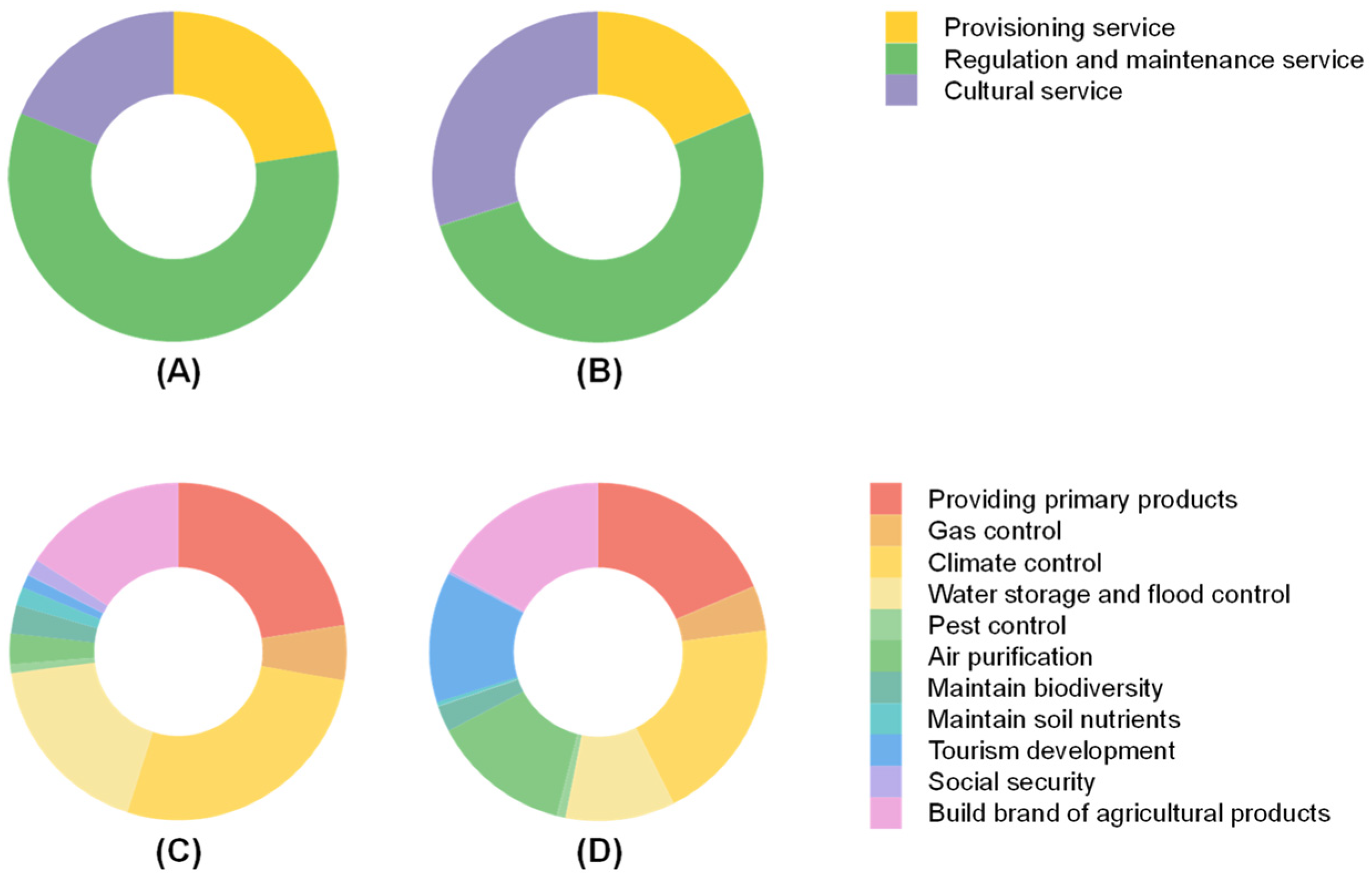
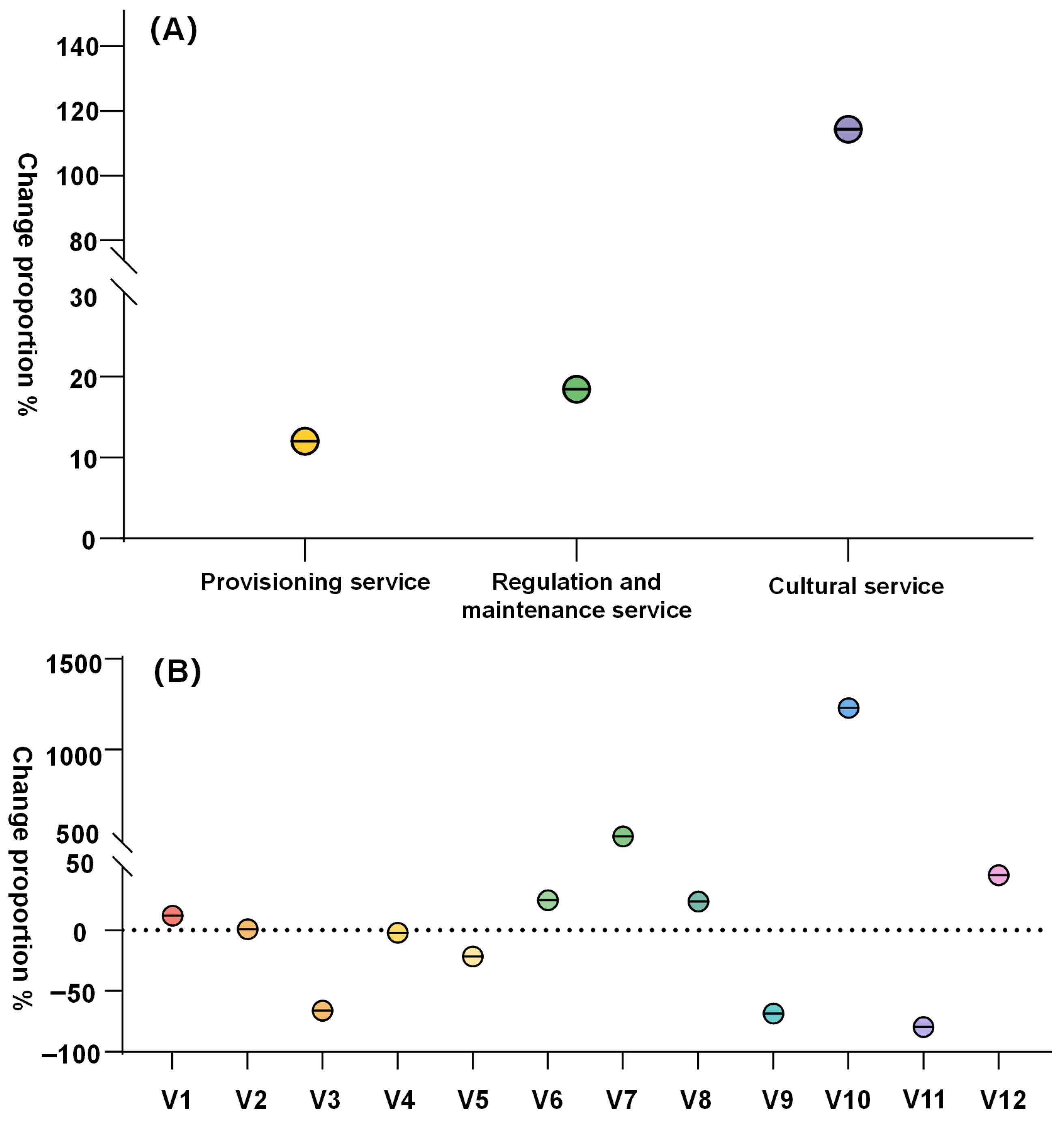
The total ESVs of rice–crayfish systems in HQ was 346,113.59 CNY/ha, while in CM it was 467,334.89 CNY/ha, indicating that CM > HQ. The provisioning service value in HQ was 77,762.06 CNY/ha, the regulation and maintenance services value were 203,432.36 CNY/ha, and the cultural service value was 64,919.17 CNY/ha (Figure 2A, Table 3). In comparison, the provisioning service value in CM was 87,116.69 CNY/ha, the regulation and maintenance services value were 241,028.92 CNY/ha, and the cultural service value was 139,189.28 CNY/ha (Figure 2B, Table 3). Compared to HQ, CM showed an upward trend in all three types of values (Figure 3A). In terms of service functions (Figure 2C,D and Figure 3B), CM showed value increases in provisioning services, carbon sequestration and oxygen release, pest control, air purification, biodiversity maintenance, tourism development, and brand development for rice–crayfish products compared to HQ. The value increase in tourism development was the most significant. In contrast, temperature regulation, water storage and flood control, soil nutrient retention, social security functions, and the negative value of GHG emissions in CM were lower than those in HQ (Table 4). The largest decrease was observed in the social security function value.

3.5. SWOT-AHP Analysis

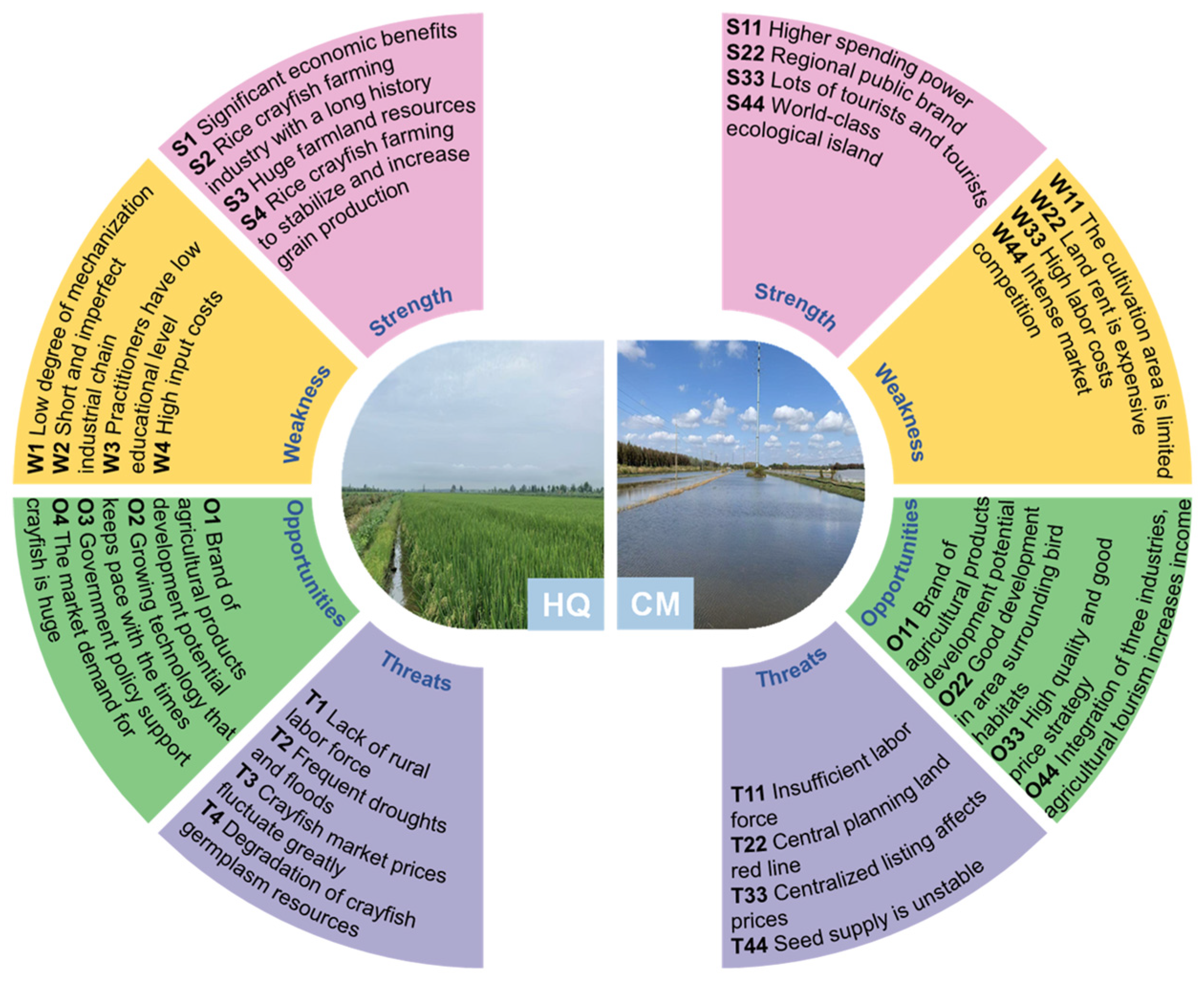
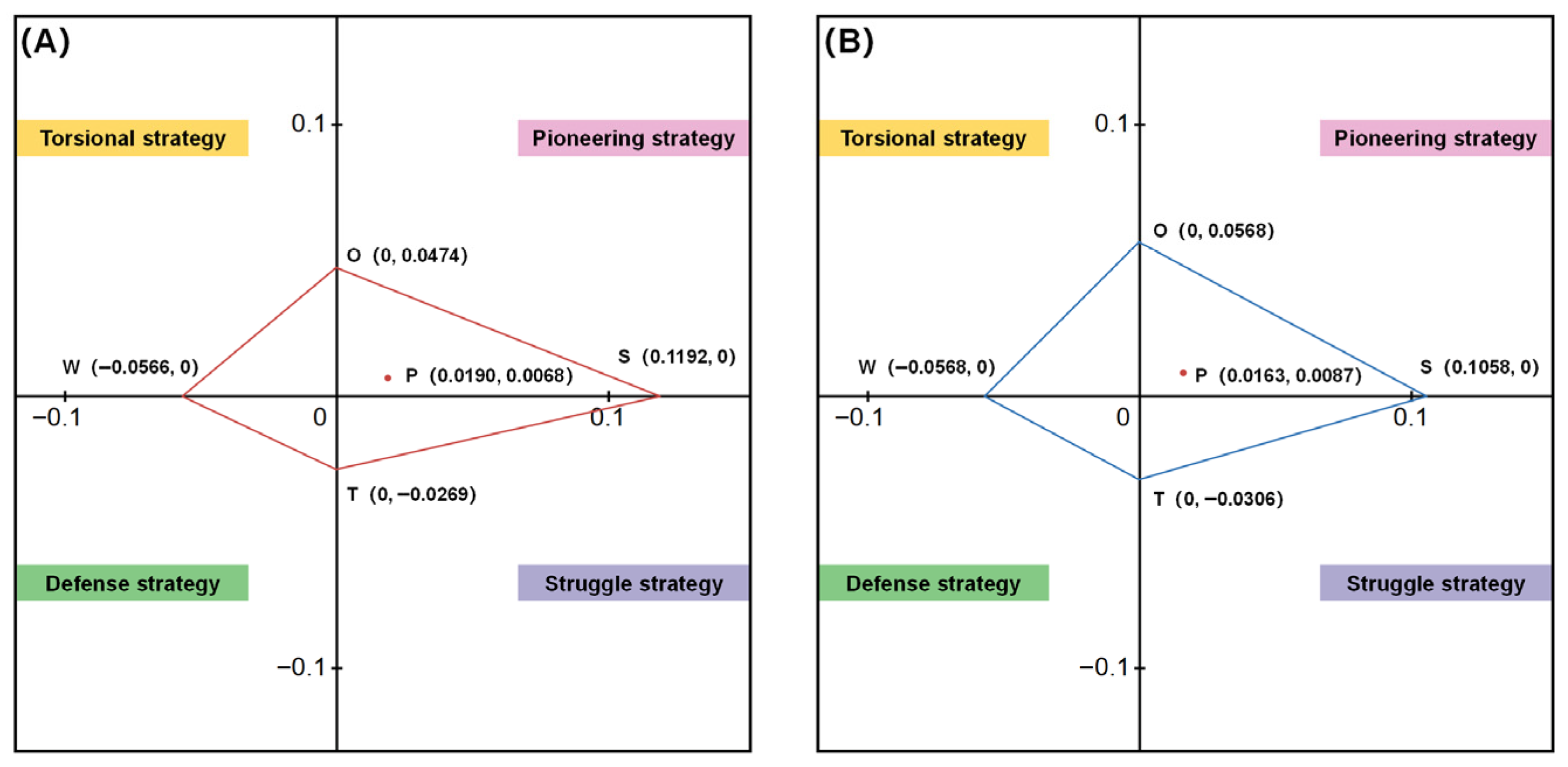
The SWOT analysis results of the rice–crayfish system in HQ and CM are presented in Figure 4. Based on the scores given by ten experts, the weight distributions of each indicator layer in the two regions rice–crayfish ecosystems were obtained, as detailed in Tables S3 and S4. The coordinates of the four points for HQ were as follows: S (0.1192, 0), W (−0.0566, 0), O (0, 0.0474), and T (0, −0.0269); for CM, the coordinates were S (0.1058, 0), W (−0.0568, 0), O (0, 0.0568), and T (0, −0.0306). By connecting the four points, the quadrilaterals representing the sustainable development strategies of the rice–crayfish ecosystems in HQ and CM were drawn, as shown in Figure 5. Further calculations revealed that the centroid coordinates of the strategic quadrilateral for HQ were P (0.0190, 0.0068), and for CM were P (0.0163, 0.0087). Since the centroids P of both regions were in the first quadrant, which indicated that the sustainable development strategies for the rice–crayfish ecosystems in both areas should primarily adopt a pioneering strategy to fully leverage internal strengths and seize external opportunities to promote the continuous and high-quality development of the ecosystems.

4. Discussion

4.1. Regional Variations in the ESVs Type in HQ and CM

Before interpreting the regional ESV differences, it is necessary to clarify the evaluation scope and data characteristics. Several CICES components were excluded because reliable local data were unavailable (e.g., for education opportunities). These exclusions may lead to a slight underestimation of total ESVs, but they were applied uniformly to both regions. Thus, the comparative results remain reliable, as the key service categories like provisioning, regulating, and soil and nutrient maintenance were fully assessed. We acknowledge that the evaluation is still constrained by the reliance on secondary data and several model assumptions. These limitations indicate that future research would benefit from more comprehensive datasets and field-based validation to further enhance the robustness of the findings. The difference in sample sizes (200 farmers in HQ and 15 farmers in CM) reflects regional agricultural structures rather than an imbalance in data collection. HQ consists mainly of smallholder farms, requiring more respondents to capture production variability, whereas CM is dominated by cooperatives and large farms with more uniform practices. Importantly, the surveyed planting area in CM (1419.20 ha) is comparable to that in HQ (1437.67 ha), ensuring balanced spatial representation.
This study estimated ESVs of 346,113.59 CNY/ha/year for HQ and 467,334.89 CNY/ha/year for CM, which approached those of natural wetlands [38] and exceeded those of the previous rice–fish systems in Ruyuan (255,529 CNY/ha) [39] and Yinchuan (266,691.89 CNY/ha) [32]. The high performance of rice–crayfish systems is driven by specific ecological and physiological mechanisms. Compared to traditional fish species, red swamp crayfish grow faster and have shorter harvest cycles, enabling multiple harvests per season and increasing provisioning service value [17]. Moreover, the fertile soils of eastern China’s alluvial plains support high primary productivity, benefiting both rice and crayfish [40].
Both regions are dominated by regulating and maintenance services (HQ: 58.77%; CM: 51.58%), yet CM’s total ESV is 35% higher, largely due to cultural and provisioning services. Cultural services in CM contributed 139,189.28 CNY/ha (29.78%) versus 64,919.17 CNY/ha in HQ, reflecting CM’s proximity to Shanghai and higher willingness to pay for ecotourism and education [41]. However, the cultural service valuation in this study is based on nearby tourism sites and may not fully reflect the tourism value generated specifically by the rice–crayfish system. Future work should integrate system-specific cultural services—such as farming experience activities and agro-education programs—to improve the accuracy of cultural ESV estimates. Provisioning services are also higher in CM, as its products command market premiums (2.88 CNY/kg for rice; 40.42 CNY/kg for crayfish) under “world-class ecological island” standards. In contrast, HQ can harvest crayfish twice annually, but market prices are lower, limiting the total provisioning ESV. Regarding regulating services, HQ shows advantages in soil nutrient retention due to full straw returning, which sequesters more organic carbon than CM’s partial returning methods. However, this practice may also enhance CH4 emissions [40]. Direct greenhouse gas measurements were unavailable; future studies should integrate remote sensing techniques to monitor land use, water, and vegetation dynamics, improving the spatial resolution and robustness of ESV assessments [42].

4.2. The Differences in ESVs Function Between HQ and CM

HQ performed better in terms of maintaining the soil nutrient value, mainly due to the widespread practice of full straw returning to the field, which significantly increases the input of soil organic matter [43,44]. Although CM also practices straw returning to the field, the non-full amount straw returning method results in relatively less organic matter input [45]. However, it should be noted that the combination of rice–crayfish systems and full straw returning may increase the emissions of GHGs such as CH4 [27,28], representing a potential loss pathway for soil carbon sinks and having a complex impact on the system’s overall climate effect [14,46]. Existing LCA studies on rice–crayfish systems highlight significant environmental burdens from energy use and nutrient emissions [15], yet region-specific comparisons remain limited. Incorporating LCA-derived environmental costs into ESV frameworks would help achieve a more objective and comprehensive assessment of the sustainability of rice–crayfish systems. In addition, we found that the value of water storage and flood control in HQ is much higher than in CM, which can be attributed to HQ is location in the Huai River Basin, historically prone to floods and waterlogging [47,48]. Due to the lack of specific literature, we cannot quantify the exact economic losses, although frequent local disasters are well recognized. In contrast, CM’s primary risk stems from typhoons, which can cause rice lodging and affect agricultural production. However, due to limited data, the associated economic losses in CM could not be assessed.
Compared with previous studies [39], this research notably introduced the indicator of “brand development for rice–crayfish products” [49]. In terms of aquatic product brand building value, this study used the contingent valuation method (CVM) for preliminary exploration. Although the results of CVM are easily affected by the subjective cognition and payment willingness of the respondents, and their accuracy needs to be further verified by actual market data, the assessment results still reflect the farmers’ expectations of a potential market value increase in rice–crayfish products after branding to a certain extent [50]. Due to the additional income from aquaculture and the price premium associated with high-quality rice from integrated rice–crayfish farming systems, profits are reported to be 7% to 462% higher compared to rice monoculture or crayfish monoculture, demonstrating significant economic advantages [50,51]. However, based on our field survey, farmers have not yet fully realized these potential gains in product value. This is an important direction for enhancing the added value and market competitiveness of the rice–crayfish industry, especially in the context of pursuing high-quality development. It is important to note that our primary data were collected in 2022, a period overlapping with the later stages of the COVID-19 pandemic. While agricultural production was prioritized by government policies to ensure food security, the market prices for crayfish experienced some volatility due to logistical constraints and fluctuating demand in the catering sector. Although this may introduce short-term variability in the economic valuation of provisioning services, the biophysical generation of regulating and supporting services (e.g., carbon sequestration and air purification) remains largely driven by ecological processes and is less sensitive to these socioeconomic shocks. Future studies utilizing multi-year longitudinal data would be beneficial to smooth out such inter-annual market fluctuations and validate the long-term economic trends.

4.3. SWOT-AHP Analysis of HQ and CM

The SWOT-AHP analysis identified the SO (strengths–opportunities) strategy as the optimal path for both regions. However, a critical examination of the weighting process reveals distinct strategic priorities.
In HQ, the expert panel assigned the highest global weight to “economic benefits” (S1, weight: 0.2395) and “brand development potential” (O1, weight: 0.0623). This weighting reflects a consensus that HQ’s development is currently constrained by the “value realization” bottleneck—i.e., it produces good products but lacks brand power.
In contrast, for CM, the highest weights were assigned to “world-class ecological island status” (S44, weight: 0.1024) and “bird habitat integration” (O22, weight: 0.0738). This indicates that experts view CM’s core competitiveness as strictly tied to its ecological integrity rather than just to production volume.
It is important to acknowledge the potential subjectivity in these expert scores. The SWOT-AHP method relies on the judgment of selected experts, which may introduce bias based on their disciplinary backgrounds. To mitigate this, we selected a diverse panel including local agricultural officials, ecologists, and economists to ensure a balanced perspective. Despite individual variations, the CR for all matrices was below 0.1, confirming the statistical robustness of the scoring. The results suggest that while both regions should pursue “growth,” HQ’s growth should be “brand-driven,” whereas CM’s growth must be “conservation-driven.”

4.4. Sustainable Development Suggestions for Rice–Crayfish Farming in HQ and CM

Based on the ESVs assessment and SWOT-AHP analysis, the following targeted recommendations promote the sustainable development of rice–crayfish ecosystems in HQ and CM, offering insights for similar regions:
Huoqiu County:
(1)
Enhance Land Use Efficiency: Leverage extensive farmland by optimizing rice–crayfish rotation systems, and integrate high-value crops such as lotus root and water bamboo. This strategy directly enhances provisioning service value (from 77,762.06 CNY/ha) by diversifying agricultural outputs and increasing economic returns. Moreover, by promoting integrated crop management, it can reduce reliance on external pesticides and fertilizers, thereby improving the pest control service (valued at 3021.45 CNY/ha) and mitigating potential water pollution.
(2)
Strengthen Branding for Enhanced Market Value: Despite the national geographical indication for “Huoqiu Crayfish”, associated rice products lack recognition. Developing distinctive rice brands through strategic marketing is crucial. This can significantly increase the market price of rice, directly elevating the brand of agricultural products service (valued at 54,893.16 CNY/ha) and strengthening the social security function (valued at 5632.35 CNY/ha) by improving local farmer incomes.
(3)
Improve Market Infrastructure to Maximize Product Value: Establish centralized trading markets and cold chain logistics to enhance crayfish preservation and transport. Promote deep processing (e.g., crayfish tails and seasonings) to increase product value. These improvements not only boost the economic dimension of provisioning service but also support rural employment, further reinforcing the social security function, which already occupies a secondary position (22%) in HQ.
Chongming District:
(1)
Integrate Ecotourism with Ecological Safeguards: Capitalize on the proximity to Dongtan Wetland Park by linking rice–crayfish systems with bird habitat conservation and tourism. This approach aims to further elevate the tourism development value already identified in CM (58,363.64 CNY/ha). However, this expansion must be carefully managed to avoid negative impacts. It is crucial to implement visitor capacity limits, establish designated ecological buffer zones, and use tourism revenue to fund habitat restoration. These cautionary measures will prevent disturbance to bird populations and protect the regulation service, such as biodiversity maintenance (valued at 11,667.77 CNY/ha).
(2)
Develop Premium Brands Based on Eco-Certification: Adhere strictly to “no chemical fertilizers or pesticides” standards to create premium, eco-certified rice and crayfish brands. This strategy directly leverages CM’s strength in environmental quality, justifying a higher market price that enhances brand of agricultural products value (79,674.40 CNY/ha).
(3)
Optimize Policy Support for Eco-Compensation: Policies should be designed to directly reward farmers for management practices that enhance specific ESVs, such as subsidies for maintaining deeper water levels to support the habitat of waterfowl to enhance the biodiversity value (11,667.77 CNY/ha). This turns policy support from a general incentive into a direct eco-compensation mechanism, better balancing ecological and economic benefits.

4.5. Mechanisms Linking ASS to Industrial Service Optimization

Global evidence shows that agricultural socialized services (ASS)—such as mechanization outsourcing, extension services, contract farming, and third-party quality or marketing support—serve as an institutional bridge linking smallholders with downstream processing, logistics, branding, and certification industries. Through scale effects, standardized operations, and reduced information asymmetry, ASS help convert fragmented production into stable, quality-controlled supply units, thereby lowering transaction costs and improving coordination efficiency across the value chain [52,53,54]. Evidence from China and other countries further indicates that ASS promote the diffusion of advanced agronomic and green technologies by offering technical guidance and unified field management. These improvements generate essential conditions for upgrading downstream services, including food processing, cold chain logistics, and certification, and support a shift toward higher standards of quality control and environmental compliance [55,56]. Moreover, the expansion of ASS facilitates more stable contractual arrangements and supply–demand matching, enabling greater investments in cold chain systems, deep processing, and digital monitoring. By fostering standardized and greener production, ASS also stimulate emerging service demands—such as carbon accounting, ecological compensation, and data-driven management—highlighting their importance for modernizing the broader industrial service system that underpins agricultural value chains.

5. Conclusions

This study provides a comparative quantification of the ESVs of integrated rice–crayfish systems, revealing significant regional differentiation that offers a key theoretical insight: ESV outcomes are fundamentally shaped by local socio-economic contexts and development pathways. The higher total ESV in CM (467,334.89 CNY/ha) is not merely a function of its landscape but is attributable to its strategic location near a major metropolis and its established ecotourism sector. Conversely, HQ’s ESV structure (346,113.59 CNY/ha), prioritizing provisioning and social security services, reflects its role as a traditional agricultural production area.
These divergent outcomes provide a clear empirical illustration of ecosystem service trade-offs and synergies. HQ’s model highlights a potential trade-off, where maximizing provisioning services may suppress cultural service values. In contrast, CM’s model demonstrates a powerful synergy, where investing in cultural services (ecotourism) financially supports and incentivizes the protection of crucial regulating services (e.g., biodiversity and water quality) that underpin its brand. The SWOT-AHP analysis reinforces that sustainability strategies cannot be “one-size-fits-all” and must be place-based.
In future research, advancing methodological rigor is paramount. Instead of relying solely on static valuation, future work should employ dynamic modeling to simulate how ESVs and their interrelationships evolve under different policy scenarios or climate change pressures. Furthermore, integrating remote sensing data could enable the large-scale, real-time monitoring of land use changes and water quality, providing more robust inputs for valuation. Finally, collecting more primary, site-specific data is crucial, in order to validate and refine the parameters used in benefit transfer methods, thereby strengthening the accuracy and policy relevance of ESV assessments.

Supplementary Materials

The following supporting information can be downloaded at: https://www.mdpi.com/article/10.3390/su172411047/s1. Table S1: Summary of data sources used in the ESV evaluation. Table S2: The meaning and explanation of the values of the judgment matrix. Table S3: Ranking of evaluation indexes in HQ. Table S4: Ranking of evaluation indexes in CM.

Author Contributions

Conceptualization, B.L., C.Q. and J.L. (Jiayao Li); methodology, B.L., C.Q., X.C. and Z.C.; software, B.L., C.Q. and J.L. (Jinghao Li); validation, B.L. and C.Q.; formal analysis, B.L.; investigation, B.L., Y.X., Q.P. and J.L. (Jiayao Li); resources, Z.Z. and J.L. (Jiayao Li); data curation, B.L. and C.Q.; writing—original draft preparation, B.L. and C.Q.; writing—review and editing, B.L., C.Q., Z.Z. and J.L. (Jiayao Li); visualization, B.L. and C.Q.; supervision, Z.Z. and J.L. (Jiayao Li); project administration, Y.X., Q.P., Z.Z. and J.L. (Jiayao Li); and funding acquisition, Z.Z. and J.L. (Jiayao Li). All authors have read and agreed to the published version of the manuscript.

Funding

This research was supported by the Agricultural Cooperation Project “Technical Cooperation in Rice–Fish and Personnel Training in the Lancang–Mekong Area” (No. 18240066) funded by the Asian Regional Cooperation Fund, and by the Special Fund of the Chinese Agriculture Research System from the Ministry of Agriculture of China with grant number [CARS-48].

Institutional Review Board Statement

This study was approved by the Shanghai Ocean University Research Ethics Committee (Approval Code: SHOU-DW-2022-022; Approval Date: 1 June 2022) and conducted in accordance with the principles outlined in the Declaration of Helsinki (1975, revised in 2013).

Informed Consent Statement

Informed consent was obtained from all participants involved in the study. Participants were informed about the purpose, scope, and voluntary nature of the research, and they were assured of the confidentiality and anonymity of their responses.

Data Availability Statement

The original contributions presented in this study are included in the article and Supplementary Materials. Further inquiries can be directed to the corresponding authors.

Acknowledgments

The authors thank the local agricultural cooperatives and farmers in the Huoqiu County and Chongming District for their assistance in field management and data collection. We also appreciate the constructive comments from anonymous reviewers that improved this manuscript.

Conflicts of Interest

The authors declare no conflicts of interest.

Abbreviations

The following abbreviations are used in this manuscript:
ESVsEcosystem service values
CICESCommon international classification of ecosystem services
ESEcosystem services
ESVEcosystem service valuation
HQHuoqiu County
CMChongming District
IAAIntegrated agriculture–aquaculture
AHPAnalytic Hierarchy Process
LCALife cycle assessment
ASSAgricultural socialized services
GHGGreenhouse gas
CRConsistency ratio
GWPGlobal warming potential
IPCCIntergovernmental Panel on Climate Change
AR6Sixth Assessment Report
SO2Sulfur dioxide
NOxNitrogen oxides
HFHydrogen fluoride
CVMContingent valuation method

References

  1. Kiptala, J.K.; Mul, M.; Mohamed, Y.; Bastiaanssen, W.G.M.; Van Der Zaag, P. Mapping Ecological Production and Benefits from Water Consumed in Agricultural and Natural Landscapes: A Case Study of the Pangani Basin. Remote Sens. 2018, 10, 1802. [Google Scholar] [CrossRef]
  2. Getzner, M.; Islam, M.S. Ecosystem Services of Mangrove Forests: Results of a Meta-Analysis of Economic Values. IJERPH 2020, 17, 5830. [Google Scholar] [CrossRef]
  3. Fu, X.; Yang, Y.; Zhang, X. Spatial-Temporal Variation of the Ecosystem Services Value (ESV) in the Yellow River Delta Wetland and Its Response to Land Use/Land Cover Changes (Lu/Lc). J. Freshw. Ecol. 2024, 39, 2419371. [Google Scholar] [CrossRef]
  4. Von Thenen, M.; Frederiksen, P.; Hansen, H.S.; Schiele, K.S. A Structured Indicator Pool to Operationalize Expert-Based Ecosystem Service Assessments for Marine Spatial Planning. Ocean Coast. Manag. 2020, 187, 105071. [Google Scholar] [CrossRef]
  5. Zepp, H.; Falke, M.; Günther, F.; Gruenhagen, L.; Inostroza, L.; Zhou, W.; Huang, Q.; Dong, N. China’s Ecosystem Services Planning: Will Shanghai Lead the Way? A Case Study from the Baoshan District (Shanghai). Erdkunde 2021, 75, 271–293. [Google Scholar] [CrossRef]
  6. Jourdain, D.; Vivithkeyoonvong, S. Valuation of Ecosystem Services Provided by Irrigated Rice Agriculture in Thailand: A Choice Experiment Considering Attribute Nonattendance. Agric. Econ. 2017, 48, 655–667. [Google Scholar] [CrossRef]
  7. Natuhara, Y. Ecosystem Services by Paddy Fields as Substitutes of Natural Wetlands in Japan. Ecol. Eng. 2013, 56, 97–106. [Google Scholar] [CrossRef]
  8. Ma, Y.; Huang, G. Effects of combined application of Chinese Milk Vetch (Astragalus sinicus L.) and nitrogen fertilizer on ecological service function of paddy field. J. Nat. Resour. 2018, 33, 1755–1766. [Google Scholar] [CrossRef]
  9. Tong, Y.D. Rice Intensive Cropping and Balanced Cropping in the Mekong Delta, Vietnam—Economic and Ecological Considerations. Ecol. Econ. 2017, 132, 205–212. [Google Scholar] [CrossRef]
  10. Gangopadhyay, S.; Banerjee, R.; Batabyal, S.; Das, N.; Mondal, A.; Pal, S.C.; Mandal, S. Carbon Sequestration and Greenhouse Gas Emissions for Different Rice Cultivation Practices. Sustain. Prod. Consum. 2022, 34, 90–104. [Google Scholar] [CrossRef]
  11. Shi, J.; Mo, M.; Xie, Y.; Liao, Q. Impacts of Different Tourism Models on Rural Ecosystem Service Value in Ziquejie Terraces. Sustainability 2024, 16, 4945. [Google Scholar] [CrossRef]
  12. Pérez-Méndez, N.; Alcaraz, C.; Catala-Forner, M. Ecological Restoration of Field Margins Enhances Biodiversity and Multiple Ecosystem Services in Rice Agroecosystems. Agric. Ecosyst. Environ. 2025, 382, 109484. [Google Scholar] [CrossRef]
  13. Zhou, T.; Hu, H.; Hu, J.; Yang, Z.; Lv, Q.; Wang, Y.; Yan, B.; Ren, X.; Hu, S. Ecosystem Services and Cost-Effective Benefits from the Reclamation of Saline Sodic Land under Different Paddy Field Systems. Ecosyst. Serv. 2024, 70, 101682. [Google Scholar] [CrossRef]
  14. Hou, J.; Styles, D.; Cao, Y.; Ye, X. The Sustainability of Rice-Crayfish Coculture Systems: A Mini Review of Evidence from Jianghan Plain in China. J. Sci. Food Agric. 2021, 101, 3843–3853. [Google Scholar] [CrossRef]
  15. Hu, N.; Liu, C.; Chen, Q.; Zhu, L. Life Cycle Environmental Impact Assessment of Rice-Crayfish Integrated System: A Case Study. J. Clean. Prod. 2021, 280, 124440. [Google Scholar] [CrossRef]
  16. Gao, P.; Wang, H.; Sun, G.; Xu, Q.; Dou, Z.; Dong, E.; Wu, W.; Dai, Q. Integrated Emergy and Economic Evaluation of the Dominant Organic Rice Production Systems in Jiangsu Province, China. Front. Plant Sci. 2023, 14, 1107880. [Google Scholar] [CrossRef]
  17. Xu, Q.; Dai, L.; Gao, P.; Dou, Z. The Environmental, Nutritional, and Economic Benefits of Rice-Aquaculture Animal Coculture in China. Energy 2022, 249, 123723. [Google Scholar] [CrossRef]
  18. Liu, T.; Li, C.; Tan, W.; Wang, J.; Feng, J.; Hu, Q.; Cao, C. Rice-Crayfish Co-Culture Reduces Ammonia Volatilization and Increases Rice Nitrogen Uptake in Central China. Agric. Ecosyst. Environ. 2022, 330, 107869. [Google Scholar] [CrossRef]
  19. Zhang, Z.; Du, L.; Xiao, Z.; Li, C.; Wang, Z.; Zhou, P.; Sun, G.; Ye, Y.; Hu, T.; Wang, H. Rice-Crayfish Farming Increases Soil Organic Carbon. Agric. Ecosyst. Environ. 2022, 329, 107857. [Google Scholar] [CrossRef]
  20. Xu, Q.; Liu, T.; Guo, H.; Dou, Z.; Gao, H.; Zhang, H. Conversion from Rice–Wheat Rotation to Rice–Crayfish Coculture Increases Net Ecosystem Service Values in Hung-Tse Lake Area, East China. J. Clean. Prod. 2021, 319, 128883. [Google Scholar] [CrossRef]
  21. Jiao, W.; Fuller, A.; Xu, S.; Min, Q.; Wu, M. Socio-Ecological Adaptation of Agricultural Heritage Systems in Modern China: Three Cases in Qingtian County, Zhejiang Province. Sustainability 2016, 8, 1260. [Google Scholar] [CrossRef]
  22. Gao, L.; Zhao, G.; Liang, L.; Chen, B. Achieving Higher Eco-Efficiency for Three Staple Food Crops with Ecosystem Services Based on Regional Heterogeneity in China. Sci. Total Environ. 2024, 948, 174942. [Google Scholar] [CrossRef]
  23. Bull, J.W.; Jobstvogt, N.; Böhnke-Henrichs, A.; Mascarenhas, A.; Sitas, N.; Baulcomb, C.; Lambini, C.K.; Rawlins, M.; Baral, H.; Zähringer, J.; et al. Strengths, Weaknesses, Opportunities and Threats: A SWOT Analysis of the Ecosystem Services Framework. Ecosyst. Serv. 2016, 17, 99–111. [Google Scholar] [CrossRef]
  24. Bunting, S.W.; Kundu, N.; Ahmed, N. Evaluating the Contribution of Diversified Shrimp-Rice Agroecosystems in Bangladesh and West Bengal, India to Social-Ecological Resilience. Ocean Coast. Manag. 2017, 148, 63–74. [Google Scholar] [CrossRef]
  25. Ariyana, R.; Amalia, R.; Salsabilah, D.S.; Uka, A.S.; Rilisa, C.; Gunawan, W. Strategy for Increasing Lowland Rice Productivity in West Java Province with the SWOT-AHP Model Approach. IOP Conf. Ser. Earth Environ. Sci. 2020, 457, 012058. [Google Scholar] [CrossRef]
  26. Dahowski, R.T.; Li, X.; Davidson, C.L.; Wei, N.; Dooley, J.J.; Gentile, R.H. A Preliminary Cost Curve Assessment of Carbon Dioxide Capture and Storage Potential in China. Energy Procedia 2009, 1, 2849–2856. [Google Scholar] [CrossRef]
  27. Li, Q.; Xie, Q.; Ye, P. Research on the law of greenhouse gas emissions from rice fields under the rice-shrimp planting and breeding model. Hubei Agric. Sci. 2023, 62, 30–36. [Google Scholar] [CrossRef]
  28. Xu, X.; Zhang, M.; Peng, C.; Si, G.; Zhou, J.; Xie, Y.; Yuan, J. Effect of rice-crayfish co-culture on greenhouse gases emission in straw-puddled paddy fields. Chin. J. Eco-Agric. 2017, 25, 1591–1603. [Google Scholar] [CrossRef]
  29. Weng, S.; Zhang, F.; Feng, Y.; Duan, C.; Tong, Y. Characteristics of Evapotranspiration and Its Influencing Factors in Rice-wheat Rotation in the Jianghuai River Basin. Water Sav. Irrig. 2020, 8, 7. [Google Scholar]
  30. Ma, X.; Sun, G.; Ren, Z. The values of vegetation purified air and its measure in Xin’an city. Arid. Land. Resour. Environ. 2002, 83–86. [Google Scholar] [CrossRef]
  31. Xie, G.; Zhang, C.; Zhang, C.; Xiao, Y.; Lu, C. The value of ecosystem services in China. Resour. Sci. 2015, 37, 1740–1746. [Google Scholar]
  32. Liu, D.; Feng, Q.; Zhang, J.; Zhang, K.; Tian, J.; Xie, J. Ecosystem Services Analysis for Sustainable Agriculture Expansion: Rice-Fish Co-Culture System Breaking through the Hu Line. Ecol. Indic. 2021, 133, 108385. [Google Scholar] [CrossRef]
  33. Kikstra, J.S.; Nicholls, Z.R.J.; Smith, C.J.; Lewis, J.; Lamboll, R.D.; Byers, E.; Sandstad, M.; Meinshausen, M.; Gidden, M.J.; Rogelj, J.; et al. The IPCC Sixth Assessment Report WGIII Climate Assessment of Mitigation Pathways: From Emissions to Global Temperatures. Geosci. Model. Dev. 2022, 15, 9075–9109. [Google Scholar] [CrossRef]
  34. Krochta, M.; Chang, H. Reviewing Controls of Wetland Water Temperature Change across Scales and Typologies. Prog. Phys. Geogr. Earth Environ. 2025, 49, 144–164. [Google Scholar] [CrossRef]
  35. Yan, F.; Zhang, S. Ecosystem Service Decline in Response to Wetland Loss in the Sanjiang Plain, Northeast China. Ecol. Eng. 2019, 130, 117–121. [Google Scholar] [CrossRef]
  36. Ji, Z.-J.; Zhao, L.-F.; Zhang, T.-J.; Dai, R.-X.; Tang, J.-J.; Hu, L.-L.; Chen, X. Coculturing Rice with Aquatic Animals Promotes Ecological Intensification of Paddy Ecosystem. J. Plant Ecol. 2023, 16, rtad014. [Google Scholar] [CrossRef]
  37. Xiao, Y.; Xie, G. Comprehensive valuation of the ecosystem services of rice paddies in Shanghai. Resour. Sci. 2009, 31, 38–47. [Google Scholar]
  38. Li, X.; Yu, X.; Jiang, L.; Li, W.; Liu, Y.; Hou, X. How Important Are the Wetlands in the Middle-Lower Yangtze River Region: An Ecosystem Service Valuation Approach. Ecosyst. Serv. 2014, 10, 54–60. [Google Scholar] [CrossRef]
  39. Liu, D.; Tang, R.; Xie, J.; Tian, J.; Shi, R.; Zhang, K. Valuation of Ecosystem Services of Rice–Fish Coculture Systems in Ruyuan County, China. Ecosyst. Serv. 2020, 41, 101054. [Google Scholar] [CrossRef]
  40. Yu, H.; Zhang, X.; Shen, W.; Yao, H.; Meng, X.; Zeng, J.; Zhang, G.; Zamanien, K. A Meta-Analysis of Ecological Functions and Economic Benefits of Co-Culture Models in Paddy Fields. Agric. Ecosyst. Environ. 2023, 341, 108195. [Google Scholar] [CrossRef]
  41. Michaelis, A.K.; Walton, W.C.; Webster, D.W.; Shaffer, L.J. The Role of Ecosystem Services in the Decision to Grow Oysters: A Maryland Case Study. Aquaculture 2020, 529, 735633. [Google Scholar] [CrossRef]
  42. Tan, W.; Wang, X.; Yan, L.; Yi, J.; Xia, T.; Zeng, Z.; Yu, G.; Chai, M. Mapping Rice-Crayfish Co-Culture (RCC) Fields with Sentinel-1 and -2 Time Series in China’s Primary Crayfish Production Region Jianghan Plain. Sci. Remote Sens. 2024, 10, 100151. [Google Scholar] [CrossRef]
  43. Pan, J.; Dai, W.; Shang, Z.; Guo, R. Review of research progress on the influence and mechanism of field straw residue incorporation on soil organic matter and nitrogen availability. Chin. J. Eco-Agric. 2013, 21, 526–535. [Google Scholar] [CrossRef]
  44. Song, Y.; Gao, M.; Li, Z. Impacts of Straw Return Methods on Crop Yield, Soil Organic Matter, and Salinity in Saline-Alkali Land in North China. Field Crops Res. 2025, 322, 109752. [Google Scholar] [CrossRef]
  45. Chen, L.; Sun, S.; Yao, B.; Peng, Y.; Gao, C.; Qin, T.; Zhou, Y.; Sun, C.; Quan, W. Effects of Straw Return and Straw Biochar on Soil Properties and Crop Growth: A Review. Front. Plant Sci. 2022, 13, 986763. [Google Scholar] [CrossRef]
  46. Sun, Q.; Gu, X.; Wang, Y.; Gao, H.; Wang, X.; Chen, X.; Sun, S. Impact of Straw Return on Greenhouse Gas Emissions from Maize Fields in China: Meta-Analysis. Front. Plant Sci. 2025, 16, 1493357. [Google Scholar] [CrossRef]
  47. Song, L.; Wei, C.; Song, L. Application of five- element connection number method- improved entropy method in water quality evaluation. South—North. Water Transf. Water Sci. Technol. 2015, 13, 268–273. [Google Scholar] [CrossRef]
  48. Li, Y.; Xia, G. Study on characteristics and causation of waterlog disaster of waterlogging depressions along mid-reach of Huaihe Rive. Water Resour. Hydropower Eng. 2012, 43, 93–96. [Google Scholar] [CrossRef]
  49. Grima, N.; Jutras-Perreault, M.-C.; Gobakken, T.; Ole Ørka, H.; Vacik, H. Systematic Review for a Set of Indicators Supporting the Common International Classification of Ecosystem Services. Ecol. Indic. 2023, 147, 109978. [Google Scholar] [CrossRef]
  50. Yang, M.; Li, Z.; Shao, L.; Zhao, X.; Chu, J.; Yu, F. Impact of Different Modes of Comprehensive Rice Field Planting and Aquaculture Systems in Paddy Fields on Rice Yield, Quality, and Economic Benefits. Pol. J. Environ. Stud. 2025, 34, 1415–1423. [Google Scholar] [CrossRef]
  51. Xu, Q.; Peng, X.; Guo, H.; Che, Y.; Dou, Z.; Xing, Z.; Hou, J.; Styles, D.; Gao, H.; Zhang, H. Rice-Crayfish Coculture Delivers More Nutrition at a Lower Environmental Cost. Sustain. Prod. Consum. 2022, 29, 14–24. [Google Scholar] [CrossRef]
  52. Minot, N. Contract Farming in Developing Countries: Patterns, Impact, and Policy Implications; Cornel University: Ithaca, NY, USA, 2007. [Google Scholar]
  53. Reardon, T.; Echeverria, R.; Berdegué, J.; Minten, B.; Liverpool-Tasie, S.; Tschirley, D.; Zilberman, D. Rapid Transformation of Food Systems in Developing Regions: Highlighting the Role of Agricultural Research & Innovations. Agric. Syst. 2019, 172, 47–59. [Google Scholar] [CrossRef]
  54. Devaux, A.; Torero, M.; Donovan, J.; Horton, D. Agricultural Innovation and Inclusive Value-Chain Development: A Review. J. Agribus. Dev. Emerg. Econ. 2018, 8, 99–123. [Google Scholar] [CrossRef]
  55. Yu, Y.; Chi, Z.; Yu, Y.; Zhao, J.; Peng, L. Boosting Agricultural Green Development: Does Socialized Service Matter? PLoS ONE 2024, 19, e0306055. [Google Scholar] [CrossRef]
  56. Chen, X.; Liu, T. Can Agricultural Socialized Services Promote the Reduction in Chemical Fertilizer? Analysis Based on the Moderating Effect of Farm Size. Int. J. Environ. Res. Public Health 2023, 20, 2323. [Google Scholar] [CrossRef] [PubMed]
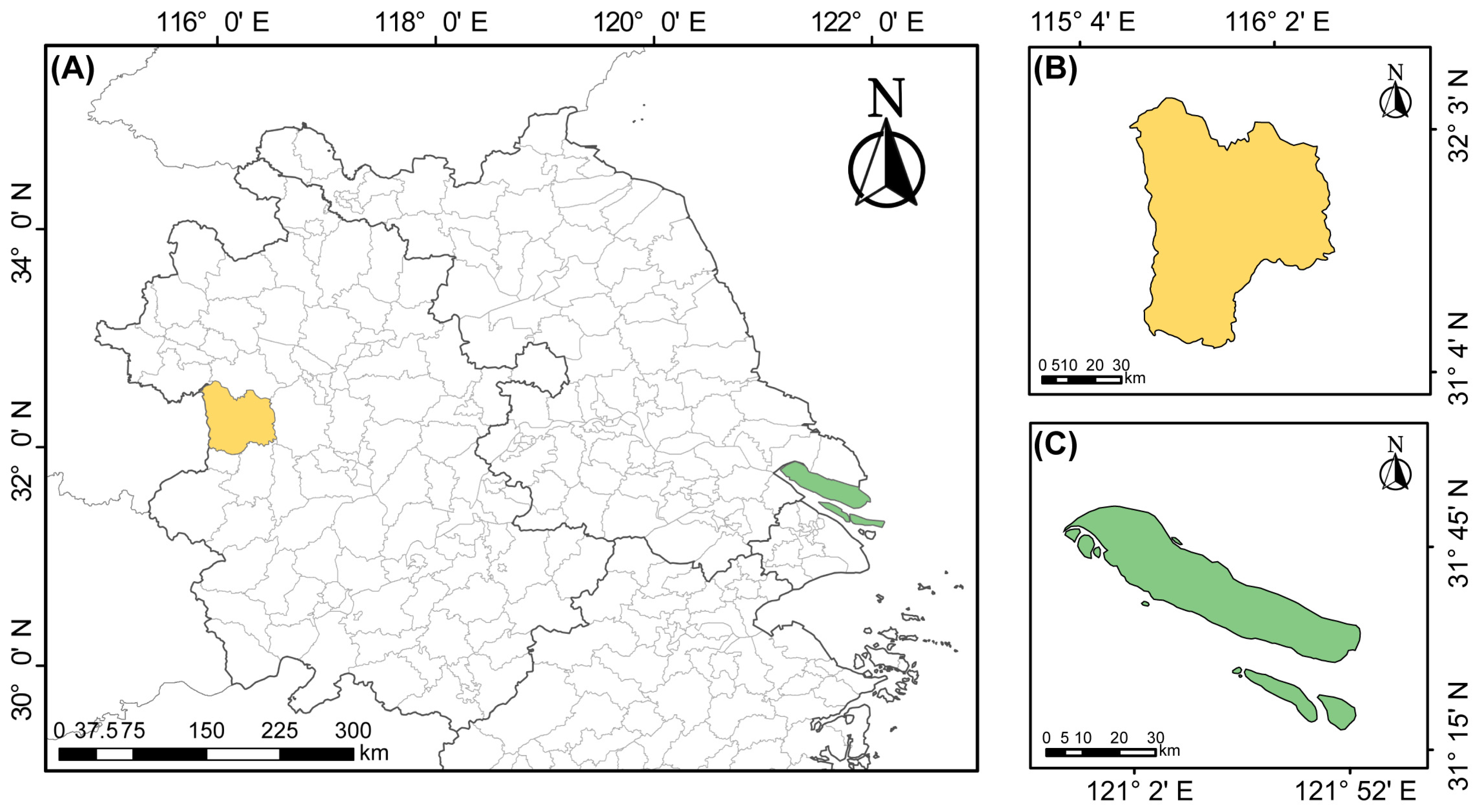
Figure 1. The map of research areas in the study. (A) Local regional map of China; (B) Huoqiu County (HQ); and (C) Chongming District (CM).
Sustainability 17 11047 g001
Figure 2. Proportion of ecosystem service value type function in HQ and CM. (A) ESV type in HQ; (B) ESV type in CM; (C) ESV function in HQ; and (D) ESV function in CM.
Sustainability 17 11047 g002
Figure 3. Change proportion of ecosystem service value type and function in HQ and CM. (A) ESV type and (B) ESV function.
Sustainability 17 11047 g003
Figure 4. SWOT analysis of integrated rice–crayfish systems in HQ and CM.
Sustainability 17 11047 g004
Figure 5. Sustainable development strategic quadrilateral in HQ (A) and CM (B).
Sustainability 17 11047 g005
Table 1. Calculation formula.
FormulaParameter Specification
V1 = Yr × Pr + Yf × PfV1 represents the value of primary product provision (CNY/ha); Yr and Yf denote the yields of rice and crayfish, respectively, which are 8509.97 (N = 200, sigma = 2168) and 1240.64 kg/ha (N = 200, sigma = 450) in HQ, and 8595.24 (N = 15, sigma = 1343) and 1446.38 kg/ha (N = 15, sigma = 428) in CM; and Pr and Pf are the market prices of rice and crayfish, respectively: 2.14 (N = 200, sigma = 0.21) and 24.00 CNY/kg (N = 200, sigma = 5.23) in HQ, and 2.88 (N = 15, sigma = 0.14) and 40.42 (N = 15, sigma = 19) CNY/kg in CM.
V2 = V21 + V22
V21 = (Y × (1 − w))/f × α × Nc × PCO2
V22 = (Y × (1 − w))/f × β × PO2
V2 refers to the value of carbon sequestration and oxygen release (CNY/ha), where V21 and V22 denote the values of carbon sequestration and oxygen release, respectively. Y is the rice yield (kg/ha); w is the moisture content of rice (13.5%); f is the economic conversion coefficient for rice crops (0.50); α is the amount of CO2 absorbed per gram of rice dry matter (1.63 g); Nc is the carbon content of CO2; β is the amount of O2 produced per gram of rice dry matter (1.9 g); PCO2 is the cost of afforestation (CNY/t C); and PO2 is the cost of industrial oxygen production (CNY/t O2).
V3 = RC × PCO2
RC = 12/44 × (29.8 × ECH4 + 273 × EN2O + ECO2)
V3 denotes the value of greenhouse gas (GHG) emissions (CNY/ha); PCO2 is the afforestation cost (CNY/t C); RC is the CO2-equivalent value converted from CH4 and N2O using global warming potential (kg/ha); ECH4 is the CH4 emission (850.84 and 117.65 kg/ha); EN2O is the N2O emission (0.58 and 0.87 kg/ha); and ECO2 is the CO2 emission (6927.10 kg/ha).
V4 = SZF × d × μ × PMV4 represents the value of temperature regulation (CNY/ha); SZF is the average daily evaporation per hectare (3.22 mm/d/ha); d is the number of days per year with temperatures above 30 °C (50 and 49 days); μ is the equivalent amount of coal (t) required to evaporate 50 mm of water; and PM is the price of standard coal (CNY/t).
V5 = (H × (1 − μ) × S + μ × S × (H + h)) × PSKV5 refers to the value of water storage and flood control (CNY/ha); H is the average height of bunds (0.79 and 0.69 m); μ is the proportion of trenching area in integrated rice–crayfish farming (7.88% and 0.00%); S is the unit area (ha); h is the trench depth (1.14 m); and PSK is the unit cost of reservoir projects (CNY/m3).
V6 = β × CPV6 denotes the value of pest control (CNY/ha); β is the reduction in pesticide and fertilizer use (kg/ha) compared to monoculture; and CP is the average local pesticide price (CNY/kg).
V7 = PSO2× QSO2+ PNOX × QNOX + PHF × QHF + PS × QSV7 represents the value of air purification (CNY/ha); PSO2, PNOX, PHF, and PS are the unit costs for removing SO2, NOx, HF, and particulate matter in forestry (CNY/t); and QSO2, QNOX, QHF, and QS are the average annual fluxes absorbed by rice paddies (t/year).
V8 = α × ErfV8 denotes the value of biodiversity maintenance (CNY/ha); α is the value equivalence factor for the rice field ecosystem (0.21); and Erf is the weighted average income from local cash crops (CNY/ha).
V9 = PSOC × (ISOC − OSOC)
ISOC = Nr × 5 × Cr + Ns × Cs
OSOC = RCO2 × 0.27 + RCH4 × 0.75
V9 refers to the value of soil nutrient retention (CNY/ha); PSOC is the market price of organic fertilizer (CNY/kg C); ISOC and OSOC represent the input and output of soil organic carbon (kg C/ha), respectively; Nr is the root biomass of rice (1312.97 and 1326.12 kg/ha); Cr is the carbon content in rice roots (39.21%); Ns is the rice straw biomass (9190.77 and 9282.86 kg/ha); Cs is the carbon content in straw (33.21%); and RCO2 and RCH4 are the CO2 and CH4 emissions, respectively (kg/ha).
V10 = (Nd/Nz) × Rz/SdV10 is the value of tourism development (CNY/ha); Nd is the number of visitors to the Lotus Festival in HQ or Dongtan Wetland Park in CM (5.00 and 18.80 × 10⁴ person-times); Nz is the annual total number of tourists in each region (335.00 and 1899.00 × 104 person–times); Rz is the total tourism revenue (15.70 and 50.70 billion CNY/year); Sd is the area of Chengxi Lake or Dongtan Wetland Park (5333.33 and 860 ha).
V11 = (N × M × R)/SdV11 represents the value of social security (CNY/ha/year); N is the number of rural minimum subsistence allowance recipients (49,821 and 12,280 people); M is the minimum living allowance standard (659.00 and 1330.00 CNY/year); R is the consumption ratio between rural and urban residents (0.67 and 0.83); and Sd is the total area of integrated rice–crayfish farming in each region (ha).
V12 = Pr1 × w × Yr1 + Pf1 × Yf1V12 is the value of brand development for rice–crayfish products (CNY/ha); Pr1 is the price premium for rice (4.00 and 7.50 CNY/kg); w is the average milling yield of rice (66.50%); Yr1 is the rice yield (kg/ha); Pf1 is the price premium for crayfish (26.00 and 23.58 CNY/kg); and Yf1 is the crayfish yield (kg/ha).
Table 2. Evaluation indicators for 12 ecosystem services of integrated rice–crayfish systems, constructed based on the CICES V5.1 classification.
SectionEcosystem Services of the Rice–Crayfish SystemAssessment of IndicatorsTo Estimate
Provisioning (Biotic)1. Rice and crayfish harvested provide food and nutritionproviding primary productsV1
Regulation and Maintenance (Biotic)2. Increase in fauna diversity and microorganismsmaintain biodiversityV8
3. Reducing pesticides and herbicidespest controlV6
4. Reducing land abandonment ×
5. Improving soil salinization ×
6. Saving water source ×
7. Recharging groundwaterwater storage and flood controlV5
8. Energy losses and expenditure for irrigation ×
9. Crop transpiration and farmland evaporationclimate controlV4
10. Enhancing humidification and rain ×
11. Carbon dioxide fixation from photosynthesiscarbon fixation and oxygen releaseV2
12. Oxygen release from rice photosynthesis
13. Rice absorbs SO2, HF, NOx, and dustair purificationV7
14. Greenhouse gas emissionsgreenhouse gas emissionsV3
15. Nutrition cycle and organic accumulationmaintain soil nutrientsV9
Cultural (Biotic and Abiotic)16. Securing the rural poorsocial securityV11
17. Cultural value and heritage ×
18. Artistic inspiration: theater, painting, and sculpture ×
19. Willingness to preserve for future generations ×
20. Development of tourismtourism developmentV10
21. Experiential use of plants, animals, and land ×
22. Education opportunities ×
23. Research subject ×
24. Build brand of agricultural productsbuild brand of agricultural productsV12
“×” mean we have no data to calculate ESV of integrated rice–crayfish systems in HQ and CM.
Table 3. Total value of integrated rice–crayfish ecosystem service type in HQ and CM (CNY/ha/Year).
Type of ServiceHQ (CNY/ha/Year)CM (CNY/ha/Year)
Provisioning service77,762.0687,116.69
Regulation and maintenance service203,432.36241,028.92
Cultural service64,919.17139,189.28
Total value346,113.59467,334.89
Table 4. Total value of integrated rice–crayfish ecosystem service functions in HQ and CM (CNY/ha/Year).
Type of ServiceFunction of ServiceHQ (CNY/ha/Year)CM (CNY/ha/Year)
Provisioning serviceproviding primary products77,762.0687,116.69
Regulation and maintenance servicecarbon fixation and oxygen release20,805.0621,013.52
greenhouse gas emissions−2524.68−858.11
climate control93,894.5792,016.68
water storage and flood control62,556.0649,059.00
pest control3021.453765.00
air purification10,059.4462,413.03
maintain biodiversity9443.1411,667.77
maintain soil nutrients6177.321952.03
Cultural servicetourism development4393.6658,363.64
social security5632.351151.24
build brand of agricultural products54,893.1679,674.40
Total value346,113.59467,334.89
Disclaimer/Publisher’s Note: The statements, opinions and data contained in all publications are solely those of the individual author(s) and contributor(s) and not of MDPI and/or the editor(s). MDPI and/or the editor(s) disclaim responsibility for any injury to people or property resulting from any ideas, methods, instructions or products referred to in the content.