Article

Does the Digital Economy Promote Green Technology Innovation? A Perspective from the Synergistic Agglomeration of High-Tech Industry Agglomeration and High-Tech Talent Agglomeration

1
School of Statistics and Data Science, Lanzhou University of Finance and Economics, Lanzhou 730020, China
2
School of Finance, Lanzhou University of Finance and Economics, Lanzhou 730020, China
*
Author to whom correspondence should be addressed.
Sustainability 2026, 18(1), 81; https://doi.org/10.3390/su18010081 (registering DOI)
Submission received: 17 November 2025 / Revised: 15 December 2025 / Accepted: 17 December 2025 / Published: 20 December 2025

Abstract

The influence of the digital economy on green technological innovation is essential for the attainment of Sustainable Development Goals (SDGs). Based on panel data from 30 Chinese provinces between 2011 and 2023, this study establishes a dual fixed-effects model to investigate how the digital economy affects green technological innovation, considering both quantity and quality. It innovatively explores the roles of high-tech industry agglomeration, high-tech talent agglomeration, and their synergistic agglomeration. This study reveals the following: (1) The digital economy has a significant promotional effect on both the quantity and quality of green technological innovation, and this finding has been consistently verified through an array of robustness tests. (2) Mechanism results show that high-tech industry agglomeration, high-tech talent agglomeration, and their synergistic agglomeration all have a “multiplier effect”, but the impact intensity of synergistic agglomeration is less than that of single agglomeration. (3) Further exploration of the threshold effect of synergistic agglomeration shows that, concerning the quantity of green technological innovation, a higher level of synergistic agglomeration corresponds to a stronger promotional effect. In terms of quality, the promotional effect reaches its peak after the degree of synergistic agglomeration crosses the first threshold and weakens after crossing the second threshold. (4) Heterogeneity analysis reveals that the positive impacts of the digital economy on green innovation are more pronounced in Eastern and Central China than in its western regions. Moreover, a lower environmental regulation intensity favors innovation quantity, while a higher intensity promotes quality. Additionally, the facilitative effect is the strongest in regions where greater attention is given by the government to green development. This study offers practical insights for sustainable global development, particularly in the context of developing nations.

1. Introduction

Climate disasters and natural resource depletion have led governments and academics worldwide to focus on the concept of sustainable development [1,2]. China’s high-speed economic growth is heavily reliant on unsustainable models characterized by high pollution and energy consumption [3]. In September 2020, the Chinese government proposed its “dual carbon” goals, targeting a peak in carbon emissions and the achievement of carbon neutrality, thereby establishing a strategic plan for a greener and low-carbon future. Against this background, green technological innovation (GTI) has become the core driver to promote efficient resource utilization and low-carbon emission reduction [4,5]. Currently, global GTI activities are increasing, accompanied by a growing volume of related patents. However, this growth is accompanied by the prominent issue of “prioritizing quantity over quality” [6]. Due to policy orientations and evaluation systems, local governments in China have prioritized innovation quantity over quality. Consequently, innovation resources have been wasted, and regional innovation capabilities have not been improved. This phenomenon suggests that relying exclusively on environmental management methods is difficult for stimulating the intrinsic vitality of GTI. Thus, there is an immediate need to discover new driving forces consistent with market forces.
Currently, the digital economy (DE) exuding disruptive force is reworking the innovation ecosystem. According to the statistics from the China Academy of Information and Communications Technology, the scale of China’s DE reached CNY 52.2 trillion in 2022, representing 41.5% of the country’s GDP. The rapid growth of the DE provides new solutions to the challenges faced by GTI. With the continuous expansion of DE and the deep penetration of digital technologies in all areas, the DE serves as a strong driving force for both the quantitative and qualitative enhancement of GTI. This is achieved by optimizing resource allocation, speeding up technology iteration, and expanding innovation scenarios [7,8]. However, the DE’s role is double-edged. Although it has promoted cross-domain integration and efficiency of green technologies [9], it also poses challenges to GTI, including regional imbalances in digital infrastructure development [10] and ecological risks related to digital technology [11]. Thus, it is important for academic research to explore the DE’s impact on GTI for the achievement of SDGs.
The relevant research findings can be classified into three types. The first type of research suggests that the DE has a positive influence on GTI. At the regional level, Li et al. (2024) [12] found that digital infrastructure development significantly fosters green economic development in China. Focusing on the Yangtze River Delta urban agglomeration, Bai et al. (2024) [13] further demonstrated that the DE not only enhances local green innovation but also generates positive spatial spillovers to neighboring regions. At the firm level, studies link China’s rapid digital transformation to increased GTI among listed companies [14,15,16], facilitated by mechanisms such as eased financing constraints and improved urban innovation capacity [17]. From a policy perspective, research indicated that policies like “Broadband China” [18] and “Smart City” pilots [19,20] significantly stimulate GTI. A few researchers have published the second type of research and believe that the DE has a deleterious effect on GTI. According to some researchers, the large-scale development and profound application of DE require considerable capital and human resource inputs. As resources are scarce, pressure is put on funding and talent resources for other important issues [21]. Furthermore, the emergence of digital platforms has led to knowledge monopolies, which stifle technological innovation [22]. The third type of research is published by researchers who argue that the DE exerts complex nonlinear effects on GTI. From an efficiency perspective, Zhang et al. (2023) [23] found that the influence of DE on green innovation efficiency presents a U-shaped pattern. In contrast, Dou et al. (2022) [16] revealed that this relationship exhibits an inverted U-shape characterized by “initial promotion followed by inhibition”, indicating that enterprises’ green patent outputs increase with digital development initially but start to decrease after reaching a certain threshold. In addition, a small number of researchers examined the effects of agglomeration in this relationship. Specifically, Ji et al. (2025) [24] examined the promotional effect of smart manufacturing on green innovation efficiency from the perspectives of scale agglomeration, economic agglomeration, and talent agglomeration. Conversely, Huang et al. (2023) [25] found that digital talent agglomeration exerts a negative moderating effect on the process of the DE driving GTI.
Thus, based on the existing literature, this study identifies the following areas for further exploration. First, most existing studies focused on the enterprise, industry, or specific city levels and were confined to a single dimension of analysis, overlooking the coordinated development of the overall regional system. This makes it difficult to fully explain the role of DE in GTI across the entire region. Second, existing studies emphasized innovation quantity over quality. This may overestimate the actual role of DE, resulting in cognitive biases regarding the effectiveness of DE in driving GTI. Finally, the existing literature adopted a single perspective of industry or talent agglomeration [25,26], overlooking the specific mechanisms of high-tech industry agglomeration, high-tech talent agglomeration, and their synergistic effects. Therefore, it is necessary to deeply explore high-tech industry agglomeration and high-tech talent agglomeration to more comprehensively and accurately reveal the internal logic of how the DE affects GTI at the regional level. To address these research gaps, this study examines panel data spanning 30 provinces in China from 2011 to 2023 to explore the effects of the DE on GTI. The results suggest that the DE fulfills two functions in “boosting the quantity and improving the quality” of GTI. Furthermore, this study explores high-tech industry agglomeration, high-tech talent agglomeration, and their synergistic agglomeration in the mechanism through which the DE affects GTI. Finally, considering external conditions such as regional economic development and government institutions, this study explores the heterogeneity of the DE’s impact on GTI.
In contrast to prior research, this study’s contributions are mainly demonstrated in the subsequent areas. First, it broadens scholarly understanding of how the DE influences GTI. While the extant literature has primarily examined this relationship at the firm levels or within specific urban agglomerations [13,14], research remains scarce at the broader regional scale, which is particularly relevant for innovations characterized by significant externalities and sensitivity to institutional frameworks. Furthermore, this study also reveals the multi-faceted effect of DE by encompassing both the quantity and quality of an innovation and helps in clarifying the causal mechanism of the link in China. Second, it deepens the understanding of mechanisms through which the DE influences GTI. Much of the agglomeration literature [25] focuses on a single type of channel. In contrast, this study investigates three distinct channels: high-tech industry agglomeration, high-tech talent agglomeration, and their synergistic agglomeration. This contributes to the existing knowledge in two ways. First, it narrows industrial and talent agglomeration to high-tech-focused dimensions and integrates them to examine how their coordinated agglomeration mediates the relationship between the DE and GTI, addressing prior research’s neglect of their synergistic effects. Second, it explores the nonlinear threshold effect of the synergistic agglomeration on the DE’s role in driving GTI. This transcends conventional linear and single-factor analytical frameworks for regional digital innovation impacts. Furthermore, it refines the conditional boundaries that shape the DE’s capacity to empower GTI at the regional scale. Third, the varying effect of DE on GTI would be further understood from this study. It considers the levels of regional economic development to investigate how variations in DE influence GTI and employs a logical structure of strict limitations and flexible guidance from the viewpoint of governmental systems. Thus, it offers more practical implications for areas with different economic foundations and policies.

2. Theoretical Analysis and Research Hypotheses

2.1. Direct Impact of DE on GTI

The DE represents a novel economic model that emphasizes digital knowledge and information as its fundamental components. By deeply integrating with the real economy, the DE fosters the transformation of both digital and intelligent processes, ultimately redefining the development model and governance framework [27,28]. This process resonates with the core tenets of the Natural Resource-Based View (NRBV). The NRBV underscores the link between resources, capabilities, and green sustainable development. Moreover, it argues that enterprises’ sustainable competitive advantages rest on integrating heterogeneous resources to engage in targeted green innovation practices [29]. Therefore, the DE lays a robust resource foundation for GTI by refining production factor allocation, boosting production efficiency, and pioneering new business models. As global consensus on green development deepens and a new generation of information technologies evolves rapidly, the DE with its high penetration and strong enabling capability will overcome resource constraints and geographical limitations in GTI. The DE plays an important role in increasing the number of GTI R&D projects and accelerating the conversion of results. Meanwhile, the DE propels the advancement of human capital. Drawing on the human capital theory, high-quality human capital serves as a pivotal input factor underpinning technological innovation [30], and the DE’s empowerment of human capital directly strengthens the R&D competencies of entities engaged in GTI. The DE lessens the information gap and allows for the spread of knowledge that helps GTI. Specifically, the DE promotes GTI through its effects of alleviating information asymmetry and facilitating knowledge spillovers.
The development of DE alleviates information asymmetry by reducing information acquisition costs, thereby enlarging the scale of GTI stakeholders. The information asymmetry theory points out that information discrepancies between transaction parties in market exchanges lead to problems such as adverse selection and moral hazard [31], thus inhibiting market participation. Drawing on the information asymmetry theory, the absence of transparent information sharing among core GTI entities impedes the efficient allocation of resources dedicated to GTI initiatives. The green technology platforms are built by the DE, which integrates multi-source information and timely and accurate information matching [32]. In this process, it greatly minimizes costs in acquiring information because personalized information is delivered using big data [33].
Moreover, the knowledge spillover effects of DE accelerate knowledge diffusion. This shortens innovation cycles and narrows technological gaps to GTI. This finding aligns with the knowledge spillover theory, which holds that the flow and diffusion of knowledge across diverse entities serves as a core driver of technological innovation [34]. The DE enhances knowledge diffusion efficiency by allowing regional innovators to digitize green technology research findings and use short videos or live streams [35]. This improves efficiency and enables innovators to quickly tackle competency gaps by facilitating knowledge exchange, closing technical divides, and ultimately improving the overall quality of GTI in the region. Building on this mechanistic analysis, we present the subsequent hypothesis:
Hypothesis 1.
The DE simultaneously enhances both the quantity and the quality of GTI.

2.2. Indirect Impact of DE on GTI

2.2.1. High-Tech Industry Agglomeration

The high-tech industry represents a knowledge-intensive, technology-intensive, and high-value-added industrial cluster. It is driven by high and new technologies, encompassing fields such as electronic information, new energy, and high-end equipment manufacturing [26]. Its core characteristics not only embody the advancement and innovation of technology but also demonstrate the green characteristics of “low pollution and low energy consumption” [36]. Industry agglomeration is the spatial concentration of specialized, interconnected firms for mutual gains from shared resources and spillovers [37]. The diversification and specialization characteristics derived from high-tech industry agglomeration [38] enhance the role of DE development in promoting GTI. High-tech industry agglomeration diversifies with the spatial clustering of diverse high-tech enterprises. It gathers multi-faceted cross-sectoral factors (e.g., capital, technology, labor) [39] and builds an open cross-sectoral knowledge exchange network. This facilitates two-way spillover of digital technology and green industry scenario-related knowledge. It also expands the scope of digitally enabled GTI by strengthening collaboration among innovators. The focus of high-tech industry clustering is on particular sub-fields within GTI [36]. It enables a thorough segmentation of labor throughout the industrial chain and a meticulous allocation of resources, which in turn amplifies the use of digital technologies in specific contexts of green innovation. In contrast, when the concentration of high-tech industry is low, factors could be inadequate, resources could become uniform, and avenues for innovation could come to a standstill, which could diminish the DE’s contribution to promoting GTI. Accordingly, we posit the following hypothesis:
Hypothesis 2.
High-tech industry agglomeration drives the DE’s impact on GTI.

2.2.2. High-Tech Talent Agglomeration

High-tech talent agglomeration serves as a core supporting force for driving the quantity and quality of GTI. During the advancement of DE, uneven data flow abilities across regions caused the migration of high-quality, highly skilled individuals toward areas with more developed digital economies [25]. High-tech talent agglomeration modulates the influence of DE on GTI through expanding the scale and enhancing the quality of human capital [40,41]. Specifically, the increase in high-tech talent has formed large-scale innovation teams. This implies that more professionals skilled in digital technologies or green sectors can not only fill personnel gaps in R&D but also enhance overall efficiency in technology matching and market conversion of green innovations [25]. Thus, it offers talent endorsement for the integration of DE with GTI and the conversion of related achievements. Furthermore, high-tech talent agglomeration promotes the improvement in regional human capital quality. Endowed with cross-sectoral professional expertise and robust innovation and breakthrough capabilities, high-quality talents can not only proficiently use cutting-edge digital tools to quickly overcome technological barriers involved in the DE development [42] but also accurately overcome the core bottlenecks of GTI. This shortens the iteration cycle of GTI from R&D to implementation, thereby enhancing the DE’s promotional effect on GTI. Based on this analysis, this study proposes the following hypothesis:
Hypothesis 3.
High-tech talent agglomeration enhances the DE’s promoting effect on GTI.

2.2.3. The Synergistic Agglomeration of High-Tech Industry Agglomeration and High-Tech Talent Agglomeration (COAG)

In the process of DE driving GTI, high-tech industry agglomeration provides a scenario-based carrier and high-tech talent agglomeration offers a talent foundation. They achieve dynamic matching between industrial demand-guided talent allocation and talent supply-supported industrial upgrading, rather than functioning independently [43,44]. This interaction further forms a coordinated co-agglomeration framework of high-tech industries and talents characterized by “ industrial platform + talent foundation.” According to the synergy theory, improving regional GTI requires the establishment of interaction and coordination among all elements within the system [45]. Therefore, in the process of DE influencing GTI, COAG serves as a key moderating variable. It not only optimizes the DE’s efficiency in integrating innovation factors but also enhances the implementation of human capital upgrading effects. This remedies the functional deficiencies of single industrial or talent agglomeration, thereby regulating the innovation output process from both quantitative expansion and qualitative improvement dimensions.
COAG generates a threshold effect in the DE’s impact on GTI. From the perspective of GTI quantity, low COAG levels lead to fragmented industrial scenarios and imbalanced talent structures. Digital technologies collect green innovation information that disconnects from R&D demands, leaving massive data idle. However, as the level of COAG continues to rise, industries form end-to-end clusters spanning R&D, manufacturing, and operations, delivering more specialized and diverse green innovation scenarios. Concurrently, the pool of digital and green technology talent expands [46], driving a scaled increase in the quantity of GTI. Ultimately, the higher the level of COAG, the more robust the DE’s promotional effect on the quantity of GTI. From the perspective of GTI’s quality, the DE’s positive impact manifests effectively only after a high threshold of COAG is reached. At this stage, industries have improved full-value-chain innovation scenarios, and the capabilities of “digital + green” talents are well aligned. The DE can precisely address core technological pain points while achieving GTI quality standards. In the earlier phase of high collaborative concentration, the DE strongly promotes the improvement in GTI’s quality by providing high-quality information resources, remedying technological gaps, and enhancing technological compatibility. However, once collaborative concentration exceeds a certain threshold, the DE’s role in enhancing the quality of GTI gradually weakens due to the constraints of diminishing marginal returns on innovation factors. Based on this analysis, we propose the following hypotheses:
Hypothesis 4.
COAG reinforces the positive impact of the DE on GTI.
Hypothesis 5.
COAG exhibits a threshold effect in the influence of the DE on GTI.
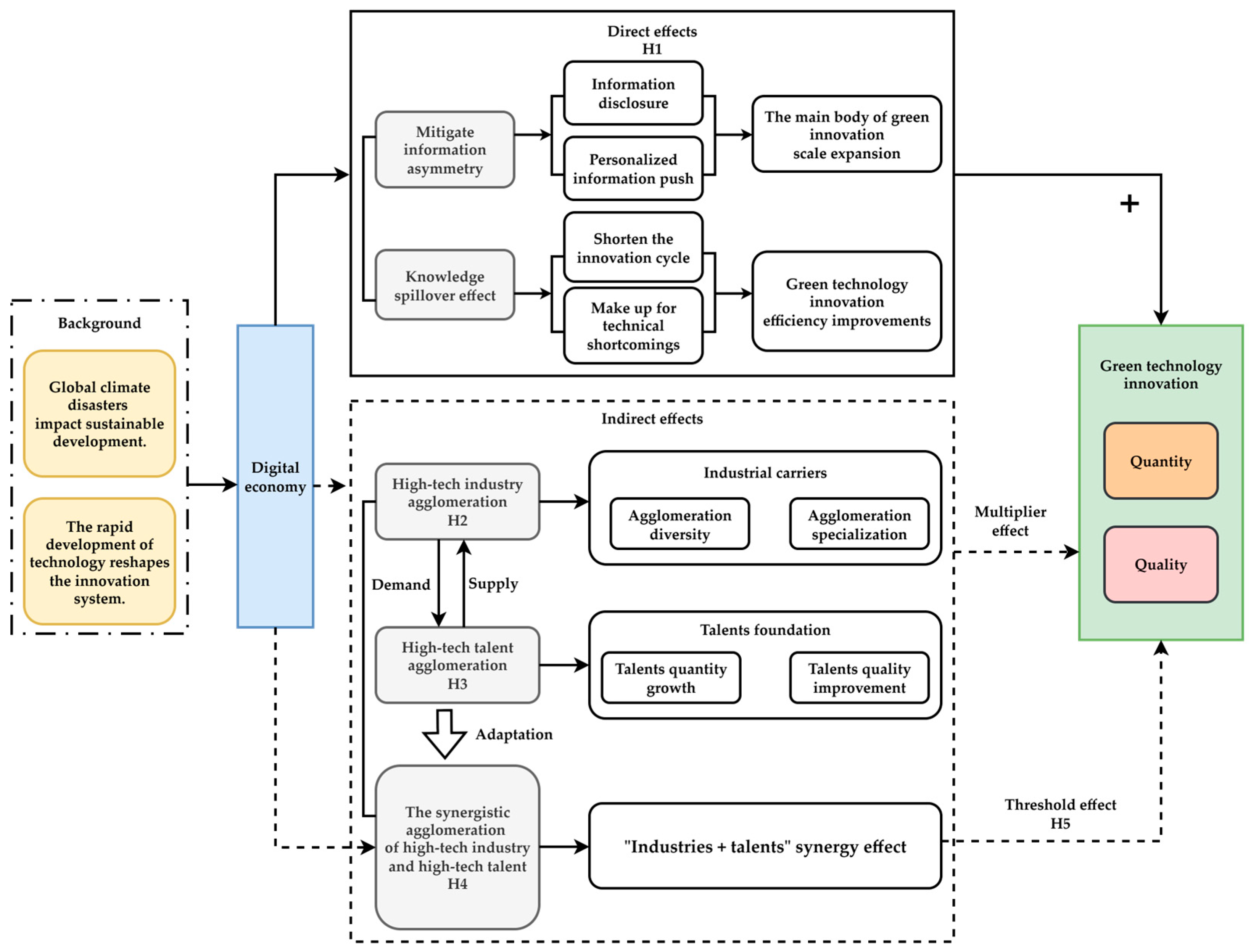
The specific analytical mechanism is shown in Figure 1.

3. Research Design

3.1. Model Settings

3.1.1. Benchmark Model

To investigate how the DE affects GTI, this research constructs a two-way fixed effects model incorporating provincial and time-specific factors, based on theoretical reasoning and Hausman test outcomes. The fundamental model is presented in Equation (1):
G T I i t = α 0 + α 1 D E i t + α 2 C o n i t + γ i + σ t + ε i t
In Equation (1), the symbol i represents a province (which includes municipalities directly governed by the Central Government or autonomous regions), while t signifies a specific year. The variable GTI reflects the dependent variable of interest, and DE serves as the independent variable. Con represents the set of control variables. γ i represents provincial fixed effects, σ t represents year fixed effects, and ε i t is the random error term. Coefficients α 1 and α 2 are the parameters to be estimated, with a focus on α 1 .

3.1.2. Mechanism Test Model

To enhance the exploration of the moderating effects of high-tech industry agglomeration and high-tech talent agglomeration, as well as their synergistic agglomeration, on the process by which the DE influences GTI, a moderation model is established as illustrated in Equation (2):
G T I i t = β 0 + β 1 D E i t + β 2 D E i t × M i t + β 3 M i t + β 4 C o n i t + γ i + σ t + ε i t
In Equation (2), M serves as the moderating variable, denoting the level of agglomeration degree of high-tech industry, the agglomeration degree of high-tech talent, and the extent of synergistic agglomeration between high-tech industry and high-tech talent, respectively. The interaction term D E i t × M i t captures the moderating effect of different M mechanisms, with a primary focus on the coefficient β 2 . All other variable symbols are consistent with their definitions in Equation (1).

3.1.3. Threshold Effect Model

To further analyze the threshold effect of the DE on GTI, this study employs the threshold model proposed by Hansen (1999) [47]. This study adopts a dual-threshold approach from the COAG perspective, as shown in Equation (3):
G T I i t = ρ 0 + ρ 1 D E i t × I ( C O A G i t < η 1 ) + ρ 2 D E i t × I ( η 1 C O A G i t < η 2 ) + ρ 3 D E i t × I ( C O A G i t η 2 ) + ρ 4 C o n i t + γ i + σ t + ε i t
In Equation (3), COAG is the threshold variable, I ( ) is an indicator function that takes a value of 1 when the condition in the parentheses is met and 0 otherwise, η 1 and η 2 represent the double threshold values, and all other variable symbols are consistent with their definitions in Equation (1).

3.2. Variable Definitions

3.2.1. Dependent Variable

GTI is the dependent variable. The extant literature about the measurement of GTI primarily employs two methodological approaches. One approach utilized Data Envelopment Analysis (DEA) to gauge innovation efficiency from an input–output standpoint [48,49]. The other approach relied on green patent statistics to quantify innovation output. GTI denotes the integration of energy-saving and environmental protection technologies into R&D and production processes. Since green patent data mainly reflect the innovation, energy efficiency improvement, and cleaner production, it can more reliably measure the overall level of regional GTI compared with other methods [50,51]. However, most of the existing literature has focused on the quantitative research regarding GTI, while neglecting its quality dimensions. Wang et al. (2025) [52] proposed that green invention patents involve more complex and creative exploration and R&D processes than green utility model patents, thereby qualifying as high-quality technological innovation. Consequently, based on the research of Wang et al. (2025) [52], the overall count of patent applications for green utility models and the quantity of green invention patents served as an indication of the quantity of GTI, while the count of green invention patents is utilized to evaluate the quality of GTI. Specifically, the information regarding patent applications released by the China National Intellectual Property Administration (CNIPA) is matched with the green patent inventory of the World Intellectual Property Organization (WIPO) [53]. This process yields green patent data for various provinces. To measure the quantity and quality of GTI, we use the natural logarithm of the total number of green invention and utility model patent applications (plus one), and the natural logarithm of green invention patent applications (plus one).

3.2.2. Independent Variable

The DE is the independent variable. The DE represents a novel economic model that emerges after both the agricultural and industrial economies. Currently, a standardized method for assessing the DE does not exist, and the majority of evaluations are performed by developing a system of indicators tailored to the DE [54,55]. Drawing on Wang et al. (2021) [56] and Yang et al. (2021) [57], this paper constructs the DE indicator system. Guided by the “foundation support-core drive-integration application” framework, the system covers three digital economy dimensions. These include digital infrastructure, digital industrialization and industrial digitalization.
Digital infrastructure as the carrier of digital technology application and data factor flow, its improvement directly determines the support capacity of DE for GTI. Specifically, internet broadband access rate and internet penetration rate shape the digital connectivity of innovation entities within a region, governing the efficiency of information sharing and cross-entity collaboration; the length of long-distance optical fiber cable lines reflects the geographic coverage breadth of regional digital infrastructure, and the interregional element mobility facilitates the integration of external knowledge into GTI.
Digital industrialization is the core industrial form of the DE, directly outputting digital technology, products and services. It determines the supply capacity of digital technologies, thereby providing a technology source and talent pool for GTI. Specifically, per capita telecom business volume reflects the service capacity of the regional digital industry, and the widespread adoption of telecommunications services lowers the information transmission costs incurred by GTI entities; the number of legal entities in information transmission, software and information technology services indicates digital industry scale; the proportion of employees in the information software industry reflects the digital industry’s talent pool, and digital talents play a vital role in GTI.
Industrial digitalization is the penetration process of digital technologies into industries and an important link through which the DE affects GTI. Specifically, the number of websites per hundred enterprises reflects enterprises’ basic digital capabilities, which serve as key carriers for enterprises to acquire GTI information and showcase green products; e-commerce sales reflect an enterprise’s level of digitalized transactions. The proportion of enterprises with e-commerce transaction activities measures the prevalence of industrial digitalization. Greater prevalence empowers more firms to adopt digital solutions for optimizing production processes. Peking University Digital Financial Inclusion Index indicates that digital inclusive finance is an important financial support for industrial digitalization, and it can provide low-cost financing for GTI.
Existing studies primarily measured the comprehensive the DE index using the entropy weight method [56] and principal component analysis (PCA) [57]. Specifically, PCA retains most of the information from the original indicators during dimension reduction, exhibits stronger robustness to outliers, and objectively assigns weights by extracting principal components with the highest variance contribution—making it more suitable for the objective comparison of cross-regional the DE indexes. Prior to adopting PCA, statistical tests were conducted in this study. The results show that the p-value of Bartlett’s spherical test is 0, while the KMO value is 0.786. These findings confirm that PCA is valid both in economic and statistical terms. Thus, this study adopts PCA to measure the comprehensive the DE index. To ensure the robustness of findings, we subsequently employ an alternative index computed via the entropy method in our sensitivity checks. All specific indicators are positive. The detailed composition of the indicator system is presented in Table 1.

3.2.3. Moderating Mechanism Variables

Several methods exist to measure agglomeration, including the Herfindahl Index [58], the E-G index, and location entropy [59]. Among these, the location entropy approach is preferred because it controls inter-regional differences in the overall scale of high-tech sectors, thereby providing a more accurate reflection of spatial concentration [53]. Thus, we employ location entropy to quantify both high-tech industry agglomeration and high-tech talent agglomeration.
High-Tech industry agglomeration as the scenario carrier for the DE to empower GTI, its generated scale effect and knowledge spillover effect enhance the promoting role of the DE in GTI. Drawing on the research of Han et al. (2021) [59], this study employed main business income data to measure high-tech industry agglomeration. The calculation formula is shown in Equation (4):
I N D A G i t = I N D L i t / I N D G i t I N D L t / I N D G t
Among them, INDAGit measures high-tech industry agglomeration. INDLit denotes the main business income of region i’s high-tech industry in year t. INDGit indicates the main business income of industrial enterprises above designated size in region i in year t. INDLt indicates the total main business income of high-tech industries nationwide in year t; and INDGt denotes the total main business income of industrial enterprises above designated size nationwide in year t.
High-Tech talent agglomeration stimulates regional innovation vitality and enhances the positive effect of the DE on GTI by providing compound skills in digital technology and green knowledge. Drawing on Yan et al. ’s (2024) [60] research, this study employed the number of employees to quantify high-tech talent agglomeration. The formula shown in Equation (5):
H U M A G i t = H U M L i t / H U M G i t H U M L t / H U M G t
Among them, HUMAGit represents the measurement results of high-tech talent agglomeration. HUMLit denotes the number of employees in high-tech industries in region i in year t. HUMGit denotes the number of employees in industrial enterprises above designated size in region i in year t. HUMLt indicates the total number of employees in high-tech industries nationwide in year t; and HUMGt denotes the total number of employees in industrial enterprises above designated size nationwide in year t.
COAG achieves dynamic matching between the demand for industrial green innovation and the supply of digitally skilled talents. In addition to exploring its moderating effect, this research also analyzes threshold effects of COAG between the DE and GTI. To assess COAG, the coupling coordination degree (CCD) model is adopted. It captures the interaction dynamics between multiple systems, encompassing both coupling degree and coordination degree [61]. Consequently, building on Guo et al. (2022) [62], this study employs CCD model to evaluate COAG. The detailed measurement process is outlined as follows.
First, calculate the coupling degree between the two systems:
C = M 1 M 2 M L / M 1 + M 2 + + M L L 1 / L
where C represents the coupling degree, with a value range of [0, 1]. A value closer to 1 signifies a stronger correlation and more intense interaction between high-tech industry agglomeration and high-tech talent agglomeration. A value closer to 0 indicates a weaker correlation and less interaction between the two systems. L represents the number of systems, and here L = 2. Thus, the formula for the coupling degree between high-tech industry agglomeration and high-tech talent agglomeration is:
C I H = M I M H / M I + M H 2 1 / 2
Second, based on the coupling degree model, introduced to form CCD model:
C O A G = C I H × T I H 1 / 2
In Equation (8),
T I H = α M I + β M H
where MI and MH represent the values of high-tech industry agglomeration and high-tech talent agglomeration, respectively. α and β are undetermined coefficients. Considering that high-tech industries and high-tech talents are equally important, this paper sets α = β = 0.5 for calculation.

3.2.4. Control Variables

(1)
Economic Development Level (ED): It reflects the supporting and driving role of a region’s material foundation for GTI. The stronger the regional economic strength, the more funds will be invested in building green R&D technologies and cultivating high-quality talents, thereby providing material and human resources guarantees for GTI. This variable is measured by per capita GDP.
(2)
Advanced Industrial Structure (AIS): An industry-dominated industrial structure often suffers from low energy efficiency and high pollution. In contrast, industrial structure upgrading reflects the shift from high-pollution to low-pollution industries. This transformation affects the demand and supply of GTI by optimizing resource allocation and enhancing industrial synergy. The rise of the tertiary industry not only reduces reliance on the high-polluting manufacturing sector but also synergizes with green industries to boost GTI commercialization efficiency. This variable is measured as the ratio of tertiary industry output value to secondary industry output value.
(3)
Government Intervention (GOV): As the core financial carrier for governments to fulfill public functions and regulate economic and social development, fiscal expenditure reflects their intervention intensity and resource allocation efforts in regional green economic activities via fiscal tools. It also serves as a key external funding source for GTI. It can reduce enterprises’ green R&D costs and encourage innovation input. In addition, government subsidies and special funds can not only cover part of the economic losses incurred by enterprises when investing in green innovation, but also steer capital flows toward green industries [63]. This variable is measured by the ratio of general public budget expenditure to regional GDP.
(4)
Openness Degree (OPEN): As a reflection of global market integration, a higher degree of openness facilitates the acquisition of advanced GTI and expertise through channels such as technology transfer and international collaboration [64]. As a reflection of global market integration, greater openness facilitates access to advanced green technology and expertise via technology transfer and international collaboration.
(5)
Environmental Regulation Intensity (ER): Based on the Porter Hypothesis, strict ER drives enterprises to actively develop green technologies to reduce pollutant emissions, and these new green technologies in turn enable enterprises to achieve lower production costs and higher operational efficiency. This variable influences the motivation and direction of GTI by constraining corporate pollutant emissions and compelling firms to undertake green technological upgrades. In this study, it is quantified as the ratio of completed investment in industrial pollution control to the industrial value-added.
(6)
Technology Market Development (TEC): It serves as a crucial platform for the transaction, diffusion, and commercialization of GTI. Its development level affects the potential returns and iteration speed of green innovation. A mature technology market not only expedites the diffusion of green technologies across enterprises but also translates green technologies into economic benefits rapidly [65]. This variable is measured by the ratio of the regional technology market transaction value to the local GDP.
Detailed variable definitions are provided in Table 2.

3.3. Data Sources

This study utilizes panel data from 30 provinces in China spanning the years 2011 to 2023. Tibet, Taiwan, Hong Kong, and Macao are excluded due to substantial data unavailability. Data on GTI quantity and quality are obtained from CNIPA, aligned with WIPO’s green technology patent classification. DE data from the China Statistical Yearbook, China Electronic Information Industry Statistical Yearbook, Peking University Digital Financial Inclusion Index, China Research Data Service Platform, and provincial statistical yearbooks. Mechanism variable data come from the China High-tech Industry Statistical Yearbook, China Statistical Yearbook, and local provincial yearbooks. Additional data are collected from the China Energy Statistical Yearbook, China Science and Technology Statistical Yearbook, regional statistical bulletins, and provincial economic databases. Limited missing values are handled via linear interpolation. Descriptive statistics for specific variables are reported in Table 3.

4. Empirical Test and Analysis

4.1. Benchmark Regression

Initially, this study employs the variant inflation factor (VIF) to assess multicollinearity. A mean VIF of 3.04, which is below the critical limit of 10, suggests that multicollinearity does not pose a significant issue in model configuration. In terms of model selection, the Hausman test (p-value = 0.000) leads us to reject the null hypothesis, thus supporting the fixed effects model. To address possible heteroskedasticity, we estimate a two-way fixed effects model with province and year fixed effects and report robust standard errors. The results of the estimates can be found in Table 4.
Table 4 presents the benchmark regression results for the DE’s impact on GTI quantity and quality. Columns (1) and (3) exclude control variables, while Columns (2) and (4) include them. The regression coefficient of DE for GTI quantity and quality is 0.450 and 0.306, respectively, both statistically significant at the 1% level. The above results indicate that the DE not only increases the quantity of GTI but also promotes high-quality innovation. This conclusion is consistent with prior findings of Sun et al. (2024) [66] and Ge et al. (2024) [67], providing empirical support for Hypothesis 1. The findings indicate that DE creates value for firms by integrating information resources and delivering customized content, reducing firms’ information acquisition costs [68]. By sharing high-quality information, the DE encourages broader participation in innovative activities and improves innovation quality. Digital technologies enable the electronic storage and visual circulation of knowledge, accelerating its dissemination, shortening innovation cycles, and increasing GTI’s unit-time output. Firm-to-firm knowledge exchange via digital platforms further helps overcome technical gaps in emission-reduction technologies and their upgradation, thereby enhancing innovation quality.
Focusing on the control variables, the analysis uncovers clear trends. AIS and OPEN are significantly negatively correlated with green innovation scale and quality, potentially stemming from an imbalance between specific advanced industries and green technologies or a distorted hierarchical order in open innovation investment. In contrast, GOV shows a significant positive relationship, as fund allocation secures essential resources for GTI. ER exerts a positive and significant effect, consistent with firms investing in GTI upgrades to comply with stringent policies. ED and TEC have no statistically significant impact. ED’s insignificance suggests its assumed positive effect on green innovation is either underdeveloped or offset by other factors. Similarly, TEC’s non-significance may reflect its underdevelopment or ineffectiveness in resource allocation and technology transfer for green innovation.

4.2. Endogenous Tests

When examining the DE’s impact on GTI, this study incorporates a set of control variables to mitigate omitted variable bias, yet two endogeneity issues persist. First, reverse causality is a concern. The DE positively influences GTI, and GTI may in turn promote DE advancement, leading to potential reverse causality. Second, sample selection bias may be present. Therefore, to tackle these two types of endogeneity issues, this study employs the instrumental variable approach and propensity score matching (PSM) for estimation.

4.2.1. Instrumental Variables (IV)

IV approach addresses endogeneity arising from omitted variables and reverse causality. Following Yang et al. (2021) [57], we use the interaction between provincial internet penetration rates and the 1984 volume of postal and telecommunications services (IV1) as the instrumental variable for the DE. This choice is justified by the DE’s close link to internet development, as early-stage internet advancement was tied to the business volume processed by postal and telecommunication departments. However, historical postal and telecommunication services volume exerts no direct impact on current GTI, thereby satisfying the relevance and exogeneity requirements of instrumental variables. To enhance the reliability of the results, this study uses the one-period lag of the DE as the second instrumental variable (IV2). The one-period lag of the DE influences current DE development but has no direct impact on current GTI, thereby meeting the relevance and exogeneity requirements of instrumental variables. In addition to economic rationale, formal statistical tests are performed on the two IVs. The results confirm the validity of the selected instruments, as they satisfy the relevance and strict exogeneity requirements. Specifically, the two-stage least squares (2SLS) regression results are presented in Table 5. As shown, after rigorously addressing endogeneity issues, the DE remains statistically significantly and positively associated with both GTI quantity and quality. This finding reinforces the conclusion drawn from our benchmark regression analysis.

4.2.2. PSM

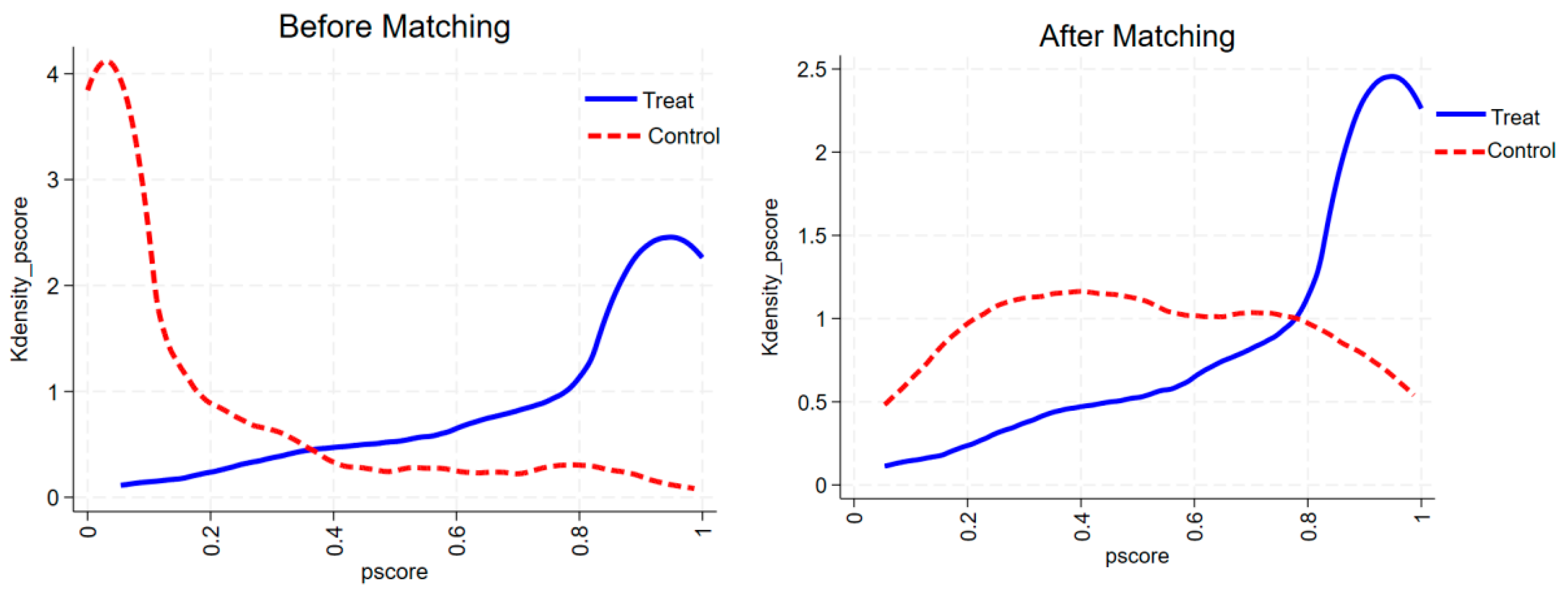
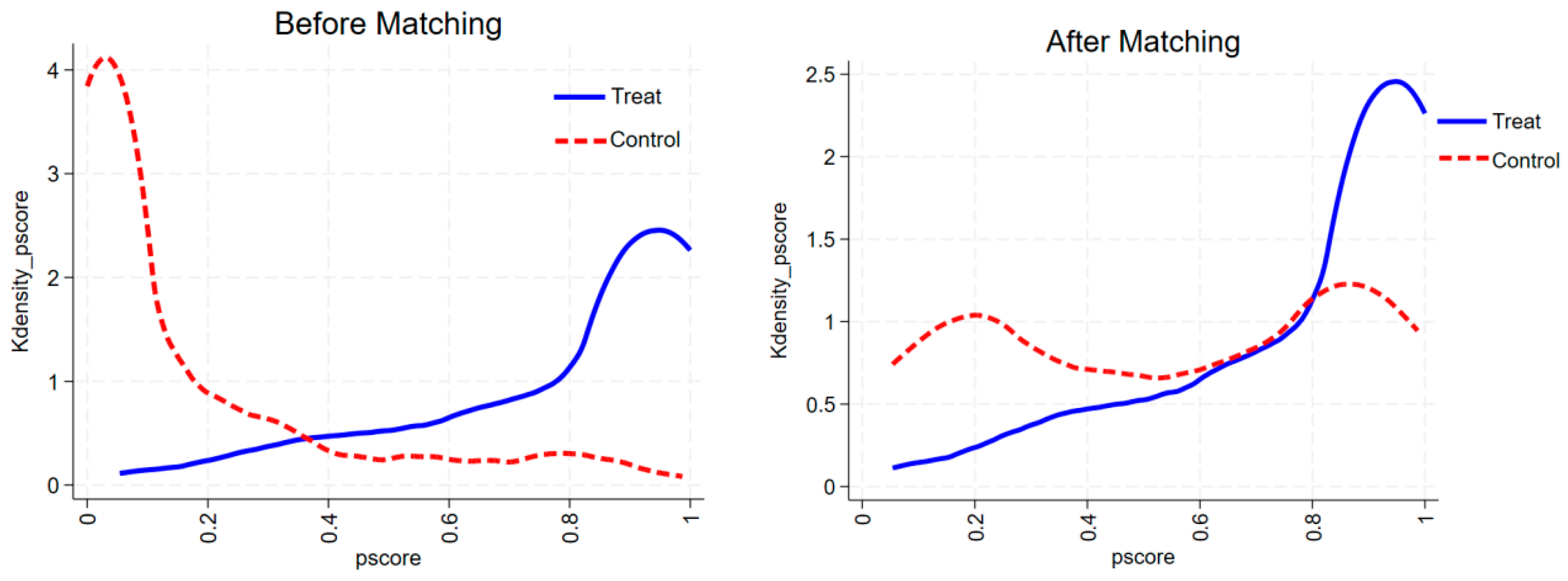
To address sample selection bias, this study employs PSM. We divide the sample into high and low DE groups based on the mean value of the DE index. The DE is defined as a binary treatment variable, where the high-DE group serves as the treatment group and the low-DE group as the control group. Multiple matching methods (i.e., radius matching, nearest neighbor matching, and kernel matching) are employed in the analysis. Table 6 results demonstrate that the average treatment effect on the treated (ATT) of the DE on GTI is highly significant at the 1% level and robust across all three matching methods. This stability suggests reliable ATT estimates. Balance diagnostics further affirm that the matching process successfully removes any substantial differences in covariates between the treatment and control cohorts.
To visually assess the alterations in the kernel density prior to and following the matching process, we present Figure 2 and Figure 3. This visual representation provides evidence that the PSM procedure effectively balanced the observed characteristics across both the treatment and control groups, thereby addressing the endogeneity issues that stem from sample selection bias.

4.3. Robustness Checks

To verify the reliability and precision of the research conclusions, this section conducts robust examinations of the benchmark regression outcomes, with the results displayed in Table 7 and Table 8.

4.3.1. Replacement of the Independent Variable

The comprehensive index of the DE is recalculated utilizing the entropy weight method, as outlined by Chen (2021) [69], rather than the previously used PCA method. Subsequently, the regression analysis is conducted again, with the findings displayed in Columns (1) and (2) of Table 7. Estimation results show DE remains significantly and positively associated with GTI after adjusting the core explanatory variable’s measurement.

4.3.2. Mitigating the Influence of Extreme Values

To reduce the influence of extreme values in the sample data, this study implements winsorization as a method of enhancing robustness. We apply winsorization to the dependent variable, primary explanatory variable, and control variables at the 5% and 95% quantiles. The results are displayed in Columns (3) and (4) of Table 7. It suggests that the DE retains its effect on GTI after adjusting for outliers

4.3.3. Alleviating the Missing Variable Problem

To address potential omitted variable bias, regression is re-run with the inclusion of additional GTI-related control variables. Following academic standards, we introduce regional financial development (FIN), urbanization (UR), and labor force levels (Labor) as additional controls. The results are presented in Columns (5) and (6) of Table 7. Following the inclusion of these extra controls, the DE continues to exhibit a statistically significant and positive effect on GTI at the 1% level, thereby reinforcing the strength of the initial conclusion.

4.3.4. Dynamic Effect Test

Considering the time lag effect of the DE on GTI, this paper regresses the one-period lag of DE (LAG-1) and two-period lag of DE (LAG-2) on GTI’s quantity and quality, respectively. The results are presented in Columns (1) to (4) of Table 8. The findings indicate that the LAG-1 and LAG-2 of DE have a positive and significant influence on GTI at the 1% level. Thus, the robustness of the original conclusion is further confirmed. The coefficients show a decreasing relationship in the current period, LAG-1 and LAG-2 specifications. To summarize, it appears that the influence of the DE is stronger in the short term than in the long term. This pattern implies that the immediate impact of the DE on GTI is stronger. However, the impact may be subject to diminishing returns or even be superseded by subsequent technological waves in the long run.

4.3.5. Adjustment of the Sample Period

To assess whether the sample period affects the robustness of the baseline conclusion, the sample period is further restricted to 2015–2023. The 2015 starting year is justified by a significant shift in China’s digital policy framework, as the launch of major government initiatives drove key technologies (e.g., mobile internet and big data) into a phase of mature application and rapid diffusion [70]. This period thus better captures the core phase of the DE’s impact on GTI. As shown in columns (5) and (6) of Table 8, the results indicate that even after adjusting the sample period, the DE remains a statistically significant positive driver for GTI. This consistency across different time windows further affirms the robustness of benchmark conclusion.

5. Mechanism Tests

5.1. Moderating Effect Tests

To analyze the impact of the DE on GTI from the agglomeration perspective. The analysis is done through interaction terms between DE and high-tech industry agglomeration, high-tech talent agglomeration, and their synergistic agglomeration. The results are presented in Table 9.
As shown in columns (1) and (2) of Table 9, the interaction term of agglomeration in high-tech industry and the DE has positive and statistically significant impacts at the 1% level on both quantity (coefficient = 1.448) and quality (coefficient = 1.637) of GTI. It is interesting to note that these interaction coefficients are greater than individuality. This means that high-tech industry agglomeration can enhance the DE’s positive impact on GTI. This finding supports Hypothesis 2. This finding can be explained as follows: First, the diversification associated with industrial agglomeration concentrates capital, technology, and labor from various sectors [71], creating a fertile ground for both digital and green development. Second, the specialization within high-tech agglomeration focuses on specific sub-fields of GTI [36]. This fosters a deep division of labor along the industrial chain and refines the application of digital tools in targeted green innovation contexts, thereby enhancing the efficiency and precision of technology integration.
As presented in columns (3) and (4) of Table 9, this indicates that high-tech talent agglomeration strengthens DE’s promoting effect on GTI, validating Hypothesis 3. The underlying mechanisms are as follows: First, high-tech talent agglomeration increases the talent pool size [38], translating to a larger pool of talent in the DE and GTI, thereby improving the efficiency of DE-driven GTI output. Second, high-tech talent agglomeration enhances talent quality [39], which not only overcomes technical bottlenecks in the DE but also precisely addresses the core “bottleneck” constraints in GTI, shortening the innovation cycle length. Thus, high-tech talent agglomeration reinforces the DE’s “quantity-enhancing and quality-upgrading” effect on GTI. Notably, high-tech talent agglomeration outperforms industry agglomeration, indicating that talent serves as the core link for the DE to empower GTI. Compared with the resource and technology convergence driven by industry agglomeration, the dual digital and green knowledge reserves of talent agglomeration [25,44] can more accurately convert digital tools into GTI. Furthermore, a cross-disciplinary collaboration among talents is more efficient than knowledge spillover from industry agglomeration [43], enhancing the DE’s GTI empowerment effect.
The coefficients for the interaction term between COAG and DE are presented in columns (5) and (6) of Table 9. This indicates that COAG strengthens DE’s promoting effect on GTI, validating Hypothesis 4. The potential mechanism is as follows: At a high level of synergistic agglomeration, high-tech industry agglomeration serves as a carrier for innovation scenarios [36], while high-tech talent agglomeration provides core momentum for technology R&D and factor transformation [46]. This two-way dynamic adaptation where industrial demand guides talent allocation and talent supply supports industrial upgrading.
Interestingly, the coefficient for the interaction between COAG and DE is notably lower than those for the interactions of DE with either high-tech industry agglomeration or high-tech talent agglomeration. This finding suggests that synergistic agglomeration represents the dynamic adaptation between industries and talents, with its core value lying in compensating for the functional shortcomings of standalone high-tech industry agglomeration or high-tech talent agglomeration. Its role is mainly achieved through the systematic integration where industrial demand guides talent allocation and talent supply supports industrial upgrading. Thus, this “shortcoming-compensating” systematic synergy results in relatively smaller coefficient values, but it possesses irreplaceable systematic value in the two-dimensional moderating effect of DE on both the quantity and quality of GTI output. This also provides empirical evidence for subsequent policies to focus on building a synergistic agglomeration ecosystem of high-tech industries and talents, and to leverage systematic synergy to strengthen the DE’s promotional effect on GTI.

5.2. Threshold Effect Test

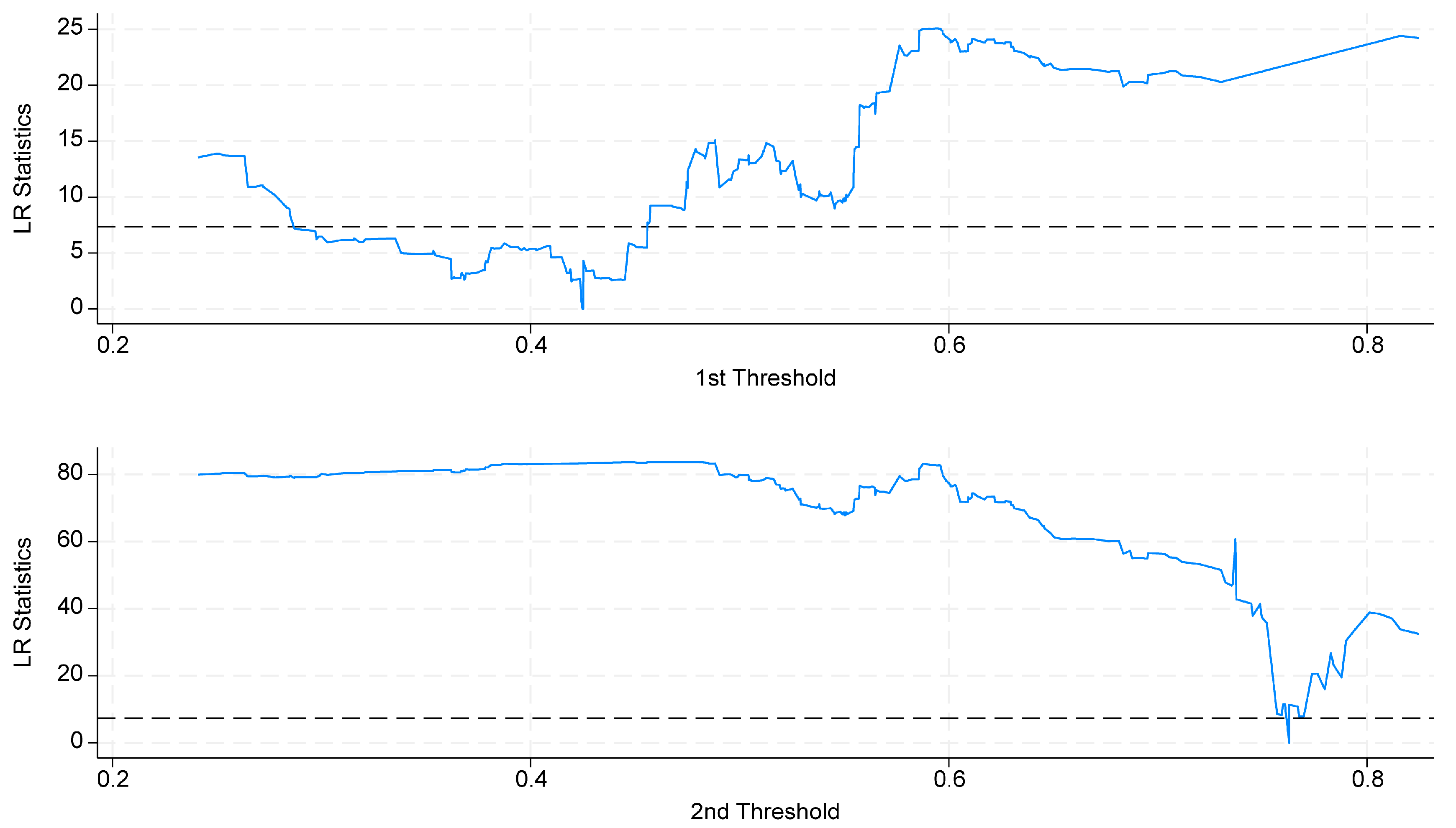
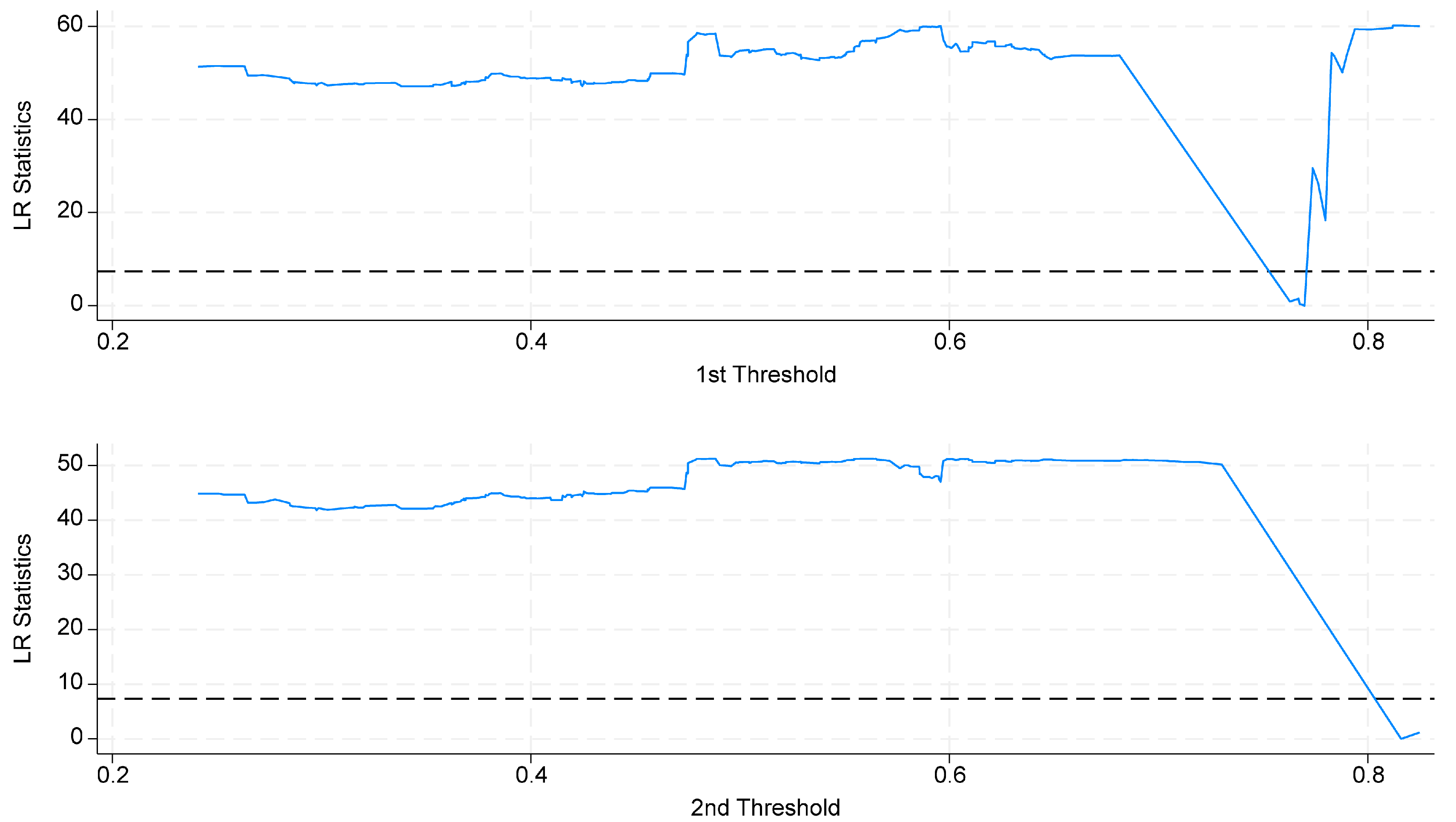
To explore the threshold effect of COAG in the process by which the DE influences GTI, this study employs the bootstrap method with 300 iterations to assess the threshold effect, and the findings are presented in Table 10. The data reveals that COAG demonstrates a significant double threshold effect concerning both the quantity and quality of GTI impacted by the DE. In terms of the DE’s influence on quantity of GTI, the first threshold estimate for COAG is 0.4248, while the second is 0.7628. Regarding the DE’s effect on quality of GTI, COAG’s first threshold estimate stands at 0.7698, with the second at 0.8160. Additionally, the likelihood ratio (LR) test is conducted to confirm the double threshold estimates of COAG, which successfully passes the test, thereby substantiating Hypothesis 5. The specific results of the LR test are illustrated in Figure 4 and Figure 5, further affirming the reliability of the estimated thresholds.
The regression results for the COAG threshold effect are presented in Table 11. Regarding quantity of GTI, when the level of COAG < 0.4248, the coefficient of the DE is 0.130; when 0.4248 ≤ COAG < 0.7628, the coefficient rises to 0.248; and when COAG ≥ 0.7628, the coefficient increases significantly to 0.403. This indicates that COAG displays a distinct double threshold feature in DE’s impact on the quantity of GTI. Specifically, the higher the level of COAG, the stronger DE’s positive effect on the quantity of GTI. The following interpretations explain the pattern: At the low COAG level, the industrial landscape remains fragmented, and the talent structure unbalanced, as digital technologies fail to align the R&D demand with green innovation-related information. As COAG improves, the industry forms an integrated full-chain cluster, offering diversified green innovation scenarios. Meanwhile, the pool of digital and green technology talents expands, directly driving large-scale growth in the quantity of GTI. Thus, after COAG crosses the critical thresholds, DE’s promoting effect on the quantity of GTI quantity is progressively enhanced.
When the COAG in the quality of GTI dimension is less than 0.7698, the DE coefficient is 0.338; when 0.7698 ≤ COAG < 0.8160, DE coefficient is 0.727; and when COAG ≥ 0.8160, the DE coefficient is 0.343, which decreases compared with the previous interval. DE can only fully exert its impact on the quality of GTI when COAG reaches a relatively high threshold. Notably, COAG exhibits an inverted U-shaped relationship with the DE’s effect on GTI. This nonlinearity can be explained by two key mechanisms: At a high level of COAG, mature innovation ecosystems and a well-matched “digital-green” talent pool enable the DE to effectively target and address core technical challenges, driving rapid improvements in the quality of GTI. However, once COAG surpasses a certain threshold, constrained by the law of diminishing marginal returns of innovation factors, DE’s role in promoting quality of GTI gradually weakens.
From theoretical and practical perspectives, COAG critically moderates the DE’s role in driving regional GTI, with nonlinear and dimension-specific effects. In terms of GTI quantity, COAG exerts a threshold jump effect. At low levels of COAG, fragmented industries and imbalanced talent structures blunt the DE’s capacity to integrate innovative resources. By contrast, as COAG crosses the thresholds of 0.4248 and 0.7628, the formation of full-chain industrial clusters and pools of digitally green talent amplifies the DE’s positive impact, aligning with the shift in regional agglomeration from inefficiency toward scale synergy. In terms of quality of GTI, COAG follows an inverted U-shaped pattern. When COAG stays below 0.8160, mature innovation ecosystems and well-matched talent systems enable the DE to target core GTI bottlenecks and boost innovation quality. Beyond this threshold, the law of diminishing marginal returns on innovation factors weakens the DE’s contribution, reflecting the real-world risk that excessive agglomeration tends to trigger resource misallocation. This finding enriches the theory of regional industry talent agglomeration and offers practical guidance.

6. Further Discussion: Heterogeneity Analysis

The regional economic development level and government institutional structure significantly impact both the DE and GTI. This study delves deeper into the varying effects of the DE on GTI across the different levels of regional development and institutional contexts of the government. For the categorization of regional development, we utilize the official classification from China’s National Bureau of Statistics, combining Northeastern China with Eastern China, thereby partitioning the sample into three primary regions: Eastern, Central, and Western China. In the case of government institutions, we assessed government systems through two perspectives: hard constraints represented by ER and soft guidance evident from the attention given by the government to green development (GGA).

6.1. Heterogeneity Analysis of Regional Economic Development Levels

Resource distribution and industrial composition vary across China’s regions, leading to the heterogeneous impacts of DE on GTI. As shown in Table 12, the DE exerts a significant “quantity–quality” enhancement effect on GTI in Eastern and Central China, while the effect is insignificant in the western region This heterogeneity can be attributed to distinct regional conditions. The eastern region benefits from a robust economic base, abundant innovation factors, high agglomeration of industries and talent, and stringent ER [13]. These advantages underpin its advanced digital infrastructure and diverse application scenarios, facilitating effective resource integration and fostering an ideal environment for the DE to drive GTI. The central region, which is currently undergoing rapid growth in GTI and actively receiving industrial transfers, utilizes the DE strategies to modernize traditional industries [72].
In contrast, the western region faces challenges including sluggish growth, a weak innovation base, and difficulties in attracting high-tech industries and digital talent [73], which restricts the development potential of its digital sector. Additionally, its energy-intensive and polluting traditional industries may have formed a development path lock-in that hinders green transformation [74], thereby limiting the DE’s role in promoting GTI. Thus, the western region should be particularly concerned about the future policy areas of synergistic digital and green development.

6.2. Heterogeneity Analysis of ER

ER acts as a crucial hard constraint tool employed by governmental governance to affect GTI. This research aims to investigate the varying degrees of ER in DE’s influence on GTI. Following Shimizu (2020) [75], we measure ER by the ratio of industrial pollution control expenditure to industrial added value. Subsequently, we categorize the sample into two groups: those regions exhibiting high-ER (above the average) and those with low-ER (below the average), utilizing the average of this ratio as the dividing line. The detailed findings are presented in Table 13.
Table 13 illustrates that the DE has a considerable positive influence on both the quantity and quality of GTI in areas with varying levels of ER. This suggests that high ER redirects the DE’s driving force toward enhancing the quality of GTI. Under such constraints, firms are compelled to leverage digital technologies to develop more sophisticated and efficient solutions for meeting higher compliance and innovation requirements. Thus, they prioritize quality over quantitative expansion rather than pursuing mere quantity growth. Conversely, in low-ER regions, the DE exerts a stronger influence on innovation quantity (coefficient = 0.374) than on quality (coefficient = 0.216). This phenomenon can be explained by two mechanisms: First, loose ER lowers the compliance threshold for green innovation. The DE advantages in enhancing R&D and production efficiency facilitate GTI activities among enterprises and other entities, thereby boosting the quantity of innovations. Second, under loose ER, market entities face relatively little pressure for green transformation. The DE’s low-cost transformation advantage enables simple and feasible GTI ideas to be quickly converted into practical innovative outcomes, eliminating the need for excessive resource investment in quality enhancement. Consequently, the growth of GTI quantity is promoted.

6.3. Heterogeneity Analysis of GGA

GGA signifies soft guidance regarding GTI, which has varied effects on the cognitive environment and social context essential for the integration of DE and GTI. In this regard, this study draws on the work of Tu et al. (2024) [76] to assess GGA through a word frequency analysis of pertinent terms found in regional government reports. The identified statistical keywords are grouped into five categories: (1) development concepts: ecological city, circular economy, green economy, low-carbon economy, and ecological civilization demonstration zones; (2) green production: industrial water conservation, high energy consumption, green manufacturing, consumption reduction, agricultural non-point source pollution, energy conservation, and emission reduction, along with water-saving irrigation; (3) green lifestyle: green consumption, green travel, restroom revolution, and domestic waste management; (4) green ecology: afforestation, clear waters and lush mountains, mountain forest restoration, and water conservation efforts; and (5) institutional development: local regulations, collaborative prevention and control, civic engagement, environmental oversight mechanisms, and green governance. We categorize the sample into regions that exhibit high-GGA (above the mean value) and those with low-GGA (below the mean value), using the word frequency index as the cutoff point. The detailed results are outlined in Table 14.
Table 14 indicates that, compared with low-GGA regions, the DE exerts a more pronounced positive impact on GTI in high-GGA regions. The underlying reasons may be as follows: First, in high-GGA regions, the government actively formulates more supportive policies, such as special subsidies and tax incentives for the DE-driven GTI. At the same time, the government builds integration platforms for the DE and GTI, attracting a large number of market entities to participate, thereby promoting the rapid growth of GTI quantity. Second, the government pays more attention to innovation quality and long-term benefits; thus, it establishes strict GTI standards and certification systems. The government’s strong signal transmission function can provide policy guidance for the digital transformation of GTI. It guides market entities to invest more resources such as capital, labor, and data into high-quality technological innovation with low energy consumption and low pollution, thereby helping the DE to empower the high-quality development of GTI.

7. Conclusions and Policy Implications

7.1. Research Conclusions

This study extends the literature on DE and GTI by examining its impact on both the quantity and quality of GTI and by introducing a novel agglomeration perspective. We theoretically and empirically investigate the roles of high-tech industry agglomeration, high-tech talent agglomeration, and their synergistic agglomeration in the DE’s impact on GTI. Using panel data from 30 Chinese provinces from 2011 to 2023 and employing a two-way fixed effects model, we found robust evidence that DE significantly enhances both the quantity and quality of GTI. This conclusion remains robust after a series of robust tests. This finding agrees with the research results of Wu et al. (2024) [77] on China’s energy efficiency and that of Wang et al. (2025) [78] on OECD countries. This consistency across different economic and geographic contexts suggests that the positive role of DE in fostering GTI may be a generalized phenomenon. In addition, high-tech industry agglomeration, high-tech talent agglomeration, and COAG generally exert a “multiplier effect” in the process of DE influencing GTI. This multiplier effect stems from the fact that high-tech industry agglomeration provides diversified digital-green integration scenarios via cross-sector resources; high-tech talent agglomeration resolves technical bottlenecks through dual knowledge and interdisciplinary collaboration; their synergy aligns resources with demand. To explore the nonlinear impact characteristics of COAG, this study investigates the threshold effect of COAG in the DE’s impact on GTI and identifies a double threshold effect. Specifically, regarding GTI quantity, the DE’s effect strengthens progressively as COAG crosses the first and then the second threshold, indicating a “more-is-better” dynamic. This is because low-COAG fails to integrate digital-green innovation resources effectively. Crossing each threshold consolidates industrial chains, expands talent pools and optimizes resource allocation. In terms of GTI quality, the effect peaks after COAG surpasses the first threshold and then significantly diminishes after the second, forming a clear inverted U-shaped relationship. The core mechanism lies in the fact that moderate COAG builds a well-matched innovation ecosystem. It integrates industrial resources and digital-green talent to address core technical bottlenecks in GTI. Excessively high COAG leads to diminishing marginal returns of innovation factors. Resource misallocation and talent redundancy then weaken the DE’s driving effect on GTI quality. Heterogeneity analysis yields three results. First, the DE’s enhancement effect on GTI is stronger in eastern and central than in western regions, as these regions have more advanced digital infrastructure, higher industrial and talent agglomeration levels, and more complete GTI supporting systems. Second, strict ER influences the DE in terms of GTI quality rather than quantity, whereas more relaxed regulations favor quantitative expansion, since strict ER compels firms to deploy digital technologies for high-standard GTI, whereas loose ER lowers compliance costs to enable large-scale low-threshold GTI activities. Third, compared to low-GGA regions, the DE’s role in GTI is stronger in high-GGA regions because high GGA offers policy subsidies and certification standards that direct digital resources to support both the scale expansion and quality upgradation of GTI. These results provide empirical evidence and practical insights for global green development.

7.2. Policy Implications

Investigating the influence of DE on GTI is essential for advancing green development. This study examines how DE, as an emerging economic model, can drive GTI, address prevailing barriers, and enable the transition to a low-carbon economy and sustainable societal development. The policy implications drawn from these findings are as follows:
First, the DE should be promoted to enable quantitative and qualitative enhancement of GTI. Our analysis reveals divergent patterns across regions and industries. Regionally, the advanced digital infrastructure and vibrant innovation ecosystems of eastern coastal areas are highly conducive to a synergistic convergence of digital and green technologies. In contrast, central, western, and less-developed regions, facing constraints in both digitalization and industrial structure, predominantly exhibit GTI concentrated in incremental process optimizations within resource-intensive industries. At the industry level, a parallel dichotomy exists. High-tech manufacturing and digital service sectors are focal points for generating transformative, system-level green innovations. However, traditional heavy industry embraces digital tools primarily for achieving incremental efficiencies in energy and material use. At the same time, given the dynamic and context-dependent nature of this relationship, as revealed by our findings on time lags and threshold effects, policymakers must complement this strategic framework with a robust monitoring and evaluation system. This system should track the evolving interplay between digital advancement and green innovation outcomes.
Second, enhance the linkage between high-tech industries and talents to consolidate the foundation for GTI. Eastern China, with its dense agglomeration of skilled human capital and mature industrial networks, acts as a catalyst for deep digital-green integration. The central and western regions, however, face challenges of talent outmigration and less cohesive value chains, which heighten the imperative for upfront public investment in digital infrastructure as a foundational enabler. This diagnostic calls for a place-based policy differentiation. In advanced eastern economies, policy should leverage existing advantages by nurturing a synergistic innovation ecosystem and competing for global talent. In less-developed interior regions, the strategic priority must shift to bridging the digital divide through targeted infrastructure investments and fostering distinctive local green industry specializations. Meanwhile, a dynamic matching mechanism for industrial and talent needs should be established: digital technologies can be leveraged to capture the innovation demands of high-tech industries and the skill supply of talents in real time, enabling timely adjustments to industrial layout and talent training directions, and reducing mismatches between industries and talents.
Third, the leverage threshold effects should be leveraged to precisely promote the synergistic agglomeration of high-tech industry and high-tech talent. Given the identified double-threshold effects of the synergistic agglomeration, policy interventions must be tailored to specific developmental stages. Governments should first establish a scientific classification system defining low-, medium-, and high-level intervals. When COAG is less than 0.4248, local governments leverage digital platforms to establish industry-talent matching databases and grant initial special green innovation subsidies to enterprises onboarded to the platforms, addressing the issues of industrial fragmentation and talent imbalance. When COAG ranges between 0.4248 and 0.7628, local governments can build full-chain green innovation collaboration platforms based on the DE and formulate requirements for cross-enterprise collaboration projects for innovation entities within the agglomeration areas, thereby boosting the output of GTI. When COAG reaches 0.7628, local governments use digital technologies to monitor resource redundancy and allocate the saved resources to subsidize the specialized sub-fields of GTI. When COAG approaches 0.8160, a digital technology platform is utilized to construct an innovative quality evaluation system; if a project’s score falls below the threshold, subsidies for the DE and GTI are suspended, forcing resources to shift towards high-value innovation. Thus, this minimizes the diminishing returns or resource bottlenecks that may arise from excessive industry and talent agglomeration.
Fourth, promote regional regulatory and policy coordination to optimize the development environment for the DE and GTI. Regarding regional coordinated development, policy should reflect regional disparities. In regions with stringent regulations, leverage this “forcing” mechanism to direct corporate investment toward low-pollution, energy-efficient green technologies, complemented by technical guidance and policy support. In regions with lenient regulations, carefully set intensity levels that stimulate green innovation without stifling industrial development. In addition, enhance overarching government attention to green development and establish a unified yet adaptable national framework for incentivizing green innovation. This creates a cohesive, multi-level policy system that ensures balanced and sustainable advancement of GTI across the country.

7.3. Limitations and Future Research

Although this work extends previous work, it still has several limitations. First, future work could build more comprehensive indicators by including multi-source heterogeneous data. Future research could integrate environmental benefit data (e.g., achieved reductions in carbon emissions and energy consumption) and economic benefit data (e.g., attributable increases in firm revenue and realized cost savings) into GTI indicator system. Second, future work could consider industries of different sizes and technology or talent with different specializations and skill levels, to uncover more precise interaction effects with the DE. Finally, a promising direction is to decompose the DE into its core components, notably digital industrialization and industrial digitalization. Investigating their distinct impacts and mechanisms on green innovation would yield a more granular understanding of the digital-green nexus.

Author Contributions

Conceptualization, J.Y.; methodology, J.Y.; software, J.Y.; validation, J.Y.; formal analysis, J.Y.; investigation, J.Y.; resources, J.Y.; data curation, J.Y.; writing—original draft preparation, Y.W.; writing—review and editing, Y.W.; visualization, Y.W.; supervision, Z.L.; project administration, Z.L. All authors have read and agreed to the published version of the manuscript.

Funding

This research was funded by the China Soft Science Special Program of Gansu Provincial Science and Technology Department (grant number 23JRZA438).

Institutional Review Board Statement

Not applicable.

Informed Consent Statement

Not applicable.

Data Availability Statement

Publicly available datasets were analyzed in this study. These data can be found at CNIPA, the China Statistical Yearbook, China Electronic Information Industry Statistical Yearbook, Peking University Digital Financial Inclusion Index, China Research Data Service Platform, and statistical yearbooks of various provinces; derived indicators are available from the authors upon reasonable request.

Conflicts of Interest

The authors declare no conflicts of interest.

References

  1. Mensah, J.D. Rethinking the Contribution of Creative Economies in Africa to Sustainable Development. An Empirical Research of Creative Intermediaries in Accra’s Contemporary Art Sector. Int. J. Cult. Policy 2025, 31, 551–568. [Google Scholar] [CrossRef]
  2. Figueira, C.; Fullman, A.R. Regenerative Cultural Policy: Sustainable Development, Cultural Relations, and Social Learning. Int. J. Cult. Policy 2025, 31, 451–466. [Google Scholar] [CrossRef]
  3. Zhou, G.; Zhu, J.; Luo, S. The impact of fintech innovation on green growth in China: Mediating effect of green finance. Ecol. Econ. 2022, 193, 107308. [Google Scholar] [CrossRef]
  4. Tian, Z.; Mu, X. Towards China’s dual-carbon target: Energy efficiency analysis of cities in the Yellow River basin based on a “geography and high-quality development” heterogeneity framework. Energy 2024, 306, 132396. [Google Scholar] [CrossRef]
  5. Xie, X.; Zhu, Q. How can green innovation solve the dilemmas of “harmonious coexistence”? J. Manag. World 2021, 37, 128–149. [Google Scholar] [CrossRef]
  6. Wang, Q.; Qu, J.; Wang, B.; Wang, P.; Yang, T. Green technology innovation development in China in 1990–2015. Sci. Total Environ. 2019, 696, 134008. [Google Scholar] [CrossRef] [PubMed]
  7. Che, Y. Utilizing ESG frameworks to improve environmental performance in digital economy entrepreneurial firms: Using digital technologies for green development. Int. Entrep. Manag. J. 2025, 21, 63. [Google Scholar] [CrossRef]
  8. Xiao, Y.; Duan, Y.; Zhou, H.; Han, X. Has digital technology innovation improved urban total factor energy efficiency?—Evidence from 282 prefecture-level cities in China. J. Environ. Manag. 2025, 378, 124784. [Google Scholar] [CrossRef]
  9. Ma, H.; Du, X. Digital economic integration under RCEP: China-ASEAN collaboration opportunities, challenges, and pathways. Int. Relat. Dipl. 2025, 13, 96–106. [Google Scholar] [CrossRef]
  10. Wang, L.; Shao, J. The energy saving effects of digital infrastructure construction: Empirical evidence from Chinese industry. Energy 2024, 294, 130778. [Google Scholar] [CrossRef]
  11. Fan, M.; Liu, J.; Tajeddini, K.; Khaskheli, M.B. Digital technology application and enterprise competitiveness: The mediating role of ESG performance and green technology innovation. Environ. Dev. Sustain. 2023, 27, 21195–21225. [Google Scholar] [CrossRef]
  12. Li, C.; Wen, M.; Jiang, S.; Wang, H. Assessing the effect of urban digital infrastructure on green innovation: Mechanism identification and spatial-temporal characteristics. Humanit. Soc. Sci. Commun. 2024, 11, 320. [Google Scholar] [CrossRef]
  13. Bai, D.; Li, M.; Wang, Y.; Mallek, S.; Shahzad, U. Impact mechanisms and spatial and temporal evolution of digital economy and green innovation: A perspective based on regional collaboration within urban agglomerations. Technol. Forecast. Soc. Change 2024, 207, 123613. [Google Scholar] [CrossRef]
  14. Chen, K.; Zhao, S.; Jiang, G.; He, Y.; Li, H. The green innovation effect of the digital economy. Int. Rev. Econ. Financ. 2025, 99, 103970. [Google Scholar] [CrossRef]
  15. Li, Y.; Wang, F. The corporate path to green innovation: Does the digital economy matter? Environ. Sci. Pollut. Res. 2023, 30, 79149–79160. [Google Scholar] [CrossRef]
  16. Dou, Q.; Gao, X. The double-edged role of the digital economy in firm green innovation: Micro-evidence from Chinese manufacturing industry. Environ. Sci. Pollut. Res. 2022, 29, 67856–67874. [Google Scholar] [CrossRef] [PubMed]
  17. Li, X.; Shao, X.; Chang, T.; Albu, L.L. Does digital finance promote the green innovation of China’s listed companies? Energy Econ. 2022, 114, 106254. [Google Scholar] [CrossRef]
  18. Tang, C.; Xu, Y.; Hao, Y.; Wu, H.; Xue, Y. What is the role of telecommunications infrastructure construction in green technology innovation? A firm-level analysis for China. Energy Econ. 2021, 103, 105576. [Google Scholar] [CrossRef]
  19. Yan, Z.; Sun, Z.; Shi, R.; Zhao, M. Smart city and green development: Empirical evidence from the perspective of green technological innovation. Technol. Forecast. Soc. Change 2023, 191, 122507. [Google Scholar] [CrossRef]
  20. Tang, Y.; Qi, Y.; Bai, T.; Zhang, C. Smart city construction and green technology innovation: Evidence at China’s city level. Environ. Sci. Pollut. Res. 2023, 30, 97233–97252. [Google Scholar] [CrossRef]
  21. Li, F.; Nucciarelli, A.; Roden, S.; Graham, G. How smart cities transform operations models: A new research agenda for operations management in the digital economy. Prod. Plan. Control 2016, 27, 514–528. [Google Scholar] [CrossRef]
  22. Safadi, H.; Watson, R.T. Knowledge monopolies and the innovation divide: A governance perspective. Inf. Organ. 2023, 33, 100466. [Google Scholar] [CrossRef]
  23. Zhang, Z.; Cheng, Y.; Zhang, J. Spatial spillover and threshold effects of digital economy on green innovation efficiency–based on provincial level data in China. Environ. Dev. Sustain. 2023, 27, 6733–6755. [Google Scholar] [CrossRef]
  24. Ji, H.; Zeng, X.; Zhou, F. Intelligent manufacturing and green innovation efficiency: Perspective on the agglomeration effect. Sustainability 2025, 17, 4929. [Google Scholar] [CrossRef]
  25. Huang, X.; Zhang, S.; Zhang, J.; Yang, K. Research on the impact of digital economy on regional green technology innovation: Moderating effect of digital talent aggregation. Environ. Sci. Pollut. Res. 2023, 30, 74409–74425. [Google Scholar] [CrossRef] [PubMed]
  26. Ren, F.; Tang, G. Agglomeration effects of high-tech industries: Is government intervention justified? Econ. Anal. Policy 2024, 83, 685–700. [Google Scholar] [CrossRef]
  27. Chirkunova, E.; Anisimova, V.Y.; Tukavkin, N.M. Innovative digital economy of regions: Convergence of knowledge and information. In Current Achievements, Challenges and Digital Chances of Knowledge Based Economy; Ashmarina, S.I., Mantulenko, V.V., Eds.; Lecture Notes in Networks and Systems; Springer International Publishing: Cham, Switzerland, 2021; Volume 133, pp. 123–130. ISBN 978-3-030-47457-7. [Google Scholar]
  28. Shah, N.; Zehri, A.W.; Saraih, U.N.; Abdelwahed, N.A.A.; Soomro, B.A. The role of digital technology and digital innovation towards firm performance in a digital economy. Kybernetes 2024, 53, 620–644. [Google Scholar] [CrossRef]
  29. Khanra, S.; Kaur, P.; Joseph, R.P.; Malik, A.; Dhir, A. A resource-based view of green innovation as a strategic firm resource: Present status and future directions. Bus. Strategy Environ. 2022, 31, 1395–1413. [Google Scholar] [CrossRef]
  30. Lin, X. The spatial impact of innovative human capital on green total factor productivity in Chinese regions based on quantity and quality dimensions. Sustainability 2024, 16, 9358. [Google Scholar] [CrossRef]
  31. Kyle, A.S. Continuous auctions and insider trading. Econometrica 1985, 53, 1315. [Google Scholar] [CrossRef]
  32. Tadelis, S.; Zettelmeyer, F. Information disclosure as a matching mechanism: Theory and evidence from a field experiment. Am. Econ. Rev. 2015, 105, 886–905. [Google Scholar] [CrossRef]
  33. Yang, C.; Huang, Q.; Li, Z.; Liu, K.; Hu, F. Big data and cloud computing: Innovation opportunities and challenges. Int. J. Digit. Earth 2017, 10, 13–53. [Google Scholar] [CrossRef]
  34. Xu, Y.; Li, X.; Tao, C.; Zhou, X. Connected knowledge spillovers, technological cluster innovation and efficient industrial structure. J. Innov. Knowl. 2022, 7, 100195. [Google Scholar] [CrossRef]
  35. Dima, A.; Bugheanu, A.-M.; Boghian, R.; Madsen, D.Ø. Mapping knowledge area analysis in E-learning systems based on cloud computing. Electronics 2022, 12, 62. [Google Scholar] [CrossRef]
  36. Song, Y.; Yang, L.; Sindakis, S.; Aggarwal, S.; Chen, C. Analyzing the role of high-tech industrial agglomeration in green transformation and upgrading of manufacturing industry: The case of China. J. Knowl. Econ. 2023, 14, 3847–3877. [Google Scholar] [CrossRef]
  37. Zhao, F.; Sun, Y.; Zhang, J. Does industrial agglomeration and environmental pollution have a spatial spillover effect? Taking panel data of resource-based cities in China as an example. Environmental Science and Pollution Research 2023, 30, 76829–76841. [Google Scholar] [CrossRef] [PubMed]
  38. Simonen, J.; Svento, R.; Juutinen, A. Specialization and diversity as drivers of economic growth: Evidence from HighTech industries. Pap. Reg. Sci. 2015, 94, 229–248. [Google Scholar] [CrossRef]
  39. Chen, J.; Xu, B.; Zhang, S.; Chen, W.; Wu, X.; Ying, Z. Study on influencing factors of industrial design agglomeration on manufacturing innovation performance. Sustainability 2025, 17, 8269. [Google Scholar] [CrossRef]
  40. Zhang, H.; Guo, R. How does the spatial agglomeration of human capital affect strategic innovation in China? J. Asian Econ. 2025, 96, 101868. [Google Scholar] [CrossRef]
  41. Wang, L.; Xue, Y.; Chang, M.; Xie, C. Macroeconomic determinants of high-tech migration in China: The case of Yangtze River delta urban agglomeration. Cities 2020, 107, 102888. [Google Scholar] [CrossRef]
  42. Alenezi, M. Digital learning and digital institution in higher education. Educ. Sci. 2023, 13, 88. [Google Scholar] [CrossRef]
  43. Li, X.; Chen, Z.; Chen, Y. The impact of digital talent inflow on the Co-agglomeration of the digital economy industry and manufacturing. Systems 2024, 12, 317. [Google Scholar] [CrossRef]
  44. Liu, Q.; Wu, F.; Chen, W. The interaction between industry-talent integration and two-phase green innovation in pharmaceutical manufacturing companies: Moderating effects of corporate financing constraints and executive short-term compensation incentives. J. Environ. Manag. 2024, 372, 123199. [Google Scholar] [CrossRef]
  45. Hu, T.-S. Interaction among high-tech talent and its impact on innovation performance: A comparison of taiwanese science parks at different stages of development. Eur. Plan. Stud. 2008, 16, 163–187. [Google Scholar] [CrossRef]
  46. Mi, R.; Liu, S.; Liu, C.; Li, Z.; Li, S. The Nexus of Digitalization, Talent, and High-Quality Development: How Clusters Foster Sustainable Economic Growth. Sustainability 2025, 17, 8503. [Google Scholar] [CrossRef]
  47. Hansen, B.E. Threshold effects in non-dynamic panels: Estimation, testing, and inference. J. Econom. 1999, 93, 345–368. [Google Scholar] [CrossRef]
  48. Lv, C.; Shao, C.; Lee, C.-C. Green technology innovation and financial development: Do environmental regulation and innovation output matter? Energy Econ. 2021, 98, 105237. [Google Scholar] [CrossRef]
  49. Xu, W.; Zhang, Y. The impact of carbon taxes and carbon tax recovery on the Chinese economy: A green technological progress perspective. Sustainability 2025, 17, 1700. [Google Scholar] [CrossRef]
  50. Hu, F.; Chang, H.; Wang, D.; Chen, X. Fostering green technological innovation through carbon emission trading policies. Financ. Res. Lett. 2025, 74, 106797. [Google Scholar] [CrossRef]
  51. Du, K.; Li, P.; Yan, Z. Do green technology innovations contribute to carbon dioxide emission reduction? Empirical evidence from patent data. Technol. Forecast. Soc. Change 2019, 146, 297–303. [Google Scholar] [CrossRef]
  52. Wang, Z.; Chen, J.; Xue, X. Assessing the efficacy of green credit policy in fostering green innovation in heavily polluting industries. Clean Technol. Environ. Policy 2025, 27, 309–325. [Google Scholar] [CrossRef]
  53. Li, N.; Xu, Y.; Xie, Y. How digital transformation intensity enables persistent green innovation? An empirical study of Chinese a-share listed firms. SAGE Open 2025, 15, 21582440251363286. [Google Scholar] [CrossRef]
  54. Zhang, Y.; Su, Y.; Wang, S. Digital economy and entrepreneurial vitality: Unveiling the impact and mechanisms through the lens of smart cities. Sci. Rep. 2025, 15, 14228. [Google Scholar] [CrossRef] [PubMed]
  55. Chen, K.; Tao, Q.; Wang, Y.; Ding, Z.; Fu, R. Coupled coordination relationship and enhancement path between digital economy and essential public health services in China. Front. Public Health 2025, 13, 1517353. [Google Scholar] [CrossRef]
  56. Wang, J.; Zhu, J.; Luo, X. Research on the measurement of China’s digital economy development and the characteristics. J. Quant. Technol. Econ. 2021, 38, 26–42. [Google Scholar] [CrossRef]
  57. Yang, H.M.; Jiang, L. Digital economy, spatial effects and total factor productivity. Stat. Res. 2021, 38, 3–15. [Google Scholar] [CrossRef]
  58. Wang, H.; Guo, W.; Zou, X. Herfindahl index methods and special analysis for regional competitiveness inequality evaluation. J. Financ. Account. 2022, 10, 15–22. [Google Scholar] [CrossRef]
  59. Han, L.; Song, Y. The method of measuring the agglomeration degree of high-tech industries and its influence mechanism: Taking guangdong province as an example. Math. Probl. Eng. 2021, 2021, 1–14. [Google Scholar] [CrossRef]
  60. Yan, L.; Fan, S.; Mengyu, L. Innovative talent agglomeration, spatial spillover effects and regional innovation performance—Analyzing the threshold effect of government support. PLoS ONE 2024, 19, e0311672. [Google Scholar] [CrossRef]
  61. Dong, Q.; Zhong, K.; Liao, Y.; Xiong, R.; Wang, F.; Pang, M. Coupling coordination degree of environment, energy, and economic growth in resource-based provinces of China. Resour. Policy 2023, 81, 103308. [Google Scholar] [CrossRef]
  62. Guo, S.; Diao, Y.; Du, J. Coupling coordination measurement and evaluation of urban digitalization and green development in China. Int. J. Environ. Res. Public Health 2022, 19, 15379. [Google Scholar] [CrossRef]
  63. Liu, L.; Wang, Z.; Xu, J.; Zhang, Z. Green baton: How government interventions advance green technological innovation. Environ. Dev. Sustain. 2023, 25, 11121–11152. [Google Scholar] [CrossRef]
  64. Zhao, J.; Chankoson, T.; Cheng, W.; Pongtornkulpanich, A. Executive compensation incentives, innovation openness and green innovation: Evidence from China’s heavily polluting enterprises. Eur. J. Innov. Manag. 2025, 28, 372–402. [Google Scholar] [CrossRef]
  65. Wang, C.H. An environmental perspective extends market orientation: Green innovation sustainability. Bus. Strategy Environ. 2020, 29, 3123–3134. [Google Scholar] [CrossRef]
  66. Sun, G.; Fang, J.; Li, J.; Wang, X. Research on the impact of the integration of digital economy and real economy on enterprise green innovation. Technol. Forecast. Soc. Change 2024, 200, 123097. [Google Scholar] [CrossRef]
  67. Ge, Y.; Xia, Y.; Wang, T. Digital economy, data resources and enterprise green technology innovation: Evidence from a-listed Chinese firms. Resour. Policy 2024, 92, 105035. [Google Scholar] [CrossRef]
  68. Asif, M.; Miah, M.S.; Hia, M.J.F.; Jamal, A.M.; Upoma, S.B.F. The impact of digital transformation on small and medium enterprises (SMEs): Opportunities and challenges. Int. J. Nov. Res. Mark. Manag. Econ. 2025, 12, 11–18. [Google Scholar] [CrossRef]
  69. Chen, P. Effects of the entropy weight on TOPSIS. Expert Syst. Appl. 2021, 168, 114186. [Google Scholar] [CrossRef]
  70. Wang, Q.-J.; Li, W.-Z.; Gong, Z.-Y.; Fu, J.-Y. The coupling and coordination between digital economy and green economy: Evidence from China. Emerg. Mark. Financ. Trade 2025, 61, 562–578. [Google Scholar] [CrossRef]
  71. Wang, Y.; Bai, Y.; Quan, T.; Ran, R.; Hua, L. Influence and effect of industrial agglomeration on urban green total factor productivity—On the regulatory role of innovation agglomeration and institutional distance. Econ. Anal. Policy 2023, 78, 1158–1173. [Google Scholar] [CrossRef]
  72. Liu, L.; Si, S.; Li, J. Research on the effect of regional talent allocation on high-quality economic development—Based on the perspective of innovation-driven growth. Sustainability 2023, 15, 6315. [Google Scholar] [CrossRef]
  73. Du, K.; Cheng, Y.; Yao, X. Environmental regulation, green technology innovation, and industrial structure upgrading: The road to the green transformation of Chinese cities. Energy Econ. 2021, 98, 105247. [Google Scholar] [CrossRef]
  74. Chen, W.; Li, H.; Wu, Z. Western China energy development and west to east energy transfer: Application of the western China sustainable energy development model. Energy Policy 2010, 38, 7106–7120. [Google Scholar] [CrossRef]
  75. Shimizu, M. The relationship between pollution abatement costs and environmental regulation: Evidence from the Chinese industrial sector. Review of Development Economics 2020, 24, 668–690. [Google Scholar] [CrossRef]
  76. Tu, C.; Liang, Y.; Fu, Y. How does the environmental attention of local governments affect regional green development? Empirical evidence from local governments in China. Humanit. Soc. Sci. Commun. 2024, 11, 371. [Google Scholar] [CrossRef]
  77. Wu, H.; Wen, H.; Li, G.; Yin, Y.; Zhang, S. Unlocking a greener future: The role of digital finance in enhancing green total factor energy efficiency. J. Environ. Manag. 2024, 364, 121456. [Google Scholar] [CrossRef] [PubMed]
  78. Wang, X.; Wang, K.; Safi, A.; Umar, M. How is artificial intelligence technology transforming energy security? New evidence from global supply chains. Oeconomia Copernic. 2025, 2025, 15–38. [Google Scholar] [CrossRef]
Figure 1. The mechanism of the DE influences GTI.
Sustainability 18 00081 g001
Figure 2. The kernel density plot of the quantity of GTI before and after PSM for the DE.
Sustainability 18 00081 g002
Figure 3. The kernel density plot of the quality of GTI before and after PSM for the DE.
Sustainability 18 00081 g003
Figure 4. The LR plot of the COAG threshold effect on the DE’s impact on the quantity of GTI.
Sustainability 18 00081 g004
Figure 5. The LR plot of the COAG threshold effect on the DE’s impact on the quality of GTI.
Sustainability 18 00081 g005
Table 1. The indicator system of the DE.
Primary IndicatorsSecondary IndicatorsVariable DefinitionAttribute
Digital
Infrastructure
Internet broadband access rateInternet broadband access
ports per capita
+
Internet penetration rateInternet broadband
subscribers per capita
+
Length of long-distance
optical cable lines
Direct yearbook data+
Industrial
digitalization
Per capita telecom
business volume
Telecommunication service
revenue per capita
+
Number of legal entities in
information transmission,
software and information
technology services
Direct yearbook data+
Proportion of employees in the
information software industry
Employment in Information
Transmission, Software, and IT
Services as a proportion of total
urban unit employment
+
Industrial
digitalization
Number of websites per
hundred enterprises
Direct yearbook data+
E-commerce salesDirect yearbook data+
Proportion of enterprises
with e-commerce
transaction activities
Direct yearbook data+
Peking University Digital
Financial Inclusion Index
Direct yearbook data+
Table 2. Detailed variable definitions.
TypesVariablesSymbolsDefinitions
Dependent variablesQuantity of GTIQTGTILn (green utility model patent applications
and green invention patents + 1)
Quality of GTIQLGTILn (green invention patents + 1)
Independent variableDigital EconomyDEPrincipal component analysis
Mechanism variablesHigh-Tech Industry
Agglomeration
INDAG I N D A G i t = I N D L i t / I N D G i t I N D L t / I N D G t
High-Tech Talent AgglomerationHUMAG H U M A G i t = H U M L i t / H U M G i t H U M L t / H U M G t
The Synergistic Agglomeration of High-tech Industry Agglomeration and High-Tech Talent AgglomerationCOAGCoupling coordination degree model
Control variablesEconomic Development LevelEDPer capita GDP
Advanced Industrial StructureAISRatio of the output value of the tertiary
industry to that of the secondary industry
Government InterventionGOVRatio of general public budget expenditure
to regional GDP
Openness DegreeOPENtotal value of imports and exports (converted to domestic currency using the annual average exchange rate) divided by GDP
Environmental Regulation
Intensity
ERRatio of completed investment in industrial pollution control to the industrial value-added
Technology Market
Development
TECRatio of the regional technology market
transaction value to the local GDP
Table 3. Descriptive statistics of variables.
VariablesObservationsMeanStandard
Deviation
MinMax
QTGTI3908.0681.3483.29610.937
QLGTI3907.3181.3812.48510.143
DE3900.2000.1230.0260.664
INDAG3900.7850.4590.0442.055
HUMAG3900.7580.5230.0202.425
COAG3900.5450.1920.0010.990
ED39010.9030.4709.68212.207
AIS3901.3760.7610.5275.690
GOV3900.2570.1110.1050.758
OPEN3900.2700.2770.0081.464
ER3900.0310.0340.0010.310
TEC3900.0200.0320.00020.195
Table 4. Results of benchmark regression.
VariablesQTGTIQLGTI
(1)(2)(3)(4)
DE0.450 ***
(0.084)
0.392 ***
(0.066)
0.315 ***
(0.112)
0.306 ***
(0.050)
ED 0.235
(0.198)
−0.030
(0.203)
AIS −0.291 **
(0.104)
−0.566 ***
(0.190)
GOV 1.586 ***
(0.515)
2.293 ***
(0.666)
OPEN −0.957 ***
(0.280)
−0.762 *
(0.405)
ER 7.317 **
(3.117)
11.299 **
(5.231)
TEC −1.002
(0.731)
−0.624
(1.131)
_cons0.795 ***
(0.115)
−1.532
(2.118)
0.585 ***
(0.149)
1.119
(2.094)
ControlsNoYesNoYes
Province FEYesYesYesYes
Year FEYesYesYesYes
N390390390390
R20.78210.74410.53680.5679
Note: The values in parentheses are robust standard errors; ***, **, and * denote statistical significance at the 1%, 5%, and 10% levels, respectively.
Table 5. Results of endogeneity test.
VariablesQTGTIQLGTI
1st2nd1st2nd1st2nd1st2nd
DE 0.600 ***
(0.035)
0.554 ***
(0.024)
0.565 ***
(0.030)
0.505 ***
(0.031)
IV10.953 ***
(0.137)
0.953 ***
(0.157)
IV2 0.106 ***
(0.013)
0.106 ***
(0.013)
Kleibergen-Paap LM42.303 ***341.070 ***354.503 ***341.070 ***
Cragg-Donald Wald F3695.189
{16.38}
6143.841
{16.38}
3695.189
{16.38}
6143.841
{16.38}
ControlsYesYesYesYes
Province FEYesYesYesYes
Year FEYesYesYesYes
N390390390390390390390390
Note: The values in parentheses are robust standard errors; *** denote statistical significance at the 1% levels.
Table 6. ATT of the DE on GTI by using PSM.
Matching ApproachesTreatControlATTStandard ErrorT-Statistic
QTGTIRadius (r = 0.05)0.5040.2210.2830.0733.88 ***
Nearest neighbor (k = 1)0.5040.2210.2830.0733.88 ***
Kernel0.5040.2060.2980.0614.86 ***
QLGTIRadius (r = 0.05)0.5600.2320.3280.0635.23 ***
Nearest neighbor (k = 1)0.5600.2320.3280.0635.23 ***
Kernel0.5600.2140.3460.0595.87 ***
Note: *** denotes statistical significance at the 1% levels.
Table 7. Results of robust test (1).
VariablesQTGTIQLGTIQTGTIQLGTIQTGTIQLGTI
(1)(2)(3)(4)(5)(6)
ED0.209
(0.188)
−0.090
(0.197)
0.102
(0.224)
−0.229
(0.211)
0.238
(0.243)
−0.281
(0.245)
AIS−0.220 **
(0.082)
−0.516 ***
(0.164)
−0.180
(0.137)
−0.511 **
(0.210)
−0.315 ***
(0.098)
−0.532 ***
(0.168)
GOV1.223 **
(0.460)
1.943 ***
(0.579)
0.600
(0.687)
1.195
(0.802)
1.872 ***
(0.552)
2.598 ***
(0.709)
OPEN−0.873 ***
(0.216)
−0.616 *
(0.316)
−0.816 **
(0.273)
−0.684 **
(0.318)
−0.770 **
(0.345)
−0.830 *
(0.444)
ER8.428 ***
(2.482)
11.606 **
(4.438)
9.552 **
(4.372)
15.739 **
(7.019)
7.779 **
(3.417)
12.507 **
(5.466)
TEC−0.867
(0.814)
−0.781
(1.110)
−0.503
(0.869)
−1.606
(1.294)
−7.913
(0.912)
0.146
(1.214)
FIN −0.045
(0.050)
−0.091
(0.073)
UR −1.210
(1.010)
1.088
(0.951)
Labor 0.116 **
(0.298)
0.180 **
(0.341)
_cons−2.137
(1.994)
1.034
(2.065)
−0.097
(2.408)
3.399
(2.247)
−1.650
(2.605)
3.271
(2.317)
ControlsYesYesYesYesYesYes
Province FEYesYesYesYesYesYes
Year FEYesYesYesYesYesYes
N390390390390390390
R20.76400.59570.70980.55950.76720.5992
Note: The values in parentheses are robust standard errors; ***, **, and * denote statistical significance at the 1%, 5%, and 10% levels, respectively.
Table 8. Results of robust test (2).
VariablesQTGTIQLGTIQTGTIQLGTIQTGTIQLGTI
(1)(2)(3)(4)(5)(6)
LAG-10.374 ***
(0.060)
0.254 ***
(0.061)
LAG-2 0.367 ***
(0.065)
0.212 ***
(0.073)
2015–2023 0.315 ***
(0.080)
0.144 ***
(0.048)
ED0.329
(0.210)
0.075
(0.250)
0.284
(0.219)
0.012
(0.292)
−0.008
(0.233)
−0.059
(0.324)
AIS−0.277 ***
(0.097)
−0.545 ***
(0.189)
−0.248 ***
(0.089)
−0.507 ***
(0.182)
−0.096
(0.089)
−0.244 *
(0.124)
GOV1.844 ***
(0.571)
2.505 ***
(0.725)
1.667 **
(0.616)
2.314 ***
(0.747)
0.507
(0.609)
1.778 **
(0.642)
OPEN−0.961 ***
(0.339)
−0.802 *
(0.464)
−0.896 **
(0.432)
−0.770
(0.549)
−0.447
(0.549)
−0.630
(0.540)
ER8.145 **
(3.084)
13.192 **
(5.546)
9.109 **
(3.704)
15.787 **
(6.711)
4.398
(2.854)
8.873
(5.254)
TEC−0.693
(0.776)
0.063
(1.224)
−0.543
(0.757)
0.375
(1.255)
−1.400 *
(0.701)
−0.102
(1.181)
_cons−2.639
(2.256)
−0.119
(2.622)
−2.190
(2.371)
0.477
(3.111)
0.555
(2.586)
0.882
(3.502)
ControlsYesYesYesYesYesYes
Province FEYesYesYesYesYesYes
Year FEYesYesYesYesYesYes
N360360330330270270
R20.69780.52470.63970.48350.53650.4128
Note: The values in parentheses are robust standard errors; ***, **, and * denote statistical significance at the 1%, 5%, and 10% levels, respectively.
Table 9. Results of mechanism tests.
VariablesQTGTIQLGTIQTGTIQLGTIQTGTIQLGTI
(1)(2)(3)(4)(5)(6)
DE0.240 ***
(0.056)
0.138 ***
(0.050)
0.265 ***
(0.057)
0.170 ***
(0.048)
0.250 ***
(0.051)
0.208 ***
(0.052)
DE × INDAG1.448 ***
(0.348)
1.637 ***
(0.281)
INDAG0.009
(0.103)
−0.226 **
(0.091)
DE × HUMAG 1.673 ***
(0.389)
1.829 ***
(0.329)
HUMAG −0.074
(0.108)
−0.259 **
(0.119)
DE × COAG 0.429 ***
(0.112)
0.300 ***
(0.092)
COAG 0.160
(0.244)
−0.360
(0.276)
ED0.104
(0.174)
−0.120
(0.232)
0.102
(0.175)
−0.112
(0.236)
−0.144
(0.215)
−0.144
(0.245)
AIS−0.256 ***
(0.068)
−0.528 ***
(0.083)
−0.347 ***
(0.079)
−0.611 ***
(0.084)
−0.506 ***
(0.182)
−0.596 ***
(0.086)
GOV1.595 ***
(0.486)
1.995 ***
(0.593)
1.476 ***
(0.486)
1.895 ***
(0.609)
2.003 ***
(0.652)
2.043 ***
(0.627)
OPEN−0.375 **
(0.185)
0.140
(0.237)
−0.326 *
(0.176)
0.041
(0.222)
−0.299
(0.251)
−0.300
(0.225)
ER1.860
(2.501)
5.418
(5.277)
3.470
(2.692)
7.360
(5.227)
8.186 **
(4.064)
8.186
(5.426)
TEC−0.525
(0.820)
−0.522
(1.118)
−1.216
(0.806)
−1.175
(1.120)
−1.164
(1.322)
−1.164
(1.162)
_cons−0.655
(1.870)
1.486
(2.489)
−0.494
(1.870)
1.597
(2.527)
0.401
(1.857)
2.060
(2.604)
ControlsYesYesYesYesYesYes
Province FEYesYesYesYesYesYes
Year FEYesYesYesYesYesYes
N390390390390390390
R20.78880.61240.79060.61360.78260.5855
Note: The values in parentheses are robust standard errors; ***, **, and * denote statistical significance. at the 1%, 5%, and 10% levels, respectively.
Table 10. Significance tests for COAG threshold effects.
Number of ThresholdsThreshold ValueF-Statisticp-Value
QTGTISingle0.762899.750.0000
Double0.4248
0.7628
25.720.0567
Triple0.58775.620.9133
QLGTISingle0.762824.120.0767
Double0.7698
0.8160
36.970.0000
Triple0.297610.010.5033
Table 11. Results of threshold regression.
QTGTIQLGTI
COAG < 0.42480.130 ***
(0.033)
0.4248 ≤ COAG < 0.76280.248 ***
(0.029)
0.7628 ≤ COAG0.403 ***
(0.027)
COAG < 0.7698 0.338 ***
(0.047)
0.7698 ≤ COAG < 0.8160 0.727 ***
(0.068)
0.8160 ≤ COAG 0.343 ***
(0.045)
_cons1.315
(0.886)
2.601 *
(1.550)
ControlsYesYes
N390390
R20.75030.5131
Note: The values in parentheses are robust standard errors; *** and * denote statistical significance at the 1% and 10% levels, respectively.
Table 12. Heterogeneity results of regional economic development.
VariablesEasternCentralWestern
QTGTIQLGTIQTGTIQLGTIQTGTIQLGTI
DE0.402 ***
(0.106)
0.241 **
(0.105)
0.338 ***
(0.083)
0.414 ***
(0.098)
0.080
(0.070)
0.071
(0.050)
_cons−7.574
(15.419)
−6.062
(1.52)
−2.727
(4.827)
3.620
(7.013)
−2.202
(1.624)
−2.752 **
(2.027)
ControlsYesYesYesYesYesYes
Province FEYesYesYesYesYesYes
Year FEYesYesYesYesYesYes
N1691697878143143
R20.82070.68800.88060.90760.58480.7563
Note: The values in parentheses are robust standard errors; *** and ** denote statistical significance at the 1% and 5% levels, respectively.
Table 13. Heterogeneity results of ER.
VariablesHigh-ERLow-ER
QTGTIQLGTIQTGTIQLGTI
DE0.263 ***
(0.053)
0.398 ***
(0.097)
0.374 ***
(0.080)
0.216 ***
(0.051)
_cons0.200
(1.567)
2.506
(2.055)
−0.061
(3.993)
1.834
(3.801)
ControlsYesYesYesYes
Province FEYesYesYesYes
Year FEYesYesYesYes
N134134256256
R20.60680.78000.78450.5809
Note: The values in parentheses are robust standard errors; *** denote statistical significance at the 1% levels.
Table 14. Heterogeneity results of the GGA.
VariablesHigh-GGALow-GGA
QTGTIQLGTIQTGTIQLGTI
DE0.443 ***
(0.080)
0.248 ***
(0.065)
0.275 ***
(0.071)
0.227 ***
(0.05)
_cons−5.043
(3.910)
−2.309
(3.884)
−1.387
(2.119)
1.947
(2.124)
ControlsYesYesYesYes
Province FEYesYesYesYes
Year FEYesYesYesYes
N178178212212
R20.78350.66800.68450.4935
Note: The values in parentheses are robust standard errors; *** denote statistical significance at the 1% levels.
Disclaimer/Publisher’s Note: The statements, opinions and data contained in all publications are solely those of the individual author(s) and contributor(s) and not of MDPI and/or the editor(s). MDPI and/or the editor(s) disclaim responsibility for any injury to people or property resulting from any ideas, methods, instructions or products referred to in the content.