


Abstract
This paper argues that the challenge managers face today when trying to justify investments in sustainability is reminiscent of the challenge of investing in quality management in the 1980s. Quality managers relied on evidence rather than ideology to select investment projects in quality and defined optimal investment budgets with cost of quality reports. In the first part of the paper, a quality–sustainability analogy is used to adapt lessons learned from Total Quality Management into a Total Sustainability Management framework. In the second part of the paper, the focus shifts to the adaptation of the cost of quality report into a cost of sustainability report. The credibility of the cost of the sustainability model is compared to extant knowledge from the sustainability literature. The discussion shows how many topical questions about sustainability—which can only be answered today through a recourse to ideology—could be answered more factually if we applied quality management knowledge and techniques.
1. Introduction
Many workflows of operations management are often implemented through best practices [1]. Typical examples of these best practices include Just-in-Time, Flexible Manufacturing Systems, lean thinking, business process re-engineering, and Total Quality Management (TQM). As implementing best practices means implementing a set of techniques carefully crafted by a pioneering firm, late adopters can significantly save costs by imitating the first movers. However, it has been known for a long time that the adoption of best practices often fails [1]. One of the reasons is that adopting a best practice avoids the stages of learning and adaptation, as it is easier to follow management fashions than to solve complex organizational problems [2].
In the 1980s, manufacturing organizations in the Western world faced significant quality management challenges, and product quality had long been an issue. For example, business historians in the automotive industry report that Ford’s Model T came with a toolbox and a repair manual rather than a guarantee of reliability [3]. In Europe, when Citroën was considered the most innovative company, the release of new models was plagued by quality issues [4]. Clearly, we have come a very long way from these days, which is a testament to the fact that TQM has made a significant difference to performance. Although many automotive companies are known for the quality and reliability of their products, there are still companies with less enviable reputations, a fact that highlights that even in industrial sectors where TQM principles have been widely promoted, the adoption of best practices can remain challenging.
Competition has been a key mechanism in pushing the spread and adoption of TQM. In the automotive sector, U.S. companies realized that they were struggling to compete against Japanese cars, hence the interest and momentum in TQM that followed. Nowadays, organizations face a similar challenge when it comes to sustainable business practices. Some organizations have invested significantly in becoming sustainable, addressing significant climate change [5], other environmental [6], and social impact issues. As evidence shows that sustainability challenges are becoming more critical [6] and are increasingly important purchasing decision variables for a growing proportion of customers [7], firms that have not yet embraced sustainability face a dilemma. For example, well-established shoe manufacturers are being challenged by startups commercializing entirely biodegradable shoes. Car manufacturers who used to operate in an industry with almost no new entrants for decades are now competing with new electric vehicle manufacturers.
It is difficult not to see a parallel between the growth of TQM and current debates surrounding sustainable operations. Many have explained the rise of TQM as a response to a change in demand, as the low-cost focus of rebuilding economies post-World War II was replaced by markets preferring better-quality products in the 1980s. Today, quality has become more of an order-qualifier than an order-winner criterion, and thus, advertising sustainable processes and products is the new way to differentiate. This is not to say that low-cost markets have disappeared, but there is growing academic evidence that sustainability matters as a competitive dimension. This evidence is captured by researchers asking whether it pays to be green and who conclude that firms earn a return by investing in sustainability [8,9,10]. Despite this evidence, there is an equally well-established literature arguing that organizations are not doing enough [11], are postponing investments in sustainability to reduce their financial risk exposure [12], and that firms’ reports of being sustainable are often exaggerated [13].
This debate may lead organizations considering sustainability initiatives to question whether these investments rest on a sound business logic or must instead be justified primarily on normative or value-driven grounds. The starting point of this paper is to note that this is exactly where business organizations were in the 1980s, when they were reluctant to invest in quality. This reluctance is discussed in more detail in the next section, as it led to the development of TQM as an integrated management framework. The aim of this paper is to propose a formal specification of the TQM framework, which can then be applied to sustainability and adapted into a Total Sustainability Management (TSM) framework.
2. Literature Review
2.1. TQM, Performance, and Configuration Theory
TQM has become a broadly recognized best practice to such an extent that it may be easy to forget that the very idea of investing in quality was originally looked upon with suspicion. Philip Crosby explains how the title of his book Quality Is Free [14] was inspired by a conversation with his boss at ITT, who stated [15]: “I don’t understand why they fight quality. It’s free.” Back in the 1980s, investing in quality was initially viewed as investing in indirect expenses. If an expenditure does not increase sales but increases expenses, it is tempting to conclude that it will decrease profits. This critical view of investing in quality created a strong debate in academia that peaked in the 1990s, e.g., the view that Japanese quality superiority was a myth [16] or that investing in quality creates more rigid bureaucracies that are not part of the path to competitive success [17]. Even today, there is evidence that reluctance to invest in quality persists [18].
There is a difference between stating that TQM is not a guaranteed path to success—the contention of many critics (e.g., [17])—and stating that TQM creates value when its implementation fits the context of the firm. There is plenty of academic evidence using contingency theory to demonstrate that investing in quality and performance improvements only occurs when the right practices are deployed and fit the operational context of the firm [19,20,21].
If investing in quality and investing in sustainability are both viewed suspiciously by managers, and if there are parallel debates about their relationship with firm performance, it is likely that the underlying problem is the same. In the same way that there is no universal approach to TQM that guarantees success, there is no universal way for firms to become sustainable. This also explains why there is an ongoing academic debate between the “lean is green” [22] or “win–win” literature and the trade-off school of thought. The trade-off school argues that investing in sustainability may reduce financial performance [23,24]. What has been observed as a win–win success in one firm or industry may not be replicable in a different context. It is important to note that the configurational elements of TQM are well known and documented, and that there is no equivalent framework in the sustainability literature. To close this gap, there is a need to delve into the nature of configurations, or archetypes of practices that characterize TQM, and to do this at a sufficiently high level that it can be applied to sustainability management. Before the discussion moves on to the components of a TQM configuration in the next section, it is important to distinguish the proposition made in this paper, i.e., to derive a specification of TSM adapted from TQM, from the literature arguing that TQM is an enhancer of sustainability performance (e.g., [25]). Both research agendas acknowledge that quality and sustainability are related concepts, but in this paper, the focus is on adapting TQM knowledge into a TSM framework.
2.2. The Components of TQM as a System
As the contingent nature of TQM performance has long been researched, there is also an extensive body of literature that defines the components of TQM as a management system. Hellsten and Klefsjö [26] conceptually propose a framework composed of:
- Core values that help firms let everybody be involved in quality matters while focusing on the customers.
- These core values guide the implementation of several techniques (e.g., quality function deployment, quality circles, process management) used to focus on processes and improve continuously.
- The applications of techniques go hand in hand with tools (e.g., scatter graph, Pareto diagrams, process mapping, Ishikawa diagrams), which are used to make sure that decisions are based on facts.
The importance of values, techniques, and tools has been confirmed empirically through surveys of practitioners (e.g., [27]) and in research examining the effectiveness of different TQM configurations. However, when it comes to discussing TQM tools, the cost of quality framework is often not included (e.g., [26]). An explanation for this is that many TQM papers focus on describing how TQM is implemented rather than the process through which it was refined to become a best practice. Tari [27] explains how the cost of quality tool was instrumental in the early days of TQM adoption, as it was deployed to make investment decisions based on facts extracted from a cost of quality report. As a tool, the cost of quality reporting still features in cost accounting textbooks [28] and a specialist literature [29]. Most modern practicing quality managers may never have produced a cost of quality report: this is because the debate about whether firms should invest in quality has long been settled. Cost of quality reporting was essential in the early days of quality management when resistance to adoption was considerable. The next section provides more information about cost of quality reporting.
2.3. Cost of Quality Reports
According to Crosby, the cost of quality is the expense of doing things wrong [14]. The cost of quality report, therefore, measures the cost of poor quality, but it is important to note that it compares this to the cost of investing in quality, i.e., the cost of doing things right. When originally developed in the late 1940s, it was initially formulated to include both tangible and intangible costs, a feature that remains in today’s teaching material as financial and non-financial measures [28].
Measuring the cost of quality is achieved by categorizing costs into the prevention–appraisal–failure cost pools:
- Quality prevention: it includes all the training and redesign expenses that aim to prevent poor quality from happening, as well as all the organizational expenses related to a quality management function.
- Quality inspection (appraisal): it includes the salary of quality inspectors and the equipment that they need to perform inspection.
- Internal failure: these costs are incurred when a faulty product is discovered within the factory. It includes the cost of scrappage or the cost of reworking the product.
- External failure: A defective product was never detected and was delivered to the customer. This includes all the after-sales services, warranty calls, and product recall types of expenses.
The key conceptual contribution made by quality management pioneers in collaboration with accountants was to demonstrate that the cost of quality revealed an optimal level of investment in quality. A firm under-investing in quality would incur a very high failure cost and a firm over-investing in quality would incur excessively high prevention cost, and an optimal trade-off exists between these two extremes. Another contribution of the cost of quality framework was to challenge the idea of 0-defects as being attainable, i.e., seeking perfection, by illustrating the fact that an optimal investment in quality does not lead to 0-defects.
When the cost of quality frameworks was taught in the 1990s, it was common to include opportunity cost in the cost of poor quality/failure. This could be, for example, the cost of lost customers because of poor quality. Although including these costs can be challenging and would typically involve estimates, the optimal level of investment changes. Sandoval-Chavez and Beruvides [30] provide a case study example where the justification for quality improvement is mostly explained by opportunity costs rather than objective cost data.
2.4. TSM Framework
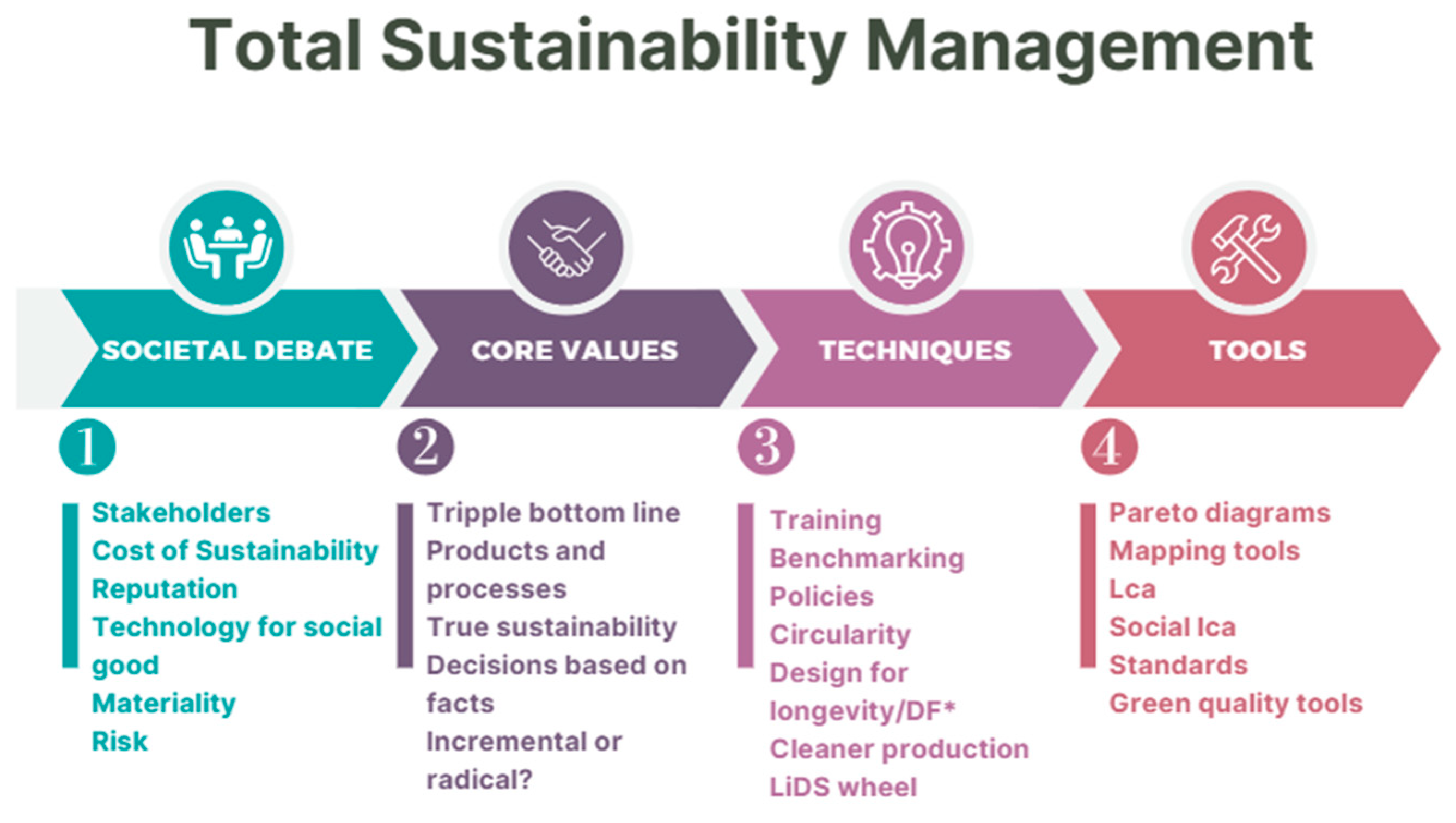
The Total Sustainability Management (TSM) framework depicted in Figure 1 represents a conceptual adaptation of the model introduced by Hellsten and Klefsjö [26], in which total quality management (TQM) was articulated through three core components: values, techniques, and tools. This updated framework integrates a fourth foundational element—societal debate—thereby extending the scope of TQM into the domain of sustainability and anchoring it more firmly in contemporary socio-environmental discourse. This extrapolation aligns conceptually with Tari’s [27] assertion that successful quality management must evolve to include emerging concerns and practices relevant to social and environmental contexts. This also aligns with broader debates in corporate social responsibility and stakeholder theory [31].
Figure 1.
Total Sustainability Management Framework.
The value chain format of the framework is used to organize sustainability management into four hierarchical and interrelated layers: Societal Debate, Core Values, Techniques, and Tools. It is only through the adequate alignment of the value chain model that value can be created. The social debate dimension is not strictly speaking a novel addition to Hellsten and Klefsjö’s framework model [26]. As their framework was designed after TQM became well established, the social debate about the value of TQM was largely over, whereas this debate is ongoing in the case of sustainability. Table 1 provides key examples of this debate in the academic literature.
Table 1.
Academic Evidence of Insufficient Investment in Sustainability.
The critical importance of this ongoing social debate is captured by Shevchenko et al. [12] decision analysis model, which shows that when deciding to invest in sustainability, managers face reputational risks if they do not become sustainable, on one hand, and the risk of undertaking innovative sustainable projects, on the other hand. As stakeholders do not put enough pressure on them for reputational risks to bear on the outcome of the decision, most firms engage in compensating actions (e.g., offsetting emissions). These compensating actions do not solve sustainability issues, but they are enough to manage reputation, and this, without incurring innovation risk. Leseure and Bennett [32] also criticize compensating actions by adapting accounting’s materiality principles to the domain of sustainability. They argue that too often, investments in sustainability that are broadly advertised only have minor impacts on environmental improvements, and that the more pressing environmental concerns remain ignored. Pagell and Shevchenko [11] argue that sustainability initiatives are constrained by what they call the primacy of profits. This results not only in managing reputation by investing in non-material impact projects, but also in only investing in “win-win” projects that enhance both profitability and the environment. This means that many other projects where there is a trade-off will never be considered for investment. The “primacy of profits” is a feature of what could be called “technology for private good”, i.e., investment in technology is only justified and feasible if it can result in the betterment of private parties’ wellbeing: utility for customers and profit for firms. This is why the framework in Figure 1 introduces Technology as Social Good [35] to stress that environmental or social harm should be accounted for, even if current accounting practices and legal directives do not warrant it.
The core value stage of Figure 1 extends the values dimension of Hellsten and Klefsjö [26]. It emphasizes foundational principles such as the triple bottom line [36], ethical decision-making, and invites managers to decide whether sustainability challenges should be addressed through incremental or radical innovation projects [11,24]. The inclusion of “decisions based on facts” continues with the data-driven ethos of TQM and is supported by Tari’s [27] emphasis on fact-based management and performance evaluation.
TQM is famous for its focus on process quality, which is the principle to focus on quality assurance rather than quality control, i.e., the idea that a good quality process always generates good quality products, meaning that quality in TQM refers to both process and product quality, as improving one impacts the other. A quality assurance analogy in the context of sustainability does not work, though, as if a process is sustainable, the product made from this process is not necessarily sustainable. For example, Ihlen [33] describes the concept of the sustainable oil industry as an oxymoron. Pagell and Shevchenko [11] criticize the view of lean processes being labelled as green when their products have significant negative environmental impacts. For this reason, Figure 1 stresses that sustainability management should include both product and process sustainability.
The technique stage follows the original “techniques” category in Hellsten and Klefsjö’s model and describes the systematic practices that translate values into action. It reuses the training, policy development, and benchmarking components from TQM. It also introduces techniques more specific to environmental performance, such as circularity [37], cleaner production [38], and design for longevity [39]. The Df* notation is used in Figure 1 to include the broader family of design frameworks such as Design for Environment [40] and Design for Reuse [41]. Similarly, Brezet & van Hemel’s [42] lifecycle-thinking approach to design ideas (LiDS wheel) is included as it provides an exhaustive source of ideas to design products and processes in more sustainable ways.
The final stage corresponds directly to Hellsten and Klefsjö’s tools dimension and includes existing mapping and quality tools. For example, Leseure and Benett [32] rely extensively on one of the seven tools of quality, Pareto analysis, to assess when industrial practices are material, bearable, or a serious matter. The tools stage also includes sustainability-specific operative instruments such as LCA (life cycle assessment) [43], social LCA [44], and standards [45]. Although social LCA impact measures are less established than their environmental counterpart, they should be used to remain consistent with triple bottom line values.
In conclusion, most of the components of the Total Sustainability Framework shown in Figure 1 are known, and there are, therefore, no technical or organizational reasons why more sustainable practices could not be implemented today, aside from assessing what the practices are worth. This is why Figure 1 shows the cost of sustainability as a component of the social debate dimension. It is only by developing a cost of sustainability framework that a concerted approach to sustainability management akin to TQM can be achieved. The next section presents the cost of the sustainability model proposed in this paper.
3. Cost of Sustainability Framework
3.1. Framework Conceptual Specification
Cost of quality research has been performed by analyzing real-life businesses’ cost of quality reports compiled by cost accountants. Although firms do prepare sustainability reports, these reports do not translate impact into costs, as there are obvious theoretical and measurement challenges in doing so. Table 2 presents how the different components of the cost of quality (COQ) framework translate into the sustainability context.
Table 2.
Adaptation of Cost of Quality into Cost of Sustainability.
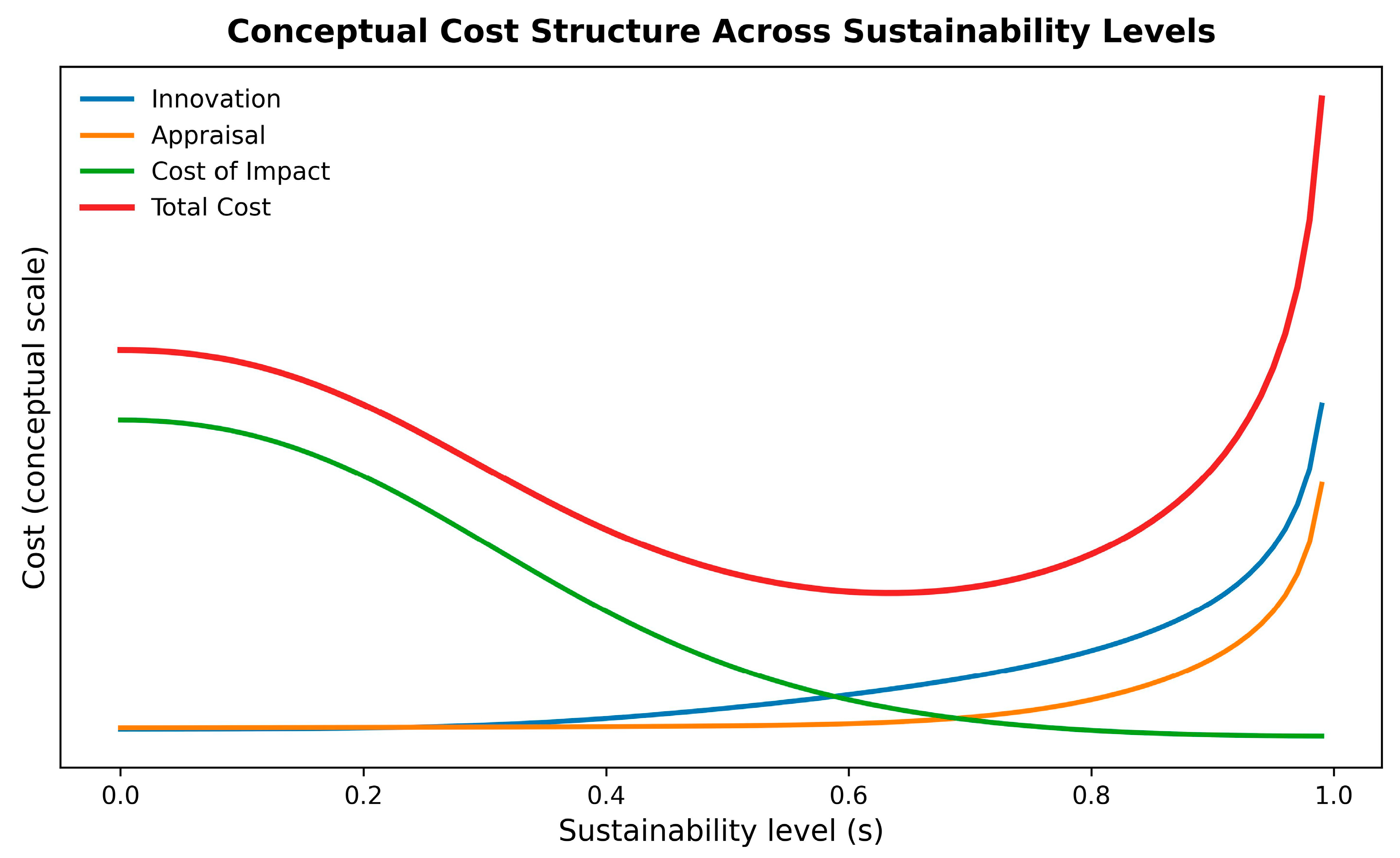
Figure 2 displays a conceptual illustration of the cost of sustainability (COS). The cost of sustainability borne by a firm is plotted against the sustainability level of the firm, measured by s. At the lowest possible level of sustainability (s = 0), a firm generates the full amount of environmental impact associated with its current operations. At the opposite extreme, a firm that eliminates its environmental impact entirely would represent the ideal of full sustainability (s = 1). Each year, managers receive data from environmental reporting and from internal cost accounting, and these two sources can be combined to produce a cost of sustainability report. The firm’s sustainability level can then be expressed as the proportion of impact that has been eliminated relative to the original baseline. In other words, the variable s reflects how far the firm has progressed on a linear scale from its starting point toward the ideal of zero impact. This is analogous to the cost of quality framework, where quality performance is expressed as the percentage of products that are defect-free. As in quality management, however, improvements do not occur at a constant rate: reducing environmental impact becomes progressively more difficult as firms approach higher levels of sustainability, meaning that cost behavior is non-linear. These conceptual properties form the basis of Figure 2, which is intended only as an illustrative extension of the well-known cost of quality model.
Figure 2.
Total cost of sustainability conceptual illustration.
Figure 2 inherits all the properties of the COQ model, as the total curve cost shows a minimum, which represents a firm’s optimal investment in sustainability.
3.2. Practical Use of the Framework
In practice, the model can be used as a cost monitoring tool or as a prospective tool. The prospective use of the model requires estimating the cost implied in Figure 2 for different levels of investment in prevention. This approach complements scenario analysis or technology roadmapping exercises seeking to plan long-term investments in sustainability. Even with access to primary data from a firm, the prospective use of the model remains an estimation problem, as it is about anticipating what the cost of a sustainability initiative could be and by how much it would reduce impact.
The monitoring use case of the cost of sustainability mirrors the original use of the cost of quality model. Instead of trying to prospectively estimate s*, managers want their internal cost systems to provide feedback about whether additional investments in sustainability are decreasing the total cost of sustainability. Each year, organizations can measure impact through their environmental reporting department and can deduct s from this value. The accounting department compiles incurred sustainability costs and observes cost evolution. This turns the model into a dynamic performance indicator.
When used either as a prospective or monitoring tool impact category, a single impact category, like Global Warming Potential, could be used. Alternatively, it can be applied to other LCA impact categories (e.g., eutrophication, particulate matter formation, resource depletion), to aggregated sustainability indices, or to strategic valuation models that monetize or weight impacts according to organizational priorities. When multiple categories are used, managers will have to decide whether per per-category cost of sustainability reporting is preferable to aggregate reporting. Aggregate reporting is more useful for strategic resource allocation, i.e., justifying high-level investment decisions. Aggregate reporting reflects the organization’s total burden, enables cross-impact comparability, and gives decision-makers a coherent view of long-term performance trajectories.
At an initiative level, project managers will prefer reporting in individual impact categories as category-specific cost curves are more actionable: they highlight the cost structure of specific improvement levers.
Importantly, the implementation logic of the COS model is grounded in the quality–sustainability analogy developed throughout the paper. The COS framework is designed to be implemented in a manner analogous to the historical implementation of cost of quality (COQ) reporting within Total Quality Management: by combining impact measurement systems with internal cost accounting to provide recurring managerial feedback. In this adaptation, the cost of quality failure is replaced by the cost of environmental or social impact. As was the case with early COQ reports, some components of these costs may be non-financial, difficult to measure, or based on estimates. Such challenges were common in the implementation of COQ and therefore do not constitute conceptual limitations specific to sustainability, but rather practical issues inherent to cost-based decision support frameworks.
3.3. Model Credibility
This section evaluates the cost-behavior logic implicit in Figure 2 against evidence from the sustainability literature, showing how the cost structures of quality and sustainability align in some respects yet differ in others. Figure 2 represents the standard textbook illustration of the COQ model. This canonical representation appears in introductory accounting and operations management textbooks [28].
In the sustainability literature, the analogue to prevention cost is investment in impact reduction, often expressed through a marginal abatement cost curve (MACC). MACCs are well-established tools used to rank emissions-reduction initiatives by unit abatement cost. Empirical MACC studies, e.g., sector-specific curves for shipping, agriculture and transport, consistently show the same qualitative structure suggested by Figure 2: (i) a region of relatively low-cost or even profitable initiatives, (ii) a rising section where more complex interventions become costlier, and (iii) a tail of very high-cost abatement technologies reflecting the increasing difficulty of eliminating residual emissions [46,47,48,49,50].
A limit to the quality-sustainability analogy is the negative abatement cost sections in MACCS. These negative abatement costs align with the “it pays to be green” literature [8,9,10]. These profitable initiatives imply a left-hand side dip below zero sometimes observed in empirical MACCs and would therefore imply the same in the blue curve in Figure 2.
Empirical evidence on the cost behavior of sustainability appraisal (i.e., monitoring, measurement, and reporting) is more limited. However, available industry surveys indicate that sustainability and ESG reporting impose substantial fixed costs, often exceeding $500,000 annually for large firms [51]. As reporting requirements expand (e.g., extended supply-chain disclosure, LCA incorporation, third-party assurance), costs increase nonlinearly [52,53]. This suggests a high baseline cost analogous to the fixed appraisal component in COQ, and increasing marginal cost as firms attempt to measure impacts with greater accuracy or scope, and a potential “tail” caused by methodological and data complexity, especially when approaching full-scope environmental and social accounting. While empirical quantification remains underdeveloped, the qualitative behavior implied by these sources is consistent with the function form for appraisal shown in Figure 2.
In the COQ model, failure costs decrease as quality improves. The sustainability analogue is the cost of impact, expressed as the monetized environmental or social harm. Unlike quality failures, where cost burdens fall predominantly on the firm, environmental impacts are externalities that typically fall on society. This is another key difference between quality and sustainability. Several established valuation systems exist (e.g., market carbon prices, social cost of carbon, government appraisal values), each allowing the cost of residual impact to be treated as a decreasing function of sustainability effort, directly analogous to the decreasing failure cost in Figure 2.
There are more differences between quality and sustainability when considering cost behavior. In quality management, defects are typically associated with the product, and failure costs relate directly to customer dissatisfaction or warranty claims. In sustainability, however, impacts arise from both the process and the product’s lack of sustainability. We define process sustainability as impacts measured from the cradle to gate stages of a lifecycle analysis, and product sustainability as impacts incurred after the firm’s gate up to the product’s grave, unless other end-of-life options are possible. The sustainability literature emphasizes this distinction through life cycle assessment (LCA) frameworks [43], where upstream and downstream impacts can differ dramatically in magnitude and cost structure. This implies that COS reporting requires two curves or two reports: (i) a cost function for process sustainability, based on cradle-to-gate impacts, and (ii) a cost function for product sustainability, based on use-phase and end-of-life impacts. Each curve has different innovation opportunities, different MACC structures, and different appraisal challenges. Process and product sustainability are interdependent, i.e., one investment in one dimension may have an impact on the other. Investments in process sustainability are motivated either directly by sustainability concerns as a strategic priority or by reputation concerns or stakeholder pressures [12].
Another fundamental difference is the existence of environmental offsets. A firm can compensate for process or product emissions by purchasing offsets, but there is no equivalent mechanism for “offsetting” product defects. The sustainability literature has criticized offsets for enabling compensating behavior that avoids substantive innovation [12], a concern directly relevant to modelling total sustainability costs. Offsets affect the interpretation of reported sustainability levels (s), the separation between physical impact reduction and financial compensation, and the shape of the total-cost curve itself (potentially enabling low apparent cost for high apparent sustainability). Therefore, the model requires a distinction between actual sustainability effort (s-process, s-product) and an overall reported sustainability.
There is very limited empirical evidence for textbook COQ curves, but the results of sustainability economics, particularly MACCs, appraisal cost studies, and impact valuation methods, offer a more promising empirical foundation for the functional behaviors suggested in Figure 2. This reinforces the credibility of the proposed COS model. It also highlights several avenues for further modelling and empirical research, which are beyond the scope of this conceptual paper.
4. Discussion
The TSM framework is conceptually similar to the TQM framework of Hellsten and Klefsjö’s [26], as this paper proposes that the search for better quality is very similar to the search for sustainability in many respects. The purpose of this section is to discuss the implications of the quality-sustainability differences mentioned in the previous section.
4.1. Impact of Social Debate
A central proposition of this paper is that sustainability management, unlike quality management, cannot be understood solely through organizational systems, techniques, and tools. It is also shaped by an unresolved social debate about what sustainability means, who is responsible for achieving it, and how urgently action is required. This debate does not merely provide background context; it actively conditions managerial decisions in ways fundamentally different from the historical development of quality management.
In the early days of TQM, disagreements about investing in quality were primarily technical or economic: firms questioned whether prevention activities would pay off, but there was broad consensus about what “quality” meant and why defects should be avoided. Over time, the cost of quality framework helped resolve these disagreements by providing evidence-based guidance on optimal investment levels. Once the economic logic was accepted, the debate faded, and quality management matured into a stable best practice.
Sustainability lacks this stabilizing foundation. Managers operate in an environment where competing narratives coexist: some view sustainability as a moral imperative grounded in planetary boundaries, others treat it as a reputational concern, and many see it as an economic risk to be minimized. These divergent positions reflect deep tensions highlighted in the sustainability literature—between harm reduction and harm elimination [11], between substantive and symbolic action [33], and between win–win thinking and trade-off thinking [23,24]. Because these tensions remain unresolved at the societal level, they influence how firms evaluate sustainability investments and how stakeholders evaluate firms.
This is why the incorporation of the “social debate” as a foundational layer in the TSM framework is needed. Unlike TQM, sustainability management cannot be reduced to a technical system of values, techniques, and tools. The legitimacy of managerial decisions depends on how firms navigate public expectations, stakeholder pressures, political discourse, scientific warnings, and conflicting interpretations of what constitutes sustainable practice. These societal narratives shape not only what firms do, but also how their actions are judged. The unresolved nature of this debate has a direct consequence: in the absence of a widely accepted definition of the optimal sustainability level (s*), firms face perpetual criticism. If s* remains conceptually undefined, the only position that is immune from critique is the unrealistic endpoint of s = 1, i.e., zero impact. Any intermediate position becomes contestable, and this perpetuates the ideological polarization seen in sustainability research and practice.
Recognizing the social debate explicitly therefore clarifies why firms diverge in their sustainability strategies and why many sustainability decisions cannot be justified solely through economic reasoning. Different organizations interpret the same information through different normative lenses, resulting in distinct corporate orientations toward sustainability. These orientations—ranging from ideological commitment to sustainability-first thinking to economically motivated win–win strategies—are not determined by technical constraints but by the interaction between managerial beliefs and societal expectations.
By acknowledging this foundational role of the social debate, the TSM framework provides a clearer explanation for why sustainability practice is heterogeneous and why conventional tools alone cannot resolve the tensions that managers face.
4.2. Impact of Core Values: Product or Process Sustainability?
A key feature of TQM is the interdependence between process quality and product quality, as it underpins the concept of quality assurance vs. quality control. By improving process quality, managers were also able to improve product conformance quality. A common textbook rule of thumb is that by investing $1 in prevention, firms would save $10 in inspection and $100 in failure costs. This relationship does not hold in the case of sustainability.
A common criticism of the lean and green literature is the example of a lean manufacturing system producing non-sustainable products (e.g., [11]). Managers considering the elaboration of a cost of sustainability report will accept that they should be accountable for process emissions, i.e., emissions typically described as scope 1 or scope 2 emissions. The willingness to include scope 3 emissions will be a matter for debate, especially when considering the broad range of activities classified in scope 3 emissions. These include, for example, indirect activities such as business travel, embedded emissions from the supply chain, but also downstream emissions, such as the emissions from the product in use.
Paradoxically, although the sustainability literature typically structures environmental responsibility around organizational accounting boundaries (namely, scopes 1, 2, and 3), the TSM/COS framework instead relies on life-cycle assessment (LCA) boundaries to distinguish between process and product sustainability. This departure is deliberate. The managerial question at the heart of COS reporting is how to allocate resources between improving the sustainability of internal processes and improving the sustainability of the product across its use and end-of-life phases. LCA boundaries reflect this strategic decision more directly than scope accounting does. Volvo’s 2023 impact assessment of the XC40 illustrates the point: the petrol model generates approximately 16 tons of CO2-eq during the cradle-to-gate (“process”) stage, compared with 42 tons during the use and end-of-life (“product”) stages [51]. Improving only the process stage would therefore address just 28% of the vehicle’s total life-cycle impact. For this reason, the decision to use the process–product distinction enables the COS model to circumvent the longstanding debate in the scope-based accounting literature about whether—and with what degree of completeness—scope 3 emissions should be included.
4.3. Impact of Core Values: Offsets
A further difference between the COQ and COS models concerns the role of environmental offsets. Offsetting introduces a gap between a firm’s actual environmental impact and the impact it reports, because some of the harm caused by its activities can be compensated for through external projects such as reforestation, renewable-energy schemes, or carbon-capture initiatives. In conceptual terms, a firm’s total impact consists of two sources: (1) the impact arising from its internal processes (the “process” dimension) and (2) the impact associated with its products during their use and end-of-life stages (the “product” dimension).
If the firm purchases no offsets, the impact it reports is simply the sum of these two components relative to their respective baselines. However, once the firm begins to purchase offsets, part of this combined impact is effectively neutralized. The reported figure, therefore, decreases even though the underlying physical impact may not have changed.
This creates an important distinction between actual sustainability performance—which depends on improvements in processes and products—and reported sustainability performance, which also depends on how extensively the organization makes use of offsets. A firm that invests heavily in offsets can appear more sustainable than one that focuses solely on reducing its own emissions, even if the latter is making more substantive long-term improvements.
In other words, offsets alter not only the numerical value used to communicate sustainability progress but also the interpretation of that value. They make it possible for firms to report a high level of sustainability even when their underlying systems and products still generate substantial impact. Understanding this distinction is essential for analyzing investment decisions and for assessing whether organizations are genuinely reducing their environmental burden or simply reallocating it through financial compensation mechanisms.
4.4. Impact of Core Values: Radical or Incremental Innovation
TQM’s implementation heavily relies on the continuous improvement of processes and product designs, as captured either by the cyclical concept of Kaizen or Deming’s PDCA cycle. In contrast, many authors in the sustainable operations literature have argued that incremental innovation is not enough for a firm to become truly sustainable (e.g., [11]). Others (e.g., [24]) criticize this position by arguing that radical innovation is too risky to implement and that there is merit in approaching sustainability through a probe and learn search process, as described in the behavioral theory of the firm [52,53]. The TSM framework can be used to take a position on this debate by returning to the results of Figure 2. A radical innovation project requires a leapfrog investment in the value of s. This means that managers would not be able to assess if they would leapfrog below or beyond the optimal level of investment in sustainability s*. A more incremental innovation approach allows for a more careful observation of cost behavior and therefore improves the ability to learn when the firm approaches s*.
4.5. Impact of Techniques: Circularity and Design for Longevity
In TQM, quality is traditionally defined as fitness for use, meaning that a product should be designed to meet customer expectations under normal conditions of utilization [54]. For example, if a car is sold with a three-year warranty, its design is expected to ensure that no warranty intervention will be required during that period. From this perspective, any design effort that exceeds the performance or durability required by the customer is considered over-engineering, and therefore an inefficient use of resources [55].
However, the sustainability debate complicates this classical interpretation. Because of (i) questions about responsibility allocation for environmental impacts and (ii) the distinction between process and product improvements discussed in Section 4.1 and Section 4.2, practices labelled as over-engineering in TQM may be regarded as best practice from a sustainability perspective. For instance, designing products for extended life, reparability, or circularity may appear economically inefficient in a narrow quality-management sense, but these designs are superior in sustainability terms.
The COS model can be tailored to assess product design decisions that incorporate longevity or circularity. Given the multiple pathways through which Design for Longevity or circularity influences sustainability-related costs, empirical applications using real-world data are essential for understanding the net cost implications. As with the original cost of quality framework, a hidden yet critical variable is the cost of lost sales associated with short-life versus long-life products. In practice, such market effects may dominate managerial decision-making, overshadowing increases or decreases in sustainability costs. Nevertheless, empirical applications of the COS model that explore these trade-offs represent a key avenue for future research.
It is important to note that to use the COS model to assess investment in Design for Longevity or circularity, the functional unit of the LCA used to measure impact must be changed. In the more general case, it is fine to use the product itself as the functional unit. If the accounting objective is to assess the value of longevity, the functional unit should be expressed in units of years of service or output [56,57,58,59,60] or in terms of the number of cycles [61,62,63].
4.6. A Typology of Corporate Sustainability Orientations
Corporate sustainability is not guided by a single, unified logic; rather, it is shaped by competing belief systems about what sustainability is for, what managers ought to prioritize, and how decisions should be justified. This plurality of viewpoints is precisely why the social debate layer in the TSM framework is foundational: unlike TQM—where consensus around the purpose of quality emerged relatively quickly—sustainability still lacks agreement on whether its objectives are primarily ethical, strategic, or economic. As shown in Section 4.1, Section 4.2, Section 4.3, Section 4.4 and Section 4.5, disagreements persist over the appropriate responsibility boundaries (scopes vs. lifecycle thinking), the legitimacy of offsets, the role of radical versus incremental innovation, and the choice of design principles such as circularity or longevity. These unresolved debates shape not only how firms measure sustainability but also how they assign responsibility and justify investment decisions.
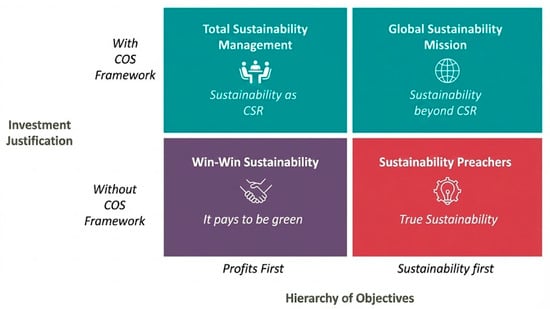
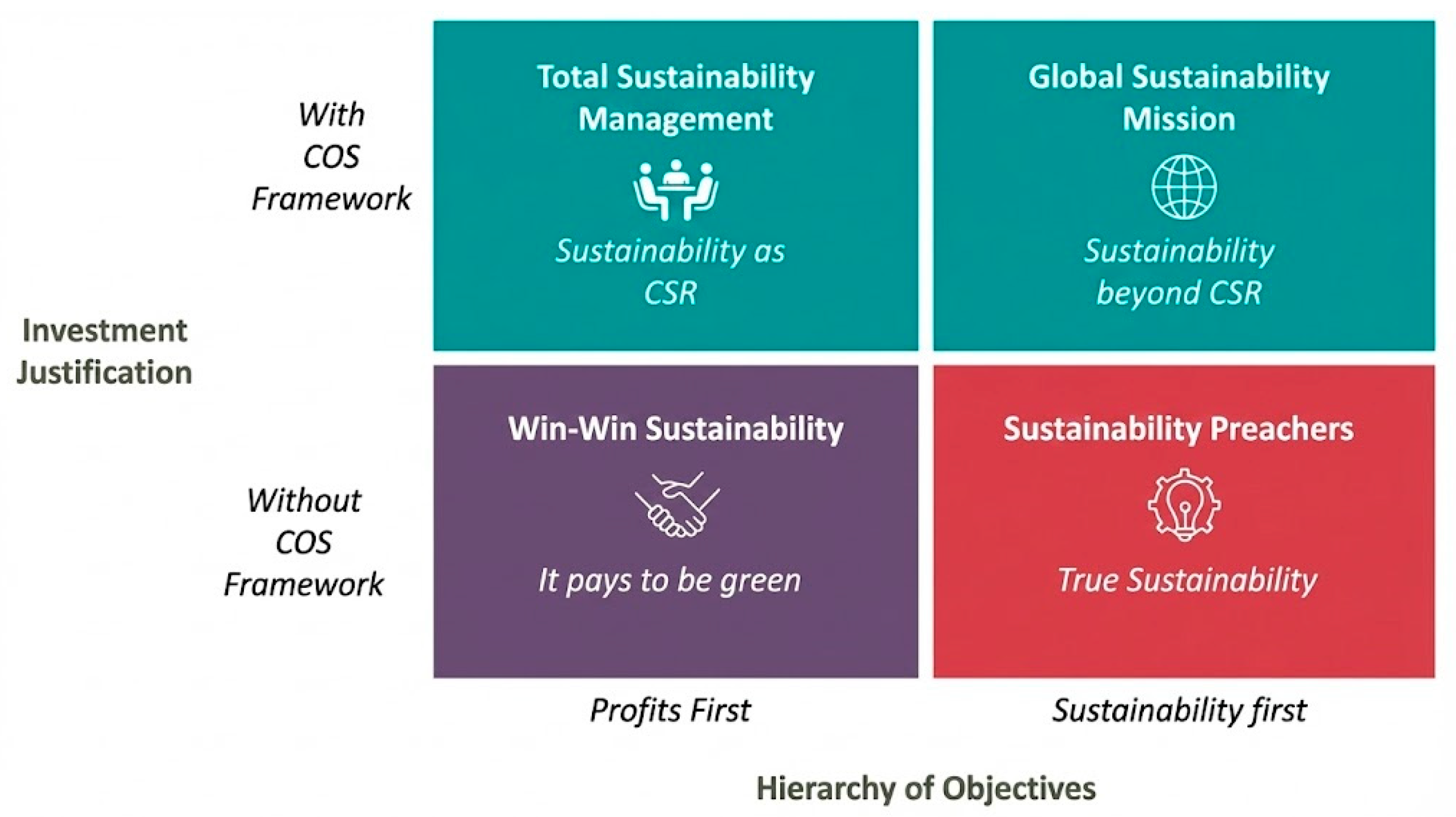
To make these tensions explicit, Figure 3 introduces a typology of corporate sustainability orientations. This typology maps the dominant logics shaping managerial and academic positions onto two core dimensions: the hierarchy of objectives (profits-first to sustainability-first) and the basis for justification (fact-based to ideology-based). By situating the TSM and COS frameworks within this broader landscape of competing perspectives, the typology clarifies how the proposed approach differs from existing orientations and why a structured, debate-aware framework is necessary for advancing sustainability practice.
Figure 3.
Typology of Corporate Sustainability Orientation.
Figure 3 is based on two scales that differentiate managerial or research orientations toward corporate sustainability. The first scale concerns the hierarchy of objectives, ranging from a profits-first position—where profitability is the superordinate goal and sustainability remains subordinate—to a sustainability-first position, in which sustainability objectives dominate and profit-making becomes a constraint to be respected rather than an end in itself. The profits-first position corresponds to the traditional shareholder view of the firm [31] and is criticized by Pagell and Shevchenko [11] as the “primacy of profits.” At the opposite end of the scale, sustainability-first positions argue for reversing this hierarchy so that sustainability becomes the guiding principle, much like the early 0-defect ideal in quality management, where quality goals were placed above all others.
The second scale represents how managers justify sustainability investments, and it ranges from fact-based justification to ideological justification. At one end, managers use a COS appraisal to evaluate initiatives empirically; at the other, decisions are made without such appraisal, relying instead on normative commitments or value-driven rationales.
The upper-left quadrant, “sustainability preachers”, combines a sustainability-first hierarchy with ideological justification. In this orientation, sustainability is viewed as intrinsically superordinate, and COS appraisals are unnecessary. The resulting logic resembles Matt Ridley’s notion of “ecology as religion” [64], in which sustainability becomes a belief system that transcends scientific or economic reasoning. The implicit objective is the pursuit of a new form of economic governance in which firms, supply chains, or entire sectors operate according to sustainability principles that override cost-based constraints. This position attempts to step outside the pragmatic boundaries of operations management by framing managers as moral agents acting for the greater social and ecological good.
The “win–win” sustainability quadrant represents organizations that do not place sustainability above profits. Instead, sustainability initiatives are pursued only when they generate a positive financial return, such as when the marginal cost of carbon abatement is negative. Hahn et al. [23] criticize this stance as a diluted or “watered-down” form of sustainability, since environmentally beneficial projects that do not meet profitability thresholds are systematically excluded. In this quadrant, the guiding logic is that “it pays to be green,” and empirical research showing that sustainable practices can improve financial performance reinforces this orientation. Given the strength of this evidence base, it is likely that this quadrant captures the majority of contemporary firms, which adopt sustainability measures primarily when they align with economic incentives.
If firms adopt COS reporting, they can expand the range of sustainability initiatives under consideration beyond those that exhibit immediate financial payoffs. The COS framework allows managers to assess the trade-off between innovative investments and the reduction in the environmental or social impact, mirroring the logic of the traditional cost of quality model. As a result, the Total Sustainability Management (TSM) quadrant reflects an orientation in which profits remain the primary organizational objective, yet sustainability investments are optimized through systematic appraisal rather than ideology or a narrow cost-saving logic. In this quadrant, managers balance economic and sustainability considerations by using evidence-based COS analysis to identify the level of sustainability effort that delivers optimal total cost performance. This creates a position consistent with principles of corporate social responsibility (CSR) [65], in which firms operate within the constraints of market economies while using structured methods to integrate sustainability into decision-making.
In other words, the proposed TSM framework is grounded in the socio-economic context in which most firms operate: competitive market economies where the classical theory of the firm assumes profit maximization on the supply side and utility maximization on the demand side. This assumption is often criticized in the sustainability literature for constraining managerial action within conventional economic logics [36,66,67,68,69,70,71]. To acknowledge these critiques, the final quadrant, “global sustainability mission”, represents the possibility of organizations placing sustainability above profitability and using the COS framework not to maximize private outcomes, but to ensure the efficient allocation of resources in pursuit of broader societal or planetary objectives. This quadrant, therefore, accommodates worldviews that see firms as agents of systemic transformation rather than solely as market actors.
4.7. Evaluation of the Value and Contribution of the TSM/COS Framework
The analogy between quality management and sustainability management is conceptually compelling. As discussed in the previous sections, most of the techniques, metrics, and accounting constructs used within the TSM/COS framework already exist, albeit in fragmented form, across management accounting, sustainability assessment, and quality management. This observation raises the following question: if its constituent elements are largely established, what is the added value of the TSM/COS framework?
The contribution of the framework does not lie in the invention of novel tools, but in their systematic integration into a coherent decision logic that enables firms to compare heterogeneous sustainability investments under conditions of capital rationing. Much like early COQ models, TSM/COS provides a unifying structure that transforms dispersed measurements into a managerial framework for prioritization, trade-off analysis, and strategic positioning. This contribution is easier to illustrate through a notional investment decision faced by an automotive manufacturer evaluating the following three sustainability-related investment options:
- A solar photovoltaic installation on company-owned car parks, delivering an estimated carbon reduction of 2000 tons. According to [72], the mean greenhouse gas abatement cost of such projects is approximately −€1300 per ton, implying that the initiative generates a direct economic surplus.
- A power purchasing agreement (PPA) with a renewable electricity provider, yielding an estimated reduction of 100,000 tons of CO2 at a mean cost of approximately €200 per ton, thus representing a net cost to the firm [72].
- An increased investment promoting the sales of battery electric vehicle (BEV) technologies as opposed to internal combustion engine (ICE) technologies, targeting reductions in product use-phase emissions rather than process emissions.
Under capital constraints, the firm cannot pursue all options simultaneously. The investment decision, therefore, depends critically on the sustainability logic adopted by management, as represented by the firm’s position in Figure 3.
Firms operating within a “sustainability-first” or normative sustainability logic would, in principle, seek to invest in all available initiatives irrespective of their economic implications. While internally consistent, this position provides limited guidance in practice when resources are constrained. In such cases, profitability considerations and regulatory pressures inevitably dominate decision-making. Given current regulatory trajectories where BEVs are increasingly mandated this logic would likely result in prioritizing the solar PV installation and BEV promotion, while postponing higher-cost process-based initiatives such as the PPA. Alternatively, the firm could decide to stop making ICE to be consistent with its sustainability mission, ignoring the financial impact of this decision.
Firms aligned with a “win–win sustainability” perspective would adopt a more selective approach. They will invest in the solar PV installation as it provides both environmental and financial benefits but would reject the PPA on profitability grounds. Investments in BEV development would be undertaken cautiously and primarily where regulatory compliance or a demonstrable business case exists. This logic characterizes the dominant approach adopted by most firms today.
The distinctive contribution of the Total Sustainability Management (TSM) position lies in its ability to move beyond this “profits first” logic without ignoring their responsibilities to shareholders. At a minimum, if firms restrict their valuation of environmental impact to explicit carbon prices or pollution taxes, TSM would yield investment decisions similar to those of the win–win approach. However, TSM explicitly enables experimentation with broader formulations of the cost of impact. These may incorporate anticipated regulatory tightening, reputational effects, first-mover advantages, or monetized social costs of carbon. By allowing firms to explore how the cost of impact may evolve over time, TSM supports prospective rather than purely static decision-making.
This forward-looking capability helps explain why firms may rationally prioritize product-level innovation even when short-term abatement costs appear unfavorable. A well-known example is Toyota’s early introduction of the Prius hybrid in 1997. Despite uncertain demand and limited short-term profitability, the strategic investment positioned Toyota as the dominant hybrid manufacturer for over a decade, with the Prius remaining the market-leading hybrid model from 1997 to 2008. Such outcomes are difficult to explain within a narrow win–win logic but become justifiable within a TSM perspective that incorporates dynamic cost of impact trajectories and strategic option value.
As the distinction between the “win–win sustainability” and “total sustainability management” (TSM) positions rests on which impacts are considered and how they are valued, the Toyota Prius example can be further generalized by returning to the notional example above. Consider that the firm is selling 160,000 internal combustion engine (ICE) vehicles and 40,000 battery electric vehicles (BEVs) of a given model in a year. In the absence of a clearly profitable product innovation project aimed at reducing emissions, the firm operating under a win–win sustainability logic would typically allow expected market demand to determine the production mix for subsequent periods, except where regulatory constraints explicitly override market signals (e.g., bans on ICE vehicles).
In the absence of such regulatory pressure, sustainability efforts would therefore tend to focus on process-based green projects within the firm’s direct operational boundary. Using Volvo’s XC40 as an illustrative example [51], manufacturing emissions are 2.1 tons of CO2-equivalent per ICE vehicle and 1.4 tons per BEV. A TSM approach, however, extends the system boundary beyond direct operations by explicitly incorporating upstream supply-chain emissions associated with materials production and refining—14 tons for the ICE variant and 24 tons for the BEV variant. While this broader definition substantially increases the scope for impact reduction, it also implies that carbon reduction would require collaborative investment across the supply chain rather than isolated firm-level actions.
TSM further encourages the explicit evaluation of product use-phase impacts when compiling a COS assessment. This does not imply that firms accept formal responsibility for downstream emissions, but rather that they seek to compare the relative magnitude of process and product-related impacts within a single analytical framework. For the XC40, Volvo’s report [51] suggests use-phase emissions of approximately 41 tons of CO2-equivalent for the ICE variant, compared to 28 tons for the BEV when charged using a global average electricity mix, and as low as 0.4 tons when charged exclusively with wind-generated electricity.
At this stage, a firm may still conclude that such downstream impact reductions fall outside its immediate strategic remit. However, the TSM logic makes explicit that investments traditionally framed as process-level initiatives, such as a PPA covering on-site electricity consumption, will have a limited impact on reduction. Instead, a similar PPA will generate substantially greater societal impact if reconfigured as part of a broader business-model innovation. For example, the same renewable electricity could be leveraged through vertical integration or joint ventures in charging infrastructures. This would provide the firm with a new source of revenue as a green electricity retailer. It also shifts the carbon reduction efforts from marginal facility-level emissions (2.1 and 1.4 tons per vehicle) to the substantially larger emissions associated with vehicle use. This type of reframing is difficult to justify within a win–win sustainability logic but emerges naturally from the expanded system boundary and comparative valuation enabled by TSM.
Finally, the TSM position serves as a conceptual stepping stone toward a “global sustainability mission” orientation. Only by explicitly considering social-level costs of environmental impact can firms meaningfully assess whether existing regulations are proportionate, misaligned, or technologically suboptimal. In this quadrant, firms move beyond firm-level optimization and become active participants in industry platforms, standard-setting bodies, and collaborative R&D ecosystems. For example, rather than evaluating PPAs in isolation, firms may engage collectively in efforts to decarbonize electricity grids on a large scale. Importantly, decisions at this level remain grounded in structured cost-of-impact reasoning, rather than ideological commitments or ad hoc lobbying.
The value of the TSM/COS framework is not confined to the automotive context used above. A similar logic arises, for example, in manufacturing facilities evaluating energy-related decarbonization investments. Under a win–win sustainability logic, firms typically prioritize incremental efficiency measures—such as LED lighting, compressed air optimization, or building energy management systems that deliver rapid payback and low or negative abatement costs. By contrast, deeper structural interventions, such as full electrification of process heat or the replacement of fossil-fuel-based furnaces with low-carbon alternatives, are frequently deferred due to their high upfront cost and uncertain short-term returns. A TSM perspective allows these structurally different investments to be evaluated on a comparable basis by incorporating anticipated carbon price trajectories, regulatory risk, and long-term lock-in effects into the cost-of-impact formulation. As in classical cost-of-quality models, the framework highlights how persistent reliance on low-cost “appraisal-type” improvements can delay more fundamental “prevention-by-design” solutions, even when the latter dominate from a lifecycle or social cost perspective. This type of cross-category comparison is largely inaccessible within a win–win sustainability logic but is central to the decision rationale enabled by TSM.
5. Conclusions
As with other best practices, one of the major challenges faced by managers considering investments in sustainability is whether these investments should be motivated by economic fundamentals or by ideology. At the time of writing this paper, the ideological case for sustainability is strong and growing, although reaching a consensus is a challenge, as different perceptions of the criticality of sustainability exist. Limited improvements in sustainability indicators suggest that the economic fundamentals are not present. This results in many superficial investments in sustainability to maintain a suitable reputation profile, but critical sustainability issues remain unaddressed. References to “true sustainability”, a concept akin to 0-defects in quality management, reinforce the idea that many academics have been promoting investments in sustainability from an ideological viewpoint.
This situation is history repeating itself, as the decision to invest in quality management was once a contentious issue. Quality management is remarkable in that it has escaped this contention by preferring facts and evidence over ideology, and the cost of quality report was key to guiding investors towards the right amount of investment into quality management systems. In this paper, everything that was learned during the historical refinement of Total Quality Management as a best practice has been translated and customized to the context of investing in sustainability initiatives. More research into compiling the cost of sustainability reports will contribute to more realistic and evidence-based guidelines for managers about the right investments to commit to sustainability within the broader context in which they operate.
The value of the proposed TSM/COS framework is not in the novelty of its individual components, which are already in use, but in its ability to integrate these components into a coherent managerial logic that enables comparison, prioritization, and strategic foresight across fundamentally different sustainability investments.
Funding
This research received no external funding.
Institutional Review Board Statement
Not applicable.
Informed Consent Statement
Not applicable.
Data Availability Statement
The original contributions presented in this study are included in the article. Further inquiries can be directed to the corresponding author.
Conflicts of Interest
The author declares no conflicts of interest.
Abbreviations
The following abbreviations are used in this manuscript:
| BEV | Battery Electrical Vehicle |
| COQ | Cost of quality |
| COS | Cost of Sustainability |
| CSR | Corporate Social Responsibility |
| Df* | Design for X |
| DfL | Design for Longevity |
| ESG | Environmental, Social, and Governance |
| GHG | Greenhouse Gas |
| GWP | Global Warming Potential |
| ICE | Internal Combustion Engine |
| LiDS | Lifecyle Design Strategies |
| TQM | Total Quality Management |
| TSM | Total Sustainability Management |
References
- Leseure, M.; Bauer, J.; Birdi, K.; Neely, A.; Denyer, D. Adoption of promising practices: A systematic review of the evidence. Int. J. Manag. Rev. 2005, 5–6, 169–190. [Google Scholar] [CrossRef] [Scilit]
- Shapiro, E.C. Fad Surfing in the Boardroom: Reclaiming the Courage to Manage in the Age of Instant Answers; Perseus Publishing: Cambridge, MA, USA, 1996. [Google Scholar]
- Broustail, J.; Greggio, R. Citroën: Essai sur 80 Ans d’Antistratégie; Vuibert: Paris, France, 2000. [Google Scholar]
- Shiomi, H.; Wada, K. (Eds.) Fordism Transformed: The Development of Production Methods in the Automobile Industry; Oxford University Press: Oxford, UK; New York, NY, USA, 1995. [Google Scholar]
- Forster, P.M.; Smith, C.; Walsh, T.; Lamb, W.F.; Lamboll, R.; Hall, B.; Hauser, M.; Ribes, A.; Rosen, D.; Gillett, N.P.; et al. Indicators of global climate change 2023. Earth Syst. Sci. Data 2024, 16, 2625–2658. [Google Scholar] [CrossRef] [Scilit]
- Richardson, K.; Steffen, W.; Lucht, W.; Bendtsen, J.; Cornell, S.E.; Donges, J.F.; Drüke, M.; Fetzer, I.; Bala, G.; von Bloh, W.; et al. Earth beyond six of nine planetary boundaries. Sci. Adv. 2023, 9, 2458. [Google Scholar] [CrossRef] [Scilit]
- Brand, B.M.; Rausch, T.M.; Brandel, J. The importance of sustainability aspects when purchasing online. Sustainability 2022, 14, 5689. [Google Scholar] [CrossRef] [Scilit]
- Golicic, S.; Smith, C.D. A meta-analysis of environmentally sustainable supply chain management practices and firm performance. J. Supply Chain Manag. 2013, 49, 78–95. [Google Scholar] [CrossRef] [Scilit]
- Aragón-Correa, J.A.; Rubio-López, E.A. Proactive corporate environmental strategies: Myths and misunderstandings. Long Range Plan. 2007, 40, 357–381. [Google Scholar] [CrossRef] [Scilit]
- Du, W.; Pan, S.L.; Zuo, M. How to balance sustainability and profitability in technology organizations: An ambidextrous perspective. IEEE Trans. Eng. Manag. 2013, 60, 366–385. [Google Scholar] [CrossRef] [Scilit]
- Pagell, M.; Shevchenko, A. Why research in sustainable supply chain management should have no future. J. Supply Chain Manag. 2014, 50, 44–55. [Google Scholar] [CrossRef] [Scilit]
- Shevchenko, A.; Lévesque, M.; Pagell, M. Why firms delay reaching true sustainability. J. Manag. Stud. 2016, 53, 911–935. [Google Scholar] [CrossRef] [Scilit]
- Gray, R. Is accounting for sustainability actually accounting for sustainability...and how would we know? Account. Organ. Soc. 2010, 35, 47–62. [Google Scholar] [CrossRef] [Scilit]
- Crosby, P.B. Quality Is Free: The Art of Making Quality Certain; McGraw-Hill: New York, NY, USA, 1979. [Google Scholar]
- Stevens, T. Philip Crosby: Quality is still free. Industry Week, 20 June 1995. [Google Scholar]
- Eberts, R.E.; Eberts, C. The Myths of Japanese Quality; Prentice Hall: Upper Saddle River, NJ, USA, 1995. [Google Scholar]
- Tuckman, A. The Yellow Brick Road: Total Quality Management and the restructuring of organizational culture. Organ. Stud. 1994, 15, 727–751. [Google Scholar] [CrossRef] [Scilit]
- Majumdar, J.P.; Manohar, B.M. Why Indian Manufacturing SMEs are still reluctant in adopting Total Quality Management. Int. J. Prod. Qual. Manag. 2016, 17, 16–35. [Google Scholar] [CrossRef] [Scilit]
- Neergard, P. Configurations in quality management. Scand. J. Manag. 2002, 18, 173–195. [Google Scholar] [CrossRef] [Scilit]
- Yunis, M.; Jung, J.; Chen, S. TQM, strategy, and performance: A firm-level analysis. Int. J. Qual. Reliab. Manag. 2013, 30, 690–714. [Google Scholar] [CrossRef] [Scilit]
- Zatzick, C.D.; Moliterno, T.P.; Fang, T. Strategic (mis)fit: The implementation of TQM in manufacturing organizations. Strateg. Manag. J. 2012, 33, 1321–1330. [Google Scholar] [CrossRef] [Scilit]
- Elemure, I.; Dhakal, H.N.; Leseure, M.; Radulovic, J. Integration of lean green and sustainability in manufacturing: A review. Sustainability 2023, 15, 10261. [Google Scholar] [CrossRef] [Scilit]
- Hahn, T.; Figge, F.; Pinkse, J.; Preuss, L. Trade-offs in corporate sustainability: You can’t have your cake and eat it. Bus. Strategy Environ. 2010, 19, 217–229. [Google Scholar]
- Leseure, M. Sustainability Performance Frontiers. Univ. J. Oper. Manag. 2023, 2, 16–30. [Google Scholar] [CrossRef] [Scilit]
- Ofori, D.; Agyapong, G.K.Q.; Buer, S.B. Exploring the necessity of TQM practices for enhancing sustainability performance. J. Manuf. Technol. Manag. 2025, 1–23. [Google Scholar] [CrossRef] [Scilit]
- Hellsten, U.; Klefsjö, B. TQM as a management system. TQM J. 2000, 12, 238–244. [Google Scholar] [CrossRef] [Scilit]
- Tari, J.J. Components of successful total quality management. TQM Mag. 2005, 17, 182–194. [Google Scholar] [CrossRef] [Scilit]
- Horngren, C.T.; Datar, S.K.; Rajan, M.V. Cost Accounting: A Managerial Emphasis; Pearson: Harlow, UK, 2012. [Google Scholar]
- Schiffauerova, A.; Thomson, V. A review of research on cost of quality models and best practices. Int. J. Qual. Reliab. Manag. 2006, 23, 647–669. [Google Scholar] [CrossRef] [Scilit]
- Sandoval-Chavez, D.A.; Beruvides, M.G. Using opportunity costs to determine the cost of quality. Eng. Econ. 1998, 43, 107–124. [Google Scholar] [CrossRef] [Scilit]
- Freeman, R.E. Strategic Management: A Stakeholder Approach; Pitman: Boston, MA, USA, 1984. [Google Scholar]
- Leseure, M.; Bennett, D. Adopting the materiality principle in sustainable operations. Sustainability 2024, 16, 6572. [Google Scholar] [CrossRef] [Scilit]
- Ihlen, Ø. The oxymoron of ‘sustainable oil production’. Bus. Strategy Environ. 2009, 18, 53–63. [Google Scholar] [CrossRef] [Scilit]
- van Wassenhove, L.N. Sustainable innovation: Pushing the boundaries of traditional operations management. Prod. Oper. Manag. 2019, 28, 2930–2945. [Google Scholar] [CrossRef] [Scilit]
- Zhou, Q.; Yu, H.; Chen, M.; Snell, M.; Adams, K. Managing technological innovation for social good. Strateg. Change 2025, 2651. [Google Scholar] [CrossRef] [Scilit]
- Elkington, J. Cannibals with Forks: The Triple Bottom Line of 21st Century Business; Capstone: Oxford, UK, 1997. [Google Scholar]
- Ghisellini, P.; Cialini, C.; Ulgiati, S. A review on circular economy. J. Clean. Prod. 2016, 114, 11–32. [Google Scholar] [CrossRef] [Scilit]
- UNEP. Working Group on Cleaner Production—First Meeting Report; UNEP Industry and Environment Office: Paris, France, 1989. [Google Scholar]
- Carlsson, S.; Mallalieu, A.; Almefelt, L.; Malmqvist, J. Design for longevity. In Proceedings of the 23rd International Conference on Engineering Design (ICED21), Gothenburg, Sweden, 16–20 August 2021. [Google Scholar]
- Fiksel, J. Design for Environment: Creating Eco-efficient Products and Processes; McGraw-Hill: New York, NY, USA, 1996. [Google Scholar]
- Meehan, J.S.; Duffy, A.H.B.; Whitfield, R.I. Supporting ‘Design for Reuse’ with Modular Design. Concurr. Eng. Res. Appl. 2007, 15, 141–155. [Google Scholar] [CrossRef] [Scilit]
- Brezet, H.; van Hemel, C. Ecodesign: A Promising Approach to Sustainable Production and Consumption; UNEP: Nairobi, Kenya, 1997. [Google Scholar]
- ISO 14040; Environmental Management—Life Cycle Assessment—Principles and Framework. ISO: Geneva, Switzerland, 2006.
- UNEP/SETAC. Guidelines for Social Life Cycle Assessment of Products; UNEP: Nairobi, Kenya, 2009. [Google Scholar]
- ISO 14001:2015; Environmental Management Systems—Requirements with Guidance for Use. ISO: Geneva, Switzerland, 2015.
- Faber, J.; Markowska, A.; Nelissen, D.; Davidson, M.; Eyring, V. A Global Maritime Energy Efficiency Study; CE Delft: Delft, The Netherlands, 2011. [Google Scholar]
- UNFCCC. Technical Workshop on the Global Stocktake: Synthesis Report; Subsidiary Body for Scientific and Technological Advice (SBSTA); United Nations Framework Convention on Climate Change: Bonn, Germany, 2023. [Google Scholar]
- Department for Environment, Food and Rural Affairs (Defra). UK Marginal Abatement Cost Curves for Agriculture and Land Use, Land Use Change and Forestry; Report to the Committee on Climate Change; Defra: London, UK, 2008. [Google Scholar]
- World Bank. Understanding Marginal Abatement Cost Curves; World Bank Group: Washington, DC, USA, 2014. [Google Scholar]
- Baker, E.; Khatami, S. Estimating the Levelized Cost of Carbon. Energy Policy 2019, 134, 110955. [Google Scholar]
- Volvo Cars. Carbon Footprint Report—Battery Electric XC40 Recharge and the XC40 ICE; Volvo Car Corporation: Göteborg, Sweden, 2020; Available online: https://www.volvocars.com/assets/volvocm/globalpages/live/6D8F58D5DC1E4E288A35DBA2647CC28F/volvo_carbonfootprintreport_ex40.pdf (accessed on 28 November 2025).
- Cyert, R.M.; March, J.G. Behavioral Theory of the Firm, 2nd ed.; Wiley-Blackwell: Hoboken, NJ, USA, 1992. [Google Scholar]
- Lynn, G.S.; Morone, J.G.; Paulson, A.S. Marketing and discontinuous innovation: The probe and learn process. Calif. Manag. Rev. 1996, 38, 8–37. [Google Scholar] [CrossRef] [Scilit]
- Juran, J.M. Juran’s Quality Handbook; McGraw-Hill: New York, NY, USA, 1999. [Google Scholar]
- Taguchi, G.; Chowdhury, S.; Wu, Y. Taguchi’s Quality Engineering Handbook; Wiley: Hoboken, NJ, USA, 2005. [Google Scholar]
- Jérôme, A.; Ljunggren, M. Product lifetime in life cycle assessments of circular economy. Int. J. Life Cycle Assess. 2025, 30, 2162–2189. [Google Scholar] [CrossRef] [Scilit]
- Furberg, A.; Baumann, H.; Rex, E. A practice-based framework for defining functional units. J. Ind. Ecol. 2022, 26, 1815–1830. [Google Scholar] [CrossRef] [Scilit]
- Kaddoura, M.; Tillman, A.-M.; Kambanou, M.L.; Sakao, T. Is Prolonging the Lifetime of Passive Durable Products a Low-Hanging Fruit of a Circular Economy? A multiple case study. Sustainability 2019, 11, 4819. [Google Scholar] [CrossRef] [Scilit]
- Tecchio, P.; Ardente, F.; Mathieux, F. Environmental impacts of durability for washing machines. Resour. Conserv. Recycl. 2017, 122, 131–144. [Google Scholar]
- Sández, J.; Arvidsson, R.; Sandin, G. Repair or replace? Assessing environmental consequences of extended lifetime for kettles. Int. J. Life Cycle Assess. 2024, 29, 885–899. [Google Scholar]
- Caraceni, A. Functional unit definition in a circular economy perspective. Resour. Conserv. Recycl. 2024, 205, 107457. [Google Scholar]
- van Stijn, A.; van der Harst, E.; van der Voet, E. A CE-LCA framework integrating circularity metrics. Resour. Conserv. Recycl. 2021, 170, 105619. [Google Scholar]
- Zubas, A.R.; Fischer, M.; Gervais, E.; Herceg, S.; Nold, S. Combining circularity and environmental metrics to assess material flows of PV silicon. EPJ Photovolt. 2023, 14, 10. [Google Scholar] [CrossRef] [Scilit]
- Ridley, M. The Origins of Virtue: Human Instincts and the Evolution of Cooperation; Penguin Books: London, UK, 1996. [Google Scholar]
- Carroll, A.B. The Pyramid of Corporate Social Responsibility: Toward the Moral Management of Organizational Stakeholders. Bus. Horiz. 1991, 34, 39–48. [Google Scholar] [CrossRef] [Scilit]
- Hoffman, A.J. The Next Phase of Business Sustainability; Stanford Social Innovation Review: Stanford, CA, USA, 2018. [Google Scholar]
- Hahn, T.; Pinkse, J.; Preuss, L.; Figge, F. Tensions in corporate sustainability: Towards an integrative framework. J. Bus. Ethics 2015, 127, 297–316. [Google Scholar] [CrossRef] [Scilit]
- Banerjee, S.B. Who sustains whose development? Sustainable development and the reinvention of nature. Organ. Stud. 2003, 24, 143–180. [Google Scholar] [CrossRef] [Scilit]
- Bansal, P.; Song, H.C. Similar but not the same: Differentiating corporate sustainability from corporate responsibility. Acad. Manag. Ann. 2017, 11, 105–149. [Google Scholar] [CrossRef] [Scilit]
- Starik, M.; Kanashiro, P. Toward a theory of sustainability management: Uncovering and integrating the nearly obvious. Organ. Environ. 2013, 26, 7–30. [Google Scholar] [CrossRef] [Scilit]
- Felber, C. Change Everything: Creating an Economy for the Common Good; Zed Books: London, UK, 2012. [Google Scholar]
- Hechelmann, R.-H.; Paris, A.; Buchenau, N.; Ebersold, F. Decarbonisation Strategies for Manufacturing: A Technical and Economic Comparison. Renew. Sustain. Energy Rev. 2023, 188, 113797. [Google Scholar] [CrossRef] [Scilit]

Disclaimer/Publisher’s Note: The statements, opinions and data contained in all publications are solely those of the individual author(s) and contributor(s) and not of MDPI and/or the editor(s). MDPI and/or the editor(s) disclaim responsibility for any injury to people or property resulting from any ideas, methods, instructions or products referred to in the content. |
© 2025 by the author. Licensee MDPI, Basel, Switzerland. This article is an open access article distributed under the terms and conditions of the Creative Commons Attribution (CC BY) license.