Innovative Preservation Technologies and Supply Chain Optimization for Reducing Meat Loss and Waste: Current Advances, Challenges, and Future Perspectives




Abstract
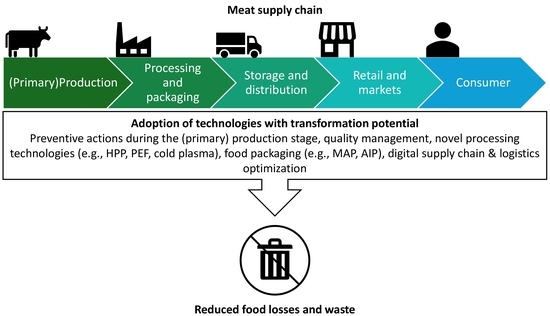
1. Introduction
1.1. The Vulnerability of the Meat Industry
1.2. Drivers of Meat Loss and Waste Across Economies
1.3. Understanding FLW Through the Food Waste Hierarchy
1.4. Integrating Preservation Technologies to Reduce Meat Losses and Waste
2. Research Methodology
- Research Design and Scope: Two core thematic areas guided the design and scope of this review. The first focused on advanced production, processing, and storage technologies applied to meat and meat products, including primary production, thermal, non-thermal and packaging innovations. The second addressed interventions related to supply chain and logistics optimization strategies aimed at reducing meat losses from farm to fork. To capture the most recent research progress and development trends, this review included journal articles, book chapters, institutional reports, and grey literature published between 2015 and 2025. To ensure global relevance, this review covered studies from high-, middle-, and low-income countries [30].
- Data Sources and Search Strategy: Major scientific databases, including Scopus, Web of Science, ScienceDirect, PubMed, and Google Scholar, were searched systematically. A combination of keywords and Boolean operators was applied to identify relevant studies, such as “primary meat production challenges”, “meat waste prevention”, “meat waste valorization”, “meat preservation technologies”, “food supply chain optimization”, “smart packaging”, “non-thermal storage”, and “food loss reduction logistics” [50].
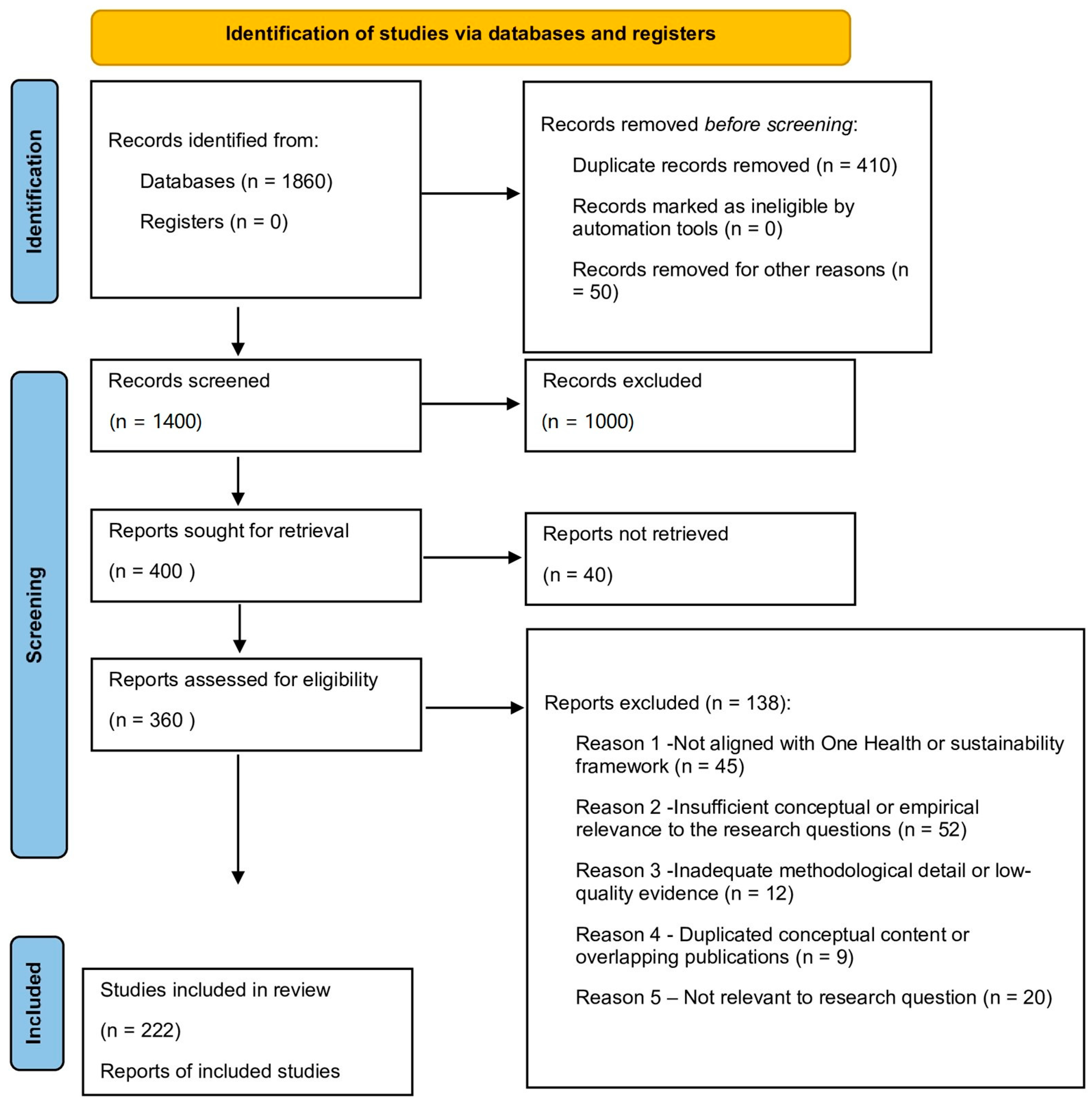
- Screening and Inclusion Criteria: Titles and abstracts were first screened for relevance using a reference management program. Articles were included if they (a) presented primary or secondary research on meat production, preservation, valorization, or supply chain optimization, (b) reported results on meat loss or reduction waste, (c) provided multidisciplinary insights on technological feasibility, economic sustainability or environmental impacts, and (d) were published in English. Exclusion criteria applied to studies focused on plant-based foods or those lacking empirical or theoretical foundations. After reviewing the full text, articles that met the inclusion criteria were analyzed in depth [51]. The PRISMA flow diagram presents a clear, stepwise account of this review’s study-selection process, moving from identification to inclusion. It visually maps records identified through database and other searches, records after duplicate removal, the number screened and excluded at title/abstract stage (with reasons), full-text articles assessed for eligibility, full-text exclusions (with reasons), and the final number of studies included in qualitative and/or quantitative synthesis. The diagram enhances transparency and reproducibility by summarizing how search yields were narrowed to the studies used in this review and by documenting exclusion rationales and attrition at each stage (Figure 1).
- Data Extraction and Thematic Analysis: A standardized approach was applied to extract data from each article, including publication year, research focus, type of meat product, technology or methodology, supply chain stage, and main findings. Thematic analysis followed Braun and Clarke’s (2019) guidelines [52] allowing for comparative insights across technologies, regions, and stages of the value chain.
- Quality Assessment: The methodological quality of the included studies was assessed using the Critical Appraisal Skills Program (CASP) checklist [53] focusing on their relevance to meat loss, waste reduction, and valorization. Studies were categorized as high, moderate, or low quality, and those with insufficient methodological rigor were excluded from the synthesis. Synthesis and Reporting: Findings were synthesized narratively, with emphasis on evidence-based results, replicable methodologies, technological challenges, research gaps, and interdisciplinary approaches to meat production, preservation, and supply chain management. This integrative approach enabled the identification of best practices and future perspectives to support comprehensive and sustainable solutions [50]. The methodology of this review is grounded in a systematic and comprehensive approach aligned with established protocols for narrative systematic reviews, with full transparency and reproducibility ensured. The revised methodology explicitly reports the complete Boolean search strings applied across all databases, the number of records retrieved from each source, and a PRISMA 2020–compliant flow diagram that clearly documents the identification, screening, eligibility, and final inclusion of studies, thereby demonstrating search completeness and saturation. The temporal scope is now clearly defined and justified: The primary analytical focus covers the period 2015–2025 to capture recent advances in preservation technologies and supply chain digitalization, while seminal pre-2015 studies are purposefully included to provide essential conceptual and technological context for established meat processing and preservation practices.
3. Extent and Relevance of Meat Losses and Waste
3.1. Global Significance of Meat Losses and Waste
3.2. Extent of Losses Across the Supply Chain
- Production and slaughterhouses: Carcass rejection due to sanitary issues, anatomical defects, or processing inefficiencies can result in losses of 2–5% at the slaughter stage [56]. In developing countries, limited access to adequate slaughter facilities exacerbates these problems.
- Processing and logistics: Maintaining the cold chain is a major determinant of meat quality [57]. Interruptions during storage or transport create opportunities for microbial growth and spoilage, leading to economic downgrading or outright rejection of products.
- Retail stage: Overstocking, inaccurate demand forecasting, and rigid product presentation standards are common drivers of loss. For example, meat approaching its expiration date is frequently discarded despite being safe for consumption [58].
- Consumers: In high-income countries, households are the single largest contributors to meat waste, primarily due to over-purchasing, inadequate storage, and misunderstanding of “best before” versus “use by” labels [59]. In contrast, in low- and middle-income countries, infrastructural deficits such as unreliable refrigeration, weak transport logistics, and limited cold storage capacity dominate upstream losses [60]. Regional comparisons illustrate these differences clearly. In sub-Saharan Africa, up to 15% of meat losses occur before products reach markets, whereas in Europe and North America, over 50% of total meat waste occurs at the retail and household levels [55]. This distinction highlights the need for tailored solutions sensitive to local conditions.
3.3. Mass Balance Perspective
- Beef: On average, only 60–70% of a carcass is converted into prime meat cuts [64]. The remainder includes hides, bones, fat, blood, and offal. While some these by-products are processed into secondary products, others remain underused or discarded.
- Pork: Utilization rates are typically higher (75–80%), due to broader acceptance of processed cuts and by-products in many culinary traditions [65].
- Poultry: Carcass yields hover around 70%, with feathers, viscera, and bones. Often a practical example is the breakdown of a 600 kg beef carcass: Roughly 370 kg is transformed into edible cuts, while about 230 kg consists of materials that, if not valorized, represent both economic loss and environmental burden [66]. From this perspective, meat loss is not only visible spoilage but also insufficient valorization of non-prime fractions.
3.4. Sustainability Implications and LCA Evidence
- The environmental consequences of meat loss and waste are among the most severe in the food sector. Life cycle assessment (LCA) consistently demonstrates that meat—particularly beef—has one of the highest carbon footprints per kilogram of edible product [67].
- Carbon footprint: Wasted beef generates approximately 27 kg CO2-eq per kilogram of discarded product, compared with 7–12 kg for pork and 5–6 kg for poultry [68].
- Water footprint: Producing 1 kg of beef may require up to 15,000 L of water (including virtual water for feed crops). The loss of such products therefore represents a substantial inefficiency in freshwater use [69].
- Energy footprint: Case studies from Germany report that discarding one ton of pork sausages at the retail stage results in more than 6 MWh of embodied energy loss, excluding additional emissions associated to packaging and refrigeration [70].
3.5. Critical Action Points and Optimization Potential
3.6. Visualization and Communication Strategies
4. Technologies with Transformation Potential
4.1. Measures to Prevent Food Losses and Waste During the Production Stage
4.2. Measures to Prevent Food Losses and Waste During the Food Processing
Overview of Traditional and Emerging Processing and Preservation Methods
- Rendering and waste transformation
- Circular economy and bioconversion
- Sustainable pig farming practices
- Livestock diversity, feed optimization and manure management
- Awareness and behavioral change
- Environmental impact of meat waste and waste reduction frameworks
- Green technologies for waste valorization
- Life cycle assessment and policy alignment
- Farm-to-Fork and life cycle approaches
4.3. Food Packaging
Identification and Assessment of Sustainable Packaging
5. Supply Chain Optimization
6. Conclusions
Author Contributions
Funding
Institutional Review Board Statement
Informed Consent Statement
Data Availability Statement
Acknowledgments
Conflicts of Interest
References
- FAO. The State of Food and Agriculture. In Moving Forward on Food Loss and Waste Reduction; Food and Agriculture Organization of the United Nations: Rome, Italy, 2019. [Google Scholar]
- Mezgebe, T.T.; Alemu, M. Climate change and food security nexus in Ethiopia: A systematic review. Front. Sustain. Food Syst. 2025, 9, 1563379. [Google Scholar]
- An, H.; Galera-Zarco, C. Tackling food waste and loss through digitalization in the food supply chain: A systematic review and framework development. Technol. Forecast. Soc. Change 2025, 217, 124175. [Google Scholar] [CrossRef]
- Buzby, J.C.; Farah-Wells, H.; Hyman, J. The Estimated Amount, Value, and Calories of Postharvest Food Losses at the Retail and Consumer Levels in the United States; Economic Research Service (ERS): Washington, DC, USA, 2014. [Google Scholar]
- Parfitt, J.; Barthel, M.; Macnaughton, S. Food waste within food supply chains: Quantification and potential for change to 2050. Philos. Trans. R. Soc. B Biol. Sci. 2010, 365, 3065–3081. [Google Scholar] [CrossRef]
- Jones-Garcia, E.; Bakalis, S.; Flintham, M. Consumer Behaviour and Food Waste: Understanding and Mitigating Waste with a Technology Probe. Foods 2022, 11, 2048. [Google Scholar] [CrossRef]
- Seyam, A.; Barachi, M.E.I.; Zhang, C.; Du, B.; Shen, J.; Mathew, S.S. Enhancing resilience and reducing waste in food supply chains: A systematic review and future directions leveraging emerging technologies. Int. J. Logist. Res. Appl. 2024, 1–35. [Google Scholar] [CrossRef]
- Aschemann-Witzel, J.; Giménez, A.; Ares, G. Household food waste in an emerging country and the reasons why: Consumer’s own accounts and how it differs for target groups. Resour. Conserv. Recycl. 2019, 145, 332–338. [Google Scholar] [CrossRef]
- Torres, M.; Ceglar, A. The Carbon Footprint of Astronomical Observatories; IOP Publishing: Bristol, UK, 2024. [Google Scholar]
- Grandin, T. On-farm conditions that compromise animal welfare that can be monitored at the slaughter plant. Meat Sci. 2017, 132, 52–58. [Google Scholar] [CrossRef]
- Barone, A.M.; Aschemann-Witzel, J. Food handling practices and expiration dates: Consumers’ perception of smart labels. Food Control 2022, 133, 108615. [Google Scholar] [CrossRef]
- Yassin, C.A.; Soares, A.M. Buy now before it expires: A study of expiration date-based pricing. Int. J. Retail. Distrib. Manag. 2020, 49, 514–530. [Google Scholar] [CrossRef]
- Gravert, C.; Mormann, M. In-store food promotions increase sales as well as household food waste. Sci. Rep. 2025, 15, 18035. [Google Scholar] [CrossRef] [PubMed]
- Janssens, K.; Lambrechts, W.; van Osch, A.; Semeijn, J. How Consumer Behavior in Daily Food Provisioning Affects Food Waste at Household Level in The Netherlands. Foods 2019, 8, 428. [Google Scholar] [CrossRef] [PubMed]
- Schanes, K.; Dobernig, K.; Gözet, B. Food waste matters—A systematic review of household food waste practices and their policy implications. J. Clean. Prod. 2018, 182, 978–991. [Google Scholar] [CrossRef]
- Wani, N.R.; Rather, R.A.; Farooq, A.; Padder, S.A.; Baba, T.R.; Sharma, S.; Mubarak, N.M.; Khan, A.H.; Singh, P.; Ara, S. New insights in food security and environmental sustainability through waste food management. Environ. Sci. Pollut. Res. 2023, 31, 17835–17857. [Google Scholar] [CrossRef]
- Theodoridis, P.; Zacharatos, T.; Boukouvala, V. Consumer behaviour and household food waste in Greece. Br. Food J. 2024, 126, 965–994. [Google Scholar] [CrossRef]
- Chia, D.; Yap, C.C.; Wu, S.L.; Berezina, E.; Aroua, M.K.; Gew, L.T. A systematic review of country-specific drivers and barriers to household food waste reduction and prevention. Waste Manag. Res. J. A Sustain. Circ. Econ. 2024, 42, 459–475. [Google Scholar] [CrossRef]
- Carvalho, R.; Lucas, M.R.; Marta-Costa, A. Food Waste Reduction: A Systematic Literature Review on Integrating Policies, Consumer Behavior, and Innovation. Sustainability 2025, 17, 3236. [Google Scholar] [CrossRef]
- Jobson, D.; Karunasena, G.G.; Nabi, N.; Pearson, D.; Dunstan, E. A Systematic Review of Pre-Post Studies Testing Behaviour Change Interventions to Reduce Consumer Food Waste in the Household. Sustainability 2024, 16, 1963. [Google Scholar] [CrossRef]
- Zhang, X.; Jiang, D.; Li, J.; Zhao, Q.; Zhang, M. Carbon emission oriented life cycle assessment and optimization strategy for meat supply chain. J. Clean. Prod. 2024, 439, 140727. [Google Scholar] [CrossRef]
- Wang, Z.; Fu, B.; Wu, X.; Li, Y.; Wang, S.; Lu, N. Escaping social–ecological traps through ecological restoration and socioeconomic development in China’s Loess Plateau. People Nat. 2023, 5, 254–273. [Google Scholar] [CrossRef]
- Friedman-Heiman, A.; Miller, S.A. The impact of refrigeration on food losses and associated greenhouse gas emissions throughout the supply chain. Environ. Res. Lett. 2024, 19, 064038. [Google Scholar] [CrossRef]
- Han, J.; Sun, C.; Ji, Z.; Yang, X. Smart cold chain logistics for fresh agricultural products: Key technologies, challenges, and future trends. Trends Food Sci. Technol. 2025, 167, 105421. [Google Scholar] [CrossRef]
- Mmereki, D.; David, V.E.; Wreh, A.H. Brownell The management and prevention of food losses and waste in low- and middle-income countries: A mini-review in the Africa region. Waste Manag. Res. J. A Sustain. Circ. Econ. 2024, 42, 287–307. [Google Scholar] [CrossRef]
- Pedrotti, M.; Fattibene, D.; Antonelli, M.; Castelein, B. Approaching Urban Food Waste in Low- and Middle-Income Countries: A Framework and Evidence from Case Studies in Kibera (Nairobi) and Dhaka. Sustainability 2023, 15, 3293. [Google Scholar] [CrossRef]
- Kilelu, C.W.; Musyoka, D.M.; Kalele, D.N. Unraveling smallholder food loss and value for sustainable cold chain investments: A case of horticultural value chains in Kiambu County, Kenya. Front. Hortic. 2024, 3, 1474056. [Google Scholar] [CrossRef]
- Sooriyabandara, W.T.N.; Kavirathna, C.A. The Role of Logistics in Perishable Food Waste Reduction: Small and Medium-Sized Enterprises Involved in Sri Lankan Food Supply Chains. In Proceedings of the 2025 International Research Conference on Smart Computing and Systems Engineering (SCSE), Colombo, Sri Lanka, 3 April 2025; IEEE: New York, NY, USA; 2025, pp. 1–6. [Google Scholar] [CrossRef]
- Özlü, H.; Çevik, B.; Atasever, M.; Sarıalioğlu, M.F.; Alkan, B. Polat Investigation of meat species adulteration in beef-based meat products via real-time PCR in Türkiye. Qual. Assur. Saf. Crops Foods 2023, 15, 42–48. [Google Scholar] [CrossRef]
- Teigiserova, D.A.; Hamelin, L.; Thomsen, M. Towards transparent valorization of food surplus, waste and loss: Clarifying definitions, food waste hierarchy, and role in the circular economy. Sci. Total Environ. 2020, 706, 136033. [Google Scholar] [CrossRef]
- Akbar, U.; Kaur, S. Case studies in successful food waste management. In Cultivating Sustainability: Innovations in Agricultural and Food Waste Management; Lovely Professional University: Punjab, India, 2024; pp. 238–259. Available online: https://www.researchgate.net/publication/385939905_Chapter_11_Case_Studies_in_Successful_Food_Waste_Management (accessed on 23 November 2025).
- Huang, I.Y.; Manning, L.; James, K.L.; Grigoriadis, V.; Millington, A.; Wood, V.; Ward, S. Food waste management: A review of retailers’ business practices and their implications for sustainable value. J. Clean. Prod. 2021, 285, 125484. [Google Scholar] [CrossRef]
- Ammann, J.; Arbenz, A.; Mack, G.; Nemecek, T.; El Benni, N. A review on policy instruments for sustainable food consumption. Sustain. Prod. Consum. 2023, 36, 338–353. [Google Scholar] [CrossRef]
- Jayasena, D.D.; Kang, T.; Wijayasekara, K.N.; Jo, C. Innovative Application of Cold Plasma Technology in Meat and Its Products. Food Sci. Anim. Resour. 2023, 43, 1087–1110. [Google Scholar] [CrossRef]
- Dodero, A.; Escher, A.; Bertucci, S.; Castellano, M.; Lova, P. Intelligent Packaging for Real-Time Monitoring of Food-Quality: Current and Future Developments. Appl. Sci. 2021, 11, 3532. [Google Scholar] [CrossRef]
- Goraya, R.K.; Singla, M.; Kaura, R.; Singh, C.B.; Singh, A. Exploring the impact of high pressure processing on the characteristics of processed fruit and vegetable products: A comprehensive review. Crit. Rev. Food Sci. Nutr. 2025, 65, 3856–3879. [Google Scholar] [CrossRef]
- Anyibama, B.J.; Orjinta, K.K.; Onotole, E.F.; Olalemi, A.A.; Olayinka, O.T.; Ogunwale, G.E.; Fadipe, E.O.; Daniels, E.O. Blockchain Application in Food Supply Chains: A Critical Review and Agenda for Future Studies. Int. J. Innov. Sci. Res. Technol. 2025, 10, 2345–2352. [Google Scholar] [CrossRef]
- Ivanov, D. Supply Chain Viability and the COVID-19 pandemic: A conceptual and formal generalisation of four major adaptation strategies. Int. J. Prod. Res. 2021, 59, 3535–3552. [Google Scholar] [CrossRef]
- Hunka, A.D.; Daniel, A.M.; Lindahl, C.; Rydberg, A. From farm to fork: Swedish consumer preferences for traceable beef attributes. Food Humanit. 2025, 5, 100673. [Google Scholar] [CrossRef]
- Roe, S.; Streck, C.; Beach, R.; Busch, J.; Chapman, M.; Daioglou, V.; Deppermann, A.; Doelman, J.; Emmet-Booth, J.; Engelmann, J.; et al. Land-based measures to mitigate climate change: Potential and feasibility by country. Glob. Change Biol. 2021, 27, 6025–6058. [Google Scholar] [CrossRef]
- Pires, I.; Machado, J.; Rocha, A.; Martins, M.L. Food Waste Perception of Workplace Canteen Users—A Case Study. Sustainability 2022, 14, 1324. [Google Scholar] [CrossRef]
- Spang, E.S.; Achmon, Y.; Donis-Gonzalez, I.; Gosliner, W.A.; Jablonski-Sheffield, M.P.; Momin, M.A.; Moreno, L.C.; Pace, S.A.; Quested, T.E.; Winans, K.S.; et al. Food Loss and Waste: Measurement, Drivers, and Solutions. Annu. Rev. Environ. Resour. 2019, 44, 117–156. [Google Scholar] [CrossRef]
- Lisboa, H.M.; Pasquali, M.B.; dos Anjos, A.I.; Sarinho, A.M.; de Melo, E.D.; Andrade, R.; Batista, L.; Lima, J.; Diniz, Y.; Barros, A.I. Innovative and Sustainable Food Preservation Techniques: Enhancing Food Quality, Safety, and Environmental Sustainability. Sustainability 2024, 16, 8223. [Google Scholar] [CrossRef]
- Scholten, K.; Stevenson, M.; van Donk, D.P. Dealing with the unpredictable: Supply chain resilience. Int. J. Oper. Prod. Manag. 2019, 40, 1–10. [Google Scholar] [CrossRef]
- Bajželj, B.; Quested, T.E.; Röös, E.; Swannell, R.P.J. The role of reducing food waste for resilient food systems. Ecosyst. Serv. 2020, 45, 101140. [Google Scholar] [CrossRef]
- Akkerman, R.; Cruijssen, F. Food Loss, Food Waste, and Sustainability in Food Supply Chains; From Theory to Practice; Springer: Berlin/Heidelberg, Germany, 2024; pp. 219–239. [Google Scholar] [CrossRef]
- Bytyqi, H.; Kunili, I.E.; Mestani, M.; Antoniak, M.A.; Berisha, K.; Dinc, S.O.; Guzik, P.; Szymkowiak, A.; Kulawik, P. Consumer attitudes towards animal-derived food waste and ways to mitigate food loss at the consumer level. Trends Food Sci. Technol. 2025, 159, 104898. [Google Scholar] [CrossRef]
- Page, M.J.; McKenzie, J.E.; Bossuyt, P.M.; Boutron, I.; Hoffmann, T.C.; Mulrow, C.D.; Shamseer, L.; Tetzlaff, J.M.; Akl, E.A.; Brennan, S.E. The PRISMA 2020 statement: An updated guideline for reporting systematic reviews. BMJ 2021, 372, n71. [Google Scholar] [CrossRef]
- Munn, Z.; Peters, M.D.J.; Stern, C.; Tufanaru, C.; McArthur, A.; Aromataris, E. Systematic review or scoping review? Guidance for authors when choosing between a systematic or scoping review approach. BMC Med. Res. Methodol. 2018, 18, 143. [Google Scholar] [CrossRef] [PubMed]
- Alvarez-Cisneros, Y.M.; de Lourdes Pérez-Chabela, M.; Ponce-Alquicira, E. New Technologies in Meat Preservation. In Food Processing—Novel Technologies and Practices [Working Title]; IntechOpen: London, UK, 2025. [Google Scholar] [CrossRef]
- Snyder, H. Literature review as a research methodology: An overview and guidelines. J. Bus. Res. 2019, 104, 333–339. [Google Scholar] [CrossRef]
- Braun, V.; Clarke, V. Reflecting on reflexive thematic analysis. Qual. Res. Sport. Exerc. Health 2019, 11, 589–597. [Google Scholar] [CrossRef]
- Critical Appraisal Skills Programme (CASP). Qualitative Study Checklist. 2018. Available online: https://casp-uk.net/casp-tools-checklists/qualitative-studies-checklist/ (accessed on 23 November 2025).
- Gustavsson, J.; Cederberg, C.; Sonesson, U.; van Otterdijk, R.; Meybeck, A. Global Food Losses and Food Waste: Extent, Causes and Prevention; FAO: Rome, Italy, 2011. [Google Scholar]
- FAO. World Food and Agriculture—Statistical Yearbook; Food and Agriculture Organization of the United Nations: Rome, Italy, 2021. [Google Scholar]
- Verma, A.K.; Umaraw, P.; Kumar, P.; Mehta, N.; Sazili, A.Q. Processing of red meat carcasses. In Postharvest and Postmortem Processing of Raw Food Materials; Elsevier: Amsterdam, The Netherlands, 2022; pp. 243–280. [Google Scholar] [CrossRef]
- Wang, S.; Zhang, D.; Yang, Q.; Wen, X.; Li, X.; Yan, T.; Zhang, R.; Wang, W.; Akhtar, K.H.; Huang, C.; et al. Effects of different cold chain logistics modes on the quality and bacterial community succession of fresh pork. Meat Sci. 2024, 213, 109502. [Google Scholar] [CrossRef]
- Veskovic, S. Natural Food Preservation: Controlling Loss, Advancing Safety; Springer: Berlin/Heidelberg, Germany, 2025. [Google Scholar]
- Agya, B.A. Technological solutions and consumer behaviour in mitigating food waste: A global assessment across income levels. Sustain. Prod. Consum. 2025, 55, 242–256. [Google Scholar] [CrossRef]
- Kaur, R.; Watson, J.A. A Scoping Review of Postharvest Losses, Supply Chain Management, and Technology: Implications for Produce Quality in Developing Countries. J. ASABE 2024, 67, 1103–1131. [Google Scholar] [CrossRef]
- Good Food Institute and EarthShift Global Comparative Life Cycle Assessment of Plant- and Animal-Based Meats. 2024. Available online: https://gfi.org/wp-content/uploads/2024/11/Comparative-life-cycle-assessment-of-plant-and-animal-based-meats_Key-findings.pdf (accessed on 15 December 2025).
- Hietala, S.; Usva, K.; Vieraankivi, M.-L.; Vorne, V.; Nousiainen, J.; Leinonen, I. Environmental sustainability of Finnish pork production: Life cycle assessment of climate change and water scarcity impacts. Int. J. Life Cycle Assess. 2024, 29, 483–500. [Google Scholar] [CrossRef]
- European Commission. Pathways Towards Lower Emissions—A Global Assessment of the Greenhouse Gas Emissions and Mitigation Options from Livestock Agrifood Systems. Knowledge for Policy. 2023. Available online: https://knowledge4policy.ec.europa.eu/publication/pathways-towards-lower-emissions-global-assessment-greenhouse-gas-emissions-mitigation_en (accessed on 15 November 2025).
- Pavlov, A.V.; Rud, A.I.; Zankevich, M.A. The Correlation Between Lean Meat Percentage in Primal Cuts and Total Lean Meat Percentage in Carcass. Theory Pract. Meat Process. 2018, 3, 33–39. [Google Scholar] [CrossRef]
- Jadeja, R.; Teng, X.M.; Mohan, A.; Duggirala, K. Value-added utilization of beef by-products and low-value comminuted beef: Challenges and opportunities. Curr. Opin. Food Sci. 2022, 48, 100938. [Google Scholar] [CrossRef]
- Ramanathan, R.; Lambert, L.H.; Nair, M.N.; Morgan, B.; Feuz, R.; Mafi, G.; Pfeiffer, M. Economic Loss, Amount of Beef Discarded, Natural Resources Wastage, and Environmental Impact Due to Beef Discoloration. Meat Muscle Biol. 2022, 6, 13218. [Google Scholar] [CrossRef]
- Poore, J.; Nemecek, T. Reducing food’s environmental impacts through producers and consumers. Science 2018, 360, 987–992. [Google Scholar] [CrossRef]
- Kres, P. Reduction of Carbon Footprint of Meals in Sisak Elementary Schools; University of Zagreb: Zagreb, Croatia, 2023. [Google Scholar]
- Ingrao, C.; Strippoli, R.; Lagioia, G.; Huisingh, D. Water scarcity in agriculture: An overview of causes, impacts and approaches for reducing the risks. Heliyon 2023, 9, e18507. [Google Scholar] [CrossRef] [PubMed]
- European Commission. A Farm to Fork Strategy for a Fair, Healthy and Environmentally-Friendly Food System; COM(2020) 381 Final; Brussels. 20 May 2020. Available online: https://www.europeansources.info/record/a-farm-to-fork-strategy-for-a-fair-healthy-and-environmentally-friendly-food-system/ (accessed on 23 November 2025).
- Ben Hlima, H.; Smaoui, S.; Barkallah, M.; Elhadef, K.; Tounsi, L.; Michaud, P.; Fendri, I.; Abdelkafi, S. Sulfated exopolysaccharides from Porphyridium cruentum: A useful strategy to extend the shelf life of minced beef meat. Int. J. Biol. Macromol. 2021, 193, 1215–1225. [Google Scholar] [CrossRef] [PubMed]
- Bala, S.; Garg, D.; Sridhar, K.; Inbaraj, B.S.; Singh, R.; Kamma, S.; Tripathi, M.; Sharma, M. Transformation of Agro-Waste into Value-Added Bioproducts and Bioactive Compounds: Micro/Nano Formulations and Application in the Agri-Food-Pharma Sector. Bioengineering 2023, 10, 152. [Google Scholar] [CrossRef]
- Chaari, M.; Elhadef, K.; Akermi, S.; Ben Hlima, H.; Fourati, M.; Chakchouk Mtibaa, A.; Ennouri, M.; D’Amore, T.; Ali, D.S.; Mellouli, L.; et al. Potentials of beetroot (Beta vulgaris L.) peel extract for quality enhancement of refrigerated beef meat. Qual. Assur. Saf. Crops Foods 2023, 15, 99–115. [Google Scholar] [CrossRef]
- Pinto, J.; Boavida-Dias, R.; Matos, H.A.; Azevedo, J. Analysis of the Food Loss and Waste Valorisation of Animal By-Products from the Retail Sector. Sustainability 2022, 14, 2830. [Google Scholar] [CrossRef]
- Khodaei, S.M.; Gholami-Ahangaran, M.; Sani, I.K.; Esfandiari, Z.; Eghbaljoo, H. Application of intelligent packaging for meat products: A systematic review. Vet. Med. Sci. 2023, 9, 481–493. [Google Scholar] [CrossRef]
- Smaoui, S.; Echegaray, N.; Kumar, M.; Chaari, M.; D’Amore, T.; Shariati, M.A.; Rebezov, M.; Lorenzo, J.M. Beyond Conventional Meat Preservation: Saddling the Control of Bacteriocin and Lactic Acid Bacteria for Clean Label and Functional Meat Products. Appl. Biochem. Biotechnol. 2024, 196, 3604–3635. [Google Scholar] [CrossRef]
- Singh, A.; Prasad, S.; Singh, R.; Younis, K.; Yousuf, O. Revolutionizing the supply chain: Cutting-edge strategies and technologies for food waste reduction. Bioresour. Technol. Rep. 2025, 29, 102047. [Google Scholar] [CrossRef]
- Fatorachian, H.; Kazemi, H.; Pawar, K. Digital Technologies in Food Supply Chain Waste Management: A Case Study on Sustainable Practices in Smart Cities. Sustainability 2025, 17, 1996. [Google Scholar] [CrossRef]
- Issa, A.; Mekanna, A.N.; Doumit, J.; Bou-Mitri, C. Redefining food safety: The confluence of Web 3.0 and AI technologies in the meat supply chain—A systematic review. Int. J. Food Sci. Technol. 2024, 59, e1–e14. [Google Scholar] [CrossRef]
- Blake, O.; Glaser, M.; Bertolini, L.; Brömmelstroet, M.T. How policies become best practices: A case study of best practice making in an EU knowledge sharing project. Eur. Plan. Stud. 2021, 29, 1251–1271. [Google Scholar] [CrossRef]
- Pucher, J.; Ngoc, T.N.; ThiHanhYen, T.; Mayrhofer, R.; El-Matbouli, M.; Focken, U. Earthworm Meal as Fishmeal Replacement in Plant based Feeds for Common Carp in Semi-intensive Aquaculture in Rural Northern Vietnam. Turk. J. Fish. Aquat. Sci. 2014, 14, 557–565. [Google Scholar] [CrossRef]
- Boyd, C.E.; McNevin, A.A. Aerator energy use in shrimp farming and means for improvement. J. World Aquac. Soc. 2021, 52, 6–29. [Google Scholar] [CrossRef]
- Alarcón, L.V.; Allepuz, A.; Mateu, E. Biosecurity in pig farms: A review. Porcine Health Manag. 2021, 7, 5. [Google Scholar] [CrossRef]
- Maye, D.; Chan, K.W. On-farm biosecurity in livestock production: Farmer behaviour, cultural identities and practices of care. Emerg. Top. Life Sci. 2020, 4, 521–530. [Google Scholar] [CrossRef]
- Poland, J.; Rutkoski, J. Advances and Challenges in Genomic Selection for Disease Resistance. Annu. Rev. Phytopathol. 2016, 54, 79–98. [Google Scholar] [CrossRef]
- Monica, K.S.; Jayaraj, E.G. Review on probiotics as a functional feed additive in aquaculture. Int. J. Fish. Aquat. Stud. 2021, 9, 201–207. [Google Scholar] [CrossRef]
- Naiel, M.A.E.; Abdelghany, M.F.; Khames, D.K.; Abd El-hameed, S.A.A.; Mansour, E.M.G.; El-Nadi, A.S.M.; Shoukry, A.A. Administration of some probiotic strains in the rearing water enhances the water quality, performance, body chemical analysis, antioxidant and immune responses of Nile tilapia, Oreochromis niloticus. Appl. Water Sci. 2022, 12, 209. [Google Scholar] [CrossRef]
- Cloutier, L.; Galiot, L.; Sauvé, B.; Pierre, C.; Guay, F.; Dumas, G.; Gagnon, P.; Létourneau Montminy, M.-P. Impact of Precision Feeding During Gestation on the Performance of Sows over Three Cycles. Animals 2024, 14, 3513. [Google Scholar] [CrossRef]
- Pomar, C.; van Milgen, J.; Remus, A. 18: Precision livestock feeding, principle and practice. In Poultry and Pig Nutrition; Brill/Wageningen Academic: Wageningen, The Netherlands, 2019; pp. 397–418. [Google Scholar] [CrossRef]
- Sun, X.; Dou, Z.; Shurson, G.C.; Hu, B. Bioprocessing to upcycle agro-industrial and food wastes into high-nutritional value animal feed for sustainable food and agriculture systems. Resour. Conserv. Recycl. 2024, 201, 107325. [Google Scholar] [CrossRef]
- Mustapa, M.A.C.; Kallas, Z. Towards more sustainable animal-feed alternatives: A survey on Spanish consumers’ willingness to consume animal products fed with insects. Sustain. Prod. Consum. 2023, 41, 9–20. [Google Scholar] [CrossRef]
- Yaqoob, M.U.; Yousaf, M.; Iftikhar, M.; Hassan, S.; Wang, G.; Imran, S.; Zahid, M.U.; Iqbal, W.; Wang, M. Effect of Multi-Enzyme Supplementation on Growth Performance, Meat Quality, Ileal Digestibility, Digestive Enzyme Activity and Caecal Microbiota in Broilers Fed Low-Metabolizable Energy Diet. Anim. Biosci. 2022, 35, 1059–1068. [Google Scholar] [CrossRef]
- Cowieson, A.J.; Toghyani, M.; Kheravii, S.K.; Wu, S.-B.; Romero, L.F.; Choct, M. A mono-component microbial protease improves performance, net energy, and digestibility of amino acids and starch, and upregulates jejunal expression of genes responsible for peptide transport in broilers fed corn/wheat-based diets supplemented with xylanase and phytase. Poult. Sci. 2019, 98, 1321–1332. [Google Scholar] [CrossRef] [PubMed]
- Benjamin, M.; Yik, S. Precision Livestock Farming in Swine Welfare: A Review for Swine Practitioners. Animals 2019, 9, 133. [Google Scholar] [CrossRef]
- Berckmans, D. Precision livestock farming technologies for welfare management in intensive livestock systems. Rev. Sci. Tech. De L’oie 2014, 33, 189–196. [Google Scholar] [CrossRef] [PubMed]
- Da Borso, F.; Chiumenti, A.; Sigura, M.; Pezzuolo, A. Influence of automatic feeding systems on design and management of dairy farms. J. Agric. Eng. 2017, 48, 48–52. [Google Scholar] [CrossRef]
- Tullo, E.; Finzi, A.; Guarino, M. Review: Environmental impact of livestock farming and Precision Livestock Farming as a mitigation strategy. Sci. Total Environ. 2019, 650, 2751–2760. [Google Scholar] [CrossRef]
- Rejeb, A.; Abdollahi, A.; Rejeb, K.; Treiblmaier, H. Drones in agriculture: A review and bibliometric analysis. Comput. Electron. Agric. 2022, 198, 107017. [Google Scholar] [CrossRef]
- Jinya, L. Genomic Selection in Livestock Breeding: Advances and Applications. Anim. Mol. Breed. 2024, 14, 239–251. [Google Scholar] [CrossRef]
- Hansen, P.J. Implications of Assisted Reproductive Technologies for Pregnancy Outcomes in Mammals. Annu. Rev. Anim. Biosci. 2020, 8, 395–413. [Google Scholar] [CrossRef]
- Menchaca, A. Assisted Reproductive Technologies (ART) and genome editing to support a sustainable livestock. Anim. Reprod. 2023, 20, e20230074. [Google Scholar] [CrossRef]
- Oliveira, C.P.; de Sousa, F.C.; da Silva, A.L.; Schultz, É.B.; Londoño, R.I.V.; de Souza, P.A.R. Heat Stress in Dairy Cows: Impacts, Identification, and Mitigation Strategies—A Review. Animals 2025, 15, 249. [Google Scholar] [CrossRef]
- Mondal, S.; Reddy, I.J. Impact of climate change on livestock production. In Biotechnology for Sustainable Agriculture; Singh, S.S., Kumar, N., Eds.; Elsevier: Amsterdam, The Netherlands, 2018; pp. 235–256. [Google Scholar]
- Tahamtani, F.M.; Pedersen, I.J.; Riber, A.B. Effects of environmental complexity on welfare indicators of fast-growing broiler chickens. Poult. Sci. 2020, 99, 21–29. [Google Scholar] [CrossRef]
- Temple. Grandin, Livestock Handling and Transport; CABI: Wallingford, UK, 2019. [Google Scholar]
- Terlouw, E.M.C.; Veissier, I. Animal welfare during transport and slaughter: An issue that remains to be solved. Anim. Front. 2022, 12, 3–5. [Google Scholar] [CrossRef]
- González, L.A.; Faucitano, L. Road transport of livestock: Implications for animal welfare and meat quality. Anim. Front. 2023, 13, 22–30. [Google Scholar]
- Wurtz, K.E.; Herskin, M.S.; Riber, A.B. Water deprivation in poultry in connection with transport to slaughter—A review. Poult. Sci. 2024, 103, 103419. [Google Scholar] [CrossRef] [PubMed]
- Gupta, S.; Makridis, P.; Henry, I.; Velle-George, M.; Ribicic, D.; Bhatnagar, A.; Skalska-Tuomi, K.; Daneshvar, E.; Ciani, E.; Persson, D.; et al. Recent Developments in Recirculating Aquaculture Systems: A Review. Aquac. Res. 2024, 2024, 6096671. [Google Scholar] [CrossRef]
- Yang, Y.; Narayan, E.; Rey Planellas, S.; Phillips, C.J.C.; Zheng, L.; Xu, B.; Wang, L.; Liu, Y.; Sun, Y.; Sagada, G.; et al. Effects of stocking density during simulated transport on physiology and behavior of largemouth bass (Micropterus salmoides). J. World Aquac. Soc. 2024, 55, e13054. [Google Scholar] [CrossRef]
- Zainalabidin, F.A.; Hassan, F.M.; Zin, N.S.M.; Azmi, W.N.W.; Ismail, M.I. Halal System in Meat Industries. Malays. J. Halal Res. 2019, 2, 1–5. [Google Scholar] [CrossRef]
- Qin, X.; Shen, Q.; Guo, Y.; Liu, J.; Zhang, H.; Jia, W.; Xu, X.; Zhang, C. An advanced strategy for efficient recycling of bovine bone: Preparing high-valued bone powder via instant catapult steam-explosion. Food Chem. 2022, 374, 131614. [Google Scholar] [CrossRef]
- Mercier, S.; Villeneuve, S.; Mondor, M.; Uysal, I. Time–Temperature Management Along the Food Cold Chain: A Review of Recent Developments. Compr. Rev. Food Sci. Food Saf. 2017, 16, 647–667. [Google Scholar] [CrossRef]
- Niu, Z.; Yang, J.; Zhu, Y.; Xu, L.; Yang, S.; Li, M.; Zhao, L.; Zhang, Y.; Guo, Q.; Zhao, G. Development and design of an intelligent monitoring system for cold chain meat freshness. Food Mater. Res. 2023, 3, article 2. [Google Scholar] [CrossRef]
- Food and Agriculture Organization (FAO). Climate Change and Livestock Sector, 1st ed.; FAO: Rome, Italy, 2020. [Google Scholar]
- Rojas-Downing, M.M.; Nejadhashemi, A.P.; Harrigan, T.; Woznicki, S.A. Climate change and livestock: Impacts, adaptation, and mitigation. Clim. Risk. Manag. 2017, 16, 145–163. [Google Scholar] [CrossRef]
- Wisser, D.; Grogan, D.S.; Lanzoni, L.; Tempio, G.; Cinardi, G.; Prusevich, A.; Glidden, S. Water Use in Livestock Agri-Food Systems and Its Contribution to Local Water Scarcity: A Spatially Distributed Global Analysis. Water 2024, 16, 1681. [Google Scholar] [CrossRef]
- Toldrá, F.; Mora, L.; Reig, M. New insights into meat by-product utilization. Meat Sci. 2016, 120, 54–59. [Google Scholar] [CrossRef] [PubMed]
- van Huis, A.; Oonincx, D.G.A.B. The environmental sustainability of insects as food and feed. A review. Agron. Sustain. Dev. 2017, 37, 43. [Google Scholar] [CrossRef]
- Halloran, A.; Roos, N.; Eilenberg, J.; Cerutti, A.; Bruun, S. Life cycle assessment of edible insects for food protein: A review. Agron. Sustain. Dev. 2016, 36, 57. [Google Scholar] [CrossRef] [PubMed]
- Sevillano, C.A.; Pesantes, A.A.; Carpio, E.P.; Martínez, E.J.; Gómez, X. Anaerobic Digestion for Producing Renewable Energy—The Evolution of This Technology in a New Uncertain Scenario. Entropy 2021, 23, 145. [Google Scholar] [CrossRef]
- Bywater, A.; Adam, J.A.H.; Kusch-Brandt, S.; Heaven, S. Co-Digestion of Cattle Slurry and Food Waste: Perspectives on Scale-Up. Methane 2025, 4, 8. [Google Scholar] [CrossRef]
- Achouri, O.; Bianco, F.; Trancone, G.; Race, M. A critical review of anaerobic biofilm reactors for the renewable biogas production from food waste. J. Environ. Chem. Eng. 2025, 13, 118239. [Google Scholar] [CrossRef]
- Bounaas, M.; Haouichi, M.; Gattal, B.; Hamza, W.; Benalia, A.; Derbal, K.; Benzina, M.; Pizzi, A.; Trancone, G.; Panico, A. Optimization of NaOH Chemical Treatment Parameters for Biomass-Based Adsorbents in Cationic Dye Removal. Processes 2025, 13, 3932. [Google Scholar] [CrossRef]
- Buzdugan, S.N.; Alarcon, P.; Huntington, B.; Rushton, J.; Blake, D.P.; Guitian, J. Enhancing the value of meat inspection records for broiler health and welfare surveillance: Longitudinal detection of relational patterns. BMC Vet. Res. 2021, 17, 278. [Google Scholar] [CrossRef] [PubMed]
- Dongo, D.; Torre, G. Animal Transport and Welfare: 5 EFSA Opinions to Define New EU Rules; Planet; European Food Safety Authority (EFSA): Parma, Italy, 2022. [Google Scholar]
- Fuseini, A. Pre-slaughter handling and possible impact on animal welfare and meat quality. In Halal Slaughter of Livestock: Animal Welfare Science, History and Politics of Religious Slaughter; Springer: Berlin/Heidelberg, Germany, 2022; pp. 49–86. [Google Scholar]
- Nath, D. Smart Farming: Automation and Robotics in Agriculture. In Recent Trends in Agriculture; Integrated Publications: Delhi, India, 2023; Volume 9, pp. 281–310. [Google Scholar]
- Papakonstantinou, G.I.; Voulgarakis, N.; Terzidou, G.; Fotos, L.; Giamouri, E.; Papatsiros, V.G. Precision Livestock Farming Technology: Applications and Challenges of Animal Welfare and Climate Change. Agriculture 2024, 14, 620. [Google Scholar] [CrossRef]
- Food and Agriculture Organization of the United Nations. The State of Food and Agriculture 2023: Unlocking the Potential of Livestock Systems; FAO: Rome, Italy, 2023. [Google Scholar]
- Food and Agriculture Organization of the United Nations. Pathways Towards Lower Emissions—A Global Assessment of Greenhouse Gas Emissions and Mitigation Options from Livestock Agrifood Systems; FAO: Rome, Italy, 2023. [Google Scholar]
- Caccialanza, A.; Cerrato, D.; Galli, D. Sustainability practices and challenges in the meat supply chain: A systematic literature review. Br. Food J. 2023, 125, 4470–4497. [Google Scholar] [CrossRef]
- Kappes, A.; Tozooneyi, T.; Shakil, G.; Railey, A.F.; McIntyre, K.M.; Mayberry, D.E.; Rushton, J.; Pendell, D.L.; Marsh, T.L. Livestock health and disease economics: A scoping review of selected literature. Front Vet. Sci. 2023, 10, 1168649. [Google Scholar] [CrossRef]
- García-Machado, J.J.; Greblikaitė, J.; Llopis, C.E.I. Risk Management Tools in the Agriculture Sector: An Updated Bibliometric Mapping Analysis. Stud. Risk Sustain. Dev. 2024, 398, 1–26. [Google Scholar] [CrossRef]
- Food and Agriculture Organization of the United Nations. Voluntary Code of Conduct for Food Loss and Waste Reduction; FAO: Rome, Italy, 2022. [Google Scholar]
- Gbaguidi, L.A.M.; Münstermann, S.; Sow, M. Manual for the Management of Operations During an Animal Health Emergency; FAO Animal Production and Health Manual No. 27; FAO: Rome, Italy, 2022. [Google Scholar]
- Collins, L.M.; Smith, L.M. Review: Smart agri-systems for the pig industry. Animal 2022, 16, 100518. [Google Scholar] [CrossRef] [PubMed]
- Prates, J.A.M. Heat Stress Effects on Animal Health and Performance in Monogastric Livestock: Physiological Responses, Molecular Mechanisms, and Management Interventions. Vet. Sci. 2025, 12, 429. [Google Scholar] [CrossRef]
- Schrobback, P.; Zhang, A.; Loechel, B.; Ricketts, K.; Ingham, A. Food Credence Attributes: A Conceptual Framework of Supply Chain Stakeholders, Their Motives, and Mechanisms to Address Information Asymmetry. Foods 2023, 12, 538. [Google Scholar] [CrossRef]
- FAO. Global Framework for the Five Years of Action for the Development of Mountain Regions 2023–2027; FAO: Rome, Italy, 2023; Available online: https://openknowledge.fao.org/server/api/core/bitstreams/409a6e90-ec6a-4a1b-8251-69834f43a063/content (accessed on 23 November 2025).
- Taglioni, C.; Moncayo, J.R.; Fabi, C. Food Loss Estimation: SDG 12.3.1a Data and Modelling Approach; FAO: Rome, Italy, 2023. [Google Scholar] [CrossRef]
- FAO. FAO Strategic Framework 2022–31; FAO: Rome, Italy, 2021. [Google Scholar]
- European Commission. Opinion of the European Economic and Social Committee—Aligning the Circular Economy and the Bioeconomy at EU and National Level (Own-Initiative Opinion). 2025. Available online: https://eur-lex.europa.eu/eli/C/2025/109/oj (accessed on 23 November 2025).
- Gagaoua, M.; Gondret, F.; Lebret, B. Towards a ‘One quality’ approach of pork: A perspective on the challenges and opportunities in the context of the farm-to-fork continuum—Invited review. Meat Sci. 2025, 226, 109834. [Google Scholar] [CrossRef]
- EFPRA. European Fat Processors and Renderers Association Sustainability Charter for a Circular Bioeconomy, Version 1. 2021. Available online: https://efpra.eu/sustainability/ (accessed on 23 November 2025).
- Alibekov, R.S.; Alibekova, Z.I.; Bakhtybekova, A.R.; Taip, F.S.; Urazbayeva, K.A.; Kobzhasarova, Z.I. Review of the slaughter wastes and the meat by-products recycling opportunities. Front Sustain. Food Syst. 2024, 8, 1410640. [Google Scholar] [CrossRef]
- Shirsath, A.P.; Henchion, M.M. Bovine and ovine meat co-products valorisation opportunities: A systematic literature review. Trends Food Sci. Technol. 2021, 118, 57–70. [Google Scholar] [CrossRef]
- Sagar, N.A.; Pathak, M.; Sati, H.; Agarwal, S.; Pareek, S. Advances in pretreatment methods for the upcycling of food waste: A sustainable approach. Trends Food Sci. Technol. 2024, 147, 104413. [Google Scholar] [CrossRef]
- Ragasri, S.; Sabumon, P.C. A critical review on slaughterhouse waste management and framing sustainable practices in managing slaughterhouse waste in India. J. Environ. Manag. 2023, 327, 116823. [Google Scholar] [CrossRef]
- Shurson, G.C.; Urriola, P.E. Sustainable swine feeding programs require the convergence of multiple dimensions of circular agriculture and food systems with One Health. Anim. Front. 2022, 12, 30–40. [Google Scholar] [CrossRef]
- Alvarez-Rodriguez, J.; Ryschawy, J.; Grillot, M.; Martin, G. Circularity and livestock diversity: Pathways to sustainability in intensive pig farming regions. Agric. Syst. 2024, 213, 103809. [Google Scholar] [CrossRef]
- Shurson, G.C. We Can Optimize Protein Nutrition and Reduce Nitrogen Waste in Global Pig and Food Production Systems by Adopting Circular, Sustainable, and One Health Practices. J. Nutr. 2025, 155, 367–377. [Google Scholar] [CrossRef]
- Kapeller, M.L.; Jäger, G. Threat and Anxiety in the Climate Debate—An Agent-Based Model to Investigate Climate Scepticism and Pro-Environmental Behaviour. Sustainability 2020, 12, 1823. [Google Scholar] [CrossRef]
- Islam, M.Z.; Zheng, L. Why is it necessary to integrate circular economy practices for agri-food sustainability from a global perspective? Sustain. Dev. 2025, 33, 600–620. [Google Scholar] [CrossRef]
- Ozturk-Kerimoglu, B.; Tkacz, K.; Modzelewska-Kapituła, M.; Ozdikicierler, O.; Urgu-Ozturk, M. Current perspectives on sustainable technologies for effective valorization of industrial meat waste: Opening the door to a greener future. Adv. Food Nutr. Res. 2025, 116, 239–294. [Google Scholar] [CrossRef]
- Binhweel, F.; Ahmad, M.I.; Khalil, A.H.P.S.; Hossain, M.S.; Shakir, M.A.; Senusi, W. Kinetics, thermodynamics, and optimization analyses of lipid extraction from discarded beef tallow for bioenergy production. Sep. Sci. Technol. 2024, 59, 1–20. [Google Scholar] [CrossRef]
- Jeon, Y.-W.; Kim, H.-J.; Shin, M.-S.; Pak, S.-H. Ultrasonic treatment of waste livestock blood for enhancement of solubilization. Environ. Eng. Res. 2016, 21, 22–28. [Google Scholar] [CrossRef]
- Kadem, Z.A.; Al-Hilphy, A.R.; Alasadi, M.H.; Gavahian, M. Combination of ohmic heating and subcritical water to recover amino acids from poultry slaughterhouse waste at a pilot-scale: New valorization technique. J. Food Sci. Technol. 2023, 60, 24–34. [Google Scholar] [CrossRef] [PubMed]
- Chatti, W.; Majeed, M.T. Meat production, technological advances, and environmental protection: Evidence from a dynamic panel data model. Environ. Dev. Sustain. 2024, 26, 31225–31250. [Google Scholar] [CrossRef]
- Kowalski, Z.; Kulczycka, J.; Makara, A.; Mondello, G.; Salomone, R. Industrial Symbiosis for Sustainable Management of Meat Waste: The Case of Śmiłowo Eco-Industrial Park, Poland. Int. J. Environ. Res. Public Health 2023, 20, 5162. [Google Scholar] [CrossRef] [PubMed]
- Varzakas, T.; Smaoui, S. Global Food Security and Sustainability Issues: The Road to 2030 from Nutrition and Sustainable Healthy Diets to Food Systems Change. Foods 2024, 13, 306. [Google Scholar] [CrossRef]
- Floros, J.D.; Newsome, R.; Fisher, W.; Barbosa-Cánovas, G.V.; Chen, H.; Dunne, C.P.; German, J.B.; Hall, R.L.; Heldman, D.R.; Karwe, M.V.; et al. Feeding the World Today and Tomorrow: The Importance of Food Science and Technology. Compr. Rev. Food Sci. Food Saf. 2010, 9, 572–599. [Google Scholar] [CrossRef]
- Robertson, G.L. Food Packaging: Principles and Practice; CRC Press: Boca Raton, FL, USA, 2016. [Google Scholar]
- Falkman, M.A. Fundamentals of Packaging Technology; Institue of Packaging Professionals: Herndon, VA, USA, 2014. [Google Scholar]
- Singh, P.; Wani, A.A.; Langowski, H.-C. Food Packaging Materials: Testing & Quality Assurance; CRC Press: Boca Raton, FL, USA, 2017. [Google Scholar]
- HLPE. Food Losses and Waste in the Context of Sustainable Food Systems; HLPE: Rome, Italy, 2014. [Google Scholar]
- King, T.; Cole, M.; Farber, J.M.; Eisenbrand, G.; Zabaras, D.; Fox, E.M.; Hill, J.P. Food safety for food security: Relationship between global megatrends and developments in food safety. Trends Food Sci. Technol. 2017, 68, 160–175. [Google Scholar] [CrossRef]
- Mullan, M.; McDowell, D. Modified Atmosphere Packaging. In Food and Beverage Packaging Technology; Wiley: Hoboken, NJ, USA, 2011; pp. 263–294. [Google Scholar] [CrossRef]
- Spencer, K.C. Modified atmosphere packaging of ready-to-eat foods. In Innovations in Food Packaging; Elsevier: Amsterdam, The Netherlands, 2005; pp. 185–203. [Google Scholar] [CrossRef]
- Heinrich, V.; Zunabovic, M.; Nehm, L.; Bergmair, J.; Kneifel, W. Influence of argon modified atmosphere packaging on the growth potential of strains of Listeria monocytogenes and Escherichia coli. Food Control 2016, 59, 513–523. [Google Scholar] [CrossRef]
- European Commission. Commission Regulation (EC) No 450/2009 of 29 May 2009 on Active and Intelligent Materials and Articles Intended to Come into Contact with Food (Text with EEA Relevance); European Commission, Brussels: Brussels, Belgium, 2009; Available online: https://eur-lex.europa.eu/legal-content/EN/TXT/?uri=CELEX%3A32009R0450 (accessed on 23 November 2025).
- European Parliament and Council of the European Union. Regulation (EC) No 1935/2004 of the European Parliament and of the Council of 27 October 2004 on Materials and Articles Intended to Come into Contact with Food and Repealing DIRECTIVES 80/590/EEC and 89/109/EEC; Official Journal of the European Union: Brussels, Belgium, 2004. [Google Scholar]
- Han, J.H. Innovations in Food Packaging; Elsevier: Amsterdam, The Netherlands, 2005. [Google Scholar] [CrossRef]
- Tiekstra, S.; Dopico-Parada, A.; Koivula, H.; Lahti, J.; Buntinx, M. Holistic Approach to a Successful Market Implementation of Active and Intelligent Food Packaging. Foods 2021, 10, 465. [Google Scholar] [CrossRef] [PubMed]
- COST Action FP1405 (ActInPak). Active and Intelligent Fibre-Based Packaging—Innovation and Market Introduction; European Cooperation in Science and Technology (COST): Brussels, Belgium, 2015. [Google Scholar]
- Martín-Mateos, M.J.; Amaro-Blanco, G.; Manzano, R.; Andrés, A.I.; Ramírez, R. Efficacy of modified active packaging with oxygen scavengers for the preservation of sliced Iberian dry-cured shoulder. Food Sci. Technol. Int. 2023, 29, 318–330. [Google Scholar] [CrossRef] [PubMed]
- Zhang, J.; Zhang, J.; Zhang, L.; Qin, Z.; Wang, T. Review of Recent Advances in Intelligent and Antibacterial Packaging for Meat Quality and Safety. Foods 2025, 14, 1157. [Google Scholar] [CrossRef]
- Smaoui, S.; Ben Hlima, H.; Tavares, L.; Ennouri, K.; Ben Braiek, O.; Mellouli, L.; Abdelkafi, S.; Mousavi Khaneghah, A. Application of essential oils in meat packaging: A systemic review of recent literature. Food Control 2022, 132, 108566. [Google Scholar] [CrossRef]
- Gaba, A.B.M.; Hassan, M.A.; EL-Tawab, A.A.A.; Abdelmonem, M.A.; Morsy, M.K. Protective Impact of Chitosan Film Loaded Oregano and Thyme Essential Oil on the Microbial Profile and Quality Attributes of Beef Meat. Antibiotics 2022, 11, 583. [Google Scholar] [CrossRef]
- Jeong, S.; Lee, H.; Lee, S.Y.; Yoo, S. Preparation of food active packaging materials based on calcium hydroxide and modified porous medium for reducing carbon dioxide and kimchi odor. J. Food Sci. 2024, 89, 419–434. [Google Scholar] [CrossRef]
- Castrica, M.; Miraglia, D.; Menchetti, L.; Branciari, R.; Ranucci, D.; Balzaretti, C.M. Antibacterial Effect of an Active Absorbent Pad on Fresh Beef Meat during the Shelf-Life: Preliminary Results. Appl. Sci. 2020, 10, 7904. [Google Scholar] [CrossRef]
- Neves, M.d.S.d.; Scandorieiro, S.; Pereira, G.N.; Ribeiro, J.M.; Seabra, A.B.; Dias, A.P.; Yamashita, F.; dos R. Martinez, C.B.; Kobayashi, R.K.T.; Nakazato, G. Antibacterial Activity of Biodegradable Films Incorporated with Biologically-Synthesized Silver Nanoparticles and the Evaluation of Their Migration to Chicken Meat. Antibiotics 2023, 12, 178. [Google Scholar] [CrossRef]
- Subramani, G.; Manian, R. Bioactive chitosan films: Integrating antibacterial, antioxidant, and antifungal properties in food packaging. Int. J. Biol. Macromol. 2024, 278, 134596. [Google Scholar] [CrossRef]
- Baghi, F.; Gharsallaoui, A.; Dumas, E.; Ghnimi, S. Advancements in Biodegradable Active Films for Food Packaging: Effects of Nano/Microcapsule Incorporation. Foods 2022, 11, 760. [Google Scholar] [CrossRef]
- Waldhans, C.; Albrecht, A.; Ibald, R.; Wollenweber, D.; Sy, S.-J.; Kreyenschmidt, J. Temperature Control and Data Exchange in Food Supply Chains: Current Situation and the Applicability of a Digitalized System of Time–Temperature-Indicators to Optimize Temperature Monitoring in Different Cold Chains. J. Packag. Technol. Res. 2024, 8, 79–93. [Google Scholar] [CrossRef]
- Ma, Y.; Wen, L.; Liu, J.; Du, P.; Liu, Y.; Hu, P.; Cao, J.; Wang, W. Enhanced pH-sensitive anthocyanin film based on chitosan quaternary ammonium salt: A promising colorimetric indicator for visual pork freshness monitoring. Int. J. Biol. Macromol. 2024, 279, 135236. [Google Scholar] [CrossRef]
- European Commission. Final Report Summary—TOXDTECT (Innovative Packaging for the Detection of Fresh Meat Quality and Prediction of Shelf-Life) [Project ID 603425]; Community Research and Development Information Service (CORDIS): Brussels/Luxembourg, Belgium, 2024. [Google Scholar]
- Mehdizadeh, S.A.; Noshad, M.; Chaharlangi, M.; Ampatzidis, Y. AI-driven non-destructive detection of meat freshness using a multi-indicator sensor array and smartphone technology. Smart Agric. Technol. 2025, 10, 100822. [Google Scholar] [CrossRef]
- Dörnyei, K.R.; Uysal-Unalan, I.; Krauter, V.; Weinrich, R.; Incarnato, L.; Karlovits, I.; Collelli, G.; CHrysochou, P.; Fenech, M.C.; Pettersen, M.K.; et al. Sustainable food packaging: An updated definition following a holistic approach. Front Sustain. Food Syst. 2023, 7, 1119052. [Google Scholar] [CrossRef]
- ISO 14040:2006; Environmental Management—Life Cycle Assessment—Principles and Framework. ISO: Geneva, Switzerland, 2006. Available online: https://www.iso.org/standard/37456.html (accessed on 23 November 2025).
- Hunt, R.G.; Franklin, W.E.; Welch, R.O.; Cross, J.A.; Woodall, A.E. Resource and Environmental Profile Analysis of Nine Beverage Container Alternatives; United States Environmental Protection Agency (US EPA), Office of Solid Waste Management Programs: Atlanta, GA, USA, 1974.
- Molina-Besch, K.; Wikström, F.; Williams, H. The environmental impact of packaging in food supply chains—Does life cycle assessment of food provide the full picture? Int. J. Life Cycle Assess. 2019, 24, 37–50. [Google Scholar] [CrossRef]
- United Nations Environment Programme. Single-Use Supermarket Food Packaging and Its Alternatives: Recommendations from Life Cycle Assessments; United Nations Environment Programme: Nairobi, Kenya, 2022. [Google Scholar]
- Crippa, M.; Solazzo, E.; Guizzardi, D.; Monforti-Ferrario, F.; Tubiello, F.N.; Leip, A. Food systems are responsible for a third of global anthropogenic GHG emissions. Nat. Food 2021, 2, 198–209. [Google Scholar] [CrossRef]
- Vermeulen, S.J.; Campbell, B.M.; Ingram, J.S.I. Climate Change and Food Systems. Annu. Rev. Environ. Resour. 2012, 37, 195–222. [Google Scholar] [CrossRef]
- Jungbluth, N. Environmental consequences of food consumption: A modular life cycle assessment to evaluate product characteristics. Int. J. Life Cycle Assess. 2000, 5, 143–144. [Google Scholar] [CrossRef]
- Verghese, K.; Crossin, E.; Clune, S.J.; Lockrey, S.; Wikström, F.; Rio, M.; Williams, H. The greenhouse gas profile of a ‘Hungry Planet’; quantifying the impacts of the weekly food purchases including associated packaging and food waste of three families. In Proceedings of the 19th IAPRI World Conference on Packaging, Melbourne, Australia, 15–18 June 2014. [Google Scholar]
- Heller, M.C.; Selke, S.E.M.; Keoleian, G.A. Mapping the Influence of Food Waste in Food Packaging Environmental Performance Assessments. J. Ind. Ecol. 2019, 23, 480–495. [Google Scholar] [CrossRef]
- Krauter, V.; Bauer, A.-S.; Milousi, M.; Dörnyei, K.R.; Ganczewski, G.; Leppik, K.; Krepil, J.; Varzakas, T. Cereal and Confectionary Packaging: Assessment of Sustainability and Environmental Impact with a Special Focus on Greenhouse Gas Emissions. Foods 2022, 11, 1347. [Google Scholar] [CrossRef]
- Hellström, D.; Olsson, A.; Nilsson, F. Managing Packaging Design for Sustainable Development; Wiley: Hoboken, NJ, USA, 2016. [Google Scholar] [CrossRef]
- Licciardello, F. Packaging, blessing in disguise. Review on its diverse contribution to food sustainability. Trends Food Sci. Technol. 2017, 65, 32–39. [Google Scholar] [CrossRef]
- Wikström, F.; Williams, H. Potential environmental gains from reducing food losses through development of new packaging—A life-cycle model. Packag. Technol. Sci. 2010, 23, 403–411. [Google Scholar] [CrossRef]
- Williams, H.; Wikström, F. Environmental impact of packaging and food losses in a life cycle perspective: A comparative analysis of five food items. J. Clean. Prod. 2011, 19, 43–48. [Google Scholar] [CrossRef]
- Tetteh, H.; Balcells, M.; Sazdovski, I.; Fullana-i-Palmer, P.; Margallo, M.; Aldaco, R.; Puig, R. Environmental comparison of food-packaging systems: The significance of shelf-life extension. Clean. Environ. Syst. 2024, 13, 100197. [Google Scholar] [CrossRef]
- Casson, A.; Giovenzana, V.; Frigerio, V.; Zambelli, M.; Beghi, R.; Pampuri, A.; Tugnolo, A.; Merlini, A.; Colombo, L.; Limbo, S.; et al. Beyond the eco-design of case-ready beef packaging: The relationship between food waste and shelf-life as a key element in life cycle assessment. Food Packag. Shelf Life 2022, 34, 100943. [Google Scholar] [CrossRef]
- Khan, M.A.-A.; Cárdenas-Barrón, L.E.; Treviño-Garza, G.; Céspedes-Mota, A.; Sarkar, B. Balancing economic and environmental goals: A novel strategy for growing items acquisition in livestock farming under an incremental discount and a power demand pattern. Comput. Oper. Res. 2024, 168, 106707. [Google Scholar] [CrossRef]
- Cunha, A.L.; Santos, M.O.; Morabito, R.; Barbosa-Póvoa, A. An integrated approach for production lot sizing and raw material purchasing. Eur. J. Oper. Res. 2018, 269, 923–938. [Google Scholar] [CrossRef]
- Luche, J.R.D.; Morabito, R.; Pureza, V. Combining Process Selection and Lot Sizing Models for Production Scheduling of Electrofused Grains. Asia-Pac. J. Oper. Res. 2009, 26, 421–443. [Google Scholar] [CrossRef]
- Vlk, M.; Šůcha, P.; Rudy, J.; Idzikowski, R. Purchase and production optimization in a meat processing plant. Int. Trans. Oper. Res. 2026, 33, 1016–1051. [Google Scholar] [CrossRef]
- Brevik, E.; Lauen, A.Ø.; Rolke, M.C.B.; Fagerholt, K.; Hansen, J.R. Optimisation of the broiler production supply chain. Int. J. Prod. Res. 2020, 58, 5218–5237. [Google Scholar] [CrossRef]
- Soler, W.A.O.; Santos, M.O.; Akartunalı, K. MIP approaches for a lot sizing and scheduling problem on multiple production lines with scarce resources, temporary workstations, and perishable products. J. Oper. Res. Soc. 2021, 72, 1691–1706. [Google Scholar] [CrossRef]
- Hlavatý, R.; Krejčí, I.; Houska, M.; Tichá, I. Understanding the decision-making in small-scale beef cattle herd management through a mathematical programming model. Int. Trans. Oper. Res. 2023, 30, 1955–1985. [Google Scholar] [CrossRef]
- Schmidt, B.V.; Moreno, M.S. Traceability optimization in the meat supply chain with economic and environmental considerations. Comput. Ind. Eng. 2022, 169, 108271. [Google Scholar] [CrossRef]
- Koroteev, M.; Romanova, E.; Korovin, D.; Shevtsov, V.; Feklin, V.; Nikitin, P.; Makrushin, S.; Bublikov, K.V. Optimization of Food Industry Production Using the Monte Carlo Simulation Method: A Case Study of a Meat Processing Plant. Informatics 2022, 9, 5. [Google Scholar] [CrossRef]
- Arabsheybani, A.; Khamseh, A.A.; Pishvaee, M.S. Sustainable cold supply chain design for livestock and perishable products using data-driven robust optimization. Int. J. Manag. Sci. Eng. Manag. 2024, 19, 305–320. [Google Scholar] [CrossRef]
- Fathollahzadeh, K.; Saeedi, M.; Khalili-Fard, A.; Rabbani, M.; Aghsami, A. Multi-objective optimization for a green forward-reverse meat supply chain network design under uncertainty: Utilizing waste and by-products. Comput. Ind. Eng. 2024, 197, 110578. [Google Scholar] [CrossRef]
- Ramudhin, A.; Chaabane, A.; Kharoune, M.; Paquet, M. Carbon Market Sensitive Green Supply Chain Network Design. In Proceedings of the 2008 IEEE International Conference on Industrial Engineering and Engineering Management, Singapore, 8–11 December 2008; IEEE: New York, NY, USA, 2008; pp. 1093–1097. [Google Scholar] [CrossRef]
- Chaabane, A.; Ramudhin, A.; Paquet, M. Design of sustainable supply chains under the emission trading scheme. Int. J. Prod. Econ. 2012, 135, 37–49. [Google Scholar] [CrossRef]
- Benjaafar, S.; Li, Y.; Daskin, M. Carbon Footprint and the Management of Supply Chains: Insights From Simple Models. IEEE Trans. Autom. Sci. Eng. 2013, 10, 99–116. [Google Scholar] [CrossRef]
- Shoji, K.; Schudel, S.; Onwude, D.; Shrivastava, C.; Defraeye, T. Mapping the postharvest life of imported fruits from packhouse to retail stores using physics-based digital twins. Resour. Conserv. Recycl. 2022, 176, 105914. [Google Scholar] [CrossRef]
- Zhang, M.; Wang, L.; Feng, H.; Zhang, L.; Zhang, X.; Modeling, J.L. Method for Cost and Carbon Emission of Sheep Transportation Based on Path Optimization. Sustainability 2020, 12, 835. [Google Scholar] [CrossRef]



| Preventive Actions | Application | Impact | Estimated Losses Prevented (%) | Recent Sources |
|---|---|---|---|---|
| Animal Health Management | Use of veterinary services, vaccinations, early disease detection, and improved hygiene. | Reduces mortality and condemned carcasses. | 3–7% (on-farm mortality reduction) | [125] |
| Improved Animal Handling & Transport | Trained staff, reduced transport time, gentle handling. | Reduces bruising, DFD/PSE meat, transport deaths. | 1–3% of total carcass value preserved | [126,127] |
| Precision Livestock Farming (PLF) | Smart sensors, real-time health/feed monitoring. | Prevents early losses, improves efficiency. | 2–5% mortality and inefficiency reduction | [128,129] |
| Genetic Improvement and Breeding | Selecting traits, feed conversion, disease resistance. | Better survivability and consistency in meat production. | 1–3% long-term yield increase | [99,130] |
| Feed Quality and Management | Balanced rations, proper storage, clean water access. | Reduces digestive issues, improves weight gain. | 2–4% mortality reduction & improved conversion | [131,132] |
| Slaughterhouse Scheduling and Coordination | Aligning transport and slaughter capacity. | Minimizes animal stress and holding-time losses. | Up to 2% reduction in pre-slaughter losses | [10] |
| On-farm Mortality Surveillance and Reduction Programs | Continuous tracking and timely interventions. | Reduces unexplained livestock deaths. | 1–2.5% fewer unproductive deaths | [133,134] |
| Training and Capacity Building for Producers | Educating on welfare, nutrition, handling. | Improves productivity and reduces error-related losses. | Variable, but up to 5% efficiency improvement | [135,136] |
| Environmental Control in Animal Housing | Ventilation, cooling, proper bedding and lighting. | Prevents heat/cold stress and death. | 1–4% loss reduction in hot/cold climates | [137,138] |
| Use of Mobile/Decentralized Slaughter Units | Slaughter units near farms to reduce transport. | Lowers stress, mortality, and meat defects. | Up to 2% pre-slaughter loss reduction | [135,139] |
| The Three Major Meat Production Chains | |||
|---|---|---|---|
| Parameters | Pork | Beef | Poultry |
| Main spoilage risks | Chemical oxidation, microbial growth | Chemical oxidation, microbial spoilage | Rapid microbial growth, high moisture |
| Packaging objectives | Extend shelf life, control oxidation, ensure safety | Preserve red color, inhibit spoilage, extend shelf life | Control moisture, suppress pathogens, maintain freshness |
| Common packaging materials | Synthetic plastics, biodegradable films | Synthetic plastics, biodegradable films | Synthetic plastics, biodegradable films |
| Vacuum packaging | Employed for fresh and processed pork | Common for primal cuts and aging | Less common due to drip loss |
| Active packaging applications | Antimicrobial and antioxidants films, nanomaterials | Antimicrobial and antioxidants films, nanomaterials | Antimicrobial and antioxidants films, nanomaterials |
| Use of natural antimicrobials | Plant-derived compounds, biopolymers, microbial-derived bacteriocins, animal-derived proteins, and organic acids | Plant-derived compounds, biopolymers, microbial-derived bacteriocins, animal-derived proteins, and organic acids | Plant-derived compounds, biopolymers, microbial-derived bacteriocins, animal-derived proteins, and organic acids |
| Nanotechnology application |
| ||
| Intelligent packaging |
| ||
| Role in FLW reduction | Shelf-life extension, oxidation control | Color stability, spoilage reduction | Moisture and microbial control |
| Contribution to sustainability | Supports waste reduction and circular packaging solutions | Reduces returns and consumer rejection | Minimizes rapid spoilage and product discard |
| Study Focus | Packaging Type | Key Findings | Reference |
|---|---|---|---|
| Assessment of greenhouse gas emissions in food–packaging systems | General comparison across food categories | Packaging contributes about 5% of total GHG emissions in the food–packaging system; values vary depending on the product group | [67,194] |
| Environmental contribution of meat vs. plant-based food packaging | Overwrap and MAP packaging in meat products | Meat packaging accounts for ~2% of total GHG emissions, while fruits and vegetables packaging accounts for ~10% | [195,196,197,198,199] |
| Optimization of packaging for high-impact foods | Meat and meat products | Effective packaging plays a key role in reducing food waste and overall environmental impact | [198,199,201,202,203] |
| Role of packaging in reducing food waste | Various optimized packaging systems | Well-designed and, where needed, increased packaging use helps minimize total environmental impact | [203,204] |
| Comparative LCA of different meat packaging systems | Overwrap, high-oxygen MAP, and vacuum skin packaging | Vacuum skin packaging showed better environmental performance and extended shelf life compared to traditional methods | [205] |
Disclaimer/Publisher’s Note: The statements, opinions and data contained in all publications are solely those of the individual author(s) and contributor(s) and not of MDPI and/or the editor(s). MDPI and/or the editor(s) disclaim responsibility for any injury to people or property resulting from any ideas, methods, instructions or products referred to in the content. |
© 2026 by the authors. Licensee MDPI, Basel, Switzerland. This article is an open access article distributed under the terms and conditions of the Creative Commons Attribution (CC BY) license.
Share and Cite
Bytyqi, H.; Barros, A.N.; Krauter, V.; Smaoui, S.; Varzakas, T. Innovative Preservation Technologies and Supply Chain Optimization for Reducing Meat Loss and Waste: Current Advances, Challenges, and Future Perspectives. Sustainability 2026, 18, 530. https://doi.org/10.3390/su18010530
Bytyqi H, Barros AN, Krauter V, Smaoui S, Varzakas T. Innovative Preservation Technologies and Supply Chain Optimization for Reducing Meat Loss and Waste: Current Advances, Challenges, and Future Perspectives. Sustainability. 2026; 18(1):530. https://doi.org/10.3390/su18010530
Chicago/Turabian StyleBytyqi, Hysen, Ana Novo Barros, Victoria Krauter, Slim Smaoui, and Theodoros Varzakas. 2026. "Innovative Preservation Technologies and Supply Chain Optimization for Reducing Meat Loss and Waste: Current Advances, Challenges, and Future Perspectives" Sustainability 18, no. 1: 530. https://doi.org/10.3390/su18010530
APA StyleBytyqi, H., Barros, A. N., Krauter, V., Smaoui, S., & Varzakas, T. (2026). Innovative Preservation Technologies and Supply Chain Optimization for Reducing Meat Loss and Waste: Current Advances, Challenges, and Future Perspectives. Sustainability, 18(1), 530. https://doi.org/10.3390/su18010530