1. Introduction
Globally, digital technology advancements are surging, with almost three-quarters of global inhabitants connected online, although momentum is decelerating and 2.2 billion are still disconnected. Reports highlight rapid AI advancements attracting
$33.9 billion in investments—a 18.7% increase—and emerging technologies like generative AI reshaping industries [
1]. The digital economy is projected to drive employment, with 10 of the 15 fastest-growing jobs tied to digital skills, emphasizing its role in fostering innovation [
2]. In this context, innovation serves as the chief catalyst for progress and a vital tool for firms to attain market superiority. In China, as a key player in this global landscape, national policies emphasize advancing modernization through digital initiatives, with manufacturing as the foundational pillar [
3]. Academics have progressively investigated the worth generation from digital innovation and its consequences for firm output [
3,
4], underscoring its role in fostering growth. However, imbalances in industrial and regional development have left many enterprises lagging in digital innovation adoption [
5]. Consequently, understanding how manufacturing enterprises can cultivate digital innovation has become a central concern for industry and academia. Existing studies indicate that digital technology affordance is essential for achieving this, providing critical technical support for innovation realization. Digital technology enables heterogeneous entities to pursue diverse objectives, with digital innovation transforming affordance into actionable outcomes [
6]. Affordance is defined as the action potential—tied to specific goals—emerging from interactions between digital technology and individuals, organizations, or social entities [
7,
8]. It enhances domains like service innovation [
9], business model innovation [
10], digital transformation [
11], and global value chain upgrading [
12], with empirical evidence linking it to enterprise digital innovation [
13].
However, several elements of digital technology affordance theory remain underdeveloped, particularly in addressing causal complexity, equifinality, and sociomaterial interactions. Prior research often treats affordances as static properties or linear outcomes of technology–user interactions, overlooking how they emerge from dynamic, multifaceted configurations that can lead to multiple equivalent pathways for the same outcome [
14]. For instance, affordance theory has been critiqued for its limited focus on single-factor influences, such as isolated technological features, without fully exploring asymmetrically interactions with organizational and environmental contexts to produce varied innovation results [
15]. This oversight hinders an understanding of digital innovation’s role in complex ecosystems.
To address these limitations, this study adopts a configurational approach, extending affordance theory beyond prior linear or single-factor analyses by emphasizing holistic patterns and interdependent factor combinations. Unlike traditional methods assuming net effects or additive influences, this perspective reveals equifinality—where different antecedents combinations yield the same high-level affordance—and causal asymmetry, offering a nuanced view of technology’s action potentials [
16]. Furthermore, integrating fuzzy-set qualitative comparative analysis (fsQCA) with the Technology-Organization-Environment (TOE) framework uncovers causal complexity and equifinality not addressed in earlier work. fsQCA identifies multiple sufficient configurations within TOE dimensions, highlighting non-linear interactions among technological, organizational, and environmental factors to generate affordances, whereas regression-based studies often mask these synergies [
16]. This integration resolves endogeneity issues in linear models and aligns with sustainable innovation by revealing adaptable resource efficiency strategies.
As a result of these extensions, the differentiated effects of digital technology affordance, shaped by varying antecedent conditions, on enterprise digital innovation remain unexplored. this study therefore poses the following research question: what is the impact of digital technology affordance with different antecedent configurations on enterprises’ digital innovation behaviors? The research objectives are as follows: (1) to utilize fsQCA to inspect precursor conditions at technical, entity, and external stages, spotting multiple arrangements producing affordance; and (2) to use linear regression to investigate how these configurations influence digital innovation behaviors, elucidating intrinsic correlation mechanisms.
The significance of this research lies in guiding manufacturing enterprises amid digital transformation. Innovation points include the following: (1) extending affordance theory through a configurational lens to reveal causal complexity and equifinality; (2) integrating fsQCA with TOE for a novel methodological approach overcoming traditional limitation; and (3) providing empirical insights from a large-scale Chinese dataset, generalizable to global contexts. Specific contributions are threefold: theoretically, enriching affordance and TOE frameworks with non-linear pathways to better explain digital innovation mechanisms; empirically, offering robust evidence on configuration-driven affordance and its heterogeneous impacts on innovation behaviors in manufacturing; and practically, delivering actionable strategies for enterprises to leverage digital affordances for enhance efficiency, vitality, and long-term sustainability. To achieve this, the study utilizes data from 2206 listed manufacturing enterprises in China, employing fsQCA and regression analysis.
The manuscript is organized as follows:
Section 2 surveys the literature and formulates the inquiry model with preliminary assumptions;
Section 3 outlines the materials, techniques, variable assessment, and adjustment;
Section 4 displays the outcomes, encompassing necessity/sufficiency examinations and durability tests;
Section 5 deliberates on the effects on digital creativity with theoretical merger; and
Section 6 wraps up with principal discoveries, contributions, implications, and restrictions. To guarantee wider applicability, we deliberate on adjustments of the TOE model for international duplication past the Chinese manufacturing setting.
2. Literature Review and Research Framework
2.1. Literature Review and Commentary
Building on the gaps identified in the introduction, this section reviews existing literature on digital technology affordance from three perspectives: realization pathways, influencing factors, and outcomes. Digital technology affordance is widely regarded as a relation-driven action potential [
5], depending on the programmability, homogeneity, and self-referential nature of digital technology [
17] and closely tied to actors or application scenarios [
18]. Recent scholarship suggests that existing research on digital technology affordance can coexist and complement each other, underscoring digital technology’s central role [
19] and broadens actors to include individuals, organizations, and society levels, avoiding single-level focus.
Research on digital technology affordance primarily spans three perspectives: implementation pathways, influencing factors, and outcomes. Realization involves linear or circular feedback among generating, perceiving, and implementing activities [
20], with outcomes varying by context and granularity [
21]. Organizationally, affordance links to goals, yielding innovation in services, products, or processes [
22]. Environmentally, they drive social changes and transformation that iteratively shape affordances [
23,
24]. However, affordance realization may yield negative outcomes, like cognitive distortion from information overload [
25], with unclear causes. Overall, influencing factors are complex and diverse, facilitate or hindering goal achievement and introducing uncertainties in processes and outcomes.
In summary, while scholars have examined affordance factors and outcomes from various angles, few have distinguished causes to explain effects [
26]. Key gaps, including insufficient attention to causal complexity and equifinality, constrain affordance theory’s explanatory power in dynamic digital environments, particularly overlooking the differential impacts of affordance—shaped by varied antecedents—on enterprise digital innovation.
To strengthen conceptual coherence and clarify expected interactions among TOE factors, we propose the following preliminary hypotheses derived from the literature. These guide the configurational analysis while accommodating the exploratory strengths of fsQCA, which reveals multiple pathways not captured in linear models [
27].
H1: Technological factors (e.g., investment, infrastructure) will interact synergistically with organizational factors (e.g., goals, employee qualifications) to enable high digital technology affordance, beyond isolated effects.
H2: Environmental factors (e.g., institutional measures, public service efficiency) will moderate TOE interactions, leading to equifinal configurations for affordance in sustainable contexts.
H3: Multiple TOE configurations will differentially impact digital innovation behaviors (e.g., product, process, model innovation), with ternary synergies promoting positive outcomes.
These hypotheses anticipate non-linear interactions, informing the fsQCA to identify antecedent paths and the subsequent regression to examine their consequences on innovation.
2.2. Research Framework
Based on the above literature review, the antecedent variables of digital technology affordance are primarily distributed across technological, organizational [
6], and environmental levels [
28]. Thus, this inquiry assesses the affecting elements of digital technology affordance based on the TOE theoretical model.
At the technological stage, current studies have examined the impact of technological investment [
29], digital infrastructure [
30], and technology management on digital technology affordance [
4]. These elements play a crucial role at each stage of the implementation pathway, either facilitating or hindering the achievement of digital technology affordance outcomes. At the entity stage, prior investigations have explored the influence of internal and external organizational goals and employees’ educational qualifications on digital technology affordance. Only when organizational goals align with digital technology affordance can the smooth progression of perception and realization activities be ensured [
31]. Additionally, employees’ high educational attainment can, to some extent, enhance an organization’s perception, adaptation, and creative application of digital technology affordance [
32]. At the environmental level, studies have explored the impact of institutional measures [
33], such as property rights protection, and the governance efficiency of public services [
28] on digital technology affordance, explaining its formation from the perspective of the external environment and its constituent elements.
As evident from the above, technological, organizational, and environmental factors significantly influence digital technology affordance. However, existing research primarily focuses on one of these dimensions—technological, organizational, or environmental—overlooking their synergistic effects on digital technology affordance. In reality, digital technology affordance results from the combined influence of these three factors. Hence, adopting an arrangement viewpoint, this inquiry merges these affecting elements to probe the intricate causal processes underlying digital technology affordance. It then builds a research model to assess the connection between digital technology affordance and firm digital creativity actions based on precursor arrangements, aiming to probe the effect of digital technology affordance on firm digital creativity under intricate precursor conditions.
Following the configurational theorization process, this section first reviews existing studies on the influencing factors of high-quality digital technology affordance from the technological, organizational, and environmental perspectives to define the scope of the research. Subsequently, from a configurational perspective, it explores how and why these conditional factors interrelate and affect digital technology affordance in enterprises, further developing a research framework for digital technology affordance and enterprise digital innovation based on antecedent configurations.
2.2.1. Influence of Technological Antecedent Conditions on Digital Technology Affordance
Three main antecedents promote high-quality digital technology affordance at the technological level: technological investment, technology management, and digital infrastructure.
Technological investment refers to the systematic allocation of resources by enterprises to enhance technological innovation. Drawing on dynamic capability and resource-based theories, enterprises’ digital investments provide the material foundation for digital technology affordance. Moreover, technological investment can bridge the dynamic gap between technological iteration and organizational adaptation through agile response mechanisms [
29]. Technology management involves strategic practices that coordinate and control the entire process of technology development, product innovation, and technological transformation through systematic planning, organization, and resource allocation, thereby enhancing the level of digital technology affordance [
4]. Digital framework acts as the technical carrier for the flow and handling of data elements, forming the base arrangement for digital technology affordance [
34].
2.2.2. Influence of Organizational-Level Antecedent Conditions on Digital Technology Affordance
Three main antecedents promote high-quality digital technology affordance at the organizational level: external organizational goals, internal organizational goals, and employees’ educational qualifications.
External and internal organizational goals can inspire innovators to perceive open innovation opportunities on social media platforms and facilitate their realization [
35]. In the digital age, employees’ digital thinking and abilities are critical for entities to execute digital technologies, undergo digital transformation, adapt to industry changes, and enhance productivity [
36]. Employees’ digital cognition is measured by their educational qualifications.
2.2.3. Influence of Environmental-Level Antecedent Conditions on Digital Technology Affordance
Two main antecedents promote high-quality digital technology affordance at the environmental level: institutional measures and the governance efficiency of public services.
Property rights protection is a common indicator for assessing formal institutions. Through legal frameworks and systems, property rights protection involves confirming, maintaining, and regulating various property rights, with the core objective of safeguarding the exclusive rights and interests of innovation entities over technological achievements [
37]. The governance efficiency of public services refers to the efficiency and quality with which government or public service institutions achieve public service goals by utilizing various resources and methods. This includes aspects such as the fairness, accessibility, timeliness, and responsiveness of services. A public service system with high governance efficiency can better integrate resources and provide a supportive policy environment, financial backing, and infrastructure support for digital technology applications, thereby advancing the advancement and boost of digital technology affordance [
28].
2.2.4. The Impact of Digital Technology Affordance on Firm Digital Innovation
The TOE model acts as a sturdy lens for comprehending how technical, entity, and external elements interplay in arrangements to affect business model creativity. Following Zhang et al. (2020) [
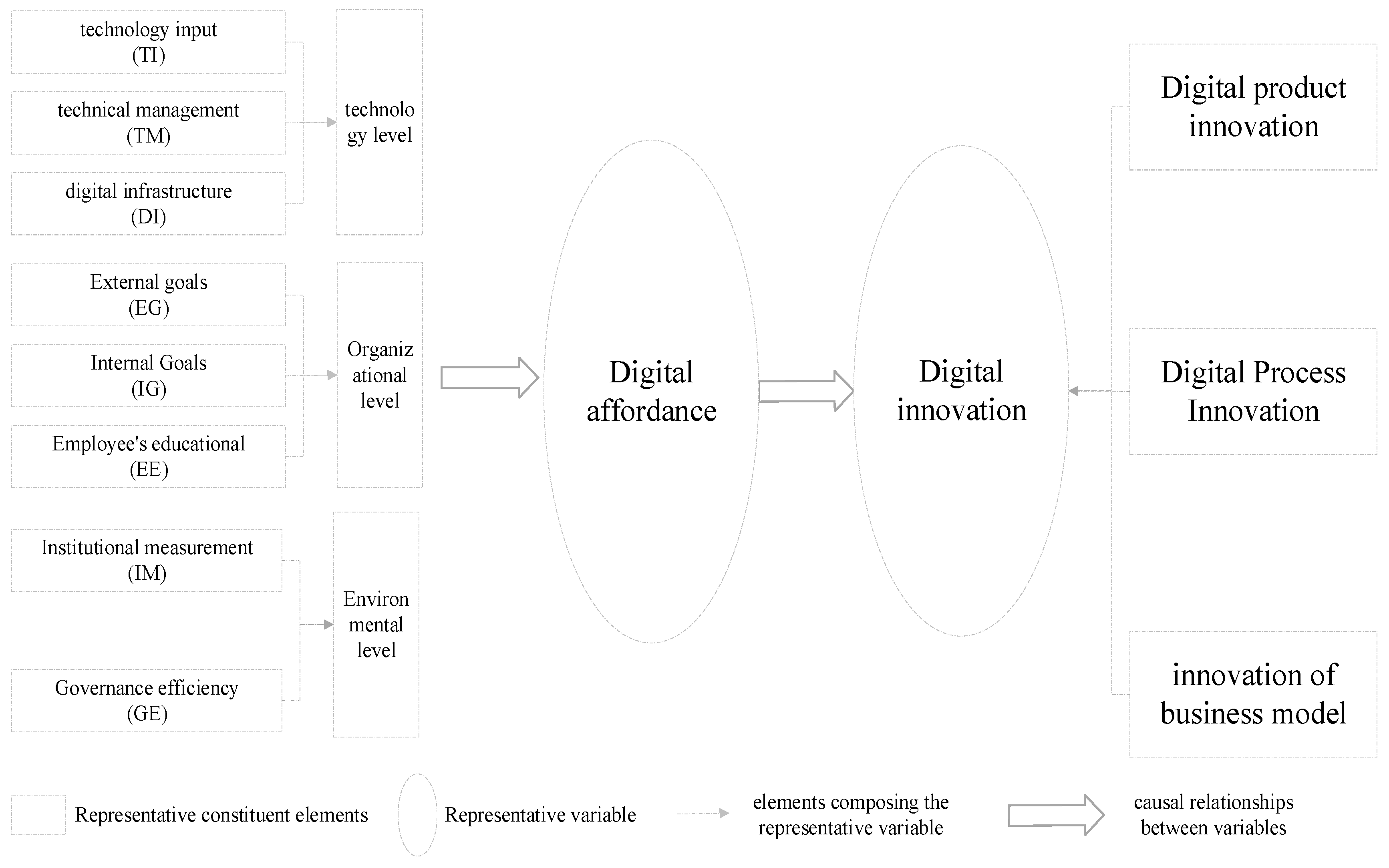
38] in Management World, which first derives antecedent configurations using fsQCA and then assesses their performance effects via PSM, we extend this by showing how TOE-driven pathways differentially impact innovation—for instance, ternary configurations (balancing all three dimensions) promote disruptive business models through synergistic effects, while alternative configurations may yield null or negative outcomes due to imbalances, as evidenced by lower coverage in non-primary pathways. In light of this configurational perspective, this study focuses on eight antecedent conditions: technological investment, technology management, and digital infrastructure at the technological level; internal and external organizational goals and employees’ educational qualifications at the organizational level; and institutional measures and the governance efficiency of public services at the environmental level, which are integrated to construct a research model examining the connection between digital technology affordance and firm digital creativity based on precursor arrangements (as shown in
Figure 1).
2.3. Technological Foundations of Digital Technologies
Digital technologies underpin sustainable manufacturing by enabling efficient processes that align with the technological antecedents in the TOE framework, such as technological investment and digital infrastructure, discussed in
Section 2.2.1. Artificial intelligence (AI) relies on machine learning algorithms, including supervised learning (e.g., regression models for predictive maintenance) and unsupervised learning (e.g., clustering for anomaly detection in production lines). These mechanisms optimize operations by processing historical data to forecast equipment failures, minimizing downtime, and enhancing resource efficiency—key to fostering digital technology affordance in manufacturing contexts.
Big Data Analytics employ data-processing pipelines like Apache Hadoop or Apache Spark to manage vast sensor-generated datasets, facilitating real-time supply chain monitoring and reducing waste through informed decision-making. The Internet of Things (IoT) leverages sensor networks and edge computing for on-source data collection and processing, enabling smart factories where devices communicate via protocols such as MQTT, thus supporting scalable digital infrastructure.
Blockchain utilizes distributed ledger technology with cryptographic hashing to create immutable records, ensuring traceability in supply chains and promoting secure, transparent data handling that bolsters institutional and environmental factors in TOE. Cloud computing provides scalable infrastructure for data storage and analysis, integrating seamlessly with these technologies to drive innovation.
Collectively, these foundations—AI, big data, IoT, blockchain, and cloud—interact to generate action potentials for digital affordance, as per affordance theory, while advancing sustainable outcomes like emission reductions and adaptive resource strategies [
39]. This technical grounding informs our empirical analysis in subsequent sections, linking technological mechanisms to configuration pathways and their impacts on enterprise digital innovation.
4. Results
4.1. Necessity Analysis of Individual Conditions
Before undertaking the configuration analysis, the necessity of each condition must be evaluated independently. A necessary condition is essential for the outcome to emerge, yet insufficient to assure its occurrence. Necessity test findings demonstrate that the consistency values for all condition are below the 0.9 threshold for necessity (
Table 4). Hence, none of the eight conditions can be deemed necessary for elucidating the outcome variables.
4.2. Sufficiency Analysis of Conditional Configuration
Before undertaking the sufficiency analysis of conditional configurations, thresholds for original consistency, Proportional Reduction in Inconsistency (PRI) consistency, and case frequency must be specified to select qualifying truth table rows. Consistent with prior fsQCA studies on consistency thresholds, the present study adopts an original consistency threshold of 0.8 and a PRI consistency threshold of 0.7. Moreover, the case frequency threshold is calibrated to the sample size, ensuring retention of at least 75% of the research samples [
9]. Thus, based on the sample size herein, this threshold is established at 3.
According to the configuration results shown in
Table 5, which identifies eight sufficient configurations leading to high-level digital technology affordance. These configurations are grouped based on the dominant levels of antecedent variables involved—technology, organization, and environment—as revealed by the presence and interplay of core and peripheral conditions in each pathway. This delineation allows for a structured analysis of how multidimensional synergies contribute to affordance outcomes, highlighting patterns of complementarity and substitution across dimensions. Specifically, types are categorized by the number and combination of levels represented: ternary (all three), dual (two levels), or focused synergies, ensuring a comprehensive yet parsimonious framework that reflects empirical variations in the data while facilitating targeted managerial and policy insights.
All four configurations include antecedent variables at the technological, organizational, and environmental levels. This configuration archetype suggests that attaining elevated digital technology affordance necessitates integration across these three dimensions, with elements from different dimensions forming complementary or substitutive relationships through dynamic combinations. Enterprises must adopt differentiated configuration strategies based on technological maturity, organizational adaptability, and environmental characteristics.
Configurations 4 and 7 primarily include antecedent variables at the technological and organizational levels. This configuration type suggests that high-level digital technology affordance depends on deep collaboration between technological and organizational factors. Its essence lies in the high dependence of digital technology value realization on dynamic organizational adaptability.
Configuration 6 encompasses four antecedent variables: technological investment, digital infrastructure, institutional measures, and the governance efficiency of public services. This configuration indicates that high-level digital technology affordance relies not only on the advancement of the technologies themselves but also on aligning them with societal demands through institutional measures at the environmental level. Simultaneously, it seeks to transform technological capabilities into inclusive services through public service governance. The core characteristic of this type is the deep integration of technical resources with policy tools, achieving universal value through mutual benefits between digital infrastructure and public services.
Configuration 2 includes three antecedent variables: external organizational goals, employees’ educational attainment, and institutional measures. This configuration suggests that the core logic of high-level digital technology affordance is a dynamic closed loop of policy guidance, goal response, and capability support. Specifically, high-level digital technology affordance depends not only on technological advancement but also on alignment with societal demands through institutional measures, with value realization achieved by leveraging the execution capabilities of a highly educated workforce. Such enterprises are primarily driven by policies and transform institutional requirements into technical implementation capabilities through highly educated teams.
4.3. Robustness Test
In qualitative comparative analysis (QCA) research, robustness verification of analytical outcomes is imperative and viable. Owing to QCA’s set-theoretic foundation, the present study modifies the consistency and case frequency thresholds to assess the robustness of digital technology affordance configurations [
50]. Initially, in line with Schneider and Wagemann [
51], the consistency threshold is elevated from 0.80 to 0.9, imposing a more rigorous standard for the configurational evaluation. Subsequently, the case frequency threshold is increased from 3 to 5, with the analysis reiterated. As depicted in
Table 6, the robustness evaluations indicate that post-adjustment configurations form subsets of those outlined in
Table 5, thereby substantiating the robustness of the research conclusions.
While data limitations prevent additional subsample analyses (e.g., pre- and post-2018 splits aligned with “Made in China 2025”), the main results remain robust across the full 2010–2023 period, which encompasses key digital policy shifts in China. This temporal span captures pre-GFC recovery, rapid digital adoption, and post-COVID resilience, suggesting stability. Future studies with extended datasets could further validate these patterns.
5. Discussion: Further Analysis—The Impact of Different Configurations on Enterprise Digital Innovation
Drawing upon the preceding outcomes, it is apparent that unique antecedent configurational pathways facilitate the emergence of digital technology affordance. Extending these insights, the present research examines the differential effects of diverse antecedent configurations on enterprise digital innovation, representing the second research question pursued in this study. To tackle this inquiry, membership scores for each configuration are computed using the QCA package in R4.4.2, followed by the application of a fixed-effects model to evaluate the influence of digital technology affordance under varying antecedent configurations on digital innovation.
5.1. Variable Selection
Prior scholarship on digital innovation asserts that novel products, services, and phenomena arising from digital technology applications qualify as digital innovation. Extending this foundation, the present study delineates digital innovation into three categories: digital product innovation, digital process innovation, and business model innovation. Digital product innovation, informed by economic concepts of innovation generation, encompasses digital products and services developed via digital technologies. Digital process innovation and business model innovation, originating from actor–technology interactions, embody the digital reconfiguration of enterprise processes and models, respectively. These variables are quantified through text analysis and machine learning applied to listed companies’ annual reports.
Explanatory Variables. The study employs digital technology affordance configurations as explanatory variables, with membership scores computed via the QCA package in R.
Control Variables. The following controls are included: (1) enterprise size (SIZE), as the natural logarithm of total assets; (2) enterprise age (AGE), as the natural logarithm of years since establishment to the observation period; (3) net cash flow (CASH), from annual reports, indicating debt repayment and dividend capabilities; (4) board size (SCALE), as the total number of board members; (5) number of employees (NUMBER), as the enterprise’s total workforce; (6) ownership nature (STATE), coded as 1 for state-controlled enterprises and 0 otherwise; (7) asset–liability ratio (LEV), as total liabilities divided by total assets; (8) per capita profit (PROFIT), as operating income over total employees for a given period. Measurement details appear in
Table 7.
5.2. Analysis of the Impact of Different Types of Digital Technology Affordance on Enterprise Digital Innovation
Table 8 reveals that Configurations 1, 3, 4, and 5 exert positive effects on enterprise digital product innovation. Additionally, Configuration 5 positively influences digital process innovation, whereas Configuration 1 negatively affects business model innovation. Examining the influence of digital technology affordance on digital product innovation, enterprises conforming to the “technology-organization-environment” (TOE) ternary-driven or “technology-organization” (TO) synergy-driven archetypes—absent internal and external organizational objectives—experience positive outcomes. Conversely, “technology-environment” (TE) and “organization-environment” (OE) synergy-driven archetypes exhibit no significant impact on digital product innovation. With respect to digital process innovation, digital technology affordance fosters advancement within the TOE ternary synergy solely when technological investment, digital infrastructure, employee educational levels, institutional mechanisms, and public service governance efficiency coexist. Regarding business model innovation, within the TOE ternary synergy, the concurrent presence of technological investment, employee educational attainment, and institutional measures—coupled with the absence of other factors—yields a significant negative effect from digital technology affordance. Other configurations demonstrate no substantial influence on business model innovation. These results corroborate existing scholarship on digital transformation’s contributions to innovation capacities.
5.3. Theoretical Integration and Implications
To integrate theory with results, we link each identified configuration to mechanisms from affordance theory, TOE, and digital innovation research, explaining how findings support, refine, or challenge prior insights. For the technology–organization–environment ternary-driven type (Configurations 1, 3, 5, 8), the synergy of all TOE dimensions complements affordance theory’s emphasis on sociomaterial interactions, where action potentials arise from multi-level alignments. This supports TOE by confirming holistic factor interdependence for high affordance, but refines digital innovation research by showing ternary paths enable product and process innovation under sustainability pressures, challenging single-level views that overlook equifinality. The technology–organization synergy-driven type (Configurations 4, 7) highlights internal alignments, supporting affordance theory’s relational action potentials through tech–human goal integration. It refines TOE by demonstrating organizational adaptability, compensates for environmental absences, and challenges linear digital innovation models by revealing positive impacts on product innovation without external factors. In the technology–environment synergy-driven type (Configuration 6), policy–tech interactions align with affordance’s contextual dependencies, supporting TOE’s environmental role in enabling inclusive services. This refines digital innovation insights by showing that institutional measures transform tech into sustainable outcomes, challenging assumptions of tech dominance alone. The organization–environment synergy-driven type (Configuration 2) emphasizes policy–workforce links, supporting affordance theory’s actor-focused potentials. It refines TOE by illustrating education–institution synergies for affordance without heavy tech investment and challenges prior research by highlighting limited impacts on innovation, urging nuanced views in sustainable contexts. Overall, these findings add theoretical value by extending affordance theory through configurational lenses, refining TOE with fsQCA-derived equifinality, and challenging digital innovation’s linear paradigms. This is among the first to empirically link configurations to sustainability outcomes like emission reductions, providing a foundation for future multi-path studies [
50].
5.4. Generalizability and Future Research
While our sample focuses on manufacturing enterprises listed on Shanghai and Shenzhen A-share markets from 2010 to 2023—capturing China’s digital economy boom—this may limit direct applicability. However, the TOE framework offers strong replicability. For instance, it adapts text analysis to U.S. SEC 10-K filings or EU sustainability reports, using similar keywords for technology indicators.
Cross-national comparisons suggest broader relevance: similar to Brynjolfsson et al. (2021) [
52] on U.S. firms, our findings could be extended to emerging markets like India (via BSE listings) or developed ones like the EU. Future research could use global datasets (e.g., Compustat Global) to test the framework in diverse contexts, addressing regional variations in institutional environments.
Limitations include potential endogeneity; instrumental variable approaches could strengthen causality. Overall, this study provides a replicable model for examining digital innovation linkages worldwide.
6. Conclusions and Implications
6.1. Research Conclusions
Utilizing a sample of 2206 manufacturing firms listed on China’s Shanghai and Shenzhen A-share exchanges, this investigation systematically assesses the heterogeneous effects of digital technology affordance—formed through diverse antecedent configurations—on enterprises’ digital innovation activities via fuzzy-set qualitative comparative analysis (fsQCA) and fixed-effects modeling. The principal results are as follows: (1) four primary pathways underpin the development of digital technology affordance: the technology–organization–environment (TOE) ternary-driven archetype, the technology–organization (TO) synergy-driven archetype, the organization–environment (OE) synergy-driven archetype, and the technology–environment (TE) synergy-driven archetype. (2) The influence of digital technology affordance on enterprise digital innovation demonstrates marked conditional contingency. Within the TOE ternary-driven or TO synergy-driven configurations and absent internal and external organizational objectives, digital technology affordance enhances digital product innovation. Bolstered by the concurrent alignment of technological investment, digital infrastructure, high-caliber human capital, institutional frameworks, and public service governance efficacy, digital technology affordance advances digital process innovation. Conversely, in scenarios where technological investment, employee educational levels, and institutional measures coexist without supplementary elements, digital technology affordance suppresses business model innovation. The effects of remaining configurations on digital business model innovation remain insignificant.
6.2. Theoretical Contributions
The theoretical advancements of this research are delineated as follows:
Initially, through the synthesis of technological, organizational, and environmental elements, this investigation illuminates the diverse and intricate routes underpinning the emergence of digital technology affordance. Existing research primarily focuses on one of these dimensions—technological, organizational, or environmental—and has not fully clarified the synergistic influencing mechanisms across these three levels on digital technology affordance. Therefore, grounded in the TOE theoretical framework and based on the identification of eight key antecedent conditions, this study thoroughly analyzes their interlinkages with digital technology affordance and identifies four distinct configuration pathways for achieving high-quality digital technology affordance. This not only unveils the theoretical mechanisms through which technological, organizational, and environmental factors collectively promote digital technology affordance but also deepens researchers’ understanding of the complex mechanisms underlying this phenomenon.
Secondly, by emphasizing the precursors of digital technology affordance, this research furnishes an innovative theoretical lens for reconciling the inconsistent findings on the linkage between digital technology affordance and enterprises’ digital innovation activities. Given the inconsistencies in prior research findings, previous studies have primarily explored this relationship through the lens of digital technology accumulation and variability. However, this study provides a new explanation by distinguishing the antecedents of digital technology affordance, highlighting how variations in antecedent configurations differentially impact enterprises’ digital technology affordance and, consequently, their digital innovation behaviors. This advancement not only supplies fresh evidence to elucidate the inconsistencies in prior findings regarding the association between digital technology affordance and enterprises’ digital innovation activities but also enriches the theoretical grasp of this linkage.
Thirdly, through the amalgamation of the fuzzy-set qualitative comparative analysis (fsQCA) and fixed-effects modeling, this research delineates the integrated causal mechanisms linking digital technology affordance, its precursors, and enterprises’ digital innovation activities. Diverging from antecedent scholarship that employs case studies, surveys, or regression techniques to isolate examinations of digital technology affordance’s ties to its antecedents or outcomes, the present investigation embeds antecedent factors within the nexus between digital technology affordance and enterprises’ digital innovation outcomes via the fusion of fsQCA and fixed-effects approaches. This methodology surmounts the constraints of prior fragmented inquiries into the interconnections among digital technology affordance, its antecedents, and enterprises’ digital innovation outcomes. Furthermore, it forges an innovative avenue for aligning superior digital technology affordance with ensuing behaviors, yielding supplementary empirical contributions to prospective explorations of the holistic “antecedent-consequence-behavior” paradigm.
6.3. Practical Implications
This research proffers the ensuing managerial implications:
Firstly, the “multiple concurrency” and “convergence of heterogeneous pathways” inherent in digital technology affordance underscore the intricacy of realizing superior digital technology affordance, necessitating the synergistic orchestration of manifold conditions alongside the formulation of bespoke strategies attuned to an enterprise’s distinctive attributes. For example, enterprises with weak organizational management can enhance their digital technology affordance through technological investment and by leveraging government policies. Similarly, enterprises in regions with limited government policy support can strengthen their technological and managerial investments at the organizational level to improve their digital technology affordance.
Secondly, high-quality digital technology affordance, propelled by technology–organization, technology–environment, or organization–environment synergies, exerts no substantial influence on enterprises’ new product development, service process innovation, or business model innovation. This result implies that firms should strengthen their dynamic adaptive mechanisms through the ternary synergy of technology, organization, and environment, with priority given to forging a ternary collaborative closed loop. This loop amalgamates the merits of technological, organizational, and environmental factors to engender innovative synergy. Specifically, at the technological level, it provides advanced digital tools and innovative thinking; at the organizational level, it optimizes internal resource allocation and collaboration processes; and at the environmental level, it offers external market insights and policy support. Through the synergy of these dimensions, enterprises can achieve cross-departmental and cross-domain knowledge sharing and resource integration, transcend the boundaries of traditional innovation, and unlock deeper innovation potential. Moreover, the ternary synergy of technology, organization, and environment enhances an enterprise’s ability to acutely perceive and rapidly respond to external market changes, thereby strengthening its competitiveness and enabling it to maintain a competitive advantage in intense market competition.