

Article

Employees’ Intentions to Engage in Green Practices: A Multilevel Extended Theory of Planned Behavior Perspective


by
Rubinia Celeste Bonfanti
*,
Nicolò Billeci
,
Gioacchino Lavanco
and
Stefano Ruggieri
Department of Psychology, Educational Science and Human Movement, University of Palermo, Viale Delle Scienze, Edificio 15, 90128 Palermo, Italy
*
Author to whom correspondence should be addressed.
Sustainability 2026, 18(1), 486; https://doi.org/10.3390/su18010486
Submission received: 14 November 2025 / Revised: 22 December 2025 / Accepted: 26 December 2025 / Published: 3 January 2026

Abstract

In recent years, organizations have increasingly promoted and integrated employees’ environmentally sustainable behaviors and practices as part of a strategic approach to enhance corporate reputation, demonstrate environmental stewardship, and respond to pressing ecological imperatives. This study explores the psychological factors that motivate employees’ intentions to engage in green behaviors within organizational settings, following the Theory of Planned Behavior (TPB). We extend the model by incorporating a conceptually multilevel perspective, examining antecedents at the organizational, team, and employee levels: perceived organizational support, perceived colleague support and workplace attachment. Data were collected from a sample of 286 public employees. Our findings indicate that, among the behavioral antecedents proposed by the TPB, only some were validated as significant predictors of employees’ intentions to engage in green behaviors within their organization. The results further show that each organizational, team, and employee level antecedent included in this study significantly influenced the constructs of the TPB. Implications and suggestions for future research are also discussed.

1. Introduction

Environmental challenges have become a globally pervasive issue, characterized by regional variation in both their expression and impact [1]. The escalating impacts of environmental degradation—evident in phenomena such as global warming, ecosystem decline, and ozone layer depletion—have compelled corporations to increasingly integrate environmental sustainability into their strategic agendas [2]. Organizations have made significant progress in implementing environmentally sustainable practices and procedures, with the aim of enhancing corporate reputation, demonstrating environmental responsibility, responding to pressing ecological imperatives, and meeting consumer demands to achieve a competitive advantage [3]. Nevertheless, the efficacy of organizational sustainability initiatives varies across contexts and is significantly influenced by employees’ engagement in pro-environmental behaviors, as employees serve as pivotal agents in promoting environmental sustainability within organizational settings through their engagement in green behaviors [4].
Employee green behaviors are commonly defined as discretionary pro-environmental actions performed by employees that support organizational sustainability objectives [4]. According to Norton et al. [5], employee green behavior can be classified into two categories: required and voluntary. Required employee green behavior encompasses environmentally responsible actions that are integral to an employee’s formal job duties. These behaviors involve following the organization’s environmental policies, employing sustainable work practices, choosing environmentally responsible alternatives, and contributing to the design of sustainable products and processes. This type of behavior closely corresponds to task performance, which refers to the execution of activities formally designated as part of an employee’s role and essential to the organization’s technical operations [6]. A representative example of required employee green behavior involves the correct segregation of waste into recycling and compost bins, as stipulated by formal organizational policies and environmental protocols [7]. In contrast, voluntary employee green behavior involves discretionary pro-environmental actions that employees undertake on their own initiative, going beyond formal job expectations and organizational mandates [5]. A representative example of voluntary employee green behavior may be an employee independently organizing a carpooling initiative among coworkers to minimize carbon emissions, an action not formally prescribed or incentivized by the organization, but rather driven by personal environmental commitment [8].
Generally, employee green behaviors are critical strategies that organizations promote to enhance their environmental sustainability outcomes [9]. Actions such as efficiently managing office supplies, segregating waste, using teleconferencing, reusing and recycling paper, disseminating sustainability-related information among colleagues, voluntarily participating in or coordinating workplace environmental initiatives, and using reusable containers to minimize single-use plastic consumption are practices that can foster environmental awareness in the workplace [8]. Understanding the determinants that drive these forms of pro-environmental behavior is critical for formulating effective and evidence-based policies aimed at promoting environmentally sustainable behavior within the broader public [10]. In this regard, employee green behavior has been found to be associated with several multilevel organizational factors, including perceived organizational support [11], green human resource management practices [12], organizational identification [13], supervisor support behaviors [14], and intrinsic satisfaction [15]. Nonetheless, empirical research examining the factors that drive employees to adopt and engage in their organization’s environmental initiatives remains sparse [16]. Furthermore, the associations between employee green behaviors and organizational factors have also been examined across multiple disciplines beyond organizational behavior, including environmental psychology [17], environmental engineering [18], business [19], and tourism [20]. Despite the studies conducted on the topic, several questions remain unresolved, as the existing evidence on employee green behavior is dispersed across various fields, utilizing diverse theoretical frameworks and encompassing a broad range of associated variables.

2. Literature Review

2.1. Theoretical Background

This study is primarily grounded in the Theory of Planned Behavior (TPB) [21,22,23], which provides a comprehensive framework for examining how various psychological factors (such as employees’ attitudes, social norms, and perceived behavioral control), together with organizational-, team-, and individual-level antecedents, influence employees’ intentions to engage in green behaviors. Research indicates that the TPB is a robust framework for explaining individuals’ intentions to engage in organized environmental actions [24]. Proposed by Ajzen [25], the TPB suggests that a person’s intention to engage in a behavior is influenced by three main factors: (1) attitude toward the behavior, (2) subjective norms, and (3) perceived behavioral control. Attitude toward the behaviour is determined by an individual’s expectations regarding whether the behavior will lead to specific outcomes and by the perceived desirability of those outcomes [25,26]. Subjective norms refer to the extent to which an individual perceives social pressure to perform a given behavior. They are shaped by the individual’s assessment of the expectations held by salient reference groups and by the individual’s motivation to comply with those groups [25,26]. Finally, perceived behavioral control reflects an individual’s assessment of the difficulty associated with performing a given behavior. It is determined by the extent to which the individual believes they possess the necessary self-efficacy to carry out the behavior and perceives that they have sufficient control over the factors influencing its execution.
TPB has been widely applied to environmental behaviors in private settings [27] and workplaces [28], demonstrating stronger predictive power than alternative variables such as demographics [29,30]. For instance, Trumbo and O’Keefe [29], Lam [31], and Clark and Finley [32] studied water conservation intentions in communities across California, China, and Bulgaria, finding that TPB constructs consistently predicted behavioral intentions, explaining 10–66% of the variance. TPB has also been applied to a broad range of pro-environmental behaviors, including public transport use [33,34], adoption of park-and-ride systems [35], and engagement in environmental activism [36]. Yuriev et al. [37] demonstrated that the TPB accounted for 79% and 37.7% of the variance in predicting employees’ intentions to use alternative transportation for commuting and to offer eco-suggestions within the workplace, respectively. Similarly, Greaves et al. [21] found that TPB constructs explained between 46% and 61% of the variance in employees’ intentions to engage in three specific pro-environmental behaviors: turning off personal computers when leaving desks for extended periods, using video conferencing instead of traveling for meetings, and maximizing recycling efforts. Furthermore, TPB was shown to mediate the relationship between specific antecedent beliefs and employees’ intentions to engage in these behaviors [23]. These findings highlight TPB as a particularly effective framework for examining intentions related to pro-environmental actions.
In addition to applying the TPB, numerous studies have investigated organizational factors influencing green behaviour. Norton et al. [5] provide a rigorous multilevel review of variables associated with employees’ green behavior, encompassing perceived organizational support at the organizational level, perceived colleague support at the team level, and various personological characteristics at the employee level.
In most cases, employees’ decisions to engage in green behaviors appear to be shaped by both personal preferences and the broader organizational climate. Numerous studies indicate that when employees adopt environmentally sustainable practices, they draw upon their own human capital, expressing such behaviors as an extension of their personal values and identity [38]. At the same time, an organization’s commitment to environmental sustainability is closely linked to its corporate image, influencing the perceptions of both internal stakeholders (e.g., employees) and external stakeholders [39]. For these reasons, employees who engage in environmentally oriented activities tend to do so in ways that reflect their personality traits, personal dispositions, and the organization’s environmental management practices, all of which play a crucial role in shaping workplace behavior and professional conduct. Taken together, these insights highlight the importance of adopting a multilevel perspective when examining employees’ decisions to engage in green behaviors. In this regard, Cantor, Morrow, and Montabon [40] found a strong positive link between perceived organizational support and employees’ participation in both mandatory green behaviors and proactive efforts, such as promoting initiatives and engaging in voluntary environmentally friendly actions. Also, a recent meta-analysis [41] identified perceived organizational support as a significant work perception correlate of employees’ behavioral intentions to engage in sustainability practices promoted by the company.
Research also indicates that employees’ perceived support from colleagues can enhance individual innovative behavior [17]. The importance of perceived colleague support lies in its direct impact on key outcomes such as job satisfaction and commitment to coworkers. Furthermore, high levels of perceived colleague support may foster a stronger sense of value congruence, wherein employees perceive greater alignment between their colleagues’ values and their own personal beliefs and values.
Regarding individual-level factors, research has emphasized the role of personality traits and self-esteem in shaping pro-environmental behavior [41]; however, to date, no study has examined the relationship between workplace attachment and these behaviors. Rooted in interpersonal attachment theory [42,43], workplace attachment comprises affective, cognitive, and behavioral dimensions [44,45] and defines a person’s emotional bond with their workplace [46,47]. Just as children seek a secure base in caregivers, individuals gravitate toward work settings they perceive as familiar and safe environments that reduce uncertainty and provide emotional comfort [48]. In turn, this attachment influences subsequent attitudes, such as satisfaction, loyalty, and stewardship, toward the places they value.
To date, no study has applied a multilevel perspective to TPB to examine antecedents at the organizational, team, and individual levels. Given the current gap in applying a multilevel extended TPB Ajzen [25] framework to understand employees’ environmental behavioral intentions, it is essential to investigate the multilevel factors that drive employees’ intentions to engage in green behaviors. Addressing this gap, the present study examines 286 public administration employees using a mediation model with two objectives. First, it evaluates the direct effects of attitudes toward green behaviors, perceived behavioral control, and subjective norms on employees’ intentions to engage in green behaviors in the workplace. Second, it investigates whether attitudes mediate the relationships between organizational-, team-, and individual-level antecedents and employees’ intentions to engage in green behaviors. This approach aims to provide a comprehensive understanding of the mechanisms driving workplace green behaviors.

2.2. Hypothesis Development

This study advances the TPB by empirically testing an extended model that integrates a conceptually multilevel perspective. Drawing on organizational, team, and individual antecedents, we examine the factors that shape employees’ intentions to engage in green behaviors at work. By identifying the most salient psychological predictors of green behaviors, this study provides a more nuanced understanding of environmental conduct in organizational settings and establishes a foundation for developing integrative theoretical frameworks. Figure 1 illustrates the extended model on which our hypotheses were grounded.
As a general hypothesis, we expected that the variables specified by the TPB would influence employees’ intentions to engage green behaviors, encompassing both required and voluntary actions. To examine the psychological mechanisms influencing employees’ intention, we formulated the following hypotheses based on TPB [25]:
Hypothesis 1.
Attitude towards green behaviors positively affects behavioral intention to engage in green behaviors.
Hypothesis 2.
Subjective norms positively affect behavioral intention to engage in green behaviors.
Hypothesis 3.
Perceived behavioral control positively affects behavioral intention to engage in green behaviors.
With respect to the conceptually multilevel perspective, the following hypotheses are proposed based on an analysis of the existing literature.
Organizational-level attitudes toward the environment play a critical role in shaping employees’ green attitudes and behavioral intentions. For instance, Ref. [40] report a significant positive relationship between perceived organizational support for environmental initiatives and employees’ propensity to promote and engage in innovative employees’ pro-environmental behaviors. For these reasons, we propose the following hypothesis:
Hypothesis 4.
Employees who perceive higher levels of organizational support will report more favorable attitudes toward green behaviors.
Team-level behaviours and shared beliefs constitute important contextual factors influencing pro-environmental attitude. For example, prior research has demonstrated that perceived colleague support exerts a positive influence on eco-helping attitude [17]. For these reasons, we propose the following hypothesis:
Hypothesis 5.
Stronger perceived support from colleagues will be related to more positive attitudes toward green behaviors.
Employee-level variables—including job-related factors, norms, motivation, and affect—play a critical role in shaping employees’ attitudes toward green behaviors, which in turn influence their engagement in such behaviors. For instance, Ref. [7] found that positive affect significantly contributes to green behaviour at the within-person level. Specifically, their results indicate that low-arousal positive affect positively influences pro-environmental actions. Considering workplace attachment as an employee’s emotional bond with their work environment, we propose the following hypothesis:
Hypothesis 6.
Stronger attachment to the workplace will be related to more positive attitudes toward green behaviors.
Within the TPB framework, attitudes are conceptualized as the proximal mediating mechanism linking organizational-, team-, and individual-level antecedents to individuals’ behavioral intention [49]. Consistent with this view, Jaiswal and Kant [50] demonstrated that cognitive and affective factors exert an indirect effect on pro-environmental intentions through their influence on green attitudes. Building on this evidence, and in accordance with recent scholarship on workplace sustainability, we hypothesize that attitudes mediate the relationship between multilevel antecedents and employees’ intentions to engage in green behaviors, as follows:
Hypothesis 7.
Attitudes will mediate the relationships between organizational-, team-, and employee-level antecedents (perceived organizational support; perceived colleague support; workplace attachment) and employees’ intention to engage green behaviors.
Collectively, testing these hypotheses aims to provide a comprehensive understanding of the integration of the TPB model with a conceptually multilevel perspective.

3. Materials and Methods

3.1. Methodological Approach

This study employed a quantitative, cross-sectional research design to examine the relationships between the variables of interest within a population of public sector employees. The selected public administration represents a large and organizationally diverse institution in southern Italy, making it an appropriate context for analysing the psychological dynamics underlying employees’ intention to engage green behaviours. Participants occupied a wide range of administrative and technical positions, ensuring that the sample reflected the variety of tasks and responsibilities typical of local public institutions.
Data were collected through a structured online questionnaire composed of standardised scales with Likert-type response formats, enabling a quantitative assessment of participants’ perceptions and attitudes. Prior to full implementation, the questionnaire underwent internal review to ensure item clarity and suitability for an adult working population. The list of potential respondents was drawn from the organisation’s official employee register, and a simple random sampling procedure was applied to guarantee equal selection probability for all eligible staff members [51].

3.2. Participants

In February 2025, data were gathered via an online survey as part of a broader study targeting public employees in southern Italy. Two hundred eighty-six employees (150 men and 136 women), aged between 24 and 68 years (M = 42.34, SD = 10.74), employed in a public administration participated in this study. A simple random sampling technique was employed, drawing participants from a current and comprehensive list of public-sector employees within the defined target population, in order to ensure sample representativeness and reduce the risk of selection bias. Four hundred-fifty participants were asked to complete an anonymous online survey after being contacted, and the response rate was 63.5%. This study adhered to the ethical guidelines of the Italian Psychological Association (AIP) and the Declaration of Helsinki, and received approval from the Ethics Committee of the University of Palermo (approval code: 302/2025).

3.3. Measures

Sociodemographic Data. This study gathered sociodemographic data, specifically participants’ age and gender.
Attitude towards green behaviors. Participants’ attitudes toward green behaviors were assessed using the semantic differential technique [52], employing seven item bipolar adjective scale (e.g., bad/good, ugly/beautiful, weak/strong), respondents evaluated the target sentence, “For you, green behaviors are…”. Each item was rated on a 5-point Likert-type scale (α = 0.91), with negative terms anchored on the left and positive terms on the right.
Subjective Norms. Subjective norms were assessed with two items on a 5-point Likert scale (1 = strongly disagree and 5 = strongly agree; α = 0.77). A sample item for operational definition of variable [53] was “[My partner/My parents] believe that engaging in pro-environmental behaviors at work is an important aspect of how one should live.”
Perceived Behavioural Control. Perceived behavioural control was assessed with four items on a 5-point Likert scale (1 = strongly disagree and 5 = strongly agree; α = 0.76). A sample item for operational definition of variable [53] was “I have the necessary skills to carry out pro-environmental behaviors in my job”.
Behavioural Intentions to Engage in Green Behaviours in the Workplace. Employees’ behavioural intention to engaging in pro-environmental required and voluntary green behaviors was measured with four items adapted from Chen and Knight [54]. Examples of items include “I intend to engage in pro-environmental required behaviors in my workplace (e.g., printing on both sides of the paper)”, and “I intend to engage in voluntary pro-environmental behaviors in my workplace (e.g., placing my computer in sleep mode even when not formally required)”. Item were presented on a 5-point Likert scale (1 = strongly disagree, 5 = strongly agree; α = 0.96).
Perceived Organizational Support. Employees’ organizational perceived support was measured with the Perceived Organizational Support--Shortened Version (8 items) [55,56]. Items included “My organization considers my goals and values”. The items were presented on a 5-point Likert scale (1 = strongly disagree, 5 = strongly agree; α = 0.92).
Perceived colleague support. Perceived colleague support was assessed with the Perceived Workplace Support Scale (8 item) [57]. A sample item is: ‘If I were having difficulties of a personal nature, there are co-workers who would show concern for me.’ Responses were recorded on a 5-point Likert scale (1 = strongly disagree to 5 = strongly agree). The scale demonstrated acceptable internal consistency (α = 0.91).
Workplace Attachment. Employees’ workplace attachment was measured with the Workplace Attachment Scale (7 items) [58]. A sample of item included is “I am attached to my workplace”. The items were presented on a 5-point Likert scale (1 = definitely don’t agree, 5 = definitely agree; α = 0.93).
The instruments were refined through a pilot session in which ten university students completed the questionnaire; feedback was used to identify and revise any items that were unclear or inaccurate.
Survey reliability was evaluated using Cronbach’s alpha and the average variance extracted (AVE) method [59]. The Cronbach’s alpha values, ranging from 0.76 to 0.96, are consistent with previous studies and demonstrate high reliability, surpassing the recommended minimum of 0.6. Similarly, the AVE values also indicated strong reliability, exceeding the suggested threshold of 0.50 [60].

4. Results

Descriptive statistics of the study variables are reported in Table 1. Preliminary analyses were conducted to assess the normality of the data distribution [61]. All study variables exhibited no significant deviations from normality in their distributions (∣Skewness∣ < 1).

4.1. Outer Model Assessment

The outer model was analyzed using Mplus software (version 8.0). It captures the hypothesized relationships among Attitude toward green behaviors (AtGB), Subjective norms (SN), Perceived behavioral control (PBC), and Behavioral intentions to engage in green behaviors in the workplace while also highlighting the mediating role of Attitude toward Green Behaviors in the relationship between organizational- (POS), team- (PCS), and individual-level (WA) antecedents and Behavioral Intentions. Table 2 illustrates the items associated with each variable. The outer loadings of each item were assessed to evaluate the outer model. Convergent validity was further assessed using Cronbach’s alpha, Composite Reliability (CR), and Average Variance Extracted (AVE). Cronbach’s alpha (>0.7) and Composite Reliability (>0.7) values were within acceptable thresholds. Furthermore, all AVE values exceeded 0.5, confirming convergent validity.
The Fornell-Larcker test is a statistical method utilized in structural equation modeling (SEM) to evaluate the discriminant validity of constructs [62]. For the discriminant validity to be recognized, the square root of AVE should be higher than its correlation with any other construct in the model [63]. Based on Table 3, the Fornell–Larcker criterion was satisfied, as the square roots of the AVE were higher than the corresponding correlations between the constructs.

4.2. Structural Model Assessment

This study’s hypotheses were examined through Structural Equation Modeling (SEM). The theoretical model used is shown in Figure 1, and model testing was performed using Mplus software (version 8.0). To assess the structural equation model (SEM) and test the hypotheses, a bootstrapping procedure with 5000 resamples was employed [64]. Model fit was evaluated using several indices: the chi-square statistic (with χ2/df ratios < 3 indicating an acceptable fit), the comparative fit index (CFI; values > 0.90 indicating good fit) [65], and the root mean square error of approximation (RMSEA; values < 0.08 reflecting adequate fit) [65].
The model provided a good fit (χ2 = 41.733, df = 22, χ2/df = 1.9, CFI = 0.980, RMSEA = 0.052, 95% RMSEA = 0.024–0.069). The model accounted for 18.5% (R2 = 0.185) of the variance in behavioural intention.
As reported in Table 4, the relationship of attitude and behavioural intention is significant (β = 0.367, p < 0.05); thus, H1 has been accepted. The relationship of subjective norms and behavioural intention is not significant (β = 0.057, p = 0.222); thus, H2 has been rejected. Moreover, the relationship of perceived behavioural control and behavioural intention is significant (β = 0.369, p < 0.05); thus, H3 has been accepted. Overall, the hypotheses with regard to the TPB model were all supported by our data except for H2.
Moreover, the relationship of perceived organizational support and attitude is significant (β = 0.399, p < 0.05); thus, H4 has been accepted; the relationship of perceived colleague support and attitude is significant (β = 0.323, p < 0.05); thus, H5 has been accepted. Finally, the relationship of workplace attachment and attitude is significant (β = 0.401, p < 0.05); thus, H6 has been accepted.
In addition, Table 4 depicts the indirect/mediating role of attitude between the assumed organizational-, team-, employee- level antecedents (perceived organizational support, perceived colleague support and workplace attachment). In this regard, the relationship between organizational perceived support, attitude and behavioral intention (β = 0.132, p < 0.05), the relationship between perceived colleague support, attitude and behavioral intention (β = 0.149, p < 0.05), and the relationship between workplace attachment, attitude and behavioral intention (β = 0.131, p < 0.05) are positive and significant. Thus, H7 have been accepted.

5. Discussion

The primary goal of our study was to explore employees’ intentions to engage in green behaviors, emphasizing the influence of psychological antecedents within a conceptually multilevel, extended TPB framework.
To better understand the relationship between employees’ intention to engage in green behaviors, attitude towards green behaviors, subjective norms, perceived behavioral control, and three organizational-, team-, and employee-level antecedents (perceived organizational support, perceived colleague support and workplace attachment) we tested a mediation model. Referring to the TPB indicators, our results partially showed a significant association with all the three variables of the model. Specifically, attitude towards green behaviors and perceived behavioral control influenced employees’ behavioral intention to engage in green behaviors as expected, thereby providing support only for Hypotheses 1 and 3 of this study.
Overall, the results indicated that only attitude toward green behaviors and perceived behavioral control were directly related to employees’ intentions to engage in green behaviors and exerted indirect effects via attitude. Unexpectedly, subjective norms were not significantly associated with behavioral intentions, suggesting that they do not play a fundamental role in motivating employees to adopt green practices. According to the TPB, attitude toward a behavior is a key determinant of behavioral intention: the more positively, usefully, or desirably an individual perceives a behavior, the more likely they are to form the intention to engage in it. In the context of green practices in the workplace, a favorable attitude can enhance employees’ intrinsic motivation, increasing the likelihood that they will voluntarily engage in sustainable behaviors even in the absence of formal obligations or external incentives [41]. An individual’s positive attitude toward a given green practice reflects not only a favorable evaluation of its environmental benefits, but also an affective commitment to enacting that behavior. Concurrently, perceived behavioral control, which reflects an individual’s assessment of their own abilities, resources, and control over performing a behavior, underscores the importance of self-efficacy. Employees who believe they possess the necessary knowledge, skills, and opportunities to carry out green actions—such as reducing waste or optimizing resource use—are more likely not only to form strong behavioral intentions but also to translate these intentions into actual behavior [41]. Perceived behavioral control captures employees’ beliefs about their capability to perform the behavior—encompassing both the requisite skills (e.g., knowing how to switch off nonessential equipment) and the availability of situational resources (e.g., access to energy-efficient tools). When employees feel competent and supported in these respects, they are more likely to form firm intentions to act in environmentally responsible ways. The predictive role of perceived behavioral control is further corroborated by domain-specific research, such as studies on office electricity conservation [66]. In particular, Zhang and colleagues [66] found that employees who perceived greater access to switch-off protocols, energy monitors, and managerial encouragement reported stronger intentions to reduce electricity consumption. In other words, a positive attitude enhances motivation, while a high level of perceived behavioral control provides a sense of feasibility, mitigating psychological and practical barriers that might otherwise impede action. The observation that subjective norms do not significantly influence behavioral intention in our model aligns with previous research [66,67] and may be attributed to employees’ tendency to devalue external perspectives regarding workplace practices, this may be because those external to the organization are seen as not fully understanding the organization’s specific challenges, rules, and available resources. As a result, subjective norms emanating from people beyond one’s immediate workgroup carry less weight in shaping green-work behaviors.
Taken together, these findings suggest that interventions aiming to promote workplace sustainability may achieve greater impact by focusing on (a) strengthening employees’ positive attitudes through information and feedback on behavioral outcomes, and (b) enhancing their perceived control via skills training, resource provision, and procedural support, rather than relying primarily on social pressures or external mandates.
In our extended TPB model, perceived organizational support, perceived colleague support and workplace attachment were assumed to have an indirect relationship with behavioral intention toward green behavior through the attitude, and this hypothesis was confirmed by the results of our study. With respect to the indirect relationships between organizational-, team-, and employee-level antecedents and employees’ intentions to engage in green behaviors, the results indicate that perceived organizational support, perceived colleague support, and workplace attachment are fundamental contributors, exerting their effects indirectly through attitudes, thereby providing support for Hypotheses 4, 5, 6 and 7 of this study. Consequently, these variables play a critical role in shaping employees’ intentions to adopt green behaviors. Perceived organizational support, as embedded in the employee’s organizational context, serves as a foundational factor that fosters a sense of safety and support from the organization, thereby encouraging the adoption of various sustainable behaviors. When employees perceive that their organisation genuinely prioritises and endorses environmental initiatives, they are more likely to internalise these values, thereby enhancing their intrinsic motivation to engage in both required and voluntary pro-environmental behaviours. In this regard, Cantor and colleagues [40] found a significant positive association between perceived organizational support for environmental initiatives and employees’ involvement in environmental management practices, encompassing both required forms of green behavior (i.e., environmental management) and voluntary forms (i.e., innovative environmental behavior). This indicates that organisational support not only facilitates adherence to established environmental protocols but also empowers employees to take initiative, propose improvements, and experiment with novel environmentally friendly practices, thereby enhancing the organisation’s overall sustainability performance. Moreover, such support can reinforce employees’ identification with organisational objectives, fostering a sense of belonging and responsibility toward environmental outcomes, which in turn strengthens long-term commitment to pro-environmental behaviours. Regarding perceived support from colleagues, accumulating empirical evidence suggests that employees’ perceptions of receiving support from their colleagues play a pivotal role in fostering individual innovative behavior within organizational settings [17]. Perceived colleague support is not merely a peripheral social factor, but constitutes a central determinant of several critical work-related outcomes. Specifically, it has been found to significantly influence employees’ levels of job satisfaction and their affective commitment toward their peers. These interpersonal dynamics contribute to the development of a more cohesive and psychologically safe work environment, which, in turn, fosters creativity, innovation, and acceptance of proposed organizational policies. Moreover, when employees experience a high degree of perceived support from their colleagues, they are more likely to interpret workplace interactions through the lens of shared values and mutual understanding. This perceived alignment, or value congruence, strengthens the internalization of organizational norms and enhances personal identification with team members, thereby reinforcing both individual and collective motivation. Regarding workplace attachment, it has also been found to be closely linked to employees’ attitudes toward pro-environmental behavior within organizations. Workplace attachment refers to the emotional bond an individual forms with their work environment, through which the workplace becomes integrated into the individual’s self-concept and identity [68]. A growing body of research has shown that workplace attachment is associated with a variety of important work-related attitudes and behaviors, including organizational engagement as well as both in-role and extra-role performance [69]. Accordingly, workplace attachment can be understood as a personal psychological resource that facilitates employees’ integration into their organizational context [70], thereby increasing their propensity to enact and support sustainability initiatives promoted by the organization. Overall, the findings of this study highlight the importance of a multi-level perspective in shaping employee attitudes and behavioral intentions within the context of environmental sustainability.

5.1. Theoretical Contributions and Practical Implication

This study offers several notable contributions. First, it extends the application of the TPB by incorporating a conceptually multilevel perspective on antecedents within the domain of organizational sustainability management. Second, it highlights key psychological factors that shape employees’ cognitive evaluations underlying their decisions to engage in pro-environmental behaviors.
This research demonstrates a positive interaction between organizational, team, and employee level antecedents and the TPB’s psychological antecedents in shaping employees’ intentions to engage in green behaviors, thereby advancing our understanding of how multilevel factors jointly influence environmental actions within the workplace context. Whereas prior research has tended to focus either solely on the TPB or on organizational antecedents when explaining employees’ green behaviors, it has largely overlooked the synergistic effects emerging from a conceptually multilevel TPB perspective. By uncovering these synergistic mechanisms, the present study bridges the gap between green human resource management and TPB research and contributes to a comprehensive understanding of the drivers of workplace green behavior. Within the TPB framework, we examine how three core psychological constructs (attitude toward the behavior, subjective norms, and perceived behavioral control) are translated into actual green practices. Consistent with previous findings [12,71,72], our results indicate also that multilevel antecedents exert an indirect effect on employees’ green behaviors by shaping attitudes, which then influence behavioral outcomes. Finally, this research extends the boundary conditions of green human resource management by clarifying the contextual factors that most effectively promote green behaviors, offering important theoretical implications for organizations implementing green management initiatives.
Regarding the practical implications of this research, organizations should acknowledge the pivotal role of employees’ attitudes toward green behaviors in enhancing individual environmental performance and mediating the effects of multilevel antecedents on green behavior. Specifically, understanding these attitudes enables organizations to design interventions that address the motivational factors driving environmentally sustainable behaviors, thereby enhancing the likelihood of their long-term adoption and integration into daily practices. At the organizational level perspective, firms ought to establish policies and regulations that actively support employees’ green practices, foster an environment of environmental responsibility, and reinforce perceptions of corporate environmental stewardship. This may involve the implementation of formal sustainability programs, the provision of incentives for eco-friendly initiatives, and the organization of regular training sessions to raise awareness of environmental impacts, thereby ensuring that environmental objectives are embedded within the organizational culture and reflected in performance evaluation metrics. At the team level, organizations should aim to minimize employees’ negative emotional experiences with colleagues while fostering perceived colleague support, defined as the emotional attachment to and sense of belonging within one’s workgroup, which in turn encourages discretionary behaviors such as engagement in environmentally sustainable practices. Practical measures may include team-building activities that integrate sustainability challenges, peer recognition systems for environmentally responsible contributions, and mentoring programs that pair environmentally conscious employees with colleagues to foster knowledge sharing and collective commitment to environmental objectives. At the individual level, managers should implement strategies aimed at strengthening employees’ attachment to their workplace. In particular, HR practitioners and organizational leaders seeking to promote green behaviors can build upon the antecedents identified in this study (e.g., perceived organizational support, perceived colleague support, and workplace attachment) by leveraging HR tools (such as job design and retention initiatives) to cultivate positive green attitudes and foster environmental sustainability. For instance, managers can establish roles with clearly defined sustainability responsibilities, provide professional development opportunities related to environmental initiatives, and acknowledge individual contributions to the organization’s environmental objectives, thereby reinforcing the personal value and significance of actions that promote environmental stewardship. Furthermore, considering the strong empirical support for the TPB [24], practitioners can develop and implement interventions aimed at systematically improving employees’ pro-environmental attitudes, subjective norms, and perceived behavioral control to bolster their environmental intentions [73]. Concurrently, it is essential to deploy HR practices that ensure these strengthened intentions translate into actual green behaviors, for example, through the creation and communication of pro-environmental organizational policies and climates [74].

5.2. Limitations and Future Research

Our study has several limitations. First, the psychosocial variables were self-reported by participants and may be subject to response biases, such as social desirability. To mitigate these biases, future research should incorporate objective behavioral measures. Second, although we employed a randomized sample, participants were drawn from a single geographic region, which may limit the generalizability of our findings. Examining diverse cultural, economic, and organizational contexts could offer deeper insights into how multilevel predictors influence employee behavior across varying environments. Third, we examined only one representative antecedent at each level of our conceptually multilevel framework; future work should investigate additional organizational-, team-, and individual-level antecedents. Fourth, our sample consisted exclusively of public-sector employees; subsequent studies should evaluate the proposed model among other employee groups. Fifth, the cross-sectional design of this study constrains the ability to draw causal inferences; longitudinal or experimental approaches would be better suited to clarify the directionality of the observed relationships. An additional limitation of this study is that, although it incorporates antecedents at the organizational, group, and individual levels, the analyses are conducted solely at the individual level using structural equation modeling (SEM). Consequently, the multilevel nature of the data is considered conceptually but not modeled statistically, which may limit the ability to capture nested effects. Future research could address this limitation by employing multilevel modeling to accurately estimate the effects of organizational and colleague support, thereby enhancing both the explanatory power and the methodological rigor of the framework. Finally, potential moderating factors (such as employee tenure, job role, or level of environmental awareness) were not examined and may affect the strength of the identified relationships. Future research could complement potential moderating factors.

6. Conclusions

This study identified several predictors of employees’ intentions to engage in green behaviors, thereby supporting the application of an extended conceptually multilevel TPB framework in organizational sustainability research. Overall, the findings highlight the complex relationship between employees and green behavior. In particular, the results underscore the critical roles of some TPB variables (attitude and perceived behavioral control) alongside perceived organizational support, perceived colleague support, and workplace attachment in explaining this relationship. Notably, attitude emerged as especially important, acting as a bridge between multilevel organizational factors and employees’ actual behavioral intentions. In contrast, subjective norms did not significantly influence employees’ intentions to engage in green behaviors. Despite several limitations, these results offer theoretical implications for refining the extended TPB-based models of green behavior and practical implications for designing interventions that enhance perceived control, foster positive attitudes, and strengthen organizational support to promote sustainable practices among employees.

Author Contributions

Conceptualization, R.C.B., G.L. and S.R.; methodology, R.C.B. and S.R.; formal analysis, R.C.B. and N.B.; writing—original draft preparation, R.C.B. and N.B.; writing—review and editing, R.C.B., G.L. and S.R. All authors have read and agreed to the published version of the manuscript.

Funding

This research received no external funding.

Institutional Review Board Statement

This study was conducted in accordance with the Declaration of Helsinki, and approved by the Ethics Committee of University of Palermo (302/2025) on 24 April 2025.

Informed Consent Statement

Informed consent was obtained from all subjects involved in this study.

Data Availability Statement

The data presented in this study are available on request from the corresponding author.

Acknowledgments

We thank the employees who agreed to participate in this study.

Conflicts of Interest

The authors declare no conflicts of interest.

References

  1. Bonfanti, R.C.; Ruggieri, S.; Schimmenti, A. Psychological Trust Dynamics in Climate Change Adaptation Decision-Making Processes: A Literature Review. Sustainability 2024, 16, 3984. [Google Scholar] [CrossRef]
  2. Rockström, J.; Steffen, W.; Noone, K.; Persson, Å.; Chapin, F.S.; Lambin, E.F.; Lenton, T.M.; Scheffer, M.; Folke, C.; Schellnhuber, H.J.; et al. A Safe Operating Space for Humanity. Nature 2009, 461, 472–475. [Google Scholar] [CrossRef]
  3. Asongu, S.A.; Odhiambo, N.M. Enhancing Governance for Environmental Sustainability in Sub-Saharan Africa. Energy Explor. Exploit. 2021, 39, 444–463. [Google Scholar] [CrossRef]
  4. Ones, D.S.; Dilchert, S. Environmental Sustainability at Work: A Call to Action. Ind. Organ. Psychol. 2012, 5, 444–466. [Google Scholar] [CrossRef]
  5. Norton, T.A.; Parker, S.L.; Zacher, H.; Ashkanasy, N.M. Employee Green Behavior. Organ. Environ. 2015, 28, 103–125. [Google Scholar] [CrossRef]
  6. Tian, H.; Zhang, J.; Li, J. The Relationship Between Pro-Environmental Attitude and Employee Green Behavior: The Role of Motivational States and Green Work Climate Perceptions. Environ. Sci. Pollut. Res. 2020, 27, 7341–7352. [Google Scholar] [CrossRef]
  7. Bissing-Olson, M.J.; Iyer, A.; Fielding, K.S.; Zacher, H. Relationships Between Daily Affect and Pro-environmental Behavior at Work: The Moderating Role of Pro-environmental Attitude. J. Organ. Behav. 2013, 34, 156–175. [Google Scholar] [CrossRef]
  8. Kim, S.-H.; Kim, M.; Han, H.-S.; Holland, S. The Determinants of Hospitality Employees’ pro-Environmental Behaviors: The Moderating Role of Generational Differences. Int. J. Hosp. Manag. 2016, 52, 56–67. [Google Scholar] [CrossRef]
  9. DuBois, C.L.Z.; Dubois, D.A. Strategic HRM as Social Design for Environmental Sustainability in Organization. Hum. Resour. Manag. 2012, 51, 799–826. [Google Scholar] [CrossRef]
  10. Li, D.; Zhao, L.; Ma, S.; Shao, S.; Zhang, L. What Influences an Individual’s pro-Environmental Behavior? A Literature Review. Resour. Conserv. Recycl. 2019, 146, 28–34. [Google Scholar] [CrossRef]
  11. Manika, D.; Wells, V.K.; Gregory-Smith, D.; Gentry, M. The Impact of Individual Attitudinal and Organisational Variables on Workplace Environmentally Friendly Behaviours. J. Bus. Ethics 2015, 126, 663–684. [Google Scholar] [CrossRef]
  12. Dumont, J.; Shen, J.; Deng, X. Effects of Green HRM Practices on Employee Workplace Green Behavior: The Role of Psychological Green Climate and Employee Green Values. Hum. Resour. Manag. 2017, 56, 613–627. [Google Scholar] [CrossRef]
  13. Gkorezis, P.; Petridou, E. Corporate Social Responsibility and Pro-Environmental Behaviour: Organisational Identification as a Mediator. Eur. J. Int. Manag. 2017, 11, 1. [Google Scholar] [CrossRef]
  14. Ramus, C.A.; Steger, U. The Roles of Supervisory Support Behaviors and Environmental Policy in Employee “Ecoinitiatives” at Leading-Edge European Companies. Acad. Manag. J. 2000, 43, 605–626. [Google Scholar] [CrossRef]
  15. Lee, Y.-J.; De Young, R. Intrinsic Satisfaction Derived from Office Recycling Behavior: A Case Study in Taiwan. Soc. Indic. Res. 1994, 31, 63–76. [Google Scholar] [CrossRef]
  16. Chan, E.S.W.; Hon, A.H.Y. Application of Extended Theory of Planned Behavior Model to Ecological Behavior Intentions in the Food and Beverage Service Industry. J. Foodserv. Bus. Res. 2020, 23, 169–191. [Google Scholar] [CrossRef]
  17. Paillé, P.; Mejía-Morelos, J.H. Antecedents of Pro-Environmental Behaviours at Work: The Moderating Influence of Psychological Contract Breach. J. Environ. Psychol. 2014, 38, 124–131. [Google Scholar] [CrossRef]
  18. Li, C.; Abredu, P.; Kwasi Sampene, A.; Oteng Agyeman, F. Does Green Human Resource Management Stimulate Employees’ Green Behavior Through a Green Psychological Climate? Sage Open 2025, 15, 21582440241279274. [Google Scholar] [CrossRef]
  19. Din, A.U.; Yang, Y.; Zhang, Y. The Psychological Benefits of Green HRM: A Study of Employee Well-Being, Engagement, and Green Behavior in the Healthcare Sector. Acta Psychol. 2025, 254, 104823. [Google Scholar] [CrossRef]
  20. Tuan, L.T. Activating Tourists’ Citizenship Behavior for the Environment: The Roles of CSR and Frontline Employees’ Citizenship Behavior for the Environment. J. Sustain. Tour. 2018, 26, 1178–1203. [Google Scholar] [CrossRef]
  21. Greaves, M.; Zibarras, L.D.; Stride, C. Using the Theory of Planned Behavior to Explore Environmental Behavioral Intentions in the Workplace. J. Environ. Psychol. 2013, 34, 109–120. [Google Scholar] [CrossRef]
  22. Khalid, B.; Shahzad, K.; Shafi, M.Q.; Paille, P. Predicting Required and Voluntary Employee Green Behavior Using the Theory of Planned Behavior. Corp. Soc. Responsib. Environ. Manag. 2022, 29, 1300–1314. [Google Scholar] [CrossRef]
  23. Sawitri, D.R.; Hadiyanto, H.; Hadi, S.P. Pro-Environmental Behavior from a SocialCognitive Theory Perspective. Procedia Environ. Sci. 2015, 23, 27–33. [Google Scholar] [CrossRef]
  24. Yuriev, A.; Boiral, O.; Guillaumie, L. Evaluating Determinants of Employees’ Pro-Environmental Behavioral Intentions. Int. J. Manpow. 2020, 41, 1005–1019. [Google Scholar] [CrossRef]
  25. Ajzen, I. The Theory of Planned Behavior. Organizational Behavior and Human Decision Processes. Organ. Behav. Hum. Decis. Process 1991, 50, 179–211. [Google Scholar] [CrossRef]
  26. Ajzen, I. From Intentions to Actions: A Theory of Planned Behavior. In Action Control; Springer: Berlin/Heidelberg, Germany, 1985; pp. 11–39. [Google Scholar]
  27. Bamberg, S. How Does Environmental Concern Influence Specific Environmentally Related Behaviors? A New Answer to an Old Question. J. Environ. Psychol. 2003, 23, 21–32. [Google Scholar] [CrossRef]
  28. Unsworth, K.L.; Dmitrieva, A.; Adriasola, E. Changing Behaviour: Increasing the Effectiveness of Workplace Interventions in Creating Pro-environmental Behaviour Change. J. Organ. Behav. 2013, 34, 211–229. [Google Scholar] [CrossRef]
  29. Trumbo, G.J.O.C.V.; O’Keefe, G.J. Intention to Conserve Water: Environmental Values, Planned Behavior, and Information Effects. A Comparison of Three Communities Sharing a Watershed. Soc. Nat. Resour. 2001, 14, 889–899. [Google Scholar] [CrossRef]
  30. Oreg, S.; Katz-Gerro, T. Predicting Proenvironmental Behavior Cross-Nationally. Environ. Behav. 2006, 38, 462–483. [Google Scholar] [CrossRef]
  31. Lam, S. Predicting Intention to Save Water: Theory of Planned Behavior, Response Efficacy, Vulnerability, and Perceived Efficiency of Alternative Solutions. J. Appl. Soc. Psychol. 2006, 36, 2803–2824. [Google Scholar] [CrossRef]
  32. Clark, W.A.; Finley, J.C. Determinants of Water Conservation Intention in Blagoevgrad, Bulgaria. Soc. Nat. Resour. 2007, 20, 613–627. [Google Scholar] [CrossRef]
  33. Bamberg, S.; Schmidt, P. Incentives, Morality, or Habit? Predicting Students’ Car Use for University Routes with the Models of Ajzen, Schwartz, and Triandis. Environ. Behav. 2003, 35, 264–285. [Google Scholar] [CrossRef]
  34. Heath, Y.; Gifford, R. Extending the Theory of Planned Behavior: Predicting the Use of Public Transportation. J. Appl. Soc. Psychol. 2002, 32, 2154–2189. [Google Scholar] [CrossRef]
  35. De Groot, J.; Steg, L. General Beliefs and the Theory of Planned Behavior: The Role of Environmental Concerns in the TPB. J. Appl. Soc. Psychol. 2007, 37, 1817–1836. [Google Scholar] [CrossRef]
  36. Fielding, K.S.; McDonald, R.; Louis, W.R. Theory of Planned Behaviour, Identity and Intentions to Engage in Environmental Activism. J. Environ. Psychol. 2008, 28, 318–326. [Google Scholar] [CrossRef]
  37. Yuriev, A.; Dahmen, M.; Paillé, P.; Boiral, O.; Guillaumie, L. Pro-Environmental Behaviors Through the Lens of the Theory of Planned Behavior: A Scoping Review. Resour. Conserv. Recycl. 2020, 155, 104660. [Google Scholar] [CrossRef]
  38. Chen, T.; Wu, Z. How to Facilitate Employees’ Green Behavior? The Joint Role of Green Human Resource Management Practice and Green Transformational Leadership. Front. Psychol. 2022, 13. [Google Scholar] [CrossRef] [PubMed]
  39. Bashirun, S.N.; Noranee, S.; Hasan, Z. Theoretical Perspective on Employee Green Behavior. Int. J. Acad. Res. Bus. Social. Sci. 2022, 12, 2782–2790. [Google Scholar] [CrossRef] [PubMed]
  40. Cantor, D.E.; Morrow, P.C.; Montabon, F. Engagement in Environmental Behaviors Among Supply Chain Management Employees: An Organizational Support Theoretical Perspective. J. Supply Chain. Manag. 2012, 48, 33–51. [Google Scholar] [CrossRef]
  41. Katz, I.M.; Rauvola, R.S.; Rudolph, C.W.; Zacher, H. Employee Green Behavior: A Meta-Analysis. Corp. Soc. Responsib. Environ. Manag. 2022, 29, 1146–1157. [Google Scholar] [CrossRef]
  42. Ainsworth, M.S. Infant–Mother Attachment. Am. Psychol. 1979, 34, 932–937. [Google Scholar] [CrossRef] [PubMed]
  43. Bowlby, J. Attachment and Loss: Retrospect and Prospect. Am. J. Orthopsychiatry 1982, 52, 664–678. [Google Scholar] [CrossRef] [PubMed]
  44. Fornara, F.; Scopelliti, M.; Carrus, G.; Bonnes, M.; Bonaiuto, M. Place Attachment and Environment-Related Behavior. In Place Attachment; Routledge: Oxfordshire, UK, 2020; pp. 193–207. [Google Scholar]
  45. Scannell, L.; Gifford, R. Defining Place Attachment: A Tripartite Organizing Framework. J. Environ. Psychol. 2010, 30, 1–10. [Google Scholar] [CrossRef]
  46. Lewicka, M. Place Attachment: How Far Have We Come in the Last 40 Years? J. Environ. Psychol. 2011, 31, 207–230. [Google Scholar] [CrossRef]
  47. Manzo, L.C.; Devine-Wright, P. Place Attachment; Manzo, L., Devine-Wright, P., Eds.; Routledge: Oxfordshire, UK, 2020; ISBN 9780429274442. [Google Scholar]
  48. Korpela, K.; Kyttä, M.; Hartig, T. Restorative Experience, Self-Regulation, and Children’s Place Preferences. J. Environ. Psychol. 2002, 22, 387–398. [Google Scholar] [CrossRef]
  49. Marangunić, N.; Granić, A. Technology Acceptance Model: A Literature Review from 1986 to 2013. Univers. Access Inf. Soc. 2015, 14, 81–95. [Google Scholar] [CrossRef]
  50. Jaiswal, D.; Kant, R. Green Purchasing Behaviour: A Conceptual Framework and Empirical Investigation of Indian Consumers. J. Retail. Consum. Serv. 2018, 41, 60–69. [Google Scholar] [CrossRef]
  51. Bornstein, M.H.; Jager, J.; Putnick, D.L. Sampling in Developmental Science: Situations, Shortcomings, Solutions, and Standards. Dev. Rev. 2013, 33, 357–370. [Google Scholar] [CrossRef] [PubMed]
  52. Osgood, C.E.; Suci, G.J.; Tannenbaum, P.H. The Measurement of Meaning; University of Illinois Press: Champaign, IL, USA, 1957. [Google Scholar]
  53. Ajzen, I.; Fishbein, M. Understanding Attitudes and Predicting Social Behavior; Prentice-Hall: Englewood Cliffs, NJ, USA, 1980. [Google Scholar]
  54. Chen, C.; Knight, K. Energy at Work: Social Psychological Factors Affecting Energy Conservation Intentions within Chinese Electric Power Companies. Energy Res. Soc. Sci. 2014, 4, 23–31. [Google Scholar] [CrossRef]
  55. Eisenberger, R.; Huntington, R.; Hutchison, S.; Sowa, D. Perceived Organizational Support. J. Appl. Psychol. 1986, 71, 500–507. [Google Scholar] [CrossRef]
  56. Hochwarter, W.A.; Kacmar, C.; Perrewé, P.L.; Johnson, D. Perceived Organizational Support as a Mediator of the Relationship Between Politics Perceptions and Work Outcomes. J. Vocat. Behav. 2003, 63, 438–456. [Google Scholar] [CrossRef]
  57. Hammond, A.; Tennant, A.; Ching, A.; Parker, J.; Prior, Y.; Gignac, M.A.M.; Verstappen, S.M.M.; O’Brien, R. Psychometric Testing of the British-English Perceived Workplace Support Scale, Work Accommodations, Benefits, Policies and Practices Scale, and Work Transitions Index in Four Rheumatic and Musculoskeletal Conditions. Musculoskelet. Care 2023, 21, 1261–1278. [Google Scholar] [CrossRef]
  58. Rioux, L. Construction d’une Échelle d’attachement Au Lieu de Travail: Une Démarche Exploratoire. Can. J. Behav. Sci. 2006, 38, 325–336. [Google Scholar] [CrossRef]
  59. Diamantopoulos, A.; Siguaw, J. Introducing LISREL; SAGE Publications, Ltd.: London, UK, 2000; ISBN 9780761951711. [Google Scholar]
  60. Hair, J.F.; Anderson, R.E.; Babin, B.J.; Black, W.C. Multivariate Data Analysis: A Global Perspective; Pearson: Upper Saddle River, NJ, USA, 2010; Volume 7. [Google Scholar]
  61. Tabachnick, B.G.; Fidell, L.S. Using Multivariate Statistics, 5th ed.; Pearson Education: London, UK; Allyn & Bacon: Boston, MA, USA, 2007. [Google Scholar]
  62. Hair, J.F., Jr.; Hult, G.T.M.; Ringle, C.M.; Sarstedt, M. A Primer on Partial Least Squares Structural Equation Modeling (PLS-SEM); Sage Publications: London, UK, 2014; Volume 6. [Google Scholar]
  63. Fornell, C.; Larcker, D.F. Evaluating Structural Equation Models with Unobservable Variables and Measurement Error. J. Mark. Res. 1981, 18, 39–50. [Google Scholar] [CrossRef]
  64. Henseler, J.; Ringle, C.M.; Sarstedt, M. A New Criterion for Assessing Discriminant Validity in Variance-Based Structural Equation Modeling. J. Acad. Mark. Sci. 2015, 43, 115–135. [Google Scholar] [CrossRef]
  65. Hu, L.; Bentler, P.M. Cutoff Criteria for Fit Indexes in Covariance Structure Analysis: Conventional Criteria versus New Alternatives. Struct. Equ. Model. 1999, 6, 1–55. [Google Scholar] [CrossRef]
  66. Zhang, Y.; Wang, Z.; Zhou, G. Determinants of Employee Electricity Saving: The Role of Social Benefits, Personal Benefits and Organizational Electricity Saving Climate. J. Clean. Prod. 2014, 66, 280–287. [Google Scholar] [CrossRef]
  67. Abrahamse, W.; Steg, L.; Gifford, R.; Vlek, C. Factors Influencing Car Use for Commuting and the Intention to Reduce It: A Question of Self-Interest or Morality? Transp. Res. Part F Traffic Psychol. Behav. 2009, 12, 317–324. [Google Scholar] [CrossRef]
  68. Fischer, G.N.; Tarquinio, C.; Vischer, J.C. Effects of the Self-Schema on Perception of Space at Work. J. Environ. Psychol. 2004, 24, 131–140. [Google Scholar] [CrossRef]
  69. van Zoonen, W.; Banghart, S. Talking Engagement Into Being: A Three-Wave Panel Study Linking Boundary Management Preferences, Work Communication on Social Media, and Employee Engagement. J. Comput. -Mediat. Commun. 2018, 23, 278–293. [Google Scholar] [CrossRef]
  70. Rioux, L.; Pignault, A. Workplace Attachment and Meaning of Work in a French Secondary School. Span. J. Psychol. 2013, 16, E23. [Google Scholar] [CrossRef]
  71. Luu, T.T. Green Human Resource Practices and Organizational Citizenship Behavior for the Environment: The Roles of Collective Green Crafting and Environmentally Specific Servant Leadership. J. Sustain. Tour. 2019, 27, 1167–1196. [Google Scholar] [CrossRef]
  72. Wang, X.; Zhou, K.; Liu, W. Value Congruence: A Study of Green Transformational Leadership and Employee Green Behavior. Front Psychol 2018, 9, 1946. [Google Scholar] [CrossRef] [PubMed]
  73. Steinmetz, H.; Knappstein, M.; Ajzen, I.; Schmidt, P.; Kabst, R. How Effective Are Behavior Change Interventions Based on the Theory of Planned Behavior? Z. Psychol. 2016, 224, 216–233. [Google Scholar] [CrossRef]
  74. Norton, T.A.; Zacher, H.; Parker, S.L.; Ashkanasy, N.M. Bridging the Gap Between Green Behavioral Intentions and Employee Green Behavior: The Role of Green Psychological Climate. J. Organ. Behav. 2017, 38, 996–1015. [Google Scholar] [CrossRef]
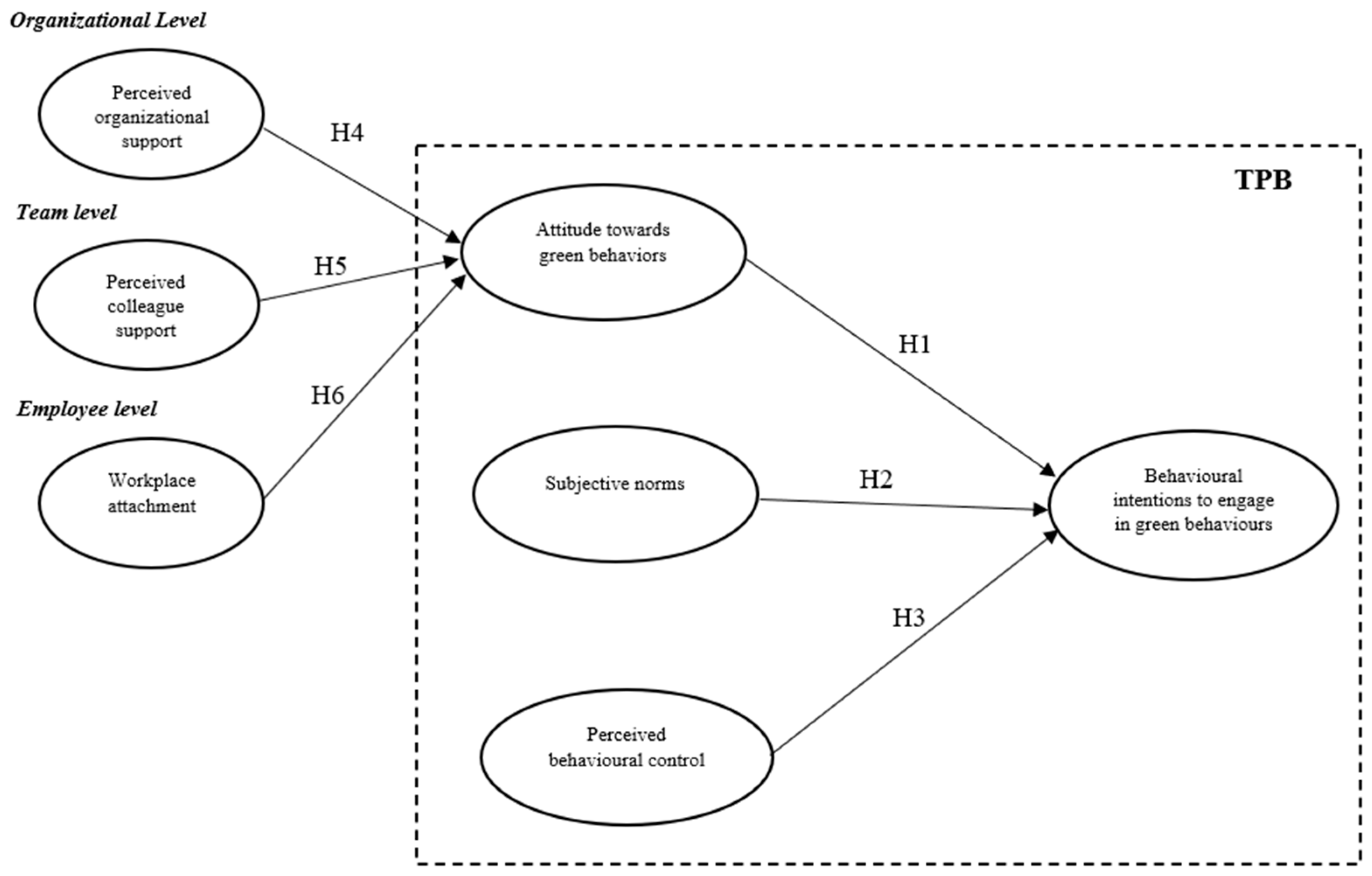
Figure 1. The research model.
Sustainability 18 00486 g001
Table 1. Means, standard deviation, skewness and kurtosis of the variables.
MeanSDSkewnessKurtosis
Age42.34 10.740.9520.792
Attitude towards green behaviors22.34.94−0.6030.332
Subjective norms3.831.95−0.112−0.093
Perceived behavioural control13.472.150.1130.283
Perceived organizational support29.975.370.115−0.402
Perceived colleague support23.306.080.284−0.617
Workplace attachment16.104.550.594−0.378
Behavioural intentions to engage in green behaviours 16.283.07−1.0141.579
Note. Means values represent mean total scale scores.
Table 2. Outer loadings, construct validity, reliability, and AVE.
Construct/IndicatorsOuter LoadingCronbach’s AlphaCRAVE
AtGB_10.9310.910.9790.870
AtGB_20.941
AtGB_30.936
AtGB_40.937
AtGB_50.920
AtGB_60.927
AtGB_70.937
SN_10.8150.770.7980.663
SN_20.814
PBC_10.8640.760.9070.709
PBC_20.767
PBC_30.851
PBC_40.881
BIGR_10.9120.965 0.9580.851
BIGR_20.924
BIGR_30.933
BIGR_40.920
POS_10.9220.9230.9830.879
POS_20.953
POS_30.945
POS_40.944
POS_50.931
POS_60.929
POS_70.933
POS_80.942
PCS_10.9310.9110.9820.874
PCS_20.941
PCS_30.937
PCS_40.937
PCS_50.930
PCS_60.937
PCS_70.930
PCS_80.937
WA_10.9160.9350.9760.855
WA_20.914
WA_30.935
WA_40.923
WA_50.926
WA_60.943
WA_70.917
Table 3. Fornell and Larker.
AtGBSNPBCBIGRPOSPCSWA
AtGB0.933
SN0.1980.814
PBC0.0140.1980.842
BIGR0.0800.0000.3600.923
POS0.2360.0260.4890.6200.938
PCS0.2040.1190.0880.1350.3080.935
WA0.1360.2360.1620.1160.2310.2460.925
Table 4. Structural model and effect size.
Relationship
Direct Paths
β-ValueSEp-Value
Attitude → Behavioural intention0.3670.0170.000
Subjective norms → Behavioural intention0.0570.0350.222
Perceived behavioural control → Behavioural intention0.3690.0320.000
Perceived organizational support → Attitude0.3990.0870.000
Perceived colleague support → Attitude0.3230.0430.003
Workplace attachment → Attitude0.4010.0740.000
Relationship
Indirect paths
Perceived organizational support → Attitude → Behavioural intention0.1320.0120.000
Perceived colleague support → Attitude → Behavioural intention0.1490.0110.003
Workplace attachment → Attitude → Behavioural intention0.1310.0230.013
Disclaimer/Publisher’s Note: The statements, opinions and data contained in all publications are solely those of the individual author(s) and contributor(s) and not of MDPI and/or the editor(s). MDPI and/or the editor(s) disclaim responsibility for any injury to people or property resulting from any ideas, methods, instructions or products referred to in the content.


