


Abstract
Under the dual driving forces of negative population growth and the cross-regional agglomeration of factors, the trend of urban shrinkage in China continues to intensify. This study examines 461 small towns in 26 mountainous counties of Zhejiang Province, constructing a multi-dimensional shrinkage identification model based on “population–economy–land use.” The spatiotemporal patterns of shrinkage were visualized using ArcGIS 10.8, while the driving factors were analyzed using the MGWR method. ① From 2010 to 2020, the shrinkage phenomenon in small towns across the 26 mountainous counties rapidly spread, with medium- and severe-shrinking towns increasing markedly, showing an irreversible trend. ② The spatial evolution pattern shows a phased characteristic, transitioning from “disordered scattered points” to “striped aggregation.” A “V”-shaped shrinkage belt formed along the “Kaihua–Jingning–Yongjia” axis, demonstrating strong spatial aggregation. ③ The shrinkage of small towns is driven by multiple factors. Rugged mountainous terrain constrains development, while urbanization and industrial restructuring, coupled with outmigration of young and middle-aged workers, accelerate aging and limit local specialty industries. Transportation, social services, and policy frameworks further influence shrinkage patterns. In response to the continuous shrinkage trend of small towns in mountainous areas, future efforts should adopt coordinated strategies such as smart shrinkage, industrial restructuring, and institutional innovation to achieve structural and systemic reshaping.
1. Introduction
Stiglitz once remarked that “China’s urbanization will be one of the two major events shaping the course of human development in the twenty-first century.” The United Nations’ Sustainable Development Goals (SDGs) explicitly emphasize the need to promote inclusive and sustainable urbanization. Amid slowing economic growth, demographic shifts, and increasing regional disparities, China’s urbanization has entered a new phase characterized by simultaneous expansion and contraction [1]. Research indicates that between 2000 and 2020, over 180 cities nationwide exhibited signs of urban shrinkage [2]. Certain regions, represented by resource-based cities in Northeast China and counties in the central and western regions, are experiencing multiple shrinkage challenges, including population loss, industrial hollowing, and land vacancy [3]. Small towns in mountainous regions, which serve as vital links between urban and rural areas and cover 53% of the national territory, exhibit more intricate and concealed patterns of urban shrinkage. This shrinkage is driven not only by the siphoning effect of regional central cities but also by a combination of factors including ecological constraints, resource allocation, and policy interventions [4]. Consequently, there is an urgent need for more in-depth research at both theoretical and practical levels.
The concept of “urban shrinkage” was first proposed by Häußermann and Siebel [5] and has since been accepted and widely applied in the study of population loss, economic decline, and infrastructure idleness in cities and urban functional areas worldwide under the overlapping influences of suburbanization, deindustrialization, globalization, localized financial crises, and social transformation [6,7,8,9]. The research mainly covers the definition of urban shrinkage [10,11,12], quantitative identification [13,14,15,16,17], classification of its types [18,19,20], formation mechanisms [21,22,23], and planning responses [24,25,26,27]. The research scale has gradually expanded from typical regions such as metropolitan areas and traditional industrial cities to micro scales including small and medium-sized cities on the urban fringe and suburban rural areas [28,29]. Strategies like “smart shrinkage” and “age-friendly renovation” aimed at addressing small-town shrinkage are being explored in countries such as the United States, Poland, Japan, and Germany [28,30,31,32].
Restricted by the long-standing dominance of the urban expansion paradigm, research on shrinking cities in China began relatively late. The first questions to be answered were “What is a shrinking city?” and “What are the methods and criteria for identifying shrinking cities [1,2]?”. This was followed by further discussions and reflections on the statistical identification and comprehensive evaluation of shrinking cities [23,33,34]. In terms of the research areas, early studies mainly focused on the shrinkage phenomena in resource-exhausted regions such as the old industrial areas in Northeast China [3,29]. With the deepening of research, it has gradually been recognized by academia that urban shrinkage, like expansion, is a regular and normal phenomenon. Empirical studies conducted in regions such as the Yellow River Basin have clarified that urban shrinkage is not exclusive to resource-based cities but is a widespread phenomenon arising from the rapid development of urbanization and the frequent interaction of various factors [34,35].
At present, China’s urbanization has entered a stage of high-quality development, and the traditional growth-oriented urbanization logic can no longer fully meet the goals of the new stage. As an important component of China’s urbanization, small towns are situated at the critical juncture between cities and rural areas, serving as fundamental spatial units for promoting regional coordinated development and accommodating population mobility, and are also key actors in responding to shrinkage phenomena. Against this backdrop, the development of small towns urgently needs to align with the emerging development logic, and focusing on local shrinkage within a growth-oriented context helps explore a research paradigm of urban shrinkage with Chinese characteristics. Some scholars have begun to reconsider the issue of small-town shrinkage. In typical urban agglomerations and provincial regions, such as the Pearl River Delta, researchers have revealed the shrinkage trends of small towns based on population data at the township and street level [36,37]. They argue that the agglomeration effect of large cities will continue in the foreseeable future and that the shrinkage and differentiation of small towns follow an objective regularity [38,39]. At present, the shrinkage of small towns should not be regarded as a negative issue; rather, it provides an important perspective for understanding grassroots governance and designing targeted policy responses [12,40].
In conclusion, extensive research on urban shrinkage has been conducted both within China and internationally, offering valuable insights for a comprehensive and accurate understanding of emerging phenomena in urban development. Nevertheless, China’s urban shrinkage research differs significantly from Western studies due to unique national and provincial contexts, institutional frameworks, and other factors. The development patterns, influencing factors, and formation mechanisms of shrinkage in China are multifaceted, complex, and distinct [23,34,38]. Therefore, it is necessary not only to continue in-depth research on shrinkage phenomena in resource-based cities, core cities, and urban agglomerations, but also to pay close attention to the small towns and rural areas undergoing continuous transformation in the context of rapid transition, jointly constructing an integrated “city–town–village” research system. Therefore, this study defines small towns as the research scale and concentrates on the shrinkage conditions of small towns within a specific period. Compared with urban shrinkage in the traditional sense, this perspective better reflects the structural adjustment and reorganization within China’s urban system under rapid urbanization. The 26 mountainous counties in Zhejiang Province are key and challenging areas in the province’s efforts to build a high-quality demonstration zone for common prosperity. Therefore, exploring the shrinkage characteristics of small towns in this region and their underlying influencing factors provides a new empirical case for the localization of urban shrinkage research in China. This has important implications for actively addressing small-town shrinkage, adjusting regional governance policies, optimizing the spatial pattern of towns, and promoting regional sustainable development.
2. Analytical Framework and Data Methods
2.1. Research Framework
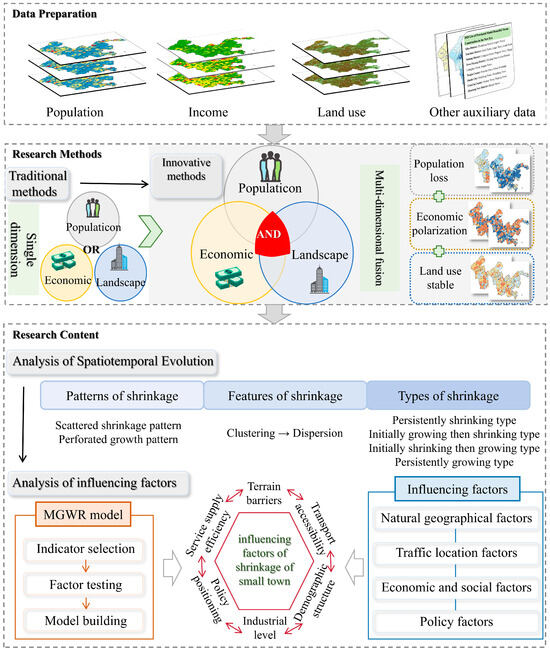
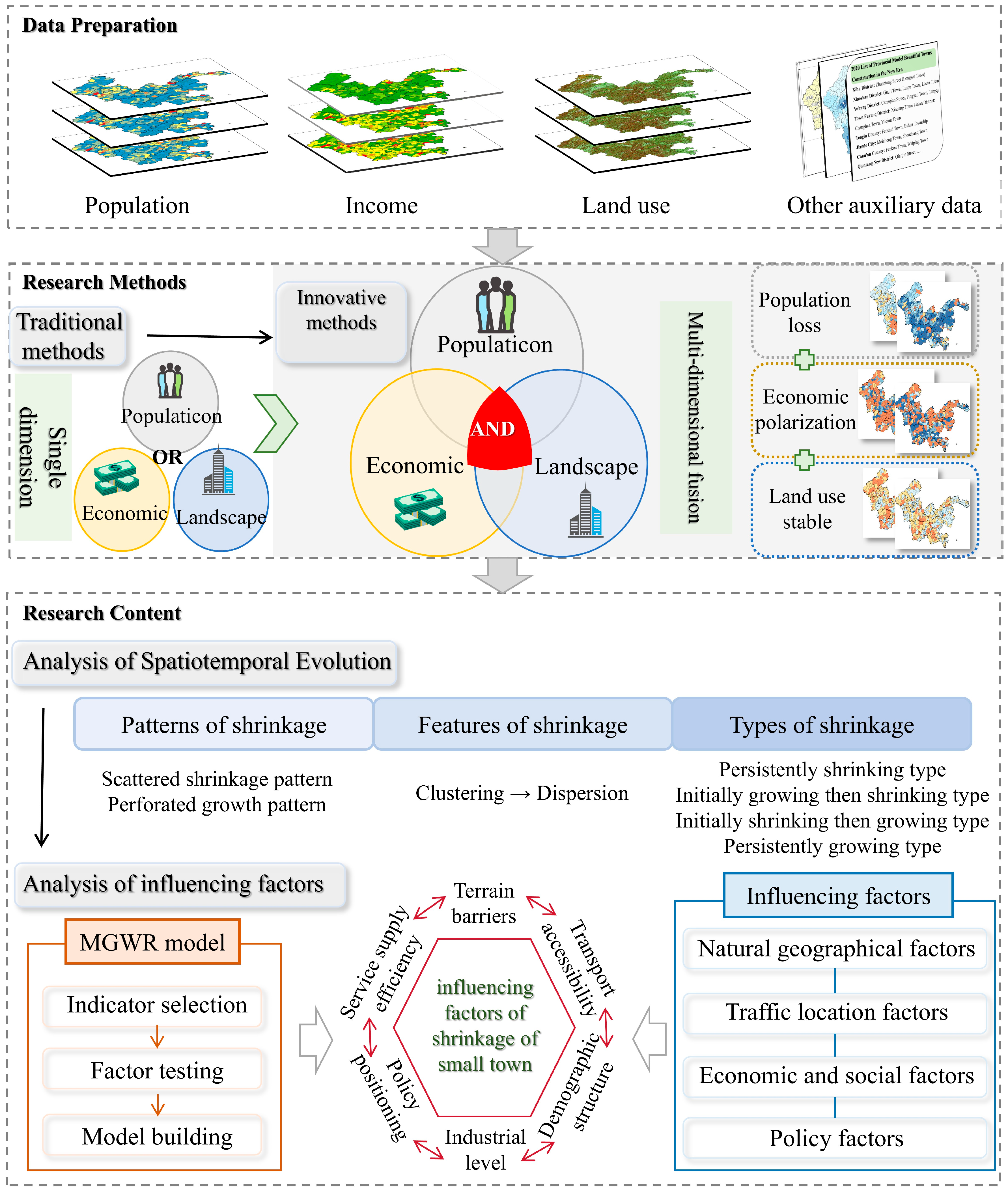
This study takes 461 small towns in 26 mountainous counties of Zhejiang Province as the research sample and constructs an integrated analytical framework of “multidimensional measurement–dynamic evolution–mechanism interpretation” to systematically explain the shrinkage patterns and influencing mechanisms of small towns in contiguous mountainous areas. As shown in Figure 1, the research proceeds as follows.
Figure 1.
Research framework.
First, a multidimensional identification model based on “population–economy–land use” is constructed to accurately identify the shrinkage patterns of mountainous small towns. By integrating multi-source data such as population, economy, and land use, this model breaks through the limitations of using a single population indicator and precisely identifies the multidimensional shrinkage characteristics of small towns. Second, the spatiotemporal evolution and type differentiation of shrinkage in mountainous small towns are systematically examined. Global Moran’s I index and Local Moran’s I index are employed to test the spatial autocorrelation of shrinkage patterns in contiguous mountainous areas. On this basis, small towns are classified into four types—continuous shrinkage, growth-to-shrinkage, shrinkage-to-growth, and continuous growth—thereby revealing differentiated evolutionary paths across shrinkage types. Finally, the MGWR model is used to analyze the mechanisms influencing the shrinkage of small towns in the 26 mountainous counties. An indicator system of influencing factors is constructed from the dimensions of natural geographic environment, transportation and locational development, socioeconomic factors, and policy institutions. Appropriate indicators are selected through systematic screening and factor testing and then incorporated into the MGWR model for empirical analysis. This approach reveals how each explanatory variable affects the shrinkage of small towns in mountainous areas, providing a fundamental basis for effectively addressing shrinkage challenges and implementing differentiated development strategies.
2.2. Research Area Profile
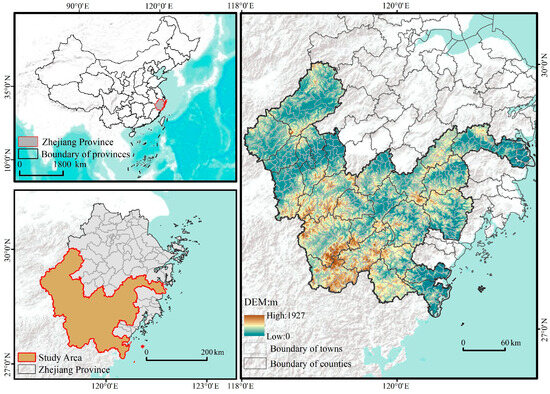
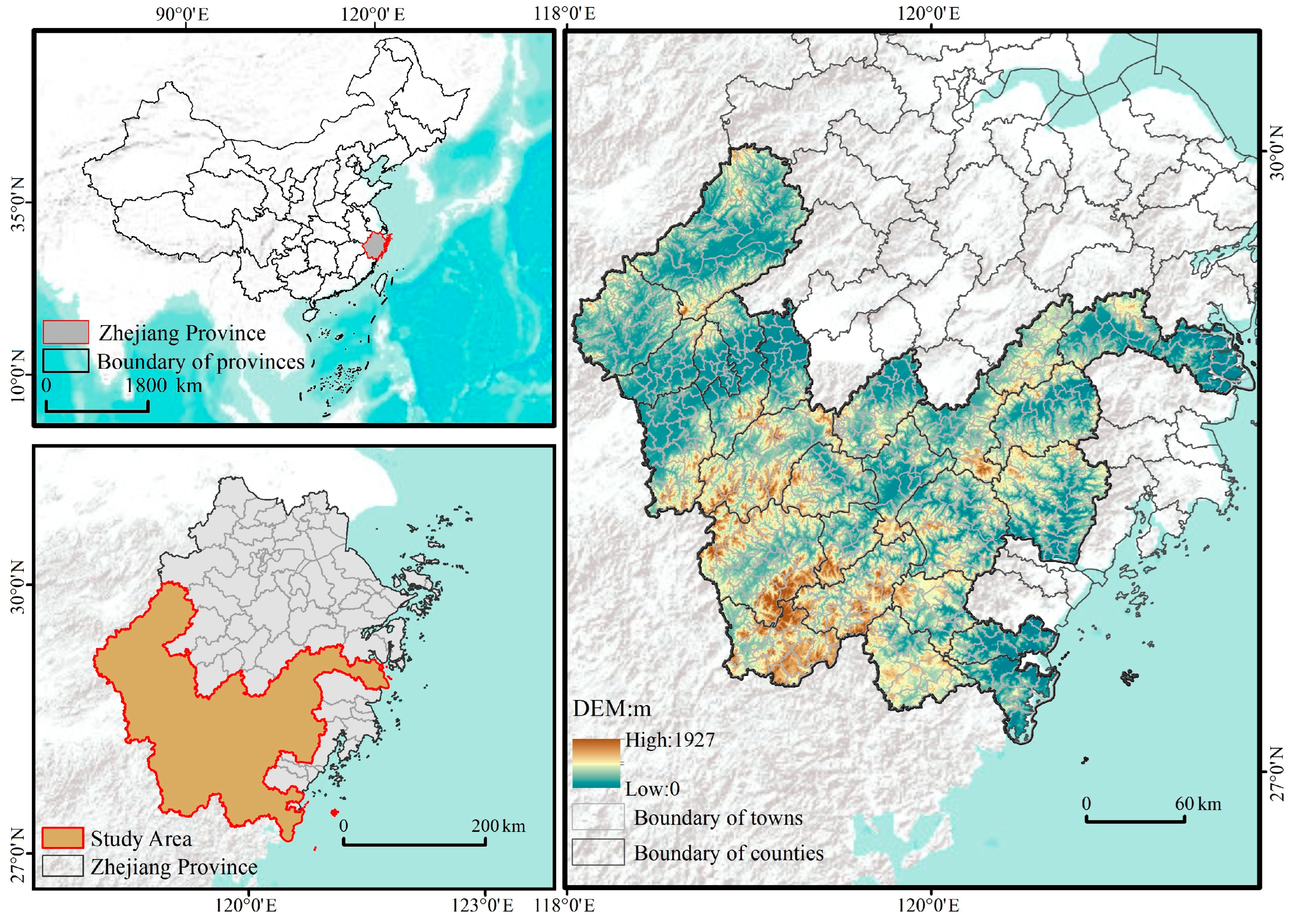
The 26 mountainous counties of Zhejiang Province are situated in the southwestern part of the province, covering approximately 44.5% of its total land area. Bordered by the Baiji Mountains to the north and the residual ridges of the Wuyi Mountains to the south, the region is predominantly mountainous and hilly, with areas above 500 m in altitude accounting for 73.7% of the total. The terrain is marked by extensive mountain and hill coverage, with only limited plains distributed along rivers and coastal zones, making it a representative example of a contiguous mountainous region (Figure 2). The mountainous terrain, often described by the saying “green mountains lock the gates,” has long constrained the development of the 26 counties, which remain among the least developed regions in Zhejiang Province. As of 2020, these counties accounted for just 9.65% of the province’s total GDP, with per capita GDP reaching only 57% of the provincial average. The permanent population stood at 10.17 million, and its share of the provincial total had declined by 4.9% compared to 2015. The average urbanization rate was 57.87%, well below the provincial average of 72.17% [41,42]. As the first pilot area in China to establish a “mountain–sea collaboration” policy system and implement a dynamic exit mechanism, the mountainous 26 counties of Zhejiang Province exhibit a unique pattern in which small-town shrinkage coexists with the revitalization of characteristic industries, driven by the complex interaction among internal resource endowments, policy environments, and market mechanisms. It is worth noting that although mountainous areas in Guizhou, Gansu, and other regions of China share similar geomorphological features, they differ significantly in terrain structure, resource endowments, and development foundations. Constrained simultaneously by weak infrastructure and ecological limitations, the development of characteristic industries in these regions faces substantial challenges. In contrast, the small-town shrinkage observed in Zhejiang’s urbanization process more clearly reflects the coexistence of ecological constraints and development opportunities, which provides a unique observational window into the spatial and temporal differentiation of small-town shrinkage in contiguous mountainous areas and offers important insights for developing differentiated governance approaches guided by “smart shrinkage.”
Figure 2.
Overview of the research area.
2.3. Data Sources and Processing
In this paper, all township-level administrative units within the study area (including townships, towns, and subdistricts) are included in the research scope and collectively referred to as “small town”. Considering administrative boundary adjustments during the study period, merged township boundaries are consolidated based on the 2020 administrative divisions, and data from other time points are combined accordingly. For divisions, data are proportionally split according to the built-up area share to ensure comparability over time. After further excluding areas such as state-owned forest farms, a total of 187 townships, 208 towns, and 66 subdistricts were obtained, amounting to 461 small towns units.
Regarding data, the population and socioeconomic data for the 461 small towns are mainly obtained from the “Zhejiang Township Statistical Data” provided by the Zhejiang Provincial Bureau of Statistics, supplemented in part by the “China County Statistical Yearbook (Township Volume)” and the “Zhejiang Fiscal Yearbook”. Since the Zhejiang Township Statistical Data only collects relevant data up to 2020, this study defines the research period as 2010–2020 and divides it into two sub-periods with 2015 as the boundary, in order to portray the phased evolutionary characteristics of small-town shrinkage. This temporal division is based not only on data availability but also on policy and development context. On one hand, 2010 corresponds to the national population census, and 2015 corresponds to the national population sample survey, which helps maintain the continuity and comparability of core indicators such as population, fiscal revenue, and built-up area. On the other hand, 2015 marks a critical point in the advancement of China’s urbanization policies, bringing a new institutional environment for small-town development. Transportation network data were obtained from OpenStreetMap (OSM) for the corresponding years. Land cover data were derived from the 30 m global land cover fine classification product (1985–2020) released in 2021 by the Aerospace Information Research Institute, Chinese Academy of Sciences (http://doi.org/10.5281/zenodo.4280923).
2.4. Research Methods
2.4.1. Shrinkage Identification Method
At present, academic research generally identifies town shrinkage based on three main dimensions: population decline or out-migration in the demographic dimension, industrial recession or growth stagnation in the economic dimension, and spatial deterioration or facility abandonment in the landscape dimension [3,38,43,44,45]. Among these, population change is regarded as the most direct manifestation of shrinkage and serves as the primary basis for identification in most current studies [36,46,47]. This study argues that town shrinkage embodies all of the above characteristics and represents a multi-dimensional transformation involving population, economy, and land use.
Therefore, considering the regional characteristics of small towns in the 26 mountainous counties of Zhejiang Province, this paper systematically establishes a three-dimensional identification method of “population–economy–land use” to comprehensively determine the shrinkage pattern and its evolutionary characteristics in the region.
① Population dimension: The absolute change in the population size of small towns is the most direct criterion for measuring shrinkage or growth. The change in the absolute value of the permanent resident population is used to determine whether a small town’s population is increasing or declining [3,35,46,47].
② Economic dimension: General public budget revenue is an important indicator reflecting regional economic strength and fiscal condition [36,38]. Regions with higher revenue have more complete infrastructure and higher living standards. Public fiscal revenue is selected to measure the economic development level of small towns and is deflated using 2010 as the base year. This indicator can represent the economic shrinkage status of small towns.
③ Land Use Dimension: The expansion of built-up land reflects changes in the spatial development of towns [43]. Following the methodology of Zong Huiming [48], remote sensing data are used to identify built-up areas in small towns. High-resolution remote sensing imagery is then preprocessed through projection transformation, cropping to town boundaries, and classification. The growth rate of built-up land is subsequently used to assess areas of spatial expansion and contraction.
The calculation formulas for the shrinkage level of small towns across the three dimensions are as follows [3,35,36,38,43]:
In the formula, Spi represents the change rate of the resident population for small town i; P′i and Pi are the resident populations of small town i in two consecutive years. The calculation process for the fiscal revenue change rate Sei and the built-up area change rate Sli is the same as that for the resident population change rate Spi.
The AHP-CRITIC combined weighting method is further employed to identify the shrinkage situation of small towns across the “population–economic–land use” composite dimension. This method combines the strengths of both the CRITIC and AHP weighting techniques, accounting for the variation in indicators in determining their weights and the conflicts between the indicators, while preserving more essential information [49]. The calculation process is as follows [49,50]:
- (1)
- AHP subjective weights
In this study, multiple experts in relevant fields were invited to score each indicator. A judgment matrix was constructed by pairwise comparison of indicator importance by the experts, and the rationality of the matrix was verified through a consistency test. The eigenvector method was then used to normalize the matrix, and the subjective weight of each indicator was ultimately obtained. For detailed calculation procedures, please refer to the relevant literature [49].
- (2)
- CRITIC objective weights
The calculation process is as follows [50]:
- Calculation of Indicator Weight:
In the formula, σj represents the standard deviation of each indicator, and rjk denotes the correlation coefficient.
- 2.
- Calculation of indicator information content:
- (3)
- AHP-CRITIC combined weighting
In the formula, represents the objective weight of the j indicator. represents the subjective weight of the j indicator.
The final combined weights are determined as follows: 0.445 for the change rate of the resident population, 0.328 for the change rate of fiscal revenue, and 0.227 for the change rate of built-up area.
Using this approach, the shrinkage changes in small towns in the composite dimension are obtained, and the calculation formula is as follows [49]:
In the formula, Szi represents the composite dimension change rate of small town i, Sij is the change rate of small town i in the j dimension, where j refers to the change rates of resident population, fiscal revenue, and built-up area. Wj is the AHP-CRITIC combined weight value of small town i in the j dimension.
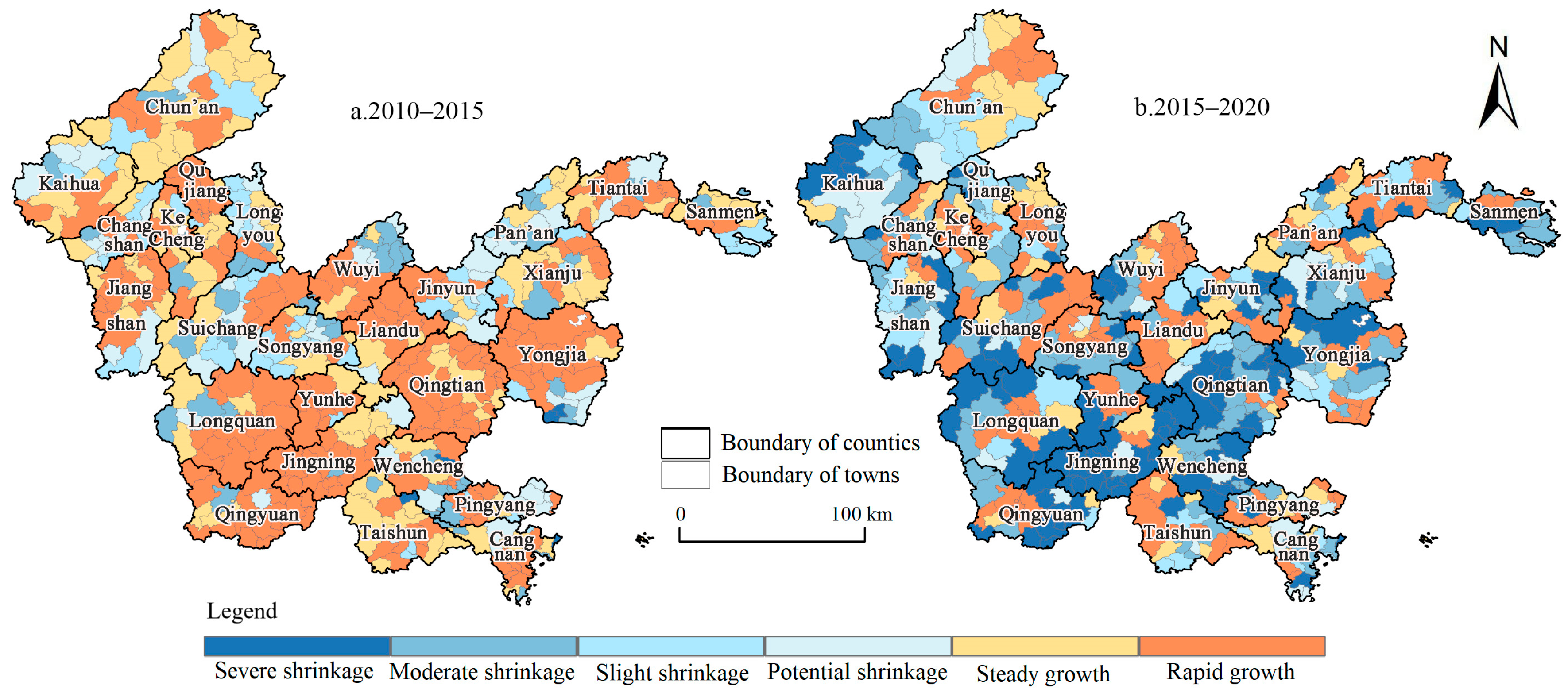
Additionally, following relevant studies [51,52], the shrinkage degree of small towns is classified into six levels. Based on the comprehensive change rate between the two time periods, the levels are classified as: “Severe Shrinkage” (Szi ≤ −0.3), “Moderate Shrinkage” (−0.3 < Szi ≤ −0.1), “Mild Shrinkage” (−0.1 < Szi ≤ 0), “Potential Shrinkage” (0 < Szi ≤ 0.1), “Stable Growth” (0.1 < Szi ≤ 0.3), and “Rapid Growth” (Szi > 0.3). Among them, severe, moderate, and mild shrinkage indicate that the area has overall entered an absolute shrinkage state; potential shrinkage refers to areas with stagnated or extremely slow growth, which presents a higher risk of shrinkage, so they are also classified as shrinking areas for early warning. Stable growth and rapid growth indicate that small towns are still in a relatively fast growth phase and are considered growing areas.
2.4.2. Exploratory Spatial Data Analysis
Global Moran’s I index and Local Moran’s I index were used to test the spatial autocorrelation of the shrinkage pattern of contiguous mountainous small towns [53]. The Global Moran I index measures whether the spatial distribution of small-town shrinkage variables exhibits an overall clustering characteristic. The Local Moran’s I index analyzes each small town individually to reveal the spatial autocorrelation at that location and its surrounding area. It can capture more detailed spatial heterogeneity, reflecting different spatial distribution patterns that may exist among small towns. These include four types of spatial association patterns: high-high clustering, low-low clustering, high-low clustering, and low-high clustering. The calculation formulas are as follows [53]:
In the formulas, I represents the global Moran’s I index, and Ii denotes the local Moran’s I index for the i area. n is the number of small towns involved in the study. xi and xj are the shrinkage indices of small town i and small town j, respectively. is the mean value of the small-town shrinkage indices. is the adjacency matrix in the spatial weight matrix, where the value is 1 if small towns i and j are spatially adjacent, and 0 if not.
2.4.3. Regression Analysis
- (1)
- OLS Model
To avoid redundancy and multicollinearity among influencing factors, this study employs the Ordinary Least Squares (OLS) regression to test the effects of influencing factors. The aim is to precisely predict the variation trends of the dependent variable using multiple explanatory variables. The calculation method is shown in the following formula [54]:
In the formula: y is the dependent variable, namely the small-town shrinkage index; x represents the explanatory variables, used to predict the values of the dependent variable in the model; β is the regression coefficient, indicating the strength of the relationship between the explanatory variables and the dependent variable. If the regression coefficient is positive, the explanatory variable is positively correlated with the dependent variable; otherwise, if negative, the two are negatively correlated. β0 is the intercept of the regression line on the y-axis, representing the predicted value of the dependent variable when all explanatory variables are zero. ε denotes the random error, reflecting the difference between the actual and predicted values of the dependent variable.
- (2)
- Multi-scale Geographically Weighted Regression (MGWR)
The MGWR model takes variable bandwidths into account during the computation process, customizing a specific bandwidth for each variable as the spatial scale parameter in the spatial calculation. This approach is closer to the actual spatial processes than the traditional GWR, making it especially suitable for analyzing spatial heterogeneity [55]. Since this study involves a small scale and a large sample size, the use of the MGWR model can more effectively identify the spatial heterogeneity characteristics of multi-factor influences on the shrinkage changes of 461 small towns. The calculation formula is as follows [55]:
In the formula, Pi is the dependent variable, representing the shrinkage level of small town i; β0(ui,vi) denotes the intercept of the i-th small town. βbwj indicates the local regression coefficient under different bandwidths; (ui,vi) represent the centroid coordinates of small town i; Xij represents the j predictor variable of small town i; and εi is the regression residual of the model.
3. Spatiotemporal Patterns of Small-Town Shrinkage in the 26 Mountainous Counties of Zhejiang Province
3.1. Evolution of Spatial Patterns
The intensification of shrinkage during the rapid urbanization process is a general characteristic of small-town development in the 26 mountainous counties of Zhejiang Province. From 2010 to 2015, nearly 70% of small towns in this region were in a stage of stable or rapid growth, while only about one-third faced the risk of shrinkage. Within just five years, shrinkage among the 461 small towns in the study area became dramatically more evident. The number of severely shrinking towns rose sharply, making up nearly one-quarter of the total, while moderately shrinking towns also increased. Meanwhile, the proportion of mildly and potentially shrinking towns remained relatively stable. As shrinking areas expanded rapidly, the number of steadily and rapidly growing small towns decreased sharply, and their overall share fell from 67.68% to 36.66% (Table 1).
Table 1.
Number and proportion of shrinking small towns based on the integrated population–economy–land use dimensions.
Taken together, these findings show that during the decade of socioeconomic transformation, over half of the small towns in the study area alternated between phases of growth and shrinkage. The distribution of shrinkage types shifted from a single-peaked pattern dominated by gradual growth to an hourglass-shaped structure, where growth-type towns coexist with moderate and severe shrinkage types, and towns with intermediate shrinkage remain relatively few. This composition further confirms that the transmission and transition process of small towns from growth to shrinkage in the study area was quite dramatic.
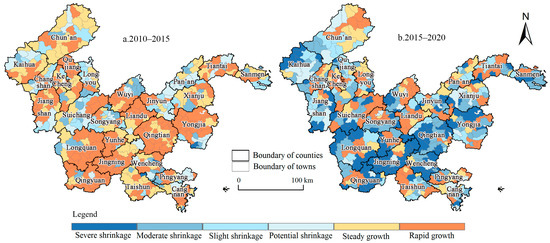
In spatial terms (Figure 3), the types of small-town shrinkage show clear regional differentiation between the two periods. From 2010 to 2015, stable and rapid growth were the dominant development trends among small towns in the 26 mountainous counties, widely distributed across counties such as Longquan, Qingtian, and Yongjia. Together, they formed a “Longquan–Yongjia” rapid growth belt stretching continuously from the southwest to the northeast. Shrinking small towns are fragmented by growth areas in certain localities, primarily at the junctions of the 26 mountainous counties, exhibiting a scattered distribution pattern with small-scale clusters.
Figure 3.
Evolution of small-town shrinkage patterns based on the integrated population–economy–land use.
By 2015–2020, shrinkage had become the dominant trend in small towns development, forming a distinct “V”-shaped shrinkage belt that extended northeastward and northwestward along the Kaihua–Jingning–Yongjia axis. Among them, the expansion of severely shrinking small towns was particularly pronounced. In the southern part of the region, including Suichang, Jingning, and Wencheng, significant transitions occurred, and zones of severe shrinkage became spatially continuous. Moderate and mild shrinkage towns were mainly clustered around the edges of severely shrinking zones, particularly in Kaihua and Qingtian. Potentially shrinking small towns, serving as a buffer zone in the transition between “growth and shrinkage,” were often located near urban streets and county seat towns. These towns were relatively few in number and showed scattered distributions in places like Chun’an, Jiangshan, and Xianju. At this stage, the development space of growing small towns was significantly compressed. They were distributed in a perforated pattern among numerous shrinkage zones, mainly concentrated in urban subdistricts and county seat towns of various counties and cities. Small-scale clusters emerged in Liandu, Qujiang, and the northern areas of Chun’an, Wuyi, and Suichang.
3.2. Spatial Clustering Characteristics
To further explore the spatial clustering of different types of small-town shrinkage in the 26 mountainous counties, the global Moran’s I index was used to characterize the spatial autocorrelation of small-town shrinkage patterns in the region. The global Moran’s I indices for both periods were positive, with Z-scores greater than 2.8 and passing the significance test. This indicates a significant positive spatial autocorrelation of small-town shrinkage in the 26 mountainous counties during both periods, meaning that small towns with similar levels of shrinkage tend to be spatially clustered.
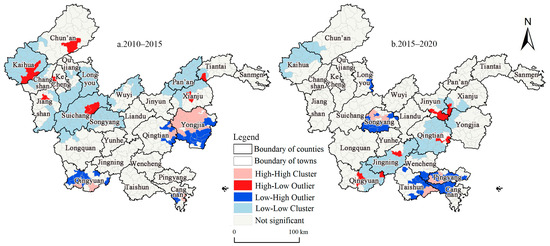
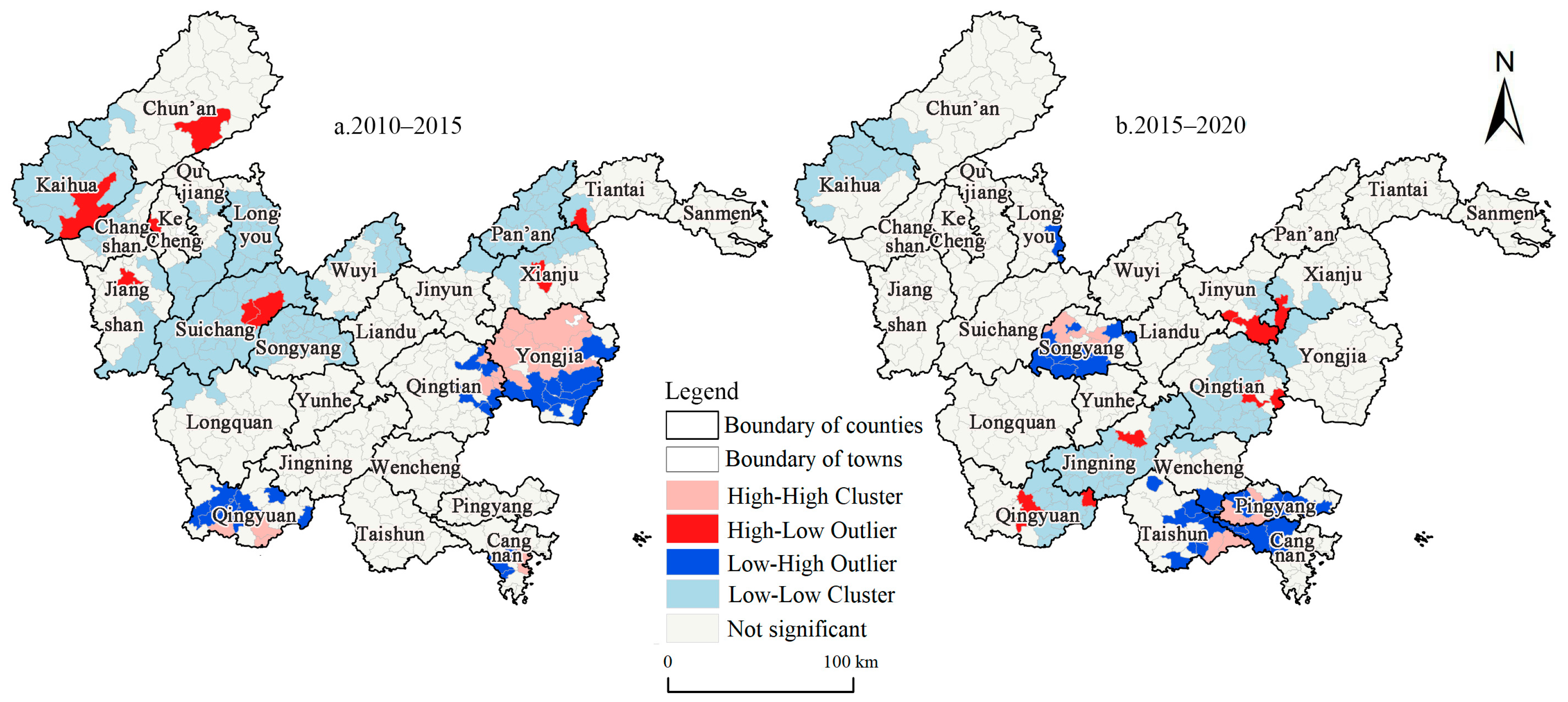
Using the Anselin Local Moran’s I tool for local spatial autocorrelation analysis (Figure 4), it was found that from 2010 to 2015, high–high clusters were primarily concentrated in small towns located in the eastern part of the 26 mountainous counties—such as Yongjia, Qingtian, and Cangnan. In the later period, these clusters shifted to central areas like Songyang and southern counties including Taishun and Pingyang, though the overall spatial extent remained limited. The spatial extent of low–low clusters was considerably broad. From 2010 to 2015, they were distributed in contiguous zones across the western counties of Kaihua and Changshan, the central areas including Suichang, Songyang, Longyou, and Qujiang, as well as the northeastern counties of Wuyi and Pan’an. By 2015–2020, the spatial extent of low–low clusters had contracted, with concentrations primarily consolidating in two large regions: the Kaihua–Chun’an belt and the Qingyuan–Xianju belt. High-low clustering areas usually coexist with low-low clustering areas, while low-high clustering areas coexist with high-high clustering areas, which well reflects the “agglomeration–diffusion” effect of regional central places.
Figure 4.
Local spatial autocorrelation of shrinkage level in small towns.
3.3. Evolutionary Types
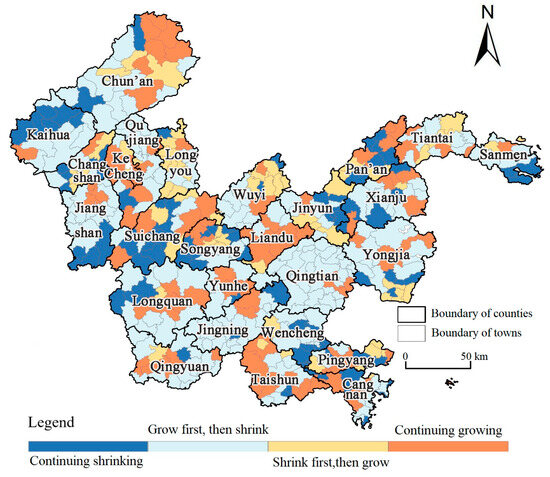
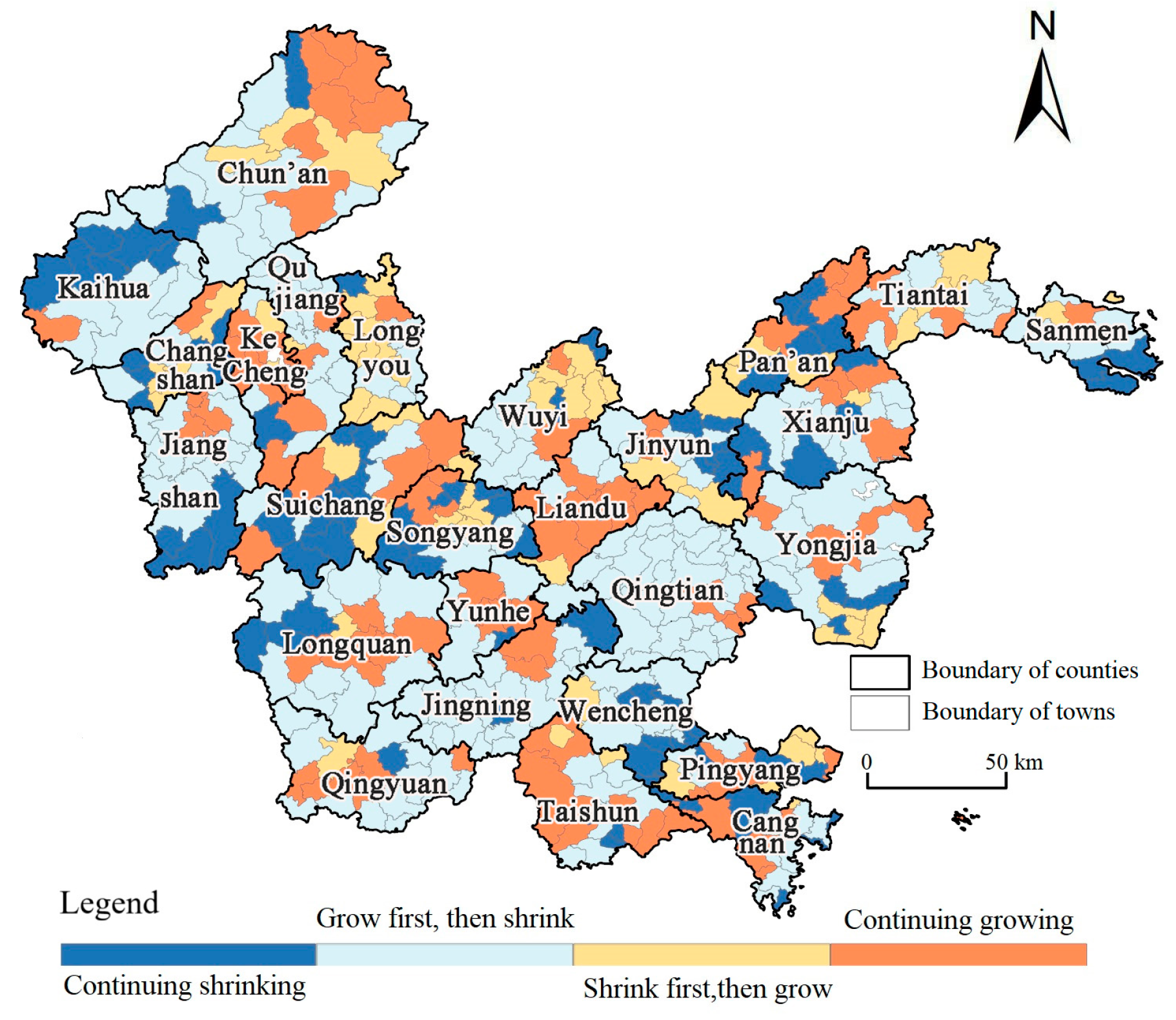
By comparing the multidimensional evaluation results between 2010–2015 and 2015–2020, the evolution of small-town shrinkage can be categorized into four types: continuous shrinkage, growth then shrinkage, shrinkage then growth, and continuous growth, as illustrated in Figure 5.
Figure 5.
Spatial differentiation of evolutionary types of small-town shrinkage.
Specifically, shrinkage-type small towns constitute 63.34% of the total, making them the dominant group. Among them, there are 205 small towns of the growth-then-shrinkage type, the largest number with the broadest distribution, mainly concentrated in Jingning, Qingtian, Wencheng, and other areas. These towns are clearly constrained by factors such as terrain and policies, showing a reverse shift from growth back to shrinkage. A total of 87 small towns is classified as continuously shrinking, a relatively small number mainly located at the borders of counties and cities such as Jiangshan–Suichang–Longquan, Kaihua–Chun’an, and Jinyun–Xianju. These towns are influenced by the combined forces of internal push-out and external “magnetic attraction.”
In contrast, the number of growth-type small towns is far fewer than that of shrinkage-type small towns, totaling 169. Among them, continuously growing small towns account for a relatively high proportion (23.21%) and are distributed across all counties and cities except Wencheng. Municipal districts such as Liandu, Kecheng, and Qujiang, as well as most county seat towns and Chengguan towns, are mainly of this type. Compared with other small towns, these areas have stronger economic strength and social service capacity, a higher degree of policy-resource matching, and serve as the core areas driving high-quality county development, effectively supporting the sustained growth of small towns.
In addition, the number of small towns that first shrink and then grow is the smallest, with only 62. Most of these are concentrated in the northern part of the study area, displaying a distinctive “W”-shaped spatial distribution, particularly among small towns in Wuyi, Longyou, and other locations. Taken together, these evolutionary patterns clearly indicate that shrinkage is the predominant feature and trend in the development of small towns across the 26 mountainous counties of Zhejiang Province. Furthermore, this trend has intensified over time and appears to be progressing in an increasingly irreversible direction.
4. Influencing Factors of Small-Town Shrinkage in the 26 Mountainous Counties of Zhejiang Province
4.1. Selection of Indicator Variables for Influencing Factors
When exploring the potential influencing factors behind small-town shrinkage, scholars both in China and abroad generally consider globalization, deindustrialization and population aging as key driving forces [6,9,24,56]. Further integrating the regional development characteristics of the 26 mountainous counties, and based on the feasibility, representativeness, and availability of indicators, this study selects indicators from six dimensions—geographical environment, transportation accessibility, urbanization development, industrial structure, social services, and policy and institutional factors—to analyze the deeper causes of small-town shrinkage in the 26 mountainous counties (Table 2).
Table 2.
Indicator system of influencing factors for small-town shrinkage.
The natural geographical environment is a fundamental condition that influences the flow and allocation of various factors, directly affecting economic activities and population distribution in small towns [57]. This study selects two indicators—mean altitude and mean slope—to reflect the complex environmental characteristics of the mountainous areas with varying terrain. The rapid economic development, accompanied by the cross-regional organization and restructuring of production activities, has accelerated the flow and agglomeration of production factors. Meanwhile, it has also led to the outflow of economic and population factors in certain areas, resulting in a trend of shrinkage [21,23,36]. Seven indicators, including demographic structure and industrial structure, are of representative significance. Small towns in contiguous mountainous areas possess weak endogenous development capacity and are highly constrained by transportation accessibility and the availability of basic public services. Government policy and institutional factors play a crucial role in guiding regional resource allocation and shaping development strategies [3,39,58]. Accordingly, this study evaluates transportation accessibility by measuring the travel time between small towns and their respective higher-level administrative centers. It further selects indicators such as the minimum living security rate and the number of institutions for science, education, culture, and healthcare per capita to assess social service capacity. Lastly, two indicators, whether a town serves as a county seat town and whether it has been designated as a Beautiful Town demonstration site, are introduced to reflect policy and institutional factors and explore how they influence small-town shrinkage.
4.2. Analysis of Influencing Factors
This study employs the Multiscale Geographically Weighted Regression (MGWR) model to analyze the driving factors of small-town shrinkage, concentrating on the 2015–2020 period in light of the article length constraints and the current status of the study area, which better captures the prevailing characteristics of small-town shrinkage in China’s mountainous regions, thereby enabling a more precise examination of its underlying drivers and spatial heterogeneity. Pearson correlation analysis, multicollinearity diagnosis, and other methods were used for the initial screening of indicators, with those exhibiting a tolerance below 0.1 and high multicollinearity (VIF > 7.5) being removed. Ultimately, eight indicators—mean slope, travel time, aging rate, number of agricultural organizations per capita, number of industrial enterprises per capita, minimum living security rate, number of institutions for science, education, culture, and healthcare per capita, and whether the town is a county seat town—are selected for model analysis.
To verify the model performance and ensure the reliability of the results, this study conducted a multi-model comparison of the influencing factors of small-town shrinkage (Table 3). The results show that the OLS model performs poorly in the analysis of shrinkage factors of small towns in the 26 mountainous counties, with an R2 of only 0.373, indicating that global regression cannot fully capture the spatial heterogeneity among variables and therefore leads to weak fitting performance. Thus, it is necessary to select models capable of reflecting spatial heterogeneity, namely GWR and MGWR. Further comparison reveals that the adjusted R2 of the MGWR model reaches 0.629, which is significantly higher than those of the OLS and GWR models, indicating that MGWR has a higher goodness-of-fit and better adaptability in analyzing the spatial pattern and influencing factors of small-town shrinkage in the 26 mountainous counties. The spatial differentiation characteristics of each explanatory variable are shown in Figure 5.
Table 3.
Comparison of results from OLS, GWR, and MGWR models.
4.2.1. Geographical Environment
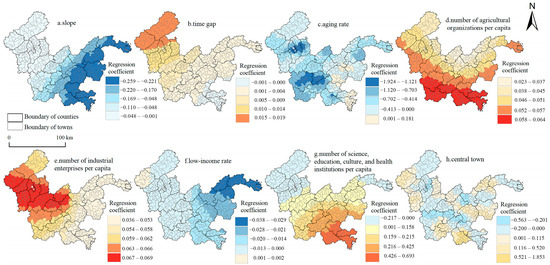
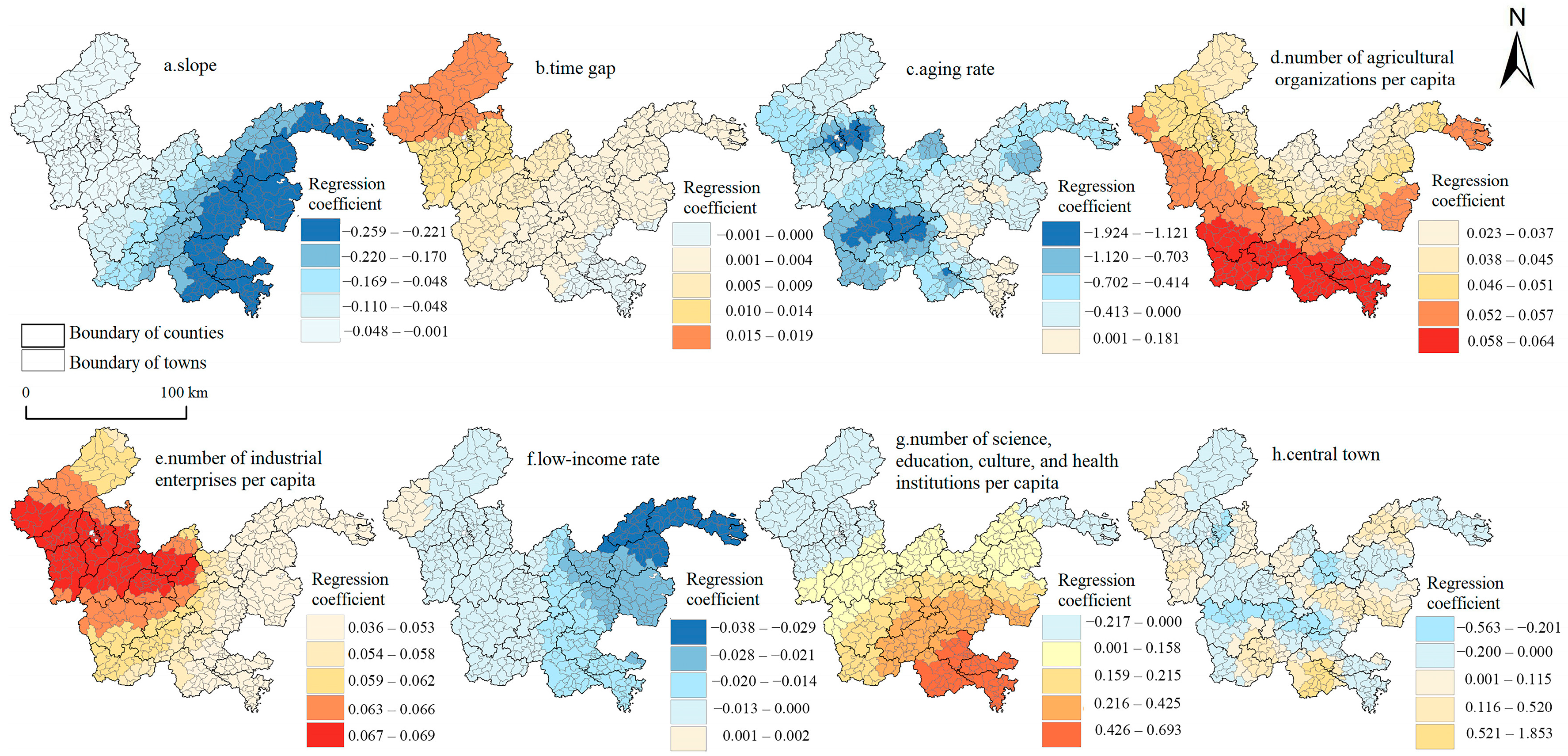
According to Figure 6a, mean slope generally shows a negative impact on the variation in small-town shrinkage. This means that as slope increases, the numerical value representing small-town shrinkage in the 26 mountainous counties decreases, and the degree of shrinkage intensifies. Spatially, the strongest negative effects are observed in coastal counties such as Taishun, Wencheng, and Cangnan, exhibiting an overall spatial pattern of gradually weakening influence from southeast to northwest. The widespread mountainous terrain and steep topography, as the fundamental geographical environment of the 26 mountainous counties in Zhejiang Province, not only limit the exchange of material and information between small towns and the outside world and the development of large-scale socioeconomic activities but also increase the difficulty of expanding construction land, transportation, and infrastructure supporting facilities in small towns, thereby restricting the expansion of small towns scale.
Figure 6.
Spatial heterogeneity map of MGWR results.
Further statistical analysis (Table 4) shows that among the 461 small towns in the study area, 177 mountainous towns have an average altitude exceeding 500 m, of which 132 are shrinkage-type small towns, accounting for 74.58% of the mountainous towns. Among small towns with an average slope greater than 25°, 75.32% belong to severe or moderate shrinkage types. These findings indicate a relatively strong correlation between small towns shrinkage and terrain geomorphology.
Table 4.
Comparison of altitude, slope, and shrinkage types of small towns in the 26 mountainous counties.
4.2.2. Transportation Accessibility
The MGWR model analysis results (Figure 6b) show that transportation accessibility generally has a positive effect on small-town shrinkage, indicating that areas with better transportation conditions experience lower degrees of shrinkage. In terms of location, areas with better transportation accessibility are mainly composed of urban streets and county seat towns in the 26 mountainous counties, which undertake economic and administrative functions of the county. These areas are generally in stable or rapid growth stages, with relatively complete supporting infrastructure and public services, and exhibit strong resource exclusivity and polarization effects. With the improvement of transportation infrastructure shortening travel time, the time cost for the transfer of population and other factors to county seats is reduced. Consequently, small towns in peripheral areas experience rapid resource loss and are more susceptible to falling into the “agglomeration shadow”.
In contrast, for areas with low transportation accessibility, such as Qingyuan, Yunhe, and Kaihua, their remote locations and poor transportation infrastructure, coupled with limited external communication channels, make it difficult to support large-scale economic and industrial development and provide sufficient employment opportunities. The lack of opportunities to generate economic benefits leads to financial difficulties and population outflow, resulting in the shrinkage of small towns.
4.2.3. Demographic Structure
Rapid urbanization is an important factor influencing population loss in small towns, with aging being the most prominent issue of concern. Figure 6c shows that the aging rate primarily exerts a negative effect on small-town shrinkage, and two pronounced clusters of negative impact are observed in regions such as Qujiang–Longyou and Longquan–Yunhe. Essentially, population aging and small-town shrinkage are mutually causal. The accelerating process of urbanization inevitably draws large numbers of people—especially the working-age population—from towns to county seats, thereby intensifying aging. In turn, the level of aging, through a cycle of cumulative causal effects, becomes a “signal light” indicating population shrinkage. Most counties within Zhejiang’s 26 mountainous counties have long been regarded as “small population counties.” In 2020, the resident population growth rate in the 26 mountainous counties lagged the provincial average by 4.9%, while the average urbanization rate was only 57.87%, far below the provincial urbanization rate of 72.17%.
Furthermore, currently in the 26 mountainous counties, shrinkage-type small towns have a population aged over 60 accounting for more than 32%, while the proportion of migrant population is less than 15%. These figures differ significantly from the provincial average aging rate of 13.27% and migrant population proportion of 25.1%. Among severely shrinking small towns, the aging rate exceeds 37%, and the average migrant population proportion is only 13%. The excessively high aging population combined with a shortage of migrants has resulted in considerable population shrinkage, which will further impact the economy and land use, becoming the fuse for multidimensional shrinkage in small towns.
4.2.4. Industrial Structure
In terms of industrial structure, the MGWR model analysis results (Figure 6d,e) show that the number of agricultural organizations per capita and the number of industrial enterprises per capita both have a strong positive effect on small-town shrinkage. That is, as these two values increase, the shrinkage trend in small towns is continuously alleviated. Spatially, the regression coefficient for the number of agricultural organizations per capita shows a stepwise decline in its positive effect from south to north. In contrast, the regression coefficient for the number of industrial enterprises per capita forms a contiguous zone of concentrated positive effects in the Jiangshan–Qujiang–Wuyi area, which is also the main concentration area of industrial enterprises in the 26 mountainous counties. Overall, the development of industry and agriculture in small towns provides substantial employment opportunities and fiscal revenue, demonstrating a strong ability to attract and retain production factors, thereby helping to mitigate small-town shrinkage to some extent.
However, in the long term, the agricultural value chain in the 26 mountainous counties remains relatively short and positioned at the lower end of the value spectrum, which limits its capacity to attract resources and absorb labor. The industrial foundation in these areas is comparatively weak relative to other counties of the province, with a clear trend of deindustrialization emerging in recent years due to ecological protection policies. As a key sector for employment and population retention, the secondary industry’s role has significantly diminished. If these “freed” labor and capital elements cannot achieve “re-fixation” locally through the immature tertiary industry, these mountainous small towns will face irreversible industrial shrinkage, reduced employment opportunities, declining public service levels, and even the deterioration of overall social functions.
4.2.5. Social Services
The minimum living security rate and the number of institutions for science, education, culture, and healthcare per capita can be used to measure the intrinsic impact of social service levels on small-town shrinkage. As shown in Figure 6f, it is evident that the minimum living security rate exhibits a negative effect in most study units—that is, the lower the minimum living security rate, the lower the degree of small-town shrinkage. This indicates that ensuring basic living standards for low-income populations and preventing the recurrence of poverty are important measures to address small-town shrinkage, as well as practical requirements for sharing development outcomes among all people.
In contrast, the number of institutions for science, education, culture, and healthcare per capita shows a significant positive effect on small-town shrinkage variation (Figure 6g). Counties with higher regression coefficients are concentrated in the southeastern areas such as Cangnan, Pingyang, and Taishun, with the influence gradually weakening toward the northwest and northeast. This indicates that the equalization of public services significantly contributes to sustaining socioeconomic vitality in small towns and alleviating shrinkage pressure. The higher the level of education, healthcare, and social services, the lower the degree of shrinkage in small towns. In fact, to promote leapfrog development in the 26 mountainous counties, Zhejiang Province has already embedded innovation elements such as science, education, and healthcare into these areas, supporting their transformation through initiatives like agricultural technology assistance, shared educational resources, and rural medical outreach.
4.2.6. Policy and Institutional Factors
Policy and institutional factors have a significant influence on small-town shrinkage in the 26 mountainous counties, reflected in multiple dimensions. First, whether a town is designated as a provincial-level central town is included in the model analysis (Figure 6h). The results reveal a marked dual effect: the development orientation of central towns exerts a notable influence on small-town shrinkage. In relatively developed areas, such orientation shows a clear positive impact, enabling towns to secure more fiscal resources and policy support, thereby helping to mitigate the shrinkage of small towns.
Furthermore, changes in small-town shrinkage are closely linked to their administrative management systems and higher-level policy planning. On the one hand, under an administrative system characterized by “vertical fragmentation” and “segmented governance,” the intermediary administrative status of small towns—positioned between rural townships and urban centers—makes it difficult for them to access development resources through top-down mechanisms. The differing administrative roles of townships, towns, and subdistricts have also shaped divergent capacities in resisting shrinkage across small towns. As shown in Table 5, among the 108 severely shrinking small towns in the study area, 68 are townships, accounting for 62.96% of the total. In contrast, the proportion of towns is 35.19%, while subdistricts account for only 1.85%, presenting a distribution structure of “township > town > subdistrict.” If the sample sizes of townships, towns, and subdistricts are further considered, the disparity becomes even more pronounced. Among the 187 townships in the study area, 73.26% are classified as shrinkage-type small towns, whereas only 13.64% of all subdistricts exhibit shrinkage characteristics. This indicates that the differing levels of resource access and allocation across various types of township-level administrative units lead to starkly different manifestations in the shrinkage of small towns. Ordinary townships experience significantly higher shrinkage intensity compared to urban subdistricts.
Table 5.
Comparison table of administrative units and shrinkage levels of small towns in the 26 mountainous counties, 2015–2020.
Moreover, guided by the “Two Mountains Theory,” the 26 mountainous counties in Zhejiang Province, which serve as ecological barriers, abolished GDP total volume assessments starting in 2015. Instead, the focus shifted to ecological protection, income growth for residents, and related matters. With population relocations from nature reserves and water source protection zones, as well as the impact of deindustrialization, many small towns in these mountainous counties, such as townships around Qiandao Lake in Chun’an County, have gradually embarked on a path of smart shrinkage under the policy orientation of “ecology first.”
5. Discussion
5.1. Dialectical Insights into the Dual Facets of Shrinking Small Towns in Zhejiang’s Mountains
Driven by both negative population growth and the cross-regional flow of production factors, urban shrinkage in China is expanding from localized resource-based cities to broader regional and town-level contexts [23,34,38,39]. However, the shrinkage phenomenon of contiguous mountainous small towns, which is concealed, complex, and largely irreversible, has received little scholarly attention [28]. Accordingly, this study examines 461 small towns in 26 mountainous counties of Zhejiang Province, using a multidimensional identification approach, a dialectical analysis of shrinkage effects, and innovative policy recommendations, providing a new empirical perspective and analytical framework for understanding small-town shrinkage under complex topographic constraints.
Compared with traditional methods that identify shrinkage based on population change rates [30,39,57,59], this study introduces economic and land-use perspectives to comprehensively determine shrinking small towns, further identifying potential shrinkage small towns characterized mainly by “relatively stable populations but economic decline and inefficient expansion of built-up areas.” By breaking through the limitations of using a single population indicator to measure shrinkage in mountainous small towns, it accurately captures early signals of systemic functional decline, providing a more scientific basis for early intervention [60].
The findings of this study also provide spatialized evidence for dialectically understanding the “dual facets” influencing small-town shrinkage [32,61]. On one hand, this study further confirms the existence of the negative cycle of “shrinkage–decline” in small towns [37]. The MGWR analysis shows that towns with higher aging rates and fewer industrial enterprises exhibit more pronounced shrinkage. These towns are largely concentrated in the core area of the “V-shaped” shrinkage belt (Figure 6). This “shrinkage shadow” in economically developed regions can be viewed as a micro-level manifestation of factor centralization under regional polarization, as well as the cumulative effect of policy bundles guided by the new green and ecological development paradigm [62].
On the other hand, this study also observed the potential opportunities of “smart shrinkage [61].” It also found that some shrinking small towns with superior ecological environments and high policy positioning showed improving trends in per capita public service indicators and residents’ income stability. This suggests that, under the new context of ecological priority and high-quality development, shrinkage in mountainous small towns does not necessarily equate to an overall decline in development level [63], but may instead serve as a forcing mechanism for spatial restructuring, optimization of per capita resource allocation, and transition toward green and specialized development. Crucially, effective policy interventions are needed to interrupt negative feedback loops and steer these towns toward positive transformation.
5.2. Differentiated Responses to Shrinking Small Towns in Contiguous Mountainous Areas
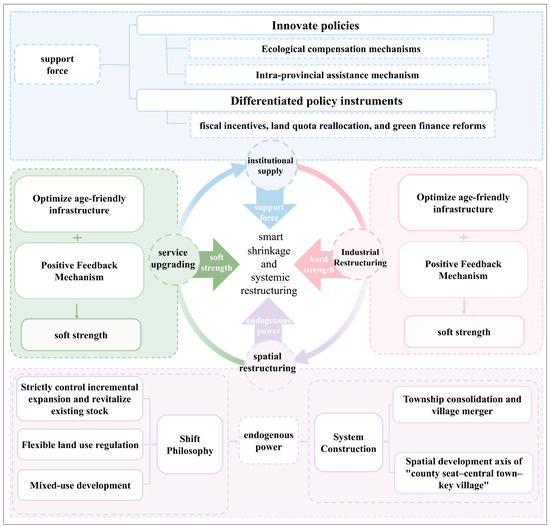
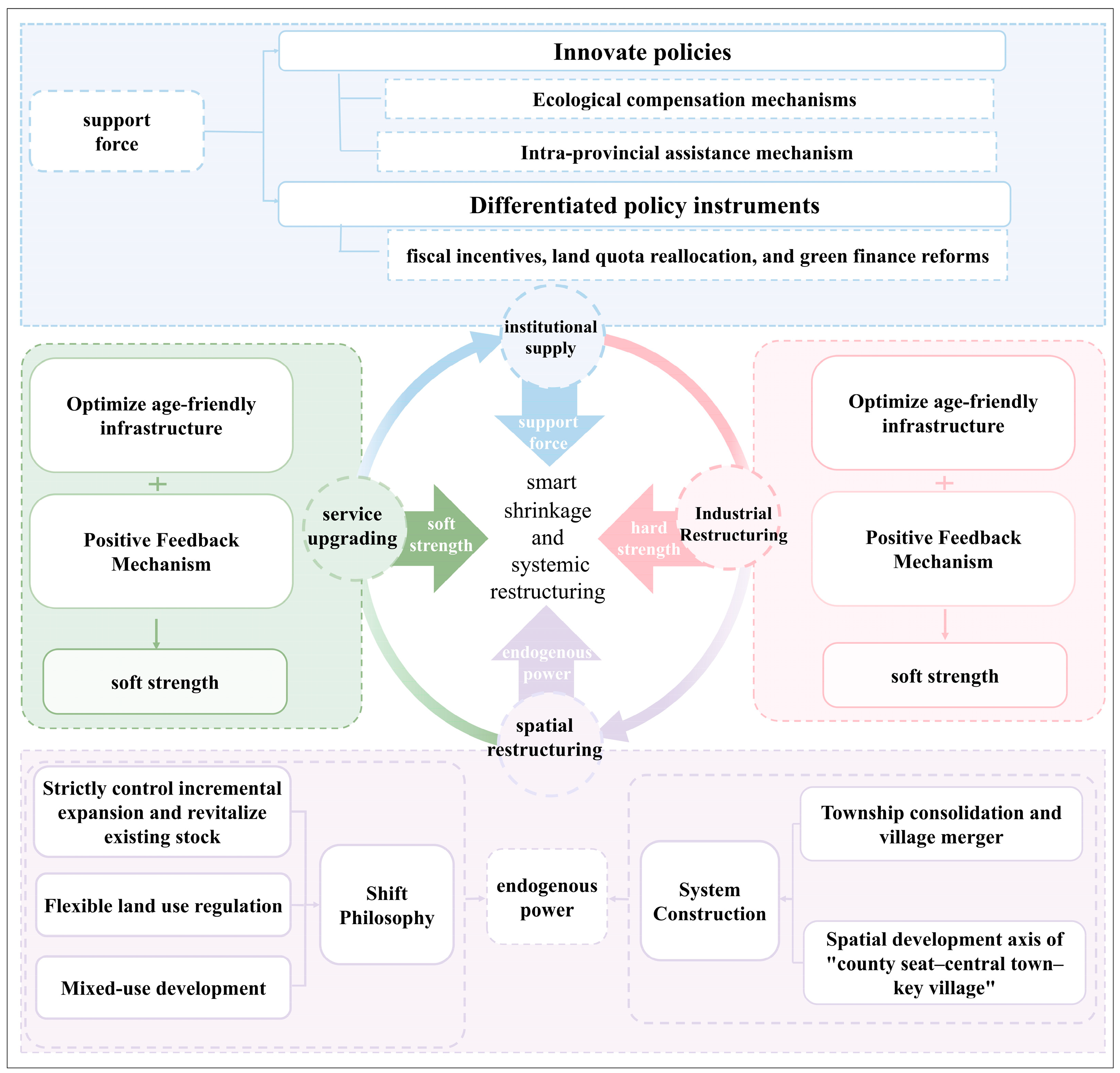
Based on the above understanding and relevant literature, this study argues that holistic and preventive expansion-oriented strategies are no longer suitable for the development of small towns in contiguous mountainous areas. Instead, a differentiated governance paradigm centered on “smart shrinkage and systemic restructuring” is required (Figure 7):
Figure 7.
Differentiated coping strategies for mountainous small-town shrinkage.
- (1)
- Implementing a spatial restructuring strategy oriented toward smart shrinkage is the core objective. The primary task for the development of small towns at present is to break the path dependence on “growth-oriented” thinking and to acknowledge the long-term nature of shrinkage. Strictly controlling new land expansion and revitalizing existing stock, adopting flexible land-use regulation and mixed-use development strategies [28,30,31,32], actively guiding the concentration of population and production factors along the “county seat–central town–key village” development axis [7]. Through measures such as township consolidation and village merger-and-relocation, the regional spatial structure is optimized, the cost of public service provision is reduced, and an efficient and resilient spatial “endogenous force” is formed.
- (2)
- Promoting an industry restructuring strategy driven by factor agglomeration is the fundamental pathway [21,64]. To alleviate shrinkage in the economic dimension, it is necessary to deepen industrial development based on the characteristic resource endowments of mountainous areas. On the one hand, based on the characteristic resource endowments of mountains, waters, forests, and farmlands in the 26 mountainous counties, traditional agriculture should be guided toward agriculture–culture–tourism integration, with a focus on developing signature industries such as Chun’an’s water-based beverages, Pan’an’s traditional Chinese medicine, and Yunhe’s cultural and sports products, so as to extend the industrial chain and strengthen the value chain. On the other hand, within the permissible scope of ecological redlines, it is necessary to cultivate new growth poles such as clean industries and digital industries, create local employment, and form the economic resilience that can curb the shrinkage of small towns.
- (3)
- Arranging a service-quality improvement and human-capital strategy that covers the full life cycle is the key support [65]. In view of the problems of population aging and out-migration, a combined set of strategies should be implemented. The age-friendliness of infrastructure and public services should be improved, and new industries serving the elderly population should be cultivated to develop the “silver economy.” At the same time, the spillover effects of science and technology, education, and medical services should be emphasized, and a positive feedback mechanism of “technology incubation–vocational training–talent return” should be fostered so as to improve the “soft power” of social development in small towns within mountainous counties.
- (4)
- Innovating a policy supply and coordination strategy compatible with incentives constitutes the institutional guarantee [24,32,66,67]. Innovate the policy system for the protection and development of mountainous areas, strengthen vertical fiscal transfers at the provincial level and horizontal coordinated development among counties and districts, and guide the targeted flow of talents and resources through differentiated policy instruments such as fiscal incentives, land quota reallocation, and green finance reforms. These measures provide institutional momentum for smart shrinkage and build institutional “supporting capacity” to slow down the shrinkage of small towns.
5.3. Limitations and Future Research Directions
Of course, this study still has certain limitations, which also point to directions for future research. First, constrained by the availability of township-level socioeconomic data, the study period is 2010–2020, and it does not capture the new characteristics of population mobility in the recent three years. Second, in the analysis of influencing factors, although policy and institutional variables were included, the depiction of complex interactions among different levels of government and the transmission mechanisms of specific policy instruments remains insufficient. For example, how the specific utilization efficiency of the “Mountain-Sea Collaboration” funds affects township shrinkage still requires in-depth case tracking. Future research could also leverage big data analysis and in-depth qualitative interviews to further reveal the dynamic mechanisms of small-town shrinkage in mountainous areas under multi-stakeholder interactions, and to conduct long-term tracking and evaluation of the implementation effects of “smart shrinkage” policies.
6. Conclusions
This study examines the shrinkage changes and distribution characteristics of 461 small towns in the 26 mountainous counties of Zhejiang Province from 2010 to 2020, using indicators such as changes in resident population, fiscal revenue, and built-up area. By constructing a multidimensional “population–economic–land use” model of urban shrinkage, the study also uses the MGWR model to explore the main factors driving the shrinkage of small towns in Zhejiang’s 26 mountainous counties. The findings are as follows:
- (1)
- From 2010 to 2020, small-town shrinkage in the 26 mountainous counties of Zhejiang Province showed a rapid expansion trend, with the degree of shrinkage continuously intensifying. The proportion of moderately and severely shrinking small towns increased significantly. Comparing the two before and after periods, 2010–2015 and 2015–2020, the number of small towns facing shrinkage problems increased by 2.64 times, while the number of severely shrinking small towns increased by 21.6 times. Under this impact, the number of growing small towns drastically decreased to about half of the original amount.
- (2)
- During the study period, the spatial pattern of small-town shrinkage in the 26 mountainous counties of Zhejiang Province changed from a scattered distribution to a strip-shaped and block-shaped distribution. A “V”-shaped shrinkage aggregation belt formed along the axis of “Kaihua–Jingning–Yongjia,” extending to the northeast and northwest directions. Moreover, the shrinkage trend exhibited a significant positive spatial autocorrelation.
- (3)
- The shrinkage pattern of small towns in the 26 mountainous counties of Zhejiang is influenced by multiple factors. The rugged and mountainous natural environment acts as a geographic constraint, while urbanization development and industrial restructuring accelerate the outflow of young and middle-aged labor and intensify aging, thereby restricting the development of specialty agriculture and green manufacturing. Improvements in transportation location conditions and social public services partially alleviate shrinkage pressures. Eco-prioritized protective policies also influence the future development paths of mountainous small towns, becoming an external force that cannot be ignored in driving shrinkage. The spatial heterogeneity of these factors is pronounced; whether the effects are positive or negative, the small towns most affected are those in rugged areas and on the peripheries of counties and regions.
Author Contributions
Conceptualization, Z.W. and M.Z.; methodology, Z.W.; software, W.Z.; validation, S.L.; formal analysis, W.Z.; investigation, S.L. and W.H.; resources, W.Z.; data curation, Z.W. and W.Z.; writing—original draft preparation, W.Z.; writing—review and editing, Z.W. and S.L.; visualization, W.H.; supervision, M.Z.; project administration, Z.W.; funding acquisition, Z.W. All authors have read and agreed to the published version of the manuscript.
Funding
This research was supported by Natural Science Foundation of China, grant number 42301241, and Zhejiang Provincial Natural Science Foundation of China, grant number LQ24D010006.
Institutional Review Board Statement
Not applicable.
Informed Consent Statement
Not applicable.
Data Availability Statement
The data presented in this study are available on request from the corresponding author.
Conflicts of Interest
The authors declare no conflicts of interest.
Correction Statement
This article has been republished with a minor correction to the Funding statement. This change does not affect the scientific content of the article.
References
- Wu, K.; Sun, D. Progress in urban shrinkage research. Econ. Geogr. 2017, 37, 59–67. (In Chinese) [Google Scholar] [CrossRef]
- Long, Y.; Wu, K.; Wang, J. Shrinking cities in China. Mod. Urban Res. 2015, 2015, 14–19. (In Chinese) [Google Scholar] [CrossRef]
- Yao, T.; Liu, W.; Li, C.; Zhang, J.; Ma, Z. Understanding patterns and multilevel influencing factors of small town shrinkage in Northeast China. Sustain. Cities Soc. 2021, 68, 102811. [Google Scholar] [CrossRef] [Scilit]
- Li, X.; Du, Z.; Li, X. The spatial distribution and mechanism of city shrinkage in the Pearl River Delta. Mod. Urban Res. 2015, 2015, 36–43. (In Chinese) [Google Scholar] [CrossRef]
- Häußermann, H.; Siebel, W. Die schrumpfende Stadt und die Stadtsoziologie. In Soziologische Stadtforschung; Häußermann, H., Siebel, W., Eds.; Suhrkamp Verlag: Frankfurt am Main, Germany, 1988; pp. 78–94. [Google Scholar]
- Blanco, H.; Alberti, M.; Olshansky, R.; Chang, S.; Wheeler, S.M.; Randolph, J.; London, J.B.; Hollander, J.B.; Pallagst, K.M.; Schwarz, T.; et al. Shaken, shrinking, hot, impoverished and informal: Emerging research agendas in planning. Prog. Plan. 2009, 72, 195–250. [Google Scholar] [CrossRef] [Scilit]
- Dubeaux, S.; Sabot, E.C. Maximizing the potential of vacant spaces within shrinking cities, a German approach. Cities 2018, 75, 6–11. [Google Scholar] [CrossRef] [Scilit]
- Nadja, K. Evolving reurbanisation? Spatio-temporal dynamics as exemplified by the East German city of Leipzig. Urban Stud. 2010, 49, 967–990. [Google Scholar] [CrossRef] [Scilit]
- Wiechmann, T.; Pallagst, K.M. Urban shrinkage in Germany and the USA: A comparison of transformation patterns and local strategies. Int. J. Urban Reg. Res. 2012, 36, 261–280. [Google Scholar] [CrossRef] [Scilit]
- Grossmann, K.; Bontje, M.; Haase, A.; Mykhnenko, V. Shrinking cities: Notes for the further research agenda. Cities 2013, 35, 221–225. [Google Scholar] [CrossRef] [Scilit]
- Martinez-Fernandez, C.; Audirac, I.; Fol, S.; Cunningham-Sabot, E. Shrinking cities: Urban challenges of globalization. Int. J. Urban Reg. Res. 2012, 36, 213–225. [Google Scholar] [CrossRef] [Scilit]
- Servillo, L.; Atkinson, R.; Hamdouch, A. Small and Medium-Sized Towns in Europe: Conceptual, Methodological and Policy Issues. Tijdschr. Econ. Soc. Geogr. 2017, 108, 365–379. [Google Scholar] [CrossRef] [Scilit]
- Caselli, B.; Ventura, P.; Zazzi, M. Performance-based spatial monitoring. An interpretative model for long-term shrinking medium-small Italian towns. Sustain. Cities Soc. 2020, 53, 101924. [Google Scholar] [CrossRef] [Scilit]
- Chen, X.; Lang, W.; Yuan, Y.; Yan, G.; Hou, X. Conceptualizing the nexus between spatiotemporal shrinkage patterns of natural cities and driving mechanisms: Insights into urban shrinkage in Northeast China. Cities 2024, 152, 105179. [Google Scholar] [CrossRef] [Scilit]
- Delken, E. Happiness in shrinking cities in Germany. J. Happiness Stud. 2008, 9, 213–218. [Google Scholar] [CrossRef] [Scilit]
- Peng, W.; Wu, Z.; Duan, J.; Gao, W.; Wang, R.; Fan, Z.; Liu, N. Identifying and quantizing the non-linear correlates of city shrinkage in Japan. Cities 2023, 137, 104292. [Google Scholar] [CrossRef] [Scilit]
- Wiechmann, T. Errors expected—Aligning urban strategy with demographic uncertainty in shrinking cities. Int. Plan. Stud. 2008, 13, 431–446. [Google Scholar] [CrossRef] [Scilit]
- Alves, D.; Barreira, P.A.; Guimarães, H.M.; Panagopoulos, T. Historical trajectories of currently shrinking Portuguese cities: A typology of urban shrinkage. Cities 2016, 52, 20–29. [Google Scholar] [CrossRef] [Scilit]
- Buhnik, S. From Shrinking Cities to Toshi no Shukushō: Identifying Patterns of Urban Shrinkage in the Osaka Metropolitan Area. Berkeley Plan. J. 2011, 23, 132–155. [Google Scholar] [CrossRef] [Scilit]
- Döringer, S.; Uchiyama, Y.; Penker, M.; Kohsaka, R. A meta-analysis of shrinking cities in Europe and Japan. Towards an integrative research agenda. Eur. Plan. Stud. 2020, 28, 1693–1712. [Google Scholar] [CrossRef] [Scilit]
- Wang, J.; Yang, Z.; Qian, X. Driving factors of urban shrinkage: Examining the role of local industrial diversity. Cities 2020, 99, 102646. [Google Scholar] [CrossRef] [Scilit]
- Wolff, M.; Wiechmann, T. Urban growth and decline: Europe’s shrinking cities in a comparative perspective 1990–2010. Eur. Urban Reg. Stud. 2018, 25, 122–139. [Google Scholar] [CrossRef] [Scilit]
- Yao, T.; Liu, W.; Li, C.; Rong, Y.; Zhang, J.; Yang, Y.; Yan, Q.; Gao, S.; Liu, Y. County town shrinkage in China: Identification, spatiotemporal variations and the heterogeneity of influencing factors. J. Rural Stud. 2022, 95, 350–361. [Google Scholar] [CrossRef] [Scilit]
- Hattori, K.; Kaido, K.; Matsuyuki, M. The development of urban shrinkage discourse and policy response in Japan. Cities 2017, 69, 124–132. [Google Scholar] [CrossRef] [Scilit]
- Martinez-Fernandez, C.; Weyman, T.; Fol, S.; Audirac, I.; Cunningham-Sabot, E.; Wiechmann, T.; Yahagi, H. Shrinking cities in Australia, Japan, Europe and the USA: From a global process to local policy responses. Prog. Plan. 2016, 105, 1–48. [Google Scholar] [CrossRef] [Scilit]
- Maxwell, H. Shifting perceptions in shrinking cities: The influence of governance, time and geography on local (in)action. Int. Plan. Stud. 2020, 25, 150–165. [Google Scholar] [CrossRef] [Scilit]
- Wolff, M.; Fol, S.; Roth, H.; Cunningham-Sabot, E. Is planning needed? Shrinking cities in the French urban system. Town Plan. Rev. 2017, 88, 131–145. [Google Scholar] [CrossRef] [Scilit]
- Bartosiewicz, B.; Kwiatek-Sołtys, A.; Kurek, S. Does the process of shrinking concern also small towns? Lessons from Poland. Quaest. Geogr. 2019, 38, 91–105. [Google Scholar] [CrossRef] [Scilit]
- Ma, Z.; Li, C.; Zhang, J.; Liu, D.; Tong, Y.; Liu, W. Understanding Urban Growth and Shrinkage From a Multiscale Perspective: Case Study of Jilin Province, China. J. Urban Plan. Dev. 2023, 149, 05023006. [Google Scholar] [CrossRef] [Scilit]
- Hartt, M.D. How cities shrink: Complex pathways to population decline. Cities 2018, 75, 38–49. [Google Scholar] [CrossRef] [Scilit]
- Peters, D.J.; Hamideh, S.; Zarecor, K.E.; Ghandour, M. Using entrepreneurial social infrastructure to understand smart shrinkage in small towns. J. Rural Stud. 2018, 64, 39–49. [Google Scholar] [CrossRef] [Scilit]
- Wirth, P.; Elis, V.; Müller, B.; Yamamoto, K. Peripheralisation of small towns in Germany and Japan—Dealing with economic decline and population loss. J. Rural Stud. 2016, 47, 62–75. [Google Scholar] [CrossRef] [Scilit]
- Guan, D.; He, X.; Hu, X. Quantitative identification and evolution trend simulation of shrinking cities at the county scale, China. Sustain. Cities Soc. 2021, 65, 102611. [Google Scholar] [CrossRef] [Scilit]
- Han, Y.; Deng, Y.; Ni, R. Why small towns are shrinking: The spatial heterogeneity of small town shrinkage and its impact from the perspective of rural–urban interaction in China. PLoS ONE 2023, 18, e0293889. [Google Scholar] [CrossRef] [Scilit] [PubMed]
- Chen, X.; Gao, R.; Han, T.; Zhang, S. Spatial pattern and influencing factors of urban shrinkage in the Yellow River Basin from the perspective of population change. Econ. Geogr. 2020, 40, 37–46. (In Chinese) [Google Scholar] [CrossRef]
- Du, Z.; Jin, L.; Ye, Y.; Zhang, H. Characteristics and influences of urban shrinkage in the exo-urbanization area of the Pearl River Delta, China. Cities 2020, 103, 102767. [Google Scholar] [CrossRef] [Scilit]
- Long, Y.; Wu, K. Shrinking cities in a rapidly urbanizing China. Environ. Plan. A 2016, 48, 220–222. [Google Scholar] [CrossRef] [Scilit]
- Liu, Z.; Liu, S.; Song, Y. Understanding urban shrinkage in China: Developing a multi-dimensional conceptual model and conducting empirical examination from 2000 to 2010. Habitat Int. 2020, 104, 102256. [Google Scholar] [CrossRef] [Scilit]
- Yang, Z.; Dunford, M. City shrinkage in China: Scalar processes of urban and hukou population losses. Reg. Stud. 2017, 52, 1111–1121. [Google Scholar] [CrossRef] [Scilit]
- Silverman, R.M. Rethinking shrinking cities: Peripheral dual cities have arrived. J. Urban Aff. 2020, 42, 294–311. [Google Scholar] [CrossRef] [Scilit]
- Zhejiang Provincial Bureau of Statistics. Zhejiang Statistical Yearbook 2015; Zhejiang Statistics Press: Hangzhou, China, 2015. [Google Scholar]
- Zhejiang Provincial Bureau of Statistics. Zhejiang Statistical Yearbook 2020; Zhejiang Statistics Press: Hangzhou, China, 2020. [Google Scholar]
- Lee, J.; Newman, G. Forecasting urban vacancy dynamics in a shrinking city: A land transformation model. ISPRS Int. J. Geo-Inf. 2017, 6, 124. [Google Scholar] [CrossRef] [Scilit]
- Qin, X.; Yuan, W.; Li, J.; Qi, X. Identification and analysis of urban shrinkage risk based on residential property values. Habitat Int. 2020, 106, 102265. [Google Scholar] [CrossRef] [Scilit]
- Reis, J.P.; Silva, E.A.; Pinho, P. Spatial metrics to study urban patterns in growing and shrinking cities. Urban Geogr. 2016, 37, 246–271. [Google Scholar] [CrossRef] [Scilit]
- Meng, X.; Jiang, Z.; Wang, X.; Long, Y. Shrinking cities on the globe: Evidence from LandScan 2000–2019. Environ. Plan. A Econ. Space 2021, 53, 1244–1248. [Google Scholar] [CrossRef] [Scilit]
- Zhang, X.; Zhou, S. Evolution of regional population decline and its driving factors at the county level in China. Econ. Geogr. 2023, 43, 42–51. (In Chinese) [Google Scholar] [CrossRef]
- Zong, H.; Dou, Q. Spatial-temporal pattern evolution and influencing factors of small town area in Chongqing. Econ. Geogr. 2023, 43, 91–100. (In Chinese) [Google Scholar] [CrossRef]
- Pei, J.; Zhang, J. Urban flooding risk assessment based on GIS–game theory combination weight: A case study of Zhengzhou City. Int. J. Disaster Risk Reduct. 2022, 77, 103080. [Google Scholar] [CrossRef] [Scilit]
- Diakoulaki, D.; Mavrotas, G.; Papayannakis, L. Determining objective weights in multiple criteria problems: The CRITIC method. Comput. Oper. Res. 1995, 22, 763–770. [Google Scholar] [CrossRef] [Scilit]
- Hoekveld, J.J. Time–space relations and the differences between shrinking regions. Built Environ. 2012, 38, 179–195. [Google Scholar] [CrossRef] [Scilit]
- Schilling, J.; Logan, J. Greening the Rust Belt: A green infrastructure model for right sizing America’s shrinking cities. J. Am. Plan. Assoc. 2008, 74, 451–466. [Google Scholar] [CrossRef] [Scilit]
- Anselin, L. Local indicators of spatial association—LISA. Geogr. Anal. 1995, 27, 93–115. [Google Scholar] [CrossRef] [Scilit]
- Zhu, C.; Zhang, X.; Zhou, M.; He, S.; Gan, M.; Yang, L.; Wang, K. Impacts of urbanization and landscape pattern on habitat quality using OLS and GWR models in Hangzhou, China. Ecol. Indic. 2020, 117, 106654. [Google Scholar] [CrossRef] [Scilit]
- Fotheringham, A.S.; Yang, W.; Kang, W. Multiscale geographically weighted regression (MGWR). Ann. Am. Assoc. Geogr. 2017, 107, 1247–1265. [Google Scholar] [CrossRef] [Scilit]
- Beauregard, R.A. Urban population loss in historical perspective: United States, 1820–2000. Environ. Plan. A 2009, 41, 514–528. [Google Scholar] [CrossRef] [Scilit]
- Yang, Z. Sustainability of urban development with population decline in different policy scenarios: A case study of Northeast China. Sustainability 2019, 11, 6442. [Google Scholar] [CrossRef] [Scilit]
- Kocur-Bera, K.; Szuniewicz, K. Socio-spatial aspects of shrinking municipalities: A case study of the post-communist region of North-East Poland. Sustainability 2021, 13, 2929. [Google Scholar] [CrossRef] [Scilit]
- Yuan, D.; Hwang, J. Can smart city development alleviate urban shrinkage in the traditional urban development process? Cities 2025, 160, 105847. [Google Scholar] [CrossRef] [Scilit]
- Ma, F.; Yoon, H. Urban shrinkage and its drivers: Time-series clustering and a panel model of Chinese cities. World Dev. 2025, 196, 107191. [Google Scholar] [CrossRef] [Scilit]
- Jiang, Y.; Sun, P. Does shrinkage have an impact on urban livability? An empirical analysis from Northeast China. Sustain. Cities Soc. 2024, 113, 105725. [Google Scholar] [CrossRef] [Scilit]
- Li, Z.; Yao, L.; Wang, M.; Wei, G.; Sun, P. Does the digital economy catalyze the emergence of urban shrinkage? Empirical evidence from Chinese prefecture-level cities. Cities 2024, 154, 105363. [Google Scholar] [CrossRef] [Scilit]
- Ren, J.; Li, Y.; Zhang, J.; Xu, H.; Hao, C. Does urban shrinkage equate to a decline in development levels?—Urban development measurement and influencing factors analysis. Environ. Impact Assess. Rev. 2024, 105, 107401. [Google Scholar] [CrossRef] [Scilit]
- Ortiz-Moya, F. Coping with shrinkage: Rebranding post-industrial Manchester. Sustain. Cities Soc. 2015, 15, 33–41. [Google Scholar] [CrossRef] [Scilit]
- Schwarz, K.; Berland, A.; Herrmann, D.L. Green, but not just? Rethinking environmental justice indicators in shrinking cities. Sustain. Cities Soc. 2018, 41, 816–821. [Google Scholar] [CrossRef] [Scilit]
- Atkinson, R. Policies for small and medium-sized towns: European, national and local approaches. Tijdschr. Econ. Soc. Geogr. 2017, 108, 472–487. [Google Scholar] [CrossRef] [Scilit]
- Ortiz-Moya, F. Green growth strategies in a shrinking city: Tackling urban revitalization through environmental justice in Kitakyushu City, Japan. J. Urban Aff. 2020, 42, 312–332. [Google Scholar] [CrossRef] [Scilit]

Disclaimer/Publisher’s Note: The statements, opinions and data contained in all publications are solely those of the individual author(s) and contributor(s) and not of MDPI and/or the editor(s). MDPI and/or the editor(s) disclaim responsibility for any injury to people or property resulting from any ideas, methods, instructions or products referred to in the content. |
© 2026 by the authors. Licensee MDPI, Basel, Switzerland. This article is an open access article distributed under the terms and conditions of the Creative Commons Attribution (CC BY) license.