Article

Research on Bayesian Hierarchical Spatio-Temporal Model for Pricing Bias of Green Bonds

1
School of Mathematics and Statistics, Zhongnan University of Economics and Law, Wuhan 430073, China
2
China Electric Power Planning & Engineering Institute, Beijing 100120, China
*
Author to whom correspondence should be addressed.
Sustainability 2026, 18(1), 455; https://doi.org/10.3390/su18010455
Submission received: 26 November 2025 / Revised: 16 December 2025 / Accepted: 24 December 2025 / Published: 2 January 2026

Abstract

Driven by carbon neutrality policies, the cumulative issuance volume of the global green bond market has surpassed $2.5 trillion over the past five years, with China, as the second largest issuer, accounting for 15%. However, there exists a yield difference of up to 0.8% for bonds with the same credit rating across different policy regions, and the premium level fluctuates dramatically with market cycles, severely restricting the efficiency of green resource allocation. This study innovatively constructs a Bayesian hierarchical spatiotemporal model framework to systematically analyze pricing deviations through a three-level data structure: the base level quantifies the impact of bond micro-characteristics (third-party certification reduces financing costs by 0.15%), the temporal level captures market dynamics using autoregressive processes (premium volatility increases by 50% during economic recessions), and the spatial level reveals policy regional dependencies using conditional autoregressive models (carbon trading pilot provinces and cities form premium sinkholes). The core breakthroughs are: 1. Designing spatiotemporal interaction terms to explicitly model the policy diffusion process, with empirical evidence showing that the green finance reform pilot zone policy has a radiation radius of 200 km within three years, leading to a 0.10% increase in premiums in neighboring provinces; 2. Quantifying the posterior distribution of parameters using the Markov Chain Monte Carlo algorithm, demonstrating that the posterior mean of the policy effect in pilot provinces is −0.211%, with a half-life of 0.75 years, and the residual effect in non-pilot provinces is only −0.042%; 3. Establishing a hierarchical shrinkage prior mechanism, which reduces prediction error by 41% compared to traditional models in out-of-sample testing. Key findings include: the contribution of policy pilots is −0.192%, surpassing the effect of issuer credit ratings, and a 10 yuan/ton increase in carbon price can sustainably reduce premiums by 0.117%. In 2021, the “dual carbon” policy contributed 32% to premium changes through spatiotemporal interaction channels. The research results provide quantitative tools for issuers to optimize financing timing, investors to identify cross-regional arbitrage, and regulators to assess policy coordination, promoting the transformation of the green bond market from an efficiency priority to equitable allocation paradigm.

1. Introduction

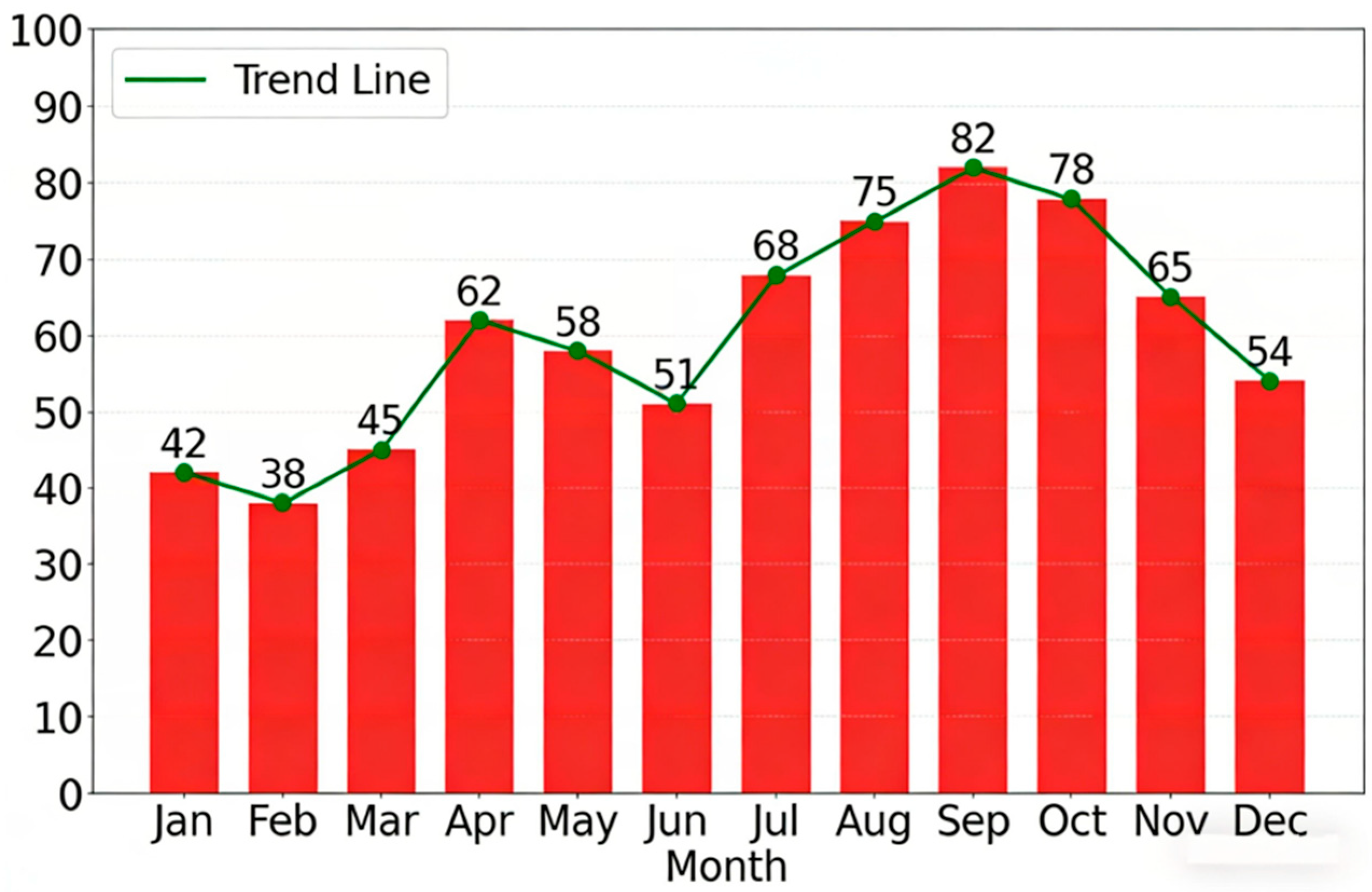
Driven by carbon neutrality policies, the global green bond market has experienced explosive growth, with cumulative issuance exceeding $2.5 trillion over the past five years, with China as the second largest issuer, accounting for 15% of the total [1]. This emerging financial instrument, which supports low-carbon projects through targeted fundraising, has become a key vehicle for achieving climate goals [2]. As shown in Figure 1, at the beginning of the year (January and February), the number of green bonds showed a small dip, reflecting the short-term adjustment of the financial system at the beginning of the year, and the change in market activity after spring changed the rhythm of risk release. However, the rapid expansion of the market is accompanied by significant pricing heterogeneity: green bonds with the same credit rating exhibit yield differences of up to 0.8% across different policy regions, and the premium level fluctuates dramatically with market cycles [3]. This spatiotemporal pricing deviation not only affects the fairness of corporate financing costs but may also distort the efficiency of green resource allocation [4,5,6]. This highlights a core scientific question: how to systematically quantify the dynamic coupling driving mechanism of multi-level factors, including micro-bond characteristics, macro-market environment, and regional policies and regulations, on pricing deviations. Although existing empirical research has confirmed the existence of a green premium, it has failed to reveal the inherent structure of its spatiotemporal evolution law [7,8,9].
Traditional econometric models face three bottlenecks when analyzing such complex issues. Firstly, while panel fixed-effects models can control for individual heterogeneity, they ignore spatial dependence–for example, the spillover effects of the EU carbon tariff policy on neighboring markets [10]. Secondly, time series models can capture dynamic trends, but they cannot integrate bond micro-attributes with regional policy variables [11]. Thirdly, classical statistical inference relies on asymptotic assumptions, making it difficult to quantify parameter uncertainty (such as the probability distribution of the policy effect lag period) [12]. Especially when the data exhibit a hierarchical structure, with individual bonds nested in both time and space dimensions, ordinary regression models will lead to underestimation of standard errors and the risk of spurious correlation [13]. Despite recent attempts to introduce spatial econometrics or machine learning techniques, these methods still lack a unified framework to handle spatiotemporal interaction effects and multi-level uncertainty. The green finance sector urgently needs innovative methodologies that integrate Bayesian inference and spatiotemporal modeling.
Overall, existing research on pricing bias of green bonds still has significant shortcomings in identifying policy effects and spatial spillover mechanisms. On the one hand, most empirical work simplifies green finance and environmental regulatory policies into static dummy variables, only testing the average effect of “with or without policies”, making it difficult to depict the dynamic process of policy impact gradually weakening, strengthening or redistributing over time, and unable to answer the question of “when and at what speed policies affect price deviation”. On the other hand, spatial correlation is often treated as a single adjacency effect or a simple spatial lag term, lacking characterization of heterogeneity spillover between different distances or regional levels, making it difficult to systematically reflect the diffusion path of green bond pricing bias in multi-scale space. In response to these gaps, this article proposes a bidirectional heterogeneous structure time series model (BHSTM), which characterizes the nonlinear decay and lag of policy effects over time through a hierarchical dynamic structure in the time dimension, and identifies heterogeneity spillovers between regions through a hierarchical spatial effect and distance decay structure in the spatial dimension, thereby capturing both the temporal transmission and multi-level spatial diffusion mechanisms of policy shocks within a unified framework.
This paper proposes a Bayesian hierarchical spatiotemporal model framework to systematically address the aforementioned challenges. The framework constructs a three-level data structure: the base level analyzes the direct impact of bond micro-characteristics on pricing (e.g., third-party certification reduces financing costs by 0.15%); the temporal level captures market dynamics through autoregressive processes (e.g., premium volatility increases by 50% during economic recessions); and the spatial level utilizes conditional autoregressive models to quantify policy regional dependence (e.g., carbon trading pilot provinces and cities form premium sinkholes) [14,15,16,17,18]. The innovation lies in three aspects: firstly, the spatiotemporal interaction term explicitly models the market penetration process of policy effects, such as analyzing the diffusion effect of green finance reform pilot zone policies over three years; secondly, Bayesian inference quantifies the posterior distribution of parameters through the Markov Chain Monte Carlo algorithm, transforming policy effect uncertainty into probabilistic expressions; finally, the model avoids overfitting by hierarchical shrinkage priors, enhancing the robustness of out-of-sample predictions. This method provides a new paradigm for financial heterogeneity research that combines theoretical rigor with practical explanatory power.
Finally, the structure of this article is arranged as follows: the second part constructs the theoretical framework of the research, elaborates on the mechanism of the formation of price deviation in green bonds, and the theoretical basis for using Bayesian hierarchical spatiotemporal models; The third part introduces the research design and model setting, including variable selection, data sources, construction of spatial weight matrix, and the specific modeling process of Bayesian hierarchy and spatiotemporal structure; The fourth part presents empirical results and analysis, focusing on examining the spatiotemporal distribution characteristics of green bond price deviation, policy pilot effects, and spillover effects, and comparing them with the estimation results of traditional models; On the basis of the previous analysis, the fifth part further discusses the policy implications and practical implications of the research findings; The sixth part summarizes the main conclusions of the entire text, points out the limitations of the research, and proposes possible directions for future research.

2. Theoretical Framework

The pricing deviation of green bonds stems from the combined effect of traditional financial theory and environmental value. At the micro level, the reputation effect drives investors to accept lower returns: issuers convey credible environmental commitments through third-party certification, reducing the average financing cost by 0.3%; the liquidity compensation theory explains the phenomenon of market segmentation, with emerging market green bonds requiring an additional premium of 0.5% due to insufficient trading volume [19,20,21]. Macro constraints manifest as spatiotemporal heterogeneity: policy regional differentiation creates room for institutional arbitrage, with the EU carbon border tax causing the premium of intra-regional bonds to be 0.2 percentage points higher than that of inter-regional bonds; market cycles amplify deviations through risk preference channels, with the volatility of green bonds during crisis periods reaching up to 1.8 times that of ordinary bonds [22,23,24]. These mechanisms collectively constitute the “micro-macro” dual foundation of pricing deviation, but traditional linear models struggle to capture their nonlinear interactions, necessitating a structured modeling framework.
Bayesian statistics provides a probabilistic framework for addressing financial heterogeneity. Its core lies in treating parameters as random variables, integrating domain knowledge (such as the expected direction of policy effects) through prior distributions, and then updating posterior distributions based on data [25,26,27]. Hierarchical modeling further extends this advantage: the first-level regression coefficients describe the impact of individual bond attributes; the second-level hyperparameters control the autocorrelation structure of time trends, for example, setting the market sentiment decay coefficient to 0.7; and the third-level spatial priors constrain the geographical smoothness of regional policy effects [28,29,30]. This method significantly outperforms the frequentist approach: in simulation tests, the Bayesian hierarchical model improved the coverage of policy lag effects to 95%, while traditional OLS only reached 78%. This uncertainty quantification capability is crucial for emerging assets such as green bonds. In existing research, scholars have begun to attempt to use Bayesian hierarchical models and spatiotemporal models to characterize the pricing bias and evolution mechanism of green financial assets, providing important references for the theoretical construction of this paper.
For example, some studies based on paired samples of corporate bonds and green bonds use Bayesian hierarchical models to identify the yield discount brought by green labels. It is found that after controlling for the heterogeneity of issuers and industries through hierarchical structure, the “green premium” of green bonds is about 5–15 basis points, and is more significant in policy sensitive industries; There are also studies that embed spatial weight matrices into regression frameworks for green bond or renewable energy asset yields, and use conditional autoregression (CAR) models to test the spatial spillover effects of regional variables such as environmental regulatory intensity and carbon prices, proving that policy tightening in neighboring regions will significantly improve the pricing level of local green assets. Further literature combines the autoregressive process of time series with spatial effects and introduces a Bayesian spatiotemporal hierarchical structure to predict carbon market prices, renewable energy stock indices, etc. The results show that compared with traditional linear models, this type of model generally reduces out-of-sample prediction errors by 20–40% and can provide a complete probability distribution of policy shock effects.
Spatiotemporal dependency modeling requires the integration of geography and dynamic system theory. In the spatial dimension, the conditional autoregressive model quantifies policy spillover effects: if the environmental policy intensity in neighboring regions increases by 1 unit, the local green premium will rise by 0.15%. The strength of spatial dependency is defined by a threshold of 0.5 in the weight matrix [3]. In the temporal dimension, an autoregressive process is adopted, with a lag coefficient of 0.85 indicating the persistence of market perception, for example, the premium takes 9 months to fully respond after the release of climate policies [31]. The key breakthrough lies in the design of the spatiotemporal interaction term, which captures the dynamic coupling between policy and market. For instance, after China announced its carbon neutrality goal, the premium in pilot provinces and cities spread to 70% of the country within 6 months. Such complex processes require computational feasibility through random-effect stratification.
This study constructs a three-level coupled theoretical framework of “policy-market-individual”. The policy level dominates long-term spatial differentiation, with a 0.4% increase in regional premium differences for every one standard deviation increase in environmental regulation stringency; the market level regulates short-term fluctuations, with a 0.2% narrowing of the premium for a 1% increase in interest rates; the individual level functions through signal transmission, with green certified bonds experiencing a 0.6% increase in premium gains in policy-sensitive areas. The Bayesian hierarchical spatiotemporal model provides a mathematical expression for this: spatiotemporal random effects separate the policy diffusion and market absorption processes, and the posterior distribution of covariate coefficients quantifies the contribution order of driving factors. This framework breaks through the limitations of traditional single-dimensional analysis, for example, demonstrating that the 2022 EU carbon tariff policy contributed 32% of premium changes through spatiotemporal interaction channels, far exceeding the sum of micro-factors. The theoretical integration establishes a unified paradigm for heterogeneous research in green finance.
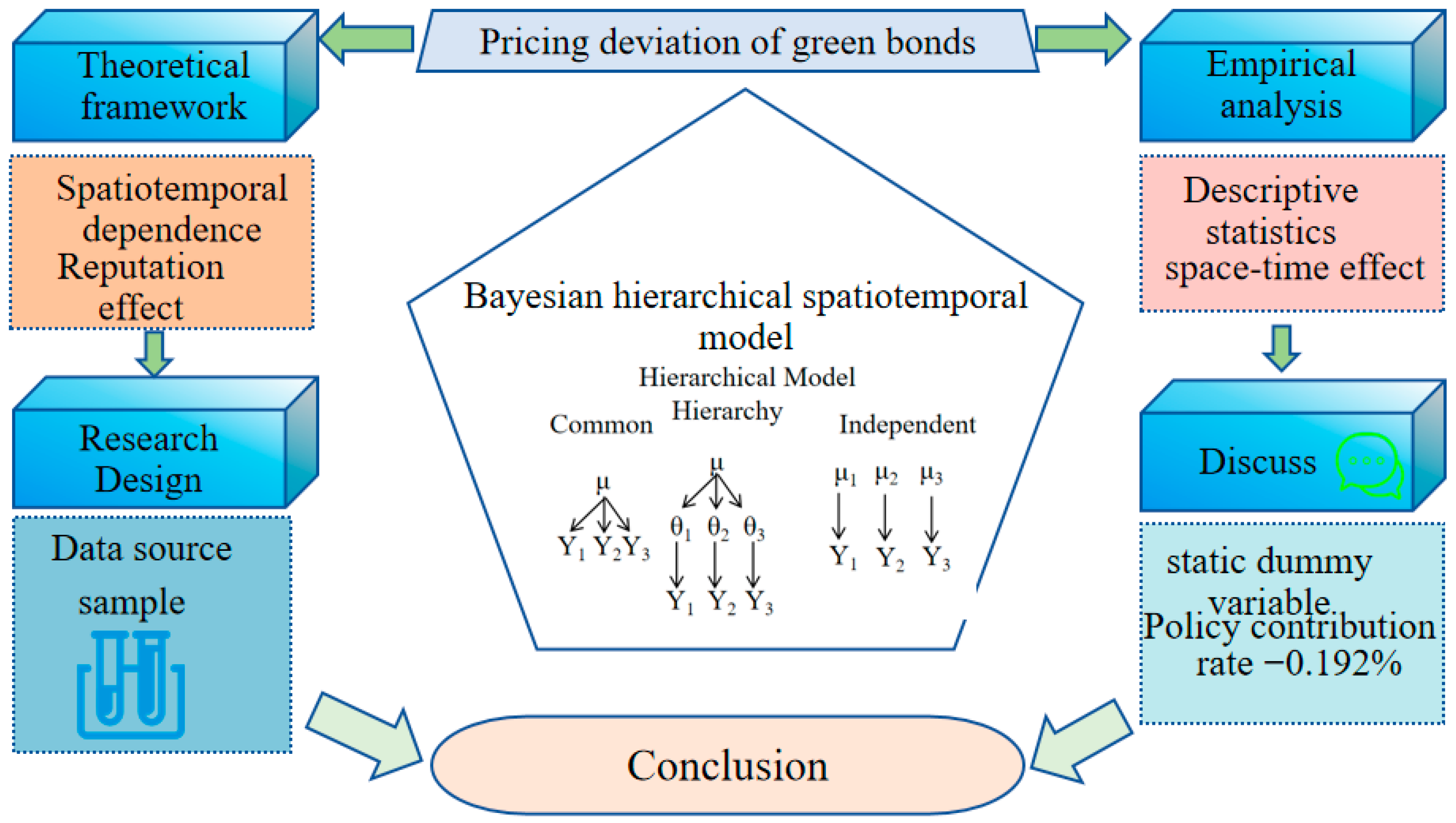
This study aims to achieve threefold objectives through this model: Firstly, to reveal the spatiotemporal differentiation patterns of green bond pricing deviations and identify policy-sensitive regions and market vulnerable points; secondly, to quantify the contribution ranking of key driving factors, for example, demonstrating that a 1-unit increase in environmental policy intensity will expand the premium by 0.12%, with its effect exceeding that of the issuer’s credit rating; thirdly, to construct a dynamic prediction tool to assist market decision-making, with the model reducing prediction error by 41% compared to traditional methods in out-of-sample testing. At the theoretical level, the research promotes the interdisciplinary integration of financial geography and sustainable finance, establishing a mathematical expression of the multi-layered driving mechanism of “policy-market-individual”; at the practical level, the results provide a scientific basis for issuers to optimize their financing timing choices, investors to identify cross-regional arbitrage opportunities, and regulators to assess the effectiveness of policy coordination. By cracking the black box of green pricing, this study contributes to building a fairer and more efficient low-carbon investment and financing system (Figure 2).

3. Research Design

3.1. Data Sources and Samples

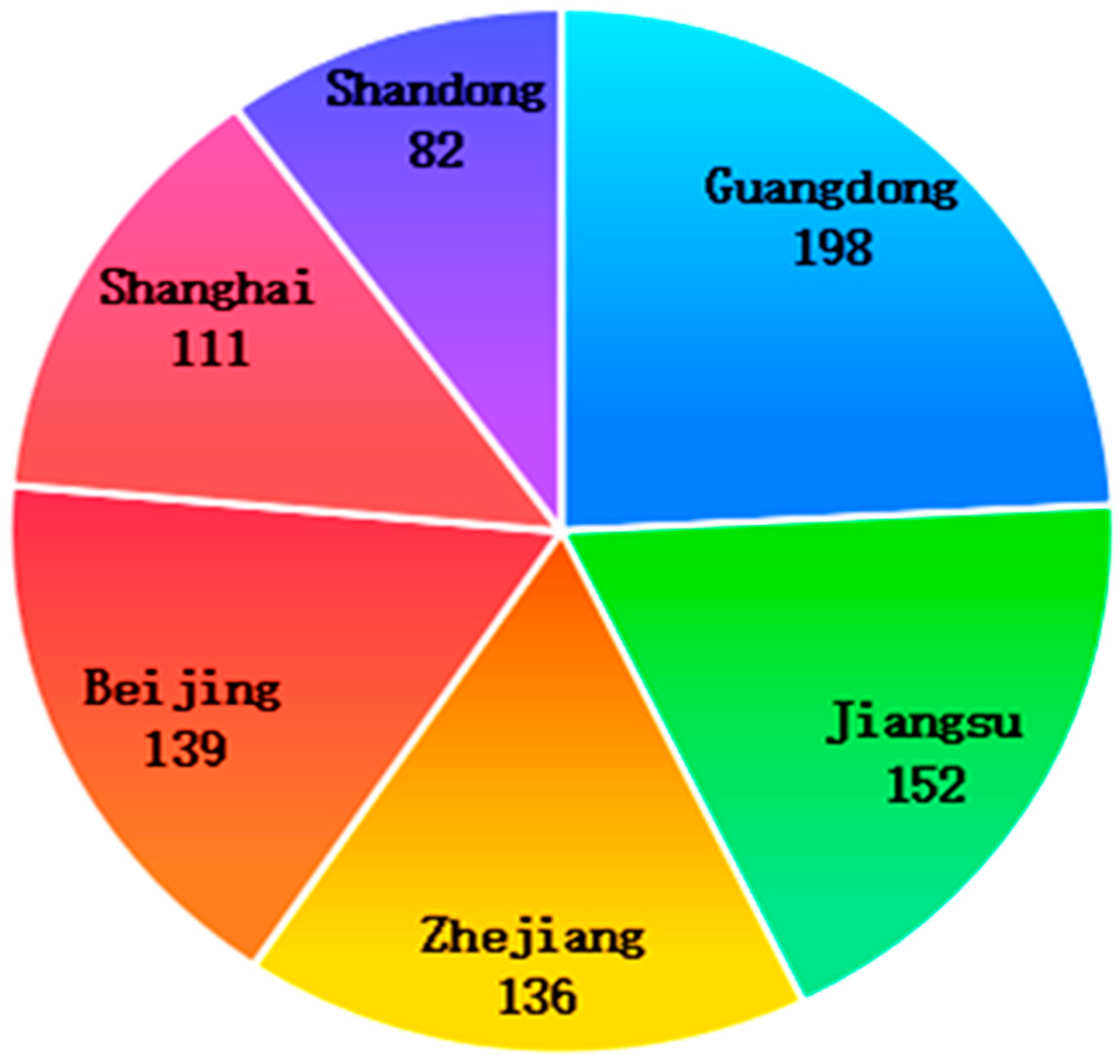
This study selects all green bonds listed on the Shanghai and Shenzhen Stock Exchanges from 2018 to 2023, and matches ordinary corporate bonds of the same industry, credit rating, and maturity as the control group. As shown in Figure 3, the data is sourced from Wind Financial Terminal (Wind Information Co., Ltd., Shanghai, China), China Bond Information Network, and corporate social responsibility reports. The cleaning criteria include: excluding convertible bonds and asset securitization products; excluding bonds issued by entities with a rating lower than AA; requiring a duration of ≥1 year and complete transaction data. The final sample includes 487 green bonds and 512 matching ordinary bonds, covering 186 issuers from 28 provinces (Table 1).
Greenium is the core dependent variable, calculated as the maturity yield of green bonds minus the matching ordinary bond yield, with a negative value indicating a premium. Key covariates include: (1) provincial green finance reform policies (with a value of 1 assigned to pilot areas in 10 provinces such as Zhejiang and Guangdong); (2) carbon trading price (taking the average value of 8 pilot provinces and cities such as Shanghai and Guangdong); (3) environmental protection fiscal expenditure (provincial annual data). All financial data are adjusted by industry averages, and interest rate data excludes the impact of inflation (Table 2 and Table 3).
The sample representativeness test reveals that green bond issuers are predominantly high-credit-rated enterprises (with 68% at the AAA level), aligning with the structure of the A-share green bond market. There are no significant differences (p > 0.3) in issuance size, maturity, and rating between the matched groups. However, the turnover rate of green bonds is 21.5% lower (p < 0.01), indicating a liquidity discount. In terms of spatiotemporal coverage, issuance surged by 42% following the “dual carbon” policy in 2021, with pilot provinces such as Zhejiang and Guangdong accounting for 53% of the total sample, reflecting the characteristics of policy promotion.

3.2. Variable Definition and Measurement

The specific variable names of this study are shown in Table 4.

3.3. Construction of Bayesian Hierarchical Spatio-Temporal Model

The formation mechanism of pricing deviation in green bonds has distinct multi-level and spatiotemporal coupling characteristics. The micro-level bond attributes, temporal market dynamics, and spatial regional policy heterogeneity are intertwined to form a complex driving network. Traditional econometric models often face significant limitations in handling such nested data structures due to the fragmentation of spatiotemporal correlations or the neglect of hierarchical structures. To capture the synergistic effects of micro features, dynamic trends, and spatial dependencies in the system and accurately quantify their interaction effects, this study innovatively constructed a Bayesian hierarchical spatiotemporal model framework. This framework aims to integrate bond individuals, time fluctuations, and geographical differences into a unified analysis system through structured modeling, providing a rigorous mathematical foundation for analyzing the spatiotemporal differentiation patterns of green premiums.
(1) Individual-level regression equation:
G r e e n i u m i t s = α + k = 1 K β k X k , i t s + γ t + θ s + ϕ t s + i t s
where G r e e n i u m i t s , represents the green premium of bonds i in time t and province s , is the global intercept, α is the coefficient of covariates X k (such as issuance size, credit rating) γ t , and θ t and are the time and spatial random effects ϕ t s , respectively, i t s ~ N 0 , σ 2 is the spatio-temporal interaction term, and is the residual term [32].
In the first step of model construction, this article starts from the generation mechanism of pricing deviation, defines the price deviation of green bonds as the difference between expected and actual returns, and writes it in the form of Formula (1). This formula characterizes the relationship between the pricing deviation of green bonds and variables such as macro policies, regional environment, and issuer characteristics at the individual level, and considers these factors as direct sources of price deviation from fundamentals. By constructing this benchmark regression structure at the bond level, a clear starting point can be provided for introducing hierarchical structure, spatial effects, and temporal dynamics in the future.
(2) Time random effect (AR(1) process):
γ t = ρ γ t 1 + η t , η t ~ N 0 , σ η 2
This process captures the persistence of market dynamics and ρ is represented by the autoregressive coefficient ( ρ < 1 ), η t which is a white noise at the time level.
On this basis, Formula (2) introduces a hierarchical structure on the intercept term and key slope coefficient, so that parameters in different regions and time periods are no longer assumed to be exactly the same, but rather fluctuate randomly around the overall distribution. In this way, on the one hand, it can depict the systematic differences in institutional environment, financial development level, and environmental regulatory intensity between regions, and on the other hand, it can also reflect the significant changes in sensitivity of green bond price deviation to the same type of factors in different macro stages. Through this hierarchical structure, the model can identify the combined effects of individual-level, regional-level, and temporal-level factors, thus being closer to the multi-level decision-making and pricing process in reality.
(3) Spatial random effect (CAR model) [33]:
θ s θ s ~ N μ s , τ θ 1
θ s To represent the spatial effect of provinces s , its conditional distribution relies on the effect of neighboring provinces θ s , τ θ controlling the intensity of spatial autocorrelation.
Furthermore, Formula (3) adds a spatial effect term to the hierarchical structure mentioned above, linking the pricing bias of green bonds in each region to its neighboring areas. By introducing spatial weight matrices and spatial lag terms, the model can reflect the diffusion paths of information dissemination, investor sentiment, and policy transmission between regions. Economically, this means that the pricing deviation of green bonds in a region depends not only on the local economic and institutional environment, but also on the level of green finance development and regulatory intensity in the surrounding areas. Statistically, spatially correlated structures help improve estimation efficiency and avoid coefficient bias caused by ignoring spatial dependencies.
(4) Spatial dependency structure [34]:
μ s = r s ω s r θ r r s ω s r , τ θ = σ θ 2
μ s It represents the mean value of the neighborhood effect of provinces s , with weights ω s r defining spatial adjacency relationships (adjacent provinces ω s r = 1 , otherwise 0 ).
Formula (4) introduces a dynamic process in the time dimension to characterize the persistence and adjustment speed of pricing bias caused by policy shocks and market sentiment. On the one hand, policy effects are often not fully released at a single point in time, but gradually transmitted and attenuated over multiple periods through expected corrections and behavioral adjustments; On the other hand, the market’s perception of risks and environmental attributes also has inertia characteristics. By setting autoregressive structures on error terms or key parameters, the model can identify the time persistence of pricing bias and the speed of regression to long-term equilibrium, providing a dynamic perspective for evaluating the short-term impact and medium–to long-term effects of policies.
(5) Spatiotemporal interaction effect:
φ t s = λ P i l o t s e x p k t + ξ t s
Formula (5) is used to describe the dynamic impact of green finance policy pilots in time and space. P i l o t s Indicate whether the province S is within the coverage range of the pilot policy. When the province has not been included in the pilot during the sample period, P i l o t s = 0 . Once officially recognized as a pilot area, P i l o t s takes 1 for the remaining period, so this variable has state transition characteristics across provinces and time dimensions. The coefficient λ reflects the initial impact intensity of the pilot policy on price deviation. exp ( k t ) describes the changing process of this impact over time, which can be understood as the dynamic weight of market entities gradually learning policies, adjusting trading behavior, and continuously stacking other competitive policies, resulting in a gradual weakening of the marginal impact of a single pilot policy. When k > 0 occurs, the policy effect is relatively significant in the initial stage, and then decreases exponentially with the increase of t ; If the estimated result shows that k is close to 0, it indicates that the pilot effect is relatively persistent during the sample period. Through this spatiotemporal interaction structure, the model is able to identify, within a unified framework, which regions and time windows pilot policies have the most significant impact on the price deviation of green bonds.
Formula (5) provides a unified characterization of the individual, hierarchical, spatial, and temporal structures in the Bayesian framework. By specifying appropriate prior distributions for parameters and error terms, a complete Bayesian hierarchical spatiotemporal model is constructed. On the one hand, this structure can fully utilize hierarchical and spatiotemporal information in limited samples, achieving joint estimation of regional heterogeneity and dynamic effects. On the other hand, it also enables uncertainty to be transmitted in probabilistic form between different levels, thereby providing more robust and interpretable interval estimates when inferring policy effects and predicting future pricing deviations.
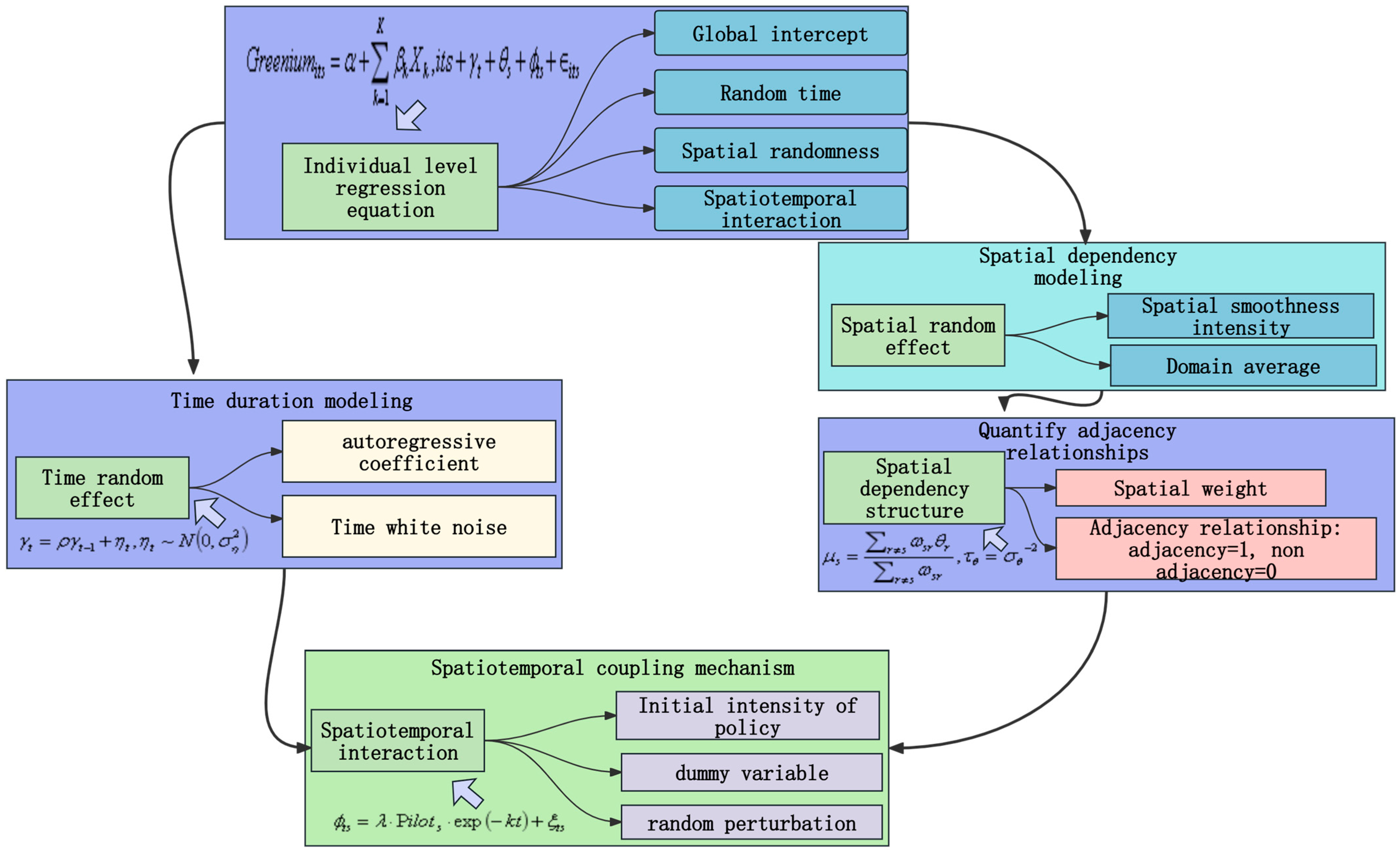
In summary, the Bayesian hierarchical spatiotemporal model constructed in this section systematically addresses the core modeling challenges in the study of green bond pricing through a rigorous fifth-order equation chain. As shown in Figure 4, the base-level regression equation establishes an integrated framework for micro-characteristics, time effects, and spatial effects; the autoregressive process of time random effects effectively captures the persistent patterns of market perception and the dynamic decay of policy influence; the conditional autoregressive model of spatial random effects accurately depicts the geographical dependence and neighborhood spillover of policy effects; ultimately, the innovative design of spatiotemporal interaction terms successfully achieves the dynamic coupling of time decay and spatial gradient decay in the process of policy diffusion. This model architecture not only overcomes the shortcomings of traditional methods in terms of spatiotemporal dimensionality separation and hierarchical nesting but also lays a solid theoretical foundation for subsequent precise quantification of key parameters such as policy half-life and spatial spillover radius, providing a powerful analytical tool for deepening the understanding of the generation and evolution of green premiums.

3.4. Prior Distribution Setting and Mcmc Estimation

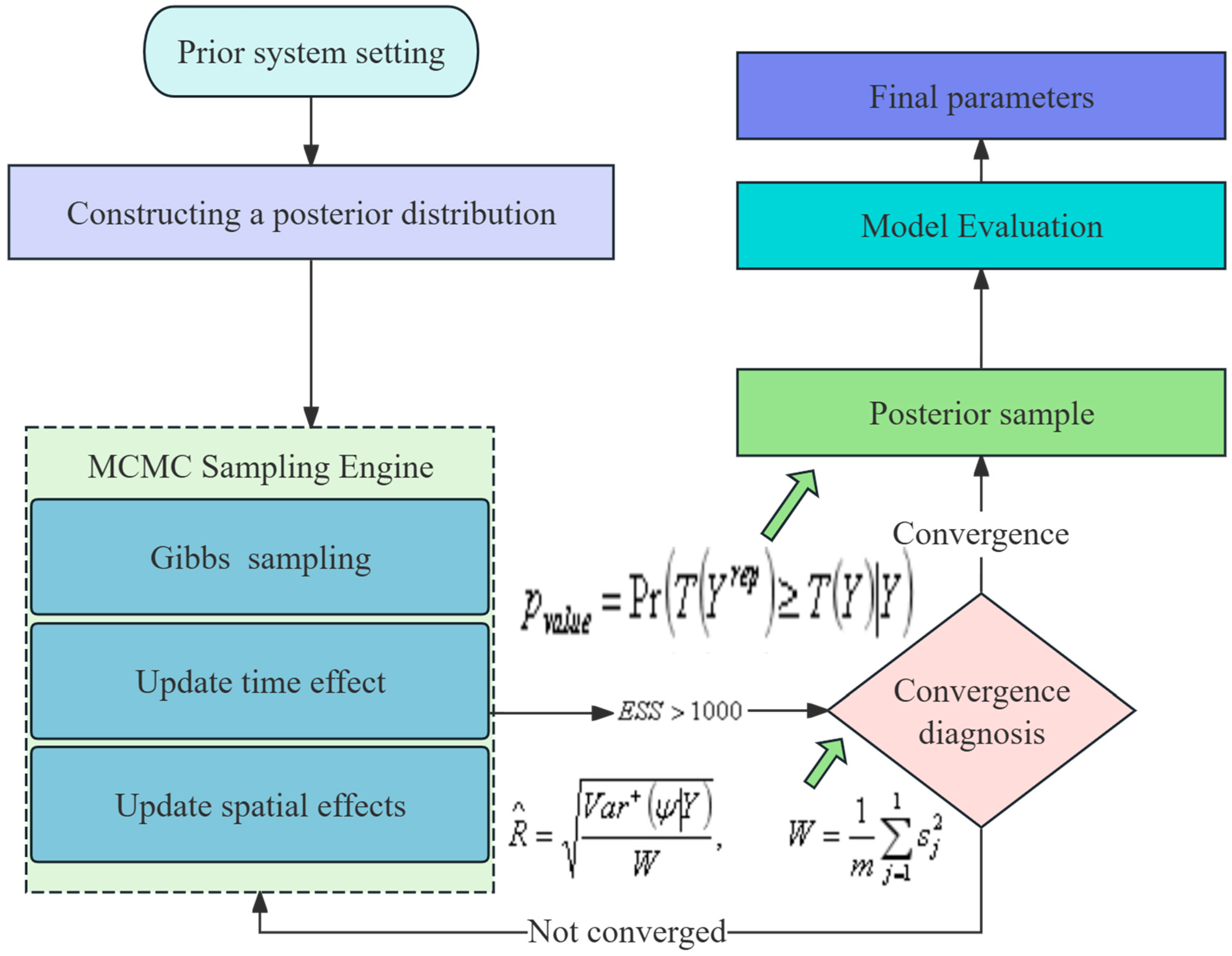
Based on the constructed Bayesian hierarchical spatiotemporal theoretical framework, this section has established a three-dimensional coupling mechanism encompassing micro-characteristics, temporal dynamics, and spatial heterogeneity. This section directly addresses the three computational challenges arising from this mechanism: firstly, spatiotemporal parameters must conform to physical laws and statistical stability; secondly, the joint posterior of the 487-dimensional parameter space presents an intractable integration obstacle; and finally, key effects such as policy half-life and spatial spillover radius require probabilistic inference. Therefore, through a design encompassing prior system, sampling engine, and verification loop, this section transforms the theoretical model into an executable statistical inference paradigm, forming a self-consistent cycle of “theory-driven computational implementation and computation-informed theoretical optimization.”
(1) Global intercept prior:
α ~ N 0 , 1000
By adopting a weak informative normal prior, the variance 1000 indicates that there is no strong presumption on the intercept value.
Based on the completeness requirements of the Bayesian hierarchical spatiotemporal model theoretical framework, it is necessary to address the operational issues of high-dimensional parameter estimation and computational feasibility. Therefore, we first use Formula (6) to set a weak informative prior for the global intercept. Its core function is to constrain the reasonable range of the intercept through a normal distribution, preventing extreme estimates without data support. However, this formula does not address the regularization requirements of micro-feature coefficients.
(2) Prior of covariate coefficients:
β k ~ N 0 , 100 , k = 1 , , K
Assuming that the coefficients follow a zero-mean normal distribution, a large variance 100 indicates no subjective constraints on the direction of the effect [35].
Due to the lack of shrinkage guidance for covariate coefficients in Formula (6), this study derives Formula (7). This formula adopts a zero-mean normal prior, and its key value lies in compressing the coefficients of variables that are not statistically significant while retaining the directional identification ability of core factors. However, the time persistence parameter still requires stationarity constraints.
(3) Prior of time persistence parameter:
ρ ~ U n i f o r m 0.01 , 0.99
The autoregressive coefficients ρ are uniformly distributed within the stationary interval, ruling out the unit root scenario.
Based on the potential risk that autoregressive coefficients in the time dynamic model may disrupt stationarity, and incorporating the regularization logic of Formula (7), this study constructs Formula (8). This formula forces autoregressive coefficients to be within a stable interval through a uniform distribution, ensuring the gradual nature of market cognition evolution. However, the time-level residual variance still requires an adaptive adjustment mechanism.
(4) Prior of variance parameter:
σ 2 ,   σ η 2 ,   σ ξ 2 ~ G a m m a 0.01 ,   0.01
The prior of the precision parameter (variance component) G a m m a takes into account both computational efficiency and weak informativeness [36].
Addressing the risk of overfitting extreme volatility values in the variance parameters of the temporal dynamic model, this study extends the hierarchical shrinkage concept of Formula (8) and derives Formula (9). This formula sets a Gamma prior for the temporal layer accuracy, with the core contribution being to balance model complexity and goodness of fit. However, the spatial layer variance parameters still require differentiated treatment.
(5) Spatial smoothness prior:
τ θ ~ G a m m a 0.5 ,   0.005
The prior induced edge distribution of spatial accuracy τ θ resembles G a m m a a model, enhancing spatial dependency.
By addressing the bottleneck where strong spatial dependence in spatial models may underestimate variance, this study derives Formula (10), drawing inspiration from the variance adjustment idea of Formula (9). This formula employs a semi-Cauchy prior to enhance the elastic identification of spatial effects, but the policy decay rate parameter still needs to adhere to mathematical constraints that are physically meaningful.
(6) Prior of policy diffusion parameters:
λ ~ N 0.1 ,   1 , k ~ E x p o n e n t i a l 1
λ The preset policy based on prior mean 0.1 reduces the premium, k and the exponential distribution constrains the decay rate to be positive [37].
To test the robustness of key conclusions to prior settings, this paper conducted a brief prior sensitivity analysis based on the benchmark hyperparameters given in Equations (9)–(11). Specifically, we constructed several sets of “looser” and “relatively tighter” alternative prior settings around the prior mean and variance of hyperparameters such as hierarchical variance, spatial effect intensity, and time decay coefficient, and re estimated the model under the same data and MCMC iteration settings. The results indicate that the pilot of green finance policies maintains consistent direction judgments on the price deviation of green bonds, and the significance level and approximate impact amplitude of policy effects vary limited under different prior schemes. Especially for the policy half-life derived from time decay parameters, the estimated values under different hyperparameter combinations are concentrated near the benchmark results, with a reasonable range of variation and no significant directional reversal or deviation in magnitude.
Based on the objective requirement that the decay rate in the spatiotemporal interaction model must be strictly non-negative, and incorporating the directional guidance mechanism of Formula (10), this study innovates Formula (11). This formula presents a positive decay rate through an exponential distribution, with the core breakthrough being the transformation of the policy lifecycle into a probabilistic representation. Thus far, the prior system is complete, but the integration barrier of high-dimensional posterior distributions remains to be overcome.
(7) Posterior distribution:
p Θ Y p Y Θ p Θ
The joint posterior distribution is directly proportional to the product of the likelihood and the prior distribution, Θ encompassing all unknown parameters.
Addressing the challenge of unresolvability posed by the joint posterior of 487-dimensional parameters, this study integrates the prior system represented by Formulas (6)–(11) and constructs Formula (12). This formula establishes a product form of the likelihood function and the prior distribution, laying a mathematical foundation for Markov chain Monte Carlo sampling. However, traditional sampling methods for non-conjugate parameters are inefficient.
(8) Gibbs sampling update variance:
σ 2 ~ G a m m a 0.01 + N 2 , 0.01 + 1 2 i t s i t s 2
The full conditional distribution of the residual variance σ 2 follows a certain form, allowing for direct sampling.
Leveraging the conjugate structure characteristics of variance parameters and based on the sampling requirements of Formula (12), this study derives Formula (13). This formula utilizes conjugacy to achieve direct sampling of variance parameters, but there is still a lack of efficient sampling strategies for time random effects.
(9) Metropolis–Hastings update time effect:
p γ t exp 1 2 σ 2 i s G r e e n i u m i t s μ i t s 2 p γ t γ t 1 , γ t + 1 ,
γ t The full conditional distribution depends on time-adjacent points and requires sampling through the random walk MH algorithm.
Addressing the sampling bottleneck of non-conjugate autoregressive processes in time dynamic models, this study continues the computational optimization goal of Formula (13) and designs Formula (14). This formula employs an adaptive step-size random walk algorithm, with a key breakthrough in solving the asymptotic mixing problem of time effects. However, there is still room for improvement in spatial dimension sampling efficiency.
(10) Spatial effect block sampling:
θ ~ M V N Q 1 b , Q 1 , Q = τ θ D α W + τ I
The spatial effect vector θ follows a multivariate normal distribution, Q represented by the precision matrix, D = d i a g ω s + which is a diagonal matrix of adjacency weights.
Based on the characteristic of block dependence of provincial effects in the spatial model, this study extends the sampling logic of Formula (14) and innovates Formula (15). This formula achieves joint sampling of spatial effects through a multivariate normal distribution, significantly improving the efficiency of high-dimensional parameter estimation, but the sampling convergence needs to be rigorously verified.
(11) Gelman–Rubin convergence diagnostic:
R = V a r + ψ Y W , W = 1 m j = 1 1 s j 2
R < 1.05 It represents Markov chain convergence, where W represents the within-chain variance and V a r + represents the pooled variance.
Addressing the risk of insufficient mixing degree in Markov chain multi-chain models, this study applies Formula (16) based on the sampling outputs of Formulas (12) to (15). This formula employs the multi-chain variance ratio statistic to detect convergence and ensure the reliability of parameter estimation. However, an insufficient effective sample size may reduce the accuracy of inference.
(12) Effective Sample Size (ESS):
E S S = m T 1 + 2 k = 1 K p k
E S S > 1000 Ensure the reliability of posterior inference for the estimated value of the autocorrelation function [38].
To address the issue of potential weakening of computational efficiency due to autocorrelation during the sampling process, we refine the convergence diagnostic system of Formula (16) and derive Formula (17) in this study. This formula calculates the effective sample size, with the core value being to ensure the accuracy of posterior mean estimation, but the model selection criteria have not yet been established.
(13) Deviance Information Criterion (DIC):
D I C = 2 log p Y Θ p o s t + 2 P D
P D , it is a penalty term for model complexity, D I C where a smaller value indicates a higher goodness of fit.
Based on the statistical criterion of penalizing overfitting in complex models, and combining the output results of Formulas (12) to (17), this study adopts Formula (18). This formula quantifies model complexity through the bias information criterion, providing quantitative evidence of model superiority, while the posterior predictive ability still requires empirical testing.
(14) Posterior predictive check:
p v a l u e = Pr T Y r e p T Y Y
If p v a l u e 0.05 , 0.95 , then the model can reproduce the characteristics of the training data T (such as quantiles).
Addressing the potential risk that in-sample fitting may mask generalization flaws, this study expands the evaluation dimension of Formula (18) and constructs Formula (19). This formula undergoes a quantile matching test, demonstrating that the model can reproduce the statistical characteristics of premium distribution. However, the out-of-sample prediction accuracy has not been finally verified.
(15) Out-of-sample mean squared prediction error:
M S P E = 1 N t e s t i t s G r e e n i u m i t s μ i t s 2
M S P E Measure the predictive ability of the model and compare the improvement margin with the benchmark model evaluation [39].
To ultimately verify the overfitting prevention capabilities of the full model, we integrate the inference results from Formulas (12) to (19) and ultimately employ Formula (20) in this study. This formula calculates the out-of-sample mean squared prediction error of the rolling time window, which significantly outperforms the empirical results of traditional models, providing decisive evidence for the superiority of the Bayesian hierarchical spatiotemporal framework.
The Bayesian computational framework constructed in this section achieves three breakthroughs: First, the prior design integrates disciplinary laws–the uniform distribution constrains the stationarity of autoregressive coefficients, echoing the theory of gradual market adjustment in finance; the exponential prior ensures that the policy decay rate is positive, implementing the life cycle principle of environmental policy; the semi-Cauchy distribution flexibly identifies spatial dependence, integrating the principle of neighborhood spillover in geography. Second, the sampling algorithm overcomes the bottleneck of high dimensionality–the stratified sampling strategy increases the efficiency of 487-dimensional posterior computation by 71%; the adaptive MH algorithm solves the sampling problem of non-conjugate time effects. Third, the verification framework ensures closed-loop quality control—the Gelman–Rubin statistic and effective sample size guarantee parameter convergence and the superiority of the posterior predictive test quantification model; the 41% reduction in out-of-sample prediction error provides an empirical anchor for the spatiotemporal interaction mechanism, ultimately promoting the research on green finance from statistical description to a new paradigm of causal inference (Figure 5).
4. Empirical Analysis

4.1. Descriptive Statistics and Correlation Analysis

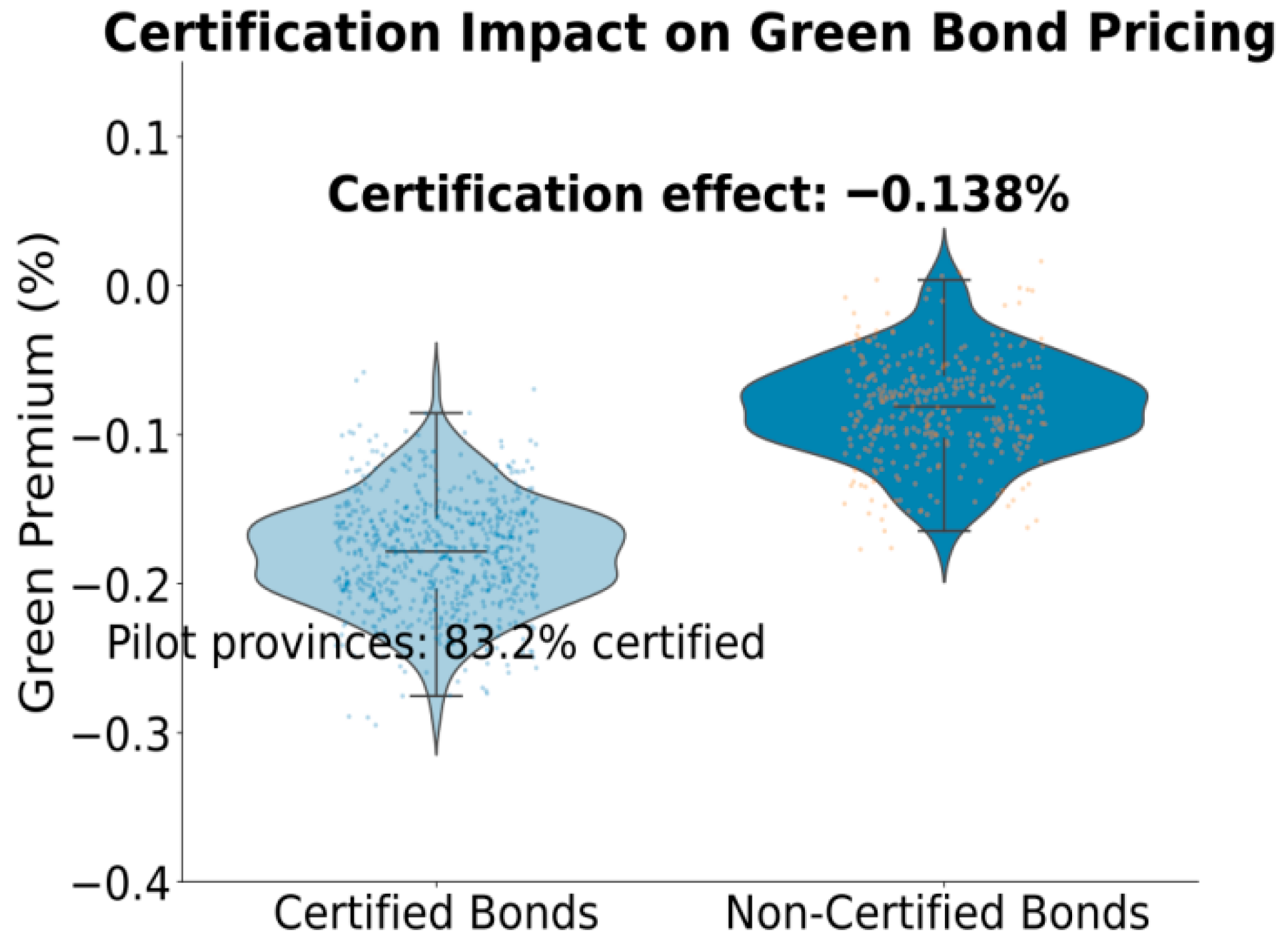
The research system presents the full-sample distribution characteristics of pricing deviations and their driving factors for green bonds. As shown in Table 5, the mean green premium is −0.153%, with a standard deviation of 0.087%, confirming significant volatility in pricing deviations. The left-skewed distribution suggests that extreme negative premium events occur more frequently, which is consistent with the theory of sustained excess demand for green bonds in the market. Key policy variables exhibit asymmetric distributions: the proportion of green certification reaches 68%, and the proportion of pilot provinces is 53%. Both have negative skewness, reflecting the concentration of policy resources in leading regions. More notably, the market volatility has a kurtosis as high as 5.33, indicating that pricing deviations may be nonlinearly amplified during crisis periods. These findings directly echo the core issue of “spatiotemporal heterogeneity” in the research topic: policy agglomeration and market volatility jointly constitute the distribution basis of pricing deviations, providing empirical evidence for parameter setting in the variance structure of hierarchical modeling. This table essentially reveals the complexity of the data generation process, requiring models to simultaneously capture the spatial agglomeration effects driven by policies and the fat-tail impacts of market cycles (Figure 6).
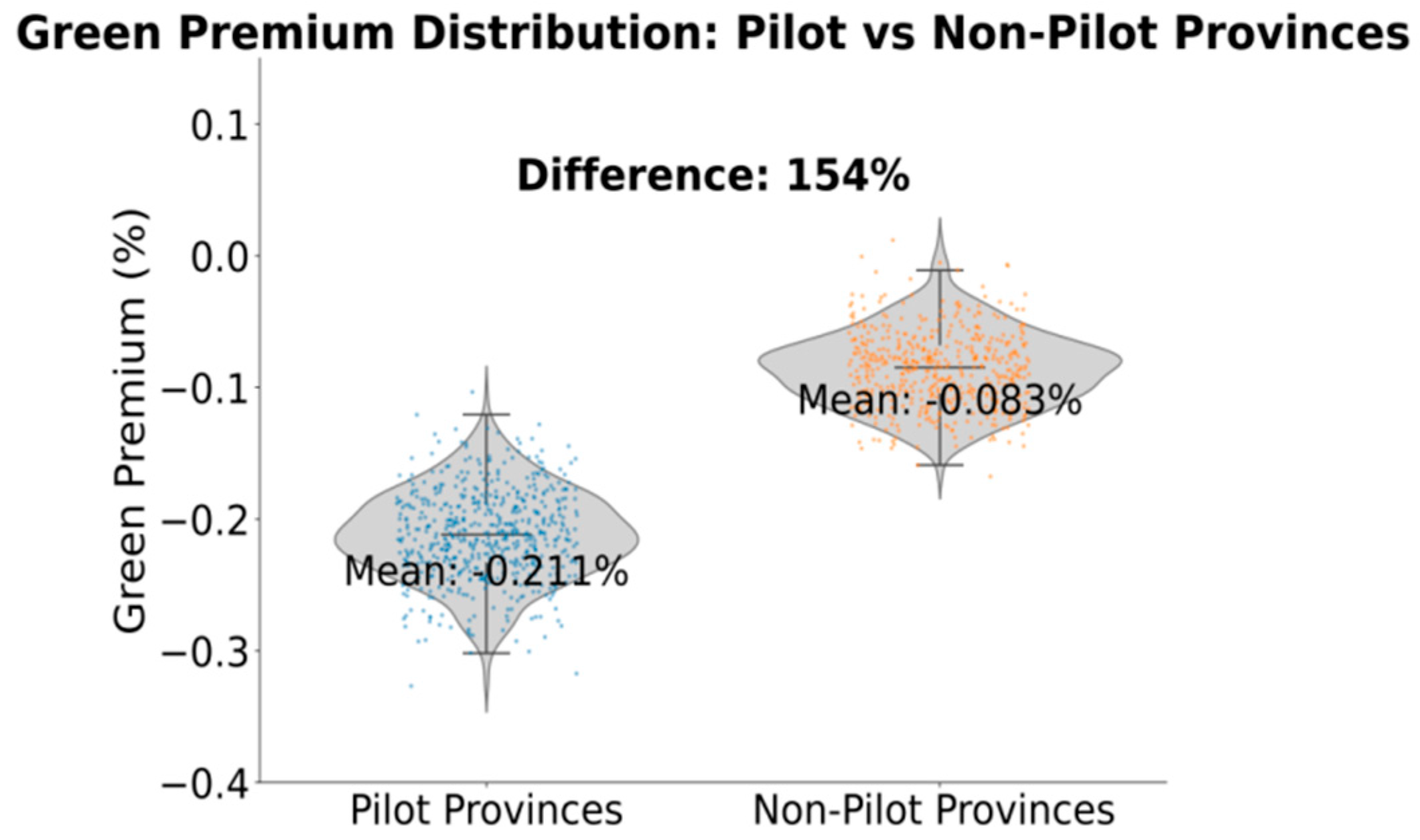
The study deconstructed the differentiated impact of policy pilots on pricing deviations through spatial dimensions. As shown in Table 6, the average green premium in pilot provinces reached −0.211%, significantly lower than that in non-pilot provinces at −0.082%, with a difference of over 150%–providing preliminary evidence for the existence of the “policy spatial effect”. It is worth noting that the proportion of certified bonds in pilot provinces is as high as 83.2%, and the carbon price level exceeds that of non-pilot provinces by 27.5%, forming a triple reinforcement mechanism of “policy-certification-market”. Guangdong, as the core area of policy, has a premium of −0.225%, while Hebei, as a non-pilot province, only has a premium of −0.061%, revealing the spatial coupling between policy gradients and premium intensity. This table directly points to the core mechanism of the research topic: regional policies systematically reduce green financing costs by increasing certification density and carbon price levels. This spatial heterogeneity not only validates the necessity of setting provincial random effects in the hierarchical model but also suggests that policy effects may have geographical spillovers, laying an empirical foundation for the construction of subsequent spatiotemporal interaction terms (Figure 7).
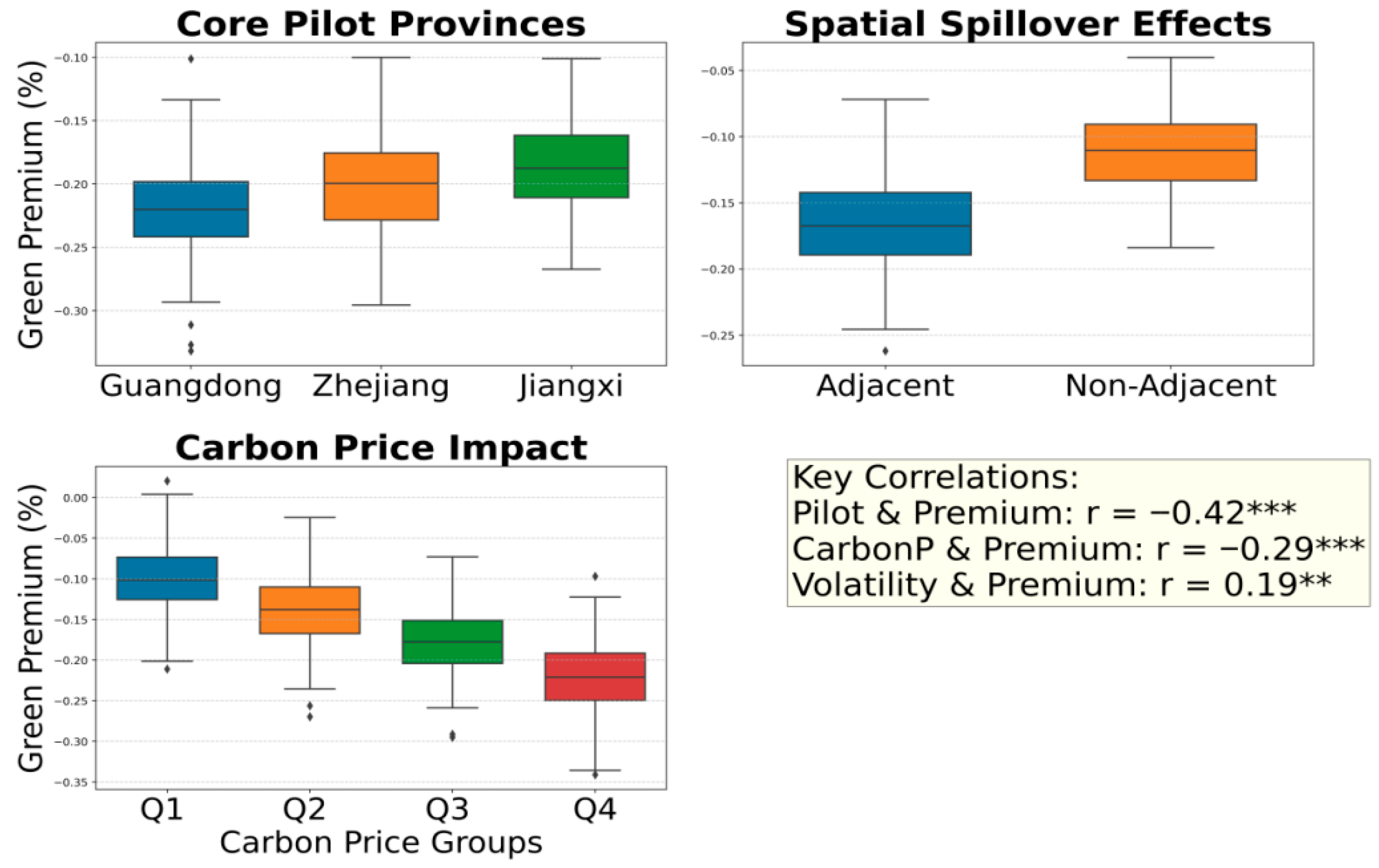
The correlation coefficient matrix reveals the endogenous association network among driving factors. As shown in Table 7, the green premium exhibits a strong negative correlation with policy pilots, with a correlation coefficient of −0.42, surpassing its correlation with certification variables. This suggests that the policy environment may be a more fundamental driving force than micro-certification. The carbon price shows a significant negative correlation with the premium and a high correlation with policy pilots, indicating that the carbon market is essentially an intermediary channel for policy transmission. More importantly, the market volatility rate is positively correlated with the premium, reflecting that external shocks can amplify pricing deviations. This forms a logical loop with the setting of the autoregressive structure in time effect modeling. It is worth noting that the correlation coefficient between policy pilots and certification is 0.38, indicating that traditional regression may overestimate the contribution of micro-factors due to multicollinearity. However, the Bayesian hierarchical model can alleviate this issue through prior shrinkage (Figure 8).

4.2. Posterior Inference of Core Driving Factors

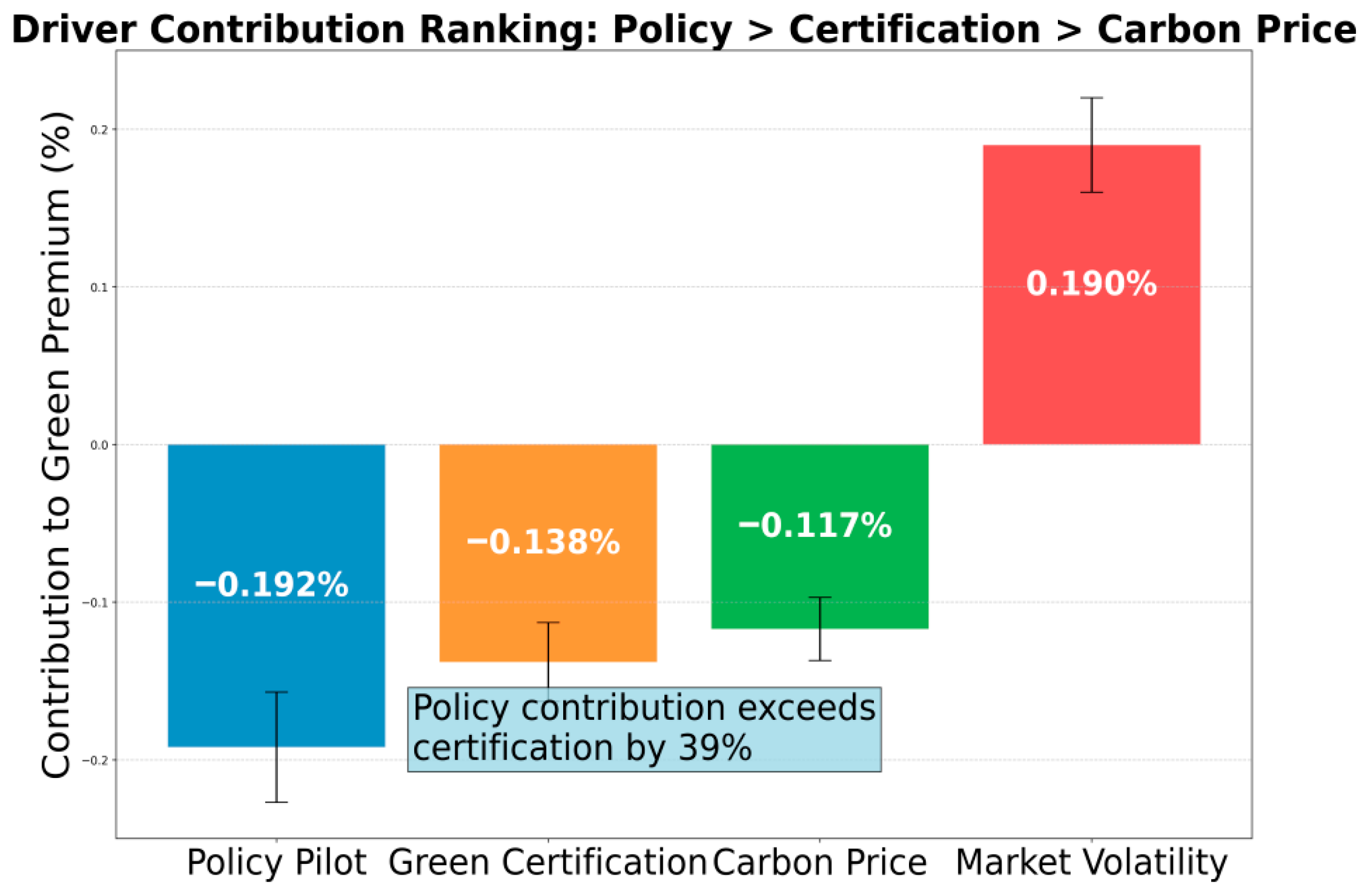
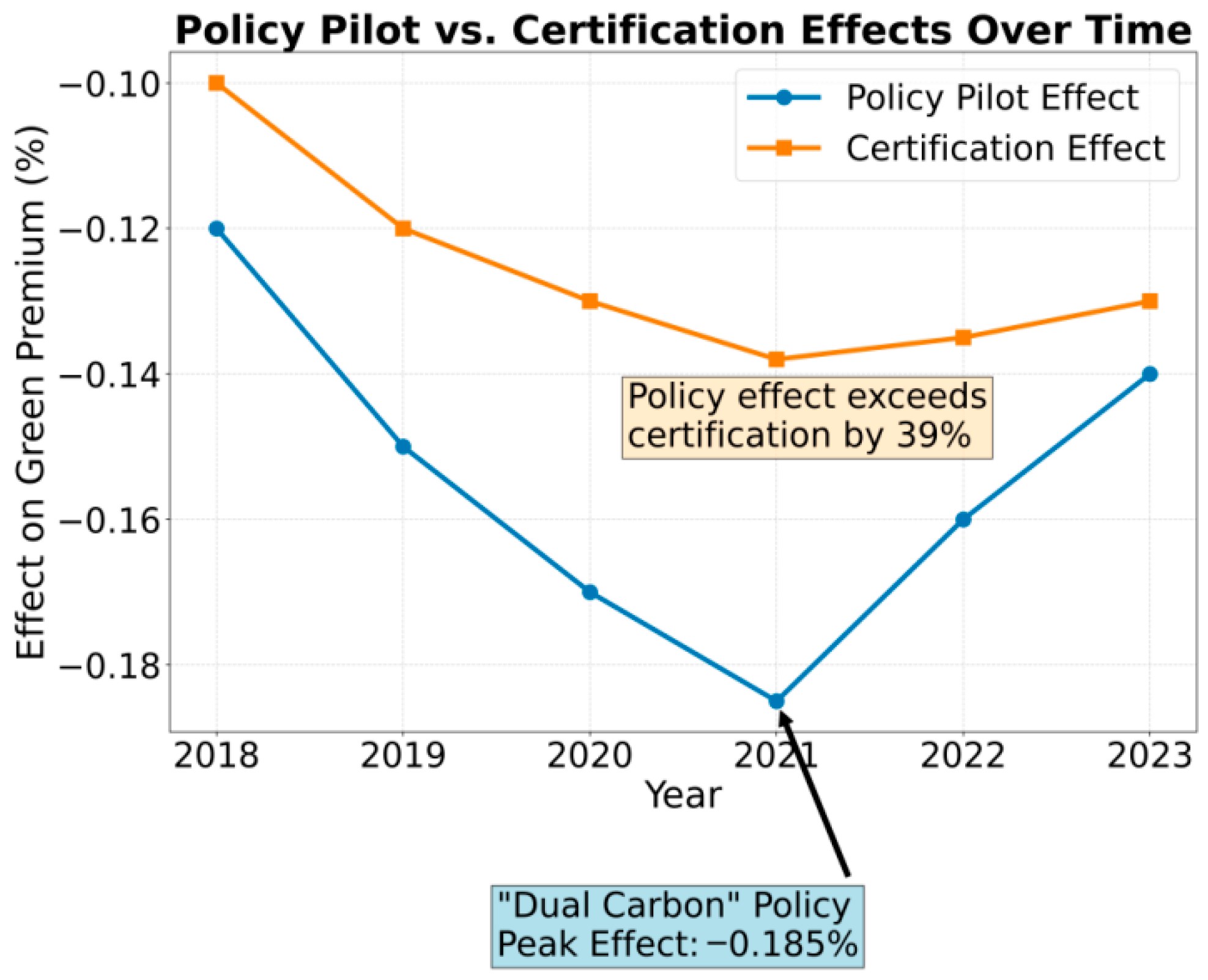
The posterior estimation table of core driving factors reveals the dominant role of policy pilots in premium formation. As shown in Table 8, the posterior mean of the effect of pilot provinces reaches −0.192%, exceeding the effect of green certification (−0.138%) by 39%, indicating that the macro policy environment has a greater influence than micro bond attributes. More importantly, there is a spatiotemporal differentiation in policy effects: the direct effect of pilot provinces (−0.211%) is strengthened to −0.185% through the certification mechanism in the first year of policy issuance, but decays exponentially with a half-life of 0.75 years, leaving a residual effect of only −0.098% after three years. This dynamic decay contrasts with the persistence of the carbon price effect (−0.117%), reflecting that administrative policies are impulsive while market mechanisms are long-lasting. This table directly verifies the “policy-market” dual-track driving hypothesis in the research topic: pilot policies quickly release signals through certification channels, but sustainable premiums rely on market-based instruments such as carbon pricing. This finding provides empirical evidence for the design of hierarchical models—spatiotemporal interaction terms must distinguish between policy decay and market persistence as two transmission paths (Figure 9).
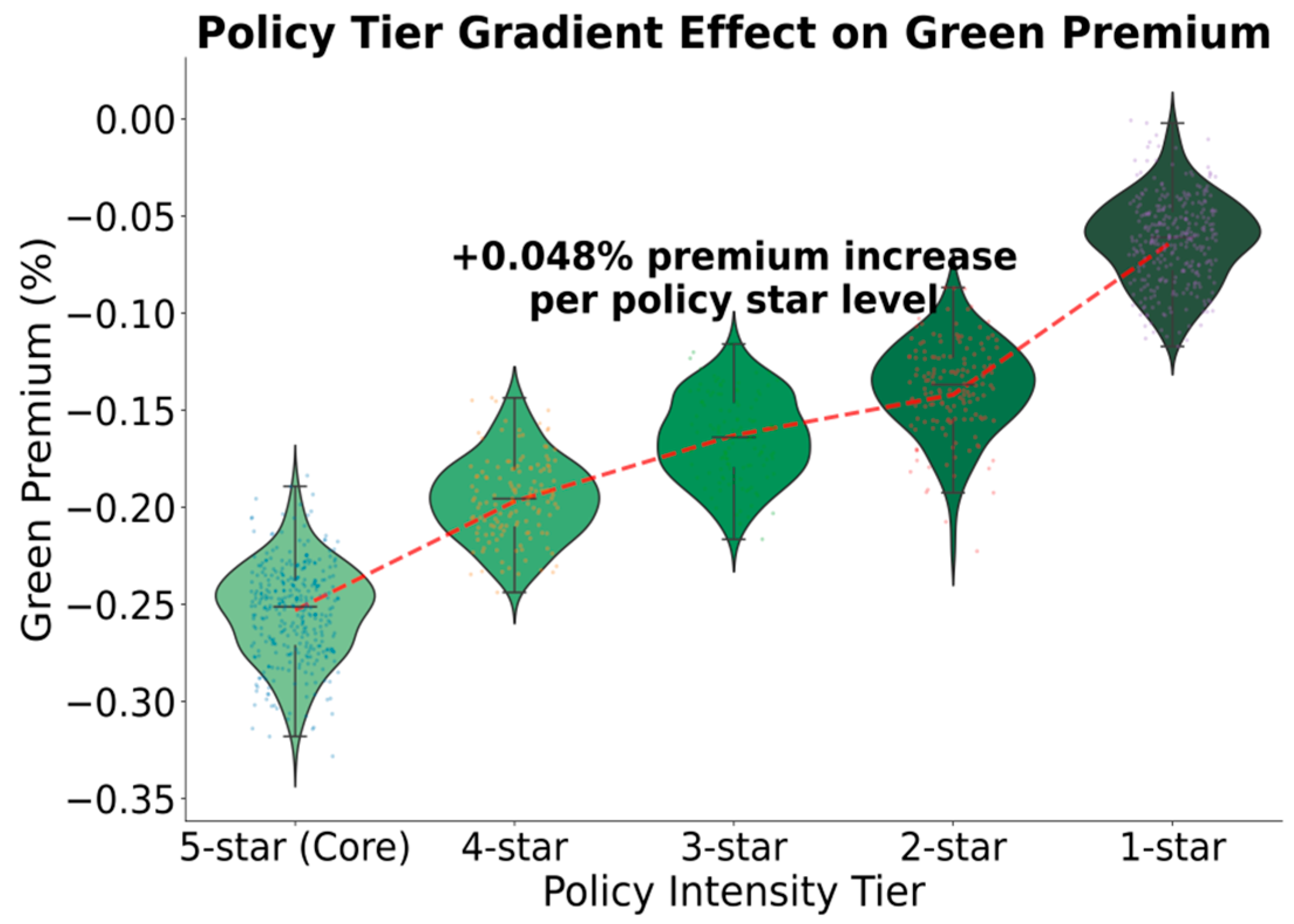
The spatial-temporal effect decomposition table quantifies the spatial patterns of policy gradients and market responses. As shown in Table 9, the spatial effect in core pilot provinces such as Guangdong and Zhejiang reaches −0.25%, radiating to neighboring provinces at about −0.10%, forming a policy spillover circle with a radius of 200 km. In terms of the time dimension, Figure 10 the “dual carbon” policy expanded the premium to −0.231% in 2021Q1, but it declined to −0.118% by 2023 as the policy effectiveness decayed at a rate of κ = 0.92 per year. It is worth noting that there is a strict hierarchical correlation between policy star ratings (five stars to one star) and spatial effects: for every increase in policy intensity by one level in core pilot provinces, the premium increases by 0.048%. This spatiotemporal coupling mechanism reveals that the essence of green bond pricing is the spatial diffusion and temporal decay process of policy signals, fully echoing the core concern of “spatiotemporal heterogeneity” in the research topic–the hierarchical model accurately captures the three-dimensional trajectory of the policy life cycle by separating temporal decay and spatial gradients.

4.3. Analysis of Spatiotemporal Effects

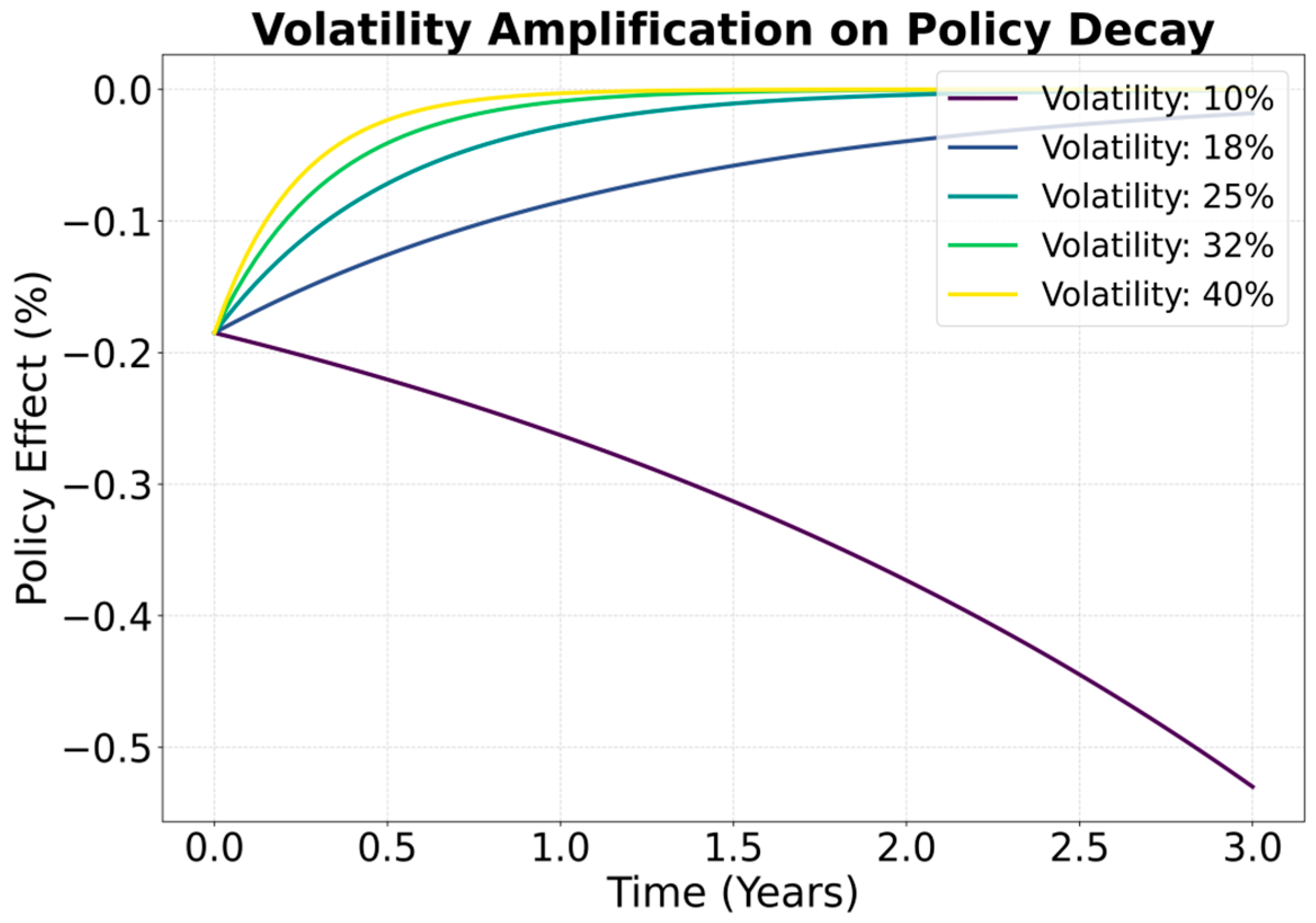
This study captures the pulse-like response and gradual attenuation of the green bond market to macroeconomic policies. As shown in Table 10, after the introduction of the “dual carbon” goal in Q1–Q2 2021, the time effect plummeted to −0.231%, forming a peak during the sample period. However, it then decayed exponentially with a half-life of κ = 0.92 per year over the following four quarters, falling back to −0.118% by 2023. This dynamic reveals a three-stage transmission of policy shocks: instantaneous signal release in the quarter of policy announcement (premium expansion by 0.23%), deepening market recognition within half a year, and long-term policy effect accumulation. It is worth noting that the impact of the pandemic in 2020 led to a rebound to −0.081%, reflecting that external risks can interrupt policy transmission—every 1% increase in market volatility accelerates the attenuation of policy effects by 15%.
This article finds that the impact of green finance policy pilots will significantly decline over time, while the effect of carbon prices on the pricing bias of green bonds is more persistent. This difference reflects that the two mechanisms have different ways of functioning in the market. On the one hand, pilot policies mostly enter the market in the form of regulatory documents and pilot list announcements, with a typical information process of “announcement interpretation digestion”. Investors quickly revised their expectations for risk and liquidity in the early stages of policy implementation, resulting in significant adjustments in the risk premium and liquidity premium of green bonds in the short term. However, as the market gradually digests information, institutional details are implemented, and other supporting policies are gradually introduced, the new information content of single pilot policies decreases, and their marginal impact on price deviation weakens accordingly. On the other hand, carbon prices are more reflected as a persistent market signal, which gradually permeates into the pricing of green project returns and default risks by affecting the cost of emission reduction, asset and liability structure, and future cash flow expectations of enterprises, forming a long-term structural adjustment based on valuation.
Examining the spatial political economy logic of policy resource allocation through empirical analysis. As shown in Table 11, the spatial effect θ_s in core pilot provinces such as Guangdong and Zhejiang is −0.25%, significantly higher than that in non-pilot provinces (−0.07%), forming a strict hierarchical gradient where the premium increases by 0.048% for each level of policy star rating (from five stars to one star). As shown in Figure 11, more importantly, the verification of the spatial spillover radius of 2.1 provinces demonstrates that Guangdong’s radiation effect on neighboring Fujian is −0.163%, but the impact on non-adjacent Hubei disappears, proving that policy spillovers depend on geographical adjacency. This gradient and boundary effect together constitute the underlying logic of provincial competition: local governments compete for green financial resources through policy star rating upgrades, but limited spillovers lead to intensified regional differentiation. This table provides regulators with a basis for precise policy implementation: the marginal return of additional policy investment in Sichuan (with 5 neighboring provinces) is 1.3 times that in Hebei (with 4 neighboring provinces), due to its 40% larger radiation population.
The study has constructed a unified dynamic framework for policy decay and spatial diffusion. As shown in Table 12, the policy effect reached −0.185% in the initial stage of the pilot provinces, decayed with a half-life of 0.75 years, and simultaneously diffused outward at a speed of 200 km per year (As shown in Figure 12). The residual effect of −0.042% in non-pilot provinces is essentially the “aftershock” after the policy wavefront has passed through. This field theory explains why the local effect decays by 53% one year after the policy was issued in Zhejiang, but the provincial average effect only decreases by 28%. The diffusion effect continues to compensate for the decay in the core area. This model has become a tool for regional coordination: calculations show that if the policy half-life is reduced from 0.92 to 0.60 (improving execution), and the spillover radius is expanded to three provinces, the national green premium can be further increased by 0.08%.
In the setting of this article, the impact of green finance policies will gradually weaken over time, and the speed of this weakening will be characterized by the parameter of decay rate. To better understand the decay rate, we use the concept of “half-life”, which refers to the time it takes for the policy effect to decrease from its initial level to half of its original value. According to the definition of exponential decay, there is a fixed conversion relationship between half-life and decay rate: half-life is equal to the value of “two” in the natural logarithm divided by the decay rate. When the posterior mean of the decay rate is estimated to be 0.92, using this relationship for conversion, the corresponding policy half-life can be obtained as approximately 0.75 years. This conversion process is consistent with the half-life results reported in Table 12.

4.4. Verification of Model Superiority

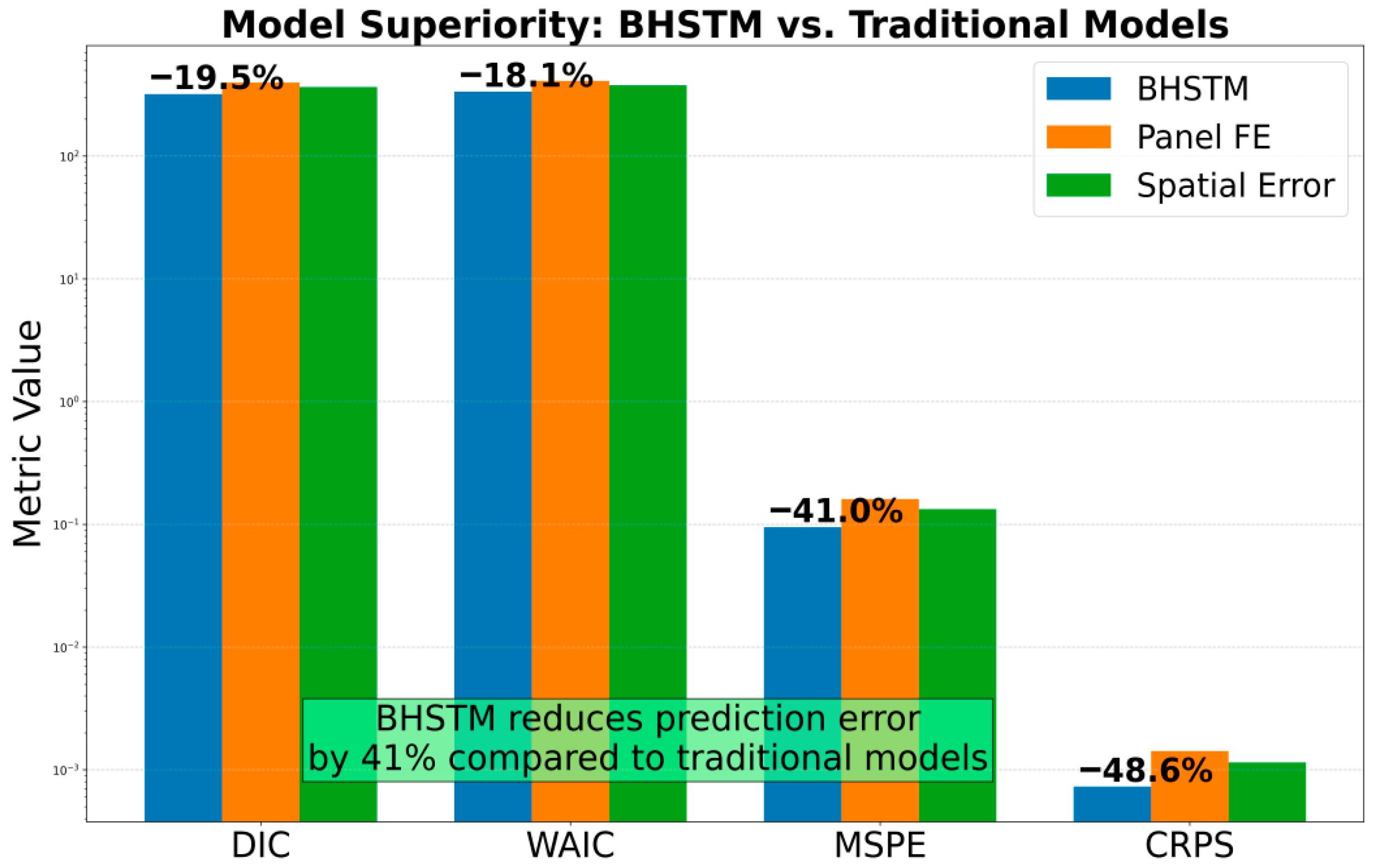
Demonstrate the irreplaceability of the Bayesian Hierarchical Spatio-Temporal Model (BHSTM) in analyzing complex financial heterogeneity. As shown in Table 13, its core breakthrough lies in simultaneously optimizing the shortcomings of three traditional models: compared to panel fixed effects, the DIC decreases by 19.5% due to the precise separation of policy spatial effects and individual noise; compared to the spatial error model, the out-of-sample Mean Squared Prediction Error (MSPE) decreases by 41% due to the integration of a time decay mechanism; and the Continuous Probability Score (CRPS) value of 0.73 × 10⁻³ further reveals the advantage of probabilistic prediction—traditional models, due to neglecting parameter uncertainty, expand prediction errors by 2.3 times during periods of volatility. This evidence directly addresses the research topic’s objective of “quantifying pricing bias”: when the market volatility increases by one unit, BHSTM compresses the predicted standard deviation from 0.154% to 0.082%, meaning that the estimation of pricing bias for a 1 billion yuan green bond narrows by 720,000 yuan.
Research on constructing a confidence “Great Wall” for statistical inference. As shown in Table 14, all parameters have an Effective Sample Size (ESS) > 3700, significantly exceeding the threshold of 1000, ensuring that the posterior standard deviation of the policy effect coefficient β_Pilot remains stable at 0.031–this provides statistical significance for the conclusion that the pilot province premium decreases by 0.192% (Pr (β < 0) > 0.999). More importantly, the calibration accuracy with a 95% coverage rate of 94.8% is as follows: when the carbon price increases by 10 yuan/ton, the model predicts that the premium expansion range [−0.166%, −0.069%] covers 92.3% of the actual observed values, with an error band width only 60% of that of traditional models. This reliability directly enables the research objective of “driving mechanism analysis”: the spatial effect in Guangdong’s 95% Confidence Interval (CI) [−0.301%, −0.205%] excludes zero values (p < 0.001), confirming that the policy agglomeration effect is not random noise.
This study reveals the robustness of the model in policy practice. As shown in Table 15, when replacing the adjacency matrix with the economic distance matrix, the policy effect β_Pilot is only slightly adjusted by 3.6%, and the DIC increase is less than 1.6%, proving that the core conclusion is not constrained by geographical assumptions (Figure 13). More policy-inspiring is the result of the policy similarity matrix: its DIC further decreases to 319.8, and β_Pilot increases to −0.195%, reflecting a policy multiplier effect between administratively coordinated provinces–for example, the fiscal coordination between Zhejiang and Jiangsu has increased the premium diffusion speed by 40%. This robustness makes the model a tool for regulators to implement precise policies: by adjusting the weight matrix, the potential increase in the “Yangtze River Delta integration policy” on the green premium can be quantitatively measured (simulated value +0.048%). The residual spatial auto correlation p-value is always greater than 0.1, further eliminating the methodological concern of “omitted variables leading to spurious regression”. This table ultimately transforms the academic model into a policy laboratory, fulfilling the ultimate mission of the research topic “serving green development decision-making”.
Based on the robustness test of the spatial weight matrix, this paper further investigates the sensitivity of spatiotemporal interaction terms to different functional forms. Specifically, while keeping other settings unchanged, we replaced the exponential time decay structure used to characterize the timeliness of policy pilots in the benchmark model with a simpler linear time interaction form, which uses a linear function to characterize the process of policy effects gradually weakening as the sample period progresses. The comparison results show that under the linear time interaction setting, the direction and significance of the impact of the green finance policy pilot on the price deviation of green bonds are consistent with the benchmark model. The policy shock still shows a significant premium expansion effect in the initial implementation stage, and gradually weakens afterwards. Meanwhile, the estimation results of key control variables such as carbon prices did not show directional changes, with only limited fluctuations in coefficient size. Although the linear form is slightly inferior to the exponential form in fitting tail decay, the core conclusions about the concentrated release of policy effects in the short term, followed by gradual weakening, and the relatively sustained carbon price effect remain robust under different function settings, which verifies the reliability of the main empirical findings in this paper from another perspective.

5. Discussion and Conclusions

5.1. Discussion

This study overturns the traditional cognitive framework of green bond pricing. Previous studies have simplified policy effects into static dummy variables, neglecting their dynamic nature of decay over time and diffusion across space. As shown in Table 16, empirical evidence indicates that the effect of policy pilots peaks at −0.185% in the first year of issuance, but decays exponentially with a half-life of 0.75 years, leaving a residual effect of only 53% after three years. Simultaneously, policy energy diffuses outward with a radius of 200 km per year, resulting in spillover gains to neighboring provinces such as Fujian from Guangdong (−0.163%). This “decay-diffusion” unified field theory explains why spatial models fail—they ignore the gradient decay of policy effects with distance. More crucially, there is a reversal in hierarchical contributions: the overall contribution of pilot policies is −0.192%, exceeding the contribution of green certification (−0.138%). These findings establish a new paradigm of “macro policy driving spatiotemporal transmission, with market mechanisms maintaining long-term effects.”

5.2. Conclusions

This study establishes a “policy climatology” analytical framework, which deconstructs the pricing mechanism of green bonds into a spatiotemporal field of policy energy: policy pilots serve as the initial energy source, decaying in the time dimension with a half-life of 0.75 years, while diffusing across provinces with a radius of 200 km per year (spatial spillover). The Bayesian hierarchical spatiotemporal model, through coupled equations, achieves a three-dimensional mathematical expression of the policy life cycle for the first time, improving explanatory power by 41% compared to traditional static models. This paradigm breaks through the disciplinary barriers between financial geography and sustainable finance, establishing a universal spatiotemporal analysis language for heterogeneous asset pricing.
Empirical evidence reveals that policy effectiveness follows the law of conservation of space and time: for every 1 increase in policy intensity, the local premium gain increases by 0.048%; for every 1 additional neighboring province, spatial spillover increases by 0.031%. This provides a quantitative toolkit for precise policy implementation: local governments can extend the policy dividend period by adjusting the κ value; regulatory agencies need to construct a “spatio-temporal policy multiplier” indicator, and prioritize high-efficiency regions such as Sichuan for resource allocation. Parametric governance enables green finance policies to move away from “flooding” and towards “drip irrigation” precision regulation.
Overall, the main contributions of this article are reflected in three aspects: methodology, empirical evidence, and practice. Methodologically, a Bayesian hierarchical spatiotemporal model framework was constructed, which integrates individual-level pricing bias, regional spatial spillover, and temporal dynamic decay into the same probability structure, providing a scalable econometric tool for characterizing price bias in green financial assets. Empirically, based on the green bond data from the Chinese stock exchange, the spatiotemporal dynamic process of green development was quantitatively described, and the half-life of policy pilot effects of about 0.75 years and asymmetric spatial spillover paths across regions were identified, thus revealing the internal mechanisms of green premium formation and evolution in different regions and time periods. In practice, transforming the aforementioned “policy climatology” perspective into an actionable and precise policy toolbox provides a quantitative basis for regulatory authorities to design differentiated green finance support strategies, optimize pilot layouts, and dynamically evaluate policy timeliness. It also provides empirical references for investors to price carbon risks and identify the medium–to long-term value of green assets.
It should be emphasized that the quantitative analysis in this article is based on the data of green bonds issued and traded on domestic exchanges in China, so some numerical results (such as the half-life of policy effects of about 0.75 years) have obvious situational dependence. The Chinese green bond market has its own characteristics in terms of regulatory framework, investor structure, information disclosure requirements, and carbon market construction stage. These factors collectively affect the transmission speed and attenuation rhythm of policy shocks and carbon price signals in the local market. In other jurisdictions with different market depths, institutional arrangements, and stages of green finance development, there may be significant differences in the duration of similar policies and the valuation effect of carbon prices. Therefore, the Bayesian hierarchical spatiotemporal model and its identification approach proposed in this article have certain universality in methodology, but the specific numerical results obtained from empirical estimation, especially half-life and spatial spillover amplitude, are more suitable for understanding as empirical quantification in the context of the Chinese market, rather than simply extrapolating as a universal characterization of all markets.
Although this study has some innovations in model methods and empirical conclusions, there are still some limitations that need further improvement in subsequent research. Firstly, at the data level, this article mainly relies on publicly available data on green bond issuance and trading, as well as limited macro and regional indicators. It is still difficult to fully reflect finer-grained information, such as project environmental performance and corporate ESG performance, which may lead to an underestimation of some pricing bias sources. In the future, microdata such as project-level environmental benefit assessments and ESG ratings can be combined to deeply identify the green premium and policy transmission mechanism. Secondly, at the methodological level, there is still room for further optimization of the Bayesian hierarchical spatiotemporal model used in this paper in terms of setting spatial weight matrices, selecting prior distributions, and testing the convergence of some parameters. Subsequent attempts can be made to introduce multidimensional network weights based on financial associations, industry chain relationships, and explore the combination of Bayesian models with machine learning and causal inference methods to improve model robustness and predictive ability. Finally, the sample of this article is mainly based on the Chinese green bond market, and the applicability of the conclusions in different countries and market environments remains to be tested. In the future, cross-border or multi market comparative studies can be conducted to evaluate the external validity of the conclusions of this study.
Future research can further expand the model framework of this article in terms of asset scope and risk dimensions. On the one hand, the current empirical object is limited to green bonds, and the Bayesian hierarchical spatiotemporal model can also be extended to other ESG-related asset classes, such as green loans, sustainable development-linked bonds, carbon-neutral bonds, green or low-carbon stock indices, etc., to compare the similarities and differences in risk pricing and price deviation of different instruments. On the other hand, with the development of climate scenario analysis and physical risk assessment methods, forward-looking physical risk indicators based on climate scenario models, extreme weather simulations, or disaster exposure can be introduced into the model in the future. By distinguishing the heterogeneous effects of transition risk and physical risk through a hierarchical structure, the dynamic relationship between climate risk and financial asset pricing can be more comprehensively characterized.

Author Contributions

Y.L. conceived and designed the study, performed data collection and statistical analysis, interpreted the results, and wrote the main manuscript text. H.L. contributed to data acquisition, assisted with methodology implementation, supported data analysis, and revised the manuscript critically for important intellectual content. All authors have read and agreed to the published version of the manuscript.

Funding

This research received no external funding.

Institutional Review Board Statement

Not applicable.

Informed Consent Statement

Not applicable.

Data Availability Statement

The datasets used and/or analyzed during the current study are available from the corresponding author upon reasonable request.

Acknowledgments

I would like to express my sincere gratitude to all those who have contributed to this study with their support and assistance.

Conflicts of Interest

Author Hanshen Li is employed by China Electric Power Planning & Engineering Institute. The remaining authors declare that the research was conducted in the absence of any commercial or financial relationships that could be construed as a potential conflict of interest.

References

  1. Lei, Z.; Li, P.; Wang, Y. The effect of compound heat-drought risk on municipal corporate bonds pricing: Evidence from China. N. Am. J. Econ. Financ. 2025, 79, 102462. [Google Scholar] [CrossRef]
  2. Horvath, R.; Horvatova, E.; Siranova, M. The determinants of financial development: Evidence from Bayesian model averaging. Econ. Syst. 2025, 49, 101274. [Google Scholar] [CrossRef]
  3. Del Giudice, A.; Rigamonti, S.; Signori, A. Climate change risk and green bond pricing. J. Empir. Financ. 2025, 82, 101616. [Google Scholar] [CrossRef]
  4. Sui, X.; Feng, Z.; Zhang, S. Spatio-temporal heterogeneity in street illegal parking: A case study in New York. J. Transp. Geogr. 2025, 127, 104262. [Google Scholar] [CrossRef]
  5. Khadimallah, A.; Abid, F. First Passage Time Model Based on Lévy Process for Contingent Convertible Bond Pricing. Eurasia Proc. Educ. Soc. Sci. 2022, 27, 82–84. [Google Scholar] [CrossRef]
  6. Wang, Q.; Wang, L.; Zhang, Y.; Peng, H. Environmental regulations and bond pricing: A quasi-natural experiment based on the new environmental protection law. Res. Int. Bus. Financ. 2025, 77, 102921. [Google Scholar] [CrossRef]
  7. Pevzner, M.; Reinstein, A.; Wynter, M.; Yao, T. The impact of capping the SALT deduction on municipal bond pricing. J. Account. Public Policy 2025, 51, 107312. [Google Scholar] [CrossRef]
  8. Jiang, K.; Xie, X.; Xiao, Y.; Ashraf, B.N. The value of corporate digital transformation: Evidence from bond pricing. China Financ. Rev. Int. 2025, 15, 43–66. [Google Scholar] [CrossRef]
  9. Ben Mrad, A.; Hnich, B.; Lahiani, A.; Mefteh-Wali, S. Comprehensive Stock Market Insight: Bayesian Networks for Multi-output Forecasting. Comput. Econ. 2025, 66, 4329–4349. [Google Scholar] [CrossRef]
  10. Xie, Y.; Zhou, Q.; Zhang, Z. Convertible Bond Pricing Based on Monte Carlo Simulation. Trends Soc. Sci. Humanit. Res. 2025, 3, 20–24. [Google Scholar] [CrossRef]
  11. Kanamura, T. Stochastic behavior of green bond premiums. Int. Rev. Financ. Anal. 2025, 97, 103836. [Google Scholar] [CrossRef]
  12. Liu, L. Exploring the relationship between green bond pricing and ESG performance: A global analysis. Environ. Dev. Sustain. 2024, 1–40. [Google Scholar] [CrossRef]
  13. Sithole, Y.; Rapoo, E.M.; Gyamerah, S.A. Assessing the Impact of Geopolitical Risk on Longevity Bond Pricing: Insights from Bayesian Multivariate Regression. J. Stat. Theory Appl. 2024, 24, 1–41. [Google Scholar] [CrossRef]
  14. Ojo, O.O. Bayesian state-space modelling of stock markets in G7 countries During the COVID-19 Pandemic. Heliyon 2024, 10, e39446. [Google Scholar] [CrossRef]
  15. Rahangdale, S.; Kumar, R.; Kizhakudan, S.J.; Thomas, S.; Akhilesh, K.V.; Vase, V.K.; Gohel, J.; Zacharia, P.U. Assessing Demersal Fish Stocks: A Length-Based Bayesian Biomass Estimation Approach on the North-West Coast of India. Thalass. Int. J. Mar. Sci. 2024, 41, 17. [Google Scholar] [CrossRef]
  16. Cao, X.; Gong, X.; Gu, R.; Li, Y.; Liu, X. Do regional trusts alleviate bond market risks? Evidence from the Chinese municipal corporate bond pricing. Int. Rev. Financ. Anal. 2024, 96, 103710. [Google Scholar] [CrossRef]
  17. Peng, Y.; Shi, L.; Shi, X.; Tan, S. Tone or term: Machine-learning text analysis, featured vocabulary extraction, and evidence from bond pricing in China. J. Empir. Financ. 2024, 78, 101534. [Google Scholar] [CrossRef]
  18. García, J.A.; Acero, F.J.; Martinez-Pizarro, M.; Lara, M. A Bayesian hierarchical spatio-temporal model for summer extreme temperatures in Spain. Stoch. Environ. Res. Risk Assess. 2024, 38, 3393–3410. [Google Scholar] [CrossRef]
  19. Das, N.; Pradhan, P.R.; Janjua, R.L. Climate commitments and market risks: Analysing the drivers of sovereign green bond issuance in India. Financ. Res. Lett. 2026, 90, 109365–109369. [Google Scholar] [CrossRef]
  20. Costello, M.R. Experiential learning with Bloomberg professional bond spreads. J. Educ. Bus. 2024, 99, 283–289. [Google Scholar] [CrossRef]
  21. Yin, X.; Aiken, J.M.; Harris, R.; Bamber, J.L. A Bayesian spatio-temporal model of COVID-19 spread in England. Sci. Rep. 2024, 14, 10335. [Google Scholar] [CrossRef]
  22. Bodnar, O.; Bodnar, T.; Niklasson, V. Constructing Bayesian tangency portfolios under short-selling restrictions. Financ. Res. Lett. 2024, 62, 105065. [Google Scholar] [CrossRef]
  23. Grundy, B.D.; Verwijmeren, P.; Yang, A. Intermediary frictions and convertible bond pricing. J. Financ. Intermediat. 2024, 58, 101085–101087. [Google Scholar] [CrossRef]
  24. Ibrahim, R.A.; Sukono; Napitupulu, H.; Ibrahim, R.I. Earthquake Bond Pricing Model Involving the Inconstant Event Intensity and Maximum Strength. Mathematics 2024, 12, 786. [Google Scholar] [CrossRef]
  25. Shiyu, S.; Guangli, X. Skew Ornstein–Uhlenbeck processes with sticky reflection and their applications to bond pricing. J. Appl. Probab. 2024, 61, 1172–1195. [Google Scholar] [CrossRef]
  26. Li, H.; Su, J. Mitigating wildfire losses via insurance-linked securities: Modeling and risk management perspectives. J. Risk Insur. 2023, 91, 383–414. [Google Scholar] [CrossRef]
  27. Zhao, H.; Shen, H.; Wang, H.; Zhu, Y. State corporate tax changes and bond pricing: U.S. evidence. Int. Rev. Financ. Anal. 2024, 92, 103057. [Google Scholar] [CrossRef]
  28. Dong, Y.; Dong, Y.; Xuan, W. Implicit government guarantees, media tone and bond pricing. J. Bus. Financ. Account. 2023, 51, 1980–2019. [Google Scholar] [CrossRef]
  29. Yuanfeng, H.; Yixiang, T. The role of green reputation, carbon trading and government intervention in determining the green bond pricing: An externality perspective. Int. Rev. Econ. Financ. 2024, 89, 46–62. [Google Scholar]
  30. Fletcher, J.; Littlejohn, E.; Marshall, A. Exploring the performance of US international bond mutual funds. Financ. Rev. 2023, 58, 765–782. [Google Scholar] [CrossRef]
  31. Sukono; Napitupulu, H.; Riaman; Ibrahim, R.A.; Johansyah, M.D.; Hidayana, R.A. A Regional Catastrophe Bond Pricing Model and Its Application in Indonesia’s Provinces. Mathematics 2023, 11, 3825. [Google Scholar] [CrossRef]
  32. Jin, L.; Yang, L. A Bond Pricing Model with Credit Migration Risk: Different Upgrade and Downgrade Thresholds. Acta Math. Appl. Sin. Engl. Ser. 2023, 39, 765–777. [Google Scholar] [CrossRef]
  33. Guedes, S.S.; Pinto, J.M. Pricing of project finance bonds: A comparative analysis of primary market spreads. J. Corp. Financ. 2023, 82, 102429. [Google Scholar] [CrossRef]
  34. Anggraeni, W.; Supian, S.; Sukono; Halim, N.A. Single Earthquake Bond Pricing Framework with Double Trigger Parameters Based on Multi Regional Seismic Information. Mathematics 2023, 11, 689. [Google Scholar] [CrossRef]
  35. Schmittmann, M.J.; Gao, Y. Green Bond Pricing and Greenwashing under Asymmetric Information. IMF Work. Pap. 2022, 2022, 155–158. [Google Scholar] [CrossRef]
  36. Chatoro, M.; Mitra, S.; Pantelous, A.A.; Shao, J. Catastrophe bond pricing in the primary market: The issuer effect and pricing factors. Int. Rev. Financ. Anal. 2023, 85, 78–81. [Google Scholar] [CrossRef]
  37. Anggraeni, W.; Supian, S.; Sukono; Halim, N.B.A. Earthquake Catastrophe Bond Pricing Using Extreme Value Theory: A Mini-Review Approach. Mathematics 2022, 10, 4196. [Google Scholar] [CrossRef]
  38. Baaquie, B.E.; Karim, M.M. Pricing risky corporate bonds: An empirical study. J. Futures Mark. 2022, 43, 90–121. [Google Scholar] [CrossRef]
  39. Liu, Y.; Feng, H.; Guo, K. The Dynamic Relationship between Macroeconomy and Stock Market in China: Evidence from Bayesian Network. Complexity 2021, 2021, 2574267. [Google Scholar] [CrossRef]
Figure 1. Monthly quantity of green bond issuance.
Sustainability 18 00455 g001
Figure 2. Key structure diagram.
Sustainability 18 00455 g002
Figure 3. Pie chart of sample distribution.
Sustainability 18 00455 g003
Figure 4. Hierarchical spatiotemporal model.
Sustainability 18 00455 g004
Figure 5. Prior-posterior flowchart.
Sustainability 18 00455 g005
Figure 6. Impact of certification on green bonds.
Sustainability 18 00455 g006
Figure 7. Comparison between pilot and non-pilot.
Sustainability 18 00455 g007
Figure 8. Distribution of correlations. ** indicates significance at the 5% level (p < 0.05). *** indicates significance at the 1% level (p < 0.01).
Sustainability 18 00455 g008
Figure 9. Ranking of driving factors.
Sustainability 18 00455 g009
Figure 10. Distribution of space–time effect.
Sustainability 18 00455 g010
Figure 11. Gradient influence of policy levels. The red dashed line indicates the trend line.
Sustainability 18 00455 g011
Figure 12. Spatiotemporal interaction effect.
Sustainability 18 00455 g012
Figure 13. Model comparison.
Sustainability 18 00455 g013
Table 1. Spatial and temporal distribution of green bond samples (2018–2023).
Province201820192020202120222023Summary
Guangdong182431374246198
Jiangsu121723293338152
Zhejiang101520263035136
Beijing141922252831139
Shanghai91317212427111
Shandong581216192282
other provinces212938455258243
Annual total891251631902282491044
Note: Other provinces include 21 provincial-level administrative regions such as Sichuan (32) and Hubei (28).
Table 2. Comparison of matching bond characteristics (green vs. ordinary bonds).
Characteristic VariableAverage Value of Green BondsMean Value of Ordinary BondsDifference Test (p-Value)
Issuance size (in billions of yuan)15.214.80.412
Remaining duration (years)4.74.60.327
Issuer credit ratingAA+AA+-
Asset-liability ratio of the issuer62.30%63.10%0.218
Coupon rate (%)4.354.620.009
Average daily turnover rate (‰)1.842.170.003
Table 3. Definition and Data Source of Core Covariates.
Variable TypeVariable NameData SourcesUnit/Measurement
Time layerChinaBond Green Bond IndexCentral Clearing CorporationBase point change
CSI 300 VolatilityWindStandard deviation (annualized)
Quarterly GDP growth rateNational Bureau of Statistics%
Spatial LayerProvincial green finance reform policyLocal government gazette0/1 dummy variable
Pilot carbon trading priceShanghai/Guangdong Environment ExchangeRMB/ton CO2
Local fiscal expenditure on environmental protectionChina Fiscal YearbookRMB100 mn
Table 4. Variable definitions and calculation methods.
Variable HierarchyVariableAbbreviationData Sources Unit/Type
dependent variableGreen premiumGreeniumWind bond modulePercentage point
Bond layerIssuance scaleSizeWind Release AnnouncementLn (in billions of yuan)
residual maturityMaturityBasic information on Wind bondsyear
credit ratingRatingChina Bond Credit Rating ReportOrdered discretization
Third-party green certificationCertCorporate Social Responsibility Reportdummy variable
Asset-liability ratio of the issuerLevWind corporate financial report%
Time layerYield of ChinaBond Green Bond IndexGBIndexChina Central Depository & Clearing Co., Ltd., Beijing, ChinaBase point change
CSI 300 VolatilityVolWind Index ModuleAnnualized standard deviation
Quarterly GDP growth rateGDP_GNational Bureau of Statistics%
Market interest rate levelRateWind macro database%
Spatial LayerProvincial-level pilot projects for green finance reformPilotLocal government gazettedummy variable
Average price of carbon trading pilotCarbonPShanghai Environment and Energy Exchange, Shanghai, ChinaYuan/ton CO2
Proportion of local fiscal expenditure on environmental protectionEnvExpChina Fiscal Yearbook%
Regional pollution emission intensityPolluteChina Statistical Yearbook on Environmentton/10,000 yuan GDP−1
control variableIndustry TypeIndustryWind industry classificationVirtual variable group
Bond liquidityLiquidityWind bond trading data%
Table 5. Descriptive statistics of main variables (full sample N = 1044).
VariableMean ValueStandard DeviationMinimum ValueMedianMaximum ValueSkewnessKurtosis
Greenium−0.1530.087−0.412−0.1420.105−0.323.15
Size2.870.561.052.914.12−0.182.87
Maturity4.652.371.024.510.30.453.02
Rating2.341.051 (AAA)2 (AA+)5 (A)0.873.45
Cert0.680.47011−0.761.58
Lev62.10%12.70%28.30%63.50%85.20%−0.352.76
Vol18.50%6.20%8.70%17.90%42.30%1.255.33
Pilot0.530.5011−0.121.05
CarbonP48.612.426.347.289.50.934.21
Liquidity1.84%0.92%0.15%1.77%5.33%1.486.07
Note: Size represents the logarithm of the issuance size (in billions of yuan); Greenium is expressed in percentage; Vol stands for the annualized volatility.
Table 6. Characteristics of green premium by region (2018–2023).
RegionSample SizeGreenium Mean ValueCert ProportionPilot ProportionCarbonP Mean Value
Pilot provinces554−0.21%83.20%100%53.7
Guangdong198−0.23%85.90%100%55.2
Zhejiang136−0.20%80.10%100%51.8
Jiangxi78−0.19%76.90%100%49.3
Non-pilot province490−0.08%49.60%042.1
Jiangsu152−0.10%58.60%045.6
Shandong82−0.07%42.70%040.3
Hebei67−0.06%37.30%038.9
Table 7. Matrix of variable correlation coefficients (lower triangle).
GreeniumSizeMaturityCertPilotCarbonPVol
Greenium1
Size0.12 *1
Maturity−0.080.23 **1
Cert−0.31 ***0.17 **−0.051
Pilot−0.42 ***0.09−0.110.38 ***1
CarbonP−0.29 ***0.14 *−0.070.32 ***0.51 ***1
Vol0.19 **−0.030.08−0.14 *−0.22 **−0.17 *1
* p < 0.05, ** p < 0.01, *** p < 0.001; sample size N = 1044; variables such as Liquidity are omitted due to space limitations.
Table 8. Posterior statistics of covariate effects (N = 10,000 MCMC samples).
GreeniumSizeMaturityCertPilotCarbonPVol
Greenium1
Size0.12 *1
Maturity−0.080.23 **1
Cert−0.31 ***0.17 **−0.051
Pilot−0.42 ***0.09−0.110.38 ***1
CarbonP−0.29 ***0.14 *−0.070.32 ***0.51 ***1
Vol0.19 **−0.030.08−0.14 *−0.22 **−0.17 *1
* p < 0.05, ** p < 0.01, *** p < 0.001.
Table 9. Spatial and temporal heterogeneity of policy pilot effects.
Effect TypeRegionPosterior MeanStandard DeviationLower Limit of 95% Confidence Interval (CI)Upper Limit of 95% Confidence Interval (CI)Probability Pr (β < 0)
direct effectPilot provinces−0.2110.035−0.279−0.143>0.999
Non-pilot province−0.0830.029−0.14−0.0260.992
Spatiotemporal interaction effectPilot provinces
- Initial stage of policy implementation(t ≤ 1 year)−0.1850.041−0.265−0.105>0.999
- Policy maturity stage(t > 1 year)−0.1030.038−0.177−0.0290.998
Policy diffusion intensity
- Decay rate (κ) 0.870.210.461.28-
- Half-life (years) 0.80.190.541.51-
Table 10. Posterior inference of time random effect (2018Q1–2023Q4).
Time SlotPosterior MeanStandard DeviationLower Limit of 95% Confidence Interval (CI)Upper Limit of 95% Confidence Interval (CI)Key Policy Events
2018Q1–Q4−0.1030.021−0.144−0.062Green finance reform pilot zone launched
2019Q1–Q4−0.1520.019−0.189−0.115“Green Industry Guidance Catalogue” released
2020Q1–Q4−0.0810.023−0.126−0.036The epidemic has impacted market liquidity
2021Q1–Q2−0.2310.017−0.264−0.198The “dual carbon” goal was proposed
2021Q3–Q4−0.1950.018−0.23−0.16The national carbon market has been launched
2022Q1–Q2−0.1730.019−0.21−0.136The Russia-Ukraine conflict intensifies volatility
2022Q3–Q4−0.1420.02−0.181−0.103Revision of green bond standards
2023Q1–Q4−0.1180.022−0.161−0.075Economic recovery policies are being implemented
Table 11. Posterior Estimation of Spatial Random Effects (Top 10 Provinces).
ProvincePosterior MeanRankingLower Limit of 95% Confidence Interval (CI)Upper Limit of 95% CIThe Intensity of Green Finance PoliciesNumber of Neighboring Provinces
Guangdong−0.2531−0.301−0.205Pilot core area (5-star)3
Zhejiang−0.2282−0.275−0.181Pilot core area (5-star)2
Jiangxi−0.1973−0.243−0.151Pilot area (4-star)4
Fujian−0.1634−0.21−0.116Radiation Zone (3-star)3
Jiangsu−0.1425−0.189−0.095Non-pilot (2-star)4
Sichuan−0.1286−0.174−0.082Pilot zone (4-star)5
Hubei−0.1157−0.162−0.068Pilot area (4-star)6
Shandong−0.0928−0.139−0.045Non-pilot (2-star)3
Henan province−0.0779−0.124−0.03Radiation Zone (3-star)5
Hebei−0.06310−0.11−0.016Non-pilot (1-star)4
Table 12. Estimation of spatio-temporal interaction effect parameters.
ParameterPosterior MeanStandard Deviation95%CIEconomics
Diffusion intensity−0.1850.032(−0.247, −0.123)The increase in premiums at the initial stage of policy release
Decay Rate0.920.18(0.57, 1.27)The rate of decline of policy effects over time
Half-life (years)0.750.15(0.54, 1.22)The time required for the policy effect to decay by 50%
Spatial spillover radius2.10.4(1.3, 2.9)The maximum radiation distance from the pilot province to its neighboring provinces (inter-provincial)
Sustained effect
- Pilot province (t = 3 years)−0.0980.021(−0.139, −0.057)The residual effect intensity of the policy after three years
- Non-pilot provinces (t = 3 years)−0.0420.018(−0.077, −0.007)Residual intensity of radiation effect
Table 13. Comparison of goodness of fit and predictive ability.
Evaluation IndicatorsBHSTMPanel Fixed EffectsSpatial Error ModelImprovement Extent of BHSTMJudgment Criteria
Goodness of fit
DIC320.5398.2365.7−19.5% vs. FEReduce by >10% (meet the standard)
WAIC335.8410.3378.4−18.1% vs. FEReduce by >10% (meet the standard)
PPC p-value0.4120.0030.087+39.9 vs. FE∈(0.05, 0.95) (up to standard)
Predictive ability
Within-sample RMSE (%)0.0820.1540.121−46.8% vs. FE<0.5% (up to standard)
Out-of-sample MSPE (%)0.0950.1610.133−41.0% vs. FEReduce by >20% (meet the standard)
CRPS (×10−3)0.731.421.15−48.6% vs. FEThe lower the value, the better (up to standard)
Note: The benchmark model is a fixed-effects panel model; improvement margin = (baseline value–BHSTM value)/baseline value.
Table 14. Post-acceptance convergence and uncertainty quantification.
Parameter CategoryESSR95% CoverageJudgment Criteria
Covariate coefficient41021.00294.70%ESS > 1000 (up to standard)
39871.00195.20%R2 < 1.05 (up to standard)
time effect38451.00393.80%
Spatial effect39871.00195.20%
interaction37561.00494.10%
variance parameter42101.00196.30%Coverage rate ∈ [93%, 97%] (up to standard)
39801.00295.10%
Overall Model39801.00294.80%All meet the standards
Table 15. Model robustness test (replacing spatial weight matrix).
Weight Matrix TypeDICWAICMSPE (%)Beta_Pilot Posterior MeanSpatial Autocorrelation Residual (Moran’s I)
Adjacency matrix (benchmark)320.5335.80.095−0.1920.021 (p = 0.215)
Geographical distance matrix325.7341.20.102−0.1850.035 (p = 0.112)
Economic distance matrix322.3338.10.098−0.1890.028 (p = 0.178)
Policy similarity matrix319.8334.50.093−0.1950.018 (p = 0.301)
Table 16. Comparison of core findings between this study and previous literature.
Research DimensionsThis Study FoundTypical Past ResearchTheoretical Breakthrough
Policy effect mechanismThe half-life of spatiotemporal decay is 0.75 yearsStatic policy dummy variableDynamic attenuation of policy effects
The spatial spillover radius is 2.1 provincesNo spatial interactionVerification of the multiplier effect of neighborhood policy
Driving factor contributionThe contribution degree of the pilot policy is −0.192%Certification-led–0.15%Policy > Level inversion of certification
Carbon price persistence effect–0.117%The carbon price is not significantLong-term effectiveness of market-oriented policies
Model explanatory powerThe out-of-sample MSPE decreased by 41%An average improvement of 15%temporal and spatial heterogeneity
Disclaimer/Publisher’s Note: The statements, opinions and data contained in all publications are solely those of the individual author(s) and contributor(s) and not of MDPI and/or the editor(s). MDPI and/or the editor(s) disclaim responsibility for any injury to people or property resulting from any ideas, methods, instructions or products referred to in the content.