1. Introduction
As a nationally significant and globally recognized strategic project in China, the safe and stable operation of the Three Gorges Project and the sustainable development of towns in the reservoir area are closely related to the country’s overall development and to the protection of people’s lives and property [
1,
2,
3]. Since the Three Gorges Project entered its normal operation stage, the hydrogeological conditions of the reservoir area have changed markedly, with intensified periodic water-level fluctuations and bank-slope readjustment [
4,
5,
6]. Combined with high-intensity engineering activities and urbanization-induced human disturbances, the geological safety risks faced by towns along the Yangtze River have become increasingly complex and severe [
7]. Under the combined influence of multiple factors such as tectonic stress, hydraulic processes, and human activities, geological disasters including landslides, collapses, debris flows, and land subsidence occur frequently in the reservoir area [
8,
9,
10,
11], seriously constraining urban safety and sustainable socioeconomic development [
12,
13]. Therefore, conducting systematic and accurate geological safety evaluations and developing a scientifically robust and practical geological safety risk evaluation model have become urgent needs in urban planning, disaster prevention, and risk management and are of great theoretical significance and engineering application value for resilient and sustainable development in the reservoir area.
Geological safety evaluation is a comprehensive applied discipline whose core is to systematically identify, analyze, and predict the threats posed by the geological environment and its potential changes to human life and property, urban construction, and engineering activities. It provides the scientific basis for geological disaster prevention and control and is an indispensable decision-making foundation for risk-informed spatial planning, and sustainable regional risk management. Previous studies have mainly focused on either deep slope stability or near-surface susceptibility and have frequently treated engineering disturbance only qualitatively, with existing evaluation methods broadly categorized as qualitative or quantitative [
14,
15,
16,
17,
18]. Among them, ecological risk assessment methods for landslide disasters based on time-series analysis and ensemble simulation have shown good applicability for regional geological disaster risk zoning [
19,
20]. In recent years, machine-learning and statistical models [
21,
22,
23], advanced models that account for spatial variability and non-stationarity [
24,
25], and the integration of remote sensing and GIS technologies have been widely adopted and further developed in geological disaster research. These approaches provide crucial technical support, enabling geological disaster risk classification and the visual representation of risk levels [
26,
27,
28]. However, many traditional methods rely heavily on expert judgment and are therefore limited by strong subjectivity and weak parameter adaptability. Moreover, the applicability and accuracy of some emerging methods still need to be further verified under the extremely complex geological conditions of the Three Gorges Reservoir area [
29,
30].
The towns along the Three Gorges Reservoir in Chongqing are located in the transition zone between the second and third topographic steps of China, and their disaster-prone geological environment exhibits pronounced specificity and complexity [
31,
32,
33,
34,
35]. Accordingly, this study focuses on typical urban clusters in northeastern Chongqing, with particular emphasis on a “2 + 4” set of towns as the research objects. This set includes the two county-level built-up areas of Wushan and Fengjie and four key towns: Hefeng Township in Fengjie County, Longdong Town in Yunyang County, Xintian Town and Xikou Township in Wanzhou District. Geological surveys, monitoring data, and numerical simulation methods are comprehensively integrated in the analysis [
36,
37,
38,
39]. The finite-element strength reduction method and a multivariate logistic regression model [
40,
41] are employed to systematically derive key parameters such as safety factors, displacement fields, and plastic zone distributions. On this basis, a four-level deep safety evaluation system is established for two types of hazard-inducing geological environments—accumulation bodies and bedding slopes—and a classification standard for shallow susceptibility is proposed. Finally, a five-level comprehensive urban geological safety risk evaluation model is developed that incorporates deep safety level, engineering sensitivity, shallow susceptibility, and prevention and control difficulty.
2. Study Area
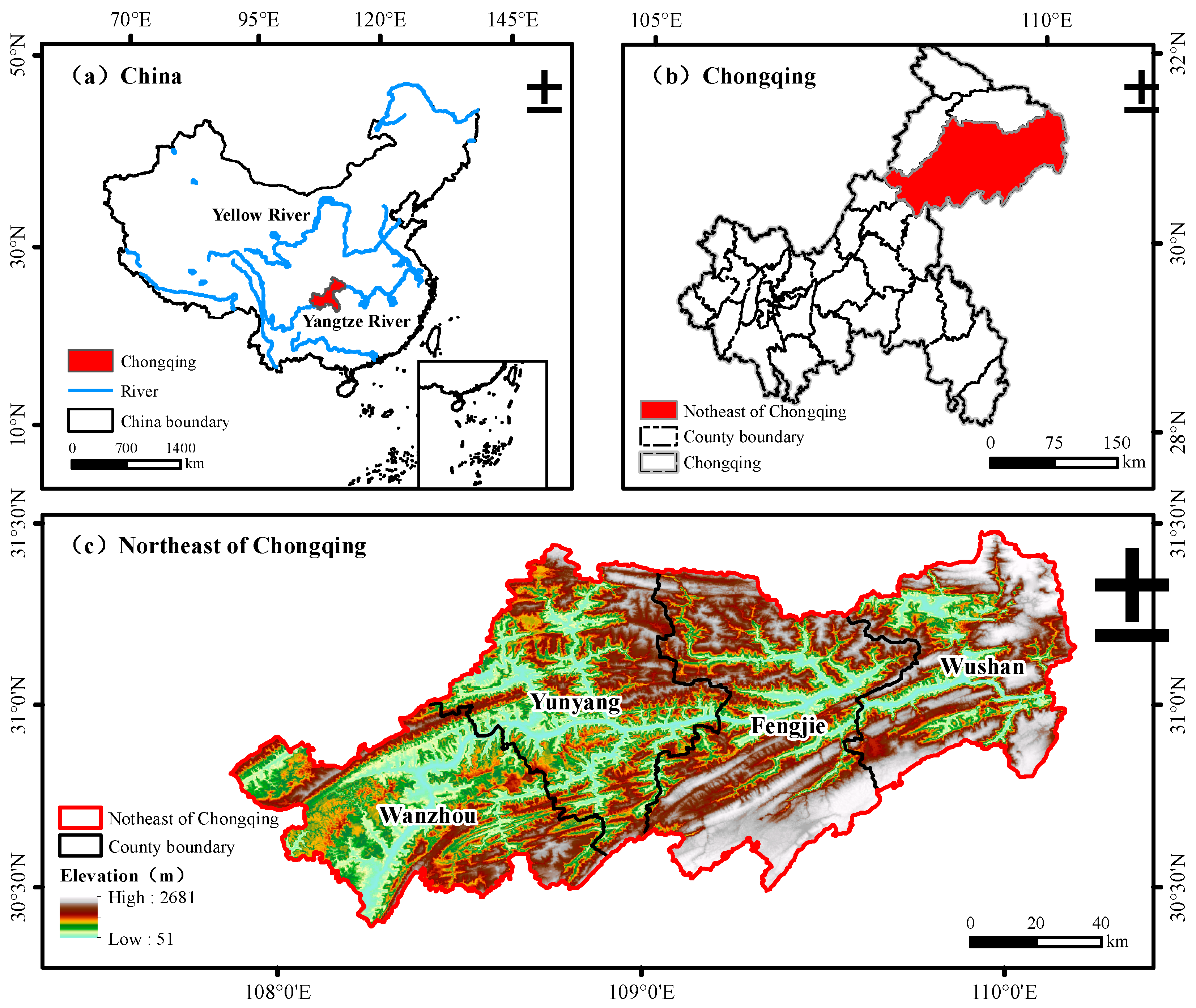
The overall regional setting and the location of the study area are shown in
Figure 1. The Three Gorges Reservoir area is located on the eastern margin of China’s second topographic step and is characterized by an erosional landscape dominated by low– to middle–relief mountains and deeply incised canyons. The Yangtze River valley trends roughly east–west and displays typical deeply cut valley landforms. Overall, the regional topography can be summarized as “high on three sides and flat along one river, with multiple mountain belts”: elevations in the east, south, and north are relatively high, whereas the terrain on both sides of the Yangtze River in the west is comparatively flat. River valleys are sporadically developed along the main stream, and a series of multi-level fluvial terraces are well preserved. Jinyun, Zhongliang, Tongluo, Min-gyue and other mountain ranges form several northeast-trending mountain belts.
Urban areas in northeastern Chongqing are located in the border region between Chongqing Municipality and the provinces of Hubei, Sichuan, and Shaanxi, covering a total area of approximately 35,400 km2. This region includes 11 districts and counties: Wanzhou, Liangping, Kaizhou, Fengjie, Wushan, Wuxi, Yunyang, Fengdu, Chengkou, Zhongxian, and Dianjiang. As the northeastern gateway of Chongqing, it plays a crucial role in the construction of an ecological security barrier in the upper reaches of the Yangtze River. This study mainly focuses on the urban areas of four counties and districts—Fengjie, Wushan, Wanzhou, and Yunyang.
2.1. Topographical and Geomorphological Characteristics
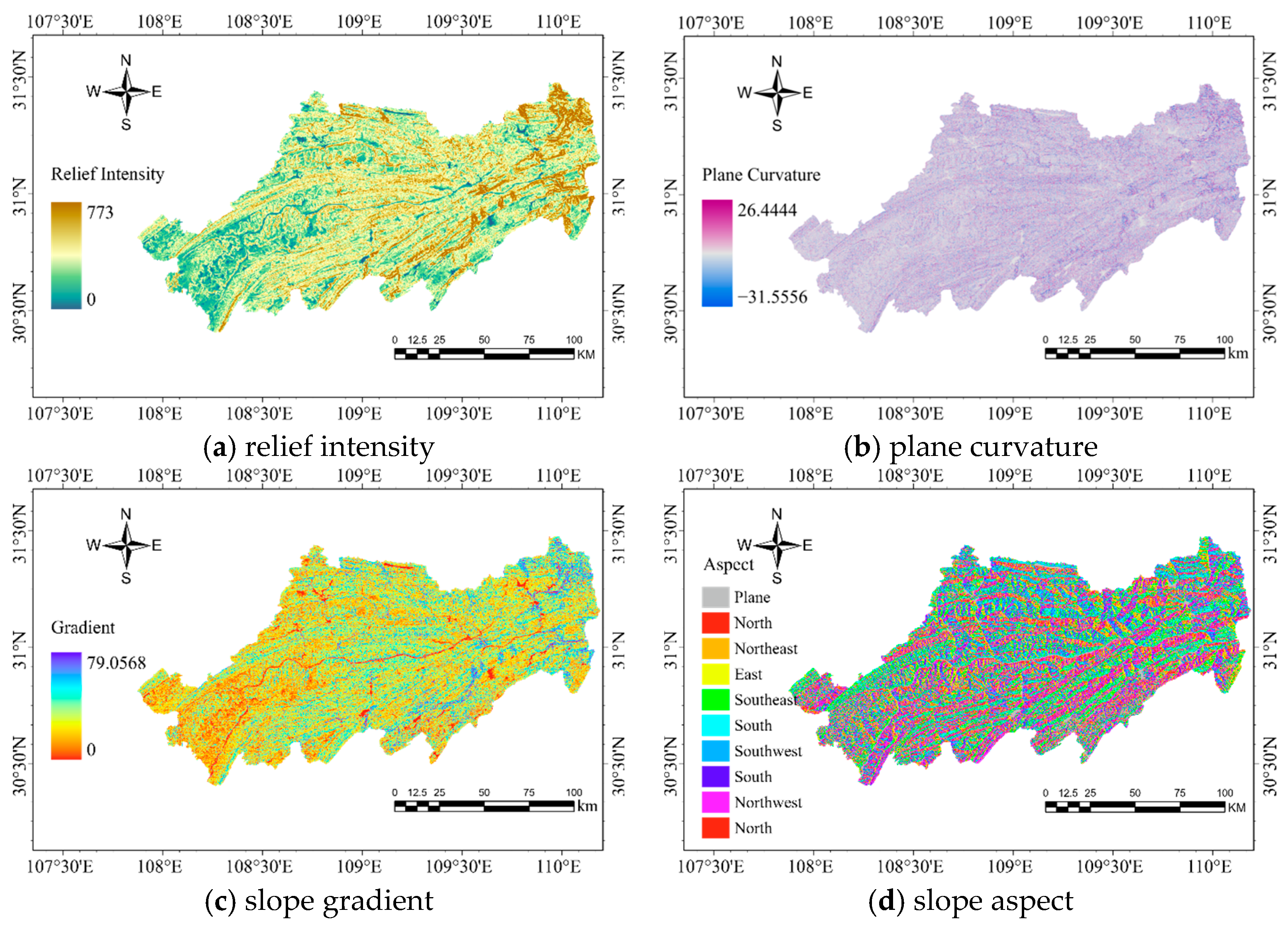
The overall orientation of the mountain ranges in the area is consistent with the trend of the major tectonic lines. The morphology and scale of the landforms are strongly controlled by geological structure, lithologic assemblages, and neotectonic activity, with many anticlines forming mountain ridges and synclines forming valleys. Using the boundary of Baidi City in Fengjie County as a demarcation line, the region can be divided into two geomorphic units, east and west. To characterize the topographical and geomorphological setting of the study area, relief intensity, plane curvature, slope gradient, and slope aspect were derived from the DEM. Relief intensity and slope gradient (
Figure 2a,c) highlight the strong topographic dissection along the deeply incised valleys, while plane curvature and aspect (
Figure 2b,d) reflect the planform geometry and orientation of the valley slopes and ridges.
2.2. Engineering Geological Conditions
The exposed strata in the Three Gorges Reservoir area of Chongqing consist entirely of sedimentary rocks. Except for the Tertiary system, Silurian–Quaternary strata are developed to varying degrees. Paleozoic outcrops (Silurian, Devonian, Carboniferous, and Permian) are mainly distributed in the Wuxia area and are composed predominantly of marine deposits. Mesozoic strata are widely distributed; apart from the middle–lower Triassic marine formations, the remaining units are of continental origin. The lithology and lithofacies of the marine strata are relatively stable, whereas those of the continental strata vary greatly. In the Cenozoic, the Tertiary system is absent, and the Quaternary system occurs sporadically, mainly as alluvial deposits, residual slope deposits, and landslide deposits with large thickness variations. Residual slope deposits and landslide deposits constitute the principal sources of geological hazards in the area.
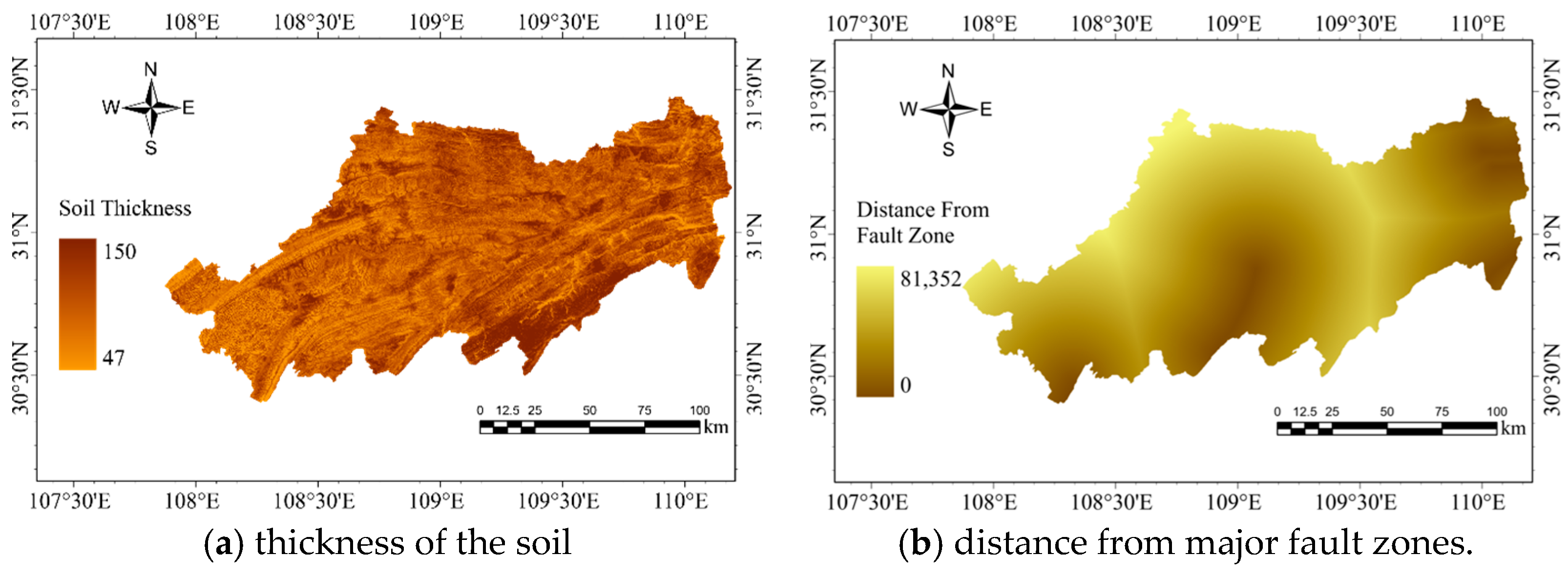
The study area is located within the Yangtze paraplatform, adjacent to the Qinling orogenic belt to the north, and is bounded by the Qiyaoshan basement fault between Wushan and Fengjie, which trends generally southwestward from Fengjie to Shizhu. To the west lies the Sichuan Basin (part of the Yangtze Block), and to the east the upper Yangtze platform fold belt. Multiple tectonic movements (Jinning, Yanshan, and Himalayan) have produced a fold–fault structure with overall regional uplift, providing the structural background that controls slope geometry and fault distribution. The spatial variation in the thickness of the soil (unconsolidated cover) and the distance from major fault zones are shown in
Figure 3a,b, respectively. The soil cover thickness varies markedly within the study area, while the distance-from-fault map reflects how the urban areas are distributed with respect to the main fault zones.
2.3. Hydrogeological Conditions
The Three Gorges Reservoir area is located in the middle and upper reaches of the Yangtze River. The geological structure is complex, and the landscape is dominated by erosional and karst landforms. Owing to the intricate geological structure and geomorphological conditions, the hydrogeological setting of the region is also highly complex. Based on groundwater occurrence conditions, hydrodynamic characteristics, and water-bearing media, three main types of groundwater can be distinguished in the area: pore water in loose rocks, fissure water in clastic rocks, and karst water in carbonate rocks [
42].
From the perspective of groundwater dynamics, groundwater in the study area can be broadly classified into two categories: (i) suspended water in the aeration zone and unconfined phreatic water and (ii) confined (piezometric) water. For the suspended and unconfined phreatic water, the hydrodynamic processes that exert a significant influence on bank-slope stability mainly include three types: intermittently infiltrating fissure phreatic water, intermittently infiltrating pore phreatic water, and pressured fissure water. In addition, interlayer water occurring within the interbedded sandstones of the slopes belongs to the confined groundwater type. According to its circulation characteristics, this confined water can be further subdivided into weakly circulating and strongly circulating types.
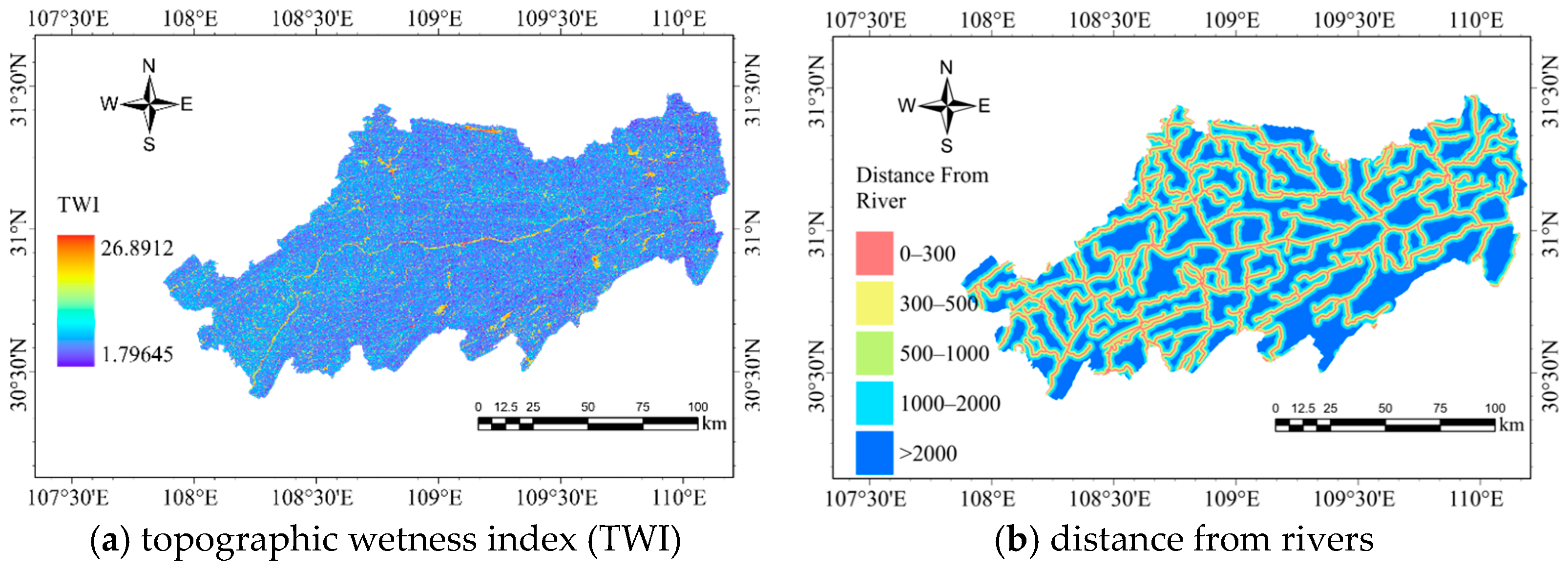
The topographic wetness index (TWI) and the distance from rivers in the study area are shown in
Figure 4a,b, respectively. The TWI reflects the combined influence of local slope and upslope contributing area on potential surface and subsurface moisture accumulation [
43], whereas the distance-from-river index characterizes the spatial relationship between the urban areas and the main river network. The TWI is calculated by the following formula:
where
As is the upslope contributing area per unit contour length and
β is the local slope angle.
3. Evaluation Methods
3.1. Stability Comprehensive Analysis
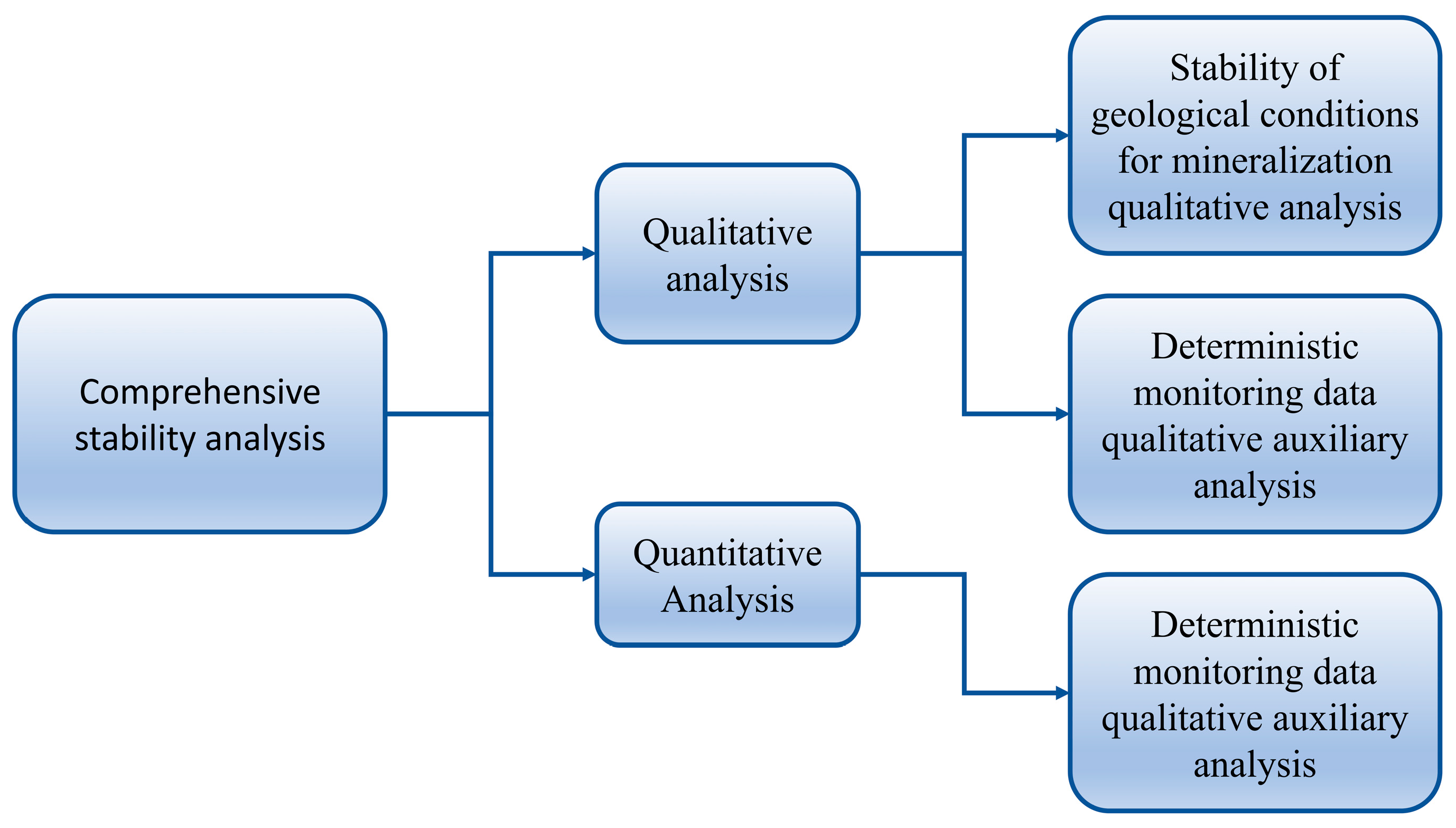
The deep stability of the hazard-inducing (disaster-prone) geological environment is evaluated using a combination of qualitative and quantitative methods. First, a qualitative stability analysis is performed based on detailed investigation of the hazard-inducing geological conditions. Then, quantitative stability calculations are carried out using numerical simulation. Finally, a comprehensive stability assessment is obtained by integrating the qualitative judgments with the quantitative results. The specific workflow is illustrated in
Figure 5.
3.2. Partition Principles of Disaster-Prone Environment
The zoning of the disaster-prone geological environment aims to provide a macroscopic and holistic understanding of regional conditions, identify different geological units and their characteristics, delineate the spatial distribution of geological disaster risks, and recognize typical geological safety problems. This, in turn, provides a regional-scale basis for geological safety in urban planning and layout. The partition principles of the disaster-prone environment are as follows:
(1) Terrain conditions of disasters
Topography and geomorphology reflect surface relief formed under the combined influence of surface material composition, geological structures, and external forces, and they record the characteristics of regional geological evolution. In this study, the boundaries of disaster-prone geological environment zones are delineated by evaluating the distribution of deeply incised gully landforms in the area.
(2) Disaster-controlling structural conditions
These conditions reflect the material characteristics of the geological environment, determine the mechanical behavior of slopes, and directly affect slope stability. The disaster-prone geological environment is therefore subdivided according to the structural types of deep disaster-controlling slopes.
(3) Sliding strata
Sliding strata reflect the geological characteristics of rock type, genesis, geological structure, lithologic assemblage, and physical–mechanical properties. By distinguishing engineering geological rock groups, the rock groups that may act as potential sliding strata are identified, and the disaster-prone geological environment is zoned accordingly.
(4) Disaster-inducing factors
According to the hydrological and hydrogeological conditions, areas affected by surface water and groundwater are delineated separately, reflecting the influence of water-related processes on the development of geological disasters.
3.3. Grading Standards
The classification of stability states and the corresponding safety factors are given in
Table 1 and
Table 2, where
Fst denotes the stability safety factor. When the number of people directly threatened is greater than or equal to 1000 or the potential direct economic loss is greater than or equal to 100 million yuan, the stability safety factor is taken as
Fst = 1.30. When the number of people directly threatened is less than or equal to 50 and the potential direct economic loss is less than or equal to 2.5 million yuan, the stability safety factor is taken as
Fst = 1.10; For all other cases, the stability safety factor is determined by interpolation based on the number of people directly threatened and the potential direct economic loss.
4. Analysis of Disaster-Prone Geological Environment
4.1. Analysis of Zoning and Disaster Conditions
The built-up areas of Wushan and Fengjie counties are both characterized by denudational low-mountain and hilly landforms. Well-developed gullies and deeply incised valleys locally form steep, high free faces, which constitute natural watershed boundaries and micro-geomorphic unit boundaries. The exposed strata in the area consist entirely of Triassic formations, with lithology dominated by limestone, argillaceous limestone, marl, argillaceous siltstone, silty mudstone, and sandstone. Rock types and lithologic assemblages are diverse, and the rock-mass structure, degree of karstification, and physical–mechanical properties vary significantly.
Based on the principles of disaster-prone geological environment zoning and the actual conditions of the assessment area, the built-up area of Wushan County is divid-ed into six disaster-prone geological environment zones (Iw1–Iw2, IIw1–IIw3, IIIw), whereas the built-up area of Fengjie County is divided into ten such zones (IF1–IF5, IIF1–IIF2, IIIF1–IIIF3).
The four key towns also exhibit pronounced disaster-prone conditions. Hefeng Town (IH1) is a consequent slope with lithology primarily composed of silty mudstone and marl, which are prone to sliding. Although the overall stability is currently good, the slope toe is susceptible to local deformation under the combined influence of reservoir water-level fluctuations and rainfall. Longdong Town is located on the southern limb of a syncline and is a consequent slope developed on low-mountain valley slopes. Its lithology mainly consists of mudstone, silty mudstone, and sandstone, overlain by a surface layer of gravelly soil. The entire area is divided into two accumulation–cataclastic rock bedding-slope disaster-prone zones (IL1, IL2). Xintian Town (IXT) is a single consequent slope with a multi-level stepped morphology. The lithology is dominated by sandstone–mudstone interbeds, in which the upper sandstone exhibits strong weathering resistance, whereas the underlying mudstone is prone to softening. The well-developed front free face makes the slope susceptible to bedding-slip deformation. Xikou Town (IXK) is a single cataclastic rock bedding slope. Fluvial erosion and water-level fluctuations lead to deterioration of the slope toe and rock mass, and the presence of a weak interlayer at depth creates the potential for bedding slip–buckling instability.
4.2. Analysis of Slope Stability
In this study, 21 typical disaster-prone slope profiles were selected in the “2 + 4” towns, and a comprehensive stability evaluation was carried out by combining qualitative and quantitative methods. An elastic–perfectly plastic Mohr–Coulomb model was adopted for both rock mass and soil, and parameters were assigned by lithology and engineering geological units from field investigation data and representative regional ranges using conservative values. Uncertainty in these parameters may affect safety factors and will be quantified in future work via probabilistic analysis together with additional in situ/lab tests.
On this basis, the finite-element strength reduction method was applied to compute the safety factors and plastic strain distributions of the 21 representative sections, and the displacement field was obtained by linear static analysis. All simulations represent static snapshots with a steady-state pore-pressure field. Cyclic reservoir water-level fluctuations and fully coupled transient seepage–stress effects are not explicitly modelled in the present study.
The results indicate that the overall safety factor of each section ranges from 1.225 to 2.00, with most values exceeding 1.30, suggesting that the slopes in the study area are generally stable to basically stable under natural conditions. Potential deformation zones are mainly distributed within the sliding mass or near the slope crest, with maximum displacements of 0.121–1.913 m. Plastic strain zones are mostly distributed along the slip zones or potential slip surfaces in arcuate or banded forms, with peak plastic strain values between 0.089 and 7.319. The maximum shear stress in the sections ranges from 2.243 to 18.330 MPa [
44].
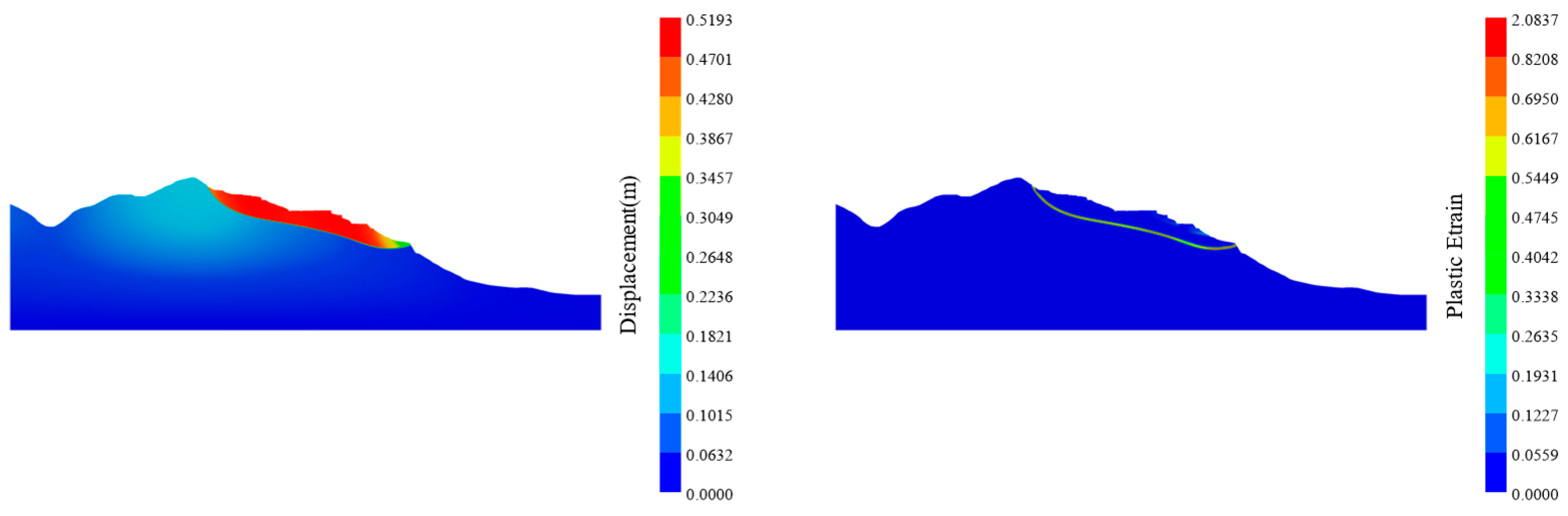
Figure 6 presents the deformation and plastic strain contour maps of the typical section III–III′ in Wushan County. The overall safety factor of this section obtained by the strength reduction method is 1.225. The deformation zone is mainly concentrated within the sliding mass, with a maximum displacement of 0.519 m, whereas the plastic strain zone is distributed along the sliding zone in an arcuate pattern, with a peak plastic strain of 2.084. The maximum shear stress in this section is 3.603 MPa. According to the numerical analysis and simulation results, the slope corresponding to this profile is basically stable under the analyzed conditions.
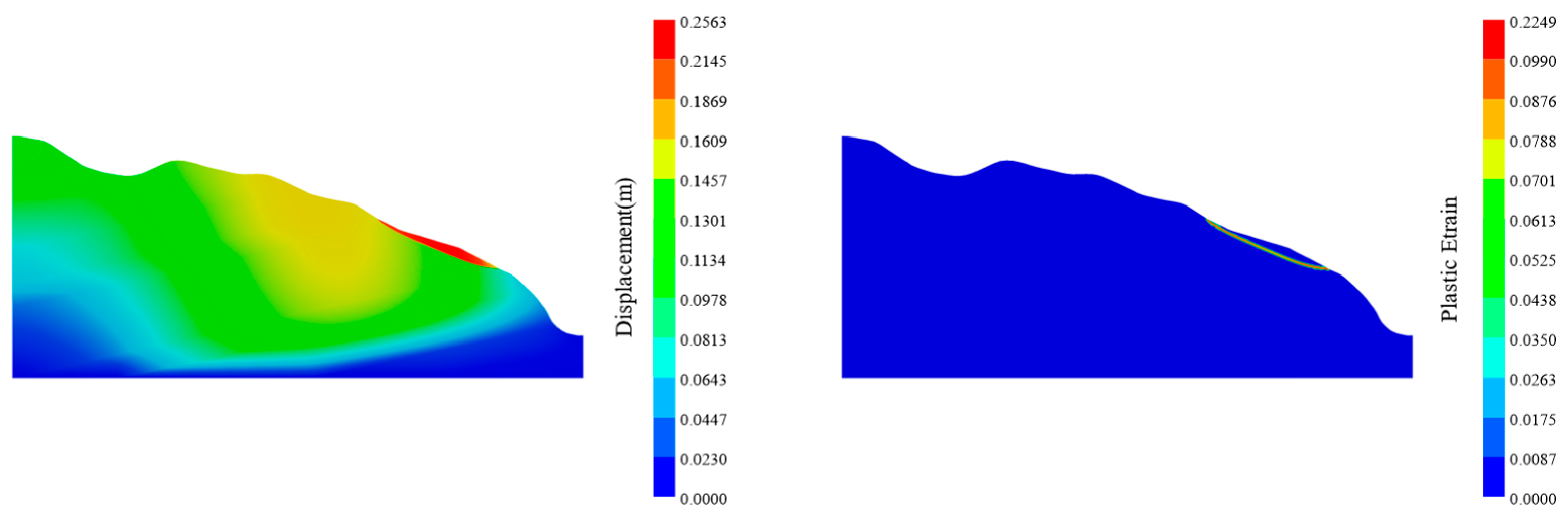
Figure 7 shows the deformation and plastic strain contour maps of the typical section IIF1–IIF1′ in Fengjie County. Numerical calculations indicate that the overall safety factor of this section is 1.314. The deformation zone is mainly concentrated in the Yanjiawuchang landslide at the slope toe, with a maximum displacement of 0.256 m. The plastic strain zone is distributed along the sliding zone of the Yanjiawuchang landslide at the slope toe in an arcuate form, with a peak plastic strain of 0.225. The maximum shear stress in this section is 4.729 MPa. Overall, the numerical analysis results show that this slope is stable as a whole.
4.3. Determination of Shallow Geological Safety Susceptibility
In this study, the influence range was delineated in GIS using the mapped boundary of each hazard/prone body and, for hazard hidden danger points, the affected extent recorded in the hazard inventory and verified by field investigation. Where only point locations were available, a conservative GIS buffer consistent with the documented threatened area and constrained by the ridge–gully bounded slope unit was applied; therefore, buffer/influence-radius assumptions mainly affect zones near classification thresholds rather than the overall low/medium/high LL zoning.
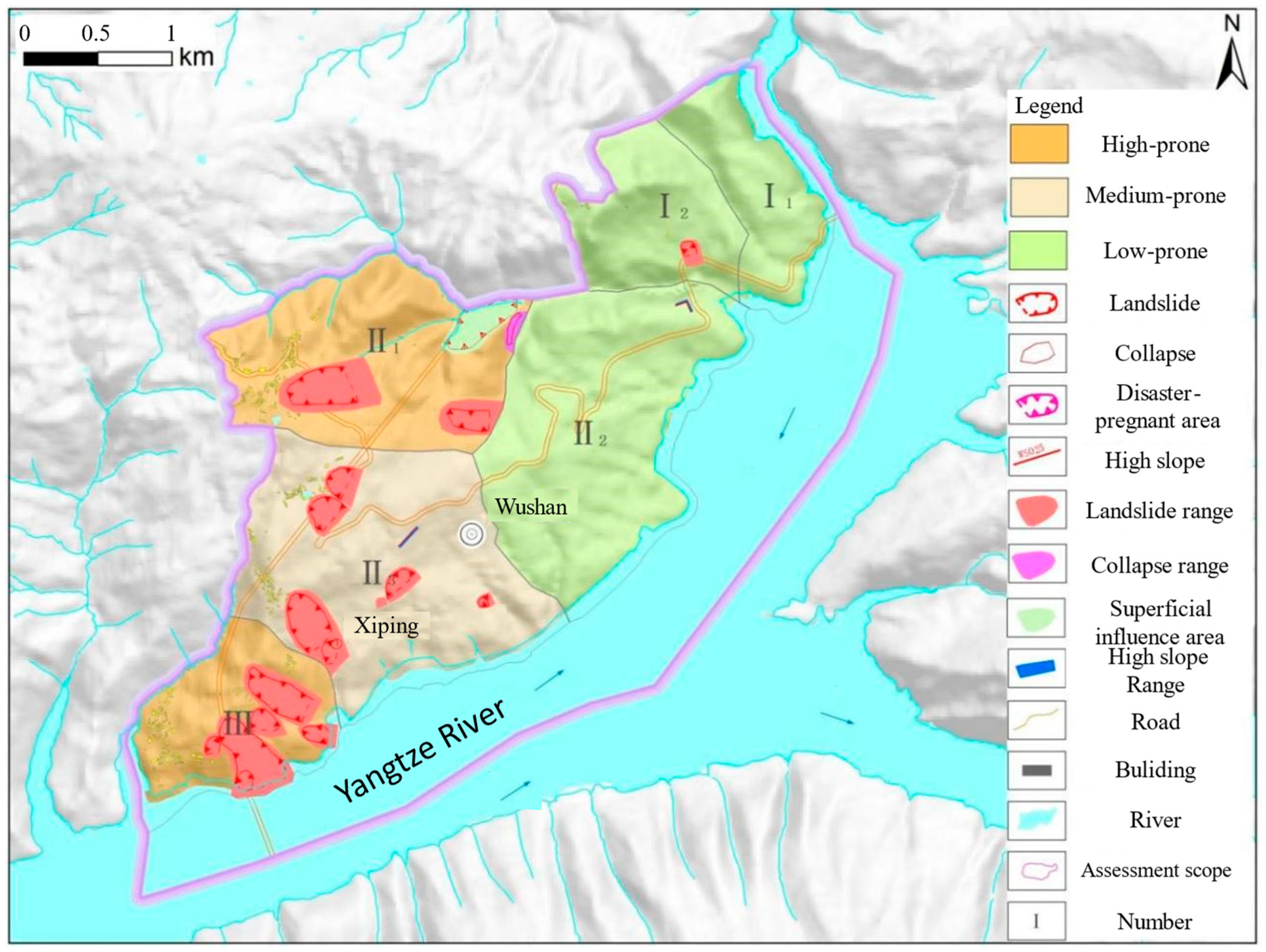
In the built-up area of Wushan County, there are no hazardous bodies with poorly performing remediation projects. A total of 14 untreated (ungoverned) geological hazard hidden danger points, 2 sites under remediation, and 1 site under emergency remediation were identified. Based on the influence range of each unstable hazard source and the areal proportion of each disaster-prone geological environment zone, the shallow geological safety susceptibility of each zone was classified, as shown in
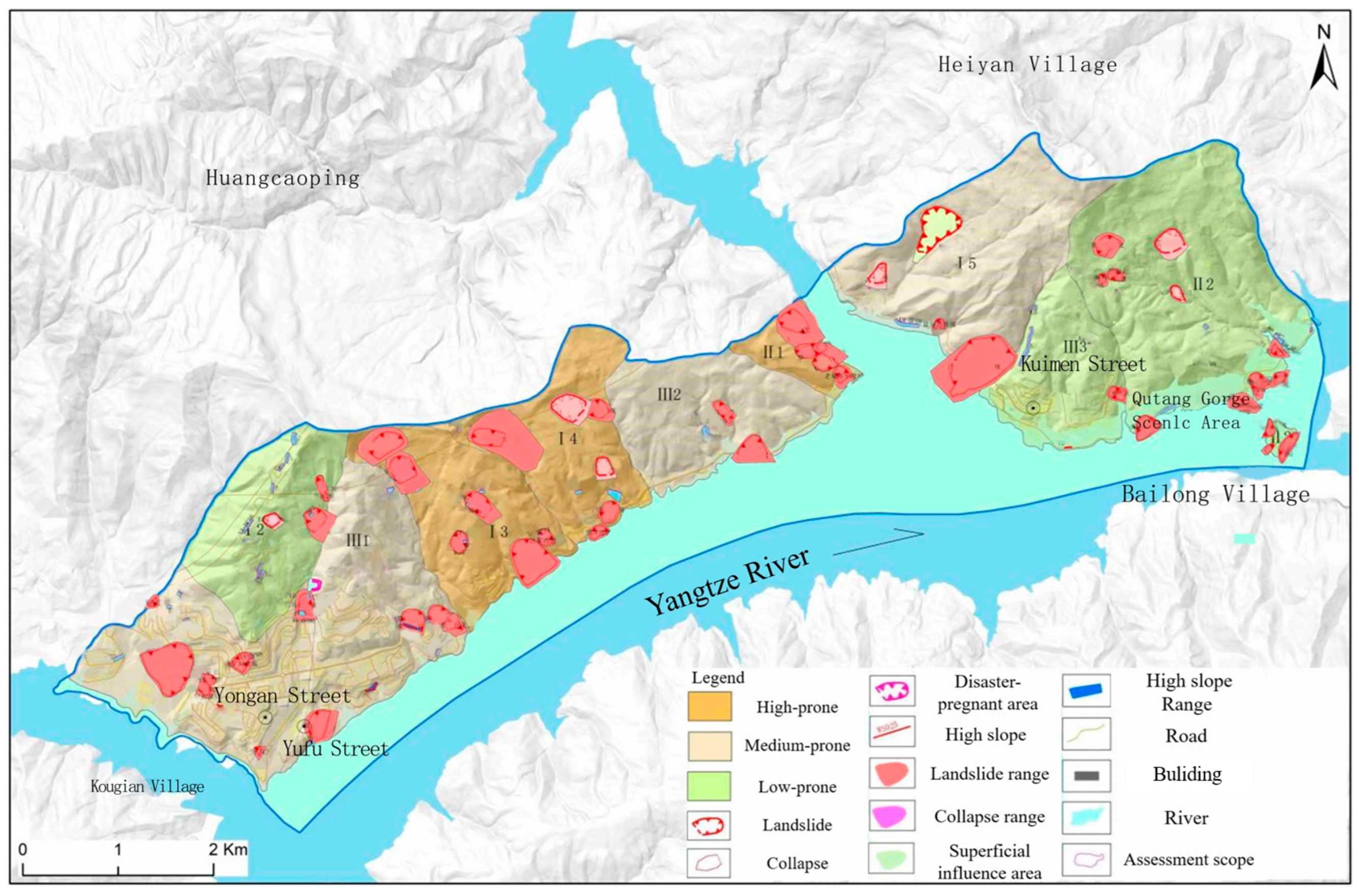
Figure 8. The built-up area of Wushan County is divided into two high-susceptibility zones, one medium-susceptibility zone, and three low-susceptibility zones for shallow geological safety.
In the built-up area of Fengjie County, there are no slope debris flows and no remediated hazard bodies with poor operational performance. A total of 43 untreated geological hazard hidden danger points and 8 basically stable disaster-prone bodies were identified, including 6 landslide bodies, 1 collapse body, and 1 shallow disaster-prone area. In addition, 85 potentially hazardous slopes with basically stable or marginally stable conditions and 4 high cut slopes that are basically stable or unstable were recognized. The built-up area of Fengjie County is divided into three high-susceptibility zones, four medium-susceptibility zones, and three low-susceptibility zones. The number of hidden danger points and hazardous slopes in this area is relatively large, and their influence range is extensive. The spatial distribution of shallow geological safety susceptibility is shown in
Figure 9.
In Hefeng Township, no unmanaged geological hazard hidden danger points, disaster-prone bodies, or slope-type debris flows were identified, and no poorly remediated hazard bodies or basically stable high cut slopes were present. Therefore, the shallow susceptibility assessment focused on 11 basically stable potentially hazardous slopes, and the area was classified as low susceptibility.
Longdong Town comprises two disaster-prone geological environment zones. Based on two basically stable landslide bodies and two potentially hazardous slopes, the shallow susceptibility was evaluated as low.
In Xintian Town, no slope-type debris flows or poorly performing control projects were found. Within the IXT zone, 1 landslide, 3 disaster-prone bodies, and 11 potentially hazardous slopes (8 basically stable and 3 stable) were identified, and the shallow susceptibility was assessed as low.
In Xikou Township, no slope-type debris flows or poorly performing control projects were identified. Four untreated hidden danger points, two basically stable disaster-prone bodies, and nine potentially hazardous slopes (basically stable or marginally stable) were recognized, and the shallow susceptibility was classified as low.
5. Construction and Application of Urban Geological Safety Evaluation Model
5.1. Construction of the Deep Evaluation Model
The overall deep geological safety classification is determined by using the deep geological safety grade of each disaster-prone geological environment zone as the dependent variable, and the disaster-prone conditions, observed deformation, and connectivity of the sliding zone as the independent variables. A multivariate logistic regression model [
45] is employed to construct the evaluation model. The corresponding grading scheme is given in
Table 3, in which Grade I represents the lowest risk and Grade IV represents the highest risk.
According to the model statistics, the overall significance value of the multivariate logistic regression model is less than 0.05, and the Pearson chi-square test yields a significance value of 1.000. In the pseudo-R2 table, the three reported pseudo-R2 indices are all high, with the minimum value being 0.912. This indicates that the model explains the variation in the dependent variable with high accuracy and provides a good overall fit. Based on the above results of the multivariate logistic regression analysis, the evaluation model can be expressed, according to the parameter estimation table, as follows:
5.2. Sensitivity Evaluation Model of Engineering Activities
Using the sensitivity to engineering activities as the dependent variable, and the water sensitivity, disintegration, and porosity of rock and soil in the study area as the independent variables, a sensitivity evaluation model for engineering activities is constructed by means of a multivariate logistic regression model. The corresponding grading scheme is presented in
Table 4.
Because project-specific information on slope cutting intensity and construction disturbance is incomplete and highly heterogeneous among the 21 units, these factors are not included as separate indicators in the present LS index.
Therefore, LS in this study is intended to represent the intrinsic sensitivity of rock/soil to engineering activities under a consistent regional-scale framework, rather than the explicit intensity of cutting or construction disturbance. When standardized GIS-based datasets are available, proxy disturbance indicators can be incorporated to indirectly account for disturbance, which is expected to mainly refine the assessment for borderline units.
According to the model statistics, the overall significance value of the multivariate logistic regression model is less than 0.05, and the Pearson chi-square test yields a significance value of 1.000. In the pseudo-R
2 table, the three reported pseudo-R
2 indices are all relatively high, with the minimum value being 0.750. This indicates that the model explains the variation in the dependent variable with good accuracy and that the overall goodness of fit is satisfactory. Based on the above results of the multivariate logistic regression analysis, the sensitivity evaluation model can be expressed, according to the parameter estimation table, as follows:
5.3. Prevention Difficulty Indicator and Classification
The prevention difficulty (PD) was defined as a binary indicator (low/high) based on engineering accessibility, slope scale and geometric complexity, technical feasibility of stabilization measures, and expected investment combined with environmental and social constraints. Slopes that could be treated by conventional measures with relatively good accessibility and moderate scale were classified as low PD, whereas high and large, structurally complex slopes in densely built-up or constrained areas requiring complex or high-cost reinforcement schemes were classified as high PD.
In this study, PD was intentionally simplified to a binary variable to preserve interpretability and statistical robustness given the limited sample size (21 zones) and the current lack of standardized, township-comparable datasets for detailed cost–benefit quantification and environmental constraint scoring.
In future applications, PD can be refined into a multi-level scheme (e.g., low/medium/high) or a continuous index by incorporating cost–benefit metrics and quantified environmental/social constraint scores; such refinement is expected to primarily affect marginal zones and may shift the final risk grade by one adjacent level.
5.4. Urban Geological Safety Model
In this study, the “2 + 4” urban geological safety risk assessment (RA) is taken as the dependent variable, and the deep overall geological safety level (DL), sensitivity to engineering activities (LS), shallow geological safety susceptibility (LL), and prevention difficulty (PD) are used as the independent variables. A multivariate logistic regression model is employed to construct the urban geological safety evaluation model. The corresponding grading scheme is given in
Table 5, where Grade I represents the lowest risk and Grade V represents the highest risk.
From the model fitting statistics, the overall significance value is less than 0.05, indicating that the multivariate logistic regression model is statistically significant and passes the overall significance test. In the goodness-of-fit results, the Pearson chi-square test yields a significance value of 1.000, suggesting that the null hypothesis that the model fits the observed data cannot be rejected and that the model provides an adequate fit.
In the pseudo-R2 table, the three reported pseudo-R2 indices are all high, with the minimum value being 0.914. This indicates that the model explains the variation in the dependent variable with high accuracy, capturing most of the information contained in the original data, and that the overall goodness of fit is excellent.
According to the likelihood ratio test results (
Table 6), the effects ultimately included in the model comprise the intercept, deep geological safety level of the disaster-prone geological environment zone, sensitivity to engineering activities, shallow geological safety susceptibility, and prevention difficulty. The significance values in the last column show that all four independent variables make statistically significant contributions to the model, indicating that they have high explanatory power and practical research significance.
Based on the above multivariate logistic regression analysis and the parameter estimation results, the model can be expressed as follows:
In the model,
G5 is taken as the reference group. Based on the above equations, the values of
G1,
G2,
G3,
G4 and
G5 are calculated, and the corresponding probabilities of the five risk grades can then be obtained. The expressions are as follows:
In addition, the classification table of model predictions is presented in
Table 7, corresponding to the five categories of the dependent variable “urban geological safety risk grade” (Grade II, Grade IV, Grade V, Grade I, and Grade III). The model shows a high level of accuracy in predicting the urban geological safety risk grade, and the overall prediction accuracy reaches 100%, which is excellent. The pseudo-R
2 statistics discussed above indicate that the model explains the variation in the dependent variable with high accuracy and captures most of the information in the original data. The goodness of fit is therefore excellent, which is consistent with the conclusion drawn from the overall prediction accuracy.
The 100% overall prediction accuracy in
Table 7 represents an in-sample agreement on the 21 calibration zones and should not be interpreted as an independent demonstration of out-of-area generalization.
5.5. Application of Urban Geological Safety Model
Based on the established model and the available experimental data, the 21 study areas defined in this project were evaluated. The model successfully produced five-level risk classifications for all 21 areas. Among them, Grade III risk is overwhelmingly dominant, with 18 areas classified as Grade III, accounting for approximately 85.7%, indicating that most urban areas in the study region are exposed to a moderate level of geological safety risk. In addition, two areas are classified as Grade II risk and one area as Grade IV risk. No Grade I or Grade V risk areas are present in this set of samples.
6. Discussion
This study presents an integrated assessment of urban geological safety for the “2 + 4” townships flanking the Three Gorges Reservoir, synthesizing regional geology, slope stability analysis, and a novel multisource logistic regression framework. Our findings underscore that the fundamental control on urban geological safety within this dynamic environment stems from the complex coupling of regional tectonic structure, stratigraphic lithology, geomorphology, and human engineering activities, all operating under the pervasive influence of reservoir water-level fluctuations. Crucially, the identification of three dominant disaster-prone slope types—cataclastic rock slopes, large accumulation slopes, and clastic rock bedding slopes—provides a robust foundation for linking specific slope morphologies to their characteristic failure mechanisms and primary hazard-controlling factors within the reservoir setting.
Finite-element strength reduction simulations conducted on 21 representative disaster-prone slope sections indicate that the majority of slopes currently reside in a stable or basically stable state (safety factors ranging from 1.225 to 2.00). However, the localization of potential deformation and plastic zones predominantly within the sliding mass or near slope crests signals a latent vulnerability. This spatial pattern suggests a propensity for instability evolution under the persistent drivers of long-term reservoir operation (cyclic water-level changes), intense rainfall events, and ongoing engineering activities. Consequently, these numerical results deliver not only a static assessment of present stability but also pinpoint critical slope segments demanding prioritized long-term monitoring and potential preemptive reinforcement measures.
The distribution and significance of the three dominant slope types exhibit distinct spatial variations across the “2 + 4” townships. These town-level differences are mainly controlled by contrasts in lithology–structure, geomorphic incision and toe erosion (including reservoir water-level fluctuations), and localized engineering disturbance. In the densely built-up areas of Wushan and Fengjie, disaster-prone units are primarily characterized by clastic rock bedding slopes and valley-side cataclastic rock slopes, whose instability is largely governed by the deep incision of gullies and river valleys, and can be locally amplified by slope modification and urban construction. Large accumulation slopes are comparatively confined, occurring locally where thick colluvial or landslide deposits exist. Contrastingly, Longdong Town is predominantly influenced by accumulation–cataclastic bedding slopes, Xintian Town by consequent bedding slopes within sandstone–mudstone interbeds, and Xikou Town by a major cataclastic rock bedding slope significantly impacted by river erosion and reservoir water-level fluctuations.
Our proposed framework represents a significant methodological advancement over many previous models which often relied on single indices or single information layers and treated mitigation measures qualitatively [
46]. Key innovations include: (1) The transition from simplistic single-index/single-layer evaluations to a multi-dimensional model that explicitly integrates four key controlling indicators (tectonics, lithology, geomorphology, engineering); (2) The implementation within a unified five-grade logistic-regression structure operating effectively at the urban scale; and (3) The extension of logistic regression application, commonly used at slope/landslide scale, to classify multiple disaster-prone geological environment zones across reservoir-side towns. This extension leverages multisource information (field investigation, numerical simulation, historical hazard inventory), yielding a more comprehensive depiction of urban surface safety and susceptibility than conventional approaches [
47,
48].
The comprehensive risk evaluation model demonstrates excellent statistical performance (pseudo-R2 ≥ 0.912, p < 0.001, overall prediction accuracy 100% on the calibration dataset). This robust validation confirms that the selected indices and the multivariate logistic regression framework effectively capture the key physical and engineering controls governing urban geological safety within the study area. It is critical to emphasize that this 100% accuracy pertains specifically to the 21 zones used for model calibration. Rigorous evaluation of the model’s generalization capability necessitates further application to additional townships and integration with new monitoring data. Therefore, the current result should be viewed as calibration performance, and future work will focus on independent validation across more towns in the Three Gorges Reservoir area.
Several limitations warrant consideration for future research directions:
(1) Dynamic Effects: The finite-element strength-reduction analyses in this study are static snapshots based on steady-state (hydrostatic) pore pressures. In the Three Gorges Reservoir setting, cyclic reservoir operations and short-duration extreme rainfall can generate transient seepage and time-dependent pore-water pressures, which may further reduce stability—particularly for slopes with safety factors close to the grade thresholds, where the risk class could potentially shift to an adjacent level. We therefore recommend conservative treatment and strengthened monitoring for borderline slopes during rapid drawdown periods. Future work will incorporate fully coupled transient seepage–stress simulations driven by measured/operational reservoir hydrographs.
(2) External Validity: Model calibration is specific to the “2 + 4” townships within the Three Gorges Reservoir, based on 21 zones and largely static/quasi-static indicators. Nevertheless, the core four-dimensional structure and workflow possess inherent transferability. Application to other mountainous or reservoir-side urban regions requires re-grading indicators and re-calibrating/validating logistic regression coefficients using locally derived data. Although the workflow is transferable, rigorous external validation requires additional towns and truly independent observations to recalibrate and test the model under consistent indicators and grading rules. Further improvements of the indicator system (e.g., a multi-level PD integrating cost–benefit and environmental constraints) will also be explored to enhance decision relevance when richer standardized datasets become available.
(3) Risk Comprehensiveness: The current framework focuses predominantly on geological susceptibility and physical stability (hazard component). To evolve from pure safety evaluation towards a genuinely comprehensive risk assessment, future iterations should integrate modules addressing socio-economic vulnerability and emergency response capacity. This study therefore focuses on the physical safety component, while socio-economic vulnerability will be integrated in future work to support comprehensive risk management and decision-making. Climate change projections are not explicitly included in the current baseline assessment; scenario-based analyses using projected rainfall extremes will be conducted in future work to examine potential shifts in risk grades, particularly for marginal units.
7. Conclusions
This study establishes an urban geological safety evaluation framework for the “2 + 4” typical towns in the Three Gorges Reservoir area under complex disaster-prone geological conditions. The main conclusions are as follows:
(1) Three dominant types of disaster-prone slopes affecting urban geological safety were identified: cataclastic rock slopes, large accumulation slopes, and clastic rock bedding slopes. Their geological conditions and hazard-controlling factors were clarified, providing a basis for targeted stability analysis and mitigation.
(2) Disaster-prone geological environment zoning was completed for the built-up areas of Wushan and Fengjie counties and four key towns. Wushan County was divided into six zones, Fengjie County into ten zones, and the remaining key towns into one to two zones each, achieving systematic identification and spatial delineation of disaster-prone units.
(3) Using the finite-element strength reduction method, 21 representative disaster-prone slope sections were quantitatively evaluated. The safety factors range from 1.225 to 2.00, with most slopes in a stable or basically stable state. Potential deformation is mainly concentrated within the sliding mass or near the slope crest, the peak plastic strain ranges from 0.089 to 7.319, and the maximum shear stress ranges from 2.243 to 18.330 MPa, indicating potential evolution toward instability in critical parts of the slopes.
(4) A five-level comprehensive urban geological safety risk evaluation model was constructed by integrating deep geological safety grade, sensitivity to engineering activities, shallow geological safety susceptibility, and prevention and control difficulty within a multivariate logistic regression framework. The model shows excellent performance (significance < 0.05, pseudo-R2 ≥ 0.912, overall prediction accuracy 100%). Application to 21 study areas shows that Grade III (moderate) risk is dominant, with 18 areas (approximately 85.7%) classified as Grade III, 2 areas as Grade II, and 1 area as Grade IV, and no Grade I or Grade V areas.
(5) As Grade III (moderate) risk is dominant in the study area, the evaluation results provide clear guidance for mitigation and management. For units with relatively low deep safety and high shallow susceptibility, priority should be given to improving drainage, locally unloading unstable slope segments, and adopting appropriate retaining or anti-sliding structures, whereas in Grade III areas with high sensitivity to engineering activities or high prevention difficulty, construction intensity should be strictly controlled and more emphasis placed on monitoring, early warning, and land-use regulation around critical slope segments.
For practical risk management, the five-tier grades can be linked to tiered mitigation: Grade III areas prioritize drainage and surface water management, localized reinforcement, and routine monitoring, whereas Grade IV–V areas require strict construction control, detailed site investigation and design, intensified monitoring/early warning, and avoidance/relocation when necessary.
Mitigation should also be tailored to dominant slope types: bedding-related slopes emphasize seepage control along bedding planes and structural reinforcement with toe protection; valley-side cataclastic rock slopes emphasize rockfall/collapse protection and toe stabilization combined with drainage; and consequent bedding slopes in sandstone–mudstone interbeds emphasize infiltration control and reinforcement targeting weak mudstone layers and adverse bedding conditions.
Overall, the proposed evaluation model has a clear structure, scientifically grounded indicators, and strong practical relevance, providing effective support for disaster risk reduction, risk-informed land-use planning, and resilient urban development in the Three Gorges Reservoir area and other complex geological settings. By enabling the prioritization of mitigation and monitoring resources and informing development control in hazard-prone zones, the framework helps reduce long-term losses and supports sustainable urban governance in reservoir-side mountainous towns.






 ,
,