From Barriers to Digital Transformation Pathways in Brazil and Germany

 ,
,  ,
,  and
and
Abstract
1. Introduction
- Which barriers and foundational technologies most influence DT adoption across distinct national contexts?
- How do these elements interrelate to generate capability-building pathways?
- (i)
- A meta-theory integrating DCT and SCT via agency, leadership, and culture, explicitly addressing the inherent tensions between managerial agency (emphasised in DCT) and structural constraints (central to SCT) and demonstrating how leadership and culture mediate these tensions in digital transformation contexts.
- (ii)
- A methodological template for ISM-MICMAC modelling replicable in different settings.
- (iii)
- Policy guidance with respect to overcoming barriers in different contexts.
- (iv)
- A comparative mapping of barrier–technology relationships in Germany and Brazil, guiding practitioners with context-specific directions for sequencing technology adoption.
2. Materials and Methods
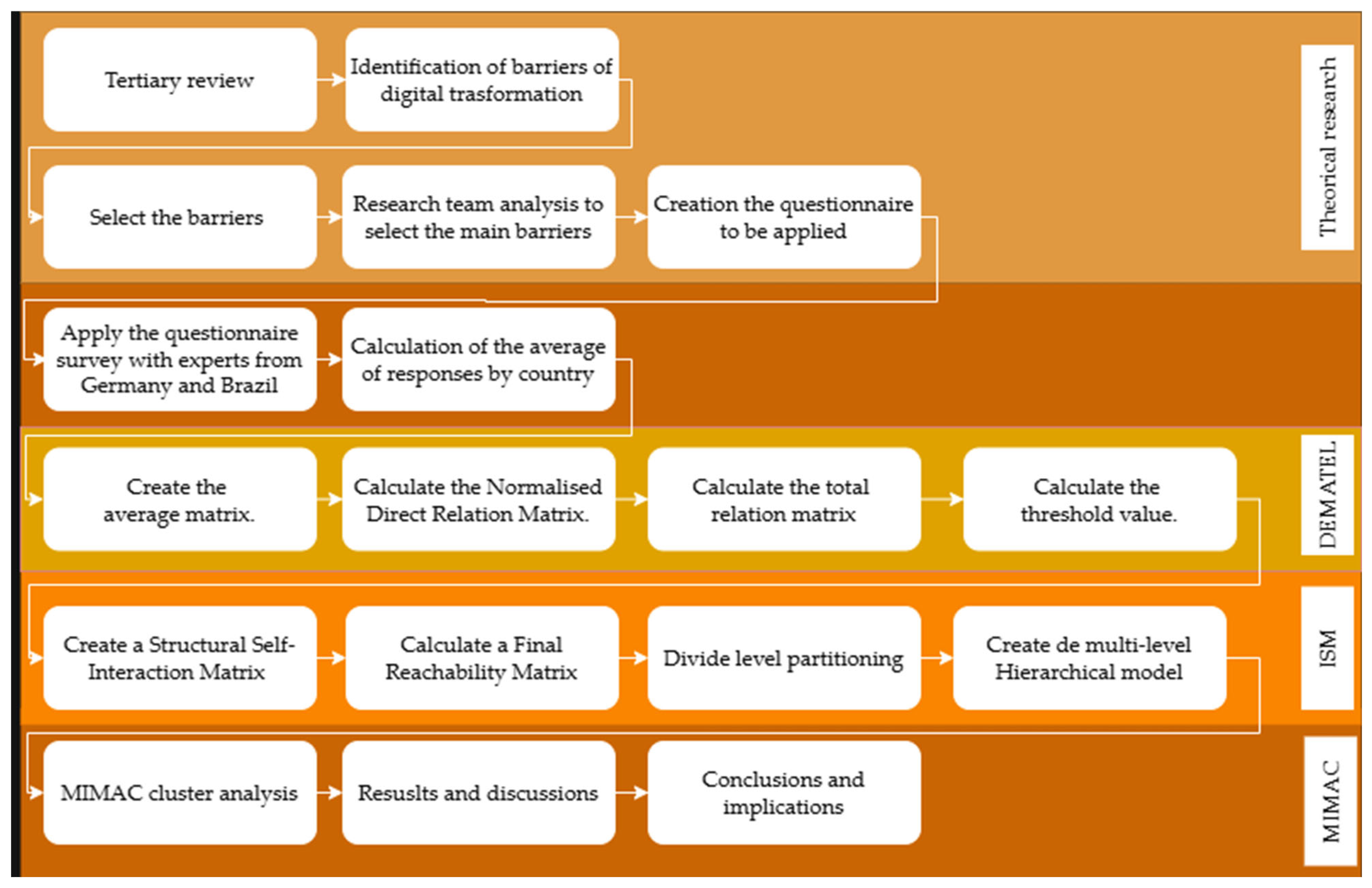
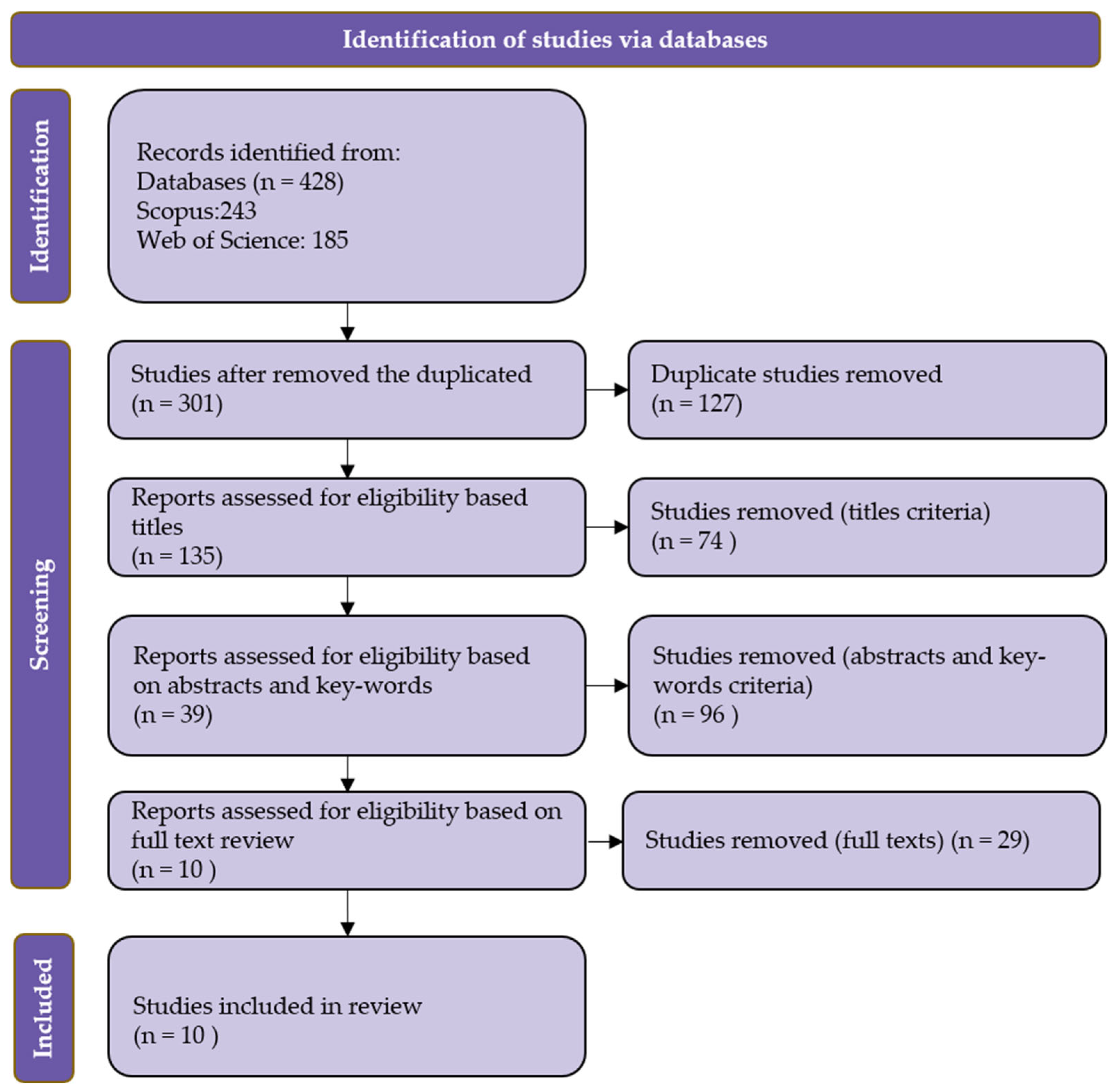
2.1. Tertiary Review
2.2. Data Collection, Classification and Sampling for Multicriteria Analysis
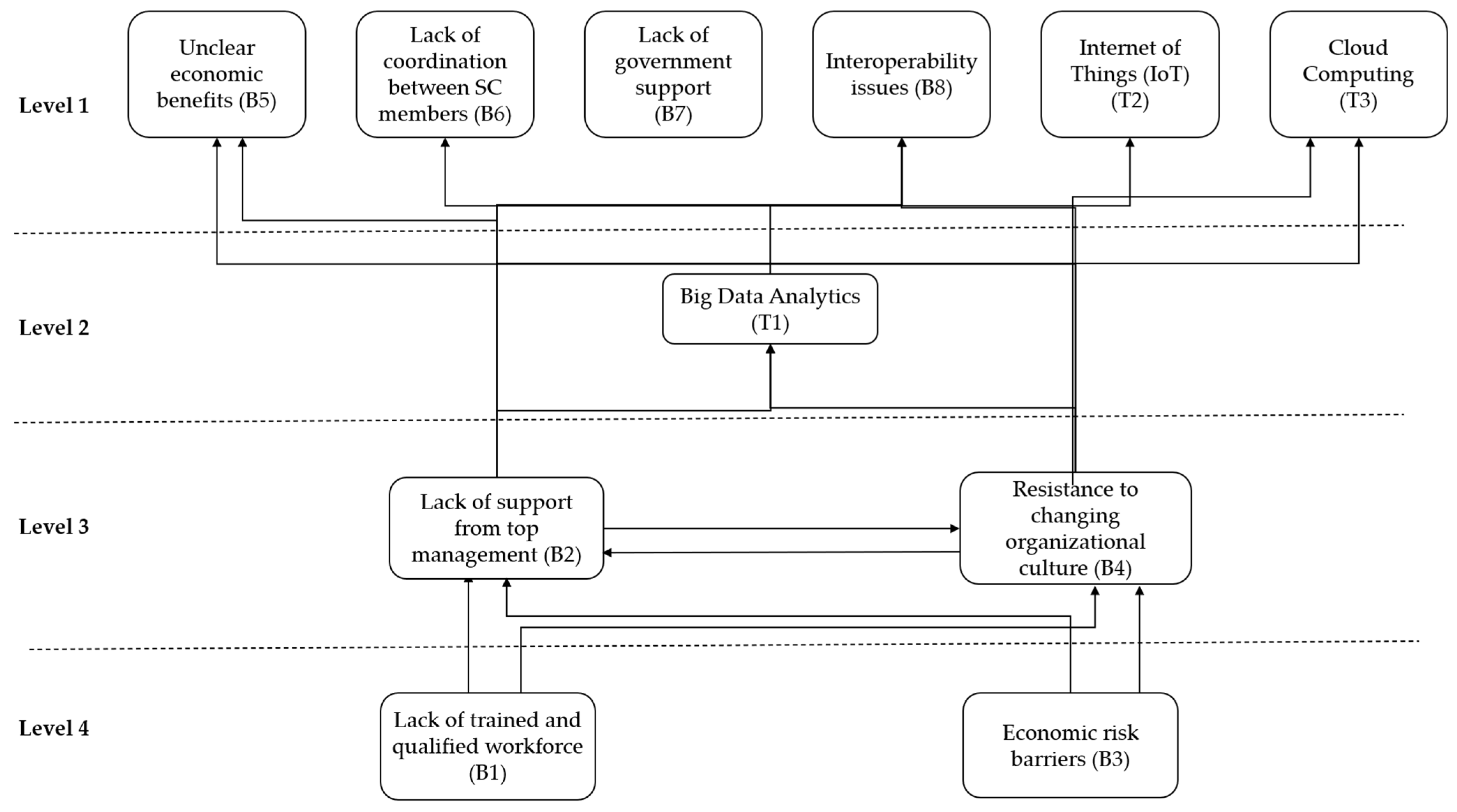
2.3. Interpretative Structural Modelling (ISM)
3. Results
3.1. Theoretical Background
3.1.1. Operations Management (OM) Theories Related to I4.0 Socio-Technical Skills
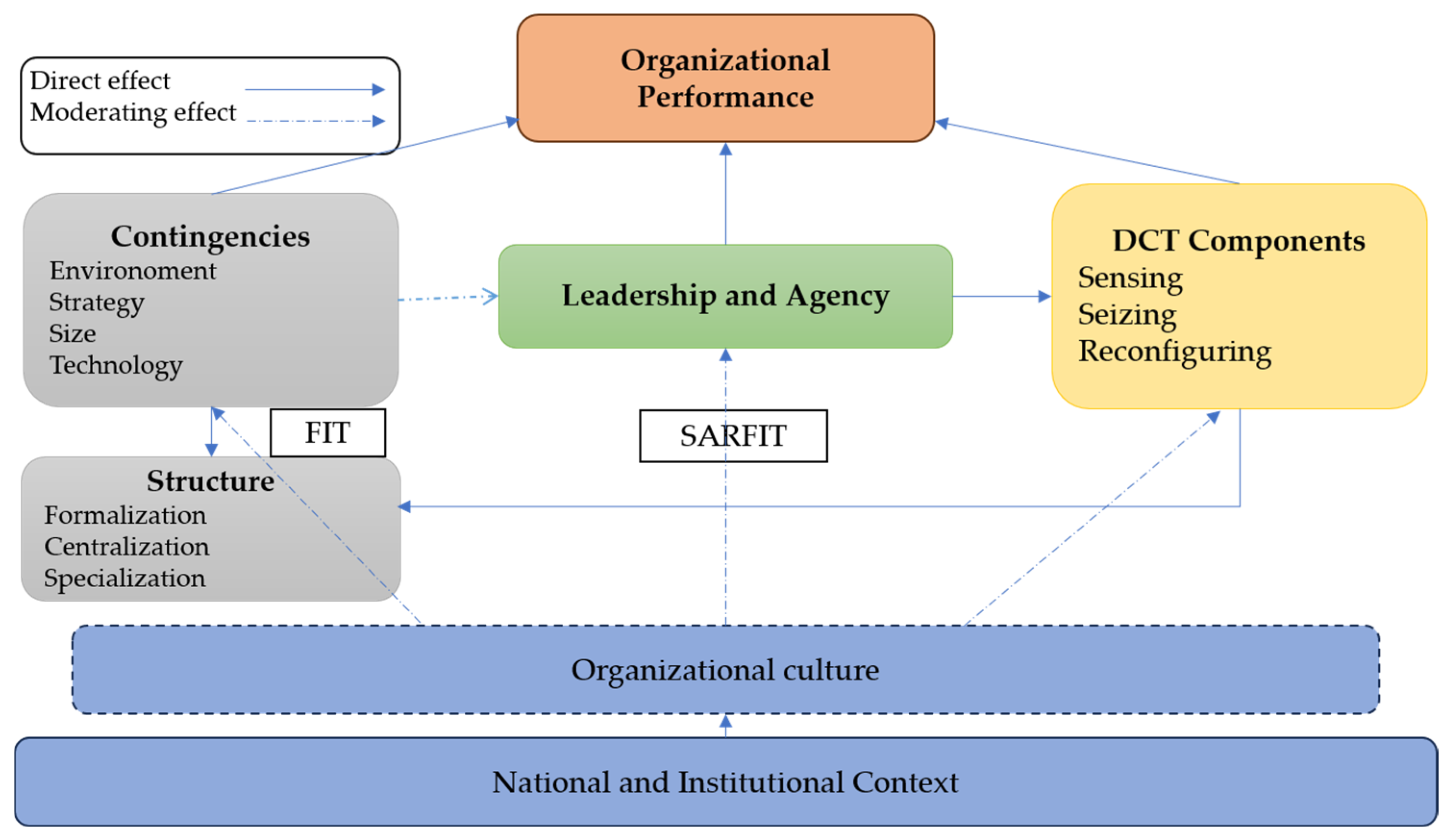
3.1.2. Theoretical Tensions and Complementarities: Reconciling Agency and Structure in Digital Transformation
3.1.3. SCM in I4.0 Era
3.1.4. Enablers of Digital Transformation
3.2. ISM and MICMAC Analysis
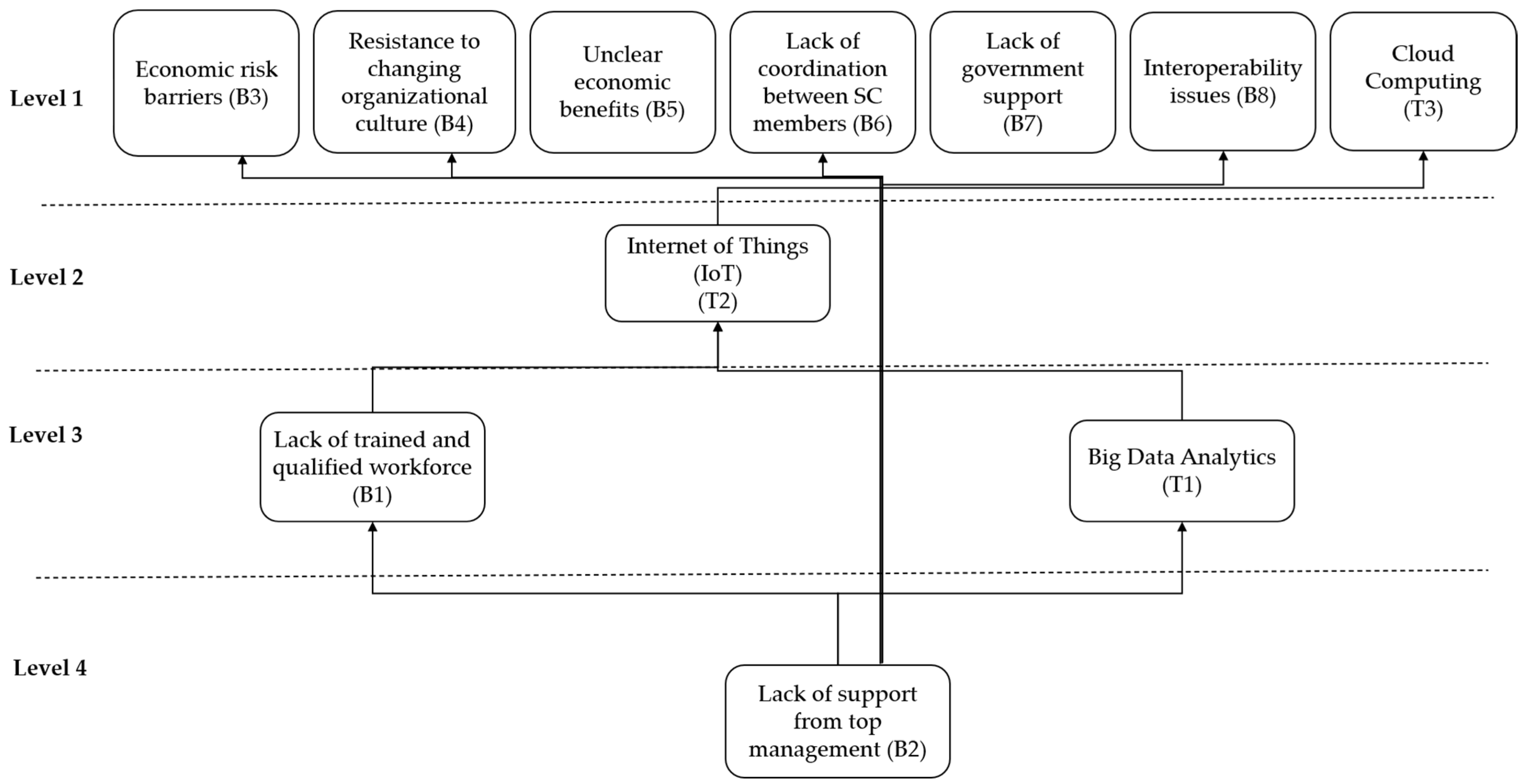
3.2.1. Germany: Capabilities, Risk, and Structural Integration
3.2.2. Brazil: Managerial Agency and Institutional Challenges
3.2.3. Comparative Synthesis
4. Discussion and Theoretical Propositions
4.1. Theoretical Propositions
4.1.1. Linking DCT and SCT Through Leadership and Culture
4.1.2. Layered Capability Development
4.1.3. Risk Perception and Economic Rationality
4.1.4. Interoperability and Ecosystem Coordination
4.1.5. Technological Layering and Cultural Alignment
4.1.6. Institutional Contingencies and Organisational Self-Reliance
4.1.7. Integration into a Meta-Framework
4.2. Implications for Practice and Policy
4.2.1. Managerial Implications
4.2.2. Policy Implications
4.3. Limitations and Future Research
5. Conclusions
Author Contributions
Funding
Institutional Review Board Statement
Informed Consent Statement
Data Availability Statement
Conflicts of Interest
Abbreviations
| DT | Digital Transformation |
| SCM | Supply Chain Management |
| BDA | Big Data Analytics |
| IoT | Internet of Things |
| SC | Supply Chain(s) |
| DCT | Dynamic Capabilities Theory |
| SCT | Structural Contingency Theory |
| ISM | Interpretive Structural Modelling |
| DEMATEL | Decision-Making Trial and Evaluation Laboratory |
| MICMAC | Matrice d’Impacts Croisés Multiplication Appliquée à un Classement |
| I4.0 | Industry 4.0 |
| RQ | Research Questions |
| SLR | Systematic Literature Reviews |
| PRISMA | Preferred Reporting Items for Systematic Reviews and Meta-Analyses |
| MCDM | Multicriteria Decision Model |
| RBV | Resource-Based View |
| SARFIT | Structural Adjustments to Regain Fit |
| DC | Dynamic Capability |
| CME | Coordinated Market Economy |
| MNC | Multinational corporation |
| SDG | Sustainable Development Goal |
| STEM | Science, Technology, Engineering and Mathematics |
| MDIC | Ministry of Development, Industry, Trade and Services |
| SENAI | National Industrial Learning Service |
| SEBRAE | Brazilian Micro and Small Business Support Service |
| ABDI | Brazilian Industrial Development Agency |
| FINEP | Financing of Studies and Projects |
| Embrapii | Brazilian Industrial Research and Innovation Company |
| BNDES | National Bank of Economic and Social Development |
Appendix A. Definitions of Barriers to Industry 4.0 Adoption

| Barriers | Definition |
|---|---|
| Lack of Trained and Skilled Manpower | Workforce upskilling through structured training programs is crucial for maintaining current technical competencies. Effective technology implementation depends on having personnel with specialised capabilities [35,36,37,38]. |
| Lack of support from top management | Executive leadership may hesitate to champion Industry 4.0 initiatives owing to insufficient strategic foresight or capital constraints, resulting in inadequate coordination of organisational change both internally and across external partnerships. Rapid technological transitions demand robust executive sponsorship to enable workforce capability development, learning programs, and inter-departmental collaboration throughout the supply chain [32,37,38,39]. |
| Economic risk | Economic risk concerns arise from uncertain productivity gains, cybersecurity threats, significant transformation costs (including workforce and infrastructure), and doubts about whether financial returns will offset the implementation efforts [36,37,38,40]. |
| Resistance to changing organisational culture | Organisational cultural resistance manifests through multiple factors: (i) attachment to established operational routines, (ii) inherent change aversion, (iii) insufficient awareness of Industry 4.0 technologies and their potential benefits, (iv) inadequate competencies and preparation for managing big data and digital tools, and (v) ingrained cultural norms among the workforce and leadership [36,37,38,39]. |
| Unclear economic gains | Financial sponsors face challenges in assessing the return prospects for the considerable capital commitments required for Industry 4.0 infrastructure and technological innovation, particularly given the opacity of metrics for measuring the economic advantages and monetary performance of digitisation [32,37,39,40]. |
| Lack of vertical and horizontal coordination between supply chain members | The barrier addresses obstacles in overcoming departmental fragmentation within firms and among supply chain collaborators. Vertical alignment encompasses coordination across production sites, market units, and sales operations, while horizontal alignment involves synchronisation at both intra-firm and inter-firm levels [32,38,40]. |
| Lack of government support | This impediment reflects deficient state-level support mechanisms—encompassing direct funding, subsidy programs, and fiscal relief instruments such as tax exemptions and fee reductions—designed to stimulate organisational adoption of Industry 4.0 automation technologies [32,37,38]. |
| Interoperability issues | Interoperability refers to the ability of technological systems to maintain operational effectiveness across diverse equipment configurations and cross-manufacturer platforms. This concept centres on integration as its core principle—a characteristic equally fundamental to IoT and cyber-physical system architectures [6,38,40,41]. |
Appendix B. DEMATEL-ISM Approach


| Variables | 1 | 2 | 3 | 4 | 5 | 6 | 7 | 8 | 9 | 10 | 11 | Driving Power |
|---|---|---|---|---|---|---|---|---|---|---|---|---|
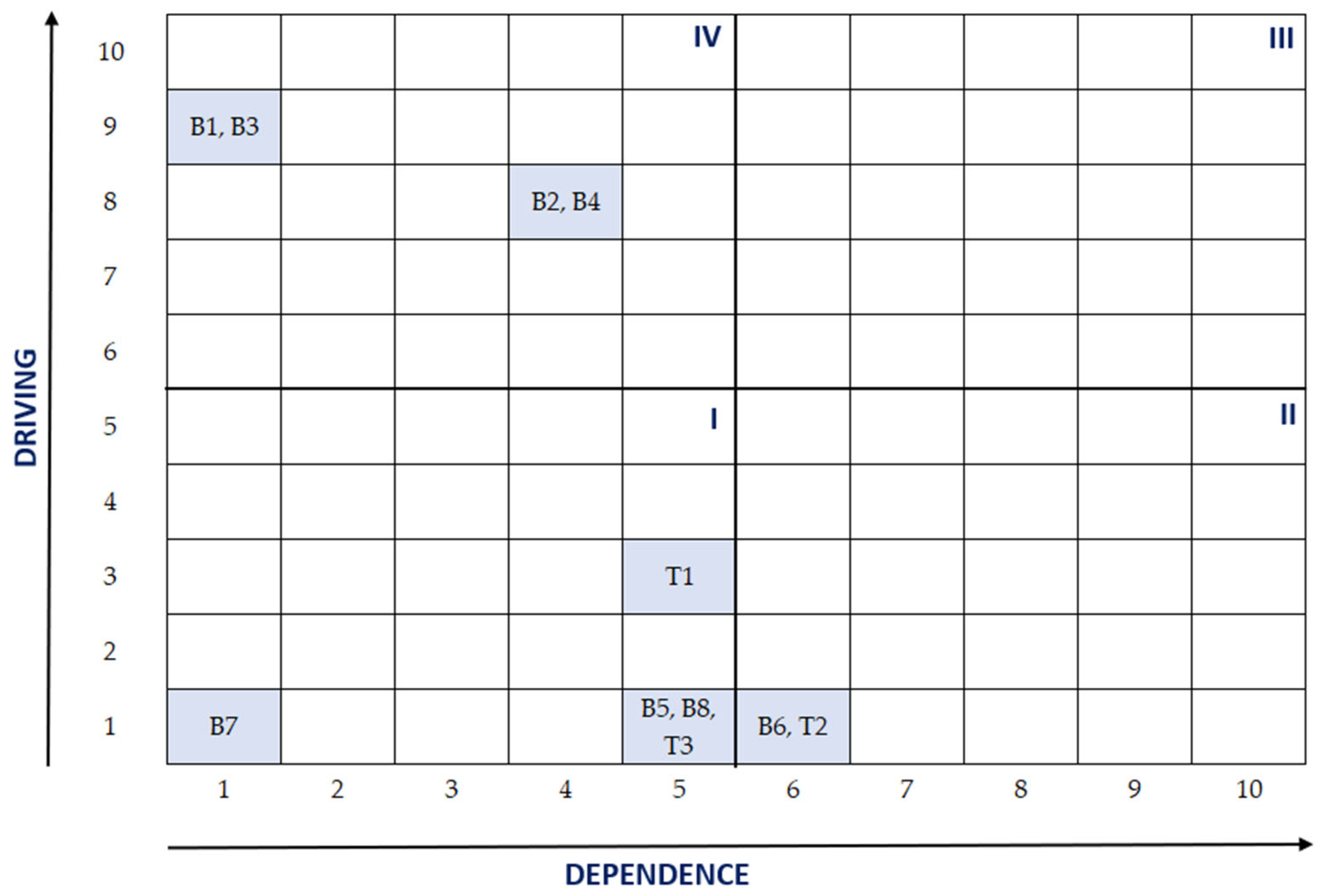
| B1 | 1 | 1 | 0 | 1 | 1 | 1 | 0 | 1 | 1 | 1 | 1 | 9 |
| B2 | 0 | 1 | 0 | 1 | 1 | 1 | 0 | 1 | 1 | 1 | 1 | 8 |
| B3 | 0 | 1 | 1 | 1 | 1 | 1 | 0 | 1 | 1 | 1 | 1 | 9 |
| B4 | 0 | 1 | 0 | 1 | 1 | 1 | 0 | 1 | 1 | 1 | 1 | 8 |
| B5 | 0 | 0 | 0 | 0 | 1 | 0 | 0 | 0 | 0 | 0 | 0 | 1 |
| B6 | 0 | 0 | 0 | 0 | 0 | 1 | 0 | 0 | 0 | 0 | 0 | 1 |
| B7 | 0 | 0 | 0 | 0 | 0 | 0 | 1 | 0 | 0 | 0 | 0 | 1 |
| B8 | 0 | 0 | 0 | 0 | 0 | 0 | 0 | 1 | 0 | 0 | 0 | 1 |
| T1 | 0 | 0 | 0 | 0 | 0 | 1 | 0 | 0 | 1 | 1 | 0 | 3 |
| T2 | 0 | 0 | 0 | 0 | 0 | 0 | 0 | 0 | 0 | 1 | 0 | 1 |
| T3 | 0 | 0 | 0 | 0 | 0 | 0 | 0 | 0 | 0 | 0 | 1 | 1 |
| Dependence Power | 1 | 4 | 1 | 4 | 5 | 6 | 1 | 5 | 5 | 6 | 5 |
| Variables | 1 | 2 | 3 | 4 | 5 | 6 | 7 | 8 | 9 | 10 | 11 | Driving Power |
|---|---|---|---|---|---|---|---|---|---|---|---|---|
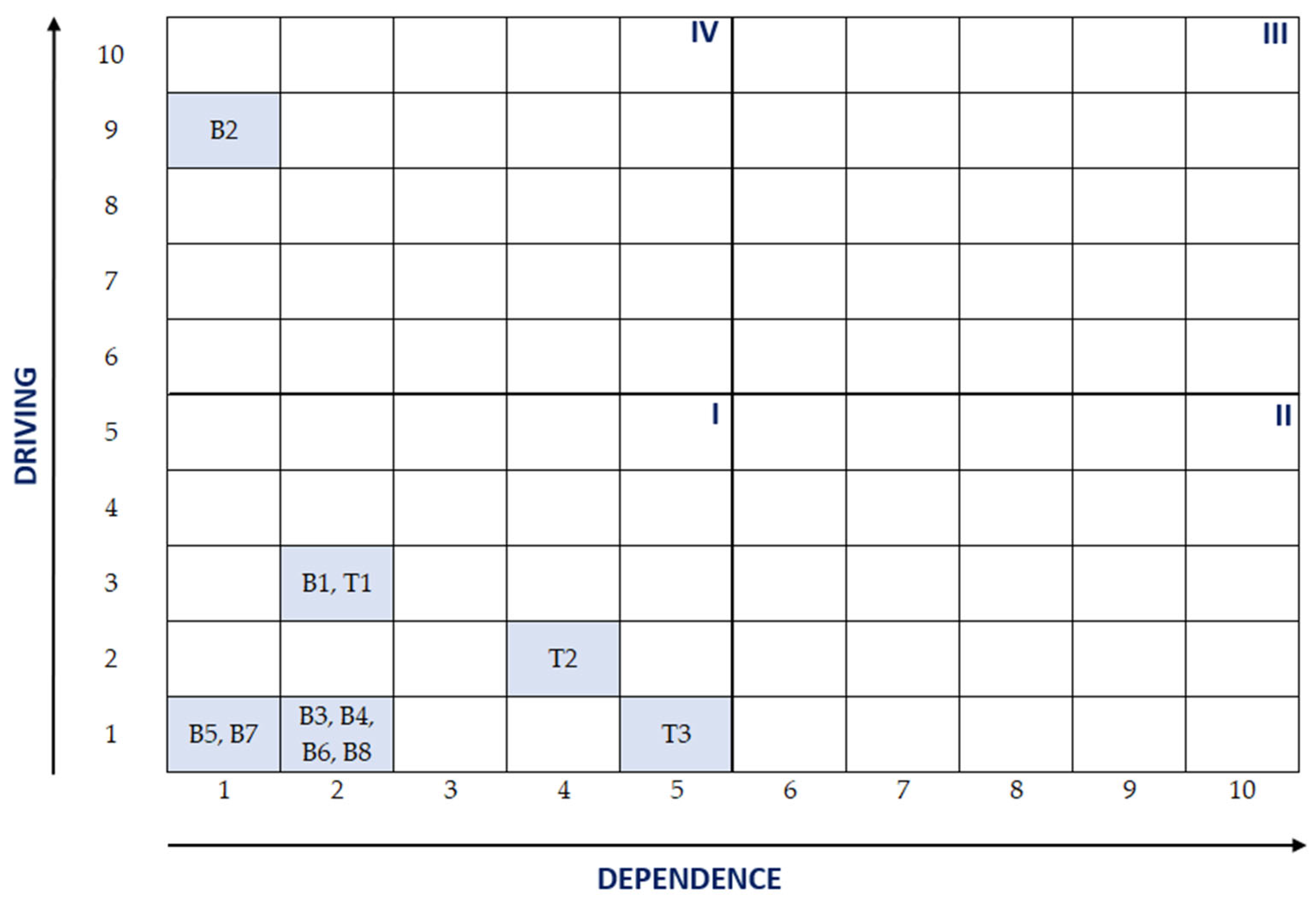
| B1 | 1 | 0 | 0 | 0 | 0 | 0 | 0 | 0 | 0 | 1 | 1 | 3 |
| B2 | 1 | 1 | 1 | 1 | 0 | 1 | 0 | 1 | 1 | 1 | 1 | 9 |
| B3 | 0 | 0 | 1 | 0 | 0 | 0 | 0 | 0 | 0 | 0 | 0 | 1 |
| B4 | 0 | 0 | 0 | 1 | 0 | 0 | 0 | 0 | 0 | 0 | 0 | 1 |
| B5 | 0 | 0 | 0 | 0 | 1 | 0 | 0 | 0 | 0 | 0 | 0 | 1 |
| B6 | 0 | 0 | 0 | 0 | 0 | 1 | 0 | 0 | 0 | 0 | 0 | 1 |
| B7 | 0 | 0 | 0 | 0 | 0 | 0 | 1 | 0 | 0 | 0 | 0 | 1 |
| B8 | 0 | 0 | 0 | 0 | 0 | 0 | 0 | 1 | 0 | 0 | 0 | 1 |
| T1 | 0 | 0 | 0 | 0 | 0 | 0 | 0 | 0 | 1 | 1 | 1 | 3 |
| T2 | 0 | 0 | 0 | 0 | 0 | 0 | 0 | 0 | 0 | 1 | 1 | 2 |
| T3 | 0 | 0 | 0 | 0 | 0 | 0 | 0 | 0 | 0 | 0 | 1 | 1 |
| Dependence Power | 2 | 1 | 2 | 2 | 1 | 2 | 1 | 2 | 2 | 4 | 5 |
References
- Abdirad, M.; Krishnan, K. Industry 4.0 in Logistics and Supply Chain Management: A Systematic Literature Review. Eng. Manag. J. 2020, 33, 1–15. [Google Scholar] [CrossRef]
- Wernerfelt, B.; Zander, I.; Bagozzi, R.P. A Resource-Based View of the Firm. Strateg. Manag. J. 1984, 5, 171–180. [Google Scholar] [CrossRef]
- Frederico, G.F.; Garza-reyes, J.A.; Anosike, A.; Kumar, V. Supply Chain 4.0: Concepts, Maturity and Research Agenda. Supply Chain Manag. An Int. J. 2020, 25, 262–282. [Google Scholar] [CrossRef]
- Schwab, K. The Fourth Industrial Revolution; World Economic Forum: Cologny, Switzerland, 2016. [Google Scholar]
- Kagermann, H.; Wahlster, W.; Helbig, J. Recommendations for Implementing the Strategic Initiative INDUSTRIE 4.0; Forschungsunion: Berlin, Germany, 2013. [Google Scholar]
- Machado, E.; Scavarda, L.F.; Goyannes, R.; Caiado, G.; Márcio, A.; Thomé, T. Barriers and Enablers for the Integration of Industry 4.0 and Sustainability in Supply Chains of MSMEs. Sustainability 2021, 13, 11664. [Google Scholar] [CrossRef]
- Costa, F.; Frecassetti, S.; Rossini, M.; Portioli-Staudacher, A. Industry 4.0 Digital Technologies Enhancing Sustainability: Applications and Barriers from the Agricultural Industry in an Emerging Economy. J. Clean. Prod. 2023, 408, 137208. [Google Scholar] [CrossRef]
- Donaldson, L. The Contingency Theory of Organizations; SAGE: Thousand Oaks, CA, USA, 2001. [Google Scholar]
- Helfat, C.E.; Peteraf, M.A. Managerial Cognitive Capabilities and the Microfoundations Of Dynamic Capabilities. Strateg. Manag. J. 2015, 36, 831–850. [Google Scholar] [CrossRef]
- Schein, E.H. Organizational Culture and Leadership, 4th ed.; Jossey-Bass: San Francisco, CA, USA, 2010. [Google Scholar]
- Frank, A.G.; Dalenogare, L.S.; Ayala, N.F. Industry 4.0 Technologies: Implementation Patterns in Manufacturing Companies. Int. J. Prod. Econ. 2019, 210, 15–26. [Google Scholar] [CrossRef]
- Klingenberg, C.O.; Borges, M.A.V.; Antunes, J.A.V. Industry 4.0 as a Data-Driven Paradigm: A Systematic Literature Review on Technologies. J. Manuf. Technol. Manag. 2019, 32, 570–592. [Google Scholar] [CrossRef]
- Mell, P.; Grance, T. The NIST Definition of Cloud Computing Recommendations of the National Institute of Standards and Technology; National Institute of Standards and Technology locatin: Gaithersburg, MD, USA, 2011. [Google Scholar]
- Diener, F.; Špaček, M. Digital Transformation in Banking: A Managerial Perspective on Barriers to Change. Sustainability 2021, 13, 2032. [Google Scholar] [CrossRef]
- Kiel, D.; Müller, J.M.; Arnold, C.; Voigt, K.I. Sustainable Industrial Value Creation: Benefits and Challenges of Industry 4.0. Int. J. Innov. Manag. 2017, 21, 1740015. [Google Scholar] [CrossRef]
- Tortorella, G.L.; Fettermann, D. Implementation of Industry 4.0 and Lean Production in Brazilian Manufacturing Companies. Int. J. Prod. Res. 2018, 56, 2975–2987. [Google Scholar] [CrossRef]
- Szalavetz, A. Industry 4.0 and Capability Development in Manufacturing Subsidiaries. Technol. Forecast. Soc. Change 2019, 145, 384–395. [Google Scholar] [CrossRef]
- Teece, D. Business Models and Dynamic Capabilities. Long Range Plan. 2018, 51, 40–49. [Google Scholar] [CrossRef]
- Hall, P.A.; Soskice, D. An Introduction to Varieties of Capitalism. In Varieties of Capitalism: The Institutional Foundations of Comparative Advantage; Hall, P.A., Soskice, D., Eds.; Oxford University Press: Oxford, UK, 2001; pp. 1–68. [Google Scholar]
- Thelen, K. Conclusions, Empirical and Theoretical. In How Institutions Evolve: The Political Economy of Skills in Germany, Britain, the United States, and Japan; Cambridge University Press: New York, NY, USA, 2004; pp. 278–296. ISBN 9780511790997. [Google Scholar]
- Schneider, B.R. Hierarchical Capitalism in Latin America: Business, Labor, and the Challenges of Equitable Development; Cambridge University Press: New York, NY, USA, 2013; ISBN 9781107041639. [Google Scholar]
- Teece, D.J. Explicating Dynamic Capabilities: The Nature and Microfoundations of (Sustainable) Enterprise Performance. Strateg. Manag. J. 2007, 28, 1319–1350. [Google Scholar] [CrossRef]
- Eisenhardt, K.M.; Martin, J.A. Dynamic Capabilities: What Are They? Strateg. Manag. J. 2000, 21, 1105–1121. [Google Scholar]
- Wang, C.L.; Ahmed, P.K. Dynamic Capabilities: A Review and Research Agenda. Int. J. Manag. Rev. 2007, 9, 31–51. [Google Scholar] [CrossRef]
- Page, M.J.; McKenzie, J.E.; Bossuyt, P.M.; Boutron, I.; Hoffmann, T.C.; Mulrow, C.D.; Shamseer, L.; Tetzlaff, J.M.; Akl, E.A.; Brennan, S.E.; et al. The PRISMA 2020 Statement: An Updated Guideline for Reporting Systematic Reviews. BMJ 2021, 372, n71. [Google Scholar] [CrossRef]
- Thomé, A.M.T.; Scavarda, A. A Systematic Literature Review of Design-Manufacturing Integration for Sustainable Products. Chem. Eng. Trans. 2015, 45, 691–696. [Google Scholar] [CrossRef]
- Warfield, J.N. Developing Subsystem Matrices in Structural Modeling. IEEE Trans. Syst. Man Cybern. 1974, SMC-4, 74–80. [Google Scholar] [CrossRef]
- Gani, A.; Bhanot, N.; Talib, F.; Asjad, M. An Integrated DEMATEL-MMDE-ISM Approach for Analyzing Environmental Sustainability Indicators in MSMEs. Environ. Sci. Pollut. Res. 2022, 29, 2035–2051. [Google Scholar] [CrossRef]
- Mukherjee, A.; Raj, A.; Aggarwal, S. Identification of Barriers and Their Mitigation Strategies for Industry 5.0 Implementation in Emerging Economies. Int. J. Prod. Econ. 2023, 257, 108770. [Google Scholar] [CrossRef]
- Kumar, S.; Raut, R.D.; Nayal, K.; Kraus, S.; Yadav, V.S.; Narkhede, B.E. To Identify Industry 4.0 and Circular Economy Adoption Barriers in the Agriculture Supply Chain by Using ISM-ANP. J. Clean. Prod. 2021, 293, 126023. [Google Scholar] [CrossRef]
- Luthra, S.; Mangla, S.K. Evaluating Challenges to Industry 4.0 Initiatives for Supply Chain Sustainability in Emerging Economies. Process Saf. Environ. Prot. 2018, 117, 168–179. [Google Scholar] [CrossRef]
- Raj, A.; Dwivedi, G.; Sharma, A.; Beatriz, A.; Sousa, L. De Barriers to the Adoption of Industry 4.0 Technologies in the Manufacturing Sector: An Inter-Country Comparative Perspective. Int. J. Prod. Econ. 2020, 224, 107546. [Google Scholar] [CrossRef]
- Szabo, R.Z.; Herceg, I.V.; Hanák, R.; Hortovanyi, L.; Romanová, A.; Mocan, M.; Djuričin, D. Industry 4.0 Implementation in B2B Companies: Cross-Country Empirical Evidence on Digital Transformation in the Cee Region. Sustainability 2020, 12, 9538. [Google Scholar] [CrossRef]
- Piovesan, L.D.; Caiado, R.G.G.; Santos, R.S.; Thomé, A.M.T. Barriers, Enablers and Base Industry 4.0 Technologies of Digital Transformation in Supply Chains: An Inter-Country Comparison. In Proceedings of the Industrial Engineering and Operations Management, Springer Proceedings in Mathematics & Statistics, Lisbon, Portugal, 28–30 June 2023; pp. 521–539. [Google Scholar]
- dos Santos Silva, J.; Matos de Oliveira, A.; Veríssimo de Oliveira, J.; Bouzon, M. Barriers to Digital Transformation in Fruit and Vegetable Supply Chains: A Multicriteria Analysis Using ISM and MICMAC. Opsearch 2024, 62, 460–482. [Google Scholar] [CrossRef]
- Calabrese, A.; Dora, M.; Levialdi Ghiron, N.; Tiburzi, L. Industry’s 4.0 Transformation Process: How to Start, Where to Aim, What to Be Aware Of. Prod. Plan. Control 2020, 33, 492–512. [Google Scholar] [CrossRef]
- Kumar, V.; Vrat, P.; Shankar, R. Prioritization of Strategies to Overcome the Barriers in Industry 4.0: A Hybrid MCDM Approach. Opsearch 2021, 58, 711–750. [Google Scholar] [CrossRef]
- Narwane, V.S.; Raut, R.D.; Yadav, V.S.; Singh, A.R. Barriers in Sustainable Industry 4.0: A Case Study of the Footwear Industry. Int. J. Sustain. Eng. 2021, 14, 175–189. [Google Scholar] [CrossRef]
- Ghadge, A.; Er Kara, M.; Moradlou, H.; Goswami, M. The Impact of Industry 4.0 Implementation on Supply Chains. J. Manuf. Technol. Manag. 2020, 31, 669–686. [Google Scholar] [CrossRef]
- Obiso, J.J.A.; Himang, C.M.; Ocampo, L.A.; Bongo, M.F.; Caballes, S.A.A.; Abellana, D.P.M.; Deocaris, C.C.; Padua, R.; Ancheta, R. Management of Industry 4.0-Reviewing Intrinsic and Extrinsic Adoption Drivers and Barriers. Int. J. Technol. Manag. 2019, 81, 210–257. [Google Scholar] [CrossRef]
- Xu, L.D.; Xu, E.L.; Li, L. Industry 4.0: State of the Art and Future Trends. Int. J. Prod. Res. 2018, 56, 2941–2962. [Google Scholar] [CrossRef]
- Barratt, M.; Kull, T.J.; Sodero, A.C. Inventory Record Inaccuracy Dynamics and the Role of Employees within Multi-Channel Distribution Center Inventory Systems. J. Oper. Manag. 2018, 63, 6–24. [Google Scholar] [CrossRef]
- Atkinson, R.; Flint, J. Accessing Hidden and Hard-to-Reach Populations: Snowball Research Strategies. Soc. Res. Update 2001, 33, 1–4. [Google Scholar]
- Palinkas, L.A.; Horwitz, S.M.; Green, C.A.; Wisdom, J.P.; Duan, N.; Hoagwood, K. Purposeful Sampling for Qualitative Data Collection and Analysis in Mixed Method Implementation Research. Adm. Policy Ment. Health 2015, 42, 533–544. [Google Scholar] [CrossRef] [PubMed]
- Sharma, I.; Bansal, P.; Dua, R. Breaking down Barriers: Emerging Issues on the Pathway to Full-Scale Electrification of the Light-Duty Vehicle Sector. Energy 2025, 326, 136230. [Google Scholar] [CrossRef]
- Dua, R.; Guzman, A.F. Energy Research & Social Science A Perspective on Emerging Energy Policy and Economic Research Agenda for Enabling Aviation Climate Action. Energy Res. Soc. Sci. 2024, 117, 103725. [Google Scholar] [CrossRef]
- Gorane, S.J.; Kant, R. Modelling the SCM Enablers: An Integrated ISM-Fuzzy MICMAC Approach. Asia Pac. J. Mark. Logist. 2013, 25, 263–286. [Google Scholar] [CrossRef]
- Kumar, A.; Dixit, G. An Analysis of Barriers Affecting the Implementation of E-Waste Management Practices in India: A Novel ISM-DEMATEL Approach. Sustain. Prod. Consum. 2018, 14, 36–52. [Google Scholar] [CrossRef]
- Santana, W.B.; Pereira, L.M.; Freires, F.G.M.; Maués, L.M.F. Analysis of the Barriers to the Adoption of Green Buildings Labels in Brazil by the Validated Interpretative Structural Modeling (VISM) Technique. J. Clean. Prod. 2023, 414, 137642. [Google Scholar] [CrossRef]
- Mwanza, B.G.; Telukdarie, A. Supply Chains Risks: An Interpretative Structural Modelling Approach. Int. J. Supply Chain Oper. Resil. 2022, 5, 217–234. [Google Scholar] [CrossRef]
- Chauhan, C.; Singh, A.; Luthra, S. Barriers to Industry 4.0 Adoption and Its Performance Implications: An Empirical Investigation of Emerging Economy. J. Clean. Prod. 2021, 285, 124809. [Google Scholar] [CrossRef]
- Shen, J.; Li, F.; Shi, D.; Li, H.; Yu, X. Factors Affecting the Economics of Distributed Natural Gas-Combined Cooling, Heating and Power Systems in China: A Systematic Analysis Based on the Integrated Decision Making Trial and Evaluation Laboratory-Interpretative Structural Modeling (DEMATEL-ISM). Energies 2018, 11, 2318. [Google Scholar] [CrossRef]
- Sousa, R.; Voss, C.A. Contingency Research in Operations Management Practices. J. Oper. Manag. 2008, 26, 697–713. [Google Scholar] [CrossRef]
- Kristal, M.M.; Huang, X.; Roth, A.V. The Effect of an Ambidextrous Supply Chain Strategy on Combinative Competitive Capabilities and Business Performance. J. Oper. Manag. 2010, 28, 415–429. [Google Scholar] [CrossRef]
- Silvestre, B.S.; Silva, M.E.; Cormack, A.; Thome, A.M.T. Supply Chain Sustainability Trajectories: Learning through Sustainability Initiatives. Int. J. Oper. Prod. Manag. 2020, 40, 1301–1337. [Google Scholar] [CrossRef]
- Barney, J. Firm Resources and Sustained Competitive Advantage. J. Manag. 1991, 17, 99–120. [Google Scholar] [CrossRef]
- Priem, R.L.; Butler, J.E. Is the Resource-Based “View” a Useful Perspective for Strategic Management Research? Acad. Manag. Rev. 2001, 26, 22–40. [Google Scholar] [CrossRef]
- Kozlenkova, I.V.; Samaha, S.A.; Palmatier, R.W. Resource-Based Theory in Marketing. J. Acad. Mark. Sci. 2014, 42, 1–21. [Google Scholar] [CrossRef]
- Drazin, R.; Van De Ven, A.H. Alternative Forms of Fit in Contingency Theory. Adm. Sci. Q. 1985, 30, 514–539. [Google Scholar] [CrossRef]
- Arndt, F.; Pierce, L. The Behavioral and Evolutionary Roots of Dynamic Capabilities. Ind. Corp. Change 2018, 27, 413–424. [Google Scholar] [CrossRef]
- Martinsuo, M.; Hoverfält, P. Change Program Management: Toward a Capability for Managing Value-Oriented, Integrated Multi-Project Change in Its Context. Int. J. Proj. Manag. 2018, 36, 134–146. [Google Scholar] [CrossRef]
- Kim, M.Y.; Moon, S. The Effects of Cultural Distance on Online Brand Popularity. J. Brand Manag. 2021, 28, 302–324. [Google Scholar] [CrossRef]
- Child, J. Organizational Structure, Environment and Performance: The Role of Strategic Choice. Sociology 1972, 6, 1–22. [Google Scholar] [CrossRef]
- Schilke, O. On the Contingent Value of Dynamic Capabilities for Competitive Advantage: The Nonlinear Moderating Effect of Environmental Dynamism. Strateg. Manag. J. 2014, 35, 179–203. [Google Scholar] [CrossRef]
- Teece, D.J. Technological Innovation and the Theory of the Firm: The Role of Enterprise-Level Knowledge, Complementarities, and (Dynamic) Capabilities. In Handbook of the Economics of Innovation; Elsevier: Amsterdam, The Netherlands, 2010; Volume 1, pp. 679–730. [Google Scholar]
- Abbasi, W.A.; Wang, Z.; Zhou, Y.; Hassan, S. Research on Measurement of Supply Chain Finance Credit Risk Based on Internet of Things. Int. J. Distrib. Sens. Netw. 2019, 15, 155014771987400. [Google Scholar] [CrossRef]
- Warner, K.S.R.; Wäger, M. Building Dynamic Capabilities for Digital Transformation: An Ongoing Process of Strategic Renewal. Long Range Plan. 2019, 52, 326–349. [Google Scholar] [CrossRef]
- Day, G.S.; Schoemaker, P.J.H. Adapting to Fast-Changing Markets and Technologies. Calif. Manage. Rev. 2016, 58, 59–77. [Google Scholar] [CrossRef]
- Gao, S.; Hakanen, E.; Rajala, R. Digital Transformation in Asset-Intensive Businesses: Lessons Learned from the Metals and Mining Industry. In Proceedings of the 52nd Hawaii International Conference on System Sciences, Grand Wailea, HI, USA, 8–11 January 2019; pp. 4927–4936. [Google Scholar]
- O’Reilly, C.A.; Tushman, M.L. Ambidexterity as a Dynamic Capability: Resolving the Innovator’s Dilemma. Res. Organ. Behav. 2008, 28, 185–206. [Google Scholar] [CrossRef]
- Li, Y.; Fei, G.Z. Network Embeddedness, Digital Transformation, and Enterprise Performance—The Moderating Effect of Top Managerial Cognition. Front. Psychol. 2023, 14, 1098974. [Google Scholar] [CrossRef]
- Sharmelly, R.; Ray, P.K. Technology in Society Managing Resource-Constrained Innovation in Emerging Markets: Perspectives from a Business Model. Technol. Soc. 2021, 65, 101538. [Google Scholar] [CrossRef]
- Nambisan, S.; Zahra, S.A.; Luo, Y. Global Platforms and Ecosystems: Implications for International Business Theories. J. Int. Bus. Stud. 2019, 50, 1464–1486. [Google Scholar] [CrossRef]
- Jetty, S.; Afshan, N. A Bibliometric Analysis and Systematic Literature Review of Industry 4.0 Implementation in Supply Chain. J. Sci. Technol. Policy Manag. 2025, 16, 784–821. [Google Scholar] [CrossRef]
- Mutambik, I. Assessing Critical Success Factors for Supply Chain 4.0 Implementation Using a Hybrid MCDM Framework. Systems 2025, 13, 489. [Google Scholar] [CrossRef]
- Geissbauer, R.; Lübben, E.; Schrauf, S.; Pillsbury, S. How Industry Leaders Build Integrated Operations Ecosystems to Deliver End-to-End Customer Solutions. Global Digital Operations. 2018. Available online: https://www.strategyand.pwc.com/gx/en/insights/industry4-0/global-digital-operations-study-digital-champions.pdf (accessed on 2 October 2025).
- Gurría, A. The Next Production Revolution; OECD Publishing Press: Paris, France, 2017. [Google Scholar]
- Kane, G.C.; Palmer, D.; Phillips, A.N.; Kiron, D.; Buckley, N. MIT Sloan Management Review. 2015. Available online: https://sloanreview.mit.edu/projects/strategy-drives-digital-transformation/ (accessed on 2 October 2025).
- Ebinger, F.; Omondi, B. Leveraging Digital Approaches for Transparency in Sustainable Supply Chains: A Conceptual Paper. Sustainability 2020, 12, 6129. [Google Scholar] [CrossRef]
- Ali, I.; Aboelmaged, M.G.S. Implementation of Supply Chain 4.0 in the Food and Beverage Industry: Perceived Drivers and Barriers. Int. J. Product. Perform. Manag. 2022, 71, 1426–1443. [Google Scholar] [CrossRef]
- Schulman, D.; Hajibashi, M.; Narsalay, R.; Sreedharan, S. Is Your Supply Chain in Sleep Mode? Accenture: Dublin, Ireland, 2018. [Google Scholar]
- Ivanov, D.; Dolgui, A.; Sokolov, B. The Impact of Digital Technology and Industry 4.0 on the Ripple Effect and Supply Chain Risk Analytics. Int. J. Prod. Res. 2019, 57, 829–846. [Google Scholar] [CrossRef]
- Schmidt, R.; Möhring, M.; Härting, R.-C.; Reichstein, C.; Neumaier, P.; Jozinović, P. Industry 4.0-Potentials for Creating Smart Products: Empirical Research Results. In Proceedings of the BIS 2015 18th International Conference on Business Information Systems, Lecture Notes in Business Information Processing (LNBIP), Poznań, Poland, 24–26 June 2015. [Google Scholar]
- Mussomeli, A.; Gish, D.; Laaper, S. The Rise of the Digital Supply Chain. Deloitte 2015, 45, 20–21. [Google Scholar]
- Laaper, S.; Yauch, G.; Wellener, P.; Robinson, R. Embracing a Digital Future How Manufacturers Can Unlock the Transformative Benefits of Digital Supply Networks. Deloitte Insights 2018, 28. [Google Scholar]
- Ni, G.; Li, H.; Jin, T.; Hu, H.; Zhang, Z. Analysis of Factors Influencing the Job Satisfaction of New Generation of Construction Workers in China: A Study Based on DEMATEL and ISM. Buildings 2022, 12, 609. [Google Scholar] [CrossRef]
- Sarkis, J.; Kouhizadeh, M.; Zhu, Q.S. Digitalization and the Greening of Supply Chains. Ind. Manag. Data Syst. 2021, 121, 65–85. [Google Scholar] [CrossRef]
- Wintergerst, R. Digitalisierung Der Wirtschaft. Available online: https://www.bitkom.org/sites/main/files/2025-03/2025-bitkom-studienbericht-digitalisierung-der-wirtschaft.pdf (accessed on 15 October 2025).
- DIHK-DIGITALISIERUNGSUMFRAGE Digitalisierung in Deutschland: Zwischen Effizienz Und Bürokratie. Available online: https://www.dihk.de/de/themen-und-positionen/wirtschaft-digital/digitalisierung/digitalisierungsumfrage-25 (accessed on 2 October 2025).
- Schwartz, M.; Gerstenberger, J. Annual Analysis of the Structure and Development of SMEs in Germany. Available online: https://www.kfw.de/PDF/Download-Center/Konzernthemen/Research/PDF-Dokumente-KfW-Mittelstandspanel/PDF-Dateien-Mittelstandspanel-(EN)/KfW-SME-Panel-2023.pdf (accessed on 2 October 2025).
- EIB. Digitalisation in Europe 2022–2023: Evidence from the EIB Investment Survey. Available online: https://www.eib.org/en/publications/20230112-digitalisation-in-europe-2022-2023 (accessed on 2 October 2025).
- Hickson, D.J.; Hinings, C.R.; Mcmillan, C.J.; Schwitter, J.P. The Culture-Free Context of Organization Structure: A Tri-National Comparison. Sociology 1974, 8, 59–80. [Google Scholar] [CrossRef]
- Oberer, B.; Erkollar, A. Leadership 4.0: Digital Leaders in the Age of Industry 4.0. Int. J. Organ. Leadersh. 2018, 7, 404–412. [Google Scholar] [CrossRef]
- Factory of the Future: Wafer Fab in Dresden. Available online: https://www.bosch.com/stories/factory-of-the-future-wafer-fab-dresden/ (accessed on 15 October 2025).
- Aranha, P.E.; Schnitzler, E.; Moreira, N.; Duccini, L.E.; Martins, A.L.; Falchetto, A.B.; Anjos, J.L. Dos Field Life Extension: Real Time Well Integrity Management. Offshore Technology Conference, Houston, TX, USA, 2–5 May 2022; pp. 1042–1060. [Google Scholar]
- Anjos, J.L.; Aranha, P.E.; Martins, A.L.; Oliveira, F.L.; Joségoncalves, C.; Silva, D.R.; Dudek, C.L.; Lima, C.B. Digital Twin for Well Integrity with Real Time Surveillance. In Proceedings of the Annual Offshore Technology Conference, Houston, TX, USA, 4–7 May 2020; p. D021S018R001. [Google Scholar]
- WEG Launches Global Positioning on Energy Transition. Available online: https://www.weg.net/institutional/BR/en/news/corporate/weg-launches-global-positioning-on-energy-transition (accessed on 15 October 2025).
- WEG Creates Its Open Innovation Center in Jaraguá Do Sul—Brazil. Available online: https://www.weg.net/institutional/SR/en/news/corporate/weg-creates-its-open-innovation-center-in-jaragua-do-sul-brazil (accessed on 15 October 2025).
- Dierickx, I.; Cool, K. Asset Stock Accumulation and the Sustainability of Competitive Advantage: Reply. Manag. Sci. 1989, 35, 1504–1511. [Google Scholar] [CrossRef]
- Child, J. Managerial and Organizational Factors Associated With Company Performance—Part II. A Contingency Analysis. J. Manag. Stud. 1975, 12, 12–27. [Google Scholar] [CrossRef]
- Lübbers, T.; Plöger, M. Executive Summary of the Final Report: Accompanying and Ex-Post Evaluation of the Funding Priority “Mittelstand-Digital”; Ramboll Management Consulting: Hamburg, Germany, 2025. [Google Scholar]
- Bella, R.L.F.; Filho, W.L.; Sigahi, T.F.A.C.; Rampasso, I.S.; Quelhas, O.L.G.; Bella, L.F.; de Moraes, G.H.S.M.; Anholon, R. Small- and Medium-Sized Enterprises: Trends and Future Perspectives for Sustainability and Digitalization in Germany. Sustainability 2024, 16, 6900. [Google Scholar] [CrossRef]
- Aliyev, V. Digital Transformation Strategies and Challenges in Small and Medium Enterprises (SMEs): A Systematic Review and Future Directions. 2025. Available online: https://www.researchgate.net/publication/392512122_Digital_Transformation_Strategies_and_Challenges_in_Small_and_Medium_Enterprises_SMEs_A_Systematic_Review_and_Future_Directions (accessed on 2 October 2025).
- Nonaka, Y.; Dyck, J.; Hahn, T. An Analysis of Industrial Sustainability for Potential Collaborations: A Study across EU, USA, and Japan; CESMII: Los Angeles, CA, USA, 2025. [Google Scholar]
- CNI. Liderança Em Inovação e Em Cadeias de Suprimento. Available online: https://static.portaldaindustria.com.br/media/filer_public/36/db/36db6ead-05db-43ad-944f-e8332a0cca4a/id_241757_-_lideranca_em_inovacao_e_cadeias_de_suprimento.pdf (accessed on 2 October 2025).
- CNI. Mapa Estratégico Da Indústria 2023–2032: O Caminho Para a Nova Indústria. Available online: https://www.portaldaindustria.com.br/publicacoes/2023/10/mapa-estrategico-da-industria-2023-2032/ (accessed on 2 October 2025).
- MDIC. Programa Brasil Mais Produtivo. Available online: https://www.gov.br/mdic/pt-br/assuntos/sdic/inovacao/brasilmais (accessed on 18 November 2025).
- INCIT. INCIT Announces Global Strategic Partnership with SENAI to Drive Industrial Transformation in Brazil. Available online: https://incit.org/en_us/newsroom/incit-announces-global-strategic-partnership-with-senai-to-drive-industrial-transformation-in-brazil/ (accessed on 18 November 2025).
- INCIT. INCIT Supports Brazil’s Path to Industrial Digital Transformation. Available online: https://incit.org/newsroom/incit-supports-brazils-path-to-industrial-digital-transformation/ (accessed on 18 November 2025).
- ABN. Transformação Digital de MPMEs Industriais Apoiada Com Novo Brasil Mais Produtivo. Available online: https://agenciadenoticias.bndes.gov.br/industria/Transformacao-digital-de-MPMEs-industriais-apoiada-com-Novo-Brasil-Mais-Produtivo (accessed on 18 November 2025).
- NOKIA. Nokia and SENAI-SP Launch Partnership to Boost Industry 4.0 Adoption in Brazil. Available online: https://www.nokia.com/newsroom/nokia-and-senai-sp-launch-partnership-to-boost-industry-40-adoption-in-brazil/ (accessed on 18 November 2025).
- ServiceNow. ServiceNow and SENAI-SP Launch Statewide AI Skills Program to Power Brazil’s Digital Future. Available online: https://www.businesswire.com/news/home/20250821016358/en/ServiceNow-and-SENAI-SP-Launch-Statewide-AI-Skills-Program-to-Power-Brazils-Digital-Future (accessed on 18 November 2025).
- European Digital Innovation Hubs Network. Available online: https://european-digital-innovation-hubs.ec.europa.eu/edih-catalogue/mittelstand-digital-zentrum-darmstadt (accessed on 18 November 2025).
- Rissola, G.; Sörvik, J. Digital Innovation Hubs in Smart Specialisation Strategies Early Lessons from European Regions; The European Union: Luxembourg, 2018. [Google Scholar]
- Linstone, H.A.; Turoff, M. The Delphi Method: Techniques and Applications. J. Mark. Res. 1976, 13, 317–318. [Google Scholar] [PubMed]
- Hair, J.F.; Black, W.C.; Babin, B.J.; Anderson, R.E. Multivariate Data Analysis; Pearson Education Limited: London, UK, 2013; ISBN 9781292021904. [Google Scholar]
- Yin, R.K. Case Study Research Design and Methods, 5th ed.; SAGE: Thousand Oaks, CA, USA, 2014. [Google Scholar]
- Pearl, J.; Mackenzie, D. The Book of Why: The New Science of Cause and Effect; Penguin Books Limited: London, UK, 2018. [Google Scholar]
- Zhang, P.K.; Luo, F. Influencing Factors of Runway Incursion Risk and Their Interaction Mechanism Based on DEMATEL–ISM. Teh. Vjesn. 2017, 24, 1853–1861. [Google Scholar]




| Experts | Years of Experience in Industry 4.0 | Activity Developed | Background |
|---|---|---|---|
| One | 12 years | Academic and consultant | Postdoctoral research in Production Engineering |
| Two | Seven years | Academic | Postdoctoral research in Production Engineering |
| Three | Five years | Academic and consultant | PhD in Instrumentation and Applied Optics |
| Four | Five years | Academic | Master’s in Production Engineering |
| Barriers | Authors | Code |
|---|---|---|
| Lack of a trained and qualified workforce | [35,36,37,38] | B1 |
| Lack of support from top management | [32,37,38,39] | B2 |
| Economic risk | [36,37,38,40] | B3 |
| Resistance to changing organisational culture | [36,37,38,39] | B4 |
| Unclear economic benefits | [32,37,39,40] | B5 |
| Lack of coordination between vertical and horizontal supply chain members | [32,38,40] | B6 |
| Lack of government support | [32,37,38] | B7 |
| Interoperability issues | [6,38,40,41] | B8 |
| Linguistic Terms | Value |
|---|---|
| No influence | 1 |
| Very low influence | 2 |
| Low influence | 3 |
| Average influence | 4 |
| High Influence | 5 |
| Very high influence | 6 |
| Technology | Description | Code |
|---|---|---|
| Big Data Analytics | BDA involves analysing large volumes of data generated by connected equipment, machines, components, products, and people using algorithms that identify patterns and relevant information [12]. | T1 |
| Internet of Things | The IoT integrates sophisticated software, affordable sensing devices, and communication infrastructure to enable digital interaction among physical objects. This technology connects operational assets—including equipment, buildings, vehicle fleets, infrastructure, and personnel—to sensor networks and control systems, channelling the captured data into analytics platforms and predictive modelling tools [85]. The primary aim is to resolve communication issues between entities [11]. | T2 |
| Cloud Computing | An infrastructure model providing ubiquitous network connectivity to collective computing assets, enabling dynamic resource allocation and release through automated processes that require minimal manual intervention or provider engagement [11,13]. | T3 |
Disclaimer/Publisher’s Note: The statements, opinions and data contained in all publications are solely those of the individual author(s) and contributor(s) and not of MDPI and/or the editor(s). MDPI and/or the editor(s) disclaim responsibility for any injury to people or property resulting from any ideas, methods, instructions or products referred to in the content. |
© 2025 by the authors. Licensee MDPI, Basel, Switzerland. This article is an open access article distributed under the terms and conditions of the Creative Commons Attribution (CC BY) license.
Share and Cite
Piovesan, L.D.; Thomé, A.M.T.; Caiado, R.G.G.; Santos, R.S. From Barriers to Digital Transformation Pathways in Brazil and Germany. Sustainability 2026, 18, 45. https://doi.org/10.3390/su18010045
Piovesan LD, Thomé AMT, Caiado RGG, Santos RS. From Barriers to Digital Transformation Pathways in Brazil and Germany. Sustainability. 2026; 18(1):45. https://doi.org/10.3390/su18010045
Chicago/Turabian StylePiovesan, Lia Denize, Antônio Márcio Tavares Thomé, Rodrigo Goyannes Gusmão Caiado, and Renan Silva Santos. 2026. "From Barriers to Digital Transformation Pathways in Brazil and Germany" Sustainability 18, no. 1: 45. https://doi.org/10.3390/su18010045
APA StylePiovesan, L. D., Thomé, A. M. T., Caiado, R. G. G., & Santos, R. S. (2026). From Barriers to Digital Transformation Pathways in Brazil and Germany. Sustainability, 18(1), 45. https://doi.org/10.3390/su18010045