Digital Twins for Clean Energy Systems: A State-of-the-Art Review of Applications, Integrated Technologies, and Key Challenges

 ,
,  ,
,  ,
, 
Abstract
1. Introduction
1.1. Emergence of Digital Twin Technology
1.2. Integration of Digital Twin Technology with Clean Energy Systems
1.3. Objectives and Structure of the Review
- Comprehensive cross-sector synthesis: Unlike previous reviews that typically focus on a single energy domain, this study analyzes state-of-the-art DT applications across the clean energy spectrum—ranging from utility-scale resources to decentralized Building-to-Grid (B2G) integration—identifying common methodological patterns and sector-specific innovations.
- Bridging clean energy supply and urban demand: It explicitly connects the “sustainable use of natural resources” with “sustainable urban planning” by critically examining B2G integration of clean energy systems. This highlights the DT’s evolving role from a passive monitoring tool to an active orchestration platform for smart districts and prosumers.
- Strategic roadmap for implementation: It identifies the critical technical, economic, and policy barriers hindering widespread adoption—particularly interoperability and human-in-the-loop challenges—and proposes strategic pathways for integrating AI-driven DTs into resilient clean energy systems.
2. Methods
2.1. Search Strategy and Database Selection
2.1.1. Inclusion and Exclusion Criteria
- Peer-reviewed journal articles, peer-reviewed conference papers, reviews, and book chapters published between 2020 and 2025.
- Studies explicitly investigating DT applications within the clean energy sectors.
- Articles examining the contribution of DT technologies to enhancing sustainability, efficiency, and operational optimization in clean energy systems.
- Research incorporating AI, DL, and ML methodologies in the context of DTs and clean energy systems.
- Publications written exclusively in English.
- Non-peer-reviewed publications, including editorials, conference papers, abstracts, notes, case reports, and short commentaries.
- Studies addressing DT applications outside the energy sector.
- Articles lacking a clear and direct connection to clean energy, renewable energy, sustainability, or DT technologies.
- Publications dated prior to 2020, considering the relatively recent advent and evolution of DT applications within the energy and sustainability contexts.
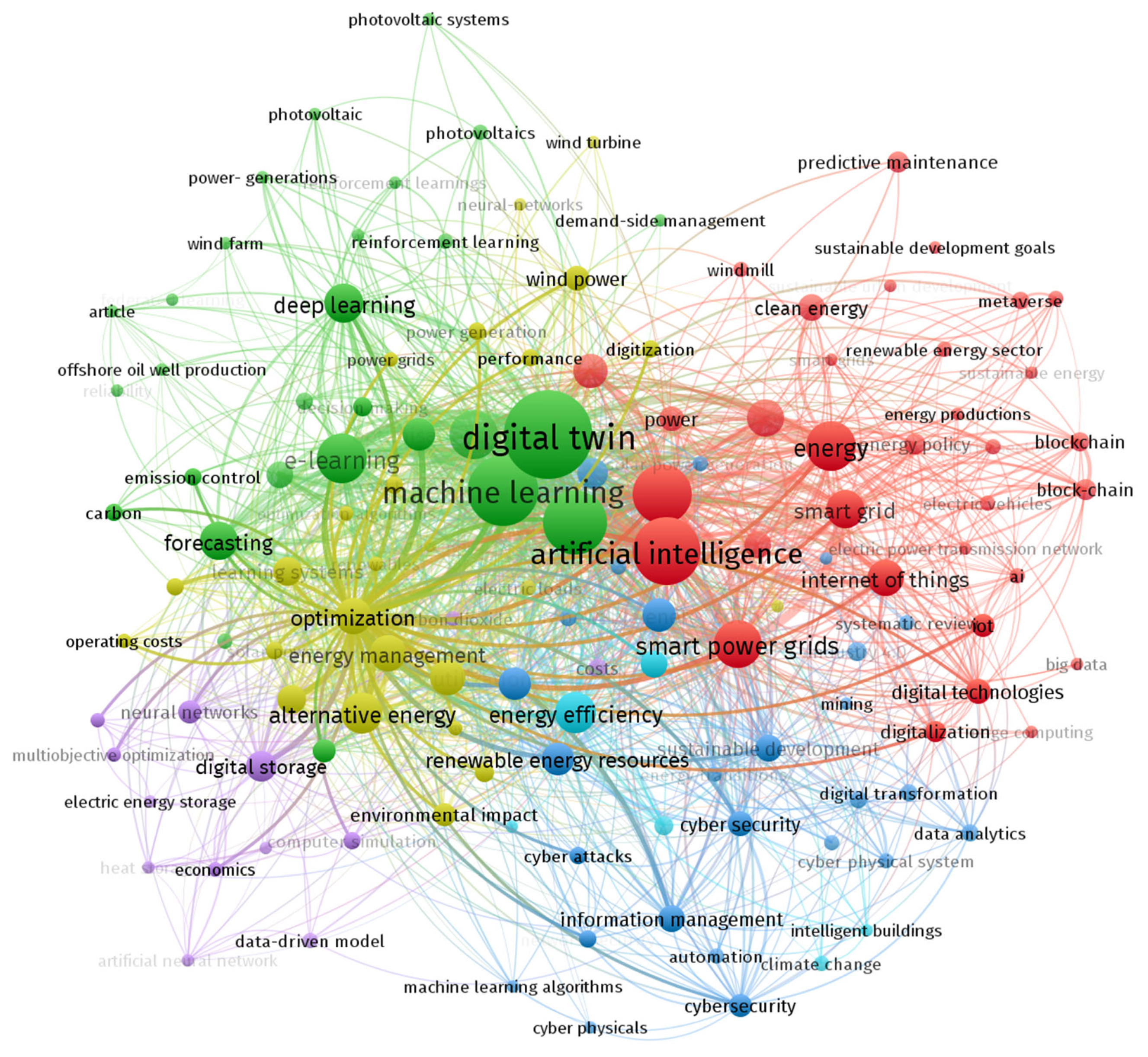
2.1.2. Co-Occurrence Analysis of Keywords in Digital Twin Research for Clean Energy
- AI-Centric Optimization (green cluster): Keywords such as “machine learning,” “deep learning,” “reinforcement learning,” “forecasting,” and “optimization” co-occurred with technology-specific terms, including “wind turbine,” “photovoltaics,” and “power grids.” This cluster reflects an intense research focus on data-driven models that improve resource forecasting, fault detection, and operational scheduling for renewable assets.
- Smart-Grid Digitalization (red cluster): Nodes labeled “smart grid,” “clean energy,” “renewable energy sector,” “energy policy,” and “predictive maintenance” highlighted research integrating real-time analytics with grid-level decision support, emphasizing reliability and the policy-aligned deployment of clean technologies.
- Cyber–Physical Infrastructure & Security (blue cluster): The co-occurrence of “internet of things,” “cyber security,” “data analytics,” and “information management” indicated a parallel research stream focused on secure, cloud–edge architectures that enable continuous data exchange between physical assets and their DTs.
- Sustainability & Systems Integration (yellow/purple sub-clusters): Terms such as “energy efficiency,” “environmental impact,” “alternative energy,” and “digital storage” reflected holistic research integrating life cycle assessment, storage technologies, and multi-objective optimization with DT frameworks.
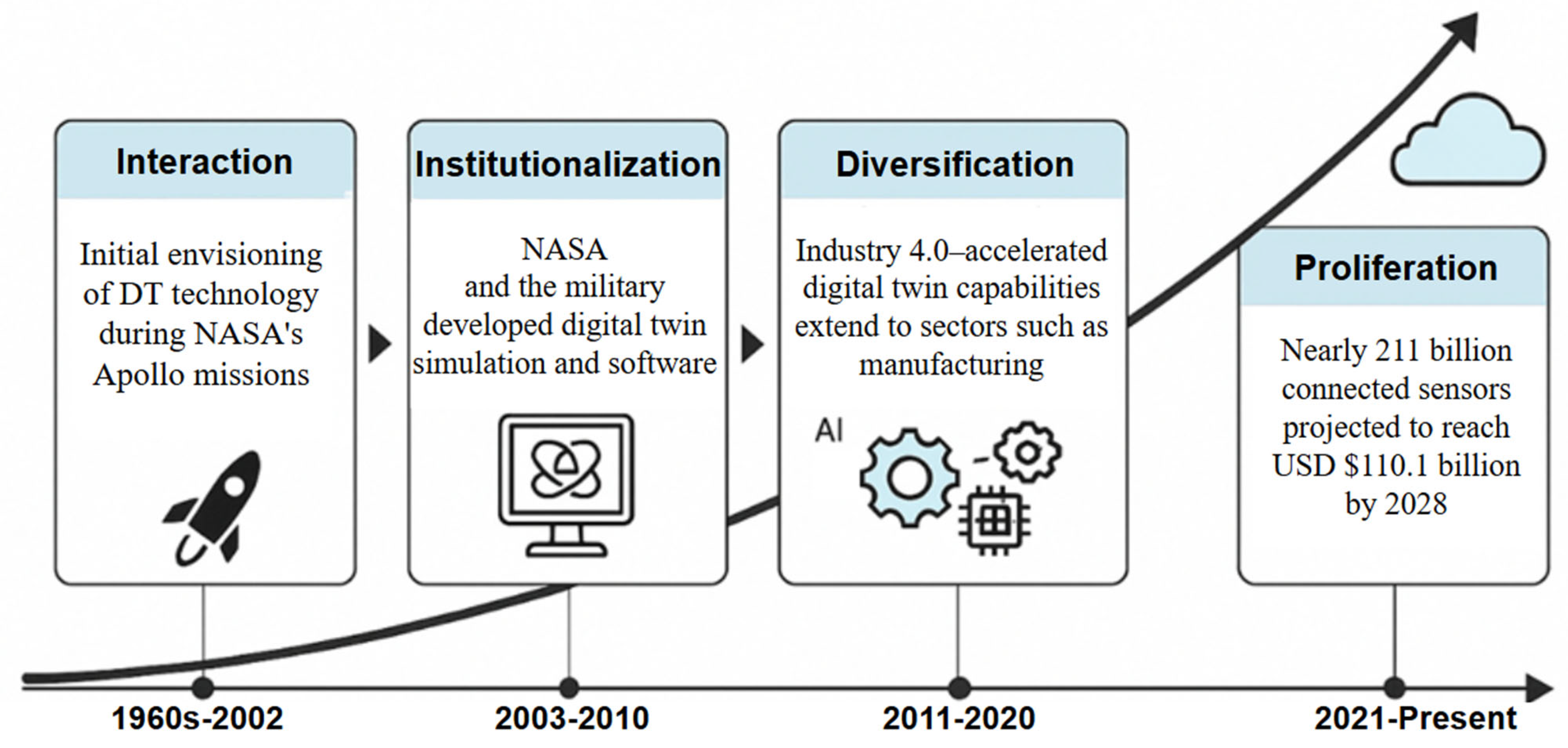
3. Evolution of Digital Twin Technology
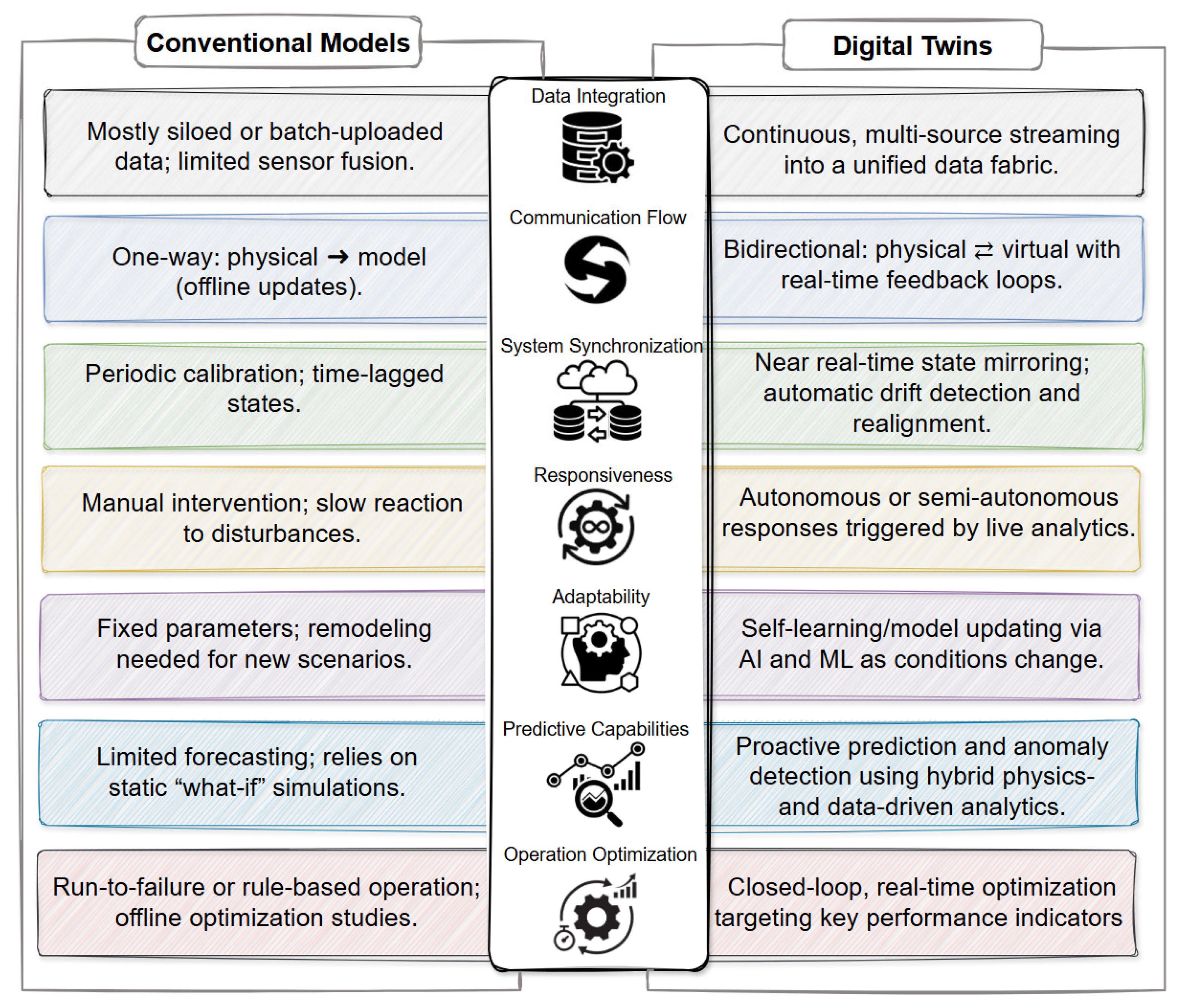
3.1. Key Differences Between Digital Twins and Conventional Models
3.2. Levels of Integration of Digital Twins in Clean Energy Systems
3.3. Relevance of Digital Twins in Clean Energy Systems
3.4. Applications of Digital Twins in Clean Energy Systems
3.4.1. Solar Energy
3.4.2. Wind Energy
3.4.3. Hydropower
3.4.4. Hydrogen Energy
3.4.5. Geothermal Energy
3.4.6. Bioenergy
3.4.7. Nuclear Energy
3.4.8. Tidal and Ocean Energy
3.4.9. Building-to-Grid Integration and Sustainable Districts
4. Discussion
4.1. Synthesis of Findings
4.2. Implications for Industry and Policy
4.3. Research Gaps and Future Directions
5. Conclusions
Author Contributions
Funding
Institutional Review Board Statement
Informed Consent Statement
Data Availability Statement
Conflicts of Interest
References
- Abbass, K.; Qasim, M.Z.; Song, H.; Murshed, M.; Mahmood, H.; Younis, I. A Review of the Global Climate Change Impacts, Adaptation, and Sustainable Mitigation Measures. Environ. Sci. Pollut. Res. 2022, 29, 42539–42559. [Google Scholar] [CrossRef]
- Dwivedi, Y.K.; Hughes, L.; Kar, A.K.; Baabdullah, A.M.; Grover, P.; Abbas, R.; Andreini, D.; Abumoghli, I.; Barlette, Y.; Bunker, D.; et al. Climate Change and COP26: Are Digital Technologies and Information Management Part of the Problem or the Solution? An Editorial Reflection and Call to Action. Int. J. Inf. Manag. 2022, 63, 102456. [Google Scholar] [CrossRef]
- Żywiołek, J.; Wolniak, R.; Grebski, W.W. From Traditional to Digital: The Paradigm Shift in the Energy Sector through Green Innovation. Energy Rep. 2025, 14, 1–16. [Google Scholar] [CrossRef]
- Hassan, Q.; Viktor, P.; Al-Musawi, T.J.; Ali, B.M.; Algburi, S.; Alzoubi, H.M.; Al-Jiboory, A.K.; Sameen, A.Z.; Salman, H.M.; Jaszczur, M. The Renewable Energy Role in the Global Energy Transformations. Renew. Energy Focus 2024, 48, 100545. [Google Scholar] [CrossRef]
- Shang, Y.; Sang, S.; Tiwari, A.K.; Khan, S.; Zhao, X. Impacts of Renewable Energy on Climate Risk: A Global Perspective for Energy Transition in a Climate Adaptation Framework. Appl. Energy 2024, 362, 122994. [Google Scholar] [CrossRef]
- Ejuh Che, E.; Roland Abeng, K.; Iweh, C.D.; Tsekouras, G.J.; Fopah-Lele, A. The Impact of Integrating Variable Renewable Energy Sources into Grid-Connected Power Systems: Challenges, Mitigation Strategies, and Prospects. Energies 2025, 18, 689. [Google Scholar] [CrossRef]
- Asadi Aghajari, H.; Niknam, T.; Shasadeghi, M.; Sharifhosseini, S.M.; Taabodi, M.H.; Sheybani, E.; Javidi, G.; Pourbehzadi, M. Analyzing Complexities of Integrating Renewable Energy Sources into Smart Grid: A Comprehensive Review. Appl. Energy 2025, 383, 125317. [Google Scholar] [CrossRef]
- Semeraro, C.; Aljaghoub, H.; Al-Ali, H.K.M.H.; Abdelkareem, M.A.; Olabi, A.G. Harnessing the Future: Exploring Digital Twin Applications and Implications in Renewable Energy. Energy Nexus 2025, 18, 100415. [Google Scholar] [CrossRef]
- Mahmood, M.; Chowdhury, P.; Yeassin, R.; Hasan, M.; Ahmad, T.; Chowdhury, N.-U.-R. Impacts of Digitalization on Smart Grids, Renewable Energy, and Demand Response: An Updated Review of Current Applications. Energy Convers. Manag. X 2024, 24, 100790. [Google Scholar] [CrossRef]
- Wang, Q.; Li, Y.; Li, R. Integrating Artificial Intelligence in Energy Transition: A Comprehensive Review. Energy Strategy Rev. 2025, 57, 101600. [Google Scholar] [CrossRef]
- Abdessadak, A.; Ghennioui, H.; Thirion-Moreau, N.; Elbhiri, B.; Abraim, M.; Merzouk, S. Digital Twin Technology and Artificial Intelligence in Energy Transition: A Comprehensive Systematic Review of Applications. Energy Rep. 2025, 13, 5196–5218. [Google Scholar] [CrossRef]
- Goel, A.; Masurkar, S.; Pathade, G.R. An Overview of Digital Transformation and Environmental Sustainability: Threats, Opportunities, and Solutions. Sustainability 2024, 16, 11079. [Google Scholar] [CrossRef]
- Sharma, A.; Kosasih, E.; Zhang, J.; Brintrup, A.; Calinescu, A. Digital Twins: State of the Art Theory and Practice, Challenges, and Open Research Questions. J. Ind. Inf. Integr. 2022, 30, 100383. [Google Scholar] [CrossRef]
- Tao, F.; Xiao, B.; Qi, Q.; Cheng, J.; Ji, P. Digital Twin Modeling. J. Manuf. Syst. 2022, 64, 372–389. [Google Scholar] [CrossRef]
- Hamid, A.-K.; Farag, M.M.; Hussein, M. Enhancing Photovoltaic System Efficiency through a Digital Twin Framework: A Comprehensive Modeling Approach. Int. J. Thermofluids 2025, 26, 101078. [Google Scholar] [CrossRef]
- Erdogan, N.; Bhinder, M.; Murphy, J.; Cali, U.; Aghaei, M. Chapter 6—Digital Twin in Design and Control Optimization of Marine Renewable Energy and Offshore Wind Energy Systems. In Digital Twin Technology for the Energy Sector; Elsevier: Amsterdam, The Netherlands, 2025; pp. 143–160. ISBN 978-0-443-14070-9. [Google Scholar]
- Leon-Medina, J.X.; Tibaduiza, D.A.; Parés, N.; Pozo, F. Digital Twin Technology in Wind Turbine Components: A Review. Intell. Syst. Appl. 2025, 26, 200535. [Google Scholar] [CrossRef]
- Haghshenas, A.; Hasan, A.; Osen, O.; Mikalsen, E.T. Predictive Digital Twin for Offshore Wind Farms. Energy Inform. 2023, 6, 1. [Google Scholar] [CrossRef]
- Ma, J.; Yuan, Y.; Chen, P. A Fault Prediction Framework for Doubly-Fed Induction Generator under Time-Varying Operating Conditions Driven by Digital Twin. IET Electr. Power Appl. 2023, 17, 499–521. [Google Scholar] [CrossRef]
- Chetan, M.; Yao, S.; Griffith, D.T. Multi-Fidelity Digital Twin Structural Model for a Sub-Scale Downwind Wind Turbine Rotor Blade. Wind Energy 2021, 24, 1368–1387. [Google Scholar] [CrossRef]
- Dibaj, A.; Gao, Z.; Nejad, A.R. Fault Detection of Offshore Wind Turbine Drivetrains in Different Environmental Conditions through Optimal Selection of Vibration Measurements. Renew. Energy 2023, 203, 161–176. [Google Scholar] [CrossRef]
- Jahangiri, V.; Valikhani, M.; Ebrahimian, H.; Liberatore, S.; Moaveni, B.; Hines, E. Digital Twinning of Modeling for Offshore Wind Turbine Drivetrain Monitoring: A Numerical Study. In Model Validation and Uncertainty Quantification, Volume 3; River Publishers: Gistrup, Denmark, 2023; pp. 135–137. [Google Scholar] [CrossRef]
- El-Agamy, R.F.; Sayed, H.A.; AL Akhatatneh, A.M.; Aljohani, M.; Elhosseini, M. Comprehensive Analysis of Digital Twins in Smart Cities: A 4200-Paper Bibliometric Study. Artif. Intell. Rev. 2024, 57, 154. [Google Scholar] [CrossRef]
- Pang, T.Y.; Pelaez Restrepo, J.D.; Cheng, C.T.; Yasin, A.; Lim, H.; Miletic, M. Developing a Digital Twin and Digital Thread Framework for an ‘Industry 4.0’ Shipyard. Appl. Sci. 2021, 11, 1097. [Google Scholar] [CrossRef]
- Bongomin, O.; Mwape, M.C.; Mpofu, N.S.; Bahunde, B.K.; Kidega, R.; Mpungu, I.L.; Tumusiime, G.; Owino, C.A.; Goussongtogue, Y.M.; Yemane, A.; et al. Digital Twin Technology Advancing Industry 4.0 and Industry 5.0 across Sectors. Results Eng. 2025, 26, 105583. [Google Scholar] [CrossRef]
- Allen, D. Digital Twins and Living Models at NASA. 2021. Available online: https://ntrs.nasa.gov/citations/20210023699 (accessed on 13 July 2025).
- Grieves, M.; Vickers, J. Origins of the Digital Twin Concept. Available online: https://www.researchgate.net/publication/307509727_Origins_of_the_Digital_Twin_Concept?channel=doi&linkId=57c6f44008ae9d64047e92b4&showFulltext=true (accessed on 11 June 2025).
- Yu, H.; Wen, B.; Zahidi, I.; Chow, M.F.; Liang, D.; Madsen, D.Ø. The Critical Role of Energy Transition in Addressing Climate Change at COP28. Results Eng. 2024, 22, 102324. [Google Scholar] [CrossRef]
- Wan Osman, W.N.A.; Rosli, M.H.; Mazli, W.N.A.; Samsuri, S. Comparative Review of Biodiesel Production and Purification. Carbon Capture Sci. Technol. 2024, 13, 100264. [Google Scholar] [CrossRef]
- Poddar, S.; Kay, M.; Prasad, A.; Evans, J.P.; Bremner, S. Changes in Solar Resource Intermittency and Reliability under Australia’s Future Warmer Climate. Sol. Energy 2023, 266, 112039. [Google Scholar] [CrossRef]
- Shafiullah, M.; Ahmed, S.D.; Al-Sulaiman, F.A. Grid Integration Challenges and Solution Strategies for Solar PV Systems: A Review. IEEE Access 2022, 10, 52233–52257. [Google Scholar] [CrossRef]
- Si, G.; Xia, T.; Wang, D.; Gebraeel, N.; Pan, E.; Xi, L. Maintenance Scheduling and Vessel Routing for Offshore Wind Farms with Multiple Ports Considering Day-Ahead Wind-Wave Predictions. Appl. Energy 2025, 379, 124915. [Google Scholar] [CrossRef]
- Oprea, S.V.; Bâra, A. Generative Literature Analysis on the Rise of Prosumers and Their Influence on the Sustainable Energy Transition. Util. Policy 2024, 90, 101799. [Google Scholar] [CrossRef]
- Eshaghi, M.S.; Anitescu, C.; Rabczuk, T. Methods for Enabling Real-Time Analysis in Digital Twins: A Literature Review. Comput. Struct. 2024, 297, 107342. [Google Scholar] [CrossRef]
- Chen, F.; Fang, G. Harnessing Digital Twin and IoT for Real-Time Monitoring, Diagnostics, and Error Correction in Domestic Solar Energy Storage. Energy Rep. 2024, 11, 3614–3623. [Google Scholar] [CrossRef]
- Madhuranthakam, R.S.; Sinha, M.; Vadlakonda, G.; Simuni, G. Digital Twins and Their Impact on Predictive Maintenance in IoT-Driven Cyber-Physical Systems. SSRN Electron. J. 2025, 6, 42–50. [Google Scholar] [CrossRef]
- Rivas, A.; Delipei, G.K.; Hou, J. Operation Optimization Framework for Advanced Reactors Using a Data-Driven Digital Twin. J. Nucl. Eng. Radiat. Sci. 2024, 11, 021801. [Google Scholar] [CrossRef]
- Barik, K.; Misra, S.; Thunem, H.P.-J. Achieving SDGs Using AI Techniques and Digital Twins for Nuclear Power Plants: A Review. In Artificial Intelligence of Things for Achieving Sustainable Development Goals; Misra, S., Siakas, K., Lampropoulos, G., Eds.; Springer Nature: Cham, Switzerland, 2024; pp. 81–98. ISBN 978-3-031-53433-1. [Google Scholar]
- Roda-Sanchez, L.; Cirillo, F.; Solmaz, G.; Jacobs, T.; Garrido-Hidalgo, C.; Olivares, T.; Kovacs, E. Building a Smart Campus Digital Twin: System, Analytics, and Lessons Learned from a Real-World Project. IEEE Internet Things J. 2024, 11, 4614–4627. [Google Scholar] [CrossRef]
- Li, B.; Severinsen, I.; Yu, W.; Walmsley, T.; Young, B. Digital Twins for Accurate Prediction beyond Routine Operation. Comput. Chem. Eng. 2025, 201, 109211. [Google Scholar] [CrossRef]
- Treviño, E.; Shields, A.; Stewart, R.; Darrington, J.; Scott, J.; Pope, C.; Ritter, C. Autonomous Anomaly Detection of Proliferation in the AGN-201 Nuclear Reactor Digital Twin. Ann. Nucl. Energy 2025, 211, 110990. [Google Scholar] [CrossRef]
- Guo, J.; Zhang, Y.; Wang, W. Predicting Hydro Turbine Failures through Digital Twin Simulations of Rare Real-World Data. J. Comput. Methods Sci. Eng. 2025, 1–13. [Google Scholar] [CrossRef]
- Kritzinger, W.; Karner, M.; Traar, G.; Henjes, J.; Sihn, W. Digital Twin in Manufacturing: A Categorical Literature Review and Classification. IFAC-Pap. 2018, 51, 1016–1022. [Google Scholar] [CrossRef]
- Rabaia, M.K.H.; Semeraro, C.; Soudan, B.; Salameh, T.S.Z.; Abdelkareem, M.A.; Olabi, A.G. Digital Twin-Driven Sustainable Energy Life Cycles: Technical Review and Guidelines. Energy Nexus 2025, 19, 100482. [Google Scholar] [CrossRef]
- Kavousi-Fard, A.; Dabbaghjamanesh, M.; Jafari, M.; Fotuhi-Firuzabad, M.; Dong, Z.Y.; Jin, T. Digital Twin for Mitigating Solar Energy Resources Challenges: A Perspective Review. Sol. Energy 2024, 274, 112561. [Google Scholar] [CrossRef]
- Zhang, X.; Tao, J.; Noshadravan, A. Probabilistic Digital Twin for Reliability-Based Maintenance Optimization of Offshore Wind Turbines. Renew. Energy 2026, 256, 123777. [Google Scholar] [CrossRef]
- Rana, S. AI-Driven Fault Detection and Predictive Maintenance in Electrical Power Systems: A Systematic Review of Data-Driven Approaches, Digital Twins, and Self-Healing Grids. Am. J. Adv. Technol. Eng. Solut. 2025, 1, 258–289. [Google Scholar] [CrossRef]
- Hamdan, A.; Ibekwe, K.I.; Ilojianya, V.I.; Sonko, S.; Etukudoh, E.A. AI in Renewable Energy: A Review of Predictive Maintenance and Energy Optimization. Int. J. Sci. Res. Arch. 2024, 11, 718–729. [Google Scholar] [CrossRef]
- Singh, M.; Yadav, V.; Pal, D.S.; Ansari, M.A.; Singh, O.; Patel, V. Digital Twins for Predictive Maintenance in Renewable Energy Grids with Tokenized Transactions: A Review. In Proceedings of the 2025 International Conference on Cognitive Computing in Engineering, Communications, Sciences and Biomedical Health Informatics (IC3ECSBHI), New Delhi, India, 16–18 January 2025; pp. 31–36. [Google Scholar]
- Dervişoǧlu, H.; Yurtoǧlu, R.A.; Sari, A.; Özcan, E.; Halepmollasi, R. A Digital Twin Framework for PV Panels. In Proceedings of the IEEE Wireless Communications and Networking Conference, WCNC, Milan, Italy, 24–27 March 2025. [Google Scholar] [CrossRef]
- Yuan, J.; Ma, J.; Tian, Z.; Man, K.L. Digital Twin Integration with Data Fusion for Enhanced Photovoltaic System Management: A Systematic Literature Review. IEEE Open J. Power Electron. 2024, 5, 1045–1058. [Google Scholar] [CrossRef]
- Angelova, D.D.; Fernández, D.C.; Godoy, M.C.; Moreno, J.A.Á.; González, J.F.G. A Review on Digital Twins and Its Application in the Modeling of Photovoltaic Installations. Energies 2024, 17, 1227. [Google Scholar] [CrossRef]
- Idrissi Kaitouni, S.; Ait Abdelmoula, I.; Es-sakali, N.; Mghazli, M.O.; Er-retby, H.; Zoubir, Z.; El Mansouri, F.; Ahachad, M.; Brigui, J. Implementing a Digital Twin-Based Fault Detection and Diagnosis Approach for Optimal Operation and Maintenance of Urban Distributed Solar Photovoltaics. Renew. Energy Focus 2024, 48, 100530. [Google Scholar] [CrossRef]
- Castilla, M.; Redondo, J.L.; Martínez, A.; Álvarez, J.D. Artificial Neural Network-Based Digital Twin for a Flat Plate Solar Collector Field. Eng. Appl. Artif. Intell. 2024, 133, 108387. [Google Scholar] [CrossRef]
- Li, B.; Jin, X.; Ba, T.; Pan, T.; Wang, E.; Gu, Z. Deceptive Cyber-Resilience in PV Grids: Digital Twin-Assisted Optimization Against Cyber-Physical Attacks. Energies 2025, 18, 3145. [Google Scholar] [CrossRef]
- Li, B.; Tan, W. A Novel Framework for Integrating Solar Renewable Source into Smart Cities through Digital Twin Simulations. Sol. Energy 2023, 262, 111869. [Google Scholar] [CrossRef]
- Gao, J.; Huang, H. Stochastic Optimization for Energy Economics and Renewable Sources Management: A Case Study of Solar Energy in Digital Twin. Sol. Energy 2023, 262, 111865. [Google Scholar] [CrossRef]
- Arafet, K.; Berlanga, R. Digital Twins in Solar Farms: An Approach through Time Series and Deep Learning. Algorithms 2021, 14, 156. [Google Scholar] [CrossRef]
- Nie, X.; Mohamad Daud, W.S.A.W.; Pu, J. A Novel Transactive Integration System for Solar Renewable Energy into Smart Homes and Landscape Design: A Digital Twin Simulation Case Study. Sol. Energy 2023, 262, 111871. [Google Scholar] [CrossRef]
- Yuan, G.; Xie, F. Digital Twin-Based Economic Assessment of Solar Energy in Smart Microgrids Using Reinforcement Learning Technique. Sol. Energy 2023, 250, 398–408. [Google Scholar] [CrossRef]
- Xu, J.; Gong, J. Novel Sustainable Urban Management Framework Based on Solar Energy and Digital Twin. Sol. Energy 2023, 262, 111861. [Google Scholar] [CrossRef]
- Cao, H.; Zhang, D.; Yi, S. Real-Time Machine Learning-Based Fault Detection, Classification, and Locating in Large Scale Solar Energy-Based Systems: Digital Twin Simulation. Sol. Energy 2023, 251, 77–85. [Google Scholar] [CrossRef]
- Wang, Y.; Qi, Y.; Li, J.; Huan, L.; Li, Y.; Xie, B.; Wang, Y. The Wind and Photovoltaic Power Forecasting Method Based on Digital Twins. Appl. Sci. 2023, 13, 8374. [Google Scholar] [CrossRef]
- Li, D.; Liu, L.; Qi, Y.; Li, Y.; Liu, H.; Luo, Z. Failure Analysis of Photovoltaic Strings by Constructing a Digital Multi-Twin Integrating Theory, Features, and Vision. Eng. Fail. Anal. 2025, 167, 108980. [Google Scholar] [CrossRef]
- Dui, H.; Zhang, S.; Dong, X.; Wu, S. Digital Twin-Enhanced Opportunistic Maintenance of Smart Microgrids Based on the Risk Importance Measure. Reliab. Eng. Syst. Saf. 2025, 253, 110548. [Google Scholar] [CrossRef]
- Hong, D.; Ma, J.; Wang, K.; Man, K.L.; Wen, H.; Wong, P. Real-Time Power Prediction for Bifacial PV Systems in Varied Shading Conditions: A Circuit-LSTM Approach Within a Digital Twin Framework. IEEE J. Photovolt. 2024, 14, 652–660. [Google Scholar] [CrossRef]
- Xiang, C.; Li, B.; Shi, P.; Yang, T.; Han, B. Short-Term Photovoltaic Power Prediction Based on a Digital Twin Model. J. Mar. Sci. Eng. 2024, 12, 1219. [Google Scholar] [CrossRef]
- Liu, S.; Qi, Y.; Ma, R.; Liu, L.; Li, Y. Intelligent Fault Diagnosis of Photovoltaic Systems Based on Deep Digital Twin. Meas. Sci. Technol. 2024, 35, 076207. [Google Scholar] [CrossRef]
- Værbak, M.; Billanes, J.D.; Jørgensen, B.N.; Ma, Z. A Digital Twin Framework for Simulating Distributed Energy Resources in Distribution Grids. Energies 2024, 17, 2503. [Google Scholar] [CrossRef]
- Hong, Y.-Y.; Pula, R.A. Diagnosis of Photovoltaic Faults Using Digital Twin and PSO-Optimized Shifted Window Transformer. Appl. Soft Comput. 2024, 150, 111092. [Google Scholar] [CrossRef]
- Yu, W.; Liu, G.; Zhu, L.; Zhan, G. Enhancing Interpretability in Data-Driven Modeling of Photovoltaic Inverter Systems through Digital Twin Approach. Sol. Energy 2024, 276, 112679. [Google Scholar] [CrossRef]
- Abdelmoula, I.A.; Oufettoul, H.; Lamrini, N.; Motahhir, S.; Mehdary, A.; Aroussi, M. El Federated Learning for Solar Energy Applications: A Case Study on Real-Time Fault Detection. Sol. Energy 2024, 282, 112942. [Google Scholar] [CrossRef]
- Silva, G.; Araújo, A. Framework for the Development of a Digital Twin for Solar Water Heating Systems. In Proceedings of the 2022 International Conference on Control, Automation and Diagnosis (ICCAD), Lisbon, Portugal, 13–15 July 2022; pp. 1–5. [Google Scholar]
- Zohdi, T.I. A Machine-Learning Digital-Twin for Rapid Large-Scale Solar-Thermal Energy System Design. Comput. Methods Appl. Mech. Eng. 2023, 412, 115991. [Google Scholar] [CrossRef]
- Machado, D.O.; Chicaiza, W.D.; Escaño, J.M.; Gallego, A.J.; de Andrade, G.A.; Normey-Rico, J.E.; Bordons, C.; Camacho, E.F. Digital Twin of a Fresnel Solar Collector for Solar Cooling. Appl. Energy 2023, 339, 120944. [Google Scholar] [CrossRef]
- Machado, D.O.; Chicaiza, W.D.; Escaño, J.M.; Gallego, A.J.; de Andrade, G.A.; Normey-Rico, J.E.; Bordons, C.; Camacho, E.F. Digital Twin of an Absorption Chiller for Solar Cooling. Renew. Energy 2023, 208, 36–51. [Google Scholar] [CrossRef]
- Chicaiza, W.D.; Machado, D.O.; Sánchez, A.J.; Escaño, J.M.; Normey-Rico, J.E. Fault Data Injection Detection on a Digital-Twin: Fresnel Solar Concentrator. IFAC-Pap. 2024, 58, 37–42. [Google Scholar] [CrossRef]
- Sergio, D.A.; Christian, R.; Bernhard, H. Concentrating Solar Power (CSP) Plant Data-Driven Digital Twin: A Novel Method for Flux Density Prediction. Results Eng. 2025, 28, 107096. [Google Scholar] [CrossRef]
- Hasan, A.; Styve, A.G. Enhancing Wind Farm Energy Prediction through Digital Twin Integration. In Digital Twin Technology for the Energy Sector: Fundamentals, Advances, Challenges, and Applications; Elsevier: Amsterdam, The Netherlands, 2024; pp. 179–190. [Google Scholar] [CrossRef]
- Stadtmann, F.; Rasheed, A.; Kvamsdal, T.; Johannessen, K.A.; San, O.; Kölle, K.; Tande, J.O.; Barstad, I.; Benhamou, A.; Brathaug, T.; et al. Digital Twins in Wind Energy: Emerging Technologies and Industry-Informed Future Directions. IEEE Access 2023, 11, 110762–110795. [Google Scholar] [CrossRef]
- Llopis-Albert, C.; Rubio, F.; Devece, C.; García-Hurtado, D. Digital Twin-Based Approach for a Multi-Objective Optimal Design of Wind Turbine Gearboxes. Mathematics 2024, 12, 1383. [Google Scholar] [CrossRef]
- Chen, B.-Q.; Liu, K.; Yu, T.; Li, R. Enhancing Reliability in Floating Offshore Wind Turbines through Digital Twin Technology: A Comprehensive Review. Energies 2024, 17, 1964. [Google Scholar] [CrossRef]
- Ko, M.; Shafieezadeh, A. Robust Wind Turbine Monitoring for Digital Twin Integration: A Physics-Informed Covariance-Preserving Deep Learning Approach. Renew. Energy 2025, 250, 123176. [Google Scholar] [CrossRef]
- Jiang, C.; Chen, N.-Z. G-Twin: Graph Neural Network-Based Digital Twin for Real-Time and High-Fidelity Structural Health Monitoring for Offshore Wind Turbines. Mar. Struct. 2025, 103, 103813. [Google Scholar] [CrossRef]
- Kavousi-Fard, A.; Dabbaghjamanesh, M.; Sheikh, M.; Jin, T. A Novel Deep Learning Based Digital Twin Model for Mitigating Wake Effects in Wind Farms. Renew. Energy Focus 2025, 53, 100686. [Google Scholar] [CrossRef]
- Habbouche, H.; Amirat, Y.; Benbouzid, M. Leveraging Digital Twins and AI for Enhanced Gearbox Condition Monitoring in Wind Turbines: A Review. Appl. Sci. 2025, 15, 5725. [Google Scholar] [CrossRef]
- Luger, M.; Seidel, A.; Pähler, U.; Schröck, S.; Hofmann, P.; Kölbl, S.; Drechsler, K. An Ontology-Augmented Digital Twin for Fiber-Reinforced Polymer Structures at the Example of Wind Turbine Rotor Blades. Adv. Eng. Mater. 2025, 27, 2401437. [Google Scholar] [CrossRef]
- Xu, T.; Zhang, X.; Sun, W.; Wang, B. Intelligent Operation and Maintenance of Wind Turbines Gearboxes via Digital Twin and Multi-Source Data Fusion. Sensors 2025, 25, 1972. [Google Scholar] [CrossRef]
- Zhou, Y.; Zhou, J.; Cui, Q.; Wen, J.; Fei, X. Digital Twin-Driven Online Intelligent Assessment of Wind Turbine Gearbox. Wind Energy 2024, 27, 797–815. [Google Scholar] [CrossRef]
- Hu, W.; Fang, J.; Zhang, Y.; Liu, Z.; Verma, A.S.; Liu, H.; Cong, F.; Tan, J. Digital Twin of Wind Turbine Surface Damage Detection Based on Deep Learning-Aided Drone Inspection. Renew. Energy 2025, 241, 122332. [Google Scholar] [CrossRef]
- Liu, H.; Sun, W.; Bao, S.; Xiao, L.; Jiang, L. Research on Key Technology of Wind Turbine Drive Train Fault Diagnosis System Based on Digital Twin. Appl. Sci. 2024, 14, 5991. [Google Scholar] [CrossRef]
- Pacheco-Blazquez, R.; Garcia-Espinosa, J.; Di Capua, D.; Pastor Sanchez, A. A Digital Twin for Assessing the Remaining Useful Life of Offshore Wind Turbine Structures. J. Mar. Sci. Eng. 2024, 12, 573. [Google Scholar] [CrossRef]
- Mousavi, Z.; Varahram, S.; Ettefagh, M.M.; Sadeghi, M.H.; Feng, W.-Q.; Bayat, M. A Digital Twin-Based Framework for Damage Detection of a Floating Wind Turbine Structure under Various Loading Conditions Based on Deep Learning Approach. Ocean Eng. 2024, 292, 116563. [Google Scholar] [CrossRef]
- Branlard, E.; Jonkman, J.; Brown, C.; Zhang, J. A Digital Twin Solution for Floating Offshore Wind Turbines Validated Using a Full-Scale Prototype. Wind Energy Sci. 2024, 9, 1–24. [Google Scholar] [CrossRef]
- Marykovskiy, Y.; Clark, T.; Deparday, J.; Chatzi, E.; Barber, S. Architecting a Digital Twin for Wind Turbine Rotor Blade Aerodynamic Monitoring. Front. Energy Res. 2024, 12, 1428387. [Google Scholar] [CrossRef]
- Liu, S. Wind Power Short-Term Prediction Based on Digital Twin Technology. Front. Energy Res. 2024, 12, 1365237. [Google Scholar] [CrossRef]
- Yin, Y.; Chen, H.; Meng, X.; Xie, H. Digital Twin-Driven Identification of Fault Situation in Distribution Networks Connected to Distributed Wind Power. Int. J. Electr. Power Energy Syst. 2024, 155, 109415. [Google Scholar] [CrossRef]
- Walker, J.; Coraddu, A.; Collu, M.; Oneto, L. Digital Twins of the Mooring Line Tension for Floating Offshore Wind Turbines to Improve Monitoring, Lifespan, and Safety. J. Ocean Eng. Mar. Energy 2022, 8, 1–16. [Google Scholar] [CrossRef]
- Zhang, J.; Zhao, X. Digital Twin of Wind Farms via Physics-Informed Deep Learning. Energy Convers. Manag. 2023, 293, 117507. [Google Scholar] [CrossRef]
- Nedaei, A.; Aghaei, M.; Eskandari, A.; Maurer, F.; Cali, U. Digital Twins for Hydropower Applications. In Digital Twin Technology for the Energy Sector: Fundamentals, Advances, Challenges, and Applications; Elsevier: Amsterdam, The Netherlands, 2024; pp. 213–234. ISBN 978-044314070-9, ISBN 978-044314071-6. [Google Scholar]
- Tan, J.; Radhi, R.M.; Shirini, K.; Gharehveran, S.S.; Parisooz, Z.; Khosravi, M.; Azarinfar, H. Innovative Framework for Fault Detection and System Resilience in Hydropower Operations Using Digital Twins and Deep Learning. Sci. Rep. 2025, 15, 15669. [Google Scholar] [CrossRef] [PubMed]
- Zeng, Y.; Hussein, Z.A.; Chyad, M.H.; Farhadi, A.; Yu, J.; Rahbarimagham, H. Integrating Type-2 Fuzzy Logic Controllers with Digital Twin and Neural Networks for Advanced Hydropower System Management. Sci. Rep. 2025, 15, 5140. [Google Scholar] [CrossRef] [PubMed]
- Wang, Z.; Jia, W.; Wang, K.; Wang, Y.; Hua, Q. Digital Twins Supported Equipment Maintenance Model in Intelligent Water Conservancy. Comput. Electr. Eng. 2022, 101, 108033. [Google Scholar] [CrossRef]
- Machalski, A.; Szulc, P.; Błoński, D.; Nycz, A.; Nemś, M.; Skrzypacz, J.; Janik, P.; Satława, Z. The Concept of a Digital Twin for the Wały Śląskie Hydroelectric Power Plant: A Case Study in Poland. Energies 2025, 18, 2021. [Google Scholar] [CrossRef]
- Li, Q.; Xin, L.; Li, R. Application of Digital Twin Technology in Monitoring System of Pump Turbine. Discov. Mech. Eng. 2024, 3, 30. [Google Scholar] [CrossRef]
- Tavares, M.; Pérez-Sánchez, M.; Carravetta, A.; Coronado-Hernández, O.E.; López-Jiménez, P.A.; Ramos, H.M. Smart Feasibility Optimization of Hybrid Renewable Water Supply Systems by Digital Twin Technologies: A Multicriteria Approach Applied to Isolated Cities. Sustain. Cities Soc. 2024, 115, 105834. [Google Scholar] [CrossRef]
- Cai, Z.; Wang, Y.; Zhang, D.; Wen, L.; Liu, H.; Xiong, Z.; Wajid, K.; Feng, R. Digital Twin Modeling for Hydropower System Based on Radio Frequency Identification Data Collection. Electronics 2024, 13, 2576. [Google Scholar] [CrossRef]
- Wang, H.; Ou, S.; Dahlhaug, O.G.; Storli, P.-T.; Skjelbred, H.I.; Vilberg, I. Adaptively Learned Modeling for a Digital Twin of Hydropower Turbines with Application to a Pilot Testing System. Mathematics 2023, 11, 4012. [Google Scholar] [CrossRef]
- Tubeuf, C.; Birkelbach, F.; Maly, A.; Hofmann, R. Increasing the Flexibility of Hydropower with Reinforcement Learning on a Digital Twin Platform. Energies 2023, 16, 1796. [Google Scholar] [CrossRef]
- Wang, H.; Yin, Z.; Jiang, Z.-P. Real-Time Hybrid Modeling of Francis Hydroturbine Dynamics via a Neural Controlled Differential Equation Approach. IEEE Access 2023, 11, 139133–139146. [Google Scholar] [CrossRef]
- Feng, Z.; Eiubovi, I.; Shao, Y.; Fan, Z.; Tan, R. Review of Digital Twin Technology Applications in Hydrogen Energy. CHAIN 2024, 1, 54–74. [Google Scholar] [CrossRef]
- Monopoli, D.; Semeraro, C.; Abdelkareem, M.A.; Alami, A.H.; Olabi, A.G.; Dassisti, M. How to Build a Digital Twin for Operating PEM-Electrolyser System—A Reference Approach. Annu. Rev. Control 2024, 57, 100943. [Google Scholar] [CrossRef]
- Fathollahi, A.; Andresen, B. Power Quality Analysis and Improvement of Power-to-X Plants Using Digital Twins: A Practical Application in Denmark. IEEE Trans. Energy Convers. 2025, 40, 1909–1921. [Google Scholar] [CrossRef]
- Ilin, I.V.; Shemyakina, A.A.; Dubgorn, A.S.; Levina, A.I. Architecture of Hydrogen Production System at Hydroelectric Power Station in Local Intelligent Network Using Machine Learning Tools and Internet of Energy. Int. J. Hydrogen Energy 2025, 138, 165–174. [Google Scholar] [CrossRef]
- Zhao, D.; He, Q.; Yu, J.; Guo, M.; Fu, J.; Li, X.; Ni, M. A Data-Driven Digital-Twin Model and Control of High Temperature Proton Exchange Membrane Electrolyzer Cells. Int. J. Hydrogen Energy 2022, 47, 8687–8699. [Google Scholar] [CrossRef]
- Liang, T.; Liu, H.; Mi, D.; Tan, J.; Jing, Y.; Huang, Z. Digital Twin Model Development and Validation for Megawatt-Scale Alkaline Water Electrolysis. J. Renew. Sustain. Energy 2025, 17, 036301. [Google Scholar] [CrossRef]
- Folgado, F.J.; González, I.; Calderón, A.J. PEM Electrolyser Digital Twin Embedded within MATLAB-Based Graphical User Interface. Eng. Proc. 2022, 19, 21. [Google Scholar] [CrossRef]
- Folgado, F.J.; González, I.; Calderón, A.J. Simulation Platform for the Assessment of PEM Electrolyzer Models Oriented to Implement Digital Replicas. Energy Convers. Manag. 2022, 267, 115917. [Google Scholar] [CrossRef]
- Deshmukh, R.S.; Rituraj, G.; Lock, N.; Vahedi, H.; Shekhar, A.; Bauer, P. Implementation of Real-Time Digital Twin of Dual Active Bridge Converter in Electrolyzer Applications. In Proceedings of the IECON 2023-49th Annual Conference of the IEEE Industrial Electronics Society, Singapore, 16–19 October 2023; pp. 1–6. [Google Scholar]
- Park, B.; Song, J.; Eom, D.; Choi, J.; Kim, S.J.; Park, S. Digital Twin-Based Design and Techno-Economic Analysis of Solar Hydrail as Future Locomotive. Int. J. Hydrogen Energy 2024, 56, 1216–1226. [Google Scholar] [CrossRef]
- Nguyen, V.H.; Jeanmougin, A.; Lecointe, V.; Hammer, B. Hybrid Edge–Cloud Energy Management System for an Industrial-Scale Green Hydrogen Refilling Station: Lessons Learned and Findings. Int. J. Hydrogen Energy 2024, 85, 360–373. [Google Scholar] [CrossRef]
- Liu, Z.; Babaei, M.; Song, C.C.; Zhang, C. Optimizing Urban Heating: Integrating Geothermal Energy and Chemical Heat Pumps for Digital Twin Simulations. In Digital Twin Computing for Urban Intelligence; Pourroostaei Ardakani, S., Cheshmehzangi, A., Eds.; Springer Nature: Singapore, 2024; pp. 119–145. ISBN 978-981-97-8483-7. [Google Scholar]
- Siratovich, P.; Blair, A.; Marsh, A.; Buster, G.; Taverna, N.; Weers, J.; Siega, C.; Urgel, A.; Mannington, W.; Cen, J.; et al. GOOML-Real World Applications of Machine Learning in Geothermal Operations. Geotherm. Res. Counc. Trans. 2022, 46, 1390–1397. [Google Scholar]
- Chityori, A.; Byiringiro, J.B.; Ndeda, R.; Gathitu, B. Towards Digital Twin and Augmented Reality Modelling to Mitigate Silica Scaling in Geothermal Plants. SSRG Int. J. Mech. Eng. 2024, 11, 70–86. [Google Scholar] [CrossRef]
- Guo, Y.; Tang, Q.; Darkwa, J.; Wang, H.; Su, W.; Tang, D.; Mu, J. Multi-Objective Integrated Optimization of Geothermal Heating System with Energy Storage Using Digital Twin Technology. Appl. Therm. Eng. 2024, 252, 123685. [Google Scholar] [CrossRef]
- Mahmoud, M.; Semeraro, C.; Ramadan, M.; Abdelkareem, M.A.; Olabi, A.G. Building a Digital Twin for a Ground Heat Exchanger. Chem. Eng. Technol. 2025, 48, e202300492. [Google Scholar] [CrossRef]
- Brehmer-Hine, T.; Yu, W.; Young, B. Modelling a Geothermal Vaporiser: A First Step Towards a Digital Twin. In Computer Aided Chemical Engineering; Manenti, F., Reklaitis, G.V., Eds.; Elsevier: Amsterdam, The Netherlands, 2024; Volume 53, pp. 187–192. ISBN 1570-7946. [Google Scholar]
- Kiwiri, F.W.; Bosco Byiringiro, J.; Onyancha, O. Real Time Monitoring and Control of Scale Formation in the Geothermal Energy Generation Systems: A Case Study of Olkaria II, Kenya. IOSR J. Eng. 2021, 11, 2278–8719. [Google Scholar]
- Omrani, P.S.; Egberts, P.J.P.; Octaviano, R. Real-Time Monitoring and Optimization of Geothermal Plants. GRC Trans. 2022, 46, 1602–1617. [Google Scholar]
- Buster, G.; Siratovich, P.; Taverna, N.; Rossol, M.; Weers, J.; Blair, A.; Huggins, J.; Siega, C.; Mannington, W.; Urgel, A.; et al. A New Modeling Framework for Geothermal Operational Optimization with Machine Learning (Gooml). Energies 2021, 14, 6852. [Google Scholar] [CrossRef]
- Khan, M.R.; Amin, J.M.; Hosen, M.M. Digital Twin-Driven Optimization of Bioenergy Production from Waste Materials. SSRN Electron. J. 2024, 1, 187–204. [Google Scholar] [CrossRef]
- Ling, J.Y.X.; Chan, Y.J.; Chen, J.W.; Chong, D.J.S.; Tan, A.L.L.; Arumugasamy, S.K.; Lau, P.L. Machine Learning Methods for the Modelling and Optimisation of Biogas Production from Anaerobic Digestion: A Review. Environ. Sci. Pollut. Res. 2024, 31, 19085–19104. [Google Scholar] [CrossRef]
- Akhator, P.; Oboirien, B. Digitilising the Energy Sector: A Comprehensive Digital Twin Framework for Biomass Gasification Power Plant with CO2 Capture. Clean. Energy Syst. 2025, 10, 100175. [Google Scholar] [CrossRef]
- Kayan, R.R.; Jauhar, S.K.; Kamble, S.S.; Belhadi, A. Optimizing Bio-Hydrogen Production from Agri-Waste: A Digital Twin Approach for Sustainable Supply Chain Management and Carbon Neutrality. Comput. Ind. Eng. 2025, 204, 111021. [Google Scholar] [CrossRef]
- Gamero, E.; Shoshi, A.; Full, J.; Sauer, A.; Miehe, R. Data Management in Biorefineries: Conceptual Thoughts on Lean Digital Twinning. Procedia CIRP 2024, 125, 48–53. [Google Scholar] [CrossRef]
- Moretta, F.; Fedeli, M.; Manenti, F.; Bozzano, G. Conceptual Design of Digital Twin for Bio. Methanol Production from Microalgae. Chem. Eng. Trans. 2022, 92, 253–258. [Google Scholar]
- Moretta, F.; Rizzo, E.; Manenti, F.; Bozzano, G. Enhancement of Anaerobic Digestion Digital Twin through Aerobic Simulation and Kinetic Optimization for Co-Digestion Scenarios. Bioresour. Technol. 2021, 341, 125845. [Google Scholar] [CrossRef] [PubMed]
- Torabi, T.; Bairami, A.; Ghasemzadeh, K.; Shojaei, M.J.; Iulianelli, A. Optimization of Sustainable Biogas Valorization to Hydrogen via Tri-Reforming Process in Packed Bed Membrane Reactor: An Integrated CFD-ML Digital Twin Approach. Renew. Energy 2025, 249, 123139. [Google Scholar] [CrossRef]
- Spinti, J.P.; Smith, P.J.; Smith, S.T. Atikokan Digital Twin: Machine Learning in a Biomass Energy System. Appl. Energy 2022, 310, 118436. [Google Scholar] [CrossRef]
- Sheik, A.G.; Kumar, A.; Ansari, F.A.; Raj, V.; Peleato, N.M.; Patan, A.K.; Kumari, S.; Bux, F. Reinvigorating Algal Cultivation for Biomass Production with Digital Twin Technology—A Smart Sustainable Infrastructure. Algal Res. 2024, 84, 103779. [Google Scholar] [CrossRef]
- Spinti, J.P.; Smith, P.J.; Smith, S.T.; Díaz-Ibarra, O.H. Atikokan Digital Twin, Part B: Bayesian Decision Theory for Process Optimization in a Biomass Energy System. Appl. Energy 2023, 334, 120625. [Google Scholar] [CrossRef]
- Bastos, T.; Teixeira, L.C.; Nunes, L.J.R. Forest 4.0: Technologies and Digitalization to Create the Residual Biomass Supply Chain of the Future. J. Clean. Prod. 2024, 467, 143041. [Google Scholar] [CrossRef]
- Schroer, H.W.; Just, C.L. Feature Engineering and Supervised Machine Learning to Forecast Biogas Production during Municipal Anaerobic Co-Digestion. ACS ES T Eng. 2024, 4, 660–672. [Google Scholar] [CrossRef]
- Oladele, M.F.; Bollas, G.M. Leveraging Digital Twin Modeling for Anaerobic Digesters Using Anaerobic Digestion Model No. 1 (ADM1) and Neural Network within the Pyomo Framework. Comput. Aided Chem. Eng. 2024, 53, 1141–1146. [Google Scholar] [CrossRef]
- Pallavicini, J.; Fedeli, M.; Scolieri, G.D.; Tagliaferri, F.; Parolin, J.; Sironi, S.; Manenti, F. Digital Twin-Based Optimization and Demo-Scale Validation of Absorption Columns Using Sodium Hydroxide/Water Mixtures for the Purification of Biogas Streams Subject to Impurity Fluctuations. Renew. Energy 2023, 219, 119466. [Google Scholar] [CrossRef]
- Mengyan, H.; Xueyan, Z.; Cuiting, P.; Yixuan, Z.; Jun, Y. Current Status of Digital Twin Architecture and Application in Nuclear Energy Field. Ann. Nucl. Energy 2024, 202, 110491. [Google Scholar] [CrossRef]
- Mondal, K.; Martinez, O.; Jain, P. Advanced Manufacturing and Digital Twin Technology for Nuclear Energy*. Front. Energy Res. 2024, 12, 1339836. [Google Scholar] [CrossRef]
- Park, S.-Y.; Lee, C.; Jeong, S.; Lee, J.; Kim, D.; Jang, Y.; Seol, W.; Kim, H.; Ahn, S.-H. Digital Twin and Deep Reinforcement Learning-Driven Robotic Automation System for Confined Workspaces: A Nozzle Dam Replacement Case Study in Nuclear Power Plants. Int. J. Precis. Eng. Manuf.-Green Technol. 2024, 11, 939–962. [Google Scholar] [CrossRef]
- Xiao, Y.; Liu, H.; Zhang, Q.; Chen, J. Reinforcement Learning Based Automatic Synchronization Method for Nuclear Power Digital Twin Model. IEEE Access 2024, 12, 87625–87632. [Google Scholar] [CrossRef]
- Karnik, N.; Abdo, M.G.; Estrada-Perez, C.E.; Yoo, J.S.; Cogliati, J.J.; Skifton, R.S.; Calderoni, P.; Brunton, S.L.; Manohar, K. Constrained Optimization of Sensor Placement for Nuclear Digital Twins. IEEE Sens. J. 2024, 24, 15501–15516. [Google Scholar] [CrossRef]
- Chen, F.; Huang, Q.; Song, M.; Liu, X.; Zeng, W.; Song, H.; Cheng, K. A Study on the Development of Digital Model of Digital Twin in Nuclear Power Plant Based on a Hybrid Physics and Data-Driven Approach. Appl. Therm. Eng. 2025, 271, 126289. [Google Scholar] [CrossRef]
- Chen, M.; Liu, H.; Zhao, W.; Zhang, Y.; Yu, W.; Peng, Q.; Wang, S.; Lin, L. Development of the Environmental Assisted Fatigue Assessment Method for Nuclear Plants in Digital Twin. Nucl. Eng. Technol. 2025, 57, 103402. [Google Scholar] [CrossRef]
- Daniell, J.; Kobayashi, K.; Alajo, A.; Alam, S.B. Digital Twin-Centered Hybrid Data-Driven Multi-Stage Deep Learning Framework for Enhanced Nuclear Reactor Power Prediction. Energy AI 2025, 19, 100450. [Google Scholar] [CrossRef]
- Hossain, R.; Ahmed, F.; Kobayashi, K.; Koric, S.; Abueidda, D.; Alam, S.B. Virtual Sensing-Enabled Digital Twin Framework for Real-Time Monitoring of Nuclear Systems Leveraging Deep Neural Operators. npj Mater. Degrad. 2025, 9, 21. [Google Scholar] [CrossRef]
- Stewart, R.; Treviño, E.; Shields, A.; Heaps, K.; Darrington, J.; Williams, Q.; Pope, C.; Scott, J.; Baker, B.; Palmer, J.; et al. The AGN-201 Digital Twin: A Test Bed for Remotely Monitoring Nuclear Reactors. Ann. Nucl. Energy 2025, 213, 111041. [Google Scholar] [CrossRef]
- Xiao, X.; Song, M.; Liu, X. A Reliable and Adaptive Prediction Framework for Nuclear Power Plant System through an Improved Transformer Model and Bayesian Uncertainty Analysis. Reliab. Eng. Syst. Saf. 2025, 261, 111076. [Google Scholar] [CrossRef]
- Lim, J.Y.; Li, J.; O’Grady, D.; Downar, T.; Duraisamy, K. A Hybrid Surrogate Modeling Framework for the Digital Twin of a Fluoride-Salt-Cooled High-Temperature Reactor (FHR). Nucl. Eng. Des. 2025, 433, 113690. [Google Scholar] [CrossRef]
- Vairagade, H.; Kim, S.; Son, H.; Zhang, F. A Nuclear Power Plant Digital Twin for Developing Robot Navigation and Interaction. Front. Energy Res. 2024, 12, 1356624. [Google Scholar] [CrossRef]
- Kobayashi, K.; Kumar, D.; Alam, S.B. AI-Driven Non-Intrusive Uncertainty Quantification of Advanced Nuclear Fuels for Digital Twin-Enabling Technology. Prog. Nucl. Energy 2024, 172, 105177. [Google Scholar] [CrossRef]
- Hong, L.Z.; Gong, H.L.; Ji, H.J.; Lu, J.L.; Li, H.; Li, Q. Optimizing Near-Carbon-Free Nuclear Energy Systems: Advances in Reactor Operation Digital Twin through Hybrid Machine Learning Algorithms for Parameter Identification and State Estimation. Nucl. Sci. Tech. 2024, 35, 135. [Google Scholar] [CrossRef]
- Kobayashi, K.; Alam, S.B. Deep Neural Operator-Driven Real-Time Inference to Enable Digital Twin Solutions for Nuclear Energy Systems. Sci. Rep. 2024, 14, 2101. [Google Scholar] [CrossRef]
- Ou, R.; Huang, X.; Zhang, J.; Yuan, M. Development of Multi-Function Underwater Inspection Robot Digital Twin System for Nuclear Power Plant. Int. Core J. Eng. 2024, 10, 2024. [Google Scholar] [CrossRef]
- Baniqued, P.D.E.; Bremner, P.; Sandison, M.; Harper, S.; Agrawal, S.; Bolarinwa, J.; Blanche, J.; Jiang, Z.; Johnson, T.; Mitchell, D.; et al. Multimodal Immersive Digital Twin Platform for Cyber–Physical Robot Fleets in Nuclear Environments. J. Field Robot. 2024, 41, 1521–1540. [Google Scholar] [CrossRef]
- Karnik, N.; Wang, C.; Bhowmik, P.K.; Cogliati, J.J.; Balderrama Prieto, S.A.; Xing, C.; Klishin, A.A.; Skifton, R.; Moussaoui, M.; Folsom, C.P.; et al. Leveraging Optimal Sparse Sensor Placement to Aggregate a Network of Digital Twins for Nuclear Subsystems. Energies 2024, 17, 3355. [Google Scholar] [CrossRef]
- Zhang, D.; Yang, K.; Zhang, H.; Yang, K.; Zeng, S.; Si, K.; Zhang, Y. Challenges in Tidal Energy Commercialization and Technological Advancements for Sustainable Solutions. iScience 2025, 28, 112348. [Google Scholar] [CrossRef] [PubMed]
- Cao, Y.; Tang, X.; Gaidai, O.; Wang, F. Digital Twin Real Time Monitoring Method of Turbine Blade Performance Based on Numerical Simulation. Ocean Eng. 2022, 263, 112347. [Google Scholar] [CrossRef]
- Babosalam, S.; Kargar, S.M.; Moazzami, M.; Zanjani, S.M. Occupancy-Aware Energy Optimization in Building-to-Grid Systems Using Deep Neural Networks and Model Predictive Control. J. Build. Eng. 2025, 112, 113714. [Google Scholar] [CrossRef]
- Li, H.; Wang, Z.; Hong, T.; Piette, M.A. Energy Flexibility of Residential Buildings: A Systematic Review of Characterization and Quantification Methods and Applications. Adv. Appl. Energy 2021, 3, 100054. [Google Scholar] [CrossRef]
- Dawes, G.; Kirant-Mitić, T.; Jiang, Z.; Le Dréau, J.; Cai, H.; Cui, J.; Townsend, J.; Bampoulas, A.; Li, R.; Lopes, R.A.; et al. Energy Flexibility at Multi-Building Scales: A Review of the Dominant Factors and Their Uncertainties. Energy Build. 2025, 346, 116157. [Google Scholar] [CrossRef]
- Khan, B.; Ali, S.M.; Ullah, Z. Deep Learning Based Digital Twins Augmented Reality: Model Predictive Control for Battery and Storage Optimization in Renewable Energy Prosumers Districts. J. Energy Storage 2025, 131, 117565. [Google Scholar] [CrossRef]
- Fu, Y.; Xu, S.; Zhu, Q.; O’Neill, Z.; Adetola, V. How Good Are Learning-Based Control v.s. Model-Based Control for Load Shifting? Investigations on a Single Zone Building Energy System. Energy 2023, 273, 127073. [Google Scholar] [CrossRef]
- Peng, Y.; Lei, Y.; Tekler, Z.D.; Antanuri, N.; Lau, S.K.; Chong, A. Hybrid System Controls of Natural Ventilation and HVAC in Mixed-Mode Buildings: A Comprehensive Review. Energy Build. 2022, 276, 112509. [Google Scholar] [CrossRef]
- Dai, X.; Chen, R.; Guan, S.; Li, W.T.; Yuen, C. BuildingGym: An Open-Source Toolbox for AI-Based Building Energy Management Using Reinforcement Learning. Build. Simul. 2025, 18, 1909–1927. [Google Scholar] [CrossRef]
- Toderean, L.; Cioara, T.; Anghel, I.; Sarmas, E.; Michalakopoulos, V.; Marinakis, V. Demand Response Optimization for Smart Grid Integrated Buildings: Review of Technology Enablers Landscape and Innovation Challenges. Energy Build. 2025, 326, 115067. [Google Scholar] [CrossRef]
- Feng, M.; Li, W.; Qin, B.; Zomaya, A.Y. Online Demand Peak Shaving with Machine-Learned Advice in Digital Twins. Digit. Twins Appl. 2024, 1, 38–50. [Google Scholar] [CrossRef]
- Omar, O. Digital Twins for Climate-Responsive Urban Development: Integrating Zero-Energy Buildings into Smart City Strategies. Sustainability 2025, 17, 6670. [Google Scholar] [CrossRef]
- Buckley, N.; Bo, C.; Delkhah, F.; Byrne, N.; Shearcaigh, A.N.; Brennan, S.; Correa, D.P. Evaluation of a Peer-to-Peer Smart Grid Using Digital Twins: A Case Study of a Remote European Island. Energies 2024, 17, 5541. [Google Scholar] [CrossRef]
- Li, Q.; Cui, Z.; Cai, Y.; Su, Y. Multi-Objective Operation of Solar-Based Microgrids Incorporating Artificial Neural Network and Grey Wolf Optimizer in Digital Twin. Sol. Energy 2023, 262, 111873. [Google Scholar] [CrossRef]
- Zhou, J.; Yang, M.; Zhan, Y.; Xu, L. Digital Twin Application for Reinforcement Learning Based Optimal Scheduling and Reliability Management Enhancement of Systems. Sol. Energy 2023, 252, 29–38. [Google Scholar] [CrossRef]
- Agostinelli, S.; Cumo, F.; Guidi, G.; Tomazzoli, C. Cyber-Physical Systems Improving Building Energy Management: Digital Twin and Artificial Intelligence. Energies 2021, 14, 2338. [Google Scholar] [CrossRef]
- Rojek, I.; Mikołajewski, D.; Mroziński, A.; Macko, M.; Bednarek, T.; Tyburek, K. Internet of Things Applications for Energy Management in Buildings Using Artificial Intelligence—A Case Study. Energies 2025, 18, 1706. [Google Scholar] [CrossRef]
- Bragatto, T.; Bucarelli, M.A.; Carere, F.; Cresta, M.; Gatta, F.M.; Geri, A.; Maccioni, M.; Paulucci, M.; Poursoltan, P.; Santori, F. Near Real-Time Analysis of Active Distribution Networks in a Digital Twin Framework: A Real Case Study. Sustain. Energy Grids Netw. 2023, 35, 101128. [Google Scholar] [CrossRef]
- Huang, J.; Koroteev, D.D.; Rynkovskaya, M. Machine Learning-Based Demand Response in PV-Based Smart Home Considering Energy Management in Digital Twin. Sol. Energy 2023, 252, 8–19. [Google Scholar] [CrossRef]
- Song, Y.; Xia, M.; Chen, Q.; Chen, F. A Data-Model Fusion Dispatch Strategy for the Building Energy Flexibility Based on the Digital Twin. Appl. Energy 2023, 332, 120496. [Google Scholar] [CrossRef]
- Ożadowicz, A. Modeling and Simulation Tools for Smart Local Energy Systems: A Review with a Focus on Emerging Closed Ecological Systems’ Application. Appl. Sci. 2025, 15, 9219. [Google Scholar] [CrossRef]
- Hofmeister, M.; Lee, K.F.; Tsai, Y.K.; Müller, M.; Nagarajan, K.; Mosbach, S.; Akroyd, J.; Kraft, M. Dynamic Control of District Heating Networks with Integrated Emission Modelling: A Dynamic Knowledge Graph Approach. Energy AI 2024, 17, 100376. [Google Scholar] [CrossRef]
- United Nations Economic Commission for Europe (UNECE). People-Smart Sustainable Cities; United Nations: New York, NY, USA, 2021; ISBN 9789210052658. [Google Scholar]
- Kannari, L.; Wessberg, N.; Hirvonen, S.; Kantorovitch, J.; Paiho, S. Reinforcement Learning for Control and Optimization of Real Buildings: Identifying and Addressing Implementation Hurdles. J. Build. Eng. 2025, 104, 112283. [Google Scholar] [CrossRef]
- Arsecularatne, B.; Rodrigo, N.; Chang, R. Digital Twins for Reducing Energy Consumption in Buildings: A Review. Sustainability 2024, 16, 9275. [Google Scholar] [CrossRef]
- Yan, B.; Yang, W.; He, F.; Zeng, W. Occupant Behavior Impact in Buildings and the Artificial Intelligence-Based Techniques and Data-Driven Approach Solutions. Renew. Sustain. Energy Rev. 2023, 184, 113372. [Google Scholar] [CrossRef]
- Bracco, S.; Rosales-Asensio, E.; González-Martínez, A.; Rosen, M.A.; Badidi, E. Edge AI and Blockchain for Smart Sustainable Cities: Promise and Potential. Sustainability 2022, 14, 7609. [Google Scholar] [CrossRef]
- Imandi, R.; Chethana, B.; Prasad, B.M.P.; Sethi, K.; Kumar, B.N.P. Enhancing Data Management in Industry 5.0: The Role of Digital Twins in Optimizing Industrial Operations. In Industry 5.0: Key Technologies and Drivers; Springer Nature: Cham, Switzerland, 2025; pp. 211–236. [Google Scholar] [CrossRef]
- Bokhtiar Al Zami, M.; Shaon, S.; Khanh Quy, V.; Nguyen, D.C. Digital Twin in Industries: A Comprehensive Survey. IEEE Access 2025, 13, 47291–47336. [Google Scholar] [CrossRef]
- Skoczkowski, T.; Bielecki, S.; Wołowicz, M.; Węglarz, A. Redefining Energy Management for Carbon-Neutral Supply Chains in Energy-Intensive Industries: An EU Perspective. Energies 2025, 18, 3932. [Google Scholar] [CrossRef]




| Objective | Role of DT | Ref. |
|---|---|---|
| Predict energy production of PV panels | A DT framework for PV panels focused on energy production modeling and efficiency monitoring | [50] |
| Advance the condition monitoring and fault detection of urban distributed solar PV systems | Uses DTs as a tool for modeling, monitoring, and managing the five building-attached PV systems | [53] |
| Reduce carbon emissions and support zero-energy buildings | Provides real-time monitoring, analysis, and fault detection | [54] |
| Develop a cyber-resilient optimization framework | Misleads attackers, supports real-time cyber defense, and enhances grid security and operational resilience under cyber–physical threats | [55] |
| Enhance energy management | Simulates the effects of load profiles on microgrids, facilitating improved energy planning and decision making | [56] |
| Propose a distributed energy management strategy | Models microgrid components | [57] |
| Obtain the DT of a PV solar farm | Uses the obtained DT for anomaly detection | [58] |
| Optimize the scheduling of demand-responsive appliances | Uses DT structures for household users with various initial loads to simulate and design multiple scenarios | [59] |
| Load scheduling employing reinforcement learning for minimizing energy bills | Provides a mathematical framework for load scheduling in DT-based microgrids | [60] |
| Sustainable energy management for microgrids | Enables more accurate charging and discharging management of energy storage systems | [61] |
| Real-time fault detection for optimal scheduling | A DT model is developed to capture the complexities of renewable energy sources | [62] |
| Forecast PV power output | Uses DT to create a highly realistic simulation environment for accurate monitoring, optimal control, and decision support for power system operations | [63] |
| Analyze PV system failures | Constructs theoretical, feature, and visual twins based on the concept of DTs | [64] |
| Enhance PV system efficiency | Supports real-time monitoring, predictive maintenance, and operational optimization under varying environmental conditions | [15] |
| Optimize maintenance strategies under resource constraints | Supports real-time monitoring and decision making | [65] |
| Improve the prediction of bifacial PV system performance under varying conditions | Facilitates real-time power prediction with high accuracy and efficiency by simulating behavior under different shading scenarios, eliminating the need for direct irradiance measurements | [66] |
| Short-term PV power prediction | Accurately simulates PV system’s behavior under varying weather conditions, especially cloudy scenarios | [67] |
| Implement fault diagnosis | Generates typical data across operational states and builds a deep data model to learn the distribution characteristics of the mechanism model | [68] |
| Improve battery performance and prediction accuracy | Supports real-time monitoring, diagnostics, and error correction in domestic solar energy storage systems | [35] |
| Develop energy management system | Simulates distributed energy resources effectively within distribution grids | [69] |
| Detect, localize, and classify grid-connected PV array faults | Analyzes the current ratio of each PV array through detection and localization | [70] |
| Enhance interpretability | Eliminates the need for additional signals or sensors and estimates unknown parameters in the mechanism model using operational data | [71] |
| Facilitate fault detection | Facilitates optimal power tracking throughout the day and accurately replicates the behavior and attributes of a physical entity by integrating real data into the PV block | [72] |
| Optimize energy efficiency | Supports real-time adaptation to changing environmental conditions | [73] |
| Design solar thermal energy systems | Tracks and optimizes the flow of incoming solar power through a complex solar thermal storage system | [74] |
| Control and optimize start-up and shut-down processes | Performs real-time, dynamic simulation of temperature, enhancing control system reliability | [75] |
| Support control, optimization, and accurate dynamic simulation | Enables real-time decision making and system optimization under solar intermittency and part-load conditions | [76] |
| Identify cyberattacks involving false data injection | Simulates Fresnel plant operations and controller behavior | [77] |
| Predict solar flux density and enable nonintrusive receiver-efficiency assessment | Produces accurate flux maps, supporting semi-autonomous monitoring and control of CSP operations | [78] |
| Objective | Role of DT | Ref. |
|---|---|---|
| Optimize performance | Estimates the real-time state of wind turbines | [83] |
| Monitor structural health | Reconstructs high-fidelity stress field in real time using sparse monitoring data | [84] |
| Optimize energy production | Accurately simulates and predicts wake effects within wind farms | [85] |
| Enhance wind turbine reliability | Monitors gearbox condition | [86] |
| Predict lifetime | Assesses production peculiarities and imperfections occurring during manufacturing | [87] |
| Perform intelligent operation and maintenance | Predicts faults in real time | [88] |
| Reliability-based maintenance optimization | Enhances risk-based structural integrity assessments and optimizing maintenance strategies. | [46] |
| Monitor remaining useful fatigue life | Performs online intelligent evaluation of wind turbine gearboxes, using gear tooth surface durability as an example of fatigue mode | [89] |
| Detect surface damage | Detects and semantically segments wind turbine surface features in real time | [90] |
| Diagnose faults | Monitors and simulates actual operating conditions in real time | [91] |
| Design optimal wind turbine gearboxes | Models and simulates wind turbine gearboxes to improve their design, diagnosis, operation, and maintenance | [81] |
| Enhance offshore floating wind turbine performance | Controls the real-time structural state of composite wind turbine structures and forecasts the remaining useful life by tracking fatigue | [92] |
| Monitor structural health | Analyzes diverse damage scenarios and detects damage in structures | [93] |
| Estimate fatigue lifetime | Estimates structural states, aerodynamic estimators, and physics-based virtual sensing procedures | [94] |
| Monitor rotor blade aerodynamics | Performs real-time analytics and predictive modeling | [95] |
| Predict short-term wind power output | Reliably predicts wind power in real time | [96] |
| Diagnose faults | Determines the real-time operational status of distribution networks connected with distributed wind power | [97] |
| Improve the safety and lifespan of floating offshore wind turbines | Uses data-driven models to detect long-term drift and forecast axial tension in mooring lines, enabling proactive maintenance, stress reduction, and real-time safety warnings during operations | [98] |
| Predict spatiotemporal wind fields to improve energy yield prediction, monitoring, and structural load assessment | Reconstructs high-resolution wind flow fields in real time, enabling accurate mirroring and analysis of wind farm behavior | [99] |
| Objective | Role of DT | Ref. |
|---|---|---|
| Establish a predictive model | Enhances the robustness of hydro turbine failure prediction by simulating data for rare operating scenarios | [42] |
| Support maintenance decision making | Provides models for predictive maintenance | [103] |
| Detect and optimize faults in hydropower system operations | Enables real-time modeling, predictive analysis, and operational optimization, improving efficiency, fault detection accuracy, and system reliability | [101] |
| Manage system performance | Performs real-time monitoring and predictive analysis | [102] |
| Manage operations efficiently | Features modular components, including data acquisition, data processing, visualization, and integration layers, emphasizing scalability, adaptability, and secure interoperability | [104] |
| Design and develop a pump–turbine monitoring system | Visualizes and monitors actual pump–turbine operating conditions | [105] |
| Manage multipurpose hydropower | Optimizes a hybrid renewable water supply system | [106] |
| Detect defects | Facilitates the intelligent transformation of hydropower stations while reducing system maintenance costs | [107] |
| Develop an adaptive learning model | Dynamically models actual hydropower turbines | [108] |
| Increase the flexibility of hydropower | Ensures safe and effective transfer of the reinforcement learning algorithm’s strategy from a virtual test environment to the physical asset | [109] |
| Model Francis hydro turbines | Collects real-time operational data to train the nonlinear dynamics of the Francis hydro turbine | [110] |
| Objective | Role of DT | Ref. |
|---|---|---|
| Provide a comprehensive guide for developing a DT of a PEM electrolyzer for green hydrogen production | Enables real-time monitoring, fault detection, diagnosis, and predictive control to enhance efficiency and extend electrolyzer lifespan | [112] |
| Model and optimize energy conversion | Enables real-time simulation, predictive analysis, and power quality control to enhance power-to-hydrogen system efficiency and scalability | [113] |
| Develop a digital architecture for hydrogen production at a hydroelectric power station within a local smart grid using the Internet of Energy (IoE) | Simulates hydrogen integration into smart grids, supports architectural design, and enhances system efficiency through IoE and ML-based coordination | [114] |
| Develop a data-driven DT to model and control the dynamics of high-temperature PEM electrolyzer cells | Predicts power, hydrogen output, and temperature; enables advanced control to reduce overshoot and enhance system durability | [115] |
| Develop a DT of a megawatt-scale alkaline electrolyzer for safe analysis under complex operating conditions | Simulates key parameters (voltage, pressure, and H2 concentration), supports real-time control, and enables safe testing under wide fluctuations in power | [116] |
| Simulate and control a PEM water electrolyzer in a smart microgrid | Enables safe, controlled simulation of PEM water electrolyzer behavior, supports monitoring and control via a graphical user interface, and facilitates integration within PV-powered hydrogen microgrids | [117] |
| Analyze and compare PEM electrolyzer models | Supports smart microgrid integration by enabling flexible model handling, simulation, and visualization under various operating conditions | [118] |
| Validate safe and effective power electronic converter designs | Enables real-time simulations to test and verify converter behavior under operational conditions, reducing safety risks prior to deployment | [119] |
| Assess the feasibility and long-term performance of solar hydrogen-powered systems | Simulates 30 years of solar hydrail operation, enabling cost, emission, and sensitivity analyses to evaluate its viability as a sustainable alternative to diesel locomotives | [120] |
| Assess the performance of a hybrid edge–cloud electrolyzer management system | Enables real-time assessment, centralized monitoring, adaptive control, and coordination of hydrogen production to improve efficiency and enable long-term virtual plant integration | [121] |
| Objective | Role of DT | Ref. |
|---|---|---|
| Develop a high-fidelity DT for geothermal heat exchangers capable of extrapolating system behavior under non-routine conditions | Uses a meta-learning physics-informed neural network to predict performance without detailed heat transfer models, thereby enhancing control and safety in industrial applications | [40] |
| Elucidate operational mechanisms and optimize performance of geothermal–chemical heat pump systems with DT technology | Provides real-time simulation and data analysis for system optimization, component integration, and informed thermal fluid selection to improve efficiency and sustainability | [122] |
| Optimize geothermal power plant operations via digital simulations | Provides a flexible, data-driven environment for scenario testing and operational optimization using real-world data and reinforcement learning techniques | [123] |
| Develop a DT and augmented reality system for real-time monitoring and control of silica scaling in geothermal reinjection | Simulates geofluid behavior, enables Industrial Internet of Things-based real-time control, optimizes silica treatment conditions, and enhances operational efficiency through predictive and remote interventions | [124] |
| Optimize geothermal heating systems with heat energy storage to address supply–demand mismatches | Integrates life cycle data, enables accurate demand prediction, and performs multi-objective optimization of cost, energy use, and emissions, enhancing sustainability and operational efficiency | [125] |
| Improve efficiency and sustainability in shallow geothermal systems | Enables real-time monitoring, behavior simulation, trend and correlation analysis, and issue prediction to optimize performance and reduce maintenance costs | [126] |
| Evaluate and compare modeling approaches as a foundational step toward developing DTs for geothermal vaporizer systems | Supports the selection and integration of suitable models for simulating geothermal processes, enabling future DT development for improved operational flexibility and decision making | [127] |
| Design and implement a virtual real-time scale monitoring and pH control system for geothermal energy generation | Accurately mirrors the physical system to enable real-time monitoring and control of brine pH, minimizing silica scaling and improving geothermal plant efficiency | [128] |
| Design and implement a real-time DT for a geothermal doublet system to enable monitoring, anomaly detection, and operational optimization | Facilitates real-time monitoring of production, pipeline integrity (corrosion, erosion, and scaling), electric submersible pump performance, and enables prescriptive analytics for optimized geothermal plant operation | [129] |
| Optimize real-world geothermal plant operations | Enables accurate modeling of as-built geothermal systems, supports integration with AI and ML tools, and enhances operational efficiency through data-driven insights and system-wide analysis | [130] |
| Objective | Role of DT | Ref. |
|---|---|---|
| Develop an integrated DT framework for a biomass gasification power plant with CO2 capture to enhance operational efficiency and system insight | Functions as a comprehensive platform combining dynamic models, data-driven methods, and real-time data to enable bidirectional communication, simulation, and optimization of gasification-based power systems | [133] |
| Optimize supply chain logistics for biohydrogen production from agricultural residues to support the circular economy and decarbonization | Simulates and optimizes biohydrogen supply chains using greenfield analysis and Monte Carlo simulations to enhance efficiency and guide decision making | [134] |
| Optimize biorefinery operations for efficiency and sustainability while minimizing complexity in data acquisition and processing | Serves as a lean, data-driven modeling tool to monitor and optimize biorefinery processes in real time, enhancing operational efficiency with minimal data and sensor requirements | [135] |
| Design and analyze a circular biorefinery using microalgae biomass for sustainable methanol production | Models and simulates the biogas-to-biofuel process using integrated computational tools to evaluate carbon emissions, process yield, and operational feasibility | [136] |
| Improve accuracy and industrial applicability for co-digestion and biogas composition prediction | Enables real-time optimization of methane content and supports broader industrial deployment | [137] |
| Optimize biogas tri-reforming in a Pd–Ag membrane reactor for sustainable H2 production and greenhouse gas mitigation | Integrates CFD and ML models to simulate, predict, and optimize reactor performance, enhancing H2 selectivity, reducing CO2 emissions, and lowering computational costs | [138] |
| Optimize real-time biomass boiler performance | Provides real-time prediction and uncertainty-informed optimization of biomass boiler operations | [139] |
| Explore the integration of algal DTs into algal cultivation systems to enhance sustainability, efficiency, and smart infrastructure | Monitors and controls key parameters (nutrients, pH, dissolved oxygen, and CO2) in real time, enabling energy-efficient, cost-effective, and intelligent management of algal biomass production systems | [140] |
| Optimize biomass boiler operations under uncertainty using Bayesian decision theory | Integrates real-time data with science-based models to dynamically update operational setpoints, enabling AI-driven decision making that maximizes utility while accounting for system uncertainties | [141] |
| Optimize the residual biomass supply chain by integrating digital technologies to enhance efficiency and valorize waste | Supports supply chain modeling and scenario analyses to enable data-driven decision making and facilitate the transformation of residual biomass into value-added resources | [142] |
| Forecast biogas production in municipal co-digestion facilities using existing SCADA data to improve operational control | Establishes the foundation for a DT using ML models to predict biogas flow in real time from high-resolution SCADA data, enabling proactive process optimization | [143] |
| Enhance prediction and control of anaerobic digester performance for waste-to-energy optimization | Integrates physics-based ADM1 with neural networks in Pyomo to improve biogas production forecasting and conduct system sensitivity analyses for informed operational control | [144] |
| Validate and optimize H2S removal in a biogas scrubber using experimental data and process simulation | Simulates and analyzes scrubber performance in Aspen PLUS, enabling sensitivity analyses of key variables to optimize H2S absorption efficiency across varying operating conditions | [145] |
| Objective | Role of DT | Ref. |
|---|---|---|
| Optimize reactor operations to extend runtime and reduce operation and maintenance costs using AI- and ML-based multi-variable control strategies | Functions as a data-driven surrogate model within the Dynamic Optimization of Modular Operations framework, enabling uncertainty-aware optimization of reactor control schemes in real time | [37] |
| Implement autonomous anomaly detection to strengthen nuclear safeguards and operational safety | Provides real-time operational data to enable isolation forest-based anomaly detection, complementing physics-based models for enhanced monitoring in nuclear systems | [41] |
| Develop a robotic automation system for hazardous tasks in NPPs, focusing on nozzle dam replacement | Provides a high-fidelity simulation environment for training, testing, and validating autonomous robotic operations using deep reinforcement learning in dangerous and confined workspaces | [148] |
| Address synchronization challenges between DT models and real-world nuclear power systems to improve safety protocols | Functions as a dynamic model, optimized in real time using the TD3PSO algorithm, to reduce discrepancies and enhance operational accuracy with minimal human intervention | [149] |
| Minimize flow field reconstruction errors in nuclear systems through optimized sensor placement under spatial and noise constraints | Provides a framework for integrating optimized sensor data to enable accurate field reconstruction and enhance communication between experimental setups and virtual models | [150] |
| Develop a high-precision digital model for nuclear power plants (NPPs) by integrating physical laws into neural networks to enhance real-world applicability | Supports real-time monitoring and control by combining physics-informed and data-driven modeling, improving prediction accuracy and model generalization for NPP operations | [151] |
| Improve fatigue assessment accuracy for Class 1 components under Environmental Assisted Fatigue (EAF) by evaluating the effects of strain rate and load pairing on the Fen factor | Collects operational data and applies Influence Function analysis to automate stress evaluation and optimize operation parameters, thereby reducing EAF impact and improving assessment reliability | [152] |
| Develop a fast and accurate DL framework for predicting steady-state reactor power output during transients | Functions as a real-time predictive and monitoring system by integrating data-driven models with reactor operations to enhance safety, performance, and decision making | [153] |
| Enable real-time prediction of thermal–hydraulic parameters in nuclear systems using ML-driven virtual sensors | Enables real-time monitoring of system degradation and enhances system observability | [154] |
| Implement remote monitoring and anomaly detection in the AGN-201 research reactor | Enables real-time monitoring and detection of undeclared events using ML and reactor physics, supporting safeguards and oversight functions | [155] |
| Enhance multi-parameter, multi-step time-series prediction accuracy for NPPs using advanced DL | Integrates a pretrained transformer model with uncertainty quantification to enable reliable, adaptive forecasting for improved operational safety and efficiency | [156] |
| Develop a real-time surrogate modeling framework for cost-efficient, reliable operation of advanced reactors, such as fluoride-salt-cooled high-temperature reactors | Provides fast, accurate virtual representations by integrating physics-informed and data-driven models for autonomous control, degradation monitoring, and long-horizon operational optimization | [157] |
| Design a real-time 3D DT system to support the development and testing of robotic automation in NPPs | Simulates full-scope NPP operations and enables realistic, risk-free testing of intelligent robotic systems for inspection and maintenance tasks | [158] |
| Accelerate and improve the reliability of uncertainty quantification in nuclear fuel performance modeling to support DT development | Enables efficient, data-driven uncertainty quantification using nonintrusive polynomial chaos expansion, reducing computational burden while enhancing model accuracy and reliability | [159] |
| Enhance real-time parameter identification and state estimation in reactor operation DTs for optimized, near-carbon-free nuclear energy systems | Enables accurate, efficient online monitoring, anomaly diagnosis, and lifetime management of nuclear reactors | [160] |
| Evaluate DeepONet as a surrogate modeling method for real-time prediction in DT applications for nuclear energy systems | Enables fast, accurate, and generalizable real-time inference using DeepONet, reducing retraining needs and enhancing online predictive capability for complex reactor operations | [161] |
| Improve the accuracy and reliability of underwater inspection robot operations in nuclear reactor pools | Creates a real-time virtual replica of the robot for precise motion control and pose visualization, enabling safe and effective remote operation in high-radiation, unstructured underwater environments | [162] |
| Develop and evaluate an immersive DT interface for managing robot fleets in nuclear environments to improve safety and usability | Enhances situational awareness and remote management of cyber–physical robotic systems by integrating sensor data, mission parameters, and user interaction in a multimodal virtual environment | [163] |
| Enable accurate full-field reconstruction in NPP subsystems through optimized sensor placement under physical constraints | Establishes a two-way communication between physical systems and virtual models by integrating optimized sensor data, supporting subsystem-level twinning and aggregation into a comprehensive NPP DT | [164] |
| Control Strategy | Application | Energy Savings | Peak Load Reduction | Other Key Metrics | Ref. |
|---|---|---|---|---|---|
| Improved Leader Particle Swarm Optimization (ILPSO) within DT-enabled BEMS | Smart home with PV, ESS, demand-responsive appliances, and grid interaction under real-time pricing | Not available (N/A) | Up to 38.5% | 46.2% reduction in electricity cost (ECC) | [59] |
| DT with DL-driven MPC | Prosumer district storage optimization with solar PV and wind | 15% | N/A | 20% reduction in operational cost | [170] |
| General DT application (Review) | Overall building performance | 30–40% | N/A | Facilitates ZEB integration | [176] |
| DT-enabled peer-to-peer (P2P) energy trading | Community-scale energy trading to optimize local solar PV consumption | Up to 54% (onsite RE consumption) | N/A | P2P trading increased PV’s contribution from 13% to 14% | [177] |
| Artificial neural networks and modified Grey Wolf optimizer within DT | Community microgrid of smart homes with PV panels and wind turbines, connected via a fog server for surplus power exchange under time-of-use pricing | Up to 55% (imported energy reduction) | N/A | Up to 67% reduction in electricity cost Facilitates peer-to-peer energy sharing | [178] |
| RL-based scheduling within DT | Smart home DR with solar PV, ESS, and appliance scheduling | Up to 35% reduction in grid imports against the baseline | N/A (load shifting achieved qualitatively) | 71% reduction in electricity cost | [179] |
| DT and AI-based BEMS | Residential district with geothermal and PV | 10% | N/A | Increased local energy self-sufficiency up to 70% | [180] |
| DT and AI-based Optimization | HVAC and lighting control with solar PV and wind turbine | 29.7% (HVAC), 23.4% (Lighting), and 20.9–33.8% (Overall) | 15–25% | 50–70% improvement in energy self-sufficiency 40% reduction in unexpected equipment failures | [181] |
| DT and optimized threshold control | Distribution network flexibility in near real-time with PV, ESS, EV charging stations, and flexible loads (HVAC, commercial) | N/A | 23.7% (import) and 27.4% (export) | 3.57% increase in self-consumption rate and 33.01% reduction in reverse energy flows | [182] |
| DT and multi-agent RL scheduling | Smart home DR with solar PV and ESS | N/A | ≈20–25% peak shaving (via load shifting and appliance scheduling) | Up to 72.3% reduction in electricity cost | [183] |
| DT and data–model fusion dispatch | Building cluster load control in DR with solar PV tracking | N/A | N/A | 18.44% reduction in electricity cost; PV accommodation rate increased to >99% | [184] |
Disclaimer/Publisher’s Note: The statements, opinions and data contained in all publications are solely those of the individual author(s) and contributor(s) and not of MDPI and/or the editor(s). MDPI and/or the editor(s) disclaim responsibility for any injury to people or property resulting from any ideas, methods, instructions or products referred to in the content. |
© 2025 by the authors. Licensee MDPI, Basel, Switzerland. This article is an open access article distributed under the terms and conditions of the Creative Commons Attribution (CC BY) license.
Share and Cite
Kim, M.; Ghobadi, F.; Tayerani Charmchi, A.S.; Lee, M.; Lee, J. Digital Twins for Clean Energy Systems: A State-of-the-Art Review of Applications, Integrated Technologies, and Key Challenges. Sustainability 2026, 18, 43. https://doi.org/10.3390/su18010043
Kim M, Ghobadi F, Tayerani Charmchi AS, Lee M, Lee J. Digital Twins for Clean Energy Systems: A State-of-the-Art Review of Applications, Integrated Technologies, and Key Challenges. Sustainability. 2026; 18(1):43. https://doi.org/10.3390/su18010043
Chicago/Turabian StyleKim, Myeongin, Fatemeh Ghobadi, Amir Saman Tayerani Charmchi, Mihong Lee, and Jungmin Lee. 2026. "Digital Twins for Clean Energy Systems: A State-of-the-Art Review of Applications, Integrated Technologies, and Key Challenges" Sustainability 18, no. 1: 43. https://doi.org/10.3390/su18010043
APA StyleKim, M., Ghobadi, F., Tayerani Charmchi, A. S., Lee, M., & Lee, J. (2026). Digital Twins for Clean Energy Systems: A State-of-the-Art Review of Applications, Integrated Technologies, and Key Challenges. Sustainability, 18(1), 43. https://doi.org/10.3390/su18010043