Perceived Abundance and Cultural-Economic Use-Value of Tree Species in the Mopane Woodlands, Mopani District, South Africa



Abstract
1. Introduction
2. Materials and Methods
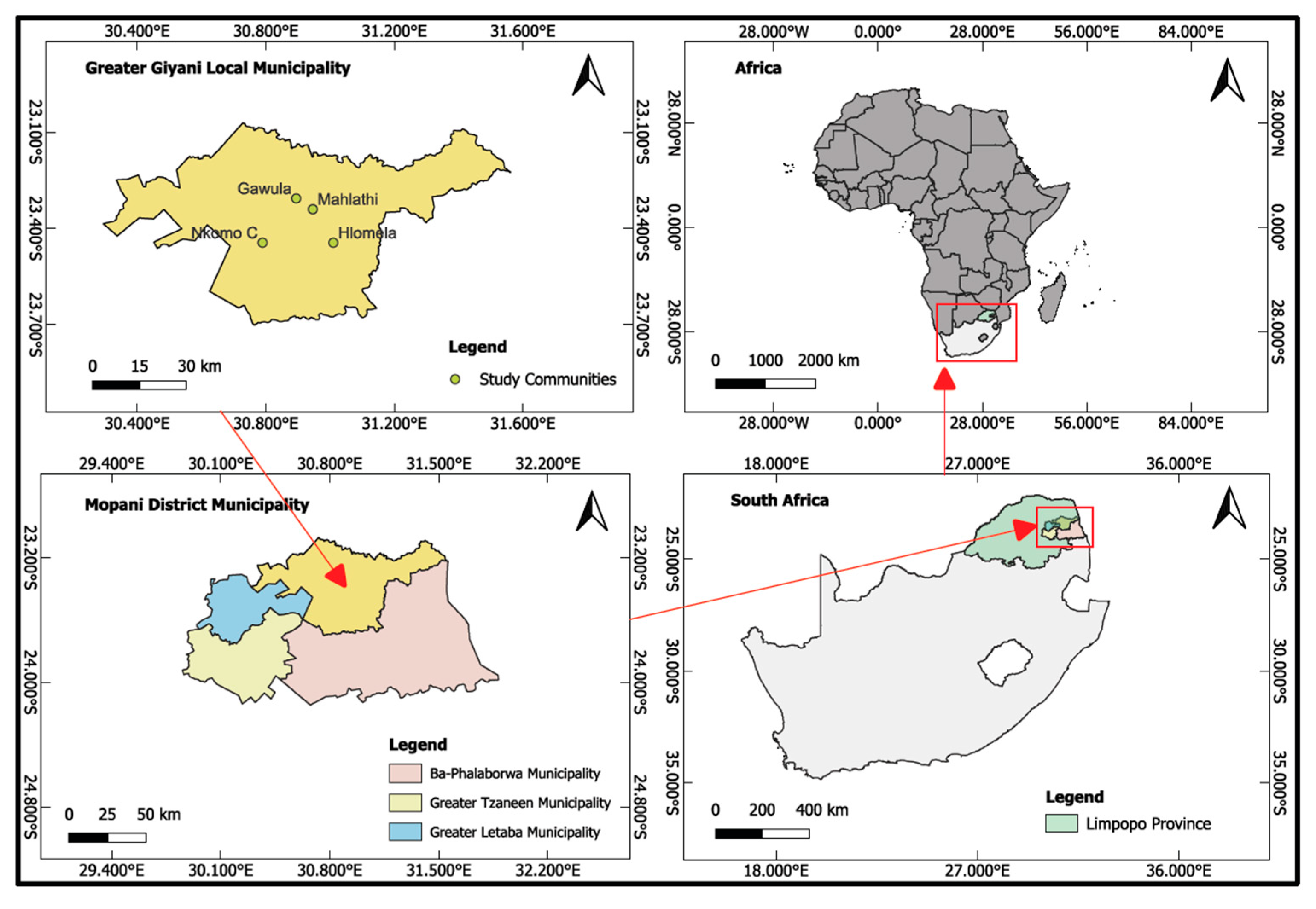
2.1. Description of the Study Site
2.2. Data Collection
2.3. Data Analysis
3. Results
3.1. Demographic Profile
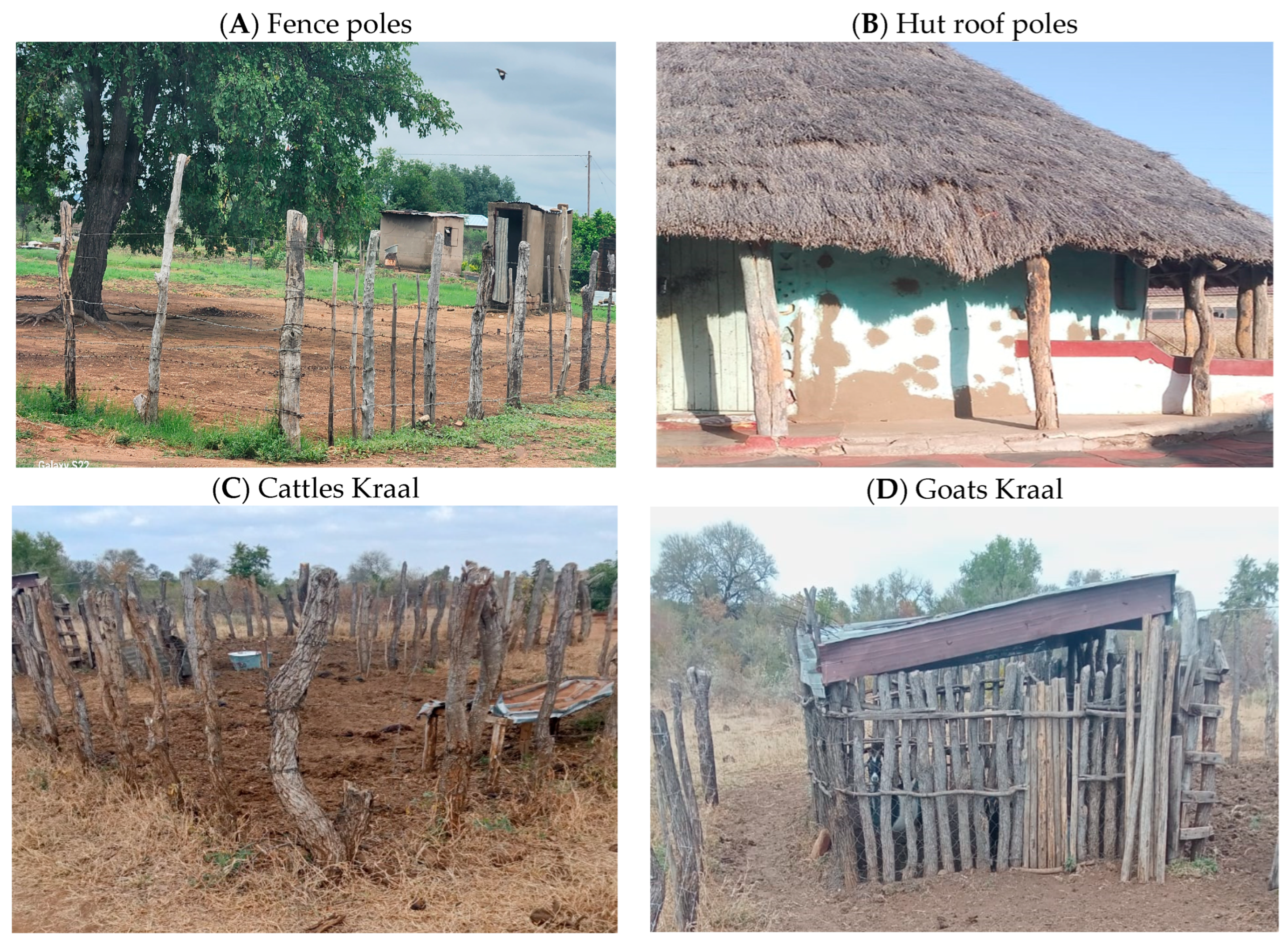
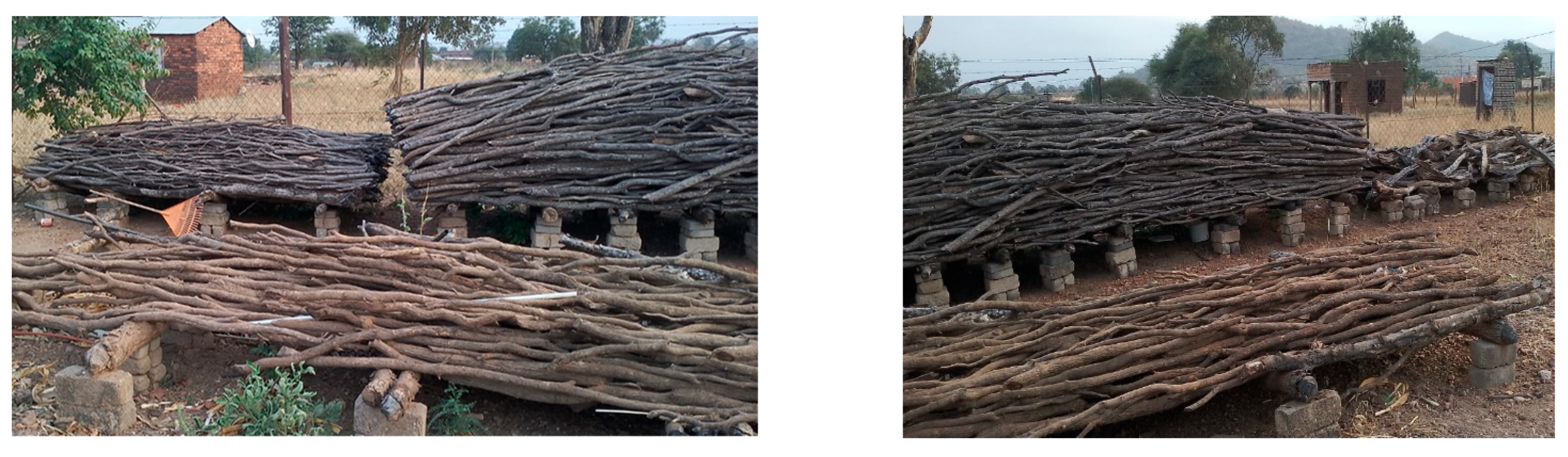
3.2. Mopane Woodland Non-Woody Plant and Animal, Woody Products Utilization
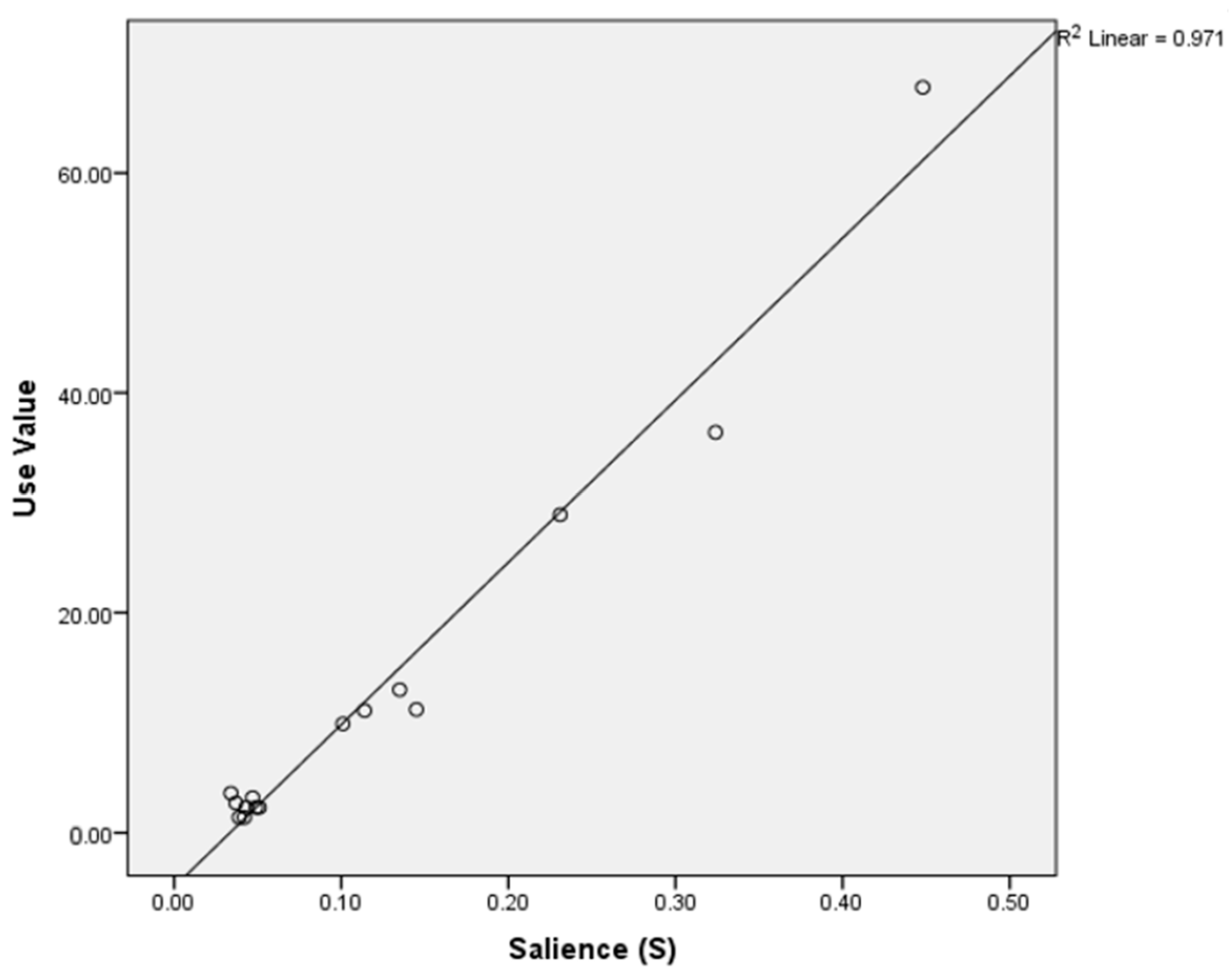
3.3. Perceptions of Tree Species Abundance and Use-Value Among Local Communities
4. Discussion
4.1. Perceived Tree Species Abundance and Use-Value
4.2. Utilization of Non-Woody Plant, Animal, and Woody Products in Mopane Woodlands
5. Conclusions
Author Contributions
Funding
Institutional Review Board Statement
Informed Consent Statement
Data Availability Statement
Acknowledgments
Conflicts of Interest
References
- Kissanga, R.; Catarino, L.; Máguas, C.; Cabral, A.I.; Chozas, S. Assessing the Impact of Charcoal Production on Southern Angolan Miombo and Mopane Woodlands. Forests 2023, 15, 78. [Google Scholar] [CrossRef] [Scilit]
- Nikodemus, A.; Hájek, M. Implementing local climate change adaptation actions: The role of various policy instruments in mopane (Colophospermum mopane) Woodlands, Northern Namibia. Forests 2022, 13, 1682. [Google Scholar] [CrossRef] [Scilit]
- Ngarega, B.K.; Masocha, V.F.; Schneider, H. Forecasting the effects of bioclimatic characteristics and climate change on the potential distribution of Colophospermum mopane in southern Africa using Maximum Entropy (Maxent). Ecol. Inform. 2021, 65, 101419. [Google Scholar] [CrossRef] [Scilit]
- Ngwenya, M.M.; Muzvondiwa, J.V.; Mukanga, C.; Ncube, S. Threats to non-timber forest products: The case of mopane worm harvesting and utilisation in Matebeleland South Province, Zimbabwe. In Wildlife and Fisheries Management in Zimbabwe: A Critical Reflection; Chinhoyi University of Technology (CUT) Publications: Chinhoyi, Zimbabwe, 2021; p. 132. [Google Scholar]
- Baiyegunhi, L.J.S.; Oppong, B.B. Commercialisation of mopane worm (Imbrasia belina) in rural households in Limpopo Province, South Africa. For. Policy Econ. 2016, 62, 141–148. [Google Scholar] [CrossRef] [Scilit]
- Teketay, D.; Kashe, K.; Madome, J.; Kabelo, M.; Neelo, J.; Mmusi, M.; Masamba, W. Enhancement of diversity, stand structure and regeneration of woody species through area exclosure: The case of a mopane woodland in northern Botswana. Ecol. Process. 2018, 7, 5. [Google Scholar] [CrossRef] [Scilit]
- Siddiqui, S.A.; Mahanta, D.K.; Bhoi, T.K.; Ahmad, A.; Fernando, I. Mopane worm (Gonimbrasia belina)-An exclusive African edible insect as human food-A comprehensive review. Future Foods 2024, 10, 100438. [Google Scholar] [CrossRef] [Scilit]
- Makhado, R.; Potgieter, J.M.; Wessels, D.; Saidi, A.; Masehela, K. Use of mopane woodland resources and associated woodland management challenges in rural areas of South Africa. Ethnobot. Res. Appl. 2012, 10, 369–380. [Google Scholar]
- Makhubele, L.; Chirwa, P.W.; Araia, M.G. The influence of forest proximity to harvesting and use of provisioning ecosystem services from tree species in traditional agroforestry landscapes. Int. J. Sustain. Dev. World Ecol. 2022, 29, 812–826. [Google Scholar] [CrossRef] [Scilit]
- Teshirogi, K.; Yamashina, C.; Fujioka, Y. Variations In Mopane Vegetation And Its Use By Local People: Comparison Of Four Sites In Northern Namibia. Afr. Study Monogr. 2017, 38, 5–25. [Google Scholar]
- Musvoto, C.; Mapaure, I.; Gondo, T.; Ndeinoma, A.; Mujawo, T. Reality and preferences in community mopane (Colophospermum mopane) woodland management in Zimbabwe and Namibia. Int. J. Soc. Sci. 2007, 1, 173–177. [Google Scholar]
- Geldenhuys, C.J.; Ham, C.; Ham, H. Sustainable Forest Management in Africa: Some Solutions to Natural Forest Management Problems in Africa; Stellenbosch University: Stellenbosch, South Africa, 2008. [Google Scholar]
- Mapaure, I.; Ndeinoma, A. Impacts of local-level utilization pressure on the structure of mopane woodlands in Omusati region, Northern Namibia. Afr. J. Plant Sci. 2011, 5, 305–313. [Google Scholar]
- Soldati, G.T.; de Medeiros, P.M.; Duque-Brasil, R.; Coelho, F.M.; Albuquerque, U.P. How do people select plants for use? Matching the ecological apparency hypothesis with optimal foraging theory. Environ. Dev. Sustain. 2017, 19, 2143–2161. [Google Scholar] [CrossRef] [Scilit]
- Asselin, H. Indigenous forest knowledge. In Routledge Handbook of Forest Ecology; Routledge: New York, NY, USA, 2024; pp. 642–653. [Google Scholar]
- Rankoana, S.A.; Shilubane, P.X.; Potgieter, M.J. The medical ethnobotanical knowledge of the Tsonga-Shangana in Bushbuckridge, Mpumalanga, South Africa. Afr. J. Phys. Health Educ. Recreat. Danc. 2015, 773–787. [Google Scholar]
- Sousa, V.J.D.; Pires, C.; Geldenhuys, C.J.; Figueiredo, A. Assessing Dependence And Pressure On Forest Resources In Limpopo National Park (Mozambique): The Case Of Mopane Woodlands. In Ilpf-Integração Lavoura Pecuária Floresta: Desafios, Perspectivas, Retrocessos e Avanços; Editora Científica Digital: São Paulo, Brazil, 2021; Volume 1, pp. 12–31. [Google Scholar]
- Statistics South Africa (Stats SA). Census 2022 Provinces at a Glance; Report No. 03-01-43; Statistics South Africa: Pretoria, South Africa, 2016. Available online: https://census.statssa.gov.za/assets/documents/2022/Provinces_at_a_Glance.pdf (accessed on 30 November 2025).
- Mopani District Municipality (MDM). Reviewed Integrated Development Plan. 2022–2026 (2022/23 Version). 2022. Available online: https://www.mopani.gov.za/docs/idp/REVIEWED%20%20IDP%202022-2023%20FINAL.pdf (accessed on 30 November 2025).
- Sinthumule, N.I. Are Mopani Worms a Mechanism for Mopane Tree (Colophospermum mopane) Conservation? An Evaluation of the Villages Around Giyani, Limpopo Province, South Africa. Trop. Conserv. Sci. 2024, 17, 19400829241283383. [Google Scholar] [CrossRef] [Scilit]
- Leavy, P. Quantitative, Qualitative, Mixed Methods, Arts-Based and Community-Based Participatory Research Approaches; The Guilford Press: New York, NY, USA, 2017. [Google Scholar]
- Alavi, H.; Hąbek, P. Addressing research design problem in mixed methods research. Manag. Syst. Prod. Eng. 2016, 21, 62–66. [Google Scholar] [CrossRef]
- Celentano, D.; Rousseau, G.X.; Engel, V.L.; Façanha, C.L.; de Oliveira, E.M.; de Moura, E.G. Perceptions of environmental change and use of traditional knowledge to plan riparian forest restoration with relocated communities in Alcântara, Eastern Amazon. J. Ethnobiol. Ethnomed 2014, 10, 11. [Google Scholar] [CrossRef] [Scilit]
- Kyarikunda, M.; Nyamukuru, A.; Mulindwa, D.; Tabuti, J.R. Agroforestry and management of trees in bunya county, mayuge district, Uganda. Int. J. For. Res. 2017, 2017, 3046924. [Google Scholar] [CrossRef] [Scilit]
- Nkosi, N.N.; Mostert, T.H.; Dzikiti, S.; Ntuli, N.R. Prioritization of indigenous fruit tree species with domestication and commercialization potential in KwaZulu-Natal, South Africa. Genet. Resour. Crop Evol. 2020, 67, 1567–1575. [Google Scholar] [CrossRef] [Scilit]
- Khatun, N. Applications of normality test in statistical analysis. Open J. Stat. 2021, 11, 113. [Google Scholar] [CrossRef]
- da Silva, T.C.; Cruz, M.P.; de Sousa Araújo, T.A.; Schwarz, M.L.; Albuquerque, U.P. Methods in research of environmental perception. In Methods and Techniques in Ethnobiology and Ethnoecology; Springer: Berlin/Heidelberg, Germany, 2014; pp. 99–109. [Google Scholar]
- Mero Dowo, G.; Kativu, S.; de Garine-Wichatitsky, M. Local perceptions of tree diversity, resource utilisation and ecosystem services provision at the periphery of Gonarezhou National Park, Zimbabwe. For. Trees Livelihoods 2018, 27, 1–21. [Google Scholar] [CrossRef] [Scilit]
- Lusk, C.H.; Falster, D.S.; Jara-Vergara, C.K.; Jimenez-Castillo, M.; Saldaña-Mendoza, A. Ontogenetic variation in light requirements of juvenile rainforest evergreens. Funct. Ecol. 2008, 22, 454–459. [Google Scholar] [CrossRef] [Scilit]
- Nhem, S.; Lee, Y.J. Women’s participation and the gender perspective in sustainable forestry in Cambodia: Local perceptions and the context of forestry research. For. Sci. Technol. 2019, 15, 93–110. [Google Scholar] [CrossRef] [Scilit]
- Revermann, R.; Krewenka, K.M.; Schmiedel, U.; Olwoch, J.M.; Helmschrot, J.; Jürgens, N. (Eds.) Climate Change and Adaptive Land Management in Southern Africa: Assessments, Changes, Challenges, and Solutions; Klaus Hess Publishers: Windhoek, Namibia, 2018. [Google Scholar]
- Urso, V.; Signorini, M.A.; Tonini, M.; Bruschi, P. Wild medicinal and food plants used by communities living in Mopane woodlands of southern Angola: Results of an ethnobotanical field investigation. J. Ethnopharmacol. 2016, 177, 126–139. [Google Scholar] [CrossRef] [Scilit]
- Mashabane, L.G.; Wessels, D.C.J.; Potgieter, M.J. The utilisation of Colophospermum mopane by the Vatsonga in the Gazankulu region (eastern Northern Province, South Africa). S. Afr. J. Bot. 2001, 67, 199–205. [Google Scholar] [CrossRef] [Scilit]
- Tokozwayo, S.; Mopipi, U.K.; Timpong-Jones, E.C.; Gulwa, U. Pastoralist’s perceptions on the impact of Vachellia karroo encroachment in communal rangelands of the Eastern Cape, South Africa. J. Agric. Ext. Rural. Dev. 2018, 10, 222–233. [Google Scholar]
- Nikodemus, A.; Abdollahnejad, A.; Kapuka, A.; Panagiotidis, D.; Hájek, M. Socio-economic benefits of Colophospermum mopane in a changing climate in northern Namibia. Forests 2023, 14, 290. [Google Scholar] [CrossRef] [Scilit]
- Mphinyane, W.N.; Akanyang, L.K.; Mulale, K.; Deventer, F.V.; Magole, L.; Perkins, J.; Sebego, R.J.; Atlhopheng, J.R.; Chanda, R. Firewood Utilisation and Its Implication on Trees around Mopipi Village in Boteti Sub-District of Botswana. Asian J. Environ. Ecol. 2018, 7, AJEE.42471. [Google Scholar] [CrossRef] [Scilit]
- Sedano, F.; Lisboa, S.; Duncanson, L.; Ribeiro, N.; Sitoe, A.; Sahajpal, R.; Hurtt, G.; Tucker, C. Monitoring intra and inter annual dynamics of forest degradation from charcoal production in Southern Africa with Sentinel–2 imagery. Int. J. Appl. Earth Obs. Geoinf 2020, 92, 102184. [Google Scholar] [CrossRef] [Scilit]
- Baumert, S.; Luz, A.C.; Fisher, J.; Vollmer, F.; Ryan, C.M.; Patenaude, G.; Zorrilla-Miras, P.; Artur, L.; Nhantumbo, I.; Macqueen, D. Charcoal supply chains from Mabalane to Maputo: Who benefits? Energy Sustain. Dev. 2016, 33, 129–138. [Google Scholar] [CrossRef] [Scilit]



| Demographics | Gawula | Mahlathi | Hlomela | Nkomo C | |
|---|---|---|---|---|---|
| (n = 70) | (n = 74) | (n = 65) | (n = 46) | ||
| Age | 18–25 | 14.3 | 2.7 | 10.8 | 6.5 |
| 26–35 | 30 | 21.6 | 23.1 | 37 | |
| 36–60 | 37.1 | 54.1 | 35.4 | 50 | |
| ≥61 | 18.6 | 21.6 | 30.8 | 6.5 | |
| Gender | Male | 31.4 | 39.2 | 43.1 | 39.1 |
| Female | 68.6 | 60.8 | 56.9 | 60.9 | |
| Source of Income | No income | 21.4 | 21.6 | 35.4 | 19.6 |
| Employed | 27.1 | 20.3 | 7.7 | 23.9 | |
| Self-employed | 20 | 23 | 6.2 | 17.4 | |
| Pensioner | 7.1 | 8.1 | 12.3 | 0 | |
| Social grant | 24.3 | 27 | 38.5 | 39.1 | |
| Education | No education | 15.7 | 17.6 | 18.5 | 10.9 |
| Primary | 12.9 | 18.9 | 15.4 | 19.6 | |
| Secondary | 41.4 | 45.9 | 50.8 | 60.9 | |
| Tertiary | 30 | 17.6 | 15.4 | 8.7 | |
| All Communities (n = 256) | ||
|---|---|---|
| Non-Woody Plant Products | Mean Rank | Statistics |
| Wild food (vegetables) | 0.69 1 | Chi-square = 513.444 |
| Fodder | 0.18 8 | Df = 9 |
| Medicinal plants | 0.59 2 | p = 0.000 |
| Cosmetic (soap) | 0.31 6 | |
| Dye | 0.02 10 | |
| Herbs and spices | 0.25 7 | |
| Sweeping material | 0.53 3 | |
| Thatch grass | 0.30 5 | |
| Ornamental | 0.16 9 | |
| Wild fruits | 0.45 4 | |
| All Communities (n = 256) | ||
|---|---|---|
| Non-Woody Animal Products | Mean Rank | Statistics |
| Bush meat | 0.72 3 | Chi-Square = 594.476 |
| Honey | 0.45 5 | Df = 9 |
| Fish | 0.73 2 | p = 0.000 |
| Hides and skins | 0.26 8 | |
| Medicine from animals | 0.38 7 | |
| Birds | 0.48 4 | |
| Termites | 0.18 10 | |
| Mopane worm | 0.84 1 | |
| Caterpillars (Locusts) | 0.44 6 | |
| Reptiles | 0.21 9 | |
| All Communities (n = 256) | ||
|---|---|---|
| Woody Forest Product | Rank | Statistics |
| Timber | 0.30 5 | Chi-square = 371.670 |
| Poles | 0.55 2 | Df = 5 |
| Fuelwood | 0.83 1 | p = 0.000 |
| Wood carving and utensils | 0.40 4 | |
| Charcoal | 0.04 6 | |
| Laths and droppers | 0.48 3 | |
| Species | Communities Smith Salience Index | |||
|---|---|---|---|---|
| Hlomela | Gawula | Mahlathi | Nkomo-C | |
| Colophospermum mopane | 0.392 1 | 0.343 1 | 0.218 1 | 0.304 1 |
| Sclerocarya birrea | 0.320 2 | 0.189 3 | 0.210 2 | 0.162 2 |
| Combretum molle | 0.140 3 | 0.072 5 | - | 0.142 4 |
| Combretum imberbe | 0.110 4 | 0.201 2 | 0.155 3 | 0.152 3 |
| Diospyros mespiliformis | 0.105 5 | 0.143 4 | - | 0.129 5 |
| Berchemia discolar | - | - | 0.107 4 | - |
| Cassia abbreviata | - | - | 0.098 5 | - |
| Scientific Names | English Names (Common Names) | Vernacular Names (Tsonga Language) | Overall Salience |
|---|---|---|---|
| Colophospermum mopane | Mopane | Xanatsi | 0.448 1 |
| Sclerocarya birrea | Marula | Nkanye | 0.324 2 |
| Combretum imberbe | Leadwood | Mondzo | 0.232 3 |
| Combretum molle | Velvet bushwillow | Xikukutsi | 0.145 4 |
| Diospyros mespiliformis | Jackal berry | Ntoma | 0.135 5 |
| Berchemia discolor | Brown ivory | Nyiri | 0.114 6 |
| Cassia abbreviata | Long tail cassia | Lumanyama | 0.101 7 |
| Spirostachys africana | Tamboti | Ndzhopfori | 0.049 8 |
| Ficus sycomorus | Sycamore fig | Nkuwa | 0.046 9 |
| Acacia nigrescens | Knob thorn | Nkaya | 0.045 10 |
| Ximenia caffra | Large sourplum | Ntsengele | 0.043 11 |
| Dichrostachys cinerea | Sickle bush | Ndzhenga | 0.042 12 |
| Acacia caffra | Common hook-thorn | Mubvinya-xihloka | 0.039 13 |
| Strychnos madagascariensis | Monkey orange | Nkwakwa | 0.037 14 |
| Vachellia karoo | White-thorn | Munga | 0.034 15 |
| Scientific Names | Gawula | Mahlathi | Nkomo C | Hlomela | Overall UV | Major Uses |
|---|---|---|---|---|---|---|
| Colophospermum mopane | 81.4 | 56.8 | 65.2 | 67.7 | 67.8 | A, B, C, E |
| Sclerocarya birrea | 31.4 | 50 | 19.6 | 44.6 | 36.4 | A, B, C, D |
| Combretum imberbe | 38.6 | 37.8 | 23.9 | 15.4 | 28.9 | A, B, C |
| Diospyros mespiliformis | 27.1 | 1.4 | 17.4 | 6.2 | 13 | A, B, C, D |
| Combretum molle | 8.6 | 8.1 | 17.4 | 10.8 | 11.2 | A, B, C |
| Berchemia discolor | 7.1 | 21.6 | 10.9 | 4.6 | 11.1 | A, B, D |
| Cassia abbreviata | 7.1 | 20.3 | 4.3 | 7.7 | 9.9 | B |
| Vachellia karroo | 0 | 12.2 | 2.2 | 0 | 3.6 | A, B, C, E |
| Ficus sycamorus | 5.7 | 2.7 | 4.3 | 0 | 3.2 | A, B, C, D |
| Adansonia digitata | 0 | 1.4 | 4.3 | 6.2 | 3 | B, D |
| Strychnos madagascariensis | 2.9 | 1.4 | 2.2 | 4.6 | 2.7 | A, B, D |
| Aloe marlothii | 0 | 0 | 10.9 | 0 | 2.7 | B |
| Acacia nigrescens | 0 | 0 | 0 | 9.2 | 2.3 | A, C, E |
| Ximenia caffra | 1.4 | 4.1 | 2.2 | 1.5 | 2.3 | B, D |
| Spirostchys africana | 4.3 | 2.7 | 2.2 | 0 | 2.3 | B |
| Grewia monticola | 4.3 | 2.7 | 2.2 | 0 | 2.3 | A, C, D |
| Philenoptera violacea | 0 | 1.4 | 6.5 | 0 | 2 | A, B, C |
| Trichilia emetica | 4.3 | 1.4 | 0 | 1.5 | 1.8 | B, D |
| Euclea divinorum | 2.9 | 2.7 | 0 | 1.5 | 1.8 | B, C, D |
| Dichrostachys cinerea | 1.4 | 0 | 4.3 | 0 | 1.4 | A, B, C, E |
Disclaimer/Publisher’s Note: The statements, opinions and data contained in all publications are solely those of the individual author(s) and contributor(s) and not of MDPI and/or the editor(s). MDPI and/or the editor(s) disclaim responsibility for any injury to people or property resulting from any ideas, methods, instructions or products referred to in the content. |
© 2025 by the authors. Licensee MDPI, Basel, Switzerland. This article is an open access article distributed under the terms and conditions of the Creative Commons Attribution (CC BY) license.
Share and Cite
Makhubele, L.; Dunbar, A.; Chirwa, P.W. Perceived Abundance and Cultural-Economic Use-Value of Tree Species in the Mopane Woodlands, Mopani District, South Africa. Sustainability 2026, 18, 387. https://doi.org/10.3390/su18010387
Makhubele L, Dunbar A, Chirwa PW. Perceived Abundance and Cultural-Economic Use-Value of Tree Species in the Mopane Woodlands, Mopani District, South Africa. Sustainability. 2026; 18(1):387. https://doi.org/10.3390/su18010387
Chicago/Turabian StyleMakhubele, Lucky, Audrill Dunbar, and Paxie W. Chirwa. 2026. "Perceived Abundance and Cultural-Economic Use-Value of Tree Species in the Mopane Woodlands, Mopani District, South Africa" Sustainability 18, no. 1: 387. https://doi.org/10.3390/su18010387
APA StyleMakhubele, L., Dunbar, A., & Chirwa, P. W. (2026). Perceived Abundance and Cultural-Economic Use-Value of Tree Species in the Mopane Woodlands, Mopani District, South Africa. Sustainability, 18(1), 387. https://doi.org/10.3390/su18010387