


Abstract
The phenomenon of digitalization and servitization paradoxes constrains the motivation of manufacturing firms to implement both strategies above. It has been shown that the role of digitalization in the link between servitization and firm performance in manufacturing firms has not yet been unanimously concluded. In this study, based on the theories of digitalization, dynamic capability, and the knowledge base view, we propose a research model to investigate the relationship between servitization, digital capabilities, and firm performance of manufacturing firms, conducting an empirical study based on questionnaire data from 435 manufacturing firms in China. The empirical results show that the three sub-dimensions of servitization of manufacturing firms have a significant positive impact on both financial and non-financial performance of firms. Meanwhile, digital capabilities act as a mediator between the three sub-dimensions of manufacturing servitization and firm performance (financial and non-financial). These results provide empirical evidence that manufacturing firms must emphasize knowledge-based digital capability development in current servitization and digitalization initiatives. Simultaneously, the study further addresses contradictions in the conclusions of existing studies on the interrelationships between servitization, digitalization, and firm performance.
1. Introduction
Since the term “servitization” was first coined by Vandermerwe and Rada [1], research has expanded significantly within U.S. and Western European management literature. Authors from operations, services, and business fields constitute the primary contributors to this body of work [2]. Baines et al. view servitization as the innovation of an organization’s capabilities and processes so that it can better create mutual value through a shift from selling products to selling ProductService Systems [3]. The evolution of service offerings can be conceptualized as a product-service continuum, ranging from product-centric “add-on” to service-centric ones, all delivered through a customer-centric strategy aimed at achieving specific customer outcomes [2,3]. The implementation of the servitization strategy in manufacturing firms is mainly motivated by three factors: financial, strategic (competitive advantage), and marketing [3]. However, much of the literature suggests that the contribution of servitization to firm performance in manufacturing firms is often not uniformly concluded. There are many companies that did not achieve the expected correspondingly high returns, which is called the “servitization paradox” [4,5].
In the digital era, manufacturing companies will rely on digitalization to provide more advanced and complex services [6]. Digital servitization encompasses back-end and front-end digitalization. For front-end, edge computing technology can leverage the network between manufacturing companies, customers, and other business partners to focus on receiving and processing raw data from the physical environment by using specialized computing modules to gain real-time insights. This allows companies to continuously optimize and innovate their service offerings [7,8]. For the back-end, Tapia et al. point to the implementation of a software platform to monitor machine tools and manufacturing processes to ensure the efficiency and quality of product production [9]. However, there is also some literature that suggests that the digitalization paradox also exists [10,11,12]. The pervasive complexity and uncertainty can lead companies into a digitalization paradox where increasing revenues from digital services fail to deliver greater profits because of spiraling cost increases [12,13]. As a matter of fact, the success of digital servitization in manufacturing firms should also not be judged solely on the basis of financial returns, but should also take into account the evaluation of stakeholders such as customers and other interested parties [14,15].
Research on the convergence of servitization and digitalization is becoming increasingly popular [15]. Kohtamäki et al. argued that convergence between servitization and digitalization is an effective way for companies to avoid the paradoxes of both processes [16,17]. Kohtamaki et al. also pointed out that the key to unlocking the value of digitalization may be embedded in advanced services, operational services, and outcome-based services that enable companies to capture the benefits of digitalization [12,18].
The convergence of servitization and digitalization has been found to manifest itself in two directions of research. One is to discuss digital servitization as a distinct concept, mainly exploring the conceptualization, business models, and dimensions of digital servitization [19,20,21]. Moreover, most of the research takes a qualitative approach [22], but quantitative studies are almost non-existent [10]. The second is to discuss and analyze digitalization and servitization as separate concepts, and to explore the interaction between digitalization and servitization strategies and their impact on corporate performance [23]. MartínPeña et al. [6] examined digitalization as a mediating variable between servitization and performance in manufacturing firms. Kohtamaki et al. [12], on the other hand, point out the importance of the interaction between servitization and digitalization, emphasizing that advanced service provision has a more significant positive moderating effect on the relationship between firms’ digitalization and financial performance under high-level digitalization. Unlike Kohtamaki et al.’s study [12], Abou-foul et al. [24] highlighted that servitization partially mediated digitalization and firm financial performance. Similarly, Chen et al. discussed how digital capabilities can bring competitiveness to firms through two kinds of servitization strategies, product-oriented and customer-oriented, from a data-driven digital capabilities perspective [25]. And Zhou et al. [26] examined the impact of two types of servitization interacting with two types of digitalization of manufacturing firms on influencing the market performance of manufacturing firms.
This study finds that servitization and digitalization research has accumulated a certain amount of literature [10,15,27], but there are some research gaps that need to be addressed: Firstly, the current body of research provides contradictory results on the impact of servitization and digitalization on firm financial performance [6,12,24], i.e., the relationship between servitization, digitalization, and firm performance, and lacks empirical consistency. Secondly, the measurement dimensions of servitization are too homogeneous, and the existing literature mainly measures the level of servitization according to the complexity of service offering or service revenue ratio, such as Baines et al., who classify servitization into basic, intermediate, and advanced services [27,28]; the measurement of servitization lacks a common lexicon and accepted analytical tools [2]. A critical gap remains in the servitization literature: few studies have utilized organizational innovation theory to define its dimensions, thereby overlooking the concept’s richness. Third, existing studies have overemphasized the technological role of digital technology in servitization and have failed to examine the role of digital capabilities in the relationship between servitization and enterprise performance. This study argues that technology alone is not enough for servitization in a digital environment [11,18,19], but rather, it is necessary to build knowledge sensing, seizing, and reconfiguring capabilities by digital technology [29,30]. Fourth, an overwhelming focus on economic performance has led existing research to overlook the impact of servitization on the non-financial performance of manufacturing firms in the digital era [18,20], such as environmental and social performance [8,24,25]. Therefore, this study follows the research paradigm of “behavior-capability-performance” and addresses these gaps by seeking to answer the three questions below:
Q1: From the perspective of organizational innovation, what are the sub-dimensions of manufacturing enterprise servitization?
Q2: Based on digitalization and dynamic capability theory, as well as the Knowledge-Based View, this study identifies the digital capabilities necessary for the servitization strategy of manufacturing enterprises in a digital context.
Q3: Drawing on empirical data, this study investigates how servitization and digital capabilities influence the economic and non-economic performance of firms in digital environments.
To address the issues above, this study constructs a conceptual model with servitization as the independent variable, digital capability as the mediating variable, and corporate performance as the dependent variable [31]. Using questionnaire data from 435 representative Chinese companies, regression analysis was employed to verify the theoretical assumptions between the variables and uncover the theoretical black box between servitization and corporate performance in the digital context for manufacturing enterprises. These manufacturing enterprises are primarily located in eastern China, specifically in Jiangsu, Shanghai, and Zhejiang. These regions feature a robust industrial base and mature digital infrastructure to ensure the quality of the questionnaire data.
The structure of this study is organized as follows. Section 2 reviews the related literature and theories and introduces the theoretical framework. Section 3 proposes the research hypotheses. Section 4 details the research methodology and data. Section 5 presents the results and findings of the regression analysis. Section 6 discusses the theoretical and practical implications, while Section 7 outlines the limitations and future research directions.
2. Theoretical Underpinnings and Conceptual Framework
The servitization of manufacturing firms in the digital environment is characterized by two aspects: firstly, the role of service offering is becoming increasingly important as manufacturing products become more complex and advanced [32,33,34]. Advancing digital incentives while adopting a servitization business model can improve service quality and promote more cost-effective operational performance [35]. Secondly, following the fast development of digital technology, especially the Internet of Things technology and 5G technology, manufacturing enterprises have accumulated a large amount of data, which are becoming the most important digital assets [25,36,37]. Manufacturing servitization relies on the knowledge moving beyond the traditional dyadic view of the customers and manufacturers, and begins to pay attention to the knowledge of the suppliers, competitors, government, and other stakeholders. Manufacturing companies implementing a servitization strategy increasingly leverage digital technologies to integrate cross-boundary stakeholders—including suppliers, competitors, governments, enterprises, and customers. This will facilitate manufacturing enterprises in concentrating on knowledge-based dynamic capabilities from a multi-stakeholder perspective. Based on the analysis above, this study argues that it is appropriate to use digitalization, Knowledge-Based View (KBV), and dynamic capability theory to explain the mechanism by which servitization affects manufacturing performance in a digital context.
2.1. Knowledge-Based View
The Knowledge-Based View (KBV) is a development and extension of the Resource-Based View (RBV) [38], and Grant [39,40] emphasized the importance of knowledge in building competitive advantage and pointed out that enterprises play the role of knowledge integration. Following the Resource-Based View (RBV), knowledge as a resource is also characterized by four characteristics: value, rarity, inimitability, and nonsubstitutability [38,40,41]. Knowledge plays a vital role in ensuring that enterprises maintain their competitive advantage. Manufacturing servitization is the process of interaction and cooperation between enterprises and customers, which is accompanied by a large amount of data and information. Data-driven knowledge assets are the most important corporate resources in the digital era. Therefore, it is extremely important to explore how manufacturing companies can utilize these data resources. Valtakoski [41] explained the process of servitization and deservitization based on the knowledge perspective. Similarly, Cuthbertson and Furseth [38] also proposed that the Knowledge-Based View is appropriate for explaining the process of digital servitization.
In a digital environment, to comprehensively and rapidly grasp market dynamics and customer needs, service-oriented firms will increasingly depend on knowledge resources to enhance service delivery [42,43]. Therefore, this paper will explore the role of knowledge-based dynamic capability and digitalization in servitization strategy.
2.2. Dynamic Capability Theory
Dynamic capability theory is an important theory in the study of enterprise strategic management, which is often used to explain how enterprises can ensure that they can continue to maintain competitive advantage in a turbulent and uncertain environment [44,45]. The theory of dynamic capabilities has received considerable scholarly attention and has been extensively examined in the literature. Among them, scholars such as Teece et al. are the most famous [45]. While interpretations of dynamic capabilities vary across the literature, they share a common emphasis on a firm’s capacity to sense, integrate, and reconfigure resources in response to changing market conditions. In a digital context, what capabilities manufacturing enterprises should possess has become a hot topic in recent years. Cuthbertson and Furseth [38] point out that, in a digital context, if enterprises are to maintain a sustainable competitive advantage, they must rely on their operant and operand resources to build a dynamic capability. Tortora et al. [46], from the perspective of digital innovation, point out the importance of knowledge dynamic capabilities for digital innovation in manufacturing enterprises. This study argues that manufacturing enterprises implementing a servitization strategy in a digital environment must build a new type of dynamic capability to ensure the success of their servitization strategy and thereby improve enterprise performance. When dynamic capability evolves to address digital transformation imperatives, it is a theoretically recognized construct: digital capability [25,33,47].
2.3. Research Framework
Building on relevant theoretical foundations, this study adopts a “behavior-capability-performance” research paradigm grounded in digitalization theory, the Knowledge-Based View (KBV), and dynamic capability theory [44]. Specifically, this study conceptualizes servitization and digitalization from the perspectives of organizational innovation and capabilities, proposing a research model where servitization acts as the antecedent, digital capability as the mediator, and firm performance as the outcome. This framework expands on existing research on the relationship between servitization, digitalization, and business performance.
3. Hypotheses Development
3.1. The Direct Effect of Servitization on Performance of Manufacturers
Servitization was proposed by Vandermerwe and Rada in the last century [1,48]. A substantial body of servitization research argues that services could represent a more profitable long-term source of revenue than initial product sales [49]. However, the servitization–performance relationship is characterized by two paradoxes that threaten the successful adoption of servitization in manufacturing firms, the financial and the organizational paradox [3]. With the disruptive and productive effects of digital technology, the servitization of manufacturing firms presents new characteristics [50], realizing the transformation from providing traditional service offerings to a smart solution provider [51,52]. The efficiency of servitization has been greatly improved. In other words, the servitization of manufacturing enterprises under digital empowerment is more and more intelligent, active, and sustainable [53]. Due to the empowerment of digital technology, enterprises understand their customers and markets better, and both their economic and non-economic performance are significantly enhanced and improved [33,42]. Digital tools enhance servitization efficiency and cost-effectiveness, boosting enterprise economic performance [42]. Beyond economic metrics, digital adoption elevates non-economic performance through deeper user intelligence and market credibility [10].
Based on the literature review, this study draws on Abou-foul et al. [24,54] to classify servitization strategy into three subdimensions of top management service orientation, mobilization of resources, and market offering from the perspective of organizational innovation. In a digital environment, in order to respond to the challenges of digitalization, senior leaders will adopt various service-oriented measures to promote the smooth implementation of the servitization strategy, so as to ensure the success of the servitization strategy. With the support of the executive team, products and service offerings are closer to market demand, gaining market performance and enhancing customer satisfaction. Mobilization of resources originates from sociology, which is the theory that organizations mobilize social resources for social movements [55]. The theory of resource mobilization has been accepted by business management studies, such as resource mobilization in entrepreneurial ventures [55]. Mobilizing resources for servitization builds organizational readiness, driving successful implementation and performance gains. Market offering is similar to the concept of service offering, which is the product service system (PSS) provided to customers by implementing the servitization strategy [56]. In a digital environment, with the support of technology, market offerings can establish closer contact with the customers, producing positive interaction. Manufacturing companies should have the ability to take over the business of the customers, and at the same time, the customers can be willing to purchase the enterprise products and services based on the market offering [57]. Therefore, the market offering becomes a bridge between the enterprise and customers and other business partners. Therefore, market offerings enhance service delivery efficiency and elevate servitization performance through superior customer value propositions. In summary, we proposed the following hypotheses:
H1a:
Top management service orientation of manufacturing firms has a significant positive effect on their financial performance.
H1b:
Top management service orientation of manufacturing firms has a significant positive effect on their non-financial performance.
H1c:
Mobilization of resources of manufacturing firms has a significant positive effect on their financial performance.
H1d:
Mobilization of resources of manufacturing firms has a significant positive effect on their non-financial performance.
H1e:
Market offering of manufacturing firms has a significant positive effect on their financial performance.
H1f:
Market offering of manufacturing firms has a significant positive effect on their non-financial performance.
3.2. The Direct Effect of Servitization on the Digital Capability of Manufacturing Firms
Many manufacturing companies are increasingly looking to digitalization to develop a servitization strategy to deliver advanced services in a digital environment [58,59]. Business opportunities pull (business pull) and digital technology push (ICT push) to create different scenarios for the adoption of technology-based solutions. For example, many manufacturers use information and communication technology (ICT) to monitor product features, location, and conditions. This allows manufacturers to develop specific services, such as maintenance, repair, and product design improvement, by the data from monitoring [60]. Ardolino et al. identify 11 key digital capabilities for service transformation that are important for enabling servitization strategies and delivering productservice solutions [23]. Manufacturing companies are committed to digital innovation to deliver customized solutions [61], which requires firms to own the knowledge-based dynamic capability for using digital components [62]. Porter and Heppelmann point out that continuous product monitoring and analysis of product operations data can help improve the efficiency of existing service processes and create new hybrid business models based on smart, interconnected products [63].
In order to achieve the convergence of servitization and digitalization and improve corporate performance, manufacturing companies will strengthen their investment, including executive support, resource mobilization, and full interaction with the market. This process will help enterprises form digital capability. Meanwhile, the service offering of manufacturing firms in a digital environment is embedded with digital components that are intelligent and advanced enough to facilitate the establishment of the firm’s digital capabilities [64]. In this study, we refer to Abou-foul et al. [24], who classify servitization into three subdimensions from an organizational innovation perspective. We therefore propose the following hypotheses:
H2a:
Top management service orientation in manufacturing firms has a significant positive impact on digital capabilities.
H2b:
Mobilization of resources in manufacturing firms has a significant positive impact on digital capabilities.
H2c:
Market offering in manufacturing firms has a significant positive impact on digitalization capabilities.
3.3. The Direct Effect of Digital Capabilities on Manufacturing Firm Performances
Dynamic capabilities theory is one of the most popularly researched topics in the field of strategic management now, and is often used to explain how firms can improve their capabilities to match the dynamic environment in the face of environmental uncertainty [65]. Dynamic capability theory is seen as expanding the static perspective of the Resource-Based View (RBV) [66], which discusses the issue of “capability rigidity” and emphasizes the importance of having dynamic capabilities that are compatible with the environment. This study argues that in the process of implementing the servitization strategy in a digital environment, it is necessary to develop digital dynamic capabilities that can support the servitization strategy for the purpose of acquiring service knowledge with the aim of optimizing enterprise performance outcomes [67].
Tortora et al. have argued the importance of digital capabilities based on knowledge acquisition, generation, and sensing for digital innovation in enterprises [46]. Abou-foul et al. [24] have also pointed out that digital capabilities embedded in the manufacturing process are increasingly important to the success of a manufacturer. The security and real-time analysis functions exhibited by these capabilities are important guarantees for enterprises to maintain a sustainable competitive advantage [37]. The existing literature, such as the study by Lenka et al. [59], emphasizes that the introduction of digital technologies by manufacturers to improve service delivery efficiencies and enhance customer satisfaction may lead to higher value and better long-term profitability. Westerman et al. [68] suggest that digital strategy drives above-industry profit and resource efficiency. Thus, digital capabilities are highly correlated with higher firm financial performance. Lenka et al. [59] point out the positive impact of digital capabilities on the value co-creation between firms and customers, i.e., digital capabilities make it possible to connect, merge, and interact with resources and processes between manufacturing firms and customers, which is more conducive to the value co-creation and winning market and customer satisfaction. Therefore, through the literature described above, this study proposes the following hypotheses:
H3a:
Digitalization capabilities have a significant positive effect on the financial performance of manufacturing firms.
H3b:
Digitalization capabilities have a significant positive effect on the non-financial performance of manufacturing firms.
3.4. The Mediating Effect of Digital Capabilities Between Servitization and Manufacturing Firm Performance
The aforementioned theoretical analysis demonstrates that the servitization of manufacturing enterprises has a positive impact on both enterprise performance and digital capability. This finding suggests that digital capability may play a mediating role between servitization and performance. Organizational search theory suggests that enterprise servitization is faced with more complex user needs and market competition in a digital environment [69]. Under the influence of the market environment, manufacturing firms are increasingly taking the initiative to strengthen their investment in digital technologies in order to obtain various knowledge resources from internal and external firms, thereby developing market offerings that are close to market and user needs, improving business performance and customer satisfaction [70]. Tortora and other scholars use organizational innovation theory to classify digital capabilities into market sensing capabilities, knowledge acquisition capabilities, and knowledge generation capabilities from the internal and external dimensions of manufacturing firms and examine the impact of digital capabilities on business performance [46,71].
As one of the important dimensions of dynamic capabilities, market sensing capability refers to the basic enterprise’s ability to utilize digital technology to find new opportunities from internal and external firms. Customer data accumulated through the relationship between enterprises and their customers is a key digital asset for service innovation. The analysis of business data enables firms to identify opportunities and threats and to select and reconfigure appropriate resources [46]. Singh and Del [72] state that big data, as an expression of dynamic capabilities, enhances the competitive advantage of firms. Akter et al. [31] similarly state that big data analytics capability can influence firm performance. Knowledge acquisition capability is the ability of a firm to identify and acquire useful new external knowledge with its partners [46]. The ability of enterprises to select and attract engagement of the external stakeholders (such as customers, users, suppliers, etc.) and stimulate value co-creation [47] is crucial to achieving digitalization and digital transformation [73]. Knowledge generation capability refers to an enterprise’s ability to develop new knowledge internally, i.e., the ability to strengthen and improve activities and processes that promote learning. For example, enterprises can facilitate knowledge generation and conversion through activities such as experimentation, R&D, and interaction [46]. By engaging in knowledge generation activities, firms can equip themselves with the appropriate knowledge to drive service innovation and enhance their digital capabilities. This enables them to consistently meet customer needs and improve the user experience [43]. This study argues that digital capabilities play a mediating role between servitization and the performance of manufacturing firms. Therefore, this study proposes the following hypotheses:
H4a:
Digital capabilities mediate the relationship between top management service orientation and manufacturing firms’ financial performance.
H4b:
Digital capabilities mediate the relationship between top management service orientation and manufacturing firms’ non-financial performance.
H4c:
Digital capabilities mediate the relationship between mobilization of resources and manufacturing firms’ financial performance.
H4d:
Digital capabilities mediate the relationship between mobilization of resources and manufacturing firms’ non-financial performance.
H4e:
Digital capabilities mediate the relationship between market offering and manufacturing firms’ financial performance.
H4f:
Digital capabilities mediate between the market offering and manufacturing firms’ non-financial performance.
3.5. Conceptual Model
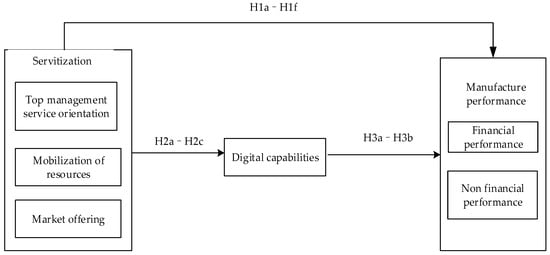
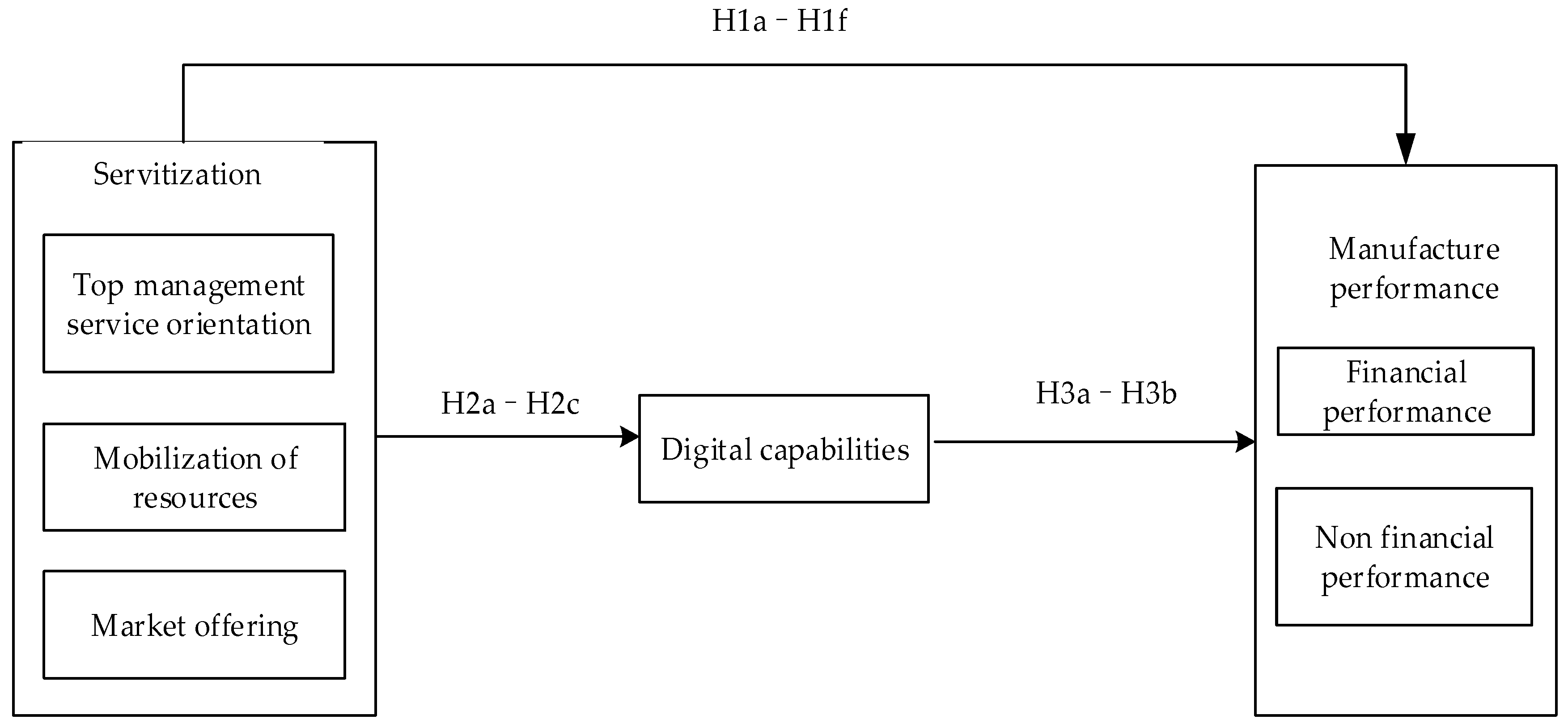
Combined with theoretical analysis, this study develops a model of the relationship between servitization, digital capability, and the performance of manufacturing firms based on the dynamic capability theory, Knowledge-Based View, and digitalization, as shown in Figure 1.
Figure 1.
Conceptual model.
4. Methodology
4.1. Empirical Data: Survey and Collection Procedures
This study uses a questionnaire-based survey to test its hypotheses. The sampling frame comprised manufacturing firms in China, which aligns with the research objectives and contextual focus of this investigation. Secondly, the questionnaire is mainly aimed at managers in manufacturing. In other words, the study focused on middle and senior managers from the R&D, production, marketing, and IT departments of enterprises. These manufacturing enterprises are primarily located in three provinces in eastern China. The study focused on regions with a strong industrial base and mature digital infrastructure—notably the Yangtze River Delta City Cluster (including Jiangsu, Zhejiang, and Shanghai), one of the world’s six major urban agglomerations—to ensure high-response quality and contextual relevance. This area remains a national leader in China, boasting exceptional economic vitality and advanced digital transformation. The provinces of Jiangsu and Zhejiang, along with Shanghai city, possess a robust industrial manufacturing base and have attracted a significant concentration of high-quality scientific and technological innovation enterprises. The main industries include machinery, electrical appliances, automobiles, food and drink, textiles and clothing, and other types of manufacturing. These industries are actively seeking service-oriented strategies and digital transformation. Therefore, manufacturing firms in the Jiangsu–Zhejiang–Shanghai region can be considered reasonably representative for this type of investigation. Furthermore, following the general principle in survey research, the sample size should theoretically be 5 to 10 times the number of variables under examination.
Regarding data collection, this study implemented strict controls over the survey timeline, target population, and distribution channels to ensure data authenticity and quality. The survey was conducted from August to December 2024, during which 600 questionnaires were randomly distributed, yielding 435 valid responses. A valid response rate of 93.95% was achieved. If it was found that the time taken to complete the questionnaire was too short, and that the options were regular, single, or lacking, the researchers chose to delete the questionnaire. The results of this study were acceptable (as shown in Table 1).
Table 1.
Questionnaire distribution and collection.
4.2. Construct Measurement and Control Variables
This study utilized measurement scales adapted from established literature. All constructs were evaluated using a seven-point Likert scale, with responses ranging from 1 (“strongly disagree”) to 7 (“strongly agree”). To ensure conceptual accuracy and linguistic equivalence, the original English items underwent a rigorous translation process involving forward translation into Chinese followed by independent back-translation into English.
First, building on the organizational innovation lens of Abou-Foul et al., this study operationalizes servitization through three subdimensions—top management service orientation, mobilization of resources, and market offering—using the COARSE scale development method [24,54]. In order to leverage the service-centric business model, manufacturing enterprises should focus on servitization investments in personnel, resources, and service offerings. Top management service orientation refers to the support of service transformation by the executive team. The three items focus on business executives’ commitment to servitization and the subsequent actions they have taken. Mobilization of resources requires enterprises to continuously pay attention to the rational allocation and mobilization of organizational resources. This dimension is measured by three main questions: employee support, resource commitment, and goal alignment. Market offering is equivalent to service offering and is a model of continuous innovation in the service-oriented transformation of manufacturing enterprises. This dimension was operationalized through three items designed to capture key aspects of the firm-customer relationship. Secondly, according to the studies of Hogan and Coote and Wang et al., manufacturing firm performance is categorized as financial or non-financial [33,74], and the construct of firm performance is measured using six items, primarily from the financial and non-financial performance dimensions. Thirdly, we refer to the definitions of digital capability and knowledge dynamic capability. We utilize Han’s scale and modify its specific items to reflect the context of this study [30]. The resulting scale uses six refined items to measure the digital capability of manufacturing firms. This scale assesses manufacturing enterprises’ capability to leverage digital technologies for knowledge creation through the dynamic processes of sensing, seizing, and transforming diverse digital resources from both internal and external environments. This study incorporated control variables identified in prior research as potential influencers of manufacturing performance, including firm age, scale, business type, and ownership structure [6,24]. These variables were treated as independent controls in the analytical models.
4.3. Multicollinearity Test
To assess potential multicollinearity among the variables, variance inflation factor (VIF) diagnostics were conducted. Following the conventional threshold (VIF < 10) established in prior research [75], all computed VIF values in this study ranged from 1.57 to 1.59, well below the critical value. This confirms the absence of severe multicollinearity in the regression models.
4.4. Control and Testing for Common Method Variation
Common method bias may lead to biased research results. Therefore, this study adopted two approaches to address the issue of common method bias.
First, procedural controls were implemented during the data collection phase. To minimize the risk of common method bias, the questionnaire distribution ensured a scientifically balanced representation of enterprises in terms of firm age, ownership type, firm size, and industry sector. The data collection process spanned five months from August to December 2024, which helped achieve a temporally even distribution and effective separation of sample data. Furthermore, the design of questionnaire items underwent multiple rounds of review to ensure semantic clarity, logical sequencing, and overall scientific rigor.
Second, statistical controls were applied. Using SPSS 26, exploratory factor analysis based on Harman’s single-factor test was conducted on the 21 measurement items in the questionnaire. The results indicated that six common factors where eigenvalues greater than 1 were extracted, cumulatively explaining 68.484% of the total variance. The variance contribution of the first common factor was 35.347%, which is below the 50% threshold. This suggests that common method bias is not a significant concern in the survey instrument used in this study.
5. Results and Findings
5.1. Descriptive Statistics
To obtain a preliminary understanding of the large-sample data structure, descriptive statistical analysis was conducted (see Table 2). The key characteristics are as follows: (1) Firm size: Enterprises with 500–1000 employees accounted for the highest proportion (53.1%), while those with over 1000 employees and under 500 employees represented 24.4% and 22.5%, respectively. (2) Firm age: Companies established for 6–10 years constituted the largest group (57.9%), followed by those older than 10 years (36.3%), and only 5.7% were under 5 years old. (3) Industry type: Legacy manufacturers and technology-driven emerging manufacturers accounted for 59.3% and 40.7%, respectively. (4) Ownership: State-owned enterprises represented 80.0%, with non-state-owned enterprises making up 20.0%.
Table 2.
Shows the descriptive statistical results.
5.2. Evaluation of Scale Reliability and Validity
For the empirical analysis, this study utilized SPSS 26.0. As summarized in Table 3, the validity of the measurement model was evaluated based on standardized factor loadings. All observed items exhibited loadings exceeding 0.50, meeting the recommended threshold established in prior methodological literature [75]. All Cronbach’s α reliability coefficients are higher than 0.8, suggesting excellent measurement reliability. Regarding the validity, composite reliability (CR) values are all greater than 0.8, indicating excellent aggregation validity. Meantime, the square root of the Average Variance Extracted (AVE) value for all variables is greater than the correlation coefficient of the same row, indicating that the discriminative validity fits the requirement [75].
Table 3.
Constructs, measurement items, and loadings.
5.3. Correlation
Table 4 presents descriptive statistics and correlation coefficients for all variables. Control variables are numerically coded as follows: 1 = firm age (age), 2 = firm size (size), 3 = industry type (industry), 4 = ownership (pro). Numbers 5–7 represent the three subdimensions of the independent variable servitization, which are top management service orientation, mobilization of resources, and market offering (SN0, SN1, and SN2 in Table 4). Number 8 represents the mediating variable, digital capability (DC in Table 4). Numbers 9–10 represent the two sub-dimensions of the dependent variable firm performance: financial performance and non-financial performance (FP, NFP in Table 4).
Table 4.
Correlation matrix.
Additionally, to assess discriminant validity, this study employed the Average Variance Extracted (AVE) method. Discriminant validity is established when the square root of each variable’s AVE is greater than its correlation coefficients with other variables. The results show that the square root of each variable’s AVE exceeds all corresponding correlation coefficients, confirming satisfactory discriminant validity in this study. The lower triangle of Table 4 presents the correlation coefficients.
5.4. Regression Analysis
Before verifying whether the hypotheses proposed in this study are supported, we first controlled for relevant control variables through models M1, 3, and 5, and then tested the significance of the direct effects (M2, M4, M6) and various hypotheses related to the mediating effects (M7, M8) in the research.
5.4.1. Direct Effect Test
From the regression results in Table 5, in model M2, Top management service orientation demonstrated a significant positive effect on financial performance (β = 0.285, p < 0.001), thus supporting hypothesis H1a. Similarly, mobilization of resources showed a significant positive relationship with financial performance (β = 0.276, p < 0.001), confirming hypothesis H1c. Furthermore, market offering also exhibited a significant positive effect (β = 0.226, p < 0.001), providing support for hypothesis H1e.
Table 5.
Hierarchical regression results.
In Model M4, top management service orientation demonstrated a significant positive effect on non-financial performance (β = 0.207, p < 0.001), supporting hypothesis H1b. Mobilization of resources also showed a significant positive effect (β = 0.301, p < 0.001), confirming hypothesis H1d. Furthermore, market offering exhibited a significant positive relationship with non-financial performance (β = 0.288, p < 0.001), thus validating hypothesis H1f.
In Model M6, top management service orientation demonstrated a significant positive effect on digital capabilities (β = 0.249, p < 0.001), supporting hypothesis H2a. Mobilization of resources also showed a significant positive relationship with digital capabilities (β = 0.211, p < 0.001), thus confirming hypothesis H2b. Furthermore, market offering exhibited a significant positive effect (β = 0.291, p < 0.001), validating hypothesis H2c.
5.4.2. Mediating Effect Test
In model M7, digital capability has a significant positive effect on financial performance (β = 0.163, p < 0.001), H3a is supported, and the coefficients of the effects of top management service orientation, mobilization of resources, and market offering on financial performance have decreased compared with model M2, but are still significant. It indicates that the digital capabilities have a partial mediating effect between top management service orientation, mobilization of resources, market offering, and financial performance; H4a–H4c are supported.
In model M8, digital capability has a significant positive effect on non-financial performance (β = 0.239, p < 0.001), and the coefficients of the effect of top management service orientation, mobilization of resources, and market offering on non-financial performance are decreased compared with model M4, but are still significant. It indicates that the digital capabilities have a partial mediating effect between top management service orientation, mobilization of resources, market offering, and non-financial performance, H4d–H4f are supported.
This study further quantifies the mediating mechanism of digital capability in the relationship between servitization and firm performance through causal mediation analysis. The results indicate a significantly positive total effect of servitization on firm performance (Model M7 = 0.246, Model M8 = 0.281). Effect decomposition shows that the mediation effect of digital capability accounts for 15.4% (ACME = 0.038) before controlling for variables, and increases to 22.4% (ACME = 0.063) after controlling for firm heterogeneity, suggesting that the mediating role of digital capability strengthens under different contextual conditions. While the direct effect of servitization remains predominant (77.6–84.6%), digital capability has demonstrated a non-negligible mediating role, thereby further confirming the theoretical and practical significance of the “servitization → digital capability → firm performance” transmission path.
5.4.3. Hypothesis Results
Table 6 presents the results of the research hypothesis tests. In Table 6, TMSE means top management service-orientation, mobilization of resources means MoR, and MO means market offering.
Table 6.
Hypothesis results.
6. Discussion and Implications
6.1. Conclusions
This study draws on Abou-foul et al. [22,52] to classify servitization into three sub-dimensions of top management service orientation, mobilization of resources, and market offering from the perspective of organizational innovation. It then examines the main effects of these three sub-dimensions on the financial and non-financial performance of manufacturing enterprises. The empirical results show that the three sub-dimensions of servitization of manufacturing firms, top management service orientation, mobilization of resources, and market offering, all have a significant positive effect on firm performance. This suggests that the implementation of a servitization strategy in Chinese manufacturing firms in the context of digital transformation should focus on the service-oriented thinking of the top team, the ability of internal and external resource allocation and mobilization, and the innovation ability of market offering. The emphasis placed by corporate decision-makers on service orientation facilitates the innovation of product service systems, enabling timely responses to customer needs, and thereby improving service performance, customer satisfaction, and market share. Secondly, mobilization of resources reflects manufacturing companies’ efforts to strengthen employees’ culture training and resource investment to support service transformation, reducing obstacles to service transformation, responding to customer needs in a timely manner, thereby improving customer satisfaction and enhancing corporate performance. Market offering is a part of a company’s product service system. It integrates the company’s products and services and takes over the customer’s business processes. This brings the company and its customers closer together, transforming the traditional transactional relationship into a relationship-based one. This reduces transaction costs between the company and its customers and fosters long-term cooperative relationships, which in turn help manufacturing companies achieve long-term, stable performance.
This study draws on the theories of digitalization, Knowledge-Based View, and dynamic capability to propose digital capabilities and finds that digital capabilities play a mediating role between servitization and corporate performance in manufacturing enterprises. This study also opens the theoretical “black box” from manufacturing servitization to corporate performance in a digital environment. It complements and refines existing research on digital capabilities, which often focuses on technical characteristics such as digital technology and digital skills [37,76]. Companies with digital capabilities will improve market offering, gaining timely insight into market changes, and meeting customer needs, thereby improving both economic and non-economic performance [37,60,64]. This study also points out new paths for guiding the practice of digital servitization in the Chinese manufacturing industry in the context of digital transformation and for avoiding the paradoxes of digitalization and servitization [77,78]. In other words, the focus of digital investment in manufacturing firms should be on developing a capability to serve the servitization strategy rather than remaining at the technological level.
6.2. Theoretical Contribution
Based on the research paradigm of “Behavior-Capability-Performance”, this paper explores how servitization impacts the performance of manufacturing enterprises in a digital environment. The research findings have theoretical value and practical significance for guiding the implementation of servitization and digitalization strategies in the Chinese manufacturing industry in the context of digital transformation, as well as for avoiding the so-called servitization and digitalization paradox.
This paper conceptualizes servitization in manufacturing firms as comprising three sub-dimensions: top management service orientation, mobilization of resources, and market offering. This approach is novel in the existing literature on servitization measurement and is based on the perspective of organizational innovation. Current measurement of servitization is often categorized into basic, intermediate, and advanced services by the level of product service system [64,79]. Some studies also suggest that the level of manufacturing servitization can be reflected by advanced services [70]. Therefore, servitization is measured in terms of the level of servitization, e.g., Kohtamäki et al. [12] categorize servitization into three sub-dimensions, namely, operational services (OSs), R&D services, and consulting services (CSs). In terms of the measurement of servitization, some scholars have also used the ratio of service revenue to the total revenue of the firm. Therefore, servitization measurement drawn from this study can reflect the organizational innovation behaviors and directions of servitization in manufacturing firms, as well as enrich the instrumental measurement in servitization research.
This study proposes digital capabilities based on the Knowledge-Based View and digital technology and examines the mediating role of digital capabilities in servitization strategy and manufacturing performance. Although the findings are different from Martín-Peña, Kohtamaki, Abou-foul, and other scholars [6,12,24] in discussing the relationship between servitization, digitalization, and firm performance, they are theoretically complementary to existing studies. This is because the findings of existing studies are not unified in the discussion of the relationship between servitization, digitalization, and firm performance. For example, the study by Abou-Foul et al. [24] shows that servitization plays a partially mediating role between firm digitalization and firm performance. Moreover, the findings of Martín-Pérez et al. [6] on the mediating role of digitalization between manufacturing servitization and performance are also contradictory to our research. Therefore, this study offers a novel theoretical perspective for understanding the convergence of digitalization and servitization. This study introduces the concept of digital capability and incorporates it into a research model combining manufacturing enterprises’ servitization and performance. This provides a new framework for understanding how manufacturing enterprises can avoid the paradoxes of servitization and digitalization.
This study refines the examination of the consequences of manufacturing servitization in a digital environment. Two dimensions of economic and non-economic performance of manufacturing enterprises are introduced in the examination of performance. And comparing with the studies of MartínPeña, Kohtamaki, Abou-foul, and other scholars [6,35,80] who only examined the economic performance of enterprises, we try to supplement the impact of the servitization of manufacturing enterprises on the non-economic performance of manufactures. Existing studies have concluded that the servitization of manufacturing firms in a digital environment not only facilitates the enhancement of firms’ economic performance, but also has an inevitable impact on society and the environmental performance [10,81]. Therefore, based on the above considerations, this study measures the impact of servitization on non-economic performance.
6.3. Managerial Implications
Our study also provides some practical insights. First of all, the servitization strategy, as an important strategy for manufacturing enterprises, should first be supported by the executive team of enterprises. The strong promotion of the executive team of the enterprise can ensure that the enterprise can obtain all kinds of resources when carrying out the servitization strategy, and that all kinds of resources can be reasonably allocated and utilized. In addition, the market offering of manufacturers is also an important factor in the successful implementation of servitization and realizing the expected benefits. The market offering comprises the product service systems provided by manufacturers. Manufacturing companies should continue to innovate and iterate on their market offering. Manufacturing companies rely on market offerings to meet customer needs, enhance customer loyalty, and improve business performance.
Secondly, manufacturing managers should pay great attention to the relationship between digitalization and digital capabilities. Digitalization is not equal to digital capabilities. Digitalization is not merely about investing in digital resources and overemphasizing the role of technology. If manufacturers place too much emphasis on digital investment, they may fall into the digitalization paradox. Digital capabilities encompass integrated technical, knowledge, and competency attributes that collectively form a critical enabler for manufacturing servitization. The results of the regression analysis indicate that digital capability plays an important mediating role between servitization and firm performance in manufacturing firms. This suggests that manufacturing firms must develop digital capabilities when implementing servitization strategies in a digital environment. This helps manufacturing companies to better understand their customers’ needs and respond to the market. It also improves their performance during the manufacturing servitization process.
Finally, how can managers effectively develop their digital capabilities? They should strengthen employee digital literacy training and build digital customer orientation [81], knowledge-based management systems. This will help them to correctly handle the relationship between the enterprise and its stakeholders. Moreover, companies should establish a knowledge governance framework to ensure seamless knowledge sharing and transmission. Enterprises should focus on digital technology investment, harnessing it to perceive, acquire, and reconstruct data resources—from internal operations to customer interactions—to gain timely insights into customer needs.
Meanwhile, manufacturing companies at different stages of digitalization face different challenges in building digital capabilities. Enterprises in the early stages should focus on training employees in digital literacy, whereas enterprises with a medium or high degree of digitalization should continue to increase investment in digital technology and strengthen stakeholder collaboration to enable knowledge sharing and promote knowledge-driven service innovation. Similarly, for legacy manufacturers, it is essential not only to enhance employees’ digital literacy but also to foster a shift toward a service innovation mindset. Meanwhile, emerging technology-driven manufacturers should avoid excessive investments in digital assets and instead integrate service innovation with digital capabilities to generate greater service demand.
7. Limitations and Future Research Directions
This study strictly adheres to the steps of empirical research and aims to be scientific in exploring the impact of servitization on manufacturing enterprise performance in a digital environment, but there are still some shortcomings that need to be addressed.
Both digitalization and servitization as separate constructs are more fully discussed in the existing literature. However, there is a lack of empirical research on the new construct of digital servitization, which converges servitization and digitalization. In terms of research methodology, many European scholars have focused their research on the new phenomenon of “digital servitization”, conducting qualitative research through single-case, double-case, and multiple-case studies. However, there is a lack of empirical and quantitative research.
In this study, we defined the digital capability of manufacturing enterprises as having three sub-dimensions: digital knowledge sensing capability, digital knowledge seizing capability, and digital knowledge reconfiguring capability. We also modified the measurement items based on existing research to ensure scientific measurement. However, in the empirical analysis of the model, we did not propose corresponding hypotheses for each sub-dimension of digital capabilities, nor did we verify the mediating role of each sub-dimension in the relationship between the servitization of manufacturing enterprises and performance. In other words, the mediating role of sub-dimensions of digital capabilities in the relationship between servitization and firm performance is not examined in detail. Future research needs to re-examine whether there are significant differences in the roles played by each sub-dimension of digital capabilities in the current model, thereby revealing more clearly the mediating role of digital capabilities between servitization and performance.
To improve the generalisability of this research—which is currently limited to two firm types (legacy and technology-driven emerging manufacturers)—future studies should expand the geographic sampling to encompass diverse cultural and regional contexts. Although the model effectively captures the direct and mediating effects, its consideration of contextual variables is limited. To address this, the study introduces moderating variables to further develop the research model.
In terms of manufacturing performance measurement, studies have examined the impact of servitization on performance by dividing performance into financial and non-financial dimensions. Nevertheless, assessing the impact of servitization on sustainable performance dimensions—particularly environmental and social outcomes—within digital contexts remains a critical avenue for future research.
Author Contributions
Conceptualization, H.Z. and Y.Z.; methodology, C.W.; software, H.Z.; validation, C.W.; formal analysis, C.W.; investigation, Y.X.; resources, H.Z. and Y.Z.; data curation, Y.X.; writing—original draft preparation, H.Z.; writing—review and editing, H.Z. and Y.Z.; visualization, C.W. and Y.X. All authors have read and agreed to the published version of the manuscript.
Funding
This research was funded by General Projects of Philosophy and Social Science Research of Jiangsu Educational Committee 2020 (2020SJA1773).
Institutional Review Board Statement
Not applicable.
Informed Consent Statement
Not applicable.
Data Availability Statement
The data are not publicly available due to privacy.
Conflicts of Interest
The authors declare no conflicts of interest.
References
- Vandermerwe, S.; Rada, J. Servitization of Business: Adding Value by Adding Services. Eur. Manag. J. 1988, 6, 314–324. [Google Scholar] [CrossRef] [Scilit]
- Raddats, C.; Kowalkowski, C.; Benedettini, O.; Burton, J.; Gebauer, H. Servitization: A Contemporary Thematic Review of Four Major Research Streams. Ind. Mark. Manag. 2019, 83, 207–223. [Google Scholar] [CrossRef] [Scilit]
- Baines, T.S.; Lightfoot, H.W.; Benedettini, O.; Kay, J.M. The Servitization of Manufacturing. J. Manuf. Technol. Manag. 2009, 20, 547–567. [Google Scholar] [CrossRef] [Scilit]
- Dmitrijeva, J.; Schroeder, A.; Bigdeli, A.Z.; Baines, T. Paradoxes in Servitization: A Processual Perspective. Ind. Mark. Manag. 2022, 101, 141–152. [Google Scholar] [CrossRef] [Scilit]
- Lyu, T.; Lyu, X.; Chen, H.; Zhao, Q. Breaking Away from Servitization Paradox to Improve Manufacturing Enterprises’ Service Innovation Performance: The Roles of Market Orientation and Service Supply Chain Dynamic Capability. J. Organ. Change Manag. 2023, 36, 848–874. [Google Scholar] [CrossRef] [Scilit]
- Martin-Pena, M.L.; SanchezLopez, J.M.; DiazGarrido, E. Servitization and Digitalization in Manufacturing: The Influence on Firm Performance. J. Bus. Ind. Mark. 2019, 35, 564–574. [Google Scholar] [CrossRef] [Scilit]
- Tapia, E.; SastoquePinilla, L.; LopezNovoa, U.; Bediaga, I.; López de Lacalle, N. Assessing Industrial Communication Protocols to Bridge the Gap between Machine Tools and Software Monitoring. Sensors 2023, 23, 5694. [Google Scholar] [CrossRef] [Scilit]
- Bongomin, O.; Mwape, M.C.; Mpofu, N.S.; Bahunde, B.K.; Kidega, R.; Mpungu, I.L.; Tumusiime, G.; Owino, C.A.; Goussongtogue, Y.M.; Yemane, A.; et al. Digital Twin Technology Advancing Industry 4.0 and Industry 5.0 across Sectors. Results Eng. 2025, 26, 105583. [Google Scholar] [CrossRef] [Scilit]
- Tapia, E.; LopezNovoa, U.; SastoquePinilla, L.; LópezdeLacalle, L.N. Implementation of a Scalable Platform for Real-Time Monitoring of Machine Tools. Comput. Ind. 2024, 155, 104065. [Google Scholar] [CrossRef] [Scilit]
- Paschou, T.; Rapaccini, M.; Adrodegari, F.; Saccani, N. Digital Servitization in Manufacturing: A Systematic Literature Review and Research Agenda. Ind. Mark. Manag. 2020, 89, 278–292. [Google Scholar] [CrossRef] [Scilit]
- Ancillai, C.; Sabatini, A.; Gatti, M.; Perna, A. Digital Technology and Business Model Innovation: A Systematic Literature Review and Future Research Agenda. Technol. Forecast. Soc. Change 2023, 188, 122307. [Google Scholar] [CrossRef] [Scilit]
- Kohtamaki, M.; Parida, V.; Patel, P.C.; Gebauer, H. The Relationship between Digitalization and Servitization: The Role of Servitization in Capturing the Financial Potential of Digitalization. Technol. Forecast. Soc. Change 2020, 151, 119804. [Google Scholar] [CrossRef] [Scilit]
- Matt, D.T.; Pedrini, G.; Bonfanti, A.; Orzes, G. Industrial Digitalization. A Systematic Literature Review and Research Agenda. Eur. Manag. J. 2023, 41, 47–78. [Google Scholar] [CrossRef] [Scilit]
- SastoquePinilla, L.; Artelt, S.; Burimova, A.; Lopez de Lacalle, N.; ToledoGandarias, N. Project Success Criteria Evaluation for a Project-Based Organization and Its Stakeholders—A QMethodology Approach. Appl. Sci. 2022, 12, 11090. [Google Scholar] [CrossRef] [Scilit]
- Shen, L.; Sun, W.; Parida, V. Consolidating Digital Servitization Research: A Systematic Review, Integrative Framework, and Future Research Directions. Technol. Forecast. Soc. Change 2023, 191, 122478. [Google Scholar] [CrossRef] [Scilit]
- Kohtamaki, M.; Parida, V.; Oghazi, P.; Gebauer, H.; Baines, T. Digital Servitization Business Models in Ecosystems: A Theory of the Firm. J. Bus. Res. 2019, 104, 380–392. [Google Scholar] [CrossRef] [Scilit]
- Toth, Z.; Sklyar, A.; Kowalkowski, C.; Sorhammar, D.; Tronvoll, B.; Wirths, O. Tensions in digital servitization through a paradox lens. Ind. Mark. Manag. 2022, 102, 438–450. [Google Scholar] [CrossRef] [Scilit]
- Struwe, S.; Slepniov, D. Unlocking Digital Servitization: A Conceptualization of Value CoCreation Capabilities. J. Bus. Res. 2023, 160, 113825. [Google Scholar] [CrossRef] [Scilit]
- Ayala, N.F.; da Silva, J.R.; Tinoco, M.A.C.; Saccani, N.; Frank, A.G. Artificial Intelligence Capabilities in Digital Servitization: Identifying Digital Opportunities for Different Service Types. Int. J. Prod. Econ. 2025, 284, 109604. [Google Scholar] [CrossRef] [Scilit]
- Marcon, E.; Marcon, A.; Ayala, N.F.; Frank, A.G.; Story, V.; Burton, J.; Raddats, C.; Zolkiewski, J. Capabilities Supporting Digital Servitization: A MultiActor Perspective. Ind. Mark. Manag. 2022, 103, 97–116. [Google Scholar] [CrossRef] [Scilit]
- Karatzas, A.; Dousios, D.; Raja, J.Z.; Papadopoulos, G. An exploration of digital servitization business models in manu-facturing SMEs. J. Small Bus. Manag. 2025, 63, 2644–2687. [Google Scholar] [CrossRef] [Scilit]
- Minaya, P.E.; Avella, L.; Trespalacios, J.A. Synthesizing Three Decades of Digital Servitization: A Systematic Literature Review and Conceptual Framework Proposal. Serv. Bus. 2024, 18, 193–222. [Google Scholar] [CrossRef] [Scilit]
- Ardolino, M.; Rapaccini, M.; Saccani, N.; Gaiardelli, P.; Crespi, G.; Ruggeri, C. The Role of Digital Technologies for the Service Transformation of Industrial Companies. Int. J. Prod. Res. 2018, 56, 2116–2132. [Google Scholar] [CrossRef] [Scilit]
- Abou-foul, M.; RuizAlba, J.L.; Soares, A. The Impact of Digitalization and Servitization on the Financial Performance of a Firm: An Empirical Analysis. Prod. Plan. Control 2021, 32, 975–989. [Google Scholar] [CrossRef] [Scilit]
- Chen, L.; Dai, Y.; Ren, F.; Dong, X. Data-Driven Digital Capabilities Enable Servitization StrategyFrom Service Supporting the Product to Service Supporting the Client. Technol. Forecast. Soc. Change 2023, 197, 122901. [Google Scholar] [CrossRef] [Scilit]
- Zhou, D.; Kautonen, M.; Dai, W.; Zhang, H. Exploring How Digitalization Influences Incumbents in Financial Services: The Role of Entrepreneurial Orientation, Firm Assets, and Organizational Legitimacy. Technol. Forecast. Soc. Change 2021, 173, 121120. [Google Scholar] [CrossRef] [Scilit]
- Ahn, C. Servitization Review: Focused on Domestic Researches. J. Korean Prod. Oper. Manag. Soc. 2022, 33, 417–432. [Google Scholar] [CrossRef] [Scilit]
- Baines, T.; Lightfoot, H.W. Servitization of the Manufacturing Firm Exploring the Operations Practices and Technologies That Deliver Advanced Services. Int. J. Oper. Prod. Manag. 2014, 34, 2–35. [Google Scholar] [CrossRef] [Scilit]
- Romero, D.; Gaiardelli, P.; Pezzotta, G.; Cavalieri, S. The Impact of Digital Technologies on Services Characteristics: Towards Digital Servitization. In IFIP Advances in Information and Communication Technology; Ameri, F., Stecke, K.E., VonCieminski, G., Kiritsis, D., Eds.; Springer: Cham, Switzerland, 2019; pp. 493–501. ISBN 9783030300005. [Google Scholar]
- Han, Y.; Li, D. Effects of Intellectual Capital on Innovative Performance. Manag. Decis. 2015, 53, 40–56. [Google Scholar] [CrossRef] [Scilit]
- Akter, S.; Wamba, S.F.; Gunasekaran, A.; Dubey, R.; Childe, S.J. How to Improve Firm Performance Using Big Data Analytics Capability and Business Strategy Alignment? Int. J. Prod. Econ. 2016, 182, 113–131. [Google Scholar] [CrossRef] [Scilit]
- Ambroise, L.; PrimAllaz, I.; Teyssier, C.; Peillon, S. The Environment-Strategy-Structure Fit and Performance of Industrial Servitized SMEs. J. Serv. Manag. 2018, 29, 301–328. [Google Scholar] [CrossRef] [Scilit]
- Wang, X.; Gu, Y.; Ahmad, M.; Xue, C. The Impact of Digital Capability on Manufacturing Company Performance. Sustainability 2022, 14, 6214. [Google Scholar] [CrossRef] [Scilit]
- Galvani, S.; Carloni, E.; Bocconcelli, R.; Pagano, A. From AfterSales to Advanced Services: A Network Analysis on the Impacts of Digital Servitization Evolution. Sustainability 2022, 14, 8308. [Google Scholar] [CrossRef] [Scilit]
- Kohtamaki, M.; Rabetino, R.; Parida, V.; Sjodin, D.; Henneberg, S. Managing Digital Servitization toward Smart Solutions: Framing the Connections between Technologies, Business Models, and Ecosystems. Ind. Mark. Manag. 2022, 105, 253–267. [Google Scholar] [CrossRef] [Scilit]
- Benedettini, O. Structuring ServitizationRelated Capabilities: A Data-Driven Analysis. Sustainability 2022, 14, 5478. [Google Scholar] [CrossRef] [Scilit]
- Ciampi, F.; Demi, S.; Magrini, A.; Marzi, G.; Papa, A. Exploring the Impact of Big Data Analytics Capabilities on Business Model Innovation: The Mediating Role of Entrepreneurial Orientation. J. Bus. Res. 2021, 123, 1–13. [Google Scholar] [CrossRef] [Scilit]
- Cuthbertson, R.W.; Furseth, P.I. Digital Services and Competitive Advantage: Strengthening the Links between RBV, KBV, and Innovation. J. Bus. Res. 2022, 152, 168–176. [Google Scholar] [CrossRef] [Scilit]
- Grant, R.M. The Knowledge-Based View of the Firm: Implications for Management Practice. Long Range Plann. 1997, 30, 450–454. [Google Scholar] [CrossRef] [Scilit]
- Grant, R.M. Toward a Knowledge-Based Theory of the Firm. Strateg. Manag. J. 1996, 17, 109–122. [Google Scholar] [CrossRef] [Scilit]
- Valtakoski, A. Explaining Servitization Failure and Deservitization: A Knowledge-Based Perspective. Ind. Mark. Manag. 2017, 60, 138–150. [Google Scholar] [CrossRef] [Scilit]
- Ambroise, L.; PrimAllaz, I.; Teyssier, C. Financial Performance of Servitized Manufacturing Firms: A Configuration Issue between Servitization Strategies and Customer-Oriented Organizational Design. Ind. Mark. Manag. 2018, 71, 54–68. [Google Scholar] [CrossRef] [Scilit]
- Jang, K.K.; Bae, J.; Kim, K.H. Servitization Experience Measurement and the Effect of Servitization Experience on Brand Resonance and Customer Retention. J. Bus. Res. 2021, 130, 384–397. [Google Scholar] [CrossRef] [Scilit]
- Teece, D.J. Explicating Dynamic Capabilities: The Nature and Microfoundations of (Sustainable) Enterprise Performance. Strateg. Manag. J. 2007, 28, 1319–1350. [Google Scholar] [CrossRef] [Scilit]
- BadenFuller, C.; Teece, D.J. Market Sensing, Dynamic Capability, and Competitive Dynamics. Ind. Mark. Manag. 2020, 89, 105–106. [Google Scholar] [CrossRef] [Scilit]
- Tortora, D.; Chierici, R.; Farina Briamonte, M.; Tiscini, R. ‘I Digitize so I Exist’. Searching for Critical Capabilities Affecting Firms’ Digital Innovation. J. Bus. Res. 2021, 129, 193–204. [Google Scholar] [CrossRef] [Scilit]
- Sun, X.; Zhang, Q. How Can Dynamic Capabilities Make Sense in Avoiding Value CoCreation Traps? Manag. Decis. 2022, 60, 735–757. [Google Scholar] [CrossRef] [Scilit]
- Vandermerwe, S.; Erixon, D. Servitization of Business Updated: Now, New, Next. Eur. Manag. J. 2023, 41, 479–487. [Google Scholar] [CrossRef] [Scilit]
- Kastalli, I.V.; Van Looy, B. Servitization: Disentangling the Impact of Service Business Model Innovation on Manufacturing Firm Performance. J. Oper. Manag. 2013, 31, 169–180. [Google Scholar] [CrossRef] [Scilit]
- Ambedkar, K.G. Prakash Evolving Dynamic Capabilities: Exploring Implications of Industry 4.0 Digital Technologies on Manufacturing. IEEE Trans. Eng. Manag. 2024, 71, 5455–5469. [Google Scholar] [CrossRef] [Scilit]
- Cesaretto, R.; Buratto, A.; De Giovanni, P. Mitigating the Feature Fatigue Effect for Smart Products through Digital Servitization. Comput. Ind. Eng. 2021, 156, 107218. [Google Scholar] [CrossRef] [Scilit]
- Bustinza, O.F.; Molina, L.M.; VendrellHerrero, F.; OpazoBasaez, M. AIEnabled Smart Manufacturing Boosts Ecosystem Value Capture: The Importance of Servitization Pathways within DigitalIntensive Industries. Int. J. Prod. Econ. 2024, 277, 109411. [Google Scholar] [CrossRef] [Scilit]
- Chowdhury, S.; Ren, S.; Richey Jnr, R.G. Leveraging Artificial Intelligence to Facilitate Green Servitization: Resource Orchestration and ReInstitutionalization Perspectives. Int. J. Prod. Econ. 2025, 281, 109519. [Google Scholar] [CrossRef] [Scilit]
- Rossiter, J.R. The COARSE Procedure for Scale Development in Marketing. Int. J. Res. Mark. 2002, 19, 305–335. [Google Scholar] [CrossRef] [Scilit]
- Villanueva, J.; Van de Ven, A.H.; Sapienza, H.J. Resource Mobilization in Entrepreneurial Firms. J. Bus. Ventur. 2012, 27, 19–30. [Google Scholar] [CrossRef] [Scilit]
- Suesse, T.; Wilkens, U.; Hohagen, S.; Artinger, F. Digital Competence of Stakeholders in ProductService Systems (PSS): Conceptualization and Empirical Exploration; Sakao, T., Lindahl, M., Liu, Y., Dalhammar, C., Eds.; Elsevier: Amsterdam, The Netherlands, 2018; Volume 73, pp. 197–202. [Google Scholar]
- Chowdhury, S.; Haftor, D.; Pashkevich, N. Smart ProductService Systems (Smart PSS) in Industrial Firms: A Literature Review. In Proceedings of the 10th CIRP Conference on Industrial Product-Service Systems, IPS2 2018, Linköping, Sweden, 29–31 May 2018; Volume 73, pp. 26–31. [Google Scholar] [CrossRef] [Scilit]
- Cenamor, J.; Rönnberg Sjödin, D.; Parida, V. Adopting a Platform Approach in Servitization: Leveraging the Value of Digitalization. Int. J. Prod. Econ. 2017, 192, 54–65. [Google Scholar] [CrossRef] [Scilit]
- Lenka, S.; Parida, V.; Wincent, J. Digitalization Capabilities as Enablers of Value CoCreation in Servitizing Firms. Psychol. Mark. 2017, 34, 92–100. [Google Scholar] [CrossRef] [Scilit]
- Altmann, P.; Linder, M. Managing Emerging (Mis)Alignments in Data-Driven Servitization. Res. Technol. Manag. 2019, 62, 37–45. [Google Scholar] [CrossRef] [Scilit]
- Blichfeldt, H.; Faullant, R. Performance Effects of Digital Technology Adoption and Product & Service InnovationA ProcessIndustry Perspective. Technovation 2021, 105, 102275. [Google Scholar] [CrossRef] [Scilit]
- Burton, J.; Story, V.M.; Zolkiewski, J.; Nisha, N. Digital Service Innovation Challenges Faced during Servitization: A Multi-Level Perspective. J. Serv. Manag. 2024, 35, 202–226. [Google Scholar] [CrossRef] [Scilit]
- Porter, M.E.; Heppelmann, J.E. How Smart, Connected Products Are Transforming Competition. Harv. Bus. Rev. 2014, 92, 64–88. [Google Scholar]
- Jia, Y.; Cui, L.; Su, J.; Wu, L.; Akter, S.; Kumar, A. Digital Servitization in Digital Enterprise: Leveraging Digital Platform Capabilities to Unlock Data Value. Int. J. Prod. Econ. 2024, 278, 109434. [Google Scholar] [CrossRef] [Scilit]
- Kanninen, T.; Penttinen, E.; Tinnilä, M.; Kaario, K. Exploring the Dynamic Capabilities Required for Servitization. Bus. Process Manag. J. 2017, 23, 226–247. [Google Scholar] [CrossRef] [Scilit]
- Barney, J.B. Resource-Based Theories of Competitive Advantage: A TenYear Retrospective on the Resource-Based View. J. Manag. 2001, 27, 643–650. [Google Scholar] [CrossRef]
- Ma, R.; Jiang, L.; Wang, T.; Wang, X.; Ruan, J. How Do Manufacturing Companies and Service Providers Share Knowledge in the Context of Servitization? An EvolutionaryGame Model of Complex Networks. Int. J. Prod. Res. 2023, 61, 4279–4301. [Google Scholar] [CrossRef] [Scilit]
- Westerman, G.; Bonnet, D.; McAfee, A. The Nine Elements of Digital Transformation. MIT Sloan Manag. Rev. 2014, 55, 1–6. [Google Scholar]
- Kilinc, T.; Sjodin, D.; Parida, V. Navigating Digital Servitization for the Twin Transition: How Manufacturers Can Support Customers With Digitalization and Sustainability. Bus. Strategy Environ. 2025, 34, 5370–5385. [Google Scholar] [CrossRef] [Scilit]
- Euchner, J.; Palmer, T. Servitization: The Journey to Advanced Services A Conversation with Tom Palmer. Res. Technol. Manag. 2024, 67, 13–20. [Google Scholar] [CrossRef] [Scilit]
- Zheng, S.; Zhang, W.; Wu, X.; Du, J. Knowledge-Based Dynamic Capabilities and Innovation in Networked Environments. J. Knowl. Manag. 2011, 15, 1035–1051. [Google Scholar] [CrossRef] [Scilit]
- Dyer, J.; Singh, H. The Relational View: Cooperative Strategy and Sources of Interorganizational Competitive Advantage. Acad. Manag. Rev. 1998, 23, 660–679. [Google Scholar] [CrossRef] [Scilit]
- Wu, X.; Tang, Y.; Fang, X.; Xu, Y.; Qiao, S. The Effects of Servitization, Digitalization, and Digital Learning Orientation on Sustainable Performance: A Hybrid PLSSEMANN Model. IEEE Access 2025, 13, 30570–30585. [Google Scholar] [CrossRef] [Scilit]
- Hogan, S.J.; Coote, L.V. Organizational Culture, Innovation, and Performance: A Test of Schein’s Model. J. Bus. Res. 2014, 67, 1609–1621. [Google Scholar] [CrossRef] [Scilit]
- Kowalkowski, C.; Kindstrom, D.; Gebauer, H. ICT as a Catalyst for Service Business Orientation. J. Bus. Ind. Mark. 2013, 28, 506–513. [Google Scholar] [CrossRef] [Scilit]
- Kohtamaki, M.; Einola, S.; Rabetino, R. Exploring Servitization through the Paradox Lens: Coping Practices in Servitization. Int. J. Prod. Econ. 2020, 226, 107619. [Google Scholar] [CrossRef] [Scilit]
- Eggert, C.G.; Winkler, C.; Volkmann, A.; Schumann, J.H.; Wuenderlich, N.V. Understanding Intra and Interorganizational Paradoxes Inhibiting Data Access in Digital Servitization. Ind. Mark. Manag. 2022, 105, 404–421. [Google Scholar] [CrossRef] [Scilit]
- Baines, T.; Bigdeli, A.Z.; Sousa, R.; Schroeder, A. Framing the Servitization Transformation Process: A Model to Understand and Facilitate the Servitization Journey. Int. J. Prod. Econ. 2020, 221, 107463. [Google Scholar] [CrossRef] [Scilit]
- BilbaoUbillos, J.; CaminoBeldarrain, V.; IntxaurburuClemente, G.; VelascoBalmaseda, E. Industry 4.0, Servitization, and Reshoring: A Systematic Literature Review. Eur. Res. Manag. Bus. Econ. 2024, 30, 100234. [Google Scholar] [CrossRef] [Scilit]
- Kopalle, P.K.; Kumar, V.; Subramaniam, M. How Legacy Firms Can Embrace the Digital Ecosystem via Digital Customer Orientation. J. Acad. Mark. Sci. 2020, 48, 114–131. [Google Scholar] [CrossRef] [Scilit]
- Vaillant, Y.; Lafuente, E. digital versus non-digital servitization for environmental and non-financial performance benefits. J. Clean. Prod. 2024, 450, 142078. [Google Scholar] [CrossRef] [Scilit]

Disclaimer/Publisher’s Note: The statements, opinions and data contained in all publications are solely those of the individual author(s) and contributor(s) and not of MDPI and/or the editor(s). MDPI and/or the editor(s) disclaim responsibility for any injury to people or property resulting from any ideas, methods, instructions or products referred to in the content. |
© 2025 by the authors. Licensee MDPI, Basel, Switzerland. This article is an open access article distributed under the terms and conditions of the Creative Commons Attribution (CC BY) license.