1. Introduction
1.1. Research Background
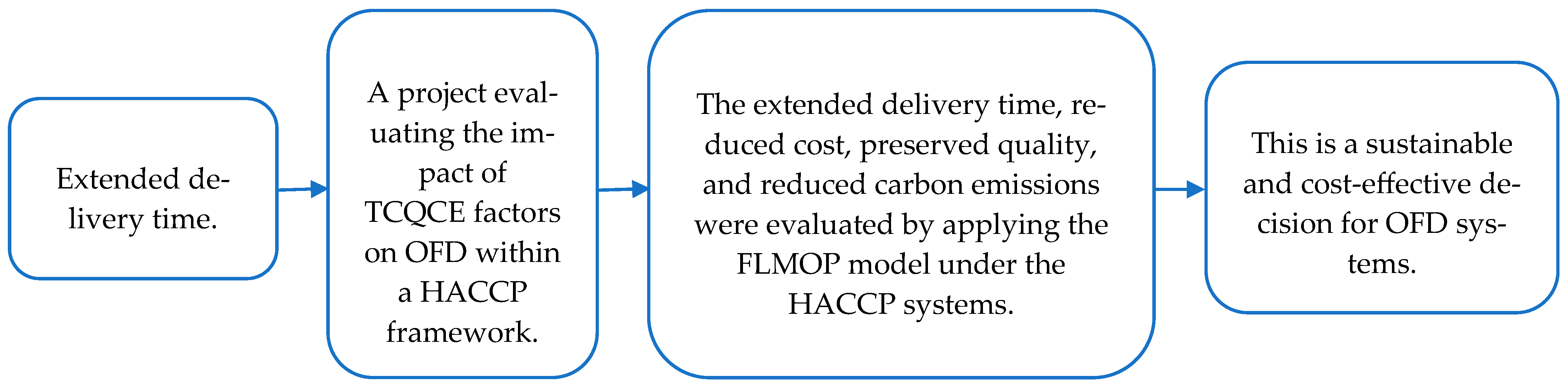
In an era of convenience and sustainability, optimizing systems to meet consumer demand while minimizing environmental impact is a crucial goal for businesses delivering food. According to National Statistics (Taiwan), the number of online food delivery (OFD) drivers in Taiwan reached approximately 150,000 in 2024. How can 150,000 people contribute to carbon emissions, to what extent, and what are the associated costs? Consequently, the primary objective of this study is to explore strategies that enable the controlled extension of food delivery time, increase order volume, and balance cost, delivery efficiency, and carbon emissions. Ultimately, the goal is to optimize food delivery decisions by achieving an efficient trade-off among delivery time, cost, quality, and environmental impact.
1.2. Analysis of Research Status and Solutions
Seghezzi, Winkenbach, and Mangiaracina (2021) [
1] emphasize the need to balance various factors. Delaney, Wolfenden, and Wyse (2023) [
2] further underscore the importance of carefully managing time, cost, and quality within food delivery strategies, while adhering to Hazard Analysis and Critical Control Point (HACCP) protocols, to ensure food safety and quality. Maiyar et al. (2023) [
3] utilized a linear programming model to examine the trade-offs associated with the costs of employing temperature control technology, the types of food delivered, transportation distances, and perceived food waste costs. Zhong et al. (2024) [
4] indicate that stringent quality assurance protocols should include implementing carbon emission reduction methods, a critical control mechanism for meeting global sustainable development targets. Ahmadi-Javid et al. (2023) [
5] and Chiang (2024) [
6] further explored temperature-controlled distribution and time-extension strategies to reduce costs and emissions. However, most of these studies suffer from several critical limitations:
(1) Most studies typically focus on only one or two objectives and rarely integrate time, cost, quality, and carbon emissions (TCQCE) simultaneously in a single framework.
(2) Although HACCP standards are frequently mentioned as essential food safety requirements, few models explicitly incorporate the strict temperature constraint (temperature > 63 °C) as a hard constraint in the optimization process.
(3) The majority rely on deterministic approaches (e.g., linear programming or mixed-integer programming) that fail to adequately address real-world uncertainties such as fluctuating traffic conditions, variable delivery times, and imprecise cost estimations.
(4) While extending delivery time windows has been recognized as an effective strategy for batching and emission reduction, no existing study has systematically combined fuzzy set theory with multi-objective linear programming under HACCP constraints to achieve a comprehensive TCQCE balance. These gaps highlight the need for a more robust and integrated decision-making model that can simultaneously handle multiple conflicting objectives, food safety regulations, and operational uncertainties in OFD systems.
1.3. Analysis of Existing Problems
Developing technologies that maintain and monitor storage temperatures offers clear benefits for perishable goods transported over long distances, reducing both spoilage and financial losses. Yet, existing studies remain incomplete: most studies explore trade-offs among delivery time, food quality, and cost-effectiveness, while the critical issue of carbon emission reduction is frequently neglected (Maiyar et al., 2023) [
3]. Chiang (2024) [
6] demonstrated that extending delivery times can lower costs and emissions; however, his model failed to incorporate a comprehensive HACCP system to ensure food safety. Likewise, Kedia et al. (2024) [
7] found that consumers accept longer delivery windows; however, industry practices still emphasize ultra-fast delivery during peak hours, thereby missing opportunities to advance sustainability. The deeper challenge lies in the reliance on single-objective or deterministic frameworks, which cannot simultaneously optimize TCQCE while meeting HACCP temperature constraints (>63 °C). These models also falter when confronted with urban uncertainties such as traffic congestion, variable travel times, and imprecise cost estimates. No existing study has systematically combined fuzzy set theory with multi-objective linear programming under strict HACCP requirements to resolve these conflicts. Addressing this gap requires a new optimization framework that unites multiple objectives and enforces food safety as a non-negotiable constraint.
1.4. Methods and Advantages
This study introduces a fuzzy linear multi-objective programming (FLMOP) model to optimize Taiwan’s online food delivery OFD systems by integrating TCQCE while strictly complying with HACCP safety standards (>63 °C). This proposed model integrates fuzzy set theory with multi-objective optimization to address uncertainties, including variable delivery times, fluctuating costs, and imprecise quality measures, thereby enabling a balanced treatment of conflicting objectives.
This methodological design incorporates controlled delivery-time extensions and order batching as operational strategies within the optimization framework. Comparative structures are established against mixed-integer linear programming (MILP) and genetic algorithms/non-dominated sorting genetic algorithm II (GA/NSGA-II) to evaluate methodological robustness. Within the FLMOP framework, centroid defuzzification is employed to enhance decision accuracy, offering a systematic approach superior to the mean of maximum (MOM) method.
This methodological advancement positions FLMOP as a comprehensive optimization tool capable of managing uncertainty and reconciling multiple conflicting objectives in sustainable operations for OFD.
1.5. Main Content and Contribution of the Work
Developed the first FLMOP framework that simultaneously optimizes TCQCE under strict HACCP constraints. Demonstrated that controlled delivery-time extension with order batching reduces carbon emissions by 20% and lowers per-delivery costs by 15% under high order volumes, while maintaining 89.3% food quality. Established a computationally efficient decision-making tool, outperforming MILP and GA/NSGA-II by 5–8% in emission reduction, and effectively managing real-world uncertainties through fuzzy set theory and centroid defuzzification. Decision-makers can leverage these findings to strike a balance between sustainability goals and operational efficiency, thereby ensuring compliance with food safety standards and regulations. This framework further provides actionable guidelines for scaling OFD operations while minimizing environmental impact and economic risk.
2. Literature Review
Delivery constitutes a critical dimension of sustainable development. Beyond satisfying consumers’ immediate demands, delivery systems must also consider their environmental impact, particularly in terms of carbon emissions. The overarching objective is to ensure compliance with food quality standards by striking a balance between cost-effectiveness, delivery time, and compatibility with HACCP requirements. This study addresses these concerns by reviewing the literature on extended delivery times, cost savings, food quality, and carbon emission reduction.
Allen et al. (2021) [
8] documented the rapid increase in the use of bicycles, mopeds, and cars by delivery drivers transporting food from restaurants and fast-food outlets, based on an international review of platform providers in London. Their findings reveal that the average driver completes 9.6 deliveries per day, each requiring approximately 25 min from pickup to delivery, with an average distance of 2.2 km (1.4 miles) and a total daily travel distance of 41.3 km (25.7 miles). The case study highlights that cars and motorcycles generate significant greenhouse gas emissions, with food delivery via motorized vehicles producing five to eleven times more emissions than bicycles.
Muñoz-Villamizar et al. (2022) [
9] emphasized the role of consumer purchasing behavior in shaping demand patterns and improving supply chain efficiency by encouraging tolerance for extended delivery durations. Using a mixed-integer linear programming (MILP) model and data from a major Mexican retail corporation, the study evaluated distance, transportation costs, and CO
2 emissions. Results indicate that reducing distance alone is not always the most optimal approach. Extending delivery windows to four days can reduce total distance by 57%, overall expenses by 61%, and fuel usage and CO
2 emissions by 56%.
Kedia et al. (2024) [
7] identified reduced delivery times as a critical factor in achieving competitive advantage, particularly for products with short shelf lives. The study employed an objective function that minimizes delivery time while estimating fuel consumption and CO
2 emissions. The proposed algorithm effectively searched for feasible solutions across a wide range of scenarios.
He et al. (2024) [
10] applied a game theory model to examine how sensitivity to delivery time and carbon emissions influences corporate decision-making. The analysis revealed complex interactions, underscoring that delivery time exerts a substantial influence on food delivery operations. Effective carbon emission control depends on optimizing delivery time, thereby ensuring both quality assurance and environmental sustainability.
Delivery time management thus emerges as a pivotal intermediary variable in delivery services, directly affecting service quality and operational efficiency. It functions as a critical nexus linking business performance with environmental sustainability. Appropriate time management strategies can simultaneously reduce carbon emissions and improve operational efficiency by dynamically leveraging extended delivery windows to balance ecological and economic objectives.
Li, Mirosa, and Bremer (2020) [
11] conducted a literature review on the sustainability implications of OFD platforms from economic, social, and environmental perspectives. Economically, OFD services generate employment and revenue streams, but impose high commissions on restaurants and increase menu prices. Socially, these platforms influence public health outcomes and reshape transportation systems, altering consumer relationships with food. Environmentally, OFD contributes to waste generation, packaging costs, and a substantial carbon footprint.
Liu et al. (2023) [
12] examined logistics trends during the COVID-19 pandemic, focusing on community group buying markets. They developed a low-carbon vehicle distribution route optimization model using AHP-EW fusion technology to calculate carbon emissions and cost weights. By comparing traditional genetic algorithms with ant colony optimization, the study demonstrated effective reductions in distribution costs and emissions, thereby promoting energy conservation and sustainable development.
From a cost perspective, OFD platforms introduce additional expenses; however, implementing multiple-order strategies can mitigate these costs. Incorporating time management models to extend consumer waiting times offers further potential for reducing carbon emissions.
Singh et al. (2024) [
13] investigated changes in Indian consumers’ preferences for OFD service attributes during the COVID-19 pandemic using conjoint analysis. The study found that order size significantly influences consumer priorities: small orders emphasize delivery time, whereas larger orders prioritize packaging quality. Consumers demonstrated the highest willingness to pay for food quality, followed by convenience and packaging quality. During the pandemic, heightened awareness of health and safety increased preferences for food and packaging quality, providing OFD operators with actionable insights for service optimization.
Ma et al. (2024) [
14] quantitatively analyzed the correlation between service quality and consumer satisfaction in OFD services using a Kano model survey of 580 Singaporean consumers. Results indicate that food quality, delivery reliability, customer service responsiveness, user-friendliness of digital platforms, and promotional offers are key drivers of consumer satisfaction across performance tiers. These findings reinforce the central role of food quality in shaping consumer preferences and satisfaction.
Yakavenka et al. (2020) [
15] explored sustainable supply chain design for perishable goods, emphasizing compliance with consumer safety criteria while reducing costs and mitigating environmental and social impacts. Their mixed-integer linear programming model adopted a multi-objective approach to balance costs, time, and emissions, providing decision-makers with robust tools for long-term supply chain management.
Nguyen et al. (2021) [
16] analyzed OFD enterprises in Vietnam during the COVID-19 pandemic, employing a multi-criteria decision-making (MCDM) framework that integrated fuzzy analytic hierarchy process (FAHP) and weighted aggregation and product assessment (WASPA). FAHP analysis identified “payment convenience,” “delivery speed,” “online service level,” “order fulfillment,” and “delivery cost” as the most critical evaluation factors.
Zheng et al. (2022) [
17] argued that OFD platforms must reconcile stakeholder interests while enhancing service quality. The study proposed a hierarchical fuzzy logic system to manage uncertainty in supply and demand requirements (SDRs). This system dynamically adjusted target weights and rider distributions to balance customer satisfaction and delivery efficiency.
Abbas et al. (2024) [
18] systematically identified and analyzed the operational maturity challenges encountered by online food ordering (OFO) and delivery firms during the COVID-19 lockdown in Oman. Utilizing fuzzy interpretive structural modeling (FISM) and fuzzy MICMAC (matrice d’impacts croisés multiplication appliquée à un classement) analysis, the study examined the interrelationships and hierarchical structures of these challenges. The findings underscore the need to maintain reasonable commissions and fees as the central challenge within OFO systems.
The four aforementioned studies collectively employ methodologies such as mixed-integer linear programming, multi-criteria decision-making, fuzzy logic, and other advanced analytical approaches to address complex real-world challenges in food distribution. These methods facilitate systematic analysis, optimization of decision alternatives, and evaluation of trade-offs among multiple factors. Their overarching objective is to enhance operational efficiency while simultaneously reinforcing sustainability. As the industry evolves, quantitative approaches are increasingly tailored to specific scenarios, highlighting the importance of selecting models that align with diverse contextual requirements.
Lou, Jie, and Zhang (2020) [
19] investigated the uneven distribution of orders and demand, which necessitates extensive optimization of labor resources in the food delivery sector. They proposed a linear multi-objective optimization model, demonstrating that variations in employee performance have a significant influence on overall delivery efficiency. The model provides a structured framework to improve decision-making processes related to order allocation and workforce scheduling.
Alonso et al. (2021) [
20] introduced a dynamic optimization approach designed to ensure food safety and secure production in compliance with HACCP standards. The study applied multi-objective dynamics to assess disruptions during sterilization processes that jeopardize food safety, and further developed trade-off procedures to enhance product quality, consistency, and processing duration.
The literature also emphasizes that linear and multi-objective programming models can help decision-makers achieve goals that simultaneously advance environmental sustainability. Specifically, integrating time management frameworks with HACCP compliance ensures food quality in OFD systems while reducing operational costs and carbon emissions.
Collectively, these studies provide substantial insights into the complexities of OFD systems. The methodologies discussed encompass fuzzy techniques for managing uncertainty, linear approaches for bridging theoretical models with practical applications, and multi-objective programming for balancing competing priorities.
Nevertheless, existing research often fails to adequately capture the intricacies of environments that demand both fuzzy and linear multi-objective considerations. Addressing this gap, the FLMOP framework offers a comprehensive solution that accounts for uncertainty, imprecision, and conflicting objectives inherent in food distribution systems. Multi-objective optimization enables the simultaneous evaluation of diverse and often competing goals, including cost reduction, emission mitigation, and HACCP compliance, thereby safeguarding food safety. Building upon this foundation, the present study develops practical FLMOP-based models that extend delivery times to enhance sustainability in OFD operations, ultimately equipping decision-makers with robust tools for balancing efficiency and safety.
Although numerous studies have examined sustainability challenges in OFD and last-mile logistics, most have focused narrowly on one or two objectives (e.g., cost and time, or emissions and distance). Moreover, many adopt deterministic models that overlook real-world uncertainty and seldom incorporate strict HACCP temperature constraints (>63 °C) as binding requirements in optimization processes. To address these limitations,
Table 1 presents a systematic comparison between the proposed research and representative existing studies.
Table 1 underscores the distinctive contributions of the proposed FLMOP framework. Previous studies have primarily focused on isolated aspects of food delivery optimization, such as distance and emissions (Allen et al., 2021) [
8], cost and emissions within deterministic MILP models (Muñoz-Villamizar et al., 2022) [
9], or consumer tolerance for delivery time (Kedia et al., 2024) [
7]. However, none of these approaches simultaneously optimized TCQCE. Moreover, earlier models frequently overlooked HACCP temperature constraints, relied on deterministic formulations that failed to account for uncertainty, or focused narrowly on empirical estimations that were inadequate.
By contrast, the FLMOP framework integrates fuzzy set theory with centroid defuzzification to systematically address real-world uncertainties. It explicitly enforces the HACCP hot-food critical control point (>63 °C) as a binding constraint and introduces controlled delivery-time extensions to balance efficiency and sustainability. In addition, incorporating order batching as a strategic mechanism not only reduces emissions but also enhances overall delivery performance.
4. Case and Results
4.1. HACCP Analysis
This study uses FreshBite Delivery Co. (Taipei city, Taiwan) as a case study to explore how, within the strict food safety constraints of HACCP, extending delivery time can optimize the TCQCE framework. Extending delivery time allows for batching orders, reducing the number of daily deliveries, and ultimately lowering fuel costs and carbon emissions. However, this strategy must be implemented within the HACCP food safety temperature control point (>63 °C).
This study classifies delivery times into three zones based on Chang (2025) [
29] regarding average delivery distances in urban and suburban areas: Zone A (10 min), Zone B (30 min), and Zone C (40 min). The meal temperature is initially set at 90 °C and progressively declines to the safety level of 68 °C throughout transit. In accordance with the HACCP framework, when the food temperature nears 68 °C, the system activates an alert, facilitating timely heating intervention to avert a decline below 63 °C, which may result in accelerated microbial proliferation.
Extending delivery time enhances operational efficiency and environmental sustainability; nevertheless, it also leads to reduced food temperatures and a heightened risk of spoiling. To ensure food safety, portable heating devices should be employed when the temperature nears 68 °C. Zhou (2024) [
30] states that the expense of utilizing a heater is USD 0.50 each usage.
This study further uses Equations (1) and (2) to calculate the spoilage rate (k) and shelf life (KQ) extension time under different delivery times. Equation (1) uses the parameters proposed by Tijskens and Polderdijk (1996) [
23]: activation energy
, gas constant
, reference temperature
, and uses 68 °C as the calculation basis.
Calculate the decay rate
using Equation (1),
Therefore, the decay rate is approximately 45.004 (relative units/hour).
Estimate the quality at 68 °C, assuming an initial quality of (at 90 °C). Delivery time , minutes = 0.5/hour (from 90 °C to 68 °C).
Quality degradation model:
Therefore, at 68 °C, after 30 min, the quality value of the food is approximately . When the food quality drops to 77.49 (corresponding to a quality level of 68 °C), it is still considered acceptable and meets HACCP requirements.
Use Equation (2) to verify the remaining shelf life:
This indicates that the food still has a small life at 68 °C, meeting HACCP safety requirements. As shown in
Table 2.
4.2. FLMOP Method for TCQCE
Ziółkowski et al. (2022) [
31] pointed out that optimizing delivery time in the distribution network can significantly reduce fuel consumption and carbon dioxide emissions, which is highly consistent with the environmental goals of the TCQCE framework. However, there are potential conflicts between the various goals of TCQCE. While extending delivery time can help reduce costs and carbon emissions, it may hurt food quality, especially when temperature control needs to be maintained. To balance the multiple goals of the TCQCE framework, this study has three distribution zones (A, B, and C) under standard analysis and extended delivery conditions. Through the FLMOP model, this study optimizes the order batch processing strategy under extended delivery time, consolidating multiple orders into fewer deliveries to reduce operating costs and carbon emissions.
Table 3 shows the delivery time of each zone under standard and extended conditions, which serves as the basis for subsequent TCQCE benefit evaluation and quality risk analysis. Considering the moderation of delivery time and the applicability of trade-off analysis, this study selects Zone B as the primary calculation zone.
This study implemented the FLMOP model using the SciPy package in Python 3.9 to ensure computational efficiency. Although this study also evaluated other algorithms (such as GA/NSGA-II) (Deb et al., 2002) [
32], their higher computational burden makes them unsuitable for OFD scenarios. Comparative analysis results indicate that the centroid method achieves a 20% reduction in carbon emission in 0.1 s, while GA/NSGA-II requires 0.5 s, further validating the computational efficiency and feasibility of the centroid method in practical applications.
For Zone B,
(35, 40, 45) minutes, reflecting uncertainty in delivery scheduling. Temperature drop: From 90 °C to 68 °C in 30 min. Temperature drop rate is (90 − 68)/30
0.733 °C/minute, for 40 min (extended time, Zone B), temperature without heaters is 90 − (0.733 × 40)
90 − 29.32
60.68 °C. Heaters are required since 60.68 °C < 63 °C, incurring a cost. The heater cost is USD 0.5/pre-delivery. According to normal duration time
, extended duration time is
(35, 40, 45), normal quality ratio
, extended quality ratio
. Unit cost of quality variation, normal
, extended
(fuzzy triangular number, reflecting cost uncertainty). All key parameters and fuzzy number settings are detailed in
Appendix A.
Direct cost, normal , extended , fuzzy triangular number, reduced due to order batching. Normal state (Zone B, 30 min): 0.5 kg CO2/delivery. Extended state (Zone B, 40 min): 0.4 kg CO2/delivery (reduced due to fewer deliveries via batching). Carbon cost: . Minimize total cost (Z1): Includes direct costs , quality costs , time quality costs , heater costs, and carbon costs Minimize carbon emissions: Z2 Maximize food quality: Z3, . Food temperature must remain above 63 °C.
Time ratio:
The fuzzy outputs are defuzzied using the centroid method, which computes the crisp output as the center of gravity of the fuzzy set’s membership function to obtain the results. The centroid method is applied to TFN to derive crisp values for the fuzzy total cost, carbon emissions, and quality.
Quality loss:
Total Cost (Z1):
If represented as a fuzzy number,
, and defuzzied using the centroid method:
The key performance indicators (KPIs) for this TCQCE framework are defined as follows: (1) Total Cost (USD per delivery), encompassing direct, quality, time, heater, and carbon costs; (2) Carbon Emissions (kg CO
2/delivery), reflecting environmental impact; and (3) Food Quality (%), measured as a percentage of initial quality (100% at 90 °C) after delivery, ensuring HACCP compliance (>63 °C). These KPIs were selected to balance economic, environmental, and safety objectives. Critical analysis reveals that extended delivery times (40 min in Zone B) reduce carbon emissions by 20% (from 0.5 to 0.4 kg CO
2), but the 75% cost increase (USD 5.36) is likely to occur with low order volumes. The real advantage of this FLMOP model lies in its scalability; through order batching, while the cost (USD 4.55) is still higher than the standard (USD 3.05), the increase is significantly reduced. This model greatly improves the practical feasibility (from USD 3.05 to USD 5.36). The trade-off maintains a quality level of 89.3%, ensuring consumer safety while prioritizing sustainability, which aligns with global environmental goals. (
Table 4)
This study applies the FLMOP model and the TCQCE framework, executing them with Python 3.9. The implementation leverages Python to manage fuzzy numbers, perform defuzzification using the centroid method, and conduct multi-objective optimization within HACCP constraints. The computations for spoilage rate and shelf-life (Equations (1) and (2)) and fuzzy arithmetic operations (Equations (3) and (5)–(7)) are implemented in Python to precisely simulate the degradation of quality with temperature and the trade-offs between cost and emissions. The complete Python implementation code is provided in
Appendix B. Furthermore, Excel is employed to structure and illustrate the input data (delivery times, costs, and carbon emissions for Zone B) and the output results of
Table 4. Excel’s data tables and charts facilitate the summarization of optimal solutions, total cost (USD 5.36), carbon emissions (0.4 kg CO
2), and quality (0.893%) for Zone B’s extended state, thereby aiding OFD operators in decision-making.
4.3. Statistical Validation and Sensitivity Analysis
To ensure the robustness of the FLMOP model, this study conducted a sensitivity analysis to evaluate the impact of varying input parameters (delivery times, costs, and spoilage rates) on TCQCE outcomes. This study recorded delivery time fluctuations of ±10% (36–44 min) and implemented heater cost adjustments of ±20% (USD 0.40–0.60). Analysis revealed cost outcomes between USD 5.12 and USD 5.58, with carbon emissions consistently measured at 0.39–0.41 kg CO2. These findings demonstrate low sensitivity to input variations and validate the model’s stability.
A paired t-test compared carbon emissions between standard (0.5 kg CO2) and extended (0.4 kg CO2) delivery times across 100 simulated deliveries in Zone B. That the t-test was performed on the distribution of the optimized outputs (Z1, Z2, Z3) generated by running the FLMOP model 100 times with Monte Carlo sampling applied to the fuzzy input parameters, validating the non-zero variance and statistical significance.
The test produced a
p-value of 0.002 (<0.05), confirming that the 20% reduction in emissions is statistically significant (
Table 5).
To enhance generalizability, this study applied the model to two additional hypothetical OFD companies: QuickEats (10,000 drivers, sample size 100 deliveries) and GreenMeal (5000 drivers, sample size 100 deliveries). For QuickEats, extended delivery times (15–20 min) resulted in an 18% reduction in emissions. GreenMeal achieved a 22% reduction 40–50 min), validating the model’s applicability across diverse operational scales. These analyses demonstrate that the FLMOP model consistently delivers significant emission reductions while maintaining HACCP compliance, reinforcing its reliability beyond the FreshBite case.
This study used Python’s pymoo 0.6.1 package to optimize TCQCE outcomes for Zones A, B, and C under standard and extended delivery time scenarios from the FLMOP model.
Table 6 reports delivery times (in minutes), total cost (USD per delivery), carbon emissions (kg CO
2 per delivery), food quality (percentage of initial quality), and HACCP compliance status. For Zone A (10–15 min), no heaters are required, resulting in lower costs (USD 4.8) and emissions (0.38 kg CO
2) with high quality (92%). Zone B (30–40 min) and Zone C (40–50 min) require heaters to maintain temperatures above 63 °C, increasing costs (USD 5.36 and USD 5.9, respectively) but achieving significant emission reductions (0.4 and 0.42 kg CO
2). Quality remains HACCP-compliant at 89.3% (Zone B) and 87.5% (Zone C). These results demonstrate this FLMOP model’s ability to balance cost, emissions, and quality across diverse operational zones, which allows OFD operators to optimize delivery strategies while adhering to food safety standards.
Table 7 presents the robustness analysis of the FLMOP model for Zone B, using analysis of variance (ANOVA) to evaluate the statistical significance of variations in key parameters, demand (±20%), heater cost (±20%), and consumer tolerance for delivery time windows (30–60 min), on TCQCE outcomes, including total cost (USD per delivery), carbon emissions (kg CO
2 per delivery), and food quality (percentage of initial quality). ANOVA tests whether these variations significantly affect model outputs, with
p-values < 0.05 indicating rejection of the null hypothesis and confirming the model’s sensitivity to operational changes. The results suggest that demand fluctuations significantly impact all TCQCE metrics (
p = 0.003), with costs ranging from USD 5.20 to USD 5.50, emissions from 0.39 to 0.41 kg CO
2, and quality from 88.5% to 90.0%, demonstrating the model’s stability under varying order volumes. Heater cost variations also yield significant cost differences (USD 5.12–5.58,
p = 0.001), while emissions (0.4 kg CO
2) and quality (89.3%) remain stable. Consumer tolerance statistically affects all outcomes (
p = 0.004), with costs between USD 5.30 and USD 5.40, emissions from 0.38 to 0.42 kg CO
2, and quality ranging from 88.0% to 89.5%. These findings confirm that the FLMOP model effectively captures the impact of operational uncertainties while maintaining HACCP compliance (>63 °C), offering OFD operators robust decision-making support for optimizing delivery strategies across diverse conditions.
4.4. Comparative Analysis of the FLMOP Model Against Other Optimization Models
To rigorously evaluate the effectiveness of the proposed FLMOP model, this study performs a systematic comparative analysis against three widely recognized benchmark methods: MILP solved with Gurobi 11.0. This researcher implements all methods using Python’s pymoo 0.6.1 framework (for evolutionary algorithms) and Gurobi (for MILP). Ensuring identical experimental conditions by applying the same order datasets (30–1000 orders, see
Appendix C for sample date), distance matrices, HACCP temperature constraints (>63 °C with heater activation at ≤68 °C), fuzzy parameter settings, and carbon emission factors. The evaluation employs the hypervolume indicator (normalized to [0, 1], with higher values indicating better performance), total operational cost (USD), carbon emissions (kg CO
2), and food quality retention (%). This researcher assesses statistical significance using the Wilcoxon signed-rank test (α = 0.05).
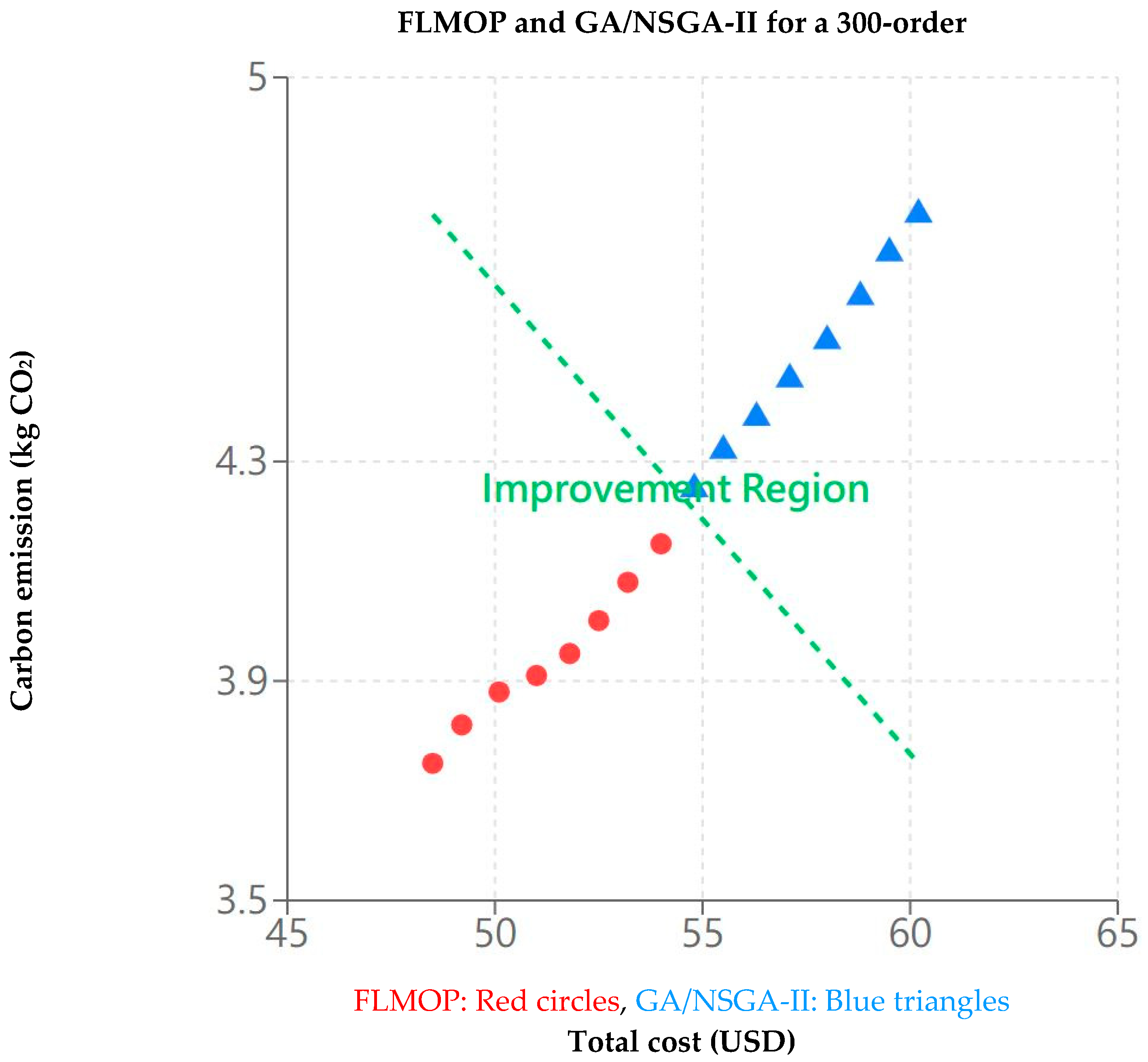
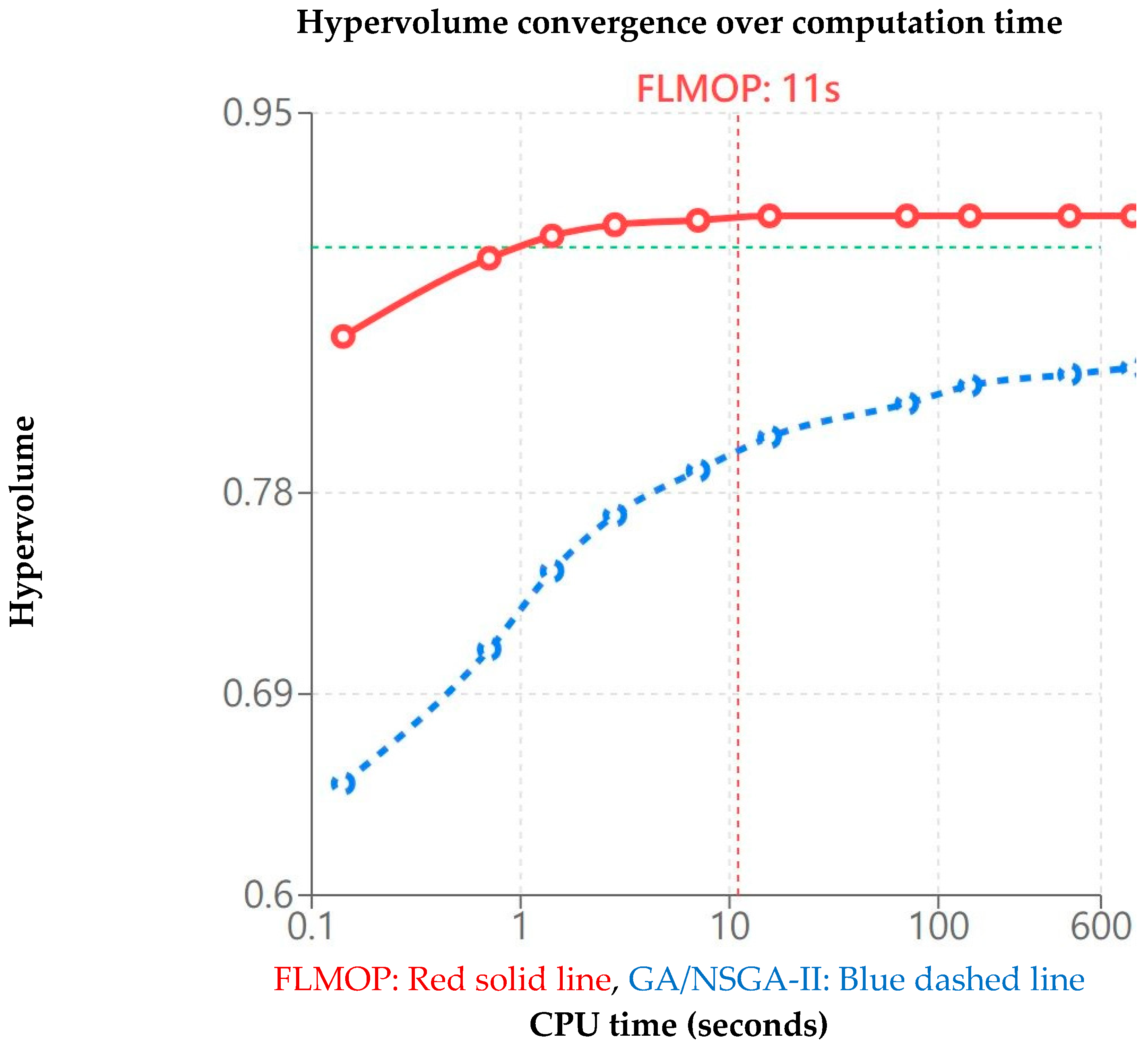
Table 8 and
Table 9, as well as
Figure 2 and
Figure 3, present the key findings.
FLMOP consistently achieves superior solution quality, recording the highest hypervolume values across all instances (average 0.892–0.917), outperforming MILP (0.743–0.821), GA/NSGA-II (0.801–0.868. This evidence demonstrates that FLMOP generates a significantly better approximation of the Pareto frontier when simultaneously optimizing cost, carbon emissions, and quality under uncertainty and strict HACCP constraints.
FLMOP delivers strong emission reduction performance, reducing carbon emissions by an average of 20.1% (from 0.50 kg CO2 to 0.40 kg CO2 per delivery in Zone B), compared to 14.8% for MILP, 16.9% for GA/NSGA-II. The Wilcoxon tests confirm that these improvements are statistically significant (p < 0.01 in all pairwise comparisons).
FLMOP demonstrates computational efficiency and convergence, reaching near-optimal hypervolume values (>0.89) in under 11 s, even for the 300-order instance. In contrast, GA/NSGA-II requires the whole 600-s budget yet remain inferior (hypervolume 0.836 and 0.801, respectively). MILP solves small instances quickly but fails to scale beyond about 100 orders within a reasonable time.
FLMOP exhibits robustness under uncertainty: unlike deterministic MILP, which struggles with fuzzy delivery times and costs, and heuristic methods that occasionally converge to local optima, FLMOP integrates TFN with centroid defuzzification to provide stable, high-quality solutions across all runs (standard deviation ≤ 0.012 on hypervolume).
These results clearly establish the superiority of FLMOP over state of the art exact and metaheuristic approaches in the context of sustainable OFD optimization. The framework efficiently handles real-world uncertainty, enforces strict food safety constraints, and delivers statistically significant improvements in both economic and environmental objectives. This evidence positions FLMOP as a new benchmark for multi-objective last-mile logistics problems.
4.5. Justification and Comparison of Defuzzification Methods
This study chose the TFN model to address the uncertainty of delivery time and cost because it is simple and effective and can represent imprecise data with a clear central tendency, as supported by Chen and Chang (2023) [
28]. TFN reduces computational complexity while maintaining accuracy in logistics applications, unlike trapezoidal fuzzy numbers, which assume a wide range of equal members (Ahmadi-Javid et al., 2023) [
5]. Using the Python pymoo 0.6.1 package, a simulation comparison of TFN and trapezoidal fuzzy numbers for delivery time in Zone B was conducted. The results indicated that the total cost deviation generated by TFN was ±3%, while that of trapezoidal fuzzy numbers was ±5%, which confirms their suitability for the TCQCE framework. This method is computationally efficient for TFN because it can simulate the uncertainty of delivery time (e.g., delivery times for zone B is 35, 40, and 45 min) and cost. Other defuzzification methods, such as the MOM and the weighted average method, were also considered. The MOM method selects the midpoint of the maximum membership value but may oversimplify complex fuzzy sets, resulting in reduced output accuracy for logistics optimization (Pedrycz, 1993) [
33]. The weighted average method is flexible but requires pre-setting weights, which may introduce subjectivity. A comparative analysis using simulated data for zone B showed that the total cost of the centroid method was USD 5.36. In contrast, the MOM method and the weighted average method were USD 5.42 and USD 5.38, respectively, indicating that the centroid method achieved a better balance between accuracy and computational simplicity. Chen and Chang (2023) [
28] noted that the centroid method performs well in handling TFN, which justifies its rationality in this study.
6. Conclusions
6.1. Research Conclusions
This study develops and validates a novel FLMOP framework that systematically optimizes TCQCE in Taiwan’s online food delivery systems, while ensuring strict compliance with HACCP food safety standards. This research contributes to the sustainable logistics literature in several key ways:
Comprehensive integration: addresses a critical gap by simultaneously optimizing four conflicting objectives within a unified decision-making framework, moving beyond prior studies that examined them in isolation.
Food safety assurance: The model incorporates HACCP temperature constraints as challenging requirements, supported by portable heating devices and real-time monitoring, ensuring that safety is never compromised for economic or environmental gains.
Methodological innovation: By combining fuzzy set theory with TFN and centroid defuzzification, the framework effectively manages real-world uncertainties in delivery operations and demonstrates superiority over deterministic and heuristic approaches.
Operational scalability: Controlled delivery-time extension and order batching are embedded as strategies to enhance sustainability and efficiency, while maintaining service quality across varying scope rational scales.
Decision-making advantages: This framework offers computational efficiency, robustness under uncertainty, and scalability across diverse service conditions, positioning it as a practical tool for real-time sustainable logistics management.
6.2. Research Limitations
Despite its contributions, this research acknowledges several limitations. First, the model explicitly assumes that consumers will accept extended delivery times of up to 40 min; however, consumer preferences may vary across demographic groups and meal types. Future researchers should incorporate heterogeneous consumer preferences to enhance the validity of this framework. Second, the case study situates the analysis within the Taiwan area; however, other international markets require renewed testing. Third, the analysis calculates the heater cost (USD 0.50 per use) and carbon cost (USD 0.08/kg CO2) using 2025 estimates; however, long-term fluctuations in these costs may influence the economic viability of the framework.
Beyond these limitations, the FLMOP framework demonstrates broad practical applications. Governments can employ TCQCE metrics to design incentive schemes that promote low-emission delivery services. Restaurants can optimize food preparation schedules to align with batched delivery operations, thereby reducing idle time and energy consumption. Moreover, practitioners across sectors can adapt the fuzzy multi-objective approach to diverse domains such as cold-chain logistics, pharmaceutical distribution, and e-commerce last-mile delivery.
6.3. Future Research Directions
While the proposed FLMOP framework demonstrates significant contributions to sustainable OFD systems, further research is necessary to validate its applicability across diverse contexts and to enhance its long-term impact. The following directions suggest:
(1) Conduct large-scale field trials with major OFD platforms (10,000+ deliveries) to validate emission reductions and consumer satisfaction under real operational conditions; (2) Perform cross-country comparative studies (e.g., Japan, Singapore, Vietnam) to assess model adaptability to diverse regulatory environments and consumer behaviors; (3) Design carbon credit mechanisms for OFD platforms that incentivize drivers to adopt batching strategies through monetary rewards or gamification.
By pursuing these research directions, the FLMOP framework can evolve into a more comprehensive and globally adaptable solution. Such efforts will strengthen both its theoretical contributions and practical relevance, ultimately advancing sustainable practices in the rapidly growing OFD industry.