Unexplored Social–Ecological Trap Lens of Hilsa Fishery in Bangladesh

 ,
,  ,
,  , ,
, , 
Abstract
1. Introduction
- What social–ecological traps exist in hilsa fisheries?
- How do socio-ecological traps relate to the livelihood outcomes of hilsa fishermen?
- What elements affected livelihood adaptation strategies during the ban?
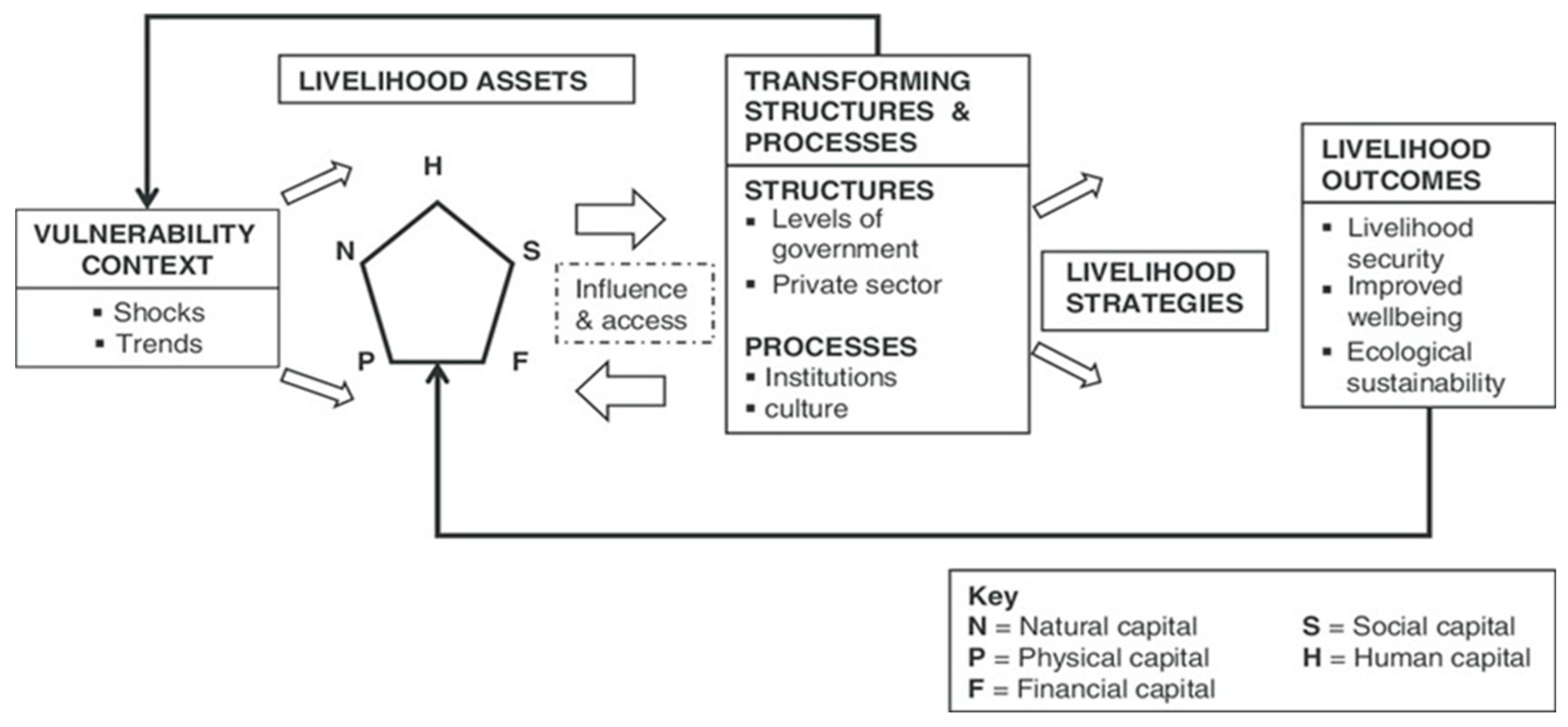
Theoretical Framework
2. Materials and Methods
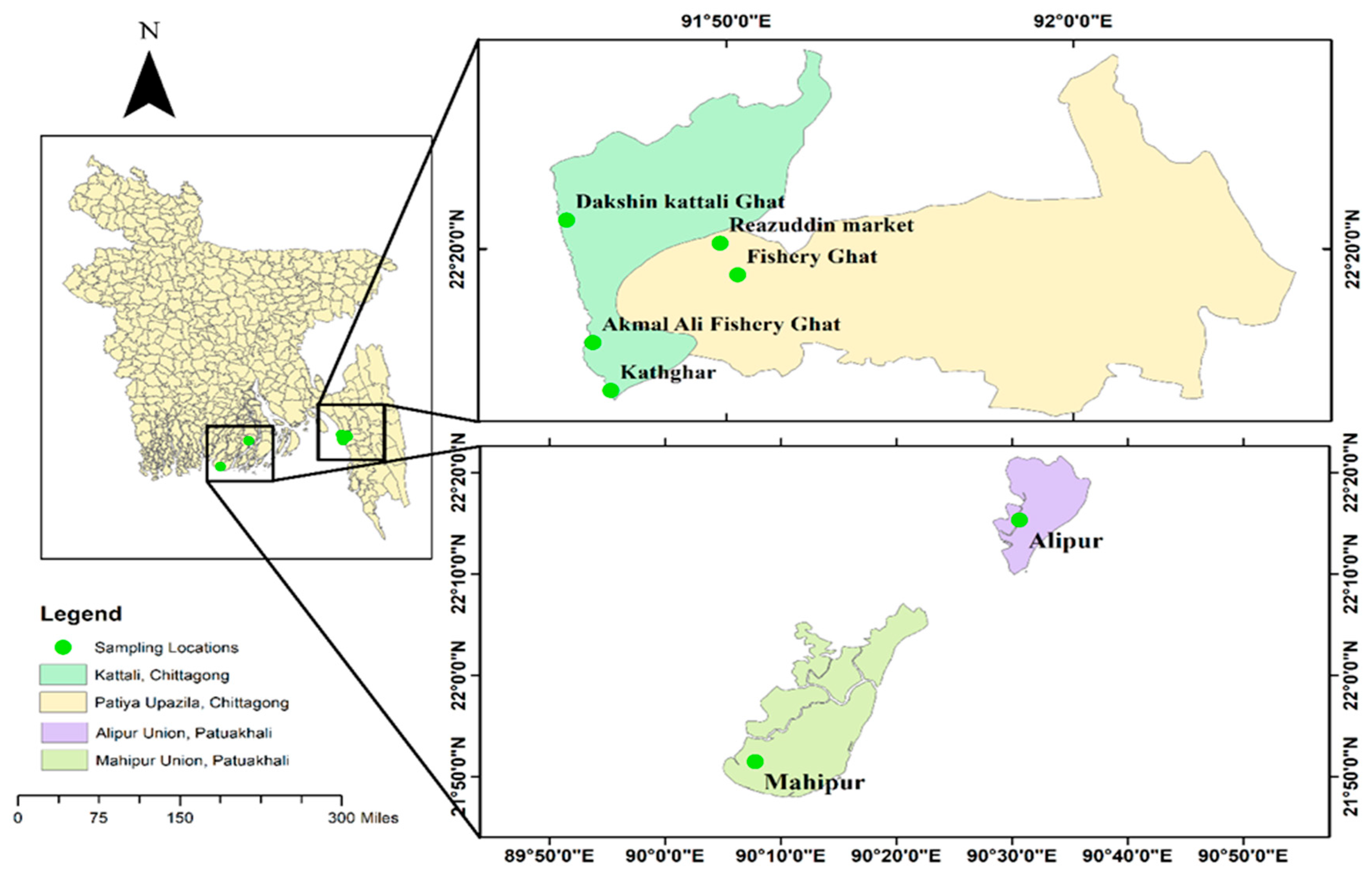
2.1. Study Areas
2.2. Methods
3. Results
3.1. Livelihood Capitals
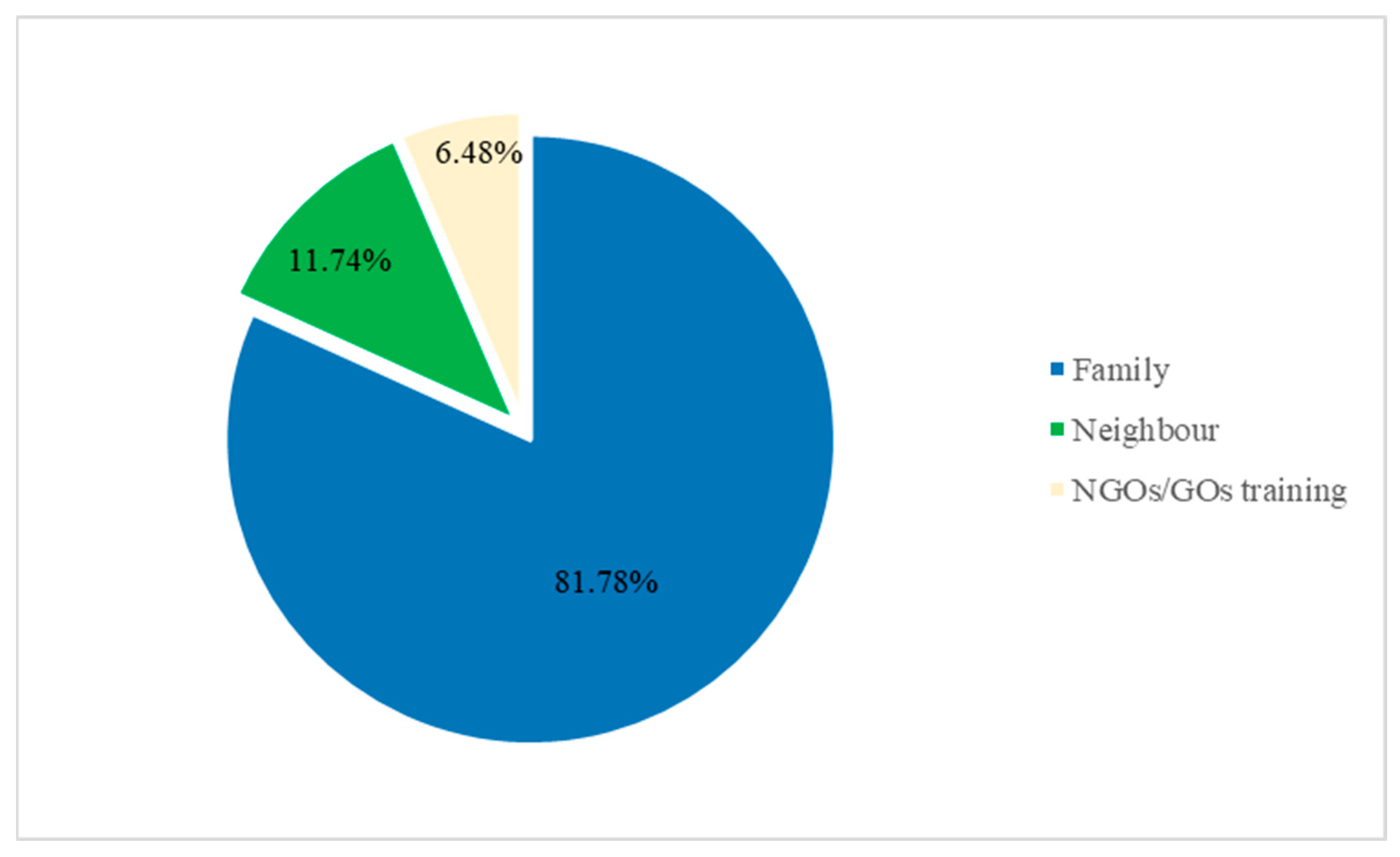
3.1.1. Human Capital
3.1.2. Physical Capital
3.1.3. Natural Capital
3.1.4. Social Capital
3.1.5. Financial Capital
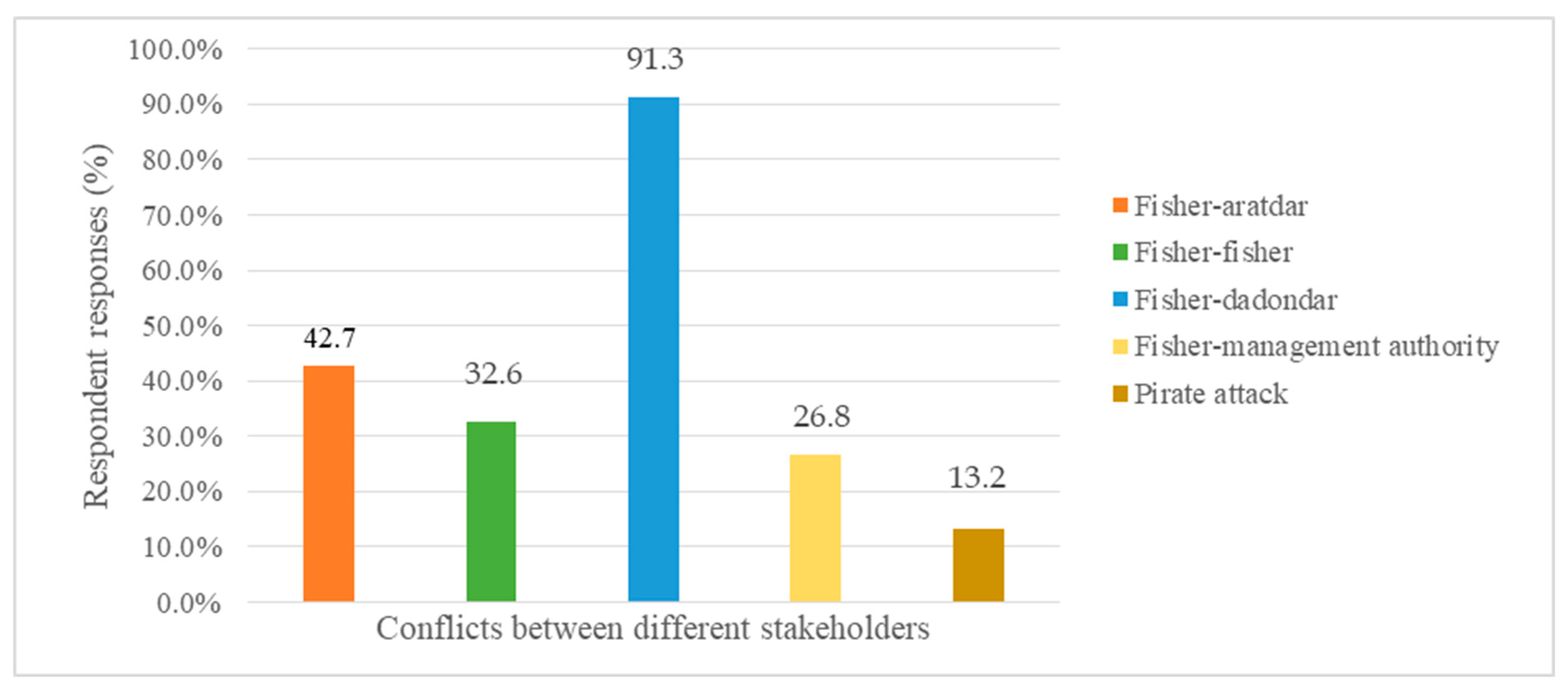
3.2. Vulnerability Context
3.3. Transforming Structures and Processes
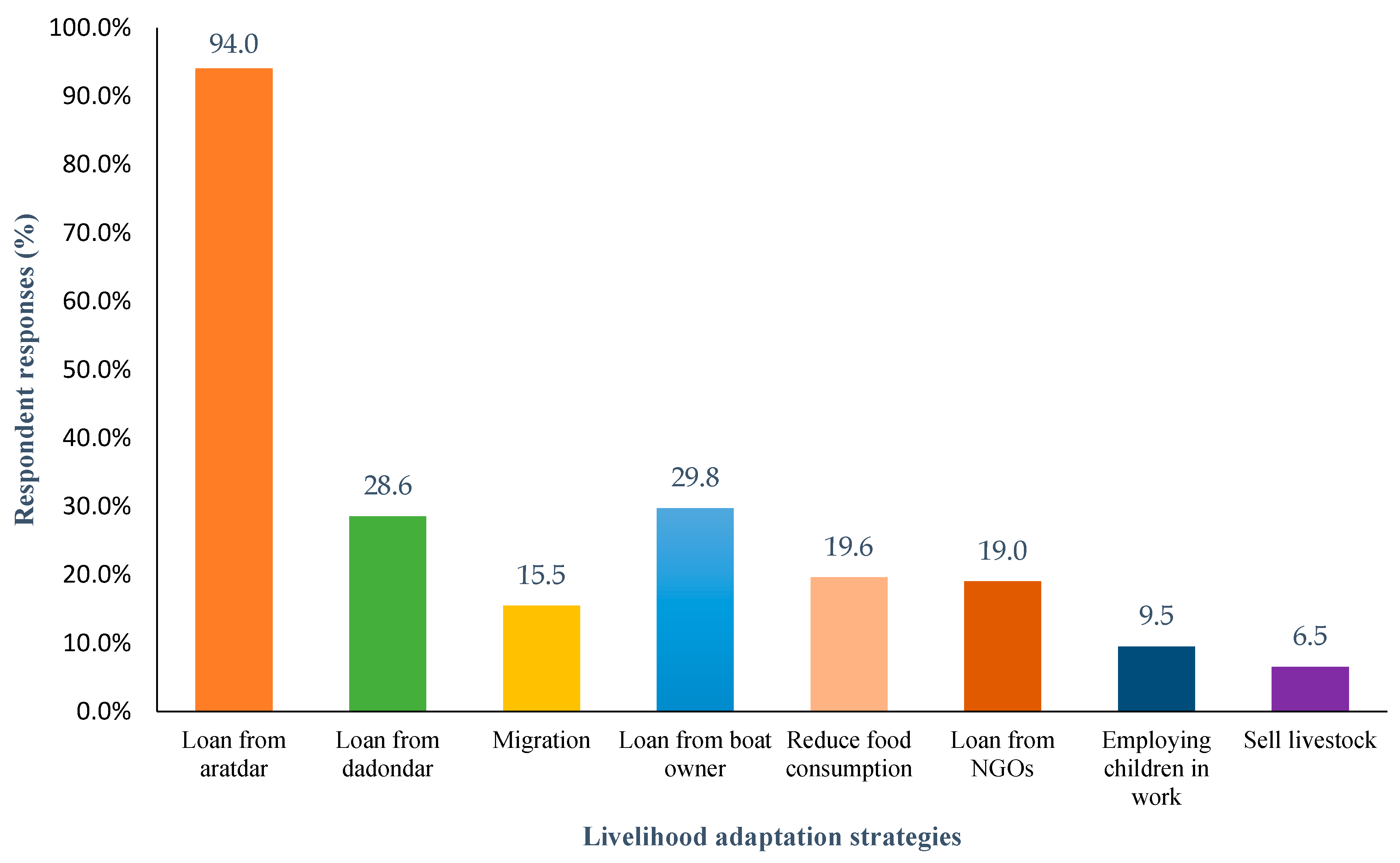
3.4. Livelihood Strategies
Factors Affecting Livelihood Adaptation in Ban Period
3.5. Livelihood Outcomes
3.6. Falling into the Traps
3.6.1. Poverty
3.6.2. Single Income Source
3.6.3. Dadon System
3.6.4. Inter-Generational Traps
3.6.5. Increased Fishers
3.6.6. Frequent Ban Period
3.6.7. Reduced Hilsa Catch
4. Discussion
4.1. Livelihood Capitals
4.2. Vulnerability Context
4.3. Livelihood Strategies
4.4. Transforming Structures and Processes
4.5. Livelihood Outcomes
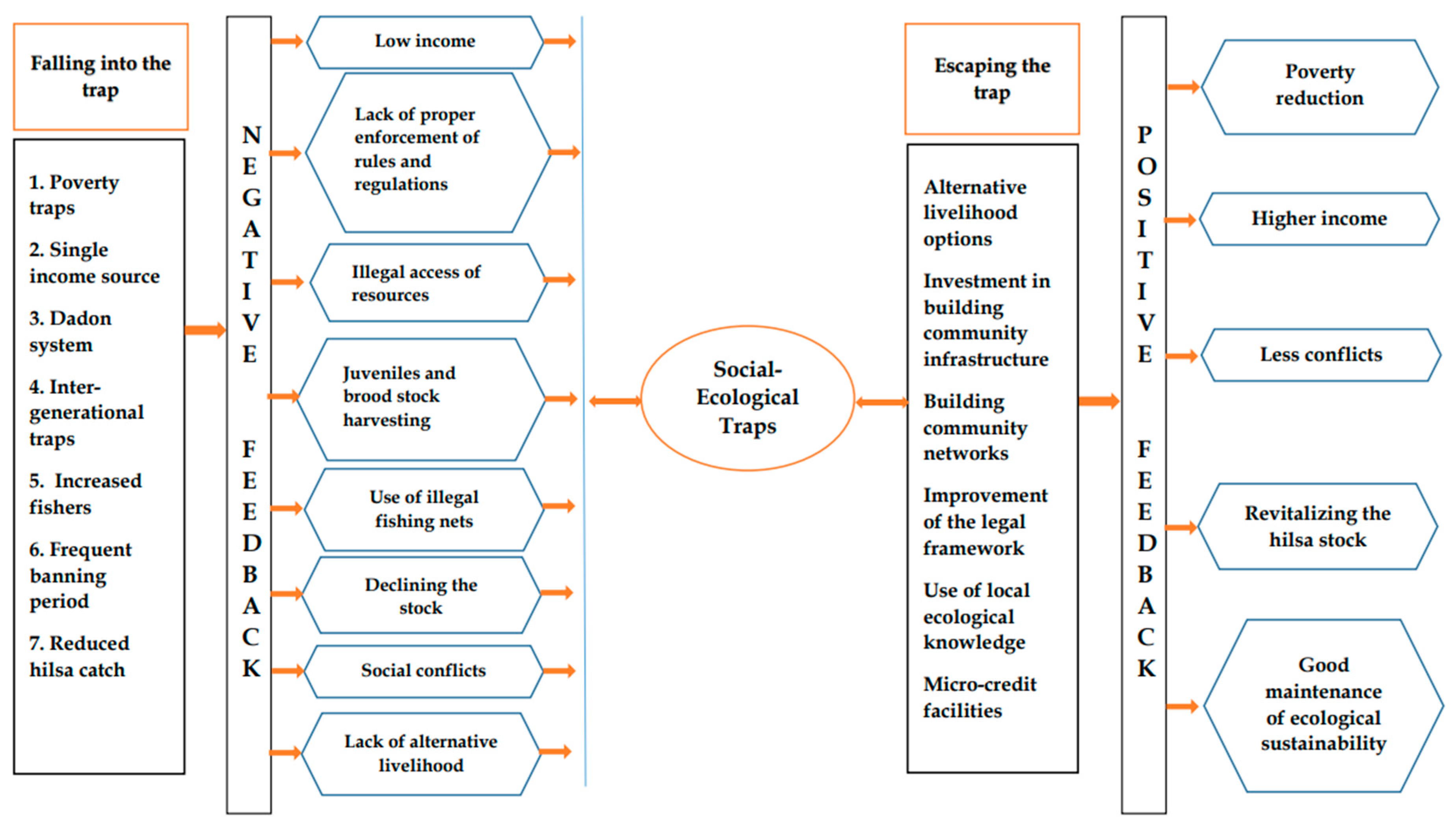
4.6. Social–Ecological Traps
4.6.1. Falling into the Traps
4.6.2. Negative Feedback
4.6.3. Escaping the Traps
4.6.4. Positive Feedback
5. Conclusions
Author Contributions
Funding
Institutional Review Board Statement
Informed Consent Statement
Data Availability Statement
Conflicts of Interest
References
- DoF Yearbook of Fisheries Statistics of Bangladesh, 2021–2022; Fisheries Resources Survey System (FRSS), Department of Fisheries; Ministry of Fisheries and Livestock: Dhaka, Bangladesh, 2022; Volume 39, 139p.
- Sunny, A.R.; Ahamed, G.S.; Mithun, M.H.; Islam, M.A.; Das, B.; Rahman, A.; Rahman, M.T.; Hasan, M.N.; Chowdhury, M.A. Livelihood status of the hilsa (Tenualosa ilisha) Fishers: The case of coastal fishing community of the Padma River, Bangladesh. J. Coast. Zone Manag. 2019, 22, 469. [Google Scholar]
- Mome, M.A.; Officer, E.; Bhaban, M.; Arnason, R. The Potential of the Artisanal Hilsa Fishery in Bangladesh: An Economically Efficient Fisheries Policy; Fisheries Training Programme Final Project Report; United Nations University: Reykjavik, Iceland, 2007; 57p. [Google Scholar]
- Sahoo, A.K.; Wahab, M.A.; Phillips, M.; Rahman, A.; Padiyar, A.; Puvanendran, V.; Bangera, R.; Belton, B.; De, D.K.; Meena, D.K.; et al. Breeding and culture status of Hilsa (Tenualosa ilisha, Ham. 1822) in South Asia: A review. Rev. Aquac. 2018, 10, 96–110. [Google Scholar] [CrossRef]
- Mohammed, E.Y.; Ali, L.; Ali, S.; Hussein, B.; Wahab, M.A.; Sage, N. Hilsa’s Non-Consumptive Value in Bangladesh: Estimating the Non-Consumptive Value of the Hilsa Fishery in Bangladesh Using the Contingent Valuation Method; International Institute for Environment and Development: London, UK, 2016. [Google Scholar]
- Mahmud, Y. (Ed.) Hilsa Fisheries Reseach and Development in Bangladesh; Bangladesh Fisheries Reseach Institute: Mymensingh, Bangladesh, 2020.
- Amin, S.M.N.; Rahman, M.A.; Haldar, G.C.; Mazid, M.A.; Milton, D.A. Catch per unit effort, exploitation level and production of Hilsa shad in Bangladesh waters. Asian Fish. Sci. 2008, 21, 175–187. [Google Scholar] [CrossRef]
- Khan, M.I.; Islam, M.M.; Kundu, G.K.; Akter, M.S. Understanding the Livelihood Characteristics of the Migratory and Non-Migratory Fishers of the Padma River, Bangladesh. J. Sci. Res. 2018, 10, 261–273. [Google Scholar] [CrossRef]
- Sunny, A.R.; Islam, M.M.; Nahiduzzaman, M.; Wahab, M.A. Coping with climate change impacts: The case of coastal fishing communities in upper Meghna hilsa sanctuary of Bangladesh. In Water Security in Asia: Opportunities and Challenges in the Context of Climate Change; Springer: Berlin/Heidelberg, Germany, 2017; pp. 1–9. [Google Scholar]
- Cinner, J.E. Social-ecological traps in reef fisheries. Glob. Environ. Change 2011, 21, 835–839. [Google Scholar] [CrossRef]
- Islam, M.M.; Mohammed, E.Y.; Ali, L. Economic incentives for sustainable hilsa fishing in Bangladesh: An analysis of the legal and institutional framework. Mar. Policy 2016, 68, 8–22. [Google Scholar] [CrossRef]
- Crona, B.; Nyström, M.; Folke, C.; Jiddawi, N. Middlemen, a critical social-ecological link in coastal communities of Kenya and Zanzibar. Mar. Policy 2010, 34, 761–771. [Google Scholar] [CrossRef]
- Hänke, H.; Barkmann, J.; Coral, C.; Kaustky, E.E.; Marggraf, R. Social-ecological traps hinder rural development in southwestern Madagascar. Ecol. Soc. 2017, 22, 42. [Google Scholar] [CrossRef]
- Laborde, S.; Fernández, A.; Phang, S.C.; Hamilton, I.M.; Henry, N.; Jung, H.C.; Mahamat, A.; Ahmadou, M.; Labara, B.K.; Kari, S.; et al. Social-ecological feedbacks lead to unsustainable lock-in in an inland fishery. Glob. Environ. Change 2016, 41, 13–25. [Google Scholar] [CrossRef]
- Steneck, R.S.; Hughes, T.P.; Cinner, J.E.; Adger, W.N.; Arnold, S.N.; Berkes, F.; Boudreau, S.A.; Brown, K.; Folke, C.; Gunderson, L.; et al. Creation of a gilded trap by the high economic value of the Maine lobster fishery. Conserv. Biol. 2011, 25, 904–912. [Google Scholar] [CrossRef]
- Onyango, P.; Jentoft, S. Assessing poverty in small-scale fisheries in Lake Victoria, Tanzania. Fish Fish. 2010, 11, 250–263. [Google Scholar] [CrossRef]
- Farrington, J.; Carney, D.; Ashley, C.; Turton, C. Sustainable livelihoods in practice: Early applications of concepts in rural areas. Environment, development & rural livelihoods. Nat. Resour. Perspect. 1999, 42, 1–5. [Google Scholar]
- DFID UK. Sustainable Livelihoods Guidance Sheets; DFID: London, UK, 1999; Volume 445, p. 710.
- Scoones, I. Sustainable Rural Livelihoods: A Framework for Analysis; Institute of Development Studies: Brighton, UK, 1998; Volume 72, pp. 1–22. [Google Scholar]
- Ellis, F. Rural Livelihoods and Diversity in Developing Countries; Oxford University Press: Oxford, UK, 2000. [Google Scholar]
- Allison, E.H.; Ellis, F. The livelihoods approach and management of small-scale fisheries. Mar. Policy 2001, 25, 377–388. [Google Scholar] [CrossRef]
- Shankland, A. Analysing Policy for Sustainable Livelihoods; Institute of Development Studies: Brighton, UK, 2000. [Google Scholar]
- Allison, E.H.; Horemans, B. Putting the principles of the Sustainable Livelihoods Approach into fisheries development policy and practice. Mar. Policy 2006, 30, 757–766. [Google Scholar] [CrossRef]
- Apine, E.; Turner, L.M.; Rodwell, L.D.; Bhatta, R. The application of the sustainable livelihood approach to small scale-fisheries: The case of mud crab Scylla serrata in South west India. Ocean Coast. Manag. 2019, 170, 17–28. [Google Scholar] [CrossRef]
- Hosmer, D.W., Jr.; Lemeshow, S.; Sturdivant, R.X. Applied Logistic Regression; John Wiley & Sons: Hoboken, NJ, USA, 2013. [Google Scholar]
- Garrett, H.E.; Woodworth, R.S. Statistics in psychology and education; Longmans, Green and Co.: London, UK, 1969. [Google Scholar]
- Dhanavandan, S. Application of garret ranking technique: Practical approach. Int. J. Libr. Inf. Stud. 2016, 6, 135–140. [Google Scholar]
- Ashley, C.; Carney, D. Sustainable Livelihoods: Lessons from Early Experience; Department for International Development: London, UK, 1999; Volume 7, No. 1.
- O’Neill, E.D.; Crona, B. Assistance networks in seafood trade–a means to assess benefit distribution in small-scale fisheries. Mar. Policy 2017, 78, 196–205. [Google Scholar]
- Willmann, R.; Franz, N.; Fuentevilla, C.; McInerney, T.F.; Westlund, L. A human rights-based approach to securing small-scale fisheries: A quest for development as freedom. In the Small-Scale Fisheries Guidelines: Global Implementaion; Springer Nature: Cham, Switzerland, 2017; pp. 15–34. [Google Scholar]
- Rodrigues, J.G.; Villasante, S. Disentangling seafood value chains: Tourism and the local market driving small-scale fisheries. Mar. Policy 2016, 74, 33–42. [Google Scholar] [CrossRef]
- Islam, M.M.; Shamsuzzaman, M.M.; Sunny, A.R.; Islam, N. Understanding fishery conflicts in the hilsa sanctuaries of Bangladesh. In Inter-Sectoral Governance of Inland Fisheries; Song, A.M., Bower, S.D., Onyango, P., Cooke, S.J., Chuenpagdee, R., Eds.; TBTI Global Foundation: Bangkok, Thailand, 2017; pp. 18–31. [Google Scholar]
- Sunny, A.R.; Prodhan, S.H.; Ashrafuzzaman, M.; Sazzad, S.A.; Mithun, M.H.; Haider, K.N.; Alam, M.T. Understanding livelihood characteristics and vulnerabilities of small-scale fishers in coastal Bangladesh. Preprints 2020, 2020060303. [Google Scholar] [CrossRef]
- Stewart Carloni, A.; Crowley, E. Rapid Guide for Missions. In Analysing Local Institutions and Livelihoods; Institutions for Rural Development (FAO): Rome, Italy, 2005. [Google Scholar]
- Davies, S. Adaptable Livelihoods: Coping with Food Insecurity in the Malian Sahel; Springer: Berlin/Heidelberg, Germany, 2016. [Google Scholar]
- Hossain, A.A.; Mahdi, G.M.A.; Azad, A.K.; Kabir, S.H.; Pramanik, M.M.H.; Ullah, M.R.; Hasan, M.M.; Ullah, M.A. Socioeconomic, livelihood and cultural profile of the Meghna River Hilsa Fishing Community in Chandpur, Bangladesh. Arch. Agric. Environ. Sci. 2022, 7, 549–558. [Google Scholar] [CrossRef]
- Faruque, M.H.; Ahsan, D.A. Socio-economic status of the Hilsa (Tenualosa ilisha) fishermen of Padma River, Bangladesh. World Appl. Sci. J. 2014, 32, 857–864. [Google Scholar]
- WRI. World Resources 2008: Roots of Resilience—Growing the Wealth of the Poor; United Nations Development Programme: New York, NY, USA; United Nations Environment Programme: Nairobi, Kenya; World Bank: Washington, DC, USA; World Resources Institute: Washington, DC, USA, 2008. [Google Scholar]
- Coulthard, S.; Johnson, D.; McGregor, J.A. Poverty, sustainability and human wellbeing: A social wellbeing approach to the global fisheries crisis. Glob. Environ. Change 2011, 21, 453–463. [Google Scholar] [CrossRef]
- Mozumder, M. Socio-Ecological Resilience of a Small-Scale Hilsa Shad (Tenualosa ilisha) Fishery in the Gangetic River Systems of Bangladesh. Ph.D. Thesis, University of Helsink, Helsinki, Finland, 2020. [Google Scholar]
- Walker, B.; Barrett, S.; Polasky, S.; Galaz, V.; Folke, C.; Engström, G.; Ackerman, F.; Arrow, K.; Carpenter, S.; Chopra, K.; et al. Looming global-scale failures and missing institutions. Science 2009, 325, 1345–1346. [Google Scholar] [CrossRef] [PubMed]
- Sarker, M.J.; Uddin, A.M.M.B.; Patwary, S.A.; Tanmay, M.M.H.; Rahman, F.; Rahman, M. Livelihood status of hilsa (Tenualosa ilisha) fishermen of greater Noakhali regions of Bangladesh. Fish. Aquac. J. 2016, 7, 1–6. [Google Scholar] [CrossRef]
- Halder, P.; Ali, H.; Gupta, N.; Aziz, M.S.B.; Monir, M.S. Livelihood status of fresh fish, dry fish and vegetable retails at Rajoir Upazila of Madaripur district, Bangladesh. Bangladesh Res. Publ. J. 2011, 5, 262–270. [Google Scholar]
- Rana, M.E.U.; Salam, A.; Shahriar Nazrul, K.M.; Hasan, M. Hilsa fishers of Ramgati, Lakshmipur, Bangladesh: An overview of socio-economic and livelihood context. J. Aquat. Res. Dev. 2018, 9, 1000541. [Google Scholar]
- Agnew, D.J.; Pearce, J.; Pramod, G.; Peatman, T.; Watson, R.; Beddington, J.R.; Pitcher, T.J. Estimating the worldwide extent of illegal fishing. PLoS ONE 2009, 4, e4570. [Google Scholar] [CrossRef] [PubMed]
- Acemoglu, D.; Robinson, J. The Role of Institutions in Growth and Development; World Bank: Washington, DC, USA, 2008; Volume 10. [Google Scholar]
- Jentoft, S.; McCay, B.J.; Wilson, D.C. Social theory and fisheries co-management. Mar. Policy 1998, 22, 423–436. [Google Scholar] [CrossRef]
- Mozumder, M.M.H.; Pyhälä, A.; Wahab, M.A.; Sarkki, S.; Schneider, P.; Islam, M.M. Understanding social-ecological challenges of a small-scale hilsa (Tenualosa ilisha) fishery in Bangladesh. Int. J. Environ. Res. Public Health 2019, 16, 4814. [Google Scholar] [CrossRef]
- Morse, S.; McNamara, N.; Acholo, M. Sustainable Livelihood Approach: A Critical Analysis of Theory and Practice; Geographical Paper No. 189; The University of Reading: Reading, UK, 2009. [Google Scholar]
- Jentoft, S.; Chuenpagdee, R. Assessing governability of small-scale fisheries. In Interactive Governance for Small-Scale Fisheries: Global Reflections; Springer International Publishing: Cham, Switzerland, 2015; pp. 17–35. [Google Scholar]
- Mozumder, M.M.H.; Wahab, M.A.; Sarkki, S.; Schneider, P.; Islam, M.M. Enhancing social resilience of the coastal fishing communities: A case study of hilsa (Tenualosa ilisha H.) fishery in Bangladesh. Sustainability 2018, 10, 3501. [Google Scholar] [CrossRef]



| SI No. | Study Sites | Methods and Sample Size (Number) | |||
|---|---|---|---|---|---|
| Districts | II * | KII * | FGD * | ||
| 1 | Chattogram | Dakkhin kattali | 21 | 5 | 3 |
| Ali akmol ghat | 58 | ||||
| Kathghor | 23 | ||||
| Fishery ghat | 36 | ||||
| Riaz Uddin market | 6 | ||||
| 2 | Patuakhali | Mohipur | 53 | 5 | 3 |
| Alipur | 50 | ||||
| Characteristics | Categories | Kattolighat (n = 21) | Ali Akmol Ghat (n = 58) | Kathghor (n = 23) | Fishery Ghat (n = 36) | Riaz Uddhin Market (n = 6) | Mohipur (n = 53) | Alipur (n = 50) | Total (n = 247) |
|---|---|---|---|---|---|---|---|---|---|
| % | % | % | % | % | % | % | % | ||
| Experience in fishing | <20 | 14.29 | 8.62 | 8.7 | 11.11 | 0 | 15.09 | 16.00 | 12.15 |
| 20–30 | 23.81 | 32.76 | 26.09 | 27.78 | 50 | 24.53 | 36.00 | 29.96 | |
| 31–40 | 42.86 | 37.93 | 43.48 | 41.67 | 33.33 | 37.74 | 28.00 | 37.25 | |
| >40 | 19.05 | 20.69 | 21.74 | 19.44 | 16.67 | 22.64 | 20.00 | 20.65 | |
| Participation training program | 14.29 | 34.48 | 39.13 | 47.22 | 0 | 56.60 | 55.00 | 42.51 | |
| Women’s activities | Housewife | 57.14 | 56.90 | 65.22 | 63.89 | 66.67 | 73.58 | 68.00 | 64.37 |
| Garments worker | 33.33 | 31.03 | 34.78 | 27.78 | 33.33 | 0 | 0 | 18.22 | |
| Buffalo rearing | 9.52 | 12.07 | 0 | 0 | 0 | 0 | 0 | 4.05 | |
| Cow rearing | 0 | 0 | 0 | 8.33 | 0 | 0 | 0 | 1.21 | |
| Dry fish sorting | 0 | 0 | 0 | 0 | 0 | 20.75 | 24.00 | 9.31 | |
| Shopkeeper | 0 | 0 | 0 | 0 | 0 | 5.66 | 8.00 | 2.83 | |
| Children activities | Go to school | 57.14 | 53.45 | 56.52 | 63.89 | 66.67 | 41.51 | 36.00 | 49.80 |
| Fishing | 14.29 | 17.24 | 17.39 | 16.67 | 16.67 | 15.09 | 22.00 | 17.41 | |
| Sorting | 23.81 | 18.97 | 17.39 | 11.11 | 16.67 | 15.09 | 16.00 | 16.60 | |
| Net-making | 4.76 | 6.9 | 8.7 | 5.56 | 0 | 16.98 | 14.00 | 10.12 | |
| Boat-making | 0 | 3.45 | 0 | 2.78 | 0 | 11.32 | 12.00 | 6.07 | |
| Number of meals a day | 1 | 0 | 0 | 0 | 0 | 0 | 0 | 0 | 0 |
| 2 (Occasional) | 23.81 | 20.69 | 30.43 | 27.78 | 16.67 | 16.98 | 6.00 | 17.41 | |
| 2 | 14.29 | 15.52 | 17.39 | 0 | 0 | 0 | 0 | 6.88 | |
| 3 | 61.90 | 63.79 | 52.17 | 72.22 | 83.33 | 90.57 | 94.00 | 75.71 |
| Characteristics | Categories | Chattogram (n = 144) | Patuakhali (n = 103) | Total (n = 247) |
|---|---|---|---|---|
| (%) Frequency | (%) Frequency | (%) Frequency | ||
| Ownership of house | Yes | 11.81 (17) | 10.68 (11) | 11.34 (28) |
| No | 88.81 (127) | 89.32 (92) | 88.66 (219) | |
| Additional land except house | Yes | 9.72 (14) | 4.85 (5) | 7.69 (19) |
| No | 90.28 (130) | 95.15 (98) | 92.31 (228) | |
| Having private latrine | Yes | 88. 89 (128) | 79.61 (82) | 85.02 (210) |
| No | 11.11 (16) | 20.39 (21) | 14.98 (37) | |
| Electricity facility | Yes | 29.17 (42) | 79.61 (82) | 50.20 (124) |
| No | 20.83 (30) | 20.39 (21) | 20.65 (51) | |
| Solar system | 50 (72) | 0 | 29.15 (72) | |
| Transportation facility | Good | 100 (144) | 0 | 58.30 (144) |
| Poor | 0 | 54.37 (56) | 22.67 (56) | |
| Very poor | 0 | 45.63 (47) | 19.03 (47) | |
| Source of drinking water | Supply water | 86.81 (125) | 3.88 (4) | 52.23 (129) |
| Tube well | 7.64 (11) | 65.05 (67) | 31.58 (78) | |
| Pump water | 5.56 (8) | 17.48 (18) | 10.53 (26) | |
| Surface water | 0 | 13.59 (14) | 5.67 (14) | |
| Medical support | Pharmacy doctor | 45.14 (65) | 32.04 (33) | 39.68 (98) |
| Upazilla clinic | 0 | 66.02 (68) | 27.53 (68) | |
| District hospital | 53.47 (77) | 0 | 31.17 (77) | |
| Qualified doctor | 11.39 (2) | 1.94 (2) | 1.62 (4) | |
| Having own boat | Yes | 43.75 (63) | 55.34 (57) | 48.58 (120) |
| No | 56.25 (81) | 44.66 (46) | 51.42 (127) |
| Characteristics | Categories | Chattogram (n = 144) | Patuakhali (n = 103) | Total (n = 247) |
|---|---|---|---|---|
| Frequency (%) | Frequency (%) | Frequency (%) | ||
| Monthly income in Bangladeshi Taka (BDT) | <5000 | 31 (21.53) | 11 (10.68) | 42 (17.00) |
| 5000–10,000 | 61 (42.36) | 55 (53.40) | 116 (46.96) | |
| 10,000–20,000 | 38 (26.39) | 27 (26.21) | 65 (26.32) | |
| >20,000 | 14 (9.72) | 10 (9.71) | 24 (9.72) | |
| Status of income level (last 10 years) | Increase | 14 (9.72) | 9 (8.74) | 23 (9.31) |
| Decrease | 130 (90.28) | 94 (91.26) | 224 (90.69) | |
| Sources of money | Aratdar | 73 (50.69) | 46 (44.66) | 119 (48.18) |
| Dadondar | 28 (19.44) | 16 (15.53) | 44 (17.81) | |
| Boat owner | 36 (25.00) | 31 (30.10) | 67 (27.13) | |
| Personal savings | 2 (1.39) | 4 (3.88) | 6 (2.43) | |
| NGOs | 5 (3.47) | 6 (5.83) | 11 (4.45) | |
| Personal saving | Yes | 16 (11.11) | 14 (13.59) | 30 (12.15) |
| No | 128 (88.89) | 89 (86.41) | 217 (87.85) | |
| Sale their catch | Aratdar | 70 (48.61) | 38 (36.89) | 108 (43.72) |
| Dadondar | 37 (25.69) | 11 (10.68) | 48 (19.43) | |
| Paiker | 33 (22.92) | 32 (31.07) | 65 (26.32) | |
| Local market | 4 (2.78) | 22 (21.36) | 26 (10.53) |
| Vulnerability Context | Examples |
|---|---|
| Shocks | Natural disasters (such as floods, storm surges, and cyclones) Frequent ban period Stakeholders and management authority conflicts Illness, fear of pirate attacks Absence of cold storage High-interest loan |
| Trends | Availability of hilsa decreased Increased fishers Increased fishing pressure Environmental changes The political crises at the local and national levels, such as limited involvement in decision-making and restricted access to local institutions |
| Seasonality | Alteration of the migration route Availability of hilsa Variations in the demand for hilsa Alteration of employment opportunities Ban period suffering Seasonal unemployment |
| Components | Examples |
|---|---|
| Policies |
|
| Institutions |
|
| Culture |
|
| Job market |
|
| Explanatory Variables | Categories | Coefficients | Standard Error | p-Value | Odds Ratios |
|---|---|---|---|---|---|
| Age | <26 (Reference category) | 0.913 | |||
| 26–35 | 0.785 | 1.111 | 0.480 | 2.193 | |
| 36–45 | −1.907 | 4.019 | 1.000 | 0.162 | |
| >45 | −1.165 | 2.269 | 0.999 | 0.123 | |
| Education | Illiterate (Reference category) | 0.007 | |||
| Primary | −1.761 | 1.432 | 0.219 | 0.172 | |
| Secondary | −0.314 | 1.431 | 0.826 | 0.731 | |
| Higher secondary | 0.464 | 1.733 | 0.789 | 1.591 | |
| Experiences | <20 (Reference category) | 0.513 | |||
| 20–30 | −1.630 | 1.076 | 0.130 | 0.196 | |
| 31–40 | 2.650 | 4.019 | 0.12 | 9.291 | |
| >40 | 1.622 | 2.269 | 0.91 | 1.222 | |
| Family members | <5 (Reference category) | 0.062 | |||
| 5–10 | 0.006 | 0.572 | 0.992 | 1.006 | |
| 11–15 | 1.013 | 0.455 | 0.026 ** | 2.755 | |
| Monthly income (BDT) | <5000 (Reference category) | 0.207 | |||
| 5000–10,000 | 0.986 | 0.826 | 0.233 | 2.680 | |
| 10,001–20,000 | −0.397 | 0.661 | 0.571 | 0.688 | |
| >20,000 | −0.366 | 0.692 | 0.597 | 0.694 | |
| Training | Yes | 1.063 | 0.438 | 0.015 ** | 2.894 |
| Having own boats | Yes | −0.397 | 0.417 | 0.340 | 0.672 |
| Having house ownership | Yes | 1.583 | 0.529 | 0.003 * | 4.870 |
| Having additional land | Yes | 0.628 | 0.740 | 0.396 | 1.874 |
| Formal society | Yes | −1.304 | 0.561 | 0.020 ** | 0.271 |
| Outcomes | Explanation |
|---|---|
| Income | The majority of respondents claim that their income has fallen in comparison to the prior situation. |
| Well-being | The majority of the hilsa fishing communities are poor, and they frequently face marginalization. They have minimal influence on decision-making and limited access to resources. |
| Vulnerability | Hilsa fishers are in a vulnerable situation in terms of trends (e.g., increased fishers and fishing pressure), shocks (e.g., natural calamities), and seasonality (e.g., alteration of income, the demand for hilsa, etc.). |
| Food security | They were unable to provide for their family’s food demands throughout the ban period. It seems like “no job, no food”. |
| Sustainability | While social sustainability is in somewhat better form, biological and economic sustainability are not maintained. |
| Outcomes | Explanation | Link to Social–Ecological Traps | Possible Way Out |
|---|---|---|---|
| Income | The earnings of hilsa fishermen are uncertain, fluctuate throughout the year, and have declined during the last ten years. | Their reduced income trapped them in a debt cycle, and they fell into the traps. | The system can be helped to avoid the traps by livelihood alternatives and fisher-friendly finance systems. |
| Well-being | Hilsa fishermen’s general state of well-being is low because of their marginalization in politics, lack of access to quality healthcare, and exclusion from mainstream society. | Due to political marginalization and the community’s lack of equal treatment, middlemen and other powerful actors can take advantage of situations, resulting in a variety of unfavorable feedback and traps. | Fishermen who are treated fairly in society are able to voice their opinions against social and political injustices and have their contributions taken into consideration for the long-term sustainability of the fishery. |
| Vulnerability | Hilsa fishermen are still susceptible to a variety of shocks (e.g., natural disasters), trends (low catch rates and hilsa availability), and seasonality (e.g., seasonal unemployment). | The system falls into traps as a result of negative feedback created by the increased vulnerability brought on by both human and climate change-related action. | Avoiding the traps can be facilitated by societies, governmental organizations, and fishermen working together effectively and coordinating their efforts. |
| Food security | Overall, there is good food security in the studied areas. However, they mostly experienced food insecurity during the fishing restriction. | They were kept in the debt cycle by food insecurity during the ban time. | Eliminating excessive use of resources, implementing regulations that are helpful, and finding new sources of income will help them have more food and financial stability. |
| Sustainable use of hilsa fishing | All things considered, the hilsa fishery’s sustainability is not doing well. Nevertheless, it is exploited by the fishers to meet their short-term demands. | The ecosystem’s balance is disrupted, and hilsa populations are directly threatened by illegal fishing methods, including using tiny mesh sizes and unapproved gear. | Avoiding the traps can be facilitated by increased awareness, compliance with legislation, empowerment, and engagement. |
| Reasons Behind Decline of Hilsa Fishery | Rank Given by the Respondents | Total No. of Respondents | Total Score | Mean Score | Rank | ||||||
|---|---|---|---|---|---|---|---|---|---|---|---|
| 1 | 2 | 3 | 4 | 5 | 6 | 7 | |||||
| Use of destructive fishing gears | 101 | 58 | 55 | 16 | 9 | 1 | 7 | 247 | 16,217 | 65.64 | I |
| Huge catch of hilsa | 79 | 60 | 57 | 24 | 10 | 7 | 10 | 247 | 15,466 | 62.62 | II |
| Increased fishers | 29 | 67 | 46 | 65 | 22 | 11 | 7 | 247 | 140.41 | 56.85 | III |
| Climate change impact | 37 | 31 | 24 | 68 | 40 | 15 | 32 | 247 | 12,649 | 51.21 | IV |
| Illegal catching of juveniles and broodstock | 9 | 13 | 22 | 37 | 41 | 65 | 60 | 247 | 10,022 | 40.57 | V |
| Siltation | 0 | 9 | 16 | 11 | 22 | 76 | 113 | 247 | 8148 | 32.98 | VI |
| Illegal access | 0 | 0 | 10 | 15 | 25 | 40 | 157 | 247 | 7249 | 29.35 | VII |
Disclaimer/Publisher’s Note: The statements, opinions and data contained in all publications are solely those of the individual author(s) and contributor(s) and not of MDPI and/or the editor(s). MDPI and/or the editor(s) disclaim responsibility for any injury to people or property resulting from any ideas, methods, instructions or products referred to in the content. |
© 2025 by the authors. Licensee MDPI, Basel, Switzerland. This article is an open access article distributed under the terms and conditions of the Creative Commons Attribution (CC BY) license.
Share and Cite
Sarker, M.; Shamsuzzaman, M.M.; Akter, K.; Talukdar, A.; Asadujjaman, M.; Mozumder, M.M.H. Unexplored Social–Ecological Trap Lens of Hilsa Fishery in Bangladesh. Sustainability 2026, 18, 295. https://doi.org/10.3390/su18010295
Sarker M, Shamsuzzaman MM, Akter K, Talukdar A, Asadujjaman M, Mozumder MMH. Unexplored Social–Ecological Trap Lens of Hilsa Fishery in Bangladesh. Sustainability. 2026; 18(1):295. https://doi.org/10.3390/su18010295
Chicago/Turabian StyleSarker, Mukta, Md. Mostafa Shamsuzzaman, Khadija Akter, Anuradha Talukdar, Md. Asadujjaman, and Mohammad Mojibul Hoque Mozumder. 2026. "Unexplored Social–Ecological Trap Lens of Hilsa Fishery in Bangladesh" Sustainability 18, no. 1: 295. https://doi.org/10.3390/su18010295
APA StyleSarker, M., Shamsuzzaman, M. M., Akter, K., Talukdar, A., Asadujjaman, M., & Mozumder, M. M. H. (2026). Unexplored Social–Ecological Trap Lens of Hilsa Fishery in Bangladesh. Sustainability, 18(1), 295. https://doi.org/10.3390/su18010295