Article

Resilience Indicators for a Road Transport Network to Access Emergency Health Services

by
Massimo Di Gangi
,
Orlando Marco Belcore
and
Antonio Polimeni
*
Department of Engineering, University of Messina, Contr. di Dio, Villaggio S. Agata, 98166 Messina, Italy
*
Author to whom correspondence should be addressed.
Sustainability 2026, 18(1), 27; https://doi.org/10.3390/su18010027
Submission received: 31 October 2025 / Revised: 12 December 2025 / Accepted: 16 December 2025 / Published: 19 December 2025

Abstract

The resilience concept, born for ecological systems, has been successfully adapted to other domains. Considering the case of transport networks, the evaluation of resilience is crucial to ensure their functionality. The objective of this paper is to provide a set of indicators that can be used to quantify the resilience of a transport network with particular attention to the access to emergency health services. The methodology adopted allows for obtaining some centrality measures and some metrics on network efficiency, to identify the most critical nodes and arcs in the network, and to determine how the removal of nodes/arcs affects efficiency. In this study, the resilience indicators of the road network of Messina, a city located in the northeastern tip of Sicily (Italy), are analyzed. The analysis focuses on three main emergency hospital facilities and, by examining the connectivity of the road network, the accessibility to these critical centers in different scenarios will be assessed. A relevant aspect of the proposed methodology is the exclusive use of open data in road network definition, which makes the procedure easily transferable to other areas. The results of the proposed application provide useful indications for improving road infrastructure and urban planning, as well as replicating the methodology in other geographical areas.

1. Introduction

In order to limit global warming above pre-industrial levels, the United Nations has established Sustainable Development Goals (SDGs), which outline actions necessary to mitigate climate change [1]. Specifically, Goal 11 is to make cities and human settlements inclusive, safe, resilient and sustainable. Transport networks affect this goal, and, in a rapidly evolving world characterized by extreme events, natural and man-made disasters, pandemics, and increasing urbanization, transport networks must not only withstand shocks, but also recover quickly and adapt to new conditions [2,3]. Transport networks can be subject to disruptions [4,5], whether caused by natural events (such as floods or earthquakes) or human factors (such as accidents or attacks), so careful analyses of their resilience are required. The concept of resilience, initially conceived for ecological systems and defined as a measure of the capability of the system to absorb the changes that maintain the relationships between state variables [6], has been extended to other fields, such as transport networks. The definition of resilience for transportation systems is not univocal [7,8], and it can be particularized depending on which element of a transportation system is being considered (e.g., passengers, freight, supply chain). Just as there is no single definition of resilience, there is no single indicator used to quantify it; on the contrary, very often multiple indicators are used simultaneously, and their selection is dictated by the situation being analyzed. It follows that to evaluate the resilience of a transport network, it is essential to identify significant indicators that can provide useful information on its performance under stressful conditions. As an example, the resilience of a system can be calculated considering the variation in indicators over time, which allows for the measurement of the degradation of the system due to the interference of external events [9]. Other indicators that can be used refer to connectivity, accessibility, redundancy, robustness, and exposure.
Connectivity [10,11] refers to the network’s ability to maintain connections between its nodes, even in the presence of interruptions. A highly connected network ensures that even if some arcs or nodes are compromised, there are alternatives to keep traffic flowing. Connectivity indicators can include the number of alternative paths between nodes, the average degree of connectivity of the nodes, and the presence of connected components.
Accessibility [12,13] measures how easy it is to reach key points within the network. This indicator is essential to evaluate whether the network is capable of ensuring access to vital services, especially in emergency situations. Accessibility can be assessed through the average travel time between different locations or the average distance to major nodes.
Redundancy [14,15] indicates the presence of alternative paths within the network. Networks with high redundancy offer alternative solutions in the case of failures or interruptions, increasing overall resilience. Redundancy indicators may include the number of alternative paths, the availability of secondary infrastructure, and the diversity of paths.
Robustness [16,17] is the ability of the network to withstand perturbations without suffering a significant deterioration in performance. Robustness indicators can include fault tolerance, the ability to maintain stable traffic flows, and resistance to extreme events.
Finally, exposure [18,19] represents the vulnerability of the network to adverse events, natural and man-made. Assessing exposure means analyzing which parts of the network are most at risk for disruption and how much impact such a disruption would have on overall operations. Exposure indicators may include settlement density, frequency of extreme events, and traffic intensity.
The objective of this paper is to use a set of indicators to quantify the resilience of a transport network, with particular attention to access to emergency health services, employing only open access data in order to guarantee the scalability of the proposed methodology that allows for obtaining the following:
  • Centrality measures, to identify the most critical nodes and arcs in the network;
  • Metrics on network efficiency, to identify how the removal of nodes/arcs affects the efficiency.
The main contributions of this research are summarized as follows:
  • the application of graph theory-based measures, adapted to directed graphs;
  • to provide a practical methodology based on data easily accessible;
  • to propose an approach designed to be easily transferable and exportable.
To test the procedure, an application that takes the city of Messina (Italy) as a case test is implemented. In the application, the set of indicators is calculated considering different disruptions (related to nodes and arcs) of the road network.
The rest of this paper is structured as follows. After the introduction, a literature review on resilience is presented, focusing on transport systems. Then, a section reporting the approach and the indicators adopted is proposed. Then, a section follows describing the case study, with a discussion of the main results and the conclusions drawn from this study.

2. Literature Review

In the literature, network resilience has been quantified by using different types of indicators. A macro-classification can be made considering various indicators based on network topology, on time, and on travel demand.
This choice allows for the clear identification of the various approaches to the problem discussed in the literature. The topological approach focuses mainly on the structure of the graph, deriving the indicators from variations in graph conditions across different situations. Time-based approaches rely on the classical definition of resilience and are based on a recovery function that provides the time needed by the transport system to return to its initial state after a disruption. Demand-based approaches incorporate users into the calculation of indicators, often employing supply–demand interaction models. Obviously, the use of one approach or another has its pros and cons. Using solely topological indicators does not allow for the evaluation of system variations in time or the impact of demand variations, although it does not pose significant challenges in data collection. On the contrary, both the use of time-based and demand-based indicators would require efforts in collecting data (e.g., on the degradation of the system in time or on the levels of demand).
Following this classification, and without claiming to be exhaustive, below is a brief analysis of the state of the art. For further information, see Yang et al. [20].

2.1. Topological-Based Indicators

Zhang et al. [21] linked resilience with the topological structure of the road network, with indicators used to quantify resilience based on accessibility and connectivity. The proposed procedure has been applied to some toy networks. A two-stage approach has been proposed by Bagloee et al. [22]: in the first stage, they evaluated the critical links of the road network considering the traffic flow, while in the second stage, they eliminated the links found before, then added them back one at a time to see what was happening to the performance of the network. Aghababaei et al. [3] proposed an indicator to measure the resilience of a path in the road network after a disaster, considering the robustness of the network, the redundancy of the path, and the recovery operations. Xu and Chopra [23] investigated the resilience of multimodal public transport by analyzing the interconnection between different modes of transport. The indicators considered in the analysis rely on the identification of the critical nodes, the degradation of the transport network, the network efficiency, and the interoperability (in relation to the number of nodes reachable from a failed node). An approach to improve resilience, providing indications on the recovery process of a road network after an earthquake, was proposed by Aydin et al. [24], comparing different recovery strategies to find the one that improved resilience. A conceptual framework to assess the resilience of the transport network before a disaster was provided by Freckleton et al. [8], which explored the characteristics of the network that contributed to overall resilience. The aim was to provide indications for improvements that could increase network resilience. Ip and Wang [25] defined the resilience of a network as the (weighted) sum of the resilience of the nodes in the network. In turn, the resilience of the node depended on the number of paths connecting the node to the other ones in the network. Akbarzadeh et al. [26] tested some methods to assess the betweenness centrality in a road network, with the aim of identifying its correlation with traffic flow and identifying the most critical nodes. From Edrissi et al. [27], an optimization model was proposed to determine the links of the road network that needed to be strengthened both to reduce the impacts of a disaster event and to allow for the distribution of humanitarian supplies after a disaster.

2.2. Time-Based Indicators

Bhavathrathan and Patil [28] defined a critical state capacity (a capacity value for each network arc, once this value is exceeded, it is not possible to guarantee the existence of paths between origin–destination pairs) and proposed a procedure to evaluate resilience as a single indicator based on travel time value. Omer et al. [29] proposed an approach to assess the resilience of the road network, defining a measure based on the network travel time. The implemented framework allowed for the assessment of resilience in different scenarios, in relation to the type of disruption that affected the transport system. Ganin et al. [30] proposed to measure resilience as the change in efficiency of a transportation system after a disruption. The indicator used to measure resilience was the delay of the transport system users; this measure was used to address network improvement interventions. Faturechi & Miller-Hooks [31] proposed an analysis of the travel time resilience of road networks considering a set of disaster scenarios. In each scenario, the resilience was quantified under capacity uncertainty, and a procedure was developed to maximize it. Godazgar et al. [32] developed a tool to visualize the resilience of a transport infrastructure after a disaster. The tool was supported by a framework based on the concept of the recovery curve of infrastructure in relation to the damage suffered (a measure of the functionality of the transport infrastructure over time). Ma et al. [33] defined the resilience of a multimodal transportation network in relation to a performance function (the reciprocal of travel costs). The approach was based on the behavior of the users, considering the variation in demand over time during the restoration phase. Wang et al. [34] defined a resilience index based on supply (transport network) and demand; such an index was conceived to measure the performance of the system over time. A cascading failure model was used to simulate the performance of the multimodal transport system due to partial system failure. The methodology for evaluating and optimizing network resilience proposed by Hosseini et al. [35,36] was based on a probabilistic model (to evaluate the probability of failure of network elements) and solved with a heuristic approach. The approach was applied to simulate the transport system when some paths were unavailable due to the collapse of buildings after a seismic event. The resilience indicator used depended on the recovery process (that is, the value was dependent on time). Gao et al. [37] developed a probabilistic approach to modeling the resilience of a transport system under rainfall. The resilience indicator was based on link efficiency that, in turn, depended on time (to take into account the temporal fluctuations of the rain). Arabi et al. [38] developed some resilience indicators able to define the response to a disastrous event in relation to freight operations at a port. The indicator used was the operation level of the system, able to capture the temporal changes in operations.

2.3. Demand-Based Indicators

Gauthier et al. [39] proposed a link-based method to identify critical links in the network; the approach took advantage of dynamic assignment to evaluate link performance. Taking into account the demand levels and the network characteristics, some indicators were evaluated to measure resilience. D’Lima and Medda [40] proposed a resilience measure considering the time taken by the system to return to its initial configuration. The approach was applied to an underground system by assuming a series of shocks that disturbed the normal functioning of the system. The indicator considered to evaluate the resilience of the system was the number of passengers. Ma et al. [41] proposed a resilience index that integrated both network structure and travel demand. The network structure considered was the network configuration after arc removal, while a satisfaction index was formulated to take into account the demand. Cox et al. [42] used a metric based on economic factors to investigate the resilience of a passenger transport system to man-made disruptions. Resilience was measured in terms of passengers who used a transport mode, and, in particular, as the rate of modal shift when users changed the mode of transport because, due to an attack, they perceived the mode they were using as unsafe. To quantify the resilience of an intermodal freight network, Chen and Miller-Hooks [43] defined an indicator based on demand level. In particular, the indicator represented the rate of demand that can be satisfied in post-disaster (natural or man-made) conditions. Miller-Hooks et al. [44] defined resilience as the demand that can be met after the disaster and proposed a two-level approach to determine the maximum value of resilience in a freight transport network, providing, at the same time, a list of possible preparation/recovery actions (under budget constraints) to maintain such a level of resilience. Preparedness actions (which imply risk mitigation) were considered at the first level of the approach, while recovery actions (post-disaster response) were provided at the second level.

3. Materials and Methods

Classifying a transport network to evaluate its resilience involves several steps and can be implemented using different methodologies. Before detailing the measures and impacts considered, a general methodology is proposed. In this work, the transport network is obtained from open data.
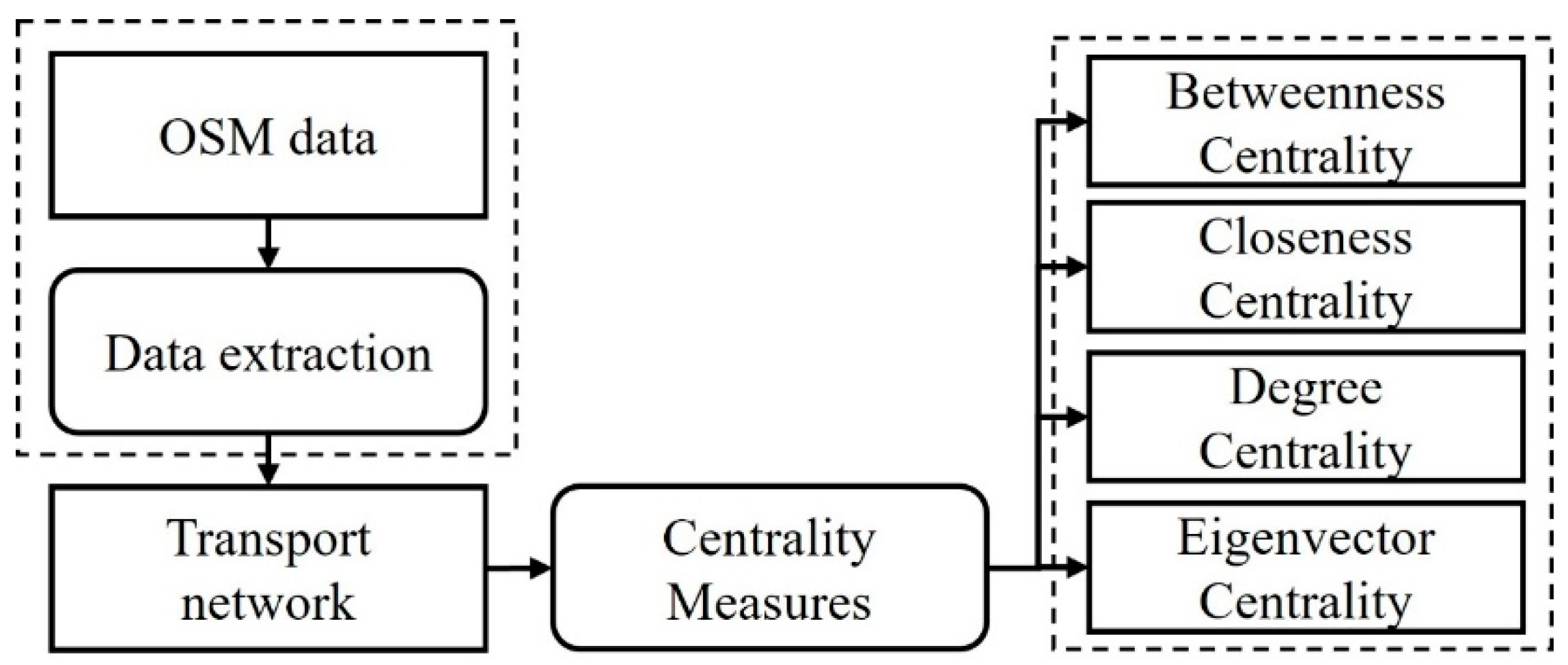
The procedure (Figure 1) starts with the acquisition of OpenStreetMap (OSM) data, a data extraction procedure aimed at classifying and selecting the transport network nodes and arcs (e.g., in relation to the OSM classification). Then, certain centrality measures, like betweenness, closeness, degree, and eigenvector centrality, are calculated (e.g., for a set of destinations). These centrality measures are detailed in the following paragraphs.
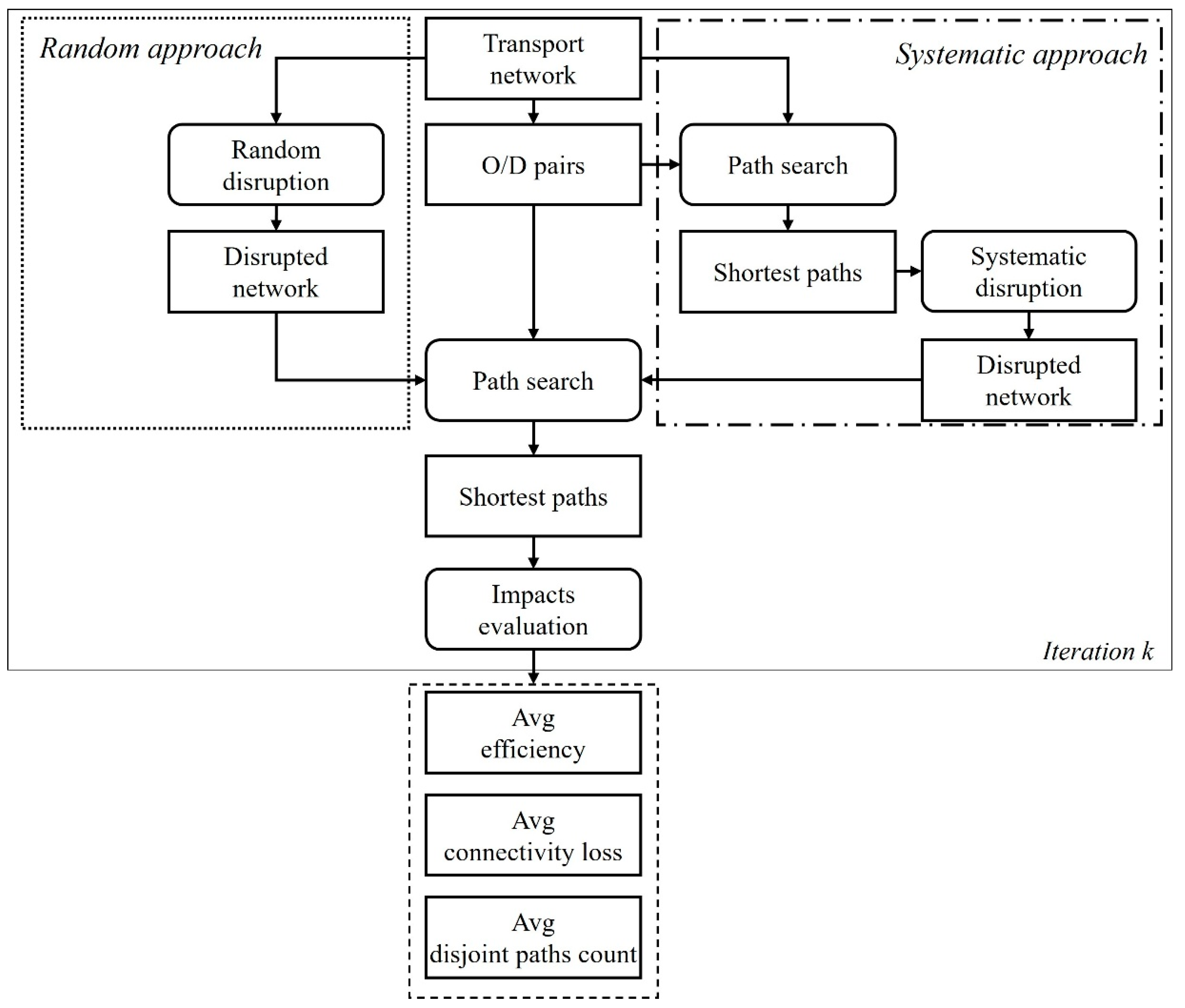
A transport network may be subject to one or more events that degrade its functionality, for example, with losses of capacity and increased travel times. To evaluate these situations, two different calculation approaches are proposed (Figure 2): a random approach and a systematic approach, the objective of which is to measure the effects of any disruption on the network. The transport network is represented by an oriented graph G(N, L), with N the set of nodes and L the set of arcs. Each arc i is associated with a cost wi (it is the free flow travel time) used in the path search. A set of O/D pairs is identified to model the origin and the destination of the travels in the area; the impacts of disruption could be referred to these pairs. The graph G and the set of O/D pairs are the input in common of the two approaches.
Focusing on the random approach, a random disruption method is used to eliminate some arcs of the road network (this impacts the performance of the network, e.g., by reducing the number of available paths). In this disrupted network, a path-search procedure (like the Dijkstra algorithm) is applied; the aim is to obtain, for each O/D pair, a set of shortest paths. The impact evaluation procedure allows for the calculation of efficiency, connectivity loss, and disjoint paths. It should be noted that the procedure is repeated more than once. In this case, given the random nature of the extractions of the arcs, a fixed number of iterations was set, and the values of the indicators were averaged over this number of iterations. It bears noting that Figure 2 depicts only one iteration.
Focusing on the systematic approach, after identifying the shortest paths, the arcs/nodes belonging to such paths were systematically disrupted (one node or one arc at a time; the elimination of a node entails the elimination of all arcs converging/diverging to/from it). From this operation, a disrupted network is obtained (e.g., a network where arcs/nodes are removed with a consequent variation on the paths available), and on this network a new path search is performed (i.e., a path search implemented in a network where some arcs/nodes are missing). The number of repetitions of the procedure depends on the number of nodes and arcs in the shortest paths; also, in this case, the value of the indicators is an average value. It bears noting that removing an arc/node generates a new network configuration and modifies the path search. Also, in this case, the procedure of impact evaluation allows for obtaining the average value of the indicators.
To develop the procedures described above, some open-source packages are used. In particular, the OSMnx library (https://osmnx.readthedocs.io/en/stable/, accessed on 30 October 2025) [45,46] and the Networkx library (https://networkx.org/en/, accessed on 30 October 2025) [47] are used to extract the graph and analyze it, respectively. The use of these tools allows for the replication of the procedure regardless of the study area analyzed.

3.1. Centrality Measures

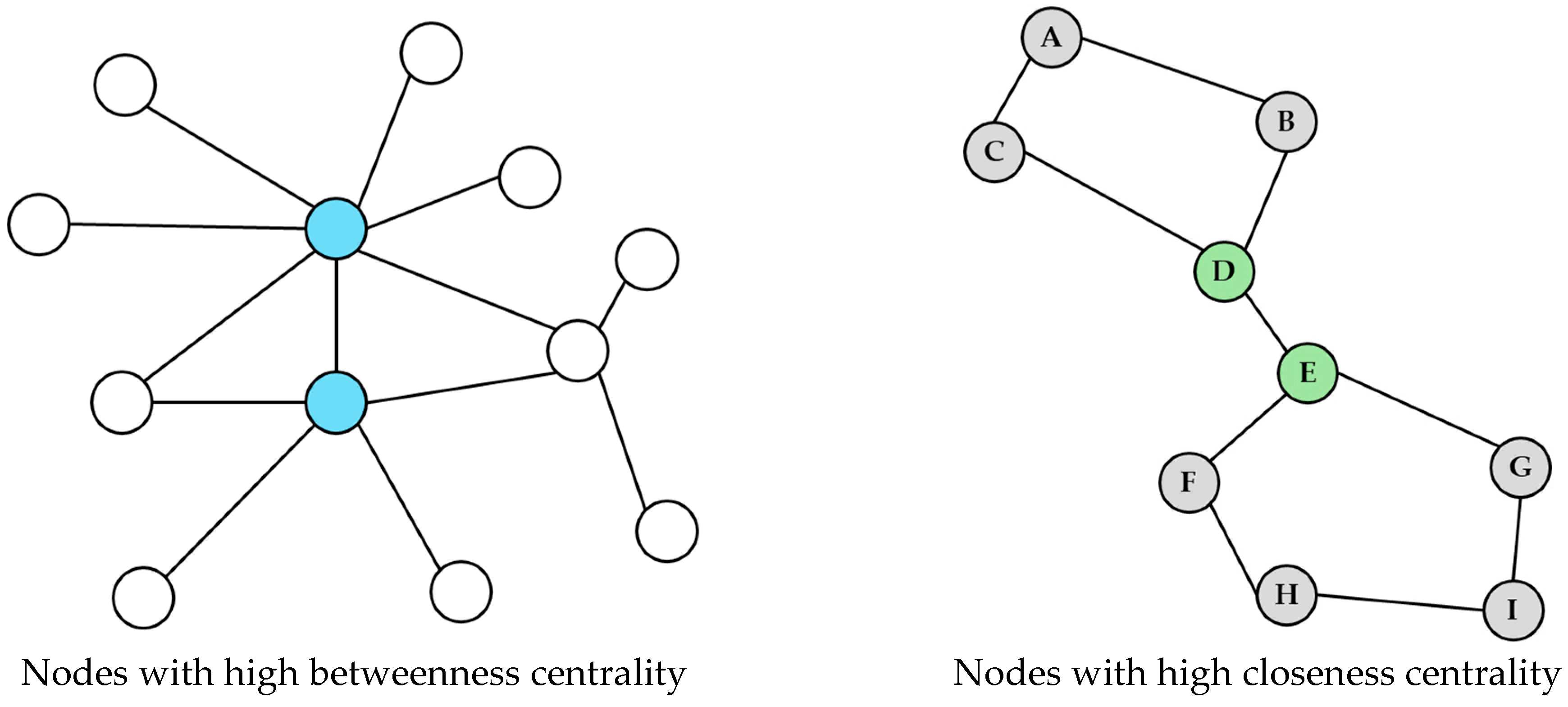
Centrality measures [48] are indices based on the topology of the network and assigned to a node/arc to reflect the importance of this node/arc for the performance of the road network. The centrality measures considered in this paper are betweenness centrality, closeness centrality, degree centrality, and eigenvector centrality. Table 1 summarizes these indicators, while Figure 3 reports some examples. The comparison of centrality indicators offers valuable insights into the relative importance of nodes within the transportation network; however, understanding the underlying causes of poor resilience is essential for interpreting these results in practical terms. The observed vulnerability largely stems from the network’s low redundancy and the concentration of traffic on a few highly central nodes. These nodes, characterized by high betweenness and closeness values, act as critical connectors. When disrupted due to accidents, maintenance, or natural hazards, the lack of alternative routes significantly amplifies the impact, leading to cascading failures across the system.
Degree centrality reflects the number of direct connections a node has, identifying highly connected intersections that can facilitate local accessibility. Nodes with high degree centrality often act as local hubs, improving connectivity within their immediate surroundings. On the other hand, betweenness centrality measures the extent to which a node lies on shortest paths between other nodes, highlighting critical connectors whose disruption could severely impact network flow and emergency response times. These nodes are essential for maintaining global connectivity and preventing bottlenecks. Closeness centrality evaluates how close a node is to all others in terms of average shortest-path distance, identifying locations that minimize travel time across the network. Finally, unlike degree centrality (which counts links), eigenvector centrality considers the quality of connections. Together, these metrics offer a comprehensive framework for prioritizing interventions and optimizing healthcare accessibility in emergency scenarios. These concepts are explored further in subsequent sections.

3.1.1. Betweenness Centrality

Betweenness Centrality (BC) identifies nodes and arcs that are critical for the shortest paths in the network. High BC indicates that a node or arc is a crucial connector in the network. The shortest-path BC [49,50] for a node i is the sum of the fraction of all-pairs’ shortest paths that pass through i:
B C ( i ) = r , s N σ r , s | i σ r , s
where N is the set of nodes, σ(r,s) is the number of shortest paths from r to s, and σ(r,s|i) is the number of paths passing through some node i other than r,s. By convention, if r = s, σ(r,s) = 1, and if i = r (or i = s), σ(r,s|i) = 0.
In this work, BC is calculated using the algorithm formulated by Brandes [51].
BC is based on the observation that if a node is part of many shortest paths, then it is a node that has an important position in the domain of the transport system. In fact, nodes with a high BC value can be seen as weak points in the network since the elimination of such points can lead to network disconnection. BC is useful for identifying critical roads or intersections in a transportation network that, if disrupted, can significantly affect connectivity.

3.1.2. Closeness Centrality

Closeness Centrality (CC) measures how close a node is to all other nodes in the network. Nodes with high closeness centrality can quickly interact with other nodes, implying high accessibility.
Closeness centrality [52,53] of a node i is the reciprocal of the average shortest-path distance to i over all n − 1 nodes:
C C ( i ) = n 1 j = 1 j i n d i j
where d(i,j) is the shortest-path distance between i and j, and n − 1 is the number of nodes reachable from i. This metric estimates the degree of proximity of node i to the rest of the nodes in the graph. Higher values of CC indicate higher centrality and how easily different parts of the network can be reached from a particular node, which is important for emergency response planning.

3.1.3. Degree Centrality

Degree Centrality (DC) [53,54] is the number of connections a node has. Let A be the adjacency matrix with generic element aij equal to 1 if nodes i and j are connected by an arc ij, 0 otherwise. In a directed graph, the arcs considered are from i to j (this means that, given a node i, only the outgoing arcs are considered). The DC for a node i is the fraction of nodes to which it is connected:
D C ( i ) = 1 n j = 1 j i n a i j
Higher DC implies a node has many direct connections and is useful for identifying well-connected hubs in the transportation network, which are crucial to maintaining overall connectivity.

3.1.4. Eigenvector Centrality

The Eigenvector Centrality (EC) is a measure used in graph theory to determine the relative importance of a node within a network. This measure is based not only on the number of connections (degree) of a node, but also considers the importance of the nodes to which it is connected. EC [55,56] computes the centrality of a node by adding the centrality of its predecessors. The centrality of the eigenvector xi of node i is calculated as:
x i = 1 λ j = 1 j i n a i j x j
where λ (λ ≠ 0) is the largest eigenvalue of the adjacency matrix. In matrix form, Equation (4) can be written as:
λ x = x A
The centrality for node i is the i-th element of the eigenvector x. A node with high eigenvector centrality is important not only because it has many connections but also because it is connected to nodes that are also highly connected. This type of centrality is useful for identifying influential nodes in transportation networks.

3.2. Impacts Evaluation

Systematic analysis in real-world networks involves a considerable expenditure of computational resources, but, in any case, various disruption scenarios (e.g., natural disasters, accidents) can be simulated by randomly interrupting a certain number of elements of the network to observe their impact on the system. In addition, practical problems require considering the efficiency and robustness of connections between some specific nodes and the rest of the network. Consequently, the analysis focuses on the redundancy of the connections to (and/or from) these nodes. Given a set of origin–destination (O/D) pairs, for each of them, it is possible to examine the impact on the connectivity between the two nodes due to the removal of some network elements. This impact can also be considered for the path between the two nodes. The goal is to determine how the removal of nodes or arcs affects the global efficiency of the graph.
The global efficiency of a graph is defined as the average of the inverse of the distance between all pairs of nodes [56]. If there is no path between two nodes, the distance is considered infinite, and their efficiency is zero. The global efficiency for a graph G with n nodes is defined as:
E g l o b a l ( G ) = 1 n ( n 1 ) i , j N i j 1 d i j
where dij is the shortest-path length between nodes i and j. Equation (7) defines the nodal efficiency for a node i [56]:
E n o d a l ( i ) = 1 n ( n 1 ) j N 1 d i j i j
With previous considerations, the vulnerability measure can be defined as the percentage decrease in the global efficiency of the graph after the removal of a node or a link compared to the original efficiency. The efficiency calculation can focus on a subset of critical nodes. Let MN be such a subset, a restricted efficiency can be defined as:
E r e s t r i c t e d ( M ) = 1 m i M E n o d a l ( i )
where m is the number of nodes in the subset M.
In a graph G, subsets of nodes Ni can be considered such that the nodes within Ni are connected to each other by at least one path, and there are no connections between the nodes belonging to different subsets. These sets are referred to as components of the graph and have the property of being the maximal connected subgraph of G, which means that one component is not a subgraph of another connected subgraph of G [57]. In this way, the procedure reported in Figure 2 may cause a variation in the number of graph components at each arc removal (with respect to the initial configuration). This allows for obtaining the indicator connectivity loss (Closs) to assess the network connection:
C l o s s = i γ i i t
where γi is the number of graph components at iteration i, and it is the number of iterations.
Due to the shortest paths set for each O/D pair, it is possible to evaluate the number of disjoint paths, i.e., the paths without arcs in common. Representing the relationship between arcs and paths by means of the incidence matrix [58], the paths are disjoint when the sum of the row related to an arc is equal to 1:
k δ i k = 1 i L
where i represents the arc, δik is an element of the arc-paths incidence matrix, and k is the generic path.
The sum of the row related to an arc equal to 1 means that such an arc belongs to only one path; thus, the disruption of such an arc affects only a path and not the others.
This indicator measures the availability of alternative paths with the assurance that the interruption of an arc does not affect the entire path set.

3.3. Measures Comparison

The selection of indicators for assessing the road network is a delicate task, linked to the characteristics of the network under investigation and to the type of analysis to be performed. The validity of the chosen indicators for a given analysis can be supported by considering those adopted in similar contexts by other authors in the literature. Accordingly, the following paragraphs report a comparison between the indicators employed in this work and those used in the literature. For instance, Ashja-Ardalan et al. [59] proposed a topology-based road network analysis incorporating betweenness, closeness, degree centrality, and efficiency into a multicriteria analysis. The approach was designed to identify the most critical nodes and arcs of the road network in relation to atmospheric precipitation levels. Nie et al. [60] aimed to investigate the impact of node failure on a road network under a sudden calamitous event. Metrics such as degree centrality, closeness centrality, betweenness centrality, and local network efficiency were used to define a synthetic index capable of capturing the network’s status across different scenarios. Wei and Xu [11] developed a framework to assess the resilience of a road network under different conditions and used a set of measures (including betweenness centrality and efficiency) to quantify its condition after a disaster. Lu et al. [61] examined the relationship between resilience and density of the road network. The measures considered in order to highlight this correlation were efficiency and betweenness centrality. Alizadeh and Dodge [62] proposed a data-driven approach to assess the road network vulnerability when a disruption event occurs. The betweenness centrality was used to quantify network vulnerability. The aim was to identify the road arcs whose disruption limits (or prevents) the accessibility, increasing the vulnerability of the network.
Table 2 shows a comparison of the use of the indicators employed to perform topological analyses of road networks. The widespread use of centrality measures and efficiency is highlighted. Therefore, it seems appropriate to use a combination of these indicators to assess the condition of the network under disruption scenarios.

4. Case Study

The application focuses on determining the efficiency of a road network by analyzing certain resilience metrics related to the ability to access sensitive points of the network.
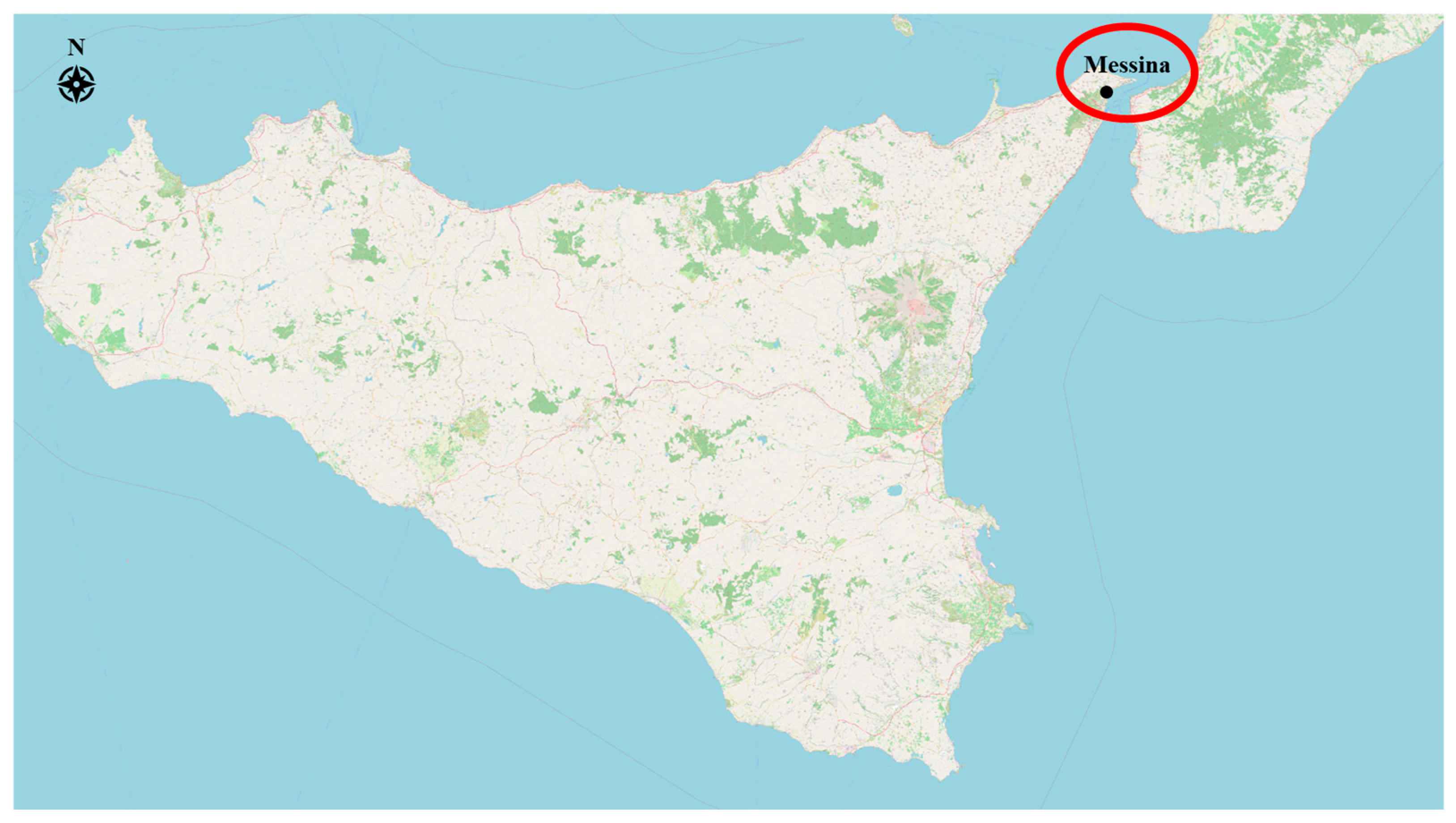
The area selected for the application is the city of Messina (Sicily, South Italy), located in northeast Sicily (Figure 4). The urban structure of Messina is characterized by a historic center surrounded by modern residential neighborhoods (about 222,000 inhabitants live in this area of approximately 214 square kilometers). The city is crossed by a complex road network that includes main arterial roads, secondary roads, and a variety of public transport infrastructure.
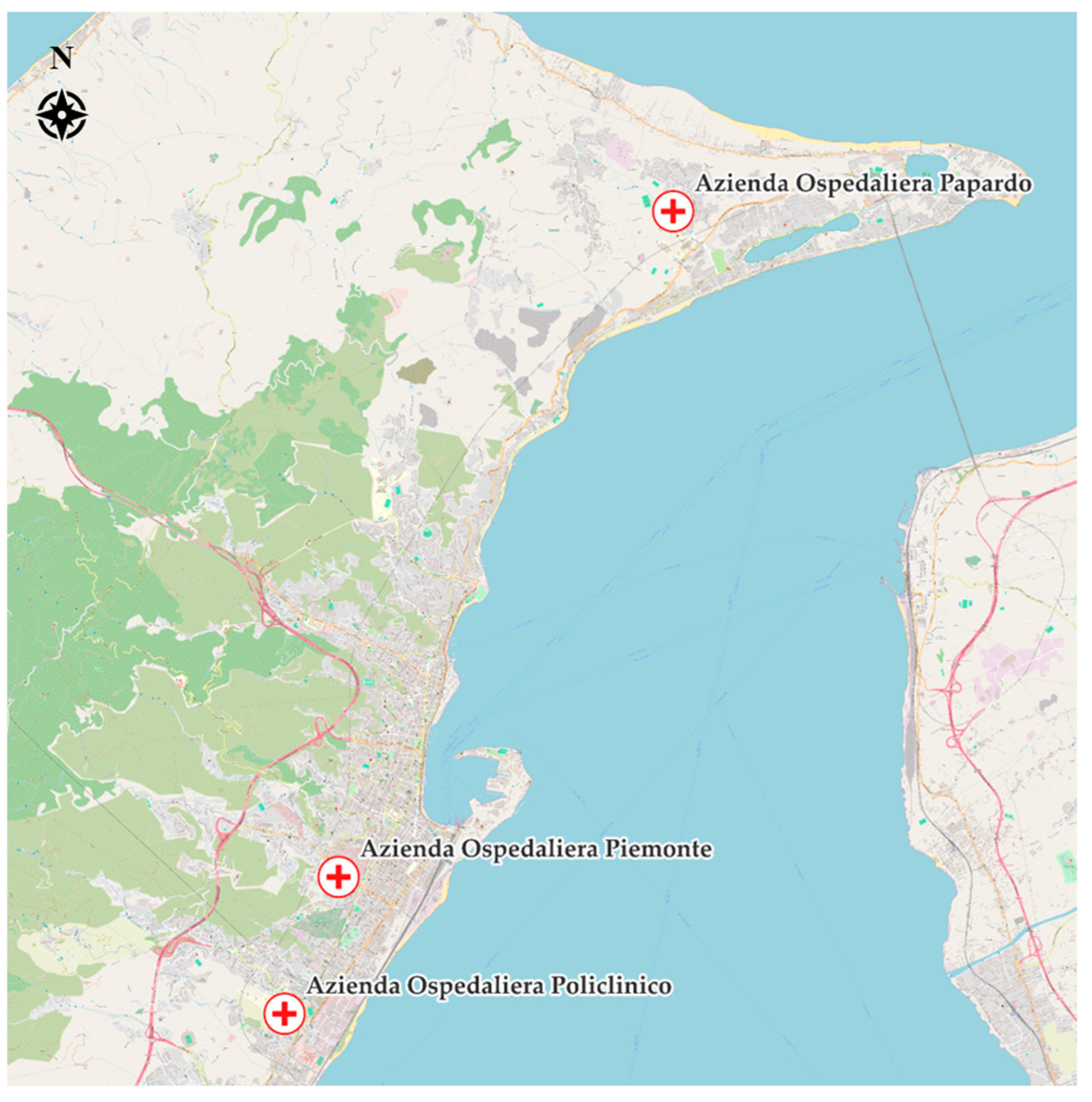
Within this road network are the city’s three main hospital facilities, as shown in Figure 5, which play a crucial role in providing emergency and first aid services. The University Hospital “G. Martino” (hereafter referred to as Policlinico) is located in the southern area of the city and represents one of the main reference centers for advanced healthcare and medical research in Sicily. The second reference center, the “Papardo” Polyclinic (referred to below as Papardo), is located in the northern part of the city and is known for its highly specialized emergency services and the quality of care offered to patients. The “Piemonte” Hospital (referred to below as Piemonte), located in the central area, is another fundamental structure for emergency services, offering rapid access and an effective response to medical emergencies. Within the city, there are other hospitals; these three were chosen because they are the ones equipped with an emergency room.
The analysis focuses on the efficiency of Messina’s road network, examining the indicators of the network in relation to the ability to quickly access these three hospital centers. The road network was extracted from OpenStreetMap [63] and the OSMnx library [45,46], making the analysis easily replicable for any other geographical area. The data obtained through the OSMnx library provided basic information on the road graph regardless of its size (e.g., road category, length) and allowed for the application of the procedure described in Section 3. It bears noting that the calculation of indicators other than those reported in Section 3 would require the use of data from other sources.
In the graph extraction, residential arcs were excluded from those considered. This approach streamlined the procedure without altering the results. In fact, by associating the origins of trips with nodes (see Section 3), demand losses were avoided, as a trip was linked to those available. For further information on this concept, refer to Cascetta [58].
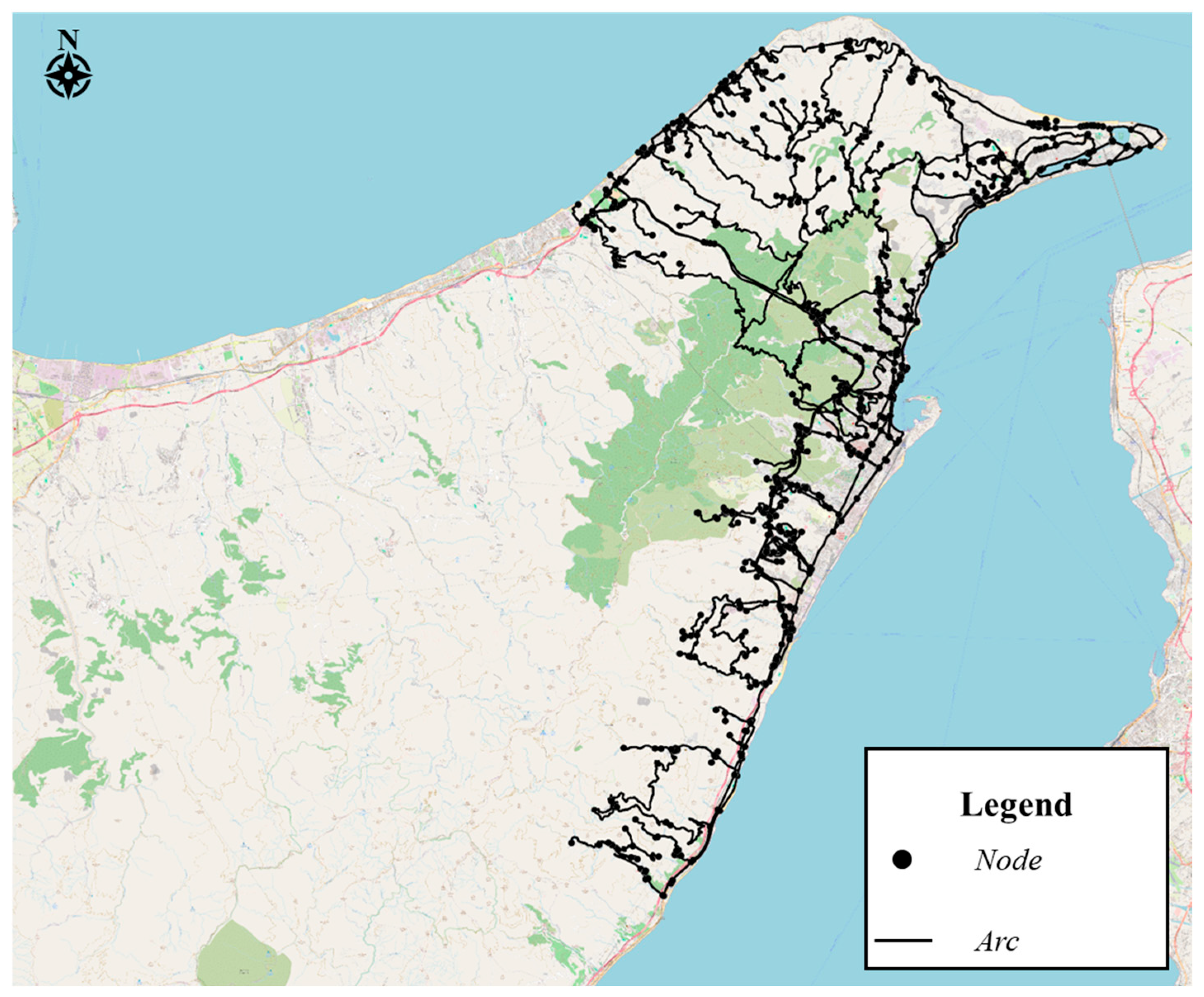
Starting from this initial graph, a cleaning procedure allowed for the elimination of arcs that were not useful for system simulation, such as “cul de sacs” in areas with a high density of connected nodes. The graph obtained 1033 nodes and 2018 arcs, which are shown in Figure 6, and certain characteristics are reported in Table 3.
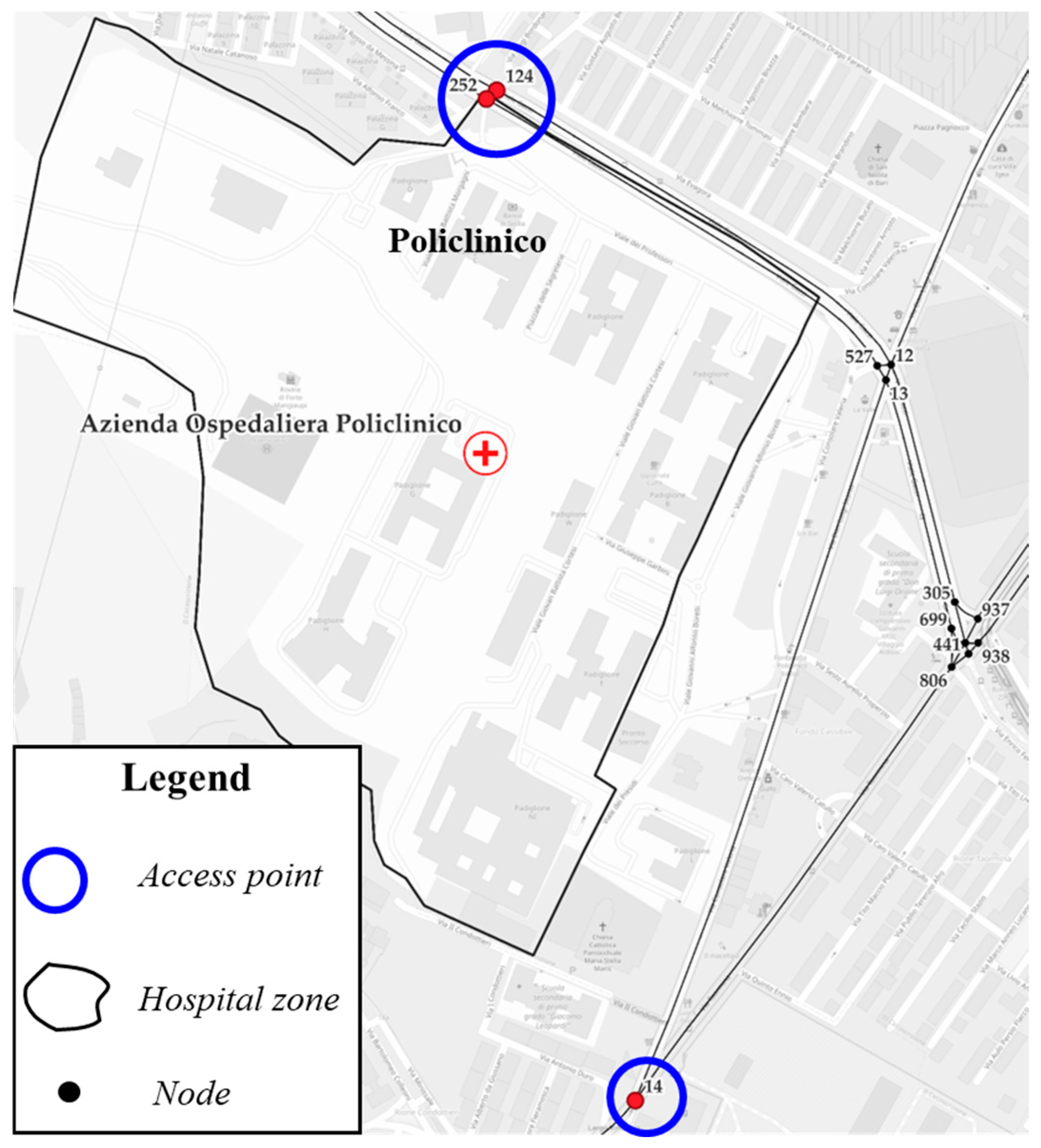
The three hospital structures considered in the simulation have multiple points of access (Figure 7); thus, to identify the three hospital structures, the nodes from which access was possible to each of them were identified within the network graph. Going beyond traditional notation [58], no centroid was defined to connect the three hospitals to the network graph so as not to structurally affect the network analysis (in particular, the search for disjoint paths). Taking into account the physical access of the hospitals, the graph nodes near such access points were considered representative of the hospital. Given the above, three nodes each were identified for the Policlinico and Papardo, and four for the Piemonte, as reported in Table 4. Figure 7 shows an example of the Policlinico, where two access points are identified, and three nodes represent the hospital. Similar considerations were made in choosing the nodes representing Piemonte and Papardo hospitals.

5. Discussion

The analysis of the resilience of the transportation network was implemented by means of Python 3.11.9 scripts, where network analysis techniques and simulated disruptions were used to classify the network’s robustness. The choice of a simulation approach was made to ensure that our analysis considered the widest possible set of scenarios. In fact, this allowed for a wider range of disruptions to be covered than those observed.
Some of the scripts were built up in order to provide a set of operations, such as setting up the transportation network, calculating centrality measures, simulating disruptions, and classifying the network’s resilience based on the observed impact. A metric to measure the number of disjoint paths connecting a pair of nodes was considered; it is often referred to as the node connectivity (or k-connectivity) in network theory and is useful for assessing the robustness and resilience of the network, as more disjoint paths imply a greater resilience to node or arc failures. A portion of the analyses was carried out as much as possible using the features of the Networkx library [47], in order to make the analysis easily replicable. As an example, the disjoint paths were identified by using the features made available by Networkx that also allowed for the calculation of directed graphs; in such a procedure, the disjoint paths search was based on the Menger theorem [64] implemented with the Edmonds–Karp algorithm [65]. However, it was necessary to develop some routines for those algorithms that were not implemented in Networkx for directed graphs. In fact, since most of the indicators provided by the library were defined for an undirected graph, it was necessary to modify the existing procedures to make them suitable for a directed graph.

5.1. Centrality Measures

Centrality measures provided perspectives on the importance of nodes within a transportation network, each capturing a different aspect of accessibility and vulnerability; a summary of their role was reported in Section 3.1.
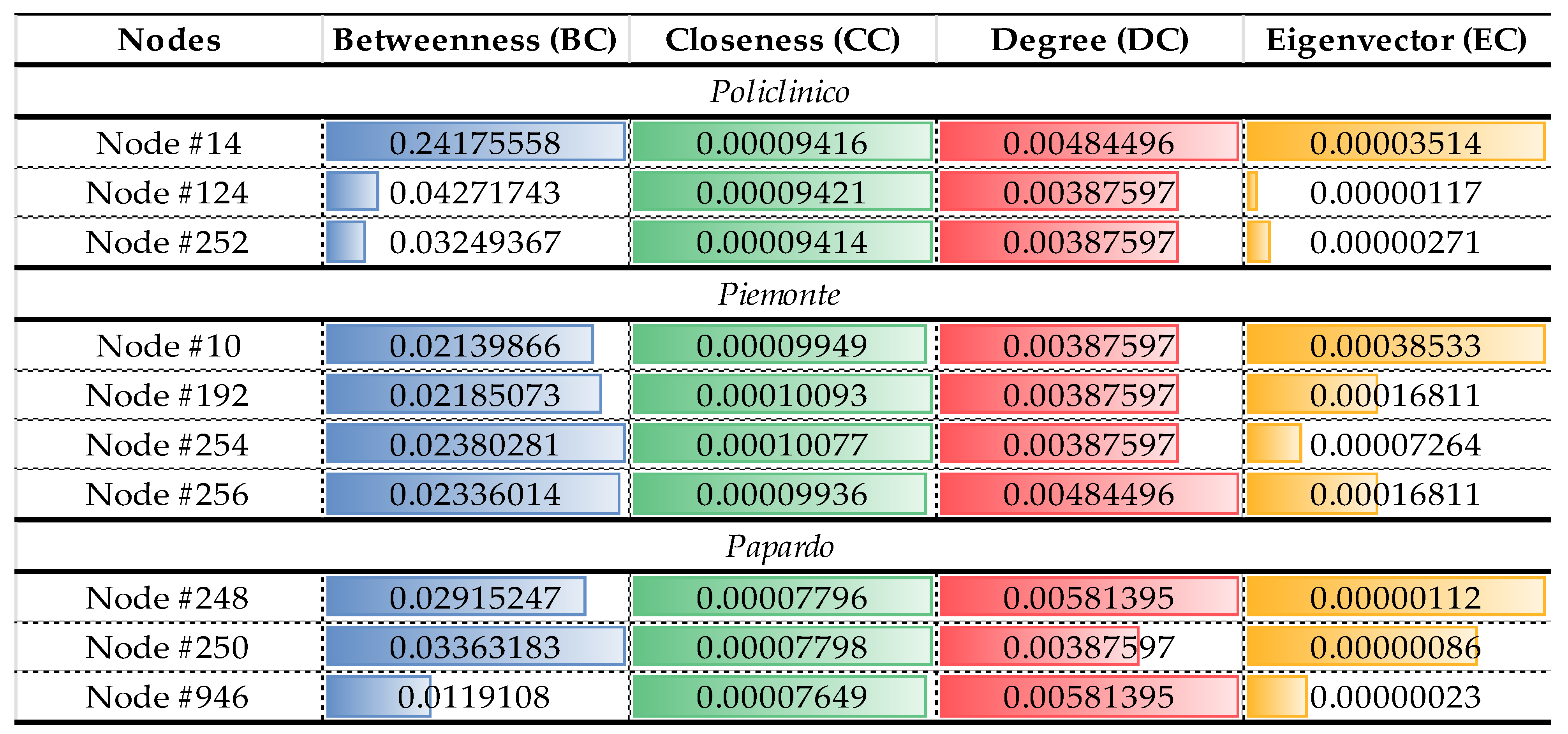
Since this analysis essentially concerned single nodes and arcs of the network, it focused on the nodes representative of each hospital described in Table 4. Centrality measures, as defined in Section 3.1, were computed using the algorithm implemented in Networkx. The results obtained for each node are summarized in Figure 8. It bears noting that the closeness centrality is the reciprocal of a length, and the length is measured in meters.
The analysis of the results (Figure 8) provides some insight into the structure and functionality of the network. For the Policlinico hospital, node 14 has the highest BC value (0.24175558) among all the nodes analyzed, indicating that it plays a crucial role as a core point for multiple paths in the network. However, the low values of CC (0.00009416), DC (0.00484496), and EC (0.00003514) suggest that it is not centrally located nor strongly connected to other influential nodes. Both node 124 and node 252 have moderate BC values (0.04271743 and 0.03249367, respectively) but share low CC, DC, and EC, indicating that they have a less significant role in transit than node 14 and are not influential in the overall structure of the network. For the Piemonte hospital, nodes 10, 192, 254, and 256 have similar BC values (between 0.02139866 and 0.02380281) and slightly higher CC than the Policlinico nodes, indicating a slightly higher centrality. In particular, node 10 has a relatively high EC value (0.00038533), suggesting a stronger connection to important nodes in the network. Node 256, with a higher DC (0.00484496), also shows better direct connection with other nodes. For the Papardo hospital, nodes 248 and 946 have the lowest CC values (0.00007796 and 0.00007649, respectively) among all nodes, suggesting poor centrality and accessibility in the network. However, node 248 has a higher DC (0.00581395), indicating a good number of direct connections, while its low EC value (0.00000112) indicates a poor connection to influential nodes. Node 250 has a relatively high BC value (0.03363183) but with very low CC, DC, and EC values, indicating that it is a critical node for transit, but not central nor strongly connected. Generally, the network shows significant variation in the roles and influences of the nodes. Policlinico nodes show a central node that is very influential for transit (node 14), but generally less central in the network. Piemonte has nodes with a slight upper centrality, and one in particular (node 10) is well-connected to important nodes. Papardo, on the other hand, has nodes with low centrality and accessibility, but some of them are crucial for transit. The acquired results could have been normalized, but it was preferred to leave them as they are to capture the order of magnitude of the obtained values. These results can guide infrastructure planning decisions, indicating which nodes to strengthen to improve the resilience and efficiency of the transportation network.

5.2. Impacts Evaluation

This analysis focused on specific origin–destination (O/D) pairs and examined the impact of removing nodes or arcs on the connectivity and efficiency of the path between those two nodes. The goal was to determine how removing nodes or arcs affected the path and efficiency of the O/D connection. In the application, the destinations for each hospital facility are the nodes reported in Table 4, while the origins considered are all the nodes in the graph. The value of the indicators associated with each hospital is the average of the indicators of the nodes that represent it.
The first simulation was performed by interrupting random arcs for each O/D pair. To determine the number of random interruptions to introduce in each simulation, the number of arcs belonging to the minimum-cost paths connecting the various origin–destination pairs was considered. Balancing statistical significance with computational efficiency, the number of interruptions was matched to the most frequent value of the arc count, i.e., the statistical mode. Based on the evaluation of minimum-cost paths for the 10,230 O/D pairs, the descriptive statistics for the number of edges are reported in Table 5.
Therefore, according to the value of the mode, the simulations were conducted with 50 interruptions in the paths.
For each iteration, the efficiency, the loss of connectivity, and the number of disjoint paths were computed, and the results were averaged. In the second simulation, the arcs and nodes belonging to the shortest-path tree connecting the considered node with all the other nodes of the network were systematically interrupted, one at a time. For the sake of simplicity, the graph of the network was implemented by considering the backward star of each node; in such a way, using Dijkstra’s algorithm to find the shortest-path tree having as its root a representative node of a hospital, the paths from each node of the graph to the destination were directly obtained in a single step. The nodes and the arcs belonging to the shortest-path tree were systematically removed from the graph, and a new shortest-path tree was computed for each removal. Finally, the percentage changes in path length and efficiency after were computed for each removal.
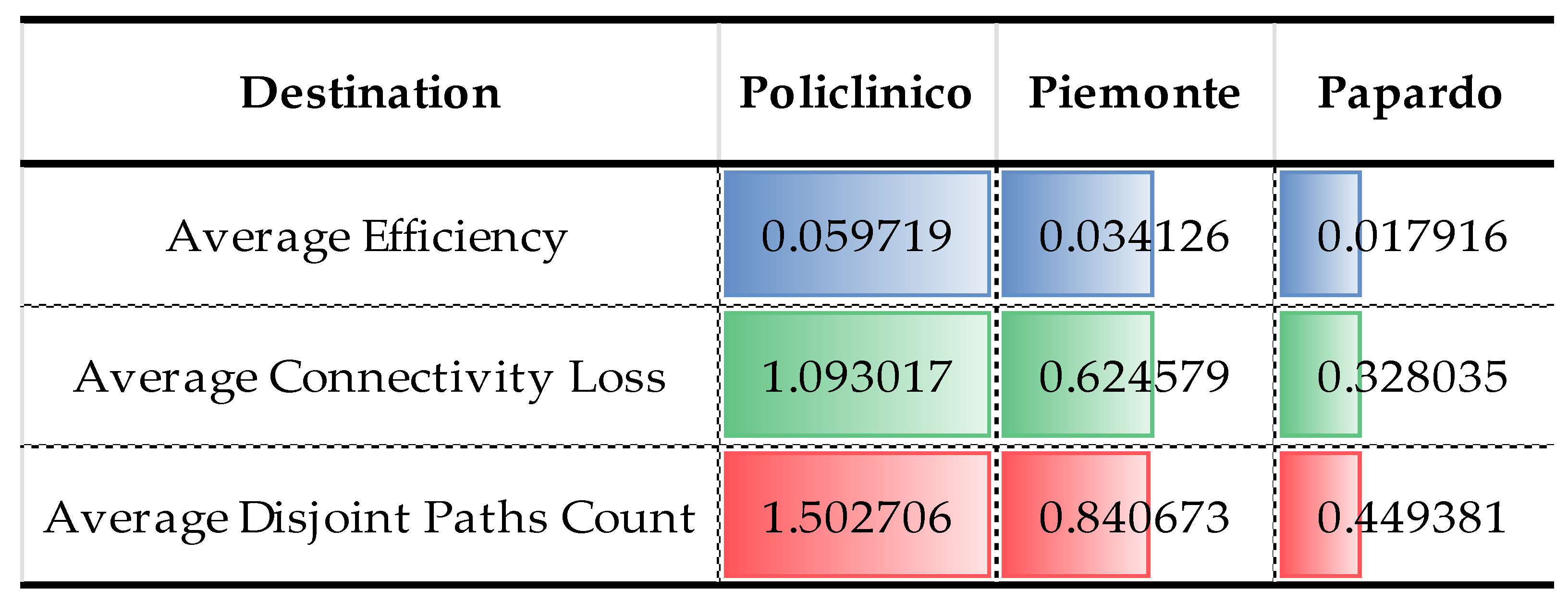
The average network efficiency (Figure 9) of Policlinico is the highest among all destinations, with a value of 0.0597192. This indicates that the paths in the network are generally shorter and that the network is more efficient than other destinations. This can be interpreted as relating to the hospital’s location, situated in an area of the city accessible through multiple alternative paths, thus mitigating the effects of disruptions. Similar considerations were made for Papardo, which is located in an area that is more difficult to reach (fewer available paths, therefore it is affected more by disruptions) than the areas where the other two hospitals are located.
Piemonte’s network has an average efficiency of 0.0341256, lower than Policlinico but higher than Papardo. This suggests a moderately efficient network with paths that are generally longer than Policlinico. With an average efficiency of 0.0179158, Papardo has the least efficient network. This indicates that the paths in the network are longer and less optimal, negatively impacting travel time and transport capacity. In summary, Policlinico has the highest average efficiency, suggesting greater ease of movement and better connectivity between nodes. Papardo shows the lowest efficiency, indicating a less effective network.
In relation to the number of disjoint paths (Figure 9), Policlinico has the highest average number of them (1.5027059), suggesting good redundancy in the network. More disjoint paths meant that there are multiple alternatives in the event of failures. With an average disjoint path count of 0.8406729, Piemonte has moderate redundancy in its network. The average number of disjoint paths in Papardo is the lowest (0.4493810), indicating low redundancy and therefore greater vulnerability to failures. In summary, Policlinico has a higher average number of disjoint paths, suggesting more redundancy in the network. Papardo has the lowest number, suggesting less availability of alternative paths.
In terms of disconnections (Table 6 and Table 7), focusing on Policlinico hospital, during random arc removals (in total, 1528 removals were made), 534 O/D pairs were disconnected (Table 6). There were a significant number of arcs removed that led to disconnections, as reported in Table 7. Arcs 388-18 and 386-388 are particularly critical, contributing the most to disconnections. This suggests that the robustness of these links should be strengthened to improve resilience. Focusing on Piemonte hospital, random arc removals caused the disconnection of 672 O/D pairs (Table 6). Arcs 18-933 and 388-18 are crucial to maintain connectivity (Table 7). Focusing on Papardo hospital, the arc removals yielded 501 disconnected O/D pairs (Table 6). Compared to the other two hospitals, Papardo had the lowest number of disconnected O/D pairs. However, some arcs (Table 7), such as 18-933 and 386-388, are critical and could benefit from hardening to further improve network resilience. It is noted that there were arcs whose removal affected the network connection of all three hospitals. As an example, the arc 386-388 disconnected 30 O/D pairs for Piemonte and Papardo, and 21 for Policlinico. Similar considerations can be made for other arcs (e.g., 412-469, 388-18, 18-933, just to name a few). These considerations can be useful in the network maintenance planning phase, in order to concentrate interventions on the most critical arcs for connectivity. Similarly, when it is decided to intervene on one of these arcs that is known to cause a disconnection, these analyses support decision makers who can make changes to the network to have alternative paths and reduce the number of disconnected pairs.
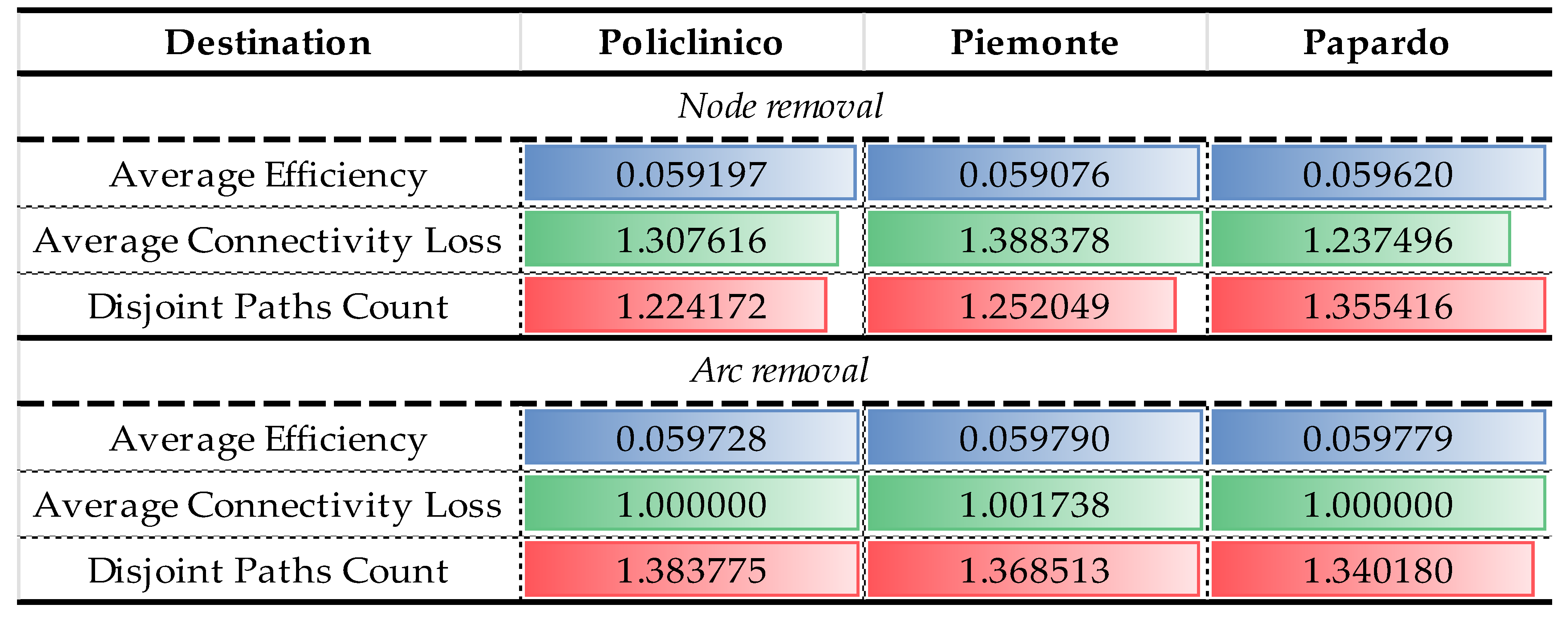
Taking into account the systematic removal of nodes and arcs (Figure 10), in terms of average efficiency, the results reveal important insights into the structural robustness and vulnerability of the network.
Concerning Average Efficiency: (i) Node removal significantly reduces efficiency (≈0.059), indicating that the network is highly sensitive to the loss of critical nodes. Papardo shows slightly better performance, suggesting a more redundant structure. (ii) Arc removal has a negligible impact on efficiency (≈0.0597–0.0598), confirming that link failures are well mitigated by alternative paths.
Concerning Average Connectivity Loss: (i) Node removal causes substantial connectivity loss, especially for Piemonte (1.388), highlighting its vulnerability. Papardo exhibits the lowest loss (1.237), reinforcing its relative robustness. (ii) Arc removal results in minimal connectivity loss (≈1.0), indicating strong link-level resilience.
Concerning Disjoint Paths Count: (i) Node removal reduces redundancy, but Papardo maintains the highest count (1.355), suggesting better fault tolerance. (ii) Arc removal slightly increases disjoint paths overall, confirming that link failures do not critically compromise redundancy.
The network demonstrated greater resilience to arc removal than to node removal, a typical characteristic of urban transport and healthcare access networks where nodes represent critical facilities. Among the destinations, Papardo emerged as the most robust, while Piemonte appeared more vulnerable under node failure scenarios.
From a resilience classification perspective, the network can be considered moderately robust, with structural redundancy mitigating link failures but remaining sensitive to node disruptions. This suggests that resilience strategies should prioritize node-level protection and redundancy enhancement, particularly for Piemonte.

6. Conclusions

Goal 11 of the Sustainable Development Goals, as defined by the United Nations, aims to improve living conditions in cities by making them inclusive, safe, resilient, and sustainable. The road network is one of the elements that can be improved to achieve this objective. As an example, redundancies can be introduced into the network to ensure that, if some elements fail, mobility within the city and accessibility to essential services can still be guaranteed. In particular, the efficiency of the road network is relevant for timely access to emergency health services. Therefore, a set of indicators is required to measure the performance of the network under different conditions. This study uses OpenStreetMap data and the tools offered by the OSMnx package to extract and analyze the street network; such a methodology, available to anyone, allows for building a detailed graph of the road network, facilitating the analysis of connections and resilience. The application describes a methodology that can be adopted, in terms of planning operations, for the analysis of criticality in connections in order to define areas where essential services, for which accessibility is a fundamental requirement, can be allocated. The extraction and analysis procedures are entirely replicable, offering a model that can be applied to any other geographical area for urban planning and infrastructure improvement purposes.
In the case considered in the application, the city of Messina is home to three main emergency hospital facilities: the “G. Martino” University Hospital, located in the southern area; the “Papardo” Polyclinic, located in the north; and Piemonte Hospital, centrally located and vital for rapid responses to medical emergencies. The network connectivity and frequency of disconnections were examined in detail, providing a critical assessment of the accessibility of the city’s three main emergency centers. The results obtained from this study, in terms of centrality measures, can guide decisions on infrastructure planning, indicating which nodes to strengthen to improve the resilience and efficiency of the transportation network.
In relation to SDG 11, this study contributes to the objective of a “resilient and sustainable city”: resilient by providing an easily exportable approach to identify a set of valuable network indicators and sustainable (from the point of view of social sustainability) by providing a means to assess the accessibility to hospitals providing first-aid, contributing to the well-being of users.
This research is not without limitations. The metrics used, although useful in quantifying the performance of a road network subject to disruptions, do not provide explicit information on time (e.g., the time needed by the system to return to its initial conditions). This aspect can be developed in future studies by defining a recovery function able to summarize the variation in the network status.

Author Contributions

Conceptualization: A.P. and M.D.G.; data curation: M.D.G.; formal analysis: M.D.G., O.M.B. and A.P.; investigation: M.D.G. and A.P.; methodology: M.D.G., O.M.B. and A.P.; software: M.D.G.; supervision: M.D.G.; validation: M.D.G., O.M.B. and A.P.; writing—original draft: M.D.G. and A.P.; writing—review editing: M.D.G., O.M.B. and A.P. All authors have read and agreed to the published version of the manuscript.

Funding

This research received no external funding.

Institutional Review Board Statement

Not applicable.

Informed Consent Statement

Not applicable.

Data Availability Statement

The data presented in this study are available on request.

Conflicts of Interest

The authors declare no conflicts of interest.

References

  1. United Nations. Transforming Our World: The 2030 Agenda for Sustainable Development; Department of Economic and Social Affairs: New York, NY, USA, 2015. [Google Scholar]
  2. Adlakha, D.; Parra, D.C. Mind the Gap: Gender Differences in Walkability, Transportation and Physical Activity in Urban India. J. Transp. Health 2020, 18, 100875. [Google Scholar]
  3. Aghababaei, M.T.S.; Costello, S.B.; Ranjitkar, P. Measures to Evaluate Post-Disaster Trip Resilience on Road Networks. J. Transp. Geogr. 2021, 95, 103154. [Google Scholar] [CrossRef]
  4. Sullivan, J.; Aultman-Hall, L.; Novak, D. A Review of Current Practice in Network Disruption Analysis and an Assessment of the Ability to Account for Isolating Links in Transportation Networks. Transp. Lett. 2009, 1, 271–280. [Google Scholar] [CrossRef]
  5. Russo, F.; Vitetta, A. Risk Evaluation in a Transportation System. Int. J. SDP 2006, 1, 170–191. [Google Scholar] [CrossRef]
  6. Holling, C.S. Resilience and Stability of Ecological Systems. Annu. Rev. Ecol. Syst. 1973, 4, 1–23. [Google Scholar] [CrossRef]
  7. Christopher, M.; Peck, H. Building the Resilient Supply Chain. Int. J. Logist. Manag. 2004, 15, 1–14. [Google Scholar] [CrossRef]
  8. Freckleton, D.; Heaslip, K.; Louisell, W.; Collura, J. Evaluation of Resiliency of Transportation Networks after Disasters. Transp. Res. Rec. 2012, 2284, 109–116. [Google Scholar] [CrossRef]
  9. Bruneau, M.; Chang, S.E.; Eguchi, R.T.; Lee, G.C.; O’Rourke, T.D.; Reinhorn, A.M.; Shinozuka, M.; Tierney, K.; Wallace, W.A.; von Winterfeldt, D. A Framework to Quantitatively Assess and Enhance the Seismic Resilience of Communities. Earthq. Spectra 2003, 19, 733–752. [Google Scholar] [CrossRef]
  10. Luo, Z.; Yang, B. Towards Resilient and Smart Urban Road Networks: Connectivity Restoration via Community Structure. Sustain. Cities Soc. 2021, 75, 103344. [Google Scholar] [CrossRef]
  11. Wei, M.; Xu, J. Assessing Road Network Resilience in Disaster Areas from a Complex Network Perspective: A Real-Life Case Study from China. Int. J. Disaster Risk Reduct. 2024, 100, 104167. [Google Scholar] [CrossRef]
  12. Martín, B.; Ortega, E.; Cuevas-Wizner, R.; Ledda, A.; De Montis, A. Assessing Road Network Resilience: An Accessibility Comparative Analysis. Transp. Res. Part D Transp. Environ. 2021, 95, 102851. [Google Scholar] [CrossRef]
  13. Zheng, Y.; Xiao, J.; Tang, J. Research on Urban Agglomeration Spatial Network Structure in the Middle Reaches of the Yangtze River Based on Real-Time Traffic Accessibility Scenario Analysis. Transp. Lett. 2025, 17, 369–383. [Google Scholar] [CrossRef]
  14. Xu, X.; Chen, A.; Xu, G.; Yang, C.; Lam, W.H.K. Enhancing Network Resilience by Adding Redundancy to Road Networks. Transp. Res. Part E Logist. Transp. Rev. 2021, 154, 102448. [Google Scholar] [CrossRef]
  15. Allen, E.; Costello, S.B.; Henning, T.F. Contribution of Network Redundancy to Reducing Criticality of Road Links. Transp. Res. Rec. 2024, 2678, 1574–1590. [Google Scholar] [CrossRef]
  16. Sohouenou, P.Y.R.; Neves, L.A.C.; Christodoulou, A.; Christidis, P.; Lo Presti, D. Using a Hazard-Independent Approach to Understand Road-Network Robustness to Multiple Disruption Scenarios. Transp. Res. Part D Transp. Environ. 2021, 93, 102672. [Google Scholar] [CrossRef]
  17. Mu, N.; Han, Y.; Fan, H.; Tian, P.; Wang, Y.; Guo, D. Robustness Assessment of a Multilayer Composite Network with a Two-Stage Fusion Community Detection Algorithm. Transp. Lett. 2025, 17, 1819–1838. [Google Scholar] [CrossRef]
  18. Vivek, S.; Conner, H. Urban Road Network Vulnerability and Resilience to Large-Scale Attacks. Saf. Sci. 2022, 147, 105575. [Google Scholar] [CrossRef]
  19. Haritha, P.C.; Anjaneyulu, M.V.L.R. Comparison of Topological Functionality-Based Resilience Metrics Using Link Criticality. Reliab. Eng. Syst. Saf. 2024, 243, 109881. [Google Scholar] [CrossRef]
  20. Yang, Y.; Huang, H.; Li, G.; Han, B.; Yuan, Z.; Ma, H. A Systematic Review of Resilience Assessment and Enhancement of Urban Integrated Transportation Networks. J. Transp. Geogr. 2025, 129, 104420. [Google Scholar] [CrossRef]
  21. Zhang, X.; Miller-Hooks, E.; Denny, K. Assessing the Role of Network Topology in Transportation Network Resilience. J. Transp. Geogr. 2015, 46, 35–45. [Google Scholar] [CrossRef]
  22. Bagloee, S.A.; Sarvi, M.; Wolshon, B.; Dixit, V. Identifying Critical Disruption Scenarios and a Global Robustness Index Tailored to Real Life Road Networks. Transp. Res. Part E Logist. Transp. Rev. 2017, 98, 60–81. [Google Scholar] [CrossRef]
  23. Xu, Z.; Chopra, S.S. Interconnectedness Enhances Network Resilience of Multimodal Public Transportation Systems for Safe-to-Fail Urban Mobility. Nat. Commun. 2023, 14, 4291. [Google Scholar] [CrossRef]
  24. Aydin, N.Y.; Duzgun, H.S.; Heinimann, H.R.; Wenzel, F.; Gnyawali, K.R. Framework for Improving the Resilience and Recovery of Transportation Networks under Geohazard Risks. Int. J. Disaster Risk Reduct. 2018, 31, 832–843. [Google Scholar] [CrossRef]
  25. Ip, W.H.; Wang, D. Resilience and Friability of Transportation Networks: Evaluation, Analysis and Optimization. IEEE Syst. J. 2011, 5, 189–198. [Google Scholar] [CrossRef]
  26. Akbarzadeh, M.; Memarmontazerin, S.; Derrible, S.; Salehi Reihani, S.F. The Role of Travel Demand and Network Centrality on the Connectivity and Resilience of an Urban Street System. Transportation 2019, 46, 1127–1141. [Google Scholar] [CrossRef]
  27. Edrissi, A.; Nourinejad, M.; Roorda, M.J. Transportation Network Reliability in Emergency Response. Transp. Res. Part E Logist. Transp. Rev. 2015, 80, 56–73. [Google Scholar] [CrossRef]
  28. Bhavathrathan, B.K.; Patil, G.R. Algorithm to Compute Urban Road Network Resilience. Transp. Res. Rec. 2018, 2672, 104–115. [Google Scholar] [CrossRef]
  29. Omer, M.; Mostashari, A.; Nilchiani, R. Measuring the Resiliency of the Manhattan Points of Entry in the Face of Severe Disruption. AJEAS 2011, 4, 153–161. [Google Scholar] [CrossRef]
  30. Ganin, A.A.; Kitsak, M.; Marchese, D.; Keisler, J.M.; Seager, T.; Linkov, I. Resilience and Efficiency in Transportation Networks. Sci. Adv. 2017, 3, e1701079. [Google Scholar] [CrossRef]
  31. Faturechi, R.; Miller-Hooks, E. Travel Time Resilience of Roadway Networks under Disaster. Transp. Res. Part B Methodol. 2014, 70, 47–64. [Google Scholar] [CrossRef]
  32. Godazgar, B.; Balomenos, G.P.; Tighe, S.L. Resilience Surface for Quantifying Hazard Resiliency of Transportation Infrastructure. Resilient Cities Struct. 2023, 2, 74–86. [Google Scholar] [CrossRef]
  33. Ma, W.; Lin, S.; Ci, Y.; Li, R. Resilience Evaluation and Improvement of Post-Disaster Multimodal Transportation Networks. Transp. Res. Part A Policy Pract. 2024, 189, 104243. [Google Scholar] [CrossRef]
  34. Wang, N.; Wu, M.; Yuen, K.F. A Novel Method to Assess Urban Multimodal Transportation System Resilience Considering Passenger Demand and Infrastructure Supply. Reliab. Eng. Syst. Saf. 2023, 238, 109478. [Google Scholar] [CrossRef]
  35. Hosseini, Y.; Karami Mohammadi, R.; Yang, T.Y. Resource-Based Seismic Resilience Optimization of the Blocked Urban Road Network in Emergency Response Phase Considering Uncertainties. Int. J. Disaster Risk Reduct. 2023, 85, 103496. [Google Scholar] [CrossRef]
  36. Hosseini, Y.; Mohammadi, R.K.; Yang, T.Y. A Comprehensive Approach in Post-Earthquake Blockage Prediction of Urban Road Network and Emergency Resilience Optimization. Reliab. Eng. Syst. Saf. 2024, 244, 109887. [Google Scholar] [CrossRef]
  37. Gao, W.; Hu, X.; Wang, N. Resilience Analysis in Road Traffic Systems to Rainfall Events: Road Environment Perspective. Transp. Res. Part D Transp. Environ. 2024, 126, 104000. [Google Scholar] [CrossRef]
  38. Arabi, M.; Kyung Hyun, K.; Mattingly, S. Adaptable Resilience Assessment Framework to Evaluate an Impact of a Disruptive Event on Freight Operations. Transp. Res. Rec. 2021, 2675, 1327–1344. [Google Scholar] [CrossRef]
  39. Gauthier, P.; Furno, A.; El Faouzi, N.-E. Road Network Resilience: How to Identify Critical Links Subject to Day-to-Day Disruptions. Transp. Res. Rec. 2018, 2672, 54–65. [Google Scholar] [CrossRef]
  40. D’Lima, M.; Medda, F. A New Measure of Resilience: An Application to the London Underground. Transp. Res. Part A Policy Pract. 2015, 81, 35–46. [Google Scholar] [CrossRef]
  41. Ma, Z.; Yang, X.; Chen, A.; Zhu, T.; Wu, J. Assessing the Resilience of Multi-Modal Transportation Networks with the Integration of Urban Air Mobility. Transp. Res. Part A Policy Pract. 2025, 195, 104465. [Google Scholar] [CrossRef]
  42. Cox, A.; Prager, F.; Rose, A. Transportation Security and the Role of Resilience: A Foundation for Operational Metrics. Transp. Policy 2011, 18, 307–317. [Google Scholar] [CrossRef]
  43. Chen, L.; Miller-Hooks, E. Resilience: An Indicator of Recovery Capability in Intermodal Freight Transport. Transp. Sci. 2012, 46, 109–123. [Google Scholar] [CrossRef]
  44. Miller-Hooks, E.; Zhang, X.; Faturechi, R. Measuring and Maximizing Resilience of Freight Transportation Networks. Comput. Oper. Res. 2012, 39, 1633–1643. [Google Scholar] [CrossRef]
  45. Boeing, G. OSMnx: A Python Package to Work with Graph-Theoretic OpenStreetMap Street Networks. J. Open Source Softw. 2017, 2, 215. [Google Scholar]
  46. Boeing, G. Modeling and Analyzing Urban Networks and Amenities with OSMnx. Geogr. Anal. 2025, 57, 567–577. [Google Scholar] [CrossRef]
  47. Hagberg, A.A.; Schult, D.A.; Swart, P.J. Exploring Network Structure, Dynamics, and Function Using NetworkX. In Proceedings of the 7th Python in Science Conference, Pasadena, CA, USA, 19–24 August 2008; pp. 11–15. [Google Scholar]
  48. Jayaweera, I.M.L.N.; Perera, K.K.K.R.; Munasinghe, J. Centrality Measures to Identify Traffic Congestion on Road Networks: A Case Study of Sri Lanka. IOSR J. Math. 2017, 13, 13–19. [Google Scholar] [CrossRef]
  49. Freeman, L.C. A Set of Measures of Centrality Based on Betweenness. Sociometry 1977, 40, 35–41. [Google Scholar] [CrossRef]
  50. Kirkley, A.; Barbosa, H.; Barthelemy, M.; Ghoshal, G. From the Betweenness Centrality in Street Networks to Structural Invariants in Random Planar Graphs. Nat. Commun. 2018, 9, 2501. [Google Scholar] [CrossRef]
  51. Brandes, U. On Variants of Shortest-Path Betweenness Centrality and Their Generic Computation. Soc. Netw. 2008, 30, 136–145. [Google Scholar] [CrossRef]
  52. Beauchamp, M.A. An Improved Index of Centrality. Behav. Sci. 1965, 10, 161–163. [Google Scholar] [CrossRef]
  53. Freeman, L.C. Centrality in Social Networks Conceptual Clarification. Soc. Netw. 1978, 1, 215–239. [Google Scholar] [CrossRef]
  54. Bamakan, S.M.H.; Nurgaliev, I.; Qu, Q. Opinion Leader Detection: A Methodological Review. Expert Syst. Appl. 2019, 115, 200–222. [Google Scholar] [CrossRef]
  55. Bonacich, P. Technique for Analyzing Overlapping Memberships. Sociol. Methodol. 1972, 4, 176–185. [Google Scholar] [CrossRef]
  56. Latora, V.; Marchiori, M. Efficient Behavior of Small-World Networks. Phys. Rev. Lett. 2001, 87, 198701. [Google Scholar] [CrossRef]
  57. Thulasiraman, K.; Swamy, M.N.S. Graphs: Theory and Algorithms; John Wiley & Sons: Hoboken, NJ, USA, 2011; ISBN 978-1-118-03025-7. [Google Scholar]
  58. Cascetta, E. Transportation Systems Analysis: Models and Applications, 2nd ed.; Springer Optimization and Its Applications; Springer: New York, NY, USA, 2009; ISBN 978-0-387-75856-5. [Google Scholar]
  59. Ashja-Ardalan, S.; Alesheikh, A.A.; Sharif, M.; Wittowsky, D. Resilience of Urban Road Networks to Climate Change: A Spatial-Topological Approach. Transp. Res. Part D Transp. Environ. 2025, 148, 104948. [Google Scholar] [CrossRef]
  60. Nie, Y.; Li, J.; Yuen, K.F.; Mao, X. Towards Vulnerability Urban Road Networks: Adaptive Topological Optimization and Network Performance Analysis. J. Transp. Geogr. 2025, 126, 104237. [Google Scholar] [CrossRef]
  61. Lu, J.; Yan, S.; Yan, W.; Li, Z.; Yang, H.; Huang, X. The Denser the Road Network, the More Resilient It Is?—A Multi-Scale Analytical Framework for Measuring Road Network Resilience. Sustainability 2025, 17, 4112. [Google Scholar] [CrossRef]
  62. Alizadeh, D.; Dodge, S. Disaster Vulnerability in Road Networks: A Data-Driven Approach through Analyzing Network Topology and Movement Activity. Int. J. Geogr. Inf. Sci. 2025, 39, 1035–1056. [Google Scholar] [CrossRef]
  63. Haklay, M.; Weber, P. OpenStreetMap: User-Generated Street Maps. IEEE Pervasive Comput. 2008, 7, 12–18. [Google Scholar] [CrossRef]
  64. Göring, F. Short Proof of Menger’s Theorem. Discret. Math. 2000, 219, 295–296. [Google Scholar] [CrossRef]
  65. Edmonds, J.; Karp, R.M. Theoretical Improvements in Algorithmic Efficiency for Network Flow Problems. J. ACM 1972, 19, 248–264. [Google Scholar] [CrossRef]
Figure 1. Procedure for network centrality measures evaluation.
Sustainability 18 00027 g001
Figure 2. Procedure for impact evaluation: random and systematic approach.
Sustainability 18 00027 g002
Figure 3. Examples of betweenness and closeness measures.
Sustainability 18 00027 g003
Figure 4. Identification of the city of Messina (source: authors; background map: OpenStreetMap (https://www.openstreetmap.org/, accessed on 30 October 2025)).
Sustainability 18 00027 g004
Figure 5. Location of the hospital facilities (source: authors; background map: OpenStreetMap).
Sustainability 18 00027 g005
Figure 6. Graph of the considered road network (source: authors; background map: OpenStreetMap).
Sustainability 18 00027 g006
Figure 7. Example of access to Policlinico hospital (source: authors; background map: OpenStreetMap).
Sustainability 18 00027 g007
Figure 8. Network topology and centrality measures for nodes representing hospitals. The ‘#’ is used to indicate the ID of a node.
Sustainability 18 00027 g008
Figure 9. Network efficiency and resilience classification after random arc removals.
Sustainability 18 00027 g009
Figure 10. Network efficiency and resilience classification after systematic node and arc removals.
Sustainability 18 00027 g010
Table 1. Centrality measures description.
MeasureDefinitionInterpretation in Network
Degree CentralityNumber of direct connections a node has.Identifies local hubs with high connectivity.
Betweenness CentralityFrequency with which a node lies on shortest paths between other nodes.Detects critical connectors and potential bottlenecks.
Closeness CentralityReciprocal of the average shortest-path distance from a node to all others.Measures overall proximity and efficiency of access.
Eigenvalue CentralityAssigns a score to each node based on the principle that connections to high-scoring nodes contribute more than connections to low-scoring nodes.Measures a node’s importance based on connections to other important nodes.
Table 2. Comparing the use of centrality measures for topological analysis.
PaperBetweenness
Centrality
Closeness
Centrality
Degree
Centrality
Eigenvector
Centrality
Efficiency
Ashja-Ardalan et al. [59]
Nie et al. [60]
Wei and Xu [11]
Lu et al. [61]
Alizadeh and Dodge [62]
This work
Table 3. Characteristics of the extracted graph.
Characteristic Number
Characteristics of the graph
Number of nodes1033
Number of arcs2018
Arcs classification
Motorway58
Primary765
Secondary659
Tertiary536
Residential *8058
Unclassified *1318
* not considered in the graph used for simulations.
Table 4. Nodes representative of each hospital.
Hospital FacilityNodes ID
Policlinico14, 124, 252
Piemonte10, 193, 254, 256
Papardo248, 250, 946
Table 5. Descriptive statistics for the number of arcs belonging to the minimum-cost paths.
StatisticsValues
N. of O/D pairs10,230
Minimum1
Maximum83
Mean35.60
Variance282.72
Mode50
Table 6. Disconnected O/D pairs after random arc removal.
DestinationPoliclinicoPiemontePapardo
Disconnected O/D534672501
Number of removed arcs152816771496
Table 7. Arcs contributing most to disconnection.
PoliclinicoPiemontePapardo
ArcFreqArcFreqArcFreq
388-183218-9333418-93336
386-38821388-1832386-38830
18-93321386-38830388-1821
412-46919412-46922412-46913
817-49414469-47119370-36313
469-47114370-36315619-22111
558-55612619-22114516-51811
619-22111885-88411469-47111
848-79010372-37910374-3739
633-61910182-3210377-3728
Disclaimer/Publisher’s Note: The statements, opinions and data contained in all publications are solely those of the individual author(s) and contributor(s) and not of MDPI and/or the editor(s). MDPI and/or the editor(s) disclaim responsibility for any injury to people or property resulting from any ideas, methods, instructions or products referred to in the content.