Article

Investigation of the Hydrodynamic Characteristics of a Wandering Reach with Multiple Mid-Channel Shoals in the Upper Yellow River


1
School of Mathematics and Information Science, North Minzu University, Yinchuan 750021, China
2
School of Civil Engineering, North Minzu University, Yinchuan 750021, China
3
Civil Engineering and Water Resources Institute, Ningxia University, Yinchuan 750021, China
*
Author to whom correspondence should be addressed.
Sustainability 2026, 18(1), 264; https://doi.org/10.3390/su18010264 (registering DOI)
Submission received: 21 November 2025 / Revised: 18 December 2025 / Accepted: 21 December 2025 / Published: 26 December 2025
(This article belongs to the Section Sustainable Water Management)

Abstract

Sustainable management of sediment-laden rivers is essential for balancing flood control, ecological protection, and socioeconomic development. The Upper Yellow River, supporting 160 million people, faces escalating challenges in maintaining channel stability under intensified water–sediment imbalances. This study investigates the Sipaikou reach in Ningxia—a representative wandering channel with multiple mid-channel shoals—through integrated UAV-USV-GNSS RTK field measurements and hydrodynamic and sediment transport modeling. Field measurements reveal that mid-channel shoal morphology coupled with bend circulation governs flow division patterns, with discharge ratios of 44.16% and 86.31% at the primary and secondary shoals, respectively. Gaussian kernel density estimation demonstrates velocity distributions evolving from right-skewed to left-skewed around shoals, while spur dike regions display strong left skewness with concentrated main flow. Numerical simulations under six discharge scenarios indicate: (1) Head loss exhibits diminishing marginal effects at the primary shoal, an inflection point at a critical discharge at the secondary shoal, and superlinear growth in the spur dike region. (2) The normal-flow period represents the critical threshold for erosion–deposition regime transition. (3) Spur dike series achieve bank protection through main flow constriction and inter-dike low-velocity zone creation. These findings provide scientific foundations for sustainable flood risk management and ecological restoration in wandering rivers. The integrated measurement–simulation framework offers a transferable methodology for adaptive river management under changing hydrological conditions.

1. Introduction

As the second-longest river in China, the Yellow River spans 5464 km in length and drains a basin area of 795,000 km2, supporting domestic and industrial water demands for 160 million people within the watershed. However, its distinctive characteristics of limited water discharge and high sediment load, coupled with the imbalanced water–sediment relationship, render it one of the most complex river systems in the world [1,2,3,4]. The Ningxia reach of the Yellow River exhibits a typical wide–shallow braided channel, with bed material predominantly composed of fine sand and silt. The weak erosion resistance of these sediments leads to intense riverbed scour and deposition, accompanied by frequent thalweg migration, posing severe threats to flood control safety [5,6]. Mid-channel shoal, as the most typical geomorphic units in this reach, undergo processes of formation, evolution, and dissipation that profoundly influence flow bifurcation patterns, sediment transport capacity, and bank stability. Accurately understanding the flow and sediment transport dynamics and bed evolution mechanisms in multi-shoal reaches has become a critical scientific question for implementing the ecological protection and high-quality development strategy in the Yellow River Basin [7,8,9].
The formation and evolution of mid-channel shoals represent the most fundamental morphodynamic process in braided rivers. Through a series of feedback processes, mid-channel shoals influence channel morphology, turbulence intensity, and other flow characteristics [10,11,12]. Pasternack et al. [13] analysis reveals that the spatial distribution of mid-channel shoals exhibits multi-scale nested characteristics. The river is divided into multiple channels, forming a braided channel network, which leads to instability and complexity in channel evolution and ultimately reduces the sediment transport capacity of the river [14,15]. Wang and Xia [16,17] demonstrated that the discharge partitioning ratio at mid-channel shoals is primarily controlled by shoal geometry, upstream flow conditions, and bed resistance. Consequently, the evolution characteristics and dynamics of mid-channel shoals constitute an essential component of fluvial geomorphology research. However, existing studies predominantly focus on isolated mid-channel shoals or idealized geometric configurations, lacking systematic understanding of flow and sediment transport dynamics under conditions involving nested distributions of multiple mid-channel shoals and successive meandering bends.
The spatial distribution characteristics of velocity serve as a critical link between flow dynamics and bed response. Traditional studies have predominantly employed statistical measures such as cross-sectional average velocity and maximum velocity to characterize velocity features [18,19]. However, these statistics fail to capture the dispersion and skewness of the distribution. Lin et al. [20] investigated the probability density function (PDF) of streamwise velocity fluctuations along the centerline of T-junctions, revealing the complex characteristics of the PDF and its variations with spatial position, flow velocity, and velocity ratio. Gaussian kernel density estimation (KDE), as a nonparametric statistical method, can capture fine-scale characteristics of velocity distributions through a data-driven approach [21]. This method has been widely applied in fields such as velocity distribution analysis [22,23] and environmental monitoring [24], but its application in fluvial hydrodynamics remains in its early stages. However, systematic investigations on the probability distribution characteristics of flow velocity and their relationship with bed stability in complex morphological units such as mid-channel shoals and spur dikes are still lacking.
Bed scour and deposition evolution results from the interactions among flow dynamics, sediment transport, and bed boundary conditions [25,26,27]. The concept of fluvial systems as “critical filters” posits that bed morphological adjustments exhibit specific critical thresholds [28,29], beyond which the bed undergoes rapid response and pattern reorganization. However, critical questions remain unclear, including the critical discharge thresholds for regime transitions, the hydrodynamic mechanisms governing these transitions, and the differential responses of mid-channel shoals at different scales.
Spur dikes serve as a primary engineering measure for Yellow River regulation, achieving flow concentration, sediment scouring, and bank stabilization through local flow structure modification. Pandey et al. [30] systematically investigated the influence of spur dike spacing on inter-dike flow fields via flume experiments. Numerical simulation has been increasingly applied in spur dike research. Peng et al. [31] employed MIKE 21 to simulate the regulation of river regime by permeable spur dike arrays. Gupta et al. [32] proposed a new predictive relationship for estimating scour depth development around T-shaped spur dikes through three-dimensional RANS simulations. Tabassum et al. [33] utilized FLOW-3D to simulate local scour around multiple spur dikes, demonstrating that optimal inter-dike spacing can reduce scour by 30%. However, existing numerical simulations predominantly focus on isolated spur dikes or spur dike arrays in straight channels, with limited investigations on compound systems involving mid-channel shoals, meandering channels, and spur dikes. The applicability and accuracy of current models require rigorous validation.
High-precision topographic and hydrodynamic data constitute the foundation for numerical simulations. In recent years, the development of integrated land–water surveying techniques has provided new avenues for synchronous acquisition of multiple parameters. Che et al. [34] constructed a complete three-dimensional terrain model using Unmanned Aerial Vehicle (UAV) oblique photogrammetry. The Velocity Mapping Toolbox (VMT) developed by Parsons et al. [35] enables rapid processing and three-dimensional visualization of moving-boat Acoustic Doppler Current Profiler (ADCP) data and has become a standard tool for river flow field measurements. Bandini et al. [36] developed an integrated UAV-ADCP system capable of simultaneously acquiring topography, water level, and velocity field data in a single survey mission. However, in sediment-laden rivers such as the Yellow River, high water turbidity limits the application of certain measurement methods. More importantly, how to effectively integrate high-precision measurement data with numerical simulations to establish an integrated research framework of “measurement–modeling–validation–prediction” remains a significant challenge in current river dynamics studies.
Existing studies on the hydrodynamic characteristics of meandering channels and mid-channel shoals typically focus on reach-averaged indicators or isolated shoals under simplified geometric configurations, with limited numerical investigations addressing the coupled interactions among shoal morphology, bend circulation, and flow bifurcation patterns in nested multi-shoal systems [5,12]. To address these scientific issues, this study focuses on the Sipaikou meandering reach with multiple mid-channel shoals in the Ningxia section of the Yellow River. In contrast to previous simplified investigations of isolated shoals, this study examines a compound configuration comprising successive bends, nested mid-channel shoals, and a spur dike series, where flow bifurcation–confluence processes coexist with structure-induced flow constriction effects, providing an ideal case for elucidating multi-unit interaction mechanisms.
An integrated research framework combining UAV-USV-GNSS RTK amphibious surveying with hydrodynamic–sediment coupled modeling was established, overcoming the limitations of conventional studies that rely on single methodologies or lack field validation, thereby achieving bidirectional constraints between high-precision field observations and numerical simulations.
Through field measurements, Gaussian kernel density estimation was applied for the first time to systematically characterize the velocity probability distribution features in compound reaches, revealing the differential regulatory patterns of mid-channel shoals and spur dikes on velocity distribution morphology. Based on simulation results, this study transcends previous qualitative descriptions of head loss by quantifying unit-specific head loss–discharge relationships, identifying critical discharge thresholds governing transitions in riverbed erosion–deposition regimes, and elucidating the differential response mechanisms of mid-channel shoals at different scales as well as the energy dissipation and sediment transport dynamics in the compound system.
The findings provide mechanistic scientific foundations for the management of sediment-laden wandering reaches in the Yellow River, optimization of flood control engineering, and ecological restoration, while also offering a methodological framework for integrated measurement–simulation studies of flow–sediment processes in complex channels.

2. Measurement Methods and Result Analysis

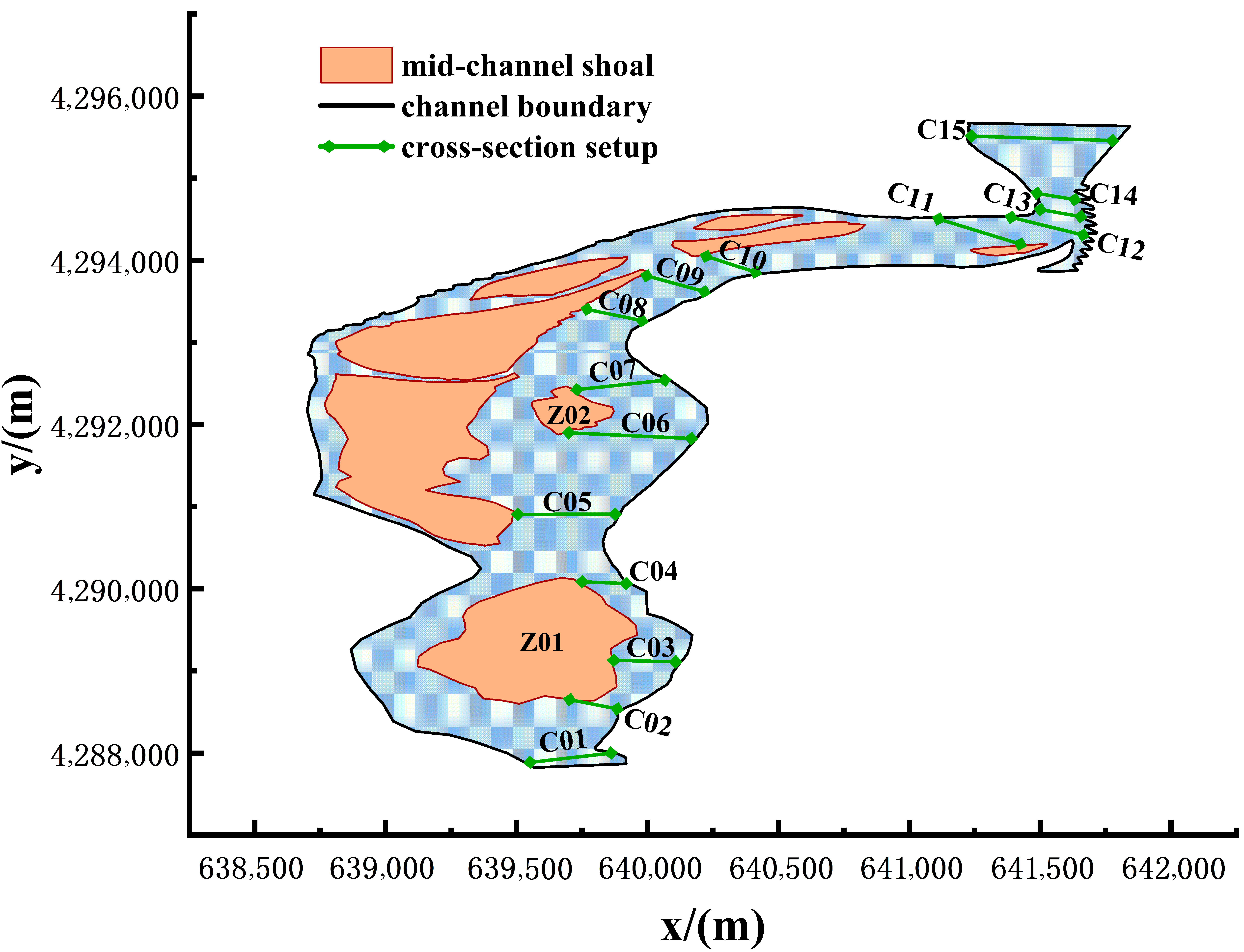
In November 2024, field measurements were conducted at the Sipaikou reach of the Yellow River in Pingluo County, Ningxia Hui Autonomous Region, using high-precision equipment including a UAV-mounted 4/3 Complementary Metal-Oxide-Semiconductor (CMOS) mapping-grade wide-angle camera (Mavic 3 Enterprise; DJI, Shenzhen, China), a USV-mounted ADCP (iBoat BS12 with iFlow RP1200; Hi-Target, Guangzhou, China), and RTK positioning system (i80; CHC Navigation, Shanghai, China). Fifteen representative cross-sections were established, with their locations shown in Figure 1. These cross-sections were sequentially labeled from upstream to downstream as C01, C02, …, C15. Water level, flow velocity, and water depth were measured along these cross-sections. The primary mid-channel shoal in the downstream portion is designated as Z01, and the secondary mid-channel shoal in the middle reach is designated as Z02.

2.1. Instrumentation

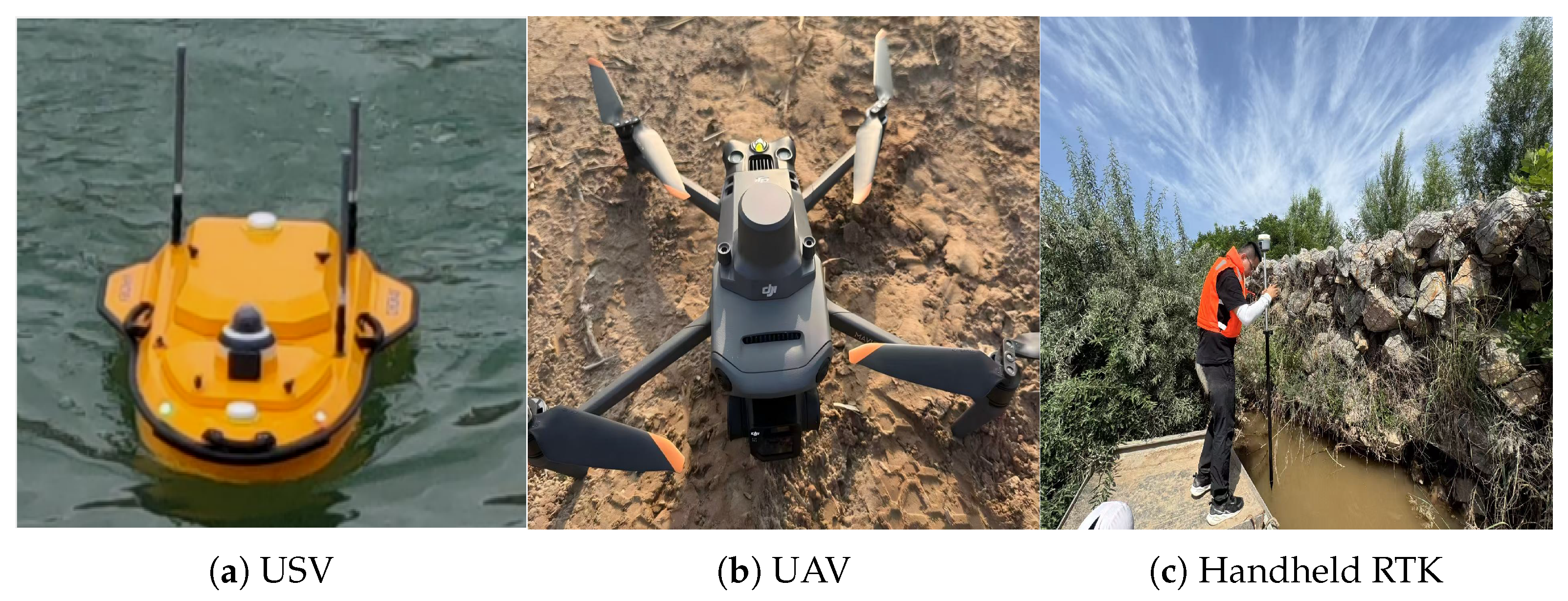
Field measurements were conducted using a Hi-Target iBoat BS12 Android-based USV equipped with an ADCP (model iFlow RP1200), as shown in Figure 2a. The ADCP features a five-beam JANUS configuration, comprising four beams with 20° angles and one vertical beam. The instrument automatically adjusts the operating frequency and bin size, with bin sizes ranging from 0.02 to 2 m and a maximum of 260 vertical bins. The vertical beam enables direct measurement of water depth and riverbed profiles, which is particularly advantageous for irregular channel geometries. Additionally, the velocity measurement has an accuracy of ±(2 + 0.25%FS) mm/s and a resolution of 1 mm/s, while the water depth measurement ranges from 0.15 to 300 m. Navigation routes and other relevant parameters were configured in the iFlow software based on the pre-established cross-sections. Due to the large channel width, each cross-section was measured at least twice to minimize random errors and mitigate the effects of data anomalies. To account for measurement uncertainties such as unmeasured zones, all procedures were strictly conducted following the manufacturer’s guidelines to ensure accurate representation of the flow structure.
A UAV equipped with a 4/3 CMOS mapping-grade wide-angle camera was employed for measurements, as shown in Figure 2b. The camera features a 20-megapixel resolution and 3.3 μm pixel size. When integrated with the RTK module, the system achieves centimeter-level positioning accuracy, meeting the precision requirements for 1:500 scale mapping without ground control points. During field surveys, UAV parameters were configured using DJI Pilot 2 (Version v2.5.1.15; DJI, Shenzhen, China) via a ground control station (GCS). Flight paths were planned along the riverbanks, and the UAV executed the predetermined routes while battery status and real-time imagery were continuously monitored.
A CHC i80 intelligent RTK system was employed to measure bank elevations and water surface elevations at both sides of each cross-section, as shown in Figure 2c. The static positioning accuracy is  ± ( 2.5 + 0.5 × 10 6 × D ) mm horizontally and  ± ( 5 + 0.5 × 10 6 × D ) mm vertically, while the RTK positioning accuracy is  ± ( 8 + 1 × 10 6 × D ) horizontally and  ± ( 15 + 1 × 10 6 × D ) mm vertically.

2.2. Study Area

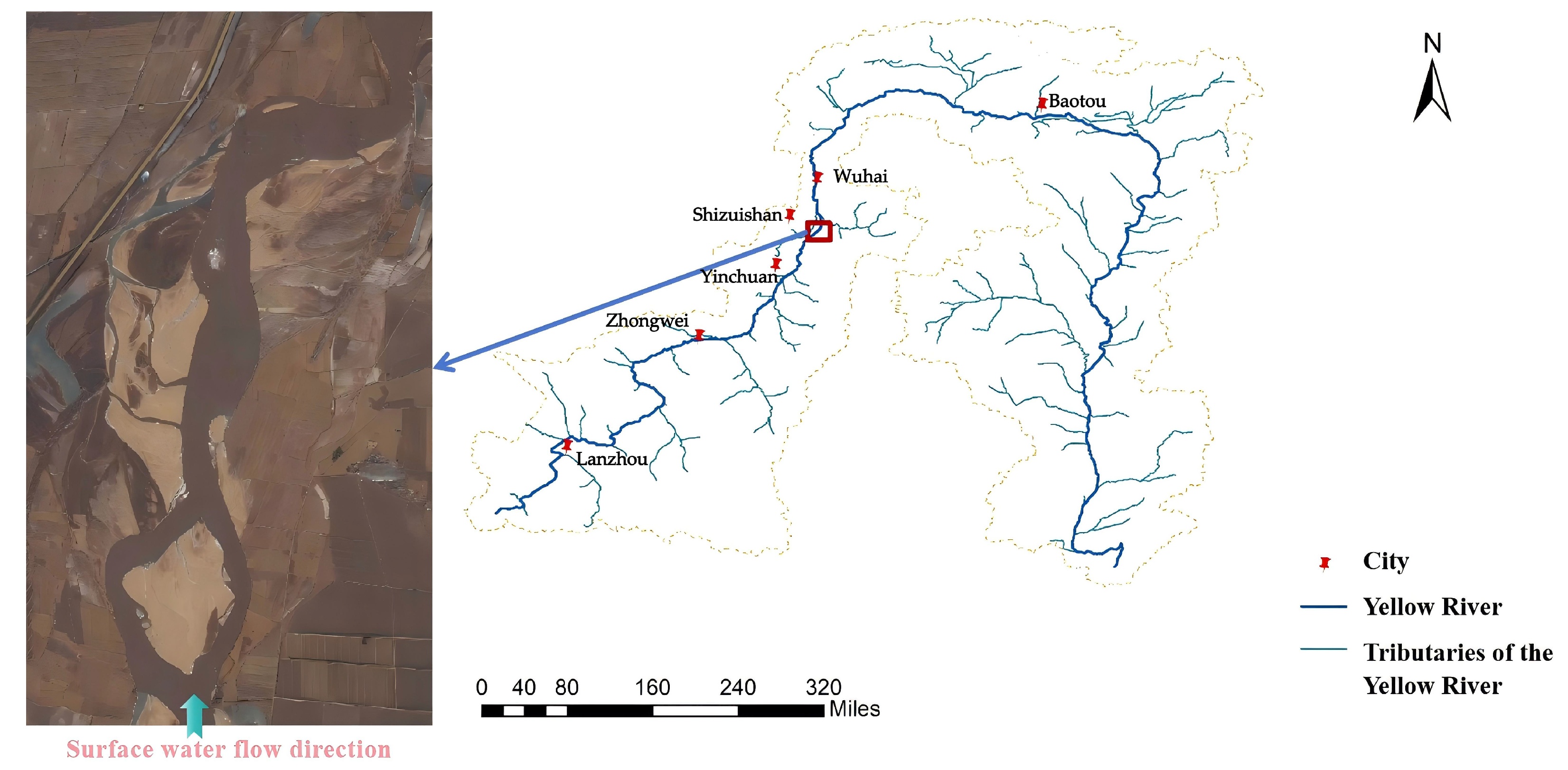
The Sipaikou reach was selected as the study site. This reach represents a typical meandering channel in the upper Yellow River with multiple mid-channel shoals. The reach exhibits typical wandering channel characteristics of a river and belongs to an unstable anabranching system. The planform displays a distinctive beaded pattern with pronounced alternation between wide and narrow sections. The width difference between the main channel and shoal areas is substantial. The reach exhibits typical wide–shallow channel characteristics with dispersed flow and an unstable thalweg. Numerous alluvial mid-channel shoals have developed within the channel. The bed material consists predominantly of fine sand and silt, which are highly erodible, resulting in intensive bed scour and deposition. Consequently, the main channel path migrates frequently, and the locations of bank impingement shift continuously, posing significant challenges to flood control. Figure 3 shows the geographic location and satellite imagery of the study reach.

2.3. Measurement Methods

An integrated aerial-aquatic measurement approach was implemented to systematically acquire three-dimensional channel topography and hydrodynamic field data. All measurement data were referenced to the China Geodetic Coordinate System 2000 (CGCS2000) with Gauss-Krüger 6° zone projection. The CGCS2000 ellipsoid was used as the reference ellipsoid, and elevations were based on the 1985 National Height Datum of China. Above-water topography was surveyed using an M3E UAV equipped with a 4/3 CMOS mapping-grade wide-angle camera. Flight paths were planned using DJI Pilot 2 through a ground control station to achieve complete aerial coverage of the channel banks and exposed shoals. Flight parameters included 85% forward overlap, 65% side overlap, and a ground sampling distance of 3.31 cm. Flight altitude was determined to meet the 1:500 scale requirement. During flight operations, battery status and image quality were monitored in real time to ensure an RTK fixed solution rate exceeding 99.2%. Image data processing involved the following steps: quality inspection of aerial images was performed to remove blurred and substandard photographs, followed by extraction and organization of POS (Position and Orientation System) data for each image. Subsequently, the images and POS data were imported into Agisoft Metashape software (Version 2.2.0; Agisoft LLC, St. Petersburg, Russia), and a sparse point cloud was generated through feature extraction and matching. Bundle adjustment was applied to optimize camera position and orientation parameters, completing high-precision aerial triangulation. Finally, a dense point cloud was generated based on the aerial triangulation results, from which a Digital Surface Model (DSM) was constructed.
Submerged topography and velocity field measurements were conducted using a Hi-Target iBoat BS12 USV equipped with an iFlow RP1200 ADCP. Prior to measurement, representative cross-section locations were configured in the iFlow software (Version 3.4.0), and survey routes and relevant parameters were established. Fifteen representative cross-sections were established along the channel, and measurements were conducted using the moving-boat method. To correct measurement uncertainties in practice (blanking distance, near-bed interference, and variable depth), the moving-boat ADCP data were processed in iFlow with explicit configuration-based screening and extrapolation. The flow reference was set to bottom tracking (BT) for converting water-tracking velocities to earth-referenced velocities. The blanking distance was set to 0.2 m and the vertical cell size was 0.24 m; measurements within the blanking zone were treated as unmeasured and were not used directly in the depth integration. Discharge contributions from the unmeasured near-surface and near-bed zones were accounted for using iFlow’s extrapolation scheme: both top and bottom extrapolations adopted the power-law method with an exponent of 0.167. Cross-sectional area was computed using the “parallel to the transect track” option, and the same setting was applied consistently across repeated transects at each section.
Quality control was implemented using iFlow’s threshold filters to reduce the influence of low-quality ensembles and near-bed contamination (including bottom-interference effects). Bottom-tracking solutions were screened using a BT error-velocity threshold of 0.2 m/s and a BT vertical-velocity threshold of 0.3 m/s, and water-tracking layers were screened using an error-velocity threshold of 1 m/s. To improve robustness when one beam was degraded, the BT three-beam solution option was enabled. Depth processing used the weighted-mean depth option to stabilize depth estimates under variable bathymetry during moving-boat transects. These procedures provide a reproducible, parameter-based treatment of blanking, near-bed data degradation, and variable depth in the field measurements.
The influence of suspended sediment on ADCP measurements was evaluated for the sediment-laden Yellow River. Under these conditions, acoustic signal attenuation remained within acceptable limits. The signal-to-noise ratio (SNR) exceeded 20 dB at all measurement locations, indicating sufficient acoustic backscatter from suspended particles and the sandy bed.
Bottom tracking was successfully achieved at all 15 cross-sections across the full range of measured depths. The vertical beam provided reliable bed detection even at the maximum depth of 14.88 m at cross-section C14. No false-bottom echoes caused by high-concentration sediment layers were identified during quality screening. The bottom-tracking success rate exceeded 98% for all transects, with occasional dropouts occurring only at cross-section boundaries where rapid depth changes exceeded the instrument’s tracking response.
The USV traversed each cross-section perpendicular to the flow along predefined paths in reciprocal passes, while the ADCP continuously recorded vertical velocity profiles, water depth, and bed elevation. Given the large channel width, at least two repeated measurements were performed at each cross-section. Averaging multiple transects reduced random errors and mitigated the effects of poor-quality data. Measured data included three-dimensional velocity distributions, water depth, discharge, and bed elevation at each cross-section. Measurements were conducted following standard operating procedures, with careful attention to avoid blanking zones and other error sources, ensuring adequate characterization of the river flow structure. ADCP output data included velocity vectors, water depth, GPS coordinates, and timestamps, which were stored in standard text format for subsequent processing and analysis.
Ground control surveys were performed using a Hi-Target iRTK i80 system to measure cross-section boundary elevations, characteristic water levels, and coordinates of hydraulic structures such as spur dikes. The RTK system was connected to a Continuously Operating Reference Station (CORS) network during measurements to ensure fixed solution status. RTK measurements were performed at cross-section boundaries on both banks, waterline positions, and critical topographic features to obtain high-precision three-dimensional coordinates. These measurements provided an accurate spatial reference for multi-source data integration and coupled hydrodynamic–topographic analysis.
All measurement data were transformed to the CGCS2000 after rigorous quality control. Quality control measures for aerial survey data included verification of image overlap, RTK fixed solution ratio, and residuals of aerial triangulation tie points. Images exceeding tolerance thresholds were excluded to ensure that DSM accuracy met specification requirements. For ADCP data quality control, outliers with velocity fluctuations exceeding 30% were removed, erroneous depth values were excluded, and consistency checks were performed on repeated cross-section measurements. For data registration and integration, the above-water DSM and underwater ADCP bathymetric data were spatially co-registered using RTK control points. Smooth transition processing was applied at the water–land interface to ensure stitching errors remained below 5 cm. For accuracy validation, 20 checkpoints were selected for RTK field verification. The root mean square error (RMSE) of DSM elevations was calculated to assess the precision of data fusion. Through the integrated land–water survey methodology described above, comprehensive data on three-dimensional channel topography, velocity fields, and submerged bathymetry were acquired, forming a high-precision, multi-parameter dataset of channel topography and hydrodynamics. This dataset provides a reliable foundation for subsequent analysis of riverbed evolution mechanisms, numerical modeling, and prediction of channel morphodynamics.

2.4. Measurement Results and Analysis

In November 2024, field surveys were conducted at 15 cross-sections along the Sipaikou reach. Table 1 presents the basic hydraulic parameters measured at each cross-section, including water level, maximum depth, mean depth, channel width, and cross-sectional mean velocity. The water level exhibited a decreasing trend from upstream to downstream along the reach. The water level was 1097.50 m at the inlet (C01) and 1096.11 m at the outlet (C15), yielding a water surface drop of 1.39 m. The average water surface slope was 0.0001616, and the channel sinuosity was 1.112.
The measured data revealed significant scour in the main channel. Cross-section C14 exhibited a maximum depth of 14.88 m, substantially exceeding other cross-sections, indicating its location within the thalweg region where concentrated flow has created a deep scour pool. In contrast, cross-sections C02–C04 exhibited maximum depths of 3.2–4.58 m, reflecting flow divergence and energy dissipation in the upstream mid-channel shoal region. Velocity distribution exhibited distinct spatial variability. The mean velocity at cross-section C14 reached 1.20 m/s, with a maximum velocity of 2.23 m/s, consistent with its narrow channel width (202.54 m) and deep scour topography, reflecting concentrated flow energy. In contrast, at cross-section C15, the channel width expanded to 574.72 m and the mean velocity decreased to 0.78 m/s, reflecting flow expansion and velocity reduction in the downstream reach. Additionally, cross-sections C02–C04 exhibited relatively low mean velocities (0.51–0.82 m/s), which were closely associated with shoal development and flow bifurcation in the mid-channel shoal region.
To characterize bed material properties for sediment transport modeling, bed sediment samples were collected at the inlet and outlet cross-sections during the field survey. At each cross-section, samples were taken from three lateral positions: left bank, center, and right bank. Grain size distributions were analyzed using laser diffraction particle size analyzer, and the results are summarized in Table 2.
The measured results indicate that the bed material is predominantly composed of coarse silt to very fine sand, with an average median grain size (D50) of 19.25 μm. The grain size exhibits a slight downstream fining trend, with the average D50 decreasing from 21.44 μm at the inlet to 17.06 μm at the outlet. This downstream fining pattern is consistent with the selective transport of finer particles by the flow.
Mid-channel shoals are common geomorphic features in fluvial systems, forming through the interaction of flow erosion and sediment deposition to create shoals of varying scales and characteristics. Based on hydrometric data collected in November 2024, combined with cross-sectional discharge measurements and UAV-based topographic modeling, the influence of mid-channel shoal geometry on discharge ratio (defined as the ratio of branch channel discharge to total discharge) was systematically analyzed. The total discharge for this reach was determined as the mean of measured discharges at C01, C12, C13, C14, and C15, calculated as:
Q t o t a l = 1 n i = 1 n Q i ,
yielding  Q t o t a l = 1283.78 m 3 / s . The discharge ratio is then calculated as:
K i = Q i Q t o t a l .
The calculated discharge ratios are presented in Table 3. As shown in Figure 1, the elliptical shoal Z01 has its major axis inclined at 30° to the main flow direction, with a blunt upstream end and gradually extending downstream tail. Due to this morphology, the right branch cross-section is constricted, with the mean channel width reduced to 240.61 m. ADCP measurements show a mean velocity of 0.72 m/s in the right branch, where cross-sectional narrowing and thalweg development result in a discharge ratio of approximately 44.16%. In contrast, the smaller shoal Z02 exhibits a right-angled trapezoidal shape, forming a natural flow obstruction. Measured data indicate that the right branch at Z02 widens to 449 m with a mean velocity of 1.14 m/s, yielding a discharge ratio of 86.31%. Shoal Z02 is situated in the transition zone of an S-shaped successive bend system, where bend-induced planform effects (flow inertia and transverse water-surface slope) shift the dominant depth-averaged flow toward the right branch. The curvature reversal downstream further maintains this right-branch dominance. Additionally, the left branch at Z02, with a low discharge ratio of 13.69%, exhibits continuous shoal formation as revealed by UAV imagery. Over time, the left branch may undergo progressive narrowing, thereby exacerbating lateral channel instability.
Gaussian kernel density estimation (GKDE) is a non-parametric statistical method that requires no prior assumptions regarding the underlying data distribution. In complex channel systems, velocity distributions may exhibit diverse patterns. The data-driven nature of GKDE enables effective capture of velocity distribution characteristics. GKDE operates by superposing Gaussian distributions centered at each data point to generate a smooth probability density curve. This approach effectively suppresses random noise while preserving the continuity of velocity distributions. By computing the skewness coefficient and identifying the peak position of the probability density curve, the method quantitatively characterizes velocity concentration, dispersion, and distribution.
The essence of GKDE lies in constructing a probability density function. For each data point xi, a Gaussian kernel function K is employed to generate a distribution centered at that point, with bandwidth  h 1 controlling the width:
K ( λ ) = 1 2 π e λ 2 2 .
The overall density function is the average of all kernel functions:
f ( x ) = 1 n h 1 i = 1 n K x x i h 1 .
This formulation generates a continuous smooth density curve by superposing Gaussian distributions centered at all data points. The method enables quantification of velocity distribution concentration and skewness, providing statistical support for flow–sediment transport mechanisms, where n is the total number of data points and  λ represents the standardized distance variable.
The bandwidth parameter  h 1 in Equation (4) was determined using Silverman’s rule of thumb, which is the most widely adopted method for univariate kernel density estimation:
h 1 = 0.9 × min σ , I Q R 1.34 × n 1 / 5 ,
where  σ is the standard deviation of the velocity data, and  I Q R is the interquartile range. This data-driven approach automatically adapts the smoothing level to the local data density and has been validated extensively in hydrological and environmental applications [22,23].
The skewness coefficient is a statistical measure that describes the asymmetry of a probability distribution, quantifying the direction and magnitude of distributional skewness. It is mathematically defined as the standardized third central moment, expressed as:
γ = E [ ( X μ ) 3 ] σ 3 ,
where X is the random variable (mean velocity),  μ is the data mean, and E is the expectation operator.
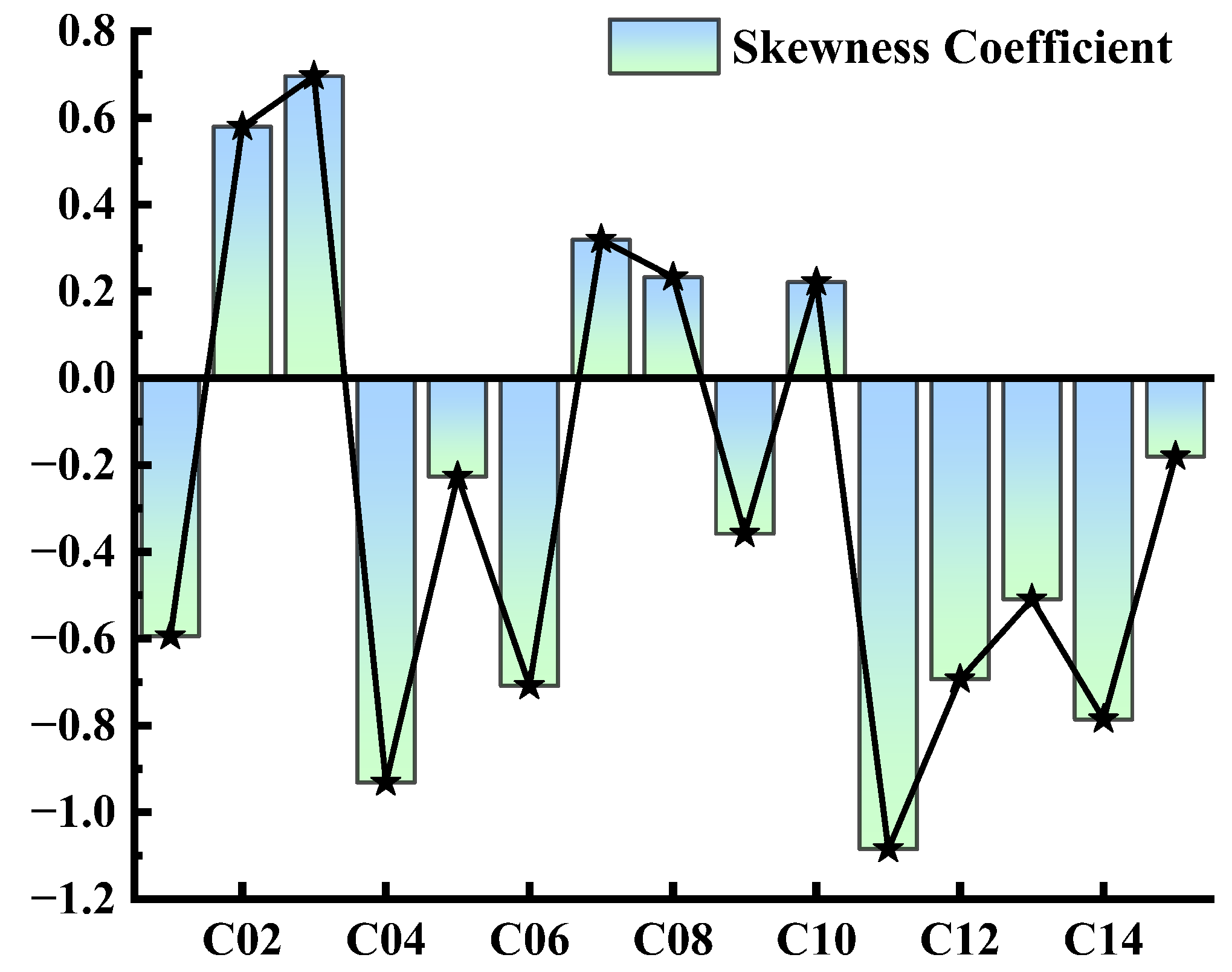
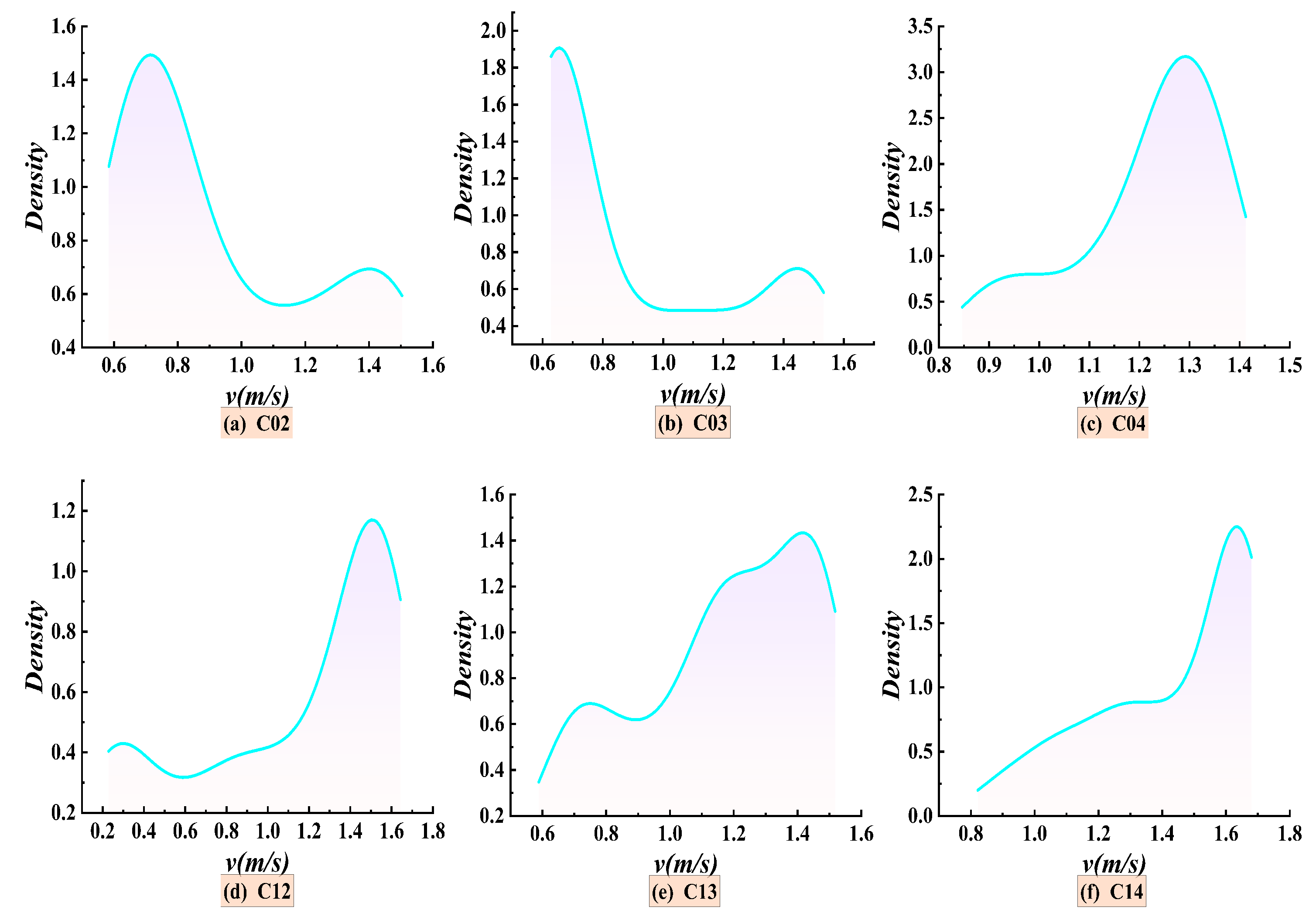
Figure 4 presents the probability density distribution of mean velocity at typical cross-sections, and Figure 5 shows the corresponding skewness coefficients. When the skewness coefficient is negative (left-skewed), the data concentrate on the right side of the distribution with the tail extending leftward, indicating that erosion dominates in high-velocity regions while eddy-induced deposition intensifies in low-velocity zones. When the skewness coefficient is positive (right-skewed), the data concentrate on the left side with the tail extending rightward, indicating that velocities are predominantly distributed in low-value regions, corresponding to stable bed morphology with sediment deposition dominated by sheet-type accumulation. The overall probability density distribution of mean velocity exhibits a skewed pattern, ranging from 0.2 to 1.98 m/s. The skewness coefficients span from −1.08 to 0.70, with negative skewness predominating, indicating that velocity distributions at most cross-sections are concentrated in high-velocity regions. Cross-section C02 exhibits a right-skewed distribution with the primary peak at 0.7 m/s and the right tail extending to 1.5 m/s, reflecting the flow division effect at the shoal head that enlarges low-velocity zones. At C03, the right skewness intensifies further, with the peak decreasing to 0.65 m/s and the peak density increasing to approximately 1.9, while the right tail extends to 1.52 m/s. This indicates enhanced flow separation in the shoal’s central region and an increased proportion of low-velocity flow. Cross-section C04 undergoes a significant transition, shifting to a left-skewed distribution with the peak surging to 1.29 m/s and peak density reaching 3.2, while the left tail extends to 0.85 m/s. High-velocity flow dominates the cross-sectional flow regime. This evolutionary sequence demonstrates that, from the head to the tail of the shoal, the flow undergoes a dynamic transition through three stages: bifurcation-induced deceleration, low-velocity dominance, and confluence-driven acceleration. Cross-section C04 exhibits the lowest velocity dispersion with relatively concentrated data, while C02 and C03 show similar dispersion levels, though C03 displays a wider velocity range.
Figure 4d–f present the velocity probability density distributions at three typical cross-sections (C12, C13, C14) within the spur dike-controlled reach, representing the upstream transition zone (C12), inter-dike region (C13), and downstream main flow confluence zone (C14), respectively. All cross-sections in the spur dike-controlled reach exhibit left-skewed distributions; however, the three sections display significant variations in peak characteristics and skewness intensity, revealing the complex hydrodynamic processes associated with progressive flow constriction induced by the spur dike series.
Cross-section C12 displays a characteristic left-skewed distribution. The primary peak occurs at 1.5 m/s with the left tail extending to 0.2 m/s, while a minor peak appears near 0.3 m/s. The main peak at 1.5 m/s reflects the high-velocity mainstream corridor generated by spur dike flow deflection, which concentrates velocities across the dominant portion of the section. In contrast, the left tail to 0.2 m/s indicates the lee-side recirculation and dead-water zones, where velocities are minimal but spatially confined. The spur dike constricts the flow cross-section, thereby compressing the majority of flow into the main channel, which increases velocity and enhances sediment transport capacity. Cross-section C13 exhibits a bimodal left-skewed distribution, with the first peak at 0.75 m/s and the main peak at 1.42 m/s. The first peak at 0.75 m/s corresponds to the outer periphery of the lee-side recirculation zone, where flow has emerged from stagnant conditions but remains influenced by recirculating eddies, with velocities intermediate between quiescent and mainstream flow. The main peak at 1.42 m/s represents the spur dike-induced main flow core, with its magnitude slightly lower than the 1.5 m/s observed at C12. The inter-peak valley (approximately 0.8–1.0 m/s) exhibits low probability density, indicating a distinct velocity demarcation between the main flow region and the recirculation zone. The left-skewed distribution persists at C14, with the peak rising to 1.62 m/s, peak density of 2.3, and the left tail extending to 0.82 m/s. The increased peak velocity reflects further strengthening of the downstream main flow due to several factors: acceleration in the contracted channel section downstream of the spur dikes, where flow experiences secondary acceleration upon entering the narrower reach after passing through the dike array, and contraction of the recirculation zone, which enables the main flow to dominate a larger cross-sectional area. The peak density increases from 1.42 at C13 to 2.3 at C14, representing an approximately 62% increase. This magnitude is comparable to the surge observed at shoal cross-section C04 (68%), indicating that downstream confluence zones in both geomorphic features produce highly concentrated velocity distributions. It is noteworthy that the left tail at C14 extends only to 0.82 m/s, markedly higher than both the 0.2 m/s tail at C12 and the 0.75 m/s low-velocity peak at C13. This elevation suggests substantial contraction of low-velocity regions downstream of the spur dikes. Even the recirculation zones that originally exhibited low velocities now experience velocity enhancement due to mainstream entrainment, demonstrating the cumulative flow-directing effect of the entire spur dike system.
Comparison between mid-channel shoal and spur dike cross-sections reveals fundamentally different mechanisms influencing velocity distributions. Shoal cross-sections undergo a transition from right-skewed to left-skewed distributions (peak velocity increasing from 0.65 m/s to 1.29 m/s), reflecting the restructuring effect of the bifurcation–confluence process on flow structure. In contrast, spur dike cross-sections consistently maintain left-skewed distributions (peak velocity increasing from 1.5 m/s to 1.62 m/s), demonstrating the sustained flow-directing action of the dikes on the main channel. The lowest peak occurs at shoal section C03 (0.65 m/s), while the highest is observed at spur dike section C14 (1.62 m/s), differing by approximately 2.5-fold. This indicates that the flow concentration capacity of spur dikes substantially exceeds the dispersive effect of mid-channel shoals. Additionally, shoal cross-sections exhibit greater variation in peak density (increasing from 1.5 to 3.2), whereas spur dike sections remain relatively stable (increasing from 1.15 to 2.3), indicating that shoal-induced flow reorganization is more pronounced. These differences reveal contrasting hydraulic regulation mechanisms: mid-channel shoals are dominated by “dynamic bifurcation–confluence” processes, while spur dikes are characterized by “stable flow guidance”.

3. Two-Dimensional Numerical Simulation of Meandering Channel with Mid-Channel Shoals and Spur Dikes

3.1. Governing Equations

To further cross-validate with integrated land–water measurement data and systematically reveal the overall regulation mechanisms by which complex geomorphic units, including mid-channel shoals, bends, and spur dikes, modulate flow structures, a two-dimensional hydrodynamic numerical model of the study reach is established based on measured high-resolution topographic data. Flow Model is employed to simulate the hydrodynamic environment at Sipaikou in the Ningxia reach of the Yellow River. The model comprises a hydrodynamic module and a coupled non-cohesive sediment transport module. The numerical simulation is based on the Navier–Stokes equations under the Boussinesq approximation and hydrostatic pressure assumption. The governing equations of the model are presented as follows:
h t + ( h u ) x + ( h v ) y = h S s o u r c e ,
( h u ) t + ( h u 2 ) x + ( h v u ) y = f v h g h η x h ρ 0 P a x g h 2 2 ρ 0 ρ x + τ s x ρ 0 τ b x ρ 0 1 ρ 0 S x x x + S x y y + x ( h T x x ) + y ( h T x y ) + h U S S s o u r c e ,
( h v ) t + ( h v 2 ) x + ( h v u ) y = f u h g h η y h ρ 0 P a y g h 2 2 ρ 0 ρ y + τ s y ρ 0 τ b y ρ 0 1 ρ 0 S y x x + S y y y + x ( h T x y ) + y ( h T y y ) + h V S S s o u r c e ,
where t is time,  η is the water level,  P a is the atmospheric pressure, d is the still water depth, and  h = η + d is the total water depth;  x , y are Cartesian coordinates, u and v are velocity components in the x and y directions, respectively,  S s o u r c e is the point source discharge,  f = 2 ω s i n φ is the Coriolis parameter,  ω is the angular velocity of Earth’s rotation,  φ is the latitude, g is the gravitational acceleration, and  ρ 0 is the water density.  S x x , S x y , S y x , S y y are the Reynolds stress components,  T x x , T x y , T y y are the eddy viscosity stress terms, and  ( U S , V S ) are the flow velocities from the source term;  ( τ s x , τ s y ) are the wind friction force components in the x and y directions, respectively; and  ( τ b x , τ b y ) are the bed friction force components in the x and y directions, respectively. Governing Equations for Sediment Transport Model
c ¯ t + u c ¯ x + v c ¯ y = 1 h x h D x c ¯ x + 1 h y h D y c ¯ y + Q L C L h S s e d ,
where  c ¯ is the depth-averaged suspended sediment concentration, and  D x , D y is the diffusion coefficient.  Q L is the point source discharge per unit horizontal area,  C L is the point source concentration, and  S s e d is the sink term for deposition or erosion.

3.2. Numerical Method

The Smagorinsky subgrid-scale model is employed for turbulence closure. The subgrid-scale eddy viscosity  ν t is computed as:
ν t = ( C s · Δ ) 2 | S ¯ |
where  | S ¯ | is the magnitude of the resolved strain rate tensor, and  Δ = A is the filter width defined as the square root of the mesh element area A. The Smagorinsky constant  C s is set to 0.28. The temporal derivative is discretized using a second-order Runge–Kutta method. A high-order scheme is adopted for the discretization of convective terms, while a central difference scheme is used for diffusive terms. The pressure–velocity coupling is treated using the Alternating Direction Implicit (ADI) method. For the simulation of hyperconcentrated flow in the Yellow River, a two-way coupling approach is adopted. The river channel topography is discretized using the Surface-water Modeling System (SMS) with triangular meshes. To predict bed deformation in a meandering reach with mid-channel shoals, a coupled hydrodynamic–sediment transport model is employed for numerical simulation. The inlet boundary condition is specified as six steady discharge scenarios covering low-/normal-/high-flow periods corresponding to low-flow, normal-flow, and high-flow periods, while a water level boundary condition is imposed at the outlet. In the sediment transport module, the sediment porosity is set to 0.35, the particle density is 2650  kg · m 3 , and the median grain size is set to 0.019  mm .

3.3. Model Validation

To investigate the effects of inflow conditions on the hydrodynamic characteristics of meandering reaches with mid-channel shoals under various scenarios, six typical cases with different inlet discharges and outlet water levels were designed for numerical simulation. The low-flow, normal-flow, and high-flow boundary conditions were selected as representative inlet discharges and outlet water level derived from hydrological statistics at Xiaheyan Hydrological Station during 2018–2019, as presented in Table 4.
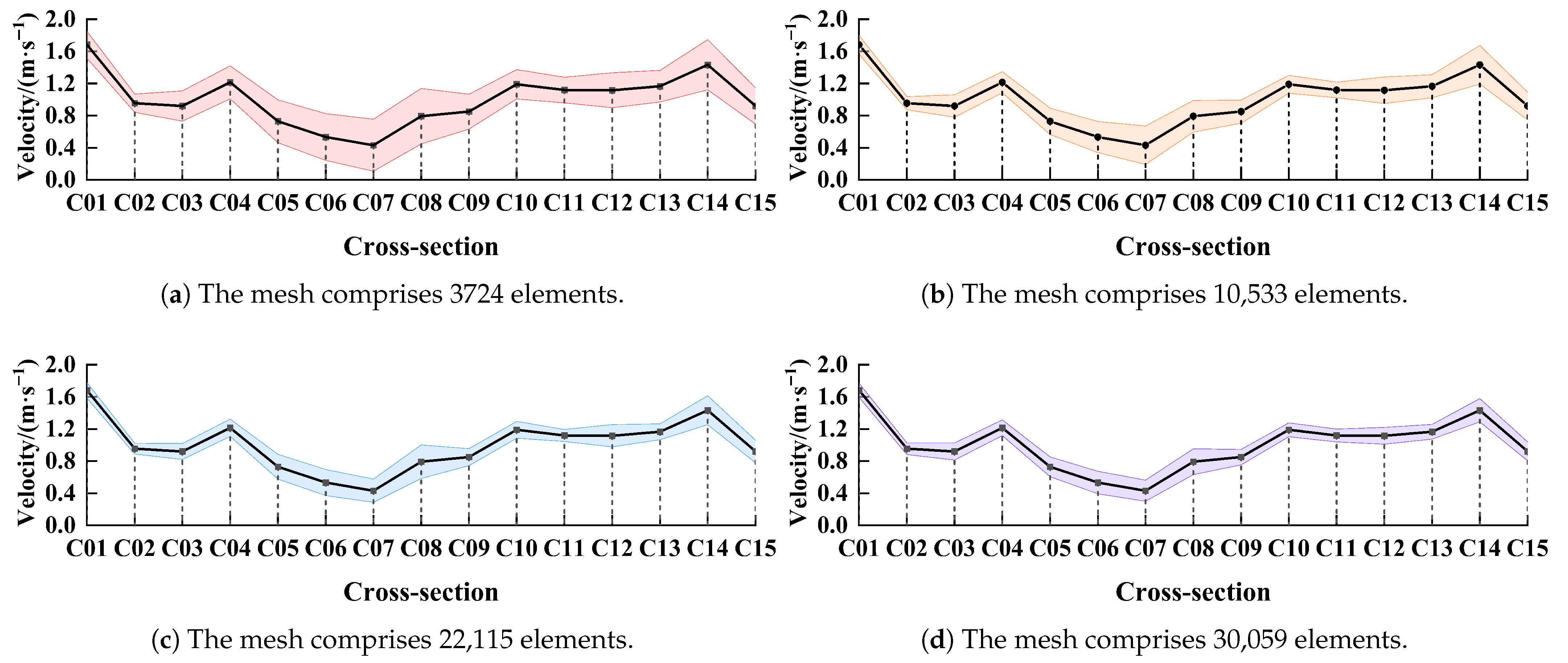
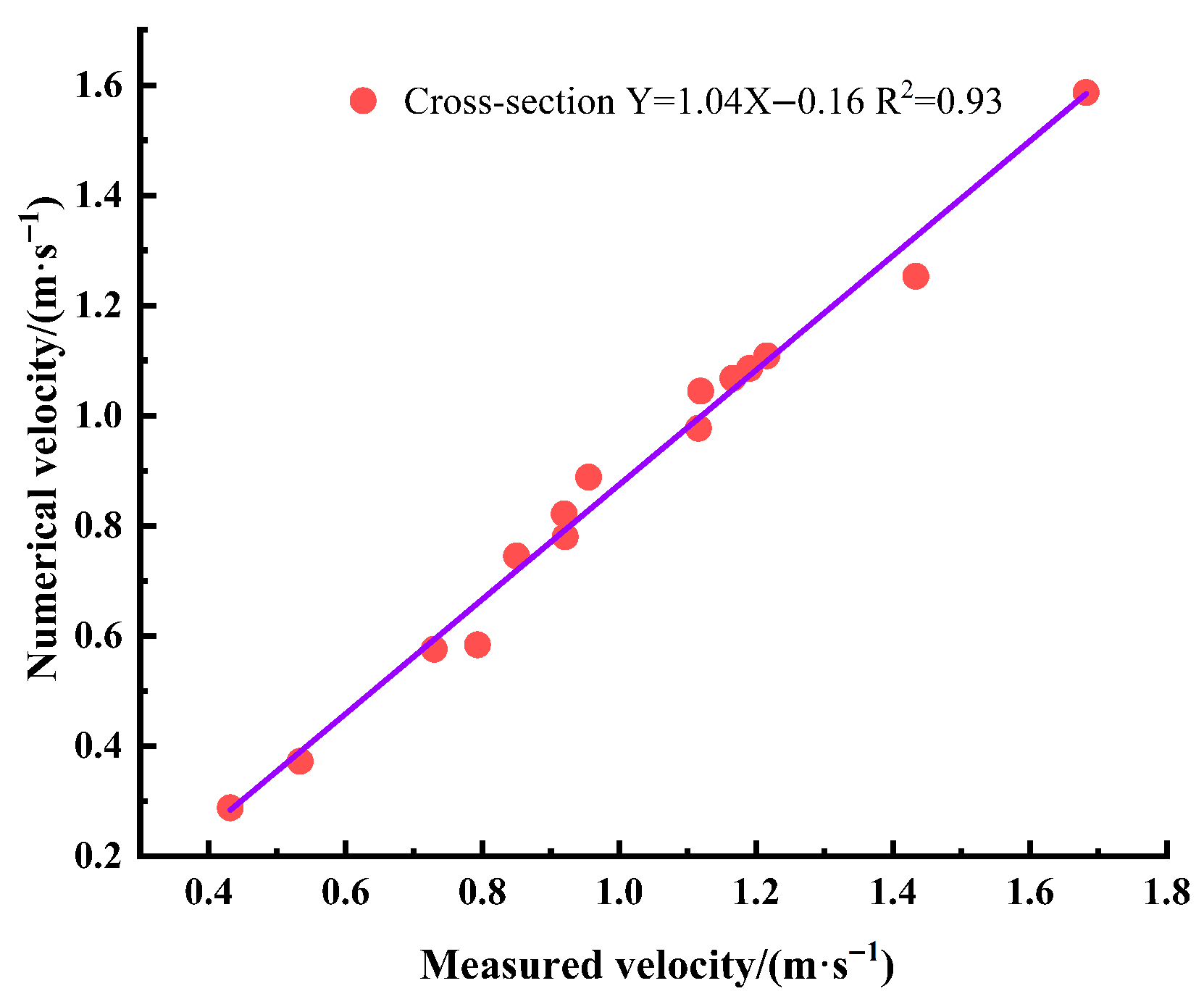
To ensure the accuracy of numerical simulation results and eliminate the influence of grid resolution on computational outcomes, a grid independence study was conducted. Four mesh schemes with varying densities were designed, comprising 3724, 10,533, 22,115, and 30,059 elements, for comparison with field measurements, as shown in Figure 6. Results indicate that when the number of grid elements exceeds  2 × 10 4 , the mean error decreases to 8% and the solution converges. Furthermore, Table 5 demonstrates that meshes with 22,115 and 30,059 elements exhibit good agreement with field measurements. To further validate the selected mesh configuration, the simulated cross-sectional mean velocities using the 22,115-element mesh were compared with field measurements collected at 15 cross-sections. As illustrated in Figure 7, the regression analysis yields Y = 1.04X − 0.16 with R2 = 0.93, where Y represents the numerical velocity and X represents the measured velocity. The slope of 1.04 (close to unity) indicates negligible systematic bias.
Balancing computational accuracy and cost, the mesh configuration with 22,115 elements was selected for subsequent simulations. This scheme ensures computational accuracy while effectively conserving computational resources, providing a reliable foundation for efficiently investigating flow structure evolution in the channel reach.
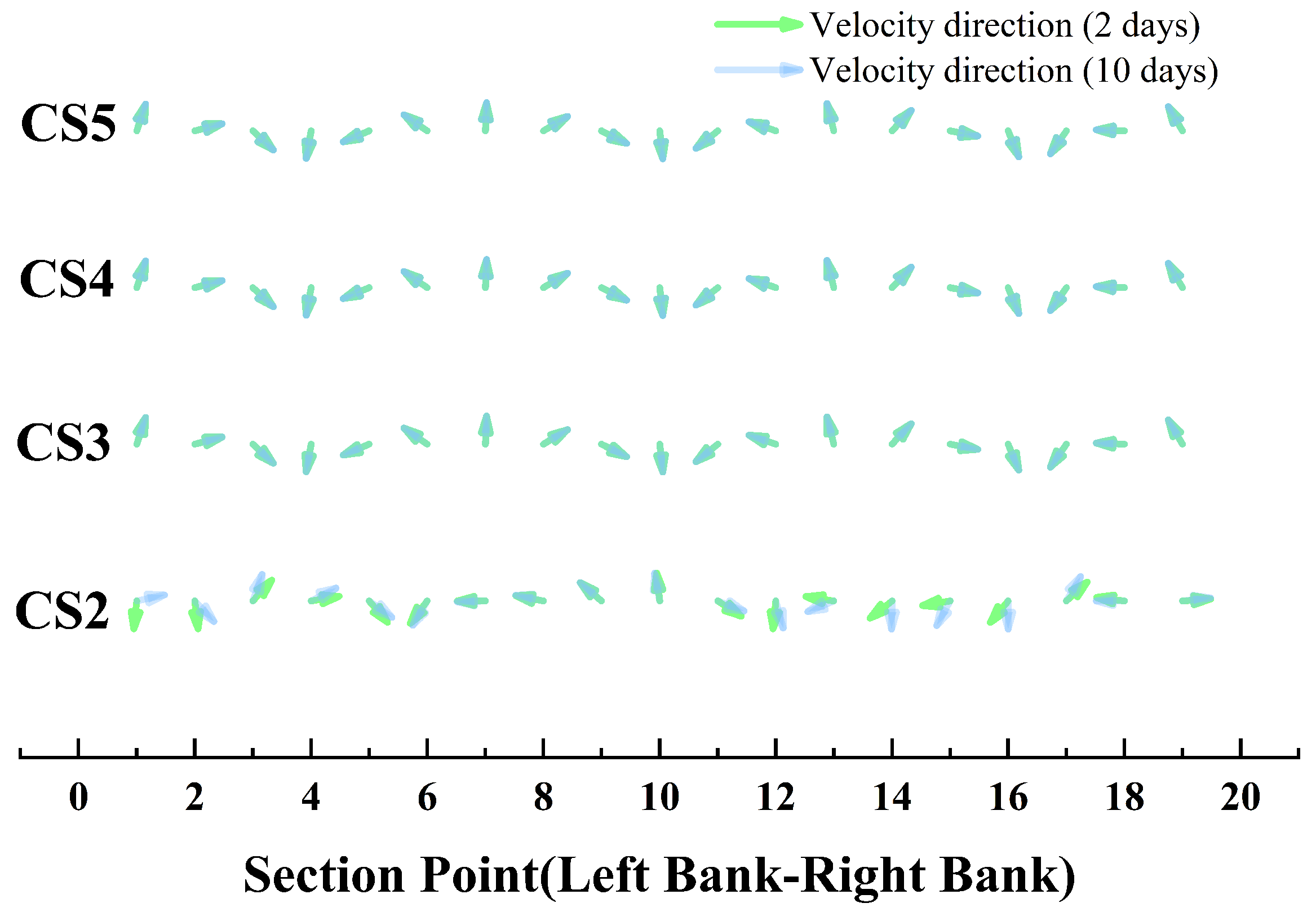
To verify the adequacy of the 2-day simulation duration, a sensitivity analysis was performed by extending the simulation to 10 days. As shown in Figure 8, velocity directions at four representative cross-sections (CS2–CS5) exhibit negligible differences between the two simulation durations, confirming that the flow field reached a quasi-steady state within 2 days. This validates the use of a 2-day simulation period for analyzing spatial patterns of flow structure and erosion–deposition.

3.4. Uncertainty Analysis

The overall uncertainty affecting the hydrodynamic and morphodynamic model predictions was systematically evaluated to assess the reliability of simulation results. Three primary uncertainty sources were identified and quantified: input data uncertainty, parameter uncertainty, and numerical uncertainty. The combined uncertainty was estimated using root-sum-square propagation:
U total = U input 2 + U param 2 + U num 2
Input data uncertainty originates from field measurement limitations. For ADCP velocity measurements, the instrument accuracy is specified as  ± ( 2 + 0.25 % × FS ) mm/s by the manufacturer. The quality control procedures implemented in this study, including the blanking distance configuration (0.2 m), bottom-tracking error-velocity threshold (0.2 m/s), water-tracking error-velocity threshold (1 m/s), and power-law extrapolation with exponent 0.167 for unmeasured zones near the surface and bed, were designed to minimize systematic measurement biases. The signal-to-noise ratio exceeding 20 dB at all measurement locations and the bottom-tracking success rate above 98% confirm reliable acoustic performance under the sediment-laden conditions characteristic of the Yellow River. For topographic data, the UAV-derived DSM achieves centimeter-level positioning accuracy with RTK fixed solution rates exceeding 99.2%, while the water–land interface stitching error was controlled below 5 cm through RTK ground control point registration. Based on repeat transect measurements at each cross-section, the combined input data uncertainty for cross-sectional mean velocity is estimated at 5–8%.
Parameter uncertainty primarily arises from bed material properties and hydraulic roughness characterization. The median grain size was measured at 19.25 μm with values ranging from 16.22 to 23.78 μm across sampling locations, yielding a coefficient of variation of approximately 13%. The sediment porosity (0.35) and particle density (2650 kg· m 3 ) were adopted from established values for Yellow River fine sand and silt sediments. Given that sediment transport capacity scales nonlinearly with both flow velocity and grain size, parameter variability contributes an estimated 10–15% uncertainty to morphodynamic predictions.
Numerical uncertainty was evaluated through grid independence analysis and temporal convergence verification. As demonstrated in Table 5, the mean velocity error decreases systematically with increasing mesh resolution, converging to 8.3% for the selected configuration (22,115 elements). The regression analysis between simulated and measured velocities yields  Y = 1.04 X 0.16 with  R 2 = 0.93 , where the slope of 1.04 (close to unity) indicates negligible systematic bias. Temporal convergence was verified by extending simulations from 2 to 10 days, with results confirming that quasi-steady flow conditions were achieved within 2 days for all discharge scenarios.

4. Analysis of Numerical Results

4.1. Full-Field Velocity Analysis

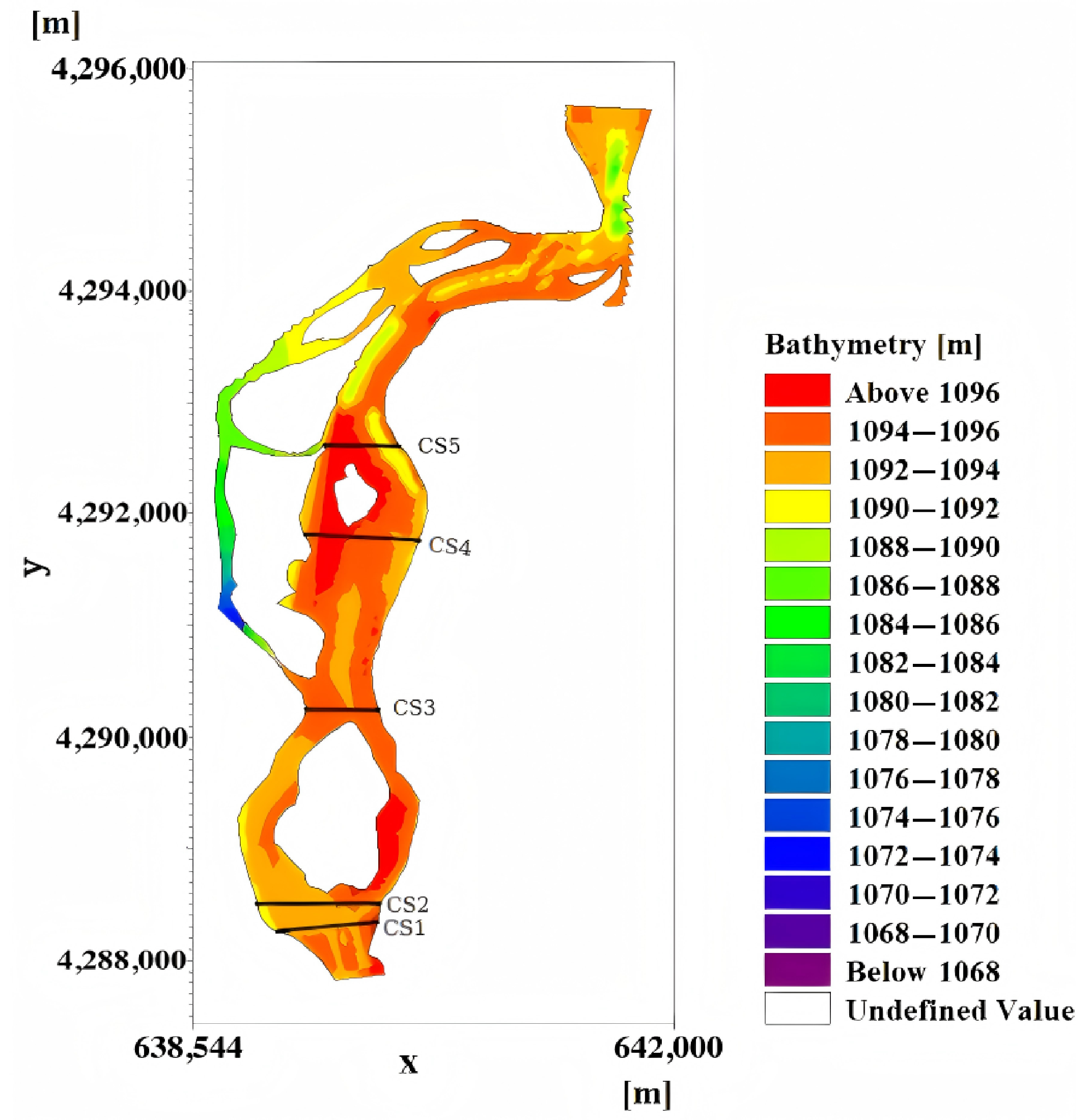
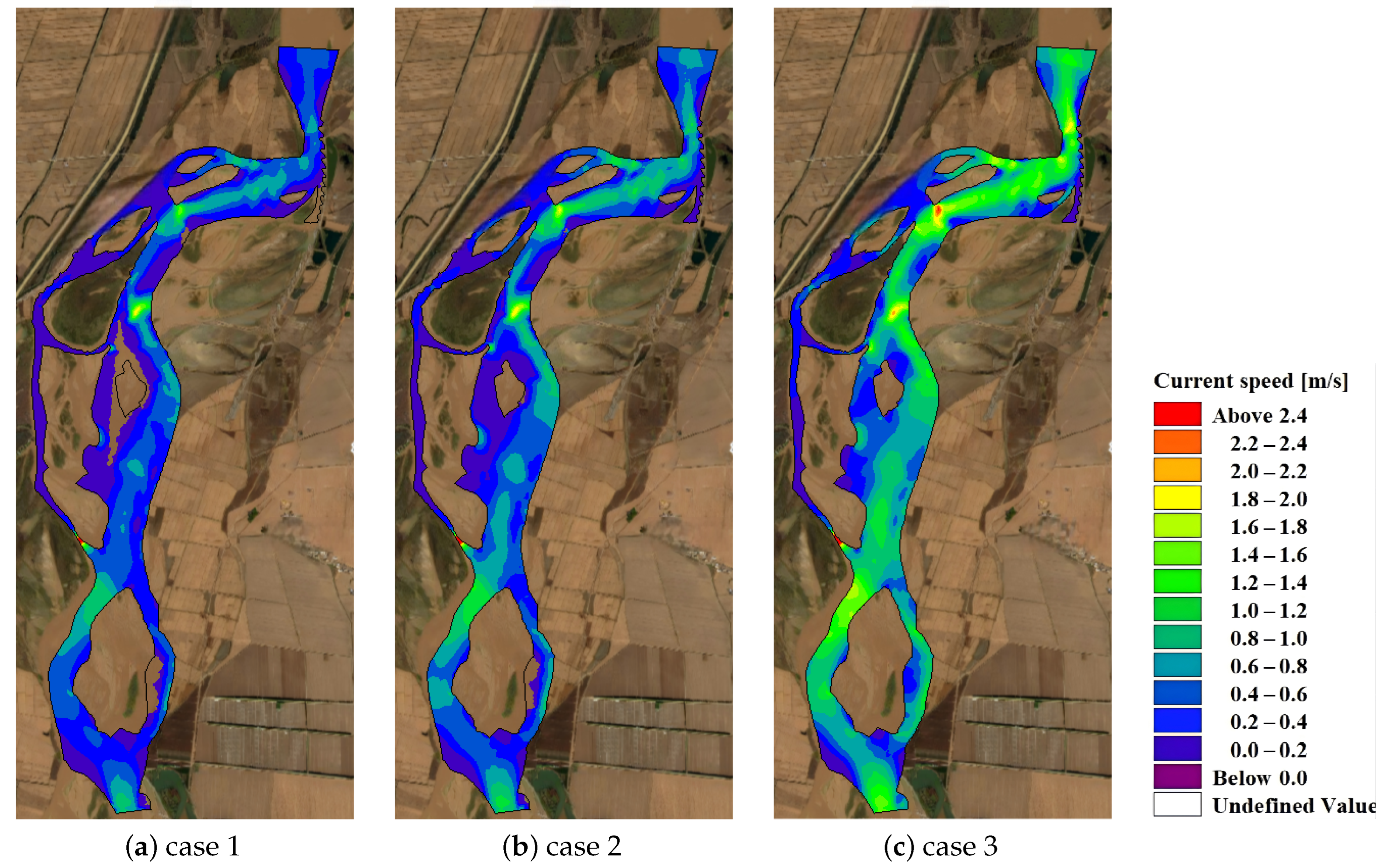
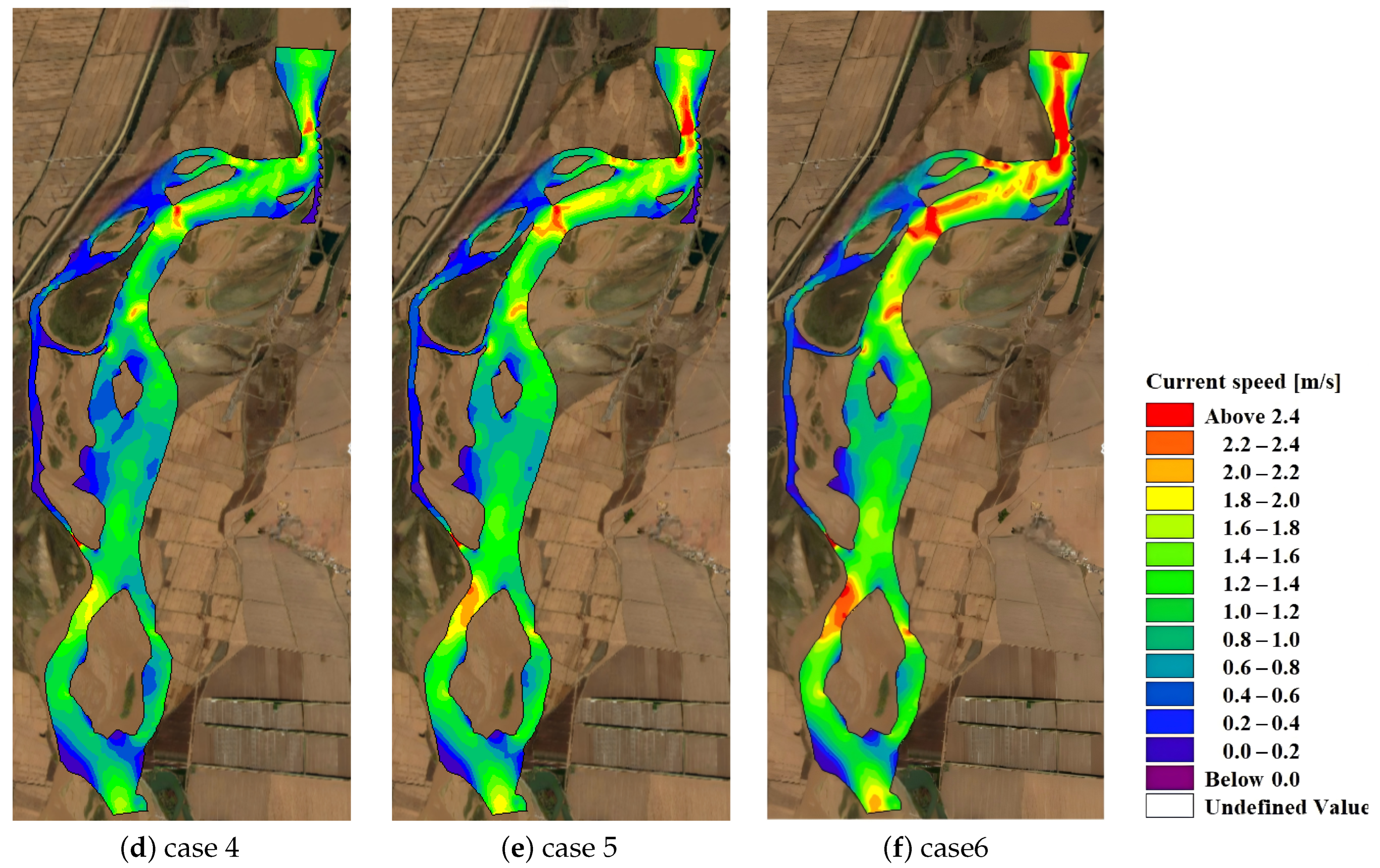
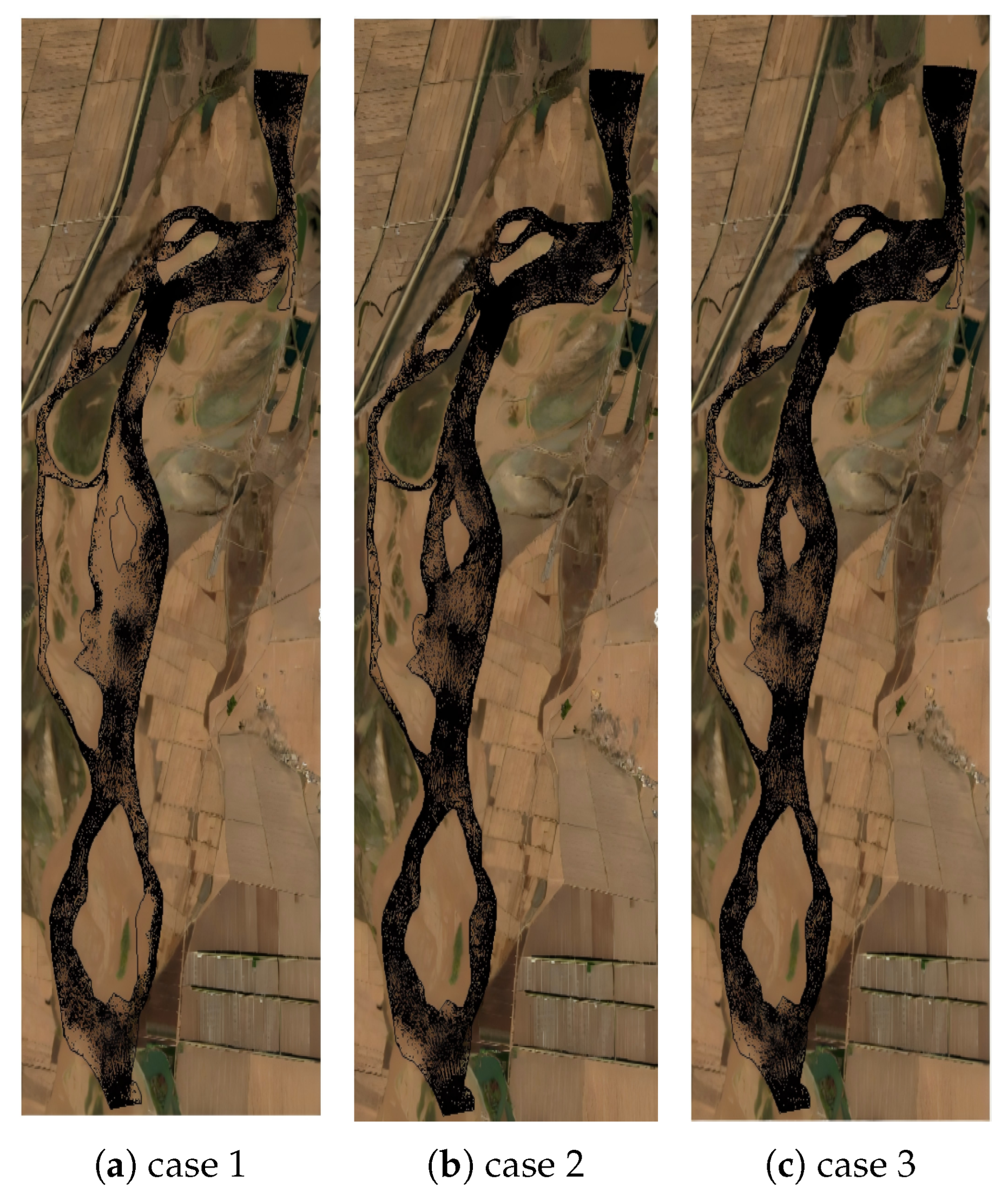
The study reach is characterized as a braided channel with multiple anabranches and mid-channel shoals, featuring localized channel constrictions and confluences. Field measurements provided bed topography and bankside elevation data, from which the reach topography was reconstructed using Natural Neighbor interpolation, as shown in Figure 9. Five representative cross-sections were selected and designated as CS1, CS2, CS3, CS4, and CS5. Figure 10 presents the velocity distributions in the meandering reach with mid-channel shoals under six different flow conditions.
Under low-flow conditions, pronounced stagnant zones emerged due to the reduced inlet discharge. These stagnant zones were primarily concentrated around the mid-channel shoals, a phenomenon attributable to the anabranching channel structure. As flow entered the distributary channels, the discharge was partitioned among multiple branches, resulting in substantial velocity reduction. The right branch of Z01 and portions of Z02 remained unsubmerged, primarily because the bed elevations in these areas exceeded the prevailing water level, preventing complete inundation.
As discharge increased, the water level progressively rose, inundating previously exposed high-bed areas and gradually reducing the extent of stagnant zones. In the right branch of Z01 and the Z02 region, the elevated water level resulted in notably higher flow velocities. Figure 10c,d illustrate this transition, showing that as water levels rose, flow velocities in these regions gradually recovered, and the disappearance of stagnant zones rendered the flow more uniform. At this stage, the influence of channel width expansion on flow field structure further diminished, and the velocity distribution became increasingly stable. Under high-flow conditions, water levels rose further as discharge reached its maximum value, resulting in significantly enhanced flow velocities throughout the reach. Stagnant zones nearly vanished entirely, with flow velocities increasing markedly around Z01 and Z02. The increased discharge promoted more uniform velocity distributions across all channel regions. Under these high-discharge conditions, flow became more concentrated and stagnation phenomena were virtually eliminated.
As critical morphological features, mid-channel shoals significantly altered the spatial velocity patterns. The bifurcation zones flanking the shoals exhibited asymmetric velocity distributions. Under low-flow conditions, the main flow remained confined to the left anabranch while the right anabranch displayed extensive stagnant zones. With increasing discharge, the right anabranch became scoured and reactivated, with overall velocities increasing by approximately 0.4–0.6  ms 1 . At the bend apex, high-velocity zones intensified markedly with increasing discharge, as centerline velocities rose from approximately 1.0  ms 1 to 1.7  ms 1 . The shear layer migration toward the concave bank indicated lateral erosion tendency in the main channel.

4.2. Global Flow Field Analysis

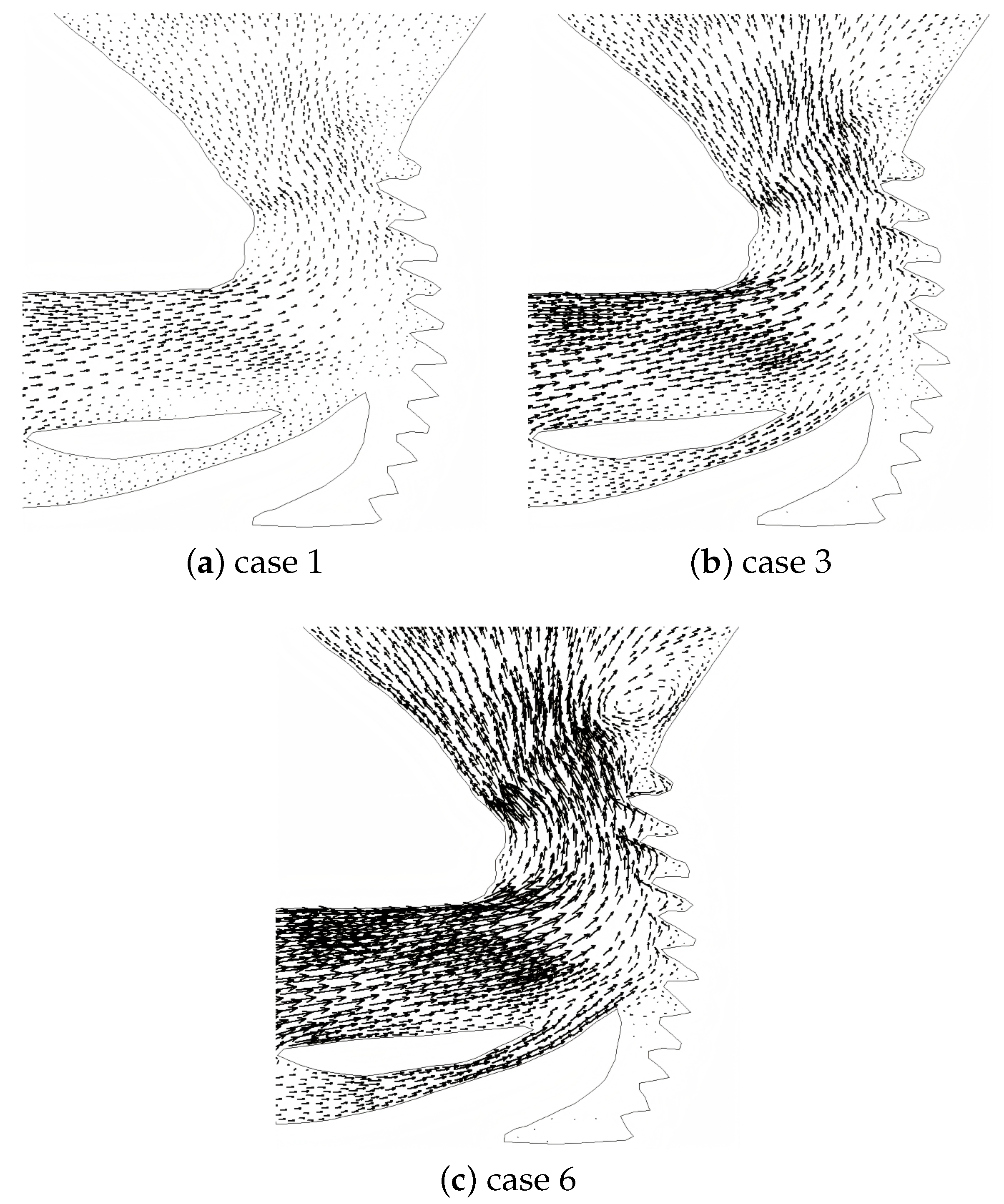
Figure 11 presents the flow field under different discharge conditions, corresponding to low-flow (Case 1), medium-flow (Case 3), and high-flow (Case 6) periods. During low-flow conditions, the inlet discharge was only 501  m 3   s 1 , with a relatively low outlet water level of 1095.78 m. Upon entering the Z01 region, the flow bifurcated with the left anabranch serving as the main channel, characterized by relatively high velocities and densely packed streamlines. In contrast, the right anabranch exhibited significantly reduced velocities and sparse streamlines due to its narrower width and shallower depth. During medium-flow conditions, discharge increased to 1356  m 3   s 1 with the outlet water level rising correspondingly to 1096.11 m. The velocity difference between the left and right anabranches of Z01 diminished, and flow field became more uniform. In the right anabranch of Z01, water that had remained nearly stagnant during low flow began to exhibit continuous flow, with streamlines transitioning from intermittent to coherent patterns.
The overall flow field transitioned from “multiple stagnant zones with strong compartmentalization” to “coherent flow with localized disturbances,” as the hydrodynamic structure of the channel progressively became more active. During high-flow conditions, discharge reached 3026  m 3 s 1 and the outlet water level rose to 1097.55 m. Streamlines became densely distributed and spatially extensive, indicating substantial velocity enhancement across the entire cross-section. The reach-scale flow field exhibited characteristics of “strong flow coherence with localized perturbations,” where flow inertia dominated the flow structure under high-discharge conditions while topographic effects became secondary.

4.3. Local Flow Field Analysis

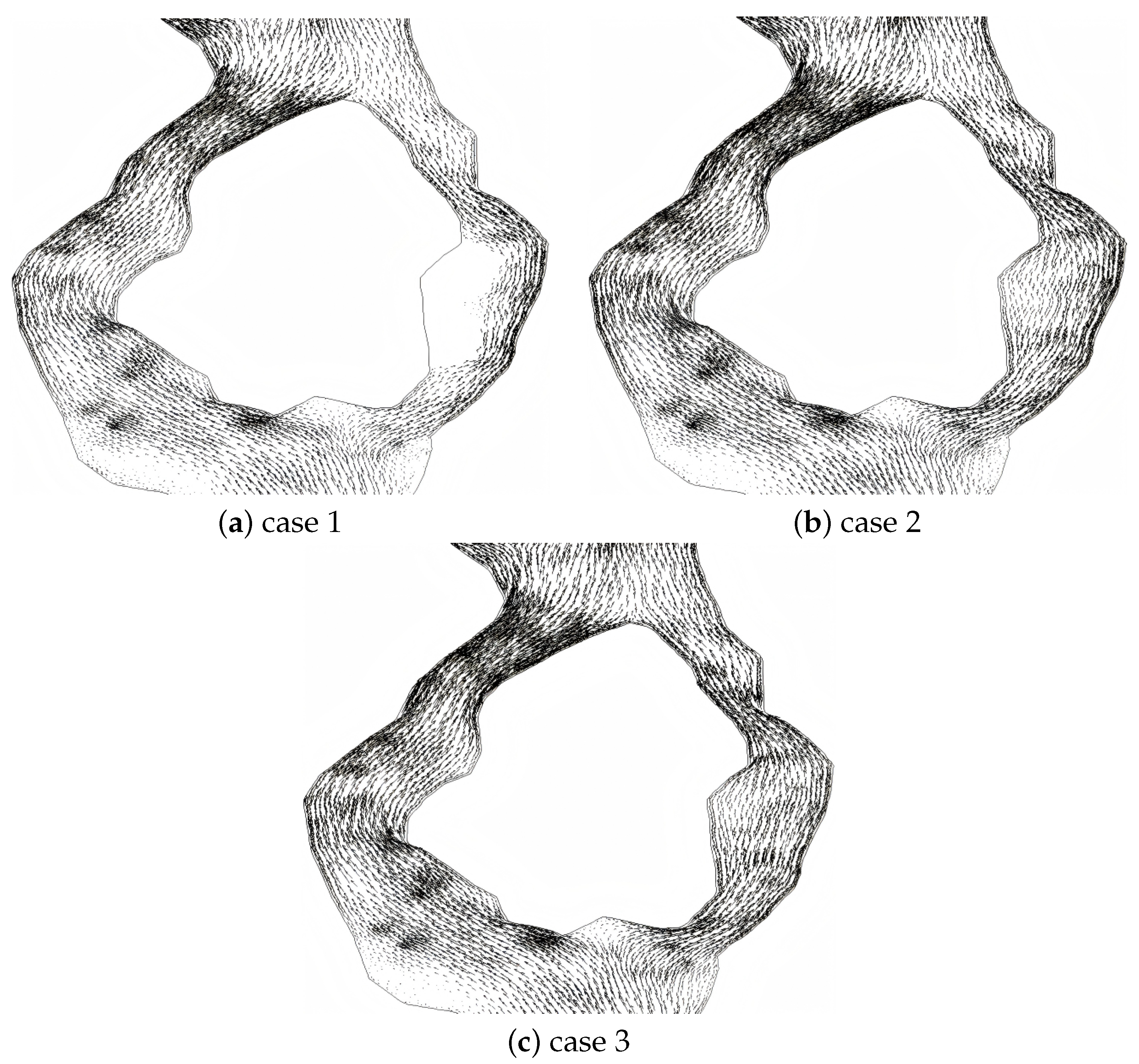
Figure 12 illustrates the flow field distribution around the mid-channel shoal. As upstream flow passed through the first bend and converged, it approached the shoal head at relatively high velocity. The shoal head acted as a substantial obstruction, exerting significant flow retardation and backwater effects on the main flow. Directly upstream of the shoal head, a low-velocity zone formed where kinetic energy was converted to pressure energy, resulting in local water level rise. This elevated pressure gradient drove flow divergence toward both sides, forming left and right anabranches.
Under low-flow conditions, Z01 exhibited typical characteristics of flow around a bluff body. Streamlines deflected markedly at the shoal head, forming a bifurcation pattern. Sparse streamlines on both sides of the shoal body indicated low kinetic energy. A stable recirculation zone developed at the shoal tail. This recirculation zone, generated by flow separation, displayed internal velocities below 0.3  ms 1 as observed in Figure 10a,b, creating a significant environment for energy dissipation and sediment deposition.
As flow transitioned to medium conditions, water levels rose throughout the reach and inertial forces intensified. The bifurcation point at the shoal head migrated upstream, flow field compression became more pronounced, and flow field density in both anabranches increased, indicating velocity enhancement. The recirculation zone at the confluence downstream of the shoal tail progressively diminished. Under high-flow conditions, streamlines curved sharply at the shoal head, exhibiting a strong blockage effect. Streamlines in both anabranches became more uniform, with the left anabranch remaining dominant. Asymmetry persisted within the two channels, characterized by dense streamlines and elevated velocities near the concave bank. The recirculation zone at the tail confluence further contracted under flow scouring.
Figure 13a–c show the flow field near the spur dikes. The spur dike series deflected high-velocity flow away from the bank, significantly reducing flow velocities in the near-bank region, thereby creating hydrodynamic conditions conducive to riverbank protection. The most prominent hydrodynamic effect of the spur dike series was the creation of a unique low-energy hydrodynamic environment within the “inter-dike region” formed between adjacent spur dikes. Flow velocities within the inter-dike zones were extremely low, presenting a sharp contrast to the external main flow. This pronounced velocity gradient resulted from the flow obstruction effect of the spur dikes.
During low-flow conditions, flow disturbance induced by the spur dikes was relatively limited. Streamlines exhibited slight deflection at the dike heads, with minimal overall variation. Recirculation zones formed in the inter-dike regions were small, turbulence intensity was weak, and local velocities were low, resulting in the development of quiescent zones. These stagnant regions were conducive to fine particle deposition, and the limited flow field variations had minimal impact on the surrounding hydraulic environment.
During medium-flow conditions, the spur dikes began to exert notable influence on the flow field. Streamlines underwent sharp deflection at the dike heads, exhibiting pronounced flow contraction that resulted in elevated velocities near the dike tips. Recirculation zones in the inter-dike regions expanded considerably, forming stable circulation patterns conducive to sediment deposition.
During high-flow conditions, the spur-dike array exhibits a strong response in the depth-averaged flow field. Streamlines show sharper deflection at the dike heads and stronger depth-averaged velocity gradients (horizontal shear) near the dike tips. Meanwhile, the sheltered inter-dike regions persist as low-velocity zones, forming new shoals that further enhanced bank stabilization.

4.4. Head Loss Analysis

Mid-channel shoals and spur dikes act as flow obstructions and induce redistribution of flow momentum and energy dissipation. To quantitatively compare the energy-loss characteristics associated with different geomorphic/engineering units under various discharge scenarios, an equivalent head loss  h w is computed between selected control cross-sections using section-averaged quantities extracted from the two-dimensional (2-D) numerical simulations.
For a free-surface open-channel flow, the section-averaged total head can be written as
H = Z wse + α V 2 2 g ,
where  Z wse is the water surface elevation at the cross-section, V is the cross-sectional mean velocity, g is the gravitational acceleration, and  α is the kinetic-energy correction coefficient accounting for velocity non-uniformity within the cross-section. In the present analysis,  Z wse and V are obtained from the 2-D simulation outputs. For consistency across cases and given the focus on comparative trends,  α is taken as unity; although velocity non-uniformity exists at each section, adopting the same assumption for all scenarios preserves the validity of relative comparisons.
Accordingly, the equivalent head loss between two control sections i and j is defined as
h w = H i H j = Z wse , i + α V i 2 2 g Z wse , j + α V j 2 2 g .
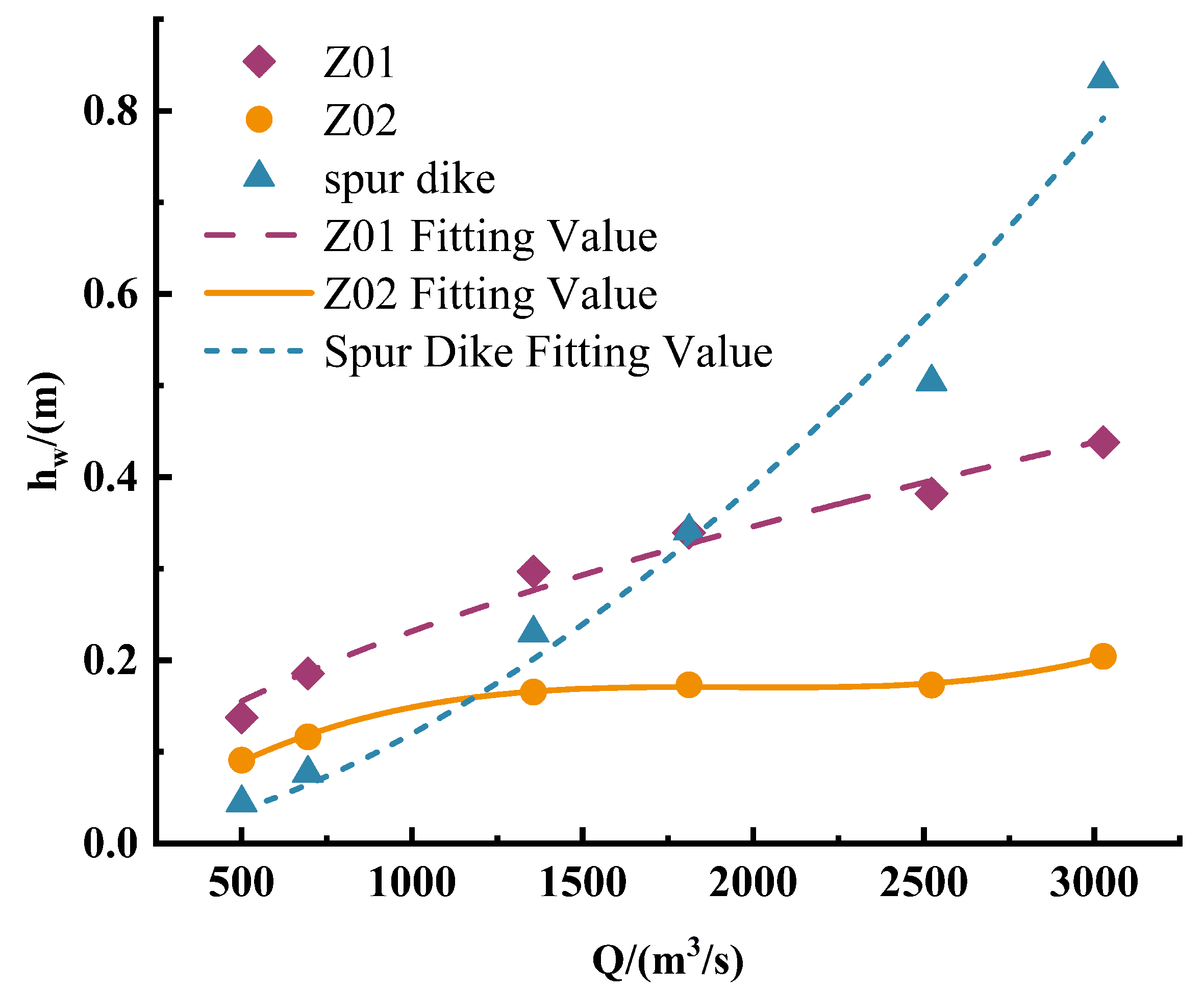
In addition, the imposed upstream suspended sediment concentration in this study is on the order of  O ( 10 1 ) kg m 3 , implying a relative density variation of  O ( 10 4 ) with respect to clear water. Hence, the influence of sediment-induced density changes on the computed  h w is negligible, and the simulated head-loss variations mainly reflect hydrodynamic reorganization and dissipation associated with shoals and spur dikes.  h w represents the head loss from section CS1 to section CS2. Cross-sections CS2, CS3, CS4, and CS5 were selected as control sections to calculate the head loss induced by mid-channel shoals Z01 and Z02 under different Cases. Cross-sections C11 and C15 were selected as control sections to calculate the head loss induced by spur dikes under different Cases. The results are presented in Figure 14.
As shown in Figure 14, the head losses induced by both Z01 and Z02 increase with discharge, albeit with markedly different growth patterns. The head loss for Z01 increases from 0.138 m under low-flow Case 1 to 0.438 m under high-flow Case 6, representing a 218% increase, while that for Z02 increases from 0.091 m to 0.204 m, corresponding to a 124% increase. The head loss of Z01 consistently exceeds that of Z02, with the disparity widening as discharge increases: the difference is 51.6% in Case 1 and expands to 114.7% in Case 6.
To elucidate the quantitative relationship between head loss and discharge, the head loss data for Z01 were fitted, yielding the following relationship:
h w 1 = ( 4.25 × 10 3 ) Q 0.57903 ( R 2 = 0.97974 ) ,
where Q is the discharge and  R 2 is the coefficient of determination. The exponent being less than unity in the Z01 fitting curve reveals a diminishing marginal effect, whereby the incremental head loss induced by unit discharge increase diminishes with increasing total discharge. Differentiation of the function with respect to discharge gives the marginal loss rate:
d ( h w 1 ) d Q = ( 2.46 × 10 3 ) Q 0.421 .
This derivative exhibits a decreasing trend with increasing discharge, with the marginal loss rate declining from 1.797  × 10 4 m/ ( m 3 / s ) in Case 1 to 8.392  × 10 5 m/ ( m 3 / s ) in Case 6, a reduction of 53.3%. At low discharge, each 1  ( m 3 / s ) increment results in 0.180 mm of additional head loss, whereas at high discharge, the increment is only 0.084 mm, representing a greater than 50% reduction in head loss per unit discharge. This diminishing effect arises because increased discharge reduces streamline curvature around the shoal, decreases the relative blockage of the channel by the shoal, and increases the effective flow cross-sectional area, consequently lowering the head loss per unit discharge.
The variation pattern of head loss for Z02 is considerably more complex than that for Z01, exhibiting a non-monotonic growth pattern. Polynomial fitting yields the following relationship:
h w 2 = 0.03038 + 3.13302 × 10 4 Q 1.61903 × 10 7 Q 2 + 2.77329 × 10 11 Q 3 ( R 2 = 0.99488 ) ,
taking the first derivative of the fitted function:
d ( h w 2 ) d Q = 3.13302 × 10 4 3.23806 × 10 7 Q + 8.31987 × 10 11 Q 2 .
Table 6 reveals that the marginal loss rate for Z02 first decreases and then increases, approaching zero at Case 4. From Case 1 to Case 4, it decreases by 63.2%, while from Case 4 to Case 6, it rebounds by 9.7%. Setting the second derivative equal to zero yields the inflection point discharge.
d 2 ( h w 2 ) d Q 2 = 3.23806 × 10 7 + 1.66397 × 10 10 Q ,
Q inflection = 1946 m 3 / s .
This inflection point lies between Cases 4 and 5, dividing the head loss evolution into two stages. In Stage 1, when  Q < Q i n f l e c t i o n , the curve is concave downward and the marginal loss rate decreases. In Stage 2, when  Q > Q i n f l e c t i o n the curve becomes convex upward and the marginal loss rate begins to increase. This behavior indicates that during low-flow periods, flow is concentrated in the main channel and the shoal causes significant obstruction. During normal-flow periods, side channels on both flanks of the shoal begin to effectively divert flow, causing the marginal loss rate to decline sharply toward zero. During high-flow periods, flow distribution becomes more asymmetric, local scour intensifies, vortical structures strengthen, and the marginal loss rate increases again.
Table 7 reveals that the growth rate of head loss consistently exceeds the growth rate of discharge, exhibiting a typical increasing marginal effect, in stark contrast to Z01. Curve fitting of the head loss data for the spur dike system yields:
h w 3 = ( 9.21787 × 10 7 ) Q 1.70473 ( R 2 = 0.97487 ) .
The exponent being significantly greater than unity reveals the superlinear growth characteristic of head loss in the spur dike system. This is manifested by the fact that higher discharge results in greater head loss per unit discharge. Taking the first derivative of the function yields the marginal loss rate:
d ( h w 3 ) d Q = 1.571 × 10 6 Q 0.70473 .
During low-flow periods, each 1 m3/s increase in discharge induces an average head loss increase of 0.091 mm; during normal-flow periods, the increase is 0.365 mm per 1 m3/s; and during high-flow periods, it is 0.287 mm per 1 m3/s. This represents a 3- to 4-fold increase in head loss per unit discharge. As discharge increases, flow velocity around the dikes intensifies, resulting in more severe local head losses.

4.5. Analysis of Bed Deformation Simulation Results

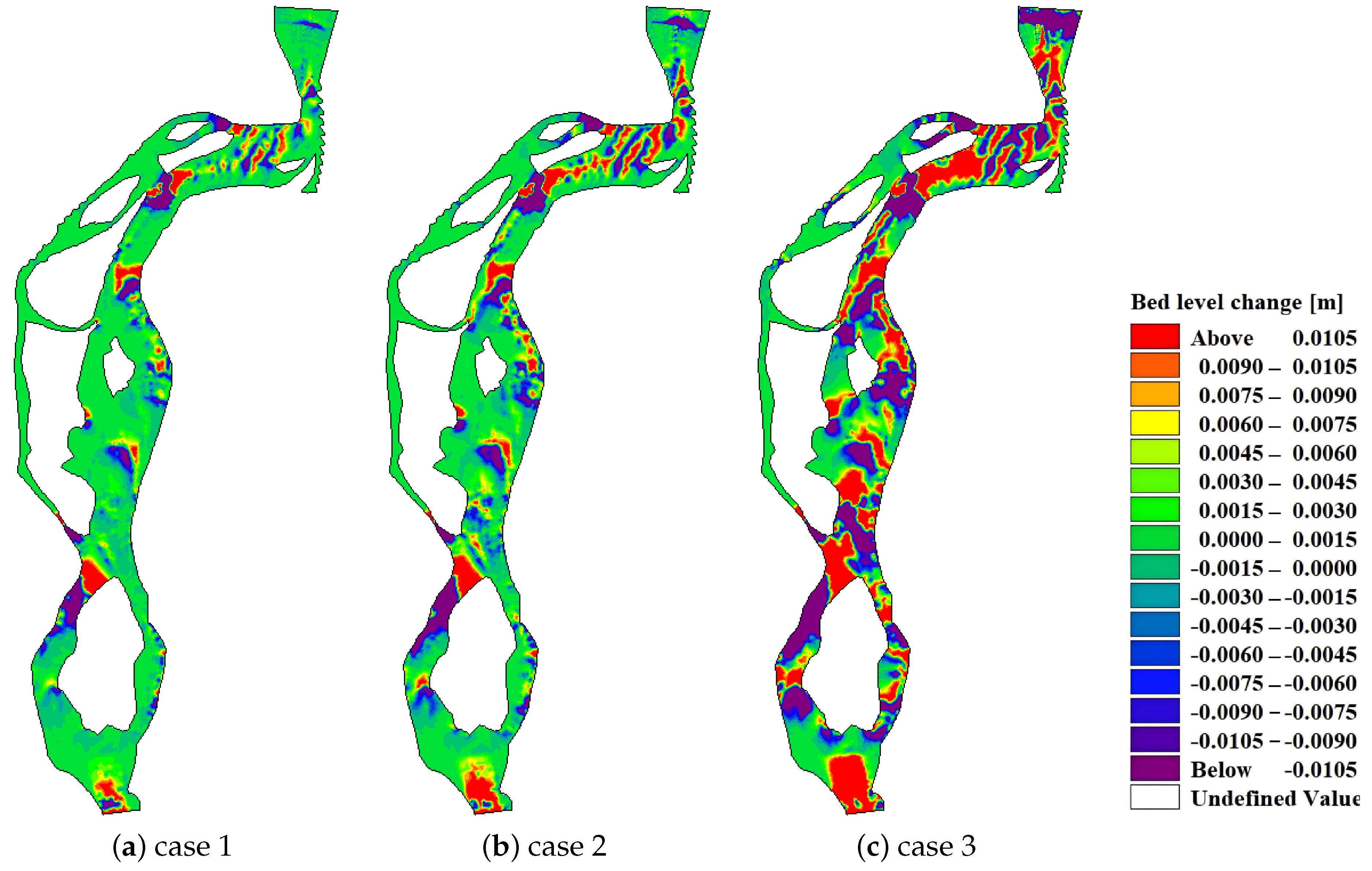
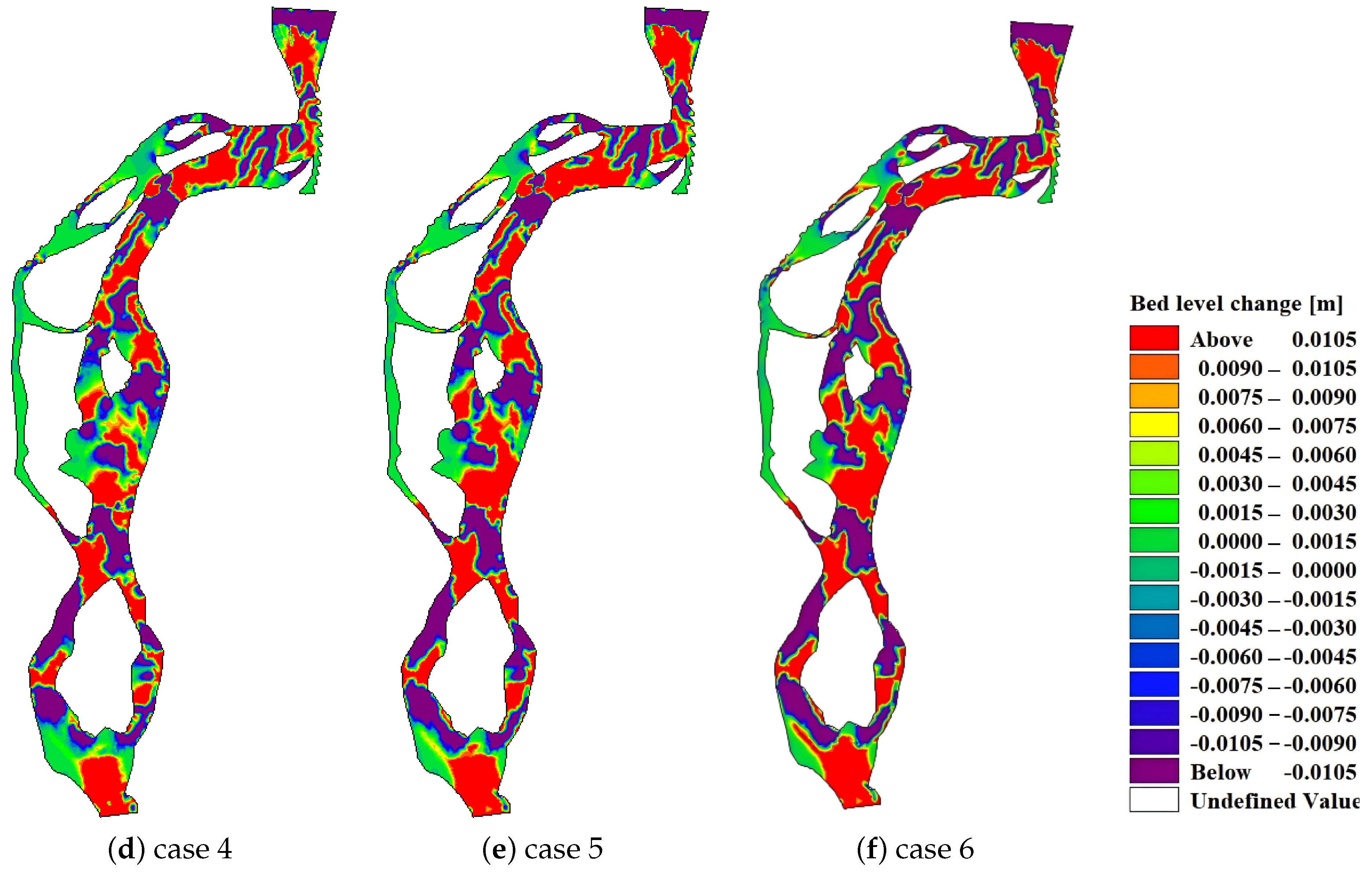
Figure 15 presents the bed deformation results for a simulation duration of 2 days, where positive changes in bed elevation indicate deposition and negative changes indicate erosion. The deposition and erosion of river sediment are correlated with flow velocity, as flow at a given velocity can carry a specific mass concentration of sediment.
From a hydrodynamic perspective, according to the continuity equation, cross-sectional contraction leads to increased flow velocity and enhanced sediment transport capacity, whereas cross-sectional expansion results in decreased flow velocity and weakened sediment transport capacity. Meanwhile, as the flow with an upstream boundary suspended sediment concentration of 0.626 kg/m3 progresses downstream, spatial non-uniformity in velocity distribution creates discontinuity in sediment transport capacity, thereby inducing erosion and deposition adjustments.
According to the simulation results in Figure 15, the study reach exhibits a typical coupled pattern of “bend erosion–shoal deposition” from an overall perspective, which is in excellent agreement with the classical erosion–deposition theory of meandering rivers [37,38]. The spatial distribution of bed deformation is governed by three key factors: discontinuity in sediment transport capacity induced by velocity gradients, and local hydrodynamic reorganization resulting from flow bifurcation around mid-channel shoals.
During low-flow periods, bed elevation changes in the main channel thalweg remained within ±0.0015 m. As clearly observed in Figure 15a,b, deposition along the lateral channel margins, on point shoals, and in areas surrounding Z01 predominantly ranged from 0.0015 to 0.0045 m, with localized high deposition zones reaching 0.0060 to 0.0105 m.
As discharge increased to medium-flow conditions, bed deformation intensity significantly intensified, and deposition zones converged into “strip-like and patchy” patterns. At this stage, the erosion–deposition configuration underwent a qualitative transformation. Main channel erosion zones expanded and concentrated toward the concave banks, forming continuous erosion bands. The right channel of Z01, which originally experienced extensive deposition during low-flow periods, began to exhibit localized erosion, indicating that this region was reactivated by scour. This transition was attributed to increased discharge, which resulted in full submergence of the flow cross-section in the right channel, elevating flow velocity from below 0.4 m/s to 0.9–1.2 m/s. This exceeded the incipient motion velocity threshold for local sediment, thereby shifting the regime from deposition to erosion–deposition equilibrium or even slight erosion.
During high-flow periods, Figure 15e,f reveal that the spatial positions of erosion zones exhibited negligible migration, differing only in erosion intensity, while the central locations and geometric configurations of erosion bands remained highly consistent. The boundary between erosion and deposition zones demonstrated remarkable stability. The spatial position of this boundary was primarily governed by bed topography rather than discharge magnitude. Increased discharge merely resulted in quantitative variations in erosion–deposition intensity without inducing qualitative changes in the erosion–deposition pattern.
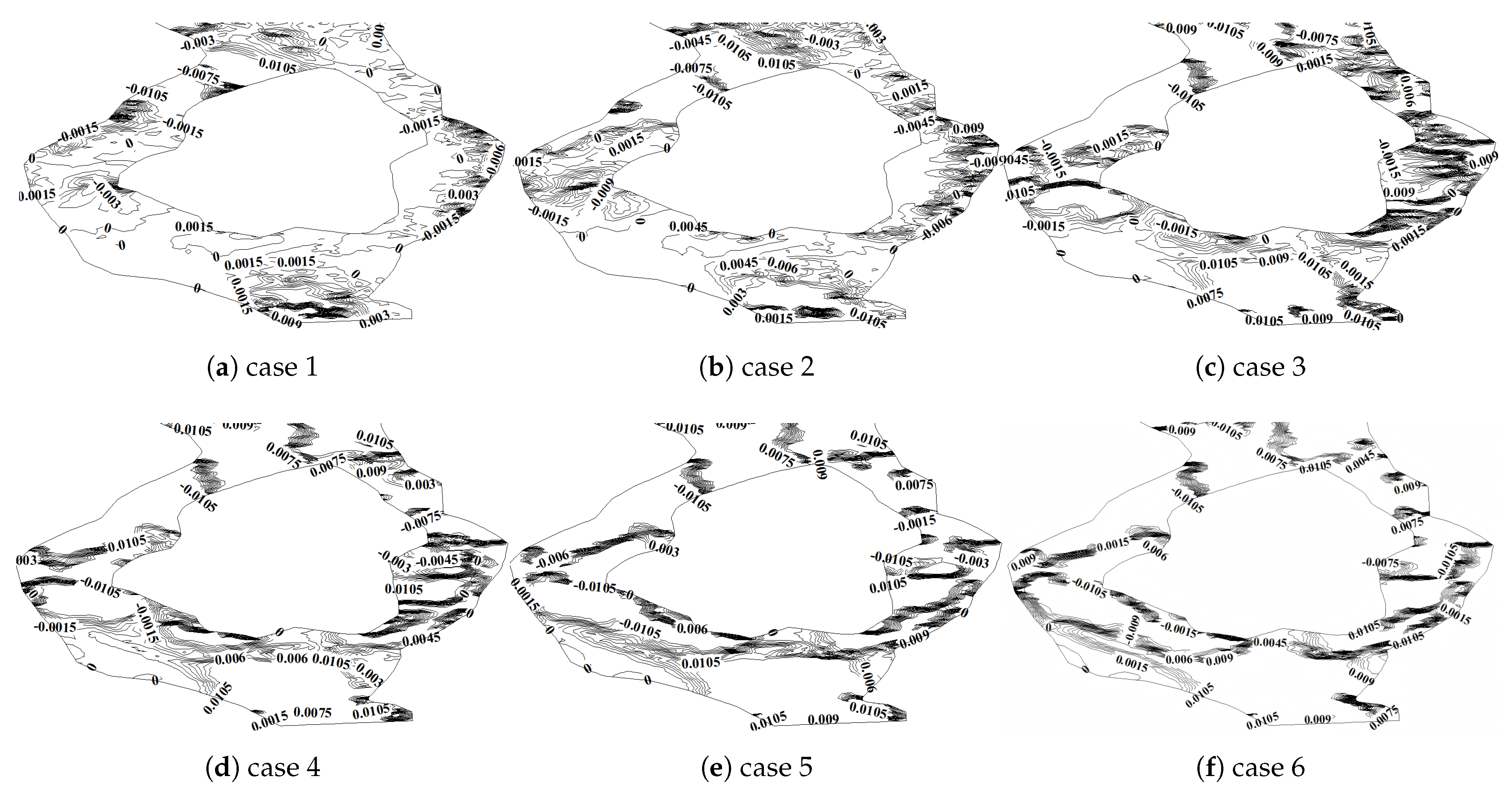
Figure 16 presents the details of bed deformation in the Z01 region. A stable pattern of “frontal deposition with lateral erosion” was consistently observed under all flow conditions. A localized deposition zone existed immediately upstream of the shoal head, which was a direct consequence of abrupt velocity reduction induced by the backwater effect at the shoal head. As flow was obstructed at the shoal head, kinetic energy converted to pressure energy, forming a “deposition center” upstream of the shoal head. Simultaneously, an elongated erosion zone developed along the left flank of the shoal head, reflecting persistent erosional action by the main flow in the left channel on the concave bank. This symmetric erosion–deposition structure remained stable across varying discharge conditions, indicating that shoal head morphology exerted strong control over the bifurcation pattern.
During the low-flow period, the shoal exhibited a “stable and depositional” regime. Due to the relatively high elevation of the shoal, portions of the shoal remained partially submerged or were characterized by extremely shallow water depths, causing flow to primarily bypass the shoal through the left and right channels, thereby exerting minimal influence on the shoal itself.
Upon entering the medium-flow period, the shoal transitioned from a stable state to one of intense erosion, exhibiting distinctive characteristics of “shoal erosion activation and vigorous erosion–deposition dynamics”. An extensive erosion core zone emerged from the shoal head to the mid-section of the shoal, indicating that following complete submergence during medium flows, the shoal experienced intense frontal impact from upstream flow and shear stress from the overlying flow, resulting in extensive mobilization and downstream transport of surface sediments.
During the low-flow period, the right channel exhibited extensive deposition with depositional thicknesses ranging from 0.003 to 0.006 m, reflecting flow dispersion in this region that led to energy dissipation and insufficient sediment transport capacity. During the medium-flow period, the deposition zone in the right channel contracted significantly, with deposition core zones retained only in localized depressions, while other areas transitioned to erosion–deposition equilibrium or slight erosion. This indicated an increase in the discharge allocation to the right channel, partially restoring its sediment transport capacity, as the right channel shifted from “depositional contraction” to “erosion activation”.
During the low-flow period, the shoal tail region exhibited areal deposition characteristics with depositional thicknesses of 0.006–0.009 m. This deposition originated from the development of a recirculation zone at the shoal tail, where flow velocities were extremely low, creating a “convergence center” for sediment settling. During the medium-flow period, the depositional zone at the shoal tail transitioned to alternating erosion and deposition. The extensive depositional area immediately downstream of the shoal tail largely disappeared, shifting to a regime dominated by erosion–deposition equilibrium, with an erosion zone emerging only locally on the left side of the shoal tail.
During the high-flow period, the erosion–deposition pattern further intensified relative to the medium-flow period, while the spatial distribution became increasingly stable. The contour distributions for Cases 5 and 6 nearly coincided, indicating that the erosion–deposition pattern had reached an equilibrium state. The location, morphology, and intensity of the erosion core zone at the shoal head closely resembled those observed during the medium-flow period, with only slight expansion at the boundaries. The erosion zone in the left channel exhibited characteristics of “streamwise banding and concentration”. This banding pattern reflected the sharpening of the main flow streamline and the intensification of velocity gradients under high-flow conditions, with erosional activity concentrated in the core region of maximum velocity.
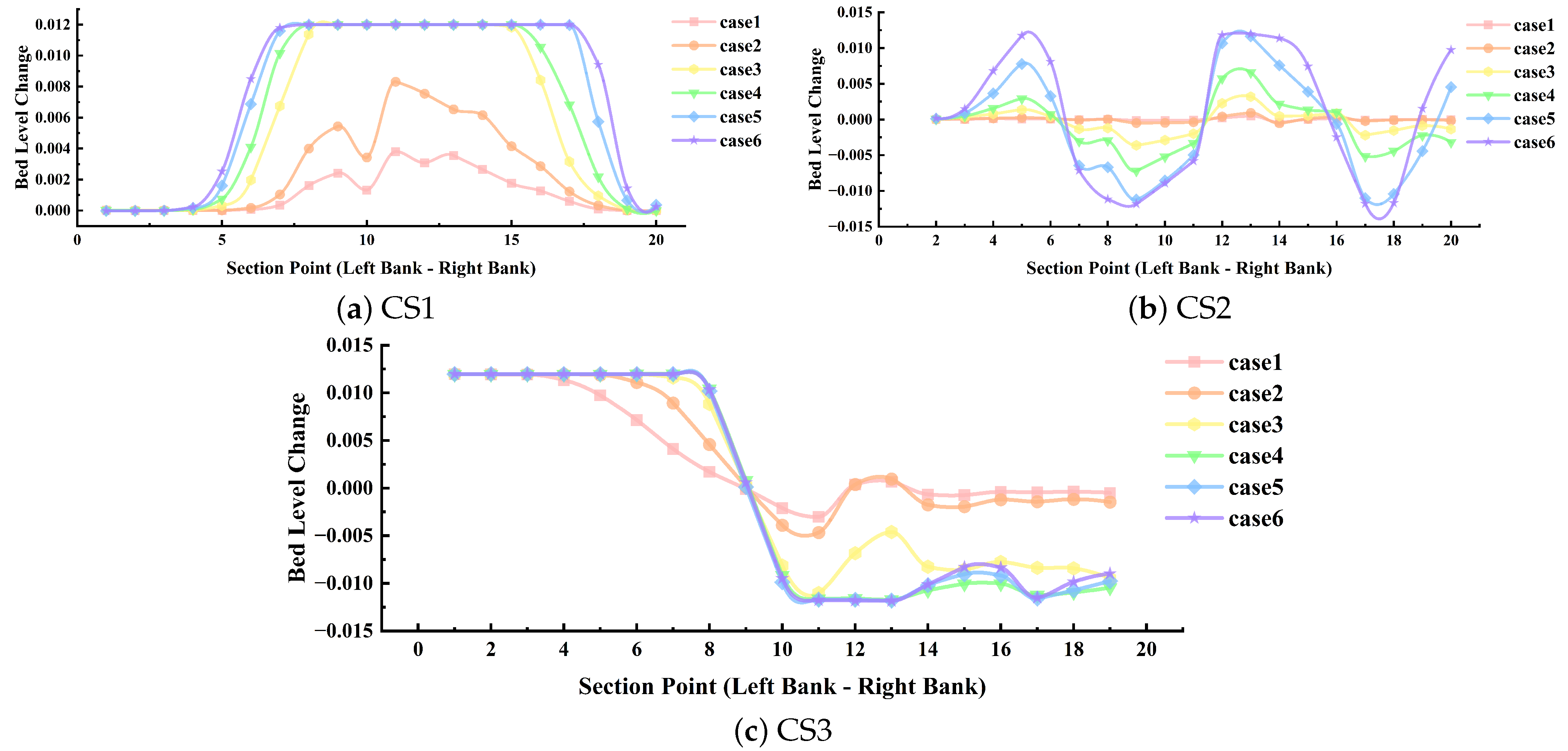
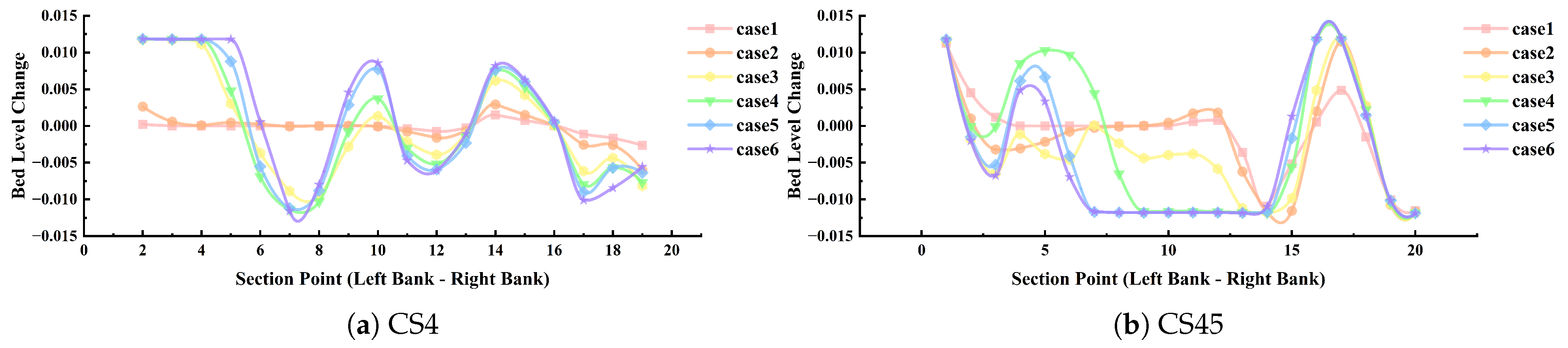
To quantitatively characterize the lateral distribution characteristics of bed erosion and deposition, this study uniformly positioned 20 sampling points perpendicular to the main flow direction along typical cross-sections (CS1–CS5) for analysis. The point numbers on the cross-sections represent relative positions.
As shown by the cross-sectional morphological evolution in Figure 17, cross-section CS1 is located in the upstream transition zone of the shoal head, CS2 is positioned at the bifurcation point of the shoal head, and CS3 is situated in the confluence region at the shoal tail. These three cross-sections exhibit distinctly different erosion–deposition evolution patterns. CS1 is dominated by deposition, with deposition intensity increasing as discharge increases, displaying a “deposition saturation” characteristic. CS2 exhibits intense alternation between erosion and deposition with a complex “wave-like” distribution, representing the most active zone of bed deformation. CS3 displays a seasonal transition of “low-flow deposition to high-flow erosion,” characterized by distinct periodic adjustment features.
All three cross-sections underwent significant transformations in their erosion–deposition patterns during the medium-flow period: CS1 transitioned from weak deposition to strong deposition, CS2 shifted from stability to intense erosion–deposition alternation, and CS3 changed from strong deposition on the left side to severe erosion on the right side.
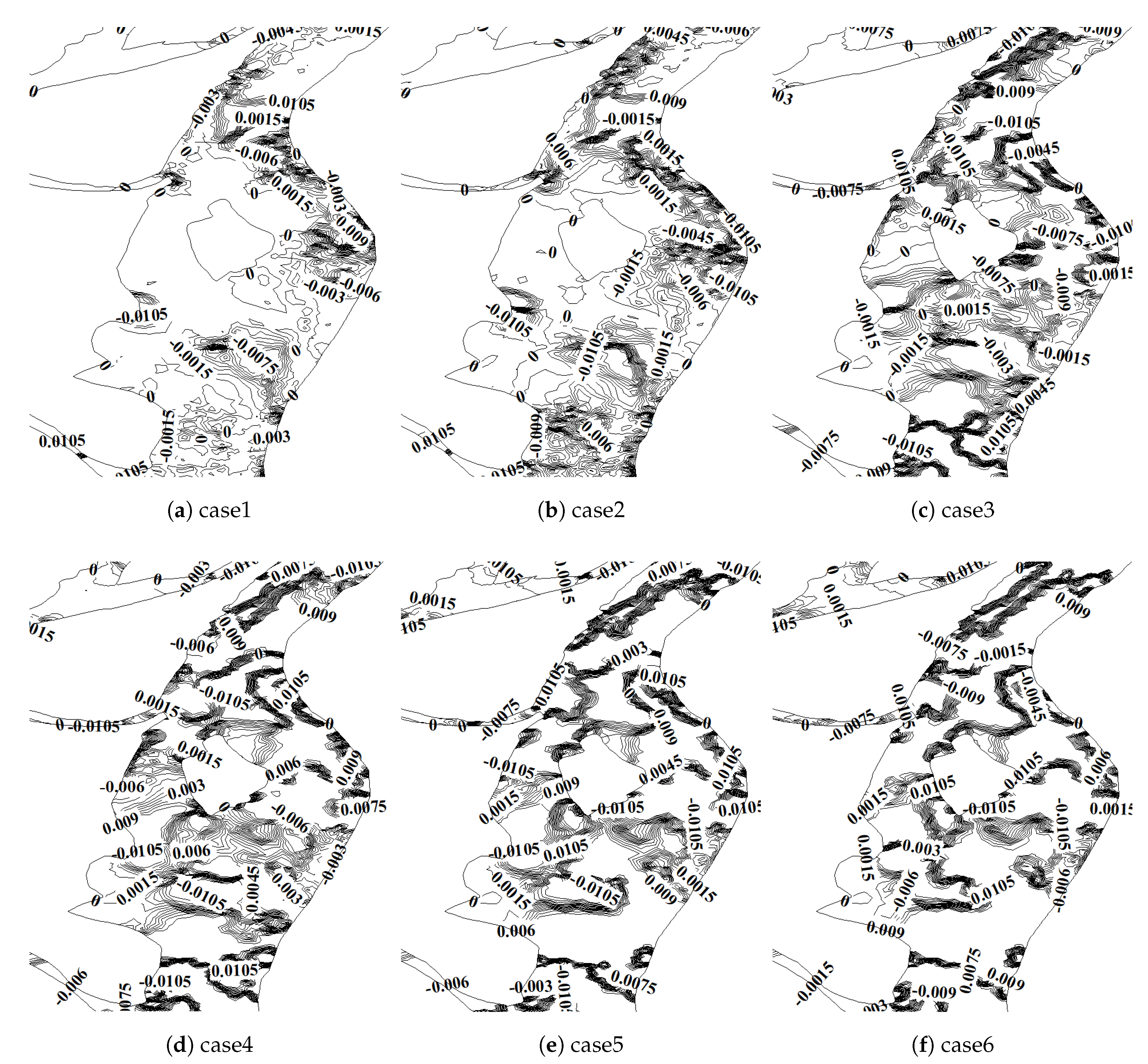
Figure 18 presents the bed deformation details in region Z02. Compared with Z01, Z02 is smaller in scale, and its erosion–deposition evolution is controlled by both flow bifurcation effects and bend circulation. Under low-flow conditions (Cases 1–2), Z02 is predominantly in a depositional state, with an average deposition thickness of 0.0003–0.003 m over the shoal body. The deposited sediments are primarily concentrated at the shoal head and at the confluence of the shoal tail with the left channel, forming distinct “deposition core zones”. At this stage, after undergoing bifurcation and confluence at Z01, the flow velocity has significantly decreased to 0.4–0.6 m/s at Z02. The relatively high bed elevation of Z02, with some areas not fully submerged, further reduces flow velocities around the shoal body. Particularly in the lee zone at the shoal tail, the velocity is extremely low due to recirculation, making this region a “convergence center” for sediment deposition.
During medium-flow conditions (Cases 3–4), the erosion–deposition pattern of Z02 exhibits spatial differentiation, with erosion initiating at the shoal head and right channel entrance, while deposition persists in the middle section of the left channel and the deep trough of the right channel. This “head erosion and tail deposition” pattern reflects the spatial adjustment of hydrodynamic conditions. With increasing discharge, the shoal head is subjected to direct impingement by the incoming flow, and the velocity increases to 0.8–1.0 m/s, triggering erosion. As the main flow channel, the right channel maintains velocities of 0.7–0.9 m/s, possessing considerable erosive capacity. In contrast, the middle section of the left channel and the deep trough of the right channel remain in a depositional state due to relatively high bed elevation and low velocities.
Under high-flow conditions (Cases 5–6), Z02 exhibits pronounced “erosion-dominated” characteristics. The scour depth at the shoal head reaches 0.01 m. In the left channel thalweg, scour depths range from 0.01 to 0.012 m, forming a continuous erosion zone. Deposition is retained only in nearshore shoals and localized depressions. The erosion-dominated pattern indicates that the overall stability of Z02 is threatened under high-flow conditions. As shown in Figure 12c, streamlines near the shoal head exhibit sharp curvature under Case 6, with velocities reaching 1.3–1.5m/s, demonstrating substantial erosive capacity. In the right channel thalweg, velocities further increase to 1.0–1.2 m/s, promoting downstream transport of bed sediments. The recirculation zone at the shoal tail confluence contracts substantially, depositional activity nearly ceases, and erosion emerges instead. This marks the transition of Z02 from an “accretion phase” to an “erosion phase” under high-flow conditions.
As shown by the cross-sectional evolution in Figure 19, CS4 is located upstream of Z02 and marks the bifurcation head. During the medium-flow period, the cross-sectional erosion–deposition pattern experiences significant changes, manifesting an asymmetric W-shaped morphology. The left deposition peak located at cross-sectional points 2–3 exhibits deposition thickness ranging from 0.011 to 0.012 m, while the central main channel develops a scour trough at point 7 with erosion depth of 0.011 m. A secondary deposition peak emerges at point 10 in the central region with thickness of 0.004 m, and the right region displays alternating patterns of erosion and deposition. This complex spatial pattern reflects the complexity of flow reorganization occurring upstream of Z02. The lateral migration of the main flow toward the right channel produces intense erosion in the central main channel, whereas the left side and localized portions of the right side exhibit deposition due to diminished flow velocities.
During the high-flow period (Cases 5–6), the erosion–deposition intensity further increases, but the spatial pattern becomes stable. The curves for Cases 5 and 6 closely overlap, indicating that the erosion–deposition pattern at cross-section CS4 reaches equilibrium once the discharge exceeds a threshold value.
Cross-section CS5 is located at the shoal tail and represents a critical zone for channel morphological adjustment following the confluence of the left and right channels. The erosion–deposition characteristics exhibit a distinct “five-zone” structure and a “dual-threshold” discharge response pattern. The cross-section exhibits five distinct zones from left to right. The left bank features a stable deposition zone with deposition thickness of 0.0112 to 0.0118 m, showing less than 5% variation across all cases. Adjacent to this is a left transitional scour zone that transitions from deposition of 0.0045 m during low flow to scour of 0.0064 m during medium flow. The left secondary deposition ridge achieves maximum deposition of 0.0103 m at Case 4 but decreases to 0.0033 m or even shifts to scour of 0.0070 m in Cases 5–6. The central main channel develops an intense scour zone with stable scour depths of 0.0117 to 0.0119 m in Cases 5–6. Finally, the right side presents a deposition ridge–thalweg complex characterized by deposition of 0.0118 to 0.0119 m and scour of 0.0115 to 0.0119 m.
Two critical discharge thresholds are identified in the cross-section. The first threshold, approximately 1356  m 3 / s , marks the transition of the central main channel from equilibrium (±0.002 m) to intense scour (−0.0112 m), accompanied by the expansion of the main flow boundary toward the left bank, which incorporates the original point shoal area into the scour zone. The second threshold, approximately 1946  m 3 / s , represents the attainment of saturated equilibrium, where the profiles of Cases 5 and 6 nearly coincide completely, indicating that further increases in discharge no longer alter the erosion–deposition pattern.

5. Discussion

5.1. Measured Flow Bifurcation Mechanism and Velocity Probability Distribution Characteristics at Mid-Channel Shoal

This study systematically reveals the flow and sediment transport patterns in a meandering reach with multiple mid-channel shoals in the Ningxia reach of the Yellow River through a combined approach of integrated bathymetric-topographic surveys and numerical simulations. The results demonstrate that the control of discharge partitioning by mid-channel shoals exhibits significant variations under different hydrological conditions. Field measurements from ADCP transects reveal that the discharge ratio of the right channel at Z01 during low flow is only 44.16%, whereas that at Z02 reaches 86.31%. This substantial difference primarily stems from the combined effects of shoal morphological characteristics, upstream and downstream boundary conditions in bends.
The classical theory of Zolezzi and Seminara [39] indicates that the discharge ratio at mid-channel shoals is governed by geometric parameters including shoal aspect ratio, shoal head bluntness, and upstream bend curvature. In the present study, Z01 exhibits an elliptical shape with its major axis oriented at 30° to the main flow direction, which constricts the right channel cross-section to 240.61 m, resulting in concentrated flow velocity but a relatively low discharge ratio. In contrast, Z02 is located in the transition zone of an S-shaped continuous bend, where the transverse momentum generated by upstream bend circulation directs flow toward the right channel. The unique trapezoidal geometry of Z02 further enhances the flow resistance effect in the left channel, ultimately producing an extremely asymmetric discharge distribution. This phenomenon is consistent with the findings of Schuurman et al. [40] in the Brahmaputra River, who demonstrated that in coupled bend-shoal systems, upstream bend circulation can influence downstream discharge partitioning by 30–40%.
The cross-sections around the mid-channel shoal (C02–C04) transition from right-skewed to left-skewed distributions, essentially reflecting the dynamic adjustment process of flow through “bifurcation-deceleration, low-velocity dominance, and acceleration-confluence”. At cross-section C02, the primary peak is located at 0.7 m/s while the right tail extends to 1.5 m/s. This right-skewed distribution indicates that most of the cross-section is in a state of insufficient sediment transport capacity. The velocity distribution in the spur dike-regulated reach exhibits distinctly different characteristics, with all cross-sections showing left-skewed distributions. The bimodal left-skewed distribution at cross-section C13 represents a typical manifestation of progressive flow confinement regulation by the spur dike series, where the low probability density in the valley between the two peaks reflects a distinct velocity demarcation between the main flow zone and the recirculation zone.
The physical relationship between velocity skewness and erosion–deposition patterns is fundamentally governed by the nonlinear dependence of sediment transport capacity on flow velocity. According to classical sediment transport theory, the sediment carrying capacity scales with velocity raised to the power of 3–5. This strong nonlinearity implies that high-velocity regions contribute disproportionately to the total sediment transport capacity relative to their spatial extent. When the velocity distribution exhibits left skewness, the probability mass concentrates in high-velocity regions, indicating that flow velocities across most of the cross-section exceed the critical incipient motion velocity. Under such conditions, the sediment transport capacity surpasses the incoming sediment supply, resulting in net erosion. Conversely, right-skewed distributions indicate that velocities are predominantly distributed in low-value regions where transport capacity falls below the incoming sediment load, leading to net deposition.
From an energy perspective, velocity skewness reflects the spatial organization of flow kinetic energy. Left-skewed distributions correspond to concentrated flow patterns characterized by high energy density, which enables sustained sediment entrainment and downstream transport. In contrast, right-skewed distributions indicate dispersed flow with reduced energy density, where kinetic energy dissipates through turbulent mixing and flow separation in low-velocity zones, creating favorable hydrodynamic conditions for sediment settling.

5.2. Head Loss Characteristics

Based on the validated numerical model (R2 = 0.93), analysis of head loss reveals the energy dissipation characteristics of different geomorphic units. Head loss at Z01 exhibits a power-law relationship with discharge, with an exponent less than unity, indicating a diminishing marginal effect. During low flow, each 1  m 3 / s increase in discharge corresponds to a 0.180 mm increase in head loss. During high flow, the marginal loss rate decreases to 0.084 mm, representing a 53.3% reduction, which demonstrates the law of diminishing marginal effects of the mid-channel shoal on flow resistance.
The fitted function of head loss at Z02 shows that the marginal loss rate approaches zero at Case 4, corresponding to an inflection point discharge of 1946 m3/s. This indicates that during medium flow, the flow resistance effect of the mid-channel shoal reaches a minimum and the discharge partitioning tends toward optimization. When discharge exceeds the inflection point value, the marginal loss rate increases again, reflecting enhanced energy dissipation due to intensified local scour and enhanced vortical structures under high-flow conditions.
Head loss in the spur dike series exhibits superlinear growth, with the marginal loss rate increasing as discharge increases, such that the energy loss per unit discharge increases by nearly threefold. This difference stems from the rigid flow obstruction characteristics of the spur dike series.

5.3. Numerical Simulation of Discharge Effects on Bed Erosion–Deposition Patterns

The study finds that when discharge increases from low flow (501–695  m 3 / s ) to medium flow (1356–1812  m 3 / s ), the bed erosion–deposition pattern undergoes a fundamental transformation. The right channel of Z01 transitions from extensive deposition to equilibrium or even slight scour, the shoal itself shifts from stable conditions to intense scour, and the deposition zone in the recirculation area at the shoal tail essentially disappears. The hydrodynamic mechanism underlying this transformation lies in the fact that increased discharge during medium flow fully submerges the right channel cross-section, elevating flow velocity from less than 0.4 m/s to 0.9–1.2 m/s, which exceeds the incipient motion velocity threshold for local fine sand. Phillips and Jerolmack [41] found in experimental flume studies that the transformation of erosion–deposition patterns at mid-channel shoals exhibits a distinct critical discharge, beyond which extensive sediment entrainment occurs on the shoal surface and the bed transitions from deposition-dominated to scour-dominated conditions. While their experiments focused on single-thread channels, the observed threshold behavior in our multi-shoal system suggests this concept may be broadly applicable, though the specific threshold values (1356–1812 m3/s) are site-specific. Notably, after entering the high-flow period, the spatial distribution of the erosion–deposition pattern becomes stable, with the contour distributions of Cases 5 and 6 nearly coinciding completely, indicating that the bed morphology has adjusted to a state compatible with high discharge hydrodynamic conditions.

5.4. Complex Flow–Sediment Interaction Mechanisms in Coupled Bend-Shoal Systems

The study reveals that the presence of mid-channel shoals significantly alters the bend circulation structure. In the left channel of Z01, the scour zone along the concave bank overlaps with the shoal scour area, forming a continuous thalweg. In the Z02 region, the transverse sediment flux generated by upstream bend circulation directly influences the lateral migration rate of the shoal. Cross-sectional morphology analysis shows that section CS2 (at the shoal head bifurcation point) exhibits a complex undulating erosion–deposition distribution and represents the most active zone of bed deformation, which is closely related to the highly complex flow structure in the bend-bifurcation transition zone. Yang et al. [42] demonstrated through three-dimensional numerical simulations that the helical flow induced by bend circulation undergoes bifurcation at the mid-channel shoal divergence point, and this asymmetric secondary flow structure leads to distinctly different erosion–deposition patterns in the two channels.
The spur dike series achieves bank protection objectives through a dual mechanism of constricting the main flow and creating inter-dike zones. Numerical results show that during high flow, local high-velocity flow develops around the dike heads, reaching 1.8 m/s, approximately 30% higher than the upstream flow. This velocity acceleration phenomenon is highly consistent with the findings of Koken and Cotel [43] in their numerical study of spur dikes in bends, who demonstrated that the flow deflection effect induced by cross-sectional constriction can increase local velocity by 20–40%, and that the deflection intensity increases with the angle between the dike and the main flow, with the maximum velocity increase at the dike head reaching 45% when the angle increases from 60° to 90°. Within the inter-dike zones between adjacent dikes, velocity decreases to below 0.2 m/s, forming a stable low-energy environment. This sharp velocity gradient is expected to substantially reduce the erosive forces acting on the riverbank. Nayyer et al. [44] systematically investigated the flow field characteristics of spur dike series through numerical simulations and physical experiments, finding that velocity within inter-dike zones can decrease to 10–15% of the main flow velocity, the recirculation zone scale expands with increasing dike spacing, the recirculation structure is most stable when spacing is 3–4 times the dike length, and the sediment deposition rate in inter-dike zones reaches its optimum under these conditions. Notably, the scour hole depth downstream of the dikes reaches 0.015 m during high flow, significantly greater than the natural scour depth (approximately 0.005–0.008 m) in reaches without dikes.

6. Conclusions

Through integrated bathymetric–topographic surveys and two-dimensional coupled hydrodynamic–sediment modeling, this study systematically reveals the patterns of flow and sediment transport and the mechanisms of bed evolution in a meandering reach with multiple mid-channel shoals in the Ningxia reach of the Yellow River. The main conclusions are as follows:
(1)
Mid-channel shoals geometry together with bend-induced planform effects controls the depth-averaged flow partitioning. The right-branch discharge ratio is 44.16% at Z01 and 86.31% at Z02. At Z02, the S-shaped successive-bend setting promotes depth-averaged flow deflection toward the right branch.
(2)
Gaussian kernel density estimation quantitatively characterizes the skewness characteristics of velocity distribution. Sections C02–C03 around Z01 exhibit right-skewed distributions, with peaks located in the low-velocity region at 0.65–0.70 m/s, reflecting that the bifurcation-induced deceleration effect leads to an increased proportion of low-velocity flow. All sections in the spur dike-controlled reaches exhibit strong left-skewed distributions, with peaks located in the high-velocity region, indicating highly concentrated mainstream flow. The degree of velocity dispersion is negatively correlated with bed stability.
(3)
Head loss at Z01 exhibits a diminishing marginal effect, with the marginal loss rate during the low-flow period being 2.14 times that during the high-flow period. Z02 shows polynomial growth, with an inflection point discharge of 1946 m3/s, at which the marginal loss rate approaches zero, reflecting that flow distribution reaches optimal allocation. The spur dike group exhibits superlinear growth, with the marginal loss rate increasing by 278% from the low-flow period.
(4)
The medium-flow period (1356–1812  m 3 / s ) represents the critical discharge for the bed erosion–deposition pattern. When discharge exceeds this threshold, flow velocity in the right channel of Z01 increases from less than 0.4 m/s to 0.9–1.2 m/s, and the bed transitions from deposition to erosion, with shoal body scour depth reaching 0.01 m and the deposition zone in the recirculation area at the shoal tail disappearing. During the high-flow period, the erosion–deposition pattern stabilizes, indicating that bed morphology has adapted to high-discharge conditions. Z02 exhibits a pattern of “head erosion and tail deposition”. The erosion–deposition pattern stabilizes during the high-flow period, with the spatial distributions of erosion and deposition highly coinciding between Cases 5 and 6.
(5)
The spur-dike series provides bank protection through a dual mechanism in the depth-averaged sense: (i) constricting the main-flow corridor and (ii) creating sheltered inter-dike low-velocity zones. During the high-flow period, flow velocity around the dike heads reaches 1.8 m/s, representing an approximately 30% increase compared to upstream conditions, while velocity within inter-dike zones decreases to below 0.2 m/s, forming a low-energy depositional environment.
Future research should integrate vegetation dynamics and ecological feedback mechanisms into the coupled flow–sediment modeling framework, as water resource management significantly influences vegetation distribution patterns [45], and threshold-based control strategies may provide insights for adaptive river management [46].

Author Contributions

H.J.: Conceptualization (equal); Data curation (equal); Formal analysis (equal); Supervision (equal); Writing—original draft (equal). H.L.: Conceptualization (equal); Data curation (equal); Formal analysis (equal); Writing—original draft (equal); Investigation (equal); Resources (equal); Software (equal); Validation (equal); Visualization (equal); Writing—original draft (equal); Writing—review editing (equal). W.W.: Conceptualization (equal); Data curation (equal); Resources (equal); Software (equal); Supervision (equal). Y.L.: Formal analysis (equal); Funding acquisition (equal); Project administration (equal); Resources (equal); Supervision (equal). J.L.: Data curation (equal); Investigation (equal); Resources (equal); Software (equal); Supervision (equal). All authors have read and agreed to the published version of the manuscript.

Funding

This work was supported by the National Natural Science Foundation of China (Grant No. 12461084); the Ningxia Natural Science Foundation (Grants No. 2023AAC02049); the Graduate Innovation Project of North Minzu University (Grant No. YCX24263); the Scientific Research Project of Ningxia Higher Education Institutions (NYG2024090). the Science and Technology Innovation Teamn of Water Resource Efficient Applications and Ecological Remediation of Ningxia, China (Grant No. 2024CXTD015); the Scientific Computing and Engineering Applications Innovation Team of North Minzu University (Grant No. 2022PTS_02).

Institutional Review Board Statement

Not applicable.

Informed Consent Statement

Not applicable.

Data Availability Statement

The data that support the findings of this study are available from the corresponding author upon reasonable request.

Conflicts of Interest

The authors declare there are no conflicts of interest.

References

  1. Xia, J.; Wang, Y.; Zhou, M.; Deng, S.; Li, Z.; Wang, Z. Variations in channel centerline migration rate and intensity of a braided reach in the Lower Yellow River. Remote Sens. 2021, 13, 1680. [Google Scholar] [CrossRef]
  2. Jing, H.; Li, C.; Guo, Y.; Zhang, L.; Zhu, L.; Li, Y. Modelling of sediment transport and bed deformation in rivers with continuous bends. J. Hydrol. 2013, 499, 224–235. [Google Scholar] [CrossRef]
  3. Ma, Z.; Fu, C.; Zhou, T.; Yan, Z.; Li, M.; Zheng, Z.; Chen, L.; Lv, M. Current status and reflections on climate and hydrological changes in the Yellow River Basin. Bull. Chin. Acad. Sci. 2020, 35, 52–60. [Google Scholar]
  4. Jing, H.; Li, Y.; Li, C. Numerical study of the flow in the Yellow River with non-monotonous banks. J. Hydrodyn. 2016, 28, 142–152. [Google Scholar] [CrossRef]
  5. Yuan, X.; Yue, Z.; Tian, F.; Cao, L.; Song, T. A study of the water and sediment transport Laws and Equilibrium stability of fluvial facies in the Ningxia section of the Yellow River under variable conditions. Sustainability 2020, 12, 1573. [Google Scholar] [CrossRef]
  6. Brierley, G.J.; Yu, G.A.; Li, Z. Geomorphic diversity of rivers in the Upper Yellow River Basin. In Landscape and Ecosystem Diversity, Dynamics and Management in the Yellow River Source Zone; Springer: Berlin/Heidelberg, Germany, 2016; pp. 59–77. [Google Scholar]
  7. Magdaleno, F.; Fernández-Yuste, J.A. Meander dynamics in a changing river corridor. Geomorphology 2011, 130, 197–207. [Google Scholar] [CrossRef]
  8. Bridge, J.S. The interaction between channel geometry, water flow, sediment transport and deposition in braided rivers. Geol. Soc. Lond. Spec. Publ. 1993, 75, 13–71. [Google Scholar] [CrossRef]
  9. Rozo, M.G.; Nogueira, A.C.; Castro, C.S. Remote sensing-based analysis of the planform changes in the Upper Amazon River over the period 1986–2006. J. S. Am. Earth Sci. 2014, 51, 28–44. [Google Scholar] [CrossRef]
  10. Khan, M.A.; Sharma, N.; Pu, J.; Alfaisal, F.M.; Alam, S.; Khan, W.A. Analysis of turbulent flow structure with its fluvial processes around mid-channel bar. Sustainability 2021, 14, 392. [Google Scholar] [CrossRef]
  11. Ashmore, P.E. How do gravel-bed rivers braid? Can. J. Earth Sci. 1991, 28, 326–341. [Google Scholar] [CrossRef]
  12. Prasujya, G.; Nayan, S. Spatio-temporal study of morpho-dynamics of the Brahmaputra River along its Majuli Island reach. Environ. Chall. 2021, 5, 100217. [Google Scholar] [CrossRef]
  13. Pasternack, G.B.; Baig, D.; Weber, M.D.; Brown, R.A. Hierarchically nested river landform sequences. Part 2: Bankfull channel morphodynamics governed by valley nesting structure. Earth Surf. Process. Landf. 2018, 43, 2519–2532. [Google Scholar] [CrossRef]
  14. Liu, Y.; Zhou, Y.; Wen, X.; Jin, Z.; Li, Z.; Liu, X.; Li, Z.; Han, J. Morphodynamic changes of braided channels caused by increased runoff and sediment flux in the Yangtze river headwater on the Tibetan Plateau. J. Hydrol. 2025, 661, 133659. [Google Scholar] [CrossRef]
  15. Baubinienė, A.; Satkūnas, J.; Taminskas, J. Formation of fluvial islands and its determining factors, case study of the River Neris, the Baltic Sea basin. Geomorphology 2015, 231, 343–352. [Google Scholar] [CrossRef]
  16. Wang, S.; Fu, B.; Piao, S.; Lú, Y.; Ciais, P.; Feng, X.; Wang, Y. Reduced sediment transport in the Yellow River due to anthropogenic changes. Nat. Geosci. 2016, 9, 38–41. [Google Scholar] [CrossRef]
  17. Xia, J.; Li, X.; Zhang, X.; Li, T. Recent variation in reach-scale bankfull discharge in the Lower Yellow River. Earth Surf. Process. Landf. 2014, 39, 723–734. [Google Scholar] [CrossRef]
  18. Corato, G.; Ammari, A.; Moramarco, T. Conventional point-velocity records and surface velocity observations for estimating high flow discharge. Entropy 2014, 16, 5546–5559. [Google Scholar] [CrossRef]
  19. Chen, Y.C.; Hsu, Y.C.; Zai, E.O. Streamflow measurement using mean surface velocity. Water 2022, 14, 2370. [Google Scholar] [CrossRef]
  20. Lin, M.; Qiao, X.; Yin, Y.; Lin, Z.; Wang, Q. Probability density function of streamwise velocity fluctuation in turbulent T-junction flows. Energy Procedia 2017, 105, 5005–5010. [Google Scholar] [CrossRef]
  21. Silverman, B.W. Density Estimation for Statistics and Data Analysis; Routledge: Oxfordshire, UK, 2018. [Google Scholar]
  22. Zheng, W.; Zhu, H.; Fu, X.; Liang, Z. Traffic flow speed distribution based on Kernel Density Estimation. Highw. Eng. 2018, 43, 113–117. [Google Scholar]
  23. Qin, Z.; Li, W.; Xiong, X. Estimating wind speed probability distribution using kernel density method. Electr. Power Syst. Res. 2011, 81, 2139–2146. [Google Scholar] [CrossRef]
  24. Wu, P.; Li, G.; Zhu, H.; Lu, W. Outlier Detection Method of Environmental Streams Based on Kernel Density Estimation. In Proceedings of the China Conference on Wireless Sensor Networks, Xi’an, China, 31 October–2 November 2014; Springer: Berlin/Heidelberg, Germany, 2014; pp. 467–480. [Google Scholar]
  25. Xia, J.; Zhang, X.; Wang, Z.; Li, J.; Zhou, M. Modelling of hyperconcentrated flood and channel evolution in a braided reach using a dynamically coupled one-dimensional approach. J. Hydrol. 2018, 561, 622–635. [Google Scholar] [CrossRef]
  26. Zhou, M.; Xia, J.; Deng, S.; Li, Z. Two-dimensional modeling of channel evolution under the influence of large-scale river regulation works. Int. J. Sediment Res. 2022, 37, 424–434. [Google Scholar] [CrossRef]
  27. Cheng, Y.; Xia, J.; Zhou, M.; Wang, Z. Coupled two-dimensional model for heavily sediment-laden floods and channel deformation in a braided reach of the Lower Yellow River. Appl. Math. Model. 2024, 131, 423–437. [Google Scholar] [CrossRef]
  28. Yang, H.; Hu, X.; Wang, S.; Cheng, K.; Luo, M.; Wang, H.; Shi, J. The effect of stress history on the critical shear stress of bedload transport in gravel-bed streams. J. Hydrol. 2024, 645, 132208. [Google Scholar] [CrossRef]
  29. Webb, J.A.; Guo, D.; Koster, W.M.; Lauchlan-Arrowsmith, C.; Vietz, G.J. Can hydraulic measures of river conditions improve our ability to predict ecological responses to changing flows? Flow velocity and spawning of an iconic native Australian fish. Front. Environ. Sci. 2022, 10, 882495. [Google Scholar] [CrossRef]
  30. Pandey, M.; Valyrakis, M.; Qi, M.; Sharma, A.; Lodhi, A.S. Experimental assessment and prediction of temporal scour depth around a spur dike. Int. J. Sediment Res. 2021, 36, 17–28. [Google Scholar] [CrossRef]
  31. Peng, X.; Zhao, Y.; Gao, L.; Xu, X.; Xia, J. Hydraulic and alluvial characteristics of the lower Yellow River after the sudden dam-break of permeable spur dikes. J. Water Resour. Water Eng. 2023, 34, 121–127+134. (In Chinese) [Google Scholar]
  32. Gupta, L.K.; Eldho, T.; Raj, P.A. Temporal evolution of scour depth and hydrodynamics around T-shaped spur dikes. Phys. Fluids 2025, 37, 086626. [Google Scholar] [CrossRef]
  33. Tabassum, R.; Gondu, V.R.; Zakwan, M. Numerical simulation of scour dynamics around series of spur dikes using FLOW-3D. J. Appl. Water Eng. Res. 2025, 13, 47–58. [Google Scholar] [CrossRef]
  34. Che, D.; Su, M.; Ma, B.; Chen, F.; Liu, Y.; Wang, D.; Sun, Y. A Three-Dimensional Triangle Mesh Integration Method for Oblique Photography Model Data. Buildings 2023, 13, 2266. [Google Scholar] [CrossRef]
  35. Parsons, D.R.; Jackson, P.; Czuba, J.A.; Engel, F.; Rhoads, B.L.; Oberg, K.; Best, J.L.; Mueller, D.; Johnson, K.; Riley, J. Velocity Mapping Toolbox (VMT): A processing and visualization suite for moving-vessel ADCP measurements. Earth Surf. Process. Landf. 2013, 38, 1244–1260. [Google Scholar] [CrossRef]
  36. Bandini, F.; Frías, M.C.; Liu, J.; Simkus, K.; Karagkiolidou, S.; Bauer-Gottwein, P. Challenges with regard to Unmanned Aerial Systems (UASs) measurement of river surface velocity using Doppler radar. Remote Sens. 2022, 14, 1277. [Google Scholar] [CrossRef]
  37. Khosronejad, A.; Limaye, A.B.; Zhang, Z.; Kang, S.; Yang, X.; Sotiropoulos, F. On the morphodynamics of a wide class of large-scale meandering rivers: Insights gained by coupling LES with sediment-dynamics. J. Adv. Model. Earth Syst. 2023, 15, e2022MS003257. [Google Scholar] [CrossRef]
  38. Szupiany, R.N.; Amsler, M.L.; Parsons, D.R.; Best, J.L. Morphology, flow structure, and suspended bed sediment transport at two large braid-bar confluences. Water Resour. Res. 2009, 45. [Google Scholar] [CrossRef]
  39. Zolezzi, G.; Seminara, G. Downstream and upstream influence in river meandering. Part 1. General theory and application to overdeepening. J. Fluid Mech. 2001, 438, 183–211. [Google Scholar] [CrossRef]
  40. Schuurman, F.; Kleinhans, M.G.; Middelkoop, H. Network response to disturbances in large sand-bed braided rivers. Earth Surf. Dyn. 2016, 4, 25–45. [Google Scholar] [CrossRef]
  41. Phillips, C.B.; Jerolmack, D.J. Self-organization of river channels as a critical filter on climate signals. Science 2016, 352, 694–697. [Google Scholar] [CrossRef]
  42. Yang, H.; Lin, B.; Zhou, J. Physics-based numerical modelling of large braided rivers dominated by suspended sediment. Hydrol. Process. 2015, 29, 1925–1941. [Google Scholar] [CrossRef]
  43. Koken, M.; Cotel, E. Numerical investigation of the coherent structures in a curved channel with a spur dike at different angles with respect to the flow directions. Phys. Fluids 2025, 37, 065134. [Google Scholar] [CrossRef]
  44. Nayyer, S.; Farzin, S.; Karami, H.; Rostami, M. A numerical and experimental investigation of the effects of combination of spur dikes in series on a flow field. J. Braz. Soc. Mech. Sci. Eng. 2019, 41, 256. [Google Scholar] [CrossRef]
  45. Jing, H.; Lv, J. Effects of efficient water resource management on vegetation distribution and pattern structures. Int. J. Biomath. 2025, 2550078. [Google Scholar] [CrossRef]
  46. Lv, J.; Li, J. The delayed reaction-diffusion Filippov system with threshold control: Modeling and analysis of plateau pika-vegetation dynamics. Commun. Nonlinear Sci. Numer. Simul. 2025, 152, 109366. [Google Scholar] [CrossRef]
Figure 1. Schematic diagram of cross-sections and mid-channel shoals in the Sipaikou reach of the Yellow River.
Sustainability 18 00264 g001
Figure 2. Schematic diagrams of field measurement instruments.
Sustainability 18 00264 g002
Figure 3. Location of the Sipaikou study reach, Shizuishan, Ningxia Hui Autonomous Region, China.
Sustainability 18 00264 g003
Figure 4. Probability density of mean velocity at typical cross-sections.
Sustainability 18 00264 g004
Figure 5. Skewness coefficients of mean velocity probability density distributions.
Sustainability 18 00264 g005
Figure 6. Error bands for different grid sizes.
Sustainability 18 00264 g006
Figure 7. Correlation between simulated and measured values.
Sustainability 18 00264 g007
Figure 8. Comparison of simulated flow directions between 2-day and 10-day scenarios.
Sustainability 18 00264 g008
Figure 9. Topography of the study reach and locations of cross-sections.
Sustainability 18 00264 g009
Figure 10. Velocity distributions under different flow conditions.
Sustainability 18 00264 g010aSustainability 18 00264 g010b
Figure 11. Flow field distribution under typical conditions.
Sustainability 18 00264 g011
Figure 12. Flow field distribution near Z01 under typical conditions.
Sustainability 18 00264 g012
Figure 13. Flow field distribution near the spur dike under typical case.
Sustainability 18 00264 g013
Figure 14. Head losses under different flow conditions.
Sustainability 18 00264 g014
Figure 15. Bed erosion and deposition thickness in the study area under different flow conditions.
Sustainability 18 00264 g015aSustainability 18 00264 g015b
Figure 16. Local enlarged views of bed deformation at the primary mid–channel shoal.
Sustainability 18 00264 g016
Figure 17. Bed erosion and deposition changes at typical cross-sections.
Sustainability 18 00264 g017
Figure 18. Local magnified view of bed deformation at the secondary mid-channel shoal.
Sustainability 18 00264 g018
Figure 19. Bed deformation in typical cross-sections.
Sustainability 18 00264 g019
Table 1. Summary of measured hydraulic parameters at cross-sections.
Cross-SectionWater Level (m)Maximum Depth (m)Mean Depth (m)Channel Width (m)Mean Velocity (m/s)
C011097.504.582.7387364.521.6821
C021097.484.142.0783253.240.9551
C031097.303.801.0233263.650.9197
C041097.143.242.2108204.941.2154
C051096.914.752.6042407.030.7297
C061096.805.082.1314508.020.5338
C071096.747.322.3613390.310.4317
C081096.517.763.3689293.200.7928
C091096.414.991.8284336.770.8499
C101096.405.412.6820314.841.1903
C111096.366.992.3429483.921.1189
C121096.346.753.2113391.791.1159
C131096.3210.686.1668216.211.1662
C141096.1814.885.8210202.541.4332
C151096.114.512.2967574.720.9209
Average1096.706.332.8577347.051.0037
Table 2. Grain size distribution of bed sediment (unit: μm).
PositionLocationD10D25D50D75D90
InletLeft bank3.168.4821.5739.1258.42
Center3.299.2223.7843.5965.60
Right bank2.827.3018.9734.2451.85
OutletLeft bank2.576.4917.1632.0848.88
Center2.716.9017.8133.4251.57
Right bank2.646.7716.2229.3745.85
Average 2.877.5319.2535.3053.70
Table 3. Measured discharge ratios at mid-channel shoals.
Shoal TypeCross-Section
Group
Right Branch Discharge
Q i (m3/s)
Discharge Ratio
K i (%)
Z01C02–C04566.9644.16
Z02C06–C07992.2386.31
Table 4. Boundary conditions for typical cases.
CasePeriodInlet Discharge  m 3 / s Outlet Water Level (m)
Case 1Low-flow period5011095.78
Case 26951095.87
Case 3Normal-flow period13561096.11
Case 418121096.37
Case 5High-flow period25231096.85
Case 630261097.55
Table 5. Comparison of velocity errors for different grid sizes.
Element CountMean Velocity (m/s)Mean Relative Error (%)
37241.069/
10,5330.90215.6
22,1150.8288.3
30,0590.8796.1
Table 6. Marginal loss rates under different flow conditions.
CaseDischarge  ( m 3 / s ) Marginal Loss Rate  ( m / ( m 3 / s ) )
Z01Z02Spur Dike
Case 1501 1.797 × 10 4 1.720 × 10 4 8.143 × 10 5
Case 2695 1.559 × 10 4 1.283 × 10 4 9.983 × 10 5
Case 31356 1.180 × 10 4 2.720 × 10 5 1.632 × 10 4
Case 41812 1.051 × 10 4 3.000 × 10 7 2.017 × 10 4
Case 52523 9.070 × 10 5 2.610 × 10 5 2.647 × 10 4
Case 63026 8.392 × 10 5 9.538 × 10 5 3.083 × 10 4
Table 7. Discharge-head loss relationship.
CaseDischarge  ( m 3 / s ) (%)Discharge Growth Rate (%)Head Loss (m)Head Loss Growth Rate (%)
Case 1501/0.045/
Case 269538.70.07773.1
Case 3135695.10.230198.2
Case 4181257.00.34148.4
Case 5252384.20.50447.8
Case 6302629.70.83565.6
Disclaimer/Publisher’s Note: The statements, opinions and data contained in all publications are solely those of the individual author(s) and contributor(s) and not of MDPI and/or the editor(s). MDPI and/or the editor(s) disclaim responsibility for any injury to people or property resulting from any ideas, methods, instructions or products referred to in the content.