


Abstract
Promoting pro-environmental behavior is crucial for addressing environmental challenges and achieving sustainable development. Social norms, as a powerful situational force, are considered an effective strategy for encouraging environmental protection actions. However, the mechanisms and boundaries of different types of social norms remain unclear. This study focuses on the pro-environmental donation context, aiming to reveal how social norms influence donation intentions, particularly the mediating role of personal norms and the moderating effect of social distance. Through two online experimental studies, this study manipulates norm types and social distance while measuring participants’ personal norms and donation intentions. The findings suggest that injunctive social norms are more effective than descriptive norms in promoting donation intentions, with personal norms mediating this effect. Social distance moderates the effect of norm type: descriptive norms are more effective in close social distance, while injunctive norms have a stronger impact in distant social distance. This study not only systematically outlines the psychological pathway through which social norms drive pro-environmental behavior but also reveals a “norm type-psychological distance” matching effect, providing a theoretical basis and practical guidance for targeted and context-specific environmental communication and donation interventions.
1. Introduction
Environmental protection is closely tied to societal and individual well-being, and driving widespread social change to address sustainability challenges requires enhancing public support for environmental protection and action intentions [1,2,3,4,5]. In this process, social norms, as a stable social construct, are widely regarded as a key mechanism for guiding collective behavior and addressing environmental and health challenges [6,7]. Numerous studies show that social norm interventions effectively promote pro-environmental behaviors [8,9,10], such as household energy conservation [11], sustainable transportation choices [12,13], encouraging water recycling [14], and green consumption [15,16]. Compared with raising environmental awareness or offering incentives, social norms often drive behavior more effectively [17,18], as humans continuously evaluate behavioral appropriateness through social interactions.
According to norm-based behavior theory and social cognitive theory [19,20], social norms are typically divided into descriptive and injunctive norms. Although their influence on pro-environmental behavior has been widely studied, research on how different norm types function and their underlying psychological mechanisms remains limited, particularly regarding boundary conditions across social contexts.
Based on this, the present study focuses on pro-environmental donations, aiming to explore the effects of different norm types on donation intentions and their mechanisms. While donation platforms often display information about the number of participants, donation amounts, or responsibility appeals, which norm type best promotes donation intentions remains unclear. This study, therefore, distinguishes between descriptive and injunctive norms, examines their differential impacts on pro-environmental donation intentions, and introduces social distance as a moderating variable to assess its interaction within the “norm-behavior” pathway. The goal is to expand the theoretical application of social norms in collectivist cultural contexts and provide empirical evidence for communication and fundraising strategies in environmental protection projects.
The structure of this paper is as follows: Section 2 reviews the relevant literature; Section 3 presents the research hypotheses; Section 4 describes the methods and experimental design; Section 5 analyzes the experimental results; and Section 6 summarizes the findings, discusses theoretical and practical implications, and outlines limitations and future directions.
2. Literature Review
2.1. Research on the Effects of Social Norms
Social norms, as behavioral standards shaped through social practices and interactions, play a central role in guiding and constraining individual behavior [19,21]. Based on norm-based behavior focus theory, they are generally classified into descriptive and injunctive norms [19,22]. Descriptive norms refer to beliefs about what most people do [19,23,24], whereas injunctive norms concern beliefs about what people should do [19,25,26]. Extensive research has examined the effectiveness of both norm types.
Descriptive norms have proven effective across various domains. In charitable donations, individuals use descriptive norm information to guide their own behaviors; donors who believe that others make large contributions are likely to increase their own contributions [27]. Bartke et al. similarly showed that descriptive norms elevate donations when individuals tend to anticipate others’ behaviors [28]. In healthy eating, exposure to descriptive norms encourages healthier food choices, whereas injunctive norms show weaker effects [29]. In environmental protection, descriptive energy-saving norms have lasting effects [30], and emphasizing general descriptive norms increases sustainable transportation behaviors for commuting [12]. Additionally, descriptive norms exert a stronger influence under high uncertainty and help regulate emotions by alleviating participants’ negative emotions [31]. Dynamic descriptive norms have also been found more effective than static ones [32].
Injunctive norms also exhibit distinct advantages in specific contexts. In media behavior, emphasizing injunctive norms increases the reporting of fake news, whereas descriptive norms have no such effect [33]. Liu et al. further noted that compared to descriptive norms, injunctive norms trigger higher behavioral intentions [32].
Recent studies suggest that combining descriptive and injunctive norms can be especially effective. For instance, a review of 36 studies noted that descriptive norms alone exert limited influence on sustainable behaviors among minority groups, whereas combined interventions show greater potential, especially when considering norm strength and environmental attitudes [34]. Schultz et al. found that descriptive norms significantly trigger energy-saving behavior, leading to a “boomerang effect,” with low-energy users increasing energy consumption, but combining descriptive and injunctive norm information prevents this effect, with low-energy users maintaining their original level [35]. However, when the two norm types conflict, their effects may be unpredictable. For example, negative descriptive norms weakened injunctive norms’ influence in promoting green consumption [36]. These findings indicate that the norm effectiveness depends not only on type but also on presentation, context, and individual differences.
2.2. Research on the Factors Influencing Pro-Environmental Donations
Pro-environmental donation, typically referring to the donation of funds or resources to environmental non-governmental organizations [37], is an important form of pro-environmental behavior. As a key measure for promoting environmental protection, addressing climate change, and driving sustainable development, it has drawn increasing academic attention. Research on its influencing factors generally can be divided into two categories:
First, intrinsic psychological factors and traits form the core foundation influencing donations. Identity recognition is a foundational factor: “identity fusion” with environmental issues and stronger environmental self-identity predict higher donation levels [38,39]. Identity is shaped and activated through social interactions; for example, labeling Republicans with a “green” identity increases environmental donations [40]. Identity recognition not only manifests as an internal sense of belonging but also externalizes into concrete cognitive and behavioral involvement. Cognitive involvement also promotes donations by enhancing value evaluations, challenging the traditional view that cognitive effort is an obstacle [41].
Emotions play a complex role in pro-environmental donations. Ibanez et al. found through a dictator game that incidental emotions do not promote donations, but the awe factor does [42]. Bergquist et al. found that anticipated positive emotions promote pro-environmental donations [43]. While acute stress increases donation frequency among individuals with low environmental orientation, it generally reduces donation amounts, revealing that stress triggers self-serving motives [44]. Additionally, religion also exerts multidimensional influence: beliefs about managing nature can promote donations by enhancing environmental guilt, whereas believing in divine control may reduce support [45]. Furthermore, survey data from 91 countries suggest that religion promotes pro-environmental donations, with stronger effects in low-income countries [46].
Second, external situational and social factors constitute important boundaries for moderation and intervention. Economic factors play a relatively direct role. Economic incentives promote behavior in the short term, but tend to diminish after incentives are removed, lacking sustainability [47]. Macro-level economic perceptions also matter: low perceived social mobility fosters a cynical mindset, indirectly suppressing donation intentions [48]. Apart from economic factors, social norms act as a stable situational driver [49]. Studies have shown that emphasizing appeals to common norms can effectively increase donation intentions and actual amounts [50]. Normative effects amplify when behavior is observable [51], indicating that visibility strengthens the social constraint of norms. Additionally, public accountability moderates the effects of norms and materialism, strengthening norms in public environments [52]. Overall, these factors together form a comprehensive explanatory framework, from micro-level psychology to macro-level social contexts.
2.3. Research Review
Existing studies have made substantial progress in the two key areas of “the effects of social norms” and “factors influencing pro-environmental donations,” providing a solid foundation for theoretical development and practical interventions. However, further exploration is needed, offering opportunities for theoretical contributions.
First, regarding the comparative effects of different social norm types, the literature contains inconsistent or even contradictory conclusions. To address this controversy, the present study focuses on the specific context of “pro-environmental donations” and introduces “social distance” as a key moderating variable. It systematically examines how the effectiveness of various norm types varies with social distance. This design helps clarify the boundary conditions influencing normative interventions, promotes the development of context-sensitive theories, and offers strategic guidance for environmental communication and public advocacy practices.
Second, although prior research widely confirms social norms as influential drivers of pre-environmental donations, insufficient attention has been given to the psychological pathways through which external norms are internalized and translated into behavioral intentions. To address this, the present study introduces “personal norms” as a mediating variable, systematically explaining how social norms activate moral identity and perceived obligation. This pathway builds a psychological bridge between social influence and individual moral motivation, helping to create a more comprehensive social–psychological–behavioral framework.
3. Research Hypotheses
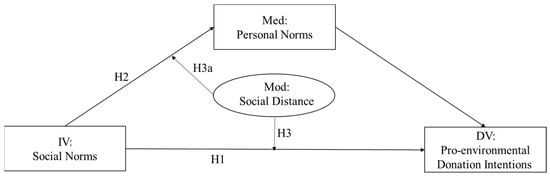
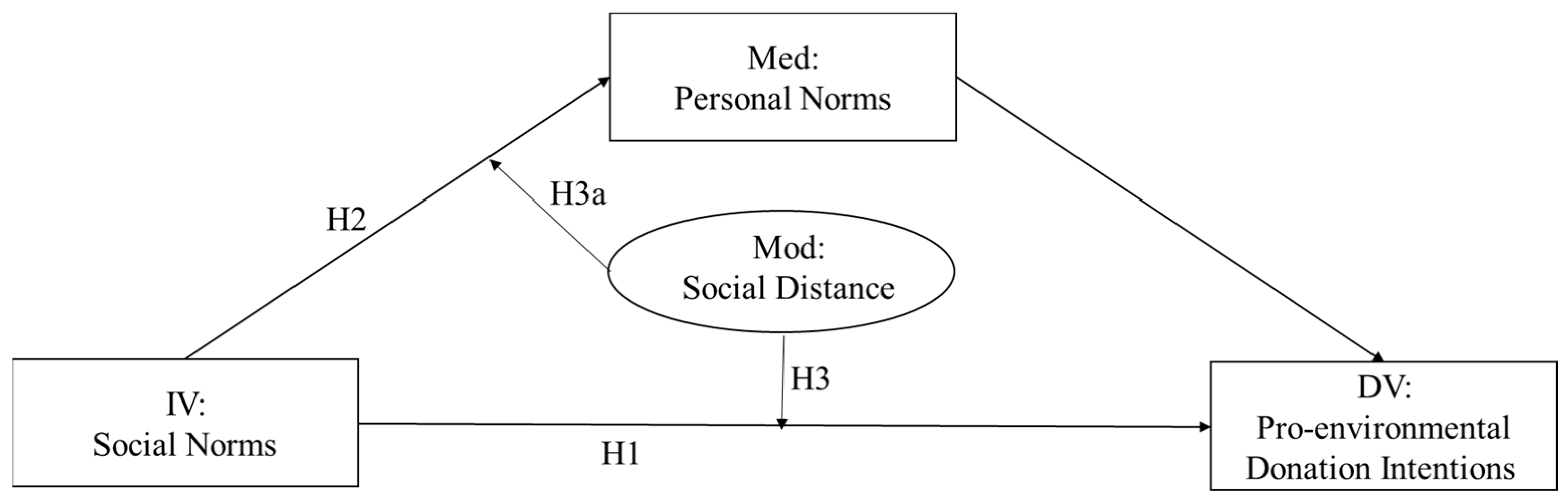
Based on the previous review and analysis of the literature related to social norms and pro-environmental donations, this study aims to explore the mechanisms through which social norms, personal norms, social distance, and pro-environmental donation intentions interact. To systematically integrate the relationships between these variables, this study constructs a moderated mediation model, as shown in Figure 1. The core proposition of this model is that social norms indirectly influence individuals’ willingness to donate to pro-environmental causes by stimulating their sense of moral obligation (i.e., personal norms), and this “norm internalization” process is moderated by the individual’s perceived social distance. The following sections will provide detailed theoretical derivations and discussions of these three hypotheses.
Figure 1.
Analytical framework.
3.1. Impact of Social Norms on Pro-Environmental Donation Intentions
Social norms, as key external situational factors shaping individual decisions and behaviors, have been widely acknowledged in pro-environmental behavior research [12,30,34,36]. In the context of pro-environmental donations, decision-making involves not only financial cost calculations but also deeper connections to self-concept, social image, and moral identity [53]. Different social norm types exert their effects through distinct psychological pathways. Descriptive norms, by revealing “what most people are actually doing,” provide behavioral reference points driven by conformity motives and decision-making efficiency, and their effectiveness depends on the perception of general behavioral trends [54]. However, when general behavior levels are low or deviate from ideal standards, descriptive norms may justify inaction or trigger the “broken window effect,” thereby generating vague or weak behavioral intentions [55].
In contrast, injunctive social norms clarify “what people should do,” directly appealing to moral cognition and social responsibility [26]. They extend beyond factual descriptions and invoke normative judgments about “right and wrong” and “should and should not” [56]. Pro-environmental donations, by their very nature, involve altruistic and moral signaling, aligning closely with the “ought-to” nature of injunctive norms. Specifically, injunctive norms operate through two pathways. The first is the intrinsic moral pathway: it activates and connects the internal desire for social respect and moral self-image, motivating individuals to demonstrate their identity as a “responsible social member” through donation. The second is the external pressure pathway: they provide social evaluation criteria and behavioral guidelines that help overcome decision inertia—the conflict between personal immediate costs and the long-term environmental benefits—by providing critical external motivation [57,58].
Thus, in the specific decision-making domain of pro-environmental donations, given moral considerations, image management, and cost-bearing, injunctive social norms more effectively mobilize both internal identity and external evaluation, as they directly anchor social expectations and moral principles. This makes injunctive norms more powerful in driving behavior than descriptive norms.
Based on this theoretical reasoning, the following core hypothesis is proposed in this study:
H1.
Compared to descriptive social norms, injunctive social norms will more effectively enhance the public’s intentions to make pro-environmental donations.
3.2. Mediating Role of Personal Norms
The influence of external social norms on individual behavior is not a simple stimulus-response process; it must pass through the individual’s internal cognitive system. Norm activation theory emphasizes that external norms must activate the individual’s internal sense of moral obligation—i.e., personal norms—for behavioral motivation to occur [59]. Personal norms represent internalized feelings of obligation and responsibility toward performing or avoiding specific behaviors and serve as a bridge connecting the external social world with the internal self-concept [59,60,61].
In this study’s context, when individuals perceive norm information from a reference group, they undergo cognitive and emotional evaluation [62]. This process begins with awareness of consequences, where individuals assess the outcomes of compliance or violation, forming a preliminary motivation based on external evaluations. They then evaluate their responsibility for these outcomes and whether their actions matter [59]. Injunctive norms, by conveying collective expectations and moral standards, strongly encourage individuals to attribute environmental responsibility to themselves, creating a self-commitment of “I should contribute.” This transformation of responsibility from external to internal is at the core of the activation of personal norms. Once activated, personal norms shift from static values to intrinsic motivation. Their power stems from the desire for moral self-consistency and affirmation from acting in line with one’s values [63,64,65]. Therefore, personal norms provide a more stable and enduring motive than external pressure.
Based on this, we propose the following hypothesis:
H2.
Personal norms mediate the relationship between social norm type and pro-environmental donation intentions. Specifically, injunctive norms (compared to descriptive norms) will more effectively activate personal norms, thereby enhancing donation intentions.
3.3. Moderating Role of Social Distance
Construal level theory (CLT) posits that social distance is a fundamental dimension shaping individual cognition and decision-making [66]. The proximity of distance influences how individuals process information—either in an abstract or concrete manner [67]. Social norms, as signals guiding behavior, do not exert uniform influence but are deeply embedded in the social relationship between the individual and the reference group. Social distance moderates norm effects through two core mechanisms: social identification and emotional connection.
Under close social distance, individuals share strong emotional bonds and identity alignment with the reference group [68]. This sense of belonging promotes the internalization of group norms. Injunctive norms are particularly effective in such contexts because they align with mutual expectations, trust, and moral obligation within close relationships [69,70,71]. The normative expectations of close friends and family can activate an individual’s sense of responsibility and compliance motivation, making injunctive norms more effective in promoting pro-environmental donations in a familiar social context.
Under distant social distance, individuals lack emotional connections and identity resonance with the reference group. The relationship is essentially anonymous, distant, and instrumental. This sense of distance weakens the individual’s emotional investment in group norms, leading to a general decrease in sensitivity to external social norm information [72]. Neither injunctive nor descriptive norms are likely to evoke a strong sense of group belonging or moral pressure. Due to the absence of an emotional foundation, the effectiveness of both norm types in influencing individual decisions is limited. Therefore, their impact on pro-environmental donation intentions is expected to be similar. In distant contexts, social norms still have an instrumental signaling function, but their incremental influence through social-emotional pathways is significantly weakened.
Based on this, we propose the following hypothesis and sub-hypothesis:
H3.
Social distance moderates the influence of social norm type on pro-environmental donation intentions.
H3a.
Specifically, social distance will moderate the effect of social norm type on personal norms. Compared to close social distance contexts, in distant social distance contexts, injunctive social norms (as opposed to descriptive social norms) will have a stronger activation effect on personal norms.
4. Research Method and Experimental Design
This study employs two online experiments to test the hypotheses. Experiment 1 examined the impact of social norms on pro-environmental donation intentions and the mediating role of personal norms (Hypotheses 1 and 2); Experiment 2 investigated the moderating effect of social distance on the relationship between social norms and donation intentions (corresponding to Hypothesis 3). Both experiments were implemented via the professional online data collection platform Credamo, which has more than 2.8 million registered participants across China and covers various regions, age groups, education levels, and income brackets. Credamo’s sample quality has been recognized by international journals across disciplines [73,74,75]. During the sampling process, the platform’s “random block” function assigned participants to experimental groups randomly to ensure group comparability. This study adheres to academic ethical standards. Before beginning, participants read an informed consent form, which clearly communicated the purpose, the use of data, and the voluntary nature of participation. Participants could only proceed after agreeing to the terms. The study received ethical approval from the institutional review board. To protect participants’ privacy, all data were anonymized, and no personal identification information was collected. After completing the experiment, participants received modest compensation through the platform. The following sections describe procedures and materials used for both experiments.
4.1. Experiment 1: Research Design and Participants
Experiment 1 adopts a one-factor between-subjects design (descriptive norms vs. injunctive norms) on pro-environmental donation intentions and tests the mediating role of personal norms. After random assignment, participants provided demographic information, followed by reading the background introduction of an environmental protection project. The normative manipulation information differed between the two groups. In the descriptive norms group, the manipulation content was as follows: “It may help to know that many people are already actively participating in environmental protection projects when making your decision. Previous data show that 86% of respondents chose to donate to support environmental protection projects after learning about the climate crisis. Participating in environmental protection has become a mainstream choice in society.” In the injunctive social norm group, the manipulation content was as follows: “It may help to know that many people believe participating in environmental protection projects is the right thing to do. Previous data show that over 86% of the adult population in China believes measures should be taken to support environmental protection projects. Please fulfill this unavoidable duty.” These manipulations were adapted from Engler et al. [76]. After reading the information, participants completed a manipulation check, a personal norms scale [77,78], and a donation intentions measurement (e.g., “To what extent would you be willing to donate to this project?”), all using a 7-point Likert scale.
The sample size for Experiment 1 was estimated using G*Power 3.1 (f = 0.25, α = 0.05, power = 0.80), yielding a sample size of 128 participants. A total of 150 responses were collected through the Credamo platform. After removing invalid responses, 137 valid samples were obtained (70 from the descriptive norm group and 67 from the injunctive norm group). The average age of the sample was 31 years, and demographic characteristics were balanced (see Table A1). A balance check confirmed that there were no significant differences between the two groups, ensuring the validity of the randomization.
4.2. Experiment 2: Research Design and Participants
Experiment 2 introduced social distance as a moderating variable and adopted a 2 × 2 (social norm type × social distance) between-subjects design to test the full theoretical model. The manipulation of social distance was adapted from existing research [79,80] by altering the reference group: for close social distance, the reference group was described as “friends and family”; for distant social distance, the reference group was described as “strangers online.” This manipulation aimed to capture the psychological distance between individuals and the reference group. The experimental procedure and measurements mirrored Experiment 1, with the addition of a manipulation check for perceived social distance [81].
Following the sample size calculation method from Experiment 1, the minimum required sample was 210 participants. A total of 400 participants were recruited; after quality screening, 360 valid responses were retained, evenly distributed across the four experimental groups. The average age of the sample was 32 years, and balance checks on demographic variables supported the effectiveness of the random assignment (see Table A2).
5. Analysis of the Experimental Results
5.1. Experiment 1: Analysis of Social Norms, Personal Norms, and Donation Intentions
5.1.1. Manipulation Check
This study examined participants’ perceptions of social norms in the experimental groups. The results are shown in Table 1. The F-test indicated that homogeneity of variance was met. A t-test on the results revealed higher perceived norms in the descriptive group (M = 6.11, SD = 0.71) compared to participants in the injunctive group (M = 5.33, SD = 1.67), F (1, 136) = 3.60, p < 0.01. This indicates that the social norm manipulation in this experiment was successful.
Table 1.
Manipulation Check Results of Social Norms in Experiment 1.
5.1.2. Main Effect Analysis
To test norm impact on pro-environmental donation intentions, we conducted a regression analysis (Table A3). Column (1) presents results without control variables; the social-norms coefficient was 0.41, which is significant at the 5% level. Column (2) includes controlling for demographic variables; the coefficient for social norms was 0.33, which is significant at the 10% level. These results indicate that social norms significantly enhance the public’s intentions to donate for environmental protection.
To further explore the differences between the descriptive and injunctive groups, we conducted a t-test on the experimental data, as shown in Table 2. In Experiment 1, the donation intentions in the injunctive social norm group were significantly higher than in the descriptive social norm group (p < 0.05), supporting Hypothesis 1.
Table 2.
Effects of Social Norms on Donation Intentions in Experiment 1.
5.1.3. Mediation Analysis
We tested the mediation role of personal norms through effect analysis. Table A3 presents the regression coefficients for the mediation effects between different variables using stepwise regression. The Bootstrap results (see Table 3) were also significant, where bs1 represents the indirect effect and bs2 the direct effect. If the confidence interval does not include 0, it indicates the presence of a mediation effect. The results suggest the existence of an indirect effect, indicating that personal norms mediate the relationship between social norms and pro-environmental donation intentions, thus supporting Hypothesis 2.
Table 3.
Bootstrap Mediation Test Results for Experiment 1.
5.2. Experiment 2: Moderating Effect of Social Distance on the Impact of Social Norms
5.2.1. Manipulation Check
This study examined participants’ perceptions of social norms in the experimental groups (Table 4). The F-test confirmed homogeneity of variance. A t-test showed that participants in the descriptive social norm group (M = 5.85, SD = 1.00) reported significantly higher perceived norms levels than those in the injunctive group (M = 4.85, SD = 1.66), F (1, 358) = 6.91, p < 0.01. This indicates successful social norm manipulation.
Table 4.
Manipulation Check Results of Social Norms in Experiment 2.
Furthermore, this study examined the participants’ perception of social distance groups, with the results shown in Table 5. The F-test indicated that the sample met the assumption of homogeneity of variance. The t-test results revealed that participants in the close social distance group (M = 23.52, SD = 2.54) reported a significantly higher perceived level of social distance compared to participants in the distant social distance group (M = 22.86, SD = 2.80), F (1, 358) = 6.91, p < 0.05. This indicates that the manipulation of social distance in this experiment was successful.
Table 5.
Manipulation Check Results of Social Distance in Experiment 2.
5.2.2. Main Effect Analysis
Regression analyses were conducted to test the impact of social norms on pro-environmental donation intentions (Table A4). Column (1) presents the regression results without including control variables. The coefficient for social norms is 0.21, significant at the 5% level. Column (2) reports results controlling demographic variables, with a coefficient for social norms of 0.15, significant at the 10% level. These results indicate that social norms significantly enhance the public’s intentions to donate.
To compare the descriptive and injunctive norm groups, a t-test on the experimental data was conducted (Table 6). In Experiment 2, the donation intentions in the injunctive norm group were significantly higher than in the descriptive norm group (p < 0.05), again supporting Hypothesis 1.
Table 6.
Effects of Social Norms on Donation Intentions in Experiment 2.
5.2.3. Mediation Effect Analysis
We next tested the mediating role of personal norms through mediation effect analysis. Table A4 provides regression coefficients for the mediation pathway using stepwise regression. Bootstrap results (Table 7), where bs1 represents the indirect effect and bs2 represents the direct effect. A confidence interval that excludes 0 indicates a mediation effect. The indirect effect was significant, indicating that personal norms mediate the relationship between social norms and donation intentions, supporting Hypothesis 2.
Table 7.
Bootstrap Mediation Test Results for Experiment 2.
5.2.4. Moderating Effect of Social Distance
Based on the data analysis, regression results show that the interaction between social norm type and social distance significantly affects both pro-environmental donation intentions and personal norms (see Table 8). For donation intentions, the interaction coefficient is −0.349, significant at the 5% level, indicating that social distance negatively moderates the relationship between social norm type and donation intentions, supporting Hypothesis 3.
Table 8.
Moderating Effect of Social Distance in Experiment 2.
When personal norms are the dependent variable, the interaction term between social norms and social distance has a coefficient of −0.99, significant at the 10% level. This means that social distance moderates the first half of the mediation pathway, supporting H3a.
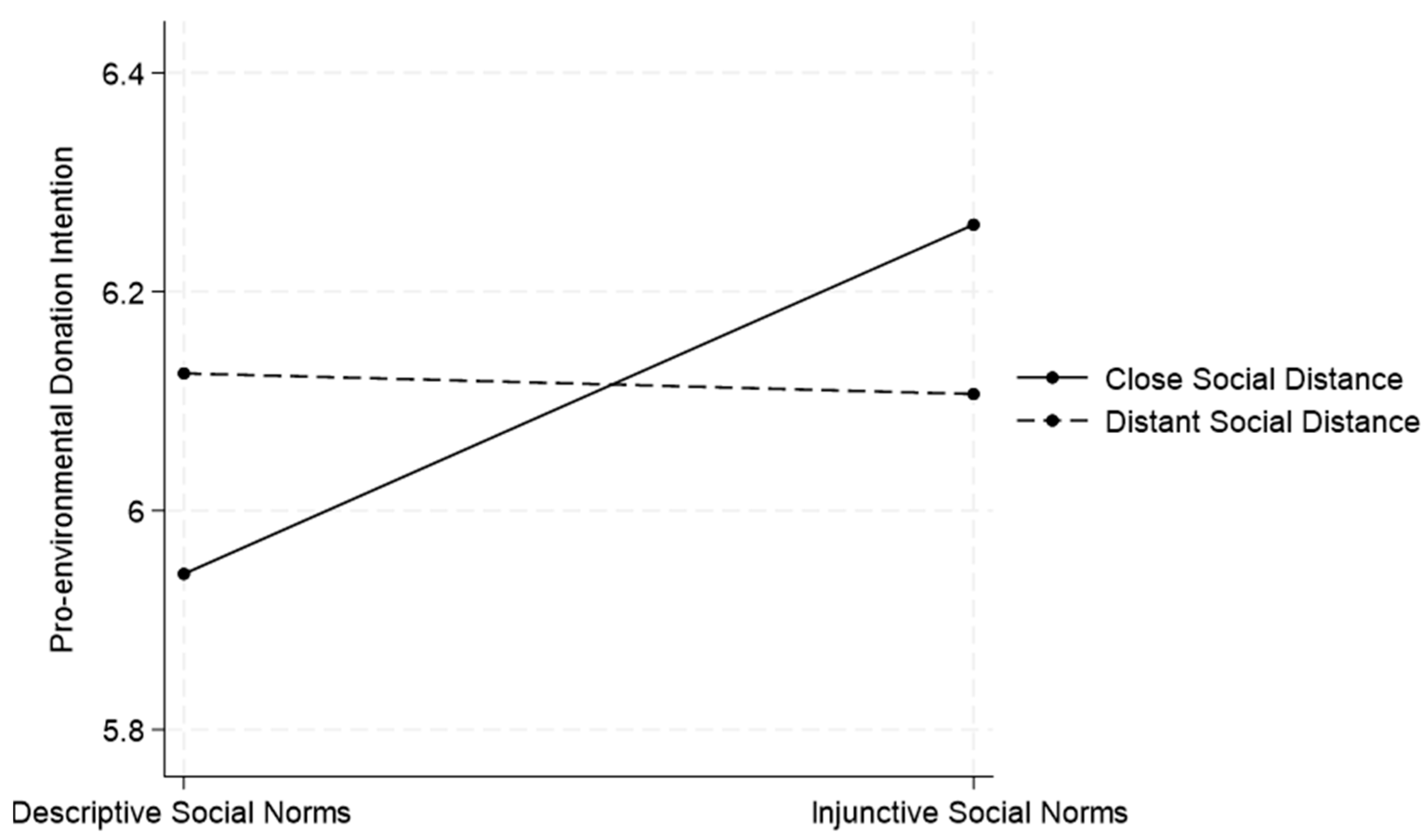
To clarify the specific moderating pattern, a simple-effects analysis graph was generated (Figure 2). The figure shows that under close social distance, injunctive norms more strongly promote donation intentions than descriptive norms. Under distant social distance, this difference diminishes substantially, and the relative advantage of injunctive norms nearly disappears.
Figure 2.
Interaction Effect of Social Norms and Social Distance.
6. Discussion and Conclusions
6.1. Discussion
Global environmental challenges continue to intensify, while environmental initiatives often face persistent funding shortages [82]. Against this backdrop, pro-environmental donations, linking individual willingness with collective action, are therefore essential for advancing sustainable development [83,84,85]. Understanding how to stimulate public willingness to donate has become an important issue in environmental protection and public policy. Based on this, the study conducted two online experiments to examine the effects of injunctive and descriptive social norms on pro-environmental donation intentions, the mediating role of personal norms, and the moderating role of social distance. Together, the study leads to the following four key findings:
First, injunctive social norms are more effective than descriptive norms in promoting donation intentions. In the experimental context, environmental donations were framed as morally significant behavior. Injunctive norms heightened donation intentions by directly appealing to moral obligation and social expectations (“this is the right thing to do”). In contrast, descriptive norms provided behavioral reference points but exerted a weaker influence in moral contexts. This result aligns with theoretical expectations and prior research, indicating that injunctive norms are more effective in promoting pro-environmental behavior [86,87,88]. Thus, when advocating environmental donations, highlighting moral standards may be more compelling than highlighting the prevalence of donations.
Second, personal norms serve as a key mediator in this pathway of influence. The experimental data support norm activation theory: external norms must activate an individual’s internal moral standards to generate behavioral motivation [59]. The study found that injunctive norms were more effective at activating personal norms, i.e., reinforcing an individual’s sense of moral obligation: “I have a responsibility to do this.” This result reaffirms the role of moral emotions in pro-environmental behaviors [89]. The confirmation not only links the external influence of social norms but also provides a concrete empirical pathway for understanding internalized personal actions.
Third, social distance significantly moderates the effects of social norm type. Norm influence is not fixed, but shaped by the psychological distance from the reference group. Under close social distance (e.g., friends and family), strong identity and emotional connections increase the credibility and internalization of injunctive norms, making them significantly outperform descriptive norms. In contrast, under distant social distance (e.g., online strangers), emotional ties and identity foundations are weak, reducing the persuasive impact of both norm types and minimizing differences between them. This finding accurately supports and extends theoretical discussions on psychological distance and social influence [90].
Fourth, under descriptive norms, distant social distance can show stronger persuasive effects than close distance. This phenomenon may be driven by the following psychological mechanism: when the reference group consists of strangers, individuals may focus more on general social realities than on maintaining close relationships. The macro-level behavior about “what most strangers do” provided by descriptive norms may be perceived as a more objective, less emotionally pressured signal of social reality. This finding deepens our understanding of the “distance-norm” interaction effect, suggesting that descriptive norms may hold specific advantages in distant, low-emotional involvement contexts.
6.2. Theoretical Contributions
This study presents the following theoretical contributions to research on how social norms influence pro-environmental donations:
First, it systematically reveals the matching effect between social norm type and psychological distance, promoting the refinement and contextualization of social norm theory. To address existing inconsistencies regarding the effects of descriptive versus injunctive norms, this study introduces social distance as a moderating variable and empirically finds a matching relationship between them. This not only clarifies the boundary conditions for norm effectiveness but also overcomes limitations of previous research that often examined normative influences in isolation. The resulting framework highlights the synergy between norm type and psychological distance, advancing social norm theory from “universal conclusions” to “contextual mechanisms,” and providing a theoretical basis for selecting effective interventions across diverse settings.
Second, this study elaborates the internal psychological transformation path through which social norms influence pro-environmental behaviors and proposes an integrated “social-psychological-behavioral” model. While previous research has widely focused on the impact of social norms on behavior, the underlying psychological mechanisms have not been thoroughly explored. By incorporating personal norms into the mediating mechanism and empirically validating their role, this study illustrates how external norms activate moral motivations and subsequently strengthen behavioral intention. This introduces a clearer link between external social influence and internal moral motivation, thereby forming a comprehensive “social-psychological-behavioral” paradigm and enriching the theoretical framework for fostering pro-environmental behavior.
6.3. Practical Implications
This study offers three core insights for environmental advocacy and public communication:
First, injunctive norms should be prioritized in appeals for environmental donations. Given these norms more effectively stimulate pro-environmental donations, communication practices should instead adopt clear value-based messages, such as “This is our responsibility,” to more effectively awaken individuals’ sense of moral obligation.
Second, activating personal norms is essential. External social norms must be internalized into a sense of moral obligation to drive action. Advocacy content should intentionally facilitate this internalization—through embodied storytelling, empathy for consequences, or emphasizing efficacy—to help the audience form a clear recognition of “I am responsible to act,” thus stimulating more stable and autonomous behavioral intentions.
Third, environmental advocacy strategies should be based on social distance. For groups with close social distance (e.g., internal members), injunctive norms should be reinforced to evoke responsibility based on shared identity. For audiences with distant social distance, strategies should be more flexible: potentially combining descriptive and injunctive information or first fostering shared identity to reduce psychological distance. In particular, when using descriptive norms, distant references like “most people” may effectively trigger widespread behavioral convergence toward objective social reality.
6.4. Limitations and Future Research Directions
This study has several limitations, and future research could further deepen understanding in the following ways:
First, the generalizability of the sample and conclusion has clear boundaries. Participants in both experiments were primarily recruited from online platforms in China, with a sample predominantly composed of young and highly educated individuals. While this sample composition aligns with the study’s focus on exploring cognitive decision-making mechanisms, the conclusions may not be directly applicable to other cultural contexts, older adults, or broader pro-environmental behavior scenarios beyond donations. Future research could conduct cross-cultural and multi-sample replication studies to test the external validity and boundary conditions of the proposed model.
Second, the research variables and mechanisms could be further expanded. While this study examined personal norms and social distance, pro-environmental donation decisions involve complex psychological processes that may involve emotional responses, cost perceptions, and social identity, factors not included in the current model. Future research could construct more integrated models to explore the synergistic or competing effects of multiple mechanisms. Moreover, this study measured immediate behavioral intentions, which means long-term effects and their dynamic changes in norm influence remain unclear. Longitudinal designs would help address this gap.
Third, there is room for improvement in the research methodology. Although the experimental methods ensured internal validity, the manipulation of social distance was simplified. In real contexts, social distance is multi-dimensional, including social class, time, space, and identity. Future research could adopt more ecologically valid and multi-dimensional manipulations to capture the psychological connotations of social distance more comprehensively. Additionally, despite attention checks in online experiments, self-selection bias within the sample could not be eliminated. Future studies could combine stratified sampling, field experiments, or longitudinal surveys to test the robustness of the findings across more representative samples.
Author Contributions
Conceptualization, S.Z.; Methodology, S.Z.; Software, S.Z.; Data curation, S.Z.; Writing—original draft, S.Z.; Writing—review & editing, S.Z.; Supervision, K.Y.; Project administration, K.Y.; Funding acquisition, K.Y. All authors have read and agreed to the published version of the manuscript.
Funding
This research received no external funding.
Institutional Review Board Statement
Ethical review and approval were waived for this study due to its anonymous, minimal-risk, and non-interventional design involving competent adults and the fact that no identifiable data were collected.
Informed Consent Statement
Informed consent was obtained from all subjects involved in the study.
Data Availability Statement
The original contributions presented in this study are included in the article. Further inquiries can be directed to the corresponding author.
Conflicts of Interest
The authors declare no conflicts of interest.
Appendix A
Table A1.
Demographic Information of Participants in Experiment 1.
Table A2.
Demographic Information of Participants in Experiment 2.
Table A3.
The Mediating Role of Personal Norms in Experiment 1.
Table A4.
The Mediating Role of Personal Norms in Experiment 2.
References
- Farrow, K.; Grolleau, G.; Ibanez, L. Social Norms and Pro-Environmental Behavior: A Review of the Evidence. Ecol. Econ. 2017, 140, 1–13. [Google Scholar] [CrossRef] [Scilit]
- Flecke, S.L.; Huber, J.; Kirchler, M.; Schwaiger, R. Nature Experiences and Pro-Environmental Behavior: Evidence from a Randomized Controlled Trial. J. Environ. Psychol. 2024, 99, 102383. [Google Scholar] [CrossRef] [Scilit]
- Lange, F.; Dewitte, S. Non-Monetary Reinforcement Effects on pro-Environmental Behavior. J. Econ. Psychol. 2023, 97, 102628. [Google Scholar] [CrossRef] [Scilit]
- Nyborg, K.; Anderies, J.M.; Dannenberg, A.; Lindahl, T.; Schill, C.; Schlüter, M.; Adger, W.N.; Arrow, K.J.; Barrett, S.; Carpenter, S.; et al. Social Norms as Solutions. Science 2016, 354, 42–43. [Google Scholar] [CrossRef] [Scilit] [PubMed]
- Venhoeven, L.; Bolderdijk, J.; Steg, L. Explaining the Paradox: How Pro-Environmental Behaviour Can Both Thwart and Foster Well-Being. Sustainability 2013, 5, 1372–1386. [Google Scholar] [CrossRef] [Scilit]
- Andrighetto, G.; Gavrilets, S.; Gelfand, M.; Mace, R.; Vriens, E. Social Norm Change: Drivers and Consequences. Phil. Trans. R. Soc. B 2024, 379, 20230023. [Google Scholar] [CrossRef] [Scilit] [PubMed]
- Gross, J.; Vostroknutov, A. Why Do People Follow Social Norms? Curr. Opin. Psychol. 2022, 44, 1–6. [Google Scholar] [CrossRef] [Scilit]
- Abrahamse, W.; Steg, L. Social Influence Approaches to Encourage Resource Conservation: A Meta-Analysis. Glob. Environ. Chang. 2013, 23, 1773–1785. [Google Scholar] [CrossRef] [Scilit]
- Goldstein, N.J.; Cialdini, R.B.; Griskevicius, V. A Room with a Viewpoint: Using Social Norms to Motivate Environmental Conservation in Hotels. J. Consum. Res. 2008, 35, 472–482. [Google Scholar] [CrossRef] [Scilit]
- Klöckner, C.A. A Comprehensive Model of the Psychology of Environmental Behaviour—A Meta-Analysis. Glob. Environ. Chang. 2013, 23, 1028–1038. [Google Scholar] [CrossRef] [Scilit]
- Allcott, H. Social Norms and Energy Conservation. J. Public Econ. 2011, 95, 1082–1095. [Google Scholar] [CrossRef] [Scilit]
- Kormos, C.; Gifford, R.; Brown, E. The Influence of Descriptive Social Norm Information on Sustainable Transportation Behavior: A Field Experiment. Environ. Behav. 2015, 47, 479–501. [Google Scholar] [CrossRef] [Scilit]
- Mundaca, L.; Román-Collado, R.; Cansino, J.M. Assessing the Impacts of Social Norms on Low-Carbon Mobility Options. Energy Policy 2022, 162, 112814. [Google Scholar] [CrossRef] [Scilit]
- Liu, X.; Chen, S.; Guo, X.; Fu, H. Can Social Norms Promote Recycled Water Use on Campus? The Evidence From Event-Related Potentials. Front. Psychol. 2022, 13, 818292. [Google Scholar] [CrossRef] [Scilit] [PubMed]
- Do, V.T.H.; Do, L.T. The Effectiveness of Social Norms in Promoting Green Consumption. Soc. Responsib. J. 2024, 20, 444–461. [Google Scholar] [CrossRef] [Scilit]
- Liang, D.; Fu, Y.; Liu, M.; Sun, J.; Wang, H. Promoting Low-Carbon Purchase from Social Norms Perspective. Behav. Sci. 2023, 13, 854. [Google Scholar] [CrossRef] [Scilit]
- Bergquist, M.; Nilsson, A.; Schultz, W.P. A Meta-Analysis of Field-Experiments Using Social Norms to Promote pro-Environmental Behaviors. Glob. Environ. Chang. 2019, 59, 101941. [Google Scholar] [CrossRef] [Scilit]
- Schultz, P.W.; Estrada, M.; Schmitt, J.; Sokoloski, R.; Silva-Send, N. Using In-Home Displays to Provide Smart Meter Feedback about Household Electricity Consumption: A Randomized Control Trial Comparing Kilowatts, Cost, and Social Norms. Energy 2015, 90, 351–358. [Google Scholar] [CrossRef] [Scilit]
- Cialdini, R.B.; Reno, R.R.; Kallgren, C.A. A Focus Theory of Normative Conduct: Recycling the Concept of Norms to Reduce Littering in Public Places. J. Personal. Soc. Psychol. 1990, 58, 1015–1026. [Google Scholar] [CrossRef]
- Simonson, I.; Carmon, Z.; Dhar, R.; Drolet, A.; Nowlis, S.M. Consumer Research: In Search of Identity. Annu. Rev. Psychol. 2001, 52, 249–275. [Google Scholar] [CrossRef] [Scilit]
- Zhang, W.; Liu, Y.; Dong, Y.; He, W.; Yao, S.; Xu, Z.; Mu, Y. How We Learn Social Norms: A Three-Stage Model for Social Norm Learning. Front. Psychol. 2023, 14, 1153809. [Google Scholar] [CrossRef] [Scilit]
- Dannals, J.E.; Li, Y. A Theoretical Framework for Social Norm Perception. Res. Organ. Behav. 2024, 44, 100211. [Google Scholar] [CrossRef] [Scilit]
- Lapinski, M.K.; Rimal, R.N. An Explication of Social Norms. Commun. Theory 2005, 15, 127–147. [Google Scholar] [CrossRef]
- Reno, R.R.; Cialdini, R.B.; Kallgren, C.A. The Transsituational Influence of Social Norms. J. Personal. Soc. Psychol. 1993, 64, 104–112. [Google Scholar] [CrossRef]
- Dannals, J.E.; Miller, D.T. Social Norm Perception in Groups with Outliers. J. Exp. Psychol. Gen. 2017, 146, 1342–1359. [Google Scholar] [CrossRef] [Scilit] [PubMed]
- Scharding, T.K.; Warren, D.E. When Are Norms Prescriptive? Understanding and Clarifying the Role of Norms in Behavioral Ethics Research. Bus. Ethics Q. 2024, 34, 331–364. [Google Scholar] [CrossRef] [Scilit]
- Croson, R.; Handy, F.; Shang, J. Keeping up with the Joneses: The Relationship of Perceived Descriptive Social Norms, Social Information, and Charitable Giving. Nonprofit Manag. Leadersh. 2009, 19, 467–489. [Google Scholar] [CrossRef] [Scilit]
- Bartke, S.; Friedl, A.; Gelhaar, F.; Reh, L. Social Comparison Nudges—Guessing the Norm Increases Charitable Giving. Econ. Lett. 2017, 152, 73–75. [Google Scholar] [CrossRef] [Scilit]
- Mollen, S.; Rimal, R.N.; Ruiter, R.A.C.; Kok, G. Healthy and Unhealthy Social Norms and Food Selection. Find. A Field-Experiment. Appet. 2013, 65, 83–89. [Google Scholar] [CrossRef] [Scilit]
- Ferraro, P.J.; Miranda, J.J.; Price, M.K. The Persistence of Treatment Effects with Norm-Based Policy Instruments: Evidence from a Randomized Environmental Policy Experiment. Am. Econ. Rev. 2011, 101, 318–322. [Google Scholar] [CrossRef] [Scilit]
- Bergquist, M.; Ekelund, M. The Role of Emotion Regulation in Normative Influence under Uncertainty. BMC Psychol. 2025, 13, 731. [Google Scholar] [CrossRef] [Scilit]
- Liu, R.W.; Foerster, T.A.; Zhuang, J. Bagging a Greener Future: Social Norms Appeals and Financial Incentives in Promoting Reusable Bags Among Grocery Shoppers. Sustainability 2025, 17, 4157. [Google Scholar] [CrossRef] [Scilit]
- Gimpel, H.; Heger, S.; Olenberger, C.; Utz, L. The Effectiveness of Social Norms in Fighting Fake News on Social Media. J. Manag. Inf. Syst. 2021, 38, 196–221. [Google Scholar] [CrossRef] [Scilit]
- Schorn, A. Why Should I When No One Else Does? A Review of Social Norm Appeals to Promote Sustainable Minority Behavior. Front. Psychol. 2024, 15, 1415529. [Google Scholar] [CrossRef] [Scilit] [PubMed]
- Schultz, P.W.; Nolan, J.M.; Cialdini, R.B.; Goldstein, N.J.; Griskevicius, V. The Constructive, Destructive, and Reconstructive Power of Social Norms. Psychol. Sci. 2007, 18, 429–434. [Google Scholar] [CrossRef] [Scilit]
- Ge, W.; Sheng, G.; Zhang, H. How to Solve the Social Norm Conflict Dilemma of Green Consumption: The Moderating Effect of Self-Affirmation. Front. Psychol. 2020, 11, 566571. [Google Scholar] [CrossRef] [Scilit]
- Ibanez, L.; Roussel, S. The Impact of Nature Video Exposure on Pro-Environmental Behavior: An Experimental Investigation. PLoS ONE 2022, 17, e0275806. [Google Scholar] [CrossRef] [Scilit]
- Spatola, N. The Interplay of Identity Fusion, Social Norms, and pro-Environmental Behavior: An Exploration Using the Dictator Game: Identity Fusion & Environmental Decision. J. Soc. Psychol. 2024, 124, 1–16. [Google Scholar] [CrossRef] [Scilit]
- Fanghella, V.; d’Adda, G.; Tavoni, M. On the Use of Nudges to Affect Spillovers in Environmental Behaviors. Front. Psychol. 2019, 10, 61. [Google Scholar] [CrossRef] [Scilit]
- Eby, B.; Carrico, A.R.; Truelove, H.B. The Influence of Environmental Identity Labeling on the Uptake of Pro-Environmental Behaviors. Clim. Chang. 2019, 155, 563–580. [Google Scholar] [CrossRef] [Scilit]
- Kusch, S.; Krebs, R.M.; Lange, F. Value through Cognitive Effort: Working for an Environmental Organization Increases Subsequent Donations. J. Environ. Psychol. 2025, 107, 102771. [Google Scholar] [CrossRef] [Scilit]
- Ibanez, L.; Moureau, N.; Roussel, S. How Do Incidental Emotions Impact Pro-Environmental Behavior? Evidence from the Dictator Game. J. Behav. Exp. Econ. 2017, 66, 150–155. [Google Scholar] [CrossRef] [Scilit]
- Bergquist, M.; Nyström, L.; Nilsson, A. Feeling or Following? A Field-experiment Comparing Social Norms-based and Emotions-based Motives Encouraging Pro-environmental Donations. J. Consum. Behav. 2020, 19, 351–358. [Google Scholar] [CrossRef] [Scilit]
- Sollberger, S.; Bernauer, T.; Ehlert, U. Stress Influences Environmental Donation Behavior in Men. Psychoneuroendocrinology 2016, 63, 311–319. [Google Scholar] [CrossRef] [Scilit]
- Eom, K.; Tok, T.Q.H.; Saad, C.S.; Kim, H.S. Religion, Environmental Guilt, and pro-Environmental Support: The Opposing Pathways of Stewardship Belief and Belief in a Controlling God. J. Environ. Psychol. 2021, 78, 101717. [Google Scholar] [CrossRef] [Scilit]
- Zemo, K.H.; Nigus, H.Y. Does Religion Promote Pro-Environmental Behaviour? A Cross-Country Investigation. J. Environ. Econ. Policy 2021, 10, 90–113. [Google Scholar] [CrossRef] [Scilit]
- Andrzej Lipinski, P.; Kunkle, S.; Lange, F. Effects of Financial Incentives on Pro-Environmental Behavior before and after Incentive Discontinuation. J. Environ. Psychol. 2025, 105, 102638. [Google Scholar] [CrossRef] [Scilit]
- Yang, S.; Liu, Y. Lower Perceived Economic Mobility Inhibits Pro-Environmental Engagement by Increasing Cynicism. Soc. Psychol. Personal. Sci. 2025, 16, 802–814. [Google Scholar] [CrossRef] [Scilit]
- Winter, K.; Pummerer, L.; Sassenberg, K. Not That Different after All: Pro-environmental Social Norms Predict Pro-environmental Behaviour (Also) among Those Believing in Conspiracy Theories. Br. J. Psychol. 2025, 1–25. [Google Scholar] [CrossRef] [Scilit] [PubMed]
- Wu, Y.; Chen, Y.; Jin, C.; Qin, J.; Zheng, L.; Chen, Y. Working-Together Normative Appeals to Promote Pro-Environmental Donations. Behav. Sci. 2024, 14, 273. [Google Scholar] [CrossRef] [Scilit] [PubMed]
- Vesely, S.; Klöckner, C.A. How Anonymity and Norms Influence Costly Support for Environmental Causes. J. Environ. Psychol. 2018, 58, 27–30. [Google Scholar] [CrossRef] [Scilit]
- Tan, M.; Li, M.; Li, H.; Li, J.; Chang, Y.; Zhang, G.; Zhong, Y. Environmental Protection or Self-Interest? The Public Accountability Moderates the Effects of Materialism and Advertising Appeals on the Pro-Environmental Behavior. Psychol. Res. Behav. Manag. 2022, 15, 3275–3286. [Google Scholar] [CrossRef] [Scilit]
- Binder, M.; Blankenberg, A.-K. Green Lifestyles and Subjective Well-Being: More about Self-Image than Actual Behavior? J. Econ. Behav. Organ. 2017, 137, 304–323. [Google Scholar] [CrossRef] [Scilit]
- Irwin, K.; Simpson, B. Do Descriptive Norms Solve Social Dilemmas? Conformity and Contributions in Collective Action Groups. Soc. Forces 2013, 91, 1057–1084. [Google Scholar] [CrossRef] [Scilit]
- Ozaki, T.; Nakayachi, K. When Descriptive Norms Backfire: Attitudes Induce Undesirable Consequences during Disaster Preparation. Anal. Soc. Issues Public Policy 2020, 20, 90–117. [Google Scholar] [CrossRef] [Scilit]
- Ng, N.L.; Luke, D.M.; Gawronski, B. Thinking About Reasons for One’s Choices Increases Sensitivity to Moral Norms in Moral-Dilemma Judgments. Personal. Soc. Psychol. Bull. 2023, 51, 01461672231180760. [Google Scholar] [CrossRef] [Scilit] [PubMed]
- Fieldhouse, E.; Cutts, D.; Bailey, J. Who Cares If You Vote? Partisan Pressure and Social Norms of Voting. Political Behav. 2022, 44, 1297–1316. [Google Scholar] [CrossRef] [Scilit]
- Scholl, A.; Sassenberg, K.; Pfattheicher, S. Pressured to Be Excellent? Social Identification Prevents Negative Affect from High University Excellence Norms. J. Exp. Soc. Psychol. 2019, 84, 103796. [Google Scholar] [CrossRef] [Scilit]
- Schwartz, S.H. Normative Influences on Altruism. In Advances in Experimental Social Psychology; Elsevier: Amsterdam, The Netherlands, 1977; Volume 10, pp. 221–279. ISBN 978-0-12-015210-0. [Google Scholar]
- Bertoldo, R.; Castro, P. The Outer Influence inside Us: Exploring the Relation between Social and Personal Norms. Resour. Conserv. Recycl. 2016, 112, 45–53. [Google Scholar] [CrossRef] [Scilit]
- Schwartz, M.; Carrasquer, G.; Rehm, W.S. Effect of Reduced pH in Absence of HCO3− on Anomalous and Normal Potential Responses in Bullfrog Antrum. Biochim. Biophys. Acta (BBA) Biomembr. 1984, 773, 189–196. [Google Scholar] [CrossRef] [Scilit]
- Sözer, E.G.; Civelek, M.E.; Ertemel, A.V.; Pehlivanoğlu, M.Ç. The Determinants of Green Purchasing in the Hospitality Sector: A Study on the Mediation Effect of LOHAS Orientation. Sustainability 2024, 16, 10590. [Google Scholar] [CrossRef] [Scilit]
- Elhoushy, S.; Ribeiro, M.A. Socially Responsible Consumers and Stockpiling during Crises: The Intersection of Personal Norms and Fear. Soc. Responsib. J. 2024, 20, 180–203. [Google Scholar] [CrossRef] [Scilit]
- Han, W.; Wang, Y.; Scott, M. Social Media Activation of Pro-Environmental Personal Norms: An Exploration of Informational, Normative and Emotional Linkages to Personal Norm Activation. J. Travel Tour. Mark. 2021, 38, 568–581. [Google Scholar] [CrossRef] [Scilit]
- Trujillo, C.A.; Estrada-Mejia, C.; Rosa, J.A. Norm-Focused Nudges Influence pro-Environmental Choices and Moderate Post-Choice Emotional Responses. PLoS ONE 2021, 16, e0247519. [Google Scholar] [CrossRef] [Scilit] [PubMed]
- Trope, Y.; Liberman, N. Construal-Level Theory of Psychological Distance. Psychol. Rev. 2010, 117, 440–463. [Google Scholar] [CrossRef] [Scilit]
- Lee, S.J. The Role of Construal Level in Message Effects Research: A Review and Future Directions. Commun. Theory 2019, 29, 231–250. [Google Scholar] [CrossRef] [Scilit]
- Stephan, E.; Liberman, N.; Trope, Y. The Effects of Time Perspective and Level of Construal on Social Distance. J. Exp. Soc. Psychol. 2011, 47, 397–402. [Google Scholar] [CrossRef] [Scilit]
- Li, Z.; Huang, S.; Lin, Y.; Bai, L. Closer People Hurt You More: How Social Distance Modulates Deception-Triggered Trust Decline and Trust Repair. Int. J. Psychol. 2025, 60, e70095. [Google Scholar] [CrossRef] [Scilit] [PubMed]
- Szczepaniak, Z.; Gaboriaud, A.; Quinton, J.-C.; Smeding, A. The Effects of Social Distance and Gender on Moral Decisions and Judgments: A Reanalysis, Replication, and Extension Of. Soc. Psychol. 2024, 55, 25–36. [Google Scholar] [CrossRef] [Scilit]
- Yang, X. How Perceived Social Distance and Trust Influence Reciprocity Expectations and eWOM Sharing Intention in Social Commerce. Ind. Manag. Data Syst. 2019, 119, 867–880. [Google Scholar] [CrossRef] [Scilit]
- Jia, G.; Chen, G.; Dong, J.; Liu, Y.; Yang, Q.; Wang, S. Closer Is Not Always More Credible: The Effect of Social Distance on Misinformation Processing. Appl. Cogn. Psychol. 2025, 39, e70034. [Google Scholar] [CrossRef] [Scilit]
- Fu, Y.; Ma, W.; Wu, J. Fostering Voluntary Compliance in the COVID-19 Pandemic: An Analytical Framework of Information Disclosure. Am. Rev. Public Adm. 2020, 50, 685–691. [Google Scholar] [CrossRef] [Scilit]
- Molina, M.; Nee, V.; Holm, H. Cooperation with Strangers: Spillover of Community Norms. Organ. Sci. 2023, 34, 2315–2331. [Google Scholar] [CrossRef] [Scilit]
- Wei, X.; Shen, B. Effects of Two Face Regulatory Foci About Ethical Fashion Consumption in a Confucian Context. J. Bus. Ethics 2025, 196, 807–825. [Google Scholar] [CrossRef] [Scilit]
- Engler, D.; Gutsche, G.; Simixhiu, A.; Ziegler, A. Social Norms and Individual Climate Protection Activities: A Survey Experiment for Germany. Energy Econ. 2025, 142, 108103. [Google Scholar] [CrossRef] [Scilit]
- Kim, S.H.; Seock, Y.-K. The Roles of Values and Social Norm on Personal Norms and Pro-Environmentally Friendly Apparel Product Purchasing Behavior: The Mediating Role of Personal Norms. J. Retail. Consum. Serv. 2019, 51, 83–90. [Google Scholar] [CrossRef] [Scilit]
- Niu, N.; Fan, W.; Ren, M.; Li, M.; Zhong, Y. The Role of Social Norms and Personal Costs on Pro-Environmental Behavior: The Mediating Role of Personal Norms. Psychol. Res. Behav. Manag. 2023, 16, 2059–2069. [Google Scholar] [CrossRef] [Scilit]
- Sun, Q.; Liu, Y.; Zhang, H.; Lu, J. Increased Social Distance Makes People More Risk-Neutral. J. Soc. Psychol. 2017, 157, 502–512. [Google Scholar] [CrossRef] [Scilit]
- Zhang, L.; Jin, Y.; Xia, L.; Xu, B.; Syed Abdullah, S.M. The Effects of Social Distance and Asymmetric Reward and Punishment on Individual Cooperative Behavior in Dilemma Situations. Front. Psychol. 2022, 13, 816168. [Google Scholar] [CrossRef] [Scilit]
- Hernández-Ortega, B. Don’t Believe Strangers: Online Consumer Reviews and the Role of Social Psychological Distance. Inf. Manag. 2018, 55, 31–50. [Google Scholar] [CrossRef] [Scilit]
- Corniciuc, I.; Lotti, L.; Ferrini, S.; Ceausu, S. Spatial Scale Effects on Environmental Donations: Evidence from a Revised Dictator Game Experiment with Real Payments. Ecol. Econ. 2026, 240, 108794. [Google Scholar] [CrossRef] [Scilit]
- Haverkamp, T.K.G.; Welsch, H.; Ziegler, A. The Relationship between Climate Protection Activities, Economic Preferences, and Life Satisfaction: Empirical Evidence for Germany. Energy Econ. 2023, 128, 106938. [Google Scholar] [CrossRef] [Scilit]
- Leardini, C.; Rossi, G.; Landi, S. Organizational Factors Affecting Charitable Giving in the Environmental Nonprofit Context. Sustainability 2020, 12, 8947. [Google Scholar] [CrossRef] [Scilit]
- Piao, X.; Managi, S. Altruistic Behavior for Environmental Conservation and Life Satisfaction: Evidence from 37 Nations. Environ. Dev. Sustain. 2025, 27, 6005–6034. [Google Scholar] [CrossRef] [Scilit]
- Lu, T.; Liang, D.; Hong, M. Shaping Future Generosity: The Role of Injunctive Social Norms in Intertemporal pro-Social Giving. J. Econ. Psychol. 2024, 102, 102717. [Google Scholar] [CrossRef] [Scilit]
- Raihani, N.J.; McAuliffe, K. Dictator Game Giving: The Importance of Descriptive versus Injunctive Norms. PLoS ONE 2014, 9, e113826. [Google Scholar] [CrossRef] [Scilit]
- Saleem, M.A.; Hinchcliff, M.; Papakosmas, M.; Hughes, G.; Heffernan, T. Norms-Driven Behaviour Change for GHG Reduction: A Meta-Analytic Review of High and Low Involvement Behaviours. Australas. Mark. J. 2025, 23, 51–68. [Google Scholar] [CrossRef] [Scilit]
- Takamatsu, R.; Rottman, J.; Crimston, C.R. Moral Expansiveness and Pro-Environmentalism: The Mediating Role of Moral Emotions. Cogn. Emot. 2025, 39, 1–17. [Google Scholar] [CrossRef] [Scilit]
- Scheper, J.; Bruns, S. Social Distancing in Times of Corona: A Longitudinal Study on the Role of (Mass Media-) Communication for Perceived Social Distancing Norms. Inf. Commun. Soc. 2025, 28, 1–20. [Google Scholar] [CrossRef] [Scilit]


Disclaimer/Publisher’s Note: The statements, opinions and data contained in all publications are solely those of the individual author(s) and contributor(s) and not of MDPI and/or the editor(s). MDPI and/or the editor(s) disclaim responsibility for any injury to people or property resulting from any ideas, methods, instructions or products referred to in the content. |
© 2025 by the authors. Licensee MDPI, Basel, Switzerland. This article is an open access article distributed under the terms and conditions of the Creative Commons Attribution (CC BY) license.